
Showing 224 items matching "train-lines"
-
 Federation University Historical Collection
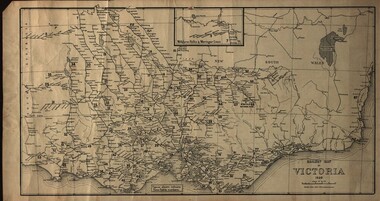
Map, Railway Map of Victoria, 1930
... ...train-lines...Cardboard map of Victorian railway system in 1930. Maps out all train-lines in Victoria and into New South Wales. ...Maps out all train-lines in Victoria and into New South Wales. ...Cardboard map of Victorian railway system in 1930. Maps out all train-lines in Victoria and into New South Wales. map, railway, train-lines, victoria, victorian railways, railway lines -
 Rutherglen Historical Society
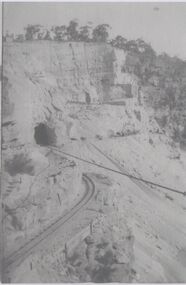
Image, c1928
... This one is of construction work on a cliff face, with train lines, tunnel and cable....Written on paper next to photo: "Detail of open cut for [illeg.]. Train lines for taking rock to crusher tunnel & stay ropes of suspension bridge showing"...This one is of construction work on a cliff face, with train lines, tunnel and cable. Image ...Photocopies of Hume Weir photographs 1928-29 One of three black and white photographs, photocopied onto a single sheet of A4 paper. This one is of construction work on a cliff face, with train lines, tunnel and cable. Written on paper next to photo: "Detail of open cut for [illeg.]. Train lines for taking rock to crusher tunnel & stay ropes of suspension bridge showing" hume weir, suspension bridge, bridges, tunnels, construction -
 Kew Historical Society Inc
Film - Digital Video Disc, Evolving Communications & Shack West, The Outer Circle: Melbourne's forgotten railway, 2014
... ...train lines -- Melbourne (vic.)...Features Dr David Beardsall, Dr Crystal Legacy, Rod Atkins, Kevin O'Shaughnessy, Sr Helen-Mary Langlands railways outer circle railway train lines -- Melbourne (vic.) 2-disc DVD on Outer Circle Railway. ...Documentary on the Outer Circle Railway, which ran from Oakleigh to Fairfield, and was opened in 1891, with the last train running in 1943. Features Dr David Beardsall, Dr Crystal Legacy, Rod Atkins, Kevin O'Shaughnessy, Sr Helen-Mary Langlands 2-disc DVD on Outer Circle Railway. railways, outer circle railway, train lines -- melbourne (vic.) -
 Bendigo Military Museum
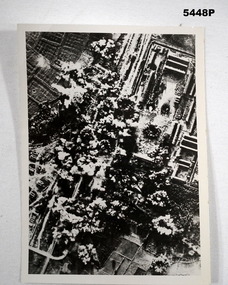
Photograph - PHOTOGRAPH, AERIAL BOMBING, 1944.-1950
... In the phot can be seen rice paddies,train lines, roads and a camp of some sort, trenches ....In the phot can be seen rice paddies,train lines, roads and a camp of some sort, trenches . ...Refer to Cat 5445.2 Black and white photograph taken during the bombing raid. In the phot can be seen rice paddies,train lines, roads and a camp of some sort, trenches . Rear Written” Nong Pladlik P.O.W camp 2nd bombing raid on camp Dec 3rd 1944 . 7 Killed Ist bombing on camp sept 7th 1944 93 Killed Stamp Imperial War Museum, Lambeth Road Wader S E 1 overwritten on stamp are some letters and 43976 ww2, p.o.w, thailand -
 Whitehorse Historical Society Inc.
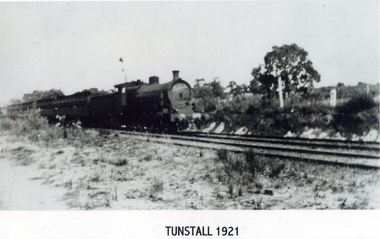
Photograph, Tunstall 1921
... Black and white photograph of a train on lines near Tunstall. No buildings....Savage and carried unanimously. tunstall 1921 railways Black and white photograph of a train on lines near Tunstall. No buildings. Tunstall 1921 Photograph Photograph ...Tunstall was named after a town in England of the same name because of the similarity of the clay. In 1945 Cr. Knox moved 'that the name of the district known as Tunstall be altered to Nunawading and the council requests that the Post Master General's Department, the Victorian Railway Commissioners and any other department concerned , give affect to such change'. This was seconded by Cr. Savage and carried unanimously. Black and white photograph of a train on lines near Tunstall. No buildings. tunstall 1921, railways -
 Victorian Interpretive Projects Inc.
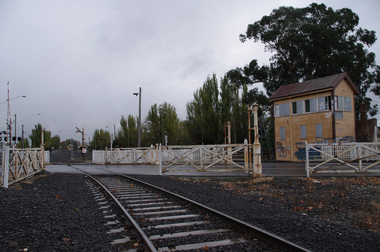
Photograph, Elaine Murphy, Ballarat Railway Gates, 03/05/2012
... Train...Ballarat Station...Lines...Signal box in foreground and Ballarat Station in the Background Railways Gates Building Signal Box Lights Tracks Train Ballarat Station Lines Road Rust Lights Ballarat Graffiti. ...Railway track running through the gates at Humffray Street (North) Ballarat. Signal box in foreground and Ballarat Station in the Background Railway track going through gates at Humffray Street (North), Ballarat. Signal box on the right of photo, Ballarat station in background. railways, gates, building, signal box, lights, tracks, train, ballarat station, lines, road, rust, lights, ballarat, graffiti. -
 Surrey Hills Historical Society Collection
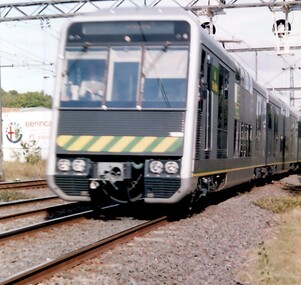
Photograph, Double deck (4D) train through Surrey Hills
... train...Belgrave Lilydale lines...lines). They were a prototype. Many station platforms had to have the coping reduced or replaced in order to provide clearance. The trial was a failure because, while the carriages carried more passengers, they also took longer to load and unload, negating any benefits from carriage of extra passengers. They were used as off-peak trains...They were manufactured from stainless steel and were fitted with air-conditioning, tinted windows, and inter-car doors, allowing passengers to access all carriages of the train. surrey hills trains tangarra carriage A Goninan & Co 4D train Belgrave Lilydale lines Double Decker train / through Surrey Hills A coloured photograph of a double decker train - silver in colour with a yellow and green strip across the front of the train. ...These were introduced in 1992 on the Lilydale-Belgrave lines only (not on the Alamein or Waverley lines). They were a prototype. Many station platforms had to have the coping reduced or replaced in order to provide clearance. The trial was a failure because, while the carriages carried more passengers, they also took longer to load and unload, negating any benefits from carriage of extra passengers. They were used as off-peak trains only on the Surrey Hills line. The 4D carriages were based on the Tangara carriage being built by A Goninan & Co for CityRail in Sydney, however they were similar only in terms of interior and exterior bodywork. They were manufactured from stainless steel and were fitted with air-conditioning, tinted windows, and inter-car doors, allowing passengers to access all carriages of the train. A coloured photograph of a double decker train - silver in colour with a yellow and green strip across the front of the train. Double Decker train / through Surrey Hills surrey hills, trains, tangarra carriage, a goninan & co, 4d train, belgrave lilydale lines -
 Vision Australia
Photograph - Image, Foto Group, Renee Williamson, May 2007
... In these images she is posing with a collection of reference books, enjoying a hot chocolate and using a white cane is disembark a tram and walk across train lines....In these images she is posing with a collection of reference books, enjoying a hot chocolate and using a white cane is disembark a tram and walk across train lines. Vision Australia Renee Williamson Orientation and mobility Library 20 digital images of Renee Williamson Renee Williamson Photograph Image Foto Group ...Renee Williamson was the Business Development Manager for Education at the Vision Australia Information and Library Service. In these images she is posing with a collection of reference books, enjoying a hot chocolate and using a white cane is disembark a tram and walk across train lines. 20 digital images of Renee Williamson vision australia, renee williamson, orientation and mobility, library -
 Ballarat Tramway Museum
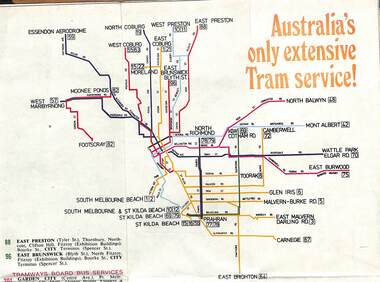
Map, Ministry of Transport, "Melbourne - Your Guide - Public Transport, No. 11, 1980", 1980
... Pocket size - folded - public transport map of Melbourne, printed in colour on heavy paper, showing public transport services in greater Melbourne and on rear, route numbers and line maps of tram routes and train lines or services. Includes private bus routes. ...Trams tramways Melbourne Map Routes On front cover, in biro, a telephone number "617 0900" Pocket size - folded - public transport map of Melbourne, printed in colour on heavy paper, showing public transport services in greater Melbourne and on rear, route numbers and line maps of tram routes and train lines or services. Includes private bus routes. ...Pocket size - folded - public transport map of Melbourne, printed in colour on heavy paper, showing public transport services in greater Melbourne and on rear, route numbers and line maps of tram routes and train lines or services. Includes private bus routes. Printed 1980 by Government Printer. Issue No. 11. Image added 20-12-2016. On front cover, in biro, a telephone number "617 0900" trams, tramways, melbourne, map, routes -
 Ballarat Tramway Museum
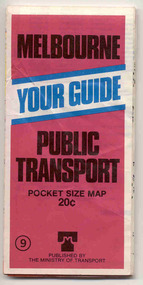
Map, Ministry of Transport, "Melbourne Public Transport Map" - "No. 9", 1979
... On the rear, route numbers and line maps of tram routes and train lines or services. Includes private bus routes. ...On the rear, route numbers and line maps of tram routes and train lines or services. Includes private bus routes. ...Pocket size - folded - public transport map of Melbourne, printed in colour on paper, showing public transport services in greater Melbourne and an index of localities. The Central zone area shown in detail. On the rear, route numbers and line maps of tram routes and train lines or services. Includes private bus routes. Printed for the Ministry of Transport. Issue No. 9. Dated 1979. trams, tramways, melbourne, map, routes -
 Bendigo Military Museum
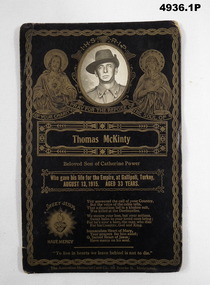
Photograph - CARD & PHOTOGRAPHS, AUST LIGHT HORSE WW1, The Australian Memorial Card Co
... Beaches - Middle East buildings - locals - repairing train lines - daily life - campsites - ships off shore etc....Beaches - Middle East buildings - locals - repairing train lines - daily life - campsites - ships off shore etc. ...In WW1 the Australian Light Horse served from the Suez Canal right around through Palestine - Syria. 1. Memorial Card. Black cardboard with gold printing. It is a religious article with images and prayers. In the top centre is an oval shaped hole with a B & W portrait of an Aust soldier. Slouch hat with side up. 2. Set of 31 B & W photos depicting scenes of light horse activity. Beaches - Middle East buildings - locals - repairing train lines - daily life - campsites - ships off shore etc. Thomas McGinty, Beloved son of Catherine Power. "Who gave his life for the Empire. At Gallipoli, Turkey, August 13 - 1915. Aged 33 years. ww1, middle east, light horse -
 Ballarat Tramway Museum
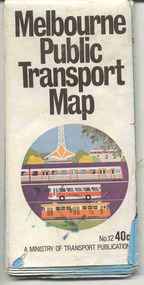
Map, Ministry of Transport, "Melbourne Public Transport Map" - "No. 12", 1982
... On the rear, route numbers and line maps of tram routes and train lines or services and fare zones. The first map with the new three zone system of fares. ...On the rear, route numbers and line maps of tram routes and train lines or services and fare zones. The first map with the new three zone system of fares. ...Pocket size - folded - public transport map of Melbourne, printed in colour on paper, showing public transport services in greater Melbourne, including ticketing information, travelcards and an index of localities. The Central zone area shown in detail. On the rear, route numbers and line maps of tram routes and train lines or services and fare zones. The first map with the new three zone system of fares. Includes private bus routes. Printed 1982 by Government Printer. Issue No. 12. On inside, a circle route around Flinders, Queen, Little Collins and Swanston St in blue felt pen and arrow in blue ink. On the rear, a sketch map showing the location Charles St, Mantell St and William Road, and a circle around Upfield station. trams, tramways, melbourne, map, routes -
 Kew Historical Society Inc
Album - Construction of the electric tram line in Cotham Road, Kew, E.J. Dower, 1913
... He worked as an adult as a clerk in the city office of the Metropolitan Gas Company, and in his role as a 'collector', was able to photograph scenes including the construction of tram and train lines and associated buildings in Kew, Hawthorn, Camberwell and Surrey Hills. ...He worked as an adult as a clerk in the city office of the Metropolitan Gas Company, and in his role as a 'collector', was able to photograph scenes including the construction of tram and train lines and associated buildings in Kew, Hawthorn, Camberwell and Surrey Hills. ...E.J. Dower was born and raised in Olinda. He later moved with his parents to Surrey Hills. He worked as an adult as a clerk in the city office of the Metropolitan Gas Company, and in his role as a 'collector', was able to photograph scenes including the construction of tram and train lines and associated buildings in Kew, Hawthorn, Camberwell and Surrey Hills. Later he established a real estate agency with his brother - the E.J. Dower Real Estate Agency, Dandenong Office. The album and its photographs are an historically significant record of the development of transport infrastructure which was used to connect Victorians in the first two decades of the twentieth century. This development resulted from increases in population and the consequent extension of Melbourne's suburbs. The photographs in the album, as well as Dower's single photos mounted on card, detail the labour of workers and the tools and machinery used to create and extend Melbourne's tram and train networks in the years preceding and during World War 1. Album of six annotated photos of construction of the St Kilda to Kew electric tram line, taken in Cotham Road, Kew, by the amateur photographer, Edgar James Dower, in 1913. The album contains images detailing the preparation for the laying of the tracks plus work on laying the line. The album, together with other phots by E.J. Dower has been made available by the owners for the Kew Historical Society to digitise and publish online and in print. Annotations by the photographer, often added over time, on the reverse of each photo in the album. theme -- connecting victorians by transport and communications, theme -- travelling by tram, photographers -- edgar james dower, cotham road -- kew (vic.) -
 Sunshine and District Historical Society Incorporated
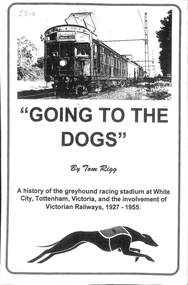
Booklet - Going to the Dogs - A history of the greyhound racing stadium at White City, Tottenham, Victoria and the involvement of the Victorian Railways 1927 - 1955, Sunshine & District Historical Society, 1997
... Transport to the White City stadium was provided by train, with only a single platform available on the downside of Tottenham, even though double train lines existed. Special train services were run from Flinders Street to the White City platform, and for a while a parcels coach was provided for the transport of dogs. ...Transport to the White City stadium was provided by train, with only a single platform available on the downside of Tottenham, even though double train lines existed. Special train services were run from Flinders Street to the White City platform, and for a while a parcels coach was provided for the transport of dogs. ...The book details the history and chronicles the the track's origins beginning with its first meeting on December 10th, 1927, and examines the involvement of the Victorian Railways between 1927 and December 1955, when it closed down. Transport to the White City stadium was provided by train, with only a single platform available on the downside of Tottenham, even though double train lines existed. Special train services were run from Flinders Street to the White City platform, and for a while a parcels coach was provided for the transport of dogs. Greyhound racing has always been popular in Melbourne's western suburbs. The White City stadium in Tottenham was a major centre for the sport until 1955, enabling those who could not afford race horses to take part in an animal racing sport. The demolition of first the stadium and years later the railway platform, has relegated the name White City and its past relevance to the western suburbs, into history. Going to the Dogs. A history of the greyhound racing stadium at White City Tottenham Victoria and the involvement of the Victorian Railways 1927 - 1955 tottenham, greyhound, white city, railway, tom rigg, gambling, live lures, mechanical lures -
 Ballarat Tramway Museum
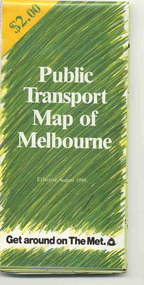
Map, Ministry of Transport and The Met, "Public Transport Map of Melbourne" - "Effective August 1988", 1988
... On the rear, route numbers, line maps of tram routes, train lines, outer metropolitan services, ticketing information, Transport Neighbourhoods, . ...On the rear, route numbers, line maps of tram routes, train lines, outer metropolitan services, ticketing information, Transport Neighbourhoods, . ...Map - Pocket size - folded - public transport map of Melbourne, printed in colour on art paper, showing public transport services in greater Melbourne, an index of localities. The City Saver area shown in detail. On the rear, route numbers, line maps of tram routes, train lines, outer metropolitan services, ticketing information, Transport Neighbourhoods, . Shows the St Kilda and Port Melbourne light rail lines. Price $2. Shows "The Met" logo. On front under The Met logo and above the scale bar is "Effective 1/7/1988". Nil trams, tramways, melbourne, map, routes -
 Melbourne Tram Museum
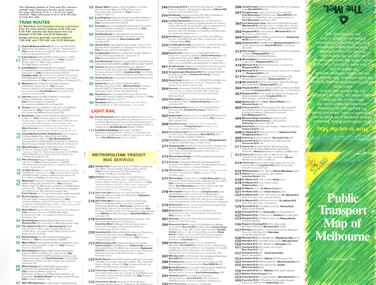
Map, The Met, "Public Transport Map of Melbourne" - "Effective August 1988", 1988
... On the rear, route numbers, line maps of tram routes, train lines, outer metropolitan services, ticketing information, Transport Neighbourhoods, . ...On the rear, route numbers, line maps of tram routes, train lines, outer metropolitan services, ticketing information, Transport Neighbourhoods, . ...Map - Pocket size - folded - public transport map of Melbourne, printed in colour on art paper, showing public transport services in greater Melbourne, an index of localities. The City Saver area shown in detail. On the rear, route numbers, line maps of tram routes, train lines, outer metropolitan services, ticketing information, Transport Neighbourhoods, . Shows the St Kilda and Port Melbourne light rail lines. Price $2. Shows "The Met" logo. On front under The Met logo and above the scale bar is "Effective 1/7/1988". In ink in top left hand corner, "11" in a circle. trams, tramways, melbourne, map, routes -
 Wodonga & District Historical Society Inc
Sign - Wodonga Railway Station
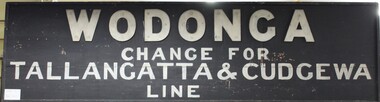
... The Tallangatta and Cudgewa train lines from Wodonga were built in stages from the 1880s to the 1920s in what is considered to be some of the most challenging landscape for railways. ...The Tallangatta and Cudgewa train lines from Wodonga were built in stages from the 1880s to the 1920s in what is considered to be some of the most challenging landscape for railways. ...The Wodonga train line opened in November 1873 when the section of the train line from Wangaratta to Wodonga was completed. A goods shed was built at this time in 1873 and a permanent train station was completed in 1874. The expansion of the railways to the northeast of Victoria occurred after the Victorian Government took over the railways in 1867 and the trains serviced large towns such as Seymour, Wangaratta and Wodonga, as well as smaller towns along the way. The Tallangatta and Cudgewa train lines from Wodonga were built in stages from the 1880s to the 1920s in what is considered to be some of the most challenging landscape for railways. The Cudgewa line was opened in 1921, so the Wodonga train station sign dates from this period. The Wodonga train station sign has local and state significance due to its use in Wodonga in the late 19th and early 20th centuries, as part of the expansion of the Victorian Railways in the northeast of the state. Old painted wooden sign from the Wodonga train station with the directions for changing to the Tallangatta and Cudgewa train line in light coloured paint on a black painted background. "WODONGA / CHANGE FOR / TALLANGATTA & CUDGEWA / LINE" wodonga railway station, wodonga train station, tallangatta train line, cudgewa train line, railway signs, victorian railways signs -
 Kiewa Valley Historical Society
Photos - SECV Race-line and Rail line
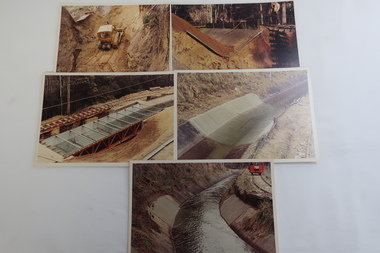
... This included race lines, which caused the water to flow into the dams and also, train/rail lines that were used to move from one end of the race-line to the other....This included race lines, which caused the water to flow into the dams and also, train/rail lines that were used to move from one end of the race-line to the other. ...SECV constructed the Kiewa Hydro Electric Scheme from the late 1940s to 1961. This included race lines, which caused the water to flow into the dams and also, train/rail lines that were used to move from one end of the race-line to the other. Part of the Kiewa Hydro Electric Scheme constructed by the SECV. Upkeep of their construction possibly after a slip (of dirt off the bank) possibly caused by heavy rain or flood. 2. various SECV photos 1. coloured photos x15 Repairing the race-line and train line at Bogong Village after a bad slip 2. x5 misccellaneous SECV construction bogong race-line, bogong rail line -
 Melbourne Tram Museum
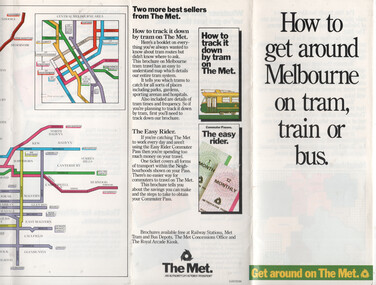
Pamphlet, The Met, "How to get around Melbourne on tram, train or bus.", July 1987
... Pamphlet issued by The Met, detailing the type of tickets issued, fares as at July 1987, Neighbourhood tickets, has a map of the Melbourne train and tram lines....Pamphlet issued by The Met, detailing the type of tickets issued, fares as at July 1987, Neighbourhood tickets, has a map of the Melbourne train and tram lines. Yields information about Melbourne public transport services and tickets in use at the time. public transport The Met fares Melbourne Pamphlet - 7 fold full colour "How to get around Melbourne on tram, train or bus." ...Pamphlet issued by The Met, detailing the type of tickets issued, fares as at July 1987, Neighbourhood tickets, has a map of the Melbourne train and tram lines. Yields information about Melbourne public transport services and tickets in use at the time. Pamphlet - 7 fold full colour public transport, the met, fares, melbourne -
 Sunshine and District Historical Society Incorporated
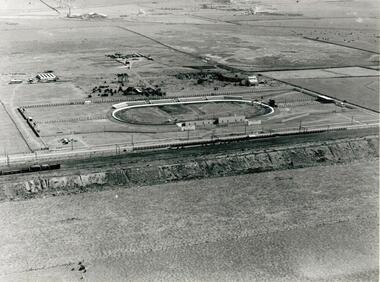
Photograph - White City Aerial photographs of White City greyhound racing venue, Pratt, Charles Daniel, (1892 - 1968)
... In 1981 when the grade separation at Ashley Street next to the Tottenham station was completed, the new train lines on the Upper Level came into operation, and so the White City platform was closed down and eventually demolished. ...In 1981 when the grade separation at Ashley Street next to the Tottenham station was completed, the new train lines on the Upper Level came into operation, and so the White City platform was closed down and eventually demolished. ...The White City Greyhound racing stadium was built at Tottenham in 1927, with the intention that mechanical lures and not live hares be used as pacemakers. The first meeting was held on 10 December 1927 but within 3 days, after strong lobbying by other sports bodies, the Victorian Government banned betting on greyhound racing if mechanical lures were used instead of live hares. This caused some financial problems to the shareholders. For a time the average weekly attendances were 9000, and races were held on Mondays, Wednesdays, and Saturdays. Whippet Races, Goat Races, Monkeys on greyhounds, and Professional Foot racing were also tried to attract attendances. After 28 years of bureaucratic interference, and using live hares as greyhound pacemakers, the White City stadium held its last meeting on 29 December 1955. On 31 December the Victorian Government finally allowed betting on greyhound races that used mechanical lures. Manufacturing industry (Olex Cables) took over the White City site. Transport to the White City stadium was provided by train, with only a single platform available on the Down side of Tottenham, even though double train lines existed. Special train services were run from Flinders Street to the White City platform, and for a while a parcels coach was provided for the transport of dogs. As industry developed in the area some trains also stopped at the White City platform in the mornings and late afternoons to transport workers. In 1981 when the grade separation at Ashley Street next to the Tottenham station was completed, the new train lines on the Upper Level came into operation, and so the White City platform was closed down and eventually demolished. Greyhound racing has always been popular in Melbourne's western suburbs. The White City stadium in Tottenham was a major centre for the sport until 1955, enabling those who could not afford race horses to take part in an animal racing sport. The demolition of first the stadium and years later the railway platform, has relegated the name White City and its past relevance to the western suburbs, into history. Only on the negatives at the State Library. We do not hold a copy of these. white city, greyhound racing stadium, coursing track, white city station, tottenham, whippet, gambling, live hare, mechanical lure -
 Kew Historical Society Inc
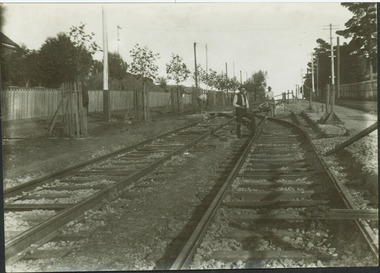
Photograph - Construction of the electric tram line in Cotham Road [Kew], E.J. Dower, 1913
... He worked as an adult as a clerk in the city office of the Metropolitan Gas Company, and in his role as a 'collector', he was able to photograph scenes including the construction of tram and train lines and associated buildings in Kew, Hawthorn, Camberwell and Surrey Hills. ...He worked as an adult as a clerk in the city office of the Metropolitan Gas Company, and in his role as a 'collector', he was able to photograph scenes including the construction of tram and train lines and associated buildings in Kew, Hawthorn, Camberwell and Surrey Hills. ...One of a small album of six photographs of the construction of the Cotham Road tramline in Kew, taken by Edgar James Dower in the second decade of the twentieth century. The reverse of each photo contains notes, written over time by the photographer, which are contained in the 'Inscriptions' field. Born and raised in Olinda, Dower's family later moved to Surrey Hills. He worked as an adult as a clerk in the city office of the Metropolitan Gas Company, and in his role as a 'collector', he was able to photograph scenes including the construction of tram and train lines and associated buildings in Kew, Hawthorn, Camberwell and Surrey Hills. Later he established a real estate agency with his brother - the E.J. Dower Real Estate Agency, Dandenong Office. The album as a whole can be viewed separately as the parent file. The image is an historically significant record of the development of transport infrastructure which was used to connect Victorians in the first two decades of the twentieth century. This development resulted from increases in population and the consequent extension of Melbourne's suburbs. The photographs in the album, as well as Dower's single photos mounted on card, individually and collectively richly detail the labour of workers and the tools and machinery used to create and extend Melbourne's tram and train networks in the years preceding and during World War 1. The first of six annotated photos in an album of photographs of the construction of the St Kilda to Kew electric tram line, taken in Cotham Road, Kew, by the amateur photographer, Edgar James Dower, in 1913. The album contains images detailing the preparation for the laying of the tracks plus work laying the line. The photographer notes on a number of the photos that te metal tracks were collected from the Hawthorn railway siding. The album, together with other phots by E.J. Dower has been made available by the owners for the Kew Historical Society to digitise and publish online and in print. Annotation verso: "1913 / Preparing for electric trams in Cotham Road Kew, looking west / Taken from corner of Burke Road by E.J. Dower / The metal was brought by horse and drays, from Hawthorn rail-way siding". keywords, theme -- connecting victorians by transport and communications, theme -- travelling by tram, photographers -- edgar james dower, cotham road -- kew (vic.) -
 Kew Historical Society Inc
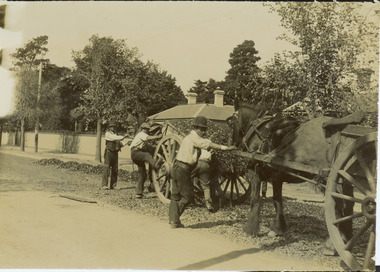
Photograph - Construction of the electric tram line in Cotham Road [Kew], E.J. Dower, 1913
... He worked as an adult as a clerk in the city office of the Metropolitan Gas Company, and in his role as a 'collector', he was able to photograph scenes including the construction of tram and train lines and associated buildings in Kew, Hawthorn, Camberwell and Surrey Hills. ...He worked as an adult as a clerk in the city office of the Metropolitan Gas Company, and in his role as a 'collector', he was able to photograph scenes including the construction of tram and train lines and associated buildings in Kew, Hawthorn, Camberwell and Surrey Hills. ...One of a small album of six photographs of the construction of the Cotham Road tramline in Kew, taken by Edgar James Dower in the second decade of the twentieth century. The reverse of each photo contains notes, written over time by the photographer, which are contained in the 'Inscriptions' field. Born and raised in Olinda, Dower's family later moved to Surrey Hills. He worked as an adult as a clerk in the city office of the Metropolitan Gas Company, and in his role as a 'collector', he was able to photograph scenes including the construction of tram and train lines and associated buildings in Kew, Hawthorn, Camberwell and Surrey Hills. Later he established a real estate agency with his brother - the E.J. Dower Real Estate Agency, Dandenong Office. The album as a whole can be viewed separately as the parent file. The image is an historically significant record of the development of transport infrastructure which was used to connect Victorians in the first two decades of the twentieth century. This development resulted from increases in population and the consequent extension of Melbourne's suburbs. The photographs in the album, as well as Dower's single photos mounted on card, individually and collectively richly detail the labour of workers and the tools and machinery used to create and extend Melbourne's tram and train networks in the years preceding and during World War 1. The second of six annotated photos in an album of photographs of the construction of the St Kilda to Kew electric tram line, taken in Cotham Road, Kew, by the amateur photographer, Edgar James Dower, in 1913. The album contains images detailing the preparation for the laying of the tracks plus work laying the line. The photographer notes on a number of the photos that the metal tracks were collected from the Hawthorn railway siding. The album, together with other phots by E.J. Dower has been made available by the owners for the Kew Historical Society to digitise and publish online and in print. Annotation verso: "Preparing electric tram Cotham Road, Kew, 1913 / The metal was brought by horses and drays, from Hawthorn railway siding". keywords, theme -- connecting victorians by transport and communications, theme -- travelling by tram, photographers -- edgar james dower, cotham road -- kew (vic.) -
 Kew Historical Society Inc
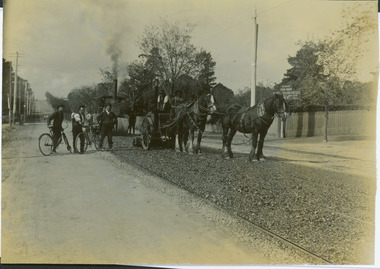
Photograph - Construction of the electric tram line in Cotham Road [Kew], E.J. Dower, 1913
... He worked as an adult as a clerk in the city office of the Metropolitan Gas Company, and in his role as a 'collector', he was able to photograph scenes including the construction of tram and train lines and associated buildings in Kew, Hawthorn, Camberwell and Surrey Hills. ...He worked as an adult as a clerk in the city office of the Metropolitan Gas Company, and in his role as a 'collector', he was able to photograph scenes including the construction of tram and train lines and associated buildings in Kew, Hawthorn, Camberwell and Surrey Hills. ...One of a small album of six photographs of the construction of the Cotham Road tramline in Kew, taken by Edgar James Dower in the second decade of the twentieth century. The reverse of each photo contains notes, written over time by the photographer, which are contained in the 'Inscriptions' field. Born and raised in Olinda, Dower's family later moved to Surrey Hills. He worked as an adult as a clerk in the city office of the Metropolitan Gas Company, and in his role as a 'collector', he was able to photograph scenes including the construction of tram and train lines and associated buildings in Kew, Hawthorn, Camberwell and Surrey Hills. Later he established a real estate agency with his brother - the E.J. Dower Real Estate Agency, Dandenong Office. The album as a whole can be viewed separately as the parent file. The image is an historically significant record of the development of transport infrastructure which was used to connect Victorians in the first two decades of the twentieth century. This development resulted from increases in population and the consequent extension of Melbourne's suburbs. The photographs in the album, as well as Dower's single photos mounted on card, individually and collectively richly detail the labour of workers and the tools and machinery used to create and extend Melbourne's tram and train networks in the years preceding and during World War 1. The third of six annotated photos in an album of photographs of the construction of the St Kilda to Kew electric tram line, taken in Cotham Road, Kew, by the amateur photographer, Edgar James Dower, in 1913. The album contains images detailing the preparation for the laying of the tracks plus work laying the line. The photographer notes on a number of the photos that the metal tracks were collected from the Hawthorn railway siding. The album, together with other phots by E.J. Dower has been made available by the owners for the Kew Historical Society to digitise and publish online and in print. Annotation verso: "Preparing Cotham Road Kew for electric trams / The metal was brought by horses and drays, from Hawthorn railway siding / 1913". keywords, theme -- connecting victorians by transport and communications, theme -- travelling by tram, photographers -- edgar james dower, cotham road -- kew (vic.) -
 Kew Historical Society Inc
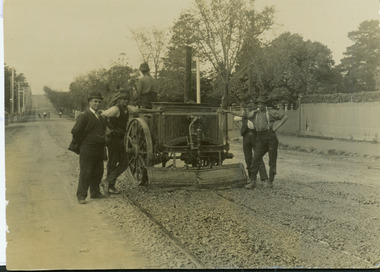
Photograph - Construction of the electric tram line in Cotham Road [Kew], E.J. Dower, 1913
... He worked as an adult as a clerk in the city office of the Metropolitan Gas Company, and in his role as a 'collector', he was able to photograph scenes including the construction of tram and train lines and associated buildings in Kew, Hawthorn, Camberwell and Surrey Hills. ...He worked as an adult as a clerk in the city office of the Metropolitan Gas Company, and in his role as a 'collector', he was able to photograph scenes including the construction of tram and train lines and associated buildings in Kew, Hawthorn, Camberwell and Surrey Hills. ...One of a small album of six photographs of the construction of the Cotham Road tramline in Kew, taken by Edgar James Dower in the second decade of the twentieth century. The reverse of each photo contains notes, written over time by the photographer, which are contained in the 'Inscriptions' field. Born and raised in Olinda, Dower's family later moved to Surrey Hills. He worked as an adult as a clerk in the city office of the Metropolitan Gas Company, and in his role as a 'collector', he was able to photograph scenes including the construction of tram and train lines and associated buildings in Kew, Hawthorn, Camberwell and Surrey Hills. Later he established a real estate agency with his brother - the E.J. Dower Real Estate Agency, Dandenong Office. The album as a whole can be viewed separately as the parent file. The image is an historically significant record of the development of transport infrastructure which was used to connect Victorians in the first two decades of the twentieth century. This development resulted from increases in population and the consequent extension of Melbourne's suburbs. The photographs in the album, as well as Dower's single photos mounted on card, individually and collectively richly detail the labour of workers and the tools and machinery used to create and extend Melbourne's tram and train networks in the years preceding and during World War 1. The fourth of six annotated photos in an album of photographs of the construction of the St Kilda to Kew electric tram line, taken in Cotham Road, Kew, by the amateur photographer, Edgar James Dower, in 1913. The album contains images detailing the preparation for the laying of the tracks plus work laying the line. The photographer notes on a number of the photos that the metal tracks were collected from the Hawthorn railway siding. The album, together with other phots by E.J. Dower has been made available by the owners for the Kew Historical Society to digitise and publish online and in print. Annotation verso: "Preparing tram line Cotham Road Kew looking east for electric trams / 1913 / The metal was brought by horses and drays, from Hawthorn railway siding / 1913". keywords, theme -- connecting victorians by transport and communications, theme -- travelling by tram, photographers -- edgar james dower, cotham road -- kew (vic.) -
 Kew Historical Society Inc
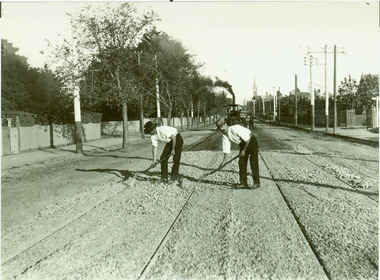
Photograph - Construction of the electric tram line in Cotham Road [Kew], E.J. Dower, 1913
... He worked as an adult as a clerk in the city office of the Metropolitan Gas Company, and in his role as a 'collector', he was able to photograph scenes including the construction of tram and train lines and associated buildings in Kew, Hawthorn, Camberwell and Surrey Hills. ...He worked as an adult as a clerk in the city office of the Metropolitan Gas Company, and in his role as a 'collector', he was able to photograph scenes including the construction of tram and train lines and associated buildings in Kew, Hawthorn, Camberwell and Surrey Hills. ...One of a small album of six photographs of the construction of the Cotham Road tramline in Kew, taken by Edgar James Dower in the second decade of the twentieth century. The reverse of each photo contains notes, written over time by the photographer, which are contained in the 'Inscriptions' field. Born and raised in Olinda, Dower's family later moved to Surrey Hills. He worked as an adult as a clerk in the city office of the Metropolitan Gas Company, and in his role as a 'collector', he was able to photograph scenes including the construction of tram and train lines and associated buildings in Kew, Hawthorn, Camberwell and Surrey Hills. Later he established a real estate agency with his brother - the E.J. Dower Real Estate Agency, Dandenong Office. The album as a whole can be viewed separately as the parent file. The image is an historically significant record of the development of transport infrastructure which was used to connect Victorians in the first two decades of the twentieth century. This development resulted from increases in population and the consequent extension of Melbourne's suburbs. The photographs in the album, as well as Dower's single photos mounted on card, individually and collectively richly detail the labour of workers and the tools and machinery used to create and extend Melbourne's tram and train networks in the years preceding and during World War 1. The fifth of six annotated photos in an album of photographs of the construction of the St Kilda to Kew electric tram line, taken in Cotham Road, Kew, by the amateur photographer, Edgar James Dower, in 1913. The album contains images detailing the preparation for the laying of the tracks plus work laying the line. The photographer notes on a number of the photos that the metal tracks were collected from the Hawthorn railway siding. The album, together with other phots by E.J. Dower has been made available by the owners for the Kew Historical Society to digitise and publish online and in print. Annotation verso: "Preparing tram line Cotham Road Kew for electric trams, looking west / 1913" keywords, theme -- connecting victorians by transport and communications, theme -- travelling by tram, photographers -- edgar james dower, cotham road -- kew (vic.) -
 Kew Historical Society Inc
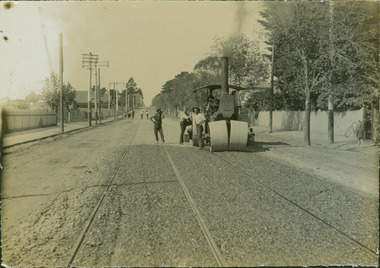
Photograph - Construction of the electric tram line in Cotham Road [Kew], E.J. Dower, 1913
... He worked as an adult as a clerk in the city office of the Metropolitan Gas Company, and in his role as a 'collector', he was able to photograph scenes including the construction of tram and train lines and associated buildings in Kew, Hawthorn, Camberwell and Surrey Hills. ...He worked as an adult as a clerk in the city office of the Metropolitan Gas Company, and in his role as a 'collector', he was able to photograph scenes including the construction of tram and train lines and associated buildings in Kew, Hawthorn, Camberwell and Surrey Hills. ...One of a small album of six photographs of the construction of the Cotham Road tramline in Kew, taken by Edgar James Dower in the second decade of the twentieth century. The reverse of each photo contains notes, written over time by the photographer, which are contained in the 'Inscriptions' field. Born and raised in Olinda, Dower's family later moved to Surrey Hills. He worked as an adult as a clerk in the city office of the Metropolitan Gas Company, and in his role as a 'collector', he was able to photograph scenes including the construction of tram and train lines and associated buildings in Kew, Hawthorn, Camberwell and Surrey Hills. Later he established a real estate agency with his brother - the E.J. Dower Real Estate Agency, Dandenong Office. The album as a whole can be viewed separately as the parent file. The image is an historically significant record of the development of transport infrastructure which was used to connect Victorians in the first two decades of the twentieth century. This development resulted from increases in population and the consequent extension of Melbourne's suburbs. The photographs in the album, as well as Dower's single photos mounted on card, individually and collectively richly detail the labour of workers and the tools and machinery used to create and extend Melbourne's tram and train networks in the years preceding and during World War 1. The sixth of six annotated photos in an album of photographs of the construction of the St Kilda to Kew electric tram line, taken in Cotham Road, Kew, by the amateur photographer, Edgar James Dower, in 1913. The album contains images detailing the preparation for the laying of the tracks plus work laying the line. The photographer notes on a number of the photos that the metal tracks were collected from the Hawthorn railway siding. The album, together with other phots by E.J. Dower has been made available by the owners for the Kew Historical Society to digitise and publish online and in print. Annotation verso: "Preparing tram line Cotham Road Kew for electric trams / 1913 / The metal was brought by horse and drays, from Hawthorn railway siding". keywords, theme -- connecting victorians by transport and communications, theme -- travelling by tram, photographers -- edgar james dower, cotham road -- kew (vic.) -
 Vision Australia
Photograph - Image, W.H. Paterson - Blind Cricketers of Australia, 1957
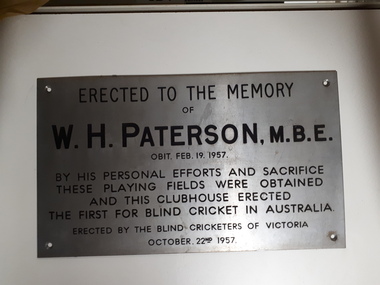
... Raising money through public donation and door knocking, Mr Paterson arranged the purchase of land on the banks of Gardiner's Creek, and adjacent to the tram and train lines. The land was raised, to avoid flooding, and a surface prepared. ...Raising money through public donation and door knocking, Mr Paterson arranged the purchase of land on the banks of Gardiner's Creek, and adjacent to the tram and train lines. The land was raised, to avoid flooding, and a surface prepared. ...When the Victorian Blind Cricket Association approached Mr Paterson for assistance in gaining access to a permanent cricket pitch upon which games could be played, it set in chain a series of events that remain in place today. Mr Paterson had been heavily involved in the formation of the Association for the Blind and saw this as a problem to be solved. Raising money through public donation and door knocking, Mr Paterson arranged the purchase of land on the banks of Gardiner's Creek, and adjacent to the tram and train lines. The land was raised, to avoid flooding, and a surface prepared. The sportsground was adjacent to the AAB, however due to the interest of Malvern Council in the land and knowing that the AAB at that time was in financial difficulties, a Trust was set up to handle the management with Mr Paterson, Mr Gould the Malvern Council Town Clerk and George Maxwell as trustees. A clubhouse was also needed to allow players to take shelter during matches and once again, Mr Paterson came to the rescue. Using their personal funds, Mr and Mrs Paterson loaned the Trust the monies required for the building. This plaque recognises the dedication and support that Mr Paterson gave to help establish the first blind cricket playing ground in Australia. Digital image of metal plaque Erected to the Memory of W.H. Paterson, M.B.E. Obit. Feb. 19 1957 By his personal efforts and sacrifice these playing fields were obtained and this clubhouse erected The first for blind cricket in Australia Erected by the Blind Cricketers of Victoria October 22nd 1957 william paterson, victorian blind cricket association -
 Bendigo Historical Society Inc.
Photograph - BASIL MILLER COLLECTION: TRAMS - CAVALCADE OF TRAMS MITCHELL STREET, BENDIGO, BENDIGO RAILWAY STATION, 1960's ?
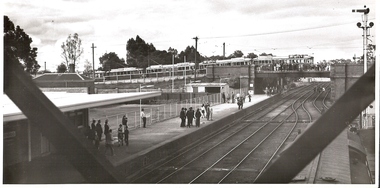
... People waiting for train on platform. Railways lines prominent in front of photo....People waiting for train on platform. Railways lines prominent in front of photo. ...BHS Collection Black and white photo. 5 trams heading east along Mitchell Street, photographed crossing railways bridge to North of Bendigo Railway Station. Photo taken from railway station. People waiting for train on platform. Railways lines prominent in front of photo. basil miller, bendigo tramways, bendigo rail station, mitchell street rail bridge -
 Otway Districts Historical Society
Photograph, Kevin L Holmes, Driver Bill Brady with Train Staff, 1961, 1961
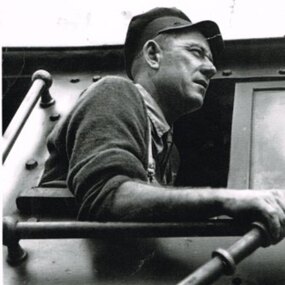
... These methods are generally known as "Safeworking" and they particularly apply to trains on single lines where trains run in opposite directions. ...These methods are generally known as "Safeworking" and they particularly apply to trains on single lines where trains run in opposite directions. ...Railway systems have methods by which trains can proceed in safety from station to station, free from the risk of collision with other trains. These methods are generally known as "Safeworking" and they particularly apply to trains on single lines where trains run in opposite directions. The stations between these two sections are called crossing stations. A "Train Staff", a thick, round metal rod, bearing the name of the two stations is issued and these places are designated as Train Staff stations. No train is permitted to proceed through the section unless the train driver either takes the staff for the section into his possession or personally sights the staff. (Note that every station on the line is not a crossing station. These roles were performed at Barongarook, Gellibrand, Banool, Beech Forest, Wyelangta, Weeaproinah and Crowes.) Except for the period 1927-1939 when Train Section Orders were applied instead, due to declining business Train Staff and Ticket working was used throughout on the line. B/W. Driver Bill Brady holding the Train Staff in the cabin of Garratt locomotive G42, at Weeaproinah 1961 railways, bill brady, train driver, weeaproinah, train staff -
 Sunbury Family History and Heritage Society Inc.
Photograph, 1970s
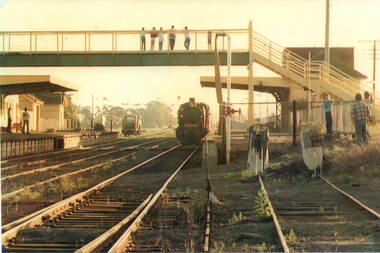
... The steam train has arrived at Number 2 platform at Sunbury Railway Station. Before diesel engines were used on the regional lines, steam trains were widely used. ...The steam train has arrived at Number 2 platform at Sunbury Railway Station. Before diesel engines were used on the regional lines, steam trains were widely used. ...The steam train has arrived at Number 2 platform at Sunbury Railway Station. Before diesel engines were used on the regional lines, steam trains were widely used. The pedestrian bridge spanning the railway line was replaced with a larger one and included a ramp, to allow for disabled people's in 2001. The water tank which supplied water for the steam engines is visible on the platform. The Sunbury line leads on to Bendigo and Echuca and is one of Victoria's important regional rail services. A non-digital coloured photograph of a steam train arriving at a station with six people on the pedestrian bridge looking at the train and five other bystanders on the two platforms. steam locomotives, sunbury station, bendigo rail line
