
Showing 73 items matching "travel writing"
-
 Linton Mechanics Institute and Free Library Collection
Book - Novel ; Travel writing, Irving, Washington et al, The works of Washington Irving Vol. III : Bracebridge Hall ; Abbotsford and Newstead Abbey, 1868 [= date of publication on title page. Volumes issued as part of this series were published between 1868-1877]
... Novel ; Travel writing......Travel writing...III : Bracebridge Hall ; Abbotsford and Newstead Abbey Book Novel ; Travel writing Irving, Washington Irving, Washington (writing as Geoffrey Crayon) Bell & Daldy William Clowes & Sons Ltd. ...Bracebridge Hall: An "episodic" novel, a series of individual plots based in the lives of the occupants of an English manor, "Bracebridge Hall". First published in 1822, under the pseudonym Geoffrey Crayon. Abbotsford and Newstead Abbey: Chronicles Irving's visits to two stately halls in England - Abbotsford, the home of Sir Walter Scott, and Newstead Abbey, once home to Lord Byron. "A blend of travel narrative, personal observation, folklore, and historical sketches". First published 1835.iv, 320 p. ; iv., 138 p. Embossed green cover, titles of works and series titles in gold on spine. Frontispiece illustration - portrait of Washington Irving. Volume III consists of re-issues of two works published by Bell & Daldy (which were themselves new editions of previously published works): "Bracebridge Hall" (published 1869), and "Abbotsford and Newstead Abbey" (published 1864). Each work has own pagination, preface, explanatory introduction, and table of contents.fictionBracebridge Hall: An "episodic" novel, a series of individual plots based in the lives of the occupants of an English manor, "Bracebridge Hall". First published in 1822, under the pseudonym Geoffrey Crayon. Abbotsford and Newstead Abbey: Chronicles Irving's visits to two stately halls in England - Abbotsford, the home of Sir Walter Scott, and Newstead Abbey, once home to Lord Byron. "A blend of travel narrative, personal observation, folklore, and historical sketches". First published 1835.fiction, travel writing, washington irving, english literature, james dodds, original collection, geoffrey crayon -
 Sunshine and District Historical Society Incorporated
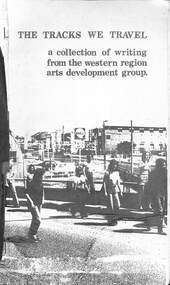
Booklet - The Tracks We Travel - A Collection of Writing from The Western Region Arts Development Group, Western Region Arts Development Group, 1975
... The Tracks We Travel - A Collection of Writing from The Western Region Arts Development Group...The Tracks We Travel A Collection of Writing From the Western Region Arts Development Group with stories from Helen Bender Helen Beswick Phillip Clarke Pat Cook Joanne Coburn Jon Hill Gayle Dignam Adrian Fitzgerald Beryl Fitgerald Lucy Kupczyk Debra Maroney Marie Nardella Rose Nardella Jill Parsons Clive Reynolds Ron Reynolds Fiona Wheelahan...writing class which was founded early in 1975 as one of the activities fostered by the Western Regions Arts Development Group. The class was held weekly in the Western Suburbs Union Community Centre in Durham Rd Sunshine. The stories and poems in this book are from 1975. Western Region History Western Region Arts Development Group Western Suburbs Union Community Centre The Tracks We Travel ...This work on this booklet was done by members of a creative writing class which was founded early in 1975 as one of the activities fostered by the Western Regions Arts Development Group. The class was held weekly in the Western Suburbs Union Community Centre in Durham Rd Sunshine. The stories and poems in this book are from 1975.The Tracks We Travel A Collection of Writing From the Western Region Arts Development Group with stories from Helen Bender Helen Beswick Phillip Clarke Pat Cook Joanne Coburn Jon Hill Gayle Dignam Adrian Fitzgerald Beryl Fitgerald Lucy Kupczyk Debra Maroney Marie Nardella Rose Nardella Jill Parsons Clive Reynolds Ron Reynolds Fiona Wheelahanwestern region, history, western region arts development group, western suburbs union community centre -
 Monbulk RSL Sub Branch
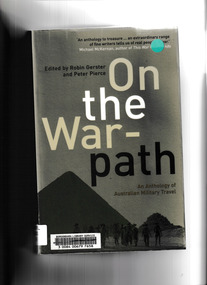
Book, Robin Gerster, On the war-path, 2004
... ...travel writing - military - australia...war and literature - australia travel writing - military - australia This anthology reveals the many ways in which going to war has formed a cultural bridge between Australia and the world. ...This anthology reveals the many ways in which going to war has formed a cultural bridge between Australia and the world. From the Sudan in 1885 to Afghanistan in 2001, the connection of war to travel is illustrated in the observations of many writers.notes, 350.p.non-fictionThis anthology reveals the many ways in which going to war has formed a cultural bridge between Australia and the world. From the Sudan in 1885 to Afghanistan in 2001, the connection of war to travel is illustrated in the observations of many writers.war and literature - australia, travel writing - military - australia -
 Uniting Church Archives - Synod of Victoria
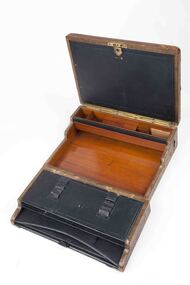
Functional object - Writing case
... Brown leather travelling writing case with brass fittings. The box is lined with black leather. ...Brown leather travelling writing case with brass fittings. The box is lined with black leather. ...John Dare was born in Dorset, England, in 1831 and emigrated to Australia as a youth. He entered the ministry in 1851 and was the first minister of Melbourne First Circuit from 1862 - 1865. In 1877 Rev Dare was elected President of the Victoria and Tasmania Conference.Brown leather travelling writing case with brass fittings. The box is lined with black leather. There is a small plaque on the lid."PRESENTED TO THE REVD. JOSEPH DANE PRESIDENT OF THE Fitz Roy Wesleyan Association by the members AS AN expression of love and esteem Fitz Roy March 30th 1869."fitzroy wesleyan association, rev joseph dare d d wesleyan minister -
 Whitehorse Historical Society Inc.
Equipment - Writing Case, c1880
... Black leather travelling writing case containing letter opener,(NA2627) six red sticks sealing wax, original glass and brass inkwell, and ruler. ...domestic items writing equipment Black leather travelling writing case containing letter opener,(NA2627) six red sticks sealing wax, original glass and brass inkwell, and ruler. ...Black leather travelling writing case containing letter opener,(NA2627) six red sticks sealing wax, original glass and brass inkwell, and ruler. Case has compartments for paper blotting paper on lid. Workable lock (with key)and hinged lid.domestic items, writing equipment -
 Marysville & District Historical Society
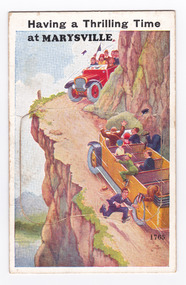
Postcard (item) - Novelty postcard, Valentine Publishing Co. Pty. Ltd, Having a Thrilling Time at Marysville, 1940's-1960's
... writing, Letter Postage is required/ TO OPEN RAISE FLAP From VALENTINE'S "MAIL NOVELTY" POST CARD. COPYRIGHT Printed in Great Britain Shape Passed/ by G.P.O./ for/ Printed Paper/ Postage Rate/ 34-2 To Postcard has an illustration of a narrow road going around a cliff face. On the road there is a bus and a car traveling ...A novelty postcard with pull-out strip of 11 miniature photographs that was produced by the Valentine Publishing Co as a souvenir of Marysville.A novelty postcard with pull-out strip of 11 miniature photographs that was produced by the Valentine Publishing Co as a souvenir of Marysville.Having a Thrilling Time/ at MARYSVILLE 1765 PRINTED PAPER/ MAILING NOVELTY/ SHAPE PASSED BY THE G.P.O./ FOR PRINTED PAPER POSTAGE RATE/ Only Name and Address of Sender Allowed/ If any other writing, Letter Postage is required/ TO OPEN RAISE FLAP From VALENTINE'S "MAIL NOVELTY" POST CARD. COPYRIGHT Printed in Great Britain Shape Passed/ by G.P.O./ for/ Printed Paper/ Postage Rate/ 34-2 Tomarysville, victoria, postcard, souvenir, valentine publishing co, acheron way (image 1), keppel's falls (image 2), cumberland falls (image 3), stevenson falls (image 4), mount margaret (image 5), main st (image 6), nicholl's lookout (image 7), the old ford (image 8), the acheron way (image 9), taggerty river (image 10), the road to cumberland valley (image 11) -
Federation University Historical Collection
Document - Document - Letter, Ballarat Junior Technical School: Correspondence related to the enrolment of student,1952
... Ballarat High School Principal arranges bus travel. ballarat junior technical school head master l garner mrs l mcdonald son enrol at bjts meredith grade vii ballarat high school principal october 31 .1: Signature of Mrs Les McDonald .1: Lined writing paper - blue ink .2: Cream page, typed Ballarat Junior Technical School: Correspondence related to the enrolment of student,1952 Document Document - Letter ...Letter from Mrs McDonald requesting her son be enrolled at BJTS for the following year. Understands date has passed for enrolments. Knows there are a number of students from Meredith wishing to come. Would it be possible for the Bus to come to Meredith. Already goes to Elaine, four miles away. Mr Garner explains it is too late to enrol. School is full. Suggests he does Grade VII and then make application before October 1953. Ballarat High School Principal arranges bus travel..1: Lined writing paper - blue ink .2: Cream page, typed.1: Signature of Mrs Les McDonald ballarat junior technical school, head master, l garner, mrs l mcdonald, son, enrol at bjts, meredith, grade vii, ballarat high school, principal, october 31 -
 Lara RSL Sub Branch
Postcards
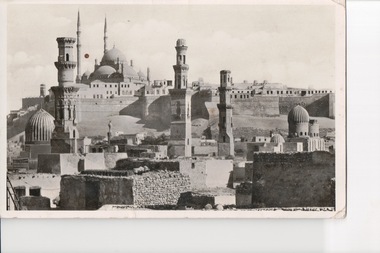
... travel during the war. cairo egypt wwi world war one first world war australia army british empire "The polish of the main pyramids is decorated in the interior of the tombs. I use to pass this often when going for stores in Cairo. It is rather nice but the Gyppoes sleeping on the foot path, and other stupid pranks. Harvey." Publ. the Oriental Commercial Bueau. Port Said. Postcard with a black and white image of citadel and tombs of the Mameluks, Cairo. Has writing ...This postcard was sent by an Australian soldier from Cairo to Australia during the First World War. It has the capacity to illustrate issues of British Imperialism, Australian approaches to race and religion, and the experience of Australian Soldiers experiencing world travel during the war.Postcard with a black and white image of citadel and tombs of the Mameluks, Cairo. Has writing on the reverse in black ink, and some scribble from a blue pen."The polish of the main pyramids is decorated in the interior of the tombs. I use to pass this often when going for stores in Cairo. It is rather nice but the Gyppoes sleeping on the foot path, and other stupid pranks. Harvey." Publ. the Oriental Commercial Bueau. Port Said.cairo, egypt, wwi, world war one, first world war, australia, army, british empire -
 Flagstaff Hill Maritime Museum and Village
Book - Journal Reference Book/History, Edward John Eyre, Journals of Expeditions of Discovery into Central Australia and Overland From Adelaide to King George Sound. In the years 1840-1 Vol 1, 1845
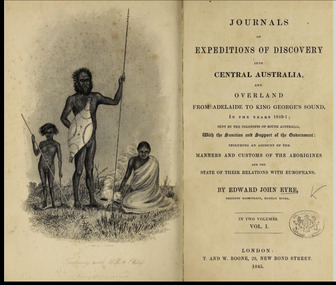
... His writing reflects the perspective of a 19th-century explorer and colonial observer, including detailed descriptions of the landscape, travel hardships, and encounters with Aboriginal peoples. ...His writing reflects the perspective of a 19th-century explorer and colonial observer, including detailed descriptions of the landscape, travel hardships, and encounters with Aboriginal peoples. ...Journals of Expeditions of Discovery into Central Australia was written by Edward John Eyre. It is Eyre’s 1845 account of his 1840–41 exploration journeys from Adelaide into central Australia and then overland to King George’s Sound. The book is published in two volumes and was first issued in 1845. It blends practical expedition reporting with reflection, so it is both a record of exploration and a statement about the colonial understanding of inland Australia.Journals of Expeditions of Discovery into Central Australia Vol 1 Author: Edward John Eyre Publisher: T and W Boone Date: 1845 non-fictionJournals of Expeditions of Discovery into Central Australia was written by Edward John Eyre. It is Eyre’s 1845 account of his 1840–41 exploration journeys from Adelaide into central Australia and then overland to King George’s Sound. The book is published in two volumes and was first issued in 1845. It blends practical expedition reporting with reflection, so it is both a record of exploration and a statement about the colonial understanding of inland Australia. flagstaff hill, warrnambool, shipwrecked coast, flagstaff hill maritime museum, maritime museum, flagstaff hill maritime village, great ocean road, book, warrnambool library, warrnambool mechanics’ institute, mechanics’ institute library, victorian library board, warrnambool books and records, journals of expeditions of discovery into central australia vol 1, edward john eyre -
 Flagstaff Hill Maritime Museum and Village
Book - Journal Reference Book/History, Edward John Eyre, Journals of Expeditions of Discovery into Central Australia and Overland From Adelaide to King George Sound. In the years 1840-1 Vol 2, 1845
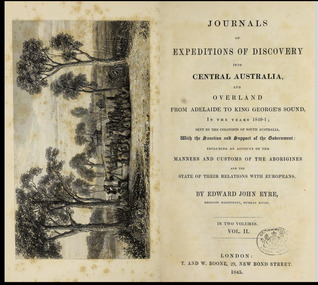
... His writing reflects the perspective of a 19th-century explorer and colonial observer, including detailed descriptions of the landscape, travel hardships, and encounters with Aboriginal peoples. ...His writing reflects the perspective of a 19th-century explorer and colonial observer, including detailed descriptions of the landscape, travel hardships, and encounters with Aboriginal peoples. ...Journals of Expeditions of Discovery into Central Australia was written by Edward John Eyre. It is Eyre’s 1845 account of his 1840–41 exploration journeys from Adelaide into central Australia and then overland to King George’s Sound. The book is published in two volumes and was first issued in 1845. It blends practical expedition reporting with reflection, so it is both a record of exploration and a statement about the colonial understanding of inland Australia.Journals of Expeditions of Discovery into Central Australia Vol 2 Author: Edward John Eyre Publisher: T and W Boone Date: 1845 non-fictionJournals of Expeditions of Discovery into Central Australia was written by Edward John Eyre. It is Eyre’s 1845 account of his 1840–41 exploration journeys from Adelaide into central Australia and then overland to King George’s Sound. The book is published in two volumes and was first issued in 1845. It blends practical expedition reporting with reflection, so it is both a record of exploration and a statement about the colonial understanding of inland Australia. flagstaff hill, warrnambool, shipwrecked coast, flagstaff hill maritime museum, maritime museum, flagstaff hill maritime village, great ocean road, book, warrnambool library, warrnambool mechanics’ institute, mechanics’ institute library, victorian library board, warrnambool books and records, journals of expeditions of discovery into central australia vol 1, edward john eyre -
 Flagstaff Hill Maritime Museum and Village
Book - Ethnographic survey, Edward Micklethwaite Curr, The Australian Race Vol 4, 1886-1887
... writing about early squatting life in Victoria and Aboriginal languages and customs. Curr was educated in England, then managed sheep runs in Victoria for his father before later holding senior colonial stock inspection roles, including Chief Inspector of Sheep and later Chief Inspector of Stock in Victoria. He also traveled widely through Europe and the Middle East in the 1850s, experiences that fed into his later writings on horses and travel...writing about early squatting life in Victoria and Aboriginal languages and customs. Curr was educated in England, then managed sheep runs in Victoria for his father before later holding senior colonial stock inspection roles, including Chief Inspector of Sheep and later Chief Inspector of Stock in Victoria. He also traveled widely through Europe and the Middle East in the 1850s, experiences that fed into his later writings on horses and travel ...The Australian Race Vol. 4 by Edward M. Curr is the highly illustrated fourth part of Curr’s four volume ethnographic survey of Aboriginal Australia. It consolidates his findings on origins, languages, customs, and distributions, and its atlas volume furnishes a large comparative language map and ethnographic plates. The four volume set are a broad survey of Aboriginal peoples’ origins, languages, social customs, and movements across the Australian continent. The fourth volume functions as an atlas and language compendium, pairing textual material with a folio atlas of comparative vocabularies and a large map that traces routes and distributions. This volume also documents specific rites and regional practices, as part of his broader attempt to synthesize ethnographic and linguistic data across Australia. The work is considered a foundational reference work although in today's modern world is is regarded as dated and eurocentric set of volumes as a reference in Australian Indigenous studies and anthropology.Hard cover book, The Australian Race Vol 4. Author: Edward Micklethwaite Curr Publisher: John Ferres, Government Printer Melbourne Aus. Date: 1886-1887 Light brown cloth hardcover and spine and blue edging to hard covers lettering in blue . The spine has a label with an inscription. Further Information: Map in pocket at the back of volnon-fictionThe Australian Race Vol. 4 by Edward M. Curr is the highly illustrated fourth part of Curr’s four volume ethnographic survey of Aboriginal Australia. It consolidates his findings on origins, languages, customs, and distributions, and its atlas volume furnishes a large comparative language map and ethnographic plates. The four volume set are a broad survey of Aboriginal peoples’ origins, languages, social customs, and movements across the Australian continent. The fourth volume functions as an atlas and language compendium, pairing textual material with a folio atlas of comparative vocabularies and a large map that traces routes and distributions. This volume also documents specific rites and regional practices, as part of his broader attempt to synthesize ethnographic and linguistic data across Australia. The work is considered a foundational reference work although in today's modern world is is regarded as dated and eurocentric set of volumes as a reference in Australian Indigenous studies and anthropology.flagstaff hil, warrnambool, flagstaff hill maritime museum, maritime museum, shipwreck coast, flagstaff hill maritime village, great ocean road, book, pattison collection, warrnambool library, warrnambool mechanics’ institute, ralph eric pattison, corangamite regional library service, warrnambool city librarian, mechanics’ institute library, victorian library board, warrnambool books and records, warrnambool children’s library, the australian race vol 4, aboriginal studies, languages, native langauge -
 Flagstaff Hill Maritime Museum and Village
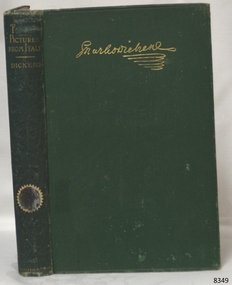
Book - A Travel & Political Critique, Charles Dickens, Hard Times and Pictures from Italy, 1866-1870’s
... The second part of this novel “Pictures from Italy” is a key example of Dickens’s non fiction and travel writing, frequently compared to his earlier “Sketches by Boz” and later “The Uncommercial Traveller”. ...Charles Dickens (1812–1870) was one of the great English novelists of the Victorian era, famous for vivid characters, social criticism, and stories that were first published in serial form. He began as a journalist, rose to enormous popularity during his lifetime, and wrote major works such as Oliver Twist, David Copperfield, and Great Expectations. Pictures from Italy first published 1846 is a travelogue describing Dickens’s 1844 journey through Italy with his family that included Rome, Venice, Florence, and other cities. It mixes vivid descriptions of art, landscape, and carnival life with his characteristic observations on social inequality and political fragmentation in pre unification Italy. Together this combined volume offers both a major insight on Victorian industrial England and a lighter, more personal travel narrative showing Dickens from two sides, the social reformer and the acute observer tourist.Hard Cover edition, Hard Times and Pictures for Italy. Author: Charles Dickens. Publisher: Chapman & Hall Ltd, London. Date: 1866-1870’s first published in book form 1846 (See note section this document for more information on Edition). Green cloth hardcover, Spine black has Author and Title in gold lettering. The spine has a Library label and no Volume information.non-fictionCharles Dickens (1812–1870) was one of the great English novelists of the Victorian era, famous for vivid characters, social criticism, and stories that were first published in serial form. He began as a journalist, rose to enormous popularity during his lifetime, and wrote major works such as Oliver Twist, David Copperfield, and Great Expectations. Pictures from Italy first published 1846 is a travelogue describing Dickens’s 1844 journey through Italy with his family that included Rome, Venice, Florence, and other cities. It mixes vivid descriptions of art, landscape, and carnival life with his characteristic observations on social inequality and political fragmentation in pre unification Italy. Together this combined volume offers both a major insight on Victorian industrial England and a lighter, more personal travel narrative showing Dickens from two sides, the social reformer and the acute observer tourist.book, the old curiosity shop, charles dickens, shipwrecked-coast, flagstaff-hill, flagstaff-hill-maritime-museum, warrnambool, maritime-museum, flagstaff-hill-maritime-village, pattison collection, warrnambool library, warrnambool mechanics’ institute, ralph eric pattison, corangamite regional library service, warrnambool city librarian, mechanics’ institute library, victorian library board, warrnambool books and records, warrnambool children’s library, great ocean road, hard times for these times -
 Flagstaff Hill Maritime Museum and Village
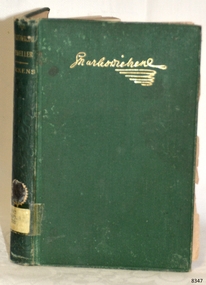
Book - Observational Essays, Charles Dickens, The Uncommercial Traveller, 1907
... They include London wanderings, travel observations, sketches of odd characters, and writing about hardship and public life. ...Charles Dickens (1812–1870) was one of the great English novelists of the Victorian era, famous for vivid characters, social criticism, and stories that were first published in serial form. He began as a journalist, rose to enormous popularity during his lifetime, and wrote major works such as Oliver Twist, Great Expectations and David Copperfield. The Uncommercial Traveller is a collection of semi autobiographical essays, not a novel. Dickens uses the persona of an “Uncommercial Traveller” to roam London and elsewhere, reflecting on street life, poverty, travel, memory, and social conditions in a way that shows off his skills as an observer and journalist. The pieces are loose, varied sketches rather than one continuous plot. They include London wanderings, travel observations, sketches of odd characters, and writing about hardship and public life. A major recurring aim within these essays is social observation, especially Dickens’s concern for ordinary people and the poor.The Uncommercial Traveller Author: Charles Dickens Publisher: Chapman & Hall Ltd Date: Subject Book 1907. (See note section this document for more information on Edition). Green Faux leather hardcover with title on spine in gold lettering, Charles Dickens signature on front cover written in gold lettering. The spine has a Library label and no Volume information.fictionCharles Dickens (1812–1870) was one of the great English novelists of the Victorian era, famous for vivid characters, social criticism, and stories that were first published in serial form. He began as a journalist, rose to enormous popularity during his lifetime, and wrote major works such as Oliver Twist, Great Expectations and David Copperfield. The Uncommercial Traveller is a collection of semi autobiographical essays, not a novel. Dickens uses the persona of an “Uncommercial Traveller” to roam London and elsewhere, reflecting on street life, poverty, travel, memory, and social conditions in a way that shows off his skills as an observer and journalist. The pieces are loose, varied sketches rather than one continuous plot. They include London wanderings, travel observations, sketches of odd characters, and writing about hardship and public life. A major recurring aim within these essays is social observation, especially Dickens’s concern for ordinary people and the poor.book, the old curiosity shop, charles dickens, shipwrecked-coast, flagstaff-hill, flagstaff-hill-maritime-museum, warrnambool, maritime-museum, flagstaff-hill-maritime-village, pattison collection, warrnambool library, warrnambool mechanics’ institute, ralph eric pattison, corangamite regional library service, warrnambool city librarian, mechanics’ institute library, victorian library board, warrnambool books and records, warrnambool children’s library, great ocean road -
 Flagstaff Hill Maritime Museum and Village
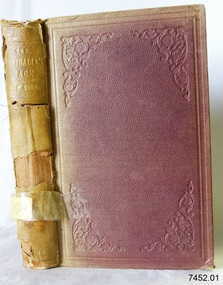
Book - Ethnographic survey, Edward Micklethwaite Curr, The Australian Race Vol 1, 1886-1887
... writing about early squatting life in Victoria and Aboriginal languages and customs. Curr was educated in England, then managed sheep runs in Victoria for his father before later holding senior colonial stock inspection roles, including Chief Inspector of Sheep and later Chief Inspector of Stock in Victoria. He also traveled widely through Europe and the Middle East in the 1850s, experiences that fed into his later writings on horses and travel...writing about early squatting life in Victoria and Aboriginal languages and customs. Curr was educated in England, then managed sheep runs in Victoria for his father before later holding senior colonial stock inspection roles, including Chief Inspector of Sheep and later Chief Inspector of Stock in Victoria. He also traveled widely through Europe and the Middle East in the 1850s, experiences that fed into his later writings on horses and travel ...The Australian Race Vol. 1 by Edward M. Curr is the highly illustrated first part of Curr’s four volume ethnographic survey of Aboriginal Australia. It consolidates his findings on origins, languages, customs, and distributions, and its atlas volume furnishes a large comparative language map and ethnographic plates. The four volume set is a broad survey of Aboriginal peoples’ origins, languages, social customs, and movements across the Australian continent. Volume one is chiefly a comparative on various vocabularies and linguistic materials, with early observations used to identify and compare Aboriginal language groups. This volume also documents specific rites and regional practices, as part of his broader attempt to synthesize ethnographic and linguistic data across Australia. The work is considered a foundational reference work although in today's modern world is is regarded as dated and eurocentric set of volumes as a reference in Australian Indigenous studies and anthropology.Hard cover book, The Australian Race Vol 1. Author: Edward Micklethwaite Curr Publisher: John Ferres, Government Printer Melbourne Aus. Date: 1886-1887 Light brown cloth hardcover and spine and blue edging to hard covers lettering in blue . The spine has a label with an inscription.non-fictionThe Australian Race Vol. 1 by Edward M. Curr is the highly illustrated first part of Curr’s four volume ethnographic survey of Aboriginal Australia. It consolidates his findings on origins, languages, customs, and distributions, and its atlas volume furnishes a large comparative language map and ethnographic plates. The four volume set is a broad survey of Aboriginal peoples’ origins, languages, social customs, and movements across the Australian continent. Volume one is chiefly a comparative on various vocabularies and linguistic materials, with early observations used to identify and compare Aboriginal language groups. This volume also documents specific rites and regional practices, as part of his broader attempt to synthesize ethnographic and linguistic data across Australia. The work is considered a foundational reference work although in today's modern world is is regarded as dated and eurocentric set of volumes as a reference in Australian Indigenous studies and anthropology.flagstaff hil, warrnambool, flagstaff hill maritime museum, maritime museum, shipwreck coast, flagstaff hill maritime village, great ocean road, book, pattison collection, warrnambool library, warrnambool mechanics’ institute, ralph eric pattison, corangamite regional library service, warrnambool city librarian, mechanics’ institute library, victorian library board, warrnambool books and records, warrnambool children’s library, the australian race vol 4, aboriginal studies, languages, native langauge -
 Flagstaff Hill Maritime Museum and Village
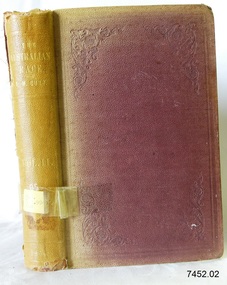
Book - Ethnographic survey, Edward Micklethwaite Curr, The Australian Race Vol 2, 1886-1887
... writing about early squatting life in Victoria and Aboriginal languages and customs. Curr was educated in England, then managed sheep runs in Victoria for his father before later holding senior colonial stock inspection roles, including Chief Inspector of Sheep and later Chief Inspector of Stock in Victoria. He also traveled widely through Europe and the Middle East in the 1850s, experiences that fed into his later writings on horses and travel...writing about early squatting life in Victoria and Aboriginal languages and customs. Curr was educated in England, then managed sheep runs in Victoria for his father before later holding senior colonial stock inspection roles, including Chief Inspector of Sheep and later Chief Inspector of Stock in Victoria. He also traveled widely through Europe and the Middle East in the 1850s, experiences that fed into his later writings on horses and travel ...The Australian Race Vol. 2 by Edward M. Curr is the second part of Curr’s four volume ethnographic survey of Aboriginal Australia. Volume two continues the language and vocabulary work from volume one, and goes on in expanding the comparative material available across more regions and groups of Aboriginal tribes or mobs. The four volume set is a broad survey of Aboriginal peoples’ origins, languages, social customs, and movements across the Australian continent. Volume one is chiefly a comparative on various vocabularies and linguistic materials, with early observations used to identify and compare Aboriginal language groups. This volume also documents specific rites and regional practices, as part of his broader attempt to synthesize ethnographic and linguistic data across Australia. The work is considered a foundational reference work although in today's modern world is is regarded as dated and eurocentric set of volumes as a reference in Australian Indigenous studies and anthropology.Hard cover book, The Australian Race Vol 2. Author: Edward Micklethwaite Curr Publisher: John Ferres, Government Printer Melbourne Aus. Date: 1886-1887 Light brown cloth hardcover and spine and blue edging to hard covers lettering in blue . The spine has a label with an inscription.non-fictionThe Australian Race Vol. 2 by Edward M. Curr is the second part of Curr’s four volume ethnographic survey of Aboriginal Australia. Volume two continues the language and vocabulary work from volume one, and goes on in expanding the comparative material available across more regions and groups of Aboriginal tribes or mobs. The four volume set is a broad survey of Aboriginal peoples’ origins, languages, social customs, and movements across the Australian continent. Volume one is chiefly a comparative on various vocabularies and linguistic materials, with early observations used to identify and compare Aboriginal language groups. This volume also documents specific rites and regional practices, as part of his broader attempt to synthesize ethnographic and linguistic data across Australia. The work is considered a foundational reference work although in today's modern world is is regarded as dated and eurocentric set of volumes as a reference in Australian Indigenous studies and anthropology.flagstaff hil, warrnambool, flagstaff hill maritime museum, maritime museum, shipwreck coast, flagstaff hill maritime village, great ocean road, book, pattison collection, warrnambool library, warrnambool mechanics’ institute, ralph eric pattison, corangamite regional library service, warrnambool city librarian, mechanics’ institute library, victorian library board, warrnambool books and records, warrnambool children’s library, the australian race vol 4, aboriginal studies, languages, native langauge -
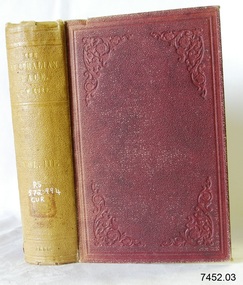 Flagstaff Hill Maritime Museum and Village
Book - Ethnographic survey, Edward Micklethwaite Curr, The Australian Race Vol 3, 1886-1887
... writing about early squatting life in Victoria and Aboriginal languages and customs. Curr was educated in England, then managed sheep runs in Victoria for his father before later holding senior colonial stock inspection roles, including Chief Inspector of Sheep and later Chief Inspector of Stock in Victoria. He also traveled widely through Europe and the Middle East in the 1850s, experiences that fed into his later writings on horses and travel...writing about early squatting life in Victoria and Aboriginal languages and customs. Curr was educated in England, then managed sheep runs in Victoria for his father before later holding senior colonial stock inspection roles, including Chief Inspector of Sheep and later Chief Inspector of Stock in Victoria. He also traveled widely through Europe and the Middle East in the 1850s, experiences that fed into his later writings on horses and travel ...The Australian Race Vol. 3 by Edward M. Curr is the third part of Curr’s four volume ethnographic survey of Aboriginal Australia. Volume three moves further into Aboriginal customs their social practices, and regional accounts gathered from settlers, missionaries, and other correspondents of the time. The four volume set is a broad survey of Aboriginal peoples’ origins, languages, social customs, and movements across the Australian continent. Volume one is chiefly a comparative on various vocabularies and linguistic materials, with early observations used to identify and compare Aboriginal language groups. This volume continuing in documenting specific rites and regional practices, as part of his broader attempt to synthesize ethnographic and linguistic data across Australia. The work is considered a foundational reference work although in today's modern world is is regarded as dated and eurocentric set of volumes as a reference in Australian Indigenous studies and anthropology.Hard cover book, The Australian Race Vol 3. Author: Edward Micklethwaite Curr Publisher: John Ferres, Government Printer Melbourne Aus. Date: 1886-1887 Light brown cloth hardcover and spine and blue edging to hard covers lettering in blue . The spine has a label with an inscription.non-fictionThe Australian Race Vol. 3 by Edward M. Curr is the third part of Curr’s four volume ethnographic survey of Aboriginal Australia. Volume three moves further into Aboriginal customs their social practices, and regional accounts gathered from settlers, missionaries, and other correspondents of the time. The four volume set is a broad survey of Aboriginal peoples’ origins, languages, social customs, and movements across the Australian continent. Volume one is chiefly a comparative on various vocabularies and linguistic materials, with early observations used to identify and compare Aboriginal language groups. This volume continuing in documenting specific rites and regional practices, as part of his broader attempt to synthesize ethnographic and linguistic data across Australia. The work is considered a foundational reference work although in today's modern world is is regarded as dated and eurocentric set of volumes as a reference in Australian Indigenous studies and anthropology.flagstaff hil, warrnambool, flagstaff hill maritime museum, maritime museum, shipwreck coast, flagstaff hill maritime village, great ocean road, book, pattison collection, warrnambool library, warrnambool mechanics’ institute, ralph eric pattison, corangamite regional library service, warrnambool city librarian, mechanics’ institute library, victorian library board, warrnambool books and records, warrnambool children’s library, the australian race vol 4, aboriginal studies, languages, native langauge -
 Ringwood and District Historical Society
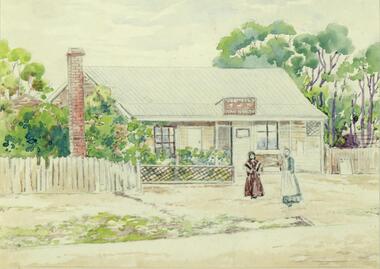
Painting, Winifred Miles, "First Post Office 1883" (Ringwood) - Water colour on paper by Winifred Miles (1884-1944), Undated, later than 1910
... travelling around Ringwood to find places to paint by means of a pony-driven governess-cart. She won prizes for paintings in the Royal Melbourne Shows." - Hugh Anderson - Ringwood, Place of Many Eagles [p.217]. Sticker on back of frame - "Ringwood Framing Gallery, 233 Whitehorse Road Ringwood, Phone 8704930" Painting with cardboard border in glass-fronted frame. Painted from an original black & white photograph, Catalogue Reg No. 1347 recorded as "Ringwood's first Post Office showing first Postmistress, Miss M. Thompson and her mother. 1890". (South side of Main Street (Maroondah Highway), approximately 300 meters west of Ringwood Railway Station). Writing ..."Alexander Colquhoun [Herald art critic 1914-1922 and feature writer for the Age 1926-1941] ... took private students in the first decade of the century, and one of these was Winifred Miles, who after her marriage in 1910 lived the remainder of her life in Ringwood. ... (She) began by doing charcoal studies of animals when she was in Balranald, but in later years moved to oils and then watercolours, travelling around Ringwood to find places to paint by means of a pony-driven governess-cart. She won prizes for paintings in the Royal Melbourne Shows." - Hugh Anderson - Ringwood, Place of Many Eagles [p.217].Painting with cardboard border in glass-fronted frame. Painted from an original black & white photograph, Catalogue Reg No. 1347 recorded as "Ringwood's first Post Office showing first Postmistress, Miss M. Thompson and her mother. 1890". (South side of Main Street (Maroondah Highway), approximately 300 meters west of Ringwood Railway Station). Writing on back of original photograph reads, "Grandma and Auntie Martha Thomson 1890". (Difference in painting date and photograph date indicates years as shown are approximate only). Sticker on back of frame - "Ringwood Framing Gallery, 233 Whitehorse Road Ringwood, Phone 8704930" -
 Orbost & District Historical Society
book, F.W. Niven & Co, Guide to Buchan Caves & the Gippsland Lakes, 1907
... This item is a useful research tool. gippsland-lakes-history-description-travel buchan-caves-history-national-park A 104 pp tattered book with a dark purple cover, gold print writing and illustrations. ...This book was intended as a tourist guide to East Gippsland.This item is a useful research tool.A 104 pp tattered book with a dark purple cover, gold print writing and illustrations. It is titled, "The Guide to Buchan Cvaes and Gippsland Lakes; Written by F. Whitcombe, Illustrated H,D, Bulmer & N.J. Caire". It contains an index and advertisements.gippsland-lakes-history-description-travel buchan-caves-history-national-park -
 Glenelg Shire Council Cultural Collection
Functional object - Typewriter - corona, Corona, 1909-1914
... travelling. History of typewriters Glenelg Shire cultural collection Writing Typing Author Office Portland Front: Corona / (Standard Folding Typewriter) 3 Manufactured by Standard Typewriter Company Groton N.Y USA 3 Back: Patented / Mar 8 1904 / Feb 8 1910 / Other Patents/ Pending / Also Patented in / Other Countries Black metal enamelled frame. ...The folding Corona typewriter was the first portable manual typewriter. Due to this pioneering, innovative design, the popularity of Corona typewriters soared in the 1910s leading to the Corona Typewriter Company in the USA developing new and improved machines to meet a growing demand. Consequently, businesses moved away from all forms of written communication such as handwritten documents and letters, to a more convenient method of speedy, legible communication. Agatha Christie Used a Corona Standard Typewriter when travelling.History of typewritersBlack metal enamelled frame. Cylindrical rubber-covered platen 220 mm wide. Typebars strike forward against platen from curved horizontal type-basket. Ink ribbon carried between two spools on vertical axes. Three-row QWERTY keyboard with 28 circular character keys with black lettering on a light background. 'FIG' and 'CAP' keys (light lettering on a black background) to left of keyboard. 'BACKSPACE' key above and behind keyboard to right of type-basket. Long black spacebar in front of keyboard. Carriage, with platen and ribbon spools, folds forward over keyboard pivoting on axis at front of type-basket.Front: Corona / (Standard Folding Typewriter) 3 Manufactured by Standard Typewriter Company Groton N.Y USA 3 Back: Patented / Mar 8 1904 / Feb 8 1910 / Other Patents/ Pending / Also Patented in / Other Countriesglenelg shire cultural collection, writing, typing, author, office, portland -
Glenelg Shire Council Cultural Collection
Book, Alone, c. 1889
... Despite giving birth to six children and running a household, she never stopped writing, eventually publishing twenty-five novels and three volumes of short stories, as well as numerous books on travel, biography, colonial history, and domestic guidance....Despite giving birth to six children and running a household, she never stopped writing, eventually publishing twenty-five novels and three volumes of short stories, as well as numerous books on travel, biography, colonial history, and domestic guidance. romance female author woman 1854 American Front: Bookplate: Presented to .../ Xmas 1889/ Corndale/ S. ...Blue cloth-covered binding. Title and author on spine in blue lettering against a gold design. 320pp.fictionromance, female author, woman, 1854, american -
Mission to Seafarers Victoria
Letter - Correspondence, Allan Charles Quinn, 14/12/1950
... travelling to London. He has sent "...a very big carton, a smaller one - a trunk and coffee table back to Australia." Quinn Collection letters-from-abroad allan quinn oslo The letter is from Allan to his mother. A single sheet of very thin paper folded in half, book form, with writing ...Allan writes that he has left the ship M S Mongabarra in Sweden and traveled by train to Oslo where he will stay for about 14 days before travelling to London. He has sent "...a very big carton, a smaller one - a trunk and coffee table back to Australia."Quinn CollectionA single sheet of very thin paper folded in half, book form, with writing on the first and third pages only (0854.a). Written in green ink it is headed Oslo and dated 14/12/50. The air-mail envelope (0854.b) is bordered with alternating purple and yellow diagonal stripes. There are three Norwegian stamps, one green and two purple, in the right upper corner. It is post-marked Oslo and addressed Mrs K Hayes, 14 Fitzroy Street, St. Kilda, Victoria, Australia. The letter is from Allan to his mother. letters-from-abroad, allan quinn, oslo -
 Flagstaff Hill Maritime Museum and Village
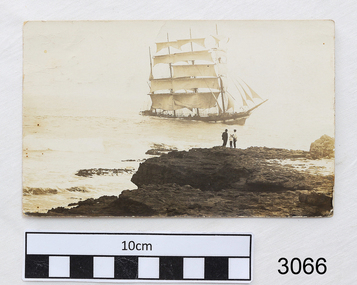
Postcard, c. Nov 1908-1910
... It would be a long journey for a person to travel from Oakleigh to the South West Victoria areas. This postcard is an example of the style of writing in Victoria in the early 1900's and of social issues and concerns, including shipwrecks. flagstaff hill warrnambool shipwrecked coast flagstaff hill maritime museum maritime museum shipwreck coast flagstaff hill maritime village great ocean road falls of halladale peterborough 14/11/1908 shipwreck queen victoria half penny stamp maysie maclean warragul rd oakleigh mrs waite warragul rd oakleigh post card postcard communication early 1900's mallee male sailor employment Note on card is addressed to Miss M. ...This postcard was written by a person referring to themselves as 'Malee Male', possibly living in the Malee area of South West Victoria. It was written after the wreck of the sailing ship Falls of Halladale, wrecked at Peterborough in November 1908, and before the reign of King George V in May 1910, at which time new postage stamps would have been issued to replace those of Queen Victoria. The writer refers to the excitement of the shipwreck and of having a sailor from the ship working for his/her mother (there was no loss of life from the shipwreck). The note is addressed to a single female family member and includes greetings to people they both know. The address of Oakleigh is approximately 20km south east of Melbourne. The writer talks of being tired and weary, inviting the receiver to visit and help with the 'office', also hinting at some matchmaking for his/her Aunt. It would be a long journey for a person to travel from Oakleigh to the South West Victoria areas. This postcard is an example of the style of writing in Victoria in the early 1900's and of social issues and concerns, including shipwrecks.Postcard, black and white photograph of the Falls of Halladale in full sail. Back of card has handwritten, black script. Top right has 2 x Half Penny stamps, green, Queen Victoria's profile. A short note addressed to a family member Miss M. (Maysie) MacLean c/o Mrs Waite, Warragul Rd, Oakleigh and signed of Mallee Male, refers to the photograph on the front and sailors from the ship.Note on card is addressed to Miss M. MacLean c/o Mrs Waite, Warragul Rd, Oakleigh and signed of Mallee Male. Message on card is ."Dear Maysee and all, too busy and tired to write but not to forget you all. This is a view of the ship Falls of Halladale, great excitement, one sailor boy came back to work for Mum and he and one crew ... When are you coming up Maysie, If you haven't any things else on hand. You can come and assist me with office. Aunt is feeling ... Do you know of any nice boys for Aunt anywhere? Dear old chicken, I am so weary so tata. Stacks of love to all and ... Mallee Male." flagstaff hill, warrnambool, shipwrecked coast, flagstaff hill maritime museum, maritime museum, shipwreck coast, flagstaff hill maritime village, great ocean road, falls of halladale, peterborough, 14/11/1908 shipwreck, queen victoria half penny stamp, maysie maclean warragul rd oakleigh, mrs waite warragul rd oakleigh, post card, postcard, communication early 1900's, mallee male, sailor employment -
 Flagstaff Hill Maritime Museum and Village
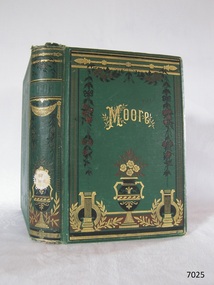
Book - Poetical Writings, Thomas Moore, The Poetical Works of Thomas Moore, 1878–1890s
... He attended Trinity College, Dublin, entering in 1794 as one of its early Roman Catholic students, before travelling to London in 1799 to study law at Middle Temple. Moore transitioned quickly from law to full-time writing, achieving massive fame as a poet, songwriter, and satirist. ...He attended Trinity College, Dublin, entering in 1794 as one of its early Roman Catholic students, before travelling to London in 1799 to study law at Middle Temple. Moore transitioned quickly from law to full-time writing, achieving massive fame as a poet, songwriter, and satirist. ...This subject volume is a comprehensive collection of the works of Irish poet and songwriter Thomas Moore (1779–1852). The work features his famous Irish Melodies (containing classic songs like "The Last Rose of Summer" and "The Minstrel Boy"), his Oriental romance epic Lalla Rookh, satire, and light verse, along with a biographical summary ("With Life") and steel-engraved illustrations.Hard cover book. The Poetical Works of Thomas Moore Author: Thomas Moore Publisher: Gall & Inglis Date: 1878–1890s Further Information: Highly decorated green Cloth hardcover with lettering and patterning to spine in gilt. The spine has a Library label with an inscription.fictionThis subject volume is a comprehensive collection of the works of Irish poet and songwriter Thomas Moore (1779–1852). The work features his famous Irish Melodies (containing classic songs like "The Last Rose of Summer" and "The Minstrel Boy"), his Oriental romance epic Lalla Rookh, satire, and light verse, along with a biographical summary ("With Life") and steel-engraved illustrations.warrnambool, shipwrecked-coast, flagstaff-hill, flagstaff-hill-maritime-museum, maritime-museum, shipwreck-coast, flagstaff-hill-maritime-village, shipwrecked-artefact, book, the poetical works of thomas moore, thomas moore, warrnambool mechanics’ institute, pattison collection, warrnambool library, ralph eric pattison, corangamite regional library service, warrnambool city librarian, mechanics’ institute library, victorian library board, warrnambool books and records, warrnambool children’s library -
 Flagstaff Hill Maritime Museum and Village
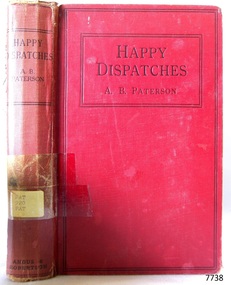
Book, Happy Dispatches
... writing. He became a successful radio broadcaster with the Australian Broadcasting Commission using his travel experiences. ...writing. He became a successful radio broadcaster with the Australian Broadcasting Commission using his travel experiences. ...This item is from the ‘Pattison Collection’, a collection of books and records that was originally owned by the Warrnambool Mechanics’ Institute, which was founded in Warrnambool in 1853. By 1886 the Warrnambool Mechanics’ Institute (WMI) had grown to have a Library, Museum and Fine Arts Gallery, with a collection of “… choice productions of art, and valuable specimens in almost every branch and many wonderful national curiosities are now to be seen there, including historic relics of the town and district.” It later included a School of Design. Although it was very well patronised, the lack of financial support led the WMI in 1911 to ask the City Council to take it over. In 1935 Ralph Pattison was appointed as City Librarian to establish and organise the Warrnambool Library as it was then called. When the WMI building was pulled down in 1963 a new civic building was erected on the site and the new Warrnambool Library, on behalf of the City Council, took over all the holdings of the WMI. At this time some of the items were separated and identified as the ‘Pattison Collection’, named after Ralph Pattison. Eventually the components of the WMI were distributed from the Warrnambool Library to various places, including the Art Gallery, Historical Society and Flagstaff Hill. Later some were even distributed to other regional branches of Corangamite Regional Library and passed to and fro. It is difficult now to trace just where all of the items have ended up. The books at Flagstaff Hill Maritime Village generally display stamps and markings from Pattison as well as a variety of other institutions including the Mechanics’ Institute itself. RALPH ERIC PATTISON Ralph Eric Pattison was born in Rockhampton, Queensland, in 1891. He married Maude Swan from Warrnambool in 1920 and they set up home in Warrnambool. In 1935 Pattison accepted a position as City Librarian for the Warrnambool City Council. His huge challenge was to make a functional library within two rooms of the Mechanics’ Institute. He tirelessly cleaned, cleared and sorted a disarrayed collection of old books, jars of preserved specimens and other items reserved for exhibition in the city’s museum. He developed and updated the library with a wide variety of books for all tastes, including reference books for students; a difficult task to fulfil during the years following the Depression. He converted all of the lower area of the building into a library, reference room and reading room for members and the public. The books were sorted and stored using a cataloguing and card index system that he had developed himself. He also prepared the upper floor of the building and established the Art Gallery and later the Museum, a place to exhibit the many old relics that had been stored for years for this purpose. One of the treasures he found was a beautiful ancient clock, which he repaired, restored and enjoyed using in his office during the years of his service there. Ralph Pattison was described as “a meticulous gentleman whose punctuality, floorless courtesy and distinctive neat dress were hallmarks of his character, and ‘his’ clock controlled his daily routine, and his opening and closing of the library’s large heavy doors to the minute.” Pattison took leave during 1942 to 1945 to serve in the Royal Australian Navy, Volunteer Reserve as Lieutenant. A few years later he converted one of the Museum’s rooms into a Children’s Library, stocking it with suitable books for the younger generation. This was an instant success. In the 1950’s he had the honour of being appointed to the Victorian Library Board and received more inspiration from the monthly conferences in Melbourne. He was sadly retired in 1959 after over 23 years of service, due to the fact that he had gone over the working age of council officers. However he continued to take a very keen interest in the continual development of the Library until his death in 1969. About A. B. ‘Banjo’ Paterson Andrew Barton Paterson was born at Narrambla Station in New South Wales, Australia, on 17th February 1864 and died 5th February 1941. His first seven years were spent on his father’s station, where like so many Australian children he enjoyed a bush boyhood. This property was at Obley in the Orange district of New South Wales. The family moved to the Yass district and lived near the main route from Sydney to Melbourne where he saw a great many bullock teams, drovers with herds of stock, gold escorts and Cob & Co coaches. His lifelong love of horses and horsemen was forged from the riders and their horses he saw at the picnic races and polo matches the family attended. These horses and riders where from the Murrumbidgee River and Snowy Mountain areas of New South Wales. Patterson lived most of his life in Sydney. He became a journalist, army officer, novelist, poet, solicitor and a war correspondent. He enjoyed many different sports such as tennis, rowing and, most of all, he delighted in his horsemanship. His first poem ‘El Mahdi to the Australian Troop’ was published in the Bulletin in 1885 under the pen name of “The Banjo”, which was the name of his favourite horse. In 1895 his first book was published and was sold out in the week of publication; he sold 7000 copies in a few months. This book was “The Man From Snowy River, and other Verses” and it contained such ballads as ‘Clancy of the Overflow’, ‘The Geebung Polo Club’, ‘The Man from Ironbark’, and ‘Saltbush Bill’. The tittle poem was first published in 1890. In 1895 Patterson visited his fiancé (at that time), Sarah Riley, who was staying with her friends the Macphersons at Dagworth Station in Queensland. Sarah’s old school friend Christina McPherson. Christina replayed to them an old Scottish tune called “The Craigielee March” that she had heard played by the Garrison Artillery band at the Warrnambool picnic races in Victoria, 1894. Patterson wrote words to fit the tune and it became the now famous ‘Waltzing Matilda’. He was commissioned by the Sydney Morning Herald and the Melbourne Age as they correspondent to report on the South African War. After being a roving reporter in China he went to England and spent time with Rudyard Kipling. In April 1903 Paterson married Alice Walker in Tenterfield, New South Wales, and they had two children, Grace and Hugh. At the outbreak of World War 1 Paterson sailed for England in the hope of covering the fighting in Flanders as a correspondent but finished up driving an ambulance for the Australian Voluntary Hospital, Wimereux, France. In 1915 as an honorary vet he made three voyages taking horse to Africa, China and Egypt. On 18th October 1915 he was commissioned in the 2nd Remount Unit in the Australian Imperial Force and was promoted to Captain serving in the Middle East. He was wounded in April 1916, when he re-joined his unit he was promoted to major and commanded the Australian Remount Squadron from October 1916 to his return to Australia in 1919. Once the War was over he resumed his work as a journalist until he retired in 1930 so that he could devote time to creative writing. He became a successful radio broadcaster with the Australian Broadcasting Commission using his travel experiences. He wrote the children’s book “The Animals Noah Forgot” in 1933 and then in 1934 “Happy Dispatches” in which he told of his meetings with people like Winston Churchill and Kipling. “The Shearer’s Colt was published in 1936 and in 1939 he wrote for the Sydney Morning Herald. After a short illness he passed away in Sydney on 5th February 1941. The Pattison Collection, along with other items at Flagstaff Hill Maritime Village, was originally part of the Warrnambool Mechanics' Institute’s collection. The Warrnambool Mechanics’ Institute Collection is primarily significant in its totality, rather than for the individual objects it contains. Its contents are highly representative of the development of Mechanics' Institute libraries across Australia, particularly Victoria. A diversity of publications and themes has been amassed, and these provide clues to our understanding of the nature of and changes in the reading habits of Victorians from the 1850s to the middle of the 20th century. The collection also highlights the Warrnambool community’s commitment to the Mechanics’ Institute, reading, literacy and learning in the regions, and proves that access to knowledge was not impeded by distance. These items help to provide a more complete picture of our community’s ideals and aspirations. The Warrnambool Mechanics Institute book collection has historical and social significance for its strong association with the Mechanics Institute movement and the important role it played in the intellectual, cultural and social development of people throughout the latter part of the nineteenth century and the early twentieth century. The collection of books is a rare example of an early lending library and its significance is enhanced by the survival of an original collection of many volumes. The Warrnambool Mechanics' Institute’s publication collection is of both local and state significance. Happy Dispatches Author: A B ("Banjo") Paterson Publisher: Angus & Robertson Ltd Date: 1935Label on spine cover with typed text PAT 920 PAT Pastedown front endpaper has sticker from Warrnambool Public Library covered by a sticker from Corangamite Regional Library Service Front loose endpaper has a stamp from Corangamite Regional Library Service warrnambool, shipwrecked-coast, flagstaff-hill, flagstaff-hill-maritime-museum, maritime-museum, shipwreck-coast, flagstaff-hill-maritime-village, shipwrecked-artefact, book, pattison collection, warrnambool library, warrnambool mechanics’ institute, ralph eric pattison, corangamite regional library service, warrnambool city librarian, mechanics’ institute library, victorian library board, warrnambool books and records, warrnambool children’s library, great ocean road, happy dispatches, a b paterson, banjo paterson -
 Flagstaff Hill Maritime Museum and Village
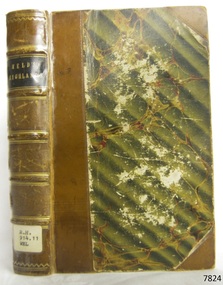
Book - Reference Book/History/Travel, Charles Richard Weld, Two months in the Highlands, Orcadia and Skye, 1860
... Modern scholars occasionally cite it as a source on shifting Victorian perceptions of the Scottish Highland and island landscapes, so it has some niche academic relevance in the cultural landscape and travel writing studies. Two Months in the Highlands, Orcadia and Skye (1860) is not a major canonical work in English literature, but it is considered a moderately significant Victorian era travelogue and is treated by collectors and historians as a valuable regional/antique book, especially in its first‑edition form. ...Charles Richard Weld (1813–1869) was an English writer and legal‑trained man who became best known for “A History of the Royal Society”, with Memoirs of the Presidents (1848), which is regarded as the first substantial institutional history of the Royal Society and remains a standard reference on early British science. Two Months in the Highlands, Orcadia, and Skye is a 1860 travel book by him, published in London and listed as a first edition. Weld is also known as an historian of the Royal Society. It should be noted that the subject work is sometimes catalogued with “Orcadia” and sometimes with “Orcadia and Skye” in slightly different punctuation, but the core bibliographic details are the same. With Weld as author and 1860 as the publication year, and Longman, Green, Longman, and Roberts as publisher.Weld's Highlands: Two Months in the Highlands Orcadia and Skye Author: Charles Richard Weld Publisher: Longman Green Longman Roberts Date: 1860 Light and dark diagonally striped hardcover with a brown spine and reinforced corners. The spine has a label with an inscription.non-fictionCharles Richard Weld (1813–1869) was an English writer and legal‑trained man who became best known for “A History of the Royal Society”, with Memoirs of the Presidents (1848), which is regarded as the first substantial institutional history of the Royal Society and remains a standard reference on early British science. Two Months in the Highlands, Orcadia, and Skye is a 1860 travel book by him, published in London and listed as a first edition. Weld is also known as an historian of the Royal Society. It should be noted that the subject work is sometimes catalogued with “Orcadia” and sometimes with “Orcadia and Skye” in slightly different punctuation, but the core bibliographic details are the same. With Weld as author and 1860 as the publication year, and Longman, Green, Longman, and Roberts as publisher. warrnambool, shipwrecked-coast, flagstaff-hill, flagstaff-hill-maritime-museum, maritime-museum, great ocean road, warrnambool library, warrnambool mechanics’ institute, mechanics’ institute library, warrnambool books and records, warrnambool public library, weld's highlands, two months in the highlands orcadia and skye, charles richard weld, 1860, longman green longman and roberts -
 Flagstaff Hill Maritime Museum and Village
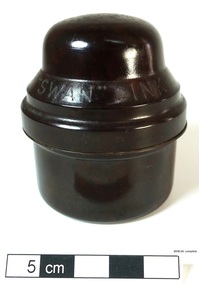
Container - Ink Bottle & Case, 1934 – Mid 1950’s
... writing, a hobby enjoyed by many people. The quality of the pen handle, the nib and the ink all work together to produce fine handwriting that expresses the character and mood of the writer. This Bakelite ink case has been specifically moulded to snugly contain an ink bottle, with just enough room to wrap the bottle with a padding or card or blotting paper. The screw top lid fits the case well and this container would be a good way to travel...writing, a hobby enjoyed by many people. The quality of the pen handle, the nib and the ink all work together to produce fine handwriting that expresses the character and mood of the writer. This Bakelite ink case has been specifically moulded to snugly contain an ink bottle, with just enough room to wrap the bottle with a padding or card or blotting paper. The screw top lid fits the case well and this container would be a good way to travel ...Pens, nib pens and later fountain pens, with suitable inks, were commonly used for writing communications from the 18th century to the mod 20th century. Fountain pens continue to be used and enjoyed. Dip pens with a wide variety of nibs are used for calligraphy writing, a hobby enjoyed by many people. The quality of the pen handle, the nib and the ink all work together to produce fine handwriting that expresses the character and mood of the writer. This Bakelite ink case has been specifically moulded to snugly contain an ink bottle, with just enough room to wrap the bottle with a padding or card or blotting paper. The screw top lid fits the case well and this container would be a good way to travel with ink because any spillage would be kept within the waterproof case. The Bakelite material is lightweight and strong. Ink bottle cases, or travelling cases, have been made as an accessory for nib pen writers. The first patent for a “pocket-case for bottles”, a wooden case, was applied for in the US in 1891. Other materials such as steel, pewter and aluminum as well as Bakelite have also been used. The British Museum has an elaborately decorated bronze ink pot holder that is inlaid with turquoise. Today ink bottle cases are even available in fabric with loops to attach to a belt. Bakelite, the material used for this ink bottle case, is made from synthetic materials and is an early form of plastic, developed in 1907 and used extensively until the 1940’s. It is still in used today for specific applications but has been largely replaced by more modern forms of plastics. This ink bottle case carries the imprint of Mabie, Todd & Co. (Aust.) Pty. Ltd. This form of company name was used from 1938 to the mid 1950’s. The Swan ink bottle’s information says it was made by Mabie, Todd & Co. Ltd., London and Sydney, so dates the ink bottle from about 1908 until 1934. (Australian newspapers display advertisements dated 1908 until 1934 for Sydney wholesalers and agents for Mabie, Todd & Co. Ltd.) ABOUT PERSONAL FOUNTAIN PENS (FOUNT PENS) A 1917 newspaper advertisement recommends that the owner of a “Swan” doesn’t lend it to anyone else to use due to its qualities of it personalised to the owner. It reads “Don’t lend your “Swan” fountpen, recommend it, but don’t let other people use it. You see, a good pen doesn’t wear, but its “tamper” (or spring) works into the writer’s pressure and manner of holding. Another person with a dashing style of writing may strain it do that it will no longer feel just like your own.” This personalisation of nib pens may be the reason that legal documents in the past being acceptable only if they were signed using a ‘wet ink’ pen. Forgeries of signatures could be easily detected as the nib takes on the character of the pen’s owner. A ballpoint pen was not acceptable. This is a strong contrast to modern times when a digital signature is widely accepted. ABOUT MABIE TODD Pty Ltd. The American company Mabie Todd began by making pencil cases in New York in the 1860’s. The Bard Brothers, makers of Gold nibs, joined Mabie Todd and the company was established in the 1870’s as Mabie Todd and Bard. In 1878 the company filed a patent for the design of a fountain pen and in 1884 the first Swan fountain pen was released. In 1884 a Mabie Todd and Bard office and showroom was established in London. In 1906 the company’s name changed to Mabie Todd & Co, New York. The UK offices also used this new name and in 1907 the UK began producing their own Swan pens. Manufacturing was going so well in England that New York sold their rights to European and Colonial business to the new Mabie Todd & Company Ltd of England. By the end of the 1930’s all components for the pens were being made in the UK; the pens in the London factory, the gold nibs in Birmingham and the ink in Liverpool. Newspaper articles from 1934 stated that Mabie Todd were large buyers of Tasmanian iridium, which had been welded with gold and used since 1834 for the tips of nib and fountain pens. Fountain pen points were the largest market buyers for Tasmanian iridium, which was classed as “the best in the world”. Production growth continued up until WWII times, when the headquarters and main factory were destroyed. Mabie Todd & Company Ltd of England rebuilt out of the inner city and by 1946 pen production began again. The market for nib and fountain pens was diminishing by this time, with people beginning to use the new ballpoint ‘Biro’ pens. The Mabie Todd bought shares in Biro Pens and in 1952 became Biro Swan. They went on to make more ballpoint pens than any other manufacturer in Britain. The ink refills that Biro-Swan produced came in five different viscosity or thickness xhoices, depending on the season and location of where the pen would be used . Along with the ballpoint pens, Biro-Swan also introduced a range of Calligraph pens to attract those following the new trend for italic writing. In 1948 Mr. T. Burke, a director for Mabie Todd & Co. (Aust.) Pty Ltd., announced that there would be a £40,000 factory built in Sydney in 1949 for the manufacture of ink. The plant for the factory would be imported from overseas. Sadly the company struggled against competition and in 1956 Mabie Todd closed business and no more Swan pens were produced. The ink bottle and container was donated to Flagstaff Hill Maritime Village by the family of Doctor William Roy Angus, Surgeon and Oculist. It is part of the “W.R. Angus Collection” includes historical medical equipment, surgical instruments and material once belonging to Dr Edward Ryan and Dr Thomas Francis Ryan, (both of Nhill, Victoria) as well as Dr Angus’ own belongings. The Collection’s history spans the medical practices of the two Doctors Ryan, from 1885-1926 plus that of Dr Angus, up until 1969. ABOUT THE “W.R.ANGUS COLLECTION” Doctor William Roy Angus M.B., B.S., Adel., 1923, F.R.C.S. Edin.,1928 (also known as Dr Roy Angus) was born in Murrumbeena, Victoria in 1901 and lived until 1970. He qualified as a doctor in 1923 at University of Adelaide, was Resident Medical Officer at the Royal Adelaide Hospital in 1924 and for a period was house surgeon to Sir (then Mr.) Henry Simpson Newland. Dr Angus was briefly an Assistant to Dr Riddell of Kapunda, then commenced private practice at Curramulka, Yorke Peninsula, SA, where he was physician, surgeon and chemist. In 1926, he was appointed as new Medical Assistant to Dr Thomas Francis Ryan (T.F. Ryan, or Tom), in Nhill, Victoria, where his experiences included radiology and pharmacy. In 1927 he was Acting House Surgeon in Dr Tom Ryan’s absence. Dr Angus had become engaged to Gladys Forsyth and they decided he further his studies overseas in the UK in 1927. He studied at London University College Hospital and at Edinburgh Royal Infirmary and in 1928, was awarded FRCS (Fellow from the Royal College of Surgeons), Edinburgh. He worked his passage back to Australia as a Ship’s Surgeon on the on the Australian Commonwealth Line’s T.S.S. Largs Bay. Dr Angus married Gladys in 1929, in Ballarat. (They went on to have one son (Graham 1932, born in SA) and two daughters (Helen (died 12/07/1996) and Berenice (Berry), both born at Mira, Nhill ) According to Berry, her mother Gladys made a lot of their clothes. She was very talented and did some lovely embroidery including lingerie for her trousseau and beautifully handmade baby clothes. Dr Angus was a ‘flying doctor’ for the A.I.M. (Australian Inland Ministry) Aerial Medical Service in 1928 . Its first station was in the remote town of Oodnadatta, where Dr Angus was stationed. He was locum tenens there on North-South Railway at 21 Mile Camp. He took up this ‘flying doctor’ position in response to a call from Dr John Flynn; the organisation was later known as the Flying Doctor Service, then the Royal Flying Doctor Service. A lot of his work during this time involved dental surgery also. Between 1928-1932 he was surgeon at the Curramulka Hospital, Yorke Peninsula, South Australia. In 1933 Dr Angus returned to Nhill and purchased a share of the Nelson Street practice and Mira hospital (a 2 bed ward at the Nelson Street Practice) from Dr Les Middleton one of the Middleton Brothers, the current owners of what previously once Dr Tom Ryan’s practice. Dr Tom and his brother had worked as surgeons included eye surgery. Dr Tom Ryan performed many of his operations in the Mira private hospital on his premises. He had been House Surgeon at the Nhill Hospital 1902-1926. Dr Tom Ryan had one of the only two pieces of radiology equipment in Victoria during his practicing years – The Royal Melbourne Hospital had the other one. Over the years Dr Tom Ryan had gradually set up what was effectively a training school for country general-practitioner-surgeons. Each patient was carefully examined, including using the X-ray machine, and any surgery was discussed and planned with Dr Ryan’s assistants several days in advance. Dr Angus gained experience in using the X-ray machine there during his time as assistant to Dr Ryan. When Dr Angus bought into the Nelson Street premises in Nhill he was also appointed as the Nhill Hospital’s Honorary House Surgeon 1933-1938. His practitioner’s plate from his Nhill surgery is now mounted on the doorway to the Port Medical Office at Flagstaff Hill Maritime Village, Warrnambool. When Dr Angus took up practice in the Dr Edward and Dr Tom Ryan’s old premises he obtained their extensive collection of historical medical equipment and materials spanning 1884-1926. A large part of this collection is now on display at the Port Medical Office at Flagstaff Hill Maritime Village in Warrnambool. In 1939 Dr Angus and his family moved to Warrnambool where he purchased “Birchwood,” the 1852 home and medical practice of Dr John Hunter Henderson, at 214 Koroit Street. (This property was sold in1965 to the State Government and is now the site of the Warrnambool Police Station. and an ALDI sore is on the land that was once their tennis court). The Angus family was able to afford gardeners, cooks and maids; their home was a popular place for visiting dignitaries to stay whilst visiting Warrnambool. Dr Angus had his own silk worm farm at home in a Mulberry tree. His young daughter used his centrifuge for spinning the silk. Dr Angus was appointed on a part-time basis as Port Medical Officer (Health Officer) in Warrnambool and held this position until the 1940’s when the government no longer required the service of a Port Medical Officer in Warrnambool; he was thus Warrnambool’s last serving Port Medical Officer. (Masters of immigrant ships arriving in port reported incidents of diseases, illness and death and the Port Medical Officer made a decision on whether the ship required Quarantine and for how long, in this way preventing contagious illness from spreading from new immigrants to the residents already in the colony.) Dr Angus was a member of the Australian Medical Association, for 35 years and surgeon at the Warrnambool Base Hospital 1939-1942, He served with the Australian Department of Defence as a Surgeon Captain during WWII 1942-45, in Ballarat, Victoria, and in Bonegilla, N.S.W., completing his service just before the end of the war due to suffering from a heart attack. During his convalescence he carved an intricate and ‘most artistic’ chess set from the material that dentures were made from. He then studied ophthalmology at the Royal Melbourne Eye and Ear Hospital and created cosmetically superior artificial eyes by pioneering using the intrascleral cartilage. Angus received accolades from the Ophthalmological Society of Australasia for this work. He returned to Warrnambool to commence practice as an ophthalmologist, pioneering in artificial eye improvements. He was Honorary Consultant Ophthalmologist to Warrnambool Base Hospital for 31 years. He made monthly visits to Portland as a visiting surgeon, to perform eye surgery. He represented the Victorian South-West subdivision of the Australian Medical Association as its secretary between 1949 and 1956 and as chairman from 1956 to 1958. In 1968 Dr Angus was elected member of Spain’s Barraquer Institute of Barcelona after his research work in Intrasclearal cartilage grafting, becoming one of the few Australian ophthalmologists to receive this honour, and in the following year presented his final paper on Living Intrasclearal Cartilage Implants at the Inaugural Meeting of the Australian College of Ophthalmologists in Melbourne In his personal life Dr Angus was a Presbyterian and treated Sunday as a Sabbath, a day of rest. He would visit 3 or 4 country patients on a Sunday, taking his children along ‘for the ride’ and to visit with him. Sunday evenings he would play the pianola and sing Scottish songs to his family. One of Dr Angus’ patients was Margaret MacKenzie, author of a book on local shipwrecks that she’d seen as an eye witness from the late 1880’s in Peterborough, Victoria. In the early 1950’s Dr Angus, painted a picture of a shipwreck for the cover jacket of Margaret’s book, Shipwrecks and More Shipwrecks. She was blind in later life and her daughter wrote the actual book for her. Dr Angus and his wife Gladys were very involved in Warrnambool’s society with a strong interest in civic affairs. He had an interest in people and the community They were both involved in the creation of Flagstaff Hill, including the layout of the gardens. After his death (28th March 1970) his family requested his practitioner’s plate, medical instruments and some personal belongings be displayed in the Port Medical Office surgery at Flagstaff Hill Maritime Village, and be called the “W. R. Angus Collection”. The ink bottle case is significant for its association with writing methods commonly used during the colonisation of Australia until the mid-20th century. The protective Bakelite case demonstrates the value placed on caring for the user’s supply of ink and protecting other belongings of the user, enabling writers to easily carry and safely transport their ink without the concern of spilling it. The case’s design is a good example of the use of new technology. The properties of Bakelite have enabled its moulded design and make it waterproof and lightweight, easily cleaned, closely fitted to the shape of the ink bottle within and lid and base join together using a smooth screwing action. The maker’s marks have also been moulded into the Bakelite, therefore not distracting from the simple but elegant design. This ink bottle case also represents the period of early to mid-20th century when handwriting materials for writers using ink and nib pens were imported into Australia and developed for the Australian market and sold by wholesalers on behalf of overseas companies. Vintage brown Bakelite travelling ink bottle case (or holder, pot, well) containing glass ink bottle and original textured cardboard liner, made by Swan Ink, Mabie, Todd & Co. (Aust) Pty.. Ltd. The Bakelite container is shaped to fit snugly around the ink bottle. It still retains its original shiny finish, the lid screws on and off perfectly. The maker’s name is embossed on lid and base of the Bakelite container. The inkwell contains a glass Ink bottle with a tiny amount of dried up ink Swan triple filtered ink inside. The bottle is cylindrical with curved shoulders tapering to a neck of around 2cm. The white metal screw-on lid and the white and red paper label on the side of the bottle both have a printed description of the ink and maker. Circa 1934-1950’sBAKELITE INK CASE - embossed on either side of the lid “ “SWAN” INK / ”SWAN” INK “ - embossed into base, written in a circle “MABIE TODD & Co (Aust.) PTY. LTD.” GLASS BOTTLE – printed on lid “SWAN”/ [corporate logo combining letters ‘M, T, co’]/TRIPLE FILTERED/ INK.” - printed on label “SWAN” INK /FOR FOUNTAIN & / STEEL PENS / A BLUE BLACK INK OF/ THE FINEST QUALITY/ MADE IN ENGLAND/ MABIE. TODD & CO LTD …….. LONDON. SYDNEY/ Makers of “SWAN” Pens, Gold Pens & Ink“ - moulded into the base of the ink bottle and written around the bottom outside edge of the bottle are the words “THIS BOTTLE ALWAYS REMAINS THE PROPERTY OF/ MABIE TODD/AUST”flagstaff hill, warrnambool, shipwrecked coast, flagstaff hill maritime museum, maritime museum, shipwreck coast, flagstaff hill maritime village, great ocean road, ink bottle holder, ink bottle case, ink bottle pot, travelling inkwell, portable inkwell, travelling ink pot, travelling ink bottle case, ink bottle, inkwell, ink well, swan ink, bakelite, dip pen ink, nib pen ink, fountain pen, fontpen, writing methods, stationery, mabie todd & co, swan fountain pens, biro-swan -
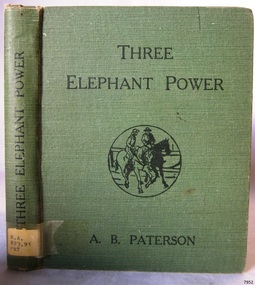 Flagstaff Hill Maritime Museum and Village
Book, Three Elephant Power
... writing. He became a successful radio broadcaster with the Australian Broadcasting Commission using his travel experiences. ...writing. He became a successful radio broadcaster with the Australian Broadcasting Commission using his travel experiences. ...This item is from the ‘Pattison Collection’, a collection of books and records that was originally owned by the Warrnambool Mechanics’ Institute, which was founded in Warrnambool in 1853. By 1886 the Warrnambool Mechanics’ Institute (WMI) had grown to have a Library, Museum and Fine Arts Gallery, with a collection of “… choice productions of art, and valuable specimens in almost every branch and many wonderful national curiosities are now to be seen there, including historic relics of the town and district.” It later included a School of Design. Although it was very well patronised, the lack of financial support led the WMI in 1911 to ask the City Council to take it over. In 1935 Ralph Pattison was appointed as City Librarian to establish and organise the Warrnambool Library as it was then called. When the WMI building was pulled down in 1963 a new civic building was erected on the site and the new Warrnambool Library, on behalf of the City Council, took over all the holdings of the WMI. At this time some of the items were separated and identified as the ‘Pattison Collection’, named after Ralph Pattison. Eventually the components of the WMI were distributed from the Warrnambool Library to various places, including the Art Gallery, Historical Society and Flagstaff Hill. Later some were even distributed to other regional branches of Corangamite Regional Library and passed to and fro. It is difficult now to trace just where all of the items have ended up. The books at Flagstaff Hill Maritime Village generally display stamps and markings from Pattison as well as a variety of other institutions including the Mechanics’ Institute itself. RALPH ERIC PATTISON Ralph Eric Pattison was born in Rockhampton, Queensland, in 1891. He married Maude Swan from Warrnambool in 1920 and they set up home in Warrnambool. In 1935 Pattison accepted a position as City Librarian for the Warrnambool City Council. His huge challenge was to make a functional library within two rooms of the Mechanics’ Institute. He tirelessly cleaned, cleared and sorted a disarrayed collection of old books, jars of preserved specimens and other items reserved for exhibition in the city’s museum. He developed and updated the library with a wide variety of books for all tastes, including reference books for students; a difficult task to fulfil during the years following the Depression. He converted all of the lower area of the building into a library, reference room and reading room for members and the public. The books were sorted and stored using a cataloguing and card index system that he had developed himself. He also prepared the upper floor of the building and established the Art Gallery and later the Museum, a place to exhibit the many old relics that had been stored for years for this purpose. One of the treasures he found was a beautiful ancient clock, which he repaired, restored and enjoyed using in his office during the years of his service there. Ralph Pattison was described as “a meticulous gentleman whose punctuality, floorless courtesy and distinctive neat dress were hallmarks of his character, and ‘his’ clock controlled his daily routine, and his opening and closing of the library’s large heavy doors to the minute.” Pattison took leave during 1942 to 1945 to serve in the Royal Australian Navy, Volunteer Reserve as Lieutenant. A few years later he converted one of the Museum’s rooms into a Children’s Library, stocking it with suitable books for the younger generation. This was an instant success. In the 1950’s he had the honour of being appointed to the Victorian Library Board and received more inspiration from the monthly conferences in Melbourne. He was sadly retired in 1959 after over 23 years of service, due to the fact that he had gone over the working age of council officers. However he continued to take a very keen interest in the continual development of the Library until his death in 1969. About A. B. ‘Banjo’ Paterson Andrew Barton Paterson was born at Narrambla Station in New South Wales, Australia, on 17th February 1864 and died 5th February 1941. His first seven years were spent on his father’s station, where like so many Australian children he enjoyed a bush boyhood. This property was at Obley in the Orange district of New South Wales. The family moved to the Yass district and lived near the main route from Sydney to Melbourne where he saw a great many bullock teams, drovers with herds of stock, gold escorts and Cob & Co coaches. His lifelong love of horses and horsemen was forged from the riders and their horses he saw at the picnic races and polo matches the family attended. These horses and riders where from the Murrumbidgee River and Snowy Mountain areas of New South Wales. Patterson lived most of his life in Sydney. He became a journalist, army officer, novelist, poet, solicitor and a war correspondent. He enjoyed many different sports such as tennis, rowing and, most of all, he delighted in his horsemanship. His first poem ‘El Mahdi to the Australian Troop’ was published in the Bulletin in 1885 under the pen name of “The Banjo”, which was the name of his favourite horse. In 1895 his first book was published and was sold out in the week of publication; he sold 7000 copies in a few months. This book was “The Man From Snowy River, and other Verses” and it contained such ballads as ‘Clancy of the Overflow’, ‘The Geebung Polo Club’, ‘The Man from Ironbark’, and ‘Saltbush Bill’. The tittle poem was first published in 1890. In 1895 Patterson visited his fiancé (at that time), Sarah Riley, who was staying with her friends the Macphersons at Dagworth Station in Queensland. Sarah’s old school friend Christina McPherson. Christina replayed to them an old Scottish tune called “The Craigielee March” that she had heard played by the Garrison Artillery band at the Warrnambool picnic races in Victoria, 1894. Patterson wrote words to fit the tune and it became the now famous ‘Waltzing Matilda’. He was commissioned by the Sydney Morning Herald and the Melbourne Age as they correspondent to report on the South African War. After being a roving reporter in China he went to England and spent time with Rudyard Kipling. In April 1903 Paterson married Alice Walker in Tenterfield, New South Wales, and they had two children, Grace and Hugh. At the outbreak of World War 1 Paterson sailed for England in the hope of covering the fighting in Flanders as a correspondent but finished up driving an ambulance for the Australian Voluntary Hospital, Wimereux, France. In 1915 as an honorary vet he made three voyages taking horse to Africa, China and Egypt. On 18th October 1915 he was commissioned in the 2nd Remount Unit in the Australian Imperial Force and was promoted to Captain serving in the Middle East. He was wounded in April 1916, when he re-joined his unit he was promoted to major and commanded the Australian Remount Squadron from October 1916 to his return to Australia in 1919. Once the War was over he resumed his work as a journalist until he retired in 1930 so that he could devote time to creative writing. He became a successful radio broadcaster with the Australian Broadcasting Commission using his travel experiences. He wrote the children’s book “The Animals Noah Forgot” in 1933 and then in 1934 “Happy Dispatches” in which he told of his meetings with people like Winston Churchill and Kipling. “The Shearer’s Colt was published in 1936 and in 1939 he wrote for the Sydney Morning Herald. After a short illness he passed away in Sydney on 5th February 1941. The Pattison Collection, along with other items at Flagstaff Hill Maritime Village, was originally part of the Warrnambool Mechanics' Institute’s collection. The Warrnambool Mechanics’ Institute Collection is primarily significant in its totality, rather than for the individual objects it contains. Its contents are highly representative of the development of Mechanics' Institute libraries across Australia, particularly Victoria. A diversity of publications and themes has been amassed, and these provide clues to our understanding of the nature of and changes in the reading habits of Victorians from the 1850s to the middle of the 20th century. The collection also highlights the Warrnambool community’s commitment to the Mechanics’ Institute, reading, literacy and learning in the regions, and proves that access to knowledge was not impeded by distance. These items help to provide a more complete picture of our community’s ideals and aspirations. The Warrnambool Mechanics Institute book collection has historical and social significance for its strong association with the Mechanics Institute movement and the important role it played in the intellectual, cultural and social development of people throughout the latter part of the nineteenth century and the early twentieth century. The collection of books is a rare example of an early lending library and its significance is enhanced by the survival of an original collection of many volumes. The Warrnambool Mechanics' Institute’s publication collection is of both local and state significance. Three Elephant Power Author: A B Paterson Publisher: Angus & Robertson Date: 1917Label on spine cover with typed text RA 823.91 PAT Pastedown front endpaper has sticker from Warrnambool Mechanics Institute and Free Library Front loose endpaper has a stamp from Warrnambool Mechanics Institute Fly paper has a stamp from Warrnambool Mechanics Institutewarrnambool, shipwrecked-coast, flagstaff-hill, flagstaff-hill-maritime-museum, maritime-museum, shipwreck-coast, flagstaff-hill-maritime-village, shipwrecked-artefact, book, pattison collection, warrnambool library, warrnambool mechanics’ institute, ralph eric pattison, corangamite regional library service, warrnambool city librarian, mechanics’ institute library, victorian library board, warrnambool books and records, warrnambool children’s library, great ocean road, three elephant power, a b paterson -
 Mission to Seafarers Victoria
Flyer, Clare McCracken, The Place Between, 2018
... travel to China mirroring her great-great-grandmother's journey from Australia to Asia in 1874. Artist statement from the back of the flyer: "In 1874, my great-great-grandmother, Elizabeth Amy Cathcart Payne, sailed unaccompanied from Australia to Asia, writing a detailed journal of her experiences. ...travel to China mirroring her great-great-grandmother's journey from Australia to Asia in 1874. Artist statement from the back of the flyer: "In 1874, my great-great-grandmother, Elizabeth Amy Cathcart Payne, sailed unaccompanied from Australia to Asia, writing a detailed journal of her experiences. ...On the 21st of July 2018, Clare McCracken boarded the ANL Wahroonga container ship to travel to China mirroring her great-great-grandmother's journey from Australia to Asia in 1874. Artist statement from the back of the flyer: "In 1874, my great-great-grandmother, Elizabeth Amy Cathcart Payne, sailed unaccompanied from Australia to Asia, writing a detailed journal of her experiences. This exhibition weaves together sections of her diary with my own voyage from Australia to the world's busiest port, Shanghai. In doing so, The Place Between, is a meditation upon the social and political nature of international trade, the mobility and the place between Australia and the rest of the world in the 19th and 21st century." The Mission has always been open to the community and has a tradition of hosting cultural events: shows, concerts, exhibitions, festivals.Postcard size flyer advertising for an exhibitionthe place between, clare mccracken, cultural events, sea voyage, andrew ferris, arun munoz, video installation -
 Heathcote McIvor Historical Society
Day Book, Book, 1856
... They also owned a sawmill and quartz crushing battery. one of three books donated to the Museum, were found by the donors father back in the late 1960's while he was working on renovations to a building in heathcote these books had been thrown onto a pile of builders rubble, he retrieved them. when he passed away some years later his son found them while clearing out his effects, have travel through several house changes till 2010 when the son was doing a cleanup and the books were found again he contacted the Historic Society, date back to first settlement of Heathcote, inside writing is in excellient condition, as if it were written yeaterday. give a daily account of purchases by locals.gives us an insight into persons living and working in Heathcote McIvor district. ...Believed to be long to Routledge Brothers who ran a general store business in heathcote. They also owned a sawmill and quartz crushing battery.one of three books donated to the Museum, were found by the donors father back in the late 1960's while he was working on renovations to a building in heathcote these books had been thrown onto a pile of builders rubble, he retrieved them. when he passed away some years later his son found them while clearing out his effects, have travel through several house changes till 2010 when the son was doing a cleanup and the books were found again he contacted the Historic Society, date back to first settlement of Heathcote, inside writing is in excellient condition, as if it were written yeaterday. give a daily account of purchases by locals.gives us an insight into persons living and working in Heathcote McIvor district. Not many early items of this era left .Day book, oblong, leather cover, Day book gold blocked on front coverday book routledge, brothers -
 Greensborough Historical Society
Container - Inkwell, [Travelling Inkwell]
... Travelling inkwell, from the days before fountain pens and biros! inkwells ink bottles writing equipment Travelling inkwell, clear glass container with cork, in brass case with double hinged lid [Travelling Inkwell] Container Inkwell ...Travelling inkwell, from the days before fountain pens and biros!Travelling inkwell, clear glass container with cork, in brass case with double hinged lidinkwells, ink bottles, writing equipment
