
Showing 190 items matching "unit camp"
-
 4th/19th Prince of Wales's Light Horse Regiment Unit History Room
16 mm Film, 4/19 PWLH Camp
... ...unit camp...16 mm film of unit camp...film 16mm unit camp 16 mm film of unit camp 4/19 PWLH Camp 16 mm Film ...16 mm film of unit campfilm, 16mm, unit camp -
 Bendigo Military Museum
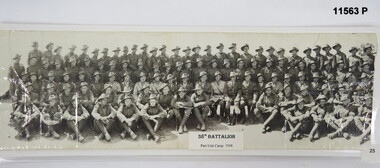
Photograph - 38th BATTALION 1938, 1938
... Photograph of 38th Battalion, Part Unit Camp 1938....Passchendaele Barracks Trust PBT25 Photograph Photograph of 38th Battalion, Part Unit Camp 1938. Photograph 38th BATTALION 1938. ...The 38th Battalion was a local Bendigo based CMF unit located at Passchendaele Barracks, Mollison Street.Photograph of 38th Battalion, Part Unit Camp 1938.passchendaele barracks trust, pbt25, photograph -
Tatura Irrigation & Wartime Camps Museum
Folder, The Wallenbergers, 1996
... raoul wallenberg unit...camp...19 separate stories of the lives of members of Unit Wallenberg of B'Nai B'Rith the wallenbergers raoul wallenberg unit camp tatura ww2 books history local Front cover clear plastic, spine black, back cover grey plastic. ...19 separate stories of the lives of members of Unit Wallenberg of B'Nai B'RithFront cover clear plastic, spine black, back cover grey plastic. Phamphlet"Raoul Wallenberg" holocaust collection pamphlet "The Jewish Holocaust Museum and Research Centre. These two pamphlets are in the back of the Folder Volume 1the wallenbergers, raoul wallenberg unit, camp, tatura, ww2, books, history, local -
Tatura Irrigation & Wartime Camps Museum
Booklet, Courage to Care
... unit...jewish museum...camp...In Adelaide by B'nai B'rith and the Jewish Community courage to care raoul wallenberg unit jewish museum camp 3 tatura ww2 books history local Beige coloured soft cover booklet. ...Booklet written to accompany an exhibition shown a a number of major Australian Capital cities and regional centres including : Jewish Museum of Australia, Melbourne. In Adelaide by B'nai B'rith and the Jewish CommunityBeige coloured soft cover booklet. Shadow photo of people rounded up in Holocustcourage to care, raoul wallenberg unit, jewish museum, camp 3, tatura, ww2, books, history, local -
 Bendigo Military Museum
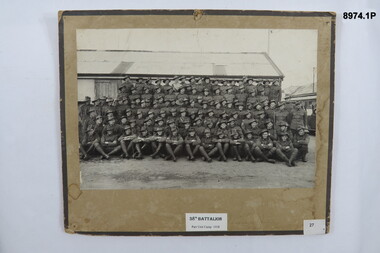
Photograph - 38TH BATTALION 1938-41, Unknown
... Group photo, part Unit Camp 1938. 2. Group photo 38th Battalion 1938 including Lt.Col Swatton. 3. ...Group photo, part Unit Camp 1938. 2. Group photo 38th Battalion 1938 including Lt.Col Swatton. 3. ...Four photos B & W on grey coloured card backing. 1. Group photo, part Unit Camp 1938. 2. Group photo 38th Battalion 1938 including Lt.Col Swatton. 3. Group photo "MG Coy 38th Battalion Mt Martha 1940. 4. Group photo HQ 38th Battalion Seymour 1941.1. “Passchendaele Barracks Trust” 2. “On loan from the Estate of Colonel J.W. Swatton, Ref No. JWS P/-18. C.Fitch & Son Photographer” 3. “Mt Martha 1940 from the Estate of Colonel J.W. Swatton, Ref No. JWS P/-/7”passchendaele barracks trust, pbt1to4, photographs, 38th battalion, j.w. swatton -
 4th/19th Prince of Wales's Light Horse Regiment Unit History Room
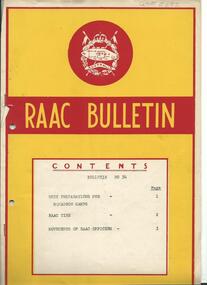
Document - Bulletin, Royal Australian Armoured Corps Bulletin No 34, March 1957
... A six page document covering unit preparations for squadron camps, RAAC ties, and movement of RAAC officers from date 29 March 1957...raac bulletin raac ties officer postings A six page document covering unit preparations for squadron camps, RAAC ties, and movement of RAAC officers from date 29 March 1957 Royal Australian Armoured Corps Bulletin No 34 Document Bulletin ...A six page document covering unit preparations for squadron camps, RAAC ties, and movement of RAAC officers from date 29 March 1957raac bulletin, raac ties, officer postings -
 8th/13th Victorian Mounted Rifles Regimental Collection
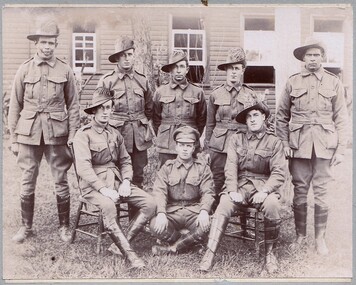
photograph
... Black and white photograph mounted on card of 8 soldiers believed to be members of 1st Remount Unit located at Broadmeadows Camp 1915.Centre front row wearing a cap is robably Veterinary Officer. standing either end are two soldiers of Aboriginal appearance....Black and white photograph mounted on card of 8 soldiers believed to be members of 1st Remount Unit located at Broadmeadows Camp 1915.Centre front row wearing a cap is robably Veterinary Officer. standing either end are two soldiers of Aboriginal appearance. photograph ...Remount Units were an important Support Unit supplying replacement horses to Light Horse regiments.Black and white photograph mounted on card of 8 soldiers believed to be members of 1st Remount Unit located at Broadmeadows Camp 1915.Centre front row wearing a cap is robably Veterinary Officer. standing either end are two soldiers of Aboriginal appearance.On reverse " Remount Depo: Mr. J. Bell. Box 5 Wangaratta." -
 Bendigo Military Museum
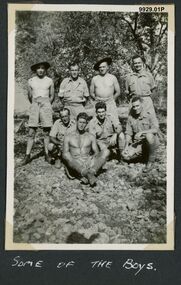
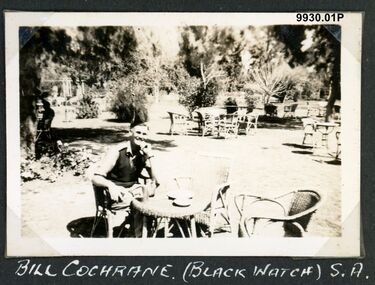
Album - PHOTOTOGRAPHIC ALBUM WW2, AIF Training in Palestine : D Company 2/31st Battalion, Syria and Palestine, 1940
... They record events and personalities from units passing through the camp, including many friends of the author in a range of units. ...They record events and personalities from units passing through the camp, including many friends of the author in a range of units. ...This album was part of the collection of Bill Thomason, a Bendigo collector of militaria. The collection includes two albums put together by a Lieutenant Brown in 1940-41, possibly attached to the 19th Training Battalion at Biet Jirja in Palestine. They record events and personalities from units passing through the camp, including many friends of the author in a range of units. The images include those taken by Brown, along with images seemingly supplied by friends from different units. This particular set features the 2nd/31st Battalion. Refer to record number 9928P and 10106P for details on physical albums.Contains unique images of AIF life in Palestine and Syria.Photographs of D Company 2/31st Battalion during training and deployment in the Middle East 1940-412/31st battalion, syria, palestine, egypt, thomason collection -
 Bendigo Military Museum
Album - PHOTOTOGRAPHIC ALBUM WW2, AIF Training in Palestine : D Company 2/31st Battalion, Syria and Palestine Part 2
... The albums record events and personalities from units passing through the camp, including many friends of the author in a range of units. ...The albums record events and personalities from units passing through the camp, including many friends of the author in a range of units. ...This album was part of the collection of Bill Thomason, a Bendigo collector of militaria. The collection includes two albums put together by a Lieutenant Brown in 1940-41, possibly attached to the 19th Training Battalion at Biet Jirja in Palestine. The albums record events and personalities from units passing through the camp, including many friends of the author in a range of units. The images include those taken by Brown, along with images seemingly supplied by friends from different units. This particular set is the second one featuring D Company, 2nd/31st Battalion. Refer to record number 9928P and 10106P for details on physical albums.Contains unique images of AIF life in Palestine and Syria.Photographs of D Company 2/31st Battalion during training and deployment in the Middle East 1940-412/31st battalion, syria, palestine, egypt, thomason collection -
 Bendigo Military Museum
Album - PHOTOGRAPHIC ALBUM WW2, AIF Training in Palestine : 2nd/8th Battalion at Biet Jirja
... camp in Palestine in 1940-41. They are part of the collection of Bill Thomason, a Bendigo collector of militaria. The collection includes two albums put together by a Lieutenant Brown in 1940-41, possibly attached to the 19th Training Battalion at Biet Jirja in Palestine. The albums record events and personalities from units...camp in Palestine in 1940-41. They are part of the collection of Bill Thomason, a Bendigo collector of militaria. The collection includes two albums put together by a Lieutenant Brown in 1940-41, possibly attached to the 19th Training Battalion at Biet Jirja in Palestine. The albums record events and personalities from units ...These images feature various personnel from 2/8th while training at Biet Jirja, the large AIF training camp in Palestine in 1940-41. They are part of the collection of Bill Thomason, a Bendigo collector of militaria. The collection includes two albums put together by a Lieutenant Brown in 1940-41, possibly attached to the 19th Training Battalion at Biet Jirja in Palestine. The albums record events and personalities from units passing through the camp, including many friends of the author in a range of units. The images include those taken by Brown, along with images seemingly supplied by friends from different units. Refer to record number 9928P and 10106P for details on physical albums.Contains unique images of AIF life in Palestine and Syria.Photographs of various 2/8th identities while at Biet Jirja training campsyria, palestine, egypt, thomason collection, 2/8th battalion aif -
 Bendigo Military Museum
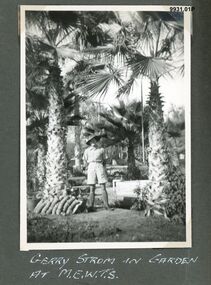
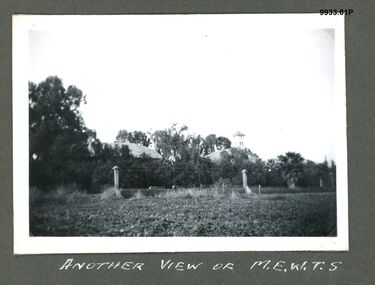
Album - PHOTOGRAPHIC ALBUM WW2, AIF Training in Palestine : Middle East Tactical School and MEWTS officer training
... The albums record events and personalities from units passing through the camp, including many friends of the author in a range of units. ...The albums record events and personalities from units passing through the camp, including many friends of the author in a range of units. ...These images feature various personnel attending courses and the Middle East Tactical School. This school honed the leadership and command skills of officers. The images are part of the collection of Bill Thomason, a Bendigo collector of militaria. The collection includes two albums put together by a Lieutenant Brown in 1940-41, possibly attached to the 19th Training Battalion at Biet Jirja in Palestine. The albums record events and personalities from units passing through the camp, including many friends of the author in a range of units. The images include those taken by Brown, along with images seemingly supplied by friends from different units. Refer to record number 9928P and 10106P for details on physical albums.Contains unique images of AIF life in Palestine and Syria.Photographs of participants and environment of the METS and MEWTS training schools for officers. These schools were credited with providing an extra degree of professionalism to Australian and Commonwealth officerssyria, palestine, egypt, thomason collection, mets middle east tactical school -
 Bendigo Military Museum
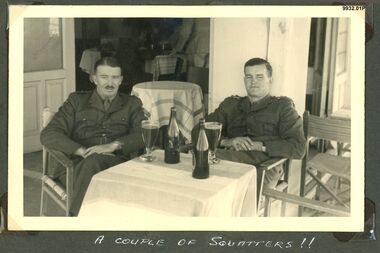
Album - PHOTOTOGRAPHIC ALBUM WW2, AIF Training in Palestine : Biet Jirja reinforcements and training camp
... camp in Palestine in 1940-41. Also featured are a number of images of Lieutenant Brown, who put together the albums. They are part of the collection of Bill Thomason, a Bendigo collector of militaria. The collection includes two albums put together by a Lieutenant Brown in 1940-41, possibly attached to the 19th Training Battalion at Biet Jirja in Palestine. The albums record events and personalities from units...camp in Palestine in 1940-41. Also featured are a number of images of Lieutenant Brown, who put together the albums. They are part of the collection of Bill Thomason, a Bendigo collector of militaria. The collection includes two albums put together by a Lieutenant Brown in 1940-41, possibly attached to the 19th Training Battalion at Biet Jirja in Palestine. The albums record events and personalities from units ...These images feature various personnel from 2/4th Battalion, featuring Christmas lunch, while training at Biet Jirja, the large AIF reinforcement depot and training camp in Palestine in 1940-41. Also featured are a number of images of Lieutenant Brown, who put together the albums. They are part of the collection of Bill Thomason, a Bendigo collector of militaria. The collection includes two albums put together by a Lieutenant Brown in 1940-41, possibly attached to the 19th Training Battalion at Biet Jirja in Palestine. The albums record events and personalities from units passing through the camp, including many friends of the author in a range of units. The images include those taken by Brown, along with images seemingly supplied by friends from different units. Refer to record number 9928P and 10106P for details on physical albums.Contains unique images of AIF life in Palestine and Syria.Photographs of various 2/4th identities while at Biet Jirja training camp and reinforcement depotsyria, palestine, egypt, thomason collection, 2/4th battalion aif -
 Bendigo Military Museum
Photograph - A Section, 1st Topographic Survey Troop, Vung Tau, Vietnam, 1966
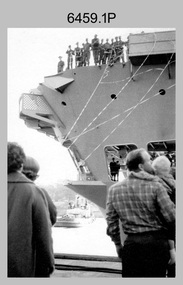
... They arrived in Saigon, Vietnam on the 10th of June 1966 enroute to the Australian Reinforcement Unit (ARU) “back beach” camp in Vung Tau. The ten RA Svy technical personnel from 1st Topo Svy Tp deployed were: WO2 David Christie, SGT Stan Campbell, SGT Dave King, CPL Jim Roberts, CPL Dennis Duquemin, CPL Des Ceruti, SPR Derek Chambers, SPR Brian Firns, SPR Joe O’Connor and SPR Ron Smith. ...A Section 1 Topo Svy Tp personnel arrive at the Australian Reinforcement Unit (ARU) “back beach” camp. .10) - Photo, black & white, 1966. ...A Section 1 Topo Svy Tp personnel arrive at the Australian Reinforcement Unit (ARU) “back beach” camp. .10) - Photo, black & white, 1966. ...This is a set of 12 photographs of A Section, 1st Topographic Survey Troop taken from the 25th of May to the 12th of June 1966 during their deployment to Vung Tau, Vietnam. Led by OC CAPT Bob Skitch, the ten personnel from A Section 1st Topo Svy Tp and six personnel from supporting units were the first contingent from the Royal Australian Survey Corps deployed to provide topographic support to the Australian Task Force in Vietnam. They arrived in Saigon, Vietnam on the 10th of June 1966 enroute to the Australian Reinforcement Unit (ARU) “back beach” camp in Vung Tau. The ten RA Svy technical personnel from 1st Topo Svy Tp deployed were: WO2 David Christie, SGT Stan Campbell, SGT Dave King, CPL Jim Roberts, CPL Dennis Duquemin, CPL Des Ceruti, SPR Derek Chambers, SPR Brian Firns, SPR Joe O’Connor and SPR Ron Smith. External personnel deployed were: WO2 Snow Rollston from Northern Command Field Survey Unit, T/CPL Peter Clarke – orderly room corporal, T/CPL Alan Carew – Technical Storeman, SPR Stan Johns – Map Storeman, SPR Boots Campbell – batman/driver and PTE BNF Brunning – cook. The ship featured in photos .1P and .2P was the aircraft carrier HMAS Sydney on its 4th voyage to Vietnam. On board were SGT Stan Campbell and SPR Brian Firns, tasked to manage A Section’s stores and equipment. The rest of A Section deployed to Vietnam by air on the chartered Qantas 707B ‘City of Longreach'. A Section’s main tasks were to establish a Theatre Grid, map compilation and map revision; Engineer Survey Support in the camp and to the civil community; give assistance to the Cordon Search Missions by producing large scale plots from aerial photos with every house and fence etc plotted; and then reproduce these by silk screening usually, within a 24-hour period. RA Svy’s support concluded with the withdrawal of Australian troops from Vietnam in 1972. More information on the A Section, 1st Topographic Survey Troop and the Army Survey Regiment’s supporting role is provided in pages 89 to 94 of Valerie Lovejoy’s book 'Mapmakers of Fortuna – A history of the Army Survey Regiment’ ISBN: 0-646-42120-4.This is a set of 12 photographs of A Section, 1st Topographic Survey Troop (1st Topo Svy Tp), taken from the 25th of May to the 12th of June 1966 during their deployment to Vung Tau, Vietnam. The black and white photographs were printed on photographic paper and are part of the Army Survey Regiment’s Collection. The photographs were scanned at 300 dpi. .1) &.2) - Photo, black & white, 1966. HMAS Sydney departing Woolloomooloo wharf en-route to Vietnam. .3) - Photo, black & white, 1966. A Section 1 Topo Svy Tp relaxing in a bar before deployment. OC CAPT Bob Skitch in centre of photo. .4) - Photo, black & white, 1966. Unidentified A Section 1 Topo Svy Tp personnel and troops from other units relaxing in a bar before deployment. .5) - Photo, black & white, 1966. A Section 1 Topo Svy Tp personnel arrival by bus at Saigon (Tan Son Nhut) Airport. OC CAPT Bob Skitch 4th from right. .6) - Photo, black & white, 1966. A Section 1 Topo Svy Tp personnel boarding the USAF Hercules aircraft enroute from Saigon (Tan Son Nhut) Airport to Vung Tau Airfield. OC CAPT Bob Skitch on left. .7) - Photo, black & white, 1966. A Section 1 Topo Svy Tp personnel and troops from other units boarding the USAF Hercules aircraft enroute from Saigon (Tan Son Nhut) Airport to Vung Tau Airfield. .8) & .9) - Photo, black & white, 1966. A Section 1 Topo Svy Tp personnel arrive at the Australian Reinforcement Unit (ARU) “back beach” camp. .10) - Photo, black & white, 1966. A Section 1 Topo Svy Tp personnel in oppressive conditions work on map products. .11) - Photo, black & white, 1966. Group photo of A Section 1 Topo Svy Tp. OC CAPT Bob Skitch on far right. .12) - Photo, black & white, 1966. Group photo of A Section 1 Topo Svy Tp. OC CAPT Bob Skitch 3rd from right.Annotated with the photo set - ‘ DET 1 Topo Svy Tp Vung Tau 25 May to 12 of Jun 66’royal australian survey corps, rasvy, army survey regiment, army svy regt, fortuna, asr, 1st topographical survey troop -
 Federation University Historical Collection
Book, Victoria Education Gazette and Teachers' Aid, 1921-1930, 1921-1930
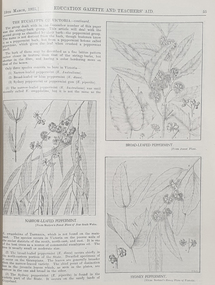
... Long and Ponsonby Carew-Smyth, Frank Tate, Phyiscal Training, Arbor Day, ANZAC Day, Shakespeare Day,Bendigo Junior Techncial School, Musical Appreciation, Motor Dental Unit, School Camps, Education Act of 1872: Mr Angus McKay's Part (George Mackay), A Bush Fire Experience (Irene Stable), Black Sunday, Californian Red Pine, Women's Education in America, Farewell to Lord and Lady Stradbroke, Grevilia Robusta, Silky Oak, Redwood, John E. ...Long and Ponsonby Carew-Smyth, Frank Tate, Phyiscal Training, Arbor Day, ANZAC Day, Shakespeare Day,Bendigo Junior Techncial School, Musical Appreciation, Motor Dental Unit, School Camps, Education Act of 1872: Mr Angus McKay's Part (George Mackay), A Bush Fire Experience (Irene Stable), Black Sunday, Californian Red Pine, Women's Education in America, Farewell to Lord and Lady Stradbroke, Grevilia Robusta, Silky Oak, Redwood, John E. ...The Victoria Education Gazette and Teachers' Aid was published for Victoria's teachers and was sent to all school on the state. In 1920 The Ballarat School of Mines had donated 136 pounds 14 shillings and 10 pence to the Victorian Education Department's War Relief Account, and the Ballarat Junior Technical School had donated 10 pounds 6 shillings and 10 pence.Ten black hard covered volumes with red tape spine, covering 1921 to 1930. The gazettes include Education Department appointments, transfers, resignations and retirements, vacancies, notices, queries, notices of books, examination papers, original articles, lesson plans, suggestions for lessons, drawing, obituaries, notes on nature study, mathematics, music, sloyd woodwork, English grammar, Victorian State School Swimming Clubs, Geography, penmanship, science, History, Latin, Geography, The School Garden, horticulture, singing, World War One; ANZAC Day, lifesaving, Astronomy, Empire Day, ANZAC Buffet London, Victorian Education Department's War Relief Fund .1) 1928. Articles include: New Caledonia, Swimming and Lifesaving, School forestry, a visit to the pyramids, Exploration of Gippsland, paul de Strezelecki, Angus McMillan, Villers Bretonneux Memorial School, American Black Walnut, Red Gum, Messmate Stringybark, The Great Barrier Reef, retirement of Frank Tate, Stawell High School, Report on Some Aspects of Education in the United States, Jubilee Education Exhibition , New School Readers; measured Drawing Images include: Macarthur Street School's Plantation, Maryborough School Plantation, Pinus Insignis (Radiata) ready for Milling, Creswick State Forest, Metalwork, Daylesford Pine Plantation four years old, Henry Harvey (art Inspector); Omeo School Endowment Plantation; Frank Tate; Stawell High School Drawings From Casts; Lake Tyers School Endowment Plantation, measured drawing, Thomas H. Stuart, GEorge Swinburne. J.R. Tantham-Fryer, Cookery Class, John Edward Thomas. .3) War Savings Stampsm Swimming and Life-saving, Teh Rural School System of Victoria, Imaginative Composition, ANZAC Day, Retardation, Teh Bright Child Hudson Hard Obituary, Leeches, Relief for Distress in Europe, Dental, Teachers' Library, History of Portarlington, J.E. Stevens Obituary, Victorian Teachers in England Images: Swimming and Life-Saving Medallion .3) Swimming and Lifesaving, Bronze medallion, Victoria Leage of Victori, War Savings Stamps, Rural School Sytem of Victoria, .4) War Relief, Talbot Colony for Epileptics Masonmeadows, Discipline New and Old (Percy Samson), Soldier teachers, Preservation of Australian Birds, Arbor Day, Jubilee of Free Education, Teaching Geography, Poery in Schools, School Committees, Shelter Pavilion, Mysia Memorial School, Clovers, Jubilee Exhibition, Domestic Arts, Louis Pasteur, .5) Victoria League of Victoria, An Endowment Scheme (Pine Plantations), School Endowment Plantations, Protecting our trees by Owen Jones,. Victorian State Schools Horticultural Society, Sloyd Woodwork, School Forestry, Thomas Brodribb Obituary and portrait, Imperial Education Conference London, school Management and Method, School plantations, Eucalypt plantations in the Bendix and Heathcote District, Junior Red Cross, Jubilee Education Exhibition, Gould League Competitions, handwriting, The School Magazine, Frank Tate in London, Victorian beetles, Council of Public Education, Villers Bretonneux and its new School, Death of Samuel Summons, Woodwork Summer School, Swimming, Japanese Relief Fund, Retirement of John Cross, reminiscences of the Late Mr Albert Mattingley .6) Thomas H. Trengrove and the Villers Bretonneux School hall and pilaster carvings, forestry, visit of Maryborough teachers to Ballarat Water Reserves, noxious weeds, relief for Distressed Europe, The Dalton Plan, Empire Day, Retirement of Mr Fussell, Centenary of Hume and Hovell Expedition, League of Kindness, Effective Nature Study in a Rural School, Some Facts About Paper and their Bearing Upon School Plantations, Council of the Working Men's College Melbourne, Maria Montessori, University Vacation School, Horticulture in State Schools, An Informal Chat About French Schools (C.R. McRae), The Vacation School, Johann Heinrich Pestalozzi, Inspector's Report on a 5th-class School, Can Children Write Verse, John Adams, Victoria League of Victoria, R.F. Toutcher, Sir James Barbie's Address to High-School Girls, Impressions of a High School Teacher Abroad (R.D. Collman), The Spirit of the School Plantation Scheme, Monument of the Late Mr and Mrs A.T. Sharp at Box Hill Cemetery, The Teaching of Geography, The Treatment of Poetry in Class, Two Difficult Arithmetic Lessons, Location of Principal Australian Timbers, Dr John Smyth, Stammering and its Influence on Education, Wireless Broadcasting as an Educational Medium, Boys School at Villers Brettonneux, The New School at Villers Brettonneux, Bird Day, Messmate or Stringybark, What Every Woman Knows, Director's Report on Denmark .7)1925 . Includes: School Forestry, horticulture, J.H. Betheras retirement, Ivanhoe School, Coburg School, Moorabool Junior Technical School, Villers Bretonneux School hall and pilaster carvings, Francis Ormond, William Charles Kernot, Corsican Pnes at Creswick, Ballarat High School Plantation, Workin Men's College, RMIT, Naorrow LEafed Peppermint, Education and World Peace, Eucalypts of Victoria, John C. Eccles, Blue Gum. Manners, Giving the Poorly Nourished Boy A Chance, Native Ferns, Marybourough Technical School, Memorial School at Villers-Brettonneux .8) Experimental Plots in Country Schools (W.W. Gay), Villers Bretonneaux and its Memorial School. nominated classes for Art Teachers, The Teachers Act 1925, Horsham High School, Richmond Technical School, Farewell to Messrs C.R. Long and Ponsonby Carew-Smyth, Frank Tate, Phyiscal Training, Arbor Day, ANZAC Day, Shakespeare Day,Bendigo Junior Techncial School, Musical Appreciation, Motor Dental Unit, School Camps, Education Act of 1872: Mr Angus McKay's Part (George Mackay), A Bush Fire Experience (Irene Stable), Black Sunday, Californian Red Pine, Women's Education in America, Farewell to Lord and Lady Stradbroke, Grevilia Robusta, Silky Oak, Redwood, John E. Grant, The Need for Research (Donald Clark), Junior Drama, Ida D. Marshall, John Pounds, Australian Books, Fish Creek School, State Boundaries, History in the Curriculum, Ceramic Art in Australia (Percy E. Everett), Choice of School Songs, Tasmanian Beech, Should History be Taught on a National or an International Basis, Hydatid Disease, James Holland Obituary, Florrie Hodges, Queensland Maple, Post Bushfire Ruins at Fumina, Arbor Day at Fumina, Queensland Rosewood, Omeo Endowment Plantation, Bird Day, Junior Red Cross, Pioneers' Day, Edward Henty, Junior Technical Schools, Yellow Pine, History and Progress of Needlework, A.B.C. of Astronomy, Northumberland Mental tests, Queensland Red Cedar, Teh Globe Theatre, .9) 1927 includes The ABC of Astronomy, Atr Theatre, English Beech, Angus McMillan Art Pottery, School Singing, State Schools' Nursery, School endowment plantations, Making a Man, experimental proof of Charles's Law, John Smyth obituary and portrait, Linton Pine Planation, motivation of arithmetic, Women's Classes at Dookie, Swimming and Lifesaving, Pioneers Day, Drawing, Ballarat High School planation, biting fly, Tir-Na-N'og, John Byatt retirement and portrait, Technical Schools Conference at Daylesford, Ethel Osborne and portrait, library. Francis Thompson portrait, Adam Lindsay Gordon, Solar movement, motor transport, Liverpool Cathedral, Teh Story of the Cathedral, Bendigo School of Mines, Omeo School pine plantation, Egypt and the Nile, Self-Criticism Images include Ballarat High School Pine Plantation, Vale Park, Francis Ormond, Woking Men's College (RMIT), W.N. Kernot, A Stand of Corsican Pines at Creswick, Victoria .10) Some Remarks on the Relationship of the technical Schools to the University (Donald Clark) , Present Day Education in England , Memorial to Joseph Cornwall, Spelling, motivation, Singing, State Scholarships, Agriculture, T.W. Bothroyd, The Swimmer - A Summer School Sketch (H.H. Croll), Swimming woodwork, Farewell to Dr Sutton. ,Drowning, War Savings Movement, White Beech. George S. Browne , Example of School Honor Book, Blackwood, Optimistic teacher, Soldier settlement around Shapparton, Oral Hygiene, Cinema Machines, Basketball, Wakter M. Camble obituary, ANZAC day Pilgrimage in England, Froebel's System, Montessori Method, War Relief Fund, New Zealand Kauri Tree, Bat Tenis at a Bush School., Advice to Australian Girls, Chrysanthemums, Royal Visit, National Parks of Victoria, Maurice Copland Obituary, total eclipse of the Moon, School libraries, The teacher and the COmmunity (A.M. Barry), The Reading Lesson, Swimming and Life-saving, MElbourne Teachers' College War Memorial Windows Old Trainees War Memorial, Cultivating a Natinoal Art education gazette, school, education, teaching, teacher, world war one, school plantations, macarthur street pine plantation, school forestry, creswick state forest, anzac day, armistance celebrations, frank tate, frank tate retirement, drawing from cast, education department school readers, lake tyers pine plantation, w.n. kernot, rmit, working men's college, francis ormond, pine plantations, calenbeem park, creswick, villers-brettonneux school hall and carvings, thomas trengrove, corsican pines, creswick, pine endowment plantations, mccarthur st primary school pine plantation, ballarat high school pine plantation, vale park, mount pleasant primary school pine plantation, golden point pine plantation, angus macmillan, paul de strzelecki, gippsland, villers-bretonneaux memorial school, francis thompson, english ash, pestalozzi centenary, shakespeare day, swimming classes, clear pine, cinema in education, american black walnut, red gum, thomas wolliam bothroyd obituary, and portrait, physical training displays, teaching of spelling, ohm's law, blue gum -
 Federation University Historical Collection
Magazine - Newsletter, The Flag, 1995-2001, 1995-2001
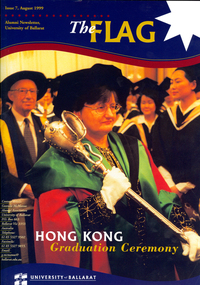
... mcmanus kent bracks vermeend university games greenhill netball magrath coutts turker colville wisely wakeling moneghetti alder atkinson lowe tirale richards blackburn pryor blainey shaw pursell singh blackman wild ballarat school of mines wimmera wimmera institute of tafe merger birkin caro sellers folkes coburn o'donogue kelly plunkett kellett unisports hong kong alumni koala muzumdar-shaw arts academy camp street precinct camp street Eleven copies of the University of Ballarat Alumni newsletter called The Flag. .1) David James, Gwenda McManus, Kerrie Edwards, Steve Bracks, Cordell Kent, Australian Native Gold, Koori Education Unit, Pat Hope, Rozeena Begum, Lidcha Mul. .2) Gwenda McManus, Wilhelmus, David James, University Mace, Trefor Prest, Steve Moneghetti, Shaun Creighton, Peter Blackburn, David Waite, Sandy Blythe, Kim Ross, Michael Wilson, Betty Gill, Betty Fish, Tom Hill, Bill Pryor . .3) David James. ...Eleven copies of the University of Ballarat Alumni newsletter called The Flag. .1) David James, Gwenda McManus, Kerrie Edwards, Steve Bracks, Cordell Kent, Australian Native Gold, Koori Education Unit, Pat Hope, Rozeena Begum, Lidcha Mul. .2) Gwenda McManus, Wilhelmus, David James, University Mace, Trefor Prest, Steve Moneghetti, Shaun Creighton, Peter Blackburn, David Waite, Sandy Blythe, Kim Ross, Michael Wilson, Betty Gill, Betty Fish, Tom Hill, Bill Pryor . .3) David James. Sandy Blythe, Geoffrey Blainey,Jamie Shaw, Kiran Mazumdar, Stuart Pursell, Tony Singh, Ballarat Teachers' College, Frank Nolan, Carolyn Blackman. .4) David James, Malini Chitaranjan, Chandker Varadhan, Lola Montez, Regina Molloy, Bert Labont'e, Jayne Reynolds, Amanda Sandwith, Roger Short, Stephen Kemmis, Barney Glover, Thomas O'Donnell, Sandy Blythe, Laurier Prosser, John Sharpham, Jack Barker, Xiaoli Jiang, Catherine Pearce, Nepal, Ballarat Teachers' College, John Culvenor, Richards Medal, Karl McCann. .5) Gwenda McManus, David James, Ron Wild, Merger, Wimmera Institute of TAFE, Katherine Birkin. .6) David Caro, Chancellor appointment, David James, Ellen Sellers, Ballarat Teachers' College Reunion, Briana Folkes, Lorri Coburn, Paul O'Donohue, Graeme Kelly, Tracy Plunkett, Julie Kellett, Unisports rehabilitation, Hong Kong graduation, China, koalas. .7) Hong Kong graduation, David Janes, Argentina, Richard Alder, threatened animals, reconciliation, Leoda Atkinson, mural, Jodie Lowe, indigenous Australians, Sue Turale, nursing, Hong Kong, Geoffrey Richards, Janice Edwards, Laura Chibnall, Franky Christiano, Nessa Jenkins, Kerrie Powell. .8) David James, Graduate Centre, Greenhill Enterprise Centre, Warren Young, Parks Victoria, Maxitrans, netball, John Magrath, maths, Catering for the Olympics, Eddie Turker, Maryanne Coutts, Sonia Colville, Daryl Wisely, Laura Wakeling. .9) Camp Street Redevelopment, Arts Academy, David James, Gwenda McManus, Doug Lloyd, Ian Gordon, University Appeal, Hong Kong, Sue Turale, Edward Wong, Hakodate University, Paris, nursing, Malaysia, Yuri Tanabe, Amanda Mead, Mary Modeen, Barry Judd. .10) Kerry Cox, Gwenda McManus, wildlife, MartinWestbrooke Brian McLennan Art Scholarship. Anne Saunders, Shenzhen, Hong Kong. .11) CFA, Kerry Cox, Wayne Robinson appointment, Terry Lloyd, Empire Rubber, Churchill Fellowship, Russell Rees, bus mural, Janice Croggon, John McDonald, Imogen Schwarz, Andrew Dark, Jacqueline Dark, building, Jeff Goodiesonmcmanus, kent, bracks, vermeend, university games, greenhill, netball, magrath, coutts, turker, colville, wisely, wakeling, moneghetti, alder, atkinson, lowe, tirale, richards, blackburn, pryor, blainey, shaw, pursell, singh, blackman, wild, ballarat school of mines, wimmera, wimmera institute of tafe, merger, birkin, caro, sellers, folkes, coburn, o'donogue, kelly, plunkett, kellett, unisports, hong kong, alumni, koala, muzumdar-shaw, arts academy, camp street precinct, camp street -
 Federation University Historical Collection
Photograph - Photograph - Sepia, Ballarat School of Mines Cadets, 1916, c1916
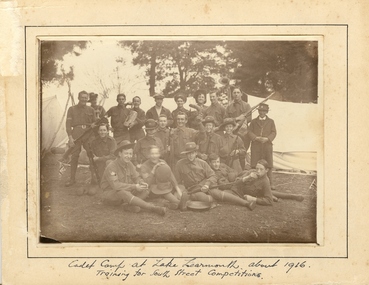
... It is thought that the 18th Brigade Cadet units in 1920 were those that came from the old: * 69th Infantry (Geelong/Queenscliff) * 70th Infantry (Ballarat/Colac) * 71st Infantry (Ballarat West) * 72nd Infantry Warrnambool) * 73rd Infantry (NW Vic) The next name change came in 1921! ballarat school of mines cadets ballarat school of mines cadets lake learmonth world war one boomerang camp ...Field Marshal Viscount Kitchener of Great Britain was invited by Prime Minister Deakin in 1909 to visit Australia and advise on the best way to provide Australia with a land defence. Kitchener’s report echoed the bill, introduced to Parliament in 1909 and supported by the Opposition Labor Party at its 1908 conference, to introduce compulsory military training in peace time (referred to as universal training). On 1 January 1911, the Commonwealth Defence Act 1911 (Cth) was passed as law and all males aged 12 to 26 were required to receive military training. Men were divided according to age, with junior cadets comprising boys 12-14 years of age, senior cadets comprising boys 14-18, and young men aged 18-26 assigned to the home militia defence. The support of schools was vital to the success of the scheme, since the system of cadet training began in the primary schools, with physical training prescribed by military authorities. Junior cadet training was entirely in the hands of school teachers, who had first been trained by military officers. This early training was less military in nature than focused on physical drill and sport. It also acted to inculcate boys with the notions of loyalty to country and empire. At this age, uniforms were not worn, although there were schools with pre-existing uniformed cadet units, who continued to do so. Senior Cadets were organised by Training Areas, administered by Area Officers. If a school had at least 60 senior cadets, they could form their own units. Unlike their junior counterparts, Senior Cadets were issued uniforms, a rifle, and learned the foundations necessary for service in any arm of the defence forces. Boys and men could be exempted from compulsory training if they lived more than five miles from the nearest training site, or were passed medically unfit. Those who failed to register for training were punished with fines or jail sentences, and the severity of this punishment generated some of the strongest opposition to the scheme. While institutions such as the political parties and most churches generally supported universal training, some in the broader labour movement were less enthusiastic, as evidenced in the Daily Herald newspaper’s editorials and letters. Universal military training persisted after the conclusion of World War 1, with the Junior Cadet scheme the first to go, in 1922. Senior cadets and service with the militia was suspended in November 1929. (http://guides.slsa.sa.gov.au/content.php?pid=575383&sid=4788359, accessed 29/10/2015) According to Neil Leckie, Manager of the Ballarat Ranger Military Museum: * Originally 12 – 14 year olds went to Junior Cadets attached to their school. * From age 14 – 17 they were Senior Cadets attached to the local militia unit. * After 1 July of the year a Cadet turned 18, the Cadet left the Senior Cadets and became a member of the Citizen Military Force. * In October 1918 the AIF, Militia and Cadets were renamed to give some connection to the AIF battalion raised in the area. Ballarat saw: 8th Australian Infantry Regiment comprising: * 8th Battalion AIF renamed 1st Battalion 8th Australian Infantry Regiment * 70th Infantry Militia renamed 2nd Battalion 8th Australian Infantry Regiment * 70th Infantry Cadets renamed 3rd B, 8th Australian Infantry. 39th Australian Infantry Regiment comprising: * 39th Battalion AIF renamed 1st Battalion 39th Australian Regiment * 71st Infantry Militia renamed 2nd Bn, 39th Australian Infantry Regiment * 71st Infantry Cadets renamed 3rd Bn, 39th Australian Infantry Regiment Prior to the reorganisation in 1918 the 18th Brigade was the 70th, 71st and 73rd Infantry. It is thought that the 18th Brigade Cadet units in 1920 were those that came from the old: * 69th Infantry (Geelong/Queenscliff) * 70th Infantry (Ballarat/Colac) * 71st Infantry (Ballarat West) * 72nd Infantry Warrnambool) * 73rd Infantry (NW Vic) The next name change came in 1921!Mounted sepia photograph of 21 young males. They are the Ballarat School of Mines Cadets on a training camp at Lake Learmonth. Back row left to right: Harold Wakeling; ? ; T. Wasley; H. Witter; H.V. Maddison (staff); Lieutenant S.J. Proctor, Joe ? ; ? ; B.C. Burrows. Centre left to right: Howard Beanland; ? ; F.N. Gibbs; H. Siemering; P. Riley; ? : E. Adamthwaite. Front row left to right: Albert E. Williams; Francis Davis (RAAF Dec.); A. Miller; W. Shattock; T. Rees From the Ballarat School of Mines Magazine, 1916 "Our Competition Team, 1916 At a parade, held on the 25th August competition teams were called from from the three colleges - Ballarat College, St Patrick's College, and the School of Mines. In each case, a large muster was obtained, twenty-nine volunteering fro the School of Mines. On account of the number in a team being limited to 21, some had to be weeded out. The team decided to have a camp at Learmonth in the vacation for the benefit of training for the coming competitions. The tents, within our baggage, were brought to the Junior Technical School at 10 a.m. on Monday, 11 September. Everything was carted to the station on a lorry, which was very kindly lent by Mr C. Burrow. ... Arriving at our camp, which was in the Park, we first raised the tents. This was done in record time. Three large tents, A.B.C., were pitched one behind the other. We also pitched a smaller one to act as a provisions tent. The provisions supplied by each cadet were placed in this tent. Dinner was ready by 3.30, and was prepared by the three senior non-coms., who also acted as orderlies. Things went alright Monday night, the two senior non-coms. acting as sentries for the first two hours. On Tuesday morning Reville sounded at 7. There was no need for it, however, as nearly all the cadets were up before daylight, owing to their beds being too hard. After physical exercises were gone through we had breakfast. We then had rifle exercises until Messrs A.W. Steane and F.N. King arrived. The former put the team through the table of physical exercises set down for competition work, many valuable points being obtained. The visitors remained for dinner, afterwards returning to Ballarat. Wednesday was uneventful, until the soldiers arrived at about 11 a.m., stopping at the park for lunch. As we handed over the coppers, etc., to them, our lunch was delayed. Two more visitors arrived after lunch, and after taking a few photos returned home. That night we had a "Sing-a-long" in C Tent until "Lights out" sounded at 9.30. After physical exercises ad breakfast on Thursday, we went for a six mile route march round the lake, doing skirmishing on the way. In the afternoon we practised rifle exercises and the march past. A concert was arranged for that night, the chief singers being cadets H. Siemering and W. Shattock. Supper was served at the end of the entertainment. On Friday, Reveille sounded at 6.30 instead of 7, and, as usual, we had physical exercises before breakfast, after which the team went through skirmishing at the reserve. In the afternoon, section drill and the march past were practised. Friday night, being our last night in camp, leave was granted until 10 p.m., "lights out" sounding at 11. Reveille sounded on Saturday at 4.30, the reason being that all kits, tents, etc., had to be packed away ready to catch the 8.15 train to Balalrat. At 7.30 we were all ready to leave for the station. We had a very enjoyable time in the train, each cadet having a chip in at the patriotic songs. On arriving at Ballarat, we found the lorry awaiting us. The luggage was carted to the Junior Technical School, the team following. The team were here dismissed, everyone feeling that he had had a very good time. F.G. Davis"Written in ink on front 'cadet camp at Lake Learmonth about 1916. Training for South Street Competitions. ballarat school of mines, cadets, ballarat school of mines cadets, lake learmonth, world war one, boomerang, camp, cadet camp, h.g. wakeling, harold wakeling, f.g. davis, albert w. steane, f.n. king, h. siermering, w. shattock, francis davis, harold wakeling, t. wasley, h. witter, h.v. maddison, s.j. proctor, b.c. burrows, howard beanland, f.n. gibbs, h. siemering, p. riley, e. adamthwaite, albert e. williams; francis davis, a. miller, w. shattock, t. rees, photography, foto, boxing gloves -
 Lara RSL Sub Branch
Photograph, THE 8TH BATTALION IN CAMP AT ELCHO FARM, GEELONG IN 1934, 1934
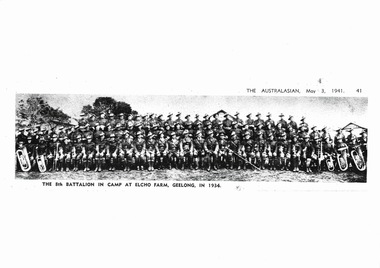
... unit before taking part in the Bougainville campaign late in the war. It was disbanded again in 1946 during the demobilisation process, although it was reformed again in 1948 when it was amalgamated with the 7th Battalion. Today, its honours and traditions are perpetuated by the 8th/7th Battalion, Royal Victoria Regiment. 8th battalion, ww1, australian infantry, lara r.s.l. THE AUSTRALIAN, May 3, 1941. THE 8TH BATTALION IN CAMP ...The 8th Battalion was an infantry battalion of the Australian Army. Initially raised in 1914 for the First Australian Imperial Force during the First World War the battalion was completely recruited from Victoria and formed part of the 2nd Brigade, 1st Division. During the war it fought at Gallipoli and in France and Belgium on the Western Front. It was disbanded in 1919, before being re-raised as a Militia battalion in 1921. During the Second World War the 8th Battalion was used primarily as a garrison unit before taking part in the Bougainville campaign late in the war. It was disbanded again in 1946 during the demobilisation process, although it was reformed again in 1948 when it was amalgamated with the 7th Battalion. Today, its honours and traditions are perpetuated by the 8th/7th Battalion, Royal Victoria Regiment.Rectangular shaped black and white photograph.THE AUSTRALIAN, May 3, 1941. THE 8TH BATTALION IN CAMP AT ELCHO FARM, GELONG IN 1934. 8th battalion, ww1, australian infantry, lara r.s.l. -
 Lara RSL Sub Branch
Photograph, Set 4 photographs. and others for Torquay Light Horse camp, 1940
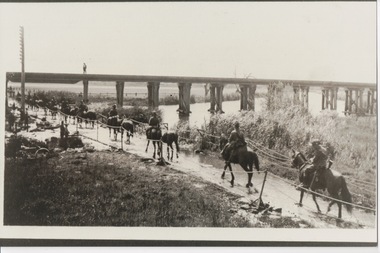
... By the end of the camp some felt that the Division was ready for active service. Gradually, over the next four years, the Australian Light Horse units were mounted on wheels and tracks and the horses were retired. ...By the end of the camp some felt that the Division was ready for active service. Gradually, over the next four years, the Australian Light Horse units were mounted on wheels and tracks and the horses were retired. ...These images capture for all time Light Horsemen travelling through Geelong on their way to camp at Torquay for the last Group meeting in Australia . information following - details obtained from .........https://torquayhistory.com/light-horse-brigade/ On Australia Day, 1997, Sir John Young unveiled this plaque on Point Danger, Torquay. Torquay history, Light Horse Training Camp, WW2 Plaque at Pt. Danger Note----- (See images to view plaque) The plaque identifies a significant event in Torquay’s history and the sentiments of ‘change’ for the Light Horse Brigade – from horses to machines. In 1940 the four Light Horse Regiments (4th, 8th, 13th and 20th), some 5000 Light Horse and 2000 horses camped and trained at Torquay. Three other regiments, formerly mounted on horses, were also at Torquay ‘mounted’ on privately owned trucks and cars. Division troops included Artillery, Engineers, Signals, Field Ambulance and other branches of the Army necessary to enable a Division to function. It wasn’t just the sheer numbers of men coming to this little town that made the event significant, it was also the fact that the men of the Light Horse were dramatic, almost glamorous figures and it is easy to see their exploits as some splendid adventure. Horses have played a special role in the story of Australia. They were the only means of transport across this huge country, so it was necessary for everyone to have the ability to ride a horse. When war broke out in 1899 between Britain and the Boers of South Africa (“Boer” was Dutch for “farmer”) Australia sent troops to fight. At first Britain was wary of using untried, unprofessional colonial cavalrymen but soon saw that the slouch-hatted Australian “bushmen” were a match for the fast-moving and unconventional mounted commandos of the Boers. The Australians proved themselves to be expert rough-riding horsemen and good shots. Bush life had hardened them to go for long periods with little food and water. They also showed remarkable ability to find their way in a strange country and use its features for cover, in both attack and defence. By 1914, when Australia joined the war against Germany, there were 23 Light Horse regiments of militia volunteers. Many men from these units joined the Light Horse regiments of the Australian Imperial Force (AIF). Men were given remounts (if not using their own horses) – army horses bought by Commonwealth purchasing officers from graziers and breeders. These were called “walers” because they were a New South Wales stockhorse type – strong, great-hearted animals with the strains of the thoroughbred and semi-draught to give them speed, strength and stamina. On 1st November, 1914, Australia’s First Infantry Division and the first four Light Horse regiments sailed for England in a fleet of transport ships. The first of the Light Horse arrived at Gallipoli in May without their horses. Back with their horses after Gallipoli, they were formidable combatants across the Sinai and Palestine. Some British commanders observed that the light horseman moved with a “lazy, slouching gait, like that of a sleepy tiger” but described how the promise of battle “changes that careless gait, into a live athletic swing that takes him over the ground much quicker than other troops”. They had Light Horse, Torquay, training campdeveloped a reputation as formidable infantrymen. The Turks called them “the White Ghurkas” – a reference to their deadly skill with the bayonet. The Arabs called them “The Kings of the Feathers”. The plume had originally been a battle honour of the Queensland Mounted Infantry for their work in the shearer’s strike of 1891. During WW1 it was adopted by almost all the Light Horse Regiments. It was the proud badge of the light horseman. The most famous of their battles was the attack on Beersheba- the charge of the 4th Light Horse Brigade. Mounted infantrymen and their superb walers had carried out one of the most successful cavalry charges in history – against what seemed impossible odds. They surprised the Turks by charging cavalry-style, when they would normally have ridden close to an objective then dismounted to fight. The fall of Beersheba swung the battle tide against the Turks in Palestine; and changed the history of the Middle East. While 19 men from the Surf Coast Shire served with the 4th Light Horse over the course of WW1, only four were involved in the charge of Beersheba- John GAYLARD, Philip QUINN.(Winchelsea); Wallace FINDLAY (Anglesea); Harry TRIGG (Bambra). After the war, Light Horse units played a key role in the Australian Government’s compulsory military training programme. The Citizen Military Forces (C.M.F.) thrived on the glamour of the wartime Light Horse tradition, ignoring the possibility that motor vehicles would soon replace the horses. When training was no longer compulsory, the C.M.F. regiments declined and horses became more of a luxury during the 1930s depression years of poverty and unemployment. Some regiments were motorised. Then, in 1939, Australia joined Britain in another world war. Training was increased for the militia at both home bases and regional training camps. The camp at Torquay in 1940, commanded by Major General Rankin, was at Divisional strength. By the end of the camp some felt that the Division was ready for active service. Gradually, over the next four years, the Australian Light Horse units were mounted on wheels and tracks and the horses were retired. Six men enlisted at the Torquay camp and another 57 men and women enlisted at Torquay for service in WW2. Those who served in the Militia provided valuable Officers and NCOs and men for the armed services during the war. Each infantry division of the 2nd AIF had a Light Horse regiment attached to it. But the day of the Australian mounted soldier hadn’t quite passed. During World War II, Australia’s 6th Cavalry Regiment formed a mounted unit they called “The Kelly Gang” which did valuable scouting work. In New Guinea, a mounted Light Horse Troop did patrol duty and helped carry supplies. Some fully equipped walers were flown into Borneo for reconnaissance in rugged mountain country. But by the end of the war, in 1945, the horse had disappeared from the Australian Army. References: Australian Light Horse Association www.lighthorse.org.au National Australia Archives Australian War Memorial Surf Coast Shire WW1 memorials www.togethertheyserved.com The Light horse- a Cavalry under Canvas Light Horse, Training Camp, Torquay, WW2 Late in 1939 it was decided to set up a Lighthorse training camp in Torquay to train both men and horses for the battles of the Second World War. Horses, men and equipment came on special trains from all over Victoria and NSW, and as you would expect horseman came from areas such as Omeo and Sale, the Wimmera and the Western District. They arrived at the Geelong racecourse for watering in the Barwon River and then were ridden across the ford at the breakwater and began their 11 mile trek to Torquay. Light Horse, Training Camp, Torquay, WW2 Tent city By the end of January 1940 the camp at Torquay accommodated some 5000 men and 2500 horses of the Second Cavalry Division. The rows of horses, tents and huts near Blackgate Road were quite a sight. While the cavalrymen engaged in exercises on the land and on the beaches, many of the troops took over the Torquay School for special training of men and officers. Mr Bob Pettit local farmer and Councillor for the Barrabool Shire, wrote about the Light horse in the Surf Coast Community News in 1985 saying “They used to travel about the district riding four abreast in one long convoy. To my annoyance they went through my property and shut all the gates behind them. I had certain gates open to let stock in to the water holes and it would take me three -quarters of an hour to follow the horsemen up and put all the gates right again” he continued “the men from the Light Horse were here when the fire went through in March 1940. He recalled an incident when early one morning, as some one blew the bugle, a soldier putting a white sheet on the line frightened the horses. They panicked and ran off in all directions. Six went over the cliff near Bird Rock, five were never found, and the rest were gathered up after nearly a fortnight in the bush around Addiscott and Anglesea" Light Horse, Training Camp, Torquay, WW2, Geelong Parade Geelong parade The training camp culminated in a parade through the streets of Geelong on March 12th 1940. The salute was given at the Town Hall and the troops continued on a route to the You Yang’s for a training exercise. Note-----(see media section for photograph) The Camp was abandoned in mid 1940 as it was deemed unsuitable for training during winter and the cost of a permanent camp could not be justified if it could not be used all year. Historic.......Rare,,,Interpretive.Sepia photographs.set of four ....post card size ....Horses &LighthorsemenNo 1, Lighthorsemen Regiment Geelong 1940......No 2 Light Horse at Breakwater Geelong 1938 to 1940....No 3 Light Horse at Breakwater Geelong 1938 to 1940.....No 4 Light Horse crossing Breakwater camped at Geelong Showgrounds. These markings are on reverse of photographs.light horsemengeelong 1940., world war 2 -
 Flagstaff Hill Maritime Museum and Village
Badge - Australian Military cloth patch, Army Medical Corps, 108 Australian General Hospital, 1939-1945
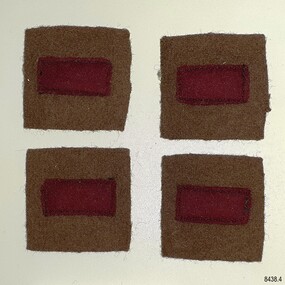
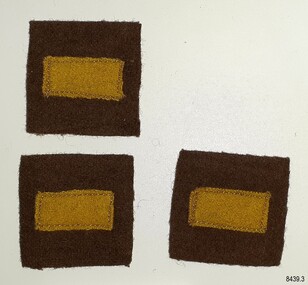
... In World War I the troops of the Australian Military Forces staked coloured flags of various shapes and colours in the ground where they camped to identify their units. These flag codes were quickly recognised. ...In World War I the troops of the Australian Military Forces staked coloured flags of various shapes and colours in the ground where they camped to identify their units. These flag codes were quickly recognised. ...The four cloth patches belonged to Dr William Roy Angus and are now part of Flagstaff Hill’s comprehensive W.R. Angus Collection, donated by the family of Dr W R Angus (1901-1970), surgeon and oculist. The badges date to the Second World War era, when Dr Angus was a Surgeon Captain for the Australian Defence Forces in the Army Medical Corps, 108 Australian General Hospital and 106 Australian General Hospital, stationed in Ballarat, Victoria, and in Bonegilla, N.S.W. He completed his service just before the end of the war due to suffering from a heart attack. In World War I the troops of the Australian Military Forces staked coloured flags of various shapes and colours in the ground where they camped to identify their units. These flag codes were quickly recognised. The system worked so well that miniature flags were called colour patches. They became part of the uniform, to be worn on both sleeves just below the shoulder. The system was slightly modified for use in the Second World War. The W.R. Angus Collection: - The W.R. Angus Collection includes historical medical equipment, surgical instruments and material belonging to Dr Edward Ryan and Dr Thomas Francis Ryan, (both of Nhill, Victoria) and Dr Angus’ own belongings. The Collection’s history spans the medical practices of the two Doctors Ryan, from 1885-1926 plus that of Dr Angus, up until 1969. It includes historical medical and surgical equipment and instruments from the doctors Edward and Thomas Ryan of Nhill, Victoria. Dr Angus married Gladys in 1927 at Ballarat, the nearest big city to Nhill where he began as a Medical Assistant. He was also Acting House surgeon at the Nhill hospital where their two daughters were born. During World War II He served as a Military Doctor in the Australian Defence Forces. Dr Angus and his family moved to Warrnambool in 1939, where Dr Angus operated his own medical practice. He later added the part-time Port Medical Officer responsibility and was the last person appointed to that position. Both Dr Angus and his wife were very involved in the local community, including the planning stages of the new Flagstaff Hill and the layout of the gardens there. Dr Angus passed away in March 1970.Dr W R Angus (1901-1970), surgeon and oculist, collected a range of military objects including those he personally used during his time as Surgeon Captain in the Australian Defence Forces in World War II. The objects allow insight into military life in the early-to-mid 20th century. The W.R. Angus Collection is significant for still being located at the site it is connected with, Doctor Angus being the last Port Medical Officer in Warrnambool. The Collection includes historical medical objects that date back to the late 1800s.Badges; set of four cloth patches, red rectangles on brown squares. Insignia of the Australian Defence Forces, Army Medical Corps, 108 Australian General Hospital, WWII era. Dr W R Angus owned the cloth patches that are now part of the W. R. Angus Collection.flagstaff hill, warrnambool, maritime village, maritime museum, shipwreck coast, great ocean road, flagstaff hill maritime museum and village, dr w r angus, w.r. angus collection, australian army, surgeon captain, ballarat, bonegilla, badge, insignia, badge collection, world war 2, second world war, australian defence forces, army medical corps, 108 australian general hospital, great war, military uniform, 106 australian general hospital, 1939-1945 -
 Flagstaff Hill Maritime Museum and Village
Badge - Australian Military cloth patch, Army Medical Corps, 106 Australian General Hospital, 1939-1945
... In World War I the troops of the Australian Military Forces staked coloured flags of various shapes and colours in the ground where they camped to identify their units. These flag codes were quickly recognised. ...In World War I the troops of the Australian Military Forces staked coloured flags of various shapes and colours in the ground where they camped to identify their units. These flag codes were quickly recognised. ...The three cloth patches belonged to Dr William Roy Angus and are now part of Flagstaff Hill’s comprehensive W.R. Angus Collection, donated by the family of Dr W R Angus (1901-1970), surgeon and oculist. The badges date to the Second World War era, when Dr Angus was a Surgeon Captain for the Australian Defence Forces in the Army Medical Corps, 108 Australian General Hospital and 106 Australian General Hospital, stationed in Ballarat, Victoria, and in Bonegilla, N.S.W. He completed his service just before the end of the war due to suffering from a heart attack. In World War I the troops of the Australian Military Forces staked coloured flags of various shapes and colours in the ground where they camped to identify their units. These flag codes were quickly recognised. The system worked so well that miniature flags were called colour patches. They became part of the uniform, to be worn on both sleeves just below the shoulder. The system was slightly modified for use in the Second World War. The W.R. Angus Collection: - The W.R. Angus Collection includes historical medical equipment, surgical instruments and material belonging to Dr Edward Ryan and Dr Thomas Francis Ryan, (both of Nhill, Victoria) and Dr Angus’ own belongings. The Collection’s history spans the medical practices of the two Doctors Ryan, from 1885-1926 plus that of Dr Angus, up until 1969. It includes historical medical and surgical equipment and instruments from the doctors Edward and Thomas Ryan of Nhill, Victoria. Dr Angus married Gladys in 1927 at Ballarat, the nearest big city to Nhill where he began as a Medical Assistant. He was also Acting House surgeon at the Nhill hospital where their two daughters were born. During World War II He served as a Military Doctor in the Australian Defence Forces. Dr Angus and his family moved to Warrnambool in 1939, where Dr Angus operated his own medical practice. He later added the part-time Port Medical Officer responsibility and was the last person appointed to that position. Both Dr Angus and his wife were very involved in the local community, including the planning stages of the new Flagstaff Hill and the layout of the gardens there. Dr Angus passed away in March 1970.Dr W R Angus (1901-1970), surgeon and oculist, collected a range of military objects including those he personally used during his time as Surgeon Captain in the Australian Defence Forces in World War II. The objects allow insight into military life in the early-to-mid 20th century. The W.R. Angus Collection is significant for still being located at the site it is connected with, Doctor Angus being the last Port Medical Officer in Warrnambool. The Collection includes historical medical objects that date back to the late 1800s.Badges; set of three cloth patches, yellow rectangles on brown squares. Insignia of the Australian Defence Forces, Army Medical Corps, 106 Australian General Hospital, WII era. Dr W R Angus owned the cloth patches that are now part of the W. R. Angus Collection.flagstaff hill, warrnambool, maritime village, maritime museum, shipwreck coast, great ocean road, flagstaff hill maritime museum and village, dr w r angus, w.r. angus collection, australian army, surgeon captain, ballarat, bonegilla, badge, insignia, world war 1, 1914-1918, badge collection, world war 2, second world war, australian defence forces, army medical corps, 108 australian general hospital, great war, military uniform, 106 australian general hospital -
 Geelong RSL Sub Branch
Book, Laurence Kay, Australian Army Colour Patches, Mid 20th Century
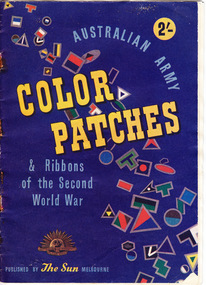
... Colour patches make units easier to find in large camps. Colour Patches Australian Army Military. ...History of Australian Army Colour Patches in WW1 and WW2.Colour patches make units easier to find in large camps.Oblong book, paper covers blue front white back. Rising Sun on the front cover.Published by The Sun Melbourne.colour, patches, australian army, military. -
 Australian Commando Association - Victoria
Photograph, 2 Commando Company emplaning for 1956 annual camp at Canungra, Queensland
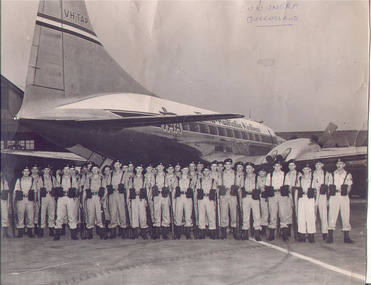
... This photograph was taken of the initial members of 2 Commando Company emplaning on a commercial aircraft which was to take them to their first annual camp being conducted at Canungra in Queensland. Early photograph of a recently established specialist Army unit. photo B & W photo 2 Commando Company emplaning for 1956 annual camp at Canungra, Queensland. ...This photograph was taken of the initial members of 2 Commando Company emplaning on a commercial aircraft which was to take them to their first annual camp being conducted at Canungra in Queensland.Early photograph of a recently established specialist Army unit.B & W photophoto -
 Eltham District Historical Society Inc
Document (Item) - Article, The Eltham Roll of Honour: Second World War, 9 Aug 2020
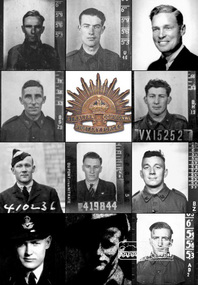
... unit...410236...ada (key) ingram...berkshire...bomber command...england...group no. 91...john ingram...lester neil ingram...longworth...n.1374...r.a.a.f....r.a.f....r.a.f. abington...research (vic.)...whitley v bomber...419844...514 bomber squadron...emmerich...germany...gordon stanley mclean...ji-g2...kleve...lancaster lm735...lucy mclean...mount pleasant road...r.a.f. waterbeach...reichswald forest war cemetery...stanley mclean...2/10 ordnance workshops...albert feldbauer...eltham cricket association...eltham girls club...frank street...henry feldbauer...jessie margarette feldbauer...june feldbauer...ken ingram...margaret (feldbauer) ingram...montmorency imperials...research cricket club...research state school...sandakan number 1 camp...Lt., 410262 (KIA 5 Apr 1945, Varrelbusch, Germany) FIELD, Kevin Francis, Pte., VX144763 (KIA 28 Jun 1945, Bougainville, PNG) BUTHERWAY, Jack Herbert, Pte, VX37645 (DOD 8 Jul 1945, Borneo) eltham war memorial roll of honour second world war eltham eltham roll of honour shire of eltham 2/4 field workshop 22 independent brigade group ordnance workshop a.i.f. australian army ordnance corps australian corps of electrical and mechanical engineers changi falkiner street florence mary butherway jack herbert butherway prisoner of war (pow) ranau number 1 jungle camp sandakan death march singapore thomas james butherway vx37645 2/2 field company 6th division abington annie castledine arthur frederick castledine george ernest castledine greece jean simonson lower plenty old eltham road royal australian engineers vx10044 sapper g. e. castledine 2/23 bn derril gahan house main road rats of tobruk studley manston gahan tobruk vx48379 3 squadron r.a.a.f. aboukir alamein memorial beulah alice (simpson) rutter bir el gubbi broken hill aero club david rutter egypt hubert rutter libya yarra braes 2/21 bn 23rd australian infrantry brigade 8th division alfred charles clerke ambon island battle of ambon bidgeland park estate inga caroline (nicholls) clerke inga mary nicholls laha airfield nora ann clerke rose matilda clerke vx23112 william charles clerke 2/14 bn 2/16 bn 21st brigade 7th division cuthbert douglas dunlop gona gona war cemetery henry street janet dunlop kokoda track new guinea palestine papua new guinea port moresby (bomana) war cemetery reuben cuthbert dunlop syria vx15252 10 operational training unit 410236 ada (key) ingram berkshire bomber command england group no. 91 john ingram lester neil ingram longworth n.1374 r.a.a.f. r.a.f. r.a.f. abington research (vic.) whitley v bomber 419844 514 bomber squadron emmerich germany gordon stanley mclean ji-g2 kleve lancaster lm735 lucy mclean mount pleasant road r.a.f. waterbeach reichswald forest war cemetery stanley mclean 2/10 ordnance workshops albert feldbauer eltham cricket association eltham girls club frank street henry feldbauer jessie margarette feldbauer june feldbauer ken ingram margaret (feldbauer) ingram montmorency imperials research cricket club research state school sandakan number 1 camp sandakan number 2 camp theodore albert feldbauer valerie (feldbauer) waller violet amelda (teagle) feldbauer vx51733 247 ‘china-british’ squadron caithness cloppenburg donlad hemphill rutter essen gloucester hanover war cemetery hanover-limmer british military cemetery holten-lochem oldenburg r.a.f. castletown r.a.f. station lealing stoppenburg typhoon ib jp443 typhoon ib sw526 15th australian infantry brigade 1940 cup 3rd division 57th/60th bn best and fairest bougainville island buin road mary field mayona road mivo river mobiai river montmorency vx144763 william field Word/PDF document file The Eltham Roll of Honour: Second World War Document Article ...Information regarding the circumstances of the eleven men of the Shire of Eltham who died serving their country in the Second World War and for whom the Eltham War Memorial was dedicated. Their names are listed on the Eltham Roll of Honour in order of rank. The image portrayed shows the eleven men (left to right, top to bottom) by date of fatality: CASTLEDINE, George Ernest, Spr., VX10044 (KIA 18 Apr 1941, Greece) GAHAN, Studley Manston, Capt., VX48379 (KIA 17 May 1941, Tobruk, Libya) RUTTER, David, Flying Off., 833 (400833) (KIA 9 Dec 1941, Bir El Gubbi, Libya) CLERKE, Alfred Charles, Cpl., VX23112 (KIA 2 Feb 1942, Laha, Ambon Island) DUNLOP, Cuthbert Douglas, Sgt., VX15252 (KIA 22 Nov 1942, Gona, New Guinea) INGRAM, Lester Neil, Flt. Sgt., 410236 (DOD 22 Apr 1943, Longworth, England) McLEAN, Stanley, Flt. Sgt., 419844 (KIA 7 Oct 1944, Emmerich, Germany) FELDBAUER, Theodore, Sgt., VX51733 (DOD 27 Mar 1945, Borneo) RUTTER, Donald Hemphill, Flt. Lt., 410262 (KIA 5 Apr 1945, Varrelbusch, Germany) FIELD, Kevin Francis, Pte., VX144763 (KIA 28 Jun 1945, Bougainville, PNG) BUTHERWAY, Jack Herbert, Pte, VX37645 (DOD 8 Jul 1945, Borneo)eltham war memorial, roll of honour, second world war, eltham, eltham roll of honour, shire of eltham, 2/4 field workshop, 22 independent brigade group ordnance workshop, a.i.f., australian army ordnance corps, australian corps of electrical and mechanical engineers, changi, falkiner street, florence mary butherway, jack herbert butherway, prisoner of war (pow), ranau number 1 jungle camp, sandakan death march, singapore, thomas james butherway, vx37645, 2/2 field company, 6th division, abington, annie castledine, arthur frederick castledine, george ernest castledine, greece, jean simonson, lower plenty, old eltham road, royal australian engineers, vx10044 sapper g. e. castledine, 2/23 bn, derril, gahan house, main road, rats of tobruk, studley manston gahan, tobruk, vx48379, 3 squadron r.a.a.f., aboukir, alamein memorial, beulah alice (simpson) rutter, bir el gubbi, broken hill aero club, david rutter, egypt, hubert rutter, libya, yarra braes, 2/21 bn, 23rd australian infrantry brigade, 8th division, alfred charles clerke, ambon island, battle of ambon, bidgeland park estate, inga caroline (nicholls) clerke, inga mary nicholls, laha airfield, nora ann clerke, rose matilda clerke, vx23112, william charles clerke, 2/14 bn, 2/16 bn, 21st brigade, 7th division, cuthbert douglas dunlop, gona, gona war cemetery, henry street, janet dunlop, kokoda track, new guinea, palestine, papua new guinea, port moresby (bomana) war cemetery, reuben cuthbert dunlop, syria, vx15252, 10 operational training unit, 410236, ada (key) ingram, berkshire, bomber command, england, group no. 91, john ingram, lester neil ingram, longworth, n.1374, r.a.a.f., r.a.f., r.a.f. abington, research (vic.), whitley v bomber, 419844, 514 bomber squadron, emmerich, germany, gordon stanley mclean, ji-g2, kleve, lancaster lm735, lucy mclean, mount pleasant road, r.a.f. waterbeach, reichswald forest war cemetery, stanley mclean, 2/10 ordnance workshops, albert feldbauer, eltham cricket association, eltham girls club, frank street, henry feldbauer, jessie margarette feldbauer, june feldbauer, ken ingram, margaret (feldbauer) ingram, montmorency imperials, research cricket club, research state school, sandakan number 1 camp, sandakan number 2 camp, theodore albert feldbauer, valerie (feldbauer) waller, violet amelda (teagle) feldbauer, vx51733, 247 ‘china-british’ squadron, caithness, cloppenburg, donlad hemphill rutter, essen, gloucester, hanover war cemetery, hanover-limmer british military cemetery, holten-lochem, oldenburg, r.a.f. castletown, r.a.f. station lealing, stoppenburg, typhoon ib jp443, typhoon ib sw526, 15th australian infantry brigade, 1940 cup, 3rd division, 57th/60th bn, best and fairest, bougainville island, buin road, mary field, mayona road, mivo river, mobiai river, montmorency, vx144763, william field -
 Bendigo Military Museum
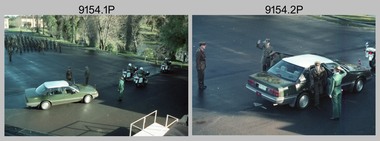
Photograph - Army Survey Regiment – Corps Day Parade Set 2, Fortuna Villa, Bendigo, 1991
... unit and the family BBQ. Royal Australian Survey Corps RASvy Army Survey Regiment Army Svy Regt Fortuna There are no personnel identified. ‘Corps Day 26 Jun 1991’ annotated on negative sleeves. This is a set of 37 photographs of the Corps Day Parade held at the Army Survey Regiment, Fortuna, Bendigo on the 26th of June 1991. The colour photographs are on 35mm negative film and scanned at 2400 dpi. They are part of the Army Survey Regiment’s Collection. .1) - Photo, colour, 1991. Arrival of COMD 3MD. L to R: D-SVY - COL Simon Lemon, unidentified personnel, unidentified Aide-de-camp ...This set of 37 photographs was taken at the Corps Day Parade held at the Army Survey Regiment, Bendigo on the 26th of June 1991.The Corps Day Parade was held to commemorate the 76th anniversary of the formation of the Royal Australian Survey Corps. The Reviewing officer was the Commander of the 3rd Military District BRIG P. Davies AM ADC and the Parade Host was D-SVY COL Simon Lemon. Refer to items 9152.31P for more photographs taken during the parade; and 9155.27P for photographs taken afterwards during the tour of the unit and the family BBQ.This is a set of 37 photographs of the Corps Day Parade held at the Army Survey Regiment, Fortuna, Bendigo on the 26th of June 1991. The colour photographs are on 35mm negative film and scanned at 2400 dpi. They are part of the Army Survey Regiment’s Collection. .1) - Photo, colour, 1991. Arrival of COMD 3MD. L to R: D-SVY - COL Simon Lemon, unidentified personnel, unidentified Aide-de-camp. .2) to .4) - Photo, colour, 1991. Arrival of COMD 3MD. L to R: D-SVY - COL Simon Lemon, COMD 3MD - BRIG P. Davies AM ADC, unidentified Aide-de-camp, unidentified personnel. .5) - Photo, colour, 1991. Cartographic Squadron stands at attention, under command of OC MAJ Graeme Wastell. .6) - Photo, colour, 1991. Headquarters Squadron stands at attention, under command of OC MAJ Peter Jensen. 2IC MAJ Ray Redman at left. .7) - Photo, colour, 1991. Air Survey Squadron stands at attention. L to R: LT Simon Buckpitt, WO1 Brett ‘Dutchy’ Van Leeuwen, unidentified (x2), CPL Perry Burt, SGT Sandy Craig, SGT Graeme Reany, SPR Stuart Bowd, LT Michelle Breen in foreground, unidentified, SGT Wolfgang Thun, SSGT Bruce Hammond, unidentified, SGT Paul Hopes, WO1 Russell ‘Rusty’ Williams. .8) - Photo, colour, 1991. Air Survey Squadron at attention under command of OC MAJ Peter Clark - at far left during the inspection. L to R: LT Simon Buckpitt, CO LTCOL Rene van den Tol, unidentified Aide-de-camp, LT Michelle Breen in foreground. At her right L to R: COMD 3MD - BRIG P. Davies AM ADC, SGT Graeme Reany, SPR Stuart Bowd, unidentified, SGT Wolfgang Thun, SSGT Bruce Hammond, unidentified, SGT Paul Hopes, WO1 Russell ‘Rusty’ Williams. .9) - Photo, colour, 1991. Air Survey Squadron inspection. L to R: D-SVY - COL Simon Lemon, COMD 3MD - BRIG P. Davies AM ADC, SPR Steve Linane, SPR Derek Percival. .10) & .11) - Photo, colour, 1991. Air Survey Squadron inspection. SSGT Graham Johnston at far left. L to R: CO LTCOL Rene van den Tol, unidentified Aide-de-camp, D-SVY - COL Simon Lemon, COMD 3MD - BRIG P. Davies AM ADC, SPR John ‘Docc’ Commons, unidentified (x4), SPR Jo (Innes) Thun, SGT Peter Tuddenham, SSGT Bob Garritty, SGT Martin Evans. .12) - Photo, colour, 1991. Air Survey Squadron inspection. L to R: CO LTCOL Rene van den Tol, unidentified Aide-de-camp, D-SVY - COL Simon Lemon, COMD 3MD - BRIG P. Davies AM ADC, SPR John ‘Docc’ Commons, unidentified (x4), SPR Jo (Innes) Thun, SGT Peter Tuddenham, SSGT Bob Garritty, SGT Martin Evans. Unidentified WO2 in right background. .13) & .14) - Photo, colour, 1991. SPR Peter Smyth stands on the corner of the parade ground behind an MRA-7 Tellurometer mounted on a tripod. .15) & .16) - Photo, colour, 1991. SPR Damian Nolan stands on the corner of the parade ground behind a Plane Table Board with an alidade mounted 3MD Band stands at attention during the inspection. L to R: unidentified Aide-de-camp, unidentified 3MD Band Master, D-SVY - COL Simon Lemon, COMD 3MD - BRIG P. Davies AM ADC, unidentified members of 3MD Band.on a tripod. .17) - Photo, colour, 1991. The unidentified 3MD Band Master salutes COMD 3MD - BRIG P. Davies AM ADC before the 3MD Band inspection. .18) - Photo, colour, 1991. 3MD Band stands at attention during the inspection. L to R: unidentified Aide-de-camp, unidentified 3MD Band Master, D-SVY - COL Simon Lemon, COMD 3MD - BRIG P. Davies AM ADC, unidentified members of 3MD Band. .19) - Photo, colour, 1991. Army Survey Regiment at ‘Shoulder Arms’ position in readiness for the Present Arms’ salute. CO LTCOL Rene van den Tol at front. .20) - Photo, colour, 1991. Cartographic and Air Survey Squadrons at ‘Shoulder Arms’ position in readiness for the Present Arms’ salute. CO LTCOL Rene van den Tol at front. .21) - Photo, colour, 1991. Headquarters Squadron at ‘Shoulder Arms’ position in readiness for the Present Arms’ salute. L to R: 2IC MAJ Ray Redman, MAJ Bob Williams, OC MAJ Peter Jensen. CAPT Colin Cuskelly. .22) & .23) - Photo, colour, 1991. Army Survey Regiment under CO LTCOL Rene van den Tol’s command salutes the COMD 3MD with ‘Present Arms’. .24) - Photo, colour, 1991. L to R: COMD 3MD - BRIG P. Davies AM ADC, D-SVY - COL Simon Lemon, unidentified Aide-de-camp. .25) - Photo, colour, 1991. The squadrons remove their hats in readiness for ‘Three cheers for Her Majesty the Queen’. .26) & .27) - Photo, colour, 1991. The squadrons cheer in unison to the command ‘Three cheers for Her Majesty the Queen’. .28) - Photo, colour, 1991. The unidentified padre addresses the Parade. .29) - Photo, colour, 1991. COMD 3MD - BRIG P. Davies AM ADC, addresses the Parade. .30) - Photo, colour, 1991. D-SVY - COL Simon Lemon addresses the Parade. .31) & .32) - Photo, colour, 1991. COMD 3MD - BRIG P. Davies AM ADC presents the Defence Force Service Medal with clasp to WO1 Brett ‘Dutchy’ Van Leeuwen for 20 years of efficient remunerated service. .33) - Photo, colour, 1991. The 3MD Band marches towards the front steps of Fortuna Villa. .34) - Photo, colour, 1991. The 3MD Band salutes as it marches past the official guests on the front steps of Fortuna Villa. .35) - Photo, colour, 1991. Lithographic Squadron led by OC MAJ Bob Coote marches towards the front steps of Fortuna Villa. .36) - Photo, colour, 1991. Lithographic Squadron led by OC MAJ Bob Coote salutes as it marches past the official guests on the front steps of Fortuna Villa. .37) - Photo, colour, 1991. COMD 3MD - BRIG P. Davies AM ADC salutes the passing troops. L to R: D-SVY - COL Simon Lemon, unidentified UK Liaison Officer, BRIG P. Davies AM ADC, unidentified Aide-de-camp.There are no personnel identified. ‘Corps Day 26 Jun 1991’ annotated on negative sleeves.royal australian survey corps, rasvy, army survey regiment, army svy regt, fortuna -
 Bendigo Military Museum
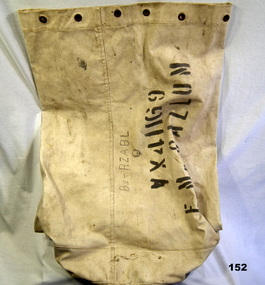
Equipment - KIT BAG WW2, 1939
... unit 17.12.1940, attends Mortar and Grenade schools, hospital 16.8.1941 with PUO, taken POW 17.2.1942 at El Alamein. He served in the Seige of Tobruk, Middle East Campaigns. As a POW it appears he was interred from 1942/43 in Italy then 1943/45 in XV111Austria. He describes his conditions in the camps...unit 17.12.1940, attends Mortar and Grenade schools, hospital 16.8.1941 with PUO, taken POW 17.2.1942 at El Alamein. He served in the Seige of Tobruk, Middle East Campaigns. As a POW it appears he was interred from 1942/43 in Italy then 1943/45 in XV111Austria. He describes his conditions in the camps ...Item issued to Eric MacCALLUM No VX41169, (born Scotland, enlisted Caulfield) on 26.6.40, 2/32nd Batt 9th Div AIF, age 31 years 9 months, promoted Cpl 6.8.1940, embarked 15.9.1940 for the Middle East, hospital 25.11.1940 with Haemorhoids, rejoinn unit 17.12.1940, attends Mortar and Grenade schools, hospital 16.8.1941 with PUO, taken POW 17.2.1942 at El Alamein. He served in the Seige of Tobruk, Middle East Campaigns. As a POW it appears he was interred from 1942/43 in Italy then 1943/45 in XV111Austria. He describes his conditions in the camps as fair and that he worked on road works. This is a brief description as to his treatment in his records. Embarked from England 4.7.1945 and disembarked in Sydney on 8.8.1945. Discharged from the 2nd AIF on 12.9.1945.Canvas Kit bag with stenciled name and details on side and base.In handwritten lettering - "B2 - RZABL- Q" Stencilled - "VX41169 E. MacCallum"containers, military equipment -
 Bendigo Military Museum
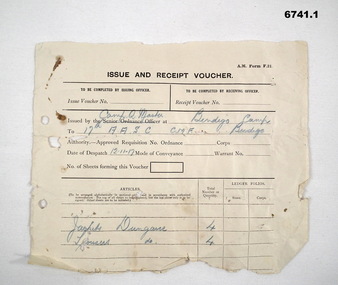
Document - VOUCHERS, ISSUE & RECEIPT, 17 Australian Army Service Corps, 1917
... it shows a host of items issued by the camp QM to 17th A.A.S.C. The numbers suggest the unit had 41 men in camp....Old whoite paper with black ink printng. it shows a host of items issued by the camp QM to 17th A.A.S.C. The numbers suggest the unit had 41 men in camp. ...17th Aus Army Service Corps was one of the Militia Units in Bendigo 1912-1918. it was part of 17 BDE whose HQ was in Bendigo.1. Army form F21. Part thereof. it is white paper with black ink. It shows items issued by camp QM to 17th A.A.S.C. Bendigo Camp, they being 4 jackets dungaree, 4 trousers dungaree. 2. Army Form F21 Complete. Old whoite paper with black ink printng. it shows a host of items issued by the camp QM to 17th A.A.S.C. The numbers suggest the unit had 41 men in camp.army vouchers, 17th aasc, militia camps, passchendaele barracks trust -
 Bendigo Military Museum
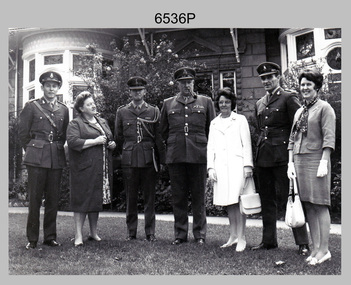
Photograph - Visit by General to the Army Survey Regiment, Fortuna, Bendigo, c1975
... camp officer and guests are unknown. LTCOL Ridge was the CO of Army Headquarters Survey Regiment from 1972 to 1973 and continued as the CO of the renamed Army Survey Regiment from 1974 to 1975. He handed over to LTCOL Peter Constantine AM, who commanded the unit...camp officer and guests are unknown. LTCOL Ridge was the CO of Army Headquarters Survey Regiment from 1972 to 1973 and continued as the CO of the renamed Army Survey Regiment from 1974 to 1975. He handed over to LTCOL Peter Constantine AM, who commanded the unit ...This photograph was most likely taken circa 1975 in the front garden of Fortuna Villa, during an Australian Army General’s visit to the Army Survey Regiment, Bendigo circa 1975. As there are no annotations on the photo, the names of the General, the aide de camp officer and guests are unknown. LTCOL Ridge was the CO of Army Headquarters Survey Regiment from 1972 to 1973 and continued as the CO of the renamed Army Survey Regiment from 1974 to 1975. He handed over to LTCOL Peter Constantine AM, who commanded the unit from 1975 to 1976.This is a photograph taken on the occasion of an Australian Army General’s visit to the Army Survey Regiment, Bendigo circa 1975. The black and white photograph was printed on photographic paper and are part of the Army Survey Regiment’s Collection. The photographic print was scanned at 300 dpi. .1) - Photo, black & white, c1975. L to R: CO LTCOL Donald Ridge, unidentified dignitary, guests and personnel.‘Visit by Gen??? 1973-1977’ annotated on cover sheet.royal australian survey corps, rasvy, army survey regiment, army svy regt, fortuna -
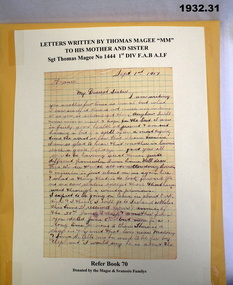 Bendigo Military Museum
Literary work - LETTERS WW1, 1914-18 (exact)
... Embark for Egypt 20.10.1914, embark for Gallipoli 4.5.1915, hospital with Mumps 19.2.1916, transfer to 4th Div Artillery 27.2.1916, embark for France 1.4.1916, promoted Bombadier 2.2.1917, promoted Cpl 30.9.1917, awarded the Military Medal (MM) at Westhoek 4.10.1917, promoted T/Sgt 23.10.1917, WIA Gassed 3.11.1917, rejoins unit 13.3.1918, promoted Sgt 7.5.1918, to No 2 Army Field rest Camp 16.7.1918 to 2.8.1918, to England 13.10.1918 special leave 1914 men, hospital with Influenza then Pnuemonia and dies in England on 25.10.1918....Embark for Egypt 20.10.1914, embark for Gallipoli 4.5.1915, hospital with Mumps 19.2.1916, transfer to 4th Div Artillery 27.2.1916, embark for France 1.4.1916, promoted Bombadier 2.2.1917, promoted Cpl 30.9.1917, awarded the Military Medal (MM) at Westhoek 4.10.1917, promoted T/Sgt 23.10.1917, WIA Gassed 3.11.1917, rejoins unit 13.3.1918, promoted Sgt 7.5.1918, to No 2 Army Field rest Camp 16.7.1918 to 2.8.1918, to England 13.10.1918 special leave 1914 men, hospital with Influenza then Pnuemonia and dies in England on 25.10.1918. ...Letters written by Thomas Magee No 1444 enlisted in F.A.Brigade 2 Ammunition Colunm AIF on 20.8.1914 age 26 years. Embark for Egypt 20.10.1914, embark for Gallipoli 4.5.1915, hospital with Mumps 19.2.1916, transfer to 4th Div Artillery 27.2.1916, embark for France 1.4.1916, promoted Bombadier 2.2.1917, promoted Cpl 30.9.1917, awarded the Military Medal (MM) at Westhoek 4.10.1917, promoted T/Sgt 23.10.1917, WIA Gassed 3.11.1917, rejoins unit 13.3.1918, promoted Sgt 7.5.1918, to No 2 Army Field rest Camp 16.7.1918 to 2.8.1918, to England 13.10.1918 special leave 1914 men, hospital with Influenza then Pnuemonia and dies in England on 25.10.1918.Series of letters, 32 in total written by Thomas Magee MM to his sister & mother. All letters are either pencil, red & black ink. Some are parts of letters with no dates or who to. The letters begin Tues 25th 1914 possibly August and continue through to Sept 1918. Letters are various sizes, some on blue paper, some on note pad size & graph paper.documents, letters, mm, -
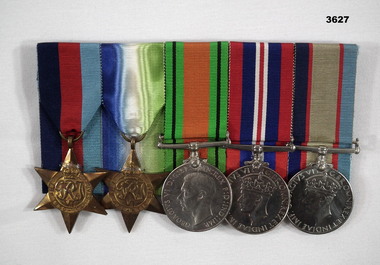 Bendigo Military Museum
Award - MEDALS RAAF, Post 1945
... Camp Miles Standish USA. Finally he is stationed in England at Pembroke with 461 Sqd RAAF with the rank of Sgt on 10.10.1943. This was a Sunderland Sqd which was a large long range patrol Flying Boat. The unit...Camp Miles Standish USA. Finally he is stationed in England at Pembroke with 461 Sqd RAAF with the rank of Sgt on 10.10.1943. This was a Sunderland Sqd which was a large long range patrol Flying Boat. The unit ...Reginald Charles ALLARDICE enlisted first in the CMF on 10.8.1940 age 21 years Regt No V40236. During this time he applied to join the RAAF so was discharged from the Army on 21.5.1942 as a Pte in the 24/39th Bn. Two days later he is in the RAAF as a Trainee Aircrew WEF No 418577. On 31.12.1942 he is listed as a LAC (Leading Aircraftsman. Ongoing training sees him at Benalla, Mallala in SA, Mt Gambier, Pt Cook, Camp Miles Standish USA. Finally he is stationed in England at Pembroke with 461 Sqd RAAF with the rank of Sgt on 10.10.1943. This was a Sunderland Sqd which was a large long range patrol Flying Boat. The unit was mainly Australians from many nations. He rises through the ranks to T/F/Sgt, Officer, Pilot Officer, Flying Officer and last Flight Lieutenant on 10.3.1945. He is discharged from the RAAF on 7.12.1945 at RAF Station Beecles Suffolk England. 461 Sqd was a Coastal Command unit mostly involved in submarine detection and hunting in the Atlantic and Bay of Biscay. They were involved in the D Day landings. The Sqd lost 20 aircraft to enemy action and accidents. A total of 86 Sqd members were lost of which 64 were Australian.Medals, individual with ribbons re R.C.Allardice. (1) 1939 - 45 Star, original not engraved. (2) Atlantic Star, original not engraved. (3) Defence Medal. (4) British War Medal 1939 - 45. (5) Australian Service Medal 1939 - 45. (.3, .4, .5) “418577 R.C.ALLARDICE”medals, campaign, service, world war2 -
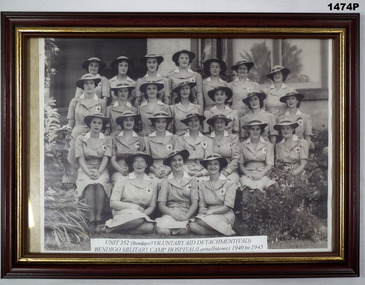 Bendigo Military Museum
Photograph - PHOTOGRAPH WW2, FRAMED, 1942 - 45
... At bottom of photo: “Unit 352 (Bendigo) Voluntary Aid Detachment (VAD) Bendigo Military Camp Hospital (Lansellstowe) 1940 - 1945” (Mrs K Proud on back of mount) ...Attached list of those present in photo. photography - photographs frame accessories medicine - hospitals VAD’s Lansellstowe Bendigo At bottom of photo: “Unit 352 (Bendigo) Voluntary Aid Detachment (VAD) Bendigo Military Camp Hospital (Lansellstowe) 1940 - 1945” (Mrs K Proud on back of mount) Copy of black & white photo, Aid Detachment, group of females. ...Attached list of those present in photo.Copy of black & white photo, Aid Detachment, group of females. Brown plastic frame with gold trim & glassAt bottom of photo: “Unit 352 (Bendigo) Voluntary Aid Detachment (VAD) Bendigo Military Camp Hospital (Lansellstowe) 1940 - 1945” (Mrs K Proud on back of mount) photography - photographs, frame accessories, medicine - hospitals, vad’s lansellstowe, bendigo
