
Showing 155 items matching "victorian infantry"
-
 The 5th/6th Battalion Royal Victoria Regiment Historical Collection
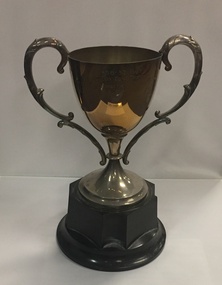
Award - Trophy, 58/32 BN "C" Coy Comd Trophy, 1953
... ...victorian infantry...58/32 battalion victorian infantry trophy wark vc club 1953 LT A.R. ...Silver metal trophy1953 LT A.R. Honey 1954 LT K.W. McLaren 1955 SGT D.W. Aumont58/32 battalion, victorian infantry, trophy, wark vc club -
 The 5th/6th Battalion Royal Victoria Regiment Historical Collection
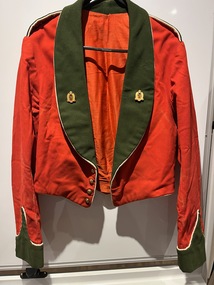
Uniform - 39th Battalion, The Hawthorn Kew Regiment Officer's Mess Dress Jacket c.1931
... ...Victorian Infantry...It is believed the jackets were worn throughout the 1930's until the start of WWII when it became harder to source the jackets. 39th Battalion 39TH BN 39th Hawthorn Kew Regiment Mess Dress Mess Jacket 5/6 RVR 39th Battalion Hawthorn Kew Regiment Royal Victoria Regiment 5th/6th Battalion Victorian Infantry Australian Army Mess uniform 1930s Militia Period Kokoda 39th Battalion, The Hawthorn Kew Regiment Officer's Mess Dress Jacket c.1931 39th Battalion, The Hawthorn Kew Regiment Officer's Mess Dress Jacket c.1931 Uniform 39th Battalion, The Hawthorn Kew Regiment Officer's Mess Dress Jacket c.1931 ...The 39th Battalion, The Hawthorn Kew Regiment was allied with The Dorsetshire Regiment (British Army) in 1931. It is believed that as a token of friendship to commemorate the alliance, the officers of The Dorsets gifted the officers of the 39th Battalion with a number of their mess dress jackets which the 39th then adopted as a unit-specific mess dress; using their unit badges and Australian Army accoutrements. It is believed the jackets were worn throughout the 1930's until the start of WWII when it became harder to source the jackets. 39th Battalion, The Hawthorn Kew Regiment Officer's Mess Dress Jacket c.193139th battalion, 39th bn, 39th hawthorn kew regiment, mess dress, mess jacket, 5/6 rvr, 39th battalion hawthorn kew regiment, royal victoria regiment, 5th/6th battalion, victorian infantry, australian army, mess uniform, 1930s, militia period, kokoda -
 Bendigo Military Museum
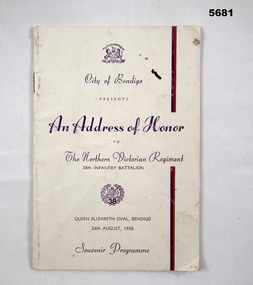
Booklet, Cambridge Press Print, "An Address of Honor"
... The presentation was from The Bendigo Council to the Northern Victorian Regiment - 38th Infantry Battalion in relation to it's 100th Anniversary of being formed. ...Cover has City of Bendigo emblem and the words "Presents "An Address of Honor" to the Northern Victorian Regiment, 38th Infantry Battalion....The presentation was from The Bendigo Council to the Northern Victorian Regiment - 38th Infantry Battalion in relation to it's 100th Anniversary of being formed. ...The presentation was from The Bendigo Council to the Northern Victorian Regiment - 38th Infantry Battalion in relation to it's 100th Anniversary of being formed. It was at the Queen Elizabeth Oval on 28th Aug 1958. 16 page white booklet. On front is the Bendigo City emblem, document titles, Regiment Emblem, Date and location. Booklet is a souvenir program. Red and Purple line (Council colours) running down the side of the page. Contents include list of Councillors, Description of Event, Order of Ceremony, History of Regiment, Battle Honours and a brief history of Bendigo.Cover has City of Bendigo emblem and the words "Presents "An Address of Honor" to the Northern Victorian Regiment, 38th Infantry Battalion.38th battalion, 100 year anniversary -
 Running Rabbits Military Museum operated by the Upwey Belgrave RSL Sub Branch
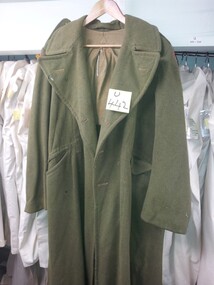
Greatcoat
... Army Greatcoat, Army Royal Australian Infantry, Victorian Coat of Arms, No buttons...Uniform 1950 Army Army Greatcoat, Army Royal Australian Infantry, Victorian Coat of Arms, No buttons Greatcoat ...Army Greatcoat, Army Royal Australian Infantry, Victorian Coat of Arms, No buttonsuniform, 1950, army -
 Running Rabbits Military Museum operated by the Upwey Belgrave RSL Sub Branch
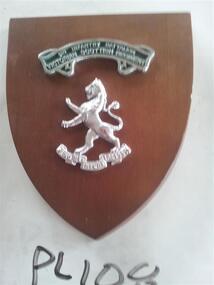
Plaque
... Victorian Scottish Regiment 5th Infantry Btn...Plaque Army Victorian Scottish Regiment 5th Infantry Btn Plaque ...Victorian Scottish Regiment 5th Infantry Btnplaque, army -
 Bendigo Military Museum
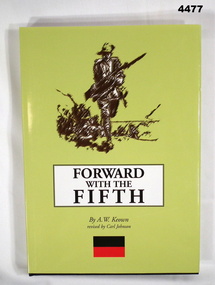
Book - BOOK, History of the 5th Battalion AIF WWI, Albert William Keown, "Forward with the Fifth"
... "Narrative of the service history of the Fifth (Victorian) Infantry Battalion 1st AIF". "A remarkable testimony of their sacrifice in the First World War"...."Narrative of the service history of the Fifth (Victorian) Infantry Battalion 1st AIF". "A remarkable testimony of their sacrifice in the First World War". ..."Narrative of the service history of the Fifth (Victorian) Infantry Battalion 1st AIF". "A remarkable testimony of their sacrifice in the First World War".Hard cover with dust cover. Hard cover, cardboard with black coloured buckraw, red print on front and spine. Front - illustrated - silhouette drawing of soldier in uniform Back - black and white photograph of 2 soldiers on camel back. Small black over red rectangular colour patch front and back 342 pages, cut, plain, white. Illustrated black and white photographs, portraits, maps and documents.Opposite Title Page - printed donation label - "Donated by 39th Australian Infantry Battalion (1941-1943) Association Inc. www.39battalion.com"books, military, history, wwi -
 Ballarat RSL Sub-Branch Inc.
Folder - Ballarat Militia
... John Ross First Victorian Infantry Contingent. Boer War No. 86...John Ross First Victorian Infantry Contingent. Boer War No. 86 Literature Ballarat RSL Ballarat Folder - Ballarat Militia ...John Ross , 1989, 1892-1899 No. 1416 Pte. John Ross First Victorian Infantry Contingent. Boer War No. 86literature, ballarat rsl, ballarat -
 Bendigo Military Museum
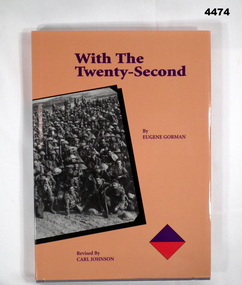
Book - BOOK WW1, Eugene GORMAN, "With the Twenty - Second", Original Edition 1919, Revised Edition 2001
... "This is a revised edition of the original 1919 Regimental History" "From the beaches of Anzac Cove to the gas ridden trenches of the Western Front" "The pyramids to the rolling plains of Stone Henge" "Ground traversed by the Twenty-Second (Victorian) Infantry Battalion during World War One"..."This is a revised edition of the original 1919 Regimental History" "From the beaches of Anzac Cove to the gas ridden trenches of the Western Front" "The pyramids to the rolling plains of Stone Henge" "Ground traversed by the Twenty-Second (Victorian) Infantry Battalion during World War One" Books Military History WWI Front fly leaf - printed donation label - "Donated by 39th Australian Infantry Battalion (1941-43) Association Inc www.39battalion.com" Top right front flyleaf - printed label with handwritten in black ink "No. 120 of 500" Hard cover book with dust cover. ..."This is a revised edition of the original 1919 Regimental History" "From the beaches of Anzac Cove to the gas ridden trenches of the Western Front" "The pyramids to the rolling plains of Stone Henge" "Ground traversed by the Twenty-Second (Victorian) Infantry Battalion during World War One"Hard cover book with dust cover. Hard cover cardboard with grey coloured buckram , gold coloured print on front and spine. Illustrated with purple over red diamond colour patch. Dust cover, paper, pinkish/orange glossy coloured background, purple coloured print on front, spine and back. Illustrated with purple over red diamond colour patch (small) front and back and black and white photograph of a group of soldiers 'somewhere in France. 245 pages, cut, plain, semi gloss white. Illustrated - black and white photographs and maps.Front fly leaf - printed donation label - "Donated by 39th Australian Infantry Battalion (1941-43) Association Inc www.39battalion.com" Top right front flyleaf - printed label with handwritten in black ink "No. 120 of 500"books, military, history, wwi -
 Geelong RSL Sub Branch
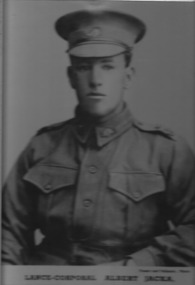
Photograph - Albert Jacka VC, MC & Bar, Albert Jacka VC, MC & Bar, Late 20th Century
... Lance Corporal Albert Jacka, Of the 14th (Victorian) Battalion, Australian Infantry Force. The First Australian VC...Albert Jacka won his VC at Gallipoli, he was the first Australian to receive the Award. jacka gallipoli ww1 aif Lance Corporal Albert Jacka, Of the 14th (Victorian) Battalion, Australian Infantry Force. The First Australian VC Black Timber Frame with black and white photograph of Albert Jacka. ...Albert Jacka VC, MC & Bar served with the AIF during WW1 from 1914-1920 at Gallipoli and the Western Front.Albert Jacka won his VC at Gallipoli, he was the first Australian to receive the Award.Black Timber Frame with black and white photograph of Albert Jacka.Lance Corporal Albert Jacka, Of the 14th (Victorian) Battalion, Australian Infantry Force. The First Australian VCjacka gallipoli ww1 aif -
 8th/13th Victorian Mounted Rifles Regimental Collection
Photograph
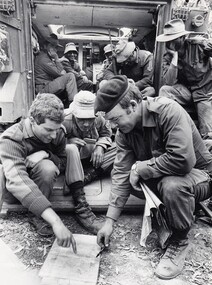
... In the period 5-20 March 1988, ‘A’ Squadron 8th/13th Victorian Mounted Rifles participated in an exercise conducted at Puckapunyal by 4th Infantry Brigade (Reserve) codenamed ‘Fiery Cauldron’. ...Black and white photograph of infantry in armoured personnel carrier of ' A ' Squadron 8/13 Victorian Mounted Rifles. ...Black and white photograph of infantry in armoured personnel carrier of ' A ' Squadron 8/13 Victorian Mounted Rifles. ...In the period 5-20 March 1988, ‘A’ Squadron 8th/13th Victorian Mounted Rifles participated in an exercise conducted at Puckapunyal by 4th Infantry Brigade (Reserve) codenamed ‘Fiery Cauldron’. Other units participating included 5th/6th Battalion and 8th/7th Battalion Royal Victorian Regiment, 4th/19th Prince of Wales’s Light Horse Regiment and 1st Armoured Regiment. The training focussed on armoured/infantry cooperation, in particular the use of armoured personnel carriers. Black and white photograph of infantry in armoured personnel carrier of ' A ' Squadron 8/13 Victorian Mounted Rifles. Infantry Platoon Commander ( left ) discussing next move wi5th APC Crew Commander Trooper Rose. -
 The 5th/6th Battalion Royal Victoria Regiment Historical Collection
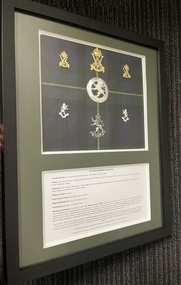
Artwork, other - 5th Infantry Battalion (Australia) Link to A COY 5/6 RVR Framed Badges and Information
... Note: While this object notes the connection between A COY 5/6 RVR and 5th Bn VSR it should be remembered that the RVR is the custodian of the legacy of all Victorian Infantry units. This is therefore not the only historical link of A COY 5/6 RVR which also holds strong links to the 52nd Infantry Battalion (The Gippsland Regiment) who had its HQ located for many years in Dandenong near the current A COY 5/6 RVR depot. ...The Scottish customs and traditions of the '5" Infantry Battalion, Victorian Scottish Regiment' have been upheld through '1 RVR', then '5 RVR', and now "5/6 RVR'. ...Note: While this object notes the connection between A COY 5/6 RVR and 5th Bn VSR it should be remembered that the RVR is the custodian of the legacy of all Victorian Infantry units. This is therefore not the only historical link of A COY 5/6 RVR which also holds strong links to the 52nd Infantry Battalion (The Gippsland Regiment) who had its HQ located for many years in Dandenong near the current A COY 5/6 RVR depot. ...Badge board in black frame showing the badges of the Royal Victoria Regiment and the 5th Battalion, Victorian Scottish Regiment on a Gordon tartan backing. Below this is an information panel which includes a summary of important historical information about the 5th Infantry Battalion and its connection to A COY 5/6 RVR. Note: While this object notes the connection between A COY 5/6 RVR and 5th Bn VSR it should be remembered that the RVR is the custodian of the legacy of all Victorian Infantry units. This is therefore not the only historical link of A COY 5/6 RVR which also holds strong links to the 52nd Infantry Battalion (The Gippsland Regiment) who had its HQ located for many years in Dandenong near the current A COY 5/6 RVR depot. While B COY 5/6 RVR is the primary custodian of the VSR historical link, the message of this object is that A COY also has a connection which should be remembered. Information panel reads: 5th Infantry Battalion (Australia) Territorial Title: The 'Victorian Scottish Regiment' (1927-1944 then 1948-1960) Motto: "Mori Quam Fordari - Death before dishonour' (1927-1935), Now 'Nemo Me Impune Lacessit - No one shall provoke me without impunity' (1935-1944 then 1948-) Alliances: The 'Gordon Highlanders' (1930-1994), Then 'The Highlanders (Seaforth, Gordons, Camerons)' (1994-2006), Now '4" Battalion, The Royal Regiment of Scotland - 4 SCOTS' (2006-) Official Tartan: Gordon Unit Colour Patch: Rectangle - Black over Red Regimental March: Cock of the North (1953-) Anniversary: Formed - 29 August 1898 Honours: Distinction: South Africa 1899-1902. Battle Honours - WW1: Somme 1916-18, Poziers, Bullecourt, Ypres 1917, Menin Road, Polygon Wood, Broodseinde, Poelcappelle, Passchendaele, Lys, Hazebrouck, Amiens, Albert 1918, Hindenburg Line, Epehy, France and Flanders 1916-18, Helles, Krithia, Anzac, Landing at Anzac, Defence of Anzac, Suvla, Sari-Bair, Gallipoli 1915, Egypt 1915-16. Battle Honours - WW2: North Africa 1940-41, Bardia 1941, Capture of Tabruk, Syria 1941, Marjayun, Damour, Greece 1941, South West Pacific 1942-45, Wau, Bobdubi II, Mubo II, Mount Tambu, Komiatum, Liberation of Australian New Guinea, Perimbul, Balif, Yamil-Ulupu, Kaboibus-Kiarivu. The Scottish customs and traditions of the '5" Infantry Battalion, Victorian Scottish Regiment' have been upheld through '1 RVR', then '5 RVR', and now "5/6 RVR'. It is your duty to uphold the customs and traditions of those that have come before you and remember the ultimate sacrifice of those who served in the 5" AlF and 2/5" AIF. A Company, 5/6 RVR your lineage is: Support Company (Dandenong) 5" Bn, VSR (1948-1960) & A Coy 5 RVR. Wherever you may be garrisoned; display your identity proudly, now and into the future. Presented to A Company in 2026 by: CPL Ross, A., PTE Brown, D. & LT (Porter) MacNaughton, M. -
 Federation University Historical Collection
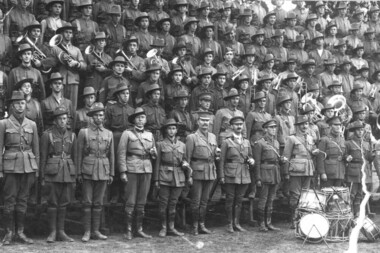
Photos, 71st Infantry Band Broadmeadows Camp
... Colonial Defence Force: 1858 – Ballarat Volunteer Rifle Regiment 1860 – Ballarat Volunteer Rifle Rangers 1863 – Ballarat Volunteer Rangers 1884 – 3rd Battalion, Victorian Rifles 1892 – 1st Battalion, 3rd Victorian Regiment 1898 – 3rd Battalion, Victorian Infantry Brigade Under the new Federal Government: 1901 – 3rd Battalion, Infantry Brigade Australian Army: 1903 – 7th Australian Infantry Regiment 1908 – 1st Battalion, 7th Australian Infantry Regiment 1912 – 70th Infantry (Ballarat East, Geelong and Queenscliff) 1912 – 71st Infantry (Ballarat West, Warrnambool) 1914 – 70th Infantry (Ballarat Regiment) - in Ballarat East 1914 – 71st (City of Ballarat) Infantry – in Ballarat West... Colonial Defence Force: 1858 – Ballarat Volunteer Rifle Regiment 1860 – Ballarat Volunteer Rifle Rangers 1863 – Ballarat Volunteer Rangers 1884 – 3rd Battalion, Victorian Rifles 1892 – 1st Battalion, 3rd Victorian Regiment 1898 – 3rd Battalion, Victorian Infantry Brigade Under the new Federal Government: 1901 – 3rd Battalion, Infantry Brigade Australian Army: 1903 – 7th Australian Infantry Regiment 1908 – 1st Battalion, 7th Australian Infantry Regiment 1912 – 70th Infantry (Ballarat East, Geelong and Queenscliff) 1912 – 71st Infantry (Ballarat West, Warrnambool) 1914 – 70th Infantry (Ballarat Regiment) - in Ballarat East 1914 – 71st (City of Ballarat) Infantry – in Ballarat West 71st infantry band broadmeadows camp percy code code frank wright brass band percy shackles shackles 71st Infantry Band (Percy Code Bandmaster) Broadmeadows Camp 1917 .1 Large group photo of members of the band .2 Photograph of part of the band The soldier in the front holding the conductor's batton is Percy Code. ...71st Infantry Band based at the Broadmeadows Camp 1917. Percy Code write a piece of music called the 71st Infantry Quick March. (http://trove.nla.gov.au/work/31795246?selectedversion=NBD11485892) The Ballarat phase of the battalion's history was formed as the Ballarat Volunteer Rifle Regiment on 9 August 1858 as a result of the Crimean War, coupled with the withdrawal of the British Army in 1857. In the years between its formation and the outbreak of War in 1914, the battalion went through a series of name changes as follows: Victorian Colonial Defence Force: 1858 – Ballarat Volunteer Rifle Regiment 1860 – Ballarat Volunteer Rifle Rangers 1863 – Ballarat Volunteer Rangers 1884 – 3rd Battalion, Victorian Rifles 1892 – 1st Battalion, 3rd Victorian Regiment 1898 – 3rd Battalion, Victorian Infantry Brigade Under the new Federal Government: 1901 – 3rd Battalion, Infantry Brigade Australian Army: 1903 – 7th Australian Infantry Regiment 1908 – 1st Battalion, 7th Australian Infantry Regiment 1912 – 70th Infantry (Ballarat East, Geelong and Queenscliff) 1912 – 71st Infantry (Ballarat West, Warrnambool) 1914 – 70th Infantry (Ballarat Regiment) - in Ballarat East 1914 – 71st (City of Ballarat) Infantry – in Ballarat West.1 Large group photo of members of the band .2 Photograph of part of the band The soldier in the front holding the conductor's batton is Percy Code. The trombone player next to Percy Code is Jack Shackles. 71st Infantry Band (Percy Code Bandmaster) Broadmeadows Camp 191771st infantry band, broadmeadows camp, percy code, code, frank wright, brass band, percy shackles, shackles -
 Bendigo Military Museum
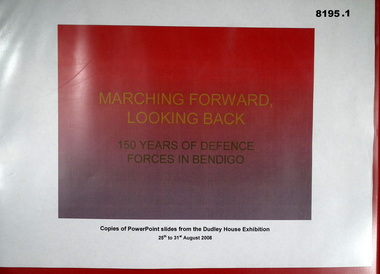
Album - FOLDERS, 150 YEARS
... The Exhibition led up to the 150 years Anniversary Dinner of Defence Forces in Bendigo held re Cat No’s 8193 & 8194.5P The source of the images came from Multiple places including; The Bendigo Advertiser, Bendigo Military Museum, Passchendaele Barracks Military Historical Society, Victorian State Library, Victorian Govt Gazette, City of Greater Bendigo, Victorian Colonial Infantry Association, 15 Transport Sqd and multiple personal files. ...The Exhibition led up to the 150 years Anniversary Dinner of Defence Forces in Bendigo held re Cat No’s 8193 & 8194.5P The source of the images came from Multiple places including; The Bendigo Advertiser, Bendigo Military Museum, Passchendaele Barracks Military Historical Society, Victorian State Library, Victorian Govt Gazette, City of Greater Bendigo, Victorian Colonial Infantry Association, 15 Transport Sqd and multiple personal files. ...The images are ones that were used in a Power Point exhibition at Dudley House Bendigo from August 25th - 31st August 2008. The Exhibition led up to the 150 years Anniversary Dinner of Defence Forces in Bendigo held re Cat No’s 8193 & 8194.5P The source of the images came from Multiple places including; The Bendigo Advertiser, Bendigo Military Museum, Passchendaele Barracks Military Historical Society, Victorian State Library, Victorian Govt Gazette, City of Greater Bendigo, Victorian Colonial Infantry Association, 15 Transport Sqd and multiple personal files. These were part of the research by Murray Poustie for the 150 year event..1)Folder A4 4 ring Binder with plastic inserts each holding two A4 white paper sheets with images, 79 inserts making total 158 images. .2) Folder same as .1) has 80 insert sheets with articles, old photos newspapers relating to units, Wars during 150 years of Defence Forces in Bendigo..1)On front cover, “Marching Forward, Looking Back - 150 years of Defence Forces in Bendigo”. .2) At top, “The Organising Committee - 150 Years of Defence Forces in Bendigo”brsl, smirsl, 150 -
 Wangaratta RSL Sub Branch
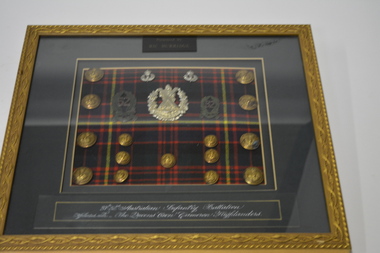
Memorabilia - Framed buttons and badges
... Thus, the Victorian 37th Infantry Battalion was the "Hunt Regiment", while the 52nd Infantry Battalion was the "Gippsland Regiment". ...Thus, the Victorian 37th Infantry Battalion was the "Hunt Regiment", while the 52nd Infantry Battalion was the "Gippsland Regiment". ...After the First World War the defence of the Australian mainland lay with the part-time soldiers of the Citizens Military Force (CMF), also known as the Militia. The Militia was organized to maintain the structure of the First AIF and kept the same numerical designations. The Militia units were distributed in the same areas the original AIF units were raised. Consequently, Militia units were also known by the name of their shire. Thus, the Victorian 37th Infantry Battalion was the "Hunt Regiment", while the 52nd Infantry Battalion was the "Gippsland Regiment". Both were raised in 1921 and linked in 1930, forming the 37th/52nd Infantry Battalion. In 1937 the battalion was separated but merged again in August 1942, after Japan's entry into the Second World War and the subsequent reorganisation of the Australian Army. gold coloured metal frame with green mount containing 3 silver and 2 green badges 8 large and 7 small gold coloured buttons on tartan cloth background.37th-52rd Australian Infantry Battalion Affilitated with The Queens "Own" Cameron Highlanders 37th/52nd australian infantry battalion, cameron highlanders -
 8th/13th Victorian Mounted Rifles Regimental Collection
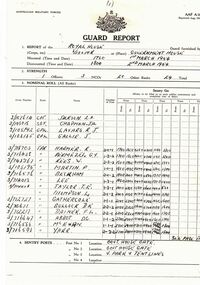
Document - Royal guard report, AAF A18 Guard Report, 2 March 1954
... Victorian Mounted Rifles and in 1991 was linked with 4th/19th Prince of Wales’s Light Horse forming the VMR Squadron of that regiment. The queen was resident at Government House Melbourne for nine days and during the time guard duties were shared by 1st Battalion Royal Australian Regiment, 3rd Division Royal Australian Artillery, 5th Infantry Battalion (Victorian Scottish), 6th Infantry Battalion (Royal Melbourne Regiment), 4th/19th Prince of Wales's Light Horse, 8th/13th Victorian Mounted Rifles, 2nd Medium Regiment, 22nd Field Regiment and Melbourne University Rifles. ...Victorian Mounted Rifles and in 1991 was linked with 4th/19th Prince of Wales’s Light Horse forming the VMR Squadron of that regiment. The queen was resident at Government House Melbourne for nine days and during the time guard duties were shared by 1st Battalion Royal Australian Regiment, 3rd Division Royal Australian Artillery, 5th Infantry Battalion (Victorian Scottish), 6th Infantry Battalion (Royal Melbourne Regiment), 4th/19th Prince of Wales's Light Horse, 8th/13th Victorian Mounted Rifles, 2nd Medium Regiment, 22nd Field Regiment and Melbourne University Rifles. ...The 8th/13th Victorian Mounted Rifles was raised as a regiment of the Royal Australian Armoured Corps on 1 May 1948 with Headquarters in Melbourne and squadrons in Sale, Benalla/Wangaratta and Albury. In 1955 Regimental Headquarters moved to Wangaratta and a second squadron was located at Albury. The Sale squadron transferred to 4th/19th Prince of Wales’s Light Horse. In 1977 8/13 VMR Regiment was reduced to an independent squadron A Squadron 8th/13th Victorian Mounted Rifles and in 1991 was linked with 4th/19th Prince of Wales’s Light Horse forming the VMR Squadron of that regiment. The queen was resident at Government House Melbourne for nine days and during the time guard duties were shared by 1st Battalion Royal Australian Regiment, 3rd Division Royal Australian Artillery, 5th Infantry Battalion (Victorian Scottish), 6th Infantry Battalion (Royal Melbourne Regiment), 4th/19th Prince of Wales's Light Horse, 8th/13th Victorian Mounted Rifles, 2nd Medium Regiment, 22nd Field Regiment and Melbourne University Rifles. Rare document relating to guard duty at Government House Melbourne mounted by a unit of the Citizen Military Forces from Victoria during a royal visit .Photocopy of a three page report prepared for period 1/2 March 1954 when 8th/13th Victorian Mounted Rifles Regiment provided the guard at Government House Melbourne during the visit of Her Majesty Queen Elizabeth II. The report lists the officer, 4 non commissioned officers and 20 other ranks comprising the guard together with timings and locations of the sentry posts. Also details of the guard duties, the general remarks at the conclusion of the guard period and the signatures of the Guard Commander, Captain LA Jackson 8th/13th Victorian Mounted Rifles and the Relieving Guard Commander Captain EJ King, 2nd Medium Regiment. queen elizabeth ii, royal visit 1954, government house, melbourne, guard, vmr -
 4th/19th Prince of Wales's Light Horse Regiment Unit History Room
Medal
... A member of the Victorian permanent forces, he served as a corporal (regimental number 8) with the First Victorian Mounted Infantry Company, part of the first Victorian Contingent to the war in South Africa in 1899. ...A member of the Victorian permanent forces, he served as a corporal (regimental number 8) with the First Victorian Mounted Infantry Company, part of the first Victorian Contingent to the war in South Africa in 1899. ...Title Peace of 1919 medalet issued to Australian schoolchildren Object type Medalet Place made Australia: Victoria, Melbourne Date made 1919 Summary Designed by C Douglas Richardson, 'The Peace of 1919' medalet was issued by the Defence Department to school children throughout Australia to commemorate the signing of the Versailles Peace Treaty in 1919. The medals were originally suspended from a narrow piece of red, white and blue striped cotton ribbon. This medalet is associated with one of the children of Lance Corporal Giles Daniel, 1st AIF. Born in Ballarat, western Victoria on 16 December 1870, Giles Felix Daniel moved to Oakleigh, Victoria aged 15. A member of the Victorian permanent forces, he served as a corporal (regimental number 8) with the First Victorian Mounted Infantry Company, part of the first Victorian Contingent to the war in South Africa in 1899. This unit was one of the first Australian formations to see action during the Boer War. It was largely drawn from serving members of the Victorian forces. Demoted to private following a Court Martial on 19 November 1900, Daniel returned to Australia in December of the same year. During the First World War, he was again one of the first to enlist, joining the AIF on 19 August 1914, and becoming Lance Corporal number 32 with the First Divisional Signals Company. He served with this unit during the Gallipoli campaign and until his return to Australia on 11 April 1916. Silver-plated brass Circular medalet with a plain edge and integral suspension loop. The obverse features a symbolic female figure of Peace, holding a sword and standing on a plinth marked 'PEACE 1919'. Behind her flies a dove, and at her left and right feet are two figures freed from their shackles. The reverse features a central panel surrounded by laurel leaves, surmounted by the King's Crown with the word 'VICTORY' over the rays of the rising sun. A sailor and a digger stand at ease on either side of the panel on which is cast 'THE / TRIUMPH / OF / LIBERTY / AND / JUSTICE'. Below the leaves is a very small panel with the words 'THE PEACE OF 1919' and the manufacturer's name.peace medal 1919 -
 Lara RSL Sub Branch
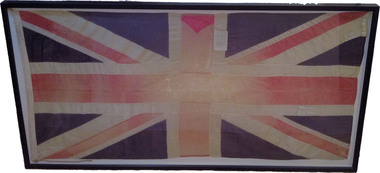
Flag, Australian Flag (Union Jack) 1900
... Australians fighting in South Africa were doing so as part of Colony based Regiments such as the Victorian Mounted Rifles, New South Wales Lancers, Queensland Mounted Infantry as well as units from the other states. ...Australians fighting in South Africa were doing so as part of Colony based Regiments such as the Victorian Mounted Rifles, New South Wales Lancers, Queensland Mounted Infantry as well as units from the other states. ...There is a Union Jack brought back from South Africa by 1229 Trooper Fredrick James Smith. Between 1899 and 1902, around 16,500 Australians served in South Africa during the Boer War. This was the largest international deployment of troops from the Australian Colonies before Australian Federation. Of the 16,500 men who served in South Africa, 606 were killed in action or died of diseases. The Australian War Memorial records that the fighting conditions in South Africa extremely hard on men and horses. Australians fighting in South Africa were doing so as part of Colony based Regiments such as the Victorian Mounted Rifles, New South Wales Lancers, Queensland Mounted Infantry as well as units from the other states. Australians were awarded six Victoria Crosses during the campaign along with many other decorations. In May of 1902 the treaty of Vereeniging was signed officially ending the Boer War. The Boer War is commemorated in many Towns and Cities around Australia. The Lara RSL Sub Branch holds some memorabilia from the Boer War. There is a Union Jack brought back from South Africa by 1229 Trooper Fredrick James Smith. He was a resident of Lara and was a member of the 5th Victorian Mounted Rifles. It was reported that he carried this flag into battle. The Lara RSL also holds the flag staff of the China, South African and Old Veterans Association. Both these items are of national significance. Both the flag and flag staff were used in marches in Geelong each year until 1916 when Anzac Day commenced. The flag and flag staff were donated to the Lara RSL sub Branch when he joined in 1928. Fredrick James Smith was born at Lara in 1879, the son of Mr/Mrs Smith from Lara. He was a farm hand from Horton Vale, Anakie when he joined F Company of the 5th Victorian Mounted Rifles at the beginning of February 1901. Two weeks later, he left for South Africa on the 15th February. Before leaving, he purchased the flag from W. Libby & Son Geelong. Frederick Left for South Africa on the 15 February 1901 on the Orient. He saw service between March 1901 - March 1902 in east Transvaal and Natal frontier under the British Major General S. Beatson then Pulteney, including the defeat at Wilmansrust where 18 soldiers were killed and 42 wounded (12th June 1901 - heaviest casualties of any Australian contingent,); and the successful intervention at Onverwacht on the 4th January 1902. The 5th Victorian Mounted Rifles suffered: 36 killed or died of wounds, 13 died of disease of a contingent of 46 Officers, 971 Other Ranks and 1099 horses. They returned to Australia on the 26th April 1902 on the Custodian after sailing from Point Natal in South Africa on the 5th April. On his return, Tropper Smith (Saddler Private) joined the South African Soldiers Association of Victoria – Geelong Branch, and after 1928, he joined the Lara RSL. He was buried in Western Cemetery on the 19th June 1968 at the age of 89. Enrolled February 1901 Departed for South Africa on 15 February 1901 Establishment: 46 Officers, 971 Other Ranks with 1099 horses Mobilised at Pretoria: 24 March -- 4 April 1901 Typical company: 1 Captain, 4 Lieutenants, 1 company sergeant-major, 1 company quartermaster-sergeant, 1 sergeant-farrier, 1 sergeant-saddler, 5 sergeants, 6 corporals, 3 shoeing-smiths, 3 saddlers, 1 bugler, 99 privates. Total in company: 126 with 131 horses. Engagements: Rhenoster Kop, Klippan, Kornfontein, Drivelfontein, Wilmansrust, Kambuladraai, H'Lobane, Luchiel's Nek, Loch's Kraal, Vryheid, Onverwacht, Johnston Hoek Killed in action (or died): six Officers, 48 Other Ranks VC Winner: Lieut. L. C. Maygar News article Leader (Melbourne) Saturday 31st May 1902, page 42 - Dear Cinderella. — This is the second time I have written to you. I was very sorry at not seeing my first letter in "The Leader". But I hope to say, that this one will be in. The last time I wrote to you I told you that my brother (Fredrick Smith) went to the Boer War in South Africa, and that he was supposed to be killed in the Wilmansrust disaster. But this time I am going to tell you about his return, and the grand welcome he got from the residents of Lara. Mother, Father, and my Brother, went down to Melbourne, to meet the boat. You can just imagine how rejoiced we all were to see him back again. The railway station was decorated some thing beautiful with flags of all description all the colours you could think of. He has bought a lot of Boer curios home and some Kaffir bracelets. They are such funny looking things. The residents of Lara, also gave my brother a grand social and ball there were over four hundred people present, They presented him with a hand some gold chain, and locket suitably inscribed, and a pair of gold sleeve links, they were magnificent. The ball was very nice. . I had a few dances. I enjoyed myself grand. I think this is all I can tell you this time. I must conclude with love. I remain yours sincerely - BESSIE SMITH. Age 14-years. This flag is of national significance as it was used in the Boer War by Private Fredrick James Smith (SN:1229) of the 5th Victorian Mounted Rifles, F Company in their deployment to South Africa between 1901 and 1902. The flag was taken into the Wilmansrust engagement in which 19 soldiers died and 41 were wounded. On return to Australia, the flag was used in marches by the South Africa, China Old Veterans Association - Geelong. This flag represents a unique part of Australian history from which the movie, Breaker Morant was taken. It is of spiritual significance as the Boer War was where the first Australian received the Imperial Victoria Cross, and the spirit of Anzac was conceived, giving birth in World War 1. The Flag represents the spirit of Australians who fought and died in South Africa.Cotton Union Jack flag approx 221cm wide by 109cm tall with small repair patches and center section cotton deteriorated.Has the word "Lara" inscribed in black on bottom part of the flag heading. Has the flag makers name "W.Libby & Son" on the top part of the flag heading.boer war, union jack flag, south africa, wilmansrust, 5th victorian mounted rifles, f coy, private fredrick james smith, service number 1229, february 1901, april 1902, south africa china old veterans association -
 Federation University Historical Collection
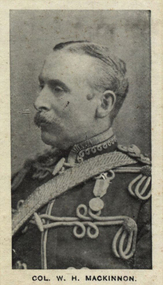
Photograph (black & White), Colonel William Henry MacKinnon - South Africa
... infantry and artillery. They were in South Africa from January 1900 until October 1900, returning to England. The corps was disbanded in December 1900. MacKinnon was awarded with the Knight Grand Cross of the Order of the Bath and Knight Commander of the Royal Victorian Order....infantry and artillery. They were in South Africa from January 1900 until October 1900, returning to England. The corps was disbanded in December 1900. MacKinnon was awarded with the Knight Grand Cross of the Order of the Bath and Knight Commander of the Royal Victorian Order. malta india assistantadjutant general second boer war city of london volunteers colonel south africa Individual image from photographed poster of tobacco and cigarette cards Colonel William Henry MacKinnon - South Africa Photograph (black & White) ...After serving in Malta and India, he became Assistant Adjutant General at Home District in 1893. After the outbreak of the Second Boer War he was appointed Colonel commandant of the City of London Volunteers who proceeded to South Africa. This corps included infantry, mounted infantry and artillery. They were in South Africa from January 1900 until October 1900, returning to England. The corps was disbanded in December 1900. MacKinnon was awarded with the Knight Grand Cross of the Order of the Bath and Knight Commander of the Royal Victorian Order.Individual image from photographed poster of tobacco and cigarette cardsmalta, india, assistantadjutant general, second boer war, city of london volunteers, colonel, south africa -
 Geelong RSL Sub Branch
Medals 293 Hughie McLean, Early 21st century
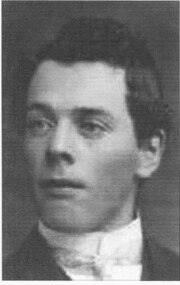
... Victorian born in Tamagulla, Victoria. Hughie McLean was living in Adelaide when he enlisted on 30 June 1915 and joined 'K' Group Base Infantry. 293 Hughie McLean was subsequently posted to 32 Australian Infantry Battalion and Killed in Action in France on the 19 July 1916. 32 Australian Intantry Battalion was raised as part of the 8th Brigade at Mitcham, South Australia....Victorian born in Tamagulla, Victoria. Hughie McLean was living in Adelaide when he enlisted on 30 June 1915 and joined 'K' Group Base Infantry. 293 Hughie McLean was subsequently posted to 32 Australian Infantry Battalion and Killed in Action in France on the 19 July 1916. 32 Australian Intantry Battalion was raised as part of the 8th Brigade at Mitcham, South Australia. 293 Hughie McLean was a Victorian man who was living in Adelaide at the time of his enlistment 30 June 1915. ...293 Hughie McLean was a Victorian born in Tamagulla, Victoria. Hughie McLean was living in Adelaide when he enlisted on 30 June 1915 and joined 'K' Group Base Infantry. 293 Hughie McLean was subsequently posted to 32 Australian Infantry Battalion and Killed in Action in France on the 19 July 1916. 32 Australian Intantry Battalion was raised as part of the 8th Brigade at Mitcham, South Australia.293 Hughie McLean was a Victorian man who was living in Adelaide at the time of his enlistment 30 June 1915. He was Killed in Action on 19 July 1916 in France. 293 Hughie McLean's original Medals were forwarded to his brother Mr J W McLean on 22 July 1922.3 x Medals - 1914-1915 Star, British War Medal 1914-1918, Victory Medal 1914-1919 ReproductionsThe Medals are reproductions, there are no markings or names293 hughie mclean, 32 aust inf battalion, kia, france -
 City of Moorabbin Historical Society (Operating the Box Cottage Museum)
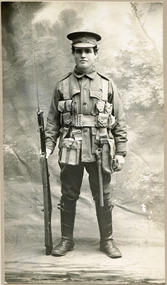
Photograph, 1916 William Henry Thomas in WW1 Uniform, 1916 William Henry Thomas in WW1 Uniform, 1916
... world war 1 1914- 1918, thomas street,early settlers, pioneers, market gardeners, australian infantry force, soldiers, key's cup, victorian war memorials, cheltenham, mckinnon,...Private Thomas returned to Australia on the hospital transport Castalia 13 April 1919 and his enlistment was terminated 26 September 1919 Private William Henry Thomas and his family are examples of the patriotism exhibited by the market gardeners, and indeed throughout Australia, during the World War 1 1914-1918. william henry thomas 1916 1894 first ww world war one uniform wickham road south brighton moorabbin world war 1 1914- 1918, thomas street,early settlers, pioneers, market gardeners, australian infantry force, soldiers, key's cup, victorian war memorials, cheltenham, mckinnon, keys road moorabbin ss castalia, british expeditionary force ww1 1914- 1918, 24th battalion 1st aif, 6th australian machine gun company 1st aif, influenza epidemic 1919, alexandria egypt, methodist church, Front of Mount : Ainor Studio Auburn Back of Mount : William Henry Thomas / 1st World War 1916 / Keys Rd., Moorabbin / Born 1894 / Christened at Wesleyan ( Methodist ) Church / Wickham Rd., / South Brighton / now Uniting Church unsigned undated Photograph is black and white. ...1916 William Henry Thomas of Keys Road , South Brighton (now Moorabbin ) in WW 1 1914 -1918 1st AIF uniform. William was born in 1894 , Christened at the Wesleyan Church. (Methodist), Wickham Road, South Brighton and attended Moorabbin State School. . Private Thomas was a market gardener in Moorabbin prior to his enlistment in the Australian Imperial Force on 19 July 1915. Both his parents wrote separate letters giving their consent for their son to serve overseas due to " the pressing request of my son William Henry, also the urgent need of recruits do give my consent that he shall go to the front." September 29th 1915 he left Australia with the 5th Reinforcements of the 24th Battalion for Egypt. March 1916 he was hospitalised with Mumps and shortly after left Alexandria to join the British Expeditionary Force for France where he transferred to the 6th Australian Machine Gun Company.. Whilst on leave in England he received medical attention before returning to France and 13 November 1918 he spent a week in the care of the 7rh Field Ambulance suffering with influenza . Private Thomas returned to Australia on the hospital transport Castalia 13 April 1919 and his enlistment was terminated 26 September 1919Private William Henry Thomas and his family are examples of the patriotism exhibited by the market gardeners, and indeed throughout Australia, during the World War 1 1914-1918. Photograph is black and white. William Henry Thomas is standing straight and tall in the centre of the photograph, looking directly at the photographer while holding a weapon in his right hand. He is in his military uniform (WW1) .Front of Mount : Ainor Studio Auburn Back of Mount : William Henry Thomas / 1st World War 1916 / Keys Rd., Moorabbin / Born 1894 / Christened at Wesleyan ( Methodist ) Church / Wickham Rd., / South Brighton / now Uniting Church unsigned undatedwilliam henry thomas, 1916, 1894, first ww, world war one, uniform, wickham road, south brighton, moorabbin, world war 1 1914- 1918, thomas street,early settlers, pioneers, market gardeners, australian infantry force, soldiers, key's cup, victorian war memorials, cheltenham, mckinnon,, keys road moorabbin, ss castalia, british expeditionary force ww1 1914- 1918, 24th battalion 1st aif, 6th australian machine gun company 1st aif, influenza epidemic 1919, alexandria egypt, methodist church, -
 Bendigo Military Museum
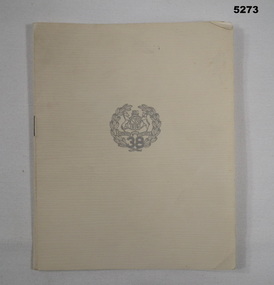
Card - CARD, CHRISTMAS, 38th Infantry Battalion, c1919-1962
... Bn - Northern Victorian Regiment, Mollison Street Bendigo. Card CARD, CHRISTMAS 38th Infantry Battalion ...Refers to service of Harry Burrell "MM".Refer Cat No 298.4 for his service detailsLocally made Christmas Card. The front has the 38th Battalion NVR badge in the centre in silver ink. The card has two sections; The outer which is folded, made out of strong paper. The other inner section, is printed on glossy white paper. Printed in colour in the centre, are the colours of the 38th Bn, with Christmas Greetings printed in blue ink on the right. 38 Inf. Bn - Northern Victorian Regiment, Mollison Street Bendigo. The sheets are folded with one staple binding.38th battalion, greeting card -
 Bendigo Military Museum
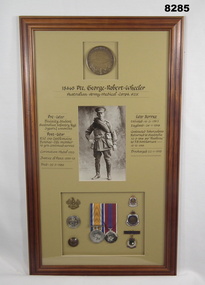
Award - FRAMED MEDALS, BADGES, PHOTO
... Infantry Regiment". (George served in pre War) Badge, "For King and Empire - Services rendered". Button. From an Army uniform. Badge. "Life Member of the RSL". Badge. "RSL membership badge with membership year clip 1920 on" Badge. "Super Veteran - Royal Victorian...Infantry Regiment". (George served in pre War) Badge, "For King and Empire - Services rendered". Button. From an Army uniform. Badge. "Life Member of the RSL". Badge. "RSL membership badge with membership year clip 1920 on" Badge. "Super Veteran - Royal Victorian ...The item is a mixture of Military and RSL service. The Medallion at the top has around the edge, "Centenary of the Government of Victoria 1851 - 1951". In the centre of has, "Awarded to G.R. Wheeler Esq for 25 years service to the Returned Servicemen". The bottom inset has the following. Badge, "8th Australian Infantry Regiment". (George served in pre War) Badge, "For King and Empire - Services rendered". Button. From an Army uniform. Badge. "Life Member of the RSL". Badge. "RSL membership badge with membership year clip 1920 on" Badge. "Super Veteran - Royal Victorian Bowls Association"' Medals. "British War medal 1914 - 1918" "Coronation medal 1953". George Wheeler, refer Cat No 8263 for his Military and RSL Service details.Framed timber with a fawn colour back ground with a medallion at the top followed by a photo inset, at bottom inset are a set of medals and 6 various badges.Main item is, "18465 Pte George. Robert. Wheeler - Australian Army Medical Corps AIF.brsl, smirsl, gwheeler -
 Bendigo Military Museum
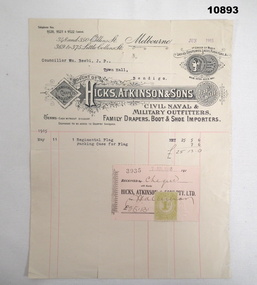
Administrative record - RECEIPT, Hicks, Atkinson & Sons Pty Ltd, 11 May 1915
... Infantry Admin record Stamp on top RH Corner = "Jun 1915". Pencilled on back are: "160 + 10" Off white sheet of paper with the Company letterhead, phone no's and address. Dated 1915, May 11. All printing is in black ink. Glued to the receipt is a small pink slip which is the receipt for cheque of .25.13.00. (25 pounds 13 shillings). That pink slip has a one penny Victorian ...In November 1914, the 67th (Bendigo) Infantry C.M.F. were called up for full time service to guard the heads at Port Philip. The Lord Mayor, Cr Beebe, noted the Battalion did not have their own "colours" so he promised to have one made. This was done, then the "Colour" of the 67th Bendigo Infantry was presented to the Battalion in Bendigo, April 1915. The flag or colour is held in the Bendigo Military Museum, along with two Union Jacks from the Boer War.Off white sheet of paper with the Company letterhead, phone no's and address. Dated 1915, May 11. All printing is in black ink. Glued to the receipt is a small pink slip which is the receipt for cheque of .25.13.00. (25 pounds 13 shillings). That pink slip has a one penny Victorian Stamp Duty stamp on it. Dated 7 July 1915. The receipt shows; 1 Regimental Flag cost 25.5.6d. Packing case for flag 0.7.6d. Total .25.13.00.Stamp on top RH Corner = "Jun 1915". Pencilled on back are: "160 + 10"ww1, 67th bendigo infantry, admin record -
 Bendigo Military Museum
Administrative record - COMPENDIUM WW1 - WW2, 4) A H Pettifer, Government Printer et al, 2) 14.2.1946; .3) 1.3.1919; .4) 30.11.1954 .5) 24.11.19? - WWI; .6) 31.10.1917; .7) 12.6.1917; .8) Page 1: 20.12.1915, Page 2: 10.12.1915, Page 6: 19.1915; .9) 10.9.1918; .10) 18.4.1919; .11) c.2.3.19?; .12) 18.9.1920; .14) post WWI; .15) 24.4.1920; .17) 18.4.1942; .18) 19.6.1943; .19) 18.3.1947; .20) 1944; .21) 1944; .23) 22.10.1941; .26) 13.9.1944; .27) 1.1944; .30) 7.3.1950; .31) 31.7.1944; .32) 16.4.1942; .33) 13.6.1946; .34) 6.5.1946; .36) a) & b) 3.11.1947; .37) 24.10.1951; .38) 24.9.1957; .39) 9.10.1957; .40) 19.2.1958; .41) 26.2.1958; .42) 1.3.1958; .43) & .44) 7.3.1958; .45) 25.2.1958; .46) 3.1.1948; .47) 26.2.1948; .48) 22.4.1958; .49) 24.2.1958; .50) 12.3.1958; .51) 6.1958; .52) c.Mar/Apr 1958; .53) 5.4.1958; .54) c.end WWII; .55) a.b. 13.6.1967; .56) 26.5.1967; .57) 18.2.1954
... Infantry Battalion ...26) Major W A JENNER, New Guinea Force Headquarters....28) & .29) First Australian Army....30) CARO A Block....31) Lt Gen Stanley Gauige, Comd New Guinea Force, Headquarters....33) Ltd Discharge Depot....34) AMF Discharge Depot ....35) Joseph Francis, Minister for the Army....36) a) & b) H T Allan (assumed)....37) Brigadier in Charge of Administration, HQ Eastern Command, Victorian...Administrative record COMPENDIUM WW1 - WW2 .2) Pacific Island Regiment .3) War Office .4) A H Pettifer, Government Printer .5) Lord Chamberlain .6) W Birdwood, 1st ANZAC Corps .8) Pages 1 & 2 University of Sydney .8) Pages 3 & 5 Commonwealth Gazette .8) Page 6 Australian Military Forces .8) Pages 7 - 11 Military Forces of the Commonwealth 2nd Military District .9) Department of Defence Base Records Office .10) Military Forces of the Commonwealth, 2nd Military District .11) Lord Birdwood .12) Australian Imperial Force, Base Records Office .13) Australian Military Forces .15) University of Sydney .16) Territory of New Guinea .17) Major General Morshead, Headquarters AIF (ME) .18) Major General Morshead, Headquarters 2 Australian Corps .19) J R Halligan, Secretary of Dept of External Territories .20) 20th Australian Infantry Brigade .21) 2/13 Battalion AIF .22) Australian Anti-Tank Regt AIF .23) 20th Infantry Brigade .24) 2/17 Australian Infantry Battalion 26) Major W A JENNER, New Guinea Force Headquarters .28) & .29) First Australian Army .30) CARO A Block .31) Lt Gen Stanley Gauige, Comd New Guinea Force, Headquarters .33) Ltd Discharge Depot .34) AMF Discharge Depot .35) Joseph Francis, Minister for the Army .36) a) & b) H T Allan (assumed) .37) Brigadier in Charge of Administration, HQ Eastern Command, Victorian Barracks .38) & .39) J V Knight, State Secretary, RSS & AILA Papua New Guinea Branch .41) & .43) 41) Major General T J DALY, General Officer Commanding Northern Command Headquarters, Victoria Barracks .44) H T Allan .46) & .47) Henry G Eckhoff, Honarary Secretary, New Guinea Citizens Association, Lae Branch .48) Major General T J Daly, General Officer Commanding Australian Military Forces, Northern Command Headquarters .49) Lieutenant General Sir Henry Wells, Chief of General Staff .50) H T Allan .51) A PNG Correspondent - Pacific Islands Monthly .53) a.b.c. ...Herbert Trangmar Allan, refer 2755.4 for his extensive service history and wards. .2) Details gifting of a pair of Japanese binoculars to Col H T ALLAN by Pacific Island Regiment. .3) Certificate issued by Winston Churchill, Secretary of State for War (The War of 1914-1918), awarded to Capt H T ALLAN MC. .4) Herbert Trangman ALLAN born 5.1.1895 at Woolwich, NSW. Middle name misspelled, should be Trangmar not Trangman. .6) Congratulating H T ALLAN on receiving the Military Cross award for leading 2 companies which had lost officers during action on Passchendaele Ridge on 9.10.1917. .7) Describes life behind the lines whilst H T ALLAN's battalion has been resting for a month. Daily life consisted of training drills, sport & entertainment. Writer takes time to describe the countryside & weather. .8) Relate to H T ALLAN's military exam results & his promotion to 2nd Lieutenant in 1915. .9) To Herbert Allan's father, Mr P Allan detailing the citation for awarding of the Military Cross to Herbert ALLAN. Original citation appeared in the London Gazette,5.4.1918. .10) Form addressed to Capt H ALLAN MC, 17th Battalion stating his period of enlistment in the 1st AIF was to expire 26.5.1919. .11) Letter from Lord BIRDWOOD (General) to Herbert ALLAN in response to a letter received 19.11.19?. General BIRDWOOD expresses his opinions on difficulties the allied troops face in their fight against the Japanese. .12) Letter to Capt H T ALLAN advising of MID oak leaves sent to him. Details guidelines for attaching oak leaves to both the larger Victory Medal & the small service dress medal. .13) Form details H T ALLAN's WWII Army No, Rank, Unit & Decorations & Medals held. The form has not been signed & dated. .14) Details service record of Lt Col H T ALLAN NX12229. Includes military service from 1912 - 1944, schools & courses attended, decorations, promotions & overseas service. .16) Form issued to H T ALLAN on 15.12.1939 granting permission to leave New Guinea for Australia & return within a period of 12 months. Issued by Customs Office in Salamaua. Lists H T ALLAN's age as 44, height 5' 10" & occupation. .17) Letter from Major General MORSHEAD GOC, AIF (ME) to Major H T ALLAN, OBE, MC congratulating him on being awarded the OBE for outstanding service at Tobruch. .18) Letter from Major General MORSHEAD to Major H T ALLAN, OBE, MC replying to ALLAN's letter of 15.6.1943. MORSHEAD is congratulating ALLAN on his appointment to New Guinea Force, also acknowledges his excellent service record. .19) Letter acknowledges H T ALLAN's resignation from the Office of Production Member of the Australian New Guinea Production Control Board, effective from 28.8.1946. .20) Major General WINDEYER commanded the 20th Brigade from 1942-1946. .22) Card sent from the CO of the 3rd Australian Anti-Tank Regiment. .23) Menu for Farewell Dinner held in the Officer's Mess of the 20th Infantry Brigade, Tobruch on 22.10.1941. .24) Menu & Toast list for Farewell Dinner to Brigadier J J MURRAY DSO MC VD. Attended by H T ALLAN & held in the Officers Mess, 2/17 Australian Infantry Battalion on 22.12.1941. .25) Invitation to Col H T ALLAN by Lady Gowrie (wife of Governor General Baron Gowrie) to attend a Luncheon at Government House, Canberra, ACT. .26) Letter to Major (T/Lt Col) H T ALLAN from Major W A JENNER advising him of his secondment to 2/17 Australian Infantry Battalion & appointment to command 5 Aust Base Sub Area. .27) Application for Africa Star with Eighth Army Clasp signed by H T ALLAN & approved by Lt Colonel of 2/17 Australian Infantry Battalion. H T ALLAN held the rank of Major (substantive) at the time of qualification, 1.3.1942 - 11.1942. He held the rank of Lt Colonel at the time of application in 2.1944. .28) Detailing changes in command & promotions including that of Lt Col H T ALLAN, dated 1.4.19? .29) For Lt Col H T ALLAN detailing movements required by First Australian Army command. .30) Acknowledgement & confirmation of Col H T ALLAN's application for campaign awards for WWII. .31) Letter addressed to Lt Col H T ALLAN from Lt Gen Stanley Sauige requesting information on New Britain for a forthcoming visit. .32) Certificate was presented to H T ALLAN on 16.4.1942 when he was awarded an OBE by King George VI. .33) Document details H T ALLAN's relinguishing of Command of the HQ of Pacific Islands Regiment. ALLAN also relinguished the rank of temporary Colonel & was transferred to the Reserve of Officers with rank of substantive Lt Colonel. .35) Official letter to Colonel H T ALLAN from Joseph Francis, Minister for the Army. The letter acknowledges Col ALLAN's long & distinguished career during both peace & wartime. .36) a) & b) From H T ALLAN (assumed) to Prime Minister J B CHIFFLEY referring to the production of copra in New Guinea, the actions of the Commonwealth Bank in relation to planters & the collaboration of New Guinea natives with the Japanese. Assumed to be a copy of original. .37) Letter to H T ALLAN indicating he had been placed on the Retired List with the rank of Honorary Colonel. .38) Letter invites H T ALLAN to officially open the State Conference in Lae in late March or early April 1958. Invitation was extended due to H T ALLAN for distinguished service in PNG. .39) Letter to H T ALLAN thanking him for accepting the invitation to open the Papua & New Guinea State Conference in late March or early April 1958. .40) Letter from H T ALLAN to Lt Gen Sir Henry WELLS, Chief of the General Staff, Victoria Barracks, Melbourne. ALLAN requests permission to wear his uniform for official engagements during his upcoming visit to New Guinea. ALLAN also offers advice on how to deal with native troops including serving time with them, learning their language & studying their customs. He suggests that this would help quell & dissent & revolt. .41) Reply from Major General DALY to HT ALLAN thanking him for his offer to spend time with the CO of the Pacific Island Regiment to address concerns with that unit. This meeting would coincide with ALLAN's upcoming visit to PNG. .42) HT ALLAN's reply to Major General T J DALY's letter of 26.2.1958. ALLAN requests an opportunity to discuss PIR issues with Major General DALY prior to his visit to PNG. .43) Major General T J DALY's reply to HT ALLAN's request for a meeting to discuss ongoing issues with the Pacific Island Regiment. .44) Letter from HT ALLAN to Brigadier D M CLELAND notifying him that he will be staying in Port Moresby on his way to the RSS&AILA Congress in Lae. .45) Lieutenant Colonel MCGUINN writes to invite Colonel ALLAN to visit the PIR during his visit to New Guinea at the end of March of the beginning of April 1959. .46) Letter of appreciation to H T ALLAN thanking him for his efforts in presenting the case for the Territory of New Guinea during the post WWII transition period. .47) Letter to H T ALLAN from New Guinea Citizens Association, Lae Branch, thanking him for his service on behalf of the people of the Territory of New Guinea. The association offered to send ALLAN a suitable present in recognition of his service. .48) Major General T J DALY's reply to HT ALLAN's suggestions for handling disquiet amongst the native troops in the Pacific Island Regiment. .49) Reply from Lieutenant General WELLS to H T ALLAN granting him permission to wear his uniform on his forthcoming visit to New Guinea. WELLS also notes that he has passed other requests made by ALLAN to Major General DALY. .50) Copy of H T ALLAN's reply to Lieutenant General WELL's letter of 24.2.1958 [.49)]. .51) A written account of Colonel H T Blue ALLAN's visit to New Guinea in 3.1958. Article appeared on p.65 & 67 of the 6.1958 edition of Pacific Islands Monthly. .52) Newspaper account of Colonel H T Blue ALLAN's opening of the Rabaul Branch of the Native Ex Servicemen's Association. Colonel ALLAN spoke of the involvement of the Pacific Islands Regiment during WWII. .53) The Rabaul Times account of Colonel H T Blue ALLAN's opening of the Rabaul Branch of Native Ex Servicemen's Club. Featured on p1, concluded p3. .54) Biographical account of Colonel H T ALLAN's service in WWI & WWII. In addition an account of his success in New Guinea between the wars is included. .55) a.b. Biography of Colonel H T ALLAN written by R W Robson who was the founder of the Pacific Islands Monthly. Article was written following ALLAN's death on 23.5.1967 aged 72. This item is a pre publication copy of Robson's article which appeared in the Pacific Islands Monthly. .56) Text of a valedictory given at the funeral of Colonel Herbert Trangmar ALLAN OBE, MC, ED, NX12229 held 26.5.1967 following his death on 23.5.1967. The speech summarized his life in both wars & civilian life. 57) Invitation issued to Colonel H T & Mrs ALLAN to attend a Garden Party at Government House on 18.2.1954. At this function Colonel H T & Mrs ALLAN were to be presented to her Majesty Queen Elizabeth II.Herbert T ALLAN Collection. The contents are all of various size, the Album is the size documented. .1) Large teal green album containing 16 plastic pockets each with white card insert. Various documents & photos contained in each pocket. .2) Typed letter, black type on cream paper. .3) Certificate mounted on fawn card backed with dark brown veneer. Presented to Capt H T ALLAN MC for being mentioned in despatches on 7.11.1917. .4) New South Wales Birth Certificate extract, printed on pink paper with watermark. .5) Telegram on tissue paper to a sheet of cream paper. Pin located top L corner. Requests the attendance of Lt Herbert ALLAN, Russell Hotel, Russell Square. .6) Typed letter mounted on grey cardboard. .7) 2 page letter on foolscap paper, secured by pin top L corner. Written from France by Herbert (Bert) ALLAN & addressed to his father. .8) 11 pages secured with a clip top L corner. 1st document typed, 2nd handwritten, remainder printed. Relate to H T ALLAN's military exam results. .9) Typed letter from Department of Defence Base Records Office to P ALLAN. .10) Document, printed form to inform the recipient that their period of enlistment in the 1st AIF had expired. .11) 4 page handwritten letter on 2 sheets of paper. 1st page has a printed letterhead. .12) BR Form No 20. Typed formal letter from AIF Base Records Office to accompany Mentioned in Despatches oak leaves sent to the recipient. .13) Form AAFA36 used for recommending the awarding of an Efficiency Decoration. Form details service record & details of a serving soldier. .14) 1 large / 1 small page, numbered, detailing the service record of Lt Col H T ALLAN. Black type on cream paper. 2 pages are loose but evidence of attachment visible. .15) Bachelor of Arts Degree Certificate (testamur) granted by the University of Sydney, awarded to Herbert Trangmar ALLAN. Printed on cream parchment. .16) Proforma document issued by the Territory of New Guinea permitting leave & return to the Territory. Printed 2 sides, black type on cream paper. .17) Letter on Australian Imperial Force letterhead from Major General MORSHEAD to Major H T ALLAN. .18 Letter on HQ2 Aust Corps letterhead from Major General MORSHEAD to Major H T ALLAN. .19) Typed letter on External Territories letterhead from J R Halligan to H T ALLAN. .20) Cream Christmas card folded in 2, sent to H T ALLAN. On front in black lettering is HQ 20th Australian Infantry Brigade below black Rising Sun emblem. Inside in black lettering is With Best Wishes for Christmas and New Year. Christmas 1944. .21) Cream card folded in 2. Front illustration depicts a devil figure riding a platypus & carrying a pennant with 2/13 on it. The devil is depicted attacking a German & Japanese soldier. Below the devil is a boomerang with Greetings Xmas 1944 printed on it. Illustration is in green & black. Inside on LHS is a message from 2/13 Battalion. On RHS is a list of 2/13 battle honours from 1940-1943. On back in black print is 1944-1945 New Guinea Australia. .22) Cream Christmas card folded in 2. Front illustration in brown with word Greetings in green. RHS inside printing in green & brown letters. Artillery badge on back in brown. .23) Cream card folded in 2. Typed menu on cream paper attached inside. Front cover illustrated with 20th Infantry Brigade colour patch & a rat over a scroll with words - So What? .24) Cream card folded in 2. On front black printing accompanied by 2/17 Battalion colour patch that is black over green diamond shape. Inside a list of Toasts & Dinner Menu printed in black. Back page for autographs. .25) Cream invitation card. Black cursive script printing below gold crown on front. .26) Typed letter on cream paper. .27) Typed foolscap application form to claim the Africa Star. .28) & .29) Message form filled with typed orders. .30) Typed letter acknowledging an application for campaign medals & listing eligible awards. .31) Typed letter on bond paper. .32) Certificate on cream parchment. Black print in cursive script. Text details the awarding of an OBE to the recipient. .33) Typed text on Australian Military Forces letterhead. Cream paper. .34) Typed text. Temporary note for H T ALLAN's discharge from AMF. .35) Typed letter on Commonwealth of Australia, Minister for the Army letterhead. .36) a) & b) 2 page letter in black type on cream paper. Pages are loose, letter unsigned. .37) 1 page typed letter on Australian Military Forces letterhead. .38) & .39) 1 page typed letter on Return Sailors, Soldiers & Airmen's Imperial League of Australia, Papua & New Guinea Branch letterhead. .40) 1 page typed letter, unsigned. .41) Single sided typed letter on Australian Military Forces letterhead on cream paper. .42) 1 page typed letter, unsigned on cream paper. .43) Single sided typed letter on Australian Military Forces, Northern Command, Victoria Barracks, Brisbane letterhead on cream paper. .44) Single sided typed letter on cream paper. .45) 2 page typed letter on folded cream paper bearing the letterhead of the Pacific Islands Regiment. .46) 1 page typed letter on cream, lined paper. .47) 1 page typed letter on cream paper. .48) 1 page typed letter on Australian Military Forces, Northern Command Headquarters, Victoria Barracks, Brisbane letterhead on cream paper. .49) 1 page typed letter on Chief of General Staff, Australian Military Forces, Army Headquarters, Victoria Barracks, Melbourne letterhead on cream paper. .50) 1 page copy of an unsigned letter on cream paper. .51) Magazine article: Building a New Nation in New Guinea : Some advice from Colonel Blue ALLAN. Black & white article with a 2nd small section stapled to the main page. Large page features a black & white captioned photo of a group listening to a uniformed Officer deliver a speech. Also features advertising front & back. .52) Newspaper article: Official Opening of Native Ex Servicemen's Club. Black & white typed newspaper article featuring a captioned black & white photo of a uniformed Australian Officer & a group of New Guinea Ex Servicemen. .53) a. b. c. Newspaper article: Master Blue Came Back to the Islands: 4000 Attend Club Opening. 3 Section article cut from a newspaper. One part is the banner of the newspaper with date published. Other sections contain the text of the article. The larger section features a black & white photo of an Australian Army Officer in uniform. .54) Newspaper article, untitled. Black & white typed newspaper article with black & white caricature of an Australian Army Officer featured. .55) a. b. Magazine article: The Story of a Big Man who Loved Soldiering. 2 page black & white typed article with sub headings. .56) Text of a Speech. 2 page typed text written for a valedictory given at a funeral. Pages connected with a staple in the top L corner. .57) Printed, cream card invitation to a Garden Party for the recipient to meet Queen Elizabeth II & The Duke of Edinburgh. Text is in cursive script under the Coat of Arms of Her Majesty. .2) Signature ? Capt S C PIR. .4) Date of issue typed: 30.11.1954 Name of recipient: Herbert Trangman Allan Stamped: T Wells, Registrar General NSW .5) Handwritten: To Lt Herbert Allan, Russell Hotel, Russell Square. Typed: Buckingham Palace OHS. Your attendance is required at Buckingham Palace on Wednesday next the Twentyeighth inst (28.11.19?) at ten o'clock am service dress please telegraph acknowledgement Lord Chamberlain London. Stamped: Central District 24 NO 19. .6) Signed in pencil: W Birdwood. In pencil on back: 15 x 12. .8) p1: Handwritten signature. Copy dated 29.12.1915. p2 Handwritten in ink: P Allan Esq, Mount Hunter Hill. Military Examination. Copy dated 29.12.1915. Handwritten in pencil: Results: H T Allan. Tactics - Distinction 92% HE Barff p3 Underlined in ink: 38th Infantry Herbert Trangmar Allan to be 2nd Lieutenant (provisionally). Dated 16 June 1914. p5 Handwritten: Total 139. Lieut Allan tied with 15 others for 20 place. p7, 9, 10 & 11underlined in ink: H T Allan. p8 Underlined in ink: Allan HT. .9) & .10) Signature in black ink. .12) Handwritten signature in black ink: On back handwritten signature in black ink: Clive Wilkinson, Buddong, Robinson St, Chatswood. Also ? Rd, Cremorne Pt. .13) Handwritten in black ink: Details of HT Allan's Commission Service from 16.6.1914 - 18.2.1946. .15) Handwritten signature of the University Chancellor, Dean of Faculty of Arts & Registrar. Handwritten name of recipient. Seal of the University of Sydney imprinted bottom LHS. .16) Handwritten in black ink: Details of recipient. Stamped in red ink: New Guinea Customs. Stamped in blue ink: H M Customs, Cooktown, dated 17.12.1939. Handwritten on reverse: Signature. Stamped on reverse in red ink: New Guinea Customs, dated 15.12.1939. .17) & .18) Handwritten signature: Major General Morshead. .19) Handwritten signature in black ink: J R Halligan. .20) Handwritten inside in blue ink: Lt Col Allan. Good wishes from your many friends here. Signed by Major General Windeyer. .21) Inside LHS handwritten in blue ink: Lt Col Allan & an indecipherable signature. .22) Inside RHS handwritten: To Major (Blue) Allan OBE MC from Lt Col? .23) On front handwritten in blue ink: H T Allan?. Inside in black ink & pencil are 19 signatures. .24) On front: 3 signatures in black ink & pencil. On back: 36 signatures in black & blue ink & pencil. .25) On back handwritten in black ink: Colonel H T Allan OBE MC, with 3 ink lines below name. .26) Handwritten in blue/black ink: Signature. Handwritten in blue pencil top R corner: A32/3477. Handwritten in black ink bottom L corner: Cond (?) 15/9A. Handwritten in black ink: Signature. .27) Stamped top R corner: 2/17 Bn Received 9.2.1944. Signature in black ink: H T Allan. Signature in black ink: ? Lt Col 2/17 Aust Inf Bn 10.2.1944 Page bottom in pencil: Blue will keep 1 1/4 for you? .30) Handwritten: Details of eligible medals. Handwritten signature: J C K Miller Capt 7.3.50. Handwritten bottom L corner: Col H T Allan Bottom R corner: OBE, MC, 1914-19, Victory, ED, MID 1914-18, MID 1939-45 On back: Steak & Kidney Morris ) Clark ) Vowood ) 10/- 70215 Maughan ) Allan ) .31) Top of page: Imprinted Coat of Arms Top LHS in black ink: TOP SECRET AND PERSONAL Handwritten signature: Stanley Sauige .32) Embossed top L corner: Seal of the Most Excellent Order of the British Empire. Handwritten: Mary R. .32) Signed: Queen Mary, mother of George VI. .33) Handwritten signature. .34) Handwritten in blue ink: HERBERT TRANGMAR ALLAN 6 MAY 46 Handwritten signature. .35) Handwritten signature in blue ink: Joseph Francis, Minister for the Army. .37) Handwritten signature. .38) & .39) Handwritten signature: J W Knight. .41), .43) & .45) Handwritten signature in blue ink. .46) & .47) Handwritten signature in black ink: Henry G Eckhoff. .48) Handwritten signature in blue ink: With best wishes Yours sincerely T J Daly. .49) Handwritten signature in black ink: Yours sincerely H Wells. .57) Handwritten in black ink: Colonel & Mrs H T Allan.certificates, records, awards, administrative, compendium -
 Bendigo Military Museum
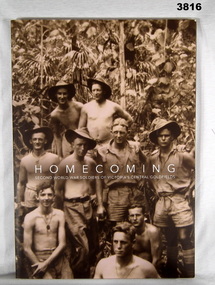
Book - BOOK, WW2, Homecoming, 2018
... victorian Biographies. Soft cardboard cover. White print on front & spine. Illustrated, sepia tones photo front of 7th Infantry Battalion - Darwin vicinity. ...Homecoming - Second World War Soldiers of Victoria's Central Goldfields.Biographies. Soft cardboard cover. White print on front & spine. Illustrated, sepia tones photo front of 7th Infantry Battalion - Darwin vicinity. Back has 7th Infantry Battalion marching a column of Japanese naval prisoners. 196 cut, plain, white pages. Illustrated black / white / sepia photos of portraits & scenes. Flyleaf & end papers illustrated. book, homecoming, central victorian -
 Bendigo Military Museum
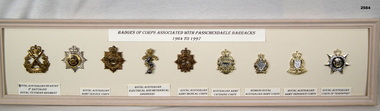
Badge - VARIOUS BADGES, FRAMED, c.1998
... Royal Australian Infantry 2nd Battalion Royal Victorian Regiment 2. & 3. Royal Australian Army Service Corps 4. ...Royal Australian Infantry 2nd Battalion Royal Victorian Regiment 2. & 3. Royal Australian Army Service Corps 4. ...Cream wooden framed selection of 9 badges displayed on cream coloured background.Top centre: “BADGES OF CORPS ASSOCIATED WITH PASSCHANDAELE BARRACKS 1964 TO 1977” Underneath each badge: “1. Royal Australian Infantry 2nd Battalion Royal Victorian Regiment 2. & 3. Royal Australian Army Service Corps 4. Royal Australian Electrical & Mechanical Engineers” 5. Royal Australian Army Medical Corp 6. Australian Army Catering Corp 7. Women's Royal Australian Army Corps 8. Royal Australian Army Ordnance Corps 9. Royal Australian Corps of Transportpasschendaele barracks trust, badges, framed -
 Bendigo Military Museum
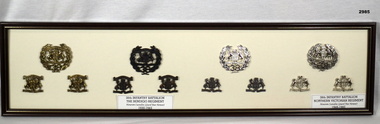
Badge - BADGES, FRAMED, Post 1960
... BADGES OF 38TH INFANTRY BATTALION NORTHERN VICTORIAN REGIMENT 1930 TO 1960. ...2 labels underneath badges Left side: “38th INFANTRY BATTALION THE BENDIGO REGIMENT 1930 - 1943” Right side: “38TH INFANTRY BATTALION NORTHERN VICTORIAN REGIMENT 1948 - 1960” ...38th Bn framed Passchendaele barracks trust 2 labels underneath badges Left side: “38th INFANTRY BATTALION THE BENDIGO REGIMENT 1930 - 1943” Right side: “38TH INFANTRY BATTALION NORTHERN VICTORIAN REGIMENT 1948 - 1960” BADGES OF 38TH INFANTRY BATTALION NORTHERN VICTORIAN REGIMENT 1930 TO 1960. ...BADGES OF 38TH INFANTRY BATTALION NORTHERN VICTORIAN REGIMENT 1930 TO 1960. Brown plastic frame of heavy cream cardboard displaying 12 badges.2 labels underneath badges Left side: “38th INFANTRY BATTALION THE BENDIGO REGIMENT 1930 - 1943” Right side: “38TH INFANTRY BATTALION NORTHERN VICTORIAN REGIMENT 1948 - 1960” 38th bn, framed, passchendaele barracks trust -
 Bendigo Military Museum
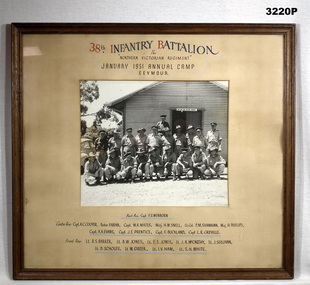
Photograph - PHOTOGRAPH 1951, FRAMED, C.1951
... "38th Infantry Battalion, the Northern Victorian Regiment"...Passchendaele Barracks Trust photographs 38th Bn "38th Infantry Battalion, the Northern Victorian Regiment" Black / white photo of Officers of the 38th Battalion taken at Annual Camp Seymour in January 1951. ...Black / white photo of Officers of the 38th Battalion taken at Annual Camp Seymour in January 1951. Officers Mess in background. Names of all Officers printed under photo. Brown wooden frame with glass front, cream border & cardboard backing."38th Infantry Battalion, the Northern Victorian Regiment"passchendaele barracks trust, photographs, 38th bn -
 Bendigo Military Museum
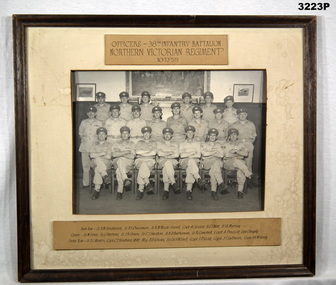
Photograph - PHOTOGRAPH 38th BN, FRAMED, C.1955
... On plaque tpp centre above photo: "OFFICERS - 38TH INFANTRY BATTALION NORTHERN VICTORIAN REGIMENT 10/12/55" On plaque bottom centre below photo: "Names of all Officers" ...Passchendaele barracks trust 3th Bn Officers On plaque tpp centre above photo: "OFFICERS - 38TH INFANTRY BATTALION NORTHERN VICTORIAN REGIMENT 10/12/55" On plaque bottom centre below photo: "Names of all Officers" Black / white photo of Officers taken in a room with framed pictures behind them. ...Black / white photo of Officers taken in a room with framed pictures behind them. Cream border in a brown wooden frame, without glass & fawn cardboard backing.On plaque tpp centre above photo: "OFFICERS - 38TH INFANTRY BATTALION NORTHERN VICTORIAN REGIMENT 10/12/55" On plaque bottom centre below photo: "Names of all Officers" passchendaele barracks trust, 3th bn, officers -
 Bendigo Military Museum
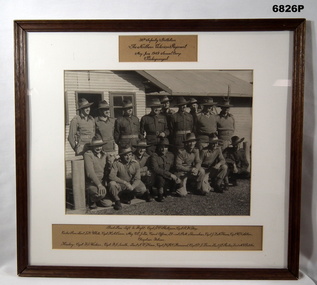
Photograph - PHOTOGRAPH, FRAMED, 1949, c1949
... Battalion nameplate - black ink pen, handwritten in copperplate style. "38th Infantry Battalion/ The Northern Victorian Regiment/ May-June 1949 Annual Camp/ Puckapunyal"....Passchendaele Barracks Trust Framed Accessories Photograph 38th INF Battn Battalion nameplate - black ink pen, handwritten in copperplate style. "38th Infantry Battalion/ The Northern Victorian Regiment/ May-June 1949 Annual Camp/ Puckapunyal". ...List of soldiers below photograph - black ink pen in copperplate style. "Back Row, Left to Right: Capt. G.V. Phillipson, Capt. R.H. Gaze/ Centre Row: Lieut. S.H. White, Capt. K.A. Evans, Maj. C.E. Lee, Comd. Officer Lt-col. P.M. Shanahan, Capt. J.F.N. Kearne, Capt. W.H. Arthur, / Chaplain Fabian/ Kneeling: Capt. F.S. Wenbon, Capt. F.S. Smith, Lieut. I.V. Ham, Capt. H.R.C. Rarnard, Capt. T.S. Dave, Lieut. J.E. Prentice, Lieut. M.V. Bolitho." Photograph - black and white on paper, an informal group of soldiers, standing and kneeling with, corrugated iron building in the background. Battalion nameplate above photograph and list of soldiers below photograph. Black ink pen handwritten on beige coloured card. Mount - cardboard, off white colour. Frame - timber with brown varnish finish, glass front and cardboard backing.Battalion nameplate - black ink pen, handwritten in copperplate style. "38th Infantry Battalion/ The Northern Victorian Regiment/ May-June 1949 Annual Camp/ Puckapunyal".passchendaele barracks trust, framed accessories, photograph, 38th inf battn
