
Showing 64 items matching "vintage accessory"
-
 Warrnambool and District Historical Society Inc.
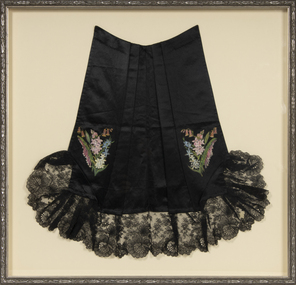
clothing - Apron in Frame, Irene Broughton, 1915
... Vintage Accessory...The maker was born in Warrnambool. Vintage Accessory Irene Broughton Warrnambool The apron is made of fine black cotton and edged with a broad lace flounce featuring a flower pattern. ...This apron was made in 1915 by Irene Broughton, nee Long. She was born in Warrnambool in 1894 and married Arthur Broughton in 1913. She re married in 1924 Reuben Donnithorne and he died in 1931. Irene died in 1982 and is buried in the Warrnambool cemetery. The apron was left to Irene's niece, Helen Thomson who had the apron framed to preserve it. The apron would not have been in everyday use but a special garment worn when entertaining visitors for afternoon tea.This apron is a fine example of a home made house hold article from the early 20th century. The maker was born in Warrnambool.The apron is made of fine black cotton and edged with a broad lace flounce featuring a flower pattern. It is decorated with two sprays of delicately hand-painted motifs featuring Australian native flowers. The apron is in a wooden frame with a silver metal edging with scrolls on the front edge. The glass is clear and the mount is buff coloured card.vintage accessory, irene broughton warrnambool -
 Warrnambool and District Historical Society Inc.
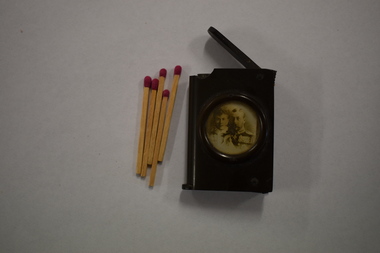
Accessory - Matches Holder, Early 20th century
... Vintage Accessory...This item is of no known provenance but it is of some interest since it is a souvenir of the reign of King George 5th. Vintage Accessory Warrnambool History A rectangular shaped brown metal matches container. ...This matches holder, a common item in the early 20th century, has been produced to commemorate the reign of King George 5th of England. It may have been produced for his coronation in 1911.This item is of no known provenance but it is of some interest since it is a souvenir of the reign of King George 5th.A rectangular shaped brown metal matches container. It is rounded on one side and has a striking mechanism on the other side and a lift up lid at the top. There is a circular inset with an image of King George 5th and Queen Alexandra in sepia tones with a clear perspex cover. Inside the container are five wooden matches with red heads.vintage accessory, warrnambool history -
 Warrnambool and District Historical Society Inc.
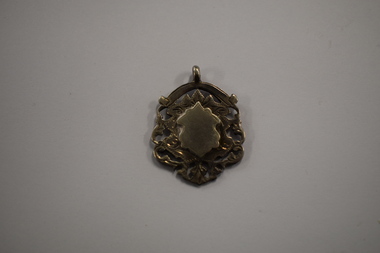
Accessory - Pendant, Late 19th century
... Vintage Accessory....It was probably a gift to a lady on a special occasion This is a vintage item kept for its attractive quality. Vintage Accessory. Warrnambool History This is a silver pendant with fret work and scroll work surrounding a small silver piece in the centre on which to etch an inscription. ...The original owner of this pendant is unknown but its quality suggests that it belonged to a member of an affluent family .It was never inscribed. It was probably a gift to a lady on a special occasionThis is a vintage item kept for its attractive quality.This is a silver pendant with fret work and scroll work surrounding a small silver piece in the centre on which to etch an inscription. There is a circular hook at the top on which to attach a chain. On the back are indecipherable hallmarks.vintage accessory., warrnambool history -
 Warrnambool and District Historical Society Inc.
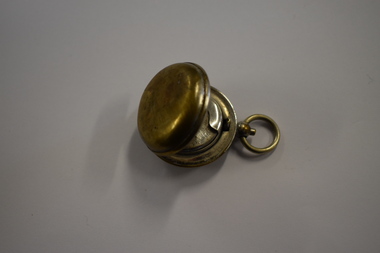
Accessory - Coin holder, Early 20th century
... Vintage Accessory...This item is retained as a fine example of a coin holder Vintage Accessory Warrnambool History This is a gold coloured metal circular container with a hinge at one end and a catch at the other. ...This item has no known provenance but would have been a common item, particularly used by affluent men in the past.This item is retained as a fine example of a coin holderThis is a gold coloured metal circular container with a hinge at one end and a catch at the other. It has a large ring at the top to attach the item to a chain on the person. Inside is a silver coloured piece which depresses to allow the storage of several coins.vintage accessory, warrnambool history -
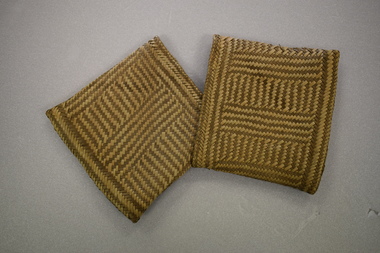 Warrnambool and District Historical Society Inc.
Functional object - note wallet, late 19th century
... Vintage accessory...This wallet is retained because of its condition and novelty. Vintage accessory This is a note wallet which appears to be made of woven grass. ...This note wallet has no known local provenance but apparently dates back to the late 19th century.This wallet is retained because of its condition and novelty.This is a note wallet which appears to be made of woven grass. It has two small rectangular bags open at the top , with one fitting into the other to hold paper money. One bag is slightly torn at one edge.vintage accessory -
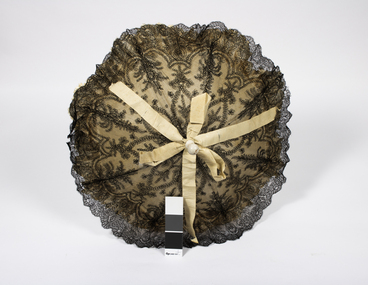 Warrnambool and District Historical Society Inc.
Accessory - Parasol, c.1880
... ...Vintage Clothing accessory...accessory as well as shielding her complexion from the sun. It has no known local provenance. This very attractive item will be very useful for display Parasol Vintage Clothing accessory This folding parasol has a black wire frame, a white handle with a brass inset and a white knob at the end. ...This lady's parasol is typical of what a lady would have used in the late 19th century as a fashionable accessory as well as shielding her complexion from the sun. It has no known local provenance.This very attractive item will be very useful for displayThis folding parasol has a black wire frame, a white handle with a brass inset and a white knob at the end. There is another knob at the top end of the handle. There is a mechanism for folding and unfolding the parasol on the handle.The undercovering is cream sateen with frilled edges, overlaid with black lace. There is a cream grosgrain bow at the top .parasol, vintage clothing accessory -
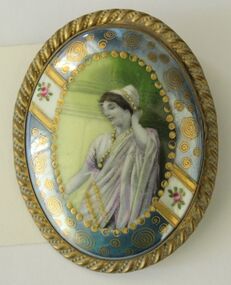 Wodonga & District Historical Society Inc
Decorative object - Brooch with Grecian image, c1909
... Fashion accessory...vintage...Jean Raper. Fashion accessory vintage fashion jewellery women's jewellery A large oval brooch featuring a central image of a Grecian woman. ...This brooch was typical of those produced at the beginning of the 20th century. It belonged to Mrs Alice Flora May Yardy, mother of Mrs. Jean Raper. Mrs Yardy died on 2 Dec 1974 in Albury, New South Wales aged 84 years old.This item is from the Raper Collection donated to the Wodonga Historical Society by Mrs. Jean Raper.A large oval brooch featuring a central image of a Grecian woman. This centrepiece is surrounded by a design of flowers and swirls with a silver edge. The brooch has a gold look metal bar across the back.fashion accessory, vintage fashion jewellery, women's jewellery -
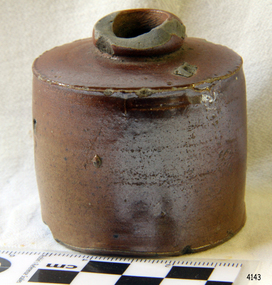 Flagstaff Hill Maritime Museum and Village
Container - Ink Bottle, 19th to early-20th century
... accessory...office equipment...stationery...domestic...stoneware...clay...ceramic...pottery...ink well...inkwell...ink bottle...penny ink well...nib pen...dip pen...ink...hand writing...record keeping...household...business...vintage...This ink well is historically significant as it represents methods of hand written communication that were still common up until the mid-20th century, when fountain pens and ballpoint pens took over in popularity and convenience. flagstaff hill warrnambool shipwreck coast flagstaff hill maritime museum flagstaff hill maritime village maritime museum great ocean road shipwreck artefact writing equipment writing accessory office equipment stationery domestic stoneware clay ceramic pottery ink well inkwell ink bottle penny ink well nib pen dip pen ink hand writing record keeping household business vintage blotting paper dwarf bottle Ink bottle or ink well, sometimes called a Penny Ink Well. ...This design of ink bottle or ink well was commonly referred to as a ‘penny ink well’ because it was very inexpensive to produce. It is also known as a dwarf bottle. Pen and ink has been in use for hand writing from about the seventh century up until the mid-20th century. Up until around the mid-19th century a quill pen made from a bird’s feather was used. In the 1850s the steel point pen was invented and could be manufactured on machines in large quantities. In the 1880s a successful portable fountain pen was designed, giving a smooth flowing ink and ease of use. Ink wells, used with steel nib dip pens, were commonly used up until the mid-20th century. The pens only held a small amount of ink so users had to frequently dip the nib of the pen into an ink well for more ink. Hand writing with pen and ink left wet writing on the paper, so blotting paper was carefully used to absorb the excess ink and prevent smudging. Ink could be purchased, ready to use, or in the powdered form, which needed to be mixed with water. After the invention of fountain pens, which had a reservoir of ink, and then ballpoint pens, which also had ink that flowed freely, the dip pen was slowly replaced. However, artisans continue to use nib pens to create beautiful calligraphy.This ink well is historically significant as it represents methods of hand written communication that were still common up until the mid-20th century, when fountain pens and ballpoint pens took over in popularity and convenience.Ink bottle or ink well, sometimes called a Penny Ink Well. Cylindrical body, salt-glazed, brown ceramic stoneware bottle, handmade. Stoneware bottle. flagstaff hill, warrnambool, shipwreck coast, flagstaff hill maritime museum, flagstaff hill maritime village, maritime museum, great ocean road, shipwreck artefact, writing equipment, writing accessory, office equipment, stationery, domestic, stoneware, clay, ceramic, pottery, ink well, inkwell, ink bottle, penny ink well, nib pen, dip pen, ink, hand writing, record keeping, household, business, vintage, blotting paper, dwarf bottle -
 Flagstaff Hill Maritime Museum and Village
Opera Glasses & case, Early 20th Century
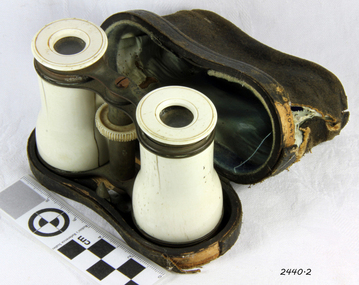
... accessory for all opera and theatergoers. Not very significant as not associated with a historic event or person and made during the first half of the 20th Century and many are still available and easily sourced. flagstaff hill warrnambool shipwrecked coast flagstaff hill maritime museum maritime museum shipwreck coast flagstaff hill maritime village great ocean road binoculars opera glasses theatre glasses optical instrument Cow Bone No markings whatsoever anywhere Vintage Pair of Opera Glasses, with cow bone barrels and eyepieces, both barrel pieces have split in them, both metal end barrels each have a minor dent, optics are pretty clear no mould although have very minor dust spots inside, they look like they were gilded at some point but most of this has rubbed off glasses have a black leather case with blue lining. ...Opera Glasses came into existence as a result of a long line of inventions, and further improvements upon those inventions. The process started in the year 1608 when a Dutch optician by the name of Hans Lipperhey developed the first pair of binoculars with a magnification capability of X3. Less than a year later, a well-known inventor and philosopher by the name of Galileo developed what became known as the Galilean telescope. Advertisements were first found for opera glasses and theatre binoculars in London as early as 1730 in the form of a long collapsible telescope. The "Opera Glass" as it was referred to; was often covered in enamel, gems, ivory, or other art and paintings. For almost 100 years opera glasses existed merely as telescopes. In Vienna, in 1823 the first binocular opera glasses and theatre binoculars began to appear. They were two simple Galilean telescopes with a bridge in the centre, each telescope focused independently from the other by extending or shortening the telescope until the desired focus was achieved, which was useful, yet very cumbersome. Two years later in Paris, Pierre Lemiere improved on this design and created a centre focus wheel. This allowed the focusing of both telescopes together. After this development, opera glasses and theatre binoculars grew in popularity because of the superior view they facilitated in opera and theatre houses. The beautiful design of the glasses themselves also added appeal to the opera-going crowd. By the 1850's opera glasses and theatre, glasses had become a must-have fashion accessory for all opera and theatergoers.Not very significant as not associated with a historic event or person and made during the first half of the 20th Century and many are still available and easily sourced.Vintage Pair of Opera Glasses, with cow bone barrels and eyepieces, both barrel pieces have split in them, both metal end barrels each have a minor dent, optics are pretty clear no mould although have very minor dust spots inside, they look like they were gilded at some point but most of this has rubbed off glasses have a black leather case with blue lining. No markings whatsoever anywhereflagstaff hill, warrnambool, shipwrecked coast, flagstaff hill maritime museum, maritime museum, shipwreck coast, flagstaff hill maritime village, great ocean road, binoculars, opera glasses, theatre glasses, optical instrument, cow bone -
 Flagstaff Hill Maritime Museum and Village
Tool - Angular Bit Stock extension, 1897-1922
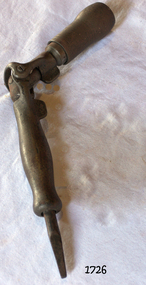
... The tool was manufactured from 1897 until this date and is sought out by collectors of vintage tools. flagstaff hill warrnambool flagstaff-hill flagstaff-hill-maritime-museum maritime-museum shipwreck-coast flagstaff-hill-maritime-village Tools Screw Driver Angular Hand operated Driver Tool Accessory Millers Falls Co. ...Millers Falls Co. is a tool manufacturing company originally based in Millers Falls, Massachusetts. It was established in Greenfield, Massachusetts in 1868 as Gunn & Amidon by Levi J. Gunn and Charles H. Amidon. Gunn and Amidon, along with a third partner, Henry L. Pratt built a factory in the north of Greenfield. After the Greenfield factory burned down, the company was reorganized as the Millers Falls Manufacturing Co. It merged with Backus Vise Co. in 1872 to form the Millers Falls Co. In 1931 Millers Falls tools purchased the majority of the shares of Goodell-Pratt tools and merged with that manufacturer in 1932.In 1962 the company was acquired by Ingersoll Rand. In 1982, Ingersoll Rand sold the Millers Falls business to the newly created Millers Falls Tool Co. The company was head quartered in Alpha, New Jersey. Since 2002 the company trademark has belonged to Hangzhou Great Star Industrial Co., Ltd, of Hangzhou, China.An interesting an unusual tool made by the Millers Falls Tool company that continued to be featured in it’s catalogue up and till 1922. The tool was manufactured from 1897 until this date and is sought out by collectors of vintage tools.Universal Angular hand operated bit stock with spring type alligator jaws, main casting is Japanned bright parts are nickel plated item used with a bit & brace as an extension or angular borer. Millers Falls Co. USA Model 109flagstaff hill, warrnambool, flagstaff-hill, flagstaff-hill-maritime-museum, maritime-museum, shipwreck-coast, flagstaff-hill-maritime-village, tools, screw driver, angular hand operated driver, tool accessory -
 Flagstaff Hill Maritime Museum and Village
Clock, 1940's
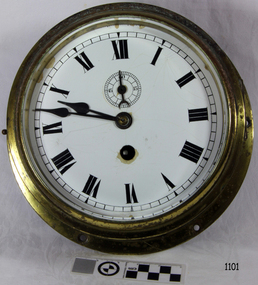
... Accessories Ltd., Smiths Aircraft Instruments Ltd., Smiths Industrial Instruments Ltd., and Smiths English clocks Ltd. The manufacture of clocks and watches ceased in 1979 and 1983 saw Smiths withdraw from producing items for the motor industry. An item that is now regarded as a vintage ...Smiths began with a craftsman named Samuel Smith who in 1851 opened a shop in Newington Causeway, London, where he made and sold watches, clocks and precision instruments. Samuel had a son, Samuel Jnr who was apprenticed in his fathers business. Samuel Jnr eventually opened his own business at 85 Strand and later opened other premises at 9 Strand, Trafalgar Square and 68 Piccadilly. In 1899 he turned his business into a private limited company, S. Smith & Son Ltd. Samuel Jnr son, Sir Allan Gordon-Smith, joined him as Manager at 9 Strand in 1903 and laid the foundation of the vast Smiths organisation of the future, leading the company towards the supply of accessories for the then developing motor industry making car clocks and the first speedometers patented in 1904. In July 1914 a new company was formed under the name S. Smith & Sons (Motor Accessories) Ltd., to take over the motor accessory business of S. Smith and Son Ltd. and this became the main company of the group which eventually grew to become Smiths Industries Ltd. The original company S Smith and Sons Ltd., continued as jewelers and clock and watchmakers until 1930 when the company was taken over by Bravingtons retail jeweller chain. In 1931 Smiths decided to enter the domestic clock market and formed a new company, Smiths English Clocks Ltd., as the Clock and Watch division of S Smith & Sons (Motor Accessories) Ltd. This is the start of "Smiths Clocks" because this is when they began to manufacture domestic clocks in quantity. Moreover, they set out to produce these clocks at a price that the average householder could afford. S Smith & Sons (Motor Accessories) was at this time was the main company in the Smiths group of companies and their business developed both in the motor vehicle field and outside it. Smiths began to make automatic pilots for aircraft and, through the acquisition of a majority interest in Henry Hughes & Sons Ltd., entered the field of marine instruments. During the war from 1939 to 1945, Smiths' production expanded. There was a demand for motor, aircraft and marine instruments for the Services and the production of industrial instruments and it is at this time that our item was made. In 1944 many changes were made to the Smiths' organisation. The name of the principal company was changed from S Smith & Sons (Motor Accessories) to S. Smith & Sons (England) Ltd. and four new subsidiary selling companies were set up. These were Smiths Motor Accessories Ltd., Smiths Aircraft Instruments Ltd., Smiths Industrial Instruments Ltd., and Smiths English clocks Ltd. The manufacture of clocks and watches ceased in 1979 and 1983 saw Smiths withdraw from producing items for the motor industry.An item that is now regarded as a vintage, sought by horology collectors worldwide and is in excellent condition. The item is unique in that it was made specifically for ships by the Smith company a well known British clock manufacture. Its provenance is well established and it was made during the world war II era specifically for merchant and naval vessels of the time. Naval brass ships bulkhead clock. The clock face is of white enamel with black Roman numerals, an outer minutes ring and black steel hands. There is a subsidiary seconds dial with sweeping hand just above the centre and a fast/slow adjustment lever above that. There is no manufactures name on the dial. There are a beveled glass and brass hinged lid to the front of the clock. The clock is housed in a heavy brass case with screw holes around the circumference for mounting. There are no markings on the clock or mechanism flagstaff hill, warrnambool, shipwrecked-coast, flagstaff-hill, flagstaff-hill-maritime-museum, maritime-museum, shipwreck-coast, flagstaff-hill-maritime-village, s smith and sons, clock, maritime clocks, clock makers, bulkhead clock -
 Flagstaff Hill Maritime Museum and Village
Container - Ink Bottle, 1890s to 1902
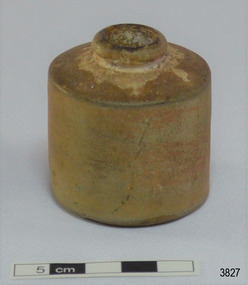
... accessory...office equipment...stationery...domestic...stoneware...clay...ceramic...pottery...ink well...inkwell...penny ink well...nib pen...dip pen...ink...hand writing...record keeping...household...business...vintage...It is valuable for an insight into Victorian era of shipping and maritime history. flagstaff hill warrnambool flagstaff hill maritime museum maritime museum shipwreck coast flagstaff hill maritime village great ocean road john chance inverlochy scotland captain e.r. kendrick melbourne tramway company tramway cable ingoldsby reef point addis anglesea thompson’s creek barwon heads ink bottle writing equipment writing accessory office equipment stationery domestic stoneware clay ceramic pottery ink well inkwell penny ink well nib pen dip pen ink hand writing record keeping household business vintage blotting paper dwarf ink Ink bottle or ink well; cylindrical shaped, salt-glazed, mid-brown ceramic bottle. ...This design of ink bottle or ink well was commonly referred to as a ‘penny ink well’ because it was very inexpensive to produce. It is also known as a dwarf ink bottle. It was recovered from the wreck of the 1895-1902 ship Inverlochy and is part of the John Chance Collection. Pen and ink has been in use for hand writing from about the seventh century up until the mid-20th century. Up until around the mid-19th century a quill pen made from a bird’s feather was used. In the 1850s the steel point pen was invented and could be manufactured on machines in large quantities. In the 1880s a successful portable fountain pen was designed, giving a smooth flowing ink and ease of use. Ink wells, used with steel nib dip pens, were commonly used up until the mid-20th century. The pens only held a small amount of ink so users had to frequently dip the nib of the pen into an ink well for more ink. Hand writing with pen and ink left wet writing on the paper, so blotting paper was carefully used to absorb the excess ink and prevent smudging. Ink could be purchased, ready to use, or in the powdered form, which needed to be mixed with water. After the invention of fountain pens, which had a reservoir of ink, and then ballpoint pens, which also had ink that flowed freely, the dip pen was slowly replaced. However, artisans continue to use nib pens to create beautiful calligraphy. INVERLOCHY 1895-1902 - The Inverlochy was a steel sailing barque built in Scotland in 1895 for international trade. In 1902 the Inverlochy left Liverpool under the command of Captain E.R. Kendrick. There were 21 officers and crew and the captain’s wife Mrs Kendrick, on board, bound for Australia with cargo that included tools, chemicals, liquor (beer, whisky, stout, rum, and brandy), steel, iron, wire netting, hoop iron, tinplate and pig iron), and steel wire for the Melbourne Tramway Company, tiles, soap, soft goods and earthenware. On December 18 almost at their destination, the Inverlochy ran aground on Ingoldsby Reef at Point Addis, near Anglesea. The crew and passengers left the ship via lifeboat and landed at Thompson’s Creek, then walked about 20 kilometres to Barwon Heads. Salvagers were interested in the 10 miles of cable in the hold. Mrs Kendrick’s ‘high grade’ bicycle was amongst the items salvaged but she lost her jewellery and two pianos. By February 1903 the ship had broken up and objects such as bottles and casks of liquor were washed ashore. Bad weather shook the wreck in June 1903, causing the ship’s spars and figurehead to be washed ashore. This ink bottle is historically significant as it represents methods of hand written communication that were still common up until the mid-20th century, when fountain pens and ballpoint pens took over in popularity and convenience. The Ink bottle also has significant as it was recovered by John Chance, a diver from the wreck of the Inverlochy in the late 1960s to early 1970s. Items that come from several wrecks along Victoria's coast have since been donated to the Flagstaff Hill Maritime Village’s museum collection by his family, illustrating this item’s level of historical value. This Ink bottle is significant because of its historical connection to the barque Inverlochy, which is an example of a commercial international steel sailing barque and is listed on the Victorian Heritage Database VHR S338. The Inverlochy is significant for its cargo, which is a snapshot of the kind of goods imported into Australia at the turn of the 19th century, including cable for the Melbourne Tramway Company. The wreck of the Inverlochy is important as an accessible dive site that shows the remains of a large international trading vessel and its contents. It is valuable for an insight into Victorian era of shipping and maritime history.Ink bottle or ink well; cylindrical shaped, salt-glazed, mid-brown ceramic bottle. It has a small round mouth, rounded lip that extend past the short neck, wide shoulders, straight sides, flat bottom. Handmade. Also called a Penny Ink Well.flagstaff hill, warrnambool, flagstaff hill maritime museum, maritime museum, shipwreck coast, flagstaff hill maritime village, great ocean road, john chance, inverlochy, scotland, captain e.r. kendrick, melbourne tramway company, tramway cable, ingoldsby reef, point addis, anglesea, thompson’s creek, barwon heads, ink bottle, writing equipment, writing accessory, office equipment, stationery, domestic, stoneware, clay, ceramic, pottery, ink well, inkwell, penny ink well, nib pen, dip pen, ink, hand writing, record keeping, household, business, vintage, blotting paper, dwarf ink -
 Flagstaff Hill Maritime Museum and Village
Container - Ink Bottle, 1890s to 1902
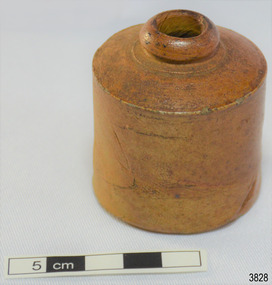
... accessory...office equipment...stationery...domestic...stoneware...clay...ceramic...pottery...ink well...inkwell...penny ink well...nib pen...dip pen...ink...hand writing...record keeping...household...business...vintage...It is valuable for an insight into Victorian era of shipping and maritime history. flagstaff hill warrnambool flagstaff hill maritime museum maritime museum shipwreck coast flagstaff hill maritime village great ocean road john chance inverlochy scotland captain e.r. kendrick melbourne tramway company tramway cable ingoldsby reef point addis anglesea thompson’s creek barwon heads ink bottle writing equipment writing accessory office equipment stationery domestic stoneware clay ceramic pottery ink well inkwell penny ink well nib pen dip pen ink hand writing record keeping household business vintage blotting paper dwarf ink Ink bottle, glazed, prange-brown ceramic cylinder, ring of clay on top for lip, narrow mouth, very short neck on wide shoulder that reaches out to edge of of straight-sided body, flat base. ...This design of ink bottle or ink well was commonly referred to as a ‘penny ink well’ because it was very inexpensive to produce. It is also known as a dwarf bottle. It was recovered from the wreck of the 1895-1902 ship Inverlochy and is part of the John Chance Collection. Pen and ink has been in use for hand writing from about the seventh century up until the mid-20th century. Up until around the mid-19th century a quill pen made from a bird’s feather was used. In the 1850s the steel point pen was invented and could be manufactured on machines in large quantities. In the 1880s a successful portable fountain pen was designed, giving a smooth flowing ink and ease of use. Ink wells, used with steel nib dip pens, were commonly used up until the mid-20th century. The pens only held a small amount of ink so users had to frequently dip the nib of the pen into an ink well for more ink. Hand writing with pen and ink left wet writing on the paper, so blotting paper was carefully used to absorb the excess ink and prevent smudging. Ink could be purchased, ready to use, or in the powdered form, which needed to be mixed with water. After the invention of fountain pens, which had a reservoir of ink, and then ballpoint pens, which also had ink that flowed freely, the dip pen was slowly replaced. However, artisans continue to use nib pens to create beautiful calligraphy. INVERLOCHY 1895-1902 - The Inverlochy was a steel sailing barque built in Scotland in 1895 for international trade. In 1902 the Inverlochy left Liverpool under the command of Captain E.R. Kendrick. There were 21 officers and crew and the captain’s wife Mrs Kendrick, on board, bound for Australia with cargo that included tools, chemicals, liquor (beer, whisky, stout, rum, and brandy), steel, iron, wire netting, hoop iron, tinplate and pig iron), and steel wire for the Melbourne Tramway Company, tiles, soap, soft goods and earthenware. On December 18 almost at their destination, the Inverlochy ran aground on Ingoldsby Reef at Point Addis, near Anglesea. The crew and passengers left the ship via lifeboat and landed at Thompson’s Creek, then walked about 20 kilometres to Barwon Heads. Salvagers were interested in the 10 miles of cable in the hold. Mrs Kendrick’s ‘high grade’ bicycle was amongst the items salvaged but she lost her jewellery and two pianos. By February 1903 the ship had broken up and objects such as bottles and casks of liquor were washed ashore. Bad weather shook the wreck in June 1903, causing the ship’s spars and figurehead to be washed ashore. This ink bottle is historically significant as it represents methods of hand written communication that were still common up until the mid-20th century, when fountain pens and ballpoint pens took over in popularity and convenience. The Ink bottle also has significant as it was recovered by John Chance, a diver from the wreck of the Inverlochy in the late 1960s to early 1970s. Items that come from several wrecks along Victoria's coast have since been donated to the Flagstaff Hill Maritime Village’s museum collection by his family, illustrating this item’s level of historical value. This Ink bottle is significant because of its historical connection to the barque Inverlochy, which is an example of a commercial international steel sailing barque and is listed on the Victorian Heritage Database VHR S338. The Inverlochy is significant for its cargo, which is a snapshot of the kind of goods imported into Australia at the turn of the 19th century, including cable for the Melbourne Tramway Company. The wreck of the Inverlochy is important as an accessible dive site that shows the remains of a large international trading vessel and its contents. It is valuable for an insight into Victorian era of shipping and maritime history. Ink bottle, glazed, prange-brown ceramic cylinder, ring of clay on top for lip, narrow mouth, very short neck on wide shoulder that reaches out to edge of of straight-sided body, flat base. On the shoulder, close to the neck, are concentric lines in the clay. There are dark areas around the lip and mouth opening. The clay appears to have a fold line on its body. The material has flecks of darker material in it. Sediment around shoulder. Handmade. Also called a Penny Ink Well.flagstaff hill, warrnambool, flagstaff hill maritime museum, maritime museum, shipwreck coast, flagstaff hill maritime village, great ocean road, john chance, inverlochy, scotland, captain e.r. kendrick, melbourne tramway company, tramway cable, ingoldsby reef, point addis, anglesea, thompson’s creek, barwon heads, ink bottle, writing equipment, writing accessory, office equipment, stationery, domestic, stoneware, clay, ceramic, pottery, ink well, inkwell, penny ink well, nib pen, dip pen, ink, hand writing, record keeping, household, business, vintage, blotting paper, dwarf ink -
 Flagstaff Hill Maritime Museum and Village
Ceramic - Soap dish, circa 1883
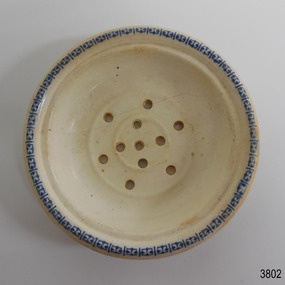
... vintage...personal hygiene...bathroom accessory...Divers can still access parts of the scattered wreck and other artefacts recovered in the 1970s and 1980s can be viewed in both public and private collections. flagstaff hill warrnambool flagstaff hill maritime museum maritime museum shipwreck coast flagstaff hill maritime village great ocean road john chance west coast trader george roper captain john ward russell stourbridge bricks port phillip heads lonsdale reef dive wreck vhr s286 coastal trader ceramic vintage personal hygiene bathroom accessory soap dish Soap dish; glazed white porcelain. ...This ceramic soap dish was recovered from the wreck of the 1882-1883 George Roper between the late 1960’s to early 1970’s. It is one of the shipwreck artefacts in the John Chance Collection. Soap dishes were often part of a wash set that also included a water jug and wash bowl. The holes in the dish allowed water to drain out of the dish, keeping the soap dry for next use. The GEORGE ROPER 1882 - 1883 - The George Roper was a 4-masted iron sailing ship built in Liverpool, England, in 1882 for fast international trade with Australia. The large vessel was launched in February 1883. The ship was on its first trip, departing Liverpool for Melbourne, captained by John Ward and a crew of 31. She had almost reached her destination on July 4 1883, approaching Port Phillip Bay and being towed by the steam tug William. The weather changed to rough with fog and both the George Roper and the William hit the dangerous Lonsdale Reef at Port Phillip Heads. The Captain and crew were eventually rescued and taken to Queenscliff. Salvage syndicates were able to recover a lot of the cargo before the George Roper broke up and sank. Amongst the cargo was soft goods, draperies, household items, spirits of malt and distilled liquors, chemicals, dynamite, and 1,400 tons of steel rails for the Victorian Government. Also in the hold were Russell Stourbridge bricks, as paying ballast. This 1880s soap dish is an example of personal hygiene accessories and may have been part of a set comprising jug, bowl and dish.. The soap dish is also significant as it was recovered by John Chance, a diver from the wreck of the George Roper in the 1960s-70s. Items that come from several wrecks along Victoria's coast have since been donated to the Flagstaff Hill Maritime Village’s museum collection by his family, illustrating this item’s level of historical value. The soap dish is significant for its association with the barque George Roper, which is considered historically and archaeologically significant and as such, is listed on the Victorian Heritage Database, VHR S286. The George Roper is an example of a vessel built specifically for fast travel to and from Australia with a large shipment of cargo. Its cargo of steel rails adds to the historical significance of international trade to the growing colony of Australia and Victoria in particular, with rail transportation soon to become a faster and safer form of transportation between colonial towns. Divers can still access parts of the scattered wreck and other artefacts recovered in the 1970s and 1980s can be viewed in both public and private collections. Soap dish; glazed white porcelain. Round shallow bowl with blue patterned border, resembling butterflies. Two raised, concentric rings are moulded into the base. Six pierced holes are evenly spaced between the rings, five holes are in the centre of the dish.flagstaff hill, warrnambool, flagstaff hill maritime museum, maritime museum, shipwreck coast, flagstaff hill maritime village, great ocean road, john chance, west coast trader, george roper, captain john ward, russell stourbridge bricks, port phillip heads, lonsdale reef, dive wreck, vhr s286, coastal trader, ceramic, vintage, personal hygiene, bathroom accessory, soap dish -
 Flagstaff Hill Maritime Museum and Village
Functional object - Hat Box, John Brush, Son & Co, 1920s
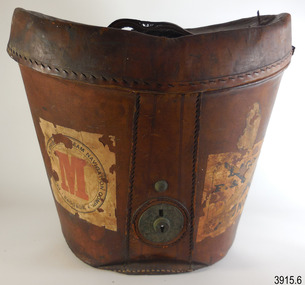
... Vintage hat box...Top hat...Homburg hat...Derby hat...Travel ware...Luggage...Leather goods...Travel goods...Clothing accessory...The traveller was able to depart from firstly the Port of Sydney and later the Port of Melbourne. flagstaff hil Warrnambool flagstaff hill maritime museum maritime museum shipwreck coast flagstaff hill maritime village great ocean road Hat box Leather hat box Vintage hat box Top hat Homburg hat Derby hat Travel ware Luggage Leather goods Travel goods Clothing accessory Men’s clothing John Brush Son & Co Saddler Sydney firm Peninsular & Orient Steam Navigation Company P & O G.M. ...This sturdy, deep hat box has been carefully constructed to give the contents utmost protection in the roughest of travel conditions. At the same time, attention to detail and quality of materials makes the box an attractive, desirable and useful piece of luggage. The supports inside the hat box show that the hat’s brim dipped at the front and back in the popular 1920s Homburg or Derby style. The hat box was likely to have been purchased, complete with its fashionable hat and personalised with the initials ‘G.M.’. The five shipping labels on the hat box tell that the owner traveller overseas with it on more than one occasion. The owner had first travelled with the shipping line Peninsular & Orient Steam Navigation Company, and may have been one the first Australian passengers in 1932, as the remnant of label on the base reads Sydney. The owner later voyaged under the company’s new name of P & O. and travelled from at least one of the voyages from Melbourne to London The square label, with “P & O” and red printed “M” in centre of circle, refers to alphabetical organisation of baggage by surname, connecting the owner ‘G.M.’ to the owner’s voyage with P & O. The P & O shipping line’s early beginnings started with the partnership of London ship broker Brodie McGhie Willcox and Scottish sailor Arthur Anderson in 1822. The partnership was joined by Irish shipowner Captain Richard Bourne in 1835 and they began operation as the Peninsular & Orient Steam Navigation Company with a service between London- Spain - Portugal. In 1932 the company expanded to include Australia with its passenger services departing from Sydney; in 1840 the company was incorporated. After various take-overs of other shipping lines and businesses, it operated under the name P & O. JOHN BRUSH The hat box was made by Australian saddle designer and maker, John Brush, Sons & Co. Brush began his saddlery trade in Roma, Queensland, His designing process included consulting with the men who rode and worked the horses. He was described in the Sydney Morning Herald of December 15, 1897, as a leading Sydney saddler, well known and reliable, with every kind of English and Australian saddle on view. John Brush established his business in 1840, operating from 371 George Street Sydney. A catalogue from that era jointly advertises John Brush (371 George Sty Sydney) and Butlers & Brush (432-4 Queen Street Sydney), both under the name of Edward Butler & Co. Pty. Ltd. The catalogue included saddlery, harness equipment, riding wear and travel goods, and strongly promoted the Wienkek made saddles, which he distributed Australia wide. John Brush, So & co. advertised its ‘new’ address in 1887, as 403 George Street Sydney. In 1898 Brush made a side-saddle for a customer, a design popular with gentlewomen of the era. The business was still operating over 100 years later, producing a catalogue in the 1950s.This early 20th century hat box is significant for being one of a kind in our Collection. Its fitted design shows the shape of the hat, dating it from the 1920s men’s fashions. The hat box is significant for being a high quality hat box made in Sydney, Australia by prominent and successful early colonial saddler and leather goods business, John Brush, Son & Co. The labels on the outside of the hat box are also significant, representing the prosperous lifestyle of an Australian traveller who purchased quality goods and cared for them. The traveller was able to depart from firstly the Port of Sydney and later the Port of Melbourne. Hatbox, oval shape, brown leather, strong, sturdy construction, six pieces, and metal lock on base. Wide lid, then tapers to a narrower base that has a red leather trim. Brown velvet fabric lining inside and covers some accessories. Other internal accessories are trimmed with plain red paper and blue and white striped paper. The lid has two attached leather tabs and a leather handle and underneath it has a drawstring liner and oval, gold-lettered maker’s label. The internal oval box has a leather retention strap and brim support. Separate moulded brim support is included. A detached leather strap with catch is inside the base. Inscriptions are stamped on the lid, printed on the maker’s label, attached as printed paper labels to the lid, sides, and under the base. Maker is John Brush, Son & Co. of Sydney. The owner’s initials “G.M” are embossed on the lid.Stamped on lid “G. M.” Label, oval, inside lid “JOHN BRUSH, SON & CO. / MANUFACTURERS & IMPORTERS / of / SADDLERY AND HARNESS / 403, GEORGE ST. / SYDNEY” Label, paper: “BAGGAGE, MELBOURNE TO LONDON’, part of word ‘CABIN’ and “P & O” Label, square, white background, black print, circular emblem: ‘PE - - - - - & ORIEN-’, ‘STEAM NAVIATION COMPY.’ BAGGAGE’ and a red printed “M” in centre of circle. Label, rectangular, white background, black print; narrow line border, text in rows and an ‘X’ overprinted, from corner to corner of the border: “BAGGAGE / P. & O. S. N. Co. / MELBOURNE / To / LONDON” Label, paper, rectangular, white background, black print, an “X” across the label: “CABIN / P & O / “ Label, paper, on base, “– aid” [Paid], “SYDNEY” flagstaff hil, warrnambool, flagstaff hill maritime museum, maritime museum, shipwreck coast, flagstaff hill maritime village, great ocean road, hat box, leather hat box, vintage hat box, top hat, homburg hat, derby hat, travel ware, luggage, leather goods, travel goods, clothing accessory, men’s clothing, john brush, son & co, saddler, sydney firm, peninsular & orient steam navigation company, p & o, g.m., melbourne to london, sydney port, melbourne port, hat case -
 Flagstaff Hill Maritime Museum and Village
Domestic object - Flower Holder, Stayput Products, Late 19th to early 20th centuries
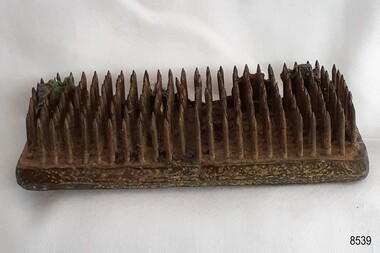
... vintage...antique...late 19th to early 20th centuries...vase accessory...Flagstaff Hill Flagstaff Hill Maritime Museum and Village Warrnambool Maritime Museum Maritime Village Great Ocean Road Shipwreck Coast flower frog flower arrangements flower holder pin-holder Stayput flower aid Ikebana flower arrangement Kenzan Moribana style flower support Melbourne manufacturer spiky pin frog metal flower holder Stayput products flower block flower arranger vintage antique late 19th to early 20th centuries vase accessory decorative item floral arrangement support florist accessory floral art needle aids Victorian era Stamped into the metal: "STAYPUT / PRODUCTS / MELB. ...This spiky, pointy metal flower holder, often called a flower frog or kenzan, was made around the late 19th to the early 20th centuries by Stayput Products of Melbourne, Australia. The flat metal base has been made in layers with the head of the spikes between the layers. It is likely to be handmade. Heavy flower holders made of non-corrosive metals are designed to sit in the base of a vase, dish, bowl or other suitable holder so that cut flower stems can be pushed into the spikes and held firmly in the arrangement. Flower frogs can be made of glass, ceramics or, more recently, synthetic materials.The flower holder is an example of Victorian era domestic decoration aids that have carried through to the 21st century.Flower holder, rectangular block made from layers of metal, with spikes embedded into the metal. The block is heavy, likely to be lead, and the spikes are strong brass pints arranged evenly in rows. There are remnants of florist's putty between some spikes. An inscription within concentric oval rings is moulded in the flat base. Made by Stayput Products, Melbourne, Australia.Stamped into the metal: "STAYPUT / PRODUCTS / MELB. AUST."flagstaff hill, flagstaff hill maritime museum and village, warrnambool, maritime museum, maritime village, great ocean road, shipwreck coast, flower frog, flower arrangements, flower holder, pin-holder, stayput, flower aid, ikebana flower arrangement, kenzan, moribana style, flower support, melbourne manufacturer, spiky pin frog, metal flower holder, stayput products, flower block, flower arranger, vintage, antique, late 19th to early 20th centuries, vase accessory, decorative item, floral arrangement support, florist accessory, floral art, needle aids, victorian era -
 Glenelg Shire Council Cultural Collection
Souvenir - Car Badge, n.d
... Portland Vintage Car Club... car accessory...Portland Vintage Car Club car accessory souvenir advertising Portland Vintage Car Club bumper bar badge. ...Portland Vintage Car Club bumper bar badge. Metal, oval, with a hole each end. Front has red enamelled border with 'PORTLAND VINTAGE CAR CLUB' in gold lettering. Centre of badge dark blue enamel with club logo in gold.portland vintage car club, car accessory, souvenir, advertising -
 Flagstaff Hill Maritime Museum and Village
Tool - Sander, c. 1930-1955
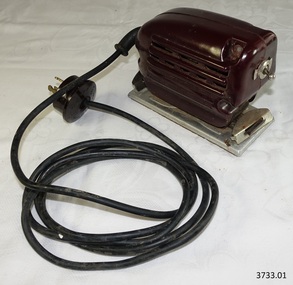
... Jim’s family has donated the ship model “Sovereign of the Seas” and many tools, accessories and documents used in the making of this and other ship models have been donated to Flagstaff Hill Maritime Village. Please see our record 3732 of the mode Sovereign of the Seas for further details of the ship and the maker. This vintage ...This burgundy coloured, portable electric belt sander is stored in its own heavy duty cardboard box. It was made in England and, according to the label on the lid of the box, it is a Portrix Sander-Polisher, all-electric, portable, sands wood metal and polishes. Its uses include decorating, carpentry and polishing. It has a complete with electric unit with flex. The price of 75/- (75 shillings) is printed on the label of the box. The model and the brand of the sander have been removed from the manufacturer’s information embossed on the side of the sander. The sander is part of a collection of objects used by Jim Williams, maker of fine ship models from about 1930-1955. Most of the components for the models, as well as many of the tools, were handmade by Jim Williams. Jim’s family has donated the ship model “Sovereign of the Seas” and many tools, accessories and documents used in the making of this and other ship models have been donated to Flagstaff Hill Maritime Village. Please see our record 3732 of the mode Sovereign of the Seas for further details of the ship and the maker.This vintage Portrix sander-polisher represents tools used for the hobby and skill of ship model making that has been carried as a leisure activity out for generations. Ship model making was also a pastime for sailing crew, who often made a model of the ship in which they were sailing. This sander was used by local Warrnambool man, Jim Williams, who was employed at Cramond and Dickson clothing store, and then at Fletcher Jones menswear for 27 years. It was used in making components for the model of the historic ship, the Sovereign of the Seas. The Sovereign of the Seas was a historic 17th century English war ship with important maritime heritage.Belt sander, electric. Portable power tool, Portrix model Sander–Polisher, burgundy coloured body with swivelling, black electric cable, 250V 1 / 4 amp. For sanding wood and metal, and for polishing. (Stored in original box.) Made in England. Part of a collection of tools and accessories used by Mr. Jim Williams to build ship model of the “Sovereign of the Sea” and other models. c. 1930-1955. Moulded into body “ - - - SANDER –POLISHER / 1 / 4 amp. PRODUCT OF - - - MANUFACTURING CO. LTD. 50 CYCLES / MADE IN ENGLAND PAT. PEND. 200/250 volts A.C.” (the Brand and Manufacturer’s name have been removed)flagstaff hill, warrnambool, shipwrecked coast, flagstaff hill maritime museum, maritime museum, shipwreck coast, flagstaff hill maritime village, great ocean road, portrix sander-polisher, portrix power tool, portrix belt sander, woodworking equipment, ship modelling equipment, jim williams, james bernard williams, ship model, hobby, ship model tool, sovereign of the seas, english war ship -
 Flagstaff Hill Maritime Museum and Village
Functional object - Opera Glasses, 1920s
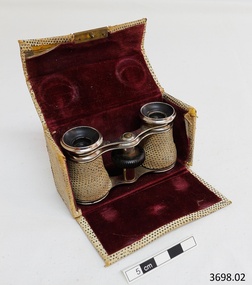
... By the 1850's opera glasses and theatre, glasses had become a must-have fashion accessory for all opera and theatregoers. A vintage pair of 1920s opera glasses probably made in France by an unknown maker the item is significant due to it's provenance that can be traced and it's completeness as a useful social item and fashion accessory used by theatergoers from the mid 19th century and well into the 20th century. ...Opera Glasses came into existence as a result of a long line of inventions, and further improvements upon those inventions. The process started in the year 1608 when a Dutch optician by the name of Hans Lipperhey developed the first pair of binoculars with a magnification capability of X3. Less than a year later, a well-known inventor and philosopher by the name of Galileo developed what became known as the Galilean telescope. Advertisements were first found for opera glasses and theatre binoculars in London as early as 1730 in the form of a long collapsible telescope. The "Opera Glass" as it was referred to; was often covered in enamel, gems, ivory, or other art and paintings. For almost 100 years opera glasses existed merely as telescopes. In Vienna, in 1823 the first binocular opera glasses and theatre binoculars began to appear. They were two simple Galilean telescopes with a bridge in the centre, each telescope focused independently from the other by extending or shortening the telescope until the desired focus was achieved, which was useful, yet very cumbersome. Two years later in Paris, Pierre Lemiere improved on this design and created a centre focus wheel. This allowed the focusing of both telescopes together. After this development, opera glasses and theatre binoculars grew in popularity because of the superior view they facilitated in opera and theatre houses. The beautiful design of the glasses themselves also added appeal to the opera-going crowd. By the 1850's opera glasses and theatre, glasses had become a must-have fashion accessory for all opera and theatregoers. A vintage pair of 1920s opera glasses probably made in France by an unknown maker the item is significant due to it's provenance that can be traced and it's completeness as a useful social item and fashion accessory used by theatergoers from the mid 19th century and well into the 20th century. Some people still use modern variants of theater glasses today to improve their enjoyment of the theater.Both glasses and case are covered with black and white snake skin. Case lined with purple velvet, and has brass closure clip.Noneflagstaff hill, warrnambool, shipwrecked coast, flagstaff hill maritime museum, maritime museum, flagstaff hill maritime village, great ocean road, opera glasses, serpentine opera glasses, binoculars, accessories, optical instrument, scientific instrument, theater glasses, french opera glasses, hans lipperhey -
 Flagstaff Hill Maritime Museum and Village
Container - Ink Bottle, Royal Doulton, Late 19th to early-20th century
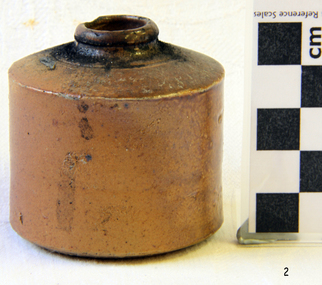
... accessory...office equipment...stationery...domestic...stoneware...clay...ceramic...pottery...inkwell...penny ink well...nib pen...dip pen...ink...hand writing...record keeping...household...business...vintage...This ink well is historically significant as it represents the method of hand written communication that was still common up until the mid-20th century, before fountain pens and ballpoint pens took over in popularity and convenience. flagstaff hill warrnambool shipwreck coast flagstaff hill maritime museum flagstaff hill maritime village great ocean road shipwreck artefact writing equipment writing accessory office equipment stationery domestic stoneware clay ceramic pottery inkwell penny ink well nib pen dip pen ink hand writing record keeping household business vintage blotting paper ink bottle dwarf ink Salt Glazed None Ceramic, salt-glazed, mid-brown ink bottle. ...The Royal Doulton company began as a partnership between John Doulton, Martha Jones, and John Watt was an English ceramic and home accessories manufacturer founded in 1815. Operating originally in Vauxhall, London, later moving to Lambeth, in 1882 it opened a factory in Burslem, Stoke-on-Trent, in the centre of English pottery. The business was specialised in making salt-glazed stoneware articles, including utilitarian or decorative bottles, jugs and jars, much of it intended for inns and pubs. The backbone of the business was a wide range of utilitarian wares, mostly stonewares, including storage jars, tankards and the like, and later extending to pipes for drains, lavatories and other bathroom ceramics. From 1853 to 1902 its wares were marked Doulton & Co., then from 1902, when a royal warrant was given, Royal Doulton. The company always made some more decorative items, initially still mostly stoneware, and from the 1860s the firm made considerable efforts to get a reputation for design, in which it was largely successful, as one of the first British makers of art pottery. Initially, this was done through artistic stoneware's made in Lambeth, but in 1882 the firm bought a Burslem factory, which was mainly intended for making bone China table wares and decorative items. An early utilitarian stoneware item made by a well-known company that specialised in making salt-glazed items that later earned a reputation for making stoneware art objects. This ink well is historically significant as it represents the method of hand written communication that was still common up until the mid-20th century, before fountain pens and ballpoint pens took over in popularity and convenience.Ceramic, salt-glazed, mid-brown ink bottle. It has a small round mouth, rounded lip that extends past neck, wide shoulders, straight sides, flat base. Handmade. The surface is matt. there are flecks of dark brown in the clay. The bottle has marks on the side.Noneflagstaff hill, warrnambool, shipwreck coast, flagstaff hill maritime museum, flagstaff hill maritime village, great ocean road, shipwreck artefact, writing equipment, writing accessory, office equipment, stationery, domestic, stoneware, clay, ceramic, pottery, inkwell, penny ink well, nib pen, dip pen, ink, hand writing, record keeping, household, business, vintage, blotting paper, ink bottle, dwarf ink, salt glazed -
 Warrnambool and District Historical Society Inc.
Accessory - Brooch, Early 20th century
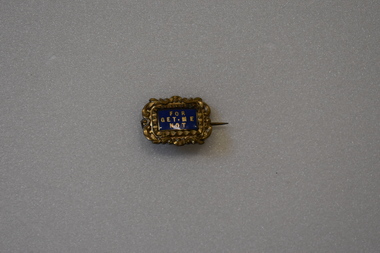
... This brooch has no known local provenance but is retained as a fine example of an early 20th century piece of jewellery and for display purposes Women’s Vintage Jewellery Warrnambool For Get-Me Not This is a rectangular-shaped gold brooch with a blue plate with gold lettering in the inner section and ornamental gold scrolls around the outer section. The back of the brooch has a metal clasp. Brooch Accessory ...This brooch is small and tasteful and the ‘forget-me -not’ wording in the centre probably indicates that it was given by someone to a loved one as a token of love or friendship. It was most likely pinned to the collar of a blouse at the neckline or to a jacket lapel. This brooch has no known local provenance but is retained as a fine example of an early 20th century piece of jewellery and for display purposesThis is a rectangular-shaped gold brooch with a blue plate with gold lettering in the inner section and ornamental gold scrolls around the outer section. The back of the brooch has a metal clasp.For Get-Me Notwomen’s, vintage jewellery, warrnambool -
 Kiewa Valley Historical Society
Box Matches, mid to early 1980's
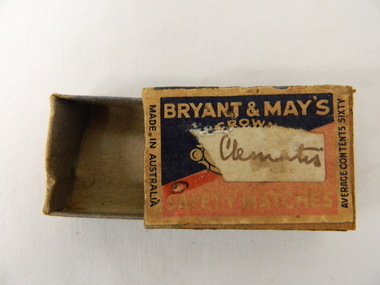
... accessory's most important list. Matches had become obsolete for the major stream of users as cheaper, easier to use and longer lasting "cigarette" lighters were produced. This match box of Australian make and vintage ...This box of matches was up until the 1980's the major source of lighting "small" fires, mainly for cigarettes, pipes (smoking), BBQs, gas/ kerosene heaters and "clearing" rural shrub by small fires. It was not until flint based battery and lighter fluid (hand held lighters) were introduced did the need for "matches" (a more dangerous application of instant fire starters) become relegated to a lower level "demand" item. The limited quality supplied in a box could also not compete with hand held gas and "lighter fluid" lighters. Box of matches belonged to the "yesteryear" fashion accessory's most important list. Matches had become obsolete for the major stream of users as cheaper, easier to use and longer lasting "cigarette" lighters were produced.This match box of Australian make and vintage in origin, was originally manufactured by a British Match Box Company (Bryant and May in Bow London), which expanded to the Australian "Colonies". The Australian subsidiary was at Cremorne, Melbourne. It was typical of goods, which had their "founding fathers" based in "the Mother Country" (England). The early settlers in the Kiewa Valley found these matches an important necessity for not only rural life but also for the recreational "smoko".This small box of "safety" matches has an inner "drawer" which can be slid open to reveal the "match" sticks. The small bowl shaped phosphorous at one end of a "match" is the fire starter(phosphorus) which when lit would "flare" up and provide a small flame. This typical box of matches held an average of sixty matches. The top of the match box has a "glued on" signage with manufacturer's details. In brown script and on a blue background "BRYANT & MAY'S and below this "CROWN" below this and on a red background with faded and worn letters "SAFETY MATCHES" On either side of the top side and in smaller print "MADE IN AUSTRALIA" and opposite "AVERAGE CONTENTS SIXTY"fire starters, cigarette lighters, bbq lighters, domestic fire starters -
 Bendigo Historical Society Inc.
Newspaper - Bendigo Advertiser Article - Pop-up shop for fans of fashion, Thursday May 26, 2022
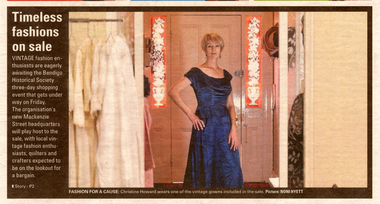
... vintage fashion enthusiasts, quilters, and crafters. It is held at the Society's new headquarters on Mackenzie Street, Bendigo. The shop is open Friday to Sunday, 10:30am–4pm. Clothing and accessories...vintage fashion enthusiasts, quilters, and crafters. It is held at the Society's new headquarters on Mackenzie Street, Bendigo. The shop is open Friday to Sunday, 10:30am–4pm. Clothing and accessories ...This document details a vintage fashion pop-up shop organized by the Bendigo Historical Society The pop-up shop is a three-day event for vintage fashion enthusiasts, quilters, and crafters. It is held at the Society's new headquarters on Mackenzie Street, Bendigo. The shop is open Friday to Sunday, 10:30am–4pm. Clothing and accessories dating from the 1900s to the 1960s are available. Prices range from $5 to $50.Many items are handmade or hand-finished, but lack documentation about their origins or previous owners. Some items are ready to wear, while others are better suited for repurposing by crafters or quilters. The Society holds 35,000–40,000 items and is reducing its collection to focus on pieces of significant historical value. A 2008 assessment found about 40% of the collection is of "curiosity interest" only, with no direct historic link to Bendigo. Only items without provenance or documentation are being sold; important historical pieces are retained.Experience and Appeal. The sale is designed to give shoppers space to browse and inspect items.Bendigo Advertiser Article - Pop-up shop for fans of fashion, Thursday May 26, 2022 by Julieanne Strachan, pictures by Noni Hyett This item contains the following documents: 3486.60a Colour Photo of Christine Howard wearing one of the vintage gowns 3486.60b Bendigo Advertiser Article - Pop-up shop for fans of fashion 3486.60c Colour Photo of a woman in vintage wear and a man dancing 3486.60d Colour Photo of Christine Howard in a vintage dressbendigo, euan mcgillivray -
 Bendigo Historical Society Inc.
Accessory - CIGARETTE LIGHTER , WORLD WAR TWO VINTAGE, HAND MADE. TRENCH ART
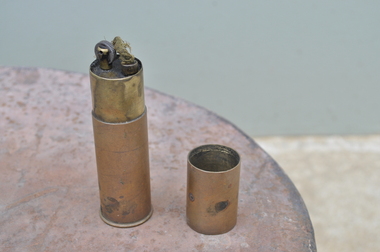
... vintage? Handmade Trench art from military weaponry. 20mm in diameter. Anti-tank?? Ammunition Note: Could be French Cigarette Lighter donated by Mrs. D. Winspear on 18/08/1977 Accessory ...Cigarette Lighter, World War two vintage? Handmade Trench art from military weaponry. 20mm in diameter. Anti-tank?? Ammunition Note: Could be French Cigarette Lighter donated by Mrs. D. Winspear on 18/08/1977cigarette lighter, worl war ii -
 Bendigo Historical Society Inc.
Accessory - LEATHER AND CLOTH VINTAGE/ANTIQUE METAL SHOE, BOOT & BUTTON HOOK. CATTRAN'S BOOTS BENDIGO
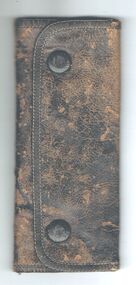
... COSTUME ACCESSORIES Footwear accessories CATTRANS BOOTS BENDIGO Worn black LEATHER AND CLOTH wallet with 2 x press studs containing 3 x Vintage antique metal show, boot and button hooks inside leather wrap wallet. ...Worn black LEATHER AND CLOTH wallet with 2 x press studs containing 3 x Vintage antique metal show, boot and button hooks inside leather wrap wallet. Cattran's Boots Bendigo.costume accessories, footwear accessories, cattrans boots bendigo -
 Warrnambool and District Historical Society Inc.
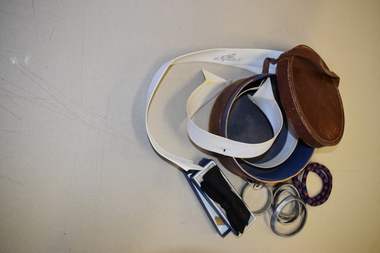
Household, Mans Dress box. Studs. Collars x4. Arm bands. Bowtie x2, Early 20th century
... Salamy and Son. men’s accessories history of warrnambool detachable vintage collars winged detachable collars .2 The box is marked ‘M.Salamy & Son, Jewellers’ .5 ‘Pelaco Best Quality Made in Australia’ .6 ‘Cremorne Collar Co. ...This man’s dress box contains accessories that a man would use, perhaps in a formal situation – bow ties,buttoning studs and detachable collars. The contents of the box may not be what was originally in the box. Bow ties and studs are still used on occasions but detachable collars are no longer in vogue because wash and wear shirts are freely available. Both of the companies which made the detachable collars, Pelaco and Cremorne, were based in Richmond in Melbourne. The Warrnambool jewellery business of M. Salamy and Son, has the known dates, 1912 to 1938. There were two Salamy shops, one in Timor Street, opposite the Post Office and one at 179 Liebig Street. This box and contents are retained because they are reminders of accessories men used in the past, especially for formal occasions. Also, one of the items came from the well-known Warrnmbool jewellery business of M. Salamy and Son..1 This is a circular-shaped leather box with a lid attached by stitching and a strap and a metal buckle for closing the box. Inside the box is a blue cardboard lining. The leather is scuffed. .2 & .3 These are two black cloth bow ties with metal clips at the back. The ties are housed in a blue wooden box. .4 These are seven elasticised bands for holding back shirt sleeves. Two of these are covered with red and blue cloth and five are made of silver-coloured metal .5 & .6 These are two white detachable collars. They are somewhat stained. .7 These are four metal studs with white inserts. .2 The box is marked ‘M.Salamy & Son, Jewellers’ .5 ‘Pelaco Best Quality Made in Australia’ .6 ‘Cremorne Collar Co. Melbourne’ men’s accessories, history of warrnambool, detachable vintage collars, winged detachable collars -
 Warrnambool and District Historical Society Inc.
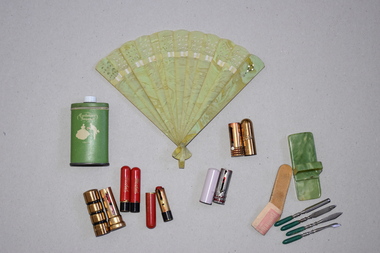
Women's Accessories, 1930s
... These items are retained as examples of women’s accessories as used in past years. The sample-size items have a particular appeal to us today. Vintage ...These items do not necessarily form a set. Several of the items are of miniature size and may have been samples for commercial travellers or shop displays or possibly used by women travelling. All of the items have their modern-day equivalents though hand fans are not widely used today.These items are retained as examples of women’s accessories as used in past years. The sample-size items have a particular appeal to us today.This is a collection of women’s accessories and make-up items with most of the items being of miniature or sample size. .1 Green bakelite fan with a white ribbon insert and fretwork at the top curved end of the fan. .2 Three lipsticks with red lids and black and gold metal inserts. .3 One lipstick with a pink lid and a silver and red metal insert. .4 Two lipsticks with gold lids and gold metal inserts. .5 Green tin of talcum powder with a white lid .6 Manicure set in a green bakelite container with four metal manicure items with green handles and an emery board. This set holder also contains a 5d. tramway ticket from Melbourne. These items above are in an old metal chocolate tin but this is not the container that would have housed the items originally. ‘Michel’ ‘Anne Page’ ‘Starlet’ ‘Judith Aden’ ‘Cashmere Bouquet Colgate’ ‘Pascall Claremont Tasmania’ vintage women’s accessories, history of warrnambool -
 Warrnambool and District Historical Society Inc.
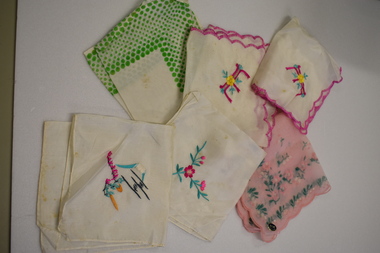
Handkerchiefs, 1950s
... These items are of interest as examples of the handkerchiefs found in a woman’s collection mid last century and as mementoes of a former Warrnambool resident, Ena Heazlewood. Vintage Women’s Accessories Todd & Heazlewood families, Warrnambool History of Warrnambool .6 & .7 Nylon Made in Japan These are seven handkerchiefs. .1 A silk handkerchief with a white centre and a green dot pattern border .2 A white silk handkerchief with an embroidered spray of pink flowers and green stems in one corner .3 A white silk handkerchief with multi-coloured embroidery in one corner .4 & .5 Two white silk handkerchiefs with a multi-coloured embroidered letter ‘E’ in one corner and a fluted embroidered edge. .6 & .7 Two pink nylon handkerchiefs with a fluted edge and an overall impressed pattern of pink flowers and green stems Handkerchiefs ...These handkerchiefs come from the estate of Ena Heazlewood. Mary Josephine (Ena) Todd was born in Warrnambool in 1920 and worked as a hairdresser at Josephine’s Salon in Warrnambool. In 1942 she married a Warrnambool man, Jack Heazlewood, who was stoker on the H.M.A.S. Sydney at the time. They later lived in Sydney. These items are of interest as examples of the handkerchiefs found in a woman’s collection mid last century and as mementoes of a former Warrnambool resident, Ena Heazlewood. These are seven handkerchiefs. .1 A silk handkerchief with a white centre and a green dot pattern border .2 A white silk handkerchief with an embroidered spray of pink flowers and green stems in one corner .3 A white silk handkerchief with multi-coloured embroidery in one corner .4 & .5 Two white silk handkerchiefs with a multi-coloured embroidered letter ‘E’ in one corner and a fluted embroidered edge. .6 & .7 Two pink nylon handkerchiefs with a fluted edge and an overall impressed pattern of pink flowers and green stems .6 & .7 Nylon Made in Japanvintage women’s accessories, todd & heazlewood families, warrnambool, history of warrnambool -
 Warrnambool and District Historical Society Inc.
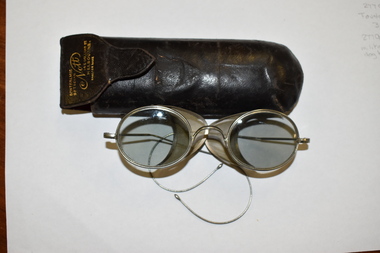
Accessory - Spectacles in Case, late 19th century
... This pair of spectacles and case are of no known origin but are typical of those used in the late 19th century These spectacles are of interest because of their age and are retained for display purpses Vintage spectacles Warrnambool History Ophthalmic Optician Nott 145 Collins St Melbourne English make This is a pair of metal and glass spectacles with mesh shades on the sides. The sides and the shades fold up to fit into a leather case with red leather lining. Part of the closing flap is missing from the case. The case has the name of the maker on the top flap. Accessory ...This pair of spectacles and case are of no known origin but are typical of those used in the late 19th centuryThese spectacles are of interest because of their age and are retained for display purpsesThis is a pair of metal and glass spectacles with mesh shades on the sides. The sides and the shades fold up to fit into a leather case with red leather lining. Part of the closing flap is missing from the case. The case has the name of the maker on the top flap.Ophthalmic Optician Nott 145 Collins St Melbourne English makevintage spectacles, warrnambool history -
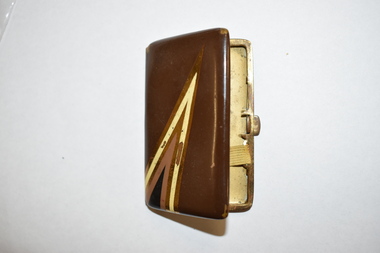 Warrnambool and District Historical Society Inc.
Accessory - Cigarette Case, Early 20th Century
... This item has no known provenance and is kept for display only. Vintage accessories Warrnambool History This is a brown rectangular shaped case with a gold and yellow decorative front. ...This is a cigarette case for small cigarettes but the original owner is unknown.This item has no known provenance and is kept for display only.This is a brown rectangular shaped case with a gold and yellow decorative front. It has a metal clasp and is hinged. Inside it has two yellow cloth pieces attached to metal bars to hold cigarettes. The front pattern is slightly damagedvintage accessories, warrnambool history
