
Showing 127 items matching "von mueller garden"
-
 Federation University Historical Collection
Booklet, Ballarat School of Mines Botanical Gardens Conservation/Restoration Management Plan
... ...von mueller garden...Historical plans and maps are detailed from 1857 up to the site assessment in 2008. smb school of mines ballarat ballarat school of mines botanical gardens smb botanical gardens conservation restoration ballarat school of mines garden von mueller garden ferdinand von mueller botany living collections horticulture gardens Lisa Palmer written at top right corner in pencil. ...A Conservation/Restoration Management Plan for the Ballarat School of Mines Botanical Gardens. The report includes a planting timeline of the plants included in the gardens from 1850. Historical plans and maps are detailed from 1857 up to the site assessment in 2008.Printed report stapled at top left corner.Lisa Palmer written at top right corner in pencil.smb, school of mines ballarat, ballarat school of mines, botanical gardens, smb botanical gardens, conservation, restoration, ballarat school of mines garden, von mueller garden, ferdinand von mueller, botany, living collections, horticulture, gardens -
Federation University Historical Collection
Document, Graeme Tyrrell, Overview for the Development of Gardens Lydiard Street Campus, 1988, 01/12/1988
... John Building, Terrraced area above Ballarat School of Mines Botanical Garden (referred to as Von Mueller garden). The report includes a campus plan. ...John Building, Terrraced area above Ballarat School of Mines Botanical Garden (referred to as Von Mueller garden). The report includes a campus plan. ...The report was prepared by Graeme Tyrrell, headgroundsman/Gardener at the Ballarat School of Mines (SMB) for Bob Feary, Manager of Facilities at SMB. The report was designed to present a broad cover of current plans for specific sites at the Lydiard Street campus.Seven page report on the development of the Ballarat School of Mines Gardens, including the Motor Mechanics Portable, Hickman Street (now demolished); Recreation Building (now demolished), E.P.U.Y Building, Hickman Street, vacant block behind creche (now site of UBTec building); Creche, Grant Street (now demolished); Former Courthouse building, Grant Street terrace, Brick Court yard, conifer beds lining Lydiard Street, Herb Garden above M.B. John Building, Terrraced area above Ballarat School of Mines Botanical Garden (referred to as Von Mueller garden). The report includes a campus plan. The report is copied onto white paper and is stapled at the top left corner. ballarat school of mines botanical gardens, ballarat school of mines, bob feary, graeme tyrrell, gardens, ballarat school of mines campus, smb campus -
Friends of Ballarat Botanical Gardens History Group
Work on paper - Letter to Mr Ford from Doctor Ferdinand von Mueller 28/7/71, Topping the Blue Gum Tree, 28/7/71
... This letter was written by Baron Ferdinand von Mueller, Melbourne Botanic Gardens to Mr Ford, Ballarat Town Clerk and is evidence of the advisory role von Mueller played, especially in the 1880's, in terms of the Ballarat Botanical Gardens....This letter was written by Baron Ferdinand von Mueller, Melbourne Botanic Gardens to Mr Ford, Ballarat Town Clerk and is evidence of the advisory role von Mueller played, especially in the 1880's, in terms of the Ballarat Botanical Gardens. ...This letter was written by Baron Ferdinand von Mueller, Melbourne Botanic Gardens to Mr Ford, Ballarat Town Clerk and is evidence of the advisory role von Mueller played, especially in the 1880's, in terms of the Ballarat Botanical Gardens.Doctor von Mueller was a valuable contributor to the development and planning of Ballarat Public Gardens. He visited Ballarat regularly and was also examiner for the Botany course at the Ballarat School of Mines.Photocopy of the original yellowed letter on two white sheetsPhotocopied letter written longhand in black ink. Left hand side in faint handwriting underlined, "Dr. Mueller, Topping the gum tree, 28/7/71".john garner, doctor, ballarat botanical gardens, melbourne botanic gardens, baron ferdinand von mueller, doctor von mueller, doctor mueller, mr ford town clerk, blue gum trees, botany course school of mines, george longley, benevolent home gardens, director melbourne botanic gardens, victorian government botanist., john garner collection, gardens, ballarat -
 City of Melbourne Libraries
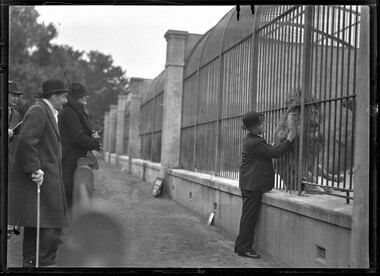
Photograph, Bull, Hugh Jones, 1897-1993, Vice-regal visit to Zoo: Lord Huntingfield greets the King of the Beasts
... He first worked as a horticultural assistant to Government botanist Baron Ferdinand von Mueller at the Botanical Gardens at the age of 13, along with his older brother David. ...He first worked as a horticultural assistant to Government botanist Baron Ferdinand von Mueller at the Botanical Gardens at the age of 13, along with his older brother David. ...Photographer notations on slide: "Vice Regal visit to zoo B42" Published: The Age, Tuesday 26 June 1934, page 11. Published title: VICE-ROYALTY GREETS THE KING OF THE BEASTS AT THE ZOO. Published caption: “Lord Huntingfield experienced a pleasant “induction ceremony” as Patron of the Royal Zoological and Acclimatisation Society yesterday, when he made a tour of the Zoological Gardens. The picture shows the Governor, accompanied by Lady Huntingfield, inspecting the King of the Beasts, who is submitting to a little playful treatment from the Director of the Gardens, Mr. Wilkie, while the Director whispers in his ear that a distinguished visitor has come to see him.” Trove article identifier: http://nla.gov.au/nla.news-article204818472 Description: A man wearing a hat and suit strokes a caged lion, observed by a man in a hat, scarf and overcoat who is leaning on a walking stick, and a woman in a hat and coat, holding a handbag. They stand behind a protective rail. Research by project volunteer, Fiona Collyer: Andrew Arthur Wellesley Wilkie, 1853-1948, was Director of the Melbourne Zoo from 1923 to 1936 and was associated with the zoo for 70 years. He first worked as a horticultural assistant to Government botanist Baron Ferdinand von Mueller at the Botanical Gardens at the age of 13, along with his older brother David. One of Andrew’s jobs was to capture moths for the National Herbarium. In 1857, a group of prominent Melburnians assembled at St. Patrick’s Hall to form the Zoological Society of Victoria, with the aim of introducing animals and plants from overseas. It was conceived, “For the purposes of science and for that of affording the public the advantages of studying the habits of the animal creation in properly arranged zoological gardens.” The Victorian Government granted 32 acres (13 hectares) of land to the Zoological Society at the southern end of Richmond Paddock on the opposite bank to the Botanical Gardens. (This is where AAMI Stadium and Collingwood Football Club now stand.) In 1861, the Zoological Society of Victoria was renamed The Acclimatisation Society of Victoria. Unfortunately the Yarra River frontage was damp, swampy and subject to flooding, so the animals were briefly housed at the Botanical Gardens until in 1862, the City of Melbourne donated 55 acres (22 hectares) of land at Royal Park for the fledgling zoo. Baron von Mueller secured employment at Royal Park for Andrew and David and they helped to lay out the gardens, plant trees and take care of a collection of deer, pheasants, hares and partridges. Initially the zoo was used for the acclimatisation of animals recovering from the long voyage to Australia and for breeding them for sport. In 1872, the zoo bought two lions, a leopard and a cheetah that had been seized from circus showmen Keith and Phillips when they were unable to pay the bill of butcher Mr T K Bennet of Bourke Street. The first zoo director, Mr. Albert Le Souef, negotiated with captains of ships to buy animals at overseas ports they visited and soon a multitude of exotic species arrived, including a ten-year-old Indian elephant in 1878. In 1923, after being head keeper for some years, Andrew was appointed director of the zoo. By 1933, the zoo had 110 different species of animals, 200 species of birds and 72 species of reptiles under Andrew’s care. He had personally planted all but six trees and laid out the garden beds. As director he lobbied authorities for funds to build more humane enclosures for the animals. In June 1928, Table Talk magazine wrote of Andrew Wilkie: “Up at the Zoo there is a humble gentleman who is a lion among the lions, who knows the proper specific to employ when the boa constrictor has chilblains, and who is a friend and confidant of Queenie the elephant. His fount of zoological lore has never been plumbed. It is bottomless, like his good fellowship and geniality. Every day he may be seen somewhere in the grounds of that growing sanctuary for the strange and arresting fauna and creeping things of the world, and I assure you as one who is privy to his passion that that area and its inhabitants are rarely out of his thoughts.” Andrew retired from the zoo in 1936 at the age of 83 and in 1948 died at his home in Brunswick aged 94. He and his wife Josephine had six children. Roy, aged 28 in 1934, was a former Wirth’s circus lion who had been left at the zoo at 10 years of age. Andrew visited Roy every day on his rounds and the pair formed a close and affectionate bond. Wireless Weekly magazine in February 1933 reported, “Roy was delighted to see Mr Wilkie, and in a docile manner, approached the bars of his cage and had his head vigorously rubbed by the director, who daily carries out this act of kindness.” As reported in The Herald on 27 October 1936, “Mr Wilkie has also found the old lion docile. He has not shown the animal any particular favouritism, but the lion has shown him a faithfulness that none of the keepers can claim. When Mr Wilkie approaches the bars the lion rolls over and lets the director stroke him and pull his tail. He gets very excited if Mr Wilkie passes without climbing over the protecting rail for a little game.” A 1930 newsreel film shows Andrew stroking Roy’s mane through the bars and the blissed out big cat lying on his back while lifting his chin for a rub. Another newsreel film from the time shows Andrew stroking a lioness and playfully pulling her tail. The Victorian Acclimatisation Society was founded in 1861 by Edward Wilson, 1813-1878, then owner and editor of The Argus newspaper. He said that Australian indigenous animals were practically useless, providing only “a little sport and an occasional meal”. The Society believed that Australia’s plants and animals were vastly inferior to those in Europe. They wanted to introduce and acclimatise to Victoria “all innoxious animals, birds, fishes, insects and vegetables, whether useful or ornamental” for sport and for the table, and to spread indigenous animals and plants from the colony around the world. Their motto was “if it lives, we want it”. The Society was primarily responsible for introducing sparrows, starlings, sambar and hog deer, ostriches, brown trout, blackberries, and carp to the Murray River. They released the European songbirds, thrush and blackbird to quell the homesickness of British settlers. The Society also sent Australian animals like platypus, echidnas, kangaroos and koalas to Europe for scientific and novelty purposes. Thomas Austin, a wealthy sheep farmer of Barwon Park, Winchelsea (property now owned by the National Trust) was a member and in 1859 he introduced hares, blackbirds, thrushes and partridges onto his property. He is probably best known for introducing 24 breeding rabbits onto his estate as game for shooting parties. Thomas quipped, “The introduction of a few rabbits could do little harm and might provide a touch of home, in addition to a spot of hunting." In 2022, genomic data confirmed that Australia’s feral rabbit population is entirely descended from these rabbits. Biological control has brought the rabbit population down from an estimated high of 10 billion rabbits in the 1920s to approximately 200 million today, inhabiting 70% of Australian landmass (5.3 million square kilometres). In 1872, the Acclimatisation Society was renamed The Zoological and Acclimatisation Society of Victoria and they focused on importing exotic animals for display purposes to the zoo. In 1937, the Royal Acclimatisation Society of Victoria was recreated as the Zoological Board of Victoria with a focus on research of native animals threatened with extinction. In an editorial for The Argus newspaper, 16 March 1856, Edward Wilson lamented: "…this country has been shamelessly stolen from the blacks. Had they been like the New Zealanders or the North American Indians, we should have bought their land, and supplied them with the means of living when we took it... In less than twenty years we have nearly swept them off the face of the earth. We have shot them down like dogs. In the guise of friendship we have issued corrosion sublimate in their damper, and consigned whole tribes to the agonies of an excruciating death. We have made them drunkards, and infected them with disease which has rotted the bones of their adults, and made such few children as are born amongst them a sorrow and a torture from the very instant of their birth. We have made them outcasts on their own land, and are rapidly consigning them to entire annihilation. There are but a few of them left, comparatively. This is what we would do for that few. We would feed and clothe every one of them.” [Note: this last sentence is italicized in the original newspaper article text]. Lord Huntingfield, (William Charles Arcedeckne Vanneck) 1883-1969, Governor of Victoria 1934-1939, was a British Conservative Party politician and the first ever Australian-born Governor of an Australian state (although he was always considered British). He was patron of the Royal Zoological and Acclimatisation Society of Victoria and was acting Governor-General for six months during the absence of Lord Gowie in 1938. Lady Huntingfield (née Margaret Eleanor Crosby) 1884-1943, his American-born wife showed great interest in social welfare and the advancement of women and children. She was president of the City Newsboys Society and Patroness of the Girls Friendly Society. In 1937, rose breeder Alister Clark named a yellow hybrid tea rose for her. In 1940, the City of Melbourne opened the Lady Huntingfield Free Kindergarten in North Melbourne, now the Lady Huntingfield Early Learning and Family Services Centre. Lady Huntingfield died in London in 1943 after her house was bombed during a German airstrike. The Lady Huntingfield Memorial Scholarship was established after the City of Melbourne raised £1000 in a public appeal conducted in her memory for students undertaking a Social Work degree at the University of Melbourne. It is awarded annually to this day. The Queen Victoria Hospital named a bed in her honour. References: VICE-ROYALTY GREETS THE KING OF BEASTS AT THE ZOO. (1934, June 26). The Age (Melbourne, Vic. : 1854 - 1954), p. 11. Retrieved August 18, 2024, from http://nla.gov.au/nla.news-article204818472 Prominent Personalities ANDREW WILKIE (1928, June 7). Table Talk (Melbourne, Vic. : 1885 - 1939), p. 15. Retrieved August 29, 2024, from http://nla.gov.au/nla.news-article146562949 'Thomas Austin (pastoralist)', Wikipedia, https://en.wikipedia.org/wiki/Thomas_Austin_(pastoralist) 'Edward Wilson (journalist)', Wikipedia, https://en.wikipedia.org/wiki/Edward_Wilson_(journalist) THE WOMAN'S WORLD (1934, June 26). The Herald (Melbourne, Vic. : 1861 - 1954), p. 14. Retrieved August 19, 2024, from http://nla.gov.au/nla.news-article243164806 MR. WILKIE CAN PULL THE OLD LION'S TAIL (1936, October 27). The Herald (Melbourne, Vic. : 1861 - 1954), p. 4. Retrieved August 18, 2024, from http://nla.gov.au/nla.news-article248551307 Director Of Zoo Will Retire Tomorrow--With White Kitten (1936, December 30). The Herald (Melbourne, Vic. : 1861 - 1954), p. 8. Retrieved August 18, 2024, from http://nla.gov.au/nla.news-article244655203 LIGHT CAR CLUB IN CARICATURE (1931, August 25). The Sun News-Pictorial (Melbourne, Vic. : 1922 - 1954; 1956), p. 24. Retrieved August 19, 2024, from http://nla.gov.au/nla.news-article276250310 'The Acclimatisation Society was driven by misguided ideals about 'fixing nature' in Australia', ABC News, https://www.abc.net.au/news/2022-11-04/acclimatisation-society-introduced-species-history-listen/101588262?utm_source=abc_news_app&utm_medium=content_shared&utm_campaign=abc_news_app&utm_content=safari 'Dr Andrew Wilkie Director Of Melbourne Zoo, With Lion (1930) Video', Pond5 Inc., https://www.pond5.com/stock-footage/item/155691351-dr-andrew-wilkie-director-melbourne-zoo-lion-1930 'Kodak Cinegraph Compilation No 12', ACMI Collection, YouTube.com [Zoo footage at 8.33 minutes, Mr Wilkie at 11.04 minutes], https://www.youtube.com/watch?v=OZZqgSNsP0k THE ABORIGINES. (1856, March 16). The Argus (Melbourne, Vic. : 1848 - 1957), p. 4. Retrieved September 28, 2024, from http://nla.gov.au/nla.news-article4833244Photographer notations on slide: "Vice Regal visit to zoo B42".1930-1939, melbourne zoo, animals, hunting, wildlife, royal park, gardens -
 City of Melbourne Libraries
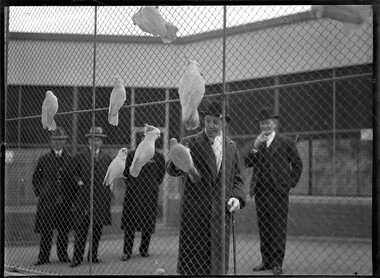
Photograph, Bull, Hugh Jones, 1897-1993, Vice-regal visit to zoo: Governor (Lord Huntingfield) meets the cockatoos
... He first worked as a horticultural assistant to Government botanist Baron Ferdinand von Mueller at the Botanical Gardens at the age of 13, along with his older brother David. ...He first worked as a horticultural assistant to Government botanist Baron Ferdinand von Mueller at the Botanical Gardens at the age of 13, along with his older brother David. ...A group of five men dressed in hats and overcoats look at caged cockatoos. Research by project volunteer, Fiona Collyer: On 25 June 1934, new Victorian Governor, His Excellency Lord Huntingfield and his wife Lady Huntingfield made an official visit to the Melbourne Zoological Gardens in order to grant his patronage to the Royal Zoological and Acclimatisation Society. The zoo director, Mr. Andrew Wilkie, introduced them to the cockatoos in the flight aviary. The Argus newspaper reported the visit in the following morning’s issue: "Birds' Greeting To Governor. Visit to Zoological Gardens. "A Very Important Society." "Cheery shouts of "Hullo!" and requests for drinks greeted His Excellency the Governor (Lord Huntingfield) on one of his official visits yesterday morning. Lady Huntingfield, who accompanied him, was asked loudly for a kiss. They were inspecting the huge cockatoo aviary at the Zoological Gardens after Lord Huntingfield had granted his patronage to the Royal Zoological and Acclimatisation Society. Both obviously enjoyed the democratic experience. It was explained to them that most of the cockatoos had been presented by residents of flats, whose neighbours objected to the noise of the birds, while others were protected birds which had been surrendered. Lord Huntingfield recalled that he had taken two Australian cockatoos to England when he left Australia in his youth. One, a galah, had lived in England for many years." In 1929, the Zoo built a commodious new flight aviary at the cost of several thousand pounds and Zoo director, Mr Andrew Wilkie, sent out an appeal published in newspapers Australia-wide for donations of parrots from all states. Many of the parrot species he wanted were protected and a special permit needed for their capture, however Mr Wilkie guaranteed he would obtain authority from the Fisheries and Game Department and that the cost of transit would be borne by the Zoo. The wanted birds were "Parrots - Black-tailed, Rock Pebbler, King, Superb, Grass (all kinds), Swamp or Ground, Mallee or Ringneck" and "Cockatoo[s] - Black, Pink or Major Mitchell, Gang-Gang". The Zoo asked that the birds be sent in boxes large enough to prevent overcrowding, contain food and water and the Zoo notified on the type and number of birds in transit. All boxes were to be addressed to 'The Zoo, Melbourne'. A letter from a reader appeared in the Weekly Times newspaper's popular "Camp-fire Circle" page for "Young Australians", 11 May 1929: "Dear Pal, I am much interested in your page, especially the nature notes. I have a pet parrot, but I don’t like to see it shut up in a cage, so I am giving it to the Melbourne Zoo. It can whistle 'Pretty Joey' and 'What's the Matter with Father' and is just learning to whistle for the dog... Wishing you and the Camp-fire Circle success." - Murray Holmes (Gorae, Vic.) The fate of this talented parrot is unknown, however in 1932, this young naturist, T Murray Holmes, 1912-1947, collected for the first time a type specimen, blue star sun orchid from Gorae (near Portland, Victoria), and it was named in his honour, Thelymitra holmesii. Murray was described by orchid collector W H Nicholls as "a youthful and energetic orchidologist, who added much to our knowledge of the orchids of south-western Victoria." Murray Holmes enlisted in the army in 1941 and fought in the Middle East before being sent to Java. In 1942 he was captured by the Japanese and became a prisoner of war for three years, working on the notorious Thai-Burma railway. Murray's health was undermined though ill treatment and starvation and he returned to Australia after the war, broken and sick. He died aged 35 in 1947. He was intensely interested in the flora and fauna of the Gorae area to the end. Murray's parents received over 200 tributes of respect for their son - too many to answer personally so they put a notice in the Portland Guardian thanking "all kind friends and relatives for letters, cards, floral tributes and personal expressions of sympathy received in their recent sad bereavement - the lamented death of their loved son, Murray." Andrew Arthur Wellesley Wilkie, 1853-1948, was Director of the Melbourne Zoo from 1923 to 1936 and was associated with the zoo for 70 years. He first worked as a horticultural assistant to Government botanist Baron Ferdinand von Mueller at the Botanical Gardens at the age of 13, along with his older brother David. One of Andrew’s jobs was to capture moths for the National Herbarium. In 1857, a group of prominent Melburnians assembled at St. Patrick’s Hall to form the Zoological Society of Victoria, with the aim of introducing animals and plants from overseas. It was conceived, “For the purposes of science and for that of affording the public the advantages of studying the habits of the animal creation in properly arranged zoological gardens.” The Victorian Government granted 32 acres (13 hectares) of land to the Zoological Society at the southern end of Richmond Paddock on the opposite bank to the Botanical Gardens. (This is where AAMI Stadium and Collingwood Football Club now stand.) In 1861, the Zoological Society of Victoria was renamed The Acclimatisation Society of Victoria. Unfortunately the Yarra River frontage was damp, swampy and subject to flooding, so the animals were briefly housed at the Botanical Gardens until in 1862, the City of Melbourne donated 55 acres (22 hectares) of land at Royal Park for the fledgling zoo. Baron von Mueller secured employment at Royal Park for Andrew and David and they helped to lay out the gardens, plant trees and take care of a collection of deer, pheasants, hares and partridges. Initially the zoo was used for the acclimatisation of animals recovering from the long voyage to Australia and for breeding them for sport. In 1872, the zoo bought two lions, a leopard and a cheetah that had been seized from circus showmen Keith and Phillips when they were unable to pay the bill of butcher Mr T K Bennet of Bourke Street. The first zoo director, Mr. Albert Le Souef, negotiated with captains of ships to buy animals at overseas ports they visited and soon a multitude of exotic species arrived, including a ten-year-old Indian elephant in 1878. In 1923, after being head keeper for some years, Andrew was appointed director of the zoo. By 1933, the zoo had 110 different species of animals, 200 species of birds and 72 species of reptiles under Andrew’s care. He had personally planted all but six trees and laid out the garden beds. As director he lobbied authorities for funds to build more humane enclosures for the animals. In June 1928, Table Talk magazine wrote of Andrew Wilkie: “Up at the Zoo there is a humble gentleman who is a lion among the lions, who knows the proper specific to employ when the boa constrictor has chilblains, and who is a friend and confidant of Queenie the elephant. His fount of zoological lore has never been plumbed. It is bottomless, like his good fellowship and geniality. Every day he may be seen somewhere in the grounds of that growing sanctuary for the strange and arresting fauna and creeping things of the world, and I assure you as one who is privy to his passion that that area and its inhabitants are rarely out of his thoughts.” Andrew retired from the zoo in 1936 at the age of 83 and in 1948 died at his home in Brunswick aged 94. He and his wife Josephine had six children. The Victorian Acclimatisation Society was founded in 1861 by Edward Wilson, 1813-1878, then owner and editor of The Argus newspaper. He said that Australian indigenous animals were practically useless, providing only “a little sport and an occasional meal”. The Society believed that Australia’s plants and animals were vastly inferior to those in Europe. They wanted to introduce and acclimatise to Victoria “all innoxious animals, birds, fishes, insects and vegetables, whether useful or ornamental” for sport and for the table, and to spread indigenous animals and plants from the colony around the world. Their motto was “if it lives, we want it”. The Society was primarily responsible for introducing sparrows, starlings, sambar and hog deer, ostriches, brown trout, blackberries, and carp to the Murray River. They released the European songbirds, thrush and blackbird to quell the homesickness of British settlers. The Society also sent Australian animals like platypus, echidnas, kangaroos and koalas to Europe for scientific and novelty purposes. Thomas Austin, a wealthy sheep farmer of Barwon Park, Winchelsea (property now owned by the National Trust) was a member and in 1859 he introduced hares, blackbirds, thrushes and partridges onto his property. He is probably best known for introducing 24 breeding rabbits onto his estate as game for shooting parties. Thomas quipped, “The introduction of a few rabbits could do little harm and might provide a touch of home, in addition to a spot of hunting." In 2022, genomic data confirmed that Australia’s feral rabbit population is entirely descended from these rabbits. Biological control has brought the rabbit population down from an estimated high of 10 billion rabbits in the 1920s to approximately 200 million today, inhabiting 70% of Australian landmass (5.3 million square kilometres). In 1872, the Acclimatisation Society was renamed The Zoological and Acclimatisation Society of Victoria and they focused on importing exotic animals for display purposes to the zoo. In 1937, the Royal Acclimatisation Society of Victoria was recreated as the Zoological Board of Victoria with a focus on research of native animals threatened with extinction. In an editorial for The Argus newspaper, 16 March 1856, Edward Wilson lamented: "...this country has been shamelessly stolen from the blacks. Had they been like the New Zealanders or the North American Indians, we should have bought their land, and supplied them with the means of living when we took it... In less than twenty years we have nearly swept them off the face of the earth. We have shot them down like dogs. In the guise of friendship we have issued corrosion sublimate in their damper, and consigned whole tribes to the agonies of an excruciating death. We have made them drunkards, and infected them with disease which has rotted the bones of their adults, and made such few children as are born amongst them a sorrow and a torture from the very instant of their birth. We have made them outcasts on their own land, and are rapidly consigning them to entire annihilation. There are but a few of them left, comparatively. This is what we would do for that few. We would feed and clothe every one of them.” [Note: this last sentence is italicized in the original newspaper article text]. Lord Huntingfield, (William Charles Arcedeckne Vanneck) 1883-1969, Governor of Victoria 1934-1939, was a British Conservative Party politician and the first ever Australian-born Governor of an Australian state (although he was always considered British). He was patron of the Royal Zoological and Acclimatisation Society of Victoria and was acting Governor-General for six months during the absence of Lord Gowie in 1938. Lady Huntingfield (née Margaret Eleanor Crosby) 1884-1943, his American-born wife showed great interest in social welfare and the advancement of women and children. She was president of the City Newsboys Society and Patroness of the Girls Friendly Society. In 1937, rose breeder Alister Clark named a yellow hybrid tea rose for her. In 1940, the City of Melbourne opened the Lady Huntingfield Free Kindergarten in North Melbourne, now the Lady Huntingfield Early Learning and Family Services Centre. Lady Huntingfield died in London in 1943 after her house was bombed during a German airstrike. The Lady Huntingfield Memorial Scholarship was established after the City of Melbourne raised £1000 in a public appeal conducted in her memory for students undertaking a Social Work degree at the University of Melbourne. It is awarded annually to this day. The Queen Victoria Hospital named a bed in her honour. References: Prominent Personalities ANDREW WILKIE (1928, June 7). Table Talk (Melbourne, Vic. : 1885 - 1939), p. 15. Retrieved August 29, 2024, from http://nla.gov.au/nla.news-article146562949 BIRDS' GREETING TO GOVERNOR (1934, June 26). The Argus (Melbourne, Vic. : 1848 - 1957), p. 6. Retrieved August 19, 2024, from http://nla.gov.au/nla.news-article10950051 Zoo Appealing For Parrots And Cockatoos To Fill Aviary For Children’s Instruction (1929, April 11). The Sun News-Pictorial (Melbourne, Vic. : 1922 - 1954; 1956), p. 31. Retrieved August 23, 2024, from http://nla.gov.au/nla.news-article275757361 LETTERS FROM READERS (1929, May 11). Weekly Times (Melbourne, Vic. : 1869 - 1954), p. 50. Retrieved October 6, 2024, from http://nla.gov.au/nla.news-article223183144 Correspondence. (1929, April 18). Corryong Courier (Vic. : 1894 - 1945), p. 6. Retrieved August 30, 2024, from http://nla.gov.au/nla.news-article269039262 'Edward Wilson (journalist)', Wikipedia, https://en.wikipedia.org/wiki/Edward_Wilson_(journalist) 'Thomas Austin (pastoralist)', Wikipedia, https://en.wikipedia.org/wiki/Thomas_Austin_(pastoralist) 'The Acclimatisation Society was driven by misguided ideals about 'fixing nature' in Australia', ABC News, https://www.abc.net.au/news/2022-11-04/acclimatisation-society-introduced-species-history-listen/101588262? utm_source=abc_news_app&utm_medium=content_shared&utm_campaign=abc_news_app&utm_content=safari Touching Canine Devotion. (1942, September 21). Portland Guardian (Vic. : 1876 - 1953), p. 1 (EVENING). Retrieved October 6, 2024, from http://nla.gov.au/nla.news-article64381989 OBITUARY (1947, August 11). Portland Guardian (Vic. : 1876 - 1953), p. 2 (EVENING). Retrieved August 26, 2024, from http://nla.gov.au/nla.news-article64412155 Family Notices (1947, September 11). Portland Guardian (Vic. : 1876 - 1953), p. 2 (EVENING). Retrieved October 10, 2024, from http://nla.gov.au/nla.news-article64412476 'Thelymitra holmesii', Wikipedia, https://en.wikipedia.org/wiki/Thelymitra_holmesii THE ABORIGINES. (1856, March 16). The Argus (Melbourne, Vic. : 1848 - 1957), p. 4. Retrieved September 28, 2024, from http://nla.gov.au/nla.news-article4833244Photographer notations on slide: "Vice Regal visit to zoo B42".zoos, governors, 1930-1939, cockatoos -
 City of Melbourne Libraries
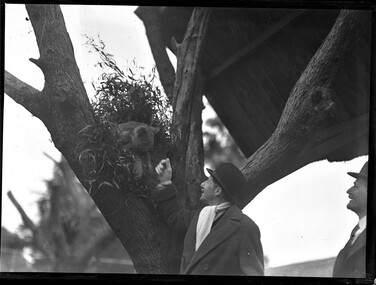
Photograph, Bull, Hugh Jones, 1897-1993, Vice-regal visit to zoo: Governor (Lord Huntingfield) and koala
... He first worked as a horticultural assistant to Government botanist Baron Ferdinand von Mueller at the Botanical Gardens at the age of 13, along with his older brother David. ...He first worked as a horticultural assistant to Government botanist Baron Ferdinand von Mueller at the Botanical Gardens at the age of 13, along with his older brother David. ...Published: (1934, June 26). The Age (Melbourne, Vic. : 1854 - 1954), p. 11. Published title: VICE-ROYALTY GREETS THE KING OF THE BEASTS AT THE ZOO. Published caption: Lord Huntingfield experienced a pleasant “induction ceremony” as Patron of the Royal Zoological and Acclimatisation Society yesterday, when he made a tour of the Zoological Gardens. The picture shows the Governor, accompanied by Lady Huntingfield, inspecting the King of Beasts, who is submitting to a little playful treatment from the Director of the Gardens, Mr. Wilkie, while the Director whispers in his ear that a distinguished visitor has come to see him. (Inset), is a picture of Lord Huntingfield greeting one of the Koalas. Trove article identifier: http://nla.gov.au/nla.news-article204818472 Description: A man wearing a hat, scarf and overcoat reaches up to pat a koala in a tree watched by a man in a hat and suit. Research by project volunteer, Fiona Collyer: In 1932, the Zoo built an Australian native animal enclosure which visitors could enter and closely view koalas, wallabies, kookaburras and magpies all placed together. The branches of the trees in the enclosure were cut so that visitors could easily see and feed the koalas sitting in them. The cost to feed each koala fresh gum leaves was fifteen shillings per week. By 1924, Queensland was the last stronghold in Australia for the koala. They were functionally extinct in South Australia, only a few hundred in NSW, and an estimated population of 1000 animals remained in Victoria. There had been a six-month open season on koalas in Queensland in 1919 where over a million had been slaughtered, however with its vast, dense forests it was impossible to accurately know their numbers. Koala fur is tough, warm and waterproof and was in high demand from consumers in Canada, Britain and the US to make hats and gloves and for lining greatcoats. In 1927, with Queensland suffering a crippling drought and high unemployment, the cash-strapped McCormack Labor Government declared an “Open Season” on koalas and “opossums” for their skins, for the month of August. (Possums were often called “opossums” at this time but they are actually possums). There were widespread protests from many groups including the Nature Lovers League, Wild Life Preservation Society of Australia, Queensland Museum, C.W.A. Royal Australian Ornithologist Union, Boy Scouts, religious and women’s groups. There were letters to newspapers from ordinary people, editorials and pleas to women to refuse to wear or purchase koala fur. People questioned the masculinity of koala hunters as it was felt that no proper bushman or sportsman would kill such a defenceless creature. The Brisbane Courier newspaper led the campaign, devoting six columns a day to “Spare the Bear”. Author Vance Palmer sent an impassioned letter to the editor of the The Brisbane Courier, 19 July 1927: “Sir- It is be hoped that the disgust which all humane people have felt at the declaration of an open season for native bears in August will not be allowed to fade away until some protest... so overwhelming and effective that the question will never be raised again. For the shooting of our harmless and loveable native bear is nothing less than barbarous. His case is entirely different from that of other furred animals. No one has ever accused him of spoiling the farmers’ wheat, eating the squatters’ grass or even spreading the prickly pear. There is not a social vice that can be put down to his account. In addition, he is comparatively defenceless. He affords no sport to the gunman, and can be trusted to present a sitting target to the creature mean enough to aim at him. For this reason he has been almost blotted out already from some areas, in days when our fauna and flora were held in such little regard that the settlers’ first instinct was to shoot every strange animal and to sink his axe into every unfamiliar tree.” The Anglican Archbishop of Brisbane, Gerald Sharp, had his letter published in The Brisbane Courier on 16 July 1927: “Sir... The extermination of fauna so distinctive of our country, especially of such harmless and pretty creatures as our native bears, seems to me a shameful thing, and this is likely to mean their extermination.” But it was all to no avail. Known as “Black August”, the government was unmoved by the public’s outrage. 10,000 licences were issued to hunters and “the slaughter of the innocents” went ahead. The newspapers were full of stories of dreadful cruelty against the helpless, benign creatures by the heartless hunters who not only used guns and spotlights but wire snares and cyanide baits so that pelts wouldn’t be damaged. Infant koalas were left orphaned and unlikely to survive without their mothers. Top quality pelts were sold at an average price of 56 shillings and 9 pence per dozen, poor quality skins for as little as 2 1/2 pence each. In December 1927, the Minister for Agriculture and Stock, Mr W. Forgan Smith told the Parliament that during the August open season 597,985 koala pelts worth £139,595 had netted the state’s coffers £6000. 952,194 “opossum” pelts were sold and £9000 made for the State. The backlash that followed helped topple the Queensland Labor Government in 1929. The Wild Life Preservation Society of Australia lobbied the Prime Minister Mr Stanley Bruce to refuse to issue exportation permits for koala pelts and from 10 November 1927 the Commonwealth Government suspended the issuing of permits. In 1930, the Society made a direct appeal to USA President Herbert Hoover and he signed an order prohibiting the importation of koala and wombat fur to USA, eliminating a major market. Koala pelts were often deliberately mislabelled “wombat” to get around restrictions. The ban most likely saved the koala from probable extinction. Three years later the Australian Federal Government banned the export of koala products. This movement against koala killing was really the first conservation campaign in Australia. It raised awareness of the vulnerability of a beloved animal and eventually brought about national parks and national laws for their protection. By 1936, community opposition to possum open seasons was beginning. The koala was made a Protected Species in all states in 1937, meaning no one is allowed to harm a koala, however the laws protecting the gum trees they rely on for food and shelter are weak. The Australian Government estimates the wild koala population in Australia is between 225,000 and 500,000 in 2024. The Australian Koala Foundation estimates the national population at less than 60,000 in 2021 with a 30% decline in three years. Habitat loss from land clearing, dog attacks, road deaths, chlamydia, bushfires and drought exacerbated by climate change, continues to cause their decline. Over eight million koalas were killed for their pelts between 1888 and 1927. Any one of the annual harvests killed more koalas than are alive now. At this time, children were also being taught to appreciate Australian native animals. In 1933, “Blinky Bill: The Quaint Little Australian” book for children was published by Angus and Robertson. It was written and illustrated by New Zealand-born author Dorothy Wall and “Dedicated to my son Peter and all other Peters and Johns and Bobs and Toms and Marys and Bettys and Joans and Pats and all kind children.” The book tells the story of Blinky Bill - a mischievous, patched knickerbocker-wearing koala and his mother and father. The story has messages of conservation and instances of human unkindness and cruelty. Mr. and Mrs. Koala and young Blinky lead a mostly idyllic family life amongst a variety of other animals in the forest. However it all changes in chapter two, when Blinky Bill’s father is distressingly shot by a hunter. There is a harrowing description of Mr. Koala’s shooting and eventual death. “The Koala family lived so happily; never thinking of harm, or that anything could happen to disturb their little home, as all they asked for were plenty of fresh gum-leaves and the warm sun. They had no idea such things as guns were in the world or that a human being had a heart so cruel that he would take a pleasure in seeing a poor little body riddled with bullets hanging helplessly from the tree-top... That same being might just as well take his gun and shoot baby kookaburras, so helpless were they all and so trusting.” “Poor Mr. Koala one day was curled up asleep in his favourite corner, when the terrible thing happened. Bang! He opened his eyes in wonder. What was that? Did the limb of the tree snap where that young cub of his was skylarking? ... bang! again. This time he felt a stinging pain in his leg... Peering over the bough of the tree he saw a man on the ground with something long and black in his arms... Another bang and his ear began to hurt. Bang! again and now his little body was stinging all over. He grunted loudly and slowly climbed up the tree, calling Mrs. Koala and Blinky as he went. He managed to reach the topmost branch... Tears were pouring down his poor little face. He brushed them away with his front paws and cried just like a baby. Fortunately Mrs. Koala and Blinky Bill were hiding in the leaves quite motionless, and the shadows of the tree made them appear as part of it. The man with the gun stood and waited a long time, then walked away, whistling as he went - the only sound to be heard in the bush except the cries of the little bear far up in the tree.” Blinky and his mother quietly and fearfully wait for Mr. Koala to wake. In the morning, grunting and crying, they feel his lifeless body with their paws. Eventually Mrs. Koala realises that her husband is dead and that they need to move to a safe place. After travelling deeper into the forest, Mrs. Koala and Blinky meet koalas Mrs. Grunty and her son Snubby and she describes how she was captured as a baby by koala fur trappers to be a pet for a little girl. The trapper forgot to bring gum leaves for the koala so they try to feed her cake, milk and bananas, making her sick. The little girl’s father relays something he read in the paper: “During the year 1920 to 1921, two hundred and five thousand six hundred and seventy-nine koalas were killed and their skins sold to the fur market, under the name of wombat.” They place the koala in a box with a teddy bear for company. The baby koala’s health deteriorates and the alarmed trapper returns her to the bush. Mrs. Grunty tells Mrs. Koala that she and Blinky are the only bears that she has seen for ten years: “I remember well the little girl’s father telling her... that not so many years ago the bush was alive with us bears, from Queensland to the south of Victoria. Now, we are so rare that we have become a curiosity, something to put in zoos, for children to see; and actually in museums. I believe our grandparents sit there in glass cases, stuffed with something inside to make them appear alive, and, oh dear, glass eyes. In New South Wales, I think we could wander for miles from one corner to another and never meet a bear. I don’t know why we were all killed. As you know, we don’t eat the farmers’ crop or ruin their orchards. All we asked for were our own gum-trees.” At the end of the book, Dorothy tells her readers - “The kindest action of all would be to leave the koala baby in his own bushland, among his own playmates, with the sun, the sky, the birds, and the gum-trees, where he will grow to manhood and live for many years - happy as he should be.” In 1934, a “Wild Zoo”, the Sir Colin Mackenzie Sanctuary, opened on 32 hectares of land, formerly part of Coranderrk Aboriginal Reserve in the Yarra Valley, exclusively displaying Australian native animals, birds and reptiles. It was later renamed Healesville Sanctuary and is now managed by Melbourne Zoo and home to over 200 species of Australian native fauna. The Sanctuary is committed to rescuing, breeding, researching and raising awareness of the vulnerability of Australian animals. Andrew Arthur Wellesley Wilkie, 1853-1948, was Director of the Melbourne Zoo from 1923 to 1936 and was associated with the zoo for 70 years. He first worked as a horticultural assistant to Government botanist Baron Ferdinand von Mueller at the Botanical Gardens at the age of 13, along with his older brother David. One of Andrew’s jobs was to capture moths for the National Herbarium. In 1857, a group of prominent Melburnians assembled at St. Patrick’s Hall to form the Zoological Society of Victoria, with the aim of introducing animals and plants from overseas. It was conceived, “For the purposes of science and for that of affording the public the advantages of studying the habits of the animal creation in properly arranged zoological gardens.” The Victorian Government granted 32 acres (13 hectares) of land to the Zoological Society at the southern end of Richmond Paddock on the opposite bank to the Botanical Gardens. (This is where AAMI Stadium and Collingwood Football Club now stand.) In 1861, the Zoological Society of Victoria was renamed The Acclimatisation Society of Victoria. Unfortunately the Yarra River frontage was damp, swampy and subject to flooding, so the animals were briefly housed at the Botanical Gardens until in 1862, the City of Melbourne donated 55 acres (22 hectares) of land at Royal Park for the fledgling zoo. Baron von Mueller secured employment at Royal Park for Andrew and David and they helped to lay out the gardens, plant trees and take care of a collection of deer, pheasants, hares and partridges. Initially the zoo was used for the acclimatisation of animals recovering from the long voyage to Australia and for breeding them for sport. In 1872, the zoo bought two lions, a leopard and a cheetah that had been seized from circus showmen Keith and Phillips when they were unable to pay the bill of butcher Mr T K Bennet of Bourke Street. The first zoo director, Mr. Albert Le Souef, negotiated with captains of ships to buy animals at overseas ports they visited and soon a multitude of exotic species arrived, including a ten-year-old Indian elephant in 1878. In 1923, after being head keeper for some years, Andrew was appointed director of the zoo. By 1933, the zoo had 110 different species of animals, 200 species of birds and 72 species of reptiles under Andrew’s care. He had personally planted all but six trees and laid out the garden beds. As director he lobbied authorities for funds to build more humane enclosures for the animals. In June 1928, Table Talk magazine wrote of Andrew Wilkie: “Up at the Zoo there is a humble gentleman who is a lion among the lions, who knows the proper specific to employ when the boa constrictor has chilblains, and who is a friend and confidant of Queenie the elephant. His fount of zoological lore has never been plumbed. It is bottomless, like his good fellowship and geniality. Every day he may be seen somewhere in the grounds of that growing sanctuary for the strange and arresting fauna and creeping things of the world, and I assure you as one who is privy to his passion that that area and its inhabitants are rarely out of his thoughts.” Andrew retired from the zoo in 1936 at the age of 83 and in 1948 died at his home in Brunswick aged 94. He and his wife Josephine had six children. The Victorian Acclimatisation Society was founded in 1861 by Edward Wilson, 1813-1878, then owner and editor of The Argus newspaper. He said that Australian indigenous animals were practically useless, providing only “a little sport and an occasional meal”. The Society believed that Australia’s plants and animals were vastly inferior to those in Europe. They wanted to introduce and acclimatise to Victoria “all innoxious animals, birds, fishes, insects and vegetables, whether useful or ornamental” for sport and for the table, and to spread indigenous animals and plants from the colony around the world. Their motto was “if it lives, we want it”. The Society was primarily responsible for introducing sparrows, starlings, sambar and hog deer, ostriches, brown trout, blackberries, and carp to the Murray River. They released the European songbirds, thrush and blackbird to quell the homesickness of British settlers. The Society also sent Australian animals like platypus, echidnas, kangaroos and koalas to Europe for scientific and novelty purposes. Thomas Austin, a wealthy sheep farmer of Barwon Park, Winchelsea (property now owned by the National Trust) was a member and in 1859 he introduced hares, blackbirds, thrushes and partridges onto his property. He is probably best known for introducing 24 breeding rabbits onto his estate as game for shooting parties. Thomas quipped, “The introduction of a few rabbits could do little harm and might provide a touch of home, in addition to a spot of hunting." In 2022, genomic data confirmed that Australia’s feral rabbit population is entirely descended from these rabbits. Biological control has brought the rabbit population down from an estimated high of 10 billion rabbits in the 1920s to approximately 200 million today, inhabiting 70% of Australian landmass (5.3 million square kilometres). In 1872, the Acclimatisation Society was renamed The Zoological and Acclimatisation Society of Victoria and they focused on importing exotic animals for display purposes to the zoo. In 1937, the Royal Acclimatisation Society of Victoria was recreated as the Zoological Board of Victoria with a focus on research of native animals threatened with extinction. In an editorial for The Argus newspaper, 16 March 1856, Edward Wilson lamented: "...this country has been shamelessly stolen from the blacks. Had they been like the New Zealanders or the North American Indians, we should have bought their land, and supplied them with the means of living when we took it... In less than twenty years we have nearly swept them off the face of the earth. We have shot them down like dogs. In the guise of friendship we have issued corrosion sublimate in their damper, and consigned whole tribes to the agonies of an excruciating death. We have made them drunkards, and infected them with disease which has rotted the bones of their adults, and made such few children as are born amongst them a sorrow and a torture from the very instant of their birth. We have made them outcasts on their own land, and are rapidly consigning them to entire annihilation. There are but a few of them left, comparatively. This is what we would do for that few. We would feed and clothe every one of them.” [Note: this last sentence is italicized in the original newspaper article text]. Lord Huntingfield, (William Charles Arcedeckne Vanneck) 1883-1969, Governor of Victoria 1934-1939, was a British Conservative Party politician and the first ever Australian-born Governor of an Australian state (although he was always considered British). He was patron of the Royal Zoological and Acclimatisation Society of Victoria and was acting Governor-General for six months during the absence of Lord Gowie in 1938. Lady Huntingfield (née Margaret Eleanor Crosby) 1884-1943, his American-born wife showed great interest in social welfare and the advancement of women and children. She was president of the City Newsboys Society and Patroness of the Girls Friendly Society. In 1937, rose breeder Alister Clark named a yellow hybrid tea rose for her. In 1940, the City of Melbourne opened the Lady Huntingfield Free Kindergarten in North Melbourne, now the Lady Huntingfield Early Learning and Family Services Centre. Lady Huntingfield died in London in 1943 after her house was bombed during a German airstrike. The Lady Huntingfield Memorial Scholarship was established after the City of Melbourne raised £1000 in a public appeal conducted in her memory for students undertaking a Social Work degree at the University of Melbourne. It is awarded annually to this day. The Queen Victoria Hospital named a bed in her honour. References: VICE-ROYALTY GREETS THE KING OF BEASTS AT THE ZOO. (1934, June 26). The Age (Melbourne, Vic. : 1854 - 1954), p. 11. Retrieved August 23, 2024, from http://nla.gov.au/nla.news-article204818472 Prominent Personalities ANDREW WILKIE (1928, June 7). Table Talk (Melbourne, Vic. : 1885 - 1939), p. 15. Retrieved August 29, 2024, from http://nla.gov.au/nla.news-article146562949 'Edward Wilson (journalist)', Wikipedia, https://en.wikipedia.org/wiki/Edward_Wilson_(journalist) 'Thomas Austin (pastoralist)', Wikipedia, https://en.wikipedia.org/wiki/Thomas_Austin_(pastoralist) 'The Acclimatisation Society was driven by misguided ideals about 'fixing nature' in Australia', ABC News, https://www.abc.net.au/news/2022-11-04/acclimatisation-society-introduced-species-history-listen/101588262?utm_campaign=abc_news_web&utm_content=link&utm_medium=content_shared&utm_source=abc_news_web Blinky Bill: the quaint little Australian (eBook); by Dorothy Wall, 1933, 2023, Project Gutenberg Australia, https://gutenberg.net.au/ebooks04/0400571h.html "Black August": Queensland's Open Season on koalas in 1927 (thesis); Glenn Fowler, 1993, Australian National University, https://www.savethekoala.com/wp-content/uploads/2018/11/Black-August.pdf Unfair game: Queensland's Open Season on koalas in 1927; Jacqui Donegan, 2000, University of Queensland, https://mesto-ku.narod.ru/koalas.pdf OPEN SEASON CONDEMNED. (1927, July 19). The Brisbane Courier (Qld. : 1864 - 1933), p. 15. Retrieved September 5, 2024, from http://nla.gov.au/nla.news-article21863465 COUNTRY WOMEN'S ASSOCIATION. (1927, July 30). The Brisbane Courier (Qld. : 1864 - 1933), p. 25. Retrieved September 20, 2024, from http://nla.gov.au/nla.news-article21866965 AUSTRALIA: Barnardo's children at Melbourne Park Zoo (1929), British Pathé, YouTube, https://www.youtube.com/watch?v=_Wcrbo_cHpI 'Kodak Cinegraph Compilation No 8', ACMI Collection, https://www.youtube.com/watch?v=MCrBng5RwFI KOALA SKINS. EXPORT BAN SOUGHT. (1927, August 4). The Brisbane Courier (Qld. : 1864 - 1933), p. 10. Retrieved September 15, 2024, from http://nla.gov.au/nla.news-article21868746 THE ABORIGINES. (1856, March 16). The Argus (Melbourne, Vic. : 1848 - 1957), p. 5. Retrieved September 28, 2024, from http://nla.gov.au/nla.news-article4833244 Koala Bears (1937), British Pathé, YouTube, https://www.youtube.com/watch?v=XbqgMtyuzwE Australian Koala Bear (Earliest Archive Footage: 1929), Pond5, https://www.pond5.com/stock-footage/item/152767491-australian-koala-bear-earliest-archive-footage-1929Photographer notations on slide: "Vice Regal visit to zoo B42".1930-1939, zoos, governors, koalas, conservation, possums, botanic gardens -
 City of Melbourne Libraries
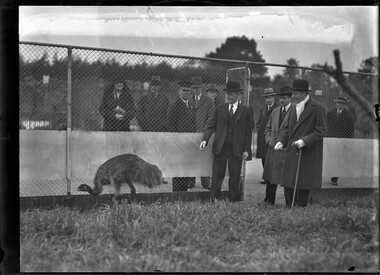
Photograph, Bull, Hugh Jones, 1897-1993, Vice-regal visit to zoo: Lord Huntingfield meets an emu
... He first worked as a horticultural assistant to Government botanist Baron Ferdinand von Mueller at the Botanical Gardens at the age of 13, along with his older brother David. ...He first worked as a horticultural assistant to Government botanist Baron Ferdinand von Mueller at the Botanical Gardens at the age of 13, along with his older brother David. ...Photographer notations on slide: "Vice Regal visit to Zoo B42" Not published. Description: A group of men and one woman all dressed in hats and overcoats stand by a wire fence while watching an emu. Research by project volunteer, Fiona Collyer: On 25 June 1934, new Victorian Governor, His Excellency Lord Huntingfield and his wife Lady Huntingfield made an official visit to the Melbourne Zoological Gardens in order to grant his patronage to the Royal Zoological and Acclimatisation Society. During the visit, zoo director Mr. Andrew Wilkie introduced them to some of the zoo’s inhabitants, including an emu. After the First World War, many returned soldiers took up the Government’s offer of land in the Soldier Settlement Scheme. Most of the veterans had little or no farming experience and much of the land offered was of poor quality, with blocks often too small to be viable. Many of the settlers had ongoing physical and mental injuries from the war. The Western Australian government allocated land to 5000 former soldiers but by 1929, one quarter of the men had already abandoned their land, unable to make a living. Not only was the world economy struggling with the Great Depression, but the settlers also had to contend with plummeting wheat and wool prices, crippling drought and rabbit infestation. The Scullin Government (Oct 1929-Jan 1932) had promised subsidies to the Western Australian farmers if they increased their wheat crops but were unable to pass the legislation in the Senate. The new Lyons Government (Jan 1932-April 1939) abandoned the legislation and the subsidies were never paid, bringing calls from Western Australia of secession from Australia. In October 1932, a deputation of soldier settlers from the Campion wheatbelt region in Western Australia, petitioned Commonwealth Minister for Defence, Western Australian Senator Sir George Pearce, for assistance. A mob of 20,000 emus were migrating to the coast after breeding and were gathering along the eastern side of the Number 1 Rabbit Proof Fence, attracted to the ripening crops and the dams the farmers had built. They were heading towards Campion, 303 kilometres east of Perth, eating and trampling the wheat, destroying the fences and letting the rabbits in. Having witnessed firsthand the effectiveness of machine guns in killing people in war, the former soldiers thought the guns would be ideal for killing emus. Sir George, wanting to demonstrate that his government was sympathetic to the settlers and hoping to quell Western Australian succession talk, agreed. However, he stipulated that no expense would be incurred by the Commonwealth Government and only active military personnel could use the machine guns. The farmers had to pay for the ammunition, food and accommodation for the military for the length of the operation. The cost for the ammunition was £50 for 10,000 rounds. Sir George also felt the operation would provide excellent target practice for the soldiers! The operation was headed by Major Gwynydd Purves Wynn-Aubrey Meredith, 1887-1975, of the Seventh Heavy Battery of the Royal Australian Artillery, and assisted by Sergeant S. McMurray and Gunner J. O'Halloran. They were equipped with two American-designed Lewis light machine guns and 10,000 rounds. Each magazine held 47 rounds of ammunition and the gun was capable of firing 500 to 600 rounds per minute with effective firing range of 800 metres. A cinematographer from British Movietone News accompanied the soldiers in order to record what was expected to be not only an easy victory but also useful propaganda for both the military and the Lyons Government. Emu (Dromaius novaehollandiae, meaning New Holland Racer) is a species of long-necked flightless bird endemic to Australia. The Tasmanian and the dwarf King and Kangaroo Island subspecies were hunted to extinction after the European settlement of Australia. It is the second largest bird in the world after the ostrich, standing up to 1.9 metres tall and weighing up to 50 kilograms. The Emu has long, powerful legs with three forward facing toes and is the only bird with calf muscles. It is able to jump 2.1 metres into the air and run 50 kilometres per hour. It communicates by drumming and booming through an inflatable neck sac which can be heard up to two kilometres away. Along with its tough hide and a body more feathers than flesh, the emu can be a tricky target. Emus had been a protected native species until 1922, when the government changed their status to “vermin” in response to the emus breaking down fences and destroying crops. Major Meredith told the press that Colonel Oswald V. Hoad of the 1st Cavalry Division NSW had especially requested he send 100 emu skins to replenish the plumage on his Light Horsemen’s hat tops. On the first day of the Emu War, 2 November 1932, Major Meredith spotted a mob of emus out of range of the guns, so he asked the farmers to use their vehicles to drive the emus towards the fence and the guns. The panicked birds split into small groups, kicking up the dust and scattering every which way. Only six were killed, though some were wounded. After that, the emus became very wary of humans. On 4 November, Major Meredith staged a dawn ambush at a dam. As 1000 emus approached to drink, the soldiers opened fire, killing 12 emus. After reloading, the gun jammed and the emus dispersed in all directions, and were not sighted again that day. The West Australian newspaper reported on 4 November 1932 that, “The emus have proved that they are not so stupid as they are usually considered to be. Each mob has its leader, always an enormous black-plumed bird standing fully six-feet high, who keeps watch while his fellows busy themselves with the wheat. At the first suspicious sign, he gives the signal, and dozens of heads stretch up out of the crop. A few birds will take fright, starting a headlong stampede for the scrub, the leader always remaining until his followers have reached safety.” In a later attempt, they mounted a gun onto the bed of a truck in order to chase and mow down the birds. However the truck couldn’t drive fast enough over the rough terrain and it was too bumpy to fire the gun accurately. The birds easily outran the truck except for one hapless emu who faltered while being chased and fell under the truck, its body wedging in the steering gear, causing the driver to crash the truck, and bringing down half a chain of the rabbit proof fence. RSPCA inspector Mr. Arthur Austin arrived with a rifle and knife in order to finish the work of the Lewis guns and dispatch injured emus. He said that while his society was sympathetic to the stricken settlers, he was anxious that wounded birds should not be left to suffer. Major Meredith told the inspector, “What speed can you run? You have to be better than Peter Pan if you want to catch wounded emus that make for the scrub.” (Racehorse “Peter Pan” had won the 1932 Melbourne Cup a few weeks earlier.) The commentator of the British Movietime newsreel uses a jocular tone to optimistically proclaim, “The scouts [emus] of the advancing army have keen eyesight, and in order to get close to the main body, our lads have to do some real stalking, with the enemy watching events through their periscopes raised up over the heads of corn... Instead of the birds ruining the farmers, tables are turned, there will be no more damage down here for many a day to come once the enemy is eliminated.” Emus proved tougher adversaries than expected, barely breaking stride even when badly injured from machine gun bullets, and the suspicious emus soon learnt to stay out of range of the men and their guns. Meanwhile, in the eastern states concern was being expressed about the cruelty of machine-gunning the native birds. Senator James Guthrie UAP of Victoria suggested that there must be “more humane, if less spectacular methods” of coping with the pests. People wrote letters to the newspapers to express their dismay at the inhumane methods used. R.F. Bellchambers from Humbug Scrub, 25 November 1932, lamented that, “At the present rate of extinctions, it will shortly be necessary to go to the Museum to see the remains of our fauna.” The Murchison Times published a letter on 16 November 1932 from “Clay Pan Joe”: “War on Emus. Slaughter of innocent birds would be more appropriate... The birds may be a nuisance and it may be necessary to destroy them, but why cause so much suffering amongst these innocent birds.” E.S. Playford of Norton’s Summit wrote to The Advertiser, 22 November 1932, that “...habitation on the earth would be impossible without bird life. Therefore, it is unwise to say that any bird is useless. Is sentiment dying? Are we so keen on personal gain that our lovely and unique birds have to be ruthlessly slaughtered in thousands and their bodies left rotting in the sun?” In Sydney, picture palace patrons expressed “considerable concern” after viewing the Movietone News newsreel of emus fleeing from the barrage of machine-guns, and wounded emus in the fields in Campion. The press had a field day, dubbing it the “The Emu War” and joking that the “Chicago method” was being used against the feathered foe. The Daily News newspaper published a cartoon depicting the emus outrunning and outsmarting the soldiers. In Parliament NSW Senator James Dunn called Sir George the “Minister for the Emu War”. Labor member Mr. Rosevear, midst great laughter, asked if the minister would consider declaring an armistice and withdrawing his troops from the Western Front. Prime Minister Joe Lyons was asked if medals would be struck for those taking part in the war. Labor parliamentarian Mr. A.E. Green declared any medals should go to the emus who had “won every round so far”. With the embarrassing press coverage and poor results, Sir George ordered a stop to the project on 9 November, and Major Meredith and the soldiers departed for Perth. The WA Premier Sir James Mitchell and the Campion farmers demanded they return, citing the continued destruction of crops and fences by the emus. Major Meredith and his two gunners were allowed to return on 13 November and seemingly having learnt from their previous experiences, had slightly more success this time killing emus. The operation finally finished on 10 December with Major Meredith reporting “definite kills” of 986 emus for 9860 rounds of ammunition, coincidentally and conveniently exactly 10% of the number of rounds used. A further 2500 birds were said to have died from their injuries and although this is a disputed figure, even if accurate, the ratio of rounds expended to emu casualties was thought too high to justify continuing. The operation barely caused a dint in the marauding mob of 20,000 emus. “There’s only one way to kill an emu”, one of the party bitterly remarked: “Shoot him through the back of the head when his mouth is closed or through the front of his mouth when his mouth is open. That’s how hard it is.” Australian ornithologist Dominic L. Serventy noted that “The machine-gunners’ dreams of point blank fire into serried masses of Emus were soon dissipated. The Emu command had evidently ordered guerrilla tactics, and its unwieldy army soon split up into innumerable small units that made use of the military equipment uneconomic. A crestfallen field force therefore withdrew from the combat area after about a month.” Major Meredith expressed the greatest of respect for the enemy. He said, “If we had a military division with the bullet-carrying capacity of these birds, it would face any army in the world. They could face machine guns with the invulnerability of tanks. They are like Zulus, whom even dum dum bullets would not stop." The Major’s official report stated that there were no human casualties in “The Emu War.” Emus are considered the victors of “The Great Emu War.” Western Australian farmers requested military assistance in 1934, 1943 and 1948, including using bombs, but the government refused. The bounty system instigated in 1923 continued, with farmers using rifles against their fleet-footed foe, with 57,034 bounties for dead emus claimed in six months in 1934 in Western Australia alone. 284,704 emus were killed in Western Australia between 1945 and 1960. The other most effective defence against the emus was the construction of a robust, vermin proof fence spanning over a long distance. Emus were formally protected in 1999 by the Environment Protection and Biodiversity Conservation Act. It’s estimated there are between 625,000 to 725,000 wild emus in Australia in 2024. An emu and a kangaroo feature on Australia’s coat of arms, holding up a shield illustrated with symbols of the six states. The animals symbolise the nation moving forward as neither animal can walk backwards. Campion is now a ghost town. A book about the operation, “Letters from the Emu War” by J.A. Bryden was published in 2023 by Playtime Books. In 2024, an Australian film called “The Emu War” was released, starring Damian Callinan and Luke McGregor. Andrew Arthur Wellesley Wilkie, 1853-1948, was Director of the Melbourne Zoo from 1923 to 1936 and was associated with the zoo for 70 years. He first worked as a horticultural assistant to Government botanist Baron Ferdinand von Mueller at the Botanical Gardens at the age of 13, along with his older brother David. One of Andrew’s jobs was to capture moths for the National Herbarium. In 1857, a group of prominent Melburnians assembled at St. Patrick’s Hall to form the Zoological Society of Victoria, with the aim of introducing animals and plants from overseas. It was conceived, “For the purposes of science and for that of affording the public the advantages of studying the habits of the animal creation in properly arranged zoological gardens.” The Victorian Government granted 32 acres (13 hectares) of land to the Zoological Society at the southern end of Richmond Paddock on the opposite bank to the Botanical Gardens. (This is where AAMI Stadium and Collingwood Football Club now stand.) In 1861, the Zoological Society of Victoria was renamed The Acclimatisation Society of Victoria. Unfortunately the Yarra River frontage was damp, swampy and subject to flooding, so the animals were briefly housed at the Botanical Gardens until in 1862, the City of Melbourne donated 55 acres (22 hectares) of land at Royal Park for the fledgling zoo. Baron von Mueller secured employment at Royal Park for Andrew and David and they helped to lay out the gardens, plant trees and take care of a collection of deer, pheasants, hares and partridges. Initially the zoo was used for the acclimatisation of animals recovering from the long voyage to Australia and for breeding them for sport. In 1872, the zoo bought two lions, a leopard and a cheetah that had been seized from circus showmen Keith and Phillips when they were unable to pay the bill of butcher Mr T K Bennet of Bourke Street. The first zoo director, Mr. Albert Le Souef, negotiated with captains of ships to buy animals at overseas ports they visited and soon a multitude of exotic species arrived, including a ten-year-old Indian elephant in 1878. In 1923, after being head keeper for some years, Andrew was appointed director of the zoo. By 1933, the zoo had 110 different species of animals, 200 species of birds and 72 species of reptiles under Andrew’s care. He had personally planted all but six trees and laid out the garden beds. As director he lobbied authorities for funds to build more humane enclosures for the animals. In June 1928, Table Talk magazine wrote of Andrew Wilkie: “Up at the Zoo there is a humble gentleman who is a lion among the lions, who knows the proper specific to employ when the boa constrictor has chilblains, and who is a friend and confidant of Queenie the elephant. His fount of zoological lore has never been plumbed. It is bottomless, like his good fellowship and geniality. Every day he may be seen somewhere in the grounds of that growing sanctuary for the strange and arresting fauna and creeping things of the world, and I assure you as one who is privy to his passion that that area and its inhabitants are rarely out of his thoughts.” Andrew retired from the zoo in 1936 at the age of 83 and in 1948 died at his home in Brunswick aged 94. He and his wife Josephine had six children. The Victorian Acclimatisation Society was founded in 1861 by Edward Wilson, 1813-1878, then owner and editor of The Argus newspaper. He said that Australian indigenous animals were practically useless, providing only “a little sport and an occasional meal”. The Society believed that Australia’s plants and animals were vastly inferior to those in Europe. They wanted to introduce and acclimatise to Victoria “all innoxious animals, birds, fishes, insects and vegetables, whether useful or ornamental” for sport and for the table, and to spread indigenous animals and plants from the colony around the world. Their motto was “if it lives, we want it”. The Society was primarily responsible for introducing sparrows, starlings, sambar and hog deer, ostriches, brown trout, blackberries, and carp to the Murray River. They released the European songbirds, thrush and blackbird to quell the homesickness of British settlers. The Society also sent Australian animals like platypus, echidnas, kangaroos and koalas to Europe for scientific and novelty purposes. Thomas Austin, a wealthy sheep farmer of Barwon Park, Winchelsea (property now owned by the National Trust) was a member and in 1859 he introduced hares, blackbirds, thrushes and partridges onto his property. He is probably best known for introducing 24 breeding rabbits onto his estate as game for shooting parties. Thomas quipped, “The introduction of a few rabbits could do little harm and might provide a touch of home, in addition to a spot of hunting." In 2022, genomic data confirmed that Australia’s feral rabbit population is entirely descended from these rabbits. Biological control has brought the rabbit population down from an estimated high of 10 billion rabbits in the 1920s to approximately 200 million today, inhabiting 70% of Australian landmass (5.3 million square kilometres). In 1872, the Acclimatisation Society was renamed The Zoological and Acclimatisation Society of Victoria and they focused on importing exotic animals for display purposes to the zoo. In 1937, the Royal Acclimatisation Society of Victoria was recreated as the Zoological Board of Victoria with a focus on research of native animals threatened with extinction. In an editorial for The Argus newspaper, 16 March 1856, Edward Wilson lamented: "...this country has been shamelessly stolen from the blacks. Had they been like the New Zealanders or the North American Indians, we should have bought their land, and supplied them with the means of living when we took it... In less than twenty years we have nearly swept them off the face of the earth. We have shot them down like dogs. In the guise of friendship we have issued corrosion sublimate in their damper, and consigned whole tribes to the agonies of an excruciating death. We have made them drunkards, and infected them with disease which has rotted the bones of their adults, and made such few children as are born amongst them a sorrow and a torture from the very instant of their birth. We have made them outcasts on their own land, and are rapidly consigning them to entire annihilation. There are but a few of them left, comparatively. This is what we would do for that few. We would feed and clothe every one of them.” [Note: this last sentence is italicized in the original newspaper article text]. Lord Huntingfield, (William Charles Arcedeckne Vanneck) 1883-1969, Governor of Victoria 1934-1939, was a British Conservative Party politician and the first ever Australian-born Governor of an Australian state (although he was always considered British). He was patron of the Royal Zoological and Acclimatisation Society of Victoria and was acting Governor-General for six months during the absence of Lord Gowie in 1938. Lady Huntingfield (née Margaret Eleanor Crosby) 1884-1943, his American-born wife showed great interest in social welfare and the advancement of women and children. She was president of the City Newsboys Society and Patroness of the Girls Friendly Society. In 1937, rose breeder Alister Clark named a yellow hybrid tea rose for her. In 1940, the City of Melbourne opened the Lady Huntingfield Free Kindergarten in North Melbourne, now the Lady Huntingfield Early Learning and Family Services Centre. Lady Huntingfield died in London in 1943 after her house was bombed during a German airstrike. The Lady Huntingfield Memorial Scholarship was established after the City of Melbourne raised £1000 in a public appeal conducted in her memory for students undertaking a Social Work degree at the University of Melbourne. It is awarded annually to this day. The Queen Victoria Hospital named a bed in her honour. References: VICE-ROYALTY GREETS THE KING OF BEASTS AT THE ZOO. (1934, June 26). The Age (Melbourne, Vic. : 1854 - 1954), p. 11. Retrieved August 23, 2024, from http://nla.gov.au/nla.news-article204818472 Prominent Personalities ANDREW WILKIE (1928, June 7). Table Talk (Melbourne, Vic. : 1885 - 1939), p. 15. Retrieved August 29, 2024, from http://nla.gov.au/nla.news-article146562949 'Edward Wilson (journalist)', Wikipedia, https://en.wikipedia.org/wiki/Edward_Wilson_(journalist) 'Thomas Austin (pastoralist)', Wikipedia, https://en.wikipedia.org/wiki/Thomas_Austin_(pastoralist) 'The Acclimatisation Society was driven by misguided ideals about 'fixing nature' in Australia', ABC News, https://www.abc.net.au/news/2022-11-04/acclimatisation-society-introduced-species-history-listen/101588262?utm_campaign=abc_news_web&utm_content=link&utm_medium=content_shared&utm_source=abc_news_web THE ABORIGINES. (1856, March 16). The Argus (Melbourne, Vic. : 1848 - 1957), p. 5. Retrieved September 28, 2024, from http://nla.gov.au/nla.news-article4833244 WAR ON EMUS. (1932, November 4). The West Australian (Perth, WA : 1879 - 1954), p. 12. Retrieved September 29, 2024, from http://nla.gov.au/nla.news-article32588972 'The Great Emu War: how it started and who won', ABC Australia, https://www.youtube.com/watch?v=Y1wA0PKeJqc Advertising (1932, November 25). The West Australian (Perth, WA : 1879 - 1954), p. 2. Retrieved October 26, 2024, from http://nla.gov.au/nla.news-article32584578 Emu Chasers Must Outstrip Peter Pan (1932, November 9). The Labor Daily (Sydney, NSW : 1924 - 1938), p. 5. Retrieved October 10, 2024, from http://nla.gov.au/nla.news-article237042749 WAR ON EMUS (1932, November 22). The Advertiser (Adelaide, SA : 1931 - 1954), p. 18. Retrieved October 15, 2024, from http://nla.gov.au/nla.news-article73997254 WAR ON EMUS. (1932, October 28). The Labor Daily (Sydney, NSW : 1924 - 1938), p. 6. Retrieved October 24, 2024, from http://nla.gov.au/nla.news-article237046601 EMU WAR (1932, December 3). Mirror (Perth, WA : 1921 - 1956), p. 7. Retrieved October 24, 2024, from http://nla.gov.au/nla.news-article75626301 Machine Gun Offensive Against Emus. (1932, November 10). Western Mail (Perth, WA : 1885 - 1954), p. 3 (PICTORIAL SECTION). Retrieved October 24, 2024, from http://nla.gov.au/nla.news-article37766670 A THOUSAND BIRDS IN LUCK. (1932, November 10). Western Mail (Perth, WA : 1885 - 1954), p. 28. Retrieved October 11, 2024, from http://nla.gov.au/nla.news-article37766849 New Strategy In A War On The Emu (1953, July 5). The Sunday Herald (Sydney, NSW : 1949 - 1953), p. 13. Retrieved October 11, 2024, from http://nla.gov.au/nla.news-article18516559 This is a nice emu-that was! (1932, November 5). The Daily News (Perth, WA : 1882 - 1955), p. 9 (HOME EDITION). Retrieved September 30, 2024, from http://nla.gov.au/nla.news-article82878309 LOCAL AND GENERAL (1932, November 16). The Murchison Times (Cue, WA : 1924 - 1937), p. 2. Retrieved October 14, 2024, from http://nla.gov.au/nla.news-article257500260 Taking Him for a Ride! (1932, October 13). The Daily News (Perth, WA : 1882 - 1955), p. 6 (HOME EDITION). Retrieved September 30, 2024, from http://nla.gov.au/nla.news-article83717338 'The Emu War', History Nuggets, https://historynuggets.squarespace.com/nuggets/2018/4/21/the-emu-war New Strategy In A War On The Emu (1953, July 5). The Sunday Herald (Sydney, NSW : 1949 - 1953), p. 13. Retrieved October 23, 2024, from http://nla.gov.au/nla.news-article18516559 'This is the story of how Australia went to war with emus and lost', First Dog on the Moon, https://www.theguardian.com/commentisfree/2018/jul/26/this-is-the-story-of-how-australia-went-to-war-with-emus-and-lost Photographer notations on slide: "Vice Regal visit to Zoo B42"emu wars, governors, melbourne zoo, city of melbourne, 1930-1939, hunting, lord huntingfield, lady huntingfield, royal park, animals, wildlife -
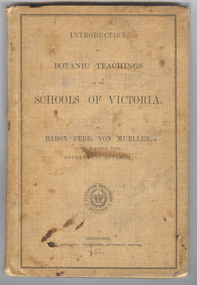 Federation University Historical Collection
Book, Ferdinand von Mueller, Introduction to Botanic Teachings at the Schools of Victoria, 1877, 1877 (exact)
... Baron von Mueller took a practical role the development of SMB's Botanical Gardens from the beginning. ...Baron von Mueller took a practical role the development of SMB's Botanical Gardens from the beginning. ...Ferdinand von Mueller was an examiner of botany at the Ballarat School of Mines (SMB) between 1880 and 1888. During that era he was active in donating related items to the School. When the Ballarat School of Mines Council agreed to introduce pharmacy and botany classes in 1879, it was apparent students would require access to botanical specimens in order to further their studies. Council members, who were inspired by the work of Baron Ferdinand von Mueller, authorised development of an area along the School's northern boundary, fronting Lydiard Street South, and oversaw the establishment of the new Botanical Gardens. Baron von Mueller took a practical role the development of SMB's Botanical Gardens from the beginning. He became a generous benefactor who 'donated collections of seeds and leguminous fodder plants, including valued grasses of interest and use to agriculturalists and graziers generally' to SMB over many years. Ferdinand von Mueller's entry on the University of Ballarat Honour Roll can be found at http://www.ballarat.edu.au/curator/honour-roll/honourroll_von_mueller.shtml A light brown, hardcovered book of 152 pages. Chapters include Eucalyptus Trees; Wattles or Acacias; Casuarinas or Sheoaks; Cypress Pines or Sandarac trees; Exocarpos trees of Natice Cherry trees; Mistletoes; Native Honeysuckles or Banksias; Bellflower, Lobelia and Goodenia; Heaths; Correas; Mallow; Buttercups and Clematis; Cruciferous Plants; Mints; Orchids; grasses; ferns. The book has numerous botanical line drawings, and a comprehensive index.Inside front cover "J. Clement Souter M.D."victorian, schools, botany, ferdinand von mueller, von mueller, botanic illustrations, j. clement souter -
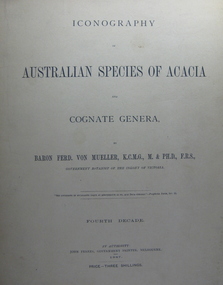 Federation University Historical Collection
Book, Baron Ferdinand Von Mueller, Iconography of Australian Species of Acacia and Cognate Genera by Ferdinand Von Mueller
... Baron von Mueller took a practical role the development of SMB's Botanical Gardens from the beginning. ...Baron von Mueller took a practical role the development of SMB's Botanical Gardens from the beginning. ...Ferdinand von Mueller was an examiner of botany at the Ballarat School of Mines (SMB) between 1880 and 1888. During that era he was active in donating related items to the School. When the Ballarat School of Mines Council agreed to introduce pharmacy and botany classes in 1879, it was apparent students would require access to botanical specimens in order to further their studies. Council members, who were inspired by the work of Baron Ferdinand von Mueller, authorised development of an area along the School's northern boundary, fronting Lydiard Street South, and oversaw the establishment of the new Botanical Gardens. Baron von Mueller took a practical role the development of SMB's Botanical Gardens from the beginning. He became a generous benefactor who 'donated collections of seeds and leguminous fodder plants, including valued grasses of interest and use to agriculturalists and graziers generally' to SMB over many years. Ferdinand von Mueller's entry on the University of Ballarat Honour Roll can be found at http://www.ballarat.edu.au/curator/honour-roll/honourroll_von_mueller.shtml Large format, brown, soft covered books with beautiful line drawings. Set contains 6 of 13 parts, Part 1 covers the fourth decade, Part 2 the fifth decade, Part 3 the eight decade, Part 4 the ninth decade, Part 5 the tenth decade and Part 6 the eleventh decade.botany, ferdinand von mueller, von mueller, botanic illustrations, government botanist, acacia -
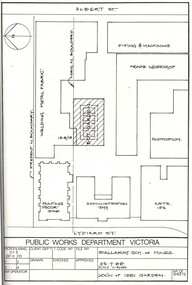 Federation University Historical Collection
Booklet, D. Wixted, Garden at School of Mines and Industries Ballarat: Conservation Analysis, 1988, 07/1988
... von mueller...von mueller...ferdinand von mueller...joseph flude...materia medica...botany...system garden...In February 1881 George Porter Day was appointed gardener at a rate of 17 pounds and ten shillings per annum. ballarat school of mines botanical gardens ballarat school of mines george day george porter day james oddie baron von mueller von mueller ferdinand von mueller joseph flude materia medica botany system garden ferdinand krause field club and science society pharmacy alfred mica smith Some words have been highlighted in orange. ...The Ballarat School of Mines Botanical Garden was established in 1879, and was used by students of botany and materia medica. In February 1881 George Porter Day was appointed gardener at a rate of 17 pounds and ten shillings per annum. Yellow covered stapled report of 20 pages. Includes information about the establishment of the Ballarat School of Mines, plans of ground and buildings (1880, 1881, 1903 and 1988), Botany subjects, history of the garden, the garden in 1988.Some words have been highlighted in orange.ballarat school of mines botanical gardens, ballarat school of mines, george day, george porter day, james oddie, baron von mueller, von mueller, ferdinand von mueller, joseph flude, materia medica, botany, system garden, ferdinand krause, field club and science society, pharmacy, alfred mica smith -
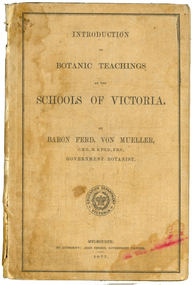 Federation University Historical Collection
Book, Ferdinand Von Mueller, Introduction to Botanic Teachings at the Schools of Victoria, 1877
... Baron von Mueller took a practical role the development of SMB's Botanical Gardens from the beginning. ...Baron von Mueller took a practical role the development of SMB's Botanical Gardens from the beginning. ...Ferdinand von Mueller was an examiner of botany at the Ballarat School of Mines (SMB) between 1880 and 1888. During that era he was active in donating related items to the School. When the Ballarat School of Mines Council agreed to introduce pharmacy and botany classes in 1879, it was apparent students would require access to botanical specimens in order to further their studies. Council members, who were inspired by the work of Baron Ferdinand von Mueller, authorised development of an area along the School's northern boundary, fronting Lydiard Street South, and oversaw the establishment of the new Botanical Gardens. Baron von Mueller took a practical role the development of SMB's Botanical Gardens from the beginning. He became a generous benefactor who 'donated collections of seeds and leguminous fodder plants, including valued grasses of interest and use to agriculturalists and graziers generally' to SMB over many years. Ferdinand von Mueller's entry on the University of Ballarat Honour Roll can be found at http://www.ballarat.edu.au/curator/honour-roll/honourroll_von_mueller.shtml Also See Cat. No. 12062A light brown, hardcovered book of 152 pages. Chapters include Eucalyptus Trees; Wattles or Acacias; Casuarinas or Sheoaks; Cypress Pines or Sandarac trees; Exocarpos trees of Natice Cherry trees; Mistletoes; Native Honeysuckles or Banksias; Bellflower, Lobelia and Goodenia; Heaths; Correas; Mallow; Buttercups and Clematis; Cruciferous Plants; Mints; Orchids; grasses; ferns. The book has numerous botanical line drawings, and a comprehensive index.Inside front cover "Botanist, Teacher, researcher. My you make your mark like the baron. Best wishes for your birthday 1999 Martin"victorian, schools, botany, ferdinand von mueller, von mueller, botanic illustrations, flora, change number -
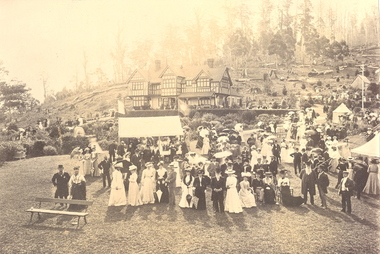 Federation University Historical Collection
Photograph - Photograph - Black and White, Meeting for the Australian Association for the Advancement of Science, Hobart, 1892, 1892
... Von Muellor. In the afternoon Lady Hamilton gave a garden party at Government House to 600 guests, including the members of the association, the Judges, the members of the Ministry, and leading citizens." (Newcastle Morning Herald & Miners' Advocate, 9 January 1892.) australasian association for the advancement of science hobart oddie james oddie martell von mueller baldwin spencer lorimer fison robert giffen napier bell arthur day dobson henry dobson Two sepia photographs mounted onto charcoal mount. ...Newspaper reports relating to the Australasian Association for the Advancement of Science, Hobart, 1892. "Australasian Association for the advancement OF SCIENCE. Several members of the Australasian Association for the Advancement of Science arrived in the city yesterday by the inter colonial steamers, some of whom went direct to Hobart, while others remained in the city, but leave for the capital this afternoon. Amongst those who arrived were Baron Von Mueller, the dis tinguished scientist, who has taken some interest in this colony's re sources, Professor W. Baldwin Spencer, M.A., professor of biology at the Melbourne University, who was general secretary at the Melbourne meeting; the Rev. Lorimer Fison, an able worker in the South Sea mission fields; Dr. Robert Giffen, L.L.D., C.ll.; Captain Pascoe, R.N.; Mr Napier Bell, C.E.; Professors Hutton, Nerich, Smith, and Morris, and Mr Richard Teece, F.T.A., the well-known actuary of the A.M.P. Society. A large number of other distinguished members also arrived. Judge Dorkerwho also arrived, was con ducted over the Exhibition in the after noon, and expressed pleasure with what he saw. His Honor leaves by express train to-day for Hobart. The hon. Dr. Campbell was met by Mr Arthur Day, the official agent for Great Britain to the Exhibition, an old friend, who conducted him over the Exhibition. The doctor confined his attention principally to the dry ore concentrator, in which he takes a great interest. He will, however, visit the Exhibition again after the meetings in Hobart has been brought to a termination. What he has seen of the Exhibition has impressed him favourably. (Launceston Advertiser, 6 January 1892.) "TASMANIA. AUSTALASIAN ASSOCIATION FOR THE ADVANCEMENT OF SCIENCE. The fourth congress of the Australasian Association for the Advancement of Science was commenced in Hobart at 11. o'olock on Thursday by the general Council assembling at the Royal Society's rooms, at the Museum. There was a good attendance, including the Governor, Sir B. G. Hamilton. In the absence of the president, Sir James Hector, the chair was occupied by Baron Von Muellor. In the afternoon Lady Hamilton gave a garden party at Government House to 600 guests, including the members of the association, the Judges, the members of the Ministry, and leading citizens." (Newcastle Morning Herald & Miners' Advocate, 9 January 1892.)Two sepia photographs mounted onto charcoal mount. A group of men in hats and coats, and women in hats and long dresses assemble in front of a double story building, thought to be Henry Dobson's of Ferntree near Hobart. In the background stumps of large trees are evident. The event was a garden party held in for members of the Australasian Association for the Advancement of Science who met in Hobart in 1892. .1 F.J. Martell of the Ballarat School of Mines is seated between two women in the right hand foreground. James Oddie, with white beard and top hat, is standing in the centre foreground between two women. .2) James Oddie is standing with cane in hand on the right of the bench in the foreground of the photo. australasian association for the advancement of science, hobart, oddie, james oddie, martell, von mueller, baldwin spencer, lorimer fison, robert giffen, napier bell, arthur day, dobson, henry dobson -
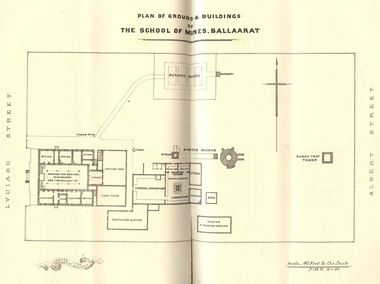 Federation University Historical Collection
Booklet, Charles Boyd, The School of Mines Ballaarat Annual Report, 1882, 1882
... Bickett James Bickett fees Annie Barnett Annette Budden Isabel Clinton John Dimsey Agnes Pobjoy Charlotte Shaw Bernard O'Dowd Bernard Patrick O'Dowd josiah Wasley Ferdinand Von Mueller William Kernot John Lynch William henderson Henry Richards Caselli W.P. Berchervaise E.I. Rosenblum W.H. Nicholls lignate Samuel Figgis Mary Drury W. Longley Botanical reserve botanical gardens ...The School of Mines Ballaarat Annual Report 24 January 1882, Additional Examination Statute, Certificates Granted by Council, Copy of letter received from the Honble. Francis Ormond MLC, Extracts from Visitors' Book, Fees, Form of Bequest, Life Governors, Museum open to Visitors, Office Bearers, Paper of Particulars, Report of the Curator of the Museum and Library (with plans), Report of the Superintendent of Laboratories, Report of the Lecturer in Telegraphy, Report of the Lecturer in Mechanical Engineering, Statement of Receipts and Expenditure for the year 1881, Subjects and Lecturers, Subjects and Examiners, Subscriptions and Donations from 1 January to 31 December 1881, The Lignite Deposit at Skipton (with Section and Plan)Ballarat School of Mines Annual Report. Pale brown booklet of 64 pages. A plan of the Ballarat School of Mines shows the position of the Botanical Gardens, and the Ballarat School of Mines Museum. Geological Sketch Map of Country in the Neighbourhood of Skipton and Plan showing site of Coal Discovery. Skipton Coal Discovery - Section of Windlass Shaft. .2) is a leatherbound copyballarat school of mines, coal, plan, ballarat school of mines botanical gardens, ballarat school of mines museum, museum, annual report, james oddie, w. p. bechervaise, s. e. friggis, f. j. martell, w. h. nicholls,, e. i. rosenblum, h. r. caselli, thomas mann, theos. williams, f. m. krause, alf. mica smith, walter d. campbell, w. h. shaw, charles kent, andw. berry, robert adam, wm. lant carpenter, henry parkinson, h. b. de la poer wall, w. h. brockenshire, arthur parker, c. davies, simon richards, c. r. blackett, david jones, wilberforce dyke, kr. r. krauel, duncan love, william ralph heaton, edward dowling, octavius vaughan morgan, william denton, e. h. grimwade, james hunter, the honble. francis ormond, ferdinand krause, a.a. buley, j. cosmo newberry, w.c. kernot, john lewis, j.m. bickett, james bickett, fees, annie barnett, annette budden, isabel clinton, john dimsey, agnes pobjoy, charlotte shaw, bernard o'dowd, bernard patrick o'dowd, josiah wasley, ferdinand von mueller, william kernot, john lynch, william henderson, henry richards caselli, w.p. berchervaise, e.i. rosenblum, w.h. nicholls, lignate, samuel figgis, mary drury, w. longley, botanical reserve, botanical gardens, francis ormond, george russell, william foster stawell, w.j. clarke, rivett henry bland, john warrington rogers, j. lonie, s.e. figgis, r.f. hudson, w. robertson, e.l. rosenblum, theophilus williams, andrew berry, henry sutton, h. rosales, state school classes, calcutta international exhibition, examinations, h.b.m ship bounty, certicates, walter charles kernot, william tunbridge, mary skelton, cartherine moran, mary rose usher, margaret ellen brophy, william burbridge, andrea tuxen, elizabeth curnow, francis campigi, james s. morrison, arthur hogue -
 Federation University Historical Collection
Book - Ledger, Ballarat School of Mines Donation Book, 1878 - 1895, 1878-1895
... The Museum was emptied in the 1960s with items being distrubuted to the Ballarat Historical Society, returned to original lenders (ie Pern Collection), of disposed of. ballarat school of mines doantions museum ballarat school of mines museum safety cage botanical garden materia medica garden library bella guerin james oddie phoenix foundry w.h. shaw john lynch henry sutton aboriginal stone axe tomahawk geological specimens moonta fedinand krause oddie collection of minerals thomas bath spears Solomon Islands King Billy bows and arrows ancient coins birds eggs snakes Donations to the Ballarat School of Mines include:
34. M. Hamburger, Ballarat - bunsen burner
41. W.H. Shaw, Phoenix Foundry - 81 nos of 'Engineer'
89. Juvenile Industrial Exhibition Association Committee per Joseph Flude - dies used for striking medals awarded to successful exhibits.
165. Ferdinand Von Mueller ...The Donation Book relates to the Ballarat School of Mines Museum which opened in 1872. Very few of these items are still held by Federation University. The Museum was emptied in the 1960s with items being distrubuted to the Ballarat Historical Society, returned to original lenders (ie Pern Collection), of disposed of. Donations to the Ballarat School of Mines include: 34. M. Hamburger, Ballarat - bunsen burner 41. W.H. Shaw, Phoenix Foundry - 81 nos of 'Engineer' 89. Juvenile Industrial Exhibition Association Committee per Joseph Flude - dies used for striking medals awarded to successful exhibits. 165. Ferdinand Von Mueller 172 Ferdinand Von Mueller o hortus siccus 6 197. James Stoddart 203. Edward Gazzard, North Creswick - Model of safety Cage invented and made by donor 218. E. Morey 222. Alfred Lestor 228. J.J. Sleep, Ballarat, patent Lever escarpment Clock (displayed in laboratories) 237. Bernard Smith (Warden) per favor of James M. Bickett - Bust of Mr John Lynch, Smythesdale. (Note: This item is not in the present Federation University Historical Collection) 241. James Oddie, J.P., Ballarat, Copy of 'the Chemist and Druggist' 267. John Lynch Junior, Smythesdale - Cast of "Golden Age" nugget, found at Browns by Co-operative party, 12 men. Weight 75 oz, 12 dwts, 12 grs.(Note: This item is not in the present Federation University Historical Collection) 270. Isaac Davis, Main Road, Ballarat 294. W. H. Shaw, Ballarat - 94 nos of 'The Engineer' 295. Rivett Henry Bland, Clunes - Specimen of water pipe from the Port Phillip Company's mine encrusted with carbonites of lime and magnesium (Note: This item is not in the present Federation University Historical Collection) 299. D.J. Williams, Queenscliff - 1 case shells from Fiji 305. C. Retallack, Ballarat 314. William Henry Shaw, Ballarat - glass case 323. W. Longley, Ballarat - Botanical Specimen (Note: This item is not in the present Federation University Historical Collection) 327. W. H. Angove, Perth 337. J. Cosmo Newbery, B Sc, Melbourne 343. James Hector, M.D., New Zealand 353. R.S. Mitchell, Ballarat - 8 specimens live plants (medicinal) (for the Ballarat School of Mines Garden) 355. W. Magee, Ballarat - Sugar cane plants and seeds (for the Ballarat School of Mines Garden) 363. James Hector, Wellington, new Zealand 371. William Wesley, 28 Essex St, Strand, London - Scientific book circular 380. Jacob Upfold (deceased) per favor of the trustees - bequest of steam engine indicator and belongings (boothe and case) 381. Joseph Mitchell, 22 Macarthur Street, Ballarat - sod of turf cut from Warboy's High Few, County Huntingdon, England, 1872. 394. W.H. Barnard 401. James Orr 418. F. Ratte, Sydney 440. Alfred Mica Smith, Sandhurst (Bendigo), Inaugural Address, delivered to the Bendigo School of Mines Science Society, June 20. 1881 by P.H. Macgillivray, MA, MRCS, FLS, President. (Note: This item is not in the present Federation University Historical Collection) (Note: This item is not in the present Federation University Historical Collection) 446. C. C. Shoppee, Ballarat 462. Dr Bunce, Ballarat 468. James Black, Mining Manager "Kerrit Bureet' 479. J.S. North, Mining Manager No. 2 Queen Co, Black Hill Ballarat. 505. Smith Tibbitts - A block of ancient leaves from the Nigtingbool Estate near Haddon on the Ballarat district from shaft 80 feet deep. (Note: This item is not in the present Federation University Historical Collection) 512. F.W. Niven, Ballarat - "A Handy Book to Tasmania" 522. James Hector, Wellington, New Zealand 549. C.E. Grainger, Manager Ballarat Woollen Mills - samples of dyed and raw wools 600. (4 July 1882) Henry Sutton, Ballarat - 13th annual report of the Aeronautical Society of Great Britain; 2 papers from the Proceedings of the Royal Society, nos 217 and 218- 1882, "One a new electrical storage battery by Henry Sutton, Ballarat, Victoria. 608. H. Glenny J.P., Ballarat - Specimen of Asbestos from Tasmania 610. M.H. Edelmann, Munich, Germany 674. W.H. Shaw, Phoenix Foundry - Steel boring 95 feet long taken from bed-plate of locomotive engine. 675 - H.R. Hancock J.P. pre favour Mr James Pryor, Moonta Mines 676. Baron Ferdinand Von Mueller KCMG, etc, Melbourne 678. E.F.A. Gaunt, Royal Navy, H.M.S. Nelson, per favour Lyde Gaunt - Specimen of manganese ore from the mines - Russell - New Zealand 728. Dr Pinnock, Ballarat 760. Simon Morrison, Ballarat 784. James Shugg, Hamilton - 1 case fossils from Muddy Creek, near Hamilton. (Note: This item is not in the present Federation University Historical Collection) 786. W. Bolam (inspector of Schools), Melbourne - 2 spears and 1 fishing prong Fijian 806. James Oddie, Ballarat 708. Henry G. Hanks, San Francisco 786. W. Bolam (Inspector of Government Schools Melbourne) - 2 spears and one fishing prong Fijian 824. Henrique Gorceixm Onro Preto, Brazil 840. W. Laplau, Ballarat - Gas furnace with a large assortment of fittings, also large gas holder and oil-heating apparatus 854. Robert Borch, Main Road, Ballarat - Improved safety chain (Note: This item is not in the present Federation University Historical Collection) 928. James Oddie 944. James P. Munroe, Registrar, Massachusetts 952. L.E. Cutter per favour of Mr F.J. Martell - Unexploded bomb shell from the Eureka Stockade 957. H. Glenny, Hobart 962. George Hart, Ballarat - eagle 976. Henry Sutton, Ballarat - 1 volume "Plattner on the Blowpipe" 978. J.W. Flatow, 45 Madeline Street, Carlton, Melbourne 984. Charles C Shoppee Ballarat - Copies of ancient coins 989-95 - Specimens from Moonta, South Australia 985. W.H. Wooster BOlwarra - books microscope related 1179. James Oddie - Live hedgehog 1181 C. Crisp, Bacchus Marsh, Portugal Copper Coin, 1785 1248 James Oddie, Solomon Islands - Bow and arrows & Spears 1285. C. Colyer, Smythesdale 1327. John L. McKenna, Smeaton - Fragment of Stone Axe. 1395. Mrs O. Skoglund, Nerrina 1428. Daniel Brophy, Ballarat - Collection of mineral specimen form Silverton (Collected by Mrs James Murray) 1442. Henry Sutton, Ballarat - Specimens of fossil fruits collected at Haddon by Charles Brown. 1444. Mining Department - Underground Mine Workings from Band of Hope and others. 1517. W.H. Wooster, Ballarat 1592. Bishop of Ballarat - Stone Axe and other native items 1669. H. McHaffier, Napoleons - 1 Spanish silver coin 1681. James Oddie, Dunedin 1688. W. Burbridge, Ballarat - Native Tomahawk from Metung 1708. A. Doepel, Ballarat 1712. Marty Guerin, Ballarat 1735. Bella Guerin. M.A., Ballarat - Copy Wide Awake Vol 1 No 7 May 28th 1887 and The Bulletin, March 19th 1887. 1747. Bella Geurin M.A., Ballarat - Copy Wide Awake Vol 1 No 8 June 4 1887 1751. Bella Geurin M.A., Ballarat - Copy Wide Awake Vol 1 No 9 June 11th 1887 1842. Linnean Society, London England - Charter, By Laws, Proceedings, Transactions, Journals 1853. W.J. Corbould, Silverton, NSW - chloride of silver from Pinnacles, Broken Hill, Silverton 1888. W. J. Corbould, Sample of metallic silver from Silverton, NSW 1928. E. Morey, Ballarat - Steam Engine 1937. Henry Sutton A.S.I.E., Ballarat - Plate Electric Machine, chimes and Sportman (number crossed out) 1951. Henry Sutton A.S.I.E., Ballarat - Plate Electric Machine, chimes and Sportman 1981. Harrie Wood (per W.H.B.[Barnard?), Ballarat 1996. W.H. Shaw, Phoenix Foundry - Papers "The Vict Engineer July 1887, May June July August 1888 and others 2014. Harrie Wood, Sydney - Report Department of Mines, 18872027. W.J. Bechervaise - Copy of Book by Baldwin Spencer 2034. A.G. Randall - Native Hatchet 2045. W.H. Corbould, Silverton, Collection of silver ores 2051. Fowler, Tarnagulla - Native Tomahawk 2123-2131. James Oddie, London 2163. Roff. F. Taplier, Sturt Street - Native Tomahawk 2178. Syd. Johnson, Meredith - Native Tomahawk, Greenstone 2184. Mr Tupp for Hall - Native Spear and Club 2292. Emmanuel Steinfeld, Melbourne 2313. A. Atwood, Rowlands Factory, Dana Street 2361. Dr Pinnock, Ballarat - Collection of Living Sponges 2363. P. Curnow, Ballarat - Piece of wood with stone naturally embedded 2364. R. Dowling, Waubra 2875. Mrs C, Flude, Ballarat - Collection of (5) mineral specimens 3460. Joseph Weir, Ballarat - Sample of rolled Annibar 3466. J. Hart, Ballarat - Native Shield - supposed to have been made by King Billy 4784. Mr. O. Woolnaugh, Pleasant Street - Four Native Tomahawks 6469. L. Balhausen, Ballarat 3472. John English, Smeaton - three samples of auriferous wash dirt 3607. Columbia College, New York - Handbook of Information of the Columbia College in the Ciry of New York 1892-3. 3672. L.A. Samuels, Bendigo 3724. P. Paperhagen 3736. The Late Rivett Henry Bland per John Noble Wilson - Collection of mineral specimens and fossils 3752. G.A. Denny, South Africa 3755. J. Carroll, Ballarat - Specimen of Native bread found in Ballarat East. 4765. J. Donnelly, Springs, Bungaree I. Fowler, Coolgardie, Specimen of Gold Bearing Quartz ballarat school of mines, doantions, museum, ballarat school of mines museum, safety cage, botanical garden, materia medica garden, library, bella guerin, james oddie, phoenix foundry, w.h. shaw, john lynch, henry sutton, aboriginal, stone axe, tomahawk, geological specimens, moonta, fedinand krause, oddie collection of minerals, thomas bath, spears, solomon islands, king billy, bows and arrows, ancient coins, birds eggs, snakes -
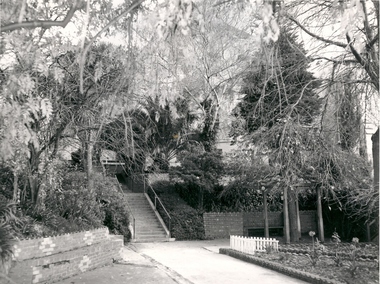 Federation University Historical Collection
Photograph - Photograph - Black and White, N.L. Harvey & Sons Photographers, Ballarat School of Mines Botanical Gardens, c1950s
... The gardens were important for the teaching of Materia Medica and Pharmacy at the Ballarat SChool of Mines. Ferdinand Von Mueller...The gardens were important for the teaching of Materia Medica and Pharmacy at the Ballarat SChool of Mines. Ferdinand Von Mueller ...The Ballarat School of Mines Botanical Gardens are locate at the rear of the current Administration Building. The gardens were important for the teaching of Materia Medica and Pharmacy at the Ballarat SChool of Mines. Ferdinand Von Mueller, a one time examiner in Botany at the School, is thought to have supplied or suggested plants. Black and white photograph of the path and stairs in the centre of the Ballarat School of Mines Botanical Garden. The photograph depicts mature trees in the gardenballarat school of mines botanical gardens, ballarat school of mines, botanical gardens, materia medica, pharmacy, ferdinand von mueller, noel l. harvey -
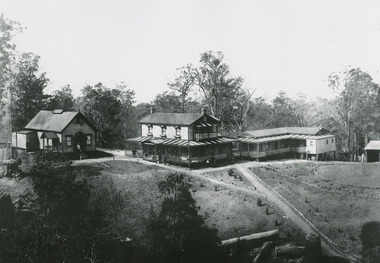 Marysville & District Historical Society
Photograph (Item) - Black and white photograph, Unknown
... garden featured New Guinea tree houses from which John Lindt made frequent panoramas of his property and the surrounding forest of towering mountain ash. Aged 81 Lindt died of heart failure during disastrous bushfires on 19 February 1926 at the Hermitage. He was survived by his wife Catherine who continued to run ‘The Hermitage’ guest house before she retired to the city. the hermitage john william lindt narbethong victoria black spur ferdinand von mueller melbourne botanic gardens new guinea catherine lindt An early black and white photograph of "The Hermitage" at Narbethong in Victoria. ...An early black and white photograph of "The Hermitage" at Narbethong in Victoria.An early black and white photograph of "The Hermitage" at Narbethong in Victoria. "The Hermitage" was built by photographer John William Lindt as a home and guesthouse in 1894. John Lindt had previously photographed the mountain scenery of the Black Spur and purchased 71 acres and subseqently built his home and guesthouse from where he continued his career. "The Hermitage had a garden designed by John Lindt's friend, Ferdinand von Mueller, who was at one stage the Director of the Melbourne Botanic Gardens. The garden featured New Guinea tree houses from which John Lindt made frequent panoramas of his property and the surrounding forest of towering mountain ash. Aged 81 Lindt died of heart failure during disastrous bushfires on 19 February 1926 at the Hermitage. He was survived by his wife Catherine who continued to run ‘The Hermitage’ guest house before she retired to the city.the hermitage, john william lindt, narbethong, victoria, black spur, ferdinand von mueller, melbourne botanic gardens, new guinea, catherine lindt -
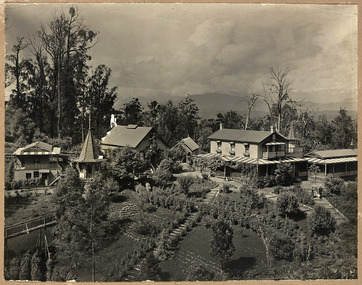 Marysville & District Historical Society
Photograph (Item) - Black and white photograph, John William Lindt, 1890-1910
... garden featured New Guinea tree houses from which John Lindt made frequent panoramas of his property and the surrounding forest of towering mountain ash. Aged 81 Lindt died of heart failure during disastrous bushfires on 19 February 1926 at the Hermitage. He was survived by his wife Catherine who continued to run ‘The Hermitage’ guest house before she retired to the city. the hermitage john william lindt narbethong victoria black spur ferdinand von mueller melbourne botanic gardens new guinea catherine lindt A digital copy of an early black and white photograph taken of "The Hermitage" in Narbethong in Victoria. ...A digital copy of an early black and white photograph taken of "The Hermitage" in Narbethong in Victoria.A digital copy of an early black and white photograph taken of "The Hermitage" in Narbethong in Victoria. "The Hermitage" was built by photographer John William Lindt as a home and guesthouse in 1894. John Lindt had previously photographed the mountain scenery of the Black Spur and purchased 71 acres and subseqently built his home and guesthouse from where he continued his career. "The Hermitage had a garden designed by John Lindt's friend, Ferdinand von Mueller, who was at one stage the Director of the Melbourne Botanic Gardens. The garden featured New Guinea tree houses from which John Lindt made frequent panoramas of his property and the surrounding forest of towering mountain ash. Aged 81 Lindt died of heart failure during disastrous bushfires on 19 February 1926 at the Hermitage. He was survived by his wife Catherine who continued to run ‘The Hermitage’ guest house before she retired to the city.the hermitage, john william lindt, narbethong, victoria, black spur, ferdinand von mueller, melbourne botanic gardens, new guinea, catherine lindt -
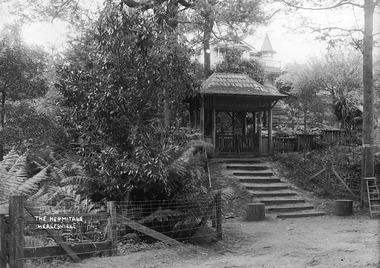 Marysville & District Historical Society
Photograph (Item) - Black and white photograph, John William Lindt, 1910
... garden featured New Guinea tree houses from which John Lindt made frequent panoramas of his property and the surrounding forest of towering mountain ash. Aged 81 Lindt died of heart failure during disastrous bushfires on 19 February 1926 at the Hermitage. He was survived by his wife Catherine who continued to run ‘The Hermitage’ guest house before she retired to the city. Visitors to the Hermitage alighted from horse-drawn vehicles and later motor coaches to enter the estate through the lich-gate in the background. the hermitage john william lindt narbethong victoria black spur ferdinand von mueller ...A digital copy of an early black and white photograph of the entrance gate to "The Hermitage" at Narbethong in Victoria.A digital copy of an early black and white photograph of the entrance gate to "The Hermitage" at Narbethong in Victoria. "The Hermitage" was built by photographer John William Lindt as a home and guesthouse in 1894. John Lindt had previously photographed the mountain scenery of the Black Spur and purchased 71 acres and subseqently built his home and guesthouse from where he continued his career. "The Hermitage had a garden designed by John Lindt's friend, Ferdinand von Mueller, who was at one stage the Director of the Melbourne Botanic Gardens. The garden featured New Guinea tree houses from which John Lindt made frequent panoramas of his property and the surrounding forest of towering mountain ash. Aged 81 Lindt died of heart failure during disastrous bushfires on 19 February 1926 at the Hermitage. He was survived by his wife Catherine who continued to run ‘The Hermitage’ guest house before she retired to the city. Visitors to the Hermitage alighted from horse-drawn vehicles and later motor coaches to enter the estate through the lich-gate in the background.the hermitage, john william lindt, narbethong, victoria, black spur, ferdinand von mueller, melbourne botanic gardens, new guinea, catherine lindt -
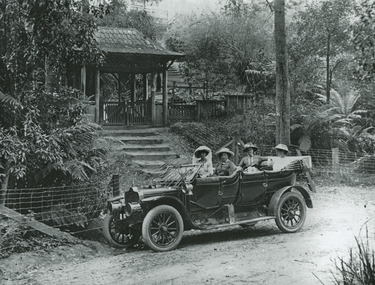 Marysville & District Historical Society
Photograph (Item) - Black and white photograph, John William Lindt, 1912
... "The Hermitage had a garden designed by John Lindt's friend, Ferdinand von Mueller, who was at one stage the Director of the Melbourne Botanic Gardens. ...An early black and white photograph taken at the entrance to "The Hermitage" in Narbethong in Victoria.An early black and white photograph taken at the entrance to "The Hermitage" in Narbethong in Victoria. "The Hermitage" was built by photographer John William Lindt as a home and guesthouse in 1894. John Lindt had previously photographed the mountain scenery of the Black Spur and purchased 71 acres and subseqently built his home and guesthouse from where he continued his career. "The Hermitage had a garden designed by John Lindt's friend, Ferdinand von Mueller, who was at one stage the Director of the Melbourne Botanic Gardens. The garden featured New Guinea tree houses from which John Lindt made frequent panoramas of his property and the surrounding forest of towering mountain ash. Aged 81 Lindt died of heart failure during disastrous bushfires on 19 February 1926 at the Hermitage. He was survived by his wife Catherine who continued to run ‘The Hermitage’ guest house before she retired to the city.the hermitage, john william lindt, narbethong, victoria, black spur, ferdinand von mueller, melbourne botanic gardens, new guinea, catherine lindt -
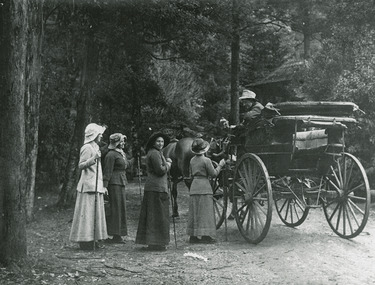 Marysville & District Historical Society
Photograph (Item) - Black and white photograph, John William Lindt, 1910
... "The Hermitage had a garden designed by John Lindt's friend, Ferdinand von Mueller, who was at one stage the Director of the Melbourne Botanic Gardens. ...An early black and white photograph taken near the entrance gatehouse to "The Hermitage" at Narbethong in Victoria.An early black and white photograph taken near the entrance gatehouse to "The Hermitage" at Narbethong in Victoria. "The Hermitage" was built by photographer John William Lindt as a home and guesthouse in 1894. John Lindt had previously photographed the mountain scenery of the Black Spur and purchased 71 acres and subseqently built his home and guesthouse from where he continued his career. "The Hermitage had a garden designed by John Lindt's friend, Ferdinand von Mueller, who was at one stage the Director of the Melbourne Botanic Gardens. The garden featured New Guinea tree houses from which John Lindt made frequent panoramas of his property and the surrounding forest of towering mountain ash. Aged 81 Lindt died of heart failure during disastrous bushfires on 19 February 1926 at the Hermitage. He was survived by his wife Catherine who continued to run ‘The Hermitage’ guest house before she retired to the city.the hermitage, john william lindt, narbethong, victoria, black spur, ferdinand von mueller, melbourne botanic gardens, new guinea, catherine lindt -
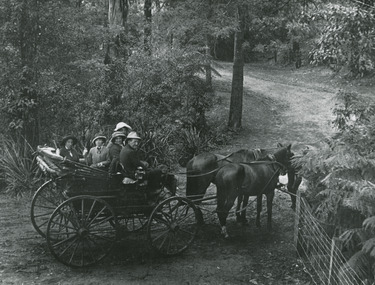 Marysville & District Historical Society
Photograph (Item) - Black and white photograph, John William Lindt, 1910
... "The Hermitage had a garden designed by John Lindt's friend, Ferdinand von Mueller, who was at one stage the Director of the Melbourne Botanic Gardens. ...An early black and white photograph taken near the entrance gatehouse to "The Hermitage" at Narbethong in Victoria.An early black and white photograph taken near the entrance gatehouse to "The Hermitage" at Narbethong in Victoria. "The Hermitage" was built by photographer John William Lindt as a home and guesthouse in 1894. John Lindt had previously photographed the mountain scenery of the Black Spur and purchased 71 acres and subseqently built his home and guesthouse from where he continued his career. "The Hermitage had a garden designed by John Lindt's friend, Ferdinand von Mueller, who was at one stage the Director of the Melbourne Botanic Gardens. The garden featured New Guinea tree houses from which John Lindt made frequent panoramas of his property and the surrounding forest of towering mountain ash. Aged 81 Lindt died of heart failure during disastrous bushfires on 19 February 1926 at the Hermitage. He was survived by his wife Catherine who continued to run ‘The Hermitage’ guest house before she retired to the city.the hermitage, john william lindt, narbethong, victoria, black spur, ferdinand von mueller, melbourne botanic gardens, new guinea, catherine lindt -
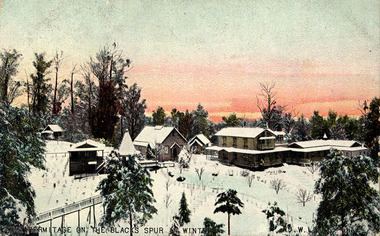 Marysville & District Historical Society
Postcard (Item) - Colour tinted postcard, John William Lindt, The Hermitage on the Black Spur in Winter, 1900s
... garden featured New Guinea tree houses from which John Lindt made frequent panoramas of his property and the surrounding forest of towering mountain ash. Aged 81 Lindt died of heart failure during disastrous bushfires on 19 February 1926 at the Hermitage. He was survived by his wife Catherine who continued to run ‘The Hermitage’ guest house before she retired to the city. the hermitage john william lindt narbethong victoria black spur ferdinand von mueller melbourne botanic gardens new guinea catherine lindt winter A digital copy of an early colour tinted postcard of "The Hermitage" in Narbethong in Victoria. ...A digital copy of an early colour tinted postcard of "The Hermitage" in Narbethong in Victoria.A digital copy of an early colour tinted postcard of "The Hermitage" in Narbethong in Victoria. "The Hermitage" was built by photographer John William Lindt as a home and guesthouse in 1894. John Lindt had previously photographed the mountain scenery of the Black Spur and purchased 71 acres and subseqently built his home and guesthouse from where he continued his career. "The Hermitage had a garden designed by John Lindt's friend, Ferdinand von Mueller, who was at one stage the Director of the Melbourne Botanic Gardens. The garden featured New Guinea tree houses from which John Lindt made frequent panoramas of his property and the surrounding forest of towering mountain ash. Aged 81 Lindt died of heart failure during disastrous bushfires on 19 February 1926 at the Hermitage. He was survived by his wife Catherine who continued to run ‘The Hermitage’ guest house before she retired to the city.the hermitage, john william lindt, narbethong, victoria, black spur, ferdinand von mueller, melbourne botanic gardens, new guinea, catherine lindt, winter -
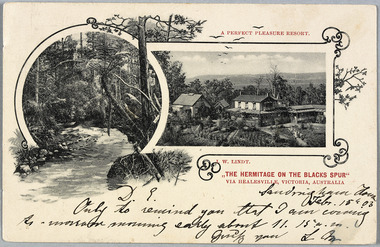 Marysville & District Historical Society
Postcard (Item) - Black and white postcard, John William Lindt, "The Hermitage on the Blacks Spur" via Healesville, Victoria, Australia: A Perfect Pleasure Resort, 1900s
... "The Hermitage had a garden designed by John Lindt's friend, Ferdinand von Mueller, who was at one stage the Director of the Melbourne Botanic Gardens. ...A digital copy of an early black and white postcard of "The Hermitage" at Narbethong in Victoria.A digital copy of an early black and white postcard of "The Hermitage" at Narbethong in Victoria. "The Hermitage" was built by photographer John William Lindt as a home and guesthouse in 1894. John Lindt had previously photographed the mountain scenery of the Black Spur and purchased 71 acres and subseqently built his home and guesthouse from where he continued his career. "The Hermitage had a garden designed by John Lindt's friend, Ferdinand von Mueller, who was at one stage the Director of the Melbourne Botanic Gardens. The garden featured New Guinea tree houses from which John Lindt made frequent panoramas of his property and the surrounding forest of towering mountain ash. Aged 81 Lindt died of heart failure during disastrous bushfires on 19 February 1926 at the Hermitage. He was survived by his wife Catherine who continued to run ‘The Hermitage’ guest house before she retired to the city.Sandringham South/ Feb. 15th. 03/ D.L./ Only to remind you that I am coming/ As-morrow morning early about 11.15 a.m./ Greetg you L Mthe hermitage, john william lindt, narbethong, victoria, black spur, ferdinand von mueller, melbourne botanic gardens, new guinea, catherine lindt, collotype -
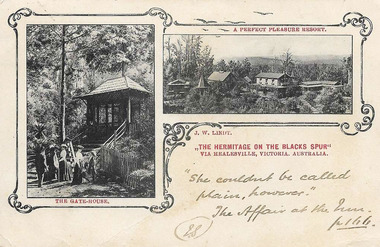 Marysville & District Historical Society
Postcard (Item) - Black and white postcard, John William Lindt, "The Hermitage on the Blacks Spur" via Healesville, Victoria, Australia: A Perfect Pleasure Resort, 1900s
... garden featured New Guinea tree houses from which John Lindt made frequent panoramas of his property and the surrounding forest of towering mountain ash. Aged 81 Lindt died of heart failure during disastrous bushfires on 19 February 1926 at the Hermitage. He was survived by his wife Catherine who continued to run ‘The Hermitage’ guest house before she retired to the city. the hermitage john william lindt narbethong victoria black spur ferdinand von mueller melbourne botanic gardens new guinea catherine lindt collotype "She couldnt be called/ plain, however ...A digital copy of an early black and white postcard of "The Hermitage" at Narbethong in Victoria.A digital copy of an early black and white postcard of "The Hermitage" at Narbethong in Victoria. "The Hermitage" was built by photographer John William Lindt as a home and guesthouse in 1894. John Lindt had previously photographed the mountain scenery of the Black Spur and purchased 71 acres and subseqently built his home and guesthouse from where he continued his career. "The Hermitage had a garden designed by John Lindt's friend, Ferdinand von Mueller, who was at one stage the Director of the Melbourne Botanic Gardens. The garden featured New Guinea tree houses from which John Lindt made frequent panoramas of his property and the surrounding forest of towering mountain ash. Aged 81 Lindt died of heart failure during disastrous bushfires on 19 February 1926 at the Hermitage. He was survived by his wife Catherine who continued to run ‘The Hermitage’ guest house before she retired to the city."She couldnt be called/ plain, however."/ The affair at the Inn./ IS/ p 1 hh.the hermitage, john william lindt, narbethong, victoria, black spur, ferdinand von mueller, melbourne botanic gardens, new guinea, catherine lindt, collotype -
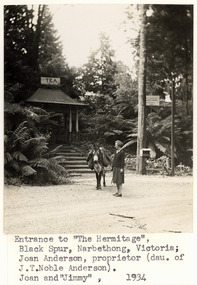 Marysville & District Historical Society
Photograph (Item) - Black and white photograph, Phyllis Bromby, 1934
... garden featured New Guinea tree houses from which John Lindt made frequent panoramas of his property and the surrounding forest of towering mountain ash. Aged 81 Lindt died of heart failure during disastrous bushfires on 19 February 1926 at the Hermitage. He was survived by his wife Catherine who continued to run ‘The Hermitage’ guest house before she retired to the city. In the early 1930s, Joan Anderson purchased the property, maintaining it as a guesthouse. the hermitage john william lindt narbethong victoria black spur ferdinand von mueller ...A digital copy of a black and white photograph taken at the entrance to "The Hermitage" at Narbethong in Victoria.A digital copy of a black and white photograph taken at the entrance to "The Hermitage" at Narbethong in Victoria. "The Hermitage" was built by photographer John William Lindt as a home and guesthouse in 1894. John Lindt had previously photographed the mountain scenery of the Black Spur and purchased 71 acres and subseqently built his home and guesthouse from where he continued his career. "The Hermitage had a garden designed by John Lindt's friend, Ferdinand von Mueller, who was at one stage the Director of the Melbourne Botanic Gardens. The garden featured New Guinea tree houses from which John Lindt made frequent panoramas of his property and the surrounding forest of towering mountain ash. Aged 81 Lindt died of heart failure during disastrous bushfires on 19 February 1926 at the Hermitage. He was survived by his wife Catherine who continued to run ‘The Hermitage’ guest house before she retired to the city. In the early 1930s, Joan Anderson purchased the property, maintaining it as a guesthouse.Entrance to "The Hermitage",/ Black Spur, Narbethong, Victoria;/ Joan Anderson, proprietor (dau of/ J.T. Noble Anderson)./ Joan and "Jimmy", 1934the hermitage, john william lindt, narbethong, victoria, black spur, ferdinand von mueller, melbourne botanic gardens, new guinea, catherine lindt, joan anderson -
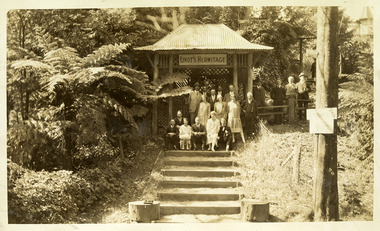 Marysville & District Historical Society
Photograph (Item) - Black and white photograph, 1900s
... "The Hermitage had a garden designed by John Lindt's friend, Ferdinand von Mueller, who was at one stage the Director of the Melbourne Botanic Gardens. ...A digital copy of a black and white photograph taken at the entrance to "The Hermitage" at Narbethong in Victoria.A digital copy of a black and white photograph taken at the entrance to "The Hermitage" at Narbethong in Victoria. "The Hermitage" was built by photographer John William Lindt as a home and guesthouse in 1894. John Lindt had previously photographed the mountain scenery of the Black Spur and purchased 71 acres and subseqently built his home and guesthouse from where he continued his career. "The Hermitage had a garden designed by John Lindt's friend, Ferdinand von Mueller, who was at one stage the Director of the Melbourne Botanic Gardens. The garden featured New Guinea tree houses from which John Lindt made frequent panoramas of his property and the surrounding forest of towering mountain ash. Aged 81 Lindt died of heart failure during disastrous bushfires on 19 February 1926 at the Hermitage. He was survived by his wife Catherine who continued to run ‘The Hermitage’ guest house before she retired to the city.the hermitage, john william lindt, narbethong, victoria, black spur, ferdinand von mueller, melbourne botanic gardens, new guinea, catherine lindt -
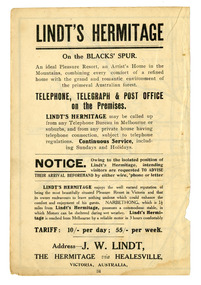 Marysville & District Historical Society
Article (Item) - Advertisement, Broadbent's Official Road Guides Company, Lindt's Hermitage on the Black's Spur, 1940s
... garden featured New Guinea tree houses from which John Lindt made frequent panoramas of his property and the surrounding forest of towering mountain ash. Aged 81 Lindt died of heart failure during disastrous bushfires on 19 February 1926 at the Hermitage. He was survived by his wife Catherine who continued to run ‘The Hermitage’ guest house before she retired to the city. the hermitage john william lindt narbethong victoria black spur ferdinand von mueller melbourne botanic gardens new guinea catherine lindt A page on Lindt's Hermitage at Narbethong from a Broadbent's Official Guide. ...A page on Lindt's Hermitage at Narbethong from a Broadbent's Official Guide.A page on Lindt's Hermitage at Narbethong from a Broadbent's Official Guide. "The Hermitage" was built by photographer John William Lindt as a home and guesthouse in 1894. John Lindt had previously photographed the mountain scenery of the Black Spur and purchased 71 acres and subseqently built his home and guesthouse from where he continued his career. "The Hermitage had a garden designed by John Lindt's friend, Ferdinand von Mueller, who was at one stage the Director of the Melbourne Botanic Gardens. The garden featured New Guinea tree houses from which John Lindt made frequent panoramas of his property and the surrounding forest of towering mountain ash. Aged 81 Lindt died of heart failure during disastrous bushfires on 19 February 1926 at the Hermitage. He was survived by his wife Catherine who continued to run ‘The Hermitage’ guest house before she retired to the city.the hermitage, john william lindt, narbethong, victoria, black spur, ferdinand von mueller, melbourne botanic gardens, new guinea, catherine lindt -
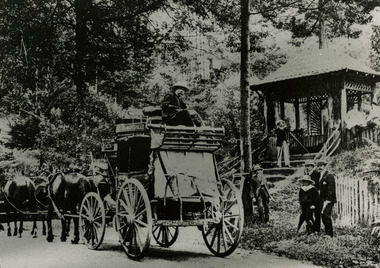 Marysville & District Historical Society
Photograph (Item) - Black and white photograph, Unknown
... garden featured New Guinea tree houses from which John Lindt made frequent panoramas of his property and the surrounding forest of towering mountain ash. Aged 81 Lindt died of heart failure during disastrous bushfires on 19 February 1926 at the Hermitage. He was survived by his wife Catherine who continued to run ‘The Hermitage’ guest house before she retired to the city. This postcard was produced by The Rose Stereograph Company as a souvenir of Narbethong in Victoria. the hermitage john william lindt narbethong victoria black spur ferdinand von mueller ...An early black and white photograph of a Cobb & Co coach at "The Hermitage" at Narbethong in Victoria.An early black and white photograph of a Cobb & Co coach at "The Hermitage" at Narbethong in Victoria. "The Hermitage" was built by photographer John William Lindt as a home and guesthouse in 1894. John Lindt had previously photographed the mountain scenery of the Black Spur and purchased 71 acres and subseqently built his home and guesthouse from where he continued his career. "The Hermitage had a garden designed by John Lindt's friend, Ferdinand von Mueller, who was at one stage the Director of the Melbourne Botanic Gardens. The garden featured New Guinea tree houses from which John Lindt made frequent panoramas of his property and the surrounding forest of towering mountain ash. Aged 81 Lindt died of heart failure during disastrous bushfires on 19 February 1926 at the Hermitage. He was survived by his wife Catherine who continued to run ‘The Hermitage’ guest house before she retired to the city. This postcard was produced by The Rose Stereograph Company as a souvenir of Narbethong in Victoria.the hermitage, john william lindt, narbethong, victoria, black spur, ferdinand von mueller, melbourne botanic gardens, new guinea, catherine lindt, cobb & co -
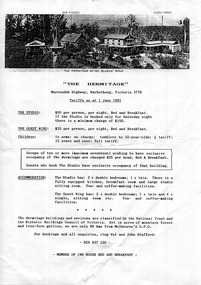 Marysville & District Historical Society
Flyer (Item) - Tariff Flyer, Val and John Stafford, "The Hermitage", 1991
... garden featured New Guinea tree houses from which John Lindt made frequent panoramas of his property and the surrounding forest of towering mountain ash. Aged 81 Lindt died of heart failure during disastrous bushfires on 19 February 1926 at the Hermitage. He was survived by his wife Catherine who continued to run ‘The Hermitage’ guest house before she retired to the city. At the time of the production of this flyer, John and Val Stafford had become the fifth owners of "The Hermitage". the hermitage john william lindt narbethong victoria black spur ferdinand von mueller ...A tariff flyer for "The Hermitage" at Narbethong in Victoria dated June 1991.A tariff flyer for "The Hermitage" at Narbethong in Victoria dated June 1991. "The Hermitage" was built by photographer John William Lindt as a home and guesthouse in 1894. John Lindt had previously photographed the mountain scenery of the Black Spur and purchased 71 acres and subseqently built his home and guesthouse from where he continued his career. "The Hermitage had a garden designed by John Lindt's friend, Ferdinand von Mueller, who was at one stage the Director of the Melbourne Botanic Gardens. The garden featured New Guinea tree houses from which John Lindt made frequent panoramas of his property and the surrounding forest of towering mountain ash. Aged 81 Lindt died of heart failure during disastrous bushfires on 19 February 1926 at the Hermitage. He was survived by his wife Catherine who continued to run ‘The Hermitage’ guest house before she retired to the city. At the time of the production of this flyer, John and Val Stafford had become the fifth owners of "The Hermitage".the hermitage, john william lindt, narbethong, victoria, black spur, ferdinand von mueller, melbourne botanic gardens, new guinea, catherine lindt, john stafford, val stafford -
Marysville & District Historical Society
Article (Item) - Magazine article, Are Media Pty Limited, Beyond All Expectations, 1992
... garden featured New Guinea tree houses from which John Lindt made frequent panoramas of his property and the surrounding forest of towering mountain ash. Aged 81 Lindt died of heart failure during disastrous bushfires on 19 February 1926 at the Hermitage. He was survived by his wife Catherine who continued to run ‘The Hermitage’ guest house before she retired to the city. At the time of the publication of this article, John and Val Stafford had become the fifth owners of "The Hermitage". the hermitage john william lindt narbethong victoria black spur ferdinand von mueller ...A magazine article taken from the magazine A Country Style in 1992 on "The Hermitage" at Narbethong in Victoria.A magazine article taken from the magazine A Country Style in 1992 on "The Hermitage" at Narbethong in Victoria. "The Hermitage" was built by photographer John William Lindt as a home and guesthouse in 1894. John Lindt had previously photographed the mountain scenery of the Black Spur and purchased 71 acres and subseqently built his home and guesthouse from where he continued his career. "The Hermitage had a garden designed by John Lindt's friend, Ferdinand von Mueller, who was at one stage the Director of the Melbourne Botanic Gardens. The garden featured New Guinea tree houses from which John Lindt made frequent panoramas of his property and the surrounding forest of towering mountain ash. Aged 81 Lindt died of heart failure during disastrous bushfires on 19 February 1926 at the Hermitage. He was survived by his wife Catherine who continued to run ‘The Hermitage’ guest house before she retired to the city. At the time of the publication of this article, John and Val Stafford had become the fifth owners of "The Hermitage".the hermitage, john william lindt, narbethong, victoria, black spur, ferdinand von mueller, melbourne botanic gardens, new guinea, catherine lindt, john stafford, val stafford
