
Showing 109 items matching "war memorials -- france"
-
 Mrs Aeneas Gunn Memorial Library
Book, Fabian Ware, The immortal heritage : an account of the work and policy of the Imperial War Graves Commission during twenty years 1917-1937, 1937
... ...War memorials - France...Commonwealth war graves commission War memorials - France An account of the work and policy of the Imperial War Graves Commission beween 1917-1937 Ill, p.80. ...An account of the work and policy of the Imperial War Graves Commission beween 1917-1937Ill, p.80.non-fictionAn account of the work and policy of the Imperial War Graves Commission beween 1917-1937commonwealth war graves commission, war memorials - france -
 Returned Nurses RSL Sub-branch
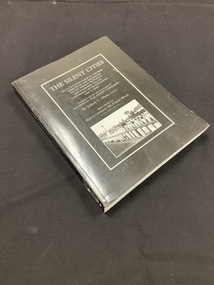
Book, Sidney C. Hurst, The silent cities : an illustrated guide to the war cemeteries and memorials to the "missing" in France and Flanders: 1914-1918, 1929
... War memorials -- France...War memorials -- France National cemeteries -- Belgium National cemeteries -- France War memorials -- Belgium Soldiers' monuments -- Belgium Soldiers' monuments -- France Guide to the War Cemeteries in France and Flanders ... ...Guide to the War Cemeteries in France and Flanders ... The Silent Cities was Rudyard Kipling's inspired name for the Cemeteries of the Western Front ... [provides] a complete guide to all Cemeteries containing war graves and all Memorials recording the Missing of the Forces of the British Empire who fell in France and Flanders during the Great War ... Some contain 'Special Memorials indicating officers and men whose graves have been destroyed by shell-fire or who are known or believed to be buried in that Cemetery--publisher's website. Facsimile reprint. First published London : Methuen, 1929.Paperback book with black cover. Title down the spine in white print. Front cover has a white border with title and author details printed inside in white text and a black and white photo of gravesites.non-fictionGuide to the War Cemeteries in France and Flanders ... The Silent Cities was Rudyard Kipling's inspired name for the Cemeteries of the Western Front ... [provides] a complete guide to all Cemeteries containing war graves and all Memorials recording the Missing of the Forces of the British Empire who fell in France and Flanders during the Great War ... Some contain 'Special Memorials indicating officers and men whose graves have been destroyed by shell-fire or who are known or believed to be buried in that Cemetery--publisher's website. Facsimile reprint. First published London : Methuen, 1929. war memorials -- france, national cemeteries -- belgium, national cemeteries -- france, war memorials -- belgium, soldiers' monuments -- belgium, soldiers' monuments -- france -
 Returned Nurses RSL Sub-branch
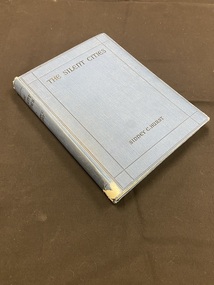
Book - Illustrated hardcover book, Sidney C. Hurst, The silent cities : an illustrated guide to the war cemeteries and memorials to the "missing" in France and Flanders: 1914-1918, 1929
... War memorials -- France...War memorials -- France National cemeteries -- Belgium National cemeteries -- France War memorials -- Belgium Soldiers' monuments -- Belgium Soldiers' monuments -- France Guide to the War Cemeteries in France and Flanders ... ...Guide to the War Cemeteries in France and Flanders ... The Silent Cities was Rudyard Kipling's inspired name for the Cemeteries of the Western Front ... [provides] a complete guide to all Cemeteries containing war graves and all Memorials recording the Missing of the Forces of the British Empire who fell in France and Flanders during the Great War ... Some contain 'Special Memorials indicating officers and men whose graves have been destroyed by shell-fire or who are known or believed to be buried in that Cemetery--publisher's website. Facsimile reprint. First published London : Methuen, 1929.Blue hardcover book. Title and author in black print across the spine. Torn white sticker label at the base of the spine. The front cover has a double border of thin black lines, inside the border the title is printed across the top and the author at the bottom.non-fictionGuide to the War Cemeteries in France and Flanders ... The Silent Cities was Rudyard Kipling's inspired name for the Cemeteries of the Western Front ... [provides] a complete guide to all Cemeteries containing war graves and all Memorials recording the Missing of the Forces of the British Empire who fell in France and Flanders during the Great War ... Some contain 'Special Memorials indicating officers and men whose graves have been destroyed by shell-fire or who are known or believed to be buried in that Cemetery--publisher's website. Facsimile reprint. First published London : Methuen, 1929. war memorials -- france, national cemeteries -- belgium, national cemeteries -- france, war memorials -- belgium, soldiers' monuments -- belgium, soldiers' monuments -- france -
 Bendigo Historical Society Inc.
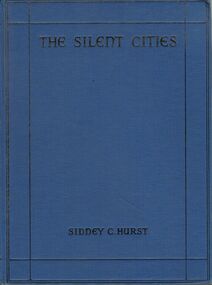
Book - THE SILENT CITIES
... War 1... cemeteries... memorials... France...An Illustrated Guide to the War Cemeteries and Memorials to the missing in France and Flanders 1914 - 1918.' ...BOOKS Military world war 1 book books war wars World War 1 cemeteries memorials France Flanders soldiers history Sidney C. ...A,B. Blue hard covered book titled ' The Silent Cities. An Illustrated Guide to the War Cemeteries and Memorials to the missing in France and Flanders 1914 - 1918.' Compiled by Sidney C. Hurst, P.A.S.I. With a preface by Major-General Sir Fabian Warem K.C.V.O., K.B.E., C.B., C.M.G. Vice-Chairman of The Imperial War Graves Commission.' Methuen & Co. LTD. 36 Essex Street W.C. London, 1929. 407 pgs. First published 1929. (ill.) C. Also included is a newspaper article titled 'Memorial to our War Dead.' dated 25-6-38. D.dust cover of the book, incomplete missing back page.Sidney C. Hurstbooks, military, world war 1, book, books, war, wars, world war 1, cemeteries, memorials, france, flanders, soldiers, history -
 Federation University Historical Collection
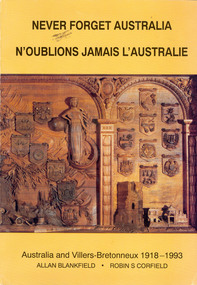
Book, Royal Victoria Pilgrimage Committee et al, Never Forget Australia: Australia and Villers-Bretonneux 1918-1993, 1994
... The Royal Victoria Regiment, The 1990s, The 1993 Pilgrimage. villers-brettonneux world war 1 world war one french amiens charles rosenthal keith murdoch henry rawlinson hobbsm pompey elliott ferdinand foch john monash red baron von richthofen tanks 5th australia division harold elliott sadlier marshall aboriginal diggers bill egan australian armt band ypres robinvale robin cuttle frederick birks gas 58th battalion tom brain dick bowman william james Yellow soft covered book with the cover featuring a carved timber memorial. ...Yellow soft covered book with the cover featuring a carved timber memorial.non-fictionvillers-brettonneux, world war 1, world war one, french, amiens, charles rosenthal, keith murdoch, henry rawlinson, hobbsm pompey elliott, ferdinand foch, john monash, red baron, von richthofen, tanks, 5th australia division, harold elliott, sadlier, marshall, aboriginal diggers, bill egan, australian armt band, ypres, robinvale, robin cuttle, frederick birks, gas, 58th battalion, tom brain, dick bowman, william james -
 Lara RSL Sub Branch
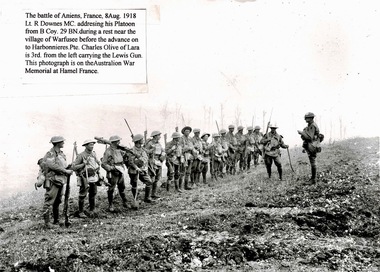
Photo, The Battle of Amiens,France,8Aug,1918
... The battle of Amiens,France,8thAug.1918.Lt R Downes MC.addressing his Platoon from B Coy.29 BN.during a rest near the village of Warfusee before the advance on to Harbonnieres.Pte Charles Olive of Lara is 3rd,from the left carrying the Lewis Gun. He was killed in action three weeks later charging a German machine gun post. Earlier in the day, he had successfully taken two machine gun posts. Photo from Australian War Memorial...Though the Allies at Amiens failed to continue their impressive success in the days following August 8, the damage had been done. ww1, battle of amiens, australian army, lara r.s.l. pte charles olive. awm accession no e2790 The battle of Amiens,France,8thAug.1918.Lt R Downes MC.addressing his Platoon from B Coy.29 BN.during a rest near the village of Warfusee before the advance on to Harbonnieres.Pte Charles Olive of Lara is 3rd,from the left carrying the Lewis Gun. He was killed in action three weeks later charging a German machine gun post. Earlier in the day, he had successfully taken two machine gun posts. Photo from Australian War Memorial ...The Battle of Amiens, also known as the Third Battle of Picardy (French: 3ème Bataille de Picardie), was the opening phase of the Allied offensive which began on 8 August 1918, later known as the Hundred Days Offensive, that ultimately led to the end of the First World War.By the end of August 8—dubbed “the black day of the German army” by Ludendorff—the Allies had penetrated German lines around the Somme with a gap some 15 miles long. Of the 27, 000 German casualties on August 8, an unprecedented proportion—12,000—had surrendered to the enemy. Though the Allies at Amiens failed to continue their impressive success in the days following August 8, the damage had been done.Rectangular shaped black and white photograph.The battle of Amiens,France,8thAug.1918.Lt R Downes MC.addressing his Platoon from B Coy.29 BN.during a rest near the village of Warfusee before the advance on to Harbonnieres.Pte Charles Olive of Lara is 3rd,from the left carrying the Lewis Gun. He was killed in action three weeks later charging a German machine gun post. Earlier in the day, he had successfully taken two machine gun posts. Photo from Australian War Memorial, Canberra.ww1, battle of amiens, australian army, lara r.s.l. pte charles olive., awm accession no e2790 -
 Lara RSL Sub Branch
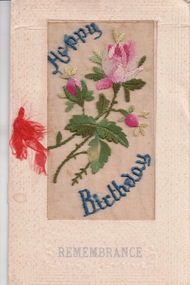
Card, Happy Birthday Card
... French women during the First World War. The women would create these in there homes as a way to earn an income during the tuff times. The silk mesh was embroidered by the women and was later sent to factories to be placed on the cards. According to the Australian war memorial...French women during the First World War. The women would create these in there homes as a way to earn an income during the tuff times. The silk mesh was embroidered by the women and was later sent to factories to be placed on the cards. According to the Australian war memorial ...The silk card were created by French women during the First World War. The women would create these in there homes as a way to earn an income during the tuff times. The silk mesh was embroidered by the women and was later sent to factories to be placed on the cards. According to the Australian war memorial website there were 10 million of the cards made between 1914-1919. This card in particular was sent from John (Jack) McIntyre to his mother for her birthday. J. McIntyre served in the first world war, first arrived in Egypt in 1915, then to the Western front in France in July 1916. He was servery injured during his time in France and was sent to the Hospital in England. After the war finished Jack travelled back to Australia and lived in Lara with his brother and sister.This card is significant as it is a reflection on the communication between families during the First World War. It also is a symbol of the way women in France made their money during the tuff timesA birthday card with silk on the front of the card. It has pink flowers stitched into the silk and says 'happy birthday'On the front it has 'Happy Birthday" "Remembrance" On the first page in the inside "Remembrance" "To mother" "From Jack" "France 1918" On the second page in the inside: "Wishes are nothing; t'is the heart That in the few lines dwells And says to those from us apart More that the greeting tells" birthday card, mother, son, mcintyre, world war 1, ww1, happy birthday, handmade, silk, embroidered -
 Ballarat Clarendon College
Albert Telfer White (1918) collection
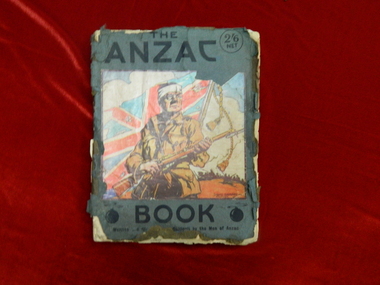
... France 19 March 1916 and transferred to the 22nd Battalion. He was mentioned in dispatches for 'good and gallant conduct' 5 August (1917?). Albert was hospitalised 30 March 1918, rejoined 22nd Battalion 3 June 1918, wounded in action 3 October 1918 but died of wounds at Rouen 10 October 1918. news of his death was received by his family n Australia just prior to the armistice. Albert Telfer White's sacrifice is commemorated at Ballarat College, Avenue of Honour Ballarat (Tree 1214), Ballarat Shire Honour Avenue Learmonth (Tree 163) and the Australian War Memorial...Collections of items including: Bayonet, Carl Eickhorn, Solingen, (29.A.159 engraved on handle) Trench shovel The ANZAC book 1916 (flyleaf inscribed: No 2012 / Pte A T White / H Quarters / 22nd Battalion / 6th Inf Brigade / France) Gallipoli medal with documentation First World War Mothers’ and Widows’ Badge Next of Kin Memorial Plaque (Death Penny) and accompanying letter from King George V Imperial War Graves Commission documentation and photograph Australia Graves Services In Memory card and photograph Documentation relating to Australian War Memorial Roll of Honour, Learmonth Memorial Wall, Ballarat and Learmonth Avenues of Honours Documentation from the Australian Army Records office Documentation relating to Military Medal, 1914/15 Star, British War Medal and Victory Medal (whereabouts unknown, November 2016) Portraiture of Albert Telfer White as a child, as a young adult (civilian dress), in full kit (A I E F formal), and at camp 1915 Portraiture of sisters Cis, Addie, Bessie, Evelyn (with personal inscriptions) Four postcards (one with letter from Albert ‘at sea’ to his mother - undated) Death notice (unreferenced newspaper clipping) Biographical and family relationship details Photocopy of The White Family 1906 showing (standing) Adeline, Leslie, Harold (father), Muriel (mother), William; (seated) Albert, John (Grandfather), Elizabeth, Allan, Elizabeth (Grandmother), Evelyn (baby) and Benjamin ...France 19 March 1916 and transferred to the 22nd Battalion. He was mentioned in dispatches for 'good and gallant conduct' 5 August (1917?). Albert was hospitalised 30 March 1918, rejoined 22nd Battalion 3 June 1918, wounded in action 3 October 1918 but died of wounds at Rouen 10 October 1918. news of his death was received by his family n Australia just prior to the armistice. Albert Telfer White's sacrifice is commemorated at Ballarat College, Avenue of Honour Ballarat (Tree 1214), Ballarat Shire Honour Avenue Learmonth (Tree 163) and the Australian War Memorial ...Significant items relating to Albert Telfer White who entered Ballarat College April 1912 and left December 1918. Albert was born 29 June 1897 at his home 'Ashford Vale" farm, Cuthbert's Road, Cardigan. Albert, a second generation Australian, was the fourth son and sixth of eleven children born to dairy farmer John White and his wife Elizabeth, nee Douglas. Albert attended Bunker's Hill State School prior to enrolling at Ballarat College. After College he obtained employment with the engineering firm Ronaldson and Tippett in Ballarat. Following his eighteenth birthday Albert enlisted in the AIF in Ballarat with the rank of Private, No 2012. He embarked for the Middle East with 23rd Battalion on 26 August 1915 and was 'taken on strength at the Gallipoli Peninsular 25 October 1915". On 10 January 1916 Albert was posted to Alexandria, Egypt and during this time he was able to meet with his aunt Rose Douglas, an Australian Army Nursing Sister. This was a great comfort to his family. Albert was sent to France 19 March 1916 and transferred to the 22nd Battalion. He was mentioned in dispatches for 'good and gallant conduct' 5 August (1917?). Albert was hospitalised 30 March 1918, rejoined 22nd Battalion 3 June 1918, wounded in action 3 October 1918 but died of wounds at Rouen 10 October 1918. news of his death was received by his family n Australia just prior to the armistice. Albert Telfer White's sacrifice is commemorated at Ballarat College, Avenue of Honour Ballarat (Tree 1214), Ballarat Shire Honour Avenue Learmonth (Tree 163) and the Australian War Memorial Canberra. (These notes provided by family November 2016)Collections of items including: Bayonet, Carl Eickhorn, Solingen, (29.A.159 engraved on handle) Trench shovel The ANZAC book 1916 (flyleaf inscribed: No 2012 / Pte A T White / H Quarters / 22nd Battalion / 6th Inf Brigade / France) Gallipoli medal with documentation First World War Mothers’ and Widows’ Badge Next of Kin Memorial Plaque (Death Penny) and accompanying letter from King George V Imperial War Graves Commission documentation and photograph Australia Graves Services In Memory card and photograph Documentation relating to Australian War Memorial Roll of Honour, Learmonth Memorial Wall, Ballarat and Learmonth Avenues of Honours Documentation from the Australian Army Records office Documentation relating to Military Medal, 1914/15 Star, British War Medal and Victory Medal (whereabouts unknown, November 2016) Portraiture of Albert Telfer White as a child, as a young adult (civilian dress), in full kit (A I E F formal), and at camp 1915 Portraiture of sisters Cis, Addie, Bessie, Evelyn (with personal inscriptions) Four postcards (one with letter from Albert ‘at sea’ to his mother - undated) Death notice (unreferenced newspaper clipping) Biographical and family relationship details Photocopy of The White Family 1906 showing (standing) Adeline, Leslie, Harold (father), Muriel (mother), William; (seated) Albert, John (Grandfather), Elizabeth, Allan, Elizabeth (Grandmother), Evelyn (baby) and Benjamin The ANZAC book 1916 (flyleaf inscribed: No 2012 / Pte A T White / H Quarters / 22nd Battalion / 6th Inf Brigade / France) Gallipoli medal: engraved on reverse: A T WHITE Embossed lettering on death penny: ALBERT TELFER WHITE Handwritten on reverse of portraits: Lovingly yours / Cis / 21/11/17; your / loving sister / Addie; your loving / sister / Evelyn; Yours lovingly / Bessie Handwritten on back of postcard of ship H M A T 'Anchisis' 14.3.16: Dear Mother, I am sending you a card / of the boat we are on. Our deck is right / on the back. I have marked it with an X. / We are not allowed to put the date on or / where we are. I am sitting on the deck now / holding the card in my hand so it is hard / to write. We are together yet haven't been / separated Bill, Matt and myself. Haven't / had anything to do. I will write a couple / of letters now. Albert Handwritten on back of postcard photograph of Albert at camp: 30th September 1915 / Dear Mother / There is a studio at the / camp so Matt and I got our Photos / taken yesterday morning, & got them/ this morning. I am sending / Ciss one of Matt.albert-telfer-white, ballarat college, world-war-one, avenue-of-honour -
 Ballarat Clarendon College
Medal, 1914-15 Star
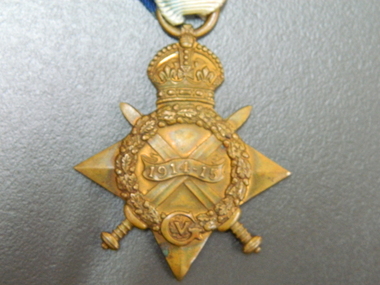
... France 19 March 1916 and transferred to the 22nd Battalion. He was mentioned in dispatches for 'good and gallant conduct' 5 August (1917?). Albert was hospitalised 30 March 1918, rejoined 22nd Battalion 3 June 1918, wounded in action 3 October 1918 but died of wounds at Rouen 10 October 1918. news of his death was received by his family in Australia just prior to the armistice. Albert Telfer White's sacrifice is commemorated at Ballarat College, Avenue of Honour Ballarat (Tree 1214), Ballarat Shire Honour Avenue Learmonth (Tree 163) and the Australian War Memorial...France 19 March 1916 and transferred to the 22nd Battalion. He was mentioned in dispatches for 'good and gallant conduct' 5 August (1917?). Albert was hospitalised 30 March 1918, rejoined 22nd Battalion 3 June 1918, wounded in action 3 October 1918 but died of wounds at Rouen 10 October 1918. news of his death was received by his family in Australia just prior to the armistice. Albert Telfer White's sacrifice is commemorated at Ballarat College, Avenue of Honour Ballarat (Tree 1214), Ballarat Shire Honour Avenue Learmonth (Tree 163) and the Australian War Memorial ...The 1914–15 Star was authorised in 1918 and was awarded for service in specified theatres of war between 5 August 1914 and 31 December 1915. A recipient of the 1914 Star could not also be awarded the 1914–15 Star. Albert was born 29 June 1897 at his home 'Ashford Vale" farm, Cuthbert's Road, Cardigan. Albert, a second generation Australian, was the fourth son and sixth of eleven children born to dairy farmer John White and his wife Elizabeth, nee Douglas. Albert attended Bunker's Hill State School prior to enrolling at Ballarat College. After College he obtained employment with the engineering firm Ronaldson and Tippett in Ballarat. Following his eighteenth birthday Albert enlisted in the AIF in Ballarat with the rank of Private, No 2012. He embarked for the Middle East with 23rd Battalion on 26 August 1915 and was 'taken on strength at the Gallipoli Peninsular 25 October 1915". On 10 January 1916 Albert was posted to Alexandria, Egypt and during this time he was able to meet with his aunt Rose Douglas, an Australian Army Nursing Sister. This was a great comfort to his family. Albert was sent to France 19 March 1916 and transferred to the 22nd Battalion. He was mentioned in dispatches for 'good and gallant conduct' 5 August (1917?). Albert was hospitalised 30 March 1918, rejoined 22nd Battalion 3 June 1918, wounded in action 3 October 1918 but died of wounds at Rouen 10 October 1918. news of his death was received by his family in Australia just prior to the armistice. Albert Telfer White's sacrifice is commemorated at Ballarat College, Avenue of Honour Ballarat (Tree 1214), Ballarat Shire Honour Avenue Learmonth (Tree 163) and the Australian War Memorial Canberra. (These notes provided by family November 2016)Part of a greater A T White CollectionThe 1914-15 Star is a four pointed star of bright bronze, ensigned with a crown. The obverse has crossed gladius, overlaid with an oak wreath that is ensigned with the cypher of King George V. A scroll bearing the legend 1914-15 is centrally placed across the crossed blades. The 1914-15 Star ribbon has the red white and blue colours of the Empire, in shaded and watered stripes.Engraved on a scroll in the centre of the medal front: '1914-15' The oak wreath is ensigned with the cypher of King George V. The back of the medal is engraved: 2012 / Pte A T White / 23/BN. A.I.F. albert-telfer-white, medal, world war one, 1914-15 star -
 Lara RSL Sub Branch
Book, Australia. in the War 1939-1944. ARMY To Benghazi Author - Gavin Long, First published in 1952 Advertiser Printing Office
... ARMY Benghazi List of events from 31st March 1939 - March 1941 Historical record of Australia in the war of 1939 - 1945 March 1939 - March 1941 a second aif the middlel east after the fall of france victory at sidi barrani the capture of tobruk the capture of giarbub Australian War Memorial Australia in the War of 1939-1945 - To Benghazi. ...WWII Australia in the War 1939-1945. ARMY Benghazi List of events from 31st March 1939 - March 1941Historical record of Australia in the war of 1939 - 1945 March 1939 - March 1941Australia in the War of 1939-1945 - To Benghazi. Volume 1Australian War Memoriala second aif, the middlel east, after the fall of france, victory at sidi barrani, the capture of tobruk, the capture of giarbub -
 Lara RSL Sub Branch
Memorial Plaque and Scroll, Dead Man's Penny, World war One
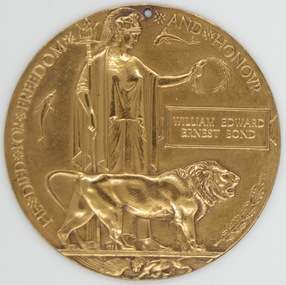
... France and the Western Front. He initially went missing in action in the Fleurbaix area on 19th of July 1917. It took a court of Inquiry in the field in September,1917 to determine he was killed in action, although his body was never recovered. He died aged 18. His name can be found on Panel 14, VC Corner Australian Cemetery and Memorial, Fromelles, Lille, Nord Pas de Calais, France brass memorial plaque and scroll dead man's penny bond william lara geelong killed in action world war one kia Brass Plaque " He died for Freedom and Honour William Edward Ernest Bond" Scroll Commemoration to Pte Edward Ernest Bond 58th Bn AIF Memorial Bronze Plaque and Scroll. ...Bronze Memorial plaque and Memorial Scroll issued to families whose relative was killed in action during word war 1. The history of the dead man's penny began in 1916 with the realisation by the British Government hat some form of an official token of gratitude should be given to the fallen service men and women's bereaved next of kin. Production of the plaques and scrolls, which was supposed to be financed by the German reparation money began in 1919 with approximately 1,150,00 issued. There were some relatives who returned the pennies to the Australian Government in protest as b they felt it was insulting and it did not replace their loved one's life.Killed in Action William Edward Ernest Bond joined the 58th Bn on the 24th November 1915 as a labourer from Geelong. As a private (4296), he was sent to France and the Western Front. He initially went missing in action in the Fleurbaix area on 19th of July 1917. It took a court of Inquiry in the field in September,1917 to determine he was killed in action, although his body was never recovered. He died aged 18. His name can be found on Panel 14, VC Corner Australian Cemetery and Memorial, Fromelles, Lille, Nord Pas de Calais, FranceMemorial Bronze Plaque and Scroll. The Memorial Plaque was also known as the WW1 'Death Penny' in memory of William Edward Ernest BONDBrass Plaque " He died for Freedom and Honour William Edward Ernest Bond" Scroll Commemoration to Pte Edward Ernest Bond 58th Bn AIFbrass memorial plaque and scroll dead man's penny bond william lara geelong killed in action world war one kia -
 City of Moorabbin Historical Society (Operating the Box Cottage Museum)
Document, x 2 ,Photograph colour x1, Reciept NSW Govt. Immigration Dept., Ticket Orient Line 'Osterley' 1915 Mr Rietmann, Osterley steam ship, 1915
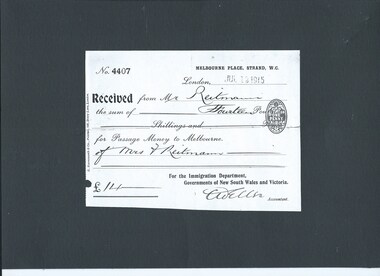
... port of marseilles france, melbourne australia, orient steam ship line, osterley steam ship,rietmann august, rietman august, rietmann frieda, rietman frieda, stonnington city town hall, war memorials, world war 1 1914-1918, rietman stefanie, rennick stefanie, francis stefanie, rietman william, rietman ray, mountford paul, malvern city town hall,box cottage museum ormond, box william, box elizabeth, joyce park ormond, rietman's landscaping pty ltd, bay road highett, macrobertson pty ltd, coleraine soldier memorial 1921,...Memorials before establishing his own successful masonry business in the Box Cottage during the latter 1920s. After becoming interested in pressed cement casting, he took on apprentices (1930s Depression) and among his products were garden furniture, pots and also street lamp standards, some of which were installed in St Kilda Road. After August’s death in 1951, his family continued the business ‘Rietman’s Landscaping Ltd.’, at Highett and Carrum. port of marseilles france, melbourne australia, orient steam ship line, osterley steam ship,rietmann august, rietman august, rietmann frieda, rietman frieda, stonnington city town hall, war memorials, world war 1 1914-1918, rietman stefanie, rennick stefanie, francis stefanie, rietman william, rietman ray, mountford paul, malvern city town hall,box cottage museum ormond, box william, box elizabeth, joyce park ormond, rietman's landscaping pty ltd, bay road highett, macrobertson pty ltd, coleraine soldier memorial 1921, a) No. 4407 MELBOURNE PLACE, THE STRAND W.C. ...August Rietmann (1877-1951) of Lustdorf ,Switzerland, married Maria Frieda Oesschlager (2/21878- 22/7/1942) of Baden Baden, Germany on 6/8/1910 In August 8th 1915 August and his wife Frieda migrated to Melbourne, Victoria, Australia sailing on the Steam Ship ‘Osterley’ from Marseilles to Melbourne They leased Box Cottage, Ormond in 1917 and raised two children, Stefanie (1918 -2006) and William (1920- 1997). 1935 August purchased the property and the family used the Cottage during the day and slept in the Front House. August was a monumental mason, potter and sculptor, and was employed at Corbens Ltd Clifton Hill, to carve war memorials in Victoria post WW1 c 1915-1922. During the 1920's August set up his own business in pressed cement making pot plants, columns,paving slabs and lampstands. He continued to carve headstones and figures and took contract work for Artists eg Paul Mountford. He built a workshop in the Barn and used the Cottage for plaster moulding. His son William joined the business and and the family continued to use the site after August died in 1951. Rietmann Landscaping Ltd moved to Bay Road Highett in 1953 and later to Carrum. The land, containing the Box Cottage, was sold to Lewis Timber Pty Ltd in 1970 and Mr Lewis proposed that Moorabbin City Council should preserve the heritage Cottage. In 1984 the Cottage was dismantled and reconstructed in the adjacent Joyce Park. 'Osterley' SS of the Orient Line, 12,129 tons, was a Royal Mail Steam- Ship sailing to and from Australia c1915The Rietman family is an example of the diverse nationalities that lived and worked productively in Moorabbin Shire 1871–1933 , the City of Moorabbin 1934-1994 and continues today in the Cities of Glen Eira, Kingston, Bayside, and Monash. August, a sculptor and stone mason, was employed by Corben Pty Ltd Clifton Hill to carve WW1 Memorials before establishing his own successful masonry business in the Box Cottage during the latter 1920s. After becoming interested in pressed cement casting, he took on apprentices (1930s Depression) and among his products were garden furniture, pots and also street lamp standards, some of which were installed in St Kilda Road. After August’s death in 1951, his family continued the business ‘Rietman’s Landscaping Ltd.’, at Highett and Carrum.Printed Documents a) Mr A Rietmann Receipt from Immigration Department of New South Wales Australia; b) Original Ticket Orient Line Ship 'Osterley' Marseilles to Melbourne 1915 c) Photograph colour of 'Osterley' Steam Shipa) No. 4407 MELBOURNE PLACE, THE STRAND W.C. /London July 12 1915/ Received from Mr Rietmann Fourteen Pounds for passage Money to Melbourne b) ORIENT LINE/ ROYAL MAIL STEAM-SHIPS TO AUSTRALIA/ ............THIRD CLASS PASSENGER CONTRACT TICKET..............OSTERLEY ... to take in passengers of the Port of Marseilles for ..........MELBOURNE............on the Eighth day of August 1915 ..........Mr August Rietmann .......................£15:4 : - to be paid before embarkation c) Osterly Steam ship en route to Melbourneport of marseilles france, melbourne australia, orient steam ship line, osterley steam ship,rietmann august, rietman august, rietmann frieda, rietman frieda, stonnington city town hall, war memorials, world war 1 1914-1918, rietman stefanie, rennick stefanie, francis stefanie, rietman william, rietman ray, mountford paul, malvern city town hall,box cottage museum ormond, box william, box elizabeth, joyce park ormond, rietman's landscaping pty ltd, bay road highett, macrobertson pty ltd, coleraine soldier memorial 1921, -
 City of Moorabbin Historical Society (Operating the Box Cottage Museum)
WW1 Medal for Women relatives of serving soldiers, c1914 - 1918
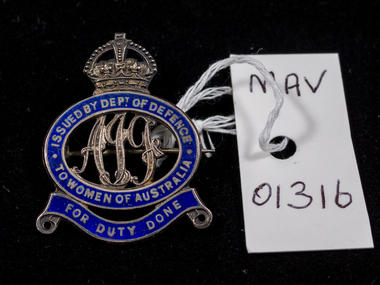
... War Memorial ) So many Moorabbin Shire young men volunteered to serve in 1st AIF during WW1 . This caused great hardship for farming families especially due to the heavy manual labour that the Women had to undertake to maintain food production for Australia and overseas . This medal may be associated with Alonzo Sheldrake Box who served at Gallipoli and France ...Female Relative Badges were issued to the nearest female relative (usually wives or mothers) of those who engaged in active service overseas during the First and Second World Wars. Two Female Relative Badges were issued during the First World War. One was issued to the nearest female relative of soldiers, airmen, nurses, and masseuses who left Australia for active service abroad; the other to the nearest female relative of members of the Royal Australian Navy (RAN) who had enlisted for general naval sea service for at least a period of the war, and who performed service outside Australian waters. A bar was suspended below the badge to indicate additional relatives involved in the war effort. The Female Relatives Badge was promulgated under Military Order 280 of 1917 and superseded by Military Order 1818 of 1918. (Australian War Memorial )So many Moorabbin Shire young men volunteered to serve in 1st AIF during WW1 . This caused great hardship for farming families especially due to the heavy manual labour that the Women had to undertake to maintain food production for Australia and overseas . This medal may be associated with Alonzo Sheldrake Box who served at Gallipoli and France Circular Silver medal with Crown , Blue engraving and pin clasp on back . A silver bar is attached Around edge ; Issued by Dept. of Defence to Women of Australia Centre cut out : A I F On Bar : For Duty Done On Back : Stokes & Sons 57691world war 1914-18, moorabbin shire, early settlers, pioneers, box alonzo, box william, australian military medals, anzac, gallipoli, sheldrake martha, box elizabeth, box mary louisa, closter mary, war memorials, a -
 City of Moorabbin Historical Society (Operating the Box Cottage Museum)
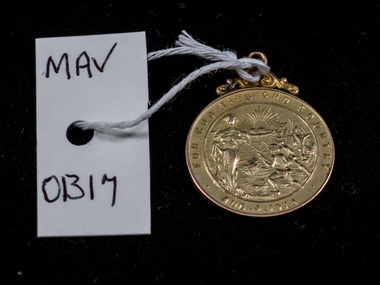
World War 1914-1918, Medal Alonzo Sheldrake Box, 1914
... War 1 1914-18 affected most families in Moorabbin Shire with large numbers of young men enlisting in the Australian Infantry Force. Alonzo Sheldrake Box , a pavier of Oakleigh, Victoria served at Gallipoli, France and Somme . When he returned home Oakleigh, like many Australian Towns, celebrated his safety and courage by presenting him with this Gold Medal. Each town also mourned the loss of so many soldiers and collected money from the residents to build War Memorials...War 1 1914-18 affected most families in Moorabbin Shire with large numbers of young men enlisting in the Australian Infantry Force. Alonzo Sheldrake Box , a pavier of Oakleigh, Victoria served at Gallipoli, France and Somme . When he returned home Oakleigh, like many Australian Towns, celebrated his safety and courage by presenting him with this Gold Medal. Each town also mourned the loss of so many soldiers and collected money from the residents to build War Memorials ...World War 1 1914-18 affected most families in Moorabbin Shire with large numbers of young men enlisting in the Australian Infantry Force. Alonzo Sheldrake Box , a pavier of Oakleigh, Victoria served at Gallipoli, France and Somme . When he returned home Oakleigh, like many Australian Towns, celebrated his safety and courage by presenting him with this Gold Medal. Each town also mourned the loss of so many soldiers and collected money from the residents to build War Memorials on which were engraved the names of the deceased soldiers. Alonzo Sheldrake Box (1851 - 1958) was the nephew of William and Elizabeth Box who lived in Box Cottage , East Brighton - now Ormond -. He married Mary Louisa Closter on June 12th 1918 at Holy Trinity, Church of England, Oakleigh.Alonzo Box was the son of John Box, who migrated from Sussex, England with his brother William Box c1855 , and established a market garden in East Brighton that was part of the Henry Dendy ' Special Survey Brighton 1841'A gold metal medal with top crest , 2 attachment rings, engraved on both sides presented to Alonzo Sheldrake Box 'For God King and Country. Aus. 1914 'Front ; outer circle - FOR GOD KING AND COUNTRY AUS. 1914 inner circle - tableau of a woman, rising sun and fighting soldiers Back : outer circle - PRESENTED BY THE CITIZENS OF OAKLEIGH centre - IN / RECOGNITION OF / SERVICE RENDd./ A.S.BOX / AIF / laurel wreathworld war 1914-18, moorabbin shire, early settlers, pioneers, box alonzo, box william, australian military medals, anzac, gallipoli, sheldrake martha, box elizabeth, box mary louisa, closter mary, war memorials, wedding dress, box john, viloudakia - box rebecca, -
 Geelong RSL Sub Branch
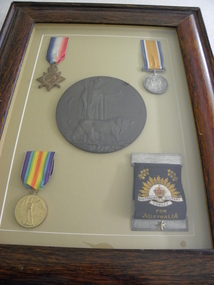
Medals - Norman H V Powell, 20th Century
... france killed in action 2952 n h v powell The Medals are behind glass, inscriptions cannot be confirmed. Plaque is inscribed - He Died for Freedom and Honour - Norman Henry Victor Powell Cloth Scroll - Australian Military Forces - For Australia A collection of Medals and Memorial Plaque and cloth scroll in a wooden frame. Medals are - 1914-1915 Star, British War ...The Medals, Plaque and Scroll are the original items presented to 2952 N H V Powell's Family. 2952 N H V Powell enlisted in the AMF on 12 October 1915 and was Killed in Action on 25 July 1916 in FranceThe items are the originals of 2952 N H V Powell as presented to his family.A collection of Medals and Memorial Plaque and cloth scroll in a wooden frame. Medals are - 1914-1915 Star, British War Medal, Victory Medal, Plaque, cloth scroll.The Medals are behind glass, inscriptions cannot be confirmed. Plaque is inscribed - He Died for Freedom and Honour - Norman Henry Victor Powell Cloth Scroll - Australian Military Forces - For Australiaww1, france, killed in action, 2952 n h v powell -
 Orbost & District Historical Society
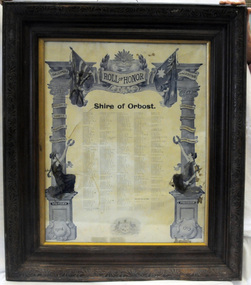
roll of honor, 1920s
... war-one-honor-roll orbost Names of those who served in W W 1. A framed memorial roll of honour for those from the Shire of Orbost who served at Gallipoli, Palestine and France. ...Presented to the Shire of Orbost as a history and commenoration of those who served and those who died during World War 1. This is an original Honor Roll and contains the names of Orbost men who served in W W 1. A framed memorial roll of honour for those from the Shire of Orbost who served at Gallipoli, Palestine and France. It is framed under glass with a large wooden frame. It has the names of those who served and those who were killed. On either side are the dates 1914 and 1919.Names of those who served in W W 1.roll-of-honor honor-roll world-war-one-honor-roll orbost -
 Phillip Island and District Historical Society Inc.
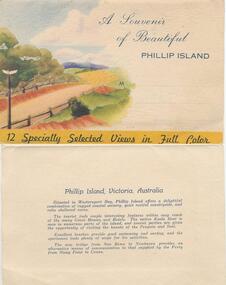
Souvenir Photographs, Nucolorvue Productions, c 1940
... War Memorial stands). View of the Suspension Bridge. View overlooking Rhyll and Westernport with French Island in the background....War Memorial stands). View of the Suspension Bridge. View overlooking Rhyll and Westernport with French Island in the background. ...A Souvenir Postcard Folder donated by Derick White.Strip postcard folder of 12 coloured views. 341-01,2,3. The Koala Cafe, Post Office & Bayview Guest looking towards the crn of Thompson Avenue and The Esplanade. The Cowes beach & Pier. The Nobbies and steps to the Blowhole. 341-04,5,6. The Cowes Pier with a ferry and crowd of people. Cape Woolamai coastline. Close up of a koala in a tree. 341-07,8,9. Seals on Seal Rocks. The San Remo pier with a group of people, beach, and main street with Westernport Hotel in the background. Four people standing looking at The Nobbies. 341-10,11,12. The Isle of Wight Hotel and garden (now where the War Memorial stands). View of the Suspension Bridge. View overlooking Rhyll and Westernport with French Island in the background.Description similar to as above.cowes post office, koala cafe, bayview guesthouse cowes, the nobbies, the nobbies & blowhole, seals on seal rocks phillip island, wildlife - koala, cowes pier phillip island, coastline cape woolamai, san remo and pier, the isle of wight hotel cowes phillip island, rhyll phillip island, phillip island suspension bridge, derick white -
 Greensborough Historical Society
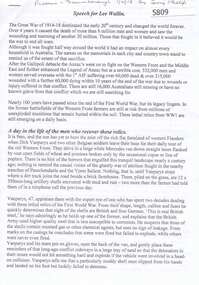
Article, Terry Phillips, Speech for Lee Wallin, by Terry Phillips at Probus Club, 01/10/2018
... War Memorial Park. Text of speech about the ongoing activity to recover unexploded ammunition from French and Belgian World War 1 battlefields....War Memorial Park. Text of speech about the ongoing activity to recover unexploded ammunition from French and Belgian World War 1 battlefields. world war 1 terry phillips 5 p. typescript; 4 p. newsletter and 1 p. invitation Speech for Lee Wallin, by Terry Phillips at Probus Club Article Greensborough Probus Club Terry Phillips ...Speech for Lee Wallin, by Terry Phillips at Probus Club [advertised as 'World War I Last 100 Days']; with Greensborough Probus Club newsletter October 2018, and invitation to Remembrance Day 2018 Service at Kangaroo Ground War Memorial Park. Text of speech about the ongoing activity to recover unexploded ammunition from French and Belgian World War 1 battlefields.5 p. typescript; 4 p. newsletter and 1 p. invitationworld war 1, terry phillips -
 Red Cliffs Military Museum
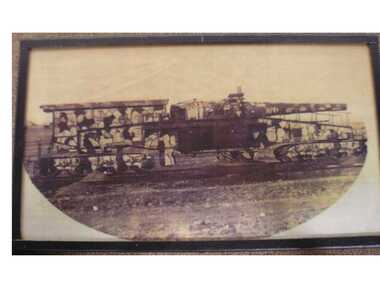
Copied Photos, The Amiens Gun, WW1
... French Divisions broke the German Front before Amiens./ The Barrel of the Great Gun, 41 feet (12,5m) long and weighing more than 45tons (45-80 tonnes), is exhibited at the Australian War Memorial in Canberra. ...French Divisions broke the German Front before Amiens./ The Barrel of the Great Gun, 41 feet (12,5m) long and weighing more than 45tons (45-80 tonnes), is exhibited at the Australian War Memorial in Canberra. ...This 11 inch (28) Railway Gun was captured by the AIF in front of Harbonnieres near Villers Bretonneaux on the 8th of August 1918. It was one of the Guns used by the Germans to shell Amiens from a distance of 15 miles (24km) in an endeavor to destroy the railway centre in the city. However the destruction of the city was prevented by the advance of Allied Troops on the morning of 8th August when 5 Australian, 4 Canadian, 4 British and 9 French Divisions broke the German Front before Amiens./ The Barrel of the Great Gun, 41 feet (12,5m) long and weighing more than 45tons (45-80 tonnes), is exhibited at the Australian War Memorial in Canberra. More information can be found at www.Wikipedia/The Amiens Gun Two copied photos of the Amiens Gun (seperate Frames) and a history of the Amiens Gun in seperate frame.None on Photos, the history frame has a short history and "Presented by the Canberra Services Club 2003"ww1, gun, the, railway, amiens, harbonnieres, villers, bretonneaux -
 Mission to Seafarers Victoria
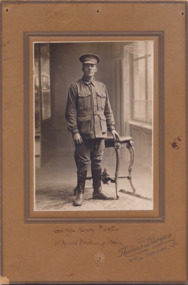
Photograph - Mounted photograph, Black and white, Thelma-Duryed, George Henry Martin, 1915
... Born: Edmonton, England, 10 January 1888 Home Town: Magill, Campbelltown, South Australia Occupation: Seaman Service Number: 176 Enlisted: 27 March 1915, Melbourne, Victoria Last Rank: Gunner Last Unit: 1st Royal Australian Naval Bridging Train Died: Killed in action, France, 7 August 1916, aged 28 years Cemetery: Gordon Dump Cemetery, Ovillers-la Boisselle Gordon Dump Cemetery, Ovillers la Boisselle, Picardie, France Memorials: Australian War Memorial Roll of Honour, Magill Honour Board, Magill War Memorial 27 Mar 1915: Enlisted AIF WW1, Private, 1st Royal Australian Naval Bridging Train, Melbourne, Victoria 4 Jun 1915: Embarked AIF WW1, Private, SN 176, 1st Royal Australian Naval Bridging Train, --- :embarkation_roll: roll_number: '24' embarkation_place: Melbourne embarkation_ship: HMAT Port Macquarie embarkation_ship_number: A39 public_note: '' 4 Jun 1915: Embarked AIF WW1, SN 176, 1st Royal Australian Naval Bridging Train, HMAT Port Macquarie, Melbourne 7 Aug 1916: Involvement AIF WW1, Gunner, SN 176, Battle for Pozières The portrait has been used in this article : "THE LATE GUNNER G. ...Born: Edmonton, England, 10 January 1888 Home Town: Magill, Campbelltown, South Australia Occupation: Seaman Service Number: 176 Enlisted: 27 March 1915, Melbourne, Victoria Last Rank: Gunner Last Unit: 1st Royal Australian Naval Bridging Train Died: Killed in action, France, 7 August 1916, aged 28 years Cemetery: Gordon Dump Cemetery, Ovillers-la Boisselle Gordon Dump Cemetery, Ovillers la Boisselle, Picardie, France Memorials: Australian War Memorial Roll of Honour, Magill Honour Board, Magill War Memorial 27 Mar 1915: Enlisted AIF WW1, Private, 1st Royal Australian Naval Bridging Train, Melbourne, Victoria 4 Jun 1915: Embarked AIF WW1, Private, SN 176, 1st Royal Australian Naval Bridging Train, --- :embarkation_roll: roll_number: '24' embarkation_place: Melbourne embarkation_ship: HMAT Port Macquarie embarkation_ship_number: A39 public_note: '' 4 Jun 1915: Embarked AIF WW1, SN 176, 1st Royal Australian Naval Bridging Train, HMAT Port Macquarie, Melbourne 7 Aug 1916: Involvement AIF WW1, Gunner, SN 176, Battle for Pozières The portrait has been used in this article : "THE LATE GUNNER G. ...Born: Edmonton, England, 10 January 1888 Home Town: Magill, Campbelltown, South Australia Occupation: Seaman Service Number: 176 Enlisted: 27 March 1915, Melbourne, Victoria Last Rank: Gunner Last Unit: 1st Royal Australian Naval Bridging Train Died: Killed in action, France, 7 August 1916, aged 28 years Cemetery: Gordon Dump Cemetery, Ovillers-la Boisselle Gordon Dump Cemetery, Ovillers la Boisselle, Picardie, France Memorials: Australian War Memorial Roll of Honour, Magill Honour Board, Magill War Memorial 27 Mar 1915: Enlisted AIF WW1, Private, 1st Royal Australian Naval Bridging Train, Melbourne, Victoria 4 Jun 1915: Embarked AIF WW1, Private, SN 176, 1st Royal Australian Naval Bridging Train, --- :embarkation_roll: roll_number: '24' embarkation_place: Melbourne embarkation_ship: HMAT Port Macquarie embarkation_ship_number: A39 public_note: '' 4 Jun 1915: Embarked AIF WW1, SN 176, 1st Royal Australian Naval Bridging Train, HMAT Port Macquarie, Melbourne 7 Aug 1916: Involvement AIF WW1, Gunner, SN 176, Battle for Pozières The portrait has been used in this article : "THE LATE GUNNER G. H. MARTIN. Mrs. G. H. Martin, of Jackson-street, Magill, has been advised that her husband, Gunner G. H. Martin, was killed in action in France on August 7. He sailed from Melbourne for Egypt in June, 1915, and had been at the front in France since April last. He also served ten months in the Naval Bridging Train before joining the artillery. He was born in Edmonton, England, and lived in Magill for about five years. He was in his 28th year." - from the Adelaide Chronicle 30 Sep 1916 (nla.gov.au)As his occupation was seaman, we can assume George Henry Martin visited the Mission. The Senior Chaplain, Alfred Hurney Goldsmith, RANR, was appointed chaplain of the Naval Bridging Train in 1914. (Jottings 31, Midwinter 1914). We can only imagine the two men knew each other and that the portrait was donated by George himself or by his family to the Mission.Portrait of ANZAC soldier in 1915naval bridging train, france, ww1, thelma-duryed, adelaide, george henry martin 1888-1916 -
 Mission to Seafarers Victoria
Article, A Woman's Melbourne Letter
... French, English, Spanish, Scandinavian, Norwegian, and German may be found on the shelves. Each week about 36 convenient parcels of reading stuff are made up. These contain illustrated papers, books in various languages, and magazines. These parcels are eagerly accepted by the sailor with a long monotonous voyage before him. But complete as is every corner of the institute, no part is so well equipped as the memorial chapel erected by the Ladies' Harbour Light Guild, in memory of the officers and men, who have lost their lives during the war...French, English, Spanish, Scandinavian, Norwegian, and German may be found on the shelves. Each week about 36 convenient parcels of reading stuff are made up. These contain illustrated papers, books in various languages, and magazines. These parcels are eagerly accepted by the sailor with a long monotonous voyage before him. But complete as is every corner of the institute, no part is so well equipped as the memorial chapel erected by the Ladies' Harbour Light Guild, in memory of the officers and men, who have lost their lives during the war ...A detailed description of the Mission and its activities written by a woman: Western Mail (Perth, WA : 1885 - 1954), Friday 13 December 1918, page 34 A WOMAN'S MELBOURNE LETTER. Melbourne, Dec. 4. There is an idea abroad, which as regards Melbourne, at any rate, is quite erroneous, that our sailors are not as well looked after as our soldiers, and that the noble men of the Mercantile Marine are much neglected ! For once, perhaps, my readers will pardon a letter dealing with only one subject, but the steady, unostentatious work done by the Ladies' Harbour Light Guild, in connection with the mission to seamen in Melbourne could not be adequately explained if dismissed in the usual short paragraph. Some of the most prominent names in Melbourne are associated with this guild and with the Mission Chaplain, and Mrs. Gurney Goldsmith, the members have made the Seamen's Institute a real home for those sailors of the Mercantile Marine, who touch our port. What we as a community owe to those men by their heroism in recent hostilities is certainly more understood by this band of enthusiastic workers than by the community generally. By using their unflagging energies, and influence on the sailor's behalf they endeavour to discharge a debt to which in some way or other we could and should all contribute. Even the most casual person can, if he thinks at all, sum up a few of the things our sailors - other than those belonging to our glorious navy - have done for us. On the spur of the moment we remember that those of the Mercantile Marine, are the men who manned our transports, who carried our wheat and wool, to oversea markets; who kept us in touch with our loved ones abroad; who kept the fires going in the furnaces of the great leviathans, bringing our wounded soldiers home again; who never flinched when self-sacrifice was demanded; who cared, with that tenderness, innate in all sailors, for the women and children, when the passenger ships were struck a dastardly blow by the wicked enemy; who, mocking death, gave up life with a heroism all the more heroic because it was always taken as a matter of course! Is it any wonder, then, that the members of the Ladies' Harbour Light Guild make it their business to provide a bright, homelike, spot in Melbourne, where the sailors are always certain of a cherry welcome ashore? The members of the guild are admirably drafted! The 360 non-workers each pay £1 1s. per annum. The workers, of whom there are between 700 and 800, donate 2s. 6d. and school members - it is confidently hoped that gradually all the schools will take an active interest in the mission - 1s. a year. The knights of the guild - as the men members are designated - are responsible for any sum they wish to name, from 5s. a year upwards. Everything is paid for out of these revenues, with the exception of a small grant from the Home Mission Fund - and such is the organisation, and management, that the entire concern is quite free from debt. The Seamen's Church and Institute, where the "Harbour Lights" gleam so brightly, is situated right in the midst of all the bustle and turmoil of the wharves, at the end of Flinders-street. The building, comprising chapel, and institute under the one red tiled roof, is grey stuccoed, with a small tower, from which flaunts the flag of 'The Flying Angel" - the badge of the guild. A visit to the institute makes one fully appreciate the boon the place must be to the voyage worn, weary, sailor. The atmosphere is eminently social in its best sense. While the architecture imparts an elegance, and quiet dignity which soothes by the very subtlety of its charm. With its comfortable furniture, its wealth of flowers, and the happy, wholesome, feminine influence which prevails everywhere, the quality which stands for the magic word "home" abounds. The Chaplain in the course of conversation said: -"We try to make this really a free club for sailors." But the habitues would probably tell you it was far more than that to them. The Institute is excellently appointed, and every little corner seems to have its particular history. It was built after the model of one of the old mission churches in California, and retains something of the old world attraction, while yet it combines all the advantages of modern, practical, conveniences. On entering the door the first thing, one notices is a huge compass, inlaid upon the floor, evidently to indicate one's proper bearings for it points due north - to the chapel! Only one other seamen's mission in the world boasts such a compass. As the sailor swings through the entrance he finds the office on his right, and there is, here, always a smiling face to welcome the shy, or timid, new comer. Quite a real post office is staffed by members of the guild, and all the letters received are listed alphabetically. Therefore, the expectant sailor has just to run his eye down the list, and he can immediately see whether there is a letter for him or not. If he is fortunate, he comes up to the member in charge, who unlocks the box, and produces the longed for missive. The boys are always encouraged to answer letters - and to write them. Often a few words about their mother, and their own home, will provoke a sleeping memory into activity. The writing room is well stocked with paper, envelopes, pens, and ink. The tables are so divided to ensure the utmost privacy, and through a calculated chain of circumstances, many an anxious mother receives a letter from her sailor lad, who, perhaps, might not have written but for these kindly inducements. The central hall - where social evenings are held every other night besides two special concerts a week - is inviting in the extreme. A handsome piano affords opportunity for those musically inclined. The tables are strewn with papers. The walls are bright with pictures, and here, and there, is a carved model, of a ship. One, of especial interest, is a model of "The Roon" carved, and presented by a French sailor. This German vessel will always be remembered in Australia. For it was across her bows that the first hostile shot was ever fired in Australian waters. In the corner is the canteen. It was fitted up entirely from the proceeds of a quotation calendar compiled by one of the members. The sailors may at any time, get a teapot of tea, or a tray of eatables, at a nominal cost. Before the canteen was in existence they had to go out for refreshments! - and sometimes they did not come back! Groups of sailors sit chatting at the tables. Half a dozen Swedes laugh and talk among themselves, for the simple reason they know no other language than their own. Several British sailors cluster about a dark-eyed Welsh lad - a perfect Celtic type - who, although only about twenty years of age, has been the victim of the Hun five times. Mines and torpedoes sank the ships he was in, either in the Channel or off the English coast, four times; and it is to his fifth experience, when the Inverness was wrecked, that everyone is eagerly listening. "We were in the boats eight days," he was saying, "I was pretty well mangled when they picked me up. The sufferings we endured were awful. At last we managed to reach Rapa, a Hawaiian island. The natives thought we were Germans, and came at us with spears. When they found we were British, they were awfully good to us. They even cried when we left, and the day before the rescue boat arrived they begged us to go into the hills and hide." At another table a Canadian lad - once a sailor - then a soldier, who trained at the Broadmeadows camp - was telling his experiences : - "The voyage which will always stick in my memory," he said, "was to a place which must be nameless. We left the United States not knowing whether we were bound, or what we were going to do. After some weeks we sighted a group of wonderfully beautiful islands, and we headed for the most remote and most lovely of them all. Then, and only then, we learned our mission from the skipper. We were taking their year's supply to a leprosy station! Oh no! I don't blame the skipper for not telling us ! Someone has to do these things, you know. A naval guard saw they didn't come near - and we all got sixty dollars extra. When the job was over we were quarantined on another island for two months, and one little chap - the baby of the crew, not eighteen - developed leprosy, and died before we left. Yes! I'll never forget that voyage, mates! Sometimes, I seem to see Leper's Island yet, with its lavish tropical vegetation and the gorgeous sunsets which stained all the water with blood. Then, too" - here the voice deepened - "there was an English girl - a leper - there. We heard she used to be an actress, and she contracted the disease somehow or other. She was always alone, and always watching us. In the distance we could see her come to the water's edge, and from there she would watch. Just watch . .. . watch . . .watch. ..." "Here come a couple of North Sea chaps," broke in an elderly man after pause. "One of them wounded, too, poor lad." It is not strange that all the sailors flock to the Institute. It is so comfortable, and essentially inviting, besides being full of human interest. The men's quarters comprise reading, writing and dressing rooms - hot and cold baths are always available - billiard room, and a special baggage room, where any sailor may leave his kit for as long as he likes. The payment of 3d. covers its complete insurance. Upstairs are the officers' quarters. These also have their own billiard room, writing and reading rooms, bath and dressing rooms. Just close are the apprentices' quarters - "The Half Deck," as popular parlance has it! The lads also have a billiard room of their own, and indulge in an easy armchair - amongst others - which was a donation from the Milverton School branch of the Guild. It is hoped by the committee to some day utilise the huge empty rooms, which run the length of the whole building. Their ultimate intention is to fit them up as cubicles, or "cabins," as they are to be called. They trust these "cabins" will be donated, either in memory, or in honour, of someone dear to the donor. Another forward movement soon to be put in hand, now that materials are available, is the establishment of "Norla Gymnasium." In a sailors' club such facility for exercise is absolutely essential. The men both need, and miss, exertion. As one boy, who had been backsliding, once said pathetically : -"If only there was something to do to get me into a good sweat, I would be all right." Soon such an one will be helped to swing from the trapese of the Norla Gymnasium into the right track! Sunday is always a fete day at the Institute, for 40 or 50 sailors generally come into tea. The up-to-date kitchen, which is fitted with every labour-saving appliance - all paid for out of working members' half crowns - is then a hive of animation, and methodical order. A formidable row of teapots await filling. Mrs. Goldsmith -, the chaplain's wife - rightly thinks it is far more homely to pour out the tea from a pot, than to serve it straight from the urns. So tea is poured out by a member, who sits at the head of a table gay with flowers, and chats to the guests. These latter are of all nationalities. But the French, the Spanish, Scandinavian, Norwegian - or any other sailor is equally welcome with the British. Two enthusiasts belonging to the Guild actually learnt Norwegian, so that men of this nation would have someone to talk to, and so be less lonely when they reached this, to them, foreign port ! The members of the Guild have their own private suite where they arrange the flow-err and do other necessary odds and ends undisturbed. No one appreciates flowers like a sailor, and the earliest and most beautiful may always be seen adorning the tables and rooms. Teas are served and lectures are held in the "Celia Little Hall," one of the most beautiful portions of the institute. It was erected by the chaplain in memory of his aunt from whom the hall takes its name. The Gothic windows open upon the cloisters, where, in the hot weather, the sailors enjoy their meals out of doors. The cloisters, indeed, form an exquisite spot. They are between a series of sweeping arches which lead to the chapel, and are sheltered by the open balcony of the chaplain's quarters. Grace of contour marks the architecture on every turn. Just around the corner is the chaplain's garden - a patch of green and colour, transformed from a desert waste, by a well-known woman horticulturist. The book room is a department especially valued by the sailors. There are two secretaries, one for home and the other for foreign literature. Books in French, English, Spanish, Scandinavian, Norwegian, and German may be found on the shelves. Each week about 36 convenient parcels of reading stuff are made up. These contain illustrated papers, books in various languages, and magazines. These parcels are eagerly accepted by the sailor with a long monotonous voyage before him. But complete as is every corner of the institute, no part is so well equipped as the memorial chapel erected by the Ladies' Harbour Light Guild, in memory of the officers and men, who have lost their lives during the war. St Peter's - for it is called after the sailor's patron saint - with its hallowed gentle dignity is a veritable sanctuary of peace, perhaps all the more so because it sprang out of war. The fittings are entirely of Australian wood. The pews, given in memory of some loved one by one of the members, are of Tasmanian hardwood. The reredos and altar chairs of carved blackwood. The rich carpet was provided by the members' magical half-crowns. Already this chapel holds memorials of peculiar historical interest. The altar lectern was given in memory of Commander Elwell, who, it will be remembered, was killed at Rabaul, in the early part of the war. The font commemorates two heroes - Nigel Hockley and Fred Hyde, who lost their lives at the hands of the Germans, although they survived the actual torpedoing of their ships, the Galgorn Castle off the coast of Ireland. The mother of one of them wrote out that her son had died as an Englishman should - fighting for the right. This noble sentiment is suitably paraphrased upon the inscription engraved upon the font. Practically every-hing enshrined in the chapel has its own sentimental value. The alms salver of beaten copper, studded with agate, is fragrant with the memory of a saintly woman.The eye of the sailor is caught and held by the pulpit, which is fashioned like a ship's hull and only a twist of rope guides the chaplain up the steps. For the last 13 years the Rev. A. Gurney Goldsmith, M.A., has acted as chaplain to the Seamen's Mission in Melbourne. Before that he and his wife worked in China. Mr Goldsmith visits all the boats and gets in touch personally with the sailor, over whom he has great influence. He is not only their chaplain and friend, but, amongst a wide range of other things, their banker besides. An exchange system exists between the various Missions, and the sailor who has "banked" his money with the chaplain, upon going away, receives a cheque which is cashed - minus exchange - by the chaplain of the next port. Mr. Goldsmith will tell you he has a soft spot in his heart for on old sailor he calls "Paddy." This ancient mariner has been wrecked ten times. It was a long time before the chaplain prevailed upon "Paddy" to partake of the spiritual and secular advantages afforded by the institute. He would not come, he said, until he could do so "with a good heart." Finally he frankly admitted that he had no "friends like those of 'the Flying Angel,' " and that he eventually proved his own "good heart" will be shown in this story. One day he came in to the chaplain and said bluffly, "Well, sir, I've been payin' off some old scores up Carlton way, an' I tells yer, plain, sir, not one of 'em would have seen a penny of their money but for the Mission." The Ladies' Harbour Light Guild has over thirty working suburban branches, and the excellent results achieved at the Institute now will no doubt be considerably augmented in the future. The practical actions of the members do more than anything else to convey the subtle meaning of the name of the Guild. To the visiting sailors the word "ladies" signifies the bread givers; "harbour" safety ; "lights" welcome; "guild" the welding of fraternity, and they one and all tell you the ideals thus embodied are unselfishly carried out by all the ladies who have banded together to care for the sailors' welfare.The article describes the Mission and the use of several spaces a year after its opening and gives details about the daily activities.Digital copy of an article published in the Western Mail on the 13th of December 1918. 717 flinders street, seamen's mission, norla dome, lhlg, reverend alfred gurney goldsmith, celia little room, garden, frederica godfrey -
 Supreme Court of Victoria Library
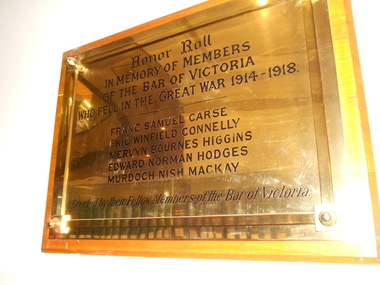
Memorial Board, PJ King, World War One Memorial Board - Bar Council, 1920
... Mackay served at Gallipoli and died in France in 1916, he was Major, but only 25 at the time of his death. memorial boards; carse connelly higgins hodges mackay Honor Roll in memory of members of the Bar of Victoria who fell in the Great War 1914-1918, Franc Samuel Carse, Eric Winfield Connelly, Mervyn Bourne Higgins, Edward Norman Hodges, Murdoch Nish Mackay, Erected by their fellow members of the Bar of Victoria brass and wood, black lettering. ...Library Committee minutes from 1920 discuss the placing of an Honour Board in the Library, there was obviously some discussion from the Ballarat and Bendigo Law Associations about whom should be placed on the board and whether it was appropriate that it be located in the library. The board was donated by the Committee of Counsel, from the Bar and so only commemorates barristers. It is curious that this was not placed in Selborne Chambers where many barristers had rooms including one of the men on the Board (Higgins). This board joined the much bigger LIV memorial board that celebrates all Victorian lawyers who served during WWI.While memorial boards are a common addition to many public and civic building after World War One. This memorial board is the only one that commemorates members of the Bar, in that sense it is of great significance to the legal community. Two of the men commemorated on the board were sons of judges (Higgins, son of the Justice Henry Bourne Higgins of the High Court and Hodges, son of Justice Henry Hodges of the Supreme Court). Franc Carse was related by marriage to the a’Beckett family (also judges of the Court) and his father in law was on the Supreme Court Library committee in 1914. Eric Connelly and Murdoch Mackay shared rooms in Selborne Chambers. Connelly died in late 1918 in France, a member of General Pompey Elliott’s staff. Connelly had previously taken part in the Gallipoli landings in April 1915. Mackay served at Gallipoli and died in France in 1916, he was Major, but only 25 at the time of his death.brass and wood, black lettering.Honor Roll in memory of members of the Bar of Victoria who fell in the Great War 1914-1918, Franc Samuel Carse, Eric Winfield Connelly, Mervyn Bourne Higgins, Edward Norman Hodges, Murdoch Nish Mackay, Erected by their fellow members of the Bar of Victoriamemorial boards; carse, connelly, higgins, hodges, mackay -
 Eltham District Historical Society Inc
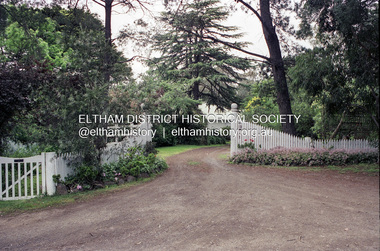
Negative - Photograph, Russell Yeoman, Stanhope, 10 Peter Street, Eltham, c.Sep. 2000
... The original property, comprising 15 ½ acres with a frontage on Diamond Creek, was bought in about 1900 by Will Longstaff (b. 1878, d London 1953), official war artist during World War I, who became famous for his painting 'The Ghosts of Menin Gate', France which is now in the Australian War Memorial, Canberra. ...The original property, comprising 15 ½ acres with a frontage on Diamond Creek, was bought in about 1900 by Will Longstaff (b. 1878, d London 1953), official war artist during World War I, who became famous for his painting 'The Ghosts of Menin Gate', France which is now in the Australian War Memorial, Canberra. ...Clem Christesen wrote a brief history of "Stanhope" which was reproduced in EDHS Newsletter No. 162 May 2005. STANHOPE HOUSE is situated on the crest of Stanhope Hill about ten minutes' walk westward from the Eltham railway station and is bounded by Peter, Fay and Stanhope Streets. The original property, comprising 15 ½ acres with a frontage on Diamond Creek, was bought in about 1900 by Will Longstaff (b. 1878, d London 1953), official war artist during World War I, who became famous for his painting 'The Ghosts of Menin Gate', France which is now in the Australian War Memorial, Canberra. The main residence, designed by Desbrowe Annear, was built of jarrah, with stucco walls and floors of Tasmanian hardwood The rooms were panelled with Californian redwood (sequoia). Away from house was a cottage (used as a studio), and stables, dairy and meat house. In 1919 Mr Theo. Handfield bought the property from Mrs Longstaff. On New Year 's Day 1924 most of the estate (eighty blocks) was auctioned. Bishop Reginald Stephen, Warden of Trinity College and distinguished scholar, bought the house and five acres in 1928. Dr and Mrs C.B. Christesen became the new owners in 1946 and subsequently extended the house on the north and south sides. 'Stanhope 'has had many very interesting art and literary associations. When Will Longstaff occupied it - he was a cousin of another well-known painter, Sir John Longstaff- various leading artists of the period, including Walter Withers who lived nearby, were frequent visitors. A son of Mr and Mrs Handfield, John, became a journalist and author, and now lives with his wife Esta at Homestead Road, Eltham. Bishop Stephen was related to Sir Leslie Stephen (1832-1904), one of the great representative minds of Victorian Britain, first editor of the monumental Dictionary of National Biography and father of the famous novelist and essayist Virginia Woolf. John Harcourt, novelist and music critic, rented 'Stanhope 'while he and his wife Fay were building 'Clay Nuneham' (mudbrick) at the foot of Stanhope Hill near the creek. Nina Christesen, academic and founding editor of Melbourne Slavonic Studies, was Head of the Department of Russian Language and Literature, University of Melbourne, from 1946 to 1977. Clem Christesen, poet, short story writer and painter, founded Australia's leading literary journal Meanjin Quarterly in 1940 and remained editor until 1975. Very many distinguished Australian and foreign writers, artists and academics-from Nobel prize-winning novelist Patrick White to the world's leading cellist Mstislav Rostropovich - have visited 'Stanhope ' over the years. The extensive garden is said to be one of the loveliest in Eltham. The main entrance is by way of Diamond and Peter Streets. film - kodak gc 400-6, russell yeoman collection, scan - 35mm negative, bishop stephen, clem christesen, eltham, nina mikhailovna christesen, peter street, stanhope, theo handfield, will longstaff -
 Bendigo Military Museum
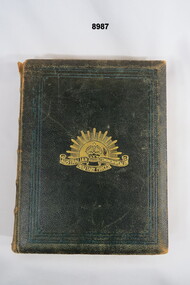
Book - THE ALL- AUSTRALIAN MEMORIAL, British - Australian Publishing Service, 1917
... War Service - France. Historical - "Jack Swatton". Refer Cat No. 6719.2P for his service details. PBTCOLLECTIONS Passchendaele barracks trust Memorial Manual Book WW1 Jack Swatton “Australian Commonwealth Military Forces” “British Australian Publishing Service 1917” “Dedication page - refer to Historical context” Large book recording the ANZAC achievements. ...Dedication Page. Photo John W. Swatton. SWATTON J.W. Gnr. No. 4905. No 43rd Bty 11th Fld Arty Bgde. Son of Mr. William and Mrs. Elizabeth Swatton, McKenzie St. Bendigo; Born at Melbourne, Dec 24, 1895. educated at Golden Square State School. Occup. Grocer. Enlisted: Bendigo, July 10, 1915. War Service - France. Historical - "Jack Swatton". Refer Cat No. 6719.2P for his service details. Large book recording the ANZAC achievements. It is wholly Australian contents and it represents almost two (2) years of data relating to Australia's part in the Great War during 1915-1916. Chapter 1 - History of the Dardanelles Operation. Part 2, Names of Soldiers officially reported killed in action or died of wounds up to December 1916 - from Victorian Regiments. Part 3. Australia's Fighting Families from Victoria. Part 4. Regimental Register of Victorian Units on Embarkation.“Australian Commonwealth Military Forces” “British Australian Publishing Service 1917” “Dedication page - refer to Historical context”pbtcollections, passchendaele barracks trust, memorial, manual, book, ww1, jack swatton -
 Bendigo Military Museum
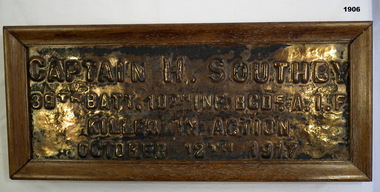
Plaque - BRONZE PLAQUE WW1, Post 1918 (estimated)
... War from March to September 1902. By the time he enlisted in the AIF he was 41 years 2 months of age on 22.3.16 with the rank of Lieut in the 39th Batt. Embarked for England 27.5.16, embark for France 23.11.16, promoted Captain 23.4.17, WIA 7.6.17 shell wound to back, return to France 30.7.17, KIA 12.10.17 at Passchendaele. It is believed he was W.I.A and while being carried out by Stretcher Bearers a shell burst killing them all. No known grave. The plaque was one of many that were placed on trees in Condon St. Bendigo as a memorial...War from March to September 1902. By the time he enlisted in the AIF he was 41 years 2 months of age on 22.3.16 with the rank of Lieut in the 39th Batt. Embarked for England 27.5.16, embark for France 23.11.16, promoted Captain 23.4.17, WIA 7.6.17 shell wound to back, return to France 30.7.17, KIA 12.10.17 at Passchendaele. It is believed he was W.I.A and while being carried out by Stretcher Bearers a shell burst killing them all. No known grave. The plaque was one of many that were placed on trees in Condon St. Bendigo as a memorial ...Henry Southby pre WW1 served 5 years in the Militia and 22 years on the Permanent staff. He is listed as No 2240 serving in the 4th Batt Aust Commonwealth Horse during the Boer War from March to September 1902. By the time he enlisted in the AIF he was 41 years 2 months of age on 22.3.16 with the rank of Lieut in the 39th Batt. Embarked for England 27.5.16, embark for France 23.11.16, promoted Captain 23.4.17, WIA 7.6.17 shell wound to back, return to France 30.7.17, KIA 12.10.17 at Passchendaele. It is believed he was W.I.A and while being carried out by Stretcher Bearers a shell burst killing them all. No known grave. The plaque was one of many that were placed on trees in Condon St. Bendigo as a memorial to those who lost their lives. Refer 1903.2, 1905P.Bronze plaque set in a wood frame re; H.SOUTHBY. Frame is brown, the plaque lettering is raised."CAPTAIN H. SOUTHBY 39th BATT. 10th INF. BGD. A.I.F KILLED IN ACTION OCTOBER 12th 1917"civic mementoes - plaques, handcrafts - woodwork, military history, southby -
 Warrnambool and District Historical Society Inc.
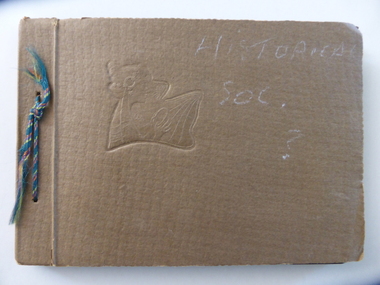
Album, Photo Album, 1920s
... War Memorials in most Australian towns and small settlements is an indication of the effect on the Australian people of the sacrifice of the lives of so many young people. Warrnambool was just one place in Australia that built a war memorial in the 1920s and continues today to remember World War One heroes as well as those from later wars. world war one history of warrnambool Stamp of Warrnambool & District Historical Society This is a brown photograph album containing 72 black and white photographs of Australian soldiers in World War One (Gallipoli, Palestine, France etc). ...This is an album of Australian official photographs of Australian participation in World War One. Enlargements of the photographs could be obtained in the 1920s from the Australian War Museum in the Exhibition Buildings in Melbourne. World War One (1914-1918) was a highly significant event, not only in world history, but also in Australian history – a time when Australia participated to a strong degree, with a great number of Australian men and women dying in the war. These photographs were important in the 1920s as they showed war scenes and military activities that were not available to the public when the war was in progress. They are still important today showing Australian military action in World War One, a signal event in Australia’s history. The number of World War One War Memorials in most Australian towns and small settlements is an indication of the effect on the Australian people of the sacrifice of the lives of so many young people. Warrnambool was just one place in Australia that built a war memorial in the 1920s and continues today to remember World War One heroes as well as those from later wars. This is a brown photograph album containing 72 black and white photographs of Australian soldiers in World War One (Gallipoli, Palestine, France etc). The photographs have been commercially produced. There are four photographs to each page mounted on card. The cover is cardboard and the pages are bound with multi-coloured string. The cover has an imprint of a lady (ancient Greek style).Stamp of Warrnambool & District Historical Society world war one, history of warrnambool -
 Bendigo Military Museum
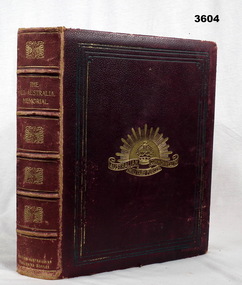
Book - BOOK WW1, Shovelton & Storey, The All Australian Memorial, 1917
... Memorial (Victorian Edition) A Historical Record of National Effort During The Great War. Australians Roll of Honour 1914 - 1916, Heroes and Helpers. Book memorial all australian Dedication page contains a card & printed portrait photo & information on Allan SCHWENNESEN “SCHWENNESEN A W, L-Cpl D Coy; 5th Batt; s. of Henry and Harriet Schwennesen 13 Arthur-St; Bendigo b. at Petersburg, S.Aust Sept 30 1897; educ. Talbot SS; clerk; enl. Bendigo, April 25, 1915 War Service; Gallipoli (Landing Evacuation); France ...The All Australian Memorial (Victorian Edition) A Historical Record of National Effort During The Great War. Australians Roll of Honour 1914 - 1916, Heroes and Helpers.Hard cardboard cover, dark red buckram, gold print on front & spine. Australian Commonwealth Military Forces badge on front. 158 cut, gold page edges, beige pages. Black / white / sepia photos, drawings, maps & portraits. Many photos mounted on cardboard mounts. Fold out photos & maps. Flyleaf & end papers are dark brown. Dedication page.Dedication page contains a card & printed portrait photo & information on Allan SCHWENNESEN “SCHWENNESEN A W, L-Cpl D Coy; 5th Batt; s. of Henry and Harriet Schwennesen 13 Arthur-St; Bendigo b. at Petersburg, S.Aust Sept 30 1897; educ. Talbot SS; clerk; enl. Bendigo, April 25, 1915 War Service; Gallipoli (Landing Evacuation); France”book, memorial, all australian -
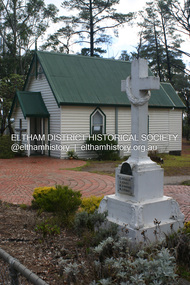 Eltham District Historical Society Inc
Photograph - Digital Photograph, Alan King, St Matthew's Church and Hall, Panton Hill, 27 March 2008
... France. The building was also used for Sunday School, a school and a hall.1 The St Matthew’s Church and hall at the corner of Church Road and Kangaroo Ground-St Andrews Road, were built in the early 20th century in the standard rectangular style of the times. The intact belt of Radiata Pines was common at that time. The war memorial...France. The building was also used for Sunday School, a school and a hall.1 The St Matthew’s Church and hall at the corner of Church Road and Kangaroo Ground-St Andrews Road, were built in the early 20th century in the standard rectangular style of the times. The intact belt of Radiata Pines was common at that time. The war memorial ...St. Matthew's Church has historic significance as the town's church and physical and social focus for the community. The standard design buildings are good examples and important streetscape elements. The war memorial cross is the area's monument to the 20th century wars and its modest scale in comparison with the granite Eltham and towered Kangaroo Ground memorials illustrates the lack of affluence in the town and surrounding area. The grouping of church, school, store and post office is typical of country villages throughout Victoria. The Radiata Pine plantings are significant as an intact line of shelterbelt planting typical of the early 20th century. (Bick Study 1992) Covered under Heritage Overlay, Nillumbik Planning Scheme. Published: Nillumbik Now and Then / Marguerite Marshall 2008; photographs Alan King with Marguerite Marshall.; p63 Panton Hill’s first church services were held in a simple building made of paling timber, opposite the Hotel de France. The building was also used for Sunday School, a school and a hall.1 The St Matthew’s Church and hall at the corner of Church Road and Kangaroo Ground-St Andrews Road, were built in the early 20th century in the standard rectangular style of the times. The intact belt of Radiata Pines was common at that time. The war memorial concrete cross is the area’s monument for the 20th century wars. It is much more modest than those in Eltham, and particularly in Kangaroo Ground, demonstrating those townships’ comparative affluence.2 Early settler J Hughes, who donated the land to the Church of England, was the first to be married at St Matthews when he married Rachel Coutie. In later life he became a minister of religion.3 One much-liked preacher was George Hollow, who with his sister playing the harmonium, conducted church services at Panton Hill, St Andrews and Christmas Hills, for many years.This collection of almost 130 photos about places and people within the Shire of Nillumbik, an urban and rural municipality in Melbourne's north, contributes to an understanding of the history of the Shire. Published in 2008 immediately prior to the Black Saturday bushfires of February 7, 2009, it documents sites that were impacted, and in some cases destroyed by the fires. It includes photographs taken especially for the publication, creating a unique time capsule representing the Shire in the early 21st century. It remains the most recent comprehenesive publication devoted to the Shire's history connecting local residents to the past. nillumbik now and then (marshall-king) collection, panton hill, st matthew's church, panton hill war memorial -
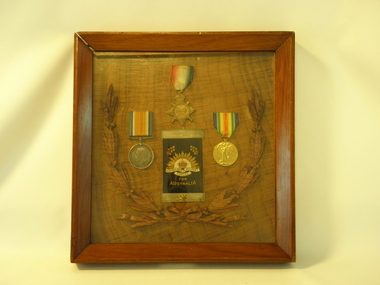 Running Rabbits Military Museum operated by the Upwey Belgrave RSL Sub Branch
Memorial, Commonwealh of Australia et al, Family Memorial case for deceased veteran son, post World War One
... France on HMAT Anchises on the 26th Augest 1915. He was killed at Polygon Wood, Zillebrook near Ypres in Belgium on 4th October 1917 aged 25. world war one medal military ypres badge plaque polygon wood On one side are the Sons Medals (War Medal, 1914-1918 Medal and the Victory Medal), Mothers Badge (for being the mother of a deceased soldier) with a plaque from King Geaorge honouring the Service of "L/Cpl Chester George Mather of the 22nd Battalion AIF" on the other Double sided wooden and glass display case Family Memorial case for deceased veteran son Memorial Commonwealh of Australia King George ...The War Medal, 1914-1918 Medal and the Victory Medal, Mothers Badge (for being the mother of a deceased soldier) with a plaque from King George honouring the Service of L/Cpl Chester George Mather on the other. L/Cpl Mather enlisted on 8th of June 1915 and embarked for France on HMAT Anchises on the 26th Augest 1915. He was killed at Polygon Wood, Zillebrook near Ypres in Belgium on 4th October 1917 aged 25.Double sided wooden and glass display caseOn one side are the Sons Medals (War Medal, 1914-1918 Medal and the Victory Medal), Mothers Badge (for being the mother of a deceased soldier) with a plaque from King Geaorge honouring the Service of "L/Cpl Chester George Mather of the 22nd Battalion AIF" on the otherworld war one, medal, military, ypres, badge, plaque, polygon wood -
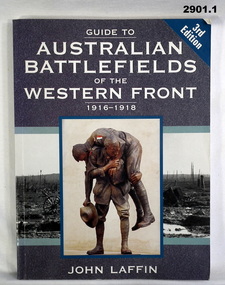 Bendigo Military Museum
Book - BOOK, BATTLEFIELDS, Kangaroo Press, Australian Battlefields of the Western Front 1916-1918
... French & English. Australian Battlefields of the Western Front 1916-1918 Book BOOK, BATTLEFIELDS Kangaroo Press Australian War Memorial ....1) Soft card cover with black & white photo of battlefield on front & back. Coloured photo of soldier carrying a wounded comrade over his shoulder. History of Author, John Laffin on back cover. 204 pages black & white with photos & maps. Complete history covering cemeteries, battlefields, commemorations, etc. .2) - .6) Tourist Information in Belgium, French & English.“3rd Edition on front cover”books - military history, battlefields
