
Showing 387 items matching "war time photograph"
-
 Bendigo Historical Society Inc.
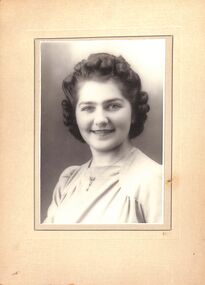
Photograph - Thomas and Valda Staley Collection: Photograph, 1942
... ...War time photograph...Bendigo Staley Photography War time photograph To Valda. Wishing you many happy returns with love from Mavis. ...From the collection of Thomas and Valda Staley. Black and white photo of bust of woman looking straight into camera. Photo mounted onto cream cardboard with light grey boarder around photo of about .5cm. Mount then attached to dark brown flap to back of photograph, which then folds over to cover image. To Valda. Wishing you many happy returns with love from Mavis. June, 1942. 16 years 10 months. bendigo, staley, photography, war time photograph -
 Federation University Historical Collection
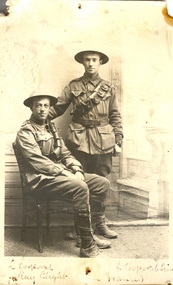
Postcard - Postcard - Black and white, Two World War One Soldiers, 1916, 28/08/1916
... time an old SMB and son of R. Sim, of Ballarat, we are wearing steel helmuts weight about 4lbs they are protection against shrapnel and steel splinters. We are doing well here, Les Coulter was wounded just near here but did not see him. Best wishes to all. Ray Blight. .2) Verso: Sitting, Ray Blight, from Ballarat, you will know his sister, she helps Miss Brazena a lot with the parcels. Standing, Les Sim, of Sim and co. wood merchants, Ballarat. Two World War One soldiers in military uniform pose for a photograph ...John Raymond (Ray) Blight enlisted on 19 July 1915. He was an electrical engineer, having studied at the Ballarat School of Mines. On 23 June 1916 Ray Blight disembarked at Marseilles. 3 February 1917 he was hospitalised with scabies. Ray Blight's next of kin was his mother, Mary Jane Blight of 116 Lyons Street South, Ballarat. James Leslie Sim enlisted on 13 July 1915, at which time he was an accountant. His next of kin was his father, Charles Robert Sim of Drummond Street North, Ballarat. On 23 June 1916 James Sim disembarked at Marseilles. A year later he received leave to the United Kingdom returning to France 2 weeks later. He received leave to Paris from 18 march 1918 to 4 April 1918. Sim was wounded on 1 June 1918. Two World War One soldiers in military uniform pose for a photograph. The two men are Lance Corporal Ray Blight and Lance Corporal Sim (both of Ballarat). On the back is a personal letter to Ballarat School of Mines Lecturer Daniel Walker. The pin holes in the postcard suggest it was displayed at the Ballarat School of Mines. .1) Verso: " France 25/8/16. Dear Mr Walker, Just a line in sending a photo we had taken in a small photographers, in a town within range of the evenings guns, the other boy is L/Corp Sim, one time an old SMB and son of R. Sim, of Ballarat, we are wearing steel helmuts weight about 4lbs they are protection against shrapnel and steel splinters. We are doing well here, Les Coulter was wounded just near here but did not see him. Best wishes to all. Ray Blight. .2) Verso: Sitting, Ray Blight, from Ballarat, you will know his sister, she helps Miss Brazena a lot with the parcels. Standing, Les Sim, of Sim and co. wood merchants, Ballarat. world war one, world war 1, james sim, ballarat school of mines, blight, james blight, sim, les sim, coulter, les coulter, world war, walker, wwi, great world war, france -
 Federation University Historical Collection
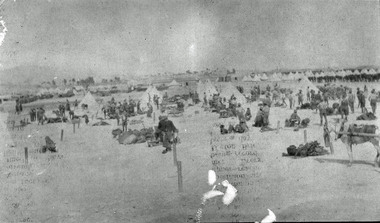
Photograph - black and white, Harry Holmes, Australian Soldiers Breaking Camp at Metras, c1916
... time. He sent a number of postcards home to his family in Ascot, Victoria. Egypt was a major base for the AIF from December 1914. A number of campaigns were fought in this theatre. There were two campaigns involving the AIF. Note that not all the fighting was actually geographically in Egypt. (http://www.aif.adfa.edu.au:8888/about3.html) This photograph is significant because it was taken by a soldier (rather than an official war ...The postcard was sent by Harry Holmes who was a member of the Australian Imperial Force based in Egypt at the time. He sent a number of postcards home to his family in Ascot, Victoria. Egypt was a major base for the AIF from December 1914. A number of campaigns were fought in this theatre. There were two campaigns involving the AIF. Note that not all the fighting was actually geographically in Egypt. (http://www.aif.adfa.edu.au:8888/about3.html) This photograph is significant because it was taken by a soldier (rather than an official war artist) and shows one of the daya to day activities experienced by Australian Soldiers in Egypt during World War One. A number of tents and soldiers in a dry landscape. They are Australian Soldiers At Metras, Egypt during World War One. Verso: 'Breaking Camp at Metras prior to making our departure from there on March 28th.' chatham family archive, chatham, holmes, harry holmes, world war, world war 1, world war one, world war i, metras, egypt -
 Federation University Historical Collection
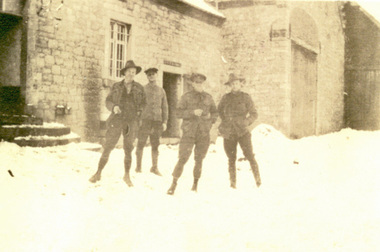
Photograph - postcard, Cam Williamson, World War One AIF Soldiers at the Suez, c1916
... photographed aspects of their time on the Suez Canal, Egypt. Egypt was a major base for the AIF from December 1914. A number of campaigns were fought in this theatre. There were two campaigns involving the AIF. Note that not all the fighting was actually geographically in Egypt. (http://www.aif.adfa.edu.au:8888/about3.html) This photograph is significant because it was taken by a soldier (rather than an official war ...Harry Holmes and his battalion friends photographed aspects of their time on the Suez Canal, Egypt. Egypt was a major base for the AIF from December 1914. A number of campaigns were fought in this theatre. There were two campaigns involving the AIF. Note that not all the fighting was actually geographically in Egypt. (http://www.aif.adfa.edu.au:8888/about3.html) This photograph is significant because it was taken by a soldier (rather than an official war artist) and shows one of the day to day activities experienced by Australian Soldiers in Egypt during World War One. 1) Four Australian soldiers during World War One in Egypt .2) Soldiers watch while two men 'fight' on a greasy pole during World War One .3) Australian soldiers stand at the grave of a German Officer at the Suez Canal, Egypt .2) Verso - "greasy Pole Fight" .3) verso: - Snap taken at grave of German officer killed in the first tussel (sic) with Turk at the Canal chatham family archive, chatham, holmes, world war, world war 1, world war i, world war one, egypt, cam williamson, greasy pole, ship, vessel, burial -
 Federation University Historical Collection
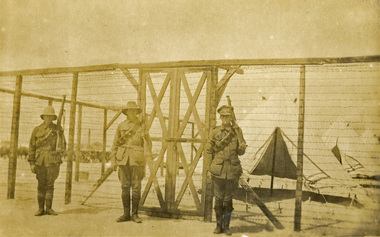
Postcard - photographic, Australian Soldiers guard Metra Gaol
... photograph is associated with Harry Holmes who was a member of the Australian Imperial Force based in Egypt at the time. Egypt was a major base for the AIF from December 1914. A number of campaigns were fought in this theatre. There were two campaigns involving the AIF. Note that not all the fighting was actually geographically in Egypt. (http://www.aif.adfa.edu.au:8888/about3.html) Chatham family Archive Chatham Holmes World War ...The photograph is associated with Harry Holmes who was a member of the Australian Imperial Force based in Egypt at the time. Egypt was a major base for the AIF from December 1914. A number of campaigns were fought in this theatre. There were two campaigns involving the AIF. Note that not all the fighting was actually geographically in Egypt. (http://www.aif.adfa.edu.au:8888/about3.html) Image of two uniformed Australian soldiers guarding a temporary gaol at Metra during World War One. Verso: 'Clink or jail at Metra. Gordon [Spittle] in the centre and Jim and George Hobill on guard. chatham family archive, chatham, holmes, world war, world war 1, world war i, world war one, france, hobill, metras, egypt -
 Federation University Historical Collection
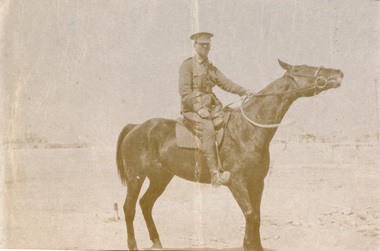
Photograph, Australian Soldier on Horse, c1916
... photograph is associated with Harry Holmes who was a member of the Australian Imperial Force based in Egypt at the time. Egypt was a major base for the AIF from December 1914. A number of campaigns were fought in this theatre. There were two campaigns involving the AIF. Note that not all the fighting was actually geographically in Egypt. (http://www.aif.adfa.edu.au:8888/about3.html) chatham family archive chatham holmes world war ...The photograph is associated with Harry Holmes who was a member of the Australian Imperial Force based in Egypt at the time. Egypt was a major base for the AIF from December 1914. A number of campaigns were fought in this theatre. There were two campaigns involving the AIF. Note that not all the fighting was actually geographically in Egypt. (http://www.aif.adfa.edu.au:8888/about3.html) Sepia photograph of an Australian solder on a house chatham family archive, chatham, holmes, world war, world war 1, world war i, world war one, egypt, horse, ascot -
 Federation University Historical Collection
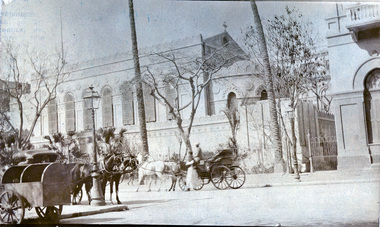
Photograph, Alexandria opposite the Anglican Church
... photograph is associated with Harry Holmes who was a member of the Australian Imperial Force based in Egypt at the time. Egypt was a major base for the AIF from December 1914. A number of campaigns were fought in this theatre. There were two campaigns involving the AIF. Note that not all the fighting was actually geographically in Egypt. (http://www.aif.adfa.edu.au:8888/about3.html) Chatham family Archive Chatham Holmes World War ...The photograph is associated with Harry Holmes who was a member of the Australian Imperial Force based in Egypt at the time. Egypt was a major base for the AIF from December 1914. A number of campaigns were fought in this theatre. There were two campaigns involving the AIF. Note that not all the fighting was actually geographically in Egypt. (http://www.aif.adfa.edu.au:8888/about3.html) Photograph of a scene in front of the Anglican Church at Cairo, Egypt. Verso: 'Snap taken in the street at Alexandria opposite the Anglican Church. chatham family archive, chatham, holmes, world war, world war 1, world war i, world war one, alexandria, egypt -
 Federation University Historical Collection
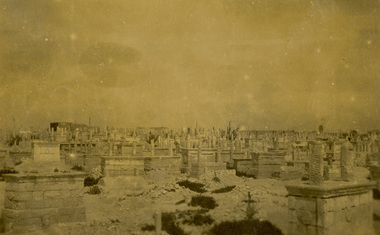
Postcard - photographic, Cemetery Near Metras, Alexandria, Egypt, c1916
... photograph is associated with Harry Holmes who was a member of the Australian Imperial Force based in Egypt at the time. Egypt was a major base for the AIF from December 1914. A number of campaigns were fought in this theatre. There were two campaigns involving the AIF. Note that not all the fighting was actually geographically in Egypt. (http://www.aif.adfa.edu.au:8888/about3.html) Chatham family Archive Chatham Holmes World War ...The photograph is associated with Harry Holmes who was a member of the Australian Imperial Force based in Egypt at the time. Egypt was a major base for the AIF from December 1914. A number of campaigns were fought in this theatre. There were two campaigns involving the AIF. Note that not all the fighting was actually geographically in Egypt. (http://www.aif.adfa.edu.au:8888/about3.html) A photograph of the cemetery at Metras, Alexandria, Egypt. It shows many graves and monuments. Verso: 'Snap taken of the Egyptian Cemetery near our camp at Metras, Alexandria.' chatham family archive, chatham, holmes, world war, world war 1, world war i, world war one, harry holmes, metras, alexandria, egypt -
 Federation University Historical Collection
Postcard - photographic, Nouza Gardens, Egypt, c1916
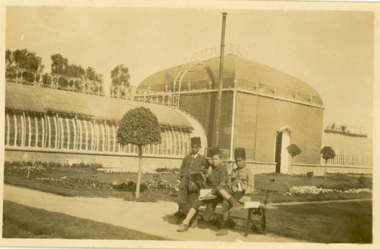
... photograph is associated with Harry Holmes who was a member of the Australian Imperial Force based in Egypt at the time. Egypt was a major base for the AIF from December 1914. A number of campaigns were fought in this theatre. There were two campaigns involving the AIF. Note that not all the fighting was actually geographically in Egypt. (http://www.aif.adfa.edu.au:8888/about3.html) Chatham family Archive Chatham Holmes World War ...The photograph is associated with Harry Holmes who was a member of the Australian Imperial Force based in Egypt at the time. Egypt was a major base for the AIF from December 1914. A number of campaigns were fought in this theatre. There were two campaigns involving the AIF. Note that not all the fighting was actually geographically in Egypt. (http://www.aif.adfa.edu.au:8888/about3.html) Four postcards of Nouza Gardens, alexandria, Eygpt. .1) Two English soldiers walk down a tree lined avenue at Nouza gardens .2) Garden setting with fernery building on the right. .3) Gardens with towered building in the centre of the photograph .4) Three Egyptian boys who acted as guide to Australian Soldiers Harry Holmes and his friends sit on a seat in front of a fernery building. .1) Aveue at entrance to Nouza gardens, Two tommies in the foreground. .2) View at gardens. Nouza .3) View taken at Nouza Gardens, Alexandria. .4) The fernery at Nouza Gardens. Very pretty inside. the three boys we picked up and they acted as our guides. chatham family archive, chatham, holmes, world war, world war 1, world war i, world war one, harry holmes, nouza gardens, alexandria, egypt -
 Federation University Historical Collection
Photograph - Sepia Postcard, Suez Canal Camp, c1916
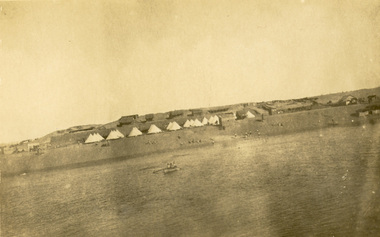
... time. Egypt was a major base for the AIF from December 1914. A number of campaigns were fought in this theatre. There were two campaigns involving the AIF. Note that not all the fighting was actually geographically in Egypt. (http://www.aif.adfa.edu.au:8888/about3.html) Chatham family Archive Chatham Holmes World War World War 1 world War I World war One Harry Holmes Suez Canal Egypt Ascot Verso "A camp five miles from ours. Snap take [3 words covered in blue pencil by the censor - they appear to say 'across the Canal Sepia photograph ...The postcard was written on by Harry Holmes who was a member of the Australian Imperial Force based in Egypt at the time. Egypt was a major base for the AIF from December 1914. A number of campaigns were fought in this theatre. There were two campaigns involving the AIF. Note that not all the fighting was actually geographically in Egypt. (http://www.aif.adfa.edu.au:8888/about3.html) Sepia photograph showing a number of tents used by Australian soldiers during World War One, with the Suez Canal in the foreground. Verso "A camp five miles from ours. Snap take [3 words covered in blue pencil by the censor - they appear to say 'across the Canal chatham family archive, chatham, holmes, world war, world war 1, world war i, world war one, harry holmes, suez canal, egypt, ascot -
 Federation University Historical Collection
Postcard - Sepia, A Horse and Cart Carry Manure at Metras Camp, c1916
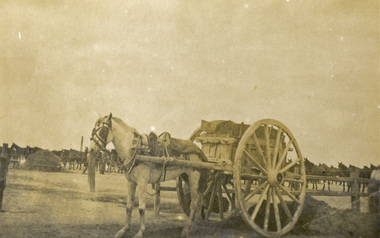
... photograph is associated with Harry Holmes who was a member of the Australian Imperial Force based in Egypt at the time. Egypt was a major base for the AIF from December 1914. A number of campaigns were fought in this theatre. There were two campaigns involving the AIF. Note that not all the fighting was actually geographically in Egypt. (http://www.aif.adfa.edu.au:8888/about3.html) Chatham family Archive Chatham Holmes World War ...The photograph is associated with Harry Holmes who was a member of the Australian Imperial Force based in Egypt at the time. Egypt was a major base for the AIF from December 1914. A number of campaigns were fought in this theatre. There were two campaigns involving the AIF. Note that not all the fighting was actually geographically in Egypt. (http://www.aif.adfa.edu.au:8888/about3.html) Two postcards showing Australian army camp at Metras Camp, Egypt .1) A soldier sits on a horse in front of a cart. Lines of horses are in the background behind a post and rail fence. .2 A horse is hitched to a manure cart at Metras Camp, Egypt. Lines of horses are in the background. .1) verso - 'Taken at Metras Camp' .2) verso - 'A native horse and cart carting manure at horse lines.' chatham family archive, chatham, holmes, world war, world war 1, world war i, world war one, egypt, ascot -
 Federation University Historical Collection
Postcard - Sepia, Team of Eight Camel and Howistzer, c1916
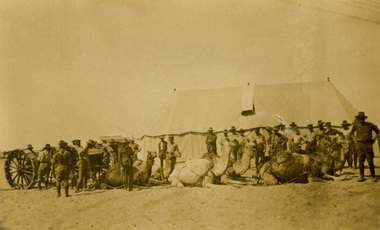
... photograph is associated with Harry Holmes who was a member of the Australian Imperial Force based in Egypt at the time. Egypt was a major base for the AIF from December 1914. A number of campaigns were fought in this theatre. There were two campaigns involving the AIF. Note that not all the fighting was actually geographically in Egypt. (http://www.aif.adfa.edu.au:8888/about3.html) Chatham family Archive Chatham Holmes World War ...The photograph is associated with Harry Holmes who was a member of the Australian Imperial Force based in Egypt at the time. Egypt was a major base for the AIF from December 1914. A number of campaigns were fought in this theatre. There were two campaigns involving the AIF. Note that not all the fighting was actually geographically in Egypt. (http://www.aif.adfa.edu.au:8888/about3.html) A team of eight camels, teamsters and Howistzer, and a large tent. Verso - 'A team of eight camels yoked in an five inch Howistzer taken at [censored in blue]. chatham family archive, chatham, holmes, world war, world war 1, world war i, world war one, egypt, harry holmes -
 Flagstaff Hill Maritime Museum and Village
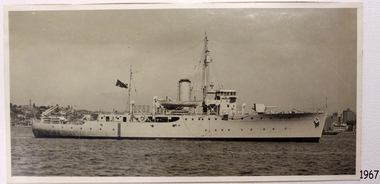
Photograph - Vessel, Steam Ship, H.M.A.S. Warrnambool J202, 1941-1947
... photograph is connected to the first HMAS Warrnambool J202, which was commissioned by the Royal Australian Navy for use as a minesweeper during World War II. The Bathurst Class Corvette, fitted out with a range of armaments, was launched in Sydney 1941. The ship began service in Bass Strait in 1941. At the end of the year it called into its namesake city, Warrnambool, where the crew paraded for the public marching eastwards along Timor...photograph is connected to the first HMAS Warrnambool J202, which was commissioned by the Royal Australian Navy for use as a minesweeper during World War II. The Bathurst Class Corvette, fitted out with a range of armaments, was launched in Sydney 1941. The ship began service in Bass Strait in 1941. At the end of the year it called into its namesake city, Warrnambool, where the crew paraded for the public marching eastwards along Timor ...This photograph is connected to the first HMAS Warrnambool J202, which was commissioned by the Royal Australian Navy for use as a minesweeper during World War II. The Bathurst Class Corvette, fitted out with a range of armaments, was launched in Sydney 1941. The ship began service in Bass Strait in 1941. At the end of the year it called into its namesake city, Warrnambool, where the crew paraded for the public marching eastwards along Timor Street. A gift of books for the ship’s personnel and a plaque bearing the City of Warrnambool’s Coat of Arms were presented to the ship. The ship was involved in evacuating a family of nine from the Dutch East Indies that was later successful in its challenge of Australia’s Immigration Restriction Act (White Australia Polity). The ship had many other appointments around Australia. On 13th September 1947 HMAS Warrnambool was leading a flotilla of minesweepers in northern Queensland’s coastal waters, clearing mines previously laid to defend Australia. The ship hit a mine, which exploded and very quickly sunk the ship. Boats from the nearby ships rescued most of the seamen although one was killed at the time. The survivors were taken by the HMAS Swan II to Darwin, and they went from there to hospitals in Brisbane and Sydney. Three of these men later died from their injuries. A number of items were recovered by Navy divers in 1948 including the ship’s bell and a plaque with Warrnambool’s Coat of Arms. In 1972-75 the wreck was sold and other items were salvaged. In 1995 a memorial plaque was erected in Warrnambool near the RSL. NOTE: The RAN built a second HMAS Warrnambool FCPB204, launched in 1981 and decommissioned in 2005. There was also a steam ship SS Warrnambool built in London 1892 and broken up in 1926. [A more detailed history can be found in our Collection Record 3477.] This photograph is significant for its association with Royal Australian Navy and its vessel, HMAS Warrnambool (j202). The HMAS Warrnambool played a nationally significant role in overturning Australia’s Immigration Restriction Act 1901 (colloquially known as the White Australia policy). The ship rescued, and brought to Australia, Samuel and Annie Jacob and their family after they evacuated Dutch East India. The family was threatened with deportation and made the first successful appeal to High Court regarding that Act. The HMAS Warrnambool has - Local significance for being the namesake of the City of Warrnambool - Local significance, having docked in Warrnambool Harbour - Local significance, the crew having paraded in Timor Street, Warrnambool - State significance for its first patrol being in Bass Strait. - National significance, being present in Timor at the Japanese surrender - National significance as part of Australia’s defence force history, being one of only four Bathurst class corvettes lost while in Australian service, the only Bathurst class corvette lost after World War II, the only RAN vessel to be sunk by a mine, and associated with the last four Navy deaths of WWII Photograph, black and white, HMAS Warrnambool J202 in water with land and buildings in background. Ship is flying a dark flag with Union Jack in corner and star below it. Lifeboat suspended above deck in centre of ship. Top of funnel has a black band. flagstaff hill, warrnambool, shipwrecked-coast, flagstaff-hill, flagstaff-hill-maritime-museum, maritime-museum, shipwreck-coast, flagstaff-hill-maritime-village, maritime village, maritime museum, shipwreck coast, mort's dock & engineering co ltd, h.m.a.s. warrnambool, hmas warrnambool, hmas warrnambool i, hmas warrnambool j202, hmas swan ii, j202, world war ii, bathurst class corvette, royal australian navy, ran, sydney built ship, bass strait patrol, sea mine patrol, mine sweeper, mine clearance, navy divers, great barrier reef, cockburn reef, southern cross diving and salvage, warrnambool city council, cr j r astbury, mayor j r astbury, warrnambool patriotic fund, seal, coat of arms, ship’s bell, hmas warrnambool 1941, shipwreck by sea mine 1947, sinking ship, sunk ship, sea rescue, life saving, lifesaving, minesweeper -
 Flagstaff Hill Maritime Museum and Village
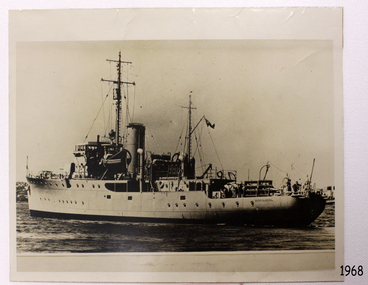
Photograph - Vessel, Steam Ship, HMAS Warrnambool J202, Between 1941-1947
... photograph shows the vessel HMAS Warrnambool J202, which was commissioned by the Royal Australian Navy for use as a minesweeper during World War II. The Bathurst Class Corvette, fitted out with a range of armaments, was launched in Sydney 1941. The ship began service in Bass Strait in 1941. At the end of the year it called into its namesake city, Warrnambool, where the crew paraded for the public marching eastwards along Timor...photograph shows the vessel HMAS Warrnambool J202, which was commissioned by the Royal Australian Navy for use as a minesweeper during World War II. The Bathurst Class Corvette, fitted out with a range of armaments, was launched in Sydney 1941. The ship began service in Bass Strait in 1941. At the end of the year it called into its namesake city, Warrnambool, where the crew paraded for the public marching eastwards along Timor ...The photograph shows the vessel HMAS Warrnambool J202, which was commissioned by the Royal Australian Navy for use as a minesweeper during World War II. The Bathurst Class Corvette, fitted out with a range of armaments, was launched in Sydney 1941. The ship began service in Bass Strait in 1941. At the end of the year it called into its namesake city, Warrnambool, where the crew paraded for the public marching eastwards along Timor Street. A gift of books for the ship’s personnel and a plaque bearing the City of Warrnambool’s Coat of Arms were presented to the ship. The ship was involved in evacuating a family of nine from the Dutch East Indies that was later successful in its challenge of Australia’s Immigration Restriction Act (White Australia Polity). The ship had many other appointments around Australia. On 13th September 1947 HMAS Warrnambool was leading a flotilla of minesweepers in northern Queensland’s coastal waters, clearing mines previously laid to defend Australia. The ship hit a mine, which exploded and very quickly sunk the ship. Boats from the nearby ships rescued most of the seamen although one was killed at the time. The survivors were taken by the HMAS Swan II to Darwin, and they went from there to hospitals in Brisbane and Sydney. Three of these men later died from their injuries. A number of items were recovered by Navy divers in 1948 including the ship’s bell and a plaque with Warrnambool’s Coat of Arms. In 1972-75 the wreck was sold and other items were salvaged. In 1995 a memorial plaque was erected in Warrnambool near the RSL. NOTE: The RAN built a second HMAS Warrnambool FCPB204, launched in 1981 and decommissioned in 2005. There was also a steam ship SS Warrnambool built in London 1892 and broken up in 1926. [A more detailed history can be found in our Collection Record 3477.] This photograph of HMAS Warrnambool is significant for its association with Royal Australian Navy and its vessel, HMAS Warrnambool (J202). The HMAS Warrnambool played a nationally significant role in overturning Australia’s Immigration Restriction Act 1901 (colloquially known as the White Australia policy). The ship rescued, and brought to Australia, Samuel and Annie Jacob and their family after they evacuated Dutch East India. The family was threatened with deportation and made the first successful appeal to High Court regarding that Act. The HMAS Warrnambool has - Local significance for being the namesake of the City of Warrnambool - Local significance, having docked in Warrnambool Harbour - Local significance, the crew having paraded in Timor Street, Warrnambool - State significance for its first patrol being in Bass Strait. - National significance, being present in Timor at the Japanese surrender - National significance, shown by the significance of the ship’s bell being curated as Military Heritage and Technology at the Australian War Memorial. - National significance as part of Australia’s defence force history, being one of only four Bathurst class corvettes lost while in Australian service, the only Bathurst class corvette lost after World War II, the only RAN vessel to be sunk by a mine, and associated with the last four Navy deaths of WWII Photograph of HMAS Warrnambool near land. Black and white photograph shows a steam and sail vessel in calm water beside land. Figures are standing on board. A flag flies on a mast. The ship's name is on the stern. The light coloured funnel has emitted a small amount of smoke. On side of ship "WARRNAMBOOL" flagstaff hill, maritime village, maritime museum, warrnambool, shipwreck coast, mort's dock & engineering co ltd, h.m.a.s. warrnambool, hmas warrnambool, hmas warrnambool i, hmas warrnambool j202, hmas swan ii, j202, world war ii, bathurst class corvette, royal australian navy, ran, sydney built ship, bass strait patrol, sea mine patrol, mine sweeper, mine clearance, navy divers, great barrier reef, cockburn reef, southern cross diving and salvage, warrnambool city council, cr j r astbury, mayor j r astbury, warrnambool patriotic fund, seal, coat of arms, dedicatory plaque, hmas warrnambool 1941, shipwreck by sea mine 1947, sinking ship, sunk ship, minesweeper -
 Mission to Seafarers Victoria
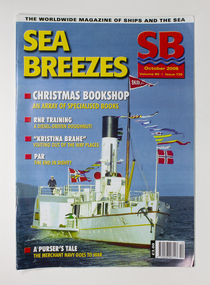
Magazine, Sea Breezes Publications Ltd, Sea Breezes, 2006
... War Two. Paper had become difficult to source and the editor at that time – Lieutenant- Commander J Francis Hall, RD, RNR – was on active service with the Royal Navy. However, it did continue during the war as a weekly (Saturday) column in the Journal of Commerce and Shipping Telegraph. Full production of the magazine as a separate publication resumed in January 1946, when the title had changed again, this time, to Sea Breezes – The Ship Lovers’ Digest. Since then several different straplines have been used to accompany the main title. In 1965, twelve issues were produced each year. A colour photograph ...Colour magazine non-fiction maritime journals, maritime magazines, ships -
 Greensborough Historical Society
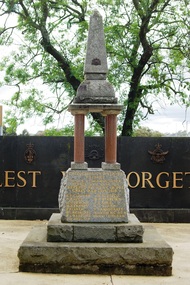
Photograph - Photograph - Digital Image, Marilyn Smith, Greensborough Fallen Soldiers' Memorial 2019, 29/09/2019
... War Memorial Park Time Capsule. Installed 11 November 2015 by Cr Craig Langdon, Mayor, and Cr Mark Di Pasquale, Bakewell Ward. Commemorating the Centenary of ANZAC. To be opened every 25 years." Names of 2015 Banyule Councillors are inscribed around edge of plaque. Part of a collection of miscellaneous historical images with a connection to the local area. fallen soldiers memorial greensborough greensborough war memorial park craig langdon mark di pasquale war memorials greensborough plaques Digital colour photographs Greensborough Fallen Soldiers' Memorial 2019 Photograph Photograph - Digital Image Marilyn Smith ...Digital images of the Greensborough Fallen Soldiers' Memorial taken in 2019. The Memorial is shown from all four sides in its current position in relation to later memorials at Greensborough War Memorial Park. The Plaque was laid in 2015 and is inscribed "Greensborough War Memorial Park Time Capsule. Installed 11 November 2015 by Cr Craig Langdon, Mayor, and Cr Mark Di Pasquale, Bakewell Ward. Commemorating the Centenary of ANZAC. To be opened every 25 years." Names of 2015 Banyule Councillors are inscribed around edge of plaque. Part of a collection of miscellaneous historical images with a connection to the local area. Digital colour photographs fallen soldiers memorial greensborough, greensborough war memorial park, craig langdon, mark di pasquale, war memorials greensborough, plaques -
 Bright & District Historical Society operating the Bright Museum
Photograph, Wandiligong Band sepia, Wandiligong Band, 1929
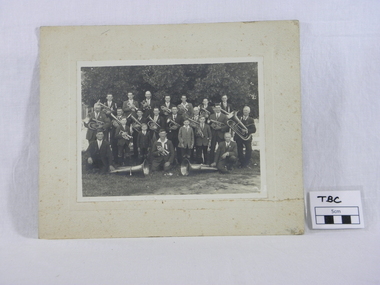
... Photograph taken at the time of the Back to Bright Celebrations 1929-1930. Unveiling of the Clock Tower in Mafeking Square,Bright, as a memorial to the fallen of the Boer War and World War 1. ...Photograph taken at the time of the Back to Bright Celebrations 1929-1930. Unveiling of the Clock Tower in Mafeking Square,Bright, as a memorial to the fallen of the Boer War and World War 1. ...Photograph taken at the time of the Back to Bright Celebrations 1929-1930. Unveiling of the Clock Tower in Mafeking Square,Bright, as a memorial to the fallen of the Boer War and World War 1. One of the tubas in the photograph is included in the Bright Historical Society collection. External photograph of the Wandiligong Brass Band. Backdrop of large tree. 22 male members with their instruments, no drums shown. Reverse of the photograph: Top Row J Stephens, A Simmonds L.Bennett F Matthews B Stephens N.Williams A.Smith/2nd. A Watters M Matthews S Stephens W Stephens G Chalwell B.Gribble R.Goldsworthy. R B Stephens/Front. W.Williams H Williams C.Williams T.Williams A.Williams L.Williams S.Smith/ Back to Bright. 1929 -1930 R Goldsworthy photograph, brass band, wandiligong, back to bright, 1929 1930, r goldsworthy, musical instruments -
 Frankston RSL Sub Branch
Photograph
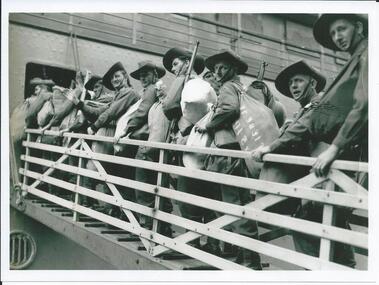
... Photograph of Australian Army World War 2 servicemen boarding a ship with weapons and full kit. The men are infantry embarking for an overseas posting. Nine soldiers, looking back over their shoulder, are depicted as they make their way up a gangway to a ship. One soldier can be identified with his name and part of his service number prominently displayed on his kitbag. The soldier is James Ellis Liebe, service number VX21644. This photograph appeared in the Melbourne Sun newspaper of the time...Photograph of Australian Army World War 2 servicemen boarding a ship with weapons and full kit. The men are infantry embarking for an overseas posting. Nine soldiers, looking back over their shoulder, are depicted as they make their way up a gangway to a ship. One soldier can be identified with his name and part of his service number prominently displayed on his kitbag. The soldier is James Ellis Liebe, service number VX21644. This photograph appeared in the Melbourne Sun newspaper of the time ...Photograph of Australian Army World War 2 servicemen boarding a ship with weapons and full kit. The men are infantry embarking for an overseas posting. Nine soldiers, looking back over their shoulder, are depicted as they make their way up a gangway to a ship. One soldier can be identified with his name and part of his service number prominently displayed on his kitbag. The soldier is James Ellis Liebe, service number VX21644. This photograph appeared in the Melbourne Sun newspaper of the time and a copy of the photograph was obtained by his family. This photograph is a modern reproduction. Liebe J E VX21644 -
 St Arnaud and District Historical Society
Book. Coonooer Bridge Memorial, Coonooer Bridge Memorial to those who served their Country in Wartime
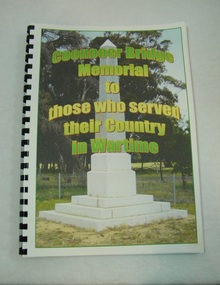
... war time were placed on the monument. After the 2nd World War the names of the local men and women who once again were asked to serve their country were added to the memorial to honour and remember the sacrifice that they made.This book was compiled to honour and enable families and future generations to remember those who served. This is the only book listing these servicemen that served from the Coonooer Bridge Area. Dedicated to the people of Coonooer Bridge. Spiral plastic bound book.Clear perspex cover. Coloured pages.Includes photographs ...Following the Great War of 1914-18 the people who lived in the general area around Coonooer Bridge , (18 kms from St.Arnaud ) erected a Monument in honour of those men and women who served their country in a time of war. In 1920 the monument was erected across from the hall, situated in a small pine plantation which was also planted by community members. The names of those that served their country during war time were placed on the monument. After the 2nd World War the names of the local men and women who once again were asked to serve their country were added to the memorial to honour and remember the sacrifice that they made.This book was compiled to honour and enable families and future generations to remember those who served. This is the only book listing these servicemen that served from the Coonooer Bridge Area. Spiral plastic bound book.Clear perspex cover. Coloured pages.Includes photographs of servicemen, medals and war service information. Dedicated to the people of Coonooer Bridge. -
 The Beechworth Burke Museum
Photograph, 2000
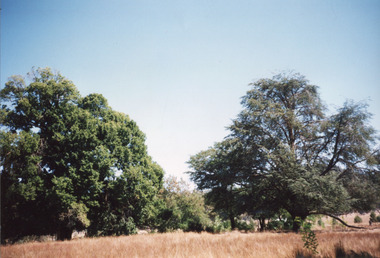
... , with the photograph taken 78 years after the school closed down. beechworth burke museum school education trees nature state school woolshed gold mining teachers over time Owens and Murray advertiser public meetings public dance c. o'donoghue spring creek state governor Sir Reginald Talbot miners honour roll world war 1 Woolshed State. / School site / 2000 / - remnant trees / / co A colour rectangular photograph printed on glossy photographic paper. ...Woolshed is a small area about five kilometres north west of Beechworth, and almost about 225km north east of Melbourne. When gold was discovered at the nearby Spring Creek in February 1852, Woolshed was one of three settlements set up to house miners and their families. At its peak in 1857, Woolshed was also populated by 29 storekeepers and 14 hotels, as well as the Woolshed State School, which stood near where this photograph was taken. The school often played host to public meetings, as well as a public dance in 1897. The school was subject to some controversy in 1874 when one parent complained about the head of the school in the local newspaper, the Owens and Murray Advertiser, and at least three letters to the editor were exchanged between the two. According to the parent, C. O'Donoghue was not providing enough amusement for the children and was disrespectful to parents and staff. When the State Governor, Sir Reginald Talbot, visited Beechworth in 1906, the school organised a celebratory welcome. The Woolshed State School was ultimately closed in 1922 as miners had exhausted the Spring Creek gold supply and were moving elsewhere. This photograph, taken in about 2000, shows the trees that grew on or near the site of the original school. The Woolshed State School Honour Roll, with a list of the men from the school who served in the First World War, also still exists. It is stored in the Beechworth RSL as of 2015. This photograph is significant for its connection to an important site in Beechworth's gold mining history. Woolshed served a significant community of miners, with a population of at least 138 according to the 1911 census, with families that needed the school site to ensure their children's education. The image is also useful for prompting discussion about how Beechworth has changed over time, with the photograph taken 78 years after the school closed down. A colour rectangular photograph printed on glossy photographic paper. Woolshed State. / School site / 2000 / - remnant trees / / co beechworth, burke museum, school, education, trees, nature, state school, woolshed, gold mining, teachers, over time, owens and murray advertiser, public meetings, public dance, c. o'donoghue, spring creek, state governor, sir reginald talbot, miners, honour roll, world war 1 -
 Marysville & District Historical Society
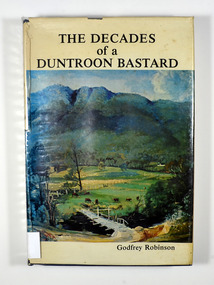
Book, The Decades of a Duntroon Bastard, 1980
... A biography of Godfrey Robinson of his time serving in the Australian, British and Indian Armies; of his time in the British Raj, the Burma war and colonial Africa and of his time as a farmer in Taggery, Victoria duntroon australian army british army indian army british raj burma war colonial africa taggerty This is copy No. 118/142 of the prepublication issue. Signature of the author Stamp of the Marysville & District / Historical Society Inc / P.O. Box 22 / Marysville 3779 Hardback. Front cover is of a painting of a farm at the base of the Cathedral Range in Victoria. Back cover has a black and white photograph ...A biography of Godfrey Robinson of his time serving in the Australian, British and Indian Armies; of his time in the British Raj, the Burma war and colonial Africa and of his time as a farmer in Taggery, Victoria Hardback. Front cover is of a painting of a farm at the base of the Cathedral Range in Victoria. Back cover has a black and white photograph of the author and a blurb on the book. This is copy No. 118/142 of the prepublication issue. Signature of the author Stamp of the Marysville & District / Historical Society Inc / P.O. Box 22 / Marysville 3779 duntroon, australian army, british army, indian army, british raj, burma war, colonial africa, taggerty -
 Lara RSL Sub Branch
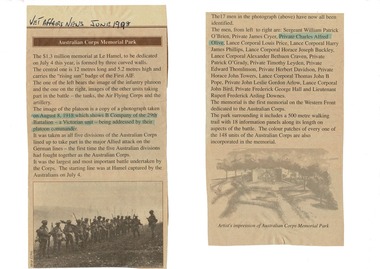
Veteran Affairs Newspaper article dated June 1998, Australian Corps Memorial Park - $1.3 million memorial at La Hamel for Australian World War 1 Soldiers
... War 2. The photograph included in the article was taken on August 8, 1918 which shows B company of the 29th Battalion - a Victorian Unit - being addressed by their platoon Commander. All 5 Australian Divisions took part in the major Allied attack on the German Lines - the first time...War 2. The photograph included in the article was taken on August 8, 1918 which shows B company of the 29th Battalion - a Victorian Unit - being addressed by their platoon Commander. All 5 Australian Divisions took part in the major Allied attack on the German Lines - the first time ...Article of World War 1 Refer to carved life size soldier with machine gun in foyer and photograph at its feet. A4 sheet of white paper has two cut-out sections of Veteran Affairs Newspaper article dated June 1998 glued on. Title Australian Corps Memorial Park. Article covers a Memorial cost $1.3 million dollars for dedication on 4th July 1998 consisting of three curved memorial walls for Australian soldiers that died during Wold War 2. The photograph included in the article was taken on August 8, 1918 which shows B company of the 29th Battalion - a Victorian Unit - being addressed by their platoon Commander. All 5 Australian Divisions took part in the major Allied attack on the German Lines - the first time the five Australian Divisions had fought together as the Australian Corps. (Under Australian Command) It is the First memorial on the Western Front dedicated to the Australian Corps. The park surrounding it includes a 500 meter walking tril with 18 information panels along its length on aspects of the battle. Article was found in Veteran Affairs News dated June 1998, heading - Australian Corps Memorial Park. veteran affairs news article, a4 paper sheet -
 Lara RSL Sub Branch
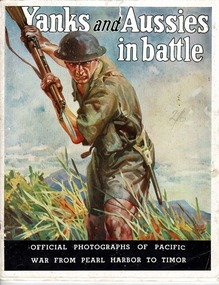
Magazine, N.S.W. BOOKSTALL CO. PTY. LTD, Yanks and Aussies in battle
... Yanks and Aussies in battle OFFICIAL PHOTOGRAPHS OF PACIFIC WAR FROM PEARL HARBOUR TO TIMOR...magazines, books, pacific war, pearl harbour, timor, ww2, lara r.s.l. Yanks and Aussies in battle OFFICIAL PHOTOGRAPHS OF PACIFIC WAR FROM PEARL HARBOUR TO TIMOR rectangular shaped magazine. ...rectangular shaped magazine. Yanks and Aussies in battle OFFICIAL PHOTOGRAPHS OF PACIFIC WAR FROM PEARL HARBOUR TO TIMOR magazines, books, pacific war, pearl harbour, timor, ww2, lara r.s.l. -
 Lara RSL Sub Branch
Book, Australia in the War of 1939 - 1945 Series One ARMY Volumn IV THE JAPANESE THRUST, First published 1957
... Part 1 - The Road to War Part 11 - South East Asia Conquered Part III - Prisoners of the Japanese WW11 Japanese New Guinea 1939-1942 Malaya Singapore Prisoners of War Java Timor Burma Thai Railway Australian War Memorial Australia in the War of 1939-1945 - The Japanese Thrust ARMY Author Lionel Wilmore List of events from 1931 - 20th May 1942 Maps, Photographs and Illustrations Australia in the War of 1939 - 1945 Series One ARMY Volumn IV THE JAPANESE THRUST Book ...WWII List of events. Part 1 - The Road to War Part 11 - South East Asia Conquered Part III - Prisoners of the Japanese Australia in the War of 1939-1945 - The Japanese Thrust ARMY Author Lionel Wilmore List of events from 1931 - 20th May 1942 Maps, Photographs and Illustrations Australian War Memorial ww11, japanese, new guinea, 1939-1942, malaya, singapore, prisoners of war, java, timor, burma thai railway -
 Lara RSL Sub Branch
Book, Victory Roll - The RAAF at War, 1952
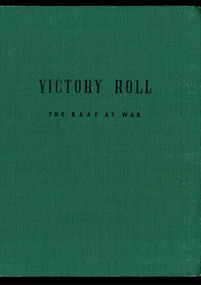
... In making final victory possible, we lost many comrades, to w home this book, together with those which preceded it, becomes a permanent memorial. wwii raaf end of conflict test pilot wewak the sisters fly on battle of borneo the biscuit bombers anzacs on bougainville raaf pacific return to timor pacific landing long range from darwin air victory over burma lifeline to china photo recce first over malaya jungle dawn the victory in europe story of a prison camp night flight over hamburg youth's prayer at a war memorial victory at the alps waaf's good service Message from the Chief of Air Staff.... Air Vice Marshal, Chief of Ai Staff C.Jones Green hardcover and spine with black text - 'Victory Roll The RAAF at war' on front cover and spine. The inside front and back covers have silhouette, green sepia pictures of a variety of aeroplane. Illustrations, photographs ...The stories in 'Victory Roll' tell of some of the deeds performed in the final and victorious year of WWII. They add to a long tradition of gallant service and sacrifice and will serve as an eternal inspiration in the task of building a new world in which the spirit of the Four Freedoms must predominate. In making final victory possible, we lost many comrades, to w home this book, together with those which preceded it, becomes a permanent memorial. Green hardcover and spine with black text - 'Victory Roll The RAAF at war' on front cover and spine. The inside front and back covers have silhouette, green sepia pictures of a variety of aeroplane. Illustrations, photographs and cartoons Message from the Chief of Air Staff.... Air Vice Marshal, Chief of Ai Staff C.Jones wwii, raaf, end of conflict, test pilot, wewak, the sisters fly on, battle of borneo, the biscuit bombers, anzacs on bougainville, raaf pacific, return to timor, pacific landing, long range from darwin, air victory over burma, lifeline to china, photo recce, first over malaya, jungle dawn, the victory in europe, story of a prison camp, night flight over hamburg, youth's prayer at a war memorial, victory at the alps, waaf's good service -
 Lara RSL Sub Branch
Book, RAAF Log - The RAAF at War, 1943
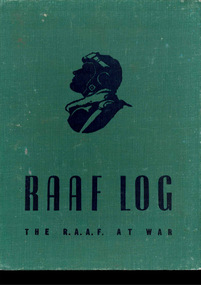
... Personal recounts of WWII RAAF service personnel supported by photographs, illustrations and cartoons. pacific front milne bay bismark sea battle battle for wau men of the mrs catalinas spit fires beaufighters malta hudson squadrons darwin timor moabiss japanese aircraft RAAF Log - The RAAF at War. ...Personal recounts of WWII RAAF service personnel supported by photographs, illustrations and cartoons. RAAF Log - The RAAF at War. Green hardcover with black text and silhouette of the head and shoulders profile of a pilot. The spine also has the same text. Inside front and back inside covers is an active illustration of RAAF members in various roles. Pictures, illustrations, photographs, poems, personal stories, paintings, prints pacific front, milne bay, bismark sea battle, battle for wau, men of the mrs, catalinas, spit fires, beaufighters, malta, hudson squadrons, darwin, timor, moabiss, japanese aircraft -
 Lara RSL Sub Branch
Photo, Harry Grove
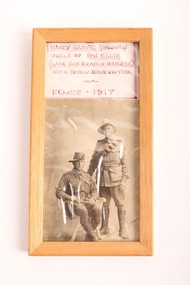
... This photo represents the connection that Lara RSL members and their family members have to the conflicts that Australia has been involved in over time. world war 1 ww1 wwi photo family private corporal The photo is black and white, and in the bottom right corner in pencil is written: Sincerely Yours, Arthur. The remainder of the text extends under the frame, but looks as though it says: Arthur, France. Photograph ...This photo is from 1917 and is of Private Harry Groves (standing) with his cousin Arthur Whitter (seated). Private Groves was the Uncle of Ron Ellis, who was a Lara Sub-Branch member. Cpl. Ronald Warren Ellis, EM (VX502517) was born in Brunswick in 1927. His family moved to Lara when he was young, and his schooling took place at the Lara State School. After finishing his education, Ron took up employment at Sims Coopers in Corio. Ron was enlisted in the second AIF at Melbourne, and posted to the 3rd Recruit Training Battalion at Greta west of Newcastle, NSW. After 3 months training, he was sent to the Service Corps Training Centre for driver and maintenance training in Ingleburn, south of Sydney. When this course was completed, Ron was posted to the Australian Army Service Corps as a driver motor vehicle with the 2nd AIF. Rons service with the AIF lasted 425 days, when he was then transferred to the Interim Army for a further 309 days. The duration of his service was in NSW. Ron was discharged from the Army in Melbourne on the 4th of May 1948. In 1957, Ron enlisted in the CMF and served with 22nd Construction Squadron for 17 years with the last 5 as a Corporal, and was awarded the Efficiency Medal for long service and good conduct. This photo represents the connection that Lara RSL members and their family members have to the conflicts that Australia has been involved in over time. Photograph of Harry Grove (standing) with his cousin Arthur Witter (seated) - France 1917. The black and white photo is framed within a wooden frame, and above it is a piece of paper with details about the photo written in red texta. The photo is black and white, and in the bottom right corner in pencil is written: Sincerely Yours, Arthur. The remainder of the text extends under the frame, but looks as though it says: Arthur, France. world war 1, ww1, wwi, photo, family, private, corporal -
 Federation University Historical Collection
Photograph (black & White), Major-General, Honorable Neville Gerald Lyttelton - South Africa
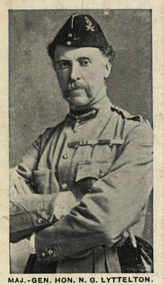
... time until his death there in 1931. Other awards received were Knight Grand Cross of the Order of the Bath; Knight Grand Cross of the Royal Victorian Order; Order of Osmanieh (Ottoman Empire) neville gerald lyttelton second boer war commander 4th brigade battle of spion kop battle of vaal krantz relief of ladysmith lord roberts commander-in-chief south africa knight commander of the order of the bath royal hospital chelsea order of osmanieh (ottoman empire) knight grand cross of the royal victorian order Individual image taken from photographed poster of tobacco and cigarette cards. ...Lyttelton served in the Second Boer War as Commander of the 4th Brigade from 1899. He temporarily became General Officer Commanding the 2nd Division and the commanded the 4th Division. The Division was involved in the Battle of Spion Kop and the Battle of Vaal Krantz, leading to the Relief of Ladysmith 1900. Lord Roberts referred to Lyttelton as an officer "with great coolness under fire, and considerable tactical knowledge and resource........an excellent commander in the field." Following the end of the Boer War in 1902, Lyttelton became Commander-in-Chief of the whole of South Africa. He and his wife sought to repair relations with the Boer community. In the South Africa honours of 1902 Lyttelton was knighted as Knight Commander of the Order of the Bath. He retired in 1912 and under insistence by the King was appointed as Governor of the Royal Hospital Chelsea from that time until his death there in 1931. Other awards received were Knight Grand Cross of the Order of the Bath; Knight Grand Cross of the Royal Victorian Order; Order of Osmanieh (Ottoman Empire) Individual image taken from photographed poster of tobacco and cigarette cards. neville gerald lyttelton, second boer war, commander, 4th brigade, battle of spion kop, battle of vaal krantz, relief of ladysmith, lord roberts, commander-in-chief, south africa, knight commander of the order of the bath, royal hospital chelsea, order of osmanieh (ottoman empire), knight grand cross of the royal victorian order -
 Flagstaff Hill Maritime Museum and Village
Painting - Watercolour Painting, Beni Carr Glyn Burnett, The Winterhude, 1933
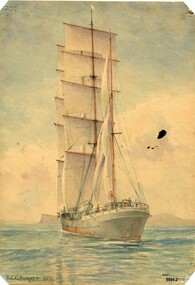
... time who specialised in photographing ships and the shipping trade (e.g. Samuel J. Hood and William James Hall) and whose photographs were used by artists to produce ship portraits. Both of these photographers took photographs of the two ships in B. C. G. Burnett's watercolours. The "Winterhude" (originally called "Mabel Rickmers) was a three masted Finnish barque built in 1898 by Rickers - Werft Bremerhaven for use on the East India rice trade and later the South American nitrate trade. After WW1 it came under French control as war...time who specialised in photographing ships and the shipping trade (e.g. Samuel J. Hood and William James Hall) and whose photographs were used by artists to produce ship portraits. Both of these photographers took photographs of the two ships in B. C. G. Burnett's watercolours. The "Winterhude" (originally called "Mabel Rickmers) was a three masted Finnish barque built in 1898 by Rickers - Werft Bremerhaven for use on the East India rice trade and later the South American nitrate trade. After WW1 it came under French control as war ...Beni Carr Glyn Burnett (also known as B. C. G. Burnett or Beni Burnett) was born in 1889 to missionary parents in Mongolia. When he was 15 years old he began training as an architect with a firm in Shanghai. He worked in Singapore, Japan and China before moving to Australia around 1933. In 1937 he was appointed as the Commonwealth principal architect in the Northern Territory. He went on to design a series of houses for senior public servants and military personnel which became very popular as they were specifically designed for the tropics - incorporating louvres, high ceilings and good ventilation. When Darwin was bombed in February 1942, he was evacuated to Alice Springs where he continued to work as an architect. He also became a Magistrate and Coroner in Alice Springs. In later life he was well known for sketching clientele in public bars. He died in 1955. Beni Burnett was living in Sydney in 1933 when he produced these three artworks. There were several photography firms operating in Sydney at this time who specialised in photographing ships and the shipping trade (e.g. Samuel J. Hood and William James Hall) and whose photographs were used by artists to produce ship portraits. Both of these photographers took photographs of the two ships in B. C. G. Burnett's watercolours. The "Winterhude" (originally called "Mabel Rickmers) was a three masted Finnish barque built in 1898 by Rickers - Werft Bremerhaven for use on the East India rice trade and later the South American nitrate trade. After WW1 it came under French control as war compensation. It was also sold several times and at one stage was called "Selma Hemsoth" but in 1925 it was bought by Gustaf Erikson who restored the name "Winterhude" and the vessel became a regular transport in the Australian wheat trade. In 1944 it was sold to the German navy before being taken over by the British at the end of WW2. It was photographed in Sydney by William James Hall in1931 on its way to Port Lincoln, South Australia to load wheat for Europe. This painting (one of a set of three small artworks) is significant as an example of shipping (particularly the use of sailing ships) that were still being used as late as the 1930's in Australia. It is also important because its creator (B. C. G. Burnett) went on to become a well-known public figure in the Northern Territory in the late 1930's due to his innovative approach to designing homes for the tropical climate. A watercolour painting of a sailing ship called "Winterhude". It shows a 3 masted barque with a blue and red steel hull in full sail heading away from the viewer. A small figure can be seen at the wheel at the rear of the ship. The painter's name (B. C. G. Burnett) and date (1933) are written on the bottom left-hand corner of the painting. The name of the ship is written in faded pencil on the back of the painting. front - "B. C. G. BURNETT. 1933" back - in faded pencil - "the Winterhude" flagstaff hill maritime museum and village, warrnambool, great ocean road, sailing ships, ships, barque, winterhude, beni carr glyn burnett, b. c. g. burnett, beni burnett, painting, watercolour painting, sketch, ink sketch, sydney harbour, architect, darwin, burnett house, photography, samuel j. hood, william james hall, mabel rickmers -
 Flagstaff Hill Maritime Museum and Village
Postcard - Postcard Folder set, Valentine Publishing Co. Pty. Ltd. Melbourne and Sydney, Beautiful Views in Colour of WARRNAMBOOL VIC, 1930-50
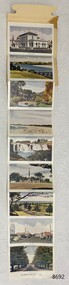
... time. Flagstaff Hill Maritime Museum and Village Great Ocean Road Warrnambool Flagstaff Hill postcard postcard folder Warrnambool Scenes Picturesque views of Warrnambool Souvenir Hopkins River Botanic Gardens Post Office Beach Hopkins Falls War Memorial Avenue of Pines Liebig St Beach Rd and Harbour 1930s 1940s Valentine Publishing Co. Pty. Ltd. Melbourne & Sydney A postcard folder containing nine coloured images of photographed ...Postcard folders such as these were popular as holiday souvenirs in the early to mid-20th century and were kept in good condition by collectors. The size is convenient for posting to friends and relatives and packing as holiday luggage. The images of iconic Warrnambool sights in this postcard folder were most likely taken during the 1930s-40s looking at the cars in the picture of Liebig St. The Valentine Publishing Co. Pty. Ltd., Melbourne and Sydney, was formed in 1923 so date the folder after this date. The postcards in this folder record images of local Warrnambool history from the early to mid 20th century. They are able to be used as a record of changes to structures and land formations around Warrnambool over time. A postcard folder containing nine coloured images of photographed scenes showcasing Warrnambool and district around the 1930s-1940s. The images are printed on one side of a long strip of white paper that is Z-folded and attached to a cover of heavier cream card. The front of the folder has a picture of a tree framing a beach scene, the title ‘Beautiful Views in Colour of WARRNAMBOOL VIC.’ and an address area. Slits on the rear cover enable the folder to be secured. flagstaff hill maritime museum and village, great ocean road, warrnambool, flagstaff hill, postcard, postcard folder, warrnambool scenes, picturesque views of warrnambool, souvenir, hopkins river, botanic gardens, post office, beach, hopkins falls, war memorial, avenue of pines, liebig st, beach rd and harbour, 1930s, 1940s, valentine publishing co. pty. ltd. melbourne & sydney
