
Showing 41 items matching "ziebell family"
-
 Friends of Westgarthtown
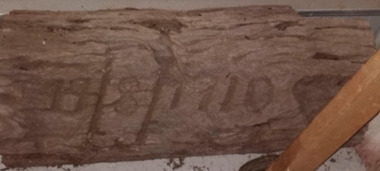
Sign - Wooden fence post sign, 1910
... ...Ziebell family....This date marker was originally located on a gate post at the entrance to the Ziebell family farm at Westgarthtown, Thomastown, Victoria. ...Date marker bearing the inscription '1910', originally located on a gate post at the entrance to the Ziebell family farm at Westgarthtown, Thomastown, Victoria....This date marker was originally located on a gate post at the entrance to the Ziebell family farm at Westgarthtown, Thomastown, Victoria. ...This date marker was originally located on a gate post at the entrance to the Ziebell family farm at Westgarthtown, Thomastown, Victoria. The inscription '1910' records the year in which the gate post was installed, reflecting a practice of marking significant improvements to the farm's infrastructure. Henry Ziebell recalled that dates were chiselled into gate posts to record when they were installed. He identified Joe Adams as having been responsible for chiselling at least one of these dates, although it is not confirmed whether he inscribed this particular example. The marker provides a tangible connection to the development and maintenance of the Ziebell family farm during the early twentieth century, documenting a practical tradition associated with the construction of farm entrances and boundary fencing. The marker was donated to Ziebell's Farmhouse Museum by Lyn and James Ziebell.Date marker bearing the inscription '1910', originally located on a gate post at the entrance to the Ziebell family farm at Westgarthtown, Thomastown, Victoria.19/08/1910gate post, date marker, 1910, joe adams, farm entrance, farm infrastructure, westgarthtown, ziebell family. -
 Friends of Westgarthtown
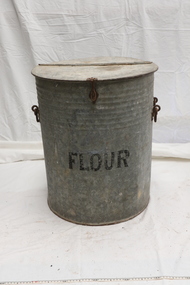
Domestic object - Metal flour tin, c. 1920-1950
... ...Ziebell family....This metal flour storage tin belonged to the Ziebell family and was originally used at their farm at Westgarthtown, Thomastown, Victoria. ...This metal flour storage tin belonged to the Ziebell family and was originally used at their farm at Westgarthtown, Thomastown, Victoria. ...This metal flour storage tin belonged to the Ziebell family and was originally used at their farm at Westgarthtown, Thomastown, Victoria. Henry Ziebell recalled the tin being used by the family during his childhood and its continued presence in the family home in Thomastown. He explained that flour was traditionally purchased in large 70-pound (approximately 32 kg) bags and transferred into the tin for everyday domestic use. Large storage tins such as this were commonly used in rural households throughout the nineteenth and twentieth centuries, particularly when staple ingredients were purchased in bulk. These containers were an essential part of household management, allowing families to store substantial quantities of food for regular use. The tin provides a tangible connection to the domestic routines, food preparation and household practices of successive generations of the Ziebell family, reflecting the practical nature of everyday life at Westgarthtown. The tin was donated to Ziebell's Farmhouse Museum by Lyn and James Ziebell.Large metal storage tin with hand-painted black lettering reading 'Flour'. Used for storing bulk quantities of flour, the tin provided a practical means of keeping dry goods contained and protected from moisture, pests and contamination.flour tin, food storage, kitchen equipment, domestic life, household management, bulk food storage, farming households, westgarthtown, ziebell family. -
 Friends of Westgarthtown
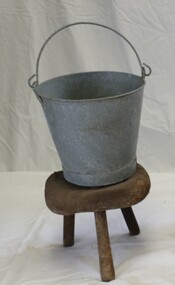
Functional object - Metal milking pale, c.1920
... ...Ziebell family....This metal milking bucket dates to approximately 1920–1930 and forms part of the Ziebell family collection associated with their farm at Westgarthtown, Thomastown, Victoria. ...This metal milking bucket dates to approximately 1920–1930 and forms part of the Ziebell family collection associated with their farm at Westgarthtown, Thomastown, Victoria. ...This metal milking bucket dates to approximately 1920–1930 and forms part of the Ziebell family collection associated with their farm at Westgarthtown, Thomastown, Victoria. Milking buckets were essential equipment on dairy farms before the widespread introduction of mechanical milking systems. Cows were milked by hand, with workers typically seated on low wooden stools beside the animals, collecting fresh milk directly into buckets before transferring it into larger milk cans for storage and transport. Henry Ziebell recalled that metal milking buckets were standard equipment on the family farm and remained in use until at least 1970, when the farm's clearing sale took place. His recollections demonstrate the continued use of traditional hand-milking equipment at Westgarthtown well into the twentieth century. The bucket provides a tangible connection to the dairy farming practices of the Ziebell family, reflecting the manual labour, daily routines and agricultural traditions maintained across generations at Westgarthtown. The bucket was donated to Ziebell's Farmhouse Museum by Lyn and James Ziebell.Metal milking bucket with a carrying handle, used for collecting fresh milk during the hand-milking of dairy cows. The bucket was designed to be positioned beneath the cow's udder, allowing milk to be collected directly during the milking process.milking bucket, hand milking, dairy farming, dairy equipment, agricultural history, milk production, westgarthtown, ziebell family. -
 Friends of Westgarthtown
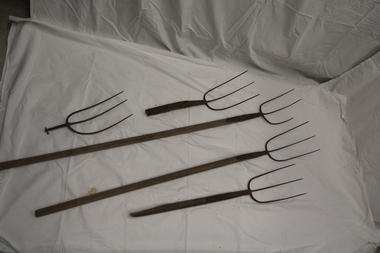
Functional object - Selection of pitchforks, c.1900
... ...Ziebell family....These pitchforks were used on the Ziebell family farm at Westgarthtown, Thomastown, Victoria, during the early twentieth century. ...These pitchforks were used on the Ziebell family farm at Westgarthtown, Thomastown, Victoria, during the early twentieth century. ...These pitchforks were used on the Ziebell family farm at Westgarthtown, Thomastown, Victoria, during the early twentieth century. Pitchforks were essential tools for handling loose hay, particularly during harvesting and the construction of large haystacks. Before the widespread adoption of mechanical baling equipment, hay was commonly gathered, lifted and stacked by hand, requiring considerable physical labour. Pitchforks were used to transfer hay from the field to carts or wagons and to build and maintain haystacks for storage and later use as livestock feed. Henry Ziebell recalled his father using pitchforks to manage hay on the family farm at Thomastown. His recollections are supported by historic family photographs depicting haymaking activities on the property (refer to associated images). The pitchforks reflect the labour-intensive nature of traditional haymaking and provide a tangible connection to the agricultural practices, working routines and skills of successive generations of the Ziebell family at Westgarthtown. The pitchforks were donated to Ziebell's Farmhouse Museum by Lyn and James Ziebell.Selection of traditional agricultural pitchforks dating to the early twentieth century, used for lifting, moving and stacking loose hay and other agricultural materials. These hand-operated tools were designed for manual haymaking and general farm work, particularly before the widespread adoption of mechanised harvesting and baling equipment.pitchfork, hay fork, haymaking, haystack, agricultural tools, farm equipment, manual labour, dairy farming, westgarthtown, ziebell family. -
 Friends of Westgarthtown
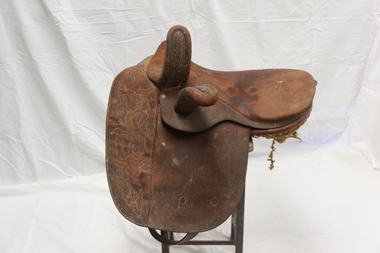
Functional object - Women's leather sidesaddle, c.1890
... Ziebell Family...Women's leather equestrian sidesaddle dating to approximately the late nineteenth century, c.1890s, once belonging to the Ziebell family of Thomastown. The sidesaddle is designed to allow the rider to sit with both legs positioned on the same side of the horse, rather than astride. ...This leather sidesaddle has a longstanding association with the Ziebell family and their farm at Westgarthtown, Thomastown, Victoria. ...Women's leather equestrian sidesaddle dating to approximately the late nineteenth century, c.1890s, once belonging to the Ziebell family of Thomastown. The sidesaddle is designed to allow the rider to sit with both legs positioned on the same side of the horse, rather than astride. This style of saddle was traditionally associated with women's horse riding and was widely used during the nineteenth century. The saddle is constructed primarily from leather, with a shaped seat designed to accommodate the rider in a sideways position.This leather sidesaddle has a longstanding association with the Ziebell family and their farm at Westgarthtown, Thomastown, Victoria. The sidesaddle is believed to date from approximately the 1890s and was reportedly used on the family farm before the time of James Ziebell, who continued operating the property until the 1970s. According to family history, the sidesaddle had always remained on the farm, although its original owner and user have not been identified. Sidesaddles were widely used by women throughout the nineteenth century, reflecting contemporary conventions surrounding women's clothing and horse riding. By the late nineteenth century, improvements in sidesaddle design enabled women to ride with greater stability and participate in a range of equestrian activities. The sidesaddle was donated to Ziebell's Farmhouse Museum by Lyn and James Ziebell and represents a tangible connection to the family's agricultural history and the everyday lives of earlier generations at Westgarthtown.ziebell family, sidesaddle, horse riding, equestrian equipment, women's history, nineteenth century, leatherwork, rural life, transport, recreation. -
 Friends of Westgarthtown
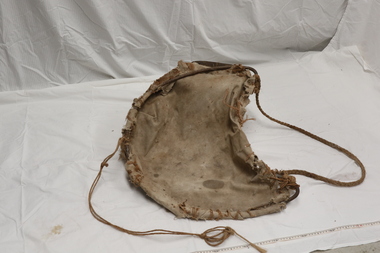
Functional object - Hand seed sower, c.1920
... ...Ziebell family....This handmade seed-sowing pouch was used on the Ziebell family farm at Westgarthtown, Thomastown, Victoria, and reflects the practical ingenuity and resourcefulness associated with everyday agricultural work. ...This handmade seed-sowing pouch was used on the Ziebell family farm at Westgarthtown, Thomastown, Victoria, and reflects the practical ingenuity and resourcefulness associated with everyday agricultural work. ...This handmade seed-sowing pouch was used on the Ziebell family farm at Westgarthtown, Thomastown, Victoria, and reflects the practical ingenuity and resourcefulness associated with everyday agricultural work. Henry Ziebell recalled that the pouch was constructed using a reused hessian sack, with a piece of iron or fencing wire bent inside to support its opening. The rope was placed around the worker's neck, allowing the pouch to hang in front of the body, while a second string was tied around the waist to hold it securely in place. The pouch was filled with seed, which was then distributed by hand as the worker walked across the field, throwing seed alternately from one side to the other. This traditional method, known as broadcast sowing, allowed seed to be scattered across prepared ground before the widespread use of mechanised sowing equipment. The reuse of hessian, fencing wire and rope demonstrates the resourcefulness of farming families, who frequently adapted readily available materials to create practical tools suited to their needs. The pouch provides a tangible connection to traditional agricultural practices, manual labour and the working lives of the Ziebell family at Westgarthtown. The pouch was donated to Ziebell's Farmhouse Museum by Lyn and James Ziebell.Handmade agricultural seed-sowing pouch constructed from repurposed hessian sack material, fencing wire and rope. The pouch features a bent metal support fitted inside the upper section to maintain its opening, with a rope strap designed to hang around the wearer's neck. An additional length of string attached to the lower section was secured around the waist to stabilise the pouch during use. The pouch was designed to hold seed for manual broadcasting across cultivated fields.seed-sowing pouch, broadcast sowing, seed broadcasting, agricultural equipment, handmade farm tools, hessian, farming, resourcefulness, westgarthtown, ziebell family. -
 Friends of Westgarthtown
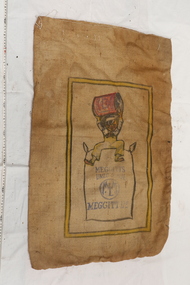
Textile - Megget's Linseed hessian sack, c.1900
... ...Ziebell family...This hessian sack forms part of the Ziebell family collection associated with their farm at Westgarthtown, Thomastown, Victoria. ...This hessian sack forms part of the Ziebell family collection associated with their farm at Westgarthtown, Thomastown, Victoria. ...This hessian sack forms part of the Ziebell family collection associated with their farm at Westgarthtown, Thomastown, Victoria. Linseed meal, a by-product of linseed oil production, was commonly used as a supplementary feed for dairy cattle. Rich in protein, it provided additional nutrition to support the condition and productivity of livestock. Henry Ziebell recalled that linseed meal was used as cattle feed on the family farm. He also described how empty hessian sacks were repurposed for agricultural use, particularly during haymaking. Once hay had been gathered and stacked in the fields, hessian sacks were sewn together to create large coverings that helped protect the haystacks from wind and rain. The reuse of hessian sacks reflects the resourcefulness of farming families, who frequently adapted available materials for practical purposes rather than discarding them. The sack provides a tangible connection to dairy farming, livestock feeding and traditional haymaking practices at Westgarthtown, illustrating both the agricultural supplies used on the property and the importance of reusing materials in everyday farm operations. The sack was donated to Ziebell's Farmhouse Museum by Lyn and James Ziebell.Hessian sack bearing printed lettering reading 'Megget's Linseed' and 'MLM'. Originally used for the packaging, storage and transport of linseed products intended as supplementary feed for livestock, particularly dairy cattle. The sack is constructed from woven hessian, a durable material commonly used for agricultural packaging and the transport of bulk produce and animal feed.hessian sack, megget's linseed, mlm, linseed meal, cattle feed, dairy farming, animal fodder, haymaking, agricultural packaging, westgarthtown, ziebell family -
 Friends of Westgarthtown
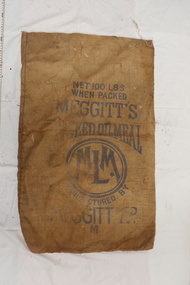
Textile - Megget's Linseed Meal hessian sack, c.1900
... ...Ziebell family....This hessian linseed meal sack forms part of the Ziebell family collection associated with their farm at Westgarthtown, Thomastown, Victoria. ...This hessian linseed meal sack forms part of the Ziebell family collection associated with their farm at Westgarthtown, Thomastown, Victoria. ...This hessian linseed meal sack forms part of the Ziebell family collection associated with their farm at Westgarthtown, Thomastown, Victoria. Linseed meal is a by-product of linseed oil production, produced from the remaining seed material after oil has been extracted. Rich in protein, it was commonly used as supplementary feed for dairy cattle to support their nutritional requirements and condition. Henry Ziebell recalled that linseed meal was used as cattle feed on the family farm. He also described how empty hessian sacks were repurposed for agricultural use, particularly during haymaking. Once hay had been gathered and stacked in the fields, hessian sacks were sewn together to create large coverings that helped protect the haystacks from wind and rain. The reuse of hessian sacks reflects the resourcefulness and practical ingenuity of farming families, who frequently adapted and repurposed available materials to meet everyday agricultural needs. The sack provides a tangible connection to dairy farming, livestock feeding and traditional haymaking practices at Westgarthtown, illustrating both the agricultural supplies used on the property and the importance of reusing materials in everyday farm operations. The sack was donated to Ziebell's Farmhouse Museum by Lyn and James Ziebell.Hessian sack bearing printed lettering reading 'Megget's Linseed Meal' and 'MLM'. Originally used for the packaging, storage and transport of linseed meal intended as supplementary feed for livestock, particularly dairy cattle. The sack is constructed from woven hessian, a durable material commonly used for agricultural packaging and the transport of bulk produce and animal feed.MLMhessian sack, megget's linseed meal, mlm, linseed meal, cattle feed, dairy farming, animal fodder, haymaking, haystack, agricultural packaging, westgarthtown, ziebell family. -
 Friends of Westgarthtown
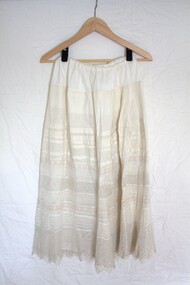
Clothing - Petticoat, c. 1895-1910
... The adaptation and continued use of the petticoat demonstrates the enduring significance of family clothing and the intergenerational transmission of material culture within the Ziebell family....The adaptation and continued use of the petticoat demonstrates the enduring significance of family clothing and the intergenerational transmission of material culture within the Ziebell family. Clothing Petticoat ...This petticoat was originally owned and worn by Annie Ziebell (née Robertson) (1872–1953) and remained within the Ziebell family. In 1967, descendant Janet Hubbard altered the waistband so that the garment could be worn as part of her wedding ensemble for her marriage to Terry Hubbard on 1 December 1967. The adaptation and continued use of the petticoat demonstrates the enduring significance of family clothing and the intergenerational transmission of material culture within the Ziebell family. -
 Friends of Westgarthtown
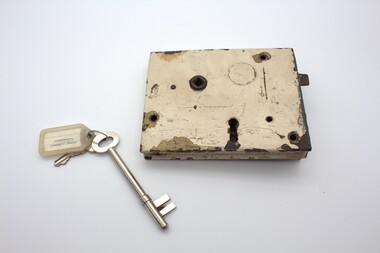
Functional object - Rim Lock and Key, c.1850
... This example formed part of the fabric of the Ziebell's Farmhouse, one of the earliest surviving German settler homes in Victoria, and provides insight into the construction methods and everyday domestic life of the Ziebell family....This example formed part of the fabric of the Ziebell's Farmhouse, one of the earliest surviving German settler homes in Victoria, and provides insight into the construction methods and everyday domestic life of the Ziebell family. Painted metal rim lock with associated metal key. ...Rim locks were commonly used on domestic buildings throughout the nineteenth and early twentieth centuries. This example formed part of the fabric of the Ziebell's Farmhouse, one of the earliest surviving German settler homes in Victoria, and provides insight into the construction methods and everyday domestic life of the Ziebell family.Painted metal rim lock with associated metal key. The rectangular lock case retains traces of its original cream-coloured paint and exhibits wear consistent with long-term use. The lock was removed from one of the doors of Ziebell's Farmhouse and is representative of the original fittings used throughout the nineteenth-century dwelling. -
 Friends of Westgarthtown
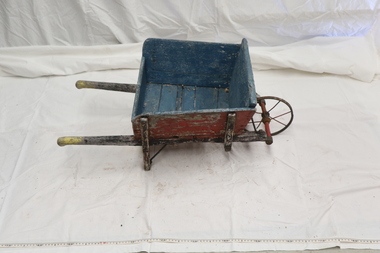
Leisure object - Child's wheelbarrow, c.1920
... This children's wheelbarrow belonged to the Ziebell family of Westgarthtown, Thomastown, Victoria, and dates to approximately 1920. ...This children's wheelbarrow belonged to the Ziebell family of Westgarthtown, Thomastown, Victoria, and dates to approximately 1920. ...This children's wheelbarrow belonged to the Ziebell family of Westgarthtown, Thomastown, Victoria, and dates to approximately 1920. A historic family photograph depicts James Ziebell, son of Henry Ziebell Senior, playing with the wheelbarrow as a young child, providing a direct connection between the object and its use by the family. Children's wheelbarrows such as this were used for play during the early twentieth century, allowing children to imitate the everyday activities of adults, particularly gardening, farming and other manual tasks. On rural properties such as the Ziebell family farm, children's play often reflected the agricultural activities and working routines taking place around them. The wheelbarrow provides a tangible connection to childhood and family life at Westgarthtown and is particularly significant for its documented association with James Ziebell through the surviving family photograph. The wheelbarrow was donated to Ziebell's Farmhouse Museum by Lyn and James Ziebell.Small children's wheelbarrow painted blue, dating to approximately 1920. Constructed as a scaled-down version of an adult wheelbarrow, it features a single front wheel, shallow tray and handles for pushing.toys -
 Friends of Westgarthtown
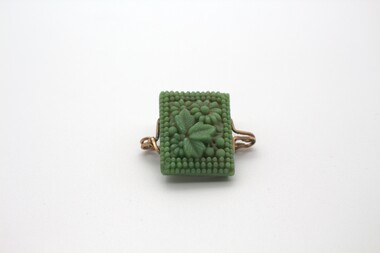
Accessory - Gold Brooch with Jade Stone
... The brooch was passed down through generations of the Ziebell family before being donated to Ziebell's Farmhouse Museum by Janet Hubbard. ...The brooch was passed down through generations of the Ziebell family before being donated to Ziebell's Farmhouse Museum by Janet Hubbard. ...Gold brooch featuring a square jade stone set within a decorative gold mount. The brooch was passed down through generations of the Ziebell family before being donated to Ziebell's Farmhouse Museum by Janet Hubbard. While the original owner and date of manufacture are unknown, the brooch is believed to have belonged to Annie Ziebell (née Robertson) -
 Friends of Westgarthtown
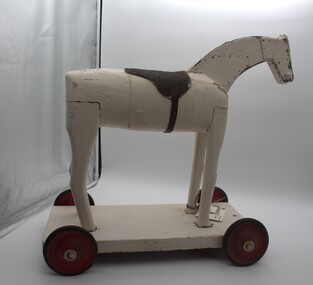
Toy Horse, c. 1910-1930
... Handmade by Carl Heinrich Alfred "Carl Alfred" Ziebell (1867–1940), great-grandson of Westgarthtown pioneers Christian and Sophia Ziebell, this toy horse is an example of the skilled craftsmanship practised within the Ziebell family. It was made for the children of his eldest son, Alfred Ziebell, and remained within the family until donated by Joan Morris (née Ziebell)....Handmade by Carl Heinrich Alfred "Carl Alfred" Ziebell (1867–1940), great-grandson of Westgarthtown pioneers Christian and Sophia Ziebell, this toy horse is an example of the skilled craftsmanship practised within the Ziebell family. It was made for the children of his eldest son, Alfred Ziebell, and remained within the family until donated by Joan Morris (née Ziebell). ...Handmade by Carl Heinrich Alfred "Carl Alfred" Ziebell (1867–1940), great-grandson of Westgarthtown pioneers Christian and Sophia Ziebell, this toy horse is an example of the skilled craftsmanship practised within the Ziebell family. It was made for the children of his eldest son, Alfred Ziebell, and remained within the family until donated by Joan Morris (née Ziebell).Handmade wooden toy horse known as Pearly Bridge, constructed and painted white with a dark painted saddle and mounted on a rectangular wheeled base with four red-painted wheels. The horse features a stylised carved body with a flat, shaped head and simple painted details -
 Friends of Westgarthtown
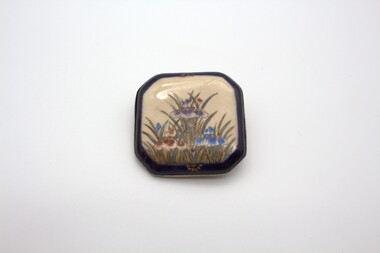
Accessory - Painted Porcelain Brooch
... The brooch was passed down through generations of the Ziebell family before being donated to Ziebell's Farmhouse Museum by Janet Hubbard. ...The brooch was passed down through generations of the Ziebell family before being donated to Ziebell's Farmhouse Museum by Janet Hubbard. ...Painted porcelain brooch featuring a hand-painted floral design set within a decorative metal mount. The brooch was passed down through generations of the Ziebell family before being donated to Ziebell's Farmhouse Museum by Janet Hubbard. While the original owner and date of manufacture are unknown, the brooch is believed to have belonged to Annie Ziebell (née Robertson). -
 Friends of Westgarthtown
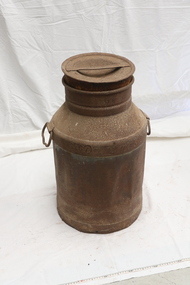
Functional object - Metal milk can and lid
... This metal milk can forms part of the Ziebell family collection associated with their farm at Westgarthtown, Thomastown, Victoria. ...This metal milk can forms part of the Ziebell family collection associated with their farm at Westgarthtown, Thomastown, Victoria. ...This metal milk can forms part of the Ziebell family collection associated with their farm at Westgarthtown, Thomastown, Victoria. Milk cans such as this were essential equipment on dairy farms throughout the nineteenth and twentieth centuries, used for storing and transporting fresh milk before the widespread introduction of refrigerated bulk milk collection systems. Henry Ziebell recalled that milk cans remained in use on the family farm until the 1970s. He explained that the cans were used to store freshly collected milk and transport it from the milking shed to the processing dairy, forming an important part of the farm's daily dairy operations. The can bears the marking 'S&G Dairy Master', although the identity of the manufacturer has not yet been confirmed. The milk can provides a tangible connection to the dairy farming activities of the Ziebell family and reflects the equipment, manual labour and working practices associated with agricultural life at Westgarthtown throughout the twentieth century. The can was donated to Ziebell's Farmhouse Museum by Lyn and James Ziebell.Large cylindrical metal milk can with tapered shoulders, a narrow neck and a removable, fitted lid featuring a recessed carrying handle. Two metal ring handles are attached to opposite sides of the upper body for lifting and transporting the can. The upper section of the can features an embossed manufacturer's or supplier's marking reading 'S&G Dairy Master', with 'Dairy Master' in decorative script. The metal surface exhibits extensive oxidation and rust, with areas of discolouration and remnants of a darker surface finish.dairy farming -
 Friends of Westgarthtown
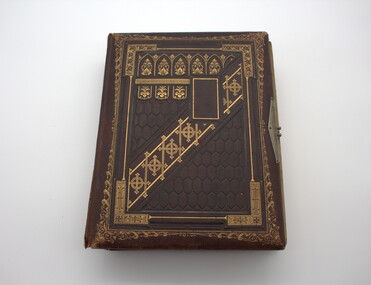
Album - Photo Album, c.1800s
... Large leather-bound family photograph album with gold-foiled decoration, containing black-and-white photographs of members of the Ziebell family. Many of the images featured in the publication The House that Christian Built. ...Large leather-bound family photograph album with gold-foiled decoration, containing black-and-white photographs of members of the Ziebell family. Many of the images featured in the publication The House that Christian Built. ...Large leather-bound family photograph album with gold-foiled decoration, containing black-and-white photographs of members of the Ziebell family. Many of the images featured in the publication The House that Christian Built. The album also contains memorial bookplates commemorating family members including Henry Ziebell, Charles Ludwig Ziebell, Heinrich August Sprenger and Elisabeth Ziebell, recording details of their deaths and burial places. Donated to Ziebell's Farmhouse Museum by Janet Hubbard. -
 Friends of Westgarthtown
Accessory - Gold Ring with Black Stone
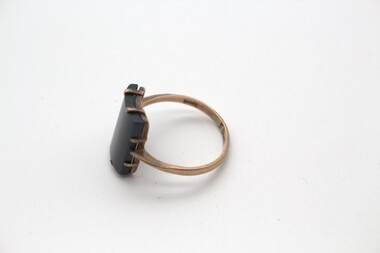
... The ring was passed down through generations of the Ziebell family before being donated to Ziebell's Farmhouse Museum by Janet Hubbard. ...The ring was passed down through generations of the Ziebell family before being donated to Ziebell's Farmhouse Museum by Janet Hubbard. ...Gold ring featuring a rectangular black stone set within a decorative gold band. The ring was passed down through generations of the Ziebell family before being donated to Ziebell's Farmhouse Museum by Janet Hubbard. While the original owner and date of manufacture are unknown, the ring is believed to have belonged to Annie Ziebell (née Robertson). The ring represents the types of personal jewellery that were treasured, worn and passed between family members over many years -
 Friends of Westgarthtown
Tool - Wooden dung scraper, c.1900-1940
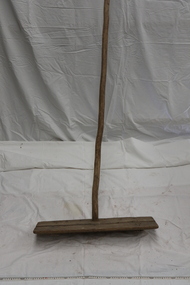
... This manure scraper was used on the Ziebell family farm at Westgarthtown, Thomastown, Victoria, and formed part of the everyday equipment used for maintaining farm buildings and working areas. ...This manure scraper was used on the Ziebell family farm at Westgarthtown, Thomastown, Victoria, and formed part of the everyday equipment used for maintaining farm buildings and working areas. ...This manure scraper was used on the Ziebell family farm at Westgarthtown, Thomastown, Victoria, and formed part of the everyday equipment used for maintaining farm buildings and working areas. Scrapers such as this were commonly used to remove animal manure, mud and other waste from stable floors, dairy sheds and yards. The rubber-edged blade allowed waste to be pushed or scraped from hard surfaces, assisting with the regular cleaning and maintenance of areas used to house and manage livestock. The scraper reflects the practical, labour-intensive nature of everyday farm work and the importance of maintaining clean and functional working environments on agricultural properties. The scraper was donated to Ziebell's Farmhouse Museum by Lyn and James Ziebell.Long-handled agricultural scraper featuring a flat wooden blade, designed for removing manure and other waste from stable floors, dairy sheds and farmyard surfaces.milking shed, tool, farming, westgarthtown, ziebell, manure scraper, agricultural equipment, farm tools, dairy farming, livestock management, farm maintenance -
 Friends of Westgarthtown
Accessory - Fobwatch, Chain and Key, c.1856-1890
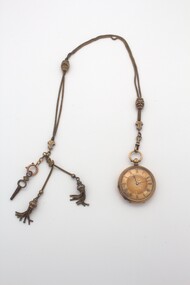
... Donated to Ziebell’s Farmhouse Museum in 2025 by Kristina Colic (née Ziebell) and her father Mervyn Turner Ziebell, the watch holds strong familial and interpretive value, enriching the museum’s representation of women’s heritage, adornment and craftsmanship within the Ziebell family. ...Believed to have belonged to either Elizabeth Ziebell (née Sprenger, 1836–1892) wife of Carl Chrsitian Ziebell or Amelia Alice Ziebell (née Bodycoat 1870-1948) wife of Albert Heinrich Ziebell, the watch provides a personal link to the women of the early Ziebell family and to domestic and social life within Westgarthtown’s German settler community. ...This finely crafted women’s gold fob watch, made by Robert Stauffer & Fils of La Chaux-de-Fonds, Switzerland, is an elegant example of mid-19th-century Swiss watchmaking. Its engraved floral motifs, protected beneath glass and repeated on the reverse, reflect the refinement and skill associated with one of Europe’s foremost horological centers. Believed to have belonged to either Elizabeth Ziebell (née Sprenger, 1836–1892) wife of Carl Chrsitian Ziebell or Amelia Alice Ziebell (née Bodycoat 1870-1948) wife of Albert Heinrich Ziebell, the watch provides a personal link to the women of the early Ziebell family and to domestic and social life within Westgarthtown’s German settler community. Women’s watches of this era were both functional and fashionable, commonly worn on a long necklace chain, suspended from a chatelaine at the waist, or attached to a decorative bodice brooch. Such pieces served as markers of refinement, femininity and social standing. The tiny winding key is central to the object’s significance. Before stem-winding mechanisms became standard in the 1870s, watches were wound and set by inserting a small key into an arbor at the back of the case. The survival of both the watch and its original key strengthens their historical integrity and deepens understanding of 19th-century personal technology. Donated to Ziebell’s Farmhouse Museum in 2025 by Kristina Colic (née Ziebell) and her father Mervyn Turner Ziebell, the watch holds strong familial and interpretive value, enriching the museum’s representation of women’s heritage, adornment and craftsmanship within the Ziebell family. Robert Stauffer & Fils of La Chaux-de-Fonds, Switzerland -
 Friends of Westgarthtown
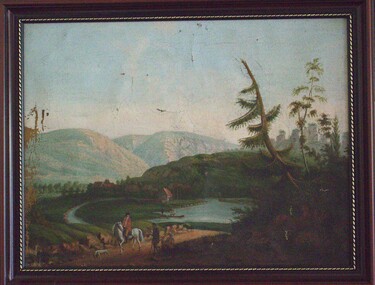
Artwork, other - Painting, c. 1830-1850
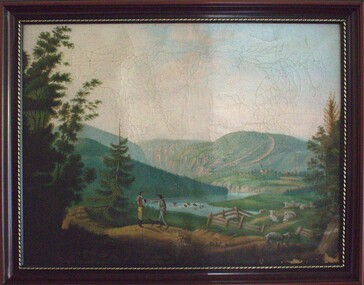
... This painting is understood to have been displayed within the Ziebell family home for much of the 20th century. ...This painting is understood to have been displayed within the Ziebell family home for much of the 20th century. ...This painting is understood to have been displayed within the Ziebell family home for much of the 20th century. According to Paul Schultz, one of the prints hung above the piano in the dining room during his childhood. His uncle, Francis Adams, who was raised in the house and born in the 1930s, recalled that the prints had been present for as long as he could remember, suggesting a long-standing association with the domestic interior of the farmhouse. The painting was re-framed approximately eight years ago, with the intention that they be returned to Ziebell’s Farmhouse Museum for display. Their reinstatement within the museum reflects a shared recognition among descendants of their historical and familial significance, and their role in evoking the lived experience of the house across generations.pastoral scene -
 Friends of Westgarthtown
Artwork, other - Painting, c.1830-1850
... This painting is understood to have been displayed within the Ziebell family home for much of the 20th century. ...This painting is understood to have been displayed within the Ziebell family home for much of the 20th century. ...This painting is understood to have been displayed within the Ziebell family home for much of the 20th century. According to Paul Schultz, one of the prints hung above the piano in the dining room during his childhood. His uncle, Francis Adams, who was raised in the house and born in the 1930s, recalled that the prints had been present for as long as he could remember, suggesting a long-standing association with the domestic interior of the farmhouse. The painting was reframed approximately eight years ago, with the intention that they be returned to Ziebell’s Farmhouse Museum for display. Their reinstatement within the museum reflects a shared recognition among descendants of their historical and familial significance, and their role in evoking the lived experience of the house across generations. -
 Friends of Westgarthtown
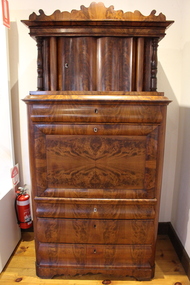
Furniture - Secretaire, c.1815-1860
... The secretaire contributes meaningfully to the interpretation of German migrant domestic life, craftsmanship, and transnational identity, offering tangible insight into what the Ziebell family valued and chose to carry across the world. ...The secretaire contributes meaningfully to the interpretation of German migrant domestic life, craftsmanship, and transnational identity, offering tangible insight into what the Ziebell family valued and chose to carry across the world. ...This 19th-century German secretaire is a refined example of the Biedermeier style, valued for its restrained elegance, high-quality craftsmanship, and practical, compartmentalised interior. Made with fine veneers, typically cherry or walnut, over a sturdy timber carcass, Biedermeier secretaires represent an important era of German domestic design that emphasised order, utility, and tasteful simplicity. Its significance to Ziebell’s Farmhouse Museum is elevated by its direct association with Christian Ziebell, who returned to Germany in 1855 after having settled in Westgarthtown and brought the secretaire back to Melbourne by ship. As a personally selected furnishing, it reflects both Christian’s continued connection to his homeland and the aspirations of a settler family building comfort, status, and familiarity in a new country. The secretaire contributes meaningfully to the interpretation of German migrant domestic life, craftsmanship, and transnational identity, offering tangible insight into what the Ziebell family valued and chose to carry across the world. -
 Friends of Westgarthtown
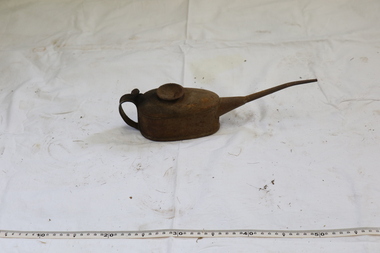
Functional object - Oil can, c. 1920
... This metal oil can forms part of the Ziebell family collection associated with their farm at Westgarthtown, Thomastown, Victoria. ...This metal oil can forms part of the Ziebell family collection associated with their farm at Westgarthtown, Thomastown, Victoria. ...This metal oil can forms part of the Ziebell family collection associated with their farm at Westgarthtown, Thomastown, Victoria. Oil cans such as this were commonly used on agricultural properties throughout the nineteenth and twentieth centuries for the routine lubrication and maintenance of farm machinery, tools and mechanical equipment. Henry Ziebell recalled that oil cans were regularly used for maintaining farm machinery, explaining that the long, narrow spouts were specifically designed to reach into confined or difficult-to-access areas where oil was required. This allowed workers to lubricate moving parts and mechanical components without having to dismantle equipment. Regular lubrication was essential to maintaining the operation of agricultural machinery, reducing wear and extending the working life of equipment. The oil can reflects the everyday maintenance practices, practical knowledge and skills required to operate a working farm at Westgarthtown. The oil can was donated to Ziebell's Farmhouse Museum by Lyn and James Ziebell.Small metal oil can featuring a long, narrow spout and handle, designed for the controlled application of lubricating oil to machinery, tools and mechanical components. -
 Friends of Westgarthtown
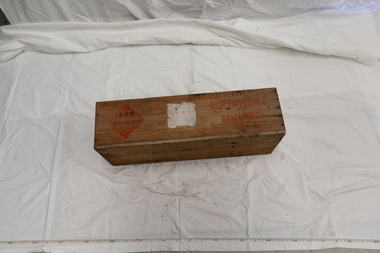
Equipment - Dynamite Box, 1972
... This wooden dynamite box forms part of the Ziebell family collection associated with the family farm at Westgarthtown, Thomastown, Victoria. ...This wooden dynamite box forms part of the Ziebell family collection associated with the family farm at Westgarthtown, Thomastown, Victoria. ...This wooden dynamite box forms part of the Ziebell family collection associated with the family farm at Westgarthtown, Thomastown, Victoria. Dynamite was historically used on agricultural properties for land clearing, removing tree stumps and breaking up rock to make land suitable for cultivation. It was also used for excavation work, including digging graves in areas where rocky ground made manual excavation difficult. Henry Ziebell recalled the use of dynamite at Westgarthtown, particularly for breaking up rock due to the difficult terrain. He described how a hole would be made in the rock using a tool known as a jumper, before dynamite was inserted to break apart the stone. He also recalled dynamite being used to remove dead trees, which could then be cut up for firewood. Henry also recounted the use of explosives when digging graves at the Westgarthtown cemetery, where the rocky ground presented particular challenges. Dating to 1972, the box reflects the continued availability of commercial explosives for agricultural and industrial purposes during the twentieth century. Although the specific use of the dynamite originally contained in this box has not been established, Henry Ziebell's recollections provide valuable insight into the historical use of explosives by the local farming community. The box was donated to Ziebell's Farmhouse Museum by Lyn and James Ziebell.Rectangular wooden box originally used for the storage and transport of ammonia gelatine dynamite. The box bears labelling identifying the contents as 'Ammonia Gelatine Dynamite', together with the markings 'Johnson NL-5420', 'Melbourne' and '1972'. The labelling indicates that the original contents were manufactured in Japan. The box survives as an empty container, with the original explosive contents no longer present. -
 Friends of Westgarthtown
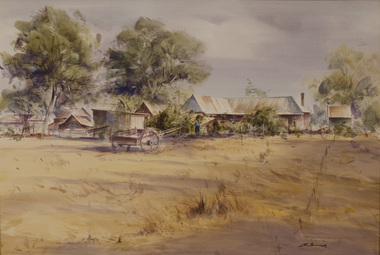
Painting, John Borrack, Last Days Ziebells "The Pines" Thomastown, c. 1970s
... As works created by a Ziebell descendant who consciously sought to record his family heritage, the paintings embody intergenerational memory, personal connection, and the enduring legacy of the Ziebell family within Victoria’s cultural landscape. ...Painted from the home (or front) paddock which ran south to the creek. The paddock was used for the cultivation of lucerne and maize crops in the lower regions while closer to the house where Ainwick Crescent is now situated, it was a burgeoning market garden for the cultivation of all varieties of vegetables. The large pines beyond, sheltered the farmyard on the west of Gardenia Road. That complex can be partly glimpsed on the left of the painting. This is a directly painted watercolour relying on the use of white paper and transparencies to impart a feeling of morning light. The figure is the artist's mother for whom the picture was painted. Provenance: Augusta Borrack (nee Ziebell) Collection, John Borrack CollectionThese two paintings by acclaimed Victorian artist John Borrack, a direct descendant of the Ziebell family through his mother Augusta, hold substantial artistic, historical, and familial significance for Ziebell’s Farmhouse Museum and the broader Westgarthtown narrative. Borrack, recognised as one of Australia’s leading landscape painters, is known for his sensitive, precise and atmospheric depictions of place. His professional standing and artistic skill considerably elevate the cultural value of these works. The paintings depict Ziebell’s Farmhouse and the associated outbuildings on the opposite side of Gardenia Road, capturing the rural character of the property prior to subdivision and suburban encroachment. They function as accurate visual records of the farm’s earlier setting and the self-sufficient lifestyle. Their documentary value is amplified by Borrack’s own reflections: he explained that he made the original sketches in the 1950s and later, in the 1970s, “decided to make a positive record of what the farm looked like”, developing these paintings from those earlier drawings. One work shows the farmhouse and milking shed as seen from the cemetery: the other captures the view from the front garden toward the former vegetable garden. Their provenance deepens their significance. As works created by a Ziebell descendant who consciously sought to record his family heritage, the paintings embody intergenerational memory, personal connection, and the enduring legacy of the Ziebell family within Victoria’s cultural landscape. They enrich the museum’s interpretive capacity, offering rare artistic insight into the historic farmstead and contributing meaningfully to the preservation and understanding of Westgarthtown’s heritage. Watercolour painting, depicting Ziebell's Farmhouse from the south (Thomastown and Mernda). Painting is mounted in a gold frame with cream board.Artist signature: John Borrack; Last Days at Ziebells "The Pines" Thomastown, 'Pro mea matre hanc picturan feci (In Memoria)'illustrations, watercolours, john borrack, ziebell, watercolour, painting -
 Friends of Westgarthtown
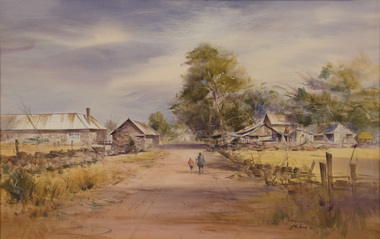
Painting, John Borrack, Ziebells, German Lane, South View, c. 1970s
... As works created by a Ziebell descendant who consciously sought to record his family heritage, the paintings embody intergenerational memory, personal connection, and the enduring legacy of the Ziebell family within Victoria’s cultural landscape. ...Painted from Gardenia Road. The extensive farm complex on the right. (Western side of Gardenia Road). was demolished in 1972 for housing development. Buildings shown are cowshed, hay barn, engine shed and stables. Painted in the late afternoon, the lengthening shadows and lowering sky, could presage the ominous fate awaiting the farm with development. The Ziebell Farm was known as “The Pines†and sadly none of the many that proliferated there remain. Today they would be equivalent to those at the cemetery, having been planted at the same time. Provenance: John Borrack CollectionThese two paintings by acclaimed Victorian artist John Borrack, a direct descendant of the Ziebell family through his mother Augusta, hold substantial artistic, historical, and familial significance for Ziebell’s Farmhouse Museum and the broader Westgarthtown narrative. Borrack, recognised as one of Australia’s leading landscape painters, is known for his sensitive, precise and atmospheric depictions of place. His professional standing and artistic skill considerably elevate the cultural value of these works. The paintings depict Ziebell’s Farmhouse and the associated outbuildings on the opposite side of Gardenia Road, capturing the rural character of the property prior to subdivision and suburban encroachment. They function as accurate visual records of the farm’s earlier setting and the self-sufficient lifestyle. Their documentary value is amplified by Borrack’s own reflections: he explained that he made the original sketches in the 1950s and later, in the 1970s, “decided to make a positive record of what the farm looked like”, developing these paintings from those earlier drawings. One work shows the farmhouse and milking shed as seen from the cemetery: the other captures the view from the front garden toward the former vegetable garden. Their provenance deepens their significance. As works created by a Ziebell descendant who consciously sought to record his family heritage, the paintings embody intergenerational memory, personal connection, and the enduring legacy of the Ziebell family within Victoria’s cultural landscape. They enrich the museum’s interpretive capacity, offering rare artistic insight into the historic farmstead and contributing meaningfully to the preservation and understanding of Westgarthtown’s heritage. Watercolour depicting Ziebell Farmhouse from the north, Thomastown and Mernda. In gold frame with cream border.Artist signature: John Borrack; 70's Ziebells German Lane South Viewillustrations, watercolours, john borrack, ziebell, watercolour, painting -
 Friends of Westgarthtown
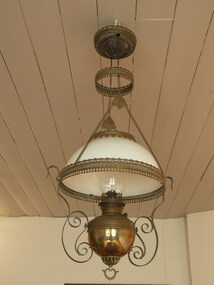
Domestic object - Lamp, Miller, Miller, c. 1890s
... The lamp’s significance is further enhanced by its believed association with the Ziebell family. It is understood that a family member brought the lamp to Melbourne on a subsequent return journey to Germany after the family had established themselves at Westgarthtown. ...Purchased by Christian Ziebell on one of his two visits back to Germany.This object is of primary significance. Christian Ziebell brought it back from Germany on his return visit to Germany in 1856. It always hung where it is now and it is retractable to different heights. It hung on the lowest chain length over the table and was only raised when the family had festive events such as dances when Dorothea would accompany them on the piano. Great care had to be exercised when the lamp was raised because if it went up too high, and therefore became too close to the wooden ceiling, it could cause a fire. Francis Adams – son of Sylvia Adams (Ziebell) restored the lamp in the 1990’s. This Miller-style hanging oil lamp is a rare and culturally layered object that connects American industrial manufacture with German domestic life and early migrant history in Victoria. Produced by Bradley & Hubbard (B&H) in the United States in the 1890s, the lamp displays characteristic features of the firm’s Rayo line, including a brass body, opaque white glass shade, quality burner mechanism, and a chain-operated raising and lowering system. The inscriptions “B&H Valpirfor” and patent dates 1894-1895 confirm its authenticity as an American-made B&H Rayo lamp. This lamp was likely purchased in Mecklenburg, Germany, reflecting the export of modern lighting technologies into rural German households in the late 19th century. The lamp’s significance is further enhanced by its believed association with the Ziebell family. It is understood that a family member brought the lamp to Melbourne on a subsequent return journey to Germany after the family had established themselves at Westgarthtown. As a result, the lamp embodies themes of migration, technological adaptation, and the lived domestic environment of the Ziebell family across two continents. Its high level of intactness, combined provenance and dual- history contribute to its importance as a culturally rich artefact within the Ziebell’s Farmhouse collection. Original Miller hanging lamp, made of brass and opaque white glass. Lamp has chain-operated raising and lowering mechanism. Decorative brass trimming around widest edge of glass lampshade. Contains tubular wick.B & H Valpirfor written on lowering mechanism on top of the lamp. Rayo 24.98, PAT'D. NOV. 20.94, FEB 28.95, written on top of oil compartment.lighting, kerosene & oil, oil lamp, hanging lamp, original. -
 Friends of Westgarthtown
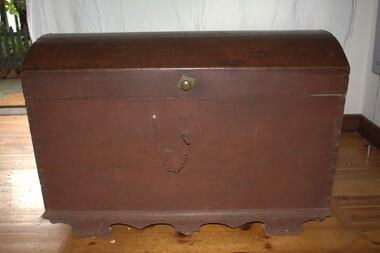
Functional object - Trunk/ Koffer, c. 1840s
... As one of the rare surviving objects directly associated with the Ziebell family’s migration story, this chest embodies themes of aspiration, hardship, cultural continuity, and settlement. ...The chest was constructed to allowable dimensions for storage in the ship's hold. The sturdy watertight construction afforded protection for the chests contents. It can be imagined that these would be household utensils, items of clothing and the most treasured ornaments as space permitted. It is likely that the contents included some building tools and as well, implements which Christian Ziebell used in his trade as a butcher in Bruel, thereby enabling him to undertake profitable work on his arrival in Australia.This object is of primary significance. The Koffer was constructed to allowable dimensions for storage in the ship’s hold. The sturdy watertight construction afforded protection for the Koffer’s contents on the voyage aboard the Privislaw from Hamburg, Germany to Hobsons Bay, Australia in 1850. The Koffer held the precious necessities for life for Christian Ziebell's family at their new destination. It is likely that the contents included some building tools as well, implements that Christian used in his trade as a butcher in Bruel, thereby enabling him to undertake profitable work on arrival in Australia. The wooden Koffer was airtight, so if lost overboard it would be retrievable. Some were fixed to the ship’s deck. After they settled at Westgarthtown the Koffer continued to contain the precious documents through each generation. Only the current owners saw the contents in each generation, and the children always regarded it as a “treasure chest”, which was always locked and out of bounds for them. This German-made sea chest, dating from the late 1840s, holds exceptional historical, cultural, and interpretive significance as an original migration object belonging to Christian and Sophia Ziebell during their maiden voyage to Australia. Serving as the family’s personal storage trunk aboard the Pribislaw in 1849, the chest would have functioned as a container for clothing, tools, and essential belongings. Later it served as storage for family archives and Lutheran church committee papers. Constructed in the robust mid-19th-century German style, the chest likely features oak timbers, dovetail joinery, and iron fittings typical of sea-going koffers of the period. Its painted decoration, including the name “C. Ziebell” in large black charcoal script, provides strong, direct provenance and reflects both ownership and pride in family identity. Such personalised embellishment was common among German migrants who decorated their chests during periods of spare time aboard the ship. As one of the rare surviving objects directly associated with the Ziebell family’s migration story, this chest embodies themes of aspiration, hardship, cultural continuity, and settlement. It is a tangible link between the family’s Mecklenburg origins and their new life at Westgarthtown, offering powerful interpretive value for understanding early German-Wendish migration and daily life at sea. Built to specifications for sea voyaging it is also a reminder of the planning required prior to considered migration. Its survival enriches the museum’s capacity to convey the lived experience of Christian and Sophia Ziebell and the foundational story of the community they helped to establish. Large wooden trunk/koffer. Base is rectangular, and lid is rectancular to fit the base but curves between the front and back. Morticed corners; protruding base with beveled edge. Supported by profiled runners with four built-in feet. Handle for carrying on each end, and locking mechanism on front.'C. Ziebell' written in large font on back of chestpersonal effects, travel goods, pribislaw, johann christian ziebell, german migration, luggage -
 Friends of Westgarthtown
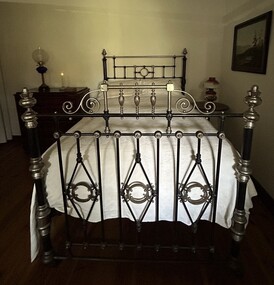
Furniture - Bed, double, Late 1800s
... The bed represents both the material resourcefulness and artisanal expertise present within the second generation of the Ziebell family. Its construction demonstrates a blending of practical skill with aesthetic ambition, illustrating how tradespeople adapted their craft to create durable and decorative domestic furnishings. ...This object is of primary significance. The nickel plated brass bedstead was made by Carl Alfred Ziebell for his wife Dorothea. Carl Alfred Ziebell ( 23.08.1867 - 26.10. 1940) was the third generation grandson of Christian Ziebell. Dorothea remained proud of her bed throughout her long life. (14.7.1873 - 14.12.1969) The bed linen and quilts remain traditionally dressed as they were in 1850. This ornate iron bed holds strong historical and cultural significance as a rare surviving example of craftsmanship by Carl Heinrich Alfred “Carl Alfred” Ziebell (1867–1940), grandson of Christian and Sophia Ziebell, early German-Wendish settlers of Westgarthtown. A skilled wheelwright by trade, Carl Alfred possessed deep technical knowledge of metalworking, timber precision, and traditional fabrication techniques required for constructing and repairing wagon wheels. These same skills are reflected in the bed’s carefully forged ironwork and its distinctive circular decorative motifs. Carl Alfred crafted this bed for his wife, Dorothea, who, as family accounts recall, “remained proud of her bed throughout her long life.” The linens displayed on the bed are traditional cotton fabrics with intricate lace detailing, donated to the museum by Sylvia Ziebell. These textiles closely resemble the types of linens that would originally have dressed the bed, helping to evoke its historic domestic context. The bed represents both the material resourcefulness and artisanal expertise present within the second generation of the Ziebell family. Its construction demonstrates a blending of practical skill with aesthetic ambition, illustrating how tradespeople adapted their craft to create durable and decorative domestic furnishings. As Carl Alfred and Dorothea are buried in the Lutheran Cemetery adjacent to Ziebell’s Farmhouse, the bed also strengthens the site’s tangible connection to the family’s multi-generational presence in Westgarthtown. The piece is significant for its rarity, its association with an identified maker within the Ziebell lineage, and its ability to illuminate the lived experience, creativity, and craftsmanship of the early community. Nickel plated and painted tubular steel bedstead with double bed mattress and spreads. On four castor wheels, ornate decoration on both ends. Turned sections on each corner post, four on the bottom ends, only caps on the top ends. Spring wire mattress base.furniture, domestic, double bed, bedstead, nickel-plated, steel, turned -
 Friends of Westgarthtown
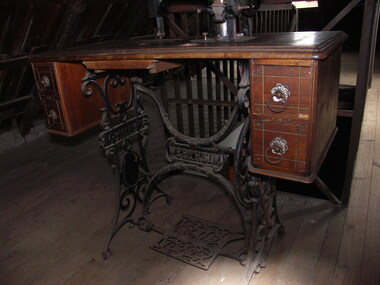
Domestic object - Sewing machine, Wertheim, Frankfurt
... As part of the Ziebell collection, the machine reflects the domestic craft, self-sufficiency, and technological adaptation of German settler families. ...c.1890-1905 This Wertheim sewing machine, donated by Sylvia Schultz, direct Ziebell descendent, is a rare early example manufactured in Frankfurt, Germany before the company established production in Melbourne. Its construction during this earlier European phase highlights the global reach of domestic technology that later became central to Australian household life. The machine features highly decorative cast-iron legs with ‘Wertheim’ prominently moulded into the frame, a brass plaque reading Wertheim Francfort with the firm’s pick-axe emblem, and a finely detailed sewing mechanism enclosed by a wooden cover. The treadle base, ornate ironwork, side storage compartments, and mobility wheels together illustrate the craftsmanship and functional elegance characteristic of 19th-century European sewing machines. As part of the Ziebell collection, the machine reflects the domestic craft, self-sufficiency, and technological adaptation of German settler families. It enriches the museum’s understanding of women’s work, household production, and the adoption of imported machinery in everyday life, offering insight into both global manufacturing histories and local cultural heritage. Hand sewing machine on stand with storage compartments. Ironwork frame, very decorative casting. Large wheel on right as part of sewing machine. Two wooden boxes on each side, with brass pull rings. Wooden box also for covering sewing machine. Decorative border around sewing mechanism. Frame is on wheels.Wertheim' cast in iron in centre of frame, and on both sides. 'Wertheim Francfort' on brass plaque nailed onto sewing machine, along with Wertheim symbol of man with pick.domestic items, sewing, machine, wertheim, francfort, domestic
