
Showing 639 items matching " foundation stones."
-
 Bendigo Historical Society Inc.
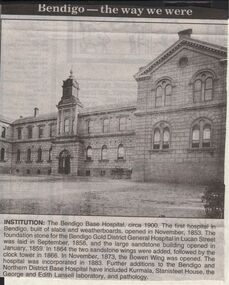
Newspaper - JENNY FOLEY COLLECTION: INSTITUTION
... The first hospital in Bendigo, built of slabs and weatherboards, opened in November, 1853. The foundation stone for the Bendigo Gold District General Hospital in Lucan Street was laid in September, 1858, and the large sandstone building opened in January, 1859. ...The first hospital in Bendigo, built of slabs and weatherboards, opened in November, 1853. The foundation stone for the Bendigo Gold District General Hospital in Lucan Street was laid in September, 1858, and the large sandstone building opened in January, 1859. ...Bendigo Advertiser "The way we were" from 1999. Institution: The Bendigo Base Hospital, circa 1900. The first hospital in Bendigo, built of slabs and weatherboards, opened in November, 1853. The foundation stone for the Bendigo Gold District General Hospital in Lucan Street was laid in September, 1858, and the large sandstone building opened in January, 1859. In 1864, the two sandstone wings were added followed by the clock tower in 1866. In November, 1873, the Bowen Wing was opened. The hospital was incorporated in 1883. Further additions to the Bendigo and Northern District Base Hospital have included Kurmala, Stanisteet House, the George and Edith Lansell laboratory, and pathology.newspaper, bendigo advertiser, the way we were -
 Kew Historical Society Inc
Archive (Sub-series) - Subject File, Congregational Church (Walpole Street, Kew), 1958
... The file contains some information on Bodalla and a foundation stone relating to the former Church which was placed on the site. ...The file contains some information on Bodalla and a foundation stone relating to the former Church which was placed on the site. ...Various partiesReference, Research, InformationSecondary Values (KHS Imposed Order)Subject file containing information about the Congregational Church in Walpole Street, Kew (demolished 1979). The file contains numerous original and copied primary sources as well as short histories and correspondence between the Kew Historical Society and the Historic Buildings Preservation Council when it was proposed to demolish the church. Following the demolition of the Church, an aged care facility - Bodalla - was erected (since demolished). The file contains some information on Bodalla and a foundation stone relating to the former Church which was placed on the site. In the file, there is a photocopy of a brass plaque from 1860 that refers to the architect being George Wharton and the builders Messrs. Leach & Bicknell. congregational church -- kew (vic), churches -- kew (vic), walpole street -- kew (vic.)congregational church -- kew (vic), churches -- kew (vic), walpole street -- kew (vic.) -
 City of Moorabbin Historical Society (Operating the Box Cottage Museum)
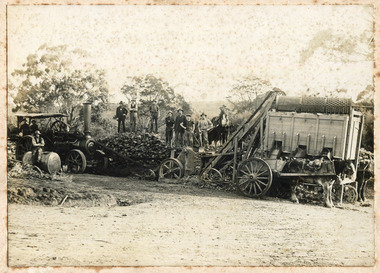
Photograph - Photograph, 1908 Excavation commences for the Melbourne Benevolent Society, Cheltenham, 1908 Excavation commences for the Melbourne Benevolent Society, Cheltenham, 1908
... The Centre had begun life in 1850 in Melbourne, as the Victoria Benevolent Asylum to "relieve the aged, infirm, disabled and destitute poor of all creeds and nations and to minister to them the comfort of religion" It outgrew its North Melbourne premises so was located to a new site at Warrigal Road, Cheltenham. The foundation stone was laid in 1909, and the main buildings were completed in 1911. ...The Centre had begun life in 1850 in Melbourne, as the Victoria Benevolent Asylum to "relieve the aged, infirm, disabled and destitute poor of all creeds and nations and to minister to them the comfort of religion" It outgrew its North Melbourne premises so was located to a new site at Warrigal Road, Cheltenham. The foundation stone was laid in 1909, and the main buildings were completed in 1911. ...Excavating prior to the building of Melbourne Benevolent Society in Cheltenham. The Centre had begun life in 1850 in Melbourne, as the Victoria Benevolent Asylum to "relieve the aged, infirm, disabled and destitute poor of all creeds and nations and to minister to them the comfort of religion" It outgrew its North Melbourne premises so was located to a new site at Warrigal Road, Cheltenham. The foundation stone was laid in 1909, and the main buildings were completed in 1911. In 1970 the benevolent Asylum was re-named Kingston Centre. The photograph is black and white. It's a photo depicting the excavation prior to the building of Melbourne Benevolent Society in Cheltenham. The photograph shows eleven workers at the excavation site. There are two horses with carriages and a large excavating machine to the right of the photograph. benevolent asylum, benevolent society, cheltenham, train, machinery, men, society, horses, kingston centre -
 Mission to Seafarers Victoria
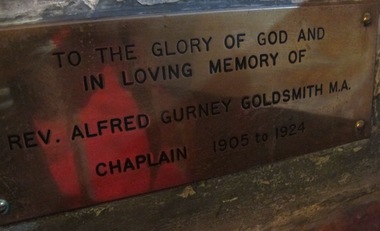
Plaque - Memorial Plaque, Rev. Alfred Gurney Goldsmith, 1925
... For more information see 0639 an invitation to the laying of the foundation stone, 0704 a photograph of Reverend Goldsmith and his wife as well as the Mission's annual report from 1925 or contact the curator....For more information see 0639 an invitation to the laying of the foundation stone, 0704 a photograph of Reverend Goldsmith and his wife as well as the Mission's annual report from 1925 or contact the curator. ...Reverend Alfred Gurney Goldsmith has two memorial plaques at the Mission to Seafarers Victoria. One in the the Mission's club room and this one in the Chapel of Saint Peter. He served as Senior Chaplain from 1905 to 1924 through a considerable period of upheaval including the building of two Missions between 1906 and 1917. For more information see 0639 an invitation to the laying of the foundation stone, 0704 a photograph of Reverend Goldsmith and his wife as well as the Mission's annual report from 1925 or contact the curator.Rev'd Gurney Goldsmith arrived in Australia in 1905, an experienced missionary with the intention of establishing a branch of the London Mission to Seamen. After a public meeting organised by the Victorian Mission to Seamen he entered into an amalgamation forging formal links with London, enabling a continuation of the services to seafarers, first commenced in 1857. Goldsmith also conceived the formation of an auxiliary, the Ladies Harbour Lights Guild, which was to play a significant role in support of the Mission and seafarers.Long rectangular brass plaque mounted to brick wall.To the glory of God and in loving memory of Rev. Alfred Gurney Goldsmith M.A. Chaplain 1905 to 1924reverend alfred gurney goldsmith, brass, plaque, memorial, chapel, hong kong, kobe, melbourne, lhlg, seamen mission, mission to seafarers, mission to seamen, chaplain -
 Bendigo Historical Society Inc.
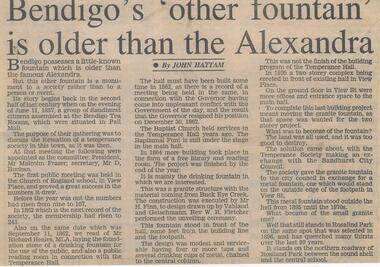
Document - RESEARCH PAPERS: THE OTHER FOUNTAIN, 2023
... The Temperance Society was formed in 1857 and in 1862 the foundation stone was laid for a public drinking fountain and reading room in View Street, Bendigo. ...The Temperance Society was formed in 1857 and in 1862 the foundation stone was laid for a public drinking fountain and reading room in View Street, Bendigo. ...The Temperance Society was formed in 1857 and in 1862 the foundation stone was laid for a public drinking fountain and reading room in View Street, Bendigo. In 1864, building additions saw the inclusion of a free library. The fountain, made of Buckeye Creek granite, featured 4 or more taps with drinking cups attached by chain. In 1895 further extensions on the site resulted in the current façade, leaving no room for the fountain. In 1896 the fountain was moved to its current site in Rosalind Park between the sound shell and the school.Newspaper detailing the history of Bendigo's oldest fountains.fountains, temperance hall, malcolm fraser, d buchan -
St Vincent's Hospital Melbourne Archives
Album - Agnes McLean, photographs at St Vincent's Hospital Melbourne, circa 1926-1928
... ...Foundation stone 1928...Laying of new building (later: Healy) Foundation Stone 1928, celebrations in Druids Wing, Brenan Hall....Laying of new building (later: Healy) Foundation Stone 1928, celebrations in Druids Wing, Brenan Hall. ...Photos include nursing colleagues in uniform, in theatre and night duty, social occasions at St Vincent's. Nurses are in full uniform, cap, starched loose fitting, long sleeved white linen dresses buttoned to drop waist with belt, white stockings and heeled court leather regulation shoes. Religious Sisters of Charity in full black winter habits, veils and rosary beads. Laying of new building (later: Healy) Foundation Stone 1928, celebrations in Druids Wing, Brenan Hall.st vincent's hospital melbourne, brenan hall, religious sisters of charity, nurses, foundation stone 1928 -
 Uniting Church Archives - Synod of Victoria
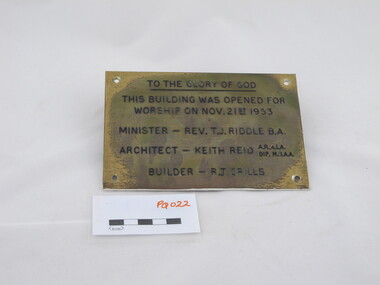
Plaque - Wall plaque
... The foundation stone for the new church was laid by the then Prime Minister, Mr R G Menzies, in 1953. ...The foundation stone for the new church was laid by the then Prime Minister, Mr R G Menzies, in 1953. ...The foundation stone for the new church was laid by the then Prime Minister, Mr R G Menzies, in 1953. The tender of 13,300 pounds submitted by Mr R S Grills was accepted in 1952. Work was completed in November 1958. The cost of the carpets was met by the Ladies' Guild and the windows in the children's chapel were given in memory of the Rev T W Leggatt by members of his family. The Rev T J Riddle was the minister at Glen Iris Presbyterian Church from 1941 - 1956.Oblong brass commemorative plaque with black text and holes at each corner."TO THE GLORY OF GOD" "THIS BUILDING WAS OPENED FOR WORSHIP ON NO.21ST 1953" "MINISTER - REV. T.J.RIDDLE B.A." "ARCHITECT - KEITH REID A.R.A.I.A." "DIP. M.U.A.A. BUILDER - R.J.GRILLS"rev t j riddle, presbyterian moderator, rev t j riddle presbyterian minister, glen iris presbyterian church, r s grills builder, keith reid architect -
 Uniting Church Archives - Synod of Victoria
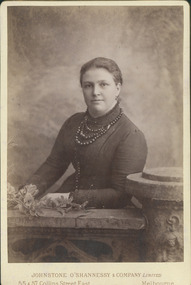
Photograph, undated c.1880s
... The Mentone Presbyterian Church was built as a memorial to her. The foundation stone of the church was laid by J. Bartlett Davies on 17th August 1889....The Mentone Presbyterian Church was built as a memorial to her. The foundation stone of the church was laid by J. Bartlett Davies on 17th August 1889. ...Mary Forrest Gardner married Joseph Bartlett Davies on 6th February 1872 at St. Andrew's Presbyterian Church Launceston, Tasmania. She was the sister-in-law of Sir Matthew Davies, first Australian-born Speaker of the Legislative Assembly. Her father was the Rev. John Gardner. She died on 28th October 1887 and was buried at the Boroondara Cemetery. The Mentone Presbyterian Church was built as a memorial to her. The foundation stone of the church was laid by J. Bartlett Davies on 17th August 1889.Sepia toned cabinet card. Waist-length studio portrait of Mary Forrest Davies (nee Gardner). -
 Uniting Church Archives - Synod of Victoria
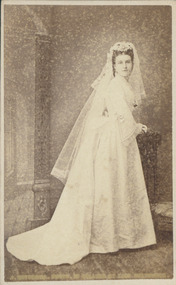
Photograph, 1872
... The Mentone Presbyterian Church was built as a memorial to her. The foundation stone of the church was laid by J. Bartlett Davies on 17th August 1889....The Mentone Presbyterian Church was built as a memorial to her. The foundation stone of the church was laid by J. Bartlett Davies on 17th August 1889. ...Mary Forrest Gardner was born on 26th April 1845 and married Joseph Bartlett Davies on 6th February 1872 at St. Andrew's Presbyterian Church Launceston, Tasmania. She was the sister-in-law of Sir Matthew Davies, Governor of Victoria. Her father was the Rev. John Gardner. She died on 28th October 1887 and was buried at the Boroondara Cemetery. The Mentone Presbyterian Church was built as a memorial to her. The foundation stone of the church was laid by J. Bartlett Davies on 17th August 1889.Sepia toned carte de visite, full-length studio portrait of Mary Forrest Davies (nee Gardner) in her wedding gown, 6th February 1872.mary forrest gardner, joseph bartlett davies, sir matthew davies, rev. john gardner, mentone presbyterian church -
 St Kilda Historical Society
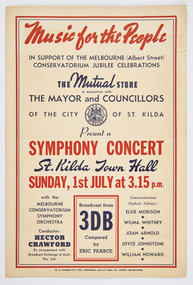
Poster - Advertisement, Music for the People, 1945
... Dame Nellie Melba laid the foundation stone for a permanent conservatorium building on the University of Melbourne’s Parkville campus in 1909, and the building was opened in 1913. ...Dame Nellie Melba laid the foundation stone for a permanent conservatorium building on the University of Melbourne’s Parkville campus in 1909, and the building was opened in 1913. ...Advertisement for Music for the People concert at St Kilda Town Hall on 1 July 1945 in support of the Melbourne Conservatorium's jubilee celebrations. Conductor Hector Crawford. The Melbourne Conservatorium opened in 1894 in rented rooms opposite the Carlton Gardens and had 150 students by 1899. Dame Nellie Melba laid the foundation stone for a permanent conservatorium building on the University of Melbourne’s Parkville campus in 1909, and the building was opened in 1913. A north wing was added in 1926-27 and a new south wing was completed in 1935.Cream coloured card poster printed in red and dark bluest kilda town hall, melbourne conservatorium symphony orchestra, st kilda symphony concerts, hector crawford -
 Warrnambool and District Historical Society Inc.
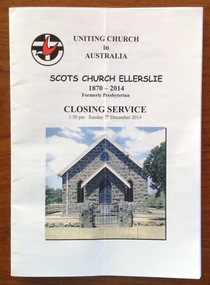
Programme - Scots Church Ellerslie 1870-2014 Closing Service, 2014
... The foundation stone of the Scots Church Ellerslie was laid by Mrs Jemima Vans Robertson on 1st November 1870. ...The foundation stone of the Scots Church Ellerslie was laid by Mrs Jemima Vans Robertson on 1st November 1870. ...The foundation stone of the Scots Church Ellerslie was laid by Mrs Jemima Vans Robertson on 1st November 1870. She was the leader and benefactor of the church. Worship services were held in the church for the next 145 years. The Sunday School was started in1871 and until 1977 Ellerslie was part of the Framlingham Presbyterian Charge. The PFA for young people was very active in the 1950s and 60s. Since 1977 the Ellerslie church has been part of the Uniting Church in Australia and was an integral part of the Mortlake Parish. The church closed in 2014 and marked for sale. This program is of some interest as it gives us a short history of Scots Church in Ellerslie and tells of its closure in 2014. This is a program for the closing of Scots Church Ellerslie (2014). It has five double pages with printed material and colour photographs. The pages are stapled together.Front Cover: Uniting Church in Australia, Scots Church Ellerslie 1870-2014 Formerly Presbyterian, Closing Service, 1.30 p.m. Sunday 7th December 2014ellerslie, scots church, presbyterian church, uniting church -
 St Kilda Historical Society
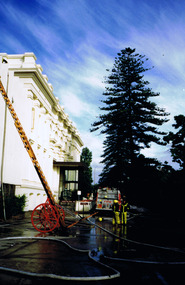
Photograph, St Kilda Town Hall after 1991 fire - images collection, April 1991
... Community support was immediate for Mayor Melanie Eagle and her team, and a foundation stone for rebuilding was laid only a year later by Sir Zelman Cowen. ...Community support was immediate for Mayor Melanie Eagle and her team, and a foundation stone for rebuilding was laid only a year later by Sir Zelman Cowen. ...On 1 April 1991, fire gutted the Town Hall. Arson was suspected. The municipal art collection then valued at $800,000 was lost, including Rupert Bunny’s The Forerunners, itself valued at $250,000. Community support was immediate for Mayor Melanie Eagle and her team, and a foundation stone for rebuilding was laid only a year later by Sir Zelman Cowen. Useful debates resulted from the St Kilda Town Hall fire as to the best protection of historic buildings from fire. http://skhs.org.au/SKHSbuildings/33.htmcolour photographst kilda, st kilda town hall, st kilda town hall fire -
 Sunbury Family History and Heritage Society Inc.
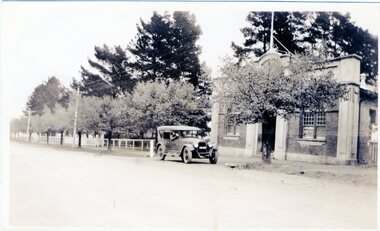
Photograph, c 1920s
... J Eadie was responsible for the building of the hall in 1885 and the foundation stone was laid by Lady Janet Clarke. The former Shire of Bulla conducted their council meetings in the hall from 1923 until 1956 when new offices were built in Macedon Street. ...J Eadie was responsible for the building of the hall in 1885 and the foundation stone was laid by Lady Janet Clarke. The former Shire of Bulla conducted their council meetings in the hall from 1923 until 1956 when new offices were built in Macedon Street. ...The 'Meeise' French car is parked outside the former Mechanics Institute Hall in Stawell Street, Sunbury. J Eadie was responsible for the building of the hall in 1885 and the foundation stone was laid by Lady Janet Clarke. The former Shire of Bulla conducted their council meetings in the hall from 1923 until 1956 when new offices were built in Macedon Street. Later the RSL took over occupancy of the hall and it became known as the Memorial Hall. In the early 1970s Stawell Street was cut off to traffic and incorporated into the Village Green.Over the years the Memorial Hall has been the venue for many community events from debutant balls, flower shows, local gatherings, celebrations and markets to name a few.A non-digital sepia photograph with a cream border of a tree lined street with a building in the foreground and a vintage car parked outside the building. Tall pine trees are growing behind the fenceline.mechanics institute, shire of bulla, memorial hall, sunbury, stawell street, village green -
 Orbost & District Historical Society
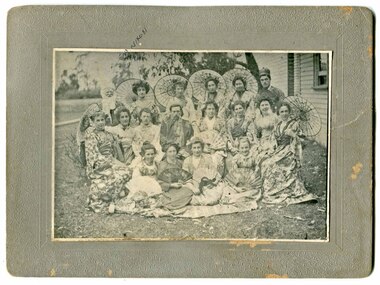
black and white photograph, C1900
... James' Anglican Church, Orbost, was conceived and built as a memorial to the men 'who served and suffered during the Great War' as noted on the foundation stone. The Right Reverend GH Cranswick, DD, Bishop of Gippsland, laid the stone on 1 October 1927....James' Anglican Church, Orbost, was conceived and built as a memorial to the men 'who served and suffered during the Great War' as noted on the foundation stone. The Right Reverend GH Cranswick, DD, Bishop of Gippsland, laid the stone on 1 October 1927. ...This is a photograph of a group of people dressed up in traditional Japanese costumes for a Church of England bazaar and fete C 1900. in the late 19th and early 20th centuries Churches in Orbost provided venues for social activities, fellowship and entertainment. Many concerts, festivals and money-raising fetes were held by the church committees. St. James' Anglican Church, Orbost, was conceived and built as a memorial to the men 'who served and suffered during the Great War' as noted on the foundation stone. The Right Reverend GH Cranswick, DD, Bishop of Gippsland, laid the stone on 1 October 1927.This item is reminiscent of the late 19th - mid 20th centuries when church-going was more commonA black / white photograph on grey buff card. It is of a large group of men and women dressed in traditional Japanese costume.on front at top - handwritten - "E. H. NIXON" with an arrow pointing to the first lady standing in the back row.churches-orbost church-of-england-orbost anglican-church-orbost festivals celebrations -
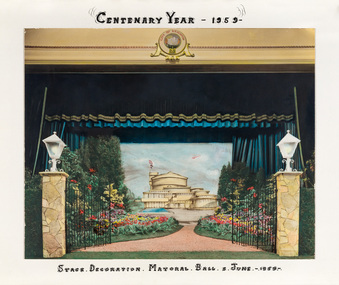 Bayside Gallery - Bayside City Council Art & Heritage Collection
Photograph - hand-coloured photograph, Brighton Centenary Year, Stage decoration, Mayoral Ball, c. 1959
... The new Brighton Municipal Offices were designed by Kevin Knight of Oakley and Parkes with the engineers John Connell and Associates and were erected by Prentice Builders Pty Ltd. The foundation stone was laid on 13 February 1959 and the building was opened on 21 July 1961. ...The new Brighton Municipal Offices were designed by Kevin Knight of Oakley and Parkes with the engineers John Connell and Associates and were erected by Prentice Builders Pty Ltd. The foundation stone was laid on 13 February 1959 and the building was opened on 21 July 1961. ...This work was presented to The Mayor and Mayoress, Cr. and Mrs R.G. Ward, by the citizens of Brighton to commemorate the Brighton Centenary in 1959. Brighton was first incorporated as a borough on 18 January 1859, it became a town on 18 March 1887 and was proclaimed a city on 12 March 1919. The new Brighton Municipal Offices were designed by Kevin Knight of Oakley and Parkes with the engineers John Connell and Associates and were erected by Prentice Builders Pty Ltd. The foundation stone was laid on 13 February 1959 and the building was opened on 21 July 1961. The interior decoration and furniture was by Grant Featherston.brighton centenary, brighton town hall, stage decoration, mayoral ball, brighton municipal offices, civic centre, oakley and parkes, kevin knight, r.g. ward, mayor -
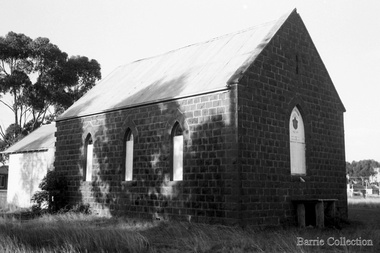 Melton City Libraries
Photograph, Wesleyan Church, Unknown
... On the 16th April the foundation stone of the Wesleyan Church was laid and does not appear to have been marked. ...On the 16th April the foundation stone of the Wesleyan Church was laid and does not appear to have been marked. ...On the 16th April the foundation stone of the Wesleyan Church was laid and does not appear to have been marked. It was opened for public worship on Oct 13th 1867. Rev Ken Moore of Melbourne was the preacher, only 6 months after the commencement of building. It was constructed of bluestone with a slate roof. The interior had not been plastered, nor ceiling erected, but would be a funds permitted. Cost at opening was L350/13/6; seats and deskL40. A Tea meeting was held to celebrate the opening on the following night. Church closed in 1910. Has been used as a den for the Djerriwarrh Scout Troop.Formerly Melton Wesleyan Church on Palmerston Streetchurches, local architecture -
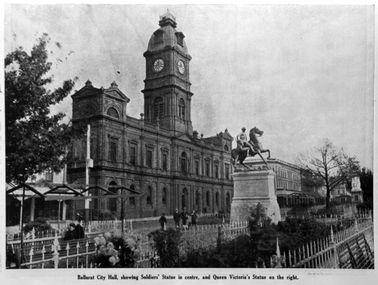 Ballarat Heritage Services
Photograph - Image, Ballarat Town Hall and Sturt Street Gardens, 1922, 1922
... Brokenshire, and was approved at the Council meeting on 31 May 1900. The foundation stone was laid on May 1901 but was relocated to the present site and re-laid by the then Mayor Brokenshire. ...Brokenshire, and was approved at the Council meeting on 31 May 1900. The foundation stone was laid on May 1901 but was relocated to the present site and re-laid by the then Mayor Brokenshire. ...The Sturt Street Gardens run down the centre of Ballarat's main street. It boast many statues. In front of the depicted Ballarat Town Hall is the Boer War Memorial which commemorates soldiers who have taken part in the South African War. The scuplture is by James White, and it was proposed by Cr J.J. Brokenshire, and was approved at the Council meeting on 31 May 1900. The foundation stone was laid on May 1901 but was relocated to the present site and re-laid by the then Mayor Brokenshire. The stature was unvelied on 01 November 1906 by the Governor General Baron Northcote.Copy of a photograph showing Ballarat Town Hall, Sturt Street gardens, and the Boer War Monument. ballarat, ballarat town hall, boer war monument, sturt street gardens, boer war memorial, statues -
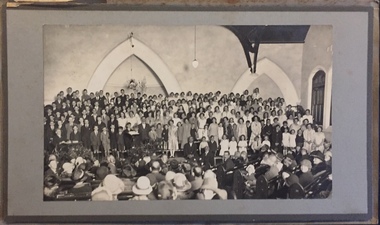 Kew Historical Society Inc
Photograph - Choir, Kew Baptist Church, c.1923
... Messer's E & F Ratten donated 6 feet of land beside this new purchase which allowed for a frontage 79 feet. The Foundation stone of the current church was laid on 14 October 1922 by Councillor F.R. ...Messer's E & F Ratten donated 6 feet of land beside this new purchase which allowed for a frontage 79 feet. The Foundation stone of the current church was laid on 14 October 1922 by Councillor F.R. ...The first Baptist church in Kew was wooden and erected in St John's Parade in 1854 and was enlarged in 1859. A brick church was later erected in Cotham Road in 1882 and was later named Newnham Hall after Reverend Newnham. In 1921 land was purchased in Highbury Grove at a cost of 602.00. Messer's E & F Ratten donated 6 feet of land beside this new purchase which allowed for a frontage 79 feet. The Foundation stone of the current church was laid on 14 October 1922 by Councillor F.R. Patten J.P. The church was opened on 9 June 1923.A rare item from an outstanding and diverse photographic collection, assembled by members of the Christian and Washfold families of Kew.Photographic positive on mounting board. interior of Baptist Church in Highbury Grove with seated congregation in foreground and serried ranks of children and adults at front. Probably the church choir at the opening of the church in 1923. The photo is encased in a grey bifold cardboard outer with a crest on the front. The photo is protected by a sheet of watermarked cellophane. washfold family, kew baptist church -- highbury grove -- kew (vic.), churches -- kew (vic.), christian-washfold collection -
 Kew Historical Society Inc
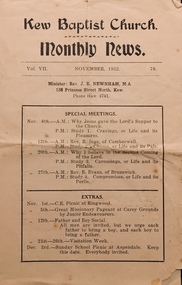
Journal, Kew Baptist Church Monthly News Vol VII November 1932, No. 76
... Messer's E & F Ratten donated 6 feet of land beside this new purchase which allowed for a frontage 79 feet. The Foundation stone of the current church was laid on 14 October 1922 by Councillor F.R. ...Messer's E & F Ratten donated 6 feet of land beside this new purchase which allowed for a frontage 79 feet. The Foundation stone of the current church was laid on 14 October 1922 by Councillor F.R. ...Bi-fold pamphlet on brown paper. Kew Baptist Church Monthly News Vol VII November 1932, No. 76non-fictionkew baptist church -- highbury grove, churches -- kew (vic.), baptist churches, christian-washfold collection -
 Warrnambool and District Historical Society Inc.
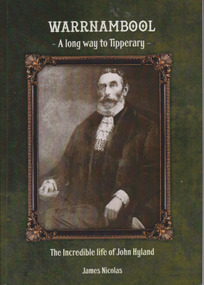
Book, Warrnambool A Long way to Tipperary The incredible life of John Hyland, 2014
... He had the honour of laying the foundation stone of the Warrnambool Town Hall. He campaigned for the vote for women and home rule in Ireland. ...He had the honour of laying the foundation stone of the Warrnambool Town Hall. He campaigned for the vote for women and home rule in Ireland. ...Biography of early Warrnambool settler, John Hyland.Paperback Background is dark green with sepia photo in bronze coloured frame. Precis on back cover is printed in white lettering. 132 pages.non-fictionBiography of early Warrnambool settler, John Hyland.warrnambool, john hyland, james nicholas, warrnambool mayors -
 Ballarat Heritage Services
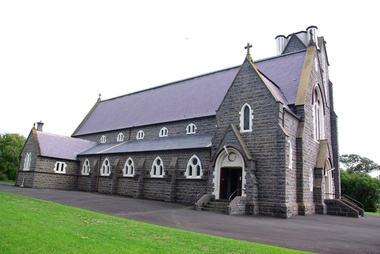
Photograph - Photograph - Colour, L.J. Gervasoni, Koroit's Infant Jesus Church and Presbytery, 2011, 20/03/2010
... " ... the foundation-stone of the new church at Koroit was laid by Bishop Goold on New Year's Day, 1867. ..." ... the foundation-stone of the new church at Koroit was laid by Bishop Goold on New Year's Day, 1867. ..." ... the foundation-stone of the new church at Koroit was laid by Bishop Goold on New Year's Day, 1867. It was said of Fr. Parle that his one. fault was "extravagant ideas of church building," and to his vision must be attributed what was called at the time "the most magnificent and costly ecclesiastical building in the Western District." Altogether about £6000 was spent on the Koroit church, a large sum in those days. It entailed much delay while the money was being collected, and Fr. Parle did not live to see the completion of the great work he had undertaken. .. " (The Advocate, 13 August 1947.)Colour photography of a bluestone church known as Infant Jesus and presbytery. Includes stained glass windows and interior shots.koroit, catholic church, infant jesus catholic church, presbytery -
 Ballarat Heritage Services
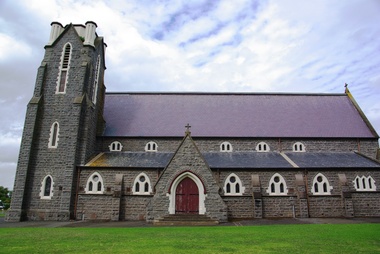
Photograph - Photograph - Colour, L.J. Gervasoni, Koroit's Infant Jesus Church, 2011, 20/03/2010
... " ... the foundation-stone of the new church at Koroit was laid by Bishop Goold on New Year's Day, 1867. ..." ... the foundation-stone of the new church at Koroit was laid by Bishop Goold on New Year's Day, 1867. ..." ... the foundation-stone of the new church at Koroit was laid by Bishop Goold on New Year's Day, 1867. It was said of Fr. Parle that his one. fault was "extravagant ideas of church building," and to his vision must be attributed what was called at the time "the most magnificent and costly ecclesiastical building in the Western District." Altogether about £6000 was spent on the Koroit church, a large sum in those days. It entailed much delay while the money was being collected, and Fr. Parle did not live to see the completion of the great work he had undertaken. .. " (The Advocate, 13 August 1947.)Colour photography of a bluestone church known as Infant Jesus and presbytery. koroit, catholic church, infant jesus catholic church, presbytery -
 Mission to Seafarers Victoria
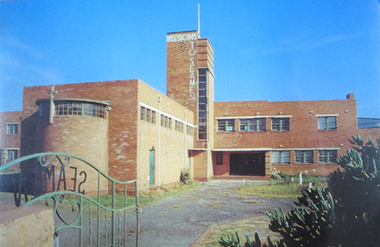
Postcard - Postcard, Colour, Alison Kelly, c. 1990
... Also known as the King George V memorial building this branch of the Mission to Seamen opened in 1937 as a replacement for the old Mission in Port Melbourne. The Foundation stone was laid by the Victorian State Governor and a photograph of the event is also held in the MTSV collection. ...Also known as the King George V memorial building this branch of the Mission to Seamen opened in 1937 as a replacement for the old Mission in Port Melbourne. The Foundation stone was laid by the Victorian State Governor and a photograph of the event is also held in the MTSV collection. ...Also known as the King George V memorial building this branch of the Mission to Seamen opened in 1937 as a replacement for the old Mission in Port Melbourne. The Foundation stone was laid by the Victorian State Governor and a photograph of the event is also held in the MTSV collection. The Art Deco style building was commissioned by merchant and philanthropist, Alfred Michael Nicholas (1881-1937) and designed by prolific Melbourne-based architect Harry A. Norris (1888-1966) in 1937 best known for his commercial work in Melbourne city centre. NB PMHPS Kindly allowed MTSV heritage to take scans of the Kelly series notes in their collection for reference in 2019.One of the few full colour images of this building originally classified by the National Trust and now demolished. An example of architect Harry Norris' work 1937. All that remains are a ceramic plaque, a brick and several items of chapel artefacts. Alison Kelly, a photographer, was part of the group supporting the Port Melbourne Seamen's Mission in the 1980s and 1990s. She took a series of photographs of the building now held by the Port Melbourne Historical and Preservation Society.Full colour Postcard featuring colour image of a large red brick building in a 1930s era Architecture. There is a green wrought iron gate ajar in the foreground with the word SEAMAN spelled out. MISSIONS TO SEAMEN can also be seen spelled ut in white across and down the central clock tower of the building and this is surmounted with a white flagpole.On verso: Printed: "Heritage Series / POST CARD " at right angles in small print from lwr edge to upper: "PHOTOGRAPHY BY ALISON KELLY PORT HERITAGE SERIES NO 6". At Lwr left crnr printed:" Missions to Seamen Building, Port Melbourne/ Designed in the Modern style by architect Harry Norris,/ this 1937 National Trust classified structure was until 1972 / an entertainment and spiritual centre for seamen, with / important roles during the war [WW2] and immigration periods"king george v, memorial chapel, harry a. norris, brick, art deco, alfred m. nicholas, beach street, mission to seamen, alison kelly, 1937, arts centre, seamen mission, mission to seafarers, port melbourne -
 Federation University Historical Collection
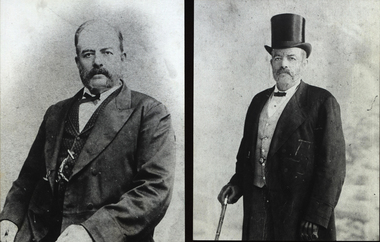
Photograph - Black and White, Alexander Peacock
... He laid the foundation stone of the new SMB Classroom building in 1899 while MInister for Public Instruction. ...He laid the foundation stone of the new SMB Classroom building in 1899 while MInister for Public Instruction. alexander peacock australian natives' association ana ballarat school of mines parliamentarian legislative assembly mininster for public instruction minister for education Three photographs of Alexander Peacock. .1) Portrait of Alexander Peacock printed from an original .2) Portrait of Alexander Peacock in a jacket, balding and with a moustache. ...Alexander Peacock was born in Creswick, Victoria in 1861. Upon leaving school he mined and was legal manager of mining companies in Ballarat. In 1882 he joined the Creswick branch of the Australian Natives' Association (ANA) and became branch secretary. He stood for parlimnet in March 189 and was elected to the Legislative Assembly representing Clunes and Allandale. Peacock assisted in the establishment f the Clunes Branch of the Ballarat School of MInes which opened in 1890. He was one of the Victorian delegates to teh Federal Convention in 1897. He laid the foundation stone of the new SMB Classroom building in 1899 while MInister for Public Instruction. Three photographs of Alexander Peacock. .1) Portrait of Alexander Peacock printed from an original .2) Portrait of Alexander Peacock in a jacket, balding and with a moustache. Photo is printed from an original. .3) Portrait of Alexander Peacock in a top hat and tails, holding a walking stick. Photo is printed from an original.alexander peacock, australian natives' association, ana, ballarat school of mines, parliamentarian, legislative assembly, mininster for public instruction, minister for education -
 Federation University Historical Collection
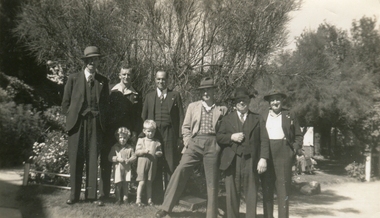
Photograph, Delegates to the ANA Conference, 1947, 21/03/1947
... The Governor of Victoria, Sir Henry Barkly, laid its foundation stone in 1857 with the Bishop of Melbourne and the Archdeacon of Geelong in attendance. ...The Governor of Victoria, Sir Henry Barkly, laid its foundation stone in 1857 with the Bishop of Melbourne and the Archdeacon of Geelong in attendance. ...Dysart is a Tudor Gothic building used as the original site of Geelong Grammar School. The Governor of Victoria, Sir Henry Barkly, laid its foundation stone in 1857 with the Bishop of Melbourne and the Archdeacon of Geelong in attendance. The student boarder population grew rapidly to call 55 Maud Street their home. After the school relocated to a larger site in 1914, the building was subdivided into a factory and a guesthouse called the Dysart Private Hotel. In 1961, it was again converted into the Reformed Theological College then later a private residence. In 2018 55 Maud Street had fallen into a state of disrepair, but was renovated to provide 28 premium dormitories in a peaceful and gorgeous setting.Small black and white photo.Verso "Taken oustise "Dysart" 21-3-47 Delegates ANA Conference 1947 Geelongana, australian natives association, geelong, dysart -
 Eltham District Historical Society Inc
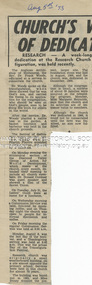
Newspaper - Newspaper article, Church's Weeklong Celebration of Dedication, 5 August 1973
... The building was burnt out in 1965 and Miss Elizabeth Doney donated a new larger site consisting of 3 house blocks on the east (high) side of Main Road. The foundation stone was laid in August 1966, and the church was dedicated in December 1966. ...The building was burnt out in 1965 and Miss Elizabeth Doney donated a new larger site consisting of 3 house blocks on the east (high) side of Main Road. The foundation stone was laid in August 1966, and the church was dedicated in December 1966. ...Weeklong celebration of the dedication / consecrtation of the Research Church of Transfiguration. Originally a small weatherbopard building, on a site almost opposite the primary school. Services were held in the church for almost 70 years. The building was burnt out in 1965 and Miss Elizabeth Doney donated a new larger site consisting of 3 house blocks on the east (high) side of Main Road. The foundation stone was laid in August 1966, and the church was dedicated in December 1966. About 30 local families were involved in the rebuilding. Although dedicated in 1966, it could not be consecrated until the debt was paid off. See also 01588, 01591, 01592, 01593, 01594anglican archbishop of melbourne, church of the transfiguration, dedication ceremony, diamond valley group of action for world development, dr donald cordner, dr frank woods, ladies guild, margaret reynolds, miss elizabeth doney, pilgrim players, research church, transfiguration festival, research (vic.) -
 St James Old Cathedral
Cathedral Building, St James Old Cathedral, 09/11/1839
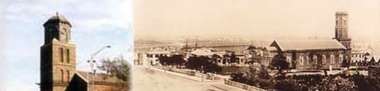
... St James Church, "Church of the Pioneers", was the first Church, first Anglican Church, and is the oldest building in Melbourne. The foundation stone was laid in 1839 by the Superintendent of the District of Bourke, Charles La Trobe, later Governor of the Colony of Victoria. ...St James Church, "Church of the Pioneers", was the first Church, first Anglican Church, and is the oldest building in Melbourne. The foundation stone was laid in 1839 by the Superintendent of the District of Bourke, Charles La Trobe, later Governor of the Colony of Victoria. ...St James Church, "Church of the Pioneers", was the first Church, first Anglican Church, and is the oldest building in Melbourne. The foundation stone was laid in 1839 by the Superintendent of the District of Bourke, Charles La Trobe, later Governor of the Colony of Victoria. The Church was opened in 1842 and the first Bishop Charles Perry was installed in the Cathedral in 1848 when its status changed to that of Cathedral. Its status changed back to that of a Parish church after 1891 when St Paul's Cathedral in Swanston Street was opened. St James is known as the "Church of the Pioneers" as it served as the place of worship, marriage, baptism and burial of many of the first families in the District of Bourke and the Colony of Victoria. St James Old Cathedral is of the most important historic value to the community of Victoria and to the Australian nation as the first Anglican Church founded within 4 years of the settlement of Melbourne. It represents and conserves the very earliest history of white settlement in Victoria and preserves the church associated history of the Pioneer families of Victoria in its collection of original records and artefacts. Late Neo-Georgian style stone church building with bluestone footings. Octagonal upper one storey bell tower housing eight bells supported by two storey square towers. Body of church has sloping roof and 4 stained glass ornamental windows on each of west and east sides with decorative sanctuary window to the north. Decorative Portico with columns on the north outside elevation. National Trust Commemorative plate on outside wall to right of east entry door. -
 Stawell Historical Society Inc
Photograph, Stawell Shire Hall 1866
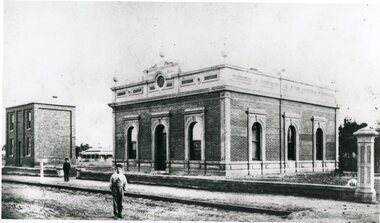
... Ronald Campbell, the Shires second president laid the foundation stone on 28th April. 1866. The contractors were Hutchings and Delbridge. ...Ronald Campbell, the Shires second president laid the foundation stone on 28th April. 1866. The contractors were Hutchings and Delbridge. ...This photograph is a copy obtained from State Library of Victoria. The photograph is of Stawell Shire Hall. Two persons can be seen in the foreground. The two story brick building beside the Stawell Shire Hall was once the Literary Institute. The Stawell Shire Hall building has been added to over the years. Ronald Campbell, the Shires second president laid the foundation stone on 28th April. 1866. The contractors were Hutchings and Delbridge. The photograph shows the first hall and office. The building contained simple 18 feet square rooms, with an entrance hall separating them, the facade was almost as it is now. The initial cost of the Shire Hall was $502.Black and white photograph of Stawell Shire Hall as one single storey brick building with parapet on top. Beside the Shire Hall is a two storey brick building. Also, a dwelling between the two building in the background in Cooper St. Two persons in the foreground, one on the road the other on the pathway. stawell -
 Ballarat Heritage Services
Photograph - Digital photographs, L.J. Gervasoni, Infant Jesus Catholic Church Koroit, 2011-2016
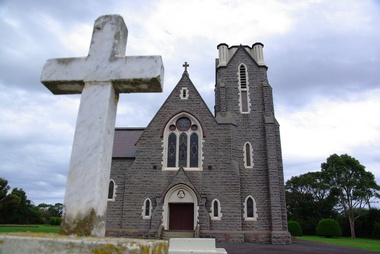
... http://vhd.heritagecouncil.vic.gov.au/places/69285 " ... the foundation-stone of the new church at Koroit was laid by Bishop Goold on New Year's Day, 1867. ...http://vhd.heritagecouncil.vic.gov.au/places/69285 " ... the foundation-stone of the new church at Koroit was laid by Bishop Goold on New Year's Day, 1867. ...http://vhd.heritagecouncil.vic.gov.au/places/69285 " ... the foundation-stone of the new church at Koroit was laid by Bishop Goold on New Year's Day, 1867. It was said of Fr. Parle that his one. fault was "extravagant ideas of church building," and to his vision must be attributed what was called at the time "the most magnificent and costly ecclesiastical building in the Western District." Altogether about £6000 was spent on the Koroit church, a large sum in those days. It entailed much delay while the money was being collected, and Fr. Parle did not live to see the completion of the great work he had undertaken. .. " (The Advocate, 13 August 1947.) Digital images of a funeral congregation at Infant Jesus Catholic Church in Koroit, Victoria. church, catholic, koroit, infant jesus, exterior, presbytery, bluestone -
 Ballarat Heritage Services
Digital photographs, L.J. Gervasoni, Infant Jesus Catholic Church Koroit interior, 2011-2016
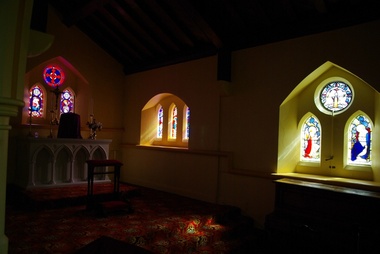
... http://vhd.heritagecouncil.vic.gov.au/places/69285 " ... the foundation-stone of the new church at Koroit was laid by Bishop Goold on New Year's Day, 1867. ...http://vhd.heritagecouncil.vic.gov.au/places/69285 " ... the foundation-stone of the new church at Koroit was laid by Bishop Goold on New Year's Day, 1867. ...http://vhd.heritagecouncil.vic.gov.au/places/69285 " ... the foundation-stone of the new church at Koroit was laid by Bishop Goold on New Year's Day, 1867. It was said of Fr. Parle that his one. fault was "extravagant ideas of church building," and to his vision must be attributed what was called at the time "the most magnificent and costly ecclesiastical building in the Western District." Altogether about £6000 was spent on the Koroit church, a large sum in those days. It entailed much delay while the money was being collected, and Fr. Parle did not live to see the completion of the great work he had undertaken. .. " (The Advocate, 13 August 1947.)Digital images of the interior of the Catholic church at Koroitchurch, catholic, koroit, infant jesus, presbytery, bluestone, interior, religion
