
Showing 429 items matching "home help"
-
 Sunshine and District Historical Society Incorporated
Administrative record - City of Sunshine - Commissioner Mr Alexander "Alex" George Gillon Collection 1976 - 1982 - Minutes of the Ordinary Meeting of Council Held on 17th October 1978, City of Sunshine, 17th October 1978
... Premises Maribyrnong Funding Recreational Projects Inquiry into Role of Local Government Home Help Subsidies Municipal Boundaries Between Keilor and Sunshine Creation of Reserve Fund Report of the Co-Ordinator of Welfare Services Early Childhood Development Programme Report of the Chief Health Inspector Health Act Registrations Applications for Transfer of Proprietorship of Premises under the Health Act B.C.G. ...Premises Maribyrnong Funding Recreational Projects Inquiry into Role of Local Government Home Help Subsidies Municipal Boundaries Between Keilor and Sunshine Creation of Reserve Fund Report of the Co-Ordinator of Welfare Services Early Childhood Development Programme Report of the Chief Health Inspector Health Act Registrations Applications for Transfer of Proprietorship of Premises under the Health Act B.C.G. ...Minutes of the Ordinary Meeting of Council held on 17th October 1978 Report of the Town Clerk's Department Report of the Town Clerk Lease G.U.D. Premises Maribyrnong Funding Recreational Projects Inquiry into Role of Local Government Home Help Subsidies Municipal Boundaries Between Keilor and Sunshine Creation of Reserve Fund Report of the Co-Ordinator of Welfare Services Early Childhood Development Programme Report of the Chief Health Inspector Health Act Registrations Applications for Transfer of Proprietorship of Premises under the Health Act B.C.G. Campaign Sunshine Municipality Mantoux Test for Active Tuberculosis J.L. Mactaggart (Victoria) Pty Ltd Establishment of Rendering Plant Report of Inspector of Weights & Measures Report of the Medical Officer of Health Report of Chief By-Laws Officer Parking Restrictions Fairbairn Road and Tallintyre Road Report of the City Librarian Library Week Report of the Municipal Recreation Officer Tallintyre Reserve Football Ground Sunshine Heights Football Club and West United Football Club Summer Grounds Rental Costs Sporting Season 1978/79 Swimming Pool Management Plan Report of the City Engineer Retail Network Planning Strategy Town Planning General Proposed Shopping Centre Taylors Road City of Keilor Newmarket Saleyards and Special Use Zone 7 Planning Permit Application Sky Sign 193 Hampshire Road Sunshine Amendment 70 Part 4B to the Melbourne Metropolitan Planning Scheme Planning Permit Application Advertising Bunting North East Corner Mitchell Street and Ashley Street Planning Permit Application Consulting Rooms Lot 7 Devonshire Road North West Corner Gertrude Street Planning Permit Application Service Premise and Caretaker's Dwelling Lot 1 Ballarat Road Sunshine Rezoning Land Occupied by the Sunshine Swimming Pool Kennedy Street and Service Street Proposed Children's Service Centre Andrea Street St. Albans Plan of Subdivision Disraeli Street and Buchanan Street Plan of Subdivision Justin Road South East Side Consolidation of Title Ormond Road Contract Kerb & Channel Berkshire Road Location and Construction of Outer Ring Road and F12 Bon Thomas Reserve Development Boring Operation M.M.B.W. Sewerage Mapledene Court and Dinnell Street Sunshine West Street Lighting Cost Sharing Western Highway (Ballarat Road) between Hampshire Road and Anderson Road Sunshine View Estate Stage 2 Partial Private Street Scheme Hampshire Road and Wright Street Traffic Signals Finalisation of Fourth Avenue Group Private Street Scheme Provision of Sewerage Facilities Tallintyre Road Report of the Building Surveyor Building Over Easement 204 Wright Street Sunshine West Building Over Easement 2 Mia Court Sunshine Building Over Easement 745 Ballarat Road Deer Park Siting of Building 58 Birchwood Boulevard Deer Park Siting of Building Lot 42 Phyliss Parade Deer Park Ruinous and Dangerous Building 28 & 30 Ridley Street Sunshine Ruinous and Dangerous Building 41 Wright Street Sunshine Report of Committee Meetings Finance Committee Plant Purchase Out of Replacement Account Agenda and Forward Planning Committee Proposal to Construct Warrs Road (Northern Section) Under the Provisions of Division 10 of Part XIX of the Local Government Act 1958 Extraordinary Business Planning Permit Application Take Away Food Premises Cafe Amusement Parlour Highpoint City 200 Rosamond Road city of sunshine, alexander "alex" george gillon, g.u.d., burton crescent, maribyrnong, tallintyre reserve, sunshine heights football club, west united football club, kermeen street, sunshine west, taylors road, st. albans, hampshire road, sunshine, mitchell street, ashley street, maidstone, devonshire road, gertrude street, ballarat road, sunshine swimming pool, kennedy street, service street, andrea street, disraeli street, buchanan street, justin road, tottenham, ormond road, berkshire road, bon thomas reserve, quinn street, deer park, mapledene court, dinnell street, western highway, anderson road, wright street, fourth avenue, tallintyre road, mia court, birchwood boulevard, phyliss parade, ridley street, albion, warrs road, highpoint city, rosamond road -
 Sunshine and District Historical Society Incorporated
Administrative record - City of Sunshine - Commissioner Mr Alexander "Alex" George Gillon Collection 1976 - 1982 - Notice of Ordinary Meeting of to be held on Tuesday 25th July 1978, City of Sunshine, 19th July 1978
... Notice of Ordinary Meeting of to be held on Tuesday 25th July 1978 Report of the Town Clerk's Department Report of the Town Clerk Lease Italo-Australian Co-Operative Social Club Ltd Supplementary Valuations Overseas Study Tours 1979 Municipal Association of Victoria Appointments Metropolitan Sectional Council Municipal Association of Victoria The Hub Sports Centre Prices Western Region Commission Report of the Co-Ordinator of Welfare Services Special Bus Replacement Willis Street Pre-School Centre Proposal for the Funding of Emergency Relief in the Western Region Family Day Care Family Day Care conference Tenancy Issues Use of Midway Hostel for Emergency Accommodation Home Help Designated Officer's Register Community Youth Support Scheme Deer Park Report of the Acting Chief Health Inspector Prosecutions Proceedings Sunshine Magistrates Court Immunisation Health Act Food Analyses Head Lice Infant Welfare Officers Western Region Environmental Committee Food Poisoning (Oysters) Butcher Shops Extended Opening Report of the Medical Officer of Health Report of the Chief By-Laws Officer Prohibited Parking Withers Street Supervision of School Crossings Main Road East / St. ...Albans Road Hampshire Road Market Road Main Road West Station Road Plantation Street The Esplanade Hulett Street Carter Street White Street Ridley Street Adams Street Bon Thomas Reserve Quinn Street Boral Albion Reid Notice of Ordinary Meeting of to be held on Tuesday 25th July 1978 Report of the Town Clerk's Department Report of the Town Clerk Lease Italo-Australian Co-Operative Social Club Ltd Supplementary Valuations Overseas Study Tours 1979 Municipal Association of Victoria Appointments Metropolitan Sectional Council Municipal Association of Victoria The Hub Sports Centre Prices Western Region Commission Report of the Co-Ordinator of Welfare Services Special Bus Replacement Willis Street Pre-School Centre Proposal for the Funding of Emergency Relief in the Western Region Family Day Care Family Day Care conference Tenancy Issues Use of Midway Hostel for Emergency Accommodation Home Help Designated Officer's Register Community Youth Support Scheme Deer Park Report of the Acting Chief Health Inspector Prosecutions Proceedings Sunshine Magistrates Court Immunisation Health Act Food Analyses Head Lice Infant Welfare Officers Western Region Environmental Committee Food Poisoning (Oysters) Butcher Shops Extended Opening Report of the Medical Officer of Health Report of the Chief By-Laws Officer Prohibited Parking Withers Street Supervision of School Crossings Main Road East / St. ...Notice of Ordinary Meeting of to be held on Tuesday 25th July 1978 Report of the Town Clerk's Department Report of the Town Clerk Lease Italo-Australian Co-Operative Social Club Ltd Supplementary Valuations Overseas Study Tours 1979 Municipal Association of Victoria Appointments Metropolitan Sectional Council Municipal Association of Victoria The Hub Sports Centre Prices Western Region Commission Report of the Co-Ordinator of Welfare Services Special Bus Replacement Willis Street Pre-School Centre Proposal for the Funding of Emergency Relief in the Western Region Family Day Care Family Day Care conference Tenancy Issues Use of Midway Hostel for Emergency Accommodation Home Help Designated Officer's Register Community Youth Support Scheme Deer Park Report of the Acting Chief Health Inspector Prosecutions Proceedings Sunshine Magistrates Court Immunisation Health Act Food Analyses Head Lice Infant Welfare Officers Western Region Environmental Committee Food Poisoning (Oysters) Butcher Shops Extended Opening Report of the Medical Officer of Health Report of the Chief By-Laws Officer Prohibited Parking Withers Street Supervision of School Crossings Main Road East / St. Albans High School and Rosamond Road / Maribyrnong High School Report of the City Librarian Children's Book Night Report of the Municipal Recreation Officer Albion Rovers Soccer Club Hours Club may use Selwyn Park for the Playing of Soccer Department of Youth, Sport and Recreation Commonwealth Games Appeal week Report of the Manager of the Sunshine Swimming Pool and the Deer Park Swimming Pool Report of the City Engineer Town Planning Car Parking Policy Melbourne Metropolitan Parking Study Planning Permit Application Factory Lot 37 Western Avenue Planning Permit Application Single Storey Units Lots 39, 40, 41, 42 & 44 Madden Street Maidstone Planning Permit Application Panel Beating Lot 4 McIntyre Road Planning Permit Application Petrol Filling Station, Bank, Child Minding Centre and Library Highpoint West Shopping Centre Rosamond Road Planning Permit Application Illuminated Facia Sign 29A Sun Crescent Planning Permit Application Extension to Existing Factory Warehouse and Caretaker's Dwelling and Addition of Offices McIntyre Road and Cromer Avenue Planning Permit Application Illuminated Facia Sign Sun Crescent C.S.C. Homes Pty Ltd, Sun Crescent Planning 7 C.S.C. Estate Agency Planning Permit Application Service Premises & Caretaker's Dwelling Lot 1 Ballarat Road Planning Permit Application Extension to Existing Warehouse Lot 13 McIntyre Road Planning Permit Application Re-building of Existing Shop 105 Anderson Road West Corner of Fraser Street Planning Permit Application Warehouse Corner McIntyre Road and Balwin Avenue Planning Permit Application Extension to Existing Car Sales Yard and Motor Repair Station 31 St. Albans Road Planning Permit Application Car Sales Yard Ballarat Road South West Corner Hampshire Road Planning Permit Application 3 Factories Market Road Brooklyn Consolidation of Title Station Road and Main Road West Shell Co of Australia Drainage Construction Subdivision Plantation Street and The Esplanade Plan of Consolidation Hulett Street Boral Albion Reid Strata Subdivision of 2 Carter Street Consolidation of Title Rosamond Road and White Street Contract Playground Equipment Various Reserves Tenders for Surplus Vehicles Tender for Tractor Mower Use of Asphalt Plant Melbourne City Council Hulett Street Private Street Scheme Declaration of Sewage Areas No 3513 & 3499 Sewage Facilities to Premises St. Albans Report of the Building Surveyor Ruinous and Dangerous Building Lots 6 & 7 Furlong Road Sunshine North Ruinous and Dangerous Building 28 - 30 Ridley Street Albion Relocation of Housee to Lot 26 Adams Street St. Albans Flats Lots 3 & 4 Ballarat Road Deer Park Seminar Residential Slab Construction 31st August 1978 Report of the Director of Parks & Recreation Reserves Development Reserves Active Usage Patterns Bon Thomas Reserve Development Orders of the Day Accounts Submitted for Payment as at 3rd July 1978 city of sunshine, alexander "alex" george gillon, italo-australian co-operative social club, furlong road, st. albans, the hub, sun crescent, sunshine, willis street pre-school centre, willis street, midway hostel, williamson road, maribyrnong, main road east, st. albans high school, rosamond road, maribyrnong high school, albion rovers soccer club, selwyn park, selwyn street, albion, sunshine swimming pool, kennedy street, deer park swimming pool, deer park, western avenue, madden street, maidstone, mcintyre road, sunshine north, highpoint west shopping centre, cromer avenue, ballarat road, anderson road, fraser street, balwin avenue, st. albans road, hampshire road, market road, main road west, station road, plantation street, the esplanade, hulett street, carter street, white street, ridley street, adams street, bon thomas reserve, quinn street, boral albion reid -
 Eltham District Historical Society Inc
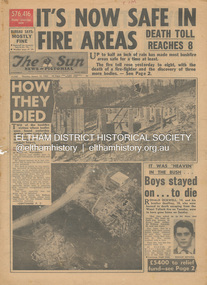
Newspaper - Newspaper articles, Sun News-Pictorial, It's Now Safe in Fire Areas; Death Toll Reacxhes 8, The Sun News-Pictorial, Thursday, January 18, p1, 1962
... .) • Now that the rain has come; It’s time for the clean-up, p6 • Wisps of smoke where flames danced, p7 • Charitry’s a loser, p7 • War Service homes claim, p7 • Help’s on way, p7 (Illust.) • Came with their gifts …, p7 • Fire summons for youth; “sparked the rest”, p9 • Three gaoled, p9 • They had to camp out at Wye River, p9 (Illust.) • “Probe Fires” – Stoneham, p9 • The Fourth Day: Scorched Earth!....) • Now that the rain has come; It’s time for the clean-up, p6 • Wisps of smoke where flames danced, p7 • Charitry’s a loser, p7 • War Service homes claim, p7 • Help’s on way, p7 (Illust.) • Came with their gifts …, p7 • Fire summons for youth; “sparked the rest”, p9 • Three gaoled, p9 • They had to camp out at Wye River, p9 (Illust.) • “Probe Fires” – Stoneham, p9 • The Fourth Day: Scorched Earth! ...Various news articles pertaining to the January 1962 Victorian bushfires in the Dandenong and Healesville districts which by the third day had encompassed large areas of the State. Specific Eltham Shire districts mentioned include Warrandyte on page 1, St. Andrews and Smith’s Gully on page 2, St. Andrews on page 3 and 43, Panton Hill and Warrandyte on p23 and Hurstbridge on page 44 • It's Now Safe in Fire Areas; Death Toll Reaches 8, p1 (Illust.) • How they died, pp1-2 • It was “heaven” in the bush … Boys stayed on . . . to die, pp1-2 (Illust.) • Towns take stock as danger drops, p2 • £5400 to the relief fund, p2 • Fire now threat to Otways, p2 • Pensioners lose all, p2 • “…If Only The Rain Had Come” … and then it came to town, p3 (Illust.) • Our best rain since May • It halted at Grandma’s front gate, p5 (Illust.) • Now that the rain has come; It’s time for the clean-up, p6 • Wisps of smoke where flames danced, p7 • Charitry’s a loser, p7 • War Service homes claim, p7 • Help’s on way, p7 (Illust.) • Came with their gifts …, p7 • Fire summons for youth; “sparked the rest”, p9 • Three gaoled, p9 • They had to camp out at Wye River, p9 (Illust.) • “Probe Fires” – Stoneham, p9 • The Fourth Day: Scorched Earth!, pp22-23 (Illust.) • This home was saved but - , p22 (Illust.) • Relief Centre, p23 (Illust.) • Homeless, p23 (Illust.) • So little was left, p43 (Illust.) • Tommy saved his cat, p43 (Illust.) • Some were lucky … and some were tired, p44 (Illust.) tom fielding collection, victorian bushfires - 1962, victorian bushfires – 1962, ronald ockwell, geoffrey ockwell, woori yallock, william ockwell, leslie ockwell, linda may ockwell, black friday, victorian bushfires – 1939, warrandyte, arthur brown, harold vernon betton, bloom road, william smith, olinda, bushfire relief fund, yarra glen, healesville, railway line, st. andrews, smith’s gully, otway ranges, eric watts, edith varty, inverness road, mt. evelyn, wye river, panton hil, heather sullivan, warrandyte hall, montrose, kalorama, mrs e. tucker, shirley tucker, margaret tucker, joane tucker, roger tucker, trevor tucker, ann quinton, tom dunstan, hurstbridge hall -
 Sunshine and District Historical Society Incorporated
Administrative record - City of Sunshine - Commissioner Mr Alexander "Alex" George Gillon Collection 1976 - 1982 - Minutes of the ordinary meeting of council held on 25th July 1978, City of Sunshine, 25th July 1978
... Minutes of the meeting of the sunshine city council held on 25th July 1978 Report of the Town Clerk's Department Report of the Town Clerk Lease Italo-Australian Co-Operative Social Club Ltd Supplementary Valuations Overseas Study Tours 1979 Municipal Association of Victoria Appointments Metropolitan Sectional Council Municipal Association of Victoria The Hub Sports Centre Prices Western Region Commission Report of the Co-Ordinator of Welfare Services Special Bus Replacement Willis Street Pre-School Centre Proposal for the Funding of Emergency Relief in the Western Region Family Day Care Family Day Care conference Tenancy Issues Use of Midway Hostel for Emergency Accommodation Home Help Designated Officer's Register Community Youth Support Scheme Deer Park Report of the Acting Chief Health Inspector Prosecutions Proceedings Sunshine Magistrates Court Immunisation Health Act Food Analyses Head Lice Infant Welfare Officers Western Region Environmental Committee Food Poisoning (Oysters) Butcher Shops Extended Opening Report of the Medical Officer of Health Report of the Chief By-Laws Officer Prohibited Parking Withers Street Supervision of School Crossings Main Road East / St. ...Burton Crescent Minutes of the meeting of the sunshine city council held on 25th July 1978 Report of the Town Clerk's Department Report of the Town Clerk Lease Italo-Australian Co-Operative Social Club Ltd Supplementary Valuations Overseas Study Tours 1979 Municipal Association of Victoria Appointments Metropolitan Sectional Council Municipal Association of Victoria The Hub Sports Centre Prices Western Region Commission Report of the Co-Ordinator of Welfare Services Special Bus Replacement Willis Street Pre-School Centre Proposal for the Funding of Emergency Relief in the Western Region Family Day Care Family Day Care conference Tenancy Issues Use of Midway Hostel for Emergency Accommodation Home Help Designated Officer's Register Community Youth Support Scheme Deer Park Report of the Acting Chief Health Inspector Prosecutions Proceedings Sunshine Magistrates Court Immunisation Health Act Food Analyses Head Lice Infant Welfare Officers Western Region Environmental Committee Food Poisoning (Oysters) Butcher Shops Extended Opening Report of the Medical Officer of Health Report of the Chief By-Laws Officer Prohibited Parking Withers Street Supervision of School Crossings Main Road East / St. ...Minutes of the meeting of the sunshine city council held on 25th July 1978 Report of the Town Clerk's Department Report of the Town Clerk Lease Italo-Australian Co-Operative Social Club Ltd Supplementary Valuations Overseas Study Tours 1979 Municipal Association of Victoria Appointments Metropolitan Sectional Council Municipal Association of Victoria The Hub Sports Centre Prices Western Region Commission Report of the Co-Ordinator of Welfare Services Special Bus Replacement Willis Street Pre-School Centre Proposal for the Funding of Emergency Relief in the Western Region Family Day Care Family Day Care conference Tenancy Issues Use of Midway Hostel for Emergency Accommodation Home Help Designated Officer's Register Community Youth Support Scheme Deer Park Report of the Acting Chief Health Inspector Prosecutions Proceedings Sunshine Magistrates Court Immunisation Health Act Food Analyses Head Lice Infant Welfare Officers Western Region Environmental Committee Food Poisoning (Oysters) Butcher Shops Extended Opening Report of the Medical Officer of Health Report of the Chief By-Laws Officer Prohibited Parking Withers Street Supervision of School Crossings Main Road East / St. Albans High School and Rosamond Road / Maribyrnong High School Report of the City Librarian Children's Book Night Report of the Municipal Recreation Officer Albion Rovers Soccer Club Hours Club may use Selwyn Park for the Playing of Soccer Department of Youth, Sport and Recreation Commonwealth Games Appeal week Report of the Manager of the Sunshine Swimming Pool and the Deer Park Swimming Pool Report of the City Engineer Town Planning Car Parking Policy Melbourne Metropolitan Parking Study Planning Permit Application Factory Lot 37 Western Avenue Planning Permit Application Single Storey Units Lots 39, 40, 41, 42 & 44 Madden Street Maidstone Planning Permit Application Panel Beating Lot 4 McIntyre Road Planning Permit Application Petrol Filling Station, Bank, Child Minding Centre and Library Highpoint West Shopping Centre Rosamond Road Planning Permit Application Illuminated Facia Sign 29A Sun Crescent Planning Permit Application Extension to Existing Factory Warehouse and Caretaker's Dwelling and Addition of Offices McIntyre Road and Cromer Avenue Planning Permit Application Illuminated Facia Sign Sun Crescent C.S.C. Homes Pty Ltd, Sun Crescent Planning 7 C.S.C. Estate Agency Planning Permit Application Service Premises & Caretaker's Dwelling Lot 1 Ballarat Road Planning Permit Application Extension to Existing Warehouse Lot 13 McIntyre Road Planning Permit Application Re-building of Existing Shop 105 Anderson Road West Corner of Fraser Street Planning Permit Application Warehouse Corner McIntyre Road and Balwin Avenue Planning Permit Application Extension to Existing Car Sales Yard and Motor Repair Station 31 St. Albans Road Planning Permit Application Car Sales Yard Ballarat Road South West Corner Hampshire Road Planning Permit Application 3 Factories Market Road Brooklyn Consolidation of Title Station Road and Main Road West Shell Co of Australia Drainage Construction Subdivision Plantation Street and The Esplanade Plan of Consolidation Hulett Street Boral Albion Reid Strata Subdivision of 2 Carter Street Consolidation of Title Rosamond Road and White Street Contract Playground Equipment Various Reserves Tenders for Surplus Vehicles Tender for Tractor Mower Use of Asphalt Plant Melbourne City Council Hulett Street Private Street Scheme Declaration of Sewage Areas No 3513 & 3499 Sewage Facilities to Premises St. Albans Report of the Building Surveyor Ruinous and Dangerous Building Lots 6 & 7 Furlong Road Sunshine North Ruinous and Dangerous Building 28 - 30 Ridley Street Albion Relocation of Housee to Lot 26 Adams Street St. Albans Flats Lots 3 & 4 Ballarat Road Deer Park Seminar Residential Slab Construction 31st August 1978 Report of the Director of Parks & Recreation Reserves Development Reserves Active Usage Patterns Bon Thomas Reserve Development Orders of the Day Accounts Submitted for Payment as at 3rd July 1978 Extraordinary Business Report of the City Engineer Ex G.U.D. Premise Burton Crescent Maribyrnong Intersection Ballarat Road / Station Street Statcon Signal Programme Deferred Payment of Costs city of sunshine, alexander "alex" george gillon, italo-australian co-operative social club, furlong road, st. albans, the hub, sun crescent, sunshine, willis street pre-school centre, willis street, midway hostel, williamson road, maribyrnong, withers street, main road east, st. albans high school, rosamond road, maribyrnong high school, albion rovers soccer, selwyn park, selwyn street, albion, sunshine swimming pool, kennedy street, deer park swimming pool, deer park, western avenue, madden street, maidstone, mcintyre road, highpoint west shopping centre, cromer avenue, sunshine north, ballarat road, anderson road, fraser street, balwin avenue, st. albans road, hampshire road, market road, brooklyn, main road west, plantation street, the esplanade, hulett street, boral albion reid, carter street, white street, ridley street, adams street, bon thomas reserve, quinn street, g.u.d., burton crescent -
 Eltham District Historical Society Inc
Document - Folder, Skipper, Matchem
... Magazine photograph: "Skipper and his home. He helped to lay the bricks", no source or date. ...Magazine photograph: "Skipper and his home. He helped to lay the bricks", no source or date. ...Matcham Skipper was born in New Zealand in 1921 to Lena and Mervyn Skipper. The family returned to Australia. After Mervyn met Justus Jorgensen; they moved to live at Montsalvat. Matcham married Myra Gould; he became a sculptor and jewellery maker. Contents Newspaper photograph: "The artist at work - Matcham Skipper in his studio at Montsalvat", The Australian, 10 August 1966. Matcham Skipper working on a metal artwork. Photocopy of photograph: Matcham Skipper c1970. Magazine article: "Matcham Skipper - knockabout genius", POL vol.4 no.12 (~1972). Biography of Matcham Skipper. Magazine photograph: "Skipper and his home. He helped to lay the bricks", no source or date. Magazine photograph: "Matcham Skipper, of Eltham, works on his sculpture of Leda and the Swan, which will be presented to this year's winner of the David Jones fashion award", no source or date. Newspaper article: "Ageless quality before fashion", Diamond Valley News, 19 December 1883. Matcham Skipper included in exhibition of jewellers at Eltham Gallery. Newspaper photograph: "Mr Matchem Skipper puts the finishing touhes to the steel mandala yesterday", no source or date. Newspaper article: "Metallic influence of Renaissance sculptor", Diamond Valley News, ~1982. Biography of Matcham Skipper. Newspaper article: "A Matcham Skipper monologe", The Age Saturday Extra, 31 August 1985. Matcham Skipper's year in Italy. Newspaper article: "Office regalia", Diamond Valley News, 14 August 1990. Presentation of Eltham Shire mayoral chain made by Matcham Skipper. Newspaper article: "Memories of a guru", Diamond Valley News, 2 December 1998. Matcham Skipper and Montsalvat. Newspaper article: "Old flicks on big screen", no source, 2004. Exhibition of Matcham Skipper's photographs "The Arnham Land Portraits" to accompany screening of Tim Burstall films. Newspaper article: "No match for Skipper", Diamond Valley News, 3 November 2010. Matcham Skipper's sculpture of a boy "Young man awakening" for Eltham Cemetery Trust. Newspaper article: "Final salute to Skipper", Diamond Valley Leader, 2 March 2011. Death of Matcham Skipper. Newspaper death and funeral notices: Matcham Skipper, no source or date. Newspaper article: "Remembering Matcham", Diamond Valley Leader, 9 March 2011. Funeral of Matcham Skipper at Montsalvat. Letter Eltham District Historical Society to Sigmund Jorgensen, 13 March 2011, seeking copies of eulogies given by Sigmund Jorgensen and Clio Skipper at funeral of Matcham Skipper. Letter Sigmund Jorgensen to Eltham District Historical Society, 21 March 2011, enclosing edited version of the eulogy with illustrations of work of Matcham Skipper. Newspaper obituary: "Eltham art colony's knockabout genius", The Age 31 March 2011. Obituary of Matcham Skipper.Newspaper clippings, A4 photocopies, etcmatcham skipper, myra skipper nee gould, marcus skipper, adam skipper, damion skipper, montsalvat, lena skipper, mervin skipper, justus jorgensen, karel zoubek, david jones fashion awards, eltham gallery, gerd bahmann, heidi wild, gilliam hillman, sonia skipper, pietrasanta, luigitommasi fonderia d'arte, peter graham, bob mclellan, thelma mclellan, tim burstall, the prize (film), the arnham land portraits exhibitio, eltham cemetery trust, jenardiy zabenko, craig macdonald, "young man awakening" sculpture, sigmund jorgensen, sue thomas, simon skipper, helen skipper, glen tomasetti, sandy kilpatrick, clio (sarah) tomasetti, raphael kilpatrick, alan marshall, alistair knox, clifton pugh, tony raunic, rita wooley, erasmus toscano, maurice toscano, mervyn garnham skipper -
 Sunshine and District Historical Society Incorporated
Administrative record - City of Sunshine - Commissioner Mr Alexander "Alex" George Gillon Collection 1976 - 1982 - Notice of the ordinary meeting 19th September 1978, City of Sunshine, 13th September 1978
... Notice of the Ordinary Meeting 19th September 1978 Report of the Town Clerk's Department Report of the Town Clerk Proposed Western Region Refuse Disposal Group Constitution of Representation on the Melbourne and Metropolitan Board of Works Municipal Clerks Conference Tasmania 13th to 17th November 1978 Home Help and Welfare Officers Subsidies Appointment of Auditor for Year 1978/79 Municipal Association Increase in Annual Subscriptions Federal Budget Effect on Municipal Finances Compulsory Acquisition Lots 43 & 44 Northumberland Road Compensation Report of the Chief Health Inspector Health Act Registrations Applications for Transfer of Proprietorship of Premises under the Health Act Prosecution Proceedings Sunshine Magistrates Court Approval to Use a Septic Tank System at Factory Premises Lot 310 Ayton Street Sunshine North Closure of Albion North Infant Welfare Centre Protean Environment Protection Appeal Application for Approval to Install a Septic Tank Recirculation Sand Filter System at the Stansfield Steel Product Fairbairn Road Sunshine West Application for Permission to Permit a Garage to be Occupied for Human Habitation at 19 Bardsley Street Sunshine West Report of the Medical Officer of Health Report of the Chief By-Laws Officer Court Proceedings Parking Infringements By-Laws Officer Course R.M.I.T. 20th October 1978 Limited Parking Ballarat Road Between Butler Street and Errol Street Braybrook Report of the City Librarian 1978 Library Week Amnesty Report of the City Engineer Planning Permit Flats North West Corner Cornwall Road and Monash Street Town Planning Appeal Planning Permit Flats Lot 9 Mernda Street Planning Permit Application Panel Beating Works & Spray-Painting Lot 219 McIntyre Road Sunshine North Planning Permit Application Sky Sign 556 Ballarat Road Albion Planning Permit Application Advertising Sign Highpoint Shopping Centre Lots 8, 9, 10, 11 & Part 12 Rosamond Road Melbourne Metropolitan Outline Plan for Cities of Keilor and Sunshine Amendment 70 Part 4A to the Melbourne Metropolitan Planning Scheme Planning Permit Application Nursing Home Lots 100 & 101 North Road Ardeer Proposed Shopping Centre Taylors Road St. ...Albans Highpoint City Pre-School Rosamond Road Maribyrnong Errington Reserve Main Road East Sunshine City Band Fairbairn Road Ballarat Road Thomson Street King Edward Avenue Albion Cumberland Street Sunshine Tip Bon Thomas Reserve Pre-School Centre Notice of the Ordinary Meeting 19th September 1978 Report of the Town Clerk's Department Report of the Town Clerk Proposed Western Region Refuse Disposal Group Constitution of Representation on the Melbourne and Metropolitan Board of Works Municipal Clerks Conference Tasmania 13th to 17th November 1978 Home Help and Welfare Officers Subsidies Appointment of Auditor for Year 1978/79 Municipal Association Increase in Annual Subscriptions Federal Budget Effect on Municipal Finances Compulsory Acquisition Lots 43 & 44 Northumberland Road Compensation Report of the Chief Health Inspector Health Act Registrations Applications for Transfer of Proprietorship of Premises under the Health Act Prosecution Proceedings Sunshine Magistrates Court Approval to Use a Septic Tank System at Factory Premises Lot 310 Ayton Street Sunshine North Closure of Albion North Infant Welfare Centre Protean Environment Protection Appeal Application for Approval to Install a Septic Tank Recirculation Sand Filter System at the Stansfield Steel Product Fairbairn Road Sunshine West Application for Permission to Permit a Garage to be Occupied for Human Habitation at 19 Bardsley Street Sunshine West Report of the Medical Officer of Health Report of the Chief By-Laws Officer Court Proceedings Parking Infringements By-Laws Officer Course R.M.I.T. 20th October 1978 Limited Parking Ballarat Road Between Butler Street and Errol Street Braybrook Report of the City Librarian 1978 Library Week Amnesty Report of the City Engineer Planning Permit Flats North West Corner Cornwall Road and Monash Street Town Planning Appeal Planning Permit Flats Lot 9 Mernda Street Planning Permit Application Panel Beating Works & Spray-Painting Lot 219 McIntyre Road Sunshine North Planning Permit Application Sky Sign 556 Ballarat Road Albion Planning Permit Application Advertising Sign Highpoint Shopping Centre Lots 8, 9, 10, 11 & Part 12 Rosamond Road Melbourne Metropolitan Outline Plan for Cities of Keilor and Sunshine Amendment 70 Part 4A to the Melbourne Metropolitan Planning Scheme Planning Permit Application Nursing Home Lots 100 & 101 North Road Ardeer Proposed Shopping Centre Taylors Road St. ...Notice of the Ordinary Meeting 19th September 1978 Report of the Town Clerk's Department Report of the Town Clerk Proposed Western Region Refuse Disposal Group Constitution of Representation on the Melbourne and Metropolitan Board of Works Municipal Clerks Conference Tasmania 13th to 17th November 1978 Home Help and Welfare Officers Subsidies Appointment of Auditor for Year 1978/79 Municipal Association Increase in Annual Subscriptions Federal Budget Effect on Municipal Finances Compulsory Acquisition Lots 43 & 44 Northumberland Road Compensation Report of the Chief Health Inspector Health Act Registrations Applications for Transfer of Proprietorship of Premises under the Health Act Prosecution Proceedings Sunshine Magistrates Court Approval to Use a Septic Tank System at Factory Premises Lot 310 Ayton Street Sunshine North Closure of Albion North Infant Welfare Centre Protean Environment Protection Appeal Application for Approval to Install a Septic Tank Recirculation Sand Filter System at the Stansfield Steel Product Fairbairn Road Sunshine West Application for Permission to Permit a Garage to be Occupied for Human Habitation at 19 Bardsley Street Sunshine West Report of the Medical Officer of Health Report of the Chief By-Laws Officer Court Proceedings Parking Infringements By-Laws Officer Course R.M.I.T. 20th October 1978 Limited Parking Ballarat Road Between Butler Street and Errol Street Braybrook Report of the City Librarian 1978 Library Week Amnesty Report of the City Engineer Planning Permit Flats North West Corner Cornwall Road and Monash Street Town Planning Appeal Planning Permit Flats Lot 9 Mernda Street Planning Permit Application Panel Beating Works & Spray-Painting Lot 219 McIntyre Road Sunshine North Planning Permit Application Sky Sign 556 Ballarat Road Albion Planning Permit Application Advertising Sign Highpoint Shopping Centre Lots 8, 9, 10, 11 & Part 12 Rosamond Road Melbourne Metropolitan Outline Plan for Cities of Keilor and Sunshine Amendment 70 Part 4A to the Melbourne Metropolitan Planning Scheme Planning Permit Application Nursing Home Lots 100 & 101 North Road Ardeer Proposed Shopping Centre Taylors Road St. Albans Planning Permit Application Maintenance Office Churchill Avenue Situated Between Churchill Avenue and Hargraves Crescent Planning Permit Application Place of Assembly for Unemployed Youth Contact Centre 818 Ballarat Road Deer Park Planning Permit Application Nursing Home Thomson Street Maidstone Planning Permit Sky Sign 86 Mitchell Street Planning Permit Application Private Tip Part Lot 35 Reid Street Albion & Advice to Denton Avenue Residents Planning Permit Flats 19 King Edward Avenue Planning Permit Application 21 Factories Lot 2 Burke Street & lot 8 Mullender Road Royal Australian Planning Institute 15th Congress Report Plan of Subdivision Reno Auto Sales Hampshire Road Corner Hampshire Road Plan of Subdivision Stage 8 Nickson's Estate Consolidated of Title Ballarat Road, Alford Street & Victor Street Shell Co of Aust Creation of Easement Lot 382 Newbury Street Consolidated of Title Glengala Road Between Links Street and Evelyn Crescent Consolidated of Title Verdun Street Plan of Transfer and Consolidation S.C.I. Meat & Paper Pty Ltd and Ready Mix Concrete Somerville Road Strata Subdivision 17 St. Albans Road Tenders for Annual Supplies Annual Supply Bituminous Concrete Contract Contract Reconstruction of Sydney Street Contract Cypress Avenue Reinstatement Contract Cumberland Street Private Street Scheme Contract Sheffield Estate Private Street Scheme Finalisation of Cumberland Street Private Street Scheme Finalisation of Sheffield Estate Private Street Scheme Sewerage Facilities M.M.B.W. Statcon Signal Remodel Programme Deferred Payment of Costs Scheme Signal Installation Programme 1978/79 and Reranking of Statewide Listing for Deferred Payment Scheme Station Road Outfall Drain Through Commonwealth Property 9th A.R.R.B. Conference Brisbane Report Establishment of Recycling Depot at Sunshine Tip Bon Thomas Reserve Pre-School Centre Report of the Building Surveyor Australian Wool Corporation Francis Street Brooklyn 60 Allison Street Sunshine West Uniform Buildings Regulations Draft Amendment No 10 Report of the Director of Parks & Recreation Bon Thomas Reserve Development Barclay Reserve Metering od Facilities Orders of the Day Accounts Submitted for Payment as at 31st August 1978 city of sunshine, alexander "alex" george gillon, macedon street, maidstone, fairbairn road pre-school, parsons reserve, stanford street, ralph street, robert bruce reserve, sunshine west, station road, deer park, tallingtyre reserve, kermeen street, bon thomas pre-school, quinn street, diamond avenue pre-school, diamond avenue, albanvale, orama street pre-school, orama street, st. albans, highpoint city pre-school, rosamond road, maribyrnong, errington reserve, main road east, sunshine city band, fairbairn road, ballarat road, thomson street, king edward avenue, albion, cumberland street, sunshine tip, bon thomas reserve pre-school centre -
 Sunshine and District Historical Society Incorporated
Administrative record - City of Sunshine - Commissioner Mr Alexander "Alex" George Gillon Collection 1976 - 1982 - Minutes of the Ordinary Meeting of Council Held on 19th September 1978, City of Sunshine, 19th September 1978
... Minutes of the Ordinary Meeting of Council Held on 19th September 1978 Report of the Town Clerk's Department Report of the Town Clerk Proposed Western Region Refuse Disposal Group Constitution of Representation on the Melbourne and Metropolitan Board of Works Municipal Clerks Conference Tasmania 13th to 17th November 1978 Home Help and Welfare Officers Subsidies Appointment of Auditor for Year 1978/79 Municipal Association Increase in Annual Subscriptions Federal Budget Effect on Municipal Finances Compulsory Acquisition Lots 43 & 44 Northumberland Road Compensation Report of the Chief Health Inspector Health Act Registrations Applications for Transfer of Proprietorship of Premises under the Health Act Prosecution Proceedings Sunshine Magistrates Court Approval to Use a Septic Tank System at Factory Premises Lot 310 Ayton Street Sunshine North Closure of Albion North Infant Welfare Centre Protean Environment Protection Appeal Application for Approval to Install a Septic Tank Recirculation Sand Filter System at the Stansfield Steel Product Fairbairn Road Sunshine West Application for Permission to Permit a Garage to be Occupied for Human Habitation at 19 Bardsley Street Sunshine West Report of the Medical Officer of Health Report of the Chief By-Laws Officer Court Proceedings Parking Infringements By-Laws Officer Course R.M.I.T. 20th October 1978 Limited Parking Ballarat Road Between Butler Street and Errol Street Braybrook Report of the City Librarian 1978 Library Week Amnesty Report of the City Engineer Planning Permit Flats North West Corner Cornwall Road and Monash Street Town Planning Appeal Planning Permit Flats Lot 9 Mernda Street Planning Permit Application Panel Beating Works & Spray-Painting Lot 219 McIntyre Road Sunshine North Planning Permit Application Sky Sign 556 Ballarat Road Albion Planning Permit Application Advertising Sign Highpoint Shopping Centre Lots 8, 9, 10, 11 & Part 12 Rosamond Road Melbourne Metropolitan Outline Plan for Cities of Keilor and Sunshine Amendment 70 Part 4A to the Melbourne Metropolitan Planning Scheme Planning Permit Application Nursing Home Lots 100 & 101 North Road Ardeer Proposed Shopping Centre Taylors Road St. ...Albans Road Sydney Street Cypress Avenue Cumberland Street Station Road Bon Thomas Reserve Pre-School Centre Quinn Street Sunshine Tip Australian Wool Corporation Francis Street Allison Street Barclay Reserve Barnes Crescent Scotland Street Hillary Street Rutland Street Minutes of the Ordinary Meeting of Council Held on 19th September 1978 Report of the Town Clerk's Department Report of the Town Clerk Proposed Western Region Refuse Disposal Group Constitution of Representation on the Melbourne and Metropolitan Board of Works Municipal Clerks Conference Tasmania 13th to 17th November 1978 Home Help and Welfare Officers Subsidies Appointment of Auditor for Year 1978/79 Municipal Association Increase in Annual Subscriptions Federal Budget Effect on Municipal Finances Compulsory Acquisition Lots 43 & 44 Northumberland Road Compensation Report of the Chief Health Inspector Health Act Registrations Applications for Transfer of Proprietorship of Premises under the Health Act Prosecution Proceedings Sunshine Magistrates Court Approval to Use a Septic Tank System at Factory Premises Lot 310 Ayton Street Sunshine North Closure of Albion North Infant Welfare Centre Protean Environment Protection Appeal Application for Approval to Install a Septic Tank Recirculation Sand Filter System at the Stansfield Steel Product Fairbairn Road Sunshine West Application for Permission to Permit a Garage to be Occupied for Human Habitation at 19 Bardsley Street Sunshine West Report of the Medical Officer of Health Report of the Chief By-Laws Officer Court Proceedings Parking Infringements By-Laws Officer Course R.M.I.T. 20th October 1978 Limited Parking Ballarat Road Between Butler Street and Errol Street Braybrook Report of the City Librarian 1978 Library Week Amnesty Report of the City Engineer Planning Permit Flats North West Corner Cornwall Road and Monash Street Town Planning Appeal Planning Permit Flats Lot 9 Mernda Street Planning Permit Application Panel Beating Works & Spray-Painting Lot 219 McIntyre Road Sunshine North Planning Permit Application Sky Sign 556 Ballarat Road Albion Planning Permit Application Advertising Sign Highpoint Shopping Centre Lots 8, 9, 10, 11 & Part 12 Rosamond Road Melbourne Metropolitan Outline Plan for Cities of Keilor and Sunshine Amendment 70 Part 4A to the Melbourne Metropolitan Planning Scheme Planning Permit Application Nursing Home Lots 100 & 101 North Road Ardeer Proposed Shopping Centre Taylors Road St. ...Minutes of the Ordinary Meeting of Council Held on 19th September 1978 Report of the Town Clerk's Department Report of the Town Clerk Proposed Western Region Refuse Disposal Group Constitution of Representation on the Melbourne and Metropolitan Board of Works Municipal Clerks Conference Tasmania 13th to 17th November 1978 Home Help and Welfare Officers Subsidies Appointment of Auditor for Year 1978/79 Municipal Association Increase in Annual Subscriptions Federal Budget Effect on Municipal Finances Compulsory Acquisition Lots 43 & 44 Northumberland Road Compensation Report of the Chief Health Inspector Health Act Registrations Applications for Transfer of Proprietorship of Premises under the Health Act Prosecution Proceedings Sunshine Magistrates Court Approval to Use a Septic Tank System at Factory Premises Lot 310 Ayton Street Sunshine North Closure of Albion North Infant Welfare Centre Protean Environment Protection Appeal Application for Approval to Install a Septic Tank Recirculation Sand Filter System at the Stansfield Steel Product Fairbairn Road Sunshine West Application for Permission to Permit a Garage to be Occupied for Human Habitation at 19 Bardsley Street Sunshine West Report of the Medical Officer of Health Report of the Chief By-Laws Officer Court Proceedings Parking Infringements By-Laws Officer Course R.M.I.T. 20th October 1978 Limited Parking Ballarat Road Between Butler Street and Errol Street Braybrook Report of the City Librarian 1978 Library Week Amnesty Report of the City Engineer Planning Permit Flats North West Corner Cornwall Road and Monash Street Town Planning Appeal Planning Permit Flats Lot 9 Mernda Street Planning Permit Application Panel Beating Works & Spray-Painting Lot 219 McIntyre Road Sunshine North Planning Permit Application Sky Sign 556 Ballarat Road Albion Planning Permit Application Advertising Sign Highpoint Shopping Centre Lots 8, 9, 10, 11 & Part 12 Rosamond Road Melbourne Metropolitan Outline Plan for Cities of Keilor and Sunshine Amendment 70 Part 4A to the Melbourne Metropolitan Planning Scheme Planning Permit Application Nursing Home Lots 100 & 101 North Road Ardeer Proposed Shopping Centre Taylors Road St. Albans Planning Permit Application Maintenance Office Churchill Avenue Situated Between Churchill Avenue and Hargraves Crescent Planning Permit Application Place of Assembly for Unemployed Youth Contact Centre 818 Ballarat Road Deer Park Planning Permit Application Nursing Home Thomson Street Maidstone Planning Permit Sky Sign 86 Mitchell Street Planning Permit Application Private Tip Part Lot 35 Reid Street Albion & Advice to Denton Avenue Residents Planning Permit Flats 19 King Edward Avenue Planning Permit Application 21 Factories Lot 2 Burke Street & Lot 8 Mullenger Road Royal Australian Planning Institute 15th Congress Report Plan of Subdivision Reno Auto Sales Hampshire Road Corner Ballarat Road Plan of Subdivision Stage 8 Nickson's Estate Consolidated of Title Ballarat Road, Alford Street & Victor Street Shell Co of Aust Creation of Easement Lot 382 Newbury Street Consolidated of Title Glengala Road Between Links Street and Evelyn Crescent Consolidated of Title Verdun Street Plan of Transfer and Consolidation S.C.I. Meat & Paper Pty Ltd and Ready Mix Concrete Somerville Road Strata Subdivision 17 St. Albans Road Tenders for Annual Supplies Annual Supply Bituminous Concrete Contract Contract Reconstruction of Sydney Street Contract Cypress Avenue Reinstatement Contract Cumberland Street Private Street Scheme Contract Sheffield Estate Private Street Scheme Finalisation of Cumberland Street Private Street Scheme Finalisation of Sheffield Estate Private Street Scheme Sewerage Facilities M.M.B.W. Statcon Signal Remodel Programme Deferred Payment of Costs Scheme Signal Installation Programme 1978/79 and Reranking of Statewide Listing for Deferred Payment Scheme Station Road Outfall Drain Through Commonwealth Property 9th A.R.R.B. Conference Brisbane Report Establishment of Recycling Depot at Sunshine Tip Bon Thomas Reserve Pre-School Centre Report of the Building Surveyor Australian Wool Corporation Francis Street Brooklyn 60 Allison Street Sunshine West Uniform Buildings Regulations Draft Amendment No 10 Report of the Director of Parks & Recreation Bon Thomas Reserve Development Barclay Reserve Metering od Facilities Orders of the Day Accounts Submitted for Payment as at 31st August 1978 Extraordinary Business Report of the Town Clerk Supplementary Valuations by Approved Report of the City Engineer Planning Permit Application Place of Assembly for Community Youth Support Scheme 20 Barnes Crescent Sunshine West Planning Permit Application Institutional Home Tallintyre Road Sunshine West Planning Permit Application Factory Extension to Existing Industrial Complex Scotland Street, Hillary Street & Rutland Street Braybrook Mines (Amendment) Bill 1978 Federated Municipal and Shire Council Employees Union National Safety Council of Australia city of sunshine, alexander "alex" george gillon, northumberland road, sunshine north, albion north infant welfare centre, stansfield steel product, fairbairn road, sunshine west, bardsley street, ballarat road, butler street, errol street, braybrook, cornwall road, monash street, sunshine, mernda street, mcintyre road, albion, highpoint shopping centre, rosamond road, maribyrnong, north road, ardeer, taylors road, st. albans, churchill avenue, hargraves crescent, deer park, thomson street, maidstone, mitchell street, reid street, denton avenue, king edward avenue, burke street, mullenger road, hampshire road, alford street, victor street, newbury street, links street, glengala road, evelyn crescent, verdun street, consolidation s.c.i. meat & paper pty ltd, somerville road, brooklyn, st. albans road, sydney street, cypress avenue, cumberland street, station road, bon thomas reserve pre-school centre, quinn street, sunshine tip, australian wool corporation, francis street, allison street, barclay reserve, barnes crescent, scotland street, hillary street, rutland street -
 Sunshine and District Historical Society Incorporated
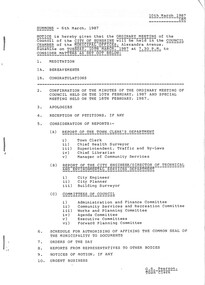
Administrative record - City of Sunshine Council Meetings 1986 - 1994 - Notice of Ordinary Meeting 10th March 1987, City of Sunshine, 6th March 1987
... Albans Special School to Furlong Park School & Pre-School Centre Change of Name Highpoint West Post Office to Highpoint City Post Office Proposed Procession Scout Association of Australia by Sunshine District Report of the Chief Librarian History of Sunshine by Prue McGoldrick Commonwealth Assistance for Public Libraries (CAPLS) Campaign Sunshine Art Collection 3WRB Community Radio Station Report of the Acting Manager Community Services Disability Services Programme Bridging the Gap Project Change in Method of Calculation CEP DEIR Region sponsor Contribution Fresh start in the Park Braybrook - Maidstone Community Health Centre Neighborhood Watch Appeal Against Council Decision Regarding Holiday Programme West Sunshine Castley Hall Redevelopment Committee Marie Mill Community Centre Purchase of Equipment Marie Mill Community Centre Sunshine West Community Centre Sunshine West Community Centre Management Committee Marie Mill Community Centre Minutes of Meeting Home & Community Care Program Home Help Grant Ceiling 1986/87 Report of the City Engineer Smorgan Consolidated Industries New Development Waste Disposal Proposed New Tip Jones Road Brooklyn Braybrook - Maidstone Public Tenants Union Community Bus Maintenance House of Sunshine Additions & Alterations Corio Street and Watt Street Portable Changerooms Chaplin Reserve Anderson Road Sunshine Development of Billingham Reserve Deer Park Notice of Motion Proposed Footscray Institute of Technology Sciences Park Renovations and Restoration of The Hunt Club Ballarat Road Deer Park Maribyrnong Viaduct Fencing Pedestrian Operated Signals Ballarat Road (East of Leonard Street) Sunshine Installation of Audio Tactile Pedestrian Facility Quinn Street Private Street Scheme Variations Deer Park Certificate of Completion Quinn Street Private Street Scheme Deer Park Metropolitan Street Name Signing Programme Traffic Control Items Tenders Two Amenities Caravan Proposed Alterations to Existing Separators and Medians in Geelong Road Between Holmwood Road and Somerville Road Brooklyn New Sunshine Fire Station McIntyre Road (East & West) Parking Prohibition Sunshine North Stanford Street (East Side) 90 Degree Angle Parking Sunshine Quinn Street Private Street Scheme Stage 2 Deer Park Proposed Lease of Railway Land off Anderson Road Sunshine Tenders for Fencing Station Road Deer Park Proposed Car Park on Railway Land Lot 2 St. ...Albans Special School to Furlong Park School & Pre-School Centre Change of Name Highpoint West Post Office to Highpoint City Post Office Proposed Procession Scout Association of Australia by Sunshine District Report of the Chief Librarian History of Sunshine by Prue McGoldrick Commonwealth Assistance for Public Libraries (CAPLS) Campaign Sunshine Art Collection 3WRB Community Radio Station Report of the Acting Manager Community Services Disability Services Programme Bridging the Gap Project Change in Method of Calculation CEP DEIR Region sponsor Contribution Fresh start in the Park Braybrook - Maidstone Community Health Centre Neighborhood Watch Appeal Against Council Decision Regarding Holiday Programme West Sunshine Castley Hall Redevelopment Committee Marie Mill Community Centre Purchase of Equipment Marie Mill Community Centre Sunshine West Community Centre Sunshine West Community Centre Management Committee Marie Mill Community Centre Minutes of Meeting Home & Community Care Program Home Help Grant Ceiling 1986/87 Report of the City Engineer Smorgan Consolidated Industries New Development Waste Disposal Proposed New Tip Jones Road Brooklyn Braybrook - Maidstone Public Tenants Union Community Bus Maintenance House of Sunshine Additions & Alterations Corio Street and Watt Street Portable Changerooms Chaplin Reserve Anderson Road Sunshine Development of Billingham Reserve Deer Park Notice of Motion Proposed Footscray Institute of Technology Sciences Park Renovations and Restoration of The Hunt Club Ballarat Road Deer Park Maribyrnong Viaduct Fencing Pedestrian Operated Signals Ballarat Road (East of Leonard Street) Sunshine Installation of Audio Tactile Pedestrian Facility Quinn Street Private Street Scheme Variations Deer Park Certificate of Completion Quinn Street Private Street Scheme Deer Park Metropolitan Street Name Signing Programme Traffic Control Items Tenders Two Amenities Caravan Proposed Alterations to Existing Separators and Medians in Geelong Road Between Holmwood Road and Somerville Road Brooklyn New Sunshine Fire Station McIntyre Road (East & West) Parking Prohibition Sunshine North Stanford Street (East Side) 90 Degree Angle Parking Sunshine Quinn Street Private Street Scheme Stage 2 Deer Park Proposed Lease of Railway Land off Anderson Road Sunshine Tenders for Fencing Station Road Deer Park Proposed Car Park on Railway Land Lot 2 St. ...Notice of Ordinary Meeting 10th March 1987 Report of the Town Clerk's Department Report of the Town Clerk Accounts for Payment as at 15th February 1987 The New Western Independent Newspaper to Replace the Now Closed Western Independent Newspaper Request to Use Roadways Essendon District Tri-Antulas Triathlon Club Chifley Drive and Coulson Gardens Heart Health Awareness Programme National Hearth Foundation of Australia Lease of Council Land to Sunshine & District Helping Hand Association Furlong Road Australia Post Municipal Association of Victoria (M.A.V.) Chief Executive Officer St. John Ambulance Land for Headquarters Notice of Motion Possible Locations Fraser Street Bus Depot, Land Adjacent to Deer Park Club, Land Adjacent to Sunshine Ambulance Station Westmoreland Road, Sassella Park & George Street Ports & Harbour Development Notice of Motion Rate Recovery Sale Lot 204 George Street Maidstone Nuclear Free Zone Local Authorities Conference Perugia Italy October 1986 Loan 177 Refinancing of Loan 163 Sunshine Community Committee Bicentenary 1988 Municipal Representation on the Melbourne & Metropolitan Board of Works Vesting of Crown Land Reserves in Council More Park & Pennell Reserve Roads & Streets Trading Occupational Health and Safety Domiciliary Workers Workcare Family Day Care Scheme Loan 179 Discontinued Road Reserve and Right of Way East of Beachley Street North of Turner Crescent Braybrook Discontinued Right of Way Between Anderson Road, Durham Road, Derby Road and Graham Street Sunshine Report of Chief Health Surveyor Registration of Premises Health Act & Food Act Registration Transfers Health Act & Food Act Prosecution Proceedings Sunshine Magistrates Court Use of Property 11 Davey Street Sunshine West Report of the Superintendent Traffic & By-Laws Court Proceedings Sunshine Magistrates Court ANZAC Commemoration March Change of Name St. Albans Special School to Furlong Park School & Pre-School Centre Change of Name Highpoint West Post Office to Highpoint City Post Office Proposed Procession Scout Association of Australia by Sunshine District Report of the Chief Librarian History of Sunshine by Prue McGoldrick Commonwealth Assistance for Public Libraries (CAPLS) Campaign Sunshine Art Collection 3WRB Community Radio Station Report of the Acting Manager Community Services Disability Services Programme Bridging the Gap Project Change in Method of Calculation CEP DEIR Region sponsor Contribution Fresh start in the Park Braybrook - Maidstone Community Health Centre Neighborhood Watch Appeal Against Council Decision Regarding Holiday Programme West Sunshine Castley Hall Redevelopment Committee Marie Mill Community Centre Purchase of Equipment Marie Mill Community Centre Sunshine West Community Centre Sunshine West Community Centre Management Committee Marie Mill Community Centre Minutes of Meeting Home & Community Care Program Home Help Grant Ceiling 1986/87 Report of the City Engineer Smorgan Consolidated Industries New Development Waste Disposal Proposed New Tip Jones Road Brooklyn Braybrook - Maidstone Public Tenants Union Community Bus Maintenance House of Sunshine Additions & Alterations Corio Street and Watt Street Portable Changerooms Chaplin Reserve Anderson Road Sunshine Development of Billingham Reserve Deer Park Notice of Motion Proposed Footscray Institute of Technology Sciences Park Renovations and Restoration of The Hunt Club Ballarat Road Deer Park Maribyrnong Viaduct Fencing Pedestrian Operated Signals Ballarat Road (East of Leonard Street) Sunshine Installation of Audio Tactile Pedestrian Facility Quinn Street Private Street Scheme Variations Deer Park Certificate of Completion Quinn Street Private Street Scheme Deer Park Metropolitan Street Name Signing Programme Traffic Control Items Tenders Two Amenities Caravan Proposed Alterations to Existing Separators and Medians in Geelong Road Between Holmwood Road and Somerville Road Brooklyn New Sunshine Fire Station McIntyre Road (East & West) Parking Prohibition Sunshine North Stanford Street (East Side) 90 Degree Angle Parking Sunshine Quinn Street Private Street Scheme Stage 2 Deer Park Proposed Lease of Railway Land off Anderson Road Sunshine Tenders for Fencing Station Road Deer Park Proposed Car Park on Railway Land Lot 2 St. Albans Road St. Albans Station Road Widening Gladstone Street to Furlong Road St. Albans Paramount Road / Somerville Road Intersection Fairbairn Road Private Street Scheme Sunshine West Report of the City Planner Enforcement of Metropolitan Planning Scheme Inspection of Use of Property 11 Davey Street Ardeer Planning Permit Application Truck Parking 18 Baynton Avenue Sunshine North Planning Permit Application Truck Parking 22 Baynton Avenue Sunshine North Planning Permit Application Truck Parking 24 Baynton Avenue Sunshine North Planning Permit Application Factory Lot 10 Tottenham Parade Brooklyn Planning Permit Application Enforcement of the Planning Scheme Amusement Parlour 113 Durham Road Sunshine Maribyrnong Advisory Committee Rezoning Land West of Kororoiit Creek and North of the Western Highway Shire of Melton Planning Permit Application Car Park Lot 53 Cromer Avenue Sunshine North Planning Permit Application Extension of Place of Assembly Dutch Australian Community Council 96 Cromer Avenue Sunshine North Planning Permit Application Health Centre 57 Dickson Street Sunshine Planning Permit Recreation Centre Lot 2 McKechnie Street North East Corner of Gratz Street St. Albans Planning Permit Application Double Sided Promotional Panel Sign Sunshine Road Tottenham Planning Permit Application Double Sided Promotional Panel Sign Sunshine Road Tottenham Planning Permit Application Double Sided Promotional Panel Sign Tilburn Road Deer Park Planning Permit Application Extension to Existing Shops 87 - 89 McIntyre Road Sunshine North Planning Permit Application Convenience Shop, Petrol Filling Station Restaurant, 10 Cinema Complex and Medical Centre 2/72 Neale Road Deer Park Planning Permit Application Alterations to Flats Lot 4 to 8 The Gables Albion Planning Permit Application Motel / Restaurant and Caretaker's Residence Lots 3 & 4 Ballarat Road North West Corner Miles Street Deer Park Planning Permit Application Motor Repair Station 58 Omar Street Maidstone Sunshine District Centre Road Works Planning Permit Application Livestock Sale Yards 690 Geelong Road North East Corner Old Geelong Road Brooklyn Planning Permit Application Private Rubbish Tip Associated Quarries Pty Ltd Market Road Quarry Market Road Sunshine Delegated Matters Removal of Easement Lot 21 Camperdown Avenue and Lot 22 Cary Street Sunshine North Plan of Subdivision Corner Robinsons Road and Ballarat Road Deer Park Plan of Proposed Strata Subdivision 1 White Street Maribyrnong Plan of Consolidation F.B. Transport Amanda Road Tottenham Plan of Consolidation Smogan Consolidated Industries Somerville Road Footscray West Plan of Consolidation Lots 5 & 6 McIntyre Road Sunshine North Plan of Consolidation Lots 1 & 2 Adams Street South East Corner Disraeli Street St. Albans Plan of Consolidation lots 4 & 5 Jefferson Street South West Corner Disraeli Street St. Albans Plan of Strata Subdivision lot 2 Corner McKechnie Street and Gratz Street St. Albans Plan of Surrender of Easement 592 Western Highway (Ballarat Road) Albion Report of the Building Surveyor Show Cause Notice 24 Chicago Street Maribyrnong Above Ground Tank Grain Elevators Board Sunshine Terminal Wright Street Sunshine Show Cause Notice 15 Beech Court Sunshine West Beech Court 32 Knight Avenue Sunshine North Siting of Open Garage 8 Diamond Avenue Albanvale Show Cause Notice Beech Court 9 Apollo Place Ardeer Show Cause Notice 154 Neale Road Deer Park Show Cause Notice 28 Cleveland Street St. Albans Show Cause Notice 1D Bell Street Sunshine West Show Cause Notice 7 Nova Avenue Deer Park Dangerous Building 16 Cypress Avenue Brooklyn Show Cause Notice 25 Chatsworth Avenue Ardeer Show Cause Notice 11 Concord Circuit Albanvale Show Cause Notice 50 Ford Avenue Sunshine North Show Cause Notice 553 Geelong Road Brooklyn Show Cause Notice 40 Joan Street Ardeer Show Cause Notice 49 Denton Avenue St. Albans Show Cause Notice 41 Mulhall Drive St. Albans Show Cause Notice 1 White Street Maribyrnong Show Cause Notice 74 Ford Avenue Sunshine North Show Cause Notice 11 Davey Street Sunshine West Schedule for Authorising of Affixing the Common Seal of the Municipality to Documents Orders of the Day West Sunshine Community Centre Show Cause Notice 19 Second Avenue Sunshine Show Cause Notice 34 Harris Street St. Albans Confidential Report Council Polices Consideration of a Petition on behalf of 45 Residents of Maribyrnong in Relation to Objecting to the Establishment of a Night Club at the Angler's Hotel Notice of Motions Sunshine Leisure Centre Contingency Account Cleaning Kerb & Channel and Drainage Pits Referendum Ceding of Brooklyn to Altona Road Surface Maintenance Management of Child Care Centres Financial Return Child Care Centres Finance Manager Council Auspiced Services Removal of Rubbish 2 Derrimut Street Albion Slogan Sunshine Multicultural City of Victoria Sand & Dust Menace Corner Sunshine Avenue and McIntyre Road Sunshine North 125 Durham Road Sunshine Traffic lights Corner McIntyre Road, Furlong Road and Berkshire Road Sunshine North Deer Park Football Club Pavilion Nuclear Free Zones Palm Sunday Peace Celebrations Seed Patenting and Plant Variety Rights Toxic Waste Disposal Facilityessendon district tri-antulas triathlon club, chifley drive, coulson gardens, maribyrnong, sunshine & district helping hand association, furlong road, sunshine north, fraser street, deer park club, westmoreland road, sassella park, george street, sunshine, ballarat road, deer park, more park, esmond street, ardeer, pennell reserve, burke street, braybrook, beachley street, turner crescent, anderson road, durham road, derby road, graham street, davey street, st. albans special school, furlong park school & pre-school centre, highpoint west post office, highpoint city post office, 3wrb community radio station, braybrook - maidstone community health centre, marie mill community centre, randall street, sunshine west community centre, kermeen street, sunshine west, smorgan consolidated industries, jones road, brooklyn, braybrook - maidstone public tenants union, house of sunshine, corio street, watt street, chaplin reserve, billingham reserve, the hunt club, leonard street, the hunt club hotel, quinn street, holmwood road, somerville road, sunshine fire station, mcintyre road, stanford street, station road, st. albans road, st. albans, paramount road, fairbairn road, baynton avenue, tottenham parade, kororoiit creek, western highway, cromer avenue, dutch australian community council, dickson street, mckechnie street, gratz street, sunshine road, tottenham, tilburn road, neale road, the gables, albion, miles street, omar street, maidstone, geelong road, old geelong road, associated quarries, market road, camperdown avenue, cary street, robinsons road, white street, amanda road, adams street, disraeli street, jefferson street, chicago street, wright street, beech court, knight avenue, diamond avenue, albanvale, apollo place, cleveland street, bell street, nova avenue, cypress avenue, chatsworth avenue, concord circuit, ford avenue, joan street, denton avenue, mulhall drive, second avenue, harris street, angler's hotel, anglers way, derrimut street, sunshine avenue, berkshire road, deer park football club, john mcleod reserve -
 Flagstaff Hill Maritime Museum and Village
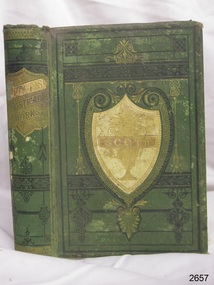
Book - Book of Poetry, Gall & Inglis, The Poetical Works of Sir Walter Scott, 1874-1880
... helped cement the romantic, misty image of Scotland in the public imagination. These editions were known for their elaborate gilt edges, embossed cloth or leather bindings, and "illuminated" title pages. Gall & Inglis specialised in mass-market distribution and because Gall & Inglis printed these in large quantities, they are not "rare" in the sense of a first edition, but they are highly prized as decorative antiques. By Gall & Inglis printing Scott’s works in various formats, they moved his poetry from the libraries of the elite into the homes ...Sir Walter Scott was the literary rock star of the 19th century, and the Edinburgh-based firm Gall & Inglis played a massive role in making his work accessible to the Victorian masses.The Poetical Works of Sir Walter Scott Author: Sir Walter Scott Publisher: Gall & Inglis fictionSir Walter Scott was the literary rock star of the 19th century, and the Edinburgh-based firm Gall & Inglis played a massive role in making his work accessible to the Victorian masses.warrnambool, shipwrecked-coast, flagstaff-hill, flagstaff-hill-maritime-museum, maritime-museum, shipwreck-coast, flagstaff-hill-maritime-village, book, the poetical works of sir walter scott, sir walter scott, poetry -
 Flagstaff Hill Maritime Museum and Village
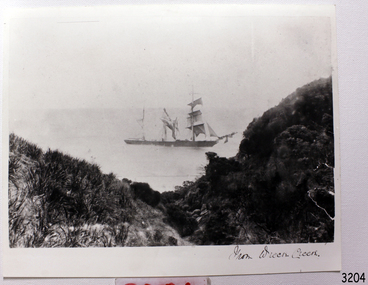
Photograph, C. 1891
... help didn’t get through on time and the two or three boats that had been notified of the wreck failed to reach it in time. Much looting occurred of the cargo that washed up on the shore, with nearly every visitor leaving the beach with bulky pockets. One looter was caught with a small load of red and white rubber balls, which were duly confiscated and he was ‘detained’ for 14 days. Essence of peppermint mysteriously turned up in many settlers homes...help didn’t get through on time and the two or three boats that had been notified of the wreck failed to reach it in time. Much looting occurred of the cargo that washed up on the shore, with nearly every visitor leaving the beach with bulky pockets. One looter was caught with a small load of red and white rubber balls, which were duly confiscated and he was ‘detained’ for 14 days. Essence of peppermint mysteriously turned up in many settlers homes ...Photograph shows the ship FIJI where she met her demise, in Wreck Bay, on the shipwreck coast of South West Victoria. The three-masted iron barque Fiji had been built in Belfast, Ireland, in 1875 by Harland and Wolfe for a Liverpool based shipping company. The ship departed Hamburg on 22nd May 1891 bound for Melbourne, under the command of Captain William Vickers with a crew of 25. The ship’s manifest shows that she was loaded with a cargo of 260 cases of dynamite, pig iron, steel goods, spirits (whisky, schnapps, gin, brandy), sailcloth, tobacco, coiled fencing wire, concrete, 400 German pianos (Sweet Hapsburg), concertinas and other musical instruments, artists supplies including brushes, porcelain, furniture, china, and general cargo including candles. There were also toys in anticipation for Christmas, including wooden rocking horses, miniature ships, dolls with china limbs and rubber balls. On September 5th, one hundred days out from Hamburg in squally and boisterous south west winds the Cape Otway light was sighted on a bearing differing from Captain Vickers’ calculation of his position. At about 2:30am, Sunday 6th September 1891 land was reported 4-5 miles off the port bow. The captain tried to put the ship on the other tack, but she would not respond. He then tried to turn her the other way but just as the manoeuvre was being completed the Fiji struck rock only 300 yards (274 metres) from shore. The place is known as Wreck Bay, Moonlight Head. Blue lights were burned and rockets fired whilst an effort was made to lower boats but all capsized or swamped and smashed to pieces. Two of the younger crewmen volunteered to swim for the shore, taking a line. One, a Russian named Daniel Carkland, drowned after he was swept away when the line broke. The other, 17 year old able seaman Julius Gebauhr, a German, reached shore safely on his second attempt but without the line, which he had cut lose with his sheath-knife when it become tangled in kelp. He rested on the beach a while then climbed the steep cliffs in search of help. At about 10am on the Sunday morning a party of land selectors - including F. J. Stansmore, Leslie Dickson (or Dixon) and Mott - found Gebauhr. They were near Ryans Den, on their travels on horseback from Princetown towards Moonlight Head, and about 5km from the wreck. Gebauhr was lying in the scrub in a poor state, bleeding and dressed only in singlet, socks and a belt with his sheath-knife, ready for all emergencies. At first they were concerned about his wild and shaggy looking state and what seemed to be gibberish speech, taking him to be an escaped lunatic. They were reassured after he threw his knife away and realised that he was speaking half-English, half-German. They gave him food and brandy and some clothing and were then able to gain information about the wreck. Some of the men took him to Rivernook, a nearby guest house owned by John Evans, where he was cared for. Stansmore and Dickson rode off to try and summon help. Others went down to the site of the wreck. Messages for rescuing the rest of the crew were sent both to Port Campbell for the rocket rescue crew and to Warrnambool for the lifeboat. The S.S. Casino sailed from Portland towards the scene. After travelling the 25 miles to the scene, half of the Port Campbell rocket crew and equipment arrived and set up the rocket tripod on the beach below the cliffs. By this time the crew of the Fiji had been clinging to the jib-boom for almost 15 hours, calling frantically for help. Mr Tregear from the Rocket Crew fired the line. The light line broke and the rocket was carried away. A second line was successfully fired across the ship and made fast. The anxious sailors then attempted to come ashore along the line but, with as many as five at a time, the line sagged considerably and some were washed off. Others, nearly exhausted, had to then make their way through masses of seaweed and were often smothered by waves. Only 14 of the 24 who had remained on the ship made it to shore. Many onlookers on the beach took it in turns to go into the surf and drag half-drowned seamen to safety. These rescuers included Bill (William James) Robe, Edwin Vinge, Hugh Cameron, Fenelon Mott, Arthur Wilkinson and Peter Carmody. (Peter Carmody was also involved in the rescue of men from the Newfield.) Arthur Wilkinson, a 29 year old land selector, swam out to the aid of one of the ship’s crewmen, a carpenter named John Plunken. Plunken was attempting to swim from the Fiji to the shore. Two or three times both men almost reached the shore but were washed back to the wreck. A line was thrown to them and they were both hauled aboard. It was thought that Wilkinson struck his head on the anchor before s they were brought up. He remained unconscious. The carpenter survived this ordeal but Wilkinson later died and his body was washed up the next day. It was 26 year old Bill Robe who hauled out the last man, the captain, who had become tangled in the kelp. The wreck of the Fiji was smashed apart within 20 minutes of the captain being brought ashore, and it settled in about 6m of water. Of the 26 men on the Fiji, 11 in total lost their lives. The remains of 7 bodies were washed onto the beach and their coffins were made from timbers from the wrecked Fiji. They were buried on the cliff top above the wreck. The survivors were warmed by fires on the beach then taken to Rivernook and cared for over the next few days. Funds were raised by local communities soon after the wreck in aid of the sufferers of the Fiji disaster. Captain Vickers was severely reprimanded for his mishandling of the ship. His Masters Certificate was suspended for 12 months. At the time there was also a great deal of public criticism at the slow and disorganised rescue attempt to save those on board. The important canvas ‘breech buoy’ or ‘bucket chair’ and the heavy line from the Rocket Rescue was in the half of the rocket outfit that didn’t make it in time for the rescue: they had been delayed at the Gellibrand River ferry. Communications to Warrnambool were down so the call for help didn’t get through on time and the two or three boats that had been notified of the wreck failed to reach it in time. Much looting occurred of the cargo that washed up on the shore, with nearly every visitor leaving the beach with bulky pockets. One looter was caught with a small load of red and white rubber balls, which were duly confiscated and he was ‘detained’ for 14 days. Essence of peppermint mysteriously turned up in many settlers homes. Sailcloth was salvaged and used for horse rugs and tent flies. Soon after the wreck “Fiji tobacco” was being advertised around Victoria. A Customs officer, trying to prevent some of the looting, was assaulted by looters and thrown over a steep cliff. He managed to cling to a bush lower down until rescued. In 1894 some coiled fencing wire was salvaged from the wreck. Hundreds of coils are still strewn over the site of the wreck, encrusted and solidified. The hull is broken but the vessel’s iron ribs can be seen along with some of the cargo of concrete and pig iron. Captain Vickers presented Bill Robe with his silver-cased pocket watch, the only possession that he still had, as a token for having saved his life and the lives of some of the crew. (The pocket watch came with 2 winding keys, one to wind it and one to change the hands.) Years later Bill passed the watch to his brother-in-law Gib (Gilbert) Hulands as payment of a debt and it has been passed down the family to Gilbert Hulands’ grandson, John Hulands. Seaman Julius Gebauhr later gave his knife, in its hand crafted leather sheath, to F. J. Stansmore for caring for him when he came ashore. The knife handle had a personal inscription on it. A marble headstone on the 200m high cliffs overlooking Wreck Beach, west of Moonlight Head, paying tribute to the men who lost their lives when Fiji ran aground. The scene of the wreck is marked by the anchor from the Fiji, erected by Warrnambool skin divers in 1967. Amongst the artefacts salvaged from the Fiji are china miniature animals, limbs from small china dolls, rubber balls, a slate pencil, a glass bottle, sample of rope from the distress rocket and a candlestick holder. These items are now part of the Fiji collection at Flagstaff Hill Maritime Museum, along with Captain Vickers’ pocket watch and Julius Gebauhr’s sheath knife. Flagstaff Hill’s Fiji collection is of historical significance at a State level because of its association with the wreck Fiji, which is on the Victorian Heritage Register VHR S259. The Fiji is archaeologically significant as the wreck of a typical 19th century international sailing ship with cargo. It is educationally and recreationally significant as one of Victoria's most spectacular historic shipwreck dive sites with structural features and remains of the cargo evident. It also represents aspects of Victoria’s shipping history and its potential to interpret sub-theme 1.5 of Victoria’s Framework of Historical Themes (living with natural processes). The Fiji collection meets the following criteria for assessment: Criterion A: Importance to the course, or pattern, of Victoria’s cultural history. Criterion B: Possession of uncommon, rare or endangered aspects of Victoria’s cultural history Criterion C: Potential to yield information that will contribute to an understanding of Victoria’s cultural history. Black and White Photograph of the ship "Fiji" taken from Wreck Creek. warrnambool, shipwrecked coast, flagstaff hill, flagstaff hill maritime museum, maritime museum, shipwreck coast, flagstaff hill maritime village, shipwrecked artefact, pocket watch, fob watch fiji, william vickers, william robe, bill robe, gebauhr, stansmore, carmody, wreck bay, moonlight head, fiji shipwreck 1891, port campbell rocket crew, wreck bay victoria -
 Federation University Historical Collection
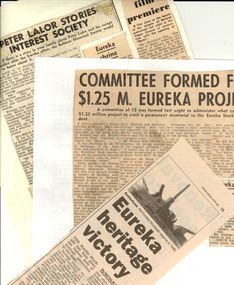
Book - Newspaper clippings, Eureka Stockade Newspaper Clippings, 1923-2015
The Eureka Stockade was fought on the Eureka Lead, Ballarat East on 03 December 1854. Keith Rash was a signwriter who learnt his trade at the Ballarat School of Mines. He was very interested in local history and wrote articles for the local newspapers. The clippings on Eureka would have been used to inform his articles, and research on the site of the Eureka Stockade. Ken Clements was former Academic Registrar at Ballarat College of Advanced Education (now University of Ballarat). He was a committee member of the Eureka Stockade Memorial Park Committee for a number of years. Dr Dorothy Wickham has researched Eureka over a number of decades, and has published a number of titles on the topic. Clare Gervasoni has researched Eureka over a number of decades, and has published a number of titles on the topic, including coordination of www.Eurekapedia.org for Ballarat Reform League Inc. Three white A4 folders of newspaper clippings dating from 1923 to 2012. The clippings are in chronological order. The clippings were collected by Keith Rash, and were later supplemented by clippings collected by Ken Clements. Further clippings collected by Dorothy Wickham, mainly around the 1990s were inserted throughout the folders in chronological order, as well as later clippings by Clare Gervasoni .1) Folder One - Eureka Cuttings 1923 - 1984 * Courier 05/05/1923 - Eureka Progress Association (W. Groves, Stockader Phillips of Rocky Lead, Stockader Wilson, G. Lakeland, Eureka Hall.) * Courier 10.08.1931 - Banquet at Eureka - Progress Association's Annual Meeting (McGregor, Parsons, W.J. McAdam, 75th anniversary. Elsworth, Kent, Robert McGregor) *Courier 11/08/1932 - Eureka Reserve - Committee Annual Social. (E. Parsons, C.C. Phillips, D.C. McGrath, T.T. Hollway, Bolster, Mackenzie, Mares, Hendy) * Courier 07/07/1939 - Eureka Improvement Committee, Eureka Reserve * Courier 04/12/1950 - Australian Democracy Was Born at Eureka * Courier 04/09/1951 - Council Seeks Development of Eureka Land - potential housing Commission development on site of Last Chance Mine. (J. Welsh). * Ballarat Courier 12/1952 - Few Remembered Eureka Affair (98th anniversary, A.W. Nicholson, C.E. Brown, L. O'Brien, R. Joshua, Soldiers' Memorial Band) * Courier 07/12/1953 - Few Commemorated the Affair at Eureka - 99th anniversary at the Stockade reserve (F.J. Cutts, L. O'Brien, R. Joshua, Peter Lalor, C.E. Brown. * Courier 14/04/1954 - Eureka Centenary - meeting to determine form of commemoration. * Courier 15/04/1954 - Getting ready - Centenary celebrations (Picture of Diggers Memorial, F.J. Cutts, C. Mott). * Courier 15/04/1954 - Eureka Centenary Planned (F.J. Cutts, Geoffrey Searle, Edgar Bartrop, G. Swenson, B. Parsons, T.E. Carter, M. Collins, Mrs L.M. Quinlan, Grenville, Eureka Progress Association, Arthur Jones, E.J. Crimmins, Bernard D'Arcy, A.W. [Bert] Strange). * Guardian 25/11/1954 - Diary of a Eureka Stockader [signed RDW] (Bentley, Fletcher, McIntyre, Westerby, Ballarat Reform League, monster meeting, Bakery Hill, Charles Hotham) * Argus 04/12/1954 - Eureka Day Marred by Storm (image of Bert O'Toole in Red Coat uniform, Peter Lalor Statue, A.C. Pittard, F.J. Cutts, Bernard D'Arcy, L. Moyle, Catherine Smith, wounded, death, Eureka Celebrations, anniversary, John Cain *Age Literary Supplement, 04/12/1954 - The motives that prompted the tragic Eureka rising . (image of Charles Hotham, government troops attack, Eureka Stockade Monument) 1851 discovery of gold in Victoria, centenary of Eureka Stockade, author MM, Governor Latrobe, law abiding nature of most miners, most miners were British but other nationalities represented, miners former occupations were varied, many did not "strike it rich", by 1853 the earnings of most diggers had fallen very low, 30/- licence fee, digger hunts, cries of "Joe" or "The Traps", 5 pound fine or 6 month imprisonment for not carrying Licence, La Trobe had hired ex-convicts as police, Governor Charles Hotham 1854, Bentlys Hotel, Commissioner Rede, miners leader Peter Lalor, Carboni Raffaello, Press warning by "Age", Ballarat Reform League, November 29 diggers meeting, licences burned, November 30 licence hunt, new flag and Southern Cross oath, the Stockade, revolution ?, Stockade Garrison, December 3 1854, the battle, 125 prisoners, 13 charged with high treason, all prisoners acquitted, Lalor and Vern into hiding, 'democratic revolution' or 'undisguised rebellion' ? , Miner's Right, Chartist ideas involved, Lalor became a member of Victorian parliament, Eureka monument inscription, little revolutionary significance. * The Argus 06/12/1954 - 100th Eureka Day ( [ Images - bearded miners, Bert O'Toole, simulated battle, red coats] battle tableau, Centenary celebrations. Mr Cain Premier, Spirit of Eureka). * Ballarat Courier 22/04/1961 Attack on the Paint ( [Image - Eureka Monument Guns] vandals). * Ballarat Courier 13/09/1962 - Little-Known Aspects of Eureka Affair (E.J. Crimmins and the 109th Eureka Anniversary); Eureka Drilling (Photo of M. Milligan drilling for water for the Eureka Pool) * Ballarat Courier 10/12/1963 - Eureka Relics in Public Display (Trev Negri), Little-known aspects of the Eureka affair (E J Crimmins, 13 State prisoners, Creswick men, M Greville), Eureka Request (Apex explanatory notice). * Ballarat Courier 12/05/1964 - Plaque to tell Eureka Story (Apex donation on monument). * Ballarat Courier 09/06/1964 - Permission is sought (re Eureka Reserve small Hall). * Ballarat Courier 28/08/ 1964 - Eureka should be much better attraction (Mayor Cr Webb, Rotary). * No Chlorination at Stockade Pool 24/08/1964 (A Jones secretary) * Ballarat Courier 10/10/1964 - Assurance given on Eureka Swimming Pool (Murray Byrne MLC, Bill Stephen MLA, pool plans [Images - Photo of Jones, Stephen Byrne - diagram of Eureka reserve swimming pools, caravan park, monument area] ) * Ballarat Courier 23/06/1964 - Pool plans ready for tenders MLA (Black Hill) * Ballarat Courier 26/11/1966 - Eureka: Was that clash in 1854 inevitable ? ([Image - Monument, Peter Lalor statue], by J J Sheehan, foreigners, Chartists, poorly armed. * 03/12/1966 Part 2 - Eureka: No plan by the Diggers to Attack, by j j Sheehan ([Images - Eureka collection, W C Colbourne and G Brookes with old rifle] Corrupt, Instructed, Withers' view, The last hunt, Police spies). * Ballarat Courier 19/12/1968 - Eureka commemoration definite next year,1854 - (Connolly Association, 3 December, 'Finest thing in Australasian history', few attending, L O'Brien, public apathy, A Williams, successful 1954 centenary, W. Roff, Eureka Progress Association) * 23/11/67 - Eureka and Miners' rights (G P Ryan letter, no representation, excessive licence system, offensive administration.brutality, Gov Hotham, barricade on Eureka lead, Miners' Rights replaced Licences but now worthless, mining monopolies, democracy). * Eureka Flag Ceremony (L O'Brien, false report, revive annual Eureka service). * Ballarat Courier 12/05/1867 Questions of Eureka (W Thompson letter, why military names on monument ? Why mount irrelevant cannons on monument ? Where is the flag ?). Lalor's refuge (between Bungaree and Bullarook ?, Fr t Linane ). Building linked with Ballarat (at French end of Collins Street Melbourne, Sir Robert Nickle, relief march to Ballarat, historian E Moorhead, 40th regiment link ). * Ballarat Courier 08/01/1968 - Too little history at Eureka says Visitor (Image - Eureka monument, Mrs L Riley, frequent complaint, B McOrist, proposed Stockade model). * Ballarat Courier c 1968 - Gallery Eureka flag may be the original (Cr W Roff, at Ballarat Art Gallery, fraud ?, matching pieces). * Ballarat Courier 11/04/1968 Pool of reflection ([Image - Eureka pool and willows], near full again). * Ballarat Courier 20/08/1968 - Eureka Reserve (Rotary Clubs' proposed project). *Ballarat Courier 05/10/1968 - Picturesque Willows ([Image- willows in good condition at Eureka Stockade]). * Ballarat Courier, November 1968 - Eureka Ceremony will be Revived (Eureka Progress Association to revive Eureka Commemoration at the site, Connolly Association Australia, J. Garvey, A. Jones) [Photo of L. O'Brien, A, Jones, R.A. Mitchell, Jim Styker and Alan Mills *Ballarat Courier 15/11/1968 - Walkathon for Stockade Diorama (planned life-size Diorama at Stockade depicting the Eureka riot, Rotary Cup walkathon fundraiser. *Ballarat Courier 26/11/1968 - Discussing plans ([Image - Les O'Brien, Arthur Jones, Alan Mills et al], memorial service Sunday). * Ballarat Courier 26/11/1968 - Eureka ceremony will be revived (four year lapse, Connolly Association, Eureka Progress Association) * Ballarat Courier 02/12/1968 - 500 attend Eureka ceremony (114th commemoration, on island in Lake, Mayor Cr M J Brown, speaker Mr Dudley Erwin MLA, significance to Australia, Connolly Association morning ceremony, Bernie Nolan, W Hartley). * Courier 1969 - Letters to the editor - Peter Lalor's Grave, Losing Places of Beauty loss of verandahs, Eureka Stockade Caravan Park, Eureka Swimming Pool), Ireland's Dilemma (Catholic Church), Small Group in "Affair" (F.R. Muller) * Courier 22/04/1969 - $7000 grant for Eureka Diorama (Sir Henry Bolte approves grant, $2 for $1, Rotary walkathon basis, City Council interest, Diorama details, information about Eureka for public, Eureka Park Sovereign Hill and Montrose cottage combination). * Courier 21/08/1969 - Mayor turns sod at Diorama site ([Image- Mayor Cr M J Brown et al], life size representation of stockade scene, Mr W F Stephen MLA). * Courier 06/12/1969 - The 'affair at Eureka' ([Image- Diorama] Few remembered anniversary of bid for democratic Government in 1850s, Mayor Cr Alec Mills, Murray Byrne, Colonial secretary J Foster resignation, reforms, hostility, unpopular, end of era). * Courier mixed 1969 - City link with Eureka Stockade threatened, - Eureka signposts [Diggers Memorial, Soldiers Memorial], - Eureka Anniversary - Souvenir of Eureka (William Cowland's pistol). * Courier :/05/1970 - Fascinated ([Image- children at near completed Diorama]). * Courier 10/08/1970 - Mayor opens Eureka Diorama ([Image- Diorama scene of 3 December 1854 battle], Mayor Cr A E Mills, Rotarians, Eric Pearce voice tape recording). * Courier 08/08/1970 - Eureka Diorama should be Popular-Rotarian ([Image- Diorama shed], City's new drawcard, Diorama Opening para and advert). * Courier 12/09/1970 - The Quick change Eureka Stockade ([Image- Eureka Stockade Hotel], was Australia Felix Hotel, Mr Kevin Worthington). * Courier 22/09/1970 - Missing golden opportunities (message unheeded, American tourists misled, bewildered tourists). * Courier 20/10/1970 - Ballarat's monument to vandalism ? (Ballarat, Wendouree and South Rotary clubs' pride: Eureka Diorama, joy and heartaches, vandalism damage, thoughtless and vicious). * Courier 20/10/1970 - Marked for demolition ([Image- Ballarat east railyard] troops path to Eureka stockade). * Courier 20/10/1970 - Diorama sound system target for vandals ([Image- Jack Redman removing foreign material from diorama starting mechanism). * Courier 03/11/1970 - Record Good but Facts are Wrong ([Image- depiction of Eureka scene], article by Paul Hughes, RCA LP record based on musical play re Eureka Stockade, errors) * Courier 11/03/1970 - Diorama for Eureka Stockade ([Images- view of park, view of diorama]). * Courier 4/12/1970 - Anniversary of Eureka uprising ([Images- Southern Cross flag over Montrose cottage, R Fenton and V Demedeze], 107th anniversary, Scouts Eureka re-enactment, Diggers didn't mind delay). * Courier 16/04/1971 - Lake disappearing ([Image- Lake Elsworth being filled], Olympic standard pool planned for same site). * Courier 31/07/1971 - Birthplace of Peter Lalor ([Image- 211 year old Lalor home in Ireland], Eureka Stockade (park) name change to Eureka Stockade Memorial Park (in Sept. 1972). * Courier 01/02/1971 Eureka Stockade Gardens - ([Images- Gardens near Caretakers Cottage, Miss J Hetherington and begonias in Eureka Stockade hothouse). * Courier 11/1971 - Eureka Grant (for toilet block in Eureka Caravan Park), Ancestor Died in Stockade Battle (William Clifton), $93,887 Tender for Eureka Pool) * Courier 10/12/1971 - Eureka FILM 'iMMORAL' ( Erwin's attack, DUDLEY ERWIN MP, suggested cuts). * Courier 21/02/1972 - It is not a subsidy (says Stockade Director, re film, Added bonus, also Descendant upset- letter from Peter A Lalor re film content). * Ballarat Courier 31/10/1973 - Eureka Stockade a National Shrine, (Editorial , Minister Grassby's support) - Eureka 'Shrine of our History', (Grassby's pledge). * Ballarat Courier 14/02/1973, - $1000 Grant for Eureka Flag (from State government to Ballarat Art Gallery, Bill Stephen MLA, Murray Byrne Minister for Tourism). * Ballarat Courier 26/05/1973, - Eureka Flag Restored (by Val D'Angri, Peter Lalor details, [Images- Val at work on flag, painting of 1854 Ballarat]). * Ballarat Courier 26/10/1973 - Taking another look at Eureka (Editorial, historical and social significance of Eureka Stockade, Neighbour attractions, Thinking BIG), and Editorial report, Put up the Stockade again - and a Monorail ? * Ballarat Courier 31/10/1973 - Eureka Stockade a National Shrine (Minister's support) * Ballarat Courier October 1973 - Eureka a 'Shrine of our History' (Grassby's pledge, Alex Barnett's plans for Eureka Stockade ). * Ballarat Courier 03/11/1973, - Build Eureka into a tourist drawcard ,(Challenge to Clubs. W H McGregor; Ceremony, Tram Link, the "Iceberg"). * Ballarat Courier 08/11/1973, - Grassby to get Eureka Plans - (from Alex Barnett). * Ballarat Courier 29/11/1973, - Memorial Plans with Town Hall (Architect plans also sent to Mr Grassby). * Ballarat Courier 13/11/1973, - Prime Minister will unveil Eureka Flag [Image - Erecting Flag frame at Ballarat Art gallery, Val D'Angri]. * Ballarat Courier 14/11/1973, - What plan for the Eureka memorial ? (Public entitled to know, National concept) and (Eureka Upgrading). * Ballarat Courier 24/11/1973, - Connolly Opposition to Eureka Proposals (Association protests about limited support for commemoration of Eureka) and (Gallery search for Lalor descendant). *Ballarat Courier 24/11/1973, - The Affair at Eureka (Part one by J J Sheehan) [Images -Jones' Circus tent, and Stockade location, also Peter Lalor photo, also artist's impression of the 13 men on trial]. Part 2 )3/11/1973 (Eureka Diorama) * Ballarat Courier 01/12/1973, - Grassby to see Eureka Plan on Site [Image- Architect's sketch of proposed $450,000 Museum building]. *Ballarat Courier 01/12/1973, - The Affair at Eureka (The fight for justice, concluding J J Sheehan series), [Images - painting of fight, and the supposed site of the Stockade]. * Ballarat Courier 02/12/1973, Victorian Treasures at Art Gallery (Eureka Flag and "Moonrise exhibition), [Image - J Nicholson cleaning 'Peter Lalor' portrait]. * Ballarat Courier 03/12/1973, - The Events Which led up to Eureka (Licence contentions,the perceived need for fortification around the workings at the Eureka lead, the death of James Scobie, the burning of Bentley's Hotel, the conviction of three miners on 20 November, arrival of armed soldiers at the Camp. Also Raffaello observations, and advert for public viewing of Eureka Flag. [Image - Diggers and Soldiers names on Eureka Monument]. * Ballarat Courier 03/12/1973, - The past celebrated but what of the future ? (119th anniversary of the Eureka Stockade uprising, but current politicians are under close scrutiny) * Ballarat Courier 03/12/1973, - Teacher-Politician is behind Eureka story (J J Sheehan profile). *Ballarat Courier 04/12/1973 - A Noteworthy Day in Ballarat - (Prime Minister Whitlam unveiled the famous Eureka Flag at the Art gallery). * Ballarat Courier 04/12/1973, - Newcomers told about migrants at Eureka (migrants from >20 countries, comradeship after battle and defeat, new nation in peace and tranquility. Minister for Immigration Mr Al Grassby at Sovereign Hill. Liberties. A Shrine. [Image- Al Grassby and newly arrived migrants at Sovereign Hill]. *Ballarat Courier 04/12/1973, - Grassby leads colorful Eureka commemoration (cheering school children, flag, wreath, World Fame for Eureka affair, boy's coach trip, two sides to Eureka battle.) [Image- Mr Grassby and group of children]. (National day proposed by Mr Grassby). * Ballarat Courier 04/12/1973, Eureka as National Monument (PM commends stockade plan, Mr Whitlam on Eureka commemoration day supports plans to make Eureka Stockade a national monument. Flag saved and restored, TV hitch. New Australian anthem needed to match the 'new nationalism'. [Image - Gough Whitlam and group at flag presentation and unfurling ceremony.] * Ballarat Courier 04/12/1973, - Eureka ! It's Digger Al (Al Grassby at 119th anniversary of the Eureka Stockade rebellion). [Images - scenes of Al Grassby at Sovereign Hill]. * Ballarat Courier 05/12/1973, - Talk, But No Cash: Stephen (Mr Bill Stephen MLA comments on visit by Whitlam and Grassby). - Eureka Flag Australia's most valuable relic: PM (Gough Whitlam report to Federal Parliament yesterday, Hospitality from Mr Dudley Erwin) * Ballarat Courier 10/12/1973, - Flag restorer stitched her way into history (Val D"Angri has stitched her way into Australian History as the person who restored the Eureka Flag. [Image - Mrs Val D'Angri, Eureka Flag needlewoman ]. * Ballarat Courier, 1974 - Location of the Eureka Stockade (Bert Strange), Misplaced Stockade (Maurice Calnin, T.C. Cleary, diary), Stockade Site (Bob O'Brien), Eureka Flag Stolen (John Shannon) *Ballarat Courier 6 May 1974, - Committee formed for $1.25 M. Eureka Project - ( a permanent memorial). *Ballarat Courier 6 May 1974, - Federal Govt Aid likely for Eureka (Federal Labor Government wants Eureka Stockade site to be a major tourist attraction, Eureka booklet proposed). *Ballarat Courier 10 May 1974, - Peter Lalor Stories Interest Society (Ballarat Historical Society seeks reports of Peter Lalor during escape after the Eureka affair). Also Eureka Shrine, The Eureka 'affair', Eureka film premier. * 29/07/1974 - Eureka Memorial Plans Need Full Support (Eureka Stockade Association) * Ballarat Courier 11/5/1974 and 6/6/1974 - Stockade Site (Rob O'Brien, Eureka Interesting Story * Ballarat Courier 30/01/1974 - Eureka Remembered in Italy (Al Grasby, Raffaello Carboni, Urbino); Eureka Memorial on Way (Eureka Stockade Association) {photo of Gordon Cornell, Alec Barnett, Bruce Bartrop] * Ballarat Courier, May 1974 and 11 May 1974 - Location of the Eureka Stockade (Bert Strange); Stockade Site (Bob O'Brien) * [Ballarat Courier?] 10/07/1979 - City's Oldest Memorial is Over Diggers' Graves. (An article on the grave over the diggers who were killed as a result of the Eureka Stockade battle which was erected on 22 March 1856. .2) Folder Two- Eureka Cuttings c1980-2004 Ballarat Courier ~9/1980, - First-hand account of hardship omitted (Frank Titan letter re Tom Evans' use of selected evidence in his proclamation that democracy was not born at Eureka Stockade. "Democracy was won at the Stockade on 3/12/1854. [Cartoon 'A beach view of the Eureka Flag debate']. Ballarat News ~1980, Names (Diggers & Troopers) of deceased on Eureka Stockade Monument. [Photo of white marble tablet] Ballarat Courier 4 July 1981, Eureka Papers Gift to City, Peter Lalor letters, Stephen Cumming diary. [Photo - Town Clerk Ian Smith, Cr Jessie Scott and donor Bruce Evans]. * The Sun Travel Supplement, 06 April 1984 - A Bloody Moment Re-visited by Alec Hepburn - (Diorama, Eureka Stockade Replica, Montrose Cottage) [Image of Gerard Rushforth to the reconstruction of the Eureka Stockade * Ballarat Courier, 10/04/1984 - Eureka Incident 'an uprising of the scum of goldfields. [photo of John Callinan with the Diggers Grave monument] * The Age, 06/05/1987 - Eureka! Man found whose father was there by John Lahey (Article on Terence Brady, who was a 4 month old baby at the Eureka Stockade battle. * Ballarat Courier 13 June 1984, 'Eureka Stockade'.....a Panning, (American critic J J O'Connor pans the Australian TV Mini-series. Book 2 - C1990-2004 * Ballarat Courier ~1990,- High-calibre Restoration, (World War I German Howitzer being restored after about 70 years exposure in the Eureka Stockade Memorial Park). [Photo of wheeled Gun, and article by author Peter Butters]. * Ballarat Courier, ~1990, A Changing Track to Eureka, a 'Room for a View' article by Alex Barnett OAM. (comment about the Stockade site and the tracks leading to it). [Photo of painting by Charles Doudiet depicting the diggers swearing allegiance to the southern Cross on 1 December 1854]. * Ballarat News 22 March 1990 - Eureka Troopers Slept Here (article on the Werribee Hunt Hotel, near the Ballarat Gold Course, where troopers slept and watered their horses on the way to Ballarat in 1854. [photograph of the hotel] * Ballarat Courier, 23 August 1991 - Eureka relics Return to Ballarat by Gemma Daley. Items acquired by Sovereign Hill - including a Ground plan of James Bentley's Eureka Hotel, autographed statement by Michael Carroll. (photograph of Peter Hiscock holding a set of percussion pistols, the Plan of the Eureka Hotel] * 30 November 1992 - Ballarat Courier 'Hayden Pays a Visit' by Julia Balderstone (Article on the visit of Governor-General Bill Hayden to Ballarat, the launch of Bob O'Brien's book 'Massacre at Eureka: The untold Story' ) [Photographs of Bill Hayden, Mayor James Coglan, Sovereign Hill, Bob O'Brien) * Ballarat Courier 03 December 1994 - Awareness grows of flag's meaning by Lorrie Brown (article on the Ballarat Trades Hall replica of the Eureka Flag. The replica flag was made by the then Trades Hall caretaker Tom Ellis. The replica flag was used in a Trades Hall march in 1945 and then disappeared until the mid 1980s (Image of David Miller nad Graeme Shearer in front of the flag.) Verso - Robert and Pamela Sublet and their link to the Eureka Stockade via their ancestor Charles Sublet de Bourgy and the site of the Eureka Stockade. * 04 May 1996 Ballarat Courier Saturday Magazine Extra 'Our Next Flag?' by Gabrielle Hodson (An article on the Australian Flag and the Eureka Flag with interview with Gayle Hart (Ballarat Fine Art Gallery) * Ballarat Courier, 15 February 1995 - 'Knockers' Harming the Story of Eureka - an opinion piece by Lewis L. Gay (descendant of William Gay) * Ballarat Courier, 10 July 1996 - Facts, not our bias, are Eureka's basis, an opinion piece by Tom Evans * Ballarat Courier 03 September 1996 - Tell Warts and All of Eureka by Weston Bate (image of Weston Bate) * The Age, 21 December 1996 - Mining a rich vein of passion by Mary Ryllis Clark (Eureka overview with information on Charles Doudiet). * Ballarat Courier, 07 July 1997 - Eureka Flag Row (Sale by auction of Eureka Flag piece held by Lex McClintock - associated with Communist Party and Evelyn Shaw) [Photo of Anne Beggs Sunter beside the Eureka Flag] * Ballarat Courier, 02 August 1997; images of the Eureka sail on the Eureka centre from different locations. * Ballarat Courier 23 October 1997, Eureka Stockade Centre Agreement is signed, (Sovereign Hill to manage new Eureka Centre). [p 1 Photo Doug Sarah, Janet Dore, James Coghlan, Peter Tobin, and Peter Hiscock at table; p 2 photo of new Eureka Centre and reference to 21 year management agreement between City of Ballarat and Sovereign Hill Museums Association. * Ballarat Courier 23 October 1997, 'A Handsome Addition to our Heritage Assets' [Plan of Bentley's Eureka Hotel ason 17 October 1854 it was when it burned ] * Ballarat Courier 03 November 1997 - Different Eureka Flag. Letter to the editor from A.D. Glasson. * * Ballarat Courier 23 October 1997, 'Did Eureka Claim the Drummer Boy' Dorothy Wickham prooves the Drummer Boy of the 12 Regiment. John Egan. did not die in the events leading to the Eureka Stockade. * Ballarat Courier ~1998, - Alex and Audrey thanked, (Total of 90 years work for Eureka Stockade Memorial Park Committee recognised), [Photo of Gordon Taite, Alex Barnett and John Barnes. * Ballarat Couruer, 04 February 1998 - Exciting Eureka Flag Find in UK by Stuart Howie. (Eureka Flag held in the Suffold Military Museum) [Jan Penney holds with a Eureka centre logo.] * Ballarat Courier 23 February 1998, Eureka Centre almost ready, (Workers adding finishing touches, description of $4m Centre by Manager Jan Penney). [Photo of new Eureka Centre, Mothers Art figures, Jan Penney, stage coach, Trooper John King]. [Photo Dorothy Wickham an d Governement Camp] * Ballarat Courier 23 February 1998, Forging links with Irish (Article by Leanne Keem on visitors from County Wicklow, 1798 Rebellion, convicts, Wicklow Historic Gaol.) [Photograph at Sovereign Hill of Joan Kavanagh, Pat Vance, Balise Treacy) * Ballarat Courier 28 March 1998, On to Camp Street, Premier urges at Eureka opening, (Comments by Mr Kennett about Eureka and the Ballarat community). [Various photos and paras about participants and about the Centre]. * Ballarat Courier 28 March 1998, EUREKA CENTRE SETS FULL SAIL, (celebration of launch of new centre by Premier Jeff Kennett). [Cartoon re Red Carpet and flag pieces]. * Ballarat Courier 17 November 1998, National Eureka Day idea 'could boost city' (Mayor Judy Verlin) * Ballarat Courier 28 November 1998, - MP backs Eureka Sunday, (Michael Ronaldson supports idea of a national Eureka Sunday to recognise Eureka's significance). [Photo of Michael Ronaldson MHR]. * Ballarat Courier 1/12/1998, - Red Eureka flag symbolic for anniversary, (red spotlight on giant Eureka flag model above the new Eureka Centre for 144th anniversary week, and outline of displays in Centre by manager Dr Jan Penny). [Photos - red 'Eureka Flag' on new Stockade Centre, and cartoon re 'tomato sauce']. * Ballarat Courier 2/12/1998, - Eureka enthusiast hopes for national day of celebration, (Jack Harvey expresses his hope that 'Eureka Day' might replace 'Australia Day' as our national day for celebration of anniversary of the formation of Australia, especially if Australia becomes a republic. History of the Dawn Walk in a list). [Cartoon re Eureka Walk Backpacker]. * The News 2/12/1998 - Lanterns to Light Path on Eureka Walk by Toni Lea-Howie - Dawn walk, lanterns, Jack Harvey, * Ballarat Courier 3/12/1998,- Marching the light fantastic, (Lighting the way, lanterns being prepared at Mining Exchange under direction of maker Graeme Dunstan in readiness for Sunday dawn walk, and other details of the Sunday program). [Photo of Belinda Dyer and Michael McTigue with several lanterns and a Eureka flag in the background]. * Ballarat Courier 4/12/1898, - Old trash reveals gold rush lifestyle , (display of artefacts dug from ground before new Eureka Centre built, Dr Jan Penny spoke, Minister Rob Maclellan launched the display, Cr James Coghlan announced the formation of the Eureka Stockaders support group with Peter Tobin and Alex Barnett as Life Members, article by Diane Squires. [Photo of Robert Maclellan and Gael Shannon with archaeological artefacts]. * Ballarat Courier 04/12/1998 'Many Behind New Eureka Centre' by Paul Murphy. (An article about the origins of the Eureka Stockade centre through the eyes of Paul Murphy, Executive Office of Eureka's Children. It includes the 1988 Bicentennial Eureka celebrations, Eureka Commemorative Society, Peter Tobin, Eureka Stockade Memorial Trust) Also inclides a letter from Bob O'Biren on the Origins of the Eureka Flag. * Ballarat Courier 5/12/1998, - Eureka walk revisits past , (Lantern bearers in a dawn walk will follow path taken in 1854 by troops as they marched to the Eureka Stockade, article by Rohan Wade). [Photo of Wayne Parker and Peter Freund discussing the internet recording of the dawn walk]. * Ballarat News 06/12/1995 - Lest we forget the fallen at Eureka by Peter Butters (William Westgarth, Captain Wise, Charles Rich, coffins, Bakery Hill meeting, Eureka monument, James Scobie, George Scobie. * Ballarat Courier 7/12/1998, - DAWN HOMAGE TO EUREKA HEROES, (300 take part in Dawn Walk, organiser Margaret Rich describes the community response and participation as fabulous and thanked Ballarat Fine Art Gallery for underwriting this years event). [Photo of dawn walkers on way to Eureka Stockade on Sunday, and photo of walk Leader Jack Harvey]. * Ballarat Courier 7/12/1998, - Walk sees the dawn of a national day, (3.30am marshalling of dawn walkers at Mining Exchange building by leader Jack Harvey and lantern maker Graeme Dunstan was spectacular; at the Eureka monument Don Chip addressed the large gathering on the significance of Eureka, Big turnout draws praise from Dore, Gallery echoes stirring oath).[Photo of Jack Harvey, Janet Dore, and Margaret Rich, Photo of Evelyn Healy, Cartoon re Ho Ho Ho ]. * Ballarat Courier 7/12/1998, - Miners were fighting for a fair go : Chipp, (Stirring Eureka address by Democrats founder Don Chipp,University lecturer Jack Harvey shares his passion, Walk invite for Jeff Kennett). [Photos of Don Chipp, Phil Cleary,Tobi and Chris Kelly, and other dawn walkers]. * Ballarat Courier 8/12/1998, - Eureka day just not for historians , (Editorial re inaugural National Eureka Sunday with comments about the program and the participation of many who are not historians). * Ballarat Courier 8/12/1998, - 'Children' threaten Eureka walk, (Paul Murphy declares that 'Eureka's Children' group would disrupt next years National Eureka Day Dawn Walk unless group criticisms of the 1998 program are heeded and changes made. Janet Dore states that Council noted advice from several community groups in setting the program). [Photo of 1998 dawn walkers]. * Ballarat Courier 9/12/1998, - Donors vital part of Eureka centre, (Dr Jan Penney, Manager of the Eureka Centre, praised donors towards cost of the Centre and the exhibits in contradiction of an article by Paul Murphy of 'Eureka's Children' group). [Photo of Dr Jan Penney]. * Ballarat Courier 9/12/1998, - Dawn Walk will continue to grow , (Editorial comment on Paul Murphy's criticism of the recent commemoration of Eureka Day including the date, the march, and use of the southern cross). * Ballarat Courier 9/12/1998, - People and Places: Eureka Dawn Walk [photographs of Dawn Walk participants, including Don Chipp and Jack Harvery * Ballarat Courier 17/12/1998, - Spirit of cooperation set up Eureka centre , (City of Ballarat chief executive officer Janet Dore gives the council's point of view on the story behind the Eureka Stockade centre, perhaps prompted by Paul Murphy's recent statements, : many individuals have participated cooperatively, the state and federal governments have cooperated as have the Eureka Stockade Memorial Trust Committee, the Eureka Project Special Committee, the Centre Historic Contents sub-committee, the Eureka's Children group, community donors, the Eureka Stockade Advisory Committee, and the Sovereign Hill Museums Association). [Photos of the Eureka Stockade centre, and Janet Dore]. * Ballarat Courier 13/2/1999, - Leaky Eureka Centre leaves visitors out in cold, (Leaky ceiling leads to closure of Eureka Stockade Centre at about 2.30pm yesterday after extremely high rainfall despite much work done on earthen wall after earlier trouble). [Photo of Dr Jan Penny in the Centre Cafe and a bucket catching water]. * Melbourne Weekly, 1-7 March 1999 - Ballarat's Eureka Stockade (overview of the Eureka Stockade centre, archaeology) [Photo of Eureka sail on the Eureka Stockade centre] * Sunday Age 7/11/1999, - Maintaining the Eureka rage, (Paul Heinrichs meets the heirs of Australia's first republicans; discussion of republican pressures and other community views in relation to the Eureka rebellion, assuming Paul H is the author of the article). [Photo of Veterans of the Eureka rebellion at a reunion in 1904 and photo of 'Eureka's Children' Robert Dublet. John Ireland, Christine Gillespie and Paul Murphy unfurling a Eureka flag at the Old Melbourne Gaol - cross purposes ?] * Family Salutes a Link with History by Tony Wright (John King descendants) [Owen and John King hold a Eureka Flag] * Eureka Children Claim Historic Flag Was Stolen by Rohan Wade (contends Eureka Flag was unlawfully removed from the Eureka Stockade. * The Making of a Eureka Myth by Tom Evans (too much emphasis on the role of Eureka in the move to Australian Independence) * Ballarat Courier, 06/12/1999 - Brave Terrier's Statue Unveiled by Peter Litras (Article about the statue to the Pikeman's Dog which was unveiled at the Eureka Stockade Centre by Victorian Premier, Steve Bracks. * Ballarat Courier 03/12/1999 - Streets to Light Up on Eureka Sunday (Article on the Eureka Dawn Walk and lanterns. The walk was attended by Irish Ambassador Richard O'Brien , and Federal Senator for Victoria Tsebin Tchen). * Ballarat Courier 1/2/2000, - Eureka myths, (Tom Evans, historian and former member of parliament, writes we should be wary of large claims about the significance of Eureka in the development of the Australian spirit). [Photo of Eureka/an artists impression, and photo of Historian Tom Evans]. * Ballarat Courier ~March 2000, - Monument to Eureka, (Peter Butters discusses the Eureka monument in relation to ecology of the Stockade reserve with particular reference to tree removal). [Photo of early view of Eureka monument]. * Ballarat courier 30 April 2000, - Eureka Stockade work a family tradition (Alex Barnett comments on his recent award of an OAM), [photo of Alex Barnett and new Eureka Centre]. * Ballarat Courier 13 May 2000, - In Retrospect (para 3 re 'Mrs Anne Franks'). * Balalrat Courier 18/07/2000 - Eureka Group Wants Headstone Removed by Lyndal Reading (Article about the headstone to the drummer boy, John Egan, erected in the Ballaarat Old Cemetery in 1988. Dorothy Wickham's research discovered that the drummer boy did not die as the result of a pre-Eureka inceident, therefore Eureka's Children called for the gravestone to be removed.) [Photo of Paul Murphy and the headstone] * Ballarat Courier 29 November 2000, - Eureka Guide to December 3, 1854 (four pages of articles, adverts and photos including authors Angela Carey, Joy King, Tom Evans, Anne Beggs Sunter, Bob O'Brien, Steve Bracks, Peter Kennedy and Weston Bate). * Ballarat Courier 12 December 2000, - Union should bow out of Eureka Debate (Tom Evans letter). * Ballarat Courier ~2002, - Eureka Stockade a Family Tradition (Alex Barnett receives OAM), [Photo of Alex and new Eureka Centre]. * Ballarat Courier, 30 October 2002 - Democracy's debt to goldfields pioneer by Paul Williams [photo of J.B. Humffray and a number of people around Humffray's grave] * Ballarat Courier, 03 December 2002 - Unfit to Fly by Mariza Fiamengo - Failed attempts to fly the Eureka Flag at Parliament House, Canberra) *Ballarat Courier 10 December 2002 – Charter Campaign rewrites history, by Tom Evans, including an image from Doudiet. * Ballarat Courier 31 July 2002, - No Right From Eureka (Mjner's Right and Australian Democracy not 'born at Eureka'), letter by Tom Evans. * Ballarat Courier, 07 September 2002 - Statue to honour Italian Eureka democracy fighter by Julia Hodges. (Preliminary sketches for a statue of Raffaello Carboni by Gary Anderson) [Preliminary sketch for statue] * Ballarat Courier 10 December 2002, - Charter Campaign Rewrites History (Eureka did not gain democracy for Victoria), article by Tom Evans, [Photo of C.Doudiet's sketch of soldiers at Eureka Stockade.] * Herald Sun, 04 April 2003 - Rebels with a cause * Ballarat Courier 5 August 2003, - Bloodline claim to Eureka irrelevant (Denial of claim by 'Eureka Children' that they know best about interpretation of Eureka), article by Dr Paul Laffey. * Ballarat Courier 21 August 2003, - Information session on Eureka Gardens (Notice of public meeting at Eureka Centre), * Ballarat Courier 24 October 2003, - Which is the true Eureka version ? (argument that there is only one true Eureka story), [letter by Tom Evans]. * Ballarat Courier 28 October 2003, - Many threads in a complex fabric (criticism of Tom Evans' case for the one true version of Eureka), letter by Ken Clements. * Ballarat Courier, 2004 - Australia Port Stamp Issue: Eureka 'spirit' honoured - stamps issued for 150th anniversary * Ballarat Courier, 2004 - Think About the Ideals by Dot Wickham (Ballarat reform League, Chartism (photo of military reenactors in the Ballaarat Old Cemetery) * Ballarat Courier, 2004 - The Flames that Lit Eureka by Peter Butters (burning of the Eureka Hotel) * Ballarat Courier 27 January 2004, - Democracy not born at Eureka (Claim that England granted 'Australian' colonies democracy two years before the Eureka battle), letter by Tom Evans. * Ballarat Courier 4 February 2004, - Forget Eureka, what about Westminster ? (Denial that Eureka was the birthplace of Australian democracy), letter by Tom Jobling, [plus Eureka flag cartoon and sundry other letters]. * Ballarat Courier 23 February 2004, - Eureka coin makes its mark (Minting of $1 coins to mark 150th anniversary of Eureka Stockade), report by Katie Maheras, [Photo of coin]. * Ballarat Courier 2004, -Eureka is for one and all (Eureka provides inspiration for many different ideologies but is not owned by any of them), Senator John Faulkner expresses his view about Eureka, [photo of new Eureka centre during recent dawn walk]. * Ballarat Courier ~2004, - Eureka : from the horse's mouth (An account by W Bourke of the Eureka fight as recorded in the Courier of 2 December 1904), one article in a series by Dot Wickham, [photo of Eureka veterans at 1904 jubilee celebrations, and photo of sketch of Eureka site]. * Eureka! The Past Gets a New Image with a Telling Makeover (an article by David Rood on historian Clare Wright's postdoctoral thesis 'Eureka's Women: An intimate History of Sex, Class and Culture on the Victorian Goldfields'. * The Sunday Age 31 October 2004 'Eureka: A job worth doing weld' (An article by Claire Miller on the 150th anniversary sculpture by Anton Hasell in the Eureka Stockade Gardens) * The Age 23 October 2004, - The Eureka Myth (An article by James Button discussing the meaning of the gold-rush uprising), [photos of tattered Eureka flag, impression of crowd hailing defendant after treason acquittal, and Peter Lalor actor; and copy of Mark Twain's famous 1890s quote re Eureka]. *`Ballarat Courier 27 October 2004, - Eureka flag to fly during historic journey to ice continent ('Ice Maidens' plan trek to South Pole), [Photo of 'Ice Maidens' and Minister Mary Delahunty, and modern version of Eureka flag]. * Ballarat Courier 1 November 2004, - Eureka 150th Anniversary Conference Dinner (Guest Speaker Gough Whitlam at University of Ballarat on 26 November), [Images of version of Eureka flag, and logos of Victoria, Eureka Spirit 150, City of Ballarat, and University of Ballarat]. * Ballarat Courier 5 November 2004, - Sculpture evokes life at Eureka (Interpretive sculpture titled 'Eureka Circle' by Dr Anton Hasell is being erected in Eureka Gardens), [Photo of Dr Hasell and image of the sculpture). * Ballarat Courier 5 November 2004, Plenty of stitches in time help re-create the history of Eureka (Eureka Women's Sewing Circle making banners based on the Eureka flag, report by Karen McCann), [Photo of Maisie Spry, Nancy Taite, Shirlie Jones, Thelma Lyle, Heather Caddy and a banner; and a photo of Marion Macleod at work]. * Ballarat Courier 6 November 2004, - A rich vein of golden history (An account by Dot Wickham about the history of the Eureka Lead; another in 'The Rest is History' series ), [Photo of Peter Butters, Eric Andrews, Dot Wickham and Tom Evans at old Eureka Lead; and photo of author Dot Wickham]. * Ballarat Courier 11 November 2004, - Historic miners' charter honoured in parliament (Copy of Reform League Charter to be presented to State Parliament and Professor Weston Bate will unveil a plaque at Bakery Hill commemorating the Ballarat Reform League; report by Jason Shields). * Ballarat Courier 11 November 2004, - Our 'priceless' Eureka flag (Article by Professor Garry Carnegien re estimates of monetary value of the flag), [image of tattered Eureka flag]. * Ballarat Courier 11 November 2004, - Eureka 150 (Feature coming in The Courier on 24 November), [Images of City of Ballarat and The Courier logos]. * Ballarat Courier 12 November 2004, - Eureka rebellion all about justice (Letter by Des Williams criticising Tom Evans' altered quotations, and stressing the injustices that existed before Eureka and that the miners charged over the affair were found to be not guilty). * Ballarat Courier 12 November 2014, - Eureka retains a special place in modern Victoria (Editorial comments on the high interest in the coming 150th anniversary of Eureka and lists some of the commemorative events planned). * Ballarat Courier 12 November 2004, - Charter vital to history : Bracks (Article by Jason Shields asserting that the Ballarat Reform League Charter is a landmark document in the history of our nation, quoting Steve Bracks, David Vendy and others) [Photo of Mayor David Vendy and L.A. Speaker Judy Maddigan; photo of replica Eureka flag flying over Parliament House; photo of Weston Bate and John Semmens unveiling Reform League plaque; copy of 'Call for freedom' from 1854 Ballarat Times; and advert for 'the scenes of Eureka' to be in the courier on 24 November]. * Ballarat Courier 13 November 2004, - Wanted: people to fly flags (Flag-bearers Needed for Parade of Nations as part of Eureka 150 celebrations). * Ballarat Courier 16 November 2004, - Latham to visit Eureka 150, while PM says no (Federal government appears to be snubbing Eureka’s significance, and Anarchists Demand an an apology for the Eureka ‘massacre’; article by Michael Ruffles) [Image of replica Eureka flag to be raised at Bakery Hill for the Monster Meeting simulation]. * Ballarat Courier 16 November 2004, - Democracy on display (Article by Eugene Kneebone re University of Ballarat Conference on democracy as part of Eureka 150 celebrations) [Image of Conference guests Weston Bate and Gough Whitlam]. * Ballarat Courier 20 November 2004, - But wait there’s more (Article by Peter Dwyer in ‘The State We’re In’ series, great Ballarat Events with another coming soon in the Eureka 150 celebrations) [Image of tattered Eureka flag]. * Ballarat Courier 20 November 2004, - Broadcast for Eureka (Ballarat Amateur Radio Group to broadcast worldwide carefully researched stories of Eureka from 27 November to 5 December) [Image of advert ‘The Stories of Eureka’]. * Ballarat Courier 20 November 2004, - PM sends Eureka message (A report by Karen McCann outlining John Howard’s view that Eureka was central to the development of the nation as an independent democratic country) [Image of PM John Howard]. * Ballarat Courier 22 November 2004, - Conference boost. under page heading ‘The Stories of Eureka 150, November 24 (Report by Michael Ruffles that Richard Franklin, Martin Kingham and Susan Mitchell would also speak at the University Democracy Conference, that Geoff Howard had presented a Eureka flag to Canadian Lead Primary School and spoken to the students about the significance of Eureka, that about 600 aborigines were living in the Ballarat area 50 years before 1854, and that a group of about 40 people would walk from Bendigo to Ballarat along the Great Dividing Trail arriving at the Eureka Reserve on 5 December) [Images of Martin Kingham, Susan Mitchell, Jose Ramos-Horta and Marjorie Mowlam]. * Ballarat Courier 23 November 2004, - CELEBRATION TOURISM BOOM (Front page article by Catherine Best, Massive influx expected for Eureka 150 commemoration, comments on various aspects of the program) [Image of Kim Rowe at Ballarat Visitor Information Centre]. * Ballarat Courier 23 November 2004, - Eureka 159 (Article by Catherine Best, Alcohol ban at major events, Sovereign Hill special show of ‘Blood on the Southern Cross’ sold-out; and report by Simon Gladman about addition of colour to activities by 10 volunteers sewing 50 decorative banners) [Cartoon re troops demanding their rum ration, Images of Marion MacLeod and Shirley Jones working on banners]. * Ballarat Courier 23 November 2004, - Show to go north following success, under page heading ‘Eureka 150’ (Article by Karen McCann re musical production titled ‘Eureka’, section re Sebastopol College flying Eureka flag proudly, and editorial comment about Courier publication ‘Eureka 150’ including contributions by Dot Wickham, Anne Beggs Sunter and Weston Bate) [Cartoon re Sydney understanding of Eureka, Images of Peter Dwyer, David Ellery and Ron Egeberg with a copy of the Eureka 150 publication, and images of Catherine King raising a flag at Sebastopol College with student Dellaram Jamli watching]. * Ballarat Courier 24 November 2004 - Eureka 150 Inside Today (page 1 heading advertising enclosed publication). * Ballarat Courier 24 November 2004 – Eureka 150 (Public invited to open forum, an article by Catherine best; Memorabilia goes on display, items from 125th anniversary display; Meeting to mark spirit of ‘fair go’, at Maritime Union meeting in Melbourne on 1 December; and Author shares insight, John Molony spoke at ACUB on 22 November), [Image of Pearl May, Bruce Bartrop, Doug Sarah, and Peter Davies with Eureka memorabilia; Listing of the 150th celebrations Program]. * Ballarat Courier 24 November 2004 – Let us simply enjoy Eureka (Letter by Allistair McCoy re cost of Eureka celebrations and government attitude to the Eureka affair). * Ballarat Courier 25 November 2004 – Eureka 150 (Delegates gather to discuss democracy, article by Catherine Best; Eureka history drama display in exhibition at Ballarat fine art gallery, article by Michael Ruffles; Sovereign Hill prepares for a rush of visitors, article by Michael Ruffles including comments by Jeremy Johnson), [Image of Gordon Morrison preparing the Eureka exhibition; listing of Eureka 150 Program]. * Ballarat Courier 25 November 2004 – Eureka 150 IT’S HERE (Page 1 article by Michael Ruffles re the first of eleven days of celebration) [Image of Jeroen Boersma, Peter Bray, and Chris Zakynthinos celebrating Sovereign Hill’s recent Tourism awards success]. * Ballarat Courier 25 November 2004 – Eureka 150, Spirit lives on:unions (Article by Michael Ruffles outlining union involvement in the celebrations) [Image of Brian Boyd and Graeme Shearer at Ballarat Trades Hall]. * Ballarat Courier 25 November 2004 – Personal feelings over proven facts (Letter by Tom Evans re Eureka rebels’ plans to plunder and destroy Ballarat after annihilating the Government camp). * Ballarat Courier 26 November 2004 – Latham Fires Up Launch (Eureka 150 conference underway in report by Catherine Best; On track for name change in report by Karen McCann, Steve Bracks supported a name change for the Ballarat train line to Eureka train line) [Image of Mark Latham and simulated flag on Eureka Centre]. * Ballarat Courier 26 November 2004 – Eureka 150 page 7 reports by Michael Ruffles (Italians honoured, concert to celebrate contribution of Italians to life on the goldfields 150 years ago; Campaigning to ditch our colony status by Peter Consandine through speaking about Eureka from a Republican perspective; Putting the Redcoat perspective by Lt Col Neil Smith) [Image of Peter Consandine]. * Ballarat Courier 26 November 2004 – Eureka 150 (Reports by Catherine Best, Alcohol ban dumped after Council plan defeated; Sailors to march in Ballarat from frigate HMAS Ballarat; Pupils in own dawn walk at Grainery Lane Theatre; Festivities move into top gear with official opening and start of formal program; MP fires up launch from page 1) [Image of six Wendouree Primary School pupils rehearsing Dawn Walk re-enactment; listing of remaining Program]. *Ballarat Courier 27 November 2004 – Eureka 150 (Symbolic hand-over, report of symbolic replicas of ‘Miner’s rights’; Call for Redcoats to return to UK, Paul Murphy claims that bodies of Redcoats killed at Eureka should be exhumed and sent to Britain but Ron Egeberg and Peter Lalor II disagree) and [Image of Theo Theophanous and Geoff Strang with commemorative Miners’ Right and image of Cr Stephen Jones with Redcoat models and Eureka Centre in background]. *Ballarat Courier 27 November 2004 – From many lands to Ballarat’s goldfields (Article by Dot Wickham in ‘The rest is History series’, various nationalities and major ideas featured in the Eureka story) and [Image of author Dot, and Image of Chinese at goldfields from Doudiet painting]. *Ballarat Courier 27 November 2004 – Eureka 150 (Diversity honoured, report by Emma-Kate Rickard of concert at Mining Exchange which celebrated the harmony between people of different nationalities at Eureka) and [Image of crowd watching ‘Wave the Flag’ concert at Mining exchange, and listing of Eureka 150 Program] *Ballarat Courier 27 November 2004 – Eureka 150 (Charter our ‘Declaration’, report by Catherine Best quoting remarks by Steve Bracks, Kerry Cox, Jose Ramos Horta, Gustav Nossal, and Alexandra Curtain at first day of Democracy conference) and [Images of these people]. *Ballarat Courier 29 November 2004 – Eureka 150 (‘Bakery Hill lights up once again’, commemorations of the 29 November 1854 Monster Meeting at Bakery Hill Ballarat and also at Federation Square Melbourne in article by Michael Ruffles, and report on ‘Musical tribute to Italians’, David Volk explained the tribute to the contribution made by Italians at Eureka and in the multicultural Ballarat), [Image of Hugh McKelvey, Alison Thompson, Peggy Ludt-Nash and Sarah Walters, and Italian flag]. *Ballarat Courier 29 November 2004,page 6 - Eureka 150 (‘Diverse views get a hearing’, report by Catherine Best of forum discussing claims of some groups that they are underrepresented in Australian democracy; ‘Call for more politics at school’ in report of talk by Adam Spencer; ‘For democracy, just listen; Dr Mowlam’, government must listen to the people, in report by Catherine Best), [Images of Tan Le, Adam Spencer, Marjorie Mowlam and remainder of Eureka 150 Program]. *Ballarat Courier 30 November 2004 – Eureka 150 (‘Monster of a day for city’, report by Catherine Best re yesterday’s re-enactment of the Monster Meeting, the first raising of the Eureka flag, the burning of licences, the march by 16 national flag-bearers, the swearing of the digger’s oath, the release of homing pigeons as a symbol of hope and peace; ‘Descendant travels from England for big occasion’, and report of participation in Eureka 150 by great-great-grandson of Alfred Madocks, Tony Fyson, from England), [Images of raising of Eureka flag, Youth team carrying Eureka flag along Victoria Street to Bakery Hill, and Tony Fyson]. *Ballarat Courier 30 November, page 7 – Eureka 150 (‘Goldfields history retold in exhibition’ report by Michael Ruffles of “Eureka Revisited-The Contest of Memories” exhibition at The Ballarat Fine Art Gallery, curated by Ann Beggs-Sunter, unveiled by Minister Mary Delahunty; ‘Critical documents go on show’, report by Joan Hunt that replicas of Ballarat Reform League Charter, miners’ resolutions and advertisement for the Monster meeting are on show at the PROV Ballarat Archives Centre; and ‘Senator seeks support to fly Eureka flag in Canberra’ Gavin Marshall tells of plan to get Eureka flag raised in Senate Foyer on Friday), [Images of Mary Delahuntly with art exhibit, Dot Wickham with small replica of Eureka flag, and list of remaining Program events]. *Ballarat Courier 1 December 2004 – A typical Australian turning point that all of us can honour (article by Michael Easson urging that the Eureka Stockade should appeal to conservatives as well as Laborites). *Ballarat Courier 1 December 2004, page 8 – Eureka 150 (‘Golden chance to recall the 1850s’ article by Michael Ruffles re Australian Gold Panning Championships, including flat-pan section, in Ballarat this coming weekend; ‘Experience the tension leading to the battle’ through Eureka type activities at Sovereign Hill this weekend; ‘Redcoats unsung heroes’ Neil Smith advocates that Redcoats be recognised for doing their duty as they understood it), [Images of actors as Peter Lalor and some Miners after Monster Meeting, Neil Smith with Alister Smith and Matthew Dowler, and List of remaining Program events]. *Ballarat Courier 1 December 2004 – Eureka 150 (‘Flag flies Friday’ report by Michael Ruffles that Eureka flag will fly in foyer of Australian Senate on Friday; ‘All’s fair in war and collecting’ article re 17th Eureka Collectables and Militaria Fair planned for this weekend; ‘Encyclopaedia of a rebellion’ publication to be released at weekend, it carries stories of the ordinary people of Eureka), [Images of Nick Smith and David Wright with military memorabilia, and Catherine King, Justin Corfield, Clare Gervasoni and Dorothy Wickham with copies of ‘Eureka Encyclopaedia’ *Ballarat Courier 2 December 2004 page 1 – REUNITE THE FLAG (Premier’s Eureka 150 Plea, Michael Ruffles reports on Steve Bracks’ call that all fragments of the Eureka flag be returned to Ballarat) [Images of part of Eureka flag, Catherine King and Steve Bracks]. *Ballarat Courier 2 December 2004 page 3 – Eureka 150 (Concern at choice of Hicks, report by Andrew Jefferson about the father of David Hicks being named to lead the Dawn Walk on Sunday; Pride of Southern Cross flies on top of the world, report by John Murphy and John McMahon of a recent trip to the Himalayas with a replica Eureka flag; Democracy symbol has parliamentary approval, Michael Ruffles reports that Catherine King has negotiated for a Eureka flag to be flown in foyer of House of Representatives on Friday; Push to reunite pieces of the scattered flag, continued from Page 1) [Images of Terry Hicks, John Murphy and John McMahon with Eureka flag in front of mountains, and Catherine King]. *Ballarat Courier 2 December 2004 page 5 – Eureka 150 (Navy rekindles local bond, report by Michael Ruffles of ‘HMAS Ballarat’ taking part in Eureka celebrations including a return to Sebastopol College by ex-student Daniel Hooper; A very charitable crew, HMAS Ballarat crew members assisted several local charities and schools on Wednesday; Eureka celebrations go live on radio, ABC and SBS will broadcast features from the Olympic program) [Images of Kayleigh Lord and Seahawk helicopter, Daniel Lord and Sharon Mudge with some St Aloysius students, and Daniel Hooper at Sebastopol College]. *Vanguard 1 December 2004 – page 1, Eureka diggers showed the way (Oppose aggression, Action precipitated political development, Essential services under attack, Better quality of life and Cultural Identity is important) [diagram of Australia with image of Eureka flag superimposed]. Showed *Ballarat Courier 2 December 2004 – LETTERS TO EDITOR (Eureka conference cost not egalitarian, letter by Frank Williams protesting about $660 registration fee for international conference being held at the University of Ballarat). *Ballarat Courier 3 December 2004 – Eureka (Cover page 1, 1923 memorial listing names of Diggers and Soldiers who died at Eureka, Cover “pages 2 &3” opinions of 20 notables re meaning of Eureka in 2004, and “page 4” the diggers’ oath.) [Images of the deceased’s names, images of the 20 surveyed, and words of the diggers’ oath]. *Ballarat Courier 3 December 2004 – EDITORIAL (Debate keeps Eureka alive and healthy in discussion re Australian democracy). *Ballarat Courier 3 December 2004 – LETTERS TO THE EDITOR (Eureka should never have happened in letter by Cordell Kent re adequacy of the courts, Different attacks on the same problem in letter by Don Woodward re J B Humffray and Peter Lalor, and Eureka expense a waste of money in letter by Raymond Morris re lack of interest in Eureka by most Australians.) *Ballarat Courier 3 December 2004 – Eureka 150 (Page 3 Hicks walk anger, report by Karen McCann re continuing public debate about Terry Hicks’ participation in the dawn walk; page 3 Bracks questions dawn route, perhaps it should not start from the soldiers camp site ?, and also on page 3 A great occasion for Ballarat in which Steve Bracks notes why it is also a great occasion for Australia; page 4 Crew free to sail in any time, in Catherine Best’s report of Freedom of City to crew of HMAS Ballarat; United report of Indigenous smoking ceremony; page 4 Message reaches across the country in report by Andrew Jefferson of reception held on Thursday evening attended by Mary Delahuntley and Steve Bracks; page 5 Hundreds expected to gather in article by Catherine Best about the dawn ceremony and other events planned for Eureka day) [Images of Terry Hicks, Margaret Mavety, Kylie Newland, Brian Molloy, Brad O’Neill, Steve Bracks, cartoon of David Hicks’ dawn walk in a prison cell, Andy Barnes, David Hunter, Geoff Clark, Shirahan Brown, Ted Lovett, Steve Bracks]. *Ballarat Courier 4 December 2004 – Eureka 150 (Descendants back Hicks in report by Karen McCann quoting comments by members of the Lalor family; Flag displayed in Britain, Activists forum in city tonight, King urges all to reflect; Family reflects on its historic link in quotes by Des and Sadie Morrish) [Images of cartoon re site of Eureka Stockade. Des Morrish at Anastasia Hayes’ gravesite]. *Ballarat Courier 4 December 2004 page 1 – DAWN AT THE EUREKA (Report by Catherine Best of the gathering at ‘Eureka Stockade’ yesterday morning, cont. on page 2) [Image of dawn ceremony, firelight people and Eureka Centre]; (page 2 – Eureka 150, Hundreds turn out at dawn, cont. from page 1 report and comments re the ceremony on the edge of Lake Penhalluriak within the Stockade Reserve; Baker’s spirit returns to hill as Bruce Gow tells of his ancestor John Balderston being the original baker at Bakery Hill) and [Images of Lake Penhalluriak including the huge Eureka flag model, wreath laying, warmth from fire, choir of 170 singers, and Bruce Gow with portrait of John Balderston]. *Ballarat Courier 4 December page 5 - Eureka 150 (Workers walk off the job, report by Michael Ruffles of protest by ‘Eureka Tiles’ workers yesterday while the shindig was proceeding; Echoes of Freedom beat rises, report by Andrew Jefferson of Friday night concert and plans for a musical Saturday; and Sharing historic stories, Annie Stewart told stories of the goldfields to primary students at Central Highlands Regional Library yesterday) and [Images of Kelly McMeeken and Keziah Burns dancing, and Hugh Masekela performing]. *Australian 4 December 2004 – Tension over Hicks’ father at Eureka (Letters from Leigh Matters, George Finlay. John Dobinson, and Raymond Morris). *Ballarat Courier 4 December 2004 – The State We’re In (Gone, but never forgotten, article by Peter Dwyer featuring the death and destruction but also the inspiration of Eureka) and [Image of children of Youth Co-ordination Team carrying replica Eureka Flag to Bakery Hill for Monster meeting simulation]. *Ballarat Courier 4 December 2004 – Weekend Features (From Eureka to Gallipoli, article by Anne Beggs Sunter re the grave of Joseph Peter Lalor at Gallipoli, he was a grandson of ‘Eureka’ Peter Lalor, Mount Clear Secondary College had developed a relationship with Gallipoli Anatolian High School and a group of MCSC personnel had taken a photo of the J P Lalor grave) and [Image of Captain Peter Lalor’s grave at Gallipoli with flowers from MCSC and GAHS]. *Ballarat Courier 6 December 2004 page 1 – Eureka 150 (Celebration huge success, report by Michael Ruffles outlining the extensive program and the world wide coverage it had received) and [Images of Deborah Conway singing at Echoes of Freedom Festival of Music, Leo Howard rode in car instead of walking, and local Prospectors placed modern day information about prospecting and mining in a time capsule to be opened at 200th Eureka Anniversary]. *Ballarat Courier 6 December 2004 page2 – Eureka 150 (Event a huge success, continued from page 1; History’s echo felt, article by Karen McCann mentioning local individuals with links to Eureka people : Leo Howard grandson of Patrick Howard, Val D’Angri great grand daughter of Anastasia Withers, Colin Holmes whose wife was a descendant of a nine year old boy at Eureka, Gary Winstanley a leading unionist, and Peter Lalor great great grandson of ‘Eureka Peter Lalor’; and Bells take their toll on the weary ringers, report of the Town Hall bell-ringers who kept the bells ringing all through the Eureka weekend) and [Images of Eureka March from Bakery Hill to the Eureka Centre on Saturday, Leo Howard, Norm Hand, Ron Furlonger, and Fergus McLaren]. *Ballarat Courier 6 December 2004 page 3 – Eureka 150 (Songs of justice draw thousands, report of music festival by Karen McCann; Walkers complete trek, report by Simon Goodwin of the ‘Follow the Southern Cross walk’ along the Great Dividing Trail from Bendigo arriving at the Eureka Centre yesterday) and [Images of George Telek on stage, Steve Moneghetti, Rosie Annear, and Patricia Grant, Adam Simmons musician, and Grand Union Band at Music festival]. *Ballarat Courier 6 December 2004 page 4 – Eureka 150 (Flag plea rebuffed, report by Andrew Jefferson that State Library of Victoria will not hand over a piece of the original Eureka flag and news of other fragments; Special day reaps gold find, report of John Campbell’s nugget found on Friday; and Miners leave time capsule for 200th, report by Karen McCann of prospecting and mining equipment being sealed in a time capsule) and [Images of John Campbell with his nugget, and prospectors with the time capsule]. *Ballarat Courier 6 December 2004 page 5 – Eureka 150 (Hicks firm despite jeers, report by Michael Ruffles of Friday’s Dawn Walk by almost 800 people led by Terry Hicks; Redcoats recall soldiers, wreath laid to honour the soldiers killed at Eureka; tour of graves a chance to remember ancestors, Callinan family had four ancestors at Eureka and 30 members of this family joined over 100 others in a tour of the Old Ballarat Cemetery) and [Images of Terry Hicks at Dawn Walk, Peter Cox dressed as a Redcoat, and Leigh Callinan at Old Ballarat Cemetery]. *Ballarat Courier 7 December 2004 page 8 – Eureka Celebration a magnificent event (para congratulating all who assisted in the 150th anniversary activities to ensure that the events of December 1854 will be elevated in the minds of Australians; and Eureka precinct is splendid, letter from Ron Marshall congratulating the City Council and staff for the good condition of the Eureka precinct). *Ballarat Courier 10 December 2004 – Eureka Flag should not fly in Canberra (Letter by Bev Hoath arguing that the Eureka flag is an expensive stunt by ALP for political purposes). *Ballarat Courier 11 December 2004 – letters re Eureka ( Hicks and Eureka: where’s the link ?, by Denis Bateman; Reckless Eureka claim repudiated, by Tom Evans). *Ballarat Courier 13 December 2004 page 8 – letters re Eureka ( What does PM find offensive in Eureka ? by Ian Braybrook; Hicks should not have been asked, by Brenda Rawlins; Hicks hijacked true meaning of Eureka, by Michael G Kershaw; and Peter Tobin would be grinning wryly, by Maree Harrison). *Ballarat Courier 13 December 2004 – [Image of Arthur Beech and Petera Clamp with flag of Eureka Probus Club]. *Ballarat Courier 16 December 2004 – Hicks choice for Eureka absurd (Letter by Jason Hamilton putting the case that Hicks should not have had a role in Eureka celebrations). *Ballarat Courier 17 December 2004 – letters re Eureka (Celebrations have silenced the critics, by Colin a Holmes; Time to rescue our Eureka flag, by Kevin Jackson). *Ballarat Courier 20 December 2004 – Figures don’t back the Eureka myth, letter by Robert Carter. *Ballarat Courier 21 December 2004 – View of Eureka is misguided, letter by Mark Mitchell. Book 3 - 2018 onwards *Ballarat News 30 November 2005 - Eureka Week 2005, Reflections of Eureka, (Centre) open free on Eureka Day. [Image of Eureka Centre and open day advert.] *Ballarat Courier ~2006 – Stalwart of Eureka Street. Notes of interview with Alex Barnett. * The Age, 02 September 2006 - Gripping Diary Captures Pivotal Moments in Australian History by Karen Kissane. Article on the Samuel Lazarus Diary. Includes image by J.B. Henderson. * Ballarat Courier, 02 December 2006 - Multicultural Eureka by Dorothy Wickham - Eureka Stockade participants came from 18 cultures. *Ballarat Courier ~April 2008 – Eureka: make it a centre of attention. Article by Eugene Kneebone in ‘Kneejerk’ series as Chairman of CHACC; “… the Eureka Centre in 1997 could never achieve its vision. The funding package was simply insufficient to design, build and equip a national icon.” *Ballarat Courier 28 November 2009 – Goldfields tension leads to battle, article by Dot Wickham in ‘The rest is history’ series’. [Image of 2004 Eureka Day celebration]. *Ballarat Courier 14 April 2010 – Eureka Centre is flagging, article by Meg Rayner, new Museum for Australian Democracy work stalls. [Image through cut wire of flagless new centre]. *Ballarat Courier 13 May 2010 – Ballarat Visitor Information Centre …on the Move Again, [Image of Eureka Centre and two previous locations of Information Centre]. Later page editorial inviting expression of public opinion re suitable location for the Visitor Information Centre. *Ballarat Courier 21 May 2010 - $11m plans unveiled, Redevelopment to double size of Eureka Centre…..to become a national heritage showpiece, article by Kim Quinlan. [Image of design of new look centre]. *Ballarat Courier 26 May 2010 – ‘Sacred Cow’ is a burden to the city, $12m on a new Eureka Centre is crazy: letter to Editor by Bob House, Wendouree. *City of Ballarat Community Magazine June 2010 – Australian Centre for Democracy at Eureka designs now available, [Image of artists impression of the Australian Centre for Democracy at Eureka]. *Ballarat Courier 12 July 2010 – Lighting the Sky, Eureka Centre plans for a night sky flag show; article by Meg Rayner. [Image of Eureka Centre and flagpole]. *Ballarat Courier 13 July 2010 – ‘Web words’ on ‘Opinion’ page re Plan for Eureka Centre flag. *Ballarat Courier 18 August 2010 – Eureka flag to undergo works in SA, page 3 continuation of article from page 1. *Ballarat Courier 18 August 2010 – Original Eureka flag heads to Adelaide for works, ‘On the Move’ page 1 article by Marcus Power, restoration of the flag and construction of a new climate-controlled display case. [Image of the original Eureka flag]. *Ballarat Courier 19 August 2010 - $100,000 set for Eureka Flag work, comments by Marcus Power. Also Flag’s home under scrutiny: invitation for expression of opinion re where the flag should be housed. *Ballarat Courier 19 August 2010 – Our flag will be missed, but conservation is important, Editorial re conservation of the Eureka flag. *Ballarat Courier 20 August 2010 – Lone objector puts $11m Eureka works on hold, report by Marcus Power; and page 2 [Image of artists impression of new Eureka Centre]. *Ballarat Courier 21 August 2010 – Keep flag at gallery for now, article by Angela Carey in series ‘The State We’re In’. [Image of Doudiet’s sketch of Ballarat miners swearing allegiance to the Southern Cross]. *Ballarat Courier 21 August 2010 – Women conserving the flag, outline of the history of the Eureka flag by Anne Beggs Sunter ( in ‘HERSTORY’ series), expressing passionately that the flag after conservation must be returned to the Art Gallery. [Images of Anne, the Eureka Flag and Val D’Angri]. *Ballarat Courier 28 August 2010 - The flag must stay permanently at the gallery, letter from Yvonne Horsfield citing the Eureka Centre as a lemon *Ballarat Courier 30 August 2019 – Sun sets on Icon, visitors farewell Eureka Centre after 12 years of operation and new development to be a Centre for democracy at Eureka; article by Erin Williams. [Images of Anne Hardy, Tracey Coates, Shane Holsgrove, and their views about the Eureka Centre]. *Ballarat Courier 22 September 2010 – Come Oprah, but let’s check our history, letter from Tom Jobling asserting that Eureka had nothing to do with the birth of democracy in Australia. *Ballarat Community Magazine September 2010 – Major conservation works for Eureka Flag, extensive repair and renovation work to be done in Adelaide with cost to be met by City of Ballarat and the National Museum of Australia in Canberra. *Ballarat Courier 27 January 2011 – Democracy Centre works under way, brief outline of soil and other works in preparation for the extending building work to begin in May 2011. *Ballarat Courier 19 February 2011 – Eureka centre works on track, report by Pat Nolan describing recent site works and proclaiming that tens of thousands of students will be able to visit each year. [Image of earthworks near Eureka Centre]. *Ballarat Courier 10 May 2011 – Help decide flag’s home, where will our Eureka icon go when it returns ? Article by Fiona Henderson inviting online expressions of opinions. [Image of Craig Fletcher, Joy King, Maryanne Gooden and Kristin Phillips inspecting work done on the Eureka flag at Artlab in Adelaide. Also, New (governance) structure proposed for (Eureka) centre, article by Fiona Henderson suggesting that the Centre be managed by a limited company rather than by Council; [Image of Eureka Centre and site works]. Page 3 [Image of Eureka flag and ‘Debate fires up’ caption, also images of Art Gallery (option 1) and Eureka Centre (option 2)]. *Ballarat Courier 17 May 2011 – Flag needs home of quiet dignity, letter by John Williams arguing for the Art Gallery to be that home. *Ballarat Courier 21 May 2011 – Flag must stay at art gallery, article by Anne Beggs Sunter (within HERSTORY series) arguing that the Art Gallery is the proper place for the Eureka flag. [Image of the Eureka flag], *Ballarat Courier 21 May 2011 – Two letters (i) Flag’s rightful place is in city’s art gallery, by Ron Batten, and (ii) Dispersed Eureka heritage good for city, by Elizabeth Trudgeon. *Ballarat Courier 12 July 2011 – Flag’s new home, Art Gallery agrees to lend Eureka icon; front page headline. [Image of soldiers with guns aloft in front of the Eureka flag]. And on page 4, Icon to return (on loan) to stockade, article by Tom McIlroy. [Images of the Eureka battle, the flag, the Eureka Centre]. And on page 5, 1895 to 2011 history of Eureka flag with two images of the flag; Seamstress’ connection to the flag dates back to 1854, [Image of Val D’Angri and the flag]; Local firm may win contract to construct the Australian Centre of democracy at Eureka, article by Evan Shuurman * Good Weekend 11 September 2004. [Gough Whitlam holding Eureka FLag, and Val D'Angri stiching a Eureka Flag with a sewing machine. *Ballarat Courier 30 September 2011 – ‘All running smoothly at Eureka site’, news article, [Image of Mayor Craig Fletcher looking at plans for Australian Centre of Democracy at Eureka]. *Ballarat Courier 26 November 2011 – ‘157 years on’. Editorial re coming anniversary. *Ballarat Courier 29 November 2011 p5 – ‘Eureka events this week’. Editorial para re 157th anniversary plans. *Ballarat Courier 2 December 2011 p5 – ‘Eureka in focus (Schools commemorate anniversary)’, report by Colin MacGillivray including some details of this years Eureka anniversary celebrations. *Ballarat Courier 2 December 2011 p1 – ‘It’s Back (Eureka flag’s top-secret return to Gallery)’, report by Brendan Gullifer advising that there was an unveiling of the restored flag today. [Image of Eureka flag prior to restoration]. *Ballarat Courier 2 December 2011 p4 – ‘Flag to return to art gallery’, from p1. The Eureka flag is described as one of the most recognisable symbols of Australian history. *Ballarat Courier 3 December 2011 – ‘Five-star repair (Eureka flag fixed and back in town) and (Stitch in time saves icon)’, reports by Jordan Oliver. [Image of conservator Kristin Phillips inspecting restored flag at Art Gallery of Ballarat]. *Ballarat Courier 3 December 2011 p3 – ‘City reflects on uprising and birth of democracy’, report by Jordan Oliver re 157th Eureka anniversary celebrations. [Image of activities in a history lesson for school pupils at Old Ballarat cemetery]. *Ballarat Courier 3 December 2011 p18 – ‘Eureka Flag returns home’, Web word from Over it praising Val D’Angri’s original restoration of the flag and asserting that it should not be lent to the Australian Centre for Democracy. *Ballarat Courier 4 December 2011 – ‘Spirit of Eureka, Ceremony marks 157 years’. Report by Tom McIlroy. [Image of troops firing a volley in salute of the men and women of Eureka. And Image of troops at the Ballarat Old Cemetery]. *Ballarat Courier 5 December 2011 – ‘Who is making the decisions ?’, letter to Editor from Gerald Jenzen in which he queries the role of the new Museum of Australian Democracy. *Ballarat Courier 1 March 2012 – ‘Query on Management of Eureka Centre plan’, letter to Editor from Gerald Jenzen re Council’s legal obligations in managing this $11m project. *Ballarat Courier 25 April 2012 – ‘Eureka project by year’s end (Centre director not finalised)’, report by Fiona Henderson including comments by Katherine Armstrong (project manager). [Image of construction works at new Eureka Centre]. *Ballarat Courier 17 May 2012 – ‘Project to finish in months ( Early opening expected)’, report by Jordan Oliver of the current stages in various aspects of the works. [Images of New spaces in the Centre, Richard Nicholson looking at the near completed Centre, Councillors inside the Centre, Councillors looking at construction methods, and a staffer levelling concrete]. *Australian 18 August 2012 p22 – ‘Eureka Moment’, Ken Henry compares the circumstances of the Eureka Stockade with present government concern about returns from natural resources. *Ballarat Courier 5 September 2012 – ‘Eureka Flag to feature’, Fiona Henderson reports on comments by deputy Premier Peter Ryan during launch of new M.A.D.E logo. *Ballarat Courier 28 November 2012 p23 - ‘Eureka, Rebellion under the southern cross’, diggers oath from 29 November 1854 and story of Eureka by Program Manager Liz Zelencich. *Ballarat Courier 28 November 2012 p25 – ‘The People of Eureka’, biographical paragraphs of Peter Lalor, Sir Charles Hotham, Rafaello Carboni, J.B. Humfray and James Scobie. [Images of each except cartoon of Scobie.] *Ballarat Courier 4 December 2012 p4 – ‘History, hope and a …. (see p5)’, Democracy museum won’t open until May, Generations keep the Eureka story alive; reports by Pat Nolan. [Images of David Battersby, Paul Murphy and Shane Howard, also Eureka cupcakes]. *Ballarat Courier 4 December 2012 p5 – ‘(see p4)….feeling of solidarity’, Eureka resonates with a modern struggle, Rebel spirit is alive and well; reports and comments by Pat Nolan. [Images of Eureka marchers, supporters at march, flags at march, and advert for Eureka Carols on 16 December]. *Ballarat Courier 5 December 2012 – ‘Time to rally around the flag’, 158 years since their battle, it is time for us reclaim the Eureka flag back from the hard left of the union movement and the rednecks of the right; article by Peter Fitzsimons. [Image of Charles Doudiet’s painting of miners swearing allegiance to the Eureka flag; is there a case to make it the national flag ? ]. *Ballarat Courier 21 January 2013 – ‘Eureka : behind the scenes’, Museum of Australian Democracy opens its doors interim report by Pat Nolan. [Images from inside and surrounds of the new Eureka Centre]. *Ballarat Courier 23 January 2013 – ‘ ‘Disturbing experience at MADE open day’, letter from Kay Wheeler claiming that the Eureka experience has been lost, * 'Flag Piece Home' - Adrian Milane, Jane Smith, Flag remnant [images of Adrian Milane, Jane Scott and the Flag piece]F1997 *Ballarat Courier 5 April 2014 p7 – ‘M.A.D.E. strife as budget blown’, …from p1…report by Rachel Afflick claiming that the centre had expended its annual budget in six months. Also ‘M.A.D.E. Timeline’. *Ballarat Courier 11 April 2014 – ‘M.A.D.E. on a tight deadline’, issues that need to be resolved before 160th anniversary of Eureka in December in article by Ron Egeberg.[Images of interior of new centre]. *Ballarat Courier 5 May 2014 – ‘Rights, freedom made possible’, article by Jane Smith MADE Director explaining how it has evolved in its first 12 months. [Images of the Eureka Flag, MADE plaque and Jane Smith]. *Ballarat Courier 1 December 2014 p1 – ‘Eureka still vital 160 years later’, Celebrations to mark rebellion’s anniversary in article by Nicole Cairns and table of Celebration Events.[Image of part of Ballarat old cemetery]. *Ballarat Courier 1 December 2014 p9 – ‘EUREKA 160 1854 – 2014’ advert for Eureka Day Wednesday Dec 3 commemorative events at M.A.D.E. *Ballarat Courier 2 December 2014 p12 – ‘Eureka rebellion through pupil’s words’, verses by Sonia Vlatkovic of Canberra. *Ballarat Courier 3 December 2014 – ‘Revolutions have a long legacy’, the stockaders have left an enduring legacy in today’s society, in article by Jane Smith. *Ballarat Courier 4 December 2014 p6 – ‘Crowd pays tribute…’, Eureka Anniversary reports by Gav McGrath; Government conspired with police: historian (John Molony), Flag raises rebellion victory query, and Pupils become part of the story. [Image of Eureka flag copy flying above Toorak House (Governor Hotham’s official residence at time of battle. Also image of Gold Commissioner Rede (actor Ian Burton) being heckled by miners (acted by school children)]. *Ballarat Courier 4 December 2014 p7 – Continuation of p6 above. ‘…160 years after battle’ Reports by David Jeans : Recreated flag flies for duration of original fight, and Pikeman’s Dog unveiled at site. [Image of Noel White, Australia’s ambassador to Ireland, at statue memorialising the Pikeman’s Dog. Also image of people watching as Wathaurong elder Uncle Bryon Powell conducts a welcome to Country and Smoking Ceremony ]. *Ballarat Courier 4 December 2014 p13 – ‘Eureka spirit lives on today’, an edited version of speech made by Hon. Steve Bracks at 160th anniversary of Eureka on Wednesday; Steve Bracks was patron of M.A.D.E. and a former Premier of Victoria, [Image of Steve Bracks in front of MADE logo]. *Ballarat Courier 4 December 2014 p15 – ‘Eureka 160 1854 – 2014’, a list of events for 6th and 7th of December, submitted by MADE. *Ballarat Courier 8 December 2014 – ‘Paying respect for democracy’, report by William Vallely re dozens attending graves ceremony in rain at Ballarat Old Cemetery. *Ballarat Courier 23 December 2014 – ‘Eureka Rebellion rekindled’, Miners’ descendants demand ownership of the stockade flag, in article by Gav McGrath in which he refers to statements by Julian Burnside QC. [Image of Eureka flag and image of Julian Burnside beside quote : “The flag never became (Trooper) King’s property, if anything, he took it on behalf of the Crown”]. Also ‘Reward offered for evidence of the battle’s Union Jack flag’, in report by Fiona Henderson. * Flyer, c2014 - Have you seen the Eureka Jack? $10,000 reward offered for further information on this flag. The Eureka Jack is believed to be a Union Jack flag hoisted beneath the Eureka Flag on the morning of 03 December 1854. * Ballarat Courier 23 December 2014. Miners descendants demand ownership of the Stockade flag. Julian Burnside supports their case. *Ballarat Courier 5 May 2015 – ‘Strengthening the Eureka story’, article by Jane Smith in which she outlines recent statements by leading Australians which indicate that they are aware of Eureka’s role in the development of Australian democracy, [Image of M.A.D.E. logo ]. *Ballarat Courier 30 June 2015 – ‘M.A.D.E. in Ballarat, showcasing Google’, article re MADE joining with 13 other Australian organisations in the Google Cultural Institute. [Image of * Ballarat Courier, 16 April 2016 - Eureka Symbol is still strong by Matthew Dixon [Photograph of Jane Smith in front of the flag] * Ballarat Courier, 16 April 2016 - Flag Meaning Has Been Losnt Among Some/Should Flag Be Protected by Matthew Dixon. [Photograph of Val D'Angri with a fragment of the Eureka Flag. * Ballarat COurier, 23 April 2016 - Tunnell of Tall Tales by Amber Wilson (Storyteller Anne E. Stewart's Eureka ghost story.) [Photograph of Anne E. Stewart] * Ballarat Courier, 06 September 2017 - The drama of the disappearing diorama by Caleb Cluff (Also Lake Elsworth Swimming Pool) This article used this item for research and features images from the news clippings. * The Miner, 01 March 2018 - Council continues its commitment to MADE and the Eureka Story * Ballarat Courier, 22 February 2018 - City of Ballarat votes to wind up MADE and rename it Eureka Centre by Ashleigh McMillan - https://www.thecourier.com.au/story/5243544/city-of-ballarat-votes-to-wind-up-made-and-rename-it-eureka-centre/ * Ballarat Courier, 12 February 2018 - - Decision on future of MADE looms, nine options presented by Rochelle Kirkham. https://www.thecourier.com.au/story/5220740/could-made-become-an-office-space/ * Ballarat Courier, 01 February 2018 - A change of name and a focus on Eureka are the keys to survival by Caleb Cluff - MADE interim CEO Rebecca MacFarling speaks on the survival of MADE - https://www.thecourier.com.au/story/5202742/call-it-the-eureka-museum-says-interim-made-ceo-macfarling/ * Ballarat Courier, 22 March 2018 - MADE to shut doors next week before reopening under City of Ballarat by • Siobhan Calafiore ( Closing of MADE to open as a City of Ballarat facility) - https://www.thecourier.com.au/story/5300446/made-to-shut-doors-next-week-before-reopening-under-city-of-ballarat/ * Ballarat Courier, 12 May 2018 - Full Page advertisement - We the Undersigned believe it is time the Eureka Flag was Returned to the Gallery. Paragraphs written by Ron Radford, Margaret Rich, Kate Redwood, Neville Oddie, Owen and Jim King, Anne Beggs Sunter, Peter Hiscock, Robert Selkirk, Iain Selkirk, and supported by around 50 people including Eric Archer, Konstantin Probst, Luigi and Athalie Bazzani, Liz Blizzard, Gary Bunn, Val D'Angri, Giancarlo Faustini, Andrew Ferry, Clare Gervasoni, Yvonne Horsfield, Bill and Heather Horrocks, Robert and Emma House, Ewan Jones, Dean Kittelty, John Mildren, Phil and Geraldine Roberts, Warwick and Julie Sellens, Christine Sutton, Val Tudball. Kevin and Linda Zibell. eureka, democracy, eureka stockade, ballarat reform league, eureka progress association, eureka stockade memorial park, ballarat, ballarat east, peter lalor, eureka film, eureka reserve, commemoration, centenary, ballaarat old cemetery, ballarat cemetery, diggers' graves, diggers graves, bert o'toole, eureka pool, black hill memorial swimming pool, swiming pool, stockade pool, eureka flag, ballarat fine art gallery, art gallery of ballarat, eureka diorama, tom mccarthy, kevin worthington, eureka stockade hotel, eureka lake, eureka stockade gardens, val d'angri, flag conservation, gough whitlam, eureka progress hall, dorothy wickham, clare gervasoni, anne beggs sunter, keith rash, anastasia withers, gary winstanley, colin holmes, steve bracks, jose ramos horta, gus nossal, alexandra curtain, swimming pool, newsclips, eureka sail, red eureka sail, news clippings, scrap book, ballarat reform league charter, paul murphy, ken clements, john egan, eureka clippings, raffaello carboni, urbino, italu, eureka swimming pool, al grasby, eureka stockade association, gordon cornell, bruce bartrop, alec barnett, alex barnett -
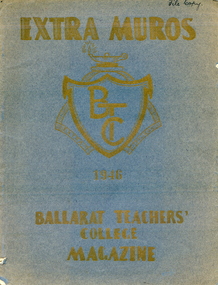 Federation University Historical Collection
Book, Ballarat Teachers' College, Ballarat Teachers College Extra Muros, 1946, 1946
... home, free of tyranny. For the achievement of this, they were prepared to die. It became characteristic that when things were at their worst, men were at their best. Discipline did not come from above on Gallipoli, for the men stuck their own standards of discipline, and stuck to them. ... After the 1914-18 war, it was surprising to find head teachers who did not know children of deceased and disabled soldiers in their schools. All teachers should acquaint themselves with this knowledge, and seek assistance from children who are eligible for help...home, free of tyranny. For the achievement of this, they were prepared to die. It became characteristic that when things were at their worst, men were at their best. Discipline did not come from above on Gallipoli, for the men stuck their own standards of discipline, and stuck to them. ... After the 1914-18 war, it was surprising to find head teachers who did not know children of deceased and disabled soldiers in their schools. All teachers should acquaint themselves with this knowledge, and seek assistance from children who are eligible for help ...Principal Frank Lord gave an ANZAC Day address called "Live Every Day as an Anzac Day". The address started with "Our opportunity is with the children. If we failed i nthe past, lest us begin again now. You are young, and let it be your resolve to live every day as an Anzac Day, and achieve some of the things for which the men of two wars have laid down their lives. Living your days with an air of kindness and decency, you will set an example to the children, and when a country's children are made happier and finer, it will follow that the county will be a happier and finer place." Mt Lord referred to theseven and a half months' occupation of Gallipoli, and the tenacious clinging by Anzac troops to their square mile of territory. Illness, disease and death came to the confined area, but there also came a spirit of self-sacrifice and charity, and a courage whoich scorrned death and won for the Australian troops world renown. Strong men broke under the conditions, but their comrades carried them on, and the prevailing spirit among men was that the had dedicated ther lives to ensuring a decent society at home, free of tyranny. For the achievement of this, they were prepared to die. It became characteristic that when things were at their worst, men were at their best. Discipline did not come from above on Gallipoli, for the men stuck their own standards of discipline, and stuck to them. ... After the 1914-18 war, it was surprising to find head teachers who did not know children of deceased and disabled soldiers in their schools. All teachers should acquaint themselves with this knowledge, and seek assistance from children who are eligible for help from the Repatriation Department. For those pupils who do not come withing the scope of Repatriation, teachers might secure the required help from the Teachers; R.S.L. sub-branch, the Carry-on Club, for from Government Scholarships. Blue soft covered magazine. Contents include: *Principal Frank Lord's Foreward * Rupert Brooke * Hostel Jottings * Looking Back * College photograph Images include: * Queenscliff Camp * Sport * ClubsCover 'File Copy' inside front cover (possibly by Monica Miller) 'With Compliments Ballarat Teachers' College. Xmas 1946'ballarat teachers college, monica miller, m fogarty, james parkinson, beatrix basterfield, patricia rea, nola stanway, valmai sprigg, valda sharp, queenscliffe, lonsdale, thea rowe, student hostel, student residence, wf lord, g kentish, don johnson, neville bunning, henry yeo, irene handley, betty smith, heather fraser, ron schneider, alma sunderland, pauline griffin, betty redford, robert eastcott, kathleen tobin, margaret mcintyre, jean somerville, ken andrews, frank lord -
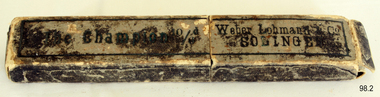 Flagstaff Hill Maritime Museum and Village
Domestic object - Razor, John Clarke Ltd, 1930s
... home at Augusta Place, Rock Street, Sheffield on 25 July 1873 (aged 68), he only employed six workmen. By 1881, Thomas had expanded this number to twenty. He sold a wide range of cutlery and was also an ‘emigration agent’, the Sheffield Independent, of 7th September in 1886 had an article published stating Thomas helped to recruit personnel from England for cutlery centers in America. ...home at Augusta Place, Rock Street, Sheffield on 25 July 1873 (aged 68), he only employed six workmen. By 1881, Thomas had expanded this number to twenty. He sold a wide range of cutlery and was also an ‘emigration agent’, the Sheffield Independent, of 7th September in 1886 had an article published stating Thomas helped to recruit personnel from England for cutlery centers in America. ...In 1848, 43-year-old John Clarke launched a cutlery business in Harvest Lane in Neepsend, Sheffield UK. Clarke entered the trade late in life he was indenture and apprenticed to Octavius Twigg, a razor maker. Clarke was granted his Freedom in 1856 and began using the trademark 'NEVA'. By the 1860s, Thomas Clarke's son by his wife Elizabeth had joined the firm. When John Clarke died at his home at Augusta Place, Rock Street, Sheffield on 25 July 1873 (aged 68), he only employed six workmen. By 1881, Thomas had expanded this number to twenty. He sold a wide range of cutlery and was also an ‘emigration agent’, the Sheffield Independent, of 7th September in 1886 had an article published stating Thomas helped to recruit personnel from England for cutlery centers in America. In 1893 Clarke’s showroom displayed miniature knives from '5/16ths-inch long to the most expensive sportsman's knives, that were gold and silver mounted. Table knives and carvers were also manufactured (or factored). Agencies were opened in London, New York, and Melbourne. Besides ‘NEVA, the ‘EXPRESS’ and ‘RING’ marks were used on razors; and Clarke’s marketed the American ‘GEM’ safety razor. By 1901, the firm had moved to Mowbray Street, where its Mowbray Works overlooked the River Don. Thomas Clarke died at Harrogate on 26 April 1902, aged 62, and was buried in the same Burngreave cemetery as his parents. Thomas’s sons, John Roome Clarke (1860-1925) and Thomas Edward Clarke, were directors, another son George William Clarke was a shareholder. John Roome Clarke died on 3 February 1925, aged 64 his son, John Clarke, of Crimicar Lane, remained as the senior partner. Clarke’s was one of the last producers of hand-made pocket knives and it also produced a large output of sheath knives for scouting associations. The firm was liquidated in 1964, but the company name was resurrected and Its last address after 1980 was at 65 Garden Street Sheffield. The company trademark passed on to Meteor Industries and then to Egginton Ltd. Weber & Co: The Clarke company purchased or (factored) many of its blades for razors and knives from Weber & Co of Solingen Germany. The full name of the firm originally was Jowika Stahlwarenfabrik Eugen Weber & Altenbach KG. It was founded in Solingen prior to 1928, under the name Johann & Wilhelm Kleinewefers GMBH, Messerfabrik. JWK for short, hence JoWiKa. The company was sold to Eugen Weber in the 1930s. Weber was married to a woman named Altenbach, from a family that manufactured innovative low-priced pocketknives, as well as other cutlery items. In 1960 Weber opened a branch factory in Listowel Ireland. It was sold to Albert M. Baer of Imperial Schrade in 1978. The Listowel factory was closed about a year and a half before the U.S. Schrade factory closed in 2004 and the Jowika factory in Solingen had closed in 1984.An item with an interesting manufacturing history from the 1930s showing how one man can grow a business into a successful concern that made quality products that stand the test of time.Razor metal folding blade with horn handle in its original cardboard box Inscription Made by John Clarke and Son England. "Champion" razor. On box " The Champion 10/6d" and "Weber Lohmann & Co SOLINGEN".flagstaff hill, warrnambool, shipwrecked-coast, flagstaff-hill, flagstaff-hill-maritime-museum, maritime-museum, shipwreck-coast, flagstaff-hill-maritime-village -
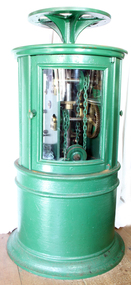 Flagstaff Hill Maritime Museum and Village
Machine - Dioptric Apparatus, mid 19th century
... The glowing lamp reminds sailors that security and home are well within reach, they also symbolize the way forward and help in navigating our way through rough waters not just on the oceans of the world but in our personal lives be it financial, personal, business or spiritual in nature. ...Before the introduction of electricity, lighthouses had a clockwork mechanism that caused the lens to rotate with a light source inside that was either powered by Kerosene or Colza oil. The mechanism consisted of a large weight attached by a cable through the centre of the lighthouse to the top where the cable wrapped around a barrel, drum or wheels that controlled the speed of the lights rotation by a clockwork mechanism. The keeper would crank the clockwork mechanism, which would lift the weight ready for the next cycle similar to an old grandfather clock mechanism. Once the weight lifted to its apex at the bottom of the first landing, the keeper would let it fall, which would pull on the cable, which would, in turn, operate a series of gears activating the rotation of the Fresnel optical lens, which would then rotate to create the lighthouse’s unique light speed of rotation characteristic. Creating a specific characteristic required a way to regulate the speed of the rotation, and was important as sailors could identify a particular light by its speed and time between flashes. The weight had to fall at a certain rate to create the proper rotation speed of the lens and a regulator within the mechanism accomplished this. History: From 1851, Chance Brothers became a major lighthouse engineering company, producing optical components, machinery, and other equipment for lighthouses around the world. James Timmins Chance pioneered placing lighthouse lamps inside a cage surrounded by Fresnel lenses to increase the available light output these cages, are known as optics and they revolutionised lighthouse design. Another important innovation from Chance Brothers was the introduction of rotating optics, allowing adjacent lighthouses to be distinguished from each other by the number of times per revolution the light flashes. The noted English physicist and engineer, John Hopkins invented this system while employed at Chance Brothers. Chance Brothers and Company was a glass works and originally based in Spon Lane, Smethwick, West Midlands England. The company became a leading glass manufacturer and a pioneer of British glass making technology. The Chance family originated in Bromsgrove as farmers and craftsmen before setting up a business in Smethwick near Birmingham in 1824. They took advantage of the skilled workers, canals and many other industrial advances taking place in the West Midlands at the time. Robert Lucas Chance (1782–1865), known as 'Lucas', bought the British Crown Glass Company's works in Spon Lane in 1824. The company specialised in making crown window glass, the company ran into difficulty and its survival was guaranteed in 1832 by investment from Chance's brother, William (1788 – 1856). William owned an iron factoring business in Great Charles Street, Birmingham. After a previous partnership that Lucas had dissolved in 1836, Lucas and William Chance became partners in the business which was renamed, Chance Brothers and Company. Chance Brothers invented many innovative processes and became known as the greatest glass manufacturer in Britain. In 1848 under the supervision of Georges Bontemps, a French glass maker from Choosy-le-Roi, a new plant was set up to manufacture crown and flint glass for lighthouse optics, telescopes and cameras. Bontemps agreed to share his processes that up to then had been secret with the Chance Brothers and stayed in England to collaborate with them for six years. In 1900 a baronetcy was created for James Timmins Chance (1814–1902), a grandson of William Chance, who had started the family business in 1771 with his brother Robert. Roberts grandson, James became head of Chance Brothers until his retirement in 1889 when the company became a public company and its name changed to Chance Brothers & Co. Ltd. Additional information: Lighthouses are equipped with unique light characteristic or flashing pattern that sailors can use to identify specific lighthouses during the night. Lighthouses can achieve distinctive light characteristics in a few different ways. A lighthouse can flash, which is when brief periods of light interrupt longer moments of darkness. The light can occult, which is when brief periods of darkness interrupt longer moments of light. The light can be fixed, which is when the light never goes dark. A lighthouse can use a combination of flashing, oscillating, or being fixed in a variety of combinations and intervals to create individual light characteristics. It is a common misconception that a lighthouse's light source changes the intensity to create a light characteristic. The light source remains constant and the rotating Fresnel lens creates the various changes in appearance. Some Fresnel lenses have "bulls-eye" panels create beams of light that, when rotated between the light and the observer, make the light appear to flash. Conversely, some lenses have metal panels that, when rotated between the light and the observer, make the light appear to go dark. This Dioptric clockwork apparatus used to turn a lighthouse optical lens is very significant as it is integral to a lighthouses operation, we can also look at the social aspect of lighthouses as being traditionally rich with symbolism and conceptual meanings. Lighthouses illustrate social concepts such as danger, risk, adversity, challenge and vigilance but they also offers guidance, salvation and safety. The glowing lamp reminds sailors that security and home are well within reach, they also symbolize the way forward and help in navigating our way through rough waters not just on the oceans of the world but in our personal lives be it financial, personal, business or spiritual in nature. Nothing else speaks of safety and security in the face of adversity and challenge quite the way a lighthouse does. Revolving dioptric clockwork apparatus used to turn a Fresnel optical lighthouse lens. A cylindrical cast metal pillar and cabinet painted green with 3 glass doors enclosing the top section. Inside the pillar/cabinet is a large clockwork mechanism used to turn and regulate a lighthouse light by means of weights and a chain attached to same. One door has the name "Adams Mare" in metallic dots similar to "Braille" to the inside edge of door frame.shipwrecked-coast, flagstaff-hill, flagstaff-hill-maritime-museum, flagstaff hill, maritime-museum, shipwreck-coast, warrnambool, flagstaff-hill-maritime-village, revolving dioptric mechanism, dioptric mechanism for lighthouse, lighthouse clockwork timing mechanism, acetylene lighthouse light mechanism, 19th century lighthouse mechanism, kerosene light, fresnel lenses, colza oil, chance brothers -
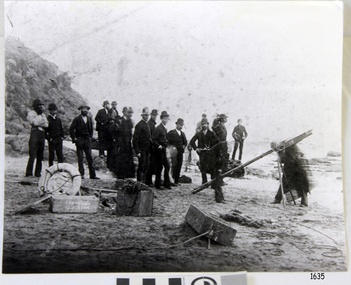 Flagstaff Hill Maritime Museum and Village
Photograph - Shipwreck rescue, c. 1890's
... help didn’t get through on time. The boat that was notified of the wreck failed to reach it in time. Much cargo looting occurred. One looter was caught with a small load of red and white rubber balls. Essence of peppermint mysteriously turned up in many settlers' homes...help didn’t get through on time. The boat that was notified of the wreck failed to reach it in time. Much cargo looting occurred. One looter was caught with a small load of red and white rubber balls. Essence of peppermint mysteriously turned up in many settlers' homes ...CONTEXT – UPDATED The photograph taken on Sunday, September 6, 1891, shows the Port Campbell Rocket Rescue Crew and Equipment at Wreck Beach, Moonlight Head, preparing to save the stranded men on the wreck of the barque Fiji. The man standing in the middle, front of the photograph, facing the ocean, is Herbert Maxwell Morris, a farmer at Barruppa near Princetown, who is also a member of the Rocket Rescue Crew. The Rocket Rescue lifesaving method used an explosive rocket to shoot a light line from the shore across to the distressed vessel. The line was then secured to the ship’s mast, and a heavy, continuous line was sent out with a ‘breaches buoy’ attached (a buoy similar to the seat of a pair of trousers). The stranded seafarers would sit in the seats and be pulled along the line to safety. A lot of skill was needed to set up the line to reach its target, and the crew trained regularly to keep up their skills. The FIJI and the RESCUE: - The three-masted iron barque Fiji was built at Belfast, Ireland, in 1875 by Harland and Wolfe for a Liverpool-based shipping company. The ship departed Hamburg on May 22, 1891, bound for Melbourne under the command of Captain William Vickers with a crew of 25. The Cape Otway light was sighted on September 5, 1891. However, the bearing was different from Captain Vickers’ calculations. At about 2:30 am the next morning, the land was reported only 4-5 miles away. The captain tried to redirect the ship in the rough weather without success, and the Fiji struck rock only 300 yards (274 metres) from shore. The crew burned blue lights and fired rockets to signal distress. The lifeboats either capsized or were swamped and smashed to pieces. Two younger crewmen volunteered to swim to the shore with a line. One, a Russian named Daniel Carkland, drowned after he was swept away when the line broke. The other, Julius Gebauhr, a 17-year-old German able seaman, reached shore safely on his second attempt but had cut the line loose with his sheath-knife when it tangled in kelp. He climbed the cliffs in search of help. Later that morning, a young man named William (Willie) Ward reported that he saw the wreck of the ship close to shore near Moonlight Head from the cliffs, and the alarm for help was sent to Princetown, six miles away. At around the same time, a Mott’s party of land selectors, including F. J. Stansmore and Leslie Dickson, was travelling on horseback from Princetown towards Moonlight Head. They were near Ryans Den when they found Gebauhr in the scrub, bleeding and dressed only in a singlet, socks and a belt with his sheath-knife. They thought the man might be an escaped lunatic, due to his wild and shaggy-looking state and what seemed to be gibberish speech. After Gebauhr threw his knife away, they realised that he was speaking half-English, half-German as he talked about the wreck. They gave him food, brandy and clothing, and he was taken to a nearby guest house, Rivernook, owned by John Evans, where he was cared for. Most of the party went off to the wreck site. Stanmore and Dickson rode for help from both Port Campbell, for the two Rocket Rescue Crew buggies, and from Warrnambool, for the lifeboat. The vessel S.S. Casino sailed from Portland towards the scene. Half of the Port Campbell Rocket Crew and equipment arrived after a 25-mile journey and set up the rocket tripod on the beach below the cliffs. By this time, the weary crew of the Fiji had been clinging to the jib-boom for almost 15 hours, calling frantically for help. The Office in Charge of the Rocket Crew, W. Tregear, ordered the rocket to be fired, but the light line broke and the rocket was carried away. A second line was successfully set up by Herbert Morris. It crossed the ship and was secured. The anxious sailors tried to come ashore along the line, but some were washed off as the line sagged with too many on it at one time. Other nearly exhausted crewmen made their way through masses of seaweed and were often smothered by waves. Only 14 of the 24 who had remained on the ship made it to shore. Rocket Crew members and onlookers on the beach took turns to go into the surf and drag the half-drowned seamen to safety. These rescuers included Bill (William James) Robe, Herbert Maxwell Morris, Edwin Vinge, Hugh Cameron, Fenelon Mott, Arthur Wilkinson and Peter Carmody, who was also involved in the rescue of men from the Newfield. Arthur Wilkinson, a 29-year-old land selector from Geelong, swam out to help one of the ship’s crewmen, a carpenter named John Plunken, who was trying to swim from the ship to the shore. Two or three times, both men almost reached the shore but were washed back to the wreck, where they were both hauled back on board. Wilkinson was unconscious, possibly from hitting his head on the anchor before they were brought up. Plunken survived, but Wilkinson later died, and his body washed up the next day. The 26-year-old Bill Robe hauled out the last man; it was the captain, and he’d been tangled in the kelp. Only 20 minutes later, the wreck of the Fiji was smashed apart, and it settled in about 6 metres of water. Of the 26 men on the Fiji, 11 in total lost their lives. The remains of 7 bodies were washed onto the beach. Their coffins were made from timbers from the wrecked Fiji, and they were buried on the cliff top above the wreck. The survivors were taken to Rivernook and cared for over the next few days. Funds were raised by locals soon after the wreck in aid of the sufferers of the Fiji disaster. Captain Vickers was severely reprimanded for his mishandling of the ship. His Master's Certificate was suspended for 12 months. There was public criticism of the rescue. The important canvas ‘breeches buoy’ and heavy line for the Rocket Rescue were in the half of the rocket outfit that didn’t make it in time for the rescue, as they had been delayed at the Gellibrand River ferry. The communications to Warrnambool were down, so the call for help didn’t get through on time. The boat that was notified of the wreck failed to reach it in time. Much cargo looting occurred. One looter was caught with a small load of red and white rubber balls. Essence of peppermint mysteriously turned up in many settlers' homes. Sailcloth was salvaged and used for horse rugs and tent flies. Soon after the wreck, “Fiji tobacco” was advertised around Victoria. A Customs officer, trying to prevent some of the looting, was assaulted by looters and thrown over a cliff. He managed to cling to a bush lower down until rescued. In 1894, some coiled fencing wire was salvaged from the wreck. Hundreds of coils are still strewn over the site of the wreck, encrusted and solidified. The hull is broken, but the vessel’s iron ribs can be seen along with some of the cargo of concrete and pig iron. Captain Vickers presented Bill Robe with his silver-cased pocket watch, the only possession that he still had, as a token for having saved his life and the lives of some of the crew. Years later, Bill used the pocket watch to pay a debt, and it was handed down through that family. Seaman Julius Gebauhr later gave his knife, in its handcrafted leather sheath, to F. J. Stansmore for caring for him when he came ashore. The knife handle had a personal inscription on it. A marble headstone on the cliffs overlooking Wreck Beach pays tribute to the men who lost their lives when Fiji ran aground. The scene of the wreck is marked by the anchor from the Fiji, erected by Warrnambool skin divers in 1967. Captain Vickers’ pocket watch and Julius Gebauhr’s sheath knife are among the artefacts salvaged from the Fiji that are now part of the Fiji collection at Flagstaff Hill Maritime Village. The man identified in the photograph, Herbert Maxwell Morris, was the nephew of the Victorian era artist, William Morris. Herbert had sailed from England to Australia; he was about 25 years old when he joined the Rocket Rescue Crew at Port Campbell, where he lived. His successful rocket line firing at the Fiji wreck site was noted by author Jack Loney in one of his historic shipwreck books. Later, Morris moved from his property at Baruppa to Laver’s Hill to run a more profitable enterprise. This photograph is significant as an image of a historical event, being the willingness of local volunteers to aid in the saving of lives of stranded seafarers. It gives a clear picture of the use of Rocket Rescue Equipment in shore-to-ship rescues. Flagstaff Hill’s Fiji collection is of historical significance at a State level because of its association with the wreck Fiji, which is on the Victorian Heritage Register VHR S259. The Fiji is archaeologically significant as the wreck of a typical 19th century international sailing ship with cargo. It is educationally and recreationally significant as one of Victoria's most spectacular historic shipwreck dive sites with structural features and remains of the cargo evident. It also represents aspects of Victoria’s shipping history and its potential to interpret sub-theme 1.5 of Victoria’s Framework of Historical Themes. The Fiji collection meets the following criteria for assessment; Importance to the course, or pattern, of Victoria’s cultural history, possession of uncommon, rare or endangered aspects of Victoria’s cultural history, and potential to yield information that will contribute to an understanding of Victoria’s cultural history. Black and white photograph of the Rocket Rescue Crew from Pt Campbell on Wreck Beach, Moonlight Head, at the barque 'Fiji' wreck site. September 6, 1891.warrnambool, shipwrecked coast, flagstaff hill, flagstaff hill maritime museum, maritime museum, shipwreck coast, flagstaff hill maritime village, shipwrecked artefact, pocket watch, fob watch fiji, william vickers, william robe, bill robe, gebauhr, stansmore, carmody, wreck bay, moonlight head, fiji shipwreck 1891, rocket crew, port campbell rocket crew, lifesaving crew, photograph of rocket crew, herbert morris, warrnambool, shipwreck artefact, mott, william ward, rocket rescue, breeches buoy, rivernook guest house -
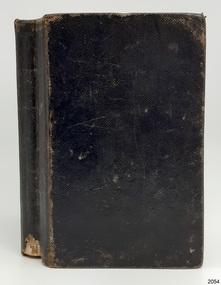 Flagstaff Hill Maritime Museum and Village
Book - Religious Book, Oxford University Press, The Holy Bible, 1859
... home. Many also hoped to find work in this new country. Some passengers had family and friends waiting for them, people who deposited money towards their trip. Henry’s relative, Charles Pitts, had helped...home. Many also hoped to find work in this new country. Some passengers had family and friends waiting for them, people who deposited money towards their trip. Henry’s relative, Charles Pitts, had helped ...Young Henry Pitts sailed from Liverpool, England, in about October 1860, on a ship called the 'British Trident'. About three months later, on January 7th 1861, he arrived in Sydney, Australia. While he travelled from one side of the world to the other, Henry attended lessons on the ship with his onboard teacher, Joseph Benton. On the day before the ship arrived at Sydney, Henry was given a Holy Bible by his teacher. The small black book had a hardcover and many printed pages of very thin paper. Henry must have felt special when he read his teacher’s beautifully written message that said the gift was a ‘mark of respect’ towards Henry. Maybe Mr Benton taught Henry to write with a pen and ink because Henry wrote his name several times inside the front of the book and again below his teacher’s message. Henry may have even learned to read from a Bible, which many passengers included in their luggage. The immigrants on board the British Trident were mostly new arrivals to Australia. Like Henry, they planned to make Australia their new home. Many also hoped to find work in this new country. Some passengers had family and friends waiting for them, people who deposited money towards their trip. Henry’s relative, Charles Pitts, had helped him pay for the ship’s passage, and William Oberthan paid money towards Joseph Benton’s fare. He may have planned for Joseph to work as a teacher in Australia. The Single Females were allowed to leave the ship the day after it docked at Sydney, but the Families and Single Men, including Henry and Joseph, had to stay onboard until Thursday. This Holy Bible is significant for its age, as it was published in 1859. The inscriptions within this small Bible are significant as they show that during a ship's voyage passengers had the opportunity to teach and to learn. They also show a relationship of encouragement had been built between the teacher and pupil. The Holy Bible containing the Old and New Testaments: Translated out of the original tongues: and with the former translations diligently compared and revised by His Majesty's Special Command. approved to be read in churches. Publisher and printed at the Oxford University Press, Sold by E. Gardner and Son, at the Oxford Bible Warehouse, Paternoster Row, London; and by J. and C. Mozley, Derby. Date: 1859 (in Roman Numerals) Handwritten black ink inscriptions are inside the front and back covers. The book once belonged to Henry Pitts and was presented to him by Joseph Benton in 1861.Front left side: " H Pitts H Pitts / - - - - - - of this Book / C - - - - - - - - -K " Front right side: "Given / to / Henry Pitts / As / A Mark of Respect / From / His Teacher on Board / the / British Trident / January 6th 1861 / Joseph Benton" "Henry" Back left: (indecipherable character)warrnambool, flagstaff hill maritime museum, holy bible, henry pitts, joseph benton, immigrant ship, 1861, single male, single female, charles pitts, william oberthan, british trident, hyde partk -
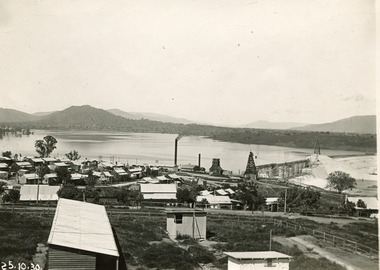 The Beechworth Burke Museum
Photograph, 25 October 1930
... home in 1825, but returned to the area in 1826 and discovered coal in the area. This photo is historically significant as it shows the Hume Dam under construction in 1930. The Dam was named after Hamilton Hume, who is an important historical figure for this area as he helped discover the area where resources were found. construction houses veterans Mitta Junction Village Hume Dam World War I Federation Wodonga Archaeological survey excavation Austral Archaeology Department of Land & Water Conservation Camp Ganger's Quarter's Stableman's Quarters Industrial Dump artefacts Mitta Mitta Mount Welcome Mount Misery Murray River Hamilton Hume William Hilton Hovell Hume and Hovell expedition Reverse: 1997.3145/ 84-20-2 Black and white rectangular photograph printer unmounted Photograph Photograph ...Taken on 25 October 1930, various houses with the Hume Dam under construction are depicted in the background. The construction of the Hume Dam took place from 1919 to 1936. At the time of construction, it was the second largest dam in the world. It was also one of the earliest civil projects developed after the Federation. Some of the Dam workers consisted of World War I veterans. Dam workers often settled their families in Mitta Junction Village and Wodonga. Archaeological surveys were completed by Austral Archaeology, which was done when the Department of Land & Water Conservation was doing work to improve Hume Dam. The archaeological report that came out of the survey recommended three sites of interest where archaeological excavation should be done: Camp Ganger’s Quarters, Stableman’s Quarters, and the Industrial Dump. The excavation uncovered artefacts. Mitta Mitta: Mitta Mitta is situated between Mount Welcome and Mount Misery. It is named after the river that explorers Hume and Hovell discovered in 1824. The town would eventually become a huge gold mining town. Mitta Mitta is called Midamodunga by the local Indigenous peoples Wodonga: Wodonga is situated on the Murray River and is part of North East Victoria. Hume and Hovell: Hamilton Hume (1979-1873) and William Hilton Hovell (1786-1875). W. H. Hovell was born in Norfolk England and Hume was born in Parramatta, New South Wales Hovell and Hume undertook an exploration journey in 1824 and thought they discovered a river, which turned out to be the Murray River. They returned home in 1825, but returned to the area in 1826 and discovered coal in the area. This photo is historically significant as it shows the Hume Dam under construction in 1930. The Dam was named after Hamilton Hume, who is an important historical figure for this area as he helped discover the area where resources were found. Black and white rectangular photograph printer unmountedReverse: 1997.3145/ 84-20-2construction, houses, veterans, mitta junction village, hume dam, world war i, federation, wodonga, archaeological survey, excavation, austral archaeology, department of land & water conservation, camp ganger's quarter's, stableman's quarters, industrial dump, artefacts, mitta mitta, mount welcome, mount misery, murray river, hamilton hume, william hilton hovell, hume and hovell expedition -
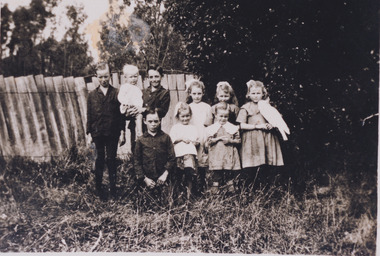 The Beechworth Burke Museum
Audio - Oral History, Jennifer Williams, Evelyn Jensen, 13th April 2000
... help Miss Jensen. Miss Jensen and her family lived a very long way from the main town and often had to carry kerosene tins full of water half a mile to their house. This was because they have no access to water at their home...help Miss Jensen. Miss Jensen and her family lived a very long way from the main town and often had to carry kerosene tins full of water half a mile to their house. This was because they have no access to water at their home ...Miss Evelyn Jensen was born in 1908 near Mytleford Road in Beechworth. Miss Jensen was a twin but she also had twelve brothers and sisters. Miss Jensen went to school when she was nine years old but did not enjoy it. Her father was a nozzleman and had a role in finding and collecting gold. More specifically, a nozzleman operated a steel barrel with an interchangeable brass nozzle that sprayed high pressure water onto rock and similar surfaces. This broke down the surface for gold to be found. Unfortunately, when he began most of the gold was already gone. Miss Jensen's mother died when Miss Jensen was sixteen. As a result, Miss Jensen had to take care of the children and run the house. This included looking after a few months old baby. Her father was away at work most days so all of the responsibility fell on her. Her grandmother was present but she was too old to help Miss Jensen. Miss Jensen and her family lived a very long way from the main town and often had to carry kerosene tins full of water half a mile to their house. This was because they have no access to water at their home. This lack of water also meant they had to either bathe in the creek or carry the water back home for a bath. On wash day, they washed their clothes in the creek too. Miss Jensen never married but continued to provide for her family. She spent her days gardening and cooking. They did not have much money so gardening was a way that they provided food for themselves. This oral history recording was part of a project conducted by Jennifer Williams in the year 2000 to capture the everyday life and struggles in Beechworth during the twentieth century. This project involved recording seventy oral histories on cassette tapes of local Beechworth residents which were then published in a book titled: Listen to what they say: voices of twentieth century Beechworth. These cassette tapes were digitised in July 2021 with funds made available by the Friends of the Burke.Miss Jensen's oral history is significant because it demonstrates the struggles of living remotely during this early part of the twentieth century. When Miss Jensen's mother died, she had to take on a lot of responsibility and did not have much support. This history sheds light on these struggles of being a young caregiver but it also gives details on how large families lived in isolated places. An example of this is the way that Miss Jensen often had to do the washing in the creek because that was the only place there was running water. In addition, Miss Jensen's story is significant because her father was a nozzleman. It indicates one of the processes was used to find gold. This oral history account is socially and historically significant as it is a part of a broader collection of interviews conducted by Jennifer Williams which were published in the book 'Listen to what they say: voices of twentieth-century Beechworth.' While the township of Beechworth is known for its history as a gold rush town, these accounts provide a unique insight into the day-to-day life of the town's residents during the 20th century, many of which will have now been lost if they had not been preserved.This is a digital copy of a recording that was originally captured on a cassette tape. The cassette tape is black with a horizontal white strip and is currently stored in a clear flat plastic rectangular container. It holds up 40 minutes of recordings on each sideEvelyn Jensen /mytleford road, beechworth, three mile creek, three mile beechworth, twin, nozzleman, goldrush, gold rush, work, mother, young mother, children, siblings, baby, grandmother, father, isolation, bush, water, watertanks, kerosene tins, wash day, bath day, creek, gardening, provide, poor, money, oral history, twentieth century, recording, story -
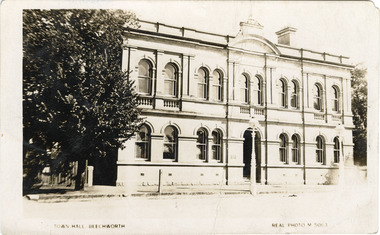 The Beechworth Burke Museum
Photograph - Postcard, Town Hall Beechworth, c1910
... The Town Hall is now home to the Visitor Information Centre which helps visitors with amongst other things, accommodation, tours, event enquiries, and is the commencement point for Precinct walking tours. ...The Town Hall is now home to the Visitor Information Centre which helps visitors with amongst other things, accommodation, tours, event enquiries, and is the commencement point for Precinct walking tours. ...Beechworth Town Hall was designed by architects J.J. Coe and Thomas Dalziel and is dated to 1859. The building was made of granite and constructed to local builders Donald and William Fiddes. The original front to the building was replaced by a two story facade in 1889 designed by George Jobbins and built by Thomas Sandham according to a plaque on the front. The Town Hall is remarkable for its vaulted ceilings and columns. Originally the building was used as the Shire Offices but also doubled as a fire station and a courthouse, with still surviving cells underneath. Among the inmates was notorious bushranger Harry Power who was originally transported to Van Dieman’s Land for stealing a pair of shoes. He gained his freedom six years later but spent time in and out of gaol for the rest of his life for a variety of offences including a number of armed robberies. The Town Hall is now home to the Visitor Information Centre which helps visitors with amongst other things, accommodation, tours, event enquiries, and is the commencement point for Precinct walking tours. The Beechworth Town Hall is one of five distinctive granite buildings on Ford Street that comprise the Justice Precinct. It is of considerable historical significance as activity on the site dates from Australia’s gold rush period and was the administrative centre for north-eastern Victoria. The building has seen continual use from 1858 as an important public building and displays many aspects of the history of law enforcement in Victoria. The building is also of substantial architectural significance for its construction from local honey coloured granite, which also showcases early stone masonry techniques and craftsmanship. The Precinct is listed on the Victorian Heritage register and is protected by Heritage Victoria under the Victorian Heritage Act 2017. The buildings are also registered by the National Estate, the National Trust and protected by Indigo Shire Council’s Planning Scheme. Black and White rectangular postcard printed on cardReverse: 1906-1910?beechworth, beechworth town hall, town hall, jj coe, thomas dalziel, granite, beechworth historic building, courthouse, cells, geoge jobbins, thomas sandham, 1859, 1889, walking tours, beechworth historic precinct, historic precinct, harry power, bushranger, australian bushrangers, van dieman's land, transportation, armed robberies -
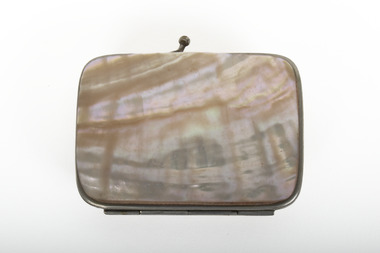 The Beechworth Burke Museum
Functional object - Ladies Coin Purse
... The Australian War Memorial notes on their website that many tokens made from mother of pearl were sent home to loved ones throughout World Wars One and Two from the Middle East, England, the South West Pacific, Australia and elsewhere, but that unfortunately provenance such as the manufacture and sale of many of these items is not recorded. The social history objects held in the Burke Museum's collection help ...Specific historical and contextual information pertaining to this object is unknown. There are no hallmarks or documentation to indicate provenance or historical significance. This coin purse appears to have a covering made of mother of pearl. Evidence of interest from over 20,000 years ago mark Aboriginal groups in Australia as some of the first people to value the power and beauty of pearlshell, while evidence of Australian pearlshell being taken across the sea to other countries dates back as early as the 1500s. The 1850s-60s saw the beginnings of the Australian pearling industry. Following the popularisation of plastic for items such as buttons the pearlshell market waned in the mid-twentieth century but was soon after began to re-forge in Australia with a new industry of cultured pearl farms. Most of Australian's pearling industry was initially located in Western Australia and off the Torres Strait Islands. The Australian War Memorial notes on their website that many tokens made from mother of pearl were sent home to loved ones throughout World Wars One and Two from the Middle East, England, the South West Pacific, Australia and elsewhere, but that unfortunately provenance such as the manufacture and sale of many of these items is not recorded.The social history objects held in the Burke Museum's collection help to tell the stories of Beechworth's past by showing the social, cultural, and economic aspects of the town's history.A small rectangular purse with silver edging and half clasp, covered in white and cream coloured shell (mother of pearl?)A01154burke museum, social history, accessories, mother of pearl, nacre, australian industry -
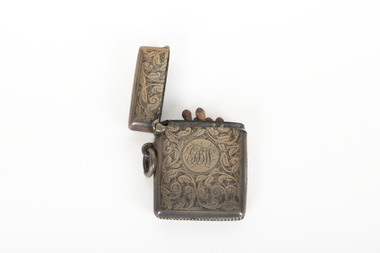 The Beechworth Burke Museum
Functional object - Vesta Case, Unknown
... home. The Swan company began production of short matches, mostly useful for lighting pipes and cigarettes due to their deliberately short length. Due to their small size it became convenient to carry these Vestas within a Vesta Case kept somewhere on the person, large enough to contain enough matches for a days use. The cases prevented their contents from becoming damaged and damp while also stopping them from accidentally striking if held loose in a pocket. This example of a Vesta case is particularly ornate. The social history objects held in the Burke Museum's collection help ...This detailed example of a match holding Vesta was owned by someone with the initials GBW but is otherwise difficult to identify ownership. Vestas are the historical name for what are now known as matches. They were named for the Roman goddess Vesta whose domain was the hearth and home. The Swan company began production of short matches, mostly useful for lighting pipes and cigarettes due to their deliberately short length. Due to their small size it became convenient to carry these Vestas within a Vesta Case kept somewhere on the person, large enough to contain enough matches for a days use. The cases prevented their contents from becoming damaged and damp while also stopping them from accidentally striking if held loose in a pocket. This example of a Vesta case is particularly ornate.The social history objects held in the Burke Museum's collection help to tell the stories of Beechworth's past by showing the social, cultural, and economic aspects of the town's history.A decorative silver coloured vesta or match book. It has detailed engraving across the obverse and reverse sides with delicate scrollwork and a monogram set in a circular setting in the centre. The vesta has a hinged top and side loop to allow for attachment.GBW/ A01171/burke museum, vesta case, vesta, matches, silver, social history, luxury -
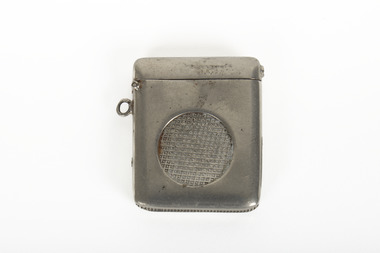 The Beechworth Burke Museum
Functional object - Vesta Case, Unknown
... home. The Swan company began production of short matches, mostly useful for lighting pipes and cigarettes due to their deliberately short length. Due to their small size it became convenient to carry these Vestas within a Vesta Case kept somewhere on the person, large enough to contain enough matches for a days use. The cases prevented their contents from becoming damaged and damp while also stopping them from accidentally striking if held loose in a pocket. This is a simple example of a Vesta Case. The social history objects held in the Burke Museum's collection help ...Vestas are the historical name for what are now known as matches. They were named for the Roman goddess Vesta whose domain was the hearth and home. The Swan company began production of short matches, mostly useful for lighting pipes and cigarettes due to their deliberately short length. Due to their small size it became convenient to carry these Vestas within a Vesta Case kept somewhere on the person, large enough to contain enough matches for a days use. The cases prevented their contents from becoming damaged and damp while also stopping them from accidentally striking if held loose in a pocket. This is a simple example of a Vesta Case.The social history objects held in the Burke Museum's collection help to tell the stories of Beechworth's past by showing the social, cultural, and economic aspects of the town's history.A decorative silver coloured vesta or match book. It has a raised crosshatch pattern in a circular pattern on the obverse side. The vesta has a hinged top and side loop to allow for attachment.A01199/burke museum, vesta case, vesta, matches, silver, social history -
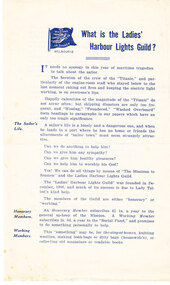 Mission to Seafarers Victoria
Flyer, What is the Ladies' Harbour Lights Guild?, c. 1912
... home, for visiting seamen. The flyer was to recruit members. The flyer mentions the sinking of the Titanic in 1912 and the bravery of the seamen staying in the engine room. The flyer mentions also Lady Talbot Margaret Jane nee Stuart-Wortley (1855-1937), wife of Governor Reginald Taldot, actively promoted advanced social welfare projects. This paper flyer holds historical significance at a local level because it illustrates the Ladies' Harbour Lights Guild involvement in the Mission to Seafarers.The Ladies' Harbour Lights Guild formally named in 1907 grew to become a significant charity in Melbourne raising large amounts of money which helped to establish the current MTSV building, supporting seafarers. ...Charity organisation, Ladies' Harbour Lights Guild,was formed within The Missions to Seamen Institute to provide a home away from home, for visiting seamen. The flyer was to recruit members. The flyer mentions the sinking of the Titanic in 1912 and the bravery of the seamen staying in the engine room. The flyer mentions also Lady Talbot Margaret Jane nee Stuart-Wortley (1855-1937), wife of Governor Reginald Taldot, actively promoted advanced social welfare projects.This paper flyer holds historical significance at a local level because it illustrates the Ladies' Harbour Lights Guild involvement in the Mission to Seafarers.The Ladies' Harbour Lights Guild formally named in 1907 grew to become a significant charity in Melbourne raising large amounts of money which helped to establish the current MTSV building, supporting seafarers. In 1960s the LHLG merged with the Flying Angels Club of the MTSV.A cream colour paper flyer describing in blue ink the work and value of membership of The Ladies' Harbour Lights Guild, in order to recruit new members. Also includes a photocopy of the flyer. (2 copies)The photocopy of the original has written in blue "1912". ladies' harbour lights guild, australian wharf, chapel, ephemera, titanic, 1912, lhlg, mission to seamen, seamens' mission, mission to seafarers, alice sibthorpe tracy, reverend alfred gurney goldsmith, philanthropy, charity, welfare, sailors, tragedy, heroism, honorary members, working members, norwegian, foreign language, pit, card game, animal grab, le jeu des animaux, margaret jane (née stuart-wortley), lady talbot, lady margaret jane talbot (nee stuart-wortley), ethel augusta godfrey 1861-1935, knitting, woolies -
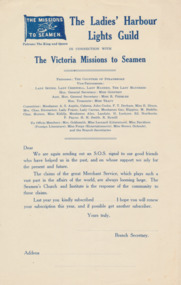 Mission to Seafarers Victoria
Flyer - Subscription, Mission to Seamen Institute, The Ladies' Harbour Lights Guild in Connection with The Victoria Mission to Seamen, 1921-1926
... home, for visiting seamen. The flyer was to recruit new members or for former Members of the charity to renew their subscription. The patroness was always the governor's wife: here the Countess of Stradbroke whose husband, the Earl of Stradbroke was governor of Victoria between 1921 to 1926. This paper flyer holds historical significance at a local level because it illustrates the Ladies' Harbour Lights Guild involvement in the Mission to Seafarers.The Ladies' Harbour Lights Guild grew to become a significant charity in Melbourne raising large amounts of money which helped to establish the current MTS building, supporting seafarers. missions to seamen institute ladies' harbour lights guild australian wharf lhlg subscriptions countess of stradbroke patroness lady irvine lady creswell lady madden the lady mayoress ethel augusta godfrey 1861-1935 miss b. peebles alice sibthorpe tracy Cream colour paper flyer's in blue ink that are also subscription forms in order to become Honorary Members/Working/School Members or renewals of previous Membership of the Ladies' Harbour Lights Guild. (9 copies) The Ladies' Harbour Lights Guild in Connection with The Victoria Mission to Seamen Flyer Subscription Mission to Seamen Institute ...The charity organisation, Ladies' Harbour Lights Guild, was formed within the Missions to Seamen Institute to provide a home away from home, for visiting seamen. The flyer was to recruit new members or for former Members of the charity to renew their subscription. The patroness was always the governor's wife: here the Countess of Stradbroke whose husband, the Earl of Stradbroke was governor of Victoria between 1921 to 1926.This paper flyer holds historical significance at a local level because it illustrates the Ladies' Harbour Lights Guild involvement in the Mission to Seafarers.The Ladies' Harbour Lights Guild grew to become a significant charity in Melbourne raising large amounts of money which helped to establish the current MTS building, supporting seafarers.Cream colour paper flyer's in blue ink that are also subscription forms in order to become Honorary Members/Working/School Members or renewals of previous Membership of the Ladies' Harbour Lights Guild. (9 copies)missions to seamen institute, ladies' harbour lights guild, australian wharf, lhlg, subscriptions, countess of stradbroke, patroness, lady irvine, lady creswell, lady madden, the lady mayoress, ethel augusta godfrey 1861-1935, miss b. peebles, alice sibthorpe tracy -
Mission to Seafarers Victoria
Flyer, The Victoria Missions to Seamen (being the Victorian Seamen's Mission and the Melbourne to Seamen amalgamated), c. 1920
... home, for visiting seamen. The flyer invited seafarers to use the institutes for 'Reading, Smoking and Writing and Special Events such as 'Sacred Song Service' and Concerts. This paper flyer holds historical significance at a local level because it illustrates the events and services that seafarers were invited to use and attend organized by the Mission to Seafarers.The Ladies' Harbour Lights Guild grew to become a significant charity in Melbourne raising large amounts of money which helped to establish the current MTS building, supporting seafarers as well as attending social events such as the ones promoted in the flyer. missions to seamen institute williamstown port melbourne special events ladies' harbour lights guild australian-wharf lhlg flinders street seafarers seamen sailors reading smoking writing religious services mission to seamen seamen's institute mission to seafarers Written in Black ink on the back: "The crues of the Cashelot" (?) ...Charity organisation, Ladies' Harbour Lights Guild,was formed within The Missions to Seamen Institute to provide a home away from home, for visiting seamen. The flyer invited seafarers to use the institutes for 'Reading, Smoking and Writing and Special Events such as 'Sacred Song Service' and Concerts. This paper flyer holds historical significance at a local level because it illustrates the events and services that seafarers were invited to use and attend organized by the Mission to Seafarers.The Ladies' Harbour Lights Guild grew to become a significant charity in Melbourne raising large amounts of money which helped to establish the current MTS building, supporting seafarers as well as attending social events such as the ones promoted in the flyer. Paper Flyer in blue ink inviting seafarers to use the institutes for 'Reading, Smoking and Writing ;. Also invites them to Special events including dates venues for Socials, 'Sacred Song Services' and Concerts. Written in Black ink on the back: "The crues of the Cashelot" (?)missions to seamen institute, williamstown, port melbourne, special events, ladies' harbour lights guild, australian-wharf, lhlg, flinders street, seafarers, seamen, sailors, reading, smoking, writing, religious services, mission to seamen, seamen's institute, mission to seafarers -
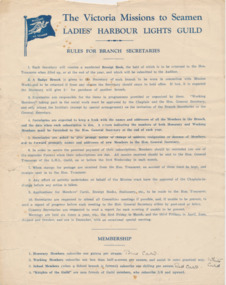 Mission to Seafarers Victoria
Document - Rules, Mission to Seamen, Rules for Branch Secretaries, c. 1915
... home, for visiting seamen. This paper illustrates the rules for branch secretaries as well as the membership types at the bottom. This paper holds historical significance at a local level because it illustrates the Ladies' Harbour Lights' Guild organization and membership types that were essential to for the success of the charity. The Ladies' Harbour Lights Guild grew to become a significant charity in Melbourne raising large amounts of money which helped ...Charity organisation, Ladies' Harbour Lights Guild, was formed within The Missions to Seamen Institute to provide a home away from home, for visiting seamen. This paper illustrates the rules for branch secretaries as well as the membership types at the bottom. This paper holds historical significance at a local level because it illustrates the Ladies' Harbour Lights' Guild organization and membership types that were essential to for the success of the charity. The Ladies' Harbour Lights Guild grew to become a significant charity in Melbourne raising large amounts of money which helped to establish the current MTS building, supporting seafarers as well as attending social events.Cream colour document with typed text in blue ink about the rules for Branch secretaries and written inscriptionWritten in black ink 'Blue card' next to '1. Honorary Members' and 'White card' next to '2. Working Members' and 'Red card' next to '3. School Members'. missions to seamen institute, williamstown, port melbourne, ladies' harbour lights guild, lhlg, branches, rules, secretaries, seamen's mission, mission to seafarers, flinders street, australian wharf, honorary members, working members, school members, knights of the guild -
 Mission to Seafarers Victoria
Card - Membership card, School branches, Missions to Seamen Institute, c. 1915
... home, for visiting seamen. These cards illustrate the rules for different type of Members and the suggested Intercession. These cards hold historical significance at a local level because it illustrates the membership types of the Ladies' Harbour Lights' Guild organization and how each member (according to membership) contributed to charity. The Ladies' Harbour Lights Guild grew to become a significant charity in Melbourne raising large amounts of money which helped ...Charity organisation, Ladies' Harbour Lights Guild, was formed within The Missions to Seamen Institute to provide a home away from home, for visiting seamen. These cards illustrate the rules for different type of Members and the suggested Intercession. These cards hold historical significance at a local level because it illustrates the membership types of the Ladies' Harbour Lights' Guild organization and how each member (according to membership) contributed to charity. The Ladies' Harbour Lights Guild grew to become a significant charity in Melbourne raising large amounts of money which helped to establish the current MTS building, supporting seafarers as well as attending social events. Small bright pink membership card typed in blue ink. Font is for the name of the member and her branch. On the back rules and the suggested Intercession.missions to seamen institute, williamstown, port melbourne, rules for members, ladies' harbour lights guild, australian wharf, school branches, membership -
 Mission to Seafarers Victoria
Plaque - Wall Plaque, Lightkeepers of the Mission to Seamen, c.1950
... home-makers with children and also as a Junior membership category for children. The platter was accompanied by other materials from the Vancouver club of Senior Light keepers and together the material provides a parallel insight and reference to this group. It also provides a historical link within the worldwide network that is now recognised as the Mission to Seafarers. The Lightkeepers Auxiliary was also active with the Mission in Williamstown where they helped ...Original owner Nora O’Connor the donor’s adopted aunt, migrated to Canada during WW2 and also worked as volunteer at the Vancouver Mission to Seamen where she met her husband Edward O’Connor who later migrated to Australia. NB Lightkeeper membership category across many of the Missions globally, was usually reserved for women busy as home-makers with children and also as a Junior membership category for children.The platter was accompanied by other materials from the Vancouver club of Senior Light keepers and together the material provides a parallel insight and reference to this group. It also provides a historical link within the worldwide network that is now recognised as the Mission to Seafarers. The Lightkeepers Auxiliary was also active with the Mission in Williamstown where they helped raised the funds to set up the new mission in the E,S & A Bank in 1943 which was furnished thanks to the High Commission of Canada.Circular , varnished wooden tray or plaque with beaded edge froming 'lip". Oval hand painted design of two flags on flag pole, one yellow hoist above blue flag with horizontal white stripe across centre, on a ground of turquoise green. U.C. Lettering in gilt around edge of design (see title). On verso, ink stamp plus an old hanging metal wire.indigo ink stamp : hand painted (1st word almost indecipherable)wooden platter, mission flags, nora o'connor, lightkeepers' auxiliary, lightkeeper, overseas missions, vancouver, canada, british columbia, mission to seamen -
 Mission to Seafarers Victoria
Newspaper - Clipping, The Australasian, To Help the Missions to Seamen and St John's Guild, 7th October 1922
... The Fraser's home, Norla was sold and demolished in 1934 for subdivision. norla dome gymnasium lady fraser gladys hawkey Some hand-inscribed annotations in blue ink some indecipherable: "Lady Lyle" and "Lady Miller", G. Hawkey, are clear. A large whole page (p.34) clipping from Punch journal featuring a photo-essay of an event at a garden fete at Norla in 1922. The page is annotated in places with identifying names in handwritten ink; To Help ...This vital fundraiser event was held at Lady Fraser's house, opened by Lady Forster and featured in respective issues of Punch and Table talk , October 12th 1922. Also reported in the Argus on Monday 9th of October 1922.The event raised important funds towards the costs of opening the Dome Gymnasium at the 717 Flinders St Mission to Seafarers. The building became known eventually as the 'Norla Dome Gymnasium". The Fraser's home, Norla was sold and demolished in 1934 for subdivision.A large whole page (p.34) clipping from Punch journal featuring a photo-essay of an event at a garden fete at Norla in 1922. The page is annotated in places with identifying names in handwritten ink;Some hand-inscribed annotations in blue ink some indecipherable: "Lady Lyle" and "Lady Miller", G. Hawkey, are clear.norla dome, gymnasium, lady fraser, gladys hawkey -
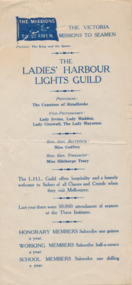 Mission to Seafarers Victoria
Flyer - Subscription, Mission to Seamen Institute, The Ladies' Harbour Lights Guild in Connection with The Victoria Mission to Seamen, 1921-1926
... home, for visiting seamen. The flyer was to recruit new members or for former Members of the charity to renew their subscription. The patroness was always the governor's wife: here the Countess of Stradbroke whose husband, the Earl of Stradbroke was governor of Victoria between 1921 to 1926. This paper flyer holds historical significance at a local level because it illustrates the Ladies' Harbour Lights Guild involvement in the Mission to Seafarers.The Ladies' Harbour Lights Guild grew to become a significant charity in Melbourne raising large amounts of money which helped to establish the current MTS building, supporting seafarers. missions to seamen institute ladies' harbour lights guild australian wharf lhlg subscriptions countess of stradbroke patroness lady irvine lady creswell lady madden the lady mayoress ethel augusta godfrey 1861-1935 miss b. peebles alice sibthorpe tracy Cream colour paper 3 fold-flyer in blue ink that are also subscription forms in order to become Honorary Members/Working/School Members or renewals of previous Membership of the Ladies' Harbour Lights Guild. ...The charity organisation, Ladies' Harbour Lights Guild, was formed within the Missions to Seamen Institute to provide a home away from home, for visiting seamen. The flyer was to recruit new members or for former Members of the charity to renew their subscription. The patroness was always the governor's wife: here the Countess of Stradbroke whose husband, the Earl of Stradbroke was governor of Victoria between 1921 to 1926.This paper flyer holds historical significance at a local level because it illustrates the Ladies' Harbour Lights Guild involvement in the Mission to Seafarers.The Ladies' Harbour Lights Guild grew to become a significant charity in Melbourne raising large amounts of money which helped to establish the current MTS building, supporting seafarers.Cream colour paper 3 fold-flyer in blue ink that are also subscription forms in order to become Honorary Members/Working/School Members or renewals of previous Membership of the Ladies' Harbour Lights Guild. Includes an extract from the Age.missions to seamen institute, ladies' harbour lights guild, australian wharf, lhlg, subscriptions, countess of stradbroke, patroness, lady irvine, lady creswell, lady madden, the lady mayoress, ethel augusta godfrey 1861-1935, miss b. peebles, alice sibthorpe tracy
