
Showing 183 items matching "showers"
-
 Department of Energy, Environment and Climate Action
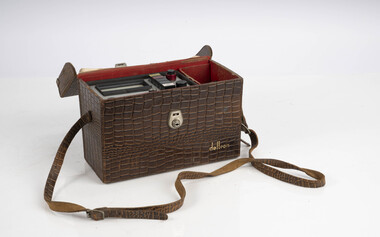
Delton Moisture meter
... Fine fuels like leaves and bark can rapidly absorb moisture after a shower of rain, or from the air when the Relative Humidity (RH) is high, and the temperature is low. ...Fine fuels like leaves and bark can rapidly absorb moisture after a shower of rain, or from the air when the Relative Humidity (RH) is high, and the temperature is low. ...Used to measure moisture content by electric current resistance Representative samples of fuel such as bark, leaves, twigs etc were minced and the moisture measured The availability of fuel to burn depends largely on its moisture content. When it exceeds 20-25% not much will burn, whereas 12-15% is generally ideal for fuel reduction burning, but if the moisture content drops as low as 7-10% virtually everything will ignite, and fire behaviour becomes extreme. During the afternoon of the Ash Wednesday bushfires on 16 February 1983 fuel moisture contents were recorded at Stawell as low as 2.7%. Fine fuels like leaves and bark can rapidly absorb moisture after a shower of rain, or from the air when the Relative Humidity (RH) is high, and the temperature is low. Conversely, they can also dry out very quickly. So even though the overall fuel quantity in the forest doesn’t change, the fine fuel availability can increase rapidly from zero after rain to many tonnes per hectare as the fuel dries out. This can happen over a few hours on hot and windy days. Heavy fuels like logs on the ground take longer to dry out. Commercial timber moisture meter used to measure fuelDCR9-Tforests commission victoria (fcv), bushfire, forest measurement -
 Bendigo Historical Society Inc.
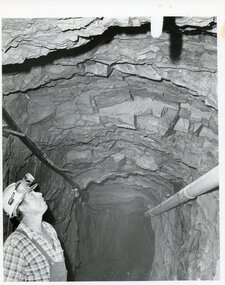
Photograph - AUSTIN COLLECTION: Central Deborah Gold Mine
... However, at the time working conditions were considered to be among the best on the goldfields at Central Deborah, after all it was one of the only mines that had hot showers. Following Central Deborah Gold Mine's closure, the Bendigo skyline began to noticeably change. ...However, at the time working conditions were considered to be among the best on the goldfields at Central Deborah, after all it was one of the only mines that had hot showers. Following Central Deborah Gold Mine's closure, the Bendigo skyline began to noticeably change. ...At its peak, Central Deborah Gold Mine reached a depth of 412 metres. It has 17 separate levels and 15 kilometres of drives and cross cuts (tunnels). The Central Deborah was very much a hands-on mine and the conditions that the miners worked in would be considered shocking by today's standards – being lowered underground in a cage with only two sides, often working ankle to knee deep in water, filling up to 32 ore trucks a shift by hand which were then pushed a mile or more along rails in the drives, working by carbide lamp, breathing in the fumes and rock dust and communication by bells. However, at the time working conditions were considered to be among the best on the goldfields at Central Deborah, after all it was one of the only mines that had hot showers. Following Central Deborah Gold Mine's closure, the Bendigo skyline began to noticeably change. Obvious remnants of mining such as poppet heads, engine rooms, service quarters, battery houses and chimneys were steadily disappearing. After intense lobbying by the local community, the Bendigo City Council purchased the still very much intact Central Deborah Gold Mine in 1970 for a mere $6,000 to ensure that a vital link to Bendigo's historic golden past was maintained. https://www.central-deborah.com/about-us/central-deborah-gold-mine-s-history Black and white photo of miner Ray Beer, wearing hard hat and mining lamp, checking mine roof at Central Deborah Gold Mine, Bendigo.mining, central deborah gold mine, ray beer -
 Glen Eira Historical Society
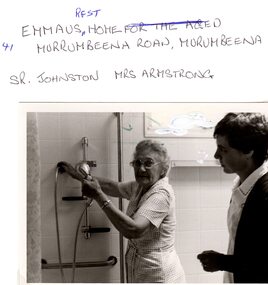
Letter - EMMAUS REST HOME
... Johnston, in a bathroom operating a shower. These photographs contain writing on the back identifying the persons. ...Johnston, in a bathroom operating a shower. These photographs contain writing on the back identifying the persons. ...This file contains two items pertaining to Emmaus Rest Home: 1/A series of emails exchanged between local resident Mark Upton and John O’Callaghan of the Glen Eira Historical Society, dated 30/01/2008 and 31/01/2008, regarding the history of a derelict property situated at 41 Murrumbeena Road. In the first email, Upton refers to the property of ‘Oakdene’ Aged Care Facility and inquires as to whether the Society possesses any information on it. The next day, O’Callaghan replies that he will investigate. Later that day, Upton recommends O’Callaghan some information on the property he unearthed via Joanne (Jo) Antoni, Executive Assistant at Churches of Christ Community Care. The property turns out to have originally been a private residence owned by the Birtchnell family, sold on 24/01/1945, eventually acquired by the Church and converted into an aged care facility which closed on 16/07/1999 2/Three black-and-white photographs. Two of the photographs portray a resident of the Home, Mrs. Armstrong, and a staff member of the Home, Sr. Johnston, in a bathroom operating a shower. These photographs contain writing on the back identifying the persons. The remaining one portrays Mrs. Armstrong and another, unidentified resident of the Home seated in a bedroom. This one also contains writing on the back, but specifying the name only of the facility. None of the photographs are dated.emmaus, emmaus rest home, emmaus home for the aged, churches of christ community care, antoni joanne (jo), new cumloden grammar school, atkin william t., betheden, waghoo road, ‘oakdene’ aged care facility, carnegie, murrumbeena, upton mark, o’callaghan john, murrumbeena road, neerim road, dandenong road, birtchnell family, birtchnell james, birtchnell elizabeth, birtchnell harold, birtchnell olive, birtchnell kingsley, oakdene crescent, clay will h., johnson sr., armstrong mrs., anglican church, nursing homes, retirement homes, mansions, clocks, fires -
 Wodonga & District Historical Society Inc
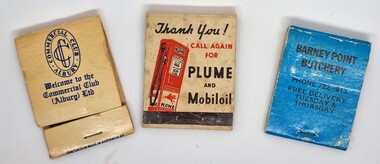
Functional object - Matchbook collection
... The park was to have accommodation for up to 1000 transports, caravans and cars, as well as all amenities ranging from showers to a cafeteria. It was to be known as "Twenty Acre Service Station” When the park first came into operation it was to have accommodation for up to 200 transports. ...The park was to have accommodation for up to 1000 transports, caravans and cars, as well as all amenities ranging from showers to a cafeteria. It was to be known as "Twenty Acre Service Station” When the park first came into operation it was to have accommodation for up to 200 transports. ...This item is from a collection donated by Les Cole of Wodonga, who among several occupations in his life time, drove buses around the Wodonga and district for the Mylon bus company. In March 1952, Transport Parks Pty Ltd. purchased 20 acres of land from the Kelly Estate on the outskirts of Wodonga. The land sold at the record urban price for Wodonga of £300 an acre. They had plans to establish a transport park advertised as the first of its kind in Australia at a cost of £50,000. The park was to have accommodation for up to 1000 transports, caravans and cars, as well as all amenities ranging from showers to a cafeteria. It was to be known as "Twenty Acre Service Station” When the park first came into operation it was to have accommodation for up to 200 transports. Wodonga had been chosen for the site of the company's first park because it was a ''half-way house" between Sydney and Melbourne, and because transports had to stop there to obtain permits to proceed on crossing the border. The service station section of the Transport Park began operation in June 1954, with other facilities following. The business operated profitably until at least 1971 as the Transport Park, but perhaps never reached its aims of providing for 1,000 transports at any given time. The Vacuum Oil Company was the first oil company established in Australia. In 1916, Vacuum introduced its "Plume" brand to the Australian market. Vacuum replaced the famous Plume brand name with Mobilgas in 1954.A collection of 3 different match books representing a variety of businesses.match book collection, matches -
 Department of Energy, Environment and Climate Action
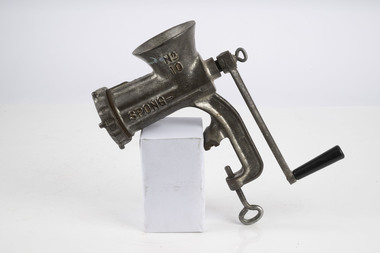
Spong Fuel Mincer
... Fine fuels like leaves and bark can rapidly absorb moisture after a shower of rain, or from the air when the Relative Humidity (RH) is high, and the temperature is low. ...Fine fuels like leaves and bark can rapidly absorb moisture after a shower of rain, or from the air when the Relative Humidity (RH) is high, and the temperature is low. ...Used to prepare fuel samples to measure their moisture content. Representative samples of fine fuel such as bark, leaves, twigs etc were minced first through a course mincing plate, then a fine plate and the moisture content measured with a Speedy moisture meter or other device. The availability of fuel to burn depends largely on its moisture content. When it exceeds 20-25% not much will burn, whereas 12-15% is generally ideal for fuel reduction burning, but if the moisture content drops as low as 7-10% virtually everything will ignite, and fire behaviour becomes extreme. During the afternoon of the Ash Wednesday bushfires on 16 February 1983 fuel moisture contents were recorded at Stawell as low as 2.7%. Fine fuels like leaves and bark can rapidly absorb moisture after a shower of rain, or from the air when the Relative Humidity (RH) is high, and the temperature is low. Conversely, they can also dry out very quickly. So even though the overall fuel quantity in the forest doesn’t change, the fine fuel availability can increase rapidly from zero after rain to many tonnes per hectare as the fuel dries out. This can happen over a few hours on hot and windy days. Heavy fuels like logs on the ground take longer to dry out. Spong No 10 food mincerforests commission victoria (fcv), bushfire, forest measurement -
 Bendigo Historical Society Inc.
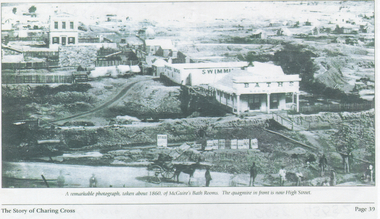
Photograph - In The Swim Collection: McGuire's Baths and Swimming Pool, Bendigo, Approximately 1860
... Matthew Moran now proprietor of the Baths since 1864, writes in a letter to the Bendigo Advertiser that 'we can now boast of the largest freshwater swimming baths in these colonies' and that 'any man can have a swim, a shower-bath and towel every day for the low charge of twopence three farthings'. ...Matthew Moran now proprietor of the Baths since 1864, writes in a letter to the Bendigo Advertiser that 'we can now boast of the largest freshwater swimming baths in these colonies' and that 'any man can have a swim, a shower-bath and towel every day for the low charge of twopence three farthings'. ...McGuire's Baths and Swimming Pool were constructed by Mr. P. McGuire 'opposite View Point and Royal Hotels' in Sandhurst. Mr. McGuire had permission to erect a building which contained twelve baths, together with ladies' and gentlemen's dressing rooms. The baths opened for business from 25th December, 1855. The establishment had a good supply of water. The water, 'after being used once', was 'passed into the Creek (Bendigo Creek)'. (Bendigo Advertiser, 25th December, '1855 'Baths, Baths, Baths' ) In November 1855 during the construction of the Baths a fire broke out, possibly started by a lighted cigar being left on wood shavings. The fire was extinguished by 'manual exertions'. There was a 'plenteous supply of water adjacent which contributed to the speedy extinguishing of the flames' In December 1863, a meeting was advertised to be held at McGuire's Baths for the purpose of establishing a swimming club (Bendigo Advertiser, 9th. December, 1863) By 1866, Mr. Matthew Moran now proprietor of the Baths since 1864, writes in a letter to the Bendigo Advertiser that 'we can now boast of the largest freshwater swimming baths in these colonies' and that 'any man can have a swim, a shower-bath and towel every day for the low charge of twopence three farthings'. Further 'we can boast of every king of baths except vapour or Turkish are very little wanted on Sandhurst, as the inhabitants are generally a very steady well conducted people'. ( Bendigo Advertiser, 29th October, 1866. Black and white copy of original photograph showing McGuire's Bath Rooms, Bendigo. Image shows building constructed near Bendigo Creek and adjoining current High Street, Bendigo. Sign on front of Building above verandah 'Baths'. Building at rear has 'Swimming' and 'Swimming Baths' signage on the front and side. In front of Baths buildings, a timber bridge across the Bendigo Creek. In foreground of image is High Street with a horse and cart with men standing along the road. Written on bottom of page 'a remarkable photograph, taken about 1860, of McGuire's Bath Rooms. The quagmire in front is now High Street' and 'The Story of Charing Cross'.bendigo, sandhurst, mcguire's baths, swimming pools, view point, mcguire and co, in the swim, horse and cart, charing cross, high street -
 Bendigo Historical Society Inc.
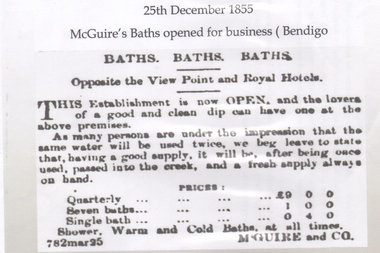
Document - In The Swim Collection: McGuire's Baths and Swimming Pool, 1855
... Matthew Moran now proprietor of the Baths since 1864, writes in a letter to the Bendigo Advertiser that 'we can now boast of the largest freshwater swimming baths in these colonies' and that 'any man can have a swim, a shower-bath and towel every day for the low charge of twopence three farthings'. ...Matthew Moran now proprietor of the Baths since 1864, writes in a letter to the Bendigo Advertiser that 'we can now boast of the largest freshwater swimming baths in these colonies' and that 'any man can have a swim, a shower-bath and towel every day for the low charge of twopence three farthings'. ...McGuire's Baths and Swimming Pool were constructed by Mr. P. McGuire 'opposite View Point and Royal Hotels' in Sandhurst. Mr. McGuire had permission to erect a building which contained twelve baths, together with ladies' and gentlemen's dressing rooms. The baths opened for business from 25th December, 1855. The establishment had a good supply of water. The water, 'after being used once', was 'passed into the Creek (Bendigo Creek)'. (Bendigo Advertiser, 25th December, '1855 'Baths, Baths, Baths' ) In November 1855 during the construction of the Baths a fire broke out, possibly started by a lighted cigar being left on wood shavings. The fire was extinguished by 'manual exertions'. There was a 'plenteous supply of water adjacent which contributed to the speedy extinguishing of the flames' In December 1863, a meeting was advertised to be held at McGuire's Baths for the purpose of establishing a swimming club (Bendigo Advertiser, 9th. December, 1863) By 1866, Mr. Matthew Moran now proprietor of the Baths since 1864, writes in a letter to the Bendigo Advertiser that 'we can now boast of the largest freshwater swimming baths in these colonies' and that 'any man can have a swim, a shower-bath and towel every day for the low charge of twopence three farthings'. Further 'we can boast of every king of baths except vapour or Turkish are very little wanted on Sandhurst, as the inhabitants are generally a very steady well conducted people'. ( Bendigo Advertiser, 29th October, 1866. One page copy of an advertisement placed in the 'Bendigo Advertiser' on 25th December, 1855, for the opening of McGuire's Baths.bendigo, sandhurst, mcguire's baths, swimming pools, view point, mcguire and co, in the swim -
 Bendigo Historical Society Inc.
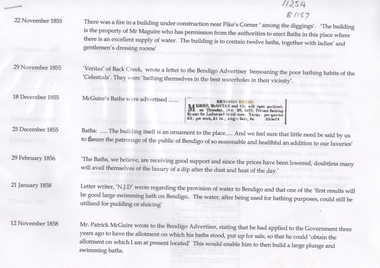
Document - In The Swim Collection: McGuire's Baths and Swimming Pool, Bendigo
... Matthew Moran now proprietor of the Baths since 1864, writes in a letter to the Bendigo Advertiser that 'we can now boast of the largest freshwater swimming baths in these colonies' and that 'any man can have a swim, a shower-bath and towel every day for the low charge of twopence three farthings'. ...Matthew Moran now proprietor of the Baths since 1864, writes in a letter to the Bendigo Advertiser that 'we can now boast of the largest freshwater swimming baths in these colonies' and that 'any man can have a swim, a shower-bath and towel every day for the low charge of twopence three farthings'. ...McGuire's Baths and Swimming Pool were constructed by Mr. P. McGuire 'opposite View Point and Royal Hotels' in Sandhurst. Mr. McGuire had permission to erect a building which contained twelve baths, together with ladies' and gentlemen's dressing rooms. The baths opened for business from 25th December, 1855. The establishment had a good supply of water. The water, 'after being used once', was 'passed into the Creek (Bendigo Creek)'. (Bendigo Advertiser, 25th December, '1855 'Baths, Baths, Baths' ) In November 1855 during the construction of the Baths a fire broke out, possibly started by a lighted cigar being left on wood shavings. The fire was extinguished by 'manual exertions'. There was a 'plenteous supply of water adjacent which contributed to the speedy extinguishing of the flames' In December 1863, a meeting was advertised to be held at McGuire's Baths for the purpose of establishing a swimming club (Bendigo Advertiser, 9th. December, 1863) By 1866, Mr. Matthew Moran now proprietor of the Baths since 1864, writes in a letter to the Bendigo Advertiser that 'we can now boast of the largest freshwater swimming baths in these colonies' and that 'any man can have a swim, a shower-bath and towel every day for the low charge of twopence three farthings'. Further 'we can boast of every king of baths except vapour or Turkish are very little wanted on Sandhurst, as the inhabitants are generally a very steady well conducted people'. ( Bendigo Advertiser, 29th October, 1866. Three page typed timeline describing the establishment and development of McGuire's Baths and Swimming Pool, Bendigo, during the period 1855 to 1872. sandhurst, bendigo, swimming pool, baths, mcguire's swimming pool and baths, fire, view point, royal hotel, bendigo creek -
 Kew Historical Society Inc
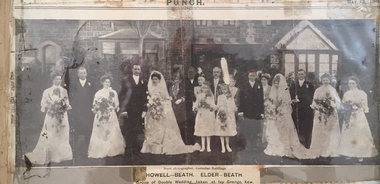
Photograph - Newspaper photograph, Punch, Howell-Beath. Elder-Beath. Group of Double Wedding taken at Ivy Grange, 1901, 1901
... The two brides were attended by six bridesmaids, all dressed alike in gowns of white Indian lawn, with tucks and insertions of Valenciennes lace, sashes of white satin and instead of hats wore on their hair pretty wreaths of Parma violets, and carried shower bouquets of Parma violets tied with heliotrope ribbons." ...The two brides were attended by six bridesmaids, all dressed alike in gowns of white Indian lawn, with tucks and insertions of Valenciennes lace, sashes of white satin and instead of hats wore on their hair pretty wreaths of Parma violets, and carried shower bouquets of Parma violets tied with heliotrope ribbons." ...On 1 June 1901, the Australian Town and Country Journal reported that: "A few couples found time to marry during, or just after, the Royal visit. A pretty double wedding took place at Ivy Grange, Kew, the residence of the bride's father, on May 15, when Mr. Samuel Howell, eldest son of the late Richard Howell, of Chocolyn, Camperdown, became the husband of Miss Olive Wilhelmina Beath, fourth daughter of Mr. David Beath, and Mr. William Elder, second son of Mr. Nairne G. Elder, of Rokewood, espoused Miss Endora Anne Beath, fifth daughter of Mr. David Beath. The brides were dressed alike in white satin duchesse, with gathered satin and chiffon, transparent yokes and sleeves of chiffon, embroidered tulle veils, with coronet of orange blossom. The happy couples vary wisely chose different districts for their honeymoon trips, Mr. and Mrs. Howell visiting Lorne, while Mr. and Mrs. W Elder went off to the Blue Mountains, N.S.W. The two brides were attended by six bridesmaids, all dressed alike in gowns of white Indian lawn, with tucks and insertions of Valenciennes lace, sashes of white satin and instead of hats wore on their hair pretty wreaths of Parma violets, and carried shower bouquets of Parma violets tied with heliotrope ribbons." (Source: Australian Town and Country Journal (Sydney, NSW : 1870 - 1907), Saturday 1 June 1901, page 43)This work forms part of the collection assembled by the historian Dorothy Rogers, that was donated to the Kew Historical Society by her son John Rogers in 2015. The manuscripts, photographs, maps, and documents were sourced by her from both family and local collections or produced as references for her print publications. Many were directly used by Rogers in writing ‘Lovely Old Homes of Kew’ (1961) and 'A History of Kew' (1973), or the numerous articles on local history that she produced for suburban newspapers. Most of the photographs in the collection include detailed annotations in her hand. The Rogers Collection provides a comprehensive insight into the working habits of a historian in the 1960s and 1970s. Together it forms the largest privately-donated collection within the archives of the Kew Historical Society.Photograph and article from Punch (May 23 1901) of a double wedding at Ivy Grange of Olive Wilhelmina Beath and Endora Anne Beath. ivy grange, beath family -
 Vision Australia
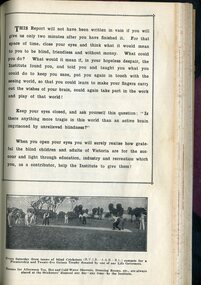
Administrative record - Text, Royal Victorian Institute for the Blind annual report 1927, 1927
... Tanswell as head teacher, George Findlay is entering the final year of his degree and Donald Forbes is in his second year, thanks to Sir Baldwin Spencer for allowing the children to visit the National Museum and touch various items as he spoke about the various exhibits, George Findlay won the 3LO Exhibition for Pianoforte, the success of the Concert Party and the difficulty in securing halls large enough to hold concerts, placement of safety zones by the City of Melbourne and South Melbourne councils opposite the Institute, official opening of the hostel in Raleigh Street by the Lord Mayor, activities providing support for those not working at the Institute include teaching of home trades who manufactured goods will be purchased by the RVIB for sale in their shop, a wholesale tobacco and grocery store, use of the Pipe Organ, musical instruments, wireless set, study, writing, games, typewriting, showers and baths and dressing rooms for on-site use, a brief outline of the blind cricket playing ground and the boat house, the decision to provide free Wireless Sets to those who cannot afford them, H. ...Tanswell as head teacher, George Findlay is entering the final year of his degree and Donald Forbes is in his second year, thanks to Sir Baldwin Spencer for allowing the children to visit the National Museum and touch various items as he spoke about the various exhibits, George Findlay won the 3LO Exhibition for Pianoforte, the success of the Concert Party and the difficulty in securing halls large enough to hold concerts, placement of safety zones by the City of Melbourne and South Melbourne councils opposite the Institute, official opening of the hostel in Raleigh Street by the Lord Mayor, activities providing support for those not working at the Institute include teaching of home trades who manufactured goods will be purchased by the RVIB for sale in their shop, a wholesale tobacco and grocery store, use of the Pipe Organ, musical instruments, wireless set, study, writing, games, typewriting, showers and baths and dressing rooms for on-site use, a brief outline of the blind cricket playing ground and the boat house, the decision to provide free Wireless Sets to those who cannot afford them, H. ...Articles in this annual report include: 60th anniversary, approximately 1000 blind people in Victoria, hope that Government will increase it's support which has not varied for over 30 years and comparison of costs compared to the 50th anniversary, visits by Lady Stonehaven and Lord and Lady Somers, resignation of G. Dent and appointment of J. Tanswell as head teacher, George Findlay is entering the final year of his degree and Donald Forbes is in his second year, thanks to Sir Baldwin Spencer for allowing the children to visit the National Museum and touch various items as he spoke about the various exhibits, George Findlay won the 3LO Exhibition for Pianoforte, the success of the Concert Party and the difficulty in securing halls large enough to hold concerts, placement of safety zones by the City of Melbourne and South Melbourne councils opposite the Institute, official opening of the hostel in Raleigh Street by the Lord Mayor, activities providing support for those not working at the Institute include teaching of home trades who manufactured goods will be purchased by the RVIB for sale in their shop, a wholesale tobacco and grocery store, use of the Pipe Organ, musical instruments, wireless set, study, writing, games, typewriting, showers and baths and dressing rooms for on-site use, a brief outline of the blind cricket playing ground and the boat house, the decision to provide free Wireless Sets to those who cannot afford them, H. Foster (foreman of the Mat department) again played Father Xmas at the children's Christmas party, the Orchestra and Concert Party gave their annual free concert to the Tramways Board and employees in appreciation for the free passes for the blind, formation of a Central Auxiliary with representatives from each municipality to help bring the work of the Institute more predominantly to the general public across Victoria, and the passing of workers Margaret Cates, Tom Ginniff and Peter Stevens.1 volume bound with illustrations.royal victorian institute for the blind, annual report, lord somers, lady somers, g dent, j tanswell, george findlay, donald forbes, baldwin spencer, national museum of victoria, cricket, rowing, h foster, auxiliaries, wirths brothers circus, raleigh street hostel, margaret cates, tom ginniff, peter stevens, buildings -
 Wodonga & District Historical Society Inc
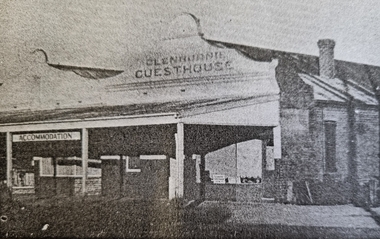
Photograph - Glenburnie Guest House, Wodonga
... Egan who advertised hot and cold shower baths with meals at all hours. In 1913 the Wodonga Coffee Palace was taken over by Mrs Cuthbertson and Miss Steele. ...Egan who advertised hot and cold shower baths with meals at all hours. In 1913 the Wodonga Coffee Palace was taken over by Mrs Cuthbertson and Miss Steele. ...In the early 1900s a new Coffee Palace was erected on the first railway land to be leased for private business in Wodonga. This Coffee Palace (later to become Glenburnie Guest House) was situated in High Street opposite the former Customs House which at the time was being used as the Wodonga Police Station. It was built by Mr Denny Donovan and operated by his wife. An article in the Wodonga and Towong Sentinel declared that “No expense has been spared in the erection and fitting up of the Palace, which is intended to supply a long felt want”. The building consists entirely of brick and the rooms are lofty, spacious and well-ventilated. The bedsteads are modern, and will satisfy the most fastidious. The motto of the proprietress is “Cleanliness, civility and attention”. Mr Donovan died in January 1908 and in 1909 the Wodonga Coffee Palace was sold by Mrs Donovan to Mrs P. Egan who advertised hot and cold shower baths with meals at all hours. In 1913 the Wodonga Coffee Palace was taken over by Mrs Cuthbertson and Miss Steele. In 1921 Wodonga Coffee Palace was taken over by Julia Ronan who had successfully conducted the dining rooms at the Wodonga Saleyards for 15 years until those premises burned down. The Wodonga and Towong Sentinel on 10 January 1936 reported that “the business premises formerly conducted by Mrs Ronan have been renovated and refurbished. The new proprietresses are Misses Breen, who have had extensive experience in managing such businesses. The new premises will be known as the Glenburnie Guest House.” Changes of ownership continued with Mrs M.E. Elliot taking over in December 1940, followed by Mrs Stella Victoria Wong in 1945. In 1953 it was again taken over by Mrs E.M. Moran. The date of the closure of Glenburnie Guest House is uncertain but the building was demolished in the early 1970s.This image is significant because it is one of the few remaining links to an important Wodonga business.A photo taken from a newspaper article about Glenburnie Guest Houseglenburnie guest house, early wodonga businesses, coffee palaces -
 Bendigo Historical Society Inc.
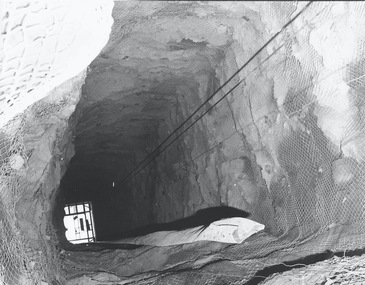
Photograph - AUSTIN COLLECTION: Central Deborah Gold Mine Lift Shaft
... However, at the time working conditions were considered to be among the best on the goldfields at Central Deborah, after all it was one of the only mines that had hot showers. Following Central Deborah Gold Mine's closure, the Bendigo skyline began to noticeably change. ...However, at the time working conditions were considered to be among the best on the goldfields at Central Deborah, after all it was one of the only mines that had hot showers. Following Central Deborah Gold Mine's closure, the Bendigo skyline began to noticeably change. ...Central Deborah Gold Mine history: At its peak, Central Deborah Gold Mine reached a depth of 412 metres. It has 17 separate levels and 15 kilometres of drives and cross cuts (tunnels). The Central Deborah was very much a hands-on mine and the conditions that the miners worked in would be considered shocking by today's standards – being lowered underground in a cage with only two sides, often working ankle to knee deep in water, filling up to 32 ore trucks a shift by hand which were then pushed a mile or more along rails in the drives, working by carbide lamp, breathing in the fumes and rock dust and communication by bells. Geez, they were ironmen. However, at the time working conditions were considered to be among the best on the goldfields at Central Deborah, after all it was one of the only mines that had hot showers. Following Central Deborah Gold Mine's closure, the Bendigo skyline began to noticeably change. Obvious remnants of mining such as poppet heads, engine rooms, service quarters, battery houses and chimneys were steadily disappearing. After intense lobbying by the local community, the Bendigo City Council purchased the still very much intact Central Deborah Gold Mine in 1970 for a mere $6,000 to ensure that a vital link to Bendigo's historic golden past was maintained. The Bendigo Trust was then formed to oversee the operations of the Central Deborah Gold Mine, which led to the surface of the mine being opened to the public in 1971. Initially the surface was open for just 12 hours a week and as the demand for viewing a part of Bendigo's history increased, so did the opening hours. In 1974 the mine was gazetted as a Public Historical Purposes Reserve and attracted such visitors as H.R.H Prince Charles. By far the greatest shortcoming at this stage was that no one could view the underground workings, as these had become flooded. After what could only be described as a monumental effort by everyone involved, Level 2 of the mine was officially opened to the public by the Premier of Victoria, the Honourable John Cain, on 20 June 1986, which brought to fruition a long standing dream.Black and white photograph, looking from bottom of lift shaft towards the surface; light visible at top of shaft. Lift cables and safety mesh on sides of shaft. gold mining, central deborah gold mine, ray beer, mine manager -
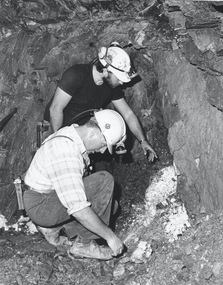 Bendigo Historical Society Inc.
Photograph - AUSTIN COLLECTION: Central Deborah Gold Mine, Possibly 1990's
... However, at the time working conditions were considered to be among the best on the goldfields at Central Deborah, after all it was one of the only mines that had hot showers. Following Central Deborah Gold Mine's closure, the Bendigo skyline began to noticeably change. ...However, at the time working conditions were considered to be among the best on the goldfields at Central Deborah, after all it was one of the only mines that had hot showers. Following Central Deborah Gold Mine's closure, the Bendigo skyline began to noticeably change. ...Central Deborah Gold Mine history: At its peak, Central Deborah Gold Mine reached a depth of 412 metres. It has 17 separate levels and 15 kilometres of drives and cross cuts (tunnels). The Central Deborah was very much a hands-on mine and the conditions that the miners worked in would be considered shocking by today's standards – being lowered underground in a cage with only two sides, often working ankle to knee deep in water, filling up to 32 ore trucks a shift by hand which were then pushed a mile or more along rails in the drives, working by carbide lamp, breathing in the fumes and rock dust and communication by bells. Geez, they were ironmen. However, at the time working conditions were considered to be among the best on the goldfields at Central Deborah, after all it was one of the only mines that had hot showers. Following Central Deborah Gold Mine's closure, the Bendigo skyline began to noticeably change. Obvious remnants of mining such as poppet heads, engine rooms, service quarters, battery houses and chimneys were steadily disappearing. After intense lobbying by the local community, the Bendigo City Council purchased the still very much intact Central Deborah Gold Mine in 1970 for a mere $6,000 to ensure that a vital link to Bendigo's historic golden past was maintained. The Bendigo Trust was then formed to oversee the operations of the Central Deborah Gold Mine, which led to the surface of the mine being opened to the public in 1971. Initially the surface was open for just 12 hours a week and as the demand for viewing a part of Bendigo's history increased, so did the opening hours. In 1974 the mine was gazetted as a Public Historical Purposes Reserve and attracted such visitors as H.R.H Prince Charles. By far the greatest shortcoming at this stage was that no one could view the underground workings, as these had become flooded. After what could only be described as a monumental effort by everyone involved, Level 2 of the mine was officially opened to the public by the Premier of Victoria, the Honourable John Cain, on 20 June 1986, which brought to fruition a long standing dream.Black and white photograph. Two men with hard hats and lights, inspecting quartz outcrop on wall of drive at Central Deborah Gold Mine.gold mining, central deborah gold mine, ray beer, mine manager -
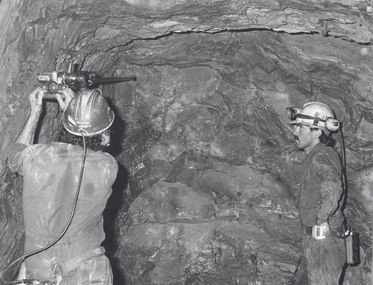 Bendigo Historical Society Inc.
Photograph - AUSTIN COLLECTION: Operating rock drill, Central Deborah Gold Mine, Possibly 1990's
... However, at the time working conditions were considered to be among the best on the goldfields at Central Deborah, after all it was one of the only mines that had hot showers. Following Central Deborah Gold Mine's closure, the Bendigo skyline began to noticeably change. ...However, at the time working conditions were considered to be among the best on the goldfields at Central Deborah, after all it was one of the only mines that had hot showers. Following Central Deborah Gold Mine's closure, the Bendigo skyline began to noticeably change. ...Central Deborah Gold Mine history: At its peak, Central Deborah Gold Mine reached a depth of 412 metres. It has 17 separate levels and 15 kilometres of drives and cross cuts (tunnels). The Central Deborah was very much a hands-on mine and the conditions that the miners worked in would be considered shocking by today's standards – being lowered underground in a cage with only two sides, often working ankle to knee deep in water, filling up to 32 ore trucks a shift by hand which were then pushed a mile or more along rails in the drives, working by carbide lamp, breathing in the fumes and rock dust and communication by bells. Geez, they were ironmen. However, at the time working conditions were considered to be among the best on the goldfields at Central Deborah, after all it was one of the only mines that had hot showers. Following Central Deborah Gold Mine's closure, the Bendigo skyline began to noticeably change. Obvious remnants of mining such as poppet heads, engine rooms, service quarters, battery houses and chimneys were steadily disappearing. After intense lobbying by the local community, the Bendigo City Council purchased the still very much intact Central Deborah Gold Mine in 1970 for a mere $6,000 to ensure that a vital link to Bendigo's historic golden past was maintained. The Bendigo Trust was then formed to oversee the operations of the Central Deborah Gold Mine, which led to the surface of the mine being opened to the public in 1971. Initially the surface was open for just 12 hours a week and as the demand for viewing a part of Bendigo's history increased, so did the opening hours. In 1974 the mine was gazetted as a Public Historical Purposes Reserve and attracted such visitors as H.R.H Prince Charles. By far the greatest shortcoming at this stage was that no one could view the underground workings, as these had become flooded. After what could only be described as a monumental effort by everyone involved, Level 2 of the mine was officially opened to the public by the Premier of Victoria, the Honourable John Cain, on 20 June 1986, which brought to fruition a long standing dream.Black and white photograph. Two men with hard hats and lights standing in front of underground rock surface at Central Deborah Gold Mine. Paul Maker on left hand side of image is operating a small rock drill. John Jeffrey on right hand side is observing the procedure. gold mining, central deborah gold mine, rock drill, underground -
 Bendigo Historical Society Inc.
Document - LYRIC THEATRE, MYER'S PATRIOTIC WORKERS' SOCIETY, 20 September, 1917
... Part II: 'Sunshine and Showers' unnamed song, 'Prologue', 'Spirit of the Wood' 'They Sang God Save The King' 'Hullamzo Balaton' 'The Two Grenadiers' 'Farwell to Summer'. ...Part II: 'Sunshine and Showers' unnamed song, 'Prologue', 'Spirit of the Wood' 'They Sang God Save The King' 'Hullamzo Balaton' 'The Two Grenadiers' 'Farwell to Summer'. ...Lyric Theatre, Myer's Patriotic Workers' Society. Grand Concert, Thursday, September 20th, 1917, 8pm. Admission 2/- (Entitling to Reserve) and 1/-. Musical Director: Mr E H Collett. Leader of Orchestra: Mr O Flight. Accompanist: Miss MacGillivray. Home Made Confectionery will be sold by Ladies. Programme: God Save the King. Part I: 'Trumpet of the Fort' 'Angles Guard Thee' 'Where my Caravan has rested' 'Villanell' 'Le Babillard' 'Hark to the Mandolin' 'Come Back, One Day'. Part II: 'Sunshine and Showers' unnamed song, 'Prologue', 'Spirit of the Wood' 'They Sang God Save The King' 'Hullamzo Balaton' 'The Two Grenadiers' 'Farwell to Summer'. Overtures: Lyric Orchestra. Songs: Mr EH Collett, Miss Elsie Code, Miss Winnie Mayberry, Mr J Warren, Mr F Monaghan, Mr H S Barkell. Duets: Misses c Ronan and J Sherlock, Misses J Pearson and L Bain, Miss E Code and Mr H S Barkell, Miss W Mayberry and Mr E H Collett. Flute Solo: Mr A E Sayer. Violin Solo: Miss Myrtle Knight. God Bless Our Splendid Men. Back Cover- Myer's Patriotic Workers' Society was formed by the Employees of Myer's' Bendigo, with the object of forwarding comforts to the soldiers from the Bendigo district who have joined the Australian Imperial Forces. Names were invited from the public, when no less than twelve hundred names were recorded, and the Society is making every effort to despatch the parcels as quickly as possible. So far six hundred and fifty parcels have been sent at a cost of 10/- (plus postage, 2/-) each The proceeds of this Concert go towards augmenting the funds of the Society to carry out this obligation.Bolton Bros. Printers, Bendigoprogram, theatre, lyric theatre -
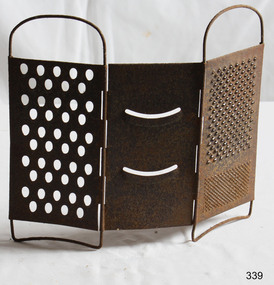 Flagstaff Hill Maritime Museum and Village
Domestic object - Grater
... Taylor read about Boullier’s invention and made his own by sharpening the holes of a metal shower drain. For the last century, many companies have tried to improve the cheese grater and invent a new “latest” one that we all must-have. ...Taylor read about Boullier’s invention and made his own by sharpening the holes of a metal shower drain. For the last century, many companies have tried to improve the cheese grater and invent a new “latest” one that we all must-have. ...François Boullier of France and Isaac Hunt of England both took credit for inventing the cheese grater in the 1540s. Ingredient supplies, mainly milk, ebbed and flowed in both France and England, as they have in the United States during this coronavirus pandemic. Boullier originally aimed to use up an overabundance of cheese in Paris. An avoidance of meat led French farmers to convert their meat herds (often boys) to dairy-producers (girls), which led to more milk and even too much milk, which led to a market flooded with cheese. Boullier made his first cheese grater out of pewter to grate hard, sometimes dried out cheeses, which turned them into a sort of condiment. Pewter is known as a rather soft metal, and Boullier’s original grater is reportedly on display in a museum in Le Havre, France. Isaac Hunt wanted to stretch cheese due to a shortage in England, so he grated and melted it for Welsh rarebit and other dishes. Grating cheese allowed more even distribution of the cheese to melt it in cooking and still does. During the Great Depression of the 1930s, Philadelphia cheesemonger and entrepreneur Jeffrey Taylor also wanted to stretch cheese for to bulk up cheese features, including vegetables, to make them look like more filling food during difficult economic times. Taylor read about Boullier’s invention and made his own by sharpening the holes of a metal shower drain. For the last century, many companies have tried to improve the cheese grater and invent a new “latest” one that we all must-have. Graters are now made of all sorts of materials including bamboo, wood, and various metals. Some are decorated with clowns’ heads, some are shaped like plastic frogs, while others bear knuckle protectors. They vary in size, shape, and function. Grating slots come with different angles and shapes of slots and can grate everything from zucchini, onions and cheese, to cooked eggs, coconut, potatoes, cabbage, and lemon and orange peel, and possibly even create wood shavings. Smaller graters grate ginger and garlic. https://www.cheeseprofessor.com/blog/antique-cheese-gratersThe grater has been used for hundreds of years and has proved its worth in the kitchen throughout history.Grater metal (3 parts) Tripartite with hinges for folding.None.flagstaff hill, warrnambool, shipwrecked-coast, flagstaff-hill, flagstaff-hill-maritime-museum, maritime-museum, shipwreck-coast, flagstaff-hill-maritime-village, grater -
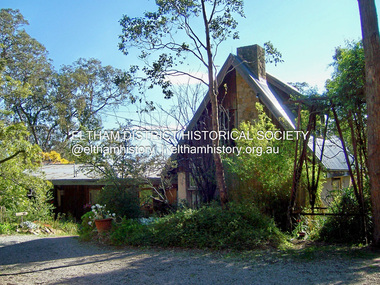 Eltham District Historical Society Inc
Photograph - Digital Photograph, Marguerite Marshall, Former home of Professor William MacMahon Ball, York Street, Eltham, 24 May 2007
... Harcourt built two bedrooms - including an attic bedroom - a balcony with a shower and toilet, a nd a fireplace and chimney of local stone. ...Harcourt built two bedrooms - including an attic bedroom - a balcony with a shower and toilet, a nd a fireplace and chimney of local stone. ...Situated at the eastern end of York Street, Eltham, 'Shinrone', the former home of Professor William (Mac) MacMahon Ball was one of the first in the Shire of Eltham to incorporate mud-brick. Professor MacMahon Ball, a political scientist, writer, broadcaster and diplomat and family moved to York Street, Eltham in 1945 into a timber cottage built around the 1890s and in poor repair. Mac asked Alistair Knox to renovate the home and he expanded the living area and added verandahs. In 1948 Montsalvat artist and sculptor Sonia Skipper supervised the building of most of the mud-brick studio. Neighbour Gordon Ford made the mud-bricks. Mac also asked John Harcourt, who had worked with him as a journalist in shortwave broadcasting, to build a pise (rammed earth) and stone addition to the largely timber house. Harcourt built two bedrooms - including an attic bedroom - a balcony with a shower and toilet, a nd a fireplace and chimney of local stone. Published: Nillumbik Now and Then / Marguerite Marshall 2008; photographs Alan King with Marguerite Marshall.; p141 At the eastern tip of York Street, Eltham, stands Shinrone, the former home of one of Australia’s intellectual leaders. Professor William Macmahon Ball, was one of the first to bring Asia as a foreign policy issue to the Australian public.1 He was a political scientist, writer, broadcaster and diplomat. The house was one of the first in Eltham Shire to incorporate mud-brick,2 because of the acute shortage of building materials after World War Two. Its novice builders later become leaders in Eltham’s built and garden design. Mac (as he was usually called), who was the son of a Church of England minister, was born in Casterton, Victoria in 1901 and died in 1986. In 1945 he helped establish the United Nations, as political consultant to the Australian Delegation at the San Francisco Conference.3 Then in 1946 Mac was appointed British Commonwealth Representative on the Allied Council for Japan, which is recorded in detail in his diary.4 In 1948 Mac led an Australian Government Goodwill Mission to South East Asia. However, Mac was perhaps most successful as an academic and public speaker.5 He was a commentator on the Australian Broadcasting Commission, from the early 1930s to the early 1960s. He was also Controller of the Short-Wave Broadcasting Unit during World War Two, which later became Radio Australia. From 1923 he taught at The University of Melbourne, then became foundation Professor of Political Science in 1949 and was Chair until his retirement in 1968.6 In 1942, as the government expected a Japanese invasion, Mac’s wife Katrine and their only child Jenny, moved from Kew to Eltham as temporary evacuees. However Mac and Katrine lived in Eltham for almost the rest of their lives. After staying with friends, they rented a house in Reynolds Road, where, as it was wartime, they needed to keep horses for transport and a cow and poultry for milk and eggs. In 1945 the family moved to the house at York Street, which was then a timber cottage, built around the 1890s and in poor repair. The underground well, cellar and part of the garden are all that remain of what stood on the original 18 acre (7.3ha) allotment. Thanks largely to Katrine’s hard work, the house was gradually renovated and extended. The long rambling house was partially built by several young neighbours, who were inspired by the cheap mud-brick and stone building style of Montsalvat, the Eltham artists’ colony. Mac asked Alistair Knox to renovate Shinrone, named after an Irish village near Katrine’s family home. Knox later popularised the mud-brick style of house construction, for which Eltham became known. He expanded the living area and added verandas. In 1948 Montsalvat artist and sculptor Sonia Skipper supervised the building of most of the mud-brick studio. Another neighbour, Gordon Ford, who was to have a major influence on the Australian garden style, made the mud-bricks. Mac also asked John Harcourt, who had worked with him as a journalist in short-wave broadcasting, to build a pisé (rammed earth) and stone addition to the largely timber house. Harcourt built two bedrooms – including an attic bedroom – a balcony with a shower and toilet, and a fireplace and chimney of local sandstone. With pioneering work naturally came mistakes, including one particularly dramatic incident when Harcourt was building walls with unsupported sections. Jenny Ellis, Mac’s daughter, remembers being awakened from sleep by a thundering shudder. The wall of her room had fallen down – fortunately away from her! In 1950 artist Peter Glass – another neighbour and later landscape designer – built Katrine a mud-brick pottery. As a result, the house features at one end Harcourt’s characteristic steep gable roof, while at the other the flatter construction characteristic of Knox. Mac referred to the home as the Eltham ‘experimental building site’.7 Surprisingly, the combination works, perhaps partly because it has the warm inviting feel of timber, mud-brick and stone.This collection of almost 130 photos about places and people within the Shire of Nillumbik, an urban and rural municipality in Melbourne's north, contributes to an understanding of the history of the Shire. Published in 2008 immediately prior to the Black Saturday bushfires of February 7, 2009, it documents sites that were impacted, and in some cases destroyed by the fires. It includes photographs taken especially for the publication, creating a unique time capsule representing the Shire in the early 21st century. It remains the most recent comprehenesive publication devoted to the Shire's history connecting local residents to the past. nillumbik now and then (marshall-king) collection, eltham, alistair knox, gordon ford, john harcourt, mudbrick construction, pise construction, professor macmahon ball, shinrone, sonia skipper, york street -
 Australian Nursing & Midwifery Federation
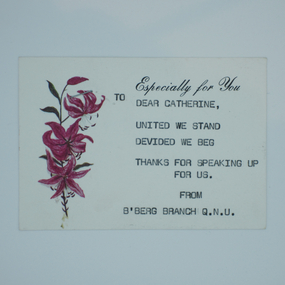
Card from Queensland Nurses Union (Bundaberg Branch) to Catherine Hutchings, visiting Victorian nurses union staff member, 1993
... "Everyone went out of their way to make us feel very welcome, and to shower us with sympathy over the situation. ..."Everyone went out of their way to make us feel very welcome, and to shower us with sympathy over the situation. ...Thank-you card given to Australian Nursing Federation (Victorian Branch) staff member Catherine Hutchings by staff at the Bundaberg Branch of the Queensland Nurses Union. In 1993, Victorian Branch staff travelled throughout Queensland, Western Australia and the Northern Territory for a series of meetings on recent events impacting nurses' conditions in Victoria. The meetings were strategically held ahead of the 1993 Federal election to discourage the election of a Coalition government. The election of the Coalition government in Victoria in 1992 had seen the introduction of the Employee Relations Act, which saw the end of the state award system in Victoria. This gave employers greater powers to establish wages and conditions and less power to the Industrial Relations Commission, foreshadowing what would later occur at a Federal level. An article in the Victorian Branch newsletter 'On the Record' from April 1993 describes the 'tour'. Entitled 'Vic. Nurses Spreading the Word in Queensland, Western Australia and the Northern Territory', it explains: "Catherine Huntchin[g]s and Elizabeth Hulme recently spent a week in Queensland informing nurses about the effect of a Liberal Government on nurses. As well, Tracy Austin visited WA to talk to nurses there about life under Kenneyt [sic]. Catherine and Liz held a total of 23 meetings from Cairns to Brisbane, as well as giving media interviews. It was well worth the effort and certainly there was much support given to nurses in Victoria. Perhaps the most interesting issue was that many nurses did not realise that they may find themselves in the same situation if we have a change in Federal Government. In February, Catherine went to the NT to talk to nurses in Darwin, Alice Springs and Katherine and despite some minor hiccoughs (the Health Department banned all the meetings so alternative venues had to be found) the turnout was gratifying - you have to be dedicated to attend a meeting held in a carpark in 32 C heat! Catherine says that the reception she received in both QLD and the NT was superb. "Everyone went out of their way to make us feel very welcome, and to shower us with sympathy over the situation. More important, is the fact that the information was distributed so no matter how the votes go on March 13 [1993, federal election] - they will be informed votes." she said. Catherine, Liz and Tracy extend sincere thanks to all interstate nurses who made their visits a success."Typed card given with flower bouquet. Printed on one side with personalised, typed message 'DEAR CATHERINE, UNITED WE STAND DEVIDED [sic] WE BEG THANKS FOR SPEAKING UP FOR US. FROM B'BERG [Bundaberg] BRANCH Q.N.U. [Queensland Nurses Union]'.nursing, nurses, unionism, solidarity, victoria, queensland, bundaberg, campaigning, 1993 federal election, 1992 victorian election, australian nursing federation, trade unions, politics, queensland nurses union, qnu, anf -
 Flagstaff Hill Maritime Museum and Village
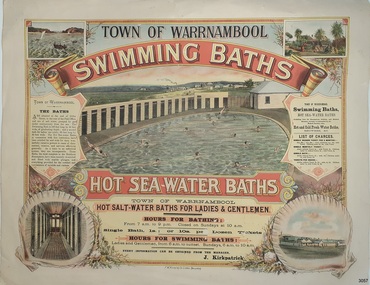
Poster - Recreation, Town of Warrnambool Swimming Baths, ca. May 1884
... Kirkpatrick" "HOT SEA-WATER BATHS ... strongly recommended by the Medical Faculty" "Hot and Cold Fresh Water Baths" "Showers etc." "LIST OF CHARGES ... Single Season Ticket, Single Monthly Ticket, Single Bath without towel ... with towel.. ...Kirkpatrick" "HOT SEA-WATER BATHS ... strongly recommended by the Medical Faculty" "Hot and Cold Fresh Water Baths" "Showers etc." "LIST OF CHARGES ... Single Season Ticket, Single Monthly Ticket, Single Bath without towel ... with towel.. ...The poster advertises these Swimming Baths as “the most complete in the Southern Hemisphere”. In February 1877 a Baths Company (1050 shares) was formed in the town of Warrnambool for the establishment of the baths at the south end of Gillies Street. The baths were filled with sea water from Lady Bay, originally pumped by a windmill situated near the current Surf Lifesaving Club and carried by iron pipes to the Public Baths; later the water was pumped by a gas motor. Hot and cold fresh water baths were advertised. The gentlemen’s bath was 100 feet long and 50 feet wide, of graduating depth. A second bath, solely for ladies, was 60 feet long by 30 feet wide. Hot Sea water Baths were also part of the institution, and were sought after for their ‘wonderful curative powers’, and ‘incomparable’ as a ‘tonic for the feeble’. In June 1881 the Hot Sea Baths were opened, and both hot and cold water baths were supplied at reasonable charges. Patrons came from near and far to receive the benefits. The manager of the Baths was J. Kirkpatrick. The Baths Company struggled for several years without success, so in 1883 the baths were sold to the Borough Council for 1250 pounds. The original shareholders received nothing for their outlay; the overdraught was over the sale price. In May 1884 the Council announced that an estimated they has spent 1000 pounds in improving the baths since purchasing them and were now returning an income of 11 per cent. Historically significant to Warrnambool and the recreational facilities available in the 1880s to 1900s. The remains of the baths are still visible to the public today.Poster on heavy cream paper, landscape orientation, with coloured print. The poster advertises the Warrnambool Swimming Baths. It has several drawings such as Middle Island and the Merri River Mouth with vessels in the water, The inside of the Baths facility, the men's baths with the adjacent bathing rooms and figures in and out of the water, a cottage with figures in the garden, and fenced buildings with a windmill and aqueduct or pipes. The text describes the location and advantages, the opening times and various costs. It was printed in Ballarat by F.W. Niven & Co. Lithos."TOWN OF WARRNAMBOOL" "SWIMMING BATHS" "HOT SALT-WATER BATHS FOR LADIES AND GENTLEMEN" "HOURS FOR BATHING fROM 7 a.m. to 9 p. m. Closed on Sundays at 10 a.m." Single Bath 1s [1 shilling]; or 10s per Dozen Tickets" "HOURS FOR SWIMMING BATHS: Ladies and Gentlemen, from 6 a.m. to Sunset, Sundays 6 a.m. to 10 a.m." "Every information can be obtained from the Manager, J. Kirkpatrick" "HOT SEA-WATER BATHS ... strongly recommended by the Medical Faculty" "Hot and Cold Fresh Water Baths" "Showers etc." "LIST OF CHARGES ... Single Season Ticket, Single Monthly Ticket, Single Bath without towel ... with towel.. Tickets per dozen without towel, with towel..." "The Baths are situated at the end of Gillies Street, in the rear of the Post Office, and are of salt water pumped by gas motor continuously from the sea. The Swimming Bath is 100 feet long by 50 feet wide, of graduating depth; and a second bath for ladies' use solely, 60 feet long by 30 feet wide. The hot Sea-water Baths in connection with this institution have been extolled far and wide for their wonderfully curative powers in cases of rheumatism, sciatica, and nervous afflictions generally. As a tonic to an enfeebled system, they are incomparable, These Baths, the most complete in the Southern Hemisphere, have been recently re-erected and fitted with marble plunges, and everything provided for the comfort and convenience of invalids and visitors." "F.W. NIVEN & Co, LITHOS, BALLARAT"flagstaff hill, warrnambool, warrnambool swimming baths, hot sea water baths warrnambool, warrnambool baths company, f.w. niven & co, warrnambool therapudic baths, town of warrnambool, swimming baths, hot sea water baths, salt water baths, ladies' baths, gentlemen's baths, warrnambool town baths, j kirkpatrick -
 Melbourne Tram Museum
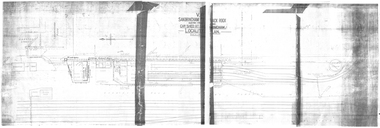
Drawing, VR Sandringham Tram Depot, 1921
... Drawing 582.22. 420H x 590W. .4 - Locker Room for Bus Drivers – plan 264-46, dated 2-5-1946, 295H x 420W. .5 - Shower for Bus Drivers, Plan No. 815-50, dated 15/12/1950, 295H x 420W. ...Drawing 582.22. 420H x 590W. .4 - Locker Room for Bus Drivers – plan 264-46, dated 2-5-1946, 295H x 420W. .5 - Shower for Bus Drivers, Plan No. 815-50, dated 15/12/1950, 295H x 420W. ...Set of 8 drawings, prints from original VR drawings of the Victorian Railways Sandringham Railway station, tram depot, bus depot and alterations between 1921 and 1958.\ .1 - VR Sandringham to Black Rock, Electric Street Railway – Car shed at Sandringham – Locality Plan – shows car depot layout, substation, track location for both the railway and tramway, including the platform, goods shed and coal stage. Not dated. Consists of two sheets of paper joined in the middle – 420H x 1210W. Minor creases at end of rolled sheet. .2 - Drawing 1907.21 - Sandringham car shed proposed extension – with note “Not carried out” – dated 2-8-21 Second copy has stamp – Drawer 2, Folio 1, plan 2 in bottom left hand corner. 480H x 630W .3 - Sandringham Station – station layout showing proposed extension to passenger platforms for both 7 and 10 car trains, buildings shops as the southern end of the yard, rail and tramway tracks, streets, dated 12.2.1923. Drawing 582.22. 420H x 590W. .4 - Locker Room for Bus Drivers – plan 264-46, dated 2-5-1946, 295H x 420W. .5 - Shower for Bus Drivers, Plan No. 815-50, dated 15/12/1950, 295H x 420W. Has a note on the drawing – “not carried out”. .6 - Tramcar shed – Site Plan – Entrance Gates – shows conversion arrangements of the depot from trams to buses, including entrance way gates. Plan 456-56. 295H x 420W. .7 - Conversion of sub-station into New Amenities Block - plan number 51-57, dated 22.2.1957 - Detail architectural drawings for the above work. 295H x 420W .8 - Conversion of sub-station into New Amenities Block - plan number 51-57, dated 22.2.1957 - Detail architectural drawings for the above work. 295H x 420W. .9 - Proposed Improvements to Bus Depot - Plan No. 455-52 - not dated. 420H x 595Wtrams, tramways, vr, sandringham, tramways, buses, railways, black rock -
 Wodonga & District Historical Society Inc
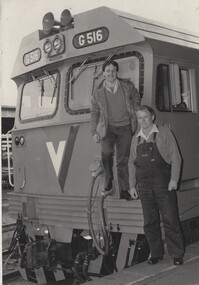
Photograph - Fred Rochow Railways Collection - Driver Tom Symonds and Fireman Billy Hyde, 3 August 1986
... Uniquely in Australia, it conveyed only First Class passengers, all of whom were accommodated in air-conditioned sleeping cars, all equipped with showers. The Southern Aurora was introduced when part of Australia's rail gauge problem was solved with the construction of a new standard gauge line. ...Uniquely in Australia, it conveyed only First Class passengers, all of whom were accommodated in air-conditioned sleeping cars, all equipped with showers. The Southern Aurora was introduced when part of Australia's rail gauge problem was solved with the construction of a new standard gauge line. ...The Fred Rochow Railways Collection incorporates photos related to the operation of the Wodonga Railway Station including different types of trains and railways staff C. 1930 – 1990. It was donated to the Wodonga Historical Society by Fred Rochow, a railwayman who spent many years based in Wodonga. He joined the Victorian Railways on 17th June l947 and retired in 1988. For some time, he was a member of the Australian Federated Union of Locomotive Enginemen and served a term as a member of the Trades Hall Council. He had an extensive knowledge of the struggles that took place to achieve better conditions for railway workers. Fred worked for many years as a fireman and then worked his way up the ranks to driver, experiencing many changes from the days of steam locomotives through to diesel trains, locomotives and even the modern XPT train. He worked throughout Victoria at different stages of his career, with his final working years focused on the northeast of Victoria and the Albury to Melbourne line. After his retirement, Fred continued to share his love of steam miniature trains with the community.This collection has local and statewide significance as it captures images of trains, locomotives and personnel who operated the railway services in Wodonga and throughout Northeast Victoria. The railways played a critical role in opening up Victoria and connecting Australia for trade, business, social communication and transport.At Spencer Street Station on the last “Southern Aurora". The locomotive was G516. Driver Tom Symonds was based in Wodonga from 1955 to 1987. He served as AFULE Branch Secretary from 1962 to 1963 and 1966 to 1971. G Class Locomotives - G Class locomotives were primarily intended for hauling freight services, they were also used on passenger trains such as the “Southern Aurora” and the “Intercapital Daylight”. Locomotive G516 came into service in December 1984. After a series of contractual changeovers between companies it was transferred to QR National and is still in operation, The "Southern Aurora", the overnight Sydney-Melbourne express, was one of the icons of Australian railways in the 1960s and 1970s. Uniquely in Australia, it conveyed only First Class passengers, all of whom were accommodated in air-conditioned sleeping cars, all equipped with showers. The Southern Aurora was introduced when part of Australia's rail gauge problem was solved with the construction of a new standard gauge line. The new line was a 317 km long line running from Albury, NSW, parallel to the existing broad gauge line to Melbourne, connecting Australia's two largest cities by standard gauge. The Southern Aurora consisted of 14 stainless steel cars: a luggage van, a power van, a dining car, a lounge car, and ten First Class Sleeping Cars. The total capacity was 198 passengers. For a number of years, there were no intermediate stops for passengers, and the train had the longest non-stop run in Australia, 430 km from Goulburn to Albury. Dining car crews changed at Goulburn and Albury, and locos were changed at Albury. The first train ran from Sydney on Thursday 14th April 1962, with full regular services starting from both Sydney and Melbourne on Monday 16th April 1962. The classic S Class locomotive was used to haul the early Southern Aurora trains. From 1984 it was also hauled by the new G Class locomotives, On the morning of 7th February 1969, the southbound Southern Aurora collided head-on with a northbound goods near Violet Town, Victoria. Nine passengers and crew were killed, and seven carriages were destroyed. A steady decline in patronage saw the withdrawal of the service in August 1986. At top of locomotive "G516". In centre of locomotive, "V" insignia of VLinerailways wodonga, fred rochow, wodonga railway men, g class locomotives, the southern aurora -
 Bendigo Historical Society Inc.
Photograph - AUSTIN COLLECTION: Ray Beer, Central Deborah Gold Mine
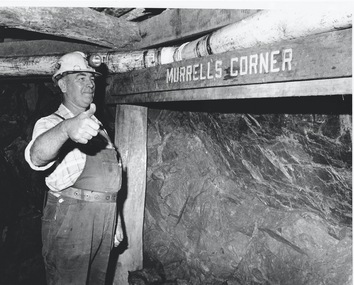
... However, at the time working conditions were considered to be among the best on the goldfields at Central Deborah, after all it was one of the only mines that had hot showers. Following Central Deborah Gold Mine's closure, the Bendigo skyline began to noticeably change. ...However, at the time working conditions were considered to be among the best on the goldfields at Central Deborah, after all it was one of the only mines that had hot showers. Following Central Deborah Gold Mine's closure, the Bendigo skyline began to noticeably change. ...Ray Beer was an employee of the Central Deborah Gold Mine. February 15th 2009: Bendigo Advertiser: 'MINING stalwart Raymond Beer has died at the age of 74 after a battle with cancer. He leaves behind an extended family and a legacy in Bendigo’s mining history. Ray was mine manager at the Central Deborah Gold Mine - appointed in 1978 - and led the team that made possible the underground project at the second level. He had a vision to allow visitors to go underground and experience Bendigo’s mining heritage first hand. Ray was responsible for developing the new battery, shaft and poppet head to make this a reality. It took persistence and lots of hard work. Friend and work colleague Bill McNamara said Ray was as good as 10 men. His enthusiasm and work ethic were unprecedented. Ray will be sadly missed by his wife, Thelma, six children, 15 grandchildren, seven brothers, three sisters, his extended family, and friends. He will be remembered for his kindness, tenacity and strength of character. In recognition of his contribution to Bendigo’s mining history, after more than 20 years of service at his retirement, a bronze life-sized statue was unveiled in his honour'. Central Deborah Gold Mine history: At its peak, Central Deborah Gold Mine reached a depth of 412 metres. It has 17 separate levels and 15 kilometres of drives and cross cuts (tunnels). The Central Deborah was very much a hands-on mine and the conditions that the miners worked in would be considered shocking by today's standards – being lowered underground in a cage with only two sides, often working ankle to knee deep in water, filling up to 32 ore trucks a shift by hand which were then pushed a mile or more along rails in the drives, working by carbide lamp, breathing in the fumes and rock dust and communication by bells. Geez, they were ironmen. However, at the time working conditions were considered to be among the best on the goldfields at Central Deborah, after all it was one of the only mines that had hot showers. Following Central Deborah Gold Mine's closure, the Bendigo skyline began to noticeably change. Obvious remnants of mining such as poppet heads, engine rooms, service quarters, battery houses and chimneys were steadily disappearing. After intense lobbying by the local community, the Bendigo City Council purchased the still very much intact Central Deborah Gold Mine in 1970 for a mere $6,000 to ensure that a vital link to Bendigo's historic golden past was maintained. The Bendigo Trust was then formed to oversee the operations of the Central Deborah Gold Mine, which led to the surface of the mine being opened to the public in 1971. Initially the surface was open for just 12 hours a week and as the demand for viewing a part of Bendigo's history increased, so did the opening hours. In 1974 the mine was gazetted as a Public Historical Purposes Reserve and attracted such visitors as H.R.H Prince Charles. By far the greatest shortcoming at this stage was that no one could view the underground workings, as these had become flooded. After what could only be described as a monumental effort by everyone involved, Level 2 of the mine was officially opened to the public by the Premier of Victoria, the Honourable John Cain, on 20 June 1986, which brought to fruition a long standing dream.Black and white photograph. Ray Beer, underground at Central Deborah Gold Mine, standing alongside wooden sign 'Murrell's Corner'. Sign is placed horizontally on timber supports, side of drive visible in background. Ray is wearing bib and brace overalls and hard hat with a belt around his waist. He is giving a 'thumbs up' sign. gold mining, central deborah gold mine, ray beer, mine manager -
 Sunshine and District Historical Society Incorporated
Administrative record - City of Sunshine - Commissioner Mr Alexander Alex George Gillon Collection 1976 - 1982 - Notice of Ordinary Meeting 16th November 1982, City of Sunshine, 16th November 1982
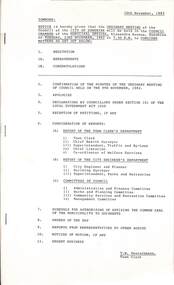
... Ordinary meeting notice including reports from Council's officers Report of the Town Clerk's Department Report of the Town Clerk Accounts for Payment as at 25th October 1982 Statistical Report for Year October 1981 to September 1992 Proposed Discontinuance of Right of Way Beside 36 Clyde Street Maidstone Telephone Number Metropolitan Fire Brigade Acquisition Chaplin Reserve Community Facility Sunshine West United Nations Association of Australia Possible Membership Salvation Army Western Region Advisory Committee Council Representation Open Space Area Maribyrnong Valley Meeting Dates 1993 Proposal to Close Part of Service Street Sealing of General Rate Year Ending 30th September 1983 Use of Council Facilities Saturday 4th December 1982 Sunshine International Women's Year Action Group Discontinuance of Right of Way Between Lewin Street and Robinsons Road South Side of Ballarat Road Deer Park Discontinuance of Right of Way Between Hamilton Street, Burnside Street, Christie Street and Tulloch Street Deer Park Report of Chief Health Surveyor Registration of Premises Health Act Transfer of Premises Health Act Prosecution Proceedings Sunshine Magistrate Court Delivery of Advertising Material / Junk mail Health Act Registration Fees Report of the Medical Officer of Health Report of the Superintendent Traffic and By-Laws Dog Act Traffic and Parking Infringements Court Proceedings Proposed Procession Italian Festival Deer Park Parking Infringements Increase In Penalties Report of the Chief Librarian Children's Pre-Christmas workshops Report of the Co-Ordinator of Welfare Services Multi-Cultural Senior Citizens' Club of West Sunshine Registration and Maintenance Subsidy Showers Street Housing Commission Estate Furnishings Community Room Showers Street Housing Commission Estate Twin Tub Washing Machines Special Bus Emergency Foster Care Report of the City Engineer / Planner Western Suburbs Study Department of Planning Planning Permit Application Advertising Sign 35 Wright Street Planning Permit Application Extensions to Existing Abattoir Kalingra Road (Armbrook Siding) Brooklyn Melbourne Metropolitan Planning Scheme Amendment No 190 On Exhibition Planning Permit Application Extensions to Existing Premises Corner Hampstead Road and Mitchell Street Maidstone Plan of Proposed Strata Subdivision 35 Washington Street St. ...City of Sunshine Alexander "Alex" George Gillon Clyde Street Maidstone Chaplin Reserve Anderson Road Sunshine Maribyrnong Valley Service Street Ballarat Road Deer Park Lewin Street Robinsons Road Hamilton Street Burnside Street Christie Street Tulloch Street Multi-Cultural Senior Citizens' Club of West Sunshine Showers Street Braybrook Wright Street Kalingra Road Armbrook Siding Tottenham Hampstead Road Mitchell Street Washington Street St. ...Ordinary meeting notice including reports from Council's officers Report of the Town Clerk's Department Report of the Town Clerk Accounts for Payment as at 25th October 1982 Statistical Report for Year October 1981 to September 1992 Proposed Discontinuance of Right of Way Beside 36 Clyde Street Maidstone Telephone Number Metropolitan Fire Brigade Acquisition Chaplin Reserve Community Facility Sunshine West United Nations Association of Australia Possible Membership Salvation Army Western Region Advisory Committee Council Representation Open Space Area Maribyrnong Valley Meeting Dates 1993 Proposal to Close Part of Service Street Sealing of General Rate Year Ending 30th September 1983 Use of Council Facilities Saturday 4th December 1982 Sunshine International Women's Year Action Group Discontinuance of Right of Way Between Lewin Street and Robinsons Road South Side of Ballarat Road Deer Park Discontinuance of Right of Way Between Hamilton Street, Burnside Street, Christie Street and Tulloch Street Deer Park Report of Chief Health Surveyor Registration of Premises Health Act Transfer of Premises Health Act Prosecution Proceedings Sunshine Magistrate Court Delivery of Advertising Material / Junk mail Health Act Registration Fees Report of the Medical Officer of Health Report of the Superintendent Traffic and By-Laws Dog Act Traffic and Parking Infringements Court Proceedings Proposed Procession Italian Festival Deer Park Parking Infringements Increase In Penalties Report of the Chief Librarian Children's Pre-Christmas workshops Report of the Co-Ordinator of Welfare Services Multi-Cultural Senior Citizens' Club of West Sunshine Registration and Maintenance Subsidy Showers Street Housing Commission Estate Furnishings Community Room Showers Street Housing Commission Estate Twin Tub Washing Machines Special Bus Emergency Foster Care Report of the City Engineer / Planner Western Suburbs Study Department of Planning Planning Permit Application Advertising Sign 35 Wright Street Planning Permit Application Extensions to Existing Abattoir Kalingra Road (Armbrook Siding) Brooklyn Melbourne Metropolitan Planning Scheme Amendment No 190 On Exhibition Planning Permit Application Extensions to Existing Premises Corner Hampstead Road and Mitchell Street Maidstone Plan of Proposed Strata Subdivision 35 Washington Street St. Albans Plan of Proposed Transfer Hampton Avenue Plan of Subdivision Reid Street Sunshine Boral Resources (Previously Albion Reid Pty Ltd) Glendenning Street Traffic Problems Half Cost Footpath and Kerb And Channel Various Locations Traffic Signals Linking On Princes Highway West From Little Boundary Road to Sommerville Road Parking Restrictions At Municipal Offices Grade Separated Pedestrian Crossings Sunshine Centre Plaza Shopping Centre Traffic Control Items Bus Shelter At Stop 45 Ashley Street Maidstone Melbourne And Metropolitan Tramway Board Neale Road / Station Road Proposes Traffic Signals No Standing Prohibition Load Limits Various Roads Half Cost Fencing 11 Ravenna Street St. Albans Thompson Hall Maidstone West Gate Bridge Charges City of Williamstown Report of the Building Surveyor Building Over Easement 26 Krambrook Street Sunshine West Building Over Easement 36 Summers Street Deer Park Building Over Easement 2 The Mews Ardeer Building Over Easement 18 Merrivale Avenue Sunshine West Building Over Easement 34 Summers Street Deer Park Building Over Easement 83 Tamar Drive St. Albans Building Over Easement 7 Salvia Street St. Albans Building Over Easement 28 Yallourn Street Ardeer Substandard Allotment Lot 62 Tulloch Street Deer Park Height of Fence 100 Ballarat Road Extension of Building Time 52B Forrest Street Sunshine Orders of the Day Planning Permit Application Restaurant and Take Away Food Ballarat Road Sunshine Planning Permit Application Consulting Rooms Main Road West St. Albans city of sunshine, alexander "alex" george gillon, clyde street, maidstone, chaplin reserve, anderson road, sunshine, maribyrnong valley, service street, ballarat road, deer park, lewin street, robinsons road, hamilton street, burnside street, christie street, tulloch street, multi-cultural senior citizens' club of west sunshine, showers street, braybrook, wright street, kalingra road, armbrook siding, tottenham, hampstead road, mitchell street, washington street, st. albans, hampton avenue, reid street, albion, boral resources, previously albion reid, glendenning street, princes highway, little boundary road, sommerville road, sunshine centre plaza shopping centre, hampshire road, ravenna street, thompson hall, krambrook street, summers street, the mews, ardeer, merrivale avenue, tamar drive, salvia street, yallourn street, forrest street -
 Department of Energy, Environment and Climate Action
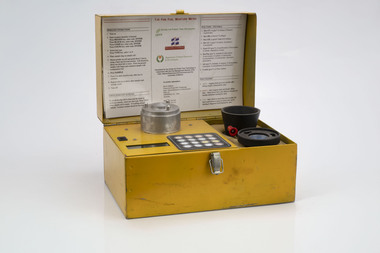
Prototype fuel moisture meter
... Fine fuels like leaves and bark can rapidly absorb moisture after a shower of rain, or from the air when the Relative Humidity (RH) is high, and the temperature is low. ...Fine fuels like leaves and bark can rapidly absorb moisture after a shower of rain, or from the air when the Relative Humidity (RH) is high, and the temperature is low. ...Bushfire behaviour is influenced by many things including temperature, relative humidity, forest type, fuel quantity and fuel dryness, topography and even slope. Wind has a dominant effect on the Rate of Spread (ROS), and also bushfire size, shape and direction. Fuel arrangement is as important as fuel quantity (tonnes/ha). Fibrous and ribbon bark, together with elevated and near-surface scrub fuels act as ladders which lead flames into the tree canopy. But the availability of fuel to burn depends largely on its moisture content. When it exceeds 20-25% not much will burn, whereas 12-15% is generally ideal for fuel reduction burning, but if the moisture content drops as low as 7-10% virtually everything will ignite, and fire behaviour becomes extreme. During the afternoon of the Ash Wednesday bushfires on 16 February 1983 fuel moisture contents were recorded at Stawell as low as 2.7%. Fine fuels like leaves and bark can rapidly absorb moisture after a shower of rain, or from the air when the Relative Humidity (RH) is high, and the temperature is low. Conversely, they can also dry out very quickly. So even though the overall fuel quantity in the forest doesn’t change, the fine fuel availability can increase rapidly from zero after rain to many tonnes per hectare as the fuel dries out. This can happen over a few hours on hot and windy days. Heavy fuels like logs on the ground take longer to dry out. Since the 1930s foresters, firefighters and researchers have been working to develop quick and reliable techniques for measuring fuel moisture content. One of the most accurate methods is slowly drying a sample of fuel in a conventional oven for 24-48 hours to remove all the moisture and measuring the weight difference, but this takes time and is not practical in the field when rapid measurements are needed. But oven drying is often used as a benchmark to compare other methods. Microwave ovens are faster but can cause uneven drying and even char the fuel. They are also not very practical for use in the field. Some mathematical models rely on weather records such as rainfall, wind speed, evaporation, cloud cover, shading, relative humidity, slope, aspect and season of the year to predict soil and fuel moisture. The Keetch-Byram Drought Index of soil dryness is the most common. But complex fuels with leaves, twigs, grass etc make the predictive models often inadequate for fine fuels. The most common technique in Victorian forests until recently was the trusty Speedy Moisture Meter. Originally developed in England during the 1920s for measuring moisture in wheat and other grains it was adapted for Australian forest fuels in the 1950s (I think). Fuel was first ground using a Spong mincer, often attached to the bullbar of a vehicle, and a small sample placed into the Speedy together with a measure of calcium carbide and then sealed. A chemical reaction created gas pressure which was read on the external dial. There were important techniques with cleaning, mincing and using the chemicals with the Speedy to give reliable readings, but it was quick, inexpensive, robust, portable and practical in the field. It was used routinely before igniting a fuel reduction burn or measuring fuel moisture differentials on slash burns. But in about 1996, Karen Chatto and Kevin Tolhurst from the Department’s Creswick Research Station developed the Wiltronics Fuel Moisture meter which measured electrical resistance. Wiltronics is an Australian owned company operating from Ballarat. The final result was a kit that was portable, accurate and could reliably measure fuel moisture contents between 3% and 200%. Although expensive, it is now widely used by fire agencies around the world which has virtually relegated the Speedy to the back cupboard.Prototype Fuel moisture meterT-H Fine Fuel Meterforests commission victoria (fcv), bushfire, forest measurement -
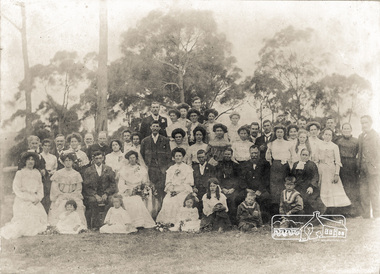 Eltham District Historical Society Inc
Photograph, Wedding of Sarah Ann Bird (b.1881) to Edward Ernest Pepper (b.1874) held at the Bird family home of "View Hill', Eltham, 1904, 1904
... The bride was prettily dressed in creme voile nicely tucked and gathered, trimmed with guipure lace and silk ruching, sprays of orange blossom, wreath and veil, and she carried a shower bouquet. Her travelling dress was a very pretty blue. ...The bride was prettily dressed in creme voile nicely tucked and gathered, trimmed with guipure lace and silk ruching, sprays of orange blossom, wreath and veil, and she carried a shower bouquet. Her travelling dress was a very pretty blue. ...Sarah Bird 4th from left (seated) and Edward Pepper on her left (standing). George Bird, 2nd from right (seated). George Bird her great-grandfather and Sarah Bird and Edward Pepper, her grandparents. [from Evelyn Observer and Bourke East Record, morning edition, 18 November 1904, p. 3:] ORANGE BLOSSOM. The marriage of Miss Sarah A. Bird, eldest daughter of Mr George Bird, of "View Hill," Eltham, to Mr Ernest Edward Pepper, of Diamond Creek, was celebrated at the residence of the bride's parents on Wednesday, 9th November, 1904. The ceremony took place at 4 p.m. and was performed by the Rev Percey Knight, B.A., of Alphington. The bride entered the drawing room with her father who gave her away, and the Wedding March, was nicely played by Miss Wild. The bride was prettily dressed in creme voile nicely tucked and gathered, trimmed with guipure lace and silk ruching, sprays of orange blossom, wreath and veil, and she carried a shower bouquet. Her travelling dress was a very pretty blue. The brides-maids were Miss Ethel Barker dressed in pale green voile trimmed with creme guipure lace and silk ruching; and Miss Button in creme voile, guipure lace, silk ruching; both carried pretty bouquets. The groomsmen were Mr Lorimer, of Diamond Creek, and Mr George Bird, brother of the bride. Between forty and fifty relatives and friends partook of a bountifully provided and nicely laid out breakfast. The usual toasts were honored, and congratulations were freely tendered "to the happy couple". The decorations were very tastefully executed by Miss Beatrice Nelson, and Mr Sayers. The evening was very pleasantly spent in singing, recitations, games, and other suitable pastimes, while others "tipped the light fantastic toe". About 10 p.m., "while all was merry as a marriage bell", the bride and bridegroom departed secretly "to cheat surprise and prying eyes". The presents were numerous and handsome:– Parents of the bride, sewing machine; Miss A. Bird, silver breakfast cruet; Miss N. Bird, bread board and knife; Master A. Bird, pair glass dishes; Master R. Bird, pair photo frames; Mr Sayers, tea set; Miss Kidd, silver jam dish and spoon; Miss Wilkinson, carpet; Mr J. Kilpatrick, cheque; Mr W. Kilpatrick, clock; Miss Kilpatrick, silver butter knife; Mr J. H. Kilpatrick, hand painted mirror; Mrs Kerwin, pictures; Mrs Gilsenan, the handsome wedding cake; Mrs Nelson, Japanese occasional table; Misses Nelson, jugs and candlestick; Mrs Bunker, silver cruet stand; Miss Bunker, hand-painted vases; Miss E. Bunker, epergne; Mr E. Bunker, crumb tray and brush; Miss Jessie Gilsenan, cake stand; Mr Harold Gilsenan, auger basin and ornaments; Mr Lorimer, silver breakfast cruet; Mr A. Collins and Miss Jones, epergne; Miss Cassie Sweeney, jardiniere; Miss Ida and Ollie Cooper, silver butter dish; Miss Mills, large vases; Misses M. and F. Shillinglaw, handsome oak clock; Misses C. and E. Shillinglaw, pair large pictures; Mr Lucas and Miss Sutton, silver butter dish and knife, and silver jam dish and spoon; Miss M. and A. Short, teapot, cheese dish, and tumblers; Mr and Mrs J. Anderson, butter dish; Miss Williams, pen tray; Miss Griffiths, vases; Mr I. Hill, cheque; Miss Wild, biscuit barrel; Mr, Mrs and Miss Brown, trifle bowl and crystal jug; Mrs Weller, water jug and glasses; Mrs Hadfield, pair glass dishes and butter dish; Mr and Mrs Blackney, photo frames; Mr Wilson, beaded basket pin cushion; Mr Linsy, cheque; Mrs Linsy, fruit dish; Mrs Stebbing, pair candle sticks; Mrs Blanchard, pictures.Digital copy of framed sepia photographanderson, bird, blanchard, blackney, bunker, collins, cooper, edward ernest pepper, george bird, george bird jnr, gilsenan, griffiths, hadfield, hill, jones, kerwin, kidd, kilpatrick, linsy, mills, nelson, sarah ann bird, sayers, shillinglaw, short, stebbing, sutton, sweeney, view hill, wedding, weller, wild, wilkinson, williams, wilson, brown, lesley mitchell (nee pepper) collection -
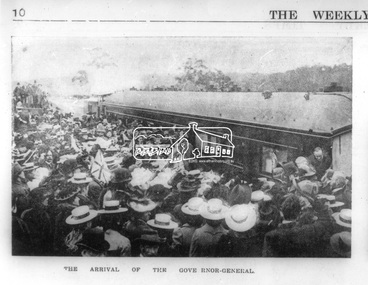 Eltham District Historical Society Inc
Photograph, Opening of the Railway Line; The arrival of the Governor-General, 6 June, 1902, 1902
... He hoped Providence would shower her blessings over them, and that they would have a series of good seasons. ...He hoped Providence would shower her blessings over them, and that they would have a series of good seasons. ...Published: The opening of the railway line by His Excellency The Governor General, The Weekly Times, June 14, 1902, p10. Governor General was John Hope, Earl of Hopetoun THE HEIDELBERG TO ELTHAM RAILWAY. OPENING CEREMONY. The opening of the railway line from Heidelberg to Eltham took place on the 6th inst. The special train, containing a large number of members of Parliament, including Mr Trenwith, the Minister for Railways, left Prince's Bridge at half-past eleven, and arrived at Eltham at twenty minutes past twelve. The party was accompanied by Mr Fitzpatrick, Acting Commissioner for Railways; Mr Lockhead, the Traffic Manager; and Mr Norman, Engineer for Existing Lines. On arrival, the visitors were entertained at a banquet in the marquee, of which a photograph is given, erected close to the railway station. Mr E. H. Cameron, M.L.A., the member for the district, occupied the chair, and, seated on his right, was Mr Mason, the Speaker of the Legislative Assembly, and on his left the Minister of Rail-ways. After the banquet His Excellency the Governor-General arrived, and was received and welcomed by Mr Cameron, the local State school children singing the National Anthem. The Governor-General, in declaring the line open, said that he felt highly honored at being asked to perform the opening ceremony, and he trusted that the railway would be a source of great convenience to the inhabitants of the district. He was sorry to say that this would be the last opportunity he would have of seeing them. It cost him a great deal to leave them. (Hear, hear.) He had a great many friends amongst all sections of the community, and he could hardly bear to trust himself to speak about leaving them. (Hear, hear.) He was sorry Lady Hopetoun was on the high seas, and unable to accompany him that day. Mr Cameron thanked his Excellency for performing the opening ceremony, and hoped the trip home would have the effect of restoring His Excellency to good health again. In replying. Lord Hopetoun thanked them sincerely for the cordial vote of thanks. He hoped Providence would shower her blessings over them, and that they would have a series of good seasons. He would always keep a warm corner in his heart for the people of Victoria. (Loud cheers.) THE COUNTRY. In our illustrations, views are given of a couple of sections of the new line, and glimpses of the surrounding country are shown. The line is eight miles in length, and cost £51,000 in construction. Eltham, which is the terminus, possesses many of the features that go to make a favorite holiday resort. It is a quiet picturesque little hamlet, snugly ensconced on the slope of one of many sombre-tinted hills by which it is sur-rounded. Even when viewed under ad-verse conditions one could not fail to be-impressed with the natural, rugged beauty of the place. It is situated about sixteen miles from Melbourne, and the line takes a circuitous course through a continuation of pretty undulating country. At intervals on the slopes of the surrounding green-mantled hills, patches of brown, freshly tilled soil indicate that for all its serene reposeful-ness Eltham possesses its phases of industrial life as well. Looking down into this valley from the main road which skirts the slope of a hill, distant something less than a quarter of a mile from the railway station is one of the prettiest pieces of scenery in the district. Verdure-clad hills ascend on all sides, whilst beneath stretches a broad expanse of carpet-like green sward, dotted here and there with picturesque homesteads, each with its patches of tilled soil. In the township itself the dwelling-houses are comparatively few, the larger portion of the inhabitants residing in the scattered homesteads. Eltham is as yet only in its youth, but energetic and un-tiring public men can effect wonders in a community's prosperity, and Eltham, whatever other real or imaginary advantages it may lay claim to, certainly possesses this one. The railway is the result of their endeavor. 1902 'THE HEIDELBERG TO ELTHAM RAILWAY.', Weekly Times (Melbourne, Vic. : 1869 - 1954), 14 June, p. 14. , viewed 26 Sep 2018, http://nla.gov.au/nla.news-article221230719This photo forms part of a collection of photographs gathered by the Shire of Eltham for their centenary project book,"Pioneers and Painters: 100 years of the Shire of Eltham" by Alan Marshall (1971). The collection of over 500 images is held in partnership between Eltham District Historical Society and Yarra Plenty Regional Library (Eltham Library) and is now formally known as the 'The Shire of Eltham Pioneers Photograph Collection.' It is significant in being the first community sourced collection representing the places and people of the Shire's first one hundred years.Digital image Negative black and white film 120 6x9 format 2 stripsAgfa APX 100sepp, shire of eltham pioneers photograph collection, eltham, heidelberg-eltham railway extension, earl of hopetoun, john hope, opening day, railway line construction -
Southern Sherbrooke Historical Society Inc.
Information folder - Edelston family
... -Poem, "Growing Old" by William Powell: cover of wedding service, St John's Church of England, Malvern, 10 December 1960 for Cherry and Brian; photo of de Rooy family house destroyed by fire, April 1962: article, "Surprise shower tea for bride-elect"/Photo, "Signing the register", marriage of Cherry Edelston & Brian Fischer, 12 December 1960; article, "It was a great night for Cherry"; card, Wild Cherry Cafe, 163 Collins St; photo, Brian & Cherry Fischer; epithet, "Of all my wife's relations I like myself the best". ...-Poem, "Growing Old" by William Powell: cover of wedding service, St John's Church of England, Malvern, 10 December 1960 for Cherry and Brian; photo of de Rooy family house destroyed by fire, April 1962: article, "Surprise shower tea for bride-elect"/Photo, "Signing the register", marriage of Cherry Edelston & Brian Fischer, 12 December 1960; article, "It was a great night for Cherry"; card, Wild Cherry Cafe, 163 Collins St; photo, Brian & Cherry Fischer; epithet, "Of all my wife's relations I like myself the best". ...Ephemera collected by Edelston family.Information folder containing items pertaining to the Edelston family. Contents: -Sheet of lined paper with hand-written names and dates of birth. -Southern Sherbrooke Historical Society data sheet, containing names and dates of birth. -Article, "Narre North lass weds leading footballer", re. Vivienne Loveridge and Geoffrey Beasley. -Article, "Doctor, 43, shot dead: Wife hit", Sun, 26th January, 1965, re. death of Dr Ronald Hyde. -Medical certificate of vaccinations and innoculations, Edwen Edelston, army record dated 1958. -Record of Services card, National Service, Edwen Edelston, dated 1958./Photo, party scene. -Baby Show certificate, Menzies Creek branch of the Red Cross Society, awarded to Leigh Edelston, plus photo of Leigh (?) and father. (2 copies) -Invitation to Robin Edelston's 21st birthday party, 24th January 1959, family photograph, and card notifying of change of venue for party. -Notice of change of venue for Robin Edelston's 21st birthday party, with small photos (apparently taken at the event) attached. -Article, "They helped Robin to celebrate". re. 21st birthday, with small photos attached. -Article, "Novel jet-age touch for spectacular Belle of Belles Ball", Dandenong Journal, 2nd November 1960 -Article, "Fourteen Belles for big Belle of Belles Ball this Friday night", also card "A. W. Edelston/builder and designer" -Royal Melbourne Hospital School of Nursing Contract of Service by student nurse, for Cherry Edelston, dated 11 December 1957, with photo of Cherry attached. -Poem, "Growing Old" by William Powell: cover of wedding service, St John's Church of England, Malvern, 10 December 1960 for Cherry and Brian; photo of de Rooy family house destroyed by fire, April 1962: article, "Surprise shower tea for bride-elect"/Photo, "Signing the register", marriage of Cherry Edelston & Brian Fischer, 12 December 1960; article, "It was a great night for Cherry"; card, Wild Cherry Cafe, 163 Collins St; photo, Brian & Cherry Fischer; epithet, "Of all my wife's relations I like myself the best". -Article, "Engagement announced at 21st birthday party", re. engagement of Cherry Edelston and Brian Fischer; thankyou card. -Article, "Married in same church as her parents", re. Cherry and Brian Fischer; bereavement card, Mrs Lillian Davie and daughter, dated August 1861; article, "'Miss City' sets the wedding date", re.Cherrie Gillingham. -Article, "Kerry Fox, many times belle, was pretty bride", re. Kerry and Edwen-Robin Edelston, Dandenong Journal, 1963, plus photo of bride and groom; card dated 4 January 1963, from Kerry & Robin to Mr & Mrs E. -Article, "Kerry Fox, hospital Ball belle at Narre Warren"; article, untitled from Weekly Times, on same subject, dated 12 December 1962. -Photo, Kerry Fox & Robin Edelston, re. Belle of Belles. -Photo, Kerry & Robin Edelston; engagement notice, Free Press, Fox-Edelston; article, "Double party: engagement, birthday, NWN"; Dandenong Journal flyer; (2 copies).edelston family -
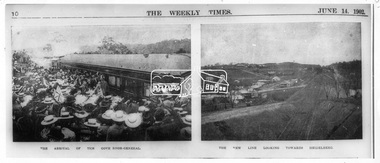 Eltham District Historical Society Inc
Photograph, The Weekly Times, Opening of the Heidelberg-Eltham Railway Line, 6 June 1902, 1902
... He hoped Providence would shower her blessings over them, and that they would have a series of good seasons. ...He hoped Providence would shower her blessings over them, and that they would have a series of good seasons. ...Reproduced from "The Weekly Times", 14th June 1902, page 10. 06 Jun 1902 Cross Reference Photo No.(s): 602, 604 Source: La Trobe Library and National Library, Canberra THE HEIDELBERG TO ELTHAM RAILWAY. OPENING CEREMONY. The opening of the railway line from Heidelberg to Eltham took place on the 6th inst. The special train, containing a large number of members of Parliament, including Mr Trenwith, the Minister for Railways, left Prince's Bridge at half-past eleven, and arrived at Eltham at twenty minutes past twelve. The party was accompanied by Mr Fitzpatrick, Acting Commissioner for Railways; Mr Lockhead, the Traffic Manager; and Mr Norman, Engineer for Existing Lines. On arrival, the visitors were entertained at a banquet in the marquee, of which a photograph is given, erected close to the railway station. Mr E. H. Cameron, M.L.A., the member for the district, occupied the chair, and, seated on his right, was Mr Mason, the Speaker of the Legislative Assembly, and on his left the Minister of Rail-ways. After the banquet His Excellency the Governor-General arrived, and was received and welcomed by Mr Cameron, the local State school children singing the National Anthem. The Governor-General, in declaring the line open, said that he felt highly honored at being asked to perform the opening ceremony, and he trusted that the railway would be a source of great convenience to the inhabitants of the district. He was sorry to say that this would be the last opportunity he would have of seeing them. It cost him a great deal to leave them. (Hear, hear.) He had a great many friends amongst all sections of the community, and he could hardly bear to trust himself to speak about leaving them. (Hear, hear.) He was sorry Lady Hopetoun was on the high seas, and unable to accompany him that day. Mr Cameron thanked his Excellency for performing the opening ceremony, and hoped the trip home would have the effect of restoring His Excellency to good health again. In replying. Lord Hopetoun thanked them sincerely for the cordial vote of thanks. He hoped Providence would shower her blessings over them, and that they would have a series of good seasons. He would always keep a warm corner in his heart for the people of Victoria. (Loud cheers.) THE COUNTRY. In our illustrations, views are given of a couple of sections of the new line, and glimpses of the surrounding country are shown. The line is eight miles in length, and cost £51,000 in construction. Eltham, which is the terminus, possesses many of the features that go to make a favorite holiday resort. It is a quiet picturesque little hamlet, snugly ensconced on the slope of one of many sombre-tinted hills by which it is sur-rounded. Even when viewed under ad-verse conditions one could not fail to be-impressed with the natural, rugged beauty of the place. It is situated about sixteen miles from Melbourne, and the line takes a circuitous course through a continuation of pretty undulating country. At intervals on the slopes of the surrounding green-mantled hills, patches of brown, freshly tilled soil indicate that for all its serene reposeful-ness Eltham possesses its phases of industrial life as well. Looking down into this valley from the main road which skirts the slope of a hill, distant something less than a quarter of a mile from the railway station is one of the prettiest pieces of scenery in the district. Verdure-clad hills ascend on all sides, whilst beneath stretches a broad expanse of carpet-like green sward, dotted here and there with picturesque homesteads, each with its patches of tilled soil. In the township itself the dwelling-houses are comparatively few, the larger portion of the inhabitants residing in the scattered homesteads. Eltham is as yet only in its youth, but energetic and un-tiring public men can effect wonders in a community's prosperity, and Eltham, whatever other real or imaginary advantages it may lay claim to, certainly possesses this one. The railway is the result of their endeavor. 1902 'THE HEIDELBERG TO ELTHAM RAILWAY.', Weekly Times (Melbourne, Vic. : 1869 - 1954), 14 June, p. 14. , viewed 26 Sep 2018, http://nla.gov.au/nla.news-article221230719This photo forms part of a collection of photographs gathered by the Shire of Eltham for their centenary project book,"Pioneers and Painters: 100 years of the Shire of Eltham" by Alan Marshall (1971). The collection of over 500 images is held in partnership between Eltham District Historical Society and Yarra Plenty Regional Library (Eltham Library) and is now formally known as the 'The Shire of Eltham Pioneers Photograph Collection.' It is significant in being the first community sourced collection representing the places and people of the Shire's first one hundred years.Digital image 35mm B&W negativesepp, shire of eltham pioneers photograph collection, eltham, heidelberg-eltham railway extension -
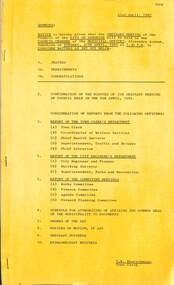 Sunshine and District Historical Society Incorporated
Administrative record - City of Sunshine - Commissioner Mr Alexander Alex George Gillon Collection 1976 - 1982 - Notice of Ordinary Meeting 21st April 1982, City of Sunshine, 21st April 1982
... Albans High School & Tottenham Technical School Report of the Co-Ordinator of Welfare Services Dental Clinic Furlong Road Hospital Councill Sponsorship to Housing Commission Flats Showers Street Braybrook Salvation Army Services Advisory Committee Emergency Relief Reimbursement Pre-School Advisory Service Report of the Chief Health Surveyor Health Act Registrations Application for Transfer of Proprietorship of Premise Under The Health Act 15 Suffolk Road Sunshine North Report of the Medical Officer of Health Report of the Superintendent Traffic and By-Laws Greek Orthodox Easter Celebrations ANZAC Commemorative March Derelict Vehicles Cat Control Naming of Reserves Place Names Committee Kevin Wheelahan Gardens Snake Eradication Report of the Chief Librarian Rainbow Workshop National Seminar for Community Arts Offices Report of the City Engineer / Planner Sunshine Tip Sunshine Shopping Centre Excavations Planning Permit Industrial Sales Lot 9 Ballarat Road Albion Planning Permit Factory Extensions 11 – 13 Judge Street Sunshine Planning Permit Container Storage, Repairs & General Service 600 Geelong Road Brooklyn Planning Permit Promotion Panel Levingston 423 Somerville Road Footscray West Delegated Matters Pedestrian Operated Signals in Station Road near Montasell Avenue Deer Park Proposed Intersection Signals Hampshire Road / Hertford Road Sunshine Sunshine Council V Lend Lease Estates Availability of Sewers Deer Park Albion Football Club Pavilion Parsons Reserve Works carried out at The Hub Complex Willis Street Pre-School Centre Hume Street Child Care Centre Replacement of Hot Water Service Municipal Offices North Sunshine Pre-School Centre Phoenix Street Sunshine North Municipal Offices Proposed Works on Roof Above Council Chambers Report of the Building Surveyor Substandard Allotment of Land 64 Cornwall Road Sunshine Renewal of Building Permit Lots 41, 42 & 43 Cromer Avenue Sunshine North Building Over Easement 45 Novara Parade St. ...Albans High School & Tottenham Technical School Report of the Co-Ordinator of Welfare Services Dental Clinic Furlong Road Hospital Councill Sponsorship to Housing Commission Flats Showers Street Braybrook Salvation Army Services Advisory Committee Emergency Relief Reimbursement Pre-School Advisory Service Report of the Chief Health Surveyor Health Act Registrations Application for Transfer of Proprietorship of Premise Under The Health Act 15 Suffolk Road Sunshine North Report of the Medical Officer of Health Report of the Superintendent Traffic and By-Laws Greek Orthodox Easter Celebrations ANZAC Commemorative March Derelict Vehicles Cat Control Naming of Reserves Place Names Committee Kevin Wheelahan Gardens Snake Eradication Report of the Chief Librarian Rainbow Workshop National Seminar for Community Arts Offices Report of the City Engineer / Planner Sunshine Tip Sunshine Shopping Centre Excavations Planning Permit Industrial Sales Lot 9 Ballarat Road Albion Planning Permit Factory Extensions 11 – 13 Judge Street Sunshine Planning Permit Container Storage, Repairs & General Service 600 Geelong Road Brooklyn Planning Permit Promotion Panel Levingston 423 Somerville Road Footscray West Delegated Matters Pedestrian Operated Signals in Station Road near Montasell Avenue Deer Park Proposed Intersection Signals Hampshire Road / Hertford Road Sunshine Sunshine Council V Lend Lease Estates Availability of Sewers Deer Park Albion Football Club Pavilion Parsons Reserve Works carried out at The Hub Complex Willis Street Pre-School Centre Hume Street Child Care Centre Replacement of Hot Water Service Municipal Offices North Sunshine Pre-School Centre Phoenix Street Sunshine North Municipal Offices Proposed Works on Roof Above Council Chambers Report of the Building Surveyor Substandard Allotment of Land 64 Cornwall Road Sunshine Renewal of Building Permit Lots 41, 42 & 43 Cromer Avenue Sunshine North Building Over Easement 45 Novara Parade St. ...Ordinary meeting notice including reports from Council's officers Report of the Town Clerk's Department Report of the Town Clerk Proposed Conference Council Officers and Preventatives of Smorgon Consolidated Industries Proposed Conference Between Victorian Railways and Councils Metropolitan Fire Brigades Board Election of Representative Proposal to close part of Butler Street to Traffic Transfer of Funds from Resort and Recreation Account Use of Sunshine Tip by Present Regional and Commerial Users Unexpected Load Funds Albion Tennis Club Request for Bingo Sunshine Croquet Club Request For Bingo Financial Statement for the Year Ended 30th September 1992 Multiple Sclerosis Society Application To Conduct Fundraising Report of Officer Committee on Recreation Facilities and Open Space Shed on Diamond Avenue Reserve Agreements St. Albans High School & Tottenham Technical School Report of the Co-Ordinator of Welfare Services Dental Clinic Furlong Road Hospital Councill Sponsorship to Housing Commission Flats Showers Street Braybrook Salvation Army Services Advisory Committee Emergency Relief Reimbursement Pre-School Advisory Service Report of the Chief Health Surveyor Health Act Registrations Application for Transfer of Proprietorship of Premise Under The Health Act 15 Suffolk Road Sunshine North Report of the Medical Officer of Health Report of the Superintendent Traffic and By-Laws Greek Orthodox Easter Celebrations ANZAC Commemorative March Derelict Vehicles Cat Control Naming of Reserves Place Names Committee Kevin Wheelahan Gardens Snake Eradication Report of the Chief Librarian Rainbow Workshop National Seminar for Community Arts Offices Report of the City Engineer / Planner Sunshine Tip Sunshine Shopping Centre Excavations Planning Permit Industrial Sales Lot 9 Ballarat Road Albion Planning Permit Factory Extensions 11 – 13 Judge Street Sunshine Planning Permit Container Storage, Repairs & General Service 600 Geelong Road Brooklyn Planning Permit Promotion Panel Levingston 423 Somerville Road Footscray West Delegated Matters Pedestrian Operated Signals in Station Road near Montasell Avenue Deer Park Proposed Intersection Signals Hampshire Road / Hertford Road Sunshine Sunshine Council V Lend Lease Estates Availability of Sewers Deer Park Albion Football Club Pavilion Parsons Reserve Works carried out at The Hub Complex Willis Street Pre-School Centre Hume Street Child Care Centre Replacement of Hot Water Service Municipal Offices North Sunshine Pre-School Centre Phoenix Street Sunshine North Municipal Offices Proposed Works on Roof Above Council Chambers Report of the Building Surveyor Substandard Allotment of Land 64 Cornwall Road Sunshine Renewal of Building Permit Lots 41, 42 & 43 Cromer Avenue Sunshine North Building Over Easement 45 Novara Parade St. Albans city of sunshine, alexander "alex" george gillon, smorgans, somerville road, tottenham, butler street, braybrook, sunshine tip, albion tennis club, selwyn park, selwyn street, albion, sunshine croquet club, stanford street, sunshine, st. albans high school, tottenham technical school, main road east, st. albans, south road, suffolk road, sunshine north, furlong road, kevin wheelahan gardens, ballarat road, judge street, geelong road, brooklyn, footscray west, station road, montasell avenue, deer park, hampshire road, hertford road, albion football club, parsons reserve, willis street pre-school centre, willis street, the hub, sun crescent, hume street child care centre, city of sunshine municipal offices, alexandra avenue, north sunshine pre-school centre, phoenix street, cornwall road, cromer avenue, novara parade -
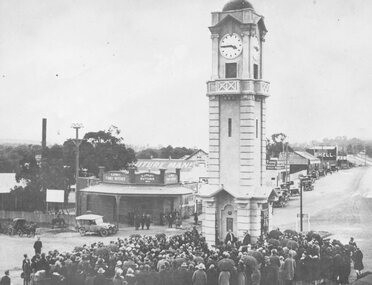 Ringwood and District Historical Society
Photograph, Opening of clock tower by Mayor W. Mackinlay in August 1928
... “Bleak conditions with showers intervening prevailed at Ringwood on Saturday afternoon, when the unveiling ceremony of the soldiers' memorial clock tower, performed by the mayor (Cr. ...“Bleak conditions with showers intervening prevailed at Ringwood on Saturday afternoon, when the unveiling ceremony of the soldiers' memorial clock tower, performed by the mayor (Cr. ...Age (Melbourne, Vic. : 1854 - 1954), Monday 6 August 1928, page 9 ________________________________________ RINGWOOD WAR MEMORIAL CLOCK TOWER UNVEILED A CIVIC CEREMONY. The people of Ringwood have erected a beautiful stone clock tower at a cost of £1797, as a memorial to those who served in the war. The unveiling ceremony was performed by the mayor of Ringwood (Cr. W. Mackinlay) on Saturday. “Bleak conditions with showers intervening prevailed at Ringwood on Saturday afternoon, when the unveiling ceremony of the soldiers' memorial clock tower, performed by the mayor (Cr. W. Mackinlay) took place in the presence of a Iarge and representative gathering. The ceremony was solely a civic one. A majority of members of the local branch of the R.S.S.I.L.A. had wished that Sir John Monash be invited to take a prominent part in the proceedings, but the trustees elected otherwise. The Salvation Army band from Box Hill rendered suitable music, while Sergeant E. P. Taylor (37th Battalion, A.I.F) sounded the Reveille and The Last Post impressively. Among those present were Mr. Edgar, M.L.C., the vicar of Ringwood (Rev. E. E. Robinson), Rev. G. McLaren (Methodist), the memorial trustees (Cr. J. B. McAlpin, Messrs, J. W. Barrett, A. H. Locke, J. A. Williams and A. G. Ashley). The last two mentioned are president and honorary secretary respectively of the local branch of the R.S.A. Soldier delegates from Camberwell and Mitcham were also present. At the outset the mayor said a few words would not be amiss concerning why the memorial had been so long delayed in being erected. In September, 1919, a public committee was formed, with Mr. A. V. Greenwood as chairman, to consider the erection of a suitable memorial to the soldiers. Among the more important suggestions had been the building of a hall and clubrooms on land generously offered by Mr. R. W. Dawes. This project had been abandoned, also the proposed erection of a huge memorial building, at a cost of £5000, on the site of the present town hall. As two years had passed without anything of a definite nature eventuating it was decided to elect five trustees, comprising three citizens and the president and secretary of the Returned Soldiers' Association with full power to act. In all propositions the trustees had been faced with financial difficulties, but about the time of the completion of the plans of the memorial tower Ringwood became a borough, and the new council was appealed to, and provided £500 to make the erection of the memorial possible. The architect, (Mr. H. Norris) had refused to take anything beyond out-of-pocket expenses (£16), while the engineer (Mr. Lucas) had saved a goodly sum by supervising the work. The total funds at the disposal of the trustees, including the council's donation, was, in round figures £1807. The tower complete would cost £1690; honor roll, £77, and fees paid for various designs had amounted to £30. The total expenditure was £1797, leaving a credit balance of £10. Before the unveiling the mayor, in again addressing the citizens, said he deemed it a privilege to perform such a task in connection with so splendid a memorial. The citizens had erected it as an expression of heartfelt gratitude in memory, first of all, of those heroes who gave not only their services, but their lives, when the call came in the common cause of right and liberty, upon which the British Empire was built. This memorial was also the tribute of the citizens in a degree of appreciation to those men who so un-selfishly and ungrudgingly volunteered their services in the Great War. The memorial, while commemorating the glorious deeds of Australian manhood, was not intended, in any sense, as a glorification of war. The memorial would tend to bring to one's mind the blessing of peace in contrast to the curse of hostilities. They were gathered there that afternoon to do honor to all those who volunteered for service to the Great War, but they wished to assure the friends and relatives of those who paid the supreme sacrifice of their sincere sympathy and trust. If ever in the future this fair southern land of ours was threatened by an invader he felt sure that Australian manhood would not hesitate to rally to the call to duty and defend the freedom of their country. Following prayer by Rev. G. McLaren (Methodist), the memorial clock tower was unveiled, the acting mayoress (Mrs. Mackinlay) cutting the cord, after which the making over of the memorial to the borough council took place, the president of the local branch of the R.S.A. (Mr. J. A. Williams) stating he had pleasure in accepting the key on behalf of the trustees. As the council was the permanent governing body the key would be handed back to the mayor, the memorial being given into the safety and custody of the council. During the proceedings the hymns O God, Our Help in Ages Past and Lest We Forget were rendered, the choirs of various denominations joining in the singing. Benediction was pronounced by the vicar of Ringwood (Rev. E. E. Robinson).” Black and white photograph (2 copies- one original mounted on cardboard backing)Written on rear of backing of original: "Opening of clock tower by Mayor W. Mackinlay, 4.8.1928." Written on back of copy" "Mayor Mackinlay dedicating Ringwood clocktower in original position at end of Warrandyte Rd. 1928. Maroondah Hwy on right."
