
Showing 723 items matching "small farm"
-
 Federation University Historical Collection
Book - Book - Scrapbook, Ballarat School of MInes: Scrapbook of Newspaper Cuttings, Book 35, April 1988 to July 1988
... farm manager computer program course...peter quinn...peter davis...federal grant to john valves...special course on stoneware glazes...ceramics instructor neville french...players find home at smb...michael staley winning apprentice...ballarat small...The papers concerned are The Courier, Ballarat, The Australian, The Age over the period of 22 July 1988 to 3 October 1987. teaching positions advertised pre-employment courses courses available enrolment for smb courses aboriginal flag for smb $600000 for science studies building arbor day at victoria park smb and local industry smb's marketing company inskill ltd open learning for maths students pilot business program industry oriented training scheme rob webber new enterprise incentives scheme gerardine christou myra morgan art and craft teacher 1950s new computer software for engineers more adults return to school cuts to special school funding transition program hospitality studies - certificate of catering anne-marie allison christine brady robert reilly sue collins sculptor peter blizzard student andrew burnham ricky hains wins tippett award kandra chapman award winner sheetmetal women's access group smb women's trade and technical program offended girl mechanic hit back mining course at smb kerrie cross council president adult literacy tutors june huggins josie micich hospitality traineeship system launched farm manager computer program course peter quinn peter davis federal grant to john valves special course on stoneware glazes ceramics instructor neville french players find home at smb michael staley winning apprentice ballarat small business centre quality control course at smb calligraphyteacher eddie goodson Book with green cover, front, spiral bound. ...Collection of newspaper articles related to Ballarat School Of Mines.They cover activities and advertisements for staff. The papers concerned are The Courier, Ballarat, The Australian, The Age over the period of 22 July 1988 to 3 October 1987.Book with green cover, front, spiral bound. teaching positions advertised, pre-employment courses, courses available, enrolment for smb courses, aboriginal flag for smb, $600000 for science studies building, arbor day at victoria park, smb and local industry, smb's marketing company inskill ltd, open learning for maths students, pilot business program, industry oriented training scheme, rob webber, new enterprise incentives scheme, gerardine christou, myra morgan art and craft teacher 1950s, new computer software for engineers, more adults return to school, cuts to special school funding, transition program, hospitality studies - certificate of catering, anne-marie allison, christine brady, robert reilly, sue collins, sculptor peter blizzard, student andrew burnham, ricky hains wins tippett award, kandra chapman award winner sheetmetal, women's access group, smb women's trade and technical program, offended girl mechanic hit back, mining course at smb, kerrie cross council president, adult literacy tutors, june huggins, josie micich, hospitality traineeship system launched, farm manager computer program course, peter quinn, peter davis, federal grant to john valves, special course on stoneware glazes, ceramics instructor neville french, players find home at smb, michael staley winning apprentice, ballarat small business centre, quality control course at smb, calligraphyteacher eddie goodson -
Federation University Historical Collection
Book - Book - Scrapbook, Ballarat School of MInes: Scrapbook of Newspaper Cuttings, Book 39, April 1989 to July 1989
... small business course...new dance technique...auction of webster street student houses...back to back theatre group...fiona watson...regional vocational information service...ann mccaffrey smb equal opportunity officer...sole parents get job boost...retail traineeship at smb...judge david boyle. smb hospitality department...smb's work at clay cave...smb service on careers...tradesmen put their skills to the test...marketing is the way to succeed...winning hairdressing apprentices...kathryn reichelt...lois rowan...janine sprattling...maria ashton...ballarat regional board...course in conservation...liz eddy top woolclasser student...jennifer mulholland...suzanne addison...cook for bosses...$393000grant for agricultural training centre...whole farm...The papers concerned are The Courier, Ballarat, The Australian, The Age over the period of 1 April 1989 to 1 July 1989. teaching positions advertised pre-employment courses courses available enrolment for smb courses work skill competition michael pierce finalist scott cook apprentice $500000 to buils smb hostel certificates for small business course new dance technique auction of webster street student houses back to back theatre group fiona watson regional vocational information service ann mccaffrey smb equal opportunity officer sole parents get job boost retail traineeship at smb judge david boyle. smb hospitality department smb's work at clay cave smb service on careers tradesmen put their skills to the test marketing is the way to succeed winning hairdressing apprentices kathryn reichelt lois rowan janine sprattling maria ashton ballarat regional board course in conservation liz eddy top woolclasser student jennifer mulholland suzanne addison cook for bosses $393000grant for agricultural training centre whole farm planning course greg carlson simon lidgett youth achiever awards return to workforce reading and writing for adults program new students' home ready soon Book with yellow cover, front, spiral bound. ...Collection of newspaper articles related to Ballarat School Of Mines.They cover activities and advertisements for staff. The papers concerned are The Courier, Ballarat, The Australian, The Age over the period of 1 April 1989 to 1 July 1989.Book with yellow cover, front, spiral bound. teaching positions advertised, pre-employment courses, courses available, enrolment for smb courses, work skill competition, michael pierce finalist, scott cook apprentice, $500000 to buils smb hostel, certificates for small business course, new dance technique, auction of webster street student houses, back to back theatre group, fiona watson, regional vocational information service, ann mccaffrey smb equal opportunity officer, sole parents get job boost, retail traineeship at smb, judge david boyle. smb hospitality department, smb's work at clay cave, smb service on careers, tradesmen put their skills to the test, marketing is the way to succeed, winning hairdressing apprentices, kathryn reichelt, lois rowan, janine sprattling, maria ashton, ballarat regional board, course in conservation, liz eddy top woolclasser student, jennifer mulholland, suzanne addison, cook for bosses, $393000grant for agricultural training centre, whole farm planning course, greg carlson, simon lidgett, youth achiever awards, return to workforce, reading and writing for adults program, new students' home ready soon -
 Flagstaff Hill Maritime Museum and Village
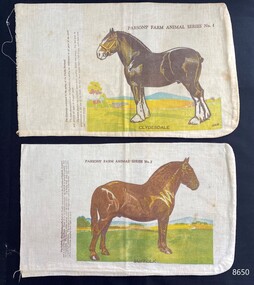
Textile - Parsons' Farm Animal Series Oat Bags
... The feet must be proportionate to the size of the horse, the hoof-head should have a full crown, with heels wide and quarters strong. 8650.2 PARSONS' FARM ANIMAL SERIES No. 3, SUFFOLK, The Suffolk, often known as the Suffolk Punch, originated in the County of Suffolk, England and is noted for its hardiness. From 15 to 16 hands in height, the Suffolk in general is smaller...The feet must be proportionate to the size of the horse, the hoof-head should have a full crown, with heels wide and quarters strong. 8650.2 PARSONS' FARM ANIMAL SERIES No. 3, SUFFOLK, The Suffolk, often known as the Suffolk Punch, originated in the County of Suffolk, England and is noted for its hardiness. From 15 to 16 hands in height, the Suffolk in general is smaller ...Dry foods for domestic use were packaged in cloth bags from the late 19th century to the mid 20th century. As the bags contain the name Parsons' it could be presumed that they were oat bags as the Parsons Company packaged a variety of groceries for the Australian market including oats. The bags provide an example of calico bags used to store dry goods. Being presented as a ‘Farm Animal Series’ gives them added value as a collectable item and may have been an advertising ploy used by the company.A set of two calico bags from the Parsons' company - most likely bought as oat bags. The two are: No 1. (Clydesdale) and No 3. (Suffolk) from the Parsons' Farm Animal Series. Each bag has a multicoloured ink picture and written information about the horse described on the bag.8650.1 PARSONS' FARM ANIMAL SERIES No. 1, CLYDESDALE, The Clydesdale originated in the valley of the Clyde, Scotland. The main characteristics of the Clydesdale are ability to acclimatise in all parts of the world and perform all types of draught work. Clydesdale breeders lay emphasis upon bone, quality, weight, and action. The feet must be proportionate to the size of the horse, the hoof-head should have a full crown, with heels wide and quarters strong. 8650.2 PARSONS' FARM ANIMAL SERIES No. 3, SUFFOLK, The Suffolk, often known as the Suffolk Punch, originated in the County of Suffolk, England and is noted for its hardiness. From 15 to 16 hands in height, the Suffolk in general is smaller than the Clydesdale. The head is rather coarse, with the neck short. The body long, deep and wide with a round full appearance. The croup is straight, the legs short and free from feather. The invariable colour is chestnut, varying from light to dark.flagstaff hill maritime museum and village, great ocean road, shipwreck coast, warrnambool, calico, domestic object, textile, food storage, parsons' farm animal series, oats, clydesdale, suffolk -
 Flagstaff Hill Maritime Museum and Village
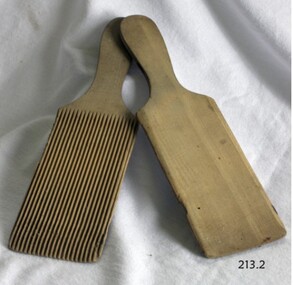
Domestic object - Butter Pats, Late 19th to mid 20th century
... An everyday item in most farm households from the 17th up until the mid 20th centuries significant as it gives a snapshot into the domestic lives of people with farms or small holdings that made their own butter either for sale or for their own use. flagstaff hill warrnambool shipwrecked-coast flagstaff-hill-maritime-museum shipwreck-coast flagstaff-hill-maritime-village domestic item butter pats butter making dairy item Textured with horizontal lines A pair of Butter Slices (pat) wooden flat with shaped handle. ...Scotch hands have also come to be known as butter beaters, butter hands, butter workers or butter pats depending on what part of the world or time period you were in. They are wooden spatulas used when making butter used to press freshly churned butter to remove the watery buttermilk during the butter finishing or working process, also as an aid to distribute salt through the butter. Removing the buttermilk and adding salt helps to prevent rancidity in finished butter, with one side of the paddle ribbed or grooved to allow the buttermilk to drain away from the butter during pressing. The ungrooved side may be used for shaping the butter into its final form. The highest quality Scotch hands are made out of sycamore wood, but they can also be made out of metal.An everyday item in most farm households from the 17th up until the mid 20th centuries significant as it gives a snapshot into the domestic lives of people with farms or small holdings that made their own butter either for sale or for their own use.A pair of Butter Slices (pat) wooden flat with shaped handle. Side for shaping butter is textured Textured with horizontal linesflagstaff hill, warrnambool, shipwrecked-coast, flagstaff-hill-maritime-museum, shipwreck-coast, flagstaff-hill-maritime-village, domestic item, butter pats, butter making, dairy item -
 City of Moorabbin Historical Society (Operating the Box Cottage Museum)
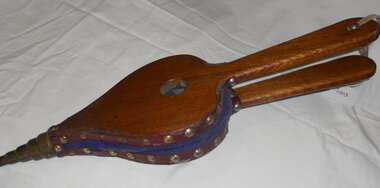
Functional object - Kitchen equipment, fire bellows, c1900
... These domestic fire bellows were used to maintain the fire in the kitchen hearth for cooking,preserving and heating purposes by an early settler family in Moorabbin Shire. brighton moorabbin cooking pioneers market gardeners early settlers kitchen equipment bellows meat betleigh fireplaces farm equipment A small, domestic, fire bellows for maintaining a fire in the kitchen hearth for cooking and heating. ...Early settlers had to daily maintain a fire in their kitchen hearth for cooking and heating purposes. Preservation of meat entailed curing by smoking in the kitchen hearth, hence domestic bellows were an important item of kitchen equipment. These domestic fire bellows were used to maintain the fire in the kitchen hearth for cooking,preserving and heating purposes by an early settler family in Moorabbin Shire.A small, domestic, fire bellows for maintaining a fire in the kitchen hearth for cooking and heating. brighton, moorabbin, cooking, pioneers, market gardeners, early settlers, kitchen equipment, bellows, meat, betleigh, fireplaces, farm equipment -
 City of Moorabbin Historical Society (Operating the Box Cottage Museum)
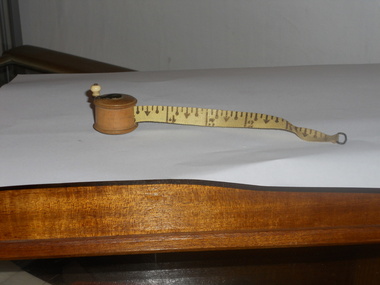
Craft - Craftwork, tape measure c 1880, c1880
... The case is of polished timber, and the little winder, to retract the tape, is made of brass with a small ivory handle Early settlers and market gardeners of Moorabbin Shire had to be self reliant producing their own food and making their farm equipment and clothing. ...c1880 This tiny tape measure, in Imperial measurements, was part of a Victorian era lady's sewing basket. The case is of polished timber, and the little winder, to retract the tape, is made of brass with a small ivory handleEarly settlers and market gardeners of Moorabbin Shire had to be self reliant producing their own food and making their farm equipment and clothing. The women of these families were skilful in all craftwork.c1880 this tiny, retractable, tape measure, in Imperial measure, is made of polished timber with a brass winder and ivory handle. Imperial ‘inch’ measurements on tape dressmaking, tape measure, sewing, craftwork, pioneers, early settlers, market gardeners, moorabbin, brighton, bentleigh cheltenham -
 Greensborough Historical Society
Photograph - Digital image, Sarah Jane Price, 1920c
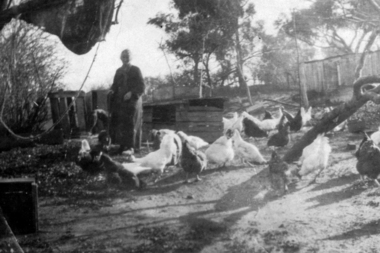
... small daughter Eva. Sarah stayed at Willis Vale until her death on 29/9/1927. Will married Annie Medhurst, who had four children. Sarah helped with the children while Annie helped Will on the farm....small daughter Eva. Sarah stayed at Willis Vale until her death on 29/9/1927. Will married Annie Medhurst, who had four children. Sarah helped with the children while Annie helped Will on the farm. ...Sarah Price was the mother of Mary Partington. After Mary's death in 1900, Sarah came to Willis Vale to help with Mary and Will's small daughter Eva. Sarah stayed at Willis Vale until her death on 29/9/1927. Will married Annie Medhurst, who had four children. Sarah helped with the children while Annie helped Will on the farm.A pioneer Greensborough familyDigital copy of black and white photograph.sarah price, willis vale, william partington, eva partington -
 Greensborough Historical Society
Report and photographs, Barclay Park Greensborough, 07/11/2015
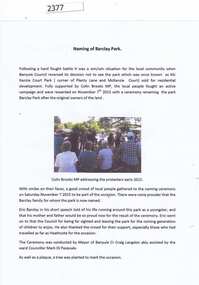
... On November 7, 2015 a small park in Greensborough (previously known as McKenzie Court Park, corner Plenty Lane and McKenzie Court) was renamed as Barclay Park after a local family. henry and Dorothy Barclay farmed Grace Park from 1938. ...On November 7, 2015 a small park in Greensborough (previously known as McKenzie Court Park, corner Plenty Lane and McKenzie Court) was renamed as Barclay Park after a local family. henry and Dorothy Barclay farmed Grace Park from 1938. ...On November 7, 2015 a small park in Greensborough (previously known as McKenzie Court Park, corner Plenty Lane and McKenzie Court) was renamed as Barclay Park after a local family. henry and Dorothy Barclay farmed Grace Park from 1938. Members of the family were present at the ceremony conducted by Banyule Mayor Craig Langdon assisted by Ward Councillor Mark di Pasquale. This open ground was saved from development through the work of local residents.Collection of 6 photographs and a report.barclay family, eric barclay, craig langdon, barclay park -
 City of Moorabbin Historical Society (Operating the Box Cottage Museum)
Album - Kodak album 24pp WW1 1914-1919, c1914-1918
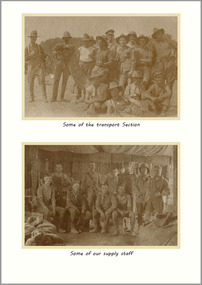
... farms while they worried about the dangers facing their beloved family members. A record of some of the experiences of men from Moorabbin Shire who enlisted c1914 and were sent to Egypt at the beginning of WW1 1914-19 ww1 1914-1918 photographs australian light horse battalion egypt 1st australian infantry force war horses kodak ltd WWI moorabbin marriott Harry Beach Front cover KODAK Inside back cover KODAK LTD. / SERIES D / ALBUM Some photographs have inscriptions on the back A thick cardboard album of 24 pages with inserts for 2 small black and white photographs per page . ...The photos in this album show the carefree, adventurous spirit of the young men soon to be ANZACS Many young men from the market garden, dairy, poultry and fruit farms as well local businesses enlisted c 1914 at the beginning of WWI. The older men, women and children then had to manage the farms while they worried about the dangers facing their beloved family members. A record of some of the experiences of men from Moorabbin Shire who enlisted c1914 and were sent to Egypt at the beginning of WW1 1914-19A thick cardboard album of 24 pages with inserts for 2 small black and white photographs per page . Scenes from Egypt c 1914 - 1918 showing Australian soldiers, naval vessels, horses, carts, pyramids, houses, buildings, camels, local inhabitants and countryside. Inscriptions on the back of some of the photographs mention Arthur (Ebsary), Clarrie (Burgess), Reg (Marriott), and a horse named Nell.Front cover KODAK Inside back cover KODAK LTD. / SERIES D / ALBUM Some photographs have inscriptions on the backww1 1914-1918, photographs, australian light horse battalion, egypt, 1st australian infantry force, war horses, kodak ltd, wwi, moorabbin, marriott, harry beach -
 City of Moorabbin Historical Society (Operating the Box Cottage Museum)
Farm Equipment, Horse Collar medium 20thC, 20thC
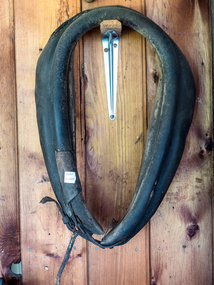
... The early settlers in Moorabbin Shire depended on the draught horse to pull the equipment need to plough the fields, grade the roads, pull their wagons of produce and small carts for transport as they developed the land after the Henry Dendy Special Survey 1841 early settlers, pioneers, draught horse, ploughs, farm equipment, saddles, leatherwork, blacksmiths, cheltenham, sandringham, city of moorabbin, county of bourke, moorabbin roads board, parish of moorabbin, shire of moorabbin, henry dendy's special survey 1841, were j.b.; bent thomas, o'shannassy john, king richard, charman stephen, highett william, ormond francis, maynard dennis, market gardeners, horse drawn wagons, plateway, vegetables, poultry farms, dairy farms, Horse Collar, 20thC medium Farm Equipment, Horse Collar medium 20thC Unrecorded Saddler ...A horse collar is a part of a horse harness that is used to distribute the load around a horse's neck and shoulders when pulling a wagon or plough. The collar often supports and pads a pair of curved metal or wooden pieces, called hames, to which the traces of the harness are attached. The collar allows the horse to use its full strength when pulling, essentially enabling the animal to push forward with its hindquarters into the collar. It is a padded appliance that conforms well to the shape of the horse's body and is constructed so that at all points of contact with the body of the horse it avoids the air passage.The early settlers in Moorabbin Shire depended on the draught horse to pull the equipment need to plough the fields, grade the roads, pull their wagons of produce and small carts for transport as they developed the land after the Henry Dendy Special Survey 1841Horse Collar, 20thC mediumearly settlers, pioneers, draught horse, ploughs, farm equipment, saddles, leatherwork, blacksmiths, cheltenham, sandringham, city of moorabbin, county of bourke, moorabbin roads board, parish of moorabbin, shire of moorabbin, henry dendy's special survey 1841, were j.b.; bent thomas, o'shannassy john, king richard, charman stephen, highett william, ormond francis, maynard dennis, market gardeners, horse drawn wagons, plateway, vegetables, poultry farms, dairy farms, -
 City of Moorabbin Historical Society (Operating the Box Cottage Museum)
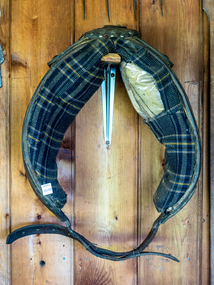
Farm Equipment, Horse Collar small, 20thC
... Farm Equipment, Horse Collar small...The early settlers in Moorabbin Shire depended on the draught horse to pull the equipment need to plough the fields, grade the roads, pull their wagons of produce and small carts for transport as they developed the land after the Henry Dendy Special Survey 1841 early settlers, pioneers, draught horse, ploughs, farm equipment, saddles, leatherwork, blacksmiths, cheltenham, sandringham, city of moorabbin, county of bourke, moorabbin roads board, parish of moorabbin, shire of moorabbin, henry dendy's special survey 1841, were j.b.; bent thomas, o'shannassy john, king richard, charman stephen, highett william, ormond francis, maynard dennis, market gardeners, horse drawn wagons, plateway, vegetables, poultry farms, dairy farms, Horse Collar small 20thC Farm Equipment, Horse Collar small Unrecorded Saddler ...shoulders when pulling a wagon or plough. The collar often supports and pads a pair of curved metal or wooden pieces, called hames, to which the traces of the harness are attached. The collar allows the horse to use its full strength when pulling, essentially enabling the animal to push forward with its hindquarters into the collar. It is a padded appliance that conforms well to the shape of the horse's body and is constructed so that at all points of contact with the body of the horse it avoids the air passage.The early settlers in Moorabbin Shire depended on the draught horse to pull the equipment need to plough the fields, grade the roads, pull their wagons of produce and small carts for transport as they developed the land after the Henry Dendy Special Survey 1841 Horse Collar small 20thCearly settlers, pioneers, draught horse, ploughs, farm equipment, saddles, leatherwork, blacksmiths, cheltenham, sandringham, city of moorabbin, county of bourke, moorabbin roads board, parish of moorabbin, shire of moorabbin, henry dendy's special survey 1841, were j.b.; bent thomas, o'shannassy john, king richard, charman stephen, highett william, ormond francis, maynard dennis, market gardeners, horse drawn wagons, plateway, vegetables, poultry farms, dairy farms, -
 City of Moorabbin Historical Society (Operating the Box Cottage Museum)
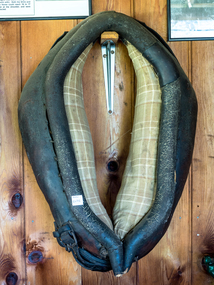
Farm Equipment, Horse Collar large, 20thC
... The early settlers in Moorabbin Shire depended on the draught horse to pull the equipment need to plough the fields, grade the roads, pull their wagons of produce and small carts for transport as they developed the land after the Henry Dendy Special Survey 1841 early settlers, pioneers, draught horse, ploughs, farm equipment, saddles, leatherwork, blacksmiths, cheltenham, sandringham, city of moorabbin, county of bourke, moorabbin roads board, parish of moorabbin, shire of moorabbin, henry dendy's special survey 1841, were j.b.; bent thomas, o'shannassy john, king richard, charman stephen, highett william, ormond francis, maynard dennis, market gardeners, horse drawn wagons, plateway, vegetables, poultry farms, dairy farms, Horse Collar large 20thC Farm Equipment, Horse Collar large Unrecorded Saddler ...A horse collar is a part of a horse harness that is used to distribute the load around a horse's neck and shoulders when pulling a wagon or plough. The collar often supports and pads a pair of curved metal or wooden pieces, called hames, to which the traces of the harness are attached. The collar allows the horse to use its full strength when pulling, essentially enabling the animal to push forward with its hindquarters into the collar. It is a padded appliance that conforms well to the shape of the horse's body and is constructed so that at all points of contact with the body of the horse it avoids the air passage.The early settlers in Moorabbin Shire depended on the draught horse to pull the equipment need to plough the fields, grade the roads, pull their wagons of produce and small carts for transport as they developed the land after the Henry Dendy Special Survey 1841Horse Collar large 20thCearly settlers, pioneers, draught horse, ploughs, farm equipment, saddles, leatherwork, blacksmiths, cheltenham, sandringham, city of moorabbin, county of bourke, moorabbin roads board, parish of moorabbin, shire of moorabbin, henry dendy's special survey 1841, were j.b.; bent thomas, o'shannassy john, king richard, charman stephen, highett william, ormond francis, maynard dennis, market gardeners, horse drawn wagons, plateway, vegetables, poultry farms, dairy farms, -
 City of Moorabbin Historical Society (Operating the Box Cottage Museum)
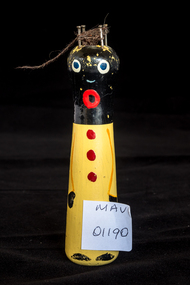
Craft work, doll, wool chain stitch, 20thC
... The chains could be made to any length and then sewn together to make a usable object eg face washer.Gladys Reed was a member of the Ormond Choral Society c 1950. who performed plays and musicals the City of Moorabbin and she was skilled in hand knitting, crochet and dressmaking Gladys Reed was a member of the Ormond Choral Society c 1950. who performed plays and musicals in the City of Moorabbin and this Doll was made and used by her family.c1950 knitting, clothing, haberdashery, crochet, doilies, brighton, moorabbin, pioneers, dressmaking, market gardeners, early settlers, craftwork , bentleigh, lacework, moorabbin shire, reed gladys, dairy farms, fruit orchards Painted doll features A small piece of painted, carved wood with central hollow and 4 nails on top used for making/ knitting a woollen chain. ...20th C and probably earlier families could make this simple 'knitting machine' by using a piece of round, hollow wood and knocking 4 nails into one end of the cylinder leaving a protrusion of 2cm. An empty cotton reel was commonly used with left over knitting wool. Children were taught to wind the wool around the nails in loops, figure of 8 and other patterns so that a chain was made which gradually protruded through the base of the cylinder as a knitted chain. The chains could be made to any length and then sewn together to make a usable object eg face washer.Gladys Reed was a member of the Ormond Choral Society c 1950. who performed plays and musicals the City of Moorabbin and she was skilled in hand knitting, crochet and dressmakingGladys Reed was a member of the Ormond Choral Society c 1950. who performed plays and musicals in the City of Moorabbin and this Doll was made and used by her family.c1950A small piece of painted, carved wood with central hollow and 4 nails on top used for making/ knitting a woollen chain.Painted doll featuresknitting, clothing, haberdashery, crochet, doilies, brighton, moorabbin, pioneers, dressmaking, market gardeners, early settlers, craftwork , bentleigh, lacework, moorabbin shire, reed gladys, dairy farms, fruit orchards -
 City of Moorabbin Historical Society (Operating the Box Cottage Museum)
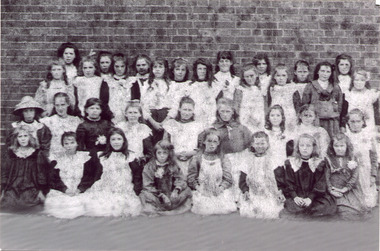
Photograph - Black & White East Bentleigh State School No 2083 c1900
... Early settlers established market gardens, farms and business in the East Brighton ( East Bentleigh) area of Henry Dendy's Special Survey 1841 Brighton. The small...Early settlers established market gardens, farms and business in the East Brighton ( East Bentleigh) area of Henry Dendy's Special Survey 1841 Brighton. The small ...Early settlers established market gardens, farms and business in the East Brighton ( East Bentleigh) area of Henry Dendy's Special Survey 1841 Brighton. The small communities established Churches and Schools. The Church of England opened St Stephen's Common School c 1850 in Tucker Road with 26 pupils. When the Government School opened 1878 the pupils were transferred to the new Centre Road building and it served the developing East Bentleigh Community until 1990. East Bentleigh State School no. 2083, Centre Road 1878 was closed c1990 due to the dwindling number of pupils enrolling following development of Valkstone SS East Bentleigh, Ormond East SS ( now McKinnon SS) and Tucker Road SS East Bentleigh Names of Pupils inscribed on back of original photograph show the children of the early settler families in Moorabbin Shire Back Row -Bessie long, Ruby Marriott, Irene Peterson, Jessie Gebuer, Grace Reid, Ella Marriott, Daisy Arnold, Lucy Hosking 2nd standing - Edie Roberts, Daisy Marriott, Elsie Strack, Ida Gouruly, Ephanie Bruce, Emma Thompson, Evelyn Marriott, Sarah Jackson, Lola G. 3rd kneeling - Lily Moore, Lizzie Sharman, Mag. Scotland, Em Ray, Elsie Claydon, Lily Marriott, ?? Day, ,Bessie Brewster, Eva Lindberg Front- Florrie D......ieson, Florrie ...i....ade, Ruth Goodrich, Lily Boles, Ettie Arnold, Bessie Marriott, Amie Jackson, Eileen Hosking The Government School opened 1878 in the new Centre Road building near Tucker Road, and it served the developing East Bentleigh Community until 1990. East Bentleigh State School no. 2083, Centre Road 1878 was closed c1990 due to dwindling number of pupils following development of Valkstone SS East Bentleigh, Ormond East SS ( now McKinnon SS) and Tucker Road SS East Bentleigh all situated along or near Tucker Road. Black & White photograph, reproduced c2005., of girl pupils at East Bentleigh State School 2083 c 1900east bentleigh state school no.2083c1900, marriott john, box jessie, pederson vic, long bessie, wong george, shephard hilda, mcneil annie, smith j l; smith mary ann, stanley helen, smith vic, smith harry redvers, chaff cutter, horse drawn carts, toll gates brighton, motor cars 1900, steam engines, early settlers, bentleigh, mckinnon, parish of moorabbin, city of moorabbin, county of bourke, moorabbin roads board, shire of moorabbin, henry dendy's special survey 1841, were j.b.; bent thomas, o'shannassy john, king richard, charman stephen, highett william, ormond francis, maynard dennis, market gardeners, vineyards, orchards -
 City of Moorabbin Historical Society (Operating the Box Cottage Museum)
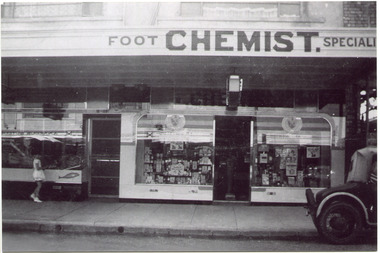
Photograph, Black & White, Mr Moore's 1st Chemist Shop Centre Road, Bentleigh c1930, c1930
... Early settlers in the Parish of Moorabbin, County of Bourke, established market gardens and farms in the area of Henry Dendy's Special Survey 1841 Brighton. Small communities grew near Churches & Schools and shops and businesses were established. ...Early settlers in the Parish of Moorabbin, County of Bourke, established market gardens and farms in the area of Henry Dendy's Special Survey 1841 Brighton. Small communities grew near Churches & Schools and shops and businesses were established. ...Early settlers in the Parish of Moorabbin, County of Bourke, established market gardens and farms in the area of Henry Dendy's Special Survey 1841 Brighton. Small communities grew near Churches & Schools and shops and businesses were established. Following the opening of the Railway line from Caulfield to Mordialloc 1881 the shops and business moved from the Tucker Road /Centre Road ( East Brighton ) East Bentleigh area to be close to the transport. Shops, businesses and housing developed along Centre Road between Thomas Street and Jasper Road. Mr Arthur Moore established his 1st shop in 395 Centre Road c1930 and later moved along the road to a site next to Coles Variety Store.Following the opening of the Railway line from Caulfield to Mordialloc 1881 the shops and business moved from the Tucker Road /Centre Road East Bentleigh area to be close to the transport. Shops, businesses and housing developed along Centre Road between Thomas Street and Jasper Road. Mr Moore established his 1st shop in 395 Centre Road c1930 and later moved along the road to a site next to Coles Variety Store.Black & White photograph of Mr Arthur Moore's 1st Chemist Shop, 384 Centre Road Bentleigh c 1930 back Handwritten information unsignedbentleigh shopping centre c1930, east brighton, railway line caulfield -mordialloc 1881, chemists, pharmacy, moore's moorabbin shire, smith j l, smith mary ann, stanley helen, smith vic, smith harry redvers, chaff cutter, horse drawn carts, toll gates brighton, motor cars 1900, steam engines, early settlers, bentleigh, mckinnon, parish of moorabbin, city of moorabbin, county of bourke, moorabbin roads board, shire of moorabbin, henry dendy's special survey 1841, were j.b., bent thomas, o'shannassy john, king richard, charman stephen, highett william, ormond francis, maynard dennis, market gardeners, vineyards, orchards -
 City of Moorabbin Historical Society (Operating the Box Cottage Museum)
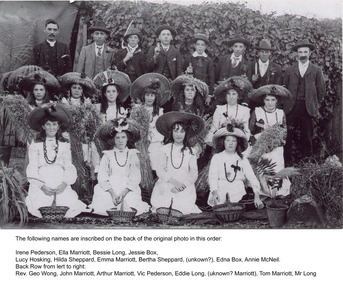
Photograph, Black & White,Methodist Youth 'Harvest Festival' East Bentleigh c1910, original c1910
... Early settlers established market gardens, farms and business in the East Brighton ( East Bentleigh) area of Henry Dendy's Special Survey 1841 Brighton. The small...Early settlers established market gardens, farms and business in the East Brighton ( East Bentleigh) area of Henry Dendy's Special Survey 1841 Brighton. The small ...Early settlers established market gardens, farms and business in the East Brighton ( East Bentleigh) area of Henry Dendy's Special Survey 1841 Brighton. The small communities established Churches and Schools. Stephen Charman, 1821-1906 a market gardener, donated land for the first Methodist Chapel, Cemetery and School in Charman Rd Cheltenham 1855. The East Bentleigh settlers built a Methodist Church in Tucker Road and established the Sunday School and Youth group which organised social and sporting events and picnics.Early settlers established market gardens, farms and business in the East Brighton ( East Bentleigh) area of Henry Dendy's Special Survey 1841 Brighton. The small communities established Churches and Schools. Black and White photograph showing the Bentleigh Methodist Youth Group on Harvest Thanksgiving Sunday c1910 in front of R.Smith's shed in Tucker Road East Bentleigh re-digitised by H.Stanley CMHS 2005Back Handwritten Names on Original photograph Front row Irene Pederson, Ella Marriott, Bessie Long, Jessie Box, Lucy Hosking, Middle row Hilda Sheppard, Emma Marriott, Bertha Sheppard, ? , Edna Box, Annie McNeil Back row Rev. George Wong, John Marriott, Arthur Marriott, Vic Pederson, Eddie Long, ? Marriott,, Tom Marriott, Mr Long methodist youth group bentleigh c1910, marriott emma, marriott ella, hosking lucy, marriott john, box jessie, pederson vic, long bessie, wong george, shephard hilda, mcneil annie, smith j l; smith mary ann, stanley helen, smith vic, smith harry redvers, chaff cutter, horse drawn carts, toll gates brighton, motor cars 1900, steam engines, early settlers, bentleigh, mckinnon, parish of moorabbin, city of moorabbin, county of bourke, moorabbin roads board, shire of moorabbin, henry dendy's special survey 1841, were j.b.; bent thomas, o'shannassy john, king richard, charman stephen, highett william, ormond francis, maynard dennis, market gardeners, vineyards, orchards -
 City of Moorabbin Historical Society (Operating the Box Cottage Museum)
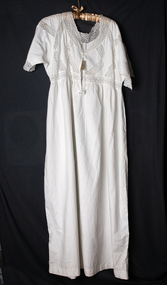
Clothing,Lady's white long cotton nightdress with lace inserts c1900, c1900
... A Lady's white, long, cotton nightdress, with lace inserts and small mother of pearl buttons, was made by an early settler woman in Moorabbin Shire c1900. The women of the pioneer families made and repaired their families clothing as they developed the market gardens , dairy farms and fruit orchards ...A Lady's white, long, cotton nightdress, with lace inserts and small mother of pearl buttons, was made by an early settler woman in Moorabbin Shire c1900. The women of the pioneer families made and repaired their families clothing as they developed the market gardens , dairy farms and fruit orchards This Lady's white long cotton nightdress with lace inserts is an example of the needlework and dressmaking skills of the early settler women in Moorabbin Shire clothing, brighton, moorabbin, pioneers, dressmaking, market gardeners, early settlers, craftwork , bentleigh, lacework, moorabbin shire blackburn nance, dairy farms, fruit orchards ,Lady's white, long, cotton nightdress with lace inserts, short sleeves and small mother of pearl buttons Clothing,Lady's white long cotton nightdress with lace inserts c1900 Family of Nance Blackburn ...A Lady's white, long, cotton nightdress, with lace inserts and small mother of pearl buttons, was made by an early settler woman in Moorabbin Shire c1900. The women of the pioneer families made and repaired their families clothing as they developed the market gardens , dairy farms and fruit orchards This Lady's white long cotton nightdress with lace inserts is an example of the needlework and dressmaking skills of the early settler women in Moorabbin Shire ,Lady's white, long, cotton nightdress with lace inserts, short sleeves and small mother of pearl buttons clothing, brighton, moorabbin, pioneers, dressmaking, market gardeners, early settlers, craftwork , bentleigh, lacework, moorabbin shire blackburn nance, dairy farms, fruit orchards -
 City of Moorabbin Historical Society (Operating the Box Cottage Museum)
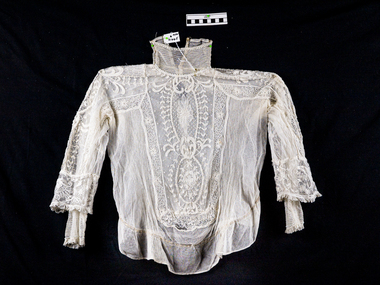
Clothing - Clothing,Girl's Blouse, lace,voile lining, c1900
... small white beads sewn around the edges. The eyes for the hooks on back opening seam are hand-sewn The women of the early settler families were skilled dressmakers and made the clothes for their families as they established market gardens and farms in Moorabbin Shire ...small white beads sewn around the edges. The eyes for the hooks on back opening seam are hand-sewn The women of the early settler families were skilled dressmakers and made the clothes for their families as they established market gardens and farms in Moorabbin Shire This girl's blouse made from lace,voile and net is an example of the high needle work skill of the women of the early settler families in Moorabbin Shire c1900 clothing, brighton, moorabbin, bentleigh, cheltenham, pioneers, dressmaking,lacework, craftwork, tulle, net, market gardeners, early settlers, craftwork , bentleigh, moorabbin shire , dairy farms, fruit orchards A girl's white,long sleeved, tulle blouse,with a high collar stiffened by 4 metal wires. ...This girl's white long sleeved blouse made from lace,voile and net and was probably made for a special occasion c1900. The delicate needlework flowers on the net insert on front of blouse and the over sleeves exhibit a high standard of skill. The fine pintucks on the front, collar and cuffs are finished by small white beads sewn around the edges. The eyes for the hooks on back opening seam are hand-sewn The women of the early settler families were skilled dressmakers and made the clothes for their families as they established market gardens and farms in Moorabbin Shire This girl's blouse made from lace,voile and net is an example of the high needle work skill of the women of the early settler families in Moorabbin Shire c1900 A girl's white,long sleeved, tulle blouse,with a high collar stiffened by 4 metal wires. The tulle has pintucks front and back with inserted decorated net panels and sleeves . The long lace outer sleeves have lace edging at the cuffs. The whole blouse is lined with tulle. .The high collar has horizontal pintucks and has small white beading along top and base. The lining tulle has horizontal pintucks and beading and lace edging on the cuffs of the inner sleeves. Hooks and eyes fasten the back of the blouse and ribbon is inserted at waist to produce a flared effect over hips clothing, brighton, moorabbin, bentleigh, cheltenham, pioneers, dressmaking,lacework, craftwork, tulle, net, market gardeners, early settlers, craftwork , bentleigh, moorabbin shire , dairy farms, fruit orchards -
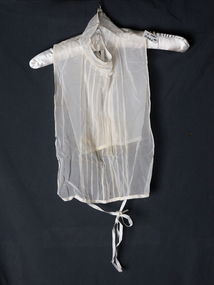 City of Moorabbin Historical Society (Operating the Box Cottage Museum)
Clothing, Lady's white voile shirt fronts with high collars and ribbon ties x 2 c1900, c1900
... small woman or child to wear under a suit jacket . The front has fine vertical pintucks and ribbon waist ties The back seam is fastened with press studs. The high collar has horizontal pintucks and 4 metal wire stays. The early settler women were skilled dressmakers and craft workers. These Lady's voile shirt fronts are examples of the high dressmaking skill of the women of the early settler families in Moorabbin Shire c1900 clothing, dressmaking, haberdashery, crochet, brighton, moorabbin, mckinnon, ormond, pioneers, market gardeners, early settlers, craftwork , bentleigh, lacework, moorabbin shire, hunt ailsa, dairy farms, fruit orchards 2 identical small lady's white voile shirt fronts, with high collar and ribbon waist ties. ...These Lady's white voile shirt fronts were made for a small woman or child to wear under a suit jacket . The front has fine vertical pintucks and ribbon waist ties The back seam is fastened with press studs. The high collar has horizontal pintucks and 4 metal wire stays. The early settler women were skilled dressmakers and craft workers. These Lady's voile shirt fronts are examples of the high dressmaking skill of the women of the early settler families in Moorabbin Shire c1900 2 identical small lady's white voile shirt fronts, with high collar and ribbon waist ties. The front has fine vertical pintucks and the high collar has horizontal pintucks with 4 metal wire stays. Press studs fasten the back seam . clothing, dressmaking, haberdashery, crochet, brighton, moorabbin, mckinnon, ormond, pioneers, market gardeners, early settlers, craftwork , bentleigh, lacework, moorabbin shire, hunt ailsa, dairy farms, fruit orchards -
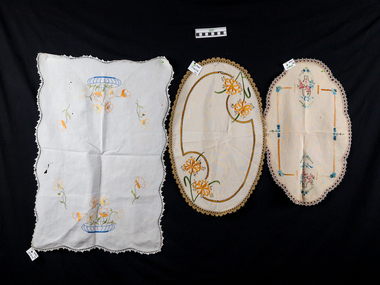 City of Moorabbin Historical Society (Operating the Box Cottage Museum)
Haberdashery, Tray Covers x 5 linen with needlework and crochet c1900, c1900
... These tray covers are examples of the dressmaking, crochet and needlework skills of the women of the early settler families in Moorabbin Shire c1900 clothing, haberdashery, crochet, doilies, brighton, moorabbin, pioneers, dressmaking, market gardeners, early settlers, craftwork , bentleigh, lacework, moorabbin shire, hunt ailsa, dairy farms, fruit orchards 5 x Linen Tray Covers with coloured silk needle work and crochet edging a) oval with flowers, b) oval with 2 small baskets of flowers, c) oval with large flowers, d) rectangle with flowers, cup ,saucer , writing, e) oval with 2 large baskets of flowers Haberdashery, Tray Covers x 5 linen with needlework and crochet c1900 Family of Ailsa Hunt ...These Tray Covers were made by women of the early settler families in Moorabbin Shire c1900 and show their needlework skills . Although living conditions were basic families still held onto their traditional English and European customs and took pride in presenting elements of refined society. These tray covers are examples of the dressmaking, crochet and needlework skills of the women of the early settler families in Moorabbin Shire c1900 5 x Linen Tray Covers with coloured silk needle work and crochet edging a) oval with flowers, b) oval with 2 small baskets of flowers, c) oval with large flowers, d) rectangle with flowers, cup ,saucer , writing, e) oval with 2 large baskets of flowers clothing, haberdashery, crochet, doilies, brighton, moorabbin, pioneers, dressmaking, market gardeners, early settlers, craftwork , bentleigh, lacework, moorabbin shire, hunt ailsa, dairy farms, fruit orchards -
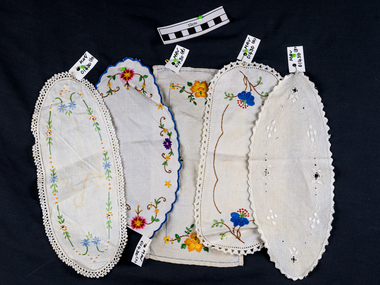 City of Moorabbin Historical Society (Operating the Box Cottage Museum)
Haberdashery, Doilies x 5 small linen with needlework and crochet c1900, c1900
... Although living conditions were basic families still held onto their traditional English and European customs and took pride in presenting elements of refined society These tray covers are examples of the dressmaking, crochet and needlework skills of the women of the early settler families in Moorabbin Shire c1900 clothing, haberdashery, crochet, doilies, brighton, moorabbin, pioneers, dressmaking, market gardeners, early settlers, craftwork , bentleigh, lacework, moorabbin shire, hunt ailsa, dairy farms, fruit orchards 4 oval and 1 rectangular small white linen Doilies with crochet and coloured and white needlework a) oval white with white needlework patterns and crochet edge; b) oval white with coloured flowers and crochet edge; c) oval white with coloured flowers and over-sewn edge; d) oval white with 2 coloured flowers crochet edge; d) rectangular, with coloured flowers and hemmed edge Haberdashery, Doilies x 5 small linen with needlework and crochet c1900 Family of Ailsa Hunt ...These Tray Covers were made by women of the early settler families in Moorabbin Shire c1900 and show their needlework skills . Although living conditions were basic families still held onto their traditional English and European customs and took pride in presenting elements of refined society These tray covers are examples of the dressmaking, crochet and needlework skills of the women of the early settler families in Moorabbin Shire c1900 4 oval and 1 rectangular small white linen Doilies with crochet and coloured and white needlework a) oval white with white needlework patterns and crochet edge; b) oval white with coloured flowers and crochet edge; c) oval white with coloured flowers and over-sewn edge; d) oval white with 2 coloured flowers crochet edge; d) rectangular, with coloured flowers and hemmed edgeclothing, haberdashery, crochet, doilies, brighton, moorabbin, pioneers, dressmaking, market gardeners, early settlers, craftwork , bentleigh, lacework, moorabbin shire, hunt ailsa, dairy farms, fruit orchards -
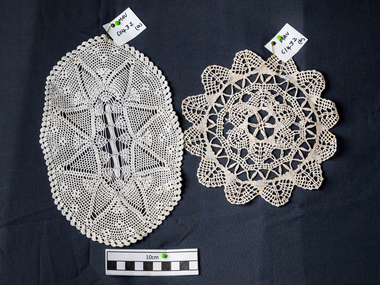 City of Moorabbin Historical Society (Operating the Box Cottage Museum)
Haberdashery, x 2 small doilies crochet c1900, c1900
... These tray covers are examples of the crochet skills of the women of the early settler families in Moorabbin Shire c1900 clothing, haberdashery, crochet, doilies, brighton, moorabbin, pioneers, dressmaking, market gardeners, early settlers, craftwork , bentleigh, lacework, moorabbin shire, hunt ailsa, dairy farms, fruit orchards 2 x small ecru crocheted dressing table doilies a) oval with flowers and shapes, b) star shaped lacy Haberdashery, x 2 small doilies crochet c1900 Family of Ailsa Hunt ...These dressing table doilies were made by women of the early settler families in Moorabbin Shire c1900 and show their crochet skills . Although living conditions were basic families still held onto their traditional English and European customs and took pride in presenting elements of refined society. These tray covers are examples of the crochet skills of the women of the early settler families in Moorabbin Shire c1900 2 x small ecru crocheted dressing table doilies a) oval with flowers and shapes, b) star shaped lacyclothing, haberdashery, crochet, doilies, brighton, moorabbin, pioneers, dressmaking, market gardeners, early settlers, craftwork , bentleigh, lacework, moorabbin shire, hunt ailsa, dairy farms, fruit orchards -
 City of Moorabbin Historical Society (Operating the Box Cottage Museum)
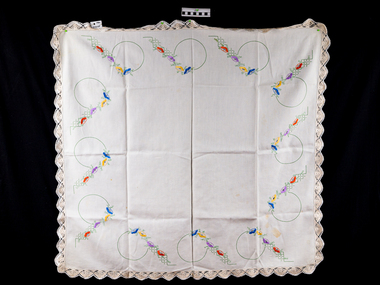
Haberdashery,Table Cloth small white x 2, c1900
... These table cloths are examples of the dressmaking, crochet and needlework skills of the women of the early settler families in Moorabbin Shire c1900 clothing, haberdashery, crochet, doilies, brighton, moorabbin, pioneers, dressmaking, market gardeners, early settlers, craftwork , bentleigh, lacework, moorabbin shire, hunt ailsa, dairy farms, fruit orchards 2 small white table cloths a) linen with wide crochet edge b) cotton with coloured needlework flowers and crochet edge Haberdashery,Table Cloth small white x 2 Family of Ailsa Hunt ...These white table cloths were made by women of the early settler families in Moorabbin Shire c1900 and show their needlework skills . Although living conditions were basic families still held onto their traditional English and European customs and took pride in presenting elements of refined society. These table cloths are examples of the dressmaking, crochet and needlework skills of the women of the early settler families in Moorabbin Shire c1900 2 small white table cloths a) linen with wide crochet edge b) cotton with coloured needlework flowers and crochet edge clothing, haberdashery, crochet, doilies, brighton, moorabbin, pioneers, dressmaking, market gardeners, early settlers, craftwork , bentleigh, lacework, moorabbin shire, hunt ailsa, dairy farms, fruit orchards -
 City of Moorabbin Historical Society (Operating the Box Cottage Museum)
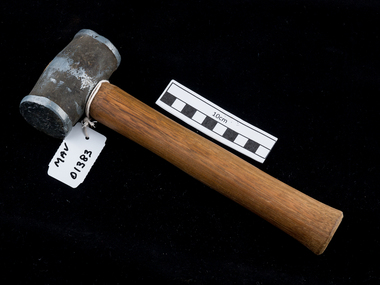
Tool - Hammer small sledge, c1900, c1900
... small sledgehammer whose relatively light weight and short handle allow single-handed use. It is useful for light demolition work, driving masonry nails, and for use with a steel chisel when cutting stone or metal. Among the early settlers in Moorabbin Shire were blacksmiths who made tools for the other settlers who were establishing the homes, market gardens, farms, orchards and various businesses. ...small sledgehammer whose relatively light weight and short handle allow single-handed use. It is useful for light demolition work, driving masonry nails, and for use with a steel chisel when cutting stone or metal. Among the early settlers in Moorabbin Shire were blacksmiths who made tools for the other settlers who were establishing the homes, market gardens, farms, orchards and various businesses. ...A hammer is a tool consisting of a weighted "head" fixed to a long handle that is swung to deliver an impact to a small area of an object. This is a small sledgehammer whose relatively light weight and short handle allow single-handed use. It is useful for light demolition work, driving masonry nails, and for use with a steel chisel when cutting stone or metal. Among the early settlers in Moorabbin Shire were blacksmiths who made tools for the other settlers who were establishing the homes, market gardens, farms, orchards and various businesses. Early settlers were self reliant and repaired their own equipment for kitchen,dairy, farm, horses, carts using various tools . This hammer is typical of the type used by early settlers in Moorabbin Shire c1900This is a small sledge hammer with a wood handle and double sided round metal headearly settlers, market gardeners, blacksmiths, tools, building equipment, hammers, moorabbin shire, bentleigh, mckinnon, highett, cheltenham,mcewan james pty ltd, melbourne, bunnings pty ltd, -
City of Moorabbin Historical Society (Operating the Box Cottage Museum)
Tool - Tenon Saw 20thC, 20thC
... This small fine-toothed saw with a strong back, used especially for cutting tenons on hard and soft woods, usually a Tenon saw will have between 10 and 14 teeth per 2.5cm (inch), this allows more control over the depth and direction of the cut. Among the early settlers in Moorabbin Shire were blacksmiths who made tools for the other settlers who were establishing the homes, market gardens, farms...This small fine-toothed saw with a strong back, used especially for cutting tenons on hard and soft woods, usually a Tenon saw will have between 10 and 14 teeth per 2.5cm (inch), this allows more control over the depth and direction of the cut. Among the early settlers in Moorabbin Shire were blacksmiths who made tools for the other settlers who were establishing the homes, market gardens, farms ...This small fine-toothed saw with a strong back, used especially for cutting tenons on hard and soft woods, usually a Tenon saw will have between 10 and 14 teeth per 2.5cm (inch), this allows more control over the depth and direction of the cut. Among the early settlers in Moorabbin Shire were blacksmiths who made tools for the other settlers who were establishing the homes, market gardens, farms, orchards and various businesses. Early settlers were self reliant and repaired their own equipment for kitchen,dairy, farm, horses, carts using various tools . This tenon saw is typical of the type used by early settlers in Moorabbin Shire 20th CA small fine-toothed steel saw with a strong back and wood handle, used esp for cutting tenons - fitted pieces of wood to insert into a cavity.saws, tenon saws, early settlers, market gardeners, blacksmiths, tools, building equipment, hammers, moorabbin shire, bentleigh, mckinnon, highett, cheltenham,mcewan james pty ltd, melbourne, bunnings pty ltd, -
 City of Moorabbin Historical Society (Operating the Box Cottage Museum)
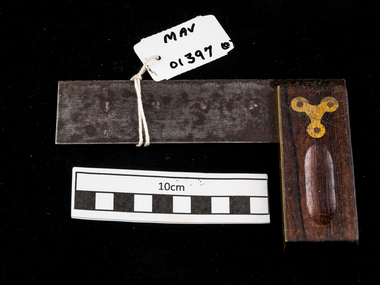
Tools, Set Square steel x2, Stanley c1900, c1900
... small shop in New Britain, USA, to manufacture bolts, hinges, and other hardware from wrought iron. Among the early settlers in Moorabbin Shire were blacksmiths who made tools for the other settlers who were establishing the homes, market gardens, farms, orchards and various businesses. ...small shop in New Britain, USA, to manufacture bolts, hinges, and other hardware from wrought iron. Among the early settlers in Moorabbin Shire were blacksmiths who made tools for the other settlers who were establishing the homes, market gardens, farms, orchards and various businesses. ...In 1843, Frederick Stanley, started a small shop in New Britain, USA, to manufacture bolts, hinges, and other hardware from wrought iron. Among the early settlers in Moorabbin Shire were blacksmiths who made tools for the other settlers who were establishing the homes, market gardens, farms, orchards and various businesses. Early settlers were self reliant and repaired their own equipment for kitchen,dairy, farm, horses, carts using various tools . As manufacturing developed late 19thC high quality tools were imported from UK, USA and EuropeThese set squares are typical of the type used by early settlers in Moorabbin Shire c19002x Steel Set Squares a) 15cm (6") with wood handle b) 19cm (7") with a slotted steel handle. a) STANLEY Pat 12-29-96set squares, rulers, builders, trigonometry, mathematics, stanley tools pty ltd., bolts, hinges, hardware, early settlers, market gardeners, blacksmiths, tools, building equipment, hammers, moorabbin shire, bentleigh, mckinnon, highett, cheltenham,mcewan james pty ltd, melbourne, bunnings pty ltd, -
City of Moorabbin Historical Society (Operating the Box Cottage Museum)
Tool - Tools small steel socket spanner
... Early settlers were self reliant and repaired their own equipment for kitchen,dairy, farm, horses, carts using various tools This spanner is typical of the type used by early settlers in Moorabbin Shire early 20thC hammers early settlers market gardeners blacksmiths tools building equipment moorabbin shire bentleigh mckinnon highett cheltenham mcewan james pty ltd melbourne bunnings pty ltd A small steel socket spanner Tool Tools small steel socket spanner ...Early 20thC settlers need a different spanner for each size nut or bolt. Now socket spanners often come as a "socket set" with many different sizes or types of sockets to fit the heads of different-sized fasteners. Among the early settlers in Moorabbin Shire were blacksmiths who made tools for the other settlers who were establishing the homes, market gardens, farms, orchards and various businesses. Early settlers were self reliant and repaired their own equipment for kitchen,dairy, farm, horses, carts using various tools This spanner is typical of the type used by early settlers in Moorabbin Shire early 20thCA small steel socket spannerhammers, early settlers, market gardeners, blacksmiths, tools, building equipment, moorabbin shire, bentleigh, mckinnon, highett, cheltenham, mcewan james pty ltd, melbourne, bunnings pty ltd -
 Orbost & District Historical Society
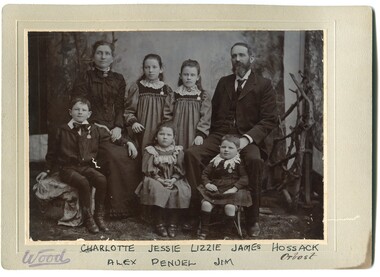
black and white photograph, Wood, C1900
... farmed "Brooklands" which he bought from John Cameron The Hossack family was a prominent Orbost family with strong ties to the Presbyterian Church in Orbost. This item is a part of the Hossack family history. hossak-family-orbost on front - "Charlotte, Jessie, Lizzie, James, Alex, Penuel & Jim Hossack" A black / white photograph of a family group with the mother seated on the left and the father on the right and twin girls standing between them. Three smaller ...James Hossack and his wife, Penuel, arrived from Scotland to Geelong on Christmas Day 1852. James and Penuel had one daughter, Penuel who married Robert Pullar Cameron at Orbost. They had two sons, James(1858) and George(1860). James Hossack farmed "Brooklands" which he bought from John Cameron The Hossack family was a prominent Orbost family with strong ties to the Presbyterian Church in Orbost. This item is a part of the Hossack family history.A black / white photograph of a family group with the mother seated on the left and the father on the right and twin girls standing between them. Three smaller children are seated in front. It is mounted on a grey buff card with the names written at the bottom.on front - "Charlotte, Jessie, Lizzie, James, Alex, Penuel & Jim Hossack"hossak-family-orbost -
 Orbost & District Historical Society
black and white photograph, Green, O. S, April 1897
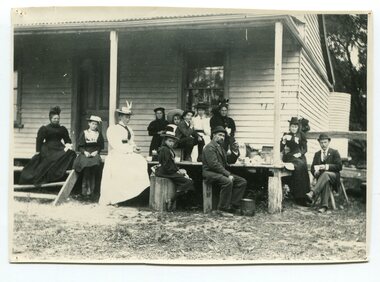
... Towing a line of small barges these paddle steamers plied their trade between the port of Marlo, and the farms along the river banks, churning their way almost twenty miles upstream to a landing beside what is now Frank Richardson’s property. ...Towing a line of small barges these paddle steamers plied their trade between the port of Marlo, and the farms along the river banks, churning their way almost twenty miles upstream to a landing beside what is now Frank Richardson’s property. ...This photograph shows the Richardson family having a picnic on the verandah of Captain McNeil' house at Marlo - April 1897. Snowy River Shipping Company formed in 1880. They were soon shipping produce (mainly vegetables) from the area to Melbourne. The Snowy River Shipping Company was formed by Mr Henry James during the 1880s, with Captain McNeil as master. Captain Hegarty was the shipping agent at Marlo. Towing a line of small barges these paddle steamers plied their trade between the port of Marlo, and the farms along the river banks, churning their way almost twenty miles upstream to a landing beside what is now Frank Richardson’s property. On these trips, the barges carried mail and supplies to the townspeople and farmers, loading their produce, mostly maize, on the return trip to the coast. The coming of the railway in 1915 spelt the end for the little river boats. ( ref. F. W. RODWELL in the “Snowy Review”) Frank Richardson 1877-1950 was a sawmiller at Tabbara and helped build and run paddle steamer "Curlip"as engineer. Captain McNeil was an always cheerful Marlo identity and local children had many times sailing with him on the river. Captain McNeil with tug went out through the entrance and brought in the schooners.This item is associated with the Richardson family, early settlers of the Orbost district.A black / white photograph of a group of people having afternoon tea on the end of a verandah of a wooden house. All are seated.on back - " The Richardson family picnic at Marlo"richardson-family-orbost-marlo mcneil-captain -
 Orbost & District Historical Society
black and white photograph, first half 20th century
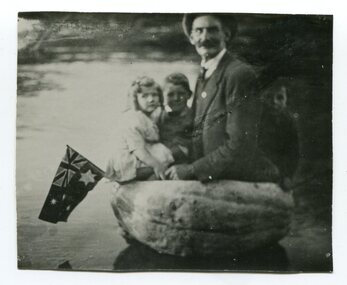
... farms and used to feed pigs. There was usually a competition for the heaviest or biggest pumpkin at the annual Orbost agricultural Show. This photograph is associated with the history of pumpkin growing in the Orbost district. Mundy-Fred pumpkins-Orbost on back - "Alec Cameron, Mr Fred Mundy" ; "Record pumpkin - Mr Fred Mundy 194lbs" A small ...The pumpkin in this photograph was an award winner and was grown by Fred Mundy Snr. It weighed 194 lbs (approx. 88 kgs). Pumpkins were grown widely on Orbost farms and used to feed pigs. There was usually a competition for the heaviest or biggest pumpkin at the annual Orbost agricultural Show.This photograph is associated with the history of pumpkin growing in the Orbost district.A small black / white photograph of man with three children sitting in a hollowed out pumpkin in water. An Australian flag is on the left side of the pumpkin.on back - "Alec Cameron, Mr Fred Mundy" ; "Record pumpkin - Mr Fred Mundy 194lbs"mundy-fred pumpkins-orbost
