
Showing 232 items matching " 'as we like it'."
-
 Stawell Historical Society Inc
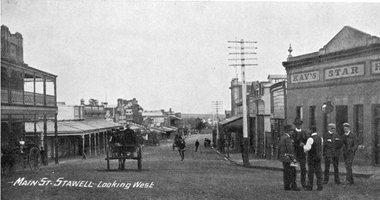
Photograph, Main Street Stawell looking West c1907. Kay's Star Hotel on Right
... Like a number of other hotels it started life on Commercial Street Pleasant Creek, the first License being held by Mr. William Francis in 1858. It was shifted to Main Street Quartz Reefs in 1860 and had many tenants over a long period. For many years it stood in the centre of the roadway in Main Street and had to be moved to give more room for traffic. It is one of the reasons we...Like a number of other hotels it started life on Commercial Street Pleasant Creek, the first License being held by Mr. William Francis in 1858. It was shifted to Main Street Quartz Reefs in 1860 and had many tenants over a long period. For many years it stood in the centre of the roadway in Main Street and had to be moved to give more room for traffic. It is one of the reasons we ...Main Street Looking West. Kays Star Hotel c1907 The Star Hotel had a chequered life. Like a number of other hotels it started life on Commercial Street Pleasant Creek, the first License being held by Mr. William Francis in 1858. It was shifted to Main Street Quartz Reefs in 1860 and had many tenants over a long period. For many years it stood in the centre of the roadway in Main Street and had to be moved to give more room for traffic. It is one of the reasons we have a bend in the Main Street. As a Hotel it had 54 years without a conviction against it. Although it had many licensees it was owned by one family for the last 27 years of its life as a Hotel. It was delicensed in 1916 because it was too close to the Albion which was a better building. Currently (2025) occupied by the Stawell Club and is licensed. The walkway beside it to the carpark is names Star Lane.Main Street Stawell looking West c1907. Bull & Mouth Hotel with verandahs on Left, Kay's Star Hotel on Right. Group of men talking in roadway at right. Telegraph pole prominent near centre of photo.Main St. Stawell Looking West.stawell, hotel -
 National Wool Museum
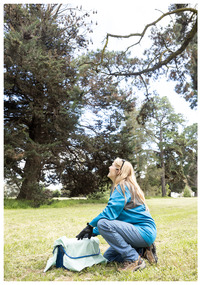
Photograph - Portrait of Jarrah Wadsworth, Nicole Marie, 2021
... They are often not well liked and can be seen as more of a nuisance than an asset to an area. Their numbers are rapidly declining. As the world warms and we...They are often not well liked and can be seen as more of a nuisance than an asset to an area. Their numbers are rapidly declining. As the world warms and we ...Thousands of volunteers work tirelessly to conserve and protect the environment of Geelong and the Bellarine. Their work often goes unnoticed. In 'The Work of Nature' the National Wool Museum and the Environment Department at the City of Greater Geelong worked with photographer Nicole Marie to showcase the significant contribution of environment volunteers in our region. Each of the eight people showcased in these portraits were nominated by their peers and members of the community for their significant contribution to conserving and protecting the environment. Jarrah Wadsworth - Friends of Bats and Bushcare Geelong Grey-headed flying foxes are listed as nationally threatened. They play a critical role in hardwood forest pollination and seed dispersal. They are often not well liked and can be seen as more of a nuisance than an asset to an area. Their numbers are rapidly declining. As the world warms and we experience more days of extreme heat they are increasingly threatened. Jarrah is a registered vet nurse and in her spare time heads up the Friends of Bats and Bushcare Geelong volunteer group. She is the coordinator of the FBBG and plays a key role in supporting the Geelong grey-headed flying fox population in Eastern Park and ensuring they survive extreme heat events. Photo at Eastern Park flying fox camp by Nicole Marie.Image showing an environmental portrait of a woman crouched on grass below trees where fruit bats are roosting.environment, conservation, portraits, geelong, nature, exhibition, work of nature, geelong nature forum, volunteers, eastern park -
 Sunshine and District Historical Society Incorporated
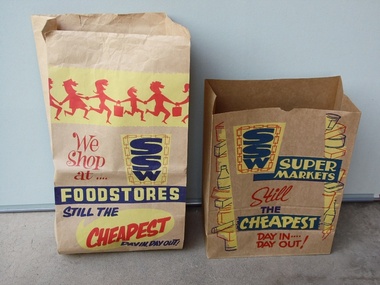
Memorabilia - SSW Supermarket Brown Paper Grocery Bag
... It is likely that many of the younger generation have no idea of how the paper grocery bags looked like, or that they were once used instead of plastic bags. brown paper grocery bag ssw supermarket food grocery purchases groceries. Large Bag: We ...These type of brown paper grocery bags were commonly supplied by SSW Supermarkets, and also by other Supermarkets. The customers generally packed their own grocery purchases into the bags, while the checkout people were engaged in the time consuming process of accurately entering by hand, the price of each item into the cash registers. One local SSW Supermarket was situated on Sun Crescent in Sunshine. The introduction of stronger plastic film grocery bags and barcode scanning saved time, and the checkout person took over the role of packing the grocery purchases. In recent times customers who use the self check out terminals have again assumed the role of packing their own groceries. The environment polluting plastic bags however still remain, unless the customers bring their own 'green' bags.These two brown paper grocery bags provide a historical reminder of how grocery purchases were taken home from Supermarkets in the not too distant past. It is likely that many of the younger generation have no idea of how the paper grocery bags looked like, or that they were once used instead of plastic bags.Two brown paper bags which were available for free in SSW Supermarkets, so that customers could pack their grocery purchases to be able to take them home. The bags have SSW advertising printed on them in red, yellow, and navy blue inks.Large Bag: We Shop at .... SSW FOODSTORES STILL THE CHEAPEST DAY IN, DAY OUT! Smaller Bag: SSW SUPERMARKETS Still THE CHEAPEST DAY IN .... DAY OUT!brown paper grocery bag, ssw supermarket, food, grocery purchases, groceries. -
 Sunshine and District Historical Society Incorporated
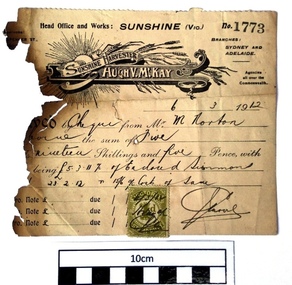
Administrative record - Sunshine Harvester Works Hugh McKay Receipt of Cheque from Mr M Norton 6 March 1912, 6 March 1912
... In 1912 and before did % also stand for Pence when the money amount was written by hand, or could it have been a shorthand way of indicating something like 'portion of amount'? This receipt is very intriguing and so we will endeavour to try to fully understand the information it contains. ...In 1912 and before did % also stand for Pence when the money amount was written by hand, or could it have been a shorthand way of indicating something like 'portion of amount'? This receipt is very intriguing and so we will endeavour to try to fully understand the information it contains. ...Interpreting from the details that can be read it is believed that on 6/3/1912 Mr. M. Norton paid by cheque the sum of 5 Pounds 19 Shillings and 5 Pence, of which 5 Pounds 3 Shillings and 11 Pence was for a Summons possibly issued on 23/2/1912, while 15 Shillings and 6 Pence was the charge for the costs of the Summons. This is not a document issued by a Court of Law so use of the word 'Summons' is confusing to us at this stage. Was it just standard practice to send out a bill and call it a Summons, or was Mr. Norton late in paying and so had to pay an extra charge after being 'summoned' a second time. Could this receipt be part of a 'promissory note' exchange, payment for which had to be summoned? Another thing that can't be explained at this stage is the use of the symbol % after the amount of money written in figures, just after the Pence amount. The symbol for Pence in those days, and until decimal currency, was d as can be seen from the Duty Stamp. In 1912 and before did % also stand for Pence when the money amount was written by hand, or could it have been a shorthand way of indicating something like 'portion of amount'? This receipt is very intriguing and so we will endeavour to try to fully understand the information it contains. If any person can provide information that may assist us, then please contact the Sunshine & District Historical Society. The receipt is significant to our Society because it was issued by Sunshine Harvester / Hugh V. McKay more than 100 years ago. It also appears to contain information that at this stage is not fully understood, such as the use of the % sign, and why the word summons is used. Of further interest, but perhaps not surprising for the times, is that only Mr. is printed on the receipt. It appears that they never expected to issue these type of receipts to females.Very light tan coloured paper receipt No.1773 issued on 6/3/1912 by Sunshine Harvester / Hugh V. McKay to Mr M. Norton. The receipt has fire damage on the left side and so some details are missing. Details are hand written in ink in the spaces provided. A greenish coloured one penny (1d) Victoria Stamp Duty stamp is affixed.6 3 1912 ......ved by Cheque from Mr. M Norton ......ne the sum of Five ...... nineteen Shillings and five Pence, with ......being £5.3.11% of Enclosed Summons 23. 2.12 & 15/6 % Costs of Same.receipt no. 1773, sunshine harvester, hugh v. mckay, mr m. norton, 1912, victoria stamp duty, 1d -
 Sunshine and District Historical Society Incorporated
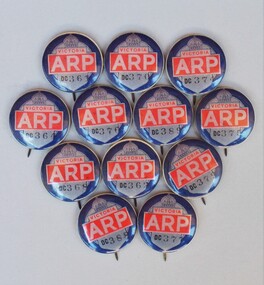
Memorabilia - Air Raid Precautions (ARP) badges, Circa early 1940's
... The badges in our possession do not have the word WARDEN printed on them, like the image of the badge shown on the Darebin Heritage 'Air Raid Protection Services (ARP)' publication, or the image of a badge offered for sale on ebay. At this stage we...The badges in our possession do not have the word WARDEN printed on them, like the image of the badge shown on the Darebin Heritage 'Air Raid Protection Services (ARP)' publication, or the image of a badge offered for sale on ebay. At this stage we ...Mr Webb King was an Air Raid Warden during World War 2. These badges were found when his workshop was being cleared out, and so were donated to our society. The badges in our possession do not have the word WARDEN printed on them, like the image of the badge shown on the Darebin Heritage 'Air Raid Protection Services (ARP)' publication, or the image of a badge offered for sale on ebay. At this stage we are uncertain of why this is so. If anybody knows the answer then please leave a message on this site. During World War 2 Australian municipalities were expected to take precautions against air raids, with the Government campaigning to recruit men over 45 to be volunteer Air Raid Wardens. It was also common for women to become wardens. Wardens carried gas masks, helmets, and rattles or whistles. The wardens received 7 to 8 one hour sessions of training, and their chief duty was to advise people of precautions to take, and to ensure those precautions were taken. Air Raid Precautions included air raid drills, shelters (usually trenches), first aid, fire fighting, rescue of 'gassed' persons, evacuation drills, demolition and repair squads, monitoring of blackouts. Melbourne was deemed vulnerable to aerial attack because of its centralised port and industrial facilities and so Anti-aircraft guns were installed in Maribyrnong. By early 1942 more than 60,000 people voluntarily carried out Air Raid Precautions duties according to the Autobiography of Robert V. J. Padula OAM. As the threat diminished during 1943 and 1944 the need for air raid precautions was slowly reduced, and some shelters (trenches) were filled. The two photos showing Air Raid Wardens are out of copyright and have been sourced from the 'Argus Newspaper Collection of Photographs, State Library of Victoria.' The image showing one warden on Swanston Street Melbourne has been cropped to remove extras not connected with the photo. Other sources of information for this report are: (1) http://bpadula.tripod.com/autobiography/id100.html, (2) https://www.awm.gov.au/exhibitions/underattack/mobilise/precautions.asp, (3) http://heritage.darebinlibraries.vic.gov.au/article/57. The ARP badges are a historic reminder of the precautions that were taken in Victoria during the early years of World War 2. The precautions were an effort to minimise the harmful effects of a theoretical air raid. The war started to turn and so an air raid never came, however many people received valuable training in what precautions needed to be taken.Pressed metal round badges with pins. Main feature of badges is the large whitish lettering ARP on a red background. A black outlined crown and the word VICTORIA in red on whitish background is also on the badges. At the bottom of the badges in black are the letters DC plus the numbers of the badges.Serial Numbers of the badges are: DC 361, DC 362, DC 364, DC 368, DC 370, DC 374, DC 375, DC 376, DC 377, DC 379, DC 388, DC 389.arp. arp badge, air raid precautions, air raid precautions warden, warden, badges -
 Tatura Irrigation & Wartime Camps Museum
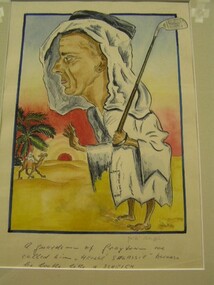
Sketch - Watercolour, Georg Rosenkranz, "Heille Selassie", 1941/2
... A guardsman of Graytown we called him "Heille Selassie" because he looked like a Sheikh...Artist Georg Rosenkranz, crewman aboard the HSK Kormoran, painted this while at Graytown Prisoner of War Camp. graytown pow camp georg rosenkranz illustrations watercolour A guardsman of Graytown we called him "Heille Selassie" because he looked like a Sheikh Watercolour painting of a guardsman of Graytown with golf club "Heille Selassie" Sketch - Watercolour Georg Rosenkranz ...Artist Georg Rosenkranz, crewman aboard the HSK Kormoran, painted this while at Graytown Prisoner of War Camp.Watercolour painting of a guardsman of Graytown with golf clubA guardsman of Graytown we called him "Heille Selassie" because he looked like a Sheikhgraytown pow camp, georg rosenkranz, illustrations, watercolour -
 Tatura Irrigation & Wartime Camps Museum
Book, The Way We Were, 1995
... Tongala Deakin Shire Shire of Campaspe Cream cover, brown writing, 13 sepia like sketches of early buildings, transport, irrigation, farming, settlers, harvesting. The Way We Were Book Book ...Timeline from 1841-1994, when squatters first settled at Tongala. Includes stories of families from Deakin Shire, now Shire of Campaspe.Cream cover, brown writing, 13 sepia like sketches of early buildings, transport, irrigation, farming, settlers, harvesting.tongala, deakin shire, shire of campaspe -
 The 69 Collective
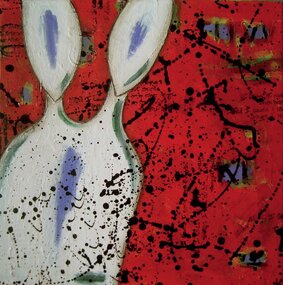
Painting, Liza Posar, Together We Mix, 2012
... This abstract image features what looks like two figures merged into one against a red background with sprays of black paint. Together We Mix Painting Liza Posar ...This artwork is part of 69Fifteen, the book published in 2013 celebrating 69 Smith Street Gallery’s 15th year in operation as an artist-run space.Painted using acrylics, ink and charcoal on canvas. This abstract image features what looks like two figures merged into one against a red background with sprays of black paint. liza posar, 69 smith street gallery, artist-run initiative, artist-run space, melbourne art galleries, painting, graffiti -
 Wangaratta RSL Sub Branch
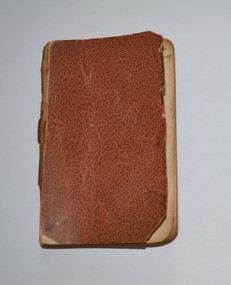
Booklet - WW1 Diary, Cassell & Company Limited, c1918
... We did likewise. I am to go out again tonight and don’t feel like it.” ...We did likewise. I am to go out again tonight and don’t feel like it.” WW1 5th Field Engineers Tan colour leather look cardboard covered diary. ...This 1918 diary belonged to Blacksmith Leslie Claude GEAPPEN 3029 - Born in Richmond, Victoria. Enlisted on 1/9/1915 aged 20 years and 10months. Served with the 5th Field Engineers during WW1. Embarked overseas on 23/11/1915. Accidently wounded on 2/7/1916. Returned to Australia on 5/7/1919 and discharged on 27/8/1919. Served 1457 days of which 1321 were overseas. Entry dated 13 July reads “Villers Bretonneux ..left camp soon after dinner & am now settled down in old dug out. Two our balloons brought down just now.” Entry dated 18 July reads…returned home at 3,30 after having a very rotten time……..?????put down very heavy barage about 8.30. We did likewise. I am to go out again tonight and don’t feel like it.” Tan colour leather look cardboard covered diary.ww1, 5th field engineers -
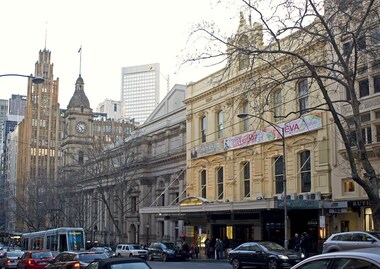 Melbourne Athenaeum Archives
Video - ABC 7.30 Report: The Athenaeum 's 170th birthday, Australian Broadcasting Corporation, Melbourne, Athenaeum building celebrates 170 years, 11/11/2009
... KEVIN QUIGLEY, ATHENAEUM PRESIDENT: There's nothing like us that has been here from day one, four years after the boat pushed ashore, here we are. ...KEVIN QUIGLEY, ATHENAEUM PRESIDENT: There's nothing like us that has been here from day one, four years after the boat pushed ashore, here we are. ...Transcript: Athenaeum building celebrates 170 years Australian Broadcasting Corporation Broadcast: 11/11/2009 Reporter: Lisa Whitehead Tomorrow marks the 170th birthday of one of the nation's historic cultural landmarks. Melbourne’s Athenaeum building has, in one form or other, provided education and entertainment for the Victorian colony as it became a city; and along the way, documented its growth. Transcript KERRY O’BRIEN, PRESENTER: Tomorrow marks the 170th birthday of one of the nation's historic cultural landmarks. Melbourne's Athenaeum building has, in one form or another, provided education and entertainment. For the Victorian colonies it became a city and along the way documented its growth. The building's original library and theatre still draw devotees and as Lisa Whitehead reports, a loyal band of volunteers. KEVIN QUIGLEY, ATHENAEUM PRESIDENT: There's nothing like us that has been here from day one, four years after the boat pushed ashore, here we are. It's a thread that runs through the life of Melbourne. LISA WHITEHEAD, REPORTER: In the heart of Melbourne's CBD, the Athenaeum is a celebrity in disguise, the oldest cultural icon in the city, but barely noticed. MARJORIE DALVEAN, VOLUNTEER HISTORIAN: People of Melbourne walk past this area and they have no idea what it is. RAY LAWLER, PLAYWRIGHT: It seemed to me to be a place that absolutely, or breathes Melbourne, I suppose, culture. LISA WHITEHEAD: Just four years after Melbourne was founded, the colony built a Mechanic's Institution, one of the first in the world, a place where the working class could meet and learn. KEVIN QUIGLEY: People think of it as Wild West sort of place where these hearty types drank and rushed about, but Melbourne was freely settled. It was a city of people who wanted to better themselves - entrepreneurs. And the Mechanic's Institution was that innovative idea that had grown up in Edinburgh and London about providing an opportunity for education for the working people. LISA WHITEHEAD: Mark Twain lectured there. Later, other buildings were added and a theatre to host classic plays. And it adopted its more bourgeois friendly title of the Athenaeum. Crucially from the start there was the library, the first to offer affordable lending to the working man. And it still attracts devotees. Former University lecturer Margaret Bowman, 89, comes in every Wednesday, along with her dog to join an enthusiastic band of volunteers sorting through the archives. MARGARET BOWMAN, FORMER UNIVERSITY LECTURER: Doing research is something that I find actually I enjoy more than anything. Every old lady needs to have a project and now I've got a project. MARJORIE DALVEAN: Margaret, Christine has just found out that Alfred Deakin was a member here from 1874 to 1877. This place is not flashy, we've never been flashy. But book lovers walk in here and they know this is the place for them. ARCHIVAL FOOTAGE: Old times and old names. The Athenaeum theatre in Melbourne for more than 40 years has been one of the city's best known cinemas. LISA WHITEHEAD: In the 20th century, the theatre surrendered to the new craze of talking pictures, and one particular fan was famous Australian playwright Ray Lawler. At 13, he dropped out of school to work in a Footscray factory and two years later his first trip to the glamorous Athenaeum cinema hinted at the education he was missing. RAY LAWLER: It just had a style about it which I responded to, I think. I was looking for something and this seemed to be part of it. Ray Lawler went on to write "Summer of the Seventeenth Doll" and found literary fame overseas. About a century after it had started as an educational place for the working man, Ray Lawler had, in effect, become an Athenaeum graduate. RAL LAWLER: If they had been looking for the sort of person that they were hoping to encourage along the way, I suppose I would have been somebody that might have fitted the mould, you know. LISA WHITEHEAD: In time, the cinema was returned to its theatrical roots. FRANK THRING, 1977: It has a great resemblance to the Theatre Royal in Hobart which Larry Olivier has called the best theatre he's ever worked in. And it's almost identical. It is the true Victorian playhouse. The horseshoe shaped thing: stalls, dress circle and gallery. And you're close to the audience and they're close to you. Marvellous feeling. LISA WHITEHEAD: Today, it's still a theatre. But time has brought compromises. The once vaunted art gallery has now covered its windows and become a comedy club and performance space. TV and suburban life have eaten away at the library membership. It offers an online service now, and a recent federal government grant will pay for the upkeep of its gracious interior, including the 1930s elevator Ray Lawler used to ride. For him, it's money well spent on history quietly made and discreetly observed. RAY LAWLER: It's the lack of awareness, I think, that people don't know what they've got here. They've really got the whole history of Melbourne almost. KEVIN QUIGLEY: It was a similar organisation in Sydney but we are the only one that's got a continual lineage on the same spot. We started here and we're still here and we'll be here for another 100 years. KERRY O'BRIEN: Lisa Whitehead on a great Melbourne landmark. © 2010 ABC | Privacy Policy Beginning as the Melbourne Mechanics' Institution in 1839, the Melbourne Athenaeum has a long history that reflects the cultural and social development of Melbourne. It continues to be managed as a not-for-profit organisation by a volunteer board, with a subscription library (maintained since 1839) and a leased theatre.Video broadcast ABC 7:30 Report for 11/11/2009. "Tomorrow marks the 170th birthday of one of the nation's historic cultural landmarks. Melbourne’s Athenaeum building has, in one form or other, provided education and entertainment for the Victorian colony as it became a city; and along the way, documented its growth."athenaeum, australian broadcasting corporation, kerry o’brien, kevin quigley, lisa whitehead, marjorie dalvean, ray lawler, margaret bowman, frank thring. -
 Duldig Studio museum + sculpture garden
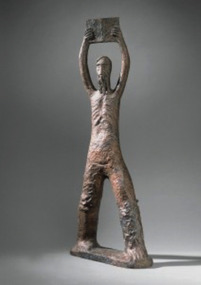
Sculpture, Karl Duldig, Moses by Karl Duldig 1956 (Bronze Cast 1979), 1956 / 1979
... we have a modern interpretation of the theme. His simplification and abstraction of form and attention to surface modeling is masterly. The figure has an emotional intensity and despite its relatively small scale, a ‘forceful monumentality’. The sculpture is aesthetically significant for its craftsmanship, expressive qualities and modernity. It is historically significant because of its associations with the 1956 Olympic Arts Festival. The Duldig Studio’s bronze cast of the sculpture was exhibited in the exhibition '1956: Melbourne, modernity and the XVI Olympiad, Museum of Modern Art at Heide.' Apart from the formal qualities of a work like ...This sculpture is a bronze cast of Karl Duldig’s 1956 terracotta sculpture titled 'Moses'. The terracotta sculpture won the 1956 Victorian Sculptor of the Year award, an honor given by the Victorian Society of Sculptors. The National Gallery of Victoria purchased the original terracotta sculpture for the Gallery’s collection in 1956. In 1979 the NGV allowed Karl to cast the original terracotta sculpture in bronze (to a limited edition of 5). The National Gallery of Victoria holds one of these casts and one is in Duldig Studio collection. The original terracotta sculpture was exhibited in 1956 at the Olympic Arts Exhibition in Wilson Hall at the University of Melbourne. Two other works by Karl were also exhibited, a sandstone titled 'Adam and Eve' and a work titled 'Fountain'. The catalogue for the Olympic exhibition, which promoted modernism across a variety of disciplines, noted that Australia’s post war immigration program had given ‘further momentum to the modernist cause’. The identification of émigré artists, such as Karl Duldig, with the acceptance of modernism in Australia became a major theme in any discussion of art and design in the post war period. Ann Carew 2016The subject Moses and the tablets of law is an important theme in the history of art. For example the National Gallery of Victoria collection includes paintings on this topic by the Australian Aboriginal artist, Queenie McKenzie (1991), prints by the Russian-French modernist artist, Marc Chagall (1956), and a painting by 19th century British academic painter, John Rogers Herbert (1870s). Michelangelo’s sculpture of Moses is perhaps the most famous sculptural interpretation of the subject. In Karl’s hands we have a modern interpretation of the theme. His simplification and abstraction of form and attention to surface modeling is masterly. The figure has an emotional intensity and despite its relatively small scale, a ‘forceful monumentality’. The sculpture is aesthetically significant for its craftsmanship, expressive qualities and modernity. It is historically significant because of its associations with the 1956 Olympic Arts Festival. The Duldig Studio’s bronze cast of the sculpture was exhibited in the exhibition '1956: Melbourne, modernity and the XVI Olympiad, Museum of Modern Art at Heide.' Apart from the formal qualities of a work like Moses, its relevance as a motif in Judaism and Christian faiths ensures its place as a work of spiritual significance. Ann Carew 2016Bronze cast from terracotta sculpture. Depicts Moses as in Exodus 32 when he returns from Sinai with the tablets of the law to find his people worshipping the golden calf, in his fury he holds the tablets aloft above his head before crashing them down on the ground. -
Stawell Historical Society Inc
Archive, Historical Film Footage of Stawell Technical School 1932 & 1966
... lettered title by Stawell Technical School 23.53 “Now, off we go in the Texas plane”(biplane) 24.07 “Stawell looks like a Doll’s Garden” 24.36 “Main Street Winds … beneath us” 24.55 “Lake Cato, Central Park, War Memorial” 25.16 “State School 502 with the “ants” out at play…. 25.53 “The North Western Woollen Mills” 26.05 “And now from the West side” 26.33 “Above the clouds at 7000ft.”...lettered title by Stawell Technical School 23.53 “Now, off we go in the Texas plane”(biplane) 24.07 “Stawell looks like a Doll’s Garden” 24.36 “Main Street Winds … beneath us” 24.55 “Lake Cato, Central Park, War Memorial” 25.16 “State School 502 with the “ants” out at play…. 25.53 “The North Western Woollen Mills” 26.05 “And now from the West side” 26.33 “Above the clouds at 7000ft.” ...Historical Film FootageTwo Film Reels Larger one Green Plastic Smaller one Red Plastic Sport at the Stawell Technical School 0.00 “Cricket Practice” 0.33 “The Bowler ..t it” 1.10 “Our Football Team 1932” 1.33 “Have a Closer look at them” (Football at Central Park ) 2.20 “Some of the Younger Fry” (school boys at Central Park) 2.33 “Start of the 220 Yards” 2.57 “High jump Events” 3.30 “See how it is done” 4.27 “See how to jump” 5.44 “The Sack Race” 6.15 “Boot Scram How carefully …. The boots …” 6.25 “The rush of the bootless brigade” 7.02 “Start of the Apple in Tub……. Race” 7.12 “An apple a day, keeps the doctor away…. They want their apple” 7.32 “See – The Art of Getting….The apple. 7.59 Putting the Weight” 8.14 “Notice the graceful movements” Skene (Street site) 9.31 “ The Long Jump” Stawell Technical School Activities at Skene Street 10.10 “ Marching practice for Inter- Technical sports….. 1932 10.33 “Some practice starts. ( Tech school building Skene Street ) 11.54 Technical school building in Skene St 12.07 “The Fall in” 12.48 “Drill exercise” 13.40 “Drill Exercise Juniors” 15.09 “Dismiss” 15.24 “Classes Leaving School Room- Sorry to part” 15.52 “Bat Tennis” 16.23 “Ball passing” 16.50 “Over-head Ball Passing” 17.21 fancy dress on stage. Similar to Can Can 18.21 possible Egyptian dance Stawell Technical School Swimming 19.00 “Receiving Instructions-The Lull before the storm!” 19.09 “All ready in their gowns.—They’re off!!! (No, not the gowns.) 19.19 “Hey! Would you believe he’d do this on purpose?” 1st method of release and rescue 19.54 “Another patient “callin” for help- Life-saving is mostly ups and downs” 20.17 “Towing the patient in, so that he can’t struggle with the rescuer” 20.52 “Who’s drowning now? It’s either Sir Walter Dally or Frantic Drake getting ducked” 21.38 Swimming club room at Cato Lake 21.44 Diving tower Cato Lake Views of Stawell from Big Hill and from a Plane 23.18 Views from Big Hill 23.48 ? lettered title by Stawell Technical School 23.53 “Now, off we go in the Texas plane”(biplane) 24.07 “Stawell looks like a Doll’s Garden” 24.36 “Main Street Winds … beneath us” 24.55 “Lake Cato, Central Park, War Memorial” 25.16 “State School 502 with the “ants” out at play…. 25.53 “The North Western Woollen Mills” 26.05 “And now from the West side” 26.33 “Above the clouds at 7000ft.”(and landing the biplane) Technical School Trade Skill-- Carpentry 27.16 “Woodwork Department” “Model Dairy” – Built on walk-in walk-out principle with bails for 6 cows; also separator, cream, and feed room; Length 52 Ft Width 18ft. Scale 27.44 “Framing for Lean-to shed Many uses can be found for this type on the farm 28.08 “Putting the finishing touches to a Twi-roomed Settler’s House….” 28.42 “A good sturdy type of hand gate….. half full size.. 28.57 “This Double-batten gate costs the farmer13/-, can be made in 3 hours, and is good for a Century…. 29.20 “ A stand for…… 1.000 Gallon tank. 1/3rd Full size….. 29.45 “ Form for moulding Concrete fence posts…. These posts are fire-proof, white-ant-proof, and will not rot…. 30.11 “No 2. Carpentry.” Sinking Mortices in Styles of a pair of Gates….. 30.29 “Cutting Tenons on the Rails” 30.42 “Fitting Tenon into Mortice.” 30.53 ‘Marking and cutting for Brace” 31.46 “Turret Roofs. 1. Bell-shaped… 2. Ogee……… 32.03 “Cutting a Mitre such as is used for corner of Picture Frame. 32.51 “Testing Mitre for Square” 32.59 “No 3. Joinery.” Box-framed Window with Double-hung sashes 33.24 “Louvre Ventilators 1. Circular. 2. Triangular. 33.46 “Front Entrance Door and Frame, with Fanlight and Sidelights. 34.04 “Half Size Model of a Gothic Door 34.21 No 4. Cabinet-Making. Fitting shaped rail to turned leg of….. Music Stool, having a Drawer for Music. 34.43 “A Fire-screen….. with Painted Panel. 35.01 “A sitting down job.” Junior Technical Boys on Chair construction 35.22 “A modeling class at work. ------- Technical School Trade Skill—Plastering 36.09 “ A process of … casting in Plaster. Of parts…… 36.14 “Building the walls around the clay….. model. ------ 36.34 “Mixing the Plaster of Paris to pour for the mould….. 36.39 “Modelling Section. The running of Mouldings…. 36.43 “Building up…. The rough shape of the mould…” 36.55 “Moving thr template slowly along,….. in order to perfect the shape…… 37.30 “Moving the template along……. For the second time. 37.49 “The finished mould.” 37.55 “An end view showing …. The exact shape. Technical School Speech Day 38.40 Speech day 39.40 Display of art work, plaster models and carpentry 41.44 Science experiments Exploring the Grampians/Halls Gap 40.30 Exploring the Grampians Views from Mt William 45.54 Picnic Halls Gap 46.36 Swimming carnival Halls Gap pool Athletics at Central Park Stawell 43.56 Athletic events at Central Park including sack race and tandem racing Lake Lonsdale Picnic 49.41 Leaving for …. The School Picnic held at …Lake Lonsdale….. December 13th 1932 50.00 By the Lakeside 50.22 The boys take to the water. 50.46 One in, All in. 51.22 Hunger….. approaching, On with..the billy.. 51.34 The workers Partake of Nourishment. 51.47 Silent workers.(mothers picnic lunch) Wash up and Dry up. 52.20 General view at Lunch time. 52.53 One swallow does not make a summer… 53.10 Great Australian Bites. 53.28 Good-bye Sandwiches.. 53.57 Note the more than full expressions… 54.06 The last parade 54.16 Swim for the shore boys Under 14 years 54.43 Swim for the shore boys. Under 16 Years. 55.06 Swim for the shore boys, all in… 55.28 Ladies Race. Use your weight. 55.45 After the fall. 55.47 The winner Mrs Taylor. 55.06 Boys Races 56.20 How NOT to run.(backwards) 57.10 Try this one yourself….(backwards) 57.26 The Staff Spirit? 57.39 The Winner Mr Henderson.. Snow in Stawell 1949 58.01 1949 snow in Stawell Tech school, 502, Tech snow fight , Patrick St with courthouse 59.31 Big Hill scenery 1.00.06 Speech at Tech school quadrangle Street Parade down Main Street 1.00.22 c. 1945 Parade main St (possibly Peace celebrations) Sporting event Central Park 1.02.04 Central Park sporting event after the Parade, including Scouts erecting a tent. Historical Film Footage Stawell Tech 1932education -
 Nillumbik Shire Council
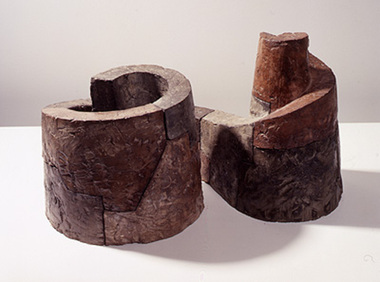
Sculpture: Mark STONER (b.1951 UK, arrived 1957 AUS), Untitled Spiral, 1991
... The structure is built of masonry-like units which "suggest a material presence and earthiness". Stoner is absorbed by how we define landscape and what is meant by natural. ...The structure is built of masonry-like units which "suggest a material presence and earthiness". Stoner is absorbed by how we define landscape and what is meant by natural. ...A small scale concrete work that can be imagined as an ancient monolithic fortress or religious edifice. It suggests ideas like perpetuity, worship, preservation and history. Untitled Spiral is made up of three spirals, the first is constructed as a closed form, the second is open and the third is the space created within the second. The sense of enclosure is powerful but this is offset by the ledge which traces the top edge of the spiral shapes. This pathway leads from a precarious position to the highest point of sanctuary, or to what Stoner refers to as Nirvana. The structure is built of masonry-like units which "suggest a material presence and earthiness". Stoner is absorbed by how we define landscape and what is meant by natural. He is interested in the notion that ancient man-made structures such as stone walls, which are intrinsic to many landscapes, can now be accepted as being natural, organic forms. -
 Nillumbik Shire Council
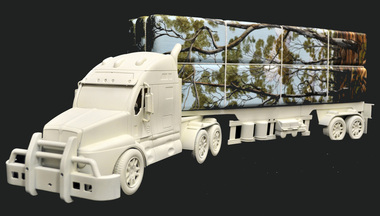
Sculpture, Ghost, 2012
... ‘Ghost’ seeks to convey the idea that when we remove something significant from a location, like the landscape itself, the remaining ‘place’ changes to become a new ‘place’. ...The (logging) truck carries a representation of John Glover’s painted landscapes, which Cox has painted on a solid block of wood. John Glover is one of Australia’s most celebrated colonial landscape painters. Born in England, he was a highly successful water-colourist and painter of landscapes in the tradition of French artist Claude Lorrain. Arriving in Australia in 1831, Glover adapted his picturesque style and luminous technique to his new surrounds, creating naturalistic and atmospheric paintings of Australian nature, settler life, and Aboriginal culture. Working out of doors, Glover developed an understanding of the unfamiliar Australian landscape, especially the twisting forms of native eucalyptus trees. His direct experience of nature, as both pioneer settler and painter, resulted in a new approach using a subtle palette of olive greens, ochres, misty greys and intense blues, and layered glazes of mauve, grey and gold, to portray Australian light and atmosphere. Dale Cox continues the ongoing preoccupation and tradition of landscape painting in the Nillumbik area and our impact on the environment in a contemporary way. The truck creates a playful nexus between painting (representational landscape) and sculpture, purposely bluring boundaries across these traditionally distinct disciplines. ‘Ghost’ seeks to convey the idea that when we remove something significant from a location, like the landscape itself, the remaining ‘place’ changes to become a new ‘place’. This may seem self-evident until we think more deeply about location and landscape. The white truck is a ghost, an ethereal, transient being that spirits away an entire place, forever removed from itself, and forever changed. Logging wild trees can never be like harvesting a ‘crop’. Logging removes a landscape, and changes a place forever. The ‘packaging’ of this painted landscape highlights the anomaly between commodity and our environment. Dale Cox was a local artist and this work was highly commended at the 2012 Nillumbik Prize. White plastic toy (logging) truck with a landscape painting on a wooden block. The landscape painting is reminiscent of paintings by colonial artist John Glover. N/Alandscape, truck, sculpture, environment, john glover, colonial, painting, ghost, nillumbik prize -
 City of Ballarat
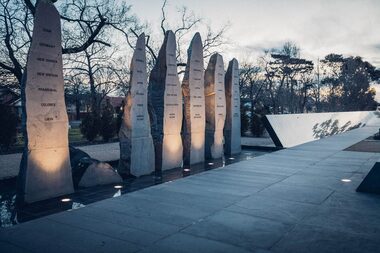
Artwork, other - Public Artwork, Ex-Prisoners of War Memorial by Peter Blizzard, 2004
... We Forget' stone to start the journey again. Water symbolizes the essential nature of man, sacrifice, suffering, spirituality, healing, cleansing, birth and re-birth. The memorial is created from natural materials and is designed to be in harmony with the Ballarat Botanical Gardens, and to create a sense of timeless, dignity and respect. The long pathway of the monument is designed to create a visual perspective of the large distances that Australians travelled to the various conflicts. The paving is shaped like...We Forget' stone to start the journey again. Water symbolizes the essential nature of man, sacrifice, suffering, spirituality, healing, cleansing, birth and re-birth. The memorial is created from natural materials and is designed to be in harmony with the Ballarat Botanical Gardens, and to create a sense of timeless, dignity and respect. The long pathway of the monument is designed to create a visual perspective of the large distances that Australians travelled to the various conflicts. The paving is shaped like ...This memorial designed by Peter Blizzard is dedicated to more than 36,000 Australian men and women were held captive as prisoners by the enemy during the Boer War, World War 1, World War 2 and the Korean War. This memorial honours and names them, the names are etched into the black granite wall adjacent to the pathway. Water springs from beneath the 'Lest We Forget' stone then flows down the wall into the narrow watercourse in front of the first group of names and into the reflective pool, then continues past the second group of names. Finally it disappears under the pathway, returning to its source under the 'Lest We Forget' stone to start the journey again. Water symbolizes the essential nature of man, sacrifice, suffering, spirituality, healing, cleansing, birth and re-birth. The memorial is created from natural materials and is designed to be in harmony with the Ballarat Botanical Gardens, and to create a sense of timeless, dignity and respect. The long pathway of the monument is designed to create a visual perspective of the large distances that Australians travelled to the various conflicts. The paving is shaped like railway sleepers in recognition of the role that railways and railway journeys were relevant to many prisoners of war. The Memorial was declared the first military memorial of national significance located outside Canberra in 2008. Dedication services are held at the memorial on the Sunday closest to 6th of February, ANZAC day and on Remembrance Day. The memorial is of historical and aesthetic importance to the people of BallaratMonument made from carved bluestone, water feature and flagsInscribed with the names of 36,000 Australian men and women were held captive as prisoners by the enemy during the Boer War, World War 1, World War 2 and the Korean War. The listing is by surname and initials and shown by war.prisoners of war, boer war, world war 1, world war 2, korean war, lest we forget, peter blizzard -
 City of Ballarat
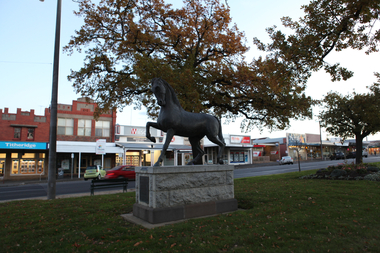
Artwork, other - Public Artwork, Adam Lindsay Gordon Memorial, 1969
... LIKE WILDFIRE SPREADING AT LARGE/ MADDEN'D THE WAR HORSE AS WELL AS THE MAN./ WHERE ARE THEY? THE WAR-STEEDS WHO SHARED IN OUR GLORY/ THE "LANERCOST" COLT AND THE "ACROBAT" MARE,/ AND THE IRISH DIVISION "KATE KEARNEY" AND "RORY" AND RUSHING "ROSCOMMON" AND EAGER "KILDARE"./ WE TOO, SPRUNG FROM THE LOINS OF ISHMAELITE STALLIONS,/ THE RENDERING OF BLACKTHORNS AND RATTLE OF RAILS./ AND WHAT THEN? ...LIKE WILDFIRE SPREADING AT LARGE/ MADDEN'D THE WAR HORSE AS WELL AS THE MAN./ WHERE ARE THEY? THE WAR-STEEDS WHO SHARED IN OUR GLORY/ THE "LANERCOST" COLT AND THE "ACROBAT" MARE,/ AND THE IRISH DIVISION "KATE KEARNEY" AND "RORY" AND RUSHING "ROSCOMMON" AND EAGER "KILDARE"./ WE TOO, SPRUNG FROM THE LOINS OF ISHMAELITE STALLIONS,/ THE RENDERING OF BLACKTHORNS AND RATTLE OF RAILS./ AND WHAT THEN? ...The bronze statue of a horse commemorates poet and horseman Adam Lindsay Gordon and the horses and mules killed during WWI. The statue depicts a horse going into battle known as a 'charger' mounted on a base of Warrenheip granite. During World War II the artist, Raymond Ewers was made an official war artist with the rank of lieutenant. Funds were raised from visitors to the Adam Lindsay Gordon cottage for the artwork which was unveiled on the centenary of the poet's arrival in Ballarat. Adam Lindsay Gordon the English born Australian poet spent some time in Ballarat, at one stage owning and running Craig's Stables in the city. He was not a very good businessman and his ventures left him in financial ruin. However his ballads and poems were recognized around the world as strong lines that told the story of the Australian bush. He is the only Australian Poet to be memorialized in Westminster Abbey, UK. The Queen quoted his work in 1992 Queens message..."Kindness in another's trouble, courage in one's own.."The artwork is of historic and aesthetic significance to the people of BallaratBronze horse on granite plinthERECTED BY/ THE ADAM LINDSAY GORDON SOCIETY/ TO MARK THE CENTENARY OF/ THE POET'S LIVING IN BALLAARAT,/ ALSO AS A MEMORIAL TO THE 958,600 HORSES AND MULES/ KILLED IN THE FIRST WORLD WAR/ INCLUDING 196,000/ THAT LEFT THESE SHORES NEVR TO RETURN./ "THE LAY OF THE LAST CHARGER"/ FORWARD, THE TRUMPETS WERE SOUNDING THE CHARGE./ THE ROLL OF THE KETTLEDRUM RAPIDLY RAN/ THAT MUSIC, LIKE WILDFIRE SPREADING AT LARGE/ MADDEN'D THE WAR HORSE AS WELL AS THE MAN./ WHERE ARE THEY? THE WAR-STEEDS WHO SHARED IN OUR GLORY/ THE "LANERCOST" COLT AND THE "ACROBAT" MARE,/ AND THE IRISH DIVISION "KATE KEARNEY" AND "RORY" AND RUSHING "ROSCOMMON" AND EAGER "KILDARE"./ WE TOO, SPRUNG FROM THE LOINS OF ISHMAELITE STALLIONS,/ THE RENDERING OF BLACKTHORNS AND RATTLE OF RAILS./ AND WHAT THEN? THE COLOURS REVERSED, THE DRUMS, MUFFLED/ THE BACK NODDING PLUMES, THE DEAD MARCH AND THE PALL/ THE STERN FACES, SOLDIER-LIKE SILENT UNRUFFLED,/ THE SLOW SACRED MUSIC THAT FLOATS OVER ALL/ BY A.L. GORDON/ UNVEILED BY/ HIS WORSHIP THE MAYOR OF BALLAARAT,/ CR. M.J.BROWN/ 1969/ PRESIDENT CR.W.E.ROOF C.B.E. SECRETARY P. ABSOY. ESQ.horse statue, adam lindsay gordon horse statue -
 City of Ballarat
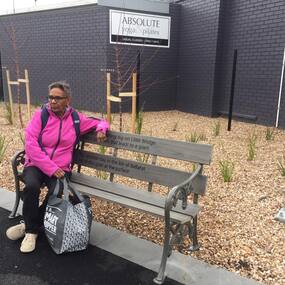
Artwork, other - Public Artwork, Nathan Curnow, Little Bridge by Nathan Curnow, 2018
... Put it all down and take a seat/ Pull out a snack from your shopping/ Listen to the trumpeter busking a tune/ With every visit this park is growing/ Killing time takes real devotion/ Stare at the flags and masts of your town/ And the buses come rolling down Bakery Hill/ It may be cold but we lean to the sun/ If you feel like a square of the Eureka flag/That’s hopelessly lost and tattered/ Remember you’re as precious as a corner-piece/ We search for you first to get started/ There is something big on Little Bridge/ Not a beanstalk that leads to a giant/ But another day in the life of Ballarat/ All of this gold at the surface ...The artwork is of historic and cultural significance to the people of Ballarat poetry little bridge street ballarat Put it all down and take a seat/ Pull out a snack from your shopping/ Listen to the trumpeter busking a tune/ With every visit this park is growing/ Killing time takes real devotion/ Stare at the flags and masts of your town/ And the buses come rolling down Bakery Hill/ It may be cold but we lean to the sun/ If you feel like a square of the Eureka flag/That’s hopelessly lost and tattered/ Remember you’re as precious as a corner-piece/ We search for you first to get started/ There is something big on Little Bridge/ Not a beanstalk that leads to a giant/ But another day in the life of Ballarat/ All of this gold at the surface Six seats featuring an engraved poem Little Bridge by Nathan Curnow Artwork, other Public Artwork Nathan Curnow ...It's encouraging to see my city using poetry in such a public way. The park itself is a humble one, which suits these little poems perfectly. If you're ever in town come and take a seat for a while. The poem 'Little Bridge' by Nathan Curnow was commissioned as part of a placemaking project in Little Bridge Street Pocket Park, Ballarat in 2018. The Park was redesigned to include more passive surveillance, and improved amenity to increase community safety in the area. The poem is engraved onto seating to provide a rest and point of interest space in the small park. Six seats featuring an engraved poemPut it all down and take a seat/ Pull out a snack from your shopping/ Listen to the trumpeter busking a tune/ With every visit this park is growing/ Killing time takes real devotion/ Stare at the flags and masts of your town/ And the buses come rolling down Bakery Hill/ It may be cold but we lean to the sun/ If you feel like a square of the Eureka flag/That’s hopelessly lost and tattered/ Remember you’re as precious as a corner-piece/ We search for you first to get started/ There is something big on Little Bridge/ Not a beanstalk that leads to a giant/ But another day in the life of Ballarat/ All of this gold at the surface poetry, little bridge street, ballarat -
 Doncaster Templestowe Historical Society
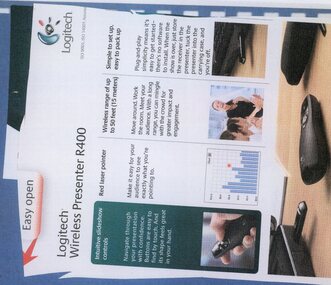
Photograph - Mouse Identifier, Mouse
... asdflkasdf a;lskdf ;alksdfasdf Initially Kent said this was a picture of an elephant but later on he changed his mind and said it was a or can asdfl;kasd f;lkasdf; l ja;sldkfasdf asdflkasj df;laskjdf;laskdjf;lasd All the time I we reword it Keep going it says Kent now is there a function here that can spell according to the way I speak Like when you bring up the Taxation Office they'll ask you to save something in Australia my voice identifies me you're familiar with that expression It's digitized my way of speaking but what you can ....hat you can save yourself quite a lot fred Mouse Photograph Mouse Identifier ...asdflkasdf a;lskdf ;alksdfasdf Initially Kent said this was a picture of an elephant but later on he changed his mind and said it was a or can asdfl;kasd f;lkasdf; l ja;sldkfasdf asdflkasj df;laskjdf;laskdjf;lasd All the time I we reword it Keep going it says Kent now is there a function here that can spell according to the way I speak Like when you bring up the Taxation Office they'll ask you to save something in Australia my voice identifies me you're familiar with that expression It's digitized my way of speaking but what you can ....hat you can save yourself quite a lotfred -
 Ararat Gallery TAMA
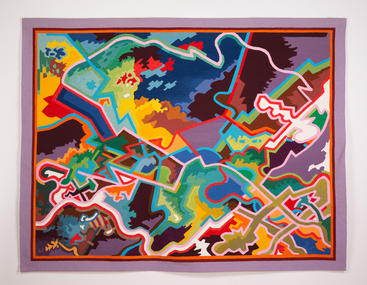
Mike Brown, Untitled (tapestry), 1982
... like imagery. Charles Nodrum Gallery describe Brown as ‘a unique leader of alternative avant guard art in Australia, and a true bohemian eccentric. An artistic anarchist and polemicist, during his 30-year career he waged an unwavering war on art world conventions and sensibilities, critiquing mass culture, consumerism, sex, advertising, censorship, and embracing counterculture, alternative lifestyles and socialism.’ This tapestry was produced by the Victorian Tapestry Workshop Melbourne (now known as the Australian Tapestry Workshop) in South Melbourne, based on an original painting by Mike Brown. We...like imagery. Charles Nodrum Gallery describe Brown as ‘a unique leader of alternative avant guard art in Australia, and a true bohemian eccentric. An artistic anarchist and polemicist, during his 30-year career he waged an unwavering war on art world conventions and sensibilities, critiquing mass culture, consumerism, sex, advertising, censorship, and embracing counterculture, alternative lifestyles and socialism.’ This tapestry was produced by the Victorian Tapestry Workshop Melbourne (now known as the Australian Tapestry Workshop) in South Melbourne, based on an original painting by Mike Brown. We ...Mike Brown is known for his bold use of colour and graffiti-like imagery. Charles Nodrum Gallery describe Brown as ‘a unique leader of alternative avant guard art in Australia, and a true bohemian eccentric. An artistic anarchist and polemicist, during his 30-year career he waged an unwavering war on art world conventions and sensibilities, critiquing mass culture, consumerism, sex, advertising, censorship, and embracing counterculture, alternative lifestyles and socialism.’ This tapestry was produced by the Victorian Tapestry Workshop Melbourne (now known as the Australian Tapestry Workshop) in South Melbourne, based on an original painting by Mike Brown. We have exhibited the weaving and painting together to provide a comparison of how artwork is translated into tapestry. The large area of dark blue at the centre top of the tapestry demonstrates how the weavers have used colour changes in the yarn to depict the painterly shading in the original painting. The Australian Tapestry Workshop (ATW) is an international leader in contemporary tapestry, collaborating with a diverse range of international and Australian artists to produce exceptional handwoven works of art. Established in 1976, ATW have created over 500 tapestries in creative collaborations for nearly 50 years, promoting innovation and excellence in tapestry weaving and textile art. -
 Ararat Gallery TAMA
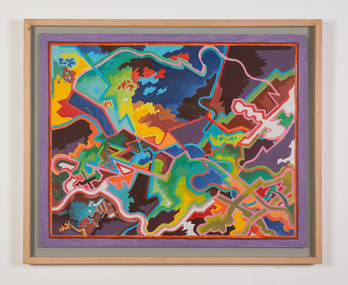
Mike Brown, Untitled (Sketch for tapestry), 1982
... like imagery. Charles Nodrum Gallery describe Brown as ‘a unique leader of alternative avant guard art in Australia, and a true bohemian eccentric. An artistic anarchist and polemicist, during his 30-year career he waged an unwavering war on art world conventions and sensibilities, critiquing mass culture, consumerism, sex, advertising, censorship, and embracing counterculture, alternative lifestyles and socialism.’ This tapestry was produced by the Victorian Tapestry Workshop Melbourne (now known as the Australian Tapestry Workshop) in South Melbourne, based on an original painting by Mike Brown. We...like imagery. Charles Nodrum Gallery describe Brown as ‘a unique leader of alternative avant guard art in Australia, and a true bohemian eccentric. An artistic anarchist and polemicist, during his 30-year career he waged an unwavering war on art world conventions and sensibilities, critiquing mass culture, consumerism, sex, advertising, censorship, and embracing counterculture, alternative lifestyles and socialism.’ This tapestry was produced by the Victorian Tapestry Workshop Melbourne (now known as the Australian Tapestry Workshop) in South Melbourne, based on an original painting by Mike Brown. We ...Mike Brown is known for his bold use of colour and graffiti-like imagery. Charles Nodrum Gallery describe Brown as ‘a unique leader of alternative avant guard art in Australia, and a true bohemian eccentric. An artistic anarchist and polemicist, during his 30-year career he waged an unwavering war on art world conventions and sensibilities, critiquing mass culture, consumerism, sex, advertising, censorship, and embracing counterculture, alternative lifestyles and socialism.’ This tapestry was produced by the Victorian Tapestry Workshop Melbourne (now known as the Australian Tapestry Workshop) in South Melbourne, based on an original painting by Mike Brown. We have exhibited the weaving and painting together to provide a comparison of how artwork is translated into tapestry. The large area of dark blue at the centre top of the tapestry demonstrates how the weavers have used colour changes in the yarn to depict the painterly shading in the original painting. The Australian Tapestry Workshop (ATW) is an international leader in contemporary tapestry, collaborating with a diverse range of international and Australian artists to produce exceptional handwoven works of art. Established in 1976, ATW have created over 500 tapestries in creative collaborations for nearly 50 years, promoting innovation and excellence in tapestry weaving and textile art. -
 Kew Historical Society Inc
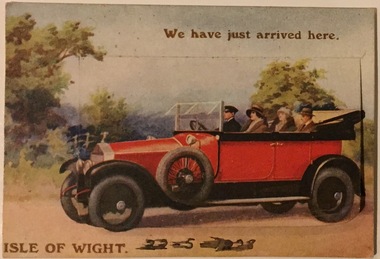
Postcard, J Salmon, We Have Just Arrived Here : Isle of Wight, c.1928
... like. The postcard was purchased by George and Edith Weir on a trip to England and Scotland, circa 1928. We ...Collection of thirty-nine postcards donated by Jillian Rigby which had been owned by her grandparents, George and Edith Weir, who from c.1917 lived at 84 Princess Street, Kew. The mostly 'mint' postcards were purchased in Victoria and while travelling overseas. The sole dated postcard is dated from 1929. The postcards are numbered sequentially from 2017.0058.01-39. The remainder of the collection donated by Jill Rigby which was once owned by the Weirs of Broken Hill and Kew consist of costumes, costume accessories, photographs, and documents.The postcards in the Weir collection, especially those purchased on a trip or trips to the mother country, i.e. United Kingdom, represent a representative sample of sites that were considered significant to those Australians undertaking a reverse grand tour by member of the erstwhile colonies. Those postcards which are early views of Melbourne must have been produced commercially for some decades from the early part of the 20th century.Novelty View Card, part of a series, representing different locations in the United Kingdom. The front of the card opens to reveal ten postcards, joined concertina-like. The postcard was purchased by George and Edith Weir on a trip to England and Scotland, circa 1928."22.5.1928"postcards, george and edith weir, isle of wight, weir collection, postcards - isle of wight -
 Kew Historical Society Inc
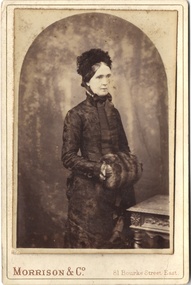
Photograph - Cabinet Card, Mrs Merritt
... Like numerous other photographers in Melbourne, their business must have been severely curtailed by the Depression of the 1890s. The sitter’s identity has been established as a Mrs. Merritt. While we...Like numerous other photographers in Melbourne, their business must have been severely curtailed by the Depression of the 1890s. The sitter’s identity has been established as a Mrs. Merritt. While we ...The photographic firm of Morrison & Co., were active at 81 Bourke Street East during the 1880s. Like numerous other photographers in Melbourne, their business must have been severely curtailed by the Depression of the 1890s. The sitter’s identity has been established as a Mrs. Merritt. While we know that she is not the Mrs Merritt who was to be the wife of the future Mayor of Kew, there were two Mrs Merritts who were shopkeepers in High Street, Kew. Mrs Lucy Merritt operated a bootmaker’s shop, and subsequently a “boot warehouse” from 1888 until the 1920s. Miss Laura Merritt established a dressmaker’s shop in High Street in 1910. Her business also lasted until the 1920s, albeit changed to that of a bookseller and stationer. Both portraits are of the same woman.Cabinet Card by Morrison & Co. Silver albumen studio portrait of a woman later identified as Mrs Merritt of Kew. The sitter wears a dark, figured silk two-piece outfit with matching bonnet and a fur muff. Mrs Merritt, Kewmrs merritt, morrison & co -
 Federation University Art Collection
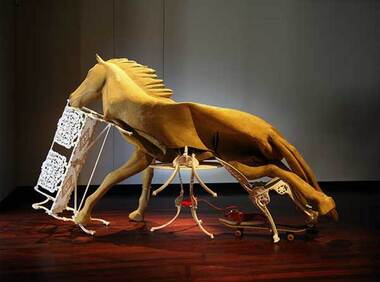
Sculpture - Sculpture - Installation, 'Dead Still Standing' by Lou Hubbard, 2015
... like the horse’s ribs, which are being ripped out.” It was these multiple meanings that also had the curator of the Post Office Gallery, Shelley Hinton, impressed with the work. “The work challenges us ethically and culturally, in a way that pleads for analysis, as we...like the horse’s ribs, which are being ripped out.” It was these multiple meanings that also had the curator of the Post Office Gallery, Shelley Hinton, impressed with the work. “The work challenges us ethically and culturally, in a way that pleads for analysis, as we ...Lou HUBBARD (1957 -) Born Brisbane, Queensland After a career in the film and television, Melbourne based artist Lou Hubbard completed a Master of Fine Art at RMIT University in 2001. She works primarily with video and installation, and has exhibited widely throughout Australia and internationally, Lou Hubbard is currently the Head of Photography at the Victorian College of the Arts. In announcing the award 2015 Guiguis New Art Award the judges applauded Lou Hubbard on her compelling installation, which comprised a deflated, disembowelled latex horse collapsed over a Coalbrookdale patio chair, table and bench seat situated over a skateboard and plastic dog. “Occupying a space between the traditions of equine, assemblage and unmonumental sculpture, Lou Hubbard’s Dead Still Standing confounds and compels viewers in its uncanny play of materials and movement,” senior curator, contemporary art, National Gallery of Victoria and judge Max Delany said. “In this elaborate yet concise work, Hubbard has created a form of surprising and unsettling effect that reflects our experience of a world in translation.” The win came as a surprise for Hubbard, who said she was overwhelmed at the talent of all 15 finalists. “I was so surprised, because I was in good company with the other artists, who were all quite extraordinary,” she said. “In the nature of the competition, I feel very lucky.” With multi-layer meanings to her piece, Hubbard said it was actually Ballarat’s rich history that inspired her work. She said it was the Ballarat goldfields and the idea of what horses might have gone through during those years that gave her a concept to work with. But that wasn’t the only source of ideals portrayed in the piece – Hubbard also explored the effect training had on horses. “The horse stands in a way that portrays (how) the human exhorts the way of training,” she said. “The horse is edging like it wants to move, which is impossible, and the furniture acts in lots of ways. The chair, for example, is like the horse’s ribs, which are being ripped out.” It was these multiple meanings that also had the curator of the Post Office Gallery, Shelley Hinton, impressed with the work. “The work challenges us ethically and culturally, in a way that pleads for analysis, as we do in our complex daily lives,” she said. Lou Hubbard's 'Dead Still Standing' won the was awarded the prestigious $20,000 Guirguis New Art Prize in 2015. The Federation University Guirguis New Art Prize was a national biennial and aquisitive contemporary art prize. The $20,000 biennial acquisitive prize was sponsored by Ballarat surgeon Mark Guirguis, administered by Federation University Australia and presented in partnership with the Art Gallery of Ballarat.The genesis of the prize was to raise the profile and encourage the Art School of what was then Ballarat University. lou hubbard, guirguis, guirguis new art prize, sculpture, horse, animal, installation artwork -
 Federation University Art Collection
Painting - Artwork, Troy Firebrace, 'A Galaxy Swirl' by Troy Firebrace, 2015
... like to convey to people. Influenced by the imagery of his Aboriginal cultural background he works at bringing together references of landscape, environmental processes and concerns, looking at the way in which we as humans relate to the natural world. ... Artist's statement: "‘Stories are being told and shared like particles in the universe, a constant swirl of words filled with emotions creating a pattern — explosions — smashing into each other creating a layering effect — creating worlds, planets — well nourished and suited to sustain life, and from this life new stories will emerge, to be told, to be shared — a continuous galaxy swirl. I like the idea that we are a part of something bigger — yes, the earth is massive, but we are just a speck of something far beyond the Milky Way itself.” ...like to convey to people. Influenced by the imagery of his Aboriginal cultural background he works at bringing together references of landscape, environmental processes and concerns, looking at the way in which we as humans relate to the natural world. ...Troy FIREBRACE (c1994-) Country/Language: Yorta Yorta Troy is a Shepparton born Yorta Yorta man, whose career is on the rise after winning the prestigious Federation University Acquisitive Award for Work by a Victorian Regional Artist at the 10th Victorian Indigenous Art Awards. He completed Year Twelve at Shepparton Secondary College in 2010, and in 2015 Troy was studying Creative Arts at La Trobe University, Bendigo where he has pursued his interest in his Aboriginal identity and art. He is largely influenced by the art of his Uncle Chris Firebrace and he enjoys the design aspects of creating a painting. Usually Troyʼs works contain a narrative, or at least hint of a meaning that he would like to convey to people. Influenced by the imagery of his Aboriginal cultural background he works at bringing together references of landscape, environmental processes and concerns, looking at the way in which we as humans relate to the natural world. Troy seeks to find and demonstrate a connection between humanity and the environment, exploring the idea of harmonious co-existence. Artist's statement: "‘Stories are being told and shared like particles in the universe, a constant swirl of words filled with emotions creating a pattern — explosions — smashing into each other creating a layering effect — creating worlds, planets — well nourished and suited to sustain life, and from this life new stories will emerge, to be told, to be shared — a continuous galaxy swirl. I like the idea that we are a part of something bigger — yes, the earth is massive, but we are just a speck of something far beyond the Milky Way itself.” The work was inspired by the work of abstract expressionist painter Jackson Pollock, science and space. This work won the 2015 Victorian Indigenous Art Awards Federation University Acquisitive Award for work by a Victorian regional artist. His canvas 'A Galaxy Swirl' was described by judges as ‘‘a vibrant and dynamic painting that, as the artist explains, epitomises a bringing together of modernism and Aboriginal arts’’.victorian indigenous art awards, troy firebrace, artwork, artist, indigenous, aboriginal, painting, indigenous artist -
 Power House Rowing Club
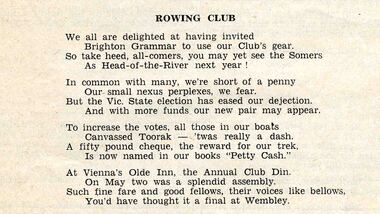
Journal article - ROWING CLUB, ROWING CLUB, 1958
... we fear. But the Vic. State election has eased our dejections. And with more funds or new pair may appear. To increase the votes, all those our boats Canvassed Toorak - 'twas really a dash. A fifty pound cheque, the reward r our trek, Is now name our books "Petty Cash." At Vienna's Olde Inn, the Annual Club Din. On May two was a splendid assembly. Such fine fare and good fellows, their voices like...we fear. But the Vic. State election has eased our dejections. And with more funds or new pair may appear. To increase the votes, all those our boats Canvassed Toorak - 'twas really a dash. A fifty pound cheque, the reward r our trek, Is now name our books "Petty Cash." At Vienna's Olde Inn, the Annual Club Din. On May two was a splendid assembly. Such fine fare and good fellows, their voices like ...ROWING CLUB We are all delighted at having invited Brighton Grammar to use our Club's gear. So take heed, all-comers. you may yet see the Sommers As Head-of-the-River next year ! In common with many, we're short of a penny Our small nexus perplexes, we fear. But the Vic. State election has eased our dejections. And with more funds or new pair may appear. To increase the votes, all those our boats Canvassed Toorak - 'twas really a dash. A fifty pound cheque, the reward r our trek, Is now name our books "Petty Cash." At Vienna's Olde Inn, the Annual Club Din. On May two was a splendid assembly. Such fine fare and good fellows, their voices like bellows, You'd have thought it a final at Wembley. -
 Wodonga & District Historical Society Inc
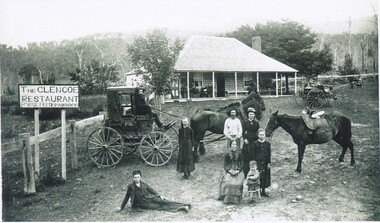
Photograph - Glencoe Restaurant, Tallandoon, c1890
... THE TRAVELLER MY EASTER EXCURSION by GIRVAN “From the top of Lockhart's Gap we caught our first glimpse of the Mitta Mitta River, winding like a silver thread through the flats below. ...THE TRAVELLER MY EASTER EXCURSION by GIRVAN “From the top of Lockhart's Gap we caught our first glimpse of the Mitta Mitta River, winding like a silver thread through the flats below. ...Glencoe Restaurant on Lockhart's Gap Road, Tallandoon, Victoria was owned by the family of William McDonald and his wife Helen nee Beattie. They migrated from Scotland in the early 1860s and settled in the Wahgunyah and Rutherglen area where their children were born. C1876 they took up a selection at Tallandoon, Victoria which they named “Glencoe” after their home in Scotland. The house was made of mud brick and measured approximately 18 feet by 10 feet. The roof was later replaced with tin. To supplement their farming income the McDonalds operated as Glencoe Restaurant and their hospitality was known far and wide. Three times a week, Crawford & Co coaches travelled from Wodonga to Glencoe via Kiewa over Lockhart’s Gap, changed horses at Glencoe and then went on to Mitta Mitta. An Extract from “Leader of Melbourne, Saturday 14 May 1887” relates the story of a visit to Glencoe. THE TRAVELLER MY EASTER EXCURSION by GIRVAN “From the top of Lockhart's Gap we caught our first glimpse of the Mitta Mitta River, winding like a silver thread through the flats below. A descent of some 3 or 4 miles brought us to the first settlement on the eastern side of the Gap, and a board serving as a rustic sign announcing this to be the " Glencoe Restaurant”. We resolved to rest here for the night, and, entering the cottage of sun-dried we were made welcome and received every attention at the hands of the hostess. A hardy old Highlander, lineally descended from the old clan of the McDonalds of Glencoe, the proprietor, bidding good-bye to his native vale, had sought to woo Fortune in the Australian bush, and followed the avocation of a gold miner for many years with but indifferent success and at length, renouncing this precarious method of " gathering gear," took up a selection in this valley and named his farm Glencoe, in memory of his native place. May this peaceful valley, never witness such deeds of blood as did the original home of this worthy old man. Combining a little cultivation with grazing, and adding to his income by means of the restaurant as well as by affording accommodation to the Snowy Creek and Wodonga coach, which changes horses here, our host seems to be thriving apace, and need not fear that his old age will experience any of the vicissitudes of fortune which marked his younger and struggling days.” In July 1919, “Glencoe” was sold to Mr C. A. Franks but he died immediately after and so the property was sold again in September 1919, this time being purchased by the Peters family. It was sold again to Alan Beer in 1957. Helen McDonald died on 13th November 1914 and William died on 12th March 1920.A black and white image of the McDonald family at the front of their home at Tallandoon, Victoria. The family members in this image are William McDonald Senior standing with Williamina (Minnie) (18), Helen (William’s wife) seated, Margaret (Maggie) and Hannah standing beside Helen, Barbara (13) standing in front of the coach and William Junior reclining.On sign post - The GLENCOE RESTAURANT / Horse Feed Paddocksmcdonalds of tallandoon, pioneer families of the upper murray -
 Wodonga & District Historical Society Inc
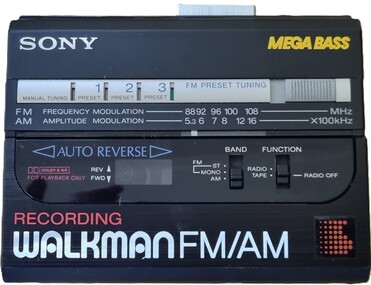
Functional object - Sony Walkman FM/AM Radio and Recorder, Sony Corporation, 1988
... If we put a playback-only headphone stereo like this on the market, it'll be a hit." ...If we put a playback-only headphone stereo like this on the market, it'll be a hit." ...The first Sony Walkman was launched on 22 June 1979 in Tokyo. It was designed under the leadership of Akio Morita and was a modification of an earlier recorder used by journalists called the “Pressman”. The first cassette Walkman TPS-L2 was to forever change the way consumers listen to music." According to Akio Morita "This is the product that will satisfy those young people who want to listen to music all day. They'll take it everywhere with them, and they won't care about record functions. If we put a playback-only headphone stereo like this on the market, it'll be a hit." Sony went on to sell approximately 220 million cassette-based Walkman units before ending production in 2010. This Sony Walkman model is a higher level portable cassette recorder and player featuring Mega Bass, auto-reverse, and an FM/AM radio. It was designed for recording from radio or microphone and was introduced to the market in 1988. This item is significant because the Walkman was widely used especially by young people from the 1980s onwards.A small portable combined radio and cassette player with recording facility. It includes ear buds and a portable plug in microphone. Black plastic cover and metal control buttons. Model name and control names are in a combimation of red, yellow, white and pale blue,SONY MEGA BASS RECORDING WALKMAN FM/AM plus labels on controlsmusical appliances, popular culture -
 Diamond Valley Vietnam Veterans Sub-Branch
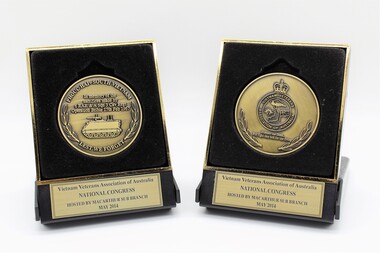
Memorabilia - Medallions, 1/5/2014
... We Forget"; the two text lines are joined by leaves. Text in the middle of the face: "In memory of the sacrifice made by 6RAR & A Sqn 3 Cav Regt Operation Bribie 17th Feb 1967. The reverse face has the Vietnam Veterans Association of Australia logo in the middle, with the motto: "Honour the Dead but fight like hell for the living" underneath; two sprigs of leaf cradle the logo and motto....We Forget"; the two text lines are joined by leaves. Text in the middle of the face: "In memory of the sacrifice made by 6RAR & A Sqn 3 Cav Regt Operation Bribie 17th Feb 1967. The reverse face has the Vietnam Veterans Association of Australia logo in the middle, with the motto: "Honour the Dead but fight like hell for the living" underneath; two sprigs of leaf cradle the logo and motto....We Forget"; the two text lines are joined by leaves. Text in the middle of the face: "In memory of the sacrifice made by 6RAR & A Sqn 3 Cav Regt Operation Bribie 17th Feb 1967. The reverse face has the Vietnam Veterans Association of Australia logo in the middle, with the motto: "Honour the Dead but fight like hell for the living" underneath; two sprigs of leaf cradle the logo and motto. ...The medallion pays respect to the sacrifices made by the units in Operation Bribie on 17th February 1967.The medallion takes its place amongst similar medallions and other commemorative items that revert to particular instances or event in Vietnam during the war.Two medallions showing front and reverse faces of a medallion issued at Vietnam Veterans Association of Australia, 2014 National Congress, hosted by Macarthur Sub Branch. Front face shows an APC with text on upper edge: "Phouc Hai-South Vietnam" and text on bottom edge: "Lest We Forget"; the two text lines are joined by leaves. Text in the middle of the face: "In memory of the sacrifice made by 6RAR & A Sqn 3 Cav Regt Operation Bribie 17th Feb 1967. The reverse face has the Vietnam Veterans Association of Australia logo in the middle, with the motto: "Honour the Dead but fight like hell for the living" underneath; two sprigs of leaf cradle the logo and motto.Front face shows an APC with text on upper edge: "Phouc Hai-South Vietnam" and text on bottom edge: "Lest We Forget"; the two text lines are joined by leaves. Text in the middle of the face: "In memory of the sacrifice made by 6RAR & A Sqn 3 Cav Regt Operation Bribie 17th Feb 1967. The reverse face has the Vietnam Veterans Association of Australia logo in the middle, with the motto: "Honour the Dead but fight like hell for the living" underneath; two sprigs of leaf cradle the logo and motto.vietnam, vietnam war, diamond valley vietnam veterans sub branch -
 Melton City Libraries
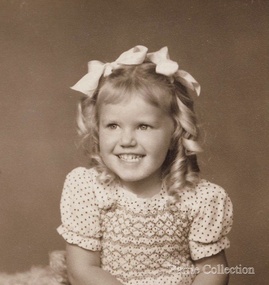
Photograph, Wendy Barrie, Unknown
... we would walk home in a group with the Nixon and Gillespie children, along the main road over the bridge near the Shire Offices and down a hill. I was being dinked on Joyce Gillespie’s bike while holding onto the seat, toppled off the bike striking my chin and teeth on the bitumen and cracking my jaw. I was about 9 years old and stayed a couple of days in the Quamby Hospital in Bacchus Marsh, it seemed like...we would walk home in a group with the Nixon and Gillespie children, along the main road over the bridge near the Shire Offices and down a hill. I was being dinked on Joyce Gillespie’s bike while holding onto the seat, toppled off the bike striking my chin and teeth on the bitumen and cracking my jaw. I was about 9 years old and stayed a couple of days in the Quamby Hospital in Bacchus Marsh, it seemed like ...Eldest daughter of Edna and Bon Barrie, born on 03 November 1943 in Melbourne, Victoria, Memoirs of Wendy Barrie, recalling the early formative years of life in Melton: In 1949 I started school at Melton State School no 430 and was driven the 2½ miles to there by my parents at first. Later we walked home in the afternoons or were picked up by car as we made our way home along the Western Highway. In 1956 I went to Bacchus Marsh High School. There were 4 students in grade 6 and 3 of us went to the High School. The students from Melton, Melton South and Toolern Vale State Schools went by bus to Bacchus Marsh High School as far a fifth form. My parents drove me to the pick up point and during the five years of travel to High School. The bus travelled via Toolern Vale and later went through Exford and through Parwan. On the return journey in the afternoon the bus went in the reverse direction. The bridge at Exford was an old narrow wooden one, and the students had to get off the bus and walk across, with the driver crossing in the empty bus for safety reasons. There was a travelling allowance paid to parents and it was estimated from the distance the crow flies, a straight line. We lived a Ferris Lane, just where the Harness Racing entrance is now situated about 2 ½ miles by road to school too close to qualify for the subsidy. While at State School Melton we would walk home in a group with the Nixon and Gillespie children, along the main road over the bridge near the Shire Offices and down a hill. I was being dinked on Joyce Gillespie’s bike while holding onto the seat, toppled off the bike striking my chin and teeth on the bitumen and cracking my jaw. I was about 9 years old and stayed a couple of days in the Quamby Hospital in Bacchus Marsh, it seemed like and eternity at the time and quite traumatic being separated from my family. I can remember contemplating how I could get out of the window and run away but realised it was too far to walk home. Often we would cut across the Common on our way home from school picking up stray golf balls and collecting them from the creek when it dried out. We were warned about not accepting lifts from strangers passing along the Melbourne/ Ballarat Road. The only danger we faced was being swooped by the magpies particularly on the open ground on the Common. We were also fairly cautious when the Gypsies camped on the Common in the area just about opposite the small reservoir. “Mum” grandma Myers loved to have us call in on our way home, and usually would cut a slice of Jongebloed’s bread and spread it with home made butter. Sometimes we waited there until we were collected by car, usually driven by our mother. Margaret Nixon and Joyce Gillespie were a few grades ahead of me and Barbara Nixon was born just two months earlier than me. Our mothers were great friends for over 6o years, born in the same month three years apart. They lived within a few days of the same age as each other at the time their deaths. Dad and George Nixon attended Melton school at the same time. Sarah nee Hornbuckle Nixon and my grandfather Frederick Myers Snr were at school together at the same in the 1880s. The Nixon family lived in Keilor Road just past the Toolern Creek near the turnoff. Tom and Ann Collins lived on the southern side of the Western highway and Keilor road intersection. Jim and Ruby Gillespie’s house was further long Keilor road on the right. They backed onto the Myers who lived on the north side of Western Highway east of Myers Gully (Ryans Creek). The Bridge over the Toolern Creek as very narrow and as truck traffic increased there were accidents. One truck took out the side railing and plunged upside down into the bank and into the shallow water. Another fatal accident happened between a car and a truck right in front of the Myers house. Grandfather Fred had been a bike rider all his life, as far as the Riverina in his younger years, wryly made the comment about the drivers the speeding along the Ballarat Road were setting out to kill themselves. The road was busy particularly after the Races at Ballarat when the crowds were hurrying home to Melbourne. Train travel had changed very little from the time my mothers generation to mine. The timetable meant the usual rush to Melton South by bike in her case and if she was running late the train pulled up on the crossing. I was driven to the Station from home past Keith and Mary Gillespie’s house near the Ferris Road rail crossing to Bridge road to Melton South for the 7.32 train. While attending Sunshine High School in 1961 I would meet up with three other students, two of whom I knew from Bacchus Marsh High School days. We usually got into the same compartment on the train, it was a typical country train with a corridor along the side and compartments with a door, roof racks and sometimes heated metal containers for the feet in the winter. Some of the trains came through from Horsham and Ballarat, and the Overland from Adelaide passed through in the evening, we could hear it in the distance from the Ferris Lane home. The carriages had 1st and economy class compartments showing photographs of county scenes and holiday destinations. The engine was the large A class diesel. They are still running to Bacchus Marsh 50 years later, due to the need for the greatly increased number of commuters travelling to work in the city. Sometimes the carriages were pull by a Steam engine, these were a problem in the summer time because the sparks caused fires along the train lines and then quickly spread into the dry grass, crops and stubble. The Motor Train left Spencer Street at 4.23 pm and was the best train for me to catch. Ferris Road was a designated stop and train pulled up on the road crossing. It had steps at the door and rungs to hold while alighting to the ground. The ballast along the tracks was rough and uneven and awkward to land on. The train was painted blue and yellow with the letters VR pained on the front. This saved may parents the afternoon trip to collect me from the Station. On the walk home on the gravel road I would pass Uncle Tom and Aunty May’s house before reaching home. Melva Gillespie was studying at Sunshine Technical School and we sometimes both got off the train at the same time. On other occasions the Motor Train was replaced with a diesel engine with carriages, it was also required to stop and the driver had to be notified in advance. This meant getting into the guards van a Rockbank. It was more difficult alighting from the carriage as the gap was greater and more precarious to swing out and land on the ground. A few times in my last year of study at Melbourne Teachers College in Grattan Street Carlton. I managed to catch the 2.30 pm train to Serviceton, it was express to Melton and was very quick trip. The last train, was the 5.25 pm diesel to Ballarat and I usually caught this train to Melton South Station. On one occasion after being held up on the tram in Bourke street I had to make a mad dash to the platform chasing the train as it was just moving off and yelling to the guard, fortunately I was noticed and the train ground to halt. I scrambled into the end door and took most of the journey home to recover. After the last year at High School I continued to travel on the train, 2 years to Prahran Technical School changing at North Melbourne. There were a lot school children travelling to private schools and some at the primary level and mainly from Bacchus Marsh. Rockbank children also travelled by train from the beginning of their high school years, quite a few went to Sunshine High School. During my third year of teacher training I travelled to Flinders Street to RMIT for ceramics classes and Grattan St Teachers College located in the grounds of Melbourne University. There were many teachers being trained at the Secondary Teachers College due to the baby bulge creating a great shortage of teachers. Sunshine High School was very well represented amongst the different courses in Primary, Secondary and Art and Crafts. I attended Melbourne University lectures, studying a Fine Art subject. Bernard Smith was the most notable of the lecturers. he replaced Professor Joseph Bourke who had taken leave for the years. In 1962 he published the art book “Australian Painting”. The secondary art and craft student teachers from the College were in the majority, taking this subject and were well regarded due to their practical art and craft methods and their teaching round experience. In December 1964 I graduated as a Trained Secondary Teacher – Art and Crafts. The graduating ceremony was held at Wilson Hall. I received my appointment to work at Maryborough High School. Uncle Max and Aunty Rosemary Myers arranged my accommodation. Uncle Max was a teacher at the Maryborough Technical School fat the time. The appointment was suddenly changed when just before the school year was about to start when I received notification that I was now required to move to Warracknabeal High School. I was subject to a bond for the three years of training and three years of teaching and was under an obligation to comply with the directive of the Education Department. My father stood as guarantor when I was accepted as student at the Melbourne Teachers’ College, thus enabling me to receive my teacher training, and a 5 pounds a week allowance for expenses. After teaching for two years at Warracknabeal High School I was fortunate enough the gain a transfer to Sunshine West High School, returning to live at home in Melton and travelling by car to work with a fellow colleague, Jock Smith who lived at Station road Melton. I completed bond obligation and resigned at the end of the year. The employment regulations at that time did not allow the option of leave of absence for, indefinite overseas travel. I returned to Australia in October 1969. Visiting Arthur Hart the Principal of Sunshine High School he arranged with the Education Department for my re-employment at Sunshine High School until the end of the year. In 1970 I was transferred, and returned to Sunshine West High School where I worked for the next three years. In January 1968 I sailed on the “Oriana” to South Hampton with two teaching friends from Warracknabeal High School on a travelling and working holiday. Doreen Kiely, a former Bacchus Marsh High student and fellow train traveller from Bacchus Marsh, was already working in London, had arranged our accommodation at the London Travellers Club Hotel, Braham Gardens, Earls Court SW5. We based our stay at this address in London and travelled around Scotland, Ireland and England. In the summer we took a four month trip around the Continent and the Mediterranean. I registered with The Royal Borough Of Kingston Upon Thames as a Supply teacher, and worked at Chessington School form autumn to spring the following year and living with Mrs Rose Gillies at Kinross Avenue, Worcester Park, Surrey. In the spring of 1969 visiting Norway, Sweden and Finland joining an organised camping group to the Artic Circle, entered Russia at Leningrad (St Petersburg) Moscow, Minsk, to Poland and Czechoslovakia. In August returning to Worcester Park for the flight to Montreal to stay with cousin Lynette and husband Jurgen. A side trip was taken to Toronto, Niagara Falls and New York. The flight home from Montreal to Melbourne took 52 hours. A ½ day break in Vancouver before boarding the Qantas boeing 707 via San Francisco, Honolulu, Fiji, Sydney to Melbourne. Around the world in 21 months. Photographs of Wendy local identities -
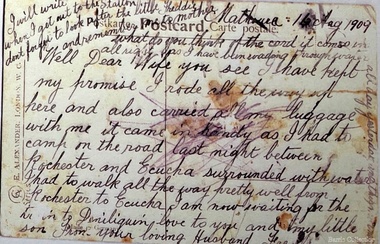 Melton City Libraries
Postcard, Postcards from Fred and Mattie Myers, 1909-1914
... we get none for the hut this year.. I have not seen a bit of butter since I left home as it is too dear for us for sinners here. Poor Marjie had a cold.. so the little kid wants to go to the war, she must think it is good like a picnic. ...we get none for the hut this year.. I have not seen a bit of butter since I left home as it is too dear for us for sinners here. Poor Marjie had a cold.. so the little kid wants to go to the war, she must think it is good like a picnic. ...Post Card: Melton Railway Station 1909 Mattie to Fred My Dear Fred I received your letter and the L2 10/- I was very pleased to hear that I could write again. You say you will come home after the last shead. I should think so. I had a letter from E Jenkins so I am going down to see her next week we call the baby Fernie now I hope you will agree. Dear Fern has got the whooping cough. Written on the side: I suppose you will be away four weeks yet. Love from Mattie will write on Sunday. This letter appears to be connected with the post card Barwonleigh Saturday October 1908 handwriting My Dear Mattie I received your letter and was sorry to hear of our dear little babys misfortune how did it happen do you know what was the cause of it Mrs Watts must be a blind old fool not to have known what it was when you took him to her the first time poor dear you must be worried to death with all this trouble tell me what the doctor thinks of the rupture. I do hope dear he will get over this all right you must be nearly dead going without sleep for so long I had a bit of misfortune myself on Thursday the machine locked and jumped out of my hand and stuck in my bone I kept on working but it was very painful as all the holding is done with the..next page ..knee the boss also has been chipping a good deal this week he says the next time he has occasion to speak to me I will have to go he is very particular. I would like to go through if possible even if I do a lot less. I have about sixteen hundred done up to now and would get another nine hundred if I was let alone but I suppose we will live lovie even if I go do you know if they are full handed at Eynesbury if I thought I could get a week there I would cut myself out here quick. Well dear lovie I am sending you a couple of pounds as I suppose you will want it to get a truss. I don’t think they are very expensive and hope things will find this better with you. Well my dear love I must close with fond love for you and baby from your loving Husband Fred Post Card: 16 Aug 1909 - Mathoura The card depicts a small sailing boat laden with blue flowers. Well Dear Wife you see I have kept my promise. I rode all the way up here and also carried all my luggage with me it came in handy as I had to camp on the road last night between Rochester and Echuca surrounded by water. I had to walk all the way pretty well from Rochester to Echuca. I am now waiting for the train to Deniliquin. Love to you and my little son Fred. From you loving Husband Fred Written along the top and side of the card. what do you think if the card comes in all right as I have been wading through water all day yesterday and this might be …? will write when I get to the Station, don’t forget to look after the little Freddie and remember me to mother. Post Card: 1909 - view across the Flat from the Creek looking to the Presbyterian Church in the distance with some small dwellings in the foreground. To Mr Fred Myers Wandook Stn Denniliquin NSW Dear Fred, received your letter I am sorry to hear you are having such wet weather I will write a letter tomorrow baby is better With Love from M Post Card: 1910 Postmark Stamp 1d Aug 12 1910 Moama NSW Melton postmark stamped Aug 25? Hare Street, looking south Echuca Mrs F Myers, Melton P O Vic Dear Mattie, Just a line to let you know I got here all right I go to Pericotta tonight and to Cobran to morrow best love to all from yours Fred Letter Cobran Stn Via Deniliquin N.S.W. Sunday 21st Aug extract I am having a good time here, a good cook and the best of everything no fires to light or kettles to boil just get up and wire in… plenty hard work the sheep are pretty tough but much better than Wandook. I am well among them here we had a little rain on Friday but not enough to stop us so we have got one full week in .. the weather is lovely. I have been basking in the sunshine mainly in the morning and feel strong and fit a as fiddle, they are a grand lot of men here I only knew one out of the lots but know them all pretty well now, we have a bit of a concert here every nights almost there are a few good singers here and we also had a phonograph up from the station with all the latest records we have two dancers among ourselves very boisterous affairs indeed thy do make the dust fly. I have not ventured to take part in it and don’t think I will either. I get enough dancing all day long and besides I have to furnish the music you ought to see them going when I rattle up the concertina. Letter Cobran Stn via Deniliquin Thursday Sept 1st 1910 [abbreviated] My Dear Mattie, I received your welcome letter today. I though I was never going to get one as it was Sunday fortnight when I wrote to you but we only the mail here twice a week so it takes a long time to write and get an answer. I also got a reply from Eynesbury and a favourable reply it starts on the 13th Oct. …. I have 800 sheep shorn up to date and am fifth among about 30 men. I am sending two more [Ls] this time which I drew on Saturday. I don’t like sending too much more this time as there is a chance of it going astray and it is not very easily earned…. Things must be humming in Melton with all them babies coming and people getting married… I suppose we will be having new neighbours soon. If Mr Watts is selling out he was getting more property then he could keep. I hope you will soon have rain…. you will have to watch our little boy the dear little rascal he must be getting very cute opening the gates he will be tumbling into the tank …. I love to think of the happy times we have had together and hope that we will love one another to the end .. the mail will not leave here until Monday Love to you dear wife and baby Fred Post Card: – I Cling to you like Ivy Cobran September 18th 1910 Fred awaits a letter from Mattie I still have three weeks here yet.. I am sending L2 tell if you got the other 1L 1911 Letters Fred to Mattie October Spring Plains Oct 1911 Mia Mia Post Office I had a great job to catch the train at Diggers Rest as after I turned off the Keilor Rd it was very way and muddy and I had to walk a lot of the way and got there just in time. I came right into Redesdale by the train and stopped there last night… they had heavy rain on thursday up here and a tremendous fall of hail which covered the ground over a foot deep. There are only 4 shearers here yet.. I saw some of the sheep they look very rough and big so there will be no big tallies done, the men are saying he is giving 2s per hundred extra, so that will help a little. We are going to start Cobran via Deniliquin. Post Card: three scenes of Mathoura 10/9/1914 EB on a photo copy 10/9/12 ? Mathoura Thursday Dear Mattie, Just a line to let you know I got up here all right. I rode the seat out of my trousers. I have done 100 miles on the bike. I met none of the old hands this time so will go out on my own… Your loving husband Fred, did Marjie miss me at all. Post Card: Cobran 15th Sept 1912 Hearts and intertwined flowers and little envelope he has written Marjorie …just a line to let you know I will cut out here Friday next in find, we have had two falls of rain since I wrote and it has bean blowing a hurricane for couple of days and may blow up again however if we are delayed I will send you a card Wednesday I am longing to see you and the two little kiddies again…. Fred Copy only Golf Hill Sep 26th Cut out 31 Oct Total 2332 1913 Post Card: Scene View Street, Bendigo August 1913 Mathoura Tuesday My Dear Mattie Just a line to let you know I got up here all right. Teddy Ginger and another couple of chaps on the way ……. Letter Cobran Sunday Aug 7th 1913 My Dear Mattie Just a line to let you know that weather permitting we will cut out here about Thursday morning….I have not got any more shearing here. I have not heard from the other place…. Expect me about Friday …. I suppose Freddie and Marjie will be glad to see me, Marjie will climb all over me. I will be glad to se you all again you will have a fortnight before Golf Hill starts. I see in the Express you sent that Annie McPherson of (Dunvegan) is engaged to Len Farrell, she appears to be going to take no risks with him she wont let him slip through her hands like the banker did…… Fred Post Card: 1914 Garland of roses Warrambeen Stn Shelford PO October 14th 1914 Birthday wishes. Post Card: Love’s Golden Chain Golf Hill Tuesday Oct 17 1914 Birthday wishes [ this one might be a different year] Letter Cobran Wed 2nd Sept 1914 My Dear Mattie, I received your welcome letter today and also the papers which were very acceptable as we don’t get many papers here we only get see one at odd times as we get none for the hut this year.. I have not seen a bit of butter since I left home as it is too dear for us for sinners here. Poor Marjie had a cold.. so the little kid wants to go to the war, she must think it is good like a picnic. We had light rain on Monday as usual only half a day’s shearing in the shed so that is all we done this week, we took a vote 9 to 6 no shearing so nothing till to morrow morning Thursday so there is still a good fortnights shearing to do, will do nothing Saturday polling day as we have to go 13 miles is near Services where I was last year so we will want the full day 50 men to vote and some will probably have to walk to get there, all solid for Labour. I have just had an interval for lunch, pudding, yeast buns and rock cakes… We are doing nothing but eating and sleeping this week. Fred I am sending L1 in this which will do you till I come back if I keep drawing up I will have none when I finish so make the most of it. Post Card: Two doves with violets 1915 Cobran Wed 18th Sept [could be 1912] Sorry to tell you we are delayed with rain so will not be home till next week… only 3 days of shearing to do…. expect me about the middle of next week….I wish I was with you now and the dear little ones Fred Post Card: Iris Flowers Barwonleigh Stn Tuesday Oct 14th 1918 Happy birthday greetings from Fred Post Card: Irrigation channel Swan Hill 5 Year not shown Swan Hill Tuesday night Just a few lines to let you know I got this far all right. I had to walk nearly all the way to Gisborne and got there last night and took the train here today. It has been raining all the way between Gisborne and here. Moulamein tomorrow. I think it will be another case of walking as it is wet here no metal roads all mud. best love to yourself and the little ones and also mother. will write Sunday Post Card: The White Man’s Burden.The writing on the back rubbed out Mattie has written, I was weighed and I am 8 stone 10 pounds. 14 Post Cards, some have the original dates, others have the date added later by Martha. Two envelopes, one with addressed to Melton postmark Moule, stamp torn off, the other Cards from my dear Fred. The letters and the notebooks can be cross checked according the their contents. Italics show the dates added by Mattie local identities
