
Showing 192 items matching "selbourne"
-
 Ruyton Girls' School
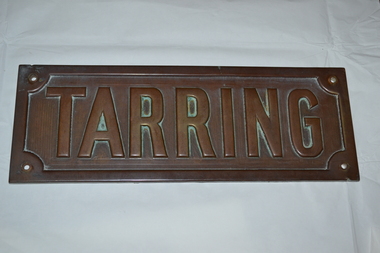
Plaque - House Name Plate, Tarring, 1872-1919
... ‘Tarring’ was sold to Ruyton Girls’ School in 1920, and the School moved to the site, (now 12 Selbourne Rd, Kew) in that year. ‘Tarring’ was renamed ‘Henty House’ by Ruyton in honour of its original owners....‘Tarring’ was sold to Ruyton Girls’ School in 1920, and the School moved to the site, (now 12 Selbourne Rd, Kew) in that year. ‘Tarring’ was renamed ‘Henty House’ by Ruyton in honour of its original owners. henty, henry henty, marion tarring, 12 selbourne road, kew ruyton girls' school, kew TARRING Rectangular-shaped brass name plate for the house "Tarring". ...Henry Henty and his wife Marion Anne Henty (nee McKellar) had ‘Tarring’, Kew built for their family in 1872. Their house was named for Tarring, Sussex, the Henty familys' ancestral home in the United Kingdom. The Henty family resided at ‘Tarring’, Kew until the death of Marion Henty in 1919. ‘Tarring’ was sold to Ruyton Girls’ School in 1920, and the School moved to the site, (now 12 Selbourne Rd, Kew) in that year. ‘Tarring’ was renamed ‘Henty House’ by Ruyton in honour of its original owners.Rectangular-shaped brass name plate for the house "Tarring". One screw-sized hole in each corner to allow name plate to be attached to a building, (total of four). Reverse of nameplate is flat.TARRINGhenty, henry, henty, marion, tarring, 12 selbourne road, kew, ruyton girls' school, kew -
 Ruyton Girls' School
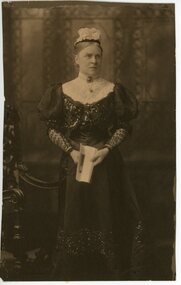
Photograph - Studio Portrait, [Marion Henty], c.1890
... ‘Tarring’ was then sold to Ruyton Girls’ School, and the School moved to the site, (now 12 Selbourne Rd, Kew) in 1920. ‘Tarring’ was renamed ‘Henty House’ in honour of its original owners. ...‘Tarring’ was then sold to Ruyton Girls’ School, and the School moved to the site, (now 12 Selbourne Rd, Kew) in 1920. ‘Tarring’ was renamed ‘Henty House’ in honour of its original owners. marion henty henry henty tarring selbourne road marion mckellar Ruyton Girls' School Kew (Vic) woman book cameo studio portrait 1890s Full length, sepia toned studio portrait of Mrs Marion Henty (b.1838-d.1919). ...Marion Anne McKellar, the daughter of William Gilbert McKellar and Maria Jones was born in 1838. She married Henry Henty in 1859 and they had 9 children. She died in June 1919. Henry Henty and his wife Marion had ‘Tarring’, Kew built for their family in 1872. The Henty family resided at ‘Tarring’ until the death of Marion Henty in 1919. ‘Tarring’ was then sold to Ruyton Girls’ School, and the School moved to the site, (now 12 Selbourne Rd, Kew) in 1920. ‘Tarring’ was renamed ‘Henty House’ in honour of its original owners. Full length, sepia toned studio portrait of Mrs Marion Henty (b.1838-d.1919). Mrs Henty is standing, hold holds a book in front of her while looking to her left. She is wearing a lace cap on her head and has a cameo broach around her neck.marion henty, henry henty, tarring, selbourne road, marion mckellar, ruyton girls' school, kew (vic), woman, book, cameo, studio portrait, 1890s -
 Ruyton Girls' School
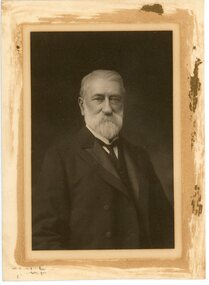
Photograph - Studio Portrait, [Henry Henty], c.1890
... ‘Tarring’ was then sold to Ruyton Girls’ School, and the School moved to the site, (now 12 Selbourne Rd, Kew) in 1920. ‘Tarring’ was renamed ‘Henty House’ in honour of its original owners. ...‘Tarring’ was then sold to Ruyton Girls’ School, and the School moved to the site, (now 12 Selbourne Rd, Kew) in 1920. ‘Tarring’ was renamed ‘Henty House’ in honour of its original owners. ...Henry Henty (b.1833-d.1912) was a successful businessman, and briefly a MLA for the seat of Grenville, Victoria in 1866. He was one of three sons of James Henty, and nephew of Edward Henty who is considered to be the first permanent European colonist to take up residence in Victoria. Henry Henty and his wife Marion Ann Henty (nee McKellar) had ‘Tarring’, Kew built for their family in 1872. The Henty family resided at ‘Tarring’ until the death of Marion Henty in 1919. ‘Tarring’ was then sold to Ruyton Girls’ School, and the School moved to the site, (now 12 Selbourne Rd, Kew) in 1920. ‘Tarring’ was renamed ‘Henty House’ in honour of its original owners. Half-length, sepia-toned studio portrait of Mr Henry Henty (b.1833-d.1912). Mr Henty wears a dark suit and tie. His body is one quarter turned to his left, while he looks straight towards the camera. The background behind him is plain and dark. Photograph is mounted on cream card.henry henty, tarring, marion henty, selbourne road, kew (vic), ruyton girls' school, businessman, politician, 1890s -
 Kew Historical Society Inc
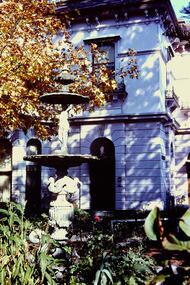
Slide - Derham House (formerly 'Mount View), 8 Selbourne Road, 1979
... Colour positive transparency (slide) of the the fountain and garden of Derham House, formerly 'Mount View', 8 Selbourne Road, Kew. The house wa designed in 1888 by the architect Frederick de Garis as his home. ...Slide Derham House (formerly 'Mount View), 8 Selbourne Road ...One of a group of slides taken by members of the Society of built heritage in Kew in 1979-80. The selection of subject matter reflects the priorities of the period. The colour of some slides has degraded.The slides represent a snapshot in time of built architecture in Kew, much of which has changed in the forty-plus period since they were created.Colour positive transparency (slide) of the the fountain and garden of Derham House, formerly 'Mount View', 8 Selbourne Road, Kew. The house wa designed in 1888 by the architect Frederick de Garis as his home. Prue Sanderson, 'Kew Conservation Study: Vol.II" wrote about Mount View that: "The house is typical of the late Victorian period in it being clad in render and styled in the Italianate. It has an asymmetrical composition with polygon bay windows extending up both floors, to each of the main facades. The ground floor is heavily incised with banded rustication, while the first floor is distinguished by the cast iron balconettes to each window. The fountain and pond in the garden appear to be those depicted in the 1903 MMBW plan of the property.""Fountain Ruyton in front of Derham House"historic houses -- kew (vic.), ruyton girls' school, derham house, mount view, italianate architecture, fountains -
 Kew Historical Society Inc
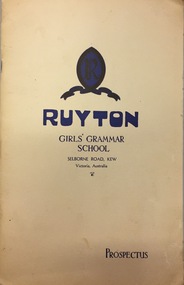
Document, Ruyton Girl's School, Ruyton Girls' Grammar School, Prospectus, 1950
... Since that time Ruyton has continued to thrive, outgrowing its Edgecomb site, and another at A’Beckett Street, Kew, before settling into its current home in Selbourne Road in 1920. The centrepiece of this property is Henty House, now named for its original owners, Henry and Marion Henty, but once known as ‘Tarring’. ...Since that time Ruyton has continued to thrive, outgrowing its Edgecomb site, and another at A’Beckett Street, Kew, before settling into its current home in Selbourne Road in 1920. The centrepiece of this property is Henty House, now named for its original owners, Henry and Marion Henty, but once known as ‘Tarring’. ...Ruyton was founded in 1878 in the Bulleen Road, Kew, home of newly widowed Mrs Charlotte Anderson (now High Street South). There she hired a governess, Miss Flora Barton, to educate a small group of children, including her own, in her front parlour. Her school immediately flourished. By 1882 she was able to move it to larger premises at ‘Edgecomb’, in Studley Park Road, and name it Ruyton, after a family connection with the village of Ruyton-XI-Towns, Shropshire, England. Since that time Ruyton has continued to thrive, outgrowing its Edgecomb site, and another at A’Beckett Street, Kew, before settling into its current home in Selbourne Road in 1920. The centrepiece of this property is Henty House, now named for its original owners, Henry and Marion Henty, but once known as ‘Tarring’. The grand, polychrome brick home was built in 1872 and with nearly four acres of gardens and grounds around it, it has proved to be a place where Ruyton and its students could continue to prosper. (source: Ruyton website 2020)Prospectus provided in response to an enrolment inquiry in 1950 for Ruyton Girls' Grammar School. (See also Item 2016.0468)ruyton girls grammar school -
 Marysville & District Historical Society
Document (Item) - Research document, Craig Robson's Fairground Follies, 1904 Romani Vardo Showman's/Gypsy Wagon, 05-09-2022
... ...selbourne...The Romani Vardo wagon was housed in The Marysville Museum alongside a collection of horse-drawn vehicles, veteran, vintage, and classic vehicles, various machinery, and memorabilia. the marysville museum marysville victoria burton type wagon henry jones & son gypsy hawkers gypsies william spooner artist st george dragon peter ingram gypsy museum selbourne england colin king fred sawyer A research document on the 1904 Romani Vardo wagon from The Marysville Museum in Marysville in Victoria. 1904 Romani Vardo Showman's/Gypsy Wagon Document Research document Craig Robson's Fairground Follies ...A research document on the 1904 Romani Vardo wagon from The Marysville Museum in Marysville in Victoria.A research document on the 1904 Romani Vardo wagon from The Marysville Museum in Marysville in Victoria. Fred Sawyer was originally from London, but then later relocated to Sydney, Australia, and then to Marysville in Victoria where he established The Marysville Museum. The Romani Vardo wagon was housed in The Marysville Museum alongside a collection of horse-drawn vehicles, veteran, vintage, and classic vehicles, various machinery, and memorabilia.the marysville museum, marysville, victoria, burton type wagon, henry jones & son, gypsy, hawkers, gypsies, william spooner, artist, st george, dragon, peter ingram, gypsy museum, selbourne, england, colin king, fred sawyer -
 Marysville & District Historical Society
Photograph (Item) - Colour photograph, Unknown
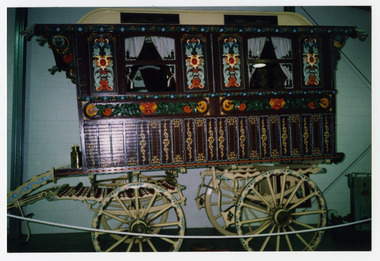
... ...selbourne...The Romani Vardo wagon was housed in The Marysville Museum alongside a collection of horse-drawn vehicles, veteran, vintage, and classic vehicles, various machinery, and memorabilia. the marysville museum marysville victoria burton type wagon henry jones & son gypsy hawkers gypsies william spooner artist st george dragon peter ingram gypsy museum selbourne england colin king fred sawyer A colour photograph of the Romany Vardo Gypsy wagon in The Marysville Museum in Marysville in Victoria. ...A colour photograph of the Romany Vardo Gypsy wagon in The Marysville Museum in Marysville in Victoria.A colour photograph of the Romany Vardo Gypsy wagon in The Marysville Museum in Marysville in Victoria. Fred Sawyer was originally from London, but then later relocated to Sydney, Australia, and then to Marysville in Victoria where he established The Marysville Museum. The Romani Vardo wagon was housed in The Marysville Museum alongside a collection of horse-drawn vehicles, veteran, vintage, and classic vehicles, various machinery, and memorabilia.the marysville museum, marysville, victoria, burton type wagon, henry jones & son, gypsy, hawkers, gypsies, william spooner, artist, st george, dragon, peter ingram, gypsy museum, selbourne, england, colin king, fred sawyer -
 Marysville & District Historical Society
Photograph (Item) - Colour photograph, Unknown
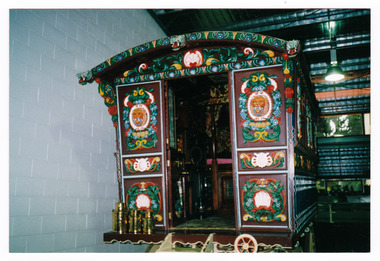
... ...selbourne...The Romani Vardo wagon was housed in The Marysville Museum alongside a collection of horse-drawn vehicles, veteran, vintage, and classic vehicles, various machinery, and memorabilia. the marysville museum marysville victoria burton type wagon henry jones & son gypsy hawkers gypsies william spooner artist st george dragon peter ingram gypsy museum selbourne england colin king fred sawyer A colour photograph of the Romany Vardo Gypsy wagon in The Marysville Museum in Marysville in Victoria. ...A colour photograph of the Romany Vardo Gypsy wagon in The Marysville Museum in Marysville in Victoria.A colour photograph of the Romany Vardo Gypsy wagon in The Marysville Museum in Marysville in Victoria. Fred Sawyer was originally from London, but then later relocated to Sydney, Australia, and then to Marysville in Victoria where he established The Marysville Museum. The Romani Vardo wagon was housed in The Marysville Museum alongside a collection of horse-drawn vehicles, veteran, vintage, and classic vehicles, various machinery, and memorabilia.the marysville museum, marysville, victoria, burton type wagon, henry jones & son, gypsy, hawkers, gypsies, william spooner, artist, st george, dragon, peter ingram, gypsy museum, selbourne, england, colin king, fred sawyer -
 City of Melbourne Libraries
Photograph, Bull, Hugh Jones, 1897-1993, Ruyton Girls School 1933
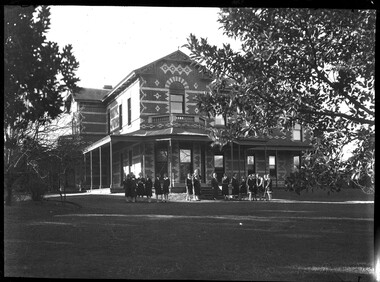
... Daniell, and girls at Ruyton, Selbourne Road, Kew, snapped after school hours. ...Daniell, and girls at Ruyton, Selbourne Road, Kew, snapped after school hours. ...Published: Age (Melbourne, Vic.: 1854- ), 4 August 1933, page 3 Published title: GIRLS’ SCHOOLS – MODEL YACHTING - FOOTBALL Published caption: The headmistress, Miss H. Daniell, and girls at Ruyton, Selbourne Road, Kew, snapped after school hours. Trove article identifier: http://nla.gov.au/nla.news-article204381763 Research by Project Volunteer, Louise McKenzie: Rather than the people, this charming building takes the eye! Originally named “Tarring”, it was built in 1872 by Mr Henry Henty and his wife Mrs Marion Anne Henty (nee McKellar) for their family. Located at 82 Selbourne Road, Kew, it is described by Melbourne’s Open House organisation as “… a two-storey, polychrome brick mansion built for them by prominent Melbourne architect Albert Purchas. The house and nearly four acres of grounds served as their family home until the death of Marian Henty in 1919. “ (See below for further information on Albert Purchas.) In 1920 it was sold to Ruyton Girls School. Ruyton was established in 1878 by its first principal, Charlotte Anderson (1838-1906), who named it in honour of the parish in Shropshire, England, Ruyton-XI-Towns, where her great-great-grandfather David Evans had been vicar. Its motto is Recte et Fideliter, meaning "Upright and Faithful", which is also the name of the school song. The original school, one of Victoria’s oldest independent schools for girls, was located at the home of Mrs Anderson at 63 High Street South, Kew. In 1882 she moved the school to Edgecombe in Studley Park Road. Mrs Anderson retired due to ill health and sold the school to her friend Miss Eliza Bromby. One of Ruyton's four Houses, Anderson, is named for Charlotte Anderson. When Ruyton Girls School was moved to the site in 1920 it established the building as a Boarding House, and renamed the building “Henty House” in honour of its original owners. Today the school remains an all girls’ school, and pays tribute to its founder and the historic significance of Henty House and its magnificent Moreton Bay Fig tree, which still stands today. The building retains many original, Victorian-era features, while also showing the layers of change, made over the decades in order to meet the evolving needs of one of Melbourne’s leading schools. The headmistress mentioned in the caption for MCK016 is Miss Hilda Daniell, shown standing in front of Henty House in the midst of a group of Ruyton girls in their school uniforms, some holding hockey sticks. Miss Daniell was the longest serving Principal of Ruyton 1913-1952. She was originally a student in 1893, then joined the teaching staff in 1898. It was under her leadership that the School purchased and moved to “Tarring”. The boarding house included a flat for Hilda to live onsite. An article in the Ruyton Heritage Collection – Bedford Series, dated 21 May 2021 cites that Miss Daniell “was affectionately known as “Dream” by Ruytonians of her era” apparently due to a tendency to quiet reflection. The article continues, “After her retirement in 1952 Miss Daniell was awarded an Order of the British Empire for her many services to education, an award she received from the hands of the Queen during the 1954 Royal Tour. Also in 1952, the Kew Council honoured her by renaming Brougham Place as ‘Daniell Place’.” Arthur Purchas, architect: The architect responsible for the design of “Tarring”. Arthur Purchas, was extremely active and highly regarded at this time. Born in Wales in 1825, he emigrated to Melbourne in 1851 and soon established a private practice as a surveyor and architect, with offices variously in Little Collins, Queen Street, Chancery Lane, and finally 462 Little Collins Street. Wikipedia notes in an early reference to Purchas that “An early story is that one of his first jobs, when he would have been about 25 years old, was a position under Surveyor-General Robert Hoddle, and disagreeing with him over the line for St Kilda Road, appealed to Governor La Trobe, and successfully got the road diverted around the hill which eventually became the site of the Shrine of Remembrance. There may not be much truth to this, since by 1851 St Kilda Road was already a well worn track running around the hill, the top of which La Trobe had reserved for a Government House in 1840.” The timing of Purchas’s arrival in Melbourne was perfect. The Victorian gold rush of the 1850’s generated enormous wealth in Melbourne, and a building boom followed. The Wikipedia entry continues … that alone, or with his brother in law Charles R Swyer, “Purchas is said to have designed over 140 houses, offices, churches, banks and cemetery buildings in Victoria in his long career. Berkely Hall, St Kilda dating from 1854 is one of his first buildings, and still exists, though the original house is obscured by an early C20th verandah. Another notable early design was the head office of the Melbourne Savings Bank, built on the corner Flinders Lane and Market Street in 1857-58, in an elaborately detailed Renaissance Revival style. His churches were mostly Gothic Revival, built for the Anglican Church, along with some parsonages, while most of the bank buildings were Renaissance Revival designs for the Bank of Australasia. He also designed city buildings in the 1860s and 70s, such as the Mutual Insurance Co, Northern Insurance Co, and the first premises for George & George, destroyed by fire in 1889. One of his most outstanding designs is St George's Presbyterian Church in Chapel Street, St Kilda (1877–80), in a striking polychrome brick Gothic Revival style, unusually carried on through to the interior. Purchas produced one of the few published maps and compilations of the early pastoral settlers runs in Victoria in 1853. In the same year he designed the layout of the Melbourne General Cemetery, the first 'garden' cemetery in Victoria, a curvilinear layout with extensive plantings, as well as the gate lodge and gates (the gates lodge were demolished and the gates relocated to their present position in the 1930s). He was a long time member of the Cemetery Trust, serving as secretary from 1876-1886. He was also Chairman of the Boroondara General Cemetery Board of Trustees 1867 to 1909, and designed many aspects of the cemetery, including the landscape, the cast iron entrance gates (1889), the rotunda (1890) and the surrounding brick wall (1895–6). Purchas was a keen inventor having applied for a patent for an invention for lighting a railway carriage with gas in 1861, and won a competition for a model farm complex, in 1862. This unusual design had the dairy either underground or half underground, to keep it cool, with a 'dry lining' around the outside of the sunken portions. In 1883, with fellow architect Alfred Smith, he took out a patent for fire-proof floors, arches, staircases and other parts of buildings.” Purchas died in his home in Kew in 1909 and, not surprisingly, was buried at Boroondara Cemetery. Henty family history in Australia: Henry Henty (b.1833-d.1912) was a successful businessman, and briefly a MLA for the seat of Grenville, Victoria in 1866. He was one of three sons of James Henty, and nephew of Edward Henty who is considered to be the first permanent European colonist to take up residence in Victoria. The Australian Dictionary of Biography provides a riveting overview of the complex and enthusiastic activities of the Henty family, and its entanglement in the development of mercantile life in WA, Tasmania, SA and Victoria from 1828 onwards. The family had a focussed commitment to creating thriving businesses in Australia, despite being regularly thwarted by legislative pushbacks and law changes, instigated in Britain as the Australian colony developed. Areas of greatest influence were merino sheep, beef and horse breeding, whaling, farm establishment, membership of the legal and political fraternities, sporting prowess, and board directorships in banking and railways. The Dictionary of Biography summarises: “As settlers the Henty men were notable not merely for being the first to settle in Victoria but also for their number and quality: a father and seven educated sons experienced in farming and trading, occupations of prime importance to a new colony, and importers of unusually substantial capital in money, skilled workers and thoroughbred stock.” As well as Tarring, the Henty family Melbourne residences included Findon (in Kew, overlooking Studley Park), Offington (St Kilda Road overlooking Albert Park) and Field Place (Henty Court, Kew), and descriptions of the houses in Wikipedia –Melbourne Architecture 1870s - reflect the development of Melbourne society. References RUYTON (1934, December 15). The Argus (Melbourne, Vic. : 1848 - 1957), p. 18. Retrieved March 12, 2025, from http://nla.gov.au/nla.news-article11001092 https://en.wikipedia.org/wiki/Ruyton_Girls%27_School#:~:text=Ruyton%20Girls'%20School%2C%20commonly%20referred,of%20Melbourne%2C%20Victoria%2C%20Australia. https://www.ruyton.vic.edu.au/our-school#:~:text=With%20an%20international%20reputation%20as,opportunity%20and%20challenge%20for%20girls. https://victoriancollections.net.au/items/5bea06b121ea690bf4eb08ed https://www.ruyton.vic.edu.au/our-school/campus-and-facilities Biography of Edward Henty and family: https://adb.anu.edu.au/biography/henty-edward-2247 Article on Offington House: http://nla.gov.au/nla.news-article196554993 Article on Field Place House : https://vhd.heritagecouncil.vic.gov.au/places/64881 Article on Findon: https://www.facebook.com/KewHistoryGroup/posts/in-the-book-jubilee-history-of-kew-1803-1910-by-fga-barnard-there-is-a-photo-of-/4389837914376555/ Charlotte Anderson/Ruyton: https://victoriancollections.net.au/items/5be4b8c821ea6a039c7a13e3 https://victoriancollections.net.au/items/6179e90da912eb195970bdf8 https://victoriancollections.net.au/items/5bea06b121ea690bf4eb08ed https://victoriancollections.net.au/items/65d3e05c5b5e5c61346420a2 Photo of Charlotte Anderson: https://viewer.slv.vic.gov.au/?entity=IE1515776&mode=browse Photo of Charlotte Anderson: https://victoriancollections.net.au/items/6179e90da912eb195970bdf8 https://victoriancollections.net.au/items/5be4b8c821ea6a039c7a13e3 Wikipedia: Architecture of Melbourne: https://en.wikipedia.org/wiki/Architecture_of_Melbourne Open House Melbourne: Henty House: https://www.universe.com/events/henty-house-ruyton-girls-school-tickets-Z45LYH Albert Purchas: https://en.wikipedia.org/wiki/Albert_Purchas Leader (Melbourne, Vic. : 1862 - 1918, 1935), Saturday 3 June 1876, page 9 – Article on Offington http://www.ohta.org.au/organs/organs/BoxHillUC.html Melb Architecture 1870s - Wikipedia Victorian Collections: Letters of Hilda Daniell https://victoriancollections.net.au/items/65d3e05c5b5e5c61346420a2 Photographer notations on slide: "Ruyton Girls School 1933".schools, 1930-1939, architecture, victorian architecture, trees, architects -
 Ruyton Girls' School
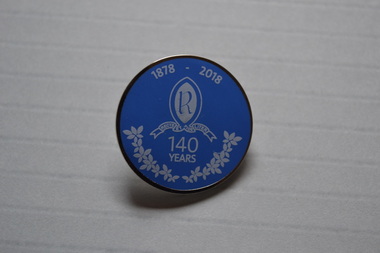
Badge - Lapel Badge, Ruyton 140 Years lapel badge, 2018
... Ruyton Girls' School Kew private school selbourne road 2018 badge anniversary 1878-2018 / R/ RECTE ET FIDELITER/ 140 YEARS POR/ R/ PARENTS OF RUYTON/ CELEBRATING/ 140 YEARS 2018 Ruyton 140 Years circular lapel badge made of zinc alloy with blue infill. ...Ruyton Girls' School was founded in 1878 and celebrated 140 years in 2018. The lapel badge was given to staff and students who attended the School in 2018.Ruyton 140 Years circular lapel badge made of zinc alloy with blue infill. Features mid-blue background with white Ruyton 140 years crest comprised of the School's Old English R crest with fig leaves. The lapel pin is held in place by a zinc butterfly clip. Pin comes mounted on a square piece of cardstock printed with Parents of Ruyton crest.1878-2018 / R/ RECTE ET FIDELITER/ 140 YEARS POR/ R/ PARENTS OF RUYTON/ CELEBRATING/ 140 YEARS 2018 ruyton girls' school, kew, private school, selbourne road, 2018, badge, anniversary -
 Ruyton Girls' School
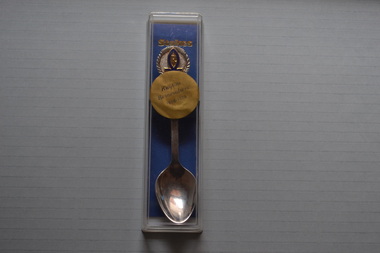
Souvenir - Souvenir teaspoon, 1978
... The souvenir tea spoon was part of a range of celebration merchandise offered to the school community. ruyton girls' school kew centenary old ruytonians' association 1970s 1978 spoon souvenir private school selbourne road Tea spoon: 'R'; 1978 Case lining: Stokes Sticker: Ruyton Remembers 1878-1978 Souvenir teaspoon with a decorative circular medallion at the end of the handle. ...Ruyton Girls' School was founded in 1878 and celebrated it's centenary in 1978. The souvenir tea spoon was part of a range of celebration merchandise offered to the school community.Souvenir teaspoon with a decorative circular medallion at the end of the handle. The medallion features the Ruyton Girls' School 'Old English' R crest in gold and blue enamel. The tea spoon is presented in a clear plastic rectangular presentation case lined with blue card. The case has a circular gold sticky label with text; "Ruyton Remembers 1878-1978".Tea spoon: 'R'; 1978 Case lining: Stokes Sticker: Ruyton Remembers 1878-1978 ruyton girls' school, kew, centenary, old ruytonians' association, 1970s, 1978, spoon, souvenir, private school, selbourne road -
 Ruyton Girls' School
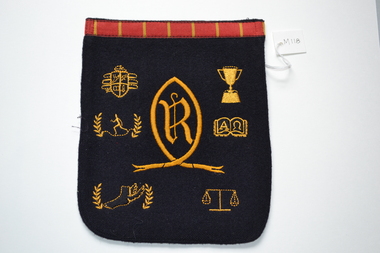
Uniform - Anderson House Blazer Pocket, 1940 circa
... Worn by a Ruyton Prefect 1942-1943; member of the Joint editor The Ruytonian 1942-1943; Vice Captain Anderson House 1942-1943; General and Library Committees 1943; Sports Committees 1942-1943; Captain Hockey and Running 1943. ruyton girls' school school uniform kew embroidery school prefect school sports 1940s anderson house private school selbourne road Navy blue wool flannel blazer pocket with Ruyton badge embroidered in gold bullion, and red and gold ribbon of Anderson House across the top of the pocket opening. ...Worn by a Ruyton Prefect 1942-1943; member of the Joint editor The Ruytonian 1942-1943; Vice Captain Anderson House 1942-1943; General and Library Committees 1943; Sports Committees 1942-1943; Captain Hockey and Running 1943.Navy blue wool flannel blazer pocket with Ruyton badge embroidered in gold bullion, and red and gold ribbon of Anderson House across the top of the pocket opening. "Colours" symbols also embroidered in gold thread. ruyton girls' school, school uniform, kew, embroidery, school prefect, school sports, 1940s, anderson house, private school, selbourne road
