
Showing 298 items matching " strong john"
-
 Federation University Art Collection
Bookplate, 'John Gartner’
... John Gartner was a fine printer and publisher, an author, a noted philatelist, and also collector of Australian banknotes and coins. He was born on 16 July 1914 and was largely self-educated, leaving school at fourteen for work following the death of his father. Gartner developed a strong...John Gartner was a fine printer and publisher, an author, a noted philatelist, and also collector of Australian banknotes and coins. He was born on 16 July 1914 and was largely self-educated, leaving school at fourteen for work following the death of his father. Gartner developed a strong ...John Gartner was a fine printer and publisher, an author, a noted philatelist, and also collector of Australian banknotes and coins. He was born on 16 July 1914 and was largely self-educated, leaving school at fourteen for work following the death of his father. Gartner developed a strong interest in the history of typography and printing and was apprenticed at the Advocate where his father had been a linotype operator. Aged 17, Gartner bought a hand press and some fonts of type, and in 1937 acquired a platen press from which he set and printed his private press books, published under the imprint of The Hawthorn Press. Gartner had a strong collection of Australian bookplates. He also looked at the work of artists overseas and commissioned personal plates. He subsequently built an international collection with preference for artists who printed from wood. His initial searches were in Belgium and Holland.(http://www3.slv.vic.gov.au/latrobejournal/issue/latrobe-84/t1-g-t7.html) The title is printed within a black circlebookplate, printmaking, australian bookplate design award -
Federation University Art Collection
bookplate, 'John Gartner’
... John Gartner was a fine printer and publisher, an author, a noted philatelist, and also collector of Australian banknotes and coins. He was born on 16 July 1914 and was largely self-educated, leaving school at fourteen for work following the death of his father. Gartner developed a strong...John Gartner was a fine printer and publisher, an author, a noted philatelist, and also collector of Australian banknotes and coins. He was born on 16 July 1914 and was largely self-educated, leaving school at fourteen for work following the death of his father. Gartner developed a strong ...John Gartner was a fine printer and publisher, an author, a noted philatelist, and also collector of Australian banknotes and coins. He was born on 16 July 1914 and was largely self-educated, leaving school at fourteen for work following the death of his father. Gartner developed a strong interest in the history of typography and printing and was apprenticed at the Advocate where his father had been a linotype operator. Aged 17, Gartner bought a hand press and some fonts of type, and in 1937 acquired a platen press from which he set and printed his private press books, published under the imprint of The Hawthorn Press. Gartner had a strong collection of Australian bookplates. He also looked at the work of artists overseas and commissioned personal plates. He subsequently built an international collection with preference for artists who printed from wood. His initial searches were in Belgium and Holland.(http://www3.slv.vic.gov.au/latrobejournal/issue/latrobe-84/t1-g-t7.html) The title is printed within a double lined black rectangular borderAudrey Hutchison England 1983 is printed on the back of the bookplatebookplate, printmaking, australian bookplate design award -
Federation University Art Collection
Bookplate, 'John Gartner’
... John Gartner was a fine printer and publisher, an author, a noted philatelist, and also collector of Australian banknotes and coins. He was born on 16 July 1914 and was largely self-educated, leaving school at fourteen for work following the death of his father. Gartner developed a strong...John Gartner was a fine printer and publisher, an author, a noted philatelist, and also collector of Australian banknotes and coins. He was born on 16 July 1914 and was largely self-educated, leaving school at fourteen for work following the death of his father. Gartner developed a strong ...John Gartner was a fine printer and publisher, an author, a noted philatelist, and also collector of Australian banknotes and coins. He was born on 16 July 1914 and was largely self-educated, leaving school at fourteen for work following the death of his father. Gartner developed a strong interest in the history of typography and printing and was apprenticed at the Advocate where his father had been a linotype operator. Aged 17, Gartner bought a hand press and some fonts of type, and in 1937 acquired a platen press from which he set and printed his private press books, published under the imprint of The Hawthorn Press. Gartner had a strong collection of Australian bookplates. He also looked at the work of artists overseas and commissioned personal plates. He subsequently built an international collection with preference for artists who printed from wood. His initial searches were in Belgium and Holland.(http://www3.slv.vic.gov.au/latrobejournal/issue/latrobe-84/t1-g-t7.html) The title is printed on plain white paperAudrey Hutchison England 1983 is printed on the back of the bookplate bookplate, printmaking, australian bookplate design award, keith wingrove memorial trust -
Federation University Art Collection
Bookplate, 'John and Zelma Gartner’
... John Gartner was a fine printer and publisher, an author, a noted philatelist, and also collector of Australian banknotes and coins. He was born on 16 July 1914 and was largely self-educated, leaving school at fourteen for work following the death of his father. Gartner developed a strong...John Gartner was a fine printer and publisher, an author, a noted philatelist, and also collector of Australian banknotes and coins. He was born on 16 July 1914 and was largely self-educated, leaving school at fourteen for work following the death of his father. Gartner developed a strong ...John Gartner was a fine printer and publisher, an author, a noted philatelist, and also collector of Australian banknotes and coins. He was born on 16 July 1914 and was largely self-educated, leaving school at fourteen for work following the death of his father. Gartner developed a strong interest in the history of typography and printing and was apprenticed at the Advocate where his father had been a linotype operator. Aged 17, Gartner bought a hand press and some fonts of type, and in 1937 acquired a platen press from which he set and printed his private press books, published under the imprint of The Hawthorn Press. Gartner had a strong collection of Australian bookplates. He also looked at the work of artists overseas and commissioned personal plates. He subsequently built an international collection with preference for artists who printed from wood. His initial searches were in Belgium and Holland.(http://www3.slv.vic.gov.au/latrobejournal/issue/latrobe-84/t1-g-t7.html) The letters J and Z are printed within a larger letter G all within an oval border comprising the titleAudrey Hutchison England 1983 is printed on the back of the bookplatebookplate, printmaking, australian bookplate design award, keith wingrove memorial trust -
Federation University Art Collection
Bookplate, ‘Ex Libris John Gartner’
... John Gartner was a fine printer and publisher, an author, a noted philatelist, and also collector of Australian banknotes and coins. He was born on 16 July 1914 and was largely self-educated, leaving school at fourteen for work following the death of his father. Gartner developed a strong...John Gartner was a fine printer and publisher, an author, a noted philatelist, and also collector of Australian banknotes and coins. He was born on 16 July 1914 and was largely self-educated, leaving school at fourteen for work following the death of his father. Gartner developed a strong ...John Gartner was a fine printer and publisher, an author, a noted philatelist, and also collector of Australian banknotes and coins. He was born on 16 July 1914 and was largely self-educated, leaving school at fourteen for work following the death of his father. Gartner developed a strong interest in the history of typography and printing and was apprenticed at the Advocate where his father had been a linotype operator. Aged 17, Gartner bought a hand press and some fonts of type, and in 1937 acquired a platen press from which he set and printed his private press books, published under the imprint of The Hawthorn Press. Gartner had a strong collection of Australian bookplates. He also looked at the work of artists overseas and commissioned personal plates. He subsequently built an international collection with preference for artists who printed from wood. His initial searches were in Belgium and Holland.(http://www3.slv.vic.gov.au/latrobejournal/issue/latrobe-84/t1-g-t7.html) A nude woman sits on the ground in an outdoor setting reading a book48/400 and signature P. Hamyl in pencilbookplate, printmaking, australian bookplate design award -
Federation University Art Collection
Bookplate, ‘Ex Libris Zelma'
... John Gartner was a fine printer and publisher, an author, a noted philatelist, and also collector of Australian banknotes and coins. He was born on 16 July 1914 and was largely self-educated, leaving school at fourteen for work following the death of his father. Gartner developed a strong...John Gartner was a fine printer and publisher, an author, a noted philatelist, and also collector of Australian banknotes and coins. He was born on 16 July 1914 and was largely self-educated, leaving school at fourteen for work following the death of his father. Gartner developed a strong ...John Gartner was a fine printer and publisher, an author, a noted philatelist, and also collector of Australian banknotes and coins. He was born on 16 July 1914 and was largely self-educated, leaving school at fourteen for work following the death of his father. Gartner developed a strong interest in the history of typography and printing and was apprenticed at the Advocate where his father had been a linotype operator. Aged 17, Gartner bought a hand press and some fonts of type, and in 1937 acquired a platen press from which he set and printed his private press books, published under the imprint of The Hawthorn Press. Gartner had a strong collection of Australian bookplates. He also looked at the work of artists overseas and commissioned personal plates. He subsequently built an international collection with preference for artists who printed from wood. His initial searches were in Belgium and Holland.(http://www3.slv.vic.gov.au/latrobejournal/issue/latrobe-84/t1-g-t7.html) A coloured bunch of flowers is depicted above the title with scrollsbookplate, printmaking, australian bookplate design award, keith wingrove memorial trust -
Federation University Art Collection
Work on paper - Bookplate, ‘This book is the property of John Gartner of the Hawthorn Press Melbourne Australia’
... John Gartner was a fine printer and publisher, an author, a noted philatelist, and also collector of Australian banknotes and coins. He was born on 16 July 1914 and was largely self-educated, leaving school at fourteen for work following the death of his father. Gartner developed a strong...John Gartner was a fine printer and publisher, an author, a noted philatelist, and also collector of Australian banknotes and coins. He was born on 16 July 1914 and was largely self-educated, leaving school at fourteen for work following the death of his father. Gartner developed a strong ...John Gartner was a fine printer and publisher, an author, a noted philatelist, and also collector of Australian banknotes and coins. He was born on 16 July 1914 and was largely self-educated, leaving school at fourteen for work following the death of his father. Gartner developed a strong interest in the history of typography and printing and was apprenticed at the Advocate where his father had been a linotype operator. Aged 17, Gartner bought a hand press and some fonts of type, and in 1937 acquired a platen press from which he set and printed his private press books, published under the imprint of The Hawthorn Press. Gartner had a strong collection of Australian bookplates. He also looked at the work of artists overseas and commissioned personal plates. He subsequently built an international collection with preference for artists who printed from wood. His initial searches were in Belgium and Holland.(http://www3.slv.vic.gov.au/latrobejournal/issue/latrobe-84/t1-g-t7.html) The title in white letters on a smoky blue circular background is depicted within a circular blue and white floral border.bookplate, printmaking, australian bookplate design award, keith wingrove memorial trust, hawthorn press -
Federation University Art Collection
Bookplate, ‘This book is the property of John Gartner of the Hawthorn Press Melbourne Australia’
... John Gartner was a fine printer and publisher, an author, a noted philatelist, and also collector of Australian banknotes and coins. He was born on 16 July 1914 and was largely self-educated, leaving school at fourteen for work following the death of his father. Gartner developed a strong...John Gartner was a fine printer and publisher, an author, a noted philatelist, and also collector of Australian banknotes and coins. He was born on 16 July 1914 and was largely self-educated, leaving school at fourteen for work following the death of his father. Gartner developed a strong ...John Gartner was a fine printer and publisher, an author, a noted philatelist, and also collector of Australian banknotes and coins. He was born on 16 July 1914 and was largely self-educated, leaving school at fourteen for work following the death of his father. Gartner developed a strong interest in the history of typography and printing and was apprenticed at the Advocate where his father had been a linotype operator. Aged 17, Gartner bought a hand press and some fonts of type, and in 1937 acquired a platen press from which he set and printed his private press books, published under the imprint of The Hawthorn Press. Gartner had a strong collection of Australian bookplates. He also looked at the work of artists overseas and commissioned personal plates. He subsequently built an international collection with preference for artists who printed from wood. His initial searches were in Belgium and Holland.(http://www3.slv.vic.gov.au/latrobejournal/issue/latrobe-84/t1-g-t7.html) The title in white letters on an smoky blue oval background is depicted within a blue and white oval borderbookplate, printmaking, australian bookplate design award, available -
Federation University Art Collection
Bookplate, ‘Ex Libris John Gartner’
... John Gartner was a fine printer and publisher, an author, a noted philatelist, and also collector of Australian banknotes and coins. He was born on 16 July 1914 and was largely self-educated, leaving school at fourteen for work following the death of his father. Gartner developed a strong...John Gartner was a fine printer and publisher, an author, a noted philatelist, and also collector of Australian banknotes and coins. He was born on 16 July 1914 and was largely self-educated, leaving school at fourteen for work following the death of his father. Gartner developed a strong ...John Gartner was a fine printer and publisher, an author, a noted philatelist, and also collector of Australian banknotes and coins. He was born on 16 July 1914 and was largely self-educated, leaving school at fourteen for work following the death of his father. Gartner developed a strong interest in the history of typography and printing and was apprenticed at the Advocate where his father had been a linotype operator. Aged 17, Gartner bought a hand press and some fonts of type, and in 1937 acquired a platen press from which he set and printed his private press books, published under the imprint of The Hawthorn Press. Gartner had a strong collection of Australian bookplates. He also looked at the work of artists overseas and commissioned personal plates. He subsequently built an international collection with preference for artists who printed from wood. His initial searches were in Belgium and Holland.(http://www3.slv.vic.gov.au/latrobejournal/issue/latrobe-84/t1-g-t7.html) The title is printed on a rectangular umber background. Below the title is an oval shape within which is an anchor and two bunches of flowers. The letters H and P are on either side of the anchor. Below the oval shape are the letters MCMLXXX1.bookplate, printmaking, australian bookplate design award, keith -
Federation University Art Collection
Bookplate, 'John & Zelma Gartner’
... John Gartner was a fine printer and publisher, an author, a noted philatelist, and also collector of Australian banknotes and coins. He was born on 16 July 1914 and was largely self-educated, leaving school at fourteen for work following the death of his father. Gartner developed a strong...John Gartner was a fine printer and publisher, an author, a noted philatelist, and also collector of Australian banknotes and coins. He was born on 16 July 1914 and was largely self-educated, leaving school at fourteen for work following the death of his father. Gartner developed a strong ...John Gartner was a fine printer and publisher, an author, a noted philatelist, and also collector of Australian banknotes and coins. He was born on 16 July 1914 and was largely self-educated, leaving school at fourteen for work following the death of his father. Gartner developed a strong interest in the history of typography and printing and was apprenticed at the Advocate where his father had been a linotype operator. Aged 17, Gartner bought a hand press and some fonts of type, and in 1937 acquired a platen press from which he set and printed his private press books, published under the imprint of The Hawthorn Press. Gartner had a strong collection of Australian bookplates. He also looked at the work of artists overseas and commissioned personal plates. He subsequently built an international collection with preference for artists who printed from wood. His initial searches were in Belgium and Holland.(http://www3.slv.vic.gov.au/latrobejournal/issue/latrobe-84/t1-g-t7.html) The title in cream letters is displayed on a black oval background.bookplate, printmaking, australian bookplate design award -
Federation University Art Collection
Bookplate, ‘Ex Libris John Gartner’
... John Gartner was a fine printer and publisher, an author, a noted philatelist, and also collector of Australian banknotes and coins. He was born on 16 July 1914 and was largely self-educated, leaving school at fourteen for work following the death of his father. Gartner developed a strong...John Gartner was a fine printer and publisher, an author, a noted philatelist, and also collector of Australian banknotes and coins. He was born on 16 July 1914 and was largely self-educated, leaving school at fourteen for work following the death of his father. Gartner developed a strong ...John Gartner was a fine printer and publisher, an author, a noted philatelist, and also collector of Australian banknotes and coins. He was born on 16 July 1914 and was largely self-educated, leaving school at fourteen for work following the death of his father. Gartner developed a strong interest in the history of typography and printing and was apprenticed at the Advocate where his father had been a linotype operator. Aged 17, Gartner bought a hand press and some fonts of type, and in 1937 acquired a platen press from which he set and printed his private press books, published under the imprint of The Hawthorn Press. Gartner had a strong collection of Australian bookplates. He also looked at the work of artists overseas and commissioned personal plates. He subsequently built an international collection with preference for artists who printed from wood. His initial searches were in Belgium and Holland.(http://www3.slv.vic.gov.au/latrobejournal/issue/latrobe-84/t1-g-t7.html) The words Ex Libris are displayed on the open pages of a book which is shown in the dense foliage of a tree. The tree is surrounded by a floral border within an outer black rectangular border.bookplate, printmaking, australian bookplate design award, keith wingrove memorial trust -
Federation University Art Collection
bookplate, ‘Ex Libris Zelma Maureen Gartner’
... John Gartner was a fine printer and publisher, an author, a noted philatelist, and also collector of Australian banknotes and coins. He was born on 16 July 1914 and was largely self-educated, leaving school at fourteen for work following the death of his father. Gartner developed a strong...John Gartner was a fine printer and publisher, an author, a noted philatelist, and also collector of Australian banknotes and coins. He was born on 16 July 1914 and was largely self-educated, leaving school at fourteen for work following the death of his father. Gartner developed a strong ...John Gartner was a fine printer and publisher, an author, a noted philatelist, and also collector of Australian banknotes and coins. He was born on 16 July 1914 and was largely self-educated, leaving school at fourteen for work following the death of his father. Gartner developed a strong interest in the history of typography and printing and was apprenticed at the Advocate where his father had been a linotype operator. Aged 17, Gartner bought a hand press and some fonts of type, and in 1937 acquired a platen press from which he set and printed his private press books, published under the imprint of The Hawthorn Press. Gartner had a strong collection of Australian bookplates. He also looked at the work of artists overseas and commissioned personal plates. He subsequently built an international collection with preference for artists who printed from wood. His initial searches were in Belgium and Holland.(http://www3.slv.vic.gov.au/latrobejournal/issue/latrobe-84/t1-g-t7.html) Faint pencil signaturebookplate, printmaking, australian bookplate design award, keith wingrove memorial trust -
Federation University Art Collection
Bookplate, ‘Ex Libris John Gartner’
... John Gartner was a fine printer and publisher, an author, a noted philatelist, and also collector of Australian banknotes and coins. He was born on 16 July 1914 and was largely self-educated, leaving school at fourteen for work following the death of his father. Gartner developed a strong...John Gartner was a fine printer and publisher, an author, a noted philatelist, and also collector of Australian banknotes and coins. He was born on 16 July 1914 and was largely self-educated, leaving school at fourteen for work following the death of his father. Gartner developed a strong ...John Gartner was a fine printer and publisher, an author, a noted philatelist, and also collector of Australian banknotes and coins. He was born on 16 July 1914 and was largely self-educated, leaving school at fourteen for work following the death of his father. Gartner developed a strong interest in the history of typography and printing and was apprenticed at the Advocate where his father had been a linotype operator. Aged 17, Gartner bought a hand press and some fonts of type, and in 1937 acquired a platen press from which he set and printed his private press books, published under the imprint of The Hawthorn Press. Gartner had a strong collection of Australian bookplates. He also looked at the work of artists overseas and commissioned personal plates. He subsequently built an international collection with preference for artists who printed from wood. His initial searches were in Belgium and Holland.(http://www3.slv.vic.gov.au/latrobejournal/issue/latrobe-84/t1-g-t7.html) The letters J and G are printed over two postage stamps all within a black and light umber border or framecb-59 no. 143bookplate, printmaking, australian bookplate design award -
Federation University Art Collection
Bookplate, ‘Ex Libris John Gartner’
... John Gartner was a fine printer and publisher, an author, a noted philatelist, and also collector of Australian banknotes and coins. He was born on 16 July 1914 and was largely self-educated, leaving school at fourteen for work following the death of his father. Gartner developed a strong...John Gartner was a fine printer and publisher, an author, a noted philatelist, and also collector of Australian banknotes and coins. He was born on 16 July 1914 and was largely self-educated, leaving school at fourteen for work following the death of his father. Gartner developed a strong ...John Gartner was a fine printer and publisher, an author, a noted philatelist, and also collector of Australian banknotes and coins. He was born on 16 July 1914 and was largely self-educated, leaving school at fourteen for work following the death of his father. Gartner developed a strong interest in the history of typography and printing and was apprenticed at the Advocate where his father had been a linotype operator. Aged 17, Gartner bought a hand press and some fonts of type, and in 1937 acquired a platen press from which he set and printed his private press books, published under the imprint of The Hawthorn Press. Gartner had a strong collection of Australian bookplates. He also looked at the work of artists overseas and commissioned personal plates. He subsequently built an international collection with preference for artists who printed from wood. His initial searches were in Belgium and Holland.(http://www3.slv.vic.gov.au/latrobejournal/issue/latrobe-84/t1-g-t7.html) Men at work printmaking are depicted in a work roomSixteenth Century Printingbookplate, printmaking, australian bookplate design award, keith wingrove memorial trust -
Federation University Art Collection
Bookplate, 'John Gartner’
... John Gartner was a fine printer and publisher, an author, a noted philatelist, and also collector of Australian banknotes and coins. He was born on 16 July 1914 and was largely self-educated, leaving school at fourteen for work following the death of his father. Gartner developed a strong...John Gartner was a fine printer and publisher, an author, a noted philatelist, and also collector of Australian banknotes and coins. He was born on 16 July 1914 and was largely self-educated, leaving school at fourteen for work following the death of his father. Gartner developed a strong ...John Gartner was a fine printer and publisher, an author, a noted philatelist, and also collector of Australian banknotes and coins. He was born on 16 July 1914 and was largely self-educated, leaving school at fourteen for work following the death of his father. Gartner developed a strong interest in the history of typography and printing and was apprenticed at the Advocate where his father had been a linotype operator. Aged 17, Gartner bought a hand press and some fonts of type, and in 1937 acquired a platen press from which he set and printed his private press books, published under the imprint of The Hawthorn Press. Gartner had a strong collection of Australian bookplates. He also looked at the work of artists overseas and commissioned personal plates. He subsequently built an international collection with preference for artists who printed from wood. His initial searches were in Belgium and Holland.(http://www3.slv.vic.gov.au/latrobejournal/issue/latrobe-84/t1-g-t7.html) A printing press with books standing alongside is depicted behind the title. One book has the initials HP and an anchor on its cover.bookplate, printmaking, australian bookplate design award, keith wingrove memorial trust -
Federation University Art Collection
Bookplate, 'John Gartner’
... John Gartner was a fine printer and publisher, an author, a noted philatelist, and also collector of Australian banknotes and coins. He was born on 16 July 1914 and was largely self-educated, leaving school at fourteen for work following the death of his father. Gartner developed a strong...John Gartner was a fine printer and publisher, an author, a noted philatelist, and also collector of Australian banknotes and coins. He was born on 16 July 1914 and was largely self-educated, leaving school at fourteen for work following the death of his father. Gartner developed a strong ...John Gartner was a fine printer and publisher, an author, a noted philatelist, and also collector of Australian banknotes and coins. He was born on 16 July 1914 and was largely self-educated, leaving school at fourteen for work following the death of his father. Gartner developed a strong interest in the history of typography and printing and was apprenticed at the Advocate where his father had been a linotype operator. Aged 17, Gartner bought a hand press and some fonts of type, and in 1937 acquired a platen press from which he set and printed his private press books, published under the imprint of The Hawthorn Press. Gartner had a strong collection of Australian bookplates. He also looked at the work of artists overseas and commissioned personal plates. He subsequently built an international collection with preference for artists who printed from wood. His initial searches were in Belgium and Holland.(http://www3.slv.vic.gov.au/latrobejournal/issue/latrobe-84/t1-g-t7.html) A black and white portrait is depicted within an oval frame. The frame has the words Johann Guttenberg at the top.bookplate, printmaking, australian bookplate design award, keith wingrove memorial trust -
Federation University Art Collection
Bookplate, ‘Ex Numis- Maticis John Gartner’
... John Gartner was a fine printer and publisher, an author, a noted philatelist, and also collector of Australian banknotes and coins. He was born on 16 July 1914 and was largely self-educated, leaving school at fourteen for work following the death of his father. Gartner developed a strong...John Gartner was a fine printer and publisher, an author, a noted philatelist, and also collector of Australian banknotes and coins. He was born on 16 July 1914 and was largely self-educated, leaving school at fourteen for work following the death of his father. Gartner developed a strong ...John Gartner was a fine printer and publisher, an author, a noted philatelist, and also collector of Australian banknotes and coins. He was born on 16 July 1914 and was largely self-educated, leaving school at fourteen for work following the death of his father. Gartner developed a strong interest in the history of typography and printing and was apprenticed at the Advocate where his father had been a linotype operator. Aged 17, Gartner bought a hand press and some fonts of type, and in 1937 acquired a platen press from which he set and printed his private press books, published under the imprint of The Hawthorn Press. Gartner had a strong collection of Australian bookplates. He also looked at the work of artists overseas and commissioned personal plates. He subsequently built an international collection with preference for artists who printed from wood. His initial searches were in Belgium and Holland.(http://www3.slv.vic.gov.au/latrobejournal/issue/latrobe-84/t1-g-t7.html) A black and white coin is drawn above the titlebookplate, printmaking, australian bookplate design award, keith wingrove memorial trust -
Federation University Art Collection
Bookplate, ‘Ex Libris John Gartner’
... John Gartner was a fine printer and publisher, an author, a noted philatelist, and also collector of Australian banknotes and coins. He was born on 16 July 1914 and was largely self-educated, leaving school at fourteen for work following the death of his father. Gartner developed a strong...John Gartner was a fine printer and publisher, an author, a noted philatelist, and also collector of Australian banknotes and coins. He was born on 16 July 1914 and was largely self-educated, leaving school at fourteen for work following the death of his father. Gartner developed a strong ...John Gartner was a fine printer and publisher, an author, a noted philatelist, and also collector of Australian banknotes and coins. He was born on 16 July 1914 and was largely self-educated, leaving school at fourteen for work following the death of his father. Gartner developed a strong interest in the history of typography and printing and was apprenticed at the Advocate where his father had been a linotype operator. Aged 17, Gartner bought a hand press and some fonts of type, and in 1937 acquired a platen press from which he set and printed his private press books, published under the imprint of The Hawthorn Press. Gartner had a strong collection of Australian bookplates. He also looked at the work of artists overseas and commissioned personal plates. He subsequently built an international collection with preference for artists who printed from wood. His initial searches were in Belgium and Holland.(http://www3.slv.vic.gov.au/latrobejournal/issue/latrobe-84/t1-g-t7.html) A grey kangaroo is depicted under the titlePencil signature Wim Zwiers 50/48. (C) Wim Zwiers 4:70 CAD 1992 printed in red capitals at bottom of book plate.bookplate, printmaking, australian bookplate design award, keith wingrove memorial trust -
Federation University Art Collection
Bookplate, ‘Ex Libris'
... John Gartner was a fine printer and publisher, an author, a noted philatelist, and also collector of Australian banknotes and coins. He was born on 16 July 1914 and was largely self-educated, leaving school at fourteen for work following the death of his father. Gartner developed a strong...John Gartner was a fine printer and publisher, an author, a noted philatelist, and also collector of Australian banknotes and coins. He was born on 16 July 1914 and was largely self-educated, leaving school at fourteen for work following the death of his father. Gartner developed a strong ...John Gartner was a fine printer and publisher, an author, a noted philatelist, and also collector of Australian banknotes and coins. He was born on 16 July 1914 and was largely self-educated, leaving school at fourteen for work following the death of his father. Gartner developed a strong interest in the history of typography and printing and was apprenticed at the Advocate where his father had been a linotype operator. Aged 17, Gartner bought a hand press and some fonts of type, and in 1937 acquired a platen press from which he set and printed his private press books, published under the imprint of The Hawthorn Press. Gartner had a strong collection of Australian bookplates. He also looked at the work of artists overseas and commissioned personal plates. He subsequently built an international collection with preference for artists who printed from wood. His initial searches were in Belgium and Holland.(http://www3.slv.vic.gov.au/latrobejournal/issue/latrobe-84/t1-g-t7.html) A brown and white tie with shirt and waist coat are depicted below the letter G in concentric circles. Two bottles are drawn on either side of the waist coat. CD 87, 657bookplate, printmaking, australian bookplate design award, keith wingrove memorial trust -
Federation University Art Collection
Bookplate, 'Zelma Gartner'
... John Gartner was a fine printer and publisher, an author, a noted philatelist, and also collector of Australian banknotes and coins. He was born on 16 July 1914 and was largely self-educated, leaving school at fourteen for work following the death of his father. Gartner developed a strong...John Gartner was a fine printer and publisher, an author, a noted philatelist, and also collector of Australian banknotes and coins. He was born on 16 July 1914 and was largely self-educated, leaving school at fourteen for work following the death of his father. Gartner developed a strong ...John Gartner was a fine printer and publisher, an author, a noted philatelist, and also collector of Australian banknotes and coins. He was born on 16 July 1914 and was largely self-educated, leaving school at fourteen for work following the death of his father. Gartner developed a strong interest in the history of typography and printing and was apprenticed at the Advocate where his father had been a linotype operator. Aged 17, Gartner bought a hand press and some fonts of type, and in 1937 acquired a platen press from which he set and printed his private press books, published under the imprint of The Hawthorn Press. Gartner had a strong collection of Australian bookplates. He also looked at the work of artists overseas and commissioned personal plates. He subsequently built an international collection with preference for artists who printed from wood. His initial searches were in Belgium and Holland.(http://www3.slv.vic.gov.au/latrobejournal/issue/latrobe-84/t1-g-t7.html) The title with scrolls beneath is printed on a diamond shape Audrey Hutchison England 1983 is printed on the back of the bookplatebookplate, printmaking, australian bookplate design award, keith wingrove memorial trust -
Old Colonists' Association of Ballarat Inc.
Ceremonial object - Trowel, William Bennett, Silver Trowel, c1887
... strongly, than 'he’ did. The Old Identities were laying this stone on the jubilee day of Her Majesty, and there never sat on the throne a worthier or nobler Queen than she who held her jubilee that day. There was not a man present, whatever his views of government may be, who did not say “God bless our Queen.” (Cheers.) The proceedings closed with the singing of the National Anthem and cheers for the Queen. (Ballarat Star, 23 June 1887) ballarat old colonists' association ballarat old colonists' club trowel silver trowel foundation stone mrs j. murray William Bennett J. Fraser John ...The silver trowel was used for the laying of the foundation stone of the Ballarat Old Colonists' Hall. It was donated to the Old Colonists' Associaiton in 1906. The Old Colonists' Association minutes noted 'Mrs Murray handed to the Secretary the silver trowel presented to the late President on the occasion of the laying of the foundation stone of the Hall.' The silver trowel was used for the laying of the foundation stone of the Ballarat Old Colonists' Hall. It was donated to the Old Colonists' Associaiton in 1906. The Old Colonists' Association minutes noted 'Mrs Murray handed to the Secretary the silver trowel presented to the late President on the occasion of the laying of the foundation stone of the Hall.' "THE OLD COLONISTS' HALL. The foundation-stone of the building to be erected by the Old Identities’ Association, in Lydiard street, was next laid with the usual ceremonies. This was immediately adjoining the foundation-stone of the Mining Exchange building. Mr J. Graham presented Mr Murray with a silver trowel, bearing the following inscription:—“ Queen Victoria’s Jubilee. Presented to J. P. Murray, Esq., president of the Old Colonists’ Association, on the occasion of his laying the foundation stone of their new hall, Ballarat, 21st June, 1887.” Mr Graham said he thought the pioneers of such a city were quite right in erecting a building that would be a home for them while they lived, and a memorial of them when they were no more. Mr J. Fraser, secretary, read the followin'- report:— “Mr Chairman, ladies, and gentlemen,—The bottle about to be deposited under this foundation contains documents in which are written particulars of the founding of the Old Colonists' Association at Ballarat; its financial and numerical position at the present time, the names of its officers and committee of management for the current term: a complete list of the names of its members, a copy of the rules and regulations of the association: copies of The Star, Evening Star, Courier, and Ballarat Advertiser newspapers, programme of to-day's proceedings as far as they relate to the laying of the foundation-stone, together with a brief summary of the aims and objects of this philanthropic institution. That the nature of these objects are considered worthy of encouragement and support is amply proved when we see on the Association's roll of membership the names of so many of our most prominent citizens and public men, "and from the fact that the Government of the colony have recognised the just claim of the old colonists'of Ballarat to be placed in possession of this valuable and central site, upon which to erect a building that will, be a credit to them and an ornament to the city, and which will enable them to still further extend the sphere of their benevolence and usefulness iu this district. The following is a copy of the signed and sealed memorial document:—*The foundation-stone of the hall of the Old Colonists’ Association of Ballarat; was laid on Her Majesty Queen Victoria's Jubilee Day,- Tuesday, 21st June, 1887, by John Paul Murray, Esq., J.P., president of the association. Under the foundation stone is deposited a copy of the constitution and rules of the association, the names of the officers, and a complete list of the names of ail the members to date; also a copy each of The Star, Courier, Evening Post, and the Advertiser, local newspapers. At this date the association numbers 319 members—accumulated funds, £203 10s 3d. The land upon which the hall is to he erected was granted by the Government to the association for that, purpose. (Signed) John P. Murray, President; W. B. Perry, Samuel Delpratt, Vice-presidents; Daniel Fern, Treasurer; John Fraser, Secretary. Committee—J. W. Graham, J. W. Lee, James M'Merkin, Andrew Lister, James Ward. Trustees—J. W. Graham, Wm. Irwin, John M'Cafferty ” Mr Murray said he was proud to lay the foundation stone of this building. The association was started in I883, and he might say they were a purely philanthropic institution. They formed an association whose creed was to assist one another in every shape and form. They had now 319 members, and were daily increasing in number.-. They were very fairly off as regarded their financial position. With respect to the objects of the association, they were to form a bond of brotherhood among those whose past experience in commercial or in mining pursuits so intimately associated them with the early history of the goldfields; men, to whose indomitable energy and perseverance Ballarat and other mining centres in the colony were so largely indebted for their development and commercial prosperity. Some of whose names were also closely identified with the memorable and sanguinary struggle 'for freedom and constitutional liberty in 1883. Their object was, further, to gather together within one fold those who survive those stirring times, to meet occasionally in friendly and social intercourse; to relieve their brethren who were overtaken by sickness or affliction; to provide the shelter of a home for those Pioneers of the goldfields whom the reverses of fortune had deprived of the means of procuring the comforts of life in their declining years; to assist the widow and succor the orphan; to mutually cheer and support each other in their temporary troubles and vicissitudes as they journeyed onward to the grave; and lastly, to tender a tribute of respect to the memory of a departed brother, by following his remains to their final resting place. Such were some of the principal objects of the “ Old Colonists' Association.” It was an institution for the good of their fellow man, and he hoped it would be successful, he hoped that the young people who came after them would appreciate what the Old Colonists had left them. He hoped they would all assist in making the institution one that would he worthy of the place. He would hand a small donation to the secretary, and hoped others would do the same. (Cheers.) The secretary, amid cheering, announced that the cheque handed over by Mr Murray was for £2O. Archdeacon Julius, who was asked to speak, said nothing could have been more fitting than the laying of the foundation-stone of the Old Identities’ Association on the Queen's Jubilee. They were a link between the past of 50 years gone by and today. Many of them remembered well enough perhaps the time when it took a man five and twenty minutes to light his pipe with tinder and steel, and when the small boys went, up the chimneys to sweep them. (Laughter.) They were building something now that people would look upon in years to come, and speak of in connection with the Old Colonists, if the young men were' half as good as their fathers they would be uncommon good fellows, and he did not think they would be. (Laughter, and interjection.) ''An old fellow said it was very true, and he knew it. (Laughter.) The Old Identities would agree with him to a man. (Laughter.) If the young men walked in their steps Ballarat in another 50 years would be 50 percent, better than it was now. There was not a man there that wished that more strongly, than 'he’ did. The Old Identities were laying this stone on the jubilee day of Her Majesty, and there never sat on the throne a worthier or nobler Queen than she who held her jubilee that day. There was not a man present, whatever his views of government may be, who did not say “God bless our Queen.” (Cheers.) The proceedings closed with the singing of the National Anthem and cheers for the Queen. (Ballarat Star, 23 June 1887)Silver trowel used during the laying of a foundation Stone for the Ballarat Old Colonists' Association building in Lydiard Street North, Ballarat.ballarat old colonists' association, ballarat old colonists' club, trowel, silver trowel, foundation stone, mrs j. murray, william bennett, j. fraser, john murray, w. lee, william irwin, john m'cafferty, john mccafferty -
 Old Colonists' Association of Ballarat Inc.
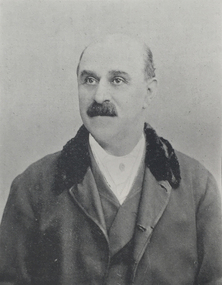
Photograph - Image, John Robson
... In 1854 Mr John Robson, who was then nearly 17 years of age, landed at Port Phillip, and with the other members of the family came on to Ballarat, which place he made his home to the end. When he first reached Ballarat, Mr Robson joined in the search for gold, but not being strong...In 1854 Mr John Robson, who was then nearly 17 years of age, landed at Port Phillip, and with the other members of the family came on to Ballarat, which place he made his home to the end. When he first reached Ballarat, Mr Robson joined in the search for gold, but not being strong ...John Robson was born at Newcastle, Northumberland, England, the son of Mathew Robson and Hannah Sproat. Hesailed to Australia on the "Arabian", landing at Port Phillip in 1854. Obituary DEATH OF MR. JOHN ROBSON ANOTHER PIONEER GONE. AN EXTREMELY VERSATILE MAN. General regret was expressed at the death yesterday morning at Miss Garnett's private hospital, of Mr John Robson, musician and and elocutonist and one of Ballarat's oldest, best known and most respected citizens. Mr Robson had been sitting for a few weeks, and his medical adviser, diagnosed his complaint as appendicitis, which afflicted, him in such a severe form that an operation was deemed to be absolutely necessary. He was removed to Miss Garnett's private hospital, and about a week ago he was operated upon. Mr Robson, being a man of robust constitution, stood the shock of the operation well, and he was making good headway towards recovery when the spell of hot weather set in, and caused exhaustion. Heart failure followed, and exhaustion the attention of his medical adviser, and the careful nursing he received, the end came peacefully at the time stated above. Mr John Robson was born at Newcastle, Northumberland, England, in , and he was therefore 72 years of age. Mr Robson's father, who was a contractor, had much to do with the building of the City of Newcastle. After passing through minor schools, Mr John Robson entered the academy of Professor Ross, and soon rose to a foremost position in the classes. When his studies were completed he was apprenticed to an architect and for a time studied the technique of this important branch of his father's calling. His adaptability for the work was great, and hopes were entertained that he would rise to a high position in the profession. Then came glowing reports of the wonderful Australian gold discoveries. Mr Robson’s father decided to migrate to these parts, and he sent a son to prepare the way. Believing that tools and timber might not be procured in Australia. Mr Robson, senr, constructed a portable wooden residence, which was shipped in pieces on the White Star liner Arabian which brought the family over. In 1854 Mr John Robson, who was then nearly 17 years of age, landed at Port Phillip, and with the other members of the family came on to Ballarat, which place he made his home to the end. When he first reached Ballarat, Mr Robson joined in the search for gold, but not being strong enough for this rough work, he turned his attention to carpentering. This he did not care much about, and in 1858 he was appointed a teacher in St. Paul's Day School, Ballarat, but in the following year he relinquished this position and became exchange clerk in the local branch of the National Bank. Being adapted to this quickly made himself acquainted with the details of a banker’s profession, and his rise was rapid. In the year 1871, about 12 years after he joined the bank, he was appointed manager, and for four years occupied that position with conspicuous success. He was connected with the National Bank for eighteen years, and in 1875 he entered business on his own account. With his brother, Mr Wm. Robson, he erected red-gum sawmills at Gunbower, on the River Murray. Subsequently he was offered the management of the Australian and European Bank in mills. In 1886, he accepted the position and held it until the bank was absorbed by the Commercial Bank of Australia. For a time he lived privately, still, how ever, holding his interest in the saw mills. In 1886, he accepted, the position of manager of the Ballarat branch of the Mercantile Bank of Australia. This bank was closed in 1892, and Mr Robson retired, altogether from commercial circles. In the meantime his brother died, and the saw-mills were sold. Mr Robson held a very important position in music, in fact he for many years was looked upon as the leading musician in Ballarat, he being master of quite a variety of instruments. In 1864. he was appointed conductor of the old Harmonic Society in this city, and subsequently conductor of the Ballarat Liedertafel. Under his leadership this society attained a high state of efficiency, which has since been well-maintained. Many years ago Mr Robson formed an operatic company from amongst Ballarat residents, and such beautiful operas as “Lucrezia Borgia' "Lucia di Lammermoor," “Ernani,' La Sonnambula,” and others were successfully rendered. As an elocutionist, Mr Robson attained much prominence, he being recognised as one of the most capable teachers in Ballarat. He was president of the one-time Ballarat Shakespearian Dramatic Club, which under his direction, from time to time produced Shakespeare’s masterpieces. In this, too, he took the chief characters, the roles of Macbeth, Othello, Hamlet, and Shylock, all being powerfully represented by him. For some years prior to his demise Mr Robson, acted as a teacher of music, and elocution, and many of his pupils, competed with great success at the Ballarat and other competitions. Some years ago he acted as adjudicator at the South street competitions, when he gave every satisfaction, and his services were frequently secured to judge at competitions in other parts of the State and in other states of the Commonwealth. At the Ballarat band contests every year, he was a conspicuous figure, and he always acted as leader of the massed bands, by whom his appearance was always enthusiastically greeted. In his younger days he took a keen interest in several forms of sport, was a successful oarsman, one of the best amateur boxers of his weight and as a billiard player was able to hold his own with professionals. 'Mr Robson was an earnest adherent of the Church of England, and in social and other organisations he from time to time held important positions. As a Anglican churchman, he was widely respected, being the official principal and lay Canon of the Cathedral, a member of the Bishops Council, and a prominent member of St. Paul's Church, Ballarat East. He was also a prominent member of the Masonic order. and was a Past Grand Junior Warden of the Grand Lodge of Freemasons of Victoria, an office which he filled with the greatest credit. He was also a member of the Old Colonists' Association and the Mechanics' Institute, was at one time vice-president of the Art Gallery was once a member of the School of Mines Council, and was many years ago made a Justice of the Pence. On many occasions he was asked to stand for Parliament, as a representative of Ballarat and on one occasion he consented to do so, but subsequently retired without going to the poll in favor of the late Mr Daniel Brophy. He was also often pressed to stand for both the Ballarat East and City Councils, but he declined to allow himself to be nominated. Mr Robson was an active gentleman, and a brilliant conversationalist. His courtesy, high mental and moral endowments, and warm open-heartedness, made him a most interesting and congenial companion. During his long residence in Ballarat, which city he declined to sever his connected with, he was well known and much courted, and was looked up on as one of the most prominent citizens, and his loss will be very severely felt. Some years ago a portrait of Mr Robson, in full Masonic regalia, was painted by he late Mr Stanton Bowman, and was presented by Mr Robson to the citizens, and it was hung in the City Hall, where it is always admired by visitors. The late Mr John Robson never married, and with his brother, James, lived for many years in Eureka street, Ballarat. The two brothers were nearly always together, and as they walked the streets with arms linked, they were frequently referred to as the Siamese twins. The only Australian relative of the late Mr John Robson is his brother. Mr James Robson, who hardly left the bedside during John's illness, and to him the blow has been a very severe one. In his bereavement he will have the heartfelt sympathy not only of the whole of the residents of Ballarat, but of people in all parts of the State. When the news of Mr Robson’s death became known the flags were flown at half-mast at the City and Town Halls, and the Old Colonists’ Hall, out of respect to the memory of the deceased. The interment will take place at the Old Cemetery this afternoon. The cortege will leave “Rothbury," Eureka street, Mr Robson’s late residence, at 3 o'clock, for St. Paul’s Church, where there will be a short service conducted by the vicar, the Rev T. A. Colebrook. (Ballarat Star, January 1910)Photographic portrait of John Robson, member of the Old Colonists' Association of Ballarat.john robson, old colonists' association of ballarat, old colonists' club -
 Ballarat Heritage Services
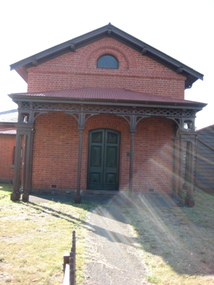
Photograph, Former Shire of Huntly Council Chambers, 2008
... John O'Dwyer and constructed by builders, Hyett and Martin. The Huntly Shire was formed in July 1866 and the construction of a building in which they could hold meetings was a priority. The Council used the building for 110 years before a new chambers was opened in 1977, at which time the former chambers were leased to a local historical society for use as a museum. The one storeyed face brick building has a double hipped roof, partially concealed by parapets on three sides. The design of the building conveys a strong...John O'Dwyer and constructed by builders, Hyett and Martin. The Huntly Shire was formed in July 1866 and the construction of a building in which they could hold meetings was a priority. The Council used the building for 110 years before a new chambers was opened in 1977, at which time the former chambers were leased to a local historical society for use as a museum. The one storeyed face brick building has a double hipped roof, partially concealed by parapets on three sides. The design of the building conveys a strong ...The former Huntly Shire Council Chambers was constructed in 1867 as council chambers for the former shire of Huntly. The building was designed by local engineer, John O'Dwyer and constructed by builders, Hyett and Martin. The Huntly Shire was formed in July 1866 and the construction of a building in which they could hold meetings was a priority. The Council used the building for 110 years before a new chambers was opened in 1977, at which time the former chambers were leased to a local historical society for use as a museum. The one storeyed face brick building has a double hipped roof, partially concealed by parapets on three sides. The design of the building conveys a strong Lombardic influence with banded brick quoining and a large open loggia on the entrance faade formed by double banded brick columns supporting semicircular arches. The building retains much of its early furniture and fittings, including the councillors' meeting table and chairs, a series of honour boards and a photographic collection of all Huntly Shire Council councillors. The former Huntly Shire Chambers is of architectural importance to the State of Victoria. The building is of architectural importance as an unusual example of an engineer designed council chambers with many interesting design elements, including the banded brickwork, overall scale of the building and loggia. The arcade on the eastern faade is a good example of fine engineered brickwork with two levels of arches. The building is substantially intact both internally and externally.Colour photographs of the brick Shire of Huntly building. huntly, shire of huntly, huntly shire council chambers, huntly historical society -
 Old Castlemaine Schoolboys Association Inc.
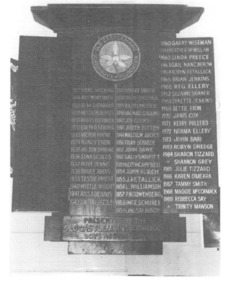
Honour Board, Chewton Primary School
... Strong 1933 – Victor Payne 1934 – Nancy Exon 1935 – Hilton Dyring 1936 – Edna Scoles 1937 – Olive Dennis 1938 – Bruce Addis 1939 – Tessie Priest 1940 – Myrtle Wright 1941 – Ailsa Dennis 1942 – Dorothy Scoles 1943 – Robert Briggs 1944 – Douglas Cracknell 1945 – B.L. Delmenico 1946 – Valmae Colling 1947 – Joy Cocks 1948 – Judith Botten 1949 – Malcolm Archer 1950 – Brian Schreck 1951 – John...Strong 1933 – Victor Payne 1934 – Nancy Exon 1935 – Hilton Dyring 1936 – Edna Scoles 1937 – Olive Dennis 1938 – Bruce Addis 1939 – Tessie Priest 1940 – Myrtle Wright 1941 – Ailsa Dennis 1942 – Dorothy Scoles 1943 – Robert Briggs 1944 – Douglas Cracknell 1945 – B.L. Delmenico 1946 – Valmae Colling 1947 – Joy Cocks 1948 – Judith Botten 1949 – Malcolm Archer 1950 – Brian Schreck 1951 – John ...1927 – Henry Hocking 1928 – Myr. Mortimer 1929 – B.M. Dennis 1930 – Bessie M Dennis 1931 – Mary. L. Archbold 1932 – Edith O. Strong 1933 – Victor Payne 1934 – Nancy Exon 1935 – Hilton Dyring 1936 – Edna Scoles 1937 – Olive Dennis 1938 – Bruce Addis 1939 – Tessie Priest 1940 – Myrtle Wright 1941 – Ailsa Dennis 1942 – Dorothy Scoles 1943 – Robert Briggs 1944 – Douglas Cracknell 1945 – B.L. Delmenico 1946 – Valmae Colling 1947 – Joy Cocks 1948 – Judith Botten 1949 – Malcolm Archer 1950 – Brian Schreck 1951 – John Dawe 1952 – Sally Smirftt 1953 – Keith Campbell 1954 – John Burch 1955 – J. Retallick 1956 – L. Williamson 1957 – P. Kouwenberg 1958 – Inge. Schuber 1959- Linday Burch 1960 – Garry Wiseman 1961 – Heather McMillan 1962 – Linda Preece 1963 – Gail Nancarrow 1964 – Robyn Retallick 1965 – Brian Jenkins 1966 – Reg. Ellery 1967 – Suzanne Skinner 1968 – Lynette Jenkins 1969 – Bettie Exon 1970 – Janice Cox 1971 – Kerry Pollerd 1972 – Norma Ellery 1973 – John Bari From 1983, The Chewton School awarded the award on their own behalf 1983 – Robyn Dredge 1984 – Sharon Tizzard and Shannon Grey 1985 – Julie Tizzard 1986 – Karen O’Meara 1987 – Tammy Smith 1988 – Maggie McCormack 1989 – Rebbecca Say &Trinity Mawson 1990 – Amber Mawson 1991 – Lucy Norwood 1992 – Emma Cohen & Aimee London 1993 – J. Troutbeck-Noy -
 Vision Australia
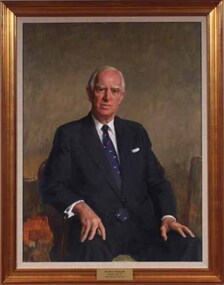
Painting - Artwork, Portrait of John Wicking, 1980
... John Wicking who was President of the Association for the Blind 1973-1984 as well as a generous benefactor. It is part of a series of paintings commissioned by the AFB Board to commemorate the work of past presidents of the organisation. Mr. Wicking wears a navy suit, white shirt and navy blue Kiwi tie. He was Managing Director and Chairman of Kiwi International when he was introduced to the Committee in 1971. With a natural air of authority, he was known to be both strong...John Wicking who was President of the Association for the Blind 1973-1984 as well as a generous benefactor. It is part of a series of paintings commissioned by the AFB Board to commemorate the work of past presidents of the organisation. Mr. Wicking wears a navy suit, white shirt and navy blue Kiwi tie. He was Managing Director and Chairman of Kiwi International when he was introduced to the Committee in 1971. With a natural air of authority, he was known to be both strong ...Framed portrait of John Wicking who was President of the Association for the Blind 1973-1984 as well as a generous benefactor. It is part of a series of paintings commissioned by the AFB Board to commemorate the work of past presidents of the organisation. Mr. Wicking wears a navy suit, white shirt and navy blue Kiwi tie. He was Managing Director and Chairman of Kiwi International when he was introduced to the Committee in 1971. With a natural air of authority, he was known to be both strong and wise. One of the first hurdles Mr Wicking faced following his election as President in 1973 was understanding the health service system and sorting out the differing views of committee members over recommendations for projects costing hundreds of thousands of dollars with no funds to implement them. The ten years of his Presidency were a time of exceptional growth and expansion. He was instrumental in acquiring an adjacent property to those already owned in Glenferrie Road in 1974 at a cost of $120,000, on which the Low Vision Clinic was erected – the first of its type in Australia. Land was also bought in both the metropolitan and country areas for future expansion. Day care centres were opened in Ballarat and Bendigo and new metropolitan services commenced. Mr Wicking formed a committee to explore the possibility of a radio station people unable to read standard print. As a result 3RPH commenced broadcasting in 1981. After his retirement as President, Mr. Wicking continued as a committee member until 1994. In 1995 he was instrumental in the establishment of the Tilly Aston Heritage Collection, on which he served as Chairman until sadly passing away in 2002. 1 art original in old gold frameThe plaque at the base of the painting reads 'Mr John O. Wicking AM / President 1973-1984 / Association for the Blind'. association for the blind, john wicking -
 Federation University Art Collection
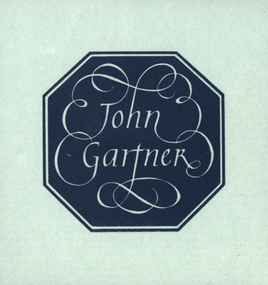
Bookplate, 'John Gartner'
... John Gartner was a fine printer and publisher, an author, a noted philatelist, and also collector of Australian banknotes and coins. He was born on 16 July 1914 and was largely self-educated, leaving school at fourteen for work following the death of his father. Gartner developed a strong...John Gartner was a fine printer and publisher, an author, a noted philatelist, and also collector of Australian banknotes and coins. He was born on 16 July 1914 and was largely self-educated, leaving school at fourteen for work following the death of his father. Gartner developed a strong ...John Gartner was a fine printer and publisher, an author, a noted philatelist, and also collector of Australian banknotes and coins. He was born on 16 July 1914 and was largely self-educated, leaving school at fourteen for work following the death of his father. Gartner developed a strong interest in the history of typography and printing and was apprenticed at the Advocate where his father had been a linotype operator. Aged 17, Gartner bought a hand press and some fonts of type, and in 1937 acquired a platen press from which he set and printed his private press books, published under the imprint of The Hawthorn Press. Gartner had a strong collection of Australian bookplates. He also looked at the work of artists overseas and commissioned personal plates. He subsequently built an international collection with preference for artists who printed from wood. His initial searches were in Belgium and Holland.(http://www3.slv.vic.gov.au/latrobejournal/issue/latrobe-84/t1-g-t7.html) The title is depicted in white on a grey blue background within an eight sided borderbookplate, printmaking, australian bookplate design award, keith wingrove memorial trust -
 Federation University Art Collection
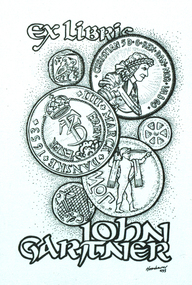
Work on paper - Bookplate, 'Ex Libris John Gartner'
... John Gartner was a fine printer and publisher, an author, a noted philatelist, and also collector of Australian banknotes and coins. He was born on 16 July 1914 and was largely self-educated, leaving school at fourteen for work following the death of his father. Gartner developed a strong...John Gartner was a fine printer and publisher, an author, a noted philatelist, and also collector of Australian banknotes and coins. He was born on 16 July 1914 and was largely self-educated, leaving school at fourteen for work following the death of his father. Gartner developed a strong ...John Gartner was a fine printer and publisher, an author, a noted philatelist, and also collector of Australian banknotes and coins. He was born on 16 July 1914 and was largely self-educated, leaving school at fourteen for work following the death of his father. Gartner developed a strong interest in the history of typography and printing and was apprenticed at the Advocate where his father had been a linotype operator. Aged 17, Gartner bought a hand press and some fonts of type, and in 1937 acquired a platen press from which he set and printed his private press books, published under the imprint of The Hawthorn Press. Gartner had a strong collection of Australian bookplates. He also looked at the work of artists overseas and commissioned personal plates. He subsequently built an international collection with preference for artists who printed from wood. His initial searches were in Belgium and Holland.(http://www3.slv.vic.gov.au/latrobejournal/issue/latrobe-84/t1-g-t7.html) Book plate depicts a series of coinsVery small signature bottom right cornerbookplate, printmaking, australian bookplate design award, keith wingrove memorial trust -
Federation University Art Collection
Bookplate, 'Ex Libris John Gartner'
... John Gartner was a fine printer and publisher, an author, a noted philatelist, and also collector of Australian banknotes and coins. He was born on 16 July 1914 and was largely self-educated, leaving school at fourteen for work following the death of his father. Gartner developed a strong...John Gartner was a fine printer and publisher, an author, a noted philatelist, and also collector of Australian banknotes and coins. He was born on 16 July 1914 and was largely self-educated, leaving school at fourteen for work following the death of his father. Gartner developed a strong ...John Gartner was a fine printer and publisher, an author, a noted philatelist, and also collector of Australian banknotes and coins. He was born on 16 July 1914 and was largely self-educated, leaving school at fourteen for work following the death of his father. Gartner developed a strong interest in the history of typography and printing and was apprenticed at the Advocate where his father had been a linotype operator. Aged 17, Gartner bought a hand press and some fonts of type, and in 1937 acquired a platen press from which he set and printed his private press books, published under the imprint of The Hawthorn Press. Gartner had a strong collection of Australian bookplates. He also looked at the work of artists overseas and commissioned personal plates. He subsequently built an international collection with preference for artists who printed from wood. His initial searches were in Belgium and Holland.(http://www3.slv.vic.gov.au/latrobejournal/issue/latrobe-84/t1-g-t7.html) The solid shapes of printmaking materials fan out in a pattern around the centrally placed intials J GPencil signature bottom rightprintmaking, bookplate, australian bookplate design award, keith wingrove memorial trust -
 Mont De Lancey
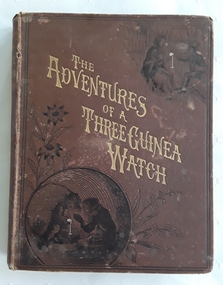
Book, Talbot Baines Reed, The Adventures of a Three Guinea Watch, c 1883
... strong religious themes throughout. Inside on the right patterned endpaper at the front is a bookplate written in beautiful copperplate writing: ' Presented to Thomas Johnson By the United Methodist Sabbath School Wandin Yallock for diligence & good attendance. John ...A vintage early 1800's adventure story for teenage boys with black lined illustrations. A boy is given a watch for his 13th birthday as he goes off to school. The watch narrates his own story as he changes 'owners' and travels to London, a pawn shop, a university, to the seaside, India and back to..... There are strong religious themes throughout.A vintage early 1800's brown hardcover children's book with the title The Adventures of a Three Guinea Watch printed in gold diagonal letter on the front cover with a black lined illustration of two boys playing with a fob watch sitting inside a large barrel. The spine has the title and RTS symbol for the publisher printed in gold lettering. The back cover has a black lined drawing of a boy reading a book in front of a bookcase with the heading: THE BOYS OWN BOOKSHELF printed in a banner above. There are flowers and butterflies too. The frontispiece illustration depicts a woman and a man with a boy in football clothes talking. It is covered with faded tissue paper. The title page has the title, author, publisher details and the same black lined illustration as is featured on the back cover. Throughout the book are many black lined illustrations. At the back is page of further Books for Boys published by The Religious Tract Society. The author,Talbot Baines Reed wrote school stories for boys. Pp. 226.fictionA vintage early 1800's adventure story for teenage boys with black lined illustrations. A boy is given a watch for his 13th birthday as he goes off to school. The watch narrates his own story as he changes 'owners' and travels to London, a pawn shop, a university, to the seaside, India and back to..... There are strong religious themes throughout.children's books, books, children's stories, adventure stories, teenage stories, boys' stories -
 Mont De Lancey
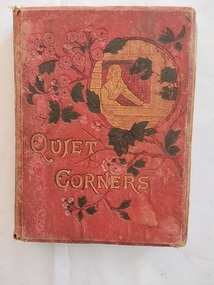
Book, Howe Benning, Quiet Corners - an American Tale, c1882
... John William (Jack), Francis Thomas (Frank), William Joseph (Bill) and Anne Evelyn. Mary died in May 1942. This book was (donated by the family of Frank Lewis) The book was awarded to Mary by the Wandin Sabbath School. Sabbath schools are a weekly bible study and song service run by Seventh Day Adentist Churches. Religious stories Family life fiction Stories for girls The book is an example of a story dealing with a girl's (Margaret) life in America which is readable, pleasing and instructive, without the ordinary excitement of a love story. It has strong ...The book is an example of a story dealing with a girl's (Margaret) life in America which is readable, pleasing and instructive, without the ordinary excitement of a love story. It has strong religious themes. It hopes that in many 'quiet corners" of our native land it may help to develop the spirit of self-sacrifice and true Christian thought for others.A very damaged, stained red antique hardcover book for girls with the title printed in gold lettering in the middle of the front cover. There is a gold outlined drawing of a girl sitting looking out of a window. There are red flowers and green leaves decorating the cover. The spine has the title printed in gold letters with red flowers and green leaves.On the front right side end paper is an inscription for a Sabbath School award dated 1882. The frontispiece balck and white illustration is of a girl sitting at a table at a fair. Tissue paper protects it. The title page has the title, author Howe Benning as well as publisher details. 296Pp. Throughout are black and white illustrations. There are four pages at the back are lists of Recent Gift Books published by the Religious Tract Society. The spine is broken from the pages.fictionThe book is an example of a story dealing with a girl's (Margaret) life in America which is readable, pleasing and instructive, without the ordinary excitement of a love story. It has strong religious themes. It hopes that in many 'quiet corners" of our native land it may help to develop the spirit of self-sacrifice and true Christian thought for others.religious stories, family life fiction, stories for girls
