
Showing 32 items matching " criterion house"
-
 Linton and District Historical Society Inc
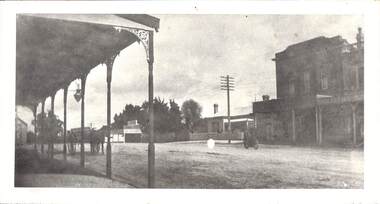
Photograph, Sussex Street, undated : Joseph Shepherd store and house, Criterion House, verandah of Railway Hotel
... Sussex Street, undated : Joseph Shepherd store and house, Criterion House, verandah of Railway Hotel......Criterion House...The photograph is undated, but is thought to have been taken before 1921 (when Joseph Shepherd died and his store was inherited by Alf Darling). Criterion House is occupied by a "Cash Dealer" - suggests photograph was taken before Murrells had their newsagency there. ...Photograph of Sussex Street, Linton, shows the verandah of the Railway Hotel, Joseph Shepherd's store and house, and Criterion House. The Linton Economic Store (owned by Morgan family) can be seen further along the street, and there is a glimpse of the weighbridge. ...Sussex Street, undated : Joseph Shepherd store and house, Criterion House, verandah of Railway Hotel Photograph ...The photograph is undated, but is thought to have been taken before 1921 (when Joseph Shepherd died and his store was inherited by Alf Darling). Criterion House is occupied by a "Cash Dealer" - suggests photograph was taken before Murrells had their newsagency there. Black and white photograph of original photograph, which has been mounted on white card. Photograph of Sussex Street, Linton, shows the verandah of the Railway Hotel, Joseph Shepherd's store and house, and Criterion House. The Linton Economic Store (owned by Morgan family) can be seen further along the street, and there is a glimpse of the weighbridge. A horse and cart, and a motorcycle, are in the street.joseph shepherd, railway hotel, criterion house, morgan's economic stores, linton economic store, joseph shepherd's store -
 Linton and District Historical Society Inc
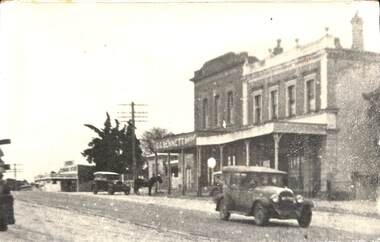
Photograph, Sussex Street 1930s : Bennett Butchers, Criterion House, former Joseph Shepherd house
... Sussex Street 1930s : Bennett Butchers, Criterion House, former Joseph Shepherd house......Criterion House...Bennett is shown trading at the store formerly owned by Joseph Shepherd/Alf Darling. Criterion House appears to be unoccupied, suggesting photo was taken after 1932 when Murrell's Newsagency moved from this site across to the west side of Sussex Street (to shop previously occupied by Dan Cornish)....Bennett butcher's shop, Criterion House, and the house built and formerly occupied by Joseph Shepherd. ...Sussex Street 1930s : Bennett Butchers, Criterion House, former Joseph Shepherd house Photograph ...Photograph is dated to 1930s as G. G. Bennett is shown trading at the store formerly owned by Joseph Shepherd/Alf Darling. Criterion House appears to be unoccupied, suggesting photo was taken after 1932 when Murrell's Newsagency moved from this site across to the west side of Sussex Street (to shop previously occupied by Dan Cornish).Somewhat grainy copy of original black and white photograph which shows buildings in Sussex Street, Linton, in the 1930s. Cars and a horse in the street. Buildings are G. G. Bennett butcher's shop, Criterion House, and the house built and formerly occupied by Joseph Shepherd. A glimpse of the Linton Economic Store (owned by Morgan family) further along the street.g. g. bennett, criterion house, joseph shepherd -
 Linton and District Historical Society Inc
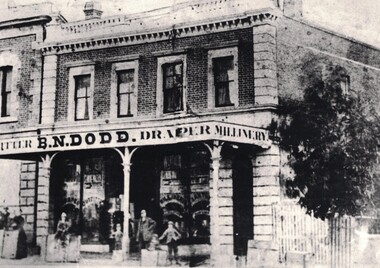
Photograph, Criterion House, Sussex Street, Linton
... Criterion House, Sussex Street, Linton...Criterion House...Date of the photograph is not known. Criterion House was built by Samuel Steele in 1862/1863. ...Date of the photograph is not known. Criterion House was built by Samuel Steele in 1862/1863. ...Date of the photograph is not known. Criterion House was built by Samuel Steele in 1862/1863. Samuel Steele left Linton in the late 1860s, but it is not known if B. N. Dodd was the next owner of the building. B. N. Dodd was mentioned in advertising as a Linton draper in 1878. He sold the shop and moved to Ballarat in 1887. The upper floor of the building was used as a hospital from around the end of WWI to the early 1920s. The building was demolished around 1938/39, in connection with the rebuilding of new offices for the Shire of Grenville.Digital copy of original photograph, which shows a two-storey brick building with a verandah. There are four windows across the second storey. A sign across the front of the verandah reads "...TFITTER. B. N. DODD. DRAPER. MILLINERY". A man is leaning on a verandah post at the front of the shop near the entrance, and a woman is standing on the left of the picture, behind a box or counter. Several children are sitting on boxes or bales outside the shop. Ground floor windows have signs reading "DRAPER", "OUTFITTER", "MILLINERY". (A fourth sign is illegible.)criterion house, samuel steele, b.n. (benjamin nunnington) dodd, drapers, shops, sussex street linton -
 Linton and District Historical Society Inc
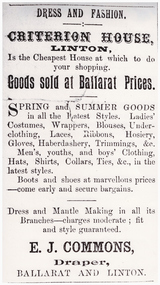
Advertisement, E.J. Commons, Draper, at Criterion House, Linton, 1896
... Commons, Draper, at Criterion House, Linton, 1896...... Criterion House Linton...Commons, Draper, at Criterion House, Linton, 1896 Advertisement ...The advertisement appears to have been photographed and an enlarged print of the photograph printed on cream-coloured, textured paper, for LDHS display purposes.An enlarged copy of an advertisement which appeared in the Grenville Standard newspaper on 19 December 1896.e. j. commons, drapers, criterion house linton, advertising -
 Stawell Historical Society Inc
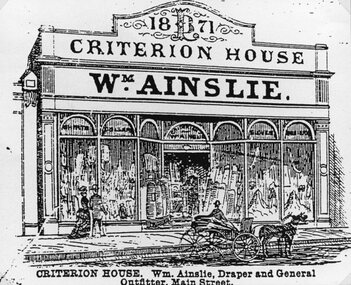
Drawing, Mr Wm. Ainslie, Criterion House in Main Street Stawell from the P.C. News Supplement 1888 -- Sketch
... Mr Wm. Ainslie, Criterion House in Main Street Stawell from the P.C. ...Wm. Ainslie Criterion House Main Street from P.C. News Supplement 1888 Building around 111 Main Street which was William the Shoeman ...Ainslie, Criterion House in Main Street Stawell from the P.C. ...Wm. Ainslie Criterion House Main Street from P.C. News Supplement 1888 Building around 111 Main Street which was William the Shoeman stawell businesses -
 Clunes Museum
Photograph
... ...R. CRITERION HOUSE...R. THOMAS CRITERION HOUSE...PHOTOGRAPHS SHOPS -THOMAS R. CRITERION HOUSE R. THOMAS CRITERION HOUSE COPY OF PHOTOGRAPH OF FRASER STREET, CLUNES Photograph PHOTOGRAPH ...COPY OF PHOTOGRAPH OF FRASER STREET, CLUNESR. THOMAS CRITERION HOUSEphotographs, shops -thomas, r. criterion house -
 Clunes Museum
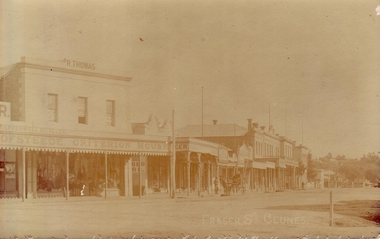
Photograph, C 1905
... ...r. thomas criterion house draper shop....ORIGINAL SEPIA POSTCARD PHOTOGRAPH OF CLUNES MAIN STREET, FEATURING HORSE AND CART AND R. THOMAS CRITERION HOUSE DRAPER SHOP....THOMAS CRITERION HOUSE DRAPER SHOP. Photograph PHOTOGRAPH ...EARLY PHOTOGRAPH OF FRASER STREET, CLUNESORIGINAL SEPIA POSTCARD PHOTOGRAPH OF CLUNES MAIN STREET, FEATURING HORSE AND CART AND R. THOMAS CRITERION HOUSE DRAPER SHOP.FRASER STREET CLUNESlocal history, photography, photographs, shops, r. thomas criterion house draper shop., clunes township -
 Linton and District Historical Society Inc
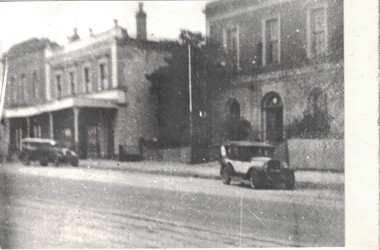
Photograph, Sussex Street, Linton, circa 1920
... ... Criterion House...View to the west of Sussex Street, Linton, showing the Grenville Shire Hall, Criterion House and Shepherd's store. The two cars shown parked in the street suggest the photograph was taken in the 1920s....Shire Hall Linton Shire of Grenville offices and hall Criterion House Shepherd's store Sussex Street Linton Buildings Somewhat blurry black and white copy of an original photograph which has been mounted on white card. ...Somewhat blurry black and white copy of an original photograph which has been mounted on white card. View to the west of Sussex Street, Linton, showing the Grenville Shire Hall, Criterion House and Shepherd's store. The two cars shown parked in the street suggest the photograph was taken in the 1920s.shire hall linton, shire of grenville offices and hall, criterion house, shepherd's store, sussex street linton, buildings -
 Federation University Historical Collection
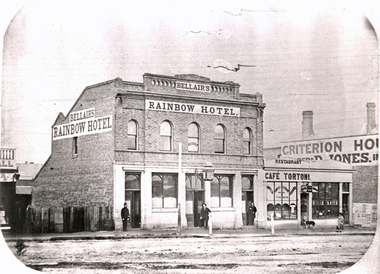
Photograph - Black and White, Solomon and Bardwell, Bellair's Rainbow Hotel, Ballarat
... ...criterion house...Cafe Tortoni and Criterion House are also evident in the image. Three men stand outside the Rainbow Hotel, and a woman and dog are shown outside Cafe Tortoni. ...Cafe Tortoni and Criterion House are also evident in the image. Three men stand outside the Rainbow Hotel, and a woman and dog are shown outside Cafe Tortoni. ...According to Reid and Chishold in 'Ballarat Golden City' "Rainbow Hotel Sturt Street: on the north side near Armstrong Street was built in the 1860s. It was demolished to may way for Lester's Hotel"Double storey brick building with a lamp over the front door. The building is Thomas Bellair's Rainbow Hotel. Cafe Tortoni and Criterion House are also evident in the image. Three men stand outside the Rainbow Hotel, and a woman and dog are shown outside Cafe Tortoni. Gift of the Keith Rash Estatebellair, thomas bellair, rainbow hotel, lestor's hotel, sturt street, armstrong street, streetscape, cafe tortoni, criterion house -
 Linton and District Historical Society Inc
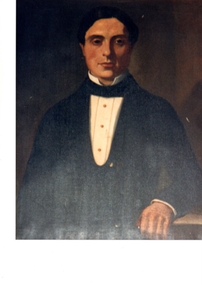
Photograph, Portrait of Samuel Steele
... ... Criterion House...Samuel Steele, who lived in Linton during the 1860s and built the draper's shop in Sussex Street known as Criterion House, brought this painting with him when he migrated to Victoria....Samuel Steele Criterion House Scan of a photograph of an original oil painting. ...Samuel Steele, who lived in Linton during the 1860s and built the draper's shop in Sussex Street known as Criterion House, brought this painting with him when he migrated to Victoria.Scan of a photograph of an original oil painting. The painting is a head and shoulders portrait of a young man with dark hair and eyes, who is wearing a dark jacket and white shirt which has three buttons and a stiff collar. His left hand resting on the arm of a chair, or a table.samuel steele, criterion house -
 Clunes Museum
Photograph
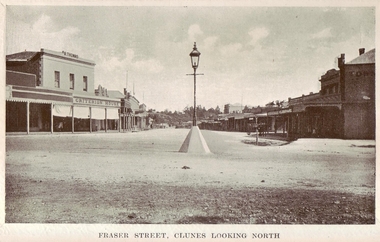
... shops- r.thomas criterion house....LOOKING NORTH, GAS LIGHT IN CENTRE OF STREET. INCLUDES, CRITERION HOUSE, R THOMAS .2 .3 BLACK AND WHITE COPIES OF THE ABOVE PHOTOGRAPH ON GLOSS PHOTOGRAPHIC PAPER .4 BLACK AND WHITE COPY OF THE ABOVE PHOTOGRAPH ON MATTE PHOTOGRAPHIC PAPER...local history document postcard shops- r.thomas criterion house. clunes township FRASER STREET CLUNES. ....1 ORIGINAL BLACK AND WHITE PHOTOGRAPH POSTCARD OF FRASER STREET, CLUNES. LOOKING NORTH, GAS LIGHT IN CENTRE OF STREET. INCLUDES, CRITERION HOUSE, R THOMAS .2 .3 BLACK AND WHITE COPIES OF THE ABOVE PHOTOGRAPH ON GLOSS PHOTOGRAPHIC PAPER .4 BLACK AND WHITE COPY OF THE ABOVE PHOTOGRAPH ON MATTE PHOTOGRAPHIC PAPERFRASER STREET CLUNES. LOOKING NORTH local history, document, postcard, shops- r.thomas criterion house., clunes township -
 Linton and District Historical Society Inc
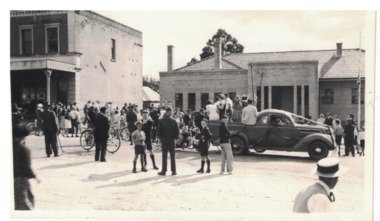
Photograph, Centenary Celebrations Procession, Linton, 1939
... ...Criterion House...The double storey building on the left is Criterion House, originally a draper's store. The upper level of this building was at one time (post WWI-early 1920s) used as a hospital. ...The double storey building on the left is Criterion House, originally a draper's store. The upper level of this building was at one time (post WWI-early 1920s) used as a hospital. ...This photograph was taken during Linton's centenary celebrations at the end of 1939. The double storey building on the left is Criterion House, originally a draper's store. The upper level of this building was at one time (post WWI-early 1920s) used as a hospital. The building on the right is the Grenville Shire Offices, built 1938/39 and only recently opened.Black and white image of a crowd of men, women and children plus a motor vehicle, motorcycle and bicycle outside buildings in Sussex Street, Linton. The car has been decorated with streamers. centenaries, centenary celebrations, hospitals, motorcycles, cars, bicycles, grenville shire offices, criterion house -
 Linton and District Historical Society Inc
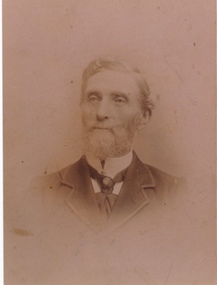
Photograph, Samuel Steele
... ... Criterion House...Samuel Steele lived in Linton from at least 1860 and built the drapery store known as Criterion House in 1862/1863. His first three children were born at Linton. ...Samuel Steele lived in Linton from at least 1860 and built the drapery store known as Criterion House in 1862/1863. His first three children were born at Linton. ...Samuel Steele lived in Linton from at least 1860 and built the drapery store known as Criterion House in 1862/1863. His first three children were born at Linton. Samuel Steele moved into Ballarat in the late 1860s and established a drapery store in Sturt Street. He afterwards lived at Stawell and ran businesses there and in Ararat.Scan of original photograph which shows the head and shoulders of an older man who has a short beard. He is neatly dressed in a jacket, shirt with a stiff collar, and cravat.samuel steele, criterion house -
 Linton and District Historical Society Inc
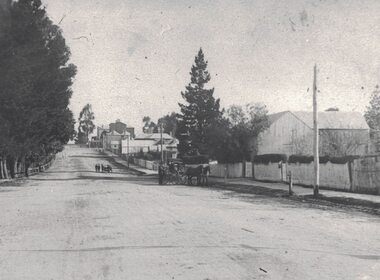
Photograph, View along Sussex Street, Linton, circa 1920
... ... Criterion House...Other identifiable buildings in the photograph are Ball Brothers blacksmith's shop, the Royal Standard Hotel on the corner of Sussex and Clyde Streets, the Shire Hall, Criterion House and Joseph Shepherd's store. The roof of Oscar Ball's house can be seen....Other identifiable buildings in the photograph are Ball Brothers blacksmith's shop, the Royal Standard Hotel on the corner of Sussex and Clyde Streets, the Shire Hall, Criterion House and Joseph Shepherd's store. The roof of Oscar Ball's house can be seen. ...Dr Donaldson (Snr) owned the block of land on the corner of Sussex and Grant Streets, Linton. He had a ten-room house set on the back of the block (where the block backs on to Surrey Street), with a large barn fronting Sussex Street. Other identifiable buildings in the photograph are Ball Brothers blacksmith's shop, the Royal Standard Hotel on the corner of Sussex and Clyde Streets, the Shire Hall, Criterion House and Joseph Shepherd's store. The roof of Oscar Ball's house can be seen.Black and white copy of original photograph which shows houses and other buildings along Sussex Street. The view is to the south (up the hill) from the Ballarat entrance to Linton. A large barn, enclosed by a picket fence, is in the foreground. A cart drawn by two horses, with a man standing next to it, is in the street near the barn. Further along the street, a group of people appear to be wheeling a barrow or cart. Houses and other buildings can be seen along the street.sussex street linton, dr donaldson's barn, ball bros. blacksmith, royal standard hotel, shire of grenville offices linton, criterion house, joseph shepherd's store -
 Linton and District Historical Society Inc
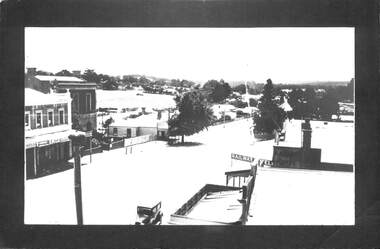
Photograph, Sussex Street, Linton, undated, probably late 1920s or early 1930s
... Criterion House...Buildings shown on west side of Sussex Street: Criterion House, at the time occupied by Murrell's Newsagency, the Grenville Shire civic hall and offices, the shop at one time occupied by J. ...Buildings shown on west side of Sussex Street: Criterion House, at the time occupied by Murrell's Newsagency, the Grenville Shire civic hall and offices, the shop at one time occupied by J. ...Buildings shown on west side of Sussex Street: Criterion House, at the time occupied by Murrell's Newsagency, the Grenville Shire civic hall and offices, the shop at one time occupied by J. Y. Clarke, barber & tobacconist. The roof of Barr's shop and dwelling can be seen (the building itself is obscured by a tree), and houses further along the street owned by J.G. Allan, Ernest Ball and Oscar Ball. The Royal Standard Hotel appears to have been demolished. On the east side of the street, the roof and signage of the Railway Hotel is visible, and the roof of Cornish's shoe shop. The photograph is undated but was probably taken in between the late 1920s (when the Royal Standard Hotel was demolished) and 1932, when the Murrell family moved its newsagency into the building on the other side of the street previously occupied by Dan Cornish. Note: a gap between the Shire Hall and the next building suggests that the shop and dwelling originally occupied by the Austin family has been demolished.Black and white copy of original photograph which has been mounted on blue card. Photograph shows shops and houses in Sussex Street, Linton, and appears to have been taken from a high vantage point, possibly the fire tower which was located in Sussex Street. View is to north-west of the township.criterion house, murrell's newsagency, j. y. clarke, j.g. allan, ernest ball, oscar ball, houses, shops, linton shire hall, linton town hall, railway hotel -
 Clunes Museum
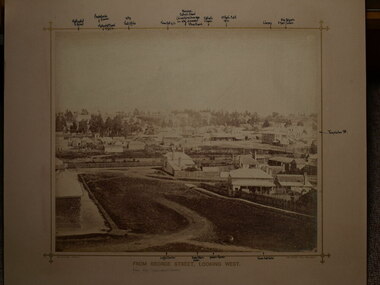
Photograph, BEAUCHAMP PHOTOGRAPHY, CLUNES TOWNSHIP, CIRCA 1870
... BUILDINGS SHOWN INCLUDE JAMES MOLONEY AND CRITERION HOUSE. .1 SEPIA PHOTOGRAPH MOUNTED WITH POINTS OF INTEREST NOTED AROUND THE BORDER OF THE PHOTOGRAPH .2 LARGER SEPIA PHOTOGRAPH MOUNTED...BUILDINGS SHOWN INCLUDE JAMES MOLONEY AND CRITERION HOUSE. .1 SEPIA PHOTOGRAPH MOUNTED WITH POINTS OF INTEREST NOTED AROUND THE BORDER OF THE PHOTOGRAPH .2 LARGER SEPIA PHOTOGRAPH MOUNTED CLUNES TOWNSHIP Photograph PHOTOGRAPH BEAUCHAMP PHOTOGRAPHY ...PHOTOGRAPH OF CLUNES TOWNSHIP LOOKING WEST TAKEN FROM MRS.GREENWOODS HOME IN GEORGE STREET, CLUNES. BUILDINGS SHOWN INCLUDE JAMES MOLONEY AND CRITERION HOUSE. .1 SEPIA PHOTOGRAPH MOUNTED WITH POINTS OF INTEREST NOTED AROUND THE BORDER OF THE PHOTOGRAPH .2 LARGER SEPIA PHOTOGRAPH MOUNTEDFROM GEORGE STREET, LOOKING WESTlocal history, photography, clunes township -
 Linton and District Historical Society Inc
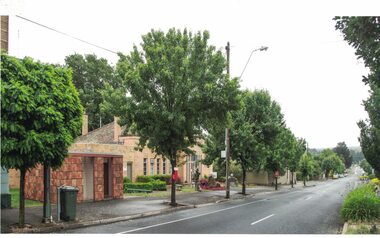
Photograph, View along Sussex Street to the North, Linton, 2014
... Criterion House was demolished in 1938/39, to make way for new, enlarged municipal offices, which are still in use in 2019....Criterion House was demolished in 1938/39, to make way for new, enlarged municipal offices, which are still in use in 2019. ...The public toilet block in Linton is decorated with hand-made terracotta tiles depicting historic themes. The tiles were produced as part of the Press Mould Tile Project 2001-2002 by Linton Primary School students and community members. Tile design and project coordination was by Pam Farey and Anne Dietrich, and instructors were Pam Farey, Anne Dietrich, Anne Bray and Jeannette Vervaart. The site the toilet block was built on was formerly occupied by 'Criterion House', a building used in the 19th and early 20th centuries as a shop and also a hospital. Criterion House was demolished in 1938/39, to make way for new, enlarged municipal offices, which are still in use in 2019.Colour photograph which shows trees and buildings in Sussex Street, Linton, the Linton public toilet building, and the Golden Plains Shire local offices.golden plains shire offices linton, public toilet building linton, press mould tile project 2001-2002 -
 Federation University Historical Collection
Photograph - Sepia, Ballarat looking north over Sturt Street and Armstrong Street, 1878
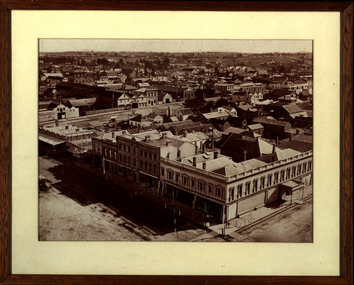
... Businesses shown in the photograph include Criterion House, W. Proctor Coach Builder, Lestor's Family Hotel, City Shoing Forge, Tattersall's Hotel, Burke's Hotel, Hislop's Hotel, Bell and Wright's Timber Yard, Mrs Binsted...Businesses shown in the photograph include Criterion House, W. Proctor Coach Builder, Lestor's Family Hotel, City Shoing Forge, Tattersall's Hotel, Burke's Hotel, Hislop's Hotel, Bell and Wright's Timber Yard, Mrs Binsted Ballarat looking north over Sturt Street and Armstrong Street Photograph - Sepia ...Framed sepia photograph showing Ballarat looking north over Sturt Street from Armstrong Street. The photograph was taken soon after the tower of the Ballarat Town Hall was built. Businesses shown in the photograph include Criterion House, W. Proctor Coach Builder, Lestor's Family Hotel, City Shoing Forge, Tattersall's Hotel, Burke's Hotel, Hislop's Hotel, Bell and Wright's Timber Yard, Mrs Binstedballarat, sturt street, armstrong street, ballarat town hall, ballarat townscape, william bardwell, fotobiennale -
 Linton and District Historical Society Inc
Photograph, Stamped on reverse: Free & Sons, Photographers, Melbourne, Linton Shire Hall
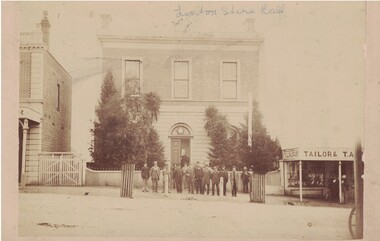
... This building is 'Criterion House', built in 1862/1863 by Samuel Steele. ...This building is 'Criterion House', built in 1862/1863 by Samuel Steele. ...The Shire Hall/offices were completed in the mid 1860s. Dating the photograph: The photograph is thought to have been taken c.1880. An earlier photograph of the Town Hall in the LDHS collection, in which the trees are smaller, is dated 1875. Thomas Austin, who ran a draper's shop next to the Shire offices, left Linton in 1882.Original sepia photograph showing the Grenville Shire Offices (Linton Town Hall). A group of men, thought to be Grenville Shire Councillors, are standing in the street in front of the building, which has several trees growing in front of it, and a low front fence. To the right, a shop has signs on its verandah: "TAILOR & DRAPER" and "TAILOR & T. A. . . ." (thought to read T. Austin). To the left, a higher picket fence or gate separates the Shire Hall from the two-storey building next door. This building is 'Criterion House', built in 1862/1863 by Samuel Steele. The words "Linton Shire Hall" have been inscribed in ink across the top of the photograph.Handwritten in ink across top of photograph: "Linton Shire Hall".grenville shire offices, linton town hall, thomas austin [tailor & drapery store], shire of grenville councillors, linton shire hall -
 Linton and District Historical Society Inc
Photograph, Mollie (Mary) Coffey
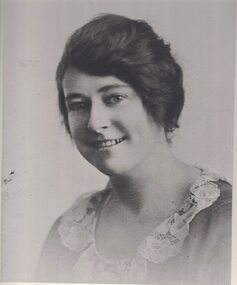
... The hospital was on the first floor of 'Criterion House', next to the old Shire of Grenville offices in Sussex Street. ...The hospital was on the first floor of 'Criterion House', next to the old Shire of Grenville offices in Sussex Street. ...Mollie Coffey, born 1897, was the daughter of Ellen Coffey, a nurse and midwife who ran a private hospital in Linton in the period after World War I. The hospital was on the first floor of 'Criterion House', next to the old Shire of Grenville offices in Sussex Street. It is understood that Mollie also became a nurse and worked with her mother at the hospital. The hospital closed in the mid-1920s. In 1927 Mollie Coffey married Daniel O'Connell, a hairdresser and tobacconist with premises in the former Bennett/Todd building on the corner of Clyde & Sussex Streets. The O'Connells had three children, Jim, Nellise (Ellen) and Jack (John). They moved to Skipton shortly after their marriage.Enlarged black and white copy of original photograph, mounted on white card. The photograph is a head and shoulders portrait of a woman whose dark hair is swept up and behind, and who is wearing a dress or top with a scooped neckline and a white lace collar. Mollie (Mary) Coffey, later Mollie O'Connell.ellen (mollie) coffey, nurses, midwives -
 Linton and District Historical Society Inc
Document - Illuminated Address, Niven, Francis Wilson, Illuminated address presented to Arthur Grace, 1873, 1873
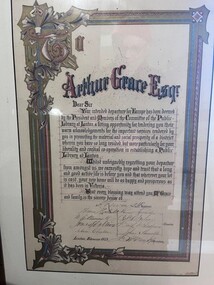
... Arthur Grace was a draper who ran a business in Linton (at 'Criterion House') from the mid-1860s until he left Linton to return to England in 1873. ...Arthur Grace was a draper who ran a business in Linton (at 'Criterion House') from the mid-1860s until he left Linton to return to England in 1873. ...From the late 1870s to the 1930s, illuminated addresses were a popular way to commemorate special occasions and were given to recognize outstanding service. They featured beautiful calligraphy and ornate designs. Arthur Grace was a draper who ran a business in Linton (at 'Criterion House') from the mid-1860s until he left Linton to return to England in 1873. He later returned to live in Ballarat, where he died in 1905. He was heavily involved with the Methodist/Wesleyan congregation at Linton, and instrumental in establishing the Linton Mechanics' Institute and Free Library. (Note: The 'Adress' does not refer to the Linton Mechanics' Institute, but to the 'Committee of the Public Library at Linton'.) The Address was made by Francis Wilson Niven, a lithographer, printer and bookbinder from Ballarat. (See 'Ballarat Star', 10 March 1873.)This may be the first reference to the 'Public Library' at Linton. Framed document, an 'illuminated address' which was presented to Arthur Grace when he moved back to England from Linton in 1873. The Address was presented in acknowledgement of the "important services rendered by you in promoting the material and social prosperity of a district wherein you have so long resided, but more particularly for you liberality and cordial co-operation in establishing a Public Library at Linton". The address is signed by the President, Secretary and eight members of the 'Committee of the Public Library' at Linton : S. Lewers, S.M. [President], J. Dodds [Secretary], and committee members Thomas Hoskins, Thomas Kennedy, W.G. Bennett, Robert S. Nelson, James Colliver, David McFadzean, Adam Clinton, John Howells.arthur grace, illuminated address, linton mechanics' institute and free library, linton public library, linton methodist church -
 Eltham District Historical Society Inc
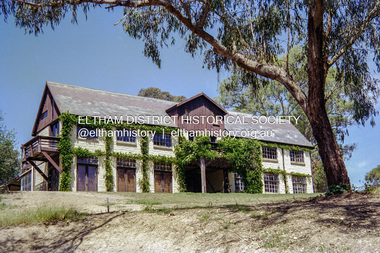
Negative - Photograph, "The Barn", built by Jelbart, c.1945, 93 Arthur Street, Eltham, 1998c
... The garden and the gate posts - The garden is historically significant because it is a remainder of a large holding of 200 acres associated with the house (Criterion A).The gate posts are historically and aesthetically significant because they were taken from a 19th-century Toorak mansion and because their removal and re-use illustrates the practice of recycling material from demolished buildings that was one of the characteristic features of 'Eltham-style' architecture (Criteria A, D & E)....The garden and the gate posts - The garden is historically significant because it is a remainder of a large holding of 200 acres associated with the house (Criterion A).The gate posts are historically and aesthetically significant because they were taken from a 19th-century Toorak mansion and because their removal and re-use illustrates the practice of recycling material from demolished buildings that was one of the characteristic features of 'Eltham-style' architecture (Criteria A, D & E). arthur street eltham jelbart barn Kinloch Kodak Gold 100-5 Roll of 35mm colour negative film, 8 strips and associated 10 x 15 cm colour print "The Barn", built by Jelbart, c.1945, 93 Arthur Street, Eltham Negative Photograph ...Statement of Significance Last updated on - January 5, 2010 REVISED STATEMENT OF SIGNIFICANCE, CONTEXT, 2010 What is significant? The c1950s Jelbart residence and the c1945 barn, the garden and the gate posts and the surrounding site to the extent of the title boundaries. How is it significant? The Jelbart house and barn are historically and architecturally significant to the Shire of Nillumbik. The garden and the gate posts are historically and aesthetically significant to the Shire of Nillumbik. Why is it significant? The Jelbart house and barn are historically significant because they are unusually large and because together they comprise one of the oldest groups of substantial mud brick buildings erected during the 20th century in the Shire of Eltham and foreshadow the large mud brick residences of the 1960s and 1970s for which the area is well known (Criteria A & B). The buildings are architecturally significant because their construction (using timber post framing and mud brick walling) is a characteristic feature of what became known as the 'Eltham style'- which was prevalent in the area during the mid and latter parts of the 20th century (Criteria D & A). The garden and the gate posts - The garden is historically significant because it is a remainder of a large holding of 200 acres associated with the house (Criterion A).The gate posts are historically and aesthetically significant because they were taken from a 19th-century Toorak mansion and because their removal and re-use illustrates the practice of recycling material from demolished buildings that was one of the characteristic features of 'Eltham-style' architecture (Criteria A, D & E).Roll of 35mm colour negative film, 8 strips and associated 10 x 15 cm colour printKodak Gold 100-5arthur street, eltham, jelbart barn, kinloch -
 Glen Eira Historical Society
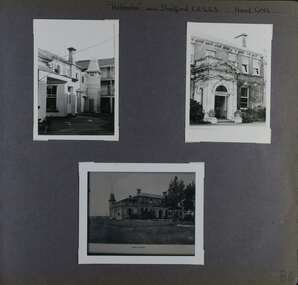
Album - Album page, Helenslea now Shelford CEGGS, Hood Crescent, Circa 1972
... It is aesthetically significant (Criterion E) as a villa residence characteristic of the mid Victorian period, predating the use of cast iron and comparing in this respect with Charles Webb's "Farleigh" (1865) at 6 Farleigh Grove, Brighton. Its substantial nature causes it to be the earliest surviving mansion house ...This photograph is part of the Caulfield Historical Album 1972. This album was created in approximately 1972 as part of a project by the Caulfield Historical Society to assist in identifying buildings worthy of preservation. The album is related to a Survey the Caulfield Historical Society developed in collaboration with the National Trust of Australia (Victoria) and Caulfield City Council to identify historic buildings within the City of Caulfield that warranted the protection of a National Trust Classification. Principal photographer thought to be Trevor Hart, member of Caulfield Historical Society. Most photographs were taken between 1966-1972 with a small number of photographs being older and from unknown sources. All photographs are black and white except where stated, with 386 photographs over 198 pages. The mansion has been the site of Shelford Church of England Girls’ Grammar School - now Shelford Girls’ Grammar School - since circa 1922.From Victorian Heritage Database citation for HO115: "Helenslea" 3 Hood Crescent, Caulfield North https://vhd.heritagecouncil.vic.gov.au/places/35212 as at 21/10/2020 ''Helenslea'' was built for Sir George Stephen, MLA, barrister and mining investor by 1863. It was built with an address to Glen Eira Road with the driveway gates close by the present Helenslea Road corner. The present address is no. 3 Hood Crescent, Caulfield North. It is historically, aesthetically and socially significant. It is historically significant (Criterion A) as the home of Sir George Stephen, MLA for Collingwood, barrister and mining investor and for its capacity to demonstrate Caulfield's early attraction as a residential retreat for Melbourne's eminent citizens. It is aesthetically significant (Criterion E) as a villa residence characteristic of the mid Victorian period, predating the use of cast iron and comparing in this respect with Charles Webb's "Farleigh" (1865) at 6 Farleigh Grove, Brighton. Its substantial nature causes it to be the earliest surviving mansion house in the Municipality. The porch, external austerity and opulent entrance hall and staircase are important contributory elements whilst the survival of the exterior surfaces predominantly in an unpainted state enhances its level of integrity. It is socially significant (Criterion G) for its association with Shelford C.E.G.G.S. since 1922. Page 86 of Photograph Album with three photographs (two portrait and one landscape ) of different views of Helenslea. One is a photo of a photograph.Handwritten: "Helenslea" now C.E.G.G.S Hood Cres [top right] / third photo is of a photograph titled "Shelford" / 86 [bottom right]trevor hart, hood crescent, helenslea, c.e.g.g.s., school, 1860's, sir george stephen, unpainted, mansion, shelford, villa residence, mid victorian, glen eira road, helenslea road, ceggs, porches, stairs, caulfield north, entrances, shelford church of england girls' grammar school, shelford girl's grammar, ivy -covered walls, caulfield -
 Glen Eira Historical Society
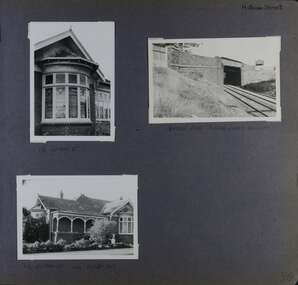
Album - Album page, Hotham Street, Circa 1972
... The survival of the riveted iron girders with their bellied angle iron struts is important since these elements are representative of the civil engineering practices of the Victorian Railways at the time and constitute the technical significance (Criterion F) of the structure. trevor hart elsternwick hotham street caulfield houses brick bay windows verandahs railway bridges tunnels gardens bluestone civil engineering victorian railways sharp and campbell contractors Handwritten: Hotham Street [top right] / 112 HOTHAM ST [under top left photo] / BRIDGE OVER SANDRINGHAM RAILWAY [under top right photo] / 112 HOTHAM ST CNR MELBY AVE [under bottom left photo] / 96 [bottom right] Page 96 of Photograph Album with three photographs (one portrait and two landscape) from Hotham Street - two external views of one house and a railway bridge. ...This photograph is part of the Caulfield Historical Album 1972. This album was created in approximately 1972 as part of a project by the Caulfield Historical Society to assist in identifying buildings worthy of preservation. The album is related to a Survey the Caulfield Historical Society developed in collaboration with the National Trust of Australia (Victoria) and Caulfield City Council to identify historic buildings within the City of Caulfield that warranted the protection of a National Trust Classification. Principal photographer thought to be Trevor Hart, member of Caulfield Historical Society. Most photographs were taken between 1966-1972 with a small number of photographs being older and from unknown sources. All photographs are black and white except where stated, with 386 photographs over 198 pages.Victorian Heritage Database - Hotham Street Road Overbridge HO116 Heritage Overlay - City of Glen Eira https://vhd.heritagecouncil.vic.gov.au/places/43557 (as of 04/07/2021) The Hotham Street road overbridge is located on the Sandringham railway line between Ripponlea and Elsternwick railway stations. It is presumed to have been built by contractors Sharp and Campbell who signed a contract on 25th . November, 1881 to construct a second line of railway between Windsor and Elsternwick. This contract was completed during 1882 and the bridge may have been designed in the year when Robert Watson took over from William Elsdon as engineer in chief for the Victorian railways. It is historically, aesthetically and technically significant. It is historically significant (Criterion A) to the extent that it demonstrates the standards of construction adopted by the Victorian Railways Department when it rebuilt the lines acquired from the private railway companies, (compare the Geelong and Melbourne Railway Co's line from Newport to Geelong, acquired in 1860). It is aesthetically significant (Criterion E) as an intact nineteenth century structure of its type, many similar girder bridges having been renewed with concrete girders in recent years. The bluestone abutments demonstrate high standards of stone masonry and are representative of Departmental work of the period. This bridge forms one of a group of historic structures on the railway to Brighton Beach and therefore contributes to the line's cultural importance as a whole. The survival of the riveted iron girders with their bellied angle iron struts is important since these elements are representative of the civil engineering practices of the Victorian Railways at the time and constitute the technical significance (Criterion F) of the structure.Page 96 of Photograph Album with three photographs (one portrait and two landscape) from Hotham Street - two external views of one house and a railway bridge.Handwritten: Hotham Street [top right] / 112 HOTHAM ST [under top left photo] / BRIDGE OVER SANDRINGHAM RAILWAY [under top right photo] / 112 HOTHAM ST CNR MELBY AVE [under bottom left photo] / 96 [bottom right]trevor hart, elsternwick, hotham street, caulfield, houses, brick, bay windows, verandahs, railway bridges, tunnels, gardens, bluestone, civil engineering, victorian railways, sharp and campbell, contractors -
 Glen Eira Historical Society
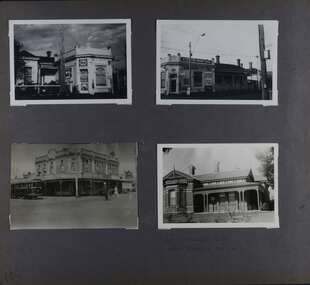
Album - Album page, Kambrook Road, Circa 1972
... It is aesthetically significant (Criterion E) as a very early example of a Queen Anne influenced late Victorian villa, comparing at the State level with ''Woodlands'' (1888), North Essendon, generally acknowledged to be one of Australia's earliest houses to fully exploit this emerging style. ...This page of photographs is part of the Caulfield Historical Album 1972. This album was created in approximately 1972 as part of a project by the Caulfield Historical Society to assist in identifying buildings worthy of preservation. The album is related to a Survey the Caulfield Historical Society developed in collaboration with the National Trust of Australia (Victoria) and Caulfield City Council to identify historic buildings within the City of Caulfield that warranted the protection of a National Trust Classification. Principal photographer thought to be Trevor Hart, member of Caulfield Historical Society. Most photographs were taken between 1966-1972 with a small number of photographs being older and from unknown sources. All photographs are black and white except where stated, with 386 photographs over 198 pages. First 2 images: milkbar and residence corner Kambrook and Balaclava Roads ie south west corner - building named Airdrie 3rd image: https://vhd.heritagecouncil.vic.gov.au/places/43737 - re 26 Kambrook Road and 345 Balaclava Road corner building ie south east corner: A prominently situated two-storeyed complex of late Victorian buildings consisting of "Wybar's Buildings" occupying the Balaclava Road/ Kambrook Road corner and the "Caulfield Bakery" facing Kambrook Road, separated by a driveway from a single storeyed shop. The main building has a comer splay and balustraded parapet with curved pediments, the words "Wybar's Buildings 1887" having been obliterated but "Caulfield Bakery 1887" with the characteristic wheatsheaf surviving in raised cement work. The walls are stuccoed and richly ornamented with bracketed cornices and keystones with masks extending to the Bakery. The main building is further distinguished by the Masonic symbol of the mason's dividers in the pediment whilst the upper level of the bakery is in overpainted brickwork. The single storeyed shop incorporates the bracketed cornice and consoles characteristic of the main buildings and is in other respects a utilitarian structure. 4th image: https://vhd.heritagecouncil.vic.gov.au/places/42415 (on 24/01/2021) - 196 Kambrook Road An imposing late Victorian poly-chrome brick asymmetrical villa with corner verandah and projecting west facing wing with faceted window bay to the facade. Body bricks are red and relieved by cream and black brick banding and by cream bricks to the bracketed eaves. The fretted barge with king post treatment and timber posted verandah are unique in the Municipality and unusual in the metropolitan area and demonstrate an understated appreciation of the emerging Queen Anne mode.345 Balaclava and 26 Kambrook Roads HO91 - City of Glen Eira https://vhd.heritagecouncil.vic.gov.au/places/43737 (on 24/01/2021) "Wybar's Buildings" at the corner of Balaclava Road and Kambrook Road are important as a prominent late Victorian commercial development incorporating a variety of activities including a bakery and possibly a coffee palace, the latter understood to be unique within the municipality, but characteristic of the period. It is a rare complex of its type in Caulfield and is important also as evocative evidence of the late Victorian Land Boom and the creation of a small now defunct commercial centre at this location by the George Wybrow. 196 Kambrook Road HO122 - City of Glen Eira https://vhd.heritagecouncil.vic.gov.au/places/42415 "Glencoe" is situated at no. 196 Kambrook Road, Caulfield North and was built for the boot manufacturer, Robert Bruce Mair, in 1888. It is of historic and aesthetic significance. It is historically significant (Criterion A) as the home of an inner suburban industrialist, notable a boot manufacturer, demonstrating the attraction of Caulfield as a residential location for the manufacturers of the metropolis during the late Victorian Boom period. It is aesthetically significant (Criterion E) as a very early example of a Queen Anne influenced late Victorian villa, comparing at the State level with ''Woodlands'' (1888), North Essendon, generally acknowledged to be one of Australia's earliest houses to fully exploit this emerging style. The ornamental timberwork is especially expressive of the new architectural fashion and compares with the house at 33 Clarence Street, Elsternwick (1888-89).Page 105 of Photograph Album with two photographs of a milk bar and attached residence, one older photograph of Wybar's Building and another photograph of a house on Kambrook Road (all are landscape).Handwritten: 196 KAMBROOK ROAD / 1970 - GAFFNEY MRS S.M. [under bottom right photo] / 100 [bottom left]trevor hart, kambrook road, victorian style, caulfield north, parapets, wybar's buildings 1887, caulfield bakery 1887, architectural features, painted bricks, balaclava road, george wybrow, shops, milk bars, airdrie, polychrome bricks, verandahs, queen anne architectural style, houses, glencoe, robert mair -
 Bendigo Historical Society Inc.
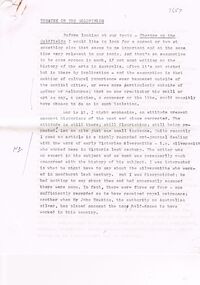
Document - PAPER BY FRANK CUSACK: 'THEATRE ON THE GOLDFIELDS''
... Reference to Theatre Royal; Yates (lessee); Gregg (lessee); Carcross's Royal Exchange Restaurant; Wright's tent theatre; Victorian saloon; Sydenham Gardens; Burton's Circus; C H Rignold; Royal Victoria Theatre; Princess Theatre; Criterion Hotel; Fawcett Rowe; Lola Montez; Criterion Theatre; Henry Coleman; G V Brooke; Burralls Assembly Rooms; Nicholls Assembly Rooms; Shamrock Concert Hall; Bendigo Hotel; Billy Heffernon; John Crowley; Thatcher; Greville; Joe Small; Fanny Young; Frank Varley; Lyceum Theatre; Haymarket; Bendigo Histrionic Club; Garrick Club; Sandhurst Philharmonic Society; Abbott; new Lyceum theatre; Richard Younge; opera house; St. ...Reference to Theatre Royal; Yates (lessee); Gregg (lessee); Carcross's Royal Exchange Restaurant; Wright's tent theatre; Victorian saloon; Sydenham Gardens; Burton's Circus; C H Rignold; Royal Victoria Theatre; Princess Theatre; Criterion Hotel; Fawcett Rowe; Lola Montez; Criterion Theatre; Henry Coleman; G V Brooke; Burralls Assembly Rooms; Nicholls Assembly Rooms; Shamrock Concert Hall; Bendigo Hotel; Billy Heffernon; John Crowley; Thatcher; Greville; Joe Small; Fanny Young; Frank Varley; Lyceum Theatre; Haymarket; Bendigo Histrionic Club; Garrick Club; Sandhurst Philharmonic Society; Abbott; new Lyceum theatre; Richard Younge; opera house; St. ...'Theatre on the Goldfields'' - paper by Frank Cusack. Two versions of this paper - an incomplete version (foolscap) of 6 pages and full version (A4) with pencilled annotations (19 pp). (Incomplete version covers pages to p11). Reference to Theatre Royal; Yates (lessee); Gregg (lessee); Carcross's Royal Exchange Restaurant; Wright's tent theatre; Victorian saloon; Sydenham Gardens; Burton's Circus; C H Rignold; Royal Victoria Theatre; Princess Theatre; Criterion Hotel; Fawcett Rowe; Lola Montez; Criterion Theatre; Henry Coleman; G V Brooke; Burralls Assembly Rooms; Nicholls Assembly Rooms; Shamrock Concert Hall; Bendigo Hotel; Billy Heffernon; John Crowley; Thatcher; Greville; Joe Small; Fanny Young; Frank Varley; Lyceum Theatre; Haymarket; Bendigo Histrionic Club; Garrick Club; Sandhurst Philharmonic Society; Abbott; new Lyceum theatre; Richard Younge; opera house; St. James Hall; Royal Princess Theatre; Masonic Theatre; Bendigo Dramatic Society; Bendigo Glee Club; Bendigo Amateur Dramatic Club; Bendigo Orchestra; Bendigo Liedertafel; Alice Crawford; Conservatorium of Music; E A Bindley.Frank Cusackentertainment, theatre, history, frank cusack, royal theatre, wrights tent theatre, burtons circus, c. h. rignold, burralls assembley rooms, nicholls assembley rooms, shamrock concert hall, garrick club, st james hall, royal princess theatre, alice crawford, lyceum theatre. e a bindley. -
 Glen Eira Historical Society
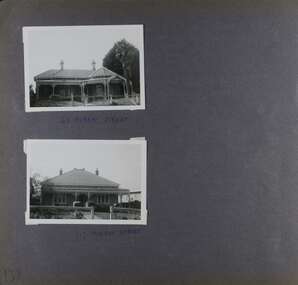
Album - Album page, Murray Street, Circa 1972
... house at adjoining No.61. It is aesthetically significant. It is aesthetically significant (Criterion E) as an exceptionally richly ornamented medium sized Boom period villa in Caulfield South, being unusual in this respect in its locale and comparing with nearby "Sprouston" at 19 Blanche Street (1887). ...This photograph is part of the Caulfield Historical Album 1972. This album was created in approximately 1972 as part of a project by the Caulfield Historical Society to assist in identifying buildings worthy of preservation. The album is related to a Survey the Caulfield Historical Society developed in collaboration with the National Trust of Australia (Victoria) and Caulfield City Council to identify historic buildings within the City of Caulfield that warranted the protection of a National Trust Classification. Principal photographer thought to be Trevor Hart, member of Caulfield Historical Society. Most photographs were taken between 1966-1972 with a small number of photographs being older and from unknown sources. All photographs are black and white except where stated, with 386 photographs over 198 pages. 63 and 117 Murray Street houses are extant (Google maps image capture Dec 2018).Victorian Heritage Database - HO131 63 Murray Street Caulfield https://vhd.heritagecouncil.vic.gov.au/places/35569 (as of 14/08/2021) "Marston" at no. 63 Murray Street, Caulfield South, was built by J.E. Guest, a contractor resident in nearby Downshire Road, in 1889-90, presumably as a speculative venture together with the extant house at adjoining No.61. It is aesthetically significant. It is aesthetically significant (Criterion E) as an exceptionally richly ornamented medium sized Boom period villa in Caulfield South, being unusual in this respect in its locale and comparing with nearby "Sprouston" at 19 Blanche Street (1887). Important contributory elements include the polychrome brickwork, frieze and verandah including the half timbered gablet which would have been stylistically innovative in its day.Page 139 of Photograph Album with two landscape photographs of two different houses in Murray Street. Handwritten: 63 MURRAY STREET [under top photo] / 117 MURRAY STREET [under bottom photo] / 139 [bottom left]trevor hart, garden, verandah, murray street, elsternwick, victorian style, houses, marston, house names, j e guest, verandahs, polychrome bricks, cast iron work, chimneys -
 Glen Eira Historical Society
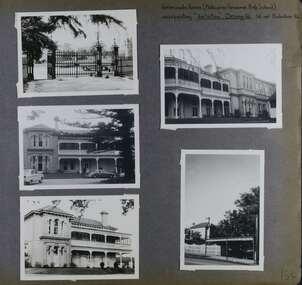
Album - Album page, Grimwade House, Orrong Road, Circa 1972
... Both Grimwade and his house are exemplars of the commercial enterprise of the Boom period and the amassing of personal fortunes with which it is associated. It is aesthetically significant (Criterion ...This photograph is part of the Caulfield Historical Album 1972. This album was created in approximately 1972 as part of a project by the Caulfield Historical Society to assist in identifying buildings worthy of preservation. The album is related to a Survey the Caulfield Historical Society developed in collaboration with the National Trust of Australia (Victoria) and Caulfield City Council to identify historic buildings within the City of Caulfield that warranted the protection of a National Trust Classification. Principal photographer thought to be Trevor Hart, member of Caulfield Historical Society. Most photographs were taken between 1966-1972 with a small number of photographs being older and from unknown sources. All photographs are black and white except where stated, with 386 photographs over 198 pages. From Victorian Heritage Database citation HO54 Grimwade House, former Harleston stables, outbuilding, garden, gate and Picconia excelsa tree. https://vhd.heritagecouncil.vic.gov.au/places/35573 as at (28/10/2020) ''Harleston'', now "Grimwade House", is situated at no. 67 Balaclava Road, Caulfield North, at the Orrong Road corner. It was built for Frederick, later Sir Frederick, Grimwade, to the design of architect Thomas Watts in 1875. Today the complex has been incorporated in the Melbourne Grammar Junior School campus. It retains not only the main house but also the stables and mature garden setting with driveway and gates. It is historically, aesthetically and socially significant.From Victorian Heritage Database citation HO54 Grimwade House, former Harleston stables, outbuilding, garden, gate and Picconia excelsa tree. https://vhd.heritagecouncil.vic.gov.au/places/35573 as at (28/10/2020) It is historically significant (Criterion A) as the former home of prominent business man, speculator and benefactor, Sir Frederick Grimwade. Both Grimwade and his house are exemplars of the commercial enterprise of the Boom period and the amassing of personal fortunes with which it is associated. It is aesthetically significant (Criterion E) as an imposing yet stately large house of its time, the classic Italian form with comer verandah terminated by projecting wings being most distinctively seen in this instance. It is enhanced not only by the garden setting but also by the delicate cast iron verandah spandrels, stained glass work and stencilled ceiling in the music room. It is socially significant (Criterion G) on account of the value placed on it by the community associated with the Melbourne Grammar Junior School since its inception on this site in 1911.Page 154 of Photograph Album with five photographs (4 landscape and one portrait) including Grimwade House, gates and a tram shelter.Handwritten: Grimwade House (Melbourne Grammar Prep School) / incorporating "Harleston" Orrong Rd. S.E cnr Balaclava Rd [top right] / 154 [bottom right]trevor hart, verandah, porch, slate roof, garden, grimwade house, grimwade, harleston, sir frederick grimwade, thomas watts, orrong road, balaclava road, melbourne grammar, melbourne grammar junior school, italianate, cast iron verandah spandrels, stained glass, stencilled ceiling, mgs, m.g.s, school, grimwade family, jessie grimwade, gates, palisade style fence, cast iron spears, stone plinths, melbourne grammar prep school, victorian style, cast iron work, caulfield north, gardens, cars, tram services, outbuildings, stables, trees, picconia excelsa tree -
 Glen Eira Historical Society
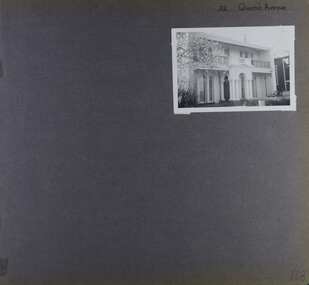
Album - Album page, 32 Queen's Avenue, Circa 1972
... house at no. 32 Queens Avenue, Carnegie, was built in 1888 and formed one of an identical pair since demolished. It was built for and formed part of a land development scheme undertaken by one of Sir Matthew Davies group of speculative companies known as the Freehold Investment and Banking Company of Australia Ltd. It is historically and aesthetically important. It is aesthetically important (Criterion ...This photograph is part of the Caulfield Historical Album 1972. This album was created in approximately 1972 as part of a project by the Caulfield Historical Society to assist in identifying buildings worthy of preservation. The album is related to a Survey the Caulfield Historical Society developed in collaboration with the National Trust of Australia (Victoria) and Caulfield City Council to identify historic buildings within the City of Caulfield that warranted the protection of a National Trust Classification. Principal photographer thought to be Trevor Hart, member of Caulfield Historical Society. Most photographs were taken between 1966-1972 with a small number of photographs being older and from unknown sources. All photographs are black and white except where stated, with 386 photographs over 198 pages. From Victorian Heritage Database citation for HO137 32 Queens Ave, Caulfield East https://vhd.heritagecouncil.vic.gov.au/places/35536 as at (30/10/2020) The house at no. 32 Queens Avenue, Carnegie, was built in 1888 and formed one of an identical pair since demolished. It was built for and formed part of a land development scheme undertaken by one of Sir Matthew Davies group of speculative companies known as the Freehold Investment and Banking Company of Australia Ltd. It is historically and aesthetically important. It is aesthetically important (Criterion E) as an unusual terraced building form in Glen Eira that stands apart from its neighbours which were built predominantly after the tum of the twentieth century and which is further distinguished by the cast cement ornamentation applied to the central porch.Page 168 of Photograph Album with one photograph of a house on Queen's Avenue. Handwritten: 32 Queen's Avenue [top right] / 168 [bottom right]trevor hart, cast iron lacework, decorative brackets, chimneys, verandah, porch, cast iron columns, queens avenue, 1880's, sir matthew davies, matthew davies, freehold investment and banking company of australia ltd, cast cement ornamentation, arches, caulfield racecourse, portico, stone columns, full length french windows, fanlight, caulfield, race course, queen's avenue, caulfield east, land subdivision, victorian style, cast iron work, rendered mansions, lead lights, terraced buildings -
 Glen Eira Historical Society
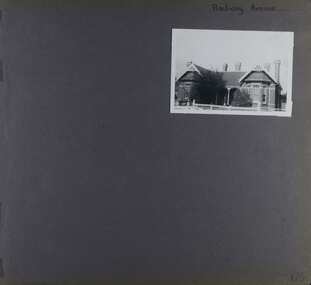
Album - Album page, Railway Avenue (ie Railway Parade), Circa 1972
... It is aesthetically significant (Criterion E) as an early example of the Queen Anne style in Glen Eira and as an isolated early building facing the railway station in Murrumbeena. trevor hart chimneys verandah porch 1890's alnwick railway parade sir james patterson james patterson single storey murrumbeena station red brick gable murrumbeena railway avenue victorian style house names queen's avenue queen anne style protruding bay windows premiers polychrome bricks Handwritten: Railway Avenue [top right] / 170 [bottom right] Page 170 of Photograph Album with one photograph of a house on Railway Avenue. ...This photograph is part of the Caulfield Historical Album 1972. This album was created in approximately 1972 as part of a project by the Caulfield Historical Society to assist in identifying buildings worthy of preservation. The album is related to a Survey the Caulfield Historical Society developed in collaboration with the National Trust of Australia (Victoria) and Caulfield City Council to identify historic buildings within the City of Caulfield that warranted the protection of a National Trust Classification. Principal photographer thought to be Trevor Hart, member of Caulfield Historical Society. Most photographs were taken between 1966-1972 with a small number of photographs being older and from unknown sources. All photographs are black and white except where stated, with 386 photographs over 198 pages. From Victorian Heritage Database citation for HO57 Alnwick, 11 Railway Parade Murrumbeena https://vhd.heritagecouncil.vic.gov.au/places/35369 as at 30/10/2020 Alnwick" is situated at no. 11 Railway Parade, Murrumbeena, and was built for Sir James Patterson, former Commissioner of Public Works and Railways and Premier and Chief Secretary at the time. It is historically and aesthetically significant. It is historically significant (Criterion A) as the home of a former Premier and MLA who held a multitude of senior positions during his term of office spanning between 1870 and 1895. These positions included Commissioner of Public Works, Vice President of the Board of Land and Works, Postmaster General, Commissioner of Railways and Commissioner of Trade and Customs and Minister of Railways. Importantly, he held these offices during the period of Colonial expansion leading up to the economic crash of the early 1890s. It is aesthetically significant (Criterion E) as an early example of the Queen Anne style in Glen Eira and as an isolated early building facing the railway station in Murrumbeena.Page 170 of Photograph Album with one photograph of a house on Railway Avenue.Handwritten: Railway Avenue [top right] / 170 [bottom right]trevor hart, chimneys, verandah, porch, 1890's, alnwick, railway parade, sir james patterson, james patterson, single storey, murrumbeena station, red brick, gable, murrumbeena, railway avenue, victorian style, house names, queen's avenue, queen anne style, protruding bay windows, premiers, polychrome bricks
