
Showing 252 items matching " king design"
-
 Whitehorse Historical Society Inc.
Article, The Secrets of Hardwood King, 1980's
... 'The Hardwood King' designed and built more than 50 craftsman bungalows in Blackburn in the early 1900's....Algernon John Elmore (1882 - 1961) or 'The Hardwood King' designed and built more than 50 craftsman bungalows in Blackburn in the early 1900's....'The Hardwood King' designed and built more than 50 craftsman bungalows in Blackburn in the early 1900's. ...Algernon John Elmore (1882 - 1961) .Algernon John Elmore (1882 - 1961) or 'The Hardwood King' designed and built more than 50 craftsman bungalows in Blackburn in the early 1900's.Algernon John Elmore (1882 - 1961) .elmore, algernon, john, elmore houses -
Glen Eira Historical Society
Book - Glen Huntly State School No.3703 Grange Road
... ... King Design...Glenhuntly State School Greengrocers King Stephen King Design Alessi Libby Principals McGowan Keith Radio Broadcasting Hunt Sydney Forbes C. ...A 190 page book called The Story So Far 1914-2009 – The History of Glen Huntly Primary School No.3703, by Shirley A. Mirams. The book gives a very detailed history of the school’s early history. It includes head teachers/principals and the school’s progress through each decade to 2009. The remaining chapters give 2009 student roll call, citizenship awards, house competition awards, music awards, sporting awards, encouragement, swimming and musical productions, notable past students and teachers, bibliography and sponsors. There are many photos and school plans as well.glen huntly, glen huntly primary school, glenhuntly primary school, mirams shirley a., glenhuntly printing works, printing industry, from the earth fruit and veg., glenhuntly state school, greengrocers, king stephen, king design, alessi libby, principals, mcgowan keith, radio broadcasting, hunt sydney, forbes c., ramsay m., primary schools, glenhuntly state school, jenkin william, bryant a., orames mr, morrison r., christensen t., doggett j., rogers a., fink r., terrill f., mitchell j., cravine e., mcrae w., cooper l., chernside c., silva a.j., dolphin w., crampton colin, wilson wendy mrs, glenhuntly road, glen huntly, clerk's estate, subdivisions, glen huntly clerk's settlement, carnegie school no. 2897, world war 1914-1918, gardens, mothers clubs, world war 1939-1945, poliomylitis, rural training school, traffic signals, films, 'slow bike race', parents and friends association, after school program, fires, 'links' magazine, choirs, disadvantaged schools program, school plays, 'germs', 'garden folk', festivals and celebrations, japanese internship program, 'kids in space', 'dragon girl', 'fish 'n' ships', murals, wendy wilson music award, fetes, lord reserve, carnegie, australian natives association, congregational chuch sunday school hall, martell e miss, garden avenue, grange road, salvation army halls, halls, glenhuntly road, wanalta road, williamson alex, williamson jean, williamson gordon mccrae, school rolls, le brocq john, cockfield douglas r., grogan allen, mathiesson edward, johnston ronald frank, harris george, money neil robert, fraser eric, munro john, hyland hector thos., gibson wilfred john, eliason francis, scarles john robert, wallace andrew, henning george frederick, maryson sydney, petherbridge c., whitfield j., edward lee, queen alexander, carnegie state school, madden frank sir, parliamentary representatives, bank of new south wales, charles ernest, wallace andrew james, hunt chas. hogarth, williams stanley f., tester thomas george, henstridge john, henstridge reginald, johnston travis andrew, nixon alexander, lewis victor, dalton john, arthurs violet grace, browning leslie george, carroll eric harry, dobson keith george, evans george w.m., eyres annie may, hogg lillian, hunt alfred w.m., johnson henry, jones dorothy minnie, love helvic agnes, lyons gordon, lyons vera, parsons eric robert, dickens gordon percy, smith elva beatrice, harry david, westcott harold norton, westcott ormond chs., bremner marie, entertainers, williamson alex mccrae, ransay albert, caulfield town hall, green ethel, hawthorn alice, reynolds emma a., potter thelma, potter phyllis, anderson elsie m., girdwood stella, bastin may, murphy dorothy g., southern mary, mcleod gwen, ezard gladys m., hood emily vera, thorne eileen isobel, robinson noel, monckton marjorie, mrs hannigan's tuckshop, foley children, lord mr., bladin francis, tomlinson jean, jenkins vern, williamson jean, forty alan, rhinefield mr, bennett mary, brabham laurel, swain george, reynolds mille, gill harry, williamson g., cockfield winifred, baird beth, king elsie, challman miss, glen huntly 'drum and file' school band, larkin aircraft supply company, sugarworks swamp, lemans swamp, lyons streets, morgan streets, miller street, lizars linda, brown allan sir, hurie gladys, simpson peggy, royal ave., garden ave., tennis courts, lander h.j., castledine f.r., henning a.s., glen huntly progress association, harboard joan, mullins mr, pountney dorothy, daley beryl, marching clubs, findlay joyce, green lionel, charles ern, bennett mary, shelter sheds, blanchfield mr bakers, donoald mr grocers, walburn rhoda, harris shirley, treyvaud mr, hale maxwell, painter ken, allan mr ('fatty'), proven mr, ross mrs, nye margaret, nally ware beaker, monuments and memorials, graham bruce, 'bulldog drummond', learmonth mary, bullock margaret, o'shea annie, tattersall dawn, jenkins betty, lighton robert, bruce peter, love grace, love family, judd margery, gardiner elsie, gardiner sadie, glen eira dairy, vanston dorothy, barton cynthia, tipping mr, drummond mr, hambly chrissy, shrives kathleen, hutton beverly, miller kenneth deering, callender mr bakers, cook miss, nunn john athlete, andrews ailsa (nee mcgregor), fraser wally, vickers madeline, vickers john, scanlon mr, malcolm miss, brown barbara (nee holland), pepper miss, burns miss, mclaren miss, beadman jim athletics, robinson noel, crompton neal sportsperson, wilkinson graham, neilson ray, byers barry, bryant tony referee, murray bob, burton pam, pappas george, burke b. mrs, neville street, smith harvey, o'donnell mrs, kivlighon mr, grierson wendy, evans yvonne, squires doreen, squires kathy, jenvey stewart, baxter john, coenen eddie maintenance workers, byrne carol, williams pamela, zari austin (nee coenen), furney janet, dodds mrs, mitchell j., bell r., forsyth e. miss, mitchell neil, radio broadcasting, burke m., boatman r., garfield d., harris e. mrs, sherman m. mrs, carolan e., gunthorp b., barnes john, barnes joan, ellis christine, kossatz mr, black miss, lader mrs, franghis peter, parnell dennis, revens ester, young vivian, mclean bernice, tattersal lorna, geddes rae, hocking malcolm, cusworth peter, christie glenn, watt richard, conway gred, hand graham, mcgowan e., parnell j., mcguire n, hare john, prest margaret, forrester david, mitchell eric, cordingley mrs, waterworth mr, cohen mr, rankin fiona, christiansen mr, boatman mr, dougan mrs milkbars, dougan barry, suttie richard, parnell bruce, silverman judy, king jenny, saxon sally, king nicolette, maxwell heather, saxon jill, vincent russell, saxon rosemary, murray bob, saxon david, miller bill, hill sally-ann, hesline sandra, raspberger cynthia, nightingale mrs district remedial centre, smith mrs, district language consultant, robertson gabrielle, mclennan matthew, goloub kin lyn, jarrett mavis, schafer dianne, commerford pip, mcdougall carlene, anderson jack, hawthorne russell, callahan evelyn, zagami maria, bremner elizabeth, braun tiki, berman claudine, briggs margaret, brady sue, shaw melissa, henham ravena, cooper tania, de abrev connie, brodie joanne, macdonald leighan, mccallum margaret, beddoe john, mcdonald mr council employee, clift andrew, ash steven, lowndes nerida, wysocki b., drough h., grossbard j., locke j., cox l., morey l., clifton p., short b., herszberg n., clift debbie, fuk michael, theodosopoulos haria, shrives jean (nee tomlison), forty alan, geiger irit, roach sally, hillis rachael, roache donna, dixon wendy, bayliss curtis, pregnall joy mrs, slocum mrs, nelson glenda, rubinstein morrie, lurkey dianne, mcminn michael, arneil barbara, mick rose, mell and alice, brayton andrea, moorhead k. rev, brownhill e., lolas heather mrs, regan bernie cleaner, hopkins a. mrs, dewar leon, school crossings, darak diana, eddey diana, pregnall max, eppinger rosy, stacy paul, douvitsas chris, maycock kelly, bunyan liza, johansen eva, siaosi jackie, don kerrie, smyth ruth, bruce julie, mcgregor lorraine, mcallister peter, nelson g., knight sue, mackey s., mackinnon julie, mccallum margaret, johannsen j., herzberg n., hall k, jarrett m., johns w., beddoe john, wilson w., dayble l., thomas helen, ogura etsuko, coxon diane, guttman emmy, garg sangeeto, kennedy robyn, coleman heidi, thompson vic, currie sioux, arnold eve mrs, beddoe mr, mckay sara, skilney tamara, zent mandy, sassos eugenia, manvel bill, lewis pam, rothstadt kaye, clerehan jane, watson simon, daw josie, strong helen, craig caroline, devasagayam kenny, bell peter, palanarezuk fiona, suttie mitchell, mirians shirley, prest marg, condon gabrielle, pitkin sigrid, wilson heather, don paul, thursfield william, footballers, ormond junior football club, rothstadt david, bruce julie, fallu jackie, patterson denise, trantor debbie, nakamura nozomi, christensen tanya, james-clark spencer, eppinger rosy, matsumoto minako, osborne cheryle, john beddoe meritorious sporting student award, sunderland pippa, schleiger emma, paulusz chris, hollingworth kyle, griffiths david, cooper cameron, jewel andrew, nannegaril (nick) abhishek, marshall joel, hodden leigh, meyer tony, te hennepe michael, zimbachs trent, chavili praveen, listmangof mark, sampson tim, sayfer daniel, mest jack, crampton colin, crampton andrew, hemming beth, dean deirdre, wong melissa, arneil christopher, friedman adam, sonnberger leonie, mackey suzanne, clarke heather, fernando gyan, horvath eva, horvath melissa, horvath natalie, rowe rebecca, taylor yani, robinson tess, nolan rebecca, hollingworth mamie, trigellis-smith anna, zhou cindy, jenvey olivia, smith yasminka, hemming caitlin, gale elke, johnson christopher, dalton lyndsay, perish james, seddon anna, webster teagan, stratford sachi, zhuang yvette, taylor katherine, tettennepe simon, hu kevin, thursfield oliver, beycher sonny, gavland angelene, fotopoulos daisy, mcclelland letty, king sierra, sargeant kolly, hodden melissa, picking kate, brasic lisa, mcclelland cassie, cummins alexandra, jamieson laura, cashen lanaya, rowe angela, georgiou jonathon, pejovic maja, luv aileen, hoskin yumika, bishop amy, tweed jacqueline, corrales mariana, williams kendall, jewell bethany, friedman sara, golden phoebe, mellios lauren, sayfer charlene, bell daniel, glagovski anton, ring hannah, aldred jasmin, sisson laura, king janine, allen robbie, taylor xavier, trigellis-smith colin, italia paula, tamura naoko, eddy diane, paterson denise, clarke heather, hemming beth, wilson wendy, wallace gaye, moore denis, plumb rochellee, schmauder debra, taylor kathrine, gale elke, taylor yani, sisson laura, fotopoulos daisy, zuccala lyn, smith phyllis, katz lily, sonnberger leonie, quail janine, prest margaret, zhang karen, indukuri gita, prest duncan, prest julieann, dureau sally, hopkins anna, baligod imelda, fallon kerry, bjelanovic danijela, james-clark laura, magnani lisa, phillips kathy, bell hilary, bakshi jasmeet, james-clark spencer, james-clark mason, james-clark stella, fitzgerald kerrie, krawze kamila, czech jon, lee maria, boell jacqueline, schmauder debra, georgiou martha, randles yvonne, smyth ruth, florrimell sean, ryan patrick, rossjohn sian, eppinger rosy, melenhurst bradley, melenhurst ashley, melenhurst christopher, silva katie, richards michael, garner jenny, bucher peter, gleitzman morris author, zhou jun, cook andrew, memorial services, funerals, wendy wilson hall, rossjohn jamie, earls tom, nicholls stephanie, vagner natasha, anderson pam, hall aileen, grose jenny, dalton sue, bejers maya, paterson denise, witte david, lath natalie, dalmau jessica, darras irene, miljus max, moritmitsu ran, zhou yida, barns sue, varbaro bianco, howell alan, lath miss, jacobs john, tinetti amy, maloney matthew, petrovic vida, bruce julie, bonner angie, porter ros, hill andrea, hocking hazel, jozsa zara, wishart jan, guyer noeline, powell bruce, hopkinson judy, mccrae glenys, mccrae beverly, james margot, barns tony, barns joan, ryan ann artist, jenek alex, jozsa olivia, woods caitlin, ledda daniel, cook andrew, rossjohn bevan, aunavarapu ashray, loveas paul, beiers mariel, allan gemma, squires rhoda, squires garry, squires terry, squires lesley, squires rhonda, squires doreen, squires peter, squires kathy, king sierra, king tynan, king mackenzie, king harrison, king shuyler, allen robbie, allen jessica, allen samantha, dale sheridan, dale caroline, dale elliot, dale taylor, dale clark, woodards carnegie auctioneers, roberts ruth, mckenzie's ward, glenhuntly fruit supply, ceudet and kubeyde, subway glenhuntly, alessi libby mrs, manuel bill mr, bruce julie ms, jacobs john mr, paterson denise mrs, thompson vic mr, sonnberger leonie mrs, sassos eugenia mrs, witte david mr, krauze maila ms, tinetti amy ms, bower jessica mrs, fitzgerald kerrie mrs, eppinger rosie mrs, vagner natasha mrs, zent mandy mrs, james-clark laura mrs, fallon kerry mrs, grose jenny mrs, bonner angie mrs, miriams shirley mrs, petrovic vida mrs, maloney matthew mr, bakshi jameet mr, smyth-kinyua ruth mrs, fitzpatrick tom mr, watson scott mr, theodore kate ms, porter ros ms, hill andrea ms, howell alan mr, schauder emma mrs, jozsa george mr, bitmead claire mrs, bader linda ms, jacobs john mr, bhuteja raza, rossjohn bevan, christensen lara, dale clark, chong aldwin, barns-dunne genevieve, guy cleo, georgiou demetrius, allen gemma, arunachalam elanthendral thiruavani, chau samantha, foldvari miro, gade saathvika, ghafari mohid, jones alvin, korres johnny, margaritis evan, pickering finley, schauder daniel, shah hisha, shermis-fox dalvin, thorat sahil, zhong emma, arunkumar mitali, baxi vaasu, bhadra rushil, chevalier stefanie, bitmead rose, cooper brittany, jozsa zara, croes sonny, gil harnoor, koika akito, gitein iris, matthews benjamin, moses lior, gupta anushka, nematy keanu, jaiswal sanjana, makwana yash max milius, o'donoghue romy, patel vishesh, nalamati anushka, paul aaron, obsioma jarred, pavlich nicola, rizk taran, schauder ben, shah vansh, stuart isobel, yadavalli sriprada, sharma shreya, tut nyajania, zhao max, abeyesekerea gail, attanayake nikeesha, behl shaurya, desai noopur ankoor, espinosa daphne, kansara kesha, kantheti sai rithvik, malakar ishan, manion freya, mohammed zoheb, morimitsu ran, moshe sarit, peri varsha, reutskiy yael, ryan harrison, shah jahanvi, wallis hannah, woods liam, bhuteja raza, belyuga lachlan, chen linda, bikovsky alexander, das sanchali, bitmead william, ghafari malaika, cherukuihota ritish, jenek alex, chintala aditi, lvovsky jeremy, dumnounkan nicky, mazzocchi ashleigh, el shorbagy hanna, mohammed zeeshan, foldvari phoebe, nekkadapu prava, gill armann, obsioma joseph, harper tyler, pickering jasper, kanapathippillai noah, pronina anja, kat jemma, pudikova veronika, king schuyler, reutskiy nicole, nikitin daniel, rossjohn bevan, o'connor finnian, schauder hannah, parsons zoe, shaked natalie, shang alexander, sharmila ajit aaditya arya, shulz david, siah sunny, singh gab, woods caitlin, wallis eliza, yang jee, zhong michelle, zhang alan, zhou stella, zhang betty, arjuna vicknan, arunachalam thirumagal, bahambhani yog, christensen lara, dale clark, hoenig tess, jozsa olivia, knelle louise, kwon minchol, lin angelina, milyus sophie, modi dhriti, morimitsu rin, moses nikol, noh yuhan, raghav devrath, rule darcy, tran cindy, trivedi namit, vayenas christina, vaz adonis, vortman david, allan liam, annavarapu ashrey, attanayake akeshi, capicchiano rose, chilakamarri nikhil, davis oliver, forti kate, guo maggie, guy cleo, james zoe, jenek ada, kalra pravav, king harrison, lin angelo, lin anita, melenhorst bradley, melenhorst christopher, metzler jessica, moses tomer, perelman michael, ryan patrick, wheatley nathaniel, allen gemma, bailey crystal-lee, gan tina, georgiou demetrius, ghafari kainat, grigorian nick, hackshaw chris, howell benjamin, kuznetsov ilya, luo eileen, luo elaine, margaritis mary-anne, melenhorst ashley, morimitsu rui, omer-cooper james, ozgur batuhan, salathiel matthew, vayenas paulina, wang qi wei, ward monica, arabena. brittany, bader-mcdowell alexander, barns-dunne genevieve, beiers mariel, chilcott rose, chong aldwin, cook andrew, dale taylor, dalton eamon, durant demeke, horn jade, iker korkhan, kat mariana, kwon so hyun, ledda daniel, loucas paul, panchal rajvi, ragozin vadim, reyer emma, song alex, varbara sovan, zhou james, robertson angela, henkul roland, hannagan cassie, rice elizabeth, ryan tammy, stacey paul, mason rebecca, ammendola marcella, moore m., copey n., priesner m., cotterell d., cohn adam, don paul, don kerrie, hanley alison, mckechnie brian, gowland rebecca, te hennepe daniel, schleiger emma, zimbachs trent, rowe rebecca, taylor katherine, beycher sonny, halliburton andrew, dureau thomas, dureau nicole, thursfield alexandra, allen courtney, willis isabelle, zhou jun, james-clark stella, melky michelle, willis ruby, earls tom, srinivasan lakshmi, zhou yida, te hennepe daniel, meyer tony, leiken nikita, thompson alex, te hennepe simon, johnson christopher, vassilopoulos michael, irwin christopher, asaturov gary, rossjohn sian, sangangum watsana, varbaro bianca, mitchell, hume, batman, brown robyn, maxwell jennifer, mclean jill, culpin howard, jones dennis, archer ?, lester phillip, taylor jennifer, anderson judith, ? bronwyn, hall robyn, powlett john, clark ross, taylor christine, booth peter, turner ian, porter larry, turner diane, anderson diane, scott megan, mclean david, christie donald, wishart philip, mottrim joan, christie coleen, travis bicki, watt elizabeth, richards michael, peet marily, sutherland fiona, ziegenbien kay, lester judith, kostamarkis con, yeoman keith, hastings ronald, ? mark, coenen zari, young vivian, young carolyn, weber elizabeth, child gary, cooper stephen, robertson james, ross dean, ? eve, cooper anne, saunders bruce, yeaman peter, wilkinson dawn, armstrong jeffrey, hill gregory, morris steven, suttie richard, silverman judy, king jenny, silverman sharon, broadmore janine, martin dean, smith robert, frommer ruth, saxon rosemary, justus heidi, o'keefe sue-ellen, robertson angela, young natalia, pigounis anthony, brodie anthony, henkul roland, duncan neil, cooper tania, brodie joanne, meerkin naomi, henham rowena, moulds adam, butterworth richard, kellis nick, tapai michael, goodwin sonia, clift debbie, hannagan shannon, marley kara, ceki tibor, ellis shaun, charleworth stewart, can bergeijk richard, schroor briony, leticq jeanette, davidson angela, kakos vicki, collins darren, mcfarlane matthew, adley hassan, agar james, rakonjac mileva, lowndes nereida, grimster jane, ? laurenne, mcdonell terry, clift andrew, perry timothy, rice martin, weir lisa, devasagayam briony, chatila nancy, melland alice, rakonjac nik, mcdonald brett, collins michael, rose darren, ryan tammy, rice elizabeth, hannagan cassie, mason rebecca, douvitasa chris, chivers scott, siaosi jack, stacey paul, moore matthew, coles lisa, diggins sebastian, barboussas costa, moulds johanna, brett travis, mcminn johanna, soloma tim, copey nicole, kakos peter, rontoyannis evan, mcdonald scott, pregnell ian, lowndes jared, kapetanos diane, ivkov srdjan, palamarczuk rosemary, cotterell diane, tonta amelia, craig caroline, yeun joseph, yusuf alham, quon kane, fiek peter, pitkin meryl, yarovsky julie, mckay sara, koger saskia, slocum tom, meyer sean, dunn nathan, vickers anthony, don paul, mason lulu, stanton bronwyn, hanley alison, don kerrie, kennedy chad, callaghan matthew, ghosh suvro, teteira jay, sargent kelly, hollingworth marnie, lack orry, wheeler ashley, trigellis-smith anna, hoskin tim, barda david, nolan rebecca, kulikov simon, kirkpatrick ryan, schleiger rudi, becker thomas, de lisle justin, taylor katherine, gale elke, te hennepe simon, ring hannah, stratford sachi, taylor yani, parish james, aldred jasmin, sisson laura, thursfield oliver, fotopoulos daisy, hoskin yumika, trigellis-smith colin, corrales mariana, soyfer charlene, moore vanessa, halliburton andrew, glagovski anton, johnson christopher, wheeler joel, taylor xavier, chapman jessica, ledda alexander, rowe angela, jewell bethany, goluguri pradeepthi, bell daniel, golightly callum, graham emily, mckechnie ellen, james-cark spencer, byrne david, parker natalie-lee, loucas david, pappas michael, gamble laurence, dureau thomas, loriot christina, drinozcky chloe, ring caitlin, robertson mitchell, pleysier yvonne, boghikian emie, sisson matthew, sanchez zanetta, rowe daniel, saunders john, cox josh, barda nick, dureau nicole, lenkiewicz justine, jamieson emily, mclaughlan kate, carpenter tess, vassilopoulos michael, jewell clare, gavnoudias james, matthews laura, georgiou costa, dale caroline, gamble kate, beiers hannah, james-clark mason, richardson zoe, thursfield alexandra, hosking kenta-neville, dounias theodore, annavaparu ramya, sinclair chloe, nolan megan, king tynan, tomlinson michael, allen courtnay, florrimell sean, ong kenny, foley patrick, gale emily, saunders alice, rowe michelle, willis isabelle, vassilopoulos alexandra, johnson bradley, borley genevieve, irwin christopher, earls thomas, matthews jessica, mudumbi venkatesh, lenkiewicz alice, king mackenzie, dounias christopher, beiers maya, dick alastair, levy matthew, srinivasan lakshmi, adams joshua, singh mia, borley natalie, varbaro bianca, christensen jade, willis ruby, sinclair emma, allen samantha, rossjohn sian, borley morgan, bader-mcdowell jeremy, chettimadda gopala kr yashas, anguswamy manoj, nekkadapu sankeerth, dalton kieran, allan tristan, gandham anoohya, arabena brittany, melenhorst ashley, vayenas paulina, dale taylor, bader-mcdowell alexander, omer-cooper james, reyer emma, kuznetsov ilya, metzler jessica, beiers mariel, forti kate, james zoe, annavarapu ashrey, ryan patrick, davis oliver, ilker korkhan, mcgowan keith, thursfield william, gribbin andrew, walsh-howling damien, scanlon alan, mitchell neil, brown allan, bruce peter, murray robert (bob), christensen tanya, de kretser jan, bremner marie, bayliss curtis, wheeler reece, symons red, de zilwa nick, byers gary, crompton neil, wilkinson graham, nilsson ray, bryant tony -
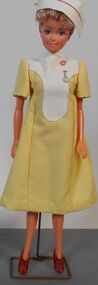 Northern District School of Nursing. Managed by Bendigo Historical Society Inc.
Education kit - Teaching aid - Doll, Nursing Through the Ages
... In 1972 Designed Noeline King designed a new uniform for the Northern District School of Nursing. ...In 1972 Designed Noeline King designed a new uniform for the Northern District School of Nursing. ...In 1972 Designed Noeline King designed a new uniform for the Northern District School of Nursing. Yellow and White dress with a yellow jacket. 1st worn by School 80 (31/07/1972) Students nurses wore this distinctive uniform in wards and were affectionately known as "Yellow Canaries"The Uniform was worn to the forced school closure in July 1989 as a result of transfer of nursing education into Colleges of Advanced Education. School 108 (4/8/1986) was the final school. 30cm Miniature Doll - Yellow and white dress with yellow jacket. Worn 1972 - 1986Name Tagnursing history, nursing uniforms, northern district school of nursing -
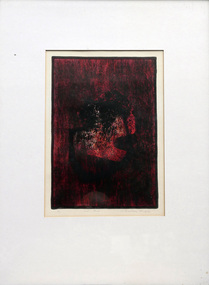 Robin Boyd Foundation
Work on paper - Lithograph, Grahame King, Red and Black, 1965
... Robin Boyd was a long time friend of Grahame King and sculptor Inge King and he designed their Warrandyte home and studio in three stages between 1952 and 1964. ...Robin Boyd was a long time friend of Grahame King and sculptor Inge King and he designed their Warrandyte home and studio in three stages between 1952 and 1964. ...This artwork is thought to have come from Robin Boyd's East Melbourne office after his death in 1971. Robin Boyd was a long time friend of Grahame King and sculptor Inge King and he designed their Warrandyte home and studio in three stages between 1952 and 1964. This artwork may have been a gift from them.Red and black abstract composition.Signature and date on lower right. 3/20grahame king, inge king, robin boyd, walsh st artwork, ohm2022, ohm2022_22 -
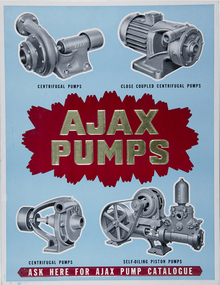 RMIT Design Archives
Advertising signs, Ajax Pumps
... One of Australia’s most acclaimed printmakers, Grahame King originally trained as a commercial artist in the mid-1930s. The Design Archives holds a collection of embossed advertising showcards designed by King in the 1950s which reveal examples of graphic design and typography in post-war Melbourne. ...One of Australia’s most acclaimed printmakers, Grahame King originally trained as a commercial artist in the mid-1930s. The Design Archives holds a collection of embossed advertising showcards designed by King in the 1950s which reveal examples of graphic design and typography in post-war Melbourne. ...One of Australia’s most acclaimed printmakers, Grahame King originally trained as a commercial artist in the mid-1930s. The Design Archives holds a collection of embossed advertising showcards designed by King in the 1950s which reveal examples of graphic design and typography in post-war Melbourne. The showcards were used by iconic companies for advertising and promotion on shop counters and in window displays and were produced by Firestone Embossed Showcards. Megan Atkins, 2017 Sign shows centrifugal pumps, close coupled centrifugal pumps and self-oiling piston pumps.Printed text bottom left on verso, Firestone embossed showcards PTY. LTDshowcards, advertising, graphic design, commercial art, artist -
4th/19th Prince of Wales's Light Horse Regiment Unit History Room
Medal
... The obverse has a central design of the Royal Cypher of King George VI, surmounted by a crown. ...The obverse has a central design of the Royal Cypher of King George VI, surmounted by a crown. ...Awarded by United Kingdom and Commonwealth Type :Campaign medal Eligibility Two months operational flying Awarded for Flying over occupied Europe Campaign European Air Operations 1939 – 1944 Description Six pointed star Clasps Atlantic France and Germany Related Atlantic Star, France and Germany Star The Air Crew Europe Star is a six–pointed star of yellow copper zinc alloy. The obverse has a central design of the Royal Cypher of King George VI, surmounted by a crown. The cypher is surrounded by a circlet containing the words 'The Air Crew Europe Star'. The reverse is plain, although Stars issued to Australian and South African personnel have recipient names impressed. The ribbon for this medal, along with those of the other Second World War campaign stars, is reputed to have been designed by King George VI. The sky is represented by pale blue, night flying by the black stripes on the edges, with the yellow stripes representing enemy searchlights.ww2, medal, air ops europe -
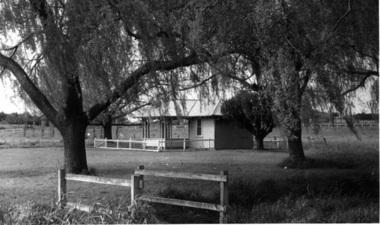 Mortlake and District Historical Society
Photograph - Montgomery Pavillion, Montgomery Pagoda or Pavillion, 1924
... The design was chosed by his widow who had seen a smilar design in King's Park whilst in Perth so the plans were obtained from that City. ...The design was chosed by his widow who had seen a smilar design in King's Park whilst in Perth so the plans were obtained from that City. ...In July 1922 Rev. W. McBride of the St Andrews Presbyterian Church, Mortlake had a meeting with the Garden sub-committee to discuss how the 500 pounds sterling bequest from the Late Thomas Montgomery could best be spent. His suggestion was that the money should be spent on either a kiosk, pavillion or recreation hall and pavillion combines with kitchen and fireplace was agreed to with exact site to decided at a public meeting. Cr Montgomery, a local businessman and a councillor, had loved the gardens and had assisted to transform the area from a swamp into a thing of beauty. The design was chosed by his widow who had seen a smilar design in King's Park whilst in Perth so the plans were obtained from that City. The work was carried out by Archibald Cluny McDonald and completed in September 1924. In December 1924 the Montgomery Pagado was unveiled to the public by Cr Wells Brumley after which the Red Cross ladies served tea.THIS TABLET IS DESIGNED TO COMMEMORATE THE GENEROSITY OF THE LATE COUNCILLOR THOMAS MONTGOMERY BY WHOM THIS PAVILLION WAS GRACIOUSLY BEQUEATHED TO THE TOWN OF MORTLAKE AND TO PERPETUATE THE MEMORY OF HIS NOBILITY OF CHARACTER AND EXTREME WORTH AS A CITIZENpagoda -
 City of Melbourne Libraries
Photograph, Bull, Hugh Jones, 1897-1993, Steel manufacturers, McPherson's Ltd, Melbourne
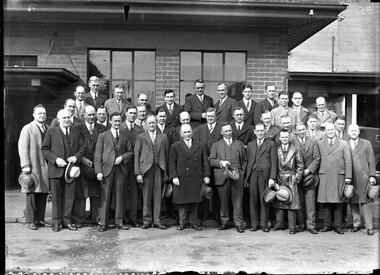
... It is an imposing building fronting almost a quarter of the city block between Spencer Street and King Street, and was designed to be a warehouse, office and showroom for the hardware empire. ...It is an imposing building fronting almost a quarter of the city block between Spencer Street and King Street, and was designed to be a warehouse, office and showroom for the hardware empire. ...Photographer notations on slide: Steel Manuf’rs at McPherson’s Ltd 1933 Published: The Age, 30 August 1933 BUREAU OF STEEL MANUFACTURERS OF AUSTRALIA. (1933, August 30). The Age (Melbourne, Vic. : 1854 - 1954), p. 11. Retrieved January 25, 2026, from http://nla.gov.au/nla.news-article204372874 Published title: Bureau of Steel Manufacturers of Australia Published caption: A group of Inter-State Visitors, from the Bureau of Steel Manufacturers of Australia, on a tour of inspection at the Bolt Works of McPhersons Pty. Ltd., Burnley-Richmond, yesterday. Research by Project Volunteer, Louise McKenzie: The photo shows a line up of 36 men, in three rows, in front of a building. They are mostly dressed in dark 3-piece suits, or camel coats. But one gentleman stands out in his full length leather coat! Striped ties are popular, and they are all holding hats. One man, at the rear towards the right, looks a bit younger with his thick, black, brylcreamed hair.. These interstate gentlemen are described in the newspaper caption as representatives of the Bureau of Steel Manufacturers "...on a tour of inspection at the Bolt Works of McPhersons Pty Ltd, Burnley, Richmond." Interestingly, the Bureau of Steel Manufacturers of Australia (BOSMA) still exists, and is the industry body for major Australian steel producers like BlueScope, Liberty, and InfraBuild, representing their interests, engaging with government, and participating in standards setting for the domestic steel market, with a history dating back to 1923. While BOSMA focuses on primary manufacturing, the Australian Steel Institute (ASI) serves as the broader peak body for the entire steel supply chain, from mills to end-users, promoting and supporting the industry. But at the time of this photo, the Australian steel industry was just starting to make headway. As the AST website explains, "Steelmaking in Australia began just a decade prior to the start of the 1851 Gold Rush whilst Australia was still divided into colonies. Iron ore deposits were discovered in 1840 at Iron Knob, South Australia but a lack of equipment meant that the process of producing steel was impossible. Even attempts at smelting the iron ore in a blast furnace to create pig iron were unsuccessful due to the poor quality of iron ore and coke available to the budding industry. In the other colonies at the time, such as Victoria, Tasmania, and New South Wales, there were minor discoveries of iron ore but poor technical expertise and limited quantity meant that the quality of steel was poor. Compared to the far superior steel being imported from Britain at the time, the steel manufacturing industry simply couldn’t compete and was unviable. By the 1870s, almost all steel production in Australia had been abandoned. The situation began to change at the turn of the century. Rapid growth sparked higher demand for industrial machinery made from steel and infrastructure such as rail. It became apparent that there was a need for locally manufactured steel and soon there would be an answer. In 1901, the year Australia united into a federation, the nation’s first blast furnace went into production at Eskbank near Lithgow in New South Wales. The development was spearheaded by William Stafford and his son Esk, and Stafford is known as the father of Australian steel production. In 1915, production expanded with another steel mill in Newcastle that was opened by BHP. It sourced coke from local mines and iron ore from South Australia, creating a domestic loop for steel manufacturing. In the following years, more steelworks opened in Whyalla, South Australia and Port Kembla in NSW. Steel manufacturing in Australia was now underway." The company mentioned in the photo’s notation and in the newspaper caption, was McPhersons, "...an Australian hardware firm, for many years a leading merchant of woodworking and metal-working machinery... [and founded by] Thomas McPherson (c.1823–1888) who had a home "Dudley House" at 142 Dudley Street, West Melbourne. [The] ironmongery business [was located] in 1860 at 149 Spencer Street, Melbourne. Merchandise carried included bells, lathes, horseshoes and steam engines." (Wikipedia - McPherson's Pty Ltd) Anyone who has read Robyn Annear’s excellent award-winning 2014 book Bearbrass – the name for early Melbourne - will remember only too well her description of West Melbourne, from where the city of Melbourne as we know it, emerged. Her book resurrects the village that was early Melbourne – from the arrival of white settlers in 1835 until the first gold rushes shook the town – and brings it to life in vivid colour. The McPherson family, whose arrival in Bearbrass coincides with this period (Thomas arrived in 1852), became intimately involved in the growth and development of Melbourne. Thomas was Mayor of Melbourne (1870-1871); his eldest son Hunter became a successful Sydney businessman; second son Edward and third son William inherited the company, and ran it together until 1896 when Edward killed himself. William had a notable career in politics as treasurer of Victoria 1917-1923, in which year he was knighted. 1928-1929 he was Premier of Victoria, and a noted philanthropist. The family were significant property owners in the city of Melbourne: 149 Spencer Street, 582-588 Collins Street, 554-566 Collins Street, together with a property on Jeffcott Street, West Melbourne, and factories in Sunshine, Tottenham, Kensington and Richmond – all by the mid 1940s. By that time they also had controlling interests in several Australasian industries, including Ajax Bolt and Rivet Pty Ltd of NZ, F W Hercus Manufacturing Co Ltd, manufacturers in South Australia of lathes, guillotines and other heavy machinery, also of Patience and Nicholson (P & N), manufacturers in Maryborough, Victoria, of twist drills and thread-forming tools; also Wiltshire Files on Sunshine Road, Tottenham, manufacturing files and rasps. The Acme Machine Tool Company became a branch of McPhersons, and the company claimed to have supplied, from their own manufacture, all five million rivets (some 3,600 tonnes) used in the building of the Sydney Harbour Bridge – described as a steel through arch bridge, which opened in 1932; the tallest of its kind in the world (Wikipedia – Sydney Harbour Bridge) McPherson’s was also innovative in other ways. It published a comprehensive catalogue, extensively detailed with prices, available free of charge to farmers and other businesses. In 1908 it had 148 pages. By 1937 it had grown to 372 pages. The University of Melbourne’s Archives entry on McPherson’s Limited notes: "After the outbreak of the Second World War, McPherson’s factories worked at full capacity and were crucial to Australia’s war efforts. On 5 December 1944 McPherson's converted to a public company named McPherson's Ltd, with William Edward as Chairman of Directors. By the start of the 1950s the company had a very different Board of Directors; in 1947 the Managing Director Oliver Addison died, and his replacement Marshall Eady died only six months later. Both had been Directors since McPherson’s became a proprietary company in 1913. Another Director, Philip Bevan, died in 1948 and this was followed by the death of William Edward in 1950. S.B Holder, F.G. Thorpe, H.L. Hastie, F. Grassick and D.G. Syme all joined the Board before 1950. The company continued to prosper for many years after the death of William Edward. His son, William David, was invited to join the McPherson’s Ltd Board in 1951. He married Angela Cumming in 1955 and soon after was sent to Brisbane as Director in Charge to oversee the building of a new warehouse. The opening of this warehouse in Queensland meant that the company now had major outlets in five states. As time went on, manufacturing in Australia began to decline and imports of everyday tools began arriving from Asia. These tools were being produced with much lower labour costs and could be sold at cheaper prices. William David retired in 1984 and eventually parts of the company were divested, such as the Richmond Bolt Works which closed in the early 1990s. Since the 1980s, McPherson's has diversified into housewares, printing, and health and beauty care products." This article also contains photos, one of which is a photograph of 'Bolt works picnic' 1920, showing workers in their shirt sleeves participating in a tug of war in a rural "picnic" setting. McPherson’s premises at 554-566 Collins Street more than lasted the test of time and is listed as historically significant. The magnificent art deco building from the 1930s in the heart of Melbourne was first commissioned in 1934 and completed in 1937. It is an imposing building fronting almost a quarter of the city block between Spencer Street and King Street, and was designed to be a warehouse, office and showroom for the hardware empire. International architects Stuart P Calder, and Reid and Pearson designed the four-storey building with a basement level and a stair tower at the centre that provides access to what was a tennis court on the roof. It is considered an example of the streamlined modern style in Melbourne and shows how the McPherson company, protected from taxes after World War I, was able to manufacture goods without being affected by the competition. The building has survived, and its current iteration is as the home to il Mercato Centrale – an Italian style artisan market concept. The University of Melbourne Archives hold a particularly good image of the building from its heyday, complete with Collins Street lamps on the pavement outside the store. And to return to our image, sited at "Bolt Works of McPhersons". Today this segment of McPhersons is still very well known - Ajax. A good summary of the company’s history, and the development of the name and business, can be found on the Mine Suppliers Online website: "AJAX Fasteners can trace its heritage back to 1900, when the Acme Bolt Company was established in West Melbourne, Victoria. In 1909, William McPherson used the company as the basis for establishing McPherson’s Bolt Works – adopting the brand ‘Ajax’ – and moved it to Richmond. Over the years, the company changed many times in response to industry needs to ensure that it remained the premier manufacturer of high quality fasteners in Australia. Many other names in the industry, such as Firth Cleveland, Spurway Cooke and Nettlefolds were merged or acquired into the company. McPhersons ended their 80-year ownership of Ajax in the early 90s when they sold their shares to National Consolidated, which was also a major shareholder at the time. In 1997, Ajax Fasteners moved to new purpose-built premises in Braeside, Victoria. Soon after, National Consolidated was taken over by the diversified manufacturer Austrim. The group soon acquired the iconic Nylex, and adopted the name Nylex Corporation. In January 2007, ACME Operations Pty Ltd acquired Ajax Fasteners and continues to operate the business today from the Braeside plant. The name ACME provides a nostalgic return by the new owners to the company’s heritage, when the Acme Bolt Company was founded in July 1900." REFERENCES: BUREAU OF STEEL MANUFACTURERS OF AUSTRALIA. (1933, August 30). The Age (Melbourne, Vic. : 1854 - 1954), p. 11. Retrieved January 25, 2026, from http://nla.gov.au/nla.news-article204372874 Wikipedia, McPherson’s Pty Ltd, https://en.wikipedia.org/wiki/McPherson%27s_Pty_Ltd Wikipedia, Richmond, Victoria, https://en.wikipedia.org/wiki/Richmond,_Victoria Industry: From the mid-19th century, Richmond was a centre of manufacturing industry, including many large complexes such as the Bryant & May match factory, Jaques Limited engineering works, the Wertheim Piano factory and Pelaco. Wikipedia, Sydney Harbour Bridge, https://en.wikipedia.org/wiki/Sydney_Harbour_Bridge eMelbourne, Manufacturing, https://www.emelbourne.net.au/biogs/EM00896b.htm 'New life for Melbourne's McPherson Building', The Urban Developer, https://www.theurbandeveloper.com/articles/mcphersons-building-melbourne-il-mercato-centrale-food-retail-destination Bureau Of Steel Manufacturers Of Australia Limited, http://www.bosma.org.au/ 'A Brief History of Steel Manufacturing in Australia', AST, https://astraders.com.au/a-brief-history-of-steel-manufacturing-in-australia/ 'Steel manufacturing in Australia: a brief history', Hard Bakka Steel Fabrication, https://www.hardbakka.com.au/component/virtuemart/steel-manufacturing-in-australia-a-brief-history?Itemid=494 McPherson's Limited, University of Melbourne Archives, https://archives.library.unimelb.edu.au/nodes/view/58364 Source of Description: 'Nuts and Bolts: A story of a family and a firm', Barbara Hamer (2006), McPherson’s Printing Group 'Photograph of 'Bolt works picnic' 1920', University of Melbourne Archives, https://archives.library.unimelb.edu.au/assets/display/1287217-max?u=dea2e4d2fd07ac822e624f1e7d39adb3 'Photograph of the exterior of the McPhersons Department store at 546 Collins Street, Melbourne.', University of Melbourne Archives, https://archives.library.unimelb.edu.au/assets/display/1287215-max?u=12430d30453a77059b7d10d49006a521 Robyn Annear, Bearbrass: imagining early Melbourne, Black Inc., 2014 (originally published 1995 by Mandarin) 'Company details', Ajax Fasteners, http://www.minesuppliersonline.com.au/australia/braeside/hardware/ajax-fasteners 'Former McPherson's Building', Victorian Heritage Database, https://vhd.heritagecouncil.vic.gov.au/places/741Photographer notations on slide: "Steel manuf'rs at McPherson's Ltd 1933 B5".1930-1939, industrial workers, clothing and dress, 1930, iron and steel industry, businesses, bridges, industry, melbourne, gold rush, moderne style architecture -
 Federation University Historical Collection
Medal - Numismatics, 'Dead Man's Penny' for Edwin Joseph 'Ted' Cannon, c1919
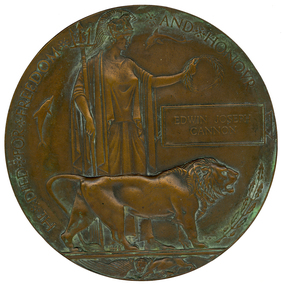
... King George V, stating ‘I join with my grateful people in sending you this memorial of a brave life given for others in the Great War’.[http://nma.gov.au/blogs/education/2010/11/14/dead-mans-penny/] Popularly known as the "Dead Man’s Penny", because of the similarity in appearance to the somewhat smaller penny coin. 1,355,000 plaques were issued, which used a total of 450 tonnes of bronze, and continued to be issued into the 1930s to commemorate people who died as a consequence of the war. [http://en.wikipedia.org/wiki/Memorial_Plaque_(medallion)] It was decided that the design...King George V, stating ‘I join with my grateful people in sending you this memorial of a brave life given for others in the Great War’.[http://nma.gov.au/blogs/education/2010/11/14/dead-mans-penny/] Popularly known as the "Dead Man’s Penny", because of the similarity in appearance to the somewhat smaller penny coin. 1,355,000 plaques were issued, which used a total of 450 tonnes of bronze, and continued to be issued into the 1930s to commemorate people who died as a consequence of the war. [http://en.wikipedia.org/wiki/Memorial_Plaque_(medallion)] It was decided that the design ...The Dead Man’s Penny is a commemorative medallion which was presented to the next-of-kin of the men and women from England and the Empire who died during World War One. The Dead Man’s Penny was accompanied by a letter from King George V, stating ‘I join with my grateful people in sending you this memorial of a brave life given for others in the Great War’.[http://nma.gov.au/blogs/education/2010/11/14/dead-mans-penny/] Popularly known as the "Dead Man’s Penny", because of the similarity in appearance to the somewhat smaller penny coin. 1,355,000 plaques were issued, which used a total of 450 tonnes of bronze, and continued to be issued into the 1930s to commemorate people who died as a consequence of the war. [http://en.wikipedia.org/wiki/Memorial_Plaque_(medallion)] It was decided that the design of the plaque was to be picked from submissions made in a public competition. Over 800 designs were submitted and the competition was won by the sculptor and medallist Edward Carter Preston with his design called Pyramus, receiving a first place prize of £250.[http://en.wikipedia.org/wiki/Memorial_Plaque_(medallion)] They were initially made at the Memorial Plaque Factory, 54/56 Church Road, Acton, W3, London from 1919. Early plaques did not have a number stamped on them but later ones have a number stamped behind the lion's back leg. [http://en.wikipedia.org/wiki/Memorial_Plaque_(medallion)] Ted Cannon's plaquette does not have a stamped number. Ted Cannon was a gifted artist and cartoonist who studied at the Ballarat School of Mines Technical Art School. During the Battle of Pozieres on the Western Front Ted Cannon worked with the Scout Platoon sketching the enemy's gun emplacements. Ted proved invaluable to the Brigade and brought he came under the attention of the Australian High Command. On 13 September 1916 Ted was given a special assignment for General C.B.B. White. Ted was sent out forward of the Old Mill at Verbrandenmolen (in the Ypres Salient) to draw a panorama of the German lines in the area from Hill 60 to The Bluff. It was a hazardous task and Ted was warned to be careful. Tragically he was sniped by an enemy machine-gunner and sustained severe abdominal wounds. Stretcher-bearers rushed him to the 17th Casualty Clearing Station where he was operated on by the doctors at 8.30 that night. With little chance of success, but ever resilient, Ted remained conscious almost to the end. He died early in the morning of the 14 September 1916. His body was buried in the large Military Cemetery at Lijssenthoek. The effects of the late Ted Cannon were returned to his parents. These were an autograph book, three brushes, prayer book, housewife, whistle, book, hymn book, curios. Another listing gives his effects as "identity disc, letters, photos, wallet, 2 books, Mexican Dollar, 1 cent (Ceylon), 3 German Straps, Fountain Pen, Cigarette-holder, Franc Note, 50 centimes Note, devotional book, mirror, rosary, scapula, metal ring, two combs, book of views, nail clippers, badges, tie clip, Egyptian stamp.[http://recordsearch.naa.gov.au/scripts/Imagine.asp?B=3202589] Ted Cannon was an only child. It is not known how the 'Dead Man's Penny' came into the ownership of the donor, but it is thought that it may have been left in a house owned by the donor's mother. Further information on Ted Cannon can be found at http://bih.ballarat.edu.au/index.php/Edwin_J._Cannon and http://www.ballarat.edu.au/about-ub/history/art-and-historical-collection/ub-honour-roll/c/edwin-joseph-ted-cannon-1895-1916Large bronze medallion or plaquette featuring an image of Lady Britannia surrounded by two dolphins (representing Britain’s sea power) and a lion (representing Britain) standing over a defeated eagle (symbolising Germany). Around the outer edge of the medallion are the words ‘He died for freedom and honour’. Next to Lady Britannia is the deceased solider’s name, with no rank provided to show equality in their sacrifice. (http://nma.gov.au/blogs/education/2010/11/14/dead-mans-penny) The plaque was distributed throughout the British Empire, and the first plaques were distributed in Australia in 1922 "Returned home" by W. & O. Mayne, 2013. ted cannon, edwin joseph cannon, cannon, world war 1, world war -
 Flagstaff Hill Maritime Museum and Village
Domestic object - Fork
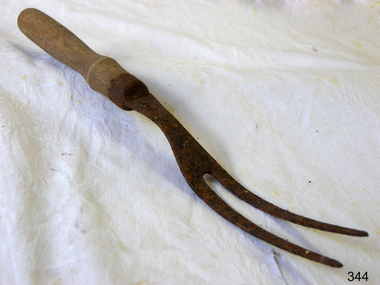
... design better suited to gathering the noodles. In Italy, it became commonplace by the 14th century and was almost universally used by the merchant and upper classes by 1600. It was proper for a guest to arrive with his fork and spoon enclosed in a box called a cadena; this usage was introduced to the French court with Catherine de’ Medici’s entourage. In Portugal, forks were first used at the time of Infanta Beatrice, Duchess of Viseu, King...design better suited to gathering the noodles. In Italy, it became commonplace by the 14th century and was almost universally used by the merchant and upper classes by 1600. It was proper for a guest to arrive with his fork and spoon enclosed in a box called a cadena; this usage was introduced to the French court with Catherine de’ Medici’s entourage. In Portugal, forks were first used at the time of Infanta Beatrice, Duchess of Viseu, King ...Naturally, we tend to take commonplace objects for granted, because they have always been there. Yet how many of you actually have thought “hey, where do forks come from?” Well, it takes one trip to China and a 3-year-old laughing at your face because of your desperate attempt to eat with chopsticks to finally appreciate something so ordinary such as a fork. So, where do forks come from? The early history of the fork is obscure. As a kitchen and dining utensil, it is believed to have originated in the Roman Empire, as proved by archaeological evidence. The personal table fork most likely originated in the Eastern Roman (or Byzantine) Empire. Its use spread to what is now the Middle East during the first millennium AD and then spread into Southern Europe during the second millennium. It did not become common in northern Europe until the 18th century and was not common in North America until the 19th century. Carving fork from 1640. Source: Wikipedia/Public Domain Carving Fork from 1640. Source: Wikipedia/Public Domain Some of the earliest known uses of forks with food occurred in Ancient Egypt, where large forks were used as cooking utensils. Bone forks had been found on the burial site of the Bronze Age Qijia culture (2400–1900 BC) as well as later Chinese dynasties’ tombs.The Ancient Greeks used the fork as a serving utensil. Read also: Steven Spielberg to Remake the Classic Musical ‘West Side Story’ In the Roman Empire, bronze and silver forks were used. The use varied according to local customs, social class and the nature of food, but forks of the earlier periods were mostly used as cooking and serving utensils. The personal table fork was most likely invented in the Eastern Roman (Byzantine) Empire, where they were in everyday use by the 4th century (its origin may even go back to Ancient Greece, before the Roman period). Records show that by the 9th century a similar utensil known as a barjyn was in limited use in Persia within some elite circles. By the 10th century, the table fork was in common use throughout the Middle East. Bronze forks made in Persia during the 8th or 9th century.Source: Wikipedia/Public Domain Bronze forks made in Persia during the 8th or 9th century.Source: Wikipedia/Public Domain The first recorded introduction of the fork to Western Europe, as recorded by the theologian and Cardinal Peter Damian, was by Theophano Sklereina the Byzantine wife of Holy Roman Emperor Otto II, who nonchalantly wielded one at an Imperial banquet in 972, astonishing her Western hosts.By the 11th century, the table fork had become increasingly prevalent in the Italian peninsula. It gained a following in Italy before any other Western European region because of historical ties with Byzantium and continued to get popularity due to the increasing presence of pasta in the Italian diet. At first, pasta was consumed using a long wooden spike, but this eventually evolved into three spikes, design better suited to gathering the noodles. In Italy, it became commonplace by the 14th century and was almost universally used by the merchant and upper classes by 1600. It was proper for a guest to arrive with his fork and spoon enclosed in a box called a cadena; this usage was introduced to the French court with Catherine de’ Medici’s entourage. In Portugal, forks were first used at the time of Infanta Beatrice, Duchess of Viseu, King Manuel I of Portugal’s mother around 1450. However, forks were not commonly used in Western Europe until the 16th century when they became part of Italian etiquette. The utensil had also gained some currency in Spain by this time, and its use gradually spread to France. Nevertheless, most of Europe did not adopt the use of the fork until the 18th century. Read also: The 8 Most Famous ‘Functioning Alcoholics’ in History Long after the personal table fork had become commonplace in France, at the supper celebrating the marriage of the Duc de Chartres to Louis XIV’s natural daughter in 1692, the seating was described in the court memoirs of Saint-Simon: “King James having his Queen on his right hand and the King on his left, and each with their cadenas.” In Perrault’s contemporaneous fairy tale of La Belle au bois dormant (1697), each of the fairies invited for the christening is presented with a splendid “fork holder”. The fork’s adoption in northern Europe was slower. Its use was first described in English by Thomas Coryat in a volume of writings on his Italian travels (1611), but for many years it was viewed as an unmanly Italian affectation. Some writers of the Roman Catholic Church expressly disapproved of its use, St. Peter Damian seeing it as “excessive delicacy.” It was not until the 18th century that the fork became commonly used in Great Britain, although some sources say that forks were common in France, England, and Sweden already by the early 17th century. Spaghetti fork By Lady alys - Own work, CC BY-SA 3.0, https://commons.wikimedia.org/w/index.php?curid=6414948 Spaghetti Fork By Lady alys – Own work, CC BY-SA 3.0, The fork did not become popular in North America until near the time of the American Revolution. The curved fork used in most parts of the world today was developed in Germany in the mid 18th century while the standard four-tine design became current in the early 19th century. The fork was important in Germany because they believed that eating with the fingers was rude and disrespectful. The fork led to family dinners and sit-down meals, which are important features of German culture. https://www.thevintagenews.com/2016/08/31/priority-fork-came-italy-european-country-pasta/?chrome=1Serving fork, two prongs, with a shaped wooden handle. Badly rusted.None.flagstaff hill, warrnambool, shipwrecked-coast, flagstaff-hill, flagstaff-hill-maritime-museum, maritime-museum, shipwreck-coast, flagstaff-hill-maritime-village, food, meat, carving -
 Flagstaff Hill Maritime Museum and Village
Certificate - Invitation, Norman Lindsay (Artist), Opening of the Parliament of the Commonwealth by His Royal Highness The Duke of Cornwall and York, ca. 1901
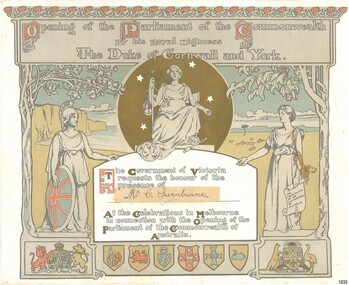
... King George V). The historic occasion was held at noon on May 9th, 1901, at Melbourne's Royal Exhibition Building, the only building large enough for that number of guests. The guests represented all six states of Australia with varied connections and interests, including politics, business and industry, the arts, religion, education, and public service. In Melbourne, the occasion was followed by two weeks of celebrations. The decorative, elaborate design...King George V). The historic occasion was held at noon on May 9th, 1901, at Melbourne's Royal Exhibition Building, the only building large enough for that number of guests. The guests represented all six states of Australia with varied connections and interests, including politics, business and industry, the arts, religion, education, and public service. In Melbourne, the occasion was followed by two weeks of celebrations. The decorative, elaborate design ...Australia became a Federation on January 1st, 1901, uniting Australia's six British colonies - New South Wales, Victoria, Queensland, South Australia, Western Australia and Tasmania – into States of the Commonwealth of Australia. The Government of Victoria invited 12,000 guests to attend the official celebrations for the Opening of the Federal Parliament by His Royal Highness, the Duke of Cornwall and York (later King George V). The historic occasion was held at noon on May 9th, 1901, at Melbourne's Royal Exhibition Building, the only building large enough for that number of guests. The guests represented all six states of Australia with varied connections and interests, including politics, business and industry, the arts, religion, education, and public service. In Melbourne, the occasion was followed by two weeks of celebrations. The decorative, elaborate design of the certificate-size invitation represents Australia’s colonial history and its transition to the Federated Commonwealth of Australia. The National Gallery of Australia attributes the artwork of this invitation to Australian artists Norman Lindsay (1879–1969) and John Longstaff (1861–1941) and its printing to Sands & McDougall Limited, Melbourne. The invitation has no date or location details. This invitation has the label “Mr. C Swinburne” added over an original, handwritten name. Perhaps it was a spelling correction, or a late change, with Swinburne attending in the place of another citizen. The book “Our Invited Guests An Official Directory, Melbourne, Victoria, 1901” lists all the guests, but not one has the surname SWINBURNE. There are five Warrnambool listings, eight people in all: - - MoCOBMICK, G. D., Esq., P.M., Warrnambool. - O’DOWD, The Ven. Monsignor, Warrnambool. - OPIE, C. N. T., Esq. (and Lady), Warrnambool. - OSBORNE, Hy. Wm., Esq., Shire Secretary (and Lady), Town Hall, Warrnambool. - STEVENS, Mrs. F. P., Mia Mia, Warrnambool. CHARLES GRANT SWINBURNE (1864-1934): - Charles Grant Swinburne, known as Chas.., was a prominent Warrnambool figure: a member of Toc H., the Progress Association and several other local clubs and societies. He purchased Warrnambool’s Tattersall’s Hotel in 1911 and had a booth at the 1914 Warrnambool Show. In 1891, he married Susan Jane Granter (1867-19 June 1935), daughter of Joseph Granter (1832-1879) and Ann (born Holley). Joseph had arrived in Melbourne on the famous tall ship Marco Polo in February 1856. In 1868, he was a shareholder of the Warrnambool Steam Packet Co., trading along the coast of Victoria. His portrait is among those recognised on the historic Warrnambool Pioneers Board. The invitation is nationally significant for its connection with the first Federal Parliament in May 1901, where the first federal parliamentarians were sworn in, and where the Duke and Duchess of Cornwall and York attended, representing the continued link with Britain. The invitation also unites a local Warrnambool businessman, Mr C Swinburne, with the 12,000 guests representing their towns and states that in 1901 became the Commonwealth of Australia. Swinburn was also married to the daughter of Joseph Granter, an early pioneer recognised on Warrnambool’s Pioneer Board. Invitation: certificate size, colour lithograph on cream card with gilt highlights. The Victorian Government invited Mr C Swinburne to celebrate the Opening of Federal Parliament by HRH the Duke of Cornwall and York, held in Melbourne. The invitation has printed drawings of figures, decorations, heraldic symbols, and gilt accents behind the central figure, on the capital letters of the message, and the Advance Australia Arms. Inscribed with a handwritten label that covers handwritten text. [The event was held at Noon, 9th May 1901, Royal Exhibition Building, Melbourne.] Inscription, handwritten on a label: "Mr. C. Swinburne" Left image: [figure of Britannia holding a blue shield with three crossing red bands, standing below an oak tree] Central image, in front of a gilt circle : [symbolic female royal future with Orbe and Sceptre seated on throne, four stars around her] Right image: [young female figure representing Australia holding a scroll, standing below a flowering gum] "THE CONSTITUTION OF THE COMMONWEALTH OF AUSTRALIA" Bottom left: Combined Arms: "[Duke of Cornwall and York, Prince George Frederick Ernest Albert, Princess Alexandra, his Duchess]" Bottom centre: [six symbols representing the Coat of Arms for each state of Australia] Bottom right: Advance Australia Arms "[Shield with six symbols, between Kangaroo and Emu, and below Rising Sun'] ADVANCE AUSTRALIA"flagstaff hill maritime museum and village, flagstaff hill, maritime museum, maritime village, warrnambool, great ocean road, shipwreck coast, invitation, certificate, mr c swinburne, government of victoria, opening of federal parliament, hrh the duke of cornwall and york, c swinburne, susan jane granter, susan jane swinburne, federal parliament, 1901, australian federation, ceremonies, politics, royal exhibition building, invited guest, britannia, orb, sceptre, advance australia arms, constitution of the commonwealth of australia, norman lindsay, john longstaff, sands & mcdougall, federation, british colonies, commonwealth of australia, charles grant swinburne, chas swinburne, c g swinburne, opening of the federal parliament, duke of cornwall and york, may 9th, tattersall’s hotel, marco polo, warrnambool steam packet co, warrnambool pioneers board, joseph granter, ann granter -
 Flagstaff Hill Maritime Museum and Village
Craft - Ship Model, Port Jackson Schooner
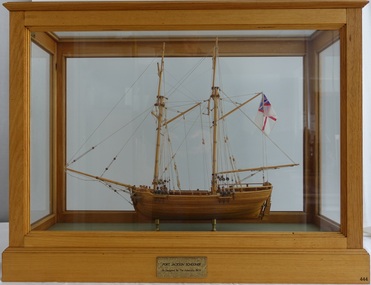
... design...maritime trade...maritime vessel...colonial port jackson schooner...pacific island trade in early 1800s...sydney cove...governor arthur phillip...governor philip gidley king...The colonial Port Jackson schooner is considered significant to Australian history, and represented on the 1994 twenty dollar banknote and its new version being rolled out in October 2019. flagstaff hill warrnambool shipwrecked-coast flagstaff-hill flagstaff-hill-maritime-museum maritime-museum shipwreck-coast flagstaff-hill-maritime-village ship model port jackson schooner sailing ship limited edition model model maker bill leonard david mcgregor design maritime trade maritime vessel colonial port jackson schooner pacific island trade in early 1800s sydney cove governor arthur phillip governor philip gidley king a schooner for port jackson national maritime museum greenwich australian $20 banknote Engraved on metal plaque "PORT JACKSON SCHOONER / As Designed By The Admiralty. 1803" Ship model of a colonial Port Jackson Schooner. ...This ship model is of a Colonial Port Jackson schooner, originally designed by the British Admiralty in 1803 as a response to the request of New South Wales' Governor Arthur Phillip. The drafts for the original plans are in Greenwich, UK, in the National Maritime Museum. The model is a Ledition edition, number 2 of 5, modelled by Bill Leonard. The model is rigged and decked in the manner of David McGregor. The flag on model of Port Jackson schooner is that of the British White Ensign which was used as the flag design of the Royal Australian Navy from 1911 - 1967. In 1785 the First Fleet arrived in the new British colony of Port Jackson (now Sydney Harbour) in New South Wales and Arthur Phillip was appointed as the first Governor. The following year Governor Phillip asked the English Royal Navy to provide drafts and materials for two ships for use in the Port Jackson colony for exploring and surveying rivers. The vessels needed a shallow draught and to be made from local cedar timber. He asked for the frames of the schooners to be provided along with shipwrights to assemble them. Many years later, in 1803, Governor Phillip’s request was fulfilled but he had already resigned from his post. The drafts titled ‘Schooner for Port Jackson’ were despatched by the Royal Navy from England to Australia. The original draft is still in the National Maritime Museum in Greenwich, UK. Meanwhile, the NSW Government had already built various other ships before 1803. In 1797 His Majesty’s Dockyard was opened at Port Jackson for building larger vessels. The Royal Navy’s 1803 design of a ‘Schooner for Port Jackson’ has been recognised on the obverse of Australia’s twenty dollar banknote since 1994. A sketch of the schooner is beside the portrait of Mrs Mary Reibey, who arrived as a convict and rose to become a respected and successful owner of a cargo shipping business. Her fleet included the Mercury, a schooner similar to the 1803 design for the Port Jackson schooner. Although the 1803 plans for a ‘Schooner for Port Jackson’ are commonly believed to be used for the first ship built in Australia, no records have been found of any ships being built according to these plans. However, it can be claimed that the plans were the ‘first Royal Navy plans made for a ship for use at Port Jackson, and to be built at Port Jackson, in Australia’. William (Bill) Leonard passed away on March 1st 1995.This ship model is significant for its representation of an early Australian colonial schooner. The 1803 Royal Navy’s plans for the colonial ‘Schooner for Port Jackson, were for the first ship specifically designed by the Royal Navy to be built and used in Port Jackson, for use in exploration and surveying of Australian ports and rivers. The plans are associated with Australia’s colonial settlement in the late 1700s. This ship model is significant for its association with the emblems of Australia’s history on the twenty dollar banknote. The colonial Port Jackson schooner is considered significant to Australian history, and represented on the 1994 twenty dollar banknote and its new version being rolled out in October 2019.Ship model of a colonial Port Jackson Schooner. Two-masted sailing ship displaying the flag named The British White Ensign. Mode of light coloured stained timberl is mounted on brass legs inside a glass case with timber frame and base. Metal engraved plaque states that the model is as designed by The Admiralty in 1803. Model is a number 2 of 5 in a limited edition, made by Bill Leonard.Engraved on metal plaque "PORT JACKSON SCHOONER / As Designed By The Admiralty. 1803"flagstaff hill, warrnambool, shipwrecked-coast, flagstaff-hill, flagstaff-hill-maritime-museum, maritime-museum, shipwreck-coast, flagstaff-hill-maritime-village, ship model port jackson schooner, sailing ship, limited edition model, model maker bill leonard, david mcgregor design, maritime trade, maritime vessel, colonial port jackson schooner, pacific island trade in early 1800s, sydney cove, governor arthur phillip, governor philip gidley king, a schooner for port jackson, national maritime museum greenwich, australian $20 banknote -
 Mission to Seafarers Victoria
Furniture - Pulpit, Rodney Howard Alsop, 1909
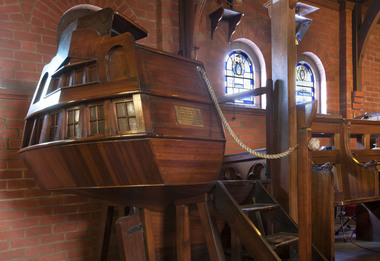
... King Haire can be found on the side next to the steps. The dedication was performed by the Archbishop of Melbourne on the 26th January (date engraves on the plaque) This pulpit was designed by Melbourne architect Rodney Howard Alsop (1881-1932) and manufactured by William John Dalziel (furniture manufacturer). ...King Haire can be found on the side next to the steps. The dedication was performed by the Archbishop of Melbourne on the 26th January (date engraves on the plaque) This pulpit was designed by Melbourne architect Rodney Howard Alsop (1881-1932) and manufactured by William John Dalziel (furniture manufacturer). ...In 1909, assistant Chaplain Rev. Haire presented the Mission with an 'uncommonly artistic pulpit' in memory of his mother. A plaque in memory of Jane King Haire can be found on the side next to the steps. The dedication was performed by the Archbishop of Melbourne on the 26th January (date engraves on the plaque) This pulpit was designed by Melbourne architect Rodney Howard Alsop (1881-1932) and manufactured by William John Dalziel (furniture manufacturer). It was initially used in the first Mission in Central Melbourne, Siddeley St. It is located in the Chapel of Saint Peter of the Mission to Seafarers 717 Flinders St. complex since 1917 (State Heritage listed (H1496). This complex was designed by Walter Richmond Butler in 1916, and officially opened on 11 September 1917, a day '...of unusually kind weather', by the Governor of Victoria, the Honourable Sir Arthur Stanley. According to a later article published in 1950: The pulpit is a model, built to scale, of the stern of an old ship of the line in Lord Nelson's day. This pulpit is significant as it is housed in The Memorial Chapel of Saint Peter forming part of the State Heritage listed Mission to Seafarers Victoria complex. It was built in Melbourne of Australian timbers, and is one of only two known maritime inspired pulpits, both associated with Missions to Seamen of the early 20th C. the other is held in the ANMM Collection see link. Their statement of significance is worth quoting in part as it applies equally to this pulpit "...an extremely rare and unique example of such pulpits. It is highly significant as a wonderfully preserved example of a time when religion was preached to sailors for their spiritual guidance and temperance..." Rodney Howard Alsop was an important Melbourne architect of the Arts and Crafts movement. John William Dalziel had sailed from Liverpool to Melbourne in 1862. Seventeen years later Penman and Dalziel founded the business in Lonsdale Street West, and won recognition at the Indian and Colonial Exhibition in London in 1886. Penman and Dalziel were identified in 1937 as one of Melbourne’s early ‘skilled craftsmen’ and ‘leading names’ in the manufacture of fine furniture. He died in February 1918 in a railway accident.Timber pulpit built in the form of a ship's stern including a timber step ladder for access, a timber keel and rudder, a rope fixed from the pulpit to a post mounted to the floor, and a dedication plaque on the side of the pulpit. The pulpit sits on timber legs. It's likely to be the original rope: traditionally made coir rope with twisted fibres, covered with canvas supported by a thread. At lower end the rope is secured by a monkey fist know and at the top by a turk head knot.Inside the pulpit (right) is the cardboard label with the maker details: " On an attached plaque see 0678 To the greater glory of God and in ever loving memory of Jane King Haire. This pulpit is erected by her son. Blessed are the pure in heart. For they shall see God. St. Matt. V.8. 26.1.09mission, seafarers, melbourne, victoria, chapel, saint peter, pulpit, australian timber, stern, walter richmond butler, australian maritime history, reverend w.f. haire, rodney howard alsop (1881-1932), wright's lane, william john dalziel, gifts-1917, heritage listed -
 Mission to Seafarers Victoria
Postcard - Postcard, Colour, Alison Kelly, c. 1990
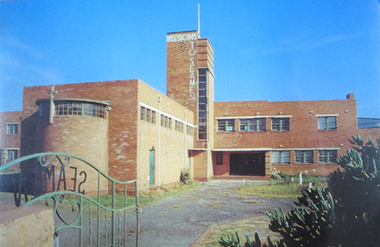
... King George V memorial building this branch of the Mission to Seamen opened in 1937 as a replacement for the old Mission in Port Melbourne. The Foundation stone was laid by the Victorian State Governor and a photograph of the event is also held in the MTSV collection. The Art Deco style building was commissioned by merchant and philanthropist, Alfred Michael Nicholas (1881-1937) and designed...King George V memorial building this branch of the Mission to Seamen opened in 1937 as a replacement for the old Mission in Port Melbourne. The Foundation stone was laid by the Victorian State Governor and a photograph of the event is also held in the MTSV collection. The Art Deco style building was commissioned by merchant and philanthropist, Alfred Michael Nicholas (1881-1937) and designed ...Also known as the King George V memorial building this branch of the Mission to Seamen opened in 1937 as a replacement for the old Mission in Port Melbourne. The Foundation stone was laid by the Victorian State Governor and a photograph of the event is also held in the MTSV collection. The Art Deco style building was commissioned by merchant and philanthropist, Alfred Michael Nicholas (1881-1937) and designed by prolific Melbourne-based architect Harry A. Norris (1888-1966) in 1937 best known for his commercial work in Melbourne city centre. NB PMHPS Kindly allowed MTSV heritage to take scans of the Kelly series notes in their collection for reference in 2019.One of the few full colour images of this building originally classified by the National Trust and now demolished. An example of architect Harry Norris' work 1937. All that remains are a ceramic plaque, a brick and several items of chapel artefacts. Alison Kelly, a photographer, was part of the group supporting the Port Melbourne Seamen's Mission in the 1980s and 1990s. She took a series of photographs of the building now held by the Port Melbourne Historical and Preservation Society.Full colour Postcard featuring colour image of a large red brick building in a 1930s era Architecture. There is a green wrought iron gate ajar in the foreground with the word SEAMAN spelled out. MISSIONS TO SEAMEN can also be seen spelled ut in white across and down the central clock tower of the building and this is surmounted with a white flagpole.On verso: Printed: "Heritage Series / POST CARD " at right angles in small print from lwr edge to upper: "PHOTOGRAPHY BY ALISON KELLY PORT HERITAGE SERIES NO 6". At Lwr left crnr printed:" Missions to Seamen Building, Port Melbourne/ Designed in the Modern style by architect Harry Norris,/ this 1937 National Trust classified structure was until 1972 / an entertainment and spiritual centre for seamen, with / important roles during the war [WW2] and immigration periods"king george v, memorial chapel, harry a. norris, brick, art deco, alfred m. nicholas, beach street, mission to seamen, alison kelly, 1937, arts centre, seamen mission, mission to seafarers, port melbourne -
 Mission to Seafarers Victoria
Slide - Glass slide, Black and white, circa 1921
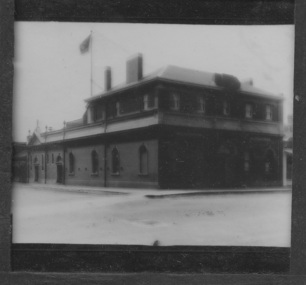
... designed by architect, Frederick Williams, who built the first brick Mission at Port Melbourne in the 19th C. Walter Butler was commissioned for the second storey. The Port Melbourne building in the image established in the 19th C., still survives. It was a key centre of operations for the Mission prior to the building of the Mission near Australian Wharf in 1907 and prior to the eventual opening of the current "Central Mission" in 1917. NB operations of The Port Melbourne Branch Mission were eventually transferred to the King ...This image provides an additional later modified building view to that of the image of the original single storey building image published on back page of the 1910 MTS Annual Report. According to the Annual Report of 1915 the plans to build a residence on top ( the 2nd storey ) of the Port Melbourne building got the go ahead to commence and opened 1916. Originally designed by architect, Frederick Williams, who built the first brick Mission at Port Melbourne in the 19th C. Walter Butler was commissioned for the second storey.The Port Melbourne building in the image established in the 19th C., still survives. It was a key centre of operations for the Mission prior to the building of the Mission near Australian Wharf in 1907 and prior to the eventual opening of the current "Central Mission" in 1917. NB operations of The Port Melbourne Branch Mission were eventually transferred to the King George V memorial Building, dedicated in December 1937 but demolished in 1995. The Mission depicted here still survives as part of an apartment complex on the corner of Nott st.Positive photograph on medium format glass slide ; b & w image of brick building taken from a corner street level view, with upper storey at one end on glass transparency with a flagpole and flag (Flying Angel) just discernible. The slide is edged with adhesive tape.missions to seamen institute, mission building, frederick williams, walter butler, port melbourne, beach road, mission to seafarers, nott street -
 Mission to Seafarers Victoria
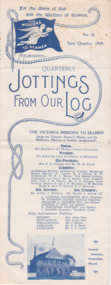
Magazine (sub-item) - Newsletter, The Victoria Missions to Seamen, Jottings From Our Log, Issue 15 - June Quarter 1909, 1909
... It is also a source of images. newsletter victorian seamen's mission melbourne misson to seamen jottings from our log lhlg rope flying angel seagull advertising port melbourne williamstown sailors' home australian wharf seamen's institute sailors' rest services concerts events socials deaths captain press w.h.c. darvall motor boat geelong boat builder manx king glenlui dovenby marion woodside ainsdale robert reid bagatelle board billiard table sir wilmot fawkes lady fawkes book bags woolies michaelmas 1906 quarterly ladies harbour lights guild captain strickland Long two folds newsletter printed in blue ink on paper with design of a rope, the flying angel mission flag and a photograph of the Siddeley Street Mission Jottings From Our Log, Issue 15 - June Quarter 1909 Magazine Newsletter The Victoria Missions to Seamen ...The earliest example of this newsletter published two to three times per year issued by the Mission to Seamen and LHLG. The Mission holds a photograph of this publication being packed in calico by the members of the 'Ladies Harbour Lights Guild' for distribution to branches and supporters.Published for some 30 years by the Victorian Missions to Seamen issued to supporters the series contributes to the history of the organisation. It is a key cross reference supplying many details and dates of Chaplain and LHLG activities in both Melbourne, Port Phillip and other States where Missions were gradually established and information not able to be included in Annual Reports. It is also a source of images.newsletter, victorian seamen's mission, melbourne misson to seamen, jottings from our log, lhlg, rope, flying angel, seagull, advertising, port melbourne, williamstown, sailors' home, australian wharf, seamen's institute, sailors' rest, services, concerts, events, socials, deaths, captain press, w.h.c. darvall, motor boat, geelong, boat builder, manx king, glenlui, dovenby, marion woodside, ainsdale, robert reid, bagatelle board, billiard table, sir wilmot fawkes, lady fawkes, book bags, woolies, michaelmas, 1906, quarterly, ladies harbour lights guild, captain strickland -
 Mission to Seafarers Victoria
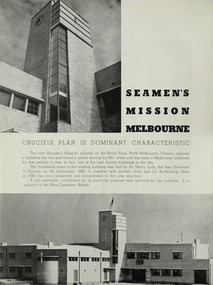
Article - Copy, Australian Glass Manufactures, Seamen's Mission Melbourne - Crucifix Plan Is Dominant Characheristic, May 1938
... design was chosen for the new Port Melbourne building when the old 1888 one was too old. The article gives a good description especially of the interiors and colours. Only black and white photographs depict the building. harry norris port melbourne king ...Article describing the 1937 Port Melbourne building.Four pages from the magazine Décoration and Glass with 5 pictures of the Art Deco mission in Port Melbourne built in 1937.non-fictionArticle describing the 1937 Port Melbourne building.harry norris, port melbourne, king george v memorial building, art deco, 1937 -
 Mission to Seafarers Victoria
Photograph - Photograph, Black and white, circa 1960s
... The building depicted in the photograph ( taken from the Western Beach Road) is known as the King Edward VII Sailors' Rest building; it was designed by architect Percy Everett and replaced the older building in 1912. ...The building depicted in the photograph ( taken from the Western Beach Road) is known as the King Edward VII Sailors' Rest building; it was designed by architect Percy Everett and replaced the older building in 1912. ...The Geelong Rest located at 3 Moorabool Street was created in 1895. The building depicted in the photograph ( taken from the Western Beach Road) is known as the King Edward VII Sailors' Rest building; it was designed by architect Percy Everett and replaced the older building in 1912. In 1901, it became the Geelong branch of the Mission to Seamen. The building is still standing on the waterfront in Geelong and has a commercial use.Medium b & w photograph depicting the front facade of the Sailors' Rest in Geelong.geelong, sailors' rest, seafarer, king edward vii sailors' rest building, 1912, percy everett, kombi -
Frankston RSL Sub Branch
Plaque, Memorial, 1914-1918 Memorial Plaque, 1920 (estimated); Issued from 1920
... The scroll designed to accompany the plaques was of thick paper, headed by the royal coat-of-arms, and bore the following message: "He whom this scroll commemorates was numbered among those who, at the call of King and Country, left all that was dear to them, endured hardness, faced danger, and finally passed out of the sight of men by the path of duty and self-sacrifice, giving up their own lives that others might live in freedom. ...The scroll designed to accompany the plaques was of thick paper, headed by the royal coat-of-arms, and bore the following message: "He whom this scroll commemorates was numbered among those who, at the call of King and Country, left all that was dear to them, endured hardness, faced danger, and finally passed out of the sight of men by the path of duty and self-sacrifice, giving up their own lives that others might live in freedom. ...This round, bronze memorial plaque was presented to the family of Private Richard Evans Harkness, service number 3426, of the 37th Battalion, (8th Reinforcements) who was killed in action at Villers-Bretonneux on 12th August, 1918. Colloquially known as 'Dead Man's Penny' or 'King's Penny', this plaque was given to the next of kin of service personnel who died on active service in WW1. 1914-1918 Memorial Plaque In early 1920 it was announced that the next-of-kin of all Australian servicemen and women whose deaths were attributable to the First World War would receive a memorial plaque and scroll "as a solace for bereavement and as a memento". The memorial plaques were not uniquely Australian. In fact they were designed and produced in Britain and issued to commemorate all those who died as a result of war service from within the British Commonwealth. The idea for the plaques was originally conceived mid-way through the war. In 1917 a competition was announced to obtain a suitable design and 800 entries were eventually received. The winner, Mr. E. Carter Preston of Liverpool, England, was chosen in 1918. He was awarded a prize of 250 pounds. Mr Manning Pike directed the manufacture of the memorial plaques at the Memorial Plaque Factory set up at Acton, London. Some later plaques were also made at the Woolwich Arsenal. The cost of manufacturing so many plaques must have been considerable. Each plaque had the name of the soldier commemorated individually embossed (some were engraved) as part of the design. The full name was given without any indication of rank or honours to show the equality of sacrifice of all those who had lost their lives. The scroll designed to accompany the plaques was of thick paper, headed by the royal coat-of-arms, and bore the following message: "He whom this scroll commemorates was numbered among those who, at the call of King and Country, left all that was dear to them, endured hardness, faced danger, and finally passed out of the sight of men by the path of duty and self-sacrifice, giving up their own lives that others might live in freedom. Let those that come after see that his name is not forgotten". Underneath the message the serviceman or woman’s name, rank, honours and unit were written by hand in red ink. Because of the late arrival in Australia of the plaques many scrolls were sent out separately. A message from the King, "I join with my grateful people in sending you this memorial of a brave life given for others in the Great War", was included with the scroll. The first plaques were distributed in Australia in 1922. Each plaque was sent out from Base Records Office at Victoria Barracks in Melbourne by second-class mail. Approximately 60,000 plaques were issued in Australia. Families of deceased members of the Royal Australian Navy and the Australian Army Nursing Service also received plaques and scrolls This plaque is significant because it commemorates the death of an Australian soldier on active service in World War 1. It is representative of some 60,000 issued to next of kin of soldiers killed in World War 1. Although Richard Harness was living at 52 Victoria Street, Abbotsford when enlisted, together with a scroll from the King, it was donated by a Frankston Family.This round, bronze memorial plaque was presented to the family of Australian Army private Richard Evans Harkness, service number 03426, of the 37th battalion, 8th re-inforcement. Harkness was killed in action on 12th August, 1918, near the French village of Proyart, during the 3rd Division's advance along the Somme Valley. further details can be found here: https://www.awm.gov.au/collection/U51477 Colloquially known as 'Dead Man's Penny' or 'King's Penny', these plaques were awarded to the next of kin of service personnel who died on active service during WW1. refer to link for further information : http://www.awm.gov.au/encyclopedia/memorial_scroll/plaque.aspAround the edge are the words 'HE DIED FOR FREEDOM AND HONOUR' On the righthand side of the plaque is the name of the soldier, in this case Richard Evans Harkness.commemorative, memorial, plaque, dead, man s, penny, king s, richard, evans, harkness -
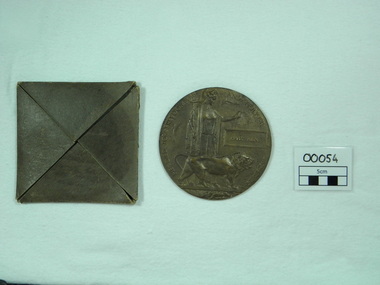 Frankston RSL Sub Branch
Plaque, Memorial, c. 1919
... Originally would have been issued with a scroll & letter from the King but neither with plaque. 1914-1918 Memorial Plaque In early 1920 it was announced that the next-of-kin of all Australian servicemen and women whose deaths were attributable to the First World War would receive a memorial plaque and scroll "as a solace for bereavement and as a memento". The memorial plaques were not uniquely Australian. In fact they were designed...Originally would have been issued with a scroll & letter from the King but neither with plaque. 1914-1918 Memorial Plaque In early 1920 it was announced that the next-of-kin of all Australian servicemen and women whose deaths were attributable to the First World War would receive a memorial plaque and scroll "as a solace for bereavement and as a memento". The memorial plaques were not uniquely Australian. In fact they were designed ...Originally would have been issued with a scroll & letter from the King but neither with plaque. 1914-1918 Memorial Plaque In early 1920 it was announced that the next-of-kin of all Australian servicemen and women whose deaths were attributable to the First World War would receive a memorial plaque and scroll "as a solace for bereavement and as a memento". The memorial plaques were not uniquely Australian. In fact they were designed and produced in Britain and issued to commemorate all those who died as a result of war service from within the British Commonwealth. The idea for the plaques was originally conceived mid-way through the war. In 1917 a competition was announced to obtain a suitable design and 800 entries were eventually received. The winner, Mr. E. Carter Preston of Liverpool, England, was chosen in 1918. He was awarded a prize of 250 pounds. Mr Manning Pike directed the manufacture of the memorial plaques at the Memorial Plaque Factory set up at Acton, London. Some later plaques were also made at the Woolwich Arsenal. The cost of manufacturing so many plaques must have been considerable. Each plaque had the name of the soldier commemorated individually embossed (some were engraved) as part of the design. The full name was given without any indication of rank or honours to show the equality of sacrifice of all those who had lost their lives. The scroll designed to accompany the plaques was of thick paper, headed by the royal coat-of-arms, and bore the following message: "He whom this scroll commemorates was numbered among those who, at the call of King and Country, left all that was dear to them, endured hardness, faced danger, and finally passed out of the sight of men by the path of duty and self-sacrifice, giving up their own lives that others might live in freedom. Let those that come after see that his name is not forgotten". Underneath the message the serviceman or woman’s name, rank, honours and unit were written by hand in red ink. Because of the late arrival in Australia of the plaques many scrolls were sent out separately. A message from the King, "I join with my grateful people in sending you this memorial of a brave life given for others in the Great War", was included with the scroll. The first plaques were distributed in Australia in 1922. Each plaque was sent out from Base Records Office at Victoria Barracks in Melbourne by second-class mail. Approximately 60,000 plaques were issued in Australia. Families of deceased members of the Royal Australian Navy and the Australian Army Nursing Service also received plaques and scrolls Bronze Memorial Plaque 1914-1918 for 4876 Pte. Harry Milne , 46 Battalion KIA 10/5/1918, In a cardboard square envelope. http://www.awm.gov.au/research/people/roll_of_honour/person.asp?p=493414Embossed around edge of plaque "HE DIED FOR FREEDOM AND HONOVR" Name of serviceman embossed on plaque right of centre "HARRY MILNE"ww1, dead mans penny, kings penny, memorial plaque -
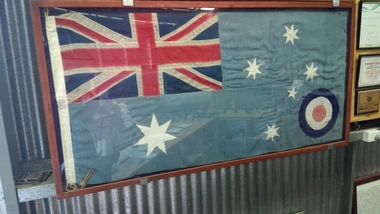 Nhill Aviation Heritage Centre
Memorabilia - RAAF ensign 1948 -1982
... In December 1948 King George V1 proclaimed the new, uniquely Australian design to be used by the RAAF. ...In December 1948 King George V1 proclaimed the new, uniquely Australian design to be used by the RAAF. ...Prior to 1948 the RAAF used the British RAF flag . In December 1948 King George V1 proclaimed the new, uniquely Australian design to be used by the RAAF. It featured a smaller roundel with a slightly tilted southern cross and 7 pointer star, similar to the Australian Flag, on a sky blue background. This ensign was used until 1982 when the red dot in the roundelwas replaced by the image of a kangaroo. This flag was stored in the Nhill RSL Australian flag with sky blue background, with roundel in bottom RH corner. -
Federation University Historical Collection
Book - Book - Scrapbook, Ballarat School of MInes: Scrapbook of Newspaper Cuttings, Book 74, June 1996 to August 1996
... king...tony leonard...cuts fall on regional takes...administration students placed in workforce...art appreciation through theatre...tenders exceed funding...ray borner to olympic games...shane everard inspiration to all...network caters for chefs...judith beaton and jennifer martin...business studies...master painters' association...innovative businesses...building course for women...deanne jakiel's win a boon for kooris...dr ron wild...bright future for smb...young workers test their skills...melissa cameron...michael ronaldson mhr...peter morey work skill...angela cox...geoffrey richards...a legacy of design...The papers concerned are The Courier, Ballarat, The Australian, The Age ad other region papers over the period of 1 June 1996 to 6 August 1996. teaching positions advertised pre-employment courses courses available enrolment for smb courses counselling course may be lost myma rance father son graduate phil allender steve allender building apprentices non payment proposed changes to industrialrelations laws brenda huggins winner of award education is lifelong quest smb graduation night her majesty's 121st food fit for a king tony leonard cuts fall on regional takes administration students placed in workforce art appreciation through theatre tenders exceed funding ray borner to olympic games shane everard inspiration to all network caters for chefs judith beaton and jennifer martin business studies master painters' association innovative businesses building course for women deanne jakiel's win a boon for kooris dr ron wild bright future for smb young workers test their skills melissa cameron michael ronaldson mhr peter morey work skill angela cox geoffrey richards a legacy of design jocelynne scutt - barrister paralympians at smb barry jones - alp tafe cuts hit farmers smb and red lion hotel - hospitality course Book with yellow cover, front, spiral bound. ...Collection of newspaper articles related to Ballarat School Of Mines.They cover activities and advertisements for staff. The papers concerned are The Courier, Ballarat, The Australian, The Age ad other region papers over the period of 1 June 1996 to 6 August 1996.Book with yellow cover, front, spiral bound. teaching positions advertised, pre-employment courses, courses available, enrolment for smb courses, counselling course may be lost, myma rance, father son graduate, phil allender, steve allender, building apprentices non payment, proposed changes to industrialrelations laws, brenda huggins winner of award, education is lifelong quest, smb graduation night, her majesty's 121st, food fit for a king, tony leonard, cuts fall on regional takes, administration students placed in workforce, art appreciation through theatre, tenders exceed funding, ray borner to olympic games, shane everard inspiration to all, network caters for chefs, judith beaton and jennifer martin, business studies, master painters' association, innovative businesses, building course for women, deanne jakiel's win a boon for kooris, dr ron wild, bright future for smb, young workers test their skills, melissa cameron, michael ronaldson mhr, peter morey work skill, angela cox, geoffrey richards, a legacy of design, jocelynne scutt - barrister, paralympians at smb, barry jones - alp, tafe cuts hit farmers, smb and red lion hotel - hospitality course -
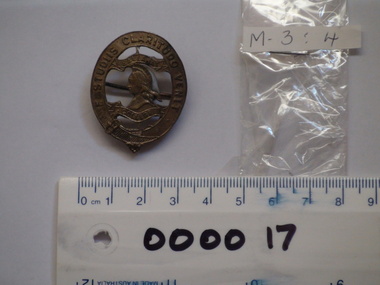 Ballarat Clarendon College
Badge, Bridgland & King, Prior to 1916
... 1918 1917 badge 1916 ballarat college fred raynor langsford marjory langsford Embossed around outer edge: 'E STUDIIS CLARITUDO VENIT' Embossed across centre: 'BALLARAT / COLLEGE' Inscribed on back of badge:'BRIDGLAND & KING / 358 P.O.PLACE (indistinct single mark follows) A metal Ballarat College badge worn on school cap featuring the school motto 'E studiis Claritudo Venit' and a belt with buckle design embossed around its outer edge. ...A metal Ballarat College badge worn on school cap featuring the school motto 'E studiis Claritudo Venit' and a belt with buckle design embossed around its outer edge. Inside the outer edge the badge is voided around the Minerva head and embossed 'Ballarat College'. A pin is attached across the rear of the badgeEmbossed around outer edge: 'E STUDIIS CLARITUDO VENIT' Embossed across centre: 'BALLARAT / COLLEGE' Inscribed on back of badge:'BRIDGLAND & KING / 358 P.O.PLACE (indistinct single mark follows)1918, 1917, badge, 1916, ballarat college, fred raynor langsford, marjory langsford -
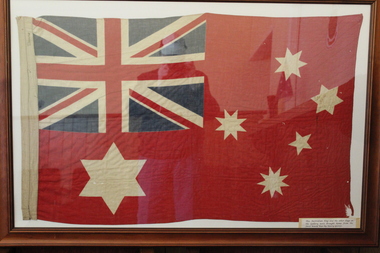 Lara RSL Sub Branch
Australian Red Ensign 1901 - 1903, Australian Red Ensign 1901 - 1903 Design, circ 1901-03
... 1901–1903 version Australian/Commonwealth red ensign (1901–1903) Version After being submitted to King Edward VII for approval the competition winning design which featured a southern cross with nine, eight, seven, six and five points respectively was standardised by the British Admiralty with the number of points on the four biggest stars of the southern cross set to seven, ostensibly to improve ease of manufacture. ...Rare historical example of an Australian Flag. red ensign world war 1 On top left hand side of the flag is inscribed "GROVES" and a cardboard note stating "This Australian Flag and other flags in the Gallery were brought home from the First World War by Harry Groves." 1901–1903 version Australian/Commonwealth red ensign (1901–1903) Version After being submitted to King Edward VII for approval the competition winning design which featured a southern cross with nine, eight, seven, six and five points respectively was standardised by the British Admiralty with the number of points on the four biggest stars of the southern cross set to seven, ostensibly to improve ease of manufacture. ...Red Ensign Flag was updated in 1908, the current Commonwealth star of seven points replaced the earlier six-pointed starPart of a collection of Wold War I Flags obtained by Harry Groves. Rare historical example of an Australian Flag.1901–1903 version Australian/Commonwealth red ensign (1901–1903) Version After being submitted to King Edward VII for approval the competition winning design which featured a southern cross with nine, eight, seven, six and five points respectively was standardised by the British Admiralty with the number of points on the four biggest stars of the southern cross set to seven, ostensibly to improve ease of manufacture. The original variety of points was an indication of the relative brightness of each star as it appeared in the night sky.On top left hand side of the flag is inscribed "GROVES" and a cardboard note stating "This Australian Flag and other flags in the Gallery were brought home from the First World War by Harry Groves."red ensign, world war 1 -
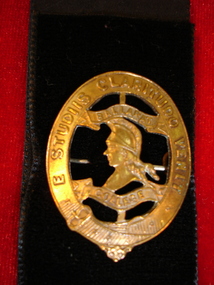 Ballarat Clarendon College
Cap badge
... Embossed around outer edge: 'E STUDIIS CLARITUDO VENIT' Embossed across centre: 'BALLARAT / COLLEGE' Inscribed on back of badge:'BRIDGLAND & KING / 358 P.O.PLACE (indistinct single mark follows) Scratched on back of badge: W Hicks A metal Ballarat College badge worn on school cap featuring the school motto 'E studiis Claritudo Venit' and a belt with buckle design embossed around its outer edge. ...Badge worn on school caps. William Reginald Claude Hicks attended the school in the early 1920's and rowed in the 1920 rowing crew. A metal Ballarat College badge worn on school cap featuring the school motto 'E studiis Claritudo Venit' and a belt with buckle design embossed around its outer edge. Inside the outer edge the badge is voided around the Minerva head and embossed 'Ballarat College'. A pin is missing from across the rear of the badgeEmbossed around outer edge: 'E STUDIIS CLARITUDO VENIT' Embossed across centre: 'BALLARAT / COLLEGE' Inscribed on back of badge:'BRIDGLAND & KING / 358 P.O.PLACE (indistinct single mark follows) Scratched on back of badge: W Hicks -
Ballarat Clarendon College
Badge, Cap badge
... He was Dux of School 1919 and School Captain and Captain of Rowing, Football, Athletics and Cricket, 1920 john-stanley-coltman dux school-captain school-badge badge ballarat-college Embossed around outer edge: 'E STUDIIS CLARITUDO VENIT' Embossed across centre: 'BALLARAT / COLLEGE' Inscribed on back of badge:'BRIDGLAND & KING / 358 P.O.PLACE (indistinct single mark follows) A gold-coloured metal Ballarat College badge worn on school cap featuring the school motto 'E Studiis Claritudo Venit' and a belt with buckle design embossed around its outer edge. ...This cap badge was worn by John Stanley Coltman, while he attended Ballarat College 1913 - 1920. He was Dux of School 1919 and School Captain and Captain of Rowing, Football, Athletics and Cricket, 1920 A gold-coloured metal Ballarat College badge worn on school cap featuring the school motto 'E Studiis Claritudo Venit' and a belt with buckle design embossed around its outer edge. Inside the outer edge the badge is voided around the Minerva head and embossed 'Ballarat College'. A pin is attached across the rear of the badgeEmbossed around outer edge: 'E STUDIIS CLARITUDO VENIT' Embossed across centre: 'BALLARAT / COLLEGE' Inscribed on back of badge:'BRIDGLAND & KING / 358 P.O.PLACE (indistinct single mark follows) john-stanley-coltman, dux, school-captain, school-badge, badge, ballarat-college -
Ballarat Clarendon College
Badge, Cap badge
... The badge was worn by John Hall in 1909 when he was 12 years of age. john-hall ballarat-college garbutt-house Embossed around outer edge: 'E STUDIIS CLARITUDO VENIT' Embossed across centre: 'BALLARAT / COLLEGE' Inscribed on back of badge:'BRIDGLAND & KING / 358 P.O.PLACE (indistinct single mark follows) A silver-coloured metal Ballarat College badge worn on school cap featuring the school motto 'E studiis Claritudo Venit' and a belt with buckle design embossed around its outer edge. ...The badge was worn by John Hall in 1909 when he was 12 years of age. A silver-coloured metal Ballarat College badge worn on school cap featuring the school motto 'E studiis Claritudo Venit' and a belt with buckle design embossed around its outer edge. Inside the outer edge the badge is voided around the Minerva head and embossed 'Ballarat College'. The badge is sewn to a fragment of Garbutt House ribbon. Embossed around outer edge: 'E STUDIIS CLARITUDO VENIT' Embossed across centre: 'BALLARAT / COLLEGE' Inscribed on back of badge:'BRIDGLAND & KING / 358 P.O.PLACE (indistinct single mark follows) john-hall, ballarat-college, garbutt-house -
 Flagstaff Hill Maritime Museum and Village
Book - Letters/Journals, Charles Kingsley, Charles Kingsley: His Letters and Memories of His Life Vol 1, 1879
... King’s back list. Kegan Paul was renowned for his exceptional intellectual taste and high production standards. He sought to publish beautifully bound, well-designed books of high literary, scientific and scholarly merit. ...King’s back list. Kegan Paul was renowned for his exceptional intellectual taste and high production standards. He sought to publish beautifully bound, well-designed books of high literary, scientific and scholarly merit. ...The focus of this book is not a standard biography written by an outside observer; it is a life story told through letters and personal journals. The volume is seamlessly woven together with editorial commentary by Kingsley’s widow, Frances "Fanny" Grenfell. Because this is Volume 1, it covers the first half of Charles Kingsley's life. It documents his childhood, his time at Cambridge University, and his intense courtship of Fanny. His early career as an Anglican clergyman in the rural parish of Eversley is covered, alongside his rise to national prominence in the late 1840s and 1850s as a social reformer. The text highlights his role in the Christian Socialist movement and his writing under the pen name "Parson Lot" to advocate for the working class. It also explores the writing and reception of his famous early novels, such as Alton Locke and Yeast, which tackled themes of poverty and systemic inequality.Charles Kingsley: His Letters and Memories of His Life Vol 1 Author: Charles Kingsley Edited by his wife ( Frances "Fanny" Grenfell) Publisher: C Kegan Paul & Co Date: 1879 Further Information: Sixth Abridged Editionnon-fictionThe focus of this book is not a standard biography written by an outside observer; it is a life story told through letters and personal journals. The volume is seamlessly woven together with editorial commentary by Kingsley’s widow, Frances "Fanny" Grenfell. Because this is Volume 1, it covers the first half of Charles Kingsley's life. It documents his childhood, his time at Cambridge University, and his intense courtship of Fanny. His early career as an Anglican clergyman in the rural parish of Eversley is covered, alongside his rise to national prominence in the late 1840s and 1850s as a social reformer. The text highlights his role in the Christian Socialist movement and his writing under the pen name "Parson Lot" to advocate for the working class. It also explores the writing and reception of his famous early novels, such as Alton Locke and Yeast, which tackled themes of poverty and systemic inequality.flagstaff hill, warrnambool, shipwrecked coast, flagstaff hill maritime museum, maritime museum, shipwreck coast, flagstaff hill maritime village, great ocean road, book, pattison collection, warrnambool library, warrnambool mechanics’ institute, ralph eric pattison, corangamite regional library service, warrnambool city librarian, mechanics’ institute library, victorian library board, warrnambool books and records, warrnambool children’s library, charles kingsley: his letters and memories of his life vol 1, frances "fanny" grenfell, mrs kingsley -
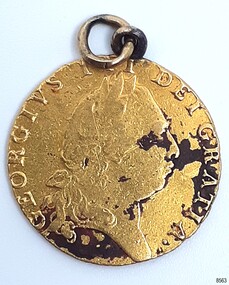 Flagstaff Hill Maritime Museum and Village
Currency - Guinea Coin, The Royal Mint, 1793 George III Spade Guinea, 1793
... Gold coin; British. 1793, King George III of the United Kingdom of Great Britain and Ireland (1760-1820), Spade Guinea. Yellow gold coin with gold metal loop mount and a gold ring through the loop. The design...(Crown with fleer de lies, above Shield with crowned lions in different postures, a harp, and other details) Gold coin; British. 1793, King George III of the United Kingdom of Great Britain and Ireland (1760-1820), Spade Guinea. Yellow gold coin with gold metal loop mount and a gold ring through the loop. The design ...The coin was discovered by Julie Wilkins, a Victorian scuba diver who had already experienced more than 500 dives in Australia and overseas. She was holidaying in Peterborough, Victoria, and looking forward to discovering more about the famous Loch Ard ship, wrecked in June 1878 at Mutton Bird Island. The fast Glasgow-built clipper ship was only five years old when the tragedy occurred. There were 54 people on board the vessel and only two survived Julie's holiday photograph of Boat Bay reminds her of her most memorable dive. Submerged in the calm, flat sea, she was carefully scanning around the remains of the old wreck when, to her amazement, a gold coin and a small gold cross suddenly came up towards her. She excitedly cupped them in her hands, then stowed the treasures safely in her wetsuit and continued her dive. She soon discovered a group of brass carriage clock parts and some bottles of champagne. It was a day full of surprises. The items were easily recognisable, without any build-up of encrustations or concretion. Julie secretly enjoyed her treasures for twenty-four years then packed them up for the early morning train trip to Warrnambool. After a short walk to Flagstaff Hill Maritime Museum and Village, her photograph was taken as she handed over her precious find. She told her story to a local newspaper reporter, lunched a café in town then took the late afternoon train home. Her generous donation is now part of a vast collection of Loch Ard shipwreck artefacts, including the gold watch and the Minton Majolica model peacock. The coin is a British 1793 George III Gold Spade Guinea. It was already 83 years old when the Loch Ard had set sail. The loop and ring have been added, perhaps as a pendant, pocket watch accessory or similar purpose. It may have been worn for ‘good luck’ on the long journey to Australia, where ships had to carefully navigate the treacherous Bass’s Strait before arriving at their destination of Melbourne. Sadly, many met their fate on that short stretch of ocean aptly named the Shipwreck Coast. The coin is very recognisable even though it was exposed to the wrecking of the ship, its consequent movement, and the sea's turbulence. Its bent, scratched, buckled, split, dinted and worn condition is part of its story. The red-brown-black discolouration is similar to that found on other gold coins, sometimes called the ‘corrosion phenomena’. Studies suggest the possible cause is contaminants in the minting process reacting to the coins’ environment. The GEORGE III GOLD SPADE GUINEA: - The British Guinea was introduced in 1663 and was circulated until 1814. It was made of 22 carat gold, was 25 to 26 cm in diameter and weighed 8.35 grams. It had a value of 21 British shillings. The guinea coin ceased circulation after 1816 and was replaced by the one-pound note. However, the term ‘guinea’ continued to represent 21 shillings. King George (1738-1820) had six gold guinea designs minted during his reign from 1760 and 1820. Each of the six had different obverse portraits, all facing the right. There were three different reverse sides. The Spade Guinea was the fifth issue of the coin, introduced in 1787 and produced until 1799. The reverse shows a royal crown over a flat-topped shield with the Royal Arms of Great Britain, used in Scotland between 1714 and 1800. The shield images are, from left to right, top to bottom, the Arms of England and Scotland, the Arms of France, the Arms of Ireland, and the Arms of the House of Hanover. The Gold Guinea is also part of Australia’s history. It was the first coin mentioned in the announcement of Governor King of New South Wales his Australian Proclamation of a limited variety and denomination of coins accepted for use in the Australian Colony. The historic and decorative George III Spade Guinea has been reproduced for special collections of coins. However, replicas and imitations have also been made as souvenirs for tourists, as gaming tokens and chips for gamblers, and as ‘fake’ coins for profit. These coins differ in many ways; they may be only half the weight of the genuine coin. Often have a small stamp on the obverse with “COPY” or the manufacturer’s name or initials. Some have scalloped edges, some have dates that are different to the original dates of issue, and some even have text in Latin that translates as something very different to the original coin.The King George III Guinea was only produced from 1663 to 1814 and was the first English coin to be mechanically minted. The coin is the fifth edition of the King George III Guinea, the Spade Guinea, was only produced between 1787 and 1799. It is the only edition with this portrait of King George and the only one with the Royal Coat of Arms of Great Britain in Scotland on the reverse side. This edition was also the last guinea in circulation, because the sixth edition was reserved as the Military guinea. This edition of the Guinea is unique; This coin is the only guinea in our collection. It was minted in 1793, so it is now over 230 years old. The Gold Guinea is part of Australia’s history; it was the first coin in the list of coins for use in the Australian Colonies, mentioned by Governor King of New South Wales in his Australian Proclamation speech of 1800. The George III Spade Guinea was included in the Limited Edition Sherwood 12 Coin Collection of Notable Coinage of Australia. This coin is the only known guinea coin recovered from the wreck of the Loch Ard. It was already 85 years old when the ship was wrecked.Gold coin; British. 1793, King George III of the United Kingdom of Great Britain and Ireland (1760-1820), Spade Guinea. Yellow gold coin with gold metal loop mount and a gold ring through the loop. The design is the fifth issue of the George III Gold Guinea. The obverse relief is a portrait of George III facing right. Reverse relief is a crown above the Coats of Arms (1801-1816) of flat top spade-shaped shield divided into four quadrants that depict crowned lions, fleur de lies, a harp. These images are identified as, from left to right, top to bottom, England and Scotland, France, Ireland and Hanover. Inscriptions are minted around the rims of each side. The coin is dated 1793. Its surface has dark areas on both sides and the reed edge and surfaces are well worn. The loop mount is bent and the ring is buckled. The coin was recovered from the wreck of the ship Loch Ard.Obverse text; 'GEORGIVS III DEI GRATIA' (translates to George the Third, by the Grace of God) Obverse relief; (King George III bust, facing right, laurel wreath on head) Reverse text; 'M.B.E.ET.H.REX.F. D.B.ET.L.D. S.R.I.A.T.ET.E' '1793' (translates to: King of Great Britain, France and Ireland, Defender of the Faith, Duke of Brunswick and Lüneburg, Arch-Treasurer and Elector of the Holy Roman Empire) Reverse relief; a spade-shaped image i.e. (Crown with fleer de lies, above Shield with crowned lions in different postures, a harp, and other details)flagstaff hill maritime museum and village, warrnambool, great ocean road, shipwreck coast, royal mint, british coin, currency, guinea, military guinea, australian currency, british guinea, gold coin, spade guinea, king george iii, george iii, fifth portrait, arms of england and scotland, arms of france, arms of ireland, arms of the house of hanover, coins, gold coins, gold medallion, georgian era, 1793, numismatics, contamination phenomena, gold corrosion, good luck, lucky charm, pendant, lucky coin, trade, loch ard, wreck of the loch ard, 1878, mutton bird island, peterborough, scuba diver, 1980s, guinea coin, gold guinea, shipwreck artefact, relic, julie wilkins -
 Flagstaff Hill Maritime Museum and Village
Book - Compilation of Dramatic Artistic Performances, George Routledge, Masques and Entertainments, 1890
... Often associated with these theatrical presentations were complicated stage machinery and spectacular costumes; these were frequently designed by the famous architect Inigo Jones. In these events, professional actors handled the speaking and singing, while the King, Queen, and courtiers themselves wore masks and danced as allegorical figures (gods, heroes, or virtues). ...Often associated with these theatrical presentations were complicated stage machinery and spectacular costumes; these were frequently designed by the famous architect Inigo Jones. In these events, professional actors handled the speaking and singing, while the King, Queen, and courtiers themselves wore masks and danced as allegorical figures (gods, heroes, or virtues). ...Masques and Entertainments by Ben Jonson (edited by Henry Morley and published by George Routledge & Sons in 1890) is a compilation of the dramatic courtly performances written by the legendary Renaissance playwright and poet Ben Jonson. Issued as Volume IX of the popular "Carisbrooke Library" series, this specific late-Victorian edition gathered works that Jonson originally wrote in the early 17th century (between 1603 and 1630) for the courts of King James I and King Charles I.Masques and Entertainments Author: Ben Jonson Publisher: George Routledge & Sons Date: 1890fictionMasques and Entertainments by Ben Jonson (edited by Henry Morley and published by George Routledge & Sons in 1890) is a compilation of the dramatic courtly performances written by the legendary Renaissance playwright and poet Ben Jonson. Issued as Volume IX of the popular "Carisbrooke Library" series, this specific late-Victorian edition gathered works that Jonson originally wrote in the early 17th century (between 1603 and 1630) for the courts of King James I and King Charles I.flagstaff hil, warrnambool, flagstaff hill maritime museum, maritime museum, shipwreck coast, flagstaff hill maritime village, great ocean road, book, pattison collection, warrnambool library, warrnambool mechanics’ institute, ralph eric pattison, corangamite regional library service, warrnambool city librarian, mechanics’ institute library, victorian library board, warrnambool books and records, warrnambool children’s library, masques and entertainments, ben jonson
