
Showing 1140 items matching "1950s melbourne"
-
 Melbourne Tram Museum
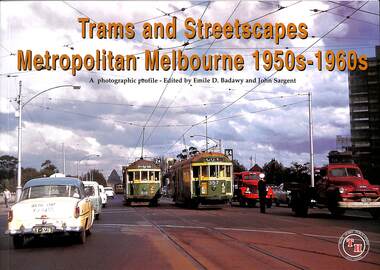
Book, Emile Badawy et al, "Trams and streetscapes Metropolitan Melbourne 1950s - 1960s", Dec. 2000
... "Trams and streetscapes Metropolitan Melbourne 1950s - 1960s"...Book - 48 pages+ card cover + jacket, perfect bound, landscape format, "Trams and streetscapes Metropolitan Melbourne 1950s - 1960s", edited by Emile Badawy and John Sargent, published December 2002, featuring photos by Keith Atkinson, Graham Evans, Noel Reed and Jim Seletto. ..."Trams and streetscapes Metropolitan Melbourne 1950s - 1960s" Book Emile Badawy et al ...Book - 48 pages+ card cover + jacket, perfect bound, landscape format, "Trams and streetscapes Metropolitan Melbourne 1950s - 1960s", edited by Emile Badawy and John Sargent, published December 2002, featuring photos by Keith Atkinson, Graham Evans, Noel Reed and Jim Seletto. See Reg Item 4264 for the first in the series published Apr 2002.trams, tramways, melbourne, work trams, mmtb -
 Melbourne Tram Museum
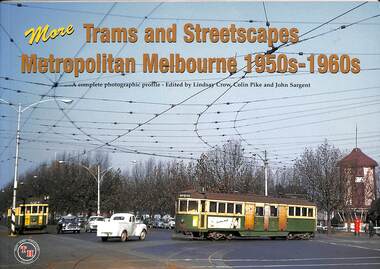
Book, Lindsay Crow et al, "More trams and streetscapes Metropolitan Melbourne 1950s - 1960s", Apr. 2002
... "More trams and streetscapes Metropolitan Melbourne 1950s - 1960s"...Book - 48 pages+ card cover + jacket, perfect bound, landscape format, "More trams and streetscapes Metropolitan Melbourne 1950s - 1960s", edited by Lindsay Crow, Colin Pike and John Sargent, published April 2002, featuring photos by Keith Atkinson, Graham Evans, Ron Lennard, Don McLean, Eric Quinlan, Michael Schrader and Jim Seletto. ..."More trams and streetscapes Metropolitan Melbourne 1950s - 1960s" Book Lindsay Crow et al ...Book - 48 pages+ card cover + jacket, perfect bound, landscape format, "More trams and streetscapes Metropolitan Melbourne 1950s - 1960s", edited by Lindsay Crow, Colin Pike and John Sargent, published April 2002, featuring photos by Keith Atkinson, Graham Evans, Ron Lennard, Don McLean, Eric Quinlan, Michael Schrader and Jim Seletto. See Reg Item 4289 for the first in the series published Dec 2000.trams, tramways, melbourne, work trams, mmtb -
 Victorian Railway History Library
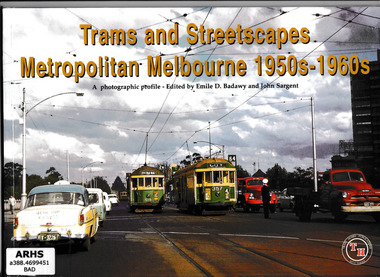
Book, Emile D Badawy, Trams and streetscapes: Metropolitan Melbourne 1950s-1960s, 2000
... Trams and streetscapes: Metropolitan Melbourne 1950s-1960s...Tramways - Melbourne - History Tramways - Melbourne Pictorial History of Melbourne trams in the 1950s and 1960s Ill, p.49. Trams and streetscapes: Metropolitan Melbourne 1950s-1960s Book Emile D Badawy John Sargent Train Hobby Publications ...Pictorial History of Melbourne trams in the 1950s and 1960sIll, p.49.non-fictionPictorial History of Melbourne trams in the 1950s and 1960stramways - melbourne - history, tramways - melbourne -
 Ringwood and District Historical Society
Train Tickets, Victorian Railways, Train tickets - Heathmont/Melbourne 2nd Class Weekly and a Workers Weekly Ringwood/Melbourne - circa 1950s, c. 1950
... Train tickets - Heathmont/Melbourne 2nd Class Weekly and a Workers Weekly Ringwood/Melbourne - circa 1950s....Train tickets - Heathmont/Melbourne 2nd Class Weekly and a Workers Weekly Ringwood/Melbourne - circa 1950s. Train Tickets Victorian Railways ...Train tickets:; 1. Train tickets Heathmont/Melbourne 2nd Class Weekly. Each stamped with a large two digit number which identifies the week of issue. Known as a Workers Weekly which cost 9/6 Ringwood/Melbourne. The date of issue is stamped across the end of each ticket. Qty 23 tickets.; 2. Train ticket with end torn off. Heathmont to Boronia. Particular of service: 2XR - Extension of service from Heathmont to Boronia. Issued at Canterbury. The date of issue 29JA is stamped across the end of the ticket. -
 Kew Historical Society Inc
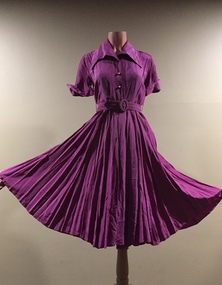
Clothing - Purple Rayon Day Dress, Scotchco of Melbourne, c.1950
... 1950s...melbourne fashion designers - scotchco of melbourne...Items in the collection were largely produced for, or purchased by women in Melbourne, and includes examples of outerwear, protective wear, nightwear, underwear and costume accessories. australian fashion - 1950s melbourne fashion designers - scotchco of melbourne women's clothing day dresses Label: Scotchco of Melbourne Plum coloured single piece dress, belted at the waist, with a belt covered with the same fabric. ...The Fashion & Design collection of the Kew Historical Society includes examples of women’s, men’s, children’s and infants’ clothing from the 18th, 19th and 20th centuries. Items in the collection were largely produced for, or purchased by women in Melbourne, and includes examples of outerwear, protective wear, nightwear, underwear and costume accessories.Plum coloured single piece dress, belted at the waist, with a belt covered with the same fabric. It has pearl buttons. The dress was retailed by Scotchco of MelbourneLabel: Scotchco of Melbourneaustralian fashion - 1950s, melbourne fashion designers - scotchco of melbourne, women's clothing, day dresses -
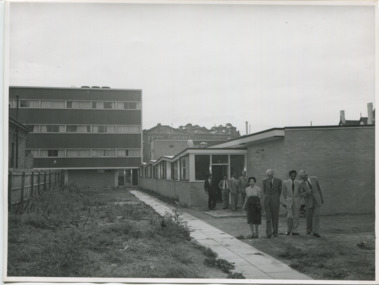 International House, The University of Melbourne
Photograph (Item), Australian News and Information Bureau, Group of people including first Warden Brian Jones walking near the recently-completed first accommodation building (llater named the Ian Clunies Ross Wing) at International House Melbourne, c. 1957
... 1950s Melbourne...The first accommodation building, which opened to residents in 1957, was later named in honour of Ian Clunies Ross (1899-1959), the first chair of the International House Council. 1950s Melbourne International House Group of people including first Warden Brian Jones walking near the recently-completed Clunies Ross Wing at International House Melbourne Group of people including first Warden Brian Jones walking near the recently-completed first accommodation building (llater named the Ian Clunies Ross Wing) at International House Melbourne Photograph Photograph Australian News and Information Bureau ...International House at the University of Melbourne was the first residence of its type in Australia. The first accommodation building, which opened to residents in 1957, was later named in honour of Ian Clunies Ross (1899-1959), the first chair of the International House Council. 1950s melbourne, international house -
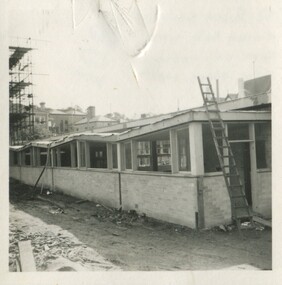 International House, The University of Melbourne
Photograph (Item), Dining hall wing at International House under construction, 1956
... 1950s Melbourne...1950s Melbourne Construction Inscribed in ink on reverse: 'South side of dining hall wing; covered passage way along wall'. ...Inscribed in ink on reverse: 'South side of dining hall wing; covered passage way along wall'.1950s melbourne, construction -
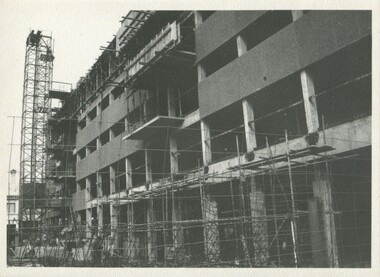 International House, The University of Melbourne
Photograph (Item), Clunies Ross Wing at International House under construction, c. 1956
... 1950s Melbourne...Historic 1950s Melbourne Construction Black and white photograph Clunies Ross Wing at International House under construction Clunies Ross Wing at International House under construction Photograph ...Historic1950s melbourne, construction -
International House, The University of Melbourne
Film (Item), University of Melbourne Experimental Film Unit, Film: International House, Melbourne
... 1950s Melbourne...The female student from Lang Lang is unknown, though may be named Wendy. 1950s Melbourne International House Black and white film displaying the benefits of an International House in Melbourne for university students. ...This short documentary film was produced by the Melbourne University Film Society in 1954 to display the hopeful possibilities of an International House in Melbourne. It was played from May 4th-6th in the Union House Theatre, along with several other films produced by the Society, possibly scheduled to coincide with the fundraising International House Fair the following weekend. The film stars broadcaster and author Allan Aldous as commentator, and the Malaysian female student is thought to be Rajeswary Thambiah of Malaysia. The female student from Lang Lang is unknown, though may be named Wendy.1950s melbourne, international house -
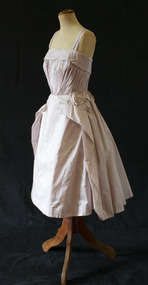 Brighton Historical Society
Dress, Cocktail dress, circa 1952
... hartnell of melbourne...1950s...Established by local designer Ralph Samuel, Hartnell of Melbourne was one of the leading high-end Flinders Lane fashion houses of the 1950s and 1960s. ...Adjusted for inflation, this price tag equates to approximately $1,480 in today's money. hartnell of melbourne 1950s ralph samuel melbourne designers flinders lane Label, white with blue text: "Exclusively yours, / Hartnell / REGD / MELBOURNE" Swing tag: "THIS GARMENT is made from finest material and designed for the fashion conscious woman / NO. 3633/332 / SIZE SSW / PRICE 39"19"6 / Hartnell of Melbourne Pty. ...Established by local designer Ralph Samuel, Hartnell of Melbourne was one of the leading high-end Flinders Lane fashion houses of the 1950s and 1960s. This dress still has its original store tag attached, which tells us that it cost 39 pounds, 19 shillings and sixpence - a large amount of money to spend on a dress in 1952. Adjusted for inflation, this price tag equates to approximately $1,480 in today's money.Mauve tucked and folded cocktail dress with twin shoulder straps, ruched bodice and gathered skirt. Rose detail on each hip. Tulle underskirt. Swing tag still attached to back zip.Label, white with blue text: "Exclusively yours, / Hartnell / REGD / MELBOURNE" Swing tag: "THIS GARMENT is made from finest material and designed for the fashion conscious woman / NO. 3633/332 / SIZE SSW / PRICE 39"19"6 / Hartnell of Melbourne Pty. Ltd. / Almond Pink"hartnell of melbourne, 1950s, ralph samuel, melbourne designers, flinders lane -
 Kew Historical Society Inc
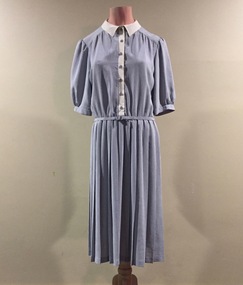
Clothing - Grey and Cream Crepe Dress, Nouvelle, 1960s
... ...fashion - melbourne - 1950s...Items in the collection were largely produced for, or purchased by women in Melbourne, and includes examples of outerwear, protective wear, nightwear, underwear and costume accessories. nouvelle women's clothing day dresses fashion - australia - melbourne (vic) fashion - melbourne - 1950s Label: Nouvelle Grey coloured crepe dress with cream coloured collar and neckline to waist. ...The Fashion & Design collection of the Kew Historical Society includes examples of women’s, men’s, children’s and infants’ clothing from the 18th, 19th and 20th centuries. Items in the collection were largely produced for, or purchased by women in Melbourne, and includes examples of outerwear, protective wear, nightwear, underwear and costume accessories.Grey coloured crepe dress with cream coloured collar and neckline to waist. The dress has three quarter length banded sleeve and a pleated skirtLabel: Nouvellenouvelle, women's clothing, day dresses, fashion - australia - melbourne (vic), fashion - melbourne - 1950s -
 Kew Historical Society Inc
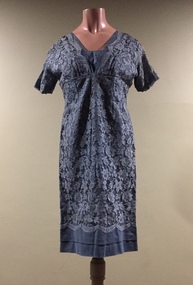
Clothing, Margeaux of Melbourne, Grey Silk & Lace Cocktail Dress, 1950s
... 1950s...margaux of melbourne...Items in the collection were largely produced for, or purchased by women in Melbourne, and includes examples of outerwear, protective wear, nightwear, underwear and costume accessories.This garment was created by Margeaux (Melbourne) which specialised in the production of "high-class cocktail and evening wear" (The Age, 17 March 1956). australian fashion - 1950s margaux of melbourne cocktail dresses women's clothing Knee length short sleeved grey silk and grey tulle cocktail dress with an attached outer covering of patterned lace of a lighter grey colour. ...The Fashion & Design collection of the Kew Historical Society includes examples of women’s, men’s, children’s and infants’ clothing from the 18th, 19th and 20th centuries. Items in the collection were largely produced for, or purchased by women in Melbourne, and includes examples of outerwear, protective wear, nightwear, underwear and costume accessories.This garment was created by Margeaux (Melbourne) which specialised in the production of "high-class cocktail and evening wear" (The Age, 17 March 1956).Knee length short sleeved grey silk and grey tulle cocktail dress with an attached outer covering of patterned lace of a lighter grey colour. The garment has the label of ‘Margeaux Regd. Imported fabric’. There is a zip at the back. There is some discoloration (due to sun damage?) to the lace at the shoulders. australian fashion - 1950s, margaux of melbourne, cocktail dresses, women's clothing -
 Kew Historical Society Inc
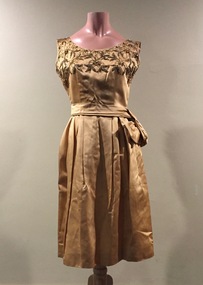
Clothing, Phil Bacon, Gold Satin Cocktail Dress with Beaded Bodice, 1950s
... australian fashion - melbourne - 1950s...The cocktail dress was once owned and worn by a resident of East Kew. women's clothing australian fashion - melbourne - 1950s cocktail dresses phil bacon Gold satin cocktail dress, gathered at the waist with beading on the bodice. ...The Fashion & Design collection of the Kew Historical Society includes examples of women’s, men’s, children’s and infants’ clothing from the 18th, 19th and 20th centuries. Items in the collection were largely produced for, or purchased by women in Melbourne, and includes examples of outerwear, protective wear, nightwear, underwear and costume accessories. Phil Bacon was one of a number of Melbourne fashion manufacturers who emerged in Melbourne following the Second World War. The cocktail dress was once owned and worn by a resident of East Kew.Gold satin cocktail dress, gathered at the waist with beading on the bodice. The zipped opening is at the back.women's clothing, australian fashion - melbourne - 1950s, cocktail dresses, phil bacon -
 Whitehorse Historical Society Inc.
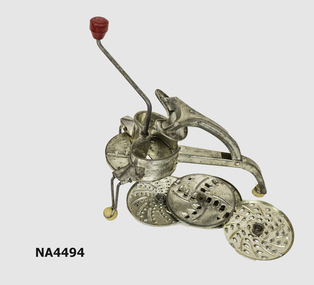
Domestic object - Moule Schredder, 1950s
... Used by donor's mother Alice Haggarty Port Melbourne in 1950s 1960s and 1970s...Used by donor's mother Alice Haggarty Port Melbourne in 1950s 1960s and 1970s domestic items appliances Moule Product other Pat. ...Used by donor's mother Alice Haggarty Port Melbourne in 1950s 1960s and 1970sMoule Schredder with six discs for slicing or grating vegetables, fruit or cheese. A stand for holding discs and detachable handle for changing discs. Instructions in Supplementary File.Moule Product other Pat. Pend. Serial No 1638domestic items, appliances -
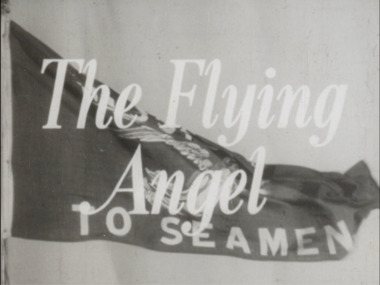 Mission to Seafarers Victoria
Film - Documentary, Cinesound, The Flying Angel, 1952
... This promotional film made in the early 1950s in Melbourne. Padre Oliver may have been inspired by an earlier film also called The Flying Angel, shon at the Mission in 1948. ...This promotional film made in the early 1950s in Melbourne. Padre Oliver may have been inspired by an earlier film also called The Flying Angel, shon at the Mission in 1948. ...This promotional film made in the early 1950s in Melbourne. Padre Oliver may have been inspired by an earlier film also called The Flying Angel, shon at the Mission in 1948. An article for the Herald, Saturday 27 December 1952, page 9, mentions the screening of a Cinesound short about the world's merchant fleets and the Missions to Seamen. An illuminated light house beside the ship - a £5000 model of an ocean-going cargo ship on display at the State Theatre for a week - was a collection box for the work of the mission. Flying Angel flag. Padre Oliver with flyer from the Flying Angel Club on a ship visit. Crew on a ship. Clubs at the Port Melbourne, Williamstown, and Melbourne. Activities: dances, outings. boxing, movies. Ladies from the Harbour Lights Guild. Motorbus donated by Prahran Patriotic Funds The Cruel Sea, by Nicholas Montsarrat was published in 1951.The documentary was shown for a week at the State Theatre along with a £5000 model of an ocean-going cargo ship was on display and visitors could donate money in a box in a shape of a lighthouse.Promotional documentary produced in 1951 presenting the different activities of the Mission. The 3 buildings are depicted.port melbourne, williamstown, melbourne, ww2, nicholas montsarrat, cinesound productions, the cruel sea, frank leslie oliver, padre oliver, dance, movies, picnics, motorbus, activities, appeal, hobart, cinema, dandenongs -
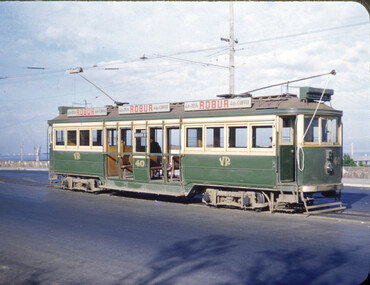 Melbourne Tram Museum
Slide - MMTB, VR and MTA tramway operations set of 12, Hugh Ballment, 1950s to 1980s
... HBM181 - Photo 1950s, Melbourne from south of Yarra River, Kodak commercial slide titled "Melbourne City Skyline across the River Yarra" HBM182 - MTA Tram SW6-915, cNov 1987, Bourke Street Mall, Has Billy Guyatts, Petra Haircare, Roger David and the Royal Mail Hotel in the background HBM183 - KCR , Apr 1988, ComEng Dandenong, Tuen Mun tram HBM184 - MTA, Aug 1988, Bourke St, Spencer St junction construction. ...HBM181 - Photo 1950s, Melbourne from south of Yarra River, Kodak commercial slide titled "Melbourne City Skyline across the River Yarra" HBM182 - MTA Tram SW6-915, cNov 1987, Bourke Street Mall, Has Billy Guyatts, Petra Haircare, Roger David and the Royal Mail Hotel in the background HBM183 - KCR , Apr 1988, ComEng Dandenong, Tuen Mun tram HBM184 - MTA, Aug 1988, Bourke St, Spencer St junction construction. ...Set of 12 photos by Hugh Ballment, unless noted, of MMTB, VR, Hong Kong KCR and MTA: HHBM173 - VR Tram 40, 26/05/1954, Brighton Beach, Tram has three roof top Robur Tea Adverts HBM174 - VR Trams 39, 54, 1950s, Elwood depot, Both trams have the destination of Elwood Depot HBM175 - VR Tram 3, 1950s, Elwood depot, Has the VR Substation in the background HBM176 - MMTB Trams W2 385, SW6 923, 26/05/1954, Swanston St, Damaged photograph. Tram 385 (South Melbourne Beach route 2A) and 923 (RAAF tram. Camberwell route 7). In the background is the Greer & Ashburnter Pty Ltd building HBM177 - MMTB Tram 31 May 1976, Bourke Street, Dark photo. Has the Palladion Theatre in the background showing Barry's Lindon. HBM178 - MMTB, c1954, Elizabeth St, Looking south from about Little Collins St with street decorations possibly for a Royal Tour positioned. Has the Hotel London and McEwans store in the view. HBM179 - MMTB Tram PCC 980, c1955, Malvern Depot, HBM180 - MMTB Trams 864, 502, c1987, Flinders St, Dark photo - see also HBM027 for a better photo. HBM181 - Photo 1950s, Melbourne from south of Yarra River, Kodak commercial slide titled "Melbourne City Skyline across the River Yarra" HBM182 - MTA Tram SW6-915, cNov 1987, Bourke Street Mall, Has Billy Guyatts, Petra Haircare, Roger David and the Royal Mail Hotel in the background HBM183 - KCR , Apr 1988, ComEng Dandenong, Tuen Mun tram HBM184 - MTA, Aug 1988, Bourke St, Spencer St junction construction. Z3 180 on Route 96 plus several other Z class trams present. Two Welding trucks onsite plus the mobile lilting crane and AEC Mk.VI meal bus further up Bourke Street Yields information about Melbourne tram operations, with 1950s to 1980s photos of Melbourne tramways.Kodachrome cardboard and plastic mounts, with notes - set of 12new tramway, vr, st kilda brighton tramway, tram 915, bourke st, spencer st, tram 40, tram 39, tram 3, tram 54, tram 985, swanston st, tram 31, tram 980, tram 864, tram 502, malvern depot, elizabeth st, hong kong, trams, brighton beach, elwood depot, w2 class, tram 385, sw6 class, tram 923, raaf, route 2a, route 7, z class, pcc class, arts trams, volvo b59, bourke st mall, route 95, comeng, z3 class, tram 180, welding truck, route 96, met bus -
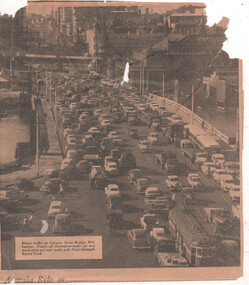 Melbourne Tram Museum
Newspaper - Spencer St bridge, traffic congestion and a hook turn, 1950s
... Photo shows extensive traffic congestion on the Spencer St bridge at the north end of Clarendon St South Melbourne, early 1950s, prior to the construction of the King St bridge. ...Photo shows extensive traffic congestion on the Spencer St bridge at the north end of Clarendon St South Melbourne, early 1950s, prior to the construction of the King St bridge. ...Photo shows extensive traffic congestion on the Spencer St bridge at the north end of Clarendon St South Melbourne, early 1950s, prior to the construction of the King St bridge. In the background is the Fish Market buildings prior to its demolition in 1958 - 1960 (see reference). The two lanes of traffic on the right side of the photo, or east side of the bridge, are queuing to do a hook turn into Lorimer St for Port Melbourne. This hook turn only operated during peak traffic hours and when a policeman was on duty.Yields information about traffic congestion on the Spencer St bridge in the early 1950s and a forgotten hook turn.Newspaper clipping from an unknown publication advertising Courtaulds Aust. Rayon tyres - A UK company who built a factory at Tomago NSW during 1951tramways, hook turns, south melbourne, spencer st bridge, traffic control, traffic congestion -
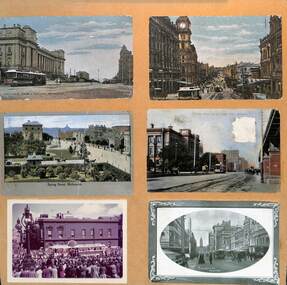 Melbourne Tram Museum
Postcard - Set of 5 mounted cable tram postcards and one photograph, 1910s
... Postcards with one photograph, all featuring the cable tram era, left to right, top to bottom: 1 - Parliament House and Treasury Melbourne 2 - Bourke St Melbourne from near Queen St looking east - has glitter added to the card surface. 3 - Spring St Melbourne 4 - Flinders Stand the Custom House Melbourne - part of the paper missing where a stamp has been removed. 5 - Cable tram set in a Parade, on a float, at the corner of Spring and Bourke Sts - early 1950s 6 - Elizabeth St Melbourne - looking south from Bourke St....Postcards with one photograph, all featuring the cable tram era, left to right, top to bottom: 1 - Parliament House and Treasury Melbourne 2 - Bourke St Melbourne from near Queen St looking east - has glitter added to the card surface. 3 - Spring St Melbourne 4 - Flinders Stand the Custom House Melbourne - part of the paper missing where a stamp has been removed. 5 - Cable tram set in a Parade, on a float, at the corner of Spring and Bourke Sts - early 1950s 6 - Elizabeth St Melbourne - looking south from Bourke St. ...Postcards with one photograph, all featuring the cable tram era, left to right, top to bottom: 1 - Parliament House and Treasury Melbourne 2 - Bourke St Melbourne from near Queen St looking east - has glitter added to the card surface. 3 - Spring St Melbourne 4 - Flinders Stand the Custom House Melbourne - part of the paper missing where a stamp has been removed. 5 - Cable tram set in a Parade, on a float, at the corner of Spring and Bourke Sts - early 1950s 6 - Elizabeth St Melbourne - looking south from Bourke St.Demonstrates a set of 6 postcards featuring Melbourne cable trams.Set of 5 mounted cable tram postcards and one photograph onto light weight boardtramways, spring st, bourke st, flinders st, cable trams, parades, elizabeth st -
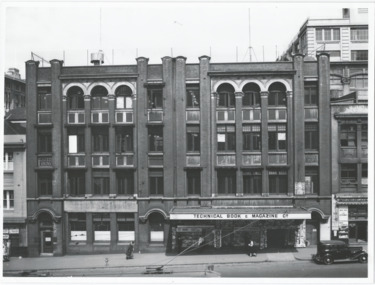 Melbourne Legacy
Photograph, Legacy House, 1956
... A photo of Legacy House in the 1950s. Junior Legacy Melbourne purchased 289-299 Swanston Street Melbourne (previously called Red Cross House) in 1956 from the Commonwealth Government with money gifted to Legacy in memory of David H Dureau. ...A photo of Legacy House in the 1950s. Junior Legacy Melbourne purchased 289-299 Swanston Street Melbourne (previously called Red Cross House) in 1956 from the Commonwealth Government with money gifted to Legacy in memory of David H Dureau. ...A photo of Legacy House in the 1950s. Junior Legacy Melbourne purchased 289-299 Swanston Street Melbourne (previously called Red Cross House) in 1956 from the Commonwealth Government with money gifted to Legacy in memory of David H Dureau. The donation was initially used to purchase a different building at 342 Swanston St, which was sold in 1954, and 289 Swanston St was purchased. Melbourne Legacy is still using three floors of the building, with tenants on the ground floor. It was used in a newspaper article about the acquisition of the building for Legacy. It mentions the purchase price was undisclosed. It says the purchase was possible due to a generous gift of money from overseas in 1944. The building would be called the David H Dureau Memorial Building at the request of the donor. The article has a photo of Governor Sir Dallas Brooks and the Legacy President Bob Gaylard. The notation LH5 in red pen implies it was part of an early archive project by Frank Doolan.A record of what the Legacy House building looked like when it was acquired by Melbourne Legacy.Black and white photo of Legacy House around the time when it was acquired in 1956 and newspaper reprint of an article about the acquisition marked LH5.Stamped on reverse 'Please Acknowledge Australian News and Information Bureau' in purple ink. Newpaper reprint has LH5 in red pen on top right corner, part of an archive project.dureau house, properties, swanston st, streetscape -
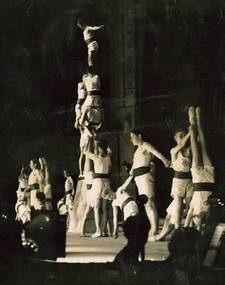 Melbourne Legacy
Photograph, Annual Demonstration 1947, 1947
... It was in an album of press photos taken during dress rehearsals from the 1940s and 1950s. Throughout the year Melbourne Legacy provided classes for Junior Legatees such as dancing, gymnastics and Eurythmics. ...It was in an album of press photos taken during dress rehearsals from the 1940s and 1950s. Throughout the year Melbourne Legacy provided classes for Junior Legatees such as dancing, gymnastics and Eurythmics. ...Black and white photo of boys in an Annual Demonstration in 1947. The boys are in gymnastic outfits with dark belts. They are climbing on equipment and each other, making a human pyramid. It was published in the newsletter in December 1947. It was in an album of press photos taken during dress rehearsals from the 1940s and 1950s. Throughout the year Melbourne Legacy provided classes for Junior Legatees such as dancing, gymnastics and Eurythmics. The Demonstration was an annual event to showcase their skills. Melbourne Legacy conducted Annual Demonstrations / Parades from 1928 through to the 1980's, usually held at Melbourne Town Hall. The beautiful costumes were made by members of the Junior Legacy Mothers' Club and the Melbourne Legacy Wives' Association.A record of the displays at the Annual Demonstrations. Also that Legacy provided classes for junior legatees and the skills learned were displayed in the Annual Demonstration.Black and white photo in an album of boys performing gymnastics on stage during a Demonstration.junior legatees, demonstration, annual demonstration, boys classes -
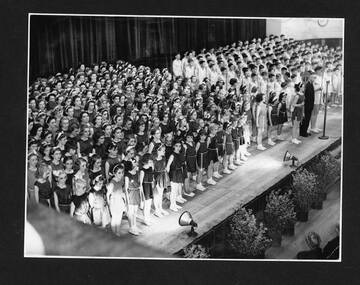 Melbourne Legacy
Photograph, Annual Demonstration, 1945
... Melbourne Town Hall stage during an Annual Demonstration. The boys and girls are either side of a Legatee W Perrin. The year is assumed to be 1945 as the Legatee making the speech is William Perrin who was President in 1945. It is in an album that was a collection of press photos taken during dress rehearsals from the 1940s and 1950s...Melbourne Town Hall stage during an Annual Demonstration. The boys and girls are either side of a Legatee W Perrin. The year is assumed to be 1945 as the Legatee making the speech is William Perrin who was President in 1945. It is in an album that was a collection of press photos taken during dress rehearsals from the 1940s and 1950s ...Black and white photo of a massed group on the Melbourne Town Hall stage during an Annual Demonstration. The boys and girls are either side of a Legatee W Perrin. The year is assumed to be 1945 as the Legatee making the speech is William Perrin who was President in 1945. It is in an album that was a collection of press photos taken during dress rehearsals from the 1940s and 1950s. Throughout the year Melbourne Legacy provided classes for Junior Legatees such as dancing, gymnastics and Eurythmics. The Demonstration was an annual event to showcase their skills. Melbourne Legacy conducted Annual Demonstrations / Parades from 1928 through to the 1980's, usually held at Melbourne Town Hall. The beautiful costumes were made by members of the Junior Legacy Mothers' Club and the Melbourne Legacy Wives' Association.A record of the displays at the Annual Demonstrations. Also that Legacy provided classes for junior legatees and the skills learned were displayed in the Annual Demonstration.Black and white photo in an album of a massed group on stage during a Demonstration with President Perrin.junior legatees, demonstration, annual demonstration, girls classes, boys classes, perrin -
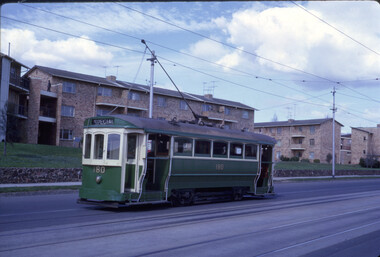 Melbourne Tram Museum
Slide - MMTB, and MTOCo - set of 12, Hugh Ballment, 1950s to 1960s
... HBM200 - MMTB Tram 610, 22/09/1968, Haymarket, with the Hotel Gresham, Evan Evans and the CBA bank in the background HBM201 - MMTB Tram 610, 22/09/1968, Royal Park, Railway bridge HBM202 - MMTB Tram 610, 22/09/1968, Melville Rd , West Coburg terminus, with the State Savings Bank, W G P Allen Chemist and a newsagent in the background HBM203 - MMTB Trams 104, 106, 28/07/1968, William St into LaTrobe St, TMSV tour - HBM204 - MMTB Trams 772, 731, 862, 22/09/1968, Brunswick depot, HBM205 - MMTB Tram 610, 22/09/1968, River St, Maribyrnong HBM206 - MMTB Tram 610, 22/09/1968, Royal Park, Back of Zoo HBM207 - MT&O, 1950s, Port Melbourne cable carshed, Cable tramway slot visible in road. ...Yields information about Melbourne tram operations, with 1950s to 1960s photos of Melbourne tramways. ...Set of 12 photos by Hugh Ballment, unless noted, of MMTB, and one of Port Melbourne cable tram depot trackwork. HBM196 - MMTB Tram 180, 10/09/1967, Epsom Rd, TMSV Tour - tours database gives the date of 10/9/1967, confirmed by TMSV tours listing. HBM197 - MMTB Tram 676, 10/09/1967, Caulfield, TMSV tour with the railway bridge in the background, along with an advert for EB Latice bricks HBM198 - MMTB Tram 180, 10/09/1967, South Melbourne depot, general view with some of the tour participants HBM199 - MMTB Tram 610, 22/09/1968, Footscray station, TMSV tour - Leeds St with the Appleton & Wright Mens wear and the railway station buildings in the background. HBM200 - MMTB Tram 610, 22/09/1968, Haymarket, with the Hotel Gresham, Evan Evans and the CBA bank in the background HBM201 - MMTB Tram 610, 22/09/1968, Royal Park, Railway bridge HBM202 - MMTB Tram 610, 22/09/1968, Melville Rd , West Coburg terminus, with the State Savings Bank, W G P Allen Chemist and a newsagent in the background HBM203 - MMTB Trams 104, 106, 28/07/1968, William St into LaTrobe St, TMSV tour - HBM204 - MMTB Trams 772, 731, 862, 22/09/1968, Brunswick depot, HBM205 - MMTB Tram 610, 22/09/1968, River St, Maribyrnong HBM206 - MMTB Tram 610, 22/09/1968, Royal Park, Back of Zoo HBM207 - MT&O, 1950s, Port Melbourne cable carshed, Cable tramway slot visible in road. Shows the car shed entrance, a hotel that was next door. In the view are adverts for Penfolds and Orlando wines. Yields information about Melbourne tram operations, with 1950s to 1960s photos of Melbourne tramways.Kodachrome cardboard mounts, with notes - set of 12tramways, epsom rd, tram 180, tram 676, caulfield, south melbourne depot, footscray, tram 610, tmsv, haymarket, royal park, tram 104, melville rd, river st, tram 772, tram 731, tram 862, port melbourne, cable trams, brunswick depot, the zoo -
 Melbourne Legacy
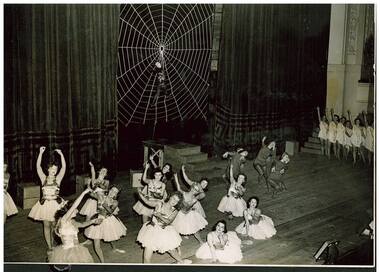
Photograph, Annual Demonstration, 195
... Melbourne Town Hall for an Annual Demonstration. It shows a girl dressed as a spider in a large spiderweb with other girls dancing below. This routine was done multiple times over the years. These three appear to be the same year based on the set and camera angle. One of the photos was published in the December 1946 newsletter so the year was 1946. They were in an album of press photos taken during dress rehearsals from the 1940s and 1950s...Melbourne Town Hall for an Annual Demonstration. It shows a girl dressed as a spider in a large spiderweb with other girls dancing below. This routine was done multiple times over the years. These three appear to be the same year based on the set and camera angle. One of the photos was published in the December 1946 newsletter so the year was 1946. They were in an album of press photos taken during dress rehearsals from the 1940s and 1950s ...Three black and white photos of a group of girls in elaborate costumes on the stage of the Melbourne Town Hall for an Annual Demonstration. It shows a girl dressed as a spider in a large spiderweb with other girls dancing below. This routine was done multiple times over the years. These three appear to be the same year based on the set and camera angle. One of the photos was published in the December 1946 newsletter so the year was 1946. They were in an album of press photos taken during dress rehearsals from the 1940s and 1950s. Throughout the year Melbourne Legacy provided classes for Junior Legatees such as dancing, gymnastics and Eurythmics. The Demonstration was an annual event to showcase their skills. Melbourne Legacy conducted Annual Demonstrations / Parades from 1928 through to 1979, usually held at Melbourne Town Hall. The beautiful costumes were made by members of the Junior Legacy Mothers' Club and the Melbourne Legacy Wives' Association.A record of the displays at the Annual Demonstrations. Also that Legacy provided classes for junior legatees and the skills learned were displayed in the Annual Demonstration.Black and white photo x 3 in an album of girls on stage with a large spiderweb as a background.junior legatees, demonstration, annual demonstration, girls classes, costumes -
 Eltham District Historical Society Inc
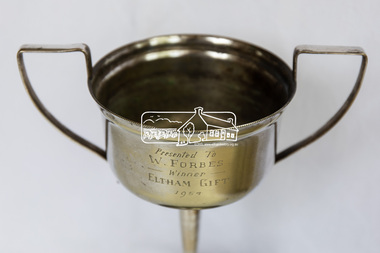
Decorative object - Trophy, Winner's Cup, Eltham Gift 1954, 1954
... Forbes Raymond (Billy) William Forbes 1934-2008 Born Nyah West, Vic and died Echuca, Vic, Billy was a painter and decorator in the 1950s before joining the Melbourne Metropolitan Fire Brigade in the 1960s. ...Forbes Raymond (Billy) William Forbes 1934-2008 Born Nyah West, Vic and died Echuca, Vic, Billy was a painter and decorator in the 1950s before joining the Melbourne Metropolitan Fire Brigade in the 1960s. ...Presented to W. Forbes Raymond (Billy) William Forbes 1934-2008 Born Nyah West, Vic and died Echuca, Vic, Billy was a painter and decorator in the 1950s before joining the Melbourne Metropolitan Fire Brigade in the 1960s. In the 1970s he was employed at the Melbourne Metropolitan Board of Works until his retirement in 1991. In the 1930s he was raised in Nyah West then moved to Wallan in the 1940s, Collingwood/Carlton in the 1950s, Reservoir in 1970 then Torrumbarry, Vic from the 1990s. Billy undertook National Service in the 1950s and played football with the Carlton Royals in the 1950s and 1960s. Billy was presented with this Winner's Trophy for the 1954 Eltham Gift. The Eltham Gift was a running race similar to many other 'Gift' races around the the Melbourne suburbs and country towns. And that is where the mystery lies as press reports of the day have a completely different person winning the Eltham Gift in 1954. Bert Edwards was recorded in local news as winning the 1954 Eltham Gift held at Central Park Eltham. Brass alloy silver plated cup (engraved) on brown baketlite platic basePresented to W. Forbes, Winner, Eltham Gift, 1954eltham gift 1954, raymond (billy) william forbes 1934-2008, running race, sports, trophy, w. forbes, winner's cup, central park, athletics -
 Sunshine and District Historical Society Incorporated
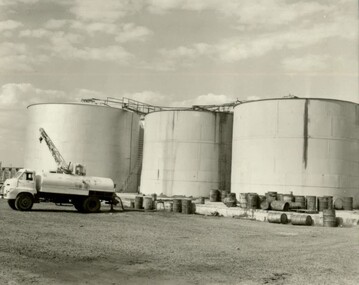
Photograph - Pridhams Tallow Tanks Evans Street Braybrook 1963 Photograph, February 1963
... Peerless Foods began in the 1950s as a small Melbourne business recycling and rendering meat by‑products with their early focus on rendering, tallow production, basic edible fats and oils. ...Peerless Foods began in the 1950s as a small Melbourne business recycling and rendering meat by‑products with their early focus on rendering, tallow production, basic edible fats and oils. ...Peerless Holdings’ Braybrook site began in the 1890s as Pridham’s Rendering Works. The rendering works produced sausage casings, meat meal, tallow, and fertiliser and operated as part of a large cluster of slaughterhouse related industries in Braybrook and Footscray districts. The founder, William Pridham was a prominent civic figure (Councillor, mayor, and community leader). Peerless Foods began in the 1950s as a small Melbourne business recycling and rendering meat by‑products with their early focus on rendering, tallow production, basic edible fats and oils. This positioned Peerless as a natural successor to Pridham’s operations. In 1982, Peerless Foods acquires Pridham’s Braybrook rendering business This acquisition gave Peerless a large, established industrial site, and by integrating Pridham’s century old rendering operations allowed Peerless to scale into a national fats and oils manufacturer During the 1980s and into the 2000s, Peerless went through a diversification process and expanded from tallow into edible oils, margarine, shortenings, bakery fats and foodservice oil. In 2005, Peerless purchased Unilever’s nonretail margarine and oil business, acquiring major Australian brands EOI, Copha, Fairy and Kremelta. This dramatically increased the Braybrook site’s production and distribution role. Peerless Holdings (Peerless Foods) now produces edible oils, spreads, shortenings, and bakery fats, supplies retail, foodservice, bakery, ingredients, and export markets. Peerless is still operating out of long-established Braybrook industrial complex, and the site remains one of the largest and longest running industrial facilities in Melbourne’s western suburbs.These tallow tanks are large, heated storage vessels that are used to hold rendered animal fat (tallow) in liquid form so it can be processed, refined, or transported. As tallow is solid at room temperature, these tanks keep it pumpable, and are fitted with steam coils, hot‑water jackets and insulated walls.evans street, braybrook, pridham -
 Flagstaff Hill Maritime Museum and Village
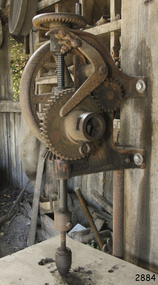
Drill Press, 1920s-1950s
... Melbourne, model no 611. Hand operated drill press. Self-feeding blacksmiths’ drill-press. This drill once belonged to Harry Goodall & Sons, blacksmiths of Terang. Dated 1920s-1950s...It is an example of the tools of the blacksmiths’ trade in Victoria in the 1920s-1950s. flagstaff hill warrnambool shipwrecked-coast flagstaff-hill flagstaff-hill-maritime-museum maritime-museum shipwreck-coast flagstaff-hill-maritime-village h. goodall & sons of terang terang blacksmith h. goodall & sons pty ltd, mortlake ernie entwistle blacksmith alfred hodgetts radio expert charles goodall john goodall mrs. chas. newton nee goodall terang 1900s warrnambool district 1900s post drill blacksmith’s drill dawn post drill dawn ball-bearing post drill no. 611 blacksmiths dawn of melbourne "Dawn", "Melbourne" Dawn Ball-bearing Post Drill no. 611, made by Dawn of Melbourne, model no 611. ...This drill once belonged to Goodall and Sons, who were blacksmiths in Terang. The smith was called upon to do a variety of work. In the early 1900s he was often the nearest person to be able to perform an engineer’s services for many miles around. The Dawn Ball-bearing Post Drill no. 611 is described in McPherson’s Catalogue as a “drilling machine with adjustable automatic feed, with improved Dawn coupler and ball-bearing thrust’. The heavy design of the flywheel enables it to maintain momentum” and is “fitted with pulleys for belt drive if desired” The hand crank drives an automatic feed to work off a cam-follow system opposite a large wheel. Made by Dawn Manufacturing Co. Australia 1920-1950. DAWN MANUFACTURING CO. Dawn Manufacturing Co. was founded in Coburg, Melbourne, in 1917 by the four Blake brothers, who were all engineers. After World War I Dawn was supplying drills Australia wide and the company was growing at a healthy rate. During the depression they remained busy, with employees working 60-80 hour weeks. Dawn was contracted to supply vices and clamps to the Australian Defence Department and munitions factory during the World War II. In 1959 the company was taken over by G.N. Raymond Group, then in 1973 the Siddons Ramset Limited acquired Dawn. In December 1991, Dawn became a unit of the United States owned Stanley Works Pty. Ltd. In November 1998 Dawn became 100 per cent Australian owned. HENRY GOODALL & SONS Henry Goodall (1870-1936) was proprietor of garages as H. Goodall & Sons Pty. Ltd., at both Terang (McKinnon and High Streets) and Mortlake (Dunlop Street). His business was in operation in at least in 1916 and perhaps well before, considering the date of the tyre bender and its use for wagons with wooden wheels. It was still in operation in 1953, chasing up debtors in Mount Gambier Court. Amongst the employees of H. Goodall & Sons Pty. Ltd. was Ernie Entwistle, a blacksmith (a soldier who died in 1916 ) and Alfred Hodgetts, radio expert (killed in a fatal accident in 1943, when he was in his early 30s ). Henry Goodall was involved in the community as a Justice of Peace, a deputy coroner, President of the Mortlake Hospital, trustee of the Soldiers’ Memorial Hall, and as a prominent Freemason. He and his wife had two sons (Charles and John) and one daughter (Mrs. Chas. Newton, of Skipton). The drill is locally significant as it was used by a local company in Terang and Mortlake in their blacksmith, wheelwright and garage business. It is an example of the tools of the blacksmiths’ trade in Victoria in the 1920s-1950s.Dawn Ball-bearing Post Drill no. 611, made by Dawn of Melbourne, model no 611. Hand operated drill press. Self-feeding blacksmiths’ drill-press. This drill once belonged to Harry Goodall & Sons, blacksmiths of Terang. Dated 1920s-1950s. Gear ratio 2:1 main drive, 6" diam, 3:1 reduction gear. "Dawn", "Melbourne"flagstaff hill, warrnambool, shipwrecked-coast, flagstaff-hill, flagstaff-hill-maritime-museum, maritime-museum, shipwreck-coast, flagstaff-hill-maritime-village, h. goodall & sons of terang, terang blacksmith, h. goodall & sons pty ltd, mortlake, ernie entwistle blacksmith, alfred hodgetts radio expert, charles goodall, john goodall, mrs. chas. newton nee goodall, terang 1900s, warrnambool district 1900s, post drill, blacksmith’s drill, dawn post drill, dawn ball-bearing post drill no. 611, blacksmiths, dawn of melbourne -
 Flagstaff Hill Maritime Museum and Village
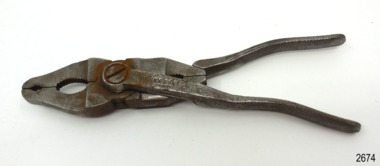
Tool - Pliers, Henry Boker, late 19th to early 20th century
... Fox & Co., of 250 Victoria Street North Melbourne, were agents for Boker tools in the 1950s. Museums Victoria has a Boker catalogue in its collection dated circa 1954....Fox & Co., of 250 Victoria Street North Melbourne, were agents for Boker tools in the 1950s. Museums Victoria has a Boker catalogue in its collection dated circa 1954. ...This unusual set of pliers was made in Germany by Henry Boker (Heinrich Boker). Boker hand tools were being produced in the 18th century in Remscheid, Germany. Boker tools were known for good quality and value for money. George A. Fox & Co., of 250 Victoria Street North Melbourne, were agents for Boker tools in the 1950s. Museums Victoria has a Boker catalogue in its collection dated circa 1954.These pliers are significant as an example of hand tools used in the early 20th centry or earlier. Pliers like this would typically be used in maritime trades.Pliers, double headed. This hand tool has two sets of jaws on its pair of handles. It was made by Henry Boker, Germany. Impressed into metal "HENRY BOKER / GERMANY"flagstaff hill, warrnambool, shipwrecked coast, flagstaff hill maritime museum, maritime museum, shipwreck coast, flagstaff hill maritime village, great ocean road, pliers, double headed pliers, henry boker, boker hand tool, german tool, german pliers, antique pliers, vintage pliers, victorian pliers, heinrich boker, tradesmen's tools -
 Federation University Historical Collection
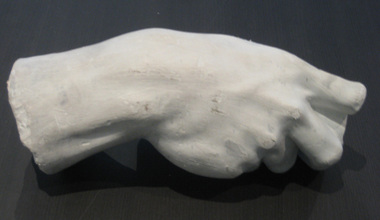
Equipment - Object, Otto Waschatz, Cast of Hand, Plaster Cast Drawing Prop
... 1950s. This is one of the few surviving pieces, with TAFE students reportedly drawing from it into the twenty-first century. This plaster hand is inscribed “Waschatz, Modeller, Melbourne.” ...1950s. This is one of the few surviving pieces, with TAFE students reportedly drawing from it into the twenty-first century. This plaster hand is inscribed “Waschatz, Modeller, Melbourne.” ...The Ballarat Technical Art School boasted a well-stocked Antique Room replete with plaster copies of classical, Renaissance and Gothic sculptural examples, which were used as drawing props by students. The school inherited some casts from its predecessor institutions, and further consignments were purchased during the 1920s, including full length, bust and relief figures, as well as dozens of ornamental and architectural casts. Unfortunately, much of the collection was lost or destroyed in the late 1950s. This is one of the few surviving pieces, with TAFE students reportedly drawing from it into the twenty-first century. This plaster hand is inscribed “Waschatz, Modeller, Melbourne.” Otto Waschatz was a German plasterer who opened a plaster business in the Melbourne suburb of Richmond, and was responsible for the invention of the first true fibrous plaster - using a layer of hemp laid between plaster to create light and strong panels. By 1912 Waschatz's Lottoid Pty Ltd was a thriving and creative business, and possessed over 5,000 moulds for all kinds of plasterwork. The business closed in 1915, as the result of anti-German sentiment during World War One. Plaster cast of a hand used as a teaching aid at the Ballarat Technical Art School. The Victorian Education Department courses required art students to create studies based on ancient sculptures so copies of famous works were purchased as teaching aids. Among these courses were 'Drawing the Human Figure from Cast' and ‘Drawing from the Antique’. Waschatz, Modeller, Melbourneballarat school of mines, art, arts academy, ballarat technical art school, vikki nash, plaster cast, otto waschatz, lattoid pty ltd, school of mines, plaster copy, drawing from the antique, drawing the human figure from cast -
 Federation University Historical Collection
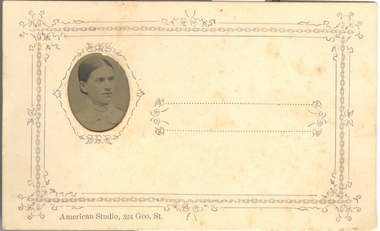
Photograph - Little Gem tintype, American Studio, Portrait of a Woman, (exact)
... 1950s. (Above information abridged from http://www.rleggat.com/photohistory/history/tintype.htm) The firm of Gove and Allen opened in Sydney in 1880 and were responsible for the belated popularizing of the gem tintype in Australia. The firm traded as both The American Gem Studio and The American Studio. Others franchises were opened in Melbourne...1950s. (Above information abridged from http://www.rleggat.com/photohistory/history/tintype.htm) The firm of Gove and Allen opened in Sydney in 1880 and were responsible for the belated popularizing of the gem tintype in Australia. The firm traded as both The American Gem Studio and The American Studio. Others franchises were opened in Melbourne ...The tintype (or ferrotype or Melainotype) was produced on metallic sheet (not, actually, tin) instead of glass. The plate was coated with collodion and sensitized just before use. It was introduced by Adolphe Alexandre Martin in 1853. The most common size was about the same as the carte-de-visite, 5.5cm x 9.0cm, but both larger and smaller ferrotypes were made. The smallest were "Little Gem" tintypes, about the size of a postage-stamp, made simultaneously on a single plate in a camera with 12 or 16 lenses. They were often produced by travelling photographers, and were cheaper than Ambrotypes so made photography available to working classes, not just to the more well-to-do. The print would come out laterally reversed (as one sees oneself in a mirror). Being quite rugged, tintypes could be sent by post. Tintypes were eventually superseded by gelatin emulsion dry plates in the 1880s, though street photographers in various parts of the world continued with this process until the 1950s. (Above information abridged from http://www.rleggat.com/photohistory/history/tintype.htm) The firm of Gove and Allen opened in Sydney in 1880 and were responsible for the belated popularizing of the gem tintype in Australia. The firm traded as both The American Gem Studio and The American Studio. Others franchises were opened in Melbourne, Ballarat and Sandhurst (Bendigo). The Sandhurst branch closed in 1882 and Adelaide in 1884. All Gove and Allen studios had ceased trading by 1885. The studio addresses were: 23 King William St, Adelaide; 324 George St, Sydney; 95 Swanston St, Melbourne; Howard Place, Sandhurst; 7 Queen St, Brisbane; The card mounts used in Gove and Allen studios in Australia are identical to those used in America. They were initially made of plain white card with embossing around the oval image opening in the mount while some also had simple geometric and floral printed designs as well. Although Gove and Allen studios produced the majority of gem tintypes in Australia, other studios offered them including: - London, American & Sydney Photo Company, 328 George St, Sydney; - David Edelsten, 55 & 57 Bourke St, Melbourne; - Burman's Portrait Rooms, St. George's Hall, 209 Bourke St, Melbourne; - Bell's Gem Portrait Studio, 57 Bourke St East, Melbourne; - R. H. Kenny, Bridge St, Ballarat; - Marinus W. Bent, Sandhurst (Bendigo); - George Fisher, Victoria; - Anson Brothers, Hobart Town. (Abridged information from http://members.ozemail.com.au/~msafier/photos/tintypes.html) A tintype portrait of a woman's head, attached to a card.Printed lower left hand side of the card "American Studio, 324 Geo. St."tintype, american studio, woman, unidentified woman, women, photograph -
 Federation University Historical Collection
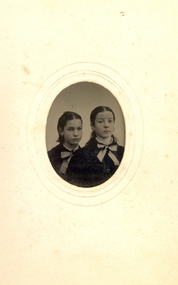
Photograph - Tintype, Portrait of two young girls
... 1950s. (Above information abridged from http://www.rleggat.com/photohistory/history/tintype.htm) The firm of Gove and Allen opened in Sydney in 1880 and were responsible for the belated popularizing of the gem tintype in Australia. The firm traded as both The American Gem Studio and The American Studio. Others franchises were opened in Melbourne...1950s. (Above information abridged from http://www.rleggat.com/photohistory/history/tintype.htm) The firm of Gove and Allen opened in Sydney in 1880 and were responsible for the belated popularizing of the gem tintype in Australia. The firm traded as both The American Gem Studio and The American Studio. Others franchises were opened in Melbourne ...The tintype (or ferrotype or Melainotype) was produced on metallic sheet (not, actually, tin) instead of glass. The plate was coated with collodion and sensitized just before use. It was introduced by Adolphe Alexandre Martin in 1853. The most common size was about the same as the carte-de-visite, 5.5cm x 9.0cm, but both larger and smaller ferrotypes were made. The smallest were "Little Gem" tintypes, about the size of a postage-stamp, made simultaneously on a single plate in a camera with 12 or 16 lenses. They were often produced by travelling photographers, and were cheaper than Ambrotypes so made photography available to working classes, not just to the more well-to-do. The print would come out laterally reversed (as one sees oneself in a mirror). Being quite rugged, tintypes could be sent by post. Tintypes were eventually superseded by gelatin emulsion dry plates in the 1880s, though street photographers in various parts of the world continued with this process until the 1950s. (Above information abridged from http://www.rleggat.com/photohistory/history/tintype.htm) The firm of Gove and Allen opened in Sydney in 1880 and were responsible for the belated popularizing of the gem tintype in Australia. The firm traded as both The American Gem Studio and The American Studio. Others franchises were opened in Melbourne, 6 Sturt St Ballarat and Sandhurst (Bendigo). The Sandhurst branch closed in 1882 and Adelaide in 1884. All Gove and Allen studios had ceased trading by 1885. The studio addresses were: 23 King William St, Adelaide; 324 George St, Sydney; 95 Swanston St, Melbourne; Howard Place, Sandhurst; 7 Queen St, Brisbane; The card mounts used in Gove and Allen studios in Australia are identical to those used in America. They were initially made of plain white card with embossing around the oval image opening in the mount while some also had simple geometric and floral printed designs as well. Although Gove and Allen studios produced the majority of gem tintypes in Australia, other studios offered them including: - London, American & Sydney Photo Company, 328 George St, Sydney; - David Edelsten, 55 & 57 Bourke St, Melbourne; - Burman's Portrait Rooms, St. George's Hall, 209 Bourke St, Melbourne; - Bell's Gem Portrait Studio, 57 Bourke St East, Melbourne; - R. H. Kenny, Bridge St, Ballarat; - Marinus W. Bent, Sandhurst (Bendigo); - George Fisher, Victoria; - Anson Brothers, Hobart Town. (Abridged information from http://members.ozemail.com.au/~msafier/photos/tintypes.html) .2) A tintype portrait of two girls heads, attached to a card. The girls are wearing a cloak with a large bow at the frontlittle gem, women, children, photography, tintype
