
Showing 50 items matching "advertising 1940s"
-
 Wodonga & District Historical Society Inc
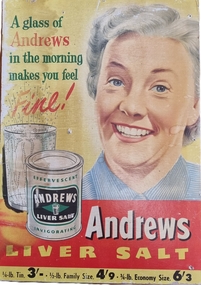
Sign - Andrews Liver Salt
... ...Advertising 1940s...Andrews Liver Salt Advertising 1940s A coloured advertising sign featuring a smiling woman and text in colours of red, yellow and white. ...Andrews Liver Salts was a laxative and antacid for mild stomach complaints. It was sold as a powder which was added to water and mixed, creating effervescence, before being swallowed. The powder contained sugar; an antacid, sodium bicarbonate (22.6% w/w); citric acid (to provide effervescence) (19.5% w/w); and a laxative, magnesium sulphate (17.4% w/w). Andrews Liver Salts was first sold from 1894, by William Henry Scott and William Murdoch Turner. Their business in the north-east of England originally imported margarine in the 1870s and 1880s. Their offices were in Gallowgate, Newcastle upon Tyne, and the product was named after St Andrew's church nearby. The trademark "Andrews Liver Salt" was registered in 1909. From the 1930s, promotional materials recommended taking the salts for "inner cleanliness". The company was acquired by Frederick Stearns & Co, a subsidiary of Sterling Drug, in 1923, and acquired by SmithKline Beecham in 1995. Haleon, the successor to SmithKline Beecham, ceased production of Andrews Liver Salts in November 2023. This item is significant because it represents a popular health product used throughout Australia from 1894 to 2023.A coloured advertising sign featuring a smiling woman and text in colours of red, yellow and white. It features two cans of Andrew Liver Saltandrews liver salt, advertising 1940s -
 Whitehorse Historical Society Inc.
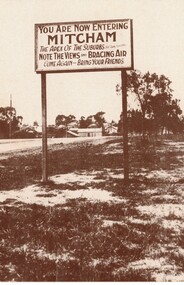
Postcard, Historic Postcard - Set 2 no 2 - Sign - Mitcham
... Black and white historic postcard (Set 2 No 2 ) Sign on Whitehorse Road, Mitcham in the 1940s advertising Mitcham. Photo supplied by Nunawading Historical Society - 2 copies....Signs Whitehorse Road Mitcham Nunawading Historical Society Nunawading Library & Information Service Black and white historic postcard (Set 2 No 2 ) Sign on Whitehorse Road, Mitcham in the 1940s advertising Mitcham. Photo supplied by Nunawading Historical Society - 2 copies. ...Black and white historic postcard (Set 2 No 2 ) Sign on Whitehorse Road, Mitcham in the 1940s advertising Mitcham. Photo supplied by Nunawading Historical Society - 2 copies.signs, whitehorse road, mitcham, nunawading historical society, nunawading library & information service -
 Greensborough Historical Society
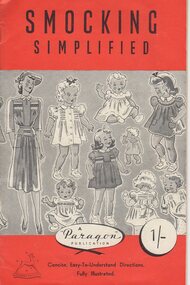
Book - Book - Digital Image, Paragon Art Needlecraft, Smocking Simplified, 1940s
... An example of 1940s advertising through sewing and homemaker books. ...An example of 1940s advertising through sewing and homemaker books. ...Front and back covers of "Smocking Simplified". An example of 1940s advertising through sewing and homemaker books. In this book, instructions are given for smocking of garments. Smocking is an embroidery technique used to gather fabric. An example of mid 20th century advertising through 'how-to' books.Digital copy of front and back covers of a bookhistoric advertisements, smocking, embroidery, hand sewing, paragon art needlecraft -
 Greensborough Historical Society
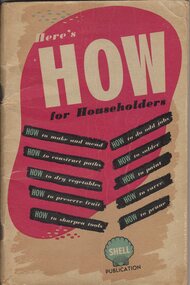
Book - Book - Digital Image, Shell Company of Australia, Here's how for householders, 1948_
... An example of 1940s advertising through sewing and homemaker books. ...An example of 1940s advertising through sewing and homemaker books. ...Front cover of "Here's how for householders". An example of 1940s advertising through sewing and homemaker books. In this book, instructions are given for many aspects of household management, interspersed with advertisements for useful items. An example of mid 20th century advertising through 'how-to' books.Digital copy of front cover of a bookhistoric advertisements, domestic science, shell company of australia, household hints -
 Greensborough Historical Society
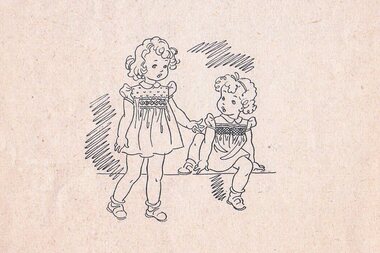
Book - Book - Digital Image, Paragon Art Needlecraft, Smocking Simplified: sample pages, 1940s
... An example of 1940s advertising through sewing and homemaker books. ...An example of 1940s advertising through sewing and homemaker books. ...Sample page from "Smocking Simplified", showing a line drawing of two small girls wearing smocked dresses. An example of 1940s advertising through sewing and homemaker books. In this book, instructions are given for smocking of garments. Smocking is an embroidery technique used to gather fabric. An example of mid 20th century advertising through 'how-to' books.Digital copy of sample page from a bookhistoric advertisements, smocking, embroidery, hand sewing, paragon art needlecraft -
 Greensborough Historical Society
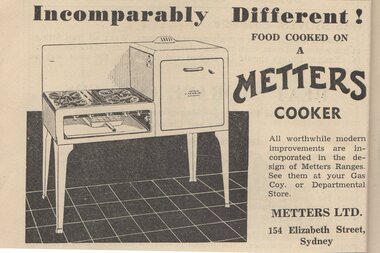
Document - Advertisement - Digital Image, NSW Cookery Teachers' Association, Metters Cooker: in Domestic Science Handbook, 1942_
... An example of 1940s advertising through cooking and homemaker books. ...An example of 1940s advertising through cooking and homemaker books. ...Advertisement for Metters Gas Cooker in "Domestic Science Handbook: for use by the pupils of domestic science schools". An example of 1940s advertising through cooking and homemaker books. In this book, instructions are given for many aspects of household management, interspersed with advertisements for useful items. This advertisement is for a Metters Gas Cooker or stove.An example of mid 20th century advertising through 'how-to' books.Digital copy of advertisement from a bookhistoric advertisements, domestic science, nsw cookery teachers association, metters, gas stoves -
 Greensborough Historical Society
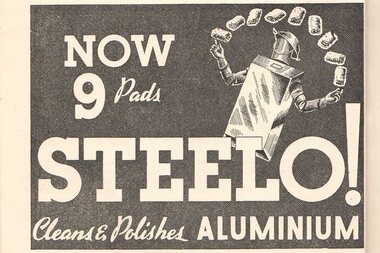
Document - Advertisement - Digital Image, NSW Cookery Teachers' Association, Steelo steel wool: in Domestic Science Handbook, 1942_
... An example of 1940s advertising through cooking and homemaker books. ...An example of 1940s advertising through cooking and homemaker books. ...Advertisement for Steelo in "Domestic Science Handbook: for use by the pupils of domestic science schools". An example of 1940s advertising through cooking and homemaker books. In this book, instructions are given for many aspects of household management, interspersed with advertisements for useful items. This advertisement is for Steelo steel wool used for cleaning saucepans.An example of mid 20th century advertising through 'how-to' books.Digital copy of advertisement from a bookhistoric advertisements, domestic science, nsw cookery teachers association, steelo, steel wool -
 Greensborough Historical Society
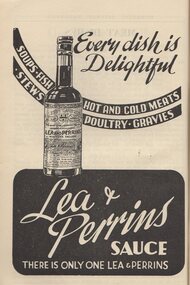
Document - Advertisement - Digital Image, NSW Cookery Teachers' Association, Lea and Perrins Sauce: in Domestic Science Handbook, 1942_
... An example of 1940s advertising through cooking and homemaker books. ...An example of 1940s advertising through cooking and homemaker books. ...Advertisement for Lea and Perrins Sauce from "Domestic Science Handbook: for use by the pupils of domestic science schools". An example of 1940s advertising through cooking and homemaker books. In this book, instructions are given for many aspects of household management, interspersed with advertisements for useful items. Lea and Perrins Worcestershire Sauce is still available today.An example of mid 20th century advertising through 'how-to' books.Digital copy of advertisement from a bookhistoric advertisements, domestic science, nsw cookery teachers association, lea and perrins, worcestershire sauce -
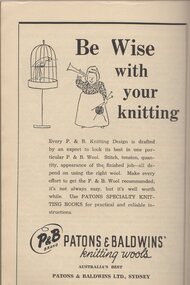 Greensborough Historical Society
Document - Advertisement - Digital Image, NSW Cookery Teachers' Association, Patons and Baldwins' Knitting Wool: in Domestic Science Handbook, 1942_
... An example of 1940s advertising through cooking and homemaker books. ...An example of 1940s advertising through cooking and homemaker books. ...Advertisement for Patons and Baldwins' Knitting Wool in "Domestic Science Handbook: for use by the pupils of domestic science schools". An example of 1940s advertising through cooking and homemaker books. In this book, instructions are given for many aspects of household management, interspersed with advertisements for useful items. This advertisement is for Patons and Baldwins' Knitting Wool and knitting books.An example of mid 20th century advertising through 'how-to' books.Digital copy of advertisement from a bookhistoric advertisements, domestic science, nsw cookery teachers association, knitting patterns, patons and baldwins knitting wool -
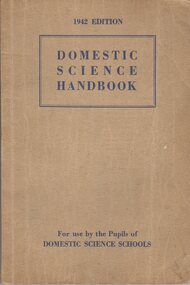 Greensborough Historical Society
Book - Book - Digital Image, NSW Cookery Teachers' Association, Domestic Science Handbook, 1942_
... An example of 1940s advertising through sewing and homemaker books. ...An example of 1940s advertising through sewing and homemaker books. ...Front and back covers of "Domestic Science Handbook: for use by the pupils of domestic science schools". An example of 1940s advertising through sewing and homemaker books. In this book, instructions are given for many aspects of household management, interspersed with advertisements for useful items. The back cover is an advertisement for Nock and Kirby Ltd, a Sydney based retail store. An example of mid 20th century advertising through 'how-to' books.Digital copy of front and back covers of a bookhistoric advertisements, domestic science, nock and kirby, nsw cookery teachers association -
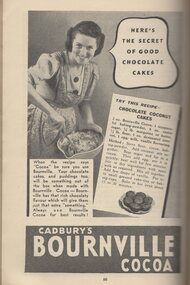 Greensborough Historical Society
Article - Advertisement - Digital Image, NSW Cookery Teachers' Association, Cadbury's Bourneville Cocoa: in Domestic Science Handbook, 1942_
... An example of 1940s advertising through cooking and homemaker books. ...An example of 1940s advertising through cooking and homemaker books. ...Advertisement for Cadbury's Bourneville Cocoa from "Domestic Science Handbook: for use by the pupils of domestic science schools". An example of 1940s advertising through cooking and homemaker books. In this book, instructions are given for many aspects of household management, interspersed with advertisements for useful items. This Cadbury's Bourneville Cocoa advertisement includes a recipe for chocolate cake.An example of mid 20th century advertising through 'how-to' books.Digital copy of advertisement from a bookhistoric advertisements, domestic science, nsw cookery teachers association, cadburys bourneville cocoa, chocolate cake -
 Greensborough Historical Society
Book - Book - Digital Image, Shell Company of Australia, Here's how for householders: Sample pages, 1948_
... An example of 1940s advertising through sewing and homemaker books. ...An example of 1940s advertising through sewing and homemaker books. ...Sample pages from "Here's how for householders". An example of 1940s advertising through sewing and homemaker books. In this book, instructions are given for many aspects of household management, interspersed with advertisements for useful items. Inside front and back covers are advertisements for Shell products, the company publishing this book.. There is also an advertisement for Pennant Kerosine (kerosene)An example of mid 20th century advertising through 'how-to' books.Digital copy of sample pages of a bookhistoric advertisements, domestic science, shell company of australia, household hints, pennant kerosine, kerosene -
 Greensborough Historical Society
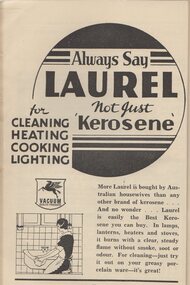
Document - Advertisement - Digital Image, NSW Cookery Teachers' Association, Laurel Kerosene: in Domestic Science Handbook, 1942_
... An example of 1940s advertising through cooking and homemaker books. ...An example of 1940s advertising through cooking and homemaker books. ...Advertisement for Laurel Kerosene from "Domestic Science Handbook: for use by the pupils of domestic science schools". An example of 1940s advertising through cooking and homemaker books. In this book, instructions are given for many aspects of household management, interspersed with advertisements for useful items. This Laurel Kerosene advertisement claims that Lauren Kerosene is good for cleaning, heating, cooking and lighting.An example of mid 20th century advertising through 'how-to' books.Digital copy of advertisement from a bookhistoric advertisements, domestic science, nsw cookery teachers association, laurel kerosene, kerosene -
 Greensborough Historical Society
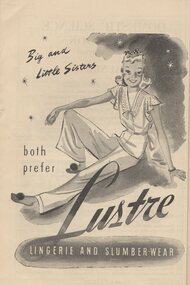
Document - Advertisement - Digital Image, NSW Cookery Teachers' Association, Lustre Lingerie: in Domestic Science Handbook, 1942_
... An example of 1940s advertising through cooking and homemaker books. ...An example of 1940s advertising through cooking and homemaker books. ...Advertisement for Lustre Lingerie and Slumberwear from "Domestic Science Handbook: for use by the pupils of domestic science schools". An example of 1940s advertising through cooking and homemaker books. In this book, instructions are given for many aspects of household management, interspersed with advertisements for useful items. This advertisement for Lustre Lingerie and Slumberwear claims it is suitable for all ages - 'big and little sisters'.An example of mid 20th century advertising through 'how-to' books.Digital copy of advertisement from a bookhistoric advertisements, domestic science, nsw cookery teachers association, lustre lingerie -
 Greensborough Historical Society
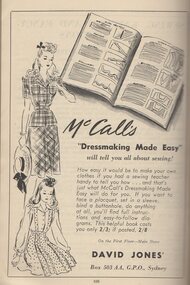
Document - Advertisement - Digital Image, NSW Cookery Teachers' Association, McCall's "Dressmaking made easy": in Domestic Science Handbook, 1942_
... An example of 1940s advertising through cooking and homemaker books. ...An example of 1940s advertising through cooking and homemaker books. ...Advertisement for McCall's "Dressmaking made easy" in "Domestic Science Handbook: for use by the pupils of domestic science schools". An example of 1940s advertising through cooking and homemaker books. In this book, instructions are given for many aspects of household management, interspersed with advertisements for useful items. This advertisement for another book McCall's "Dressmaking made easy" was available from David Jones in Sydney.An example of mid 20th century advertising through 'how-to' books.Digital copy of advertisement from a bookhistoric advertisements, domestic science, nsw cookery teachers association, mccalls, dressmaking, david jones -
 Greensborough Historical Society
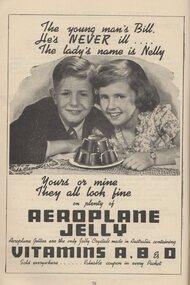
Article - Advertisement - Digital Image, NSW Cookery Teachers' Association, Aeroplane Jelly: in Domestic Science Handbook, 1942_
... An example of 1940s advertising through cooking and homemaker books. ...An example of 1940s advertising through cooking and homemaker books. ...Advertisement for Aeroplane Jelly from "Domestic Science Handbook: for use by the pupils of domestic science schools". An example of 1940s advertising through cooking and homemaker books. In this book, instructions are given for many aspects of household management, interspersed with advertisements for useful items. This Aeroplane Jelly advertisement tells of the health benefits of eating the jelly, its vitamin content and that it is made in Australia.An example of mid 20th century advertising through 'how-to' books.Digital copy of advertisement from a bookhistoric advertisements, domestic science, nsw cookery teachers association, aeroplane jelly -
 Greensborough Historical Society
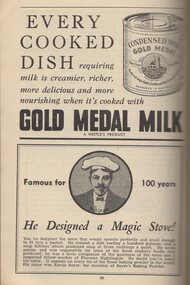
Article - Advertisement - Digital Image, NSW Cookery Teachers' Association, Gold Medal Milk: in Domestic Science Handbook, 1942_
... An example of 1940s advertising through cooking and homemaker books. ...An example of 1940s advertising through cooking and homemaker books. ...Advertisement for Gold Medal Milk from "Domestic Science Handbook: for use by the pupils of domestic science schools". An example of 1940s advertising through cooking and homemaker books. In this book, instructions are given for many aspects of household management, interspersed with advertisements for useful items. This Gold Medal Milk advertisement is for tinned condensed milk. The page includes an advertisement for Soyer's Baking Powder.An example of mid 20th century advertising through 'how-to' books.Digital copy of advertisement from a bookhistoric advertisements, domestic science, nsw cookery teachers association, gold medal milk, condensed milk, baking powder, soyers baking powder -
 Greensborough Historical Society
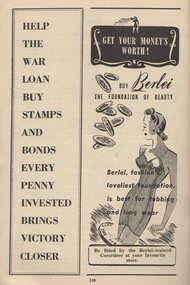
Article - Advertisement - Digital Image, NSW Cookery Teachers' Association, Berlei: in Domestic Science Handbook, 1942_
... An example of 1940s advertising through cooking and homemaker books. ...An example of 1940s advertising through cooking and homemaker books. ...Advertisement for Berlei (foundation garments) from "Domestic Science Handbook: for use by the pupils of domestic science schools". An example of 1940s advertising through cooking and homemaker books. In this book, instructions are given for many aspects of household management, interspersed with advertisements for useful items. This Berlei advertisement is for corsetry that was popular at the time. Also on this page is an advert for War Bonds, to support the war effort in World War 2.An example of mid 20th century advertising through 'how-to' books.Digital copy of advertisement from a bookhistoric advertisements, domestic science, nsw cookery teachers association, berlei, war bonds, world war 2 -
 Greensborough Historical Society
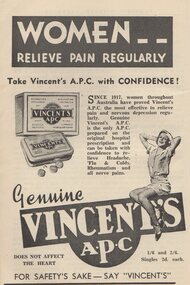
Flyer - Advertisement - Digital Image, NSW Cookery Teachers' Association, Vincent's A.P.C.: in Domestic Science Handbook, 1942_
... An example of 1940s advertising through cooking and homemaker books. ...An example of 1940s advertising through cooking and homemaker books. ...Advertisement for Vincent's A.P.C. in "Domestic Science Handbook: for use by the pupils of domestic science schools". An example of 1940s advertising through cooking and homemaker books. In this book, instructions are given for many aspects of household management, interspersed with advertisements for useful items. This advertisement is for Vincent's A.P.C., a drug containing aspirin, phenacetin, and caffeine, used to 'relieve pain and nervous depression'. It was banned in Australia in 1979 due to possible kidney complications.An example of mid 20th century advertising through 'how-to' books.Digital copy of advertisement from a bookhistoric advertisements, domestic science, nsw cookery teachers association, vincents apc, pain relief -
 Marysville & District Historical Society
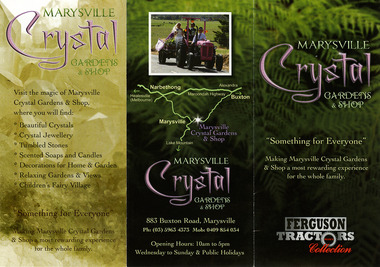
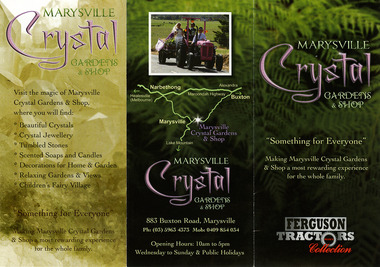
Ephemera (Item) - Advertising brochure, Marysville Crystal Gardens & Shop, Unknown
... advertising brochure for Marysville Crystal Gardens and Shop in Victoria. Marysville House, home to Marysville Crystal Gardens and Shop was built by Arthur Dickinson as a guest house in the late 1920s, then added to in the late 1940s. ...An advertising brochure for Marysville Crystal Gardens and Shop in Victoria.An advertising brochure for Marysville Crystal Gardens and Shop in Victoria. Marysville House, home to Marysville Crystal Gardens and Shop was built by Arthur Dickinson as a guest house in the late 1920s, then added to in the late 1940s. It closed as a guest house in the late 1950s. The family catered for up to 40 guests at a time. It was also the family home and still is. After the 2009 Black Saturday bushfires, it is now the only surviving, original guest house left in Marysville.crystal gardens, marysville, victoria, ferguson tractors, marysville house, arthur dickinson, guest house, 2009 black saturday bushfires -
 Marysville & District Historical Society
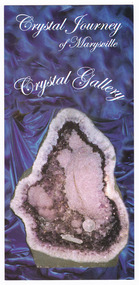
Ephemera (Item) - Advertising brochure, Crystal Journey of Marysville, Unknown
... advertising brochure for Crystal Journey of Marysville in Victoria. Marysville House, home to Marysville Crystal Gardens and Shop was built by Arthur Dickinson as a guest house in the late 1920s, then added to in the late 1940s. ...An advertising brochure for Crystal Journey of Marysville in Victoria.An advertising brochure for Crystal Journey of Marysville in Victoria. Marysville House, home to Marysville Crystal Gardens and Shop was built by Arthur Dickinson as a guest house in the late 1920s, then added to in the late 1940s. It closed as a guest house in the late 1950s. The family catered for up to 40 guests at a time. It was also the family home and still is. After the 2009 Black Saturday bushfires, it is now the only surviving, original guest house left in Marysville.crystal gardens, marysville, victoria, marysville house, arthur dickinson, guest house, 2009 black saturday bushfires -
 Marysville & District Historical Society
Ephemera (Item) - Advertising brochure, Marysville Crystal Gardens & Shop, Unknown
... advertising brochure for Marysville Crystal Gardens and Shop in Victoria. Marysville House, home to Marysville Crystal Gardens and Shop was built by Arthur Dickinson as a guest house in the late 1920s, then added to in the late 1940s. ...An advertising brochure for Marysville Crystal Gardens and Shop in Victoria.An advertising brochure for Marysville Crystal Gardens and Shop in Victoria. Marysville House, home to Marysville Crystal Gardens and Shop was built by Arthur Dickinson as a guest house in the late 1920s, then added to in the late 1940s. It closed as a guest house in the late 1950s. The family catered for up to 40 guests at a time. It was also the family home and still is. After the 2009 Black Saturday bushfires, it is now the only surviving, original guest house left in Marysville.crystal gardens, marysville, victoria, ferguson tractors, marysville house, arthur dickinson, guest house, 2009 black saturday bushfires -
 Flagstaff Hill Maritime Museum and Village
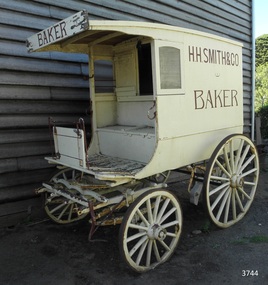
Vehicle - Wagon, H.H. Smith & Co. Baker, Circa 1930s - 1940s
... advertising for H.H. Smith & Co. Henry Huntington Smith (1857-1941) owned and operated his Warrnambool bakery in the late 19th and early 20th century. However, the design of the wagon is similar to those used by local bakers in the 1930s and 1940s and probably originated from Stephenson’s Bakery in Warrnambool, which operated around that time. ...advertising for H.H. Smith & Co. Henry Huntington Smith (1857-1941) owned and operated his Warrnambool bakery in the late 19th and early 20th century. However, the design of the wagon is similar to those used by local bakers in the 1930s and 1940s and probably originated from Stephenson’s Bakery in Warrnambool, which operated around that time. ...This baker’s wagon or cart transported and delivered bread and other baked goods in the Warrnambool area. It currently has advertising for H.H. Smith & Co. Henry Huntington Smith (1857-1941) owned and operated his Warrnambool bakery in the late 19th and early 20th century. However, the design of the wagon is similar to those used by local bakers in the 1930s and 1940s and probably originated from Stephenson’s Bakery in Warrnambool, which operated around that time. The wagon’s original internal shelves were removed in the early days of Flagstaff Hill so that children could have rides around the village in a horse-driven cart. BAKERS’ HISTORY There were many bakeries in Warrnambool in the 19th to mid-20th century. Each bread bakery made horse and cart deliveries in its allocated zone. SMITH’S BAKERY; – as shown on the wagon’s signage. Henry Huntington Smith (1857-1941) was born and educated in Warrnambool. He worked at Davis’ steam biscuit factory in Timor Street before he began his own bakery business in 1885 near the corner of Fairy and Koroit Streets. A few years later Smith built a new bakery on the corner of Fairy and Lava Street where it still stands today (2025) as Monaghan’s Pharmacy. The building was designed by James McLeod in 1892 as a bakehouse, shop and residence for Smith The address was known locally as Smith’s Corner. Next door to the bakery, at 136 Fairy Street, were stables built by Jobbins and McLeod in 1886 for William Cust. A photograph in the archives of the Warrnambool and District Historical Society shows the 1892 building with four fancy horse-drawn wagons on the street with white-clad drivers and a promotional stand erected with 5 bakers in uniform and the signage “H H Smith & Co, Pastry Cooks and Confectioners”. One of the wagons appears to have “H H Smith” painted on the side. H.H. Smith & Co. placed an Advertisement in the Weekly Times in December 1896 promoting its business as bakers, confectioners and pastry cooks, praising their shop as an ‘ornament to the town’ with ‘neat appointments’ and ‘dainty decorations’. It also boasted of supplying a large number of customers within a twelve-mile radius of Warrnambool. In November 1919 The Warrnambool Standard announced the marriage of Henry H Smith, Mayor of Warrnambool, to Jeannie Samson-Goodman in East Adelaide. In the same newspaper was a notice that Frank Crossley was to open as baker and pastry cook in H.H. Smith’s premises. As well as being the proprietor of the H.H. Smith Bakery, Henry Huntington Smith was a Councillor for the Warrnambool Municipality from 1913 to 1937 and Mayer for two terms. In December 1919 during his first term as Mayor, he was honoured for the work he had done with returning soldiers after World War I, receiving a document in recognition of this work, presented by the Mothers, Wives and Sisters of returned soldiers. Smith was very interested and involved in the community in many roles, including being the Vice President of the first Warrnambool and District Historical Society. STEPHENSON’S BAKERY: – believed to be the past owner of the wagon. The last owner of the bakery was Harold Stephenson. Stephenson was enlisted in the A.I.F. and was invalided home in 1943 before the end of the Second World War. He also served as a Councillor from 1958 to 1976, during which time he served six terms as Mayor for the City of Warrnambool (1966-1973) while he had the bakery. He was very involved in many local organisations including the Warrnambool Surf Life Saving Club and the Road Race Committee. He died in 1985, lauded as being one of Warrnambool’s “most distinguished civic leaders”. It has been said that the baker injured in World War II invented a special contraption to enable him to get up into the wagon and that he alerted his customers that he was in their vicinity by blowing a whistle. The customers would come out and choose their bread from the back of his wagon then pay him for it. However, another account is given by a man who once earned pocket money by helping the baker on his rounds. He says that it was Stephenson, the owner and manager of the bakery, and not the delivery baker who received a significant injury during the war, making him unable to climb the stairs of his upstairs accommodation at the bakery, therefore causing him to sleep downstairs. At this time in the early to late 1940 Stephenson’s bakery had three wagons, one for each of the delivery rounds. The wagons were painted black and yellow. Two of the drivers were Stan Lake and Ali (Alec) Dean who both had wagons with the covered cabin design. The third driver was Bill Lake who had a flat wagon. Stan Lake delivered in the area around Lava and Koroit Streets, Ali Dean had another round and Bill Lake had the Dennington area. Bread continued to be delivered into the 1960s but by this time the delivery vehicles were motorised. The goods produced at Stephenson’s bakery included bread baked in different shaped tins such as High Tin, Sandwich and Vienna. Some shapes were easily divided into half by breaking them apart, therefore the baker could make two-quarter loaves from a half loaf, satisfying different needs. There was the option of white or brown bread, sweet buns, fruit buns and Boston buns. The baker’s assistant was known to take great delight in ‘trimming’ the broken halves of excess bread and crust, enjoying his treat. THE BAKERY PREMISES: – Southeast corner of Fairy and Lava Streets, Warrnambool. The building retains the original cast iron veranda. Above the veranda, a motif of a wheat sheaf in ornamental plaster can be seen. Inside the building, there are still some of the original fittings. The building was classified by the National Trust in August 1979. After the Second World War, an official system of zoning was introduced as a fair way for the baking industry to operate. In 1949 different pricing was introduced by the Government for either delivered or retail purchased bread. Many of the small local bakeries went out of business after the Government banned zoning. The way was made open for the larger bread manufacturers to enter the local market with cheaper prices. Some of those companies were Mc Queens, Tip Top, Twisties, and Sunicrust, (Mc Queens ‘new’ bakery building was where the current Toyworld shop now stands, is, in the Ozone carpark.) O’Grady’s Bakery, later changing hands and known as Burkes Bakery, was on Fairy Street near the Timor Street intersection, on the North West side. There was also a bakery named Almay. The baker’s wagon is significant because of its association with H.H. Smith’s Bakery in Warrnambool.. The H.H. Smith’s Bakery building on the corner of Fairy and Lava Streets, built in 1892, is classified by the National Trust, August 1979. Smith Street Warrnambool was named after Henry Huntington Smith, who was a Warrnambool Councillor 1913 – 1937 and Mayor 1919 – 1921. Baker’s wagon, often referred to as a baker’s cart. Four wheeled horse-drawn delivery wagon, front wheels smaller than rear wheels. Wagon is clad with metal sheets and lined with varnished timber panels. Wheels have metal rims, wooden spokes and rear wheels have wooden brake pads. Horse shaft is timber with metal fittings. Front has a metal lamp holder, brake lever, metal hand grips and decorative metal foot plates. The wagon has suspension leaves on back and sides and double suspension leaves on the front. Driver’s area at front has a roof, glass side windows and wooden box seat with hinged compartment accessing wagon storage area. Door above back of seat has buckled leather handgrip strap attached, door slides open for access to wagon area. Back of wagon has a wooden step and a split door; top door has ventilation louvers, both doors have metal latches. Wagon is painted cream with brown trim and signage and green step. Remnants of red and green paint are visible; underside of seat panel is painted grey. Wagon advertises H.H. Smith & Co. Baker, a Warrnambool business established in 1885, but is of a more modern design seen around 1930’s and 1940’s and most likely belonging to Stephenson's bakery. Brown signwriting on sides of wagon “H.R. SMITH & CO. / BAKER” Brown signwriting across front of wagon “BAKER” warrnambool, shipwrecked-coast, flagstaff-hill, flagstaff-hill-maritime-museum, maritime-museum, shipwreck-coast, flagstaff-hill-maritime-village, shipwrecked-artefact, great ocean road, baker’s wagon, h.h. smith baker, warrnambool, henry h smith, jeannie samson-goodman, frank crossley, mayor of city of warrnambool, vice president of warrnambool and district historical society, stephenson’s bakery warrnambool, harold stephenson, warrnambool surf life saving club, road race committee, national trust building, stan lake, bill lake, ali dean, 19th and 20th century bakers, davies steam biscuit factory warrnambool, james mcleod building designer, jobbins and mcleod, william cust, h h smith & co, pastry cooks and confectioners, bakery trade, bread delivery wagon -
 Warrnambool and District Historical Society Inc.
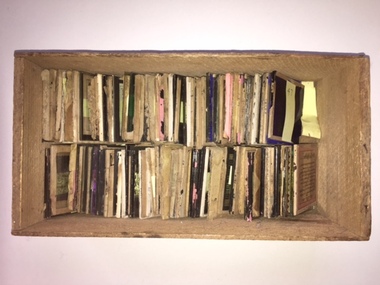
Slide - Slides, Box of Glass Slides Capitol Theatre, 1940s
... 1940s and 50s when slides were shown during the interval times and many of these were locally made. The reason for showing the words of songs is not known but it is presumed they had sing-a-longs during the intervals, possibly to boost morale during the days of World War Two. The advertising ...These glass slides were made to be used at interval time at the Capitol Theatre in Kepler Street, Warrnambool. The Capitol Theatre (originally the Warrnambool Theatre) was erected in 1930 on the site occupied by the Hotel Mansions which included a Palais de Danse and a Mansions Theatre. All were destroyed by fire in 1929. The Capitol Theatre was built in the Spanish Mission style and is one of the few surviving Spanish Mission style theatres in Victoria. However the interior was largely altered in 1994 when the Capitol was converted into a three-screen complex. But some decorative features of the old interior were kept and these included the original proscenium. Stan Stevens and his family were associated with the Capitol Theatre management for many years from 1972. The Capitol Theatre still operates today. These slides are of considerable importance as they are a wonderful example of picture theatre-going in the 1940s and 50s when slides were shown during the interval times and many of these were locally made. The reason for showing the words of songs is not known but it is presumed they had sing-a-longs during the intervals, possibly to boost morale during the days of World War Two. The advertising slides are of particular interest and feature such local businesses as the Woollen Mill, Sungold Dairies, E.A. Wright Motors and Alex Donaldson Timber and Hardware Supplies. These are small square glass slides (numbered1 to 92) which were shown in the 1940s at the Capitol Theatre in Warrnambool at interval time (advertisements, words of songs etc). Some of the slides have been professionally produced and some, especially the words of songs, have been hand-made and handwritten or typed. Some are in colour and some are blank. In others the contents have been obscured or obliterated. Most of the slides have been taped around the edges and some have more sturdy frames made of tape. capitol theatre, warrnambool, stan stevens, glass slides, movie theatre -
 Warrnambool and District Historical Society Inc.
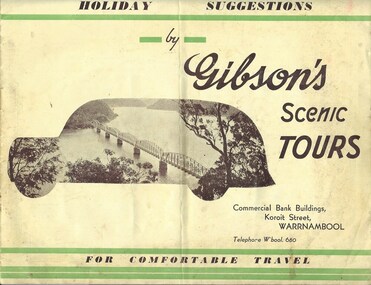
Booklet, Advertising Holiday Suggestions by Gibson's Scenic Tours, 1930s/40s
... 1940s. The tours were to Canberra and Sydney, Mount Gambier, Adelaide, Geelong, Ballarat, the Great Ocean Road and the Grampians. The buses could take 11 to 20 passengers. Gibson’s Bus Services History of Warrnambool Warrnambool Tourism Warrnambool This is a soft cover booklet of eight pages produced as an advertising feature for Gibson’s Bus Services of Warrnambool. ...This booklet has been produced to advertise the tours offered by the Gibson’s Bus Services in Warrnambool in the late 1930s or early 1940s. The office of this bus service was situated in the Commercial Bank Buildings in Koroit Street, Warrnambool. This booklet is of interest because it shows the type of bus tours offered to Warrnambool people in the late 1930s and early 1940s. The tours were to Canberra and Sydney, Mount Gambier, Adelaide, Geelong, Ballarat, the Great Ocean Road and the Grampians. The buses could take 11 to 20 passengers. This is a soft cover booklet of eight pages produced as an advertising feature for Gibson’s Bus Services of Warrnambool. The cover has a yellow background with green lines on the edges. There is a sepia-coloured photograph on the front cover of a river scene encased in the shape of a bus and the back cover has three photographs of the buses used by the company. The pages have information on Gibson’s Scenic Tours, Gibson’s Travel Club and the extended and day tours offered by the company. The booklet includes many black and white photographs of places visited on the tours. The booklet is bound with metal staples. gibson’s bus services, history of warrnambool, warrnambool tourism, warrnambool -
 Bendigo Historical Society Inc.
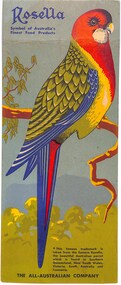
Ephemera - PRODUCT LABELS: ROSELLA, QT, LAGOON, COTTEE'S, Unknown
... 1940s. Cottee's is a company founded in Australia in 1927. It manufactured and continues to produce cordial, jams, marmalades, spreads, toppings, jellies and puddings. The company is now owned by Kraft Heinz. BUSINESS Retail Rosella Allens Lagoon Cottee's a 'ROSELLA. THE ALL-AUSTRALIAN COMPANY' b 'QT. ORANGE FRUIT DROPS' c, d 'LAGOON' 'Lagoon Confectioners Pty. Ltd., 118 Albert Rd., South Melbourne' e 'HI KIDS, THEY'RE BEAUT!' 'CHOCOLATE CREAM toffees' '1D each' f 'Cottee's Sparkling PASSIONA' Pamphlet advertising ...Rosella Preserving & Manufacturing Co. in Carlton, Victoria by H. R. McCraken and T. J. Press in 1895. The name and the logo are the Eastern Rosella which is a bird found down the east coast of Australia. The brand went into receivership but was bought back into Australian ownership by Sabrands Australia in 2013. QT fruit drops were manufactured by Allen's which was founded by Alfred Weaver Allen in1891 in Fitzroy. This product is no longer manufactured. Lagoon Confectioners Pty. Ltd. is a family-owned and operated business commenced in 1929. They are the original maker of the 'Sherbet Bomb'. The Chocolate Cream Toffees is from a Counter Box Display from the 1940s. Cottee's is a company founded in Australia in 1927. It manufactured and continues to produce cordial, jams, marmalades, spreads, toppings, jellies and puddings. The company is now owned by Kraft Heinz.Pamphlet advertising various products from the Rosella Company. Labels from various food products including confectionary and soft drinks.a 'ROSELLA. THE ALL-AUSTRALIAN COMPANY' b 'QT. ORANGE FRUIT DROPS' c, d 'LAGOON' 'Lagoon Confectioners Pty. Ltd., 118 Albert Rd., South Melbourne' e 'HI KIDS, THEY'RE BEAUT!' 'CHOCOLATE CREAM toffees' '1D each' f 'Cottee's Sparkling PASSIONA'business, retail, rosella, allens, lagoon, cottee's -
 Warrnambool and District Historical Society Inc.
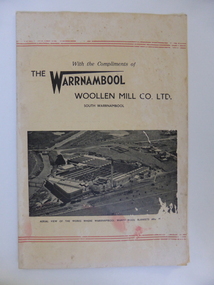
Brochure, The Warrnambool Woollen Mill Co Ltd, c.1950
... advertising leaflet issued by the Warrnambool Woollen Mill Co. This mill was established in South Warrnambool in 1910 with John Bennett the first Manager. The mill’s production increased during both World Wars with government contracts and wartime demands. In the 1940s...advertising leaflet issued by the Warrnambool Woollen Mill Co. This mill was established in South Warrnambool in 1910 with John Bennett the first Manager. The mill’s production increased during both World Wars with government contracts and wartime demands. In the 1940s ...This is an advertising leaflet issued by the Warrnambool Woollen Mill Co. This mill was established in South Warrnambool in 1910 with John Bennett the first Manager. The mill’s production increased during both World Wars with government contracts and wartime demands. In the 1940s the mill employed over 700 people. In 1968 the mill was sold to the multinational company Dunlop which in turn sold the business in 1982 to Onkaparinga Woollen Mill. In 1983 Onkaparinga was taken over by Macquarie Worsteds and in 1994 this group pulled out of Warrnambool. The Warrnambool Woollen Mill closed in 2000 after 90 years of operation. This leaflet is of interest as an example of the advertising mechanisms produced by the Warrnambool Woollen Mill when it was a locally run large-scale business in the city. The business was a dominant one in Warrnambool for many decades, employing many local people. The factory itself was a well-known landmark in the city. This is a sheet of buff-coloured thick paper folded in two places to make a six-page leaflet. The front page has an aerial black and white photograph of the Warrnambool Woollen Mill, two of the inside pages have 12 black and white photographs showing the processes in making woollen blankets and two other pages have advertisements for Warrnambool blankets and dress suiting material. Inside the folder is a sample piece of pink blanket with a card in red and cream colouring showing the factory’s guarantee. The sample has been glued to the paper. There is evidence of silverfish damage on both the blanket sample and the paper. ‘With the Compliments of the Warrnambool Woollen Mill Co. Ltd.’warrnambool woollen mill -
 Warrnambool and District Historical Society Inc.
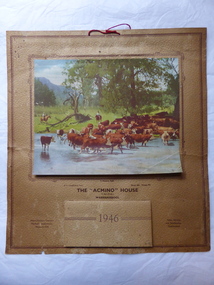
Calendar
... advertising tool for businesses. This calendar is of minor interest as an example of the use made by businesses in the 1940s of calendars as advertising tools. ...This calendar has been distributed as a advertising item for Earl’s agricultural machinery and oil depot. The business was situated at the corner of Lava and Kepler Streets in Warrnambool. The name, Acmino’ stood for Allis-Chalmers, Mitchell’s Implements, Neptune Oils’. Distributing calendars at Christmas time for the following year was, and still is, a popular advertising tool for businesses. This calendar is of minor interest as an example of the use made by businesses in the 1940s of calendars as advertising tools. It also has a local Warrnambool connection, the agricultural machinery business of F. Earl. This is a 1946 calendar with a buff-coloured sheet of crinkled paper with a brown border. It has a coloured photograph of two men droving cattle near a river and it ispasted on to the paper with a brown border around the photograph. The calendar for 1946 is printed on to the paper and also in monthly sheets pasted on to the paper on top of each other. The printing on the calendar is brown. On the back of the calendar is written in black ink, ‘French Bros’. The calendar has a red piece of string at the top for hanging the calendar up on a wall or cupboard. The calendar is torn at the edges and somewhat stained.‘With Compliments from the “Acmino” House, F.Earl (Prop.)Warrnambool Phone 484 Private 75’ ‘Allis-Chalmers Tractors Mitchell’s Implements Neptune Oils’ ‘Sales, Service and Satisfaction Guaranteed’ ‘French Bros’ ‘acmino’ house, warrnambool, f. earl, history of warrnambool -
 National Wool Museum
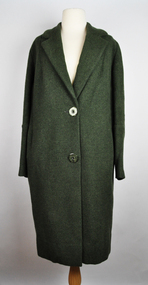
Clothing - Overcoat, Dominex, 1950s
... This overcoat was designed and tailored by Dominex, a company that sold clothing in high end department stores such as Myer and David Jones in the 1940s through to the 2000s. As pictured in the accompanying advertising, Dominex looked to produce clothes for women to “casually, confidently wear … the exquisite styling and superb tailoring of… Dominex Coats”. ...This overcoat was designed and tailored by Dominex, a company that sold clothing in high end department stores such as Myer and David Jones in the 1940s through to the 2000s. As pictured in the accompanying advertising, Dominex looked to produce clothes for women to “casually, confidently wear … the exquisite styling and superb tailoring of… Dominex Coats”. ...This overcoat was designed and tailored by Dominex, a company that sold clothing in high end department stores such as Myer and David Jones in the 1940s through to the 2000s. As pictured in the accompanying advertising, Dominex looked to produce clothes for women to “casually, confidently wear … the exquisite styling and superb tailoring of… Dominex Coats”. This sentiment was carried by the company for more than 60 years. Amanda Morgan, a director of the Dominex fashion label in an interview from 2003 said “Not everybody wants sass, or sex, or high fashion for that matter. Au contraire. Our customers will be stylish, sophisticated and womanly, but we don’t do shoestring straps or asymmetrical lines." Dominex was a label specialising in exceptional quality "traditional" dressing for corporate wear. Their clothes looked to provide women with a return to the tried and true values of elegant, unpretentious, classic dressing. "Our look is European-influenced," Morgan explained further. "Inspired by Armani, Valentino, Chanel and Escada. Suits have been specially dyed in France to ensure the perfect shade of ice blue, lemon, grey, or slate. Fabrics are natural, silk and linen. Shapes are stylish, with an almost 1930s feel; classic pants, silk shirts, structured overcoats with elegant-length” Returning to this overcoat, it has a label on the inside which reads “Pure Wool Material by Godfrey Hirst of Geelong”. Nowadays Godfrey Hirst produce flooring products and are the largest manufacturer and exporter of residential and commercial carpets in Australasia. They have expanded into hard flooring and left their fashion days behind. This overcoat serves as a useful example of a different time for the company; before they made the change to concentrating exclusively on flooring, when they produced fabrics to be tailored for the height of Australian fashion. This overcoat was purchased and worn by Joan Waller, aunty of the donor, Kim Rosenow. Kim said her aunty was from Ballarat but frequently shopped in Melbourne to keep up with the latest trends. Her aunty Joan fitted the target demographic of Dominex well, as she needed to look sophisticated and elegant at social events and work. Kim donated the overcoat to the National Wool Museum in 2021. Green singled breasted overcoat with a narrow overlap and one column of buttons for fastening. The overcoat features notched lapels of a medium width and two large buttons of a green & dark green marble. The overcoat has two semi-visible jetted pockets at the hips. Internally, the overcoat features a black silk lining for comfort. It also features a stitched patch on the left side of the opening which reads “Pure Wool Material by Godfrey Hirst of Geelong”. At the collar, another patch reads “Dominex REGD”. At the cuffs, the overcoat finishes in a type of gauntlet cuff which stretches back over 200mm. The decorative finish utilises no buttons and has thick piping to accentuate this design feature. The overcoat finishes with a simple invisible hem at the bottom.Wording, gold. Patch stitched at collar: “DomineX / REGD.” Wording, black. Patch stitched at left off opening: “PURE WOOL MATERIAL BY / Godfrey Hirst / OF GEELONG”dominex, fashion, women's corporate wear, godfrey hirst, overcoat, wool clothing -
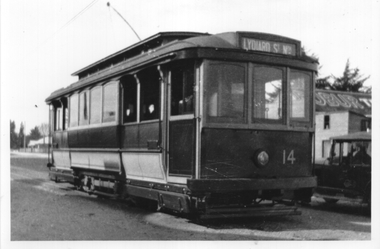 Ballarat Tramway Museum
Photograph - Ballarat tram 14 Albert St Sebastopol, 1930s or 1940s
... 1940s. The tram was in the livery shown from August 1936 until Dec. 1950. A motor car is travelling on the adjacent side of the open door, which indicates possibly at the north end of Albert St, just before the tram turned into Skipton St. On the right side is a building advertising...1940s. The tram was in the livery shown from August 1936 until Dec. 1950. A motor car is travelling on the adjacent side of the open door, which indicates possibly at the north end of Albert St, just before the tram turned into Skipton St. On the right side is a building advertising ...The Photograph shows Ballarat tram No. 14 with the destination of Lydiard St North most likely in Albert St Sebastopol during the 1930s or 1940s. The tram was in the livery shown from August 1936 until Dec. 1950. A motor car is travelling on the adjacent side of the open door, which indicates possibly at the north end of Albert St, just before the tram turned into Skipton St. On the right side is a building advertising Robur Tea.Yields information about tram 14 in Albert St. Black and white prints - plain back. tramcars, tramways, tram 14, albert st
