
Showing 89 items matching "ambulance members"
-
 Kiewa Valley Historical Society
Photos - Ambulance Members
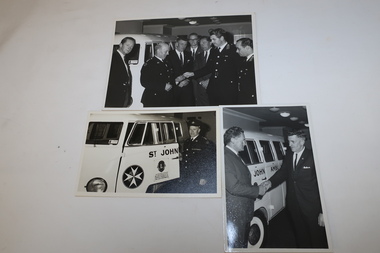
... Photos - Ambulance Members......Ambulance members...St Johns Ambulance Upper Kiewa Valley Lions Club Ambulance members b & w photos. 1. large 16.5 cm x 12 cm of 7 men, 3 in uniform. ...St John's Ambulance provides First Aid training and services, defibrillators and 1st aid kits ab patient transfer. It is a self funding, non-profit charitable organidation. Iniatally founded in 1883 and in Melbourne from 1887. Followed by attending important events eg. Olympics in Melbourne. Provides non-emergency patient transport. Rural Ambulance Victoria was the founding ambulance service in Victoria. St John's Ambulance was supported by the Upper Kiewa Valley Lions Club at Mt Beauty.b & w photos. 1. large 16.5 cm x 12 cm of 7 men, 3 in uniform. On back"Left to right: Jack Smith, Roly Wilson, Bob Edmondson, Leon Henry,/Alex McCullough, UN,UN." No. 2 smaller photos: 14cm x 9 cm, both with "St John Ambulance on vehicle. 1st with Lions club logo on the vehicle and on back "Roy Wilson" in uniform. 2nd On back "Alex McCullough left / Bob Edmondson right"st johns ambulance, upper kiewa valley lions club, ambulance members -
 Ambulance Victoria Museum
Book, record of ambulance service life members, Shepparton region, 1950s to 1960s
... Book, record of ambulance service life members, Shepparton region, 1950s to 1960s...record of ambulance service life members, Shepparton region 1950s to 1960s...record of ambulance service life members, Shepparton region 1950s to 1960s Indexed through Red hard bound book Book, record of ambulance service life members, Shepparton region, 1950s to 1960s ...record of ambulance service life members, Shepparton region 1950s to 1960sRed hard bound bookIndexed through -
 National Vietnam Veterans Museum (NVVM)
Poster - Information Board
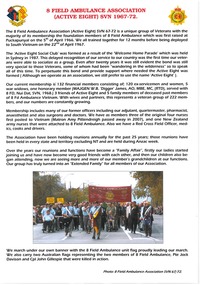
... Laminated poster of 8 Field Ambulance Association members marching on ANZAC day under their banner....This item contributes to an understanding of the impact that involvement in the war in Vietnam (1962–1972) had on Australian servicemen. 8 Field Ambulance Vung Tau Vietnam 8 Field Ambulance South Vietnam/1967-1972 Laminated poster of 8 Field Ambulance Association members marching on ANZAC day under their banner. ...This item contributes to an understanding of the impact that involvement in the war in Vietnam (1962–1972) had on Australian servicemen.Laminated poster of 8 Field Ambulance Association members marching on ANZAC day under their banner.8 Field Ambulance South Vietnam/1967-19728 field ambulance, vung tau, vietnam -
 Ambulance Victoria Museum
Photograph, Ambulance Car, Eastern Suburbs District, September 1942
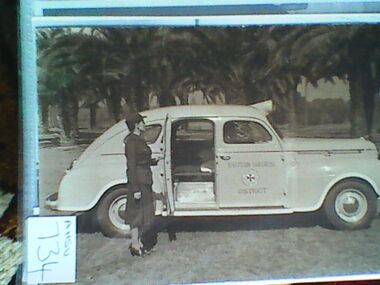
... Driver is probably a wartime female auxiliary ambulance member....Driver is probably a wartime female auxiliary ambulance member. EASTERN SUBURBS DISTRICT Black and white photograph of ambulance car. ...Second World war photograph. Driver is probably a wartime female auxiliary ambulance member.Black and white photograph of ambulance car. Female driver stands at attention while holding the back door open.EASTERN SUBURBS DISTRICT -
 Kiewa Valley Historical Society
Scarf - St John Ambulance
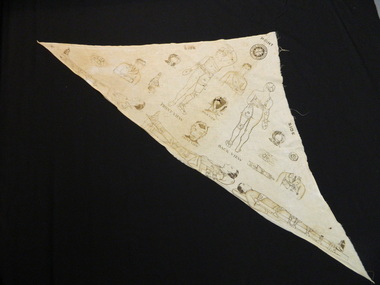
... In 1965 the first Search and Rescue Squad was formed in Victoria. St john Ambulance members are volunteers who are often on stand-by at public events and called out to natural / extreme disasters. ...In 1965 the first Search and Rescue Squad was formed in Victoria. St john Ambulance members are volunteers who are often on stand-by at public events and called out to natural / extreme disasters. ...St John Ambulance of Victoria was founded in 1883 to teach public First Aid classes in Victoria. In 1887 it commenced the first ambulance service in Melbourne until 1916 when it was taken over by the state. In 1965 the first Search and Rescue Squad was formed in Victoria. St john Ambulance members are volunteers who are often on stand-by at public events and called out to natural / extreme disasters. This scarf may have been worn by a student learning first aid from a member of the St John Ambulance Association. It signifies that such classes were held in the Kiewa Valley. April 1940 a four stretcher ambulance was developed for use on the Kiewa Hydro Electric Scheme. The design was modified for comparatively long and rough trips.Cream coloured triangular cotton scarf with 2 sides, a base and a point labelled. At the point is the logo of The St John Ambulance Association. The scarf has drawings all over it showing people and/or body parts bandaged with numbers on the bandages and the views labelled front, back etc.st john ambulance association. first aid. scarf. neck tie. -
Ambulance Victoria Museum
Patch, Uniform, Ambulance Service Victoria
... Worn by designated representatives (probably voluntary) Ambulance Service Victoria members...Worn by designated representatives (probably voluntary) Ambulance Service Victoria members Volunteer Representative Ambulance Service Victoria Circular patch featuring a red Maltese Cross in a white background Patch, Uniform, Ambulance Service Victoria ...Worn by designated representatives (probably voluntary) Ambulance Service Victoria membersCircular patch featuring a red Maltese Cross in a white backgroundRepresentative Ambulance Service Victoriavolunteer -
 Ambulance Victoria Museum
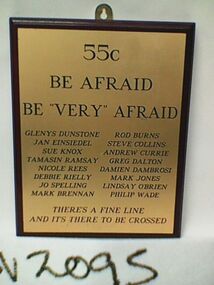
Plaque, Ambulance officer course 55C
... List of members of Ambulance Officers on Course 55C...List of members of Ambulance Officers on Course 55C There's a fine line and it's there to be crossed A Wooden Plaque with gold embossed plate featuring student names. ...List of members of Ambulance Officers on Course 55CA Wooden Plaque with gold embossed plate featuring student names.There's a fine line and it's there to be crossed -
 Ambulance Victoria Museum
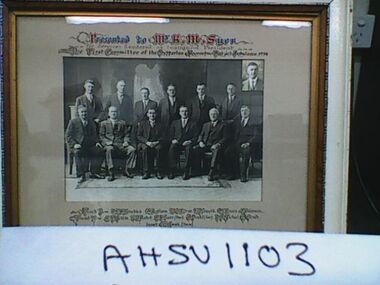
Photograph, framed, Shepparton & Mooroopna District Ambulance Committee, circa 1934
... Syer inaugural president of the Shepparton & Mooroopna District Ambulance Committee. Committee members named in photograph...Syer inaugural president of the Shepparton & Mooroopna District Ambulance Committee. Committee members named in photograph shepparton & mooroopna district ambulance committee mooroopna shepparton PRESENTED TO MR R.M. ...presented to R.M. Syer inaugural president of the Shepparton & Mooroopna District Ambulance Committee. Committee members named in photographBlack and white photograph with grey matting and white over-painted timber frame. Group of 12 men in suits. Photograph of another man pasted into top right corner.PRESENTED TO MR R.M. SYER FOR SERVICES RENDERED AS INAUGURAL PRESIDENTshepparton & mooroopna district ambulance committee, mooroopna, shepparton -
 Ambulance Victoria Museum
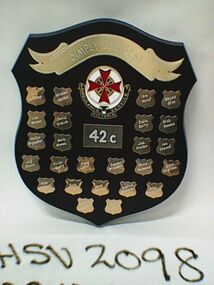
Plaque, Ambulance officer course 42C
... Contains names of members of Ambulance Officers on Course 42C...Contains names of members of Ambulance Officers on Course 42C Simply the best A Wooden Plaque with gold coloured individual shields featuring student names and an Ambulance Service Victoria logo. ...Contains names of members of Ambulance Officers on Course 42CA Wooden Plaque with gold coloured individual shields featuring student names and an Ambulance Service Victoria logo.Simply the best -
 Ambulance Victoria Museum
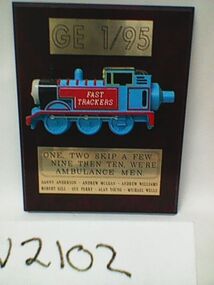
Plaque, Ambulance officer course GE 1/95, 1995 ?
... Contains names of members of Ambulance Officers on Course GE 1/95. This course probably trained in 1995....Contains names of members of Ambulance Officers on Course GE 1/95. This course probably trained in 1995. ...Contains names of members of Ambulance Officers on Course GE 1/95. This course probably trained in 1995.Wooden Plaque featuring a Thomas the Tank locomotive model course attendee names. One, two skip a few ... nine then ten, we're ambulance men -
 Lakes Entrance Historical Society
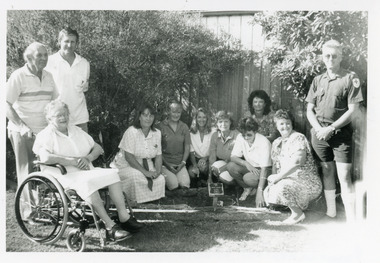
Photograph - Ambulance, Lakes Post Newspaper, Ambulance Auxiliary and Lioness Club 1994, 1994
... Black and white photograph of members of Ambulance Auxiliary and Lioness Club, planting a tree to honour past member of both organisations, Mavis Lapham, with plaque in garden at Ambulance Station. ...Emergency Services Community Services Lionesses Black and white photograph of members of Ambulance Auxiliary and Lioness Club, planting a tree to honour past member of both organisations, Mavis Lapham, with plaque in garden at Ambulance Station. ...Black and white photograph of members of Ambulance Auxiliary and Lioness Club, planting a tree to honour past member of both organisations, Mavis Lapham, with plaque in garden at Ambulance Station. Lakes Entrance Victoriaemergency services, community services, lionesses -
 Bendigo Historical Society Inc.
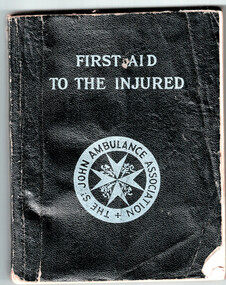
Book - First Aid to the Injured - The St John Ambulance association, 1942
... Like the Order, St John Ambulance associations accept members of all religions. Their geographic organisation differs from the Order, and they have to contend with the differing national laws, medical practices and cultures of countries. ...Like the Order, St John Ambulance associations accept members of all religions. Their geographic organisation differs from the Order, and they have to contend with the differing national laws, medical practices and cultures of countries. ...The St John Ambulance Association, which was founded in 1877 in England. Its first uniformed first-aiders were founded in 1887 as the St John Ambulance Brigade. These two have since been merged into a single association. St John Ambulance now have over 40 national organisations, many of which are affiliated with Johanniter International, and over 300,000 volunteers worldwide. The Order of St John owns the brand name in most countries (with the notable exception of India, which has a St John Ambulance organisation that is unconnected to the international movement). Logos vary in different countries but always contain the eight-pointed white Maltese cross as the essential identifier. Like the Order, St John Ambulance associations accept members of all religions. Their geographic organisation differs from the Order, and they have to contend with the differing national laws, medical practices and cultures of countries. As a result, the role and organisation of St John Ambulance varies by country.Joan Filbey Collection: Book First Aid to the Injured - The St John Ambulance association. The book is a copy of the Thirty-ninth edition first impression (1942), Price 2/6 net; by post, 2/8. The book is published by the St John Ambulance Association (Victoria Centre) 217 Lonsdale Street Melbourne. Inside Front Cover - a sketch of a skeleton along with arteries and bones marked. It is sttsched to the cover by masking tape. Written in ink is "Maxwell A. Roberts, SEC Bendigo"history, bendigo, joan filbey collection, st john ambulance, first aid book, maxwell roberts -
 Federation University Historical Collection
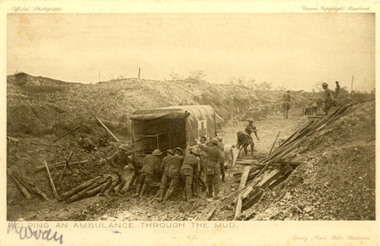
Postcard - black and white, Daily Mail War Pictures, Helping an Ambulance Through the Mud, c1917
... He was a member of the 6th Field Ambulance. ...He was a member of the 6th Field Ambulance. chatham chatham family collection ernest dark dark world war one world war i. world war 1 ambulance Verso: "Dear Miss Holmes, I am sending this P.C. to thank you for a pair of sox which I received from the red cross, (sic) with a note inside on which was your your name and address. ...Ernest William Dark was born at Ballarat East. Before his enlistment on 10 April 1915, aged 19, Dark was a boot salesman. His next of kin on the enlistment papers was his mother Sarah Dark of 40 Bridge Street, Ballarat East. Ernest Dark was a very early World War One enlistment with the regimental number of 19A. He was a member of the 6th Field Ambulance. Black and white photograph of soldiers pushing an ambulance through the mud during World War One. The scene is most probably in France. Verso: "Dear Miss Holmes, I am sending this P.C. to thank you for a pair of sox which I received from the red cross, (sic) with a note inside on which was your your name and address. My unit, the 6th Aus. Field Ambulance, had received quite a lot of red cross goods from the Ballarat district, and I am writing to let you know how much the boys appreciate them. Please accept my best thanks. Yours sincerely. Pte E.W. Darkchatham, chatham family collection, ernest dark, dark, world war one, world war i. world war 1, ambulance -
Marysville & District Historical Society
THE TRIANGLE NEWS-VOL 41 NO 27-JULY 18 2014
... marysville victoria australia life saving defibrillator presented to football netball club by adas ambulance victoria what's on when in july 2014 sesonal influenza vaccine the committee of management of the gallipoli park precinct new committee members needed marysville community market creative triangle buxton ridge vineyard wine tasting marysville & triangle men's shed working bee hoffman's green grocer marysville golf report church notices mayors chair by councillor margaret rae councillor comment cr john kennedy cheviot ward advertisements residential & rural real estate marysville triangle real estate cleaners required marysville preschool long day care & kindergarten christmas in july el kanah gilbert & sullivan opera victoria event yea shire hall murrindindi shire council marysville & district lions club presents magic flute opera vibe hotel in progress intrepid triangle bushwalkers pool life guard positions expressions of interest lease & operation of yea family caravan park el kanah eat in eat out menu marysville golf & bowls club staff wanted buxton hotel roast night made in marysville & surrounds grand opening THE TRIANGLE NEWS-VOL 41 NO 27-JULY 18 2014 ...marysville, victoria, australia, life saving defibrillator presented to football netball club by adas, ambulance victoria, what's on when in july, 2014 sesonal influenza vaccine, the committee of management of the gallipoli park precinct, new committee members needed, marysville community market, creative triangle, buxton ridge vineyard wine tasting, marysville & triangle men's shed working bee, hoffman's green grocer, marysville golf report, church notices, mayors chair by councillor margaret rae, councillor comment cr john kennedy cheviot ward, advertisements, residential & rural real estate, marysville triangle real estate, cleaners required, marysville preschool, long day care & kindergarten, christmas in july el kanah, gilbert & sullivan opera victoria event, yea shire hall, murrindindi shire council, marysville & district lions club presents magic flute opera, vibe hotel in progress, intrepid triangle bushwalkers, pool life guard positions, expressions of interest lease & operation of yea family caravan park, el kanah eat in eat out menu, marysville golf & bowls club staff wanted, buxton hotel roast night, made in marysville & surrounds grand opening -
Greensborough Historical Society
Article, Laurie McQuade, by Rosie Bray, 2019_
... Laurie McQuade is a Watsonia resident, who has volunteered for many years as a Scout leader, member of the Yarrambat CFA and St John's Ambulance. He has received many awards, and is still an active volunteer at the age of 83....Laurie McQuade is a Watsonia resident, who has volunteered for many years as a Scout leader, member of the Yarrambat CFA and St John's Ambulance. He has received many awards, and is still an active volunteer at the age of 83. laurie macquade watsonia 3 p. typescript, coloured photographs; with newspaper clipping from Diamond Valley News 23/11/2018 Laurie McQuade, by Rosie Bray Article Rosie Bray ...Laurie McQuade is a Watsonia resident, who has volunteered for many years as a Scout leader, member of the Yarrambat CFA and St John's Ambulance. He has received many awards, and is still an active volunteer at the age of 83.3 p. typescript, coloured photographs; with newspaper clipping from Diamond Valley News 23/11/2018laurie macquade, watsonia -
 Eltham District Historical Society Inc
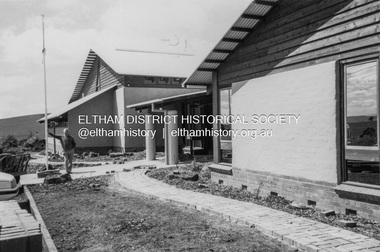
Photograph - Black and White Print, Kangaroo Ground Hall, 35 Kangaroo Ground-St Andrews Road, Kangaroo Ground, c.1988
... Alan Baker at a ceremony attended by Members of Parliament, Councillors, & Representatives of the Victoria Police, Country Fire Authority, State Emergency Servicve, Ambulance Service Melbourne, Salvation Army & residents of the Shire of Eltham on Saturday, 13 February 1988. ...Alan Baker at a ceremony attended by Members of Parliament, Councillors, & Representatives of the Victoria Police, Country Fire Authority, State Emergency Servicve, Ambulance Service Melbourne, Salvation Army & residents of the Shire of Eltham on Saturday, 13 February 1988. ...Landscaping works in progress at the newly built Kangaroo Ground Hall located at 35 Kangaroo Ground-St Andrews Road, Kangaroo Ground The dedication plaque, mounted on a rock near the flag pole reads: This centre, jointly funded by the Shire of Eltham, Community Employment Programme, Country Fire Authority and State Emergency Service was opened by The Shire President of the Shire of Eltham Cr. Alan Baker at a ceremony attended by Members of Parliament, Councillors, & Representatives of the Victoria Police, Country Fire Authority, State Emergency Servicve, Ambulance Service Melbourne, Salvation Army & residents of the Shire of Eltham on Saturday, 13 February 1988. See also: Kangaroo Ground Hall. (2025, July 5). Retrieved from https://www.nillumbik.vic.gov.au/Council/Facilities-and-property/Council-facilities-for-hire/Kangaroo-Ground-HallMarked "G 90%"1988, eltham shire council property, kangaroo ground hall, mudbrick construction, nillumbik shire council property -
 Eltham District Historical Society Inc
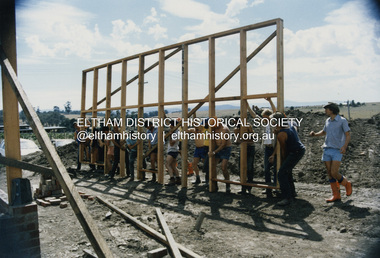
Photograph - Colour Print, SES members assisting with construction work on the Eltham Emergency Operations Centre and Kangaroo Ground Hall, 35 Kangaroo Ground-St Andrews Road, Kangaroo Ground, 1988
... Alan Baker, at a ceremony attended by Members of Parliament, Councillors, & Representatives of the Victoria Police, Country Fire Authority, State Emergency Service, Ambulance Service Melbourne, Salvation Army & residents of the Shire of Eltham on Saturday, 13 February 1988....Alan Baker, at a ceremony attended by Members of Parliament, Councillors, & Representatives of the Victoria Police, Country Fire Authority, State Emergency Service, Ambulance Service Melbourne, Salvation Army & residents of the Shire of Eltham on Saturday, 13 February 1988. ...Located at 35 Kangaroo Ground-St Andrews Road, Kangaroo Ground The centre was jointly funded by the Shire of Eltham, Community Employment Programme, Country Fire Authority and State Emergency Service. It was opened by the Shire President of the Shire of Eltham, Cr. Alan Baker, at a ceremony attended by Members of Parliament, Councillors, & Representatives of the Victoria Police, Country Fire Authority, State Emergency Service, Ambulance Service Melbourne, Salvation Army & residents of the Shire of Eltham on Saturday, 13 February 1988.construction, kangaroo ground hall, mudbrick construction, state emergency service (eltham), eltham emergency operations centre -
 Eltham District Historical Society Inc
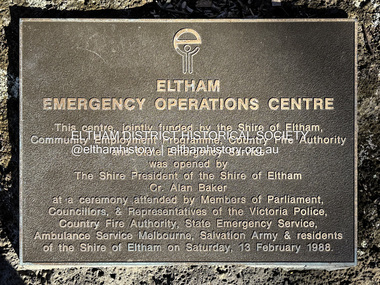
Photograph - Digital Photograph, Peter Pidgeon, Plaque, Eltham Emergency Operations Centre (and Kangaroo Ground Hall), 35 Kangaroo Ground-St Andrews Road, Kangaroo Ground, 5 July 2025
... Alan Baker at a ceremony attended by Members of Parliament, Councillors, & Representatives of the Victoria Police, Country Fire Authority, State Emergency Servicve, Ambulance Service Melbourne, Salvation Army & residents of the Shire of Eltham on Saturday, 13 February 1988. ...Alan Baker at a ceremony attended by Members of Parliament, Councillors, & Representatives of the Victoria Police, Country Fire Authority, State Emergency Servicve, Ambulance Service Melbourne, Salvation Army & residents of the Shire of Eltham on Saturday, 13 February 1988. ...The dedication plaque, mounted on a rock near the flag pole at entrance reads: This centre, jointly funded by the Shire of Eltham, Community Employment Programme, Country Fire Authority and State Emergency Service was opened by The Shire President of the Shire of Eltham Cr. Alan Baker at a ceremony attended by Members of Parliament, Councillors, & Representatives of the Victoria Police, Country Fire Authority, State Emergency Servicve, Ambulance Service Melbourne, Salvation Army & residents of the Shire of Eltham on Saturday, 13 February 1988. See also: Kangaroo Ground Hall. (2025, July 5). Retrieved from https://www.nillumbik.vic.gov.au/Council/Facilities-and-property/Council-facilities-for-hire/Kangaroo-Ground-Hallkangaroo ground hall, mudbrick construction, nillumbik shire council property, ambulance service victoria, community employment program, country fire authority, cr. alan baker, eltham emergency operations centre, salvation army, shire of eltham, state emergency service (eltham), victoria police, peter & elizabeth pidgeon collection -
 Bendigo Military Museum
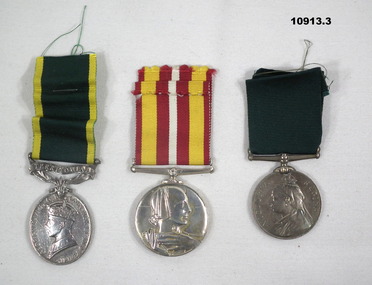
Award - MEDALS, BRITISH, Unnown
... Awarded to members who complete 15 years service in British Red Cross Society on St Andrews Ambulance Corps to be worn only on ceremonial occasions. 3. ...Awarded to members who complete 15 years service in British Red Cross Society on St Andrews Ambulance Corps to be worn only on ceremonial occasions. 3. ...1. Territorial Forces Efficiency Medal awarded to WO, NCO's and enlisted personnel in Citizens Military Force of Australia and Territorial Armies of NZ & UK for 12 Years Service. 2. Awarded to members who complete 15 years service in British Red Cross Society on St Andrews Ambulance Corps to be worn only on ceremonial occasions. 3. Volunteer Long Service and Good Conduct usually for services in the rank. Instituted in 1894 for 20 years Service and superceded in 1908 by Territorial Forces Efficiency Medal.Three medals with ribbons - unmounted. 1.Territorial Forces Efficiency Medal - oval shaped. 2. British Voluntary Medical Services Medal. 3. Volunteer Reserve Long Service Medal - Queen Victoria.1. Named to "879759 Gunner R. Roll, Royal Artillery" 2. Named to "Mrs Roma Harris". 3. Un-named.ron mills collection, medals, british -
 Bendigo Military Museum
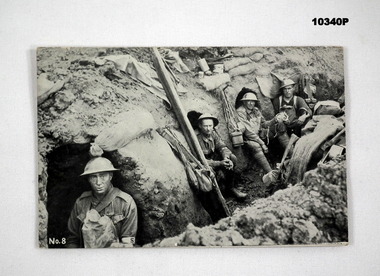
Postcard - PHOTOGRAPH POSTCARD, WW1
... Black and white photo of members of the Australian Field Ambulance taking shelter in a "Funk Hole". ...Black and white photo of members of the Australian Field Ambulance taking shelter in a "Funk Hole". ...Postcards issued by Dept of Defence with proceeds going to Australian Comfort Funds. Part of the collection of William (Bill) Thomason. Refer no 4136PBlack and white photo of members of the Australian Field Ambulance taking shelter in a "Funk Hole". Back of card as a description of photo. Related to WW1.Titled "Our Boys at the front - No.8". "No 5" Written on back in pencil.collection of william (bill) thomason, photograph, postcard -
 Bendigo Military Museum
Award - MEDALS, MINIATURE, Unknown
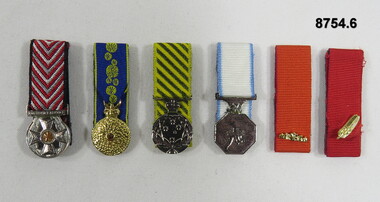
... Original - Australian Ambulance Service Medal. 2. Original - Member of the Order of Australia (Military) OAM, 3. ...Original - Australian Ambulance Service Medal. 2. Original - Member of the Order of Australia (Military) OAM, 3. ...Miniature Medals, all original, Court mounted. 1. Original - Australian Ambulance Service Medal. 2. Original - Member of the Order of Australia (Military) OAM, 3. Original - Australian Conspicuous Service Medal. 4. Original - Australian Antarctic Medal. 5. Original - Commendation for Gallantry. 6. Original - Australian Commendation for Brave Conduct. passchendaele barracks trust, pbt285to290, bob english collection -
 Warrnambool and District Historical Society Inc.
Brass Plate, Dr Alfred Brauer, Circa 1930
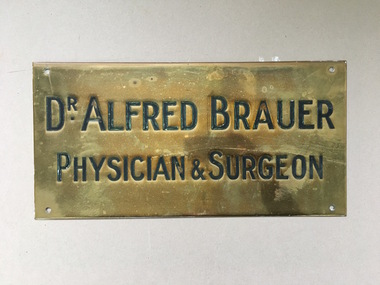
... He initially took up the position as resident medical officer at the Warrnambool Base Hospital before entering private practice. he was appointed honorary medical officer at the hospital and was a life member of the Hospital board , serving as its president from 1952-54.he was a founding member of the South Western Victoria Ambulance service.as vice president, a position he held until his death in 1972.He had wide sporting and community interests including cricket, football, and horseracing. ...He initially took up the position as resident medical officer at the Warrnambool Base Hospital before entering private practice. he was appointed honorary medical officer at the hospital and was a life member of the Hospital board , serving as its president from 1952-54.he was a founding member of the South Western Victoria Ambulance service.as vice president, a position he held until his death in 1972.He had wide sporting and community interests including cricket, football, and horseracing. ...This plaque is the name plate of one of Warrnambool's longest serving doctors. Alfred Ernest Brauer came to Warrnambool after graduating from the University of Melbourne in 1927. He initially took up the position as resident medical officer at the Warrnambool Base Hospital before entering private practice. he was appointed honorary medical officer at the hospital and was a life member of the Hospital board , serving as its president from 1952-54.he was a founding member of the South Western Victoria Ambulance service.as vice president, a position he held until his death in 1972.He had wide sporting and community interests including cricket, football, and horseracing. He was a founding member of the Warrnambool Lutheran church and was closely associated with Warrnambool High School and Warrnambool Technical School. he died in September 1972 and was survived by his wife and three daughters. His practice was situated in Koroit StWarrnambool, firstly at Ambleside where he also lived, then later on the other side of the street , in practice with a number of other doctors. A link to one of Warrnambool's longest serving doctors who contributed to the city in a wide range of roles. It therefore has strong historic and social significance.Rectangular brass plaque stamped and infilled with black. A screw hole in each of the four corners.Dr. Alfred Brauer physician & Surgeonwarrnambool, dr a e brauer, alfred brauer, warrnambool doctors, warrnambool doctors 1940-50's, ambleside warrnambool -
 Bendigo Military Museum
Certificate - LIFE MEMBERSHIP 1947, FRAMED, 8/5/47
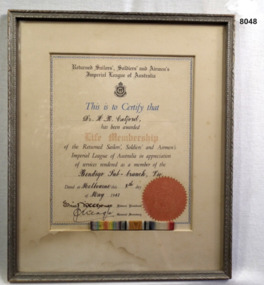
... Member of the Bendigo RSL Sub Branch. The certificate was signed on the 8th Day of May 1947. He was first elected to Committee of the Bendigo Branch in 1918 and retired after 29 years at the AGM 1947 serving the whole time as Vice President. Doctor Harold Robert Catford enlisted as a Captain on 23.6.15 age 41 years and attached to HQ 29th Batt AIF. Embarked for overseas 10.11.15, transfer to 8th Field Ambulance...Member of the Bendigo RSL Sub Branch. The certificate was signed on the 8th Day of May 1947. He was first elected to Committee of the Bendigo Branch in 1918 and retired after 29 years at the AGM 1947 serving the whole time as Vice President. Doctor Harold Robert Catford enlisted as a Captain on 23.6.15 age 41 years and attached to HQ 29th Batt AIF. Embarked for overseas 10.11.15, transfer to 8th Field Ambulance ...Doctor HAROLD ROBERT CATFORD was the first to be made a Life Member of the Bendigo RSL Sub Branch. The certificate was signed on the 8th Day of May 1947. He was first elected to Committee of the Bendigo Branch in 1918 and retired after 29 years at the AGM 1947 serving the whole time as Vice President. Doctor Harold Robert Catford enlisted as a Captain on 23.6.15 age 41 years and attached to HQ 29th Batt AIF. Embarked for overseas 10.11.15, transfer to 8th Field Ambulance 6.10.16. At various times he was attached to 5th Div Ammunition Column and 2nd A.C.C. Station, promoted to Major 24.8.17. He returned to Australia on 26.9.17 for personal reasons and his appointment in the AIF was terminated on 11.12.17. from 1.1.18 he was RMO to several military units including the 38th Batt in Peace time. Promoted to Lt Col on 19.4.23, placed on the AAMC reserve list 30.1.30 and then the retired list 30.1.1934. Life membership certificate of the Bendigo RSL awarded to Dr HR Catford. Certificate is set in a yellowish cardboard frame inside a silver wooden frame. The certificate is in colour with a red seal and signatures of Federal President and Secretary of the RSSILA. A set of WWI ribbons has been placed in the frame.brsl, smirsl, life membership -
 Waverley RSL Sub Branch
Spurs, 1914 to 1918
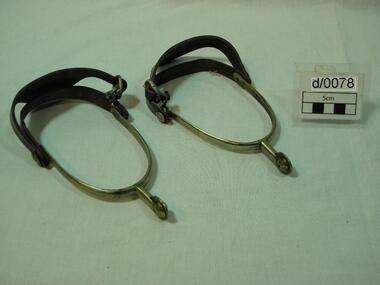
... Joe was a member of the 4th Light Horse. serving in Egypt with 4th Light Horse Field Ambulance and returned to Australia after serving 1060 days overseas in the troop ship Essex....Joe was a member of the 4th Light Horse. serving in Egypt with 4th Light Horse Field Ambulance and returned to Australia after serving 1060 days overseas in the troop ship Essex. ...Spurs worn by Pte. Edward (Joe) Coughlan 17879 during World war one. Joe was a member of the 4th Light Horse. serving in Egypt with 4th Light Horse Field Ambulance and returned to Australia after serving 1060 days overseas in the troop ship Essex.This item is significant because Spurs have near original condition leather, and use the disk spur. Useage ceased in 1918.Pair of silver disk spurs with brown leather arch and instep straps . nilcavalry, light horse, spurs -
 Running Rabbits Military Museum operated by the Upwey Belgrave RSL Sub Branch
Medallion, Anzac Commemorative Medallion
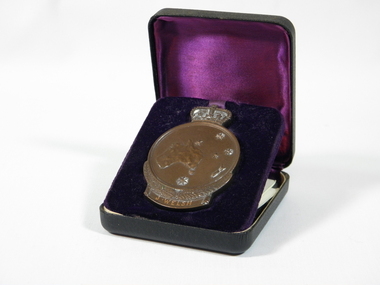
... Ambulance. Mentioned in despatches This Item is significance because apart from only being issued to members who served in GALLIPOLI, This Medallion is significant because Lieutenant-Colonel John Basil Welch "Army Medical Corps" was Mentioned in Despatches and Awarded the "DSO" Distinguished Service Order Medal medal anzac gallipoli medalion welch 1915 ANZAC ON FRONT "J.WELSH" ON BACK Bronze /Round /Crown with Anzac on lower part Australia on back with southern cross Anzac Commemorative Medallion Medallion Commonwealth of Australia ...In commemoration of the heroic deeds of the men of ANZAC at GALLIPOLI in 1915 and in recognition of the great debt owed by all Australians. Medical practitioner Army Medical Corps 1st Field Ambulance. Mentioned in despatchesThis Item is significance because apart from only being issued to members who served in GALLIPOLI, This Medallion is significant because Lieutenant-Colonel John Basil Welch "Army Medical Corps" was Mentioned in Despatches and Awarded the "DSO" Distinguished Service Order Medal Bronze /Round /Crown with Anzac on lower part Australia on back with southern cross1915 ANZAC ON FRONT "J.WELSH" ON BACKmedal, anzac, gallipoli, medalion, welch -
 Warrnambool RSL Sub Branch
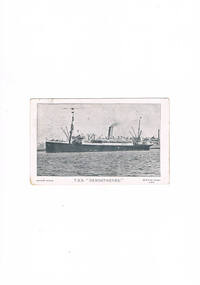
POSTCARD 29 December 1915 to MADGE from H.M.A.T. 'DEMOSTHENES' just after embarkation. Secretly married, Bob addresses his wife as 'Miss McLaughlin' c/- her parents. PICTURE POSTCARD of 8th Reinforcements, 6th Field Ambulance, photographed on board the Demosthenes. Every member's name has been carefully recorded by Bob on the reverse side. PHOTOS x 2: Fancy Dress on board Demosthenes. POSTCARD 2 January 1919 to MADGE from Belgium. By this stage, Madge had stopped writing to Bob after she was shown Bob's '2nd Trip to Paris' letter (15 August 1918) by her mother-in-law. By now, Bob had virtually given up on the marriage
... PICTURE POSTCARD of 8th Reinforcements, 6th Field Ambulance, photographed on board the Demosthenes. Every member's name has been carefully recorded by Bob on the reverse side. ...This is one of the very few surviving pieces of correspondence between Bob and his wife, Madge. Bob destroyed the bulk of such correspondence between the pair, although some of Bob's typed letter/stories that Bob sent to Madge survived, pasted into a large hard-backed journal, and later passed on to grand-daughter, Margaret Davey. The Registry Office marriage was a secret business. Perhaps an Irish nationalist, Madge's father, Andrew McLaughlin, had absolutely forbidden any of his daughters to marry a soldier. The Snapes were taken by surprise too and Madge wore the wedding ring on a string about her neck. Bob wrote to Madge McLaughlin c/- her parents's home in at 22 Hull Street, Richmond (near West Richmond Railway Station).Picture Postcard.snape collection -
 Bendigo Military Museum
Certificate - LIFE MEMBERSHIP RSL 1969, National HQ RSL Australia, C. 11.9.1969
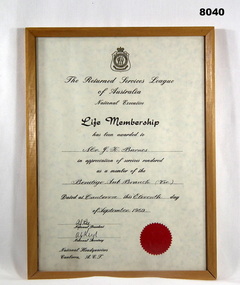
... member of the Bendigo Branch. Jack initially enlisted as V25001 in the CMF then transferred to the AIF as VX116316 at age 19 years on 25.2.1941. At discharge from the Army on 12.6.1946 he held the rank of Pte in 2/1st Australian Motor Ambulance Convoy W/shops....member of the Bendigo Branch. Jack initially enlisted as V25001 in the CMF then transferred to the AIF as VX116316 at age 19 years on 25.2.1941. At discharge from the Army on 12.6.1946 he held the rank of Pte in 2/1st Australian Motor Ambulance Convoy W/shops. brsl smirsl life member "Life Membership has been awarded to Mr J.K. ...John Kerr Barnes. Life Membership is a nomination by the Sub - Branch. Jack as known was first elected to the Committee of the Bendigo Sub - Branch in 1955 and held that position until he was elected to the position of Secretary in 1964 and held that till he retired in 2005 (43 years) the entire time he did this from the Soldiers Memorial Institute which was the HQ of the Bendigo Sub Branch. He then became a Museum guide at the Soldiers Memorial Institute until his death in 2011. He was also involved in fund raising particularly the stall they had at the Bendigo Show and the Melbourne Cup sweep the Branch had. He was also awarded a Life Membership with Gold badge 1988, Meritorious Service Medal 1989 (Highest award in the RSL), RSL Licensed Sub - Branch Hall of Fame 2002, State certificate of Appreciation 2006. He is the highest awarded member of the Bendigo Branch. Jack initially enlisted as V25001 in the CMF then transferred to the AIF as VX116316 at age 19 years on 25.2.1941. At discharge from the Army on 12.6.1946 he held the rank of Pte in 2/1st Australian Motor Ambulance Convoy W/shops.Certificate framed, frame is timber light brown colour, certificate is yellow colour with gold RSL logo at the top followed by details of the award of "Life Membership" of the National Branch of the RSL Australia, all print in black, signed and red seal at RH side bottom."Life Membership has been awarded to Mr J.K. Barnes - Bendigo Sub Branch (Vic)" "Dated at Canberra - eleventh - September 1969" Signed "A.J. Lee" National President. Signed "A.G. Kiyl" (?) National Secretary.brsl, smirsl, life member -
 Kiewa Valley Historical Society
Plaque - Ambulance Service
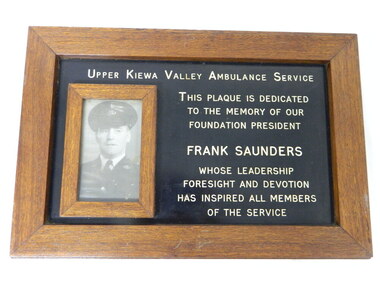
... Metal plate with gold letters in capitals: "Upper Kiewa Valley Ambulance Service / This Plaque is Dedicated / to the Memory of our / Foundation President / Frank Saunders / whose Leadership / Foresight and Devotion / has Inspired all Members/ of the Service"...Metal plate with gold letters in capitals: "Upper Kiewa Valley Ambulance Service / This Plaque is Dedicated / to the Memory of our / Foundation President / Frank Saunders / whose Leadership / Foresight and Devotion / has Inspired all Members/ of the Service" This brown wooden framed plaque is backed by masonite and surrounds a black metal sign with gold lettering beside which there is a photo of a Frank Saunders. ...Frank Saunders was the foundation president of the Upper Kiewa Valley Ambulance Service. There was an Ambulance service in the Upper Kiewa Valley commencing in April 1940 when a four stretcher ambulance was made available on the Kiewa Hydro Electric Scheme. It was designed for comparatively long and rough trips, involving some departures from usual ambulance design. Companies involved were O/C Motor Vehicles (Mr Frank Stone), in collaboration with the builders, Messrs. Jas. Thompson & Co. of South Yarra. (Ref. SECV magazine. April 1940.)This brown wooden framed plaque is backed by masonite and surrounds a black metal sign with gold lettering beside which there is a photo of a Frank Saunders. The photo is also framed with wood.Metal plate with gold letters in capitals: "Upper Kiewa Valley Ambulance Service / This Plaque is Dedicated / to the Memory of our / Foundation President / Frank Saunders / whose Leadership / Foresight and Devotion / has Inspired all Members/ of the Service"frank saunders. ambulance. upper kiewa. -
 Frankston RSL Sub Branch
Photograph
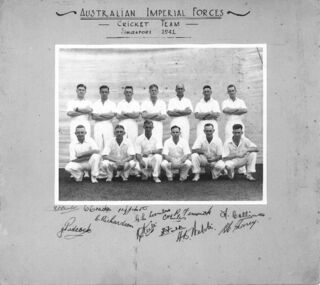
... members. The rear of the mounting board has the following note: "To My Dear Darling Pet, with Love from Ron" "5/8/41" Original monochrome photograph mounted on thick buff coloured mounting board. This photograph is of a cricket team fielded by the Australian Imperial Forces, Singapore during 1941. The players depicted have signed the photograph. The photograph is from the collection of one of the players, Sergeant R. K. Churches, service number VX34599, of the Australian Army 2/9th Field Ambulance ...Original monochrome photograph mounted on thick buff coloured mounting board. This photograph is of a cricket team fielded by the Australian Imperial Forces, Singapore during 1941. The players depicted have signed the photograph. The photograph is from the collection of one of the players, Sergeant R. K. Churches, service number VX34599, of the Australian Army 2/9th Field Ambulance who were based in Singapore at the time. (refer item number 00320) note: digital format copy only available, this original photograph has been donated to the Australian War Memorial, Canberra - 22nd November, 2014The photograph has the following inscription: "AUSTRALIAN IMPERIAL FORCES" "CRICKET TEAM" "SINGAPORE 1941" and bears the signatures of the team members. The rear of the mounting board has the following note: "To My Dear Darling Pet, with Love from Ron" "5/8/41"churches, world war 2, ww2, singapore, changi, australian army -
 Geoffrey Kaye Museum of Anaesthetic History
Equipment - Inhaler, Probyn Williams, Mayer & Meltzer, c. 1900
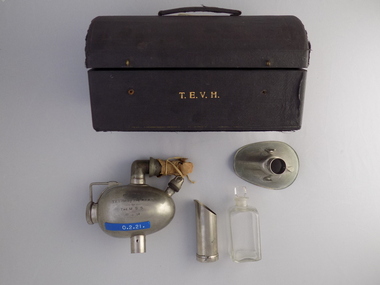
... Ambulance. He served in Enypt, London, and the Western Front during World War 1. He gained a Companion of the Order of St George and St Michael in 1917. Upon return to Melbourne he held positions such as surgeon to Victoria Police (1928-1956), elected to Council of the Victorian branch of the British Medical Association, member of the Charities Board of Victoria and foundation member of the Royal Australasian College of Surgeons and chaired the Flying Personnel Research Committee m a consulting surgeon at the Royal Melbourne Hospital. ...Ambulance. He served in Enypt, London, and the Western Front during World War 1. He gained a Companion of the Order of St George and St Michael in 1917. Upon return to Melbourne he held positions such as surgeon to Victoria Police (1928-1956), elected to Council of the Victorian branch of the British Medical Association, member of the Charities Board of Victoria and foundation member of the Royal Australasian College of Surgeons and chaired the Flying Personnel Research Committee m a consulting surgeon at the Royal Melbourne Hospital. ...Hurley, Sir Thomas Ernest Victor (1888-1958) was gifted this Probyn Williams inhaler in 1914. After studying at Melbourne University, Victorian-born Hurley was a Medical Officer at the Royal Melbourne Hospital until he commenced private practice in Collins Street. He was appointed Captain Australian Army Medical Corps, AIF and served in Gallipoli with the 2nd Field Ambulance. He served in Enypt, London, and the Western Front during World War 1. He gained a Companion of the Order of St George and St Michael in 1917. Upon return to Melbourne he held positions such as surgeon to Victoria Police (1928-1956), elected to Council of the Victorian branch of the British Medical Association, member of the Charities Board of Victoria and foundation member of the Royal Australasian College of Surgeons and chaired the Flying Personnel Research Committee m a consulting surgeon at the Royal Melbourne Hospital. This apparatus is transitional between Clover's and Hewitt's having Clover's narrow "ways" and compact size, but using Hewitt's ether-control lever.Black round topped box with brass hooks [missing] at front and brass hinges at rear. The initials T.E.V.H. are printed in gold leaf on the front. There is a black fabric handle on the top. Inside the box is black padding with the manufacturer's logo printed in gold leaf. There is a square section in the base of the box for holding the square clear glass bottle for ether. The pear-shaped mask is made of metal. There is also a metal ether measure for pouring the ether. The metal inhaler is ovoid shaped. The rotating gauge has a series of numbers engraved onto the inhaler for measurement. There is an elbow joint attaching a re-breather bag, with a small amount of waxy paper remaining attached with a thin ribbon. There is a small glass bulb encased in a metal housing. Printed in gold leaf on front of box: T.E.V.H. •Printed in gold leaf on inside lid of box: MAYER & MELTZER / LONDON / MELBOURNE & CAPE TOWN •Engraved on side of inhaler: PRESENTED / TO / T.E.V. Hurley Esq.,M.D.M.S. / by / THE M.S.S. / 15.6.14. •Engraved on reverse side of inhaler: PROBYN WILLIAMS / ETHER INHALER •Moulded into connector on elbow joint: MAYER & MELTZER •Stamped into base of metal pourer: MAYER & MELTZER / LONDON •Blue sticker with white printed text on front of inhaler: O.2.21.hurley, thomas ernest victor, probyn williams, university of melbourne, world war 1, wwi, gallipoli, australian army medical corps, medical student society, mayer & meltzer, clover, joseph, hewitt, fredrick william
