
Showing 710 items matching "bottle openner"
-
 Bendigo Historical Society Inc.
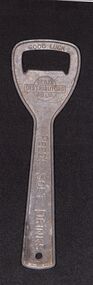
Domestic object - Reed's soft drink bottle opener
... ...Bottle openner...Reeds Soft Drinks Cohns Bottle openner Reeds Soft Drinks and Brylen Distributors Pty Ltd Metal bottle opener. ...Reed Bros is a historical soft drink brand associated with Bendigo, Victoria. Founded by Joseph Reed in 1900, the company initially produced aerated waters and later expanded to other products. The brand is known for its crystal bottles and has a rich history in the local beverage industry. After Joseph Reed's death, the business continued under his son, eventually being sold in 1966 to Cohn Bros.Metal bottle opener. Embossed with 'Reed's Soft Drinks' on handle, 'Brylen Distributors Pty Ltd' towards top of item, and 'Good Luck' at very top of item. Light metal. Has hole at base of opener - presumably for hanging the item. Reeds Soft Drinks and Brylen Distributors Pty Ltdreeds, soft drinks, cohns, bottle openner -
 Trafalgar Holden Museum
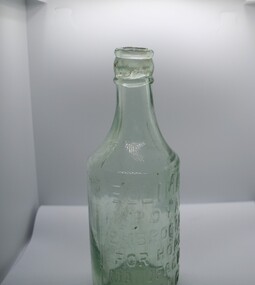
Container - Glass bottle
... Clear glass bottle with open neck with inscription on front and bottom...On bottom 12399 Clear glass bottle with open neck with inscription on front and bottom Container Glass bottle ...Glass bottle container for Elliman's horse linement Ca 1900Imported and sold by Holden and FrostClear glass bottle with open neck with inscription on front and bottom Elliman's Royal Embrocation for horses Manufactory Slough. On bottom 12399bottle, medicine, equine -
 Trafalgar Holden Museum
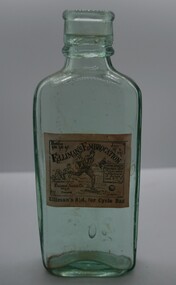
Container - Clear Glass Bottle, Circa 1900
... Rectangular glass bottle with open neck inscription moulded on back, paper label on front...Bottle containing embrocation for use on horses As imported and sold by Holden and Frost Ca1900 Equine medicine Embrocation Elliman's Embrocation moulded in Glass, Paper label on front Elliman's Embrocation showing running man and price Rectangular glass bottle with open neck inscription moulded on back, paper label on front Container Clear Glass Bottle ...Bottle containing embrocation for use on horsesAs imported and sold by Holden and Frost Ca1900Rectangular glass bottle with open neck inscription moulded on back, paper label on frontElliman's Embrocation moulded in Glass, Paper label on front Elliman's Embrocation showing running man and price equine, medicine, embrocation -
 Bendigo Historical Society Inc.
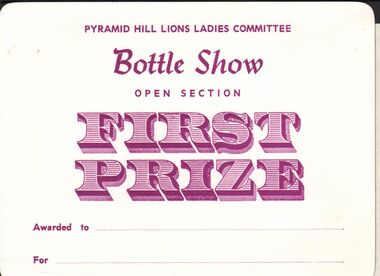
Document - JAMES LERK COLLECTION: PYRAMID HILL BOTTLE SHOW
... Card for Pyramid Hill lions Ladies committee. Bottle show, open section, First Prize. The Awarded to and For section are blank....EVENT Exhibition Bottle Collectors Exhibition Card for Pyramid Hill lions Ladies committee. Bottle show, open section, First Prize. The Awarded to and For section are blank. ...Card for Pyramid Hill lions Ladies committee. Bottle show, open section, First Prize. The Awarded to and For section are blank.event, exhibition, bottle collectors exhibition -
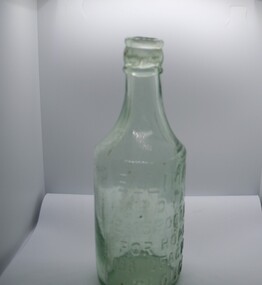 Trafalgar Holden Museum
Container - Equine medication, Ca 1900
... Clear glass open neck bottle...Linement for the treatment of Horses Imported and sold by Holden and Frost Bottle equine medication Elliman's Royal Embrocation for Horses Manufactory Slough, on bottom 7926 Clear glass open neck bottle Container Equine medication ...Linement for the treatment of Horses Imported and sold by Holden and FrostClear glass open neck bottleElliman's Royal Embrocation for Horses Manufactory Slough, on bottom 7926bottle, equine, medication -
 Coal Creek Community Park & Museum
Bottle, olives
... To ensure these olives retain their maximum freshness after the bottle is opened add (?) one teaspoonful of C and B Olive oil....To ensure these olives retain their maximum freshness after the bottle is opened add (?) one teaspoonful of C and B Olive oil. ...Cylindrical shaped glass bottle tapering sightly at the top, with metal screw top. Square label on side, pale yellow with green, brown and orange decoration around edge, and a neck label.Crosse & Blackwells' Spanish queen olives. Produce of Spain. C and B. To ensure these olives retain their maximum freshness after the bottle is opened add (?) one teaspoonful of C and B Olive oil. -
Glenelg Shire Council Cultural Collection
Souvenir - Stubby Holder, n.d
... Front: 'Daly's IGS Supermarkets For all your Beer, Premix & Wine Call into Daly's IGA Plus Liquor Our Bottle Shop's open @ 9 Portland 03 5523 3494 Koroit 03 5565 8111...Front: 'Daly's IGS Supermarkets For all your Beer, Premix & Wine Call into Daly's IGA Plus Liquor Our Bottle Shop's open @ 9 Portland 03 5523 3494 Koroit 03 5565 8111 Neoprene stubby holder, cylindrical, open top. ...Neoprene stubby holder, cylindrical, open top. Red outside, white and black print.Front: 'Daly's IGS Supermarkets For all your Beer, Premix & Wine Call into Daly's IGA Plus Liquor Our Bottle Shop's open @ 9 Portland 03 5523 3494 Koroit 03 5565 8111 -
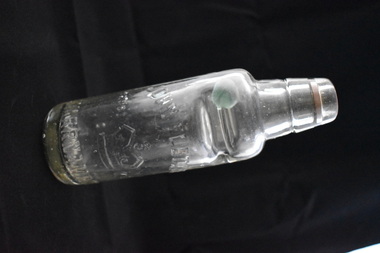 Warrnambool and District Historical Society Inc.
Bottle, Webb Bros Port Fairy, Early 20th century
... Pressure inside the bottle would keep the marble pressed against the top of the bottle. To open the bottle the marble was pressed down where it would fall into the neck chamber below. ...Pressure inside the bottle would keep the marble pressed against the top of the bottle. To open the bottle the marble was pressed down where it would fall into the neck chamber below. ...This is a marble stopper bottle from the Port Fairy aerated waters factory of the Webb brothers. A marble stopper bottle was filled upside down so that as soon as the filling stopped the stopper was forced down to seal the bottle against the rubber ring. Pressure inside the bottle would keep the marble pressed against the top of the bottle. To open the bottle the marble was pressed down where it would fall into the neck chamber below. The marble would stay inside the chamber when the bottle was tilted up for drinking. The Webb brothers operated the Port Fairy Aerated Water and Cordial Factory in William Street (no 29) in the late 19th and early 20th centuries. This bottle is of interest as an example of a marble stopper bottle from the aerated waters factory of the Webb brothers in Port Fairy. Cordial manufacturing was an important industry in Warrnambool and district for over 100 yearsThis is a marble stopper glass bottle. It has a rounded base with a rounded body tapering to a deeply-indented section which forms a narrow neck chamber. The top is rounded moulded glass with an opening. The green marble is loose inside the neck chamber and the rubber ring has been displaced and is at the bottom of the bottle. There is some discolouration inside the bottle from the original contents.‘Webb Bros. Aerated Waters Port Fairy’ cordial manufacturing in warrnambool district -
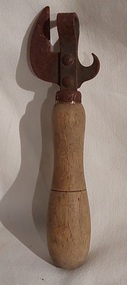 Mont De Lancey
Domestic object - Bottle and Can Opener, 1950's
... Early openers were often a single tool for both purposes, a double-ended design that punctured cans with a triangle hole and opened bottles, with modern versions like pull tabs appearing later. ...Early openers were often a single tool for both purposes, a double-ended design that punctured cans with a triangle hole and opened bottles, with modern versions like pull tabs appearing later. ...Early openers were often a single tool for both purposes, a double-ended design that punctured cans with a triangle hole and opened bottles, with modern versions like pull tabs appearing later. Some had only a blade for the can opener.A dual metal can and bottle opener with a decorative line on the turned wooden handle. Rivets join the metal can and bottle opening sections.can openers, bottle openers, kitchen equipment -
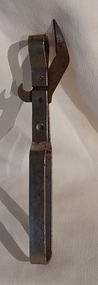 Mont De Lancey
Domestic object - Bottle and Can Opener, 1950's
... Early openers were often a single tool for both purposes, a double-ended design that punctured cans with a triangle hole and opened bottles, with modern versions like pull tabs appearing later. ...Three rivets join the metal can and bottle opening sections. The handle has an open section along the length of it....Early openers were often a single tool for both purposes, a double-ended design that punctured cans with a triangle hole and opened bottles, with modern versions like pull tabs appearing later. ...Early openers were often a single tool for both purposes, a double-ended design that punctured cans with a triangle hole and opened bottles, with modern versions like pull tabs appearing later. Some had only a blade for the can opener.A dual metal can and bottle opener. Three rivets join the metal can and bottle opening sections. The handle has an open section along the length of it.can openers, bottle openers, kitchen equipment -
 Warrnambool and District Historical Society Inc.
Bottle, Fletts Soda Water Warrnambool
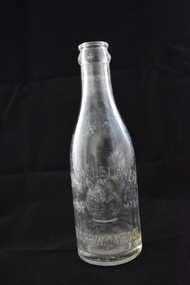
... Pressure inside the bottle would keep the marble pressed against the top of the bottle. To open the bottle the marble was pressed down where it has fallen into the neck chamber below. ...Pressure inside the bottle would keep the marble pressed against the top of the bottle. To open the bottle the marble was pressed down where it has fallen into the neck chamber below. ...This is a marble stopper bottle that came from the Warrnambool aerated waters factory of John Fletcher. This bottle was filled upside down so that as soon as the filling stopped the marble was forced down to seal the bottle against the rubber ring. Pressure inside the bottle would keep the marble pressed against the top of the bottle. To open the bottle the marble was pressed down where it has fallen into the neck chamber below. The marble stayed inside the bottle when it was tilted for drinking. John Fletcher worked as a young boy at Rowley’s cordial factory in Banyan Street Warrnambool. He then worked for John Davis who had established the Union Cordial Factory in Koroit Street in the 1860s. In 1885 Fletcher bought John Davis’ business and operated it until 1930. It was then bought by Ralph Reeves. John Fletcher manufactured soda water, tonic waters, lemonade, ginger ale, sarsaparilla, cordials, hop beer and hop bitters. This bottle is of some significance as an example of a marble stopper bottle and as a memento of the Warrnambool soft drinks business of John Fletcher. He was a prominent businessman in This is a mauve-coloured glass bottle known as a marble stopper bottle. The base and body are round with the top part of the body heavily indented to form a narrow opening leading to the neck. The neck is rounded and slightly tapering to the moulded round top. A green glass marble is loose in the neck section. The rubber ring at the top of the opening is missing. The details of the soda water manufacturer are embedded into the glass on the sides. ‘John Fletcher Trade Mark (crown symbol) Warrnambool’ ‘Soda Water’ ‘M’ john fletcher, warrnambool, cordial manufacturers in warrnambool, history of warrnambool -
 Warrnambool and District Historical Society Inc.
Bottle, Fletcher Warrnambool
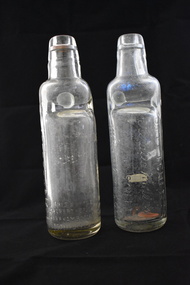
... Pressure inside the bottle would keep the marble pressed against the top of the bottle. To open the bottle the marble was pressed down where it would fall into the neck of the chamber below. ...Pressure inside the bottle would keep the marble pressed against the top of the bottle. To open the bottle the marble was pressed down where it would fall into the neck of the chamber below. ...These marble stopper bottles came from the Warrnambool aerated waters factory of John Fletcher. A marble stopper bottle was filled upside down so that as soon as the filling stopped the marble was forced down to seal the bottle against the rubber ring. Pressure inside the bottle would keep the marble pressed against the top of the bottle. To open the bottle the marble was pressed down where it would fall into the neck of the chamber below. The marble would stay inside the chamber when the bottle was tilted up for drinking. As a young boy John Fletcher worked at the cordial factory of John Rowley in Banyan Street, Warrnambool. He then worked in Koroit Street, Warrnambool at the Union Cordial Factory of John Davis. This factory had been established in the 1860s. In 1885 John Fletcher bought the business of John Davis and continued it on until 1930 when it was bought by Ralph Reeves. John Fletcher manufactured lemonade, tonic waters, soda water, sarsaparilla, cordials, ginger ale, hop beer and hop bitters. These bottles are of interest, firstly because they are good examples of the marble stopper bottle type of bottle, no longer in use. They are also important because they are John Fletcher bottles and he was a prominent businessman in Warrnambool for over 40 years.These are two glass bottles. They have a rounded base and body with deep indentations which give a narrowed aperture to the top of the body and the neck. The neck is round and tapering to a moulded opening at the top of the bottle. Both bottles had a round rubber ring inside the bottle, with one lodged in the bottom of the bottle. Both bottles have a green glass marble in the neck of the bottle. The name of the manufacturer of the lemonade is impressed into the body of the bottles. ‘J. Fletcher’s Aerated Waters Koroit Street Warrnambool’ ‘Lemonade’ ‘This bottle is the property of John Fletcher Warrnambool & cannot be legally used by others’ ‘A.G.M.’ john fletcher warrnambool, cordial manufacturers in warrnambool, history of warrnambool -
 Warrnambool and District Historical Society Inc.
Bottle, J Fletcher Warrnambool, Early 20th century
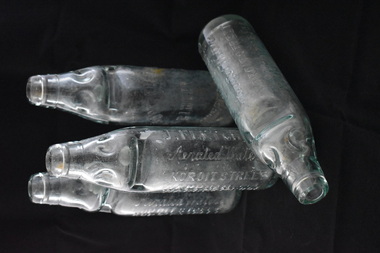
... Pressure inside the bottle would keep the marble pressed against the top of the bottle. To open the bottle the marble was pressed down where it would fall into the neck chamber below. ...Pressure inside the bottle would keep the marble pressed against the top of the bottle. To open the bottle the marble was pressed down where it would fall into the neck chamber below. ...These bottles are known as marble stopper bottles. This type of bottle was filled upside down so that as soon as the filling stopped the stopper was forced down to seal the bottle against the rubber ring. Pressure inside the bottle would keep the marble pressed against the top of the bottle. To open the bottle the marble was pressed down where it would fall into the neck chamber below. The marble would stay inside the chamber when the bottle was tilted up for drinking. These bottles have come from the aerated waters factory of John Fletcher of Warrnambool. This factory in Koroit Street was established in the mid 19th century by John Davis. As a young boy John Fletcher worked at the cordial factory of John Rowley in Banyan Street, Warrnambool and then worked for a number of years for John Davis at his Union Cordial Factory. In 1885 John Fletcher succeeded John Davis and continued in this business until 1930.. The business was then taken over by Ralph Reeves. John Fletcher manufactured aerated waters, soda, tonic waters, lemonade, ginger ale, hop beer, hop bitters, sarsaparilla and cordials. These bottles are of interest firstly because they are good examples of marble stopper bottles, no longer in use today. They are also important because they are John Fletcher bottles and he was a prominent soft drinks manufacturer in Warrnambool for over 40 years. These four bottles are made of green coloured glass. They have a round body with deep indentations at the top, narrowing the entrance to the neck which is short and thick. The top opening is made of thick moulded glass. A glass marble is loose in the neck section. The rubber ring inside the neck is missing. The manufacturer’s details are embedded into the glass on both sides of the bottle.‘Lemonade’ ‘J.Fletcher’s Aerated Waters Koroit Street Warrnambool’ ‘This bottle is the property of John Fletcher Warrnambool and cannot be legally used by others’ fletcher's cordial, marble stopper bottle, warrnambool cordial -
 Warrnambool and District Historical Society Inc.
Bottle, John Fletcher Warrnambool, Early 20th century
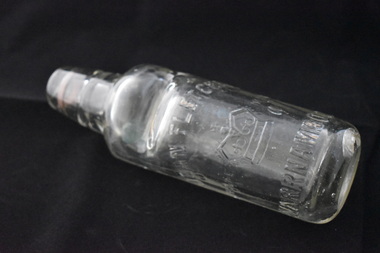
... Pressure inside the bottle kept the marble pressed against the top of the bottle. To open the bottle the marble has been pressed down and has fallen into the neck chamber below. ...Pressure inside the bottle kept the marble pressed against the top of the bottle. To open the bottle the marble has been pressed down and has fallen into the neck chamber below. ...This is a marble stopper bottle. It was filled upside down so that as soon as the filling stopped the marble was forced down to seal the bottle against the rubber ring. Pressure inside the bottle kept the marble pressed against the top of the bottle. To open the bottle the marble has been pressed down and has fallen into the neck chamber below. The marble stayed inside the chamber when the bottle was tilted up for drinking. This bottle came from the Warrnambool aerated waters factory of John Fletcher. This factory was commenced in the mid 19th century by John Davis. As a young boy John Fletcher worked at the cordial factory of John Rowley in Banyan Street, Warrnambool. He then worked for John Davis at his Union Cordial Factory in Koroit Street for many years. In 1885 he succeeded John Davis in this business. Fletcher’s business continued until 1930 when it was sold to the soft drinks manufacturer, Ralph Reeves. John Fletcher made aerated waters, soda water, tonic water, lemonade, ginger ale, hop beer, hop bitters, sarsaparilla and cordials. This bottle is of interest as a good example of a marble stopper bottle and as a memento of the soft drinks made by John Fletcher, a prominent Warrnambool businessman for over 40 years. This is a glass bottle with a heavy round base and a rounded body which is markedly indented at the top, causing the aperture inside to be narrowed. The neck is rounded and tapers to the moulded glass opening at the top. There is a round piece of red rubber inside the top of the bottle. A green glass marble is loose in the neck section. The lettering giving details of the manufacturer is embedded into the glass. There is a small chip on the base.‘John Fletcher Trade Mark (crown symbol)Warrnambool’ ‘Soda Water’ ‘M’ john fletcher, warrnambool, cordial manufacturers, warrnambool -
 Warrnambool and District Historical Society Inc.
Bottle, John Fletcher, Early 20th century
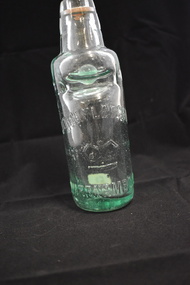
... Pressure inside the bottle would keep the marble pressed against the top of the bottle. To open the bottle the marble was pressed down where it would fall into the neck chamber below. ...Pressure inside the bottle would keep the marble pressed against the top of the bottle. To open the bottle the marble was pressed down where it would fall into the neck chamber below. ...This bottle is known as a marble stopper bottle. The bottle was filled upside down so that as soon as the filling stopped the stopper was forced down to seal the bottle against the rubber ring. Pressure inside the bottle would keep the marble pressed against the top of the bottle. To open the bottle the marble was pressed down where it would fall into the neck chamber below. The marble would stay inside the chamber when the bottle was tilted up for drinking. This bottle came from the aerated waters factory of John Fletcher. This factory was commenced in the mid 19th century by John Davis. As a young boy John Fletcher worked at the cordial factory of John Rowley in Banyan Street, Warrnambool and then worked for John Davis at his Union Cordial Factory for many years. In 1885 he succeeded John Davis in this business. Fletcher’s business continued until 1930 and it later was bought by Ralph Reeves. John Fletcher manufactured aerated waters, soda, tonic waters, lemonade, ginger ale, hop beer, hop bitters, sarsaparilla and cordials. This bottle is of interest, firstly because it is a good example of the marble stopper type of bottle, no longer in use. It is also important because it is a John Fletcher bottle and he was a prominent soft drinks manufacturer in Warrnambool for over 40 years. This is a green-coloured glass bottle with a round base. The top of the body of the bottle has two heavy indentations either side, narrowing the entry to the body of the bottle. The neck is short and thick and the opening at the top of the bottle is moulded with a rubber ring around the inside. A glass marble is loose inside the bottle neck. The name of the manufacturer is moulded into the glass on the side and includes a crown symbol used as a trade mark.‘John Fletcher Trade Mark Warrnambool’ john fletcher, warrnambool, cordial manufacturers in warrnambool -
 Warrnambool and District Historical Society Inc.
Bottle, J Lescal Warrnambool, 1920's
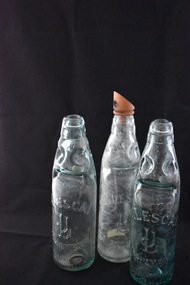
... Pressure inside the bottle would keep the marble pressed against the top of the bottle. To open the bottle the marble was pressed down where it would fall into the neck chamber below. ...Pressure inside the bottle would keep the marble pressed against the top of the bottle. To open the bottle the marble was pressed down where it would fall into the neck chamber below. ...These marble stopper bottles came from the Warrnambool aerated waters factory of Joseph Lescai. A marble stopper bottle was one which was filled upside down so that as soon as the filling stopped the stopper was forced down to seal the bottle against the rubber ring. Pressure inside the bottle would keep the marble pressed against the top of the bottle. To open the bottle the marble was pressed down where it would fall into the neck chamber below. The marble would stay inside the neck chamber when the bottle was tilted up for drinking. Joseph Lescai and his brother, James had fruit shops in Warrnambool and in the 1920s Joseph Lescai began to produce cordial and soft drinks at his Fairy Street shop. The cordial manufacturing was then re-located to a site in Fairy Street close to Raglan Parade and the business, known as Warrnambool Cordials Pty Ltd, was operated then by a group of Warrnambool businessmen and later by Thomas Hill in the 1930s. In the 1940s the business was purchased by the Flett brothers, Frederick and Charles, and in the 1960s the business was sold to Thomas McKenzie and retailed under the name of McKenzie’s Cordials. The business was still operating in the 1970s. These bottles are significant because they come from the Warrnambool aerated water factory of Joseph Lescai, probably in the late 1920s. The business commenced by Joseph Lescai became Warrnambool Cordials Pty Ltd and this was a prominent business in Warrnambool for 50 years or more. Cordial manufacturing was an important industry in Warrnambool for over 100 years. These three bottles are marble-stopper green glass bottles. They have a rounded base and body with a deep indentation in the glass at the top of the body to form a narrow neck chamber. The necks have small round indentations in the glass. The tops of the bottles have moulded glass and an opening. Details on the aerated waters manufacturer are impressed into the glass on the side of the bottles. A round green marble is loose in the neck chamber. Rubber rings in the necks of the bottles are missing. One of the bottles has a wooden stopper but this may not have been an original. Inscriptions and Markings: Serial numbers, signatures, engravings, dedications in books, manufacturing details or personal markings ‘J. Lescai J.L. Warrnambool’ ‘This bottle is the property of Lescai Warrnambool and cannot be legally used by others’ These three bottles are marble-stopper green glass bottles. They have a rounded base and body with a deep indentation in the glass at the top of the body to form a narrow neck chamber. The necks have small round indentations in the glass. The tops of the bottles have moulded glass and an opening. Details on the aerated waters manufacturer are impressed into the glass on the side of the bottles. A round green marble is loose in the neck chamber. Rubber rings in the necks of the bottles are missing. One of the bottles has a wooden stopper but this may not have been an original. Inscriptions and Markings: Serial numbers, signatures, engravings, dedications in books, manufacturing details or personal markings ‘J. Lescai J.L. Warrnambool’ ‘This bottle is the property of Lescai Warrnambool and cannot be legally used by others’ These three bottles are marble-stopper green glass bottles. They have a rounded base and body with a deep indentation in the glass at the top of the body to form a narrow neck chamber. The necks have small round indentations in the glass. The tops of the bottles have moulded glass and an opening. Details on the aerated waters manufacturer are impressed into the glass on the side of the bottles. A round green marble is loose in the neck chamber. Rubber rings in the necks of the bottles are missing. One of the bottles has a wooden stopper but this may not have been an original. Inscriptions and Markings: Serial numbers, signatures, engravings, dedications in books, manufacturing details or personal markings ‘J. Lescai J.L. Warrnambool’ ‘This bottle is the property of Lescai Warrnambool and cannot be legally used by others’ These three bottles are marble-stopper green glass bottles. They have a rounded base and body with a deep indentation in the glass at the top of the body to form a narrow neck chamber. The necks have small round indentations in the glass. The tops of the bottles have moulded glass and an opening. Details on the aerated waters manufacturer are impressed into the glass on the side of the bottles. A round green marble is loose in the neck chamber. Rubber rings in the necks of the bottles are missing. One of the bottles has a wooden stopper but this may not have been an original. J. Lescai J.L. Warrnambool’ ‘This bottle is the property of Lescai Warrnambool and cannot be legally used by others’ lescal cordials, cordial bottles, 1920's bottles, warrnambool cordial manufacurers -
 Mont De Lancey
Domestic object - Baby Bottle, Felgrim, Early 20th C
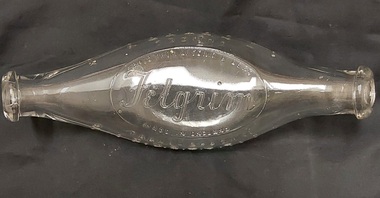
... The brand is stamped in large ornate lettering inside an oval shape on the wide front of the bottle. It has two open ends for attaching teats. 8oz measurements are marked on one side and 16 tablespoons on the other. ...The brand is stamped in large ornate lettering inside an oval shape on the wide front of the bottle. It has two open ends for attaching teats. 8oz measurements are marked on one side and 16 tablespoons on the other. ...The banana bottle is often referred to as the hygienic bottle, and is aptly named. It was the saviour of many hand reared babies in early 20th C. It's ease of cleaning was a major breakthrough in nursery hygiene. The basic design was around for about 50 years. It first made its appearance around the mid 1880's. The first true banana feeder with a teat and valve was invented in 1894 by Allen and Hanbury's. In the next 15 years the model was modified over a series of four slightly different models. In 1910 the final design, The Allenbury Feeder was to remain unchanged for the next 50 years.A clear glass Felgrim Banana bottle (valve and teat) for feeding babies by hand. The brand is stamped in large ornate lettering inside an oval shape on the wide front of the bottle. It has two open ends for attaching teats. 8oz measurements are marked on one side and 16 tablespoons on the other. 'Felgrim' brand and 'Made in England Free from arsenic and lead'baby bottles, baby equipment, babies, domestic objects -
 Warrnambool and District Historical Society Inc.
Perfume bottle, Glass & silver
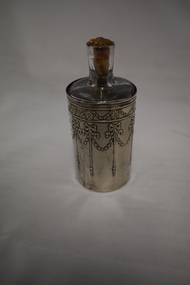
... The silver folder, which is cylindrical, covers the entire base of the bottle and is open at both ends. The silver holder has impressed silver patterns (chains, bows and discs).The bottle slides into the folder which is slightly rusted inside....The silver folder, which is cylindrical, covers the entire base of the bottle and is open at both ends. The silver holder has impressed silver patterns (chains, bows and discs).The bottle slides into the folder which is slightly rusted inside. ...This item is an attractive one and has belonged to someone who was a more affluent member of society. It is an item that would have been kept in a bedroom on a dresser or table. It is surmised that the ‘H.D’ stands for Hope Dickson, a member of a prominent Warrnambool family. She was the daughter of Mary Glass Cramond and James Dickson. Her grandfathers, John Cramond and James Dickson, established a clothing and drapery store in Warrnambool in the 1850s and it continued as a major business in Liebig Street, Warrnambool until 1973. As an elderly woman in the 1970s, Hope Dickson donated many household and personal items to the Warrnambool and District Historical Society and this perfume bottle may be one of them. This item is significant because it is a high-quality household item that dates back 100 years. If it belonged to Hope Dickson then this local provenance gives it added importance. This is a glass bottle with a covering silver holder. The bottle body is round with two straight pieces on either side. The neck is rounded and short and the opening has a cork stopper that extends down the neck. The silver folder, which is cylindrical, covers the entire base of the bottle and is open at both ends. The silver holder has impressed silver patterns (chains, bows and discs).The bottle slides into the folder which is slightly rusted inside.‘H.D.’women’s boudoir items, perfume bottle, history of warrnambool -
 Warrnambool and District Historical Society Inc.
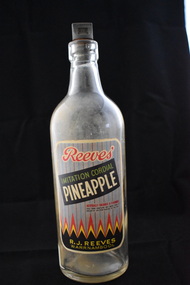
Bottle, Imitation Cordial Pineaple Reeves W'bool, 1970s
... The top of the bottle has a moulded glass open top and there is a cork stopper with a brown top to enable the bottle to be opened by turning. ...The top of the bottle has a moulded glass open top and there is a cork stopper with a brown top to enable the bottle to be opened by turning. ...This bottle came from the Warrnambool aerated waters factory of Reg Reeves. This factory in Koroit Street, Warrnambool was established in the 1860s as the Union Cordial Factory by John Davis and then bought by John Fletcher in 1885. Fletcher’s business continued until 1930 when it was bought by Ralph Reeves. Coming to Warrnambool about 1900, Ralph Reeves managed a Banyan Street cordial factory which had been established by John Rowley. Ralph Reeves bought a cordial business at Hamilton in 1916 and sold it in 1929 to concentrate on his Warrnambool cordial factory. Reeves was joined by his son Reg in Warrnambool and Reg operated the business from 1946 to 1972. The trade name of Reeves was still used after Reg Reeves died and continued on for some years. This bottle is of interest as an example of the soft drinks made at the Warrnambool aerated waters factory of Reg Reeves. Reg and his father Ralph operated a cordial business in Warrnambool for 40 years. Cordial manufacturing was an important industry in Warrnambool for over 100 years.This is a glass bottle with a long rounded body, a round base and a short rounded neck. The top of the bottle has a moulded glass open top and there is a cork stopper with a brown top to enable the bottle to be opened by turning. The stopper has the name of the manufacturer of the soft drink on it and there is a multi-coloured label pasted on to the side of the bottle. The name of the soft drinks manufacturer is also impressed into the glass on the side of the bottle. There are two small chips near the base of the bottle. Stopper: R.V.Reeves R.V.R. Bottle: Reeves Imitation Cordial Pineapple Artificially coloured &flavoured This food contains not more than 2 grains of sulphur dioxide to the pint R.J. Reeves Warrnambool ralph reeves, warrnambool, reg reeves, warrnambool, cordial manufacturers in warrnambool, history of warrnambool -
 Warrnambool and District Historical Society Inc.
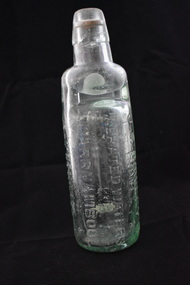
Bottle, Bottle Rowley, Late 19th century
... Pressure inside the bottle would keep the marble pressed against the top of the bottle. To open the bottle the marble was pressed down where it would fall into the neck chamber below. ...Pressure inside the bottle would keep the marble pressed against the top of the bottle. To open the bottle the marble was pressed down where it would fall into the neck chamber below. ...This marble stopper bottle came from the Warrnambool aerated waters manufacturer, John Rowley. A marble stopper bottle was filled upside down so that as soon as the filling stopped the stopper was forced down to seal the bottle against the rubber ring. Pressure inside the bottle would keep the marble pressed against the top of the bottle. To open the bottle the marble was pressed down where it would fall into the neck chamber below. The marble would stay inside the chamber when the bottle was tilted up for drinking. John Rowley (1837-1893) was born in England and came to Australia in 1856. In 1865 he opened a branch of the Geelong Corio Brewery at the corner of Timor and Banyan Streets, Warrnambool, bottling the beer, not brewing it. In 1870 this business was closed and Rowley developed his soft drinks business which he had established in 1868. In 1872 the business was called the Warrnambool Steam Aerated Works when a steam engine was purchased from Melbourne. By this time the factory was turning out 600 dozen bottles a day. For some time Rowley also had a factory in the Western District town of Hamilton. By the 1880s the Warrnambool factory was occupying half an acre of land, was employing 13 people and manufacturing 20 varieties of drinks. Rowley was active in community affairs, serving four years on the Warrnambool Council and he was on the committees of the Warrnambool Hospital and the Mechanics’ Institute.This bottle is of great interest as it comes from the factory of the prominent 19th century Warrnambool aerated waters manufacturer, John Rowley. This is one of the few bottles we have from the Rowley factory. Cordial manufacturing was an important industry in Warrnambool for over 100 years and John Rowley was a key figure in this industry. This is a marble stopper green-coloured glass bottle. The body is rounded with a round base and it has deep indentations at the top of the body that narrows to form a small chamber. The neck tapers to the top of the bottle which has a moulded glass top and a rubber ring inside the top. A green marble is loose in the neck chamber. Details of the soft drinks manufacturer are impressed into the glass on the side of the bottle. ‘J.S.Rowley’s Aerated Waters Warrnambool & Hamilton’ ‘D. K.’ john searle rowley, warrnambool, cordial manufacturers in warrnambool, history of warrnambool -
 Flagstaff Hill Maritime Museum and Village
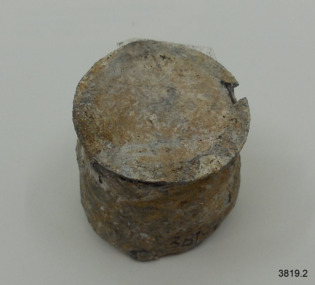
Functional object - Bottle Seal, circa 1843-1878
... The capsule couldn’t be re-fitted so it was discarded after the bottle was opened. Capsule designs from about 1862 used tin-plated lead foil and often had the inscriptions and trademarks of the content makers on them. ...The capsule couldn’t be re-fitted so it was discarded after the bottle was opened. Capsule designs from about 1862 used tin-plated lead foil and often had the inscriptions and trademarks of the content makers on them. ...This lead sealing capsule was recovered from the tragic wreck of the sailing ship ‘Loch Ard’. It may have once been on a bottle amongst the ship's cargo, its provisions or the passengers’ personal luggage. It is now part of the John Chance collection. Bottles in the early 19th century were handmade. They were not necessarily uniform in size or shape, so sealing was not always successful. If the bottles were stored they often became contaminated by rats and mice breaking the cork or wax seals, or by insects attracted to the contents if the seal on the bottle leaked. Lead sealing capsules were used from 1843 to overcome this problem. The lead was heated until it was malleable, then moulded by hand to fit over the sealed bottle’s mouth and neck. This was more successful if wire was also used under the capsule for added security (similar to modern champagne bottles). The capsule couldn’t be re-fitted so it was discarded after the bottle was opened. Capsule designs from about 1862 used tin-plated lead foil and often had the inscriptions and trademarks of the content makers on them. Eventually it was found that the lead was toxic. The lead was replaced by tin, aluminium, and later plastic. Today’s home brewers can buy readymade plastic capsules that fit over the bottle then twist to lock it firmly into place and can be re-used. Digs at archaeological sites often reveal lead sealing capsules. These are collected and catalogued. The information gathered from inscriptions, makers’ marks, logos and descriptions of the bottle contents has provided valuable insights into the history and the dating of other items on the sites. This lead sealing capsule was made to seal a handmade glass bottle and is historically significant for representing its invention to solve a preservation and integrity issue with bottle seals in the mid-to-late 19th century. Its design has evolved and is still in use today. This sealing capsule is representative of their historical use of capsules as a tool for dating and interpreting archaeological sites around the world. The sealing capsule is also significant as it was recovered by John Chance, a diver from the wreck of the Loch Ard in the 1960s-70s. Items that come from several wrecks along Victoria's coast have since been donated to the Flagstaff Hill Maritime Village’s museum collection by his family, illustrating this item’s level of historical value. The sealing capsule is also significant for being connected to the wreck of the Loch Ard (1873-1878), which is historically significant to both Victoria and Australia. The loss of the ship has been described as one of the ‘worst shipwreck tragedies’ and is well known in Victoria for the tragic death of 52 out of the 54 lives on board. The Loch Ard wreck's historical significance as a large international passenger and cargo clipper ship has been recognised and it is now registered on the Victorian Heritage Database, VHR S417. The wreck site is labelled as ‘one of Victoria’s most spectacular diving sites’ and the area is a popular tourist site. It is part of Victoria’s Underwater Shipwreck Discovery Trail.Bottle sealing capsule, cylindrical with thin, round top separated from thicker body (taped in place and fragile). Made from grey-white lead, uneven in thickness and shape. Remnants of a thick substance are inside the capsule.flagstaff hill, warrnambool, flagstaff hill maritime museum, maritime museum, shipwreck coast, flagstaff hill maritime village, great ocean road, john chance, loch ard, bottle seal, bottle capsule, handmade bottle, antique bottle, sealing capsule, lead capsule, bottle closure, bottle foil, bottle preservation, bottle finish -
 Bendigo Historical Society Inc.
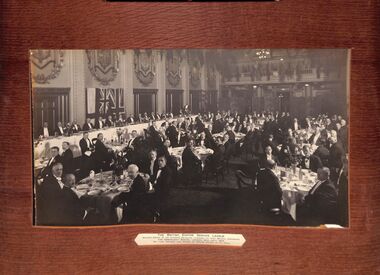
Photograph - IAN DYETT COLLECTION: Photograph of the first biennial conference of the British Empire Services League
... The tables are all set with empty plates and opened wine bottles. all the men are looking at the camera. ...The tables are all set with empty plates and opened wine bottles. all the men are looking at the camera. ...This important occasion (the First Conference of the British Empire Service League), in the life and career Gilbert J C Dyett, indicates his position in a world between the 1st and 2nd World Wars when the British Empire was still a major power and ones proximity to the Royal Family was the key to your standing. Note, under the Union Jacks and third from the left edge sits the lead delegate and President of the league Bendigonian Gilbert Dyett, beside a Field Marshal and beside him the Chairman and Paron The Prince of Wales The venue The Connaught Rooms, London on the 16th July 1923. Sir Gilbert Joseph Cullen Dyett (1891-1964) was born in Bendigo, at the age of 14 he started working for J H Curnow Real Estate and Auction rooms. In March 1915 he was commissioned as Lieutenant in the 7th Battalion and was badly wounded at Lone Pine, Gallipoli. After the war he was prominent in many organizations including Anzac Remembrance Appeal, Ocean Road Trust, Returned Services League, Australian War Memorial, Racecourse Licences Board of Victoria, Victoria Trotting and Racing Association (which was largely controlled by John Wren) He was caricatured as Captain Dwyer by Frank Hardy in his novel Power without Glory. HE was Knighted in 1934. Died in Fitzroy in1964 and is buried in Bendigo. Ref. Australian Dictionary of Biography. https://adb.anu.edu.au/biography/dyett-sir-gilbert-joseph-cullen-6071 A black and white photograph of about 90 men in dinner suits sitting at dining tables. The tables are all set with empty plates and opened wine bottles. all the men are looking at the camera. There are Heraldic shield and flags on the walls. Gilbert Dyett is sitting at the podium table, second from the left two places from The Prince of Wales who is sitting on the left edge of the flags. The photo is in a brown mount which has a small white piece in the lower section with black printing - THE BRITISH EMPIRE SEERVICE LEAGUE Welcome Dinner to the Overseas Delegates attending the First Biennial Conference. THE CONNAUGHT ROOMS, LONDON 16TH JULY 1923. His Royal Highness, THE PRINCE OF WALES, Patron in the chair gilbert dyett, british empire service league, the prince of wales, the connaught rooms, 'fortuna -
 Royal District Nursing Service (now known as Bolton Clarke)
Photograph - Photograph, black and white, Barry Sutton, c.1970
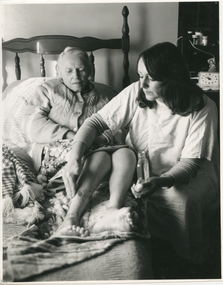
... Prentice, who is looking at her right hand, is holding a small open bottle in her left hand and has her right arm extended across Mrs. ...Prentice, who is looking at her right hand, is holding a small open bottle in her left hand and has her right arm extended across Mrs. ...Sister Prentice is visiting Mrs. Morgan in her home and is applying a lotion around the outside of Mrs. Morgan's leg ulcer. Following this application Sr. Prentice dressed the wound with the dressing material as ordered by Mrs. Morgan's Doctor. Under her gown, Sister Prentice is wearing the RDNS winter uniform introduced in 1971, which was a grey/blue skivy under a blue/grey herringbone woollen V neck tunic.From its inception in 1885 as Melbourne District Nursing Society (MDNS), their Trained nurses (Nurses) provided wound care to their patients, who ranged in age from the very young to the elderly. The methods and medication applied to wounds changed as research developed better products. MDNS received Royal patronage in 1966 and as Royal District Nursing Service (RDNS), the Education department developed programs, such as the Leg Ulcer Management Program, to provide their trained nurses (Sisters) with methods of best quality care. The Sisters liaised with the patient’s Doctors and Hospitals to provide information on the progress of patient’s wounds and to receive any change of wound care from the Doctors. RDNS introduced Wound Care Specialists who did assessments and provided advice and support to the District Sisters working in the field. On the right of the black and white photograph is Royal District Nursing Service (RDNS), Sister Cheryl Prentice, who has dark shoulder length hair and is wearing a white gown over her RDNS uniform, the sleeves of which are seen. On her left Mrs. Morgan is sitting propped against a pillow at the top of her bed and has her knees slightly bent with legs extended. Sr. Prentice, who is looking at her right hand, is holding a small open bottle in her left hand and has her right arm extended across Mrs. Morgan's legs, with the fingers of her hand touching the skin on the far side of an open ulcer wound on the right leg of Mrs. Morgan. Mrs. Morgan, who has short light coloured hair, is wearing a cardigan over her floral frock, is looking at the procedure. The bedhead has fine turned wooden slats and the bed coverings are a checked rug and chenile bedspread with a floral towel under Mrs. Morgan's legs.. Photographer stamp. Quote No. DN 77 Handwritten informationroyal district nursing service, rdns, rdns wound care, mrs morgan, sister cheryl prentice -
Warrnambool and District Historical Society Inc.
Functional object - Ginger Ale Bottle, John Fletcher. Koroit Street, Warrnambool, c. 1930
... Pressure inside the bottle would keep the marble pressed against the top of the neck. To open the bottle the marble was pressed down so that it fell into the body of the bottle. ...Pressure inside the bottle would keep the marble pressed against the top of the neck. To open the bottle the marble was pressed down so that it fell into the body of the bottle. ...This bottle was found in sea water while the donor was snorkelling in Stingray Bay, Warrnambool. It is a marble stopper bottle from the Warrnambool cordial factory of John Fletcher. Th bottle was filled upside down so that as soon as the filling ceased the marble was forced down to seal the bottle against a rubber ring (missing in this bottle). Pressure inside the bottle would keep the marble pressed against the top of the neck. To open the bottle the marble was pressed down so that it fell into the body of the bottle. John Fletcher as a young boy worked at Rowley's Cordial Factory in Banyan Street, Warrnambool. He then worked for John Davis who had established the Union Cordial Factory in Koroit Street in the 1860s. In 1885 John Fletcher bought Davis' business and operated it until 1930. It was then bought by Ralph Reeves. John Fletcher manufactured soda water, lemonade, tonic waters, ginger ale, sarsaparilla, cordials, hop beer and hop bitters.This bottle is of some interest as an example of a marble stopper bottle over 90 years old and as a memento of the Warrnambool soft drinks business of John Fletcher, a prominent businessman in Warrnambool for over 40 years.This is a clear glass bottle with a rounded body, a heavy indentation near the base of the neck and a thick tapering neck with a round opening. The bottle contains a green marble and some marine detritus. The bottle is discoloured with stains and dirt and has lettering etched into the side and base.John Fletcher Ginger Ale Warrnambool This bottle is the property of John Fletcher Warrnambool and cannot be legally used by others Gjohn fletcher warrnambool, cordial manufacturers in warrnambool -
 Tarnagulla History Archive
Codd Bottle - Whittaker & Sons, Lemonade, Dunolly
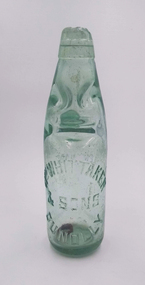
... The bottle is pinched into a special shape to provide a chamber into which the marble is pushed to open the bottle. ...The bottle is pinched into a special shape to provide a chamber into which the marble is pushed to open the bottle. ...David Gordon Collection. A Codd-neck bottle is a type of bottle used for carbonated drinks. Hiram Codd, an English engineer invented a successful process that he patented as “Codd’s patented globe stopper bottle” in 1872. This type of bottle has a closing design in which a glass marble is held against a rubber seal, which sits within a recess in the lip. The Codd-neck bottle was designed and manufactured with thick glass to withstand internal pressure, and a chamber to enclose a marble and a rubber washer in the neck. The bottles are filled upside down, and pressure of the gas in the bottle forced the marble against the washer, sealing in the carbonation. The bottle is pinched into a special shape to provide a chamber into which the marble is pushed to open the bottle. This prevents the marble from blocking the neck as the drink is poured. The bottles were regularly produced for many decades, but gradually declined in usage. Since children smashed the bottles to retrieve the marbles, vintage bottles are relatively scarce and have become collector items, particularly in the UK. William Whittaker's son Joseph Whittaker operated a cordial factory at Tarnagulla for many years. It was located at the southern end of Commercial Road, and was the last business premises on the eastern side of the road. Joseph Whittaker was a leading citizen at Tarnagulla for many years, and was a leading supporter of sporting activities including cricket and rifle clubs, as well as a strong patron of the fire brigade. He was known by some as Ginger Beer Joe. -
 Flagstaff Hill Maritime Museum and Village
Container - Bottle, c. 1905
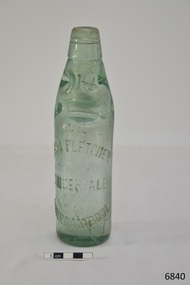
... When the bottle stands upright, the gas pushes the marble up against the washer, creating a firm seal to keep the fizz inside. The bottle is opened by pushing the marble down firmly to allow some of the gas to escape. ...When the bottle stands upright, the gas pushes the marble up against the washer, creating a firm seal to keep the fizz inside. The bottle is opened by pushing the marble down firmly to allow some of the gas to escape. ...This bottle once contained John Fletcher’s ginger cordial. It was found in August 2014 in the sand dunes at Levy's Point, near McKinnon's quarry, Warrnambool. ABOUT JOHN FLETCHER of WARRNAMBOOL John Fletcher Cordial (or Beverage) Co.. Warrnambool supplied cordial and aerated drinks to the Western District of Victoria. John Fletcher was named as a cordial manufacturer in the Warrnambool Standard of June 13th 1895, when he attended a Publican’s Association meeting. Mr John Fletcher, aerated water and cordial manufacturer of Koroit Street, Warrnambool, had a summary of his factory printed in a short article in the Advocate, Melbourne, in February 1901. The article said, “one of the most complete plants outside the metropolis … spacious … well appointed …old-established business … noted for the excellence of the quality … a trial [of the beverage] is solicited.” John Fletcher and Harold Caffin, trading as J.S. Rowley & Co, cordial manufacturers in 1903, were prosecuted in September that year when the Board of Health found an analysed sample of Raspberry Vinegar to contain coal tar colouring, which could be injurious to health, particularly to the kidneys. The factory was still in operation in December 1924, when sadly, Mr S. Fletcher, who was carrying bottles of aerated water at Mr John Fletcher’s cordial factory, sustained an eye injury when one of the bottles burst. Later, the eye had to be removed at the Warrnambool Base Hospital. ABOUT CODD BOTTLES Many inventions during the mid-to-late 1800s kept the fizz in carbonated drinks, such as ginger ale, soda water, and fruit drinks. Hiram Codd, an English engineer, invented a successful process that he patented as “Codd’s patented globe stopper bottle” in 1872. The Codd-neck bottle (commonly called Codd or marble bottle) is manufactured in two parts. The body of the bottle is cast in two sections. At the time of joining the sections, a glass marble and rubber seal are inserted into the neck section. The lip is then applied to the top of the bottle. The Codd bottle is filled upside down as the pressure of the gas from the carbonated liquid holds the marble up and out of the way. When the bottle stands upright, the gas pushes the marble up against the washer, creating a firm seal to keep the fizz inside. The bottle is opened by pushing the marble down firmly to allow some of the gas to escape. The marble drops down and is caught in a depression formed in the neck. When the bottle is tilted to pour or drink the liquid, the marble rests in a dimple. Some have said that the bottle is a character, the shape having a face with its mouth keeping the marble out of the drink and eyes that catch the marble so that it doesn’t roll into the mouth of the drinker. The Codd bottle was expensive to produce, and children loved to destroy the marbles to play with the marbles inside. Many shops and factories added a deposit to the cost of buying the drink to encourage children to return the bottles rather than break it for the marble. Codd bottles are still being produced in India and Japan for soft drinks. A Codd bottle with the same markings as this one is valued on today’s Australian auction sites from AUD 35 - $75. Bottle, aqua/green glass, with glass marble inside. John Fletcher's Ginger Ale, Warrnambool. Container is often called a "Codd neck bottle", “marble bottle” or “Codd’s patent bottle”. Bottle made by Dobson. Inscription on bottle and base. c. 1905Marks moulded into glass; "JOHN FLETCHER / GINGER ALE / WARRNAMBOOL" and “DOBSON” and on base “G”. flagstaff hill, warrnambool, shipwrecked coast, flagstaff hill maritime museum, maritime museum, shipwreck coast, flagstaff hill maritime village, great ocean road, codd bottle, codd neck bottle, marble bottle, ginger beer bottle, john fletcher soft drinks, warrnambool soft drinks and cordials, john fletcher cordial (or beverage) co ., codd neck bottle, glass stopper bottle, hiram codd, antique bottle, harold caffin, john fletcher -
 Flagstaff Hill Maritime Museum and Village
Domestic object - Codd neck bottle, E. Rowlands, 1921
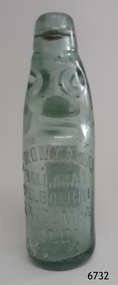
... When the bottle stands upright the gas pushes the marble up against the washer, creating a firm seal to keep the fizz inside. The bottle is opened by pushing the marble down firmly to allow some of the gas to escape. ...When the bottle stands upright the gas pushes the marble up against the washer, creating a firm seal to keep the fizz inside. The bottle is opened by pushing the marble down firmly to allow some of the gas to escape. ...The design of the bottle is called a Codd, sometimes referred to as a marble bottle or "Codd's patent bottle". During the mid-to-late 1800s, there were many inventions to keep the fizz in carbonated drinks such as ginger ale, soda water, and fruit drinks. Hiram Codd, an English engineer invented a successful process that he patented as "Codd's patented globe stopper bottle" in 1872. The Codd-neck bottle (commonly called Codd or marble bottle) is manufactured in two parts. The body of the bottle is cast in two sections. At the time of joining the sections, glass marble and rubber seal are inserted into the neck section. The lip is then applied to the top of the bottle. The Codd bottle is filled upside down as the pressure of the gas from the carbonated liquid holds the marble up and out of the way. When the bottle stands upright the gas pushes the marble up against the washer, creating a firm seal to keep the fizz inside. The bottle is opened by pushing the marble down firmly to allow some of the gas to escape. The marble drops down and is caught in a depression formed in the neck. When the bottle is tilted to pour or drink the liquid the marble rests in a dimple. Two Ballarat miners, Evan Rowland and Robert Lewis started manufacturing mineral and aerated waters, bitters, cordials, and liqueurs in 1854, in a tent on the shores of Lake Wendouree Ballarat. Another 13 firms at that time employed manual operations, whereas they introduced Taylor's No. 1 machine that speeded up the process and laid the foundation for their fortune. Evan Rowland was a pioneer in the aerated water trade in Australia. He was born on August 2, 1826, in North Wales. In 1852, during the gold rush, he emigrated to Melbourne, and in 1854 he went to Ballarat and formed a partnership with Robert Lewis, the firm being called ‘‘Rowlands & Lewis’’. Their next step was to secure a supply of pure water. Using mineral Waters that they found via a natural spring at Warrenheip, Victoria. From the outset, the beverages made from this water gained repute and were in great demand. Their business prospered so well that in 1858 they were able to build a factory at the corner of Sturt and Dawson Streets, Ballarat, and to fit with the most up-to-date machinery then in use. By 1870 their business had increased so much and demand had grown to such an extent that Mr. Rowlands erected another factory, covering over an acre of ground at the corner of Dana and Doveton Streets, costing £13,000. The factory was fitted with the most modern equipment of the time to manufacture cordials and aerated water. In 1873 Rowlands established an agency at 116 Collins St, Melbourne, because the demand for the products of the Melbourne factory became so large. The company expanded to Sydney opening a factory at the corner of Burns & Hay Streets Darling Harbour obtaining spring water to supply this plant from Katoomba in the Blue Mountains. The water was brought to Sydney by rail. In the meantime, the Melbourne concern had progressed so rapidly that in 1888 a magnificent factory embodying all the latest ideas and equipment was built in King Street Melbourne. Robert Lewis was a fellow Welshman born in 1816, and he arrived in Port Phillip in 1853 and became a partner in the early day with Evan Rowland but with lesser and shorter involvement in the firm, from which he retired in 1876. Robert Lewis was perhaps better known as Ballarat's first mayor and a Member of the Legislative Assembly. He was a strong supporter of local charities, president/treasurer of the Eisteddfod Committee, a major force in the development of the Ballarat Hospital, and he was the mayor of Ballarat five times, the first in 1863, (having been a counsellor as early as 1859) and for the last time in 1881. Lewis died in 1884 of a stroke in Ballarat. Rowlands continued in the firm and invented and patented an improved soda water bottle. The water used in Rowlands products was filtered four times but his attempts to use local corks failed on quality grounds. He was a stickler for quality, which was so good that many outside Victoria were prepared to pay the 'premium' imposed by inter-colonial customs duty payable at that time. By the 1890s, Rowlands had factories in Ballarat, Melbourne, Sydney, and Newcastle. He died in 1894 but his company continued until well after the Second World War when it was sold to Schweppes. Bottles such as this popular brand, containing soda water, were often used on paddle steamers for refreshments.An early manufacturing process producing the first mineral waters in Australia was invented and developed by an early Welsh migrant to Australia. The Evan Rowlands story gives an insight into the early development of manufacturing industries in Australia that allowed their workers and the towns they were situated in to prosper and develop into what they are today. A good example of hand blown glass.Bottle; clear glass Codd neck bottle with small marble in top. Once contained soda water or soft drink. Manufactured in 1921 by E. Rowlands of Ballarat, Melbourne, Katoomba and Sydney. The bottle is 'recyclable' - the message on the base says that it remains the property of E. Rowlands Pty Ltd. Inscriptions on three adhesive labels at time of donation"E. ROWLANDS BALLARAT MELBOURNE KATOOMBA AND SYDNEY". Imprinted into bas "1921" "THIS BOTTLE REMAINS THE PROPERTY OF E. ROWLANDS PTY LTD" On adhesive labels (3) " 1921 ON BASE (LASTED 1924) CODD PATENT 702" "SMALL SIZE. MARBLE TOP SODA WATER PAPER LABEL. USED" "ON PADDLE STEAMERS. POPULAR BRAND"flagstaff hill, warrnambool, shipwrecked-coast, flagstaff-hill, flagstaff-hill-maritime-museum, maritime-museum, shipwreck-coast, flagstaff-hill-maritime-village, bottle, codd bottle, hiram codd, glass marble bottle, e. rowlands bottle manufacturer, soda bottle australia, early recyclable bottle, codd's patent bottle, marble bottle, refreshments, soda water, marble top, 1920s, codd patent 702, handmade, blown -
 Flagstaff Hill Maritime Museum and Village
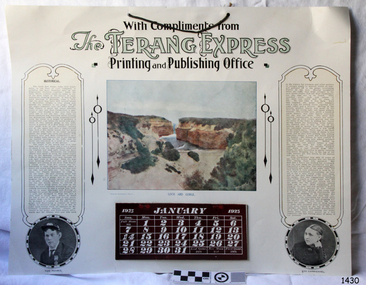
Book - Calendar, T.S. McInnes, The Terang Express: August 1923, 1923
... He took her to the cave and broke open a case of brandy which had washed up on the beach. He opened a bottle to revive the unconscious woman. ...He took her to the cave and broke open a case of brandy which had washed up on the beach. He opened a bottle to revive the unconscious woman. ...The calendar has an account of the event of the wreck of the Loch Ard and the only survivors, Tom Pearce and Eva Carmichael. It was printed by the local firm, The Terang Express. HISTORY OF THE LOCH ARD: - The LOCH ARD belonged to the famous Loch Line, which sailed many ships from England to Australia. Built in Glasgow by Barclay, Curdle and Co. in 1873, the LOCH ARD was a three-masted square-rigged iron sailing ship. The LOCH ARD made three trips to Australia and one trip to Calcutta before its final voyage. LOCH ARD left England on March 2, 1878, under the command of Captain Gibbs, a newly married, 29-year-old, bound for Melbourne with a crew of 37, plus 17 passengers and a load of cargo. There were items included in the cargo that were intended for display in the Melbourne International Exhibition in 1880. The voyage to Port Phillip was long but uneventful. At 3 am on June 1, 1878, the LOCH ARD was running into a fog that greatly reduced visibility. Captain Gibbs was becoming anxious as there was no sign of land or the Cape Otway lighthouse. The lifteed about an hour later, and the sheer cliffs of Victoria's west coast came into view. Captain Gibbs realised that the ship was much closer to them than expected. Soon after, just half a mile from the coast, the ship's bow was suddenly pulled around by the anchor. The captain tried to tack out to sea, but the ship struck a reef at the base of Mutton Bird Island, near Port Campbell. Waves broke over the ship, and the top deck was loosened from the hull. The masts and rigging came crashing down, knocking passengers and crew overboard. When a lifeboat was finally launched, it crashed into the side of LOCH ARD and capsized. Tom Pearce drifted out to sea and then, on the flood tide, came into what is now known as LOCH ARD Gorge. He swam to shore, bruised and dazed, and found a cave in which to shelter. Eva Carmichael had raced onto the deck to find out what was happening, only to be confronted by towering cliffs looming above the stricken ship. In all the chaos, she was swept into the sea. Eva saw Tom Pearce on a small rocky beach and yelled to attract his attention. He dived in and swam to the exhausted woman and dragged her to shore. He took her to the cave and broke open a case of brandy which had washed up on the beach. He opened a bottle to revive the unconscious woman. Later, Tom scaled a cliff in search of help. He eventually came by chance upon two men from nearby Glenample Station. Eventually, the two shipwreck survivors were taken to Glenample Station to recover. Eva stayed at the station for six weeks before returning to Ireland, this time by steamship. Of the 54 crew members and passengers on board, only two survived: the apprentice, Tom Pearce and the young woman passenger, Eva Carmichael, who lost all of her family in the tragedy.The calendar records the wreck of the Loch Ard, showing that the event was significant locally and thought worthy of publishing on a local calendar. The calendar is significant for its connection to the wreck of the Loch Flagstaff Hill’s collection of artefacts from LOCH ARD is significant for being one of the largest collections of artefacts from this shipwreck in Victoria. It is significant for its association with the shipwreck, which is on the Victorian Heritage Register (VHR S417). The collection is significant because of the relationship between the objects, as together they have a high potential to interpret the story of the LOCH ARD. The LOCH ARD collection is archaeologically significant as the remains of a large international passenger and cargo ship. The LOCH ARD collection is historically significant for representing aspects of Victoria’s shipping history and its potential to interpret sub-theme 1.5 of Victoria’s Framework of Historical Themes (living with natural processes). The collection is also historically significant for its association with the LOCH ARD, which was one of the worst and best known shipwrecks in Victoria’s history.Calendar printed by Terang Express for August 1923 with a Coloured picture of Loch Ard Gorge and portraits of the survivors of the wreck, Tom Pearce and Eva Carmichael, and a brief story of the episode of the wreck. There is a piece of string for hanging the calendar on a wall."With Compliments from The Terang Express Printing and Publishing Office" "December1923" "Historical" "Tom Pearce" "Eva Carmichael"flagstaff hill, warrnambool, shipwrecked coast, flagstaff hill maritime museum, maritime museum, shipwreck coast, flagstaff hill maritime village, great ocean road, loch line, loch ard, captain gibbs, eva carmichael, tom pearce, glenample station, mutton bird island, terang express, calendar, 1923, calendar 1923, printer, newspaper, loch ard gorge, 50th anniversary, flagstaff hill maritime museum and village, maritime village, august 1923 -
 Flagstaff Hill Maritime Museum and Village
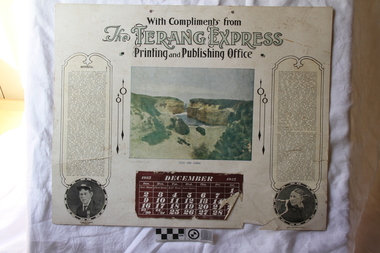
Book - Calendar, Terang Express, The Terang Express: December 1923, 1923
... He took her to the cave and broke open a case of brandy which had washed up on the beach. He opened a bottle to revive the unconscious woman. ...He took her to the cave and broke open a case of brandy which had washed up on the beach. He opened a bottle to revive the unconscious woman. ...The calendar has an account of the event of the wreck of the Loch Ard and the only survivors, Tom Pearce and Eva Carmichael. It was printed by the local firm, The Terang Express. HISTORY OF THE LOCH ARD: - The LOCH ARD belonged to the famous Loch Line, which sailed many ships from England to Australia. Built in Glasgow by Barclay, Curdle and Co. in 1873, the LOCH ARD was a three-masted square-rigged iron sailing ship. The LOCH ARD made three trips to Australia and one trip to Calcutta before its final voyage. LOCH ARD left England on March 2, 1878, under the command of Captain Gibbs, a newly married, 29-year-old, bound for Melbourne with a crew of 37, plus 17 passengers and a load of cargo. There were items included in the cargo that were intended for display in the Melbourne International Exhibition in 1880. The voyage to Port Phillip was long but uneventful. At 3 am on June 1, 1878, the LOCH ARD was running into a fog that greatly reduced visibility. Captain Gibbs was becoming anxious as there was no sign of land or the Cape Otway lighthouse. The lifteed about an hour later, and the sheer cliffs of Victoria's west coast came into view. Captain Gibbs realised that the ship was much closer to them than expected. Soon after, just half a mile from the coast, the ship's bow was suddenly pulled around by the anchor. The captain tried to tack out to sea, but the ship struck a reef at the base of Mutton Bird Island, near Port Campbell. Waves broke over the ship, and the top deck was loosened from the hull. The masts and rigging came crashing down, knocking passengers and crew overboard. When a lifeboat was finally launched, it crashed into the side of LOCH ARD and capsized. Tom Pearce drifted out to sea and then, on the flood tide, came into what is now known as LOCH ARD Gorge. He swam to shore, bruised and dazed, and found a cave in which to shelter. Eva Carmichael had raced onto the deck to find out what was happening, only to be confronted by towering cliffs looming above the stricken ship. In all the chaos, she was swept into the sea. Eva saw Tom Pearce on a small rocky beach and yelled to attract his attention. He dived in and swam to the exhausted woman and dragged her to shore. He took her to the cave and broke open a case of brandy which had washed up on the beach. He opened a bottle to revive the unconscious woman. Later, Tom scaled a cliff in search of help. He eventually came by chance upon two men from nearby Glenample Station. Eventually, the two shipwreck survivors were taken to Glenample Station to recover. Eva stayed at the station for six weeks before returning to Ireland, this time by steamship. Of the 54 crew members and passengers on board, only two survived: the apprentice, Tom Pearce and the young woman passenger, Eva Carmichael, who lost all of her family in the tragedy.The calendar records the wreck of the Loch Ard, showing that the event was significant locally and thought worthy of publishing on a local calendar. The calendar is significant for its connection to the wreck of the Loch Flagstaff Hill’s collection of artefacts from LOCH ARD is significant for being one of the largest collections of artefacts from this shipwreck in Victoria. It is significant for its association with the shipwreck, which is on the Victorian Heritage Register (VHR S417). The collection is significant because of the relationship between the objects, as together they have a high potential to interpret the story of the LOCH ARD. The LOCH ARD collection is archaeologically significant as the remains of a large international passenger and cargo ship. The LOCH ARD collection is historically significant for representing aspects of Victoria’s shipping history and its potential to interpret sub-theme 1.5 of Victoria’s Framework of Historical Themes (living with natural processes). The collection is also historically significant for its association with the LOCH ARD, which was one of the worst and best known shipwrecks in Victoria’s history. Calendar printed by Terang Express for December 1923 with a Coloured picture of Loch Ard Gorge and portraits of the survivors of the wreck, Tom Pearce and Eva Carmichael, and a brief story of the episode of the wreck. "With Compliments from The Terang Express Printing and Publishing Office" "December1923" "Historical" "Tom Pearce" "Eva Carmichael"flagstaff hill, warrnambool, shipwrecked coast, flagstaff hill maritime museum, maritime museum, shipwreck coast, flagstaff hill maritime village, great ocean road, loch line, loch ard, captain gibbs, eva carmichael, tom pearce, glenample station, mutton bird island, loch ard gorge, calendar, terang express, 1923, 50th anniversary, flagstaff hill maritime museum and village, maritime village, august 1923 -
 Flagstaff Hill Maritime Museum and Village
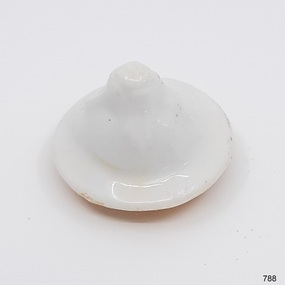
Leisure object - Toy, Circa 1878
... He took her to the cave and broke the open case of brandy that had washed up on the beach. He opened a bottle to revive the unconscious woman. ...He took her to the cave and broke the open case of brandy that had washed up on the beach. He opened a bottle to revive the unconscious woman. ...This ceramic lid is part of a child's tea set, perhaps from a sugar bowl or tea pot. It was recovered from the wreck of the Loch Ard. The Loch Ard got its name from "Loch Ard" a loch that lies to the west of Aberfoyle, and the east of Loch Lomond. It means "high lake" in Scottish Gaelic. The vessel belonged to the famous Loch Line which sailed many vessels from England to Australia. The Loch Ard was built in Glasgow by Barclay, Curle & Co. in 1873, the vessel was a three-masted square-rigged iron sailing ship that measured 79.87 meters in length, 11.58 m in width, and 7 m in depth with a gross tonnage of 1693 tons with a mainmast that measured a massive 45.7 m in height. Loch Ard made three trips to Australia and one trip to Calcutta before its fateful voyage. Loch Ard left England on March 2, 1878, under the command of 29-year-old Captain Gibbs, who was newly married. The ship was bound for Melbourne with a crew of 37, plus 17 passengers. The general cargo reflected the affluence of Melbourne at the time. Onboard were straw hats, umbrellas, perfumes, clay pipes, pianos, clocks, confectionery, linen, and candles, as well as a heavier load of railway irons, cement, lead, and copper. There were other items included that were intended for display in the Melbourne International Exhibition of 1880. The voyage to Port Phillip was long but uneventful. Then at 3 am on June 1, 1878, Captain Gibbs was expecting to see land. But the Loch Ard was running into a fog which greatly reduced visibility. Captain Gibbs was becoming anxious as there was no sign of land or the Cape Otway lighthouse. At 4 am the fog lifted and a lookout aloft announced that he could see breakers. The sheer cliffs of Victoria's west coast came into view, and Captain Gibbs realised that the ship was much closer to them than expected. He ordered as much sail to be set as time would permit and then attempted to steer the vessel out to sea. On coming head-on into the wind, the ship lost momentum, the sails fell limp and Loch Ard's bow swung back towards land. Gibbs then ordered the anchors to be released in an attempt to hold their position. The anchors sank some 50 fathoms - but did not hold. By this time the ship was among the breakers and the tall cliffs of Mutton Bird Island rose behind. Just half a mile from the coast, the ship's bow was suddenly pulled around by the anchor. The captain tried to tack out to sea, but the ship struck a reef at the base of Mutton Bird Island, near Port Campbell. Waves subsequently broke over the ship and the top deck became loosened from the hull. The masts and rigging came crashing down knocking passengers and crew overboard. When a lifeboat was finally launched, it crashed into the side of Loch Ard and capsized. Tom Pearce, who had launched the boat, managed to cling to its overturned hull and shelter beneath it. He drifted out to sea and then on the flood tide came into what is now known as Lochard Gorge. He swam to shore, bruised and dazed, and found a cave in which to shelter. Some of the crew stayed below deck to shelter from the falling rigging but drowned when the ship slipped off the reef into deeper water. Eva Carmichael a passenger had raced onto the deck to find out what was happening only to be confronted by towering cliffs looming above the stricken ship. In all the chaos, Captain Gibbs grabbed Eva and said, "If you are saved Eva, let my dear wife know that I died like a sailor". That was the last Eva Carmichael saw of the captain. She was swept off the ship by a huge wave. Eva saw Tom Pearce on a small rocky beach and yelled to attract his attention. He dived in and swam to the exhausted woman and dragged her to shore. He took her to the cave and broke the open case of brandy that had washed up on the beach. He opened a bottle to revive the unconscious woman. A few hours later Tom scaled a cliff in search of help. He followed hoof prints and came by chance upon two men from nearby Glenample Station three and a half miles away. In a complete state of exhaustion, he told the men of the tragedy. Tom then returned to the gorge while the two men rode back to the station to get help. By the time they reached Loch Ard Gorge, it was cold and dark. The two shipwreck survivors were taken to Glenample Station to recover. Eva stayed at the station for six weeks before returning to Ireland by steamship. In Melbourne, Tom Pearce received a hero's welcome. He was presented with the first gold medal of the Royal Humane Society of Victoria and a £1000 cheque from the Victorian Government. Concerts were performed to honour the young man's bravery and to raise money for those who lost families in the disaster. Of the 54 crew members and passengers on board, only two survived: the apprentice, Tom Pearce, and the young woman passenger, Eva Carmichael, who lost her family in the tragedy. Ten days after the Lochard tragedy, salvage rights to the wreck were sold at auction for £2,120. Cargo valued at £3,000 was salvaged and placed on the beach, but most washed back into the sea when another storm developed. The wreck of Lochard still lies at the base of Mutton Bird Island. Much of the cargo has now been salvaged and some items were washed up into Lochard Gorge. Cargo and artifacts have also been illegally salvaged over many years before protective legislation was introduced in March 1982. One of the most unlikely pieces of cargo to have survived the shipwreck was a Minton majolica peacock- one of only nine in the world. The peacock was destined for the Melbourne 1880 International Exhibition. It had been well packed, which gave it adequate protection during the violent storm. Today the Minton peacock can be seen at the Flagstaff Hill Maritime Museum in Warrnambool. From Australia's most dramatic shipwreck, it has now become Australia's most valuable shipwreck artifact and is one of very few 'objects' on the Victorian State Heritage Register. The shipwreck of the Loch Ard is of significance for Victoria and is registered on the Victorian Heritage Register ( S 417). Flagstaff Hill has a varied collection of artifacts from Loch Ard and its collection is significant for being one of the largest accumulation of artifacts from this notable Victorian shipwreck of which the subject items are a small part. The collection's objects give us a snapshot of how we can interpret the story of this tragic event. The collection is also archaeologically significant as it represents aspects of Victoria's shipping history that allows us to interpret Victoria's social and historical themes of the time. Through is associated with the worst and best-known shipwreck in Victoria's history.Toy; a white ceramic lid from a child's tea set. The underside is hollow. The lid is glazed and the surface of the lid is uneven under the glaze.flagstaff hill, warrnambool, flagstaff hill maritime museum, shipwreck coast, flagstaff hill maritime village, great ocean road, loch line, loch ard, captain gibbs, eva carmichael, tom pearce, glenample station, mutton bird island, loch ard gorge, toy, child's tea set, toy lid
