
Showing 12 items matching "cell phone"
-
 Emerald Museum & Nobelius Heritage Park
Functional object - Motorola mobile phone and accessories, Motorola Inc, 1993
... ...cell phone...he Motorola Dyna TAC 8000X was the first portable cell phone developed by Motorola in 1973. Mobile (cell) phones gained popularity in the 1990s and exponentially beyond that time. ...he Motorola Dyna TAC 8000X was the first portable cell phone developed by Motorola in 1973. Mobile (cell) phones gained popularity in the 1990s and exponentially beyond that time. The Motorola Ultra Sleek 9660 - 1993 - was the last phone Motorola released in the Dynatac Series.Mobile phone - Motorola Ultra Sleek 9660 - in carry case Motorola battery SNN4040A, charging cradle and adaptor Motorola battery SSN4139A AC adaptor SPN4193A User Manual for Motorola Mobile Phone and receipt dated 13/05/1994 Instillation Manual for Motorola Mobile Phone Motorola Battery SNN4043AOn front of phone: 'Ultra Sleek 9660 / by Motorola'telecommunications, motorola, mobile phone, cell phone -
Emerald Museum & Nobelius Heritage Park
Functional object - Nokia Mobile Phones, Nokia, 1990s - 2000s
... ...cell phone...However, it was ultimately not able to compete with the smartphone evolution although its phones are still valued for durabilty and reliability. telecommunications Nokia mobile phone cell phone Ten Nokia Mobile Phones - release dates ranging from 1997 to 2006 Nokia 3810 Nokia 6210 Nokia 8310 Nokia 6100 Nokia 6610 Nokia 3120 Nokia 6030 Nokia 6288 Nokia E51 Nokia 6120c1 Functional object Nokia Mobile Phones Nokia ...Nokia is a Finnish multinational corporation. Starting in the 1990s and until the advent of the iPhone and the Android, Nokia produced some of the world's most successful phones. However, it was ultimately not able to compete with the smartphone evolution although its phones are still valued for durabilty and reliability.Ten Nokia Mobile Phones - release dates ranging from 1997 to 2006 Nokia 3810 Nokia 6210 Nokia 8310 Nokia 6100 Nokia 6610 Nokia 3120 Nokia 6030 Nokia 6288 Nokia E51 Nokia 6120c1telecommunications, nokia, mobile phone, cell phone -
Emerald Museum & Nobelius Heritage Park
Functional object - Sony Ericsson mobile phone and charger, Sony Ericsson, 2008
... ...cell phone...This particular phone came out in 2008 - a year after the release of Apple's iPhone. telecommunications Sony Ericsson mobile phone cell phone 'Sony Ericsson / 3' on front and 'Sony Ericsson' on back Sony Ericsson mobile phone and charger. ...Sony Ericsson was a technological mobile phone marriage of Sweden and Japan starting in 2001 - with a particular focus on design. Sony Ericsson ultimately failed to keep pace with rapid technological advancements and innovations in the mobile industry that could compete with Apple's iPhone and Samsung's Galaxy series and Sony acquired the brand in 2012. This particular phone came out in 2008 - a year after the release of Apple's iPhone.Sony Ericsson mobile phone and charger. Model number K770i and charger. Purple case. Released in 2008.'Sony Ericsson / 3' on front and 'Sony Ericsson' on backtelecommunications, sony ericsson, mobile phone, cell phone -
Emerald Museum & Nobelius Heritage Park
Functional object - Apple iPhone, Apple, 2008
... ...cell phone...Apple was, and remains, an innovative and successful company and has subsumed several rivals in the field. telecommunications Apple mobile phone cell phone Apple logo on the front and back On back: 'iPhone /8GB /Designed by Apple in California / Assembled in China Model No A1241' One Apple iPhone. ...The first Apple iPhone was launched in 2007 - this particular phone was launched the following year. Apple was, and remains, an innovative and successful company and has subsumed several rivals in the field.One Apple iPhone. Model A1241. Released 2008.Apple logo on the front and back On back: 'iPhone /8GB /Designed by Apple in California / Assembled in China Model No A1241'telecommunications, apple, mobile phone, cell phone -
Emerald Museum & Nobelius Heritage Park
Functional object - Panasonic mobile phones, Panasonic, 2003 and 2005
... ...cell phone...telecommunications Panasonic mobile phone cell phone 'Panasonic' on front of phone Two Panasonic mobile phones - EBX70 and EBVS3 released in 2003 and 2005 respectively. ...Two Panasonic mobile phones - EBX70 and EBVS3 released in 2003 and 2005 respectively. Both are flip phones with silver cases.'Panasonic' on front of phonetelecommunications, panasonic, mobile phone, cell phone -
Emerald Museum & Nobelius Heritage Park
Functional object - Motorola mobile flip phones, Motorola Inc, 2005
... ...cell phone...Motorola is now owned by Lenovo Group Limited, a Chinese company. telecommunications Motorola mobile phone cell phone VEMU2055.1 'VGA Zoom 4X' above the Motorola logo on the front and Motorola logo on back. ...Motorola Inc has the distinction of pioneering the first portable phone in 1973. It was shaped like a brick and weighed 2.4lb. Like some other companies, Motorola was not able to quickly adapt and evolve in the competitive smartphone industry - its market share had declined to 6% by 2009. Motorola is now owned by Lenovo Group Limited, a Chinese company.Two Motorola mobile phones. C168 (released 2005) and CEO168 (also released 2005). Both are flip phones. Part of a collection of mobile phones donated by a local resident.VEMU2055.1 'VGA Zoom 4X' above the Motorola logo on the front and Motorola logo on back. VEMU2055.2 '1.3MP / 8X Zoom' on the front above the Motorola logo. The Telstra logo is on the back.telecommunications, motorola, mobile phone, cell phone -
Emerald Museum & Nobelius Heritage Park
Functional object - Mobile Phone - LG, LG, 2011
... ...cell phone...This particular phone is a fairly basic one for the time. telecommunications LG mobile phone cell phone On front: 'LGC- 800W' on the front above the LG logo. ...LG released their first mobile phone in 1995. They were later to release flip phones and phones with keypads. They released their first Android device in 2009 and by 2013 they were the third largest mobile phone manufacturer in the market. In 2021, they shut down their mobile phone division citing the challenges of a competitive market and in order to focus on other products. This particular phone is a fairly basic one for the time.One LG mobile phone. Model LGC-800. Released in 2011. Silver grey. Part of a collection of mobile phones donated by a local resident.On front: 'LGC- 800W' on the front above the LG logo. On back: LG logotelecommunications, lg, mobile phone, cell phone -
 Beechworth RSL Sub-Branch
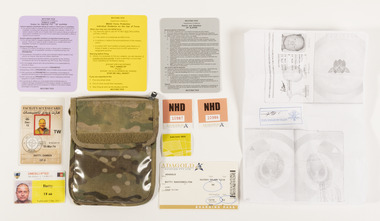
Functional object - Field Notebook Holder Contents, c2012
... 0096.02 - UNESCORTED / WEAPONS AUTHORISED / CELL PHONE ALLOWED / BATTY / TF-66 / VALID UNTIL 5 DECEMBER 2012. 0096.03 - 03-MAR-74 / BATTY DAMIEN / OF-3 Back 0096.04 - ADAGOLD / AVIATION PTY LTD / FROM SYDNEY / TO MIHAD MILITARY / DATE 05 JUN /1310 / 0096.05 - NHD / 10987 /ADAGOLD / AVIATION PTY LTD / 0096.06 - NHD / 10986 / ADAGOLD / AVIATION PTY LTD / 0096.07 - QUALITY CONTROL / 0096.08 - DAMIEN BATTY / 0096.09 - RESTRICTED / DEPARTMENT OF DEFENSE / SEARCH AND DETENTION / OP SLIPPER / (AFGHANISTAN ONLY) / DEC 2010 / 0096.10 - RESTRICTED / DEPARTMENT OF DEFENSE / MEAO FORCE PROTECTION / INDIVIDUAL GUIDANCE ON THE USE OF FORCE / APR 2009 / 0096.11 - RESTRICTED / DEPARTMENT OF DEFENSE / PURPLE CARD / ORDERS FOR OPERATING FIRE / OP SLIPPER / ...During this time they undertook significant combat operations, and were awarded for its actions, the regiment was collectively awarded the Unit Citation for Gallantry and the Meritorious Unit Citation. contents field notebook holder identification united nations 0096.02 - UNESCORTED / WEAPONS AUTHORISED / CELL PHONE ALLOWED / BATTY / TF-66 / VALID UNTIL 5 DECEMBER 2012. 0096.03 - 03-MAR-74 / BATTY DAMIEN / OF-3 Back 0096.04 - ADAGOLD / AVIATION PTY LTD / FROM SYDNEY / TO MIHAD MILITARY / DATE 05 JUN /1310 / 0096.05 - NHD / 10987 /ADAGOLD / AVIATION PTY LTD / 0096.06 - NHD / 10986 / ADAGOLD / AVIATION PTY LTD / 0096.07 - QUALITY CONTROL / 0096.08 - DAMIEN BATTY / 0096.09 - RESTRICTED / DEPARTMENT OF DEFENSE / SEARCH AND DETENTION / OP SLIPPER / (AFGHANISTAN ONLY) / DEC 2010 / 0096.10 - RESTRICTED / DEPARTMENT OF DEFENSE / MEAO FORCE PROTECTION / INDIVIDUAL GUIDANCE ON THE USE OF FORCE / APR 2009 / 0096.11 - RESTRICTED / DEPARTMENT OF DEFENSE / PURPLE CARD / ORDERS FOR OPERATING FIRE / OP SLIPPER / Contents from the Field Notebook Holder, (see 0096.1) belonging to Major Damien Batty whilst serving with the United Nations in Afghanistan. ...Contents belonged to Major Damien Batty whilst serving with the United Nations Forces in Afghanistan. Major Damien Batty served in Afghanistan in 2011-2012 with the Bravo Commando Company Group, 2nd Commando Regiment in Uruzgan. The Commandos took part in 20 rotations with the Special Operations Task Group (SOTG) between 2007 and 2012. During this time they undertook significant combat operations, and were awarded for its actions, the regiment was collectively awarded the Unit Citation for Gallantry and the Meritorious Unit Citation.Contents from the Field Notebook Holder, (see 0096.1) belonging to Major Damien Batty whilst serving with the United Nations in Afghanistan. Located in the clear plastic compartment of the Field Note Holder: 0096.02 - Authority card in colour featuring a photograph of Major Damien Batty. 0096.03 - Facility access card in colour featuring a photograph of Major Damien Batty. Located in the folded compartment of the Field Note Holder: 0096.04 - White boarding pass with colour text 0096.05 - Peach sticker with black text 0096.06 - Peach sticker with black text 0096.07 - Green sticker with black text 0096.08 - White A4 sized paper copy of passport with certification stamp 0096.09 - Small grey Rules of Engagement card with a gloss surface and rounded corners. Has text on both sides 0096.10 - Small yellow Rules of Engagement card with a gloss surface and rounded corners. Has text on both sides 0096.11 - Small purple Rules of Engagement card with a gloss surface and rounded corners. Has text on both sides 0096.12 - White piece of paper torn from a spinal notebook with written text in blue and red ink. (Not pictured) 0096.02 - UNESCORTED / WEAPONS AUTHORISED / CELL PHONE ALLOWED / BATTY / TF-66 / VALID UNTIL 5 DECEMBER 2012. 0096.03 - 03-MAR-74 / BATTY DAMIEN / OF-3 Back 0096.04 - ADAGOLD / AVIATION PTY LTD / FROM SYDNEY / TO MIHAD MILITARY / DATE 05 JUN /1310 / 0096.05 - NHD / 10987 /ADAGOLD / AVIATION PTY LTD / 0096.06 - NHD / 10986 / ADAGOLD / AVIATION PTY LTD / 0096.07 - QUALITY CONTROL / 0096.08 - DAMIEN BATTY / 0096.09 - RESTRICTED / DEPARTMENT OF DEFENSE / SEARCH AND DETENTION / OP SLIPPER / (AFGHANISTAN ONLY) / DEC 2010 / 0096.10 - RESTRICTED / DEPARTMENT OF DEFENSE / MEAO FORCE PROTECTION / INDIVIDUAL GUIDANCE ON THE USE OF FORCE / APR 2009 / 0096.11 - RESTRICTED / DEPARTMENT OF DEFENSE / PURPLE CARD / ORDERS FOR OPERATING FIRE / OP SLIPPER / contents, field notebook holder, identification, united nations -
 Geoffrey Kaye Museum of Anaesthetic History
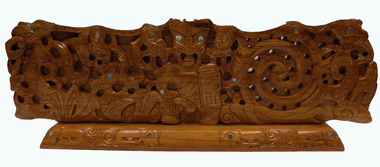
Sculpture - Carving, Heke Collier, Mauri Ora, May - July 2016
... His teachings and knowledge are relevant in contemporary times, and the cell-phone carved into his left hand represents this. ...His teachings and knowledge are relevant in contemporary times, and the cell-phone carved into his left hand represents this. ...Professor Alan Merry commissioned the work from New Zealand artist Heke Collier as a gift to the College at his retirement from Council. This artwork was carved by Heke Collier in May-July 2016. It is made from native New Zealand Rimu timber. Heke named this carving Mauri Ora which translates to vitality, well-being or the healing life-force. Tihei Mauri Ora (breath of life) is a well-known Māori saying that was uttered by the first human being. Māori believe that all people and all things have mauri. This carving symbolises the many shapes and forms of mauri with reference to the Māori creation story, and the spiritual and natural worlds. Māori refer to the heavens as Ranginui the sky-father and according to the Māori creation story, Ranginui was pressed against Papatūānuku the earth mother. Their children did not like living in the cramped, dark space between them. One of their sons Tāne separated Ranginui and Papatūānuku to allow light and life into the world. The central male figure carved into Mauri Ora (above) is Tāne. To his right (far right) is his mother Papatūānuku and to his left (far left) is his father Ranginui. Papatūānuku gives birth to all things including human kind and provides the physical and spiritual basis for life. The takarangi (spiral) design in the carving (to the left of Tāne) symbolises the life cycle. Whenua, the word for land also means placenta - organ that nourishes the baby in the womb. Women are associated with the land (whenua) because the land gives birth to people and so do women. In tribal history women have had influence over land and men. Papatūānuku is depicted in the carving to the right of Tāne. Ranginui played a pivotal role in the birth of the sun, moon, planets, stars and constellations – collectively called Te Whānau Mārama (the family of light). Human life and knowledge were said to originate in the realm of Ranginui. Tāne ascended the heavens to retrieve three baskets of knowledge: te kete-tuatea (basket of light), te kete-tuauri (basket of darkness) and te kete-aronui (basket of pursuit). Ranginui is depicted in the carving to the left of Tāne. Tāne had many different roles, and he was given different names to reflect these roles. He is called Tāne-mahuta as god of the forest, Tāne-te-wānanga as the bringer of knowledge, and Tāne-te-waiora as the bringer of life, prosperity, and welfare. His teachings and knowledge are relevant in contemporary times, and the cell-phone carved into his left hand represents this. Tuatara feature in the Māori creation story and some tribes view Tuatara as kaitiaki (guardians) of knowledge. Given that they have lived for more than 220million years. There are birds or manu surrounding Tāne in the carving, who represent Tane’s voice or the voice of the forest. The flax or harakeke depicted in the carving represent the family unit and reinforce the importance of kinship ties. There are plants, ferns, and birds carved into Mauri Ora play an integral role in the life-cycle which represent rongoa Māori or Māori medicine. Traditional Māori carving in Rimu, a native New Zealand wood, with paua insets.merry, alan, anzca council, collier, heke, kaiwhakairo, master carver, rimu -
 National Communication Museum
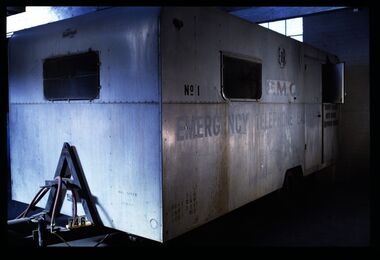
Vehicle - Mobile Telephone Exchange, c. 1965
... Exchanges such as this facilitated phone calls in the aftermath of an emergency, particularly for hospitals, police and other emergency services. Today, Mobile Exchange on Wheels (MEOWs), Cell on Wheels (CoW) and Satellite Cell on Wheels (SatCOW) - which provide temporary landline and broadband services, mobile phone coverage and service in areas without communications infrastructure respectively - are a critical part of emergency response procedures for natural disasters such as fire and flood. ...Manufactured in the 1960s, this mobile emergency telephone exchange was fitted into a caravan. Part of the Shepparton Division State Disaster Plan, the caravan could be towed to areas affected by disasters to enable communications to recommence. The caravan remained in service until approximately 1974.Mobile infrastructure plays an important role in Australian communications, owing to the often remote and hostile environments in which Australians live and work. Exchanges such as this facilitated phone calls in the aftermath of an emergency, particularly for hospitals, police and other emergency services. Today, Mobile Exchange on Wheels (MEOWs), Cell on Wheels (CoW) and Satellite Cell on Wheels (SatCOW) - which provide temporary landline and broadband services, mobile phone coverage and service in areas without communications infrastructure respectively - are a critical part of emergency response procedures for natural disasters such as fire and flood. Though technology has progressed, the need for rapid service in remote areas remains a present concern of the communications service providers in Australia. This mobile service infrastructure is historically significant as an early example of a service which has evolved over decades, yet is still needed today. The exchange, as a representative example of a vehicle which would provide early-response in a disaster, is socially significant as a facilitator of critical communications needs in devastated communities: access to emergency services and contact with family and friends. The exchange itself, intact from its period of use, provides an insight into technology of the 1970s.Mobile emergency exchange housed in a caravan trailer on 2 wheel base, duralin body, steel tow bar, Caravan divided into 3 sections; the exchange room; the relay room and the main frame room. The exchange room contains 3 switchboards, a folding table, cupboards, benches and switch rack (.1). table (.2), steel bar for attaching the table (.3), back boards of switchboards (.4-.6), switches (.7-.16), box of switches (.17). There is a wall phone magneto, 300 type handset on wall and 2 skylights with wire screens. .11? hat pegs and shelf; there are 2 fluorescent tubes for lighting, all in exchange section. The floor is covered with 2 tone grey tiles and there are wire mesh on outside of windows and a geometric curtain inside behind switch rack. There is a flywire screen door as well as exterior door. The relay room has a sectioned door so half can open at a time. Room contains a cupboard with folding bench top beneath a curtained window. The opposite wall has a bank of batteries and transmission condensers; there is a shelf above window, one fluorescent tube and fuse boxes. Tiles on floor also. The main frame room contains many metres of coiled black covered cable, a black covered magneto wall telephone with 300 type handset; grey plastic jumper cords, a rack of termination points and wire with wasp nests attached. There is a small iron step under door, a fluorescent tube on wall and 3 hat hooks. Roll of Paper Handtowels (.18), cord and handle (.19), red exchange cords and plugs (.20-.22), plastic aluminium runners (.23,.24), headset (.25,.26), logbook (.27), battery readings (.28), box containing papers circuit drawings etc (.29-.93), paper lists off wall (.94,.95). Books, record books etc (.96-.103). Manila folder (.104) containing circuit drawings (105-.124). Wooden drawer (.125), metal drawer containing subscribers master cards, record of faults cards, particular switchboards connected, Junction line cards (.126). Box of valves (.127), box of clamps (.128). Box of 2000 type rack fuses, red 1 1/2 AMPS, black 3 AMP, blue 1/2 AMP (.129). Box of sleeves for covering wire joints (.130), plastic beakers (.131,.132), soap (.133), box of white plastic squares (.134), time switch "Venner BF/43 time switch" Made in England (.135), box of bolts, knobs etc (.136), box of switchboard number indicators (.137), fuse (.138), fuse wire (.139), football card (.140). Box of cartridge fuse 6 AMP (.141). Envelope of drawing pins, rubber bands (.142), black plastic, paper tape centres (.143-.152), metal plug (.153), 2 signs "Beware of vehicles" (.154-.155). Paper listing Naringal East automatic conversion (.156). Green Commonwealth of Australia note pad (.157). Wiring plug for tail lights (.158). Black fuse plugs (.159,.160). Box of bolts (.161). 2 sections of blue plastic coated wires (.162,.163). Gloves used for working on batteries (.164-.167). Wasp nests (.168,.169). White fuse (.170). Photographs of van in use (.171,.172)..1 on front: "ANOTHER / MOBILETRAIL / PRODUCT" "MAX SPEED / 25MPH" "TRAILER BRAKES / --- / " On sides: "EMERGENCY TELEPHONE EXCHANGE" "NO 1" "PMG" "TCQ / GROSS 250 / TARE 182 / LOAD 162" "6" "COUNTRY BRANCH / NORTH REGION / [SHEPPARTON DIVISION]" "LAW'S SIGNS" "Telecom Australia" On back: "DANGER / LONG LOAD" "MQA 3787" .133: "FIR OIL" "AUSTRALIA"mobile telephone exchanges, mobile telecommunications trailers, trailers, transport, natural disaster, black saturday, bushfires, floods, emergency communications -
 Falls Creek Historical Society
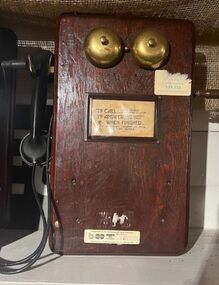
Functional object - Three early telephones
... When the operator answered she could then plug a line into another phone line or the exchange in Bright. In the phone were two dry cell batteries that carried the spoken word to the other phone connected. ...When the operator answered she could then plug a line into another phone line or the exchange in Bright. In the phone were two dry cell batteries that carried the spoken word to the other phone connected. ...Until 1960 there were no telephones in Falls Creek. The only access to a phone was at Rocky Valley Camp where the State Electricity Commission (SEC) had an extensive network to Mount Beauty, Bogong and the other camps such as Clover power station and Howman's Gap. There were test points with a phone beside the road where contact could be made to the office in Mount Beauty. The SEC was unconcerned about Falls Creek, so no power was connected until 1960 when Tom Mitchell aired the matter in parliament. Tom was a keen skier. He applied to the Post Master General who was then responsible for telephones as well as mail. The PMG staff came up from Bright and installed an exchange in Diana Lodge. There were only about 15 lines to a post across the road uphill about 20 metres. It was from here that you could put a line from the building into a box where connections were possible. You had to buy a cable from the disposal store. It needed to have an alloy of copper and steel in the wire similar to what the army had used during the war. If the phone failed the owner would have to find the break in the wire, not an easy task in the heavy snow. Then came the telephone itself. Falls Creek was given old-fashioned sets with a hand wound magneto to ring the bell at the exchange. When the operator answered she could then plug a line into another phone line or the exchange in Bright. In the phone were two dry cell batteries that carried the spoken word to the other phone connected. Trunk lines were expensive then, so each trunk call was timed by the minute. The operator would disconnect you after a minute if you did not reply to her question "are you extending?". These telephones were donated by Julian Newton Brown. Julian's Lodge Arundel was known as Falls Creek 11.These telephones are significant because they illustrate the earliest form of technology available to connect Falls Creek Village to other areas.Telephones constructed of polished wood, brass bell, handles and cabling. Designed to operate through a telephone exchange. They operated on two dry cell batteries.Attached to front of telephone: Instructions on how to make or receive a call.falls creek village, falls creek communicaton -
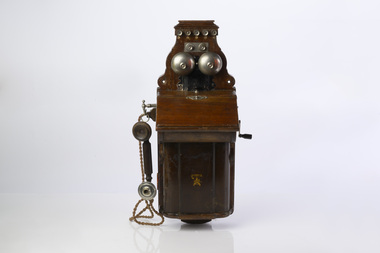 Department of Energy, Environment and Climate Action
Ericsson 'Commonwealth' wall telephone Model AB535
... Vintage wall telephone The case originally housed two No6 dry-cell batteries to power the speaker (early models used a pair of Leclanche-like wet-cell batteries - the drawing from 1911 indicates that wet-cell batteries were still in use at that time). Batteries became obsolete when the phone was connected to a central exchange. ...Forests Commission Victoria (FCV) Communications on front - L M ERICSSON & Co STOCKHOLM inside - serial number: 496018 H 5 (this serial number identifies the phone as being manufactured in 1904) inside - slip of paper identifies date of manufacture as 1904 inside aftermarket writing - F.W.31 Vintage wall telephone The case originally housed two No6 dry-cell batteries to power the speaker (early models used a pair of Leclanche-like wet-cell batteries - the drawing from 1911 indicates that wet-cell batteries were still in use at that time). ...The Commonwealth Ericsson Wall Telephone was adopted in 1901 by the Post Master General as the standard magneto telephone throughout Australia. It was designated by the Australian Post Office as: "Telephone No.1 - Magneto Wall, Commonwealth Type" The No1 was widely used in country areas and new installations of this type continued throughout the 1920s. Although classified as obsolete in 1951, several were still in service in country areas into the mid-1960s before the phone systems were fully automated. The phone was originally connected to a 'party' line (several connections to a common wire), and the winder was turned in various combinations of long and short turns (being the codes unique to each individual connection) to alert the other party of an incoming call. Anyone could listen in on a party line, although courtesy prevented it occurring most of the time. Central telephone exchanges rendered the party line obsolete. Vintage wall telephone The case originally housed two No6 dry-cell batteries to power the speaker (early models used a pair of Leclanche-like wet-cell batteries - the drawing from 1911 indicates that wet-cell batteries were still in use at that time). Batteries became obsolete when the phone was connected to a central exchange. A plastic speaker horn was fitted in 2025 - the original was missing on front - L M ERICSSON & Co STOCKHOLM inside - serial number: 496018 H 5 (this serial number identifies the phone as being manufactured in 1904) inside - slip of paper identifies date of manufacture as 1904 inside aftermarket writing - F.W.31forests commission victoria (fcv), communications
