
Showing 271 items matching "cotham road - kew (vic.)"
-
 Kew Historical Society Inc
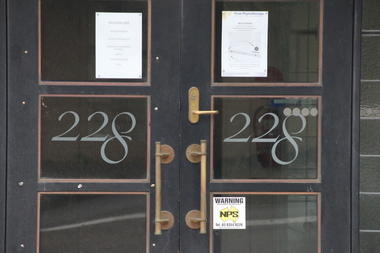
Photograph - Photographs (series), Richard Bowen, Sunninghill, 228 Cotham Road, 07/02/2020
... sunninghill - 228 cotham road - kew (vic)...Exterior photographs (digital) of Sunninghill, 228 Cotham Road, Kew VIC 3101. ...'The Shakespeare Window', State Library of Victoria website. sunninghill - 228 cotham road - kew (vic) joseph thomas (bland) holt lucy coppin Exterior photographs (digital) of Sunninghill, 228 Cotham Road, Kew VIC 3101. ...'Sunninghill' at 228 Cotham Road (Kew) is an historically significant building due to its associations with Joseph Thomas (Bland) Holt (1851-1942), theatre entrepreneur and actor who lived at the house following his retirement in 1909. Sunninghill (aka Sunning Hill) was one of his residences in Victoria (also 'The Anchorage' at Sorrento). Following Holt's death at Sunninghill on 28 June 1942, the house was left to his wife. After her death the house was bequeathed to Lucy Coppin, daughter of George Coppin. The 'Shakespeare Window' in the State Library of Victoria was at one stage installed in the house. References 'Death of Mr Bland Holt: Great exponent of melodrama', The Argus, 30 June 1942, p. 3. Shoesmith D, 'Holt, Joseph Thomas (Bland) (1851-1942)', Australian Dictionary of Biography, Vol 4, 1972. 'The Shakespeare Window', State Library of Victoria website.Exterior photographs (digital) of Sunninghill, 228 Cotham Road, Kew VIC 3101. sunninghill - 228 cotham road - kew (vic), joseph thomas (bland) holt, lucy coppin -
 Kew Historical Society Inc
Archive (Sub-series) - Subject File, Clarence House (180 Cotham Road), 1958
... clarence house - cotham road - kew (vic)...Archive file containing a white metal badge “CLARENCE” from Clarence House girls’ school at 180 Cotham Road, Kew (Vic). An inscribed envelope accompanying the badge notes that: 180 Cotham Road, Kew. ...Typically files will contain primary and secondary sources. clarence house - cotham road - kew (vic) schools -- kew (vic.) Archive file containing a white metal badge “CLARENCE” from Clarence House girls’ school at 180 Cotham Road, Kew (Vic). ...Various partiesReference, Research, InformationSecondary Values (KHS Imposed Order)Subject file containing a white metal badge “CLARENCE” from Clarence House girls’ school at 180 Cotham Road, Kew (Vic). An inscribed envelope accompanying the badge notes that: 180 Cotham Road, Kew. Built by Mr Justice A’Beckett. Later “Clarence House” school (a girls’ school) run by Misses Wymond. (This house was then owned but apparently not occupied by Jess and George Reed.)’clarence house - cotham road - kew (vic), schools -- kew (vic.)clarence house - cotham road - kew (vic), schools -- kew (vic.) -
Kew Historical Society Inc
Archive (series) - Subject File, Kew Historical Society, Woodbury Ladies' College, 1986
... kew (vic)...schools - cotham road - kew - vic...Cotham Road between Atkins and Davis Streets. In 1910, a new school building was built on the corner of Uvadale Grove and Cotham Road [the building is still extant as of 2020]. Woodbury College was operated by Miss Lizzie J and Miss Harriet J Macey until 1920. In 1921, the school amalgamated with the newly formed St Andrew's College, Mont Victor Road, Kew (Vic...Reference file containing information about Woodbury College, Cotham Road, Kew (Vic). The file includes historically significant primary sources relating to the former Woodbury College [c.1898-1920] and Lillsden Ladies' College, Edgevale Road, Kew (Vic) [c.1891-1903]. ...The latter were donated by Ms Doretta Bucknell in 1989. woodbury college misses macey schools - kew (vic) schools - cotham road - kew - vic private schools - kew (vic) rev jt lawton cotham road - kew (vic.) ...Various partiesReference, Research, InformationSecondary Values (KHS Imposed Order)Subject file containing information about Woodbury College, Cotham Road, Kew (Vic). The file includes historically significant primary sources relating to the former Woodbury College [c.1898-1920] and Lillsden Ladies' College, Edgevale Road, Kew (Vic) [c.1891-1903]. In addition to manuscripts, the file also includes photographs and ephemera such as a metal school badge, a hatband and printed programs and school magazines. The file [as of 2020] includes materials donated between 1986 and 2005 by descendants of the second principal (Miss Macey), and by former students and or their descendants. The contents of the reference file include: 1. School origins : undated handwritten manuscript [2pp]; 2. Annual Reports : Handwritten manuscripts for the years 1908, 1909, 1910, 1912, 1913, 1914, 1916, 1917, 1919, 1920 by Miss LJ Macey; 3. Prize List : undated manuscript [3pp]; 4. School Magazine ; undated handwritten manuscripts about the origin of the school's magazine; 5. Woodbury Chat [school magazine] : printed booklets from the years 1918, 1919, 1920 x 2; 6. Correspondence [sundry] : handwritten letters from a parent [1916] and a former pupil (sic) [1938] to Miss Macey; 7. Exercise Books : one containing a handwritten history of the school(s) and the names and addresses of former students and teachers; and the other containing information relating to the National Home Reading Union, Kew Circle [1912-c.1916]. 8. Metal school badge and photographic negative of students. The names of various donors are listed in the file: they include Ann Ransom, Muriel Coghlan, Helen Lade, and Lilian McRae (nee Houston).woodbury college, misses macey, schools - kew (vic), schools - cotham road - kew - vic, private schools - kew (vic), rev jt lawton, cotham road - kew (vic.)woodbury college, misses macey, schools - kew (vic), schools - cotham road - kew - vic, private schools - kew (vic), rev jt lawton, cotham road - kew (vic.) -
 Kew Historical Society Inc
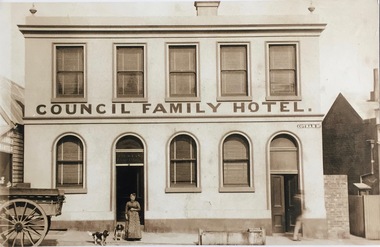
Photograph - Photograph [copy], Council Family Hotel, Cotham Road, circa 1888, c.1888
... Exterior - Council Family Hotel in Cotham Road, Kew (Vic) with Mrs Ryan, wife of the licensee at front...Rare photograph of a landmark Kew hotel hotels - kew council family hotel - kew (vic) licenees - ryan family Mrs Ryan Exterior - Council Family Hotel in Cotham Road, Kew (Vic) with Mrs Ryan, wife of the licensee at front Council Family Hotel, Cotham Road, circa 1888 Photograph Photograph [copy] ...The Council Family Hotel was the fifth of the eight hotels to be licensed in Kew during the 19th Century. They were licensed in the following date order: The Woodman Inn (1854), The Harp of Erin (1854), O’Shaughnessy’s Kew Hotel (1855), the Prospect Hill Hotel (1858), the Council Family Hotel (1861), the Princess Hotel (1864), the Clifton Hotel (1868) and the Greyhound Hotel (1873).Rare photograph of a landmark Kew hotelExterior - Council Family Hotel in Cotham Road, Kew (Vic) with Mrs Ryan, wife of the licensee at frontMrs Ryanhotels - kew, council family hotel - kew (vic), licenees - ryan family -
Kew Historical Society Inc
Archive (Series) - Subject File, Kew Historical Society, Heritage Studies [Kew & Boroondara], 1958
... kew (vic)...charleville - cotham road - kew (vic)...The file provides evidence of early heritage activities in the City of Kew in relation to statewide and national heritage initiatives. city of boroondara heritage action plan clemson house - kew (vic) charleville - cotham road - kew (vic) ross house - cotham road - kew (vic) 120 princess street - kew (vic) 14-16 princess street - kew (vic) fairyland - 57 malmsbury street (kew) raheen - studley park road (kew) Archival file containing correspondence, reports, newspaper articles/clippings, a City of Boroondara Heritage Action Plan (2012) relating to heritage in Kew, Victoria. ...Various partiesReference, Research, InformationSecondary Values (KHS Imposed Order)Subject file containing correspondence, reports, newspaper articles/clippings, a City of Boroondara Heritage Action Plan (2012) relating to heritage in Kew, Victoria. The earliest item dates from 1964, and is a letter from W. D. Birrell, Town Clerk to the Secretary of the Historical Society. The file also includes a National Trust of Victoria listing of classified buildings as of 1981. The most interesting documents in the file are the City of Kew Heritage Advice Note 1-4, compiled in 1991 and which provides advice on Protecting Heritage through Planning, Victorian Buildings, Edwardian Buildings, and 1930s-1940s houses. The latter would benefit from digitisation and publication.city of boroondara heritage action plan, clemson house - kew (vic), charleville - cotham road - kew (vic), ross house - cotham road - kew (vic), 120 princess street - kew (vic), 14-16 princess street - kew (vic), fairyland - 57 malmsbury street (kew), raheen - studley park road (kew)city of boroondara heritage action plan, clemson house - kew (vic), charleville - cotham road - kew (vic), ross house - cotham road - kew (vic), 120 princess street - kew (vic), 14-16 princess street - kew (vic), fairyland - 57 malmsbury street (kew), raheen - studley park road (kew) -
 Kew Historical Society Inc
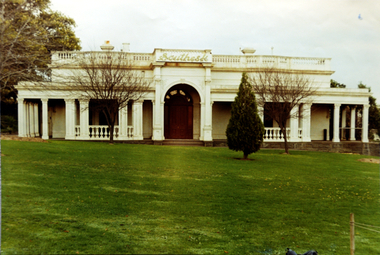
Photograph, Façade of ‘Southesk', Cotham Road, 1970
... southesk - cotham road - kew (vic)...Colour enlargement of a photograph (slide) of Southesk (formerly Ordsall) in Cotham Road, Kew (demolished 1970). david carnegie john halfey southesk - cotham road - kew (vic) ordsall - cotham road - kew (vic) Colour photograph of the front lawn and façade of ‘Southesk’ (formerly ‘Ordsall’, built for John Halfey in 1882). ...Colour enlargement of a photograph (slide) of Southesk (formerly Ordsall) in Cotham Road, Kew (demolished 1970).Colour photograph of the front lawn and façade of ‘Southesk’ (formerly ‘Ordsall’, built for John Halfey in 1882). The house was located on the corner of Cotham Road and Charles Street, Kew. The Italianate mansion was built in the Renaissance villa style on a bluestone plinth. Two balustrades surrounded the parapet of the roof and ran between the groups of pillars on either side of the entrance porch. The verandah was tiled and wide and Corinthian columns supported its roof. When the house passed into the hands of the City of Kew in 1948, the landscaping and formal flower beds were removed and replaced by lawns.The house was demolished in 1970.david carnegie, john halfey, southesk - cotham road - kew (vic), ordsall - cotham road - kew (vic) -
 Kew Historical Society Inc
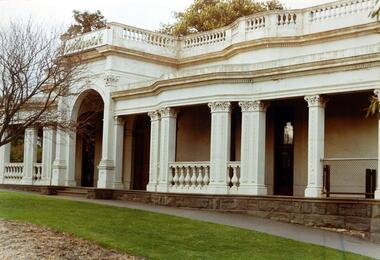
Photograph, Façade of ‘Southesk', Cotham Road, 1970
... southesk - cotham road - kew (vic)...Colour enlargement of a photograph (slide) of Southesk (formerly Ordsall) in Cotham Road, Kew (demolished 1970). david carnegie john halfey southesk - cotham road - kew (vic) ordsall - cotham road - kew (vic) A colour photograph of the façade of ‘Southesk’ taken at an oblique angle. ...Colour enlargement of a photograph (slide) of Southesk (formerly Ordsall) in Cotham Road, Kew (demolished 1970).A colour photograph of the façade of ‘Southesk’ taken at an oblique angle. Formerly known as ‘Ordsall’, the house was built for John Halfey in 1882 on the corner of Cotham Road and Charles Street. The Italianate mansion was built in the Renaissance villa style on a bluestone plinth. Two balustrades surrounded the parapet of the roof and ran between the groups of pillars on either side of the entrance porch. The verandah was tiled and wide and Corinthian columns supported its roof. When the house passed into the hands of the City of Kew in 1948, the Council used it for a kindergarten, an elderly citizen centre and as a home for the Leo Baeck Centre. The house was demolished in 1970.david carnegie, john halfey, southesk - cotham road - kew (vic), ordsall - cotham road - kew (vic) -
 Kew Historical Society Inc
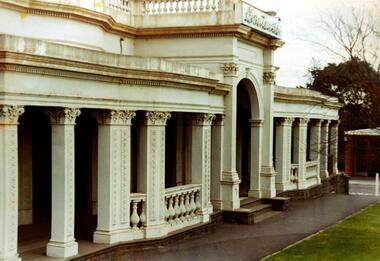
Photograph - Façade of ‘Southesk', Cotham Road, Stewart West, 1970
... southesk - cotham road - kew (vic)...Colour enlargement of a photograph (slide) of Southesk (formerly Ordsall) in Cotham Road, Kew (demolished 1970). david carnegie john halfey southesk - cotham road - kew (vic) ordsall - cotham road - kew (vic) A colour photograph of the façade of ‘Southesk’ taken at an oblique angle. ...Colour enlargement of a photograph (slide) of Southesk (formerly Ordsall) in Cotham Road, Kew (demolished 1970).A colour photograph of the façade of ‘Southesk’ taken at an oblique angle. Formerly known as ‘Ordsall’, the house was built for John Halfey in 1882 on the corner of Cotham Road and Charles Street. The Italianate mansion was built in the Renaissance villa style on a bluestone plinth. Two balustrades surrounded the parapet of the roof and ran between the groups of pillars on either side of the entrance porch. The verandah was tiled and wide and Corinthian columns supported its roof. When the house passed into the hands of the City of Kew in 1948, the Council used it for a kindergarten, an elderly citizen centre and as a home for the Leo Baeck Centre. The house was demolished in 1970.david carnegie, john halfey, southesk - cotham road - kew (vic), ordsall - cotham road - kew (vic) -
 Kew Historical Society Inc
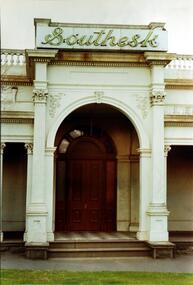
Photograph, Entrance to ‘Southesk’, Cotham Road, 1970
... southesk - cotham road - kew (vic)...Cotham Road, Kew (demolished 1970). Rare colour photograph of the exterior of Southesk david carnegie john halfey southesk - cotham road - kew (vic) ordsall - cotham road - kew (vic) A colour enlargement of the entrance to ‘Southesk’. ...Colour enlargement of a photograph (slide) of Southesk (formerly Ordsall) in Cotham Road, Kew (demolished 1970).Rare colour photograph of the exterior of SoutheskA colour enlargement of the entrance to ‘Southesk’. Formerly known as ‘Ordsall’, the house was built for John Halfey in 1882 on the corner of Cotham Road and Charles Street. This Italianate mansion was built in the Renaissance villa style on a bluestone plinth. The picture provides photographic evidence of the tiling on the veranda and the typically arched doorway. The neon sign above the door was added during the period when it was owned by the City of Kew (1948-70).david carnegie, john halfey, southesk - cotham road - kew (vic), ordsall - cotham road - kew (vic) -
 Kew Historical Society Inc
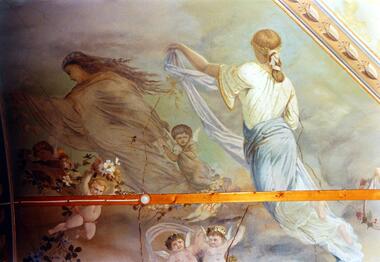
Photograph - Ceiling fresco, Ballroom, ‘Southesk’, Cotham Road, Stewart West, 1970
... southesk - cotham road - kew (vic)...) ordsall - cotham road - kew (vic) Notwithstanding its grand Italianate façade, the most important aspect of Southesk (formerly ‘Ordsall’) were the murals in the front two rooms. ...Colour enlargement of a photograph (slide) of Southesk (formerly Ordsall) in Cotham Road, Kew (demolished 1970).The ceilings of and architraves of Ordsall were painted by artists employed by the decorating company, Cullis Hill & Co. The frescos, of which fragments survive, were some of the most important murals used as elements of interior decoration in Melbourne during the Boom Period of the 1880s. These photographs were taken immediately prior to the demolition of the house, and are the best examples of the murals.Notwithstanding its grand Italianate façade, the most important aspect of Southesk (formerly ‘Ordsall’) were the murals in the front two rooms. An article in the Melbourne Argus in 1882 records that Mr Vandenbrandt and Signor Rizzi created these under the supervision of Cullis Hill. This fresco from the ceiling of the ballroom depicts ‘Night, represented by a female figure in a diaphanous garment, skirted with flowers, wafted before the approaching dawn into space illuminated by the moonlight, and peopled by the fairies, is a striking picture. Flying with her are an attendant Cupid bearing an artificial light, and a tired little votary of Bacchus with a reversed wine-pitcher and goblet’.david carnegie, john halfey, southesk - cotham road - kew (vic), ordsall - cotham road - kew (vic) -
 Kew Historical Society Inc
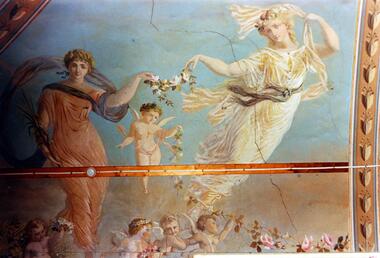
Photograph - Ceiling fresco, Ballroom, ‘Southesk’, Cotham Road, Stewart West, 1970
... southesk - cotham road - kew (vic)...) ordsall - cotham road - kew (vic) The most significant decorative aspects of Southesk (formerly ‘Ordsall’) were the murals in the front two rooms. ...Colour enlargement of a photograph (slide) of Southesk (formerly Ordsall) in Cotham Road, Kew (demolished 1970).The ceilings of and architraves of Ordsall were painted by artists employed by the decorating company, Cullis Hill & Co. The frescos, of which fragments survive, were some of the most important murals used as elements of interior decoration in Melbourne during the Boom Period of the 1880s. These photographs were taken immediately prior to the demolition of the house, and are the best examples of the murals.The most significant decorative aspects of Southesk (formerly ‘Ordsall’) were the murals in the front two rooms. An article in the Melbourne Argus in 1882 records that Mr Vandenbrandt and Signor Rizzi created these under the supervision of Cullis Hill. This fresco from the ceiling of the ballroom is believed to depict two of the Seasons. Signor Rizzi was a renowned painter of flowers. He is credited with painting these parts of the murals. Examples of his floral paintings can still be seen at Villa Alba in Walmer Street.david carnegie, john halfey, southesk - cotham road - kew (vic), ordsall - cotham road - kew (vic) -
 Kew Historical Society Inc
Photograph - Ceiling fresco, Ballroom, ‘Southesk’, Cotham Road, Stewart West, 1970
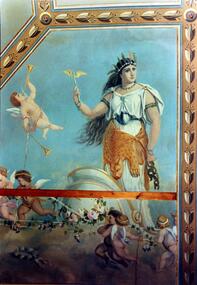
... southesk - cotham road - kew (vic)...) ordsall - cotham road - kew (vic) The most significant decorative aspects of Southesk (formerly ‘Ordsall’) were the murals in the front two rooms. ...Colour enlargement of a photograph (slide) of Southesk (formerly Ordsall) in Cotham Road, Kew (demolished 1970).The ceilings of and architraves of Ordsall were painted by artists employed by the decorating company, Cullis Hill & Co. The frescos, of which fragments survive, were some of the most important murals used as elements of interior decoration in Melbourne during the Boom Period of the 1880s. These photographs were taken immediately prior to the demolition of the house, and are the best examples of the murals.The most significant decorative aspects of Southesk (formerly ‘Ordsall’) were the murals in the front two rooms. An article in the Melbourne Argus in 1882 records that Mr Vandenbrandt and Signor Rizzi created these under the supervision of Cullis Hill. This fresco from the ceiling of the ballroom is believed to depict ‘Africa’. The article records that: ‘Notwithstanding the large size of the drawings they are often marked by delicate touches, and a minuteness of detail in evident sympathy with nature. The figures have grace, life and animation and the skillful shading of the colours used — chiefly amber, gold, light blue, green, light fawn and brown – is in harmony with the quiet tone of the general furnishing of the rooms.’david carnegie, john halfey, southesk - cotham road - kew (vic), ordsall - cotham road - kew (vic) -
 Kew Historical Society Inc
Photograph - Ceiling fresco, Ballroom, ‘Southesk’, Cotham Road, Stewart West, 1970
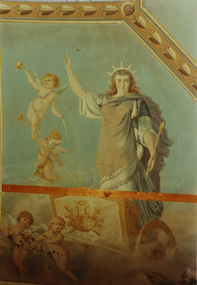
... southesk - cotham road - kew (vic)...) ordsall - cotham road - kew (vic) The most significant decorative aspects of Southesk (formerly ‘Ordsall’) were the murals in the front two rooms. ...Colour enlargement of a photograph (slide) of Southesk (formerly Ordsall) in Cotham Road, Kew (demolished 1970).The ceilings of and architraves of Ordsall were painted by artists employed by the decorating company, Cullis Hill & Co. The frescos, of which fragments survive, were some of the most important murals used as elements of interior decoration in Melbourne during the Boom Period of the 1880s. These photographs were taken immediately prior to the demolition of the house, and are the best examples of the murals.The most significant decorative aspects of Southesk (formerly ‘Ordsall’) were the murals in the front two rooms. An article in the Melbourne Argus in 1882 records that Mr Vandenbrandt and Signor Rizzi created these under the supervision of Cullis Hill. This fresco from the ceiling of the ballroom is believed to depict one of the ‘boldly drawn four great geographical divisions of the Earth’. The crowned woman, believed to represent Europe, stands aloft in a chariot drawn by cherubs holding garlands of flowers.david carnegie, john halfey, southesk - cotham road - kew (vic), ordsall - cotham road - kew (vic) -
 Kew Historical Society Inc
Photograph - Ceiling fresco, Drawingroom, ‘Southesk’, Cotham Road, Stewart West, 1970
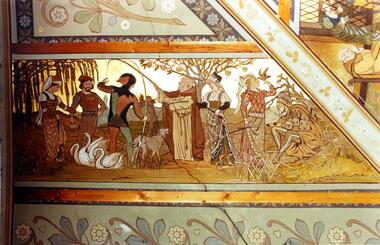
... southesk - cotham road - kew (vic)...) ordsall - cotham road - kew (vic) The most significant decorative aspects of Southesk (formerly ‘Ordsall’) were the murals in the front two rooms. ...Colour enlargement of a photograph (slide) of Southesk (formerly Ordsall) in Cotham Road, Kew (demolished 1970).The ceilings of and architraves of Ordsall were painted by artists employed by the decorating company, Cullis Hill & Co. The frescos, of which fragments survive, were some of the most important murals used as elements of interior decoration in Melbourne during the Boom Period of the 1880s. These photographs were taken immediately prior to the demolition of the house, and are the best examples of the murals.The most significant decorative aspects of Southesk (formerly ‘Ordsall’) were the murals in the front two rooms. An article in the Melbourne Argus in 1882 records that Mr Vandenbrandt and Signor Rizzi created these under the supervision of Cullis Hill. This fresco from the ceiling of the drawingroom was described by the reporter as ‘done in the quaint old 14th century style’. This section depicts ‘out-door sports. The fishing-lines of the jester and the almoner have become entangled, and a large wolf-dog seems disposed to arbitrate in the difficulty, while a party of young men and maidens are angling, feeding swans, or training hawks for a future day’s sport.’david carnegie, john halfey, southesk - cotham road - kew (vic), ordsall - cotham road - kew (vic) -
 Kew Historical Society Inc
Photograph - Ceiling fresco, Drawingroom, ‘Southesk’, Cotham Road, Stewart West, 1970
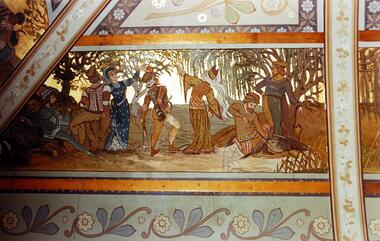
... southesk - cotham road - kew (vic)...) ordsall - cotham road - kew (vic) The most significant decorative aspects of Southesk (formerly ‘Ordsall’) were the murals in the front two rooms. ...Colour enlargement of a photograph (slide) of Southesk (formerly Ordsall) in Cotham Road, Kew (demolished 1970).The ceilings of and architraves of Ordsall were painted by artists employed by the decorating company, Cullis Hill & Co. The frescos, of which fragments survive, were some of the most important murals used as elements of interior decoration in Melbourne during the Boom Period of the 1880s. These photographs were taken immediately prior to the demolition of the house, and are the best examples of the murals.The most significant decorative aspects of Southesk (formerly ‘Ordsall’) were the murals in the front two rooms. An article in the Melbourne Argus in 1882 records that Mr Vandenbrandt and Signor Rizzi created these under the supervision of Cullis Hill. This fresco from the ceiling of the drawingroom was described by the reporter as ‘done in the quaint old 14th century style … The second panel represents a hawking party. The ladies hold aloft the natural perches for their falcons. The men, seated in picturesque variety of attitude, hold their cross-bows, and a boy is relieving a heron from an arrow which has pierced its bosom.’david carnegie, john halfey, southesk - cotham road - kew (vic), ordsall - cotham road - kew (vic) -
 Kew Historical Society Inc
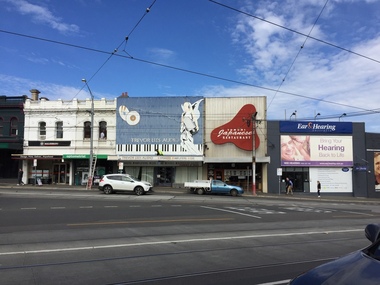
Photograph, Robert Baker, Kew Junction Streetscape, 2017, 01/09/2017
... the block - cotham road - kew (vic)...the block - cotham road - kew (vic) cotham road - kew (vic) Photograph of the junction of Cotham Road and High Street, Kew. ...Photograph of the junction of Cotham Road and High Street, Kew. the block - cotham road - kew (vic), cotham road - kew (vic) -
 Kew Historical Society Inc
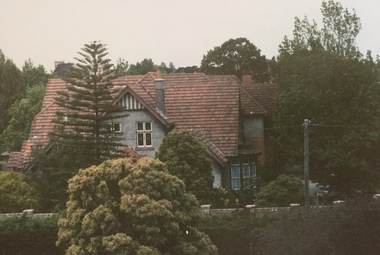
Photograph - 227 Cotham Road, Kew, 1988
... houses -- cotham road -- kew (vic.)...houses -- cotham road -- kew (vic.) 227 Cotham Road -- kew (vic.) ...Colour photographic positive of a house at 227 Cotham Road, Kewhouses -- cotham road -- kew (vic.), 227 cotham road -- kew (vic.) -
 Kew Historical Society Inc
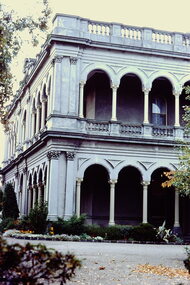
Slide - 'Ross House' (formerly 'Charleville'), Cotham Road, 1976
... ross house -- cotham road -- kew (vic.)...The images, albeit amateurish in composition, frequently reveal aspects of important buildings and sites that have changed over time. ross house -- cotham road -- kew (vic.) historic houses -- kew (vic) charleville -- cotham road -- kew (vic.) 35mm colour transparency of the left hand porticos of Ross House (aka Charleville) in Cotham Road, Kew. ...Colour transparency (slide) created in June 1976 during a tour by the Junior National Trust, which was led by members of Kew Historical Society. The collection of 21 slides reveals that the tour covered all parts of Kew, but focused understandably on heritage buildings and sites.Image of an historic place in Kew that can be dated to an exact time and place. The images, albeit amateurish in composition, frequently reveal aspects of important buildings and sites that have changed over time.35mm colour transparency of the left hand porticos of Ross House (aka Charleville) in Cotham Road, Kew. The colour of the original render is intact, and that of the cast iron columns used in the colonnade, at least in 1976, are white. Ross House is a fine example of boom time Italianate architecture. ross house -- cotham road -- kew (vic.), historic houses -- kew (vic), charleville -- cotham road -- kew (vic.) -
 Kew Historical Society Inc
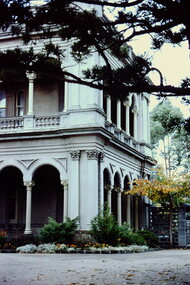
Slide - 'Ross House' (formerly 'Charleville'), Cotham Road, 1976
... kew (vic.)...ross house -- cotham road -- kew (vic.)...The images, albeit amateurish in composition, frequently reveal aspects of important buildings and sites that have changed over time. historic houses -- kew (vic.) ross house -- cotham road -- kew (vic.) charleville -- cotham road -- kew (vic.) 35mm colour transparency of the right hand porticos of 'Ross House' ('formerly 'Charleville') in Cotham Road, Kew. ...Colour transparency (slide) created in June 1976 during a tour by the Junior National Trust, which was led by members of Kew Historical Society. The collection of 21 slides reveals that the tour covered all parts of Kew, but focused understandably on heritage buildings and sites.Image of an historic place in Kew that can be dated to an exact time and place. The images, albeit amateurish in composition, frequently reveal aspects of important buildings and sites that have changed over time.35mm colour transparency of the right hand porticos of 'Ross House' ('formerly 'Charleville') in Cotham Road, Kew. historic houses -- kew (vic.), ross house -- cotham road -- kew (vic.), charleville -- cotham road -- kew (vic.) -
 Kew Historical Society Inc
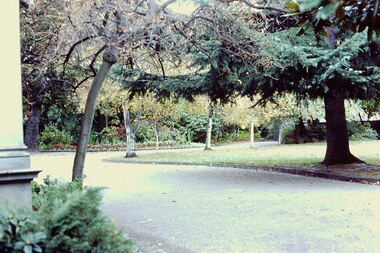
Slide - 'Ross House' (formerly 'Charleville'), Cotham Road, 1976
... kew (vic.)...ross house -- cotham road -- kew (vic.)...The images, albeit amateurish in composition, frequently reveal aspects of important buildings and sites that have changed over time. historic houses -- kew (vic.) ross house -- cotham road -- kew (vic.) charleville -- cotham road -- kew (vic.) 35mm colour transparency of the front garden of 'Ross House' ('formerly 'Charleville') in Cotham Road, Kew. ...Colour transparency (slide) created in June 1976 during a tour by the Junior National Trust, which was led by members of Kew Historical Society. The collection of 21 slides reveals that the tour covered all parts of Kew, but focused understandably on heritage buildings and sites.Image of an historic place in Kew that can be dated to an exact time and place. The images, albeit amateurish in composition, frequently reveal aspects of important buildings and sites that have changed over time.35mm colour transparency of the front garden of 'Ross House' ('formerly 'Charleville') in Cotham Road, Kew. historic houses -- kew (vic.), ross house -- cotham road -- kew (vic.), charleville -- cotham road -- kew (vic.) -
 Kew Historical Society Inc
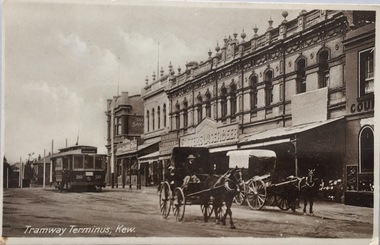
Postcard, Oastler (Leading Stationer), Tramway Terminus, Kew, c.1913
... kew (vic.)...trams -- kew (vic.)...Cotham Road...However, other postcards produced after this date do not always conform to this print layout. postcards -- kew (vic.) trams -- kew (vic.) Cotham Road -- high street --- kew (vic.) ...The Kew Historical Society's postcard collection includes views of Kew, Melbourne and Greater Melbourne as well as those including overseas scenes sent or received from Europe or the Middle East. They date from the 1890s to the 2000s. These postcards may or may not include the name of the publisher or printer. A number of the cards were published as parts of popular series. A way of dating early postcards is to identify whether the reverse was divided by a central line which became the norm after 1902 in the United Kingdom. However, other postcards produced after this date do not always conform to this print layout.A monochrome postcard of the tram terminus beside 'The Block' in Cotham Road, KewOastler, leading stationer, Kew / Printed in Saxonypostcards -- kew (vic.), trams -- kew (vic.), cotham road -- high street --- kew (vic.), the block -- cotham road -- kew (vic.) -
 Kew Historical Society Inc
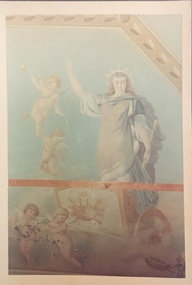
Photograph, Mural, Ballroom, 'South Esk', 1960s
... historic houses -- cotham road -- kew (vic.)...Together it forms the largest privately-donated collection within the archives of the Kew Historical Society. southesk ordsall historic houses -- cotham road -- kew (vic.) "Ceiling in Ballroom of "Southesk"" Very faded photograph of a section of the painted ceiling of the ballroom at Southesk (formerly Ordsall). ...This work forms part of the collection assembled by the historian Dorothy Rogers, that was donated to the Kew Historical Society by her son John Rogers in 2015. The manuscripts, photographs, maps, and documents were sourced by her from both family and local collections or produced as references for her print publications. Many were directly used by Rogers in writing ‘Lovely Old Homes of Kew’ (1961) and 'A History of Kew' (1973), or the numerous articles on local history that she produced for suburban newspapers. Most of the photographs in the collection include detailed annotations in her hand.The Rogers Collection provides a comprehensive insight into the working habits of a historian in the 1960s and 1970s. Together it forms the largest privately-donated collection within the archives of the Kew Historical Society.Very faded photograph of a section of the painted ceiling of the ballroom at Southesk (formerly Ordsall). "Ceiling in Ballroom of "Southesk""southesk, ordsall, historic houses -- cotham road -- kew (vic.) -
 Kew Historical Society Inc
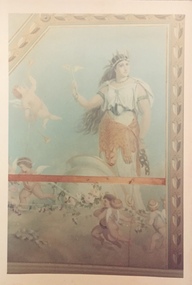
Photograph, Mural, Ballroom, 'South Esk', 1960s
... historic houses -- cotham road -- kew (vic.)...Together it forms the largest privately-donated collection within the archives of the Kew Historical Society. southesk ordsall historic houses -- cotham road -- kew (vic.) Small, very faded colour photo of a section of the ballroom ceiling at Southesk (formerly Ordsall) Mural, Ballroom, 'South Esk' Photograph Photograph ...This work forms part of the collection assembled by the historian Dorothy Rogers, that was donated to the Kew Historical Society by her son John Rogers in 2015. The manuscripts, photographs, maps, and documents were sourced by her from both family and local collections or produced as references for her print publications. Many were directly used by Rogers in writing ‘Lovely Old Homes of Kew’ (1961) and 'A History of Kew' (1973), or the numerous articles on local history that she produced for suburban newspapers. Most of the photographs in the collection include detailed annotations in her hand.The Rogers Collection provides a comprehensive insight into the working habits of a historian in the 1960s and 1970s. Together it forms the largest privately-donated collection within the archives of the Kew Historical Society.Small, very faded colour photo of a section of the ballroom ceiling at Southesk (formerly Ordsall)southesk, ordsall, historic houses -- cotham road -- kew (vic.) -
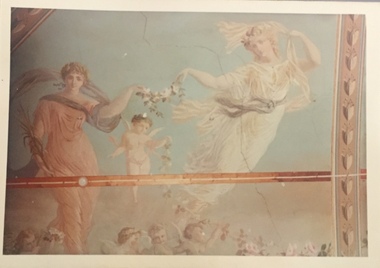 Kew Historical Society Inc
Photograph, Mural, Ballroom, 'South Esk', 1960s
... historic houses -- cotham road -- kew (vic.)...Together it forms the largest privately-donated collection within the archives of the Kew Historical Society. southesk ordsall historic houses -- cotham road -- kew (vic.) Small, very faded colour photo of a section of the ballroom ceiling at Southesk (formerly Ordsall) Mural, Ballroom, 'South Esk' Photograph Photograph ...This work forms part of the collection assembled by the historian Dorothy Rogers, that was donated to the Kew Historical Society by her son John Rogers in 2015. The manuscripts, photographs, maps, and documents were sourced by her from both family and local collections or produced as references for her print publications. Many were directly used by Rogers in writing ‘Lovely Old Homes of Kew’ (1961) and 'A History of Kew' (1973), or the numerous articles on local history that she produced for suburban newspapers. Most of the photographs in the collection include detailed annotations in her hand.The Rogers Collection provides a comprehensive insight into the working habits of a historian in the 1960s and 1970s. Together it forms the largest privately-donated collection within the archives of the Kew Historical Society.Small, very faded colour photo of a section of the ballroom ceiling at Southesk (formerly Ordsall)southesk, ordsall, historic houses -- cotham road -- kew (vic.) -
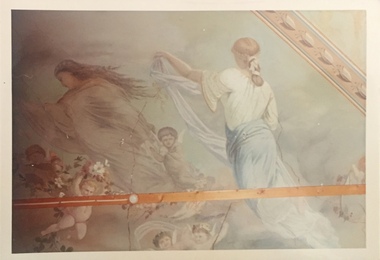 Kew Historical Society Inc
Photograph, Mural, Ballroom, 'South Esk', 1960s
... historic houses -- cotham road -- kew (vic.)...Together it forms the largest privately-donated collection within the archives of the Kew Historical Society. southesk ordsall historic houses -- cotham road -- kew (vic.) Small, very faded colour photo of a section of the ballroom ceiling at Southesk (formerly Ordsall) Mural, Ballroom, 'South Esk' Photograph Photograph ...This work forms part of the collection assembled by the historian Dorothy Rogers, that was donated to the Kew Historical Society by her son John Rogers in 2015. The manuscripts, photographs, maps, and documents were sourced by her from both family and local collections or produced as references for her print publications. Many were directly used by Rogers in writing ‘Lovely Old Homes of Kew’ (1961) and 'A History of Kew' (1973), or the numerous articles on local history that she produced for suburban newspapers. Most of the photographs in the collection include detailed annotations in her hand.The Rogers Collection provides a comprehensive insight into the working habits of a historian in the 1960s and 1970s. Together it forms the largest privately-donated collection within the archives of the Kew Historical Society.Small, very faded colour photo of a section of the ballroom ceiling at Southesk (formerly Ordsall)southesk, ordsall, historic houses -- cotham road -- kew (vic.) -
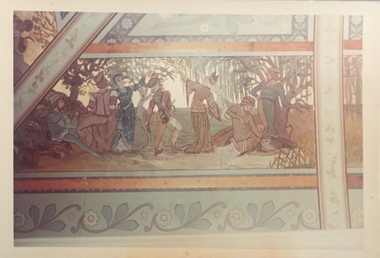 Kew Historical Society Inc
Photograph, Mural, Dining Room, 'South Esk', 1960s
... historic houses -- cotham road -- kew (vic.)...Together it forms the largest privately-donated collection within the archives of the Kew Historical Society. southesk ordsall historic houses -- cotham road -- kew (vic.) Small, very faded colour photo of a section of the dining room ceiling at Southesk (formerly Ordsall) Mural, Dining Room, 'South Esk' Photograph Photograph ...This work forms part of the collection assembled by the historian Dorothy Rogers, that was donated to the Kew Historical Society by her son John Rogers in 2015. The manuscripts, photographs, maps, and documents were sourced by her from both family and local collections or produced as references for her print publications. Many were directly used by Rogers in writing ‘Lovely Old Homes of Kew’ (1961) and 'A History of Kew' (1973), or the numerous articles on local history that she produced for suburban newspapers. Most of the photographs in the collection include detailed annotations in her hand.The Rogers Collection provides a comprehensive insight into the working habits of a historian in the 1960s and 1970s. Together it forms the largest privately-donated collection within the archives of the Kew Historical Society.Small, very faded colour photo of a section of the dining room ceiling at Southesk (formerly Ordsall)southesk, ordsall, historic houses -- cotham road -- kew (vic.) -
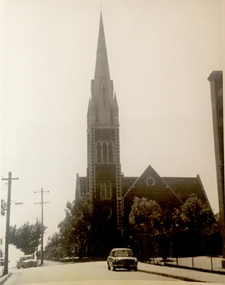 Kew Historical Society Inc
Photograph, Kew Presbyterian Church, c.1959
... churches -- cotham road -- kew (vic.)...Together it forms the largest privately-donated collection within the archives of the Kew Historical Society. kew presbyterian church churches -- cotham road -- kew (vic.) neo gothic churches churches -- kew 9vic) "Presbyterian Church Cotham Rd" Small black and white photograph of Cotham Road, Kew with the Kew Presbyterian Church at right. ...This work forms part of the collection assembled by the historian Dorothy Rogers, that was donated to the Kew Historical Society by her son John Rogers in 2015. The manuscripts, photographs, maps, and documents were sourced by her from both family and local collections or produced as references for her print publications. Many were directly used by Rogers in writing ‘Lovely Old Homes of Kew’ (1961) and 'A History of Kew' (1973), or the numerous articles on local history that she produced for suburban newspapers. Most of the photographs in the collection include detailed annotations in her hand.The Rogers Collection provides a comprehensive insight into the working habits of a historian in the 1960s and 1970s. Together it forms the largest privately-donated collection within the archives of the Kew Historical Society.Small black and white photograph of Cotham Road, Kew with the Kew Presbyterian Church at right."Presbyterian Church Cotham Rd"kew presbyterian church, churches -- cotham road -- kew (vic.), neo gothic churches, churches -- kew 9vic) -
![Uniform - School Uniform, Hatband of Woodbury Ladies’ College [Kew], circa 1918, c.1918](/media/collectors/550653872162f11fb04854aa/items/5e254add21ea671e18757914/item-media/5e254b2121ea671e1875b9aa/item-fit-380x285.jpg?cb=6) Kew Historical Society Inc
Kew Historical Society IncUniform - School Uniform, Hatband of Woodbury Ladies’ College [Kew], circa 1918, c.1918
... schools - cotham road - kew - vic...Cotham Road between Atkins and Davis Streets. In 1910, a new school building was built on the corner of Uvadale Grove and Cotham Road [the building is still extant as of 2020]. Woodbury College was operated by Miss LJ and Miss HJ Macey until 1920. In 1921, the school amalgamated with the newly formed St Andrew's College, Mont Victor Road, Kew (Vic...Kew (Vic). The hatband was worn by Lilian McCrae in circa 1918 and donated by her sister Heather Houston. The badge was donated by Helen Lade. woodbury college schools - cotham road - kew - vic private schools - kew (vic) Navy blue hatband with narrow white and yellow stripes of Woodbury Ladies College (1903-1920). ...Woodbury College was an indirect predecessor of Preshil School in Kew. Woodbury College was founded in Glenferrie Road by a Miss Harcourt, former principal of Sydenham College, Moonee Ponds. Miss Harcourt maintained the school until the goodwill was purchased in 1908 by Miss LJ Macey, who had previously operated Lillsden Ladies' College in Edgevale Road, between c.1891 and c.1903. The first school was in a rented building on the south side of Cotham Road between Atkins and Davis Streets. In 1910, a new school building was built on the corner of Uvadale Grove and Cotham Road [the building is still extant as of 2020]. Woodbury College was operated by Miss LJ and Miss HJ Macey until 1920. In 1921, the school amalgamated with the newly formed St Andrew's College, Mont Victor Road, Kew (Vic) under the leadership of Rev JT Lawton [who had previously been principal of St Andrew's School of the 'Pathfinder' in South Yarra]. Miss Macey was for a period the Headmistress of the amalgamated school. Another teacher at the school was Miss Margaret JR Lyttle, who in 1931, left St Andrew's to form the Preshil School.Rare ephemera relating to an early private school in Kew (Vic). The hatband was worn by Lilian McCrae in circa 1918 and donated by her sister Heather Houston. The badge was donated by Helen Lade.Navy blue hatband with narrow white and yellow stripes of Woodbury Ladies College (1903-1920). woodbury college, schools - cotham road - kew - vic, private schools - kew (vic) -
![Uniform - School Uniform, Woodbury Ladies’ College [Kew] Badge, circa 1918, c.1918](/media/collectors/550653872162f11fb04854aa/items/5e89f58a21ea671a7c03d0c9/item-media/5e89f65821ea671a7c0508fc/item-fit-380x285.jpg?cb=6) Kew Historical Society Inc
Kew Historical Society IncUniform - School Uniform, Woodbury Ladies’ College [Kew] Badge, circa 1918, c.1918
... schools - cotham road - kew - vic...Cotham Road between Atkins and Davis Streets. In 1910, a new school building was built on the corner of Uvadale Grove and Cotham Road [the building is still extant as of 2020]. Woodbury College was operated by Miss LJ and Miss HJ Macey until 1920. In 1921, the school amalgamated with the newly formed St Andrew's College, Mont Victor Road, Kew (Vic...Kew (Vic). The badge was donated by Helen Lade. woodbury college schools - cotham road - kew - vic private schools - kew (vic) Brass school badge which includes the initials WL within a large C, surrounded with the school crest - VERITAS VINCIT [Truth Prevails] of Woodbury Ladies College (1903-1920). ...Woodbury College was an indirect predecessor of Preshil School in Kew. Woodbury College was founded in Glenferrie Road by a Miss Harcourt, former principal of Sydenham College, Moonee Ponds. Miss Harcourt maintained the school until the goodwill was purchased in 1908 by Miss LJ Macey, who had previously operated Lillsden Ladies' College in Edgevale Road, between c.1891 and c.1903. The first school was in a rented building on the south side of Cotham Road between Atkins and Davis Streets. In 1910, a new school building was built on the corner of Uvadale Grove and Cotham Road [the building is still extant as of 2020]. Woodbury College was operated by Miss LJ and Miss HJ Macey until 1920. In 1921, the school amalgamated with the newly formed St Andrew's College, Mont Victor Road, Kew (Vic) under the leadership of Rev JT Lawton [who had previously been principal of St Andrew's School of the 'Pathfinder' in South Yarra]. Miss Macey was for a period the Headmistress of the amalgamated school. Another teacher at the school was Miss Margaret JR Lyttle, who in 1931, left St Andrew's to form the Preshil School.Rare ephemera relating to an early private school in Kew (Vic). The badge was donated by Helen Lade.Brass school badge which includes the initials WL within a large C, surrounded with the school crest - VERITAS VINCIT [Truth Prevails] of Woodbury Ladies College (1903-1920). woodbury college, schools - cotham road - kew - vic, private schools - kew (vic) -
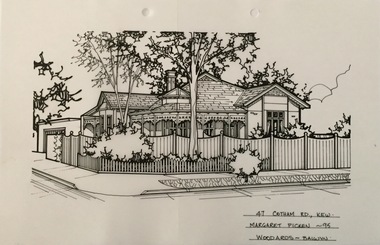 Kew Historical Society Inc
Drawing - Property Illustration, Margaret Picken, 47 Cotham Road, Kew, 1995
... kew (vic.)...47 cotham road -- kew (vic.)...The year in which the drawing was created is also a valuable record for house historians, as a number of the properties depicted have either been altered since that date or demolished. artist -- margaret picken 1950- architectural drawings -- houses -- kew (vic.) 47 cotham road -- kew (vic.) 47 COTHAM RD., KEW / MARGARET PICKEN ~95 / WOODARDS ~ BALWYN Pen and ink architectural drawing on drafting film of 47 Cotham Road, Kew by Margaret Picken. 47 Cotham Road, Kew Drawing Property Illustration Margaret Picken Woodards (Balwyn) ...After training as a Cartographic Draftsman within the mining industry, I worked as a property illustrator for real estate firms in the eastern suburbs of Melbourne for 23 years from 1983. I initially photographed houses with a Polaroid camera and made a 'thumbnail' sketch while there. The photos were used to scale off a sketch in pencil and then that sketch was overlaid with drafting film and the 'pen and ink' completed. The pens I used were the Rotring ‘Rapidigraph’ drafting pens. The ink was also made by Rotring (German).The film was ‘Rapidraw’, polyester drafting film, double matte. It takes a very fine line and doesn’t bleed. As well as house sketches, there were often floor plans and site plans ordered. Aerial sketches were ordered when the property needed an overall view. (Margaret Picken, 2020)This drawing is one of a series created by Margaret Picken for a range of real estate agents in Melbourne between c.1983 and c.2005. Each work is signed and dated by the artist.Gift of Margaret Picken, 2020Pen and ink architectural drawing on drafting film of 47 Cotham Road, Kew by Margaret Picken.47 COTHAM RD., KEW / MARGARET PICKEN ~95 / WOODARDS ~ BALWYNartist -- margaret picken 1950-, architectural drawings -- houses -- kew (vic.), 47 cotham road -- kew (vic.)
