
Showing 33 items matching "death of king george vi"
-
 Mission to Seafarers Victoria
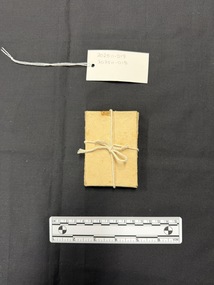
Letter - Correspondence, 14/02/1952
... ...death of king george vi...Allan describes London following the death of King George VI. He witnessed the Proclamation of the Queen at the Royal Exchange. ...Allan describes London following the death of King George VI. He witnessed the Proclamation of the Queen at the Royal Exchange. ...Allan describes London following the death of King George VI. He witnessed the Proclamation of the Queen at the Royal Exchange. He writes "The Proclamation was read in four different parts of the city and about a hundred Lifeguards escorted the Royal carriages through the city." And ....."I also saw the procession from Kings Cross station to Westminister Hall when they brought the King back to London." He would have liked to walk past the coffin lying in state at Westminister Hall but the queue was three miles long and it took seven hours to get into the hall.Quinn CollectionA pale blue self-folding letter (0894.a1) headed 37 Elsham Road, London W 14 and dated 14/02/52. Letter is typed using a very small font. The print is faint and difficult to read. It is addressed to Mrs K Hayes, 14 Fitzroy Street, St Kilda, Victoria, Australia. There is no postmark. The return address is Allan Quinn, 37 Elsham Road, London W14.letters-from-abroad, allan quinn, alette andersen, death of king george vi, proclamation of queen elizabeth ii, london 1952 -
 Greensborough Historical Society
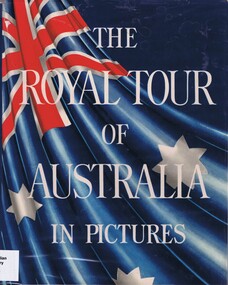
Book, The Royal Tour of Australia and New Zealand in pictures, 1954_
... Following the death of King George VI, the Queen's trip to Australia and New Zealand was postponed until 1954. ...Following the death of King George VI, the Queen's trip to Australia and New Zealand was postponed until 1954. ...Following the death of King George VI, the Queen's trip to Australia and New Zealand was postponed until 1954. This book is a photographic story of their travels around Australia, New Zealand and Pacific Islands.A pictorial record of the first visit to Australia by Queen Elizabeth II and the Duke of Edinburgh in 1954Hard cover, Illus. (some colour). Cover illustration of Australian flag with white writing over.house of windsor, duke of edinburgh, royal tour of australia 1954, queen elizabeth ii -
 Hymettus Cottage & Garden Ballarat
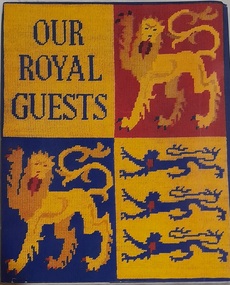
Book - Souvenir Book, Our Royal Guests
... Published in 1952, before the death of King George VI the book tells the the Windsor family story. ...Published in 1952, before the death of King George VI the book tells the the Windsor family story. ...non-fictionqueen elizabeth 2, house of windsor, duke of edinburgh, royal tour australia 1952, -
 Hymettus Cottage & Garden Ballarat
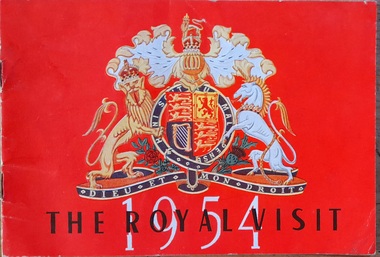
Work on paper - Souvenir Booklet, The Royal Visit 1954
... It replaced the ill fated souvenir booklet issued in 1952 and then withdrawn due to the death of King George VI and the return to the UK of Princess Elizabeth & the Duke of Edinburgh....It replaced the ill fated souvenir booklet issued in 1952 and then withdrawn due to the death of King George VI and the return to the UK of Princess Elizabeth & the Duke of Edinburgh. ...A small booklet issued to Australian schoolchildren as a souvenir of the Royal Visit 1954.non-fictionA small booklet issued to Australian schoolchildren as a souvenir of the Royal Visit 1954.royal visit, elizabeth ii, souvenir booklet, itinerary -
 Hymettus Cottage & Garden Ballarat
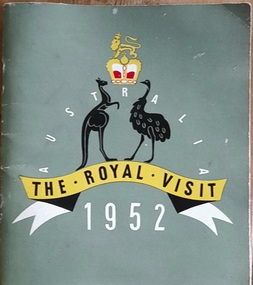
Booklet - Royal Visit booklet, Australia: The Royal Visit 1952
... This booklet was produced by the Commonwealth of Australia to commemorate a royal visit that never happened due to the death of King George VI. The booklet was to be issued to schoolchildren across the Commonwealth. ...This booklet was produced by the Commonwealth of Australia to commemorate a royal visit that never happened due to the death of King George VI. The booklet was to be issued to schoolchildren across the Commonwealth. ...front cover green with stylised Kangaroo and Emu on ribbon featuring the words 'The Royal Visit' with southern cross on rear cover.non-fictionqueen elizabeth ii, duke of edinburgh, australia, royal visit -
 Mont De Lancey
Book, Oxford University Press, The Holy Bible containing the Old and New Testaments, 1772
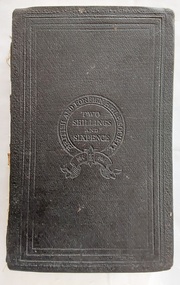
... Throughout the bible are several added pieces of handwritten notes on paper, small leaflets a newspaper article about the death of King George VI. There is no pagination. Included are two ribbon bookmarks, one yellow with 'Think of Me. 1870.' embroidered on perforated paper in blue cross stitch. ...A newspaper piece 'District Mourns A Popular Monarch' about the death of King George VI. 4.Two flimsy handwritten pages in small black ink what appears to be a sermon '2 Kings 9 1918' with Peace as its main theme. 5. ...A newspaper piece 'District Mourns A Popular Monarch' about the death of King George VI. 4.Two flimsy handwritten pages in small black ink what appears to be a sermon '2 Kings 9 1918' with Peace as its main theme. 5. ...The Holy Bible containing the Old and New testaments: translated out of the original tongues and with the former translations diligently compared and revised, By His Majesty's Special Command. Appointed to be read in churches.A badly damaged thick black hardcover Holy Bible with an embossed insignia on the front cover as well as lined patterns on the front and back covers. The front has stamped inside a circular insignia the words, 'British and Foreign Bible Society, Two Shillings and Sixpence' embossed in the middle. The end paper at the front has come away from the spine, there are marks and foxing inside. The text is clear. There is no spine and many pages are loose. Throughout the bible are several added pieces of handwritten notes on paper, small leaflets a newspaper article about the death of King George VI. There is no pagination. Included are two ribbon bookmarks, one yellow with 'Think of Me. 1870.' embroidered on perforated paper in blue cross stitch. The other blue one has 'Love' embroidered on perforated paper in coloured thread. A third green ribbon bookmark has 'Who ever absent dear' embroidered in brown thread on perforated paper. non-fictionThe Holy Bible containing the Old and New testaments: translated out of the original tongues and with the former translations diligently compared and revised, By His Majesty's Special Command. Appointed to be read in churches. holy bible, religion, christianity, gibson collection -
 Bendigo Historical Society Inc.
Memorabilia - Memento of the visit of Their Royal Highnesses Princess Elizabeth, Duchess of Edinburgh and the Duke of Edinburgh
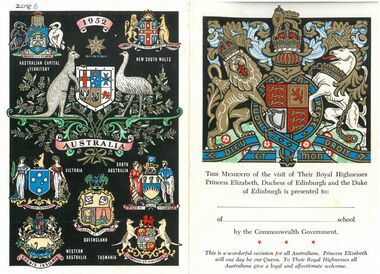
... King George VI and Queen Elizabeth were scheduled to tour Australia along with Princess Margaret. Their tour was cancelled November 1951 due to the King's health and replaced with scheduled tour for the Duchess and Duke of Edinburgh, scheduled for Early 1952. The card was produced to commemorate the visit, but the tour was cancelled after the death...King George VI and Queen Elizabeth were scheduled to tour Australia along with Princess Margaret. Their tour was cancelled November 1951 due to the King's health and replaced with scheduled tour for the Duchess and Duke of Edinburgh, scheduled for Early 1952. The card was produced to commemorate the visit, but the tour was cancelled after the death ...Produced in preparation for the visit of the Duchess and Duke of Edinburgh. King George VI and Queen Elizabeth were scheduled to tour Australia along with Princess Margaret. Their tour was cancelled November 1951 due to the King's health and replaced with scheduled tour for the Duchess and Duke of Edinburgh, scheduled for Early 1952. The card was produced to commemorate the visit, but the tour was cancelled after the death of King George VI in February of 1952. Folded A5 card commemorating the Duchess and Duke of Edinburgh's visit to Australia in 1952. Printed in colour, the card contains the Coat of arms of the United Kingdom on the front cover, images of King George VI and Queen Elizabeth on their coronation day in 1937, and a family portrait of then Princess Elizabeth, Prince Philip, Prince Charles and Princess Ann (date unknown). On the back cover are the hand drawn coat of arms of Australia, and that of each of the states and territories. king geroge vi, australia, royal visit, queen elizabeth ii, duke of edinburgh, royal tour -
 Emerald Museum & Nobelius Heritage Park
Accessory - Victoria Police Button, c. 1950s
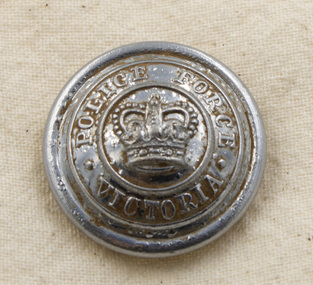
... This button was likely made sometime in between the death of King George VI in February 1952 and the changing of the company's name in May 1953, due to the presence of the Queen's crown on the front and the manufacturing details on the back....This button was likely made sometime in between the death of King George VI in February 1952 and the changing of the company's name in May 1953, due to the presence of the Queen's crown on the front and the manufacturing details on the back. ...This button was found adjacent to the old lock-up in the backyard of present-day Fernlea Op-Shop, formerly the site of the Emerald Police Station. It was made by button manufacturer K. G. Luke, who was one of Australia's largest manufacturers of silverware, including buttons. This button was likely made sometime in between the death of King George VI in February 1952 and the changing of the company's name in May 1953, due to the presence of the Queen's crown on the front and the manufacturing details on the back.This button is significant as it demonstrates the presence of the Victorian Police Force in Emerald in the mid-20th CenturyA circular silver metal plated button with a raised Queen's crown in the centre. On the back there are four holes for sewing into.Front: 'POLICE FORCE / VICTORIA' Back: 'K. G. LUKE PTY LTD / MELB'emerald, 20th century, 1950s, police -
 Warrnambool and District Historical Society Inc.
Memorabilia - Two articles of civic events in Warrnambool, Kaye & Son, Warrnambool Printers, mid 20th century
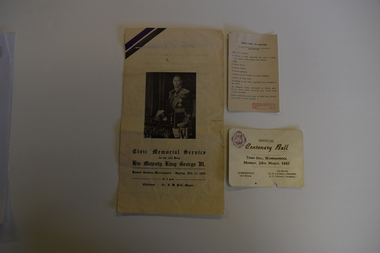
... The leaflet is a programme of the Civic Memorial Service held in the Botanic Gardens in Warrnambool in February1952 on the occasion of the death of King George VI of England. Both items came from memorabilia held by the Bamford family of 8 Monash Avenue Warrnambool and it is presumed that one or more members of that family attended the events....The leaflet is a programme of the Civic Memorial Service held in the Botanic Gardens in Warrnambool in February1952 on the occasion of the death of King George VI of England. Both items came from memorabilia held by the Bamford family of 8 Monash Avenue Warrnambool and it is presumed that one or more members of that family attended the events. ...The card relates to the Official Centenary Ball held in the Warrnambool Town Hall in March 1947 to celebrate the city's Centenary in 1947. Warrnambool was founded as a port settlement to service the farming interests in the area, with the first land sales held in Melbourne in July 1847. The leaflet is a programme of the Civic Memorial Service held in the Botanic Gardens in Warrnambool in February1952 on the occasion of the death of King George VI of England. Both items came from memorabilia held by the Bamford family of 8 Monash Avenue Warrnambool and it is presumed that one or more members of that family attended the events.These items are of social significance as mementos of events in Warrnambool in the mid 20th century..1 A white card with black printing and a logo .2 A sheet of white paper folded to make four pages with black printing and a photograph of King George VI of Englandwarrnambool memorabilia, warrnambool centenary, warrnambool centenary 1947, official centenary ball. -
Glenelg Shire Council Cultural Collection
Flag - Souvenir Flag - Royal Visit, 1952/54, c. 1952
... Queen Elizabeth II and her husband, Prince Philip, the Duke of Edinburgh, were to have toured Australia in 1952, but this was postponed following the death of her father, King George VI. The visit happened in 1964 instead and was the first to Australia by a reigning monarch....Queen Elizabeth II and her husband, Prince Philip, the Duke of Edinburgh, were to have toured Australia in 1952, but this was postponed following the death of her father, King George VI. The visit happened in 1964 instead and was the first to Australia by a reigning monarch. royal visit 1954 1952 flag Flag, rectangular, fabric, souvenir of Royal visit 1954 (originally 1952, which was cancelled. '1952' has been cut from bottom of flag). ...Queen Elizabeth II and her husband, Prince Philip, the Duke of Edinburgh, were to have toured Australia in 1952, but this was postponed following the death of her father, King George VI. The visit happened in 1964 instead and was the first to Australia by a reigning monarch.Flag, rectangular, fabric, souvenir of Royal visit 1954 (originally 1952, which was cancelled. '1952' has been cut from bottom of flag). Union Jack and Australian flag crossed behind crown.royal visit, 1954, 1952, flag -
 Orbost & District Historical Society
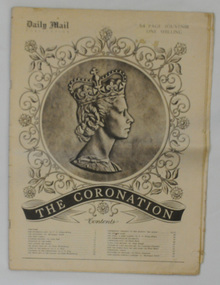
newspaper, The Coronation, 1953
... Elizabeth ascended the throne at the age of 25, upon the death of her father, King George VI, on 6 February 1952....Elizabeth ascended the throne at the age of 25, upon the death of her father, King George VI, on 6 February 1952. On the 2nd June 1953, the coronation of Queen Elizabeth II took place and the commonwealth countries, including Australia joined in the celebration. ...This special edition was issued as a souvenir of the coronation of Queen Elizabeth 11. The coronation of Queen Elizabeth II as monarch of the United Kingdom, Canada, Australia, New Zealand, the Union of South Africa, Pakistan, and Ceylon took place on 2 June 1953. Elizabeth ascended the throne at the age of 25, upon the death of her father, King George VI, on 6 February 1952.On the 2nd June 1953, the coronation of Queen Elizabeth II took place and the commonwealth countries, including Australia joined in the celebration. Saving an item dedicated to the royal family is typical of the general feeling of respect and admiration felt by the rural communities towards the British Royal Family, especially towards Queen Elizabeth II.A 64 pp Daily Mail souvenir edition titled, The coronation. It is b/w and cost one shilling. It traces the accession of Queen Elizabeth 11 to the coronation and afterwards.coronation royal-family elizabeth-11 -
 Orbost & District Historical Society
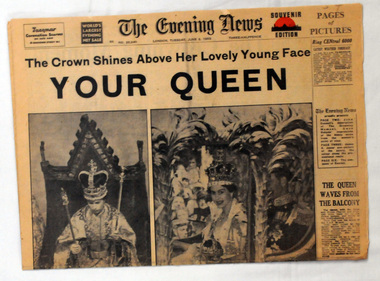
newspaper, The Evening News, June 2, 1953
... Elizabeth ascended the throne at the age of 25, upon the death of her father, King George VI, on 6 February 1952. The Evening News was an evening newspaper published in London from 1881 to 1980 and was very popular. ...Elizabeth ascended the throne at the age of 25, upon the death of her father, King George VI, on 6 February 1952. The Evening News was an evening newspaper published in London from 1881 to 1980 and was very popular. ...This special edition was issued as a souvenir of the coronation of Queen Elizabeth 11. The coronation of Queen Elizabeth II as monarch of the United Kingdom, Canada, Australia, New Zealand, the Union of South Africa, Pakistan, and Ceylon took place on 2 June 1953. Elizabeth ascended the throne at the age of 25, upon the death of her father, King George VI, on 6 February 1952. The Evening News was an evening newspaper published in London from 1881 to 1980 and was very popular. The paper was founded by Coleridge Kennard and Harry Marks with the first issue appearing on July 26, 1881. On the 2nd June 1953, the coronation of Queen Elizabeth II took place and the commonwealth countries, including Australia joined in the celebration. Saving an item dedicated to the royal family is typical of the general feeling of respect and admiration felt by the rural communities towards the British Royal Family, especially towards Queen Elizabeth II.A newspaper of 8 pp, The Evening News Souvenir Edition of the coronation of Queen Elizabeth 11. It contains b/w photographs of the coronation as well as advertisements, stories, comic strips and puzzles.royal-family elizabeth-coronation newspaper evening-news -
 Orbost & District Historical Society
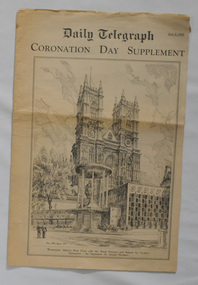
newspaper supplement, Coronation Day Supplement, June 2 1953
... Elizabeth ascended the throne at the age of 25, upon the death of her father, King George VI, on 6 February 1952, and was proclaimed queen by her various privy and executive councils shortly afterwards. ...Elizabeth ascended the throne at the age of 25, upon the death of her father, King George VI, on 6 February 1952, and was proclaimed queen by her various privy and executive councils shortly afterwards. ...The Daily Telegraph is a broadsheet newspaper published in London by Telegraph Media Group and distributed across the United Kingdom and internationally. It was founded by Arthur B. Sleigh in 1855 as The Daily Telegraph and Courier. The coronation of Queen Elizabeth II as monarch of the United Kingdom, Canada, Australia, New Zealand, the Union of South Africa, Pakistan, and Ceylon took place on 2 June 1953. Elizabeth ascended the throne at the age of 25, upon the death of her father, King George VI, on 6 February 1952, and was proclaimed queen by her various privy and executive councils shortly afterwards. The ceremony took place at Westminster Abbey. Celebrations took place and a commemorative medal was issued throughout the Commonwealth. Saving an item dedicated to the royal family is typical of the general feeling of respect and admiration felt by the rural communities towards the British Royal Family, especially towards Queen Elizabeth II.A supplement from the Daily Telegraph, June 2 1953, titled Coronation Day Supplement. On the front cover is a b/w picture of Westminster Abbey.newspaper-supplement-daily-telegraph coronation royal-family elizabeth-11 -
 Wodonga & District Historical Society Inc
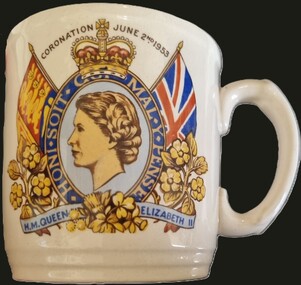
Souvenir - Mug for Coronation of Queen Elizabeth II, 1953
... Queen Elizabeth II ascended the throne, at the age of 25, on the death of her father King George VI on the 6th February 1952. ...Queen Elizabeth II ascended the throne, at the age of 25, on the death of her father King George VI on the 6th February 1952. ...Queen Elizabeth II ascended the throne, at the age of 25, on the death of her father King George VI on the 6th February 1952. Elizabeth was crowned as the Queen of the United Kingdom and the other Commonwealth realms on June 2nd 1953 at Westminster Abbey. Preparations for the coronation took over a year, it was the first British coronation to be fully televised when cameras were allowed inside the Abbey for the first time and the event was estimated to have cost £1.57 million. The British Pottery Manufacturers Federation was founded in 1919 and continued to trade until early 1995 when the company was dissolved as a result of its activities becoming fully incorporated within the British Ceramic Confederation. The design for this mug was approved by The British Pottery Manufacturers Federation and then circulated to approved Potters. This item is significant because it records an important event in the British Royal Family, a vital part of the hereditary of many Wodonga residents. Queen Elizabeth became the official head of the Government of Australia at that time.Cream handled China mug with coloured transfer. The image includes a central oval image of a golden profile of the queen (without a crown) against a light blue background. It is surrounded by a dark blue band with gold edging. To the left is the Royal Standard and to the right is the Union Jack and English roses below. Above the central image is the royal crown and above this wording. At Top CORONATION JUNE 2nd 1953 The Latin wording HONI SOIT QUI MAL Y PENSE, contained in the dark blue oval band is the motto of the British chivalric Order of the Garter which means "shamed be whoever thinks ill of it" Beneath the image - H.M QUEEN ELIZABETH II The base of the mug shows a makers mark of the DESIGN mark.coronation of queen elizabeth ii, british royal family -
 Orbost & District Historical Society
program, 1953
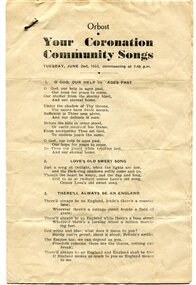
... Elizabeth ascended the throne at the age of 25, upon the death of her father, King George VI, on 6 February 1952, and was proclaimed queen by her various privy and executive councils shortly afterwards. ...Elizabeth ascended the throne at the age of 25, upon the death of her father, King George VI, on 6 February 1952, and was proclaimed queen by her various privy and executive councils shortly afterwards. ...This program was produced by the Snowy River Mail for a community singalong held in Orbost on Tuesday June 2 1953 to celebrate the coronation of Queen Elizabeth 11. In June 1953 , Elizabeth II was crowned Queen of the United Kingdom, Canada, Australia, New Zealand, South Africa, Ceylon (now Sri Lanka), and Pakistan, and became the Head of the Commonwealth. The coronation of Queen Elizabeth II as monarch took place on 2 June 1953. Elizabeth ascended the throne at the age of 25, upon the death of her father, King George VI, on 6 February 1952, and was proclaimed queen by her various privy and executive councils shortly afterwards. The coronation took place more than a year later because of the tradition that holding such a festival is inappropriate during the period of mourning that follows the death of a monarch. This community event was typical of the general feeling of respect and admiration felt by the rural communities towards the British Royal Family. This item reflects the significance of monarchy for Australia and the constitutional history of Australia.The item reflects the interest in the royal family to Australians at this time as well as the general feeling of respect and admiration felt by the rural communities towards the British Royal Family.A white paper program with the words of songs printed in black. There is a rust mark from a metal staple in the top left corner. It is titled "Your Coronation Community Songs".queen-elizabeth-11 royalty community-event-orbost souvenir-program -
 Wodonga & District Historical Society Inc
Souvenir - Mug Silver Jubilee of Queen Elizabeth II
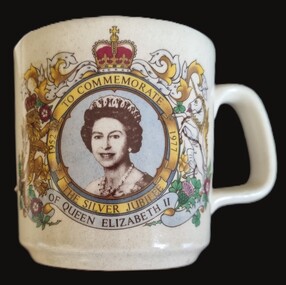
... Queen Elizabeth II ascended the throne, at the age of 25, on the death of her father King George VI on the 6th February 1952. ...Queen Elizabeth II ascended the throne, at the age of 25, on the death of her father King George VI on the 6th February 1952. ...Queen Elizabeth II ascended the throne, at the age of 25, on the death of her father King George VI on the 6th February 1952. Elizabeth was crowned as the Queen of the United Kingdom and the other Commonwealth realms on June 2nd 1953 at Westminster Abbey. Her Silver Jubilee was celebrated with large-scale parties and parades throughout the United Kingdom and the Commonwealth throughout 1977, culminating in June with the official "Jubilee Days", held to coincide with the Queen's Official Birthday. In addition Queen Elizabeth and Prince Philip embarked on a tour of Commonwealth nations including Australia. In March 1977, a Silver Jubilee Parade was held in front of Parliament House, Canberra. The Royal Australian Mint released a commemorative Silver Jubilee 50c coin, which featured twenty-five representations of St Edward's Crown. Two commemoratives stamps were released by Australia Post to celebrate the Jubilee. Australian artist Paul Fitzgerald was commissioned to complete the only official portrait of the Queen during the Silver Jubilee year. The Silver Jubilee celebrations culminated in December 1977 with 35,000 serving personnel taking part in parades across Australia.This item is significant because it records an important event in the British Royal Family, a vital part of the hereditary of many Wodonga residents. This item is a vintage ceramic commemorative mug produced to celebrate the 1977 Silver Jubilee of Queen Elizabeth II. It features a portrait of the Queen surrounded by royal iconography, including the crown, crests, and the text "To Commemorate The Silver Jubilee of Queen Elizabeth II". The reverse bears a decorative transfer. The centre features the British Royal Crown. Surrounding the crown are floral emblems representing the United Kingdom: the Tudor Rose (England), the Thistle (Scotland), and Shamrock (Ireland). TO COMMEMORATE THE SILVER JUBILLEE OF QUEEN ELIZABETH II 1952 1977queen elizabeth ii, royal memorabilia -
 Orbost & District Historical Society
newspaper, The Sun News-Pictorial, February 16 1952
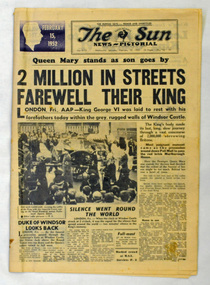
... For more than fifty years it was the Australian newspaper with the largest circulation George VI (Albert Frederick Arthur George; 14 December 1895 – 6 February 1952) was King of the United Kingdom and the Dominions of the British Commonwealth from 11 December 1936 until his death....For more than fifty years it was the Australian newspaper with the largest circulation George VI (Albert Frederick Arthur George; 14 December 1895 – 6 February 1952) was King of the United Kingdom and the Dominions of the British Commonwealth from 11 December 1936 until his death. ...The Sun News-Pictorial, also known as The Sun, was a morning daily tabloid newspaper in Melbourne, Australia, established in 1922 and closed in 1990. It was part of The Herald and Weekly Times stable of Melbourne newspapers. For more than fifty years it was the Australian newspaper with the largest circulation George VI (Albert Frederick Arthur George; 14 December 1895 – 6 February 1952) was King of the United Kingdom and the Dominions of the British Commonwealth from 11 December 1936 until his death.Newspapers reflect contemporary society. Saving an item dedicated to the royal family is typical of the general feeling of respect and admiration felt by the rural communities towards the British Royal Family.A newspaper - middle pages missing, containing articles relating to the death of King George V1. It is dated Saturday February 1952..newspaper-sun-news-pictorial media-print george-v1 royal-family -
 Orbost & District Historical Society
newspaper article, Daily Mirror, February 8 1952
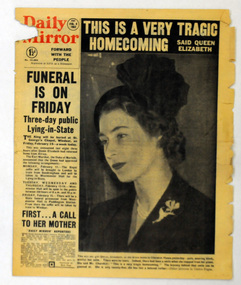
... George VI (Albert Frederick Arthur George; 14 December 1895 – 6 February 1952) was King of the United Kingdom and the Dominions of the British Commonwealth from 11 December 1936 until his death...George VI (Albert Frederick Arthur George; 14 December 1895 – 6 February 1952) was King of the United Kingdom and the Dominions of the British Commonwealth from 11 December 1936 until his death Newspapers reflect contemporary society. ...The Daily Mirror is a British national daily tabloid newspaper founded in 1903 by Alfred Harmsworth. George VI (Albert Frederick Arthur George; 14 December 1895 – 6 February 1952) was King of the United Kingdom and the Dominions of the British Commonwealth from 11 December 1936 until his deathNewspapers reflect contemporary society. Saving an item dedicated to the royal family is typical of the general feeling of respect and admiration felt by the rural communities towards the British Royal Family.Cover of a Daily Mirror newspaper dated February 8 1952. At the top of the page is the headline, "THIS IS A VERY TRAGIC HOMECOMING" above a photograph of the Princess Elizabeth.The article relates to the death of her father, King George V1,newspaper-daily-mirror media-print george-v1 royal-family -
Ringwood and District Historical Society
Envelope, Royal Visit Coronations programs, photos from local and "Sun" newspapers.1954, Also 1936 "Death of King George V", and Civic Memorial Service for Late King George VI 1952
... Royal Visit Coronations programs, photos from local and "Sun" newspapers.1954, Also 1936 "Death of King George V", and Civic Memorial Service for Late King George VI 1952...Royal Visit Coronations programs, photos from local and "Sun" newspapers Royal Visit Coronations programs, photos from local and "Sun" newspapers.1954, Also 1936 "Death of King George V", and Civic Memorial Service for Late King George VI 1952 Envelope ...Royal Visit Coronations programs, photos from local and "Sun" newspapers -
 Greensborough Historical Society
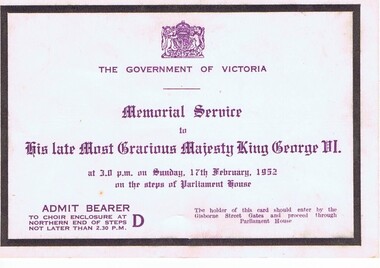
Document - Ticket, Ticket for choir members to Memorial Service for the late King George VI, 1952, 17/02/1952
... Jessie was an amateur singer from age 12 to her death and a member of the pioneering Partington family of Greensborough. The item is her admission ticket as a choir member for the memorial service for the late King George Vi, held at Victoria's Parliament House on 17th Feb 1952. ...Jessie was an amateur singer from age 12 to her death and a member of the pioneering Partington family of Greensborough. The item is her admission ticket as a choir member for the memorial service for the late King George Vi, held at Victoria's Parliament House on 17th Feb 1952. ...From the Jessie Partington Scholes collection. Jessie was an amateur singer from age 12 to her death and a member of the pioneering Partington family of Greensborough. The item is her admission ticket as a choir member for the memorial service for the late King George Vi, held at Victoria's Parliament House on 17th Feb 1952. The item is a limited edition as it was only distributed to choir members. It is in good condition and has reliable provenance through her niece, Faye Partington Fort. This item is significant as part of the Jessie Partington Scholes Angus (1902-1989) collection. The Partington family are Greensborough pioneers.Printed on buff card. Edged with black. Purple print.jessie may partington, jessie angus, jessie scholes, partington family, king george vi memorial service, choirs -
4th/19th Prince of Wales's Light Horse Regiment Unit History Room
Medal, War Medal 1939-45
... death, wounds or other disabilities due to service or by cessation of hostilities on 2 September 1945. The War Medal 1939-45 is awarded to Australian Civilian Personnel who served afloat with the United States Army Small Ships Section between 8 December 1941 and 2 September 1945. Eligibility is the same as that for Merchant Navy personnel. See required evidence to support a claim. The Medal The War Medal 1939-45 is cupro-nickel with the crowned effigy of King George VI...death, wounds or other disabilities due to service or by cessation of hostilities on 2 September 1945. The War Medal 1939-45 is awarded to Australian Civilian Personnel who served afloat with the United States Army Small Ships Section between 8 December 1941 and 2 September 1945. Eligibility is the same as that for Merchant Navy personnel. See required evidence to support a claim. The Medal The War Medal 1939-45 is cupro-nickel with the crowned effigy of King George VI ...The War Medal 1939-45 was awarded for full-time service in the Armed Forces, wherever that service may have been rendered during the war. Operational and non-operational service may be counted, providing that it was of 28 days or more duration. Eligibility The War Medal 1939-45 is awarded for 28 days full-time service between 3 September 1939 and 2 September 1945. In the Merchant Navy there is a requirement that the 28 days should have been served at sea. A member qualifies for the award where service was brought to an end by death, wounds or other disabilities due to service or by cessation of hostilities on 2 September 1945. The War Medal 1939-45 is awarded to Australian Civilian Personnel who served afloat with the United States Army Small Ships Section between 8 December 1941 and 2 September 1945. Eligibility is the same as that for Merchant Navy personnel. See required evidence to support a claim. The Medal The War Medal 1939-45 is cupro-nickel with the crowned effigy of King George VI on the obverse. The reverse has a lion standing on a fallen dragon. The top of the reverse shows the dates 1939 and 1945. The Ribbon The War Medal 1939-45 ribbon colours of red, white and blue represent the colours of the Union Flag. Emblem The single bronze oak leaf Emblem signifying either a Mention in Despatches, King's Commendation for brave conduct, or a King's Commendation for valuable service in the air, will, if granted for service during World War II, be worn on the ribbon of the War Medal 1939-45.Full size and miniature medals with ribbons. Miniature has MID claspnilwar medal 1939-45 -
 Royal Australian and New Zealand College of Obstetricians & Gynaecologists (RANZCOG)
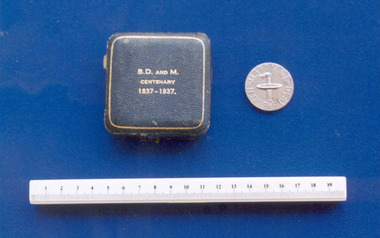
Medal - Commemorative medal celebrating the centenary of the Births, Deaths and Marriages Registration Act, 1937, Royal Mint, c. 1937
... Front of medal features portraits of King George VI and Queen Elizabeth in profile. Text encircling the portraits reads 'BIRTHS & DEATHS REGISTRATION & MARRIAGES ACTS". ...The accurate recording of births and deaths was to be a vital tool in improving population health and would later enable systematic interventions such as vaccination, as well as aiding research and data analysis. ('1836 Registration Act') Numismatics Round silver medallion with presentation case. Front of medal features portraits of King George VI ...The Registration Act 1836 established the General Register Office and a new system of national registration of births, marriages and deaths to take effect from 1837. There was a need to set up a system to record births, to aid with the planning of services and to record deaths to enable further study on the causes of mortality. The accurate recording of births and deaths was to be a vital tool in improving population health and would later enable systematic interventions such as vaccination, as well as aiding research and data analysis. ('1836 Registration Act')Round silver medallion with presentation case. Front of medal features portraits of King George VI and Queen Elizabeth in profile. Text encircling the portraits reads 'BIRTHS & DEATHS REGISTRATION & MARRIAGES ACTS". Back of medal carries a lit torch design at centre, encircled by the text "BIRTH . MARRIAGE . DEATH". Presentation case is a square, green, leather box with cream satin and beige velvet lining. There is a central depression within the case in which the medallion sits. Text printed on upper surface of box lid reads "B.D. and M./CENTENARY/1837-1937". Royal Mint insignia stamped in gold inside lid.numismatics -
 Bendigo Historical Society Inc.
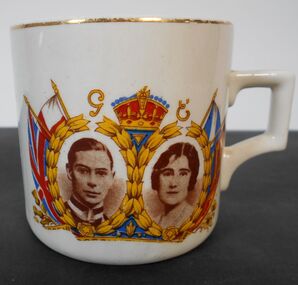
Memorabilia - Commemoration Mug
... George VI (Albert Frederick Arthur George; 14 December 1895 – 6 February 1952) was King of the United Kingdom and the Dominions of the British Commonwealth from 11 December 1936 until his death on 6 February 1952. ...George VI (Albert Frederick Arthur George; 14 December 1895 – 6 February 1952) was King of the United Kingdom and the Dominions of the British Commonwealth from 11 December 1936 until his death on 6 February 1952. ...George VI (Albert Frederick Arthur George; 14 December 1895 – 6 February 1952) was King of the United Kingdom and the Dominions of the British Commonwealth from 11 December 1936 until his death on 6 February 1952. He was also the last Emperor of India from 1936 until the British Raj was dissolved in August 1947, and the first head of the Commonwealth following the London Declaration of 1949, He married Lady Elizabeth Bowes-Lyon in 1923, and they had two daughters, Elizabeth and Margaret. KEELE STREET POTTERY (K.S.P) CO. LTD 1915–1958 Earthenware manufacturer at Keele St, Tunstall (to c.1958) and then at Meir Airport, Longton, as part of the Staffordshire Potteries Group.Coronation of King George VI and Queen Elizabeth c.1937 Commemorative Ceramic Mug. Individual Photo of King George and Queen Elizabeth surrounded by yellow wreath. 2 Flags either side. Crown in center of photos and G and E either side of Crown. Gold embossing on lip of mug. Writing at bottom of transfer is missing.KSP C England on basecoronation 1936, king george vi -
 Warrnambool and District Historical Society Inc.
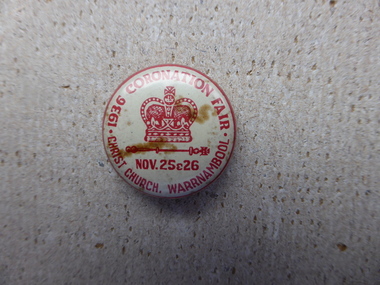
Badge - 1936 Coronation Fair Christ Church, 1936
... A keepsake badge which relates to the tumultuous period of the English royal family with the death of George V when his son Edward V111 abdicated from the throne due to his involvement with divorcee Wallis Simpson. His brother Albert was crowned as King George VI on May 12 1937. ...A keepsake badge which relates to the tumultuous period of the English royal family with the death of George V when his son Edward V111 abdicated from the throne due to his involvement with divorcee Wallis Simpson. His brother Albert was crowned as King George VI on May 12 1937. ...A keepsake badge which relates to the tumultuous period of the English royal family with the death of George V when his son Edward V111 abdicated from the throne due to his involvement with divorcee Wallis Simpson. His brother Albert was crowned as King George VI on May 12 1937. This badge is of interest as the dates are a mere two weeks before the abdication. The Christ Church fetes and flower shows have been a part of Christ Church social and fundraising agenda since the 1890’s, with the ladies’ guild playing a large part in their organization and operation. This object has significance as it commemorates a long running and popular event on the social and religious calendar for the parishioners and people of Warrnambool. It also is linked to an event of world- wide interest.Small white badge with red writing and symbol of crown in the centre. Pin at the back.1936 Coronation Fair Christ Church Warrnambool Nov 25 & 26.christ church fete 1936, coronation fete warrnambool -
Lakes Entrance Historical Society
Ephemera - Documents - Royal memorabilia, 1952
... Catalogue no 10140.1 Daily Express English Newspaper King George VI Death 1952, Cat no 10140.2 Sunday Graphic English Newspaper King George VI Death 1952, Cat no 10140.3 Sun News Pictorial Queen Elizabeth visit Febr 1954, Cat no 10140.4 Preview of Royal Wedding Elizabeth and Philip, Cat no 10140.5 Sun News Pictorial Souvenir of Australia's America's Cup win 1983, Cat no 10140.6 Weekend Australian Magazine The Bradman Letters 2004...Catalogue no 10140.1 Daily Express English Newspaper King George VI Death 1952, Cat no 10140.2 Sunday Graphic English Newspaper King George VI Death 1952, Cat no 10140.3 Sun News Pictorial Queen Elizabeth visit Febr 1954, Cat no 10140.4 Preview of Royal Wedding Elizabeth and Philip, Cat no 10140.5 Sun News Pictorial Souvenir of Australia's America's Cup win 1983, Cat no 10140.6 Weekend Australian Magazine The Bradman Letters 2004 DOCUMENTS Newspapers Various cuttings, patterns, poetry, contained in a manila folder, also magazine articles Ephemera Documents - Royal memorabilia ...Catalogue no 10140.1 Daily Express English Newspaper King George VI Death 1952, Cat no 10140.2 Sunday Graphic English Newspaper King George VI Death 1952, Cat no 10140.3 Sun News Pictorial Queen Elizabeth visit Febr 1954, Cat no 10140.4 Preview of Royal Wedding Elizabeth and Philip, Cat no 10140.5 Sun News Pictorial Souvenir of Australia's America's Cup win 1983, Cat no 10140.6 Weekend Australian Magazine The Bradman Letters 2004Various cuttings, patterns, poetry, contained in a manila folder, also magazine articlesdocuments, newspapers -
 Wodonga & District Historical Society Inc
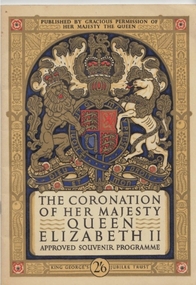
Programme - The Coronation of Her Majesty Queen Elizabeth II, Her Majesty's Printers, 1953
... Her Majesty ascended the throne, at the age of 25, on the death of her father King George VI on the 6th February 1952. ...This souvenir programme was produced to record the coronation of Queen Elizabeth II. Her Majesty ascended the throne, at the age of 25, on the death of her father King George VI on the 6th February 1952. Elizabeth was crowned as the Queen of the United Kingdom and the other Commonwealth realms on June 2nd 1953 at Westminster Abbey. Preparations for the coronation took over a year, it was the first British coronation to be fully televised when cameras were allowed inside the Abbey for the first time and the event was estimated to have cost £1.57 million.An official souvenir programme of the Coronation of Queen Elizabeth II. It includes images, text and the official order of service.This souvenir programme was produced to record the coronation of Queen Elizabeth II. Her Majesty ascended the throne, at the age of 25, on the death of her father King George VI on the 6th February 1952. Elizabeth was crowned as the Queen of the United Kingdom and the other Commonwealth realms on June 2nd 1953 at Westminster Abbey. Preparations for the coronation took over a year, it was the first British coronation to be fully televised when cameras were allowed inside the Abbey for the first time and the event was estimated to have cost £1.57 million.coronation of queen elizabeth ii, british royal family -
 Wodonga & District Historical Society Inc
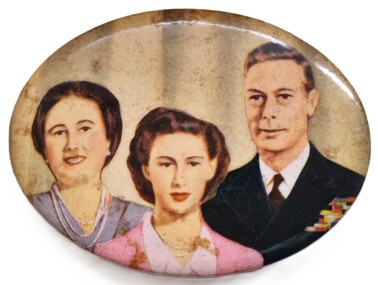
Memorabilia - Royal Family Portrait Badge, late 1940s
... King George VI. The date is uncertain but it may have been created prior to Princess Elizabeth's tour to Africa in 1952. Whilst on this tour to represent her father, King George passed away and Princess Elizabeth ascended to the throne while staying at the Treetops Hotel in Kenya. Her official coronation took place in London on 2 June 1953. King George VI reigned from 11 December 1936, upon the abdication of Edward VIII, until his death...King George VI. The date is uncertain but it may have been created prior to Princess Elizabeth's tour to Africa in 1952. Whilst on this tour to represent her father, King George passed away and Princess Elizabeth ascended to the throne while staying at the Treetops Hotel in Kenya. Her official coronation took place in London on 2 June 1953. King George VI reigned from 11 December 1936, upon the abdication of Edward VIII, until his death ...This badge features a portrait of Queen Elizabeth the Queen Mother, Princess Elizabeth and King George VI. The date is uncertain but it may have been created prior to Princess Elizabeth's tour to Africa in 1952. Whilst on this tour to represent her father, King George passed away and Princess Elizabeth ascended to the throne while staying at the Treetops Hotel in Kenya. Her official coronation took place in London on 2 June 1953. King George VI reigned from 11 December 1936, upon the abdication of Edward VIII, until his death in 1952. Queen Elizabeth the Queen Mother, born Elizabeth Angela Marguerite Bowes-Lyon in 1900, passed away on 30 March 2002 at Royal Lodge, Windsor, Berkshire, England.This item is significant because it is a rare photo of the Royal Family.An oval shaped badge featuring a coloured portrait of Queen Elizabeth The Queen Mother, Queen Elizabeth II, and King George VI. It has a small pin and a plastice stand attached to the back so it could be pinned to clothing or stand upright.british royal family, royal memorabilia -
 Melbourne Legacy
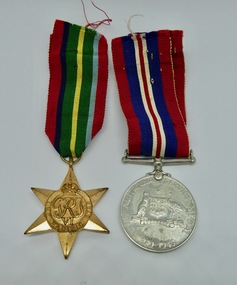
Medal, Australian Service Medal and Pacific Star Medal, 1949
... death in 1911. His stepfather Horace Dilks served in World War 1 with the 2nd Pioneer Battalion. These are examples of World War 2 medals awarded to a serviceman who participated in the conflict in the Pacific region. Many returned servicemen joined Legacy after World War 2 and would have had similar medals. medals World War Two Arthur Comden Both engraved with 'VX26251 A. N. Comben'. Silver circular medal and bronze star shaped medal from World War 2 mounted on ribbons initially together by a safety pin. 01700.1 The medal is nickel silver with the crowned effigy of King George VI ...The Australian Service Medal and Pacific Star Medal that were awarded to Private Arthur Norman Comben VX26251 for his war service in World War Two. From the AWM website Private Arthur N Comden of the 2/21st Australian Infantry Battalion, who died on Hainan Island, China, on 27 June 1945. The DVA records show he was born 6 April 1907 in Yarraville and enlisted on 17 June 1940 whilst residing in Coopers Creek Victoria. His next of kin was shown as H Dilks. Also that he had been a prisoner of war. His connection with Legacy is not known, he may have been a junior legatee though there's no record of his father Arthur John Louis Comben serving for Australia in WW1. More research is needed to check, it is possible the medals were donated to Legacy as no family members wanted them. Additional information provided by a distant relative - Arthur's mother (Mary Eleanor Norman) remarried twice after his fathers death in 1911. His stepfather Horace Dilks served in World War 1 with the 2nd Pioneer Battalion.These are examples of World War 2 medals awarded to a serviceman who participated in the conflict in the Pacific region. Many returned servicemen joined Legacy after World War 2 and would have had similar medals.Silver circular medal and bronze star shaped medal from World War 2 mounted on ribbons initially together by a safety pin. 01700.1 The medal is nickel silver with the crowned effigy of King George VI on the obverse. The reverse has the Australian coat of arms, placed centrally, surrounded by the words ‘THE AUSTRALIA SERVICE MEDAL 1939-1945’. The normal ribbon is missing and it is on the ribbon meant for the UK War Medal which is of red, white and blue to represent the colours of the Union Flag. 01700.2 The six–pointed star is yellow copper zinc alloy. The obverse has a central design of the Royal and Imperial cypher, surmounted by a crown. The cypher is surrounded by a circlet containing the words ‘The Pacific Star’. The ribbon has central yellow and green stripes that represent the forests and the beaches of the Pacific, flanked dark blue, light blue and red stripes that represent the service of the Naval Forces and Merchant Navy, the Air Forces and the Armies.Both engraved with 'VX26251 A. N. Comben'.medals, world war two, arthur comden -
 Returned Nurses RSL Sub-branch
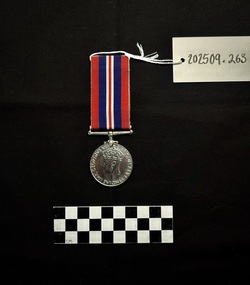
Medal - War Medal 1939–1945, [post 1949]
... death, wounds or other disabilities due to service or by cessation of hostilities on 2 September 1945. The medal is of high significance and should be kept in the collection. World War 2 World War II World War Two Joan Grace Gibson War Medal 1939-45 WWII WW2 'VFX53656 J. G. GIBSON' [engraved around lower part of the medal edge] Made from cupro-nickel, the medal itself is cool-to-the-touch. The front has a central and textured design of the crowned effigy of King George VI ...Medal belonged to Joan Grace Gibson (Mitchell) Service numbers: VFX53656 VX53656 VX38752. The War Medal 1939–45 was awarded for 28 days full-time service in the armed forces between 3 September 1939 and 2 September 1945. Operational and non-operational service may be counted if it was 28 days or more in duration. In the merchant navy, there was a requirement that the 28 days should have been served at sea. A member qualifies for the award where service was brought to an end by death, wounds or other disabilities due to service or by cessation of hostilities on 2 September 1945.The medal is of high significance and should be kept in the collection.Made from cupro-nickel, the medal itself is cool-to-the-touch. The front has a central and textured design of the crowned effigy of King George VI, facing left and signed 'PM', the initials of designer Percy Metcalfe, below the truncated neck of the effigy. Around the perimeter is the legend 'GEORGIVS VI D:G:BR:OMN:REX ET INDIAE IMP:' The reverse has a lion standing on a double-headed dragon. The top of the reverse shows the dates 1939 and 1945. The ribbon colours of red, white and blue represent the colours of the Union Flag. The ribbon is tactile, feeling ribbed under finger. The edge is engraved with the service number, initials and name of the recipient.'VFX53656 J. G. GIBSON' [engraved around lower part of the medal edge]world war 2, world war ii, world war two, joan grace gibson, war medal 1939-45, wwii, ww2 -
 Returned Nurses RSL Sub-branch
Medal - War Medal 1939–1945, [post 1949]
... death, wounds or other disabilities due to service or by cessation of hostilities on 2 September 1945. The medal is of high significance and should be kept in the collection. World War 2 World War II World War Two War Medal 1939-45 WWII WW2 Margaret Lawrence Jackson 'QF140158 M. L. JACKSON' [engraved around lower part of the medal edge] Medal belonged to Margaret Lawrence Jackson Service numbers: Q140158 QF140158. Made from cupro-nickel, the medal itself is cool-to-the-touch. The front has a central and textured design of the crowned effigy of King George VI ...Medal belonged to Margaret Lawrence Jackson Service numbers: Q140158 QF140158. The War Medal 1939–45 was awarded for 28 days full-time service in the armed forces between 3 September 1939 and 2 September 1945. Operational and non-operational service may be counted if it was 28 days or more in duration. In the merchant navy, there was a requirement that the 28 days should have been served at sea. A member qualifies for the award where service was brought to an end by death, wounds or other disabilities due to service or by cessation of hostilities on 2 September 1945.The medal is of high significance and should be kept in the collection.Medal belonged to Margaret Lawrence Jackson Service numbers: Q140158 QF140158. Made from cupro-nickel, the medal itself is cool-to-the-touch. The front has a central and textured design of the crowned effigy of King George VI, facing left and signed 'PM', the initials of designer Percy Metcalfe, below the truncated neck of the effigy. Around the perimeter is the legend 'GEORGIVS VI D:G:BR:OMN:REX ET INDIAE IMP:' The reverse has a lion standing on a double-headed dragon. The top of the reverse shows the dates 1939 and 1945. The ribbon colours of red, white and blue represent the colours of the Union Flag. The ribbon is tactile, feeling ribbed under finger. The edge is engraved with the service number, initials and name of the recipient.'QF140158 M. L. JACKSON' [engraved around lower part of the medal edge]world war 2, world war ii, world war two, war medal 1939-45, wwii, ww2, margaret lawrence jackson
