
Showing 93 items matching "four sided stitch"
-
 Embroiderers Guild, Victoria
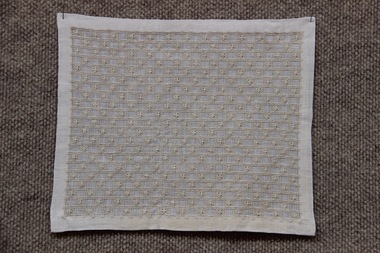
Textile - Mat, Shirley Dawson, Late 20thC
... ...Four sided stitch...Embroidery Mat Pulled thread Four sided stitch Pulled thread mat. Ecru linen, satin stitch. ...Pulled thread mat. Ecru linen, satin stitch. Squares with 4 sided stitch, and hem stitched edge.embroidery, mat, pulled thread, four sided stitch -
 Embroiderers Guild, Victoria
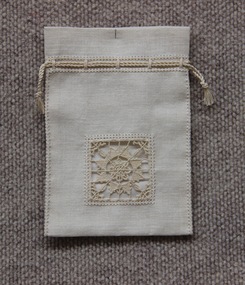
Accessory - Bag, Shirley Dawson, Late 20thC
... Drawstring bag wih square design in needlelace on the front. Four sided stitch construction. Lined in cream silk, Cream cotton cord....Embroidery Needlelace Bag Drawstring bag wih square design in needlelace on the front. Four sided stitch construction. Lined in cream silk, Cream cotton cord. ...Drawstring bag wih square design in needlelace on the front. Four sided stitch construction. Lined in cream silk, Cream cotton cord.embroidery, needlelace, bag -
 Embroiderers Guild, Victoria
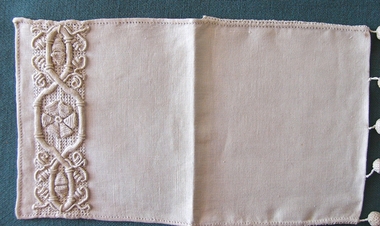
Accessory - Casalguidi Embroidered Envelope Bag, Early 20th century
... It consists of very heavy raised stem stitch worked in curves or lines, on a background of pulled thread four-sided stitching. A late 19th/early 20th century whitework technique from Tuscany, Italy....It consists of very heavy raised stem stitch worked in curves or lines, on a background of pulled thread four-sided stitching. A late 19th/early 20th century whitework technique from Tuscany, Italy. ...Casalguidi is an embroidery technique, rather than just a stitch. It consists of very heavy raised stem stitch worked in curves or lines, on a background of pulled thread four-sided stitching. A late 19th/early 20th century whitework technique from Tuscany, Italy.Cream linen envelope style bag embroidered in traditional Casalguidi style and five bobble tassels on the bottom edge.embroidery, casalguidi, bags, early 20th century, italy, flowers -
 Bendigo Historical Society Inc.
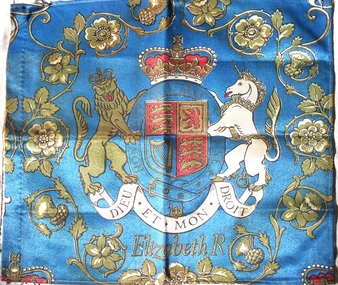
Textile - Royal Coat of Arms, 1953
... Fabric sample is hemmed on four sides, stitched by hand....Fabric sample is hemmed on four sides, stitched by hand. Textile Royal Coat of Arms ...Donor has owned the fabric sample since 1975. The family story is that the fabric sample was presented to the donor's mother Zoe Smith in 1954/55 when she was a teacher at Camberwell Primary School. One of her pupils brought the sample as a gift, telling Zoe that it was from the Royal Train when Queen Elizabeth and Prince Phillip toured Australia in 1954, one year after the Coronation. The family believed that it was a cushion cover from the Royal Train. Further research suggests that it is a fabric display of the Royal Coat of Arms produced to mark the Coronation of Queen Elizabeth II. See website below https://www.worthpoint.com/worthopedia/queen-elizabeth-ii-coat-arms-fabric-489239608Fabric piece with royal blue background with the Coat of Arms framed by a circle of floral emblems. "Elizabeth R" is printed below the Coat of Arms. Fabric sample is hemmed on four sides, stitched by hand.elizabeth r, queen elizabeth 2, 1953 coronation, coat of arms, wall hamging -
 Embroiderers Guild, Victoria
Accessory - Bag, Shirley Dawson, Late 20thC
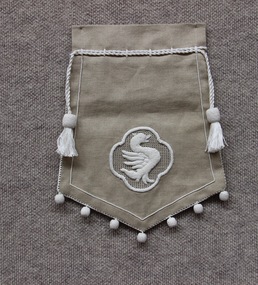
... Beige linen, design of bird on four sided stitch on front, surrounded by Casalguidi rope stitch. ...Embroidery Casalguidi Needle lace Needle lace Bobbles Tassels Italy Beige linen, design of bird on four sided stitch on front, surrounded by Casalguidi rope stitch. ...Beige linen, design of bird on four sided stitch on front, surrounded by Casalguidi rope stitch. Drawstring and needlelace tassels, and needlelace bobbles on peaked base. All embroidery and cards etc. white pearl thread.embroidery, casalguidi, needle lace, needle lace, bobbles, tassels, italy -
 Embroiderers Guild, Victoria
Textile - Beathea Jannett Dickenson Sampler 1840, Beathea Jannett Dickenson, 1840
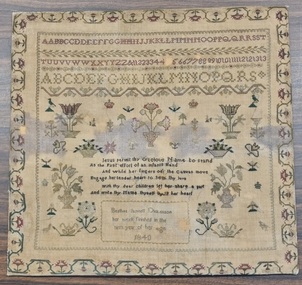
... Rows of alphabet and numbers embroidered in red four-sided stitch. Brown alphabet embroidered in eyelet stitch. ...Rows of alphabet and numbers embroidered in red four-sided stitch. Brown alphabet embroidered in eyelet stitch. ...Samplers served as both a learning tool and a showcase of a young girls skill in needlework, literacy and numeracy.Sampler with floral border surround. Rows of alphabet and numbers embroidered in red four-sided stitch. Brown alphabet embroidered in eyelet stitch. Separated by rows of ornate patterns. Religious verse in dark brown surrounded by vases of flowers and floral motifs.Beathea Jannett Dickenson her work finished in the ninth year of her age 1840 " Jesus permit thy Gracious Name to stand As the First effort of an infants hand And while her fingers oe'r the canvas move engage her tender heart to seek thy love With thy dear children let her share a part And write thy Name thyself upon her heart" -
 Embroiderers Guild, Victoria
Textile - Janet Ness 1818 Scottish Sampler, The Elizabeth Mury Collection, 1818
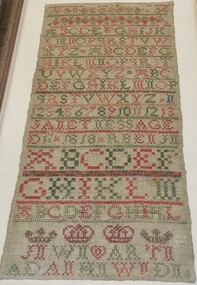
... Cross stitch, eyelet and four sided stitch are used. Lower row of crowns and coronets and initials....Cross stitch, eyelet and four sided stitch are used. Lower row of crowns and coronets and initials. ...Period characteristics: Missing letters - the exclusion of 'J' and 'U' was standard in Latin Alphabet typography and carried heavily into educational samplers through the 19th century. Horizontally arranged bands of letters and text separated by geometric borders was a simpler band composition in older educational templates. Crown motifs can serve several purposes: Loyalty to the Monarchy - allegiance to the reigning King or Queen was especially prominent in British, Scottish and Dutch traditional samplers. Religious devotion - spiritually crowns represented 'Crown of Life' or the 'Crown of Righteousness' mentioned in the Bible, signifying eternal reward, fidelity and spiritual virtue. Family hierarchy and status - different style of crowns and coronets symbolized specific ranks of nobility. They may be incorporated to represent family heritage. Linen marking practice - alphabet samplers were used to practice marking household linens. Small crowns alongside initials indicate the status or lineage belonging to the owner of the linens. Traditional Scottish child's sampler on ecru linen embroidered with green and red threads. Narrow borders, worked in a variety of stitches, separates the alphabet, numbers and initials. Cross stitch, eyelet and four sided stitch are used. Lower row of crowns and coronets and initials.Janet Ness Aged 11 1818sampler, england, childs -
 Embroiderers Guild, Victoria
Textile - Casalguidi Handkerchief Sachet, Late 19th century
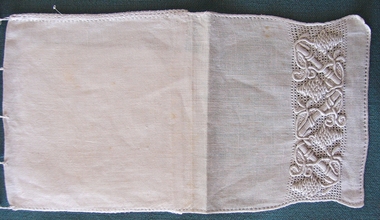
... Other characteristic Casalguidi stitches rise above the surface of the fabric to form naturalistic elements. all worked on a background of four-sided stitch. Piecework 2027...Other characteristic Casalguidi stitches rise above the surface of the fabric to form naturalistic elements. all worked on a background of four-sided stitch. Piecework 2027 Embroidery Casalguidi Sachet Italy Late 19th century vines plants Cream linen with design of vines in Casaguildi embroidery. ...Named for a charming village located in the Tuscan countryside northwest of Florence, Italy, Casalguidi embroidery is a distinctive three-dimensional form of needlework, which is worked in neutral colours and mimics sculpted marble. Traditional elements identify a piece of Casalguidi embroidery - the bastone (stick)—a heavily padded, three-dimensional composite of simple stitches referred to collectively as the Casalguidi stitch. The bastone can be worked in a straight or curved line, crisscrossed, or formed into a circle to create a definitive anchoring point for a design. Other characteristic Casalguidi stitches rise above the surface of the fabric to form naturalistic elements. all worked on a background of four-sided stitch. Piecework 2027Cream linen with design of vines in Casaguildi embroidery. Casaguildi work is from the Pistoia district of Italy. This style of work is very textural using drawn thread work, raised stem stitch bands, bullion knots, button hole stitch bars, padded cords and bobbles. embroidery, casalguidi, sachet, italy, late 19th century, vines, plants -
 Embroiderers Guild, Victoria
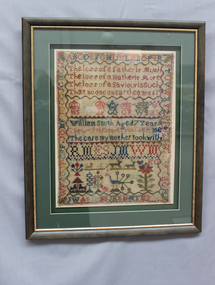
Textile - William Smith Aged 7 years Sampler 1852, William Smith, 1852
... Sampler with cross stitch, four-sided and eyelet stitches by William Smith, 7 years old. ...Embroidery Cross Stitch Sampler "The loss of the Father is much The loss of a Mother is more The loss of a Saviour is such That no one on earth can restore" William Smith aged 7 Sampler with cross stitch, four-sided and eyelet stitches by William Smith, 7 years old. ...Possibly embroidered 1852. Old attached note states " was done by my Father when he was a boy. His mother was a sewing teacher and he did what he seen the girls do, till he was at school" Apparently there was also canvas work he did which was then over 100 years old, at time of writing. Possibly the brother to Jessie Smith, sampler E 1862.Sampler with cross stitch, four-sided and eyelet stitches by William Smith, 7 years old. Beige coarse linen, dull and dark colours, red, blue, greens, browns. Framed, glass on green board and green mount."The loss of the Father is much The loss of a Mother is more The loss of a Saviour is such That no one on earth can restore" William Smith aged 7 embroidery, cross stitch, sampler -
 Embroiderers Guild, Victoria
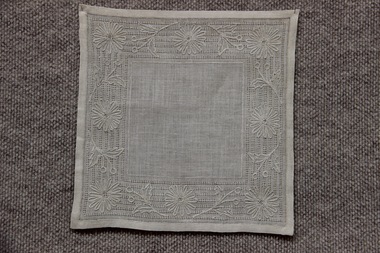
Textile - Mat, Mrs Ethel Oates, 20thC
... Ecru linen square mat stitche4d in pulled thread work around all four sides, then over stitched in a floral design in chain stitch. ...Embroidery Pulled thread Mat Ecru linen square mat stitche4d in pulled thread work around all four sides, then over stitched in a floral design in chain stitch. ...Ecru linen square mat stitche4d in pulled thread work around all four sides, then over stitched in a floral design in chain stitch. Fine satin stitch hem. Silk threadembroidery, pulled thread, mat -
 The Beechworth Burke Museum
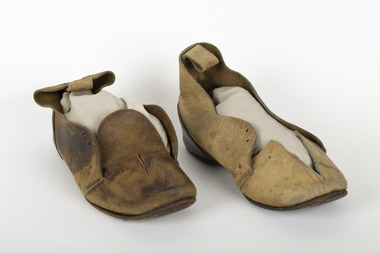
Uniform - Protective Boots
... Large, lighter leather foot with polished harder leather back and sole, stitched at sides, four lace holes. Stitched leather insole and pull tab at back....Large, lighter leather foot with polished harder leather back and sole, stitched at sides, four lace holes. Stitched leather insole and pull tab at back. ...These protective over-boots were compulsorily worn in the Powder Magazine so as not to induce static electricity.The Beechworth Powder Magazine was constructed in 1859, and was used as a storage room for large amounts of black-powder used in mining and quarrying. By law, miners were required to leave bulk black-powder in this building overnight.Pair of brown over-boots. Large, lighter leather foot with polished harder leather back and sole, stitched at sides, four lace holes. Stitched leather insole and pull tab at back.burke museum, beechworth, mining, powder magazine, footware -
 Flagstaff Hill Maritime Museum and Village
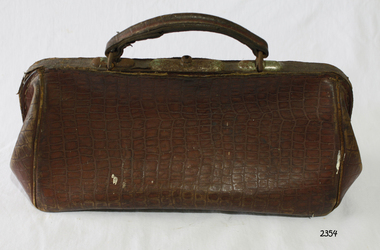
Bag
... Bag leather brown medical bag has leather handle at top connected by rings attached to a piece of metal at either end, a strip of metal in the centre with a round washer shaped object with a hole attached, on a metal frame which is squared off at the sides, stitching on the top and also both sides of the thick leather handle, four metal studs at each corner....flagstaff hill warrnambool shipwrecked-coast flagstaff-hill flagstaff-hill-maritime-museum maritime-museum shipwreck-coast flagstaff-hill-maritime-village medical bag Bag leather brown medical bag has leather handle at top connected by rings attached to a piece of metal at either end, a strip of metal in the centre with a round washer shaped object with a hole attached, on a metal frame which is squared off at the sides, stitching on the top and also both sides of the thick leather handle, four metal studs at each corner. ...Bag leather brown medical bag has leather handle at top connected by rings attached to a piece of metal at either end, a strip of metal in the centre with a round washer shaped object with a hole attached, on a metal frame which is squared off at the sides, stitching on the top and also both sides of the thick leather handle, four metal studs at each corner.flagstaff hill, warrnambool, shipwrecked-coast, flagstaff-hill, flagstaff-hill-maritime-museum, maritime-museum, shipwreck-coast, flagstaff-hill-maritime-village, medical bag -
 Shepparton RSL Sub Branch
Uniform, Hat, 1989
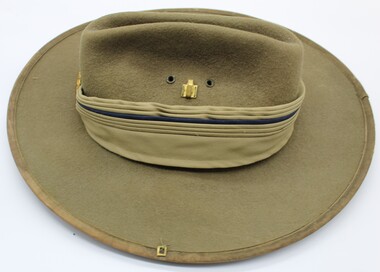
... Four plastic eyelets at crow of hat and signature fold on crown. Wide brim edged with brown coloured binding. A hook on the left crown and left brim attach together to lift one side of the hat. On interior, brown leather chinstrap with metal adjustable buckle ad black leather sweatband stitched...Four plastic eyelets at crow of hat and signature fold on crown. Wide brim edged with brown coloured binding. A hook on the left crown and left brim attach together to lift one side of the hat. On interior, brown leather chinstrap with metal adjustable buckle ad black leather sweatband stitched ...This slouch hat belonged to Royal Australian Air Force serviceman/woman Forsyth. Khaki-coloured slouch hat with folded cotton band with blue strip around brim; gold coloured badge depicting a wreath with crown atop and ornamental letters “RAAF”. Four plastic eyelets at crow of hat and signature fold on crown. Wide brim edged with brown coloured binding. A hook on the left crown and left brim attach together to lift one side of the hat. On interior, brown leather chinstrap with metal adjustable buckle ad black leather sweatband stitched in with zig-zag black stitching and secured by khaki silk bow at back. Bow attaches a card reading “58” in a circle. Sticker on interior centre in brown and metallic gold. Size sticker hidden underneath sweatband reads “58 7 1/8”Label on interior of cotton band reads “A.G.C.F./VIC 1989 [broad arrow]/SIZE. 58/8405-66.[crossed out 109-5392]033-5309”. Handwritten on interior brim “FORSYTH”. Size labels read “58” and “58 7 1/8”. Sticker reads “COMMANDO/WOOL SLOUCH HAT/MELBOURNE”uniform, royal australian air force, raaf, r.a.a.f., slouch hat, 1980s -
 Federation University Historical Collection
Clothing - Textiles, Ruth McGannon, Needlework, c 1950-70s
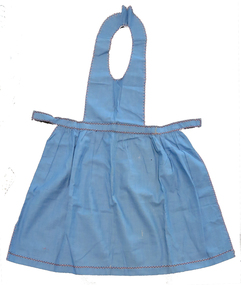
... R.M. is embroidered in brown chain stitch on the right side. .6) A rectangle of hemmed blue lawn the same as the previous piece but with five rows of back stitch in yellow and orange thread creating a pattern. .7) A rectangle of blue lawn with the top and bottom edges hemmed with two rows of long stitch close together in yellow and orange. The other two edge are frayed to 2.5 centimeters and has four...R.M. is embroidered in brown chain stitch on the right side. .6) A rectangle of hemmed blue lawn the same as the previous piece but with five rows of back stitch in yellow and orange thread creating a pattern. .7) A rectangle of blue lawn with the top and bottom edges hemmed with two rows of long stitch close together in yellow and orange. The other two edge are frayed to 2.5 centimeters and has four ...These items were made as samplers either at school or most likely college. They are samples of embroidery stitches, seam types and sewing and knitting techniques.Nos 1-16 are group of samplers made from cotton lawn, cotton with sateen weave and flannel and made by Ruth McGannon. No 17 is a pair of gloves made by Margaret Russell. .1) A small square of yellow lawn with three horizontal rows in blue thread and three vertical rows in red thread of running stitch each 3.5 centimeters apart. The edges are frayed to 1.2 centimeters. .2) A larger rectangle of yellow lawn with three horizontal rows 7.8 centimeters apart and three vertical rows 10 centimeters apart of long stitch, stitched in blue thread. The edges are frayed to 2 centimeters. .3) A small square of yellow lawn with three horizontal rows and three vertical rows of blue thread of running stitch, each 1.9 centimeters apart. The edges are frayed to 1.5 centimeters. .4) A larger rectangle of yellow lawn with three horizontal rows 9 centimeters apart and three vertical rows 11.2 centimeters apart of running stitch, stitched in red thread. The edges are hemmed with two rows of long stitch .5 centimeter apart with a loose blue thread of laced running stitch weaving in and out of the red long stitch. .5) A rectangle of hemmed yellow lawn with a pocket formed at each end. Two rows of long stitch in red thread hem the edges with a blue thread stitched between each red stitch. The pockets are formed by turning back the edges and stitching them down in brown thread. R.M. is embroidered in brown chain stitch on the right side. .6) A rectangle of hemmed blue lawn the same as the previous piece but with five rows of back stitch in yellow and orange thread creating a pattern. .7) A rectangle of blue lawn with the top and bottom edges hemmed with two rows of long stitch close together in yellow and orange. The other two edge are frayed to 2.5 centimeters and has four rows of long stitch .7 centimeter apart in yellow and orange thread. .8) A blue lawn bag with two packets was made by hemming a rectangle of fabric on three sides in long stitch with orange thread, then yellow thread between the stitches. The fourth side is hemmed in hemming stitch in yellow thread with blanket stitch in yellow thread along the edge. This edge is folded up by one third to create a pocket. The edges on either side are stitched together. A row of chain stitch in orange thread is stitched down the middle to create two pockets. A tape is stitched to either side at the top and this is folded over the pocket. .9) A cream cotton with sateen weave rectangle is hemmed with a double row of orange thread in long stitch. On both sides is embroidery in orange and yellow thread. .10) A yellow cotton with sateen weave baby's bib is made from a rectangle of fabric with a semi circle cut out of the top. The edges are turned and hemmed with a narrower turning on the neck. A tape is stitched at either side of the neck. On the front is embroidered a train in blue and yellow threads. .11) A yellow lawn embroidery sampler using blue and brown thread shows long stitch, stem stitch, herringbone stitch, chain stitch, fly stitch, lazy daisy stitch, cross stitch and satin stitch. It is hemmed using drawn thread work and the bottom is scalloped and finished in blanket stitch. .12) A pink lawn embroidery sampler with green thread shows herringbone stitch, stem stitch, running stitch, chain stitch, cross stitch, lazy daisy stitch, fly stitch, feather stitch, satin stitch and back stitch. The bottom is scalloped and finished in buttonhole stitched. The other three edges are hemmed using drawn thread work. .13) A small cream flannel square with two smaller squares are stitched together down the middle in decreasing sizes using chain stitch. The largest piece is hemmed using both herringbone and a decorative blanket stitch. It also has a run and fell seam on the opposite side using both running and herringbone stitches. A row of feather stitch is on either side of the seam. The two smaller squares are frayed on the edges. .14) A cream rectangular flannel sampler has two seams along the length. One is a run and fell seam using running and herringbone stitches and the other is an open seam using running stitch and both edges are stitched down with herringbone stitch. The two shorter edges are bound and the longer edges have a tape which is stitched down to neaten the edges. On the right side are two rows of feather stitch. .15) This blue lawn apron has a rectangular gathered skirt which is attached to a waistband and in turn attached to a bib front which goes over the head. The bib and skirt sides are hemmed using decorative blanket stitch in pink and dark blue thread. The skirt hem and both sides of the waistband are stitched in two rows of herringbone in pink and dark blue thread. .16) This pale pink lawn child's shirt has french seam side seams, a waist band to which the shirt is attached using slight gathering. The sleeves have cuffs. There is a front facing and a collar and there is a small pocket in the left hand breast. .17) These yellow knitted gloves are made using plain stitch for the hand and rib for the wrist.Written on paper and stitched on to a couple of items - Ruth McGannon V.3 - 312 Written on paper and stitched to the gloves - Margaret Russell x No2embroidery, sampler, gloves, stitches, sewing, knitting, apron, costume, needlework, dressmaking, textiles -
 Flagstaff Hill Maritime Museum and Village
Clothing - Corset cover, Eliza Towns, Mid to late 19th century
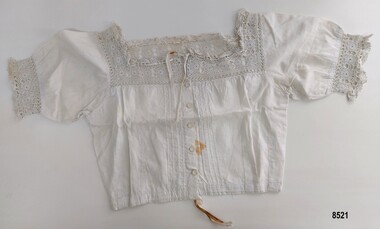
... The same crocheted lace design and feather stitching are also on the square neckline which is finished with a drawstring ribbon. The bodice has a front opening with five buttons and is bordered on each side with four pintucks. ...The same crocheted lace design and feather stitching are also on the square neckline which is finished with a drawstring ribbon. The bodice has a front opening with five buttons and is bordered on each side with four pintucks. ...This corset cover is one of several linen and clothing items that were made and belonged to Mrs. Eliza Towns and donated to Flagstaff Hill Maritime Museum and Village. Eliza was born Eliza Gould in 1857 in South Melbourne (Emerald Hill) and in 1879 married Charles Towns. In the early 1880's they moved to Nhill in western Victoria and remained there for the rest of their married life. Charles was a jeweller and later became an accountant and for many years was involved with the Shire Council, the local show committee (A & P Society), the Hospital Committee and the Board of the local newspaper (the Nhill Free Press). They had three children and lived a life that would be regarded as comfortably "middle class". Eliza probably had a treadle sewing machine and would have made many of her own clothes as well as clothes for her children - adding her own handmade embroidered or crocheted decorative trim. This corset cover is an excellent example of an everyday clothing item with the decorative trim favoured by women in the late Victorian era. Eliza Towns has added pintucks, embroidered feather stitch and a highly decorative hand crocheted lace trim to the neckline, sleeves and front of the bodice. Corset covers (sometimes called camisoles) began to appear in women's fashion around 1840 and continued through the late Victorian decades into the Edwardian era. The long chemise was considered too bulky to cover the corset and so the corset cover was developed to be short and light and was worn over the corset and under the bodice of the outer garment. A woman would dress into her chemise and drawers first, followed by her corset and finally her corset cover as a final layer under her dress. Corset covers served several purposes. They provided protection against sweat (and the need to regularly wash the corset), helped smooth the lines of the corset and increased a woman's modesty.This item is an example of the needlework skills of women in the late 19th century - combining machine stitching with hand embroidery and crochet to embellish an item of personal underclothing. It is also significant as an example of a practical solution to the difficulty of hand washing a corset in the Victorian era.A short (waist length) corset cover of fine cotton. Short sleeves fall from a square neckline and are gathered into a wide crocheted lace trim with a band of embroidered feather stitch. The same crocheted lace design and feather stitching are also on the square neckline which is finished with a drawstring ribbon. The bodice has a front opening with five buttons and is bordered on each side with four pintucks. It has a drawstring ribbon at the waist and an extra layer of fine cotton lining has been added to strengthen the corset cover under the arms. The back has two bands of three pintucks running vertically from the neckline to the waist.flagstaff hill, flagstaff hill maritime museum & village, warrnambool, great ocean road, shipwreck coast, nhill, wimmera, eliza towns, underclothing, corset cover, camisole, machine sewing, hand sewing, crocheted lace, pintucks, feather stitch, embroidery, underwear, victorian era underclothing, victorian era corset cover -
 City of Moorabbin Historical Society (Operating the Box Cottage Museum)
Functional object - Sewing Equipment, needles
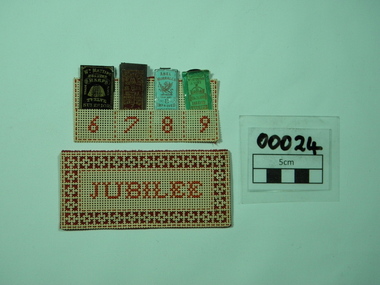
... In red cot tonCross stitch on one side of the card needle case the word "NEEDLES" is embroidered, and on the other side the word "JUBILEE". Inside the needle case is four...This is one of many items used to exhibit the skill and craftsmanship of the women in these families. 1887 queen victorias golden jubilee victorian punched card work hand embroidery different packets different gauge sharp needles wm shrimpton and sons william mattins abel morrals copestakes cross stitch In red cot tonCross stitch on one side of the card needle case the word "NEEDLES" is embroidered, and on the other side the word "JUBILEE". Inside the needle case is four ...In the 1820s perforated cardboard first became available. Then, with the invention of the printing press, designs such as sentimental or religious mottos were pre-printed on the card and a Victorian craze began as it provided a simpler and cheaper method of embroidering for the masses compared to the previously far more expensive linen embroidery. Over the following decades embroidering of punched-card grew enormously in popularity and a variety of articles from Christmas decorations to birthday cards, and in this case a Neele case to celebrate Queen Victoria's golden Jubilee in 1887. The pioneer settlers and market gardeners of Moorabbin Shire had to be self reliant and made their own clothing and utensils. This is one of many items used to exhibit the skill and craftsmanship of the women in these families. Small cream coloured Punched-Cardboard needle case,with red satin lining and red cross-stitch decoration. The case contains four paper packets each containing sewing needles of a different gauge. Each packet of needles is 3 1/2 cms long and 1 cm wide. The size of the needles In red cot tonCross stitch on one side of the card needle case the word "NEEDLES" is embroidered, and on the other side the word "JUBILEE". Inside the needle case is four packets of different sized needles, by Wm Mattins1887, queen victorias golden jubilee, victorian punched card work, hand embroidery, different packets, different gauge sharp needles, wm shrimpton and sons, william mattins, abel morrals, copestakes, cross stitch -
 Bendigo Military Museum
Equipment - TOOL ROLL, c.1939-45
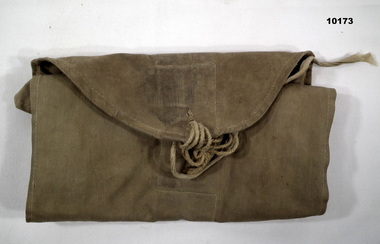
... side has 2 simple pockets with 8 smaller slots for small tools. The top and bottom have 4 cm flaps that fold over to keep the tools in place. The left end has a curved flap that shuts the tool roll. There are two cotton cords sewn into the end of the closing flap. There is a four string cord stuck through the closing flap in an ad hoc manner. It forms a c.100mm loop. There has been some hand stitching...side has 2 simple pockets with 8 smaller slots for small tools. The top and bottom have 4 cm flaps that fold over to keep the tools in place. The left end has a curved flap that shuts the tool roll. There are two cotton cords sewn into the end of the closing flap. There is a four string cord stuck through the closing flap in an ad hoc manner. It forms a c.100mm loop. There has been some hand stitching ...Frederick Simons collection. Refer Cat No 10159Tool roll, small, cotton drill. When opened it reveals that right side has 2 simple pockets with 8 smaller slots for small tools. The top and bottom have 4 cm flaps that fold over to keep the tools in place. The left end has a curved flap that shuts the tool roll. There are two cotton cords sewn into the end of the closing flap. There is a four string cord stuck through the closing flap in an ad hoc manner. It forms a c.100mm loop. There has been some hand stitching at the end of the tool 'slots'.Written on one of the tool slots is “R.A.A.F. 41707”equipment, tool roll -
 Warrnambool and District Historical Society Inc.
Artefact, School Satchel, Circa 1900
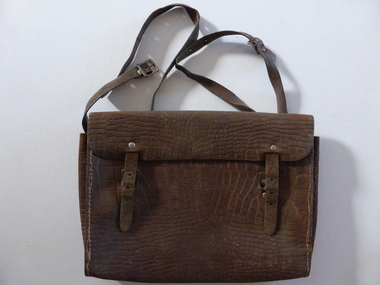
... stitching, to be kept in good order. Being adjustable they would also serve a student for a number of years.No information is available on Henry Alexander Cain of Surrey Hills. A common item with which many people would identify. warrnambool school history boy's school bag Solid leather is stamped in the leather on the front. henry Alexander Cain ******Rd Surrey Hills Brown leather rectanular satchel with gusset on either side . It is fastened on the front with two metal buckles and has four ...Satchels such as these were commonly used by young boys to carry their lunch and school items between school and home. They were used commonly in the days when much of the requirements such as slates and paper were used as class sets. They proved to be serviceable and required only the most basic of maintenace as in stitching, to be kept in good order. Being adjustable they would also serve a student for a number of years.No information is available on Henry Alexander Cain of Surrey Hills.A common item with which many people would identify.Brown leather rectanular satchel with gusset on either side . It is fastened on the front with two metal buckles and has four adjustable leather back straps attached to the bag with metal studs. These are adjustable through holes in the leather straps. Likewise the front straps can be fastened in a number of different holes. The leather has an overall snake skin pattern.Solid leather is stamped in the leather on the front. henry Alexander Cain ******Rd Surrey Hillswarrnambool, school history, boy's school bag -
 Kiewa Valley Historical Society
Box Sewing Kit, pre 1952
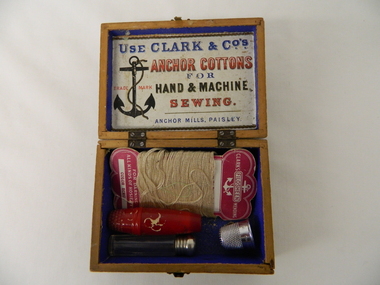
... stitching domestic clothes alterations haberdashery On outside lid "FROM A FRIEND. I DO NOT WISH THEE GRANDEUR, NOR YET A STORE OF WEALTH, I WISH THEE RICHER TREASURE, CONTENTMENT, PEACE & HEALTH", On inside lid "USE CLARK & CO ANCHOR COTTONS FOR HAND & MACHINE SEWING ANCHOR MILLS, PAISLEY" Each of the different sewing boxes from the Clark Bros. has a label with different "friend" passages. This wooden sewing box is covered with decorative paper. The lid is fastened to the bottom section with two small hinges each having four screws. Each side ...This "sewing and darning" box was purchased before 1952 (the date that the Clark Brothers merged with J&P Coats). It was in an era where the production and alteration/modification to any household or personal clothing was carried out by a family member/s. This was at the period where self sufficiency in rural and especially remote areas was a requirement and not just a hobby. Clothing modifications and "hand me downs" was a way of life. The long and tiresome journey from home to millinery shops was a great force to ensure that home sewing was carried out in the majority of residential and farm areas.This sewing box was donated by a pioneer family in the Kiewa Valley. Its significance points to an era before the establishment of the Kiewa Hydro Electricity Scheme and the establishment of the Mount Beauty Township. It was a time when the rural industries of the Kiewa Valley was rich in production of beef, dairy products, tobacco leaf and before the mass of alpine adventurers that tourism sparked. It was a time rural enterprises out shone tourism.This wooden sewing box is covered with decorative paper. The lid is fastened to the bottom section with two small hinges each having four screws. Each side is fixed to the other by a mortise groove. At the front of the box is a small clasp for complete closure. The box contains needles, darrning thread, thimble, a glass vial with metal screwtop and a red plastic cylindrical container with a thimble screw on top(contains a small reel with three different cotton thread compartments).On outside lid "FROM A FRIEND. I DO NOT WISH THEE GRANDEUR, NOR YET A STORE OF WEALTH, I WISH THEE RICHER TREASURE, CONTENTMENT, PEACE & HEALTH", On inside lid "USE CLARK & CO ANCHOR COTTONS FOR HAND & MACHINE SEWING ANCHOR MILLS, PAISLEY" Each of the different sewing boxes from the Clark Bros. has a label with different "friend" passages.sewing box, hand stitching, domestic clothes alterations, haberdashery -
 Kiewa Valley Historical Society
Case Leather, circa mid to late 1900's
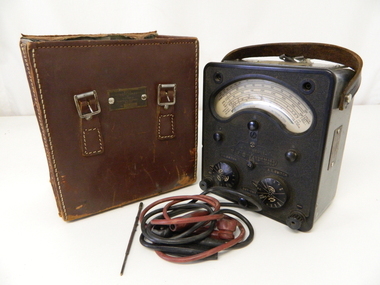
... stitched onto one side but no lid to fasten down. The sides are stitched together with strong tick twine. On either side there are small strap holds. On the bottom are four...stitched onto one side but no lid to fasten down. The sides are stitched together with strong tick twine. On either side there are small strap holds. On the bottom are four ...When this AVOMETER leather case was being utilised in the early 1950's it contained the "leading" edge of electrical measuring instrumentation.The first meter was produced by Automatic Coil Winder and Electrical Equipment Co. in 1923. This model was produced in the time from 1933 to 1951 when it was superseded by the most popular model, Model 8 (1951 to 2008).This leather case which holds its AVO Meter brought the measuring of three electrical power indicators i.e., amps, volts and ohms into one measuring unit. By using a "one fits all" unit, the carrying of separate measuring devices was reduced considerably. The need for a mountainous and a large area of operational requirements, such as the SEC Vic Kiewa Hydro Electricity Scheme, to minimise the weight of equipment carried by electricians and technicians was of the utmost relevance. The significance of this meter to the Kiewa Valley region relates to the impact of modern technology (at that time) upon a mainly rural environment. This equipment shows how the boost of "modern" equipment into the area because of the "Hydro Scheme" was facilitated a lot faster than would have taken under "normal" evolutionary time. The speed of information on all "new technology" had a relatively slow assimilation rate to those living in rural communities. The use of solid leather carrying bags for transporting equipment up and down the mountains provided some form of protection against bumps and dust.This carry case for its AVO meter has an outer leather covering with an inner thick cardboard liner. The case has two mild steel buckles but stitched onto one side but no lid to fasten down. The sides are stitched together with strong tick twine. On either side there are small strap holds. On the bottom are four large chromed metal lugs acting as feet to keep the bottom from lying flat on any floor. The outside bottom has been branded "SOLID COWHIDE"Between the front two buckles is a identification plate riveted onto the cowhide "STATE ELECTRICITY COMMISSION OF VICTORIA ELECTRICAL ENGINEERING SECTION"electrical meters, electrical equipment, sec vic., state electricity commission of victoria, mount beauty, bogong village -
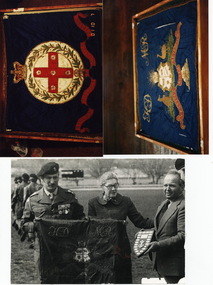 4th/19th Prince of Wales's Light Horse Regiment Unit History Room
Flag - Regimental Colour, Kyneton District Mounted Rifles, 1861 (exact)
... sides by 30mm coiled metal fringing. It is heavily embroidered through a silk and cotton layer and these sections are are put back-to-back forming a sandwich of four layers. Several kinds of metal threads and sequins have been used for the embroidery as well as coloured silk floss, employing satin and stem stitch. ...sides by 30mm coiled metal fringing. It is heavily embroidered through a silk and cotton layer and these sections are are put back-to-back forming a sandwich of four layers. Several kinds of metal threads and sequins have been used for the embroidery as well as coloured silk floss, employing satin and stem stitch. ...Address given by Mrs Lavender on the presentation of the Kyneton Colours on 28 February 1861 “Gentlemen of the Kyneton District Mounted Rifles, I feel proud of the honour done me in being deputed by the ladies of Kyneton to present the colours to your honourable Corps. There has always been a peculiar honour and responsibility connected with the colours of a Regiment. They have been unfurled on a battlefield as rallying points for many a splendid troop of gallant soldiers and courageous hearts. They have been spread to the breeze on the storming of many a city and battles hardly fought and dearly won. To retain their position and maintain their integrity, many a brave soldier has freely offered his life in their defence and, when in the hour of adversity they have been lowered, overpowered by the foe, many a brave heart has bit the dust. We might say that the history of our country is written on the banners of our “Fatherland”. The names emblazoned there speak, it is true of many a battlefield, of many a desperate struggle and of many a glorious victory won by British bravery. Gentlemen, your colours are not decorated by names such as Waterloo, Alma, Inkerman, Delhir Cawnpore, and many others I might mention. They are blank and may the God of Peace grant that in this land of adoption, it may be long before necessity of duty calls upon you to maintain the integrity of your colours and win their names. But if in the providence of God, either from internal commotion or external aggression, you should be called into action, may these colours, the token of your Corps, be upheld with the bravery of British Soldiers, their honour maintained with your lives, and may they never be lowered to a foe. Gentlemen, your motto directs: Onward, onward; may it be so Onward at the shout of victory” This item is significant as The Kyneton Colour is the 2nd oldest Regimental Colour knownin Australia, and the oldest Australian Cavalry Colour. It is unique, in that it is hand made from an original design, there is no other colour of this type known to exist. The Kyneton District Mounted Rifles is the oldest ancestor unit of the 4th/19th Prince of Wales's Light Horse Regiment and therefore is historicaly significant to the Regiment in particular and to Australian Military History in general.Regimental Colour of the Kyneton District Mounted Rifles. A double-sided blue silk damask standard bounded on three sides by 30mm coiled metal fringing. It is heavily embroidered through a silk and cotton layer and these sections are are put back-to-back forming a sandwich of four layers. Several kinds of metal threads and sequins have been used for the embroidery as well as coloured silk floss, employing satin and stem stitch. The front shows a central insert in white silk divided into four and with a steam engine, bull, plough, and wheat sheaf in the segments. This crest is flanked on the left by a kangaroo and the right by an Emu. Above the crest is a horizontal baton, and above that a smiling sun sitting on a bed of clouds. The initials KD are in the upper hoist area and MD in the upper fly region.Below the crest is a red ribbon with the Latin words VESTICIA NULLA RETRORSUM in metal thread. Below this applique is a green satin stitch shape. The reverse has a red cross with stars surrounded by a green and gold laurel wreath. This is surmounted by a Queen's crown in embroidered metal thread over a base of red silk velvet. The bottom third of the flag is decorated with the words KYNETON DISTRIC MOUNTED RIFLES in embroidered metal thread.See description.standard, colours, kyneton district mounted rifles, kyneton -
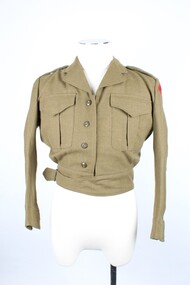 Warrnambool RSL Sub Branch
Uniform - Army, Jacket, C1968
... side. There are two patch pockets on the front have a box pleat down the middle and a V shaped pocket flap at the top, closing with a hidden button. The shoulder epaulets each have a plain khaki coloured button at the neck edge.The sleeves are cuffed fastened with a button however the right button is missing.There are red patches on each shoulder with navy blue text. The back of the jacket has darts stitched at the waist and at shoulder level. There are four...side. There are two patch pockets on the front have a box pleat down the middle and a V shaped pocket flap at the top, closing with a hidden button. The shoulder epaulets each have a plain khaki coloured button at the neck edge.The sleeves are cuffed fastened with a button however the right button is missing.There are red patches on each shoulder with navy blue text. The back of the jacket has darts stitched at the waist and at shoulder level. There are four ...This uniform belonged to Sapper Hughes 3795948 of the Royal Australian Engineers Corps. By the date on the uniform, it is assumed that he served C 1968.This uniform has significance as an example of uniform worn by soldier ranks for daily work and dress parades.Khaki coloured short jacket with lapels, and waist band which has strap and buckle on right hand side. There are two patch pockets on the front have a box pleat down the middle and a V shaped pocket flap at the top, closing with a hidden button. The shoulder epaulets each have a plain khaki coloured button at the neck edge.The sleeves are cuffed fastened with a button however the right button is missing.There are red patches on each shoulder with navy blue text. The back of the jacket has darts stitched at the waist and at shoulder level. There are four khaki buttons down the front. The sleeve seams are bound in cotton tape which also forms a label on the back neck collar with the lining of the waist band also in a cotton twill.Stitched in navy blue on arm banners,” Royal Australian Engineers.” On inner label, “ DUNLOP NSW 1968 8405-66-025-6411 SIZE OF CHEST 35/36S MATCHING TROUSERS 29/30S WAIST DRY CLEAN ONLY CREASE UPPER HALF OF LAPELS ONLY . NAME....HUGHES ( in blue pen) ARMY NO... 3795948 (in blue pen)warrnambool rsl, royal australian engineers, hughes 3795948 -
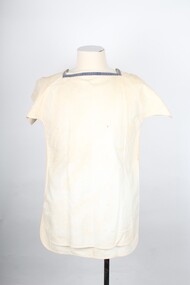 Warrnambool RSL Sub Branch
Uniform - Royal Australian Navy (RAN), Berlei Ltd, Naval Ratings Shirt
... four parts. The uniform is representative of the Royal Australian Navy uniform and can be traced to the Royal Navy (England). The complete uniform shows the connection between Australia and England since European settlement. navy naval ratings uniform ran royal australian navy j.m. parsons j parsons parsons military uniform naval ratings shirt shirt Owners name printed in capitals on the lower part of the back exterior fabric: "J.M.PARSONS" White cotton short sleeved shirt with blue trimming around a square neckline. There are two slits on either side of the base of the shirt with rounded edges. There is a label stitched ...The Royal Australian Navy Uniforms are based on the uniform of the Royal Navy. They reflect traditions that can be traced back to the Royal Navy (England) and demonstrate the relationship between the two. This shirt is one of four parts to a Naval Ratings Uniform which was presumably owned by J.M. Parsons.This shirt is one part of a naval ratings uniform which consists of four parts. The uniform is representative of the Royal Australian Navy uniform and can be traced to the Royal Navy (England). The complete uniform shows the connection between Australia and England since European settlement.White cotton short sleeved shirt with blue trimming around a square neckline. There are two slits on either side of the base of the shirt with rounded edges. There is a label stitched in the top/centre of the interior back of the shirt.Owners name printed in capitals on the lower part of the back exterior fabric: "J.M.PARSONS"navy, naval ratings uniform, ran, royal australian navy, j.m. parsons, j parsons, parsons, military uniform, naval ratings shirt, shirt -
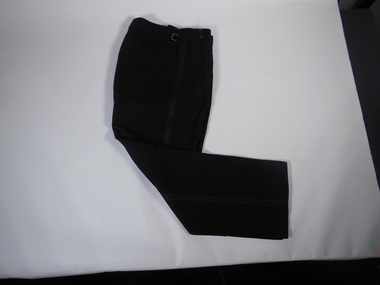 Bendigo Historical Society Inc.
Clothing - Trousers
... side by belt/buckle attachments. Trousers fasten with two buttons and there are four buttons at the fly opening at front. There are two deep lined pockets either side and one top pocket at rear on LHS. There is a maker's label stitched...side by belt/buckle attachments. Trousers fasten with two buttons and there are four buttons at the fly opening at front. There are two deep lined pockets either side and one top pocket at rear on LHS. There is a maker's label stitched ...In about 1888 William George Ashman (1871-11/2/1944) began a tailoring business in High Street, Eaglehawk. In 1890 he admitted his brother Arthur Thomas Ashman to the business and they traded as Ashman Brothers. In 1936 the company of Ashman and sons was registered at 265 Hargreaves Street. They specialised in made to measure, hand tailored suits. William married Clara Hunkin (1871-25/11/1944) in 1894. Their sons, John, Eric, Basil and Charles followed into the family business.Woolen fabric trousers, part of Dress Suit. A decorative strip runs down each leg. The waistband can be adjusted on either side by belt/buckle attachments. Trousers fasten with two buttons and there are four buttons at the fly opening at front. There are two deep lined pockets either side and one top pocket at rear on LHS. There is a maker's label stitched to the lining of the Rear pocket which reads "Ashmans, Hargreaves Street, Bendigo 'The Home of Better Suits'". A name written in ink below the maker's label is 'Mr M. Suurpaa, 28-3-1961 7252." Leather strips have been sewn inside edge of each leg cuff for garment protection.men's clothing, formal wear, trousers -
 Bendigo Historical Society Inc.
Clothing - ANDREW - MONSANT COLLECTION: LADIES PETTICOAT, Early 1900's
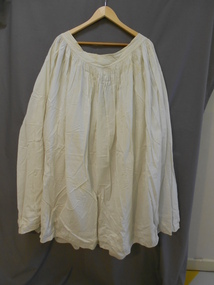
... Back section of waistband has horizontal stitching to form casings for four narrow cotton ties. Ties extend from hips on either side across the back opening to be used for tightening and closing the opening. ...Back section of waistband has horizontal stitching to form casings for four narrow cotton ties. Ties extend from hips on either side across the back opening to be used for tightening and closing the opening. ...BHS CollectionWhite cotton full length ladies petticoat. Made of five pieces - two at the back, three at the front. Back opening. Very tightly gathered onto a waistband (4cm). Back section of waistband has horizontal stitching to form casings for four narrow cotton ties. Ties extend from hips on either side across the back opening to be used for tightening and closing the opening. Lower edge finished with cotton cord. Two small frills above hemline.costume, female, cotton full length petticoat. -
 Bendigo Historical Society Inc.
Clothing - SAGE COLOURED SILK LONG SLEEVED DRESS, Silk long Sleeved Dress, 1880-1890's
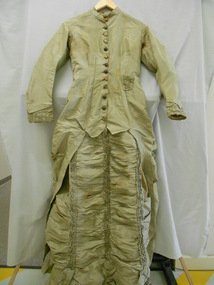
... four panels. The two centre panels extend below waist to to two points. The centre skirt panel is attached under the centre two panels and is gathered by five deep pleats to form a bustle effect extending to a long train. Front centre panel has horizontal gathering with ruched frills in centre, and at sides. Side panels overlap front centre panel. Hemline has pleated frill above the hem which is finished with cord. Skirt is lined with an open weave, brown cotton fabric. Bodice is lined with brown polished cotton. Hand stitched...four panels. The two centre panels extend below waist to to two points. The centre skirt panel is attached under the centre two panels and is gathered by five deep pleats to form a bustle effect extending to a long train. Front centre panel has horizontal gathering with ruched frills in centre, and at sides. Side panels overlap front centre panel. Hemline has pleated frill above the hem which is finished with cord. Skirt is lined with an open weave, brown cotton fabric. Bodice is lined with brown polished cotton. Hand stitched ...BHS CollectionSage coloured silk long sleeved dress. One piece full length dress. Full length side panels from shoulder to hem. Front of bodice extends below waist line to form two points on either side of front opening. Front opening is fastened with twelve fabric buttons (1-5cm) and button holes. Small standup collar(3cm) fastened at throat with hook and eye. Bodice shaped with two darts on either side of front opening. Small ruched pocket on LHS of bodice at waist level. Long narrow fitted sleeves shaped at the elbow. Decorative cuffs at wrists of ruched frilling (8cm) with triangularturned flap on top edge at back of cuff. Back of dress has four panels. The two centre panels extend below waist to to two points. The centre skirt panel is attached under the centre two panels and is gathered by five deep pleats to form a bustle effect extending to a long train. Front centre panel has horizontal gathering with ruched frills in centre, and at sides. Side panels overlap front centre panel. Hemline has pleated frill above the hem which is finished with cord. Skirt is lined with an open weave, brown cotton fabric. Bodice is lined with brown polished cotton. Hand stitched and machine stitched.costume, female, sage coloured silk dress -
 Bendigo Historical Society Inc.
Clothing - HANRO COLLECTION: PURE WOOL JACKET AND SKIRT
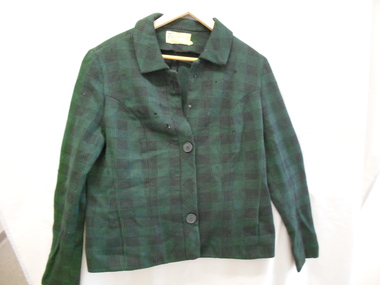
... four pieces. Front of jacket made of three pieces on each side to form shaping. Pockets inserted to seams at waist level on both sides of the jacket. Long sleeves tapering to wrist. Pure wool. Black and green, woven in a check design A-line skirt, with a long stitched...four pieces. Front of jacket made of three pieces on each side to form shaping. Pockets inserted to seams at waist level on both sides of the jacket. Long sleeves tapering to wrist. Pure wool. Black and green, woven in a check design A-line skirt, with a long stitched ...BHS CollectionPure wool black and dark green check pattern suit jacket. Single-breasted fastened with three buttons (2.4cm diameter) and two press studs. Buttonholes on a placket, of fabric cut diagonally. Classic collar. Top button at throat. Back of jacket made from four pieces. Front of jacket made of three pieces on each side to form shaping. Pockets inserted to seams at waist level on both sides of the jacket. Long sleeves tapering to wrist. Pure wool. Black and green, woven in a check design A-line skirt, with a long stitched down ''plackett'' effect of fabric cut diagonally, opening to a pleat, just left of centre front.Label inside back neck, ''Hanro tailored by franchise from Handschin and Ronus Ltd Switzerland. 100% wool. 18.costume, female, hanro pure wool jacket -
 Bendigo Historical Society Inc.
Clothing - FRIEDA KAHLAND COLLECTION: BLACK SILK SATIN DRESS, 1920-30's
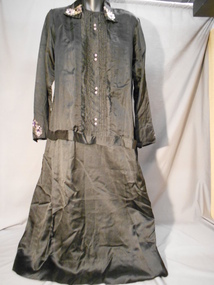
... stitched dress. Dropped waist with bans 3.5 cm wide across front. Pleat from neckline to dropped waist, 2.5 cm wide and fastened down by four groupings of two one cm diameter buttons, mauve in colour. Four rows of narrow pin tucks each side...stitched dress. Dropped waist with bans 3.5 cm wide across front. Pleat from neckline to dropped waist, 2.5 cm wide and fastened down by four groupings of two one cm diameter buttons, mauve in colour. Four rows of narrow pin tucks each side ...Black silk-satin machine stitched dress. Dropped waist with bans 3.5 cm wide across front. Pleat from neckline to dropped waist, 2.5 cm wide and fastened down by four groupings of two one cm diameter buttons, mauve in colour. Four rows of narrow pin tucks each side of centre front and one tuck one cm wide on outer side of pintucks. Six press stud fasteners concealed under left hand tuck. Fold down collar, with two silk embroidered flowers appliquéd at collar fronts. Three quarter length sleeves slit at lower edge, and trimmed with two mauve buttons and two silk flowers appliquéd at each lower edge. Four knife pleats at each side of front skirt/ Back straight through from shoulders.garments from the Executors of the late Frieda Kahland 11400.122,11400.364, 11400.365, 11400.366.. Donated by A.L.Lienhop of Harcourt.costume, female, black silk-satin dress -
 Bendigo Historical Society Inc.
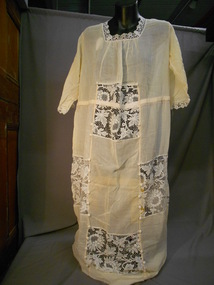
Clothing - KARL JACKSON COLLECTION: LADIES TEA DRESS, Ladies Tea Dress, 1920 -30's
... Skirt has four panels of fabric - two side panels extending around front and back, and centre panels at front and back. French seams - some stitched...Skirt has four panels of fabric - two side panels extending around front and back, and centre panels at front and back. French seams - some stitched ...Research suggests that this dress dates from the early 1920's when elastic was first used in clothing.Deep cream cotton muslin ladies tea dress. High waisted, square neckline, elbow length sleeves edged in cotton lace. Skirt has four panels of fabric - two side panels extending around front and back, and centre panels at front and back. French seams - some stitched in pink thread - machine stitched. Centre panels have two rectangular inserts of cotton lace. Each side panel has one rectangular insert of cotton lace. Lace inserts are edged on sides with six ball passementerie buttons. Neckline and sleeves edged with cream cotton lace. Soft gathering from neckline of centre front and back. Elastic casing around waist.costume, female, ladies tea dress -
 Bendigo Historical Society Inc.
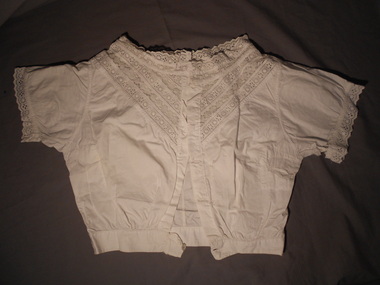
Clothing - CAMISOLE
... side , four on the right hand side. Cotton high neck. Deep Vee lace front 5 buttons, metal, covered with fabric(one missing). Bodice gathered onto a waistband at front, three back panels join waistband at back. Hand stitched...side , four on the right hand side. Cotton high neck. Deep Vee lace front 5 buttons, metal, covered with fabric(one missing). Bodice gathered onto a waistband at front, three back panels join waistband at back. Hand stitched ...BHS CollectionCamisole. Round neck,edged with cut work lace. V shaped panel below the neckline, made with alternating bands 2.5cm wide, of cut work and woven lace five on one side , four on the right hand side. Cotton high neck. Deep Vee lace front 5 buttons, metal, covered with fabric(one missing). Bodice gathered onto a waistband at front, three back panels join waistband at back. Hand stitched button holes.costume, female, underwear
