
Showing 22 items matching "george ramsden"
-
 Kew Historical Society Inc
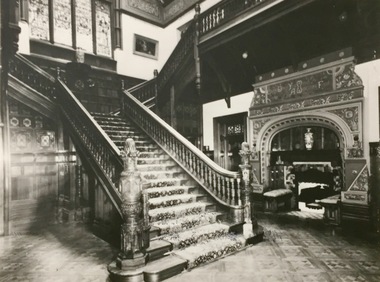
Photograph - Staircase in the Main Hall of 'Tara Hall', Kew, Marc Strizic, c.1960
... byram, tara hall, lowan, goathland, edward g. kilburn (architect), george ramsden...Edward George Kilburn, of Ellerker & Kilburn, designed 'Byram' (later renamed 'Goathland', 'Lowa' and 'Tara Hall') for the industrialist George Ramsden in 1888. The mansion, one of the most significant in Kew, was demolished in 1960....Donated by Grandson [Peter Ramsden] of original owner George Ramsden. Home was also called Goathlands [sic] during its ownership by Sir Malcolm McEacharn. ...Donated by Grandson [Peter Ramsden] of original owner George Ramsden. Home was also called Goathlands [sic] during its ownership by Sir Malcolm McEacharn. ...Edward George Kilburn, of Ellerker & Kilburn, designed 'Byram' (later renamed 'Goathland', 'Lowa' and 'Tara Hall') for the industrialist George Ramsden in 1888. The mansion, one of the most significant in Kew, was demolished in 1960.This is an original small photograph of this historic Kew mansion with provenance by descent from the first owners of the house.An angled view of the main hallway and staircase of Tara Hall (previously named Byram, Goathland and Lowan). To the right of the staircase in this Studley Park Road mansion, was a large inglenook fireplace surrounded by stucco decoration. The latter was a characteristic of the architect, Edward G. Kilburn’s late style.Inscription reverse: "Interior Tara Hall, demolished 1960. Donated by Grandson [Peter Ramsden] of original owner George Ramsden. Home was also called Goathlands [sic] during its ownership by Sir Malcolm McEacharn. Other owners - Mrs F Treadway, Count O'Loughlin, Dr Edward Ryan, Mrs Evans, Royal Womens' Hosp. KH-324"byram, tara hall, lowan, goathland, edward g. kilburn (architect), george ramsden -
 Kew Historical Society Inc
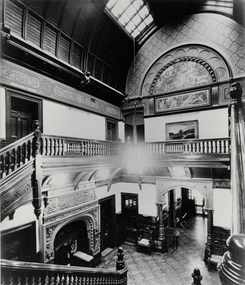
Photograph - Central Hall, 'Tara Hall', Studley Park Road, Marc Strizic, c.1960
... byram, goathland, tara hall, lowan, studley park (kew), george ramsden, sir malcolm mceacharn, edward george kilburn (architect), studley park road (kew)...This photograph provides the clearest evidence of the scale and building materials selected by Edward George Kilburn, of Ellerker & Kilburn, for the industrialist George Ramsden in 1888. These include the murals on the second floor, the use of skylights, and the vaulted wooden panelling. ...This is one of the photographs donated to KHS by the author. byram, goathland, tara hall, lowan, studley park (kew), george ramsden, sir malcolm mceacharn, edward george kilburn (architect), studley park road (kew) Central Hall, Tara Hall, circa 1957. ...'Lost Glories: a memorial to forgotten Australian buildings' was published by David Latta in 1986. It tells the story of a number of significant Australian buildings that had previously been demolished. A chapter in the book was devoted to Goathland, later known as Tara Hall. To supplement the text, he sourced photographs from a range of suppliers, chiefly the Royal Women's Hospital which had once owned Tara Hall, but had sold it in 1960. This is one of the photographs donated to KHS by the author.Central Hall, Tara Hall, circa 1957. The central hallway and grand staircase of Tara Hall (previously named Byram, Goathland and Lowan). This photograph provides the clearest evidence of the scale and building materials selected by Edward George Kilburn, of Ellerker & Kilburn, for the industrialist George Ramsden in 1888. These include the murals on the second floor, the use of skylights, and the vaulted wooden panelling. byram, goathland, tara hall, lowan, studley park (kew), george ramsden, sir malcolm mceacharn, edward george kilburn (architect), studley park road (kew) -
 Kew Historical Society Inc
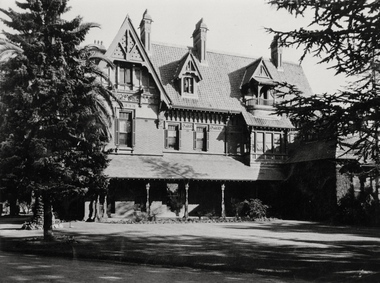
Photograph - 'Tara Hall', Studley Park Road, Marc Strizic (attrib), c.1960
... byram, goathland, tara hall, lowan, studley park (kew), george ramsden, sir malcolm mceacharn, edward george kilburn (architect), studley park road (kew)...Kilburn, of Ellerker & Kilburn, designed Byram for the industrialist George Ramsden in 1888. ...Kilburn, of Ellerker & Kilburn, designed Byram for the industrialist George Ramsden in 1888. Photograph 'Tara Hall', Studley Park Road Marc Strizic (attrib) ...'Lost Glories: a memorial to forgotten Australian buildings' was published by David Latta in 1986. It tells the story of a number of significant Australian buildings that had previously been demolished. A chapter in the book was devoted to Goathland, later known as Tara Hall. To supplement the text, he sourced photographs from a range of suppliers, chiefly the Royal Women's Hospital which had once owned Tara Hall, but had sold it in 1960. This is one of the photographs donated to KHS by the author.Tara Hall, Studley Park Road, circa 1957. The front of Tara Hall (previously named Byram, Goathland and Lowan). This triple-storey mansion with its elaborate gabled, steeply-pitched roofs and verandah was set back from Studley Park Road and concealed by a high brick fence. E. G. Kilburn, of Ellerker & Kilburn, designed Byram for the industrialist George Ramsden in 1888. Typed inscription on reverse: "Tara Hall at the time it was a home for nurses from the Royal Women's Hospital, Melbourne. (Royal Women's Hospital, Melbourne)."byram, goathland, tara hall, lowan, studley park (kew), george ramsden, sir malcolm mceacharn, edward george kilburn (architect), studley park road (kew) -
 Kew Historical Society Inc
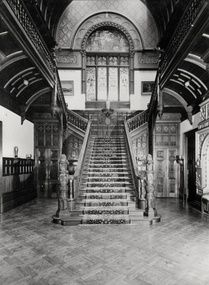
Photograph - Grand Staircase, Tara Hall', Studley Park Road, Marc Strizic (attrib), c.1960
... byram, goathland, tara hall, lowan, studley park (kew), george ramsden, sir malcolm mceacharn, edward george kilburn (architect), studley park road (kew)...Edward George Kilburn, of Ellerker & Kilburn, designed this Studley Park Road mansion, of which the hallway was a significant feature, for the industrialist George Ramsden in 1888. Tara Hall, one of the great houses in Kew was demolished in 1959-60. ...Edward George Kilburn, of Ellerker & Kilburn, designed this Studley Park Road mansion, of which the hallway was a significant feature, for the industrialist George Ramsden in 1888. Tara Hall, one of the great houses in Kew was demolished in 1959-60. ...'Lost Glories: a memorial to forgotten Australian buildings' was published by David Latta in 1986. It tells the story of a number of significant Australian buildings that had previously been demolished. A chapter in the book was devoted to Goathland, later known as Tara Hall. To supplement the text, he sourced photographs from a range of suppliers, chiefly the Royal Women's Hospital which had once owned Tara Hall, but had sold it in 1960. This is one of the photographs donated to KHS by the author. The Grand Staircase of Tara Hall, circa 1957. The central hallway and stairs of Tara Hall, (previously named Byram, Goathland and Lowan). Edward George Kilburn, of Ellerker & Kilburn, designed this Studley Park Road mansion, of which the hallway was a significant feature, for the industrialist George Ramsden in 1888. Tara Hall, one of the great houses in Kew was demolished in 1959-60. Possibly Marc Strizic, photographer (1928-2012). Typed inscription on reverse: "The Grand Staircase of Tara Hall (Royal Women's Hospital, Melbourne).byram, goathland, tara hall, lowan, studley park (kew), george ramsden, sir malcolm mceacharn, edward george kilburn (architect), studley park road (kew) -
 Kew Historical Society Inc
Photograph - 'Tara Hall', Studley Park Road, 1890-1900
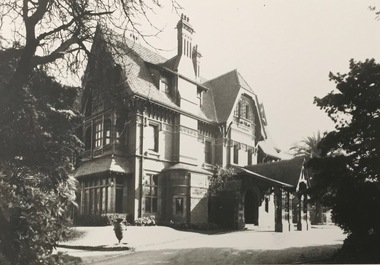
... byram, tara hall, lowan, goathland, edward g. kilburn (architect), george ramsden...Edward George Kilburn, of Ellerker & Kilburn, designed Byram for the industrialist George Ramsden in 1888....Edward George Kilburn, of Ellerker & Kilburn, designed Byram for the industrialist George Ramsden in 1888. This is an original small photograph of this historic Kew mansion with provenance by descent from the first owners of the house. byram, tara hall, lowan, goathland, edward g. kilburn (architect), george ramsden Inscription reverse: KH-323 Tara Hall once stood on Studley Pk Road on vast landscaped gardens. ...During construction, commentators described the house as being in the ‘Elizabethan style’. The architectural style of the exterior, with its innovatory use of red brick and Italian tiles was more influenced by American models. Edward George Kilburn, of Ellerker & Kilburn, designed Byram for the industrialist George Ramsden in 1888.This is an original small photograph of this historic Kew mansion with provenance by descent from the first owners of the house.The main entrance to Tara Hall (previously named Byram, Goathland and Lowan). The entrance, through a porte-cochère, was located on the east side of the house. Inscription reverse: KH-323 Tara Hall once stood on Studley Pk Road on vast landscaped gardens. Donated by Mr Peter Ramsden, 49 Kamilaroy Road, West Pymble 2073 N.S.W. Dec.1979."byram, tara hall, lowan, goathland, edward g. kilburn (architect), george ramsden -
 Kew Historical Society Inc
Photograph - Drawing Room, 'Tara Hall', Studley Park Road, Marc Strizic (attrib), c.1960
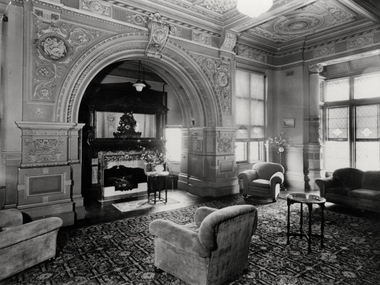
... byram, goathland, tara hall, lowan, studley park (kew), george ramsden, sir malcolm mceacharn, edward george kilburn (architect), studley park road (kew)...Kilburn, of Ellerker & Kilburn, designed Byram for the industrialist George Ramsden in 1888. ...Kilburn, of Ellerker & Kilburn, designed Byram for the industrialist George Ramsden in 1888. Photograph Drawing Room, 'Tara Hall', Studley Park Road Marc Strizic (attrib) ...'Lost Glories: a memorial to forgotten Australian buildings' was published by David Latta in 1986. It tells the story of a number of significant Australian buildings that had previously been demolished. A chapter in the book was devoted to Goathland, later known as Tara Hall. To supplement the text, he sourced photographs from a range of suppliers, chiefly the Royal Women's Hospital which had once owned Tara Hall, but had sold it in 1960. This is one of the photographs donated to KHS by the author. The Drawing Room, Tara Hall, circa 1957. A reception room in Tara Hall (previously named Byram, Goathland and Lowan). The room is presumed to be the original drawing room. In the La Trobe collection, there is a drawing by Charlie Hammond, depicting a group of painters who are gilding the elaborate stucco ceiling of this room. The drawing is dated 16 September 1889. The elaborate stucco decoration is characteristic of E. G. Kilburn’s late style. Kilburn, of Ellerker & Kilburn, designed Byram for the industrialist George Ramsden in 1888. Typed inscription on reverse: "A sitting room, one of many handsomely decorated rooms at Tara Hall.( Royal Women's Hospital, Melbourne)."byram, goathland, tara hall, lowan, studley park (kew), george ramsden, sir malcolm mceacharn, edward george kilburn (architect), studley park road (kew) -
 Kew Historical Society Inc
Archive (Sub-series) - Subject File, Clifton House [Studley Park Road], 1958
... Archive file containing a transcribed copy of a sale notice from 1867 of Clifton House, later demolished by George Ramsden to build Byram (aka Goathland, Tara Hall etc)....Archive file containing a transcribed copy of a sale notice from 1867 of Clifton House, later demolished by George Ramsden to build Byram (aka Goathland, Tara Hall etc). ...Various partiesReference, Research, InformationSecondary Values (KHS Imposed Order)Subject file containing a transcribed copy of a sale notice from 1867 of Clifton House, later demolished by George Ramsden to build Byram (aka Goathland, Tara Hall etc).houses -- kew (vic.), clifton house, stevenson brothers, studley park road -- kew (vic.)houses -- kew (vic.), clifton house, stevenson brothers, studley park road -- kew (vic.) -
Kew Historical Society Inc
Archive (series) - Subject File, Kew Historical Society et al, 'Iveagh', Studley Park Road, 1993
... ...george ramsden...Typically files will contain primary and secondary sources. kew historical society - archives kew - history pallotine fathers iveagh - 169 studley park road - kew (vic) john bakewell richard goldsborough william de graves john mckenzie john miller thomas greenwood thomas nankivell george ramsden patrick mcginnis studley heights estate Archive file containing a 16-page manuscript recording the history of Iveagh in Studley Park Road, Kew from the earliest land sales to the ownership of the house by the Pallottine Fathers. ...Various partiesReference, Research, InformationSecondary Values (KHS Imposed Order)Subject file containing a 16-page manuscript recording the history of Iveagh in Studley Park Road, Kew from the earliest land sales to the ownership of the house by the Pallottine Fathers. Jean-Marie Labdanum and Dorothy Lyons created the manuscript in 1993 as part of a school research project. [There is also an article in KHS Newsletter 107, June 2014 by Kerry Fairbank on the history of the building].kew historical society - archives, kew - history, pallotine fathers, iveagh - 169 studley park road - kew (vic), john bakewell, richard goldsborough, william de graves, john mckenzie, john miller, thomas greenwood, thomas nankivell, george ramsden, patrick mcginnis, studley heights estatekew historical society - archives, kew - history, pallotine fathers, iveagh - 169 studley park road - kew (vic), john bakewell, richard goldsborough, william de graves, john mckenzie, john miller, thomas greenwood, thomas nankivell, george ramsden, patrick mcginnis, studley heights estate -
 Kew Historical Society Inc
Photograph - Staircase of 'Tara Hall', Studley Park Road, Marc Strizic (attrib), c.1960
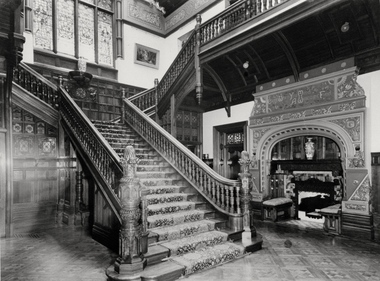
... byram, goathland, tara hall, lowan, studley park (kew), george ramsden, sir malcolm mceacharn, edward george kilburn (architect), studley park road (kew)...This is one of the photographs donated to KHS by the author. byram, goathland, tara hall, lowan, studley park (kew), george ramsden, sir malcolm mceacharn, edward george kilburn (architect), studley park road (kew) Typed inscription on reverse: "The Staircase at Tara Hall. ...'Lost Glories: a memorial to forgotten Australian buildings' was published by David Latta in 1986. It tells the story of a number of significant Australian buildings that had previously been demolished. A chapter in the book was devoted to Goathland, later known as Tara Hall. To supplement the text, he sourced photographs from a range of suppliers, chiefly the Royal Women's Hospital which had once owned Tara Hall, but had sold it in 1960. This is one of the photographs donated to KHS by the author. The Staircase at Tara Hall, circa 1957. An angled view of the main hallway and staircase of Tara Hall (previously named Byram, Goathland and Lowan). To the right of the staircase in this Studley Park Road mansion, a large inglenook fireplace was located, which was surrounded by stucco decoration. The latter was a characteristic of E. G. Kilburn’s late style.Typed inscription on reverse: "The Staircase at Tara Hall. Above the ornate fireplace is the legend 'Come When You Mind, A Welcome Find'. (Royal Women's Hospital, Melbourne)." byram, goathland, tara hall, lowan, studley park (kew), george ramsden, sir malcolm mceacharn, edward george kilburn (architect), studley park road (kew) -
 Kew Historical Society Inc
Photograph - Gable, 'Tara Hall', Studley Park Road, Marc Strizic, c.1960
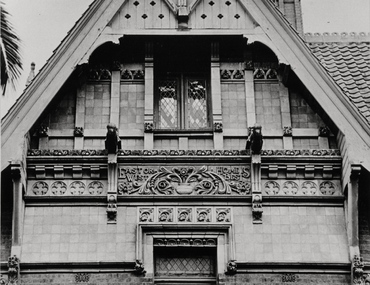
... byram, goathland, tara hall, lowan, studley park (kew), george ramsden, sir malcolm mceacharn, edward george kilburn (architect), studley park road (kew)...This is one of the photographs donated to KHS by the author. byram, goathland, tara hall, lowan, studley park (kew), george ramsden, sir malcolm mceacharn, edward george kilburn (architect), studley park road (kew) A detailed photograph of the main gable on the front of Tara Hall (previously named Byram, Goathland and Lowan). ...'Lost Glories: a memorial to forgotten Australian buildings' was published by David Latta in 1986. It tells the story of a number of significant Australian buildings that had previously been demolished. A chapter in the book was devoted to Goathland, later known as Tara Hall. To supplement the text, he sourced photographs from a range of suppliers, chiefly the Royal Women's Hospital which had once owned Tara Hall, but had sold it in 1960. This is one of the photographs donated to KHS by the author.A detailed photograph of the main gable on the front of Tara Hall (previously named Byram, Goathland and Lowan). The façade included detailed terra cotta mouldings. The Kew Historical Society was gifted a remnant of this façade (ie. ‘East or West’) in 2013. The use of applied terra cotta decoration by the architect Edward George Kilburn, of Ellerker & Kilburn, is typical of his style of the period. Mark Strizic (1928-2012), photographer. byram, goathland, tara hall, lowan, studley park (kew), george ramsden, sir malcolm mceacharn, edward george kilburn (architect), studley park road (kew) -
 Kew Historical Society Inc
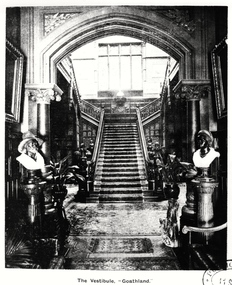
Photograph, The Vestibule, 'Goathland', 1901-1911
... byram, goathland, tara hall, lowan, studley park (kew), george ramsden, sir malcolm mceacharn, edward george kilburn (architect), studley park road (kew)...This is one of the photographs donated to KHS by the author. byram, goathland, tara hall, lowan, studley park (kew), george ramsden, sir malcolm mceacharn, edward george kilburn (architect), studley park road (kew) The Vestibule - "Goathland" The Vestibule, Goathland', 1901-11. ...'Lost Glories: a memorial to forgotten Australian buildings' was published by David Latta in 1986. It tells the story of a number of significant Australian buildings that had previously been demolished. A chapter in the book was devoted to Goathland, later known as Tara Hall. To supplement the text, he sourced photographs from a range of suppliers, chiefly the Royal Women's Hospital which had once owned Tara Hall, but had sold it in 1960. This is one of the photographs donated to KHS by the author.The Vestibule, Goathland', 1901-11. The vestibule of Tara Hall (originally Byram, and later Goathland and Lowan). The vestibule was entered through a porte-cochère on the east side of the house. Visitors entered the mansion through the vestibule before progressing to the main hallway. The main rooms of the house were accessed through the latter on the ground and first floor. The photograph gives some idea of the decorative style of furnishings during this era. The Vestibule - "Goathland"byram, goathland, tara hall, lowan, studley park (kew), george ramsden, sir malcolm mceacharn, edward george kilburn (architect), studley park road (kew) -
 Kew Historical Society Inc
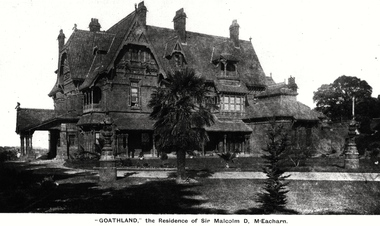
Photograph, 'Goathland', The Residence of Sir Malcolm D McEacharn, 1901-1911
... The architect, Edward Kilburn designed Byram in the Arts & Crafts style for the industrialist George Ramsden. Construction began in 1888 and was reputed to have lasted three years. ...Edward George Kilburn, of Ellerker & Kilburn, had originally designed the house for the industrialist George Ramsden in 1888. When Sir Malcolm McEacharn purchased Byram, he was to rename it as Goathland. ...The architect, Edward Kilburn designed Byram in the Arts & Crafts style for the industrialist George Ramsden. Construction began in 1888 and was reputed to have lasted three years. ...The architect, Edward Kilburn designed Byram in the Arts & Crafts style for the industrialist George Ramsden. Construction began in 1888 and was reputed to have lasted three years. The mansion had frontages to Studley Park Road and Stevenson Street, including gardens laid out with great taste, including pleasure grounds, tennis lawn, fruit and flower garden, and paddock.The size of many of the trees in the garden indicate that many survived from the garden of Clifton Villa, the previous single-storeyed house built on the site by the Stevenson brothers. Byram had views to Melbourne and Port Phillip Bay. The house was demolished in 1960, despite opposition from the National Trust (Victoria), and its gardens subdivided into residential allotments.An early photograph of Goathland (also known as Byram, Lowan and Tara Hall). The photo shows the front of the building during the period of Sir Malcolm McEacharn’s occupation of the house (1901-11). Edward George Kilburn, of Ellerker & Kilburn, had originally designed the house for the industrialist George Ramsden in 1888. When Sir Malcolm McEacharn purchased Byram, he was to rename it as Goathland. This has led to some confusion, as Goathland was also the name used for McEacharn’s other home in St. Kilda. The period of McEacharn’s ownership represented the high point of the mansion’s history. 'Lost Glories: a memorial to forgotten Australian buildings' was published by David Latta in 1986. It tells the story of a number of significant Australian buildings that had previously been demolished. A chapter in the book was devoted to Goathland, later known as Tara Hall. To supplement the text, he sourced photographs from a range of suppliers, chiefly the Royal Women's Hospital which had once owned Tara Hall, but had sold it in 1960. This is one of the photographs donated to KHS by the author."'Goathland', The Residence of Sir Malcolm D McEacharn"byram, goathland, tara hall, lowan, studley park road -- kew (vic.), melbourne mansions, e g kilburn - architect -
 Kew Historical Society Inc
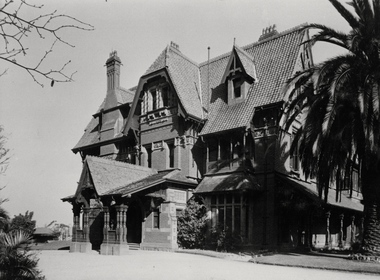
Photograph - Porte-cochere, 'Tara Hall', Studley Park Road, Marc Strizic (attrib), c.1960
... Edward George Kilburn, of Ellerker & Kilburn, designed Byram for the industrialist George Ramsden in 1888. ...Edward George Kilburn, of Ellerker & Kilburn, designed Byram for the industrialist George Ramsden in 1888. Photograph Porte-cochere, 'Tara Hall', Studley Park Road Marc Strizic (attrib) ...'Lost Glories: a memorial to forgotten Australian buildings' was published by David Latta in 1986. It tells the story of a number of significant Australian buildings that had previously been demolished. A chapter in the book was devoted to Goathland, later known as Tara Hall. To supplement the text, he sourced photographs from a range of suppliers, chiefly the Royal Women's Hospital which had once owned Tara Hall, but had sold it in 1960. This is one of the photographs donated to KHS by the author. Porte-cochere, Tara Hall, circa 1957. The main entrance to Tara Hall (previously named Byram, Goathland and Lowan). The entrance, through a porte-cochère, was located on the side of the house facing east. During construction, commentators described the house as being in the ‘Elizabethan style’. The architectural style of the exterior, with its innovatory use of red brick and Italian tiles was more influenced by American models. Edward George Kilburn, of Ellerker & Kilburn, designed Byram for the industrialist George Ramsden in 1888. Typed inscription on reverse: "Goathland, also known as Tara Hall (Royal Women's Hospital, Melbourne)."goathland -- kew (vic), byram -- kew (vic), tara hall - kew (vic), studley park road -
 Kew Historical Society Inc
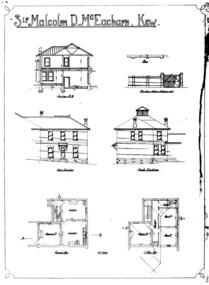
Drawing - Architectural Drawings [copy], William Pitt, Sir Malcolm D. McEacharn, Kew, 1901
... Pitt had previously worked with the original architect of the house, Edward George Kilburn, of Ellerker & Kilburn, who had designed Byram for the industrialist George Ramsden in 1888. 'Lost Glories: a memorial to forgotten Australian buildings' was published by David Latta in 1986. ...Pitt had previously worked with the original architect of the house, Edward George Kilburn, of Ellerker & Kilburn, who had designed Byram for the industrialist George Ramsden in 1888. 'Lost Glories: a memorial to forgotten Australian buildings' was published by David Latta in 1986. ...A set of architectural drawings of additions to Goathland (originally Byram, and later Goathland and Lowan). The drawings, by the architect William Pitt represent additions to the size of Goathland. Pitt had previously worked with the original architect of the house, Edward George Kilburn, of Ellerker & Kilburn, who had designed Byram for the industrialist George Ramsden in 1888. 'Lost Glories: a memorial to forgotten Australian buildings' was published by David Latta in 1986. It tells the story of a number of significant Australian buildings that had previously been demolished. A chapter in the book was devoted to Goathland, later known as Tara Hall. To supplement the text, he sourced photographs from a range of suppliers, chiefly the Royal Women's Hospital which had once owned Tara Hall, but had sold it in 1960. This is one of the photographs donated to KHS by the author.Six black and white architectural drawings by the architect William Pitt for additions to the home of Sir Malcolm McEacharn in Studley Park Road. The original is in the collection of the State Library of Victoria."Sir Malcolm D. McEacharn, Kew"william pitt, malcolm mceacharn, architects -- melbourne (vic.) -- william pitt, architectural drawings, byram, tara hall, goathland -
 Kew Historical Society Inc
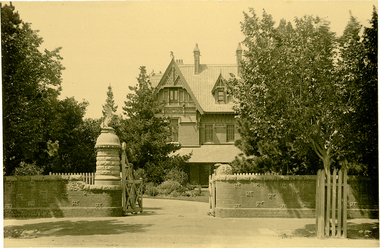
Photograph, J F C Farquhar, A View in Studley Park Road, 1891
... The architect, Edward Kilburn designed Byram in the Arts & Crafts style for the industrialist George Ramsden. Construction began in 1888 and was reputed to have lasted three years. ...The architect, Edward Kilburn designed Byram in the Arts & Crafts style for the industrialist George Ramsden. Construction began in 1888 and was reputed to have lasted three years. ...At the beginning of the 1890s, the Kew businessman and Town Councillor, Henry Kellett, commissioned J.F.C. Farquhar to photograph scenes of Kew. These scenes included panoramas as well as pastoral scenes. The resulting set of twelve photographs was assembled in an album, Kew Where We Live, from which customers could select images for purchase.The preamble to the album describes that the photographs used the ‘argentic bromide’ process, now more commonly known as the gelatine silver process. This form of dry plate photography allowed for the negatives to be kept for weeks before processing, hence its value in landscape photography. The resulting images were considered to be finely grained and everlasting. Evidence of the success of Henry Kellett’s venture can be seen today, in that some of the photographs are held in national collections.It is believed that the Kew Historical Society’s copy of the Kellett album is unique and that the photographs in the book were the first copies taken from the original plates. It is the first and most important series of images produced about Kew. The individual images have proved essential in identifying buildings and places of heritage value in the district.This is the earliest known photograph of the exterior of Byram (later Tara Hall). It shows the original red brick fence, its asymmetrical gate and gateposts, with a large terra cotta gargoyle surmounting the higher of the two. The architect, Edward Kilburn designed Byram in the Arts & Crafts style for the industrialist George Ramsden. Construction began in 1888 and was reputed to have lasted three years. The mansion had frontages to Studley Park Road and Stevenson Street, including gardens laid out with great taste, including pleasure grounds, tennis lawn, fruit and flower garden, and paddock. The size of many of the trees in the garden indicate that many survived from the garden of Clifton Villa, the previous single-storeyed house built on the site by the Stevenson brothers. Byram had views to Melbourne and Port Phillip Bay. The house was demolished in 1960, despite opposition from the National Trust (Victoria), and its gardens subdivided into residential allotments.A View in Studley Park Roadkew illustrated, kew where we live, photographic books, henry kellett, byram, tara hall, goathlands -
 Kew Historical Society Inc
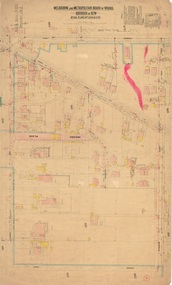
Plan, Melbourne and Metropolitan Board of Works, Melbourne & Metropolitan Board of Works : Borough of Kew : Detail Plan No.1294 & 1295, 1904
... Kilburn for the paper magnate George Ramsden, it was demolished in 1960. While an earlier sale of the southern section of Byram had created Tara Avenue in 1927, the demolition of the house in 1960 enabled the extension of Tara Avenue northward....Kilburn for the paper magnate George Ramsden, it was demolished in 1960. While an earlier sale of the southern section of Byram had created Tara Avenue in 1927, the demolition of the house in 1960 enabled the extension of Tara Avenue northward. ...The Melbourne and Metropolitan Board of Works (MMBW) plans were produced from the 1890s to the 1950s. They were crucial to the design and development of Melbourne's sewerage and drainage system. The plans, at a scale of 40 feet to 1 inch (1:480), provide a detailed historical record of Melbourne streetscapes and environmental features. Each plan covers one or two street blocks (roughly six streets), showing details of buildings, including garden layouts and ownership boundaries, and features such as laneways, drains, bridges, parks, municipal boundaries and other prominent landmarks as they existed at the time each plan was produced. (Source: State Library of Victoria). This plan forms part of a large group of MMBW plans and maps that was donated to the Society by the Mr Poulter, City Engineer of the City of Kew in 1989. Within this collection, thirty-five hand-coloured plans, backed with linen, are of statewide significance as they include annotations that provide details of construction materials used in buildings in the first decade of the 20th century as well as additional information about land ownership and usage. The copies in the Public Record Office Victoria and the State Library of Victoria are monochrome versions which do not denote building materials so that the maps in this collection are invaluable and unique tools for researchers and heritage consultants. A number of the plans are not held in the collection of the State Library of Victoria so they have the additional attribute of rarity.Original survey plan, issued by the MMBW to a contractor with responsibility for constructing sewers in the area identified on the plan within the Borough of Kew. The plan was at some stage hand-coloured, possibly by the contractor, but more likely by officers working in the Engineering Department of the Borough and later Town, then City of Kew. The hand-coloured sections of buildings on the plan were used to denote masonry or brick constructions (pink), weatherboard constructions (yellow), and public buildings (grey).The streets and built structures in MMBW Detail Plan 1294 & 1295 were surveyed in 1903 and released to contractors in 1904. This plan is one of two in the collection where the lithographers amalgamated two separate plans. Both plans include sections of Studley Park. Dominating the south and west corners of Kew Junction are the Clifton and Kew Hotels. The Kew Hotel, owned by Patrick O’Shaughnessy was one of the oldest in Kew. MMBW plans were amended over time to take account of new subdivisions such as that which created Merrion Place. Of the four mansions shown in Studley Park Road, three remain – ‘Field Place’, the home of Frances Henty, ‘Leaghur’ and ‘Darley’. ‘Byram’ (later ‘Goathland’, then ‘Tara Hall’) was an architectural marvel. Designed in 1888 by E.G. Kilburn for the paper magnate George Ramsden, it was demolished in 1960. While an earlier sale of the southern section of Byram had created Tara Avenue in 1927, the demolition of the house in 1960 enabled the extension of Tara Avenue northward.melbourne and metropolitan board of works, detail plans, mmbw 1294, mmbw 1295, cartography -
 Eltham District Historical Society Inc
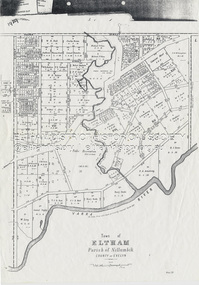
Document - Map, Victoria. Department of Crown Lands and Survey, Town of Eltham, Parish of Nillumbik, County of Evelyn, 2 October 1929
... George Stebbing...Godalmin Street...H. Peck...H.C.Whess...H.H. Farquharson...H.J. Bews...Henry Stooke...J. Goer...j. mcdonald...J. McLaren...J. Roberts...J.B. Knagers...James Irish...jane bailey (nee matthews)...John L. Smith...john mason...John Scott...John Smith...Joseph Stevenson...Joseph Verse...K. Wingrove...k.e. dunstan...Kerby Street...Kirby Street...Location TBD...M. Coman...Map...michael o'shea...O.B. McCutcheon...P. & G. Tumbull...P.K. McCaughan...p.p. cotter...Porter Street...Pound Reserve...robert hepburn...Roman Catholic Church...s. evans...samuel dagley...samuel phillips...samuel ramsden...George Stebbing Godalmin Street H. Peck H.C.Whess H.H. Farquharson H.J. Bews Henry Stooke J. Goer j. mcdonald J. McLaren J. Roberts J.B. Knagers James Irish jane bailey (nee matthews) John L. Smith john mason John Scott John Smith Joseph Stevenson Joseph Verse K. Wingrove k.e. dunstan Kerby Street Kirby Street Location TBD M. Coman Map michael o'shea O.B. McCutcheon P. & G. Tumbull P.K. McCaughan p.p. cotter Porter Street Pound Reserve robert hepburn Roman Catholic Church s. evans samuel dagley samuel phillips samuel ramsden ...Township of Eltham, Parish of Nillumbik, County of Evelyn / lithographed at the Department of Lands & Survey Melbourne 5th June 1888, amended 2 October 1929 This amendment from the 1888 original shows the reserve for the the State School marked as permanent with dimensions added to Main Road and block frontages along Main Road between Mount Pleasant Road and Dalton Street and Metery Road Possibly photocopied from a copy held at PROV by Harry Gilham whilst resaerching Eltham Primary School history in 1995.a. armstrong, a. lavard, arthur c. allan, arthur c. allen, b. bowatere, baxter street, benjamin oliver wallis, bolton steet, c. souter, c.s. hain, cemetery reserve, charles brown, charles newman, charles symons wingrove, christopher caldwell, church of england, d. anderson, dalton street, david ballard, e. james, e.m. peck, edward dumaresq, eltham town, ely street, f.e. falkiner, f.m. peck, falkiner street, flint street, g. buckingham, g. drabble, george stebbing, godalmin street, h. peck, h.c.whess, h.h. farquharson, h.j. bews, henry stooke, j. goer, j. mcdonald, j. mclaren, j. roberts, j.b. knagers, james irish, jane bailey (nee matthews), john l. smith, john mason, john scott, john smith, joseph stevenson, joseph verse, k. wingrove, k.e. dunstan, kerby street, kirby street, location tbd, m. coman, map, michael o'shea, o.b. mccutcheon, p. & g. tumbull, p.k. mccaughan, p.p. cotter, porter street, pound reserve, robert hepburn, roman catholic church, s. evans, samuel dagley, samuel phillips, samuel ramsden, t. upton, t. watkins, t.a. stark, t.c.b. batt, t.p. cross, thomas grant, thornton street, w. adam, w. blain, w. long, w. watkins, w.f. ford, w.h. hull, w.r. belcher, w.t. schultz, william thomas, eltham primary school, eltham state school, eltham state school no. 209, quarry reserve -
 Bendigo Historical Society Inc.
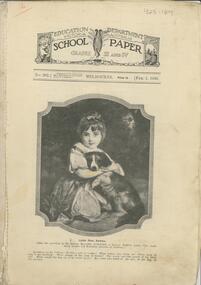
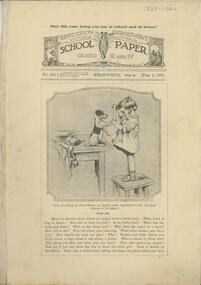
Document - BADHAM COLLECTION: SCHOOL PAPERS, 1930
... George Wallace served as the editor from 1925 to 1934 and then John Ramsden Lyall from 1934 until 1940....George Wallace served as the editor from 1925 to 1934 and then John Ramsden Lyall from 1934 until 1940. ...In the 1930s the Victorian Education Department published The School Paper monthly for primary school students.Each one featured a combination of Australian poetry, literature and imperial values. The magazines were edited by teachers. George Wallace served as the editor from 1925 to 1934 and then John Ramsden Lyall from 1934 until 1940.Document. School Papers published by Education Department, Victoria Australia. Owned by Jean Badham. Cloth bound on spine 1930 grades 3 and 4. February, March. June. July. September. December.'Education Department, Victoria, Australia. School Paper. Grades III and IV. Feb 1, 1930.'document, memo, school papers -
 Bendigo Historical Society Inc.
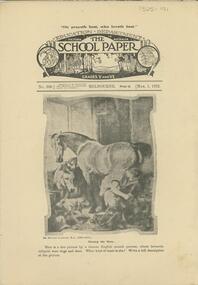
Document - BADHAM COLLECTION: SCHOOL PAPERS, 1931
... George Wallace served as the editor from 1925 to 1934 and then John Ramsden Lyall from 1934 until 1940....George Wallace served as the editor from 1925 to 1934 and then John Ramsden Lyall from 1934 until 1940. ...In the 1930s the Victorian Education Department published The School Paper monthly for primary school students. Each one featured a combination of Australian poetry, literature and imperial values. The magazines were edited by teachers. George Wallace served as the editor from 1925 to 1934 and then John Ramsden Lyall from 1934 until 1940.Document. School papers published by Education Department, Victoria, Australia. Owned by Jean Badham. Cloth bound on spine. 1931 Grades 3 and 4. February. March. June. July. August. September. November.'Education Department, Victoria, Australia. School Paper. Grades III and IV.' Pictures of Koala on left of heading, lyrebird in the centre and a possum on the right.document, memo, school papers for 1931, badham collection -
 Bendigo Historical Society Inc.
Document - BADHAM COLLECTION: SCHOOL PAPERS, 1932
... George Wallace served as the editor from 1925 to 1934 and then John Ramsden Lyall from 1934 until 1940....George Wallace served as the editor from 1925 to 1934 and then John Ramsden Lyall from 1934 until 1940. ...In the 1930s the Victorian Education Department published The School Paper monthly for primary school students. Each one featured a combination of Australian poetry, literature and imperial values. The magazines were edited by teachers. George Wallace served as the editor from 1925 to 1934 and then John Ramsden Lyall from 1934 until 1940.Document. School papers published by Education Department Victoria Australia. Owned by Jean Badham. 1932 for grades 5 and 6. March. April. May.'Education Department, Victoria, Australia. The School Paper. Grades V and VI. 1932.' Pictures on title header of Australian wildflowers and forest.document, memo, school papers for 1932., badham collection -
 Bendigo Historical Society Inc.
Document - BADHAM COLLECTION: SET OF SCHOOL PAPERS, 1933-34
... George Wallace served as the editor from 1925 to 1934 and then John Ramsden Lyall from 1934 until 1940....George Wallace served as the editor from 1925 to 1934 and then John Ramsden Lyall from 1934 until 1940. ...In the 1930s the Victorian Education Department published The School Paper monthly for primary school students. Each one featured a combination of Australian poetry, literature and imperial values. The magazines were edited by teachers. George Wallace served as the editor from 1925 to 1934 and then John Ramsden Lyall from 1934 until 1940.Document. Set of School Papers published by Education Department Victoria Australia in a cardboard cover. Cover made of two pieces of black card with black cloth hinge glued in place. A set of strings is looped around the hinge. School papers are inserted under single strings Name ''Jean Badham'' written on front of several School papers. 1933 grades 5 and 6, February. March. April. May. July. August. October. September. 1934 grades 7 and 8, February. March. April. May.June.July. September.'Education Department, Victoria, Australia. The School Paper. Grades V and VI.' Name of original owner written on front cover 'Jean Badham'. Header features pictures of wildflowers and bush scene.document, memo, scool paper fro 1933 and 1934 -
 Bendigo Historical Society Inc.
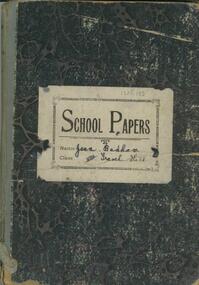
Document - BADHAM COLLECTION: SET OF SCHOOL PAPERS FOR 1935, 1935
... George Wallace served as the editor from 1925 to 1934 and then John Ramsden Lyall from 1934 until 1940....George Wallace served as the editor from 1925 to 1934 and then John Ramsden Lyall from 1934 until 1940. ...In the 1930s the Victorian Education Department published The School Paper monthly for primary school students. Each one featured a combination of Australian poetry, literature and imperial values. The magazines were edited by teachers. George Wallace served as the editor from 1925 to 1934 and then John Ramsden Lyall from 1934 until 1940.Document. School Papers published by Education Department Victoria Australia, in a cardboard cover. Cover made of two pieces of black, white and grey marbled card with blue cloth hinge glued in place. A set of strings is looped around the hinge. School papers are inserted under single strings. Label on front cover ''School Papers, Name Jean Badham Class V111 Gravel Hill''. 1935 grades 7 and 8, February. March. April. May. June. July. August. November.Front Cover 'School Papers' 'Name Jean Badham. Class VIII Gravel Hill.'document, memo, school papers for 1935, badham collection
