
Showing 47 items matching "guard duties"
-
 4th/19th Prince of Wales's Light Horse Regiment Unit History Room
Training Pamphlet, Lt R Stupart, Guard and Sentry Duties Fifth Edition, 1916
... Guard and Sentry Duties Fifth Edition ...64 page soft covered booklet Guard and Sentry Duties Fifth Edition Training Pamphlet Angus & Roberson Lt R Stupart ...64 page soft covered booklet -
 National Vietnam Veterans Museum (NVVM)
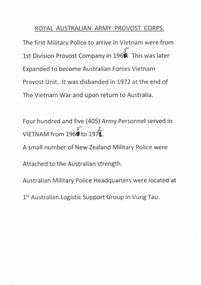
Memorabilia, Memorabilia Royal Australian Army Provist Corps by Cpl James Archbold
... ...Guard Duties...Royal Australian Army Provost Corps 1st Division Provost Company Australian Forces Vietnam Provost Unit New Zealand Military Police Australian Military Police Headquarters 1st Australian Logistic Support Group Vung Tau Military Prison Detention Barrack Court Martial Centre AFV Pro Unit American MPs Vietnamese Military and Civilian Police Nui Dat Cam Ranh Bay Special Investigation Branch (SIB) Guard Duties 1st Australian Field Hospital Viet Cong Prisoner North Vietnamese Army Prisoners VIP Security Prisoner Of War Camp Long Binh Saigon EOD Night Curfew Qantas Tan Son Nhat International Airport Cpl Ian Robert Brown 54157 Killed in Action Cpl James Stuart Archbold 3790920 Military Medal Maj Richard Karney Gorman 237669 Mention in Despatches WO1 William Anthony Eade 52772 Australian Army Training Team Vietnam (AATTV) Sgt Robert James Popperwell 52731 Memorabilia Royal Australian Army Provist Corps by Cpl James Archbold. ...Memorabilia Royal Australian Army Provist Corps by Cpl James Archbold. There is also a DVD and USB stick with photographs of the Military Police in Vietnam. royal australian army provost corps, 1st division provost company, australian forces vietnam provost unit, new zealand military police, australian military police headquarters, 1st australian logistic support group, vung tau, military prison, detention barrack, court martial centre, afv pro unit, american mps, vietnamese military and civilian police, nui dat, cam ranh bay, special investigation branch (sib), guard duties, 1st australian field hospital, viet cong prisoner, north vietnamese army prisoners, vip security, prisoner of war camp, long binh, saigon, eod, night curfew, qantas, tan son nhat international airport, cpl ian robert brown, 54157, killed in action, cpl james stuart archbold, 3790920, military medal, maj richard karney gorman, 237669, mention in despatches, wo1 william anthony eade, 52772, australian army training team vietnam (aattv), sgt robert james popperwell, 52731 -
Glenelg Shire Council Cultural Collection
Photograph - Photograph - Portland Harbour Wharf, n.d
... Black & white photo of a crew member of HMAS Yarra, on guard duty an the wharf beside the ship....Port of Portland Authority Archives Port of Portland Archives HMAS Yarra Portland Harbour Black & white photo of a crew member of HMAS Yarra, on guard duty an the wharf beside the ship. Photograph Photograph - Portland Harbour Wharf ...Port of Portland Authority Archivesport of portland archives, hmas yarra, portland harbour -
 National Vietnam Veterans Museum (NVVM)
Slide - Sims Image Collection
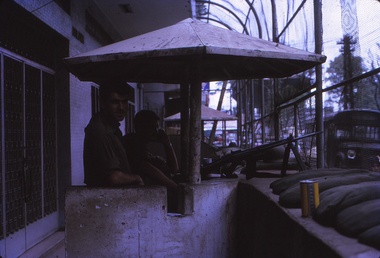
... Guard duty at main entrance to Canberra BEQ (Bachelor and enlisted men's quarters), Cholon, Vietnam 1970....Peter Stanley Sims 44304 Slides Royal Australian Army Medical Corps Vietnam War Sims Cho Lon Cholon Canberra BEQ Bachelors and Enlisted Men's Quarters Guard duty at main entrance to Canberra BEQ (Bachelor and enlisted men's quarters), Cholon, Vietnam 1970. ...A collection of 253 images on slides taken while on deployment in Vietnam, by Corporal Peter Stanley Sims (44304) who served in the Royal Australian Army Medical Corps, 1969 - 1970.Guard duty at main entrance to Canberra BEQ (Bachelor and enlisted men's quarters), Cholon, Vietnam 1970.peter stanley sims, 44304, slides, royal australian army medical corps, vietnam war, sims, cho lon, cholon, canberra beq, bachelors and enlisted men's quarters -
 Frankston RSL Sub Branch
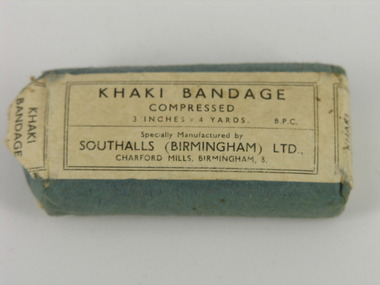
Dressing, Bandage
... A packaged compressed khaki bandage used by British RAF Regiment personnel training for airfield guard duties during the 1950s. The dressing is contained within a paper package. ...A packaged compressed khaki bandage used by British RAF Regiment personnel training for airfield guard duties during the 1950s. The dressing is contained within a paper package. ...A packaged compressed khaki bandage used by British RAF Regiment personnel training for airfield guard duties during the 1950s. The dressing is contained within a paper package. -
Tatura Irrigation & Wartime Camps Museum
Photograph, 1940
... Dhurringile guard duty....Dhurringile guard duty. dhurringile pow camp Australian POW camp guards Black and white photograph of Dhurringile. ...Dhurringile guard duty.Black and white photograph of Dhurringile. Tree on left fence, Australian guard outside perimeter.dhurringile pow camp, australian pow camp guards -
 Tatura Irrigation & Wartime Camps Museum
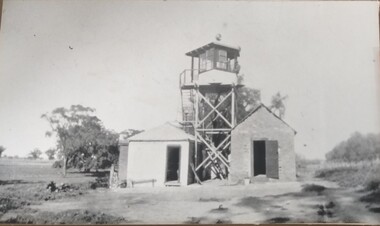
Photograph, South Guard Observation Tower Dhurringile, 1940
... Dhurringile guard duty....Dhurringile guard duty. dhurringile pow camp observation towers Black and white photograph of south guard observation tower with a shed either side. ...Dhurringile guard duty.Black and white photograph of south guard observation tower with a shed either side.dhurringile pow camp, observation towers -
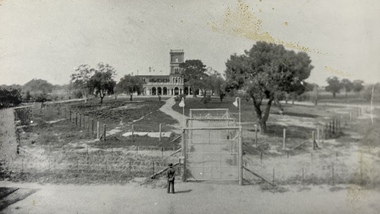 Tatura Irrigation & Wartime Camps Museum
Photograph, 1940
... Dhurringile guard duty....Dhurringile guard duty. dhurringile pow camp Black and white photograph of the Mansion in background. ...Dhurringile guard duty.Black and white photograph of the Mansion in background. Outer perimeter fence, on 3 angles, with solitary guard in centre foreground outside perimeter fence.dhurringile pow camp -
Tatura Irrigation & Wartime Camps Museum
Photograph, Herr Rothe, 1941
... Guard duty at camp....Guard duty at camp. dunera boys australian army guard And to think they are all friendly and I sitting here and greeting lumbago all for nothing. ...Guard duty at camp.Black and white photograph of an Australian Army officer talking to an Australian Army private in front of the small guard house on which a parrot is perchedAnd to think they are all friendly and I sitting here and greeting lumbago all for nothing.dunera boys, australian army guard -
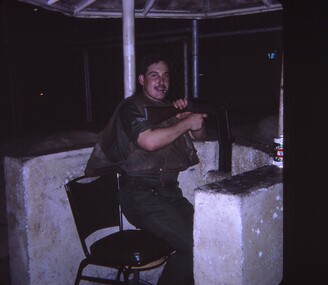 National Vietnam Veterans Museum (NVVM)
Slide - Sims Image Collection
... Cpl Peter Sims on guard duty at located in the Canberra Bachelors and Enlisted Men's Quarters (BEQ) on Chau Van Liem Street in the bustling Cho Lon area of Saigon, 1970....Peter Stanley Sims 44304 Slides Royal Australian Army Medical Corps Vietnam War Sims Australian Forces Vietnam HQ Australian Forces Vietnam Cpl Peter Sims Canberra BEQ Cpl Peter Sims on guard duty at located in the Canberra Bachelors and Enlisted Men's Quarters (BEQ) on Chau Van Liem Street in the bustling Cho Lon area of Saigon, 1970. ...From a collection of 253 images on slides taken while on deployment in Vietnam, by Corporal Peter Stanley Sims (44304), who served in the Royal Australian Army Medical Corps, 1969 - 1970.Cpl Peter Sims on guard duty at located in the Canberra Bachelors and Enlisted Men's Quarters (BEQ) on Chau Van Liem Street in the bustling Cho Lon area of Saigon, 1970.peter stanley sims, 44304, slides, royal australian army medical corps, vietnam war, sims, australian forces vietnam, hq australian forces vietnam, cpl peter sims, canberra beq -
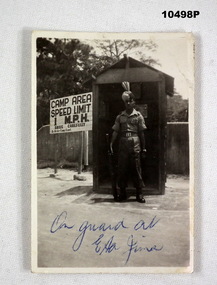 Bendigo Military Museum
Photograph - ETA JIMA, JAPAN, BCOF, 1947-49
... Black and white photograph of an Indian soldier in uniform on guard duty. Guard is standing in front of his sentry box. ...Handwritten in black on back of photograph: “Indian Guard” Black and white photograph of an Indian soldier in uniform on guard duty. Guard is standing in front of his sentry box. ...Item collected by Alva Marie Bennetts whilst deployed to BCOF, 1947-49. See Cat No. 9726P for details of service for Alva Bennetts, VFX128835.Black and white photograph of an Indian soldier in uniform on guard duty. Guard is standing in front of his sentry box. He is standing at ease with his rifle. A sign indicating camp speed limits has been erected on the right hand side of the sentry box.Handwritten in blue ink on front of photograph: “On guard at Eta Jima". Handwritten in black on back of photograph: “Indian Guard”alva bennetts, eta jima, japan, bcof -
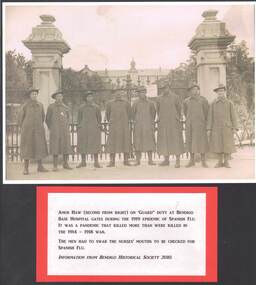 Bendigo Historical Society Inc.
Photograph - BENDIGO BASE HOSPITAL - GUARDS ON DUTY DURING SPANISH FLU 1919 ANZACS
... Photo (copy) of 8 soldiers who stood guard duty at the gates of the Bendigo Base Hospital during the 1919 epidemic of the Spanish flu. ...Photograph BENDIGO BASE HOSPITAL - GUARDS ON DUTY DURING SPANISH FLU 1919 ANZACS ...Photo (copy) of 8 soldiers who stood guard duty at the gates of the Bendigo Base Hospital during the 1919 epidemic of the Spanish flu. Amos Haw ( second from right ), others un-named.buildings, hospital, bendigo base hospital, bendigo base hospital;, amos haw, spanish flu. -
 8th/13th Victorian Mounted Rifles Regimental Collection
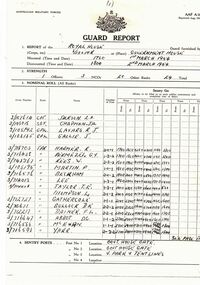
Document - Royal guard report, AAF A18 Guard Report, 2 March 1954
... The queen was resident at Government House Melbourne for nine days and during the time guard duties were shared by 1st Battalion Royal Australian Regiment, 3rd Division Royal Australian Artillery, 5th Infantry Battalion (Victorian Scottish), 6th Infantry Battalion (Royal Melbourne Regiment), 4th/19th Prince of Wales's Light Horse, 8th/13th Victorian Mounted Rifles, 2nd Medium Regiment, 22nd Field Regiment and Melbourne University Rifles. ...Also details of the guard duties, the general remarks at the conclusion of the guard period and the signatures of the Guard Commander, Captain LA Jackson 8th/13th Victorian Mounted Rifles and the Relieving Guard Commander Captain EJ King, 2nd Medium Regiment. ...Also details of the guard duties, the general remarks at the conclusion of the guard period and the signatures of the Guard Commander, Captain LA Jackson 8th/13th Victorian Mounted Rifles and the Relieving Guard Commander Captain EJ King, 2nd Medium Regiment. ...The 8th/13th Victorian Mounted Rifles was raised as a regiment of the Royal Australian Armoured Corps on 1 May 1948 with Headquarters in Melbourne and squadrons in Sale, Benalla/Wangaratta and Albury. In 1955 Regimental Headquarters moved to Wangaratta and a second squadron was located at Albury. The Sale squadron transferred to 4th/19th Prince of Wales’s Light Horse. In 1977 8/13 VMR Regiment was reduced to an independent squadron A Squadron 8th/13th Victorian Mounted Rifles and in 1991 was linked with 4th/19th Prince of Wales’s Light Horse forming the VMR Squadron of that regiment. The queen was resident at Government House Melbourne for nine days and during the time guard duties were shared by 1st Battalion Royal Australian Regiment, 3rd Division Royal Australian Artillery, 5th Infantry Battalion (Victorian Scottish), 6th Infantry Battalion (Royal Melbourne Regiment), 4th/19th Prince of Wales's Light Horse, 8th/13th Victorian Mounted Rifles, 2nd Medium Regiment, 22nd Field Regiment and Melbourne University Rifles. Rare document relating to guard duty at Government House Melbourne mounted by a unit of the Citizen Military Forces from Victoria during a royal visit .Photocopy of a three page report prepared for period 1/2 March 1954 when 8th/13th Victorian Mounted Rifles Regiment provided the guard at Government House Melbourne during the visit of Her Majesty Queen Elizabeth II. The report lists the officer, 4 non commissioned officers and 20 other ranks comprising the guard together with timings and locations of the sentry posts. Also details of the guard duties, the general remarks at the conclusion of the guard period and the signatures of the Guard Commander, Captain LA Jackson 8th/13th Victorian Mounted Rifles and the Relieving Guard Commander Captain EJ King, 2nd Medium Regiment. queen elizabeth ii, royal visit 1954, government house, melbourne, guard, vmr -
 Frankston RSL Sub Branch
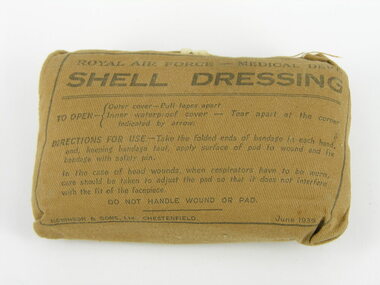
Dressing, Shell
... This example was used by British RAF Regiment personnel training for airfield guard duties during the 1950s. The dressing is contained within a waterproof cover, giving instructions to open and directions for use....This example was used by British RAF Regiment personnel training for airfield guard duties during the 1950s. The dressing is contained within a waterproof cover, giving instructions to open and directions for use. ...A packaged shell dressing carried by World War 2 service personnel. This example was used by British RAF Regiment personnel training for airfield guard duties during the 1950s. The dressing is contained within a waterproof cover, giving instructions to open and directions for use. -
 Frankston RSL Sub Branch
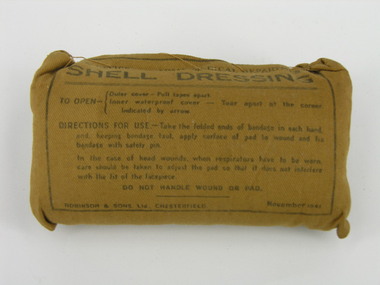
Dressing, Shell
... This example was used by British RAF Regiment personnel training for airfield guard duties during the 1950s. The dressing is contained within a waterproof cover, giving instructions to open and directions for use. ...This example was used by British RAF Regiment personnel training for airfield guard duties during the 1950s. The dressing is contained within a waterproof cover, giving instructions to open and directions for use. ...A packaged shell dressing carried by World War 2 service personnel. This example was used by British RAF Regiment personnel training for airfield guard duties during the 1950s. The dressing is contained within a waterproof cover, giving instructions to open and directions for use. -
 Frankston RSL Sub Branch
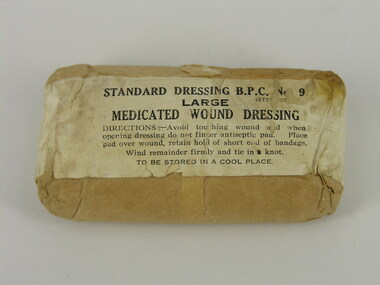
Dressing, Wound
... This example was used by British RAF Regiment personnel training for airfield guard duties during the 1950s. The dressing is packaged in a brown paper cover, giving instructions to open and directions for use. ...This example was used by British RAF Regiment personnel training for airfield guard duties during the 1950s. The dressing is packaged in a brown paper cover, giving instructions to open and directions for use. ...A packaged medicated wound dressing carried by World War 2 service personnel. This example was used by British RAF Regiment personnel training for airfield guard duties during the 1950s. The dressing is packaged in a brown paper cover, giving instructions to open and directions for use. -
Tatura Irrigation & Wartime Camps Museum
Photograph - copy, copy 1989
... Guards on duty in tower. Trucks laden with prisoners. ...Guards on duty in tower. Trucks laden with prisoners. ...Guards on duty in tower. Trucks laden with prisoners. Guards and drivers standing beside trucks.B & W. Guard Tower, three army trucks and army personnel. Large tree in background.army personnel, internment camps, camp 13, army personnel, ww2 -
Tatura Irrigation & Wartime Camps Museum
Photograph - copy, copy 1989
... Light horse guard and mount on duty....Light horse guard and mount on duty. Light horse guard Internment camps Internment camp 13 B & W. ...Light horse guard and mount on duty.B & W. Light horse guard mounted on horse. Rifle in holster. Buildings and trees in distance.light horse guard, internment camps, internment camp 13 -
 St Kilda Historical Society
Administrative record - Pay book, Soldier's pay book, 1917
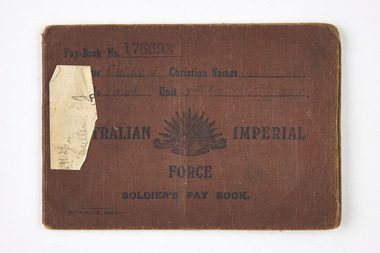
... After recovering, Jack undertook permanent guard duties at Broadmeadows Training Camp until October 1916, when he went to England with the 118th Howitzer Battery on the HMAT Aeneas. ...After recovering, Jack undertook permanent guard duties at Broadmeadows Training Camp until October 1916, when he went to England with the 118th Howitzer Battery on the HMAT Aeneas. ...John (Jack) Dudley Cullen was the first person from St Kilda to enlist in World War I. He lived at 23 Argyle Street (now Waterloo Crescent), St Kilda. An electrician with three years service with the militia behind him, Jack enlisted on 18 August 1914 at the age of 21. By 20 October that year he was sailing to Egypt on the HMAT Shropshire as a member of the 5th Battery, 2nd Field Artillery Brigade. He served in the Middle East for a short time before being hospitalised with enteric fever and returning home to Australia. After recovering, Jack undertook permanent guard duties at Broadmeadows Training Camp until October 1916, when he went to England with the 118th Howitzer Battery on the HMAT Aeneas. He again returned to Australia on health grounds, this time suffering a bronchial condition, and was discharged on 14 June 1918.Maroon coloured pay book with white pages printed in black, with handwritten and stamped entries.On front cover Pay-Book No. 17663 First name Cullen Christina Names John Dunlop No 1026 Unit 5th BTY. 2ND [illegible] A.I.F. AUSTRALIAN IMPERIAL FORCE SOLDIER'S PAY BOOK Rising sun motif Internal pages show name and contact details, notations of amounts and dates paid from 8 February 1917 to 10 May 1918, and a will. Each page overstamped in blue: DISCHARGEDjohn dudley cullen, jack cullen, wwi -
 Tatura Irrigation & Wartime Camps Museum
Photograph - Photograph - black and white
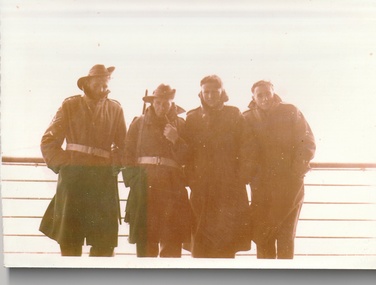
... Australian Army Guards on Escort duty repatriating German POW's from Tatura Group Camps. ...Australian Army Guards on Escort duty repatriating German POW's from Tatura Group Camps. ...Australian Army Guards on Escort duty repatriating German POW's from Tatura Group Camps. Iced in at Cuxhaven Harbour, Germany February 1947. L to R: Polry, Lin McGann, Blue & Royrepatriation of german pow's, tatura, camp guards, mcgann, polry, cuxhaven, escort -
 Wangaratta RSL Sub Branch
Uniform - Ceremonial gloves, 9/7/2001
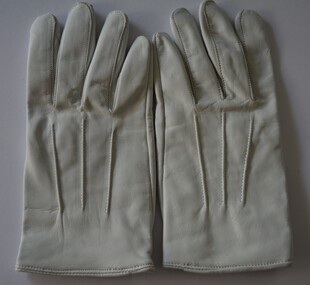
... They are essential for parades, honor guards, and formal military duties....They are essential for parades, honor guards, and formal military duties. Lt Gen Ash Power Army White leather gloves with snap fastener and three rows of stitching on top Uniform Ceremonial gloves ...White leather ceremonial gloves issued to Lt Gen Brian “Ash” POWER. They are essential for parades, honor guards, and formal military duties.White leather gloves with snap fastener and three rows of stitching on toplt gen ash power, army -
 Bendigo Military Museum
Book - NOTE BOOK WW1, 1918
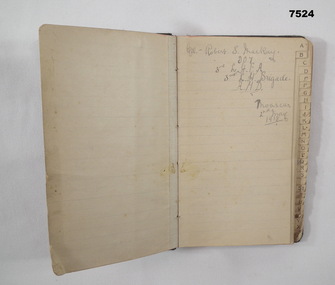
... Training notes: "B" is about bearings - navigation. "G" is for guard duty, "H" is for human frame with drawing and notes - skull to toes - bones. ...Training notes: "B" is about bearings - navigation. "G" is for guard duty, "H" is for human frame with drawing and notes - skull to toes - bones. ...Full name: Robert Sinclair John Mackay, POB Caithness, Scotland. Training notes: "B" is about bearings - navigation. "G" is for guard duty, "H" is for human frame with drawing and notes - skull to toes - bones. "H" is for hemisphere - finding north in north and south hemispheres. "M" Map reading. "Q" Quarter master rules. "R" Road Railway river recon report. "R" .303 Cartridge design and Ballistics. "R" - duties of an R.S.M. "S" - Stretcher drill. Syphilis, Gonorrhea. "ST" is for stables routine. "W" is for words of command, Ambulance formations. At the very back of the book, is a list of numbers in 3 columns. Mackay enlisted on 8.9.1914 No 907 in the 3rd Light Horse Field Ambulance, embarked for Eygpt 2.2.1915, embark for Gallipoli 25.10.1915, Hospital 21.11.1915 (just said “Disc”) while in Eygpt he is hospitalised again with Bronchial Pneumonia rejoin unit 2.4.1916, hospital 6.11.1916 with Bruised Thigh, promoted Cpl 18.2.1918, hospital 4.8.1918 with Catarrhal Jaundice, rejoin unit 14.9.1918, promoted Sgt in the field 29.1.1919, hospital 26.4.1919 (unclear), hospital 20.6.1919 with Fractured right Disc, embark for England 23.7.1919, RTA 4.1.1920, Discharged from the AIF 22.2.1920. Pocket sized address book which has been used as a Training Exercise book. The cover is made of dark buckram. Inside are sections labelled A - Z, with lined pages or each section. First page has written in pencil: - “CPL ROBERT S. MACKAY, 907 3rd L.H.F.A. 3rd L.H. Brigade, A.M.D. MOASCAR 2 Jnay 1918”.ww1, lighthorse, training notes, 3rd field ambulance -
 St Kilda Historical Society
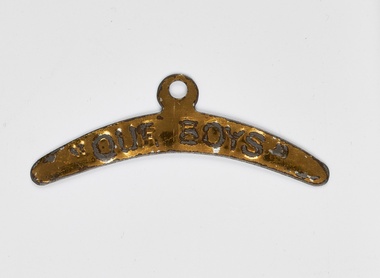
Badge - WWI souvenir, Boomerang badge, 1914-1918
... After recovering, Jack undertook permanent guard duties at Broadmeadows Training Camp until October 1916, when he went to England with the 118th Howitzer Battery on the HMAT Aeneas. ...After recovering, Jack undertook permanent guard duties at Broadmeadows Training Camp until October 1916, when he went to England with the 118th Howitzer Battery on the HMAT Aeneas. ...During World War I, "boomerang badges" were popular sweetheart brooches and fundraising pins. The boomerang motif was chosen to symbolize the solder's safe return from the war, much like a thrown boomerang comes back. This badge was donated to the St Kilda Society by the wife of John (Jack) Dudley Cullen, who was the first person from St Kilda to enlist in World War I. He lived at 23 Argyle Street (now Waterloo Crescent), St Kilda. An electrician with three years service with the militia behind him, Jack enlisted on 18 August 1914 at the age of 21. By 20 October that year he was sailing to Egypt on the HMAT Shropshire as a member of the 5th Battery, 2nd Field Artillery Brigade. He served in the Middle East for a short time before being hospitalised with enteric fever and returning home to Australia. After recovering, Jack undertook permanent guard duties at Broadmeadows Training Camp until October 1916, when he went to England with the 118th Howitzer Battery on the HMAT Aeneas. He again returned to Australia on health grounds, this time suffering a bronchial condition, and was discharged in June 1918. In February 1918, while still in England, Jack married Miss Daisy Dawes of Durrington, near Salisbury. They settled for a short while in Australia but returned to England to live in 1921.Gold coloured metal boomerang with eyelet for attachment."Our Boys"wwi memorabilia, john dudley cullen, jack cullen -
 St Kilda Historical Society
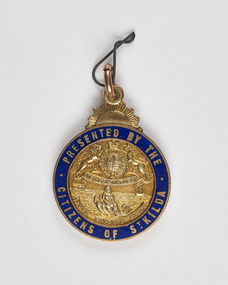
Memorabilia - Medallion, St Kilda tribute medallion, 1918
... After recovering, Jack undertook permanent guard duties at Broadmeadows Training Camp until October 1916, when he went to England with the 118th Howitzer Battery on the HMAT Aeneas. ...After recovering, Jack undertook permanent guard duties at Broadmeadows Training Camp until October 1916, when he went to England with the 118th Howitzer Battery on the HMAT Aeneas. ...Tribute medallions were presented to all 1914 enlistees from St Kilda by the citizens of St Kilda. Two presentations were held, one in November 1918 (98 recipients) and one in May 1919 (90 recipients). Both were organised by the St Kilda Patriotic Committee and held at the St Kilda Town Hall. Gunner J.D. Cullen attended the May 1919 function. John (Jack) Dudley Cullen was the first person from St Kilda to enlist in World War I. He lived at 23 Argyle Street (now Waterloo Crescent), St Kilda. An electrician with three years service with the militia behind him, Jack enlisted on 18 August 1914 at the age of 21. By 20 October that year he was sailing to Egypt on the HMAT Shropshire as a member of the 5th Battery, 2nd Field Artillery Brigade. He served in the Middle East for a short time before being hospitalised with enteric fever and returning home to Australia. After recovering, Jack undertook permanent guard duties at Broadmeadows Training Camp until October 1916, when he went to England with the 118th Howitzer Battery on the HMAT Aeneas. He again returned to Australia on health grounds, this time suffering a bronchial condition, and was discharged in June 1918. In February 1918, while still in England, Jack married Miss Daisy Dawes of Durrington, near Salisbury. They settled for a short while in Australia but returned to live in England in 1921.Round medal, 9 carat gold and dark blue enamel. Eyelet attachedFront: The City of St Kilda coat of arms within a dark blue enamel band bearing gold lettering 'PRESENTED BY THE CITIZENS OF ST. KILDA' Back: Engraved with the inscription 'GNR J.D. CULLEN' and raised lettering 'ENLISTED AND EMBARKED IN 1914 THE GREAT EUROPEAN WAR 1914-18'john dudley cullen, jack cullen, wwi recognition of service, citizens welcome to anzacs, st kilda patriotic committee, wwi -
 St Kilda Historical Society
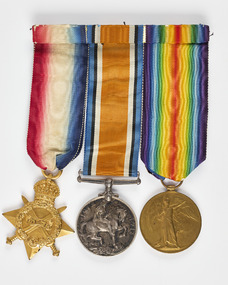
Medal - Military medals, Campaign Star, British War Medal and Victory Medal: Gunner John Dudley Cullen, 1919
... After recovering, Jack undertook permanent guard duties at Broadmeadows Training Camp until October 1916, when he went to England with the 118th Howitzer Battery on the HMAT Aeneas. ...After recovering, Jack undertook permanent guard duties at Broadmeadows Training Camp until October 1916, when he went to England with the 118th Howitzer Battery on the HMAT Aeneas. ...Most British and Commonwealth soldiers who served in World War I were awarded these three medals. The 1914-15 Star was awarded for service on the establishment of a unit in a theatre of war. It was never issued singly; recipients also received the British War Medal and the Victory Medal. The British War Medal was awarded to those who had entered a theatre of war on duty, or served overseas between 5 August 1914 and 11 November 1918. The Victory Medal commemorated the victory of the Allied Forces. Each nation designed their own medal but used the same ribbon. Australians received the medal issued by Great Britain. The combination of the 1914-15 Star, British War Medal and Victory Medal were popularly dubbed 'Pip, Sqeak and Wilfred' after cartoon characters of the time. John (Jack) Dudley Cullen was the first person from St Kilda to enlist in World War I. He lived at 23 Argyle Street (now Waterloo Crescent), St Kilda. An electrician with three years service with the militia behind him, Jack enlisted on 18 August 1914 at the age of 21. By 20 October that year he was sailing to Egypt on the HMAT Shropshire as a member of the 5th Battery, 2nd Field Artillery Brigade. He served in the Middle East for a short time before being hospitalised with enteric fever and returning home to Australia. After recovering, Jack undertook permanent guard duties at Broadmeadows Training Camp until October 1916, when he went to England with the 118th Howitzer Battery on the HMAT Aeneas. He again returned to Australia on health grounds, this time suffering a bronchial condition, and was discharged in June 1918. The inscription '2/F.A. BDE A.I.F.' refers to the '2nd Field Artillery Brigade Australian Imperial Forces'.A gold coloured star medal (1914-15 Star), a round silver medal (British War Medal), and a round bronze medal (Victory Medal), joined by different multi-coloured ribbons to a bar.1914-15 Star: The medal is a four-point star in bright bronze with a crown at the top. On the front are two crossed swords overlaid with a wreath and a scroll inscribed '1914-15'. The back is inscribed '1023 GNR J. Cullen, 2/F.A. BDE A.I.F'. The ribbon has a white band in the middle with a red band on one side and a blue band on the other. British War Medal: The front shows a mounted horse. The back shows the head of King George V in profile. The ribbon has a wide orange centre stripe and narrow blue, black and white stripes on each side. Victory Medal: The front has a winged figure of Victory. On the back are the words 'The Great War for Civilisation 1914-1919' surrounded by a laurel wreath. The ribbon design colours are of two rainbows.john dudley cullen, jack cullen, wwi recognition of service -
 Southern Sherbrooke Historical Society Inc.
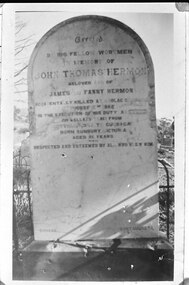
Photograph - Photo - Gravestone of John Thomas Hermon, brother of William Hermon snr
... The headstone reads, “Erected/by his fellow workmen/in memory of/John Thomas Hermon/Beloved son of/James and Fanny Hermon/Accidentally killed at Coolac Crossing/August 3rd 1885/in the execution of his duty as guard/on [illegible] train from/Cootamundra to Gundagai/Born Sunbury Victoria/Aged 21 years/Respected and esteemed by all who knew him." ...The headstone reads, “Erected/by his fellow workmen/in memory of/John Thomas Hermon/Beloved son of/James and Fanny Hermon/Accidentally killed at Coolac Crossing/August 3rd 1885/in the execution of his duty as guard/on [illegible] train from/Cootamundra to Gundagai/Born Sunbury Victoria/Aged 21 years/Respected and esteemed by all who knew him." ...B&W photo of a gravestone in a cemetery. The headstone reads, “Erected/by his fellow workmen/in memory of/John Thomas Hermon/Beloved son of/James and Fanny Hermon/Accidentally killed at Coolac Crossing/August 3rd 1885/in the execution of his duty as guard/on [illegible] train from/Cootamundra to Gundagai/Born Sunbury Victoria/Aged 21 years/Respected and esteemed by all who knew him." Also death notice from Melbourne Age. -
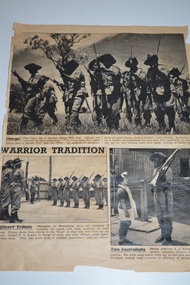 Wangaratta RSL Sub Branch
Newspaper - Newspaper Articles, 1940
... She visits camp nearly every day to chat with guard on duty. Aboriginal soldiers formed a special all volunteer platoon at No 9 Camp Wangaratta in Victoria from late 1940 until February 1941. ...She visits camp nearly every day to chat with guard on duty. Aboriginal soldiers formed a special all volunteer platoon at No 9 Camp Wangaratta in Victoria from late 1940 until February 1941. ...Article One - Charge! - image of members of the aboriginal group carrying out a baton charge Article Two - Officer's Tribute - image of aborigines at Wangaratta carry out ceremony of changing of the guard Article Three - Two Australians - image of Shirley Anderson, 8, of Wangaratta frequently entertains Diggers, singing and dancing. She visits camp nearly every day to chat with guard on duty. Aboriginal soldiers formed a special all volunteer platoon at No 9 Camp Wangaratta in Victoria from late 1940 until February 1941. No 9 Camp was set up at the Wangaratta Showgrounds to allow the formation of the 2/24th Australian Infantry Battalion prior to leaving for Egypt. Major Joseph Albert Wright a WW1 Light Horse veteran was in charge of this platoon the only Aboriginal squad in the Australian Military Forces at that time. The soldiers from Lake Tyers enlisted at Caulfield between June and July 1940 include Harold Cornelius HAYES VX 48217 DOB 2/4/1916 Enlisted 25/7/40 Discharged 22/3/1941 Edward FOSTER VX48218 DOB 25/5/1921 Enlisted 25/7/1940 Discharged 22/3/1941 Noel Ernest HOOD VX48194 DOB 3/1/1919 Enlisted 25/7/1940 Discharged 22/3/1941 Edward Leslie MULLETT VX48199 DOB 30/6/1910 Enlisted 25/7/1940 Discharged 22/3/1941 Samuel Richard RANKIN VX48201 DOB 23/7/1910 Enlisted 25/7/1940 Discharged 22/3/1941 Stewart HOOD VX47351 DOB 23/1/1903 Enlisted 18/7/1940 Discharged 22/3/1941 William GORRIE VX48208 DOB 22/11/1921 Enlisted 25/7/1940 Discharged 22/3/1941 David John MULLETT VX48195 DOB 10/6/1919 Enlisted 25/7/1940 Discharged 22/3/1941 Arthur Alexander (Tom?) MULLETT VX48198 DOB 25/11/1914 Enlisted 25/7/1940 Discharged 22/3/1941 Images relates to the "special platoon" based at No 9 Camp Wangaratta as being the Australian Army's first all Aboriginal Unit formed in 1940. The soldiers were all volunteers mainly from Lake Tyers in Victoria. In addition to normal army training they performed guard duty at the Army Hospital and Camp. They formed the Gum Leaf Band and led the troops at community singing and assisted in Methodist Church services. Three black and white newspaper articles adhered to cream paperWarrior Tradition Written in blue ink 28/12/1940no 9 camp wangaratta, aboriginal platoon -
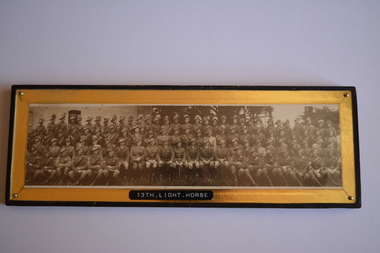 Wangaratta RSL Sub Branch
Memorabilia - Photograph, 13th Light Horse, c1935
... In May 1942, it was converted into an armoured regiment – designated as the "13th Armoured Regiment" – as part of the 2nd Armoured Division's 6th Armoured Brigade, which had been formed for defensive duties to guard against a possible invasion of mainland Australia. ...In May 1942, it was converted into an armoured regiment – designated as the "13th Armoured Regiment" – as part of the 2nd Armoured Division's 6th Armoured Brigade, which had been formed for defensive duties to guard against a possible invasion of mainland Australia. ...This black and white mage depicts large group of men dressed in military uniform of the Light Horse - with most wearing bandoliers and slouch hat, some with emu plumes. The 13th Light Horse Regiment was formed at Broadmeadows in Victoria in March 1915; it was the third light horse regiment to have been raised in that state. Its regimental number quickly led to it becoming known as the "Devil's Own" regiment. It left Australia on 28 May and disembarked in Egypt on 29 June 1915. In 1921, Australia's part-time military forces were re-organised to perpetuate the numerical designations of the AIF following its demobilisation. Through this process, the 13th Light Horse was re-raised as a Citizens Forces unit in Victoria, adopting the territorial designation of the "Gippsland Light Horse". In 1939, the regiment was amalgamated with the 19th Light Horse to become the 13th/19th Light Horse.In August 1940, during the opening stages of the Second World War, the 13th was re-formed in its own right. It was later mechanised and re-designated the "13th Motor Regiment". In May 1942, it was converted into an armoured regiment – designated as the "13th Armoured Regiment" – as part of the 2nd Armoured Division's 6th Armoured Brigade, which had been formed for defensive duties to guard against a possible invasion of mainland Australia. After moving to Puckapunyal in July, the regiment was equipped with M3 Grant tanks. Further training was undertaken in Murgon, Queensland, throughout 1943. By that time, manpower within the Army was scarce and as the threat of an invasion by the Japanese diminished during the year, so too did the need for large-scale armoured forces. A number of armoured units were subsequently disbanded as men and equipment were reallocated as the Army reorganised for jungle warfare. As a result, the 13th was disbanded in October 1943. In the post war period, the unit was perpetuated by the 8th/13th Victorian Mounted Rifles, which existed between 1948 and 1991–92. During WWI three light horse regiments were raised in Victoria for the AIF, the 4th ALH, the 8th ALH and the 13th ALH. These regiments served with distinction at Gallipoli, in the Middle East and on the Western Front.Wide and narrow rectangle shaped black painted frame with gold colour mount. The frame contains a black and white photograph depicting a large group of men dressed in military uniform with bandoliers and slouch hat, some with emu plumes. A small black strip of plastic is attached in the centre of lower edge.Front - 13th Light Horse Rear - 2nd Division Cavalry School Broadmeadows 20-09-1935victoria, 13th light horse -
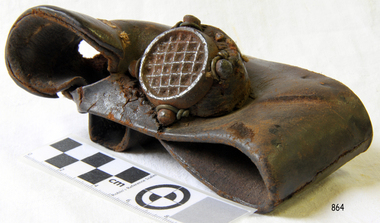 Flagstaff Hill Maritime Museum and Village
Tool - Roping Palm, Late 19th to early 20th century
... A late nineteenth to early twenty century sewing palm heavy duty used for rope work, its a tool that is still in use today aboard sailing vessels and gives a snapshot into the sailors life aboard the old sailing ships of times past. flagstaff hill warrnambool shipwrecked-coast flagstaff-hill flagstaff-hill-maritime-museum maritime-museum shipwreck-coast flagstaff-hill-maritime-village None Leather roping palm. Left hand- simular to a seaming palm, except for the much heavier indentations in the eye and thicker moulded leather guard ...While a sailmaker’s palm is intended for rope work, hand sewing sails and marine canvas work, it can also be used for other extremely thick or heavy-duty sewing applications. You can use a sailmaker’s palm for hand sewing leather, webbing or any sewing assembly that’s thicker than your sewing machine can handle.A late nineteenth to early twenty century sewing palm heavy duty used for rope work, its a tool that is still in use today aboard sailing vessels and gives a snapshot into the sailors life aboard the old sailing ships of times past.Leather roping palm. Left hand- simular to a seaming palm, except for the much heavier indentations in the eye and thicker moulded leather guard to the thumb hole. Rd No 666761.Noneflagstaff hill, warrnambool, shipwrecked-coast, flagstaff-hill, flagstaff-hill-maritime-museum, maritime-museum, shipwreck-coast, flagstaff-hill-maritime-village -
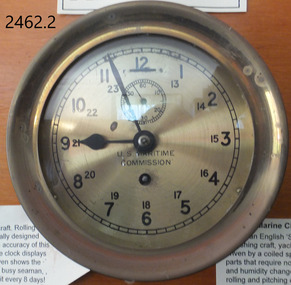 Flagstaff Hill Maritime Museum and Village
Clocks, 1939-1946
... duty the U.S. merchant fleet had often filled throughout the years since the Revolutionary War. From 1939 through the end of World War II, the Maritime Commission funded and administered the largest and most successful merchant shipbuilding effort in world history, producing ships for both navy and merchant marine. By the end of the war, U.S. shipyards working under Maritime Commission contracts had built a total of 5,777 ocean-going merchant and naval ships. In early 1942 both the training and licensing was transferred to the U.S. Coast Guard...duty the U.S. merchant fleet had often filled throughout the years since the Revolutionary War. From 1939 through the end of World War II, the Maritime Commission funded and administered the largest and most successful merchant shipbuilding effort in world history, producing ships for both navy and merchant marine. By the end of the war, U.S. shipyards working under Maritime Commission contracts had built a total of 5,777 ocean-going merchant and naval ships. In early 1942 both the training and licensing was transferred to the U.S. Coast Guard ...Chelsea Clock Company History: The Chelsea Clock Company is an American clock manufacturing company that started before 1880 with Joseph Henry Eastman who founded the Harvard Clock Company and produced 800 clocks of marine, carriage, shelf and banjo types. He went on to change the company name to the Boston Clock Company in 1884. After several name changes in 1897, the Chelsea Clock Company was finally founded. Clocks produced by Chelsea Clock Company have been found in the White House, on US Naval Ships, and in homes and offices around the world. After the company first began life as the Harvard Clock Company, it was named the Boston Clock Company, the Eastman Clock Company before finally becoming the Chelsea Clock Company in July of 1897. The company had developed many patents and innervations over these years and between 1939 and 1946 during World War II they were awarded contracts by the U.S Maritime Commission and produced vast numbers of clocks for both merchant and naval ships. U.S Maritime Commission History: The United States Maritime Commission (MARCOM) was an independent executive agency of the U.S. federal government that was created by the Merchant Marine Act of 1936, and replaced the United States Shipping Board which had existed since World War I. It was intended to formulate a merchant shipbuilding program to design and build five hundred modern merchant cargo ships to replace the World War I vintage vessels that comprised the bulk of the United States Merchant Marine, and to administer a subsidy system authorized by the Act to offset the cost differential between building in the U.S. and operating ships under the American flag. It also formed the United States Maritime Service for the training of seagoing ship's officers to man the new fleet. The purpose of the Maritime Commission was to formulate a merchant shipbuilding program to design and then have built over a ten-year period 900 modern fast merchant cargo ships which would replace the World War I-vintage vessels Those ships were intended to be then leased to U.S. shipping companies for their use in the foreign seagoing trades the aim was to offer better and more economical freight services. The ships were also intended to serve as a reserve naval auxiliary force in the event of armed conflict which was a duty the U.S. merchant fleet had often filled throughout the years since the Revolutionary War. From 1939 through the end of World War II, the Maritime Commission funded and administered the largest and most successful merchant shipbuilding effort in world history, producing ships for both navy and merchant marine. By the end of the war, U.S. shipyards working under Maritime Commission contracts had built a total of 5,777 ocean-going merchant and naval ships. In early 1942 both the training and licensing was transferred to the U.S. Coast Guard for administration, then later to the Maritime Service final responsibility was conveyed to the newly created War Shipping Administration which was created to oversee the operation of merchant ships being built by the Emergency Program to meet the needs of the U.S. Armed Services. With the end of World War II, both the Emergency and Long Range shipbuilding programs were terminated as there were far too many merchant vessels now for the Nation's peacetime needs. In 1946, the Merchant Ship Sales Act was passed to sell off a large portion of the ships built during the war to commercial buyers, both domestic and foreign. The U.S Maritime Commission was officially disbanded on May 24th 1950. These clocks were to be found on all ships made in American for the war effort between 1939 and 1946. They are a significant reminder of the sacrifice by those who served in the merchant marine and the navy’s during the Second World War. The item is a part of our social history that reminds us of these dark times. The loses of family members, along with the trauma that many sailors had endured and had to live with for the rest of their lives once they were released from service and allowed to go home.American Clock is an 8-day marine clock made by the Chelsea clock Co for the “US Maritime Commission” . There is a second smaller dial for the seconds and 24-hour markings. Also a fast-slow adjuster to the top of the dial. The clock is an 8 day marine clock with US Maritime Commission inscribed on face in black lettering. flagstaff hill, warrnambool, shipwrecked-coast, flagstaff-hill, flagstaff-hill-maritime-museum, maritime-museum, shipwreck-coast, flagstaff-hill-maritime-village, clock, us maritime commission, chelsea clock company, horology, maratime clock
