
Showing 677 items matching "head family"
-
 Glen Eira Historical Society
Book - WILLIAM AND SARAH HEAD OUR PIONEER ANCESTORS' FAMILY HISTORY 1838-1970, Head, Edward, 1970
... WILLIAM AND SARAH HEAD OUR PIONEER ANCESTORS' FAMILY HISTORY 1838-1970...A history of the Head Family which includes William Head (26/05/1839 - 1922) who lived with his first wife Ann Margaret (nee Priest DOB 09/12/1840) in Caulfield area. ......Head Family...Book WILLIAM AND SARAH HEAD OUR PIONEER ANCESTORS' FAMILY HISTORY 1838-1970 Head, Edward Head Family ...A history of the Head Family. Includes illustrations, photographs, tables and facsimiles. Genealogical table of 1465 descendants in an envelope inside the back cover. 30p but not numbered.non-fictionA history of the Head Family. Includes illustrations, photographs, tables and facsimiles. Genealogical table of 1465 descendants in an envelope inside the back cover. 30p but not numbered.head william 1818-1882, head sarah 1820-1898, pioneers victoria melbourne, local history glen eira -
 Greensborough Historical Society
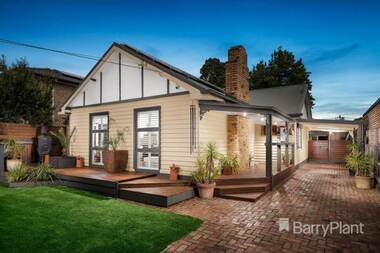
Photograph - Photograph - Digital Image, Marilyn Smith, 15 Doris Street Greensborough, 2021_12
... ...head family...Formerly the home of the Head family. ...Formerly the home of the Head family. doris street greensborough head family 2 Colour digital photographs and document. 15 Doris Street Greensborough Photograph Photograph - Digital Image Marilyn Smith ...This house at 15 Doris Street Greensborough was sold in December 2021 for $1,032,000 by Barry Plant. By August 2022, the home had been demolished for redevelopment. Previous sales: June 2005 - $264,000; January 1994 - $54,000; April 1981 - $31,000. Formerly the home of the Head family. 2 Colour digital photographs and document.doris street greensborough, head family -
 Greensborough Historical Society
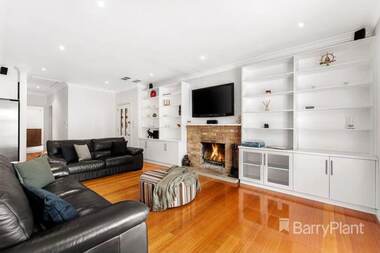
Photograph - Photograph - Digital Image, Marilyn Smith, 15 Doris Street Greensborough - interiors, 2021_12
... ...head family...Formerly the home of the Head family. ...Formerly the home of the Head family. doris street greensborough head family 4 Colour digital photographs of house interior. 15 Doris Street Greensborough - interiors Photograph Photograph - Digital Image Marilyn Smith ...This house at 15 Doris Street Greensborough was sold in December 2021 for $1,032,000 by Barry Plant. By August 2022, the home had been demolished for redevelopment. Previous sales: June 2005 - $264,000; January 1994 - $54,000; April 1981 - $31,000. Formerly the home of the Head family. 4 Colour digital photographs of house interior.doris street greensborough, head family -
 Greensborough Historical Society
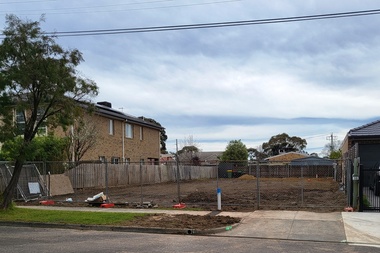
Photograph - Photograph - Digital Image, Marilyn Smith, 15 Doris Street Greensborough - vacant land, 2021_12
... ...head family...Formerly the home of the Head family....Formerly the home of the Head family. doris street greensborough head family Colour digital photograph of streetscape 15 Doris Street Greensborough - vacant land Photograph Photograph - Digital Image Marilyn Smith ...This house at 15 Doris Street Greensborough was sold in December 2021 for $1,032,000 by Barry Plant. By August 2022, the home had been demolished for redevelopment. Previous sales: June 2005 - $264,000; January 1994 - $54,000; April 1981 - $31,000. Formerly the home of the Head family.Colour digital photograph of streetscapedoris street greensborough, head family -
 Narre Warren and District Family History Group
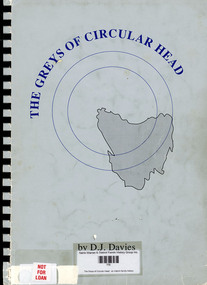
Book, DJ Davies, The Greys of Circular Head : an interim family history, 1991
... The Greys of Circular Head : an interim family history...The Greys of Circular Head : an interim family history Book DJ Davies ...The story of Stephen and Mary Gray who settled at Circular Head in North West Tasmania.non-fictionThe story of Stephen and Mary Gray who settled at Circular Head in North West Tasmania.stephen gray, mary burns, tasmania, circular head (tas.) -
 Linton and District Historical Society Inc
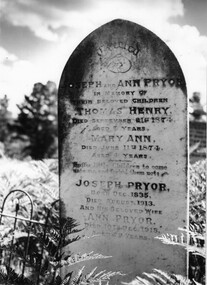
Photograph, Pryor Family Head stone
... Pryor Family Head stone...Has a part of cast iron fence to the left of the photograph also shows bracken ferns and tall trees behind. Pryor Family Head stone Photograph ...Black and white photograph of a grave headstone for Pryor family located in the Linton Cemetery. Has a part of cast iron fence to the left of the photograph also shows bracken ferns and tall trees behind.linton cemetery, grave, headstone, joseph pryor, ann pryor, thomas henry pryor, mary ann pryor -
 Greensborough Historical Society
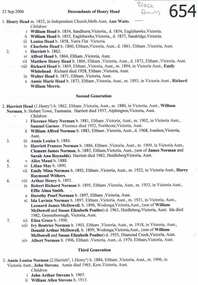
Genealogical Document, Descendants of Henry Head, 1852o
... head family...List of the descendants of Henry Head, including members of the Stock and McDowell families....List of the descendants of Henry Head, including members of the Stock and McDowell families. head family stock mcdowell black family 3 pages of text Descendants of Henry Head Genealogical Document ...List of the descendants of Henry Head, including members of the Stock and McDowell families.3 pages of texthead family, stock, mcdowell, black family -
 Eltham District Historical Society Inc
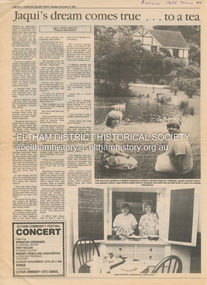
Document - Property Binder, 1435 Main Road, Eltham
... ...The Head family...Main Road Eltham Businesses Ballara tea rooms Jaquiline Robins The Sentimental Bloke The Head family David John Kerr Maurice Dyasons family Maria Grobner Johannes Pietzcka Ray Robins Kim Robins Sebastian Jorgensen Tony Hadjon Rodger Treble John Norten Eltham Community Arts Council Miscellaneous clippings, notes, photocopies, etc held on the subject property. 1435 Main Road, Eltham Document Property Binder ...Newspaper article: Jaqui's dream comes true ... to a tea, Diamond Valley News, 5 November 1985. about Ballara tea room, history of property, claims scenes from 1932 film The Sentimental Bloke filmed in house, earlier life of now owner Jaqueline Robins in England. Newspaper advertisement: Diamond Valley News, 5 November 1985. Eltham Community Festival Concert, lists performers.main road, eltham, businesses, ballara tea rooms, jaquiline robins, the sentimental bloke, the head family, david john kerr maurice, dyasons family, maria grobner, johannes pietzcka, ray robins, kim robins, sebastian jorgensen, tony hadjon, rodger treble, john norten, eltham community arts council -
Tatura Irrigation & Wartime Camps Museum
Photograph
... Funeral of the head of the Nishi family...Black and white photograph of the funeral of the head of the Nishi family at the Tatura Cemetery. The 7 members of the family are standing behind his coffin (he may now be interred at Cowra, NSW)....Funeral of the head of the Nishi family Camp 4 buriels Nishi family Black and white photograph of the funeral of the head of the Nishi family at the Tatura Cemetery. ...Funeral of the head of the Nishi familyBlack and white photograph of the funeral of the head of the Nishi family at the Tatura Cemetery. The 7 members of the family are standing behind his coffin (he may now be interred at Cowra, NSW).camp 4 buriels, nishi family -
 Linton and District Historical Society Inc
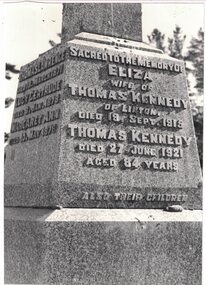
Photograph, Kennedy Head Stone
... Black and white copy of original photograph of the Kennedy Family Head Stone....Thomas Kennedy Linton Cemetery Thomas Lawrance Kennedy Eliza Kennedy nee Brophy Lucy Gertrude Kennedy Margaret Ann Kennedy Black and white copy of original photograph of the Kennedy Family Head Stone. Kennedy Head Stone Photograph ...Thomas Kennedy was Linton's policeman from about 1865 to 1885. He served as a Shire of Grenville Councillor and was President on multiple occasions. He purchased farming land at Spring Vale (later known as Pittong) and named the property 'Fingal Park'. In retirement he built a house, 'Kin-Kora', in Cumberland Street, Linton. He married Eliza Brophy in 1861 and they had thirteen children.The cemetery memorial names several of their children who died in childhood.Black and white copy of original photograph of the Kennedy Family Head Stone.thomas kennedy, linton cemetery, thomas lawrance kennedy, eliza kennedy nee brophy, lucy gertrude kennedy, margaret ann kennedy -
 Northern District School of Nursing. Managed by Bendigo Historical Society Inc.
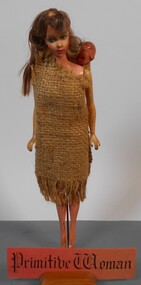
Education kit - Primitive Women - Miniature Dolls, Nursing Through the Ages
... Primitive Woman - First nurse was the mother - probably a "matriarchal" head of the family. Men were the hunters and absent for long periods. ...Primitive Woman - First nurse was the mother - probably a "matriarchal" head of the family. Men were the hunters and absent for long periods. ...Primitive Woman - First nurse was the mother - probably a "matriarchal" head of the family. Men were the hunters and absent for long periods. Women grew seeds for food and likely first medicines. Infectious diseases depleted numbers and the sick were regarded as occurring through witchcraft. This resulted in the medicine man or witch doctor.Miniature Doll dressed in brown cloth sack dress carrying child on her back. Doll is 30cm tallName tag - Primitive Womennursing history, northern district school of nursing, first nurses -
 Surrey Hills Historical Society Collection
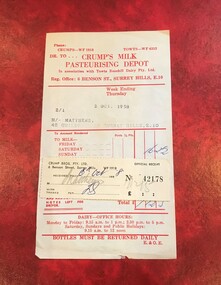
Document - Account and receipt, Receipt signed (?) ES - possibly Eric Scanlan, Crump's Milk Pasteurising Depot account with attached receipt, 2 October 1958 /6 October 1958
... Eric William Walker Crump (1903-1981) headed the family business. Also involved were Kevin Eric Crump, Eric William Scanlan. ...Eric William Walker Crump (1903-1981) headed the family business. Also involved were Kevin Eric Crump, Eric William Scanlan. ...Crumps Dairy (Milk Pasteurising Depot) was located at 6 Benson Street, Surrey Hills on the corner of Weybridge Street until c1973. It was demolished after it had been badly vandalised. The business closed after cartons replaced glassperishables including milk, bread, meat and fruit and vegetables bottles for sale of milk. It was one of many small local facilities for processing and delivering milk that existed from the early 1920s. Eric William Walker Crump (1903-1981) headed the family business. Also involved were Kevin Eric Crump, Eric William Scanlan. NB/ Also held in this collection is a copy of a project by Chatham Primary School student, Susanne Pascoe, dated 1956 which includes photos of the dairy's operations. An oral history by Dave Croft, a driver for the dairy, who lived close by, is also relevant. The account also mentions 'Towt'. Canterbury Oliver Towt (1890-1962) was another dairyman whose premises was on the corner of Chatham and Mont Albert Roads.This is material evidence of business practice c1920s-1960s when accounts for goods received, especially perishables, were often hand-delivered on a weekly basis, with monies owed collected at the door. A paper account printed red on cream (discoloured) paper with the details of the date, account holder and address typed in and the amount owed hand-written in blue ink. The attached receipt has been stuck onto the account and filled out in grey pencil and blue ink. The amounts are in pounds, shillings and pence.Typed: 2/1; 2 OCT. 1958 M/- MATTHEWS, 42 GUILDFROD RD. SURREY HILLS, E.10dairies, crumps dairy, crumps milk pasteurising depot, kevin eric crump, eric william scanlan, eric william walker crump, towt's dairy, canterbury oliver towt, accounts, receipts, guildford road, geoff matthews, ruth matthews, benson street, towts rosehill dairy -
 Surrey Hills Historical Society Collection
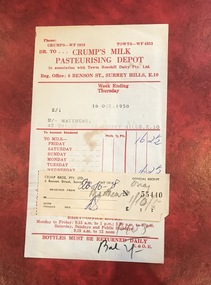
Document - Account and receipt, Receipt signed (?) ES - possibly Eric Scanlan, Crump's Milk Pasteurising Depot account with attached receipt, 16 October 1958 /20 October 1958
... Eric William Walker Crump (1903-1981) headed the family business. Also involved were Kevin Eric Crump, Eric William Scanlan. ...Eric William Walker Crump (1903-1981) headed the family business. Also involved were Kevin Eric Crump, Eric William Scanlan. ...Crumps Dairy (Milk Pasteurising Depot) was located at 6 Benson Street, Surrey Hills on the corner of Weybridge Street until c1973. It was demolished after it had been badly vandalised. The business closed after cartons replaced glassperishables including milk, bread, meat and fruit and vegetables bottles for sale of milk. It was one of many small local facilities for processing and delivering milk that existed from the early 1920s. Eric William Walker Crump (1903-1981) headed the family business. Also involved were Kevin Eric Crump, Eric William Scanlan. NB/ Also held in this collection is a copy of a project by Chatham Primary School student, Susanne Pascoe, dated 1956 which includes photos of the dairy's operations. An oral history by Dave Croft, a driver for the dairy, who lived close by, is also relevant. The account also mentions 'Towt'. Canterbury Oliver Towt (1890-1962) was another dairyman whose premises was on the corner of Chatham and Mont Albert Roads.This is material evidence of business practice c1920s-1960s when accounts for goods received, especially perishables, were often hand-delivered on a weekly basis, with monies owed collected at the door. A paper account printed red on cream (discoloured) paper with the details of the date, account holder and address typed in and the amount owed hand-written in blue ink. The attached receipt has been stuck onto the account and filled out in grey pencil and blue ink. The amounts are in pounds, shillings and pence.Typed: 2/1; 16 OCT. 1958 M/- MATTHEWS, 42 GUILDFROD RD. SURREY HILLS, E.10dairies, crumps dairy, crumps milk pasteurising depot, kevin eric crump, eric william scanlan, eric william walker crump, towt's dairy, canterbury oliver towt, accounts, receipts, guildford road, geoff matthews, ruth matthews, benson street, towts rosehill dairy -
 Surrey Hills Historical Society Collection
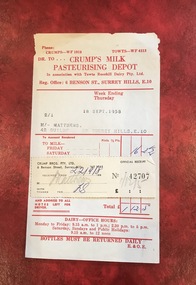
Document - Account and receipt, Receipt signed (?) ES - possibly Eric Scanlan, Crump's Milk Pasteurising Depot account with attached receipt, 18 September 1958 /22 September 1958
... Eric William Walker Crump (1903-1981) headed the family business. Also involved were Kevin Eric Crump, Eric William Scanlan. ...Eric William Walker Crump (1903-1981) headed the family business. Also involved were Kevin Eric Crump, Eric William Scanlan. ...Crumps Dairy (Milk Pasteurising Depot) was located at 6 Benson Street, Surrey Hills on the corner of Weybridge Street until c1973. It was demolished after it had been badly vandalised. The business closed after cartons replaced glassperishables including milk, bread, meat and fruit and vegetables bottles for sale of milk. It was one of many small local facilities for processing and delivering milk that existed from the early 1920s. Eric William Walker Crump (1903-1981) headed the family business. Also involved were Kevin Eric Crump, Eric William Scanlan. NB/ Also held in this collection is a copy of a project by Chatham Primary School student, Susanne Pascoe, dated 1956 which includes photos of the dairy's operations. An oral history by Dave Croft, a driver for the dairy, who lived close by, is also relevant. The account also mentions 'Towt'. Canterbury Oliver Towt (1890-1962) was another dairyman whose premises was on the corner of Chatham and Mont Albert Roads.This is material evidence of business practice c1920s-1960s when accounts for goods received, especially perishables, were often hand-delivered on a weekly basis, with monies owed collected at the door. A paper account printed red on cream (discoloured) paper with the details of the date, account holder and address typed in and the amount owed hand-written in blue ink. The attached receipt has been stuck onto the account and filled out in grey pencil and blue ink. The amounts are in pounds, shillings and pence.Typed: 2/1; 18 SEPT. 1958 M/- MATTHEWS, 42 GUILDFROD RD. SURREY HILLS, E.10dairies, crumps dairy, crumps milk pasteurising depot, kevin eric crump, eric william scanlan, eric william walker crump, towt's dairy, canterbury oliver towt, accounts, receipts, guildford road, geoff matthews, ruth matthews, benson street, towts rosehill dairy -
 Kiewa Valley Historical Society
Book - Reference Countryside, The Australian Countryside in Pictures, circa 1950s
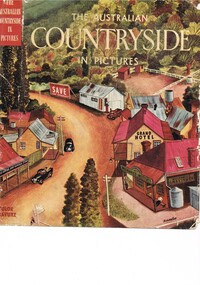
... The book spans an era where the male was still the "head" of the family even though for a majority of families the women took on the many "male only" roles during the World War II period. ...The book spans an era where the male was still the "head" of the family even though for a majority of families the women took on the many "male only" roles during the World War II period. ...This book is a "snapshot" in time (1950s) detailing life in Australia covering a time when a "man's word and handshake" were his moral and quasi legal bond, and the now relative defunct saying "smoko" (having a "time out" from work for a cigarette and tea or coffee). The book spans an era where the male was still the "head" of the family even though for a majority of families the women took on the many "male only" roles during the World War II period. This shift in the leadership of the family hierarchy is mentioned, so ever slightly, (not to offend the still predominant macho male image) in both rural and city environments. The effects of the war, and later the push for women's emancipation and equality in both family, social, workplace and political areas of life, since this book was published, is now finally resolved. However there are still some sections of the recent migrate population where this male dominance is causing a few problems.The significance of this book is not only because it was donated by Mrs C. Roper ( from the Roper Family, a pioneer Kiewa Valley and surrounding Region family - originally beef cattle graziers) but also a Kiewa Valley resident and family, experiencing the shift in the social and economical life of post World War II rural Australia. The strong heritage link to this region of many families still residing within its boundaries, is a clear affirmation of the bond that the Kiewa Valley and its Regions have upon family unity. This unity within the rural environment is something that is attracting more and more families from sometimes alienating city life.This printed coloured sketched, or painted paper sleeve of the book is freely wrapped over a dark red hard cover. Into the front of the cover is pressed a standing pose of a farmer with long sleeves rolled up over his elbows. Behind him and to the right are what appears to be three sacks of wheat and next to him is a merino sheep. To the left and down are two dogs one with a fox in its jaws. The book contains 240 pages, 300 illustrations in gravure and 25 pictures in full colour. The inside fly leaf is a colour photograph of a rural scene with dirt road running in the centre and to the left a farm house and a five bay open storage barnOn the tittle page is a signature "C Roper"country life, australian "outback", rural industries, life on the land, swag-man of the bush -
 Eltham District Historical Society Inc
Document - Folder, McLean, 1984-1999
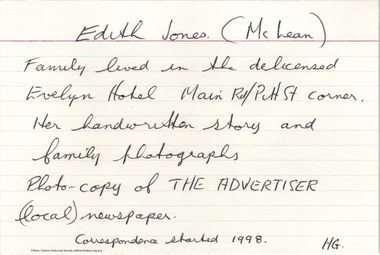
... Lived in the former Evelyn Hotel at the time it was destroyed by fire and being part of the Centenary Parade in 1934 where the family won the Group Section for their entry “Pioneers of Eltham” Reminiscences provided by Edith Jones (nee MReferences to McLean family, Hector John McLean and Louisa Frances (nee Green) and six daughters who lived in Eltham during the period 1930 to 1934 inclusive. Lived in the former Evelyn Hotel at the time it was destroyed by fire and being part of the Centenary Parade in 1934 where the family won the Group Section for their entry “Pioneers of Eltham” Reminiscences provided by Edith Jones (nee M1934 flood, ballroom, baptism, barber shop, bittern, boy scouts, bremner's flat, burgoyne's shop, cable tram, cemetery road, centenary celebrations, centenary parade, christening, coach house, collis grocery, dalton street, depression, dole, dorothy jean mclean, edith jones (nee mclean), eltham fire brigade, eltham high school, eltham higher elementary school, eltham lower park, eltham railway station, eltham state school no. 209, evelyn hotel, fire damage - buildings, flinders naval depot, fordham, gladys evelyn mclean, gold mining, gwenneth mae mclean, gwladys evelyn mclean, headmistress, hector john mclean, isherwood house and shop, louisa frances mclean (nee green), metery road, methodist church, miss finnin, miss grant cottage, motor bike races, mrs barrett, mrs bremner, mrs hurley, olive isabel mclean, parade, phoebe lillian mclean, picnic, pioneers of eltham, pitt street, research fire brigade, rev. r.g. arthur, shed, shops, st margarets church hall, st margaret's church, stables, state savings bank of victoria, susso books, todaro, vinnie willet, warrandyte bridge, warrandyte, wingrove park, yarra river -
 Melton City Libraries
Photograph, Charles Ernest and Jessie Barrie with family, Unknown
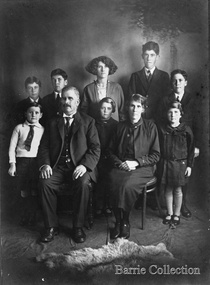
... A heavy burden of responsibility fell on the shoulders of the two eldest children, Mary particularly for her mother and Bon stepped in assuming head of the family for his mother, brothers and sisters living at the Darlingsford homestead. ...A heavy burden of responsibility fell on the shoulders of the two eldest children, Mary particularly for her mother and Bon stepped in assuming head of the family for his mother, brothers and sisters living at the Darlingsford homestead. ...This document is has been compiled by Wendy Barrie daughter of Ernest (Bon) and Edna Barrie and granddaughter of Charles E and Jessie M Barrie. I was born in during WW 11 and the first child of my generation to live on the ‘ Darlingsford’ property at Melton. My grandfather was well known in the district and was mostly referred to as Ernie. He shared the same initials as his second son Edgar. His three eldest sons lived and farmed in Melton for their entire lives. His descendants are still associated with farming, engineering and earthmoving in Melton. Ernie Barrie operated a travelling Chaff Cutter in the St Arnaud area where his parents William and Mary Ann had taken up land at Coonooer West in 1873. Ernie commenced his working life with a team of bullocks and a chaff cutter. The earliest connection he had with Melton was in 1887. By the beginning of the 20th century Ernie and his father William and brothers, William, Samuel, James Edwin,[Ted] Robert, Arthur and Albert have been associated with farming and milling in the Melton district. In the early 1900’s Ernie and his brother Ted were in partnership in a Chaff cutting and Hay processing Mill on the corner of Station and Brooklyn road Melton South. The mill was managed by William for a time. By 1906 Charles Ernest and James Edwin were in partnership in the Station Road mill when a connecting rail line across Brooklyn Road for a siding was constructed to the Melton Railway Station. In 1911 the Mill’s letterhead shows C.E. BARRIE Hay Pressing and Chaff Cutting Mills. Melton Railway Station. Telephone No 1 Melton. This Mill as sold to H S K Ward in 1916 and stood until 1977 when it burnt down in a spectacular fire. Ernie built a house at Melton South beside the Chaff Mill at Station Road in 1906 and married Jessie May Lang in August at the Methodist Church. Jessie’s father was Thomas Lang. He came to Melton in 1896 and was the Head Teacher at Melton State School No 430 until he retired in 1917. They had 9 children with 8 surviving to adulthood. Jessie and Ernie had 6 sons and 3 daughters. All the children lived at Darlingsford. In April 1910 the family left Melton for a brief period and moved to a farm in Trundle in NSW. They returned to Melton and purchased Darlingsford in May 1911. For a time during WW1 they lived at Moonee Ponds near the Lang grandparents at Ascot Vale. Mary and Bon attended Bank St State School. The children developed diphtheria in 1916 and their youngest boy, Cecil died of complications. Mary and Bon were taken to Fairfield Hospital and both recovered. At the end of the war influenza broke out the family returned to Darlingsford and shared the home for a short while with the Pearcey family who had been working the farm. By 1922 the family had and grown and Edgar, Tom, Horace, Jessie, Joyce and Jim were living a Darlingsford. Ernie continued during the 1920’s working the farm and attend his many civic and community commitments. Two 8 clydesdale horse teams were used to work the land which meant early rising for the horses to be fed and harnessed to commence the days work. In 1916 Ernie also became involved in a Chaff Mill on the corner of Sunshine and Geelong Road West Footscray, which at the time was being run by John Ralph Schutt. It was known an Schutt Barrie. A flour mill was added at a later stage. Other Schutt and Barrie mills were situated at Parwan and Diggers Rest. Another mill was situated beside the railway line at Rockbank. The Footscray mill ceased operation in 1968 Ernie spent a lot of time and energy at the Parwan Mill and travelling around Parwan and Balliang farms, where he came to know many of the families in the district. Ernies commitment to the civic development to the Melton and district was extensive, he was involved with a number of large events during the 1920’s such as the Melton Exhibitions and the 1929 Back to Melton Celebrations. He was a member of the Australian Natives Association at the turn of the century. He was Chairman of the School Committee at Melton State School 430 and the Melton South State School in thw1920s. He donated the land for a Hall for Melton South in 1909, known as Exford Hall and later in 1919 renamed Victoria Hall. The Hall was demolished in 1992. He was a Councillor, JP, and Vice President and President of the Melton Mechanics Institute Hall Committee in 1915- 1916. He was a member of the Methodist Church and later the Scots Presbyterian Church. He was Superintendent of the Sunday School of the Methodist Church to 1910 and later Scots Presbyterian Church until 1931. This is reflected in the theme of children in the stained glass window which was dedicated in his memory by his wife Jessie as a gift to the Scots Church. Charles Ernest Barrie made many generous donations to many charities who supported young people and children. In 1918 Jessie and Ernie made the first donation to a very prominent Victorian charity whose work still continues. Yooralla. In July 1931 Ernie’s untimely death was a major blow to the family and the Melton community. To this day people still vividly recall the day they lined the streets for his funeral. The day of the funeral is recalled as the day Melton stood as two of their prominent citizens who tragically died on the same day. Their eldest daughter Mary had married Keith Robinson in 1930 and had just moved to Heatherdale Toolern Vale with their year old baby son. Bon the eldest son was 22, Edgar 18, Tom 16, Horace 15, Jessie and Joyce 10 and Jim 8 years old. A heavy burden of responsibility fell on the shoulders of the two eldest children, Mary particularly for her mother and Bon stepped in assuming head of the family for his mother, brothers and sisters living at the Darlingsford homestead. In the early 1930’s the three eldest sons took on many of the Civic and Church commitments which their father had held. This community involvement extended well into the 1980s. In 1941 Bon married Edna Myers and they moved into a house shifted from Harkness Lane to Harkness Lane on the eastern section of the Darlingford property. Edgar married Margaret Hodgkinson a Primary school teacher at Melton in 1949 and they lived in the Darlingsford house. Earlier Tom married May Ferris and lived on the eastern side of Ferris Lane in the Ferris home. Bon , Edgar and Tom often operated as a team effort, in particular at harvest time when a larger team of workers was needed. The three farms cultivated wheat, barley and oats and supplied the Mill with sheafed hay. They continued using horse teams until mechanisation in the 1940’s made the horses redundant. By the 1960s their five sons continued with farming. Many loads of hay were transported to the Mill in Footscray. Well into the 1960s hired harvest hands along with agricultural university students were involved in bringing in he harvest. Stacking was an art form in itself and Tom held the expertise for building and shaping the sides and roof. The stacks built in the district each had their own unique shape and could be recognized by their builders. The Barrie brothers developed a mechanical fork lift for picking up complete stooks and moving them to be loaded to the elevator to build the haystack. The prototype built by Bill Gillespie was attached to a Bedford truck. Later refinements in a collaborative effort with the Gillespie brothers a multi pronged fork was attached to the front of tractor which was hydraulically operated to raise each stook onto trucks to be transported to the site of the haystacks. This method of handling sheaves significantly reduced laborious pitchforking individual sheaves. This invention was soon taken up by farmers far and wide and was a common sight in the district at harvest time in the stacking season. I recall visiting farmers calling in at the house at Ferris Road farm to inspect this break through invention. The Clydesdale horse teams were used into the 1940s but by the 1950s the Barries’ farms were fully mechanised. When the demand for sheafed hay declined other crops were introduced these included barley, lucerne, wheat and peas. Sheep were added to the mix in the 1950s in an attempt to keep the farms more viable. In the 1970s part of the Barrie’s farms were facing a major disruption with the impending compulsorily acquisition of a strip of land for the construction the freeway bypass, which divided access between the Darlingsford homestead with those on Ferris Lane. Charles Ernest Barrie and Jessie May Lang's children: 1. Mary Ena BARRIE was born on 07 October 1907. She died on 29 April 1999. 2. Ernest Wesley BARRIE was born on 29 April 1909 in Ascot Vale, Victoria, Australia.He died on 25 December 1985 in Melton, Victoria, Australia. 3. Cecil William BARRIE was born on 23 February 1911.He died on 25 May 1916. 4. Charles Edgar BARRIE was born on 01 June 1913.He died on 06 October 1975. 5. Thomas Lindsay BARRIE was born on 25 November 1914.He died on 14 September 1990 in Melton, Victoria, Australia. 6. William Horace BARRIE was born on 11 October 1915.He died on 19 December 1950. 7. Jessie Maud BARRIE was born on 06 November 1920 in Bacchus Marsh, Victoria, Australia.She died on 26 February 1994. 8. Dorothy Joyce BARRIE was born on 06 November 1920 in Bacchus Marsh, Victoria, Australia.She died on 18 March 2003.. 9. James Edward BARRIE was born on 17 January 1922 in Bacchus Marsh, Victoria, Australia.He died on 23 August 2004Family Photo with Edgar, Tom, Mary, Ernest (Bon), Horace, Jim, Charles Ernest, Jessie and Joycelocal identities -
 Flagstaff Hill Maritime Museum and Village
Animal specimen - Sawfish
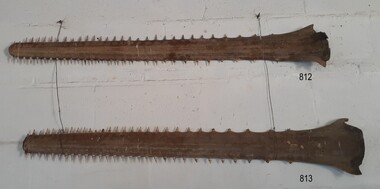
... family. Sawfish use their rostrum to access their food or pray by moving their heads from sided to side. ...family. Sawfish use their rostrum to access their food or pray by moving their heads from sided to side. ...This sawfish rostrum (saw) was once the nose piece of a sawfish, which is a type of ray. Sawfish are also referred to as carpenter sharks although they are not from the shark family. Sawfish use their rostrum to access their food or pray by moving their heads from sided to side. They also use their rostrum as a defensive weapon. Some sawfish can grow as long as seven metres. They inhabit tropical and subtropical waters of the ocean, rivers and estuaries. They can live from 25 up to even 30 years. The pair of sawfish rostrum was originally in the Collection of the old Warrnambool Museum and Art Gallery of the 1880s to 1960s. It was transferred to Flagstaff Hill in the 1970s. The museum had a collection of animal specimens from all over the world.The pair of sawfish rostrum is significant for its association with the old Warrnambool Museum and Art Gallery. The museum called on the public to donate a huge variety of items. People in the 19th century were excited about travel and the world opened up opportunities to discover and learn about 'curiosities' from other cultures.Sawfish nose piece, bill or rostrum, one of a pair. Shape is long, flat and tapering to a rounded end, with pointy thorn-like teeth around the perimeter. sawfish, saw fish, sawfish saw, carpenter shark, rostrum, flagstaff hill, warrnambool, maritime village, maritime museum, flagstaff hill maritime museum & village, shipwreck coast, great ocean road, warrnambool museum and art gallery -
 Flagstaff Hill Maritime Museum and Village
Photograph, C. 1891
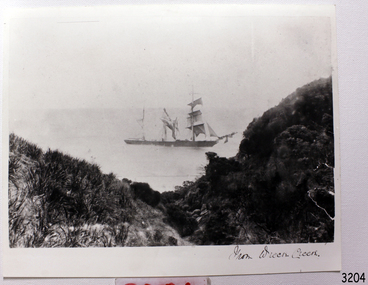
... family to Gilbert Hulands’ grandson, John Hulands. Seaman Julius Gebauhr later gave his knife, in its hand crafted leather sheath, to F. J. Stansmore for caring for him when he came ashore. The knife handle had a personal inscription on it. A marble headstone on the 200m high cliffs overlooking Wreck Beach, west of Moonlight Head...family to Gilbert Hulands’ grandson, John Hulands. Seaman Julius Gebauhr later gave his knife, in its hand crafted leather sheath, to F. J. Stansmore for caring for him when he came ashore. The knife handle had a personal inscription on it. A marble headstone on the 200m high cliffs overlooking Wreck Beach, west of Moonlight Head ...Photograph shows the ship FIJI where she met her demise, in Wreck Bay, on the shipwreck coast of South West Victoria. The three-masted iron barque Fiji had been built in Belfast, Ireland, in 1875 by Harland and Wolfe for a Liverpool based shipping company. The ship departed Hamburg on 22nd May 1891 bound for Melbourne, under the command of Captain William Vickers with a crew of 25. The ship’s manifest shows that she was loaded with a cargo of 260 cases of dynamite, pig iron, steel goods, spirits (whisky, schnapps, gin, brandy), sailcloth, tobacco, coiled fencing wire, concrete, 400 German pianos (Sweet Hapsburg), concertinas and other musical instruments, artists supplies including brushes, porcelain, furniture, china, and general cargo including candles. There were also toys in anticipation for Christmas, including wooden rocking horses, miniature ships, dolls with china limbs and rubber balls. On September 5th, one hundred days out from Hamburg in squally and boisterous south west winds the Cape Otway light was sighted on a bearing differing from Captain Vickers’ calculation of his position. At about 2:30am, Sunday 6th September 1891 land was reported 4-5 miles off the port bow. The captain tried to put the ship on the other tack, but she would not respond. He then tried to turn her the other way but just as the manoeuvre was being completed the Fiji struck rock only 300 yards (274 metres) from shore. The place is known as Wreck Bay, Moonlight Head. Blue lights were burned and rockets fired whilst an effort was made to lower boats but all capsized or swamped and smashed to pieces. Two of the younger crewmen volunteered to swim for the shore, taking a line. One, a Russian named Daniel Carkland, drowned after he was swept away when the line broke. The other, 17 year old able seaman Julius Gebauhr, a German, reached shore safely on his second attempt but without the line, which he had cut lose with his sheath-knife when it become tangled in kelp. He rested on the beach a while then climbed the steep cliffs in search of help. At about 10am on the Sunday morning a party of land selectors - including F. J. Stansmore, Leslie Dickson (or Dixon) and Mott - found Gebauhr. They were near Ryans Den, on their travels on horseback from Princetown towards Moonlight Head, and about 5km from the wreck. Gebauhr was lying in the scrub in a poor state, bleeding and dressed only in singlet, socks and a belt with his sheath-knife, ready for all emergencies. At first they were concerned about his wild and shaggy looking state and what seemed to be gibberish speech, taking him to be an escaped lunatic. They were reassured after he threw his knife away and realised that he was speaking half-English, half-German. They gave him food and brandy and some clothing and were then able to gain information about the wreck. Some of the men took him to Rivernook, a nearby guest house owned by John Evans, where he was cared for. Stansmore and Dickson rode off to try and summon help. Others went down to the site of the wreck. Messages for rescuing the rest of the crew were sent both to Port Campbell for the rocket rescue crew and to Warrnambool for the lifeboat. The S.S. Casino sailed from Portland towards the scene. After travelling the 25 miles to the scene, half of the Port Campbell rocket crew and equipment arrived and set up the rocket tripod on the beach below the cliffs. By this time the crew of the Fiji had been clinging to the jib-boom for almost 15 hours, calling frantically for help. Mr Tregear from the Rocket Crew fired the line. The light line broke and the rocket was carried away. A second line was successfully fired across the ship and made fast. The anxious sailors then attempted to come ashore along the line but, with as many as five at a time, the line sagged considerably and some were washed off. Others, nearly exhausted, had to then make their way through masses of seaweed and were often smothered by waves. Only 14 of the 24 who had remained on the ship made it to shore. Many onlookers on the beach took it in turns to go into the surf and drag half-drowned seamen to safety. These rescuers included Bill (William James) Robe, Edwin Vinge, Hugh Cameron, Fenelon Mott, Arthur Wilkinson and Peter Carmody. (Peter Carmody was also involved in the rescue of men from the Newfield.) Arthur Wilkinson, a 29 year old land selector, swam out to the aid of one of the ship’s crewmen, a carpenter named John Plunken. Plunken was attempting to swim from the Fiji to the shore. Two or three times both men almost reached the shore but were washed back to the wreck. A line was thrown to them and they were both hauled aboard. It was thought that Wilkinson struck his head on the anchor before s they were brought up. He remained unconscious. The carpenter survived this ordeal but Wilkinson later died and his body was washed up the next day. It was 26 year old Bill Robe who hauled out the last man, the captain, who had become tangled in the kelp. The wreck of the Fiji was smashed apart within 20 minutes of the captain being brought ashore, and it settled in about 6m of water. Of the 26 men on the Fiji, 11 in total lost their lives. The remains of 7 bodies were washed onto the beach and their coffins were made from timbers from the wrecked Fiji. They were buried on the cliff top above the wreck. The survivors were warmed by fires on the beach then taken to Rivernook and cared for over the next few days. Funds were raised by local communities soon after the wreck in aid of the sufferers of the Fiji disaster. Captain Vickers was severely reprimanded for his mishandling of the ship. His Masters Certificate was suspended for 12 months. At the time there was also a great deal of public criticism at the slow and disorganised rescue attempt to save those on board. The important canvas ‘breech buoy’ or ‘bucket chair’ and the heavy line from the Rocket Rescue was in the half of the rocket outfit that didn’t make it in time for the rescue: they had been delayed at the Gellibrand River ferry. Communications to Warrnambool were down so the call for help didn’t get through on time and the two or three boats that had been notified of the wreck failed to reach it in time. Much looting occurred of the cargo that washed up on the shore, with nearly every visitor leaving the beach with bulky pockets. One looter was caught with a small load of red and white rubber balls, which were duly confiscated and he was ‘detained’ for 14 days. Essence of peppermint mysteriously turned up in many settlers homes. Sailcloth was salvaged and used for horse rugs and tent flies. Soon after the wreck “Fiji tobacco” was being advertised around Victoria. A Customs officer, trying to prevent some of the looting, was assaulted by looters and thrown over a steep cliff. He managed to cling to a bush lower down until rescued. In 1894 some coiled fencing wire was salvaged from the wreck. Hundreds of coils are still strewn over the site of the wreck, encrusted and solidified. The hull is broken but the vessel’s iron ribs can be seen along with some of the cargo of concrete and pig iron. Captain Vickers presented Bill Robe with his silver-cased pocket watch, the only possession that he still had, as a token for having saved his life and the lives of some of the crew. (The pocket watch came with 2 winding keys, one to wind it and one to change the hands.) Years later Bill passed the watch to his brother-in-law Gib (Gilbert) Hulands as payment of a debt and it has been passed down the family to Gilbert Hulands’ grandson, John Hulands. Seaman Julius Gebauhr later gave his knife, in its hand crafted leather sheath, to F. J. Stansmore for caring for him when he came ashore. The knife handle had a personal inscription on it. A marble headstone on the 200m high cliffs overlooking Wreck Beach, west of Moonlight Head, paying tribute to the men who lost their lives when Fiji ran aground. The scene of the wreck is marked by the anchor from the Fiji, erected by Warrnambool skin divers in 1967. Amongst the artefacts salvaged from the Fiji are china miniature animals, limbs from small china dolls, rubber balls, a slate pencil, a glass bottle, sample of rope from the distress rocket and a candlestick holder. These items are now part of the Fiji collection at Flagstaff Hill Maritime Museum, along with Captain Vickers’ pocket watch and Julius Gebauhr’s sheath knife. Flagstaff Hill’s Fiji collection is of historical significance at a State level because of its association with the wreck Fiji, which is on the Victorian Heritage Register VHR S259. The Fiji is archaeologically significant as the wreck of a typical 19th century international sailing ship with cargo. It is educationally and recreationally significant as one of Victoria's most spectacular historic shipwreck dive sites with structural features and remains of the cargo evident. It also represents aspects of Victoria’s shipping history and its potential to interpret sub-theme 1.5 of Victoria’s Framework of Historical Themes (living with natural processes). The Fiji collection meets the following criteria for assessment: Criterion A: Importance to the course, or pattern, of Victoria’s cultural history. Criterion B: Possession of uncommon, rare or endangered aspects of Victoria’s cultural history Criterion C: Potential to yield information that will contribute to an understanding of Victoria’s cultural history. Black and White Photograph of the ship "Fiji" taken from Wreck Creek. warrnambool, shipwrecked coast, flagstaff hill, flagstaff hill maritime museum, maritime museum, shipwreck coast, flagstaff hill maritime village, shipwrecked artefact, pocket watch, fob watch fiji, william vickers, william robe, bill robe, gebauhr, stansmore, carmody, wreck bay, moonlight head, fiji shipwreck 1891, port campbell rocket crew, wreck bay victoria -
 Federation University Historical Collection
Book, William Harvey Emmons, The Principles of Economic Geology, 1940, 1940
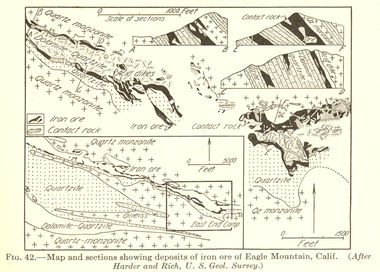
... CN Myers was a family business (on Charles Bacon's maternal line). William Emmons was Professor and head of Geology and Mineralogy at the University of Minnesota; Director of Minnesota geological Survey; and previously Geologist, Section of Metalliferous Deposits, United States Geological Survey....CN Myers was a family business (on Charles Bacon's maternal line). William Emmons was Professor and head of Geology and Mineralogy at the University of Minnesota; Director of Minnesota geological Survey; and previously Geologist, Section of Metalliferous Deposits, United States Geological Survey. charles bacon mining engineering metallurgy university of nevada mackay school of mines geology california Inside front cover "Charles Bacon 1940 Lincoln Hall Ass. ...The book was used by Charles Bacon who studied at the University of Nevada in the late 1930s/early 1940s. Bacon worked at Bunker Hill Mines and Kellogg Idaho, before arriving in Australian in 1951. He worked for CN Myers, a company involved with paper converting. CN Myers was a family business (on Charles Bacon's maternal line). William Emmons was Professor and head of Geology and Mineralogy at the University of Minnesota; Director of Minnesota geological Survey; and previously Geologist, Section of Metalliferous Deposits, United States Geological Survey.Maroon soft covered book of 529 pages. Chapters include Magmatic Segregations, Pegmatities, Hypothermal Deposits, Sedimentary Depostis, Openings in Rocks, Metasomatic Processes, Mineral Associations and more.Inside front cover "Charles Bacon 1940 Lincoln Hall Ass. University of Nevada Reno, Nevada"charles bacon, mining engineering, metallurgy, university of nevada, mackay school of mines, geology, california -
 Federation University Historical Collection
Medal, Ballarat School of Mines Hillman Award (medal), c1992
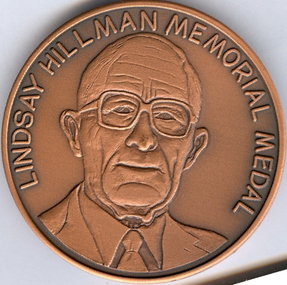
... Head of the Electrical Engineering Department in 1949, a position he held until his retirement in 1973. In 1975 Lindsay Hillman was appointed to the Council of the Ballarat School of Mines and played an active role in school affairs.As Vice-President of Council from 1981 until his death in 1991 Hillman took a leading part in the implementation of many of the major building projects on the Lydiard Street Campus. The L.F.J. Hillman Award was established by the Ballarat School of Mines Council in conjunction with and through the generosity of the Hillman family...Head of the Electrical Engineering Department in 1949, a position he held until his retirement in 1973. In 1975 Lindsay Hillman was appointed to the Council of the Ballarat School of Mines and played an active role in school affairs.As Vice-President of Council from 1981 until his death in 1991 Hillman took a leading part in the implementation of many of the major building projects on the Lydiard Street Campus. The L.F.J. Hillman Award was established by the Ballarat School of Mines Council in conjunction with and through the generosity of the Hillman family ...Lindsay F.J. Hillman was born in Ballarat in 1910, and attended the Ballarat Junior Technical School. He became a cadet in Electrical Engineering Laboratory at the Ballarat School of Mines where he gained eventually gained a student Teachership for diploma studies at the School. Hillman was particularly active and excelled in a wide range of sporting interests and in student activities. In 1928 and 1928 he was awarded the Ballarat School of Mines Honour blazer by the Old Boys' association for all round athletic ability, leadership and scholarship. After spending two years with the Melbourne City Council Electric Supply Department gaining industrial experience Hillman was awarded his Diploma of electrical engineering in 1931, returning to the School in 1932 to teach apprentices and senior students. Hillman was appointed lecturer in Engineering Design and Graphics in 1937, lecturer in Engineering Design and Civil Engineering in 1944, Lecturer-in-Charge of Mechanical and Civil Engineering in 1948 and Head of the Electrical Engineering Department in 1949, a position he held until his retirement in 1973. In 1975 Lindsay Hillman was appointed to the Council of the Ballarat School of Mines and played an active role in school affairs.As Vice-President of Council from 1981 until his death in 1991 Hillman took a leading part in the implementation of many of the major building projects on the Lydiard Street Campus. The L.F.J. Hillman Award was established by the Ballarat School of Mines Council in conjunction with and through the generosity of the Hillman family in honour of the late Lindsay Frederick John Hillman. The bronze medal was presented annually to an enrolled student in an accredited course in the field of electrical/electronics studies at the Ballarat School of Mines. specific Criteria for the Award consisted of a balance of academic performance, leadership qualities, commitment to further study and involvement in sporting and/or community groups. Bronze medal designed depicting the portrait of Lindsay Hillman. The medal has a copper finish, and is presented in a blue hinged box. The first Hillman Award was presented in 1992. The recipients are: 1992 - Brett A. Hovey 1993 - Nil 1994 - Brent L. Ferguson 1995 - Kirsty McKenzie 1996 - Peter J. White 2000 - Roger Bush 2001 - Thomas Edward George 2002 - Mark William Holden 2003 - David James Hopwood 2004 - Leighton Dunn 2005 - Donald Pirouet 2006 - Mark Irvin 2007 - Ricky Wilson 2008 - Luther Dean 2009 - Daniel Thatcher 2010 - Craig Coulter 2011 - Sarah Draper 2012 - Rhys Hendrickson 2013 - Jayden Hooper "Lindsay Hillman Memorial Medal" Verso: "The School of Mines and Industries Ballarat, Est. 1870 Presented to "ballarat school of mines, hillman, lindsay hillman, medal, numismatics, honour blazer, electrical engineering, electronics, hillman medal, hillman award -
 Federation University Historical Collection
Photographs - Colour, Hillman Award Agreement and Presentation, 1991, 1991
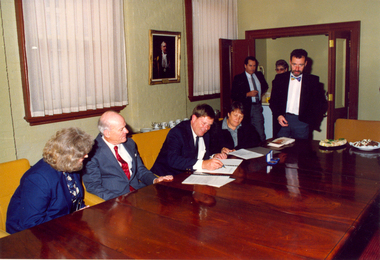
... Head of the Electrical Engineering Department in 1949, a position he held until his retirement in 1973. In 1975 Lindsay Hillman was appointed to the Council of the Ballarat School of Mines and played an active role in school affairs.As Vice-President of Council from 1981 until his death in 1991 Hillman took a leading part in the implementation of many of the major building projects on the Lydiard Street Campus. The L.F.J. Hillman Award was established by the Ballarat School of Mines Council in conjunction with and through the generosity of the Hillman family...Head of the Electrical Engineering Department in 1949, a position he held until his retirement in 1973. In 1975 Lindsay Hillman was appointed to the Council of the Ballarat School of Mines and played an active role in school affairs.As Vice-President of Council from 1981 until his death in 1991 Hillman took a leading part in the implementation of many of the major building projects on the Lydiard Street Campus. The L.F.J. Hillman Award was established by the Ballarat School of Mines Council in conjunction with and through the generosity of the Hillman family ...Lindsay F.J. Hillman was born in Ballarat, and attended the Ballarat Junior Technical School. He became a cadet in Electrical Engineering Laboratory at the Ballarat School of Mines where he gained eventually gained a student Teachership for diploma studies at the School. Hillman was particularly active and excelled in a wide range of sporting interests and in student activities. In 1928 and 1928 he was awarded the Ballarat School of Mines Honour blazer by the Old Boys' association for all round athletic ability, leadership and scholarship. After spending two years with the Melbourne City Council Electric Supply Department gaining industrial experience Hillman was awarded his Diploma of electrical engineering in 1931, returning to the School in 1932 to teach apprentices and senior students. Hillman was appointed lecturer in Engineering Design and Graphics in 1937, lecturer in Engineering Design and Civil Engineering in 1944, Lecturer-in-Charge of Mechanical and Civil Engineering in 1948 and Head of the Electrical Engineering Department in 1949, a position he held until his retirement in 1973. In 1975 Lindsay Hillman was appointed to the Council of the Ballarat School of Mines and played an active role in school affairs.As Vice-President of Council from 1981 until his death in 1991 Hillman took a leading part in the implementation of many of the major building projects on the Lydiard Street Campus. The L.F.J. Hillman Award was established by the Ballarat School of Mines Council in conjunction with and through the generosity of the Hillman family in honour of the late Lindsay Frederick John Hillman. The bronze medal was presented annually to an enrolled student in an accredited course in the field of electrical/electronics studies at the Ballarat School of Mines. specific Criteria for the Award consisted of a balance of academic performance, leadership qualities, commitment to further study and involvement in sporting and/or community groups. The first Hillman Award was presented in 1991. The recipients are: 1991: Paul Donald 1992 - Brett A. Hovey 1994 - Brent L. Ferguson 1995 - Kirsty McKenzie 1996 - Peter J. WhiteEighteen colour photographs of the signing of the Hillman award agreement and the first presentation of the award in 1991 to Paul Donald . .2) Gregor Hillman, Judith Tinney and Caroline Bethune .4) Judith Tinney or Caroline Bethune and Bill Gribble sign the agreement .8) Gregor Hillman, Judith Tinney and Caroline Bethune sign the agreement, along with President of the Ballarat School of Mines, Bill Gribble. .10) Paul Donald with his L.F.J. Hillman Award, 1991 .11) Ballarat School of Mines Principal, Peter Shiells, speaks at the lectern watched on by members of the Hillman family.ballarat school of mines, hillman, lindsay hillman, medal, numismatics, electrical engineering, electronics, gregor hillman. judith tinney, caroline bethune, tinney, bethune, hovey, ferguson, mckenzie, white, paul donald, donald -
 Federation University Historical Collection
Photograph, Indian Ambulance, Suez Canal
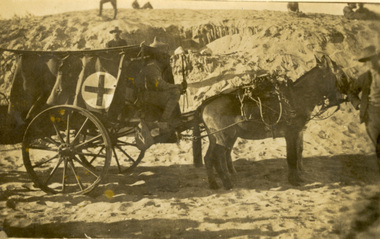
... chatham family archive chatham holmes world war world war 1 world war i world war one france ambulance harry holmes horse drawn waggon egypt Verso: "An Indian Ambulance Cart with myself (Harry Holmes) at the donkey's head."8.7 x 14.0 cm Black and White image of a donkey and cart covered with fabric and featuring the Red Cross Symble. ...Black and White image of a donkey and cart covered with fabric and featuring the Red Cross Symble. It is an Indian Ambulance, Suez Canal.Verso: "An Indian Ambulance Cart with myself (Harry Holmes) at the donkey's head."8.7 x 14.0 cmchatham family archive, chatham, holmes, world war, world war 1, world war i, world war one, france, ambulance, harry holmes, horse drawn waggon, egypt -
 Flagstaff Hill Maritime Museum and Village
Furniture - Double Bed, Late 19th to early 20th centuries
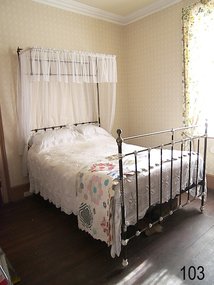
... The Giles family collection has social significance at a local level, because it illustrates the level of material support the Warrnambool community gave to Flagstaff Hill when the Museum was established. flagstaff hill warrnambool shipwrecked coast flagstaff hill maritime museum great ocean road double bed canopy bed metal frame bed giles collection henry giles cooramook mailor’s flat wangoom 19th century household goods None Double Bed metal frame with design on posts and chrome knobs at bed end. Head ...There are many 19th century items of furniture, linen and crockery donated to Flagstaff Hill Maritime Village by Vera and Aurelin Giles. The items are associated with the Giles Family and are known as the “Giles Collection”. These items mostly came from the simple home of Vera’s parents-in-law, Henry Giles and his wife Mary Jane (nee Freckleton), whose photos are in the parlour. They married in 1880. Henry Giles was born at Tower Hill in 1858. He was a labourer on the construction of the Breakwater before leaving in 1895 to build bridges in N.S.W. for about seven years. Mary Jane was born in 1860 at Cooramook. She attended Mailor’s Flat State School where she was also a student teacher before, as family legend has it, she became a governess at “Injemiara” where her grandfather, Francis Freckleton, once owned land. Henry and Mary’s family of six, some of whom were born at Mailor’s Flat and later children at Wangoom, lived with their parents at Wangoom and Purnim west, where Henry died in 1933 and Mary Jane in 1940. The Giles family collection has social significance at a local level, because it illustrates the level of material support the Warrnambool community gave to Flagstaff Hill when the Museum was established.Double Bed metal frame with design on posts and chrome knobs at bed end. Head has canopy that hangs from tall frame. Wood, wire sprung mattress base sits on metal frame.Noneflagstaff hill, warrnambool, shipwrecked coast, flagstaff hill maritime museum, great ocean road, double bed, canopy bed, metal frame bed, giles collection, henry giles, cooramook, mailor’s flat, wangoom, 19th century household goods -
 Flagstaff Hill Maritime Museum and Village
Machine - Dioptric Apparatus, mid 19th century
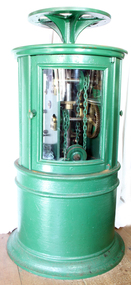
... In 1900 a baronetcy was created for James Timmins Chance (1814–1902), a grandson of William Chance, who had started the family business in 1771 with his brother Robert. Roberts grandson, James became head of Chance Brothers until his retirement in 1889 when the company became a public company and its name changed to Chance Brothers & Co. ...In 1900 a baronetcy was created for James Timmins Chance (1814–1902), a grandson of William Chance, who had started the family business in 1771 with his brother Robert. Roberts grandson, James became head of Chance Brothers until his retirement in 1889 when the company became a public company and its name changed to Chance Brothers & Co. ...Before the introduction of electricity, lighthouses had a clockwork mechanism that caused the lens to rotate with a light source inside that was either powered by Kerosene or Colza oil. The mechanism consisted of a large weight attached by a cable through the centre of the lighthouse to the top where the cable wrapped around a barrel, drum or wheels that controlled the speed of the lights rotation by a clockwork mechanism. The keeper would crank the clockwork mechanism, which would lift the weight ready for the next cycle similar to an old grandfather clock mechanism. Once the weight lifted to its apex at the bottom of the first landing, the keeper would let it fall, which would pull on the cable, which would, in turn, operate a series of gears activating the rotation of the Fresnel optical lens, which would then rotate to create the lighthouse’s unique light speed of rotation characteristic. Creating a specific characteristic required a way to regulate the speed of the rotation, and was important as sailors could identify a particular light by its speed and time between flashes. The weight had to fall at a certain rate to create the proper rotation speed of the lens and a regulator within the mechanism accomplished this. History: From 1851, Chance Brothers became a major lighthouse engineering company, producing optical components, machinery, and other equipment for lighthouses around the world. James Timmins Chance pioneered placing lighthouse lamps inside a cage surrounded by Fresnel lenses to increase the available light output these cages, are known as optics and they revolutionised lighthouse design. Another important innovation from Chance Brothers was the introduction of rotating optics, allowing adjacent lighthouses to be distinguished from each other by the number of times per revolution the light flashes. The noted English physicist and engineer, John Hopkins invented this system while employed at Chance Brothers. Chance Brothers and Company was a glass works and originally based in Spon Lane, Smethwick, West Midlands England. The company became a leading glass manufacturer and a pioneer of British glass making technology. The Chance family originated in Bromsgrove as farmers and craftsmen before setting up a business in Smethwick near Birmingham in 1824. They took advantage of the skilled workers, canals and many other industrial advances taking place in the West Midlands at the time. Robert Lucas Chance (1782–1865), known as 'Lucas', bought the British Crown Glass Company's works in Spon Lane in 1824. The company specialised in making crown window glass, the company ran into difficulty and its survival was guaranteed in 1832 by investment from Chance's brother, William (1788 – 1856). William owned an iron factoring business in Great Charles Street, Birmingham. After a previous partnership that Lucas had dissolved in 1836, Lucas and William Chance became partners in the business which was renamed, Chance Brothers and Company. Chance Brothers invented many innovative processes and became known as the greatest glass manufacturer in Britain. In 1848 under the supervision of Georges Bontemps, a French glass maker from Choosy-le-Roi, a new plant was set up to manufacture crown and flint glass for lighthouse optics, telescopes and cameras. Bontemps agreed to share his processes that up to then had been secret with the Chance Brothers and stayed in England to collaborate with them for six years. In 1900 a baronetcy was created for James Timmins Chance (1814–1902), a grandson of William Chance, who had started the family business in 1771 with his brother Robert. Roberts grandson, James became head of Chance Brothers until his retirement in 1889 when the company became a public company and its name changed to Chance Brothers & Co. Ltd. Additional information: Lighthouses are equipped with unique light characteristic or flashing pattern that sailors can use to identify specific lighthouses during the night. Lighthouses can achieve distinctive light characteristics in a few different ways. A lighthouse can flash, which is when brief periods of light interrupt longer moments of darkness. The light can occult, which is when brief periods of darkness interrupt longer moments of light. The light can be fixed, which is when the light never goes dark. A lighthouse can use a combination of flashing, oscillating, or being fixed in a variety of combinations and intervals to create individual light characteristics. It is a common misconception that a lighthouse's light source changes the intensity to create a light characteristic. The light source remains constant and the rotating Fresnel lens creates the various changes in appearance. Some Fresnel lenses have "bulls-eye" panels create beams of light that, when rotated between the light and the observer, make the light appear to flash. Conversely, some lenses have metal panels that, when rotated between the light and the observer, make the light appear to go dark. This Dioptric clockwork apparatus used to turn a lighthouse optical lens is very significant as it is integral to a lighthouses operation, we can also look at the social aspect of lighthouses as being traditionally rich with symbolism and conceptual meanings. Lighthouses illustrate social concepts such as danger, risk, adversity, challenge and vigilance but they also offers guidance, salvation and safety. The glowing lamp reminds sailors that security and home are well within reach, they also symbolize the way forward and help in navigating our way through rough waters not just on the oceans of the world but in our personal lives be it financial, personal, business or spiritual in nature. Nothing else speaks of safety and security in the face of adversity and challenge quite the way a lighthouse does. Revolving dioptric clockwork apparatus used to turn a Fresnel optical lighthouse lens. A cylindrical cast metal pillar and cabinet painted green with 3 glass doors enclosing the top section. Inside the pillar/cabinet is a large clockwork mechanism used to turn and regulate a lighthouse light by means of weights and a chain attached to same. One door has the name "Adams Mare" in metallic dots similar to "Braille" to the inside edge of door frame.shipwrecked-coast, flagstaff-hill, flagstaff-hill-maritime-museum, flagstaff hill, maritime-museum, shipwreck-coast, warrnambool, flagstaff-hill-maritime-village, revolving dioptric mechanism, dioptric mechanism for lighthouse, lighthouse clockwork timing mechanism, acetylene lighthouse light mechanism, 19th century lighthouse mechanism, kerosene light, fresnel lenses, colza oil, chance brothers -
Mission to Seafarers Victoria
Letter - Correspondence, 03/04/1950
... family members and is thought to be a relative; more research is needed. She also writes ".....I suppose you've heard all about the floods here, winter certainly is settling in early ....". Quinn Collection letters-from-abroad quinn The letter commences "Dear Allan......" and is signed "Yours June". A single page of unlined pale blue paper folded in book form to give four pages of writing (0836.a). Letter is headed ...The writer refers to Allan's and her own family members and is thought to be a relative; more research is needed. She also writes ".....I suppose you've heard all about the floods here, winter certainly is settling in early ....".Quinn CollectionA single page of unlined pale blue paper folded in book form to give four pages of writing (0836.a). Letter is headed Nurses Home, Alfred Hospital, Prahran and dated 3.04.1950. Matching envelope (0836.b) is addressed to M.S. Mongabarra, C/- Elder Smith & Co., Adelaide. 'Adelaide' has been crossed out and an indecipherable port, possibly Port Lincoln, has been added by a different writer and in darker ink. Envelope bears three red, two and halfpenny Australian stamps franked Melbourne. The letter commences "Dear Allan......" and is signed "Yours June". letters-from-abroad, quinn -
 Mission to Seafarers Victoria
Photograph, c. 12 April 1930
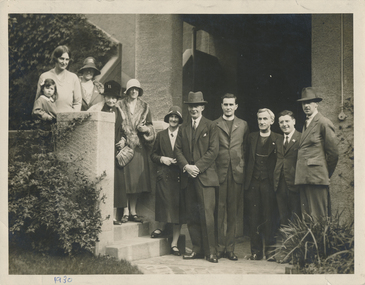
... Head welcomed a new chaplain, the Rev. F. L. Oliver, formerly of Newcastle. Mrs. Oliver was also welcomed. The old executive was re-elected except Messrs. Durham and Holmes, who declined the honor. Lady Fraser was elected president of the Harbour Lights Guild. The Rev. \V. M. Robertson of the Port Melbourne Mission, was among the speakers." First photograph of Padre Oliver and his family ...From Record (Emerald Hill, Vic. : 1881 - 1954), Saturday 12 April 1930, page 3 "On Wednesday, at the 24th meeting of the Victorian Mission to Seamen. Archbishop Head welcomed a new chaplain, the Rev. F. L. Oliver, formerly of Newcastle. Mrs. Oliver was also welcomed. The old executive was re-elected except Messrs. Durham and Holmes, who declined the honor. Lady Fraser was elected president of the Harbour Lights Guild. The Rev. \V. M. Robertson of the Port Melbourne Mission, was among the speakers."First photograph of Padre Oliver and his family at the Mission in 1930.Written in black on verso: Dad (Padre Oliver) , Miss Tracy, Mum (Mrs Oliver), Phyllis Atkins (secretary), Beverleyfrank oliver, flinders street, garden, phyllis atkins, secretary, alice sibthrope tracy, moira bird oliver (nee good), archbishop head, beverley oliver, rev. w.m robertson -
Federation University Historical Collection
Book, Glenfine South and South Berry Journal
... Gift of the Squire Family glenfine south south berry sleemans mining gold mining glenfine consols reef weights of quartz blacksmiths tools Australian and eagle davies south east reef drive brawns eaglehawk junction simons letter machinery puddlng plant poppet heads winding plant creswick mosquito creek frenchmans gully spring hill A. ...This Book is associated with former Ballarat School of Mines Student Richard Squire (1875-1876). Gift of the Squire FamilyGreen water marked linen covered journal with maroon spine with red feint lined blue pages. Label on front cover is cream with black printing JOURNAL with handwritten DATA RISIS GLENFINE SOUTH -SOUTH BERRY G.S & S.B Hand written in black and red ink. Plan in back with scale 20 chains to one inch - Has an index. Handwritten on title page in black ink Address of sawmiller T. J. Brown, Mount Rowan D. W. Hambly 317 Ligar St, Ballarat J. Freeman, C/O Mrs H Simons, Lynch St, Footscray Sleemans Prescription for the bladder in 19009 Mixture No 55983 Tabloids No 55982glenfine south, south berry, sleemans, mining, gold mining, glenfine consols, reef, weights of quartz, blacksmiths tools, australian and eagle, davies south east reef drive, brawns, eaglehawk junction, simons letter, machinery, puddlng plant, poppet heads, winding plant, creswick, mosquito creek, frenchmans gully, spring hill, a. h. welsh, squire, petticoat gully -
 Walhalla Museum
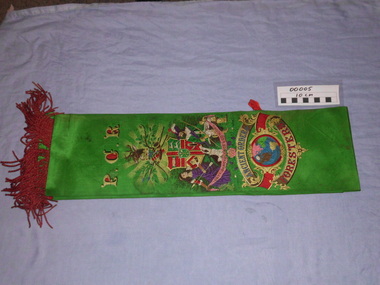
Sash, 1910 (estimated)
... family. The Ancient Order of Foresters sash is only one of a handful left in existance from the local Walhalla order and is at least 110 years old who was born and lived in Walhalla coat of arms ancient order of foresters green sash Top end of sash letters "P.C.R"/under the Coat of arms"UNITY, BENEVOLENT & CONCORD" below this is "ANCIENT ORDER of FORESTERS" all embroidered Lime green taffeta sash with red tassles hand stiched on. Top half of sash has PCR embroildered on it in Gold. Brown Elk head ...This sash is approx 110 years old and was presented to Simon Whitford Campbell on completing accreditation to enter the Ancient Order of Foresters Organisation. Donated by decendants of his family.The Ancient Order of Foresters sash is only one of a handful left in existance from the local Walhalla order and is at least 110 years old who was born and lived in WalhallaLime green taffeta sash with red tassles hand stiched on. Top half of sash has PCR embroildered on it in Gold. Brown Elk head in a gold crown with 2 arrows with blue tips and a brown horn. Underneath is the Coat of ArmsTop end of sash letters "P.C.R"/under the Coat of arms"UNITY, BENEVOLENT & CONCORD" below this is "ANCIENT ORDER of FORESTERS" all embroideredcoat of arms, ancient order of foresters, green sash -
 Bunjil Park Aboriginal Education & Cultural Centre
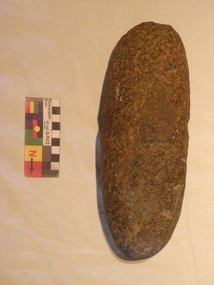
stone axehead
... family farm. It was gifted to Uncle Brien Nelson in Castlemaine. This implement could be many thousands of years old. This unusually large axe head...family farm. It was gifted to Uncle Brien Nelson in Castlemaine. This implement could be many thousands of years old. This unusually large axe head ...This stone was held by a European family for 200 years and was found on the family farm. It was gifted to Uncle Brien Nelson in Castlemaine. This implement could be many thousands of years old. This unusually large axe head would not have been carried from place to place and was probably hidden for occasional use crafting large objects.This stone axe head is shaped to a sharpened rounded edge at one end and is broad and blunt at the other end. It is an elongated teardrop shape in cross section. It has a distinctive waist in the middle where the haft was attached using hide and or fibre.This axe displays grooves caused by a disk plough.jaara, heavy stone axe head
