
Showing 84 items matching "henry weekes"
-
 Eltham District Historical Society Inc
Document - Folder, Tisdall, Thomas
... ...Henry Weekes...Constance Tisdall Book "Forerunners: The Saga of a Family of Teachers" Eltham Victoria Charles Symons Wingrove Annie Eliza Tisdall Thomas Tisdall Lucy Tisdall Albert Tisdall Henry Weekes Henry Dendy Ethel Catherine Tisdall Henry Tisdall Walhalla State School Newspaper clippings, A4 photocopies, etc Tisdall, Thomas Document Folder ...Henry and Lucy Tisdall, parents of Constance, were teachers and lived for some years in Elham. Contents Photocopy chapter "Trying it out" from "Forerunners: The Saga of a Family of Teachers", by Constance Tisdall, F W Cheshire, Melbourne, 1961, pp38-39. Photocopy pp52-121 "Old Walhalla", by Raymond Paull, Melbourne University Press, 1963.Newspaper clippings, A4 photocopies, etcconstance tisdall, book "forerunners: the saga of a family of teachers", eltham victoria, charles symons wingrove, annie eliza tisdall, thomas tisdall, lucy tisdall, albert tisdall, henry weekes, henry dendy, ethel catherine tisdall, henry tisdall, walhalla state school -
 Musculoskeletal Health Australia (now held by the Glen Eira Historical Society)
Photograph - Group photo, 07/08/1986 to 08/08/1986
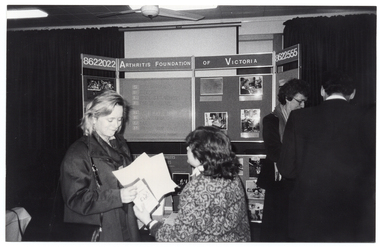
... Staff from the Arthritis Foundation of Victoria (AFV), Janet McDonald and Wilma Gardiner, provide information to doctors at the Prince Henry's Hospital Graduate Week Conference. The conference was held on the 7th and 8th of August 1986 at Prince Henry's Hospital, in Melbourne....[On a whitel label, handwritten in blue ink] Arthritis Foundation staff Janet McDonald and Wilma Gardiner ^ talk with interested doctors at Prince Henry's Hospital Graduate Week Conference on rheumatology August 7 and 8. 1986...Staff from the Arthritis Foundation of Victoria (AFV), Janet McDonald and Wilma Gardiner, provide information to doctors at the Prince Henry's Hospital Graduate Week Conference. The conference was held on the 7th and 8th of August 1986 at Prince Henry's Hospital, in Melbourne. arthritis foundation of victoria afv rheumatism and arthritis association of victoria raav prince henry’s hospital graduate week conference janet mcdonald wilma gardiner afv staff information doctors south melbourne 1986 [On a whitel label, handwritten in blue ink] Arthritis Foundation staff Janet McDonald and Wilma Gardiner ^ talk with interested doctors at Prince Henry's Hospital Graduate Week Conference on rheumatology August 7 and 8. 1986 B&W photo of four people standing in front of a multipanel display board. ...Staff from the Arthritis Foundation of Victoria (AFV), Janet McDonald and Wilma Gardiner, provide information to doctors at the Prince Henry's Hospital Graduate Week Conference. The conference was held on the 7th and 8th of August 1986 at Prince Henry's Hospital, in Melbourne.B&W photo of four people standing in front of a multipanel display board. Displayed across the top of the centre board is the text, "ARTHRITIS FOUNDATION OF VICTORIA", with the phone number "8622022" across the top of the two side panels.[On a whitel label, handwritten in blue ink] Arthritis Foundation staff Janet McDonald and Wilma Gardiner ^ talk with interested doctors at Prince Henry's Hospital Graduate Week Conference on rheumatology August 7 and 8. 1986arthritis foundation of victoria, afv, rheumatism and arthritis association of victoria, raav, prince henry’s hospital, graduate week conference, janet mcdonald, wilma gardiner, afv staff, information, doctors, south melbourne, 1986 -
Lakes Entrance Historical Society
Book, Gippsland Heritage Journal - issue 22, 1997
... No 22 of series contains biographical details of Snell family of giants, school teacher Clara Weekes, henry Meyrick,Catherine Desailly, 'Ma' Kelly and Mrs Helen Crombie. ...Bibliography Bridges Archaeology No 22 of series contains biographical details of Snell family of giants, school teacher Clara Weekes, henry Meyrick,Catherine Desailly, 'Ma' Kelly and Mrs Helen Crombie. ...No 22 of series contains biographical details of Snell family of giants, school teacher Clara Weekes, henry Meyrick,Catherine Desailly, 'Ma' Kelly and Mrs Helen Crombie. Also timber bridges of Gippsland and an item on archaeological investigation of the Sbibliography, bridges, archaeology -
 Flagstaff Hill Maritime Museum and Village
Drill Press, 1920s-1950s
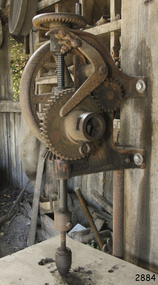
... weeks. Dawn was contracted to supply vices and clamps to the Australian Defence Department and munitions factory during the World War II. In 1959 the company was taken over by G.N. Raymond Group, then in 1973 the Siddons Ramset Limited acquired Dawn. In December 1991, Dawn became a unit of the United States owned Stanley Works Pty. Ltd. In November 1998 Dawn became 100 per cent Australian owned. HENRY...weeks. Dawn was contracted to supply vices and clamps to the Australian Defence Department and munitions factory during the World War II. In 1959 the company was taken over by G.N. Raymond Group, then in 1973 the Siddons Ramset Limited acquired Dawn. In December 1991, Dawn became a unit of the United States owned Stanley Works Pty. Ltd. In November 1998 Dawn became 100 per cent Australian owned. HENRY ...This drill once belonged to Goodall and Sons, who were blacksmiths in Terang. The smith was called upon to do a variety of work. In the early 1900s he was often the nearest person to be able to perform an engineer’s services for many miles around. The Dawn Ball-bearing Post Drill no. 611 is described in McPherson’s Catalogue as a “drilling machine with adjustable automatic feed, with improved Dawn coupler and ball-bearing thrust’. The heavy design of the flywheel enables it to maintain momentum” and is “fitted with pulleys for belt drive if desired” The hand crank drives an automatic feed to work off a cam-follow system opposite a large wheel. Made by Dawn Manufacturing Co. Australia 1920-1950. DAWN MANUFACTURING CO. Dawn Manufacturing Co. was founded in Coburg, Melbourne, in 1917 by the four Blake brothers, who were all engineers. After World War I Dawn was supplying drills Australia wide and the company was growing at a healthy rate. During the depression they remained busy, with employees working 60-80 hour weeks. Dawn was contracted to supply vices and clamps to the Australian Defence Department and munitions factory during the World War II. In 1959 the company was taken over by G.N. Raymond Group, then in 1973 the Siddons Ramset Limited acquired Dawn. In December 1991, Dawn became a unit of the United States owned Stanley Works Pty. Ltd. In November 1998 Dawn became 100 per cent Australian owned. HENRY GOODALL & SONS Henry Goodall (1870-1936) was proprietor of garages as H. Goodall & Sons Pty. Ltd., at both Terang (McKinnon and High Streets) and Mortlake (Dunlop Street). His business was in operation in at least in 1916 and perhaps well before, considering the date of the tyre bender and its use for wagons with wooden wheels. It was still in operation in 1953, chasing up debtors in Mount Gambier Court. Amongst the employees of H. Goodall & Sons Pty. Ltd. was Ernie Entwistle, a blacksmith (a soldier who died in 1916 ) and Alfred Hodgetts, radio expert (killed in a fatal accident in 1943, when he was in his early 30s ). Henry Goodall was involved in the community as a Justice of Peace, a deputy coroner, President of the Mortlake Hospital, trustee of the Soldiers’ Memorial Hall, and as a prominent Freemason. He and his wife had two sons (Charles and John) and one daughter (Mrs. Chas. Newton, of Skipton). The drill is locally significant as it was used by a local company in Terang and Mortlake in their blacksmith, wheelwright and garage business. It is an example of the tools of the blacksmiths’ trade in Victoria in the 1920s-1950s.Dawn Ball-bearing Post Drill no. 611, made by Dawn of Melbourne, model no 611. Hand operated drill press. Self-feeding blacksmiths’ drill-press. This drill once belonged to Harry Goodall & Sons, blacksmiths of Terang. Dated 1920s-1950s. Gear ratio 2:1 main drive, 6" diam, 3:1 reduction gear. "Dawn", "Melbourne"flagstaff hill, warrnambool, shipwrecked-coast, flagstaff-hill, flagstaff-hill-maritime-museum, maritime-museum, shipwreck-coast, flagstaff-hill-maritime-village, h. goodall & sons of terang, terang blacksmith, h. goodall & sons pty ltd, mortlake, ernie entwistle blacksmith, alfred hodgetts radio expert, charles goodall, john goodall, mrs. chas. newton nee goodall, terang 1900s, warrnambool district 1900s, post drill, blacksmith’s drill, dawn post drill, dawn ball-bearing post drill no. 611, blacksmiths, dawn of melbourne -
 Federation University Historical Collection
Postcard - black and white, Trafalgar Square, London, 1917, c1917
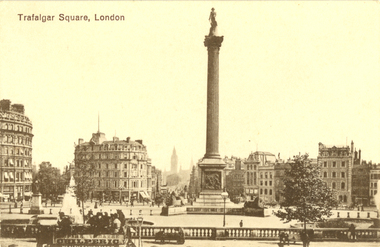
... weeks, so it may not be very long before I will be having a move on, Girls seem to be taking the vacant gaps. Black and white postcard with a photographic impression of London including Trafalagar Square. The postcard has writing on the back. This card was purchased by an Australian soldier, probably Henry ...This card was most probably sent from Harry Holmes to a family member in Ascot, Victoria during his overseas service during World War One.Black and white postcard with a photographic impression of London including Trafalagar Square. The postcard has writing on the back. This card was purchased by an Australian soldier, probably Henry Smerdon Holmes, during World War One and sent to his sister, Mary Coghill HolmesLondon 16.4.17 Dear Mary Received your welcome letter a few weeks back, pleased indeed to hear from you & to know that you were OK. Sorry I have been so long in answering it, but I suppose it is better late then never. Still in the same old job at present, but all 'A' class chaps are to go back to the units 20 per weeks, so it may not be very long before I will be having a move on, Girls seem to be taking the vacant gaps. chatham-holmes family collection, world war one, ascot, trafalgar square, london, holmes -
 Walhalla Museum
Botanical Album, Album of Botanical Specimens, 1881
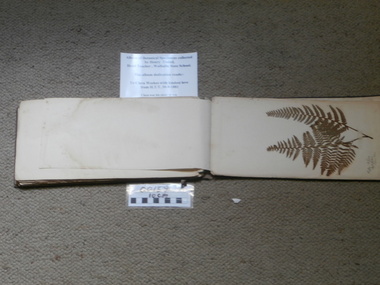
... Henry Tisdall. The book is dedicated to his sister in law Clara Weekes....Albums Catalogues Collections To Clara Weekes with kindest love from H.T.T. 30-9-1881 Item is a book of botanical specimens collected by Henry Tisdall. ...Item is a book of botanical specimens collected by Henry Tisdall. The book is dedicated to his sister in law Clara Weekes.To Clara Weekes with kindest love from H.T.T. 30-9-1881albums, catalogues, collections -
 Federation University Historical Collection
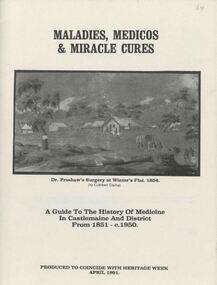
Booklet, Lauretta Zilles, Maladies, Medicos & Miracle Cures: A Guide to the History of Medicine in Castlemaine and District from 1851-c1950, 04/1991
... This is a catalogue supporting an exhibition held at the Castlemaine Art Gallery and Historical Museum. doctors castlemaine hospital pharmacists herbalists dentists veterinary surgeons opticians nurses midwives chiropody benevolent asylum private hospitals homelea herb farm castlemaine infant welfare centre richard bunce william fisher preshaw john cheyne henry barraclough daniel o. preshaw ching chin raymond francis duggan enpo hong l. goon shee shok algernon cyril yandell augustus courts yandell myrtle lucinda yandel daniel cohen max pincus s. aaron mrs foletti vaughan mary ann passalaqua guildford mary an martinoja beatrice thurlby elizabeth spencer lenna hopkins rebecca baxter avonsleigh ballara jonathan chapple alice kenyon health Grey soft covered booklet printed to accompany am exhibiton held at Castlemaine and Historical Museum during Heritage Week. ...This is a catalogue supporting an exhibition held at the Castlemaine Art Gallery and Historical Museum.Grey soft covered booklet printed to accompany am exhibiton held at Castlemaine and Historical Museum during Heritage Week. The book lists information on Castlemaine and district doctors, Castlemaine Hospital, Pharmacists, Herbalists, Dentists, Veterinary Surgeons, Opticians, Nurses, Midwives, Chiropody, Benevolent Asylum, Private Hospitals, Caslemaine Infant Welfare Centre, Homelea Herb Farmdoctors, castlemaine hospital, pharmacists, herbalists, dentists, veterinary surgeons, opticians, nurses, midwives, chiropody, benevolent asylum, private hospitals, homelea herb farm, castlemaine infant welfare centre, richard bunce, william fisher preshaw, john cheyne, henry barraclough, daniel o. preshaw, ching chin, raymond francis duggan, enpo hong, l. goon, shee shok, algernon cyril yandell, augustus courts yandell, myrtle lucinda yandel, daniel cohen, max pincus, s. aaron, mrs foletti, vaughan, mary ann passalaqua, guildford, mary an martinoja, beatrice thurlby, elizabeth spencer, lenna hopkins, rebecca baxter, avonsleigh, ballara, jonathan chapple, alice kenyon, health -
 Marysville & District Historical Society
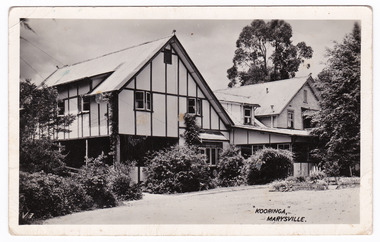
Postcard (item) - Black and white postcard, Valentine Publishing Co. Pty. Ltd, "KOORINGA," MARYSVILLE, 1923-1963
... henry branchflower wilbur anderson peter mackey caroline anna pitman valentine publishing co. pty. ltd. v.7. V.7. Valentine's POST CARD SENDING YOU GREETINGS FOR ADDRESS ONLY Dear Bloss Herb Lily and Darling Raymond and my darling/ kids. We have settled in here for a week ...A black and white postcard from Kooringa Guesthouse in Marysville. The original house was built in 1914 for Frederick Webb by the Cuzens Brothers. The postcard was produced by Valentine's as a souvenir of Marysville.A black and white postcard from Kooringa Guesthouse in Marysville.V.7. Valentine's POST CARD SENDING YOU GREETINGS FOR ADDRESS ONLY Dear Bloss Herb Lily and Darling Raymond and my darling/ kids. We have settled in here for a week we may stay/ two I would like you to come for week and it is very nice/ and clean. we had a dance last night H.A.K.B. funny/ and I had a shot at billiards they are playing Bowls/ now while I write this I can hear them clapping mad/ away it is a very long way we were the only car on the road/ 60 mile. You would enjoy yourself house is clean old lily it/ is just place for her for a walk or two. Love Mummarysville, victoria, australia, kooringa, frederick webb, cuzens brothers, betha wilhelmina christina unmack, minnie webb, t.e. foster, edgar charles webb, clarence thomas pitman, jacob pitman, sir isaac pitman, caroline anna blood newenham, henry newenham pitman, carrie rosalind persse pitman, reginald william stringer, alice burton pitman, clarence edward pitman, newenham mueller pitman, olive birch, constance may pitman, olive dora blakeney pitman, gwendoline de burch pitman, kooringa guesthouse, lilian may shelton, thomas henry branchflower, wilbur anderson, peter mackey, caroline anna pitman, valentine publishing co. pty. ltd., v.7. -
 Marysville & District Historical Society
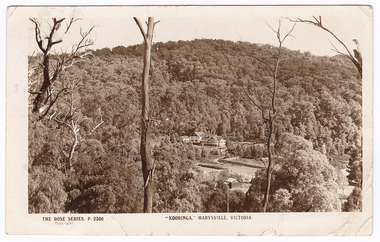
Postcard (item) - Black and white postcard, The Rose Stereographs, "KOORINGA," MARYSVILLE, VICTORIA, 1913-1967
... A black and white postcard from Kooringa Guesthouse in Marysville. marysville victoria australia kooringa frederick webb cuzens brothers betha wilhelmina christina unmack minnie webb t.e. foster edgar charles webb clarence thomas pitman jacob pitman sir isaac pitman caroline anna blood newenham henry newenham pitman carrie rosalind persse pitman reginald william stringer alice burton pitman clarence edward pitman newenham mueller pitman olive birch constance may pitman olive dora blakeney pitman gwendoline de Burch Pitman kooringa guesthouse lilian may shelton thomas henry branchflower wilbur anderson peter mackey caroline anna pitman the rose stereographs the rose stereograph company rose series postcard souvenir p. 2300 THE ROSE SERIES P. 2300/ Copyright POST CARD REAL PHOTO THE "ROSE" SERIES DE LUXE PRODUCED IN AUSTRALIA Published by "The Rose Stereographs"/ Armadale, Victoria. 22.3.24 Dear Jean,/ Thanks ever so/ for kind letters & snaps/ while in Hospital. I am/ recuperating here just now,/ & intend going further down/ the hills today to stay, will/ write you at length then./ If not I will see you in Tas. in/ a few weeks ...A black and white postcard from Kooringa Guesthouse in Marysville. The original house was built in 1914 for Frederick Webb by the Cuzens Brothers. The postcard was produced by "The Rose Stereographs" as a souvenir of Marysville.A black and white postcard from Kooringa Guesthouse in Marysville.THE ROSE SERIES P. 2300/ Copyright POST CARD REAL PHOTO THE "ROSE" SERIES DE LUXE PRODUCED IN AUSTRALIA Published by "The Rose Stereographs"/ Armadale, Victoria. 22.3.24 Dear Jean,/ Thanks ever so/ for kind letters & snaps/ while in Hospital. I am/ recuperating here just now,/ & intend going further down/ the hills today to stay, will/ write you at length then./ If not I will see you in Tas. in/ a few weeks. Cheerio!/ Bill. H. St. Clair Miss Jean Cuthbertson/ "Caldew"/ Cavill Street/ Hobart West/ Tasmaniamarysville, victoria, australia, kooringa, frederick webb, cuzens brothers, betha wilhelmina christina unmack, minnie webb, t.e. foster, edgar charles webb, clarence thomas pitman, jacob pitman, sir isaac pitman, caroline anna blood newenham, henry newenham pitman, carrie rosalind persse pitman, reginald william stringer, alice burton pitman, clarence edward pitman, newenham mueller pitman, olive birch, constance may pitman, olive dora blakeney pitman, gwendoline de burch pitman, kooringa guesthouse, lilian may shelton, thomas henry branchflower, wilbur anderson, peter mackey, caroline anna pitman, the rose stereographs, the rose stereograph company, rose series, postcard, souvenir, p. 2300 -
Federation University Historical Collection
Book - Book - Scrapbook, Ballarat School of MInes: Scrapbook of Newspaper Cuttings, Book 11, June 1981 to September 1981
... henry sutton inventor...employers advised to learn of training changes...apprentice week...The papers concerned are The Courier, Ballarat, The Australian, The Age over the period of 10 June 1981 to 25 September 1981. courses available smb music teachers to play in japan scholarships given by real estate men department tests plant operators student comfort and architectual skill carol woolman breaking language barrier morgan john retires from bcae council leanne parker neil henderson and daryl crawley among state's top students father john ignatius bleasdale wine authority receptionist course to begin at smb governor sir henry winneke's tribute to craftsmen smb courses to help avoid business failure joan chamber mla critical of tafe college funding jobless urged to train for jobs replies to joan chambers' comments ballarat rowers deny council bashing henry sutton inventor employers advised to learn of training changes apprentice week at smb photography courses at smb geoff pope photography teacher training better supervisors - factory language in classroom impetus from top ballarat move for apprentice hairdressers' course at smb safety seminar for apprentices education mood of gloom says john dawkins federal spokesman for education tafe region board chairman appointed neil ferguson councils face increasing financial pressures proper care of rape victims advocated tafe funding not enough local government conference in ballarat major trophy for john wilson peter drake racv apprentice motor mechanic of the year Book with white cover, front, spiral bound. ...Collection of newspaper articles related to Ballarat School Of Mines.They cover activities and advertisements for staff. The papers concerned are The Courier, Ballarat, The Australian, The Age over the period of 10 June 1981 to 25 September 1981.Book with white cover, front, spiral bound. courses available, smb music teachers to play in japan, scholarships given by real estate men, department tests plant operators, student comfort and architectual skill, carol woolman breaking language barrier, morgan john retires from bcae council, leanne parker neil henderson and daryl crawley among state's top students, father john ignatius bleasdale wine authority, receptionist course to begin at smb, governor sir henry winneke's tribute to craftsmen, smb courses to help avoid business failure, joan chamber mla critical of tafe college funding, jobless urged to train for jobs, replies to joan chambers' comments, ballarat rowers deny council bashing, henry sutton inventor, employers advised to learn of training changes, apprentice week at smb, photography courses at smb, geoff pope photography teacher, training better supervisors - factory language in classroom, impetus from top, ballarat move for apprentice hairdressers' course at smb, safety seminar for apprentices, education mood of gloom says john dawkins federal spokesman for education, tafe region board chairman appointed, neil ferguson, councils face increasing financial pressures, proper care of rape victims advocated, tafe funding not enough, local government conference in ballarat, major trophy for john wilson, peter drake racv apprentice motor mechanic of the year -
Federation University Historical Collection
Documents, Frank Pinkerton Printer and Stationer, Ballaarat Mechanics' Institute Fine Arts Exhibition 1876 Catalogue (copy), 1876
... fine arts exhibition ballarat mechanics' institute john ware j.w> hines a.t. turner a.m. greefield j. rice w.h. batten j. curtis a.j. boulton alex hunter w. hambly a.m. greenfield t. walton henry brind henry richards caselli isaac davis d. brophy g. willetts w.b. tappin henry sutton w. elsden julius hogarth w. weire a.l. gatliff gordon a. thomson r.s. brown h. blomfield w.r. gunn c.k. pearson w.k. watts george herbert james south b.w. wheatland c. humphreys h. weeks h. dowling j. munro j. price f. mitchell t.h. thompson p. windmiller j. reid e. towl h. wheeler robert brown l. blair r.m. serjeant j.m. fisher e. uren j. gatliff john harrison william street c.i. burrows j. mcdowall thomas bath d. book w.q. pinnell charles boyd eureka stockade pike j. holloway frank pinkerton Copy of a twenty page art exhibition catalogue Ballaarat Mechanics' Institute Fine Arts Exhibition 1876 Catalogue (copy) Documents Frank Pinkerton Printer and Stationer ...Copy of a twenty page art exhibition catalogue fine arts exhibition, ballarat mechanics' institute, john ware, j.w> hines, a.t. turner, a.m. greefield, j. rice, w.h. batten, j. curtis, a.j. boulton, alex hunter, w. hambly, a.m. greenfield, t. walton, henry brind, henry richards caselli, isaac davis, d. brophy, g. willetts, w.b. tappin, henry sutton, w. elsden, julius hogarth, w. weire, a.l. gatliff, gordon a. thomson, r.s. brown, h. blomfield, w.r. gunn, c.k. pearson, w.k. watts, george herbert, james south, b.w. wheatland, c. humphreys, h. weeks, h. dowling, j. munro, j. price, f. mitchell, t.h. thompson, p. windmiller, j. reid, e. towl, h. wheeler, robert brown, l. blair, r.m. serjeant, j.m. fisher, e. uren, j. gatliff, john harrison, william street, c.i. burrows, j. mcdowall, thomas bath, d. book, w.q. pinnell, charles boyd, eureka stockade pike, j. holloway, frank pinkerton -
Federation University Historical Collection
Newspaper - newsletter, On Campus, 1996-1997
... university of ballarat newsletter Ferdinand krause Krause medal Henry Award Twenty-nine newsletters. .1) 03 December 1996 Construction of Univeristy Drive, China Scholarships (Andrew Kuiler, Bronwyn Gibson, Marita Pierce, Veronica Malesic), Ballarat Gooldfields, Rosemary Chang, calligraphy, Pivot naming right, William Pryor, Donald Norris, John Nicholson, Bernie Whitaker, Shakespeare by the Sea, Thomas Woodrow Award, Jean Goh, Sheri Dyson, GPS, Claire Robinson, Daniel Smith, Jenny Trustum, retirement of Patrick Hope, Frank Hurley and Bon Morrell. .2) 14 November 1996 Philip Candy, Stephen Kemmis, ARC grants (Alex Rubinove, Ray Over, Dennis Arne, V. Murthy,) Paul Mensch, Chinese speaking competition, Richard Hutchinson, Mning Week ...Twenty-nine newsletters. .1) 03 December 1996 Construction of Univeristy Drive, China Scholarships (Andrew Kuiler, Bronwyn Gibson, Marita Pierce, Veronica Malesic), Ballarat Gooldfields, Rosemary Chang, calligraphy, Pivot naming right, William Pryor, Donald Norris, John Nicholson, Bernie Whitaker, Shakespeare by the Sea, Thomas Woodrow Award, Jean Goh, Sheri Dyson, GPS, Claire Robinson, Daniel Smith, Jenny Trustum, retirement of Patrick Hope, Frank Hurley and Bon Morrell. .2) 14 November 1996 Philip Candy, Stephen Kemmis, ARC grants (Alex Rubinove, Ray Over, Dennis Arne, V. Murthy,) Paul Mensch, Chinese speaking competition, Richard Hutchinson, Mning Week, Lachlan Cameron, Roy Taylor. .3) 3 September 1996 David James, Jack Barker, Gerry Anderson, Maureen Scott, Michael Redden, Dennis Arne, Benjamin Tiley, Kerrie Powell, Stafford McKnight, Susan Stacpole, Ross Ramsay, Annette Chappell-Lawrence, Helen Vendy-Kinloch, Leena McKenzie, Janet Leversha, Elizabeth Hartmann, Marion Grationnon-fictionuniversity of ballarat, newsletter, ferdinand krause, krause medal, henry award -
 Flagstaff Hill Maritime Museum and Village
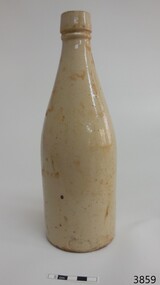
Ceramic - Stoneware Bottle, Henry Kennedy Pottery, Late 1800s to early 1900s
... week but, unlike some potteries, these were made on the premises from Garnkirk and Glenboig fire clays. Pottery production reaches a high scale which presented a high risk of fire and Barrowfield was no exception. In April 1884 heat from a kiln set fire to the roof resulting in significant structural damage, the loss of unfinished wares alone amounting to £10,000 a very substantial sum in 1884. The pottery recovered from this reverse but then Henry...week but, unlike some potteries, these were made on the premises from Garnkirk and Glenboig fire clays. Pottery production reaches a high scale which presented a high risk of fire and Barrowfield was no exception. In April 1884 heat from a kiln set fire to the roof resulting in significant structural damage, the loss of unfinished wares alone amounting to £10,000 a very substantial sum in 1884. The pottery recovered from this reverse but then Henry ...This bottle was made in Scotland and recovered decades later from a shipwreck along the coast of Victoria. It may have been amongst the ship's cargo, its provisions or amongst a passenger's personal luggage. It is now part of the John Chance collection. Stoneware bottles similar to this one were in common use during the mid-to-late 19th century. They were used to store and transport. The bottles were handmade using either a potter's wheel or in moulds such as a plaster mould, which gave the bottles uniformity in size and shape. The bottle would then be fired and glazed in a hot kiln. Makers often identified their bottles with the impression of a small symbol or adding a colour to the mouth. The manufacturer usually stamped their bottles with their name and logo, and sometimes a message that the bottle remained their property and should be returned to them. The bottles could then be cleaned and refilled. The Barrowfield pottery was founded in 1866 by Henry Kennedy, an Irish native, in the Camlachie district east of Glasgow, close to the Campbellfield and Mount Blue potteries. It is believed that Kennedy started with just one kiln but by 1871 was employing forty men and six boys and such was the success of the enterprise that by 1880, no less than eight kilns were in operation and a year later one hundred and the pottery was employing eighteen people. Stoneware bottle production was a mainstay of the pottery and over “1500 dozen” were being turned out daily along with other wares, including 30-gallon ironstone containers. With so many kilns in operation, six hundred saggars were required every week but, unlike some potteries, these were made on the premises from Garnkirk and Glenboig fire clays. Pottery production reaches a high scale which presented a high risk of fire and Barrowfield was no exception. In April 1884 heat from a kiln set fire to the roof resulting in significant structural damage, the loss of unfinished wares alone amounting to £10,000 a very substantial sum in 1884. The pottery recovered from this reverse but then Henry Kennedy died in July 1890. The terms of his will indicated that he and his sons John and Joseph were partners and this was reflected in a change of title in the 1891-92 Post Office Directory to Henry Kennedy & Sons. Despite the growth of the business there was still space enough, however, to allow china, earthenware and glass retailers Daniel and John McDougall to commence production of their Nautilus wares there in 1894, the success of which allowed them to soon move to permanent quarters at the empty Saracen Pottery, Possil. In around 1900 John Kennedy left to resurrect the liquidated Cleland Pottery and although Barrowfield remained listed as Henry Kennedy & Sons, brother Joseph was in control. In 1911 Henry Kennedy & Sons Ltd was formed, with two of the four directors being the Kennedy brothers. The pottery’s growth to this point was reflected in the eighteen kilns the largest pottery kilns then recorded in Scotland. However, the disruption of the First World War and the combined effects of subsequent economic depression, US prohibition, hygiene regulations and competition from alternative materials posed severe challenges for stoneware potteries in the post-war years as they competed with each other for diminishing markets. Competitors such as Eagle and Caledonian Potteries fell by the wayside and finally, Barrowfield closed in 1929. This stoneware bottle is historically significant for its manufacture and use in the late 19th to the early 20th century. The bottle is also significant as it was recovered by John Chance, a diver, from a wreck on the coast of Victoria in the 1960s-70s. Items that come from several wrecks along Victoria's coast have since been donated to the Flagstaff Hill Maritime Village’s museum collection by his family, illustrating this item’s level of historical value. Stoneware was produced at Barrowfield pottery for the domestic and export markets, with South America being a large market. Barrowfield stoneware can be found throughout the world. Its longevity and abundant production makes the subject item a significant addition to the Flagstaff Hill Maritime Museum collection.Bottle, salt glazed stoneware, beige, some discolouration above base. Chip on base and on neck. Inscriptions stamped near base.Makers lozenge stamped, H Kennedy Barrowfield Pottery GLASGOW at base.flagstaff hill, warrnambool, flagstaff hill maritime museum, maritime museum, shipwreck coast, flagstaff hill maritime village, great ocean road, john chance, h kennedy pottery, stoneware, ironstone, pottery, barrowfield glasgow -
 City of Moorabbin Historical Society (Operating the Box Cottage Museum)
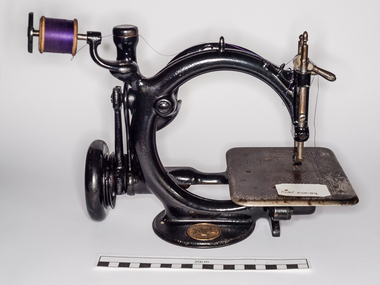
Functional object - Sewing machine, Wilcox & Gibbs, c1870
... week. The early settlers of Moorabbin Shire had to be self sufficient making their own clothes, tableware, bed coverings, furnishings and equipment. The women were skilled dressmakers and craft workers. sewing machines early settlers pioneers moorabbin brighton gibbs james willcox james willcox henry new york america dressmaking mateial machine makers wrought iron work telford england The Willcox & Gibbs badge is located on the rear of the base casting Willcox and Gibbs: Serial No. 158679. ...Willcox and Gibbs: Serial No. 158679. The Willcox & Gibbs Sewing Machine Company was founded in 1857 by James E. A. Gibbs and James Willcox and opened its London Office in 1859 at 135 Regent Street . By 1871 the Company's Chief Office for Europe was at 150 Cheapside, London, this office was later moved (post 1885) to 94 - 96 Wigmore Street, then 37 & 39 Moorgate Street (by 1891 to post 1907) and later 20 Fore Street, London . Right from the initial production the manufacturing of the Company's single thread, chain stitch machine was undertaken by Brown & Sharpe, Rhode Island and this continued up until 1948. A special hand crank mechanism was produced in England for the European market, but the general design of the Willcox & Gibbs remained essentially the same throughout its production. The only major improvement was in 1875 when the glass tension discs were replaced with an automatic tension device which ensured the machine could not get out of adjustment. In addition to the domestic hand and treadle machines the company produced a wide range of industrial models. The Company finally closed in 1973. This Willcox & Gibbs came complete with its wooden carry case. The machine was made in America in the late 1860's but it has the ornate hand crank produced at Coalbrookdale near Telford, England which was, in Victorian times, renown for producing high quality ornate iron castings. This machine has the glass tension discs which were used on domestic models until 1875. The Willcox & Gibbs badge is located on the rear of the base casting and it also has a deep wooden base. The cloth plate has various American patent dates, four dating between 1857 & 1860 relating to J. E. A. Gibbs, three dating between 1860 & 1864 relating to Chas H. Willcox (son of James Willcox), the machine was also licensed under five other patents including the infamous Elias Howe patent of 1846. There are only two English patents one for J. E. A Gibbs and the other for James Willcox. In 1887 a W & G Sewing Machine sold in England for 6 pounds , with its box and bits, at a time when the average wage was less than 10/- shillings per week. The early settlers of Moorabbin Shire had to be self sufficient making their own clothes, tableware, bed coverings, furnishings and equipment. The women were skilled dressmakers and craft workers.Willcox and Gibbs: Serial No. 158679. A single thread, chain stitch Sewing Machine with a special hand crank mechanism produced in England for the European market, and the glass tension discs which were used on domestic models until 1875. This Willcox & Gibbs came complete with its wooden carry case. The machine was made in America c1870 but it has the ornate hand crank produced at Coalbrookdale near Telford, England which was, in Victorian times, renown for producing high quality ornate iron castings. This machine has the glass tension discs which were used on domestic models until 1875. The Willcox & Gibbs badge is located on the rear of the base casting and it also has a deep wooden base. The Willcox & Gibbs badge is located on the rear of the base castingsewing machines, early settlers, pioneers, moorabbin, brighton, gibbs james, willcox james, willcox henry, new york, america, dressmaking, mateial, machine makers, wrought iron work, telford england -
 Ringwood and District Historical Society
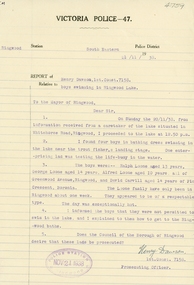
Document - Victoria Police Report, Boys swimming in Ringwood Lake - 21 November, 1938
... week. They appeared to be of a respectable type. The day was exceptionally hot. 4. I informed the boys that they were not permitted to swim in the lake, and I explained to them how to get to the Ringwood baths. 5. Does the Council of the Borough of Ringwood desire that these lads be prosecuted? Victoria Police stationery with rubber date stamp imprint. Typewritten report at Ringwood Station South Eastern Police District by Henry ...Victoria Police stationery with rubber date stamp imprint. Typewritten report at Ringwood Station South Eastern Police District by Henry Dawson, 1st Const. 7158 To the Mayor of Ringwood, Dear Sir, 1. On Sunday the 20/11/38. From information received from a caretaker of the lake situated in Whitehorse Road, Ringwood, I proceeded to the lake at 12:50pm. 2. I found four boys in bathing dress swimming in the lake near the trout fisher's landing stage. One enterprising lad was testing the life-buoy in the water. 3. The boys were: Ralph Loone aged 13 years, George Loone aged 14 years, Alfred Loone aged 10 years, all of Greenwood Avenue, Ringwood, and David Carvill aged 14 years of Pine Crescent, Boronia. The Loone family have only been in Ringwood about one week. They appeared to be of a respectable type. The day was exceptionally hot. 4. I informed the boys that they were not permitted to swim in the lake, and I explained to them how to get to the Ringwood baths. 5. Does the Council of the Borough of Ringwood desire that these lads be prosecuted? -
 Ringwood and District Historical Society
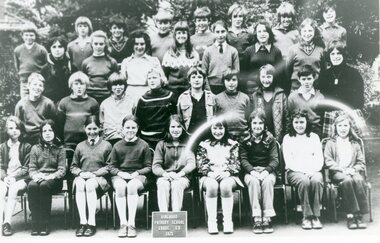
Photograph, Ringwood State School - Grade 6B, 1973
... Weeks. 3rd Row- L to R: Peter Stortenbeker, ?, Cal Harris, Colin McCord, Lyal Tan, Stephen Graham, Jeffrey James, John O'Sullivan. Front Row- L to R: Elizabeth Cuzens, Vicki Jacobs, Julie Griffith, Jenny Walters, Kim Pope, Rhonda Henry, Cathy Withers, ?...Weeks. 3rd Row- L to R: Peter Stortenbeker, ?, Cal Harris, Colin McCord, Lyal Tan, Stephen Graham, Jeffrey James, John O'Sullivan. Front Row- L to R: Elizabeth Cuzens, Vicki Jacobs, Julie Griffith, Jenny Walters, Kim Pope, Rhonda Henry, Cathy Withers, ? ...Black and white photograph - Grade 6B, 1973."Attached to photograph" Back Row- L to R: ?, Craig Lucas, ?, Leslie Weller, ?, ?, Gary Love, Gavin Alexander 2nd Row- L to R: ?, Deidre Taylor, Gaye Bacon, Roslyn Conlan, Terasa Taggart, Marina McNeil, Fiona Weeks. 3rd Row- L to R: Peter Stortenbeker, ?, Cal Harris, Colin McCord, Lyal Tan, Stephen Graham, Jeffrey James, John O'Sullivan. Front Row- L to R: Elizabeth Cuzens, Vicki Jacobs, Julie Griffith, Jenny Walters, Kim Pope, Rhonda Henry, Cathy Withers, ?, Ruth Beattie. Teacher: Mrs J.Parks. -
 City of Moorabbin Historical Society (Operating the Box Cottage Museum)
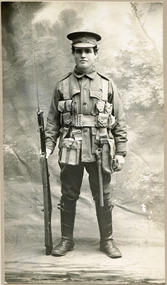
Photograph, 1916 William Henry Thomas in WW1 Uniform, 1916 William Henry Thomas in WW1 Uniform, 1916
... Henry, also the urgent need of recruits do give my consent that he shall go to the front." September 29th 1915 he left Australia with the 5th Reinforcements of the 24th Battalion for Egypt. March 1916 he was hospitalised with Mumps and shortly after left Alexandria to join the British Expeditionary Force for France where he transferred to the 6th Australian Machine Gun Company.. Whilst on leave in England he received medical attention before returning to France and 13 November 1918 he spent a week...Henry, also the urgent need of recruits do give my consent that he shall go to the front." September 29th 1915 he left Australia with the 5th Reinforcements of the 24th Battalion for Egypt. March 1916 he was hospitalised with Mumps and shortly after left Alexandria to join the British Expeditionary Force for France where he transferred to the 6th Australian Machine Gun Company.. Whilst on leave in England he received medical attention before returning to France and 13 November 1918 he spent a week ...1916 William Henry Thomas of Keys Road , South Brighton (now Moorabbin ) in WW 1 1914 -1918 1st AIF uniform. William was born in 1894 , Christened at the Wesleyan Church. (Methodist), Wickham Road, South Brighton and attended Moorabbin State School. . Private Thomas was a market gardener in Moorabbin prior to his enlistment in the Australian Imperial Force on 19 July 1915. Both his parents wrote separate letters giving their consent for their son to serve overseas due to " the pressing request of my son William Henry, also the urgent need of recruits do give my consent that he shall go to the front." September 29th 1915 he left Australia with the 5th Reinforcements of the 24th Battalion for Egypt. March 1916 he was hospitalised with Mumps and shortly after left Alexandria to join the British Expeditionary Force for France where he transferred to the 6th Australian Machine Gun Company.. Whilst on leave in England he received medical attention before returning to France and 13 November 1918 he spent a week in the care of the 7rh Field Ambulance suffering with influenza . Private Thomas returned to Australia on the hospital transport Castalia 13 April 1919 and his enlistment was terminated 26 September 1919Private William Henry Thomas and his family are examples of the patriotism exhibited by the market gardeners, and indeed throughout Australia, during the World War 1 1914-1918. Photograph is black and white. William Henry Thomas is standing straight and tall in the centre of the photograph, looking directly at the photographer while holding a weapon in his right hand. He is in his military uniform (WW1) .Front of Mount : Ainor Studio Auburn Back of Mount : William Henry Thomas / 1st World War 1916 / Keys Rd., Moorabbin / Born 1894 / Christened at Wesleyan ( Methodist ) Church / Wickham Rd., / South Brighton / now Uniting Church unsigned undatedwilliam henry thomas, 1916, 1894, first ww, world war one, uniform, wickham road, south brighton, moorabbin, world war 1 1914- 1918, thomas street,early settlers, pioneers, market gardeners, australian infantry force, soldiers, key's cup, victorian war memorials, cheltenham, mckinnon,, keys road moorabbin, ss castalia, british expeditionary force ww1 1914- 1918, 24th battalion 1st aif, 6th australian machine gun company 1st aif, influenza epidemic 1919, alexandria egypt, methodist church, -
 City of Moorabbin Historical Society (Operating the Box Cottage Museum)
Newsletter - City of Moorabbin Historical Society Oct 2012, October 2012
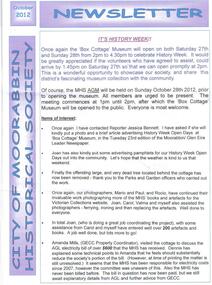
... The Newsletter is an important record of the activities of the CMHS. city of moorabbin historical society stanley helen melbourne moorabbin brighton cheltenham ormond bentleigh market gardeners pioneers early settlers the moorabbin roads board 1862 city of glen eira city of kingston moorabbin shire parish of moorabbin brighton east south brighton bent tommy mair william jessse morleys hotel lees james lees william convicts jamison john bent james lees james henry lees joseph lees jack allen CITY of MOORABBIN HISTORICAL SOCIETY / OCTOBER 2012 NEWSLETTER 4 x A4 paper printed on 1 side Issue 29 of the bi-monthly, City of Moorabbin Historical Society Newsletter produced by Society member and Secretary, Mrs Helen Stanley in October 2012. Notice of AGM October 28th , and Box Cottage Museum will be Open on 27th and 28th for History Week ...The City of Moorabbin Historical Society was formed c 1960 by a group of Moorabbin area residents who were concerned that the history of the area should be preserved. A good response to a call for items related to the historical area of Moorabbin Shire brought donations of a wide variety of artefacts that are now preserved by the current members of CMHS at Box Cottage Museum. Helen Stanley, Secretary of CMHS, began producing a Newsletter for members in April 2007 to provide current information and well researched items of historical interestHelen Stanley has produced a bi-monthly Newsletter, 2007 - 2013, for the members of the City of Moorabbin Historical Society that contains well researched interesting historical items, notification of upcoming events, current advice from Royal Australian Historical Society , Museums Australia Victoria and activities of Local Historical Societies. The Newsletter is an important record of the activities of the CMHS.4 x A4 paper printed on 1 side Issue 29 of the bi-monthly, City of Moorabbin Historical Society Newsletter produced by Society member and Secretary, Mrs Helen Stanley in October 2012. Notice of AGM October 28th , and Box Cottage Museum will be Open on 27th and 28th for History Week. Jessica Bennett, Reporter for The Leader Newspaper, has been asked to promote the History Week Open Days, volunteers have distributed fliers, and Glen Eira CC Parks and Gardens officers have removed the dead tree. Volunteer photographers from Caulfield Photography Group have helped our members to catalogue the Museum artefacts and we are progressing well.. An unfortunate electricity account was referred to GECC for advice. Helen has given an essay, of 3x A4 pages, about The Lees Family pioneer market gardeners as researched by Jan Rigby, a descendant. CITY of MOORABBIN HISTORICAL SOCIETY / OCTOBER 2012 NEWSLETTERcity of moorabbin historical society, stanley helen, melbourne, moorabbin, brighton, cheltenham, ormond, bentleigh, market gardeners, pioneers, early settlers, the moorabbin roads board 1862, city of glen eira, city of kingston, moorabbin shire, parish of moorabbin, brighton east, south brighton, bent tommy, mair william, jessse morleys hotel, lees james, lees william, convicts, jamison john, bent james, lees james henry, lees joseph, lees jack allen, -
 Ringwood and District Historical Society
Booklet, Official Opening - Ringwood Cultural Centre (Karralika Theatre), 1980
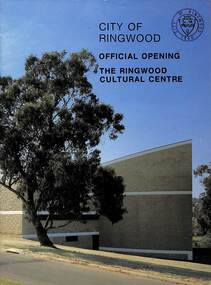
... Programme booklet - Official Opening of The Ringwood Cultural Centre by His Excellency, The Honourable Sir Henry Winneke, K.C.M.G., K.C.V.O., O.B.E., Q.C. Governor of Victoria - Saturday 19th April 1980. Includes Ringwood Arts Festival week of entertainment to be presented in the Ringwood Cultural Centre Karralika Theatre, Saturday 19th April 1980 to Sunday 27th April 1980....Programme booklet - Official Opening of The Ringwood Cultural Centre by His Excellency, The Honourable Sir Henry Winneke, K.C.M.G., K.C.V.O., O.B.E., Q.C. Governor of Victoria - Saturday 19th April 1980. Includes Ringwood Arts Festival week of entertainment to be presented in the Ringwood Cultural Centre Karralika Theatre, Saturday 19th April 1980 to Sunday 27th April 1980. ...Programme booklet - Official Opening of The Ringwood Cultural Centre by His Excellency, The Honourable Sir Henry Winneke, K.C.M.G., K.C.V.O., O.B.E., Q.C. Governor of Victoria - Saturday 19th April 1980. Includes Ringwood Arts Festival week of entertainment to be presented in the Ringwood Cultural Centre Karralika Theatre, Saturday 19th April 1980 to Sunday 27th April 1980.Mayor's Welcome Message - Cr. P. Gotlib. Sculpture: "Cassini" - Created by sculptor Charles O. Perry of Norwalk, Connecticutt, U.S.A.rinx -
 Ringwood and District Historical Society
Pamphlet, Ringwood Secondary College - Gratitude Walks- Education Week 1999
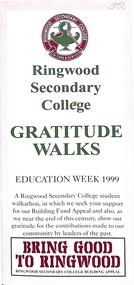
... Henry Ernest Parker), Herman Pump Reserve, F.J.C. Rogers Reserve (Fred), Staley Gardens (named after Andrew Gray Staley), Kevin Pratt Pavilion (at Jubilee Park), A.C. Robertson Field (Alan Robertson - Proclamation Park), R.O. Spencer Pavilion (Reginald Owen Spencer), Peter Vergers Reserve.-------- The rear of this pamphlet is largely a map of the locations of the people honoured on the Gratitude Walks. Red, Pink, Green and White coloured multi-fold gloss publication- six small pages and one large image on the rear of all of the small pages Ringwood Secondary College - Gratitude Walks- Education Week ...Red, Pink, Green and White coloured multi-fold gloss publication- six small pages and one large image on the rear of all of the small pagesThis publication deals with a Ringwood Secondary College Walkathon, in which they sought support for their Building Fund Appeal, and also wished to show their gratitude for the contribution made to the Ringwood community by leaders of the past. The notable locations and people written about are arranged alphabetically. They are - Dexters Bush (Mick and Liz Dexter), Harpers Bush (John and Joan Harper), A.F.B. Long Reserve (Arthur Frederick Burbridge Long), McAlpin Reserve (George McAlpin and family Reserve), Fred Dwerryhouse Pool, B.J.Hubbard (Ben) Reserve, Loughies Bushland (named after Anthony Loughnan- early settler), Douglas Maggs Reserve, Greenwood Park (named after Edmund Wilson Greenwood (local MLA from 1927 to 1929), A.G. Lavis Pavilion (Albert George Lavis - Mayor and Councillor), Russell Lucas Oval (situated at Jubilee Park), Mahon Reserve (Hugh and his son Arthur Mahon - apple and Cherry orchardists), H.E. Parker Reserve (Henry Ernest Parker), Herman Pump Reserve, F.J.C. Rogers Reserve (Fred), Staley Gardens (named after Andrew Gray Staley), Kevin Pratt Pavilion (at Jubilee Park), A.C. Robertson Field (Alan Robertson - Proclamation Park), R.O. Spencer Pavilion (Reginald Owen Spencer), Peter Vergers Reserve.-------- The rear of this pamphlet is largely a map of the locations of the people honoured on the Gratitude Walks. -
 Eltham District Historical Society Inc
Folder, Francis Percival Read (Jock) (1915-2010)
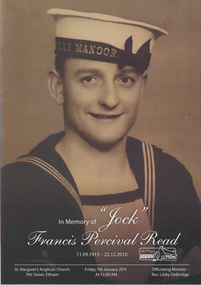
... henry street...heritage week...He was well loved as a long time school crossing supervisor and member of EDHS with a remarkable memory of his life's experiences. harry gilham collection jock read frances percival read 728 main road alison delaney bakers delivery run blacksmith building industry david johns diana bassett-smith doug orford funeral service gwen orford harry gilham henry street heritage week i remember (poem) industry jim connor lofty (horse) matlock police (tv show) peter bassett-smith russell yeoman shamus (horse) smokey (horse) sue law tackey (horse) wally Eulogy Contents 1. ...Franics Read known as Jock, was a life time resident of Eltham. He served in the Navy in WW2. He was well loved as a long time school crossing supervisor and member of EDHS with a remarkable memory of his life's experiences. Contents 1. In Memory of "Jock" Francis Percival Read 11.09.1915 - 22.12.2010; Funeral Service Booklet (3 copies), A4 card folded. Held at St Margaret's Anglican Church, Pitt Street, Eltham, Friday 7th January 2011 at 11:00 AM 2. News clippings - Clip Clop Lollipop!, Diamond Valley News, 14 Dec 1976, p1 - Jock Read with horse, Smokey, Diamond Valley News, 1978 - School Crossing Supervisor Jock Read with horse, Lofty, Diamond Valley News, 1982 - Families shed a tear for Tackey, Diamond Valley News, 23 Apr 1985 - For fallen friends, Diamond Valley News, 16 Nov 1992 - Lollipop man calls it a day, c.1996 - Local digger leads the march, Nillumbik Mail, 3 May 2000, p5 also “Our Anzacs remembered” - Rain holds off for people's march through memories, c.2001 - For Sale; 52-54 Henry Street, Eltham, Barry Plant Real Estate, The Weekly Review, 14 Mar 2002 - Wartime's memories of mates. Photo "Jock Read stands proud in front of the Australian flag in his front yard", Diamond Valley Leader, 19 Apr 2006, p1 - Keeping the Anzac spirit alive, Diamond Valley Leader, 19 Apr 2006, p10 - Meaningful life well lived by Jim Connor, Diamond Valley Leader, 16 Feb 2011, p25 3. Draft of obituary by Jim Connor published in Diamond Valley Leader 16 Feb 2011 4. Jock Read Memorial notes 5. Jock Read Distinguished Life Member, Eltham District Historical Society 6. Distinguished Life Member presentation to Jock Read by Eltham District Historical Society at Chatsworth House, 26 July 2010 7. Photographs (qty 3) 10 x 15 cm of Jock Read at the Distinguished Life Member presentation by Eltham District Historical Society members at Chatsworth House, 26 July 2010 (Photographer possibly Jim Connor) 8. Photographs (qty 9) printed on 3 sheets of A4 photo paper of Jock Read at the Distinguished Life Member presentation by Eltham District Historical Society members at Chatsworth House, 26 July 2010 (Photographer unknown) 9. Transcript of audio tape recorded by Peter Bassett-Smith with Jock Read at the old Police Residence, 728 Main Road, Eltham during Heritage Week display, 28 Apr 1990 10. Transcript of audio tape recorded by Denis Ward of Old characters and other folk around Eltham: a chat with Jock Read and Doug Orford at Eltham District Historical Society meeting held 10 May 2000 11. Interpretative transcript of audio tape EDHS_01636 Jock Read Tape 1 – 2002 12. Transcript of audio tape Main Road Eltham: a chat with Jock Read and Doug Orford at Eltham District Historical Society meeting held 10 Sep 2002 13. Baker's Run - List of names and deliveries forming Jock Read's Baker's run and discussed at meeting held 10 Sep 2002 15. Jock Read - when asked what he used to do around about 14. Nillumbik Council Item; Jock Read Eulogy 16. Photocopy of photo: Wedding Party; Jock Read and Beryl Olivia Burgess, St Katherine's Church, St Helena 17. Celebration of the life of Beryl Olivia Read nee Burgess 1 December 1924 - 17 July 2008harry gilham collection, jock read, frances percival read, 728 main road, alison delaney, bakers delivery run, blacksmith, building industry, david johns, diana bassett-smith, doug orford, funeral service, gwen orford, harry gilham, henry street, heritage week, i remember (poem), industry, jim connor, lofty (horse), matlock police (tv show), peter bassett-smith, russell yeoman, shamus (horse), smokey (horse), sue law, tackey (horse), wally, eulogy -
 Warrnambool and District Historical Society Inc.
Document, Illuminated Address H. H. Smith esq
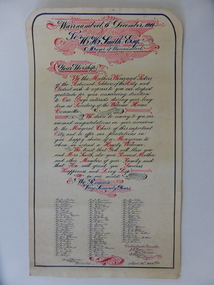
... Henry Huntingdon Smith (1857-1941) started his own bakery business in 1885, firstly near the corner of Fairy and Koroit Streets and later building his own shop at the corner of Lava and Fairy Streets (Monaghans Pharmacy today). Smith was one of the most admired men in Warrnambool in the first half of the 20th century. He was a Warrnambool Councillor from 1918 to 1937 (Mayor for two terms) and served continuously on the Warrnambool Hospital Committee for 39 years. He visited patients at the Hospital twice a week...Henry Huntingdon Smith (1857-1941) started his own bakery business in 1885, firstly near the corner of Fairy and Koroit Streets and later building his own shop at the corner of Lava and Fairy Streets (Monaghans Pharmacy today). Smith was one of the most admired men in Warrnambool in the first half of the 20th century. He was a Warrnambool Councillor from 1918 to 1937 (Mayor for two terms) and served continuously on the Warrnambool Hospital Committee for 39 years. He visited patients at the Hospital twice a week ...This illuminated address was given to H.H.Smith, the Warrnambool Mayor, for his work with soldiers returning to Warrnambool and district during and after World War One. On the same occasion Smith was also given an armchair by the mothers, sisters and wives of Warrnambool returning soldiers. Henry Huntingdon Smith (1857-1941) started his own bakery business in 1885, firstly near the corner of Fairy and Koroit Streets and later building his own shop at the corner of Lava and Fairy Streets (Monaghans Pharmacy today). Smith was one of the most admired men in Warrnambool in the first half of the 20th century. He was a Warrnambool Councillor from 1918 to 1937 (Mayor for two terms) and served continuously on the Warrnambool Hospital Committee for 39 years. He visited patients at the Hospital twice a week. He took a particular interest in the welfare of returning soldiers and it was said that there was not a returned man or woman whom Smith did not greet on his return to the district. Smith also was a tireless worker for the Methodist Church as an office bearer and a Sunday School teacher. Smith was also Vice President in 1937 of the first Warrnambool & District Historical Society. This document is of particular interest as it is a good example of the type of illuminated address produced during the early years of the 20th century. It also shows clearly the respect and love that Warrnambool people had for Henry Smith, a great volunteer worker in the community. This is a piece of cream-coloured parchment paper with a margin ruled in black ink and handwriting in blue and black ink surrounded by red ornamental scrolls and flourishes. The paper has an address to H.H.Smith and is followed by 74 names and the date (1920). The paper is inserted into a piece of red leather cloth. This has folded edges and an ornamental gold pattern around the front edges and a gold border around the back edges. There are two holes at the top of the folder and these have metal surrounds. The backing folder is rounded at the top edges. ‘Warrnambool, 6th December 1919. To H.H. Smith Esq., Mayor of Warrnambool – We, the Mothers, Wives and Sisters of the Returned Soldiers of this City and District wish to express to you our deepest gratitude for your unswerving devotion to Our Boys interests during your long term as Secretary of the Welcome Home Committee’ (etc etc)henry huntingdon smith, world war one, history of warrnambool -
 Eltham District Historical Society Inc
Photograph, Peter Pidgeon, Site of former Eltham Tennis Court, Wingrove Park, 2 Aug. 2022
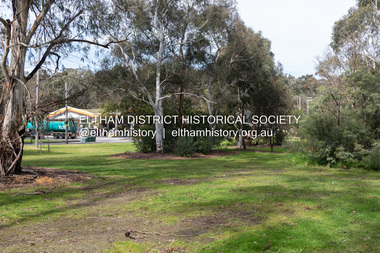
... week in November all the requisites were to hand, two courts were marked out, and practice begun. The formal opening of the Courts of this Club took place on Saturday, November 12, 1898, when 26 members and their friends assembled. Part of a presentation by Peter Pidgeon to the Society, 13 August 2022 showcasing a series of photographs taken by John Henry...week in November all the requisites were to hand, two courts were marked out, and practice begun. The formal opening of the Courts of this Club took place on Saturday, November 12, 1898, when 26 members and their friends assembled. Part of a presentation by Peter Pidgeon to the Society, 13 August 2022 showcasing a series of photographs taken by John Henry ...View looking through Wingrove Park from near the Diamond Creek Trail towards the Coles Express Service Station and Mount Pleasant Road intersection. Comparison photo: SEPP_0720 Eltham Tennis Court, c.1909 and SEPP_0721 - Eltham Tennis Court, Lady Premiers 1909-1910 The tennis courts were located in Bremner’s Flats, present day Wingrove Park. The Eltham Lawn Tennis Club was formed on a Saturday evening, the 29th of October, 1898 at a meeting held at the Eltham State school. Twenty members were enrolled, and eight more shortly afterwards. Officers and a committee were duly elected, and the Treasurer was instructed to purchase the necessary requisites without delay. By the end of the first week in November all the requisites were to hand, two courts were marked out, and practice begun. The formal opening of the Courts of this Club took place on Saturday, November 12, 1898, when 26 members and their friends assembled. Part of a presentation by Peter Pidgeon to the Society, 13 August 2022 showcasing a series of photographs taken by John Henry Clark over the period 1895 to 1930. John Henry Clark was the youngest of three boys born to William Henry Clark (1823-1877) and Maria White (1843-1914). He and his brothers, William Charles Clark (1872-1945), Clement Kent Clark (1874-1912) operated a photography business (Clark Bros.) from 25 Thomas Street, Windsor near Prahran during the period c.1894 to 1914. Following death of Clement in September 1912 and their mother in 1914, the Clark Bros business appears to have dissolved, the premises demolished, and a new house was under construction in 1915. John set up business independently in 1914 operating out of 29 Moor Street, Fitzroy where he is registered in the 1914 and 1915 Electoral Rolls. By 1916 John had relocated to Eltham where he continued his practice as a photographer and took many of the early images around the district of Little Eltham. Around 1930 John changed professions and opened a small cobbler's shop in 1931 near the pond opposite Dalton Street adjacent to the Jarrold family cottage. He never married and continued his profession as a bootmaker from this little shop, maintaining a close relationship with Mrs Jarrold for the rest of their lives. His bootmaker shop remains today beside the Whitecloud cottage and is one of only three remaining shops in the area from the early 20th century.Comparative photo taken 2022 with one taken from same location over 100 years earlier by noted local photographer J.H. ClarkBorn Digitalbible street, eltham, j.h. clark photo (2022), bremner's flat, eltham lawn tennis club, eltham tennis court, main road, mount pleasant road, tennis court, wingrove park -
 Bendigo Military Museum
Postcard - POSTCARDS, PHOTOGRAPHIC WW1, (.1) Dec 7.12.15, (.2) 31.10.16
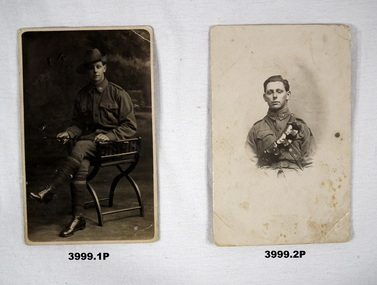
... Henry WATT", born Bendigo. He had pre war service in the 67th Bn Senior Cadets, no dates given. Regt No 3670 shows he enlisted on 20th or 28th Dec 1915 in the 8th reinforcements 21st Bn age 20 years. It shows he embarked just 9 days or 1 day later on 29.12.1915. He transfers to the 60th then 57th Bn and then on 17.3.1916 5th Div Artillery. he is mustered as “Gunner” and transfers to 5th DIV DAC (Ammunition Column) on 25.5.1916. (.1) The letter is dated Dec 7.12.1915 two weeks or so prior to enlistment dates. ...week. Tom married Margaret McCALL in Scotland 25.4.1919 prior to coming home. Refer Cat No 3996P re “Lena” and other cards, 4000.2 from “Tom”. Postcard lena 21st Thomas Henry ...Both letters to “Lena” are from Tom WATT. As well as his signature someone has written his name as in blue pen. One letter is just signed “Tom” the other “Gunner T H Watt”. It is believed this is "Thomas Henry WATT", born Bendigo. He had pre war service in the 67th Bn Senior Cadets, no dates given. Regt No 3670 shows he enlisted on 20th or 28th Dec 1915 in the 8th reinforcements 21st Bn age 20 years. It shows he embarked just 9 days or 1 day later on 29.12.1915. He transfers to the 60th then 57th Bn and then on 17.3.1916 5th Div Artillery. he is mustered as “Gunner” and transfers to 5th DIV DAC (Ammunition Column) on 25.5.1916. (.1) The letter is dated Dec 7.12.1915 two weeks or so prior to enlistment dates. The end of the letter talks about being sick and possibly missing going with the next draft. There are 3 other sketchy records showing enlisted 12.7.1915, 5th DAC 15.7.1915, AWL Bendigo 4.11.1915. This would fit in better than enlisting and embarking in not much more than a week. Tom married Margaret McCALL in Scotland 25.4.1919 prior to coming home. Refer Cat No 3996P re “Lena” and other cards, 4000.2 from “Tom”.(.1) Postcard photo, B & W showing a soldier seated on a chair with a crop, studio background. On rear extensive letter in black pen to “Dear Lena”. (.2) Postcard photo, B & W, portrait of a soldier, no hat, bandolier over shoulder, clear background. On rear brief letter in black pen addressed to “Dear Lena”. postcard, lena, 21st, thomas henry watt -
 Waverley RSL Sub Branch
R.A.A.F. Long Service Medal
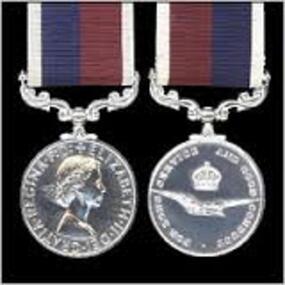
... weeks a year. Rosenbrock continued to serve as the sole RAAF Dental Officer until the middle of 1933, when the Air Board asked for his service to be terminated following ‘behaviour unbecoming of a RAAF officer'. He had borrowed several sums of money, of around 40 Pounds or so, from junior ranks on base (as well as from the Regimental Sergeant Major) and had failed to pay the money back. He was replaced by a fellow Victorian, FLGOFF Norman Henry ...Awarded to Alan Bowers (A236814) who was a R.A.A.F. dental mechanic who serverd during WWII including service in Darwin, and then continued in the R.A.A.F. for some years after the end of WWII The Royal Australian Air Force (and all Commonwealth Air Forces) Long Service and Good Conduct Medal: Awarded to NCOs and ORs of the RAAF (RAF, RCAF etc) for 15 years service. A cupro-nickel plated medal, the obverse features the sovereign's head, the reverse features the crown and eagle emblem of the RAAF (and RAF). Officers are eligible for the award provided they have served a minimum 12 years in the ranks. The riband is dark blue and maroon with white edges. This medal ceased to be awarded in Australia in 1975 when it was replaced by the National Medal (and sbsequently the DFSM and DLSM) in the Australian system of honours and awards. http://www.heritagemedals.com.au/medals-1/service-long-service/air-force-long-service-and-good-conduct-medal.html History of the RAAF Dental Branch It took six years following the formation of the RAAF in 1921 for the first Dental Clinic to be established at Point Cook, Victoria. On 10th June 1927 Flying Officer James Carl Rosenbrock commenced work as an RAAF Dental Officer for the FlyingTraining School at Point Cook. As personnel numbers were still relatively small, Rosenbrock was also responsible for the dental care of all Victorian RAAF units, which involved treating members at 1AD Laverton, as well as Air Force Headquarters at Victoria Barracks in Melbourne. As Army Dental Officers were currently caring for RAAF personnel at Richmond, NSW, the Senior Dental Officer of the 3rd Military District in Victoria (SDO 3MD) requested through the military board that a similar arrangement be established, where that the newly appointed RAAF Dentist provide part time dental services to the Army units stationed at Queenscliff. This was seen as an effective reciprocal arrangement, with both units having a Dental Officer in attendance for, in total, around 3-4 weeks a year. Rosenbrock continued to serve as the sole RAAF Dental Officer until the middle of 1933, when the Air Board asked for his service to be terminated following ‘behaviour unbecoming of a RAAF officer'. He had borrowed several sums of money, of around 40 Pounds or so, from junior ranks on base (as well as from the Regimental Sergeant Major) and had failed to pay the money back. He was replaced by a fellow Victorian, FLGOFF Norman Henry Andrews, on the 18th Sep 1933, who went on to become our first Director of Dental Services, and was instrumental in establishing the organisations and conditions of the Branch that are still present today. Through a fair amount of persistence and hard work on the part of Norman Andrews, the RAAF Dental Branch began to expand from 1937, with the introduction of 2 additional positions, at RAAF station Richmond, and at the FlyingTraining School at Point Cook. This gave the RAAF 3 uniformed Dental Officers, which was expanded to 5 in the months leading up to WW2. 4 of these Dental Officers were based in Victoria and 1 at Richmond, with the other two RAAF units being cared for by the Army (as in the case of Pearce in WA) or by civilians (as in Darwin). With the sudden increase in RAAF personnel required at the outbreak of WW2, the number of RAAF Dental Officers increased dramatically, from 5 in 1939, 28 in 1940, 64 in 1941, 147 in 1942, 193 in 1943, 219 in 1944, and peaking at 227 in 1945. RAAF Dental Officers were required to work in a variety of locations, both in and out of Australia. Between 1940 and 1942 a massive construction programme occurred, with new dental clinics being established around Australia. Priority was given to aircrew training units in order to get these personnel dentally fit for operational deployment, but Dental Officers could equally find themselves posted to recruit depots, fixed stations, medical clearance stations, mobile dental sections, and RAAF and civilian hospitals. RAAF Dental Officers were posted to the large dental centres at Ascot Vale (Vic) and Bradfield Park (NSW) when first appointed, where they received military and clinical training, before being deployed to their needed location. Mobile Dental Units When Japan entered the war in 1941, the rapid deployment of troops to northern operational areas with less than ideal dental fitness was extremely high. As a result, the RAAF deployed a range of mobile dental units, either alone or with medical sections, to support the increasing number of isolated deployed personnel within Australia and overseas. There were three types of mobile unit used: a. Mobile Dental Unit – relied on using either a semi-trailer to get around or by building a surgery directly on to the truck chassis, and installing hydraulic chairs, units, x-rays, and laboratory equipment. They were able to move around between small units, such as RAAF radar stations, where they could plug into the local power supply and work immediately. b. Transportable Dental Units – used for stops of longer duration, where field equipment was carried in panniers from one unit to another by road or rail and housed in whatever accommodation was available at the destination. They were often carried within Australia on Tiger Moths and Dakota aircraft. c. Itinerant Dental Units – in some areas, the dental equipment was installed at the RAAF unit and the Dental Officer and their staff would travel from unit to unit, using the equipment available at each location. RAAF Dental BadgeAs the war developed in Europe, it soon became obvious that the RAF Dental support was not capable of supporting the increasing numbers of RAAF aircrew that were being sent for service with the RAF, with only enough Dental Officers available to provide one to every 2000 men ( instead of the preferred 1 to 600). As a result, the RAAF provided a mobile dental unit, fitted out in a caravan and pulled by a Ford V8 Coupe, to travel around England in support of RAAF personnel at various squadrons. Some degree of tact was needed to ensure that the RAF did not take this as a comment on the treatment they were providing, but it proved successful in maintaining a satisfactory state of dental fitness in RAAF personnel, and a second mobile unit was soon dispatched. They were also set up with a laboratory on board as well as the surgery, which was a major difference between the RAF and RAAF, as the RAF did not provide dentures for their troops (the RAAF would, providing they had served for 6 years). In 1943 the RAF was no longer able to provide Dental support to Australian troops in the Middle East, which resulted in the need for a transportable dental unit to be deployed from Australia. It functioned in a similar manner to the RAF, by moving from one squadron to another. It served in the Middle East and Africa, from Cairo across North Africa, to Italy, and eventually back to England to treat returned prisoners of war. GPCAPT Norman Andrews The growth and development of the RAAF Dental Branch owes a debt to one man in particular, GPCAPT Norman Andrews. As the second RAAF Dental Officer to enlist on 18 Sep 1933, Andrews became the principal architect of the structure and organisation of the RAAF Dental Branch leading up to and during WW2. Until early 1940, the RAAF Dental Branch was administered by the Director of Medical Services (Air), which placed it under the control of the Army Medical staff. The Army would provide their Inspector of Dental Services for advice whenever needed. In April 1940, the RAAF Medical service separated from the Army, resulting in the control of the RAAF Dental Branch shifting back to the RAAF. Andrews became the first Director of Dental Services, when the position was created in 1943 as recognition of the higher profile the Dental Branch was now playing in the RAAF Medical service. Until this time, Andrews's title had been as the Dental Staff Officer to the RAAF Medical Service. Andrews was responsible for the establishment of the war-time structure of the Dental service, establishing new dental centres at all major bases, creating mobile and transportable dental units, ensuring the continual growth of the Branch, maintaining professional development of staff through the establishment of a professional journal, and by organising renowned lecturers to speak at RAAF bases. He also believed in visiting as many dental units as possible to see for himself what conditions were like and to talk first-hand to staff in remote units. His itinerary during the war years, both in and out of Australia, shows a large number of trips in a variety of modes of transport in order to reach remote areas where units were serving. He was promoted to GPCAPT in July 1944, as the numbers of Dental Officers soon peaked at 227 towards the end of the war (1 GPCAPT, 9 WGCDRs, 60 SQNLDRs, and 157 FLTLTs). After the war, with the reduction in RAAF personnel required in uniform, the Dental Branch also reduced its numbers significantly. By 1947 there were only 18 Dental Officers serving (many part-time), with 1 GPCAPT, 1 WGCDR, 10 SQNLDRs, and 6 FLTLTs, and only 13 by 1950. With the decrease in Branch personnel numbers, the ‘powers to be' saw fit to reduce the Director of Dental Service rank to WGCDR, and as a result Norman Andrews found that in order to continue serving in the RAAF he would have to wear a reduced rank. This appears to have been a contributing factor in his decision to discharge at the relatively early age of 43 and accept an administrative job as Director of the Victorian Government's School Dental Service. Norman Andrews holds the proud honour of being the founder of the RAAF Dental Branch, which during the war was instrumental in educating servicemen of the importance of dental health and maintaining the dental fitness of troops in a variety of areas. Dental Orderlies (Assistants) The dental orderly mustering was first introduced in 1937. Until that time, medical orderlies were assigned to assist the Dental officer with their duties. As early as 1931 it had been noted by both RAAF and Army Dental Officers working in Victoria and Richmond that a lot of the troubles they were having would be solved by appointing a permanent Dental Orderly. Often they would find that the medical orderly they were assigned was a different one each day, and as a result the administration and work in general was very inefficient. By 1937, with the increase in Dental Officers to 3, it was realised that a Dental Orderly mustering needed to be created. Dental Mechanics/Technicians Before WW2, dental laboratory work was provided by civilian laboratories, as most RAAF units were stationed around metropolitan areas. At this time, service personnel were still required to pay for their own dentures, unless they had served for six years or had their dentures damaged during performance of their duties. In July 1940, mainly in response to the development of more remote RAAF dental units and the increasing demand for dental prostheses, the Dental Mechanic mustering was established. Unfortunately there was a very limited pool of civilian dental mechanics to recruit from, and as a result the RAAF set up a training school at Laverton (which was later moved to Ascot Vale) in June 1941 which conducted an intensive 6 month course in Dental mechanics. Dental mechanics were quickly in demand. In all fixed and mobile dental units at least 1 Mechanic was supplied for each Dental Officer, and indeed the RAAF supplied Dental Mechanics throughout all its deployments, something the RAF were unwilling, or unable, to do. Two grades of dental mechanic existed: the Senior Mechanic (with the rank of NCO), who was competent in all phases of laboratory work; and the Junior Mechanic, who could only handle routine work and not more advanced denture work. The progression to Senior required a further trade test in techniques including setting up, clasp-forming, casting and backing teeth. During the course of the War, two special courses were held for Mechanics. The first, directed at senior mechanics so that they could instruct others, was in 1942 when Acrylic Resin was first introduced as a denture base material, as an alternative to the current option of vulcanite. Later, towards the end of the War, a ‘refresher' course was provided for those that had served for the greatest period of time in order to allow them retraining in techniques that they had not practised during their service and which were common in civilian life. This included cast base dentures, crowns and bridges, partial dentures, and retainers. Towards the end of the War, a course was held with WAAAF trainees to train them as Mechanics. However, as the War was soon to end they never had the opportunity to progress within the mustering to become Senior Mechanics. The RAAF Dental Branch has survived 75 years of turbulence, with reviews of its viability occurring regularly every few years from as early as 1937. The Branch continues to provide excellent service to the ADF community and, despite reduced manpower, will continue to play an important role in Air Force Health operations. http://www.defence.gov.au/health/about/docs/RAAFDental.pdf40cm cupro-nickel plated medal, the obverse features the sovereign's head, the reverse features the crown and eagle emblem of the RAAF (and RAF). A23814 BOWERS.A. A. F.r.a.a.f long service medal, r.a.a.f good conduct, r.a.a.f. dental service medal -
 Eltham District Historical Society Inc
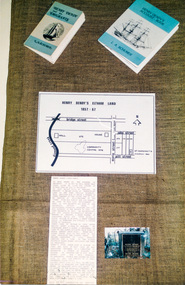
Photograph, Peter Bassett-Smith, Henry Dendy collection, 1988
... week...Henry Dendy...Bicentennial/Heritage Week Display, "The Eltham Tradition", Eltham Shire Office, 17-22 April 1988 activities eltham shire office heritage display heritage week Henry Dendy Two colour photographs Henry Dendy collection Photograph Peter Bassett-Smith ...Bicentennial/Heritage Week Display, "The Eltham Tradition", Eltham Shire Office, 17-22 April 1988 Two colour photographsactivities, eltham shire office, heritage display, heritage week, henry dendy -
 Eltham District Historical Society Inc
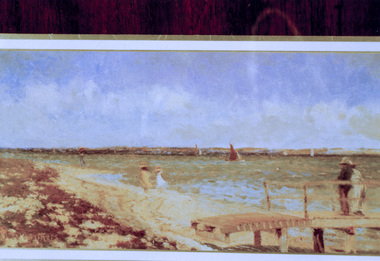
Photograph, Peter Bassett-Smith, Breezy day at Point Henry, near Geelong, Walter Withers (c. 1900), 1988
... Bicentennial/Heritage Week Display, "The Eltham Tradition", Eltham Shire Office, 17-22 April 1988 Purchased by the NGV 1958 activities eltham shire office heritage display heritage week Walter Withers Colour photograph Breezy day at Point Henry, near Geelong, Walter Withers (c. 1900) Photograph Peter Bassett-Smith ...Bicentennial/Heritage Week Display, "The Eltham Tradition", Eltham Shire Office, 17-22 April 1988 Purchased by the NGV 1958 Colour photographactivities, eltham shire office, heritage display, heritage week, walter withers -
 Warrnambool and District Historical Society Inc.
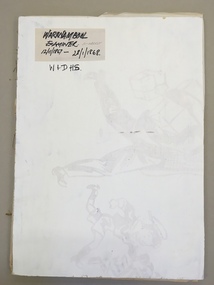
News Sheet, Warrnambool Examiner 12/11/1867 - 28/1/1868, 1867, 1868
... These papers were in a Warrnanmbool City Council storage area and it is surmised that they have come from the old Warrnambool Museum which no longer exists. warrnambool examiner richard osburne henry laurie william fairfax These are original copies of the Warrnambool Examiner newspapers from 12th November 1867 to 28th January 1868. They are broadsheets printed twice a week ...The Warrnambool Examiner was founded by John Wilkinson and Richard Osburne in 1851. After a gap of a couple of years Richard Osburne resumed publication in October 1853 and continued until 1867. William Fairfax and Henry Laurie then leased the paper (1867 to 1872) before Richard Osburne again became the proprietor from October 1872 to April 1878 and from December 1879 to December 1880 when publication ceased. Richard Osburne was a pioneer settler in Warrnambool, arriving in 1847. He was prominent in community activities in the town and was a most important early historian, publishing his seminal work, ‘The History Of Warrnambool’ in 1887, using the Warrnambool Examiner newspapers to assist with this history. Fairfax and Laurie were the proprietors when the papers herein described were printed. William Fairfax was a member of the Fairfax family that was , and still are, associated with the publication of many Australian newspapers and Henry Laurie later became well-known as a Melbourne University Philosophy Professor.These original newspapers are most important because they contain much information on Warrnambool’s early history and are a primary source for historians. These papers are also of importance because some parts of these papers were not filmed and are not currently available in microfilm. These papers were in a Warrnanmbool City Council storage area and it is surmised that they have come from the old Warrnambool Museum which no longer exists. These are original copies of the Warrnambool Examiner newspapers from 12th November 1867 to 28th January 1868. They are broadsheets printed twice a week with two pages containing four pages of printing for each edition. They are unbound and contained in two pieces of plain cardboard. They are unmarked and in good condition.warrnambool examiner, richard osburne, henry laurie, william fairfax -
 Warrnambool and District Historical Society Inc.
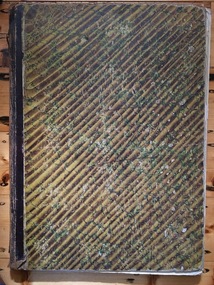
News Sheet, Newspaper Examiner, 1869
... These papers were in a Warrnambool City Council storage area and it is surmised that they have come from the old Warrnambool Museum which no longer exists. warrnambool examiner richard osburne william fairfax henry laurie Inside front cover: ‘1869 April to September’ These are original copies of the Warrnambool Examiner from 2nd April 1869 to 28th September 1869. The papers are two pages of broadsheet, printed on the four sides, published twice a week and occasionally containing a Supplement sheet. ...The Warrnambool Examiner was founded by John Wilkinson and Richard Osburne in 1851. After a gap of a couple of years Richard Osburne resumed publication in October 1853 and continued until 1867. William Fairfax and Henry Laurie then leased the paper (1867 to 1872) before Richard Osburne again became the proprietor from October 1872 to April 1878 and from December 1879 to December 1880 when publication ceased. Richard Osburne was a pioneer settler in Warrnambool, arriving in 1847. He was prominent in community activities in the town and was a most important early historian, publishing his seminal work, ‘The History of Warrnambool’ in 1887, using the Warrnambool Examiner newspapers to assist with this history. Fairfax and Laurie were the proprietors when the papers described herein were printed. William Fairfax was a member of the Fairfax family that was, and still is, associated with the publication of many Australian newspapers. Henry Laurie later became well-known as a Melbourne University Philosophy Professor.These original newspapers are most important because they contain much information on Warrnambool’s early history and are a primary source for historians. These papers are also of importance because some parts of these papers were not filmed and are not currently available on microfilm. These papers were in a Warrnambool City Council storage area and it is surmised that they have come from the old Warrnambool Museum which no longer exists.These are original copies of the Warrnambool Examiner from 2nd April 1869 to 28th September 1869. The papers are two pages of broadsheet, printed on the four sides, published twice a week and occasionally containing a Supplement sheet. The cover is plain cardboard with grey binding held together by glue. The cover is torn and the pages have many torn edges and are tattered in places. The pages (advertisements and public notices) have been marked in blue and red pencil by an editor.Inside front cover: ‘1869 April to September’warrnambool examiner, richard osburne, william fairfax, henry laurie -
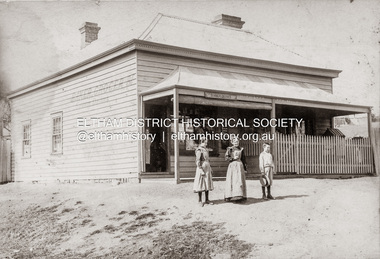 Eltham District Historical Society Inc
Photograph, Baker and Grocer shop, cnr. Main Road and York Street, Eltham, c.1902
... Henry Johnston, the property on the southern corner of Main Road and York Street, Eltham, which consisted of a store and bakery establishment occupied by Mr. Luther Haley whose lease had expired around the same time. Mr. Haley had not been prepared to leave as he was unable to secure at Eltham a suitable house in which to carry on his business. Wilfred Johnston applied for an eviction of Hayley, which was heard at Eltham Courthouse in August 1902. Hayley advised he was building a place near the railway station which he expected to be done in about three weeks...Henry Johnston, the property on the southern corner of Main Road and York Street, Eltham, which consisted of a store and bakery establishment occupied by Mr. Luther Haley whose lease had expired around the same time. Mr. Haley had not been prepared to leave as he was unable to secure at Eltham a suitable house in which to carry on his business. Wilfred Johnston applied for an eviction of Hayley, which was heard at Eltham Courthouse in August 1902. Hayley advised he was building a place near the railway station which he expected to be done in about three weeks ...Baker and Grocer store, cnr. Main Road and York Street, Eltham, early 1900s. Sign on side of building "Baker, Grocer & Summer Drinks" This image appears to be of the baker/grocery store after it was purchased in 1902 by Mrs Sarah Burgoyne and her husband, John James Thomas Burgoyne. It is possible that Mrs Sarah Burgoyne is the lady in front of the store with her eldest daughter, Charlotte and youngest son, James. Another daughter (Frances) and the family dog are watching from the doorway. In 1902 Mrs Sarah Burgoyne purchased from Wilfred Henry Johnston, the property on the southern corner of Main Road and York Street, Eltham, which consisted of a store and bakery establishment occupied by Mr. Luther Haley whose lease had expired around the same time. Mr. Haley had not been prepared to leave as he was unable to secure at Eltham a suitable house in which to carry on his business. Wilfred Johnston applied for an eviction of Hayley, which was heard at Eltham Courthouse in August 1902. Hayley advised he was building a place near the railway station which he expected to be done in about three weeks’ time. The court gave him the three weeks to vacate. Hayley’s new premises near the station became the present shopping district’s first shop and he ran it successfully till 1917 when the family moved to Clifton Hill, and he became a publisher. Their eldest child Leslie drowned in the Diamond Creek in early 1904, aged 12.Sepia photograph mounted on cardeltham, eltham bakery, grocer, john james thomas burgoyne, main road, sarah jane burgoyne (nee benson), summer drinks, york street
