
Showing 100 items matching "instructions for students"
-
 University of Melbourne, Burnley Campus Archives
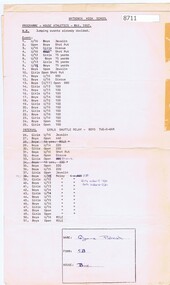
Administration, Dept of Agriculture, Victoria, College Camp T7, 18.08.1960-11.08.1970
... ...instructions for students...Manila folder containing instructions for students, receipts and expenses re camps...college camps instructions for students receipts expenses administration Manila folder containing instructions for students, receipts and expenses re camps College Camp T7 Administration Dept of Agriculture, Victoria ...college camps, instructions for students, receipts, expenses, administration -
 Greensborough Historical Society
Ephemera - Program, Watsonia High School, Watsonia High School, House Athletics 1967, 1967
... Printed program for the school athletic sports, and in-house instructions to students....Glynne Pietzsch Glynne Cousins Pietzsch watsonia high school athletics school sports Printed program for the school athletic sports, and in-house instructions to students. Watsonia High School, House Athletics 1967 Ephemera Program Watsonia High School ...Printed program and instructions for the annual Athletic Sports Meeting at Watsonia High 1967. [WaHIGH]Part of the Watsonia High collection of Glynne Pietzsch who was a student at Watsonia High in the 1960s.Printed program for the school athletic sports, and in-house instructions to students.glynne pietzsch, glynne cousins pietzsch, watsonia high school, athletics, school sports -
 Greensborough Historical Society
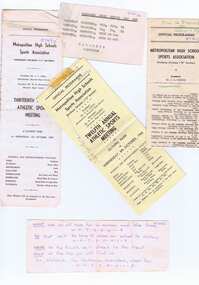
Ephemera - Programs, Metropolitan High Schools Sport Association, Metropolitan High Schools Sports Association, Annual Athletic Sports Meetings 1965-1967, 1965-1967
... Various printed official programs for the interschool athletic sports, and in-house instructions to students....Glynne Pietzsch Glynne Cousins Pietzsch watsonia high school education department victoria athletics Metropolitan High Schools Sports Association school sports Various printed official programs for the interschool athletic sports, and in-house instructions to students. Metropolitan High Schools Sports Association, Annual Athletic Sports Meetings 1965-1967 Ephemera Programs Metropolitan High Schools Sport Association ...Various programs released by the Metropolitan High Schools Sport Association for the annual Athletic Sports Meetings 1965-1967. Part of the Watsonia High collection of Glynne Pietzsch who was a student at Watsonia High in the 1960s.Various printed official programs for the interschool athletic sports, and in-house instructions to students.glynne pietzsch, glynne cousins pietzsch, watsonia high school, education department victoria, athletics, metropolitan high schools sports association, school sports -
 Ringwood and District Historical Society
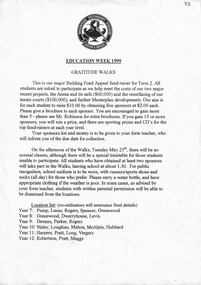
Document, Ringwood Secondary College - Gratitude Walks- Education Week 1999 - Instructions
... Instructions for students regarding what to do for the Gratitude Walks to assist with the term 2 Building Fund Appeal. ...Instructions for students regarding what to do for the Gratitude Walks to assist with the term 2 Building Fund Appeal. ...A4 sized beige sheet of paper with black type and symbolInstructions for students regarding what to do for the Gratitude Walks to assist with the term 2 Building Fund Appeal. Subjects covered are - aims of walks (financial and physical), clothing - uniform and footwear, locations for different year levels. -
 Great Stupa of Universal Compassion
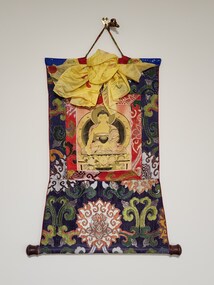
Artwork, other - Shakyamuni Buddha thangka
... Intended for personal meditation or instruction of monastic students, they are invested with the spirit of a deity to whom they are consecrated. ...Intended for personal meditation or instruction of monastic students, they are invested with the spirit of a deity to whom they are consecrated. ...Thangkas are cloth scrolls unique to Tibetan Buddhism, depicting deities, venerated spiritual figures, or religious symbols. Intended for personal meditation or instruction of monastic students, they are invested with the spirit of a deity to whom they are consecrated. The design of a thangka allows it to be rolled up for easy transport, a feature that was essential for traveling monks and practitioners in nomadic regions. The Shakyamuni Buddha thangkas serve as potent aids for cultivating compassion and awareness, offering inspiration and spiritual guidance to practitioners. The Buddha's path to enlightenment and subsequent teachings form the foundation of Buddhist philosophy. This thangka features an image of the Buddha in a meditative pose, holding an alms bowl in his lap. Framed by rich red textiles and surrounded by vibrant floral and cloud motifs, it is mounted on wooden dowels and topped with a yellow cover cloth.buddhist art, tibetan buddhism, holy objects -
 Great Stupa of Universal Compassion
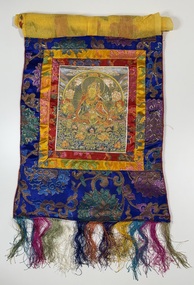
Artwork, other - Padmasambhava thangka
... Intended for personal meditation or instruction of monastic students, they are invested with the spirit of a deity to whom they are consecrated. ...Intended for personal meditation or instruction of monastic students, they are invested with the spirit of a deity to whom they are consecrated. ...Thangkas are cloth scrolls unique to Tibetan Buddhism, depicting deities, venerated spiritual figures, or religious symbols. Intended for personal meditation or instruction of monastic students, they are invested with the spirit of a deity to whom they are consecrated. The design of a thangka allows it to be rolled up for easy transport, a feature that was essential for traveling monks and practitioners in nomadic regions. Padmasambhava thangkas are used to invoke protection, dispel obstacles, and deepen tantric practice. His image serves as a powerful reminder of transformation, spiritual resilience, and the integration of wisdom and compassion.This thangka portrays Padmasambhava seated on a lotus with a red cap, the legs crossed, the right hand holding a dorje (vajra) and the left resting in his lap. Smaller deities or lineage masters appear above and below him, each enclosed in circular frames, signifying the transmission of teachings. The thangka is framed with layers of silk brocade in yellow, red, orange and blue, with floral and cloud motifs that evoke the celestial realm. A decorative fringe at the bottom adds ceremonial richness, while the yellow fabric-covered rod at the top allows the thangka to be hung for ritual or meditative use.buddhist art, tibetan buddhism, holy objects -
 Great Stupa of Universal Compassion
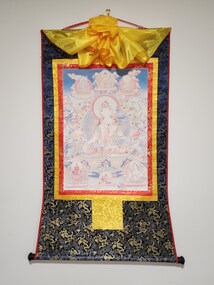
Artwork, other - White Tara thangka
... Intended for personal meditation or instruction of monastic students, they are invested with the spirit of a deity to whom they are consecrated. ...Intended for personal meditation or instruction of monastic students, they are invested with the spirit of a deity to whom they are consecrated. ...Thangkas are cloth scrolls unique to Tibetan Buddhism, depicting deities, venerated spiritual figures, or religious symbols. Intended for personal meditation or instruction of monastic students, they are invested with the spirit of a deity to whom they are consecrated. The design of a thangka allows it to be rolled up for easy transport, a feature that was essential for traveling monks and practitioners in nomadic regions. In Tibetan Buddhism, White Tara represents maternal compassion, healing, longevity, and purity. She is a female Buddha who offers swift help to those in need, providing protection, removing obstacles, and granting long life to practitioners for the purpose of spiritual practice and enlightenment. White Tara is worshipped for her ability to heal physical and mental illnesses.This thangka depicts White Tara seated in a meditative posture, radiating serenity and benevolence. Her white body symbolises purity and transcendent wisdom, and she is adorned with rich ornaments and flowing silks, reflecting her enlightened status.buddhist art, tibetan buddhism, holy objects -
 Great Stupa of Universal Compassion
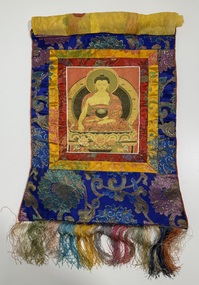
Artwork, other - Shakyamuni Buddha thangka
... Intended for personal meditation or instruction of monastic students, they are invested with the spirit of a deity to whom they are consecrated. ...Intended for personal meditation or instruction of monastic students, they are invested with the spirit of a deity to whom they are consecrated. ...Thangkas are cloth scrolls unique to Tibetan Buddhism, depicting deities, venerated spiritual figures, or religious symbols. Intended for personal meditation or instruction of monastic students, they are invested with the spirit of a deity to whom they are consecrated. The design of a thangka allows it to be rolled up for easy transport, a feature that was essential for traveling monks and practitioners in nomadic regions. The Shakyamuni Buddha thangkas serve as potent aids for cultivating compassion and awareness, offering inspiration and spiritual guidance to practitioners. The Buddha's path to enlightenment and subsequent teachings form the foundation of Buddhist philosophy.Embroided thangka with outer cover, fringing and embroided Shakyamuni Buddha deity. Surrounded by three borders with floral motifs in gold.buddhist art, tibetan buddhism, holy objects -
 Great Stupa of Universal Compassion
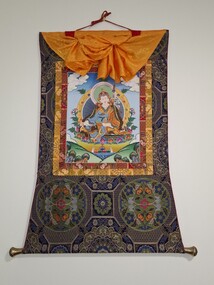
Artwork, other - Guru Padmasambhava thangka
... Intended for personal meditation or instruction of monastic students, they are invested with the spirit of a deity to whom they are consecrated. ...Intended for personal meditation or instruction of monastic students, they are invested with the spirit of a deity to whom they are consecrated. ...Thangkas are cloth scrolls unique to Tibetan Buddhism, depicting deities, venerated spiritual figures, or common religious symbols. Intended for personal meditation or instruction of monastic students, they are invested with the spirit of a deity to whom they are consecrated. A thangka is a composite three-dimensional object consisting of a picture panel which is painted or embroidered; a brocade mounting; and one or more of the following: a silk cover, leather corners, wooden dowels at the top and bottom and metal or wooden decorative knobs on the bottom dowel. Guru Padmasambhava (meaning 'Lotus-born', signifying his mythical origin as a being emerging from a lotus flower), also known as Guru Rinpoche, is seen as a manifestation of Buddha Shakyamuni. His teachings and legacy are deeply ingrained in Tibetan culture as he was responsible for bringing advanced Buddhist Tantric teachings to Tibet in the 8th century.A Tibetan thangka depicting Guru Padmasambhava. Framed in a traditional silk brocade border; a wooden dowel is inserted in a sleeve along the bottom edge of the fabric frame. buddhist art, tibetan buddhism, holy objects -
 Great Stupa of Universal Compassion
Artwork, other - Medicine Buddha thangka
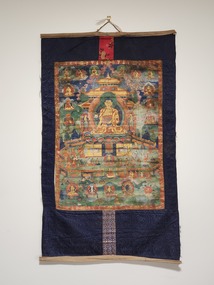
... Intended for personal meditation or instruction of monastic students, they are invested with the spirit of a deity to whom they are consecrated. ...Intended for personal meditation or instruction of monastic students, they are invested with the spirit of a deity to whom they are consecrated. ...Thangkas are cloth scrolls unique to Tibetan Buddhism, depicting deities, venerated spiritual figures, or common religious symbols. Intended for personal meditation or instruction of monastic students, they are invested with the spirit of a deity to whom they are consecrated. A thangka is a composite art form consisting of a picture panel which is painted or embroidered; a brocade mounting; and one or more of the following: a silk cover, leather corners, wooden dowels at the top and bottom and metal or wooden decorative knobs on the bottom dowel. This allows a thangka to be rolled up for portability, reflecting its origins in the nomadic lifestyle of Tibetan monks.The Medicine Buddha (also known as Bhaisajyaguru or Sangyé Menla) is revered as the embodiment of healing and associated with practices helping with mental and physical ailments, as well as purifying negative karma. His iconic imagery, including the medicine bowl and healing plant, represents the union of wisdom and compassion as forces of healing. His teachings, rooted in the "Four Medicine Tantras," emphasize that the root of all diseases lies in negative emotions of greed, hatred, and ignorance.The central figure in this old thangka is Medicine Buddha, seated on a lotus throne and surrounded by other deities and figures. He has a bowl in his left hand, and a flower in his right hand. An interesting feature is that his body is not painted blue, as is customary for the image Medicine Buddha. The paint colours were derived from natural ingredients – grinded coral, turquoise and other gemstones. The 'Om Ah Hum' mantra is printed in Tibetan in red ink on the verso of the thangka.buddhist art, tibetan buddhism, holy objects -
Federation University Historical Collection
Book - Ledger, Ballarat School of Mines Minutes: 1909-1918, 1909-1918
... It was resolved that in the event of the Department of Forestry offering 250 pounds per annum for the instruction of their students at Creswick in Chemistry, Botany, Physics and Surveying that it be accepted ..." ...It was resolved that in the event of the Department of Forestry offering 250 pounds per annum for the instruction of their students at Creswick in Chemistry, Botany, Physics and Surveying that it be accepted ..." ...The Ballarat School of Mines was the first School of Mines in Australia. It is a predecessor institution of Federation University Australia.Hard covered book with leather spine and corners. The minutes of the Ballarat School of Mines Council are handwrittten on the 25 March 1910 "... It was resolved that in the event of the Department of Forestry offering 250 pounds per annum for the instruction of their students at Creswick in Chemistry, Botany, Physics and Surveying that it be accepted ..." lined pages. 26 November 1909 "..It was decided to accept with thanks an offer of a flagpole and flag made by Mr W. Coltman through the student association. Mr Clegg to be consulted as to its erection. ..." 25 August 1916 "... A very cordial welcome was extended to Colonel Bolton, who was present for the first time since his return from Gallipoli. ... " 25 July 1910 "... A letter was received from the staff in reference to Mr Oddie's system of ventilation which he wishes introduced into the School. It was decided to postpone the matter for consideration when funds are available, ..." "... At Colonel Bolton's suggestion, it was decided to inform the Secretary of the Returned Soldiers Association that applications from returned soldiers for free instruction at this School would be favorably considered, and that it would be in the best interests of the movement if applications for admission were received through the Association. ... that Councillors T. Hurley, R. Stephenson, Colonel Bolton and the Principals be appointed as a sub-committee with power to act, in dealing with application from Returned Soldiers. "ballarat school of mines, james bickett, richard t. vale, j.k. dunn, s.e. figgis, samuel figgis, j. lonie, r. maddern, j.y. mcdonald, w.h. middleton, d. mitchell, dr morrison, h.a. nevett, j. ssxton, dr scott, w.h. sewell, j. vikery, g.h. fitches, andrew anderson, g. buchanan, j. dunn, f. herman, j. mitchell, r. scott, r.e. williams, j.d. woolcott, j. pearse, james oddie, shackleton polarizer, forestry school, creswick, b. whittington, ida johnson, j. barber, j. foster, h. hall, w.j. humphries, s. flohm, signwriting, frank tate, colonel bolton, j.b. robinson, alexander peacock, h.h. smith, charles fenner, c.a. hoadley, a.w. steane, j.n. dunn, w.d. hill, c. fenner, g. fitches, r. pearse, a.o. stubbs, daniel walker, w. nixon, t. hurley, r. stephenson, a.e. cutter, w.h. flaey, j.w. gower, j.n. montgomery, ballarat school of mines museum, a.m. lilburne, d. maxwell, d. ronaldson, r.e. tunbridge, j. jolly, j.m. sutherland, frederick martell, w.j. hoare, j.j. brokenshire, r. cutter, g. remfry, j.e. molloy, .stewart bequest, h.b. herbert, j. kean, f. saunders, george swinburne, w.j. humphreys, j. stevens, william baragwanath, richard g. walker, j.f. wiles, w.j. parry, george vincent, m.hannah, repatriation, returned soldiers, william k. bolton, maurice copland, d.v. allen, r.f. barker, a.f. heseltine, r.w. richards, appointment of dick richards, j.f.w. sporn, p.g. brown, h. daykin -
 Federation University Historical Collection
Photograph, Ballarat School of Mines Museum, c1889
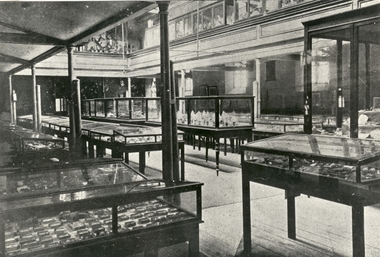
... In 1887 the museum collection number nearly 8,000 exhibits which were systematically arranged and catalogued, and in this way were a means for profitable instruction to the casual visitor as well as to the student. See http://bih.ballarat.edu.au/index.php/Ballarat_School_of_Mines_Museum. ...In 1887 the museum collection number nearly 8,000 exhibits which were systematically arranged and catalogued, and in this way were a means for profitable instruction to the casual visitor as well as to the student. See http://bih.ballarat.edu.au/index.php/Ballarat_School_of_Mines_Museum. ...The Ballarat School of Mines Museum was established in 1872. In 1887 the museum collection number nearly 8,000 exhibits which were systematically arranged and catalogued, and in this way were a means for profitable instruction to the casual visitor as well as to the student. See http://bih.ballarat.edu.au/index.php/Ballarat_School_of_Mines_Museum. The Curator of the Museum during the era was Ferdinand Krause. This image was reproduced in the 1899 Ballarat School of Mines Annual Report.Black and white photograph showing the interior of the Ballarat School of Mines Museum. ballarat school of mines, museum, geology, former wesleyan church, former methodist church, ferdinand krause, ballarat school of mines museum, display cases -
 Federation University Historical Collection
Booklet, The Ballarat School of Mines and Industries 1870-1920 Jubilee Booklet, 1920 (estimated)
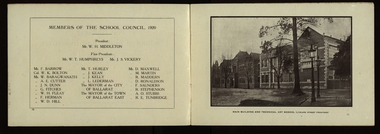
... Students gaining qualifications obtain concession in their courses at the university, should they proceed there to continue their studies. The technical Art school curriculum includes training in all branches of pictorial and applied art, an Architectural Diploma Course, a Draughtman's Course, technical Art teachers' Course, Photography,Ticket Writing, Art Metal Work, Woodcarving, Needlework, and Leather work. The Trade Classes give instruction...Students gaining qualifications obtain concession in their courses at the university, should they proceed there to continue their studies. The technical Art school curriculum includes training in all branches of pictorial and applied art, an Architectural Diploma Course, a Draughtman's Course, technical Art teachers' Course, Photography,Ticket Writing, Art Metal Work, Woodcarving, Needlework, and Leather work. The Trade Classes give instruction ...The first school of Mines in Australia was established at Ballarat in 1870. At the time of its jubilee (1930) the following people were members of the School Council: W.H. Middleton (President), W.T. Humphreys (VP), J.S. Vickery (VP), F. Barrow, Col. W.K. Bolton, William Baragwanath, A.E. Cutter, J.N. Dunn, G. Fitches, W.H. Fleay, F. Herman. W.D. Hill, T. Hurley, K. Kean. J. Kelly, L. Lederman, Mayor of Ballarat, Mayour of Ballarat East, D. Maxwell, M. Martin, R. Maddern, D. Ronaldson, F. Saunders, R. Stephenson, A.O. Stubbs, R.E. Tunbridge. The School Staff in 1920 comprised: Herbert H. Smith, Walter Rowbotham, Reginald L. Cutter, M.C. Young, Hilda Wardle, M. Wiliamson, P.S. Richards, L.H. Archibald, J. Woods, Ken Moss, W. Kenneth, Mrs McIlvena. B. Robinson, S. Rowe, E. Hope-Jones, Miss Abrams, L.St.G.P. Austin, Alfred Mica Smith, J.R. Pound, Herbert R. Murphy, N.H. Junner, Maurice Copland, L.H. Archibald, E.J.A. McConnon, Newton King, D.m. Hull, T.R. Gordon, John M. Sutherland, T.K. Jebb, Dick Richards, C. Tonkin, A.W. Steane, J. Paterson, H.W. Malin, R.V. Maddison, S.M. Mayo, F.A. King, W.H. Steane, T.R. Gordon, T.A. Williams, H. Waldron, G. Black, E.J. McConnon, R.V. Duncan. R. Cutter, E.G. Vawdrey, Hilda WardleWhite stapled booklet - landscape format - 20pp + soft covers with blue writing. Includes an historical sketch of the Ballarat School of Mines. Contains images of the school from around 1920. The history outlined in the booklet follows: 'Ballarat has helped to influence the life and destinies of Australia in many ways, the recital of which would perhaps prove tedious to the citizens of less favoured localities! However, it can be said, without much fear of contradiction, that only less known thought Australia than its fame as a gold field is the reputation won for it by its school of Mines, ... Ballarat was still quite a new place when the School was founded, but a very propserous and popular place all the same, with a go-ahead lot of citizens brim full of the spirit of enterprise which seemsto animate mining populations generally. Money was plentiful, and they launched out into ventures, which later, were to develop and take the place of the gold mines, while what is more to the point, they understood the value of education. the old digging days were passing away. So far as Ballarat itself was concerned the day of the cradle and tin dish had already passed into an antiquity "as dead and distant as the age of the Tubal Caon," said dir redmond Barry on declaring the School open. Mining had become a serious business, and the mining engineer, the metallurgist, and the geologist had become a power in the land. In these circumstances the suggestions to found a School of Mines met with ready acceptance. The late Mr James M. Bickett had the honor of bringing forward the proposition at a meeting of the Ballarat Mining Board in October, 1869. it was agreed to, and the Government, having been approached for assistance, granted a lease of the old Supreme Court buildings at a nominal reantal. A modest sum, including 100 pounds from the Borough Council of Ballarat West, was subscribed by a number of sympathisers, and on the 26th October, 1870, the inaugural address was delivered by Sir Redmond Barry, the first President of the School. Classes were commenced on the 23rd January, 1871. The students at first were mostly adults. They were chiefly men emloyed at the mines, who had the wisdom and energy to devote their spare time to study, and, though their attendance was somewhat irregular, they made very good progress. Old prints which have been preserved show them at work at furnaces, big bearded men of the old-fashioned type of miner. It is interesting to note that among those who gave evidence and encouragement was Sir Roderick Murchison, who many years before had advised Cornish miners to emigrate to Australia to search for gold, and who in 1848 was in possession of gold ore sent from this country. Sir Roderick sent a parcel of books for the library, and gave useful advice as to the curriculum which should be adopted. The Museum, which now contains a most valuable collection of minerals, was one of the first things attended to, and the reports presented to the Council from time to time speak of additions being made from all parts of the world. New equipment was constantly being added to the School, a good deal of assay work was done, and some specimens were sent from the East Indies for examination as far back as 1873. By this time there was a difficulty in providing accomodation for the students who wished to enrol, and the number of instructors had grown from two to four. In 1882 the first building was being erected on what was then part of the gaol reserve. A little more than ten years afterwards a buildnig formerly serving as a Methodist Church was absorbed, while later on, the demand for accomodation increasing, the attack upon the gaol was renewed. The School continued to grow in reputation and size, and became the science centre of the district, and in 1889 a learge new building was opened by Sir Alexander Peacock. Students came from over seas as well as from all the States of Australia, and after going through their courses they took with them the name and fame of the old School to all parts of the globe. School of Mines boys have played a great part in developing the mining fields of Western Australia, South Australia, and africa, while old students who have made a name in their profession are constantly dropping in to see how the old place is getting along. It was not to be expected, however, that the Ballarat School would be left without rivals, its very success inspiring competition. Mining Schools were started in other parts of Australia, and, at the same time, Victoria ceased to hold first place as a mining state. On the other hand there was a great advance in manufacturing, and the demand for technicaly trained men became a great and as insistent as ever it had been for trained mining men. The Council was quick to adapt the school to the new conditions, and the result is seen in the institution, which is one of Ballarat's proudest possession. Instruction is given in all branches of technical work, and the classes are filled with students who are building up for Ballarat a reputation as an industrial centre, which promises to equal that which it formerly held as a mining town. Owing to its bracing climate, its abundant opportunities for recreations, and its accessibilty, Ballarat as a city is an ideal place for educational purposed, and is yearly becoming more and more appreciated throughout the State. The chairman of one of Ballarat's biggests industries claims that the workman can do twice the day's work here that he can do in Melbourne. he was a little enthusiastic over it, perhaps, but it is a well-known fact that the healthy and invigourating Ballarat climate is conducive to both physical and mental activity, and the records of the School provide ample proof of it. One of the most interesting and successful branches of the School of Mines and Industries - if the name be enlarged with the enlargement of its scope - is the Technical Art School. "The City of Statues" has from its earliest days been a stronghold of art. Art schools have flourised here, and in 1905 the Education Department came to the conclusion that the best thing to do with them was to place them under the management of the School of Mines Council. A magnificent new Technical Art School was built at a cost of some 12,000 pounds on the site of the old Supreme Court building, and was formally opened on the 23rd July, 1915. The results have not only been justified but surpassed all anticipations. The most comprehensive list of subjects is taught, and this list is constantly added to. Students have flocked to the art School, which may be said to occupy a unique position in Australia, and its record of success is really astonishing. Its students supply art teachers for the newer schools that are being built, and many occupy leading positinos in important business houses. So well is its reputation known that orders are constantly being received, not only from Victoria, but from other States, for honor boards and challenge shields to be designed and made. The most recent addition to the School of Mines and Industries is the Junior Technical School, for which a new building is now being erected on a portion of the gaol site, transferred to the School of Mines Counci by the Government. At the present moment temporary quarters are being occupied. Some students after passing through the Junior School go straight to employment, continuing perhaps to attend the evening trade classes, while others move on to the senior School. In a review of the work of the School of Mines mention must be made of a series of industrial research carried out under supervision of the Principal. One in particular, regarding the suitability of the local ores for the manufacture of pigments attracted much attention, while the experiemtns on the manufacture of white potery from Victorian clayes were considered of sufficient importance by the Federal Advisory Council of Science and Industry to warrant the appointment of a special investigator. The results of these have been most encouraging, and may have far-reaching consequences. The vocational training of returned soldiers also should not be overlooked. The work was taken in hand from the first, before the Repatriation Department gave assistance, and now with the help of the department of the School has become one of the largest vocational training centres in Victoria outside of Melbourne. The soldiers, trained in a variety of occupations, have made remarkable progress, and already considerable numbers have found employment in local workshops and factories. To sum up, the School is divided into the following departments, each well staffed and equipped: - The School of Mines, science, and Engineering; the Techncial Art School, the Boys' Junior Technical School, the Girl's Preparatory Technical Classes, Trade Classes, and the Commercial School. The school of Mines, science and Engineering, comprises the following branches: - Mining, Metallurgy, Geology, Electrical Engineering, Civil Engineering, Mechanical Engineering, Applied Chemistry, and Pharmacy. Battery treatments, Cyanide Testing, Smelting, Assays, and Clay Testing from a regular part of the School's work. Students gaining qualifications obtain concession in their courses at the university, should they proceed there to continue their studies. The technical Art school curriculum includes training in all branches of pictorial and applied art, an Architectural Diploma Course, a Draughtman's Course, technical Art teachers' Course, Photography,Ticket Writing, Art Metal Work, Woodcarving, Needlework, and Leather work. The Trade Classes give instruction in Telephone Mechanics, telegraphy, Carpentry, Cabinet Making, Plumbing, Blacksmithing, Fitting, Electric Wiring, and Printing. Numerous Scholarships are offered every year, and altogether students will find few places to equal the Ballarat School of Mines and Industries as a training place for their life's work. One of the first in the continent to be established, its Jubilee finds it still in the front rank, keeping pace with the times, and offering to the youths of this country the means of taking advantage of Australia's teeming opportunities. william, battery, smith, herbert, drawing from the antique, ballarat school of mines botanical gardens, ballarat school of mines, redmond barry, alfred mica smith, james bickett, museum, dick richards, ballarat junior technical school, s m b, ballarat school of mines and industries, ballarat technical art school, model mine, james m bickett, j m bickett, roderick murchison, vocational training rooms, wesley church, methodist church, alexander peacock, lathes, repatriation, repatriatin department, war service, school council, baragwanath, gold mining, mining laboratory, plaster cast, r.w. richards, anniversary, jubilee -
 Federation University Historical Collection
Computer, Mutlitech Industrial Corporation, Micro-Professor MPF-IP and manuals, 1983 (estimated)
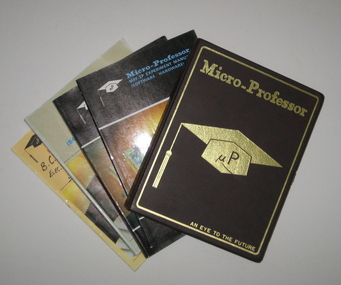
... student confessed that his dog had chewed the plastic case. This is still in our collection complete with bite marks! The Micro-Professor used a Zilog Z80 microprocessor. This was the most powerful of the 8 bit microprocessors at the time. Zilog was derived from the Intel 8080 microprocessor. The Z80 had 158 instructions...student confessed that his dog had chewed the plastic case. This is still in our collection complete with bite marks! The Micro-Professor used a Zilog Z80 microprocessor. This was the most powerful of the 8 bit microprocessors at the time. Zilog was derived from the Intel 8080 microprocessor. The Z80 had 158 instructions ...The Micro-Professor I Plus (MPF-IP) was a low cost, versatile microcomputer system featuring sophisticated software and hardware capabilities. (MPF-IP) boasted a display panel with the ability to display 20 characters using 16-segment fonts. All 64 standard ASCII characters could be displayed. The operation of the MPF-IP was controlled by an 8k monitor program which resides in the Read Only Memory (ROM). The monitor, aided by 4k Random Access Memory (RAM), enabled the user to enter a comprehensive set of single keystroke commands, making it easier for the user to use the CPU, memory and I/0 devices. This allowed the user to concentrate of microprocessor software development and application design. The system allowed printing at 48 lines per minute, and the ability to permanently record the commands, data, programs, status and other messaged. Each character printed by the printer is in a 5 by 7 dot matrix. Although the prime purpose of the programming was for machine language object code formed as hexadecimal numbers, the Micro-Professor has an embedded Tiny Basic interpreter for which formation of some of the alpha characters using a standard 7 segment display was ingenious. The program memory consisted of non volatile 2 kilobytes electrically programmable ROM whilst the Random Access Memory came with 2 kilobytes of static RAM but could be upgraded to 4 kilobytes by insertion of another chip. The entire memory space of 64 kilobytes was accessible by way of the terminals on the left hand side of the board. Engineering and Science students from the Ballarat School of Mines and the Ballarat College of Advanced Education used a class set (as they were relatively inexpensive at approx. $100 each) during the mid to late 1980s. Student were encouraged to borrow the Micro-Professors in order to assist in learning how to use them. Only one was ever not returned on time. When pressed to return the device the student confessed that his dog had chewed the plastic case. This is still in our collection complete with bite marks! The Micro-Professor used a Zilog Z80 microprocessor. This was the most powerful of the 8 bit microprocessors at the time. Zilog was derived from the Intel 8080 microprocessor. The Z80 had 158 instructions of which the Intel 78 instructions were a subset. The Intel processor continued on through development in the IBM computers as 8086, 80286, 80386, 80486 and later the pentiums. Zilog lost most of its market share when it developed the 16 bit Z8000 microprocessor. Although the microprocessor was excellent, the lack of peripherals caused users to abandon Zilog products. A brown and gold plastic box containing a microcomputer for use in classrooms. Four manuals are titled 'Micro-Professor MPF-IP user's Manual', 'MPF-I Experiment Manual (Software/Hardware)', Micro-professor MPF-IP experiment Manual (Software/Hardware)' and Micro-Professor MPF-I Monitor Program Source Listing.microcomputer, micro computer, micro professor, electronics -
 Federation University Historical Collection
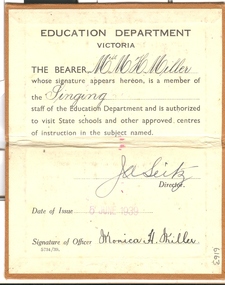
Booklet, Education Department Victoria, Education Department Victoria Official Authority, c 1939
... This pass would enable her to visit state schools and other approved centres of instruction. ballarat teachers college monica miller j seitz student teacher Brown hard covered booklet made out to Monica Miller of the Ballarat Teachers' College Education Department Victoria Official Authority Booklet Education Department Victoria ...Monica Miller taught singing at the Ballarat Teachers' College. This pass would enable her to visit state schools and other approved centres of instruction.Brown hard covered booklet made out to Monica Miller of the Ballarat Teachers' Collegeballarat teachers college, monica miller, j seitz, student teacher -
 Federation University Historical Collection
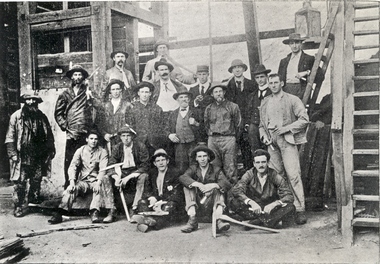
Photograph (black & white), Ballarat School of Mines Students visit the New Normanby Mine, 1899, 1899
... instructional innovation which involved weekly visits to some of the principle mines in the district. John Rowe took up this position in 1994, but it appears to have been a short lived innovation ending in 1996, possibly due to John Rowe's failing health. (http://guerin.ballarat.edu.au/curator/honour-roll/honourroll_Rowe,John.shtml) candle ballarat school of mines safety cage john rowe new normanby gold mine mining alumni pick Nineteen men, some Ballarat School of Mines students, pose outside Ballarat's New Normanby Mine. ...In 1875 John Rowe enrolled at the Ballarat School of Mines (SMB) where he studied Metallurgy and Assaying. In 1880 the Britannia Mine closed and John Rowe moved to Launceston working as Manager of the Royal Tasman Gold Mining Company. He returned to Ballarat two years later to manage the Long Gully United Gold Mining Company. In 1885 John Rowe sought work in New Caledonia followed by South Africa. While in South Africa he received an offer from SMB to lecture in Practical Mining, an instructional innovation which involved weekly visits to some of the principle mines in the district. John Rowe took up this position in 1994, but it appears to have been a short lived innovation ending in 1996, possibly due to John Rowe's failing health. (http://guerin.ballarat.edu.au/curator/honour-roll/honourroll_Rowe,John.shtml)Nineteen men, some Ballarat School of Mines students, pose outside Ballarat's New Normanby Mine. Some hold picks and candles. The man in the centre wearing a waistcoat is John Rowe, experienced miner and lecturer in Practical Mining at the Ballarat School of Mines. The June 1899 Ballarat School of Mines Magazine records: "The mining class visited the Britannia Gold Mine, and were kindly shown over the surface and underground workings by Mr. Harvey."candle, ballarat school of mines, safety cage, john rowe, new normanby gold mine, mining alumni, pick -
 Federation University Historical Collection
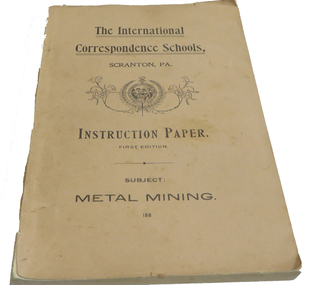
Book, International Correspondence School Instruction Paper: Metal Mining, 1889
... This book was probably used by a student of the Ballarat School of Mines mining Brown soft covered book of 148 page. The book includes many illustrations. International Correspondence School Instruction Paper: Metal Mining. ...This book was probably used by a student of the Ballarat School of MinesBrown soft covered book of 148 page. The book includes many illustrations. mining -
 Federation University Historical Collection
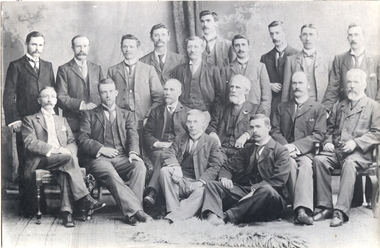
Book, Ballarat School of Mines Calendar, 1902-3, 1901
... Associateship and Final Certificates, Calendar for 1903, Discipline, Discipline Board, Fees, Full Certificates Issued, General Regulations, Honorary Correspondents, Office Bearers, President's Annual Report, Professors and Lecturers, Results of Examinations Conducted by Education Department 1901, Statistics - Students Attending Lectures, Subscriptions and Donations, Subjects Included in Regulations Technical Schools, Subjects of Instruction - Department of Chemistry and Metallurgy, Geological Department, Engineering Department, Electrical Department, Department of Mathematics and Physics, Practical, Plane and Solid Geometry, Photography, Syllabus for Assaying and Metallurgy, Time Table. ...Associateship and Final Certificates, Calendar for 1903, Discipline, Discipline Board, Fees, Full Certificates Issued, General Regulations, Honorary Correspondents, Office Bearers, President's Annual Report, Professors and Lecturers, Results of Examinations Conducted by Education Department 1901, Statistics - Students Attending Lectures, Subscriptions and Donations, Subjects Included in Regulations Technical Schools, Subjects of Instruction - Department of Chemistry and Metallurgy, Geological Department, Engineering Department, Electrical Department, Department of Mathematics and Physics, Practical, Plane and Solid Geometry, Photography, Syllabus for Assaying and Metallurgy, Time Table. ...The Ballarat School of Mines Calendar and Annual Report 1901. Associateship and Final Certificates, Calendar for 1903, Discipline, Discipline Board, Fees, Full Certificates Issued, General Regulations, Honorary Correspondents, Office Bearers, President's Annual Report, Professors and Lecturers, Results of Examinations Conducted by Education Department 1901, Statistics - Students Attending Lectures, Subscriptions and Donations, Subjects Included in Regulations Technical Schools, Subjects of Instruction - Department of Chemistry and Metallurgy, Geological Department, Engineering Department, Electrical Department, Department of Mathematics and Physics, Practical, Plane and Solid Geometry, Photography, Syllabus for Assaying and Metallurgy, Time Table. Includes several photographs.Green soft covered book of 96 pages, it includes the 1901 Annual Report of the Ballarat School of Mines. Images include: Senior Members of Staff and the Linkenbach Tableballarat school of mines, senior members of staff, linkenbach table, linkenbach, mica smith, dawson, hart, usher, annual report, andrew anderson, james m. bickett, r. t. vale, john warrington rogers, james millhinch bickett, james oddie, henry cuthbert, r. g. middleton, charles kent, robert lambert, andrew berry, fred j. martell, thomas s. hart, g. stephen hart, g. j. dawbarn, engineering department, a. e. c. kerr, lewis a. westcott, edgar a. mcconnon, laboratory assistant, john m. sutherland, electrical department, kerr grant, mathematics and physics, henry j. hall, charles e. campbell, photography -
 Federation University Historical Collection
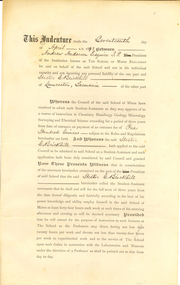
Document, Ballarat School of Mines, Ballarat School of Mine Indenture (Hector G. Brickhill), 1893, 17/04/1893
... Hector Brickbill paid 100 guineas to the Ballarat School of mines to be admitted as a Student-Assistant as part of a course of instruction in Chemistry, Metallurgy, Geology, Mineralogy, Surveying and Electrical Science. ...Hector Brickbill paid 100 guineas to the Ballarat School of mines to be admitted as a Student-Assistant as part of a course of instruction in Chemistry, Metallurgy, Geology, Mineralogy, Surveying and Electrical Science. ...Hector Brickbill paid 100 guineas to the Ballarat School of mines to be admitted as a Student-Assistant as part of a course of instruction in Chemistry, Metallurgy, Geology, Mineralogy, Surveying and Electrical Science. The indenture was for a three year period and required the student-assistant to undertake 40 hours of diligent and faithful work at the Ballarat School of Mines. Not less than 24 hours per week was to be devoted to instruction such as lectures at The School, and not less than 20 hours was to be devoted to the service of The School upon duties in connection with the Laboratories and Museum under the direction of a Professor. Upon completion Hector Brickbill became an Associate of the Ballarat School of Mines, and could put the letters ASMB after his name. .1) Printed indenture document which has been folded in half. Hand written sections have been filled out on the printed document. The indenture is between Andrew Anderson, President of the Ballarat School of Mines, and Hector G. Brickhill of Launceston, Tasmania. .2) Blue Ballarat School of Mines envelopehector g. brickhill, alumni, andrew anderson, ballarat school of mines indenture, ballarat school of mines student-assistant undenture, associate -
 Federation University Historical Collection
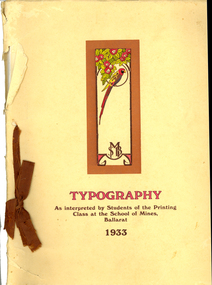
Book, Typography: As interpreted by students of the Printing Class at the School of Mines, Ballarat, 1933, 1933
... It is a book of specimens of work by the students attending the Typography Classes at the Ballarat Technical Art School under the instruction of Albert Dorling. ...It is a book of specimens of work by the students attending the Typography Classes at the Ballarat Technical Art School under the instruction of Albert Dorling. ...Albert E. Dorling was the Instructor in Printing at the Ballarat Technical Art School in 1933. The art school was a division of the Ballarat School of Mines. The objectives of Typographical Instruction at the Ballarat Technical Art School was to develop an appreciation of art in printing; to create and foster a wholesome respect for books; to develop a justifiable pride in persona achievement; to broaden the educational and social outlook; to broaden the field of vocational choice; to prepare for effective entrance into the printing trade; to give mastery of many of the principles of design; to help in forming habits of accuracy, thoroughness, neatness and industry; to give opportunity to turn out a product of use, beauty and value; to cultivate appreciation of the value of co-operation and service; to aid in mastery of other school subjects,particularly English; to provide an appropriate instructional medium for pupils whose constructive instincts desire this method of expression; to provide experience which will show the practical application and value of academic subjects.Coloured soft covered book bound with a brown ribbon. It is a book of specimens of work by the students attending the Typography Classes at the Ballarat Technical Art School under the instruction of Albert Dorling. Illustrations include: Ariel [sic] View from Art School by Fred Longhurst, 1932 Other work includes Bickart's Diamond Shop, Lydiard Street Methodist Choir, South Street Competitions, Allambee Guest House, Buninyong Lodge, Ballarat Journalists' Association, Thornton Studios, Harry Davies, Harry Brown & Co., Nautilus Corsets, Toti dal Monte, Symmons Flower Shop, Ritz Club, Ballarat Symphony Orchestra, Ladies' Art Associationtypography, printing, ballarat school of mines, ballarat technical art school, bickart's diamond shop, lydiard street methodist choir, south street competitions, allambee guest house, buninyong lodge, ballarat journalists' association, thornton studios, harry davies, harry brown & co., nautilus corsets, toti dal monte, symmons flower shop, ritz club, ballarat symphony orchestra, ladies' art association, typography, ballarat school of mines, ballarat technical art school, printing, albert dorling -
 Federation University Historical Collection
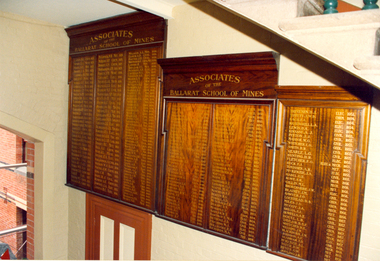
Honour Boards, Boards Listing Associates of the Ballarat School of Mines
... Students who wished to qualify for an associateship in once of the courses were expected to have a general education of matriculation standard and to have attended all the prescribed courses of instruction unless they were able to produce to the satisfaction of the School's Board of Examiners evidence of having attained elsewhere the degree of proficiency which was required in any particular subject or subjects. ...Students who wished to qualify for an associateship in once of the courses were expected to have a general education of matriculation standard and to have attended all the prescribed courses of instruction unless they were able to produce to the satisfaction of the School's Board of Examiners evidence of having attained elsewhere the degree of proficiency which was required in any particular subject or subjects. ...In 1883 the Ballarat School of Mines made some changes in order to make better use of the services of the teachers and to extend "as far as practicable the special educational advantages already afforded" by the School. One of the changes was the introduction of a three years course of training under the professors to qualify students for the following three professions: Analyst and Metallurgist, Electrician, and Geologist and Mining Surveyor. The Council was to confer the distinction of Associate. (Warren Perry, The School of Mines and Industries, Ballarat, 1984, p77) Students who took single subjects or pursued such courses as those for certificate of either mine manager or assayer were not required to pass an entrance examination. Students who wished to qualify for an associateship in once of the courses were expected to have a general education of matriculation standard and to have attended all the prescribed courses of instruction unless they were able to produce to the satisfaction of the School's Board of Examiners evidence of having attained elsewhere the degree of proficiency which was required in any particular subject or subjects. (Warren Perry, The School of Mines and Industries, Ballarat, 1984, p177) Ballarat School of Mines Associateships have been conferred since 1894 on candidates who had passed the prescribed examinations in one or other of the following three courses: Geology, Metallurgy and Mining engineering. Each of these three courses had an additional, but optional, fourth year of study. The prescribed subjects of study for an Associateship were set out in 'The Calendar of the Ballarat School of Mines' in each year. (Warren Perry, The School of Mines and Industries, Ballarat, 1984, p177)A number of timber boards with gold lettering. The list names in date order of when they became an Associates of the Ballarat School of Mines.ballarat school of mines, ballarat school of mines associate, associate of the ballarat school of mines, lonie, jennifer drummond, jill blee, jilian norton, zig plavina, associate boards -
 Federation University Historical Collection
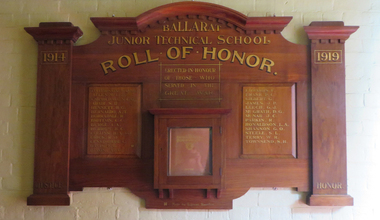
Photograph, Ballarat Junior Technical School World War One Honour Board, 2015, 0710/2015
... The Ballarat Junior Technical School Honour Board was unveiled on Saturday 17 June 1922 by Minister for Public Instruction, Alexander Peacock, in the presence of many parents, friends, students and staff. ...The Ballarat Junior Technical School Honour Board was unveiled on Saturday 17 June 1922 by Minister for Public Instruction, Alexander Peacock, in the presence of many parents, friends, students and staff. ...The Ballarat Junior Technical School Honour Board was unveiled on Saturday 17 June 1922 by Minister for Public Instruction, Alexander Peacock, in the presence of many parents, friends, students and staff. The Honour Board was designed by H.H. Smith, Principal of the Ballarat Technical Art School. Photograph of a timber World War One Honour Board honouring students from the Ballarat Junior Technical School, a division of the Ballarat School of Mines. ballarat junior technical school, world war one, honour board, honor board, w. paterson, w. allen, n. carmichael, s. adair, h.g. bennett, alan t. bernaldo, r. borradale, c.c. britain, b.c. burrow, h. collins, r.j. chick, c. cunningham, francis davis, a. dinon, f. edwards, p.c. frank, g. gilbert, j.p. james, g.j. leech, d.g. mcgrath, j.c. mcnab, r. parkin, l.a. ronaldson, g.o. shannon, s.l. steele, w.r. terry, s.h. townsend, h.h. smith, alexander peacock, robert borradale, albert burge, howard bennett, norman carmichael, reginald crick, herbert collins, r.j. crick, arthur dixon, frank edwards, george gilbert, sydney townsend -
Federation University Historical Collection
Booklet, The Ballarat School of Mines and Industries 1870-1920 Jubilee Booklet, 1920 (estimated)
... Students gaining qualifications obtain concession in their courses at the university, should they proceed there to continue their studies. The technical Art school curriculum includes training in all branches of pictorial and applied art, an Architectural Diploma Course, a Draughtman's Course, technical Art teachers' Course, Photography,Ticket Writing, Art Metal Work, Woodcarving, Needlework, and Leather work. The Trade Classes give instruction...Students gaining qualifications obtain concession in their courses at the university, should they proceed there to continue their studies. The technical Art school curriculum includes training in all branches of pictorial and applied art, an Architectural Diploma Course, a Draughtman's Course, technical Art teachers' Course, Photography,Ticket Writing, Art Metal Work, Woodcarving, Needlework, and Leather work. The Trade Classes give instruction ...The first school of Mines in Australia was established at Ballarat in 1870. At the time of its jubilee (1930) the following people were members of the School Council: W.H. Middleton (President), W.T. Humphreys (VP), J.S. Vickery (VP), F. Barrow, Col. W.K. Bolton, William Baragwanath, A.E. Cutter, J.N. Dunn, G. Fitches, W.H. Fleay, F. Herman. W.D. Hill, T. Hurley, K. Kean. J. Kelly, L. Lederman, Mayor of Ballarat, Mayour of Ballarat East, D. Maxwell, M. Martin, R. Maddern, D. Ronaldson, F. Saunders, R. Stephenson, A.O. Stubbs, R.E. Tunbridge. The School Staff in 1920 comprised: Herbert H. Smith, Walter Rowbotham, Reginald L. Cutter, M.C. Young, Hilda Wardle, M. Wiliamson, P.S. Richards, L.H. Archibald, J. Woods, Ken Moss, W. Kenneth, Mrs McIlvena. B. Robinson, S. Rowe, E. Hope-Jones, Miss Abrams, L.St.G.P. Austin, Alfred Mica Smith, J.R. Pound, Herbert R. Murphy, N.H. Junner, Maurice Copland, L.H. Archibald, E.J.A. McConnon, Newton King, D.m. Hull, T.R. Gordon, John M. Sutherland, T.K. Jebb, Dick Richards, C. Tonkin, A.W. Steane, J. Paterson, H.W. Malin, R.V. Maddison, S.M. Mayo, F.A. King, W.H. Steane, T.R. Gordon, T.A. Williams, H. Waldron, G. Black, E.J. McConnon, R.V. Duncan. R. Cutter, E.G. Vawdrey, Hilda WardleWhite stapled booklet - landscape format - 20pp + soft covers with blue writing. Includes an historical sketch of the Ballarat School of Mines. Contains images of the school from around 1920. The history outlined in the booklet follows: 'Ballarat has helped to influence the life and destinies of Australia in many ways, the recital of which would perhaps prove tedious to the citizens of less favoured localities! However, it can be said, without much fear of contradiction, that only less known thought Australia than its fame as a gold field is the reputation won for it by its school of Mines, ... Ballarat was still quite a new place when the School was founded, but a very propserous and popular place all the same, with a go-ahead lot of citizens brim full of the spirit of enterprise which seemsto animate mining populations generally. Money was plentiful, and they launched out into ventures, which later, were to develop and take the place of the gold mines, while what is more to the point, they understood the value of education. the old digging days were passing away. So far as Ballarat itself was concerned the day of the cradle and tin dish had already passed into an antiquity "as dead and distant as the age of the Tubal Caon," said dir redmond Barry on declaring the School open. Mining had become a serious business, and the mining engineer, the metallurgist, and the geologist had become a power in the land. In these circumstances the suggestions to found a School of Mines met with ready acceptance. The late Mr James M. Bickett had the honor of bringing forward the proposition at a meeting of the Ballarat Mining Board in October, 1869. it was agreed to, and the Government, having been approached for assistance, granted a lease of the old Supreme Court buildings at a nominal reantal. A modest sum, including 100 pounds from the Borough Council of Ballarat West, was subscribed by a number of sympathisers, and on the 26th October, 1870, the inaugural address was delivered by Sir Redmond Barry, the first President of the School. Classes were commenced on the 23rd January, 1871. The students at first were mostly adults. They were chiefly men emloyed at the mines, who had the wisdom and energy to devote their spare time to study, and, though their attendance was somewhat irregular, they made very good progress. Old prints which have been preserved show them at work at furnaces, big bearded men of the old-fashioned type of miner. It is interesting to note that among those who gave evidence and encouragement was Sir Roderick Murchison, who many years before had advised Cornish miners to emigrate to Australia to search for gold, and who in 1848 was in possession of gold ore sent from this country. Sir Roderick sent a parcel of books for the library, and gave useful advice as to the curriculum which should be adopted. The Museum, which now contains a most valuable collection of minerals, was one of the first things attended to, and the reports presented to the Council from time to time speak of additions being made from all parts of the world. New equipment was constantly being added to the School, a good deal of assay work was done, and some specimens were sent from the East Indies for examination as far back as 1873. By this time there was a difficulty in providing accomodation for the students who wished to enrol, and the number of instructors had grown from two to four. In 1882 the first building was being erected on what was then part of the gaol reserve. A little more than ten years afterwards a buildnig formerly serving as a Methodist Church was absorbed, while later on, the demand for accomodation increasing, the attack upon the gaol was renewed. The School continued to grow in reputation and size, and became the science centre of the district, and in 1889 a learge new building was opened by Sir Alexander Peacock. Students came from over seas as well as from all the States of Australia, and after going through their courses they took with them the name and fame of the old School to all parts of the globe. School of Mines boys have played a great part in developing the mining fields of Western Australia, South Australia, and africa, while old students who have made a name in their profession are constantly dropping in to see how the old place is getting along. It was not to be expected, however, that the Ballarat School would be left without rivals, its very success inspiring competition. Mining Schools were started in other parts of Australia, and, at the same time, Victoria ceased to hold first place as a mining state. On the other hand there was a great advance in manufacturing, and the demand for technicaly trained men became a great and as insistent as ever it had been for trained mining men. The Council was quick to adapt the school to the new conditions, and the result is seen in the institution, which is one of Ballarat's proudest possession. Instruction is given in all branches of technical work, and the classes are filled with students who are building up for Ballarat a reputation as an industrial centre, which promises to equal that which it formerly held as a mining town. Owing to its bracing climate, its abundant opportunities for recreations, and its accessibilty, Ballarat as a city is an ideal place for educational purposed, and is yearly becoming more and more appreciated throughout the State. The chairman of one of Ballarat's biggests industries claims that the workman can do twice the day's work here that he can do in Melbourne. he was a little enthusiastic over it, perhaps, but it is a well-known fact that the healthy and invigourating Ballarat climate is conducive to both physical and mental activity, and the records of the School provide ample proof of it. One of the most interesting and successful branches of the School of Mines and Industries - if the name be enlarged with the enlargement of its scope - is the Technical Art School. "The City of Statues" has from its earliest days been a stronghold of art. Art schools have flourised here, and in 1905 the Education Department came to the conclusion that the best thing to do with them was to place them under the management of the School of Mines Council. A magnificent new Technical Art School was built at a cost of some 12,000 pounds on the site of the old Supreme Court building, and was formally opened on the 23rd July, 1915. The results have not only been justified but surpassed all anticipations. The most comprehensive list of subjects is taught, and this list is constantly added to. Students have flocked to the art School, which may be said to occupy a unique position in Australia, and its record of success is really astonishing. Its students supply art teachers for the newer schools that are being built, and many occupy leading positinos in important business houses. So well is its reputation known that orders are constantly being received, not only from Victoria, but from other States, for honor boards and challenge shields to be designed and made. The most recent addition to the School of Mines and Industries is the Junior Technical School, for which a new building is now being erected on a portion of the gaol site, transferred to the School of Mines Counci by the Government. At the present moment temporary quarters are being occupied. Some students after passing through the Junior School go straight to employment, continuing perhaps to attend the evening trade classes, while others move on to the senior School. In a review of the work of the School of Mines mention must be made of a series of industrial research carried out under supervision of the Principal. One in particular, regarding the suitability of the local ores for the manufacture of pigments attracted much attention, while the experiemtns on the manufacture of white potery from Victorian clayes were considered of sufficient importance by the Federal Advisory Council of Science and Industry to warrant the appointment of a special investigator. The results of these have been most encouraging, and may have far-reaching consequences. The vocational training of returned soldiers also should not be overlooked. The work was taken in hand from the first, before the Repatriation Department gave assistance, and now with the help of the department of the School has become one of the largest vocational training centres in Victoria outside of Melbourne. The soldiers, trained in a variety of occupations, have made remarkable progress, and already considerable numbers have found employment in local workshops and factories. To sum up, the School is divided into the following departments, each well staffed and equipped: - The School of Mines, science, and Engineering; the Techncial Art School, the Boys' Junior Technical School, the Girl's Preparatory Technical Classes, Trade Classes, and the Commercial School. The school of Mines, science and Engineering, comprises the following branches: - Mining, Metallurgy, Geology, Electrical Engineering, Civil Engineering, Mechanical Engineering, Applied Chemistry, and Pharmacy. Battery treatments, Cyanide Testing, Smelting, Assays, and Clay Testing from a regular part of the School's work. Students gaining qualifications obtain concession in their courses at the university, should they proceed there to continue their studies. The technical Art school curriculum includes training in all branches of pictorial and applied art, an Architectural Diploma Course, a Draughtman's Course, technical Art teachers' Course, Photography,Ticket Writing, Art Metal Work, Woodcarving, Needlework, and Leather work. The Trade Classes give instruction in Telephone Mechanics, telegraphy, Carpentry, Cabinet Making, Plumbing, Blacksmithing, Fitting, Electric Wiring, and Printing. Numerous Scholarships are offered every year, and altogether students will find few places to equal the Ballarat School of Mines and Industries as a training place for their life's work. One of the first in the continent to be established, its Jubilee finds it still in the front rank, keeping pace with the times, and offering to the youths of this country the means of taking advantage of Australia's teeming opportunities. william, battery, smith, herbert, drawing from the antique, ballarat school of mines botanical gardens, ballarat school of mines, redmond barry, alfred mica smith, james bickett, museum, dick richards, ballarat junior technical school, s m b, ballarat school of mines and industries, ballarat technical art school, model mine, james m bickett, j m bickett, roderick murchison, vocational training rooms, wesley church, methodist church, alexander peacock, lathes, repatriation, repatriatin department, war service, school council, baragwanath, gold mining, mining laboratory, plaster cast, r.w. richards, anniversary, jubilee -
Federation University Historical Collection
Book - Annual Report, Berry, Anderson & Co, Ballarat School of Mines Calendar Year 1901-02 with Annual Report and Balance Sheet for 1900, 1901
... Calendar and Annual Report 1901-02, Associateship and Final Certificates, Calendar for 1902, Certificates issued during 1900 in Metallurgy of Gold and Ore Dressing, Discipline, Discipline Board, Fees, Full Certificates Issued, General Regulations, Honorary Correspondents, Meteorological Observations, Office Bearers, Passes Obtained since 1892 in Final Examinations, President's Annual Report, Professors and Lecturers, Results of Examinations Conducted by Education Department 1900, Statement of Receipts and Expenditure for Year 1900, Statistics - Students Attending Lectures, Subscriptions and Donations, Subjects Included in Regulations Technical Schools, Subjects of Instruction - Department of Chemistry and Metallurgy, Geological Department, Engineering Department, Electrical Department, Department of Mathematics and Physics, Practical, Plane and Solid Geometry, Photography, Time Table ...Calendar and Annual Report 1901-02, Associateship and Final Certificates, Calendar for 1902, Certificates issued during 1900 in Metallurgy of Gold and Ore Dressing, Discipline, Discipline Board, Fees, Full Certificates Issued, General Regulations, Honorary Correspondents, Meteorological Observations, Office Bearers, Passes Obtained since 1892 in Final Examinations, President's Annual Report, Professors and Lecturers, Results of Examinations Conducted by Education Department 1900, Statement of Receipts and Expenditure for Year 1900, Statistics - Students Attending Lectures, Subscriptions and Donations, Subjects Included in Regulations Technical Schools, Subjects of Instruction - Department of Chemistry and Metallurgy, Geological Department, Engineering Department, Electrical Department, Department of Mathematics and Physics, Practical, Plane and Solid Geometry, Photography, Time Table annual report 1901-02 andrew anderson - president r. denham pinnock - vice president hon. r.t. vale - vice president the hon. john warrington rogers - trustee the right reverend samuel thornton bishop of ballarat - trustee james millhinch bickett - trustee james oddie - trustee the hon. henry cuthbert - honorary solicitor r. g. middleton - honorary treasurer thomas s. hart - curator of museum chas. kent - auditor fred j. martell - director professor alfred mica smith daniel walker hubert r. murphy charles a. deane percy r. osborne arthur garrad thomas evans douglas a. runting ernest trend thomas s. hart g. stephen hart professor g. j. dawbarn a. e. c. kerr herbert krause henry j. hall john m. sutherland kerr grant j. f. usher chas, e. campbell charles kent - auditor chemistry laboratory assay laboratory electricity lecture room charles kent cyanide plant Judge warrington Rogers john warrington rogers samuel thornton james bickett thomas hart t.s. hart henry hall charles campbell j.m. sutherland 1) 05225.1 Ballarat School of Mines Calendar for the Year 1901-02 with Annual Report and Balance Sheet for 1900, Pale grey soft cover, 93 Pages 2) 05225.2 Ballarat School of Mines Calendar for the Year 1901-02 with Annual Report and Balance Sheet for 1900, Pale grey soft cover, 93 Pages Images include: Senior Members of Staff, Interior of Museum, Balance Rooms, Engineering Lecture Room, Part of Cyanide Plant, Senior Chemistry Laboratory, Chemistry Lecture Room, Assay Laboratory, Junior Chemistry Laboratory Ballarat School of Mines Calendar Year 1901-02 with Annual Report and Balance Sheet for 1900 Book Annual Report Berry, Anderson & Co. ...Calendar and Annual Report 1901-02, Associateship and Final Certificates, Calendar for 1902, Certificates issued during 1900 in Metallurgy of Gold and Ore Dressing, Discipline, Discipline Board, Fees, Full Certificates Issued, General Regulations, Honorary Correspondents, Meteorological Observations, Office Bearers, Passes Obtained since 1892 in Final Examinations, President's Annual Report, Professors and Lecturers, Results of Examinations Conducted by Education Department 1900, Statement of Receipts and Expenditure for Year 1900, Statistics - Students Attending Lectures, Subscriptions and Donations, Subjects Included in Regulations Technical Schools, Subjects of Instruction - Department of Chemistry and Metallurgy, Geological Department, Engineering Department, Electrical Department, Department of Mathematics and Physics, Practical, Plane and Solid Geometry, Photography, Time Table 1) 05225.1 Ballarat School of Mines Calendar for the Year 1901-02 with Annual Report and Balance Sheet for 1900, Pale grey soft cover, 93 Pages 2) 05225.2 Ballarat School of Mines Calendar for the Year 1901-02 with Annual Report and Balance Sheet for 1900, Pale grey soft cover, 93 Pages Images include: Senior Members of Staff, Interior of Museum, Balance Rooms, Engineering Lecture Room, Part of Cyanide Plant, Senior Chemistry Laboratory, Chemistry Lecture Room, Assay Laboratory, Junior Chemistry Laboratoryannual report 1901-02, andrew anderson - president, r. denham pinnock - vice president, hon. r.t. vale - vice president, the hon. john warrington rogers - trustee, the right reverend samuel thornton bishop of ballarat - trustee, james millhinch bickett - trustee, james oddie - trustee, the hon. henry cuthbert - honorary solicitor, r. g. middleton - honorary treasurer, thomas s. hart - curator of museum, chas. kent - auditor, fred j. martell - director, professor alfred mica smith, daniel walker, hubert r. murphy, charles a. deane, percy r. osborne, arthur garrad, thomas evans, douglas a. runting, ernest trend, thomas s. hart, g. stephen hart, professor g. j. dawbarn, a. e. c. kerr, herbert krause, henry j. hall, john m. sutherland, kerr grant, j. f. usher, chas, e. campbell, charles kent - auditor, chemistry laboratory, assay laboratory, electricity lecture room, charles kent, cyanide plant, judge warrington rogers, john warrington rogers, samuel thornton, james bickett, thomas hart, t.s. hart, henry hall, charles campbell, j.m. sutherland -
 Federation University Historical Collection
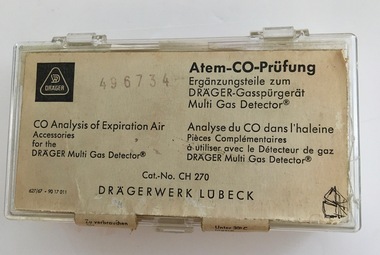
Equipment - Equipment - Monoxide Monitor, VIOSH: Carbon Monoxide Monitor - Dragerwerk Lubeck
... Students are taught active research and enquiry; rather than textbook learning and a one-size fits all approach. VIOSH accepts people into the Graduate Diploma of Occupational Hazard Management who have no undergraduate degree - on the basis of extensive work experience and knowledge. Box of accessories for the carbon monoxide monitor manufactured by Dragerwerk Lubeck Germany. Instructions...Students are taught active research and enquiry; rather than textbook learning and a one-size fits all approach. VIOSH accepts people into the Graduate Diploma of Occupational Hazard Management who have no undergraduate degree - on the basis of extensive work experience and knowledge. Box of accessories for the carbon monoxide monitor manufactured by Dragerwerk Lubeck Germany. Instructions ...Victorian Institute of Occupational Safety and Health (VIOSH) Australia is the Asia-Pacific centre for teaching and research in occupational health and safety (OHS) and is known as one of Australia's leaders on the field. VIOSH has a global reputation for its innovative approach within the field of OHS management. VIOSH had its first intake of students in 1979. At that time the Institution was known as the Ballarat College of Advanced Education. In 1990 it became known as Ballarat University College, then in 1994 as University of Ballarat. It was 2014 that it became Federation University. VIOSH Australia students are safety managers, senior advisors and experienced OHS professionals. They come from all over Australia and industry. Students are taught active research and enquiry; rather than textbook learning and a one-size fits all approach. VIOSH accepts people into the Graduate Diploma of Occupational Hazard Management who have no undergraduate degree - on the basis of extensive work experience and knowledge. Box of accessories for the carbon monoxide monitor manufactured by Dragerwerk Lubeck Germany. Instructions enclosed are in English German and French Clear perspex container - divided into three sections. Thermometers, plastic bag, rubber tubes. Instruction sheet in German, English and Frenchviosh, victorian institute of occupational safety and health, carbon monoxide monitor, dragerwerk lubeck -
 Federation University Historical Collection
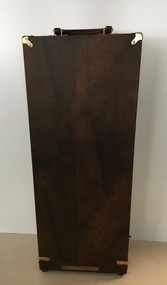
Equipment - Equipment - Meter/Calibrator, VIOSH: Flow Meter; Personal Liquid Calibrator
... Students are taught active research and enquiry; rather than textbook learning and a one-size fits all approach. VIOSH accepts people into the Graduate Diploma of Occupational Hazard Management who have no undergraduate degree - on the basis of extensive work experience and knowledge. Personal Sampler - Flow Meter/Liquid Calibrator in leatherette covered case with brass corners and clips. Maker is SKC inc., Eighty-four. PA 15330. This is Model 302. Instructions...Students are taught active research and enquiry; rather than textbook learning and a one-size fits all approach. VIOSH accepts people into the Graduate Diploma of Occupational Hazard Management who have no undergraduate degree - on the basis of extensive work experience and knowledge. Personal Sampler - Flow Meter/Liquid Calibrator in leatherette covered case with brass corners and clips. Maker is SKC inc., Eighty-four. PA 15330. This is Model 302. Instructions ...Victorian Institute of Occupational Safety and Health (VIOSH) Australia is the Asia-Pacific centre for teaching and research in occupational health and safety (OHS) and is known as one of Australia's leaders on the field. VIOSH has a global reputation for its innovative approach within the field of OHS management. VIOSH had its first intake of students in 1979. At that time the Institution was known as the Ballarat College of Advanced Education. In 1990 it became known as Ballarat University College, then in 1994 as University of Ballarat. It was 2014 that it became Federation University. VIOSH Australia students are safety managers, senior advisors and experienced OHS professionals. They come from all over Australia and industry. Students are taught active research and enquiry; rather than textbook learning and a one-size fits all approach. VIOSH accepts people into the Graduate Diploma of Occupational Hazard Management who have no undergraduate degree - on the basis of extensive work experience and knowledge. Personal Sampler - Flow Meter/Liquid Calibrator in leatherette covered case with brass corners and clips. Maker is SKC inc., Eighty-four. PA 15330. This is Model 302. Instructions are enclosed. A Gas flow meter featuring a glass tube with attached rubber tubes. A liquid is injected into the gas flow, so you can see the gas flowing. The gas passes through a tube of known volume. A liquid film is added (so you can see the gas) and you measure the time it takes for 1 litre of gas to fill the tube. SKC Model 302 flowerviosh, victorian institute of occupational safety and health, personal sampler, flow meter, liquid calibrator, skc inc -
Federation University Historical Collection
Article - Article - Women, Ballarat School of Mines: Women of Note; Margaret Baker
... student 295 on 2 August 1875 and attended seven lectures in applied magnetism and electricity. She was one of the first women to attend classes at Ballarat School of Mines (SMB). Women had only been admitted to the school for telegraphy courses in 1874. There appeared to be some concerns that the courses in magnetism and electricity were not associated with mining. They were not mentioned in the annual reports of 1875-76 which commented that: 'The objects of The School of Mines are, to provide means of instruction...student 295 on 2 August 1875 and attended seven lectures in applied magnetism and electricity. She was one of the first women to attend classes at Ballarat School of Mines (SMB). Women had only been admitted to the school for telegraphy courses in 1874. There appeared to be some concerns that the courses in magnetism and electricity were not associated with mining. They were not mentioned in the annual reports of 1875-76 which commented that: 'The objects of The School of Mines are, to provide means of instruction ...Margaret Baker enrolled as student 295 on 2 August 1875 and attended seven lectures in applied magnetism and electricity. She was one of the first women to attend classes at Ballarat School of Mines (SMB). Women had only been admitted to the school for telegraphy courses in 1874. There appeared to be some concerns that the courses in magnetism and electricity were not associated with mining. They were not mentioned in the annual reports of 1875-76 which commented that: 'The objects of The School of Mines are, to provide means of instruction in all things pertaining to mining, and to examine into the qualifications of persons engaged in mining.' By 1879 the Council proposed securing the services of competent lecturers in Geology, Mineralogy, Electricity and Magnetism,school of mines ballarat, smb, margaret baker, applied magnetism, electricity, first woman to study electricity and applied magnetism, telegraphy courses, mining courses, women of note -
Federation University Historical Collection
Document - Document - Letter, Ballarat Junior Technical School: Circular to schools from District Inspector, 1952
... Teachers to read sections of Regulations and Instruction which will be helpful in assessing efficiency of their work and give direction on organisation. Entry age for new students...Teachers to read sections of Regulations and Instruction which will be helpful in assessing efficiency of their work and give direction on organisation. Entry age for new students ...Circular from the District Inspector, Earl G Pearson, to all schools, June 1952. Divided into six headings. 1. Education Week information and suggestions. Will be held August 10th to 16th. Sunday 10th is Education Sunday. 2. State Schools' Horticulture Society return form nursery shows very little support. All school should support this and pay annual fee of 7/6d. Location is Teachers' Nursery, Poath Road, Oakleigh. ( Became State Schools' Nursery and now Victorian Schools' Nursery No 4214). 3. Inspection. Teachers to read sections of Regulations and Instruction which will be helpful in assessing efficiency of their work and give direction on organisation. Entry age for new students. Restriction maybe necessary to conserve teaching staff. 3. School residences. 4. Desk surplus. 5. Young Farmers' Clubs. New organizer for schools. Been taken over by Education Department.Cream page, typed ballarat junior technical school, head master, l garner, earl pearson, district inspector, circular, june 1952, education week, state schools' horticultural society, inspection, regulations and instructions, work efficiency, organisation, school enrolments, school residences, desk, young farmers' clubs -
 Federation University Historical Collection
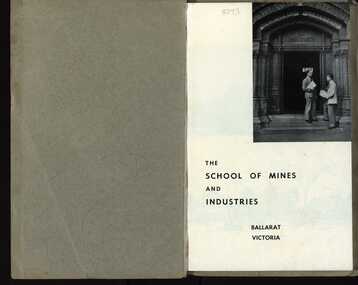
Booklet, Ballarat School of Mines and Industries, Prospectus, 1955, 1955
... The School Council, The Staff, Graduates of the School, Facts about the School, School Boards, General Regulations, Student Activities, Scholarships, Prizes, Courses of Instruction, Professional Diploma and Certificate Courses, Art Department, Trade Department, Juniot Technical School.R W Richards was the Principal and L C Garner was the Head Master of the Junior Technical School....The School Council, The Staff, Graduates of the School, Facts about the School, School Boards, General Regulations, Student Activities, Scholarships, Prizes, Courses of Instruction, Professional Diploma and Certificate Courses, Art Department, Trade Department, Juniot Technical School.R W Richards was the Principal and L C Garner was the Head Master of the Junior Technical School. ballarat school of mines prospectus alec kinnane Wool classing electrical engineering surveying courses r w richards principal l c garner head master diploma courses certificate courses Beige soft covered book of 67 pages. ...The Ballarat School of Mines is a predecessor institution of Federation University Australia. The Contents outline areas covered. The School Council, The Staff, Graduates of the School, Facts about the School, School Boards, General Regulations, Student Activities, Scholarships, Prizes, Courses of Instruction, Professional Diploma and Certificate Courses, Art Department, Trade Department, Juniot Technical School.R W Richards was the Principal and L C Garner was the Head Master of the Junior Technical School.Beige soft covered book of 67 pages. It includes information on the courses offered by the Ballarat School of Mines in 1955. Photographs include: 2 students on the steps to the Administration Building. The student on the top step is Alec Kinnane; Rear of the Administration Building, student activities; heat engines laboratory, Civil Engineering students, micro-examination of metals; Potter (Neville Bunning in background); machine shop; wool classing ballarat school of mines, prospectus, alec kinnane, wool classing, electrical engineering, surveying, courses, r w richards, principal, l c garner, head master, diploma courses, certificate courses -
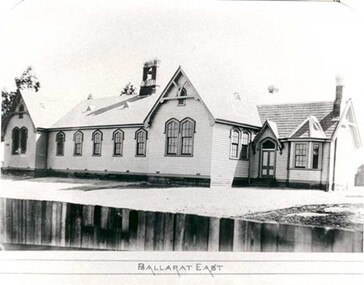 Federation University Historical Collection
Photograph - Photograph - black and white, Ballarat East State School (No 1071)
... The minister issued instructions for the old wooden part of the school to be demolished, and brick additions to be erected, so that the whole premises would accommodate 350 students. ...The minister issued instructions for the old wooden part of the school to be demolished, and brick additions to be erected, so that the whole premises would accommodate 350 students. ...The weatherboard Ballarat East State School SS 1071 was formerly known as Specimen Hill. According to 'Visions and Realisations' The Eureka gold lead opened in August 1852, running from Little Bendigo, south beneath Yarrowee Creek into Pennyweight flat, where it was joined 100 yards or so from the intersection of main and Eureka Streets by the Canadian Lead. State School 1071 was formerly known as Ballarat Common School No. 71, and was founded by the Free Presbyterian Church on Specimen Hill in Eureka Street, Ballarat on 01 January 1854. On 20 May 1869 the trustees of the Presbyterian School, Specimen Hill, Ballarat, consented to the transfer of the site to the Board of Education. On 01 September 1870, Specimen Hill, Ballarat, was vested in the Board and then became known as SS 1071. On 01 March 1879 the Minister, The Hon. William Collard Smith, and William Dobbie, Inspector of School Buildings, visited Ballarat to report on the buildings with a view to extensions and renovations. The minister issued instructions for the old wooden part of the school to be demolished, and brick additions to be erected, so that the whole premises would accommodate 350 students. (''Visions and Realisations: A Century of State Education in Victoria, Vol. 2'', Education Department of Victoria, 1973, p 729-730.)Black and white photograph of a weatherboard school with shingle roof known as Ballarat East (SS1071). The building has a brick chimney and bell tower. This school has Castlemaine flagging in the passages.ballarat east state school, education, st paul's school, specimen hill state school
