
Showing 111 items matching "john archibald"
-
 Warrnambool and District Historical Society Inc.
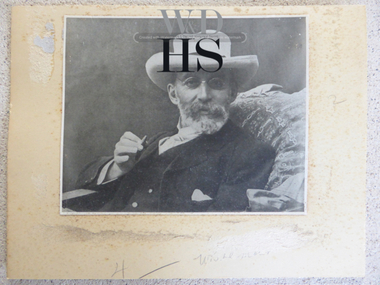
Photograph - J. F Archibald, Original photograph – c.1910
... ...john archibald...John Archibald (1856-1919) was born at Kildare near Geelong (so is not a native of the Warrnambool district) but he lived for some time in Warrnambool with his family. ...This is a black and white photograph of John Archibald, mounted on cardboard. It has been taken out of its original frame and the typed card with the original frame has been removed and attached to the back of the photograph....Founder of the ‘Bulletin’ School of Australian Literature, Presented by the Bread and Cheese Club, Melbourne’ (note that this contains inaccurate information in that John Archibald was not a native of the Warrnambool district)...This photograph of John Archibald is of some interest though it is a widely-known one and is not original. ...This photograph was donated by the Bread and Cheese Club, Melbourne but it is not know to what group or institution it was originally given. It is a copy of a well-known photograph of John Feltham Archibald, taken about 1910 when he was obsessed with all things French and was known at the time as Jules Francois Archibald. John Archibald (1856-1919) was born at Kildare near Geelong (so is not a native of the Warrnambool district) but he lived for some time in Warrnambool with his family. He began his working life with the Warrnambool Examiner newspaper and its successor, the Warrnambool Standard before going to Melbourne. In N.S.W. in 1880, he established with John Haynes, the Sydney Bulletin , a journal that became the most influential one of its day, promoting nationalism and fostering Australian writers and poets. He left legacies to establish the Archibald Prize for artists and the Archibald Fountain in Sydney. This photograph of John Archibald is of some interest though it is a widely-known one and is not original. It is kept because John Archibald, a national figure in Australian History of some importance, spent his school years in Warrnambool in the 1860s and 70s where his father was a local policeman. He went to Henry Kemmis’ Warrnambool Grammar School and wrote about his time here in later years, He also commenced his career as a journalist with the Warrnambool Examiner newspaper and later the Warrnambool Standard newspaper before going to Melbourne. This is a black and white photograph of John Archibald, mounted on cardboard. It has been taken out of its original frame and the typed card with the original frame has been removed and attached to the back of the photograph.The typed card reads: ‘J.F.Archibald, A Native of Warrnambool District. Founder of the ‘Bulletin’ School of Australian Literature, Presented by the Bread and Cheese Club, Melbourne’ (note that this contains inaccurate information in that John Archibald was not a native of the Warrnambool district)warrnambool, archibald family, j f archibald, john archibald, john feltham archibald -
 Warrnambool and District Historical Society Inc.
Financial record - Dockets (two), John Hyland et al, 1897
... These two 1897 dockets are from the Warrnambool auctioneers, John Hyland and Archibald Macfarlane. They refer to the sale by auction of the material from the demolition of the temporary buildings erected at the corner of Timor and Liebig Streets in Warrnambool as part of the staging of the Warrnambool Industrial and Art Exhibition, 1896-7. ...John Hyland...Archibald...Financial record Dockets (two) John Hyland Archibald Macfarlane, auctioneer ...These two 1897 dockets are from the Warrnambool auctioneers, John Hyland and Archibald Macfarlane. They refer to the sale by auction of the material from the demolition of the temporary buildings erected at the corner of Timor and Liebig Streets in Warrnambool as part of the staging of the Warrnambool Industrial and Art Exhibition, 1896-7. This exhibition, a major event in Warrnambool's history, ran from December 1896 to March 1897 and according to the press reports at the time attracted over 70,000 people to its many exhibitions, competitions and entertainments. Despite its popularity the Exhibition ran at a financial loss and the sale of the material from the temporary buildings was an attempt to recoup some of the losses. The sale of the timber, iron, glass etc from the temporary buildings returned about one-third of the original cost of the buildings. A feature of the John Hyland docket is the payment of seven shillings and sixpence to Ballis the bellman for ringing his bell and vocally advertising the sale in the town. These two dockets are of considerable interest as they add to our knowledge of the Warrnambool Industrial and Art Exhibition, an important event in our local 19th century history.1 and .2 These are two dockets printed on white paper with ruled red lines.The headings are printed and the details of sales are handwritten in black ink.19th century warrnambool auctioneers, warrnambool industrial and art exhibition 1896-7 -
Federation University Historical Collection
Ledger, Ballarat School of Mines Student Payments Ledger, 1907-1913, 1907-1913
... ...john archibald...The Ballarat Technical Art School opened in 1907 as a division of the Ballarat School of Mines. ballarat technical art school Clare Elshaug Eileen Coglan alice stanbury will salmon ethel owen isobel cahir dan daly a. greening george archibald t. davies alice coltman mabel fauce may lakeland agnes lamb ethel clegg john archibald mary black lewis charles may lakeland elsie Cassell mary heagney paul lalkeland myrtke harris g.c. haymes v. robinson ruby payne rick herbert herbert hayes tom harris floss rowe g. roberts clyde foord nita featherstone harold smith ernest morshead emily lucas ida holmes james grogan rene knight leslie henderson robert morgan rupert robbins albert perry h.h. blight stan blight h. rowland george anderson alex wilson c. frood vera sykes w.n. gent vera treloar w. holden violet astley percy reece ed olliver perry boweall keith McMillan t. hill eva nankervis bertha marsh ruby gates lizzie till george webb roy cooper w.t. mitchell c. brelaz guido brelaz a. pittard vera fisher Ledger with brown and blue marbled paper cover and brown tape spine. ...The Ballarat Technical Art School opened in 1907 as a division of the Ballarat School of Mines.Ledger with brown and blue marbled paper cover and brown tape spine. Names and amount paid listed on each page. Possibly relating to students of the Ballarat Technical Art School.ballarat technical art school, clare elshaug, eileen coglan, alice stanbury, will salmon, ethel owen, isobel cahir, dan daly, a. greening, george archibald, t. davies, alice coltman, mabel fauce, may lakeland, agnes lamb, ethel clegg, john archibald, mary black, lewis charles, may lakeland, elsie cassell, mary heagney, paul lalkeland, myrtke harris, g.c. haymes, v. robinson, ruby payne, rick herbert, herbert hayes, tom harris, floss rowe, g. roberts, clyde foord, nita featherstone, harold smith, ernest morshead, emily lucas, ida holmes, james grogan, rene knight, leslie henderson, robert morgan, rupert robbins, albert perry, h.h. blight, stan blight, h. rowland, george anderson, alex wilson, c. frood, vera sykes, w.n. gent, vera treloar, w. holden, violet astley, percy reece, ed olliver, perry boweall, keith mcmillan, t. hill, eva nankervis, bertha marsh, ruby gates, lizzie till, george webb, roy cooper, w.t. mitchell, c. brelaz, guido brelaz, a. pittard, vera fisher -
Glen Eira Historical Society
Article - Rosemont, Kooyong Road, 112A, Caulfield North
... ... Campbell John Archibald...Kooyong Road Blake Arthur Grice James Cast Iron Work Cellars Campbell John A. Campbell John Archibald Stables Verandahs King Thomas Howitt’s Corner Howitt Alfred William Farm Houses Bakewell John Architectural Features Bricks McWilliams Robert Rosemont Estate Mansions Howitt William Godfrey Dr. ...Eight items about this property: Handwritten notes from 1870 Caulfield rate book along with list of owners 1870-1890; unsigned and undated. Short history of Rosemont from 1860’s with owners listed up to 1895. Includes description of land and architectural features of house with sketch of pillar. Unsigned and undated with both typed and handwritten information. Unsigned and undated note (original and photocopy) about 112 Kooyong Road and Rosemont’s changing address over time. Photocopy of Andrew Ward’s Heritage Study (two pages) on 112 Kooyong Road (rear) describing significance, history and description of property. Includes photo. Online print without photo of same Heritage Study with handwritten note about brick exterior provided by owner/occupier to compiler Andrew Frederick 2010. Excerpt from Caulfield’s Building Heritage p.47-48 Volume 1 by Dr. Geulah Solomon about Rosemont giving description and history (start of entry on page 46 omitted). Added by Claire Barton date unknown. Notes taken by Andrew Frederick from Caulfield Heritage Vol.1 pages 47-9 re history; and from Sands and McDougall Directories of 1874, 1903, 1911, 1913 and 1923; plus 1913 entry in Vict. P.O Directory. These show house numbers and owners for those periods. Three pages of plans relating to Rosemont covering ground and first floors.rosemont, caulfield north, howitt godfrey dr., kooyong road, blake arthur, grice james, cast iron work, cellars, campbell john a., campbell john archibald, stables, verandahs, king thomas, howitt’s corner, howitt alfred william, farm houses, bakewell john, architectural features, bricks, mcwilliams robert, rosemont estate, mansions, howitt william godfrey dr., arches, balaclava road, coach houses, outbuildings, timber houses, squatters, campbell john, connelly mrs., king florence, slate tiles, ward andrew, chimneys, fireplaces, allen george, warburton james, mirfield professor, hall william sir, hall lady, land subdivision, cellars, embossed leather features, bay windows, house names, victorian style, ceilings, stairs, gardens -
Tatura Irrigation & Wartime Camps Museum
Document - Folder, Those Who Died in Action from Tatura in WW1
... ...John Archibald Duncan McColl...Harry Rowan Agnew Robert Ernest Alexander Daniel Allan Joseph Stanley Bainbridge Henry Saundry Bazeley Arthur Boot John Connors Thomas Cross Albert Blackburn Crossley James Lawrence Cummins Charles Patrick Fitzpatrick Richard Fuzzard Charles Alfred Philip Josiah Hampton Haswell Harding Joseph Arthur Head Thomas Patrick Keating John Mackay Layton Richard Goulburn Layton Robert Mactier VC Thomas James Maher Stanley George Mars John Archibald Duncan McColl Angas Ewen McLennan Michael Joseph Meagher Robert Alexander Mitchell Thomas James Port Albert Reddrop Albert Charles Joseph Robinson Charles John Seamons George Sinclair Swanson Alfred Tavener (Curran) William Robert Wheeler Tatura's WW1 roll of honour Tatura and District WW1 Nominal Roll Decorations and Awards to Tatura and District men Black folder with multiple sleeves each containing typed sheets with pictures. ...The sleeves contain sheets of typed material detailing the background, military history and circumstances of death, burial place and commemoration of people from Tatura and surrounding areas who were killed in action in WW1. Some have photographs as well. 1 page list of personal details of Tatura's WW1 roll of honour. 1 page list of names, dates enlisted, regiment number, last unit, rank, action, DOB and burial place of those listed. 5 page list of Tatura and District WW1 Nominal Roll. 2 page list of Decorations and Awards to Tatura and District men. Black folder with multiple sleeves each containing typed sheets with pictures.harry rowan agnew, robert ernest alexander, daniel allan, joseph stanley bainbridge, henry saundry bazeley, arthur boot, john connors, thomas cross, albert blackburn crossley, james lawrence cummins, charles patrick fitzpatrick, richard fuzzard, charles alfred philip josiah hampton, haswell harding, joseph arthur head, thomas patrick keating, john mackay layton, richard goulburn layton, robert mactier vc, thomas james maher, stanley george mars, john archibald duncan mccoll, angas ewen mclennan, michael joseph meagher, robert alexander mitchell, thomas james port, albert reddrop, albert charles joseph robinson, charles john seamons, george sinclair swanson, alfred tavener (curran), william robert wheeler, tatura's ww1 roll of honour, tatura and district ww1 nominal roll, decorations and awards to tatura and district men -
 Bendigo Military Museum
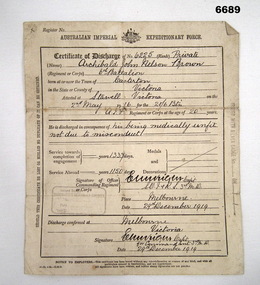
Administrative record - CERTIFICATE OF DISCHARGE, 1914-1919
... Regn No. 6225 Pte Archibald John Nelson Brown, 6th Batt 1st AIF....Certificate of Discharge. 6225 Private Archibald John Nelson Brown. 6th Battn, Medically unfit, 1337 day service, Service abroad 1150 days....Regn No. 6225 Pte Archibald John Nelson Brown, 6th Batt 1st AIF. Passchendaele Barracks Trust Discharge Certificate A. ...Regn No. 6225 Pte Archibald John Nelson Brown, 6th Batt 1st AIF.Certificate of Discharge. 6225 Private Archibald John Nelson Brown. 6th Battn, Medically unfit, 1337 day service, Service abroad 1150 days.passchendaele barracks trust, discharge certificate, a. j. n. brown, 6th battalion -
 Orbost & District Historical Society
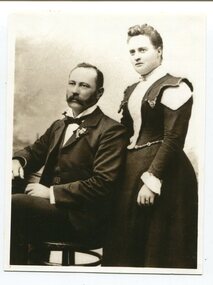
black and white photograph, early to mid 20th century
... Dickson-Archibald-John Commonwealth-Hotel-Orbost...This is a photograph of Archie Dickson and his wife, Emma ( nee Wainwright), who was married in 1900 to Archibald John Dickson (1855-1930) There is an article noting his death in the Age newspaper, Melbourne, Thursday 12 June 1930, page 6 which reports him to have been the first white child born in the Orbost area. ...This is a photograph of Archie Dickson and his wife, Emma ( nee Wainwright), who was married in 1900 to Archibald John Dickson (1855-1930) There is an article noting his death in the Age newspaper, Melbourne, Thursday 12 June 1930, page 6 which reports him to have been the first white child born in the Orbost area. ...This is a photograph of Archie Dickson and his wife, Emma ( nee Wainwright), who was married in 1900 to Archibald John Dickson (1855-1930) There is an article noting his death in the Age newspaper, Melbourne, Thursday 12 June 1930, page 6 which reports him to have been the first white child born in the Orbost area. James Thomas Dickson, his brother, was the manager and then licensee of the Commonwealth Hotel in Orbost from about 1903. The Dickson family was a prominent family in early Orbost.A black / white formal studio photograph of a man seated on a chair with a woman standing to the right behind him. He is wearing a frock coat, waistcoat and high stiff collar with a bow tie. Her day dress has a tight - fitting bodice with a deep waistline and long sleeves.dickson-archibald-john commonwealth-hotel-orbost -
 Federation University Historical Collection
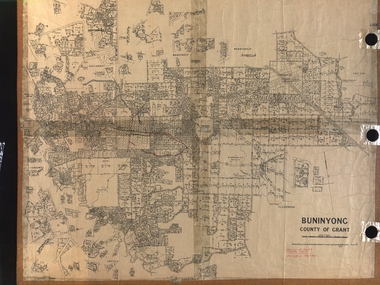
Plan, Department of Crown Lands and Survey, Melbourne, Buninyong County of Grant, 23/07/1929
... ...John Learmonth...Archibald...The plan was photo-lithographed at the Departmen tof Lands and Survey, Melbourne Buninyong Scotchman's Mt Buninyong Robert Scott Clarendon Lal Lal Creek yendon warrenheip Yarowee Enfield Thomas Learmonth John Learmonth Archibald Fisken G. Schloo George Innes Peter Inglis Durham Lead J. ...The plan was photo-lithographed at the Departmen tof Lands and Survey, MelbourneA parish plan of Buninyong, including Robert Scott's Mt Buninyong Pre-emptive Right, Mt Buninyong Public Park, Thomas Learmonth's land, John Learmonth's land, Scotchan's, Yendon. The Buninyong POst Office is Allotment 1. Pisition of tracks in 1859 have been marked on the plan in red.buninyong, scotchman's, mt buninyong, robert scott, clarendon, lal lal creek, yendon, warrenheip, yarowee, enfield, thomas learmonth, john learmonth, archibald fisken, g. schloo, george innes, peter inglis, durham lead, j. fry, j. forrest, parkin lee, buninyong recreation reserve -
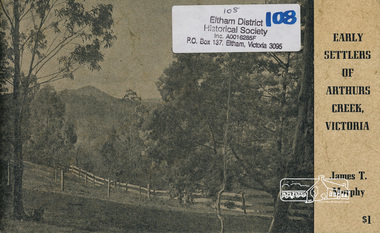 Eltham District Historical Society Inc
Book, Early settlers of Arthurs Creek, Victoria / James T. Murphy, 1971
... ...John Bear...Archibald...arthurs creek Patrick Reid Ardchattan Brennans John MacDonald John Bear Archibald Macfarlane Paperback; 16 p. : ill. ; 14 x 23 cm. ...Paperback; 16 p. : ill. ; 14 x 23 cm.arthurs creek, patrick reid, ardchattan, brennans, john macdonald, john bear, archibald macfarlane -
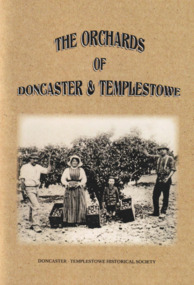 Surrey Hills Historical Society Collection
Book, The Orchards of Doncaster & Templestowe
... ...John Petty...Archibald...Irvine Green Eric Collyer Doncaster-Templestowe Historical Society Gottlieb Thiele Ruffey Creek Bismarck Street Victoria Street Thomas Petty George Hislop John Whitten John Clay August Aumann Carl Hanke Gottfried Uebergang Waldau Max Schramm German Lane George Street John Tully Henry Crouch George Tortice August Zerbe Jane Serpell Sidney Williams Phylloxera Joseph Bosisto Richard Serpell Frederick Thiele W S Williams Edwin Lawford James Read John Finger Richard Clay Ferdinand Finger Leeds Street Wetherby Road John Russell Sarah Uebergang Mary Hislop Rudolph Werner John Petty Archibald McLaren John Hicks Joe Hicks John Smedley William Smedley William Hunter Sylvester Mullens Laurie's forge Curtis Hillman Anne Hillman Dan Harvey Calder's forge Hillman's Blacksmith Works Thomas Serpell Gill Smith Victorian Fruit Growers Association H G Reynolds Alfred Thiele William Webb Fred Zerbe Mary Anne Clay Orchardist's Coolstore R H Werner & Co J H Land Orchardists and Fruit Cool Stores Association A T Petty R Read R Chivers Jack Noonan Arthur Ireland Jack Robinson George Knee Donvale Cool Store Herb Petty Frank Petty Fred Tolly Gordon White Blue Moon Fruit Co-operative Ltd Kathleen Petty Peg Chivers Jack Russell Mathew Adams George McGahy Edwin Bullock James Hodson Edwin Wilson David Corbett Edwin Lowford Thomas Beavis William Hanke Tom Petty Edward Crossman Andrew Zander Carl Aumann Heinrich Fromhold Thomas Chivers William Williams Reinhold Denhert Henry Finger August Furhmann Henry Serpell John Ireland Frank Smedley William Kent William Knee Thomas Buck Henry White Gottlieb Leber Alexander Speers A comprehensive history of fruit growing in the Doncaster-Templestowe area between 1850s and 1950s when orchards began to be subdivided for housing. ...For 100 years Doncaster-Templestowe was a major fruit producing area. The industry had a profound effect on the landscape and vegetation. Although orcharding families came from a variety of backgrounds, German families were an important sub-group.A comprehensive history of fruit growing in the Doncaster-Templestowe area between 1850s and 1950s when orchards began to be subdivided for housing. It includes B&W photos and line drawings and maps. It covers details of the varieties grown, the families involved, pests, machinery involved, markets, blacksmiths and reasons for the demise of the industry in the area.irvine green, eric collyer, doncaster-templestowe historical society, gottlieb thiele, ruffey creek, bismarck street, victoria street, thomas petty, george hislop, john whitten, john clay, august aumann, carl hanke, gottfried uebergang, waldau, max schramm, german lane, george street, john tully, henry crouch, george tortice, august zerbe, jane serpell, sidney williams, phylloxera, joseph bosisto, richard serpell, frederick thiele, w s williams, edwin lawford, james read, john finger, richard clay, ferdinand finger, leeds street, wetherby road, john russell, sarah uebergang, mary hislop, rudolph werner, john petty, archibald mclaren, john hicks, joe hicks, john smedley, william smedley, william hunter, sylvester mullens, laurie's forge, curtis hillman, anne hillman, dan harvey, calder's forge, hillman's blacksmith works, thomas serpell, gill smith, victorian fruit growers association, h g reynolds, alfred thiele, william webb, fred zerbe, mary anne clay, orchardist's coolstore, r h werner & co, j h land, orchardists and fruit cool stores association, a t petty, r read, r chivers, jack noonan, arthur ireland, jack robinson, george knee, donvale cool store, herb petty, frank petty, fred tolly, gordon white, blue moon fruit co-operative ltd, kathleen petty, peg chivers, jack russell, mathew adams, george mcgahy, edwin bullock, james hodson, edwin wilson, david corbett, edwin lowford, thomas beavis, william hanke, tom petty, edward crossman, andrew zander, carl aumann, heinrich fromhold, thomas chivers, william williams, reinhold denhert, henry finger, august furhmann, henry serpell, john ireland, frank smedley, william kent, william knee, thomas buck, henry white, gottlieb leber, alexander speers -
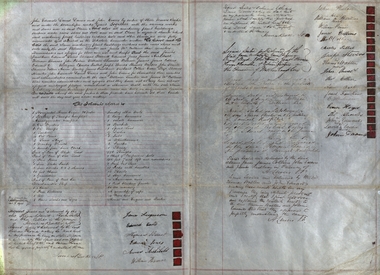 Federation University Historical Collection
Document, Transfer of Ownership of Prospecting Quartz Claim, under a Grant from the Ballarat Mining Board, 6 February 1860, 1860
... ...james archibald...john...All machinery and parts thereof are listed, plus any buildings, tools, blacksmith's shop and tools, ropes and paints/tar, etc james ferguson edward david thomas barnett edward jones james archibald john phelan william innis james collins dick collier charles talbot joseph stevens x (his mark) william thomas x (his mark) thomas walters john powell thomas collier a bach e milligan thomas knowles x (his mark) john edwards x (his mark) david davies john evans william lamble james mccallum james faulkner evan sloyd Signatures of owners. ...Document outlining the change of ownership of a Quartz Claim, all machinery and buildings at Spring Hill near Creswick, Victoria. This ownership transfer was between Misters Ferguson and others to Misters Lamble and McCallum. Each person mentioned signed the document. All machinery and parts thereof are listed, plus any buildings, tools, blacksmith's shop and tools, ropes and paints/tar, etcLarge cream coloured thick paper, Hand written in black ink. Twenty-four seals Signatures of owners.james ferguson, edward david, thomas barnett, edward jones, james archibald, john phelan, william innis, james collins, dick collier, charles talbot, joseph stevens, x (his mark) william thomas, x (his mark) thomas walters, john powell, thomas collier, a bach, e milligan, thomas knowles, x (his mark) john edwards, x (his mark) david davies, john evans, william lamble, james mccallum, james faulkner, evan sloyd -
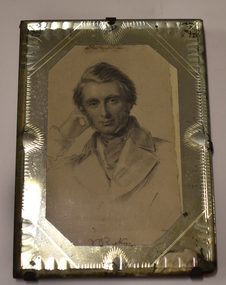 Warrnambool and District Historical Society Inc.
Artwork, other - Framed copy of engraving, John Ruskin, late 19th century
... ...Joseph Archibald...John...Archibald in his retirement years. The Museum continued as part of the Mechanics' Institute until 1963 as an important and much-admired institution. Most of the collection was lost over the years but some items remain, housed at the Warrnambool Art Gallery, Flagstaff Hill Maritime Museum and the Warrnambool and District Historical Society, with the John Ruskin item being part of the latter group's collection....John Ruskin. Old Warrnambool Museum Warrnambool Art Gallery Flagstaff Hill Maritime Museum Warrnambool & District Historical Society Joseph Archibald John Ruskin portrait J. ...This framed copy of a sketch of John Ruskin comes from the original steel plate engraving dating from about 1845. John Ruskin (1819-1900) was a notable English writer, philosopher, art critic and polymath in the Victorian era. He was the first Professor of Fine Art at Oxford University and was a prolific writer interested in the connection between nature, art and society, anticipating the more modern interest in environmental and sustainability issues. This framed item is from the collection of the old Warrnambool Museum which was first established in 1871 by the Warrnambool Mechanics' Institute under the curatorship of a local policeman, Joseph Archibald. This first museum faded away but was revived in 1883 by Joseph Archibald in his retirement years. The Museum continued as part of the Mechanics' Institute until 1963 as an important and much-admired institution. Most of the collection was lost over the years but some items remain, housed at the Warrnambool Art Gallery, Flagstaff Hill Maritime Museum and the Warrnambool and District Historical Society, with the John Ruskin item being part of the latter group's collection.This item is of considerable interest, firstly because it comes from the collection of the old Warrnambool Museum and secondly because it shows the local interest in the 19th century of the notable English writer and philosopher, John Ruskin. This is a copy of a steel plate engraving, a black and white sketch of the head and upper body of John Ruskin. It is enclosed in a cut glass frame with a red cardboard backing attached by metal clips. A section of the backing is torn off and there is damage to the bottom part of the glass frame.J. Ruskinold warrnambool museum, warrnambool art gallery, flagstaff hill maritime museum, warrnambool & district historical society, joseph archibald, john ruskin portrait -
 Peterborough History Group
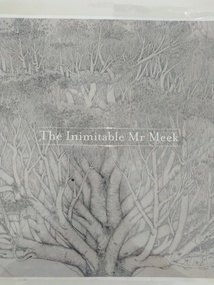
Book, Art gallery of Ballarat, The Inimitable Mr Meek, 2015
... mr james mckain archibald john meek...He was an artist and had a varied and interesting life and this book mentions the dates he was in Peterborough (Curdies Inlet, as it was then known) and his activities in Peterborough. mr james mckain archibald john meek calligraphy calligraphic works graphic arts Joan Luxemburg Peterborough Curdies Inlet 85 page soft cover catalogue of an exhibition held at the Art Gallery of Ballarat in 2015 The Inimitable Mr Meek Book Art gallery of Ballarat ...Mr Meek was the first person to build a house in Peterborough prior to 1858. Born in England in 1815 and came to Australia in 1838. this catalogue showcases his artistic skill. The art exhibition was curated by Joan Luxemburg as part of her PHD.Mr Meek is credited with building the first house in Peterborough. He was an artist and had a varied and interesting life and this book mentions the dates he was in Peterborough (Curdies Inlet, as it was then known) and his activities in Peterborough. 85 page soft cover catalogue of an exhibition held at the Art Gallery of Ballarat in 2015mr james mckain archibald john meek, calligraphy, calligraphic works, graphic arts, joan luxemburg, peterborough, curdies inlet -
 Mission to Seafarers Victoria
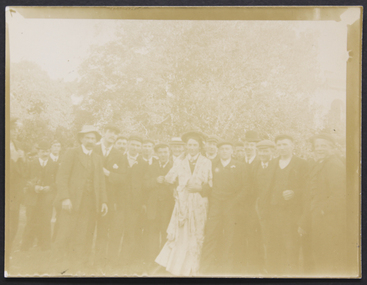
Photograph, Mr and Mrs Gurney Goldsmith, Picnic at Ottawa, King's Birthday1907, 1907
... Campbell between 1901 and 1911 when it became the property of John Archibald Campbell. (Heritage Overlay Review HO158)...Campbell between 1901 and 1911 when it became the property of John Archibald Campbell. (Heritage Overlay Review HO158) toorak king's birthday 1907 picnic edward vii mrs campbell costume ottawa goldsmith album lhlg picnics social events entertainments Small monochrome outdoor photograph, badly faded, depicting 20+ seafarers posed in a group with the central character wearing a dress Picnic at Ottawa, King's Birthday1907 Photograph Photograph Mr and Mrs Gurney Goldsmith ...Typical light-hearted gathering of seafarers on a public holiday outing, organised by the mission on Monday 11 November 1907 for King's Birthday celebration (Edward VII), at "Ottawa", Toorak, the 82 acres estate of Mrs Jane A. Campbell between 1901 and 1911 when it became the property of John Archibald Campbell. (Heritage Overlay Review HO158)Small monochrome outdoor photograph, badly faded, depicting 20+ seafarers posed in a group with the central character wearing a dresstoorak, king's birthday, 1907, picnic, edward vii, mrs campbell, costume, ottawa, goldsmith album, lhlg, picnics, social events, entertainments -
Ringwood and District Historical Society
Memorabilia, Large collection letters from Archie Harker, in England to Ruby Wilson in Mitcham 1930 -1935 and others. (Private)
... Ruby Wilson wrote to an English paper asking for a pen friend in 1930. John Archibald (Archie) Harker answered her request and thus started a long correspondence between the couple.eventuating in Archie sending Ruby an engagement ring. in July 1931. ...Ruby Wilson wrote to an English paper asking for a pen friend in 1930. John Archibald (Archie) Harker answered her request and thus started a long correspondence between the couple.eventuating in Archie sending Ruby an engagement ring. in July 1931. ...Ruby Wilson wrote to an English paper asking for a pen friend in 1930. John Archibald (Archie) Harker answered her request and thus started a long correspondence between the couple.eventuating in Archie sending Ruby an engagement ring. in July 1931. The correspondence continued till Archie came to Melbourne in June 1933 on the" Oronsay" and they married in December 1937. 280 letters in all. Ruby's elder sister Amy Thelma married Stanley Wieland thus placing the couple in the Wieland family and their story is in the Wieland's of Heathmont book by Pat and Don Talbot.Large number of personal letters, separated into pockets - letters written on lined note paper from Archie Harker to Ruby Wilson. Some postcards. Due to the private nature of these letters, they have not all been scanned and will not be made public. They can be inspected by appointment at the RDHS Archives -
Clunes Museum
Tool - DOOR KEY
... WINIFRED ALICE HALLAMORE 15-4-1909 - 8-8-99 BRASS DOOR KEY DONATED IN MEMORY OF WINIFRED ALICE HALLAMORE, BORN 15TH APRIL, 1909 IN CLUNES AT THE UNION BANK OF AUSTRALIA WHERE HER FATHER JOHN ARCHIBALD HALLAMORE WAS MANAGER. HER MOTHER WAS MINETTE MAUD HALLAMORE NEE VON DER BORCH. ...WINIFRED ALICE HALLAMORE 15-4-1909 - 8-8-99 BRASS DOOR KEY DONATED IN MEMORY OF WINIFRED ALICE HALLAMORE, BORN 15TH APRIL, 1909 IN CLUNES AT THE UNION BANK OF AUSTRALIA WHERE HER FATHER JOHN ARCHIBALD HALLAMORE WAS MANAGER. HER MOTHER WAS MINETTE MAUD HALLAMORE NEE VON DER BORCH. ...WINIFRED ALICE HALLAMORE 15-4-1909 - 8-8-99 BRASS DOOR KEY DONATED IN MEMORY OF WINIFRED ALICE HALLAMORE, BORN 15TH APRIL, 1909 IN CLUNES AT THE UNION BANK OF AUSTRALIA WHERE HER FATHER JOHN ARCHIBALD HALLAMORE WAS MANAGER. HER MOTHER WAS MINETTE MAUD HALLAMORE NEE VON DER BORCH. K. A. HALLAMORE LATER MOVED TO MARYBOROUGH TO MANAGE THE UNION BANK, THEN LATER TO ALEXANDRA. THE KEY WAS GIVEN TO BRUCE DOUGLAS ON HIS 21ST BIRTHDAY IN 1959. IT WAS BELIEVED TO BE THE KEY TO THE OLD CLUNES LOCK-UP. (BUT NO PROOF)..1 BRASS DOOR KEY - LARGE AND STRONG .2 DOCVUMENT: NOTE GIVING DETAILS OF KEYkey, document, winifred m. mclennan, winifred alice hallamore -
 Warrnambool and District Historical Society Inc.
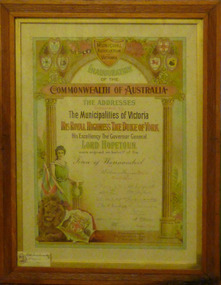
Certificate - Municipal Association of Victoria: Inauguration of the Commonwealth of Australia, Sands & McDougall, 1901
... Some local well known people of the time who were contributed in various fields to the Federation spirit, include John Archibald, Willian Astley, Louis Bayer, Richard Kennedy, Walter Murdoch, and Con O'Mahony. ...Some local well known people of the time who were contributed in various fields to the Federation spirit, include John Archibald, Willian Astley, Louis Bayer, Richard Kennedy, Walter Murdoch, and Con O'Mahony. ...This certificate is one of a number held by the Warrnambool and District Historical society which relate to the occasion of Federation of Australia , January 01/1901. Some are for social functions at the time others like this are for more formal occasions. There was a strong local vote for Federation at the referendum in 1898 with district figures 957 voting for and 146 against . By 1899 the vote had increased to 1411 yes and 39 against.. The official federation celebrations were held in Sydney and Warrnambool like towns all over Australia held celebrations. The Mayor and five of Warrnambool's councillors travelled to Sydney for the celebrations. The first federal Member of Parliament for the Warrnambool district was John Chester Manifold of "Talindert," Camperdown. Some local well known people of the time who were contributed in various fields to the Federation spirit, include John Archibald, Willian Astley, Louis Bayer, Richard Kennedy, Walter Murdoch, and Con O'Mahony. This certificate has an added link to Warrnambool in that the son of Councillor W. Henry, Victor Henry, an art student had designed and illuminated the municipal Addresses presented to the Governor general and the Duke of York. This item has historical, artistic social and interpretive significance. It links the most important event of the Federation of Australia to our city. That the art work was completed by Victor Henry, a local person is a significant claim to fame for our city. It presents an opportunity for present generations to consider local aspects of the process of the Federation of our country.Framed Certificate. Inauguration of the Commonwealth of Australia, Municipal Association of Victoria 1901. Signed by councillorsWilliam Ferguson Mayor, Giffens Russell, John Ward, John Marfell, Chas Macknight, W J Hickford, W Simpson, G S Mackay, M Saltau, H C Lawson, E J Murray William Kucks Jnr, W Henry. Small card inserted in bottom right reads With compliments of W Ferguson, Mayor.warrnambool, warrnambool history, warrnambool at federation, federation of australia, victor henry -
 Uniting Church Archives - Synod of Victoria
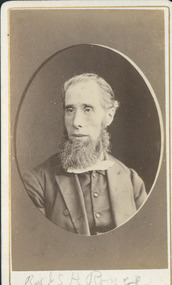
Photograph, Rev. James Stephen Hambrook Royce, Undated c.1880s
... Married Elizabeth Jenkins Berry, father of Archibald John Royce and T.W. Royce (Principal of Geelong Ladies' College) who was tragically drowned in 1893. ...Married Elizabeth Jenkins Berry, father of Archibald John Royce and T.W. Royce (Principal of Geelong Ladies' College) who was tragically drowned in 1893. ...B: England 23/10/1829, trained at the Richmond Theological Institution, then spent 5 years as a missionary in Fiji. When his health broke down he became a circuit minister in Australia. He became a supernumerary in 1887 and died 29/09/1907 at Geelong. Married Elizabeth Jenkins Berry, father of Archibald John Royce and T.W. Royce (Principal of Geelong Ladies' College) who was tragically drowned in 1893. Children: Elizabeth Mary Jane (1856 - 1939), Frances Ellen Gough (1858 - 1937, James Hamilton (1860 - 1927), Thomas William Arthur (1862 - 1893), Charlotte Louisa (1865 - 1933), Archibald John (1868 - 1944), Florence Annie (1874 - 1957)Oval inset, sepia toned head and shoulders studio portrait of the Rev. J.S.H. Royce. Carte de visite format.Rev. J.S.H. Royceroyce, j. s. h., wesleyan minister, fiji -
 Bendigo Military Museum
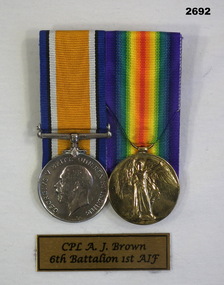
Award - MEDAL SET WW1, post 1919
... Archibald John Nelson Brown (born Casterton Vic, enlisted Ararat) No 6225 enlisted in 20th reinforcements 6th Batt AIF on 2.5.1916 age 20 years. ...Archibald John Nelson Brown (born Casterton Vic, enlisted Ararat) No 6225 enlisted in 20th reinforcements 6th Batt AIF on 2.5.1916 age 20 years. ...Archibald John Nelson Brown (born Casterton Vic, enlisted Ararat) No 6225 enlisted in 20th reinforcements 6th Batt AIF on 2.5.1916 age 20 years. Embarked for England 11.9.1916, embarked for France 13.12.1916, WIA 4.10.1917 GSW's left leg and right hand. Returned to France 17.9.1918, discharged from the AIF 29.12.1919.Medals, court mounted, set of 2, re J N BROWN 1. War Medal 1914-18 2. Victory Medal 19141 - 1919”6255 A/CPL A J N BROWN 6BN AIF”medals, military, history, passchendaele barracks trust -
 Melton City Libraries
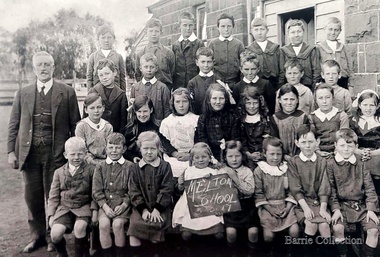
Photograph, Melton State School 430 Junior Classes, 1917
... Melton State School Photograph Junior Classes May 3rd 1917 Thomas Lang was the Head Teacher from 1896 - 1917 Back row: William Kilpatrick Bill D Whiting John Flynn Archibald MacDonald Arch Edward Radford Ted John Radford Jack Keith Beardemore Second Back Row: Percival Cook George Nixon Frederick Myers Bill ? ...Melton State School Photograph Junior Classes May 3rd 1917 Thomas Lang was the Head Teacher from 1896 - 1917 Back row: William Kilpatrick Bill D Whiting John Flynn Archibald MacDonald Arch Edward Radford Ted John Radford Jack Keith Beardemore Second Back Row: Percival Cook George Nixon Frederick Myers Bill ? ...Melton State School Photograph Junior Classes May 3rd 1917 Thomas Lang was the Head Teacher from 1896 - 1917 Back row: William Kilpatrick Bill D Whiting John Flynn Archibald MacDonald Arch Edward Radford Ted John Radford Jack Keith Beardemore Second Back Row: Percival Cook George Nixon Frederick Myers Bill ? Coburn Jim Coburn Bill ? Coburn [Arthur 06 Geo, William 06 Frdk Thomas 06 F James F] Second Front Row: Rita Wilson Mary Coburn Frdk Ivy Prickett - Winifred Barrie Marie Jongebloed Mary Phyllis Pearcey E. Waller Front Row: Kenneth Beaty John Parker Margaret McDonald Mary Kilpatrick Greta Jongebloed .. Norman Minns Francis Shelly Juniors classes with headmaster Thomas Lang. education, local identities -
 Orbost & District Historical Society
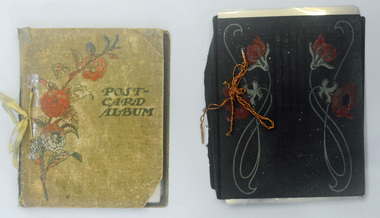
albums, early 1900's
... There were several Mrs Dickson's including Emma ( nee Wainwright), who was married in 1900 to Archibald John Dickson (1855-1930) and Laura (nee Kreymborg), who was married in 1901 to James Thomas Dickson (1864-1911). ...There were several Mrs Dickson's including Emma ( nee Wainwright), who was married in 1900 to Archibald John Dickson (1855-1930) and Laura (nee Kreymborg), who was married in 1901 to James Thomas Dickson (1864-1911). ...The postcards are addressed to Mrs Dickson, Miss Weeks, Mrs Kiernan and include one from Fred Hall AIF 1915 from Egypt. Miss Weeks was possibly Bertha Alma Weeks 1873-1952, m. George Patrick Kiernan, 1877-1961. There were several Mrs Dickson's including Emma ( nee Wainwright), who was married in 1900 to Archibald John Dickson (1855-1930) and Laura (nee Kreymborg), who was married in 1901 to James Thomas Dickson (1864-1911). The parents of Archibald and James Thomas were Euphemia (nee Brown) 1826-1907 and James T. Dickson (1853-1897). Postcards were ideal for short messages, they were cheap to buy and post, and they moved through rapidly improving transport networks. They are interesting contemporary records of places gone, architecture gone and people gone. This item reflects a contemporary form of communication in the early 20th century.Two cardboard covered albums containing post card collections. The cards have been laminated. 2350.1 has a grey cover. 2350.2 has a dark green cover, each decorated with flowers. Inside the pages are tied with gold ribbon / tape. Inside front cover hand-written in pen - "I know you are sitting all alone reflecting on the ??????. Remember that ?????? that will forever????? From Nug to Dot Dec 1906"postcards-album ww1-communication -
 Bendigo Historical Society Inc.
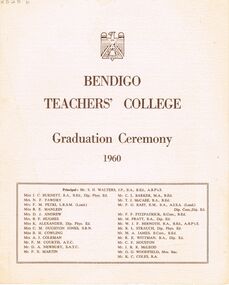
Document - LA TROBE UNIVERSITY BENDIGO COLLECTION: BENDIGO TEACHERS' COLLEGE GRADUATION CEREMONY 1960
... . - Kathleen Anne Algie, Ian Armstrong, Lorna Constance Barbour, Ronald Lindsay Bell, Michael Laurence Brown, Ross Ernest Brown, Graeme Lambden Budd, Duncan Leslie Thomas Cameron, Peter Morgan Clutterbuck, Joan Christine Connor, Allen William Cornelius, Glenys Elaine Cussins, Jean Elizabeth Davis, Denis William DeCann, Robert Alain Denham, Janet Carmel Doyle, Patricia May Edwards, Walter Kenneth Espagne, Fay Iris Evans, Brenda Gertrude Farrell, Malcolm George Ferguson, Elizabeth Joyce Fitzgerald, Kevin Joseph Foley, Barbara Violet Forrester, Lawrence Joseph Ginnivan, Peter Murray Graham, Thelma Elaine Grist, Dorothy Robyn Haines, William Jon Hall, Patricia Jeanette Hancock, Robert John Harris, William Ian Hart, Lorraine Moira Holmes, Lynette Ann Ireland, Morris Raymond Jackman, Christine Jackson, Margaret Nancy Jackson, Nanette Elizabeth Johnson, Trevor John Kellam, Robert Bruce Kemp, Ross Eliot Koochew, Henry Francis Lean, Janet Bobbie Leabeter, Rosemary Elizabeth Lowe, Graeme Stanley Lucas, Joy Patricia Maxwell, Terence Michael Mulvihill, George Alan Murdoch, Kevin Michael Murphy, Ann-Marie McCallum, Helen June Nixon, Kerry Joy O'Brien, William John O'Connell, Christine Lynette Olsen, William Stanley Page, Janice Anne Preston, John Stuart Reed, William Francis Reeves, Gary Desmond Robbins, Peter John Schlitz, Donald John McIntosh Shadforth, Gavin James Smith, John Archibald Spark, Illar Streimann, Janice Margaret Taylor, Ian Leonard Thornton, Rosemary Fay Wait, Russell Gilbert Walker, James John Wallis, Clare Mary Ward, David Ross Wiedermann, and Stephen Wilkinson..... - Kathleen Anne Algie, Ian Armstrong, Lorna Constance Barbour, Ronald Lindsay Bell, Michael Laurence Brown, Ross Ernest Brown, Graeme Lambden Budd, Duncan Leslie Thomas Cameron, Peter Morgan Clutterbuck, Joan Christine Connor, Allen William Cornelius, Glenys Elaine Cussins, Jean Elizabeth Davis, Denis William DeCann, Robert Alain Denham, Janet Carmel Doyle, Patricia May Edwards, Walter Kenneth Espagne, Fay Iris Evans, Brenda Gertrude Farrell, Malcolm George Ferguson, Elizabeth Joyce Fitzgerald, Kevin Joseph Foley, Barbara Violet Forrester, Lawrence Joseph Ginnivan, Peter Murray Graham, Thelma Elaine Grist, Dorothy Robyn Haines, William Jon Hall, Patricia Jeanette Hancock, Robert John Harris, William Ian Hart, Lorraine Moira Holmes, Lynette Ann Ireland, Morris Raymond Jackman, Christine Jackson, Margaret Nancy Jackson, Nanette Elizabeth Johnson, Trevor John Kellam, Robert Bruce Kemp, Ross Eliot Koochew, Henry Francis Lean, Janet Bobbie Leabeter, Rosemary Elizabeth Lowe, Graeme Stanley Lucas, Joy Patricia Maxwell, Terence Michael Mulvihill, George Alan Murdoch, Kevin Michael Murphy, Ann-Marie McCallum, Helen June Nixon, Kerry Joy O'Brien, William John O'Connell, Christine Lynette Olsen, William Stanley Page, Janice Anne Preston, John Stuart Reed, William Francis Reeves, Gary Desmond Robbins, Peter John Schlitz, Donald John McIntosh Shadforth, Gavin James Smith, John Archibald Spark, Illar Streimann, Janice Margaret Taylor, Ian Leonard Thornton, Rosemary Fay Wait, Russell Gilbert Walker, James John Wallis, Clare Mary Ward, David Ross Wiedermann, and Stephen Wilkinson. ...A cream document titled "Bendigo Teachers' College Graduation Ceremony 1960". The front page also contains a list of the staff working at the college. They are Mr. S. H. Walters (Principal), Miss J. C. Burnett, Mrs. N. F. Fawdry, Mrs. F. M. Petri, Miss R. E. Manlein, Mrs. D. J. Andrew, Mrs. B. F. Hughes, Miss K. Alexander, Miss C. M. Oughton Jones, Miss B. H. Cowling, Mrs. A. J. Coleman, Mr. F. M. Courtis, Mr. D. A. Newbury, Mr. F. X. Martin, Mr. C. L. Barker, Mr. T. J. McCabe, Mr. F. G. East, Mr. P. F. Fitzpatrick, Mr. M. Pratt, Mr. W. J. F. Bernoth, Mr. R. L. Strauch, Mr. M. A. James, Mr. R. E. Wittman, Mr. C. F. Houston, Mr. J. R. R. McLeod, Mr. G. G. Woodfield and Mr. K. C. Coles. The inside cover contains the "Significance of the Ceremony" and "Order of the Ceremony". Mr. F. M. Courtis welcomed the visitors whilst the Principal read the College Charge. The 'Graduation Book' was presented to Mr. A. L. Harris Inspector of Schools by Miss J. C. Burnett.The final roll call for 1960 was read by Mr. C. L. Barker. Congratulations were offered by The Mayor of Bendigo Cr. R. H. Wilson,J. P., Cr. T. A. Drechsler President of Strathfieldsaye Shire and Mr. G. Salathiel, Head Teacher of Gravel Hill State School. Finally the Occasional Address was presented by Mr. F. H. Brooks Assistant Director of Education. The following page contains a list of "Students of 1958-1960 Trained Infant Teacher's Certificate" - Marjorie May Allen, Janice Helen Ashman, Grada Ali Bos, Joan Margaret Busfield, Barbara Joan Cameron, Shirley Margaret Cribbes, Marcia Ann Davison, Margaret Mary Frances Dick, Lorraine Jean MacIntosh Goddard, Beverley Lorraine Goudie, Jennifer Joy Hamilton, Maureen Margaret Hunt, Shirley Joyce Innocent, Monica McKenna, Eileen Bernadette Mulvahil, Nola Ellen Parker, Jeanette Mary Pearson, Maureen Anne Pentland, Elaine Denise Pochon, Marian Judith Rechter, Marilyn Joy Rose, Catherine Shiels, Margaret Evelyn Stevenson, Rosemary Sutherland, Patricia Helen Tassicker, Eileen Monica Tuohey, Robin Elizabeth Walters, Patricia Ann Wenn and Ethel Dawn Whitelock. The back page contains a list of "Students of 1959-1960 Trained Primary Teacher's Certificate". - Kathleen Anne Algie, Ian Armstrong, Lorna Constance Barbour, Ronald Lindsay Bell, Michael Laurence Brown, Ross Ernest Brown, Graeme Lambden Budd, Duncan Leslie Thomas Cameron, Peter Morgan Clutterbuck, Joan Christine Connor, Allen William Cornelius, Glenys Elaine Cussins, Jean Elizabeth Davis, Denis William DeCann, Robert Alain Denham, Janet Carmel Doyle, Patricia May Edwards, Walter Kenneth Espagne, Fay Iris Evans, Brenda Gertrude Farrell, Malcolm George Ferguson, Elizabeth Joyce Fitzgerald, Kevin Joseph Foley, Barbara Violet Forrester, Lawrence Joseph Ginnivan, Peter Murray Graham, Thelma Elaine Grist, Dorothy Robyn Haines, William Jon Hall, Patricia Jeanette Hancock, Robert John Harris, William Ian Hart, Lorraine Moira Holmes, Lynette Ann Ireland, Morris Raymond Jackman, Christine Jackson, Margaret Nancy Jackson, Nanette Elizabeth Johnson, Trevor John Kellam, Robert Bruce Kemp, Ross Eliot Koochew, Henry Francis Lean, Janet Bobbie Leabeter, Rosemary Elizabeth Lowe, Graeme Stanley Lucas, Joy Patricia Maxwell, Terence Michael Mulvihill, George Alan Murdoch, Kevin Michael Murphy, Ann-Marie McCallum, Helen June Nixon, Kerry Joy O'Brien, William John O'Connell, Christine Lynette Olsen, William Stanley Page, Janice Anne Preston, John Stuart Reed, William Francis Reeves, Gary Desmond Robbins, Peter John Schlitz, Donald John McIntosh Shadforth, Gavin James Smith, John Archibald Spark, Illar Streimann, Janice Margaret Taylor, Ian Leonard Thornton, Rosemary Fay Wait, Russell Gilbert Walker, James John Wallis, Clare Mary Ward, David Ross Wiedermann, and Stephen Wilkinson.bendigo, education, bendigo teachers' college graduatio, la trobe university bendigo collection, collection, bendigo teachers' college, bendigo, education, teaching, teachers, students, graduation, tertiary education, graduation ceremony, history, book, bendigo teachers' college staff, graduands, graduates, bendigo teachers' college students, teacher training -
 Flagstaff Hill Maritime Museum and Village
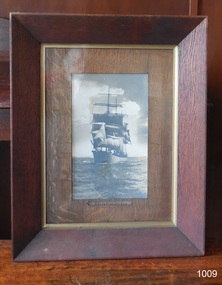
Photograph - Ship, Monkbarns, ca. 1924
... The steel-hulled, 3-masted fully rigged ship was built in 1895 by Archibald McMillan & Son at Dumbarton in Scotland. It was 267 feet long, 40.1 feet wide and 23.5 feet deep. In 1914 John...The steel-hulled, 3-masted fully rigged ship was built in 1895 by Archibald McMillan & Son at Dumbarton in Scotland. It was 267 feet long, 40.1 feet wide and 23.5 feet deep. In 1914 John ...This photograph was taken in about 1924 as it approached Newcastle, New South Wales before the sailing ship Monkbarns was converted for use as a hulk. The steel-hulled, 3-masted fully rigged ship was built in 1895 by Archibald McMillan & Son at Dumbarton in Scotland. It was 267 feet long, 40.1 feet wide and 23.5 feet deep. In 1914 John Stewart & Co. owned ten sailing vessels, one of which was the Monkbarns, but by the end of the first World War, the fleet had only four vessels survived the war, including the Monkbarns. The Monkbarns traded across the world. Some of the destinations included Port Adelaide, Table Bay in South Africa, Liverpool, Sydney, London and New York. Her last commercial voyage was in 1926. Overall, the ship traded for 32 years before it was converted in Spain in 1927 for use as a hulk for carrying coal. There were several owners of the ship over its lifetime. They were - 1895, first owner, Charles Webster Corsar, Liverpool - 1902, the owner was D. Corsar & Son, Liverpool - 1909, owned by John Hardie & Sons, Glasgow - 1911, John Stewart & Co., Liverpool - by1915, James A. Young, London - 1926, L.H. Wilson, Liverpool - 1927, Ballener Espando (Brunn & van Lippe, Tonsberg).Photograph, black and white, of the ship "Monkbarns" , a steel hulled sailing ship under sail, bow facing viewer. Rectangular wooden frame has an inner gilt frame around a wide, natural bark matte. The lover edge of the matte has a decorative rectangular cut-out surrounding an inscription with the ship's name. On the back is a handwritten inscription about the ship and the presentation of the photograph..Front: "MONKBARNS" Reverse handwritten in pen: "PRESENTED TO A.F. WATSON / FOR S.S.V. BY / CAPT. F.K. BAXTER / 74 VERDON ST/ WILLIAMSTOWN " Reverse: "STEEL SHIP MONKBARNS / 1771 TONS REGISTER / 267 x 40' X 27'2" Draft / Build 1895 by McMillan, Dumbarton, Scotland / Converted to a hulk in /Spain 1927. / Photo taken in - Converted from NEWCASTLE N.S.W. about 1924"flagstaff hill, warrnambool, maritime village, maritime museum, flagstaff hill maritime museum & village, shipwreck coast, great ocean road, monkbarns, sailing ship, newccastle, new south wales, hulk -
 Flagstaff Hill Maritime Museum and Village
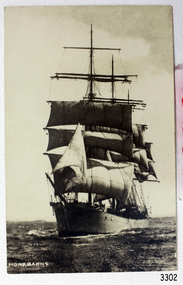
Postcard - Ship, Monkbarns, ca. 1924
... The steel-hulled, 3-masted fully rigged ship was built in 1895 by Archibald McMillan & Son at Dumbarton in Scotland. It was 267 feet long, 40.1 feet wide and 23.5 feet deep. In 1914 John...The steel-hulled, 3-masted fully rigged ship was built in 1895 by Archibald McMillan & Son at Dumbarton in Scotland. It was 267 feet long, 40.1 feet wide and 23.5 feet deep. In 1914 John ...This photograph of the Monkbarns was taken prior to 1927 before the sailing ship was converted for use as a hulk. The steel-hulled, 3-masted fully rigged ship was built in 1895 by Archibald McMillan & Son at Dumbarton in Scotland. It was 267 feet long, 40.1 feet wide and 23.5 feet deep. In 1914 John Stewart & Co. owned ten sailing vessels, one of which was the Monkbarns, but by the end of the first World War, the fleet had only four vessels survived the war, including the Monkbarns. The Monkbarns traded across the world. Some of the destinations included Port Adelaide, Table Bay in South Africa, Liverpool, Sydney, London and New York. Her last commercial voyage was in 1926. Overall, the ship traded for 32 years before it was converted in Spain in 1927 for use as a hulk for carrying coal. There were several owners of the ship over its lifetime. They were - 1895, first owner, Charles Webster Corsar, Liverpool - 1902, the owner was D. Corsar & Son, Liverpool - 1909, owned by John Hardie & Sons, Glasgow - 1911, John Stewart & Co., Liverpool - by1915, James A. Young, London - 1926, L.H. Wilson, Liverpool - 1927, Ballener Espando (Brunn & van Lippe, Tonsberg).The postcard shows and example of the sailing ships that traded across the seas and into Australia in the late 19th and early 20th century.Black and white postcard of a sailing ship, fully rigged, at sea. Handwritten on front of card is "Monkbarns"Handwritten on front "MONKBARNS". monkbarns, postcard, sailing ship, flagstaff hill, warrnambool, maritime village, maritime museum, flagstaff hill maritime museum & village, shipwreck coast, great ocean road, newccastle, hulk -
 Federation University Historical Collection
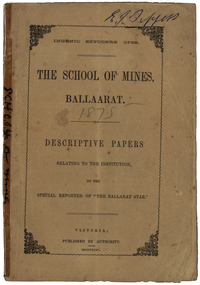
Booklet, The School of Mines Ballaarat: Descriptive papers relating to the institution by the special reporter of "The Ballarat Star", 1875 (exact)
... john day...r evan day...w w evans...j y fishburne...felice giordano...julius von haast...james hector...charles a la...trobe...archibald...John Day (Geelong); R. Evan Day (London); W.W. Evans, M.J.C.E. of New York; J.Y. Fishburne, M.B. of Ararat; Felice Giordano, Inspector of Mines, Italy; Julius Von Haast, Ph. D.F.R.S., Government Geologist of Canterbury; James Hector, M.D., F.R.S., Government Geologist of Wellington, New Zealand, W.F. Hopkins (Grant); Charles A. La Trobe, C.E. (Engineer-in-Chief International Railway Plant, London); Archibald...John Day (Geelong); R. Evan Day (London); W.W. Evans, M.J.C.E. of New York; J.Y. Fishburne, M.B. of Ararat; Felice Giordano, Inspector of Mines, Italy; Julius Von Haast, Ph. D.F.R.S., Government Geologist of Canterbury; James Hector, M.D., F.R.S., Government Geologist of Wellington, New Zealand, W.F. Hopkins (Grant); Charles A. La Trobe, C.E. (Engineer-in-Chief International Railway Plant, London); Archibald ...The booklet comprises of a series of papers published in the Ballarat Star, with some revisions. The Administrative Council hoped the publication would increase interest in Technical Education, especially the Art of Mining. He would also hope the public would recognise the Ballarat School of Mines as an institution adapted to supply technical education. The Ballarat School of Mines Council listed at the front of the book includes: Redmond Barry (President and Trustee), Judge Rogers (Vice-President), Somerville Livingstone Learmonth (Trustee), Rivett Henry Bland (Trustee), Charles Gavan Duffy, John A. MacPherson (MLA), William McLellan (MLA), Duncan Gillies (MLA), F. McCoy (University of Melbourne), John I. Bleasdale, W.H. Barnard, James M. Bickett, Henry Richards Caselli, P. Chauncy, J.M. Davey, Joseph Flude, R.F. Hudson, Robert Lewis, James Oddie, Robert M. Serjeant, J. F. Usher, John Walker, J. Williamson, Mayor of the City of Ballaarat, chairman (for the time being) of each of the seven Mining Boards of Victoria. The President of Examiners was Judge Rogers, and the Honorary Auditor was Richard Ford.Stapled, brown soft covered booklet of 48 pages. Section I outlines the establishment of the Ballarat School of Mines, the buildings and land used by the school, describes in detail the former Ballarat Circuit Court and describes the lecture rooms. Section II describes the Ballarat School of Mines Museum, including a description of exhibits. Section III describes the lecture hall, and the apartments on either side of the hall, including the office of the registrar W.H. Barnard, mathematical classroom, chemical laboratory, and metallurgical laboratory. Section IV outlines the subjects offered by the Ballarat School of Mines, including Mathematics taught by John Victor of Grenville College, who had been educated at Trinity College Dublin. Mining and Land Surveying was taught by C.W. Thomas. Mr Croll taught mechanical drawing, followed by Jonathan Robinson of the Union Foundry, and finally S. Keast. It then lists some text books used in the school. Section V mentions the School Council, lack of funds, future directions, mining laboratory. Vi- Describes the land and out buildings, and the proposed building for metal and wood turning, brass foundry, blacksmith, working engine, etc. This section describes some large donations to the school - 50 pounds from the Misses Meglin of Melbourne, 10 pounds 10 shillings to the 'Pyrites fund' by the Walhalla and Long Tunnel Companies in Gippsland. Section VII covers the teaching of chemistry by Joseph Flude. Section VIII outlines the metallurgy classes and the process of assaying. Section IX covers telegraphy taught by Mr Bechervaise Section X describes the examination process at the Ballarat School of Mines. Examiners in mathematics were G.J. Russell (Buninyong) and John Lynch (Smythesdale), mining and land surveying John Lynch and P.C. Fitzpatrick (Ballarat), Principles and Practice of Mining R.M. Serjeant (Band and Albion Consols), Mechanical Engineering John Lewis (New North Company Clunes, Mineralogy and Geology G.H. F. Ulrich, Assayign and Chemistry J. Cosmo Newberry, and Telegraphy R.L.J. Ellery (government astronomer) and Sam W. Macgowan. Underground managers and captains in quart mining was examined by Henry Rosales (Walhalla Company), and alluvial mines by Messrs Bockett, Kent, Martin and Mitchell. Engineers and Engine driving was examined by W.H. Keast,Peter Matthews, Jonathan Robinson and J.M. Troup. Section XI - Covers Annual reports of the school, and honorary correspondents of the school including: John Day (Geelong); R. Evan Day (London); W.W. Evans, M.J.C.E. of New York; J.Y. Fishburne, M.B. of Ararat; Felice Giordano, Inspector of Mines, Italy; Julius Von Haast, Ph. D.F.R.S., Government Geologist of Canterbury; James Hector, M.D., F.R.S., Government Geologist of Wellington, New Zealand, W.F. Hopkins (Grant); Charles A. La Trobe, C.E. (Engineer-in-Chief International Railway Plant, London); Archibald Liversidge, F.G.S. (Professor of Mineralogy and Reader in geology at Sydney University; J.J. Macgregor, M.D. (Creswick); J.T. McKenna (1st class of SMB underground management - Northern Territory); Henry Rosales, M.E. and M. (Walhalla); Harrie Wood (SMB founder and Under-secretary for Mines, Sydney); John Walthew (Stockport, England) .2) Signed 'E.J. Tippett', former President of the Ballarat School of Mines Council melbourne, mla, ballarat school of mines, redmond barry, j f usher, james bickett, w f hopkins, rivett henry bland, s m b, judge rogers, somerville learmonth, charles gavan duffy, gavan duffy, john macpherson, william mclellan, duncan gillies, f mccoy, university, john bleasdale, henry richards caselli, henry caselli, p chauncy, j m davey, joseph flude, r f hudson, robert lewis, james oddie, robert m serjeant, john walker, j williamson, richard ford, ballarat court house, assay, john victor, grenville college, trinity college dublin, c w thomas, jonathan robinson, union foundry, s keast, blessdale, john day, r evan day, w w evans, j y fishburne, felice giordano, julius von haast, james hector, charles a la, trobe, archibald liversidge, j j macgregor, j t mckenna, henry rosales, harrie wood, john walthew, fees, frederick mccoy, w.h. barnard -
 Federation University Historical Collection
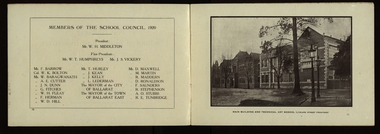
Booklet, The Ballarat School of Mines and Industries 1870-1920 Jubilee Booklet, 1920 (estimated)
... Archibald, E.J.A. McConnon, Newton King, D.m. Hull, T.R. Gordon, John M. Sutherland, T.K. ...Archibald, E.J.A. McConnon, Newton King, D.m. Hull, T.R. Gordon, John M. Sutherland, T.K. ...The first school of Mines in Australia was established at Ballarat in 1870. At the time of its jubilee (1930) the following people were members of the School Council: W.H. Middleton (President), W.T. Humphreys (VP), J.S. Vickery (VP), F. Barrow, Col. W.K. Bolton, William Baragwanath, A.E. Cutter, J.N. Dunn, G. Fitches, W.H. Fleay, F. Herman. W.D. Hill, T. Hurley, K. Kean. J. Kelly, L. Lederman, Mayor of Ballarat, Mayour of Ballarat East, D. Maxwell, M. Martin, R. Maddern, D. Ronaldson, F. Saunders, R. Stephenson, A.O. Stubbs, R.E. Tunbridge. The School Staff in 1920 comprised: Herbert H. Smith, Walter Rowbotham, Reginald L. Cutter, M.C. Young, Hilda Wardle, M. Wiliamson, P.S. Richards, L.H. Archibald, J. Woods, Ken Moss, W. Kenneth, Mrs McIlvena. B. Robinson, S. Rowe, E. Hope-Jones, Miss Abrams, L.St.G.P. Austin, Alfred Mica Smith, J.R. Pound, Herbert R. Murphy, N.H. Junner, Maurice Copland, L.H. Archibald, E.J.A. McConnon, Newton King, D.m. Hull, T.R. Gordon, John M. Sutherland, T.K. Jebb, Dick Richards, C. Tonkin, A.W. Steane, J. Paterson, H.W. Malin, R.V. Maddison, S.M. Mayo, F.A. King, W.H. Steane, T.R. Gordon, T.A. Williams, H. Waldron, G. Black, E.J. McConnon, R.V. Duncan. R. Cutter, E.G. Vawdrey, Hilda WardleWhite stapled booklet - landscape format - 20pp + soft covers with blue writing. Includes an historical sketch of the Ballarat School of Mines. Contains images of the school from around 1920. The history outlined in the booklet follows: 'Ballarat has helped to influence the life and destinies of Australia in many ways, the recital of which would perhaps prove tedious to the citizens of less favoured localities! However, it can be said, without much fear of contradiction, that only less known thought Australia than its fame as a gold field is the reputation won for it by its school of Mines, ... Ballarat was still quite a new place when the School was founded, but a very propserous and popular place all the same, with a go-ahead lot of citizens brim full of the spirit of enterprise which seemsto animate mining populations generally. Money was plentiful, and they launched out into ventures, which later, were to develop and take the place of the gold mines, while what is more to the point, they understood the value of education. the old digging days were passing away. So far as Ballarat itself was concerned the day of the cradle and tin dish had already passed into an antiquity "as dead and distant as the age of the Tubal Caon," said dir redmond Barry on declaring the School open. Mining had become a serious business, and the mining engineer, the metallurgist, and the geologist had become a power in the land. In these circumstances the suggestions to found a School of Mines met with ready acceptance. The late Mr James M. Bickett had the honor of bringing forward the proposition at a meeting of the Ballarat Mining Board in October, 1869. it was agreed to, and the Government, having been approached for assistance, granted a lease of the old Supreme Court buildings at a nominal reantal. A modest sum, including 100 pounds from the Borough Council of Ballarat West, was subscribed by a number of sympathisers, and on the 26th October, 1870, the inaugural address was delivered by Sir Redmond Barry, the first President of the School. Classes were commenced on the 23rd January, 1871. The students at first were mostly adults. They were chiefly men emloyed at the mines, who had the wisdom and energy to devote their spare time to study, and, though their attendance was somewhat irregular, they made very good progress. Old prints which have been preserved show them at work at furnaces, big bearded men of the old-fashioned type of miner. It is interesting to note that among those who gave evidence and encouragement was Sir Roderick Murchison, who many years before had advised Cornish miners to emigrate to Australia to search for gold, and who in 1848 was in possession of gold ore sent from this country. Sir Roderick sent a parcel of books for the library, and gave useful advice as to the curriculum which should be adopted. The Museum, which now contains a most valuable collection of minerals, was one of the first things attended to, and the reports presented to the Council from time to time speak of additions being made from all parts of the world. New equipment was constantly being added to the School, a good deal of assay work was done, and some specimens were sent from the East Indies for examination as far back as 1873. By this time there was a difficulty in providing accomodation for the students who wished to enrol, and the number of instructors had grown from two to four. In 1882 the first building was being erected on what was then part of the gaol reserve. A little more than ten years afterwards a buildnig formerly serving as a Methodist Church was absorbed, while later on, the demand for accomodation increasing, the attack upon the gaol was renewed. The School continued to grow in reputation and size, and became the science centre of the district, and in 1889 a learge new building was opened by Sir Alexander Peacock. Students came from over seas as well as from all the States of Australia, and after going through their courses they took with them the name and fame of the old School to all parts of the globe. School of Mines boys have played a great part in developing the mining fields of Western Australia, South Australia, and africa, while old students who have made a name in their profession are constantly dropping in to see how the old place is getting along. It was not to be expected, however, that the Ballarat School would be left without rivals, its very success inspiring competition. Mining Schools were started in other parts of Australia, and, at the same time, Victoria ceased to hold first place as a mining state. On the other hand there was a great advance in manufacturing, and the demand for technicaly trained men became a great and as insistent as ever it had been for trained mining men. The Council was quick to adapt the school to the new conditions, and the result is seen in the institution, which is one of Ballarat's proudest possession. Instruction is given in all branches of technical work, and the classes are filled with students who are building up for Ballarat a reputation as an industrial centre, which promises to equal that which it formerly held as a mining town. Owing to its bracing climate, its abundant opportunities for recreations, and its accessibilty, Ballarat as a city is an ideal place for educational purposed, and is yearly becoming more and more appreciated throughout the State. The chairman of one of Ballarat's biggests industries claims that the workman can do twice the day's work here that he can do in Melbourne. he was a little enthusiastic over it, perhaps, but it is a well-known fact that the healthy and invigourating Ballarat climate is conducive to both physical and mental activity, and the records of the School provide ample proof of it. One of the most interesting and successful branches of the School of Mines and Industries - if the name be enlarged with the enlargement of its scope - is the Technical Art School. "The City of Statues" has from its earliest days been a stronghold of art. Art schools have flourised here, and in 1905 the Education Department came to the conclusion that the best thing to do with them was to place them under the management of the School of Mines Council. A magnificent new Technical Art School was built at a cost of some 12,000 pounds on the site of the old Supreme Court building, and was formally opened on the 23rd July, 1915. The results have not only been justified but surpassed all anticipations. The most comprehensive list of subjects is taught, and this list is constantly added to. Students have flocked to the art School, which may be said to occupy a unique position in Australia, and its record of success is really astonishing. Its students supply art teachers for the newer schools that are being built, and many occupy leading positinos in important business houses. So well is its reputation known that orders are constantly being received, not only from Victoria, but from other States, for honor boards and challenge shields to be designed and made. The most recent addition to the School of Mines and Industries is the Junior Technical School, for which a new building is now being erected on a portion of the gaol site, transferred to the School of Mines Counci by the Government. At the present moment temporary quarters are being occupied. Some students after passing through the Junior School go straight to employment, continuing perhaps to attend the evening trade classes, while others move on to the senior School. In a review of the work of the School of Mines mention must be made of a series of industrial research carried out under supervision of the Principal. One in particular, regarding the suitability of the local ores for the manufacture of pigments attracted much attention, while the experiemtns on the manufacture of white potery from Victorian clayes were considered of sufficient importance by the Federal Advisory Council of Science and Industry to warrant the appointment of a special investigator. The results of these have been most encouraging, and may have far-reaching consequences. The vocational training of returned soldiers also should not be overlooked. The work was taken in hand from the first, before the Repatriation Department gave assistance, and now with the help of the department of the School has become one of the largest vocational training centres in Victoria outside of Melbourne. The soldiers, trained in a variety of occupations, have made remarkable progress, and already considerable numbers have found employment in local workshops and factories. To sum up, the School is divided into the following departments, each well staffed and equipped: - The School of Mines, science, and Engineering; the Techncial Art School, the Boys' Junior Technical School, the Girl's Preparatory Technical Classes, Trade Classes, and the Commercial School. The school of Mines, science and Engineering, comprises the following branches: - Mining, Metallurgy, Geology, Electrical Engineering, Civil Engineering, Mechanical Engineering, Applied Chemistry, and Pharmacy. Battery treatments, Cyanide Testing, Smelting, Assays, and Clay Testing from a regular part of the School's work. Students gaining qualifications obtain concession in their courses at the university, should they proceed there to continue their studies. The technical Art school curriculum includes training in all branches of pictorial and applied art, an Architectural Diploma Course, a Draughtman's Course, technical Art teachers' Course, Photography,Ticket Writing, Art Metal Work, Woodcarving, Needlework, and Leather work. The Trade Classes give instruction in Telephone Mechanics, telegraphy, Carpentry, Cabinet Making, Plumbing, Blacksmithing, Fitting, Electric Wiring, and Printing. Numerous Scholarships are offered every year, and altogether students will find few places to equal the Ballarat School of Mines and Industries as a training place for their life's work. One of the first in the continent to be established, its Jubilee finds it still in the front rank, keeping pace with the times, and offering to the youths of this country the means of taking advantage of Australia's teeming opportunities. william, battery, smith, herbert, drawing from the antique, ballarat school of mines botanical gardens, ballarat school of mines, redmond barry, alfred mica smith, james bickett, museum, dick richards, ballarat junior technical school, s m b, ballarat school of mines and industries, ballarat technical art school, model mine, james m bickett, j m bickett, roderick murchison, vocational training rooms, wesley church, methodist church, alexander peacock, lathes, repatriation, repatriatin department, war service, school council, baragwanath, gold mining, mining laboratory, plaster cast, r.w. richards, anniversary, jubilee -
 Federation University Historical Collection
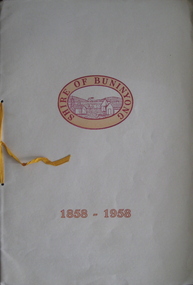
Booklet, John Fraser & Son, Shire of Buninyong 1858 - 1958, 1958
... ...archibald fisken...john...The paper for the book was donated by Ballarat Paper Mills Pty Ltd. buninyong archibald fisken john adams j macdermott Shire of buninyong 'Cr D.K. ...The first Buninyong municipality was established in 1858. The paper for the book was donated by Ballarat Paper Mills Pty Ltd.Cream soft covered booklet with yellow ribbon. The book includes notice of the special meeting, minutes of the 1st and 2nd meeting of the Buninyong District Road Board, images of Archibald Fisken, scenes of Buninyong.'Cr D.K. Coxall'buninyong, archibald fisken, john adams, j macdermott, shire of buninyong -
 Flagstaff Hill Maritime Museum and Village
Functional object - Bell, Schomberg 1855, Before 1855
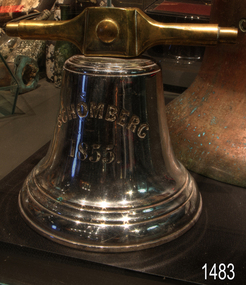
... Years later, when the property was sold to John Logan, the discarded bell was donated to the old Warrnambool Museum upon its opening in 1886. The Curator, Joseph Archibald, placed the bell on display in the entry. ...Years later, when the property was sold to John Logan, the discarded bell was donated to the old Warrnambool Museum upon its opening in 1886. The Curator, Joseph Archibald, placed the bell on display in the entry. ...The Rescue and Journey of the Schomberg Bells: This bell was the smaller of two rescued by the crew of the Schomberg following the ship’s wreck in 1855. While the specific purpose of the smaller bell is unknown, it may have served to assemble the crew or signal mealtimes on board. After surviving the shipwreck, the crew carried both bells as they made their way along the coastline. Their journey eventually led them to the home of settler John Manning, located at Hopkins Point near Warrnambool. Manning took possession of the bells and subsequently presented them to two churches in Warrnambool. The smaller bell went to St Joseph’s Catholic Church, while the larger bell went to St John’s Presbyterian Church. After around a year, the small bell at St Joseph’s developed a crack and became unusable. Thomas Manifold imported a replacement bell for the church, and the damaged bell was stored at his farm. Years later, when the property was sold to John Logan, the discarded bell was donated to the old Warrnambool Museum upon its opening in 1886. The Curator, Joseph Archibald, placed the bell on display in the entry. In 1975, it was transferred from the Warrnambool Art Gallery to Flagstaff Hill. The ’Mystery’ of the small bell solved: Despite numerous attempts by the staff at Flagstaff Hill to restore the bell’s lustre, the bell remained dull and tarnished. In October 1986, Director Peter Ronald decided to send the bell for professional advice. The bell was entrusted to Briggs Marine Products, a renowned brass founder established in 1912. Upon examination, the specialists at Briggs discovered the reason behind the bell’s persistent lack of shine: it had originally been silver-plated, but most of the plating had worn away over time. The experts at Briggs then undertook the task of restoring the bell, successfully returning it to a gleaming silver surface. The Sailing Ship Schomberg: Launched in 1855, the Schomberg was regarded as the “Noblest” ship afloat at the time. Owned by the Black Ball Line, it was built for their passenger fleet by Alexander Hall of Aberdeen at a cost of £43,103. The construction featured three skins: one planked fore and aft and two diagonally planked, all fastened with screw-threaded trunnels (wooden rails). The ship’s First Class accommodation was luxurious, boasting velvet pile carpets, large mirrors, rosewood, birds-eye maple and mahogany timbers, satin damask soft furnishings, and an oak-lined library with a piano. Schomberg had a capacity for 1,000 passengers. The ship’s master, Captain James Nicol Forbes—also known as ‘Bully’ Forbes—was only 34 years old at the launch. He had a reputation for setting and breaking speed records on the Black Ball Line’s Marco Polo and Lightning. In 1852, Forbes completed the London to Melbourne journey on the Marco Polo in 68 days, a record at the time, though 53 passengers died during the voyage. In 1854, he sailed the Lightning to Melbourne in 76 days and returned in only 63 days—a record that stood among sailing ships. Forbes was known for driving his ship and crew to their limits, often prioritising speed over passenger comfort. Determined to set new records, he promised to reach Melbourne in sixty days, declaring he would do so “with or without the help of God.” The Maiden Voyage and the Wreck: Schomberg departed Liverpool on 6th October 1855, flying a banner that read “Sixty Days to Melbourne”. The vessel carried 430 passengers and 3,000 tons of cargo, including materials to build the Melbourne to Geelong Railway and a bridge over the Yarra River. Among the cargo were a cow for fresh milk, pens for fowls and pigs, and 90,000 gallons of water for drinking and washing. Additionally, it transported 17,000 letters and 31,800 newspapers. The ship and cargo were insured for $300,000, a considerable sum for the era. Poor winds while crossing the equator delayed Schomberg’s progress. Land was first sighted on Christmas Day at Cape Bridgewater near Portland. Captain Forbes followed the coastline towards Melbourne, but was reportedly playing cards when the third mate, Henry Keen, reported land only three miles away. The ship ran aground on a sand spit near Curdie’s Inlet (approximately 56 km west of Cape Otway) on 26th December 1855, after 78 days at sea. The sand spit and nearby currents were not marked on Forbes’s map. During the night, the crew launched a lifeboat to search for a safe landing spot for the passengers. The scouting party advised Forbes to wait until morning, as rough seas posed a danger to the lifeboats. At dawn, the ship’s Chief Officer spotted the SS Queen and signalled for help. The master of the Queen brought his vessel alongside, and all passengers and crew disembarked safely. The Black Ball Line’s Melbourne agent sent another steamer to collect the passengers’ baggage, and other steamers assisted with cargo salvage until worsening weather forced operations to cease. Notably, a plunderer later recovered a case of Wellington boots, but all were for the left foot. The wreck and its cargo were sold to local merchants Manifold & Bostock, who did not attempt further salvage. They later sold their interest to a Melbourne businessman and two seafarers. In 1864, after two men drowned in their attempt to reach the Schomberg, salvage efforts were abandoned. By 1870, parts of the ship had washed ashore on New Zealand’s South Island. Today, the wreck is about nine metres below the surface. Although most woodwork has disintegrated, the vessel’s shape remains discernible due to the railway irons, girders, and framework. Various goods and materials from the ship are scattered nearby. The bell is particularly significant in that along with other items from the wreck helped in part to having the legislation changed to protect shipwrecks, with far tighter controls being employed to oversee the salvaging of wreck sites. This bell forms part of the Schomberg collection at Flagstaff Hill maritime museum. The collection as a whole is of historical and archaeological significance at a State level. Flagstaff Hill’s collection of artefacts from the Schomberg is also significant for its association with the Victorian Heritage Registered Schomberg shipwreck (VHR S 612). The collection is of additional significance because of the relationship between the objects salvaged, as together they help us to interpret the story of the Schomberg. The collection as a whole is historically significant for representing aspects of Victoria's maritime history and its potential to interpret social and historical themes from society at the time of the wreck. A small ship’s bell. The silver-plated metal bell bears the ship’s name and year of construction on one side and the name and address of the ship’s builders on the other. These details are deeply engraved into the metal and formed in bold, upper-case lettering. The bell has two bell stands: the left and the right. Both stands have an Iron pipe bent into an inverted ‘Y’ shape, with a hole along its length and feet attached to a rectangular metal plate at the other two ends. Feet are bolted to a timber base that has a hole drilled through the centre for mounting. Bell's front; “SCHOMBERG” with “1855” below. Bell's back “HALL & SONS (crack splits letter “N”) / BUILDERS (in italics) / ABERDEEN” (crack splits letter “B”).flagstaff hill, flagstaff hill maritime museum and village, warrnambool, maritime museum, maritime village, great ocean road, shipwreck coast, schomberg, silver plated bell, mess bell, bell stands, captain ‘bully’ forbes, alexander hall and son, james baines and company, liverpool’s black ball line, bell, schomberg bell, ship's bell, small bell, st joseph's church, briggs marine, john manning, john logan, warrnambool museum, briggs foundry, silver bell -
Federation University Historical Collection
Booklet, The Ballarat School of Mines and Industries 1870-1920 Jubilee Booklet, 1920 (estimated)
... Archibald, E.J.A. McConnon, Newton King, D.m. Hull, T.R. Gordon, John M. Sutherland, T.K. ...Archibald, E.J.A. McConnon, Newton King, D.m. Hull, T.R. Gordon, John M. Sutherland, T.K. ...The first school of Mines in Australia was established at Ballarat in 1870. At the time of its jubilee (1930) the following people were members of the School Council: W.H. Middleton (President), W.T. Humphreys (VP), J.S. Vickery (VP), F. Barrow, Col. W.K. Bolton, William Baragwanath, A.E. Cutter, J.N. Dunn, G. Fitches, W.H. Fleay, F. Herman. W.D. Hill, T. Hurley, K. Kean. J. Kelly, L. Lederman, Mayor of Ballarat, Mayour of Ballarat East, D. Maxwell, M. Martin, R. Maddern, D. Ronaldson, F. Saunders, R. Stephenson, A.O. Stubbs, R.E. Tunbridge. The School Staff in 1920 comprised: Herbert H. Smith, Walter Rowbotham, Reginald L. Cutter, M.C. Young, Hilda Wardle, M. Wiliamson, P.S. Richards, L.H. Archibald, J. Woods, Ken Moss, W. Kenneth, Mrs McIlvena. B. Robinson, S. Rowe, E. Hope-Jones, Miss Abrams, L.St.G.P. Austin, Alfred Mica Smith, J.R. Pound, Herbert R. Murphy, N.H. Junner, Maurice Copland, L.H. Archibald, E.J.A. McConnon, Newton King, D.m. Hull, T.R. Gordon, John M. Sutherland, T.K. Jebb, Dick Richards, C. Tonkin, A.W. Steane, J. Paterson, H.W. Malin, R.V. Maddison, S.M. Mayo, F.A. King, W.H. Steane, T.R. Gordon, T.A. Williams, H. Waldron, G. Black, E.J. McConnon, R.V. Duncan. R. Cutter, E.G. Vawdrey, Hilda WardleWhite stapled booklet - landscape format - 20pp + soft covers with blue writing. Includes an historical sketch of the Ballarat School of Mines. Contains images of the school from around 1920. The history outlined in the booklet follows: 'Ballarat has helped to influence the life and destinies of Australia in many ways, the recital of which would perhaps prove tedious to the citizens of less favoured localities! However, it can be said, without much fear of contradiction, that only less known thought Australia than its fame as a gold field is the reputation won for it by its school of Mines, ... Ballarat was still quite a new place when the School was founded, but a very propserous and popular place all the same, with a go-ahead lot of citizens brim full of the spirit of enterprise which seemsto animate mining populations generally. Money was plentiful, and they launched out into ventures, which later, were to develop and take the place of the gold mines, while what is more to the point, they understood the value of education. the old digging days were passing away. So far as Ballarat itself was concerned the day of the cradle and tin dish had already passed into an antiquity "as dead and distant as the age of the Tubal Caon," said dir redmond Barry on declaring the School open. Mining had become a serious business, and the mining engineer, the metallurgist, and the geologist had become a power in the land. In these circumstances the suggestions to found a School of Mines met with ready acceptance. The late Mr James M. Bickett had the honor of bringing forward the proposition at a meeting of the Ballarat Mining Board in October, 1869. it was agreed to, and the Government, having been approached for assistance, granted a lease of the old Supreme Court buildings at a nominal reantal. A modest sum, including 100 pounds from the Borough Council of Ballarat West, was subscribed by a number of sympathisers, and on the 26th October, 1870, the inaugural address was delivered by Sir Redmond Barry, the first President of the School. Classes were commenced on the 23rd January, 1871. The students at first were mostly adults. They were chiefly men emloyed at the mines, who had the wisdom and energy to devote their spare time to study, and, though their attendance was somewhat irregular, they made very good progress. Old prints which have been preserved show them at work at furnaces, big bearded men of the old-fashioned type of miner. It is interesting to note that among those who gave evidence and encouragement was Sir Roderick Murchison, who many years before had advised Cornish miners to emigrate to Australia to search for gold, and who in 1848 was in possession of gold ore sent from this country. Sir Roderick sent a parcel of books for the library, and gave useful advice as to the curriculum which should be adopted. The Museum, which now contains a most valuable collection of minerals, was one of the first things attended to, and the reports presented to the Council from time to time speak of additions being made from all parts of the world. New equipment was constantly being added to the School, a good deal of assay work was done, and some specimens were sent from the East Indies for examination as far back as 1873. By this time there was a difficulty in providing accomodation for the students who wished to enrol, and the number of instructors had grown from two to four. In 1882 the first building was being erected on what was then part of the gaol reserve. A little more than ten years afterwards a buildnig formerly serving as a Methodist Church was absorbed, while later on, the demand for accomodation increasing, the attack upon the gaol was renewed. The School continued to grow in reputation and size, and became the science centre of the district, and in 1889 a learge new building was opened by Sir Alexander Peacock. Students came from over seas as well as from all the States of Australia, and after going through their courses they took with them the name and fame of the old School to all parts of the globe. School of Mines boys have played a great part in developing the mining fields of Western Australia, South Australia, and africa, while old students who have made a name in their profession are constantly dropping in to see how the old place is getting along. It was not to be expected, however, that the Ballarat School would be left without rivals, its very success inspiring competition. Mining Schools were started in other parts of Australia, and, at the same time, Victoria ceased to hold first place as a mining state. On the other hand there was a great advance in manufacturing, and the demand for technicaly trained men became a great and as insistent as ever it had been for trained mining men. The Council was quick to adapt the school to the new conditions, and the result is seen in the institution, which is one of Ballarat's proudest possession. Instruction is given in all branches of technical work, and the classes are filled with students who are building up for Ballarat a reputation as an industrial centre, which promises to equal that which it formerly held as a mining town. Owing to its bracing climate, its abundant opportunities for recreations, and its accessibilty, Ballarat as a city is an ideal place for educational purposed, and is yearly becoming more and more appreciated throughout the State. The chairman of one of Ballarat's biggests industries claims that the workman can do twice the day's work here that he can do in Melbourne. he was a little enthusiastic over it, perhaps, but it is a well-known fact that the healthy and invigourating Ballarat climate is conducive to both physical and mental activity, and the records of the School provide ample proof of it. One of the most interesting and successful branches of the School of Mines and Industries - if the name be enlarged with the enlargement of its scope - is the Technical Art School. "The City of Statues" has from its earliest days been a stronghold of art. Art schools have flourised here, and in 1905 the Education Department came to the conclusion that the best thing to do with them was to place them under the management of the School of Mines Council. A magnificent new Technical Art School was built at a cost of some 12,000 pounds on the site of the old Supreme Court building, and was formally opened on the 23rd July, 1915. The results have not only been justified but surpassed all anticipations. The most comprehensive list of subjects is taught, and this list is constantly added to. Students have flocked to the art School, which may be said to occupy a unique position in Australia, and its record of success is really astonishing. Its students supply art teachers for the newer schools that are being built, and many occupy leading positinos in important business houses. So well is its reputation known that orders are constantly being received, not only from Victoria, but from other States, for honor boards and challenge shields to be designed and made. The most recent addition to the School of Mines and Industries is the Junior Technical School, for which a new building is now being erected on a portion of the gaol site, transferred to the School of Mines Counci by the Government. At the present moment temporary quarters are being occupied. Some students after passing through the Junior School go straight to employment, continuing perhaps to attend the evening trade classes, while others move on to the senior School. In a review of the work of the School of Mines mention must be made of a series of industrial research carried out under supervision of the Principal. One in particular, regarding the suitability of the local ores for the manufacture of pigments attracted much attention, while the experiemtns on the manufacture of white potery from Victorian clayes were considered of sufficient importance by the Federal Advisory Council of Science and Industry to warrant the appointment of a special investigator. The results of these have been most encouraging, and may have far-reaching consequences. The vocational training of returned soldiers also should not be overlooked. The work was taken in hand from the first, before the Repatriation Department gave assistance, and now with the help of the department of the School has become one of the largest vocational training centres in Victoria outside of Melbourne. The soldiers, trained in a variety of occupations, have made remarkable progress, and already considerable numbers have found employment in local workshops and factories. To sum up, the School is divided into the following departments, each well staffed and equipped: - The School of Mines, science, and Engineering; the Techncial Art School, the Boys' Junior Technical School, the Girl's Preparatory Technical Classes, Trade Classes, and the Commercial School. The school of Mines, science and Engineering, comprises the following branches: - Mining, Metallurgy, Geology, Electrical Engineering, Civil Engineering, Mechanical Engineering, Applied Chemistry, and Pharmacy. Battery treatments, Cyanide Testing, Smelting, Assays, and Clay Testing from a regular part of the School's work. Students gaining qualifications obtain concession in their courses at the university, should they proceed there to continue their studies. The technical Art school curriculum includes training in all branches of pictorial and applied art, an Architectural Diploma Course, a Draughtman's Course, technical Art teachers' Course, Photography,Ticket Writing, Art Metal Work, Woodcarving, Needlework, and Leather work. The Trade Classes give instruction in Telephone Mechanics, telegraphy, Carpentry, Cabinet Making, Plumbing, Blacksmithing, Fitting, Electric Wiring, and Printing. Numerous Scholarships are offered every year, and altogether students will find few places to equal the Ballarat School of Mines and Industries as a training place for their life's work. One of the first in the continent to be established, its Jubilee finds it still in the front rank, keeping pace with the times, and offering to the youths of this country the means of taking advantage of Australia's teeming opportunities. william, battery, smith, herbert, drawing from the antique, ballarat school of mines botanical gardens, ballarat school of mines, redmond barry, alfred mica smith, james bickett, museum, dick richards, ballarat junior technical school, s m b, ballarat school of mines and industries, ballarat technical art school, model mine, james m bickett, j m bickett, roderick murchison, vocational training rooms, wesley church, methodist church, alexander peacock, lathes, repatriation, repatriatin department, war service, school council, baragwanath, gold mining, mining laboratory, plaster cast, r.w. richards, anniversary, jubilee -
Federation University Historical Collection
Document, Dianne Campbell, Ballarat Lawyers 1853-1895 Research Folders, c2000-2021
... McCormick, McDonnell, Townsend MacDermott, Morgan McDOnnell, Percy McDonnell, Cyprian McDonnell, John McFarland, Samuel W, McGowan, Bill McGregor, David Madden, Charles Holthouse, J. Madden, Samuel Mann, Samuel F. Mann, Tobias Furneaux, Samuel Mann, Agar Wynne, thomas Mann, Henry MacDermott, Archibald Midnie, Arthur Nevett, Arthur H. ...McCormick, McDonnell, Townsend MacDermott, Morgan McDOnnell, Percy McDonnell, Cyprian McDonnell, John McFarland, Samuel W, McGowan, Bill McGregor, David Madden, Charles Holthouse, J. Madden, Samuel Mann, Samuel F. Mann, Tobias Furneaux, Samuel Mann, Agar Wynne, thomas Mann, Henry MacDermott, Archibald Midnie, Arthur Nevett, Arthur H. ...Folders of research notes on Ballarat Lawyers, including newspaper clippings, website information, etc. .1) Ballarat Lawyers - A (Australian Law Firm histories, Jamaican in Australia, History of the Court System, University of Melbourne Law Students c1870s, Melanie Senior, Cinque Oakley Senior Lawyers, 19th Century Castlemaine Police Courts, New Victorian County Court, Scots and the Law in Scotland, Solicitor online encyclopedia, Alfred Akehurst, Artur Akehurst, J.T. Ansdell, Butler Cole Aspinall, Alfred James Bailey, Henry Stephen Bailey, Matthew Baird, Hugh Sutherland Barrett, William Field Barrett, Redmond Barry, George Elliott Barton, George Frederick Bartrop, John Bell, Thomas Bellas, George Booker) .2) Ballarat Lawyers B (Hugh Sunderland Barrett, Peter Beckford, William Beckford, John T.F. Bowker, William Box, George Boyd, William Boykett, B. Browne, Richard Archer Burton, Alfred Butler) .3) Ballarat Lawyers C-E (Thomas B.S. Carwithen, J.B. Cathcart, John Alfred Chalk, David Clarke, John Collins, Matthew Combe, Thomas Spemcer Cope, Richard. Crouch, Charles Curwan-Walker, Frank H. Cole, John Rowland Davies, Charles J. Dawson, Christopher John Dease, J.E. Dixon, Robert Willian Dobson, Roy Dobson, Edward Doward, Charles R. Doward, Edgar R. Doward,) .4) Ballarat Lawyers F-G (Charles B. Finlayson, Peter T. Finn, John Findlay, John Fitzgerald, John Olsen Foss, Alexander Fraser, J.A. Doane, Andrew Garran, George Garrard, David Gaunson, William Gaunt, MAry Gaunt, F.T. Gell) .5) Ballarat Lawyers H-J: (Frederick Ham, Jeremy Harper, John H. Harris, solicitors, Amelia Harris, J. Henry Harris, Peter Blake, Henry Plomer, Arthur Plomer, Ballarat Chamber of Commerce, Freemasons, White Flat Drainage and Mining Company, Henry R. Nicholls, Francis Ham, Richard T. Harvey, Edward Heady, Peter Heinz, T.t. Hollway. Thomas tuke hollway, William Higgins, James V.M. Hitchins, frederick Hitchins, James Hitchins, Edward Hockley, Robert W. Holmes, Catherine Kain, JOhn Ireland, Richard D. Ireland, Peter Jacobs) .6) T.C. Williams, John Kidahl, Arthur W. King, Pendrell family, M.A. Lazarus, Edward Lewis, W.H. McCormick, Soho Foundry, Henry S, Ochiltree, James V. McCormick, McDonnell, Townsend MacDermott, Morgan McDOnnell, Percy McDonnell, Cyprian McDonnell, John McFarland, Samuel W, McGowan, Bill McGregor, David Madden, Charles Holthouse, J. Madden, Samuel Mann, Samuel F. Mann, Tobias Furneaux, Samuel Mann, Agar Wynne, thomas Mann, Henry MacDermott, Archibald Midnie, Arthur Nevett, Arthur H. Nevett, Alfred Mitchell, William Mitchell, H.W. Morrow, William Mitchell, Norman P. Must, George F. Oakley.) .7) Ballarat Lawyer Q-R (Henry S. Ochiltree, W.B. Ochiltree, Edward G. Ochiltree, J.J.P. O'Dee, Bernard O'Dowd, John Ogier, Cornish Lawyers in Central Victoria Q-R, John Bateman Paynter, J.B. Pearson, Mondle Emmanuel Phillips, Robert King Piers, Robert King Piers, Pinkerton, Frank Pinkerton, Martha Pinkerton, Charles Purcell, R.H. Ramsay, Henry Randall, James Randall, Thomas Randall, John Warrington Rogers, John M. S. Rodd, George Rutler) .8) Lawyers in Central Victoria S-W (Charles Salter, H. Holmes, George Staveley, Charles Salter, George T. Boyd, Edward Sandford, Henry G. Shaw, Thomas W. Snape, Thomas S. Standish, Charles Snape, Frederick C. Standish, Edith Snape, James Snape, Thomas Snape, Philip Snape, George Staveley, John G. Stoker, William Stone, Henry Sturt, Matthew W. Taylor, Bread and Cheese Club, R.D. Thompson, Roger D. Thompson, R.H. Ramsay, R.G. Turner, F.H. Tuthill, W.M.K. Vale, William Vale, May Vale, William L. Vardy, Gordon Vardy, William S. Vardy, Charles Von Ende) .9) Lawyers in Central Victoria W-Z (Henry Walker, Andrew Wallace, John Wellesley, Brereton Watson, C.G.M. Watson, James Watson, George Armytage, Thomas Watson, Patricius Welsh, John Westmore, Theodore Whipham, Arthur Whipham, Thomas H. Whipham, Frances Whipham, Thomas Bellas, James L. Willoughby, John Noble Williams, James Wisewould, Horace Wright, H.M. Wright, William Wright, Henry J. Wrixon, Agar Wynne, Samuel Young) . ballarat lawyers, ballarat, dianne campbell goldfields lawyers collection
