
Showing 197 items matching "june so"
-
 Sunshine and District Historical Society Incorporated
Film - Changing Faces Of Sunshine A Documentary, Latha Weerakkody, 2003
... ...June So...This video was made by Victorian University of Technology (VUT) students, Latha Weeakkody, Clavin Wang, June So, Anthony Mapp and Daniel King in the 2nd semester 2003. ...Changing Faces of Sunshine a Documentary Latha Weerakkody, Calvin Wang, June So, Anthony Mapp & Daniel King......June So...This video was made by Victorian University of Technology (VUT) students, Latha Weeakkody, Clavin Wang, June So, Anthony Mapp and Daniel King in the 2nd semester 2003. ...This video was made by Victorian University of Technology (VUT) students, Latha Weeakkody, Clavin Wang, June So, Anthony Mapp and Daniel King in the 2nd semester 2003. The interviewer Stan Bolton talks to members of the Sunshine and District Historical Society Olwen Ford, Norman Carlton and Eric Wegner about the history of Sunshine. Street scenes of Sunshine also feature in the video. The video was presented to the Sunshine and District Historical Society in July 2004.Changing Faces of Sunshine a Documentary Latha Weerakkody, Calvin Wang, June So, Anthony Mapp & Daniel Kingcalvin wang, june so, anthony mapp, latha weerakkody, daniel king, olwen ford, norman carlton, eric wegner -
 Port Melbourne Historical & Preservation Society
Newspaper - Clipping, Profile of Cr Ray JULIER, 1980s
... Newspaper cutting possibly from the Herald or the Sun entitled 'Retired in Port Melbourne - A home by the bay for a lifetime' - a profile of Councillor Ray JULIER (Original missing June 2019 so replaced by photocopy from People file)...Cutting kept by Barbara GARDINER as a momento of family friend Newspapers Raymond Frank JULIER Newspaper cutting possibly from the Herald or the Sun entitled 'Retired in Port Melbourne - A home by the bay for a lifetime' - a profile of Councillor Ray JULIER (Original missing June 2019 so replaced by photocopy from People file) Newspaper Clipping, Profile of Cr Ray JULIER Herald and Weekly Times ...Cutting kept by Barbara GARDINER as a momento of family friendNewspaper cutting possibly from the Herald or the Sun entitled 'Retired in Port Melbourne - A home by the bay for a lifetime' - a profile of Councillor Ray JULIER (Original missing June 2019 so replaced by photocopy from People file)newspapers, raymond frank julier -
 Ruyton Girls' School
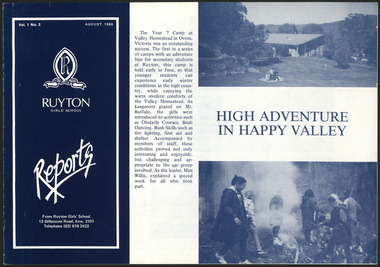
Newsletter, Ruyton Reports, 1986
... The first in a series / of camps with an adventure / bias for secondary students / at Ruyton, this camp is / held in early June, so that / younger students can / experience early winter / conditions in the high coun- / try, while enjoying the / warm modern comforts of / the Valley Homestead. ...The first in a series / of camps with an adventure / bias for secondary students / at Ruyton, this camp is / held in early June, so that / younger students can / experience early winter / conditions in the high coun- / try, while enjoying the / warm modern comforts of / the Valley Homestead. ...The Ruyton Reporter (formerly known as Ruyton Reports) captures the essential Ruyton Girls' School experience for the broader school community. It has been produced since 1986.The record has strong historic significance as it pertains to the fourth oldest girls' school in Victoria, Australia. Ruyton was founded in 1878 in the Bulleen Road, Kew, home of newly widowed Mrs Charlotte Anderson (now High Street South). Thus, the record can be used as a reference example for research into Victorian school history. It also gives insight into the types of activities and events undertaken at Ruyton Girls' School during the period of its production. The record's significance is further enhanced by its exceptionally well-documented provenance, having remained the property of Ruyton Girls' School since its production.Black and white newsletter printed on paper with staple binding. 8 pages.Front Page: Vol. 1 No. 2 AUGUST, 1986 / R / RECTE ET FIDE LITER / RUYTON / GIRLS' SCHOOL / Reports / From Ruyton Girls' School / 12 Selbourne Road, Kew. 3101 / Telephone (03) 819 2422 / The Year 7 Camp at / Valley Homestead in Ovens, / Victoria was an outstanding / success. The first in a series / of camps with an adventure / bias for secondary students / at Ruyton, this camp is / held in early June, so that / younger students can / experience early winter / conditions in the high coun- / try, while enjoying the / warm modern comforts of / the Valley Homestead. As / kangaroos grazed on Mt. / Buffalo, the girls were / introduced to activities such / as Obstacle Courses, Bush / Dancing, Bush Skills such as / fire lighting, first aid and / shelter. Accompanied by / members of staff, these / activities proved not only / interesting and enjoyable, / but challenging and ap- / propriate to the age group / involved. As the leader, Miss / Willis, explained a special / week for all who took / part. / HIGH ADVENTURE / IN HAPPY VALLEY /ruyton girls' school, ruyton, school, students, newsletter, ruyton reports, ruyton news, kew, victoria, melbourne, girls school -
 Flagstaff Hill Maritime Museum and Village
Newspaper - Newspaper clipping, The Loch Ard : An Epic Wreck : Death of Eva Carmichael, ca. April 1934
... June, 1878 ....”. [Transcription of the article is attached]. Captain Gibbs was master of the Loch Ard, an iron clipper of 1623 tons, which was wrecked on Mutton Bird Island, one mile east of Sherbrook River. The two survivors, Carmichael, a passenger and Pearce, a member of the crew, were washed through the mouth of the gorge, which now bears the name of the ill-fated ship. The impact of the ship was so...June, 1878 ....”. [Transcription of the article is attached]. Captain Gibbs was master of the Loch Ard, an iron clipper of 1623 tons, which was wrecked on Mutton Bird Island, one mile east of Sherbrook River. The two survivors, Carmichael, a passenger and Pearce, a member of the crew, were washed through the mouth of the gorge, which now bears the name of the ill-fated ship. The impact of the ship was so ...“On the 8th April 1934, at her residence in Bedford, England, Eveline Victoria Townshend, widow of the late Thomas Achilles Townshend, C.E. of County Cork, Ireland, died in her 74th year. Mrs Townshend was the Eva Carmichael who, with the late Tom Pearce, were the only two survivors of the ship Loch Ard, which was wrecked near Port Campbell, on 1st June, 1878 ....”. [Transcription of the article is attached]. Captain Gibbs was master of the Loch Ard, an iron clipper of 1623 tons, which was wrecked on Mutton Bird Island, one mile east of Sherbrook River. The two survivors, Carmichael, a passenger and Pearce, a member of the crew, were washed through the mouth of the gorge, which now bears the name of the ill-fated ship. The impact of the ship was so violent that the deck was torn clean off the hull, which now lies in 70 fathoms of water. (edited version of the same article)The newspaper article is of local, state and national historical significance for its association with the wreck of the sailing ship LOCH ARD, which is now listed on the Victorian Heritage Register S417. The article records an eye witness account of the rescue of the only two survivors from the Loch Ard wreck. A newspaper cutting from the Warrnambool Standard in 1934. It contains the obituary notice of Eva Carmichael (Townshend), the only female survivor of the LOCH ARD shipwreck in 1878. She died on 8 April 1934, a widow in England, in her 74th year. This original newspaper cutting has yellowed and creased with age. The article in the cutting is incomplete. flagstaff hill, warrnambool, shipwrecked-coast, flagstaff-hill, flagstaff-hill-maritime-museum, maritime-museum, shipwreck-coast, flagstaff-hill-maritime-village, warrnambool standard, eva carmichael, loch ard, eveline townshend, tom pearce, eveline victoria townsend, thomas achilles townshend, county cork, ireland, loch ard survivors, port campbell victoria, royal reade, 1-6-1878, w. c. till, eye witness account, george ford, glenample homestead, princetown, gibson, w. shields, mckenzie, robertson, robert strasenburg, loch venacher, robert pearce, tss hobsons bay -
 Flagstaff Hill Maritime Museum and Village
Poster - Recreation, Warrnambool Hot Sea Water Baths, c. November 1908
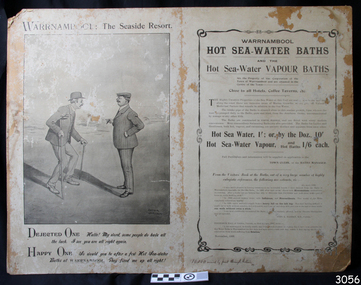
... June 1881 the Hot Sea Baths were opened, and both hot and cold water baths were supplied at reasonable charges. Patrons came from near and far to receive the benefits. The manager of the Baths was J. Kirkpatrick. The Baths Company struggled for several years without success so...June 1881 the Hot Sea Baths were opened, and both hot and cold water baths were supplied at reasonable charges. Patrons came from near and far to receive the benefits. The manager of the Baths was J. Kirkpatrick. The Baths Company struggled for several years without success so ...The poster includes a cartoon by Arthur Jordan, with a conversation between an ailing man and a good man after baths visits. There are several reviews dating from 1906 to 1908 extolling the healing powers of the baths' waters. In February 1877 a Baths Company (1050 shares) was formed in the town of Warrnambool for the establishment of the baths at the south end of Gillies Street. The baths were filled with sea water from Lady Bay, originally pumped by a windmill situated near the current Surf Lifesaving Club and carried by iron pipes to the Public Baths; later the water was pumped by gas motor. Hot and cold fresh water baths were advertised. The gentlemen’s bath was 100 feet long and 50 feet wide, of graduating depth. A second bath, solely for ladies, was 60 feet long by 30 feet wide. Hot Sea-water Baths were also part of the institution, and were sought after for their ‘wonderful curative powers’, and ‘incomparable’ as a ‘tonic for the feeble’. In June 1881 the Hot Sea Baths were opened, and both hot and cold water baths were supplied at reasonable charges. Patrons came from near and far to receive the benefits. The manager of the Baths was J. Kirkpatrick. The Baths Company struggled for several years without success so in 1883 the baths were sold to the Borough Council for 1250 pounds. The original shareholders received nothing for their outlay; the overdraught was over the sale price. In May 1884 the Council announced that an estimated they has spent 1000 pounds in improving the baths since purchasing them and were now returning an income of 11 per cent. The poster promotes the healing powers of the hot sea water baths that were in use in Warrnambool in the late 19th century through to the early 20th century. The baths were a place for fitness, health and social activity, an example of the recreational activities during this period.Poster, black and white, mounted on card. It shows advertising Warrnambool Sea-water Baths and Hot Sea-water Baths. There are several references promoting the health benefits of baths, dating from 1906-1908. The cartoon was sketched by Arthur Jordan. The poster was printed by The Thompson Printing Co. Warrnambool. Handwritten inscription on the lower edge.Handwritten "10,000 mailed by post through Victoria"flagstaff hill, warrnambool, shipwrecked-coast, flagstaff-hill, flagstaff-hill-maritime-museum, maritime-museum, shipwreck-coast, flagstaff-hill-maritime-village, warrnambool salt baths, warrnambool therapudic baths, arthur jordan, baths company, sea water baths, hot sea water, swimming, healing powers, warrnambool baths, advertisement, thompson printing co. warrnambool -
 Flagstaff Hill Maritime Museum and Village
Poster - Recreation, Town of Warrnambool Swimming Baths, ca. May 1884
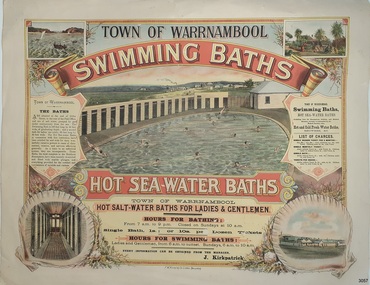
... June 1881 the Hot Sea Baths were opened, and both hot and cold water baths were supplied at reasonable charges. Patrons came from near and far to receive the benefits. The manager of the Baths was J. Kirkpatrick. The Baths Company struggled for several years without success, so...June 1881 the Hot Sea Baths were opened, and both hot and cold water baths were supplied at reasonable charges. Patrons came from near and far to receive the benefits. The manager of the Baths was J. Kirkpatrick. The Baths Company struggled for several years without success, so ...The poster advertises these Swimming Baths as “the most complete in the Southern Hemisphere”. In February 1877 a Baths Company (1050 shares) was formed in the town of Warrnambool for the establishment of the baths at the south end of Gillies Street. The baths were filled with sea water from Lady Bay, originally pumped by a windmill situated near the current Surf Lifesaving Club and carried by iron pipes to the Public Baths; later the water was pumped by a gas motor. Hot and cold fresh water baths were advertised. The gentlemen’s bath was 100 feet long and 50 feet wide, of graduating depth. A second bath, solely for ladies, was 60 feet long by 30 feet wide. Hot Sea water Baths were also part of the institution, and were sought after for their ‘wonderful curative powers’, and ‘incomparable’ as a ‘tonic for the feeble’. In June 1881 the Hot Sea Baths were opened, and both hot and cold water baths were supplied at reasonable charges. Patrons came from near and far to receive the benefits. The manager of the Baths was J. Kirkpatrick. The Baths Company struggled for several years without success, so in 1883 the baths were sold to the Borough Council for 1250 pounds. The original shareholders received nothing for their outlay; the overdraught was over the sale price. In May 1884 the Council announced that an estimated they has spent 1000 pounds in improving the baths since purchasing them and were now returning an income of 11 per cent. Historically significant to Warrnambool and the recreational facilities available in the 1880s to 1900s. The remains of the baths are still visible to the public today.Poster on heavy cream paper, landscape orientation, with coloured print. The poster advertises the Warrnambool Swimming Baths. It has several drawings such as Middle Island and the Merri River Mouth with vessels in the water, The inside of the Baths facility, the men's baths with the adjacent bathing rooms and figures in and out of the water, a cottage with figures in the garden, and fenced buildings with a windmill and aqueduct or pipes. The text describes the location and advantages, the opening times and various costs. It was printed in Ballarat by F.W. Niven & Co. Lithos."TOWN OF WARRNAMBOOL" "SWIMMING BATHS" "HOT SALT-WATER BATHS FOR LADIES AND GENTLEMEN" "HOURS FOR BATHING fROM 7 a.m. to 9 p. m. Closed on Sundays at 10 a.m." Single Bath 1s [1 shilling]; or 10s per Dozen Tickets" "HOURS FOR SWIMMING BATHS: Ladies and Gentlemen, from 6 a.m. to Sunset, Sundays 6 a.m. to 10 a.m." "Every information can be obtained from the Manager, J. Kirkpatrick" "HOT SEA-WATER BATHS ... strongly recommended by the Medical Faculty" "Hot and Cold Fresh Water Baths" "Showers etc." "LIST OF CHARGES ... Single Season Ticket, Single Monthly Ticket, Single Bath without towel ... with towel.. Tickets per dozen without towel, with towel..." "The Baths are situated at the end of Gillies Street, in the rear of the Post Office, and are of salt water pumped by gas motor continuously from the sea. The Swimming Bath is 100 feet long by 50 feet wide, of graduating depth; and a second bath for ladies' use solely, 60 feet long by 30 feet wide. The hot Sea-water Baths in connection with this institution have been extolled far and wide for their wonderfully curative powers in cases of rheumatism, sciatica, and nervous afflictions generally. As a tonic to an enfeebled system, they are incomparable, These Baths, the most complete in the Southern Hemisphere, have been recently re-erected and fitted with marble plunges, and everything provided for the comfort and convenience of invalids and visitors." "F.W. NIVEN & Co, LITHOS, BALLARAT"flagstaff hill, warrnambool, warrnambool swimming baths, hot sea water baths warrnambool, warrnambool baths company, f.w. niven & co, warrnambool therapudic baths, town of warrnambool, swimming baths, hot sea water baths, salt water baths, ladies' baths, gentlemen's baths, warrnambool town baths, j kirkpatrick -
 Federation University Historical Collection
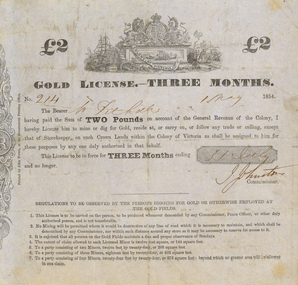
Document - Gold License, Fittnall's Gold Licenses, 1854, 1) 1 May 1854 ; .2) 16 April 1855
... so few survived the harsh treatment of being carried around a working goldfield. There was much dissatisfaction about what was thought to be an unfair mining tax (or gold license). On 29 November 1854 Ballarat miners burnt their licenses on Bakery Hill. On 3 December 1854 the Eureka Stockade Battle took place, resulting in the Goldfields Commission. The first Miner's Right was issued in late June ...From 1851 the Victorian government required all men on Victorian Goldfields to carry a Gold License. The fee was one pound per month, and was payable in advance. There was agitation surrounding the gold license which was thought to be an excessive fee and did not give the bearer right to representation. On 03 December 1854 the gold diggers on the Eureka Lead fought a short battle against the army and police troopers. A few months later a new system of taxing gold diggers was introduced - the Miner's Right.The Victorian Gold Licence was issued from 1851 until early 1855. Every man on a Victorian goldfield had to carry a valid gold license, so few survived the harsh treatment of being carried around a working goldfield. There was much dissatisfaction about what was thought to be an unfair mining tax (or gold license). On 29 November 1854 Ballarat miners burnt their licenses on Bakery Hill. On 3 December 1854 the Eureka Stockade Battle took place, resulting in the Goldfields Commission. The first Miner's Right was issued in late June 1855, and in July the first Local Courts were elected by miner's right holders. The two Fitnall Gold Licenses are important because they were issued on either side of the Eureka Stockade, and are in very good condition. The Gold Licenses were donated to the Ballarat School of Mines by John Wilson in 1921. Two gold licenses issued by the Colony of Victoria. The licenses are printed onto blue paper with a Colony of Victoria logo at the top. The licenses were issued on either side of the historic Eureka Stockade in Ballarat East which took place on 03 December 1854. .1) No 219 - Made out to [H?] Fithall on 16 April 1854 and signed by Commissioner R.C. Mackenzie. The license was valid until 31 July 1854. .2) No. 214 - Made out to [H?] Fithall on 1 May 1854 and signed by Commissioner J. Johnston. The license was valid until 15 May 1855.On the backing card "Given to the School of Mines, October 6 1921, by John Wilson Errard Street, Ballarat."mining, gold license, gold licence, mining license, mining licence, mackenzie, johnston, fitnall, gold commissioner, eureka -
 Federation University Historical Collection
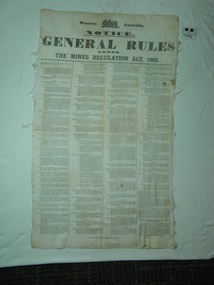
Poster, Western Australia Government Printer, Western Australia Notice. General Rules under the Mines Regulation Act 1906, c1906
... Quite possibly the mining regulations were printed onto material so they could be displayed in harsh conditions without deteriorating like paper. The 1906 mining regulations were enacted on 01 June 1907. ...Quite possibly the mining regulations were printed onto material so they could be displayed in harsh conditions without deteriorating like paper. The 1906 mining regulations were enacted on 01 June 1907. ...Quite possibly the mining regulations were printed onto material so they could be displayed in harsh conditions without deteriorating like paper. The 1906 mining regulations were enacted on 01 June 1907. (See http://www.dmp.wa.gov.au/documents/Magazine/MSH_MineSafe_Dec09v18no3_LookingBack.pdf)Cloth mining regulations. The cloth appears to be a woven lawn, with black ink regulations printed onto it.mining, mines regulations, mining regulation actw m simpson -
 Federation University Historical Collection
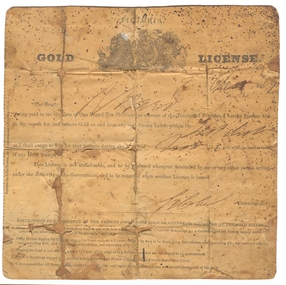
Document, Colony of Victoria, Gold License, 1852
... so few survived the harsh treatment of being carried around a working goldfield. There was much dissatisfaction about what was thought to be an unfair mining tax (or gold license). On 29 November 1854 Ballarat miners burnt their licenses on Bakery Hill. On 3 December 1854 the Eureka Stockade Battle took place, resulting in the Goldfields Commission. The first Miner's Right was issued in late June ...From 1851 the Victorian government required all men on Victorian Goldfields to carry a Gold License. The fee was one pound per month, and was payable in advance. There was agitation surrounding the gold license which was thought to be an excessive fee and did not give the bearer right to representation. On 03 December 1854 the gold diggers on the Eureka Lead fought a short battle against the army and police troopers. A few months later a new system of taxing gold diggers was introduced - the Miner's Right. The Gold License c allowed the bearer to 'dig, search for, and remove gold on and from any Crown Lands' within the district specified on the license. The license was not transferable, and had to be produced on demand. This has resulted in most surviving licenses showing evidence of having been folded and kept in a pocket.The Victorian Gold Licence was issued from 1851 until early 1855. Every man on a Victorian goldfield had to carry a valid gold license, so few survived the harsh treatment of being carried around a working goldfield. There was much dissatisfaction about what was thought to be an unfair mining tax (or gold license). On 29 November 1854 Ballarat miners burnt their licenses on Bakery Hill. On 3 December 1854 the Eureka Stockade Battle took place, resulting in the Goldfields Commission. The first Miner's Right was issued in late June 1855, and in July the first Local Courts were elected by miner's right holders. This gold license was issued around one year after the issue of the first Victorian gold license in August 1851, making it a rare early survivor. This fold lines on this Gold License are evidence of being carried around by the bearer. A original Victorian paper gold license glued onto on old card poster. The original colour of the paper was pale blue. The license has undergone conservation treatment and has been removed from the card.'231', '9 Nov 1852', [name illegible], 'Lod dist [Loddon District?], [Commissioner illegible - probably M. Cohn]gold license, gold licence, mining, cohn, eureka -
 Federation University Historical Collection
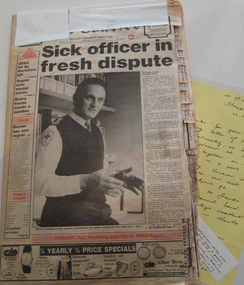
Ballarat Teachers' College (Year of 1947) correspondence, Ballarat Teachers' College (Year of 1947) correspondence relating to reunions, 1990s
... Much of this document is handwritten so is significant as an example of teacher's handwritten letters. btc ballarat ballarat teachers' college education 1947 harley tozer pattenden sonsee lelean miller Most of the notes and letters contained in this document are handwritten. All the tabs are handwritten, mostly in blue ink or biro. Two Ballarat Courier newspapers dated 5 June ...All participants attended BTC (Ballarat Teacher's College) in 1947.Much of this document is handwritten so is significant as an example of teacher's handwritten letters.Two Ballarat Courier newspapers dated 5 June 1991 and 1 June 1991 bound at side with white contact adhesive. The newspapers are used as an alphabetical filing system for correspondence relating to reunions. They have been cut along the top edge to create an indented filing system with a number and name put onto each tab. .1) Newspaper dated 5 June 1991, comprising tabs 1 Athol/Aisbett - 27 Gleeson. The information contained in the pages is sometimes biographical, with names, addresses and occupations. * 1. Athol/Aisbett 6 pages * 2. Nancy Alexander (McDonald) 7 pages * 3. Jessie Batson 3 pages * 4. Eddie Blake - * 5. Phyllis Borley (Smith) 10 pages * 6. Keith Boyd 1 page * 7. Owen Brennan - * 8. Josie Bunning (Humphries) 1 page * 9. Ron Carless 15 pages * 10. Jean Clade (Courten Coster) * 11. John Collins 3 pages * 12. Kevin Collins 2 pages * 13. Colin Connelly 1 page * 14. David Cooper 9 pages * 15. Kath Crossnett (Ward) 1 page * 16. Norma Dally (Gittson) 4 pages * 17. inez Domaschenz (Reimers) 3 * 18. Dawn Doney (Spencer) 5 pages * 19. Fay Dreher (O'Toole) 6 pages * 20. John Ellifson - * 21. Jean Elliott (Elliott) 1page * 22. Ethel Esmore (White) 17 pages * 23. Marie Faulds 3 pages * 24. Hugh Fraser 2 pages * 25. Beatrice Freeman (Sanders) 6 pages * 26. Bob Giddings 2 pages * 27. Bill Gleeson 2 pages 15105.2 Newspaper dated 1 June 1991, comprising tabs 28. Gorrie/Gunning to 81. Williams/Witney, then names in alphabetical order and one tab "information" at back of newspaper filing system. The following pages are listed after the second name of the "tab" * 28. Val Gorrie (Lynch) * 29. Joan Gunning (Jennings) 17 pages * 30. Madeline Hannan (Meehan) * 31. Lindsay Harley 6 pages * 32. Bill Henderson * 33. Wal Henning 2 pages * 34. Tom Hill * 35. Jim Howlett 13 pages * 36. Claire Kennedy (McLachlan) * 37. Joyce Kennedy (Evans) 3 pages * 38. Nancy Kerr (Harley) * 39. Arthur Lelean 2 pages * 40. Beth Leslie (Only) (Stutterd) * 41. Pat Lewsin (Williams) 12 pages * 42. Joy Love (Robertson) * 43. Pat Luxford (Steer) 3 pages * 44. Lynette Lynch (vickery) (McCl;ure) * 45. Ann McKinnon (Oldfield) 29 pages * 46. Alex McLachlan * 47. Keith McLean 3 pages * 48. Alex Magill * 49. Jack Mallett 12 pages * 50. Fred Marshman * 51. Alan Martin 11 pages * 52. Joyce Mathison (fraser) * 53. Maurine Merlin (Carter) 9 pages * 54. Muriel Morrish * 55. Mary Murnane (Bergin) 15 pages * 56. George Nield * 57. John O'Shannessy 1 small note * 58. Margaret Palmer (Alexander) * 59. Gwen Pamphiton 20 pages * 60. Tom Pascoe * 61. Howard Pattenden 12 pages and two small notes * 62. Ruth Pearse (Marshall) * 63. Betty Ferry (Ellis) 7 pages plus small note * 64. Mavis Polard (Grant * 65. Bill Punshon 4 pages and 2 small notes * 66. Peggy Purdue (Wood) (Jakeman) * 67. Milton Rice 29 pages * 68. Thelma Ritchie * 69. Pat Robinson (Kloppenborg) 6 pages * 70. Burns roddis * 71. Elva Surman (Murphy) - nil * 72. Ray Terrill * 73. Kath Tobin (Hatfield) 2 pages * 74. Ruth Tozer * 75. Jack Tyers 10 pages * 76. Neila Vallance (Peart) * 77. Pat Watts (Knight) 12 plus 2 newspaper articles * 78. Lorna Welsh (Davis) * 79. Betty Williams (Maynard) 12 pages plus 2 small notes * 80. Jil Williams * 81. Val Witney (Kelm) 12 pages * Carl Bryan * Mattie Hayes (Uton) - nil * Beth Hughes * Trudi Kentish 7 pages * W. Lord - nil * Mephan McEwin - 12 pages plus newspaper obit * Monica Miller (Rawlings) 5 pages includes funeral booklet * Win O'Brien (Lloyd) 9 pages * Alan Sonsee - nil * Information - 25 pages of acceptances and addresses of students who attended BTC in 1947 Most of the notes and letters contained in this document are handwritten. All the tabs are handwritten, mostly in blue ink or biro.btc, ballarat, ballarat teachers' college, education, 1947, harley, tozer, pattenden, sonsee, lelean, miller -
 Federation University Historical Collection
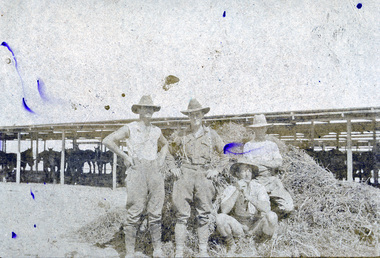
Photograph, Australian Soldiers at Moarcar, Egypt, c1914
... June 14th '16. From left to right. S.G.S. [Gordon Spittle], Cam Williamson & Harry [Holmes]. Sitting is Private Berry a son of the big merchants in Melbourne. Am sending these negatives to Jim W. so...June 14th '16. From left to right. S.G.S. [Gordon Spittle], Cam Williamson & Harry [Holmes]. Sitting is Private Berry a son of the big merchants in Melbourne. Am sending these negatives to Jim W. so ...The photograph was associated with Harry Holmes who was a member of the Australian Imperial Force based in Egypt at the time. Gordon Spittle was the youngest of three brothers. He grew up in Creswick and attended Creswick Grammar School. Gordon purchased 'Mt Cavern' in 1912. It had 4 years of a 10 year lease to run. His mother and father took delivery of it on 1 April 1916. They lived there and farmed it until Gordon returned from active service in May 1919. He married Violet Holmes and both lived at "Mt Cavern" until their deaths. Gordon died in 1942 aged 51. Violet Holmes-Spittle died in 1949 aged 56. They were the aunty and uncle of Mary Elziabeth Holme ( m Chatham) Egypt was a major base for the AIF from December 1914. A number of campaigns were fought in this theatre. There were two campaigns involving the AIF. Note that not all the fighting was actually geographically in Egypt. (http://www.aif.adfa.edu.au:8888/about3.html)Four Australian soldiersVerso: 'Moascar, Egypt, June 14th '16. From left to right. S.G.S. [Gordon Spittle], Cam Williamson & Harry [Holmes]. Sitting is Private Berry a son of the big merchants in Melbourne. Am sending these negatives to Jim W. so if they arrive safely, you'll be able to get better proofs from him. From Gordon [Spittle].chatham family archive, chatham, holmes, world war, world war 1, world war i, world war one, moascar, egypt, suez canal, spittle, williamson, harry holmes, berry, egypt, moarcar, ascot -
 Federation University Historical Collection
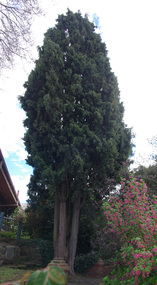
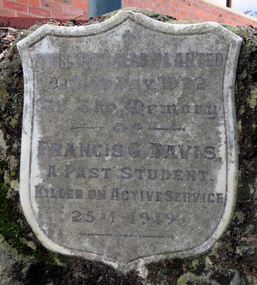
Photograph - Colour, Memorial to Francis Davis in the grounds of Federation University, SMB Campus, 2012, 20/09/2012
... He hoped the empire would always be able to produce such men, so that the Empire would always be able to lead the World's struggle for the benefit of humanity. The last post was then sounded by Mr. H. Green. ... (Ballarat Courier, 19 June...He hoped the empire would always be able to produce such men, so that the Empire would always be able to lead the World's struggle for the benefit of humanity. The last post was then sounded by Mr. H. Green. ... (Ballarat Courier, 19 June ...Francis Gordon Davis was born in Ballarat on 09 August 1899. He is the only former student of the Ballarat Junior Technical School who was killed on service during World War One. Davis enlisted into the Australian Flying Corps, Laverton, on 12 April 1918 at which time he was 18 and 8 months and served as a second class Air Mechanic. His service number was 3310. He died accidentally from shock resulting from an accident resulting from skidding a Leyland Motor Lorry at Leighterton, Tetbury, Gloucester, England on 28 January 1919 and is buried in Grave 6 in the Soldiers Corner of the Leighterton Cemetery. Francis Davis was accorded a full military funeral, firing party, bugler and pallbearers. The coffin was draped in the Union Jack and surmounted in several beautiful wreathes sent from his brother 2/A.M. E.H. Davis (A.F.C Leighterton), officer of the A.F.C. Leighterton, Gloucester, Cadets of A.F.C. and many other personal friends of the deceased. The "Last Post" was sounded at the graveside, and the Rev. Major K.D. Norman C. of E. A.I.F. officiated. The grave was to be turfed and an oak cross erected by the A.I.F. London. Administrative Headquarters A.I.F. London were represented at the funeral. (http://bih/index.php/Francis_G._Davis) In June 1922 Alfred Davis, the father of Francis Davis, planted a tree in the grounds of the Ballarat Junior Technical School in honour of hos son. It was the first tree of six planted in the grounds of the Ballarat School of Mines on Arbor Day 1922. Speaking of the planting of the tree by Mr Davis the Chief Secretary (Mr M. Baird M.L.A.), said he trusted the memory would ever remain green at the school. Had he and others not given their lives nothing that we could have done to-day could have retrieved the time. Australians had indeed done splendidly, but they should take a wider outlook than Australia, and reading the history of the Genoa Conference he had been struck by what had been done ... We should honor such men as he in whose memory that tree was planted, and the schools that sent them out to fight for us. He hoped the empire would always be able to produce such men, so that the Empire would always be able to lead the World's struggle for the benefit of humanity. The last post was then sounded by Mr. H. Green. ... (Ballarat Courier, 19 June 1922)A number of photographs of a tree and marble plaque in the grounds of the Ballarat School of Mines. It was a memorial to Francis Davis, a former student of the Ballarat Junior Technical School, who died on active service during World War One.ballarat school of mines, ballarat junior secondary school, world war one, memorial, marble plaque, marble memorial, tree, memorial tree, davis, francis davis -
 Flagstaff Hill Maritime Museum and Village
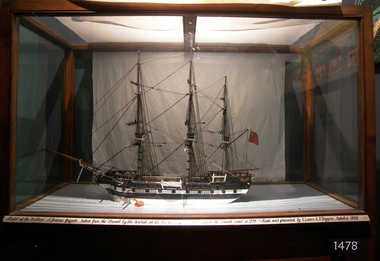
Craft - Ship Model, Arethusa, 1894
... The mast was struck from the ship and re-erected at the dockyard entrance so as many people as possible could watch the execution. On 17 June 1778, she fought a famous duel against the French 36-gun frigate, Belle Poule. ...The mast was struck from the ship and re-erected at the dockyard entrance so as many people as possible could watch the execution. On 17 June 1778, she fought a famous duel against the French 36-gun frigate, Belle Poule. ...Original Ships History: Aréthuse was a French frigate, launched in 1757 during the Seven Years War between England and France. She was captured by the Royal Navy in 1759 and became the fifth-rate HMS Arethusa. She remained in Royal Navy service for twenty years until she was wrecked after being badly damaged in battle. The ship was constructed at Le Havre for privateer warfare as ”Pélerine” and soon after her launch, she was purchased by King Louis XV (1710-1774) and commissioned as Aréthuse on 21 January 1758. In June, under captain Vauquelin, she sailed through the British blockade of Louisbourg helping to defend the site before departing, again forcing the blockade. On 18 May 1759, she was in transit from Rochefort to Brest, under the command of Louis-Philippe de Rigaud, Marquis of Vaudreuil, when she was intercepted near Audierne Bay (Baie d'Audierne) by three Royal Navy ships the Thames, Venus and Chatham. She attempted to escape but after two hours, lost her topmasts and was overtaken by her pursuers. Thames and Venus engaged her with heavy fire, causing 60 casualties before the vessel surrendered. She entered service with the Royal Navy for the rest of the war, and was in service in British home waters and became responsible for the capture of several French privateer cutters. In 1777, a Scotsman James Aitken, widely known as John the Painter, was hanged from her mizzenmast for burning the Rope House at Portsmouth Royal Dockyard on 7 December 1776, to aid the struggle of American independence. The mast was struck from the ship and re-erected at the dockyard entrance so as many people as possible could watch the execution. On 17 June 1778, she fought a famous duel against the French 36-gun frigate, Belle Poule. Belle Poule was on a reconnaissance mission, along with the 26-gun Licorne, the corvette Hirondelle and the smaller Coureur when she encountered a large British squadron that included Arethusa at a point 37 km south of The Lizard. Admiral Keppel, commanding the British fleet ordered that the French ships be pursued. The captain of Belle Poule refused the order to sail back to the British fleet. The British fired a warning shot across his ship's bow, to which he responded with a full broadside. This action began a furious, two-hour battle between the two ships that resulted in the deaths of the French second captain and 30 of the crew. However, Arethusa was crippled by the loss of a mast and withdrew, allowing Belle Poule to escape. This battle was the first between British and French naval forces during the American Revolutionary War and took place around three weeks before France had made a formal declaration of war. The battle was widely celebrated in France as a victory, even inspiring a hair-style in court circles that included a model of Belle Poule. It was also viewed as a victory in Britain and became the subject of a traditional Sea shanty, The Saucy Arethusa. On 18 March 1779, under captain Charles Holmes Everitt, Arethusa engaged the French Aigrette, under Lieutenant Mortemart, sustaining considerable damage in the fight. Arethusa was wrecked the next day off Ushant, It was the fame of this Arethusa which induced the Royal Navy, during the following two centuries, to bestow the name on a further seven consecutive individual ships and two consecutive classes of cruisers. (See Provenance Sec this document for information on the makers of this model). Model ship of the 3 masted frigate the “Arethusa”, model is painted black and white with varnished deck and masts. A British flag is flown at the stern. The ship is displayed in a glass case with timber frame and 4 legged stand.Label at bottom of glass case, printed in black script on a gold strip “Model of the “Arethusa" "A famous frigate, taken from the French by the British, on the 18th of May 1759 and lost on the French coast in 1779. – Made and presented by G. Lance & P. Diggins, October 1894” flagstaff hill, warrnambool, shipwrecked-coast, flagstaff-hill, flagstaff-hill-maritime-museum, maritime-museum, shipwreck-coast, flagstaff-hill-maritime-village, arethusa ship model, george lance, peter diggins, len asling, warrnambool art gallery, warrnambool exhibition, message in a bottle -
 Federation University Historical Collection
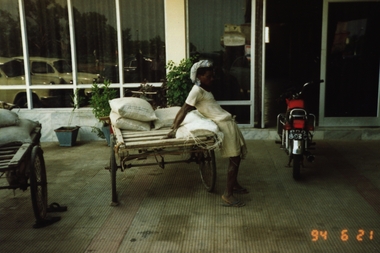
Photograph - Photograph - Colour, VIOSH: Man carrying heavy sack - method used. Taken by Derek Viner in June 1994
... so they become a display collection relating to OHS. These show how a heavy bag/sack is picked up and carried. viosh victorian institute of occupational safety and health university of ballarat derek viner overseas projects photograph display carrying method 1994 Three colour photograps VIOSH: Man carrying heavy sack - method used. Taken by Derek Viner in June ...Victorian Institute of Occupational Safety and Health (VIOSH) Australia is the Asia-Pacific centre for teaching and research in occupational health and safety (OHS) and is known as one of Australia's leaders in the field. VIOSH has a global reputation for its innovative approach within the field of OHS management. VIOSH had its first intake of students in 1979. At that time the Institution was known as the Ballarat College of Advanced Education. In 1990 it became known as Ballarat University College, then in 1994 as University of Ballarat. It was 2014 that it became Federation University. VIOSH Australia students are safety managers, senior advisors and experienced OHS professionals. They come from all over Australia and industry. Students are taught active research and enquiry; rather than textbook learning and a one-size fits all approach. VIOSH accepts people into the Graduate Diploma of Occupational Hazard Management who have no undergraduate degree - on the basis of extensive work experience and knowledge. Photographs taken by Derek Viner and sent to VIOSH in 1994. He asked for people who had suitable photos taken while overseas on projects, send them to VIOSH so they become a display collection relating to OHS. These show how a heavy bag/sack is picked up and carried.Three colour photograpsviosh, victorian institute of occupational safety and health, university of ballarat, derek viner, overseas projects, photograph display, carrying method, 1994 -
 Federation University Historical Collection
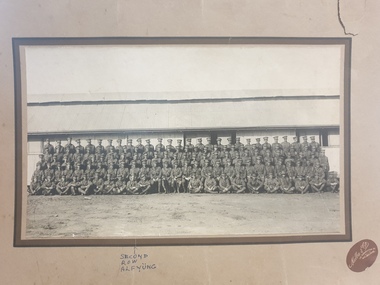
Photograph, Melba & Co, 7th Australian Infantry Training Battalion WW1
... June 1919. In November 1918 members of the AIF began to return to Australia for demobilisation and discharge. In March, the battalion was so...June 1919. In November 1918 members of the AIF began to return to Australia for demobilisation and discharge. In March, the battalion was so ...George Alfred Yung, known as Alf, pictured in the second row, 10th from the left, enlisted on 25/02/1916; embarked on 19/02/1917; was killed during the battle of Menin Gate at Yrpres, Belgium on 20/09/1917. https://www.awm.gov.au/collection/U51447 The 7th Battalion was among the first infantry units raised for the AIF during the First World War. Like the 5th, 6th and 8th Battalions, it was recruited from Victoria and, together with these battalions, formed the 2nd Brigade. The battalion was raised by Lieutenant Colonel H. E. "Pompey" Elliott within a fortnight of the declaration of war in August 1914 and embarked just two months later. After a brief stop in Albany, Western Australia, the battalion proceeded to Egypt, arriving on 2 December. It later took part in the ANZAC landing on 25 April 1915, as part of the second wave. Ten days after the landing, the 2nd Brigade was transferred from ANZAC to Cape Helles to help in the attack on the village of Krithia. The attack captured little ground but cost the brigade almost a third of its strength. The Victorian battalions returned to ANZAC to help defend the beachhead, and in August the 2nd Brigade fought at the battle of Lone Pine. While holding positions captured by the 1st Brigade, four members of the 7th Battalion, Corporal A. S. Burton, Acting Corporal W. Dunstan, Lieutenant W. Symons and Captain F. H. Tubb, earned the Victoria Cross - Burton posthumously. The battalion served at ANZAC until the evacuation in December. After the withdrawal from Gallipoli in December 1915, the battalion returned to Egypt. In March 1916, it sailed for France and the Western Front and entered the front line trenches for the first time on 3 May. The battalion's first major action in France was at Pozieres in the Somme valley where it fought between 23-27 July and 15-21 August. After Pozieres the battalion manned trenches in the Ypres salient in Belgium, before returning to the Somme valley. It saw out the horrendous winter of 1916-1917 rotating between training, working parties and duty in the trenches. In early 1917, the Germans withdrew to the Hindenburg Line and the 7th Battalion participated in the brief advance that followed and then came to a grinding halt before Bullecourt. The battalion was withdrawn from the front line for training on 9 May 1917 and did not return to action until the Ypres offensive of September and October. It fought major battles at Menin Road on 20 September and Broodseinde on 4 October, and then spent much of ensuing winter in the Ypres mud. In March and April 1918 the 7th helped stop the German spring offensive in northern France and later participated in the Allies' own great offensive of 1918, that began with the battle of Amiens on 8 August. The advance by British and empire troops on 8 August was the greatest success in a single day on the Western Front, one that German General Erich Ludendorff described as, "the black day of the German Army in this war". The battalion continued operations until late September 1918. At 11 am on 11 November 1918, the guns fell silent. The November armistice was followed by the peace treaty of Versailles signed on 28 June 1919. In November 1918 members of the AIF began to return to Australia for demobilisation and discharge. In March, the battalion was so reduced that it and the 6th Battalion were amalgamated to form a composite battalion. In turn, this battalion was merged with another, formed from the 5th and 8th Battalions, to form the 2nd Brigade Battalion. https://www.awm.gov.au/collection/U51447army, soldier, alf yung, 7th australian infantry battalion -
 Federation University Historical Collection
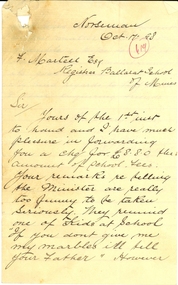
Letter, J.B. Rankine to Frederick Martell, 1898, 17/10/1898
... June 4, 1897. He states that his preliminary examination of the mines in active operation on the field, which was of a hurried nature, revealed in several instances a very unsystematic method of mining, which must have been attended with grave risk to the workmen had it been allowed to continue. The underground workings in one, particular mine which he inspected, and wherein a large number of men were employed, were of such a serious and dangerous nature that immediate steps and measures had to be taken to secure the ground for the safety of the men so employed. ...June 4, 1897. He states that his preliminary examination of the mines in active operation on the field, which was of a hurried nature, revealed in several instances a very unsystematic method of mining, which must have been attended with grave risk to the workmen had it been allowed to continue. The underground workings in one, particular mine which he inspected, and wherein a large number of men were employed, were of such a serious and dangerous nature that immediate steps and measures had to be taken to secure the ground for the safety of the men so employed. ..."Mr. J. B. Rankine, the inspector for the Dundas goldfield, entered upon his duties on June 4, 1897. He states that his preliminary examination of the mines in active operation on the field, which was of a hurried nature, revealed in several instances a very unsystematic method of mining, which must have been attended with grave risk to the workmen had it been allowed to continue. The underground workings in one, particular mine which he inspected, and wherein a large number of men were employed, were of such a serious and dangerous nature that immediate steps and measures had to be taken to secure the ground for the safety of the men so employed. Without entering on this occasion into the question of culpability, he desired to place on record that the manager had shown a readiness and willingness to carry out his (the Inspector's) instructions. (West Australian, 21 February 1898)Handwritten letter on folded, lined paper. The letter was written in Norseman and relates to school fees for the Ballarat School of Mines. Norseman Oct 17 98 F.Mmaretll esq Registrar Ballarat School of Mines Sir Yours of the 1st instant to hand and I have much pleasure in forwarding you a cheque for L8.8.0 the account of school fees. Your remarks re telling the Minister are really too funny to be taken seriously. the remind one of kids at School "If you don't give me my marbles ill tell your father" however you have been very patient in the matter + I don;t grumble. Hope school is doing well + maintaining its good name, My kind regards to proff Smith + other enquiring friends Yours very truly J.B. Rankinej.b. rankine, dundas goldfield -
 Lara RSL Sub Branch
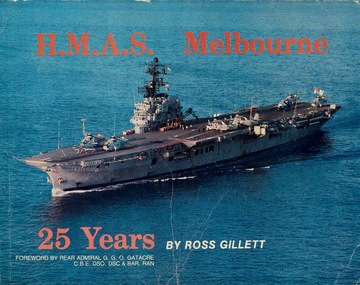
Book, Nautical Press, HMAS Melbourne 25 Years
... The scrapping was delayed so Melbourne could be studied by the People's Liberation Army Navy (PLAN) as part of a secret project to develop a Chinese aircraft carrier and used to train PLAN aviators in carrier flight operations. HMAS Melbourne was decommissioned on 30 June...The scrapping was delayed so Melbourne could be studied by the People's Liberation Army Navy (PLAN) as part of a secret project to develop a Chinese aircraft carrier and used to train PLAN aviators in carrier flight operations. HMAS Melbourne was decommissioned on 30 June ...HMAS Melbourne (R21) was a Majestic-class light aircraft carrier of the Royal Australian Navy (RAN). Operating from 1955 until 1982, she was the third and final conventional aircraft carrier to serve in the RAN. Melbourne was the only British Commonwealth naval vessel to sink two friendly warships in peacetime collisions. The ship was laid down for the British Royal Navy as the lead ship of the Majestic class in April 1943, and was launched as HMS Majestic (R77) in February 1945. At the end of World War II, work on the ship was suspended until she was purchased by the RAN in 1947. At the time of purchase, it was decided to incorporate new aircraft carrier technologies into the design, making Melbourne the third ship to be constructed with an angled flight deck. Delays in construction and integrating the enhancements meant that the carrier was not commissioned until 1955. Melbourne never fired a shot in anger during her career, having only peripheral, non-combat roles in relation to the Indonesia-Malaysia confrontation and the Vietnam War. However, she was involved in two major collisions with allied vessels. On the evening of 10 February 1964, Melbourne collided with and sank HMAS Voyager when the Daring class destroyer altered course across her bow. Eighty-two of Voyager's crew were killed, and two Royal Commissions were held to investigate the incident. The second collision occurred in the early morning of 3 June 1969, when Melbourne collided with and sank the Allen M. Sumner class destroyer USS Frank E. Evans in similar circumstances. Seventy-four United States Navy (USN) personnel died, and a joint USN–RAN Board of Inquiry was held. These incidents, along with several minor collisions, shipboard accidents, and aircraft losses, led to the reputation that Melbourne was jinxed. Melbourne was paid off from RAN service in 1982. A proposal to convert her for use as a floating casino failed, and a 1984 sale was cancelled, before she was sold in 1985 and towed to China for breaking. The scrapping was delayed so Melbourne could be studied by the People's Liberation Army Navy (PLAN) as part of a secret project to develop a Chinese aircraft carrier and used to train PLAN aviators in carrier flight operations. HMAS Melbourne was decommissioned on 30 June 1982, having spent 62,036 hours underway and having steamed 868,893 nautical miles. A proposal to convert her for use as a floating casino failed, and a 1984 sale was cancelled, before she was sold for scrap in 1985 and towed to China for breaking. The scrapping was delayed so Melbourne could be studied by the People's Liberation Army Navy (PLAN) as part of a secret project to develop a Chinese aircraft carrier and used to train PLAN aviators in carrier flight operations.The pictorial history of HMAS Melbourne with rare photos. Now a scarce title and highly desirable title that is now long out of print. Has provenance history of all ships movements from 1955 till decommissioned.HMAS Melbourne 25 YearsOn the front page is a picture of HMAS Melbourne with the words at top "H.M.A.S. Melbourne. At bottom are the words in orange, '25 Years'. In white, are the words 'by Ross Gillett' then 'Forward by Rear Admiral G.G.O. Gatacre C.B.E. DSO. DSC & Bar, RAN'. On the rear page is a list of all the Captains that served on the HMAS Melbourne between 1955-1980.hmas melbourne, aircraft carrier, royal australian navy, australian navy, westland whirlwind, sea venom, fairy gannet, bristol sycamore, westland wessex, douglas skyhawk, grumman tracker, westland sea king, fleet air arm, hmas albatross, nowra -
 Lara RSL Sub Branch
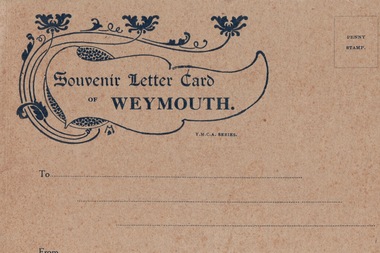
Postcards Booklet, Souvenir Letter Card of Weymouth
... The first contingent of 200 wounded men arrived in the first week of June 1915, and two weeks later a group of local ladies organised a cream tea for the newcomers, followed by a concert party 'The Frolics' at the camp. So...The first contingent of 200 wounded men arrived in the first week of June 1915, and two weeks later a group of local ladies organised a cream tea for the newcomers, followed by a concert party 'The Frolics' at the camp. So ...Following the landing of Australian & New Zealand troops, the Anzacs, at Gallipoli on 25th April 1915, casualties mounted rapidly and were initially transported to their base in Egypt, which was soon unable to cope, with wounded being sent to England. Here the troops found that there was no Australian base to which they could report once they had been discharged from hospital; what was needed urgently was a base in England where troops could be sent to convalesce. So on 31st May 1915 a command depot was set up at Monte Video House in Chickerell, some two miles from Weymouth. Weymouth then became the Australian Imperial Forces (AIF) Command Depot No.2 which accommodated those men not expected to be fit for duty within six months, therefore, most of the Diggers repatriated as a result of wounds or sickness passed through Weymouth. During the years 1915-1919 over 120,000 Australian and New Zealand troops passed through Weymouth. In Spring & Summer, Weymouth Esplanade would be full of Anzac soldiers in wheelchairs, being wheeled along by their more able mates. The first contingent of 200 wounded men arrived in the first week of June 1915, and two weeks later a group of local ladies organised a cream tea for the newcomers, followed by a concert party 'The Frolics' at the camp. So began the close connection that was to grow between the soldiers and the villagers of Chickerell. The ANZAC Memorial on Weymouth seafront commemorates the Australian and New Zealand troops who were accommodated in three camps in the town during WW1: Monte Video, Westham and Littlemoor. In Weymouth and Melcombe Regis Cemetery there are about eighty-six graves of those Anzacs who were never to return to their homelands. Also in memory of these troops, there a number of roads close to the camps named after Australian cities and states.A World War 1 Letter Card sent home by Australian troops repatriated in Weymouth, UK containing images of Weymouth and a picture of the Australian Base Camp.Front cover (see image) Souvenir Letter Card of Weymouth Inside are eight pictures of the Weymouth area including the YMCA Hut - Australian Base Campymca, uk, australian base camp, world war 1, ww1, aif, army, australian army, westham, littemoor, weymouth, melcombe regis cemetery, anzac -
 Federation University Historical Collection
Photograph, Clare Gervasoni, Memorial to Francis Davis in the grounds of Federation University, SMB Campus, 2019, 20/01/2019
... He hoped the empire would always be able to produce such men, so that the Empire would always be able to lead the World's struggle for the benefit of humanity. The last post was then sounded by Mr. H. Green. ... (Ballarat Courier, 19 June...He hoped the empire would always be able to produce such men, so that the Empire would always be able to lead the World's struggle for the benefit of humanity. The last post was then sounded by Mr. H. Green. ... (Ballarat Courier, 19 June ...Francis Gordon Davis was born in Ballarat on 09 August 1899. He is the only former student of the Ballarat Junior Technical School who was killed on service during World War One. Davis enlisted into the Australian Flying Corps, Laverton, on 12 April 1918 at which time he was 18 and 8 months and served as a second class Air Mechanic. His service number was 3310. He died accidentally from shock resulting from an accident resulting from skidding a Leyland Motor Lorry at Leighterton, Tetbury, Gloucester, England on 28 January 1919 and is buried in Grave 6 in the Soldiers Corner of the Leighterton Cemetery. Francis Davis was accorded a full military funeral, firing party, bugler and pallbearers. The coffin was draped in the Union Jack and surmounted in several beautiful wreathes sent from his brother 2/A.M. E.H. Davis (A.F.C Leighterton), officer of the A.F.C. Leighterton, Gloucester, Cadets of A.F.C. and many other personal friends of the deceased. The "Last Post" was sounded at the graveside, and the Rev. Major K.D. Norman C. of E. A.I.F. officiated. The grave was to be turfed and an oak cross erected by the A.I.F. London. Administrative Headquarters A.I.F. London were represented at the funeral. (http://bih/index.php/Francis_G._Davis) In June 1922 Alfred Davis, the father of Francis Davis, planted a tree in the grounds of the Ballarat Junior Technical School in honour of hos son. It was the first tree of six planted in the grounds of the Ballarat School of Mines on Arbor Day 1922. Speaking of the planting of the tree by Mr Davis the Chief Secretary (Mr M. Baird M.L.A.), said he trusted the memory would ever remain green at the school. Had he and others not given their lives nothing that we could have done to-day could have retrieved the time. Australians had indeed done splendidly, but they should take a wider outlook than Australia, and reading the history of the Genoa Conference he had been struck by what had been done ... We should honor such men as he in whose memory that tree was planted, and the schools that sent them out to fight for us. He hoped the empire would always be able to produce such men, so that the Empire would always be able to lead the World's struggle for the benefit of humanity. The last post was then sounded by Mr. H. Green. ... (Ballarat Courier, 19 June 1922)A number of photographs of a tree and marble plaque in the grounds of the Ballarat School of Mines. It was a memorial to Francis Davis, a former student of the Ballarat Junior Technical School, who died on active service during World War One.ballarat school of mines, ballarat junior secondary school, world war one, memorial, marble plaque, marble memorial, tree, memorial tree, davis, francis davis, centenary -
Federation University Historical Collection
Document - Article, A Profile of Bella Guerin, Australia's first woman graduate, 1987
... Bella Guerin matriculated from the University of Melbourne in 1878, passing in Latin, English, French, Arithmatic, Algebra, Euclif and History She enrolled into the Faculty of Arts at Melbourne University in 1881, the first year women could do so, and graduated in 1883. From January 1887 to June 1891 Bella Guerin taught at the Ballarat School of Mines, during a period of affiliation with the University of Melbourne....Bella Guerin matriculated from the University of Melbourne in 1878, passing in Latin, English, French, Arithmatic, Algebra, Euclif and History She enrolled into the Faculty of Arts at Melbourne University in 1881, the first year women could do so, and graduated in 1883. From January 1887 to June 1891 Bella Guerin taught at the Ballarat School of Mines, during a period of affiliation with the University of Melbourne. bella geurin bella lavendar bella halloran henry halloran women's movement woman's suffrage women's political association anti-conscription Eleven page article from the Victorian Historical Journal (May-August 1987, Vol 53, No 2&3) on Bella Guerin. ...Bella Guerin matriculated from the University of Melbourne in 1878, passing in Latin, English, French, Arithmatic, Algebra, Euclif and History She enrolled into the Faculty of Arts at Melbourne University in 1881, the first year women could do so, and graduated in 1883. From January 1887 to June 1891 Bella Guerin taught at the Ballarat School of Mines, during a period of affiliation with the University of Melbourne.Eleven page article from the Victorian Historical Journal (May-August 1987, Vol 53, No 2&3) on Bella Guerin.bella geurin, bella lavendar, bella halloran, henry halloran, women's movement, woman's suffrage, women's political association, anti-conscription -
 Flagstaff Hill Maritime Museum and Village
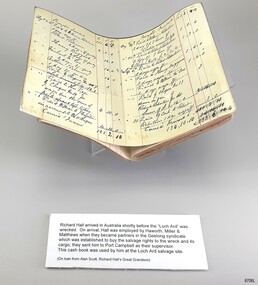
Book - Cash Book, Richard Hall, Manager of Loch Ard salvage site, 1878
... June 1878. On arrival, Hall was employed by the partners Haworth, Miller & Matthews, a Geelong syndicate established to buy the salvage rights to the wreck and its cargo. The firm sent Hall to Port Campbell as their supervisor. Hall used this cash book at the Loch Ard salvage site, keeping a record of the date, the workers’ names, hours worked and amount paid. The wreck was difficult to access from the shore, so...June 1878. On arrival, Hall was employed by the partners Haworth, Miller & Matthews, a Geelong syndicate established to buy the salvage rights to the wreck and its cargo. The firm sent Hall to Port Campbell as their supervisor. Hall used this cash book at the Loch Ard salvage site, keeping a record of the date, the workers’ names, hours worked and amount paid. The wreck was difficult to access from the shore, so ...Richard Hall arrived in Australia shortly before the "Loch Ard" was wrecked at Port Campbell in June 1878. On arrival, Hall was employed by the partners Haworth, Miller & Matthews, a Geelong syndicate established to buy the salvage rights to the wreck and its cargo. The firm sent Hall to Port Campbell as their supervisor. Hall used this cash book at the Loch Ard salvage site, keeping a record of the date, the workers’ names, hours worked and amount paid. The wreck was difficult to access from the shore, so the firm sent its recently purchased steamer, the SS Napier, to allow access from the sea. Sadly, the steamer hit rocks in the process, and it sank nearby with a cargo of general stores for settlers along the coast. Rochard Hall’s cash book has been passed down through his family’s generations. Currently, it belongs to his great-grandson, who has generously loaned it for display with other significant Loch Ard relics. Richard Hall’s cash book is significant as a record of essential details regarding the salvage process in the 1870s, including the date of work, the names of workers involved, the hours they worked, and the payments made. The use of this cash book ensured meticulous documentation of the workforce and financial transactions during the salvage period. Richard Hall’s cash book has been carefully preserved within his family for generations. Today, it is in the possession of his great-grandson, who has generously loaned it for public exhibition alongside other important relics from the Loch Ard shipwreck. The cash book serves as a tangible link to the events surrounding the salvage and the individuals involved in this historic episode. The Loch Ard shipwreck itself is a landmark event in Victoria’s maritime history and is registered on the Victorian Heritage Register (Ref S 417). The Flagstaff Hill Maritime Village houses a diverse and substantial collection of artefacts recovered from the Loch Ard, representing one of the largest assemblies of items from this significant shipwreck. The collection serves as a vital snapshot of history, enabling interpretation of the circumstances and impact of the tragic Loch Ard event. Additionally, the artefacts hold archaeological importance, offering insights into Victoria’s shipping history and early social and historical themes. The collection’s historical significance is further emphasised by its association with what is regarded as the worst and best-known shipwreck in Victoria’s history. Cash book: a small cash book with printed blue lines and red columns. Entries are handwritten in blue ink. They show the date, the name of the person paid, the amount paid, and the cheque number, or cash. The book is kindly on loan from Alan Scott, Richard Hall's great-grandson.Handwritten entries in pen and ink.flagstaff hill maritime museum and village, great ocean road, shipwreck coast, richard hall, loch ard, cash book, financial record, salvage, haworth miller and matthews, geelong salvage syndicate, 1878 wreck, port campbell, ss napier, salvage supervisor, salvage manager, salvage workers, richard hall's cash book, loch ard cash book -
 City of Moorabbin Historical Society (Operating the Box Cottage Museum)
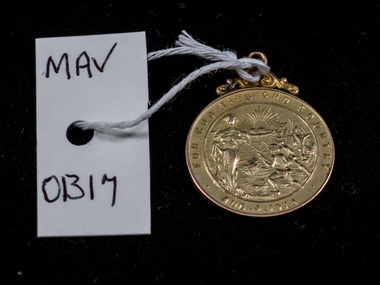
World War 1914-1918, Medal Alonzo Sheldrake Box, 1914
... Each town also mourned the loss of so many soldiers and collected money from the residents to build War Memorials on which were engraved the names of the deceased soldiers. Alonzo Sheldrake Box (1851 - 1958) was the nephew of William and Elizabeth Box who lived in Box Cottage , East Brighton - now Ormond -. He married Mary Louisa Closter on June...Each town also mourned the loss of so many soldiers and collected money from the residents to build War Memorials on which were engraved the names of the deceased soldiers. Alonzo Sheldrake Box (1851 - 1958) was the nephew of William and Elizabeth Box who lived in Box Cottage , East Brighton - now Ormond -. He married Mary Louisa Closter on June ...World War 1 1914-18 affected most families in Moorabbin Shire with large numbers of young men enlisting in the Australian Infantry Force. Alonzo Sheldrake Box , a pavier of Oakleigh, Victoria served at Gallipoli, France and Somme . When he returned home Oakleigh, like many Australian Towns, celebrated his safety and courage by presenting him with this Gold Medal. Each town also mourned the loss of so many soldiers and collected money from the residents to build War Memorials on which were engraved the names of the deceased soldiers. Alonzo Sheldrake Box (1851 - 1958) was the nephew of William and Elizabeth Box who lived in Box Cottage , East Brighton - now Ormond -. He married Mary Louisa Closter on June 12th 1918 at Holy Trinity, Church of England, Oakleigh.Alonzo Box was the son of John Box, who migrated from Sussex, England with his brother William Box c1855 , and established a market garden in East Brighton that was part of the Henry Dendy ' Special Survey Brighton 1841'A gold metal medal with top crest , 2 attachment rings, engraved on both sides presented to Alonzo Sheldrake Box 'For God King and Country. Aus. 1914 'Front ; outer circle - FOR GOD KING AND COUNTRY AUS. 1914 inner circle - tableau of a woman, rising sun and fighting soldiers Back : outer circle - PRESENTED BY THE CITIZENS OF OAKLEIGH centre - IN / RECOGNITION OF / SERVICE RENDd./ A.S.BOX / AIF / laurel wreathworld war 1914-18, moorabbin shire, early settlers, pioneers, box alonzo, box william, australian military medals, anzac, gallipoli, sheldrake martha, box elizabeth, box mary louisa, closter mary, war memorials, wedding dress, box john, viloudakia - box rebecca, -
 Orbost & District Historical Society
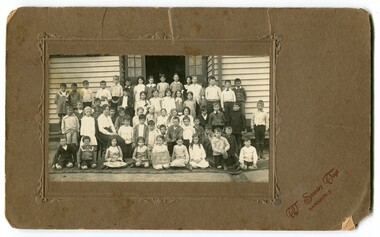
black and white photograph, Vogt. W.S, early 20th century
... June 1887, a portable room was provided; it being brought to the area by schooner. The school now had accommodation for 30 pupils; the teacher's welfare was considered because quarters of two rooms were attached. As the population increased so...June 1887, a portable room was provided; it being brought to the area by schooner. The school now had accommodation for 30 pupils; the teacher's welfare was considered because quarters of two rooms were attached. As the population increased so ...This is the annual photograph of Grades 111 and 1V for pupils of the Orbost State School. The 19th of March 1886 proved an important day in the lives of many early settlers in the Orbost area, because on this day the Orbost State School opened. The fact that the school had first operated temporarily in a leased building, and on a half-time basis with SS2745 Jarrahmond, did not dampen the enthusiasm of the local inhabitants as they saw their offspring commence their education under the guidance of Head Teacher Campbell Mackay. However he remained in charge only until 12th of May 1886. The second Head Teacher, John Rowe, served until 1908. On 30th of June 1887, a portable room was provided; it being brought to the area by schooner. The school now had accommodation for 30 pupils; the teacher's welfare was considered because quarters of two rooms were attached. As the population increased so did the needs of the school. This was reflected in the provision of a larger classroom in 1898. This item is associated with the history of education in Orbost.A black / white photograph mounted on brown car. There are five rows of school children standing outside a wooden building. Some are sitting and others standing. A female teacher is seated on a chair in the second front row. A girl in the front row is holding a card - "Grades 111 & 1V Orbost".on front - "W. Stanley Vogt Bairnsdale"orbost-state-school education-primary-schools -
 Orbost & District Historical Society
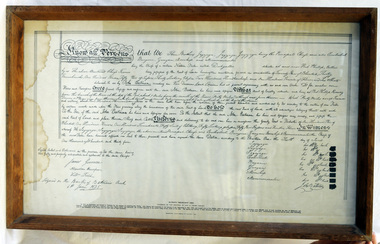
framed document, Batman's Melbourne Deed, 1966
... June 1835 by John Batman, an Australian grazier, businessman and explorer, and a group of Wurundjeri elders, for the purchase of land around Port Phillip, near the present site of the city of Melbourne. The document came to be known as Batman's Treaty and is considered significant as it was the first and only documented time when Europeans negotiated their presence and occupation of Aboriginal lands directly with the traditional owners. The so ...The Batman Deed is sometimes called the Batman Treaty, the Dutigullar Deed, the Dutigullar Treaty or the Melbourne Deed. The deeds had been drafted by JT Gellibrand, a leading lawyer in the colony. Batman's Treaty was a document signed on 6 June 1835 by John Batman, an Australian grazier, businessman and explorer, and a group of Wurundjeri elders, for the purchase of land around Port Phillip, near the present site of the city of Melbourne. The document came to be known as Batman's Treaty and is considered significant as it was the first and only documented time when Europeans negotiated their presence and occupation of Aboriginal lands directly with the traditional owners. The so-called treaty was implicitly declared void on 26 August 1835 by the Governor of New South Wales, Richard Bourke. The original Batman Deed is of enormous significance to the history of the European settlement of Victoria. Framed print of the Batman Deed, dated 1835. This is a printed copy of the Batman Deed, made in 1966 from the 'original' by the State Library of Victoria. The frame is wood. The document consists of handwritten text in black ink with eight signatures in the lower right hand side and three signatures in the lower left hand corner. It has been signed by John Batman beneath the eight signatures.document batman-deed melbourne -
 Orbost & District Historical Society
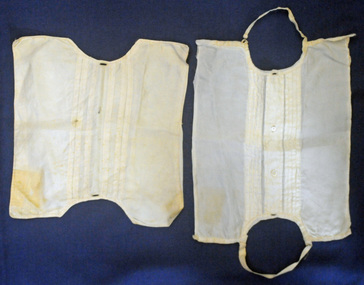
shirt fronts / dickeys, first half 20th century
... June, in Birmingham, England came to Orbost in 1995. She came from a middle-class, working, church-going family. The invention of the dickey was to make the front of a full dress shirt a separate entity in itself, like the detachable collar, so it could be laundered and starched more easily than a traditional shirt with the front attached....June, in Birmingham, England came to Orbost in 1995. She came from a middle-class, working, church-going family. The invention of the dickey was to make the front of a full dress shirt a separate entity in itself, like the detachable collar, so it could be laundered and starched more easily than a traditional shirt with the front attached. ...These were worn by Mr Whiteman, Marjorie Burton's father, when he sang in the church choir. Marjorie Burton ( nee Whiteman), born 12 June, in Birmingham, England came to Orbost in 1995. She came from a middle-class, working, church-going family. The invention of the dickey was to make the front of a full dress shirt a separate entity in itself, like the detachable collar, so it could be laundered and starched more easily than a traditional shirt with the front attached.Cloth dickeys simulated many different styles and were often often used in marching band or choir uniforms. However they are rarely worn now. These items are examples of a menswear accessory commonly used in the first half of the 20th century. Two silk white dickeys, men' shirt fronts. 2483.29 has tapes with press studs ant the top and bottom and 2 button holes. 2483.30 has 3 button holes and is a double thickness. Both have pleats.men's-clothing accessories shirt-fronts-dickeys burton-marjorie -
 Orbost & District Historical Society
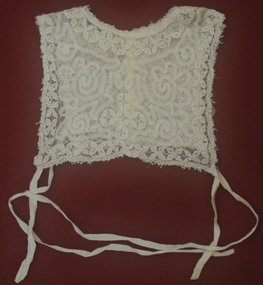
lace dickie, Early 20th century
... so that the lace decoration showed underneath another garment. This dickey is small and was worn by Marjorie Burton as a child. Marjorie Burton ( nee Whiteman), born 12 June...so that the lace decoration showed underneath another garment. This dickey is small and was worn by Marjorie Burton as a child. Marjorie Burton ( nee Whiteman), born 12 June ...A dickey is a type of false shirt-front that was originally intended to be worn with a tuxedo. Women made their own lace dickeys as a way to spice up their wardrobe. It was designed to be worn at the front, so that the lace decoration showed underneath another garment. This dickey is small and was worn by Marjorie Burton as a child. Marjorie Burton ( nee Whiteman), born 12 June, in Birmingham, England came to Orbost in 1995. She came from a middle-class working church-going family. Her mother was a milliner who made most of Marjorie’s clothes, hats and outfits. This item is an example of a handcrafted item and reflects the handcraft skills of women in the early twentieth century.A small lace cream / white dickie. It is hand-made and double layered. There are two tapes sewn at both side at the bottom and there are 3 press studs for closing at the back. dickey women's-clothing accessory burton-marjorie -
 Orbost & District Historical Society
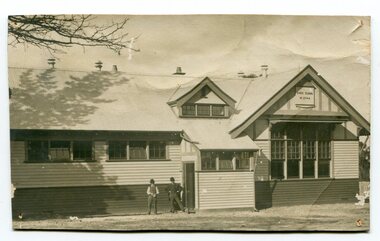
black and white photograph, C1910
... June 1887, a portable room was provided; it being brought to the area by schooner. The school now had accommodation for 30 pupils; the teacher's welfare was considered because quarters of two rooms were attached. As the population increased so...June 1887, a portable room was provided; it being brought to the area by schooner. The school now had accommodation for 30 pupils; the teacher's welfare was considered because quarters of two rooms were attached. As the population increased so ...the Orbost State School opened on19th of March 1886. The school had first operated temporarily in a leased building, and on a half-time basis with SS2745 Jarrahmond, The head teacher was Campbell Mackay who remained in charge only until 12th of May 1886. The second head teacher, John Rowe, served until 1908. On 30th of June 1887, a portable room was provided; it being brought to the area by schooner. The school now had accommodation for 30 pupils; the teacher's welfare was considered because quarters of two rooms were attached. As the population increased so did the needs of the school. This was reflected in the provision of a larger classroom in 1898. During 1910-11 the first approaches were made to the Department for the establishment of a Higher Elementary School in Orbost and this became a reality in 1912. Orbost. The Higher Elementary School supplied post-primary education in the district until a high school was built in 1948. When fire destroyed the school in 1941 local halls were used as classrooms until a new school was built, opened by the Hon. A. E. Lind, MLA, on 13th of February 1942. But Orbost continued to develop and the new school was soon overtaxed. This resulted in the erection of two Bristol classrooms in 1947. By 1950, when the school population had reached 500 pupils the opening of the new school at Orbost North was welcomed by all concerned. In 1963 the Department purchased land diagonally opposite the school and developed it as a playing area.This item is associated with education in the Orbost district.A black / white photograph of a large school building with two men standing out the front.orbost-state-school education-orbost -
 Orbost & District Historical Society
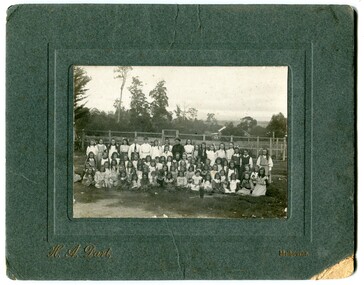
black and white photograph, H.A. Dart, C1890
... June 1887, a portable room was provided; it being brought to the area by schooner. The school now had accommodation for 30 pupils; the teacher's welfare was considered because quarters of two rooms were attached. As the population increased so...June 1887, a portable room was provided; it being brought to the area by schooner. The school now had accommodation for 30 pupils; the teacher's welfare was considered because quarters of two rooms were attached. As the population increased so ..."The 19th of March 1886 proved an important day in the lives of many early settlers in the Orbost area, because on this day the Orbost State School opened. The fact that the school had first operated temporarily in a leased building, and on a half-time basis with SS2745 Jarrahmond, did not dampen the enthusiasm of the local inhabitants as they saw their offspring commence their education under the guidance of HT Campbell Mackay. However he remained in charge only until 12th of May 1886. The second HT, John Rowe, served until 1908. On 30th of June 1887, a portable room was provided; it being brought to the area by schooner. The school now had accommodation for 30 pupils; the teacher's welfare was considered because quarters of two rooms were attached. As the population increased so did the needs of the school. This was reflected in the provision of a larger classroom in 1898. During 1910-11 the first approaches were made to the Department for the establishment of a HES in Orbost and this became a reality in 1912. Orbost HES supplied post-primary education in the district until a high school was built in 1948. When fire destroyed the school in 1941 local halls were used as classrooms until a new school was built. Work was quite rapid and a new brick structure was opened by the Hon. A. E. Lind, MLA, on 13th of February 1942. This new building was a fine type of school of which both the pupils and the HT Leslie Collins were indeed proud. But Orbost continued to develop and the new school was soon overtaxed. This resulted in the erection of two Bristol classrooms in 1947. By 1950, when the school population had reached 500 pupils the opening of the new school at Orbost North was welcomed by all concerned. In 1963 the Department purchased land diagonally opposite the school and developed it as a playing area. In 1965 two LTCs were opened in November, and in October 1968 the Brodribb School building was moved to SS2744 Orbost for use as a general purpose room." This item is associated with the history of education in Orbost.A black / white photograph of a group of students, some kneeling, some sitting, in a school yard. It is framed in grey buff cardboard with a photographer's stamp at the bottom.H. A. Dart Melbourne in gold print at the bottom.photograph-orbost-state-school -
 Orbost & District Historical Society
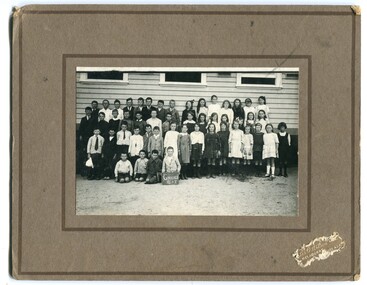
black and white photograph, Wilson, Les G, C1919
... June 1887, a portable room was provided; it being brought to the area by schooner. The school now had accommodation for 30 pupils; the teacher's welfare was considered because quarters of two rooms were attached. As the population increased so...June 1887, a portable room was provided; it being brought to the area by schooner. The school now had accommodation for 30 pupils; the teacher's welfare was considered because quarters of two rooms were attached. As the population increased so ...This photograph shows students of Grades 5 and 6. The 19th of March 1886 proved an important day in the lives of many early settlers in the Orbost area, because on this day the Orbost State School opened. The fact that the school had first operated temporarily in a leased building, and on a half-time basis with SS2745 Jarrahmond, did not dampen the enthusiasm of the local inhabitants as they saw their offspring commence their education under the guidance of HT Campbell Mackay. However he remained in charge only until 12th of May 1886. The second HT, John Rowe, served until 1908. On 30th of June 1887, a portable room was provided; it being brought to the area by schooner. The school now had accommodation for 30 pupils; the teacher's welfare was considered because quarters of two rooms were attached. As the population increased so did the needs of the school. This was reflected in the provision of a larger classroom in 1898. During 1910-11 the first approaches were made to the Department for the establishment of a HES in Orbost and this became a reality in 1912. Orbost HES supplied post-primary education in the district until a high school was built in 1948. When fire destroyed the school in 1941 local halls were used as classrooms until a new school was built. Work was quite rapid and a new brick structure was opened by the Hon. A. E. Lind, MLA, on 13th of February 1942. This new building was a fine type of school of which both the pupils and the HT Leslie Collins were indeed proud. But Orbost continued to develop and the new school was soon overtaxed. This resulted in the erection of two Bristol classrooms in 1947. By 1950, when the school population had reached 500 pupils the opening of the new school at Orbost North was welcomed by all concerned. In 1963 the Department purchased land diagonally opposite the school and developed it as a playing area. In 1965 two LTCs were opened in November, and in October 1968 the Brodribb School building was moved to SS2744 Orbost for use as a general purpose room. (info. from Schools East Gippsland) This item is associated with the history of education in Orbost.A black / white photograph framed by a grey buff card with the photographer's label in the RH bottom corner. The photograph shows a group of students outside their school. building.education -orbost orbost-state-school -
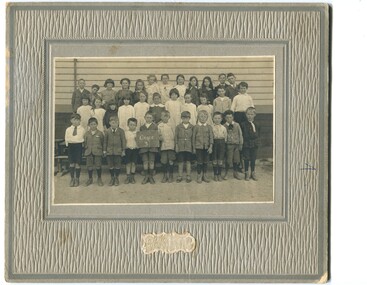 Orbost & District Historical Society
black and white photograph, C1900
... June 1887, a portable room was provided; it being brought to the area by schooner. The school now had accommodation for 30 pupils; the teacher's welfare was considered because quarters of two rooms were attached. As the population increased so...June 1887, a portable room was provided; it being brought to the area by schooner. The school now had accommodation for 30 pupils; the teacher's welfare was considered because quarters of two rooms were attached. As the population increased so ...The 19th of March 1886 proved an important day in the lives of many early settlers in the Orbost area, because on this day the Orbost State School opened. The fact that the school had first operated temporarily in a leased building, and on a half-time basis with SS2745 Jarrahmond, did not dampen the enthusiasm of the local inhabitants as they saw their offspring commence their education under the guidance of HT Campbell Mackay. However he remained in charge only until 12th of May 1886. The second HT, John Rowe, served until 1908. On 30th of June 1887, a portable room was provided; it being brought to the area by schooner. The school now had accommodation for 30 pupils; the teacher's welfare was considered because quarters of two rooms were attached. As the population increased so did the needs of the school. This was reflected in the provision of a larger classroom in 1898. During 1910-11 the first approaches were made to the Department for the establishment of a HES in Orbost and this became a reality in 1912. Orbost HES supplied post-primary education in the district until a high school was built in 1948. When fire destroyed the school in 1941 local halls were used as classrooms until a new school was built. Work was quite rapid and a new brick structure was opened by the Hon. A. E. Lind, MLA, on 13th of February 1942. This new building was a fine type of school of which both the pupils and the HT Leslie Collins were indeed proud. But Orbost continued to develop and the new school was soon overtaxed. This resulted in the erection of two Bristol classrooms in 1947. By 1950, when the school population had reached 500 pupils the opening of the new school at Orbost North was welcomed by all concerned. In 1963 the Department purchased land diagonally opposite the school and developed it as a playing area. In 1965 two LTCs were opened in November, and in October 1968 the Brodribb School building was moved to SS2744 Orbost for use as a general purpose room. ( info. Schools East Gippsland) This item is associated with the history of education in Orbost.A black / white photograph framed by a grey buff card. It shows grade three students standing in front of a wooden school building.education-orbost orbost-state-school
