
Showing 31 items matching "little betty"
-
 Bendigo Historical Society Inc.
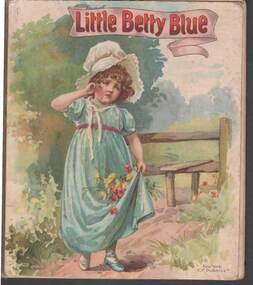
Book - CHILD'S BOOK DORIS EMMETT PRESENTATION: LITTLE BETTY BLUE
... CHILD'S BOOK DORIS EMMETT PRESENTATION: LITTLE BETTY BLUE......Little Betty Blue / Ernest Nister / E.P.Dutton & Co / Private School Wattle St ...Child's book -' Little Betty Blue ' / cardboard cover with watercolour painting of young girl - cloth binding / 'London Ernest Nister , Printed in Bavaria 160 , New York E.P.Dutton & Co / first page written in ink - ' Private School Wattle St , Upper first class prize for home lessons awarded to Doris Emmett, Christmas 1903 , A.L Parckhurst Teacher / collection of Nursery Rhymes...BOOKS Children's story book Little Betty Blue / Ernest Nister / E.P.Dutton & Co / Private School Wattle St / A.L Parckhurst Teacher / Doris Emmett Ernest Nister , E.P.Dutton & Co Child's book -' Little Betty Blue ' / cardboard cover with watercolour painting of young girl - cloth binding / 'London Ernest Nister , Printed in Bavaria 160 , New York E.P.Dutton & Co / first page written in ink - ' Private School Wattle St , Upper first class prize for home lessons awarded to Doris Emmett, Christmas 1903 , A.L Parckhurst Teacher / collection of Nursery Rhymes Book CHILD'S BOOK DORIS EMMETT PRESENTATION: LITTLE BETTY BLUE ...Child's book -' Little Betty Blue ' / cardboard cover with watercolour painting of young girl - cloth binding / 'London Ernest Nister , Printed in Bavaria 160 , New York E.P.Dutton & Co / first page written in ink - ' Private School Wattle St , Upper first class prize for home lessons awarded to Doris Emmett, Christmas 1903 , A.L Parckhurst Teacher / collection of Nursery RhymesErnest Nister , E.P.Dutton & Cobooks, children's, story book, little betty blue / ernest nister / e.p.dutton & co / private school wattle st , /, a.l parckhurst teacher / doris emmett -
 Cheese World Museum
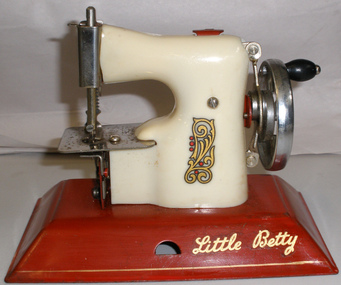
Toy, sewing machine, c1960
... little betty...Little Betty...little betty allansford toys sewing machines Little Betty Hand-operated toy sewing machine has red metal base with name inscribed in gold; creamy-white plastic body has a gold scroll decoration with 5 red spots. ...Hand-operated toy sewing machine has red metal base with name inscribed in gold; creamy-white plastic body has a gold scroll decoration with 5 red spots. The operating wheel is silver metal with a black knob on the handle. The working parts are silver-coloured metal.Little Bettylittle betty, allansford, toys, sewing machines -
 Ringwood and District Historical Society
Newspaper, Ringwood State School - Newspaper Clipping 13 November 1930 - Ringwood Mothers' Club "First Birthday Party"
... Blood congratulated the Club on their first year. "Little Dorothy Beal and Betty Walters" made floral presentations to the Mayoress and Mrs Kloot (president, Victorial Federated Mothers' Clubs). ...Blood congratulated the Club on their first year. "Little Dorothy Beal and Betty Walters" made floral presentations to the Mayoress and Mrs Kloot (president, Victorial Federated Mothers' Clubs). ...Long newspaper article (in 2 clippings) covering the Ringwood Mothers' Club celebration of their first birthday at the State School, with visitors from Williamstown, South Melbourne, Fitzroy, Hawthorn and other centres. Mrs Bryant (President), Mrs Matlock (Secretary) and Mrs N. Cooper (treasurer) presided. The article includes description of outfits, room decorations, offical table guests including the Mayor and Mayoress (cr. and Mrs Blood). Birthday cake was cut by Mrs Bryant. Cr. Blood congratulated the Club on their first year. "Little Dorothy Beal and Betty Walters" made floral presentations to the Mayoress and Mrs Kloot (president, Victorial Federated Mothers' Clubs). Toast by Mr Ashley, and response by Mr W. A. Broben. Followed by Community singing led by Mrs Kloot. Numerous other names listed. -
 Federation University Historical Collection
Book - Book - Scrapbook, University of Ballarat: Scrapbook of Newspaper cutting; Book 2, 11 April 1998 to 28 July 1998
... betty collier...margaret little.... ` employment advertisements application for enrolment outline of courses university of ballarat smb campus ub message from vice chancellor attack on telstra sell-off $1.36m capital works boost ballarat municipal observatory james oddie 'pathways to knowledge' apprenticeship training and advice peter morey art of bricklaying aussie bronzes betty collier margaret little clare blake ballarat tafe safe university: more choices off campus study course takes peril out of eating food safety ub graduation in hong kong librarians adapt to change kerrie-anne hare - publisher uni farewells carol seymour david nicholson search for gold-medal talent uni chaplain - father hislop anglican diocese smb graduation andrew vassiliou nicole kramer grab opportunities uni commitment to koori education cookery apprentices david molzer david bending dallas cuddy uni wins asx training deal australian stock exchange winter fest water chief to top education job ballarat legends people who shaped a city Book with yellow cover, front. ...Newspaper cuttings relating to the University of Ballarat, SMB Campus. These are from various newspapers and include The Age, Ballarat Courier, The Australian, The Herald. The cuttings cover the period from 11 April 1998 to 28 July 1998. . `Book with yellow cover, front. Spiral bound.employment advertisements, application for enrolment, outline of courses, university of ballarat, smb campus, ub, message from vice chancellor, attack on telstra sell-off, $1.36m capital works boost, ballarat municipal observatory, james oddie, 'pathways to knowledge', apprenticeship training and advice, peter morey, art of bricklaying, aussie bronzes, betty collier, margaret little, clare blake, ballarat tafe safe, university: more choices, off campus study, course takes peril out of eating, food safety, ub graduation in hong kong, librarians adapt to change, kerrie-anne hare - publisher, uni farewells, carol seymour, david nicholson, search for gold-medal talent, uni chaplain - father hislop, anglican diocese, smb graduation, andrew vassiliou, nicole kramer, grab opportunities, uni commitment to koori education, cookery apprentices, david molzer, david bending, dallas cuddy, uni wins asx training deal, australian stock exchange, winter fest, water chief to top education job, ballarat legends, people who shaped a city -
Federation University Historical Collection
Booklet, Education Department of Victoria Publications Branch, John and Betty: The Earliest Reader for the Little Ones, 1951, 1951
... John and Betty: The Earliest Reader for the Little Ones, 1951...Students studying for the Trained Infant Teacher's Certificate at Toorak Teachers’ College were given a copy to assist with the preparation of teaching aids for this reader, 1965-1967. reader education Booklet Colour and black and white illustrations by Marjorie Howden John and Betty: The Earliest Reader for the Little Ones, 1951 Booklet Education Department of Victoria Publications Branch ...Students studying for the Trained Infant Teacher's Certificate at Toorak Teachers’ College were given a copy to assist with the preparation of teaching aids for this reader, 1965-1967.Booklet Colour and black and white illustrations by Marjorie Howdenreader, education -
 Federation University Historical Collection
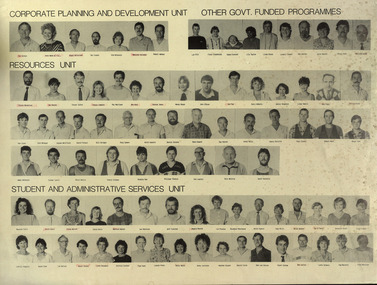
Poster, Ballarat School of Mines staff, 1995, 1995
... betty...crump, neville...d'angri, val...dunlop, barbara...fennell, anne (humphry)...hall, paula...haller, walter...heighway, alastair...hocking, geoff...humphrey, anne (fennell)...kellam, trevor...kisler, peter...lawless, bob...little...davis, sonia dixon, heather dixon, philip durant, heather dyer, robert fennell, anne firth, barrie gaunt malcolm gunn, peter hobbs, lyn hood, graham howell, kevin jelbart, john johnson, murray leith, john lovett, bob mcfarlane, roger mendelson, steven merrett, pam nicholls, geoff o'toole, jan palmer, max parfenovics, roly pavey, sue perrin, mary pym, ian rae, bradley ryan, bill seymour, carole shiel, peter sordello, john staley, bruce vallance, malcolm vn dreven, john watts, liz whittle, bill woodruff, brian beanland, graham collier, betty crump, neville d'angri, val dunlop, barbara fennell, anne (humphry) hall, paula haller, walter heighway, alastair hocking, geoff humphrey, anne (fennell) kellam, trevor kisler, peter lawless, bob little, garry mail, andrew mclennan, brian mcnulty, patti mitaxa, ian nunn, peter olmstead, dennis peart, alby perry, graeme pope, geoff pyke, george shannon, leo sharman, eric shearer, graham sheehan, frank shiells, peter stefschenk, ray stoddart, roger turner, jim vandreven, john wallis,. lee akers, keith boast, keith byrne, simone calistro, paul dixon, john faull, shirley fenelon, virginia french, neville gribble, isabel grist, carol haddow, david haley, rosaley harris, ian hazlett, rocky heffernan, liz jardine, cynthia kemp, john knight, kim lambeth, paul lanigan, alison lesock, peter lyttle, gary martin, kevin mcmillan, adrian mcneight, wendy nestor, david osborne, bill o'shea, bob parker, frank penhall, graham pink, alan pink, merrill rasmussen, mary sarah, doug schenk, ray seymour, doug sullivan, andrew thake, tony thorpe, sharon tiller, donna torrington, andrew trembath, colin trotter, peter turner, sonia webber, brian wild, ron williams, carol wren, derek yeomans, lorraine bergin, peter burgess, zena crebbin, irene gough, tsony haller, fleur murray, bill oparski, cheyrl snibson, graham sordello, franl sutton, ron walsh, paul adrian, bill aiton, alan barratt, geoff bevelander, mark bridges, bill brown, doug cartledge, brian conroy, ken cook, les curran, laurie davidson, ron davies, dennis dobbyn, col edwards, harold ellis, alan fithall, david flanagon, john fletcher, jeff harrison, john howlett, keith hutchions, bob lindorff, les lucas, ron mccann, david mcdonald, laughlin mclellan, jan mitchell, ian morgan, bob perovic, bruno robinson, ian shaw, jim smail, andrew stevens, bernie symons, doug trainor, malcolm van hammond, hans wallis, lee whitefield, gordon woolman, tom Max Palmer donna tiller neville french rocky hazlet tony thake colin trembath Anne fennell doug sara jan mclellan Poster of all Ballarat School of Mines staff (named) Ballarat School of Mines staff, 1995 Poster Poster ...Poster of all Ballarat School of Mines staff (named)davis, sonia, dixon, heather, dixon, philip, durant, heather, dyer, robert, fennell, anne, firth, barrie, gaunt malcolm, gunn, peter, hobbs, lyn, hood, graham, howell, kevin, jelbart, john, johnson, murray, leith, john, lovett, bob, mcfarlane, roger, mendelson, steven, merrett, pam, nicholls, geoff, o'toole, jan, palmer, max, parfenovics, roly, pavey, sue, perrin, mary, pym, ian, rae, bradley, ryan, bill, seymour, carole, shiel, peter, sordello, john, staley, bruce, vallance, malcolm, vn dreven, john, watts, liz, whittle, bill, woodruff, brian, beanland, graham, collier, betty, crump, neville, d'angri, val, dunlop, barbara, fennell, anne (humphry), hall, paula, haller, walter, heighway, alastair, hocking, geoff, humphrey, anne (fennell), kellam, trevor, kisler, peter, lawless, bob, little, garry, mail, andrew, mclennan, brian, mcnulty, patti, mitaxa, ian, nunn, peter, olmstead, dennis, peart, alby, perry, graeme, pope, geoff, pyke, george, shannon, leo, sharman, eric, shearer, graham, sheehan, frank, shiells, peter, stefschenk, ray, stoddart, roger, turner, jim, vandreven, john, wallis,. lee, akers, keith, boast, keith, byrne, simone, calistro, paul, dixon, john, faull, shirley, fenelon, virginia, french, neville, gribble, isabel, grist, carol, haddow, david, haley, rosaley, harris, ian, hazlett, rocky, heffernan, liz, jardine, cynthia, kemp, john, knight, kim, lambeth, paul, lanigan, alison, lesock, peter, lyttle, gary, martin, kevin, mcmillan, adrian, mcneight, wendy, nestor, david, osborne, bill, o'shea, bob, parker, frank, penhall, graham, pink, alan, pink, merrill, rasmussen, mary, sarah, doug, schenk, ray, seymour, doug, sullivan, andrew, thake, tony, thorpe, sharon, tiller, donna, torrington, andrew, trembath, colin, trotter, peter, turner, sonia, webber, brian, wild, ron, williams, carol, wren, derek, yeomans, lorraine, bergin, peter, burgess, zena, crebbin, irene, gough, tsony, haller, fleur, murray, bill, oparski, cheyrl, snibson, graham, sordello, franl, sutton, ron, walsh, paul, adrian, bill, aiton, alan, barratt, geoff, bevelander, mark, bridges, bill, brown, doug, cartledge, brian, conroy, ken, cook, les, curran, laurie, davidson, ron, davies, dennis, dobbyn, col, edwards, harold, ellis, alan, fithall, david, flanagon, john, fletcher, jeff, harrison, john, howlett, keith, hutchions, bob, lindorff, les, lucas, ron, mccann, david, mcdonald, laughlin, mclellan, jan, mitchell, ian, morgan, bob, perovic, bruno, robinson, ian, shaw, jim, smail, andrew, stevens, bernie, symons, doug, trainor, malcolm, van hammond, hans, wallis, lee, whitefield, gordon, woolman, tom, max palmer, donna tiller, neville french, rocky hazlet, tony thake, colin trembath, anne fennell, doug sara, jan mclellan -
Federation University Historical Collection
Document, Ballarat School of Mines Annual Report, 1979, 1979
... Little...Land Laboratory...Walkways...Music centre...4 Hickman St...Lake Bolac TAFE centre...welfare certificate...Jack Sewell...plumber andrew trigg wins silver medal...Gordon Spittle...A. Trigg...Caravan Park Management Course...Mt Clear Technical High School...Betty...Yandell i. aitken Gary Little Land Laboratory Walkways Music centre 4 Hickman St Lake Bolac TAFE centre welfare certificate Jack Sewell plumber andrew trigg wins silver medal Gordon Spittle A. Trigg Caravan Park Management Course Mt Clear Technical High School Betty ...In 1979 Rex Hollioake was the President of the Ballarat School of Mines Council. A music centre was opened at 4 Hickman StreetBrown covered A4 reportballarat school of mines, annual report, rex hollioake, r.c. muir, n.a. croach, j.gf. mckay, r.j. dobell, e.j. barker, j. chambers, ken flecknoe, jack barker, lindsay hillman, m.b. john, arthur nicholson, r.j. selkirk, j. short, e.j. tippett, f.r. uhe, t.a. wiseman, l.c. yandell, i. aitken, gary little, land laboratory, walkways, music centre, 4 hickman st, lake bolac tafe centre, welfare certificate, jack sewell, plumber andrew trigg wins silver medal, gordon spittle, a. trigg, caravan park management course, mt clear technical high school, betty collier, alistair highway, i. mitaxa, rolly parfenovics, enolments, trevor kellam, eileen kelly, brian mclennan, women's access program, drama, r.c. morgan, intake -
 Ringwood and District Historical Society
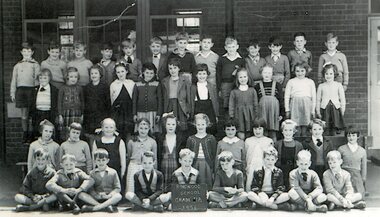
Photograph, Ringwood State School -Class photograph - Grade 11A- 1956
... , Julie Little, Jean Ritch, Elaine Evans, Rosaline Busby, Margaret Nelson, ?, Barbara Ryan(?) 3rd Row L-R : Betty Jacobs, Diane Deuter, Ruth Reeves, Lynette (?)..., Julie Little, Jean Ritch, Elaine Evans, Rosaline Busby, Margaret Nelson, ?, Barbara Ryan(?) 3rd Row L-R : Betty Jacobs, Diane Deuter, Ruth Reeves, Lynette (?) ...Black and white photograph - Grade 2A, 1956"Attached to photograph" List of student names (Incomplete) Back Row L-R : Rod Roach, ?, ?, ?, Russell Goodall, David Flowers, Jimmy Page, ?, Peter Pavey, John Carpenter, ?, Robert McCulloch, Ross Warne. 2nd Row L-R : ?, Annette Wright, Meridith Brown, ?, Julie Little, Jean Ritch, Elaine Evans, Rosaline Busby, Margaret Nelson, ?, Barbara Ryan(?) 3rd Row L-R : Betty Jacobs, Diane Deuter, Ruth Reeves, Lynette (?), Laurel Adams, Lois Clark, Madeleine (?), (?) Williams, Barbara Gordon, Margaret Doak, Irene Bennett. Seated Front Row L-R : ?, Robert Caywood, Philip Decini, John Reid, ?, ?, ?, Chris Harding. Teacher : -
 Flagstaff Hill Maritime Museum and Village
Photograph - Portraits, c. 1904
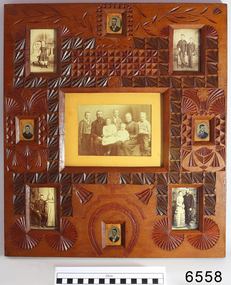
... little girl, wearing her black dress. Ellis built a bluestone cottage for himself and Ann on his father’s land in Dales Road. He later added weatherboard rooms, and they named their finished home “Latrigg”. Early in their marriage Ellis recycled some empty dynamite boxes from their quarry to build a cupboard with drawers for Ann’s flat irons and other ironing equipment. The cupboard was used by future generations until recently, when Ann’s granddaughter, Betty...The little girl with black boots on is Betty Stone's grandmother. ...little girl, wearing her black dress. Ellis built a bluestone cottage for himself and Ann on his father’s land in Dales Road. He later added weatherboard rooms, and they named their finished home “Latrigg”. Early in their marriage Ellis recycled some empty dynamite boxes from their quarry to build a cupboard with drawers for Ann’s flat irons and other ironing equipment. The cupboard was used by future generations until recently, when Ann’s granddaughter, Betty ...Ann Dale (nee Lees) was given this frame by her younger brother Thomas Chamberlain Lees, who was eighteen at that time. Thomas was the youngest son and seventh child of Lees and Sarah (nee Chamberlain) Lees. Ann loved her little brother’s artistic talents, which are demonstrated in this frame he designed and carefully carved for her. Thomas had cleverly finished the back with timber pieces around the images, and a section of a 1904 calendar. His “GOOD LUCK” is below the image of Ann, her husband Ellis Dale and their five children, c 1900. Sadly, Thomas died in 1911, aged 25. Ellis Dale’s father, William, was a quarryman who sailed from Yorkshire to Australia in 1852. He later bought land for Dale’s Quarries on the edge of Warrnambool in the area of Dale and Aberline roads. From the age of about eleven, Ellis and his brother worked in the quarry beside their father. In 1890 Ellis Dale married Ann Lees. Ann had lived nearby at Wangoom with her parents, Lees and Sarah Lees, who had had her photograph taken when she was a little girl, wearing her black dress. Ellis built a bluestone cottage for himself and Ann on his father’s land in Dales Road. He later added weatherboard rooms, and they named their finished home “Latrigg”. Early in their marriage Ellis recycled some empty dynamite boxes from their quarry to build a cupboard with drawers for Ann’s flat irons and other ironing equipment. The cupboard was used by future generations until recently, when Ann’s granddaughter, Betty Stone, donated it as part of the Chamberlain Dale Lees Collection. It is now in the kitchen of the Port Medical Office. Chamberlain Dale Lees family – local Colonial Pioneers Centre: Ellis Dale and Ann (nee Lees) and their five children - c 1900. Sons lvor William, Robert Ellis, Alfred John, and daughters - Elsie Mary Dale, and Daisy Elvena Dale. Top Left: Ann Lees - c 1868, (the little girl in the black dress) Top Right: William Dale Jnr. and Ellis Dale - c 1871 Lower Left: Ellis Dale and Ann (nee Lees), married 22 Jan. 1890 Lower Right: William Dale Jnr. and Agnes (nee Gillies), married 1883 Oval Photographs: unidentified but presumed to be family members [NB Spelling of Ann Dale – The spelling of Ann’s name has been confirmed by Betty Stone as being “Ann” (Not Anne), by phone conversation with Flagstaff Hill Maritime Village, K P 14th April 2014] (Note: For additional information please refer to Betty Stone’s book “Pioneers and Places - A History of three Warrnambool Pioneering Families” ie. Chamberlain, Dale and Lees Families)This item is associated with the families of Chamberlain, Dale and Lees. These families are listed in the "Pioneers' Register" for Warrnambool Township and Shire, 1835-1900, published by A.I.G.S. Warrnambool Branch. The handmade frame is a unique example of clever craftsmanship and carving skills used by early pioneers with limited access to materials.Family photographs, nine, set into carved, solid wood frame, stained and lacquered. Carving includes leaves, flowers, a horseshoe and a ribbon with the words "GOOD LUCK" Photographs are of the Lees family of Wangoom, from the 'Chamberlain Dale Lees Collection’ Made by Thomas Lees for his sister, Ann. The little girl with black boots on is Betty Stone's grandmother. The back of the frame has a London calendar dated 1904.Words in carved ribbon "GOOD LUCK" Calendar for the year 1904flagstaff hill, warrnambool, shipwrecked coast, flagstaff hill maritime museum, maritime museum, shipwreck coast, flagstaff hill maritime village, great ocean road, chamberlain, dale, lees, stone, betty stone, warrnambool pioneers, thomas lees, wangoom, ann dale, ellis dale, flagstaff hill, warrnambool, shipwrecked coast, flagstaff hill maritime museum, maritime museum, shipwreck coast, flagstaff hill maritime village, great ocean road, chamberlain, dale, lees, stone, betty stone, warrnambool pioneers, thomas lees, wangoom, ann dale, ellis dale, thomas chamberlain lees, handmade photograph frame, carved photograph frame, dynamite -
 Greensborough Historical Society
Booklet, John and Betty: the earliest reader for the little ones, 1951_
... John and Betty: the earliest reader for the little ones...John and Betty: the earliest reader for the little ones Booklet Booklet Victoria. ...School reader widely used in Victorian government schools.24 p., stapled, col. illusrations.Stamped in red: P. S. 5024 Watsonia South, Frensham Rd. Watsonia 3087. Tel. 435-6662childrens books, school textbook -
 Flagstaff Hill Maritime Museum and Village
Book - Religious books in case, Book of Common Prayer and Hymns Ancient and Modern, Mid 19th century
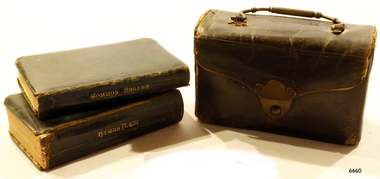
... In the words of the Donor, Betty Stone, "According to family tradition, this small leather case containing a prayer book and a hymn book was originally owned by Susan (nee Ellis) Chamberlain who brought it with her when the family left Thriplow England in 1854 to come to Australia. Later, Susan passed it on to her granddaughter Ann (nee Lees) Dale who used the little...In the words of the Donor, Betty Stone, "According to family tradition, this small leather case containing a prayer book and a hymn book was originally owned by Susan (nee Ellis) Chamberlain who brought it with her when the family left Thriplow England in 1854 to come to Australia. Later, Susan passed it on to her granddaughter Ann (nee Lees) Dale who used the little ...In the words of the Donor, Betty Stone, "According to family tradition, this small leather case containing a prayer book and a hymn book was originally owned by Susan (nee Ellis) Chamberlain who brought it with her when the family left Thriplow England in 1854 to come to Australia. Later, Susan passed it on to her granddaughter Ann (nee Lees) Dale who used the little books for some years in 1912, Ann Dale (my grandmother) gave the case and books to my mother Daisy Elvena Dale. Daisy, aged twelve years at the time, was the youngest child of Ann and Ellis Dale, of Latrigg, Wangoom, Warrnambool. There is no date of publication but it would be mid-1800's, as it was brought to Australia in 1854 . The hymn book has a notation - “From Mother to Daisy 1912 Print too small” and is signed by A. Dale. (ie Ann Dale, granddaughter of Susan Chamberlain)" (Note: For additional information please refer to Betty Stone’s book “Pioneers and Places - A History of three Warrnambool Pioneering Families” ie. Chamberlain, Dale and Lees Families) This item is associated with families of Chamberlain, Dale and Lees. These families are listed in the "Pioneers' Register" for Warrnambool Township and Shire, 1835-1900, published by A.I.G.S. Warrnambool Branch.Miniature leather case with two books inside - Book of Common Prayer and Hymns Ancient and Modern, Brought to Australia by Susan Chamberlain when she emigrated in 1854. From the 'Chamberlain Dale Lees Collection'. Hand written inscription is inside the cover. One end of the handle has been repaired by sewing it in place. Hand written inside the cover is "From Mother to Daisy, 1912 Print too small (signed) A. Dale"flagstaff hill, warrnambool, shipwrecked coast, flagstaff hill maritime museum, maritime museum, shipwreck coast, flagstaff hill maritime village, great ocean road, chamberlain, dale, lees, stone, betty stone, warrnambool pioneers, miniature bible, miniature hymn book, worship, emigration -
 Orbost & District Historical Society
black and white photographs, April 1916
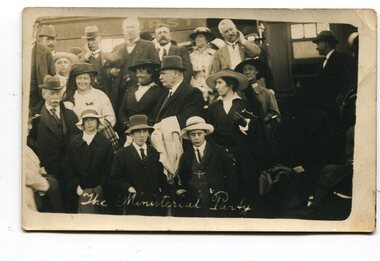
... Betty Gilbert; Marion Gilbert; Mrs Shaw and son; ? Gay; and Pen Gilbert. In 3150.4 L-R front " Mary Gilbert; Bet Gilbert (sitting with glasses); Pen Gilbert(Richardson); Marion Gilbert ( middle front little girl) About 1912 work began at Newmerella on clearing the track for the railway line from Bairnsdale to Orbost. ...Betty Gilbert; Marion Gilbert; Mrs Shaw and son; ? Gay; and Pen Gilbert. In 3150.4 L-R front " Mary Gilbert; Bet Gilbert (sitting with glasses); Pen Gilbert(Richardson); Marion Gilbert ( middle front little girl) About 1912 work began at Newmerella on clearing the track for the railway line from Bairnsdale to Orbost. ...These photographs were taken at the official opening of the Orbost - Bairnsdale Railway Line. In 3150.3 which is of a group of children and two adults those identified in the photograph are ; L - R front row Mary Gilbert; Warren; Betty Gilbert; Marion Gilbert; Mrs Shaw and son; ? Gay; and Pen Gilbert. In 3150.4 L-R front " Mary Gilbert; Bet Gilbert (sitting with glasses); Pen Gilbert(Richardson); Marion Gilbert ( middle front little girl) About 1912 work began at Newmerella on clearing the track for the railway line from Bairnsdale to Orbost. A canvas town sprang up on the higher land adjacent to the river flats. Local farmers supplied meat, milk and fresh produce to the camp, as well as gaining employment carting and labouring. The line opened in 1916, the Orbost railway station being built on the Newmerella side of the river.This item is associated with the history of the Orbost-Bairnsdale railway line and therefore reflects the role that the rail line played in the social and economic history of Orbost. It is a pictorial record of a significant event in Orbost's history. On April 10 1916, the first scheduled train service left Orbost for Bairnsdale. The Bairnsdale-Orbost railway was opened to serve the agricultural and timber ndustry. Because of the decline in traffic and heavy operating costs, the line was finally closed in August, 1987. Four black / white postcards of people at the opening of The Orbost - Bairnsdale Railway. 3150.1 - on front - "The Ministerial Party" 3150.2 - on front - hand-written - " The Hon James Cameron" with arrow pointing to a man standing in the back row. at bottom - "The Ministerial Party X Florie Cameron" on back- "Opening the Orbost Railway" 3150.3 and 3150.4 - on back - hand-written "First train to Orbost with a list of names.orbost-bairnsdale-railway celebration-opening-of-railway east-gippsland-railway -
 Eltham District Historical Society Inc
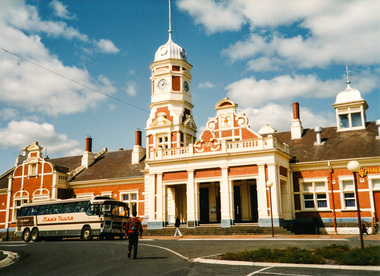
Photograph, Doug Orford, Maryborough Railway Station, Spring Excursion to Maryborough, 27 September 1992, 27/09/1992
... little more than usual at $20.00. The entry to the Midlands Society's Worsley Cottage is included. At the end of the town tour we will visit the C.W.A.'s Fair which is part of the Wattle Festival. Afternoon tea will be available there for a small charge. Bring your lunch and something for morning tea if you wish. We will be travelling to Maryborough via Creswick and Clunes and returning via Castlemaine. We will return about 6.00 pm and transport home can be arranged if required. Maryborough has a rich history with the gold era being particularly significant. Local historian Betty...little more than usual at $20.00. The entry to the Midlands Society's Worsley Cottage is included. At the end of the town tour we will visit the C.W.A.'s Fair which is part of the Wattle Festival. Afternoon tea will be available there for a small charge. Bring your lunch and something for morning tea if you wish. We will be travelling to Maryborough via Creswick and Clunes and returning via Castlemaine. We will return about 6.00 pm and transport home can be arranged if required. Maryborough has a rich history with the gold era being particularly significant. Local historian Betty ...[from EDHS Newsletter No. 86, September 1992:] SPRING EXCURSION MARYBOROUGH: As a Spring excursion our bus trip on 27th September is well timed - Maryborough is conducting its Wattle Festival on that weekend. We are to be guests of the Midlands Historical Society who will provide a guide for our tour of the town. This is a somewhat longer trip than we usually undertake so we have an earlier start at 8.00 am and the cost is a little more than usual at $20.00. The entry to the Midlands Society's Worsley Cottage is included. At the end of the town tour we will visit the C.W.A.'s Fair which is part of the Wattle Festival. Afternoon tea will be available there for a small charge. Bring your lunch and something for morning tea if you wish. We will be travelling to Maryborough via Creswick and Clunes and returning via Castlemaine. We will return about 6.00 pm and transport home can be arranged if required. Maryborough has a rich history with the gold era being particularly significant. Local historian Betty Osborne has produced the book "Maryborough - a Social History 1854-1905". You might like to try and obtain it from the library for advance reading or it will be available for purchase on the day at $25.00. To book for this tour please complete the attached from and return with your payment to the September meeting or send it to our post office box. Friends are most welcome as usual.Two colour photographsactivities, maryborough -
 Eltham District Historical Society Inc
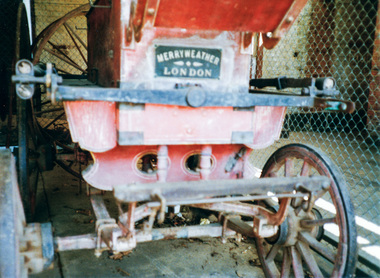
Photograph, At Creswick, Spring Excursion to Maryborough, 27 September 1992, 27/09/1992
... little more than usual at $20.00. The entry to the Midlands Society's Worsley Cottage is included. At the end of the town tour we will visit the C.W.A.'s Fair which is part of the Wattle Festival. Afternoon tea will be available there for a small charge. Bring your lunch and something for morning tea if you wish. We will be travelling to Maryborough via Creswick and Clunes and returning via Castlemaine. We will return about 6.00 pm and transport home can be arranged if required. Maryborough has a rich history with the gold era being particularly significant. Local historian Betty...little more than usual at $20.00. The entry to the Midlands Society's Worsley Cottage is included. At the end of the town tour we will visit the C.W.A.'s Fair which is part of the Wattle Festival. Afternoon tea will be available there for a small charge. Bring your lunch and something for morning tea if you wish. We will be travelling to Maryborough via Creswick and Clunes and returning via Castlemaine. We will return about 6.00 pm and transport home can be arranged if required. Maryborough has a rich history with the gold era being particularly significant. Local historian Betty ...[from EDHS Newsletter No. 86, September 1992:] SPRING EXCURSION MARYBOROUGH: As a Spring excursion our bus trip on 27th September is well timed - Maryborough is conducting its Wattle Festival on that weekend. We are to be guests of the Midlands Historical Society who will provide a guide for our tour of the town. This is a somewhat longer trip than we usually undertake so we have an earlier start at 8.00 am and the cost is a little more than usual at $20.00. The entry to the Midlands Society's Worsley Cottage is included. At the end of the town tour we will visit the C.W.A.'s Fair which is part of the Wattle Festival. Afternoon tea will be available there for a small charge. Bring your lunch and something for morning tea if you wish. We will be travelling to Maryborough via Creswick and Clunes and returning via Castlemaine. We will return about 6.00 pm and transport home can be arranged if required. Maryborough has a rich history with the gold era being particularly significant. Local historian Betty Osborne has produced the book "Maryborough - a Social History 1854-1905". You might like to try and obtain it from the library for advance reading or it will be available for purchase on the day at $25.00. To book for this tour please complete the attached from and return with your payment to the September meeting or send it to our post office box. Friends are most welcome as usual.Colour photographactivities, maryborough -
 Eltham District Historical Society Inc
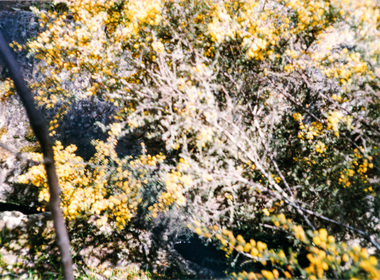
Photograph, Doug Orford, Aboriginal waterholes at Maryborough, Spring Excursion to Maryborough, 27 September 1992, 27/09/1992
... little more than usual at $20.00. The entry to the Midlands Society's Worsley Cottage is included. At the end of the town tour we will visit the C.W.A.'s Fair which is part of the Wattle Festival. Afternoon tea will be available there for a small charge. Bring your lunch and something for morning tea if you wish. We will be travelling to Maryborough via Creswick and Clunes and returning via Castlemaine. We will return about 6.00 pm and transport home can be arranged if required. Maryborough has a rich history with the gold era being particularly significant. Local historian Betty...little more than usual at $20.00. The entry to the Midlands Society's Worsley Cottage is included. At the end of the town tour we will visit the C.W.A.'s Fair which is part of the Wattle Festival. Afternoon tea will be available there for a small charge. Bring your lunch and something for morning tea if you wish. We will be travelling to Maryborough via Creswick and Clunes and returning via Castlemaine. We will return about 6.00 pm and transport home can be arranged if required. Maryborough has a rich history with the gold era being particularly significant. Local historian Betty ...[from EDHS Newsletter No. 86, September 1992:] SPRING EXCURSION MARYBOROUGH: As a Spring excursion our bus trip on 27th September is well timed - Maryborough is conducting its Wattle Festival on that weekend. We are to be guests of the Midlands Historical Society who will provide a guide for our tour of the town. This is a somewhat longer trip than we usually undertake so we have an earlier start at 8.00 am and the cost is a little more than usual at $20.00. The entry to the Midlands Society's Worsley Cottage is included. At the end of the town tour we will visit the C.W.A.'s Fair which is part of the Wattle Festival. Afternoon tea will be available there for a small charge. Bring your lunch and something for morning tea if you wish. We will be travelling to Maryborough via Creswick and Clunes and returning via Castlemaine. We will return about 6.00 pm and transport home can be arranged if required. Maryborough has a rich history with the gold era being particularly significant. Local historian Betty Osborne has produced the book "Maryborough - a Social History 1854-1905". You might like to try and obtain it from the library for advance reading or it will be available for purchase on the day at $25.00. To book for this tour please complete the attached from and return with your payment to the September meeting or send it to our post office box. Friends are most welcome as usual.Colour photographactivities, maryborough -
 Eltham District Historical Society Inc
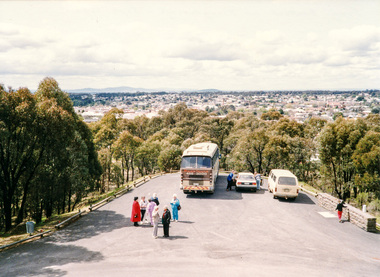
Photograph, Doug Orford, From Maryborough Lookout, Spring Excursion to Maryborough, 27 September 1992, 27/09/1992
... little more than usual at $20.00. The entry to the Midlands Society's Worsley Cottage is included. At the end of the town tour we will visit the C.W.A.'s Fair which is part of the Wattle Festival. Afternoon tea will be available there for a small charge. Bring your lunch and something for morning tea if you wish. We will be travelling to Maryborough via Creswick and Clunes and returning via Castlemaine. We will return about 6.00 pm and transport home can be arranged if required. Maryborough has a rich history with the gold era being particularly significant. Local historian Betty...little more than usual at $20.00. The entry to the Midlands Society's Worsley Cottage is included. At the end of the town tour we will visit the C.W.A.'s Fair which is part of the Wattle Festival. Afternoon tea will be available there for a small charge. Bring your lunch and something for morning tea if you wish. We will be travelling to Maryborough via Creswick and Clunes and returning via Castlemaine. We will return about 6.00 pm and transport home can be arranged if required. Maryborough has a rich history with the gold era being particularly significant. Local historian Betty ...[from EDHS Newsletter No. 86, September 1992:] SPRING EXCURSION MARYBOROUGH: As a Spring excursion our bus trip on 27th September is well timed - Maryborough is conducting its Wattle Festival on that weekend. We are to be guests of the Midlands Historical Society who will provide a guide for our tour of the town. This is a somewhat longer trip than we usually undertake so we have an earlier start at 8.00 am and the cost is a little more than usual at $20.00. The entry to the Midlands Society's Worsley Cottage is included. At the end of the town tour we will visit the C.W.A.'s Fair which is part of the Wattle Festival. Afternoon tea will be available there for a small charge. Bring your lunch and something for morning tea if you wish. We will be travelling to Maryborough via Creswick and Clunes and returning via Castlemaine. We will return about 6.00 pm and transport home can be arranged if required. Maryborough has a rich history with the gold era being particularly significant. Local historian Betty Osborne has produced the book "Maryborough - a Social History 1854-1905". You might like to try and obtain it from the library for advance reading or it will be available for purchase on the day at $25.00. To book for this tour please complete the attached from and return with your payment to the September meeting or send it to our post office box. Friends are most welcome as usual.Two colour photographsactivities, maryborough -
 Kiewa Valley Historical Society
Book - School Reader for Infants, John and Betty, 1951
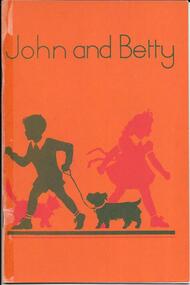
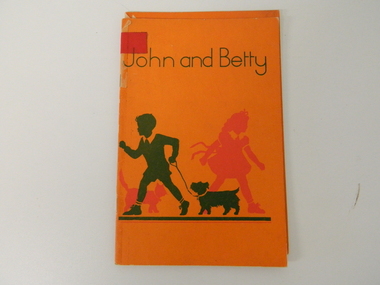
... On the front page "John and Betty" below this "The earliest Reader for the Little Ones". Below this "Illustrations by Marjorie Howden" Further down the page and in smaller print is "Education Department of Victoria 1951". ...The book is in good condition, consequently making it suitable for exhibitions, and highlighting schools in the Kiewa Valley along with what local children read in these schools. first grader reader primary education 1950's style On the front page "John and Betty" below this "The earliest Reader for the Little Ones". Below this "Illustrations by Marjorie Howden" Further down the page and in smaller print is "Education Department of Victoria 1951". ...This "first reader" for children in a Victorian Primary school was fashioned by the period that it was printed in (1951), and the associated educational principles was applied by the Victorian Educators. It defines the role play of young children, at this point, in their educational development and contained within the(1950's) "society's" mores and expectations. This book was widely used by state schools in Victoria including Mt Beauty and Tawonga Primary Schools.This reader is significant to the Kiewa Valley because it demonstrates that there was still a very marked "one book" fits all school environmental approach by State educators which the local schools were apart of. This book is one of the KVHS children's school book collection, which many were donated by local families whose children went to Mt Beauty Primary School. Therefore this reader represents a social history significance for the period from 1950's and 60's. The book is in good condition, consequently making it suitable for exhibitions, and highlighting schools in the Kiewa Valley along with what local children read in these schools. This primary school reader has an orange cover with "John and Betty" printed in green. Below this is the green outline of a young boy leading his dog(Scottish Terrier) on a lead. Behind him is the red outline of a young girl (bow tied waist belt) in front of a cat(tail up). A thick green line is situated below the figures. The cover is 180 gsm thick. Inside the book are colored sketches of a boy and a girl playing well defined "boy" and "girl" activities (gender specific for the period of print 1951) Below these activities are simple descriptive words for the above activities.On the front page "John and Betty" below this "The earliest Reader for the Little Ones". Below this "Illustrations by Marjorie Howden" Further down the page and in smaller print is "Education Department of Victoria 1951". Below this and under a fine line "A.C. Brookes, Government Printer, Melbourne"first grader reader, primary education 1950's style -
 Warrnambool RSL Sub Branch
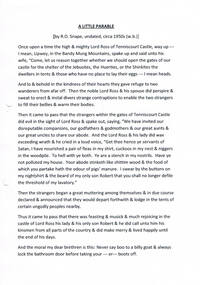
'A Little Parable'. A humourous piece written in the 1950s, about Bob's friend (and Madge's younger sister Betty's husband) LES ROSS, Reg. No. 2475, a veteran of the 5th Machine Gun Company, 18th Battalion, in the Middle East and on the Western Front and later, a fighter pilot with the Australian Flying Corps. He re-enlisted in WW2 and served in the RAAF, in northern Australia, in air traffic control. (Photos of Les courtesy of Les and Betty's son, Robert Hamilton Ross)
... Little Parable'. A humourous piece written in the 1950s, about Bob's friend (and Madge's younger sister Betty's husband) LES ROSS, Reg. ...snape collection -
 Bendigo Historical Society Inc.
Document - VIKKI SPICER COLLECTION: BENDIGO OPERATIC SOCIETY PROGRAMME BOOKLET, May, 1957
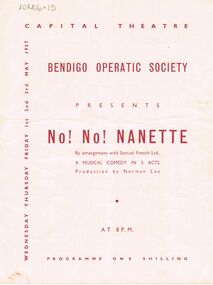
... Betty Cullen, Dawn Beckwith, Jean Cannon, Rhonda Miller. Songs Include: 'The Call of the Sea', 'I Want to be Happy', 'No, No Nanette,' 'Tea for Two', 'How Do You Do,' 'Too Many Rings Around Rosie', 'You Can Dance With Any Girl,' 'Take A Little One-Step', 'It's A Pity to Say Goodnight.'...Betty Cullen, Dawn Beckwith, Jean Cannon, Rhonda Miller. Songs Include: 'The Call of the Sea', 'I Want to be Happy', 'No, No Nanette,' 'Tea for Two', 'How Do You Do,' 'Too Many Rings Around Rosie', 'You Can Dance With Any Girl,' 'Take A Little One-Step', 'It's A Pity to Say Goodnight.' ...Cream and Maroon Booklet Bendigo Operatic Society Theatre Programme 'No No Nanette' A Musical Comedy in Three Acts. Capital Theatre Bendigo May 1, 2 and 3, 1957 8 pm. Arranged by Samuel French Ltd. Producer Norman Lee. Musical Director Max O'Loghlen. Cast: Greta Smyth, Ruth McLennan, Brian Brewer, Barbara McGregor, Voronica Blanch, Harry brewer, Brian Thomas, Betty Cullen, Dawn Beckwith, Jean Cannon, Rhonda Miller. Songs Include: 'The Call of the Sea', 'I Want to be Happy', 'No, No Nanette,' 'Tea for Two', 'How Do You Do,' 'Too Many Rings Around Rosie', 'You Can Dance With Any Girl,' 'Take A Little One-Step', 'It's A Pity to Say Goodnight.'Cambridge Press Bendigo.clubs and associations, theatre, bendigo operatic society, https://en.wikipedia.org/wiki/no, _no, _nanette -
Glen Eira Historical Society
Newsletter - CAULFIELD RSL
... Betty M. Le... Logan George... Wilson Tony... Slater Bob... Cobby A. H. (Harry) Air Commodore... Steinberg Alison Mrs.... Astill Bob... Reed Donald... Niewland Hans... Bodelier Berry... Little...Betty M. Le Logan George Wilson Tony Slater Bob Cobby A. H. (Harry) Air Commodore Steinberg Alison Mrs. Astill Bob Reed Donald Niewland Hans Bodelier Berry Little Harold Hawkes Stewart Limbue Ram Bahadur Kirkwood Robert Rai Bharansher McLean Susan McBean Jon White Michael Sgt. ...This file contains one item about the Caulfield RSL’s newsletter: 1/Five issues (nos. 26, 33, 35, 42, and 44) of Furfs, the official newsletter of the Caulfield RSL, dated 12/2000, 05/2004, 10/2005, 12/2007, and 11/2009 respectively. The issues vary in size (numbering 12, 6, 1, 8, and 8 pages, respectively) and consequently, in terms of breadth of content. Most, however, report on the Club’s recent activities, list the current administrative staff, eulogise recently deceased members, and contain advertisements for goods and services of interest to members. All except the shortest also contain numerous black-and-white photographs of members participating in various events. No. 42 also has an article on the progress of the Club history including mention of a 1963 ABC Four Corners episode with footage inside and outside the Club as well as interviews with members.furfs, advertisements, gould tony, moore hedley, frances ken, stewart r. k, whybrow john, mclean tom, elsternwick, canfield bill, anzac day, remembrance day, middlemiss glenys, middlemiss brian, sayers john, rodda alby, st. george’s road, remembrance day service, president’s dinner, annett michael colonel, dejussing clive, stacey carole, white thomas sir, fuller joan, edwards m. t., greer j., warburton jimmy, decker john, mcbean j., mclean s. mrs., gibson ray, rigby jack, oakley trevor, paul’s steak house, wear well dry cleaners, mclean susan, caulfield lions clubs, glen eira district lions, ‘my brother jack’ short story award, ‘glenmore’, everett kevin, lee kenneth c., sneddon bruce n., perignon george j., bradley john m., kennedy colin j., waratah cellars, glenhuntly road, glen huntly road, taverna john, taverna robyn, gaylard bernie, auhl ron, yob loretta, muir frank, morris tony, blaney matt, james bob, kevin brennan, davey kathleen, wreath laying ceremonies, may carl, one petroleum co., ager michelle major, taus joe, geier noel, blore peter, creaney john, wadley geoffrey, oliver mavis i., browne donald d., ross john, kidd william, rea alan m., pollock rob, pollock florence, sell patricia miss, fidler n., dew d., mayell w., booth vincent, booth lois, johnson carl, ‘the ole tin hat’, centre road, bentleigh, rigby pat, eade charles, howell davie, blore jeff, russell paul, morse r. e., long bridford f. r., harkensee keith r., collins williams h., daniels albert e., stephani detleef p. von, walton alan l., canfield william g., barclay henry i., rose frank w., sherriff william g., may donald c., fergus mark l., sorel peter a., chivers keith, scarffe richard a., dalgleish maggie, sampson stan, jacobs frank, ware les, powell massey, merlo harry, perini leo, milnes ‘bluey’, carmody jack, edwards michael terrence, orrock george, lyon stan, raines barbara, raines laurie, hall ron, metherall murray, blore geoff, walker keith, davis max, doyle tom, reece jim, jewell bill, o’neill roe, ferrari ron, fogarty des, sinclair bill, mitchell j., harris l., boughton h. ms., townsend d. mrs., decker j., larkin r., elder g., sell p., clarke john, mclean t., kean phyllis m., booth geoffrey e., donoghue clifton s., durham leonard c., ford john w., nitsche neil h., davidson kelvin r., werba adele, pleydell max, price colin, taberner laurie, condron neil, leech gail, green barry rev’d, veteran’s lunch, devlin joseph h., murray mark blodwen, jackman david d., hall erica d., hackman james f., thompson pauline l., gassick betty m. le, logan george, wilson tony, slater bob, cobby a. h. (harry) air commodore, steinberg alison mrs., astill bob, reed donald, niewland hans, bodelier berry, little harold, hawkes stewart, limbue ram bahadur, kirkwood robert, rai bharansher, mclean susan, mcbean jon, white michael sgt., caspar freddie -
 Warrnambool and District Historical Society Inc.
Book, Archibald Constable & Co Ltd, Bachelor Betty, 1905
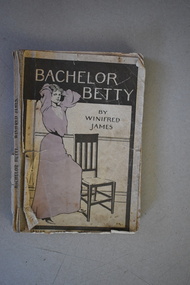
... The book is a little tattered and dog-eared. Bachelor Betty Book Archibald Constable & Co Ltd. ...This book was written by Winifred James. She was born in Melbourne in 1876 and began writing in the early 1900s. ‘Bachelor Betty’ was published in England in 1905 and was a successful publication. The book is marked ‘Vickers’ and may have belonged to Daisy Vickers (1907-1987), later Mrs Ogier. She was a long-serving and very respected teacher and Senior Mistress at Warrnambool Technical School. This book is retained because the author was an early advocate for women’s rights and because it may have a close connection to Daisy Vickers, an important 20th century teacher in Warrnambool. This is a paper back of 127 pages. It has 46 chapters and several advertisements inside the covers. The front cover, partly detached from the binding, has an image of a woman near a chair in mauve, grey and buff tonings. The book is a little tattered and dog-eared.‘Vickers’daisy vickers, winifred james, history of warrnambool -
 Anglesea and District Historical Society
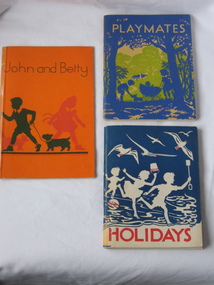
Victorian Education Department Readers, Playmates; Holidays; John and Betty, 1951, 1952, 1953
... John and Betty: the earliest reader for the little ones, all colour illustrations Playmates: the Victorian readers, first book, black & white with few colour illustrations Holidays: the Victorian readers, second book...John and Betty: the earliest reader for the little ones, all colour illustrations Playmates: the Victorian readers, first book, black & white with few colour illustrations Holidays: the Victorian readers, second book Playmates; Holidays; John and Betty Victorian Education Department Readers ...Set of teaching flash cards with single words and sentences went with "John and Betty" - these resources missing. "Playmates" and "Holidays" were the only reader for the year.Three volumes with soft cardboard covers, staple binding, clear adhesive tape on exterior and interior binding. John and Betty: the earliest reader for the little ones, all colour illustrations Playmates: the Victorian readers, first book, black & white with few colour illustrations Holidays: the Victorian readers, second bookJan Morrisonbook, primary reader, victorian education -
 Stawell Historical Society Inc
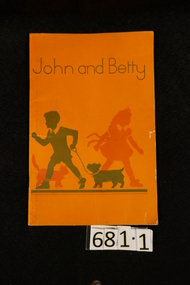
Book, Education Department of Victoria, John and Betty, 1951
... little ones. Education department 1951 stawell education John And Betty Orange Cover with green drawing of a girl with a cat following her in darker Orange. over layed by a boy with a dog on lead in green with title above John and Betty Book Education Department of Victoria ...The Earylist reader for little ones. Education department 1951 Orange Cover with green drawing of a girl with a cat following her in darker Orange. over layed by a boy with a dog on lead in green with title aboveJohn And Bettystawell education -
 Peterborough History Group
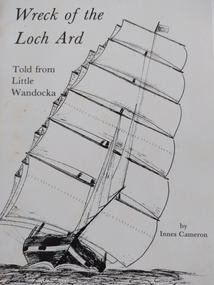
Innes Cameron, Wreck of the Loch Ard Told from Little Wandocka, 1986
... little wandocka...peterborough poems...loch ard...crazy kate beach...wild dog cove...betty...Significant due to he memories of Peterborough and names of holiday visitors. innes cameron peterborough little wandocka peterborough poems loch ard crazy kate beach wild dog cove betty cameron Small paperback booklet. ...Innes Cameron was a regular visitor to Peterborough.Significant due to he memories of Peterborough and names of holiday visitors.Small paperback booklet.innes cameron, peterborough, little wandocka, peterborough poems, loch ard, crazy kate beach, wild dog cove, betty cameron -
 Sunshine and District Historical Society Incorporated
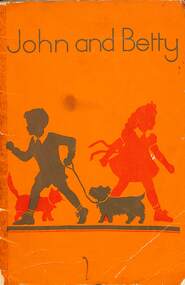
Book - John And Betty The Earliest Reader For The Little Ones, Betty Somerville et al, 1951
... John And Betty The Earliest Reader For The Little Ones...John And Betty The Earliest Reader For The Little Ones...Front Cover - John and Betty First Page - Handwritten Rodney Francis Orange soft covered book with text and an image John And Betty The Earliest Reader For The Little Ones Book John And Betty The Earliest Reader For The Little Ones Betty Somerville Marjorie Howden Education Department Victoria A.C. ...Orange soft covered book with text and an imagenon-fiction -
 Melbourne Legacy
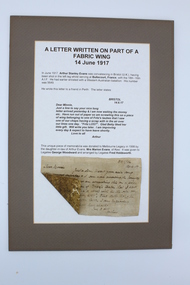
Document, Letter written on part of a fabric wing 14 June 1917, 1917
... "Fritz LOST". Glad Betty liked her little gift. Will write you later. I am improving every day and expect to have leave shortly. ..."Fritz LOST". Glad Betty liked her little gift. Will write you later. I am improving every day and expect to have leave shortly. ...A wartime letter written by Arthur Evans that was later mounted on card for display purposes. It was donated to Legacy in 1998. The letter was written on the fabric of an aircraft wing. The letter was written by Arthur Stanley Evans while convalescing in Briston in 1917. He had been injured at Bullecourt, France with the 18th-16th AIF. The letter says 'Dear Minnie, Just a line to say your nice long letter arrived yesterday and I am now waiting the money etc. Have run out of paper so am scrawling this on a piece of wing belonging to one of Fritz's tubes that I saw one of our chaps having a scrap with in the air over our lines one day. "Fritz LOST". Glad Betty liked her little gift. Will write you later. I am improving every day and expect to have leave shortly. Love to all, Arthur." Not to let war time shortages of paper get in Arthur Evans way, he improvised and his letter to Minnie, it arrived intact. The fabric would be quite durable and light. A great memento to show family and friends.Despite war time shortages a little ingenuity can overcome many difficulties.Backing, ply board. Letter and short story typed on white cardboard, cardboard fixed to ply backing. Original letter fixed to white cardboard. Lower left hand corner folded over showing the reverse side of the fabric. Original letter rectangular in shape. All of the above is surrounded by a brownish border.The letter, the story and how the letter came to Legacy is printed in brown ink. The original letter is hand written on a piece of wing fabric from a German aircraft shot down over Allied lines.souvenir, world war one -
 Torquay and District Historical Society
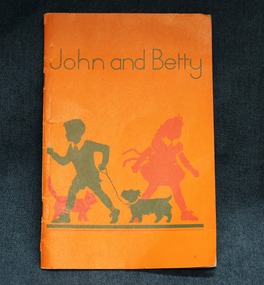
Book - School reader, Howden, Marjorie, John and Betty: the earliest reader for the little ones, 1951
... John and Betty: the earliest reader for the little ones...Business card pasted on inside front cover "Class Act" School reader, orange paperback cover, 24 pages John and Betty: the earliest reader for the little ones Book School reader Howden, Marjorie Education Department of Victoria ...This reader was used at Torquay Primary School, State School Number 3368. It is from a series of official Prep readers used in Victorian schools from 1951 to mid 1960s.School reader, orange paperback cover, 24 pagesfictionThis reader was used at Torquay Primary School, State School Number 3368. It is from a series of official Prep readers used in Victorian schools from 1951 to mid 1960s.education -
![COL photo of a man standing in front of a row of tables set against the wall. The wall is covered with various posters, and there is a window on either side. Poster titles include: "If old age is catching up, walk a little faster" (VicHealth, Active At Any Age); "Table tennis [keeps] you moving. Move it or lose it"; "Ben Back-Bender says WATCH YOUR BACK"; "The WALK of life. Well-being Aerobic exercise Life Extension Kilograms" (Institute of Health & Fitness); "Betty Bones [illegible] YOU CAN [illegible] BONES STRONG! MOVE IT OR LOSE IT".](/media/collectors/6406aa055b62820f1ee406c8/items/68884b64aa506c2d1b98a179/item-media/68884c35aa506c2d1b98a644/item-fit-380x285.jpg?cb=6) Musculoskeletal Health Australia (now held by the Glen Eira Historical Society)
Musculoskeletal Health Australia (now held by the Glen Eira Historical Society)Photograph - Solo photo, 1993
... little faster" (VicHealth, Active At Any Age); "Table tennis [keeps] you moving. Move it or lose it"; "Ben Back-Bender says WATCH YOUR BACK"; "The WALK of life. Well-being Aerobic exercise Life Extension Kilograms" (Institute of Health & Fitness); "Betty Bones [illegible] YOU CAN [illegible] BONES STRONG! ...little faster" (VicHealth, Active At Any Age); "Table tennis [keeps] you moving. Move it or lose it"; "Ben Back-Bender says WATCH YOUR BACK"; "The WALK of life. Well-being Aerobic exercise Life Extension Kilograms" (Institute of Health & Fitness); "Betty Bones [illegible] YOU CAN [illegible] BONES STRONG! ...Rheumatologist and founder of the Arthritis Foundation of Victoria (formerly the Rhematism and Arthritis Association of Victoria), Dr Leslie Koadlow AO (1920-2006) is pictured at the Foundation's premises at Action House. This photo appears on page 16 of the Vol 6 No 3, Spring 1993 issue of the Arthritis Foundation of Victoria's quarterly magazine, Arthritis Update. It is captioned: "Below: Dr Les Koadlow, AFV President, endorses the Bionic Walk. Story, page 4." The article on page 4 promotes the upcoming Great Bionic Walk which was to be held at Albert Park Lake on Sunday, the 14th of November. The walk was a fundraising event which aimed to raise five million dollars nationally to support the Australian Orthopaedic Association Research Foundation through sponsorship of participants in the walk. A sausage sizzle and entertainment was planned to provide refreshments for participants after the walk.COL photo of a man standing in front of a row of tables set against the wall. The wall is covered with various posters, and there is a window on either side. Poster titles include: "If old age is catching up, walk a little faster" (VicHealth, Active At Any Age); "Table tennis [keeps] you moving. Move it or lose it"; "Ben Back-Bender says WATCH YOUR BACK"; "The WALK of life. Well-being Aerobic exercise Life Extension Kilograms" (Institute of Health & Fitness); "Betty Bones [illegible] YOU CAN [illegible] BONES STRONG! MOVE IT OR LOSE IT".[Handwritten in pencil] 16E (if used) [On a yellow sticky note, handwritten in pencil] Les Koadlow 1993 endorsing the Great Bionic Walk (Arthritis Update Spring 1993 pg 4, 16.dr leslie koadlow, rheumatologist, founder, co-founder, president, arthritis foundation of victoria, afv, rheumatism and arthritis association of victoria, raav, action house, great bionic walk, fundraising, sponsorship, australian orthopaedic association research foundation, albert park lake, sausage sizzle, arthritis update, 1993 -
 City of Melbourne Libraries
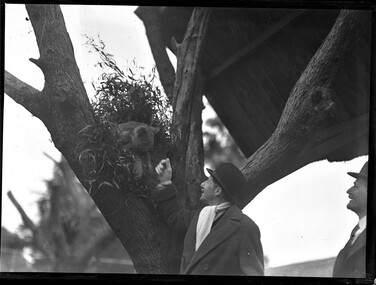
Photograph, Bull, Hugh Jones, 1897-1993, Vice-regal visit to zoo: Governor (Lord Huntingfield) and koala
... Little Australian” book for children was published by Angus and Robertson. It was written and illustrated by New Zealand-born author Dorothy Wall and “Dedicated to my son Peter and all other Peters and Johns and Bobs and Toms and Marys and Bettys and Joans and Pats and all kind children.” ...Little Australian” book for children was published by Angus and Robertson. It was written and illustrated by New Zealand-born author Dorothy Wall and “Dedicated to my son Peter and all other Peters and Johns and Bobs and Toms and Marys and Bettys and Joans and Pats and all kind children.” ...Published: (1934, June 26). The Age (Melbourne, Vic. : 1854 - 1954), p. 11. Published title: VICE-ROYALTY GREETS THE KING OF THE BEASTS AT THE ZOO. Published caption: Lord Huntingfield experienced a pleasant “induction ceremony” as Patron of the Royal Zoological and Acclimatisation Society yesterday, when he made a tour of the Zoological Gardens. The picture shows the Governor, accompanied by Lady Huntingfield, inspecting the King of Beasts, who is submitting to a little playful treatment from the Director of the Gardens, Mr. Wilkie, while the Director whispers in his ear that a distinguished visitor has come to see him. (Inset), is a picture of Lord Huntingfield greeting one of the Koalas. Trove article identifier: http://nla.gov.au/nla.news-article204818472 Description: A man wearing a hat, scarf and overcoat reaches up to pat a koala in a tree watched by a man in a hat and suit. Research by project volunteer, Fiona Collyer: In 1932, the Zoo built an Australian native animal enclosure which visitors could enter and closely view koalas, wallabies, kookaburras and magpies all placed together. The branches of the trees in the enclosure were cut so that visitors could easily see and feed the koalas sitting in them. The cost to feed each koala fresh gum leaves was fifteen shillings per week. By 1924, Queensland was the last stronghold in Australia for the koala. They were functionally extinct in South Australia, only a few hundred in NSW, and an estimated population of 1000 animals remained in Victoria. There had been a six-month open season on koalas in Queensland in 1919 where over a million had been slaughtered, however with its vast, dense forests it was impossible to accurately know their numbers. Koala fur is tough, warm and waterproof and was in high demand from consumers in Canada, Britain and the US to make hats and gloves and for lining greatcoats. In 1927, with Queensland suffering a crippling drought and high unemployment, the cash-strapped McCormack Labor Government declared an “Open Season” on koalas and “opossums” for their skins, for the month of August. (Possums were often called “opossums” at this time but they are actually possums). There were widespread protests from many groups including the Nature Lovers League, Wild Life Preservation Society of Australia, Queensland Museum, C.W.A. Royal Australian Ornithologist Union, Boy Scouts, religious and women’s groups. There were letters to newspapers from ordinary people, editorials and pleas to women to refuse to wear or purchase koala fur. People questioned the masculinity of koala hunters as it was felt that no proper bushman or sportsman would kill such a defenceless creature. The Brisbane Courier newspaper led the campaign, devoting six columns a day to “Spare the Bear”. Author Vance Palmer sent an impassioned letter to the editor of the The Brisbane Courier, 19 July 1927: “Sir- It is be hoped that the disgust which all humane people have felt at the declaration of an open season for native bears in August will not be allowed to fade away until some protest... so overwhelming and effective that the question will never be raised again. For the shooting of our harmless and loveable native bear is nothing less than barbarous. His case is entirely different from that of other furred animals. No one has ever accused him of spoiling the farmers’ wheat, eating the squatters’ grass or even spreading the prickly pear. There is not a social vice that can be put down to his account. In addition, he is comparatively defenceless. He affords no sport to the gunman, and can be trusted to present a sitting target to the creature mean enough to aim at him. For this reason he has been almost blotted out already from some areas, in days when our fauna and flora were held in such little regard that the settlers’ first instinct was to shoot every strange animal and to sink his axe into every unfamiliar tree.” The Anglican Archbishop of Brisbane, Gerald Sharp, had his letter published in The Brisbane Courier on 16 July 1927: “Sir... The extermination of fauna so distinctive of our country, especially of such harmless and pretty creatures as our native bears, seems to me a shameful thing, and this is likely to mean their extermination.” But it was all to no avail. Known as “Black August”, the government was unmoved by the public’s outrage. 10,000 licences were issued to hunters and “the slaughter of the innocents” went ahead. The newspapers were full of stories of dreadful cruelty against the helpless, benign creatures by the heartless hunters who not only used guns and spotlights but wire snares and cyanide baits so that pelts wouldn’t be damaged. Infant koalas were left orphaned and unlikely to survive without their mothers. Top quality pelts were sold at an average price of 56 shillings and 9 pence per dozen, poor quality skins for as little as 2 1/2 pence each. In December 1927, the Minister for Agriculture and Stock, Mr W. Forgan Smith told the Parliament that during the August open season 597,985 koala pelts worth £139,595 had netted the state’s coffers £6000. 952,194 “opossum” pelts were sold and £9000 made for the State. The backlash that followed helped topple the Queensland Labor Government in 1929. The Wild Life Preservation Society of Australia lobbied the Prime Minister Mr Stanley Bruce to refuse to issue exportation permits for koala pelts and from 10 November 1927 the Commonwealth Government suspended the issuing of permits. In 1930, the Society made a direct appeal to USA President Herbert Hoover and he signed an order prohibiting the importation of koala and wombat fur to USA, eliminating a major market. Koala pelts were often deliberately mislabelled “wombat” to get around restrictions. The ban most likely saved the koala from probable extinction. Three years later the Australian Federal Government banned the export of koala products. This movement against koala killing was really the first conservation campaign in Australia. It raised awareness of the vulnerability of a beloved animal and eventually brought about national parks and national laws for their protection. By 1936, community opposition to possum open seasons was beginning. The koala was made a Protected Species in all states in 1937, meaning no one is allowed to harm a koala, however the laws protecting the gum trees they rely on for food and shelter are weak. The Australian Government estimates the wild koala population in Australia is between 225,000 and 500,000 in 2024. The Australian Koala Foundation estimates the national population at less than 60,000 in 2021 with a 30% decline in three years. Habitat loss from land clearing, dog attacks, road deaths, chlamydia, bushfires and drought exacerbated by climate change, continues to cause their decline. Over eight million koalas were killed for their pelts between 1888 and 1927. Any one of the annual harvests killed more koalas than are alive now. At this time, children were also being taught to appreciate Australian native animals. In 1933, “Blinky Bill: The Quaint Little Australian” book for children was published by Angus and Robertson. It was written and illustrated by New Zealand-born author Dorothy Wall and “Dedicated to my son Peter and all other Peters and Johns and Bobs and Toms and Marys and Bettys and Joans and Pats and all kind children.” The book tells the story of Blinky Bill - a mischievous, patched knickerbocker-wearing koala and his mother and father. The story has messages of conservation and instances of human unkindness and cruelty. Mr. and Mrs. Koala and young Blinky lead a mostly idyllic family life amongst a variety of other animals in the forest. However it all changes in chapter two, when Blinky Bill’s father is distressingly shot by a hunter. There is a harrowing description of Mr. Koala’s shooting and eventual death. “The Koala family lived so happily; never thinking of harm, or that anything could happen to disturb their little home, as all they asked for were plenty of fresh gum-leaves and the warm sun. They had no idea such things as guns were in the world or that a human being had a heart so cruel that he would take a pleasure in seeing a poor little body riddled with bullets hanging helplessly from the tree-top... That same being might just as well take his gun and shoot baby kookaburras, so helpless were they all and so trusting.” “Poor Mr. Koala one day was curled up asleep in his favourite corner, when the terrible thing happened. Bang! He opened his eyes in wonder. What was that? Did the limb of the tree snap where that young cub of his was skylarking? ... bang! again. This time he felt a stinging pain in his leg... Peering over the bough of the tree he saw a man on the ground with something long and black in his arms... Another bang and his ear began to hurt. Bang! again and now his little body was stinging all over. He grunted loudly and slowly climbed up the tree, calling Mrs. Koala and Blinky as he went. He managed to reach the topmost branch... Tears were pouring down his poor little face. He brushed them away with his front paws and cried just like a baby. Fortunately Mrs. Koala and Blinky Bill were hiding in the leaves quite motionless, and the shadows of the tree made them appear as part of it. The man with the gun stood and waited a long time, then walked away, whistling as he went - the only sound to be heard in the bush except the cries of the little bear far up in the tree.” Blinky and his mother quietly and fearfully wait for Mr. Koala to wake. In the morning, grunting and crying, they feel his lifeless body with their paws. Eventually Mrs. Koala realises that her husband is dead and that they need to move to a safe place. After travelling deeper into the forest, Mrs. Koala and Blinky meet koalas Mrs. Grunty and her son Snubby and she describes how she was captured as a baby by koala fur trappers to be a pet for a little girl. The trapper forgot to bring gum leaves for the koala so they try to feed her cake, milk and bananas, making her sick. The little girl’s father relays something he read in the paper: “During the year 1920 to 1921, two hundred and five thousand six hundred and seventy-nine koalas were killed and their skins sold to the fur market, under the name of wombat.” They place the koala in a box with a teddy bear for company. The baby koala’s health deteriorates and the alarmed trapper returns her to the bush. Mrs. Grunty tells Mrs. Koala that she and Blinky are the only bears that she has seen for ten years: “I remember well the little girl’s father telling her... that not so many years ago the bush was alive with us bears, from Queensland to the south of Victoria. Now, we are so rare that we have become a curiosity, something to put in zoos, for children to see; and actually in museums. I believe our grandparents sit there in glass cases, stuffed with something inside to make them appear alive, and, oh dear, glass eyes. In New South Wales, I think we could wander for miles from one corner to another and never meet a bear. I don’t know why we were all killed. As you know, we don’t eat the farmers’ crop or ruin their orchards. All we asked for were our own gum-trees.” At the end of the book, Dorothy tells her readers - “The kindest action of all would be to leave the koala baby in his own bushland, among his own playmates, with the sun, the sky, the birds, and the gum-trees, where he will grow to manhood and live for many years - happy as he should be.” In 1934, a “Wild Zoo”, the Sir Colin Mackenzie Sanctuary, opened on 32 hectares of land, formerly part of Coranderrk Aboriginal Reserve in the Yarra Valley, exclusively displaying Australian native animals, birds and reptiles. It was later renamed Healesville Sanctuary and is now managed by Melbourne Zoo and home to over 200 species of Australian native fauna. The Sanctuary is committed to rescuing, breeding, researching and raising awareness of the vulnerability of Australian animals. Andrew Arthur Wellesley Wilkie, 1853-1948, was Director of the Melbourne Zoo from 1923 to 1936 and was associated with the zoo for 70 years. He first worked as a horticultural assistant to Government botanist Baron Ferdinand von Mueller at the Botanical Gardens at the age of 13, along with his older brother David. One of Andrew’s jobs was to capture moths for the National Herbarium. In 1857, a group of prominent Melburnians assembled at St. Patrick’s Hall to form the Zoological Society of Victoria, with the aim of introducing animals and plants from overseas. It was conceived, “For the purposes of science and for that of affording the public the advantages of studying the habits of the animal creation in properly arranged zoological gardens.” The Victorian Government granted 32 acres (13 hectares) of land to the Zoological Society at the southern end of Richmond Paddock on the opposite bank to the Botanical Gardens. (This is where AAMI Stadium and Collingwood Football Club now stand.) In 1861, the Zoological Society of Victoria was renamed The Acclimatisation Society of Victoria. Unfortunately the Yarra River frontage was damp, swampy and subject to flooding, so the animals were briefly housed at the Botanical Gardens until in 1862, the City of Melbourne donated 55 acres (22 hectares) of land at Royal Park for the fledgling zoo. Baron von Mueller secured employment at Royal Park for Andrew and David and they helped to lay out the gardens, plant trees and take care of a collection of deer, pheasants, hares and partridges. Initially the zoo was used for the acclimatisation of animals recovering from the long voyage to Australia and for breeding them for sport. In 1872, the zoo bought two lions, a leopard and a cheetah that had been seized from circus showmen Keith and Phillips when they were unable to pay the bill of butcher Mr T K Bennet of Bourke Street. The first zoo director, Mr. Albert Le Souef, negotiated with captains of ships to buy animals at overseas ports they visited and soon a multitude of exotic species arrived, including a ten-year-old Indian elephant in 1878. In 1923, after being head keeper for some years, Andrew was appointed director of the zoo. By 1933, the zoo had 110 different species of animals, 200 species of birds and 72 species of reptiles under Andrew’s care. He had personally planted all but six trees and laid out the garden beds. As director he lobbied authorities for funds to build more humane enclosures for the animals. In June 1928, Table Talk magazine wrote of Andrew Wilkie: “Up at the Zoo there is a humble gentleman who is a lion among the lions, who knows the proper specific to employ when the boa constrictor has chilblains, and who is a friend and confidant of Queenie the elephant. His fount of zoological lore has never been plumbed. It is bottomless, like his good fellowship and geniality. Every day he may be seen somewhere in the grounds of that growing sanctuary for the strange and arresting fauna and creeping things of the world, and I assure you as one who is privy to his passion that that area and its inhabitants are rarely out of his thoughts.” Andrew retired from the zoo in 1936 at the age of 83 and in 1948 died at his home in Brunswick aged 94. He and his wife Josephine had six children. The Victorian Acclimatisation Society was founded in 1861 by Edward Wilson, 1813-1878, then owner and editor of The Argus newspaper. He said that Australian indigenous animals were practically useless, providing only “a little sport and an occasional meal”. The Society believed that Australia’s plants and animals were vastly inferior to those in Europe. They wanted to introduce and acclimatise to Victoria “all innoxious animals, birds, fishes, insects and vegetables, whether useful or ornamental” for sport and for the table, and to spread indigenous animals and plants from the colony around the world. Their motto was “if it lives, we want it”. The Society was primarily responsible for introducing sparrows, starlings, sambar and hog deer, ostriches, brown trout, blackberries, and carp to the Murray River. They released the European songbirds, thrush and blackbird to quell the homesickness of British settlers. The Society also sent Australian animals like platypus, echidnas, kangaroos and koalas to Europe for scientific and novelty purposes. Thomas Austin, a wealthy sheep farmer of Barwon Park, Winchelsea (property now owned by the National Trust) was a member and in 1859 he introduced hares, blackbirds, thrushes and partridges onto his property. He is probably best known for introducing 24 breeding rabbits onto his estate as game for shooting parties. Thomas quipped, “The introduction of a few rabbits could do little harm and might provide a touch of home, in addition to a spot of hunting." In 2022, genomic data confirmed that Australia’s feral rabbit population is entirely descended from these rabbits. Biological control has brought the rabbit population down from an estimated high of 10 billion rabbits in the 1920s to approximately 200 million today, inhabiting 70% of Australian landmass (5.3 million square kilometres). In 1872, the Acclimatisation Society was renamed The Zoological and Acclimatisation Society of Victoria and they focused on importing exotic animals for display purposes to the zoo. In 1937, the Royal Acclimatisation Society of Victoria was recreated as the Zoological Board of Victoria with a focus on research of native animals threatened with extinction. In an editorial for The Argus newspaper, 16 March 1856, Edward Wilson lamented: "...this country has been shamelessly stolen from the blacks. Had they been like the New Zealanders or the North American Indians, we should have bought their land, and supplied them with the means of living when we took it... In less than twenty years we have nearly swept them off the face of the earth. We have shot them down like dogs. In the guise of friendship we have issued corrosion sublimate in their damper, and consigned whole tribes to the agonies of an excruciating death. We have made them drunkards, and infected them with disease which has rotted the bones of their adults, and made such few children as are born amongst them a sorrow and a torture from the very instant of their birth. We have made them outcasts on their own land, and are rapidly consigning them to entire annihilation. There are but a few of them left, comparatively. This is what we would do for that few. We would feed and clothe every one of them.” [Note: this last sentence is italicized in the original newspaper article text]. Lord Huntingfield, (William Charles Arcedeckne Vanneck) 1883-1969, Governor of Victoria 1934-1939, was a British Conservative Party politician and the first ever Australian-born Governor of an Australian state (although he was always considered British). He was patron of the Royal Zoological and Acclimatisation Society of Victoria and was acting Governor-General for six months during the absence of Lord Gowie in 1938. Lady Huntingfield (née Margaret Eleanor Crosby) 1884-1943, his American-born wife showed great interest in social welfare and the advancement of women and children. She was president of the City Newsboys Society and Patroness of the Girls Friendly Society. In 1937, rose breeder Alister Clark named a yellow hybrid tea rose for her. In 1940, the City of Melbourne opened the Lady Huntingfield Free Kindergarten in North Melbourne, now the Lady Huntingfield Early Learning and Family Services Centre. Lady Huntingfield died in London in 1943 after her house was bombed during a German airstrike. The Lady Huntingfield Memorial Scholarship was established after the City of Melbourne raised £1000 in a public appeal conducted in her memory for students undertaking a Social Work degree at the University of Melbourne. It is awarded annually to this day. The Queen Victoria Hospital named a bed in her honour. References: VICE-ROYALTY GREETS THE KING OF BEASTS AT THE ZOO. (1934, June 26). The Age (Melbourne, Vic. : 1854 - 1954), p. 11. Retrieved August 23, 2024, from http://nla.gov.au/nla.news-article204818472 Prominent Personalities ANDREW WILKIE (1928, June 7). Table Talk (Melbourne, Vic. : 1885 - 1939), p. 15. Retrieved August 29, 2024, from http://nla.gov.au/nla.news-article146562949 'Edward Wilson (journalist)', Wikipedia, https://en.wikipedia.org/wiki/Edward_Wilson_(journalist) 'Thomas Austin (pastoralist)', Wikipedia, https://en.wikipedia.org/wiki/Thomas_Austin_(pastoralist) 'The Acclimatisation Society was driven by misguided ideals about 'fixing nature' in Australia', ABC News, https://www.abc.net.au/news/2022-11-04/acclimatisation-society-introduced-species-history-listen/101588262?utm_campaign=abc_news_web&utm_content=link&utm_medium=content_shared&utm_source=abc_news_web Blinky Bill: the quaint little Australian (eBook); by Dorothy Wall, 1933, 2023, Project Gutenberg Australia, https://gutenberg.net.au/ebooks04/0400571h.html "Black August": Queensland's Open Season on koalas in 1927 (thesis); Glenn Fowler, 1993, Australian National University, https://www.savethekoala.com/wp-content/uploads/2018/11/Black-August.pdf Unfair game: Queensland's Open Season on koalas in 1927; Jacqui Donegan, 2000, University of Queensland, https://mesto-ku.narod.ru/koalas.pdf OPEN SEASON CONDEMNED. (1927, July 19). The Brisbane Courier (Qld. : 1864 - 1933), p. 15. Retrieved September 5, 2024, from http://nla.gov.au/nla.news-article21863465 COUNTRY WOMEN'S ASSOCIATION. (1927, July 30). The Brisbane Courier (Qld. : 1864 - 1933), p. 25. Retrieved September 20, 2024, from http://nla.gov.au/nla.news-article21866965 AUSTRALIA: Barnardo's children at Melbourne Park Zoo (1929), British Pathé, YouTube, https://www.youtube.com/watch?v=_Wcrbo_cHpI 'Kodak Cinegraph Compilation No 8', ACMI Collection, https://www.youtube.com/watch?v=MCrBng5RwFI KOALA SKINS. EXPORT BAN SOUGHT. (1927, August 4). The Brisbane Courier (Qld. : 1864 - 1933), p. 10. Retrieved September 15, 2024, from http://nla.gov.au/nla.news-article21868746 THE ABORIGINES. (1856, March 16). The Argus (Melbourne, Vic. : 1848 - 1957), p. 5. Retrieved September 28, 2024, from http://nla.gov.au/nla.news-article4833244 Koala Bears (1937), British Pathé, YouTube, https://www.youtube.com/watch?v=XbqgMtyuzwE Australian Koala Bear (Earliest Archive Footage: 1929), Pond5, https://www.pond5.com/stock-footage/item/152767491-australian-koala-bear-earliest-archive-footage-1929Photographer notations on slide: "Vice Regal visit to zoo B42".1930-1939, zoos, governors, koalas, conservation, possums, botanic gardens -
Emerald Museum & Nobelius Heritage Park
Booklet - History booklet, Hotchin, Betty et al, The Village Store: A Brief History of Little Post Offices and Stores in the Dandenongs, 1999
... Dandenong Ranges Victoria Australia The Patch Victoria Australia Kallista Victoria Australia Sherbrooke Victoria Australia Post Offices shops Monbulk Historical Society Betty Hotchin Cook's Corner Store Soft cover 10 pages with illustrations The Village Store: A Brief History of Little Post Offices and Stores in the Dandenongs Booklet History booklet Hotchin, Betty Monbulk Historical Society ...A history of small village post offices in stores and the families who owned and ran them, located in Sherbrooke, The Patch, and Kallista.Soft cover 10 pages with illustrationsdandenong ranges, victoria, australia, the patch victoria australia, kallista victoria australia, sherbrooke victoria australia, post offices, shops, monbulk historical society, betty hotchin, cook's corner store
