
Showing 123 items matching "london regiment"
-
 Dandenong/Cranbourne RSL Sub Branch
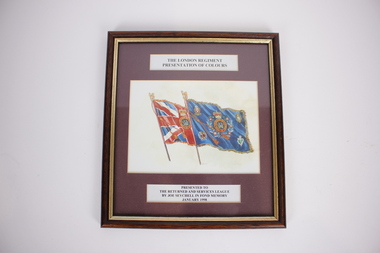
Photograph - Framed Image, C(City of London fusions) Company, Photo of the London Regiment Colours Picture frame
... Photo of the London Regiment Colours Picture frame...London Regiment...Picture framed Photo of The London Regiment Presentation if Colours....London Regiment Colours Presented to. The Returned and Services League By. ...Picture framed Photo of The London Regiment Presentation if Colours.Presented to. The Returned and Services League By. Joe Seychell in fond memory January. 1998.london regiment, colours -
 Wangaratta RSL Sub Branch
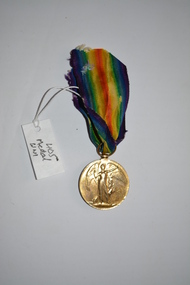
Medal
... ...16 london regiment...Medal awarded to Private C T WHYMAN 554269 who served with the 16th London Regiment (County of London). The 16th Battalion was known as the Queen's Westminster Rifles, an Infantry regiment of the British Army formed in 1908 and disbanded in 1938. ...Medal awarded to Private C T WHYMAN 554269 who served with the 16th London Regiment (County of London). The 16th Battalion was known as the Queen's Westminster Rifles, an Infantry regiment of the British Army formed in 1908 and disbanded in 1938. ...Medal awarded to Private C T WHYMAN 554269 who served with the 16th London Regiment (County of London). The 16th Battalion was known as the Queen's Westminster Rifles, an Infantry regiment of the British Army formed in 1908 and disbanded in 1938. The Battalion was engaged on the western front between 1914 and 1918. The item was found and no further information is known regarding Private WHYMAN.Round bronze medal - The obverse shows figure of 'Victory' (or 'Victoria') with her left arm extended and holding a palm branch in her right hand.The reverse has the words ‘THE GREAT / WAR FOR / CIVILISATION / 1914-1919' in four lines, all surrounded by a laurel wreath.The ribbon has an iridescent multi-colour scheme and attaches to the medal through a ring suspender The recipient's name, rank, service number and unit is impressed on the edge of the medal. 554269 Pte C T WHYMAN 16 LOND Rww1, 16 london regiment, c t whyman, 1918, victory medal -
 Beechworth RSL Sub-Branch
Functional object - Picture Frame Brass
... Item acquired by Pte B.A.Bristow 58848 6th London Regiment in France during his time in France in WWI...Item acquired by Pte B.A.Bristow 58848 6th London Regiment in France during his time in France in WWI Centered at the in scroll the work "SOUVENIR"below the oval border is engraved "1914 - FRANCE - 1919" ; flowers are engraved each side of the oval border A rectangular shield shaped and convex brass picture frame with an oval shaped opening for the border of the picture. ...Item acquired by Pte B.A.Bristow 58848 6th London Regiment in France during his time in France in WWIA rectangular shield shaped and convex brass picture frame with an oval shaped opening for the border of the picture. A tin plate holder is attached to the rear with a heavy gauge copper wire stand Centered at the in scroll the work "SOUVENIR"below the oval border is engraved "1914 - FRANCE - 1919" ; flowers are engraved each side of the oval border -
Beechworth RSL Sub-Branch
Memorabilia - Model WWI Tank metal
... Bristow 5848 6 - London Regiment during war time service in France WWI...Bristow 5848 6 - London Regiment during war time service in France WWI the mounting plinth engraved "Souvenir of the War' and a poppy engraved in a central position Metallic basic model of a WWI tank with cannon turrets protruding on each side and on top and mounted on a metallic plinth Memorabilia Model WWI Tank metal ...Acquired by Pte B.A. Bristow 5848 6 - London Regiment during war time service in France WWIMetallic basic model of a WWI tank with cannon turrets protruding on each side and on top and mounted on a metallic plinththe mounting plinth engraved "Souvenir of the War' and a poppy engraved in a central position -
 The 5th/6th Battalion Royal Victoria Regiment Historical Collection
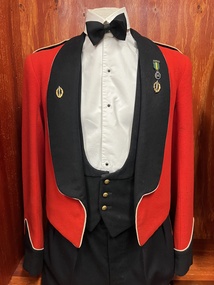
Uniform - 6th Battalion, the Royal Victoria Regiment Mess Dress Jacket
... Traditional Fusiliers pattern mess dress inherited from the 6th Battalion, the Royal Melbourne Regiment (1918-1960) who were given the pattern by their allied regiment, the Royal Fusiliers (City of London Regiment) in 1936 as a token of friendship. ...Traditional Fusiliers pattern mess dress inherited from the 6th Battalion, the Royal Melbourne Regiment (1918-1960) who were given the pattern by their allied regiment, the Royal Fusiliers (City of London Regiment) in 1936 as a token of friendship. ...They were given the pattern by their allied regiment, the Royal Fusiliers (City of London Regiment) in 1936 as a token of friendship. ...6th Battalion, the Royal Victoria Regiment Mess Dress Jacket. Traditional Fusiliers pattern mess dress inherited from the 6th Battalion, the Royal Melbourne Regiment (1918-1960) who were given the pattern by their allied regiment, the Royal Fusiliers (City of London Regiment) in 1936 as a token of friendship. The Royal Victoria Regiment (RVR) was a late adopter of miniature RVR badges for collar badges and the Royal Australian Infantry Corps collar badges fitted indicate use after 1960 and likely at least into the 1980s when miniature RVR badges were adopted. The staybrite St Edward's Crown rank insignia to each epaulet also indicate use between 1960-1980s. Red body with white piping to Royal blue facings (to cuffs, epaulets and lapel/collar). Royal blue lapelled waistcoat with brass Australian Commonwealth Military Forces buttons. This mess jacket is significant because Australian Army Infantry units would normally wear the Infantry Corps pattern of mess dress. However, this pattern was worn by the 6th Battalion, the Royal Victoria Regiment (and likely also 5/6 RVR) right up to the late 1980s due to the unique and honoured customs and traditions of the 6th Battalion. It is a traditional Fusiliers pattern mess dress which was inherited from the 6th Battalion, the Royal Melbourne Regiment (1918-1960) who were the forebear to the Royal Victoria Regiment. They were given the pattern by their allied regiment, the Royal Fusiliers (City of London Regiment) in 1936 as a token of friendship. The use after 1960 (when the Royal Melbourne Regiment was amalgamated) is evidenced by unit held photos and by object itself which bears the Royal Australian Infantry Corps collar badges and staybrite St Edward's Crown rank insignia to each epaulet (for rank of Major).6th Battalion, the Royal Victoria Regiment Mess Dress Jacket. Traditional Fusiliers pattern mess dress inherited from the 6th Battalion, the Royal Melbourne Regiment (1918-1960) who were given the pattern by their allied regiment, the Royal Fusiliers (City of London Regiment) in 1936 as a token of friendship. The Royal Victoria Regiment (RVR) was a late adopter of miniature RVR badges for collar badges and the Royal Australian Infantry Corps collar badges fitted indicate use after 1960 and likely at least into the 1980s when miniature RVR badges were adopted. The staybrite St Edward's Crown rank insignia to each epaulet also indicate use between 1960-1980s. Red body with white piping to Royal blue facings (to cuffs, epaulets and lapel/collar). Royal blue lapelled waistcoat with brass Australian Commonwealth Military Forces buttons. 6th battalion, royal melbourne regiment, mess dress jacket, mess dress, mess jacket, australian army, royal australian infantry corps, rainf, rmr, 5th/6th battalion, royal victoria regiment, city of melbourne regiment, rvr, 5/6 rvr -
Beechworth RSL Sub-Branch
Memorabilia - Ashtray - trench art
... Bistrow 5848 6th London Regiment during war service in France during WWI...Bistrow 5848 6th London Regiment during war service in France during WWI marking relating the artillery shell around the base are; 18 Pr II (roman numerals for 2) clockwise from that are; LOT 193; B5; CF - 7/16; abd EWBC A ashtray made from the bottom part of 100 mm artillery shell; there are three groves spaced at equal distance on the rim of ashtray' small arm cartridge shell is soldered to internal primer house of the artillery shell ; on the shell rim there are three files groves that may be considered decorative with radiating file marks on side of the ashtray assumed to had been made when filing the groves on the shell rim. ...Item acquired by Pte B.A. Bistrow 5848 6th London Regiment during war service in France during WWIA ashtray made from the bottom part of 100 mm artillery shell; there are three groves spaced at equal distance on the rim of ashtray' small arm cartridge shell is soldered to internal primer house of the artillery shell ; on the shell rim there are three files groves that may be considered decorative with radiating file marks on side of the ashtray assumed to had been made when filing the groves on the shell rim.marking relating the artillery shell around the base are; 18 Pr II (roman numerals for 2) clockwise from that are; LOT 193; B5; CF - 7/16; abd EWBC -
Beechworth RSL Sub-Branch
Domestic object - Candlestick Brass
... Bristow 58848 6th London Regiment ...Bristow 58848 6th London Regiment Machined column shaped candlestick in solid brass with hollowed out portion on top to hold the candle Domestic object Candlestick Brass ...Purported to be trench art by donor; however this is refuted because the items appear mass produced. Artillery shell casing do not come in that thickness. Items acquired by Pte B.A. Bristow 58848 6th London Regiment Machined column shaped candlestick in solid brass with hollowed out portion on top to hold the candle -
 Sunshine and District Historical Society Incorporated
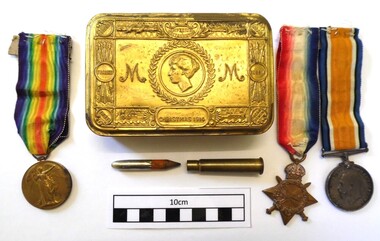
Memorabilia - Ray Nutting Collection, Circa 1914 -1918
... The brass tin, bullet pencil, and medals belonged to Pte George Nutting of the 2nd London regiment, and regimental number 2080/230442. ...The brass tin, bullet pencil, and medals belonged to Pte George Nutting of the 2nd London regiment, and regimental number 2080/230442. ...A 'Sailors & Soldiers Christmas Fund' created by Princess Mary had overwhelming response and so it was decided to give every person 'wearing the King's uniform on Christmas Day 1914' the brass tin along with a Christmas card and a picture of the princess, and items such as pipe, lighter, tobacco, and 20 cigarettes. Non-smokers and boys received a bullet pencil and a packet of sweets. Indian troops often received sweets and spices, and nurses received chocolates. Many of the items were sent separately from the boxes because of lack of space. Not all the tins could be sent out by Christmas and so those sent in January 1915 contained a New Year card. Shortage of brass meant that many did not received their tins until summer 1916, however by January 1919 some still did not receive them. After using up the contents many service people then used the tins to store small items. The brass tin, bullet pencil, and medals belonged to Pte George Nutting of the 2nd London regiment, and regimental number 2080/230442. After World War 1 George Nutting sailed for Melbourne on June 1, 1922 aboard the S.S. Borda. He then lived at several addresses in the Sunshine/Albion area including Dawson St, 32 King Edward Ave, and 15 Kamarooka St. At one stage he was involved in a window cleaning and gardening business, and both he and his wife Janet were very good dancers. George Nutting was also involved in the Loyal Sunshine Lodge and was presented with a Past Grand's Collar in 1943. He lived at 15 Kamarooka St until he passed away on March 20th 1979 at the age of 85. The above information was sourced from http://www.kinnethmont.co.uk/1914-1918_files/xmas-box-1914.htm (accessed 1/3/2014), and from http://museumvictoria.com.au/collections/items/1329146/tin-princess-mary-s-Christmas-gift-1914 (accessed 1/3/2014), and from research work done by Eva and Marie of S&DHS.The tin and medals provide a visible historical record of the Christmas gift, and the awards that the average WW1 British service person received about 100 years ago. The bullet pencil may indicate that Pte G. Nutting was probably a non-smoker, at least around circa 1914.Brass rectangular box with an embossed and hinged lid. The lid features the profile of Princess Mary with an 'M' on each side, and the names of Britain's allies in 1914. The pencil fits into the brass bullet casing to give the appearance of a bullet. The WW1 British medals are: 1. 1914 - 1915 Star, 2. British War Medal 1914 - 1918 (Silver), 3. Allied Victory Medal.TIN: Imperium Brittanicum, Christmas 1914, Belgium, France, Servia, Japan, Russia, Montenegro. MEDALS: 2080 Pte G. Nutting 2 - Lond.R bullet pencil, g nutting, princess mary tin, christmas 1914, british ww1 medals, 1914-1915 star, allied victory medal, british war medal 1914 -1918 -
 Bendigo Historical Society Inc.
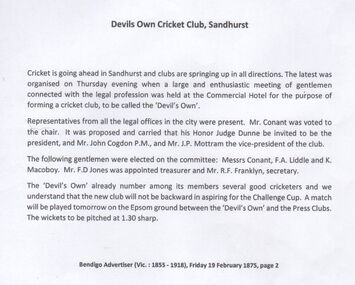
Article - Devils Own Cricket Club Established Bendigo Advertiser Article
... The Inns of Court Regiment, London, has a unique place in history as a result of its ancient and intimate connection with the Law and lawyers. ...The Inns of Court Regiment, London, has a unique place in history as a result of its ancient and intimate connection with the Law and lawyers. ...The Devils' Own Cricket Club was also referred to as the Law Cricket Club and the Law (Devils' Own) Cricket Club. The club was formed in 1875 from members of the local legal fraternity and business people in Sandhurst (Bendigo). In addition to the Devils' Own Cricket Club, there were many male cricket clubs formed in Bendigo in the 1870's, for example, the Bendigo United Cricket Club; Epsom Cricket Club; All Trades Cricket Club; New Chum Cricket Club; California Gully Cricket Club; Long Gully Cricket Club; Butchers' Cricket Club; View Point Cricket Club; Myers Street Cricket Club; Australian Natives Association Cricket Club; View Point Cricket Club; Beehive Cricket Club; Advertiser Cricket Club; Kangaroo Flat Cricket Club; Golden Square Cricket Club; North Bendigo Cricket Club; Crusoe Cricket Club; City Cricket Club; Bohemians Cricket Club and the Happy Valley Cricket Club. Where did the name 'Devils' Own' come from? The Inns of Court Regiment, London, has a unique place in history as a result of its ancient and intimate connection with the Law and lawyers. It recruited and 'officered' almost exclusively from the legal profession, drawn from barristers, attorneys, notaries and their clerks and students practising in the area of the Inns of Court comprising Middle Temple, Inner Temple, Lincoln’s Inn and Gray’s Inn. During Napoleonic Wars all Inns raised companies. During a review by King George III in Hyde Park in 1803, the King used his dislike for lawyers – particularly ones carrying arms – to name the massed ranks of the Law Association as "The Devil's Own".[5] "It is understood that the King was in high health and excellent spirits at the time. The Bloomsbury and Inns of Court Volunteers was reformed in 1797 during the Napoleonic Wars. It was shortly afterwards that the regiment gained its enduring nickname. During a review by King George III in Hyde Park in 1803, the King used his dislike for lawyers – particularly ones carrying arms – to name the massed ranks of the Law Association as "The Devil's Own". "It is understood that the King was in high health and excellent spirits at the time. When the 'Temple companies' had defiled before him, his Majesty enquired of Lord David Erskine, who commanded them, as lieutenant colonel, what was the composition of that corps? 'They are all lawyers, Sire,' said Erskine. 'What! What! 'exclaimed the King, 'all lawyers? all lawyers? Call them the Devil's Own, call them the Devil's Own!" "And the Devil's Own they were called accordingly." ( Norton, F.C., A short history of the military & naval services of the Inns of Court and the members of the Bench and the Bar, 1886, William Clowes & Sons, Stamford Street and Charing Cross, London) Did Bendigo’s legal fraternity name themselves DOCC with the intent that they would reflect the distinguished pedigree and qualities of the Devil’s Own regiment? Details of one the players in the 'Devils'Own' CC : Pelling Hugh Gough Pigott Stainsby Conant, solicitor, born Hampshire, England 1846. Arrived Australia 1871. Pelling was the son of Francis Pigott Stainsby Conant Esq., Lieutenant Governor of the Isle of Man. He married Catherine Anne Drummond. In 1874, his practice was in the Albion Chambers, Sandhurst, given as 'Pelling H.G.P.S. Conant, Solicitor'. Organisation-Club/society-sportA transcript of the Devils Own Cricket Club article in the 19th February, 1875 edition of the Bendigo Advertiser docc, devils own cricket club, sandhurst, bendigo advertiser, pelling h.g.p. s. conant, solicitor, barrister -
 Federation University Historical Collection
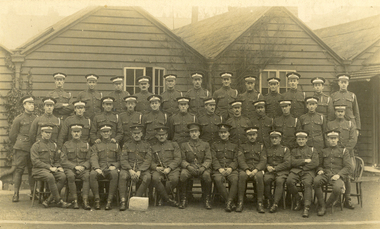
Postcard, "A" Squad Cadets, St John's Wood Barracks, 1917
... St John's Wood is a district of north-west London, in the City of Westminster, and at the north-west end of Regent's Park. The King's Troop, Royal Horse Artillery formerly resided at St John's Wood Barracks. The regiment...St John's Wood is a district of north-west London, in the City of Westminster, and at the north-west end of Regent's Park. The King's Troop, Royal Horse Artillery formerly resided at St John's Wood Barracks. The regiment ...St John's Wood is a district of north-west London, in the City of Westminster, and at the north-west end of Regent's Park. The King's Troop, Royal Horse Artillery formerly resided at St John's Wood Barracks. The regiment moved to Woolwich on 6 February 2012; the barracks is to be demolished and developed as housing. (http://en.wikipedia.org/wiki/St_John's_Wood)A number of uniformed men pose for a photograph in front of a weatherboard building. The image is of the "A" Squad Cadets at St John's Wood Barracks, London.This card was purchased by an Australian soldier, probably Henry Smerdon Holmes, during World War One. Verso: "A" Squad Cadets. St John's Wood Barracks, London, 12th March 1917chatham family collection, chatham, world, war, world war one, world war 1, world war i, france, harry holmes, holmes, st john's wood -
 Federation University Historical Collection
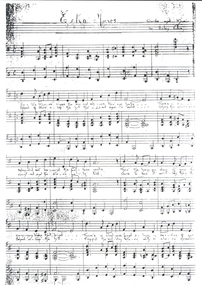
Document - Music score, 'Extra Muros' by Helen Ellis
... regiment. When Mr Ellwood became Principal of the Ballarat Teachers' College in 1926 the original copy of the college anthem, "Extra Muros", bore the words written and composed by Helen Ellis. She was a London...regiment. When Mr Ellwood became Principal of the Ballarat Teachers' College in 1926 the original copy of the college anthem, "Extra Muros", bore the words written and composed by Helen Ellis. She was a London ...Ballarat Teachers' College Principal W.H. Ellwood (1926-31) formed a friendship with Mr C. Ellis when they were teachers at neighbouring Gippsland schools. During the first world war they served in the same regiment. When Mr Ellwood became Principal of the Ballarat Teachers' College in 1926 the original copy of the college anthem, "Extra Muros", bore the words written and composed by Helen Ellis. She was a London born singer, composer and author who came to Australia after her marriage to c. Ellis in 1918.A3 photocopy of Extra Muros words and music. The words are by C. Ellis and the music is by Helen Ellis. ballarat teachers' college, helen ellis, c. ellis, extra muros, score, music -
 Montmorency–Eltham RSL Sub Branch
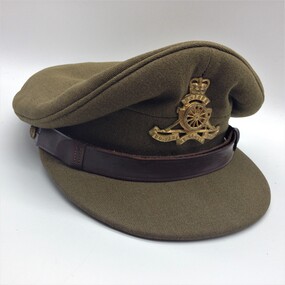
Cap, Peaked, Dress, Royal Australian Artillery, 1951, 1951
... headgear cap "Herbert Johnson (Bond Street) Ltd., 38 New Bond Street, London" "1951" "Size 6 7/8" "Made in England" "D^D" No personal I.D. Khaki cloth peaked cap with Royal Regiment of Australian Artillery gilt cap badge (Queen's crown) with brown leather chin strap and gilt AMF 12mm diameter buttons. ...UK manufacture RAA cap for 1950s. Personal purchase?? Khaki cloth peaked cap with Royal Regiment of Australian Artillery gilt cap badge (Queen's crown) with brown leather chin strap and gilt AMF 12mm diameter buttons. Brown leather sweat band and tan plastic crown liner and khaki cloth liner. Manufacturer's, size and D^D stamp under crown. "Herbert Johnson (Bond Street) Ltd., 38 New Bond Street, London" "1951" "Size 6 7/8" "Made in England" "D^D" No personal I.D.headgear, cap -
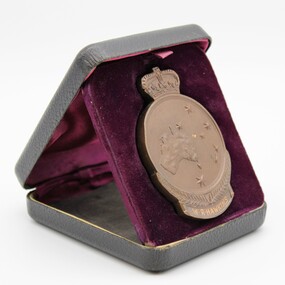 Montmorency–Eltham RSL Sub Branch
Medal - Commemorative Medallion, Issues began 1967
... Regiment at ANZAC on 14 October 1915. He arrived at Alxandria on 27 December 1915. Subsequently served in France, and was discharged, in London, 24 January 1920. ...Regiment at ANZAC on 14 October 1915. He arrived at Alxandria on 27 December 1915. Subsequently served in France, and was discharged, in London, 24 January 1920. ...Medallion awarded to surviving members of Australian forces who served on the Gallipoli Peninsula during 25 April 1915 to January 1916. Recipient enlisted 07 June 1915 and was taken on strength of the 4th Australian Light Horse Regiment at ANZAC on 14 October 1915. He arrived at Alxandria on 27 December 1915. Subsequently served in France, and was discharged, in London, 24 January 1920. Returned to Australia, departing United Kingdom 06 May 1921. Cast bronze, approximately 75 mm high and 50mm wide. The obverse depicts Simpson and his donkey carrying a wounded soldier, with '1915' . It is bordered on the lower half by a laurel wreath above the word ANZAC. The reverse shows a map in relief of Australia and New Zealand superimposed by the Southern Cross. The lower half is bordered by fern leaves. The name and initials of the recipient is engraved on the reverse. The presentation box in black leatherette is lined with deep red velvet and deep red silk (lid)."W. R' Hawkins" -
Red Cliffs Military Museum
Collage, Collage of WW1 photos, Post WW1
... London Scottish going to their trenches. (.5) Happy 'Tommys' wearing Hun Helmets. (.6) A galant Rescue under fire - This man saved 20 lives like this. Next rowe down, Left to right: (.7) Firing a heavy Howitzer in France. (.8) Loyal North Lancs Regiment cheering when ordered to the trenches. (.9) Thirsty German prisoners in their barbed wire cage. ...There is no information with this collage other than what is on the photos, it is unknown who put it together, who owned it, or who donated it. france ww1 british photos infantry north collage lancashire regiments Top Left to right. ( .1) British Infantry practicing an attack. (.2) Australians parading for the Trenches. (.3) 'Tommy' at home in German duggouts. Next Rowe Left to Right. (.4) London ...There is no information with this collage other than what is on the photos, it is unknown who put it together, who owned it, or who donated it.An old black wooden frame containing 12 WW1 photos which have been beautifully displayed in the frame, surrounded by hand made wooden lattice and leaves decor. Typed on the bottom of each photo is a description of the photo.Top Left to right. ( .1) British Infantry practicing an attack. (.2) Australians parading for the Trenches. (.3) 'Tommy' at home in German duggouts. Next Rowe Left to Right. (.4) London Scottish going to their trenches. (.5) Happy 'Tommys' wearing Hun Helmets. (.6) A galant Rescue under fire - This man saved 20 lives like this. Next rowe down, Left to right: (.7) Firing a heavy Howitzer in France. (.8) Loyal North Lancs Regiment cheering when ordered to the trenches. (.9) Thirsty German prisoners in their barbed wire cage. Bottom rowe Left to right (.10) Highlanders Pipe themselves back from the trenches. (.11) Decorating a Canandian on the Field of Battle. (.12) A 'Fag' after a fight.france, ww1, british, photos, infantry, north, collage, lancashire, regiments -
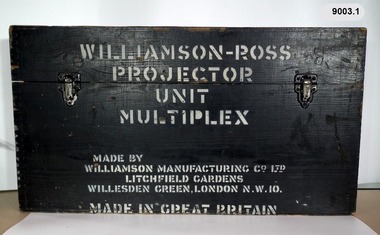 Bendigo Military Museum
Instrument - Multiplex Unit Projector, Williamson Manufacturing Co, Circa 1950
... Another Multiplex instrument is in the collection as Item 9039.4 Royal Australian Survey Corps RASvy Fortuna Army Survey Regiment Army Svy Regt WILLIAMSON MANUFACTURING CO, PHOTOGRAPHIC ENGINEERS, SERIAL NUMBER 3437, TYPE MPC, LITCHFIELD GARDENS, LONDON AND READING. ...Multiplex mechanical stereoplotting equipment was used at the Army Survey Regiment, Fortuna Bendigo. c1950s. Multiplex equipment was imported from the UK in 1951 and introduced in the following year, to accelerate map production output covering CMF training areas at 1:25,000 map scale. Multiplex plotting was a productive advancement replacing the ‘Arundel’ method of graphical plotting planimetric detail that was expensive and slow, especially in timbered mountainous terrain. Air photos were made into small diapositives and mounted on racks in the exact position relative to when the aerial photos were taken. The technicians operated the Multiplex in a darkened room, with one photo projected with a green filter and the other through a red filter to form a 3D view of the overlapping photos. The 3D model projected onto a platen, which was a small platform that was raised up and down. The technician viewed the 3D image with special glasses fitted with red and green lenses. In the centre of the platen was a small pinhole that served as a floating mark, with a vertical pencil located exactly below the pinhole. This tracing table was moved to follow the topographic feature or contour line and draw it on the paper underneath. The technician raising or lowering the platform’s floating mark to match the height of the 3D terrain. It also replaced the slotted template method of mechanical adjustment of strips of aerial photography, however was restricted to each strip rather than between strips in the block. Although the Multiplex was phased out of production in 1968, it was used in the training of photogrammetry and aero-triangulation at the School of Military Survey located at Bonegilla, Victoria until the early 1990s. The history of the Multiplex is covered in more detail with additional historic photographs, in pages 50 to 51 of Valerie Lovejoy’s book 'Mapmakers of Fortuna – A history of the Army Survey Regiment’ ISBN: 0-646-42120-4. This instrument is only one of the projectors of a set and is unfortunately missing its platen, coloured filters and coloured glasses. A cardboard set of glasses is included as an example. Another Multiplex instrument is in the collection as Item 9039.4A black wooden box containing a Multiplex Unit Projector (incomplete). The Multiplex has a Lamp Head, Barrel Housing, Body of the Projector and a Platen which is missing. .1 Protective wooden box .2 Multiplex Instrument .3 Multiplex Instrument Parts Diagram .4 A bank of Multiplex projectors in operation WILLIAMSON MANUFACTURING CO, PHOTOGRAPHIC ENGINEERS, SERIAL NUMBER 3437, TYPE MPC, LITCHFIELD GARDENS, LONDON AND READING.royal australian survey corps, rasvy, fortuna, army survey regiment, army svy regt -
 Bendigo Military Museum
Letter - Royal Australian Survey Corps Jubilee, Department of Defence, Melbourne, 1965
... Regiment Army Svy Regt ASR No "91" Top right hand corner. "Royal Australian Survey Corps Jubilee" hand written on front cover Foolscap size manila Folder containing a number of letters held together by an ARNOS fastener. Royal Australian Survey Corps Jubilee Letter Royal Australian Survey Corps Jubilee Department of Defence, Melbourne Directorate of Military Survey, Canberra Commissioners Office, London Headquarters Southern Command, Melbourne ...The folder about the Royal Australian Survey Corps Jubilee, contains a number of very informative letters dealing with the formation of the Army Survey Corps. There is also some history as to how the Australian Survey Corps came into being. One letter lists the current units of the Royal Australian Survey Corps.Foolscap size manila Folder containing a number of letters held together by an ARNOS fastener.No "91" Top right hand corner. "Royal Australian Survey Corps Jubilee" hand written on front coverroyal australian survey corps, rasvy, fortuna, army survey regiment, army svy regt, asr -
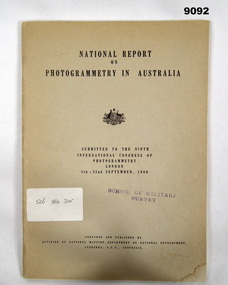 Bendigo Military Museum
Administrative record - Report on Photogrammetry in Australia 1960 - Division of National Mapping, Division of National Mapping, Department of National Development, September 1960
... London during September 1960. Chapters deal with Mapping activities by various Australian Organisations including the Royal Australian Survey Corps. This comprehensive report details the status of mapping and aerial photography in Australia in 1960 including 14 Annexes. Royal Australian Survey Corps RASvy Fortuna Army Survey Regiment ...This National Report on Photogrammetry in Australia was prepared and submitted to the Ninth International Congress of Photogrammetry held in London during September 1960. Chapters deal with Mapping activities by various Australian Organisations including the Royal Australian Survey Corps. This comprehensive report details the status of mapping and aerial photography in Australia in 1960 including 14 Annexes. An A4 sized buff coloured card covered paper report of 68 pages and stapled. There is a property Card inside the front cover titled "Historical Property Record". Stamped "SCHOOL OF MILITARY SURVEY" on the front cover and first page. Sticker has hand written "526 982 DIV"royal australian survey corps, rasvy, fortuna, army survey regiment, army svy regt, asr, division of national mapping -
 Bendigo Military Museum
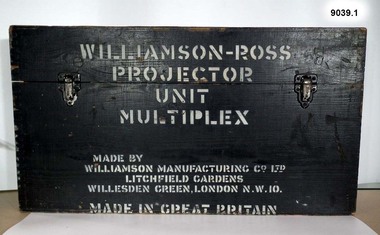
Instrument - Multiplex Unit Projector, Williamson Manufacturing Co, Circa 1950
... Another instrument is in the collection as Item 9003.4 Royal Australian Survey Corps RASvy Fortuna Army Survey Regiment Army Svy Regt WILLIAMSON MANUFACTURING CO, PHOTOGRAPHIC ENGINEERS, SERIAL NUMBER 3187, TYPE MPC, LITCHFIELD GARDENS, LONDON AND READING. ...Multiplex mechanical stereoplotting equipment was used at the Army Survey Regiment, Fortuna Bendigo. c1950s. Multiplex equipment was imported from the UK in 1951 and introduced in the following year, to accelerate map production output covering CMF training areas at 1:25,000 map scale. Multiplex plotting was a productive advancement replacing the ‘Arundel’ method of graphical plotting planimetric detail that was expensive and slow, especially in timbered mountainous terrain. Air photos were made into small diapositives and mounted on racks in the exact position relative to when the aerial photos were taken. The technicians operated the Multiplex in a darkened room, with one photo projected with a green filter and the other through a red filter to form a 3D view of the overlapping photos. The 3D model projected onto a platen, which was a small platform that was raised up and down. The technician viewed the 3D image with special glasses fitted with red and green lenses. In the centre of the platen was a small pinhole that served as a floating mark, with a vertical pencil located exactly below the pinhole. This tracing table was moved to follow the topographic feature or contour line and draw it on the paper underneath. The technician raising or lowering the platform’s floating mark to match the height of the 3D terrain. It also replaced the slotted template method of mechanical adjustment of strips of aerial photography, however was restricted to each strip rather than between strips in the block. Although the Multiplex was phased out of production in 1968, it was used in the training of photogrammetry and aero-triangulation at the School of Military Survey located at Bonegilla, Victoria until the early 1990s. The history of the Multiplex is covered in more detail with additional historic photographs, in pages 50 to 51 of Valerie Lovejoy’s book 'Mapmakers of Fortuna – A history of the Army Survey Regiment’ ISBN: 0-646-42120-4. This instrument is only one of the projectors of a set and is unfortunately missing its coloured filters and coloured glasses. Another instrument is in the collection as Item 9003.4A black wooden box containing a Multiplex Unit Projector (incomplete). The Multiplex has a Lamp Head, Barrel Housing, Body of the Projector and a Platen. .1 Protective wooden box .2 Multiplex Instrument .3 Multiplex Instrument Parts Diagram .4 A bank of Multiplex projectors in operation WILLIAMSON MANUFACTURING CO, PHOTOGRAPHIC ENGINEERS, SERIAL NUMBER 3187, TYPE MPC, LITCHFIELD GARDENS, LONDON AND READING.royal australian survey corps, rasvy, fortuna, army survey regiment, army svy regt -
 Bendigo Military Museum
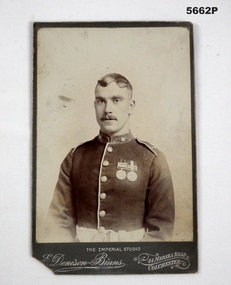
Photograph - PHOTOGRAPH, BRITISH SOLDIER, POST BOER WAR, E. Dennison- Binns, c1899-1903
... He was NR 4886 Suffolk Regiment DOB c1878. POB White Chapel, London. Served 1899-1902 Cape Colony, Colesberg, Transvaal - with the Mounted Infantry. ...He was NR 4886 Suffolk Regiment DOB c1878. POB White Chapel, London. Served 1899-1902 Cape Colony, Colesberg, Transvaal - with the Mounted Infantry. ...Believed to be "George Goulding No. 4886" Britain. The collar badge is that of the Suffolk Regiment. Service of George Frederick Goulding, British Army Boer, South Africa. He was NR 4886 Suffolk Regiment DOB c1878. POB White Chapel, London. Served 1899-1902 Cape Colony, Colesberg, Transvaal - with the Mounted Infantry. WW1 - DOE 11 Dec 15, Middlesex Regiment 5 Bm. (A Reserve Bn). Discharged from Middlesex 19 Apr 1916. M.U. Number 1710 Pte. The British I.W.M. also shows he served in the Royal Field Artillery in WW1. That info is not available. Rank Gunner NR L/10626.This is a black and white portrait of a British soldier waist upwards. He is in uniform, wearing two medals. One medal on the soldier has 3 bars, the other has 2 bars. His belt is probably white. The badges on his collar appear to be a Castle with gate. The soldier is hatless. The photo is glued onto a cardboard surround.The bottom of the cardboard backing has written in white ink "The Imperial Studio - E. Dennison. Binns, 44 Measea Road, Colchester"boer war, south africa, british soldier -
 Bendigo Military Museum
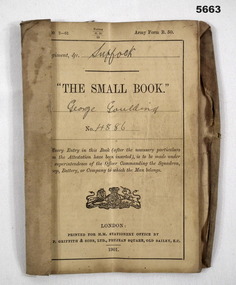
Booklet - BOOK, SOLDIERS PAY, SUFFOLK REGIMENT UK 1901, British Army, 1901
... London. County of Middlesex. 31 December 1897, age 18 yrs, 10 mths. He joined Suffolk Regiment for 7 years. ...London. County of Middlesex. 31 December 1897, age 18 yrs, 10 mths. He joined Suffolk Regiment for 7 years. ...Page 4 has handwritten description of soldier and enlistment details - George Goulding. Enlisted at St. Georges Barracks, London. County of Middlesex. 31 December 1897, age 18 yrs, 10 mths. He joined Suffolk Regiment for 7 years. He was born in Whitechapel, London. Height 5'5-1/2 ", Dark hair, tattoo on left forearm. He served in various places abroad. Malta, Dolpa, Sth Africa, Southampton.This is a small booklet titled "The Small Book" British Army form B.50. The soldier's name is George Goulding No. 4886. The Regiment is Suffolk. In the centre of the cover are the instructions for use, beneath that is the crest of Great Britain. The rear cover is khaki coloured buckram. Inside are 24 pages. These have Goulding's description - Navy regulations and details of Goulding's Service.british suffolk regiment, south african war, boer war, soldier -
 Bendigo Military Museum
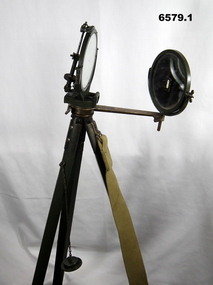
Instrument - Duplex Heliograph Mk V - 1940 with Tripod, LUCO Art Metal Coy Ltd, London, 1940
... Royal Australian Survey Corps RASvy Fortuna Army Survey Regiment Army Svy Regt ASR A253 stamped on instrument . 1 Brish Army "Mance" Mk V A253 Heliograph has two 125mm diameter mirrors on a brass arm with targeting attachments. The Instrument is mounted on a three-legged tripod of brass and mahogany with spiked feet, approximately 1.2 metres high. The instrument was made by LUCO Art Metal Co Ltd, London ...The Heliograph MkV is a fascinating piece of historical surveying and communications equipment. It was primarily used for visual signaling by reflecting sunlight with a mirror to send coded messages over long distances. This method was primarily useful in remote areas where other forms of communication were not available. The MkV model, specifically, was widely used by the British Army and other military forces from around 1906 until the mid 1960s. It remained in use with the Australian Army Survey Corps until the mid 1980s. The device typically included a 5 - inch mirror and was often mounted on a tripod for stability. Initially the instrument was used to communicate between survey stations using Morse code to coordinate their activities. Later when better forms of communication were available, they were used for precise angle alignment where the sunlight reflection from the mirror was targeted between the survey stations to give very accurate results. The MkV was relatively light weight and portable, making it ideal for use in the field. It could be setup and adjusted quickly. The heliograph had an adjustable mirror that could be tilted to reflect sunlight towards a distant receiver. Surveyors could align the mirror using a sighting device. Whilst it was primarily used by the Military it was also used in civil surveying particularly in the remote areas of Australia. The British Army Mark V version uses a flat round mirror with a small unsilvered spot in the centre. The sender aligned the heliograph to the target by looking at the reflected target in the mirror and moving their head until the target was hidden by the unsilvered spot. Keeping their head still, they then adjusted the aiming rod so its cross wires bisected the target, they then turned up the sighting vane, which covered the cross wires with a diagram of a cross, and aligned the mirror with the tangent and elevation screws, so the small shadow that was a reflection of the unsilvered spot hole was on the cross target. This indicated that the sunbeam was pointing at the target. If the sun was in front of the sender, its rays were reflected directly from this mirror to the receiving station. If the sun was behind the sender, the sighting rod was replaced by a second mirror, to capture the sunlight and direct it onto the main mirror to reflect it to the receiving station.. 1 Brish Army "Mance" Mk V A253 Heliograph has two 125mm diameter mirrors on a brass arm with targeting attachments. The Instrument is mounted on a three-legged tripod of brass and mahogany with spiked feet, approximately 1.2 metres high. The instrument was made by LUCO Art Metal Co Ltd, London in 1940. .2 A military green metal carrying safety storage case with khaki shoulder strap.A253 stamped on instrumentroyal australian survey corps, rasvy, fortuna, army survey regiment, army svy regt, asr -
 Bendigo Military Museum
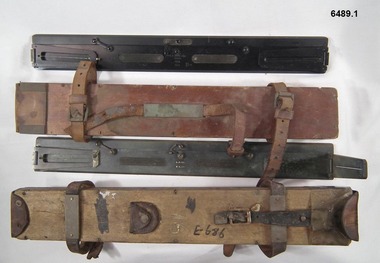
Instrument - Plane Table Surveying - Simple Alidade, ER Watts and Son, London, 1938
... Royal Australian Survey Corps RASvy Fortuna Army Survey Regiment Army Svy Regt ASR First Instrument, "ER Watts and Son, London, 1938, MkII, Box Label 423. ...The Plane Table Alidade was used as the sighting Instrument in the production of historical manual hand drawn maps. A Plane Table Board mounted on a tripod is levelled and the Alidade is placed on the table with the vanes perpendicular to the it. Each sighting vane has a central thread lined up on the target and the angle to that target point is then drawn on the map sheet using the beveled fiducial edge. Plane Table Surveying is used as a quick method where less accuracy is required or needed. Plane table Surveying is a relatively portable and inexpensive method and was used extensively before the advent of sophisticated surveying instruments. The photo at 6489.2 is an Australian Army Survey Corps Party using a Plane Table Alidade in Syria during WWII. See also item 6580 which is the Plane Table with tripod legs that was used with the Alidade.Two Plane Table sighting instruments (Alidade) used for historical manual map making housed in wooden transit boxes. A brass instrument with folding sights at each end and a beveled fiducial edge in one edge. The front sight is the object vane and the rear sight is the sight vane. There is a sliding arm attached to the base to draw parallel lines to the fiducial edge. Very slight differences in model between these two instruments.First Instrument, "ER Watts and Son, London, 1938, MkII, Box Label 423. Second Instrument - R. E-Co, Mk.II, stamped E686, Box Label 686.royal australian survey corps, rasvy, fortuna, army survey regiment, army svy regt, asr -
 Warrnambool and District Historical Society Inc.
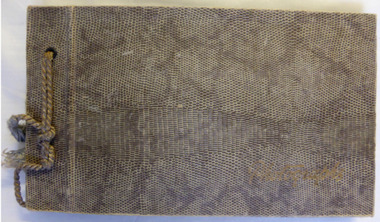
Album - Family photo album, Photograph album, Circa 1954
... Another is labelled London bus 2 RTR Munster. The 2 RTR was a tank regiment in the British Army and was stationed at the Swinton Barracks in Munster from 1952-1959. ...Another is labelled London bus 2 RTR Munster. The 2 RTR was a tank regiment in the British Army and was stationed at the Swinton Barracks in Munster from 1952-1959. ...This album shows a collection of photographs some of which are labelled as Munster Services Club. Some show the Bookshop at the TOC H building. There are photos of soldiers in parade drills and in training exercises as well as social events. One is labelled D Craven & Rab, Munster 1954. Another is labelled London bus 2 RTR Munster. The 2 RTR was a tank regiment in the British Army and was stationed at the Swinton Barracks in Munster from 1952-1959. There are also a number of loose photos showing local scenes such as London Bridge and Needle Rock at Childers Cove. Others depict floats in a parade showing Peace Woollen Mill. Others are small postcards of MaryBorough and Brisbane Queensland. There is also a photograph of the Nestanglo basketball team, Victorian champions circa 1940’s. This collection of photographs has limited local relevance as there is limited provenance. However it depicts quite well the activities of the RTR and their activities in Munster in the post WW era.Brown and fawn snake skin patterned card cover with fawn cord binding. Photographs written in gold on front cover. Pages are brown card. Photographs are black and white.Munster Services Club.warrnambool, swinton barracks munster, munster services club 1952-1959, 2rtr munster -
 4th/19th Prince of Wales's Light Horse Regiment Unit History Room
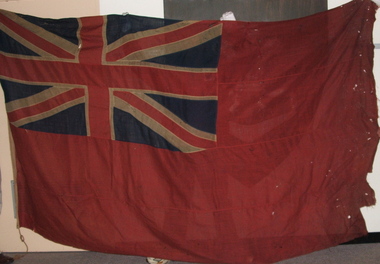
Flag - Red Ensign, Surgeons' Banner, 1850 (estimated)
... Regiment. In the binding is the inscription ‘Kyneton Prince of Wales Light Horse’ and three names: Surg-Major S Smith MRSLE, Dr McMillan, and Maj Thirkettle. These surgeons played a significant role in the military and civil affairs of Kyneton. Dr McMillan Dr McMillan was the first surgeon but left KPWLH 2-3 months after its formation and little else is known of him. Surgeon-Major Samuel Smith 1836 Born, Scotland 1857 Surgeon to the Hon. Hudson Bay Company. Ship “Prince Arthur” from London ...Red Ensign 1801 design. - The British red ensign was altered in 1801 to include the change to the design of the Union Jack. British legislation required, with a few exceptions, that all merchant shipping throughout the British Empire fly the British Red Ensign, without any defacement or modification. The ensign is sometimes referred to as the red duster. The Royal Navy stopped using the Red Ensign in 1864. This red ensign was used by the Surgeons of the Kyneton District Mounted Rifles to indicate their location. The Banner is a large red ensign mounted on a 10 foot long polished wooden pike. The Banner was used by the Kyneton District Mounted Rifles, later The Royal Volunteer Cavalry Regiment (Prince of Wales Hussars), then Prince of Wales Victorian Light Horse, ancestor units of the modern day 4th /19th Prince of Wales’s Light Horse Regiment. In the binding is the inscription ‘Kyneton Prince of Wales Light Horse’ and three names: Surg-Major S Smith MRSLE, Dr McMillan, and Maj Thirkettle. These surgeons played a significant role in the military and civil affairs of Kyneton. Dr McMillan Dr McMillan was the first surgeon but left KPWLH 2-3 months after its formation and little else is known of him. Surgeon-Major Samuel Smith 1836 Born, Scotland 1857 Surgeon to the Hon. Hudson Bay Company. Ship “Prince Arthur” from London to Moose Fort, Hudson Bay. June 13 – Aug. 24 1857. 1858 Appointed Medical Officer of large immigrant ship to Port Phillip 1859 Appointed Assistant District Coroner, Castlemaine 1859 Appointed to Castlemaine Hospital 1862 Appointed first resident surgeon and manager of Kyneton Hospital Foundation member of Kyneton District Mounted Rifles 1874 Appointed Surgeon-Major Kyneton Volunteer Prince of Wales Light Horse Conducted a private practice in Kyneton. 1909 Died 8 November 1909, aged 73 years Samuel Smith was a Life Governor of Castlemaine Benevolent Asylum, a member of St Andrews Presbyterian Church, a Mark Master Mason of the Edward Coulson Lodge No 17, Kyneton. He also had a notable collection of stuffed native birds and animals of which he had great knowledge. Major Thirkettle 1855 Major Thirkettle arrived in Kyneton Established a timber merchant and ironmongery business in Kyneton with Robert Burton. 1857 By 1857 he was practising as an architect. His house is still standing in Yaldwin St, West Kyneton. 1860 Joined the Prince of Wales Light Horse 1863 Joined Rifle Volunteers and appointed Captain. On their disbandment he was made Honorary Major. 1864 Won Queen’s prize for rifle shooting. Major Thirkettle was noted for his skill with woodwork. He won many prizes and orders of merit for his models of yachts It is believed likely that he made the wooden pike with its metal head (now missing). He was Tyler of the Zetland Lodge, also Secretary of the MUIOOF and Bowling Club. 1904 Died in Kyneton, aged 75 years Protection for medical services The Surgeons’ Banner indicated the location of the Regimental Aid Post. The use of this device in the 1860’s overlapped the adoption of the Red Cross which became the symbol for the protection of sick and wounded soldiers. In 1864 twelve European nations signed a treaty stating that in future wars they would care for all sick and wounded military personnel, regardless of nationality. They would also recognise the neutrality of medical personnel, hospitals and ambulances identified by the emblem of a red cross on a white background. The treaty was called the Geneva Convention. This Convention was concerned only with soldiers wounded on the battlefield. Over the years, however, it has been expanded to cover everyone caught up in conflicts but not actually taking an active part in the fighting. The Surgeons’ Banner complements the Colours of the Kyneton District Mounted Rifles, also held by the Unit History Room, in presenting the colonial period of the Regiment’s history. Provenance It is believed that the Banner was manufactured in Britain and brought to Australia by Samuel Smith. After the disbanding of Colonial units, the Banner was in the care of the Shire of Kyneton until presented to the 4/19 Prince of Wales’s Light Horse Regiment on 14 September 1986 on the occasion of the Regiment exercising its right of freedom of entry to the city. There are many examples of Regimental and King’s/Queen’s Colours held by various organisations. However A Surgeons’ Banner such as this is rare, if not unique, in Australia. A large red ensign, post 1801 design. - The British red ensign was altered in 1801 to include the change to the design of the Union Jack. British legislation required, with a few exceptions, that all merchant shipping throughout the British Empire fly the British Red Ensign, without any defacement or modification. The ensign is sometimes referred to as the red duster. The Royal Navy stopped using the Red Ensign in 1864. On the binding is the inscription: "Kyneton Prince of Wales Light Horse", and three names - Surgeon Major S Smith MRSLE Dr McMillan Major Thirkettleheraldry, red ensign, surgeons banner, kyneton district mounted rifles -
 4th/19th Prince of Wales's Light Horse Regiment Unit History Room
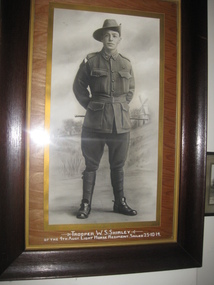
Portrait Photograph, J Williams, Trooper W S Shirley
... Regiment, 20 Aug 1914, embarked 19 Oct 1914. Wounded in action (side) 24 June 1915, 1 General Hospital Alexandria 30 June 1915, 4 London General Hospital , 23 Aug 1915. ...Regiment, 20 Aug 1914, embarked 19 Oct 1914. Wounded in action (side) 24 June 1915, 1 General Hospital Alexandria 30 June 1915, 4 London General Hospital , 23 Aug 1915. ...No 336, Tpr William Shirley, 34-yo labourer, of Yea Victoria. Enlisted B Squadron 4 LH Regiment, 20 Aug 1914, embarked 19 Oct 1914. Wounded in action (side) 24 June 1915, 1 General Hospital Alexandria 30 June 1915, 4 London General Hospital , 23 Aug 1915. Returned to Australia 8 May 1916. Previous service: No 1012 Pte, 5 VMR, Boer War. Embarked 15 Feb 1901. Returned to Australia 27 March 1902. Militia service 15 Light Horse RegimentB&W framed photograph of Trooper W S Shirley, 4th Light Horse RegimentTrooper W S Shirley of the 4th Aust Light Horse Regiment. Sailed 25.10.14photograph, ww1, w s shirley, 4th light horse regiment -
 4th/19th Prince of Wales's Light Horse Regiment Unit History Room
Print, A V Gregory, HMS Susan, 1934 (exact)
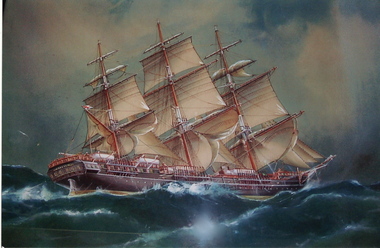
... London on the 23rd September 1835. She carried 394 male convicts and a guard of officers and 30 rank and file of the 28th (North Gloucestershire) regiment, arriving in Sydney on 8th February 1836. ...London on the 23rd September 1835. She carried 394 male convicts and a guard of officers and 30 rank and file of the 28th (North Gloucestershire) regiment, arriving in Sydney on 8th February 1836. ...HMS Susan sailed from the Port of London on the 23rd September 1835. She carried 394 male convicts and a guard of officers and 30 rank and file of the 28th (North Gloucestershire) regiment, arriving in Sydney on 8th February 1836. Samuel Windridge, who was born in Warwickshire in 1817, was a Private in the Regiment on board the ‘Susan’. He served in various places: Sydney, Moreton Bay (Brisbane) and Port Phillip (Melbourne). He was discharged from the Regiment in 1842 with the rank of Sergeant. After his marriage he settled in Victoria and by 1852 he was often in charge of the gold escort from Bendigo. In 1854 he retired from the Gold Commission and settled in Kyneton. In 1860 the Kyneton Mounted Rifle Corps was formed with Samuel Windridge as one of its earliest members. In 1862 the ladies of Kyneton presented a standard to the Rifle Corps. In 1976 the Shire of Kyneton presented the Kyneton Colours to the 4th/19th Prince of Wales’s Light Horse Regiment Museum. In 1862 the whole of the Victorian Horse was amalgamated into one Regiment: The Prince of Wales Light Horse. Samuel Windridge rose to the rank of Lieutenant Colonel in the Kyneton Troop of the regiment. He died in 1896, aged 79 years, This painting is a gift from his Great Grand-daughters Mrs Mary Hopper and Miss Jean Baldwin. Framed reproduction of painting of HMS Susan. Wood frame, glass frontA V Gregory on proper left bottom corner of print On bottom right of print: H.M.S Susan 'Southward of the Cape' Arrived in Sydney Feby 1836paintings, kyneton, prints, hms susan, samuel windridge, a v gregory -
 4th/19th Prince of Wales's Light Horse Regiment Unit History Room
Regimental Flag, 4th Light Horse Regiment, 1918 (estimated)
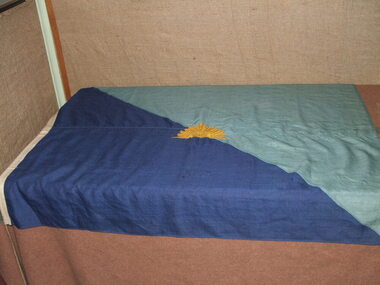
... A wooden securing toggle is attached to the flag. 4th Light Horse Regiment Regimental Flag The Ladies of Australia House, London ...High Significance. A Unit flag proclaiming to anyone approaching RHQ's location that this is the 4th Light Horse. Anyone who was famliar with the Colour Patch system of the Australian Imperial Force, would know from observing the flag that this unit is the 4th Light Horse Regt.4th Light Horse Regiment , "Two Blues" Flag, diagonally divided from upper left to lower right corner, light blue top, dark blue lower. 200 x 90 mm gold rising sun badge in centre. Rising Sun is likely to have been hand embroidered.. A wooden securing toggle is attached to the flag. Not anyflag, 4th light horse -
 4th/19th Prince of Wales's Light Horse Regiment Unit History Room
Souvenir cut from crashed aircraft stay
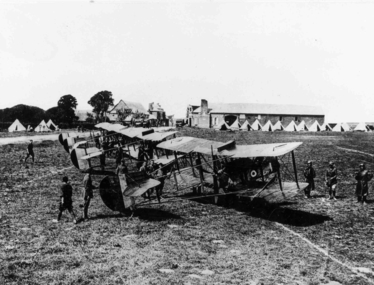
... The aircraft was probably an SE5 archibald smith arch smith 17alh 17th lhr sevententh light horse regiment. somme fremicourt souvenir aircraft Manufacturers logo of London Aircraft Co Ld. ...Souvenir is from an aircraft flown by 2LT Lewis Charles Burford Sheppard RFC, killed when his aircraft crashed on landing on the Bapaume Rd, Fremicourt in the Somme Area. A portion of a wing stay was cut from the aircraft and fashioned into a war trophy with the manufacturers logo and a hand written inscription detailing the crash on the reverse. The aircraft was probably an SE5Brown sealed timber cross section of a WW 1 aircraft stay Aircraft manufacturer logo in red and gold of London Aircraft Co Ld. Reverse has hand written inscription.Manufacturers logo of London Aircraft Co Ld. Reverse side has hand written inscription. Logo is Red "A" with red wings enclosed in a red circle with "Aircraft Co London on scroll under logo. Inscription on reverse reads "Captain Shepherd killed near Fremicourt April 21 1917 Piece of his planes stay Collided with tree on Bapuame Rd while landing archibald smith, arch smith, 17alh, 17th lhr, sevententh light horse regiment. somme, fremicourt, souvenir, aircraft -
 4th/19th Prince of Wales's Light Horse Regiment Unit History Room
Sword, abt early 20th century
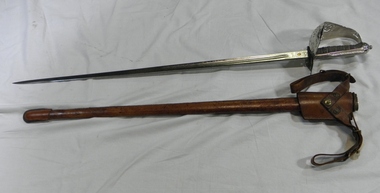
... This sword was issued to a member of the Regiment. sword wilkinson gallipoli 4th lioght horse chanter On guard - attached plaque : "LIEUT A L CHANTER "Lynn" ANZAC GALLIPOLI Nov 4th 1915" On blade ( R side): Star of Damascus, On scroll " BY WARRANT", UK Coat of Arms, Royal Standard, King's Crown. On blade (L Side) HENRY WILKINSON PALL MALL LONDON ...This sword was issued to Lt A Chanter of the 4th Australian Light Horse Regiment while serving at Gallipoli. He enlisted as Regimental No 59, was commissioned at Gallipoli and later rose to the rank of Captain commanding a Machine Gun section of the RegimentThe 4th Light Horse Regiment is an ancestor unit of the modern day Regiment. The 4LH served with distinction in WW1. This sword was issued to a member of the Regiment. Sword, Wilkinson, Infantry with scabbard, brown leather On guard - attached plaque : "LIEUT A L CHANTER "Lynn" ANZAC GALLIPOLI Nov 4th 1915" On blade ( R side): Star of Damascus, On scroll " BY WARRANT", UK Coat of Arms, Royal Standard, King's Crown. On blade (L Side) HENRY WILKINSON PALL MALL LONDON On scroll "BY APPOINTMENT" Badge of Prince of Wales Ornate "GVR", King's Crown On back of blade -Defence broad arrow, maker's or inspector's marks sword, wilkinson, gallipoli, 4th lioght horse, chanter -
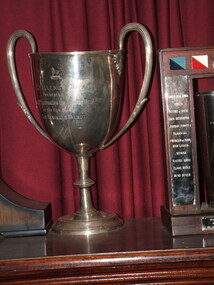 4th/19th Prince of Wales's Light Horse Regiment Unit History Room
Trophy - Silver Cup, Challenge Cup, Pre WW2
... Regiment. It has been catalogued by the Unit History Room to provide a record of it. trophy mess property CHALLENGE CUP PRESENTED TO THE 11TH AUSTRALIAN LIGHT HORSE REGT BY THE HON COLONEL SIR REGINALD TALBOT Maker's detail on edge of base: JAY s 142 & 144 Oxford Street London W Regimental crest Hallmarks - JJ, Queen's Crown, Lion. ...Object is property of the Regiment. It has been catalogued by the Unit History Room to provide a record of it.Silver cup. with two handles projecting 50 mm above rim of cup.CHALLENGE CUP PRESENTED TO THE 11TH AUSTRALIAN LIGHT HORSE REGT BY THE HON COLONEL SIR REGINALD TALBOT Maker's detail on edge of base: JAY s 142 & 144 Oxford Street London W Regimental crest Hallmarks - JJ, Queen's Crown, Lion. K trophy, mess property
