
Showing 84 items matching "match container"
-
 Williamstown Historical Society Inc
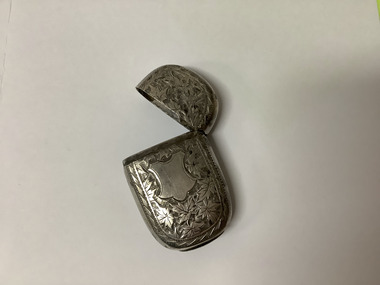
Accessory - Small silver Vesta match container
... Small silver Vesta match container...This small match container probably once held Vesta matches. ...Small sterling silver embossed Vesta match container with a hinged lid. Embossed leaves and shield design. ...This small match container probably once held Vesta matches. ...This small match container probably once held Vesta matches. Vesta matches were patented in 1832. The tips were made of volatile phosphorus and needed to be kept dry, so small containers called vesta cases (or match safes) became popular Victorian accessories. Vestas could be lit by striking them against a range of surfaces so were quite dangerous, so enclosing them in a metal container also helped keep them safe. Small sterling silver embossed Vesta match container with a hinged lid. Embossed leaves and shield design. Two hallmarks: one a lion and one unreadable. -
 Linton and District Historical Society Inc
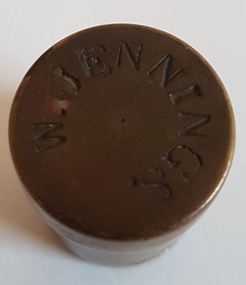
Container, Match Container, World War, 1914-1918
... Match Container, World War, 1914-1918...This type of match container was issued to soldiers in World War 1, to carry phosphorous matches safely. ...This type of match container was issued to soldiers in World War 1, to carry phosphorous matches safely. ...This type of match container was issued to soldiers in World War 1, to carry phosphorous matches safely. These matches could ignite by being rubbed together and often did so when carried in bags or pockets. This one was the property of a member of Linton's Jennings family.Cylindrical brass container with lid, bottom hatched. Lid engraved or stamped "W. JENNINGS."."W. Jennings".w. jennings, world war 1914-1918, containers, matches -
 Linton and District Historical Society Inc
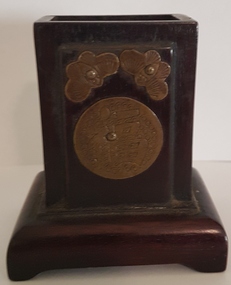
Container, Match Box Container
... Match Box Container...Match-box container, dark wood with metal adornments....Used by Colin Kerr and family at Linton. Containers Matches Kerr family Match-box container, dark wood with metal adornments. ...Used by Colin Kerr and family at Linton.Match-box container, dark wood with metal adornments.containers, matches, kerr family -
 Queenscliffe Maritime Museum
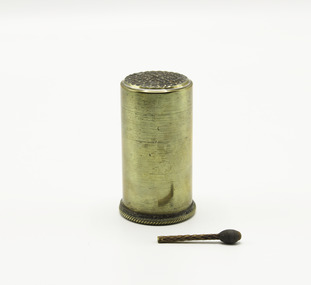
Container - Brass match container
... Brass match container...These brass containers held strike anywhere matches used by the Lifeboat service to light fuses to launch rescue rockets. ...A brass container for matches with one Vesta match used for lighting fuse for rescue rope rocket...Matches Strike anywhere matches rescue equipment rope rockets A brass container for matches with one Vesta match used for lighting fuse for rescue rope rocket Container Brass match container ...These brass containers held strike anywhere matches used by the Lifeboat service to light fuses to launch rescue rockets. Example of a type of match and its container used by the lifeboat crews in training and rescue operations where a rescue rope rocket had to be launched.A brass container for matches with one Vesta match used for lighting fuse for rescue rope rocketmatches, strike anywhere matches, rescue equipment, rope rockets -
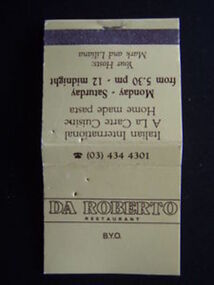 Greensborough Historical Society
Match Container - Digital Image, Da Roberto Restaurant matchbook, 1980s, 1980s
... Match Container - Digital Image...Da Roberto Restaurant matchbook, 1980s Match Container - Digital Image ...Digital image of Da Roberto Restaurant matchbook, circa 1980, used for advertising. Da Roberto was an Italian restaurant situated on the corner of Main Street and Para Road Greensborough.Part of a collection of miscellaneous historical images with a connection to the local area.Digital image of paper matchbook."Da Roberto Restaurant ..." da roberto restaurant -
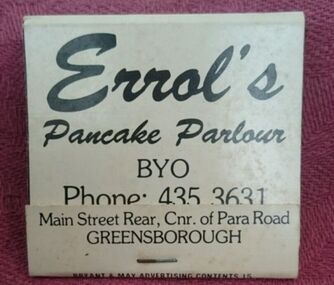 Greensborough Historical Society
Match Container - Digital Image, Errol's Pancake Parlour, 1980s
... Match Container - Digital Image...Errol's Pancake Parlour Match Container - Digital Image ...Advertisement on a matchbook for Errol's Pancake Parlour, of Main Street Greensborough 1980sPart of a collection of miscellaneous advertisements for businesses in Greensborough and surrounding areas.Digital copy of matchbook advertisement.errols pancake parlour, main street greensborough -
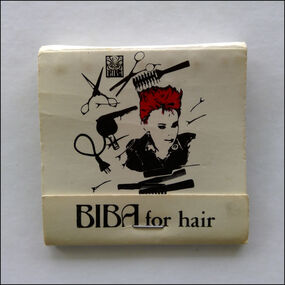 Greensborough Historical Society
Match Container - Digital Image, Biba for Hair matchbook, 1980s, 1980s
... Match Container - Digital Image...Biba for Hair matchbook, 1980s Match Container - Digital Image ...Digital image of a Biba for Hair matchbook, circa 1980, used for advertising. Biba was a hair salon located in Greensborough Plaza.Part of a collection of miscellaneous historical images with a connection to the local area.Digital image of paper matchbook."Biba for Hair … Greensborough Shopping Centre" biba for hair, greensborough plaza -
 Greensborough Historical Society
Match Container - Digital Image, Harrick Dry Cleaners, 1980s
... Match Container - Digital Image...Harrick Dry Cleaners Match Container - Digital Image ...Advertisement on a matchbook for Harrick Dry Cleaners of Main Street Greensborough 1980sPart of a collection of miscellaneous advertisements for businesses in Greensborough and surrounding areas.Digital copy of matchbook advertisement.main street greensborough, harrick dry cleaners -
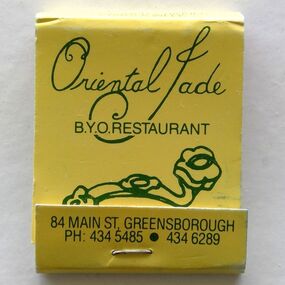 Greensborough Historical Society
Match Container - Digital Image, Oriental Jade, Oriental Jade, 1990s, 1990s
... Match Container - Digital Image...Oriental Jade, 1990s Match Container - Digital Image Oriental Jade Diamond Valley News ...Matchbook from Oriental Jade, Main Street Greensborough (1990s)Part of a collection of historic advertisements from local newspapers and other sources, showing local businesses from the mid 20th century.Digital copy of matchbook.main street greensborough, oriental jade -
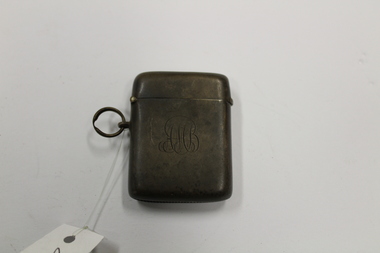 Dandenong/Cranbourne RSL Sub Branch
Memorabilia - Vesta match container, Unknown
... Vesta match container...Memorabilia Vesta match container ...Maybe WWI historical significance (unable to find any historic material on this item).Metal vesta container with a ring holder on the side.Inscribed with initials AMB on the front of holder -
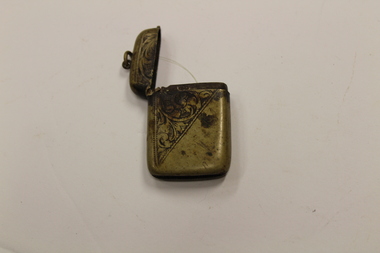 Dandenong/Cranbourne RSL Sub Branch
Memorabilia - Safety Match Container
... Safety Match Container...Brass container with flip up hinged lid to hold matches. Base has match striker lid has ring clip....Memorabilia Safety Match Container ...Brass container with flip up hinged lid to hold matches. Base has match striker lid has ring clip.Engraving on lid and half base diagonally. -
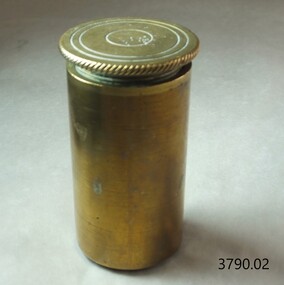 Flagstaff Hill Maritime Museum and Village
Domestic object - Match Safe, after 1830's
... ...match container...Pocket match safes or match safes were small portable boxes, or containers made in a great variety of forms and shapes, each with lids or covers to contain matches and retain their quality. ...Flagstaff Hill Flagstaff Hill Maritime Museum and Village Warrnambool Maritime Museum Maritime Village Great Ocean Road Shipwreck Coast shipwreck artefact Port Phillip Bay Port Lonsdale Lighthouse wreck 1960’s diver Queenscliff Marine Shop match container match safe matches fire lighter fire safety heat fire portable match safe 19th century Match Safe; hollow brass cylinder with ribbed match striker texture on base and screw thread around top. ...This match safe was amongst various items collected from a sea dive in Port Phillip Bay. The diver was the caretaker of the Port Lonsdale Lighthouse, who dived on various wrecks in the bay during the 1960's. After the caretaker's death, his son sold off many of the shipwreck artefacts. The match safe was purchased from the caretaker's son in the 1990's by a previous owner of the Marine Shop, Queenscliff, Victoria. Pocket match safes or match safes were small portable boxes, or containers made in a great variety of forms and shapes, each with lids or covers to contain matches and retain their quality. Matches came into use around the 1830's and were produced extensively between the years 1890 and 1920. During this period everyone carried strike anywhere matches, so they could ignite stoves, lanterns and other devices. Early matches were unreliable and prone to ignite from rubbing on one another or spontaneously. Accordingly, most people carried a match safe to house their matches. Wealthy people had ‘match safes made of gold or silver, while common folk had ones made of tin or brass. They were made throughout the world including the United Kingdom, in the U.S.A., continental Europe and Australia. Significant English makers of cases were, Sampson Mordan and Asprey & Co. Significant American manufacturers of match safes include Wm. B. Kerr, Gorham, Unger Brothers, Battin, Blackington , Whiting, George Scheibler and Shreve & Co. Different patterns and types run into thousands as well as plain and decorative examples. They were also made in a wide range of materials, including pressed brass, pressed tin, gunmetal, nickel silver, gold, bone, ivory, the wood of varying types, early plastics like tortoiseshell and Bakelite, and ceramics. A distinguishing characteristic of match safes is that they have a ribbed surface, usually on the bottom, for lighting the matches. The item gives a snapshot into the social development through it's application in every day use match safes were used at a time when there were no safety matches and the early use of matches was a dangerous affair given they were easily combustive if rubbed together in a pocket for example. The item is also an example of the shipwreck artefacts gathered along the southwest coast of Victoria.Match Safe; hollow brass cylinder with ribbed match striker texture on base and screw thread around top. Fitted brass lid has an internal screw thread, and the top's flat surface has concentric circles design, with a twisted rope pattern grip around the edge. flagstaff hill, flagstaff hill maritime museum and village, warrnambool, maritime museum, maritime village, great ocean road, shipwreck coast, shipwreck artefact, port phillip bay, port lonsdale lighthouse, wreck, 1960’s diver, queenscliff marine shop, match container, match safe, matches, fire lighter, fire safety, heat, fire, portable match safe, 19th century -
 Flagstaff Hill Maritime Museum and Village
Container
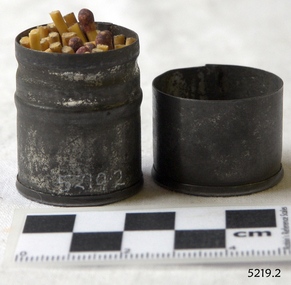
... ...match container...Metal container of wax matches. Made by Bryant & Mays Melbourne and called "Wax Vestas". ...flagstaff hill warrnambool shipwrecked-coast flagstaff-hill flagstaff-hill-maritime-museum maritime-museum shipwreck-coast flagstaff-hill-maritime-village wax matches bryant & mays wax vestas match case match container match box match sae Metal container of wax matches. ...Metal container of wax matches. Made by Bryant & Mays Melbourne and called "Wax Vestas". There is a strike pad on the bottom of the container.flagstaff hill, warrnambool, shipwrecked-coast, flagstaff-hill, flagstaff-hill-maritime-museum, maritime-museum, shipwreck-coast, flagstaff-hill-maritime-village, wax matches, bryant & mays, wax vestas, match case, match container, match box, match sae -
 Hand Tool Preservation Association of Australia Inc
Chain
... chain, fob, plus match container...This item is part of the Thomas Caine Tool Collection, owned by The National Trust of Australia (Victoria) and curated by the Hand Tools Preservation Association of Australia. chain, fob, plus match container Chain ...This item is part of the Thomas Caine Tool Collection, owned by The National Trust of Australia (Victoria) and curated by the Hand Tools Preservation Association of Australia.chain, fob, plus match container -
Hand Tool Preservation Association of Australia Inc
Container
... container, wax matches, silver...This item is part of the Thomas Caine Tool Collection, owned by The National Trust of Australia (Victoria) and curated by the Hand Tools Preservation Association of Australia. container, wax matches, silver Container ...This item is part of the Thomas Caine Tool Collection, owned by The National Trust of Australia (Victoria) and curated by the Hand Tools Preservation Association of Australia.container, wax matches, silver -
 Warrnambool and District Historical Society Inc.
Accessory - Matches Holder, Early 20th century
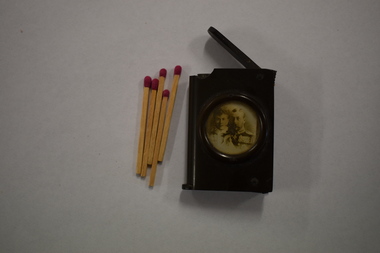
... A rectangular shaped brown metal matches container. It is rounded on one side and has a striking mechanism on the other side and a lift up lid at the top. ...Vintage Accessory Warrnambool History A rectangular shaped brown metal matches container. It is rounded on one side and has a striking mechanism on the other side and a lift up lid at the top. ...This matches holder, a common item in the early 20th century, has been produced to commemorate the reign of King George 5th of England. It may have been produced for his coronation in 1911.This item is of no known provenance but it is of some interest since it is a souvenir of the reign of King George 5th.A rectangular shaped brown metal matches container. It is rounded on one side and has a striking mechanism on the other side and a lift up lid at the top. There is a circular inset with an image of King George 5th and Queen Alexandra in sepia tones with a clear perspex cover. Inside the container are five wooden matches with red heads.vintage accessory, warrnambool history -
 Warrnambool and District Historical Society Inc.
Container, Silver coin container, 1910
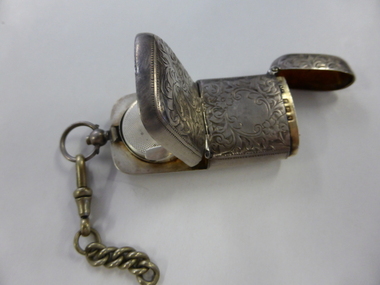
... Coin containers were used in the late 19th and early 20th centuries as a means of carrying some cash on the person and the matches holder was also a common item for men to carry....The top part has an indented and serrated part for striking the matches. The container is highly decorated in etched patterns with a space to engrave a person’s initials. ...The top part has an indented and serrated part for striking the matches. The container is highly decorated in etched patterns with a space to engrave a person’s initials. ...This item would have been owned by a man with some wealth as the silver hallmarks indicate an expensive purchase. Coin containers were used in the late 19th and early 20th centuries as a means of carrying some cash on the person and the matches holder was also a common item for men to carry.This item has no known local provenance but is useful as an example of social customs of the past and can be used also for display. This is a silver container divided into two sections – the top part with a hinged lid held wax matches and the bottom section has a circular recess for holding silver coins. This bottom section has a hinged lid. The top part has an indented and serrated part for striking the matches. The container is highly decorated in etched patterns with a space to engrave a person’s initials. The top has a ring with a chain for attaching the item to a chain. The container is slightly dented. Seven hallmarkssilver coin container, warrnambool, coin container -
 Bendigo Military Museum
Equipment - PERSONAL EFFECTS, 1) Oakley et al, C.1990’s
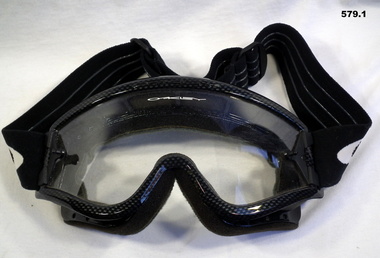
... Brand name Oakley. .2) Camouflage paint in plastic container, hinged lid with mirror inside. 3 divided sections with dark green, light green & brown used paint. .3) Patch, square, at top - yellow, middle - white above blue, bottom - bright light green. .4) Foot powder in dark green plastic container, twist lid with holes. .5) Container, dark green plastic cylinder, 11 matches, assorted. .6) Container lid, snap on, for .5). .7) Tube of army personal insect repellent. ...Brand name Oakley. .2) Camouflage paint in plastic container, hinged lid with mirror inside. 3 divided sections with dark green, light green & brown used paint. .3) Patch, square, at top - yellow, middle - white above blue, bottom - bright light green. .4) Foot powder in dark green plastic container, twist lid with holes. .5) Container, dark green plastic cylinder, 11 matches, assorted. .6) Container lid, snap on, for .5). .7) Tube of army personal insect repellent. ....1) Goggles, black plastic frame, foam padding, black strap. Brand name Oakley. .2) Camouflage paint in plastic container, hinged lid with mirror inside. 3 divided sections with dark green, light green & brown used paint. .3) Patch, square, at top - yellow, middle - white above blue, bottom - bright light green. .4) Foot powder in dark green plastic container, twist lid with holes. .5) Container, dark green plastic cylinder, 11 matches, assorted. .6) Container lid, snap on, for .5). .7) Tube of army personal insect repellent. Dark green plastic tube with screw top lid, unnumbered. Instructions & warnings printed on back of tube. .8) Metal signalling plate, Polished steel signalling plate with small hole in center. Instructions printed on one side. .9) Vinyl sleeve for signalling plate, green. Dole K.1) Written on foam in black texta: DOLEY. .2) Austcam NSN 6850-36-130-0172. Military Sunscreen DDM↑ 0598. .4) Foot Powder, Colbar Pty Ltd, 50g net, B/C 5-98, Formula Salicylic Acid 3%, Starch 10%, Talc 87%. .7) NSN 6840-66-106-0247.military equipment, containers, preventative medicine, goggles -
 The Beechworth Burke Museum
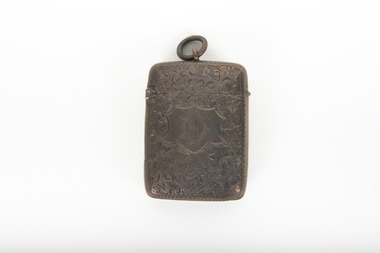
Functional object - Silver Vesta Case, Minshull & Latimer, 1901
... Vesta cases are small containers used to keep matches dry and prevent them from being ignited. ...Vesta cases are small containers used to keep matches dry and prevent them from being ignited. ...The hallmarks on this vesta indicate that the vesta was made in Birmingham, England in 1901 by Minshull & Latimer. Vesta cases are small containers used to keep matches dry and prevent them from being ignited. There three types of vesta cases but the most popular design was the pocket vesta which could be hung from a chain and featured a ribbed bottom to strike a match.The social history objects held in the Burke Museum's collection help to tell the stories of Beechworth's past by showing the social, cultural, and economic aspects of the town's history.A small silver container with a hinged lid that has a ring attached to the top of it. There is an engraved pattern across the surface with a set of initials on the obverse of the case. The bottom of the case features a ribbed design.TD/ [initials engraved on obverse] M/ &/ L/ anchor symbol/ lion symbol/ b/ [hallmarks] A1194/vesta case, birmingham, 20th century, minshull & latimer, matchbox -
 The Beechworth Burke Museum
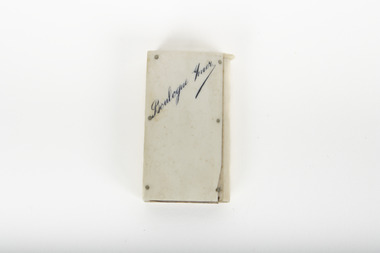
Functional object - Vesta Case
... Vesta cases are small containers used to keep matches dry and prevent them from being ignited. ...Vesta cases are small containers used to keep matches dry and prevent them from being ignited. ...Vesta cases are small containers used to keep matches dry and prevent them from being ignited. There three types of vesta cases but the most popular design was the pocket vesta which could be hung from a chain and featured a ribbed bottom to strike a match. It is unknown when this vesta case was created but the lettering on the front of the case suggest that it was create in Boulogne-sur-Mer, France. Boulogne-sur-Mer is a costal city in Northern France and is known for its maritime and trade history.The social history objects held in the Burke Museum's collection help to tell the stories of Beechworth's past by showing the social, cultural, and economic aspects of the town's history.A small white rectangular box. There are 6 nails both on the top and bottom keeping it closed. There is a small inscription on top in cursive lettering. One end is covered in a material used for crating sparks.Boulogne smer/ A01148/matchbox -
 Flagstaff Hill Maritime Museum and Village
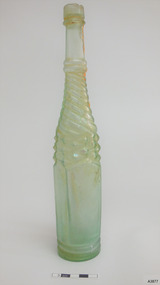
Container - Bottle, 1870s-1910s
... This whirley salad oil bottle is matches the whirley salad oil bottles recovered from the Loch Ard in the 1990s, adding depth of interpretation to the array of salvaged Loch Ard artefacts in Flagstaff Hill’s collection. The salad oil bottle is an example of the type of food condiment containers ...This clear, green tinged, Half Whirley (or Whirly) salad oil bottle has been handmade by a glassblower from 1870s-1910s. A bottle with such elaborate decoration would have been sought after as there was no need to decant the sauce into another jug or bottle to make it acceptable for table service. It is possible that this bottle was recovered from the Loch Ard, wrecked in 1878. A diver found the bottle on a shipwreck in the coastal waters of Victoria about 100 years from when it was made. The diver who found this bottle has recovered objects from several different shipwrecks between the late 1950s and early 1970s. A sizeable proportion of those objects was from the wreck of the famous clipper ship Loch Ard. This salad oil bottle may very well have been amongst that ship’s cargo. It is part of the John Chance Collection. A paper titled ‘Glass Bottles from the Loch Ard Shipwreck (1878): A Preliminary Study’ by Iain Stuart, (published in Australian Historical Archaeology, 9, 1991) included a study of twelve salad oil bottles from the wreck of the Loch Ard. The bottles were of this same Half Whirley design (half meaning that it was Whirley on the upper half but not on the lower half of the body), as well as the same colour and size. A diagram of one of these twelve bottles matches the bottle in our collection. The paper mentions that eleven of the twelve bottles have a number on their base, just as this one has. It is estimated that foreign and salad oil bottles totalled four percent of all of the bottles carried as cargo on the ship. The Half Whirley bottle has side seams from below the lip to the base, indicating that the bottle was made in a two-piece mould that included the heel, body, shoulder and neck. The fancy ‘whirly’ twist pattern and panelled sides would have been cut into the mould’s inner surface. The uneven thickness of the ridge around the base comes from adding a separately moulded and embossed base after the bottle was removed from the mould. The applied finish (mouth and lip) was also added to the bottle. The elongated bubbles in the glass are evidence of the glass being mouth blown into the mould, thus forming the shape and pattern from the inside shape of the mould. The bottle probably had a glass stopper with a round top and wedge-shaped shank with a ground surface, allowing the bottle to be re-sealed. The ring between upper and lower lip allows the closure to be sealed and anchored. The embossed numbers are either “133” or “833” and may represent a particular bottle pattern, manufacturer or filler. Although the bottle is not currently linked to a particular shipwreck, it is recognised as being historically significant as an example of bottles imported for use in Colonial Victoria in the mid-to-late 19th century. This whirley salad oil bottle is matches the whirley salad oil bottles recovered from the Loch Ard in the 1990s, adding depth of interpretation to the array of salvaged Loch Ard artefacts in Flagstaff Hill’s collection. The salad oil bottle is an example of the type of food condiment containers that were used in Victoria’s early days. The bottle is also significant as it was recovered by John Chance, a diver in Victoria’s coastal waters in the late 1960s to early 1970s. Items that come from several wrecks, including the Loch Ard, have since been donated to the Flagstaff Hill Maritime Village’s museum collection by his family, illustrating this item’s level of historical value. Bottle; glass Half Whirley salad oil bottle, green-tinged, with some opalescence. Handmade, elaborately decorated bottle with round neck and base, and five-sided body. Applied double lip; straight upper, flared lower. The lower neck and shoulder have twisted spiral whirley patterns in the glass. The body tapers slightly inwards towards the base. It has five plain panels, one wider than the others. Side seams run from below the lip to the heel. The heel of the bottle is uneven in width, height and density where it joins the body of the bottle. The base is not level. Embossed characters on base. Glass has elongated bubbles towards the base and orange-brown sediment inside, on one side. Embossed "133" or “833” (the first character may be an “8”) flagstaff hill, warrnambool, flagstaff hill maritime museum, maritime museum, shipwreck coast, flagstaff hill maritime village, great ocean road, shipwreck artefact, john chance, glass bottle, antique bottle, handmade, mouth blown, blown bottle, 19th century bottle, collectable, bottle, green glass, tinged green, two piece mould, food bottle, oil bottle, salad oil bottle, whirley, whirly, half whirley, condiment bottle -
 City of Moorabbin Historical Society (Operating the Box Cottage Museum)
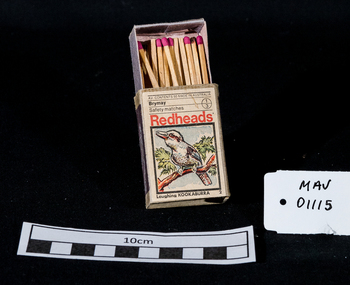
Containers, matchbox 'Redhead' with matches, 20thC
... The tray containing the matches slides inside the open ended cover.. The striking patch is on both sides of the cover. Containers ...On 15th December 1909, Bryant & May, Australia’s first match factory at Church Street, Richmond, Victoria. was opened by The Honourable Alfred Deakin, Prime Minister of Australia, and Mrs. Deakin. It was heralded by the first Commonwealth Government of newly-federated Australia because the government of the day was anxious to encourage secondary industry and pledged tariff protection of local manufacturers. The building was constructed in 1909 as the Empire Works to a design by prolific Melbourne architect William Pitt and was purchased soon after by British safety match manufacturer Bryant and May, who significantly expanded the building, adding another level and the landmark clock tower. Bryant and May were unique in that they operated as a model factory, providing workers with conditions and amenities that even today seem generous. These included a dining hall and sports facilities such as a tennis court and bowling green which were constructed in the 1920s. Bryant and May ceased Australian match manufacture in the early 1980s as a result of import competition. Their iconic Redheads matches are now imported from Sweden. The complex has since been converted for use as offices and showrooms but is extremely well preserved. It is listed on the Victorian Heritage Register. Bryant and May was a United Kingdom (UK) company created in the mid-nineteenth century specifically to make matches. Their original Bryant and May Factory was located in Bow, London. They later opened other match factories in the United Kingdom and Australia, such as the Bryant and May Factory, Melbourne; and owned match factories in other parts of the world. Bryant and May survived as an independent company for over seventy years, but went through a series of mergers with other match companies and later with consumer products companies. To protect its position Bryant and May merged with or took over its rivals. In 1971 the Northern Ireland factory, Maguire & Patterson closed down following a terrorist attack.. In the 1980s, factories in Gloucester and Glasgow closed too leaving Liverpool as the last match factory in the UK, until December 1994. . The registered trade name Bryant and May still exists and it is owned by Swedish Match, as are many of the other registered trade names of the other, formerly independent, companies within the Bryant and May group. Two French chemists, Henri Savene and Emile David Cahen, proved in 1898 that the addition of phosphorus sesquisulfide meant that the substance was not poisonous, that it could be used in a "strike-anywhere" match, and that the match heads were not explosive. British company Albright and Wilson, was the first company to produce phosphorus sesquisulfide ( Red Phosphorous) matches commercially. The company developed a safe means of making commercial quantities of phosphorus sesquisulfide in 1899 and started selling it to match manufacturers. Matches were first produced by Bryant & May in Australia in 1909. The Redhead name applies to the red striking heads of the matches which were introduced to Australia in 1946. The logo on the matchbox depicted the head and shoulder of a redheaded woman and has had four major updates since that time with a number of special issues depicting birds, animals and notable persons also produced.The Bryant & May Ltd factory in Church St Richmond is a listed building and has been converted to apartments following the closure of the Company 1980. Bryant & May's Ltd were influential in fighting against the dreadful disease known as Phossy jaw which was caused by white phosphorus used in the manufacture of the early matches. They were also the object of the 'Match Girls Strike' in London 1888, which won important improvements in working conditions and pay for the mostly female workforce working with the dangerous white phosphorus. The public were slow to purchase these safety matches because of the higher price .A box of safety matches with unused matches made by Bryant & May Pty Ltd , Richmond Victoria Australia. The tray containing the matches slides inside the open ended cover.. The striking patch is on both sides of the cover. Av. CONTENTS 50 MADE IN AUSTRALIA / Brymay / 1/3 / Safety Matches / Redheads / a colour picture of a Kookaburra / Laughing KOOKABURRAsafety matches, bryant & may pty ltd, phossy jaw disease, early settlers, moorabbin, bentleigh, cheltenham, lights, lamps, tobacco, white phosphorous, phosphorus sesquisulfide, swedish match pty ltd, pitt william, savens henri, cahen emile david , richmond victoria, -
 Orbost & District Historical Society
tin, From 1920's
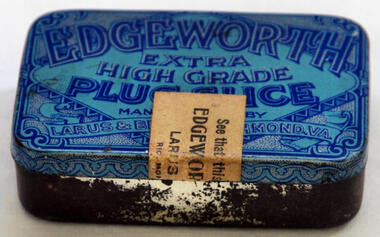
... container Tobacco by LARUS & BRO. CO Richmond Va Tin by American Can Co 50A Small blue, rectangular tin with hinged lid. Match ...The ready rubbed tobacco held within the tin was mainly used by those smokers who rolled their own cigarettes. These smokers would have mainly used their palm and formed a cup then placing their choice of the amount of tobacco to be rolled. This would then be placed on the fine cigarette paper and rolled and sealed (using saliva in the mouth) into the required shape. There were mechanical "roll you own" gadgets on the market but most rural users, especially males used their palms. This item reflects the first half of the 20th century when smoking was acceptable.Small blue, rectangular tin with hinged lid. Match striker on base. Edgeworth Extra High Grade Plug Slice. Paper seal remains on lid. Tobacco by LARUS & BRO. CO Richmond Va Tin by American Can Co 50Atin tobacco larus smoking container -
 Orbost & District Historical Society
tin, 1940's
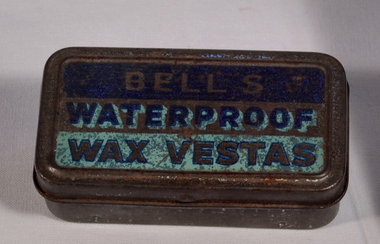
... container with hinged cover. Base has a slightly recessed central section which has been perforated to enable the striking of matches. ...Matches were made from wax and came in tins such as this item. tin bell's-vestas smoking matches Small rectangular iron alloy container with hinged cover. ...Moisture-proof wax vestas issued to A.I.F. troops during south-west Pacific campaign. Cigarettes were a normal part of life during both World Wars and there was no attempt made to limit or stop soldiers from smoking. In many cases it was actually encouraged.In WW1 there were almost no cigarette lighters available. Even in WW2 they were unusual. Matches were the normal way of creating fire. The wooden "safety" match that we know today was not in common use. Matches were made from wax and came in tins such as this item.Small rectangular iron alloy container with hinged cover. Base has a slightly recessed central section which has been perforated to enable the striking of matches. The cover has been painted with 'Bells Waterproof Wax Vestas' on a green or black ground. tin bell's-vestas smoking matches -
 Orbost & District Historical Society
match box, Sinclair (?)
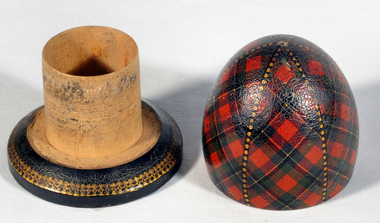
... vestra matchbox smoking personal-effects container A wax matches' box in the shape of an egg on a mall pedestal. ...A wax matches' box in the shape of an egg on a mall pedestal. It is made of carved wood and painted red, green and black in a tartan design. It has gold dots down the side and on the base.vestra matchbox smoking personal-effects container -
 Orbost & District Historical Society
beaded bag, late 19th -early 20th century
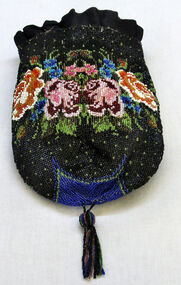
... match the dresses of the era. They were small enough to carry makeup compacts, a few coins, and they were fashion accessories more than practical handbags. This item is an example of a clothing accessory used by women in the early 20th century. bag personal-effects money-container beading drawstring-bag Fully beaded drawstring bag with designs of flowers. ...Pretty and tiny beaded bags and purses were highly decorated to match the dresses of the era. They were small enough to carry makeup compacts, a few coins, and they were fashion accessories more than practical handbags.This item is an example of a clothing accessory used by women in the early 20th century.Fully beaded drawstring bag with designs of flowers. Tassel of beads attached to bottom of bag. Small wooden hooks on the inside to hold black rope drawstring.bag personal-effects money-container beading drawstring-bag -
 Greensborough Historical Society
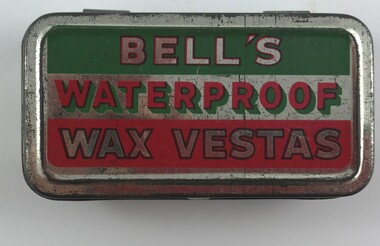
Domestic object - Matches, Bell, Bell's waterproof wax vestas, 1950c
... "Vesta case" containing 3 cm long waterproof matches matches match containers vesta cases vesta matches Bell's Waterproof Wax Vestas printed in green and red Small tin, hinged lid, nickle plated, printed lid, containing blue-headed waterproof matches, known as "Vestas" Bell's waterproof wax vestas Domestic object Matches Bell ..."Vesta case" containing 3 cm long waterproof matchesSmall tin, hinged lid, nickle plated, printed lid, containing blue-headed waterproof matches, known as "Vestas"Bell's Waterproof Wax Vestas printed in green and redmatches, match containers, vesta cases, vesta matches -
 Bendigo Military Museum
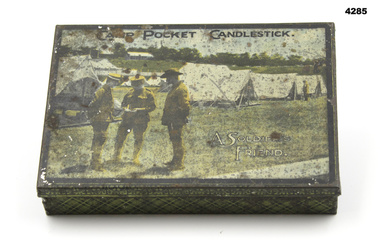
Container - TIN, HINGED, circa World War One 1915-1918
... Candle and matches missing. Container TIN, HINGED ...Uniforms worn by the soldiers in the illustration suggest that the item was used by Australians in World War One. Soldiers had to purchase the item.Rectangular hinged tin with a coloured illustration on the top. Illustration features three soldiers in an outdoor tented campsite. Illustration is bordered in black. Title in black and white lettering includes the text, CAMP POCKET CANDLESTICK./A SOLDIER’S FRIEND. Sides of the tin feature a yellow and green tartan pattern. Base of the tin is silver coloured with traces of the yellow and green tartan pattern. Inside of the tin has compartments for a candle and matches and a holder for a lit candle. Round hole in base is part of the candle holder. Candle and matches missing.personal equipment, candlestick, world war one, troop comforts -
 Bendigo Military Museum
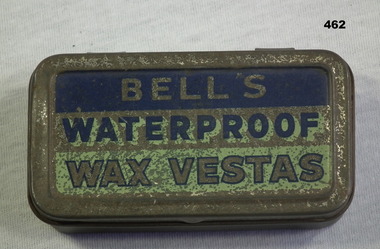
Container - MATCHES TIN, C.1939 -45
... Striking plate indented into bottom of tin. Container MATCHES TIN ...Wax Vestas were matches. The tin would hold approx. 150 matches. Belonged to Keith David Livingston VX136969 2nd AIF. Refer 1911P for service history.Tin for containing wax vestas containing piece of folded lint. Painted coloured label-dark blue and pale green. Hinged lid. Striking plate indented into bottom of tin.On lid: "BELL'S/WATERPROOF/WAX VESTAS"containers-commercial, wax vestas, matches -
 Bendigo Military Museum
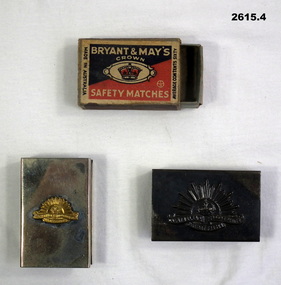
Memorabilia - TRENCH ART, MATCHBOX & HOLDERS, 1) & .2) Bryant & May, C. WW2
... military history - souvenirs containers - commercial Matches .1) & .2) Matchbox. .3) Metal matchbox holder with Rising Sun badge in brass on top. ....1) & .2) Matchbox. .3) Metal matchbox holder with Rising Sun badge in brass on top. Electroplated nickel silver. .4) Metal matchbox holder with large self coloured Rising Sun badge embossed.military history - souvenirs, containers - commercial, matches
