
Showing 56 items matching "memorial fundraising"
-
 Bendigo Military Museum
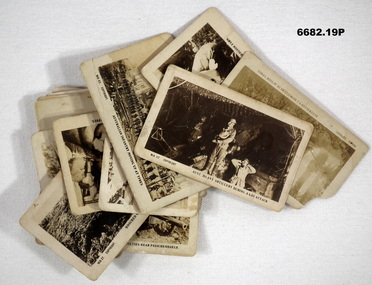
Photograph - PHOTOGRAPHS, WW1, Aust Army et al, 1916-1930
... Memorial...Fundraising...Passchendaele Barracks Trust WW1 Australian War Memorial Fundraising On the rear of each is an advert for Magpie cigarettes, stating these are the copies of official war photographs. originals are from Australian War Museum, Melbourne. it shows prices for enlargements and proceeds to go to War Memorial funds. ...Items in the collection relating to Lt Col Jack Swatton M.I.D. Regt No 4905, refer Cat No 6719.2P for his extensive service record and RSL.These are miniature black and white photos from WW1 scenes. They apparently were collected from cigarette packets. They are numbered, these are definitely not the full set. Each photo has a number and one line description of scene.On the rear of each is an advert for Magpie cigarettes, stating these are the copies of official war photographs. originals are from Australian War Museum, Melbourne. it shows prices for enlargements and proceeds to go to War Memorial funds.passchendaele barracks trust, ww1, australian war memorial, fundraising -
 Returned Nurses RSL Sub-branch
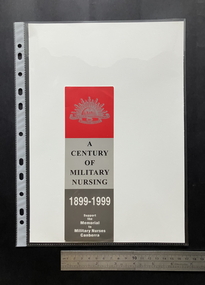
Card - Bookmark, [circa 1999]
... ...Memorial fundraising...Australian Commonwealth Military Forces Australian Army Nurses Centenary Memorial fundraising Australian Service Nurses National Memorial The bookmark features 3 squares with the traditional colours of the Australian Army Nursing Service (AANS) uniforms and the Royal Australian Army Nursing Corps (RAANC) emblems: on top the Scarlet (Red) with the Australian Commonwealth Military Forces pattern with rising sun in silver, Silver in the centre with "A Century of Military Nursing" in black, and Grey with "1899-1999 / Support the Memorial to Military Nurses Canberra". ...Located on Anzac Parade, Canberra, the Australian Service Nurses National Memorial commemorates the Centenary of the Australian Service Nurses who died and honours those who served and suffered in war since 1899. The glass artwork was created by Robin Moorehouse and was unveiled on 2 October 1999 by Sir William Deane AC K.B.E. The bookmark features 3 squares with the traditional colours of the Australian Army Nursing Service (AANS) uniforms and the Royal Australian Army Nursing Corps (RAANC) emblems: on top the Scarlet (Red) with the Australian Commonwealth Military Forces pattern with rising sun in silver, Silver in the centre with "A Century of Military Nursing" in black, and Grey with "1899-1999 / Support the Memorial to Military Nurses Canberra". A bookmark sized card in three sections, top in red with Australian military logo in silver, middle in pale grey with black text and bottom section darker grey with white textaustralian commonwealth military forces, australian army nurses, centenary, memorial fundraising, australian service nurses national memorial -
 Federation University Historical Collection
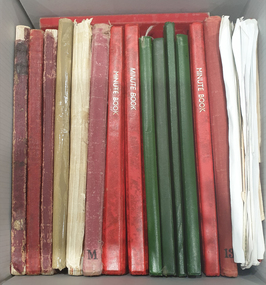
Book - Minute Book, Eureka Stockade Memorial Park Committee Minute Book
... Nine red hard covered books with the handwritten and computer generated minutes Eureka Stockade Memorial Park Committee . .1) Includes duties of officers, events, fundraising, payments, placing a tablet on the monument, list of members of the committee (139 names) .2) Eureka Widows and Orphans Fund, plan of proposed gardens, extension of the hall .3) Swimming pool improvement, proposed tramway extenson, electric light .7) Glasshouse .8) planting of trees .9) Eureka Stockade Centre .10) Financial Statements 11/2000-8/2003 Note, the minutes form 02/1932 to 1/1943 are not held within this collection, and were deemed to be missing when donated. ...From the earliest minute book (1918) the committee of this organisation included women in decision making positions. gordon eureka stockade ballarat fine art gallery lake penhalluriack eureka caravan park eureka hall frank williams eureka walk dale kelly john barnes eureka s children old colonists club peter nicholson paul wiliams taite ken clements darren gamston eureka playground roly mckenzie janet dore len fox pikeman s dog f nielson thomas keneally al grasby s jones brian harvey t bibby eureka centre eureka stockade centre eureka stockade park committee eureka stockade committee e.g. pearce bernardi ratford mckay carey mcgregor ham fallow feary jones j.r. hams j. davey w. wye r. quick d. bernardi eddy gingell micklejohn w. mckay w. carey r. mcgregor c. davies sports programm eureka stockade anniversary celebration s. barker d.c. mcgrath m. baird annual carnival r. britnall w. elsworth g. williams f. britnell eurkea stockade improvement and progress association w.j. corbett crago a. harrison b. groves s. leonard h. parsons e. plumridge j. dynan e.parsens w.k. hood walter a. shaw f. pearce a. pearce vic carey william carey de gaafe j.h. stanley j. andrewartha w. marshall v.c. jones m. byrne caravan park anan day helen mckay a. jones n. jones w. bromley j. lamb w. strange p. hetherington alex barnett\k. catios l. eva j. collins j. shannon\ g. calions l. o'brien j.a. cook w.g. fleet g. lee d. crooke s. mckenzie r. chittock g. drake s. romeo p. williams g. taite j. webb g. mckenzie j. berriman f. kennan d. miller d. scanlon eureka luncheon t. bibby f. nielan eureka dioramo Nine red hard covered books with the handwritten and computer generated minutes Eureka Stockade Memorial Park Committee . .1) Includes duties of officers, events, fundraising, payments, placing a tablet on the monument, list of members of the committee (139 names) .2) Eureka Widows and Orphans Fund, plan of proposed gardens, extension of the hall .3) Swimming pool improvement, proposed tramway extenson, electric light .7) Glasshouse .8) planting of trees .9) Eureka Stockade Centre .10) Financial Statements 11/2000-8/2003 Note, the minutes form 02/1932 to 1/1943 are not held within this collection, and were deemed to be missing when donated. ...From the earliest minute book (1918) the committee of this organisation included women in decision making positions.Nine red hard covered books with the handwritten and computer generated minutes Eureka Stockade Memorial Park Committee . .1) Includes duties of officers, events, fundraising, payments, placing a tablet on the monument, list of members of the committee (139 names) .2) Eureka Widows and Orphans Fund, plan of proposed gardens, extension of the hall .3) Swimming pool improvement, proposed tramway extenson, electric light .7) Glasshouse .8) planting of trees .9) Eureka Stockade Centre .10) Financial Statements 11/2000-8/2003 Note, the minutes form 02/1932 to 1/1943 are not held within this collection, and were deemed to be missing when donated. gordon, eureka stockade, ballarat fine art gallery, lake penhalluriack, eureka caravan park, eureka hall, frank williams, eureka walk, dale kelly, john barnes, eureka s children, old colonists club, peter nicholson, paul wiliams, taite, ken clements, darren gamston, eureka playground, roly mckenzie, janet dore, len fox, pikeman s dog, f nielson, thomas keneally, al grasby, s jones, brian harvey, t bibby, eureka centre, eureka stockade centre, eureka stockade park committee, eureka stockade committee, e.g. pearce, bernardi, ratford, mckay, carey, mcgregor, ham, fallow, feary, jones, j.r. hams, j. davey, w. wye, r. quick, d. bernardi, eddy, gingell, micklejohn, w. mckay, w. carey, r. mcgregor, c. davies, sports programm, eureka stockade anniversary celebration, s. barker, d.c. mcgrath, m. baird, annual carnival, r. britnall, w. elsworth, g. williams, f. britnell, eurkea stockade improvement and progress association, w.j. corbett, crago, a. harrison, b. groves, s. leonard, h. parsons, e. plumridge, j. dynan, e.parsens, w.k. hood, walter a. shaw, f. pearce, a. pearce, vic carey, william carey, de gaafe, j.h. stanley, j. andrewartha, w. marshall, v.c. jones, m. byrne, caravan park, anan day, helen mckay, a. jones, n. jones, w. bromley, j. lamb, w. strange, p. hetherington, alex barnett\k. catios, l. eva, j. collins, j. shannon\, g. calions, l. o'brien, j.a. cook, w.g. fleet, g. lee, d. crooke, s. mckenzie, r. chittock, g. drake, s. romeo, p. williams, g. taite, j. webb, g. mckenzie, j. berriman, f. kennan, d. miller, d. scanlon, eureka luncheon, t. bibby, f. nielan, eureka dioramo -
 Mission to Seafarers Victoria
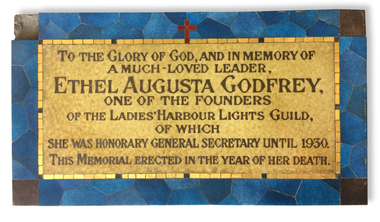
Plaque - Opus sectile tablet, 1936
... A key achievement was the fundraising campaign for the memorial chapel in St Peters built in 1917 by Walter R.Butler. ...A key achievement was the fundraising campaign for the memorial chapel in St Peters built in 1917 by Walter R.Butler. ...The memorial tablet was unveiled in the St Nicholas chapel at the Port Melbourne mission (Beach Cnr Nott St) on Wednesday 24 June 1936. The ceremony was performed by her nephew, Reverend John Smerger Drought - her sister's son. Another plaque was erected the same month in the Williamstown Institute. (Annual Report 1936) Along with the windows in the St Peter chapel in the Central Institute, those were the 3 memorials similar to the ones erected in memory of Miss Tracy. Miss Ethel Godfrey was born in 1861 at sea on the vessel called Copenhagen. Daughter of a pioneer, and settler Frederick Race Godfrey MLA and subsequently Lay Dean at St Paul's. Ethel Studied in Melbourne and abroad at Brussels and became a singing teacher and performer. In 1906 she took on the role of Honorary General Secretary to create and lead the volunteer organisation "The Ladies Harbour Lights Guild" and subsequently helped establish similar groups in Newcastle, Brisbane, Sydney, Hobart, Adelaide and also established the mission in Southampton in the UK. The structure of the LHLG was used as a model framework by similar groups supporting Missions around Australia and the Globe. A key achievement was the fundraising campaign for the memorial chapel in St Peters built in 1917 by Walter R.Butler. She died the 7 July 1935, and is buried in the St Kilda Cemetery.On her retirement in 1930 after some 25 years, Miss Godfrey together with Chaplain Gurney Goldsmith was recognised in the journal The Church and the Sailor, as a key influence and promoter of the formation of Harbour Lights groups across the suburbs of Melbourne, Victoria and Australia, the Ladies Harbour Lights Guild, Melbourne being the first such auxiliary group in the world.Clay base rectangular plaque with inlaid blue ceramic regular tesserae surrounding the ceramic centre rectangular ceramic panel with inscription and decorative glazed detail tiles. Support is a metal frame with inset wood pieces .To the Glory of God and in memory ops/ a much loved leaderAthel Augusta Godfrey, / one of the founders/ of the ladies Harbour Lights Guild/ of which she was honorary general secretary / Until 1930./ This memorial erected in the year of her death."memorial plaque, plaque, lhlg, port melbourne, chapel, brooks robinson and co, reverend john smerger drought, sectile tablet, opus sectile mosaic, mosaic, ethel augusta godfrey 1861-1935 -
 Mission to Seafarers Victoria
Plaque - Memorial plaque, P.J. King, Memorial Chapel of Saint Peter, 1917
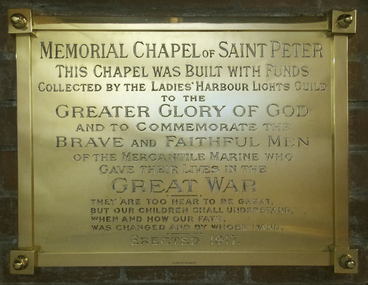
... Highly significant as the identifier of the raison d'etre for the chapel building and the massive fundraising effort made by the Ladies Harbour Lights Guild to fund the building prior to the end of the Great War. memorial memorial chapel wwi first world war great war 1917 lhlg merchant navy mercantile marine st peter chapel walter richmond butler p.j.king engraver MEMORIAL CHAPEL OF SAINT PETER / THIS CHAPEL WAS BUILT WITH FUNDS / COLLECTED BY THE LADIES HARBOUR LIGHTS GUILD/ TO THE GLORY OF GOD / AND TO THE COMMEMORATE THE/ BRAVE AND FAITHFUL MEN / OF THE MERCANTILE MARINE WHO/ GAVE THEIR LIVES IN THE/GREAT WAR / THEY ARE TOO NEAR TO BE GREAT / BUT OUR CHIDREN SHALL UNDERSTAND/ WHEN AND HOW OUR FATE/ WAS CHANGED AND BY WHOSE HAND/ ERECTED 1917 At the bottom manufacturer's name and address: P.J. ...The Chapel of Saint Peter was dedicated on September 6, 1917 by His Grace the Archbishop of Melbourne. The total sum necessary for the construction of the chapel was collected by the L.H.L.G and the chapel stands as a tribute to the honoured memory of the officers and men of the Mercantile Marine who lost their lives in the Great War. Note that the building was erected to commemorate fallen Mercantile Marines in the Great War before the war was concluded. This shows that the war and death toll thus far was significant enough at this point that it was having a serious impact on Australian society. Highly significant as the identifier of the raison d'etre for the chapel building and the massive fundraising effort made by the Ladies Harbour Lights Guild to fund the building prior to the end of the Great War.Large rectangular engraved brass plaqueMEMORIAL CHAPEL OF SAINT PETER / THIS CHAPEL WAS BUILT WITH FUNDS / COLLECTED BY THE LADIES HARBOUR LIGHTS GUILD/ TO THE GLORY OF GOD / AND TO THE COMMEMORATE THE/ BRAVE AND FAITHFUL MEN / OF THE MERCANTILE MARINE WHO/ GAVE THEIR LIVES IN THE/GREAT WAR / THEY ARE TOO NEAR TO BE GREAT / BUT OUR CHIDREN SHALL UNDERSTAND/ WHEN AND HOW OUR FATE/ WAS CHANGED AND BY WHOSE HAND/ ERECTED 1917 At the bottom manufacturer's name and address: P.J. King / 175 Collins Stmemorial, memorial chapel, wwi, first world war, great war, 1917, lhlg, merchant navy, mercantile marine, st peter chapel, walter richmond butler, p.j.king engraver -
 City of Moorabbin Historical Society (Operating the Box Cottage Museum)
Document - Fundraising for the 'Burgess Memorial Fund', c 1916-1917
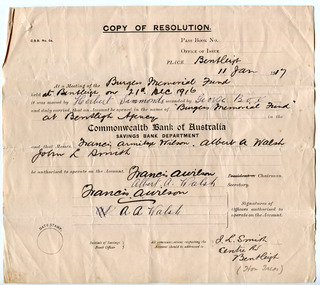
... sport Shire of Moorabbin Two paper documents: One a copy of a resolution re the opening of a bank account ; two a letter from the Southern Cross Press which accompanied a donation for the Burgess Memorial Fund Document Fundraising for the 'Burgess Memorial Fund' ...At a public meeting in January 1917 the residents of the Shire of Moorabbin decided to appeal for funds for the purpose of erecting a memorial to the memory of the late Councillor William George Burgess, who died on 29 November 1916. The committee that was formed to oversee this project described Mr Burgess and his accomplishments: “Mr Burgess served the Shire of Moorabbin in the that capacity faithfully and will for upwards of 35 years. Mr Burgess was a resident of the shire since early boyhood and all through life either initiated or identified himself closely with every movement for the advancement of the district. The acquisition of the Bentleigh Reserve is evidence of his untiring energy and zeal, and it is now proposed to erect a brick pavilion thereon as a monument to the memory of one who had striven to leave the world, and the district in which he resided, a little better than he found it.” The “Burgess Memorial Pavilion” was opened on 13 October 1917. The pavilion was built of brick, with tiled roof, containing two rooms, one 12ft x17ft, the other 12ft x 9ft, a spacious verandah, supported by brick pillars was provided on two sides of the building. Unfortunately the Burgess Pavilion burnt down in June 1928. William Burgess was a Councillor for the Shire of Moorabbin for over 35 years, during which he was the President for five terms. William was a market gardener in Mackay Road, Bentleigh. His family settled in the district in 1855.Two paper documents: One a copy of a resolution re the opening of a bank account ; two a letter from the Southern Cross Press which accompanied a donation for the Burgess Memorial Fundwilliam burgess, the burgess pavilion, bentleigh recreational ground, fundraising, sport, shire of moorabbin -
 Mission to Seafarers Victoria
Memorabilia - Honor Board, Mercantile Marine War Service League, Early 20th Century
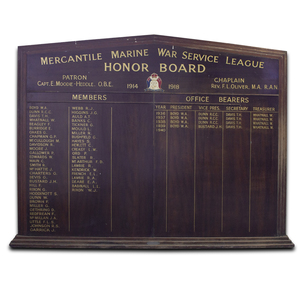
... memorial fund may have been superseded by a national organisation see links above. JM 2020. The Katoomba crews led by Captain E. Moodie-Heddle were regular visitors to the Mission from 1914 onwards and assisted with fundraising events and collections. captain e.l. moodie heddle s.s. katoomba frank oliver honour boards war memorials see image Large Honour board with angled top in dark red stained wood and gilt lettering Patron: Captain E. ...While there are some references from time to time to a war memorial fund in both Mission Annual reports from the 1930s and news clippings the actual organisation has not been well researched. More information is needed about formation and member details. As the board primarily was designed for WW1 it may have fallen out of use post WW2. This War memorial fund may have been superseded by a national organisation see links above. JM 2020.The Katoomba crews led by Captain E. Moodie-Heddle were regular visitors to the Mission from 1914 onwards and assisted with fundraising events and collections.Large Honour board with angled top in dark red stained wood and gilt lettering Patron: Captain E. Moodie Heddle showing member names, president, Vice President, treasurer and Rev Oliver's name at far rightprimarily dedicated to the Merchant seamen of Great war of 1914-1918. see imagecaptain e.l. moodie heddle, s.s. katoomba, frank oliver, honour boards, war memorials -
 Mission to Seafarers Victoria
Postcard - Postcard, Black and white, Valentine & Sons Publishing Co. Ltd, Baptistry in the Chapel, Missions to Seamen, Melbourne, Vic, c. 1920
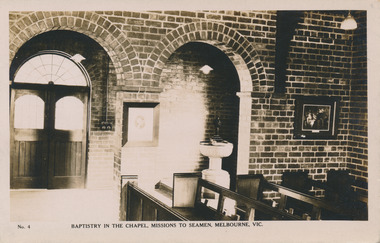
... The Chapel, opened in 1917, was a special fundraising project of the Ladies Harbour Light Guild and was originally dedicated as a Memorial Chapel in remembrance of those who served in the Merchant Navy of WWI. ...The Chapel, opened in 1917, was a special fundraising project of the Ladies Harbour Light Guild and was originally dedicated as a Memorial Chapel in remembrance of those who served in the Merchant Navy of WWI. ...Possibly produced as one of a series of photographic post cards of various areas of the Mission especially of the Chapel in the pre-war WW2 period of the 20th century. There are several such cards in the MTSV Collection. The Chapel, opened in 1917, was a special fundraising project of the Ladies Harbour Light Guild and was originally dedicated as a Memorial Chapel in remembrance of those who served in the Merchant Navy of WWI. The Chapel is still used for marriages, baptisms,funerals and memorial services, and is often referred to as St Peter's, the Mariners' Chapel. Photographic postcards were produced soon after the new 1917 Mission to Seamen building was first opened. Available to supporters and visiting seafarers alike, effectively promoting the Mission and the role it played in ensuring both spiritual and pastoral care available to seamen and shipping to and from Australia. Black and white gloss print postcard featuring an interior view of St Peter's Chapel at the MTSV 717 Flinders St showing the baptismal font and front door.Pencil inscription " Ret to B. Kent" (see also gift comments below) ; Printed : "POST CARD / A Real Photograph Produced in Australia"mtsv, missions to seamen institute, baptism, merchant navy, st peter chapel, mission to seafarers, baptistry, baptismal font, seamen's mission, flinders street -
 Mission to Seafarers Victoria
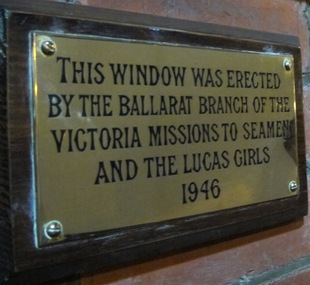
Plaque - Memorial Plaque, Ballarat Branch and Lucas Girls, 1946
... The cumulative local fundraising efforts helped maintain the work of the Coastal based Mission services to seafarers. ballarat lucas girls lucas & co. 1946 window plaque ww2 world war 2 textile company Lucas Clothing Factory This window was erected by the Ballarat Branch of the Victoria Missions to Seamen and the Lucas Girls 1946. Rectangular brass plaque mounted to wood board. Ballarat Branch and Lucas Girls Plaque Memorial ...The Ballarat Branch Committee and girls of Lucas & Co. raised the money for the memorial window in Good Chapel of Saint Peter which is dedicated to the men of the Jervis Bay and all Merchant seamen who gave their lives in the world wars. To see a picture of the actual window go to VC database Mtsv record 0035.Regionally based support across Victoria provided crucial funds to the Mission for Seafarer welfare, activities and operations. This support was very often sourced either through a country Auxiliary group based in places such as Ballarat, Camperdown, Hamilton, Bendigo and other similar towns or centres. Op shops and CWA, Church Auxiliaries and other similar charities mainly operated by the womenfolk of the respective communities, recognized the vital importance of 19th and 20th C Merchant and Military Naval services to the development of Australia. The cumulative local fundraising efforts helped maintain the work of the Coastal based Mission services to seafarers.Rectangular brass plaque mounted to wood board.This window was erected by the Ballarat Branch of the Victoria Missions to Seamen and the Lucas Girls 1946.ballarat, lucas girls, lucas & co., 1946, window, plaque, ww2, world war 2, textile company, lucas clothing factory -
 Eltham District Historical Society Inc
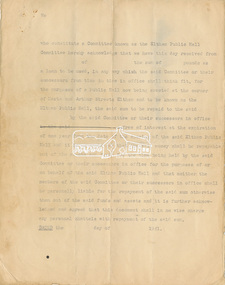
Document, Blank form of acknowledgement for receipt of funds as a loan for use by the Eltham Public Hall Committee, 1941, 1941
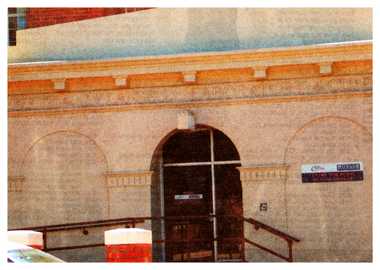
... A similar funding approach was used a few years later to provide for the Eltham War Memorial located on the opposite side of Main Road. arthur street, eltham public hall, fundraising, main road Single page Blank form of acknowledgement for receipt of funds as a loan for use by the Eltham Public Hall Committee, 1941 Document Document ...In September 1937, a group of ladies met to form a Ladies’ Committee to assist the General Committee in raising funds for a Public Hall. Those present were Mrs Allen, Mrs Bowman, Mrs Hickey, Mrs Rains, Mrs Boake and Mrs Lyon. As there were only six present, they elected to remain in the interim as a Social Committee to arrange catering, etc., for the two dances that had been arranged for September 29th and October 30th of that year. Both those dances proved a great success. Mrs McAdie joined the committee in October. The Ladies’ Committee was officially formed at a combined meeting of the General and Ladies’ committees held on April 6th, 1938. Mrs Boake agreed to be President, Mrs Lyon as Secretary and Mrs Rains as Assistant Secretary. Other members included Mrs Browne, Mrs Forde, Mrs Jarrold, Mrs Bradbury and Mrs Taylor. By 1941 their numbers had grown to include Matron Wilson, and Mesdames Andrew, Brinkkotter, Cloney, Walker, Parsons, Crick, Ballenger, Travena, Hurst, Shields and Le Brocq . A number of these ladies eventually became part of the Women’s Auxiliary of the Eltham War Memorial Trust. Councillor A. Brinkkotter, secretary of the Hall Committee, noted that Eltham had succeeded, after many long years of fighting, in erecting a new hall and civic centre which had been badly needed. “It took a long time to convince the Council of the necessity for a new hall and civic centre in Eltham.” “The councillors, in looking after the interests of all sections of the rate payers, could not see that such a move was necessary. But finally the Hall Committee proved that such a move was not only advisable, but would prove a financial asset to the Shire.” “This committee had to put down £1,500 in cash before the work on the hall began, and to enable the committee to do this, residents loaned them money free of interest for 12 months. In addition the committee has guaranteed to pay the Council £100 a year for the next ten years.” “The borrowed money has to be repaid to the lenders, and I hope that the public will realise this and support the functions which have been and will be arranged by the Hall Committee to enable them to return the money as soon, as possible.” At the opening gala for the Public Hall, Mr. G. L. Chandler, M.L.C. said “It speaks volumes for those people who have worked for many years for the hall. I know of no other place where the residents have handed over £1,500 for the erection of a hall and guaranteed the balance of the cost. You will always find the few who say ‘Time is not opportune.’ In these days you have to make your opportunities.” “Before any town can advance, a civic spirit must exist in the residents, and I hope the people will support the Hall Committee which has the interests of this district at heart.”Background workings for the funding of a Public Hall at Eltham. The funding was provided by public subscription and the money loaned to Council to build the hall. The hall was part of the new Eltham Shire offices located at the corner of Main Road and Arthur Street. A similar funding approach was used a few years later to provide for the Eltham War Memorial located on the opposite side of Main Road.Single pagearthur street, eltham public hall, fundraising, main road -
 Eltham District Historical Society Inc
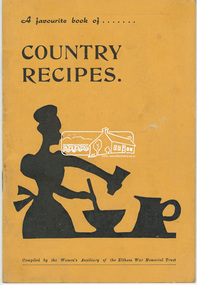
Book, Eltham War Memorial Trust, A favourite book of country recipes / compiled by the Women's Auxiliary of the Eltham War Memorial Trust, 1958
... 46 page book produced by the women of the Shire of Eltham as a fundraising project for the construction of the WW2 Eltham War Memorial. Contents: I. ...46 page book produced by the women of the Shire of Eltham as a fundraising project for the construction of the WW2 Eltham War Memorial. Contents: I. ...46 page book produced by the women of the Shire of Eltham as a fundraising project for the construction of the WW2 Eltham War Memorial. Contents: I. Fish, II. Meat, III. Puddings and desserts, IV. Bread and scones, V. Cakes and biscuits, VI. Jams, marmalades and chutneys, VII. Salads, dressings and sauces, VIII. Drinks. 47 p. : ill., b&w., ; 19 cm. a. & s. davis pty ltd, a. boyd-graham, a. lyon, a. mezner, a. uglow, a.m. lynes, b. clark, b. rothwell, b. thomas, b.j. brinkkotter, b.m. gresford, b.w. morrison, betty p. metcalfe, briar hill timber & trading, c. may, c. pelling, c. smith, cold comfort farm, commercial bank of australia, cook-book, cooking, d. garratt, d. richards, d. warner, d.g. wills, draffin bros pty ltd, e. egan, e. hoppner, e.i. rains, e.s. rothwell, eltham home supplies, eltham hotel, eltham motor garage, eltham real estate & business agency, eltham war memorial trust, f.j. burgoyne, g.b. gresford, gas and fuel corporation of victoria, george lovitt & co pty ltd, guest's biscuits, h.w. downing, heidelberg district bakery, i. putnam, j. & j. burgoyne, j. kimber, j.m. attiwill, jack burgoyne, kraft cheddar, l. carter, lyon bros garage, m. banks, m. battye, m. black, m. erswell, m. foletta, m. johnson, m. roletta, m.h. bucknell, m.j. loosli, millett's foodland, n.h. baxter estate agent, n.h. baxter, new bridge building supplies, m. banks, m. battye, m. black, m. erswell, m. foletta, m. johnson, m. roletta, m.h. bucknell, m.j. loosli, millett's foodland, n.h. baxter estate agent, n.h. baxter, new bridge building supplies, o. holland, o.a. brown, p. moore, p. pease, p. peel, p. reece, presswell's eltham east auto service, r.j. scully, rains, recipes, research meat supply, research post office and general store, s. littlehales, stanley s addison, t. sawyer, t.e. & e.m. moran, v. addison, v. hughes, valley furniture, women's auxiliary, cookery, fundraising -
 Kiewa Valley Historical Society
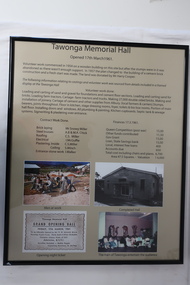
Posters - "Tawonga Remembers" x 5
... fundraising, CWA etc. The posters are a collection of historical photos, documentation and information regarding the history of the town of Tawonga, which is the centre of a farming community in the Kiewa Valley. Tawonga photos of early Tawonga Kiewa Valley Tawonga Remembers Tawonga Hall Posters framed with thin black plastic strip, covered, by glass. Each one has a title re "Tawonga Remembers" and includes print and photos in black and white. Beige background. 1. Tawonga Memorial ...The town of Tawonga is in the Kiewa Valley surrounded by farmland. It is adjacent to Mt Beauty (built from 1946), an SECV town built for the workers on the Kiewa Hydro Electric Scheme which was being constructed from 1911-1961. Tawonga consisted of essential amenities including a store, school, butter factory, sporting facilities, post office, hall and hotel. Activities involved sport, social get togethers eg. dances, fundraising, CWA etc. The posters are a collection of historical photos, documentation and information regarding the history of the town of Tawonga, which is the centre of a farming community in the Kiewa Valley.Posters framed with thin black plastic strip, covered, by glass. Each one has a title re "Tawonga Remembers" and includes print and photos in black and white. Beige background. 1. Tawonga Memorial Hall 2. Opening of the Second Public Hall 1925 3. Public Hall for Tawonga 4. Tawonga Debutante Ball 1947 5. Tawonga Hall Ghosttawonga, photos of early tawonga, kiewa valley, tawonga remembers, tawonga hall -
 Bendigo Military Museum
Memorabilia - BADGES, WWI & Post War
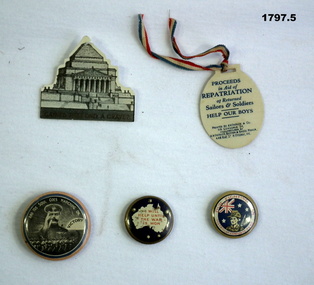
... 5 fundraising badges ( 3 metal, 2 paper) not individually marked. .1) Graphic of war memorial Melbourne (black & white) .2) Oval badge, floral pattern red/white, blue ribbon re Repatriation. .3) Black & white circular badge, metal (General kitchener) .4) Round, blue, metal, map outline of Australia , red print, help win the war. .5) Round metal badge, Australian Flag & soldier...Refer 1795P for service history, 2317.6, 2591. fundraising numismatics- badges 5 fundraising badges ( 3 metal, 2 paper) not individually marked. .1) Graphic of war memorial Melbourne (black & white) .2) Oval badge, floral pattern red/white, blue ribbon re Repatriation. .3) Black & white circular badge, metal (General kitchener) .4) Round, blue, metal, map outline of Australia , red print, help win the war. .5) Round metal badge, Australian Flag & soldier Memorabilia BADGES ...Fanny Isabella Nicol, Staff nurse A.A.M.S WWI. Badge collection during and post WWI in aid of returned servicemen and War effort. Refer 1795P for service history, 2317.6, 2591. 5 fundraising badges ( 3 metal, 2 paper) not individually marked. .1) Graphic of war memorial Melbourne (black & white) .2) Oval badge, floral pattern red/white, blue ribbon re Repatriation. .3) Black & white circular badge, metal (General kitchener) .4) Round, blue, metal, map outline of Australia , red print, help win the war. .5) Round metal badge, Australian Flag & soldierfundraising, numismatics- badges -
 Eltham District Historical Society Inc
Book, Citymission Retirement Village - Judge Book Village, Eltham: A Village History; the first thirty years / The Reverend Norman C. Pearce, 1986
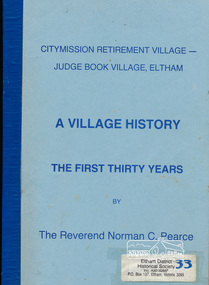
... Memorial Village, was officially opened on Sunday 28 October 1956. This history documents the first thirty years through to 1986. Founded by the Melbourne City Mission, the significant early history of the "village for the aged" is documented including the various challenges faced including ongoing expansions and building develoment needs and impacts of flooding from the nearby Diamond Creek. It mentions some people associated with the organisation with reference to the Eltham Auxillary which was a group of Eltham residents formed to support the organisation and its residents through activity and fundraising...Memorial Village, was officially opened on Sunday 28 October 1956. This history documents the first thirty years through to 1986. Founded by the Melbourne City Mission, the significant early history of the "village for the aged" is documented including the various challenges faced including ongoing expansions and building develoment needs and impacts of flooding from the nearby Diamond Creek. It mentions some people associated with the organisation with reference to the Eltham Auxillary which was a group of Eltham residents formed to support the organisation and its residents through activity and fundraising ...CityMission Retirement Village, also known as Eltham Retirement Centre, also formerly known as Judge Book Memorial Village, was officially opened on Sunday 28 October 1956. This history documents the first thirty years through to 1986. Founded by the Melbourne City Mission, the significant early history of the "village for the aged" is documented including the various challenges faced including ongoing expansions and building develoment needs and impacts of flooding from the nearby Diamond Creek. It mentions some people associated with the organisation with reference to the Eltham Auxillary which was a group of Eltham residents formed to support the organisation and its residents through activity and fundraising efforts.Softcover; 60p.judge book village, retirement village, melbourne citymission, eltham, aged care, seniors, social service, older people, housing -
 Bendigo Historical Society Inc.
Newspaper - Fortuna Article - "Lansell's Impressive Legacy", Mar 06 2008
... Led fundraising for the Soldiers' Memorial Hall and its brass honour rolls. ...Led fundraising for the Soldiers' Memorial Hall and its brass honour rolls. ...George Victor Lansell was Born in London in 1883, eldest son of George Lansell ('Quartz King') and Edith. Educated at St Andrew's College, Bendigo, and Melbourne Grammar. Married Edith, a skiing champion, in 1910; honeymooned overseas and visited Egypt. Named his Bendigo home 'Denderah' after an Egyptian archaeological site. The house featured art nouveau architecture and a Widow's Walk for astronomy. Commissioned in the 8th Australian Infantry Regiment in 1904; captain by 1909. He served in France during World War I with the 38th Battalion; wounded but returned to service. George organized the northwest Victorian Volunteer Defence Corps in WWII; retired as honorary colonel in 1942. Served as a Nationalist Party member for Bendigo in the Legislative Council, later joined the Country Party.President of the Bendigo branch of the Returned Sailors' and Soldiers' Imperial League of Australia for nearly 30 years. Led fundraising for the Soldiers' Memorial Hall and its brass honour rolls. Director of several local companies, including Sandhurst Trustees Co. and Bendigo Mutual Permanent Land and Building Society. Introduced Hanro Knitting Mills and the Australian Swiss Watch Co. to Bendigo.Acquired and merged the Bendigo Independent with The Bendigo Advertiser. Built a clinic at Bendigo Hospital with his mother; donated medical equipment and supported local institutions like the Benevolent Home, art gallery, School of Mines, and YMCA.Recognition and Legacy. Knighted in 1951.Remembered for personal generosity, especially to ex-servicemen and their families.Described as shy and retiring, but a major figure in Bendigo's history.His funeral in 1959 was one of the largest in Bendigo, reflecting his impact on the community.Fortuna Restoration Article - "Lansell's Impressive Legacy" - The Bendigo Miner Tuesday March 06 2008- Author Jim Evans This item contains the following: 11217.10a Colour Photo of The Edith and G. V. Lansell Laboratory Clinic at the Bendigo Hospital 11217.10b Part of page 23 - Lansell's Impressive Legacynon-fictionbendigo, fortuna, george lansell, the edith and g. v. lansell laboratory clinic -
 Glen Eira Historical Society
Article - Jewish Holocaust Centre
... Memorial Award and a history relating to the award. Includes coloured photograph of Eva Marks. 5/An article from the ‘Caulfield/Port Phillip Leader’ titled ‘Saving Holocaust Artefacts’ written by Jenny Ling, dated 01/03/2011. It concerns fundraising...Memorial Award and a history relating to the award. Includes coloured photograph of Eva Marks. 5/An article from the ‘Caulfield/Port Phillip Leader’ titled ‘Saving Holocaust Artefacts’ written by Jenny Ling, dated 01/03/2011. It concerns fundraising ...This file contains six items: 1/An article from the ‘Caulfield/Port Phillip Leader’ titled ‘Bid to counter anti-semitism’ written by Jenny Ling, dated 15/03/2011. It describes a tour of the Jewish Holocaust Museum by thirteen state MPs for Familiarization Day, which was organized by David Southwick. It includes a photograph of the tour. 2/A black and white pamphlet for the ‘Jewish Holocaust and Research Centre’, which includes three photographs, a map, details on business hours and the logo. 3/A flyer produced by the ‘Jewish Holocaust Centre’ in 1988 to celebrate the Bicentary of Australia. It includes acknowledgements and two illustrations. 4/An article from the ‘Caulfield/Port Phillip Leader’ titled ‘Long Memory Serves Her’ written by Jenny Ling, dated 19/10/2010. It concerns Holocaust survivor Eva Marks being awarded the Australian Holocaust Memorial Award and a history relating to the award. Includes coloured photograph of Eva Marks. 5/An article from the ‘Caulfield/Port Phillip Leader’ titled ‘Saving Holocaust Artefacts’ written by Jenny Ling, dated 01/03/2011. It concerns fundraising to preserve deteriorating artefacts at the Jewish Holocaust Centre. 6/Magazine titled ‘Centre News’, volume 8, number 4, dated December 1991, published by the Volunteers’ Committee of the Jewish Holocaust Centre. Contents include an editorial, obituary to Aron Sokolowicz, letters regarding visits to the Holocaust Centre, and two pages of Hebrew text.southwick david, hanner irma, goldberg abram, jewish community, religion, jewish holocaust museum and research centre, jewish religion, ethnic communities, museums, education and research establishments, shows and exhibitions, murdoch elisabeth, selwyn street, banazewska rachel, einhorn renee, fink mina, langsam raya, kohn mali, young joyce, schnall janek, burston myer, feniger saba, flicker ursala, silver michael, wajsenberg sonia, weiss claire, weiss alex, newmann charlotte, gurvich aron, kohn adam, rice beverly, liebman henrietta, rener charles, lippmann walter, dolia frank, dolia maurice, marks eva, beth weizmann community centre, josem jayne, artefacts, conservation, rockman pauline, fundraising events, maisel phillip, shaw adela, liebmann henia, sokolowicz aron, shelford girls school, marks caitlin, adler ruth, scholes rebecca, elsner lisa, balaclava road caulfield 234, rechter bernard, zygier ted, caulfield/port phillip leader, ling jenny, mann helena, elsternwick -
Glen Eira Historical Society
Document - CAULFIELD RED CROSS UNIT
... fundraising, voluntary aid emergencies. Caulfield Caulfield ‘F’ Red Cross unit Caulfield Citizens’ Advice Bureau Caulfield Welfare Department Caulfield Royal District Nursing Service Chisholm Institute of Technology Red Cross Salvation Army Caulfield Council Caulfield Hospital Caulfield Racecourse Caulfield Citizens’ Red Cross Appeal Committee District Citizens’ Appeal Committee of Red Cross Southern Memorial Hospital Elsternwick Mayor Mayoress Campbell Jack Cr. ...This file contains one item about this organisation: 1/Original copy of typewritten document titled ‘Forty Eighth Annual Report of the Caulfield ‘F’ Red Cross Unit from 01/07/1986 to 30/06/1987.’ This document includes details of members’ activities during the aforesaid year such as first aid training, fundraising, voluntary aid emergencies.caulfield, caulfield ‘f’ red cross unit, caulfield citizens’ advice bureau, caulfield welfare department, caulfield royal district nursing service, chisholm institute of technology, red cross, salvation army, caulfield council, caulfield hospital, caulfield racecourse, caulfield citizens’ red cross appeal committee, district citizens’ appeal committee of red cross, southern memorial hospital, elsternwick, mayor, mayoress, campbell jack cr. (mayor), campbell aj, anzac day, heart foundation, community services, voluntary workers, welfare establishments, accidents and disasters, emergency services, fundraising, charitable organisations, remembrance day, red cross calling, markets, disabled people, local government, blood bank, life line, telecross service, fires, central citizens’ appeal committee -
Glen Eira Historical Society
Document - Lions’ Club Caulfield
... City of Caulfield Lions’ International Lions’ Club District 201 Lions’ Club Caulfield Lions’ Club Elsternwick Meetings Nursing Homes Spurway Nursing Home City of Caulfield Daycare Fundraising Events Charitable Organisations Royal Southern Memorial Hospital Associations Organisation and Societies Citizenship Ceremonies Hospitals Hospital Equipment St. ...This file contains two items: 1/Minutes of Lions’ Club meeting (21/11/1988) district 201. Includes list of members, an overview of how the club was formed (25/04/1966 by joining Caulfield and Elsterrnwick), description of events, activities, donations and appeals, such as Westgate Bridge Appeal, Hobart Bush Fire Appeal, sponsored seeing eye dogs, hospital equipment donated, and health checks. Includes a cartoon on lions sausage sizzle and photocopy of four photographs (with handwritten notes) showing the presentation of cheques for Hobart Bush Fire (not dated), charter members (dated 1962), presentation of mobile first aid unit to St. John Ambulance Brigade (not dated) and photocopy of the interior. 2/Two pamphlets for the Lions’ Club (dated 08/1987 and on the other dated 11/1985).city of caulfield, lions’ international, lions’ club district 201, lions’ club caulfield, lions’ club elsternwick, meetings, nursing homes, spurway nursing home city of caulfield, daycare, fundraising events, charitable organisations, royal southern memorial hospital, associations organisation and societies, citizenship ceremonies, hospitals, hospital equipment, st. johns’ ambulance, city of caulfield, bethlehemn hospital, tudor court, john allison/monkhouse, lions’ youth exchange, ormond kindergarten, caulfield grammar school basketball teams, gladys machin elderly citizens, camdon court, mobile first aid unit caulfield division, rippon lea, murrumbeena, caulfield scouts, st. john ambulance brigade, spurway family, schwartz albert, lions’ club code of ethics, bendixsen morgens, knowles alan, braun emil, traine ravie lady, wurzel joseph, wheat john, arden fred, patron eric, knowles alan, wallace ken, vermay fred, donoghue clif, giles gordon, huggard gordon, martin ray, nixon geoff, shepes charles, smith pat, tesoriero dom, wilkin john (assume johrn incorrect), zimmet paul, patience geoff, same harvey, cornhill wal, davis john (assume jihn incorrect), fisher bert, hosking alan, macgowan ian, scumacher cubby, shepard ken, stephenson lyle -
Glen Eira Historical Society
Drawing - St. Stephen’s Presbyterian Church, Caulfield
... Memorials Clubs and Associations Sporting Clubs P.W.M.U. Presbyterian Women’s Missionary Union P.F.A. P.B.A. P.G.A. Men’s Brotherhood Soldier’s Welfare Association Youth Executive Women’s League Dramatic Club Halls Committees of Management Building Construction Fundraising Events Business and Finance Festivals and celebrations Religious Ceremonies Architects Choirs Christian Religion Drawing St. ...Two copies of a sixteen page booklet titled First Fifty Years, detailing a brief history, researched by John Watson, of St. Stephen’s Presbyterian Church, Balaclava Road Caulfield, between 1910-1960. The booklet includes several images, including two photographs, one of the interior of the church, the other of the interior of the main hall. There is also a set of six portrait photographs of the ministers of St. Stephen’s from 1913-1960. There is also a photograph of the front view of the first church and a sketch by Haddon and Henderson architects of the design for the present, 1960, church dated to the early-mid 1920s. There is a list of names of office-bearers for the year 1960. That list has been photocopied and is included in the file. Finally, there are two pages of handwritten notes, undated and unattributed, of information about St. Stephen’s derived from the First Fifty Years booklet.caulfield, st. stephen’s presbyterian church, presbyterian church, balaclava road, caulfield west, oulton street, watson john, kerry gordon f.g. rev., currie george, kinross george, haddon robert, thomson william rev., pollard mr., hunter c. hay m.a. rev., burns hugh m.m.a.b.d. rev., tamagno f. rev., simpson w.l. rev., goddard s.a.m.a.b.d. rev., robinson e.b. rev., adamson j. mr., jamieson r.f. mr., fraser w. mr., tannahill a.s. mr., mcilroy r. mr., smith f.b. mr., josephs a. mr., mac callum d. mr., darby g. mr., watson t.c. mr., attwood w.b. mr., wells organisation, land subdivisions, clergy residences, churches, settlements, community services, sunday schools, religious structures and establishments, architectural features, stained glass, paintings, farms, religious groups, ministers, monuments and memorials, clubs and associations, sporting clubs, p.w.m.u., presbyterian women’s missionary union, p.f.a., p.b.a., p.g.a., men’s brotherhood, soldier’s welfare association, youth executive, women’s league, dramatic club, halls, committees of management, building construction, fundraising events, business and finance, festivals and celebrations, religious ceremonies, architects, choirs, christian religion -
Glen Eira Historical Society
Book - St Peter's Catholic Church, Bentleigh East
... Fundraising, Finishing With Recollections From Parishioners. Heriot Maurice FR McKenna Fred FR Wade Terry FR Gebbie Gordon FR Casey William FR Maloney Des FR O’Sullivan FR Guiney John Upton John Stephen Kennedy James O’ Meara Noreen SR Coakley Daniel FR Chevalier Wilma Sierakowski Michael FR Centre Road Bentleigh East Bignell Road Opal Court The Lighthouse Project McKenna Centre Memorial Stone The Anchor Bayside Learning Memorial Garden And Wall St Peter's School Presentation Sisters Daughters Of Our Lady Of The Sacred Heart Casey Reserve Outside School Hours Program Moorleigh Community Centre St James College St James College Chapel Loganville Hostel Loganville Social Committee The Beacon Moongala Drop-In Centre Berlin Wall Souvenir St Peter's Memorial Book Faith And Life Development Altar Servers Deaneries Bentleigh Chadstone Clayton Bentleigh East Moorabbin East Murrumbeena Oakleigh Ormond Clayton South Liturgy Group Friday Mass Sacramental Sponsoring Sunday School Baptism Support Children Liturgy Of The Word Pre Marriage Program Cancer Support Group Ministry To The Sick Loss And Grief Support Junior Youth Support Senior Youth Support Outreach Bingo The Parish Fete White Elephant Young Vinnies St Vincent de Paul Spirituality In The Pub (S.I.P) The Passionist Family Group Movement Rite Of Christian Initiation For Adults (R.C.I.A) Prayer Around The Cross St Peter's Prayer Group St Peter's Choir Antioch Catholic War Veterans Association Memorial Bursary Fund Catechetics St Peter's Catholic Church Book St Peter's Catholic Church, Bentleigh East ...The Golden Harvest Is A Book That Continues The History Of St Peter’s Parish, Bentleigh East From 1984 – 2005. The Book Discusses Community Life For The Previous 25 Years, Specifically Outreach And Services, Liturgy, Faith Education, And Fundraising, Finishing With Recollections From Parishioners.heriot maurice fr, mckenna fred fr, wade terry fr, gebbie gordon fr, casey william fr, maloney des fr, o’sullivan fr, guiney john, upton john stephen, kennedy james, o’ meara noreen sr, coakley daniel fr, chevalier wilma, sierakowski michael fr, centre road, bentleigh east, bignell road, opal court, the lighthouse project, mckenna centre, memorial stone, the anchor, bayside learning, memorial garden and wall, st peter's school, presentation sisters, daughters of our lady of the sacred heart, casey reserve, outside school hours program, moorleigh community centre, st james college, st james college chapel, loganville hostel, loganville social committee, the beacon, moongala drop-in centre, berlin wall souvenir, st peter's memorial book, faith and life development, altar servers, deaneries, bentleigh, chadstone, clayton, bentleigh east, moorabbin east, murrumbeena, oakleigh, ormond, clayton south, liturgy group, friday mass, sacramental sponsoring, sunday school, baptism support, children liturgy of the word, pre marriage program, cancer support group, ministry to the sick, loss and grief support, junior youth support, senior youth support, outreach, bingo, the parish fete, white elephant, young vinnies, st vincent de paul, spirituality in the pub (s.i.p), the passionist family group movement, rite of christian initiation for adults (r.c.i.a), prayer around the cross, st peter's prayer group, st peter's choir, antioch, catholic war veterans association, memorial bursary fund, catechetics, st peter's catholic church -
Glen Eira Historical Society
Article - Ricketson Family
... Third copy of 8 pages (with title page) from bound copy of this excerpt. 2.Handwritten page of Caulfield Rate book details from 1866 to 1892. 3.Poor photocopied articles about fundraising for the Southern Memorial Hospital from the Australian Womens Weekly dated 04/04/1973. ...Third copy of 8 pages (with title page) from bound copy of this excerpt. 2.Handwritten page of Caulfield Rate book details from 1866 to 1892. 3.Poor photocopied articles about fundraising for the Southern Memorial Hospital from the Australian Womens Weekly dated 04/04/1973. ...Four items on Ricketson Family. 1.7 photocopied pages (2 copies) on family of Henry Ricketson, his pastoral enterprises and other business areas. The article from Henderson's 'Early Pioneer Families of Victoria and The Riverina' also gives his family tree line and historical lineage. Includes 13 photocopied photographs. Third copy of 8 pages (with title page) from bound copy of this excerpt. 2.Handwritten page of Caulfield Rate book details from 1866 to 1892. 3.Poor photocopied articles about fundraising for the Southern Memorial Hospital from the Australian Womens Weekly dated 04/04/1973. Includes photograph of ‘Glen Eira’. 4.Photocopied article on Staniforth Ricketson, from the Weekend Australian dated May 14 to 15, 1988, detailed article on his business, J.B. Were and son, his military life, his firms expanding into overseas and interstate branches and political areas of his life.ricketson henry, pioneer, athletes, horseriders, ricketson joseph, staniforth georgina, glen eira, caulfield, ricketson henry william, ricketson henry joseph, military hospitals, ricketson frederick william, ricketson charles nightingale, ricketson amy alice georgina, staniforth, were edith alice mary, ricketson rudolph ashley, ricketson esther edith, ricketson henry lancelot, cumloden, ricketson sophia henrietta, ricketson henry clifton keith, ricketson earle, ricketson leonie lyell, ricketson lois, ricketson staniford, ricketson mary gwendolyn, ricketson john staniford, ricketson peter, ricketson antony, ricketson michael staniford, ricketsongwendolyn elizabeth, ricketson anne staniford, ricketson georgina sherbourne, ricketson olive elarie, ricketson jean staniford, ramsey harry doughty, ramsey jean staniford, ramsey hugh staniford, ramsey joan winifred, ramsey doris valdene, ricketson kenneth, menzies kenneth, menzies william alexander, george dorothy mary, ricketson barrie were ashley, quakers, ricketson margaret, ricketson james henry, ‘glen eira’, house names, mansion, kooyong rd, southern memorial hospital, j.b. were and son -
 Wangaratta RSL Sub Branch
Badge
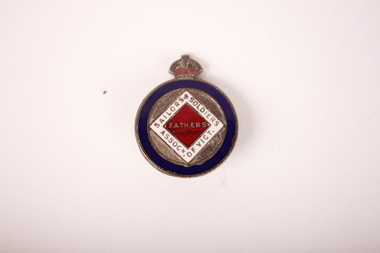
... Memorials after the war. The Association remained active after the First World War in pursuing returned soldiers’ rights. They appear under a slightly different name during the Second World War (Sailors, Soldiers and Airmen’s Fathers' Association) but their goals were identical........ The Sailors and Soldiers Fathers' Association, established during the First World War, was active in fundraising ...The Sailors and Soldiers Fathers' Association was established in the First World War. The group was active (and often outspoken), involving themselves with hospital visits, repatriation issues, employment of returned servicemen and the establishment of returned servicemen’s rights relating to principles such as pensions and housing. There appears to be a close co-operation between this group and the Returned Sailors and Soldiers Imperial League of Australia in forming a group with strong lobbying abilities. Similarly, they were active in raising funds to build Memorials after the war. The Association remained active after the First World War in pursuing returned soldiers’ rights. They appear under a slightly different name during the Second World War (Sailors, Soldiers and Airmen’s Fathers' Association) but their goals were identical........The Sailors and Soldiers Fathers' Association, established during the First World War, was active in fundraising, establishing memorials and advocacy for issues such as the repatriation and employment of returned servicemen. The group worked closely with the Returned Sailors and Soldiers Imperial League of Australia, now known as the RSL.Round bronze and enamel badge badge with blue circular border enclosing a white and red diamond. Crown on top. In white border: "Sailors & soldiers Assoc.n of Vict." In red diamond: "Fathers" On back: "167 / Stokes Melb."badge, sailors and soldiers association of victoria, sailors and soldiers fathers' association -
 St Kilda Historical Society
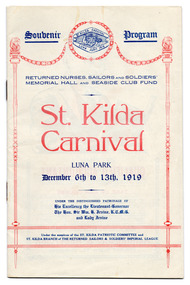
Ephemera - Special event program, St Kilda Carnival Souvenir Program, 1919
... Fundraising for Returned Nurses Sailors and Soldiers Memorial Hall and Seaside Club Fund. ...Fundraising for Returned Nurses Sailors and Soldiers Memorial Hall and Seaside Club Fund. ...Fundraising for Returned Nurses Sailors and Soldiers Memorial Hall and Seaside Club Fund. The Memorial Hall was entirely community-funded.Multi-page document printed in blue and red on 8 sheets of white paper that has discoloured with age, folded and fastened with 2 staples. luna park, st kilda patriotic committee, st kilda carnivals, memo, st kilda memorial hall -
 Surrey Hills Historical Society Collection
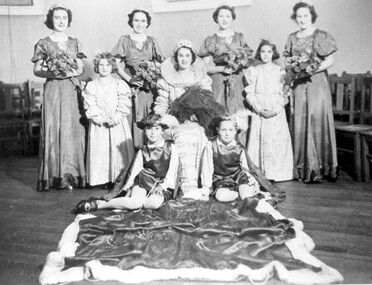
Photograph - Holy Trinity Surrey Hills Tennis Queen Carnival, 1940, 11 June 1940
... Memorial Hall on 11 June 1940. Mrs F Eastwood was the trainer and the Honorary Secretary of the tennis club. The donor Mary Holborn married Geoffrey Stroud Clucas in 1946 in Surrey Hills. The photo documents a social fundraising ...Identification has been given as follows: L to R: front: Derek Manley and (?) Jeff Holland; Queen: Leila Hanslow; young women: Connie Eastwood, Mary Clucas (nee Holborn), Hazel Bodley, Olwyn Powys. Girls: L - unknown; R - Barbara Fair. The Queen Carnival was a fundraiser for the Holy Trinity Tennis Club. The Queen Carnival Coronation was held in the Canterbury Memorial Hall on 11 June 1940. Mrs F Eastwood was the trainer and the Honorary Secretary of the tennis club. The donor Mary Holborn married Geoffrey Stroud Clucas in 1946 in Surrey Hills.The photo documents a social fundraising practice common in the early 20th century. Queen carnivals were also popular in New Zealand. In both countries they were particularly common during World War I and in the years after, when they were used to raise funds for returned soldiers. The first such carnival is believed to have been held in Napier, New Zealand, in 1913. The carnivals were not always annual events, and were held in various locations throughout a year.Black and white group photo of 5 women, 2 girls and 2 boys in formal and / or mock-Elizabethan costume. The Queen is seated in the centre and the 'page boys' are seated in front and on her train. The young girls and young women are standing beside her. The photo appears to have been taken in a hall. REAR: "Holy Trinity Tennis Club Queen Carnival / June 11 / 1940 / M Clucas / 33 Jurang St / Balwyn"sport, tennis, holy trinity anglican church, 1940, clothing and dress, miss mary holborn, mrs mary clucas, miss connie eastwood, miss hazel bodley, miss olwyn powys, miss leila hanslow, mr derek manley, mr geoff holland, miss barbara fair, queen carnivals, mrs f eastwood, canterbury memorial hall -
 Surrey Hills Historical Society Collection
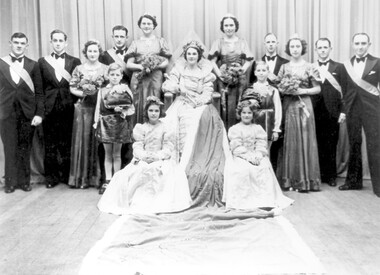
Photograph - Holy Trinity Surrey Hills Tennis Queen Carnival, Queen and court, 1940, 11 June 1940
... Memorial Hall on 11 June 1940. Mrs F Eastwood was the trainer and the Honorary Secretary of the tennis club. The donor Mary Holborn married Geoffrey Stroud Clucas in 1946 in Surrey Hills. The photo documents a social fundraising ...Identification has been given as follows: LHS 'page': Jeff Holland (?); RHS 'page': Derek Manley; Queen: Leila Hanslow; young women L to R: Olwyn Powys, Hazel Bodley, Mary Clucas (nee Holborn), Connie Eastwood. Girls: L - Barbara Fair; R - Unknown. Gentlemen not identified. The Queen Carnival was a fundraiser for the Holy Trinity Tennis Club. The Queen Carnival Coronation was held in the Canterbury Memorial Hall on 11 June 1940. Mrs F Eastwood was the trainer and the Honorary Secretary of the tennis club. The donor Mary Holborn married Geoffrey Stroud Clucas in 1946 in Surrey Hills. The photo documents a social fundraising practice common in the early 20th century. Queen carnivals were also popular in New Zealand. In both countries they were particularly common during World War I and in the years after, when they were used to raise funds for returned soldiers. The first such carnival is believed to have been held in Napier, New Zealand, in 1913. The carnivals were not always annual events, and were held in various locations throughout a year.Black and white group photo of 6 men, 5 women, 2 girls and 2 boys in formal and / or mock-Elizabethan costume mounted on cardboard which has been roughly trimmed. The Queen is seated in the centre and the 2 young girls are seated either side and slightly in front of her. The 2 'pages' and the men and other women are standing evenly divided either side of her. The photo appears to have been taken in a hall. REAR: "Holy Trinity Tennis Club Queen Carnival / June 11 / 1940 / M Clucas / 33 Jurang St / Balwyn"sport, tennis, holy trinity anglican church, 1940, clothing and dress, miss connie eastwood, miss hazel bodley, miss leila hanslow, miss olwyn powys, miss barbara fair, jeff holland, derek manley, queen carnival, mrs mary clucas, miss mary holborn, mrs f eastwood -
 Melton City Libraries
Memorabilia, Melton State School Centenary, 1970
... memorial gate (1951) to World War One ex-students, and an honour board to the 64 ex-students who served in the First World War. The school roll fell to 42 in the early post war-years, but was boosted by an influx of migrants, mainly from the UK, from the late 1960s. This presaged the boom in Melton’s development, and the corresponding growth of the school, with timber and temporary classrooms added to the previous masonry ones. An endowment pine plantation established in 1930 augmented the school’s fundraising...memorial gate (1951) to World War One ex-students, and an honour board to the 64 ex-students who served in the First World War. The school roll fell to 42 in the early post war-years, but was boosted by an influx of migrants, mainly from the UK, from the late 1960s. This presaged the boom in Melton’s development, and the corresponding growth of the school, with timber and temporary classrooms added to the previous masonry ones. An endowment pine plantation established in 1930 augmented the school’s fundraising ...On 17th May 1858 a State subsidised, combined Denominational School was opened by HT Stokes, with an attendance of about 30 children. This school was conducted in the wooden Melton Combined Protestant Church, situated on ‘a creek flat’ thought to be on the north side of Sherwin Street between Pyke and Byran Streets. It is likely that the Church had been established by 1855 and that the first minister was the Rev. Hampshire, who lived in Cambridge House on the Exford Estate. Ministers of the Protestant denominations were invited to hold services there. As there was only one resident Minister in the town (Presbyterian Mr J Lambie), laymen of the various denominations often spoke on Sundays. In 1863 this building was declared a Common School with the number 430. One of its first and most prominent headmasters was John Corr, who served from 1860 to 1864. Most of Mr Corr’s children also became teachers, including Joseph Corr, at the Rockbank school, and J Reford Corr and WS Corr, headmasters and teachers at numerous prestigious private secondary schools around Australia. John Corr purchased land alongside the school and elsewhere in and near Melton, became secretary and treasurer of the new Cemetery Trust, and by July 1861 was deputy registrar of births, deaths and marriages. He walked three miles every Sunday to teach at the Weslyan Sunday School he had established. Despite good reports from the Education Department Inspector, and burgeoning enrolments, the local school committee recommended the dismissal of, firstly, his wife (from the work mistress position), and then him from the headmaster position. Corr saw his dismissal as an attempt to redirect state aid for education from the Combined Protestant school to the support of the Free Presbyterian Minister Rev James Lambie (by one account the owner of the land on which the Common School was erected), whose son-in-law James Scott subsequently assumed responsibility for the school. Rev Lambie failed in his efforts to keep the existing school, which the Education Department Inspector and the majority of Melton citizens regarded as badly situated and badly built. Following a conditional promise of state aid, local contributors in 1868-69 raised ₤72.10.6 towards the cost of an iron-roofed bluestone rubble building 43 ft x 12 ft. This was erected on a new site of 1.5 acres (the present site). The State contributed ₤120 to the new school, which opened in 1870. A very early (c.1874) photograph of the school shows its headmaster and work mistress / assistant teacher (probably James Scott and his wife Jessie) and its (very young) scholars. Similar photos show pupils in front of the school in c.1903, and 1933. In 1877 a second bluestone room costing ₤297 was added and further land acquired from the Agricultural Society (who only needed it two days a year) to enlarge the schoolground to 3 acres. In the early 1880s an underground tank augmented the school water supply and in 1919 a five-roomed wooden residence was added. During this period the school correspondents often compained that the walls of the bluestone buildings were damp, affecting the plaster. In 1923 a brick room 26 ft 6 in by 24 ft with a fireplace and four rooms facing south, was added, and a corridor built to link the three buildings. This served adequately for the next 40 years. The school bell probably dates to 1883. The school also has a memorial gate (1951) to World War One ex-students, and an honour board to the 64 ex-students who served in the First World War. The school roll fell to 42 in the early post war-years, but was boosted by an influx of migrants, mainly from the UK, from the late 1960s. This presaged the boom in Melton’s development, and the corresponding growth of the school, with timber and temporary classrooms added to the previous masonry ones. An endowment pine plantation established in 1930 augmented the school’s fundraising activities when it was harvested in 1968. Part of the site was planted with eucalyptus trees in 1959. Famous ex-students of the early twentieth century included Hector Fraser (internationally successful shooter) and cyclist Sir Hubert Opperman. Pen, flag and flyer from the Melton State School Centenary celebrationseducation, local significant events -
 Melton City Libraries
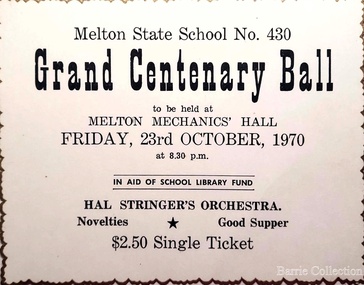
Document, Grand Centenary Ball Ticket, 1970
... memorial gate (1951) to World War One ex-students, and an honour board to the 64 ex-students who served in the First World War. The school roll fell to 42 in the early post war-years, but was boosted by an influx of migrants, mainly from the UK, from the late 1960s. This presaged the boom in Melton’s development, and the corresponding growth of the school, with timber and temporary classrooms added to the previous masonry ones. An endowment pine plantation established in 1930 augmented the school’s fundraising...memorial gate (1951) to World War One ex-students, and an honour board to the 64 ex-students who served in the First World War. The school roll fell to 42 in the early post war-years, but was boosted by an influx of migrants, mainly from the UK, from the late 1960s. This presaged the boom in Melton’s development, and the corresponding growth of the school, with timber and temporary classrooms added to the previous masonry ones. An endowment pine plantation established in 1930 augmented the school’s fundraising ...History of the Place "On 17th May 1858 a State subsidised, combined Denominational School was opened by HT Stokes, with an attendance of about 30 children. This school was conducted in the wooden Melton Combined Protestant Church, situated on ‘a creek flat’ thought to be on the north side of Sherwin Street between Pyke and Byran Streets. It is likely that the Church had been established by 1855 and that the first minister was the Rev. Hampshire, who lived in Cambridge House on the Exford Estate. Ministers of the Protestant denominations were invited to hold services there. As there was only one resident Minister in the town (Presbyterian Mr J Lambie), laymen of the various denominations often spoke on Sundays. In 1863 this building was declared a Common School with the number 430. One of its first and most prominent headmasters was John Corr, who served from 1860 to 1864. Most of Mr Corr’s children also became teachers, including Joseph Corr, at the Rockbank school, and J Reford Corr and WS Corr, headmasters and teachers at numerous prestigious private secondary schools around Australia. John Corr purchased land alongside the school and elsewhere in and near Melton, became secretary and treasurer of the new Cemetery Trust, and by July 1861 was deputy registrar of births, deaths and marriages. He walked three miles every Sunday to teach at the Weslyan Sunday School he had established. Despite good reports from the Education Department Inspector, and burgeoning enrolments, the local school committee recommended the dismissal of, firstly, his wife (from the work mistress position), and then him from the headmaster position. Corr saw his dismissal as an attempt to redirect state aid for education from the Combined Protestant school to the support of the Free Presbyterian Minister Rev James Lambie (by one account the owner of the land on which the Common School was erected), whose son-in-law James Scott subsequently assumed responsibility for the school. Rev Lambie failed in his efforts to keep the existing school, which the Education Department Inspector and the majority of Melton citizens regarded as badly situated and badly built. Following a conditional promise of state aid, local contributors in 1868-69 raised ₤72.10.6 towards the cost of an iron-roofed bluestone rubble building 43 ft x 12 ft. This was erected on a new site of 1.5 acres (the present site). The State contributed ₤120 to the new school, which opened in 1870. A very early (c.1874) photograph of the school shows its headmaster and work mistress / assistant teacher (probably James Scott and his wife Jessie) and its (very young) scholars. Similar photos show pupils in front of the school in c.1903, and 1933. In 1877 a second bluestone room costing ₤297 was added and further land acquired from the Agricultural Society (who only needed it two days a year) to enlarge the schoolground to 3 acres. In the early 1880s an underground tank augmented the school water supply and in 1919 a five-roomed wooden residence was added. During this period the school correspondents often compained that the walls of the bluestone buildings were damp, affecting the plaster. In 1923 a brick room 26 ft 6 in by 24 ft with a fireplace and four rooms facing south, was added, and a corridor built to link the three buildings. This served adequately for the next 40 years. The school bell probably dates to 1883. The school also has a memorial gate (1951) to World War One ex-students, and an honour board to the 64 ex-students who served in the First World War. The school roll fell to 42 in the early post war-years, but was boosted by an influx of migrants, mainly from the UK, from the late 1960s. This presaged the boom in Melton’s development, and the corresponding growth of the school, with timber and temporary classrooms added to the previous masonry ones. An endowment pine plantation established in 1930 augmented the school’s fundraising activities when it was harvested in 1968. Part of the site was planted with eucalyptus trees in 1959. Famous ex-students of the early twentieth century included Hector Fraser (internationally successful shooter) and cyclist Sir Hubert Opperman". Ticket for the Grand Centenary Ball at Melton State School 430education, local significant events -
 Melton City Libraries
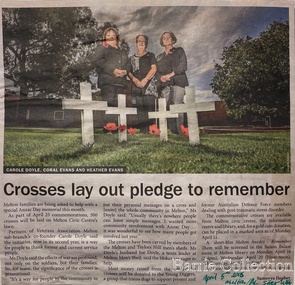
Newspaper, Crosses lay out pledge to remember, 2015
... fundraising events were held, including jumble fairs, concerts and gift evenings. Local schools also encouraged students to contribute through fund-raising and making and collecting comforts for the soldiers. People across the country engaged in similar activities, but Victoria’s rural communities found unique ways of contributing. In Melton, people were encouraged to send rabbits and hares ‘in good condition’ to an exporter in Spencer Street, for export to Belgium ‘for the relief of those suffering". Local Identities War Special Anzac Memorial ..."The outbreak of World War I in August 1914 had an immediate impact on communities across Australia, and it was no different in Melton. Young men began enlisting immediately, and Australia’s initial offer of 20,000 troops was soon exceeded by Victorian enlistments alone. Over the four years of the war, approximately 114,000 Victorians enlisted and around 91,000 servicemen and women were sent overseas. They came not just from Melbourne, but from all over the state; from farms, small towns and suburban areas. They included locals, newly arrived migrants and Indigenous people. The Australian home front was a hive of activity throughout the war, and the Melton community played its part. Following the announcement that Australia was joining the war with Great Britain and its allies on 5 August 1914, the Melton community lost no time in launching into action. A meeting ‘to assist the Red Cross fund’ was held in the Melton Mechanics’ Institute hall on 18 August – just days after the outbreak of the war. Collectors were appointed for each corner of the shire and individual donations were made. A Melton branch of the Australian Red Cross Society was formed in June 1915 and focused its energies on raising funds to purchase material that was used to make clothes for sick and wounded soldiers. A depot was established in Melton to collect clothing and other ‘comfort’ items for the soldiers – including reading material, tobacco, linen, canned foods and soap – and to coordinate the branch’s work and activities. Local cab driver Percival Stubbs volunteered to transport all the packages to the Melton railway station, until he enlisted and departed for the front in 1916. Such were the numbers of people getting involved that branches were also established in Toolern Vale and Rockbank. Regular community events were held to farewell soldiers who were leaving on active service and to welcome those who returned home. Gunner Robert (Bob) Wynne, whose uncle’s family ran the general store in Toolern Vale, was presented with a pair of field glasses (binoculars), a gold watch, inscribed locket and autographed letter by the Toolern Vale community before he set sail for the front in 1916. His mother noted that he ‘sailed away in good spirits with a smile till out of sight’. From June 1915 to June 1919, the Melton Red Cross branch donated 2,156 pairs of socks, 1,357 shirts, 425 kit bags, 251 pillowslips, 224 towels and 121 pairs of pajamas. Countless fundraising events were held, including jumble fairs, concerts and gift evenings. Local schools also encouraged students to contribute through fund-raising and making and collecting comforts for the soldiers. People across the country engaged in similar activities, but Victoria’s rural communities found unique ways of contributing. In Melton, people were encouraged to send rabbits and hares ‘in good condition’ to an exporter in Spencer Street, for export to Belgium ‘for the relief of those suffering". Special Anzac Memorial article featured in the Star Weeklylocal identities, war -
 Melton City Libraries
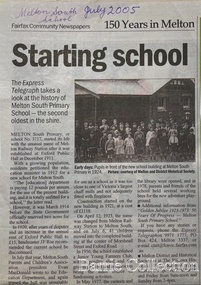
Newspaper, Melton Schools-150 years in Melton, 2005
... memorial gate (1951) to World War One ex-students, and an honour board to the 64 ex-students who served in the First World War. The school roll fell to 42 in the early post war-years, but was boosted by an influx of migrants, mainly from the UK, from the late 1960s. This presaged the boom in Melton’s development, and the corresponding growth of the school, with timber and temporary classrooms added to the previous masonry ones. An endowment pine plantation established in 1930 augmented the school’s fundraising...memorial gate (1951) to World War One ex-students, and an honour board to the 64 ex-students who served in the First World War. The school roll fell to 42 in the early post war-years, but was boosted by an influx of migrants, mainly from the UK, from the late 1960s. This presaged the boom in Melton’s development, and the corresponding growth of the school, with timber and temporary classrooms added to the previous masonry ones. An endowment pine plantation established in 1930 augmented the school’s fundraising ...Melton South "The establishment of a settlement of Melton South was induced by the opening of the railway in 1884. This subsequently prompted a number of industries, initially sawmills, and in the early twentieth century, chaff mills. This development coincided with the Exford ‘Closer Settlement’ estate at the beginning of the new century, boosting local population and produce, and the development of the chaff industry which employed many people in the Melton area. (Around 1912 the government had brought out English migrants to settle the Exford estate.) By c.1912 the small Melton Railway Station settlement had a boarding house (probably for chaff or sawmill employees), store, a small church and a hall. The Melton Valley Golf Club originated near the railway station in 1927 (in 1931 it moved to the present Melton links). In 1910 the community had built the large timber ‘Victoria Hall’, which became the focus of community life for several generations. In August of that same year AR Robertson MP and D McDonald applied for the establishment of a school on land set aside for that purpose by the Closer Settlement Board, near the Melton Railway Station settlement. District Inspector McRae recommended that a school for classes up to Grade 3 be established as an adjunct to the Melton State School. And so SS3717, ‘Melton Railway School’, was established in the leased Victoria Hall on 1st December 1911. Thomas Lang, head master at Melton since 1896, was in charge of both schools. As a ‘prep’ school only, it was necessary that the older Melton Railway Station settlement students travel to Melton SS430 at Unitt Street. Since 1912 local residents had been petitioning for the establishment of a separate school at Melton Railway Station on the grounds that it would be better if all children from the one home could attend the same school, and that the Victoria Hall was unsuitable as a school building. As a result an area of 2 acres - Allotment 8, Parish of Djerriwarrh, Exford Estate - was reserved for a State School on 4th March 1914. However the Department wrote that a school would not be established there in the near future, as ‘there is no likelihood in sight that the Railway Station settlement will increase in importance’. Parents persisted with their petitions to the Education Department, claiming that the Victoria Hall was too large, had no fireplace, that teachers were unable to use the wall for teaching aids, and that, being less than 20 metres away from a chaff mill employing 30 men, was too noisy. The turning point came when in 1920 the Hall Committee decided to increase its rent for the hall. In 1920 Head Teacher Lang advised the Education Department to discontinue SS3717 as an adjunct. The District Inspector supported this recommendation, and the schools separated in 1923. In April of that year 41 children, comprising Grades 1-8, moved into an almost completed brick building on the present site. On the 6th July 1923 the official opening of the school took place; after a ceremonial journey from the Hall to the school, speeches were given by the Hon AR Robertson and the Chief Inspector of Education. Everyone then journeyed back to Victoria Hall for a ‘bountiful repast’. (These dates are at odds with the date of 5th March 1925 given in Blake as the date the children occupied the new SS3717 brick school building. ) A teacher’s residence had been purchased for ₤500 in 1923, and the school’s name was changed to ‘Melton South’ in the same year. Even though the older Melton South pupils would no longer have to travel to the Unitt Street school, an additional brick room was still required at the Melton SS430 in that same year. In 1961 a new room was added to the school. In 1972, at the beginning of Melton’s boom as a satellite town, the number of enrolments was 224. The school has since shared in the exponential growth of the town of Melton, and at the time of its jubilee celebration (1983), 524 pupils were enrolled. Victoria Hall, neglected and vandalised, was demolished in 1992. It had been handed back to the Council on condition that it be replaced by a new hall, with the same name, and was commemorated by a plaque. Apart from the 1923 brick school building, and the railway station, none of the principal early Melton South public sites survive. Few early residential sites remain. (Further research will establish whether the house on the corner of Station Street and the railway line was the original teacher’s residence.)" Melton State School "On 17th May 1858 a State subsidised, combined Denominational School was opened by HT Stokes, with an attendance of about 30 children. This school was conducted in the wooden Melton Combined Protestant Church, situated on ‘a creek flat’ thought to be on the north side of Sherwin Street between Pyke and Byran Streets. It is likely that the Church had been established by 1855 and that the first minister was the Rev. Hampshire, who lived in Cambridge House on the Exford Estate. Ministers of the Protestant denominations were invited to hold services there. As there was only one resident Minister in the town (Presbyterian Mr J Lambie), laymen of the various denominations often spoke on Sundays. In 1863 this building was declared a Common School with the number 430. One of its first and most prominent headmasters was John Corr, who served from 1860 to 1864. Most of Mr Corr’s children also became teachers, including Joseph Corr, at the Rockbank school, and J Reford Corr and WS Corr, headmasters and teachers at numerous prestigious private secondary schools around Australia. John Corr purchased land alongside the school and elsewhere in and near Melton, became secretary and treasurer of the new Cemetery Trust, and by July 1861 was deputy registrar of births, deaths and marriages. He walked three miles every Sunday to teach at the Weslyan Sunday School he had established. Despite good reports from the Education Department Inspector, and burgeoning enrolments, the local school committee recommended the dismissal of, firstly, his wife (from the work mistress position), and then him from the headmaster position. Corr saw his dismissal as an attempt to redirect state aid for education from the Combined Protestant school to the support of the Free Presbyterian Minister Rev James Lambie (by one account the owner of the land on which the Common School was erected), whose son-in-law James Scott subsequently assumed responsibility for the school. Rev Lambie failed in his efforts to keep the existing school, which the Education Department Inspector and the majority of Melton citizens regarded as badly situated and badly built. Following a conditional promise of state aid, local contributors in 1868-69 raised ₤72.10.6 towards the cost of an iron-roofed bluestone rubble building 43 ft x 12 ft. This was erected on a new site of 1.5 acres (the present site). The State contributed ₤120 to the new school, which opened in 1870. A very early (c.1874) photograph of the school shows its headmaster and work mistress / assistant teacher (probably James Scott and his wife Jessie) and its (very young) scholars. Similar photos show pupils in front of the school in c.1903, and 1933. In 1877 a second bluestone room costing ₤297 was added and further land acquired from the Agricultural Society (who only needed it two days a year) to enlarge the schoolground to 3 acres. In the early 1880s an underground tank augmented the school water supply and in 1919 a five-roomed wooden residence was added. During this period the school correspondents often compained that the walls of the bluestone buildings were damp, affecting the plaster. In 1923 a brick room 26 ft 6 in by 24 ft with a fireplace and four rooms facing south, was added, and a corridor built to link the three buildings. This served adequately for the next 40 years. The school bell probably dates to 1883. The school also has a memorial gate (1951) to World War One ex-students, and an honour board to the 64 ex-students who served in the First World War. The school roll fell to 42 in the early post war-years, but was boosted by an influx of migrants, mainly from the UK, from the late 1960s. This presaged the boom in Melton’s development, and the corresponding growth of the school, with timber and temporary classrooms added to the previous masonry ones. An endowment pine plantation established in 1930 augmented the school’s fundraising activities when it was harvested in 1968. Part of the site was planted with eucalyptus trees in 1959. Famous ex-students of the early twentieth century included Hector Fraser (internationally successful shooter) and cyclist Sir Hubert Opperman". The Express Telegraph articles about the history of Melton South and Melton State Schoolseducation -
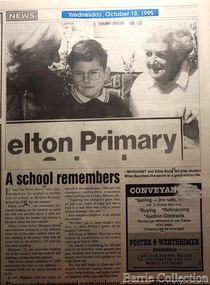 Melton City Libraries
Newspaper, A school remembers, 1995
... memorial gate (1951) to World War One ex-students, and an honour board to the 64 ex-students who served in the First World War. The school roll fell to 42 in the early post war-years, but was boosted by an influx of migrants, mainly from the UK, from the late 1960s. This presaged the boom in Melton’s development, and the corresponding growth of the school, with timber and temporary classrooms added to the previous masonry ones. An endowment pine plantation established in 1930 augmented the school’s fundraising...memorial gate (1951) to World War One ex-students, and an honour board to the 64 ex-students who served in the First World War. The school roll fell to 42 in the early post war-years, but was boosted by an influx of migrants, mainly from the UK, from the late 1960s. This presaged the boom in Melton’s development, and the corresponding growth of the school, with timber and temporary classrooms added to the previous masonry ones. An endowment pine plantation established in 1930 augmented the school’s fundraising ..."On 17th May 1858 a State subsidised, combined Denominational School was opened by HT Stokes, with an attendance of about 30 children. This school was conducted in the wooden Melton Combined Protestant Church, situated on ‘a creek flat’ thought to be on the north side of Sherwin Street between Pyke and Byran Streets. It is likely that the Church had been established by 1855 and that the first minister was the Rev. Hampshire, who lived in Cambridge House on the Exford Estate. Ministers of the Protestant denominations were invited to hold services there. As there was only one resident Minister in the town (Presbyterian Mr J Lambie), laymen of the various denominations often spoke on Sundays. In 1863 this building was declared a Common School with the number 430. One of its first and most prominent headmasters was John Corr, who served from 1860 to 1864. Most of Mr Corr’s children also became teachers, including Joseph Corr, at the Rockbank school, and J Reford Corr and WS Corr, headmasters and teachers at numerous prestigious private secondary schools around Australia. John Corr purchased land alongside the school and elsewhere in and near Melton, became secretary and treasurer of the new Cemetery Trust, and by July 1861 was deputy registrar of births, deaths and marriages. He walked three miles every Sunday to teach at the Weslyan Sunday School he had established. Despite good reports from the Education Department Inspector, and burgeoning enrolments, the local school committee recommended the dismissal of, firstly, his wife (from the work mistress position), and then him from the headmaster position. Corr saw his dismissal as an attempt to redirect state aid for education from the Combined Protestant school to the support of the Free Presbyterian Minister Rev James Lambie (by one account the owner of the land on which the Common School was erected), whose son-in-law James Scott subsequently assumed responsibility for the school. Rev Lambie failed in his efforts to keep the existing school, which the Education Department Inspector and the majority of Melton citizens regarded as badly situated and badly built. Following a conditional promise of state aid, local contributors in 1868-69 raised ₤72.10.6 towards the cost of an iron-roofed bluestone rubble building 43 ft x 12 ft. This was erected on a new site of 1.5 acres (the present site). The State contributed ₤120 to the new school, which opened in 1870. A very early (c.1874) photograph of the school shows its headmaster and work mistress / assistant teacher (probably James Scott and his wife Jessie) and its (very young) scholars. Similar photos show pupils in front of the school in c.1903, and 1933. In 1877 a second bluestone room costing ₤297 was added and further land acquired from the Agricultural Society (who only needed it two days a year) to enlarge the schoolground to 3 acres. In the early 1880s an underground tank augmented the school water supply and in 1919 a five-roomed wooden residence was added. During this period the school correspondents often compained that the walls of the bluestone buildings were damp, affecting the plaster. In 1923 a brick room 26 ft 6 in by 24 ft with a fireplace and four rooms facing south, was added, and a corridor built to link the three buildings. This served adequately for the next 40 years. The school bell probably dates to 1883. The school also has a memorial gate (1951) to World War One ex-students, and an honour board to the 64 ex-students who served in the First World War. The school roll fell to 42 in the early post war-years, but was boosted by an influx of migrants, mainly from the UK, from the late 1960s. This presaged the boom in Melton’s development, and the corresponding growth of the school, with timber and temporary classrooms added to the previous masonry ones. An endowment pine plantation established in 1930 augmented the school’s fundraising activities when it was harvested in 1968. Part of the site was planted with eucalyptus trees in 1959. Famous ex-students of the early twentieth century included Hector Fraser (internationally successful shooter) and cyclist Sir Hubert Opperman". Photo of Edna and Margaret Barrie with Miles Baunders taken for the Telegrapheducation, local identities
