
Showing 314 items matching "old course"
-
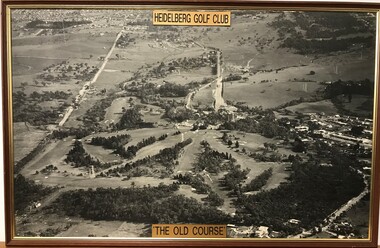 Heidelberg Golf Club
Photograph - Framed Photograph, Heidelberg Golf Club: The old course, 1966c
... Heidelberg Golf Club: The old course......old course...An aerial photograph of the Heidelberg Golf Course, around 1966 (this date is taken from the road work to build the new bridge over the Plenty River). Known as the 'old course' it was designed by Harry Alexander and was in play until a redesign of the course in 1968. ..."Heidelberg Golf Club" "The old course"...One of several aerial photogrphs showing the layout of the Heidelberg Golf Course Heidelberg Golf Club old course "Heidelberg Golf Club" "The old course" Large Black and white aerial photograph, timber frame. ...An aerial photograph of the Heidelberg Golf Course, around 1966 (this date is taken from the road work to build the new bridge over the Plenty River). Known as the 'old course' it was designed by Harry Alexander and was in play until a redesign of the course in 1968. The clubhouse is in top centre of photograph.One of several aerial photogrphs showing the layout of the Heidelberg Golf CourseLarge Black and white aerial photograph, timber frame. Brass plaque top and bottom."Heidelberg Golf Club" "The old course"heidelberg golf club, old course -
 Riversdale Golf Club
Honour Board - RGC Records of Old Course, Records of Old Course 1909 - 1983
... RGC Records of Old Course...Records of Old Course 1909 - 1983...Records of Old Course 1909 - 1983 Honour Board RGC Records of Old Course ... -
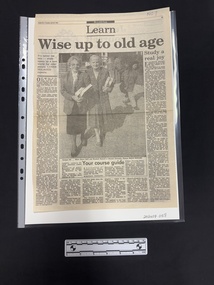 Returned Nurses RSL Sub-branch
Newspaper - Newspaper clipping, Herald Sun, 'Wise up to old age', 'Your course guide' & 'Study a real joy', Tuesday, April 20, 1993
... 'Wise up to old age', 'Your course guide' & 'Study a real joy'...'Wise up to old age' article is general about returning to studies when older, giving options to do so for a reader and mentioning two older students Eileen Stuart and Elizabeth Birchall. 'Your course guide' article under the photo of Eileen Stuart & Elizabeth Birchall provides contacts for adult education classes in Melbourne. ...World War 2 WWII WW2 Spanish Civil War Elizabeth Birchall Eileen Stuart Monash University Adult education Full page, three articles using six columns of text surrounding a large black and white photograph of two older women holding books, standing outside 'Wise up to old age', 'Your course guide' & 'Study a real joy' Newspaper Newspaper clipping Herald Sun Lynne Holroyd Bruce Howard ...'Wise up to old age' article is general about returning to studies when older, giving options to do so for a reader and mentioning two older students Eileen Stuart and Elizabeth Birchall. 'Your course guide' article under the photo of Eileen Stuart & Elizabeth Birchall provides contacts for adult education classes in Melbourne. 'Study a real joy' article brief biographical article about Elizabeth Birchall including her writing and war service.Full page, three articles using six columns of text surrounding a large black and white photograph of two older women holding books, standing outsideworld war 2, wwii, ww2, spanish civil war, elizabeth birchall, eileen stuart, monash university, adult education -
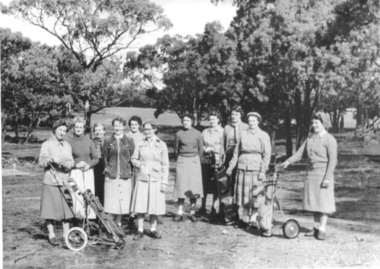 Clunes Museum
Photograph, C1950'S
... Late 1950's at the old Clunes Golf Course in Keirces Road....LATE 1950'S AT THE OLD CLUNES GOLF COURSE IN KEIRCES ROAD....LATE 1950'S AT THE OLD CLUNES GOLF COURSE IN KEIRCES ROAD. Photograph PHOTOGRAPH ...CLUNES GOLF CLUB LADIES PLAYERS. Late 1950's at the old Clunes Golf Course in Keirces Road.CLUNES GOLF CLUB LADIES PLAYERS - B. FENTON, J. HARVEY, J. MCDONALD, D. VORBACH, NANCE MEAD, PHYLLIS PICKFORD, IDA LEISHMAN, MAVIS WILLIAMS, ALLISON COUTTS, IVY LOADER , E. TOOLE. LATE 1950'S AT THE OLD CLUNES GOLF COURSE IN KEIRCES ROAD.COPY HAS HAD DYMO TAPE LABEL WITH FOLLOWING NAMES: C FENTON, J HARVEY, J MCDONALD, K VORBACH, (N?) MEAD, J PICKFORD, A LEISHMAN, I WILLIAMS, W COUTTS, J LOADER, M TOOLE.photograph, golf, clunes golf club -
Croydon Conservation Society Inc.
Archive, Archive Collection - Croydon Golf Course, Dorset Road, Croydon - parent record
... Archive materials, plans, articles, etc. relating to the old Croydon Golf Course site, 119 Dorset Road, Croydon...Archive materials, plans, articles, etc. relating to the old Croydon Golf Course site, 119 Dorset Road, Croydon Archive Collection - Croydon Golf Course, Dorset Road, Croydon - parent record Archive ...Archive materials, plans, articles, etc. relating to the old Croydon Golf Course site, 119 Dorset Road, Croydon -
 Sunshine and District Historical Society Incorporated
Archive - Sunshine Golf Club, Roma Anderson Nee Grant, 1968
... Sunshine Golf Club 1923 - 1968|Life Members 1923 - 1991|Past Presidents 1923 - 1991|History of the Old Sunshine Golf Course Fitzgerald Road...Sunshine Golf Club History Sunshine Golf Club 1923 - 1968|Life Members 1923 - 1991|Past Presidents 1923 - 1991|History of the Old Sunshine Golf Course Fitzgerald Road Collection of articles on the Sunshine Golf Club Archive Sunshine Golf Club Roma Anderson Nee Grant ...Sunshine Golf Club 1923 - 1968|Life Members 1923 - 1991|Past Presidents 1923 - 1991|History of the Old Sunshine Golf Course Fitzgerald Roadsunshine golf club, history -
 Mt Dandenong & District Historical Society Inc.
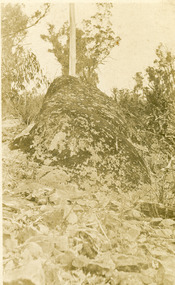
Photograph, The Rock, Olinda, c1921
... The Rock is situated adjacent to the old Olinda Golf Course. The views from The Rock have now been overgrown. ...The Rock is situated adjacent to the old Olinda Golf Course. The views from The Rock have now been overgrown. ...Close up photograph of 'The Rock', a popular tourist destination at Olinda since the late 1800s. The Rock is situated adjacent to the old Olinda Golf Course. The views from The Rock have now been overgrown. This postcard style photograph is c1921. Written on back in pen: The Rock Olinda.olinda, the rock, olinda -
 Mt Dandenong & District Historical Society Inc.
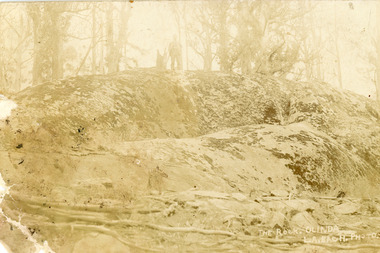
Photograph, The Rock, Olinda, early 1900s
... "The Rock" is located adjacent to the old Olinda Golf Course....course this is only a miniature size of it Yours lovingly Mary. Handwritten at a later date in blue ink: The Rock Olinda Postcard showing "The Rock' at Olinda with a man standing at centre top. It appears to be #2 in a series and is titled The Rock, OLINDA. L.A. Bach PHOTO 2. The postcard has been sent from Mary Dorey to her sister Alice Dorey. "The Rock" is located adjacent to the old ...Postcard showing "The Rock' at Olinda with a man standing at centre top. It appears to be #2 in a series and is titled The Rock, OLINDA. L.A. Bach PHOTO 2. The postcard has been sent from Mary Dorey to her sister Alice Dorey. "The Rock" is located adjacent to the old Olinda Golf Course.Handwritten on reverse in black ink. Miss A Dorey 10 Princes St Fitzroy This is the rock at Olinda I have told you about I think it is taken very well the first they have ever taken off it If you send up some money I will get you a set of the postcards they are all lovely love to Auntie May Fred and all the family they have not the snowflakes yet: of course this is only a miniature size of it Yours lovingly Mary. Handwritten at a later date in blue ink: The Rock Olindathe rock, olinda, fred dorey, alice dorey, mary dorey, postcard, l.a.bach -
 Wycheproof & District Historical Society Inc.
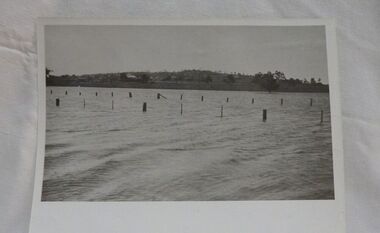
Photograph, Mr Ernie Taylor, Cooroopajerrup Creek 1923, 1923 (exact)
... In more recent times the Wycheproof channel prevented the major floods of 1956 and 1973 from following the old river course. Also there is said to have been some shifting of the sand-hills at Teddywaddy which have blocked much of the old Cooroopajerrup flow. ...In more recent times the Wycheproof channel prevented the major floods of 1956 and 1973 from following the old river course. Also there is said to have been some shifting of the sand-hills at Teddywaddy which have blocked much of the old Cooroopajerrup flow. ...The semi-mythical stream, the Cooroopajerrup Creek. Before there were any channel banks and formed roads, this creek shared the Avoca flood waters with the Tyrrell Creek. In more recent times the Wycheproof channel prevented the major floods of 1956 and 1973 from following the old river course. Also there is said to have been some shifting of the sand-hills at Teddywaddy which have blocked much of the old Cooroopajerrup flow. Little is known of earlier records, but The Mount Wycheproof Ensign records flooding of the creek in 1909. 2011 saw the Cooroopajerrup flow again after 88 years. This 2011 photo was taken at about the same position as the 1923 photo. The modern steel roadway fence is submerged. see-Photograph-Record No 001997.Copy of a B&W photograph of the Cooroopajerrup-Creek in flood-1923. To the north is Mount-Wycheproof, with the hospital barely visible behind the trees just left of centre, and a few scattered dwellings. The nearer railway-fence follows the road leading to the current saleyards.The outer fence has been replaced with a modern steel fence.None1923, cooroopajerrup creek, flood, mount wycheproof -
 Flagstaff Hill Maritime Museum and Village
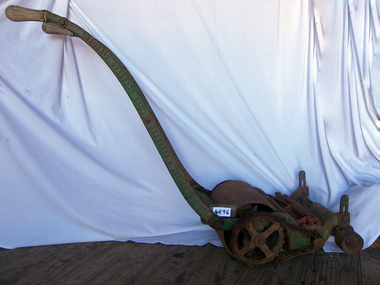
Machine - Lawn Mower, Alex Shanks & Sons Ltd Engineers Arbroth London, 1903-1925
... Although Shanks himself died at a young age, his son showed the mowers at the Great Exhibition in 1851 which led to a successful business that continued into the 20th century, supplying mowers to cut the tennis courts of Wimbledon, the cricket grounds at Lords and the Old golf course at St Andrews. The firm was also well known for the manufacture of portable steam engines and steam cranes. ...Although Shanks himself died at a young age, his son showed the mowers at the Great Exhibition in 1851 which led to a successful business that continued into the 20th century, supplying mowers to cut the tennis courts of Wimbledon, the cricket grounds at Lords and the Old golf course at St Andrews. The firm was also well known for the manufacture of portable steam engines and steam cranes. ...The firm of Alexander Shanks & Sons Ltd of Arbroath, were engineers, founders and boiler makers the company was incorporated in the year 1893. At the Dens Iron Works, purchased by the firm in the same year, a wide variety of products was manufactured including cranes, hoists, pumps and lawnmowers. In the 1960s the firm was taken over by Alexander Shanks (1801-1845) was an Inventor of the modern lawnmower, who lived in Arbroath Scotland. While credit is usually given to the Englishman Edwin Budding (1795-1846) for the invention of the lawnmower, it is Shanks' machine which was the direct predecessor of the modern mower. Shanks' innovation was a machine which rolled the grass as well as mowing it. Although Shanks himself died at a young age, his son showed the mowers at the Great Exhibition in 1851 which led to a successful business that continued into the 20th century, supplying mowers to cut the tennis courts of Wimbledon, the cricket grounds at Lords and the Old golf course at St Andrews. The firm was also well known for the manufacture of portable steam engines and steam cranes. In 1968, the company was taken over by Giddings & Lewis Fraser Ltd, Engineers of Arbroath. The subject item is a good example of an early lawn mower made by the company that is credited with being the first to patent and manufacture such a machine. The company Alexander Shanks founded was known throughout the world as significant manufactures of large steam machines used from the middle of the 19th century to the first quarter of the 20th century. The subject item is now regarded as a collector's item.Lawnmower, cast iron handles has two wooden ends and two wooden rollers at front. Blades driven by chain fixed to metal roller. Shanks's Standard Chain. Shanks's Standard Chain Arbroth London. Alex Shanks & Sons Ltd Engineers Arbroth Londonflagstaff hill, warrnambool, shipwrecked coast, flagstaff hill maritime museum, maritime museum, shipwreck coast, flagstaff hill maritime village, great ocean road, hand mower, lawn mower, mower, shanks, arboth -
 The Beechworth Burke Museum
Audio - Oral History, Joyce Snow
... She finished school at about thirteen years old, did a correspondence course, and when she was old enough, she went training for nursing. ...She finished school at about thirteen years old, did a correspondence course, and when she was old enough, she went training for nursing. ...Joyce Snow was born in Avenel and came to Beechworth at the age of twenty-three. She grew up at Bundarta, a place just out of Shepparton. Her father was a soldier who was part of the 37th Battallion while her mother's family were some of the pioneers of Beechworth--the Duracks. She finished school at about thirteen years old, did a correspondence course, and when she was old enough, she went training for nursing. Joyce was a trained nurse at the old Mooroopna Base, Hospital. She working at a Hospital in Shepparton when Manpower sent her to Beechworth. She arrived at Beechworth in 1943 at a train in Wangaratta. She had been a nurse in Beechworth for more than seven years. She got married in Beechworth and had three children, two girls and one boy. By the time of her third child, she studied a one year supplementary course on Psychy at May Day. Joyce had nursed prisoners of the First World War. She shared about the differences of medical practice back then in comparison to now. This oral history recording was part of a project conducted by Jennifer Williams in the year 2000 to capture the everyday life and struggles in Beechworth during the twentieth century. This project involved recording seventy oral histories on cassette tapes of local Beechworth residents which were then published in a book titled: Listen to what they say: voices of twentieth century Beechworth. These cassette tapes were digitised in July 2021 with funds made available by the Friends of the Burke.Joyce Snow's account of her life in the early 20th century is historically and socially significant to the cultural heritage of the region. She gave information about the settlements and life of the prisoners of First World War, the early forms of entertainment, education system and societal roles. She also mentioned changes in employment and migrant communities. This oral history account is socially and historically significant as these accounts provide a unique insight into the day-to-day life of the town's residents during the 20th century, many of which will have now been lost if they had not been preserved.This is a digital copy of a recording that was originally captured on a cassette tape. The cassette tape is black with a horizontal white strip and is currently stored in a clear flat plastic rectangular container. It holds up 40 minutes of recordings on each side.Joyce Snowburke museum, beechworth, hospital, oral history, nursing, nurse, first world war, prisoners of war, tatatura, moonrapna, peritontitis, doctors, tuck shops, largactil, rock films, victoria park, kings in grass castle, durack, duracks, glory box, d'oylies -
 Sunshine and District Historical Society Incorporated
Photograph - Aerial Photographs Of Melbourne Metropolitan Area 1989, Qascophoto, 17th November 1989 & 28th November 1989
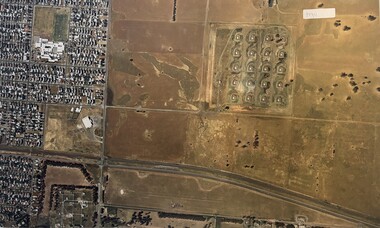
... Derrimut (West), Hilma Street (North), South of old Sunshine Golf Course (South) Points of Interest: Mt. ...Derrimut (West), Hilma Street (North), South of old Sunshine Golf Course (South) Points of Interest: Mt. ...953.01 - Aerial Photographs Of Melbourne Metropolitan Area 1989.JPG Suburb(s): Ardeer, Deer Park (Now Derrimut), Sunshine West Area bounded by: Railway Parade (North), Paramount Bouvard (South), Allison Street (East), Approx Station Road (West) Points of Interest: IVI Explosive Bunkers, Railway Siding into ICI off Forrest Street, Former Railway Station Tilburn Road, Sunshine Technical School Annex, Croatian Catholic Centre Sunshine Fitzgerald Road 953.02 - Aerial Photographs Of Melbourne Metropolitan Area 1989.JPG Suburb(s): Brooklyn, Yarraville Area bounded by: South of Somerville Road (North), Westgate Freeway (South), Urwin Street (East). West of McDonald Road (West) Points of Interest: State Electricity Commission of Victoria (SECV) Stores, Brooklyn Wool Stores, Brooklyn Primary School, Half Moon Caravan Park, Footscray Cemetery, Rheems, James Hardy 953.03 - Aerial Photographs Of Melbourne Metropolitan Area 1989.JPG Suburb(s): Ascot Vale, Maribyrnong Area bounded by: Raleigh Road (North), River Street and James Street (South), Holdsworth Street (East), West of Van Ness Avenue (West) Points of Interest: Highpoint City, Fairbairn Park, Hume Pipes, Riverside Golf Course, ICI Laboratories 953.04 - Aerial Photographs Of Melbourne Metropolitan Area 1989.JPG Suburb(s): Albion, Ardeer, Sunshine, Sunshine West Area bounded by: Dubbo Street (North), South of Glengala Road (South), West of Sydney Street (East), Vernon Crescent (West) Points of Interest: Ainsworth Reserve, Selwyn Park, St. Paul Church, Marian College, Ardeer Primary School, Glengala Road Shopping Centre, 953.05 - Aerial Photographs Of Melbourne Metropolitan Area 1989.JPG Suburb(s): Deer Park Area bounded by: Station Road (East), Marcellin Court (West), Irvine Street (North), Deer Street (South) Points of Interest: Deer Park Primary School, Deer Park Play Kindergaten, Deer Park Shopping Centre, St. Peter Chanel Church & School 953.06 - Aerial Photographs Of Melbourne Metropolitan Area 1989.JPG Suburb(s): Derrimut Area bounded by: Future Ring Road (North), South of Boundary Road (South), East of Andersons Swamp (East), West of Fitzgerald Road (West) Points of Interest: Andersons Swamp 953.07 - Aerial Photographs Of Melbourne Metropolitan Area 1989.JPG Suburb(s): Sunshine West Area bounded by: East of Fairbairn Road (East), East of Fitzgerald Road (West), North of Mailey Street (North), South of Talintyre Road (South) Points of Interest: Sunshine West High School, Sunshine Heights Primary School, Castley Reserve, Talintyre Reserve, Talintyre Road Shops, St. Peters School, Sunshine Golf Course, Ralph Reserve, Glengala Primary School 953.08 - Aerial Photographs Of Melbourne Metropolitan Area 1989.JPG Suburb(s): Derrimut, Ravenhall Area bounded by: East of Station Road, now Derrimut Road (East), West of Robinsons Road (West), South of Railway Line (North), North of Future Deer Park Bypass Points of Interest: Old Farms and Quarries 953.09 - Aerial Photographs Of Melbourne Metropolitan Area 1989.JPG Suburb(s): Sydenham, Taylors Lakes, Taylors Hill Area bounded by: Taylors Creek (North), Future Hume Drive (South), West of Future Parmelia Drive (East), Future Hawthorn Grove (West) Points of Interest: Sydenham Reservoir, Sydenham Railway Station, Sydenham Memorial Hall, Sydenham Primary School, Sydenham Recreation Reserve, Catholic Regional College Sydenham, Kingdom Hall of Jehovah's Witnesses 953.10 - Aerial Photographs Of Melbourne Metropolitan Area 1989.JPG Suburb(s): Brooklyn, Tottenham Area bounded by: Stony Creek (North), South of Somerville Road (South), Holmwood Road (East), West of McDonald Road (West) Points of Interest: Monsanto, Dalgety's, Wool Stores, Sims Metals, Farmer & Graziers, Olex Cables, Redbrook Carpets, May & Baker, Cargil Oil, Smorgans 953.11 - Aerial Photographs Of Melbourne Metropolitan Area 1989.JPG Suburb(s): Brooklyn Area bounded by: South of Fourth Avenue (North), South of Bunting Road (South), West of McDonald Road, East of Fitzgerald Road (West) Points of Interest: Market Road, Bunting & Jones Road Quarries, Monsanto, ANI, Market Timber 953.12 - Aerial Photographs Of Melbourne Metropolitan Area 1989.JPG Suburb(s): Brooklyn, Laverton North Area bounded by: South of Bunting Road (North), Buchanan Road (South), Cypress Avenue (East). Little Boundary Road (West) Points of Interest: Jones Road and Old Geelong Road Quarries, Brooklyn Go Kart Track, Sims Metal Foundry, Ralphs, Guiding Star Hotel, Gas & Fuel Substation 953.13 - Aerial Photographs Of Melbourne Metropolitan Area 1989.JPG Suburb(s): Sunshine, Sunshine West Area bounded by: Parsons Street (North), South of Fourth Avenue (South), Alfred Street (East), West of Kororoit Creek (West) Points of Interest: Parsons Reserve, Wheat Silos, H.V. McKay Trade Wing, Tottenham Hotel, Sunshine Carvan Park 953.14 - Aerial Photographs Of Melbourne Metropolitan Area 1989.JPG Suburb(s): Derrimut, Mt. Derrimut, Sunshine West, Area bounded by: East of Allison Street (East), Mt. Derrimut (West), Hilma Street (North), South of old Sunshine Golf Course (South) Points of Interest: Mt. Derrimut, Sunshine Golf Course 953.15 - Aerial Photographs Of Melbourne Metropolitan Area 1989.jpeg Suburb(s): Avondale Height, Braybrook, Sunshine North Area bounded by: Canning Street (North), North of Cranwell Street (South), Medway Golf Course (East), Nottingham Street (West) Points of Interest: Duke Street Quarries, Cranwell Park, Pennell Reserve 953.16 - Aerial Photographs Of Melbourne Metropolitan Area 1989.jpeg Suburb(s): All of City of Sunshine Area bounded by: Maribyrnong River (North), Westgate Freeway (South), Nicholson Street (East), Robinsons Road (West) Points of Interest: General overall of the City of Sunshine 953.17 - Aerial Photographs Of Melbourne Metropolitan Area 1989.jpeg Map is missing 953.18 - Aerial Photographs Of Melbourne Metropolitan Area 1989.jpeg Suburb(s): Braybrook, Maidstone, Sunshine Area bounded by: Ballarat Road (North), North of South Road (South), East of Ashley Street (East), West of Duke Street (West) Points of Interest: Skinner Reserve, Kinder Smith Reserve, Churchill Avenue Shops, St. John College, Industrial Engineering, Invita Carpets, Tottenham Technical School, Carolone Chisholm College, Christ The King Primary School, Sunshine East Primary School, Dyecraft 953.19 - Aerial Photographs Of Melbourne Metropolitan Area 1989.JPG Suburb(s): Laverton North, Sunshine West Area bounded by: North of Boundary Road (North), Sewer Out Fall (South), East of Little Boundary Road (East), East of Future Ring Road (West). Points of Interest: Factories in Laverton Northmelbourne, aerial photograph -
 Federation University Historical Collection
Ballarat Teachers' College Ceremonial Collar, Unknown
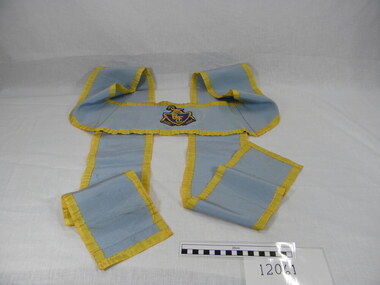
... old Ballarat East Town Hall (remodelled for their use) in Barkly Street. During 1927 the numbers in the College were augmented by 26 Manual Arts students, who had formerly received their training at Ballarat High School. Manual Art students continued till 1930 when, on grounds of economy, their training was concentrated at Melbourne Teachers’ College. During the four succeeding years, approximately 60 students annually entered the primary course...old Ballarat East Town Hall (remodelled for their use) in Barkly Street. During 1927 the numbers in the College were augmented by 26 Manual Arts students, who had formerly received their training at Ballarat High School. Manual Art students continued till 1930 when, on grounds of economy, their training was concentrated at Melbourne Teachers’ College. During the four succeeding years, approximately 60 students annually entered the primary course ...Worn by the principal of Ballarat Teachers' College over black academic gown at formal assemblies. Ellwood was the Principal of the Ballarat Teachers' College. Ballarat Teachers’ College was opened on 04 May 1926, at S.S. 33 Dana Street, with an enrolment of 61 students. Its original staff consisted of the Principal, Mr W.H. Ellwood, M.A., M.Ed. (Chairman of the Teachers’ Tribunal from its inception in 1946 until 1954), Miss A. Bouchier, B.A., and Mr A.B. Jones, BA., (lecturers). In 1927 Miss P.A. Hamano joined the staff. In 1927 the college moved to the old Ballarat East Town Hall (remodelled for their use) in Barkly Street. During 1927 the numbers in the College were augmented by 26 Manual Arts students, who had formerly received their training at Ballarat High School. Manual Art students continued till 1930 when, on grounds of economy, their training was concentrated at Melbourne Teachers’ College. During the four succeeding years, approximately 60 students annually entered the primary course. Inclusive of Manual Arts students, and private fee-paying students, exactly 400 trainees passed through the College in its brief span of life (1926-1931). Five per cent of each year’s students were granted an extension of their studentship to enable them to proceed to Melbourne Teachers’ College, and to take the first year’s course for a University degree. With the advent of the economic depression of the ‘thirties, Ballarat Teachers' College closed its doors in December, 1931. Fourteen years were to pass before the College opened again on February 2nd, 1946. The college re-commenced at SS Dana Street, under the guidance of Mr W.F. Lord, M.C., M.M., B.A., Dip. Ed., (acting, later Principal 1946-1950) and a staff consisting of Miss E.B. Hughes, B.A., Dip. Ed., Mr C.B. Bryan, B.A., B. Com., Dip. Ed., Miss Monica H. Miller, L.Mus.A., and Miss G. Kentish, Dip. Phys. Ed. The opening ceremony was performed by the Minister of Education at that time, the Hon. F. Field, M.L.A., accompanied by the Hon. T.T. Hollway, M.L.A., and the then Director of Education, Mr J.A. Seitz. It was originally intended to cater for women students only but, at the last moment, men resident in Ballarat were also accepted. A co-educational college was thus set up instead, and it has continued as such. 1951 saw the introduction of the two-year course, successful students being presented with the Trained Primary Teacher’s Certificate at the final College Assembly each year. In December 1955, College held its first Graduation Ceremony, with its own Graduation Hymn, the words of which were written by Miss C.M. (Mavis) Canty of the staff. Lord remained as principal until 1951 when he transferred to establish a teachers' college at Toorak. Tom William Turner was Lord's successor. A highlight of his term was the construction of new college buildings at Gillies Street with the students commencing their lessons there in February 1958. Turner retired in 1970, having overseen a period of substantial growth in the institution. In that year alone more than one hundred and forty students completed their primary teaching qualification to meet a severe shortage of teachers. Doug Watson commenced as principal in 1971. In 1973 Ballarat Teachers' College became the State College of Victoria at Ballarat. Three years later Ballarat College of Advanced Education was formed and the teacher education students moved to the Mount Helen Campus. In 1990 Ballarat College of Advanced Education became Ballarat University College, an affiliated college with the University of Melbourne. The University of Ballarat was formed in January 1994.Light blue grosgrain sash, bound in yellow taffeta, sewn by machine. Two mitred seams, one at each shoulder, hand sewn and two seams machine stitched on straight part of sash. A BTC insignia is placed in the centre back. The insignia is stitched in yellow, royal blue and dark blue cotton. This sash is hand sewn at the end of one side length, in order to shorten it. Extra Muros (Beyond the Wall) on insignia BTC (Ballarat Teachers' college)education, teaching, assembly, btc, ballarat teachers college, university of ballarat, regalia, ceremony, graduation, stoll, balalrat teachers' college -
 Federation University Historical Collection
Booklet, The Ballarat School of Mines and Industries 1870-1920 Jubilee Booklet, 1920 (estimated)
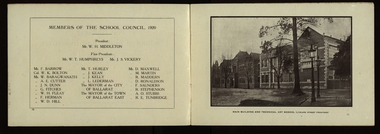
... Students came from over seas as well as from all the States of Australia, and after going through their courses they took with them the name and fame of the old School to all parts of the globe. ...Students came from over seas as well as from all the States of Australia, and after going through their courses they took with them the name and fame of the old School to all parts of the globe. ...The first school of Mines in Australia was established at Ballarat in 1870. At the time of its jubilee (1930) the following people were members of the School Council: W.H. Middleton (President), W.T. Humphreys (VP), J.S. Vickery (VP), F. Barrow, Col. W.K. Bolton, William Baragwanath, A.E. Cutter, J.N. Dunn, G. Fitches, W.H. Fleay, F. Herman. W.D. Hill, T. Hurley, K. Kean. J. Kelly, L. Lederman, Mayor of Ballarat, Mayour of Ballarat East, D. Maxwell, M. Martin, R. Maddern, D. Ronaldson, F. Saunders, R. Stephenson, A.O. Stubbs, R.E. Tunbridge. The School Staff in 1920 comprised: Herbert H. Smith, Walter Rowbotham, Reginald L. Cutter, M.C. Young, Hilda Wardle, M. Wiliamson, P.S. Richards, L.H. Archibald, J. Woods, Ken Moss, W. Kenneth, Mrs McIlvena. B. Robinson, S. Rowe, E. Hope-Jones, Miss Abrams, L.St.G.P. Austin, Alfred Mica Smith, J.R. Pound, Herbert R. Murphy, N.H. Junner, Maurice Copland, L.H. Archibald, E.J.A. McConnon, Newton King, D.m. Hull, T.R. Gordon, John M. Sutherland, T.K. Jebb, Dick Richards, C. Tonkin, A.W. Steane, J. Paterson, H.W. Malin, R.V. Maddison, S.M. Mayo, F.A. King, W.H. Steane, T.R. Gordon, T.A. Williams, H. Waldron, G. Black, E.J. McConnon, R.V. Duncan. R. Cutter, E.G. Vawdrey, Hilda WardleWhite stapled booklet - landscape format - 20pp + soft covers with blue writing. Includes an historical sketch of the Ballarat School of Mines. Contains images of the school from around 1920. The history outlined in the booklet follows: 'Ballarat has helped to influence the life and destinies of Australia in many ways, the recital of which would perhaps prove tedious to the citizens of less favoured localities! However, it can be said, without much fear of contradiction, that only less known thought Australia than its fame as a gold field is the reputation won for it by its school of Mines, ... Ballarat was still quite a new place when the School was founded, but a very propserous and popular place all the same, with a go-ahead lot of citizens brim full of the spirit of enterprise which seemsto animate mining populations generally. Money was plentiful, and they launched out into ventures, which later, were to develop and take the place of the gold mines, while what is more to the point, they understood the value of education. the old digging days were passing away. So far as Ballarat itself was concerned the day of the cradle and tin dish had already passed into an antiquity "as dead and distant as the age of the Tubal Caon," said dir redmond Barry on declaring the School open. Mining had become a serious business, and the mining engineer, the metallurgist, and the geologist had become a power in the land. In these circumstances the suggestions to found a School of Mines met with ready acceptance. The late Mr James M. Bickett had the honor of bringing forward the proposition at a meeting of the Ballarat Mining Board in October, 1869. it was agreed to, and the Government, having been approached for assistance, granted a lease of the old Supreme Court buildings at a nominal reantal. A modest sum, including 100 pounds from the Borough Council of Ballarat West, was subscribed by a number of sympathisers, and on the 26th October, 1870, the inaugural address was delivered by Sir Redmond Barry, the first President of the School. Classes were commenced on the 23rd January, 1871. The students at first were mostly adults. They were chiefly men emloyed at the mines, who had the wisdom and energy to devote their spare time to study, and, though their attendance was somewhat irregular, they made very good progress. Old prints which have been preserved show them at work at furnaces, big bearded men of the old-fashioned type of miner. It is interesting to note that among those who gave evidence and encouragement was Sir Roderick Murchison, who many years before had advised Cornish miners to emigrate to Australia to search for gold, and who in 1848 was in possession of gold ore sent from this country. Sir Roderick sent a parcel of books for the library, and gave useful advice as to the curriculum which should be adopted. The Museum, which now contains a most valuable collection of minerals, was one of the first things attended to, and the reports presented to the Council from time to time speak of additions being made from all parts of the world. New equipment was constantly being added to the School, a good deal of assay work was done, and some specimens were sent from the East Indies for examination as far back as 1873. By this time there was a difficulty in providing accomodation for the students who wished to enrol, and the number of instructors had grown from two to four. In 1882 the first building was being erected on what was then part of the gaol reserve. A little more than ten years afterwards a buildnig formerly serving as a Methodist Church was absorbed, while later on, the demand for accomodation increasing, the attack upon the gaol was renewed. The School continued to grow in reputation and size, and became the science centre of the district, and in 1889 a learge new building was opened by Sir Alexander Peacock. Students came from over seas as well as from all the States of Australia, and after going through their courses they took with them the name and fame of the old School to all parts of the globe. School of Mines boys have played a great part in developing the mining fields of Western Australia, South Australia, and africa, while old students who have made a name in their profession are constantly dropping in to see how the old place is getting along. It was not to be expected, however, that the Ballarat School would be left without rivals, its very success inspiring competition. Mining Schools were started in other parts of Australia, and, at the same time, Victoria ceased to hold first place as a mining state. On the other hand there was a great advance in manufacturing, and the demand for technicaly trained men became a great and as insistent as ever it had been for trained mining men. The Council was quick to adapt the school to the new conditions, and the result is seen in the institution, which is one of Ballarat's proudest possession. Instruction is given in all branches of technical work, and the classes are filled with students who are building up for Ballarat a reputation as an industrial centre, which promises to equal that which it formerly held as a mining town. Owing to its bracing climate, its abundant opportunities for recreations, and its accessibilty, Ballarat as a city is an ideal place for educational purposed, and is yearly becoming more and more appreciated throughout the State. The chairman of one of Ballarat's biggests industries claims that the workman can do twice the day's work here that he can do in Melbourne. he was a little enthusiastic over it, perhaps, but it is a well-known fact that the healthy and invigourating Ballarat climate is conducive to both physical and mental activity, and the records of the School provide ample proof of it. One of the most interesting and successful branches of the School of Mines and Industries - if the name be enlarged with the enlargement of its scope - is the Technical Art School. "The City of Statues" has from its earliest days been a stronghold of art. Art schools have flourised here, and in 1905 the Education Department came to the conclusion that the best thing to do with them was to place them under the management of the School of Mines Council. A magnificent new Technical Art School was built at a cost of some 12,000 pounds on the site of the old Supreme Court building, and was formally opened on the 23rd July, 1915. The results have not only been justified but surpassed all anticipations. The most comprehensive list of subjects is taught, and this list is constantly added to. Students have flocked to the art School, which may be said to occupy a unique position in Australia, and its record of success is really astonishing. Its students supply art teachers for the newer schools that are being built, and many occupy leading positinos in important business houses. So well is its reputation known that orders are constantly being received, not only from Victoria, but from other States, for honor boards and challenge shields to be designed and made. The most recent addition to the School of Mines and Industries is the Junior Technical School, for which a new building is now being erected on a portion of the gaol site, transferred to the School of Mines Counci by the Government. At the present moment temporary quarters are being occupied. Some students after passing through the Junior School go straight to employment, continuing perhaps to attend the evening trade classes, while others move on to the senior School. In a review of the work of the School of Mines mention must be made of a series of industrial research carried out under supervision of the Principal. One in particular, regarding the suitability of the local ores for the manufacture of pigments attracted much attention, while the experiemtns on the manufacture of white potery from Victorian clayes were considered of sufficient importance by the Federal Advisory Council of Science and Industry to warrant the appointment of a special investigator. The results of these have been most encouraging, and may have far-reaching consequences. The vocational training of returned soldiers also should not be overlooked. The work was taken in hand from the first, before the Repatriation Department gave assistance, and now with the help of the department of the School has become one of the largest vocational training centres in Victoria outside of Melbourne. The soldiers, trained in a variety of occupations, have made remarkable progress, and already considerable numbers have found employment in local workshops and factories. To sum up, the School is divided into the following departments, each well staffed and equipped: - The School of Mines, science, and Engineering; the Techncial Art School, the Boys' Junior Technical School, the Girl's Preparatory Technical Classes, Trade Classes, and the Commercial School. The school of Mines, science and Engineering, comprises the following branches: - Mining, Metallurgy, Geology, Electrical Engineering, Civil Engineering, Mechanical Engineering, Applied Chemistry, and Pharmacy. Battery treatments, Cyanide Testing, Smelting, Assays, and Clay Testing from a regular part of the School's work. Students gaining qualifications obtain concession in their courses at the university, should they proceed there to continue their studies. The technical Art school curriculum includes training in all branches of pictorial and applied art, an Architectural Diploma Course, a Draughtman's Course, technical Art teachers' Course, Photography,Ticket Writing, Art Metal Work, Woodcarving, Needlework, and Leather work. The Trade Classes give instruction in Telephone Mechanics, telegraphy, Carpentry, Cabinet Making, Plumbing, Blacksmithing, Fitting, Electric Wiring, and Printing. Numerous Scholarships are offered every year, and altogether students will find few places to equal the Ballarat School of Mines and Industries as a training place for their life's work. One of the first in the continent to be established, its Jubilee finds it still in the front rank, keeping pace with the times, and offering to the youths of this country the means of taking advantage of Australia's teeming opportunities. william, battery, smith, herbert, drawing from the antique, ballarat school of mines botanical gardens, ballarat school of mines, redmond barry, alfred mica smith, james bickett, museum, dick richards, ballarat junior technical school, s m b, ballarat school of mines and industries, ballarat technical art school, model mine, james m bickett, j m bickett, roderick murchison, vocational training rooms, wesley church, methodist church, alexander peacock, lathes, repatriation, repatriatin department, war service, school council, baragwanath, gold mining, mining laboratory, plaster cast, r.w. richards, anniversary, jubilee -
 Federation University Historical Collection
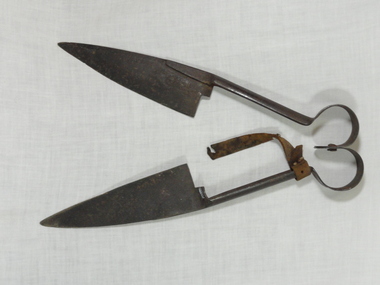
Tool, Handshears
... The technique of Australian hand shearing gradually developed from the 1830s using the old English method of cutting the flank with hand shears in a series of circular cuts from the sheep’s neck to the tail. In the early 1930s the Ballarat School of Mines introduced a wide-ranging Wool Classing Course as jobs were in extremely short supply during the Great Depression. ...The technique of Australian hand shearing gradually developed from the 1830s using the old English method of cutting the flank with hand shears in a series of circular cuts from the sheep’s neck to the tail. In the early 1930s the Ballarat School of Mines introduced a wide-ranging Wool Classing Course as jobs were in extremely short supply during the Great Depression. ballarat school of mines shearing woolclassing sheep Metal handshears used for shearing sheep. ...Hand shears needed to be very sharp and often had a leather strap or ‘driver’ which passed over the hand. Others had sheepskin bound around the grip. Blades had to be regularly sharpened on a grinding stone. Most hand shears were made in Sheffield, England, with various models produced offering wide or narrow blades, sharp or rounded points, and various grips and bows. The technique of Australian hand shearing gradually developed from the 1830s using the old English method of cutting the flank with hand shears in a series of circular cuts from the sheep’s neck to the tail. In the early 1930s the Ballarat School of Mines introduced a wide-ranging Wool Classing Course as jobs were in extremely short supply during the Great Depression. Metal handshears used for shearing sheep.ballarat school of mines, shearing, woolclassing, sheep -
 Federation University Historical Collection
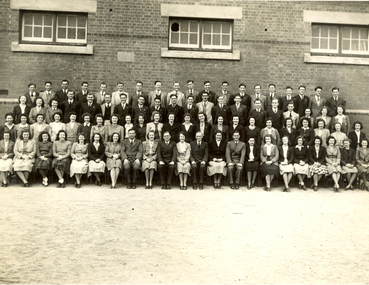
Photograph - Black and White, Ballarat Teachers' College, 1947, 1947
... old Ballarat East Town Hall (remodelled for their use) in Barkly Street. During 1927 the numbers in the College were augmented by twenty-six Manual arts students who had formerly received their training at Ballarat High School. Manual Arts students continued till 1930, when, on grounds of economy, their training was concentrated at Melbourne Teachers' College.\During the four succeeding years approximately sixty students annually entered the primary course...old Ballarat East Town Hall (remodelled for their use) in Barkly Street. During 1927 the numbers in the College were augmented by twenty-six Manual arts students who had formerly received their training at Ballarat High School. Manual Arts students continued till 1930, when, on grounds of economy, their training was concentrated at Melbourne Teachers' College.\During the four succeeding years approximately sixty students annually entered the primary course ...Ballarat Teachers' College was opened on may 4th, 1926, at S.S. 33, Dana Street, with an enrollment of sixty-one students, its original staff consisted of the Principal, Mr W. H. Ellwood, M.A., m.Ed. (Chairman of the Teachers' tribunal from its inception in 1946 until 1954), Miss A. Bouchier, B.A., and Mr A.B. Jones, B.A. (Lecturers). In 1927 Miss P.A. Hamano joined the staff. Teaching practice and special rural school work were carried on in schools in or near Ballarat - drawing, crafts and singing were taught by local teachers. In 1927 the college moved to the old Ballarat East Town Hall (remodelled for their use) in Barkly Street. During 1927 the numbers in the College were augmented by twenty-six Manual arts students who had formerly received their training at Ballarat High School. Manual Arts students continued till 1930, when, on grounds of economy, their training was concentrated at Melbourne Teachers' College.\During the four succeeding years approximately sixty students annually entered the primary course. Inclusive of Manual Arts students, and private fee-paying students, exactly 400 trainees passed through the college in its brief span of life (1926-1931) Fourteen years were to pass before they were again opened to students on February 2nd, 1946. The college was re-commenced at S.S. Dana Street under the guidance of Mr W.F. Lord, M.C., M.M., B.A., Dip.Ed., (Acting Principal 1946-1950), and a staff consisting of Miss E.B. Hughes, B.A., Dip. Ed., Mr C.B. Bryan, B.A., V.Com., Dip.Ed., Miss M.H. Miller, L.Mus.A., and Miss G. Kentish, Dip.Phys.Ed. The opening ceremony was performed by the Minister for education at that time, the Hon. F. Field, M.L.A., accompanied by the Hon. T.T. Hollway, M.L.A., and the then Director of Education, Mr J.A. Seitz. It was originally intended to cater for women students only (for whom 130 Victoria Street was purchased as a hostel) but, at the last moment, men were also accepted. A co-educational college was thus set up instead, and has continued as such. The original Staff has been considerable augmented, and the number of Students has been more than trebled. 1951 saw the introduction of the two-year course, successful students being presented with the Trained Primary Teachers' Certificate at the final College assembly each year. In December, 1855, College held its first Graduation Ceremony, with its own Graduation hymn, the words of which were written by Miss C.M. Canty of the staff. Mr Ellwood, former Principal,delivered the occasional address and presented the Ellwood Prize to the outstading student of the year (Mr C.P. Handreck). Students who had successfully completed the course received their certificates from Mr E.B. Pederick, Chief Inspector of Primary Schools. College accomodation having been strained for several years, it was pleasant news when tenders were called in July, 1956, for the building of the first section of the new Ballarat Teachers' College in Gillies Street, near the Botanical Gardens. At the beginning of 1958 the new College was occupied, and staff and students have appreciated greatly the appointments and cacilities of the new buildign. In 1968 the three-year Diploma Course began, co-existent with the other courses which will continue during the transitional period. Successful students in the course receive the Diploma of Teaching (Primary).Black and white photograph of students and staff of the Ballarat Teachers' College. The people are in four rows, and they stand in front of the Dana Street Primary School. Back Row: Jim Howlett; Milton Rice; Keith McLean; Jim Williams; George Nield, David Cooper, Ray Terrill, William Gleeson; Tom Pascoe; Lindsay Harley; Ron Carless; Robert Giddings; Colin Connelly; Alex Magill; Eddie Blake; William Punshon; Athol Aisbett; Kevin Collins; John O'Shannessy. Second Row: Beth Leslie; Faye Dreher; Gwen Pamphilon; Arthur Lelean; Howard Pattenden; Jack Tyers; Hugh Fraser; William Henderson; Jack Mallett; Alan Martin; Keith Boyd; John Ellifson; John Collins; Tom Hill; Wal Henning; Burns Roddis; Fred Marshman; Dawn Doney; Pat Watts; Ann McKinnon. Third Row: Ethel Esmore; Joy Love; Pat Luxford; Jean Elliott; Josie Bunny; Phyllis Borley; Joyce Matheson; Val Witney; Ruth Tozer; Nancy Kerr; K.ath Tobin; Muriel Morrish; Jean Clode; Peg Purdue; Joyce Kennedy; Margaret Palmer; Marie Faulds; Thelma Ritchie. Fourth Row: Pat Lewin; Mavis Poland; Lorna Welsh; Lynette Lynch; Nancy Alexander; Betty Williams, Val Gorrie; Alan Sonsee; Trudy Kentish; Carl Bryan; Monica Miller; W.F. Lord; Beth Hughes; Mephan McMcEwin; Mattie Hayes; Neila Vallance; Pat Robinson; Elva Surman; Joan Gunning; Norma Dally; Beatrice Freeman; Kath Crossett.ballarat teachers' college, education, dana street primary school, 1947 -
 Federation University Historical Collection
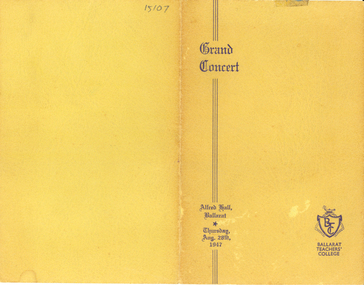
Programme, Ballarat Teachers' College, Ballarat Teachers' College Grand Concert, 1947, 1947
... old Ballarat East Town Hall (remodelled for their use) in Barkly Street. During 1927 the numbers in the College were augmented by 26 Manual Arts students, who had formerly received their training at Ballarat High School. Manual Art students continued till 1930 when, on grounds of economy, their training was concentrated at Melbourne Teachers’ College. During the four succeeding years, approximately 60 students annually entered the primary course...old Ballarat East Town Hall (remodelled for their use) in Barkly Street. During 1927 the numbers in the College were augmented by 26 Manual Arts students, who had formerly received their training at Ballarat High School. Manual Art students continued till 1930 when, on grounds of economy, their training was concentrated at Melbourne Teachers’ College. During the four succeeding years, approximately 60 students annually entered the primary course ...Ellwood was the Principal of the Ballarat Teachers' College. Ballarat Teachers’ College was opened on 04 May 1926, at S.S. 33 Dana Street, with an enrolment of 61 students. Its original staff consisted of the Principal, Mr W.H. Ellwood, M.A., M.Ed. (Chairman of the Teachers’ Tribunal from its inception in 1946 until 1954), Miss A. Bouchier, B.A., and Mr A.B. Jones, BA., (lecturers). In 1927 Miss P.A. Hamano joined the staff. In 1927 the college moved to the old Ballarat East Town Hall (remodelled for their use) in Barkly Street. During 1927 the numbers in the College were augmented by 26 Manual Arts students, who had formerly received their training at Ballarat High School. Manual Art students continued till 1930 when, on grounds of economy, their training was concentrated at Melbourne Teachers’ College. During the four succeeding years, approximately 60 students annually entered the primary course. Inclusive of Manual Arts students, and private fee-paying students, exactly 400 trainees passed through the College in its brief span of life (1926-1931). Five per cent of each year’s students were granted an extension of their studentship to enable them to proceed to Melbourne Teachers’ College, and to take the first year’s course for a University degree. With the advent of the economic depression of the ‘thirties, Ballarat Teachers' College closed its doors in December, 1931. Fourteen years were to pass before the College opened again on February 2nd, 1946. The college re-commenced at SS Dana Street, under the guidance of Mr W.F. Lord, M.C., M.M., B.A., Dip. Ed., (acting, later Principal 1946-1950) and a staff consisting of Miss E.B. Hughes, B.A., Dip. Ed., Mr C.B. Bryan, B.A., B. Com., Dip. Ed., Miss Monica H. Miller, L.Mus.A., and Miss G. Kentish, Dip. Phys. Ed. The opening ceremony was performed by the Minister of Education at that time, the Hon. F. Field, M.L.A., accompanied by the Hon. T.T. Hollway, M.L.A., and the then Director of Education, Mr J.A. Seitz. It was originally intended to cater for women students only but, at the last moment, men resident in Ballarat were also accepted. A co-educational college was thus set up instead, and it has continued as such. 1951 saw the introduction of the two-year course, successful students being presented with the Trained Primary Teacher’s Certificate at the final College Assembly each year. In December 1955, College held its first Graduation Ceremony, with its own Graduation Hymn, the words of which were written by Miss C.M. (Mavis) Canty of the staff. Lord remained as principal until 1951 when he transferred to establish a teachers' college at Toorak. Tom William Turner was Lord's successor. A highlight of his term was the construction of new college buildings at Gillies Street with the students commencing their lessons there in February 1958. Turner retired in 1970, having overseen a period of substantial growth in the institution. In that year alone more than one hundred and forty students completed their primary teaching qualification to meet a severe shortage of teachers. Doug Watson commenced as principal in 1971. In 1973 Ballarat Teachers' College became the State College of Victoria at Ballarat. Three years later Ballarat College of Advanced Education was formed and the teacher education students moved to the Mount Helen Campus. In 1990 Ballarat College of Advanced Education became Ballarat University College, an affiliated college with the University of Melbourne. The University of Ballarat was formed in January 1994.Yellow folded card programme for the Ballarat Teachers' College Grand Concert held at Alfred Hall Ballarat on Thursday 28 August 1947. Student Teachers from the 1947 class performed, including Jessie Batson, Ruth Tozer, Joy Love, N. Kerr, Arthur Lelean, D. Cooper, John Collins, Ann McKinnnon, Peg Purdue, Lindsay Harley.ballarat teachers' college, education, alfred hall -
 Federation University Historical Collection
Programme, Ballarat Teachers' College Reunion Programme, 1934, 1934
... old Ballarat East Town Hall (remodelled for their use) in Barkly Street. During 1927 the numbers in the College were augmented by 26 Manual Arts students, who had formerly received their training at Ballarat High School. Manual Art students continued till 1930 when, on grounds of economy, their training was concentrated at Melbourne Teachers’ College. During the four succeeding years, approximately 60 students annually entered the primary course...old Ballarat East Town Hall (remodelled for their use) in Barkly Street. During 1927 the numbers in the College were augmented by 26 Manual Arts students, who had formerly received their training at Ballarat High School. Manual Art students continued till 1930 when, on grounds of economy, their training was concentrated at Melbourne Teachers’ College. During the four succeeding years, approximately 60 students annually entered the primary course ...Ellwood was the Principal of the Ballarat Teachers' College. Ballarat Teachers’ College was opened on 04 May 1926, at S.S. 33 Dana Street, with an enrolment of 61 students. Its original staff consisted of the Principal, Mr W.H. Ellwood, M.A., M.Ed. (Chairman of the Teachers’ Tribunal from its inception in 1946 until 1954), Miss A. Bouchier, B.A., and Mr A.B. Jones, BA., (lecturers). In 1927 Miss P.A. Hamano joined the staff. In 1927 the college moved to the old Ballarat East Town Hall (remodelled for their use) in Barkly Street. During 1927 the numbers in the College were augmented by 26 Manual Arts students, who had formerly received their training at Ballarat High School. Manual Art students continued till 1930 when, on grounds of economy, their training was concentrated at Melbourne Teachers’ College. During the four succeeding years, approximately 60 students annually entered the primary course. Inclusive of Manual Arts students, and private fee-paying students, exactly 400 trainees passed through the College in its brief span of life (1926-1931). Five per cent of each year’s students were granted an extension of their studentship to enable them to proceed to Melbourne Teachers’ College, and to take the first year’s course for a University degree. With the advent of the economic depression of the ‘thirties, Ballarat Teachers' College closed its doors in December, 1931. Fourteen years were to pass before the College opened again on February 2nd, 1946. The college re-commenced at SS Dana Street, under the guidance of Mr W.F. Lord, M.C., M.M., B.A., Dip. Ed., (acting, later Principal 1946-1950) and a staff consisting of Miss E.B. Hughes, B.A., Dip. Ed., Mr C.B. Bryan, B.A., B. Com., Dip. Ed., Miss Monica H. Miller, L.Mus.A., and Miss G. Kentish, Dip. Phys. Ed. The opening ceremony was performed by the Minister of Education at that time, the Hon. F. Field, M.L.A., accompanied by the Hon. T.T. Hollway, M.L.A., and the then Director of Education, Mr J.A. Seitz. It was originally intended to cater for women students only but, at the last moment, men resident in Ballarat were also accepted. A co-educational college was thus set up instead, and it has continued as such. 1951 saw the introduction of the two-year course, successful students being presented with the Trained Primary Teacher’s Certificate at the final College Assembly each year. In December 1955, College held its first Graduation Ceremony, with its own Graduation Hymn, the words of which were written by Miss C.M. (Mavis) Canty of the staff. Lord remained as principal until 1951 when he transferred to establish a teachers' college at Toorak. Tom William Turner was Lord's successor. A highlight of his term was the construction of new college buildings at Gillies Street with the students commencing their lessons there in February 1958. Turner retired in 1970, having overseen a period of substantial growth in the institution. In that year alone more than one hundred and forty students completed their primary teaching qualification to meet a severe shortage of teachers. Doug Watson commenced as principal in 1971. In 1973 Ballarat Teachers' College became the State College of Victoria at Ballarat. Three years later Ballarat College of Advanced Education was formed and the teacher education students moved to the Mount Helen Campus. In 1990 Ballarat College of Advanced Education became Ballarat University College, an affiliated college with the University of Melbourne. The University of Ballarat was formed in January 1994. Programme for the 1934 Ballarat Teachers' College Reunion run by the Ballarat teachers' College ex- Students Association. Inside the programme is an image of W.H. Ellwood and copy of his 14 points. ballarat teachers' college, ellwood, reunion, w.h. elwood, elwood's fourteen points -
 Federation University Historical Collection
Book, Historic Ornament Parts I and II. Ballarat Technical Art School Art History Books, 1931, 1931
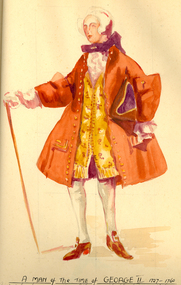
... Students studied the influences of history, geography, culture and climate on ornamental aesthetics, including the tools, materials and methods applied to decorative objects, interior design and architecture. ballarat school of mines ballarat technical art school art history edith lawn edith curnow val lawn val d'angri curnow lawn ornament costume. ballarat technical art school library artists workbook journal Historic Ornament University Women Ballarat School of Mines Old Girls Association Two books containing student notes and drawing relating to courses at the Ballarat techncial Art School in 1931. ...Edith CURNOW (1913–2003) Ballarat | Australia Edith Gertrude Curnow undertook Industrial Art teacher training at the Ballarat Technical Art School, with a five-year Senior Technical Scholarship, between 1926 and 1931. She taught for a time before marrying compositor James Lawn in 1937. She reportedly continued to teach at the Ballarat Technical Art School as Edith Lawn. She retired in 1972 at which time she was the Lecturer in Charge of Craft Edith Lawn was a member of inaugural Ballarat School of Mines Old Girls Association, and served as first Press Correspondent. Her daughter, Valda Lawn (later D'Angri) also attended and taught at the School. One of the subjects Curnow studied was Historic Ornament. This subject spanned time and space to inform and inspire designers. Students studied the influences of history, geography, culture and climate on ornamental aesthetics, including the tools, materials and methods applied to decorative objects, interior design and architecture.Two books containing student notes and drawing relating to courses at the Ballarat techncial Art School in 1931. The work was undertaken by Edith Curnow. .1) - Foolscap red covered book on Historic Ornament. Includes History of Ornament, Egyptian Ornament, Assyrian Ornament; Greek Ornament, Roman Ornament, Pompeian Ornament, Byzantine, Romanesque Ornament, Norman, Decorated Gothic, Perpendicular Gothic, Renaissance. .2) Green quarto book on Historic Ornament Part 2: Costume. The work includes Egyptian Costume, Greek Costume, Roman Costume, Richard I, Crusades, Edward III, Charles I, Charles II, George II.ballarat school of mines, ballarat technical art school, art history, edith lawn, edith curnow, val lawn, val d'angri, curnow, lawn, ornament, costume., ballarat technical art school library, artists workbook, journal, historic ornament, university women, ballarat school of mines old girls association -
 Federation University Historical Collection
Photograph - Photograph - black and white, Ballarat Junior Technical School Staff, c1913, c1913
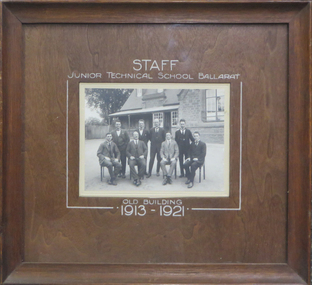
... The old bluestone building in the grounds of the Dana Street Primary School became their temporary for eight years. In its early years the school offered only a two-year course. ...The old bluestone building in the grounds of the Dana Street Primary School became their temporary for eight years. In its early years the school offered only a two-year course. ...In February 1913 the Ballarat Junior Technical School opened its doors to its 86 pupils. The old bluestone building in the grounds of the Dana Street Primary School became their temporary for eight years. In its early years the school offered only a two-year course. The first year was of a general nature giving a thorough grounding in Mathematics and Instrumental Drawing, and introducing students to the various branches of trade work. The second-year students studied for the Junior Technical Certificate and specialized in a course of their choice - either a trade (Woodwork or Fitting and Turning) or a course leading to higher studies at the School of Mines. The photograph shows the Albert Steane, the first Headmaster, with other members of Staff outside the Dana Street Primary School where the Junior Technical School first began. Black and white photograph of eight men in front of Dana Street Primary School. They are the original members staff of the Ballarat Junior Technical School. Standing left to right: Frank N. King, Harold G. Wakeling, Sam Mayo, H.Victor Maddison Sitting left to right: H.W. Malin, Albert W. Steane (Headmaster), William J. Paterson, Rex L. Cutter .1) is framed with oak mount and calligraphy.1) Staff Junior Technical School Old Building 1913-1921ballarat junior technical school, king, wakeling, mayo, maddison, malin, steane, paterson, cutter, education, school, teacher, dana street, headmaster, dana street primary school, bluestone, mathematics, instrumental drawing, woodwork, fitting and turning, junior technical certificate, school of mines, william j. paterson, albert steane, sam mayo, harold wakeling, "wendouree", dana street state school -
 Federation University Historical Collection
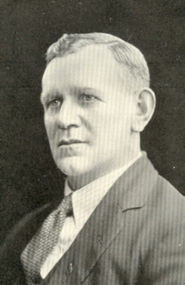
Photograph - Photograph - Black and White, Harold Herbert of the Ballarat Technical Art School, 1919
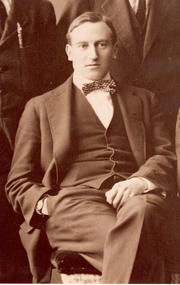
... old school with the greatest pride. He commenced at the School when he was about 15 years of age, and followed a course of training very similar to what most students are doing the most valuable qualities shown by him during his career as a student were a passion for drawing and a capacity for taking pains, so essential in all artwork. ...old school with the greatest pride. He commenced at the School when he was about 15 years of age, and followed a course of training very similar to what most students are doing the most valuable qualities shown by him during his career as a student were a passion for drawing and a capacity for taking pains, so essential in all artwork. ...Harold Brocklebank Herbert (16.09.1891-1945) Harold Herbert was one of the first pupils at the school starting in 1891, commencing as a 15 years old he studied Applied Design and Architecture at the Ballarat Technical School of design attached to the Ballarat Fine Art Galery, transferring to the Ballarat Technical Art school attached to the Ballarat School of Mines. He was a certificated Art Teacher with the Victorian Education Department. His talents were identified by Ballarat’s Ponsonby Carew-Smith who rose to become Art Inspector with the Victorian Education Department. His teaching career included being appointed Principal of the Sale Technical Art School in 1898. Harold Herbert undertook further studies in England returning to Ballarat with all new entrepreneurial ideas. He worked at the Ballarat Technical Art School between 1915-19. Harold Herbert was involved with the design of the Ballarat Arch of Victory, and was responsible for the reproductions in ‘The Education Department’s Record of War Service. Had been principal of the Sale Technical Art School since 1898, and had undertaken further studies in England returning to Ballarat with all sorts of entrepreneurial ideas. In 1924 the Ballarat School of Mines Students’ Magazine reported “We are perfectly safe in claiming on behalf of our school, that no institution of its kind has turned out a greater number of men and women students who have since “made good” while some have achieved enviable prominence in the world of art. Amongst these later, the most brilliant is Harold B. Herbert whose work is so widely and justly appreciated throughout Australia and whose achievements are watched by his old school with the greatest pride. He commenced at the School when he was about 15 years of age, and followed a course of training very similar to what most students are doing the most valuable qualities shown by him during his career as a student were a passion for drawing and a capacity for taking pains, so essential in all artwork. He was appointed as Assistant Art Teacher at Ballarat on completion of his course, and later assistant in the office of Art Inspector. All of his spare time was devoted to out-door sketching and commercial drawing and he showed an ability in practical design for various crafts quite equal to the ability he has since displayed in depictive art. His return to this School as senior master and his departure to devote himself entirely to fine art are quite recent happenings with which all students are familiar. The wonderful exhibition he held in Melbourne on return from a sketching trip abroad has place him amongst the leading artists of Australia. Upon his death in 1945 the Ballarat School of Mines Student's Magazine recorded: "The death of the famous water-colour artist, Harold Herbert, will be a distinct loss to art in Australia. he was educated at the Ballarat Art School which it was situated in Sturt Street, and the gave promise of becoming a famous artist then. his talents were recognised, and in water-colour work he quickly made a name for himself. his landscapes in water-colour are in the principle galleries of the world, and many of them are to be found in the Ballarat gallery and in other provincial galleries. In 1941 he was appointed official war artist for the COmmonwealth, and he served in the Middle East and Syria. Exhibitions of his war pictures have been seen at different times in Melbourne."Portrait of a young man in a suit. He is Harold Brocklehurst Herbert, staffmember of the Ballarat Technical Art School (a division of the Ballarat Technical Art School). The photograph is a detail of the Ballarat School of Mines Magazine Committee, 1919. (http://victoriancollections.net.au/items/54923a682162f116140de59c)harold herbert, harold b. herbert, harold brocklebank herbert, ballarat school of mines, ballarat technical art school, art, arch of victory -
 Federation University Historical Collection
Photograph, Ballarat Junior Technical School at Dana Street, c1913, c1913
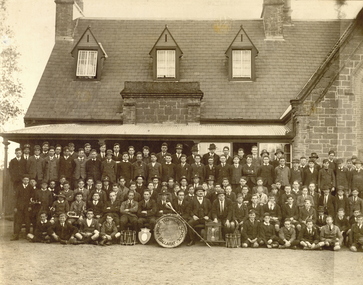
... The old bluestone building in the grounds of the Dana Street Primary School became their temporary for eight years. In its early years the school offered only a two-year course. ...The old bluestone building in the grounds of the Dana Street Primary School became their temporary for eight years. In its early years the school offered only a two-year course. ...In February 1913 the Ballarat Junior Technical School opened its doors to its 86 pupils. The old bluestone building in the grounds of the Dana Street Primary School became their temporary for eight years. In its early years the school offered only a two-year course. The first year was of a general nature giving a thorough grounding in Mathematics and Instrumental Drawing, and introducing students to the various branches of trade work. The second-year students studied for the Junior Technical Certificate and specialized in a course of their choice - either a trade (Woodwork or Fitting and Turning) or a course leading to higher studies at the School of Mines. The photograph shows the students outside the school building. Musical instruments, trophy and shield are shown. When World War 1 began, the school formed a 16 piece Bugle Band. A squad of Junior Cadets led by Mr A Williams and later Mr H Wakeling competed at the South Street contests. Mr A Steane (the Headmaster) is shown to the right of the bass drum.Black and white copy of original photograph that is mounted on brown card. Photograph shows the students and staff outside the bluestone building at Dana Street Primary School - first location of the Ballarat Junior Technical School. Drums, a shield and a trophy are located in the foreground. The Headmaster, Albert E. Steane is seated in the centre front row. ballarat junior technical school, bass drum, steane, drum, dana street primary school, bluestone, albert steane, a steane, dana st, world war 1, south street contests, junior cadets, williams, wakeling, bugle band, junior technical certificate, mathematics, instrumental drawing, woodwork, turning and fitting, dana street state school -
 Federation University Historical Collection
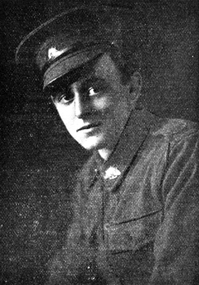
Magazine - Photograph - Black and White, Ballarat School of Mines Students' Magazine, 1916-1923, 1916-1924
... course Ted was employed as an assistant teacher at the Art School, before taking a position as cartoonist with the Ballarat Star newspaper at the end of 1914. In 1915 Ted was awarded the prestigious Victorian Education Department Senior Technical School Scholarship. Only months into his scholarship, Ted volunteered for the AIF. He was killed in action on 14 September 1916 in France. 1917 Editorial staff, Natural Colour Motion Pictures, Chemistry, Caricatures, Old...course Ted was employed as an assistant teacher at the Art School, before taking a position as cartoonist with the Ballarat Star newspaper at the end of 1914. In 1915 Ted was awarded the prestigious Victorian Education Department Senior Technical School Scholarship. Only months into his scholarship, Ted volunteered for the AIF. He was killed in action on 14 September 1916 in France. 1917 Editorial staff, Natural Colour Motion Pictures, Chemistry, Caricatures, Old ...The Ballarat School of Mines Magazine does not appear to have been publishing in 1914, 1915, 1917, 1918, and 1919.A red bound copy of the Ballarat School of Mines Students' Magazine, holding copies for years 1916 to 1923. 1916 The 1916 Students' Magazine features many references to World War One, including an image of Ted Cannon, a gifted artist attending the Ballarat Technical Art School (part of the Ballarat School of Mines [SMB] campus) from 1912. After completing his art course Ted was employed as an assistant teacher at the Art School, before taking a position as cartoonist with the Ballarat Star newspaper at the end of 1914. In 1915 Ted was awarded the prestigious Victorian Education Department Senior Technical School Scholarship. Only months into his scholarship, Ted volunteered for the AIF. He was killed in action on 14 September 1916 in France. 1917 Editorial staff, Natural Colour Motion Pictures, Chemistry, Caricatures, Old Art School Students, Old Science School Students, Broken Hill, Lal Lal Deposits, SMB Athletic Team, SMB Roll of Honor, Junior Technical School Senior Cadet Team, Ballarat, Junior Technical School; Ballarat Junior Technical School Bugle Band, A visit to Ronaldson's Workshop 1920 Historical Sketch of the Ballarat School of Mines, War Service, Editorial Staff, Maurice Copland Obituary, The Chemist, Separation of Lead and Zinc Sulphides, Explosives, Werribee Gorge Visit, Daylesford Visit, Sports Ground, Indian Art, Dressmaking, Herbert H. Smith, Drawing From the Antique, Caricatures, Ballarat School of Mines Football Team. 1921 A.F. Hesiltine, Editorial Staff, Feathertop and Mt Buffalo trip, Plumbing, frequency changer, Melbourne excursion, Melbourne Electric Railways, Dawn of Modern Art, Moorabool Trip, Guy Fawkes, Bush Camp, Caricatures, manual art, past students, SMB Athletic Team, Cadet camp at Broadmeadows, Ballarat Junior Technical School Athletics Team. 1922 Editorial Staff, Assaying, Plasticity of Clay, Lal Lal V Morwell, Cheap Electricity, Clyde Lukeis Obituary, Ken Moss Obituary, Past Students, Old Boy's Association, Reunion, SMB Athletic Team, Military News, Athletics 1923 Editorial Staff, Alfred Mica Smith Biography, caricature, Robert James Dowling Obituary, Chemistry, America, SM Football Team, Ballarat Junior Technical School, Wireless Telegraphy, Caricatures, ballarat school of mines, motion picture photography, the chemlab, ballarat school of mines students' excursion to the lead and copper mining centres, sport, military notes, ballarat junior technical school, henry j. hall, arthur m. lilburne, ballarat school of mines history, maurice copland, maurice copland obituary, l.h. archibald, g. baragwanath, r.w. richards, c.a. schache, cadets, a.w. steane, elsie j. mckissock, coliseim theatre, advertisements, mcdorney's, w. dick, t. kift and son, f. narrow, stansfield and smith, clay, reginald calister, clyde lukeisr, w.k. moss, ken moss, robert james dowling, e.j. mcconnon, raymond fricke -
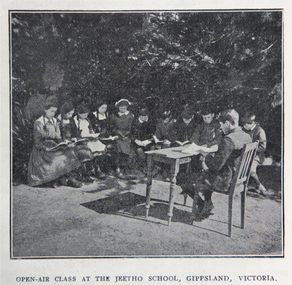 Federation University Historical Collection
Book, Victoria Education Gazette and Teachers' Aid, 1911-1919, 1910-1919
... Black hard covered book with red spine, holding Victorian Education Gazettes for one calendar year. .1) 1910 .2) 1912 .3) 1911 .4) 1914 .5) 1918 Images: Open Air Classroom Black Rock; Open Air Classroom, Jeetho, Gippsland; Open Air Nurses bedroom, Mildura; Gym at Canterbury School ; Babies and Nurses at Melbourne Foundling Hospital; Camp at Portland; Alexander Peacock Opens a Melbourne School; Unveiling Major Mitchell Memorial at Mt Arapiles; Agricultural Plot; School Interior; Swimming Drill; Graham Dux Prize Board; Bathing Place; Classroom with blackboard and pictures; Major Mitchell's Map; Melbourne, Derbyshire; Market Place Melbourne; The Blackwood; World War One Send-off at The Athenaeum; Scarsdale Old Boy's logo; Sloyd articles for the Field Hospital; World War One; Gifts for Transport to the Wharf; soldiers; ANZAC Day; ANZAC Day Medalion .5) 1915: Education Department's War Relief Fund, William Park obituary, Closer Settlement Act 1912, Agriculture, needlework, Swimming and Life Saving, explorers, Gregory Blaxland, Matthew Flinders, Composition, Geography, potatoes, onions, gardens, Needlework for Infants, Iona and Staffa, Trained Primary Teacher's Course, Electricity, Electrical Technology, hygiene, Arbour Day, Horticulture, Wattle Day, Bird Day, Technical Schools, Landing at Gaba Tepe, Evils of Alcohol, Old Boys of Scarsdale, Belgium, Teachers' College Images: The British at War, The Sonnet, History and Patriotism, Male Swimming Teachers Summer School at Geelong, Women Swimming Teachers at Port Fairy, Buln Buln State School, Burwood East State School, needlework plans, methods of Rescue and Resucitation. plan of the journey of Gregory Blaxland, Macquarie House, teachers killed (William Ross Hoggart, Stanley Robert Close, William Roy Hodgson, Campbell McDiarmid Peter, William Henry Dawkins, William Hugh Hamilton, Frederick McRae Neal, Vernon Brookes, Frank J. ...Bailey Black hard covered book with red spine, holding Victorian Education Gazettes for one calendar year. .1) 1910 .2) 1912 .3) 1911 .4) 1914 .5) 1918 Images: Open Air Classroom Black Rock; Open Air Classroom, Jeetho, Gippsland; Open Air Nurses bedroom, Mildura; Gym at Canterbury School ; Babies and Nurses at Melbourne Foundling Hospital; Camp at Portland; Alexander Peacock Opens a Melbourne School; Unveiling Major Mitchell Memorial at Mt Arapiles; Agricultural Plot; School Interior; Swimming Drill; Graham Dux Prize Board; Bathing Place; Classroom with blackboard and pictures; Major Mitchell's Map; Melbourne, Derbyshire; Market Place Melbourne; The Blackwood; World War One Send-off at The Athenaeum; Scarsdale Old Boy's logo; Sloyd articles for the Field Hospital; World War One; Gifts for Transport to the Wharf; soldiers; ANZAC Day; ANZAC Day Medalion .5) 1915: Education Department's War Relief Fund, William Park obituary, Closer Settlement Act 1912, Agriculture, needlework, Swimming and Life Saving, explorers, Gregory Blaxland, Matthew Flinders, Composition, Geography, potatoes, onions, gardens, Needlework for Infants, Iona and Staffa, Trained Primary Teacher's Course, Electricity, Electrical Technology, hygiene, Arbour Day, Horticulture, Wattle Day, Bird Day, Technical Schools, Landing at Gaba Tepe, Evils of Alcohol, Old Boys of Scarsdale, Belgium, Teachers' College Images: The British at War, The Sonnet, History and Patriotism, Male Swimming Teachers Summer School at Geelong, Women Swimming Teachers at Port Fairy, Buln Buln State School, Burwood East State School, needlework plans, methods of Rescue and Resucitation. plan of the journey of Gregory Blaxland, Macquarie House, teachers killed (William Ross Hoggart, Stanley Robert Close, William Roy Hodgson, Campbell McDiarmid Peter, William Henry Dawkins, William Hugh Hamilton, Frederick McRae Neal, Vernon Brookes, Frank J. ...Black hard covered book with red spine, holding Victorian Education Gazettes for one calendar year. .1) 1910 .2) 1912 .3) 1911 .4) 1914 .5) 1918 Images: Open Air Classroom Black Rock; Open Air Classroom, Jeetho, Gippsland; Open Air Nurses bedroom, Mildura; Gym at Canterbury School ; Babies and Nurses at Melbourne Foundling Hospital; Camp at Portland; Alexander Peacock Opens a Melbourne School; Unveiling Major Mitchell Memorial at Mt Arapiles; Agricultural Plot; School Interior; Swimming Drill; Graham Dux Prize Board; Bathing Place; Classroom with blackboard and pictures; Major Mitchell's Map; Melbourne, Derbyshire; Market Place Melbourne; The Blackwood; World War One Send-off at The Athenaeum; Scarsdale Old Boy's logo; Sloyd articles for the Field Hospital; World War One; Gifts for Transport to the Wharf; soldiers; ANZAC Day; ANZAC Day Medalion .5) 1915: Education Department's War Relief Fund, William Park obituary, Closer Settlement Act 1912, Agriculture, needlework, Swimming and Life Saving, explorers, Gregory Blaxland, Matthew Flinders, Composition, Geography, potatoes, onions, gardens, Needlework for Infants, Iona and Staffa, Trained Primary Teacher's Course, Electricity, Electrical Technology, hygiene, Arbour Day, Horticulture, Wattle Day, Bird Day, Technical Schools, Landing at Gaba Tepe, Evils of Alcohol, Old Boys of Scarsdale, Belgium, Teachers' College Images: The British at War, The Sonnet, History and Patriotism, Male Swimming Teachers Summer School at Geelong, Women Swimming Teachers at Port Fairy, Buln Buln State School, Burwood East State School, needlework plans, methods of Rescue and Resucitation. plan of the journey of Gregory Blaxland, Macquarie House, teachers killed (William Ross Hoggart, Stanley Robert Close, William Roy Hodgson, Campbell McDiarmid Peter, William Henry Dawkins, William Hugh Hamilton, Frederick McRae Neal, Vernon Brookes, Frank J. Olle, Alfred J. Collins, Ernest R. Fairlie, William J. McLaren, A.E. Smith, Thomas Patton, Francis W. Kemp, Frederick G. Hall, Rupert O. Hepburn, Woolston J. Govan), Frederick Harold Tubb VC, Botanic Gardens Red Gum, Shelter Pavillions, Head of Wheat, Australian Commonwealth Flag, Iona Cathedral, Drawing exercises, ANZAC Madallion, School Rolls of Honor .6) 1916 - Nature Study, war relief, school gardening, horticulture, singing class, geography of the war, School Rolls of Honour, Ponsonby Carew-Smyth, Astronomy, ANZAC Day, Empire Day, Arbor Day, "Some Suul of Goodness in Things Evil" by Frank Tate, War Relief Gardeners' League, ANZAC Day medallion, Solar System, Abolition of German Schools in Victoria, ANZAC Avenues, avenues of honour, Geography of the War: The West, War relief and handwork, Victorian State Schools Horticultural Society, Patrick Maloney obituary, formalin lamps, Victoria League of Victoria, Wonwondah East Roll of Honor Images - Teachers killed (John Clarke, A.C.H. Jackson, Alexander Robertson, Noel Gambetta, Ralp E. Leyland, Laurance J. Woodruff, Walter E. Cass, Percy D. Moncur, Thomas M. Carmichael, Edward G. Brain, Reginald N.F. Woods, George E. James, William Colvin, David Dobson, Stanley L. Robinson, Charles Allen, G.E. James, H.F. Curnow, Franl L. Cousins, James R. Thompson, Henry H. Campbell, George E. Read, Ernest D. Morshead, Wilfred S. Merlin, Henry R. Wright, George B. Webb, Noel Nicholas, David H. Thomas, Charles A. Levens, Thomas R. Fenner, John M. Daniell, P.J. Larkin, Ralph Smith, Philip Ormsby), school rolls of honour, Swimming Instructors at Queenscliff, The Southern Sky, Map of the North Sea and its Littorals, Easter School of Horticulture at Oakleigh, Map of the Eastern Front, Map of Mesopotamia, Map of the War Area in the Egyptian Campaign, leeches for the Melbourne Hospital .7) 1917 - Swimming and Life-Saving, Childre's FLower Day, Education Department's War Relief Fund, State War Council, Horticulture, Bird Day, Swimming, Growing Chicory at Cowes Images - Teachers killed during World War One (G.M. Nicholas, William C.W. Spencer, J.W.C. Profitt, Ivon C. Bromilow, John Colwell, Robert W. Campbell, Arthur P. Bourchier, Francid G. Houston, Claude N. Harrison, Edgar Williams, Leslie A. Stevens, Charles E. W. Chester, Stanley R. Green, Walter Baker, Arthur G. Scott, Harry L. Swinburne, Horace W. Brown, Arnold Bretherton, Edward W. Jenkins Aubrey Liddelow, Ewen A. Cameron, Edmund R. Lyall, John H. Martin, Harry Bell, Frank L. Nicholls, Melville R. Hughes, Edwin W. Hauser, Walter S. Filmer, Walter G. Barlow, Henry A. Donaldson, Edward H. Jones, Walter W. Raw, Alfred W. Dean, Wiliam Lea, Frederick G. Drury, J.T. Richards, Norman G. Pelton, Lance-Corporal Doran, Kenneth F. McKenzie, William F. Robertson, Wiliam Jarrott, Norman Graham, George G. Paul, Victor Green, Arthur William Rennie, Alfred J. Glendinning, Robert B. Liston, Eward P. Toll, George Jones, Errol E. Rodda, Christian P. Christensen, Charles F. Sydes, H.G. Clements, Norman C. Fricker, J.M. Romeo. Eric N. Lear, Thomas J. Bartley, Norval Birrell, Frederick H. Tubb. J.T. Hamilton Aram, Arthur Wilcock, William M. Conroy, Alex. H. Miller, Patrick J. Cunningham, Charles S. Mitchell, John R. Maddern, James Roadknight, Harry Arundel, Jack C. McKellar, duncan M. McKellar, George S. Manfield, Edgar C. Holmes, George A. Young, Raymond A. Gardiner, William B. Bell, William Opie, George R. Scott, Richard V.B. Vine, Herbery S. Marshall, Hugh St Omer Dentry, George B. Fullerton, Harry Oulton, Iva F. Morieson), School Honor Books, Drawing, Presentation of 30,000 pounds to the British Red Cross at Melbourne Town Hall .8) 1918 .9) 1919 - Photographs of World War One soldiers from the Education Department, Margaret Montgomery Memorial, 1918 Act relating to State School Teachers, State Scolarships, Victorian State Schools' Horticultural Society, Pneumonic Influenza, Spanish Flu, epedemic, swimming and life savinfJunior cadet training, vacancies in Fiji, School Committees, Arbor Day, Arbour Day, Henry Harding of Yinnar, Planting Trees and Shrubs, Juvenile Crime, The use of 'Get', Soldier-Teachers from Overseas in Congress London, Australia's Effort in the War, Military, Working Bees, Tree Planting, fence building, Welcoming Home a Returned Soldier, Avenue of Honour planting, Discipline, Unveiling an Honor Board, School gymnasium, school tennis court, E. E. Crogger grave at Aldershot, The School Honor Book. War Relief Fund, Commonwealth War Record, Caulfield Military Hosptial, ANZAC Day Pilgrimage, Jimmie Panikin, Donald Fraser, Arthur Mee, Card Sun Dial, Balboa Day in Honolulu, William Hamilton, Alfred Jackson, The Backward Child, Flies, Language Teaching and Learning, Spelling, The Education of the Adolescent, victorian education gazette, education gazette and teachers' aid, sloyd, william a. cavanagh, james i froebel, school, education, world war one, memorials, alfred williams, exploration and settlement, cadets, australian naval college, bernard o;dowd, birds, swimming, drawingempire league, eucalypts, paper in history, forestry, arbor day, identification of trees, forestrey museums, fiji, gravel hill school band, horticulture, hygiene, gould league of bird lovers, life saving, la perouse, bandin, j. holland, w. hamilton, charles sturt, principles of archimedes, james holland, william hamilton, scarsdale old boys' reunion, foundling home melbourne, montessori education, open air schools, james hughes, marie corelli, flinders sydney harbour, major mitchell's map, tooth brushing, r.h.s. bailey -
 Federation University Historical Collection
Correspondence, C.I. Cutler, Ansett Travel Service Correspondence letter to the School of Mines & Industries, Ballarat, 1949, 07/12/1949
... Cutler is responding to Richard Walter Richards' request to obtain a old diesel engine for administration purposes at the Ballarat School of Mines. Culter states that the company is pleased to investigate this matter and advise the School of Mines in due course....Cutler is responding to Richard Walter Richards' request to obtain a old diesel engine for administration purposes at the Ballarat School of Mines. Culter states that the company is pleased to investigate this matter and advise the School of Mines in due course. ansett, ansett motors, ansett travel service, ballarat school of mines, c.i. culter, r.w. richards, dick richards,pioneer tours, ansett airways, ansett travel hotels Ansett Travel Service. ...C.I. Cutler is responding to Richard Walter Richards' request to obtain a old diesel engine for administration purposes at the Ballarat School of Mines. Culter states that the company is pleased to investigate this matter and advise the School of Mines in due course.A letter of correspondence from C.I. Cutler, Operations office of Ansett Travel Service (Division of Ansett Transport Industries Ltd.), 414 Collins Street, Melbourne, C.1. towards Mr. Richard Walter Richards, The Principal of the School of Mines & Industries, Ballarat.Ansett Travel Service. Handwritten A.140, and 7/12/49 in top left hand corner in pen, RMR in pencil. Signed Culter.ansett, ansett motors, ansett travel service, ballarat school of mines, c.i. culter, r.w. richards, dick richards,pioneer tours, ansett airways, ansett travel hotels -
 Royal Melbourne Yacht Squadron
Award - Centenary Trophy
... (Rusty) Foreman re-donated old trophy of unknown origin in February 1978. For the Squadron’s most consistent Yacht in VYC handicapping, on the Club Course for the Season. ...(Rusty) Foreman re-donated old trophy of unknown origin in February 1978. For the Squadron’s most consistent Yacht in VYC handicapping, on the Club Course for the Season. ...To mark the Centenary of the Squadron, H.V. (Rusty) Foreman re-donated old trophy of unknown origin in February 1978. For the Squadron’s most consistent Yacht in VYC handicapping, on the Club Course for the Season. It was first won Season 1977-78 by Les R. Williams with Aquarius. Awarded by reviewing the number of races at RMYS and Block Entry races that a yacht competes in and balancing this with the minimum change in VYC handicap during the Season.Pewter Gaff–rigged Cutter Yacht, 500mm long mounted on 100mm high rectangle redwood base. Silver rectangular winners inscription plaques around edge of base.CENTENARY TROPHY PRESENTED BY H.V. (RUSTY) FOREMAN FOR THE MOST CONSISTENT PERFORMER DURING THE SEASON 1978centenary trophy -
Federation University Historical Collection
Booklet, The Ballarat School of Mines and Industries 1870-1920 Jubilee Booklet, 1920 (estimated)
... Students came from over seas as well as from all the States of Australia, and after going through their courses they took with them the name and fame of the old School to all parts of the globe. ...Students came from over seas as well as from all the States of Australia, and after going through their courses they took with them the name and fame of the old School to all parts of the globe. ...The first school of Mines in Australia was established at Ballarat in 1870. At the time of its jubilee (1930) the following people were members of the School Council: W.H. Middleton (President), W.T. Humphreys (VP), J.S. Vickery (VP), F. Barrow, Col. W.K. Bolton, William Baragwanath, A.E. Cutter, J.N. Dunn, G. Fitches, W.H. Fleay, F. Herman. W.D. Hill, T. Hurley, K. Kean. J. Kelly, L. Lederman, Mayor of Ballarat, Mayour of Ballarat East, D. Maxwell, M. Martin, R. Maddern, D. Ronaldson, F. Saunders, R. Stephenson, A.O. Stubbs, R.E. Tunbridge. The School Staff in 1920 comprised: Herbert H. Smith, Walter Rowbotham, Reginald L. Cutter, M.C. Young, Hilda Wardle, M. Wiliamson, P.S. Richards, L.H. Archibald, J. Woods, Ken Moss, W. Kenneth, Mrs McIlvena. B. Robinson, S. Rowe, E. Hope-Jones, Miss Abrams, L.St.G.P. Austin, Alfred Mica Smith, J.R. Pound, Herbert R. Murphy, N.H. Junner, Maurice Copland, L.H. Archibald, E.J.A. McConnon, Newton King, D.m. Hull, T.R. Gordon, John M. Sutherland, T.K. Jebb, Dick Richards, C. Tonkin, A.W. Steane, J. Paterson, H.W. Malin, R.V. Maddison, S.M. Mayo, F.A. King, W.H. Steane, T.R. Gordon, T.A. Williams, H. Waldron, G. Black, E.J. McConnon, R.V. Duncan. R. Cutter, E.G. Vawdrey, Hilda WardleWhite stapled booklet - landscape format - 20pp + soft covers with blue writing. Includes an historical sketch of the Ballarat School of Mines. Contains images of the school from around 1920. The history outlined in the booklet follows: 'Ballarat has helped to influence the life and destinies of Australia in many ways, the recital of which would perhaps prove tedious to the citizens of less favoured localities! However, it can be said, without much fear of contradiction, that only less known thought Australia than its fame as a gold field is the reputation won for it by its school of Mines, ... Ballarat was still quite a new place when the School was founded, but a very propserous and popular place all the same, with a go-ahead lot of citizens brim full of the spirit of enterprise which seemsto animate mining populations generally. Money was plentiful, and they launched out into ventures, which later, were to develop and take the place of the gold mines, while what is more to the point, they understood the value of education. the old digging days were passing away. So far as Ballarat itself was concerned the day of the cradle and tin dish had already passed into an antiquity "as dead and distant as the age of the Tubal Caon," said dir redmond Barry on declaring the School open. Mining had become a serious business, and the mining engineer, the metallurgist, and the geologist had become a power in the land. In these circumstances the suggestions to found a School of Mines met with ready acceptance. The late Mr James M. Bickett had the honor of bringing forward the proposition at a meeting of the Ballarat Mining Board in October, 1869. it was agreed to, and the Government, having been approached for assistance, granted a lease of the old Supreme Court buildings at a nominal reantal. A modest sum, including 100 pounds from the Borough Council of Ballarat West, was subscribed by a number of sympathisers, and on the 26th October, 1870, the inaugural address was delivered by Sir Redmond Barry, the first President of the School. Classes were commenced on the 23rd January, 1871. The students at first were mostly adults. They were chiefly men emloyed at the mines, who had the wisdom and energy to devote their spare time to study, and, though their attendance was somewhat irregular, they made very good progress. Old prints which have been preserved show them at work at furnaces, big bearded men of the old-fashioned type of miner. It is interesting to note that among those who gave evidence and encouragement was Sir Roderick Murchison, who many years before had advised Cornish miners to emigrate to Australia to search for gold, and who in 1848 was in possession of gold ore sent from this country. Sir Roderick sent a parcel of books for the library, and gave useful advice as to the curriculum which should be adopted. The Museum, which now contains a most valuable collection of minerals, was one of the first things attended to, and the reports presented to the Council from time to time speak of additions being made from all parts of the world. New equipment was constantly being added to the School, a good deal of assay work was done, and some specimens were sent from the East Indies for examination as far back as 1873. By this time there was a difficulty in providing accomodation for the students who wished to enrol, and the number of instructors had grown from two to four. In 1882 the first building was being erected on what was then part of the gaol reserve. A little more than ten years afterwards a buildnig formerly serving as a Methodist Church was absorbed, while later on, the demand for accomodation increasing, the attack upon the gaol was renewed. The School continued to grow in reputation and size, and became the science centre of the district, and in 1889 a learge new building was opened by Sir Alexander Peacock. Students came from over seas as well as from all the States of Australia, and after going through their courses they took with them the name and fame of the old School to all parts of the globe. School of Mines boys have played a great part in developing the mining fields of Western Australia, South Australia, and africa, while old students who have made a name in their profession are constantly dropping in to see how the old place is getting along. It was not to be expected, however, that the Ballarat School would be left without rivals, its very success inspiring competition. Mining Schools were started in other parts of Australia, and, at the same time, Victoria ceased to hold first place as a mining state. On the other hand there was a great advance in manufacturing, and the demand for technicaly trained men became a great and as insistent as ever it had been for trained mining men. The Council was quick to adapt the school to the new conditions, and the result is seen in the institution, which is one of Ballarat's proudest possession. Instruction is given in all branches of technical work, and the classes are filled with students who are building up for Ballarat a reputation as an industrial centre, which promises to equal that which it formerly held as a mining town. Owing to its bracing climate, its abundant opportunities for recreations, and its accessibilty, Ballarat as a city is an ideal place for educational purposed, and is yearly becoming more and more appreciated throughout the State. The chairman of one of Ballarat's biggests industries claims that the workman can do twice the day's work here that he can do in Melbourne. he was a little enthusiastic over it, perhaps, but it is a well-known fact that the healthy and invigourating Ballarat climate is conducive to both physical and mental activity, and the records of the School provide ample proof of it. One of the most interesting and successful branches of the School of Mines and Industries - if the name be enlarged with the enlargement of its scope - is the Technical Art School. "The City of Statues" has from its earliest days been a stronghold of art. Art schools have flourised here, and in 1905 the Education Department came to the conclusion that the best thing to do with them was to place them under the management of the School of Mines Council. A magnificent new Technical Art School was built at a cost of some 12,000 pounds on the site of the old Supreme Court building, and was formally opened on the 23rd July, 1915. The results have not only been justified but surpassed all anticipations. The most comprehensive list of subjects is taught, and this list is constantly added to. Students have flocked to the art School, which may be said to occupy a unique position in Australia, and its record of success is really astonishing. Its students supply art teachers for the newer schools that are being built, and many occupy leading positinos in important business houses. So well is its reputation known that orders are constantly being received, not only from Victoria, but from other States, for honor boards and challenge shields to be designed and made. The most recent addition to the School of Mines and Industries is the Junior Technical School, for which a new building is now being erected on a portion of the gaol site, transferred to the School of Mines Counci by the Government. At the present moment temporary quarters are being occupied. Some students after passing through the Junior School go straight to employment, continuing perhaps to attend the evening trade classes, while others move on to the senior School. In a review of the work of the School of Mines mention must be made of a series of industrial research carried out under supervision of the Principal. One in particular, regarding the suitability of the local ores for the manufacture of pigments attracted much attention, while the experiemtns on the manufacture of white potery from Victorian clayes were considered of sufficient importance by the Federal Advisory Council of Science and Industry to warrant the appointment of a special investigator. The results of these have been most encouraging, and may have far-reaching consequences. The vocational training of returned soldiers also should not be overlooked. The work was taken in hand from the first, before the Repatriation Department gave assistance, and now with the help of the department of the School has become one of the largest vocational training centres in Victoria outside of Melbourne. The soldiers, trained in a variety of occupations, have made remarkable progress, and already considerable numbers have found employment in local workshops and factories. To sum up, the School is divided into the following departments, each well staffed and equipped: - The School of Mines, science, and Engineering; the Techncial Art School, the Boys' Junior Technical School, the Girl's Preparatory Technical Classes, Trade Classes, and the Commercial School. The school of Mines, science and Engineering, comprises the following branches: - Mining, Metallurgy, Geology, Electrical Engineering, Civil Engineering, Mechanical Engineering, Applied Chemistry, and Pharmacy. Battery treatments, Cyanide Testing, Smelting, Assays, and Clay Testing from a regular part of the School's work. Students gaining qualifications obtain concession in their courses at the university, should they proceed there to continue their studies. The technical Art school curriculum includes training in all branches of pictorial and applied art, an Architectural Diploma Course, a Draughtman's Course, technical Art teachers' Course, Photography,Ticket Writing, Art Metal Work, Woodcarving, Needlework, and Leather work. The Trade Classes give instruction in Telephone Mechanics, telegraphy, Carpentry, Cabinet Making, Plumbing, Blacksmithing, Fitting, Electric Wiring, and Printing. Numerous Scholarships are offered every year, and altogether students will find few places to equal the Ballarat School of Mines and Industries as a training place for their life's work. One of the first in the continent to be established, its Jubilee finds it still in the front rank, keeping pace with the times, and offering to the youths of this country the means of taking advantage of Australia's teeming opportunities. william, battery, smith, herbert, drawing from the antique, ballarat school of mines botanical gardens, ballarat school of mines, redmond barry, alfred mica smith, james bickett, museum, dick richards, ballarat junior technical school, s m b, ballarat school of mines and industries, ballarat technical art school, model mine, james m bickett, j m bickett, roderick murchison, vocational training rooms, wesley church, methodist church, alexander peacock, lathes, repatriation, repatriatin department, war service, school council, baragwanath, gold mining, mining laboratory, plaster cast, r.w. richards, anniversary, jubilee -
 Marysville & District Historical Society
Booklet - Paperback booklet, Ann Thomas, The Big Culvert, 1992
... Dear Reader,/ I hope you'll enjoy sharing with me an account of some of the excitement and/ drama of events through history on the old Yarra Track. This Reserve is, of course,/ in the heart of one of the world's great hardwood forests, where generations of my/ family have lived and worked./ Some levels of elevation top the 4000 ft. mark, as it is part of the Great Dividing/Range in Victoria. ...Dear Reader,/ I hope you'll enjoy sharing with me an account of some of the excitement and/ drama of events through history on the old Yarra Track. This Reserve is, of course,/ in the heart of one of the world's great hardwood forests, where generations of my/ family have lived and worked./ Some levels of elevation top the 4000 ft. mark, as it is part of the Great Dividing/Range in Victoria. ...A history of the Big Culvert in the Cumberland Reserve and its link to the Yarra Track.Paperback. Front cover has an old photograph of the big culvert.non-fictionA history of the Big Culvert in the Cumberland Reserve and its link to the Yarra Track.big culvert, cumberland reserve, yarra track, victoria, history -
 Marysville & District Historical Society
Book, Steavenson Falls-Cumberland Valley Beauty Spot Scenic Reserve Committee of Management, The Big Culvert, 1992
... Dear Reader,/ I hope you'll enjoy sharing with me an account of some of the excitement and/ drama of events through history on the old Yarra Track. This Reserve is, of course,/ in the heart of one of the world's great hardwood forests, where generations of my/ family have lived and worked./ Some levels of elevation top the 4000 ft. mark, as it is part of the Great Dividing/Range in Victoria. ...Dear Reader,/ I hope you'll enjoy sharing with me an account of some of the excitement and/ drama of events through history on the old Yarra Track. This Reserve is, of course,/ in the heart of one of the world's great hardwood forests, where generations of my/ family have lived and worked./ Some levels of elevation top the 4000 ft. mark, as it is part of the Great Dividing/Range in Victoria. ...A history of the Big Culvert in the Cumberland Reserve and its link to the Yarra TrackPaperback. Front cover has an old photograph of the big culvert.Marysville, Vic. 3779./ January, 1992. Dear Reader,/ I hope you'll enjoy sharing with me an account of some of the excitement and/ drama of events through history on the old Yarra Track. This Reserve is, of course,/ in the heart of one of the world's great hardwood forests, where generations of my/ family have lived and worked./ Some levels of elevation top the 4000 ft. mark, as it is part of the Great Dividing/Range in Victoria. I have collected just a few aspects of early times and would like/ to say thanks for the encouragement I have received, to write about one of my/ favourite subjects./ Ann Thomas With Best Wishes / Ann Thomas / 12.7.92 Stamp of Marysville & District / Historical Society Inc / P.O. Box 22 / Marysville 3779big culvert, cumberland reserve, yarra track, victoria, history -
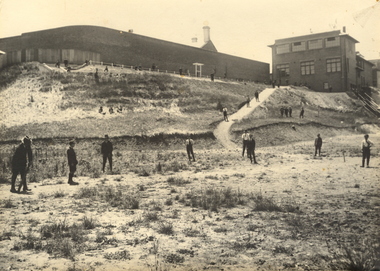 Federation University Historical Collection
Photograph, Ballarat Junior Technical School - outside the Ballarat Gaol Wall, c1921
... The old bluestone building in the grounds of the Dana Street Primary School became their temporary home for eight years. In its early years the school offered only a two-year course. ...The old bluestone building in the grounds of the Dana Street Primary School became their temporary home for eight years. In its early years the school offered only a two-year course. ...In February 1913 the Ballarat Junior Technical School opened its doors to its 86 pupils. The old bluestone building in the grounds of the Dana Street Primary School became their temporary home for eight years. In its early years the school offered only a two-year course. The first year was of a general nature giving a thorough grounding in Mathematics and Instrumental Drawing, and introducing students to the various branches of trade work. The second-year students studied for the Junior Technical Certificate and specialized in a course of their choice - either a trade (Woodwork or Fitting and Turning) or a course leading to higher studies at the School of Mines. Increased enrolment - 86 to 110 in the second year. Some applicants were turned away due to lack of space. An abandoned single room school was brought in and this helped for a time. Plans were developed and a two-storied red brick building in the vacinity of the School of Mines was build. An acre of land was reclaimed from the north-east corner of the Ballarat Gaol. The school backed onto the wall of the gaol. The task of landscaping and terracing of the area was to cost a great deal and time. The boys did much of the heavy work. This kept them occupied as the official playground areas were still full of rubble.View from the south-east of the Junior Technical School with the slope from the gaol wall down to the area known as the Battery Paddock. The new school building was a two-storied red brick building along the Education Department style of the 1920s. On 9 September 1921, the Junior Technical School building was officially opened. Much work was needed to terrace and landscape the area. Students shown in various areas of the grounds.junior technical school, dana street primary school, bluestone, mathematics, instrumental drawing, junior technical certificate, woodwork, fitting and turning, school of mines, ballarat gaol, landscaping, terracing, gaol wall, cricket
