
Showing 452 items matching "operating details"
-
 Moorabbin Air Museum
Manual - Cessna 310C, Cessna 310C Owner's Manual
... ...Operating details...Cessna 310C Normal procedures Operating details Emergency procedures Operating limitations Care of the aircraft Servicing diagram Overview of Cessna 310C for pilots, circa 1963 Book style manual Cessna 310C Owner's Manual Manual Cessna 310C ...Overview of Cessna 310C for pilots, circa 1963Book style manualnon-fictionOverview of Cessna 310C for pilots, circa 1963normal procedures, operating details, emergency procedures, operating limitations, care of the aircraft, servicing diagram -
Maldon Vintage Machinery Museum Inc
Blower - Centrifugal
... Operating details - speed range 2850 - 3500 RPM. ...Machinery; blower; centrifugal; metalwork Operating details - speed range 2850 - 3500 RPM. ...Centrifugal blower direct coupled to an electric motor. Painted dark blue with an anti-clockwise direction arrow picked out in white on the front.Operating details - speed range 2850 - 3500 RPM. Working pressure range 14 - 25 PSI? Working voltage 210 - 350 volts. Dawn No. 2F.machinery; blower; centrifugal; metalwork -
4th/19th Prince of Wales's Light Horse Regiment Unit History Room
Book, US Government Printing Office, Operation and Organizational Maintenance for Radio Sets AN/PRC 8, 8A, 9, 9A, 10 & 10A, Dec 1954
... Soft covered book detailing operating instructions and organizational maintenance for radio sets AN/PRC-8, 8A, 9, 9A, 10 & 10A...Manual for equipment previously used by the Regiment Handbook radio PRC TM 11-612, TO31R2-2PRC-101 Soft covered book detailing operating instructions and organizational maintenance for radio sets AN/PRC-8, 8A, 9, 9A, 10 & 10A Operation and Organizational Maintenance for Radio Sets AN/PRC 8, 8A, 9, 9A, 10 & 10A Book US Government Printing Office ...Manual for equipment previously used by the RegimentSoft covered book detailing operating instructions and organizational maintenance for radio sets AN/PRC-8, 8A, 9, 9A, 10 & 10ATM 11-612, TO31R2-2PRC-101handbook, radio, prc -
4th/19th Prince of Wales's Light Horse Regiment Unit History Room
Book, Technical Manual Antenna AS-1729/VRC, 23 Jan 1984
... Soft covered book detailing description, operating instructions, trouble shooting and maintenance of the Antenna System AS-1729/VRC...Handbook for equipment previously used by the Regiment Handbook radio antenna AS-1729/VRC TM 11-5985-262-14 Soft covered book detailing description, operating instructions, trouble shooting and maintenance of the Antenna System AS-1729/VRC Technical Manual Antenna AS-1729/VRC Book ...Handbook for equipment previously used by the RegimentSoft covered book detailing description, operating instructions, trouble shooting and maintenance of the Antenna System AS-1729/VRCTM 11-5985-262-14handbook, radio antenna, as-1729/vrc -
4th/19th Prince of Wales's Light Horse Regiment Unit History Room
Document, Operator Handbook Interim Rasit 3190B GSR, Nov 1987
... Loose leaf photocopy of operator handbook detailing capabilities, operating modes, controls, drills, procedures etc for the Rasit 3190B ground radar stattion...handbook radar army Nov 87 Loose leaf photocopy of operator handbook detailing capabilities, operating modes, controls, drills, procedures etc for the Rasit 3190B ground radar stattion Operator Handbook Interim Rasit 3190B GSR Document ...Loose leaf photocopy of operator handbook detailing capabilities, operating modes, controls, drills, procedures etc for the Rasit 3190B ground radar stattionNov 87handbook, radar, army -
4th/19th Prince of Wales's Light Horse Regiment Unit History Room
Book, Operators Manual Radio Sets AN/VRC53 & AN/GRC1258 Amplifier Power Supply Group OA-3633/GRC
... Soft covered book detailing installation, operating instructions and operator's maintenance of Radio Sets AN/VRC53 & AN/GRC1258 Amplifier Power Supply Group OA-3633/GRC...Handbook for equipment used by the Regiment handbook radio vrc TM 11-5820-498-10 Soft covered book detailing installation, operating instructions and operator's maintenance of Radio Sets AN/VRC53 & AN/GRC1258 Amplifier Power Supply Group OA-3633/GRC Operators Manual Radio Sets AN/VRC53 & AN/GRC1258 Amplifier Power Supply Group OA-3633/GRC Book ...Handbook for equipment used by the RegimentSoft covered book detailing installation, operating instructions and operator's maintenance of Radio Sets AN/VRC53 & AN/GRC1258 Amplifier Power Supply Group OA-3633/GRCTM 11-5820-498-10handbook, radio, vrc -
 Melbourne Tram Museum
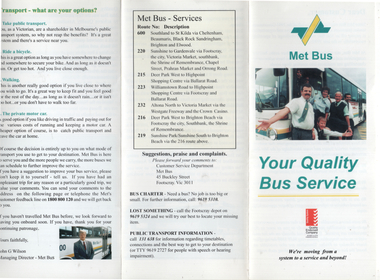
Pamphlet, Met Bus, "Met Bus - Your Quality Bus Service", c1993
... Pamphlet produced by Met Bus, the Government operator of 7 routes following the 1993 tender to provide information on the operation, its plans, public transport, routes operated, contact details and general information. Managing Director John G Wilson. ...Pamphlet produced by Met Bus, the Government operator of 7 routes following the 1993 tender to provide information on the operation, its plans, public transport, routes operated, contact details and general information. Managing Director John G Wilson. ...Pamphlet produced by Met Bus, the Government operator of 7 routes following the 1993 tender to provide information on the operation, its plans, public transport, routes operated, contact details and general information. Managing Director John G Wilson. Services were operated out of the former Footscray Tram depot in Buckley St.Yields information about Met Bus in 1993.Pamphlet, 3 fold DLfull colour.met bus, buses, public transport -
 Ballarat Tramway Museum
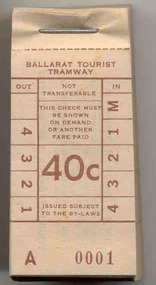
Ephemera - Ticket/s, Ballarat Tramway Museum (BTM), BTPS 40c, 1977
... On rear in brown ink are details of the Ballarat Tourist Tramway operating details, contact address and that it is operated by a volunteer organisation. ...On rear in brown ink are details of the Ballarat Tourist Tramway operating details, contact address and that it is operated by a volunteer organisation. ...Demonstrates the Museum's ticketing systems and ongoing production of tickets.Block of 200 tickets - brown ink on off white paper, denomination 40c, headed Ballarat Tourist Tramway. On rear in brown ink are details of the Ballarat Tourist Tramway operating details, contact address and that it is operated by a volunteer organisation. The 200 tickets have been stapled onto a heavy cardboard back with a heavy metal staple. The cardboard on the back has a cross hatched pattern in a teal colour. 2256.1 - A0001 to A0200 (the first block collected at the time of issue 1/8/1977) 2256.2 - A71801 to A72000 - collected 28/12/2002. 2256.3 - A99801 to 100000 - collected 30/6/2004 The tickets are in the style of the former State Electricity Commission of Victoria tramway tickets. Tickets in use as adult fare from 1/8/77 to 30/6/78 and as child return fares from 1/11/1985 to 30/11/1987. Child single ticket from 1/12/87 to 31/10/1998. Fare structure of BTM/BTPStrams, tramways, btm, tickets -
 Ballarat Tramway Museum
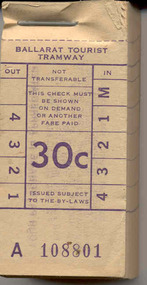
Ephemera - Ticket/s, Ballarat Tramway Museum (BTM), Block of 200 tickets - 30c BTPS, Oct. 1975
... On rear in purple ink are details of the Ballarat Tourist Tramway operating details, contact address and that it is operated by a volunteer organisation. ...On rear in purple ink are details of the Ballarat Tourist Tramway operating details, contact address and that it is operated by a volunteer organisation. ...Demonstrates the Museum's ticketing systems and ongoing production of tickets.Block of 200 tickets - purple ink on off white paper, denomination 30c, lettered A 108801 to A 109000, headed Ballarat Tourist Tramway. On rear in purple ink are details of the Ballarat Tourist Tramway operating details, contact address and that it is operated by a volunteer organisation. The 200 tickets have been stapled onto a heavy cardboard back with a heavy metal staple. The tickets are in the style of the former State Electricity Commission of Victoria tramway tickets. Original block A 001 to A200 added 30/6/2004 - from archive holdings. Tickets in use as adult fare from 1/11/1975 to 31/7/1977 and as child fares from 1/7/1978 to 31/10/1985. Child single ticket for while, late 80's to 30/6/1991. Last block issued 1/1990. Ticket issue book shows that the first ticket/block? was collected for the archives - 10/9/1975. See Fare structure of BTM/BTPStrams, tramways, btm, tickets -
 Ballarat Tramway Museum
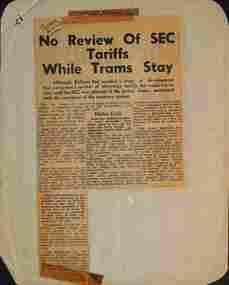
Newspaper, The Courier Ballarat, "No review of SEC Tariffs while trams stay", 3-1-1963
... Newspaper cutting from The Courier, 3-1-1963 titled "No review of SEC Tariffs while trams stay", about there will be no reduction in power tariffs in the region while the Ballarat trams continue to operate. Gives details on additional customers in the region, tariffs were reduced in Geelong after the closure of trams there. ...Newspaper cutting from The Courier, 3-1-1963 titled "No review of SEC Tariffs while trams stay", about there will be no reduction in power tariffs in the region while the Ballarat trams continue to operate. Gives details on additional customers in the region, tariffs were reduced in Geelong after the closure of trams there. ...Newspaper cutting from The Courier, 3-1-1963 titled "No review of SEC Tariffs while trams stay", about there will be no reduction in power tariffs in the region while the Ballarat trams continue to operate. Gives details on additional customers in the region, tariffs were reduced in Geelong after the closure of trams there. Quotes the Minister of Electrical Undertakings, Mr. Reid, following Murray Byrne, MLC.Yields information about the cost of power in the Ballarat area.Newspaper cutting from The Courier, Ballarat, taped to a quarto sheet with rounded corners.In ink "Courier 3/1/63"secv, ballarat, trams, tramways, closure, power supply, power costs -
 Ballarat Tramway Museum
Photograph - Colour Photograph/s, Carolyn Dean, 1/10/1995 12:00:00 AM
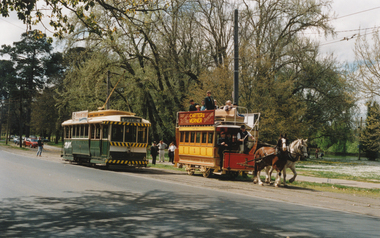
... See BTM magazine "Fares Please!" for details of operating day...See BTM magazine "Fares Please!" for details of operating day Photograph Colour Photograph/s Carolyn Dean ...Colour photograph, postcard size print of Horse tram No. 1 and electric tram No. 14, crossing at Gardens Loop on 1/10/1995. See BTM magazine "Fares Please!" for details of operating dayOn rear stamped with "BTM address stamp", dated "October 1 - 1995" in red ink," 22/11/95" in corner with 1 circled and in btm rh cnr -" 63-S/S" - used in Trolley Wire reproduction. High Res image added 20-8-2016.horse trams, btm, wendouree parade, tram 1, 14 -
 Warrnambool and District Historical Society Inc.
Book, Good Words, 1882
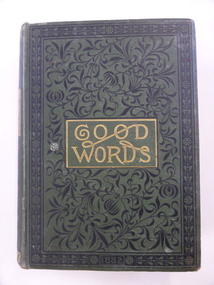
... The school was opened in December 1856 as a National School and is still operating. No other details concerning Annie Egerton have been found....The school was opened in December 1856 as a National School and is still operating. No other details concerning Annie Egerton have been found. ...This book, edited by Donald MacLeod, was given in 1883 as a prize to Annie Egerton by the Rev. W.H. Scott for Bible Knowledge. Annie Egerton was a pupil at the Allansford State School. John Jones was the Head Master at this school from 1867 to 1891. The school was opened in December 1856 as a National School and is still operating. No other details concerning Annie Egerton have been found.This book is of importance as it is a 19th century book given as a prize to a pupil of the Allansford School in 1883 for her Bible knowledge. It is particularly interesting that a prize for religious knowledge was given in the 1880s to a pupil at a secular State School. It is also interesting to note the type of book given to a primary school girl in the 19th century – a book with strong moral overtones and some heavy instructional articles. This is a hard cover book of 836 pages. It has a dark green and black cover patterned with an ornamental pattern and gold lettering contained within a square box on both the cover and the spine. The inside front and back pages have a mottled green flower pattern. The edges of the pages have a gilt finish. The book has a bookplate on the inside cover and the book contains an Index of Contents, short stories, articles on various topics and an Index of Authors. There are many black and white illustrations and sketches throughout the text. The first illustration has a piece of tissue paper in front of it. The cover is a little frayed at the edges and somewhat blotched. ‘Allansford State School No.3, 1st Prize given by the Rev. W. H. Scott awarded to Annie Egerton, Bible Class, Senior Division, for Bible Knowledge, 21st December 1883, J.E. Jones Head Teacher’. allansford state school, education in the warrnambool area, annie egerton, john jones, rev. w. h. scott -
 Ballarat Tramway Museum
Ephemera - Tour Notes, Michael Costello, "Last tram day at the Yangardook Tramway", Nov. 1994
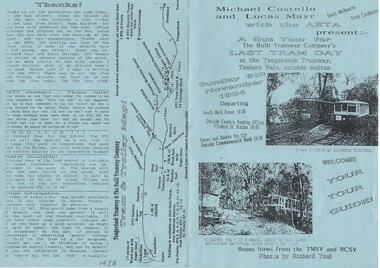
... Gives details of the tramway, the tramcars (large scale models), track, map, details of vehicles, operators and last tram details. Operated in conjunction with the Australian Electric Traction Association....Gives details of the tramway, the tramcars (large scale models), track, map, details of vehicles, operators and last tram details. Operated in conjunction with the Australian Electric Traction Association. ...Single sheet of A4 blue paper, printed on both sides, folded in half to form the notes for a bus tour to the "The Bulli Tramway Company's Last Tram Day at the Yangardook Tramway, Toolern Vale", outside Melton on Sunday 6 November 1994. Gives details of the tramway, the tramcars (large scale models), track, map, details of vehicles, operators and last tram details. Operated in conjunction with the Australian Electric Traction Association.model tramways, closure, toolern vale, yangardook tramway -
 Ballarat Tramway Museum
Pamphlet, London Bus Company, "City Circle Heritage Tour - Ballarat", c1998
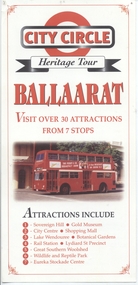
... Gives fares, timetable and contact details etc. Operated by the London Bus Company See also Reg Item 901 for a mention of this service - dates it c1998....Gives fares, timetable and contact details etc. Operated by the London Bus Company See also Reg Item 901 for a mention of this service - dates it c1998. ...Full colour pamphlet, advertising Ballarat "City Circle Heritage Tour" using a London style double deck bus, red, visiting various attractions. Gives fares, timetable and contact details etc. Operated by the London Bus Company See also Reg Item 901 for a mention of this service - dates it c1998.trams, tramways, visitors, ballarat, buses, tours -
 Bendigo Historical Society Inc.
Functional object - BLACK MANTLE CLOCK
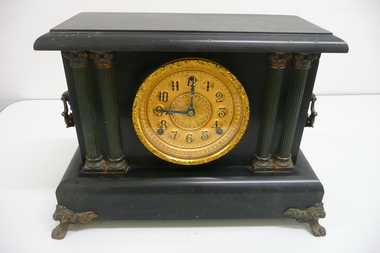
... Original paper label on back with manufacturers details and operating instructions....Original paper label on back with manufacturers details and operating instructions. Functional object BLACK MANTLE CLOCK ...Black wooden mantle clock with pendulum bob, made in U.S.A. by the Sessions Clock Company, mounted on ornate metal feet with metal handles on each end, four faux marble columns in green with metal tops & bases. Round gold dial with black numerals and hands, brass bezel with flat glass. 8 day time and strike, chiming the hours on a gong and half hour on a bell. Original paper label on back with manufacturers details and operating instructions.The Sessions Clock Cohorology, clocks, mantle -
 Bendigo Historical Society Inc.
Document - HISTORY AND PERFORMANCE INFORMATION: THE BENDIGO THEATRE CO (BENDIGO OPERATIC SOCIETY)
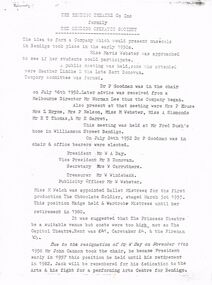
... History and performance information re The Bendigo Theatre Co (Bendigo Operatic Society) (Pat Lyon). Details of founding of company in early 1950s and references to people involved. ...ENTERTAINMENT Theatre Bendigo Theatre Company History and performance information re The Bendigo Theatre Co (Bendigo Operatic Society) (Pat Lyon). Details of founding of company in early 1950s and references to people involved. ...History and performance information re The Bendigo Theatre Co (Bendigo Operatic Society) (Pat Lyon). Details of founding of company in early 1950s and references to people involved. Company change to Bendigo Theatre Co. in Feb 1984. Includes list of 91 (named) productions from 1953 to to 1993 (with dates) with total of 478 performances. Also - productions listed by the relevant Director; list of Musical Directors; List of Pianists; List of Choreographers (no dates); list of Life Members; List of Lighting personnel.entertainment, theatre, bendigo theatre company -
 Ballarat Tramway Museum
Document - Instruction, State Electricity Commission of Victoria (SECV), "Forest City Signals", 20/01/1965 12:00:00 AM
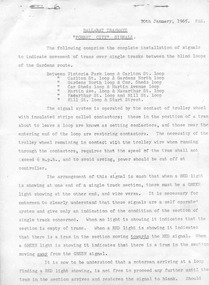
... Five page, foolscap duplicated document, stapled in two locations along the top edge, titled Forest City Signals, and dated 20-1-1965, giving details about the Forest City signalling system installed in Ballarat. Explains how the system operates, gives instructions, details of the system, location of the loops, trams following each other, power failure. ...Significant in being a detailed set of instructions for the Forest City signalling system that was operated by the tram's trolley pole. Details of the locations and crossing loops where used, primarily around the loop and through Bridge St. and how it operated. ...Significant in being a detailed set of instructions for the Forest City signalling system that was operated by the tram's trolley pole. Details of the locations and crossing loops where used, primarily around the loop and through Bridge St. and how it operated. Prepared and printed by the SEC during 1965.Five page, foolscap duplicated document, stapled in two locations along the top edge, titled Forest City Signals, and dated 20-1-1965, giving details about the Forest City signalling system installed in Ballarat. Explains how the system operates, gives instructions, details of the system, location of the loops, trams following each other, power failure. Also gives details of how the Bridge St system operated and the switch at Grenville St. Gives instructions for running out of the depot. Note: The locations of the signals are not as detailed as in the Driver Training Manual - See Reg Item 3486 See also Reg Item 5373 for another similar copy and fully scanned copy.trams, tramways, signals, crossing loop, forest city signals, grenville st, wendouree parade -
 Ballarat Tramway Museum
document - Advertising Card, Trading Places Print and Design, 2005
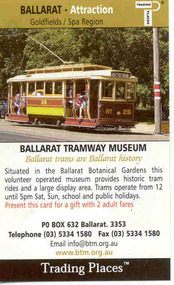
... Features a photo of 26 at Gardens Loop, providing location, operating hours and address details. Has a "give away" attached to the card. ...Features a photo of 26 at Gardens Loop, providing location, operating hours and address details. Has a "give away" attached to the card. ...Colour printed advertising card by "Trading Places" for the BTM. One of many produced early 2005. Features a photo of 26 at Gardens Loop, providing location, operating hours and address details. Has a "give away" attached to the card. On rear has six other commercial / tourist locations. Produced by "Trading Places Print & Design", were designed to go into locations where tourist would visit, eg hotels and be placed in large turning or circular racks. Has telephone number on rear. See BTM Board Minutes c May 2005. tramways, trams, btm, marketing, advertisements, tourism -
 Ballarat Tramway Museum
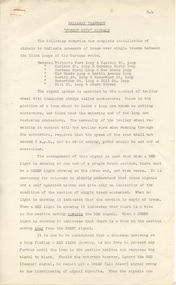
Document - Instruction, State Electricity Commission of Victoria (SECV), "Forest City Signals", late 1960's?
... Five page, foolscap duplicated document, stapled in the top left hand corner, titled Forest City Signals, undated, has letters S4 in top right hand corner of first sheet, giving details about the Forest City signalling system installed in Ballarat, particularly around Wendouree Parade and the depot. Explains how the system operates...Trams tramways Signals Crossing Loop Forest City Signals Grenville St Wendouree Parade Five page, foolscap duplicated document, stapled in the top left hand corner, titled Forest City Signals, undated, has letters S4 in top right hand corner of first sheet, giving details about the Forest City signalling system installed in Ballarat, particularly around Wendouree Parade and the depot. Explains how the system operates ...Yields information about the instructions about Signalling system on Wendouree Parade and Bridge St - Forest City signals.Five page, foolscap duplicated document, stapled in the top left hand corner, titled Forest City Signals, undated, has letters S4 in top right hand corner of first sheet, giving details about the Forest City signalling system installed in Ballarat, particularly around Wendouree Parade and the depot. Explains how the system operates, gives instructions, details of the system, location of the loops, trams following each other, power failure. Also gives details of how the Bridge St system operated and the switch at Grenville St. Note: The locations of the signals may not be not as detailed as in the Driver Training Manual - See Reg Item 3486. Does not provide instructions for Lydiard St North or Sebastopol routes. See also Reg Item 3456 for another similar copy.trams, tramways, signals, crossing loop, forest city signals, grenville st, wendouree parade -
 Bendigo Historical Society Inc.
Photograph - WES HARRY COLLECTION: SYMONDS' CRITERION FAMILY HOTEL, BENDIGO
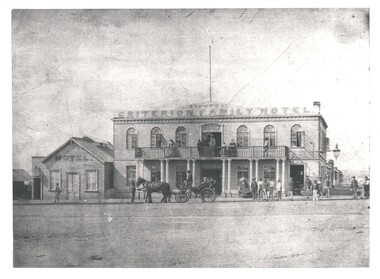
... *See Research field for further details. Symonds operated the Criterion Hotel 1858 - 1862....*See Research field for further details. Symonds operated the Criterion Hotel 1858 - 1862. ...Photograph of a double storied stone building, it has a three quarters length open verandah along the first floor. The name 'Symonds Criterion Family Hotel' is painted above the first floor. There is a large lamp on a bracket on the right-hand side of the building. To the left of the main structure there is a smaller weatherboard building with the word 'Hotel' painted along the top. There are several groups of people both on the ground and on the balcony, also in front of the hotel is a very up market buggy/wagonette with a coachman? Driving. This hotel was on the corner of Mundy and Hargreaves Streets and is significant as centre of events as it overlooked the original Market Square. Original photo is part of the Batchelder Collection owned by the State Library of Victoria. Published in 'An American on the Goldfields' p. 38-39 with description and details. See also Mosaic No. 1232. *See Research field for further details. Symonds operated the Criterion Hotel 1858 - 1862.Batchelderbuildings, hotel, criterion family hotel, criterion family hotel. mundy street hargreaves street. market square. princess theatre. symonds, joseph s. -
 Puffing Billy Railway
Blackstone Oil Engine, 6 November 1908
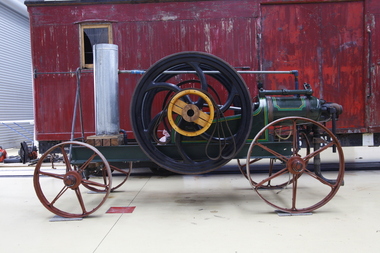
... 8HP Blackstone Lamps Start Oil Engine engine number 71076 Engine Details Maximum operating RPM of 240. Fitted with a 3'9" Flywheel Tested on the 6th of November 1908. ...8HP Blackstone Lamps Start Oil Engine engine number 71076 Engine Details Maximum operating RPM of 240. Fitted with a 3'9" Flywheel Tested on the 6th of November 1908. ...8HP Blackstone Lamps Start Oil Engine engine number 71076 Engine Details Maximum operating RPM of 240. Fitted with a 3'9" Flywheel Tested on the 6th of November 1908. Shipped to Cluter buck South Australia for installation on concrete base. Recovered and restored during the 80's in South Australia Purchased privately in 2013 in Tailem Bend South Australia and transported to Victoria. Currently on loan to the Puffing Billy Museum at Menzies Creek as an operating exhibit. Blackstone & Co. was a farm implement maker at Stamford, Lincolnshire, United Kingdom. In 1896 they built lamp start oil engines. The Lamp or hot-bulb engine (also hotbulb or heavy-oil engine) is a type of internal combustion engine. It is an engine in which fuel is ignited by being brought into contact with a red-hot metal surface inside a bulb, followed by the introduction of air (oxygen) compressed into the hot-bulb chamber by the rising piston. There is some ignition when the fuel is introduced, but it quickly uses up the available oxygen in the bulb. Vigorous ignition takes place only when sufficient oxygen is supplied to the hot-bulb chamber on the compression stroke of the engine. Most hot-bulb engines were produced as one-cylinder, low-speed two-stroke crankcase scavenged units Historic - Industrial - single cylinder, horizontal, 4 stroke, hot-bulb ignition oil engine Blackstone 8HP Oil Engine made from steel, wrought iron and brassOval Plate with Black Stones and Clutter Buck Brass Plaque engine number 71076blackstone, oil engine, clutter buck, black stone, puffing billy, hit and miss, engine, blackstone & co -
 Flagstaff Hill Maritime Museum and Village
Equipment - Printing Press, Harrild and Sons, 1866
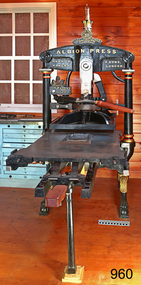
... operated Albion Press, Patent 2105. The machine has an upright iron frame at the back that supports the upper press that has a wooden handled metal bar is attached. The frame and legs support a thick metal flatbed. A metal leg supports the front of the press bed. The iron work is painted black with gold highlights. The decorative legs are finished with the golden feet of an animal. The frame above the metal bed includes a crown shaped finial symbol above the maker’s emblem. The maker’s details...operated Albion Press, Patent 2105. The machine has an upright iron frame at the back that supports the upper press that has a wooden handled metal bar is attached. The frame and legs support a thick metal flatbed. A metal leg supports the front of the press bed. The iron work is painted black with gold highlights. The decorative legs are finished with the golden feet of an animal. The frame above the metal bed includes a crown shaped finial symbol above the maker’s emblem. The maker’s details ...This Albion printing press was manufactured by Harrild & Sons of London and exported in 1868 from London to the colonial Western Victoria town of Coleraine, population of 700 at that time. It was installed in the Colerain Albion printing office. It was used to print the first edition of the Coleraine Albion newspaper in 1868 and continued until publication ceased in 1974. The Albion Press is still being used today by a volunteer printer in the “Examiners Office” in the village at Flagstaff Hill. Amongst the items produced are printed paper bags for the Tea Rooms and posters for visitors. ALBION PRINTING PRESS The Albion press was invented and manufactured in London by Richard Whittaker Cope around 1820 and was still being produced in the 1930s. The Albion was manufactured under licence by several companies from the 1850s onwards, one of which was Harrild & Sons of Fleet Works, London. Harrild & Sons describes its business as “printing materials manufacturer”. The business was established in 1807 by Robert Harrild and named R. Harrild & Co. In 1813 he showed that rollers could be used to ink a printing plate instead of inking balls, the method in use at the time. He then established a company to make the rollers. Eventually his company would make other printing materials and equipment. Robert’s sons joined him in the 1830s, when the company was renamed Harrild & Sons, and they continued to run the company after his death in 1853 and up until the mid-1900s. COLERAINE ALBION PRINTING OFFICE The Coleraine Albion Printing Office was established by W.L. Ambler. The first issue of the Coleraine Albion was dated 4th January 1868. Arrangements had been made to receive news from Melbourne, nearby provinces, other colonies and England. The second issue on 18 January 1868 printed articles from many agencies, including the Melbourne Age and the Warrnambool Examiner. The Albion office was sold to William Hatherleigh, formerly of Portland, in October 1868. Thereafter the Albion office had many owners. The last was L. A. & E. Oliver, who took over in January 1972 and was the last to be stated as printers and publishers of the Coleraine Albion. The office was wound up in 1974. The Albion Press and other equipment was distributed to Star printing in Terang. Star Printing donated the Albion press to Flagstaff Hill Maritime Village around 1980 and Stan Philp, owner of Philprint in Warrnambool, transported it to Warrnambool, brought it up to good working order and organised the supply of appropriate printer’s type. The Albion hand operated printing press is significant for producing the first newspaper in Coleraine, Western Victoria and continuing production for over 100 years. The Albion is technologically significant as a working example of a hand operated printer from the mid-19th century. The use of the printer is demonstrated by volunteers at Flagstaff Hill, printing items such as lolly and treat bays for use in the Village. The Albion is socially significant for its role in the isolated provincial colony, providing communication with the outside world, both in Australia and overseas. Newspaper printers were often amongst the first businesses of a small town. Printing press; hand operated Albion Press, Patent 2105. The machine has an upright iron frame at the back that supports the upper press that has a wooden handled metal bar is attached. The frame and legs support a thick metal flatbed. A metal leg supports the front of the press bed. The iron work is painted black with gold highlights. The decorative legs are finished with the golden feet of an animal. The frame above the metal bed includes a crown shaped finial symbol above the maker’s emblem. The maker’s details and the name of the printer are embossed on the upright frame. A plaque with the patent number is below a Lion and Unicorn emblem.Embossed maker’s emblem [A red cross - above a double ring – square inside ring – three banners below ring]. - Inside the double rings “PRINTING MATERIALS MANUFACTURE” - Inside the square, intertwined text “H & S” [representing Harrild & Sons] - Inside the three banners ““FLEET” “WORKS.” “LONDON.E.C.” Embossed across the shoulders “ALBION PRESS / HARRILD & SONS, / MAKERS LONDON.” Emblem above plaque [Lion and Unicorn] Embossed on the plaque “PATENT / 2105” Stamped into upright machine part above the printing bed “2105 / 1866” flagstaff hill, warrnambool, shipwrecked coast, flagstaff hill maritime museum, maritime museum, shipwreck coast, flagstaff hill maritime village, albion press, printing press, 1866 printing press, printing equipment, communications, coleraine albion printing office, coleraine newspaper, albion newspaper, south west victoria newspapers, harrild and sons london, richard whittaker cope, star printing terang, philprint, coleraine albion, hand operated press -
The Beechworth Burke Museum
Audio - Oral History, Jennifer Williams, Gwendoline Warden, 1st June 2000
... Gwendoline Warden's account of her life in Beechworth and the local area during the 20th century is historically and socially significant as it offers valuable information about the business activity in the region and provides a deeper insight into the way hotels and grocery shops were operating during the first half of the previous century. Additionally, along with all the details provided for many aspects of social life, her personal account of the war period is of great importance, offering vital information to research on the way the Australian society experienced WWII. ...Gwendoline Warden was born in Ararat in 1913. When she was 13 years old, she moved to Wangaratta, where her parents owned the “Hibernian Hotel”. Her father`s name was William Lavender. When Gwen was around 16 years old, she moved to Beechworth, where she met her husband and they got married in 1935. They had their wedding reception at Warden`s Hotel and they had two children together, a boy and a girl. She recounts how difficult it was for them during the war to manage their grocery's shop and source the supplies they needed, having coupons for food and the black-market prevailing. They faced financial difficulties and, ultimately, they had to sell the shop. After the war she did a few other jobs and she retired when she was nearly sixty. Gwendoline portrays Beechworth as a quiet place, where people were happy and peaceful, enjoying the many opportunities they had for entertainment, such as dances and balls, or the celebrations for the New Year's Eve. She also witnessed the beginning of the famous wheelbarrow race, which started just outside the post office and a big crowd gathered to farewell the two barrowmen. When comparing the past with the present, she points out how much Beechworth has changed over the last decades, with many new people coming to town, making her feel as “the only one around”. She also remarked that young people have changed as well; in her day they were entertaining themselves but nowadays they want to be entertained. This oral history recording was part of a project conducted by Jennifer Williams in the year 2000 to capture the everyday life and struggles in Beechworth during the twentieth century. This project involved recording seventy oral histories on cassette tapes of local Beechworth residents which were then published in a book titled: Listen to what they say: voices of twentieth century Beechworth. These cassette tapes were digitised in July 2021 with funds made available by the Friends of the Burke.Gwendoline Warden's account of her life in Beechworth and the local area during the 20th century is historically and socially significant as it offers valuable information about the business activity in the region and provides a deeper insight into the way hotels and grocery shops were operating during the first half of the previous century. Additionally, along with all the details provided for many aspects of social life, her personal account of the war period is of great importance, offering vital information to research on the way the Australian society experienced WWII. This is a digital copy of a recording that was originally captured on a cassette tape. The cassette tape is black with a horizontal white strip and is currently stored in a clear flat plastic rectangular container. It holds up 40 minutes of recordings on each side.Mrs Gwendoline Warden/ararat, wangaratta, hibernian hotel, gwendoline warden, william lavender, beechworth, warden`s hotel, grocery`s shop, coupons, black-market, war, dances, new year`s eve, balls, new people, listen to what they say: voices of twentieth century beechworth, jennifer williams, cassette tapes, friends of the burke, oral histories -
 Gippsland Vehicle Collection
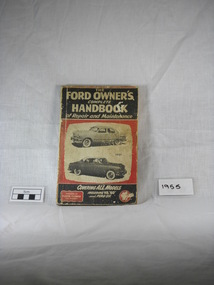
Book, FLOYD CLYMER, The FORD OWNER'S complete HANDBOOK of Repair and Maintenance, 1949 (exact)
... On page 106 of the handbook there is, in handwriting, CABLE OPERATED BRAKES, Spring, Colour & Position Guide. Hand drawn picture with details marking the layout and details of the spring, colour & position....This book covers at least 97% of the instructions necessary for servicing the 1950 and 1951 models. electrical steering ford engine transmission accessory ford owners car repair v8 60 ford six repair and maintenance ford engine clutch body chassis shockers cooling system fuel system suspension rear axle brakes shock absorbers rear axle On page 106 of the handbook there is, in handwriting, CABLE OPERATED BRAKES, Spring, Colour & Position Guide. Hand drawn picture with details marking the layout and details of the spring, colour & position. ...This Ford Handbook is in good condition. This book covers at least 97% of the instructions necessary for servicing the 1950 and 1951 models.Repair and Maintenance book covering all models of ford including V8, "60" and FORD SIXOn page 106 of the handbook there is, in handwriting, CABLE OPERATED BRAKES, Spring, Colour & Position Guide. Hand drawn picture with details marking the layout and details of the spring, colour & position.electrical, steering, ford, engine, transmission, accessory, ford owners, car repair, v8, 60, ford six, repair and maintenance, ford engine, clutch, body, chassis, shockers, cooling system, fuel system, suspension, rear, axle, brakes, shock absorbers, rear axle -
 Flagstaff Hill Maritime Museum and Village
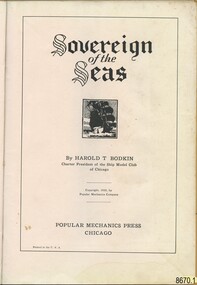
Book - "Sovereign of the Seas" book or manual for the ship model hobby enthusiast, Harold T. Bodkin, 1933, "Sovereign of the Seas", Popular Mechanics Press
... In addition to Jim witnessing the tail end of ships at port in Warrnambool, his "father was as sea captain and operated his vessel in Bass Strait coastal trade between Tasmania and Victoria". The intricately detailed model made by Jim is full of precise detail. ...In addition to Jim witnessing the tail end of ships at port in Warrnambool, his "father was as sea captain and operated his vessel in Bass Strait coastal trade between Tasmania and Victoria". The intricately detailed model made by Jim is full of precise detail. ...Jim (James Bernard) Williams, who was the owner of this manual, was a long-time resident of Warrnambool having the opportunity to work at two notable historical businesses of the town. The first, Cramond & Dickson a drapier store established around 1852-1855 and which remained a store that traded under the same name for the longest in Victoria, before it closed its doors in 1974. The second business was Fletcher Jones a highly successful textile and clothing Australian business. Some of Jim’s spare time was devoted to the model ship making which would conjure up many fascinating stories of maritime history. In addition to Jim witnessing the tail end of ships at port in Warrnambool, his "father was as sea captain and operated his vessel in Bass Strait coastal trade between Tasmania and Victoria". The intricately detailed model made by Jim is full of precise detail. The manual and the blueprints held by Flagstaff Hill Maritime Village also reflect the intricate process and devotion to the task completed by Jim. The history of the shipwreck and maritime stories of the Victorian Southwest coast surrounding Warrnambool would have continued to inspire his passion. Three photos of the model and Jim, like the photo of Harold T. Bodkin in the manual, attest to the enthusiasm and enjoyment that was gained by him through this hobby. The manual opens to a photo of “Mr. Harold T. Bodkin adding finishing touches to model of the “Sovereign of the Seas”. The “Forward to Reader” which is on the next page is written by “E. R. HAAN, Technical Editor, Popular Mechanics Magazine. The forward explains the methodology used to achieve the fine detail that is part of the body of the model, by “applying imitation carvings”, and is cited as “a museum type of model”. The following page “Blueprints and Craftmats on the ‘Sovereign of the Seas’” discusses the availability of a set of blueprints to purchase separately. Followed by a description of the moulding process for the “miniature carvings”. “Historical Notes of Interest on the “Sovereign of the Seas (1637)” follow on the next page. The manual is divided into the following parts from pages 8 to 71: “Part I – Shaping the Hull/Part II – The Rudder, Quarter Galleries and Gunports/Part III Wales, Gunport Covers and Initial Ornamentation/Part V – Beakhead Decoration, Bulkhead and Rails, Etc./Part VI Carvings, Lanterns, Knights, Bitts and Painting/Part VII – Details of Mast Construction/Part VIII – Standing Rigging/Part IX – Running Rigging and Final Details. All of these instructions include photographs and detailed graphs. Then instructions on “How to Read and Use Ship-Model Drawings”, “The Shop-Model Maker’s Tools”, and “Simplified Ship-in-a-Bottle”. This is finished off with “Helpful Hints….” And numerous pages of advertising. Some adverts include aids for completing the “Sovereign of the Seas” model. Part I uses blue and black ink to illustrate a dramatic picture of the “Sovereign”, otherwise all print is in black ink on buff paper. This book in significant to the collection as it was donated along with other tools and blueprints which have been used by the donor of the "Sovereign of the Seas" model ship. It also connects with the wider community in that it is related to historical maritime interest and the donor, Jim Williams is also connected to other significant retail and manufacturing businesses of the past in Warrnambool. This manual has been covered with brown paper, including an extra strip for the spine. The front has a watermark at the top middle, some pencilled compass circles segmented into eight parts across the area and a small amount of script writing. The back also has the same type of compass circles and some other small shapes. There are also grease marks. The cover has a patina adding to variations of colour to the paper indicative of the book being handled often. The title page reads “Sovereign of the Seas” in an Old English font. This is followed by a lithograph print around 1 inch square of a ship at full sale. By HAROLD T. BODKIN/Charter President of the Ship Model Club of Chicago/Copyright, 1933, By Popular Mechanics Company/POPULAR MECHANICS PRESS/CHICAGO/Printed in the U.S.A. By HAROLD T. BODKIN/Charter President of the Ship Model Club of Chicago/Copyright, 1933, By Popular Mechanics Company/POPULAR MECHANICS PRESS/CHICAGO/Printed in the U.S.A.flagstaff hill, warrnambool, shipwrecked coast, flagstaff hill maritime museum, maritime museum, shipwreck coast, flagstaff hill maritime village, great ocean road, model ship, vessel sovereign of the seas, jim williams, james bernard williams, the forth tasmania, freda williams, heather williams, phyllis bowditch, fletcher jones staff 1936, 17th century sailing ship, cramond and dickson, sovereign of the seas, royal sovereign, sovereign, charles 1, fletcher jones, warrnambool breakwater -
 Flagstaff Hill Maritime Museum and Village
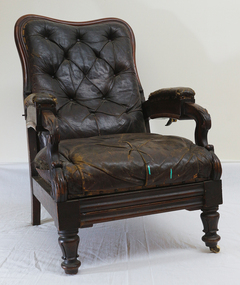
Furniture - Chair, Haberfield Chair, Michael Bradshaw, Circa 1860s-1890s
... The backrest is finished with button detailing, and its frame is distinguished by gracefully curved corners, lending the chair an elegant appearance. The chair’s padded leather armrests have attractive, crafted carvings at each end. A lever located below the armrest operates...The backrest is finished with button detailing, and its frame is distinguished by gracefully curved corners, lending the chair an elegant appearance. The chair’s padded leather armrests have attractive, crafted carvings at each end. A lever located below the armrest operates ...This elegant reclining armchair is generously on loan from the local Haberfield family. Mrs Haberfield is a member of the Anderson family from the Tower Hill region, and the chair was handed down to her from them. When it arrived at Flagstaff Hill in 2009, it was at least 100 years old. The maker, Michael Bradshaw, is currently unknown. The origin of the chair's timber has been lost through the generations, but some have named the armchair the 'Mahogany Chair' after the legendary Mahogany Ship. In August 2009, the wood was expertly examined. The structure of the wood specimens was found to be consistent with: • Pale coloured carcass timber - Fagus sylvatica – Beech (European) • Pale coloured frame timber - Agathis sp – NZ Kauri • Dark coloured timber chair legs (solid) - Swietenia sp. – True Mahogany • Dark coloured timber veneer - Swietenia sp. – True Mahogany • Repair fill-in piece – Quercus sp. – White Oak ( Northern hemisphere) • Repair fill-in piece (fine textured) – Populus sp. – Poplar • Runner wood - Eucalyptus sp – Pale coloured ash group, or messmate The chair is significant for its local origin and history, being connected to generations of the Anderson and Haberfield families. It is also significant for its elaborate and unusual design, the quality of its workmanship and materials. It is a fine example of good quality furniture of the late 19th century.The Haberfield Chair is a reclining armchair that includes a footrest and a detachable book rest. The chair features a dark timber frame and dark burgundy (now dark brown), Morocco goat skin leather upholstery. The backrest is finished with button detailing, and its frame is distinguished by gracefully curved corners, lending the chair an elegant appearance. The chair’s padded leather armrests have attractive, crafted carvings at each end. A lever located below the armrest operates the recliner’s ratchet mechanism, which also causes a footrest to slide forward for greater comfort. The turned and carved front legs are equipped with wheels, allowing for easy movement. The removable book rest is mounted on a brass pedestal. Its angle can be conveniently adjusted using a screw to move the ball and socket joint, ensuring personalised reading comfort. There is a handwritten inscription on the underside of the back rail. The chair is kindly on loan from the local Haberfield family. In pen and ink: “Made from Mahogany Ship wrecked near Tower Hill, July 3, 1835: made by Michael Bradshaw 18-2-“ [originally thought to read 1842]flagstaff hill maritime museum and village, great ocean road, shipwreck coast, armchair, reclining armchair, reading board, mahogany chair, haberfield chair, furniture, living room furniture, domestic furniture, 19th century, luxury, morroco leather, book stand, book rest, side table, music stand, reading stand, reading rest, foot rest, reading table -
 Flagstaff Hill Maritime Museum and Village
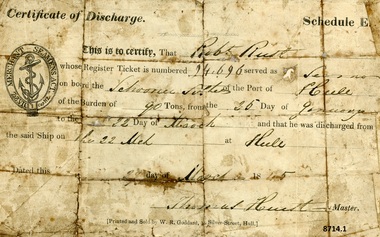
Certificate - Certificate of Discharge, 1845 - 1852
... details are recorded in "The Pioneers' Register, Warrnambool Township and Shire 1839-1900 Volume Two". He married Sarah Ann Twaits in 1865 and they had seven children. His wife died in 1876 following the birth of their last child. He doesn't appear to have ever worked as a seafarer once he arrived in Warrnambool but is only recorded as working as a labourer and chimney sweep and (in the 1880's) operating as a "General Storekeeper" and "Produce Merchant" (frequently advertising in the Warrnambool Standard for items such as potatoes, oats and dairy produce from his Henna Street premises). ...details are recorded in "The Pioneers' Register, Warrnambool Township and Shire 1839-1900 Volume Two". He married Sarah Ann Twaits in 1865 and they had seven children. His wife died in 1876 following the birth of their last child. He doesn't appear to have ever worked as a seafarer once he arrived in Warrnambool but is only recorded as working as a labourer and chimney sweep and (in the 1880's) operating as a "General Storekeeper" and "Produce Merchant" (frequently advertising in the Warrnambool Standard for items such as potatoes, oats and dairy produce from his Henna Street premises). ...Bob Rust was born in Poplar, London in 1823. He became a merchant seaman and all of his "Certificates of Discharge" (except the first one) show him working out of the London docks. The certificates document his career as an "Able Seaman" between the years 1845 to 1852. He worked on the following ships - Jan 25th - March 22nd, 1845 - schooner "Sisters" out of Hull. 14th July - 30th Nov 1845 - "Caleb Angus" - Port of London to West India Dock, London. 12th Dec 1845 - 14th June 1846 - "Caleb Angus" - Port of London to West India Dock, London. April - 16th Oct 1847 - barque "James Turcan" - discharged at Antwerp. It was noted by Mr Mills (Master) "his conduct was to my entire satisfaction. He is a sober, steady man" 25th Oct - 18th Dec 1847 - Brig "Eclipse" - Port of London. Dec 1847 - Nov 1848 - "Cecrops" - London to Cardiff to Cuba and discharged at West India Dock, London. 2nd Dec 1848 - 9th Feb 1850 (15 months) - "Enterprise" - discharged London. Nb - this was not the "Enterprise" used by John Pascoe Fawkner to enter the Yarra in 1835 or the "Enterprise" that sank in Lady Bay, Warrnambool in 1850 and it was not the "Enterprise" belonging to the British Navy which was used to search for Sir John Franklin's lost expedition and later made two Arctic voyages. It is not noted where Bob Rust sailed to on this voyage, but his Master noted on his certificate that "the bearer is an excellent seaman and a good sail maker". 3rd April - 20th Oct 1850 - brig "Thames" - London to London via Trieste. 30th Oct 1850 - 10th May 1851 - "Elizabeth". 9th June - 10th Nov 1851 - "Lady Rowena" - to Alexandria. 23rd Nov 1851 - 17th May 1852 - "Thames" - Mediterranean voyage to Trieste. Bob Rust was an early settler in Warrnambool. He came to Warrnambool, Australia sometime between May 1852 and 1856 where he was recorded in the Electoral Roll, as a labourer, living in Henna Street. According to family history, he "jumped ship" at Port Fairy (then Belfast) as there are no records of him officially arriving in Australia. His picture and details are recorded in "The Pioneers' Register, Warrnambool Township and Shire 1839-1900 Volume Two". He married Sarah Ann Twaits in 1865 and they had seven children. His wife died in 1876 following the birth of their last child. He doesn't appear to have ever worked as a seafarer once he arrived in Warrnambool but is only recorded as working as a labourer and chimney sweep and (in the 1880's) operating as a "General Storekeeper" and "Produce Merchant" (frequently advertising in the Warrnambool Standard for items such as potatoes, oats and dairy produce from his Henna Street premises). He continued to live in Henna Street until his death on 15th January 1906 aged 82 years. English maritime discharge certificates evolved from simple proof of release in the 1700's to become official service records in the mid 1800's. They were issued at the end of a voyage to confirm a sailor had been released from duty and paid. The Merchant Shipping Act of 1835 introduced the formal registration of British seamen, to allow the Government (Board of Trade) to identify individual seamen for the Royal Naval Reserve. Seafarers who registered were issued with tickets which contained some personal details including name, date and place of birth. As the registration system evolved over time, each merchant seafarer was allocated a unique number which would be retained during their time of service at sea. Bob Rust's number was 27914. It also documented the name of the ship (for each voyage), its tonnage, master and date and place of discharge. Early certificates had separate notes re the seaman's conduct or character but after the early 1850's, these became part of the discharge certificate. This collection of "Certificates of Discharge" include those from the late 1840's (which were smaller in size), several handwritten character references as well as some examples of the newer forms of the early 1850's.Theses certificates are significant examples of the legal paperwork generated by the British government in the day-to-day regulation of working seamen in the late 19th century. They are also significant as they document the career of a working seaman at that time.This is a set of twelve "Certificates of Discharge", two handwritten character descriptions and two "Certificates of Character" issued to Able Seaman Bob Rust primarily between the years 1845 and 1852. They have been issued by the Masters of the ships Bob Rust had sailed on, at the completion of each voyage. They differ slightly in size and layout but most follow a similar format in documenting the name of the seaman (Bob Rust), his ticket number (24696), the name of the ship and its tonnage, the port of departure and discharge (e.g. West India Docks London) and the date of the voyage. Some later certificates also describe the destination of the voyage (e.g. Mediterranean). Two of the documents are handwritten notes by the master of the ship certifying as to the conduct of the seaman and two later documents (from 1851 and 1852) are "Certificates of Character" - completed and signed by the Master on the termination of the voyage. Example of Certificate from 1845 - 1850 - "Certificate of Discharge. Schedule E, 7 & 8 Victoria, c.112. This is to certify, that Robert Rust/ whose Register Ticket is numbered 24696 served as Able Seaman/ on Board the Caleb Angus of the Port of London / of the Burden of 303 Tons, from the 14th day of July to the 30th / day of Nov 1845 and that he was discharged from the said ship on 30th /Nov 1845 at West India Docks London Dated this 3 day of December 1845" Mr Whittle MASTER. Example of handwritten character note - "This is to certify that the/ bearer Robert Rust sailor in the barque/ James Turcan, under my command as able / seaman six months during which time / his conduct was to my entire satisfaction / he is a sober steady man. W B. Mills Antwerp 20th October 1847"flagstaff hill maritime museum and village, shipwreck coast, warrnambool, certificate of discharge, certificate of character, robert rust, bob rust, seaman's certificate of discharge, sisters, caleb angus, james turcan, eclipse, cecrops, enterprise, brig thames, elizabeth, lady rowena, warrnambool pioneer, sarah ann twaits -
 Flagstaff Hill Maritime Museum and Village
Functional object - Brush, 1930-1955's
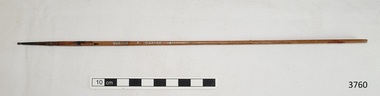
... operated under this name in London, England, 1891-1976. The company was founded as Thomas Reeves and Son in 1784. SOVEREIGN OF THE SEAS - Ship model of HMS Sovereign of the Seas, scale model of 17th Century English war ship, was handmade and carved from plans, enclosed in airtight glass case. All components of that model, including even the smallest pulleys, were hand crafted using tools designed and made by Jim. Outstanding details...operated under this name in London, England, 1891-1976. The company was founded as Thomas Reeves and Son in 1784. SOVEREIGN OF THE SEAS - Ship model of HMS Sovereign of the Seas, scale model of 17th Century English war ship, was handmade and carved from plans, enclosed in airtight glass case. All components of that model, including even the smallest pulleys, were hand crafted using tools designed and made by Jim. Outstanding details ...This fine Reeves paint brush was used in the making of components for the ship model Sovereign of the Seas. It is part of a collection of objects used by Jim Williams, maker of fine ship models from about 1930-1955. Most of the components for the models, as well as many of the tools, were handmade by Jim Williams. Jim’s family has donated the ship model “Sovereign of the Seas” and many tools, accessories and documents used in the making of this and other ship models have been donated to Flagstaff Hill Maritime Village. REEVES - Reeves & Sons Ltd, makers of fine art supplies, operated under this name in London, England, 1891-1976. The company was founded as Thomas Reeves and Son in 1784. SOVEREIGN OF THE SEAS - Ship model of HMS Sovereign of the Seas, scale model of 17th Century English war ship, was handmade and carved from plans, enclosed in airtight glass case. All components of that model, including even the smallest pulleys, were hand crafted using tools designed and made by Jim. Outstanding details include functional rigging and moving cannons. Please see our record 3732 of the mode Sovereign of the Seas for further details of the ship and the maker. This brush is connected with the hobby and skill of ship model making that has been crafted as a leisure activity for many generations. The hobby is often chosen by serving and retired mariners who appreciate the connection with maritime history. This brush was used by local Warrnambool man, Jim Williams, who was employed at Cramond and Dickson clothing store, and then at Fletcher Jones menswear for 27 years. It was used in making components for the model of the historic ship, the Sovereign of the Seas. The Sovereign of the Seas was a historic 17th century English war ship with important maritime heritage. Paint brush, narrow ‘0’ size, Reeves brand, no. 157, made in England. Inscription printed in silver paint. This paint brush is part of a collection of tools and accessories once used by Jim Williams, maker of a series of ship models 1930-1955 including “HMS Sovereign of the Seas”. Printed on handle -“MADE IN / ENGLAND” , “REEVES”, “157”, “0”flagstaff hill, warrnambool, flagstaff hill maritime museum, maritime museum, shipwreck coast, flagstaff hill maritime village, great ocean road, jim williams, james bernard williams, ship model hobby, ship model tools, ship model making equipment, ship model making accessories, paint brush, reeves of england, sovereign of the sea, ship model, hobby, ship model tool, brush -
 Flagstaff Hill Maritime Museum and Village
Vehicle - Spring Cart, Late 19th to early 20th centuries
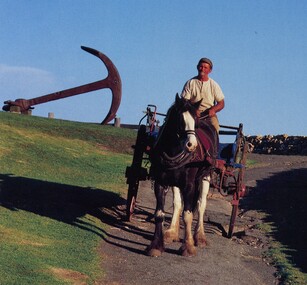
... operated by a lever on the cart's right. The cart has eight-leaf suspension from front to back. The box tray is painted blue and has decorative pale yellow detail. ...operated by a lever on the cart's right. The cart has eight-leaf suspension from front to back. The box tray is painted blue and has decorative pale yellow detail. ...A spring cart is a two-wheeled, one-horse cart, often with the driver standing up to drive it, and otherwise seated on a simple seat. Carts like this one had springs to make the ride smoother. It is a lighter version of a farm dray and is sometimes called a spring dray. Spring carts were often used on farms for carrying loads. In the towns, some businesses used a spring cart for deliveries of bread, milk and other goods. The carts would be used for travel and for families going on outings and picnics. Visitors to Flagstaff Hill Maritime Village from 1986 to 1992 would enjoy watching a Clydesdale horse named Duke as he worked around the village with his driver Pat McGowan. He would be hitched to a wagon or to this lightweight spring cart or sometimes he would pull the wagon with the cart attached as a trailer. The cart was used for maintenance, carting loads of timber or stone around the site or from town to Flagstaff Hill. Sometimes Duke and the cart would take visitors for cart rides around the Village. Pat McGowan was known for his restoration of horse-drawn vehicles including this spring cart. He already had 40 years of horse handling experience when he began looking after Duke, feeding and harnessing him and driving the horse and cart around the Village. Pat’s dog ‘Yabbie’ would often join them. In August 1992 Duke had to be put down. Warrnambool Veterinary Clinic and other fund-raisers began well-supported appeals and the beloved horse was replaced by a Clydesdale also named Duke (the second), who began work in late October 1992. He, like his predecessor, had a quiet temperament and was comfortable in the traffic. The spring card is an example of vehicles used on farms, for business delivery and for domestic transport in the late-19th and early-20th century. This cart is of note for being associated with the Clydesdale horse Duke which pulled the cart around Flagstaff Hills in the 1980s and 1990s, representing transport of that period.Spring cart; two-wheeled cart with shallow box tray and plank seat bolted across the front. Wheels have metal rims and fourteen (14) wooden spokes. A plank is bolted from side to side. A decorative metal step is on the cart's left and has acorn cut-out shapes in the plate. Both wheels have a brake block that is operated by a lever on the cart's right. The cart has eight-leaf suspension from front to back. The box tray is painted blue and has decorative pale yellow detail. Each shaft pole has has a handle fitting on it. (Horse equipment with the cart is a leather covered, straw filled collar.) flagstaff hill, flagstaff hill maritime museum and village, warrnambool, maritime museum, maritime village, great ocean road, shipwreck coast, springcart, spring cart, jingle, horse-drawn cart, one horse cart, two-wheeled cart, dray, spring dray, wagon, transportation, travel, cart, duke, clydesdale, pat mcgowan, delivery cart, yabbie, cartwright, horse-drawn vehicle, transport, horse cart -
 Orbost & District Historical Society
Plan - Large architect plans of PS Curlip and PS Nell, Adrian Brewer FLOAT A BOAT
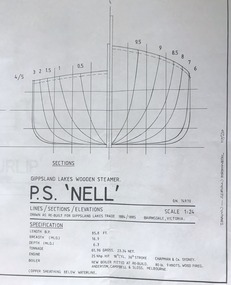
... operated mainly on the Gippsland lakes. Original plans and drawings for these two paddle steamers have not been found and likely do not exist. These plans are scale drawings of two of the Snowy River paddle steamers 1880 to 1915. Paddle steamer Snowy River PS Curlip PS Nell Gippsland lakes and Snowy River wooden steamers, PS Nell and PS Curlip, deck plans, inboard elevations, sections, details. ...These plans by Adrian Brewer for Float a Boat are researched drawings of the PS Nell and PS Curlip both of which operated as tug boats on the Snowy River between 1880 and 1915. PS Curlip was built in 1890 by the Richardson family at Tabbara near Marlo. PS Nell operated mainly on the Gippsland lakes. Original plans and drawings for these two paddle steamers have not been found and likely do not exist. These plans are scale drawings of two of the Snowy River paddle steamers 1880 to 1915. Three scaled plan drawings. Drawn in black ink on white paper. One large plan drawing of PS Curlip and two of the PS Nell, 3370.1 and 3370.2 are of the PS Nell, 3370.3 is one plan of the PS CurlipGippsland lakes and Snowy River wooden steamers, PS Nell and PS Curlip, deck plans, inboard elevations, sections, details. Scale 1:24 Float a Boat. Adrian Brewerpaddle steamer, snowy river, ps curlip, ps nell
