
Showing 102 items matching "orange tree"
-
 Bacchus Marsh & District Historical Society
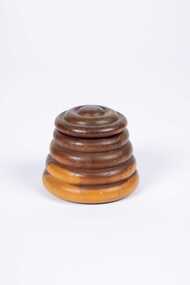
Decorative object, Wooden bowl made from Osage Orange tree timber
... Wooden bowl made from Osage Orange tree timber...Walter Simon, of Bacchus Marsh. A local osage orange tree furnished the wood for the bowl, which was one of many articles that Mr. ...Wooden bowl made from Osage Orange tree timber Decorative object ...This small bowl was won by Alex Todd for marksmanship at the Holy Trinity Anglican Church Bazaar in Bacchus Marsh in 1935. It was described in the Bacchus Marsh Express newspaper as a piece of Local Objet d'Art. The Express noted that it was 'made and donated to the Ladies' Guild by Mr. Walter Simon, of Bacchus Marsh. A local osage orange tree furnished the wood for the bowl, which was one of many articles that Mr. Simon's lathe has shaped from time to time, the grain of the osage timber being especially suitable for such work', Express, 25 May, 1935, p.2. A small polished wood bowl with unattached wooden lid. woodworking -
 University of Melbourne, Burnley Campus Archives
Newspaper, The Leader, Front Page Picture, 1948
... ...orange tree...Valerie Sloane examining an orange tree....valerie sloane orange tree horticulture students Coloured article in The Leader 11.08.1948. ...valerie sloane, orange tree, horticulture, students -
 Bacchus Marsh & District Historical Society
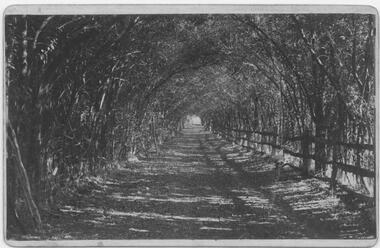
Photograph, Osage Orange Avenue Taverner Street Bacchus Marsh
... (Arthur Charles) Simon a pioneer orchardist in the Bacchus Marsh district planted this avenue of Osage orange trees in about 1883, creating an imposing entrance to his property from Taverner Street. ...A black and white photograph print mounted on mounting board showing an avenue of Osage orange trees. ...This early photographic image is evidence of this social and cultural significance. Trees Osage Orange Trees Simon Family Bacchus Marsh Arthur Charles Simon 1833-1924 Orchardists A black and white photograph print mounted on mounting board showing an avenue of Osage orange trees. ...A.C. (Arthur Charles) Simon a pioneer orchardist in the Bacchus Marsh district planted this avenue of Osage orange trees in about 1883, creating an imposing entrance to his property from Taverner Street. Simon also believed that the trees on his orchard property would provide a protective shelter for his other plants. Osage orange trees (Maclura pomifera) are a small deciduous tree or large shrub, native to the south-central United States. It usually grows to about 8 to 15 metres high. The distinctive fruit, a multiple fruit that resembles an immature orange, is roughly spherical in shape, about 8 to 15 centimetres in diameter, and turns bright yellow-green in the autumn. A. C. Simon is believed to have imported the Osage orange seeds from America around the 1860s and later used them to plant the trees depicted in this image. The date of this image is not certain but it probably shows the trees around the 1900s or 1910s. The avenue of trees was known for many years in Bacchus Mars as 'Simons Avenue', and were featured in a Rose series postcard dating from around 1900-1920. The remnants of this avenue or grove of trees can be seen on some of the properties on the north side of Taverner Street Bacchus Marsh and along the Werribee River west of the FIsken Street bridge.The Bacchus Marsh Heritage Study of 1995 described the Osage Orange Tree avenue as being of regional historical significance as a landscaping practice, pioneering of its type, It was also described as of local significance as a well-known landmark due to it be being represented on widely distributed post cards which depicted scenes of Bacchus Marsh in the early part of the twentieth century. This early photographic image is evidence of this social and cultural significance.A black and white photograph print mounted on mounting board showing an avenue of Osage orange trees. trees, osage orange trees, simon family bacchus marsh, arthur charles simon 1833-1924, orchardists -
 Dutch Australian Heritage Centre Victoria
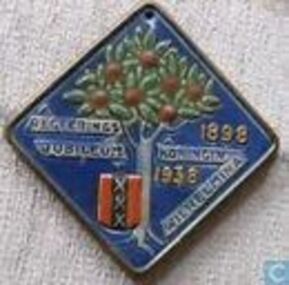
Commemorative Tile (Regeerings Tegel), 1938
... Basically blue, it also features an orange tree with fruit, the Amsterdam city coat of arms and an inscription. ...Basically blue, it also features an orange tree with fruit, the Amsterdam city coat of arms and an inscription. ...This tile was produced in 1938 to honour the 40th anniversary of Queen wilhelmina's succession to the Dutch throne.Significant because of the Dutch people's connection to their Royal House.A small square commemorative tile in celebration of the 40th anniversary of the reign of Queen Wilhelmina. Basically blue, it also features an orange tree with fruit, the Amsterdam city coat of arms and an inscription. On the front: "Regeerings Jubileum Koningin Wilhelmina 1898-1938". (Queen Wihelmina Jubilee 1898-1938). On the back: "Koninklyk Goedewaagen Gouda" and "NRvGelder&Co Amsterdam". A hole to enable hanging has been pierced in one corner . -
 Blacksmith's Cottage and Forge
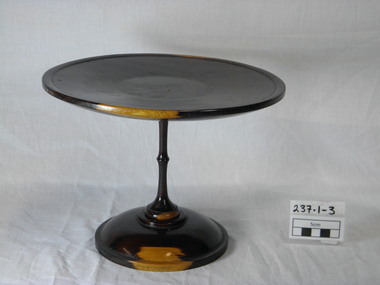
Cake Stand, Beginning of the 20th Century
... The wood was sourced from a grove of osage orange trees in the Fisken/Taverner Street area. ...The wood was sourced from a grove of osage orange trees in the Fisken/Taverner Street area. ...This cake stand was hand turned from osage orange wood. The wood was sourced from a grove of osage orange trees in the Fisken/Taverner Street area. This grove was planted by Mr A C Simon, an orchardist, who brought the seeds from North America in the 1860's to create a protective hedge for his plants The wood from these plants produces a beautiful toned affect of dark brown and yellow/orange when turned and polished. The significance of this cake stand is that it has been carved from the osage orange which grows well in Bacchus Marsh although originated in America. Mr Simon made many items from this wood. This gives it local significance.This polished wooden stand would have been used for cake to be displayed It consists of a round 'plate' of wood as the top, with a fine narrow turned wood pedestal and a round base. The stand is made of osage orange giving it the unique tones of dark brown and orange wood.turned wood, osage orange, food stand, food display, brown orange wood, wooden, cake stand, parlour item, table centre piece, polished wood, ornamental stand -
 Darebin Parklands Association
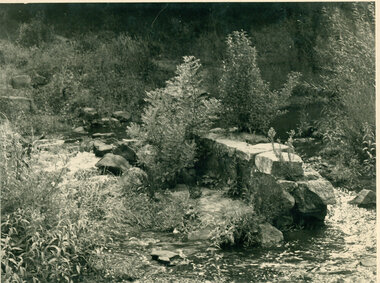
Bluestone weir, Rockbeare Park, February 1975, 1975
... A vineyard was established by Thomas Bear and produced award wining table wines in the 1860-70s. Orange trees were later grown on the slopes below Rockbeare Grove and mixed market gardening was established in this area as the land was progressively sub-divided and leased. ...A vineyard was established by Thomas Bear and produced award wining table wines in the 1860-70s. Orange trees were later grown on the slopes below Rockbeare Grove and mixed market gardening was established in this area as the land was progressively sub-divided and leased. ...This bluestone weir is one of two in the same section of Darebin Creek and is a remanent from early farming days. A vineyard was established by Thomas Bear and produced award wining table wines in the 1860-70s. Orange trees were later grown on the slopes below Rockbeare Grove and mixed market gardening was established in this area as the land was progressively sub-divided and leased. The weirs were used to dam the creek and pumps used to pump water to the vineyards and orange grove.B&W photograph showing remains of bluestone weir across Darebin Creek This item and all other Darebin Parklands Association archival material is now held by State Library Victoria (Accession No: YMS 13746). Please contact State Library Victoria if access is required. -
Dutch Australian Heritage Centre Victoria
Cocoa Tin/Cacaobus, Period between 1945 and 1989
... The lid has been painted with a coat of arms based on the Dutch coat of arms but with cocoa tree instead of orange tree. The banner carries the German words "van Houten seit 1828"....The lid has been painted with a coat of arms based on the Dutch coat of arms but with cocoa tree instead of orange tree. The banner carries the German words "van Houten seit 1828". ...Information on the tin suggests it was produced primarily for the German market.A colonial product processed in The Netherlands. Cylinderical tin brightly decorated with painted scenes of people enjoying cocoa in a variety of situations in the early 20th century. The lid has been painted with a coat of arms based on the Dutch coat of arms but with cocoa tree instead of orange tree. The banner carries the German words "van Houten seit 1828".The brand name - Van Houten's Cocoa - and instructions for preparation are given in Dutch, French, English and German. household item -
 Federation University Historical Collection
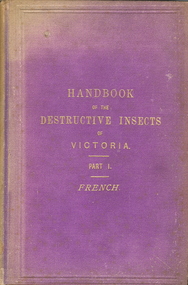
Book, C. French, A Handbook of the Destructive Insects of Victoria, Part One, 1891 (exact)
... Brittlebank)of insects and figures (by Hart Vonarx) include the Knowles' Pump, Charnwood Spray, Danks' Lever Spray Pump, Spawn's Climax Spray, Apparatus for Sparying Orange Trees, Strawsonizer, French Portable Hand Spraying Machine, Lowe and Park's Insect Exterminator, Greenhill Codlin Moth Lamp, Wolfskill Fumigator, Tutus Fumigator, Oliver Fumigator, Agitator Spray Pump...Brittlebank)of insects and figures (by Hart Vonarx) include the Knowles' Pump, Charnwood Spray, Danks' Lever Spray Pump, Spawn's Climax Spray, Apparatus for Sparying Orange Trees, Strawsonizer, French Portable Hand Spraying Machine, Lowe and Park's Insect Exterminator, Greenhill Codlin Moth Lamp, Wolfskill Fumigator, Tutus Fumigator, Oliver Fumigator, Agitator Spray Pump A Handbook of the Destructive Insects of Victoria, Part One Book Book C. ...Purple hardcovered book153 pages plus 20 figures. Contents inlcude: Introduction to Entimology, classification of insects, quarantine rules, Woolly Aphis, Codlin Moth, Curve-winged Apple moth, Apple-tree borer, Apple-bark Scale, Apple Beetle, Red Spider, Harlequin Fruit Bug, Pear and Cherry Slug, Rutherglen Fly-pest, Cherry borer, Pear Phytoptus. Coloured plates (by C. Brittlebank)of insects and figures (by Hart Vonarx) include the Knowles' Pump, Charnwood Spray, Danks' Lever Spray Pump, Spawn's Climax Spray, Apparatus for Sparying Orange Trees, Strawsonizer, French Portable Hand Spraying Machine, Lowe and Park's Insect Exterminator, Greenhill Codlin Moth Lamp, Wolfskill Fumigator, Tutus Fumigator, Oliver Fumigator, Agitator Spray PumpBookplate - Ballarat School of Mines Ballaarat No 1201. Presented by Secretary for Agriculture, Melbourne, 14th July 1891 insects, pumps, c brittlebank, hart vonarx, c french -
Emerald Museum & Nobelius Heritage Park
Document - Book, Nobelius Nursery Day book, June 1935-July 1936, Unknown maker, 1930s
... Railway freight on Trees to Orange, N.S.W. 14 lbs. 8/- Railway Freight on Trees to Kelso, 8 cwt £1.15.0. ...Railway freight on Trees to Orange, N.S.W. 14 lbs. 8/- Railway Freight on Trees to Kelso, 8 cwt £1.15.0. ...(CONTINUED FROM INSCRIPTION AND MARKS) 1 qr 2 qrs 3 qrs 1 cwt 2/2 3/7 5/2 6/8 Railway freight on Trees to Mile End, 4 cwt about £1.10.6, per cwt 8/2, Vic 5/5, S.A. 2/9 Railway freight on Trees to Orange, N.S.W. 1 cwt about 11/5, per qr Vic 2/9, N.S.W. 1/7. 4/4 - 11/- qr parcel. Railway freight on Trees to Orange, N.S.W. 14 lbs. 8/- Railway Freight on Trees to Kelso, 8 cwt £1.15.0. Sydney Agent - Wright Heaton Pitt St. Launceston .. F.H. Stephens Pty Ltd. 41 St John St. L'ton & 11 William St Canberra. 14 lbs (by passenger) 8/6 Fgh to Leura NSW on Cash 1 1/2 cwt 18/11(CONTINUED FROM INSCRIPTION AND MARKS) Cherries for certain places in N.S.W. (including Armidale & Glen Innes) must be dipped in Tar Distillate, and certificate sent to Inspector at Albury. Fumigate for Leeton, Tasmania, Queensland, New Zealand. Consignments to N.Z. containing Apple, Pear, or Quince Trees must be accompanied by a Fire-blight certificate as well as the ordinary Nursery certificate and form of invoice. Bundles to N.S.W must not be large, in Bdles not over 1 cwt 1 qr where a number of Bdles and consigned as each bundle weight and a cheaper rate of Fgt will be charged otherwise bundles not to exceed 2 cwt. India. Cases not to weigh over 5 mounds = 3 cwt 2 qr 18 lbs and not to exceed 8 x 5 x 4 Shipping freight to Adelaide 20/- per ton Shipping freight to Sydney 15/- per ton Shipping freight to Fremantle 38/- per ton about 6/6 per 100 tress Shipping freight to Albany about 4/8 per 100 trees Railway freight to Albury on plants in soil packed in casesHard cover day book with red cover and burgundy spine. Label affixed to front cover reads 'Sales 15/6/35 - 25/7/36.' Extensive hand-written notes on inner front cover. 87 pages total, all used.Label on outer front cover: 'Sales 15/6/35 - 25/7/36.' Notes on inner front cover: Manure July 20th 1936 at Shed Blood & Bone 11/6 bag Super 7/6 bag Organite 5/6 bag Super Ammonia 9/6 bag Freight on case to Leura N.S.W. 1 1/2 (illegible) 18/11 1935 Reaper Binder (illegible) @ H/Ball 1936 Labels 12/6 per box Straw 3/- cwt Trees for Leeton send Fumigation Certificate to J.C. Guy Cole District Inspector P.O. Box 111. Leeton. Trees for Griffith or Yenda send certificate to District Inspector (crossed out section) Dept. of Agric. Leeton N.S.W. Trees sent to Irrigation Areas must be accompanied by Phylloxera Certificate in addition to the Fumigation Certificate, Post certificates to the District Inspector, (crossed out section) Dept. of Agric. Leeton N.S.W. All trees for N.S.W must have Lucerne Flea Certificate posted to Border (illegible) Inspector Albury N.S.W. showing on contents what varieties of trees, also whether sent by rail or boat. Contents must also be marked on label.documents, sales records, financial records -
 University of Melbourne, Burnley Campus Archives
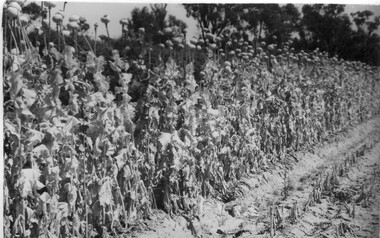
Album - Black and white prints and negatives, James Leslie Provan, Photograph Collection, 1940-1950
... Negative in envelope marked, "Prints 1 of No. 398 Department of Agriculture 'McP.' " (2) Grape vine and cabbages. (3) Rows of seedlings in the Orchard. (4) Orange tree? unpruned. (5) Flowers. (6) "Double and single rows of French Beans." (7) "Sage & marjoram." (8) Hydrangeas. (9)Sprinkler on newly planted cabbages. (10a)"Lettuce Iceberg 1/1/43." ...j.l. provan burnley moorabbin opium poppy grape vine cabbages seedlings orchards orange trees flowers french beans sage marjoram hydrangea sprinkler lettuce iceberg seeds students sowing parsnips school of horticulture burnley gardens beetroot hoeing water manure celery vegetables beds ray marriott onions carrots turnips peas ploughing horse spraying Collection of 39 black and white photographs. ...Collection of 39 black and white photographs. Some photographs with handwritten annotations in what looks like the handwriting of J.L. Provan. Mostly at Burnley, some at Moorabbin. (1) "Opium Poppy 1942 Burnley. Publicity Branch Department of Agriculture." Negative in envelope marked, "Prints 1 of No. 398 Department of Agriculture 'McP.' " (2) Grape vine and cabbages. (3) Rows of seedlings in the Orchard. (4) Orange tree? unpruned. (5) Flowers. (6) "Double and single rows of French Beans." (7) "Sage & marjoram." (8) Hydrangeas. (9)Sprinkler on newly planted cabbages. (10a)"Lettuce Iceberg 1/1/43." Seeds on soil surface. (10b) "Lettuce Iceberg 1/1/43." Seedlings emerging. (11)? planted in terracotta pipes. (12) Rows of seedlings in the Orchard. (13) "A student sowing Parsnip seed in a drill row. School of Horticulture Burnley Gardens." (14) Student distributing fertilizer? (15) Similar. (16) Similar. (17a) Flowers. (17b) Flowers. (18)"Beetroot Crimson Globe." (19) A seed drill. (20)Canna. (21a) Vegetable rows. (21b) ? (22) Student hoeing. (23) Student hoeing. (24) Similar. (26) "Cabbage Burbees Allhead 2/2/43," seedlings. (27) Water, manure, etc. (28) "Celery beds Ray Marriott Moorabbin April 2nd 1943." (29-37) Also at Moorabbin probably: (29) Vegetables. (30) Onions. (31) Vegetables. (32) Planting seedlings. (33) Vegetables. (34) Celery, carrots, turnips on display. (35) Carrots growing and just pulled up. (36) Peas. (37) Ploughing with horse. (38) Student spraying vegetables at Burnley. (39) House?j.l. provan, burnley, moorabbin, opium poppy, grape vine, cabbages, seedlings, orchards, orange trees, flowers, french beans, sage, marjoram, hydrangea, sprinkler, lettuce iceberg, seeds, students sowing, parsnips, school of horticulture burnley gardens, beetroot, hoeing, water, manure, celery, vegetables beds, ray marriott, onions, carrots, turnips, peas, ploughing, horse, spraying -
 Charlton Golden Grains Museum Inc
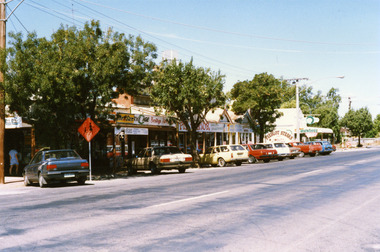
Photograph, Charlton Shire, Shops, east end of High St, Charlton c. 1987, c.1987
... Cars are parked in front of the shops and there are three trees. An orange school crossing sign is next to dark blue car. ...Cars are parked in front of the shops and there are three trees. An orange school crossing sign is next to dark blue car. ...Newsagency established c. 1912 by Dudley & Morse. Sold to F Jones in early 1940's. Royal Cafe built for Travaglia's c. 1912Colour photograph showing a row of shops. Cars are parked in front of the shops and there are three trees. An orange school crossing sign is next to dark blue car. Person in pale blue on LH side of photo. There are a variety of signs displayed along the front of the shop verandahs. From left to right; The Sun, THE AGE, Bendigo Advertiser , FUN PARLOR, (both partially obscured by a tree), FRUIT & VEGETABLES, 7 DAYS WEEKLY, FISH & CHIPS, CHICKENS B.B.Q. Building at the end of the shops is a Butchery and has a large sign for FEEDLOT STEAKS on the side wall.dudley, morse, f jones, royal cafe, travaglia, charlton, business -
 Mission to Seafarers Victoria
Medal - Defence Medal in box, c. 1945
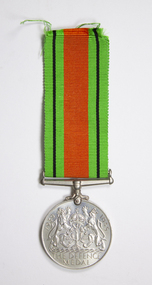
... The reverse has a conventional oak tree centrally, with a crown above, with two lions counter rampart as supporters between the dates 1939 and 1945. The base of the medal reverse has the words ‘THE DEFENCE MEDAL’. The ribbon is orange...The reverse has a conventional oak tree centrally, with a crown above, with two lions counter rampart as supporters between the dates 1939 and 1945. The base of the medal reverse has the words ‘THE DEFENCE MEDAL’. The ribbon is orange ...Charles worked in the Merchant service. After enforced retirement due to injury he was active in Civil Defence.The Defence Medal is a campaign medal instituted by the United Kingdom in May 1945, to be awarded to citizens of the British Commonwealth for both non-operational military and certain types of civilian war service during the Second World War. It was Awarded for 3 years, 360, 180 or 90 days, depending on area and nature of serviceThe medal is cupro-nickel, with the uncrowned effigy of King George VI on the obverse. The reverse has a conventional oak tree centrally, with a crown above, with two lions counter rampart as supporters between the dates 1939 and 1945. The base of the medal reverse has the words ‘THE DEFENCE MEDAL’. The ribbon is orange with green outer stripes, each green stripe having a black pin-stripe running down the centre. The green represents the Islands of the United Kingdom, the orange represents enemy attacks, and the black represents the black outs. The medal is housed in a small cardboard box. There is a loose leaf of paper with the medal which conveys salutations.Front of the box: (in black) stamp O.H.M.S. / circular stamp with English crown : OFFICIAL PAID Typewritten in blue ink: Mr. C. Page/50 High Street/Woolton/LIVERPOOL Back of the box: printed in black ink: If undelivered, return to/Defence Medal/Central Index/Home Office/Whitehall/S.W.Icharles page, medal, defence medal -
 The Beechworth Burke Museum
Animal specimen - White-Throated Treecreeper, Trustees of the Australian Museum, 1860-1880
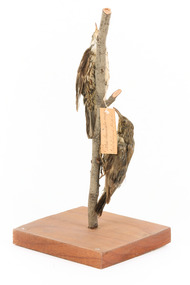
... The name tree-creeper comes from their foraging patterns, in which they spiral up the trunk of trees (usually eucalypts for their preferrable rough bark) head-first, probing for ants or nectar with their long, curved beak.The females are distinct from males through orange marks on the sides of their face. ...The name tree-creeper comes from their foraging patterns, in which they spiral up the trunk of trees (usually eucalypts for their preferrable rough bark) head-first, probing for ants or nectar with their long, curved beak.The females are distinct from males through orange marks on the sides of their face. ...The White-throated Treecreeper is a commonly small bird of the Climacteridae family, that has a loud, piping, whistle-like call. Living in permanent territories and rarely seen on the ground, this species is found in forested areas of south-east and southern mainland Australia. The name tree-creeper comes from their foraging patterns, in which they spiral up the trunk of trees (usually eucalypts for their preferrable rough bark) head-first, probing for ants or nectar with their long, curved beak.The females are distinct from males through orange marks on the sides of their face. The colour of these specimens differ from white-throated tree-creepers, whose plummage on the head and back is usually a dark gray-brown. The beaks of these specimens are also an orange-brown colour whereas these birds usually have a black beak. This specimen is part of a collection of almost 200 animal specimens that were originally acquired as skins from various institutions across Australia, including the Australian Museum in Sydney and the National Museum of Victoria (known as Museums Victoria since 1983), as well as individuals such as amateur anthropologist Reynell Eveleigh Johns between 1860-1880. These skins were then mounted by members of the Burke Museum Committee and put-on display in the formal space of the Museum’s original exhibition hall where they continue to be on display. This display of taxidermy mounts initially served to instruct visitors to the Burke Museum of the natural world around them, today it serves as an insight into the collecting habits of the 19th century.This specimen is part of a significant and rare taxidermy mount collection in the Burke Museum. This collection is scientifically and culturally important for reminding us of how science continues to shape our understanding of the modern world. They demonstrate a capacity to hold evidence of how Australia’s fauna history existed in the past and are potentially important for future environmental research. This collection continues to be on display in the Museum and has become a key part to interpreting the collecting habits of the 19th century.This mount includes two White-throated treecreepers secured on a stick, one above the other. The top specimen is female, distinguished by a distinctive orange mark on the sides of its face underneath the eyes. Both specimens have white throat, chest and streaks on the flank. The top of the head and back are both a brown to dark-brown colour, with streaks of those colours on the flank as well. The stick and specimens are mounted on a wooden platform and a swing tag is secured around a part of the stick.Swing tag: 67a. / White-throated treecreeper / See catalogue, page 20 / Wooden Mount: 85taxidermy mount, taxidermy, burke museum, beechworth, bird, treecreeper, australian birds, white-throated, white-throated treecreeper, reynell eveleigh johns -
 The Beechworth Burke Museum
Animal specimen - Tawny Frogmouth, Trustees of the Australian Museum, 1860-1880
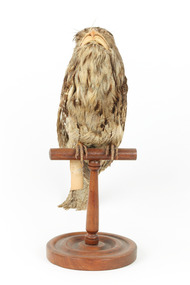
... orange-brown colour. This specimen is adopting the skyward looking pose associated with the species, mimicking dead tree branches....orange-brown colour. This specimen is adopting the skyward looking pose associated with the species, mimicking dead tree branches. ...The Tawny Frogmouth, although often mistaken for an owl, is a nocturnal Australian bird of the Podargidae family that is more closely related to the nightjars. They are widespread in terms of distribution and can be found all across mainland Australia and Tasmania in a diverse variety of habitats from woodlands, forests and urban areas. Masters of camouflage, the Tawny Frogmouth sleeps during the day on tree branches in a stiff upward facing position (as with this specimen) to mimic broken tree branches, their feathers assist in this deception as the mottled grey and brown colours blend into the environment seamlessly. This specimen differs in colours from the usual appearance of a Tawny Frogmouth, as the beak is usually a olive-grey to blackish tone and the plumage is generally more dominantly grey all over the bird. This specimen is part of a collection of almost 200 animal specimens that were originally acquired as skins from various institutions across Australia, including the Australian Museum in Sydney and the National Museum of Victoria (known as Museums Victoria since 1983), as well as individuals such as amateur anthropologist Reynell Eveleigh Johns between 1860-1880. These skins were then mounted by members of the Burke Museum Committee and put-on display in the formal space of the Museum’s original exhibition hall where they continue to be on display. This display of taxidermy mounts initially served to instruct visitors to the Burke Museum of the natural world around them, today it serves as an insight into the collecting habits of the 19th century.This specimen is part of a significant and rare taxidermy mount collection in the Burke Museum. This collection is scientifically and culturally important for reminding us of how science continues to shape our understanding of the modern world. They demonstrate a capacity to hold evidence of how Australia’s fauna history existed in the past and are potentially important for future environmental research. This collection continues to be on display in the Museum and has become a key part to interpreting the collecting habits of the 19th century.This Tawny Frogmouth has a broad head and a creamy beige coloured wide triangular beak with a hooked tip. The plumage on the head and back of the bird is a combination of darker and rufous browns, mottled with streaks of cream and grey. The underside of the bird from the bottom of the beak to the tail tip is a lighter cream colour with streaks of rufous-brown. The feet are an orange-brown colour. This specimen is adopting the skyward looking pose associated with the species, mimicking dead tree branches.1a. / More-Park / See Catalogue, page 7 /taxidermy mount, taxidermy, burke museum, beechworth, australian museum, skin, reynell eveleigh johns, bird, australian birds, tawny frogmouth, frogmouth -
Federation University Historical Collection
Booklet, Helen Ogden, Flowers of Western Australia, 1960
... orange banksia...kangaroo paw...hibbretia hypercoides...leucopogon pulchellus...isopogon roseus...qualup bell...blue leshenaultia...geradton wax plant...catspaw...wild clematis...sturt pea...donket orchid...spider orchid...hovea trisperma...black wattle...pink myrtle...boronia...christmas tree...wildflowers western australia helen ogden ida richardson c a gardner flora botany australian native plants orange banksia kangaroo paw hibbretia hypercoides leucopogon pulchellus isopogon roseus qualup bell blue leshenaultia geradton wax plant catspaw wild clematis sturt pea donket orchid spider orchid hovea trisperma black wattle pink myrtle boronia christmas tree Stamped in gold inside front cover: With Compliments A.H.A. ...Paperback booklet with painted wildflowers on the front cover and blue-grey back cover. 22 leaves of plates.Stamped in gold inside front cover: With Compliments A.H.A. Western Australian branch 1967 National Conferencewildflowers, western australia, helen ogden, ida richardson, c a gardner, flora, botany, australian native plants, orange banksia, kangaroo paw, hibbretia hypercoides, leucopogon pulchellus, isopogon roseus, qualup bell, blue leshenaultia, geradton wax plant, catspaw, wild clematis, sturt pea, donket orchid, spider orchid, hovea trisperma, black wattle, pink myrtle, boronia, christmas tree -
 Glenelg Shire Council Cultural Collection
Painting, Thomas Clark, Muntham, c. 1865
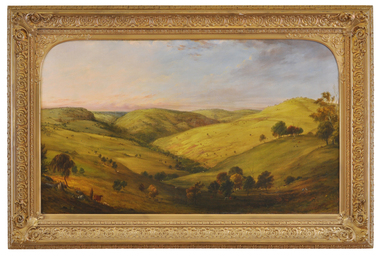
... tree stumps and birds. The background is a cloudy sky in shades of blue, pink, purple and orange. ...tree stumps and birds. The background is a cloudy sky in shades of blue, pink, purple and orange. ...The landscape painting depicts rolling green hills with a valley through the centre. Scattered throughout the painting are numerous trees and cattle. The foreground is a darker green which creates a shadow effect. Within the foreground are more detailed trees, tree stumps and birds. The background is a cloudy sky in shades of blue, pink, purple and orange. Work has a heavy gilded ornate frame.Front: (No inscriptions) Back: (Not available) -
 Glenelg Shire Council Cultural Collection
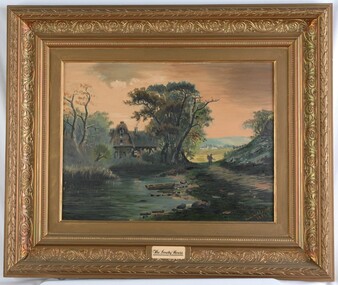
Painting, Jessie Shevill, The Lonely House, 1894
... The hill and trees of the foreground are set against an orange/pink sky. The work has a gilded ornate frame with no mounts and exposed canvas. ...The hill and trees of the foreground are set against an orange/pink sky. The work has a gilded ornate frame with no mounts and exposed canvas. ...CEMA Art Collection Previously located in History HouseA house set amongst trees with a small body of water in front. The house has smoke rising from the chimney. Pinkish sky. On the water is a small wooden boat, and to the right of the house stands a person. In the background is a green hill with buildings set in the foothills. The hill and trees of the foreground are set against an orange/pink sky. The work has a gilded ornate frame with no mounts and exposed canvas. Signed front of painting bottom rightFront: Jessie Shevill 1894 Plaque attached to frame: The Lonely House Back: (no inscriptions)european painting, 1800s, country -
 Glenelg Shire Council Cultural Collection
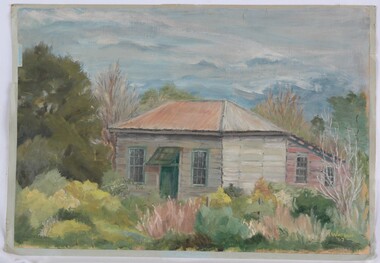
Painting, Ina Watson, Miss Beauvaise's Cottage, 1967
... trees and shrubs. The building is completed in shades of white and grey with green window frames and door, and a pink/orange roof. ...trees and shrubs. The building is completed in shades of white and grey with green window frames and door, and a pink/orange roof. ...CEMA Art Collection Previously located in History HouseThe painting depicts a small building surrounded by trees and shrubs. The building is completed in shades of white and grey with green window frames and door, and a pink/orange roof. Behind this is a partial view of another small building depicted in shades of pink. Surrounding the buildings are shrubs and trees of various shapes and sizes. The shrubs in the foreground are completed in various shades of green, yellow and pink. The work is unframed and glued to a piece of faded blue cardboard.Front: I. Watson '67 (yellow paint, bottom right corner) Back: Green label: Artist: Ina Watson 3 Palmer Street Portland Vic 3305 Title: Miss Beauvaise's Cottage (where Darby & Joan flat's now stand) Yellow Sticker: 3021 Yellow Sticker: 8 1999 written in pencilcema, female artists, female, women -
 Glenelg Shire Council Cultural Collection
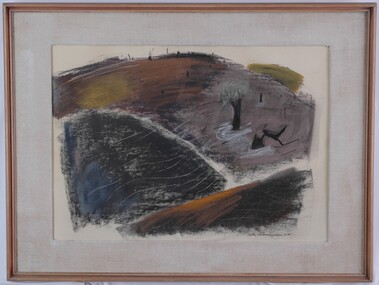
Drawing, Burnt Mountain, 1964
... In the foreground are two mountain edges which are black with a patch of blue and patch of orange/brown. In the background are remains of several burnt tree stumps on a purple/brown ground. ...In the foreground are two mountain edges which are black with a patch of blue and patch of orange/brown. In the background are remains of several burnt tree stumps on a purple/brown ground. ...CEMA Art Collection Winner of 1965 Portland Art Society Art Prize for category Any other medium.The drawing depicts the burnt remains of a mountain top. In the foreground are two mountain edges which are black with a patch of blue and patch of orange/brown. In the background are remains of several burnt tree stumps on a purple/brown ground. The work has a thin wooden frame, white painted hessian and glass.Front: M Macqueen 64 (signature, lower right, black chalk) Back: MARY MACQUEEN "BURNT MOUNTAIN" (1964) (lower left, typed label) 1964 (upper right, yellow sticker and also pencil)female artist, women, landscape -
Glenelg Shire Council Cultural Collection
Print, Portland is for Everyone, 1983
... orange, yellow and pink clothing. The background is a mix of yellow and pink lines, over which black leafless trees are printed. ...orange, yellow and pink clothing. The background is a mix of yellow and pink lines, over which black leafless trees are printed. ...CEMA Art Collection Part of "A Community View" 150 years in Portland Screenprint Exhibition Part of Angela Gee Residency 1983 and 1984Laminated screenprint of three Aboriginal women in foreground with red text "PORTLAND IS FOR EVERYONE" at the top. The Aboriginal women are portrayed with blue skin and orange, yellow and pink clothing. The background is a mix of yellow and pink lines, over which black leafless trees are printed. At the bottom of the work is purple text which reads "Thanks to the Aboriginal Cultural Centre, Heywood and the Portland Historical Society".Front: 47/60 Angela Gee '83 Back: 10 -
 Glenelg Shire Council Cultural Collection
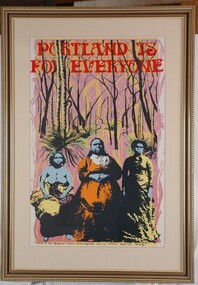
Print, Portland is for Everyone, 1983
... trees. The fgiure on the far left is wearing traditional clothing, and the two figures on the right wear Victorian period dresses. The background depicts abstract patterning. At the top of the print are the words "Portland is for Everyone". The bottom of the image includes the words "Thanks to the Aboriginal Cultural Centre, Heywood, and the Portland Historical Society." Background is mauve and colours include green, blue, yellow, orange...trees. The fgiure on the far left is wearing traditional clothing, and the two figures on the right wear Victorian period dresses. The background depicts abstract patterning. At the top of the print are the words "Portland is for Everyone". The bottom of the image includes the words "Thanks to the Aboriginal Cultural Centre, Heywood, and the Portland Historical Society." Background is mauve and colours include green, blue, yellow, orange ...CEMA Art Collection Part of "A Community View" 150 years in Portland Screenprint Exhibition Part of Angela Gee Residency 1983 and 1984Three indigenous women stand before trees and grass trees. The fgiure on the far left is wearing traditional clothing, and the two figures on the right wear Victorian period dresses. The background depicts abstract patterning. At the top of the print are the words "Portland is for Everyone". The bottom of the image includes the words "Thanks to the Aboriginal Cultural Centre, Heywood, and the Portland Historical Society." Background is mauve and colours include green, blue, yellow, orange and tan. Mounted in dark cream matt in an ornate gold-detailed wooden frame.Front: 41/60 (lower left) Angela Gee '83 (lower right) (pencil) Back: (no inscriptions) -
![Painting - Painting - [Moonlight Trees], Pro Hart, untitled [Moonlight Trees], 1967](/media/collectors/4f729f5597f83e03086015b1/items/655a82f77f3f3810362edc65/item-media/655a83e87f3f3810362ef82d/item-fit-380x285.jpg?cb=6) Glenelg Shire Council Cultural Collection
Glenelg Shire Council Cultural CollectionPainting - Painting - [Moonlight Trees], Pro Hart, untitled [Moonlight Trees], 1967
... trees are completed in darker shades and are hazy and out of focus. The glow of the moon is depicted in white which dissipates into the dark blue/green sky. In contrast to this, a burnt orange...trees are completed in darker shades and are hazy and out of focus. The glow of the moon is depicted in white which dissipates into the dark blue/green sky. In contrast to this, a burnt orange ...Included in the 1999 "Salvage" Exhibition at CEMA Arts CentreThe painting depicts numerous leaf-less trees in the moonlight. The trees are painted in shades of brown, black and cream with the main focus on those in the centre foreground. The surrounding trees are completed in darker shades and are hazy and out of focus. The glow of the moon is depicted in white which dissipates into the dark blue/green sky. In contrast to this, a burnt orange is used as the background for the trees. The work has a gold and black frame with no mount or glass.Front: 67 PRO HART (black and gold paint, lower corners) Back: PRO HART "UN-NAMED" (1967) Donated by the Artist (typed label) White Sticker: 2 (in a circle) -
 Glenelg Shire Council Cultural Collection
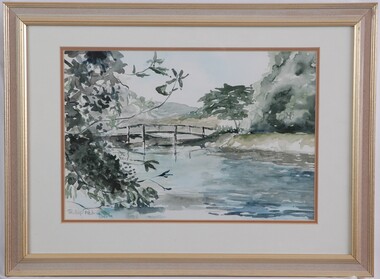
Painting, Phillip Petrie, Langley's Bridge, 1990
... tree with darker olive foliage. The background shows what could be hills and the sky is very pale blue. Mounted in a double matt (white on orange), framed under glass in wooden frame with gold details....tree with darker olive foliage. The background shows what could be hills and the sky is very pale blue. Mounted in a double matt (white on orange), framed under glass in wooden frame with gold details. ...Depiction of a bridge over a creek edged with trees. On left are the branches of a tree with grey-green leaves. The creek fills the lower centre area of the image, painted in pale blue, grey, highlights of white and darker areas of dark blue. The wooden rail bridge curves in an even arch in centre of image. On right is a bank rising from the creek, with large tree with pale grey-green foliage and a tree with darker olive foliage. The background shows what could be hills and the sky is very pale blue. Mounted in a double matt (white on orange), framed under glass in wooden frame with gold details.Front: Phillip Petrie 90 (lower left) (grey paint). Back: "Langley's Bridge" watercolour. 570 x 420 mm $150.00 -
 The Beechworth Burke Museum
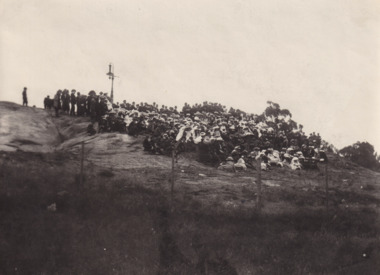
Photograph, c. 1905
... Originally known as the Beechworth Botanical Gardens, the Queen Victoria Park features a extensive collection of historic trees and plants, which have been listed on the Indigo Shire’s Significant Tree Register. entertainment album burke museum beechworth queen victoria park park Reverse: 6956 (in pencil)/ ©/ DONALD HAYES/ BEECHWORTH (stamped in orange ink)/ Black and white rectangular reproduced photograph printed on matte photographic paper Photograph Photograph ...Taken in c. 1905, depicted is a large group of children and adults dressed in formal attire sitting and standing upon a granite rock that is located in the centre of Queen Victoria Park. In front of the group is a wooden picket wire fence that sides the granite rock. On top of the rock is a gas lamp post.Originally known as the Beechworth Botanical Gardens, the Queen Victoria Park features a extensive collection of historic trees and plants, which have been listed on the Indigo Shire’s Significant Tree Register.Black and white rectangular reproduced photograph printed on matte photographic paperReverse: 6956 (in pencil)/ ©/ DONALD HAYES/ BEECHWORTH (stamped in orange ink)/entertainment album, burke museum, beechworth, queen victoria park, park -
 The Beechworth Burke Museum
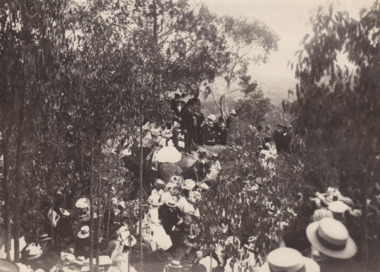
Photograph, c. 1900
... trees. The group is participating in a nature study. Nature study was a new subject introduced into the school curriculum throughout the English-speaking world in the 1890s and 1900s that taught students about the natural environment. It was hoped that a concern about the natural environment would be fostered into the school children, who were seen as future citizens of the world, and that they would implement changes to preserve the natural environment when they reached adulthood. entertainment album beechworth burke museum nature study Reverse: 6953 (in pencil)/ ©/ DONALD HAYES/ BEECHWORTH (stamped in orange ink) Black and white rectangular reproduced photograph printed on matte photographic paper Photograph Photograph ...Taken in c. 1900, depicted is a group of adults and children dressed in formal attire standing and sitting on a granite outcrop that overlooks a valley surrounded by a cluster of eucalyptus trees. The group is participating in a nature study.Nature study was a new subject introduced into the school curriculum throughout the English-speaking world in the 1890s and 1900s that taught students about the natural environment. It was hoped that a concern about the natural environment would be fostered into the school children, who were seen as future citizens of the world, and that they would implement changes to preserve the natural environment when they reached adulthood.Black and white rectangular reproduced photograph printed on matte photographic paperReverse: 6953 (in pencil)/ ©/ DONALD HAYES/ BEECHWORTH (stamped in orange ink)entertainment album, beechworth, burke museum, nature study -
 Orbost & District Historical Society
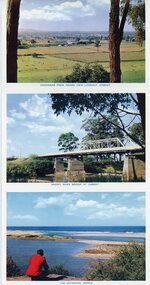
Souvenir - Orbost and Marlo photos of 1960's, Nucolorvue Productions P/L, Orbost and Marlo, 1960s
... trees on the banks. At the top of this photo is a red strip with the words ORBOST and MARLO in black, orange and yellow print. ...trees on the banks. At the top of this photo is a red strip with the words ORBOST and MARLO in black, orange and yellow print. ...This is fold-out folder with excellent quality colour photos was produced in the 1960s and used in the tourist industry within the Orbost/Marlo district. It showcases the district with excellent photographs. This item is significant because it represents a quality tourist production from the 1960s, and shows scenes and buildings from that era. A fold-out envelope containing 12 colour photos of the Orbost/Marlo district. The cover has a colour photo of a white wooden bridge over a river with trees on the banks. At the top of this photo is a red strip with the words ORBOST and MARLO in black, orange and yellow print. On front cover:ORBOST and MARLO Inside the fold-out are captions to the 12 photos.orbost, marlo, tourism, photos -
 Montmorency–Eltham RSL Sub Branch
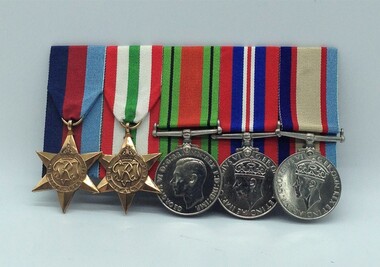
Medal - Medal Group, WW2 Royal Australian Air Force, 56380 LAC Edward Terrence Orlowski
... tree centrally placed with a crown above with two lions as supporters. Between the supporters are the dates 1939 - 1945. The base of the medal has the words "The Defence Medal". The ribbon (devised by King George VI) is orange...tree centrally placed with a crown above with two lions as supporters. Between the supporters are the dates 1939 - 1945. The base of the medal has the words "The Defence Medal". The ribbon (devised by King George VI) is orange ...Medals described from left to right: The 1939-45 Star Designed by the Royal Mint Engravers The star has a ring suspender which passes through an eyelet formed above the uppermost part of the star. A six -pointed star, in yellow copper zinc alloyto fit in a 44mm diameter circle. Maximum width of 38mm and 50mm high from the bottom point of the star to the top of the eyelet. Obverse side has a central design of the Royal Cypher "GRI VI" surmounted by a crown. A circlet, the top of which is covered by the crown, surrounds of the cypher and is inscribed "The 1939-1945 Star". The reverse is plain. The ribbon (devised by King George VI) is 32mm wide with equal bands of Navy blue, Army red and Air Force blue. The Italy Star Designed by the Royal Mint Engravers The star has a ring suspender which passes through an eyelet formed above the uppermost part of the star. A six -pointed star, in yellow copper zinc alloy to fit in a 44mm diameter circle. Maximum width of 38mm and 50mm high from the bottom point of the star to the top of the eyelet. Obverse side has a central design of the Royal Cypher "GRI VI" surmounted by a crown. A circlet, the top of which is covered by the crown, surrounds of the cypher and is inscribed "The Italy Star." The reverse is plain. The ribbon (devised by King George VI) is 32mm wide with 7mm red and 6mm white band repeated in reverse and separated by 6mm wide green band. Colours of the Italian flag. The Defence Medal The medal is cupro -nickel. It has an uncrowned effigy of King George vi on the obverse. The reverse has a conventional oak tree centrally placed with a crown above with two lions as supporters. Between the supporters are the dates 1939 - 1945. The base of the medal has the words "The Defence Medal". The ribbon (devised by King George VI) is orange with green outer stripes. Each green stripe has a black pin stripe running down the centre. The green represents the islands of the United Kingdom, the orange represents the enemy attacks and the black represents the black outs. The War Medal The war medal is cupro-nickel with the crowned effigy of King George VI on the observe. The reverse has a lion standing on the double-headed dragon. The top of the ribbon shows the date 1939-1945. The ribbon colours of red, white and blue represent the colours of the union flag. Australian Service Medal 1939-1945 The Australian Service Medal is nickel silver with the crowned effigy of king George VI on the obverse. The reverse has the Australian coat of arms, placed centrally surrounded by the words 'the Australian service medal 1939-1945. The ribbon has a wide khaki central stripe, flanked by two narrow red striped which are in turn flanked by two outer stripes, one of dark blue and the other light blue. The khaki represents the Australian Army, and the red, dark blue and light blue represent the Merchant Navy, RAN, and RAAF respectively.The 1939-45 Star Orlowski E.T. etched on the back of the medal. The Italy Star Orlowski E.T. etched on the back of the medal. The Defence Medal 56380 Orlowski E.T. etched on the rim of the medal. War Medal 1939-45 56380 Orlowski E.T. etched on the rim of the medal. Australian Service medal 1939-1945 Orlowski E. T. etched on the rim of the medal.ww2, medals -
 Montmorency–Eltham RSL Sub Branch
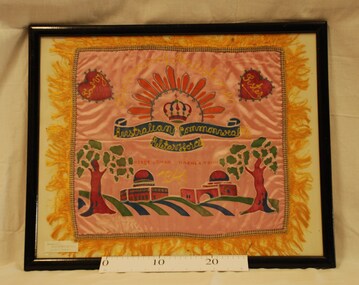
Craft - Framed Embroided Centrepiece, WW2 Embroidered Silk Centrepiece Souvenir, Estimated date 1941
... Underneath, the words 'Souvenir of Palestine' are embroidered in a yellow arc, a rising sun in orange, a red, green and blue crown, and - 'Australian' - 'Commonwealth' - 'Military Forces' - in yellow and blue. At the botton there are two trees...Underneath, the words 'Souvenir of Palestine' are embroidered in a yellow arc, a rising sun in orange, a red, green and blue crown, and - 'Australian' - 'Commonwealth' - 'Military Forces' - in yellow and blue. At the botton there are two trees ...World War Two souvenir.This framed World War Two souvenir is an embroidered silk centrepiece. On a pink background, fringed in yellow, appear two red hearts in the top left and right corners. Inside the hearts, in yellow, are the words - 'To My' - 'Sister'. Underneath, the words 'Souvenir of Palestine' are embroidered in a yellow arc, a rising sun in orange, a red, green and blue crown, and - 'Australian' - 'Commonwealth' - 'Military Forces' - in yellow and blue. At the botton there are two trees either side of two domed buildings, all in red, green and blue. 'Australian Commonwealth Military Forces'. '1941'. 'To my Sister'. 'Souvenir of Palestine'.embroidery, middle east, australia, military, commonwealth, 1941, souvenir, second world war, palestine -
 Orbost & District Historical Society
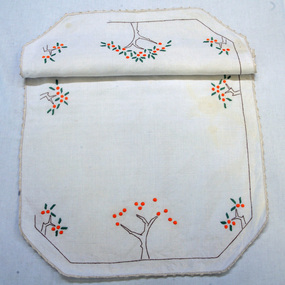
tray cloth, first half 20th century
... It has rounded corners and crocheted edging. it is hand embroidered with brown-trunked trees, green leaves and oranges....It has rounded corners and crocheted edging. it is hand embroidered with brown-trunked trees, green leaves and oranges. tray cloth ...This item reflects the needlework skills of women in the first half of the 20th century.A white rectangular shaped linen tray cloth. It has rounded corners and crocheted edging. it is hand embroidered with brown-trunked trees, green leaves and oranges.linen tablecloth embroidery needlework handcraft -
 Phillip Island and District Historical Society Inc.
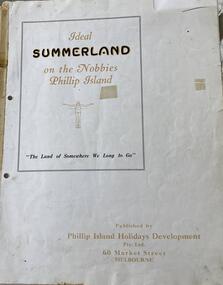
Booklet, Phillip Island Holidays Development Pty Ltd, Ideal Summerland on the Nobbies, Phillip Island, Late 1920s
... trees. Between 1927 and 1931, 227 new blocks were created, and from 1929 to 1940 there was a nine-hole golf course on what is now the Penguin Parade car park. Historical Housing tourism phillip island Summerland Estate Ideal Summerland on the Nobbies Phillip Island. "The land of somewhere we long to go". Published by Phillip Island Holidays Development Pty Ltd. 6o Market Street, Melbourne. Large 8 page glossy booklet advertising Summerland Estate, describing attractions of the area ,maps, houses , golf course. Basically black and white with some orange ...Subdivision of Summerland commenced in the 1920s with 12 large allotments created, along with features such as a roundabout and cypress trees. Between 1927 and 1931, 227 new blocks were created, and from 1929 to 1940 there was a nine-hole golf course on what is now the Penguin Parade car park.Historical Large 8 page glossy booklet advertising Summerland Estate, describing attractions of the area ,maps, houses , golf course. Basically black and white with some orange print and a coloured map.Ideal Summerland on the Nobbies Phillip Island. "The land of somewhere we long to go". Published by Phillip Island Holidays Development Pty Ltd. 6o Market Street, Melbourne.housing, tourism phillip island, summerland estate
