
Showing 27 items matching "p dressing"
-
 Federation University Historical Collection
Document - Document - Minutes, VIOSH: Ballarat College of Advanced Education; OHM Course Committee MInutes of Meetings, 1984 - 1988
... ...p dressing...Slight changes occurred over time. derek woolley chairman max brooke keith brown b cossins p coman g fernandez legal j harvey p hope p kelly raymond lang b lees r maud tom norwood p swan eric wigglesworth l colbourn p dressing j castleman r gillis j lowinger p mccarthy d shannon steve cowley phillip beaumont brad rhodes warren payne dennis else graham bradley brett wood neil dine chris schaper tony thatcher lyn roberts peter reid dulcie brooke gwen wilson Minutes typed - A4 pages. ...Victorian Institute of Occupational Safety and Health (VIOSH) Australia is the Asia-Pacific centre for teaching and research in occupational health and safety (OHS) and is known as one of Australia's leaders on the field. VIOSH has a global reputation for its innovative approach within the field of OHS management. VIOSH had its first intake of students in 1979. At that time the Institution was known as the Ballarat College of Advanced Education. In 1990 it became known as Ballarat University College, then in 1994 as University of Ballarat. It was 2014 that it became Federation University. VIOSH Australia students are safety managers, senior advisors and experienced OHS professionals. They come from all over Australia and industry. Students are taught active research and enquiry; rather than textbook learning and a one-size fits all approach. VIOSH accepts people into the Graduate Diploma of Occupational Hazard Management who have no undergraduate degree - on the basis of extensive work experience and knowledge. Committee Meetings were held monthly. All aspects of the courses were discussed and recommendations were made for changes and requests from students considered. Committee members were from the different areas / subjects of the courses. Slight changes occurred over time.Minutes typed - A4 pages. Grouped into years.derek woolley, chairman, max brooke, keith brown, b cossins, p coman, g fernandez, legal, j harvey, p hope, p kelly, raymond lang, b lees, r maud, tom norwood, p swan, eric wigglesworth, l colbourn, p dressing, j castleman, r gillis, j lowinger, p mccarthy, d shannon, steve cowley, phillip beaumont, brad rhodes, warren payne, dennis else, graham bradley, brett wood, neil dine, chris schaper, tony thatcher, lyn roberts, peter reid, dulcie brooke, gwen wilson -
 Bendigo Historical Society Inc.
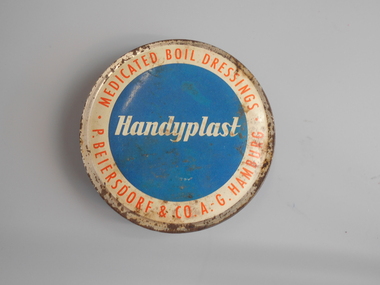
Container - PHARMACY COLLECTION: HANDYPLAST BOIL DRESSING TIN, 1950's
... Small round blue, white & red tin with partial contents of Handyplast Medicated Boil Dressings. P. Beiersoorf& Co. A.G. Hamburg. Paper instructions for use inside....Small round blue, white & red tin with partial contents of Handyplast Medicated Boil Dressings. P. Beiersoorf& Co. A.G. Hamburg. Paper instructions for use inside. ...Object. Small round blue, white & red tin with partial contents of Handyplast Medicated Boil Dressings. P. Beiersoorf& Co. A.G. Hamburg. Paper instructions for use inside.Made in Germany No 631medicine, first aid, handyplast boil dressing tin -
 Federation University Historical Collection
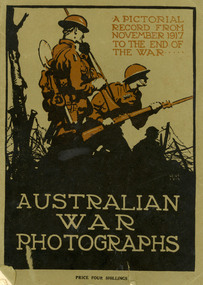
Book, Cassell and Company, Ltd, Australian War Photographs, 1917
... dressing station glencorse wood prisoners pigeons australian commonwealth military forces sgs Chatham - Holmes Family Archive Photographic history of Australians during World War One 129 page book with soft beige, brown and black cover depicting three soldiers at the front during World War One. The book includes many photographs and artwork of Australians at the French front from November 1917 until the end of the war. Photographers include Frank Hurley, E. Brooks, H.F. Baldwin and G.H. Wilkins. Artists include Crozier, W.L. King, Alan Lewis, Lothian, John Davis, S. Perks, I. Picking, Daryl Lindsay, Alf Saville, L.H. Howie, Stuart Shaw, P ...Photographic history of Australians during World War One129 page book with soft beige, brown and black cover depicting three soldiers at the front during World War One. The book includes many photographs and artwork of Australians at the French front from November 1917 until the end of the war. Photographers include Frank Hurley, E. Brooks, H.F. Baldwin and G.H. Wilkins. Artists include Crozier, W.L. King, Alan Lewis, Lothian, John Davis, S. Perks, I. Picking, Daryl Lindsay, Alf Saville, L.H. Howie, Stuart Shaw, P. Huthnance, Stiggo, S. Perks, C.H. Gould, Ted Canon, Bernie Bragg, S. Shaw, Will Dyson, An introduction is written by W. Birdwood, France, 28 September 1917. A number of pages have written notes on them by someone who had obviously been on the French Front. (These pages have been scanned and uploaded onto Victorian Collections. non-fictionPhotographic history of Australians during World War Onechatham family collection, chatham, world war one, world war 1, world war i, france, trenches, front line, birdwood, mark ridgeay, harold williamson, flanders, poziers, somme, becourt, mouquet farm, rupert whiteley, ypres, montauban, field cooker, gueudecourt, band, bapaume, bullecourt, h. murray, hindernburg wire, messines, howitzer, w. holmes. canon, ted canon, hill 60, gas masks, siege battery, menin road, ambulance, dressing station, glencorse wood, prisoners, pigeons, australian commonwealth military forces, sgs, chatham - holmes family archive -
Marysville & District Historical Society
THE TRIANGLE NEWS-VOL 4 NO 34-26 OCTOBER 1979
... dressing salon...bus to oaks day...happy birthday...lions club chariot challenge...for sale...r.s.l. day...floral carpet guides & brownies...clearance sale...wirreanda jottings...marysville cubs...anglican news...community care centre...wanted p...marysville victoria australia thanks wirreanda rosters rev george edwards last service wirreanda tee shirts wirreanda ball wanted annual meeting hair dressing salon bus to oaks day happy birthday lions club chariot challenge for sale r.s.l. day floral carpet guides & brownies clearance sale wirreanda jottings marysville cubs anglican news community care centre wanted p/t gardener bonney's footy club presentation night fire brigade member for evelyn daylight savings reminder THE TRIANGLE NEWS-VOL 4 NO 34-26 OCTOBER 1979 ...marysville, victoria, australia, thanks, wirreanda rosters, rev george edwards last service, wirreanda tee shirts, wirreanda ball, wanted, annual meeting, hair dressing salon, bus to oaks day, happy birthday, lions club chariot challenge, for sale, r.s.l. day, floral carpet guides & brownies, clearance sale, wirreanda jottings, marysville cubs, anglican news, community care centre, wanted p/t gardener, bonney's, footy club, presentation night, fire brigade, member for evelyn, daylight savings reminder -
 The Beechworth Burke Museum
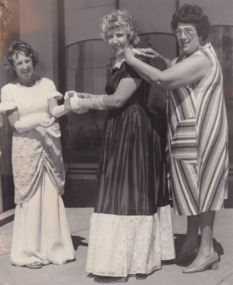
Photograph
... Two of them are dressed in theatrical costumes, one of whom is being assisted in dressing up by the third woman. The women in the photograph have been identified as P. ...Two of them are dressed in theatrical costumes, one of whom is being assisted in dressing up by the third woman. The women in the photograph have been identified as P. ...Taken in the 1950s, the photograph depicts three women. Two of them are dressed in theatrical costumes, one of whom is being assisted in dressing up by the third woman. The women in the photograph have been identified as P. Crosthwaite, L. Jorg and M. Clark.The photograph provides insight into entertainment, performance and recreation in Beechworth during the 1950s. The item's interpretive capacity is enhanced by its strong relationship to other photographs in the catalogue. Collectively, these records enrich the community's understanding of how the arts have developed in Beechworth since the mid-twentieth century.Black and white rectangular photograph printed on matte photographic paper.Reverse: 5643 /entertainment album, costume, theatre, performance, arts, recreation, theatrical costume, 1950s, beechworth -
 Ringwood and District Historical Society
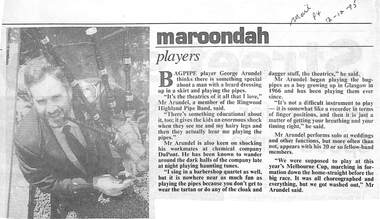
Newspaper, Scrapbook Clipping, Library Collection, Ringwood, Victoria
... dressing up in a skirt and playing the pipes. "It's the theatrics of it all that I love", Mr Arundel, a member of the Ringwood Highland Pip[e Band, said. Mr Arundel began playing the bagpipesas a boy growing up in Glasgow in 1966, and has been playing them ever since. Newspaper Clipping from "The Mail", 12-12-95. P ...Newspaper Clipping from "The Mail", 12-12-95. P 4 "Maroondah players"'. George ArundelBagpipe player George Arundel thinks there is something special about a man with a beard dressing up in a skirt and playing the pipes. "It's the theatrics of it all that I love", Mr Arundel, a member of the Ringwood Highland Pip[e Band, said. Mr Arundel began playing the bagpipesas a boy growing up in Glasgow in 1966, and has been playing them ever since. -
 Bendigo Military Museum
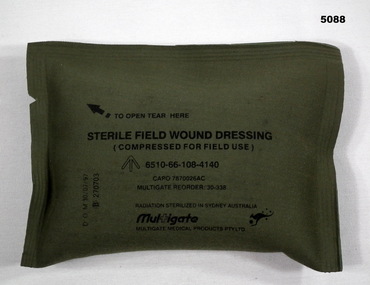
Equipment - STERILE FIELD WOUND DRESSING, Multigate Medical Products P/L, 30 July 1997
... Equipment STERILE FIELD WOUND DRESSING Multigate Medical Products P/L ...The pack contains bandage, inner bag.Field dressing, khaki canvas wrapped rectangular shape, sealed, all information re use on one side in black print.Front cover- "Sterile Field Wound Dressing" Back cover - "Directions for use".field dressing, accessory -
 Bendigo Military Museum
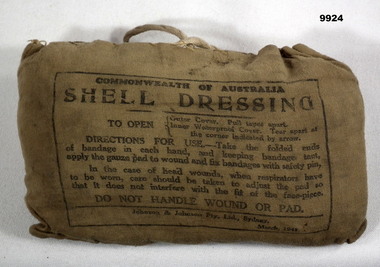
Equipment - DRESSING, SHELL WW2, Johnson & Johnson P/L, March 1941
... Equipment DRESSING, SHELL WW2 Johnson & Johnson P/L ...Shell dressing to be used if wounded in combat. Part of the collection of "John Young". Refer Cat No. 1181.3 for service details.Brown sealed pouch with white laced straps. Inside is a shell dressing. On one side is instructions to open and use.Label "Commonwealth of Australia", "Shell Dressing".first aid, shell dressings -
 Eltham District Historical Society Inc
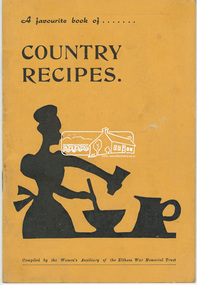
Book, Eltham War Memorial Trust, A favourite book of country recipes / compiled by the Women's Auxiliary of the Eltham War Memorial Trust, 1958
... dressings and sauces, VIII. Drinks. a. & s. davis pty ltd a. boyd-graham a. lyon a. mezner a. uglow a.m. lynes b. clark b. rothwell b. thomas b.j. brinkkotter b.m. gresford b.w. morrison betty p. metcalfe briar hill timber & trading c. may c. pelling c. smith cold comfort farm commercial bank of australia cook-book cooking d. garratt d. richards d. warner d.g. wills draffin bros pty ltd e. egan e. hoppner e.i. rains e.s. rothwell eltham home supplies eltham hotel eltham motor garage eltham real estate & business agency eltham war memorial trust f.j. burgoyne g.b. gresford gas and fuel corporation of victoria george lovitt & co pty ltd guest's biscuits h.w. downing heidelberg district bakery i. putnam j. & j. burgoyne j. kimber j.m. attiwill jack burgoyne kraft cheddar l. carter lyon bros garage M. ...46 page book produced by the women of the Shire of Eltham as a fundraising project for the construction of the WW2 Eltham War Memorial. Contents: I. Fish, II. Meat, III. Puddings and desserts, IV. Bread and scones, V. Cakes and biscuits, VI. Jams, marmalades and chutneys, VII. Salads, dressings and sauces, VIII. Drinks. 47 p. : ill., b&w., ; 19 cm. a. & s. davis pty ltd, a. boyd-graham, a. lyon, a. mezner, a. uglow, a.m. lynes, b. clark, b. rothwell, b. thomas, b.j. brinkkotter, b.m. gresford, b.w. morrison, betty p. metcalfe, briar hill timber & trading, c. may, c. pelling, c. smith, cold comfort farm, commercial bank of australia, cook-book, cooking, d. garratt, d. richards, d. warner, d.g. wills, draffin bros pty ltd, e. egan, e. hoppner, e.i. rains, e.s. rothwell, eltham home supplies, eltham hotel, eltham motor garage, eltham real estate & business agency, eltham war memorial trust, f.j. burgoyne, g.b. gresford, gas and fuel corporation of victoria, george lovitt & co pty ltd, guest's biscuits, h.w. downing, heidelberg district bakery, i. putnam, j. & j. burgoyne, j. kimber, j.m. attiwill, jack burgoyne, kraft cheddar, l. carter, lyon bros garage, m. banks, m. battye, m. black, m. erswell, m. foletta, m. johnson, m. roletta, m.h. bucknell, m.j. loosli, millett's foodland, n.h. baxter estate agent, n.h. baxter, new bridge building supplies, m. banks, m. battye, m. black, m. erswell, m. foletta, m. johnson, m. roletta, m.h. bucknell, m.j. loosli, millett's foodland, n.h. baxter estate agent, n.h. baxter, new bridge building supplies, o. holland, o.a. brown, p. moore, p. pease, p. peel, p. reece, presswell's eltham east auto service, r.j. scully, rains, recipes, research meat supply, research post office and general store, s. littlehales, stanley s addison, t. sawyer, t.e. & e.m. moran, v. addison, v. hughes, valley furniture, women's auxiliary, cookery, fundraising -
 Bendigo Military Museum
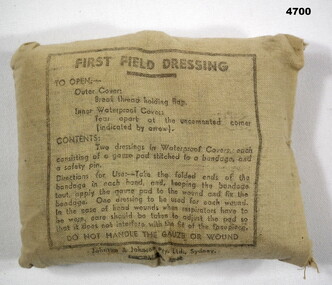
Accessory - FIRST FIELD DRESSING, Johnson & Johnson PTY LTD, C. 1942
... Peter Ball collection, refer Cat No 4704 Dressings first field accessory On one end in black pen, “P Ball” First field dressing rectangular shape rounded all corners, khaki colour cotton, the contents are labelled, instructions for use all in black print, contents are in water proof covers. ...The contents are 2 x dressings each consisting of a gauze pad stitched to a bandage and safety pin. Peter Ball collection, refer Cat No 4704First field dressing rectangular shape rounded all corners, khaki colour cotton, the contents are labelled, instructions for use all in black print, contents are in water proof covers.On one end in black pen, “P Ball”dressings, first field, accessory -
Glen Eira Historical Society
Letter - ELSTERNWICK POST OFFICE
... dressings. There is a brief summary of the settlement and development of the Elsternwick area with mention of how important the building is to the Elsternwick Community. Original date and author is unknown. Elsternwick Post Office Glenhuntly Road Elsternwick Riddell Parade Office Buildings Postal services Caulfield City Council Kay Walter Regent Street Caulfield Bush Rodney H Gisborne Street City of Caulfield Braun Emil Councillor Mayors Aylen Doug Aylen Douglas R Historic Buildings Council Caulfield Historical Society Ministry for Planning and Environment Head Stephen Historic Buildings Act 1981 Anderson P National Trust of Australia (Victoria) Public Works Department Architectural styles Calder G.K. ...This file contains seven items about the significance of this building and how this was established : 1/ Photocopies of a handwritten application (in duplicate) by Walter Kay of Elsternwick dated 13/10/1985 and Rodney H Bush’s dated 16/10/1985 to the Historic Buildings Council to register the former Elsternwick Post Office building, and an original typewritten letter dated 17/10/1985 from the Historic Buildings Council to Caulfield and Historic Society advising them of an application and inviting them to submit relevant information about the building with a copy of application attached. 2/ Six pieces of correspondence between various interested parties (Caulfield Council , Caulfield Historical Society, National Trust, of Australia and Ministry for Planning and Environment on behalf of Historic Buildings Council, Victoria) about the significance of the former Elsternwick Post Office building and the progress of efforts to include it on the Register of Historic buildings. Dated between November 1985 and May 1986. 3/ Two pieces of correspondence between the Caulfield Progress Association and the Caulfield Historical Society dated April and May 1986, regarding the efforts of the Historical Society to save the former Elsternwick Post Office building. 4/ Two pieces of ephemera by the Caulfield Progress Association, one original undated and one photocopy undated in 1986. Both appealing to the public for support to help the former Elsternwick Post Office building and to protest a proposal to demolish it, by Caulfield Council. 5/Original newspaper article dated 07/06/1989 from the Malvern-Caulfield Progress newspaper written by Robert Carmody. The article talks about the approval by the Historic Buildings Council of Caulfield Council’s restoration program of the former Elsternwick Post Office building worth approximately $850,000. The refurbishment would consist of a shop and office space which would then be rented out. Mayor Emil Braun outlines the progress to implement the plans. 6/ Caulfield Conservation Study by Andrew Ward dated September 1994 of former Elsternwick Post Office Building. The building plans for the Elizabethan Style building were approved in 1891. The original timber verandahs were replaced by the present brickworks in circa 1918 rear extensions in 1941-42. Similar Post Offices were built at Kew, Queenscliff and Portarlington. 7/ Computer printout dated 19/03/2010 of Statement of Significance held by the Victorian Heritage database of the former Elsternwick Post Office Building. It was built in 1891 in the ‘Queen Anne’ style. The substantial two story red brick building was set on a bluestone plinth with an ornate façade incorporating cement dressings. There is a brief summary of the settlement and development of the Elsternwick area with mention of how important the building is to the Elsternwick Community. Original date and author is unknown.elsternwick post office, glenhuntly road, elsternwick, riddell parade, office buildings, postal services, caulfield city council, kay walter, regent street, caulfield, bush rodney h, gisborne street, city of caulfield, braun emil councillor, mayors, aylen doug, aylen douglas r, historic buildings council, caulfield historical society, ministry for planning and environment, head stephen, historic buildings act 1981, anderson p, national trust of australia (victoria), public works department, architectural styles, calder g.k. councillor, wills cathie, lyall kerry, marsden john hudson, town clerk, hill douglas, caulfield progress association, caulfield south, glen eira road, hawthorn road, mac neil j.r., neville street, glenhuntly, marten veronika, ballantyne richard, royal historical society of victoria, dunstan don, alfada street south, hardy joan, baird rob, snowball betty, ward andrew, hoddle robert, foot henry, ebden charles hodson, elster, oldham mary kate, english ‘queen anne’ revival style, rifle club, coulson herbert h., fick p.g., railway, city manager, austin g.b. h., architects, builders, architectural features, australia post, register of historical buildings, grey karen, planning appeal board, heritage overlay no h029, victorian government gazette no. 60 dated 16/07/1986, historic building no640, certificate of title volume 5817, kennan james harley, nelson ivor, blake alison, neale anne, telegraph offices, wardell, ward andrew -
 National Vietnam Veterans Museum (NVVM)
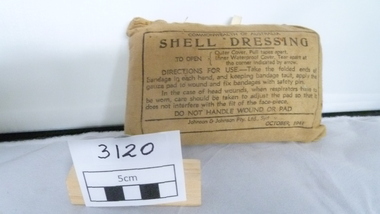
Equipment - Equipment, Army, Field Dressing, 1941
... Commonwealth of Australia Shell Dressing. Extensive directions for use. Johnson & Johnson P/L Syd October 1941...Field Dressing Equipment Equipment, Army Johnson & Johnson P/L ...Tan coloured cotton package containing dressing. Instructions for use written on outside.Commonwealth of Australia Shell Dressing. Extensive directions for use. Johnson & Johnson P/L Syd October 1941field dressing, shell dressing, sas -
 National Vietnam Veterans Museum (NVVM)
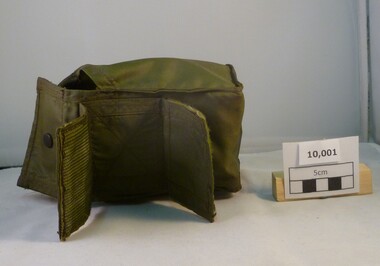
Equipment - Equipment, Army, Dressing wound with bag - olive green
... Dressing wound with bag - olive green Equipment Equipment, Army Johnson and Johnson Medical P/L ...Canvas wound dressing satchel coloured online drab. The dressing is of the sterile compressed type for field use and is stored in the inner pack.6510 66 108 4140 Dressing wound. *Sterile compressed for field use. Capo - V113811first aid dressing, wound dressing, field first aid -
 Bendigo Military Museum
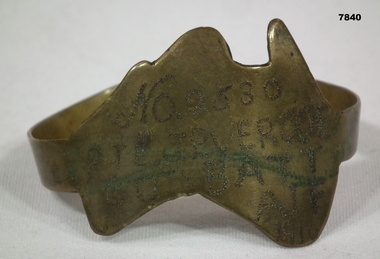
Memorabilia - TRENCH ART, BRACELET, C.1916
... dressing and carrying wounded to the Regt. Aid Post during a counter attack on Villers Brettoneux on the night of 24/25th April 1918. Cooper Collection Trench Art John P ...Part of the Cooper Collection. "John Percy VERCOE", No. 2530, enlisted 18/5/16 in 5th Reinforcements, 60 BN. Aged 30 years. Embarked for England 25/9/1916, embarked for France 4/2/1917, WIA 26/4/1918. GSW to left eye, severe. Left eye excised England 30/4/1918. RTA 23/9/1918. Discharged from the AIF 4/1/1919. Passed away 30/12/1925. John received a Congratulatory card from MAJ.General J.H. Hobbs, K.C.B, V.D. Commanding 5th Aust. Division - for bravery and devotion to duty in dressing and carrying wounded to the Regt. Aid Post during a counter attack on Villers Brettoneux on the night of 24/25th April 1918.Brass map of Australia fashioned into a bracelet. Band is secured with a clip. Owners details engraved on the map.Engraved in the face of the map: 'No.2530, PTE J.P. VERCOE, 60TH BATT, AIF, 1916.cooper collection, trench art, john p. vercoe -
 Numurkah & District Historical Society
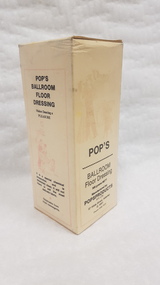
Ballroom Floor Dressing, Pops Products P/L
... (see photo) 500g Cardboard box containing ballroom floor "powder" Ballroom Floor Dressing Pops Products P/L ...Pop’s was a powdery wax used on wooden dance floors, scattered before a dance and spread by the dancers’ feet. It made the floor very slippery! It would have had a lot of use in country halls where dances were often held for fundraising (and fun).500g Cardboard box containing ballroom floor "powder" Pop's Ballroom Floor Dressing …..(see photo)ballroom dancing, floor, dressing -
Box Hill Historical Society
Photograph - Brick cottage, 1/12/1994
... View of a single storeyed brick cottage located in Wattle Park, influenced by the work of Sir Edwin Lutyens, with clinker brick dressings, rubble stone plinth, steeply pitched slate roof and symmetrical front facade having a recessed round arched porch. Roofs sweep down to window head height. It is used as the curator's cottage. See Heritage Study Vol 2. p...View of a single storeyed brick cottage located in Wattle Park, influenced by the work of Sir Edwin Lutyens, with clinker brick dressings, rubble stone plinth, steeply pitched slate roof and symmetrical front facade having a recessed round arched porch. Roofs sweep down to window head height. It is used as the curator's cottage. See Heritage Study Vol 2. p ...View of a single storeyed brick cottage located in Wattle Park, influenced by the work of Sir Edwin Lutyens, with clinker brick dressings, rubble stone plinth, steeply pitched slate roof and symmetrical front facade having a recessed round arched porch. Roofs sweep down to window head height. It is used as the curator's cottage. See Heritage Study Vol 2. p 66-67wattle park, curator's cottage, lutyens> edwin, parks and reserves -
 Ballarat Tramway Museum
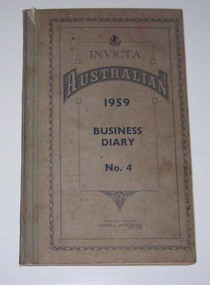
Administrative record - Log book, Diary, Sands McDougall Pty Ltd, 1958
... P. Podger 28/12/1959 - Daily time sheet with track work notes Inside rear cover Begonia Festival 1959 brochure SEC Workshop Requisition Misc. notes List of Staff and address - J. Naus added to above list. List of track lengths re top dressing...P. Podger 28/12/1959 - Daily time sheet with track work notes Inside rear cover Begonia Festival 1959 brochure SEC Workshop Requisition Misc. notes List of Staff and address - J. Naus added to above list. List of track lengths re top dressing ...Yields information about the track maintenance activities of the track gang in Ballarat, the work they did, notes, names and other information.Invicta Australian 1959 Business Diary, No. 4, printed by Sands and McDougall, light grey Rexene binding strip, card covers, sewn sections with ruled sheets providing a diary for 1959, one week per double page. Has "useful information" sheets at from the diary. Used by the SEC Ballarat track gang to record their daily work, leave, welding, track cleaning, truck driver etc Rear pages - has notes on materials used, costs, scrubber use and hours, and length of track On the inside of the rear cover is a list of Track gang and addresses for 1959. W. H. Goldsmith H. Dowie S. Eaton W. Newell E. Lakey J. Armstrong J. Naus C. Edwards A. W. Cunningham H. Lancaster H. Smith Loose contents 18/5/1059 - Medical Certificate for S. Eaton - dated 9/10/1959, Dr. D. P. Podger 28/12/1959 - Daily time sheet with track work notes Inside rear cover Begonia Festival 1959 brochure SEC Workshop Requisition Misc. notes List of Staff and address - J. Naus added to above list. List of track lengths re top dressing between various lengths.tram, trams, sec, ballarat, depot, trackwork, rails, scrubber tram -
Moorabbin Air Museum
Accessory (Item) - Beaufighter Pilots Escape kit
... Beaufighter Pilots Escape Kit ,listed below are a few of the items contained in the kit, 1 x Can Water Drinking R.A.F Stores Ref No.27 P/8. 1 Pack First Field Dressing Manufactured by Johnson & Johnson Sydney July 1943. 2 Packs Medical kit For Tropical Emergency Outfit ( 1 x is in very poor condition ,tin has rusted ,packing of contents discoloured). 3 x Sterilizing Outfits For Use With Water Bottles. 1x R.A.F Emergency Flying Ration Ref.No. 27 P/19. 1 x Fire Starter 43A12859. 1 x Lens Fused Bifocal. 1 x Truncheon. 1 x Permutit Sea Water Desalting Apparatus. 1 x Compass. 1 x Pack Bells Waterproof Wax Vestas. 1 x Cotton Mit. ...Beaufighter Pilots Escape Kit ,listed below are a few of the items contained in the kit, 1 x Can Water Drinking R.A.F Stores Ref No.27 P/8. 1 Pack First Field Dressing Manufactured by Johnson & Johnson Sydney July 1943. 2 Packs Medical kit For Tropical Emergency Outfit ( 1 x is in very poor condition ,tin has rusted ,packing of contents discoloured). 3 x Sterilizing Outfits For Use With Water Bottles. 1x R.A.F Emergency Flying Ration Ref.No. 27 P/19. 1 x Fire Starter 43A12859. 1 x Lens Fused Bifocal. 1 x Truncheon. 1 x Permutit Sea Water Desalting Apparatus. 1 x Compass. 1 x Pack Bells Waterproof Wax Vestas. 1 x Cotton Mit. ... -
 Beechworth RSL Sub-Branch
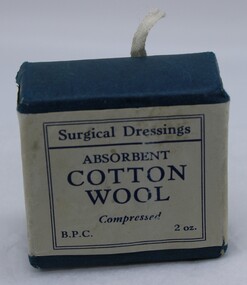
Surgical Dressing Compressed
... Front printed label, Surgical Dressings / ABSORBENT COTTON WOOL / Compressed / B. P. C. 2oz.; on both ends, Absorbent / Cotton Wool / 2 - oz. ...Clark VX34546 First aid item carried into war like service by defence personal as part of their personal effects Surgical Dressings Cotton Wool Front printed label, Surgical Dressings / ABSORBENT COTTON WOOL / Compressed / B. P. C. 2oz.; on both ends, Absorbent / Cotton Wool / 2 - oz. ...Item were carried as personal kit into service by Corporal W.C. Clark VX34546First aid item carried into war like service by defence personal as part of their personal effectsA rectangular compressed surgical dressing of absorbent COTTON WOOL with a cloth tape for openingFront printed label, Surgical Dressings / ABSORBENT COTTON WOOL / Compressed / B. P. C. 2oz.; on both ends, Absorbent / Cotton Wool / 2 - oz. ;Reverse printed MADE IN ENGLAND,hand written on black ball point pen "Lent by / Lance Flynn" surgical dressings, cotton wool -
 Bialik College
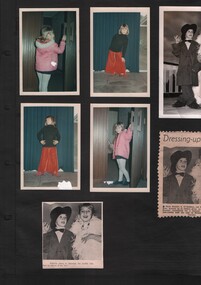
Mixed media (item) - Scrapbook page, 1968
... Page from a scrapbook featuring on one side 1968 newspaper articles about the recipe book 'I Love to Eat Jewish': 'Try a monkey gland steak', The Herald, 2 August 1968, p. 2, 'Appealing Jewish Dishes' by Jean Forward, and an article about the launch, Sunday Telegraph, 17 November 1968 - a photograph of parent Julette Alexander, and an invitation to the launch of the book. On the other side of the scrapbook page is a newspaper article 'Dressing...Page from a scrapbook featuring on one side 1968 newspaper articles about the recipe book 'I Love to Eat Jewish': 'Try a monkey gland steak', The Herald, 2 August 1968, p. 2, 'Appealing Jewish Dishes' by Jean Forward, and an article about the launch, Sunday Telegraph, 17 November 1968 - a photograph of parent Julette Alexander, and an invitation to the launch of the book. On the other side of the scrapbook page is a newspaper article 'Dressing ...Page from a scrapbook featuring on one side 1968 newspaper articles about the recipe book 'I Love to Eat Jewish': 'Try a monkey gland steak', The Herald, 2 August 1968, p. 2, 'Appealing Jewish Dishes' by Jean Forward, and an article about the launch, Sunday Telegraph, 17 November 1968 - a photograph of parent Julette Alexander, and an invitation to the launch of the book. On the other side of the scrapbook page is a newspaper article 'Dressing-up is fun', Australian Jewish News, 7 June 1968, p. 7, about a Bialik Parents' Association jumble sale in 1968, and photos of students Mark Sinclair and Kim Alexander advertising the event.1960s, judaism, recipes -
 Whitehorse Historical Society Inc.
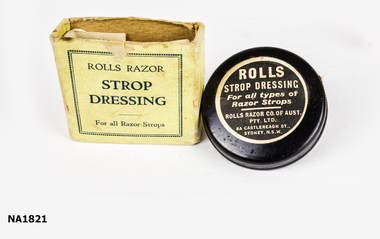
Strop Dressing
... |JAR - Rolls strop dressing Rolls Razor Co. of Aust P/L 8a Castlereagh St Sydney N.S.W....|JAR - Rolls strop dressing Rolls Razor Co. of Aust P/L 8a Castlereagh St Sydney N.S.W. ...Packet containing round jar of strop dressing. Packet is yellow - jar black with white writing instructions in box.PACKET - Rolls razor strop dressing for all razor strops.|JAR - Rolls strop dressing Rolls Razor Co. of Aust P/L 8a Castlereagh St Sydney N.S.W.personal effects-toilet requisites, shaving -
 City of Melbourne Libraries
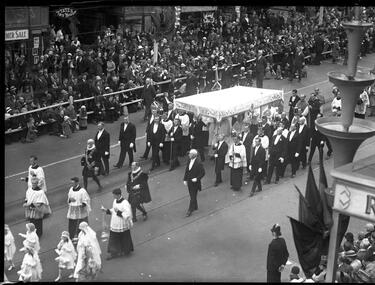
Photograph, Bull, Hugh Jones, 1897-1993, Eucharistic Congress Procession, Collins Street, Melbourne
... p. 28. Retrieved January 23, 2024, from http://nla.gov.au/nla.news-article104371824 'The year of the Melbourne Eucharistic Congress: 1934.' The Campion Society, https://campion.australiancardijninstitute.org/ch-7-the-year-of-the-melbourne-eucharistic-congress-1934/ 'Melbourne Eucharistic Congress 1934.' Panoramic photograph, https://emhs.org.au/catalogue/emdf0123 The National Eucharistic Congress, Melbourne, Australia December 2nd-9th, 1934. Edited by Rev. J.M. Murphy and Rev. F. Moynihan, The Advocate Press, Melbourne. 'Children of Mary Sodalists', Wikipedia, https://en.wikipedia.org/wiki/Sodality_of_Our_Lady 'Dressing...p. 28. Retrieved January 23, 2024, from http://nla.gov.au/nla.news-article104371824 'The year of the Melbourne Eucharistic Congress: 1934.' The Campion Society, https://campion.australiancardijninstitute.org/ch-7-the-year-of-the-melbourne-eucharistic-congress-1934/ 'Melbourne Eucharistic Congress 1934.' Panoramic photograph, https://emhs.org.au/catalogue/emdf0123 The National Eucharistic Congress, Melbourne, Australia December 2nd-9th, 1934. Edited by Rev. J.M. Murphy and Rev. F. Moynihan, The Advocate Press, Melbourne. 'Children of Mary Sodalists', Wikipedia, https://en.wikipedia.org/wiki/Sodality_of_Our_Lady 'Dressing ...Published: The Age 10 December 1934 Published title: RELIGIOUS PAGEANTRY AND FERVOR MARKED CLOSE OF EUCHARISTIC CONGRESS. Published caption: Thousands of men and women marched in the Eucharistic procession yesterday which brought the Congress to a close. The picture above shows the procession headed by the Children of Mary in Bourke-street and turning into Spring-street, in front of Parlia ment House. Right (top) — The procession leaving the starting point at St. Patrick's Cathedral and below, the Papal Legate carrying the Host under a canopy borne by a guard of laymen and preceded by white-clad girls scattering rose leaves, incense bearers and the Papal Chamberlains in their Spanish uniforms. The end of the procession in front of Mount St. Evin’s Hospital from which the final benediction was given by Cardi nal MacRory from an altar on the bal cony. The Papal Legate carrying the Host is passing through the assemblage of surpliced priests. On the left is an aerial picture taken just as the Children of Mary at the head of the procession are taking up their places for the final assembling. In the left top corner of the picture is St Patrick's Cathedral, from which the procession started, and in the right lower corner is Mount St. Evin’s Hospital. The space immediately in front of the hospital was reserved for the processionists while on either side is the crowd that assembled to take part in the final service. Trove article identifier: http://nla.gov.au/nla.news-article205067634 Religious pageantry and fervour The National Eucharistic Congress took place from Sunday 2 to Sunday 9 December 1934. An initiative of the Roman Catholic Church, it was their contribution to Melbourne’s Centenary Celebrations. 200,000 Catholics resided in Melbourne at this time – one quarter of the city’s population. While the Congress was aimed at Catholics, and acted as an opportunity to reinforce their living faith and homage, it contained a variety of events of splendour, solemnity and significance designed to appeal to Melbournians, and would additionally provide incentive for people to travel to Victoria, thereby creating an economic benefit to the state. The Procession of the Blessed Sacrament concluded the week-long Congress. Commencing at St Patrick’s Cathedral, it covered a two-mile route via Gisborne, Collins, Elizabeth and Bourke streets, then to Victoria Parade, where a final benediction was pronounced by Cardinal MacRory from the balcony of Mount St. Evin’s Hospital (today the site of St Vincent’s Private Hospital). An estimated 100,000 took part. Onlookers line Swanston Street, some standing at the entrance to Tate’s Tea House – a well-known Melbourne landmark located in the basement of the Manchester Unity Building. The white-veiled Children of Mary Sodalists strew rose petals in the path of the canopy, covering the jewelled Monstrance containing the Blessed Sacrament of consecrated Host (bread) and carried by the Cardinal. Church hierarchy in scarlet robes walk alongside, followed by incense bearers, the Papal Chamberlains in their Spanish uniforms, and a guard of honour of laymen of the city and country parishes. In the foreground is a tiered pole. This is one of 800 “Venetian Lights” specifically installed for the Centenary along all principal thoroughfares. “The poles are painted white, the superstructure resembling three trumpet lilies are made of durable fibro-cement, and their colour scheme deepens from clear yellow on the top cone to orange on the lowest, with slender rims of vermilion and white. Each cone is flooded with light externally from three lamps concealed in the one below it. There is also a painted coat of arms from which spring a trophy of flags.” – Australian Home Beautiful Featured in "Newsworthy: Melbourne in photographs 1933-1936" exhibition at East Melbourne Library, October to December 2023. Exhibition caption by project volunteer, Louise McKenzie. Research by project volunteer, Louise McKenzie: This photo was taken on Sunday 9 December 1934, looking from the Melbourne Town Hall (corner of Swanston and Collins streets) across the road to the Manchester Unity Building. This is the afternoon procession concluding the Catholic Church’s National Eucharistic Congress in Melbourne - a procession of the Blessed Eucharist through the Melbourne city. It commenced at St Patrick’s Cathedral, and covered a two mile route via Gisborne, Collins, Elizabeth and Bourke streets, then to Victoria Parade where a final benediction was pronounced by the Cardinal from the balcony of Mount St. Evin’s Hospital (present day St Vincent’s Private Hospital). An estimated 100,000 took part in the march. The people lining the streets a men in suits and hats, women in coats and hats, and children in their “Sunday best”, kneeling beside the road, many with their hands clasped in front of them. The small girls ahead of the canopy covering the Host are pale-blue clad, white veiled Children of Mary Sodalists, who strew rose petals to pave the way of the Cardinal carrying the jewelled Monstrance (Blessed Sacrament of consecrated Host (bread)), together with church heirarchy wearing scarlet robes. Behind came incense bearers and the Papal Chamberlains in their Spanish uniforms, followed by a guard of honour of laymen of the city and country parishes. The Children of Mary Sodalities was a religious body which aimed at fostering in its members an ardent devotion, reverence, and filial love towards the Blessed Virgin Mary, initially embracing the pupils and orphans of the schools and institutions of the Sisters of Charity of St Vincent de Paul. In 1847, Blessed Pius IX affiliated them to the Jesuit Roman Sodality. They were distinguished by a medal suspended from a blue ribbon, and once a fully-fledged a Child of Mary wore a distinctive blue cape. On the extreme right foreground of the photo can be seen an intriguing piece of artistic design – a tiered pole. This is one of the 800 “Venetian Lights” specifically installed for Melbourne’s Centenary along all principal thoroughfares. “The poles are painted white, the superstructure resembling three trumpet lilies are made of durable fibro-cement, and their colour scheme deepens from clear yellow on the top cone to orange on the lowest, with slender rims of vermilion and white. Each cone is flooded with light externally from three lamps concealed in the one below it. There is also a painted coat of arms from which spring a trophy of flags.” Note the sign for Tates Tea House - a well-known Melbourne landmark, located in the basement of the Manchester Unity Building. References: RELIGIOUS PAGEANTRY AND FERVOR MARKED CLOSE OF EUCHARISTIC CONGRESS. (1934, December 10). The Age (Melbourne, Vic. : 1854 - 1954), p. 11. Retrieved September 14, 2023, from http://nla.gov.au/nla.news-article205067634 Eucharistic Congress (1934, December 1). The Argus (Melbourne, Vic. : 1848 - 1957), p. 11. Retrieved January 23, 2024, from http://nla.gov.au/nla.news-article10997817 National Eucharistic Congress, Melbourne. (1934, December 6). The Catholic Press (Sydney, NSW : 1895 - 1942), p. 28. Retrieved January 23, 2024, from http://nla.gov.au/nla.news-article104371824 'The year of the Melbourne Eucharistic Congress: 1934.' The Campion Society, https://campion.australiancardijninstitute.org/ch-7-the-year-of-the-melbourne-eucharistic-congress-1934/ 'Melbourne Eucharistic Congress 1934.' Panoramic photograph, https://emhs.org.au/catalogue/emdf0123 The National Eucharistic Congress, Melbourne, Australia December 2nd-9th, 1934. Edited by Rev. J.M. Murphy and Rev. F. Moynihan, The Advocate Press, Melbourne. 'Children of Mary Sodalists', Wikipedia, https://en.wikipedia.org/wiki/Sodality_of_Our_Lady 'Dressing Melbourne for the Duke' (1934, October 1). The Australian home beautiful : a journal for the home builder, p. 21, 58. Retrieved September 14, 2023, from http://nla.gov.au/nla.obj-2950922209 Photographer notations on slide: "Eucharistic Congress Procession on Swanston St B61" [sic - actually Collins Street].events, religion, parades, catholic church -
 City of Melbourne Libraries
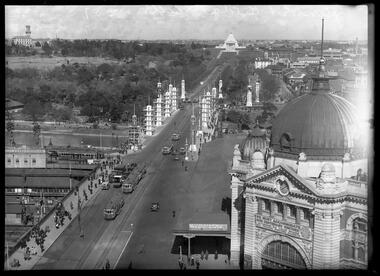
Photograph, Bull, Hugh Jones, 1897-1993, Princes Bridge Centenary pylons under construction
... p. 16. Retrieved September 21, 2023, from http://nla.gov.au/nla.news-article243172436 'Dressing Melbourne for the Duke', The Australian home beautiful: a journal for the home builder. ...p. 16. Retrieved September 21, 2023, from http://nla.gov.au/nla.news-article243172436 'Dressing Melbourne for the Duke', The Australian home beautiful: a journal for the home builder. ...Princes Bridge Centenary pylons under construction Possibly taken from Young and Jacksons Hotel (formerly Princes Bridge Hotel) on the corner of Flinders and Swanston streets, Flinders Street Station’s clocks and main entrance dominate, along with its distinctive copper dome and decorative façade. The time on the main clock is 1.40pm, and the sign underneath, reflecting Melbourne’s upcoming Centenary reads, “We must accommodate our Centenary visitors! Citizens! Do your share by taking paying guests.” At left is the original Princes Bridge Station, today the site of Federation Square. The riverside tram terminus advertises a Café/Tobacconist/Refreshment Room selling cigars & cigarettes, fountain drinks & confectionery, and in smaller text: “Leave your boot repairs here”. Nearly everyone is dressed in dark suits, coats and hats. The footpaths are wide and there are no traffic lights. The roadway stretches towards the Shrine of Remembrance, not yet dedicated but very dominant on the skyline. Government House is clearly visible across the wide parkland that would come to be known as Kings Domain and that is an area of deep importance to the people of the Eastern Kulin. Originally, Birrarung was part of a network of swamps and lagoons linked to the course of the river. From 1896, Public Works Department engineer Carlo Catani, oversaw a new channel to straighten the river and the swamps and lagoons were filled with spoil from the channel works. From the same vantage point today, only the top of the tower of Government House would be visible. The photo captures the pylons along Princes Bridge, mid-construction and being installed to mark Melbourne’s Centenary. The pylons were not without controversy. Both The Argus and The Age bemoaned them for being “made almost entirely of imported softwood timber”, denying work to native hardwood timber workers and sawmillers, and leading visitors to think Australia did not have its own exceptional native hardwoods. The pylons were also variously described in their incomplete state, as unimaginative and resembling an oilfield. Published: The Age 5 September 1934 Featured in "Newsworthy: Melbourne in photographs 1933-1936" exhibition at East Melbourne Library, October to December 2023. Exhibition caption by project volunteer, Louise McKenzie Photographer notations on slide: "Pylons + St Kilda Rd C57" Published: Age (Melbourne, Vic. : 1854 - 1954), Wednesday 5 September 1934, page 11 Published title: DECORATIONS -- THEN AND NOW. Published caption: "Although not completed yet, some impression of the effect of the decorations on Princes-bridge may be obtained from the first picture which shows the majestic sweep of St Kilda road with the Shrine of Remembrance and Government House dominating the horizon. The area to the left of St. Kilda-road and in front of Government House is portion of the area which it is proposed to call the King's Domain, which extends to Domain-road and Anderson-street..." Description: East-facing, elevated view of Flinders Street Station and Princes Bridge, featuring partially completed pylons erected for Melbourne's Centenary celebrations. The Shrine of Remembrance and Government House can be seen in the distance. In the foreground are trams, cars and trucks, pedestrians, Batman Avenue tram terminus and refreshment rooms. Signage on Flinders Street Station encourages citizens to accommodate Centenary visitors. The Melbourne Centenary was held 1934-35 in celebration John Batman's proclamation that Melbourne "the place for a village". Centenary events included a visit by Prince Henry, Duke of Gloucester. A Centenary Cake measuring 50 feet in height and ten tons in weight was cut into 250,000 pieces and sold at 1 shilling per piece for charity. Spectacular floodlighting of city landmarks, the creation of the Pioneer Women's Memorial Garden, and the MacRobertson Air Race from London, were other notable activities. Research by project volunteer, Louise McKenzie: The photo in The Age collage of 5 September 1934 has a slightly cropped foreground. The original photo has been taken from an elevated vantage point, most probably the roof of the Nicholas Building on the corner of Flinders and Swanston streets. The right foreground is dominated by the main “clocks” entrance to Flinders Street Station, showing its distinctive copper dome and decorative façade. The time on the main clock is 1.40 pm. The main sign on the front of the Station reads, "We Must Accommodate our Centenary Visitors! Citizens! Do your share by taking paying guests. Write to The Official Centenary Accommodation Bureau, 436 Collins St. City. Tel M 4671”. Another sign at eye level at the main entrance says: “Cheap Trips on Sundays”. The sign on the end of the roof along the eastern side of the station reads, “The Babies Need Your Help! Support Broadmeadows Foundling Hospital Appeal. July and August”. Run by the Sisters of St Joseph of the Sacred Heart, St Joseph’s Foundling Hospital was a purpose built infants’ home for up to 300 babies, plus accommodation for expectant mothers, mainly single women. In the early 1930s, the department (Victorian Children’s Welfare Department) contracted St Joseph’s Foundling Hospital to care for an additional 60 infant state wards, and up to 175 non wards at any given time. In 1931 it also operated a mothercraft training school. The centre foreground shows the commencement of Princes Bridge. Beneath the left side of the bridge was the site of the original Princes Bridge Station, by this time incorporated into Flinders Street Station, and today the area is the site of Federation Square. It was linked to Flinders Street station by the railway tracks that ran underneath the northern approach to the bridge. This photo shows a tram terminus which has a Café/Tobacconist/Refreshment Room, selling cigars & cigarettes, fountain drinks & confectionary, and a sign: Leave your boot repairs here. In the foreground is a wide roadway running south/north, comprising two vehicle lanes each heading north/south, and a central section containing two sets of tram tracks. There are cars, buses and delivery vans on the roadway. The trams visible are Glen Iris (Route No. 6; tram no. 448), Toorak (Route No. 8, tram no. 333), ? (No. 7), ? (No. 1), and ? (No. 2A). The footpaths are extremely wide. There is a square newspaper/magazine stand on the eastern side footpath. And also a “Ferry” sign. There are no traffic lights, but a policeman is visible on the roadway. There are pedestrians – men, women, children, a porter with trolley, women with prams. Clothing comprises dark suits, coats and hats for nearly everyone. There are double headed “Collins Street” lights along the side of the roadway, and along the northern riverbank. The roadway in the foreground is an extension of Swanston Street, which becomes Princes Bridge, then St Kilda Road, stretching towards the Shrine of Remembrance, and diverting past it. The Shrine had not yet been officially dedicated, and looks very white and dominant on the skyline. On the LHS of St Kilda Road, Government House is clearly visible across the wide parkland to be known as Kings Domain. The Kings Domain area is important to the people of the Eastern Kulin nation, and also has historical importance for its association with the early settlement of Melbourne and the foundation of British colonial administration in Victoria. On the southern side of the Yarra River (Birrarung) an historic rowing boathouse is visible, located adjacent to the Alexandra Gardens. Originally Birrarung was part of a network of swamps and lagoons linked to the course of the river. From 1896, under the guidance of engineer Carlo Catani* a new channel to straighten the river was created and the swamps and lagoons were filled with spoil from the channel works. The gardens were then created and completed in time for a Royal visit by the Duke of York in May 1901. The gardens are named after Alexandra of Denmark, the wife of King Edward VII. Both these areas, plus the Royal Botanic Gardens Victoria, Shrine of Remembrance Reserve, Sidney Myer Music Bowl, Government House, and the Queen Victoria Gardens together form the Domain Parklands. The extent of the subsequent plantings is evident today, where from the same vantage point only the top of the tower of Government House would be visible. *Catani was born in Florence in 1852, but after arriving in Melbourne worked as a civil engineer for the Victorian Government. His last major project was the reclamation of the foreshore of St Kilda, envisaged in the style of a European resort, complete with a split level esplanade, bathing pavilions, dance halls, amusements and a French-Italian style of landscape complete with palms. The gardens at the end of Fitzroy Street, St Kilda, now bear his name. The historic boathouse visible across the Yarra is another glimpse into Melbourne’s past. “Boathouse Row” comprises 7 amateur rowing clubs, the first established in 1859 (Melbourne University Boat Club). Other Clubs were Richmond, Melbourne, Banks, Melbourne Grammar School, Yarra Yarra and Mercantile. South of the river and west of the bridge is an area today developed into the Melbourne arts precinct of Hamer Hall and the Arts Centre. But at this time it was the home of Wirths Olympia Circus, which comprised Wirths Pleasure Park (an amusement park), a 5,000 seat auditorium – Hippodrome, a roller skating rink, a glaciarium, a cinema, and the Green Mill Dance Hall. Dog shows were also held at Olympia. The Green Mill Dance Hall closed in 1950, and the remainder of the Wirth buildings on site were destroyed by fire in December 1953. The feature of the photo is the pylons erected along Princes Bridge to mark Melbourne’s Centenary in 1934. The sixteen plastered pylons were designed by Roy Prentice, the second person to qualify as an architect at The University of Melbourne’s Bachelor of Architecture degree, in 1933, aged 27. Simon Reeves in his article marking the 100th birthday of Roy Prentice on 20 June 2006 reports that the State Electricity Commission sponsored this work, and the Argus reported that “… the pylons were “illuminated from within to give the effect of soft radiance”. Australia Home Beautiful 1 Oct 1934 reports in a very detailed and comprehensive article: The 10 taller pylons, including flagpole, were 48 ft, with a base of 8 ft. Timber-framed and faced with fibrous plaster and galvanised sheet iron, each structure was securely bolted to a concrete foundation three feet in depth. Panels of glass let into the shaft of each pylon were indirectly lit by 40, 100 watt lamps, and the upper bank of internal lamps were dyed so as to flood the panels with a deep red light. The decorative painted shields and flagpoles/pennants were illuminated by three 200 watt projectors concealed in the roof of each pylon, and were part of an electric night light decoration scheme involving 28 miles of wire to supply more than 20,000 lights. An article in the Argus on 18 October 1934 provided minute detail of the lighting erected in Melbourne for the Centenary, converting it “… into a coloured fairyland by night.” The estimated cost of 10 pounds per hour the lights were on. The display included 800 standard light poles 30 feet high which were tiered with electric bulbs concealed in inverted cones, 138 specially designed “Venetian poles” draped in flags trophies and streamers. The streets included in the electric night light decoration scheme were Bourke Street from Spring to William, the entire length of Collins Street, Flinders Street from Elizabeth to Spring, Lonsdale Street from Elizabeth to Swanston, Swanston and Elizabeth Streets from Flinders to Lonsdale, and parts of Springs and Spencer Streets. Together with the Princes Bridge pylons, approximately 28 miles of wire was required to supply power to the more than 20,000 lights. And that is just in the city of Melbourne. It was estimated the same amount of lighting was duplicated among other local councils. The pylons were not without controversy. The Argus on 28 August 1934 in an article headed “Imported Timber in Pylons” reported that the Princes Bridge pylons are “made almost entirely of imported softwood timber”, and have therefore denied work to native hardwood timber workers and sawmillers. The same day the Melbourne Age ran a similar story, bemoaning the fact that foreign oregon had been used which may lead tourists to think Australia did not have its own exceptional native hardwoods. A Camberwell City Councillor described the pylons as unimaginative, and the Herald reported that skeletons of pylons for the Centenary decorations in their present form led the area to resemble an oilfield! The Yarra River and Princes Bridge have long been a focal point of Melbourne life. In the early days of European settlement in Melbourne a rope-hauled punt carried people across the Yarra River. A surge in population and increased shipping traffic created a need for a bridge. There was difficulty in agreeing on a suitable site for the bridge (options were crossing at Elizabeth, Swanston, Queen or Market Streets), but the NSW Government favoured Swanston Street and the Melbourne Town Council decided on a temporary bridge across the Yarra spanning from the foot of Swanston Street. This first bridge was a single span timber toll bridge designed by Scottish born bridge designer David Lennox, and completed in 1845. It was 120 feet long, had a roadway of 17 feet wide, and a footpath on one side of 4 feet. It was leased to the Melbourne Bridge Company in the name of Robert A Balbirnie. The tollhouse was on the north side of the river and the toll keeper, Patrick Doherty, was credited with saving nine lives during the four years he was in charge of the toll station. The second bridge was stone (completed 1850), and named Prince’s Bridge after the HRH Prince of Wales, later Edward VII. It was designed with an elliptical single arc and an exceedingly small rise in proportion to the span. However, this design created an obstacle for flood waters, and together with Melbourne’s increasing population it was quickly apparent that a new bridge was required. At its opening on 15 November 1850 coincided with the imminent declaration of Victoria as a separate colony, it provided a moment of great celebration for Melbournians and “The opening ceremony was described as the grandest processional display witnessed in the colony.” (ToMelbourne.com.au) Princes Bridge in its present form, as depicted in this photograph, was designed by Jenkins, D’Ebro and Grainger, and constructed in 1886-88 by David Munro. John Grainger (father of Australian composer Percy Grainger) did the majority of the design work for the bridge. The structure was to have three arches each 96 feet wide measured across the river, and the banks on both sides were raised to allow more space for floodwater to flow. St Kilda Road was originally many feet below the current level. The bridge is of architectural significance for its substantial size, giant half columns, extensive use of wrought and cast iron, decorative elements (cast-iron lamps) and the skilled stonemasonry in the construction of the abutments and piers. Its main design features are similar to those of Blackfriars Bridge in London (1870). The bluestones were quarried from Footscray, the Malmsbury stones were from quarries at Kyneton, and the granite from Harcourt. The cost was met by the State of Victoria, City of Melbourne, and six out of seven of its municipalities, and their coats of arms feature on the bridge. The building of the bridge reflected the boom period of Melbourne, including the Victorian gold rush 1851- late 1860s, and its contractor, David Munro, was also responsible for the construction of Queens Bridge and Sandridge Railway Bridge. The Centenary pylons are no longer in place, but today this intersection still plays a major part in Melbourne’s daily life: people still meet “under the clocks” at Flinders Street station, and the route in and out of the city along St Kilda Road is often a feature of parades such as Moomba, the Grand Final Parade, and of course the Anzac Day Parade which commences at the Princes Bridge intersection and finishes at the Shrine of Remembrance. There are many tram routes, which cross the Bridge, and it directs pedestrians towards the Arts Precinct, the various components of Domain Park, plus the Southbank restaurant and rowing precincts. Even though this is a street scene, it feels very intimate; the viewer is instantly immersed in the activity of a Melbourne afternoon, looking down St Kilda Road from a viewpoint near today’s Federation Square. References: DECORATIONS -- THEN AND NOW. (1934, September 5). The Age (Melbourne, Vic. : 1854 - 1954), p. 11. Retrieved September 21, 2023, from http://nla.gov.au/nla.news-article205880269 'Flinders Street railway station', Wikipedia, https://en.wikipedia.org/wiki/Flinders_Street_railway_station 'St Joseph’s Foundling Hospital (1901-75)', Finding Records, Department of Health and Human Services, State of Victoria, https://www.findingrecords.dhhs.vic.gov.au/collectionresultspage/St-JosephsFoundling-Hospital-Babies-Home#departmental-administration 'Alexandra Gardens', City of Melbourne, https://www.melbourne.vic.gov.au/community/parks-open-spaces/major-parks-gardens/Pages/alexandra-gardens.aspx 'Wirths Circus', Wikipedia, https://en.wikipedia.org/wiki/Wirth's_Circus 'Roy Prentice: Centenary Architect', Built Heritage Pty Ltd, Simon Reeves, https://www.builtheritage.com.au/downloads/prentice.pdf 'Princes Bridge', Heritage Council Victoria, https://vhd.heritagecouncil.vic.gov.au/places/817 PORT PHILLIP. (1846, April 1). The Sydney Morning Herald (NSW : 1842 - 1954), p. 3. Retrieved September 21, 2023, from http://nla.gov.au/nla.news-article12886251 'Edward VII', Wikipedia, https://en.wikipedia.org/wiki/Edward_VII 'Princes Bridge', ToMelbourne.com, https://tomelbourne.com.au/princes-bridge/ 'Princes Bridge', eMelbourne, https://www.emelbourne.net.au/biogs/EM01189b.htm 'Princes Bridge', Australia for everyone, http://australiaforeveryone.com.au/files/melbourne/princes-bridge.html 'Victorian gold rush', Wikipedia, https://en.wikipedia.org/wiki/Victorian_gold_rush IMPORTED TIMBER IN PYLONS (1934, August 28). The Argus (Melbourne, Vic. : 1848 - 1957), p. 9. Retrieved September 21, 2023, from http://nla.gov.au/nla.news-article10952507 Princes-Bridge Pylons. (1934, August 28). The Age (Melbourne, Vic. : 1854 - 1954), p. 7. Retrieved September 21, 2023, from http://nla.gov.au/nla.news-article205532235 Pylons Appear Near Princes Bridge (1934, August 18). The Herald (Melbourne, Vic. : 1861 - 1954), p. 1. Retrieved September 21, 2023, from http://nla.gov.au/nla.news-article243104375 PRINCES-BRIDGE PYLONS. (1934, September 20). The Age (Melbourne, Vic. : 1854 - 1954), p. 10. Retrieved September 21, 2023, from http://nla.gov.au/nla.news-article205873535 28 Miles of Wire (1934, October 18). The Argus (Melbourne, Vic. : 1848 - 1957), p. 1 (The Junior Argus). Retrieved September 21, 2023, from http://nla.gov.au/nla.news-article10977836 'Historical references for Boathouse Row, Melbourne', http://boathouserowmelbourne.com.au/history/ 'ITALIAN DELEGATION TO HONOUR CARLO CATANI, DESIGNER OF THE ST KILDA FORESHORE, St Kilda Historical Society, 2001, https://web.archive.org/web/20070928061938/http://www.skhs.org.au/~SKHSarticles/articles/Carlo_Catani.html# HISTORY IN LIGHTS (1934, July 12). The Herald (Melbourne, Vic. : 1861 - 1954), p. 16. Retrieved September 21, 2023, from http://nla.gov.au/nla.news-article243172436 'Dressing Melbourne for the Duke', The Australian home beautiful: a journal for the home builder. Vol 12 No. 10 (1 October 1934), page 21, 58. Retrieved September 14, 2023, from http://nla.gov.au/nla.obj-2950922209Photographer notations on slide: "Pylons + St Kilda Rd C57".centenaries, bridges, lighting, flinders street railway station -
![Photograph, Bull, Hugh Jones, 1897-1993, View looking along St Kilda Road [completed Centenary pylons on Princes Bridge]](/media/collectors/68524623ad73480cc6fce59f/items/68f089892b74709eaf6d30e8/item-media/68f089af2b74709eaf6d372a/item-fit-380x285.jpg?cb=6) City of Melbourne Libraries
City of Melbourne LibrariesPhotograph, Bull, Hugh Jones, 1897-1993, View looking along St Kilda Road [completed Centenary pylons on Princes Bridge]
... p. 11. Retrieved September 21, 2023, from http://nla.gov.au/nla.news-article205880269 'Dressing Melbourne for the Duke', The Australian home beautiful: a journal for the home builder. ...p. 11. Retrieved September 21, 2023, from http://nla.gov.au/nla.news-article205880269 'Dressing Melbourne for the Duke', The Australian home beautiful: a journal for the home builder. ...Princes Bridge Centenary pylons complete Even though this is a street scene, it feels very intimate; we are instantly immersed in the activity of a Melbourne afternoon, looking down St Kilda Road from a viewpoint near today’s Federation Square. The focus is on the Centenary Pylons, erected on Princes Bridge to mark Melbourne’s Centenary in 1934. The sixteen plastered pylons were designed by Roy Prentice, the second person to qualify as an architect at the University of Melbourne in 1933, and aged just 27. The State Electricity Commission sponsored the work and The Argus reported that the pylons were “illuminated from within to give the effect of soft radiance”. Australia Home Beautiful reported that the taller pylons were 48 feet high. Timber-framed and faced with fibrous plaster and galvanised sheet iron, each structure was bolted to a concrete foundation three feet in depth. Panels of glass were indirectly lit by forty 100 watt lamps, and the upper bank of lamps were dyed so as to flood them with a deep red light. The shields and flagpoles were illuminated by three 200 watt concealed projectors, part of an electric night light decoration scheme involving 28 miles of wire to supply more than 20,000 lights. Melbourne was converted into “a coloured fairyland by night”. Featured in "Newsworthy: Melbourne in photographs 1933-1936" exhibition at East Melbourne Library, October to December 2023. Exhibition caption by project volunteer, Louise McKenzie Photographer notations on slide: "View looking along St Kilda Road C57" Published: (1934, September 5). The Age (Melbourne, Vic. : 1854 - 1954), p. 11. Published title: DECORATIONS -- THEN AND NOW. Published caption: "The second picture shows one of the Princes-bridge pylons completed..." Trove article identifier: http://nla.gov.au/nla.news-article205880269 Research by project volunteer, Louise McKenzie: Even though this is a street scene, it feels very intimate; we are instantly immersed in the activity of a Melbourne afternoon, looking down St Kilda Road from a viewpoint near today’s Federation Square. The focus is on the Centenary Pylons, erected on Princes Bridge to mark Melbourne’s Centenary in 1934. The sixteen plastered pylons were designed by Roy Prentice, the second person to qualify as an architect at the University of Melbourne in 1933, and aged just 27. The State Electricity Commission sponsored the work and The Argus reported that the pylons were “illuminated from within to give the effect of soft radiance”. Australia Home Beautiful reported that the taller pylons were 48 feet high. Timber-framed and faced with fibrous plaster and galvanised sheet iron, each structure was bolted to a concrete foundation three feet in depth. Panels of glass were indirectly lit by forty 100 watt lamps, and the upper bank of lamps were dyed so as to flood them with a deep red light. The shields and flagpoles were illuminated by three 200 watt concealed projectors, part of an electric night light decoration scheme involving 28 miles of wire to supply more than 20,000 lights. Melbourne was converted into “a coloured fairyland by night”. References: DECORATIONS -- THEN AND NOW. (1934, September 5). The Age (Melbourne, Vic. : 1854 - 1954), p. 11. Retrieved September 21, 2023, from http://nla.gov.au/nla.news-article205880269 'Dressing Melbourne for the Duke', The Australian home beautiful: a journal for the home builder. Vol 12 No. 10 (1 October 1934), page 21, 58. Retrieved September 14, 2023, from http://nla.gov.au/nla.obj-2950922209 28 Miles of Wire (1934, October 18). The Argus (Melbourne, Vic. : 1848 - 1957), p. 1 (The Junior Argus). Retrieved September 21, 2023, from http://nla.gov.au/nla.news-article10977836Photographer notations on slide: "View looking along St Kilda Road C57".centenaries, 1930-1939, bridges -
 Bendigo Historical Society Inc.
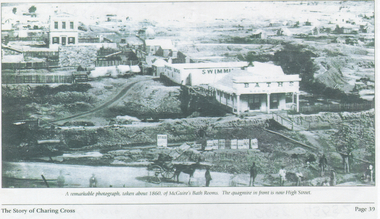
Photograph - In The Swim Collection: McGuire's Baths and Swimming Pool, Bendigo, Approximately 1860
... P. McGuire 'opposite View Point and Royal Hotels' in Sandhurst. Mr. McGuire had permission to erect a building which contained twelve baths, together with ladies' and gentlemen's dressing rooms. ...P. McGuire 'opposite View Point and Royal Hotels' in Sandhurst. Mr. McGuire had permission to erect a building which contained twelve baths, together with ladies' and gentlemen's dressing rooms. ...McGuire's Baths and Swimming Pool were constructed by Mr. P. McGuire 'opposite View Point and Royal Hotels' in Sandhurst. Mr. McGuire had permission to erect a building which contained twelve baths, together with ladies' and gentlemen's dressing rooms. The baths opened for business from 25th December, 1855. The establishment had a good supply of water. The water, 'after being used once', was 'passed into the Creek (Bendigo Creek)'. (Bendigo Advertiser, 25th December, '1855 'Baths, Baths, Baths' ) In November 1855 during the construction of the Baths a fire broke out, possibly started by a lighted cigar being left on wood shavings. The fire was extinguished by 'manual exertions'. There was a 'plenteous supply of water adjacent which contributed to the speedy extinguishing of the flames' In December 1863, a meeting was advertised to be held at McGuire's Baths for the purpose of establishing a swimming club (Bendigo Advertiser, 9th. December, 1863) By 1866, Mr. Matthew Moran now proprietor of the Baths since 1864, writes in a letter to the Bendigo Advertiser that 'we can now boast of the largest freshwater swimming baths in these colonies' and that 'any man can have a swim, a shower-bath and towel every day for the low charge of twopence three farthings'. Further 'we can boast of every king of baths except vapour or Turkish are very little wanted on Sandhurst, as the inhabitants are generally a very steady well conducted people'. ( Bendigo Advertiser, 29th October, 1866. Black and white copy of original photograph showing McGuire's Bath Rooms, Bendigo. Image shows building constructed near Bendigo Creek and adjoining current High Street, Bendigo. Sign on front of Building above verandah 'Baths'. Building at rear has 'Swimming' and 'Swimming Baths' signage on the front and side. In front of Baths buildings, a timber bridge across the Bendigo Creek. In foreground of image is High Street with a horse and cart with men standing along the road. Written on bottom of page 'a remarkable photograph, taken about 1860, of McGuire's Bath Rooms. The quagmire in front is now High Street' and 'The Story of Charing Cross'.bendigo, sandhurst, mcguire's baths, swimming pools, view point, mcguire and co, in the swim, horse and cart, charing cross, high street -
 Bendigo Historical Society Inc.
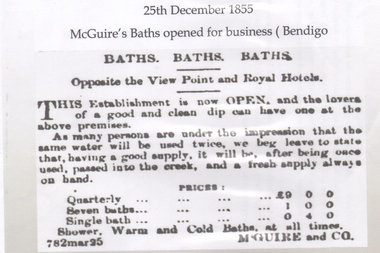
Document - In The Swim Collection: McGuire's Baths and Swimming Pool, 1855
... P. McGuire 'opposite View Point and Royal Hotels' in Sandhurst. Mr. McGuire had permission to erect a building which contained twelve baths, together with ladies' and gentlemen's dressing rooms. ...P. McGuire 'opposite View Point and Royal Hotels' in Sandhurst. Mr. McGuire had permission to erect a building which contained twelve baths, together with ladies' and gentlemen's dressing rooms. ...McGuire's Baths and Swimming Pool were constructed by Mr. P. McGuire 'opposite View Point and Royal Hotels' in Sandhurst. Mr. McGuire had permission to erect a building which contained twelve baths, together with ladies' and gentlemen's dressing rooms. The baths opened for business from 25th December, 1855. The establishment had a good supply of water. The water, 'after being used once', was 'passed into the Creek (Bendigo Creek)'. (Bendigo Advertiser, 25th December, '1855 'Baths, Baths, Baths' ) In November 1855 during the construction of the Baths a fire broke out, possibly started by a lighted cigar being left on wood shavings. The fire was extinguished by 'manual exertions'. There was a 'plenteous supply of water adjacent which contributed to the speedy extinguishing of the flames' In December 1863, a meeting was advertised to be held at McGuire's Baths for the purpose of establishing a swimming club (Bendigo Advertiser, 9th. December, 1863) By 1866, Mr. Matthew Moran now proprietor of the Baths since 1864, writes in a letter to the Bendigo Advertiser that 'we can now boast of the largest freshwater swimming baths in these colonies' and that 'any man can have a swim, a shower-bath and towel every day for the low charge of twopence three farthings'. Further 'we can boast of every king of baths except vapour or Turkish are very little wanted on Sandhurst, as the inhabitants are generally a very steady well conducted people'. ( Bendigo Advertiser, 29th October, 1866. One page copy of an advertisement placed in the 'Bendigo Advertiser' on 25th December, 1855, for the opening of McGuire's Baths.bendigo, sandhurst, mcguire's baths, swimming pools, view point, mcguire and co, in the swim -
 Bendigo Historical Society Inc.
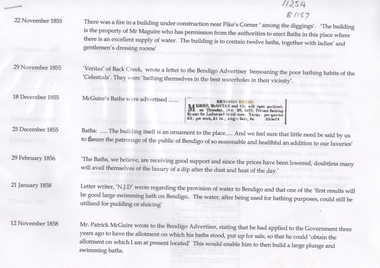
Document - In The Swim Collection: McGuire's Baths and Swimming Pool, Bendigo
... P. McGuire 'opposite View Point and Royal Hotels' in Sandhurst. Mr. McGuire had permission to erect a building which contained twelve baths, together with ladies' and gentlemen's dressing rooms. ...P. McGuire 'opposite View Point and Royal Hotels' in Sandhurst. Mr. McGuire had permission to erect a building which contained twelve baths, together with ladies' and gentlemen's dressing rooms. ...McGuire's Baths and Swimming Pool were constructed by Mr. P. McGuire 'opposite View Point and Royal Hotels' in Sandhurst. Mr. McGuire had permission to erect a building which contained twelve baths, together with ladies' and gentlemen's dressing rooms. The baths opened for business from 25th December, 1855. The establishment had a good supply of water. The water, 'after being used once', was 'passed into the Creek (Bendigo Creek)'. (Bendigo Advertiser, 25th December, '1855 'Baths, Baths, Baths' ) In November 1855 during the construction of the Baths a fire broke out, possibly started by a lighted cigar being left on wood shavings. The fire was extinguished by 'manual exertions'. There was a 'plenteous supply of water adjacent which contributed to the speedy extinguishing of the flames' In December 1863, a meeting was advertised to be held at McGuire's Baths for the purpose of establishing a swimming club (Bendigo Advertiser, 9th. December, 1863) By 1866, Mr. Matthew Moran now proprietor of the Baths since 1864, writes in a letter to the Bendigo Advertiser that 'we can now boast of the largest freshwater swimming baths in these colonies' and that 'any man can have a swim, a shower-bath and towel every day for the low charge of twopence three farthings'. Further 'we can boast of every king of baths except vapour or Turkish are very little wanted on Sandhurst, as the inhabitants are generally a very steady well conducted people'. ( Bendigo Advertiser, 29th October, 1866. Three page typed timeline describing the establishment and development of McGuire's Baths and Swimming Pool, Bendigo, during the period 1855 to 1872. sandhurst, bendigo, swimming pool, baths, mcguire's swimming pool and baths, fire, view point, royal hotel, bendigo creek
