
Showing 114 items matching "politics - state - victorian"
-
 Unions Ballarat
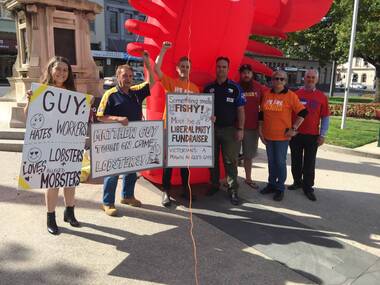
Photographs: Victorian State Election Campaign 2018, 23/4/18
... ...politics - state - victorian...Direct significance to the Ballarat Regional Trades and Labour Council and Victorian State politics. ballarat trades hall btlc ballarat trades and labour council ballarat city council guy, matthew liberal party of australia politics - state - victorian campaigns - elections politicians - leader of opposition victorian trades hall council australian labor party Electronic jpg images. ...Photographs of the Union 2018 State Election Campaign team. On 23 April 2018, Matthew Guy (Opposition Leader, Liberal Party) visited the City of Ballarat as part of his election campaign. Whilst Mr Guy was inside of the Ballarat Council building, activists from Trades Hall gathered outside with an enormous inflatable lobster. The lobster is a reminder of allegations made in 2017 that Guy dined on lobster with alleged mafia entities who may have been donors to the Liberal Party. 23 April 2018 - 2 photos. Left to right: - ; Doug Stewart, CMFEU; Brett Edgington, Unions Ballarat, Secretary; Alan Townsend, ANMF, Organiser; - ; Tracey Brown, HWU, Organiser. Back: Pinchy. Direct significance to the Ballarat Regional Trades and Labour Council and Victorian State politics.Electronic jpg images.ballarat trades hall, btlc, ballarat trades and labour council, ballarat city council, guy, matthew, liberal party of australia, politics - state - victorian, campaigns - elections, politicians - leader of opposition, victorian trades hall council, australian labor party -
 Flagstaff Hill Maritime Museum and Village
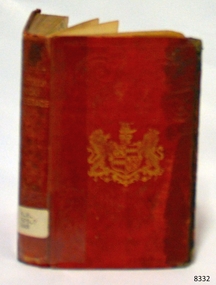
Book - Referance Book, Thomas Curson Hansard Junior, Hansards Pocket Peerage, 1854
... Victorian peerage guides like Debrett's or Burke's. With a Fawkner signature, it elevates this volume from a common reference book to a highly desirable piece of Australiana. Authentic artifacts, documents, or personal library books signed by the founders of Melbourne are scarce and deeply sought after by Australian universities, state libraries, museums, and private collectors of colonial history. An authenticated book from Fawkners personal political...Victorian peerage guides like Debrett's or Burke's. With a Fawkner signature, it elevates this volume from a common reference book to a highly desirable piece of Australiana. Authentic artifacts, documents, or personal library books signed by the founders of Melbourne are scarce and deeply sought after by Australian universities, state libraries, museums, and private collectors of colonial history. An authenticated book from Fawkners personal political ...This volume is a genealogical and biographical reference directory of the British nobility. It was designed as a compact, portable handbook detailing the titles, lineages, coats of arms, and family histories of the peers of Great Britain and Ireland, as well as bishops and baronets. While Thomas Curson Hansard is famous for establishing the printing of Britain's official parliamentary debates (Hansard), his firm also published these highly practical, condensed pocket guides for politicians, gentlemen, and libraries who needed quick access to the details of high society and parliamentary ranks.Hansards Pocket Peerage Publisher: T C Newby Date: 1854 Further Information: Signed by John Pascoe Fawknernon-fictionThis volume is a genealogical and biographical reference directory of the British nobility. It was designed as a compact, portable handbook detailing the titles, lineages, coats of arms, and family histories of the peers of Great Britain and Ireland, as well as bishops and baronets. While Thomas Curson Hansard is famous for establishing the printing of Britain's official parliamentary debates (Hansard), his firm also published these highly practical, condensed pocket guides for politicians, gentlemen, and libraries who needed quick access to the details of high society and parliamentary ranks.flagstaff hill, warrnambool, shipwrecked coast, flagstaff hill maritime museum, maritime museum, shipwreck coast, flagstaff hill maritime village, great ocean road, book, pattison collection, warrnambool library, warrnambool mechanics’ institute, ralph eric pattison, corangamite regional library service, warrnambool city librarian, mechanics’ institute library, victorian library board, warrnambool books and records, warrnambool children’s library, hansards pocket peerage, thomas cautley newby, thomas curson hansard junior, john pascoe fawkner -
 Flagstaff Hill Maritime Museum and Village
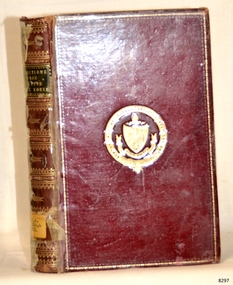
Book - Literary Work, John Milton, Selections from the Prose Works of John Milton, 1870
... State, essentially handling foreign correspondence and political propaganda. His prose is characterised by dense, complex sentences featuring a highly Latinate writing style. Milton was also a fierce advocate for individual liberties, such as free speech, and republicanism. The editor, the Reverend James John George Graham (M.A. Oxon), was a 19th-century English clergyman and scholar. He had a deep scholarly interest in Milton; in addition to this 1870 volume of selections, he also compiled and edited The Autobiography of John Milton: Or Milton's Life in His Own Words (published by Longmans in 1872). Clergymen of the Victorian...State, essentially handling foreign correspondence and political propaganda. His prose is characterised by dense, complex sentences featuring a highly Latinate writing style. Milton was also a fierce advocate for individual liberties, such as free speech, and republicanism. The editor, the Reverend James John George Graham (M.A. Oxon), was a 19th-century English clergyman and scholar. He had a deep scholarly interest in Milton; in addition to this 1870 volume of selections, he also compiled and edited The Autobiography of John Milton: Or Milton's Life in His Own Words (published by Longmans in 1872). Clergymen of the Victorian ...Selections from the Prose Works of John Milton (1870) is a curated compilation of the non-poetic writings of John Milton. While Milton is globally famous for epic poems like Paradise Lost, he spent a significant portion of his adult life writing fiery political and religious tracts. This specific volume, compiled and annotated by the Rev. James J.G. Graham, extracts the most powerful segments of Milton’s prose. The book organizes his writings to give readers a cohesive look at Milton's philosophy, including his arguments for the freedom of the press known as Areopagitica. This was a famous 1644 prose pamphlet by Milton, written to protest Parliament's Licensing Order of 1643, which mandated government pre-approval for all published books. It remains one of the most historically significant defences of freedom of speech and the press. This work also encompasses his thoughts on the right to overthrow tyrannical rulers, his views on church reform, and various autobiographical passages.Selections from the Prose Works of John Milton Author: John Milton Edited by the Rev.James J G Graham Publisher: Hurst and Blackett Date: 1870 Further Information: Red embossed hardcover with a red spine and lettering in gold. The spine has a Library label with an inscription.fictionSelections from the Prose Works of John Milton (1870) is a curated compilation of the non-poetic writings of John Milton. While Milton is globally famous for epic poems like Paradise Lost, he spent a significant portion of his adult life writing fiery political and religious tracts. This specific volume, compiled and annotated by the Rev. James J.G. Graham, extracts the most powerful segments of Milton’s prose. The book organizes his writings to give readers a cohesive look at Milton's philosophy, including his arguments for the freedom of the press known as Areopagitica. This was a famous 1644 prose pamphlet by Milton, written to protest Parliament's Licensing Order of 1643, which mandated government pre-approval for all published books. It remains one of the most historically significant defences of freedom of speech and the press. This work also encompasses his thoughts on the right to overthrow tyrannical rulers, his views on church reform, and various autobiographical passages.flagstaff hill, warrnambool, shipwrecked coast, flagstaff hill maritime museum, maritime museum, shipwreck coast, flagstaff hill maritime village, great ocean road, selections from the prose works of john milton, colac municipal library, rev.james j ggraham -
 Flagstaff Hill Maritime Museum and Village
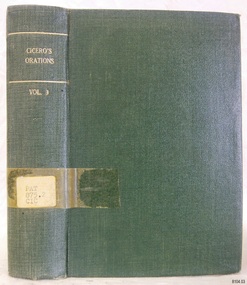
Book - Ancient Political Speeches/Reference, Henry George Bohn, The Orations of Marcus Tullius Cicero Vol 3, 1852
... victorian library board warrnambool books and records warrnambool children’s library Ralph Eric Pattison Marcus Tullius Cicero C.D. Yonge Bohn's Classical Library English translations The Orations of Marcus Tullius Cicero, Vol. 3 contains some of the most dramatic political speeches in ancient history. Volume 3 of this 1852 edition pivots away from the sweeping state ...The Orations of Marcus Tullius Cicero, Vol. 3 contains some of the most dramatic political speeches in ancient history. Volume 3 of this 1852 edition pivots away from the sweeping state conspiracies found in other volumes and focuses intensely on Cicero's personal political survival and highly dramatic legal defense trials. To understand its contents, you have to look at Cicero's life right before these speeches were given. In 58 BC, Cicero’s bitter enemy, Clodius, passed a law that forced Cicero into exile and destroyed his homes. A year later, Cicero was triumphantly recalled to Rome. Volume 3 is entirely made up of the legal battles and political speeches that followed his return as he fought to reclaim his property, protect his allies, and attack his enemies. If Volume 4 is about Cicero trying to save the dying Roman Republic from Mark Antony, Volume 3 is about Cicero saving his own skin, rebuilding his career, and fighting the corrupt gang politics of 1st-century BC Rome.The Orations of Marcus Tullius Cicero Vol 3 Author: C D Yonge Publisher: Henry G Bohn Date: 1852 Green cloth hard cover with Library label, title & Vol number on spine in gold letteringnon-fictionThe Orations of Marcus Tullius Cicero, Vol. 3 contains some of the most dramatic political speeches in ancient history. Volume 3 of this 1852 edition pivots away from the sweeping state conspiracies found in other volumes and focuses intensely on Cicero's personal political survival and highly dramatic legal defense trials. To understand its contents, you have to look at Cicero's life right before these speeches were given. In 58 BC, Cicero’s bitter enemy, Clodius, passed a law that forced Cicero into exile and destroyed his homes. A year later, Cicero was triumphantly recalled to Rome. Volume 3 is entirely made up of the legal battles and political speeches that followed his return as he fought to reclaim his property, protect his allies, and attack his enemies. If Volume 4 is about Cicero trying to save the dying Roman Republic from Mark Antony, Volume 3 is about Cicero saving his own skin, rebuilding his career, and fighting the corrupt gang politics of 1st-century BC Rome.warrnambool, shipwrecked-coast, flagstaff-hill, flagstaff-hill-maritime-museum, maritime-museum, flagstaff-hill-maritime-village, shipwrecked-artefact, book, a life, guy de maupassant, warrnambool mechanics’ institute, pattison collection, warrnambool library, corangamite regional library service, warrnambool city librarian, mechanics’ institute library, victorian library board, warrnambool books and records, warrnambool children’s library, ralph eric pattison, marcus tullius cicero, c.d. yonge, bohn's classical library, english translations -
 Connecting Home
book, Deadly Design, Bewteen Two Worlds, 2008
... Social Significance, The information recorded from stolen generation participants explains to non-aboriginal health & human service professionals about the social impact of the politically incorrect times that state & national laws and policies had been introduced to forcibly remove aboriginal & toerres strait islander children form family, land and culture. Research Significance, book stolen generations victoria victorian ...As a result of the recommendations arising from the Stolen Generations Taskforce Report 2003. The taskforce identified the need for an independant, community controlled organisation in Victoria to be established to meet the needs of the stolen generation in this state. Connecting Home seeks to undertalke activities that will assist members of the stolen generation and engage in publc awareness and education. Historic Significance, this is one of Victoria's first books published that helps to explain the thought & feelings of Stolen Generation people, that has been developed to address recommendations from the Bringing Them Home Report. Social Significance, The information recorded from stolen generation participants explains to non-aboriginal health & human service professionals about the social impact of the politically incorrect times that state & national laws and policies had been introduced to forcibly remove aboriginal & toerres strait islander children form family, land and culture. Research Significance, Soft cover book, with 43 pages. Picture of aboriginal girl, crying, holding teddy bear on front cover. Content is a guide aimed at understanding the Stolen Generations for Health & Human Service Professionals. book, stolen, generations, victoria, victorian, human, resources, syd, jackson, roseann, hepbruns haines, aiatsis, missions, rererves, aboriginal, legal, service, child, care, agency, health, education, consultative, group, housing, cooperative, bringing, them, home, counsellor, program, link, up, koori, heritage, trust -
 Flagstaff Hill Maritime Museum and Village
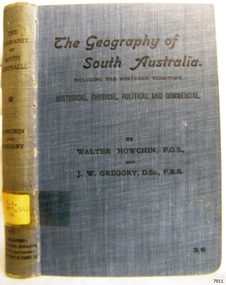
Book, The Geography of South Australia
... The Warrnambool Mechanics' Institute Library book collection is deemed to be of great importance because it is one of the few collections in an almost intact state, and many of the books are now very rare and of great value. warrnambool shipwrecked-coast flagstaff-hill flagstaff-hill-maritime-museum maritime-museum shipwreck-coast flagstaff-hill-maritime-village shipwrecked-artefact great ocean road book warrnambool library warrnambool mechanics’ institute mechanics’ institute library victorian library board warrnambool books and records warrnambool children’s library warrnambool public library Label on spine cover with typed text RA 911.942 HOW Pastedown front endpaper has sticker from Warrnambool Mechanics Institute and Free Library The Geography of South Australia including The Northern Territory Historical, Physical, Political and Commercial Author: Walter Howchin Publisher: Whitcombe and Tombs Ltd Date: 1911 The Geography of South Australia Book ...Warrnambool's Mechanics' Institute (or Institution as it was sometimes called) was one of the earliest in Victoria. On 17th October 1853 a meeting was held where it was resolved to request the Lieutenant Governor of the Colony to grant land for the erection of a Mechanics' Institutes building. A committee was formed at the meeting and Richard Osburne chaired the first meeting of this committee. The land on the North West corner of Banyan and Merri Streets was granted but there were no funds to erect the building. The Formal Rights of the Warrnambool Mechanics' Institute's encompassed its aims and these were officially adopted in1859; "This Institution has for its object the diffusion of literary, scientific, and other useful knowledge amongst its members, excluding all controversial subjects, religious or political. These objects are sought to be obtained by means of a circulating library, a reading room, the establishment of classes, debates, and the occasional delivery of lectures on natural and experimental philosophy, mechanics, astronomy, chemistry, natural history, literature, and the useful and ornamental arts, particularly those which have a more immediate reference to the colony." The Warrnambool Mechanics' Institute opened its first reading room in November1884 in the National School building at the corner of Banyan and Timor Streets. The Institute was funded by member subscription, payable on a quarterly, half yearly or yearly basis. Samuel Hannaford, the Manager of the Warrnambool Bank of Australasia, was the first Honorary Secretary of the Mechanics' Institutes, and an early President and Vice-President. He also gave several of the early lectures in the Reading Room. Another early Secretary, Librarian and lecturer was Marmaduke Fisher, the teacher at the National School. Lecture topics included The Poets and Poetry of Ireland', 'The Birth and Development of the Earth', 'The Vertebrae - with Remarks on the pleasures resulting from the study of Natural History' and 'Architecture'. In 1856 the Reading Room was moved to James Hider's shop in Timor Street, and by 1864 it was located in the bookshop of Davies and Read. In the 1860's the Mechanics' Institute struggled as membership waned but in 1866, after a series of fund raising efforts, the committee was able to purchase land in Liebig Street, on a site then called Market Square, between the weighbridge and the fire station. A Mechanics' Institute building was opened at this site in August 1871. The following year four more rooms were added to the main Reading Room and in 1873 the Artisan School of Design was incorporated into the Institute. The same year Joseph Archibald established a Museum; however it deteriorated when he was transferred to Bendigo in 1877. In 1880, with Archibald's return to Warrnambool, the Museum was re-established, and in 1885 a new building was built at the back of the Institute to accommodate the re-created School of Design, the Art Gallery and the Museum. In 1887 the Museum section was moved to the former court house in Timor Street (for some time the walls of the building formed part of the TAFE cafeteria but all is now demolished)). In 1911 the Museum was transferred back to the original building and the management of the Mechanics' Institute was handed over to the Warrnambool City Council. The Museum and Art Gallery became one and housed many fine works of art, and the Library continued to grow. The building was well patronised, with records showing that at the beginning of the 20th century there were between 500 and 800 visitors. During World War One the monthly figures were in the thousands, with 3,400 people visiting in January 1915. The Museum was a much loved Institution in Warrnambool until the contents of the Museum and Art Gallery were removed to make room for the Warrnambool City Council Engineers' Department. The contents were stored but many of the items were scattered or lost. When the original building was demolished the site became occupied by the Civic Centre, which included the new City Library. (The library was temporarily located in the old Palais building in Koroit Street.) In the process of reorganisation the Collection was distributed amongst the community groups: -The new City Library took some of the historic books and some important documents, historic photographs and newspapers. -The Art Gallery kept the 19th Century art collection and some of the artefacts from the museum. -The Historic Society has some items -The State Museum has some items -Some items were destroyed -Flagstaff Hill Maritime Village has old newspapers, Government Gazettes, most of the Mechanics' Institute Library, ledgers and documents connected to the Mechanics' Institute Library, some framed and unframed art works and some photographs. The Warrnambool Mechanics' Institute Library book collection is deemed to be of great importance because it is one of the few collections in an almost intact state, and many of the books are now very rare and of great value. The Geography of South Australia including The Northern Territory Historical, Physical, Political and Commercial Author: Walter Howchin Publisher: Whitcombe and Tombs Ltd Date: 1911Label on spine cover with typed text RA 911.942 HOW Pastedown front endpaper has sticker from Warrnambool Mechanics Institute and Free Librarywarrnambool, shipwrecked-coast, flagstaff-hill, flagstaff-hill-maritime-museum, maritime-museum, shipwreck-coast, flagstaff-hill-maritime-village, shipwrecked-artefact, great ocean road, book, warrnambool library, warrnambool mechanics’ institute, mechanics’ institute library, victorian library board, warrnambool books and records, warrnambool children’s library, warrnambool public library -
 Flagstaff Hill Maritime Museum and Village
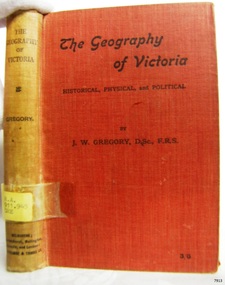
Book, The Geography of Victoria
... The Warrnambool Mechanics' Institute Library book collection is deemed to be of great importance because it is one of the few collections in an almost intact state, and many of the books are now very rare and of great value. warrnambool shipwrecked-coast flagstaff-hill flagstaff-hill-maritime-museum maritime-museum shipwreck-coast flagstaff-hill-maritime-village shipwrecked-artefact great ocean road book warrnambool library warrnambool mechanics’ institute mechanics’ institute library victorian library board warrnambool books and records warrnambool children’s library warrnambool public library The Geography of Victoria J W Gregory Label on spine cover with typed text RA 911.945 GRE Pastedown front endpaper has sticker from Warrnambool Mechanics Institute and Free Library The Geography of Victoria Historical, Physical and Political Author: J W Gregory Publisher: Whitcombe and Tombs Ltd Date: 1904 The Geography of Victoria Book ...Warrnambool's Mechanics' Institute (or Institution as it was sometimes called) was one of the earliest in Victoria. On 17th October 1853 a meeting was held where it was resolved to request the Lieutenant Governor of the Colony to grant land for the erection of a Mechanics' Institutes building. A committee was formed at the meeting and Richard Osburne chaired the first meeting of this committee. The land on the North West corner of Banyan and Merri Streets was granted but there were no funds to erect the building. The Formal Rights of the Warrnambool Mechanics' Institute's encompassed its aims and these were officially adopted in1859; "This Institution has for its object the diffusion of literary, scientific, and other useful knowledge amongst its members, excluding all controversial subjects, religious or political. These objects are sought to be obtained by means of a circulating library, a reading room, the establishment of classes, debates, and the occasional delivery of lectures on natural and experimental philosophy, mechanics, astronomy, chemistry, natural history, literature, and the useful and ornamental arts, particularly those which have a more immediate reference to the colony." The Warrnambool Mechanics' Institute opened its first reading room in November1884 in the National School building at the corner of Banyan and Timor Streets. The Institute was funded by member subscription, payable on a quarterly, half yearly or yearly basis. Samuel Hannaford, the Manager of the Warrnambool Bank of Australasia, was the first Honorary Secretary of the Mechanics' Institutes, and an early President and Vice-President. He also gave several of the early lectures in the Reading Room. Another early Secretary, Librarian and lecturer was Marmaduke Fisher, the teacher at the National School. Lecture topics included The Poets and Poetry of Ireland', 'The Birth and Development of the Earth', 'The Vertebrae - with Remarks on the pleasures resulting from the study of Natural History' and 'Architecture'. In 1856 the Reading Room was moved to James Hider's shop in Timor Street, and by 1864 it was located in the bookshop of Davies and Read. In the 1860's the Mechanics' Institute struggled as membership waned but in 1866, after a series of fund raising efforts, the committee was able to purchase land in Liebig Street, on a site then called Market Square, between the weighbridge and the fire station. A Mechanics' Institute building was opened at this site in August 1871. The following year four more rooms were added to the main Reading Room and in 1873 the Artisan School of Design was incorporated into the Institute. The same year Joseph Archibald established a Museum; however it deteriorated when he was transferred to Bendigo in 1877. In 1880, with Archibald's return to Warrnambool, the Museum was re-established, and in 1885 a new building was built at the back of the Institute to accommodate the re-created School of Design, the Art Gallery and the Museum. In 1887 the Museum section was moved to the former court house in Timor Street (for some time the walls of the building formed part of the TAFE cafeteria but all is now demolished)). In 1911 the Museum was transferred back to the original building and the management of the Mechanics' Institute was handed over to the Warrnambool City Council. The Museum and Art Gallery became one and housed many fine works of art, and the Library continued to grow. The building was well patronised, with records showing that at the beginning of the 20th century there were between 500 and 800 visitors. During World War One the monthly figures were in the thousands, with 3,400 people visiting in January 1915. The Museum was a much loved Institution in Warrnambool until the contents of the Museum and Art Gallery were removed to make room for the Warrnambool City Council Engineers' Department. The contents were stored but many of the items were scattered or lost. When the original building was demolished the site became occupied by the Civic Centre, which included the new City Library. (The library was temporarily located in the old Palais building in Koroit Street.) In the process of reorganisation the Collection was distributed amongst the community groups: -The new City Library took some of the historic books and some important documents, historic photographs and newspapers. -The Art Gallery kept the 19th Century art collection and some of the artefacts from the museum. -The Historic Society has some items -The State Museum has some items -Some items were destroyed -Flagstaff Hill Maritime Village has old newspapers, Government Gazettes, most of the Mechanics' Institute Library, ledgers and documents connected to the Mechanics' Institute Library, some framed and unframed art works and some photographs. The Warrnambool Mechanics' Institute Library book collection is deemed to be of great importance because it is one of the few collections in an almost intact state, and many of the books are now very rare and of great value. The Geography of Victoria Historical, Physical and Political Author: J W Gregory Publisher: Whitcombe and Tombs Ltd Date: 1904Label on spine cover with typed text RA 911.945 GRE Pastedown front endpaper has sticker from Warrnambool Mechanics Institute and Free Librarywarrnambool, shipwrecked-coast, flagstaff-hill, flagstaff-hill-maritime-museum, maritime-museum, shipwreck-coast, flagstaff-hill-maritime-village, shipwrecked-artefact, great ocean road, book, warrnambool library, warrnambool mechanics’ institute, mechanics’ institute library, victorian library board, warrnambool books and records, warrnambool children’s library, warrnambool public library, the geography of victoria, j w gregory -
 Supreme Court of Victoria Library
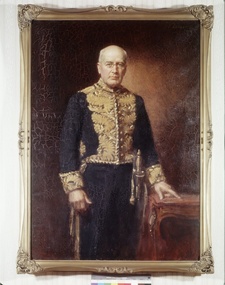
Painting - Portrait, Sir William Irvine
... State of Victoria. Irvine was a member of the Victorian Legislative Assembly from 1894 to 1904, as well as Attorney-General , he was later Premier. Retiring from state politics...State of Victoria. Irvine was a member of the Victorian Legislative Assembly from 1894 to 1904, as well as Attorney-General , he was later Premier. Retiring from state politics ...This is a portrait of Sir William Irvine, not in his judical robes, but those of Lt Governor of the State of Victoria. Irvine was a member of the Victorian Legislative Assembly from 1894 to 1904, as well as Attorney-General , he was later Premier. Retiring from state politics after a particularly bruising encounter with the Railway Unions, he entered federal politics as the member for Flinders. He became Federal Attorney General in the period 1913-1914. During World War One Irvine campaigned strongly for the introduction of the complusory military service (conscription) until being elevated to the bench in 1918. With his appointment as Chief Justice, he became a lieutenant governor in 1919, and was acting Governor for the state of Victoria for a period of nearly 3 years in the early 1930s. The painting is of interest for its subject (Irvine) and the artist who painted it, 5 times Archibald winner Sir John Longstaff.3/4 length portrait in oils of Sir William Irvine. Irvine is standing his finger resting on the deak. He is in Vice-Regal clothing, a black suit with plenty of gold braid.Signed and dated 1934 upper right cornerirvine william, longstaff john -
 Kiewa Valley Historical Society
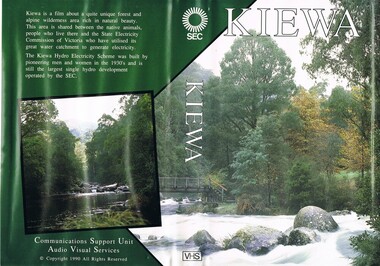
VHS Tape - Kiewa Hydro Electricity Scheme x2, Kiewa, Circa 1990
... This VHS was produced by the State Electricity Commission of Victoria, to show the pristine state of the Kiewa River and Valley post the completion of the Kiewa Hydro Electricity Scheme (Circa 1950s), The late 1970s on wards was the beginning of deeper social scrutineering by pro environmental groups such as the Australian Wilderness Society (1976) and the Greens (political Party), before, during and after the construction phases of any man made structures in forest/bush areas which may or could damage or adversely affect the natural flora and fauna of sites. This promotional VHS, which was produced in the 1990s, was to project that unlike the Tasmanian State Electricity Commission (Franklin Dam issue), the Victorian...This VHS was produced by the State Electricity Commission of Victoria, to show the pristine state of the Kiewa River and Valley post the completion of the Kiewa Hydro Electricity Scheme (Circa 1950s), The late 1970s on wards was the beginning of deeper social scrutineering by pro environmental groups such as the Australian Wilderness Society (1976) and the Greens (political Party), before, during and after the construction phases of any man made structures in forest/bush areas which may or could damage or adversely affect the natural flora and fauna of sites. This promotional VHS, which was produced in the 1990s, was to project that unlike the Tasmanian State Electricity Commission (Franklin Dam issue), the Victorian ...This VHS was produced by the State Electricity Commission of Victoria, to show the pristine state of the Kiewa River and Valley post the completion of the Kiewa Hydro Electricity Scheme (Circa 1950s), The late 1970s on wards was the beginning of deeper social scrutineering by pro environmental groups such as the Australian Wilderness Society (1976) and the Greens (political Party), before, during and after the construction phases of any man made structures in forest/bush areas which may or could damage or adversely affect the natural flora and fauna of sites. This promotional VHS, which was produced in the 1990s, was to project that unlike the Tasmanian State Electricity Commission (Franklin Dam issue), the Victorian State Electricity Commission acted in a way to protect the environment to the maximum level possible. With the passage of time since, and the issue of the global push to minimise carbon pollution, and as an alternative to coal fired power stations, the use of hydro electricity can now be seen as a highly efficient alternative to "coal powered" electricity. This VHS is a snap shot in time (1990) when the Kiewa Valley was still relatively under populated and holiday houses owned by city bound workers was still relatively insignificant. As more and more holiday makers retire to a small but friendly region(Kiewa Valley and Mount Beauty) the increase in visitor numbers will affect the local rural bush scene more and more. The changes that will occur (in time) can be measured against the scenes presented in this video. The additional resources provided by the State Electricity Commission of Victoria of "alpine bush" fire control and management, together with an ongoing educational scheme for school children in learning about what constitutes the Alpine country's unique environment, are a very important offshoot, benefitting to both the communities within the Kiewa Valley and regional Victoria.This VHS tape is stored within its own plastic cover which has a front side covered by a coloured photograph(both front and back cover) of the Kiewa River, just to the north east of the Mount Beauty township. The VHS tape is nestled within a formed inner structure which not only prevents the tape from moving to and fro but also unnecessary intrusion of foreign particles.Front cover "KIEWA" on the spine top circle with lines projecting out and below this "SEC". Middle of spine "KIEWA" and bottom of spine "VHS"secv, kiewa valley, dale-bromley, cy-duff, chris- harding, michael-glucz, forestation education, wilderness photography, nature film. -
 Kiewa Valley Historical Society
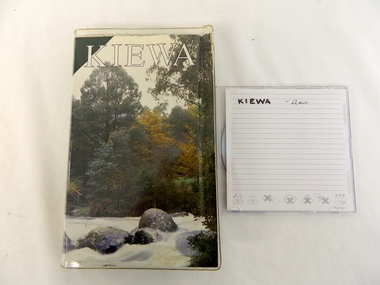
DVD - Kiewa Hydro Electricity Scheme, KIEWA, Circa 1990
... This DVD is a digital reproduction of a VHS produced by the State Electricity Commission of Victoria, to show the pristine state of the Kiewa River and Valley post the completion of the Kiewa Hydro Electricity Scheme (Circa 1950s), The late 1970s on wards was the beginning of deeper social scrutineering by pro environmental groups such as the Australian Wilderness Society (1976) and the Greens (political Party), before, during and after the construction phases of any man made structures in forest/bush areas which may or could damage or adversely affect the natural flora and fauna of sites. This promotional VHS, which was produced in the 1990s, was to project that unlike the Tasmanian State Electricity Commission (Franklin Dam issue), the Victorian...This DVD is a digital reproduction of a VHS produced by the State Electricity Commission of Victoria, to show the pristine state of the Kiewa River and Valley post the completion of the Kiewa Hydro Electricity Scheme (Circa 1950s), The late 1970s on wards was the beginning of deeper social scrutineering by pro environmental groups such as the Australian Wilderness Society (1976) and the Greens (political Party), before, during and after the construction phases of any man made structures in forest/bush areas which may or could damage or adversely affect the natural flora and fauna of sites. This promotional VHS, which was produced in the 1990s, was to project that unlike the Tasmanian State Electricity Commission (Franklin Dam issue), the Victorian ...This DVD is a digital reproduction of a VHS produced by the State Electricity Commission of Victoria, to show the pristine state of the Kiewa River and Valley post the completion of the Kiewa Hydro Electricity Scheme (Circa 1950s), The late 1970s on wards was the beginning of deeper social scrutineering by pro environmental groups such as the Australian Wilderness Society (1976) and the Greens (political Party), before, during and after the construction phases of any man made structures in forest/bush areas which may or could damage or adversely affect the natural flora and fauna of sites. This promotional VHS, which was produced in the 1990s, was to project that unlike the Tasmanian State Electricity Commission (Franklin Dam issue), the Victorian State Electricity Commission acted in a way to protect the environment to the maximum level possible. With the passage of time since, and the issue of the global push to minimise carbon pollution, and as an alternative to coal fired power stations, the use of hydro electricity can now be seen as a highly efficient alternative to "coal powered" electricity. This item provids a snap shot in time (1990) when the Kiewa Valley was still relatively under populated and holiday houses owned by city bound workers was still relatively insignificant. As more and more holiday makers retire to a small but friendly region(Kiewa Valley and Mount Beauty) the increase in visitor numbers will affect the local rural bush scene more and more. The changes that will occur (in time) can be measured against the scenes presented in this video. The additional resources provided by the State Electricity Commission of Victoria to "alpine bush" fire control and management, together with an ongoing educational scheme for school children in learning about what constitutes the Alpine country's unique environment, are a very important offshoot, benefitting to both the communities within the Kiewa Valley and regional Victoria. The DVD is nestled within a formed inner structure (case), which not only prevents the disc from moving to and fro but also unnecessary intrusion of foreign particles.This DVD is a TDK data/video recordable single sided 4.7 GB disc.It is a 1-16x speed."KIEWA" on disc.secv, kiewa valley, dale-bromley, cy-duff, chris- harding, michael-glucz, forestation education, wilderness photography, nature film. -
 Kiewa Valley Historical Society
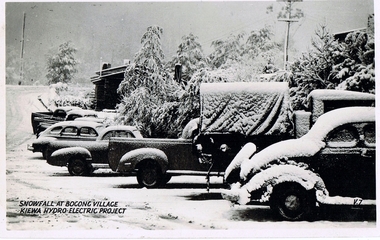
Postcard Circa 1950, Snowfall at Bogong Village Kiewa Hydro-Electric Project, 1950s
... State of Victoria was pressured by the ever increasing demand by industry and its population for electricity supplies. Hydro electricity was seen as an untapped natural resource to quench this demand. The Victorian Alps and the rivers flowing into its valleys was ideal for the construction of the Kiewa Hydro Electricity Scheme. The late 1940's saw the development of this scheme and the changing of sections of alpine landscape is covered by this and other postcards/pictures (tourists, construction workers, and established rural populations). This period in time was before the established wildlife and forest/nature groups became political...State of Victoria was pressured by the ever increasing demand by industry and its population for electricity supplies. Hydro electricity was seen as an untapped natural resource to quench this demand. The Victorian Alps and the rivers flowing into its valleys was ideal for the construction of the Kiewa Hydro Electricity Scheme. The late 1940's saw the development of this scheme and the changing of sections of alpine landscape is covered by this and other postcards/pictures (tourists, construction workers, and established rural populations). This period in time was before the established wildlife and forest/nature groups became political ...This postcard was produced in the 1950's for the tourist trade in the Kiewa Valley and Alpine region. It encompasses the period when the State of Victoria was pressured by the ever increasing demand by industry and its population for electricity supplies. Hydro electricity was seen as an untapped natural resource to quench this demand. The Victorian Alps and the rivers flowing into its valleys was ideal for the construction of the Kiewa Hydro Electricity Scheme. The late 1940's saw the development of this scheme and the changing of sections of alpine landscape is covered by this and other postcards/pictures (tourists, construction workers, and established rural populations). This period in time was before the established wildlife and forest/nature groups became political activist who changed legislative acts to protect the environment.This rural region (Kiewa Valley/alpine plains) was at most only significant to a smaller group of winter sports, summer hikers/horse riders and rural farmers/graziers. The numbers of tourists and the increase in the local resident population was boosted by the construction of the Hydro Electricity Scheme. This influx to the regional population resulted in a corresponding diversity in services and brought about an environment that responded to a growing level of tourists and thereby permitting this industry to grow more rapidly than it would have naturally. This postcard details an attraction to the "cleaner" method of providing electricity. This postcard was purchased in 1950 by a surveyor at Landford's Gap.This scanned black and white photograph of a postcard, shows vehicles covered in thick snow at Bogong Village in 1950. See 0480(A), (C) - (F) for other similar photos of postcards available at this period."SNOWFALL AT BOGONG VILLAGE KIEWA HYDRO-ELECTRICITY PROJECT"kiewa valley tourism, victorian alps, alternate energy supplies, alpine population growth, bogong village, secv -
 Kiewa Valley Historical Society
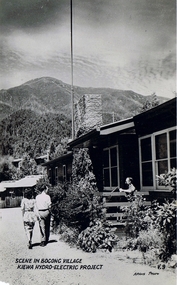
Postcard Circa 1950, Scene in Bogong Village Kiewa Hydro-Electric Project, 1950s
... State of Victoria was pressured by the ever increasing demand by industry and its population for electricity supplies. Hydro electricity was seen as an untapped natural resource to quench this demand. The Victorian Alps and the rivers flowing into its valleys was ideal for the construction of the Kiewa Hydro Electricity Scheme. The late 1940's saw the development of this scheme and the changing of sections of alpine landscape is covered by this and other postcards/pictures (tourists, construction workers, and established rural populations). This period in time was before the established wildlife and forest/nature groups became political...State of Victoria was pressured by the ever increasing demand by industry and its population for electricity supplies. Hydro electricity was seen as an untapped natural resource to quench this demand. The Victorian Alps and the rivers flowing into its valleys was ideal for the construction of the Kiewa Hydro Electricity Scheme. The late 1940's saw the development of this scheme and the changing of sections of alpine landscape is covered by this and other postcards/pictures (tourists, construction workers, and established rural populations). This period in time was before the established wildlife and forest/nature groups became political ...This postcard was produced in the 1950's for the tourist trade in the Kiewa Valley and Alpine region. It encompasses the period when the State of Victoria was pressured by the ever increasing demand by industry and its population for electricity supplies. Hydro electricity was seen as an untapped natural resource to quench this demand. The Victorian Alps and the rivers flowing into its valleys was ideal for the construction of the Kiewa Hydro Electricity Scheme. The late 1940's saw the development of this scheme and the changing of sections of alpine landscape is covered by this and other postcards/pictures (tourists, construction workers, and established rural populations). This period in time was before the established wildlife and forest/nature groups became political activist who changed legislative acts to protect the environment. This rural region (Kiewa Valley/alpine plains) was at most only significant to a smaller group of winter sports, summer hikers/horse riders and rural farmers/graziers. The numbers of tourists and the increase in the local resident population was boosted by the construction of the Hydro Electricity Scheme. This influx to the regional population resulted in a corresponding diversity in services and brought about an environment that responded to a growing level of tourists and thereby permitting this industry to grow more rapidly than it would have naturally. This postcard details an attraction to the "cleaner" method of providing electricity. This postcard was purchased in 1950 by a surveyor at Landford's Gap. The couple shown in this photograph would have been employed by the S.E.C. under the Kiewa Hydro-Electricity Scheme.This item is a scanned black and white photograph of a couple walking along a gravel street in Bogong Village in 1950. See 0480 (A) ,(B), (D) - (F) for other photos of similar postcards" SCENE IN BOGONG VILLAGE KIEWA HYDRO-ELECTRIC PROJECT"kiewa valley tourism, victorian alps, alternate energy supplies, alpine population growth, bogong, secv -
 Kiewa Valley Historical Society
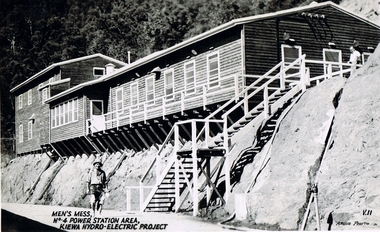
Postcard Circa 1950, Men's Mess No.4 Power Station, Kiewa Hydro-Electric Project
... State of Victoria was pressured by the ever increasing demand by industry and its population for electricity supplies. Hydro electricity was seen as an untapped natural resource to quench this demand. The Victorian Alps and the rivers flowing into its valleys was ideal for the construction of the Kiewa Hydro Electricity Scheme. The late 1940's saw the development of this scheme and the changing of sections of alpine landscape is covered by this and other postcards/pictures (tourists, construction workers, and established rural populations). This period in time was before the established wildlife and forest/nature groups became political...State of Victoria was pressured by the ever increasing demand by industry and its population for electricity supplies. Hydro electricity was seen as an untapped natural resource to quench this demand. The Victorian Alps and the rivers flowing into its valleys was ideal for the construction of the Kiewa Hydro Electricity Scheme. The late 1940's saw the development of this scheme and the changing of sections of alpine landscape is covered by this and other postcards/pictures (tourists, construction workers, and established rural populations). This period in time was before the established wildlife and forest/nature groups became political ...This postcard was produced in the 1950's for the tourist trade in the Kiewa Valley and Alpine region. It encompasses the period when the State of Victoria was pressured by the ever increasing demand by industry and its population for electricity supplies. Hydro electricity was seen as an untapped natural resource to quench this demand. The Victorian Alps and the rivers flowing into its valleys was ideal for the construction of the Kiewa Hydro Electricity Scheme. The late 1940's saw the development of this scheme and the changing of sections of alpine landscape is covered by this and other postcards/pictures (tourists, construction workers, and established rural populations). This period in time was before the established wildlife and forest/nature groups became political activist who changed legislative acts to protect the environment.Although this photo details the eating facilities of the construction workers at the power station it was not only a postcard for the people employed in the Hydro Scheme is was also provided to tourists visiting the area and thus used for promotional purposes.This rural region (Kiewa Valley/alpine plains) was at most only significant to a smaller group of winter sports, summer hikers/horse riders and rural farmers/graziers. The numbers of tourists and the increase in the local resident population was boosted by the construction of the Hydro Electricity Scheme. This influx to the regional population resulted in a corresponding diversity in services and brought about an environment that responded to a growing level of tourists and thereby permitting this industry to grow more rapidly than it would have naturally. This postcard details an attraction to the "cleaner" method of providing electricity. This postcard was purchased in 1950 by a surveyor at Landford's Gap. The men shown in this photograph would have been employed by the S.E.C. under the Kiewa Hydro-Electricity Scheme.This item is a scanned black and white photograph of a construction worker walking from stairs leading down from the men's mess building, in 1950. See 0480 (A) -(C), (E) - (F) for other photos of similar postcards"MEN'S MESS No.4 POWER STATION AREA, KIEWA HYDRO-ELECTRIC PROJECT" "ARGUS PHOTO V.IIkiewa valley tourism, victorian alps, alternate energy supplies, alpine population growth, secv -
 Kiewa Valley Historical Society
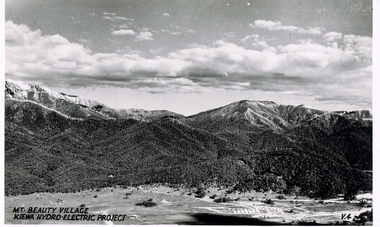
Postcard Circa 1950, Mt. Beauty Village, Kiewa Hydro-Electricity Project, circa 1950
... State of Victoria was pressured by the ever increasing demand by industry and its population for electricity supplies. Hydro electricity was seen as an untapped natural resource to quench this demand. The Victorian Alps and the rivers flowing into its valleys was ideal for the construction of the Kiewa Hydro Electricity Scheme. The late 1940's saw the development of this scheme and the changing of sections of alpine landscape is covered by this and other postcards/pictures (tourists, construction workers, and established rural populations). This period in time was before the established wildlife and forest/nature groups became political...State of Victoria was pressured by the ever increasing demand by industry and its population for electricity supplies. Hydro electricity was seen as an untapped natural resource to quench this demand. The Victorian Alps and the rivers flowing into its valleys was ideal for the construction of the Kiewa Hydro Electricity Scheme. The late 1940's saw the development of this scheme and the changing of sections of alpine landscape is covered by this and other postcards/pictures (tourists, construction workers, and established rural populations). This period in time was before the established wildlife and forest/nature groups became political ...This postcard was produced in the 1950's for the tourist trade in the Kiewa Valley and Alpine region. It encompasses the period when the State of Victoria was pressured by the ever increasing demand by industry and its population for electricity supplies. Hydro electricity was seen as an untapped natural resource to quench this demand. The Victorian Alps and the rivers flowing into its valleys was ideal for the construction of the Kiewa Hydro Electricity Scheme. The late 1940's saw the development of this scheme and the changing of sections of alpine landscape is covered by this and other postcards/pictures (tourists, construction workers, and established rural populations). This period in time was before the established wildlife and forest/nature groups became political activist who changed legislative acts to protect the environment. The regulatory pondage on the northern aspect of the village had no water over-spill from the unfinished power station.This rural region in 1950 (Kiewa Valley/alpine plains) was at most only significant to a smaller group of winter sports, summer hikers/horse riders and rural farmers/graziers. The numbers of tourists and the increase in the local resident population was boosted by the construction of the Hydro Electricity Scheme. This influx to the regional population resulted in a corresponding diversity in services and brought about an environment that responded to a growing level of tourists and thereby permitting this industry to grow more rapidly than it would have naturally. This postcard details an attraction to the "cleaner" method of providing electricity. This postcard was purchased in 1950 by a surveyor at Landford's Gap. The couple shown in this photograph would have been employed by the S.E.C. under the Kiewa Hydro-Electricity Scheme.This item is a scanned black and white photograph of a panoramic view of Mount Beauty Village in 1950 (a closed village, entry by pass only). The regulatory pondage has earthen walls but no water.See 0480 (A) -(D) and (F) for other photos of similar postcards"MT. BEAUTY VILLAGE KIEWA HYDRO-ELECTRIC PROJECT"kiewa valley tourism, victorian alps, alternate energy supplies, alpine population growth -
 Kiewa Valley Historical Society
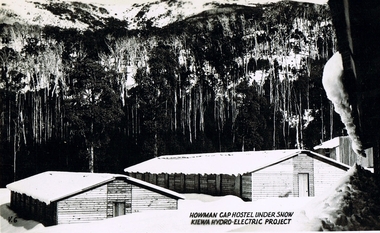
Postcard Circa 1950, Howman Gap Hostel under snow Kiewa Hydro-Electric Project, Circa 1950
... State of Victoria was pressured by the ever increasing demand by industry and its population for electricity supplies. Hydro electricity was seen as an untapped natural resource to quench this demand. The Victorian Alps and the rivers flowing into its valleys was ideal for the construction of the Kiewa Hydro Electricity Scheme. The late 1940's saw the development of this scheme and the changing of sections of alpine landscape is covered by this and other postcards/pictures (tourists, construction workers, and established rural populations). This period in time was before the established wildlife and forest/nature groups became political...State of Victoria was pressured by the ever increasing demand by industry and its population for electricity supplies. Hydro electricity was seen as an untapped natural resource to quench this demand. The Victorian Alps and the rivers flowing into its valleys was ideal for the construction of the Kiewa Hydro Electricity Scheme. The late 1940's saw the development of this scheme and the changing of sections of alpine landscape is covered by this and other postcards/pictures (tourists, construction workers, and established rural populations). This period in time was before the established wildlife and forest/nature groups became political ...This postcard was produced in the 1950's for the tourist trade in the Kiewa Valley and Alpine region. It encompasses the period when the State of Victoria was pressured by the ever increasing demand by industry and its population for electricity supplies. Hydro electricity was seen as an untapped natural resource to quench this demand. The Victorian Alps and the rivers flowing into its valleys was ideal for the construction of the Kiewa Hydro Electricity Scheme. The late 1940's saw the development of this scheme and the changing of sections of alpine landscape is covered by this and other postcards/pictures (tourists, construction workers, and established rural populations). This period in time was before the established wildlife and forest/nature groups became political activist who changed legislative acts to protect the environment.This rural region (Kiewa Valley/alpine plains) was at most only significant to a smaller group of winter sports, summer hikers/horse riders and rural farmers/graziers. The numbers of tourists and the increase in the local resident population was boosted by the construction of the Hydro Electricity Scheme. This influx to the regional population resulted in a corresponding diversity in services and brought about an environment that responded to a growing level of tourists and thereby permitting this industry to grow more rapidly than it would have naturally. This postcard details an attraction to the "cleaner" method of providing electricity. This postcard was purchased in 1950 by a surveyor at Landford's Gap.This item is a scanned black and white photograph of a panoramic view of Howman Gap Hostel under snow in 1950 (a closed village, entry by pass only). This accommodation was for construction workers only. See 0480 (A) -(E) for other photos of similar postcards.On the photo, " Howman Gap Hostel under snow Kiewa Hydro-Electric Project" . On postcard address and personal information side "V.2 Valentine's Post Card "kiewa valley tourism, victorian alps, alternate energy supplies, alpine population growth, bogong, secv, howman's gap hostel -
Eltham District Historical Society Inc
Folder, Sir William Irvine
... Victorian Parliament in 1894. He rose to the position of Leader of the Opposition and in 1902 became Premier. He resigned in 1904 for health reasons but in 1906 entered Federal politics as the member for Flinders. He was knighted in 1913 and in 1918 resigned to take up the position of Chief Justice of Victoria. From 1919 he administered the state...Victorian Parliament in 1894. He rose to the position of Leader of the Opposition and in 1902 became Premier. He resigned in 1904 for health reasons but in 1906 entered Federal politics as the member for Flinders. He was knighted in 1913 and in 1918 resigned to take up the position of Chief Justice of Victoria. From 1919 he administered the state ...Sir William Irvine, (1858-1943) Eltham, Politician and Judge. "William Irvine was born at Dromalene, Newry, Down, Ireland and after the death of his father emigrated to Melbourne with his mother in 1879. Here be completed his legal studies and spent some years teaching and in legal practice before entering the Victorian Parliament in 1894. He rose to the position of Leader of the Opposition and in 1902 became Premier. He resigned in 1904 for health reasons but in 1906 entered Federal politics as the member for Flinders. He was knighted in 1913 and in 1918 resigned to take up the position of Chief Justice of Victoria. From 1919 he administered the state as lieutenant-governor several times and was acting governor for nearly three years from 1931. He died in 1943 and following a State funeral was buried at Eltham cemetery. A portrait by Buckmaster won the Archibald Prize in 1933" - Newsletter 163 Folder of information.sir william irvine -
 Bendigo Military Museum
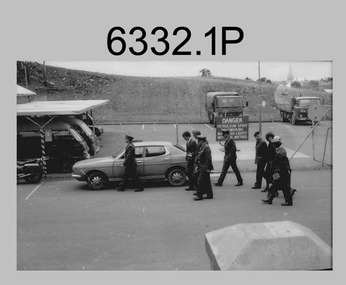
Photograph - Visit by the Minister for Defence to the Army Survey Regiment, Fortuna, Bendigo, c1984
... He later moved on to Victorian state politics, serving as Treasurer from 2000 to 2007 and Premier from 2007 to 2010. ...He later moved on to Victorian state politics, serving as Treasurer from 2000 to 2007 and Premier from 2007 to 2010. ...This collection of 22 photos was most likely taken in 1984. Mr Gordon Scholes AO was the Minister for Defence in the Hawke Government from 1983 to 1984. It’s evident in these photos he was taken on a tour through the production areas. Mr John Brumby AO at this time was the Federal Member for Bendigo. He later moved on to Victorian state politics, serving as Treasurer from 2000 to 2007 and Premier from 2007 to 2010. Key Army Survey Regiment personnel identified include COL Alex Laing, the Director of Survey from 1983 to 1988 and CO LTCOL Jorge Gruszka who led the unit from 1982 to 1985. The rank of the senior officer is not known, however would have been a Major-General or above, due to the presence of the aide-de-camp (female captain). This is a set of 22 photographs of a visit to the Army Survey Regiment, Bendigo circa 1984, by Mr Gordon Scholes AO, who was the Minister for Defence. The photographs were printed on photographic paper and are part of the Army Survey Regiment’s Collection. Photographs .1P to .11P, .14P to .17P and .19P to .22P were scanned at 600 dpi. Photographs .12P to .13P and .18P were scanned at 300 dpi. .1) - Photo, black and white, c1984. L to R: unidentified, Mr John Brumby AO, Mr Gordon Scholes AO CO LTCOL Jorge Gruszka, unidentified, D-SVY COL Alex Laing, unidentified (x3). .2) - Photo, black and white, c1984. L to R: unidentified, CO LTCOL Jorge Gruszka AO, Mr John Brumby AO, Mr Gordon Scholes AO, unidentified (x4), D-SVY COL Alex Laing. .3) - Photo, black and white, c1984. L to R: unidentified (x2), Mr John Brumby, unidentified, CO LTCOL Jorge Gruszka AO, Mr Gordon Scholes AO, CAPT Danny Galbraith. .4) - Photo, black and white, c1984. L to R: unidentified, CO LTCOL Jorge Gruszka AO, Mr Gordon Scholes AO Mr John Brumby AO, unidentified. .5) - Photo, black and white, c1984. L to R: unidentified, Mr Gordon Scholes AO, unidentified, CO LTCOL Jorge Gruszka AO Mr John Brumby AO, unidentified. .6) - Photo, black and white, c1984. L to R: MAJ Daryl Hockings CSM, unidentified (x2). .7) - Photo, black and white, c1984. L to R: CAPT Danny Galbraith, unidentified (x2), Mr John Brumby AO, unidentified, CO LTCOL Jorge Gruszka AO, Mr Gordon Scholes AO, unidentified (x2). .8) - Photo, black and white, c1984. L to R: unidentified, Mr Gordon Scholes AO, CO LTCOL Jorge Gruszka AO, MAJ Daryl Hockings CSM, D-SVY COL Alex Laing, unidentified. .9) - Photo, black and white, c1984. L to R: unidentified, Mr John Brumby AO, CAPT Bob John, CO LTCOL Jorge Gruszka, Mr Gordon Scholes AO, unidentified (x2), MAJ Graham Baker, unidentified, MAJ Daryl Hockings CSM. .10) - Photo, black and white, c1984. L to R: Mr John Brumby AO, CAPT Bob John, Mr Gordon Scholes AO, unidentified (x2), MAJ Graham Baker, unidentified, MAJ Daryl Hockings CSM. .11) - Photo, black and white, c1984. L to R: unidentified, CO LTCOL Jorge Gruszka, Mr Gordon Scholes AO, unidentified (x2), MAJ Graham Baker, unidentified (x2). .12) - Photo, black and white, c1984. L to R: unidentified, CO LTCOL Jorge Gruszka, Mr Gordon Scholes AO. .13) - Photo, black and white, c1984. L to R: unidentified, Mr John Brumby AO, Mr Gordon Scholes AO, D-SVY COL Alex Laing, CO LTCOL Jorge Gruszka. .14) - Photo, black and white, c1984. L to R: unidentified, Mr Gordon Scholes AO, unidentified media, D-SVY COL Alex Laing, unidentified, CO LTCOL Jorge Gruszka, unidentified media (x2). .15) - Photo, black and white, c1984. L to R: unidentified, D-SVY COL Alex Laing, unidentified (x2), Mr Gordon Scholes AO, unidentified media (x3). .16) - Photo, black and white, c1984. L to R: unidentified (x5), CO LTCOL Jorge Gruszka, Mr Gordon Scholes AO. .17) - Photo, black and white, c1984. L to R: unidentified (x2), D-SVY COL Alex Laing, unidentified (x3), CO LTCOL Jorge Gruszka, Mr Gordon Scholes AO, Mr John Brumby AO. .18) - Photo, black and white, c1984. L to R: unidentified, CO LTCOL Jorge Gruszka, Mr Gordon Scholes AO. .19) - Photo, black and white, c1984. L to R: unidentified, CO LTCOL Jorge Gruszka, Mr John Brumby AO, D-SVY COL Alex Laing, unidentified, Mr Gordon Scholes AO, unidentified (x2). .20) - Photo, black and white, c1984. L to R: D-SVY COL Alex Laing, unidentified (x2). .21) - Photo, black and white, c1984. L to R: Mr John Brumby AO, unidentified, D-SVY COL Alex Laing, unidentified. .22) - Photo, black and white, c1984. L to R: unidentified (x3), Mr Gordon Scholes AO, Mr John Brumby AO, CO LTCOL Jorge Gruszka. .1P to .22P – no annotationsroyal australian survey corps, rasvy, army survey regiment, army svy regt, fortuna, asr -
 Kiewa Valley Historical Society
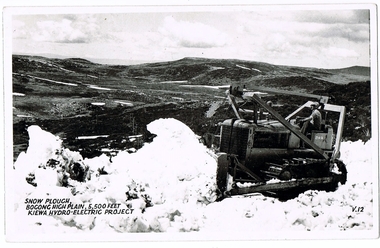
Postcard Circa 1950, Snow Plough, Bogong High Plain,5,500 Feet Kiewa Hydro-Electric Project, Circa 1950
... State of Victoria was pressured by the ever increasing demand by industry and its population for electricity supplies. Hydro electricity was seen as an untapped natural resource to quench this demand. The Victorian Alps and the rivers flowing into its valleys was ideal for the construction of the Kiewa Hydro Electricity Scheme. The late 1940's saw the development of this scheme and the changing of sections of alpine landscape is covered by this and other postcards/pictures (tourists, construction workers, and established rural populations). This period in time was before the established wildlife and forest/nature groups became political...State of Victoria was pressured by the ever increasing demand by industry and its population for electricity supplies. Hydro electricity was seen as an untapped natural resource to quench this demand. The Victorian Alps and the rivers flowing into its valleys was ideal for the construction of the Kiewa Hydro Electricity Scheme. The late 1940's saw the development of this scheme and the changing of sections of alpine landscape is covered by this and other postcards/pictures (tourists, construction workers, and established rural populations). This period in time was before the established wildlife and forest/nature groups became political ...This postcard was produced in the 1950's for the tourist trade in the Kiewa Valley and Alpine region. It encompasses the period when the State of Victoria was pressured by the ever increasing demand by industry and its population for electricity supplies. Hydro electricity was seen as an untapped natural resource to quench this demand. The Victorian Alps and the rivers flowing into its valleys was ideal for the construction of the Kiewa Hydro Electricity Scheme. The late 1940's saw the development of this scheme and the changing of sections of alpine landscape is covered by this and other postcards/pictures (tourists, construction workers, and established rural populations). This period in time was before the established wildlife and forest/nature groups became political activist who changed legislative acts to protect the environment. This rural region (Kiewa Valley/alpine plains) was at most only significant to a smaller group of winter sports, summer hikers/horse riders and rural farmers/graziers. The numbers of tourists and the increase in the local resident population was boosted by the construction of the Hydro Electricity Scheme. This influx to the regional population resulted in a corresponding diversity in services and brought about an environment that responded to a growing level of tourists and thereby permitting this industry to grow more rapidly than it would have naturally. This postcard details an attraction to the "cleaner" method of providing electricity. This postcard was purchased in 1950 by a surveyor at Landford's Gap. This item is a black and white photograph(professional) of a panoramic view of a snow plough clearing the unsealed road in 1950.This postcard is on quality paper and the reproduction of the picture is of a high standard.For other "tourist" postcards see 0480 (A) -(F) for other photos of similar postcards. kiewa valley tourism, victorian alps, alternate energy supplies, alpine population growth, secv, snow plough -
 Kiewa Valley Historical Society
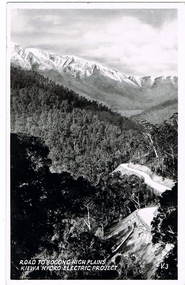
Postcard Circa 1950, Road to Bogong High Plains Kiewa Hydro Electric Project, Circa 1950's
... State of Victoria was pressured by the ever increasing demand by industry and its population for electricity supplies. Hydro electricity was seen as an untapped natural resource to quench this demand. The Victorian Alps and the rivers flowing into its valleys was ideal for the construction of the Kiewa Hydro Electricity Scheme. The late 1940's saw the development of this scheme and the changing of sections of alpine landscape is covered by this and other postcards/pictures (tourists, construction workers, and established rural populations). This period in time was before the established wildlife and forest/nature groups became political...State of Victoria was pressured by the ever increasing demand by industry and its population for electricity supplies. Hydro electricity was seen as an untapped natural resource to quench this demand. The Victorian Alps and the rivers flowing into its valleys was ideal for the construction of the Kiewa Hydro Electricity Scheme. The late 1940's saw the development of this scheme and the changing of sections of alpine landscape is covered by this and other postcards/pictures (tourists, construction workers, and established rural populations). This period in time was before the established wildlife and forest/nature groups became political ...This postcard was produced in the 1950's for the tourist trade in the Kiewa Valley and Alpine region. It encompasses the period when the State of Victoria was pressured by the ever increasing demand by industry and its population for electricity supplies. Hydro electricity was seen as an untapped natural resource to quench this demand. The Victorian Alps and the rivers flowing into its valleys was ideal for the construction of the Kiewa Hydro Electricity Scheme. The late 1940's saw the development of this scheme and the changing of sections of alpine landscape is covered by this and other postcards/pictures (tourists, construction workers, and established rural populations). This period in time was before the established wildlife and forest/nature groups became political activist who changed legislative acts to protect the environment.This rural region (Kiewa Valley/alpine plains) was at most only significant to a smaller group of winter sports, summer hikers/horse riders and rural farmers/graziers. The numbers of tourists and the increase in the local resident population was boosted by the construction of the Hydro Electricity Scheme. This influx to the regional population resulted in a corresponding diversity in services and brought about an environment that responded to a growing level of tourists and thereby permitting this industry to grow more rapidly than it would have naturally. This postcard details an attraction to the "cleaner" method of providing electricity. This postcard was purchased in 1950 by a surveyor at Landford's Gap.This black and white photograph on a Valentine's postcard is from a V2 Argus photograph.. It is on a 200g/m paper density photo side gloss. See 0480 (A) - (G) for other photos of similar postcards.In white lettering " ROAD TO BOGONG HIGH PLAINS KIEWA HYDRO-ELECTRIC PROJECT", V3secv, road making, victorian alps -
 Kiewa Valley Historical Society
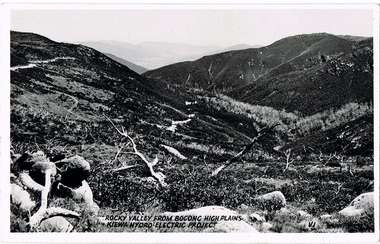
Postcard - Rocky Valley - Circa 1950, 1950
... State of Victoria was pressured by the ever increasing demand by industry and its population for electricity supplies. Hydro electricity was seen as an untapped natural resource to quench this demand. The Victorian Alps and the rivers flowing into its valleys was ideal for the construction of the Kiewa Hydro Electricity Scheme. The late 1940's saw the development of this scheme and the changing of sections of alpine landscape is covered by this and other postcards/pictures (tourists, construction workers, and established rural populations). This period in time was before the established wildlife and forest/nature groups became political...State of Victoria was pressured by the ever increasing demand by industry and its population for electricity supplies. Hydro electricity was seen as an untapped natural resource to quench this demand. The Victorian Alps and the rivers flowing into its valleys was ideal for the construction of the Kiewa Hydro Electricity Scheme. The late 1940's saw the development of this scheme and the changing of sections of alpine landscape is covered by this and other postcards/pictures (tourists, construction workers, and established rural populations). This period in time was before the established wildlife and forest/nature groups became political ...This postcard was produced in the 1950's for the tourist trade in the Kiewa Valley and Alpine region. It encompasses the period when the State of Victoria was pressured by the ever increasing demand by industry and its population for electricity supplies. Hydro electricity was seen as an untapped natural resource to quench this demand. The Victorian Alps and the rivers flowing into its valleys was ideal for the construction of the Kiewa Hydro Electricity Scheme. The late 1940's saw the development of this scheme and the changing of sections of alpine landscape is covered by this and other postcards/pictures (tourists, construction workers, and established rural populations). This period in time was before the established wildlife and forest/nature groups became political activist who changed legislative acts to protect the environment.This rural region (Kiewa Valley/alpine plains) was at most only significant to a smaller group of winter sports, summer hikers/horse riders and rural farmers/graziers. The numbers of tourists and the increase in the local resident population was boosted by the construction of the Hydro Electricity Scheme. This influx to the regional population resulted in a corresponding diversity in services and brought about an environment that responded to a growing level of tourists and thereby permitting this industry to grow more rapidly than it would have naturally. This postcard details an attraction to the "cleaner" method of providing electricity. This postcard was purchased in 1950 by a surveyor at Landford's Gap.This black and white photograph is from a Valentine's V2 Argus postcard. It is on a 200g/m paper density one side gloss. See also KVHS 0480 (A) to (L) for similar postcards. "ROCKY VALLEY FROM BOGONG HIGH PLAINS KIEWA HYDRO-ELECTRIC PROJECT" "V1"kiewa valley tourism, victorian alps, alternate energy supplies, alpine population growth, rocky valley, secv -
 Kiewa Valley Historical Society
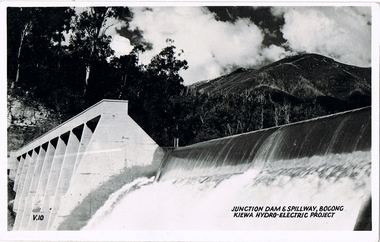
Postcard - Junction Dam - Circa 1950, Circa 1950's
... State of Victoria was pressured by the ever increasing demand by industry and its population for electricity supplies. Hydro electricity was seen as an untapped natural resource to quench this demand. The Victorian Alps and the rivers flowing into its valleys was ideal for the construction of the Kiewa Hydro Electricity Scheme. The late 1940's saw the development of this scheme and the changing of sections of alpine landscape is covered by this and other postcards/pictures (tourists, construction workers, and established rural populations). This period in time was before the established wildlife and forest/nature groups became political...State of Victoria was pressured by the ever increasing demand by industry and its population for electricity supplies. Hydro electricity was seen as an untapped natural resource to quench this demand. The Victorian Alps and the rivers flowing into its valleys was ideal for the construction of the Kiewa Hydro Electricity Scheme. The late 1940's saw the development of this scheme and the changing of sections of alpine landscape is covered by this and other postcards/pictures (tourists, construction workers, and established rural populations). This period in time was before the established wildlife and forest/nature groups became political ...This postcard was produced in the 1950's for the tourist trade in the Kiewa Valley and Alpine region. It encompasses the period when the State of Victoria was pressured by the ever increasing demand by industry and its population for electricity supplies. Hydro electricity was seen as an untapped natural resource to quench this demand. The Victorian Alps and the rivers flowing into its valleys was ideal for the construction of the Kiewa Hydro Electricity Scheme. The late 1940's saw the development of this scheme and the changing of sections of alpine landscape is covered by this and other postcards/pictures (tourists, construction workers, and established rural populations). This period in time was before the established wildlife and forest/nature groups became political activist who changed legislative acts to protect the environment.This rural region (Kiewa Valley/alpine plains) was at most only significant to a smaller group of winter sports, summer hikers/horse riders and rural farmers/graziers. The numbers of tourists and the increase in the local resident population was boosted by the construction of the Hydro Electricity Scheme. This influx to the regional population resulted in a corresponding diversity in services and brought about an environment that responded to a growing level of tourists and thereby permitting this industry to grow more rapidly than it would have naturally. This postcard details an attraction to the "cleaner" method of providing electricity. This postcard was purchased in 1950 by a surveyor at Landford's Gap.This black and white photograph is a Valentine's postcard, from a V2 Argus photograph. It is on a 200g/m paper density with only the photo side gloss.Front "JUNCTION DAM & SPILLWAY, BOGONG KIEWA HYDRO-ELECTRIC PROJECT" on the flip side "VALENTINE'S POST CARD " "A GENUINE PHOTOGRAPH"kiewa valley tourism, victorian alps, alternate energy supplies, alpine population growth, junction dam, secv -
 Kiewa Valley Historical Society
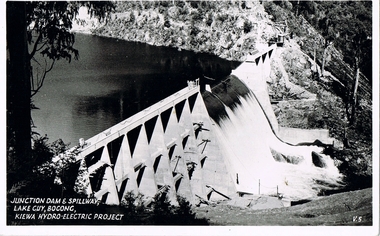
Postcard - Junction Dam - Circa 1950, Circa 1950
... State of Victoria was pressured by the ever increasing demand by industry and its population for electricity supplies. Hydro electricity was seen as an untapped natural resource to quench this demand. The Victorian Alps and the rivers flowing into its valleys was ideal for the construction of the Kiewa Hydro Electricity Scheme. The late 1940's saw the development of this scheme and the changing of sections of alpine landscape is covered by this and other postcards/pictures (tourists, construction workers, and established rural populations). This period in time was before the established wildlife and forest/nature groups became political...State of Victoria was pressured by the ever increasing demand by industry and its population for electricity supplies. Hydro electricity was seen as an untapped natural resource to quench this demand. The Victorian Alps and the rivers flowing into its valleys was ideal for the construction of the Kiewa Hydro Electricity Scheme. The late 1940's saw the development of this scheme and the changing of sections of alpine landscape is covered by this and other postcards/pictures (tourists, construction workers, and established rural populations). This period in time was before the established wildlife and forest/nature groups became political ...This postcard was produced in the 1950's for the tourist trade in the Kiewa Valley and Alpine region. It encompasses the period when the State of Victoria was pressured by the ever increasing demand by industry and its population for electricity supplies. Hydro electricity was seen as an untapped natural resource to quench this demand. The Victorian Alps and the rivers flowing into its valleys was ideal for the construction of the Kiewa Hydro Electricity Scheme. The late 1940's saw the development of this scheme and the changing of sections of alpine landscape is covered by this and other postcards/pictures (tourists, construction workers, and established rural populations). This period in time was before the established wildlife and forest/nature groups became political activist who changed legislative acts to protect the environment.This rural region (Kiewa Valley/alpine plains) was at most only significant to a smaller group of winter sports, summer hikers/horse riders and rural farmers/graziers. The numbers of tourists and the increase in the local resident population was boosted by the construction of the Hydro Electricity Scheme. This influx to the regional population resulted in a corresponding diversity in services and brought about an environment that responded to a growing level of tourists and thereby permitting this industry to grow more rapidly than it would have naturally. This postcard details an attraction to the "cleaner" method of providing electricity. This postcard was purchased in 1950 by a surveyor at Landford's Gap.This black and white photograph on a Valentine's postcard is from a V2 Argus photograph. It is on a 200g/m paper density one side gloss only/. See 0480 (A) -(L) for other photos of similar postcards."JUNCTION DAM & SPILLWAY, LAKE GUY, BOGONG, KIEWA HYDRO-ELECTRIC PROJECT" "V5" on the flip side" VALENTINE'S POST CARD " "A GENUINE PHOTOGRAPH"kiewa valley tourism, victorian alps, alternate energy supplies, alpine population growth, junction dam, secv -
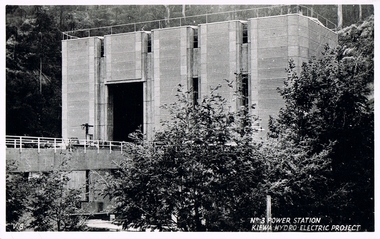 Kiewa Valley Historical Society
Postcard Circa 1950, No.3 Power Station Kiewa Hydro-electric Project "V.8", Circa 1950
... State of Victoria was pressured by the ever increasing demand by industry and its population for electricity supplies. Hydro electricity was seen as an untapped natural resource to quench this demand. The Victorian Alps and the rivers flowing into its valleys was ideal for the construction of the Kiewa Hydro Electricity Scheme. The late 1940's saw the development of this scheme and the changing of sections of alpine landscape is covered by this and other postcards/pictures (tourists, construction workers, and established rural populations). This period in time was before the established wildlife and forest/nature groups became political...State of Victoria was pressured by the ever increasing demand by industry and its population for electricity supplies. Hydro electricity was seen as an untapped natural resource to quench this demand. The Victorian Alps and the rivers flowing into its valleys was ideal for the construction of the Kiewa Hydro Electricity Scheme. The late 1940's saw the development of this scheme and the changing of sections of alpine landscape is covered by this and other postcards/pictures (tourists, construction workers, and established rural populations). This period in time was before the established wildlife and forest/nature groups became political ...This postcard was produced in the 1950's for the tourist trade in the Kiewa Valley and Alpine region. It encompasses the period when the State of Victoria was pressured by the ever increasing demand by industry and its population for electricity supplies. Hydro electricity was seen as an untapped natural resource to quench this demand. The Victorian Alps and the rivers flowing into its valleys was ideal for the construction of the Kiewa Hydro Electricity Scheme. The late 1940's saw the development of this scheme and the changing of sections of alpine landscape is covered by this and other postcards/pictures (tourists, construction workers, and established rural populations). This period in time was before the established wildlife and forest/nature groups became political activist who changed legislative acts to protect the environment.This rural region (Kiewa Valley/alpine plains) was at most only significant to a smaller group of winter sports, summer hikers/horse riders and rural farmers/graziers. The numbers of tourists and the increase in the local resident population was boosted by the construction of the Hydro Electricity Scheme. This influx to the regional population resulted in a corresponding diversity in services and brought about an environment that responded to a growing level of tourists and thereby permitting this industry to grow more rapidly than it would have naturally. This postcard details an attraction to the "cleaner" method of providing electricity. This postcard was purchased in 1950 by a surveyor at Landford's Gap.This black and white photograph from a Valentine's postcard is from a V2 Argus photograph postcard. It is on a 200g/m paper density photo side gloss. See 0480 (A) - (K) for other photos of similar postcards."No.3 POWER STATION KIEWA HYDRO ELECTRIC PROJECT" "V8"kiewa valley tourism, victorian alps, alternate energy supplies, alpine population growth, secv -
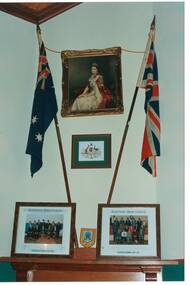 Buninyong & District Historical Society
Photograph - Original Photograph, Mr. C.J. Brooks, Corner wall and mantel piece of 1886 Buninyong Courthouse. portrait of QEII framed by Australian flag and Union Jack, November 1995
... Social/ political, legal Buninyong Courthouse Buninyong Council Chamber Colour photo, Corner wall and mantel piece of 1886 Buninyong Courthouse. portrait of QEII framed by Australian flag and Union Jack, Victorian State Crest of Arms below portrait, group portaits of Buninyong Councillors on mantel. ...Social/ political, legalColour photo, Corner wall and mantel piece of 1886 Buninyong Courthouse. portrait of QEII framed by Australian flag and Union Jack, Victorian State Crest of Arms below portrait, group portaits of Buninyong Councillors on mantel.buninyong, courthouse, buninyong council chamber -
Bendigo Historical Society Inc.
Administrative record - Commercial Egg Producers' Association of Victoria (CEPA) Central Council Correspondence, 1979
... Victorian Egg Board) members. Objection to Ministerial Appointments:The letter strongly opposes the practice of the Minister of Agriculture appointing V.E.B. members, describing it as undemocratic. 8504.35af The document is a letter from the Secretary of CEPA addressed to the State Director of the Liberal Party of Australia. The poultry industry in Victoria is approaching the final year of its current licensing legislation.The association is seeking political...Victorian Egg Board) members. Objection to Ministerial Appointments:The letter strongly opposes the practice of the Minister of Agriculture appointing V.E.B. members, describing it as undemocratic. 8504.35af The document is a letter from the Secretary of CEPA addressed to the State Director of the Liberal Party of Australia. The poultry industry in Victoria is approaching the final year of its current licensing legislation.The association is seeking political ...The Commercial Egg Producers' Association of Victoria was active by the 1930s, engaging in industry management and lobbying.The Commercial Egg Producer's Association (CEPA) had branches in Bendigo, South Bendigo, Eaglehawk, Wedderburn, Murrabit and Euroa.CEPA Commercial Egg Producer's Association (Bendigo Region) correspondence, for the year 1979. This item includes the following documents: 8504.35a Minutes of Branch half yearly conference 1979 8504.35b The document is a letter from K. Fitzgibbon, Secretary of the Central Council, addressed to Mr. C. L. Jefferson, Secretary of the Victorian Egg Marketing Board. Congratulation on Meeting Reduction:The Central Council commends the A.E.B. and C.E.M.A.A. for reducing their meetings to two per year. 8504.35c This document is a letter from K. Fitzgibbon, Secretary of the association, addressed to Mr. D. J. Foster, Chairman of the Federal Council of Poultry Farmers' Association of Australia. Gratitude for Legislative SupportThe letter expresses appreciation for Mr. Foster's persistent efforts to maintain demand and supply management legislation for poultry in the state. 8504.35d This document is a formal letter to the Poultry Research Advisory Council, dated January 6, 1980, expressing support for ongoing efforts and making key recommendations 8504.35e Letter to the Department of Agriculture, Division of Animal Healy re a possible outbreak of an exotic disease. 8504.35f The document is a letter addressed to the Minister of Agriculture, summarizing The importance of Random Sample Laying Tests 8504.35g The document is a letter from the Secretary of an agricultural association expressing concerns about the upcoming inquiry into the Egg Board. The association acknowledges the government's decision to extend the Egg Industry Stabilization Act Legislation for another 12 months. 8504.35h This document is a thank-you letter from the secretary of an association addressed to Hon. John Radford, M.L.C. The association expresses gratitude to John Radford for his support and efforts regarding the Egg Industry Stabilization Act. 8504.35i The document is a formal letter from the association to the Victorian Egg Marketing Board, proposing that with regards to the Producer Price Increase that the they suggest that the advance price paid to egg producers should be increased.The recommended increase should be in line with the Consumer Price Index (CPI), not just based on cost of production. 8504.35j Notice of half yearly conference 8504.35k The document is a letter from the Commercial Egg & Producers Association of Victoria expressing urgent concern about the government's reported intention to discontinue the Egg Industry Stabilization Act as of March 1980. The association requests that John Radford raise this issue with the Minister of Agriculture and, if the statement is accurate, arrange an immediate meeting with the Liberal Party Parliamentary Agriculture Committee to present their case. 8504.35l This document is a formal letter addressed to Mr. Cecil Burgin, Convenor of the Agricultural Committee of the Parliamentary Liberal Party. The letter is signed by K. Fitzgibbon, Secretary, and highlights the urgency and significance of resolving disagreements over the egg industry legislation. 8504.35m This document is a formal letter to the Secretary of the Liberal Party in Victoria. CPA requests the names and contact details of the Agricultural Committee of the Parliamentary Liberal Party. 8504.35n The Commercial Egg Producers' Association of Victoria expresses disappointment with the Minister of Agriculture's stance on the indefinite continuation of the Egg Industry Stabilisation Legislation. 8504.35o The document is a protest letter from the Commercial Egg Producers' Association of Victoria, addressed to Mrs. Jeanette Patrick, Secretary of the Liberal Party. The Association is protesting the selection of members for the New Victorian Egg Board. 8504.35p Notable recipients include Mr. B. Reid, Mr. D. McClure, Mr. W. Ebery, Mr. J. Radford, Mr. E. Hann (M.L.A., Echuca), Mr. P. Ross-Edwards (Leader National Party), and Mr. N. McKenzie (Executive Officer, Poultry Section V.F.U., Melbourne) 8504.35q This document outlines the formal hierarchy and key officials in the government. 8504.35r Newspaper article: "Stability and Efficiency in the Australian Egg IndustryDemand and supply management has made the Australian egg industry the most stable among major producers globally." 8504.35s The document is a letter from the Commercial Egg Producers' Association of Victoria expressing concerns about recent changes to the Victorian Egg Board. Concerns Over Appointment Process. The Association is troubled by how the new appointments were made, feeling the process lacked transparency and justification. 8504.35t The document highlights concerns about the political influence and governance of the Victorian Egg Producers Board:Board Member Changes: The Minister has replaced three Board members and the Chairman, which is the maximum allowed in a year. 8504.35u CEPA Annual Conference business Paper June 1979 8504.35v Notice of annual meeting 8504.35w This document is a formal letter from K. Fitzgibbon, Secretary of the association, addressed to the Minister of Agriculture. It responds to a previous request for nominations to fill a vacancy on the Victorian Egg Marketing Board. Three candidates are nominated for the vacancy: L. F. Bessy: Recognized for previous contributions to the Board and known qualifications.Ronald Robins (Harcourt): Has 30 years of experience in the poultry industry, currently operates 12,000 layers, is a director and past Chairman of the Commercial Egg Producers Co-operative, and is a member of the local fire brigade.John Scott (Maiden Gully): Has 21 years of experience in the poultry industry, currently operates 3,000 laying hens, involved in all aspects of poultry production, is President of the South Bendigo Branch E.P.A., and a member of the local fire brigade. 8504.35x The document is a formal letter addressed to the Minister of Agriculture, highlighting concerns about uncertainty regarding the future of the Stabilization Act in Victoria. There is widespread panic selling of hen quotas in rural areas due to rumors about possible changes, such as quotas being tied to farms, surrendered to the Licensing Committee, or prices being pegged. 8504.35y This document is a letter addressed to the Premier of Victoria, expressing concerns about uncertainty regarding the continuation of the Stabilization Act for poultry farmers. There is widespread panic selling of hen quotas among poultry farmers in rural areas due to rumors about potential changes to quota regulations, such as quotas being tied to farms, surrendered to the Licensing Committee, or prices being pegged. 8504.35z The document is a formal request addressed to the Secretary of the Federal Council of Poultry Farmers' Associations of Australia. Inclusion Request: The sender, K. Fitzgibbon (Secretary), asks for a specific item to be added to the agenda for the upcoming Annual and General Meeting.Investigation of Surplus Egg Sales:The agenda item proposes an investigation into the sale of surplus eggs from fertile egg farms. 8504.35aa This document is a formal letter from CEPA to the Victorian Egg Marketing Board. The Association is submitting research project suggestions for consideration by the Board. 8504.35ab The document is a protest letter addressed to the State Director of the Liberal Party of Australia. Objection to Ministerial Appointments:Members at a recent conference unanimously objected to V.E.B. (Victorian Egg Board) members being appointed by the Minister of Agriculture.The method is described as undemocratic. 8504.35ac The document is a formal protest letter expressing concerns about the appointment process for V.E.B. (Victorian Egg Board) members. Objection to Ministerial Appointments:The letter strongly opposes the practice of the Minister of Agriculture appointing V.E.B. members, describing it as undemocratic. 8504.35ad The document is a formal protest letter expressing concerns about the appointment process for V.E.B. (Victorian Egg Board) members. Objection to Ministerial Appointments:The letter strongly opposes the practice of the Minister of Agriculture appointing V.E.B. members, describing it as undemocratic. 8504.35ae The document is a formal protest letter expressing concerns about the appointment process for V.E.B. (Victorian Egg Board) members. Objection to Ministerial Appointments:The letter strongly opposes the practice of the Minister of Agriculture appointing V.E.B. members, describing it as undemocratic. 8504.35af The document is a letter from the Secretary of CEPA addressed to the State Director of the Liberal Party of Australia. The poultry industry in Victoria is approaching the final year of its current licensing legislation.The association is seeking political support for the continuation of Licensing and Demand Supply Management policies in Victoria. 8504.35ag The document is a letter from the Secretary of CEPA addressed to the State Director of the Liberal Party of Australia. The poultry industry in Victoria is approaching the final year of its current licensing legislation.The association is seeking political support for the continuation of Licensing and Demand Supply Management policies in Victoria. 8504.35ah The document is a letter from the Secretary of CEPA addressed to the State Director of the Liberal Party of Australia. The poultry industry in Victoria is approaching the final year of its current licensing legislation.The association is seeking political support for the continuation of Licensing and Demand Supply Management policies in Victoria. 8504.35ai The document is a letter from the Secretary of CEPA addressed to the State Director of the Liberal Party of Australia. The poultry industry in Victoria is approaching the final year of its current licensing legislation.The association is seeking political support for the continuation of Licensing and Demand Supply Management policies in Victoria. 8504.35aj The document is a letter from the Secretary of CEPA addressed to the State Director of the Liberal Party of Australia. The poultry industry in Victoria is approaching the final year of its current licensing legislation.The association is seeking political support for the continuation of Licensing and Demand Supply Management policies in Victoria. 8504.35ak The document is a letter from the Commercial Egg Producers' Association, written by Secretary K. Fitzgibbon, addressing Mr. S. McDonald regarding compensation payments for fire damage 8504.35al 8504.35ak The document is a letter from the Commercial Egg Producers' Association, written by Secretary K. Fitzgibbon, addressing Mr. B. Reid regarding compensation payments for fire damage 8504.35am The document is a letter from the Commercial Egg Producers' Association, written by Secretary K. Fitzgibbon, addressing Mr. W. Ebery regarding compensation payments for fire damage 8504.35an 8504.35am The document is a letter from the Commercial Egg Producers' Association, written by Secretary K. Fitzgibbon, addressing Mr. D. McClure regarding compensation payments for fire damage 8504.35ao This document is a formal letter from the Central Council of the Commercial Egg Producers Association of Victoria, dated January 10, 1979. The letter recommends that all non-government delegate members attending Poultry Research Advisory Council meetings should be reimbursed for out-of-pocket and travel expenses 8504.35ap The document is a letter from the Secretary of CEPA to the Director General of Agriculture, highlighting two main concerns: Retention of Genetic Laying Stock in Victoria:The Association urges efforts to retain genetic laying stock, especially in light of suggestions to sell the flock at Dookie.There is awareness of remaining pure-bred stock in Victoria, and a question is raised about their availability for sale to new breeders.Concerns About Cage-Kept Birds:The Association addresses ongoing public discussion about keeping birds in cages.They express concern that the Department of Agriculture's actions, such as inviting Dr. Linda Murphy to a Field Day, may increase publicity on this issue. 8504.35aq The document is a formal letter from the Secretary of the Commercial Egg Producers Association Co-operative Ltd. to Mr. W Cramer. The Association wishes to maintain a close relationship with the Heat Board. They express willingness to act as an agent for the Wheat Board if possible. 8504.35ar Minutes of the CEPA General Council Annual conference June 1979 8504.35as Minutes of a branch meeting of CEPA 8504.35at Government of Victoria Agnote Jan 1979 39/79 Disposal of Pesticide containers and surplus pesticide 8504.35au Government of Victoria Agnote Mar 1979 637/79 Safety with agricultural chemicals 8504.35av This document is a formal letter from the National Bank of Australasia Limited addressed to the Commercial Egg Producers Association of Victoria. Confirmation of Good Standing. The bank confirms that Bruce Noel Moresi and Robyn Elizabeth Moresi are customers considered to be in good standing for their business engagements. 8504.35aw Letter of reference from Fitzpatrick's View point Eaglehawk 8504.35ax CEPA half yearly conference Dec 1979 Agenda and Resolutions 8504.35ay Reference from the Bendigo College of Advanced Education Dec 1979 8504.35az Part minutes, report and General Business of a meeting. 8504.35aaa CEPA Notice of half yearly conference Dec 1979egg producer's information, correspondence, cepa, commercial egg producers' association -
Bendigo Historical Society Inc.
Audio - Making Tracks, c1980s
... Victorian Railways. It opened in response to political pressures from provincial groups for decentralization, with the Victorian Railways preferring the cheaper option of expanding the existing Newport Workshops in suburban Melbourne. The 1980s were a time of restructuring, and on the breakup of the Victorian Railways the workshops passed to the State...Victorian Railways. It opened in response to political pressures from provincial groups for decentralization, with the Victorian Railways preferring the cheaper option of expanding the existing Newport Workshops in suburban Melbourne. The 1980s were a time of restructuring, and on the breakup of the Victorian Railways the workshops passed to the State ...Bendigo Workshops is a railway workshop in Bendigo, Victoria, Australia. It is located in the north of the city beside the junction of the Swan Hill and Deniliquin railway lines. The site covers 10.3 hectares of land and has 31 separate buildings, including a 10,000 sqm main workshop building and six kms of railway track. The workshops were opened in November 1917 by the Victorian Railways. It opened in response to political pressures from provincial groups for decentralization, with the Victorian Railways preferring the cheaper option of expanding the existing Newport Workshops in suburban Melbourne. The 1980s were a time of restructuring, and on the breakup of the Victorian Railways the workshops passed to the State Transport Authority and then the Public Transport Corporation.Three Audio Files - by David Bennet, Davis Moon and Kevin Whelan who worked at the Bendigo Railway Workshops. The three share their working life memories history, bendigo, bendigo railway workshops -
Bendigo Historical Society Inc.
Audio - The 1930s Depression Tapes - William Frederick Hillman, 2005
... The questions covered sixteen relevant subjects: • Introduction and housing • Social activities, swimming, cinemas, school and games played with friends • Organizations such as the RSL, Relief Committees etc. and any effect they had on family life • The life of the single woman • Unemployment and Employment • Government Assistance • Charities Aid • Self-help • People Power, e.g. boycotts or protests • Politics • Trouble or crime • Family Health, Medical and Diet • Education • General memories of, and hardships encountered, during the Depression history Bendigo Michele Matthews Collection The 1930s Depression Tapes william frederick hillman Audio tape interview with William Frederick Hillman. Son of Robert James Hillman (who was a fitter for the Victorian Railways), and Elizabeth Hebden. William was born in 1917. He attended school at Gravel Hill State ...In 2005 Michele Matthews interviewed current and former residents of Bendigo for her thesis on the 1930s Depression as part of her PhD Research, with the University of Melbourne Faculty of Arts, History Department. Michele interviewed fifteen members of prominent Bendigonian families. The thesis was titled: "How Depressing?: The impact of the Great Depression on Bendigo and District 1925-1935". The Michele Matthews Collection contains fourteen audio cassette tape recordings and one written transcript. The tapes are each approximately 1 hour and 45 minutes duration. The questions presented to the interviewees explore everyday experiences they would have lived through at the time of the Depression. The questions covered sixteen relevant subjects: • Introduction and housing • Social activities, swimming, cinemas, school and games played with friends • Organizations such as the RSL, Relief Committees etc. and any effect they had on family life • The life of the single woman • Unemployment and Employment • Government Assistance • Charities Aid • Self-help • People Power, e.g. boycotts or protests • Politics • Trouble or crime • Family Health, Medical and Diet • Education • General memories of, and hardships encountered, during the DepressionAudio tape interview with William Frederick Hillman. Son of Robert James Hillman (who was a fitter for the Victorian Railways), and Elizabeth Hebden. William was born in 1917. He attended school at Gravel Hill State School, 1922-1931. William married Bernice Alwyn Hillman in 1943. The tape has been converted to a sound file. The 90 minute interview can be listened to, and the notes viewed, at the Bendigo Historical Society. By appointment only.history, bendigo, michele matthews collection, the 1930s depression tapes, william frederick hillman -
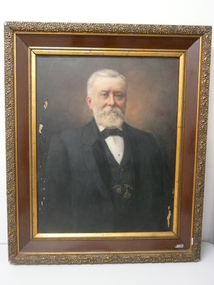 Bendigo Historical Society Inc.
Painting - OIL PORTRAIT OF T.LANGDON. MP, 1902
... Victorian politician who served as a Member of Parliament (MP) in the Parliament of Victoria. In 1902, he represented the electorate of Korong in the Legislative Assembly and chaired the state’s key Royal Commission on the handling of grain. His connection to Bendigo dates back to 1853, when he first arrived in Australia and worked as a gold miner and carter in the Bendigo district before launching his merchant and political career....Victorian politician who served as a Member of Parliament (MP) in the Parliament of Victoria. In 1902, he represented the electorate of Korong in the Legislative Assembly and chaired the state’s key Royal Commission on the handling of grain. His connection to Bendigo dates back to 1853, when he first arrived in Australia and worked as a gold miner and carter in the Bendigo district before launching his merchant and political career. ...Thomas Langdon (1832–1914) was a prominent Victorian politician who served as a Member of Parliament (MP) in the Parliament of Victoria. In 1902, he represented the electorate of Korong in the Legislative Assembly and chaired the state’s key Royal Commission on the handling of grain. His connection to Bendigo dates back to 1853, when he first arrived in Australia and worked as a gold miner and carter in the Bendigo district before launching his merchant and political career.Coloured oil portrait on canvas of T.Langdon. MP. 1902. Prominent Bendigo MP. Gilt - embossed frame. Deframedunreadableperson, individual, bendigo mp. t. langdon. -
 City of Whittlesea
Badge - Badges - Advocacy Campaign, Access Denied, 2014
... Access Denied was a joint advocacy campaign between the City of Whittlesea and the local community in the lead up to the 2014 Victorian State Election. The campaign called on all political parties to commit to extending the railway line from South Morang to Mernda and building access ramps on the Hume Freeway at O’Herns Road in Epping North. ...Access Denied was a joint advocacy campaign between the City of Whittlesea and the local community in the lead up to the 2014 Victorian State Election. The campaign called on all political parties to commit to extending the railway line from South Morang to Mernda and building access ramps on the Hume Freeway at O’Herns Road in Epping North. ...Access Denied was a joint advocacy campaign between the City of Whittlesea and the local community in the lead up to the 2014 Victorian State Election. The campaign called on all political parties to commit to extending the railway line from South Morang to Mernda and building access ramps on the Hume Freeway at O’Herns Road in Epping North. The campaign was a success and secured almost $650 million in promises from the incoming Labor Government to build these projects. Badge, metal back with pin, white plastic printed front, black and red textConnect O'Herns Road / Access Denied / Get on Board / www.accessdenied.net.au / Build Mernda Railbadges, campaign badges, south morang railway, mernda railway -
 Ballarat Tramway Museum
Newspaper - set of four, The Courier Ballarat, "Residents fight to save trams", 1967 -1968
... Set of four newspaper cuttings about the Victorian Government's proposal to close Ballarat and Bendigo Tramways 1 - The Age 8/8/1968 - 455 x 84 - providing details of the proposal, SEC employees, bus replacement, and keeping some trams in Ballarat for use at Sovereign Hill. Notes the politics in the Government over this matter. 2 - The Age 27/10/1967 - 47 x 43 - noting that the State...Set of four newspaper cuttings about the Victorian Government's proposal to close Ballarat and Bendigo Tramways 1 - The Age 8/8/1968 - 455 x 84 - providing details of the proposal, SEC employees, bus replacement, and keeping some trams in Ballarat for use at Sovereign Hill. Notes the politics in the Government over this matter. 2 - The Age 27/10/1967 - 47 x 43 - noting that the State ...Set of four newspaper cuttings about the Victorian Government's proposal to close Ballarat and Bendigo Tramways 1 - The Age 8/8/1968 - 455 x 84 - providing details of the proposal, SEC employees, bus replacement, and keeping some trams in Ballarat for use at Sovereign Hill. Notes the politics in the Government over this matter. 2 - The Age 27/10/1967 - 47 x 43 - noting that the State Government had ordered the TRB to hold an enquiry 3 - undated and unsourced - "Battle for Trams by Petition" - Cr Roff of Save the Trams Committee - slow start on the petition. Notes the TRB recommendation to scrap the trams. 4 - The Sun - "Save tram committee will meet" - 28/10/1967 - 122 x 40 - quotes Cr Rolf of the Committee and the negative view of Cr A Nicholson.Yields information about the 1967/1968 proposal to closure both Ballarat and Bendigo Tramways. This proposal did not have the numbers in the upper house of the State Government.Set of four newspaper cuttings.Some have the newspaper source in ink along the top edge.tramways, closure, ballarat, bendigo, trb, cr roff, cr nicholson, petitions
