
Showing 47 items matching "prime ministers - australia - robert menzies"
-
 Unions Ballarat
Australian Prime Ministers, Grattan, Michelle, 2000
... Prime Ministers - Australia - Robert Menzies...Australian prime ministers (Barton-Howard) and political analysis. Essays by a variety of authors. Relevance to the history of politics in Australia, particularly the federal government and prime ministers. Biographical interest. BTLC ballarat regional trades and labour council ballarat trades hall Prime Ministers - Australia - Edmund Barton Prime Ministers - Australia - Alfred Deakin Prime Ministers - Australia - Chris Watson Prime Ministers - Australia - George Reid Prime Ministers - Australia - Andrew Fisher Prime Ministers - Australia - Joseph Cook Prime Ministers - Australia - William Morris Hughes Prime Ministers - Australia - Stanley Melbourne Bruce Prime Ministers - Australia - James Scullin Prime Ministers - Australia - Joseph Lyons Prime Ministers - Australia - Earle Page Prime Ministers - Australia - Robert Menzies Prime Ministers - Australia - Arthur Fadden Prime Ministers - Australia - John Curtin Prime Ministers - Australia - Francis Forde Prime Ministers - Australia - Ben Chifley Prime Ministers - Australia - Harold Holt Prime Ministers - Australia - John McEwan Prime Ministers - Australia - John Gorton Prime Ministers - Australia - William McMahon Prime Ministers - Australia - Gough Whitlam Prime Ministers - Australia - Malcolm Fraser Prime Ministers - Australia - Robert Hawke Prime Ministers - Australia - Paul Keating Prime Ministers - Australia - John Howard Politics Politicians House of Representatives Parliament Biography Front cover: editor's name and book title. ...A biography of Australian prime ministers (Barton-Howard) and political analysis. Essays by a variety of authors.Relevance to the history of politics in Australia, particularly the federal government and prime ministers. Biographical interest.Paperback book. Front cover: black background; sepia portrait photographs of all prime ministers up to John Howard; gold and white lettering.Front cover: editor's name and book title. Back cover: description; editor's biography; list of contributors.btlc, ballarat regional trades and labour council, ballarat trades hall, prime ministers - australia - edmund barton, prime ministers - australia - alfred deakin, prime ministers - australia - chris watson, prime ministers - australia - george reid, prime ministers - australia - andrew fisher, prime ministers - australia - joseph cook, prime ministers - australia - william morris hughes, prime ministers - australia - stanley melbourne bruce, prime ministers - australia - james scullin, prime ministers - australia - joseph lyons, prime ministers - australia - earle page, prime ministers - australia - robert menzies, prime ministers - australia - arthur fadden, prime ministers - australia - john curtin, prime ministers - australia - francis forde, prime ministers - australia - ben chifley, prime ministers - australia - harold holt, prime ministers - australia - john mcewan, prime ministers - australia - john gorton, prime ministers - australia - william mcmahon, prime ministers - australia - gough whitlam, prime ministers - australia - malcolm fraser, prime ministers - australia - robert hawke, prime ministers - australia - paul keating, prime ministers - australia - john howard, politics, politicians, house of representatives, parliament, biography -
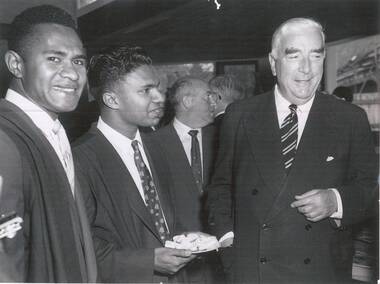 International House, The University of Melbourne
Photograph, Australian News and Information Bureau, Josevats Komikamica and John Daniel with Prime Minister of Australia Robert Menzies after the official opening of International House, 24/05/1958
... Prime Minister of Australia, Robert Menzies, pictured here with the two students, attended and spoke at the official opening of International House....Black and white photograph of Josevats Komikamica and John Daniel with Prime Minister of Australia Robert Menzies after the official opening of International House...Prime Minister of Australia, Robert Menzies, pictured here with the two students, attended and spoke at the official opening of International House. ...Josevats Komikamica, a commerce student from Fiji, and John Daniel, a medical student from India, attended International House in its opening year, 1957. Prime Minister of Australia, Robert Menzies, pictured here with the two students, attended and spoke at the official opening of International House.Black and white photograph of Josevats Komikamica and John Daniel with Prime Minister of Australia Robert Menzies after the official opening of International Houseinternational house, students, official opening -
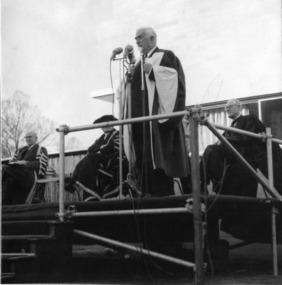 International House, The University of Melbourne
Photograph (Item), Soedjadi Sastrosoegito, 'Bob on the job', 1958
... Black and white photograph of Prime Minister of Australia Robert Menzies speaking at the official opening of International House...Australia's first 'international house'. Events Official opening Robert Gordon Menzies Captioned 'Bob on the job'. Black and white photograph of Prime Minister of Australia Robert Menzies speaking at the official opening of International House 'Bob on the job' Photograph Soedjadi Sastrosoegito Richard Shiell ...This item is of historical significance as a record of the official opening of Australia's first 'international house'.Captioned 'Bob on the job'.events, official opening, robert gordon menzies -
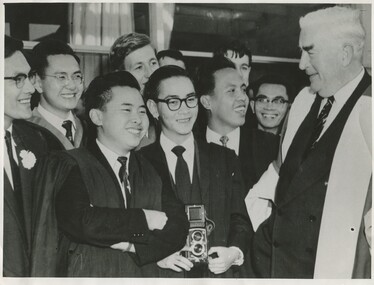 International House, The University of Melbourne
Photograph (Item), Prime Minister of Australia Robert Menzies chatting to a group of students at the official opening of International House on 24 May 1958
... Black and white photograph of Prime Minister of Australia Robert Menzies chatting to a group of students at the official opening of International House on 24 May 1958...Black and white photograph of Prime Minister of Australia Robert Menzies chatting to a group of students at the official opening of International House on 24 May 1958 Prime Minister of Australia Robert Menzies chatting to a group of students at the official opening of International House on 24 May 1958 Photograph ... -
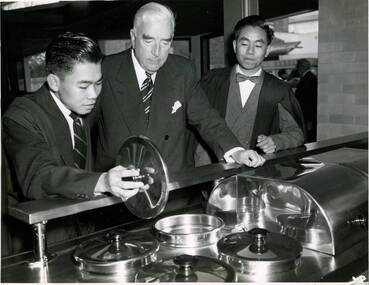 International House, The University of Melbourne
Photograph, Students John Padasian and Ral Lian Sum and Prime Minister Robert Menzies at International House, 24-05-1958
... Black and white photograph of students John Padasian (Jesselton, North Borneo) and Ral Lian Sum (Chin Hills, Burma) showing Prime Minister of Australia Robert Menzies the kitchen equipment at the official opening of International House, The University of Melbourne....Students Events Official opening Black and white photograph of students John Padasian (Jesselton, North Borneo) and Ral Lian Sum (Chin Hills, Burma) showing Prime Minister of Australia Robert Menzies the kitchen equipment at the official opening of International House, The University of Melbourne. ...Black and white photograph of students John Padasian (Jesselton, North Borneo) and Ral Lian Sum (Chin Hills, Burma) showing Prime Minister of Australia Robert Menzies the kitchen equipment at the official opening of International House, The University of Melbourne.students, events, official opening -
 Melbourne Legacy
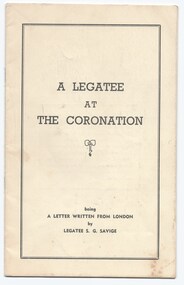
Booklet, A Legatee at the Coronation. A letter written from London by Legatee S. G. Savige, 1953
... Legatee Stan Savige attended the Coronation of Queen Elizabeth on 2nd June 1953 as a representative of Legacy at the request of the Co-ordinating Council and the Australian Prime Minister, Robert Menzies. This booklet is his account of the events as he wrote in a letter back the President of Legacy. ...Legatee Stan Savige attended the Coronation of Queen Elizabeth on 2nd June 1953 as a representative of Legacy at the request of the Co-ordinating Council and the Australian Prime Minister, Robert Menzies. This booklet is his account of the events as he wrote in a letter back the President of Legacy. ...Legatee Stan Savige attended the Coronation of Queen Elizabeth on 2nd June 1953 as a representative of Legacy at the request of the Co-ordinating Council and the Australian Prime Minister, Robert Menzies. This booklet is his account of the events as he wrote in a letter back the President of Legacy. In shows the interest in the Coronation, and L/- Savige's account was of interest to so many that it was published in a booklet for the Legatees.The Coronation of Queen Elizabeth II was an important event and Sir Stan Savige felt it worth sending a letter that was published for Legatees about it. Also that Legacy was deemed important enough to send a representative.A booklet recounting the Queen's Coronation as observed by Stan Savige.coronation, stan savige -
 Melbourne Legacy
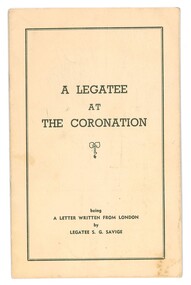
Booklet, A Legatee at the Coronation. A letter written from London by Legatee S. G. Savige, 1953
... Legatee Stan Savige attended the Coronation of Queen Elizabeth on 2nd June 1953 as a representative of Legacy at the request of the Co-ordinating Council and the Australian Prime Minister, Robert Menzies. This booklet is his account of the events as he wrote in a letter back the President of Legacy. ...Legatee Stan Savige attended the Coronation of Queen Elizabeth on 2nd June 1953 as a representative of Legacy at the request of the Co-ordinating Council and the Australian Prime Minister, Robert Menzies. This booklet is his account of the events as he wrote in a letter back the President of Legacy. ...Legatee Stan Savige attended the Coronation of Queen Elizabeth on 2nd June 1953 as a representative of Legacy at the request of the Co-ordinating Council and the Australian Prime Minister, Robert Menzies. This booklet is his account of the events as he wrote in a letter back the President of Legacy. In shows the interest in the Coronation, and L/- Savige's account was of interest to so many that it was published in a booklet for the Legatees. Two additional copies of the booklet - see full images at 01164.The Coronation of Queen Elizabeth II was an important event and Sir Stan Savige felt it worth sending a letter that was published for Legatees about it. Also that Legacy was deemed important enough to send a representative.Two copies of a booklet recounting the Queen's Coronation as observed by Stan Savige.One copy has handwritten 'B' in top right in pencilcoronation, stan savige -
 Carlton Football Club
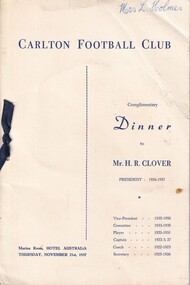
Dinner Program & Menu, Carlton Football Club November 21st 1957 to Mr H R Clover, 1957
... Former Australian Prime Minister Sir Robert Menzies was just one of the many Carlton fans who were captivated; “he was the most artistic of high marks, unforgettable at half-forward,” said Menzies. ...Former Australian Prime Minister Sir Robert Menzies was just one of the many Carlton fans who were captivated; “he was the most artistic of high marks, unforgettable at half-forward,” said Menzies. ...Dinner to Mr H R Clover player Career : 1920-24, 1926-31 Debut : Round 2, 1920 vs. Richmond, aged 25 years, 46 days Carlton Player No. 346 Games : 147 Goals : 396 Guernsey No. 1 Last Game : Semi Final, 1931 vs. Collingwood, aged 36 years, 180 days Height : 185 cm (6 ft. 1 in.) Weight : 86.5 kg (13 stone, 9 lbs.) DOB : 20 March, 1895 League Leading Goalkicker: 1922 Leading Goalkicker: 1920, 1921, 1922, 1923, 1926, 1928 Best and Fairest: 1929 Captain Coach: 1922-1924, 1927 Champion of the Colony: 1921 VFL AFL Hall of Fame Carlton Hall of Fame Team of the Century President: 1956-57 Vice President: 1932, 1935-54 Club Secretary: 1925-26 Horace “Horrie” Clover was Carlton’s star centre half-forward of the 1920’s; a high flying, long-kicking champion who enjoyed a stellar career with the Old Dark Navy Blues, then went on to be one of our longest-serving administrators. But even before he took the field for Carlton, Clover had to conquer the odds on the battlefields of France in World War 1. From Maryborough in central Victoria, Horrie enlisted in the 1st AIF in September 1915. After basic training, he embarked for France with reinforcements for the 7th Battalion in January of 1916. Soon pitched into the horrors of trench warfare, he fought and survived until September of that year, when he was transferred to a machine gun company and promoted to the rank of Corporal. On Christmas day, 1916, Horrie was struck down with acute appendicitis. He was evacuated to a field hospital for emergency surgery, where the doctors discovered that his appendix was gangrenous and that his life was in danger. He was immediately transferred to London for specialist treatment, and months of recuperation. Pronounced unfit for further front-line service, he was repatriated back to Australia in August 1917, and honourably discharged in May of the following year – six months before the Armistice. Having recovered, and keen to have a crack at senior football, Clover trained with Richmond and Melbourne before Carlton gave him an opportunity at VFL level. And how he delivered! In his first match in 1920 – ironically, against Richmond - he kicked four goals from centre half-forward, and hit the post three times! By the end of his first season at Princes Park, Clover was one of Carlton’s drawcards. Former Australian Prime Minister Sir Robert Menzies was just one of the many Carlton fans who were captivated; “he was the most artistic of high marks, unforgettable at half-forward,” said Menzies. Horrie could kick a football, too. A balanced, deceptively quick mover, he was a glorious running drop-kick for goal. Playing against Richmond again at Princes Park in July, 1921, he let fly with a monster kick that was later measured at 86.26 metres – that’s 94 yards, 2 feet in imperial terms! And there are numerous other instances where he roosted the ball more than 70 metres. In round 12 of 1921, he slotted 13 goals in a game against St Kilda; a club record which still stands today. The Blues made the finals in third place in 1921 and battled through to meet Richmond for the Premiership. Then the heavens above the MCG opened up on the day before the decider, turning the ground into a quagmire. In what was to be Clover’s only Grand Final appearance, Richmond won a slogging, mauling contest by four points. While Premiership glory eluded him, Horrie was Carlton’s top goalkicker in three of his first four seasons, including 1922, where his total of 58 was the competition’s best. He was appointed captain of the Blues that same year, and in 1923 took on the dual role of captain-coach. Over 1924 / 1925, he suffered more debilitating illness that prevented him from playing all season. Unable to pull on his football boots, he took on the job of Club Secretary, and continued in that position even after returning to the field in 1926. When he did eventually resume, he formed a new, powerful Carlton forward set-up with a young Harry “Soapy” Vallence at full-forward. Twice more – in 1926 and 1928, Clover’s brilliance and accuracy in front of goal saw him at the top of Carlton’s goal-kicking, and in 1929 – aged 34, he was honoured with the captaincy of Victoria against WA in his ninth and final game in the Big Vee. show_image.php?id=205 Horrie Clover retired as a player in 1931 after 147 games. His total of 396 goals is still ranked fifth best in Carlton’s proud history (only displaced for fourth when Brendan Fevola broke through in 2007/2008) – and it should be remembered that all but a handful of his games were played at centre half-forward, not in the goal square. In 1932 he was elected Vice-President of the Carlton Football Club, but retired after one year. In February 1935 on learning of Terry Ogden's the serious illness, Clover and Newton Chandler offered their services for a blood transfusion for the club's wing man. After a blood test Chandler's blood was accepted. However, Ogden passed away the next month. Clover stood again in 1935, was elected – and spent twenty unbroken years serving his beloved Blues. He even took on the Presidency in 1956, aged 60, and was as vigorous and determined as ever in his two years in the job. Carlton Football Club mourned deeply when Horrie Clover passed away on the first day of January, 1984. Three years later, he was among the first to be inducted into the Carlton Hall of Fame. Testament to his stature in the game as a whole, he was elected to the AFL Hall of Fame in 1996; and May 2000 saw him named as one of four emergencies in Carlton’s Team of the Century. A champion in every sense of the word, he spent 37 years of his remarkable life at Princes Park. Footnote The Argus published an article on Maryborough, April 12 1930, it said; "Clover has been the leading half-forward in League ranks for some time. It takes a specialist to fill the position capably, and the Carisbrook man does this admirably. Like good wine he has improved with age, and besides being one of the greatest half forwards that has ever appeared on a football field, he is about the best all round kicker that has ever played the game. He excells in punting, drop, and place kicking. He is a great marksman and a splendid exponent, one of the greatest the district has produced, besides being a fair cricketer also." When Clover returned to football in 1926, The Argus mentioned that they thought it was the first time a member of the Permit and Umpire Committee had played in a League game. 13 GOAL AWARD Round 12, 1921 At the Carlton AGM held on Monday 27 February 1922, Horrie Clover "was presented with ball used on the occasion, the St.Kilda club having generously donated it to the Carlton officials, who had it mounted for the purpose." (Age February 22 1922) 1922 The Art Of Forward Play Horrie wrote an article for the Sporting Globe August 30 p7 To read click here> http://nla.gov.au/nla.news-article184798404 1928 Idol of Carlton Crowds - Australia's Best Centre Half Forward The Sporting Globe's football writer W. S. "Jumbo" Sharland writes about Horrie Clover To read click here> http://nla.gov.au/nla.news-article183958222 Footballer Who Gambles With Death. Daily Pictorial (Sydney) article about Horrie. http://nla.gov.au/nla.news-article246129350 1932 Jack Worrall on Clover Writing for the Australasian September 03 p7; "Take Horrie Clover as an example, a real specialist, one of the best forwards the game has seen, and the best all-round kick that has ever come under my purview. For that reason he deserves a line to himself. He played the game like a sportsman, was a glorious high mark, and could cover a great distance by either drop, punt, or place kick - a remarkable accomplishment. Many players have been notable kicks in two aspects of the game, yet none have equalled Clover in the three branches. His nearest rival as an all-round kick, though not quite as certain in his efforts, was Frank Caine, of Carlton, who, like Clover, also hailed from the country." 1933 Coming Football Champion Melbourne, Saturday A special warning was issued to the Victorian Football League delegates last night by Mr. D. H. Crone, a Carlton delegate, not to angle for a certain "coming" champion that the Carlton Club had signed up that day. At first delegates were a little puzzled at the statement, but when it was explained that Horrie Clover, former champion half-forward, had that day become the father of of a son they burst into sustained laughter. It was only by persistent ringing of the bell by the chairman that order was restored. (News (Adelaide) May 20 1933 p3) 1933 - The Place Kick A letter to The Argus via the Huon Times about the lack of place kicking expertise in the VFL. The writer mentions that he got Horrie to play football in Maryborough after he saw the then 15 y.o. place kick a ball 63 yards, and later with Carlton, Clover place kicked 8 goals in one match. To read click here> http://nla.gov.au/nla.news-article137253000 Milestones 50 Games: Round 1, 1923 vs Fitzroy 100 Games: Round 18, 1927 vs St Kilda 100 Goals: Round 18, 1921 vs Collingwood 200 Goals: Round 3, 1924 vs St Kilda 300 Goals: Round 11, 1928 vs Geelong Links Articles: The Magical 'Three Goal Average' | A Letter From Horrie | Our Flagless Greats Blueseum: Stat Shot for Horrie Clover | Career Breakdown | Clover's big goals hauls | Clover's Blueseum Image Gallery A dinner to celebrate career Horrie Clover in 1957Four Page Program & Menu 1927 -
 Federation University Historical Collection
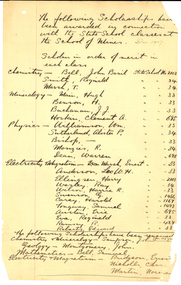
Letter - Correspondence, State School Classes at the Ballarat School of Mines, 1907, 1907
... Menzies from Humffray Street State School (No. 34) is Robert Menzies who became Prime Minister of Australia in 1939. Menzies topped the State scholarship examination in 1907....Menzies from Humffray Street State School (No. 34) is Robert Menzies who became Prime Minister of Australia in 1939. Menzies topped the State scholarship examination in 1907. ballarat school of mines scholarship state school scholarship robert menzies john basil bell reginald smith t. marsh hugh main h. benson j.j. buchanan clement a. hoskin william williamson alister p. sutherland bishop warren dean ernest marsh leo w.h. anderson harry ellingham ray wasley harrie r. wilson g. swenson harold carey samuel tongway eric austin reginald eva r. ramsey edward roberts john montgomery samuel bell ernest pridgeon charles nicholls norman martin. ...A number of students from local state schools were awarded a scholarship to undertake a subject at the Ballarat School of Mines. R. Menzies from Humffray Street State School (No. 34) is Robert Menzies who became Prime Minister of Australia in 1939. Menzies topped the State scholarship examination in 1907.Foolscap page with handwritten list of State School Students who were awarded a scholarship to study a subject at the Ballarat School of Mines.ballarat school of mines, scholarship, state school scholarship, robert menzies, john basil bell, reginald smith, t. marsh, hugh main, h. benson, j.j. buchanan, clement a. hoskin, william williamson, alister p. sutherland, bishop, warren dean, ernest marsh, leo w.h. anderson, harry ellingham, ray wasley, harrie r. wilson, g. swenson, harold carey, samuel tongway, eric austin, reginald eva, r. ramsey, edward roberts, john montgomery, samuel bell, ernest pridgeon, charles nicholls, norman martin., samuel taong-way, state school students -
 National Vietnam Veterans Museum (NVVM)
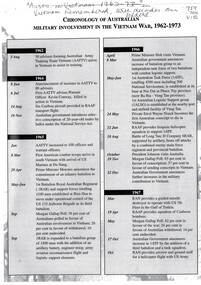
Document, A copy of Chronology of Australian Military involvement in the Vietnam War, 1962-1973
... Vietnam War Chronology of Events Australian Army Training Team Vietnam (AATTV) Caribou RAAF Royal Australian Air Force National Servoce Act US Marines Da Nang Prime Minister Robert Menzies 1st Battalion Royal Australian Regiment 1 RAR Bien Hoa US 173 Airborne Brigade Prime Minister Harold Holt 1st Australian Task Force 1 ATF Nui Dat Phuoc Tuy Province 1st Australian Logistic Support Group 1 ALSG Pte Errol Wayne Noack Killed in Action RAAF IROQUOIS Helicopter Battle of Long Tan D Company 6 RAR Royal Australian Regiment President Johnson RAN Royal Australian Navy US 7th Fleet The Gulf of Tonkin Canberra Bomber Tet Offensive Prime Minister John Gorton Fire Support Base Coral and Balmoral Presdient Nixon Prime Minister William (Bill) McHahon Australian Government 4 RAR Governor General Sir Paul Hasluck Prime Minister Gough Whitlam Democratic Republic Of Vietnam The Book titled Vietnam Remember is held in the Library on Shelf 31 Two pages that have been photogcopied out of the book titled Vietnam Remembered Three Decades is a copy of Chronology of Australian Military iIvolvement in the Vietnam War, 1962-1973. there is handwritten information on the first page. ...Two pages that have been photogcopied out of the book titled Vietnam Remembered Three Decades is a copy of Chronology of Australian Military iIvolvement in the Vietnam War, 1962-1973. there is handwritten information on the first page.The Book titled Vietnam Remember is held in the Library on Shelf 31vietnam war, chronology of events, australian army training team vietnam (aattv), caribou, raaf, royal australian air force, national servoce act, us marines, da nang, prime minister robert menzies, 1st battalion royal australian regiment, 1 rar, bien hoa, us 173 airborne brigade, prime minister harold holt, 1st australian task force, 1 atf, nui dat, phuoc tuy province, 1st australian logistic support group, 1 alsg, pte errol wayne noack, killed in action, raaf iroquois helicopter, battle of long tan, d company, 6 rar, royal australian regiment, president johnson, ran, royal australian navy, us 7th fleet, the gulf of tonkin, canberra bomber, tet offensive, prime minister john gorton, fire support base coral and balmoral, presdient nixon, prime minister william (bill) mchahon, australian government, 4 rar, governor general sir paul hasluck, prime minister gough whitlam, democratic republic of vietnam -
 National Vietnam Veterans Museum (NVVM)
Document, A Copy of Vietnam Veterans Council of Victoria Inc.: A brief history of the Vietnam War (Copy 1), 1993
... South China Sea Laos Cambodia The Viet Minh Ho Chi Minh Battle of Dien Bien Phu Vietnamese Communist Party National Liberation Front Viet Cong Saigon Bien Hoa The Domino Theory South East Asia Australian Government Prime Minister - Robert Menzies Australian Army Training Team Vietnam (AATTV) Royal Australian Air force RAAF Caribou Australian National Serviceman 1st Battalion Royal Australian Regiment 1RAR HMAS Sydney Bien Hoa Airbase US 173rd Airborne Brigade Cu Chi Tunnels Tunnel Rats Saigon-Cholon Australian Task Force Phuoc Tuy Province 5RAR 6RAR Nui Dat 1st Australian Task Force 1ATF Headquarters Australian Force Vietnam Ho Chi Minh City Phuoc Tuy D Company Battle of Long Tan Gunners New Zealand Gunners Australian Gunners M113 RAAF Helicopters D445 Provincial Battalion Vietnam Veterans' Day ANZAC HMAS Hobart U.S. 7th Fleet A Squadron Canberra Bomber Vung Tau Harbour Tet Offensive Baria Long Dien Long Hai Hills C Company 3RAR Fire Support Base Fire Support Base - Coral Fire Support Base - Balmoral 8RAR Vietnamese Territorial Force US Troops Whitlam Labor Government Prime Minister Gough Whitlam Agent Orange Evatt Royal Commission Post Traumatic Stress Disorder PTSD Welcome Home Parade 1987 A Copy of Vietnam Veterans Council of Victoria Inc.: A brief history of the Vietnam War which was compiled as a guide to secondary school students and or any other person wishing to study the history of the Vietnam War. ...A Copy of Vietnam Veterans Council of Victoria Inc.: A brief history of the Vietnam War which was compiled as a guide to secondary school students and or any other person wishing to study the history of the Vietnam War. For more information please read the media files.vietnam veterans council of victoria inc., south china sea, laos, cambodia, the viet minh, ho chi minh, battle of dien bien phu, vietnamese communist party, national liberation front, viet cong, saigon, bien hoa, the domino theory, south east asia, australian government, prime minister - robert menzies, australian army training team vietnam (aattv), royal australian air force, raaf, caribou, australian national serviceman, 1st battalion, royal australian regiment, 1rar, hmas sydney, bien hoa airbase, us 173rd airborne brigade, cu chi, tunnels, tunnel rats, saigon-cholon, australian task force, phuoc tuy province, 5rar, 6rar, nui dat, 1st australian task force, 1atf, headquarters, australian force vietnam, ho chi minh city, phuoc tuy, d company, battle of long tan, gunners, new zealand gunners, australian gunners, m113, raaf helicopters, d445 provincial battalion, vietnam veterans' day, anzac, hmas hobart, u.s. 7th fleet, a squadron, canberra bomber, vung tau harbour, tet offensive, baria, long dien, long hai hills, c company, 3rar, fire support base, fire support base - coral, fire support base - balmoral, 8rar, vietnamese territorial force, us troops, whitlam labor government, prime minister gough whitlam, agent orange, evatt royal commission, post traumatic stress disorder, ptsd, welcome home parade 1987 -
 National Vietnam Veterans Museum (NVVM)
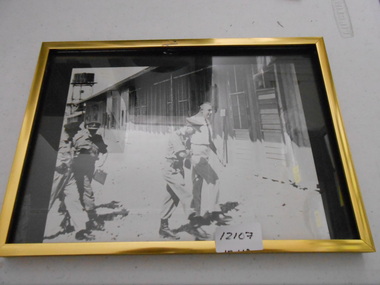
Photograph, PM Visits
... Photograph Prime Minister - Robert Menzies Soldiers Photograph of Prime Minister Ribert Menzies walking and talking to three Australian Officers PM Visits Photograph Photograph ...Photograph of Prime Minister Ribert Menzies walking and talking to three Australian Officersphotograph, prime minister - robert menzies, soldiers -
 National Vietnam Veterans Museum (NVVM)
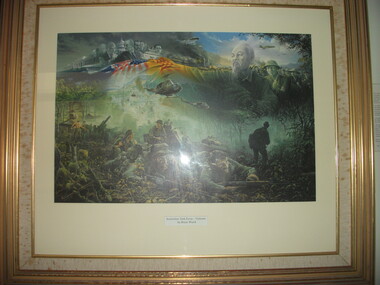
Painting - A Coloured Painting of Soldiers from Australian Task Force, Brian Wood, Australian Task Force - Vietnam By Brian Wood
... Painting Robert Menzies Flags South Vietnam Flag 105mm Artillery Adrian d'Hage Adrian Cronauer Pte Brian John Wood 3179841 Royal Australian Infantry Corps 4th Battalion The Royal Australian Regiment Capt (Temp) Adrian Stuart D'Hage 235323 Military Cross 6th Battalion Australian Task Force - Vietnam Prime Minister Robert Menzies Adrian Cronauer - Tge US Air Force Sergean Armed Forces Radio Show Goooooooood morning Vietnam A framed coloured original painting in gold timber with a multi beige matte and a cream matte around the painting. ...A framed coloured original painting in gold timber with a multi beige matte and a cream matte around the painting. Painting depicts several world leaders including Sir Robert Menzies, flags of Australia and SVN. In the foreground is a 105mm Artillary Battery. also a number of soldiers resting. See a full description of the detail of the painting (Photo 2021-125)painting, robert menzies, flags, south vietnam flag, 105mm artillery, adrian d'hage, adrian cronauer, pte brian john wood, 3179841, royal australian infantry corps, 4th battalion, the royal australian regiment, capt (temp) adrian stuart d'hage, 235323, military cross, 6th battalion, australian task force - vietnam, prime minister robert menzies, adrian cronauer - tge us air force sergean, armed forces radio show, goooooooood morning, vietnam -
 National Vietnam Veterans Museum (NVVM)
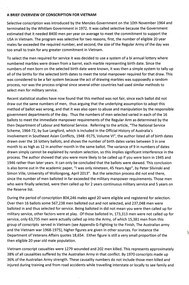
Document - A Copy of A Brief Overview of Conscription for Vietnam
... Signalman Rodney Laurence Gallagher 3793958 Royal Australian Corps of Signals 110 Signal Squadron Australian National Serviceman Conscription Prime Minister - Robert Menzies Prime Minister Gough Whitlam A Brief Overview of Conscription for Vietnam which was introduced by the Menzies Government on the 10th November 1964 and terminated by the Whitlam Government in 1972. ...This item was donated by Signalman Rodney Laurence Gallagher (3793958) who was with the Royal Australian Corps of Signals and served in Vietnam with 110 Signal Squadron from July 1969 to June 1970. Rodney was also a National Serviceman.A Brief Overview of Conscription for Vietnam which was introduced by the Menzies Government on the 10th November 1964 and terminated by the Whitlam Government in 1972. This was written by Rod Gallagher who was a Vietnam Veteran and Conscript. See media files for more information.signalman rodney laurence gallagher, 3793958, royal australian corps of signals, 110 signal squadron, australian national serviceman, conscription, prime minister - robert menzies, prime minister gough whitlam -
 Bendigo Historical Society Inc.
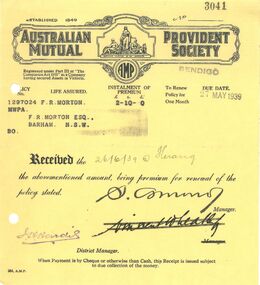
Financial record - INVOICE COLLECTION: The Australian Mutual Provident Society
... Milestones 1849 – The Australian Mutual Provident Society (AMP) opens for business 1860 – Benjamin Short joins AMP as its first agent 1869 – The National Mutual Life Association of Australasia opens for business 1899 – James Tuscon Thompson joins National Mutual as its first agent 1962 – The iconic AMP building in Sydney's Circular Quay is opened by Prime Minister Robert Menzies 1995 – National Mutual demutualises and lists on the Australian Stock Exchange 1998 – AMP demutualises and lists on the Australian Stock Exchange. ...Milestones 1849 – The Australian Mutual Provident Society (AMP) opens for business 1860 – Benjamin Short joins AMP as its first agent 1869 – The National Mutual Life Association of Australasia opens for business 1899 – James Tuscon Thompson joins National Mutual as its first agent 1962 – The iconic AMP building in Sydney's Circular Quay is opened by Prime Minister Robert Menzies 1995 – National Mutual demutualises and lists on the Australian Stock Exchange 1998 – AMP demutualises and lists on the Australian Stock Exchange. ...https://www.amp.com.au/about-amp/what-we-do "From its humble beginnings in 1849 by offering life insurance as the Australian Mutual Provident Society, AMP has evolved over the past 175 years to be a publicly listed company with over 1.3 million customers and AU$133 billion in assets under management (as at FY23). Proudly celebrating 175 years of business in 2024, AMP now helps millions of people in Australia and New Zealand invest, build wealth and retire with confidence." Milestones 1849 – The Australian Mutual Provident Society (AMP) opens for business 1860 – Benjamin Short joins AMP as its first agent 1869 – The National Mutual Life Association of Australasia opens for business 1899 – James Tuscon Thompson joins National Mutual as its first agent 1962 – The iconic AMP building in Sydney's Circular Quay is opened by Prime Minister Robert Menzies 1995 – National Mutual demutualises and lists on the Australian Stock Exchange 1998 – AMP demutualises and lists on the Australian Stock Exchange. AMP Bank opens for business 2000 – AMP plays a major part in the first Olympics of the new century, supporting the Sydney 2000 Olympic Games, the Paralympic Games and the Olympic Torch Relay 2009 – AMP and China Life Group form strategic partnership 2011 – AMP and AXA Asia Pacific (formerly National Mutual) merge. AMP and Mitsubishi UFJ Trust and Banking form strategic partnership 2017 – AMP Capital takes a minority stake in US based real estate investment manager PCCP 2020 – Completed sale of AMP Life insurance business to Resolution Life 2022 – Announced sale of global asset management business, AMP Capital, to focus on AMP’s core businesses in banking and wealth management. 2024 – AMP celebrates 175 years of helping people create their tomorrow10934.35a: No. 3041 A small, square sheet of yellow paper with two clean punch holes on the left side and a perforated edge. The paper is thin, but sturdy. Printed in black ink is the business name and details: Australian Mutual Provident Society established 1849. Policy No. 1297024 The receipt is printed in black ink. Payment due 27 May 1939. Receipt indicates payment received 26 June 1939. Payment listed in British Pounds, totaling 2 pounds 10 shillings. 10934.35b: No. 3861 A small, square sheet of yellow paper with two clean punch holes on the left side and a perforated edge. The paper is thin, but sturdy. Printed in black ink is the business name and details: Australian Mutual Provident Society established 1849. Policy No. 1311528 The receipt is printed in black ink. Payment due 18 Jun 1939. Receipt indicates payment received 26 June 1939. Payment listed in British Pounds, totaling 2 pounds 10 shillings. 10934.35c: No. 1671 A small, square sheet of yellow paper with two clean punch holes on the left side and a perforated edge. The paper is thin, but sturdy. Printed in black ink is the business name and details: Australian Mutual Provident Society established 1849. Policy No. 1311528 The receipt is printed in black ink. Payment due 18 Mar 1939. Receipt indicates payment received 25 March 1939. Payment listed in British Pounds, totaling 2 pounds 10 shillings. 10934.35d: No. 903 A small, square sheet of yellow paper with two clean punch holes on the left side and a perforated edge. The paper is thin, but sturdy. Printed in black ink is the business name and details: Australian Mutual Provident Society established 1849. Policy No. 1297024 The receipt is printed in black ink. Payment due 27 Feb 1939. Receipt indicates payment received 25 March 1939. Payment listed in British Pounds, totaling 2 pounds 10 shillings. 10934.35e: No. 8557 A small, square sheet of yellow paper with two clean punch holes on the left side and a perforated edge. The paper is thin, but sturdy. Printed in black ink is the business name and details: Australian Mutual Provident Society established 1849. Policy No. 1297024 The receipt is printed in black ink. Payment due 27 Dec 1938. Receipt indicates payment received 25 Jan 1939. Payment listed in British Pounds, totaling 2 pounds 10 shillings. 10934.35f: No. 338 A small, square sheet of yellow paper with two clean punch holes on the left side and a perforated edge. The paper is thin, but sturdy. Printed in black ink is the business name and details: Australian Mutual Provident Society established 1849. Policy No. 1311528 The receipt is printed in black ink. Payment due 18 Jan 1939. Receipt indicates payment received 25 Jan 1939. Payment listed in British Pounds, totaling 2 pounds 10 shillings. 10934.35g: No. 365 A small, square sheet of yellow paper with two clean punch holes on the left side and a perforated edge. The paper is thin, but sturdy. Printed in black ink is the business name and details: Australian Mutual Provident Society established 1849. Policy No. 1297024 The receipt is printed in black ink. Payment due 27 Jun 1939. Receipt indicates payment received 25 Feb 1939. Payment listed in British Pounds, totaling 2 pounds 10 shillings. receipt attached to 10934.35j 10934.35h: No. 2321 A small, square sheet of yellow paper with two clean punch holes on the left side and a perforated edge. The paper is thin, but sturdy. Printed in black ink is the business name and details: Australian Mutual Provident Society established 1849. Policy No. 1311528 The receipt is printed in black ink. Payment due 18 April 1939. Receipt indicates payment received 27 April 1939. Payment listed in British Pounds, totaling 2 pounds 10 shillings. receipt is attached to 10934.35i 10934.35i: No. 1697 A small, square sheet of yellow paper with two clean punch holes on the left side and a perforated edge. The paper is thin, but sturdy. Printed in black ink is the business name and details: Australian Mutual Provident Society established 1849. Policy No. 1297024 The receipt is printed in black ink. Payment due 27 Mar 1939. Receipt indicates payment received 27 April 1939. Payment listed in British Pounds, totaling 2 pounds 10 shillings. Attached to 10934.35h 10934.35j: No. 876 A small, square sheet of yellow paper with two clean punch holes on the left side and a perforated edge. The paper is thin, but sturdy. Printed in black ink is the business name and details: Australian Mutual Provident Society established 1849. Policy No. 1311528 The receipt is printed in black ink. Payment due 18 Feb 1939. Receipt indicates payment received 25 Feb 1939. Payment listed in British Pounds, totaling 2 pounds 10 shillings. Attached 10934.35gac morton, amp, australian mutual provident society, insurance -
 Sunshine and District Historical Society Incorporated
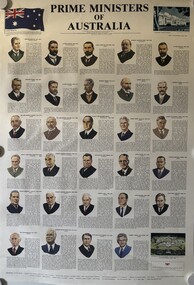
Poster - Prime Ministers of Australia 1901 - 1983 Poster, Standard Publishing House, 1984
... Prime Ministers of Australia 1901 - 1983 Edmund Barton 1901 - 1903 Alfred Deakin 1903 - 1904 John Christopher Watson 1904 George Houston Reid 1904 - 1905 Alfred Deakin 1905 - 1908 Andrew Fister 1908 -- 1909 Alfred Deakin 1909 - 1910 Andrew Fisher (1910 1913) Joseph Cook (1913 - 1914) Andrew Fisher (1914 - 1915) William Morris Hughes (1915 - 1917) William Morris Hughes (1917 - 1923) Stanley Melbourne Bruce (1923 1929) James Henry Scullin (1929 - 1931) Joseph Aloysius Lyons (1932 - 1939) Earle Christmas Grafton Page (1939) Robert Gordon Menzies (1939 - 1941) Arthur William Fadden (b1941) John Curtin (1941 - 1945) Francis Michael Forde (1945) Joseph Benedict Chifley (1945 - 1949) Robert Gordon Menzies (1949 - 1966) Harold Holt (1966 - 1967) John McEwen (1967 - 1968) John Grey Gordon (1966 - 1971) William McMahon (1971 - 1972) Edwward Gough Whitham (1972 - 1975) John Malcolm Fraser (1975 - 1983) Robert James Lee Hawke (1983 -)...This poster was sponsored by Woolworths Limited an Australian Company to celebrate Australia Day 26th January 1984 Prime Minister Prime Ministers of Australia 1901 - 1983 Edmund Barton 1901 - 1903 Alfred Deakin 1903 - 1904 John Christopher Watson 1904 George Houston Reid 1904 - 1905 Alfred Deakin 1905 - 1908 Andrew Fister 1908 -- 1909 Alfred Deakin 1909 - 1910 Andrew Fisher (1910 1913) Joseph Cook (1913 - 1914) Andrew Fisher (1914 - 1915) William Morris Hughes (1915 - 1917) William Morris Hughes (1917 - 1923) Stanley Melbourne Bruce (1923 1929) James Henry Scullin (1929 - 1931) Joseph Aloysius Lyons (1932 - 1939) Earle Christmas Grafton Page (1939) Robert Gordon Menzies (1939 - 1941) Arthur William Fadden (b1941) John Curtin (1941 - 1945) Francis Michael Forde (1945) Joseph Benedict Chifley (1945 - 1949) Robert Gordon Menzies (1949 - 1966) Harold Holt (1966 - 1967) John McEwen (1967 - 1968) John Grey Gordon (1966 - 1971) William McMahon (1971 - 1972) Edwward Gough Whitham (1972 - 1975) John Malcolm Fraser (1975 - 1983) Robert James Lee Hawke (1983 -) Poster of the Prime Ministers of Australia including image and bibliography of each Prime Minister Poster Prime Ministers of Australia 1901 - 1983 Poster Standard Publishing House Margaret Alberts Ken Roberts ...This poster was sponsored by Woolworths Limited an Australian Company to celebrate Australia Day 26th January 1984Prime Ministers of Australia 1901 - 1983 Edmund Barton 1901 - 1903 Alfred Deakin 1903 - 1904 John Christopher Watson 1904 George Houston Reid 1904 - 1905 Alfred Deakin 1905 - 1908 Andrew Fister 1908 -- 1909 Alfred Deakin 1909 - 1910 Andrew Fisher (1910 1913) Joseph Cook (1913 - 1914) Andrew Fisher (1914 - 1915) William Morris Hughes (1915 - 1917) William Morris Hughes (1917 - 1923) Stanley Melbourne Bruce (1923 1929) James Henry Scullin (1929 - 1931) Joseph Aloysius Lyons (1932 - 1939) Earle Christmas Grafton Page (1939) Robert Gordon Menzies (1939 - 1941) Arthur William Fadden (b1941) John Curtin (1941 - 1945) Francis Michael Forde (1945) Joseph Benedict Chifley (1945 - 1949) Robert Gordon Menzies (1949 - 1966) Harold Holt (1966 - 1967) John McEwen (1967 - 1968) John Grey Gordon (1966 - 1971) William McMahon (1971 - 1972) Edwward Gough Whitham (1972 - 1975) John Malcolm Fraser (1975 - 1983) Robert James Lee Hawke (1983 -)prime minister -
 City of Ballarat
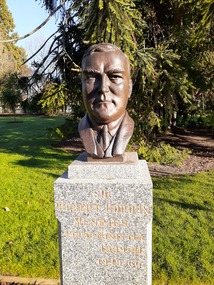
Public Artwork, Robert Menzies Prime Ministers Walk, 1942
... Sir Robert Gordon Menzies Australia's 12th Prime Minister, served April 1939 to 1941 and a second term from 1949 to 1966. ...prime ministers' busts are unique in Australia, representing the only sculptural portrait collection of all past Australian Prime Ministers. The different styles used reflect the unique artistic practices of the selected artists; textures, sizes and features and proportions are used by the artists to interpret the characteristics of each of the subjects. The artwork is of historic and aesthetic significance to the people of Ballarat prime minister australian pm Sir Robert Gordon Menzies ...Sir Robert Gordon Menzies Australia's 12th Prime Minister, served April 1939 to 1941 and a second term from 1949 to 1966. The Prime Ministers Avenue is a collection of bronze bust portraits of the Prime Ministers of Australia, located at the Ballarat Botanical Gardens in Ballarat, Victoria. The Prime Ministers' portraits are commissioned after the incumbent term of each Prime Minister by the City of Ballarat. The City of Ballarat has taken responsibility for commissioning the busts after funds set aside by politician Richard Armstrong Crouch were exhausted in 2014. Crouch originally donate money to pay for six busts, the first of which was unveiled in 1940. The collection of prime ministers' busts are unique in Australia, representing the only sculptural portrait collection of all past Australian Prime Ministers. The different styles used reflect the unique artistic practices of the selected artists; textures, sizes and features and proportions are used by the artists to interpret the characteristics of each of the subjects.The artwork is of historic and aesthetic significance to the people of BallaratBronze bust cast on granite and concrete plinth.Sir Robert Gordon Menzies Prime Minister 1939-41 1949-66prime minister, australian pm -
 City of Ballarat
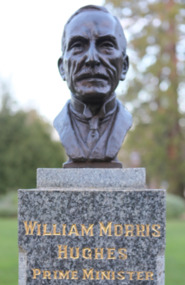
Artwork, other - Public Artwork, Wallace Anderson, William Morris Hughes (Prime Ministers' Walk) by Wallace Anderson, c1940
... William Morris Hughes, Australia’s 7th and longest serving Prime Minister until 1957 when Robert Menzies overtook Hughes’ record term from 1915 to 1923. ...William Morris Hughes, Australia’s 7th and longest serving Prime Minister until 1957 when Robert Menzies overtook Hughes’ record term from 1915 to 1923. ...William Morris Hughes, Australia’s 7th and longest serving Prime Minister until 1957 when Robert Menzies overtook Hughes’ record term from 1915 to 1923. A long standing parliamentarian of 51 years and 7 months continuous service as a member of Australia’s House of Representatives – from the 1st parliament in 1901 to the 20th in 1952. The Prime Ministers Avenue is a collection of bronze bust portraits of the Prime Ministers of Australia, located at the Ballarat Botanical Gardens in Ballarat, Victoria. The Prime Ministers' portraits are commissioned after the incumbent term of each Prime Minister by the City of Ballarat. The City of Ballarat has taken responsibility for commissioning the busts after funds set aside by politician Richard Armstrong Crouch were exhausted in 2014. Crouch originally donate money to pay for six busts, the first of which was unveiled in 1940. The collection of prime ministers' busts are unique in Australia, representing the only sculptural portrait collection of all past Australian Prime Ministers. The different styles used reflect the unique artistic practices of the selected artists; textures, sizes and features and proportions are used by the artists to interpret the characteristics of each of the subjects.The artwork is of historic and aesthetic significance to the people of Ballarat Bronze bust cast on granite plinthWilliam Morris Hughes Prime Minister 1915-23prime minister, australian pm, william morris hughes, parliament -
 Kew Historical Society Inc
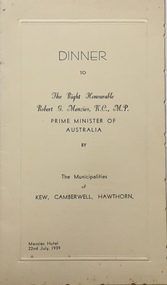
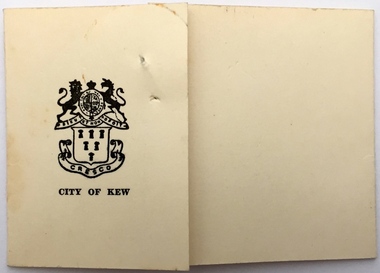
Document (item) - Programme, The Municipalities of Kew, Camberwell, Hawthorn, Dinner, Menzies Hotel, 1939
... Bi-fold programme for a dinner to honour the Right Honourable Robert G Menzies KC MP, Prime Minister of Australia...prime minister menzies hotel -- melbourne (vic.) Bi-fold programme for a dinner to honour the Right Honourable Robert G Menzies KC MP, Prime Minister of Australia Dinner, Menzies Hotel Document Programme The Municipalities of Kew, Camberwell, Hawthorn ...The Municipality of Kew (1860-1863), the Borough of Kew (1863-1910), the Town of Kew (1910-1921) and the City of Kew (1921-1994) were local government instrumentalities in the State of Victoria. In 1994, the City of Kew was amalgamated, together with the former Cities of Camberwell and Hawthorn, into the new City of Boroondara (1994- ). Like other local government entities of the period, Kew was administered by town clerks. The two notable town clerks in Kew's history were H. H. (Henry Hirst) Harrison (1868-1955) and W. D. (William Dickie) Birrell (1899-1974). Harrison was appointed to the position in 1901 and retired in 1938 after 37 years. Birrell, appointed Acting Town Clerk in 1921, became Town Clerk in 1938, following Harrison's retirement. He continued in this role until his retirement in 1966.This card is part of an historically significant civic collection, containing hundreds of separate invitations, documents, greeting cards, programmes and tickets issued and/or collected by successive town clerks. Items in the collection illuminate the political, social and cultural history of the district. As a continuous record, ranging across most decades of the Twentieth Century, they reveal changing tastes in design, values and relationships in the history of local government in Victoria.civic invitations -- kew (vic), the right hon r g menzies -- mp for kew -- prime minister, menzies hotel -- melbourne (vic.) -
![A Smile for My Parents / [by] Heather Henderson](/media/collectors/550653872162f11fb04854aa/items/5ece6a72f36c2704c4f2bf03/item-media/5ece6ad5f36c2704c4f2bf8d/item-fit-380x285.jpg?cb=6) Kew Historical Society Inc
Kew Historical Society IncBook, Allen & Unwin, A Smile for My Parents, 2017
... australia -- history -- 20th century -- biography. prime ministers -- australia -- biography. Biography of Dame Pattie and Sir Robert Menzies Crows Nest, NSW : Allen & Unwin, 2017 ©2013 xii, 227 pages, 16 unnumbered pages of plates : illustrations, portraits, plates ; 20 cm A Smile for My Parents Book Allen & Unwin Heather Henderson ...Biography of Dame Pattie and Sir Robert MenziesCrows Nest, NSW : Allen & Unwin, 2017 ©2013 xii, 227 pages, 16 unnumbered pages of plates : illustrations, portraits, plates ; 20 cm non-fictionBiography of Dame Pattie and Sir Robert Menziesaustralia -- history -- 20th century -- biography., prime ministers -- australia -- biography. -
 Melbourne Legacy
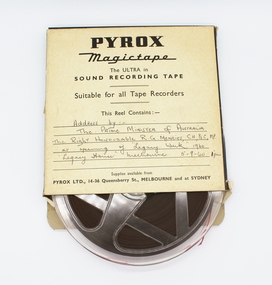
Audio - Recording, tape, Address by the PM of Australia RG Menzies 1960, 1960
... Hand written in blue biro Prime Minister R.G.Menzies "Legacy Week' 1960 An audio tape recording of an address by the Prime Minister Robert Menzies at Legacy House in 1960. Address by the PM of Australia ...A recording of a speech by PM Robert Menzies at Legacy House during the launch of Legacy Week in 1960. The Prime Minister is recognising the importance of the welfare carried out by Legacy for the families of service personnel who have died as a result war or since. The event was covered in the press, with a photo appearing in The Age on 6 September 1960. The article was saved in a scrapbook of press clippings. The content of the speech is not known as the tape hasn't been played. there are two speeches by Sir Robert Menzies in the archive, one undated and one from 1967.A record that prominent Australians were asked to promote Legacy during Legacy Week.An audio tape recording of an address by the Prime Minister Robert Menzies at Legacy House in 1960.Hand written in black ink on the label: Address by:- The Prime Minister of Australia The Right Honourable R.G.Menzies, C.H., Q.C.,M.P. at opening of "Legacy Week 1960 Legacy House Melbourne 5-9-60 at 1 pm". Front of box in white print, Special Sound recording tape for highest frequency response. In red print PYROX. In white print Magictape finest quality recording tape. Side of box in white print Magictape sound recording tape (printed on 3 sides). Bottom of box in black print, PYROX/ Magictape/ The ultrain sound recording tape/Suitable for all Tape recorders/This reel contains. supplies available from PYROX LTD 14-36 Queensberry St, Melbourne and at Sydney Spool, Paper adhered to spool with cello tape. Hand written in blue biro Prime Minister R.G.Menzies "Legacy Week' 1960 speech, legacy week, legacy promotion, robert menzies -
 Kew Historical Society Inc
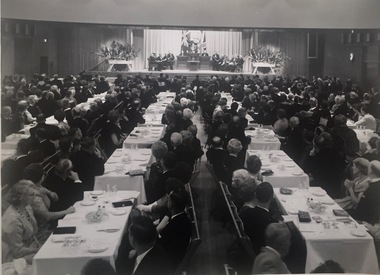
Photograph, Centenary Dinner Dance, Kew Civic Hall, 1960
... Birrell [Town Clerk], Cr WHS Dickinson [the Mayor], and The Rt Hon Robert Menzies, MP for Kew and Prime Minister of Australia....Birrell [Town Clerk], Cr WHS Dickinson [the Mayor], and The Rt Hon Robert Menzies, MP for Kew and Prime Minister of Australia. Centenary Dinner Dance, Kew Civic Hall Photograph Photograph ...Original photograph of the Kew Centenary Ball in the new Kew Civic Hall in 1960. The photograph formed part of the collection of WHS Dickinson and was presented to the Kew Historical Society by his daughter in 2018. Original black and white photograph of the seated invited guests at the dinner celebrating the 100th anniversary of the declaration of Kew as an independent municipality. The point of view is from the south end of the building, looking towards the stage at the north end of the main hall. [Originally both halls could be separated or joined by concertina doors.] On the stage, centre, is from left Mr. W. Birrell [Town Clerk], Cr WHS Dickinson [the Mayor], and The Rt Hon Robert Menzies, MP for Kew and Prime Minister of Australia.cr whs dickinson - mayor of kew 1946-1947, civic events - kew (vic), centenary of kew (vic) - 1860-1960 -
 Kew Historical Society Inc
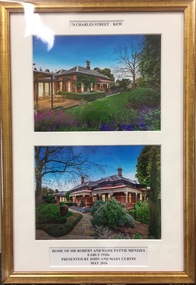
Photograph - Framed Photographs, John & Mary Curtin, 74 Charles Street, Kew, c. 2016
... Sir Robert Menzies and his family lived in a number of houses in Kew. He was the local MHR for Kew and for many years Prime Minister of Australia...Sir Robert Menzies and his family lived in a number of houses in Kew. He was the local MHR for Kew and for many years Prime Minister of Australia sir robert menzies dame pattie menzies 74 charles street (kew) The annotations to the photographs read: "74 Charles Street Kew / Home of Sir Robert and Dame Pattie Menzies / Early 1920s / Presented by John and Mary Curtin / May 2016". ...Sir Robert Menzies and his family lived in a number of houses in Kew. He was the local MHR for Kew and for many years Prime Minister of AustraliaTwo colour photographs, mounted in a single gilt frame of the exterior of 74 Charles Street, Kew. During the 1920s, the house was the home of [Sir] Robert and [Dame] Pattie Menzies. The framed photographs were donated by subsequent owners of the property.The annotations to the photographs read: "74 Charles Street Kew / Home of Sir Robert and Dame Pattie Menzies / Early 1920s / Presented by John and Mary Curtin / May 2016".sir robert menzies, dame pattie menzies, 74 charles street (kew) -
![Book, Sir Robert Menzies 1894-1968 - a new informal memoir / [by] Sir Percy Joske, 1978](/media/collectors/550653872162f11fb04854aa/items/5d03470821ea7b095051f88c/item-media/5d03472421ea7b0950521757/item-fit-380x285.jpg?cb=6) Kew Historical Society Inc
Kew Historical Society IncBook, Sir Robert Menzies 1894-1968 - a new informal memoir / [by] Sir Percy Joske, 1978
... sir robert menzies australian prime ministers political representatives - kew (vic) 354p. : ill Sir Robert Menzies 1894-1968 - a new informal memoir / [by] Sir Percy Joske Book book Angus & Robertson ...354p. : illsir robert menzies, australian prime ministers, political representatives - kew (vic) -
 Kew Historical Society Inc
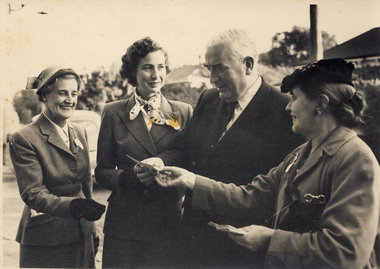
Photograph, Ama Figuerola and Sir Robert Menzies, 1960s
... An undated photograph of the Prime Minister of Australia, and local member for Kew, [Sir] Robert Menzies with his wife and daughter and the artist Alma Figuerola to his left. ...She predeceased her two sisters who both died in the 1990s and who are buried at Andersons' Creek Cemetery in Warrandyte. alma figuerola album arists - kew (vic) art exhibitions - kew (vic) sir robert menzies An undated photograph of the Prime Minister of Australia, and local member for Kew, [Sir] Robert Menzies with his wife and daughter and the artist Alma Figuerola to his left. ...The Melbourne artist Alma Agnes Marion Figuerola, was the daughter of Juan Pedro Narciso Figuerola (1869-1919) and Alice Lucinda Walker Hanson (1889-1969). Each of their three daughters grew up to be involved in the arts: Alma as a painter; Carmen Irene (1906-1993) as a short story writer, poet and teacher of dancing; and Sylvia (also Silvia) Lyla Alice (1911-1992) as a composer and cellist. The first art lessons Alma Figuerola received were with Oscar Binder. Later she attended the art school established by the Melbourne 'tonalist' [Duncan] Max Meldrum (1875-1955). She graduated from his school in 1920, participating in her first group exhibition in the same year. Solo exhibitions of her work were to be held in 1933 at the Meldrum Gallery in Elizabeth Street, in 1937 and 1945 at the Athenaeum Gallery at 188 Collins Street, and in 1951 at Georges Gallery in Collins Street. Throughout her extensive career she participated in group exhibitions, usually with artists of the Meldrum School, and as a member of the Twenty Melbourne Painters, of which she was invited to become an associate in 1935. In 1953, her portrait of Professor ES Hills was entered in the Archibald Prize Competition of the Art Gallery of New South Wales. A resident of Kew from the 1930s - 51 Studley Park Road, often with her mother, her sister Carmen, or both - from c.1942 until her death she lived at 'D’Estaville', 7 Barry Street. From the late 1930s she is recorded as actively contributing to the arts at a local level. In 1939 and 1940 she participated in art exhibitions at the Hawthorn Municipal Library organised by Jessie Carbines. From 1944 to 1951 she co-organised successive Kew Arts Festivals, initially in the Presbyterian Church Hall in Highbury Grove and later at the Recreation Hall in Wellington Street. A foundation member of the Kew Historical Society in 1958, Alma Figuerola remained an active member of the Society until her death on 8 December 1970. She predeceased her two sisters who both died in the 1990s and who are buried at Andersons' Creek Cemetery in Warrandyte.An undated photograph of the Prime Minister of Australia, and local member for Kew, [Sir] Robert Menzies with his wife and daughter and the artist Alma Figuerola to his left. alma figuerola album, arists - kew (vic), art exhibitions - kew (vic), sir robert menzies -
 Kew Historical Society Inc
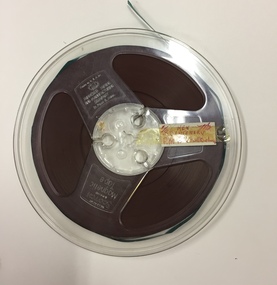
Audio - City of Kew Centenary: The Right Hon RG Menzies & Cr WHS Dickinson, William Dickinson, 1960
... Australian population, gained through historic participation in democracy at local, state and federal levels. RG Menzies mounts a strong case for each level of government having value in the development of Australian democracy. He also describes the emerging democracies of Africa in the period following decolonisation, and suggests that the success of these countries is dependent on democratic institutions not being imposed from above by colonial powers. city of kew centenary of kew 1860-1960 robert gordon menzies william henry shorey dickinson bill burrell mayors of kew town clerks of kew australian prime ministers australian democracy democracy Label on original box City of Kew Centenary 1860-1960 Speeches by The Hon RG Menzies, MHR for Kew, and Cr WHS Dickinson, Mayor of Kew. ...Kew, in Melbourne, Victoria, was declared a Borough in 1859, following which the first Council was elected in 1860. Kew became a Town in 1910, and a City in 1921. It was amalgamated into a new City of Boroondara in 1994. The centenary celebrations of 1860 marked 100 since the first Kew Council was established.This reel-to-reel tape, now digitised, is both rare (ie unique) and historically significant. While the recording clearly has local significance, it is also of national and international significance due to the content of the Prime Minister's address. The focus of his speech is the nature of Australian democracy and its strengths, deriving from universal suffrage and the acceptance of democratic values by the Australian population, gained through historic participation in democracy at local, state and federal levels. RG Menzies mounts a strong case for each level of government having value in the development of Australian democracy. He also describes the emerging democracies of Africa in the period following decolonisation, and suggests that the success of these countries is dependent on democratic institutions not being imposed from above by colonial powers. City of Kew Centenary 1860-1960 Speeches by The Hon RG Menzies, MHR for Kew, and Cr WHS Dickinson, Mayor of Kew. Recorded on 13th December 1960 at the Kew City Hall 34 minutes 29 seconds From the archives of the Kew Historical Society Inc Copyright Kew Historical Society Inc Timings 00.14-17.00 The Right Hon RG Menzies MHR 17.07-32.33 Cr. WHS Dickinson 32.38-33.10 The Right Hon RG Menzies MHR 33.30-33.50 Cr. WHS Dickinson 33.51-34.25 Song - 'For He's a Jolly Good Fellow'Label on original boxcity of kew, centenary of kew 1860-1960, robert gordon menzies, william henry shorey dickinson, bill burrell, mayors of kew, town clerks of kew, australian prime ministers, australian democracy, democracy -
 Kew Historical Society Inc
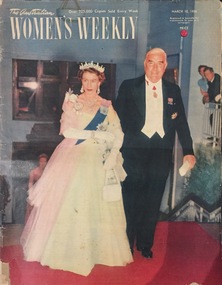
Magazine, The Australian Women's Weekly, March 10, 1954
... Single issue of the Australian Women's Weekly, published on March 10, 1954, picturing Queen Elizabeth II and the Australian Prime Minister, The Hon Robert Menzies, on the cover. ...Australia. The Rt Hon R G Menzies was the Member for Kew. australian womens weekly - 1954 royal tours - 1954 Single issue of the Australian Women's Weekly, published on March 10, 1954, picturing Queen Elizabeth II and the Australian Prime Minister, The Hon Robert Menzies, on the cover. ...Magazine published at the time of Elizabeth II's visit to Australia. The Rt Hon R G Menzies was the Member for Kew.Single issue of the Australian Women's Weekly, published on March 10, 1954, picturing Queen Elizabeth II and the Australian Prime Minister, The Hon Robert Menzies, on the cover. This 63-page edition was published during the Royal tour of Australia. It contains photographs, articles, stories, letters, advertisements etc.australian womens weekly - 1954, royal tours - 1954 -
 Kew Historical Society Inc
Document - Invitation, Invitation to Meet Mr Menzies and Dame Pattie Menzies, City of Kew, 1955, 1955
... Robert (later Sir Robert) Menzies was the member for Kooyong from 1934 to 66, and Australian Prime Minister from 1939 to 41, and again from 1949 to 66. ...Robert (later Sir Robert) Menzies was the member for Kooyong from 1934 to 66, and Australian Prime Minister from 1939 to 41, and again from 1949 to 66. ...Robert (later Sir Robert) Menzies was the member for Kooyong from 1934 to 66, and Australian Prime Minister from 1939 to 41, and again from 1949 to 66. The City of Kew was within the boundaries of his electorate. Civic events, before the opening of the new Kew City Hall in 1960 were frequently held at the Kew Recreation Hall (demolished 1960) in Wellington Street.The Arthur Dear Collection is a comprehensive collection of theatrical ephemera relating to performances by theatrical and musical organisations from within and outside the former City of Kew who typically performed at venues in Kew during the 1950s and 1960s.Card formally acknowledging the acceptance of an invitation to an event in the Kew Recreation Hall. The printed response was issued by the Town Clerk - W.D. Birrell - on behalf of the Mayor - Cr. Marie Dalley. The event was held to meet Mr Menzies and Dame Pattie Menzies.arthur dear collection, robert menzies, dame pattie menzies, kew recreation hall, city of kew - invitations -
Unions Ballarat
Don Chipp: The third man (Don Woodward Collection), Larkin, John et al, 1978
... Australian Democrats in 1977 and gained the balance of power in the Senate. The foreword is written by John Gorton (former Liberal Prime Minister) and an afterword by RJ Hawke (former ALP Prime Minister). Section titles: 1. In the beginning 2. Inside Canberra: Menzies to Fraser 3. Moving on 4. Present shock Biographical and political interest (Australia). btlc ballarat trades hall ballarat trades and labour council chipp, don politics and government senate - australia liberal party australia senators australian democrats parliament Menzies, Robert Fraser, Malcolm Hawke, RJ ALP australian labor party Prime minister - Australia Biography autobiography Book; 254 pages. ...Don Chipp was a former Liberal Party politician. He was the founder of the Australian Democrats in 1977 and gained the balance of power in the Senate. The foreword is written by John Gorton (former Liberal Prime Minister) and an afterword by RJ Hawke (former ALP Prime Minister). Section titles: 1. In the beginning 2. Inside Canberra: Menzies to Fraser 3. Moving on 4. Present shock Biographical and political interest (Australia).Book; 254 pages. Dust jacket: grey background; colour artistic representation of Don Chipp; red lettering; authors' names and title. Cover: red background; gold lettering; authors' names and titles on spine.btlc, ballarat trades hall, ballarat trades and labour council, chipp, don, politics and government, senate - australia, liberal party australia, senators, australian democrats, parliament, menzies, robert, fraser, malcolm, hawke, rj, alp, australian labor party, prime minister - australia, biography, autobiography -
Unions Ballarat
Afternoon light: Some memories of men and events (Don Woodward Collection), Menzies, Robert, 1967
... Reflections by Sir Robert Menzies (former Australian Prime Minister) upon past USA and UK prime ministers, White Australia Policy, Suez Canal, the monarchy, cricket, governance and more....Reflections by Sir Robert Menzies (former Australian Prime Minister) upon past USA and UK prime ministers, White Australia Policy, Suez Canal, the monarchy, cricket, governance and more. ...Reflections by Sir Robert Menzies (former Australian Prime Minister) upon past USA and UK prime ministers, White Australia Policy, Suez Canal, the monarchy, cricket, governance and more.Politics and government - world. Sport.Book; 384 pages. Cover: green background; gold lettering; author's name and title on the spine.Inside pages: Don Woodward's name inscribed in blue ink.btlc, ballarat trades hall, ballarat trades and labour council, prime ministers - menzies, robert, liberal party australia, lpa, politics and government, politics and government - international, monarchy - united kingdom, white australia policy, suez canal, international relations
