
Showing 539 items matching "r. staff"
-
 Eltham District Historical Society Inc
Book - Minute Book, Eltham District Gun Club, 1948-1950
... ...R. Staff...Bode, J. Harris, R. Staff, C. Thorne, F. Jones, W.S. Harrison, F.N. ...Bode, J. Harris, R. Staff, C. Thorne, F. Jones, W.S. Harrison, F.N. ...Minute Book for the Eltham District Gun Club from the first meeting held at the Shire Hall, 6th Sept 1948 to 9th May 1950. Those recorded present at the first meeting were: K. Maxwell, C. Norman, R. Norman, W.R. Squire, R.J. Squire, C. Bode, J. Harris, R. Staff, C. Thorne, F. Jones, W.S. Harrison, F.N. Squire and C.T. Martin. F.N. Squire was appointed President. C.T. Martin appointed Secretary. Those appointed to Committee were C.Bode, H.Correll, J. Harris, C. Thorne, F. Jones, W.R. Squire, R.J. Squire Finacial funds for the club to be raised by debentures issued to members, valued at £5 each. It was agreed that the Eltham Gun Club was to be affiliated with the Australian Clay Pigeon Trap Shooting Association J. Shallard was to be appointed club solicitor Club to be known as Eltham District Gun Club (Clay Targets) Commercial Bank of Australasia to be used for club's banking puposes Annual membership fee fixed at £5 k. maxwell, c. norman, r. norman, w. squire, r.j. squire, c. bode, j. harris, r. staff, c. thorne, w.s. harrison, f.n. squire, c.t. martin, eltham district gun club, minute book, eltham shire hall, h.correll, f. jones, w.r. squire, australian clay pigeon trap shooting association, j. shallard, eltham district gun club (clay targets), commercial bank of australasia, cba -
 Stawell Historical Society Inc
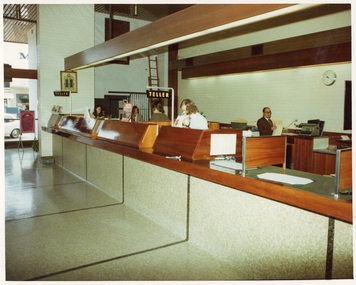
Photograph, Pleasant Creek Special School, State Savings Bank Interior. Staff L - R Kaye Baxendale ? ? Mr Bob Freeland with long blond hair & Unknown Nov 1975, Nov 1975
... State Savings Bank Interior. Staff L - R Kaye Baxendale ? ? Mr Bob Freeland with long blond hair & Unknown Nov 1975...State Savings Bank Interior. Staff L - R Kaye Baxendale ? ? Mr Bob Freeland with long blond hair & Unknown Nov 1975 Photograph Pleasant Creek Special School ...Photographs taken by teacher at Pleasant Creek Training Centre to help train students in living skills and becoming familiar with what shops sold. Part of socializing students for leaving the training centre.Main Street Stawell. Showing shops and businesses in Main Street. education, shops, main street, streetscape -
 Eltham District Historical Society Inc
Document - Folder, Stooke, Henry
... ...R & J Staff...Henry Stooke ship John Pirrie Rosehill homestead Eltham Eltham Court House Eltham Race Course Diamond Valley Miniature Railway St Margaret's Church of England Eltham William Williams Charles Butler R & J Staff Colin McComick 56 Bonds Road Lower Plenty Eliza Jane Stooke Norman Stooke Fountain Hotel Eltham Arthur Young George Stebbing Eltham District Road Board Mary Ann Williams Robert Hopper Woodcock Charles John McCormack Charles Felix Butler Belle Vue homstead Jane Janet Crow Eric Nichol Staff Raymond Charles Staff Janet Staff Josephine McCormick Belle Vue homestead 17 Livingstone Road Eltham Newspaper clippings, A4 photocopies, etc Stooke, Henry Document Folder ...Henry Stooke came to Melbourne in 1842, and bought land in Eltham in 1852, building the Rosehill homestead. He was an eminent member of the community. The homestead was later called Belle Vue. Contents Newspaper article: "Pioneer who built Eltham". Diamond Valley News, 17 August 1992. Henry Stooke's life. List of land purchases. Pages 201-203, "A History of Saint Margaret's Church Eltham": Section on Henry Stooke. Pages 7, 9, 18, 19, 21, 25, Heritage Intelligence Pty Ltd, "Heritage Assessment of 'Bell Vue', 17 Livingstone Road Eltham", October 2009.Newspaper clippings, A4 photocopies, etchenry stooke, ship john pirrie, rosehill homestead eltham, eltham court house, eltham race course, diamond valley miniature railway, st margaret's church of england eltham, william williams, charles butler, r & j staff, colin mccomick, 56 bonds road lower plenty, eliza jane stooke, norman stooke, fountain hotel eltham, arthur young, george stebbing, eltham district road board, mary ann williams, robert hopper woodcock, charles john mccormack, charles felix butler, belle vue homstead, jane janet crow, eric nichol staff, raymond charles staff, janet staff, josephine mccormick, belle vue homestead 17 livingstone road eltham -
 Melbourne Tram Museum
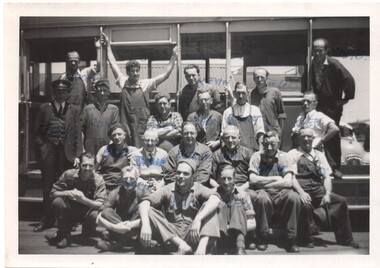
Photograph - Set of two Black & White Photograph/s, Fred Turner, 1960
... In ink on rear "Some of Brunswick R/S staff 1960"...Trams tramways Brunswick Depot Workshops Depots Maintenance In ink on rear "Some of Brunswick R/S staff 1960" .1 - Black and white photograph of some of the Brunswick Depot Rolling stock or tram maintenance staff in 1960, standing in front of a tram. ....1 - Black and white photograph of some of the Brunswick Depot Rolling stock or tram maintenance staff in 1960, standing in front of a tram. A first name has been written on the photograph in biro. .2 - An A4 sheet has had the names written over in red ink.In ink on rear "Some of Brunswick R/S staff 1960"trams, tramways, brunswick depot, workshops, depots, maintenance -
 Tatura Irrigation & Wartime Camps Museum
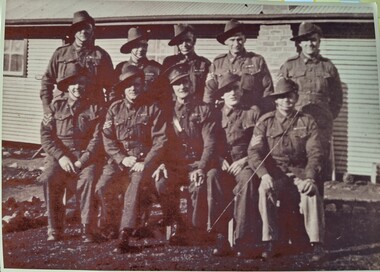
Photograph, Camp 13 Garrison Sergeants, copy 1989
... Front row (l to r): Staff Sergeant Blackwood, Sergeant Ryan, Sergeant Major Gamble, Sergeants Gilbert, F "Chips" Sidebottom (veterans of 13th Light Horse WW1). ...Front row (l to r): Staff Sergeant Blackwood, Sergeant Ryan, Sergeant Major Gamble, Sergeants Gilbert, F "Chips" Sidebottom (veterans of 13th Light Horse WW1). ...Camp 13 Garrison sergeants: Back row (l to r): Sergeants, Wright, Roxborough, Lyall, Thompson and ? Front row (l to r): Staff Sergeant Blackwood, Sergeant Ryan, Sergeant Major Gamble, Sergeants Gilbert, F "Chips" Sidebottom (veterans of 13th Light Horse WW1). Original photo lent by Mrs McCormack of Shepperton, daughter of Sgt. Sidebottom.Black and white photograph of Camp 13, garrison sergeants, POW camp, Tatura 1942 - 1945. Outside of the Army huts. (10 men).sergeant wright, sergeant roxborough, sergeant lyall, sergeant thompson, staff sergeant blackwood, sergeant ryan, sergeant major gamble, sergeant gilbert, sergeant f "chips" sidebottom, veteran of 13th light horse, light horse regiment -
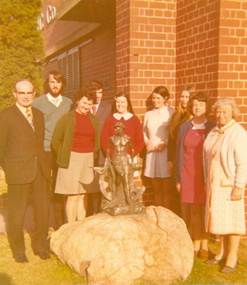 National Wool Museum
Photograph
... Photograph of R S & S Staff with the "Spirit of Anzac" statue at the mill....Photograph of R S & S Staff with the "Spirit of Anzac" statue at the mill. ...Photograph of R S & S Staff with the "Spirit of Anzac" statue at the mill.textile mills - staff textile mills, returned soldiers and sailors mill, the spirit of anzac, textile mills - staff, textile mills -
Creswick Campus Historical Collection - University of Melbourne
Photograph - First group of Forestry School Students and staff standing on the grass in front of Tremearne House, 1910, V. S. F. 1909 - 12 Students
... VSF students and staff R. G. Lindsay, W. H. Horn, J. Sampson, A. ...VSF students and staff R. G. Lindsay, W. H. Horn, J. Sampson, A. ...VSF students and staff R. G. Lindsay, W. H. Horn, J. Sampson, A. Warren, H. Felstead, (Nursery Supt.), N. L. Boston, A. Ken. Sepia photograph on cardboard mount of seven people standing on the grass in front of Tremearne House. The individuals are named at the bottom of the photograph, written in pen on the cardboard mount. L to R. R. G. Lindsay, W. H. Horn, J. Sampson, A. Warren, H. Felstead, (Nursery Supt.), N. L. Boston, A. Ken. On the rear of the cardboard mount: writing in greylead pencil; ? 4 students only:- viz Lindsay, Horn, Sampson, Warren. Writing in blue pen; V.F.S. 1909 - 12 Students. A typewritten label; Presented to the school by Mr W. H. Horn STUDENTS 1909 - 12. February 1971. Written in green lead pencil; Please return to CFEO, DE&R. 22/1/79 -
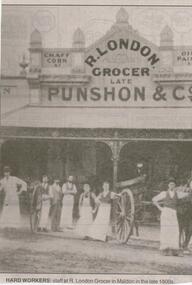 Bendigo Historical Society Inc.
Newspaper - JENNY FOLEY COLLECTION: HARD WORKERS
... Bendigo Advertiser ''The way we were'' from 2000. Hard workers: staff at R. London grocer in Maldon in the late 1800s. ...NEWSPAPER Bendigo advertiser the way we were Bendigo Advertiser ''The way we were'' from 2000. Hard workers: staff at R. London grocer in Maldon in the late 1800s. ...Bendigo Advertiser ''The way we were'' from 2000. Hard workers: staff at R. London grocer in Maldon in the late 1800s. The clip is in a folder.newspaper, bendigo advertiser, the way we were -
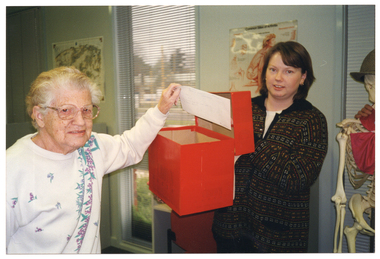 Musculoskeletal Health Australia (now held by the Glen Eira Historical Society)
Photograph - Group photo, Circa 1999 to 2000
... * See Kodak Olympic Games Sponsor [Archivist's note: on a yellow sticky note, handwritten in black ink] (L) Volunteer (R) Melissa (STAFF)...An unidentified Arthritis Foundatin of Victoria (AFV) member deposits an envelope into a red box, assisted by AFV staff member, Mellissa at the AFV headquarters in Elsternwick. arthritis foundation of victoria afv fundraising melissa staff volunteer members [Archivist's note: on a torn half of a MOVE-branded sticky note, handwritten in black ink] Circa LATE 1990s 1999/2000? * See Kodak Olympic Games Sponsor [Archivist's note: on a yellow sticky note, handwritten in black ink] (L) Volunteer (R) Melissa (STAFF) COL photo of an elderly woman and a younger woman. ...An unidentified Arthritis Foundatin of Victoria (AFV) member deposits an envelope into a red box, assisted by AFV staff member, Mellissa at the AFV headquarters in Elsternwick.COL photo of an elderly woman and a younger woman. The elderly woman is holding an envelope above an open red cardboard box, while the younger woman is holding the box with its lid taken off. Beside the younger woman, there is a skeleton on a stand wearing a hat and a scarf (partially obscured). Someone's hand (partially obscured) is placed around the skeleton's shoulder/neck.[Archivist's note: on a torn half of a MOVE-branded sticky note, handwritten in black ink] Circa LATE 1990s 1999/2000? * See Kodak Olympic Games Sponsor [Archivist's note: on a yellow sticky note, handwritten in black ink] (L) Volunteer (R) Melissa (STAFF)arthritis foundation of victoria, afv, fundraising, melissa, staff, volunteer, members -
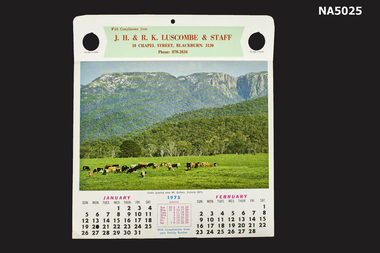 Whitehorse Historical Society Inc.
Souvenir - Calendar, 1975, 1975
... 1975 Calendar produced for J. H. & R. K. LUSCOMBE and staff, Butchers. 6 pages with coloured scenes of Australian rural areas. ...Phone 878-2834 1975 Calendar produced for J. H. & R. K. LUSCOMBE and staff, Butchers. 6 pages with coloured scenes of Australian rural areas. ...Calendars produced for Luscombe butchers of Blackburn Victoria to be given to customers.1975 Calendar produced for J. H. & R. K. LUSCOMBE and staff, Butchers. 6 pages with coloured scenes of Australian rural areas. Each page has two months calendars under the rural scene. On the reverse side of pages have meal recipes & cooking tips.With compliments from J.H. & R.K. Luscombe & staff, 18 Chapel Street, Blackburn, 3130. Phone 878-2834 18 chapel st blackburn, blackburn shops, j h & r k luscombe, butcher shops -
 8th/13th Victorian Mounted Rifles Regimental Collection
Photograph - TST working
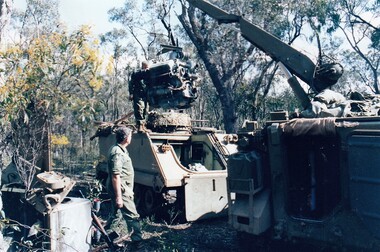
... Colour photograph of Technical Support Troop (TST) of VMR Squadron 4/19 Prince of Wales's Light Horse carrying out major repair to disabled M113 Carrier during Annual Camp, Puckapunyal, September 19992. Staff Sergeant R Wells is supervising lift of power plant....The 4/19 Prince of Wales’s Light Horse title was retained, but the VMR Squadron continued to wear the VMR hat badge. military vmr puckapunyal repair carrier training Wells Colour photograph of Technical Support Troop (TST) of VMR Squadron 4/19 Prince of Wales's Light Horse carrying out major repair to disabled M113 Carrier during Annual Camp, Puckapunyal, September 19992. Staff Sergeant R Wells is supervising lift of power plant. ...On 1 April 1991, ‘A’ Squadron 8/13 Victorian Mounted Rifles linked with 4/19 Prince of Wales’s Light Horse Regiment to form a new regiment of two squadrons: VMR Squadron and PWLH Squadron. The 4/19 Prince of Wales’s Light Horse title was retained, but the VMR Squadron continued to wear the VMR hat badge.Colour photograph of Technical Support Troop (TST) of VMR Squadron 4/19 Prince of Wales's Light Horse carrying out major repair to disabled M113 Carrier during Annual Camp, Puckapunyal, September 19992. Staff Sergeant R Wells is supervising lift of power plant.military, vmr, puckapunyal, repair, carrier, training, wells -
Federation University Historical Collection
Document - Document - Letter, Ballarat Junior Technical School: Letter from Mr Robert Watson, Head Master re Staff Vacation Addresses, 1961
... Letter from Robert Watson, Head Master, providing the vacation addresses of the staff at Ballarat Junior Technical School. Staff were R Watson, F Hewitt, B Johnson, B Longman, R Whitla, W Walker, K Hamilton, G Reeve, N King, R Dunlop, I Chisholm, A Leviston, G Poyton, J Benn, B Bogicevic, J Nicholas. ...Letter from Robert Watson, Head Master, providing the vacation addresses of the staff at Ballarat Junior Technical School. Staff were R Watson, F Hewitt, B Johnson, B Longman, R Whitla, W Walker, K Hamilton, G Reeve, N King, R Dunlop, I Chisholm, A Leviston, G Poyton, J Benn, B Bogicevic, J Nicholas. ballarat junior technical school head master robert watson branko bogicevic f hewitt b johnson b longman r whitla w walker k hamilton g reeve n king r dunlop i chisholm a leviston g poyton j benn j nicholas 1 white page, typed Ballarat Junior Technical School: Letter from Mr Robert Watson, Head Master re Staff Vacation Addresses, 1961 Document Document - Letter ...Letter from Robert Watson, Head Master, providing the vacation addresses of the staff at Ballarat Junior Technical School. Staff were R Watson, F Hewitt, B Johnson, B Longman, R Whitla, W Walker, K Hamilton, G Reeve, N King, R Dunlop, I Chisholm, A Leviston, G Poyton, J Benn, B Bogicevic, J Nicholas. 1 white page, typedballarat junior technical school, head master, robert watson, branko bogicevic, f hewitt, b johnson, b longman, r whitla, w walker, k hamilton, g reeve, n king, r dunlop, i chisholm, a leviston, g poyton, j benn, j nicholas -
 Federation University Historical Collection
Magazine, J.A. Hoskin & Son, Quadrangle: Magazine of the Junior Technical School Ballarat, 1960, 1960
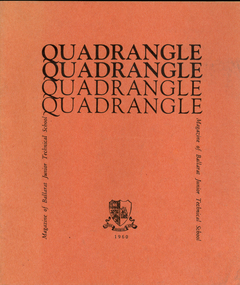
... Robert Champneys, Air Training Corps, Mothers' Club Images include: R. Watson (headmaster), staff, prefects, tennis court, Peter Trezise, Doug Rash, Wong Chik Min, John Gilbert, John McDonald, Ray Bilney, Denis Moy, John Crawley, Roberto Venier, Reijo Karvinen, Cheetham Salt Works; Graeme Cummins, Gerald Kessel, James Colligan, Alan Everett, David Newman, Air Training Corps, Ken Wach, Athletics team, Tunnel Ball Team, Cross Country Team, Basketball Team, Softball Team, Football Team, Swimming team, Cycling Team, Cricket Team, ...Robert Champneys, Air Training Corps, Mothers' Club Images include: R. Watson (headmaster), staff, prefects, tennis court, Peter Trezise, Doug Rash, Wong Chik Min, John Gilbert, John McDonald, Ray Bilney, Denis Moy, John Crawley, Roberto Venier, Reijo Karvinen, Cheetham Salt Works; Graeme Cummins, Gerald Kessel, James Colligan, Alan Everett, David Newman, Air Training Corps, Ken Wach, Athletics team, Tunnel Ball Team, Cross Country Team, Basketball Team, Softball Team, Football Team, Swimming team, Cycling Team, Cricket Team, Quadrangle: Magazine of the Junior Technical School Ballarat, 1960 Magazine Magazine J.A. ...The 1960 Quadrangle magazine committee were Kelvin Whitford, Bill Heywood, Ken Delayney, Daryl Burt, John Cornish, John McDonald, Ross Gray, and Messrs I. Chisholm and N. Watkins.Salmon coloured soft covered magazine of 46 pages. Contents include: Villiers Internal Combustion Engine, Geelong, School Song, Death of W.J. Paterson, Old Boys Newsletter (Keith Rash), Pine plantation. Robert Champneys, Air Training Corps, Mothers' Club Images include: R. Watson (headmaster), staff, prefects, tennis court, Peter Trezise, Doug Rash, Wong Chik Min, John Gilbert, John McDonald, Ray Bilney, Denis Moy, John Crawley, Roberto Venier, Reijo Karvinen, Cheetham Salt Works; Graeme Cummins, Gerald Kessel, James Colligan, Alan Everett, David Newman, Air Training Corps, Ken Wach, Athletics team, Tunnel Ball Team, Cross Country Team, Basketball Team, Softball Team, Football Team, Swimming team, Cycling Team, Cricket Team, ballarat junior technica school, ballarat school of mines, whitford, watson, paterson, w.j. paterson, george cornell, franklin, tresize, prefects, tennis court, peter trezise, doug rash, wong chik min, john gilbert, john mcdonald, ray bilney, denis moy, john crawley, roberto venier, reijo karvinen, cheetham salt works, graeme cummins, gerald kessel, james colligan, alan everett, david newman, air training corps, ken wach, athletics team, tunnel ball team, cross country team, basketball team, softball team, football team, swimming team, cycling team, cricket team, r. watson, kelvin whitford, bill heywood, ken delayney, daryl burt, john cornish, ross gray, william paterson obituary, ron kirner, keith rash, air training cadets, i. pym, c. antonio, k. woodyatt, b. middleton, a. everett, b. clarke, d. riddiford, i. trembath, j. myers, l. goldsmith, p. chanler, p. edge, s. riddiford, r. cook, j. holt, k. fellows, d. coldicott, douglas rash, g. angow, n. jones, john dellaca, j. angwin, w. scanlon, m. chung, g. holt, r. bilney, w. carey, r. carmichael, b. mckinnon, n. bedggood, r. robinson, c. cunninham, r. grubb, l. skevington, g. cole, w. whiting, ronaldson-tippett, palmer bros, h. dubberley & son, m.b. john and hatersley limited, h.a. davis motor service, alexandria tea rooms -
 Royal District Nursing Service (now known as Bolton Clarke)
Photograph - Photograph, black and white, Barry Sutton, 12.07.1975
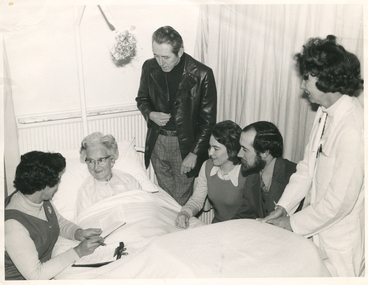
... This photograph is taken in a Hospital ward and shows a meeting between a patient, an RDNS Liaison Sister; and the Hospital staff, L-R, a Doctor, a Physiotherapist, a Social Worker and an Occupational Therapist. ...This photograph is taken in a Hospital ward and shows a meeting between a patient, an RDNS Liaison Sister; and the Hospital staff, L-R, a Doctor, a Physiotherapist, a Social Worker and an Occupational Therapist. ...This photograph is taken in a Hospital ward and shows a meeting between a patient, an RDNS Liaison Sister; and the Hospital staff, L-R, a Doctor, a Physiotherapist, a Social Worker and an Occupational Therapist. The group are discussing with the patient the ongoing care she will require when shes goes home. The Sister. has an RDNS information leaflet open in her hands which will be given to the lady. From those present, the Sister is ready to write, on the clipboard, any information required to be passed to the RDNS District Sister to carry out the nursing care needed when the lady goes home. The Sister is wearing the RDNS winter uniform of a light blue.grey skivvie under a darker blue/grey V neck tunic style dress made from herringbone winter material.Liaison had occurred between doctors and the Trained nurses (Nurses) of the Melbourne District Nursing Society (MDNS), from its inception in 1885. This increased when Midwifery was introduced in August 1893 with close liaising with the Women’s Hospital. As District nursing grew it was recognized closer liaising between many Public Hospitals would be beneficial, for not only the MDNS, later called Royal District Nursing Service (RDNS),Trained nurses (Sisters), but also for the patients and the hospitals. In August 1964 a Liaison Officer commenced at the Alfred Hospital. This soon increased to Liaison Officers working full time at several Public Hospitals. They facilitated the smooth transition from hospital to home for many patients who required ongoing nursing care. Liaison Sisters regularly attended discharge planning meetings, interviewed prospective patients, coordinated discharge, and booked the first visit by the visiting RDNS Sister. At the time of a patient’s discharge, the Liaison Sister forwarded information on their diagnosis and instructions regarding the care required at home to the appropriate RDNS Centre, and in turn the attending District Sister wrote a report of progress and any queries to the Hospital Doctor, via the Liaison Sister, at the time the patient was attending outpatients. Any new instructions were then sent back to the District Sister. Liaising also occurred between District Sisters and Doctors when patients were referred by General Practitioners and did not attend a hospital.On the left of this black and white photograph is a Royal District Nursing Service (RDNS) Sister who is seated and has her curly dark hair head, turned to her left looking at a lady who is resting in a hospital bed. The Sister, who is wearing a light grey skivvie under a darker V neck tunic style dress, is holding an open folded page with typed writing seen, in her hands; a pen is sitting between the fingers of her right hand and a clipboard is on the bed. The elderly lady, to her right, is sitting propped up against white pillows on her hospital bed and is looking, and smiling, at the Sister. She is wearing glasses; has curly grey hair; and is wearing a light coloured nightdress. The light coloured bedclothes cover most of her body. On the right of the bed, and from its head down, L-R is:a man who is standing; he has short dark hair and is wearing a leather type jacket over a dark skivvie and plaid trousers. Next, sitting, is a lady who has short slightly waved dark hair; she is wearing a grey round neck sleeveless frock over a light coloured long sleeve blouse. Next, seated, is a male who has short dark hair and a short dark beard.He is wearing a dark grey suit jacket over a light grey shirt and patterned tie. Next, on the far right, standing, is a lady who has curly dark hair and is wearing a hospital white coat over a light coloured skivvie. A Hydronic heater is attached to the lower part of the wall behind the bed and a monkey bar is attached to the centre of the bed. Some flowers are also seen behind the bed and a drawn curtain is behind the staff on the right hand side of the photograph.Barry Sutton LO12royal district nursing service, rdns uniform, rdns liaison -
Bendigo Historical Society Inc.
Photograph - MAPLE STREET PRIMARY SCHOOL COLLECTION: GRADE AND STAFF PHOTOS 1994
... staff Maple Street Primary School 1994. a. Grade 4W Teacher George Wood; b. Prep 1M Teacher Kerrie McMillin; c. Grade 5/6K Teacher D. Kent; d. Grade 2/3N Teacher Meredith Nicks; e. Grade 5/6G Teacher Frank Gargiulo; f. Grade 2/3E Teacher R...staff Maple Street Primary School 1994. a. Grade 4W Teacher George Wood; b. Prep 1M Teacher Kerrie McMillin; c. Grade 5/6K Teacher D. Kent; d. Grade 2/3N Teacher Meredith Nicks; e. Grade 5/6G Teacher Frank Gargiulo; f. Grade 2/3E Teacher R ...Colour photographs of grades and staff Maple Street Primary School 1994. a. Grade 4W Teacher George Wood; b. Prep 1M Teacher Kerrie McMillin; c. Grade 5/6K Teacher D. Kent; d. Grade 2/3N Teacher Meredith Nicks; e. Grade 5/6G Teacher Frank Gargiulo; f. Grade 2/3E Teacher R. Elliott; g. Staff photo, front row Margaret Gregson, Anita Whittle, Sandra Lacey, Anne Hocking, Meredith Nicks, Kerrie McMillin, Second Row Bob Elliott, Debbie Kent, Murray Sweeney, Glenda McQualter, Sharon Derby, Frank Gargiulo, Third Row (back) Brenda Savy, David Robins, Ross Wood, George Wood, Maylene Rodda. Principal David Robins. H. Prep 1D 1994 Teacher Sharon Derby; i. Grade 5/6L Teacher Sandra Lacey; j. Grade 2/3R Teacher Maylene Rodda; k. Grade Prep 1H Teacher Anne Hocking; l. Grade 4 (no names attached) Names of students on bottom of photos.bendigo, education, maple street primary school -
![Booklet - Who's who at Massey-Ferguson (Australia) limited, Sunshine [1958], McKay Massey Harris, H.V](/media/collectors/5164c1772162ef0c64d700f2/items/69dc57946a5a9c1cb356dc1d/item-media/69dc61006a5a9c1cb356f7af/item-fit-380x285.jpg?cb=6) Sunshine and District Historical Society Incorporated
Sunshine and District Historical Society IncorporatedBooklet - Who's who at Massey-Ferguson (Australia) limited, Sunshine [1958], McKay Massey Harris, H.V
... staff members:|(1) L. T. (Tom) Ritchie, Deputy Chairman and Managing Director, Massey Ferguson (Australia)|(2) J.K (Ken) Gaunt, Chief Engineer|(3) R. ...staff members:|(1) L. T. (Tom) Ritchie, Deputy Chairman and Managing Director, Massey Ferguson (Australia)|(2) J.K (Ken) Gaunt, Chief Engineer|(3) R. ...massey ferguson, sunshine harvester works -
 Eltham District Historical Society Inc
Photograph, Looking north from Staff's Railway Store, Main Road, Eltham, c. Oct. 1945
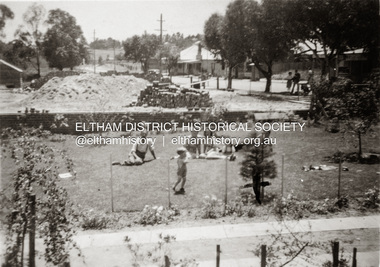
... Looking north from Staff's Railway Store overlooking Staff’s garden and the foundations of Lyon Bros Garage being built next door, circa Oct. 1945. L-R...Looking north from Staff's Railway Store overlooking Staff’s garden and the foundations of Lyon Bros Garage being built next door, circa Oct. 1945. L-R ...Looking north from Staff's Railway Store overlooking Staff’s garden and the foundations of Lyon Bros Garage being built next door, circa Oct. 1945. L-R: Eric Staff, Michael Sinclair, Marie (Mary) Staff, Mrs Rigbye, Eileen Rigbye, Mr Rigbye (partly hidden); Michael Sinclair in foreground. On back of photo: "I had this taken to show you Lyon's Garage. You can see the foundations and the filling in. Like our lawn. The Xmas tree we had for Michael with X" Digital scan from photo loaned by Michael Sinclair (2017). Photographer unknown. Dated as circa Oct. 1945 as Michael Sinclair was in Grade 4 at Dalton Street school in 1954 (typically 9 or 10 yrs old), Lyons Bros garage was completed 1946, it appears to be late spring or early summer, the reference to the Christmas tree suggests it was before December and Michael looks about 2 years old. An aerial photo taken December 1945 shows Lyon Bros Garage erected with a roof on it so the image could be around October 1945. Staff’s Railway Store was located at present-day 929-937 Main Road. The store was built in 1902 by Luther Haley adjacent to the new railway station and was the first shop in what was to become Eltham’s present-day shopping precinct. Across the road was known as Haley’s Paddock and it was here in 1922 that the next store was to open, Miss Barber’s Blue Gum Soda Fountain. That store is visible in the upper centre of the picture on the southern corner with Pryor Street. At the time of the photo the shop was owned by Harold Eugene Borner and his older sister, Miss Edith Florance Borner, known as H.E. Borner’s shop. Immediately to the right is vacant street frontage then the Eltham Timber and Hardware Store owned since 1923 by William Walker, a plumber. It was about the same time as this photo that William Walker’s son, Thomas Roy Walker, also a plumber, returned home from active service overseas and took over till it was sold in 1950. Outside the hardware store is a Post Master General (PMG) mailbox, a petrol bowser and Telephone Box, then further to the right another vacant frontage then Rains Newsagency. North of Pryor just visible behind the trees is the Bootmaker factory on the corner of Pryor Street opposite the Blue Gum. The vacant site next door is where Hughes Fruit Shop and Milk Bar was built sometime between Dec. 1945 and 1949. Eric Nieve Staff and his wife Mary Forbes Staff lived at Main Road, Eltham. Eric Staff bought the Railway Store in 1939. In the 1946 Electoral Roll, Eric Staff’s profession was stated as printer. Their son, Raymond Charles Staff was also listed at Main Road, his profession, grocer, so presumably he had taken over the business by then. Charles Keith Rigbye, a laundryman, and his wife Phyllis Mary Rigbye lived in Dudley Street. https://maps.app.goo.gl/KuF8JyZc1Gcza3n68 - Research by Peter Pidgeon, EDHS, July 2026Black and white photograph1945, blue gum milk bar (eltham), bootmaker's shop, charles keith rigbye, eileen rigbye, eltham hardware and timber, eltham shopping centre, eltham shops, eric nieve staff, eric staff, estate agency, h.e. borner's shop, lyon bros garage, main road eltham, marie (mary) staff, mary forbes staff, michael sinclair, newsagency, phyllis mary rigbye, rains newsagency, telephone box -
 Surrey Hills Historical Society Collection
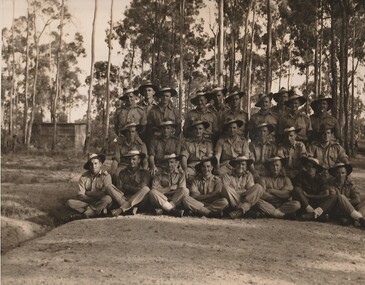
Work on paper - Photograph, The 2/1 Australian Field Butchery Platoon, Petrie, Queensland, 1945, 9 March 1945
... Middle row: QX49356 Pte L V Symes; QZ31697 Pte N R Underhill; QX16156 Staff Sergeant H L Cairns; VX19172 Lieutenant W H Thomas; VX55658 Sgt D W Craig; QX47082 Sgt E S Wilbraham; SX19778 Pte D Weatherald. ...Middle row: QX49356 Pte L V Symes; QZ31697 Pte N R Underhill; QX16156 Staff Sergeant H L Cairns; VX19172 Lieutenant W H Thomas; VX55658 Sgt D W Craig; QX47082 Sgt E S Wilbraham; SX19778 Pte D Weatherald. ...This is an official group portrait of the 2/1st Field Butchery Platoon who are identified as: Left to right, back row: VX33117 Corporal (Cpl) F M Hogan; NX85618 Private (Pte) A J Nicol; VX127710 Pte E C J Kemp; VX143647 Lance Corporal (LCpl) L G Lobb; QX44905 Pte C L Adams; SX25540 Lance Sergeant R J Gray; NX193508 Pte K A Burgess; VX5112 Pte J T Roberts; NX153073 Pte D J Evans; WX9743 Pte M F Lynch. Middle row: QX49356 Pte L V Symes; QZ31697 Pte N R Underhill; QX16156 Staff Sergeant H L Cairns; VX19172 Lieutenant W H Thomas; VX55658 Sgt D W Craig; QX47082 Sgt E S Wilbraham; SX19778 Pte D Weatherald. Front row: NX155215 Pte E Corrigan; QX56335 Pte E Corrigan; NX57204 LCpl W H Jackson; VX59081 Pte B Moszkowicz; SX31901 Pte J Lambre; NX94941 Cpl R A Hanson; QX40009 Pte T G O’Neill; VX84971 Pte S J Welsh. The photo was taken under the command of 1 Aust Base Sub Area and Lt R B Irving. According to the Australian War Memorial website, the photographer was David Tennant Gaery Eastman and the photo was taken on 9 March 1945. In the AWM collection there is also a photo of members of the platoon at the unit slaughter yards in Milne Bay, New Guinea (REF: AWM 0703790). An overview of the history of the unit can be found at https://birtwistlewiki.com.au/wiki/2/1st_Field_Butchery_Company Leslie George Lobb, the father of the donor, was the platoon sergeant. He had multiple copies of this photo, which may have been obtained with the aim of distributing them to other platoon members. Leslie George Lobb - born 15 July 1920 in Box Hill; married Elizabeth Annie Stephenson in 1954; died 14 Nov. 1997. Leslie became a service station / garage proprietor at 352 Mont Albert Road, Mont Albert a business he took over from his father. An associated mechanical business operated under the name of Leo Green Motors, at the same address. The family lived next door at 354 Mont Albert Road, Mont Albert. Leslie's father Harry Lobb had operated at an adjoining property (350 Mont Albert Road, Mont Albert) as a fuel and ice merchant, before installing a petrol bowser to service the expanding motor car industry. The house at 354 Mont Albert Road, Mont Albert was removed and relocated by the family in 2000 to Mirboo North, Gippsland, Victoria, where it still stands.The photo is a touchstone to local servicemen who served in World War 2.A B&W / sepia photo with a narrow white border of 25 men in uniform. They are standing / sitting in 3 distinct rows with the rear row standing and the other 2 sitting on a 'sandy' area with sapling eucalypts and a (?) corrugated iron shed in the background.REAR: Purple photographer's stamp approximately in the centre: "Photograph No. MH [in lead pencil 87544] / Supplied by Military History / Section (S.D.9) / General Staff L H Q. / For personal enjoyment ONLY / and on condition that it will / not be reproduced in any form." f m hogan, a j nicol, c j kemp, l g lobb, c l adams, r j gray, k a burgess, j t roberts, d j evans, m f lynch, l v symes, n r underhill, h l cairns, w h thomas, d w craig, e s wilbraham, d weatherald, e corrigan, w h jackson, b moszkowicz, j lambre, r a hanson, t g o’neill, s j welsh, 2/1st field butchery platoon, petrie, world war, 1939-1945, mont albert -
 Flagstaff Hill Maritime Museum and Village
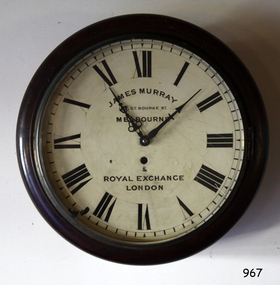
Instrument - Clock
... Staff at the Bank of Australasia in Warrnambool included the following men but others were also involved: Samuel Hannaford, Teller then Manager from 1855-1856; W H Palmer, Manager from January 1857 until November 1869 when the Teller Basil Spence was promoted to Manager; H B Chomley, Manager from April 1873 and still there in 1886; A Butt, Manager in 1895-1904; J R McCleary Accountant and Acting Manager for 12 months, until 1900; A Kirk, Manager 1904; J Moore, staff until his transfer to Bendigo in December 1908; J S Bath was Manager until 1915; C C Cox, Manager until April 1923; Richard C Stanley, Manager 1923 to April 1928. ...Staff at the Bank of Australasia in Warrnambool included the following men but others were also involved: Samuel Hannaford, Teller then Manager from 1855-1856; W H Palmer, Manager from January 1857 until November 1869 when the Teller Basil Spence was promoted to Manager; H B Chomley, Manager from April 1873 and still there in 1886; A Butt, Manager in 1895-1904; J R McCleary Accountant and Acting Manager for 12 months, until 1900; A Kirk, Manager 1904; J Moore, staff until his transfer to Bendigo in December 1908; J S Bath was Manager until 1915; C C Cox, Manager until April 1923; Richard C Stanley, Manager 1923 to April 1928. ...This wall clock originated from the Bank of Australasia. The label on the base matches other items from the same donor. It was spring powered by winding the key mechanism with the clock's key through the hole in the clock face. The hinged door on the base of the clock's case allows access to the clock's working mechanism. James Murray (son of James Murray 1780-1847) was a maker of clocks and chronometers. He worked at No. 1, Royal Exchange, London and from 1861 at 107 Great Bourke Street, Melbourne. In 1854 William Kerr ordered a clock from James Murray and erected it on the Albert Street frontage of the National Model & Training School in Spring Street Melbourne. It was Melbourne's first turret clock and remained there for 80 years before it was transferred to the Public Library in Melbourne in 1934 (now Museum Victoria). The Bank of Australasia was incorporated by Royal Charter of England in March 1834. It had its Australian beginning on 14th December 1835, opening in Sydney. The Acting Superintendent of the bank at that time was David Charters McArthur. He was Superintendent from 1867-to 1876. The Melbourne branch opened on 28th August 1838 in a two-roomed brick cottage on the north side of Little Collins Street, where two huge mastiff dogs were used at night to guard the bank. The government also provided an armed military sentinel. Due to the bank's rapid growth, a new building for the Melbourne branch was opened in 1840 at 75 Collins Street West. By 1879 the bank had been upgraded to a magnificent two-storey building on the corners of Collins and Queens Streets, with the entry on Collins Street. In 1951 the Bank of Australasia amalgamated with the Union Bank to form the Australia and New Zealand Bank, now known as the ANZ. Then in 1970, the ANZ merged with both the ES&A and the London Bank of Australia to form the ANZ Banking Group Limited. The ANZ Banking Group Ltd kindly donated a variety of historic items from the Bank of Australasia. BANK of AUSTRALASIA, WARRNAMBOOL – In 1854 Warrnambool had two banks, the Union Bank and the Bank of Australasia. Later, completely different bank businesses opened; in 1867 the National Bank of Australasia, then in 1875 the Colonial Bank of Australasia. The original Warrnambool branch of the Bank of Australasia was established in July 1854, and operated from a leased cottage on Merri Street, close to Liebig Street. The bank next bought a stone building previously erected by drapers Cramond & Dickson on the corner of Timor and Gibson Streets. Samuel Hannaford was a teller and then Manager at the Warrnambool branch from 1855 to 1856 and the Warrnambool Council chose that bank for its dealings during 1856-57. In 1859 Roberts & Co. was awarded the contract to build the new Bank of Australasia branch for the sum of £3,000. The land was on a sand hill on the northeast corner of Timor and Kepler Streets and had been bought in 1855 from investor James Cust. The new building opened on May 21, 1860. The bank continued to operate there until 1951 when it merged with the Union Bank to form the ANZ Bank, which continued operating from its Liebig Street building. Warrnambool City Council purchased the former Bank of Australasia building in 1971 and renovated it, then on 3rd December 1973 it was officially opened as the Art Gallery by Cr. Harold Stephenson and Gallery Director John Welsh. The Gallery transferred to the purpose-built building in Liebig Street in 1986 and the old bank building is now the Gallery club. Staff at the Bank of Australasia in Warrnambool included the following men but others were also involved: Samuel Hannaford, Teller then Manager from 1855-1856; W H Palmer, Manager from January 1857 until November 1869 when the Teller Basil Spence was promoted to Manager; H B Chomley, Manager from April 1873 and still there in 1886; A Butt, Manager in 1895-1904; J R McCleary Accountant and Acting Manager for 12 months, until 1900; A Kirk, Manager 1904; J Moore, staff until his transfer to Bendigo in December 1908; J S Bath was Manager until 1915; C C Cox, Manager until April 1923; Richard C Stanley, Manager 1923 to April 1928. The clock has significance through its association with the Bank of Australasia. The early Australian bank was established in 1834 by Royal Charter and opened in Sydney, Australia, in Sydney in 1835. The bank had many Australian offices in November 1877, particularly on the east and south coasts. Victoria had 45 percent of all Offices. The clock is significant for its connection with the quality clockmaker James Murray, originally from Royal Exchange London with a branch that opened in Melbourne in 1861. James Murray is renown for making the first turret clock to be installed in Melbourne. The clock is locally significant for its association with the Warrnambool Bank of Australasia, which was established in 1854. It was Warrnambool Council’s first bank. The bank continued to operate until the organisation's merger in 1951 when it became the ANZ Bank Group today. The Bank was an integral part of the growth of local commerce and the community.Wall clock with a round face behind glass in a wooden case. The painted brass face has Roman numerals, two decorative hands, divisions for minutes and a keyhole. The curved base of the case has a hinged access door with a keyhole and adhesive label. The back of the clock's case has metal mounting brackets. Inscriptions on the rectangular white label. Made by James Murray, Melbourne.Face: "JAMES MURRAY / - GT. BOURKE ST. / MELBOURNE / & / ROYAL EXCHANGE / LONEON" Label: "A M / 40"flagstaff hill, warrnambool, shipwrecked coast, flagstaff hill maritime museum, maritime museum, shipwreck coast, flagstaff hill maritime village, great ocean road, bank of australasia, boa, union bank, australia & new zealand bank, anz bank, james murray, clock, wall clock, great bourke street melbourne, royal exchange london, william kerr, turret clock, old model school, national model & training school, access door, winding key -
 Flagstaff Hill Maritime Museum and Village
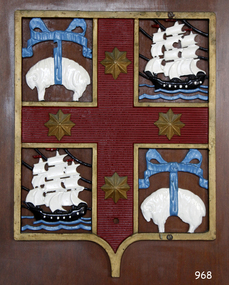
Plaque - Insignia, Bank of Australasia, 16-10-1980
... Staff at the Bank of Australasia in Warrnambool included the following men but others were also involved: Samuel Hannaford, Teller then Manager from 1855-1856; Hawkins, Manager in 1856, W H Palmer, Manager from January 1857 until November 1869 when the Teller Basil Spence was promoted to Manager; H B Chomley, Manager from April 1873 and still there in 1886; A Butt, Manager in 1895-1904; J R McCleary Accountant and Acting Manager for 12 months, until 1900; A Kirk, Manager 1904; J Moore, staff until his transfer to Bendigo in December 1908; J S Bath was Manager until 1915; C C Cox, Manager until April 1923; Richard C Stanley, Manager 1923 to April 1928. ...Staff at the Bank of Australasia in Warrnambool included the following men but others were also involved: Samuel Hannaford, Teller then Manager from 1855-1856; Hawkins, Manager in 1856, W H Palmer, Manager from January 1857 until November 1869 when the Teller Basil Spence was promoted to Manager; H B Chomley, Manager from April 1873 and still there in 1886; A Butt, Manager in 1895-1904; J R McCleary Accountant and Acting Manager for 12 months, until 1900; A Kirk, Manager 1904; J Moore, staff until his transfer to Bendigo in December 1908; J S Bath was Manager until 1915; C C Cox, Manager until April 1923; Richard C Stanley, Manager 1923 to April 1928. ...This plaque displays the Bank of Australia's Coat of Arms and is significant because is ts the symbol printed on the Bank Notes of the Bank of Australasia. The bank of Australasia was incorporated by Royal Charter of England in March 1834. It had its Australian beginning on 14th December 1835, opening in Sydney. The Acting Superintendent of the bank at that time was David Charters McArthur. He was Superintendent from 1867-to 1876. The Melbourne branch opened on 28th August 1838 in a two-roomed brick cottage on the north side of Little Collins Street, where two huge mastiff dogs were used at night to guard the bank. The government also provided an armed military sentinel. Due to the bank's rapid growth, a new building for the Melbourne branch was opened in 1840 at 75 Collins Street West. By 1879 the bank had been upgraded to a magnificent two-storey building on the corners of Collins and Queens Streets, with the entry on Collins Street. In 1951 the Bank of Australasia amalgamated with the Union Bank to form the Australia and New Zealand Bank, now known as the ANZ. Then in 1970, the ANZ merged with both the ES&A and the London Bank of Australia to form the ANZ Banking Group Limited. The ANZ Banking Group Ltd kindly donated a variety of historic items from the Bank of Australasia. BANK of AUSTRALASIA, WARRNAMBOOL – In 1854 Warrnambool had two banks, the Union Bank and the Bank of Australasia. Later, completely different bank businesses opened; in 1867 the National Bank of Australasia, then in 1875 the Colonial Bank of Australasia. The original Warrnambool branch of the Bank of Australasia was established in July 1854, and operated from a leased cottage on Merri Street, close to Liebig Street. The bank next bought a stone building previously erected by drapers Cramond & Dickson on the corner of Timor and Gibson Streets. Samuel Hannaford was a teller and then Manager at the Warrnambool branch from 1855 to 1856 and the Warrnambool Council chose that bank for its dealings during 1856-57. In 1859 Roberts & Co. was awarded the contract to build the new Bank of Australasia branch for the sum of £3,000; the firm built the Warrnambool Post Office in 1856 and purchased land in Timor Street in 1858. The land was on a sand hill on the northeast corner of Timor and Kepler Streets and had been bought in 1855 from investor James Cust. The new building opened on May 21, 1860. The bank continued to operate there until 1951 when it merged with the Union Bank to form the ANZ Bank, which continued operating from its Liebig Street building. Warrnambool City Council purchased the former Bank of Australasia building in 1971 and renovated it, then on 3rd December 1973 it was officially opened as the Art Gallery by Cr. Harold Stephenson and Gallery Director John Welsh. The Gallery transferred to the purpose-built building in Liebig Street in 1986 and the old bank building is now the Gallery club. Staff at the Bank of Australasia in Warrnambool included the following men but others were also involved: Samuel Hannaford, Teller then Manager from 1855-1856; Hawkins, Manager in 1856, W H Palmer, Manager from January 1857 until November 1869 when the Teller Basil Spence was promoted to Manager; H B Chomley, Manager from April 1873 and still there in 1886; A Butt, Manager in 1895-1904; J R McCleary Accountant and Acting Manager for 12 months, until 1900; A Kirk, Manager 1904; J Moore, staff until his transfer to Bendigo in December 1908; J S Bath was Manager until 1915; C C Cox, Manager until April 1923; Richard C Stanley, Manager 1923 to April 1928. The plaque with the insignia has significance through its association with the Bank of Australasia. The early Australian bank was established in 1834 by Royal Charter and opened in Sydney, Australia, in Sydney in 1835. The bank had many Australian offices in November 1877, particularly on the east and south coasts. Victoria had 45 per cent of all Offices. The plaque is locally significant for its association with the Warrnambool Bank of Australasia, which was established in 1854. It was Warrnambool Council’s first bank. The bank continued to operate until the organisation's merger in 1951 when it became the ANZ Bank Group today. The Bank was an integral part of the growth of local commerce and the community.Insignia of the Bank of Australasia. Cast metal coat of arms within a gold, shield-shaped border, painted gold and red, with blue, black and white details. Decals in each corner; upper left and lower right have a white sheep suspended by a blue ribbon, upper right and lower left have a 3-masted, square-rigged sailing ship with a black hull and red flags flying on each mast, sailing on waves with storm clouds in the sky. Between the emblems are gold stars.Decals; ships, sheep, starsflagstaff hill, warrnambool, shipwrecked coast, flagstaff hill maritime museum, maritime museum, shipwreck coast, flagstaff hill maritime village, great ocean road, bank of australasia, boa, union bank, australia & new zealand bank, anz bank, david charters mcarthur, d c mcarthur, currency, banknote, commerce, banking, heraldic shield, insignia, samuel hannaford -
 Flagstaff Hill Maritime Museum and Village
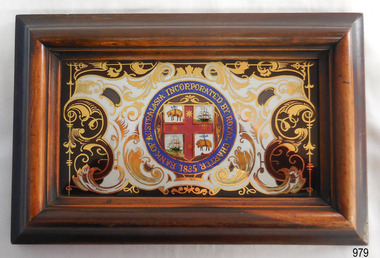
Plaque - Insignia, Bank of Australasia, 19th Century
... Staff at the Bank of Australasia in Warrnambool included the following men but others were also involved: Samuel Hannaford, Teller then Manager from 1855-1856; W H Palmer, Manager from January 1857 until November 1869 when the Teller Basil Spence was promoted to Manager; H B Chomley, Manager from April 1873 and still there in 1886; A Butt, Manager in 1895-1904; J R McCleary Accountant and Acting Manager for 12 months, until 1900; A Kirk, Manager 1904; J Moore, staff until his transfer to Bendigo in December 1908; J S Bath was Manager until 1915; C C Cox, Manager until April 1923; Richard C Stanley, Manager 1923 to April 1928. ...Staff at the Bank of Australasia in Warrnambool included the following men but others were also involved: Samuel Hannaford, Teller then Manager from 1855-1856; W H Palmer, Manager from January 1857 until November 1869 when the Teller Basil Spence was promoted to Manager; H B Chomley, Manager from April 1873 and still there in 1886; A Butt, Manager in 1895-1904; J R McCleary Accountant and Acting Manager for 12 months, until 1900; A Kirk, Manager 1904; J Moore, staff until his transfer to Bendigo in December 1908; J S Bath was Manager until 1915; C C Cox, Manager until April 1923; Richard C Stanley, Manager 1923 to April 1928. ...This decorative plaque displays the insignia of the Bank of Australasia, which was incorporated by the Royal Charter of England in March 1834. The bank began in Australia on 14th December 1835, opening in Sydney. The Acting Superintendent of the bank at that time was David Charters McArthur. He was Superintendent from 1867-to 1876. The Melbourne branch opened on 28th August 1838 in a two-roomed brick cottage on the north side of Little Collins Street, where two huge mastiff dogs were used at night to guard the bank. The government also provided an armed military sentinel. Due to the bank's rapid growth, a new building for the Melbourne branch was opened in 1840 at 75 Collins Street West. By 1879 the bank had been upgraded to a magnificent two-storey building on the corners of Collins and Queens Streets, with the entry on Collins Street. In 1951 the Bank of Australasia amalgamated with the Union Bank to form the Australia and New Zealand Bank, now known as the ANZ. Then in 1970, the ANZ merged with both the ES&A and the London Bank of Australia to form the ANZ Banking Group Limited. The ANZ Banking Group Ltd kindly donated a variety of historic items from the Bank of Australasia. BANK of AUSTRALASIA, WARRNAMBOOL – In 1854 Warrnambool had two banks, the Union Bank and the Bank of Australasia. Later, completely different bank businesses opened; in 1867 the National Bank of Australasia, then in 1875 the Colonial Bank of Australasia. The original Warrnambool branch of the Bank of Australasia was established in July 1854, and operated from a leased cottage on Merri Street, close to Liebig Street. The bank later bought a stone building previously erected by drapers Cramond & Dickson on the corner of Timor and Gibson Streets. Samuel Hannaford was a teller and then Manager at the Warrnambool branch from 1855 to 1856 and the Warrnambool Council chose that bank for its dealings during 1856-57. In 1859 Roberts & Co. was awarded the contract to build the new Bank of Australasia branch for the sum of £3,000. The land was on a sand hill on the northeast corner of Timor and Kepler Streets and had been bought in 1855 from investor James Cust. The new building opened on May 21, 1860. The bank continued to operate there until 1951 when it merged with the Union Bank to form the ANZ Bank, which continued operating from its Liebig Street building. Warrnambool City Council purchased the former Bank of Australasia building in 1971 and renovated it, then on 3rd December 1973 it was officially opened as the Art Gallery by Cr. Harold Stephenson and Gallery Director John Welsh. The Gallery transferred to the purpose-built building in Liebig Street in 1986 and the old bank building is now the Gallery club. Staff at the Bank of Australasia in Warrnambool included the following men but others were also involved: Samuel Hannaford, Teller then Manager from 1855-1856; W H Palmer, Manager from January 1857 until November 1869 when the Teller Basil Spence was promoted to Manager; H B Chomley, Manager from April 1873 and still there in 1886; A Butt, Manager in 1895-1904; J R McCleary Accountant and Acting Manager for 12 months, until 1900; A Kirk, Manager 1904; J Moore, staff until his transfer to Bendigo in December 1908; J S Bath was Manager until 1915; C C Cox, Manager until April 1923; Richard C Stanley, Manager 1923 to April 1928. The plaque has historical significance as it belonged to the Bank of Australasia which was established in Australia in 1835 by Royal Charter. The plaque is significant for its association with the Bank of Australasia in Warrnambool, the first bank in Warrnambool, established in 1854. The bank continued to operate until its merger in 1951 when it became the ANZ Bank, which is still in operation today. The Bank was an integral part of the establishment and growth of commerce in Colonial Warrnambool and throughout Australia.Plaque with insignia on glass in a rectangular varnished wooden frame. Insignia of the Bank of Australasia has been painted onto the glass in a mirror-like fashion. Insignia depicts a heraldic shield with sheep hung up by their waists and ships in full sail. Inscription on insignia. Stamp and handwritten inscription on the rectangular label with a blue border on the reverse.Insignia: "BANK OF AUSTRALASIA INCORPORATED BY ROYAL CHARTER 1835" Label's red oval stamp with "AUSTRALIA AND NEW ZEALAND BANK UNITED ARCHIVES" Label's handwritten black letters "AM1" flagstaff hill, warrnambool, shipwrecked coast, flagstaff hill maritime museum, maritime museum, shipwreck coast, flagstaff hill maritime village, great ocean road, commerce, banking, plaque, insignia, bank of australasia, insignia on glass, union bank, australia & new zealand bank, anz bank, david charters mcarthur, d c mcarthur, sydney, new south wales, currency, banknote, legal tender -
 Flagstaff Hill Maritime Museum and Village
Currency - Bank exchange note, Perkins, Bacon and Perch, 14-10--1847
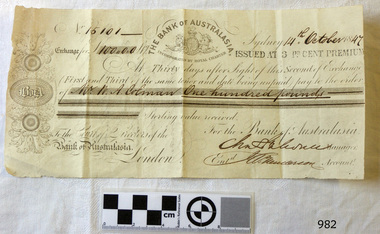
... Staff at the Bank of Australasia in Warrnambool included the following men but others were also involved: Samuel Hannaford, Teller then Manager from 1855-1856; W H Palmer, Manager from January 1857 until November 1869 when the Teller Basil Spence was promoted to Manager; H B Chomley, Manager from April 1873 and still there in 1886; A Butt, Manager in 1895-1904; J R McCleary Accountant and Acting Manager for 12 months, until 1900; A Kirk, Manager 1904; J Moore, staff until his transfer to Bendigo in December 1908; J S Bath was Manager until 1915; C C Cox, Manager until April 1923; Richard C Stanley, Manager 1923 to April 1928. ...Staff at the Bank of Australasia in Warrnambool included the following men but others were also involved: Samuel Hannaford, Teller then Manager from 1855-1856; W H Palmer, Manager from January 1857 until November 1869 when the Teller Basil Spence was promoted to Manager; H B Chomley, Manager from April 1873 and still there in 1886; A Butt, Manager in 1895-1904; J R McCleary Accountant and Acting Manager for 12 months, until 1900; A Kirk, Manager 1904; J Moore, staff until his transfer to Bendigo in December 1908; J S Bath was Manager until 1915; C C Cox, Manager until April 1923; Richard C Stanley, Manager 1923 to April 1928. ...This exchange note was issued by the Bank of Australasia to Mr N A Coleman for one hundred pounds paid n 14th October 1847 at the Sydney branch. The interest rate was three per cent. This exchange note displays the insignia of the Bank of Australasia, which was incorporated by Royal Charter of England in March 1834. The bank began in Australia on 14th December 1835, opening in Sydney. The Acting Superintendent of the bank at that time was David Charters McArthur. He was Superintendent from 1867-to 1876. The Melbourne branch opened on 28th August 1838 in a two-roomed brick cottage on the north side of Little Collins Street, where two huge mastiff dogs were used at night to guard the bank. The government also provided an armed military sentinel. Due to the bank's rapid growth, a new building for the Melbourne branch was opened in 1840 at 75 Collins Street West. By 1879 the bank had been upgraded to a magnificent two-storey building on the corners of Collins and Queens Streets, with the entry on Collins Street. In 1951 the Bank of Australasia amalgamated with the Union Bank to form the Australia and New Zealand Bank, now known as the ANZ. Then in 1970, the ANZ merged with both the ES&A and the London Bank of Australia to form the ANZ Banking Group Limited. The ANZ Banking Group Ltd kindly donated a variety of historic items from the Bank of Australasia. BANK of AUSTRALASIA, WARRNAMBOOL – In 1854 Warrnambool had two banks, the Union Bank and the Bank of Australasia. Later, completely different bank businesses opened; in 1867 the National Bank of Australasia, then in 1875 the Colonial Bank of Australasia. The original Warrnambool branch of the Bank of Australasia was established in July 1854, and operated from a leased cottage on Merri Street, close to Liebig Street. The bank next bought a stone building previously erected by drapers Cramond & Dickson on the corner of Timor and Gibson Streets. Samuel Hannaford was a teller and then Manager at the Warrnambool branch from 1855 to 1856 and the Warrnambool Council chose that bank for its dealings during 1856-57. In 1859 Roberts & Co. was awarded the contract to build the new Bank of Australasia branch for the sum of £3,000. The land was on a sand hill on the northeast corner of Timor and Kepler Streets and had been bought in 1855 from investor James Cust. The new building opened on May 21, 1860. The bank continued to operate there until 1951 when it merged with the Union Bank to form the ANZ Bank, which continued operating from its Liebig Street building. Warrnambool City Council purchased the former Bank of Australasia building in 1971 and renovated it, then on 3rd December 1973 it was officially opened as the Art Gallery by Cr. Harold Stephenson and Gallery Director John Welsh. The Gallery transferred to the purpose-built building in Liebig Street in 1986 and the old bank building is now the Gallery club. Staff at the Bank of Australasia in Warrnambool included the following men but others were also involved: Samuel Hannaford, Teller then Manager from 1855-1856; W H Palmer, Manager from January 1857 until November 1869 when the Teller Basil Spence was promoted to Manager; H B Chomley, Manager from April 1873 and still there in 1886; A Butt, Manager in 1895-1904; J R McCleary Accountant and Acting Manager for 12 months, until 1900; A Kirk, Manager 1904; J Moore, staff until his transfer to Bendigo in December 1908; J S Bath was Manager until 1915; C C Cox, Manager until April 1923; Richard C Stanley, Manager 1923 to April 1928. The bank exchange note has significance through its association with the Bank of Australasia. The early Australian bank was established in 1834 by Royal Charter and opened in Sydney, Australia, in Sydney in 1835. The bank had many Australian offices in November 1877, particularly on the east and south coasts. Victoria had 45 percent of all Offices. The object is locally significant for its association with the Warrnambool Bank of Australasia, which was established in 1854. It was Warrnambool Council’s first bank. The bank continued to operate until the organisation's merger in 1951 when it became the ANZ Bank Group today. The Bank was an integral part of the growth of local commerce and the community.Bank exchange note for the Bank of Australasia, Sydney, manufactured by Perkins, Bacon and Perch, printed in brown. Insignia depicts a heraldic shield with a lion and unicorn on either side and another insignia with "B of A". Exchange note paid on 14th October 1847. Issued for one hundred pounds and paid to Mr N A Coleman.. Inscriptions include the document number, the date, the amount paid, the receiving person, signatures and a stamp with the interest rate.Handwritten number "15101" "One hundred pounds" "14th October [18] 47" "Mr N A Coleman" Black stamp "ISSUED AT 3 PR CENT PREMIUM" Signatures of [Manager] and [Accountant].flagstaff hill, warrnambool, shipwrecked-coast, flagstaff-hill, flagstaff-hill-maritime-museum, maritime-museum, shipwreck-coast, flagstaff-hill-maritime-village, banknote, currency, exchange note, commerce, banking, finances, bank of australasia, n a coleman, 1847, shipwrecked coast, flagstaff hill maritime museum, maritime museum, shipwreck coast, flagstaff hill maritime village, great ocean road, boa, union bank, australia & new zealand bank, anz bank, david charters mcarthur, d c mcarthur, sydney, new south wales, legal tender -
 Flagstaff Hill Maritime Museum and Village
Financial record - Passbook, Bank of Australasia, 1880
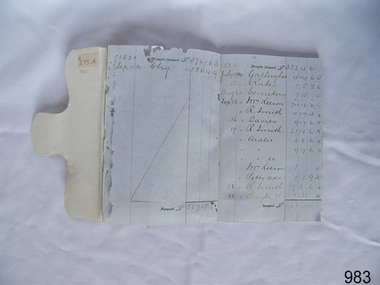
... Staff at the Bank of Australasia in Warrnambool included the following men but others were also involved: Samuel Hannaford, Teller then Manager from 1855-1856; Hawkins, Manager in 1856, W H Palmer, Manager from January 1857 until November 1869 when the Teller Basil Spence was promoted to Manager; H B Chomley, Manager from April 1873 and still there in 1886; A Butt, Manager in 1895-1904; J R McCleary Accountant and Acting Manager for 12 months, until 1900; A Kirk, Manager 1904; J Moore, staff until his transfer to Bendigo in December 1908; J S Bath was Manager until 1915; C C Cox, Manager until April 1923; Richard C Stanley, Manager 1923 to April 1928. ...Staff at the Bank of Australasia in Warrnambool included the following men but others were also involved: Samuel Hannaford, Teller then Manager from 1855-1856; Hawkins, Manager in 1856, W H Palmer, Manager from January 1857 until November 1869 when the Teller Basil Spence was promoted to Manager; H B Chomley, Manager from April 1873 and still there in 1886; A Butt, Manager in 1895-1904; J R McCleary Accountant and Acting Manager for 12 months, until 1900; A Kirk, Manager 1904; J Moore, staff until his transfer to Bendigo in December 1908; J S Bath was Manager until 1915; C C Cox, Manager until April 1923; Richard C Stanley, Manager 1923 to April 1928. ...This bank passbook originated from the Warrnambool branch of the Bank of Australasia with handwritten entries dating from 1880. Names written in the passbook are likely to be people local to Warrnambool. The book belonged to Thomas Smith and was handed over to his Executors. Thomas Smith operated his Gas Printers Works from Koroit Street, Warrnambool, and was a member of the Odd Fellows. In 1878, his son, aged about 12 years old, was carried across a tightrope forward and backwards, on the shoulders of the "Australian Blondon" Mr. L' Estrange, at a performance in Warrnambool. Royal Charter of England incorporated the Bank of Australasia in March 1834. It had its Australian beginning on 14th December 1835, opening in Sydney. The Acting Superintendent of the bank at that time was David Charters McArthur. He was Superintendent from 1867 to 1876. The Melbourne branch opened on 28th August 1838 in a two-roomed brick cottage on the north side of Little Collins Street, where two huge mastiff dogs were used at night to guard the bank. The government also provided an armed military sentinel. Due to the bank's rapid growth, a new building for the Melbourne branch was opened in 1840 at 75 Collins Street West. By 1879, the bank had been upgraded to a magnificent two-storey building on the corners of Collins and Queens Streets, with the entry on Collins Street. In 1951, the Bank of Australasia amalgamated with the Union Bank to form the Australia and New Zealand Bank, now known as the ANZ. Then in 1970, the ANZ merged with both the ES&A and the London Bank of Australia to form the ANZ Banking Group Limited. The ANZ Banking Group Ltd kindly donated a variety of historic items from the Bank of Australasia. BANK of AUSTRALASIA, WARRNAMBOOL – In 1854, Warrnambool had two banks, the Union Bank and the Bank of Australasia. Later, completely different bank businesses opened; in 1867, the National Bank of Australasia, and then in 1875, the Colonial Bank of Australasia. The original Warrnambool branch of the Bank of Australasia was established in July 1854 and operated from a leased cottage on Merri Street, close to Liebig Street. The bank next bought a stone building previously erected by drapers Cramond & Dickson on the corner of Timor and Gibson Streets. Samuel Hannaford was a teller and then Manager at the Warrnambool branch from 1855 to 1856, and the Warrnambool Council chose that bank for its dealings during 1856-57. In 1859, Roberts & Co. was awarded the contract to build the new Bank of Australasia branch for the sum of £3,000; the firm built the Warrnambool Post Office in 1856 and purchased land in Timor Street in 1858. The land was on a sand hill on the northeast corner of Timor and Kepler Streets and had been bought in 1855 from investor James Cust. The new building opened on May 21, 1860. The bank continued to operate there until 1951, when it merged with the Union Bank to form the ANZ Bank, which continued operating from its Liebig Street building. Warrnambool City Council purchased the former Bank of Australasia building in 1971 and renovated it, then on 3rd December 1973, it was officially opened as the Art Gallery by Cr. Harold Stephenson and Gallery Director John Welsh. The Gallery transferred to the purpose-built building in Liebig Street in 1986, and the old bank building is now the Gallery club. Staff at the Bank of Australasia in Warrnambool included the following men but others were also involved: Samuel Hannaford, Teller then Manager from 1855-1856; Hawkins, Manager in 1856, W H Palmer, Manager from January 1857 until November 1869 when the Teller Basil Spence was promoted to Manager; H B Chomley, Manager from April 1873 and still there in 1886; A Butt, Manager in 1895-1904; J R McCleary Accountant and Acting Manager for 12 months, until 1900; A Kirk, Manager 1904; J Moore, staff until his transfer to Bendigo in December 1908; J S Bath was Manager until 1915; C C Cox, Manager until April 1923; Richard C Stanley, Manager 1923 to April 1928. The bank passbook has significance through its association with the Bank of Australasia. The early Australian bank was established in 1834 by Royal Charter and opened in Sydney, Australia, in Sydney in 1835. The bank had many Australian offices in November 1877, particularly on the east and south coasts. Victoria had 45 per cent of all Offices. The passbook is locally significant for its association with the Warrnambool Bank of Australasia, which was established in 1854. It was Warrnambool Council’s first bank. The bank continued to operate until the organisation's merger in 1951 when it became the ANZ Bank Group today. The Bank was an integral part of the growth of local commerce and the community. It has local significance for its association with commercial Warrnambool in 1880, belonging to Thomas Smith, a prominent businessman with a printing works whose son of about 12 years age crossed a tightrope with the 'Australian Blondin', L' Estrange. Bank passbook, Bank of Australasia, Warrnambool branch. Bound with waxed, cream-coloured cardboard cover and tab closure. Pages have blue horizontal lines and red vertical lines. Black ink handwritten entries, with Date, Name and amount. Inscription was written inside and on a sticker inside the front cover. Passbook is dated 1880 and belonged to Thomas Smith.Marked "The Executors of the late Thomas Smith" "Stamped inside "Bank of Australasia, Warrnambool" Handwritten on sticker " R. 273 A" Sample of handwritten entries include "1880" Callaghan" "Rates" A Linch" "Davies" Bottom of page, balance "529 10 21" [529 pounds 10 shillings 21 pence]flagstaff hill, warrnambool, shipwrecked coast, flagstaff hill maritime museum, maritime museum, shipwreck coast, flagstaff hill maritime village, great ocean road, bank of australasia, boa, union bank, australia & new zealand bank, anz bank, david charters mcarthur, d c mcarthur, bank book, pass book, financial record, commerce, thomas smith, thos. smith, gas printing works, australian blondin, thomas smith's son, tightrope walker, odd fellows, l' estrange, passbook, bank passbook -
 Flagstaff Hill Maritime Museum and Village
Currency - Bank cheque, Sands & McDougall Limited, 03-12-1885
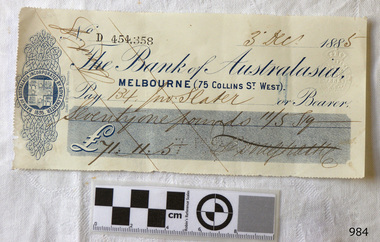
... Staff at the Bank of Australasia in Warrnambool included the following men but others were also involved: Samuel Hannaford, Teller then Manager from 1855-1856; W H Palmer, Manager from January 1857 until November 1869 when the Teller Basil Spence was promoted to Manager; H B Chomley, Manager from April 1873 and still there in 1886; A Butt, Manager in 1895-1904; J R McCleary Accountant and Acting Manager for 12 months, until 1900; A Kirk, Manager 1904; J Moore, staff until his transfer to Bendigo in December 1908; J S Bath was Manager until 1915; C C Cox, Manager until April 1923; Richard C Stanley, Manager 1923 to April 1928. ...Staff at the Bank of Australasia in Warrnambool included the following men but others were also involved: Samuel Hannaford, Teller then Manager from 1855-1856; W H Palmer, Manager from January 1857 until November 1869 when the Teller Basil Spence was promoted to Manager; H B Chomley, Manager from April 1873 and still there in 1886; A Butt, Manager in 1895-1904; J R McCleary Accountant and Acting Manager for 12 months, until 1900; A Kirk, Manager 1904; J Moore, staff until his transfer to Bendigo in December 1908; J S Bath was Manager until 1915; C C Cox, Manager until April 1923; Richard C Stanley, Manager 1923 to April 1928. ...This bank cheque originated from the Bank of Australasia, Melbourne branch. It was issued on 3rd December 1885 to a person surnamed Slater for £71.11.5 (seventy-one pounds, eleven shillings and five pence). The parallel lines are called Cheque Crossed and mean that only Slater and no one else could receive the payment and that it would have been paid into Slater's bank account, not exchanged for cash. The embossed dots signify that the cheque amount was also paid to be the bearer of the cheque. Slater would have visited the bank to deposit the money into his or her own account. The cheque was printed by Sands & McDougall, a long-standing Melbourne printing and stationery company. It was then Stamped at the bank with its own unique number before it was issued to the customer. From its previously perforated edges, it is presumed that the cheque was part of a page of cheques, likely to be contained within a book of similar cheques ready for use. The Bank of Australia was incorporated by Royal Charter of England in March 1834. It had its Australian beginnings on 14th December 1835, opening in Sydney. The Acting Superintendent of the bank at that time was David Charters McArthur. He was Superintendent from 1867-to 1876. The Melbourne branch opened on 28th August 1838 in a two-roomed brick cottage on the north side of Little Collins Street, where two huge mastiff dogs were used at night to guard the bank. The government also provided an armed military sentinel. Due to the bank's rapid growth, a new building for the Melbourne branch was opened in 1840 at 75 Collins Street West. By 1879 the bank had been upgraded to a magnificent two-storey building on the corners of Collins and Queens Streets, with the entry on Collins Street. In 1951 the Bank of Australasia amalgamated with the Union Bank to form the Australia and New Zealand Bank, now known as the ANZ. Then in 1970, the ANZ merged with both the ES&A and the London Bank of Australia to form the ANZ Banking Group Limited. The ANZ Banking Group Ltd kindly donated a variety of historic items from the Bank of Australasia. BANK of AUSTRALASIA, WARRNAMBOOL – In 1854 Warrnambool had two banks, the Union Bank and the Bank of Australasia. Later, completely different bank businesses opened; in 1867 the National Bank of Australasia, then in 1875 the Colonial Bank of Australasia. The original Warrnambool branch of the Bank of Australasia was established in July 1854, and operated from a leased cottage on Merri Street, close to Liebig Street. The bank next bought a stone building previously erected by drapers Cramond & Dickson on the corner of Timor and Gibson Streets. Samuel Hannaford was a teller and then Manager at the Warrnambool branch from 1855 to 1856 and the Warrnambool Council chose that bank for its dealings during 1856-57. In 1859 Roberts & Co. was awarded the contract to build the new Bank of Australasia branch for the sum of £3,000. The land was on a sand hill on the northeast corner of Timor and Kepler Streets and had been bought in 1855 from investor James Cust. The new building opened on May 21, 1860. The bank continued to operate there until 1951 when it merged with the Union Bank to form the ANZ Bank, which continued operating from its Liebig Street building. Warrnambool City Council purchased the former Bank of Australasia building in 1971 and renovated it, then on 3rd December 1973 it was officially opened as the Art Gallery by Cr. Harold Stephenson and Gallery Director John Welsh. The Gallery transferred to the purpose-built building in Liebig Street in 1986 and the old bank building is now the Gallery club. Staff at the Bank of Australasia in Warrnambool included the following men but others were also involved: Samuel Hannaford, Teller then Manager from 1855-1856; W H Palmer, Manager from January 1857 until November 1869 when the Teller Basil Spence was promoted to Manager; H B Chomley, Manager from April 1873 and still there in 1886; A Butt, Manager in 1895-1904; J R McCleary Accountant and Acting Manager for 12 months, until 1900; A Kirk, Manager 1904; J Moore, staff until his transfer to Bendigo in December 1908; J S Bath was Manager until 1915; C C Cox, Manager until April 1923; Richard C Stanley, Manager 1923 to April 1928. The bank cheque has significance through its association with the Bank of Australasia. The early Australian bank was established in 1834 by Royal Charter and opened in Sydney, Australia, in Sydney in 1835. The bank had many Australian offices in November 1877, particularly on the east and south coasts. Victoria had 45 percent of all Offices. The bank cheque is significant as an early example of financial management of money and money exchange or transfer.Bank cheque of the Bank of Australasia, Melbourne branch. The rectangular paper has three sides that have been perforated. It is printed in blue with bank's Insignia of a heraldic shield of sheep hung by their waists and ships in full sail. Embossed Stamp Duty mark. Embossed dots. Handwritten black ink details Dated 3rd Dec 1885. Printed in Melbourne by Sands & McDougall. Diagonal parallel lines are across the cheque. Printed: "Bank of Australasia, MELBOURNE (75 COLLINS ST. WEST)." "454,358" "Sands & McDougall, Melbourne" Embossed stamp: Symbol of Crown above double oval lines " - STAMP DUTY" "ONE PENNY" Embossed dots forming test "7 PAID T2" Handwritten: "3rd Dec. [188] 5" "134 - Slater" "Seventy one pounds 11/S 5p" "£71.11.5" Signature: (undecipherable) flagstaff hill, warrnambool, shipwrecked-coast, flagstaff-hill, flagstaff-hill-maritime-museum, maritime-museum, shipwreck-coast, flagstaff-hill-maritime-village, bank cheque, shipwrecked coast, flagstaff hill maritime museum, maritime museum, shipwreck coast, flagstaff hill maritime village, great ocean road, bank of australasia, boa, union bank, australia & new zealand bank, anz bank, bank note, melbourne, slater, sands & mcdougall, chrssed cheque, embossed dots, paid cheque, banknote -
 Flagstaff Hill Maritime Museum and Village
Decorative object - Bookends
... Staff at the Bank of Australasia in Warrnambool included the following men but others were also involved: Samuel Hannaford, Teller then Manager from 1855-1856; Hawkins, Manager in 1856, W H Palmer, Manager from January 1857 until November 1869 when the Teller Basil Spence was promoted to Manager; H B Chomley, Manager from April 1873 and still there in 1886; A Butt, Manager in 1895-1904; J R McCleary Accountant and Acting Manager for 12 months, until 1900; A Kirk, Manager 1904; J Moore, staff until his transfer to Bendigo in December 1908; J S Bath was Manager until 1915; C C Cox, Manager until April 1923; Richard C Stanley, Manager 1923 to April 1928. ...Staff at the Bank of Australasia in Warrnambool included the following men but others were also involved: Samuel Hannaford, Teller then Manager from 1855-1856; Hawkins, Manager in 1856, W H Palmer, Manager from January 1857 until November 1869 when the Teller Basil Spence was promoted to Manager; H B Chomley, Manager from April 1873 and still there in 1886; A Butt, Manager in 1895-1904; J R McCleary Accountant and Acting Manager for 12 months, until 1900; A Kirk, Manager 1904; J Moore, staff until his transfer to Bendigo in December 1908; J S Bath was Manager until 1915; C C Cox, Manager until April 1923; Richard C Stanley, Manager 1923 to April 1928. ...The individual eagles in this pair of Napoleonic Eagle bookends are made so that each eagle faces the opposite direction to the other, one left and one right. The Napoleonic Eagle is the name given to the eagle symbol used by Napoleon Bonaparte 1799-1815 and the French Regiments, mounted on a standard to represent the honour and pride of fighting French men. It is believed that the Napoleonic Eagle was chosen as a symbol for the Tamar Bank in Launceston, Tasmania, established in 1834. The bank was formed after the separation of one of the branches of the Bank of Van Diemen’s Land. The Managing Director in 1834 was Lewis Gilles, previously a naval officer. Other directors were T. Williams, M. Connolly, F. D. Wickham, and P. Oakden. The bank was dissolved in 1838 and became the basis of the Launceston branch of the British-founded Union Bank of Australia Limited, established in 1837 and had its own emblem. The Union Bank of Australia merged with the Bank of Australasia in 1951 and went on to eventually become part of the Australia and New Zealand (ANZ) Banking Group. The Bank of Australasia was incorporated by Royal Charter of England in March 1834. It had its Australian beginning on 14th December 1835, opening in Sydney. The Acting Superintendent of the bank at that time was David Charters McArthur. He was Superintendent from 1867 to 1876. The Melbourne branch opened on 28th August 1838 in a two-roomed brick cottage on the north side of Little Collins Street. By 1879 the bank had been upgraded to a magnificent two-storey building on the corners of Collins and Queens Streets, with the entry on Collins Street. In 1951 the Bank of Australasia amalgamated with the Union Bank to form the Australia and New Zealand Bank, now known as the ANZ. Then in 1970, the ANZ merged with the ES&A and the London Bank of Australia to form the ANZ Banking Group Limited. The ANZ Banking Group Ltd kindly donated to Flagstaff Hill various historic items from the Bank of Australasia. BANK of AUSTRALASIA, WARRNAMBOOL – In 1854 Warrnambool had two banks, the Union Bank and the Bank of Australasia. Later, completely different bank businesses opened; in 1867 the National Bank of Australasia, then in 1875 the Colonial Bank of Australasia. The original Warrnambool branch of the Bank of Australasia was established in July 1854, and operated from a leased cottage on Merri Street, close to Liebig Street. The bank next bought a stone building previously erected by drapers Cramond & Dickson on the corner of Timor and Gibson Streets. Samuel Hannaford was a teller and then Manager at the Warrnambool branch from 1855 to 1856 and the Warrnambool Council chose that bank for its dealings during 1856-57. In 1859 Roberts & Co. was awarded the contract to build the new Bank of Australasia branch for the sum of £3,000; the firm built the Warrnambool Post Office in 1856 and purchased land in Timor Street in 1858. The land was on a sand hill on the northeast corner of Timor and Kepler Streets and had been bought in 1855 by investor James Cust. The new building opened on May 21, 1860. The bank continued to operate there until 1951 when it merged with the Union Bank to form the ANZ Bank, which continued operating from its Liebig Street building. Warrnambool City Council purchased the former Bank of Australasia building in 1971 and renovated it, then on 3rd December 1973 it was officially opened as the Art Gallery by Cr. Harold Stephenson and Gallery Director John Welsh. The Gallery transferred to the purpose-built building on Liebig Street in 1986 and the old bank building is now the Gallery Club. Staff at the Bank of Australasia in Warrnambool included the following men but others were also involved: Samuel Hannaford, Teller then Manager from 1855-1856; Hawkins, Manager in 1856, W H Palmer, Manager from January 1857 until November 1869 when the Teller Basil Spence was promoted to Manager; H B Chomley, Manager from April 1873 and still there in 1886; A Butt, Manager in 1895-1904; J R McCleary Accountant and Acting Manager for 12 months, until 1900; A Kirk, Manager 1904; J Moore, staff until his transfer to Bendigo in December 1908; J S Bath was Manager until 1915; C C Cox, Manager until April 1923; Richard C Stanley, Manager 1923 to April 1928. This pair of Napoleonic Eagle bookends represents the type of ornaments appropriate for 19th and 20th-century business associated with finance and commerce. They symbolise strength, reliability and power. It is believed that the Napoleonic Eagle was the seal of the Tamar Bank, established in 1834 in Launceston, Tasmania. The Tamar bank was taken over by the Australia-wide Union Bank in 1838, which later merged with the Bank of Australasia, which had a branch in Warrnambool. In 1851 it became the Australia and New Zealand Bank, which is still active in Warrnambool in 2023. Bookends; two (2) black metal eagles, standing, beaks open, tail to the side, wings spread, claws open. The black figures are cast metal and the backs are hollow, with flat even edges. The front is textured and shiny. The eagles are facing opposite directions; one left, one right. The figures are commonly known as Napoleonic eagles.flagstaff hill maritime museum and village, warrnambool, great ocean road, shipwreck coast, bookends, eagle bookends, napoleonic eagles, tamar bank, launceston bank, bank of australasia, eagle symbol, 1834-1838, commerce, financial institution, colonial bank, lewis gilles, m. connolly, f. d. wickham, and p. oakden., t. williams, anz bank, australia and new zealand bank, union bank of australia -
Federation University Historical Collection
Booklet - Annual Report, Ballarat School of Mines, Ballarat School of Mines Annual Report, 1969, 1969
... staff members retired: A.L.H. Aldersey; J.V. Crotty; M. Page; J.Ralston; P.J. Smith, P.B. Todd; Derek Wooley; Mr Goldfinch. TRADE DIVISION: F.D. Hamilton, J. Moran, D.Drake The following new lecturing appointments were made during the year: G.I. Boyd; E.W. Butters; D.R. Dowling; P.D. Kelly; G.J. medwell; R.E. Northey; C.A. Pogliani; R.H. Pyke; Roy Schrieke; B.J. Shearer, D.J. Stabb, T.W. Sweatman; A.C. Turner; D.G. Williams; C.M. McGarry. The Computer centre was enlarged when Arch MacKinnon was transferred as Mathematics lecturer to Computer Manager. J.A. Wilson was the computer operator, and R...staff members retired: A.L.H. Aldersey; J.V. Crotty; M. Page; J.Ralston; P.J. Smith, P.B. Todd; Derek Wooley; Mr Goldfinch. TRADE DIVISION: F.D. Hamilton, J. Moran, D.Drake The following new lecturing appointments were made during the year: G.I. Boyd; E.W. Butters; D.R. Dowling; P.D. Kelly; G.J. medwell; R.E. Northey; C.A. Pogliani; R.H. Pyke; Roy Schrieke; B.J. Shearer, D.J. Stabb, T.W. Sweatman; A.C. Turner; D.G. Williams; C.M. McGarry. The Computer centre was enlarged when Arch MacKinnon was transferred as Mathematics lecturer to Computer Manager. J.A. Wilson was the computer operator, and R ...This annual report was one year before the opening of the new tertiary division at Mt Helen. Council decided to retain the overall title "The School of Mines and Industries, Ballarat" for the foreseeable future, but to separately name the three divisions as follows: 1. Diploma School - The Ballarat Institute of Advanced Education (A division of the School of Mines and Industries, Ballarat) 2. Trades School - The Ballarat School of Industries (A division of the School of Mines and Industries, Ballarat) 3. Secondary School - The Ballarat Technical School (A division of the School of Mines and Industries, Ballarat). The annual report also foreshadowed the Centenary of the School (and technical education in Australia) in 1970. Speaker at the trade Prize Night and Apprenticeship Week was W.J. Anderson, and Craftsmen Certificates were presented by the Ballarat City Council. A number of quarto pages with stapled inside a brown card cover. The report was for the year ended 30 June 1969, and was delivered by Ballarat School of Mines President M.B. John. Page 5 lists the Diplomas awarded. Page 6 lists the scholarships, prizes and awards, including the Josephine Brelaz Scholarship, Martha Pinkerton Scholarship, Frank Pinkerton Scholarship, Mica Smith/Serjeant/Ironworkers Scholarship, Ballaarat Has Comapny Scholarship, Ballaarat City Council Scholarship, R.W. Richards Medal. Page 8 covers buildings and accommodation. Conditions were cramped at Lydiard Street , with conditions hoped to be improved when the Stage I buildings at Mount Helen were completed in the following year. Mount Helen Master Plan was undertaken by Joint site planners G.J. Harrison, staff architect at the Flinders University of South Australia. and messrs L.H. Vernon and associates, of Ballarat. The following staff members retired: A.L.H. Aldersey; J.V. Crotty; M. Page; J.Ralston; P.J. Smith, P.B. Todd; Derek Wooley; Mr Goldfinch. TRADE DIVISION: F.D. Hamilton, J. Moran, D.Drake The following new lecturing appointments were made during the year: G.I. Boyd; E.W. Butters; D.R. Dowling; P.D. Kelly; G.J. medwell; R.E. Northey; C.A. Pogliani; R.H. Pyke; Roy Schrieke; B.J. Shearer, D.J. Stabb, T.W. Sweatman; A.C. Turner; D.G. Williams; C.M. McGarry. The Computer centre was enlarged when Arch MacKinnon was transferred as Mathematics lecturer to Computer Manager. J.A. Wilson was the computer operator, and R. Kopke, E. Dykstra and V. Gay were Card Punch Operators. Preliminary work on the new Brewing and Malting course was continuing, and plans were being made for the commencement of courses in Librarianship and General Studies. A Halls of Residence Committee had held meetings to explore the type of student accommodation required. ballarat school of mines, library, m.b. john, stohr, robertson, beanland, graeme beanland, arthur nicholson, m.j. brown, anderson, rex hollioake, w.j.c. north, patterson, smail, w.g. smith. sutton, e.j. tippett, webb, white, yandell, mount helen, scholarship, martha pinkerton, josephine brelaz, graham beanland -
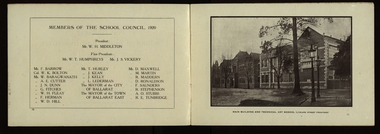 Federation University Historical Collection
Booklet, The Ballarat School of Mines and Industries 1870-1920 Jubilee Booklet, 1920 (estimated)
... R. Stephenson, A.O. Stubbs, R.E. Tunbridge. The School Staff in 1920 comprised: Herbert H. ...R. Stephenson, A.O. Stubbs, R.E. Tunbridge. The School Staff in 1920 comprised: Herbert H. ...The first school of Mines in Australia was established at Ballarat in 1870. At the time of its jubilee (1930) the following people were members of the School Council: W.H. Middleton (President), W.T. Humphreys (VP), J.S. Vickery (VP), F. Barrow, Col. W.K. Bolton, William Baragwanath, A.E. Cutter, J.N. Dunn, G. Fitches, W.H. Fleay, F. Herman. W.D. Hill, T. Hurley, K. Kean. J. Kelly, L. Lederman, Mayor of Ballarat, Mayour of Ballarat East, D. Maxwell, M. Martin, R. Maddern, D. Ronaldson, F. Saunders, R. Stephenson, A.O. Stubbs, R.E. Tunbridge. The School Staff in 1920 comprised: Herbert H. Smith, Walter Rowbotham, Reginald L. Cutter, M.C. Young, Hilda Wardle, M. Wiliamson, P.S. Richards, L.H. Archibald, J. Woods, Ken Moss, W. Kenneth, Mrs McIlvena. B. Robinson, S. Rowe, E. Hope-Jones, Miss Abrams, L.St.G.P. Austin, Alfred Mica Smith, J.R. Pound, Herbert R. Murphy, N.H. Junner, Maurice Copland, L.H. Archibald, E.J.A. McConnon, Newton King, D.m. Hull, T.R. Gordon, John M. Sutherland, T.K. Jebb, Dick Richards, C. Tonkin, A.W. Steane, J. Paterson, H.W. Malin, R.V. Maddison, S.M. Mayo, F.A. King, W.H. Steane, T.R. Gordon, T.A. Williams, H. Waldron, G. Black, E.J. McConnon, R.V. Duncan. R. Cutter, E.G. Vawdrey, Hilda WardleWhite stapled booklet - landscape format - 20pp + soft covers with blue writing. Includes an historical sketch of the Ballarat School of Mines. Contains images of the school from around 1920. The history outlined in the booklet follows: 'Ballarat has helped to influence the life and destinies of Australia in many ways, the recital of which would perhaps prove tedious to the citizens of less favoured localities! However, it can be said, without much fear of contradiction, that only less known thought Australia than its fame as a gold field is the reputation won for it by its school of Mines, ... Ballarat was still quite a new place when the School was founded, but a very propserous and popular place all the same, with a go-ahead lot of citizens brim full of the spirit of enterprise which seemsto animate mining populations generally. Money was plentiful, and they launched out into ventures, which later, were to develop and take the place of the gold mines, while what is more to the point, they understood the value of education. the old digging days were passing away. So far as Ballarat itself was concerned the day of the cradle and tin dish had already passed into an antiquity "as dead and distant as the age of the Tubal Caon," said dir redmond Barry on declaring the School open. Mining had become a serious business, and the mining engineer, the metallurgist, and the geologist had become a power in the land. In these circumstances the suggestions to found a School of Mines met with ready acceptance. The late Mr James M. Bickett had the honor of bringing forward the proposition at a meeting of the Ballarat Mining Board in October, 1869. it was agreed to, and the Government, having been approached for assistance, granted a lease of the old Supreme Court buildings at a nominal reantal. A modest sum, including 100 pounds from the Borough Council of Ballarat West, was subscribed by a number of sympathisers, and on the 26th October, 1870, the inaugural address was delivered by Sir Redmond Barry, the first President of the School. Classes were commenced on the 23rd January, 1871. The students at first were mostly adults. They were chiefly men emloyed at the mines, who had the wisdom and energy to devote their spare time to study, and, though their attendance was somewhat irregular, they made very good progress. Old prints which have been preserved show them at work at furnaces, big bearded men of the old-fashioned type of miner. It is interesting to note that among those who gave evidence and encouragement was Sir Roderick Murchison, who many years before had advised Cornish miners to emigrate to Australia to search for gold, and who in 1848 was in possession of gold ore sent from this country. Sir Roderick sent a parcel of books for the library, and gave useful advice as to the curriculum which should be adopted. The Museum, which now contains a most valuable collection of minerals, was one of the first things attended to, and the reports presented to the Council from time to time speak of additions being made from all parts of the world. New equipment was constantly being added to the School, a good deal of assay work was done, and some specimens were sent from the East Indies for examination as far back as 1873. By this time there was a difficulty in providing accomodation for the students who wished to enrol, and the number of instructors had grown from two to four. In 1882 the first building was being erected on what was then part of the gaol reserve. A little more than ten years afterwards a buildnig formerly serving as a Methodist Church was absorbed, while later on, the demand for accomodation increasing, the attack upon the gaol was renewed. The School continued to grow in reputation and size, and became the science centre of the district, and in 1889 a learge new building was opened by Sir Alexander Peacock. Students came from over seas as well as from all the States of Australia, and after going through their courses they took with them the name and fame of the old School to all parts of the globe. School of Mines boys have played a great part in developing the mining fields of Western Australia, South Australia, and africa, while old students who have made a name in their profession are constantly dropping in to see how the old place is getting along. It was not to be expected, however, that the Ballarat School would be left without rivals, its very success inspiring competition. Mining Schools were started in other parts of Australia, and, at the same time, Victoria ceased to hold first place as a mining state. On the other hand there was a great advance in manufacturing, and the demand for technicaly trained men became a great and as insistent as ever it had been for trained mining men. The Council was quick to adapt the school to the new conditions, and the result is seen in the institution, which is one of Ballarat's proudest possession. Instruction is given in all branches of technical work, and the classes are filled with students who are building up for Ballarat a reputation as an industrial centre, which promises to equal that which it formerly held as a mining town. Owing to its bracing climate, its abundant opportunities for recreations, and its accessibilty, Ballarat as a city is an ideal place for educational purposed, and is yearly becoming more and more appreciated throughout the State. The chairman of one of Ballarat's biggests industries claims that the workman can do twice the day's work here that he can do in Melbourne. he was a little enthusiastic over it, perhaps, but it is a well-known fact that the healthy and invigourating Ballarat climate is conducive to both physical and mental activity, and the records of the School provide ample proof of it. One of the most interesting and successful branches of the School of Mines and Industries - if the name be enlarged with the enlargement of its scope - is the Technical Art School. "The City of Statues" has from its earliest days been a stronghold of art. Art schools have flourised here, and in 1905 the Education Department came to the conclusion that the best thing to do with them was to place them under the management of the School of Mines Council. A magnificent new Technical Art School was built at a cost of some 12,000 pounds on the site of the old Supreme Court building, and was formally opened on the 23rd July, 1915. The results have not only been justified but surpassed all anticipations. The most comprehensive list of subjects is taught, and this list is constantly added to. Students have flocked to the art School, which may be said to occupy a unique position in Australia, and its record of success is really astonishing. Its students supply art teachers for the newer schools that are being built, and many occupy leading positinos in important business houses. So well is its reputation known that orders are constantly being received, not only from Victoria, but from other States, for honor boards and challenge shields to be designed and made. The most recent addition to the School of Mines and Industries is the Junior Technical School, for which a new building is now being erected on a portion of the gaol site, transferred to the School of Mines Counci by the Government. At the present moment temporary quarters are being occupied. Some students after passing through the Junior School go straight to employment, continuing perhaps to attend the evening trade classes, while others move on to the senior School. In a review of the work of the School of Mines mention must be made of a series of industrial research carried out under supervision of the Principal. One in particular, regarding the suitability of the local ores for the manufacture of pigments attracted much attention, while the experiemtns on the manufacture of white potery from Victorian clayes were considered of sufficient importance by the Federal Advisory Council of Science and Industry to warrant the appointment of a special investigator. The results of these have been most encouraging, and may have far-reaching consequences. The vocational training of returned soldiers also should not be overlooked. The work was taken in hand from the first, before the Repatriation Department gave assistance, and now with the help of the department of the School has become one of the largest vocational training centres in Victoria outside of Melbourne. The soldiers, trained in a variety of occupations, have made remarkable progress, and already considerable numbers have found employment in local workshops and factories. To sum up, the School is divided into the following departments, each well staffed and equipped: - The School of Mines, science, and Engineering; the Techncial Art School, the Boys' Junior Technical School, the Girl's Preparatory Technical Classes, Trade Classes, and the Commercial School. The school of Mines, science and Engineering, comprises the following branches: - Mining, Metallurgy, Geology, Electrical Engineering, Civil Engineering, Mechanical Engineering, Applied Chemistry, and Pharmacy. Battery treatments, Cyanide Testing, Smelting, Assays, and Clay Testing from a regular part of the School's work. Students gaining qualifications obtain concession in their courses at the university, should they proceed there to continue their studies. The technical Art school curriculum includes training in all branches of pictorial and applied art, an Architectural Diploma Course, a Draughtman's Course, technical Art teachers' Course, Photography,Ticket Writing, Art Metal Work, Woodcarving, Needlework, and Leather work. The Trade Classes give instruction in Telephone Mechanics, telegraphy, Carpentry, Cabinet Making, Plumbing, Blacksmithing, Fitting, Electric Wiring, and Printing. Numerous Scholarships are offered every year, and altogether students will find few places to equal the Ballarat School of Mines and Industries as a training place for their life's work. One of the first in the continent to be established, its Jubilee finds it still in the front rank, keeping pace with the times, and offering to the youths of this country the means of taking advantage of Australia's teeming opportunities. william, battery, smith, herbert, drawing from the antique, ballarat school of mines botanical gardens, ballarat school of mines, redmond barry, alfred mica smith, james bickett, museum, dick richards, ballarat junior technical school, s m b, ballarat school of mines and industries, ballarat technical art school, model mine, james m bickett, j m bickett, roderick murchison, vocational training rooms, wesley church, methodist church, alexander peacock, lathes, repatriation, repatriatin department, war service, school council, baragwanath, gold mining, mining laboratory, plaster cast, r.w. richards, anniversary, jubilee -
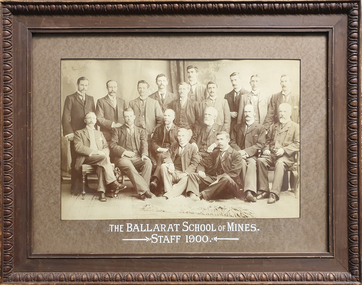 Federation University Historical Collection
Photograph - Photograph (Black & White), Senior Members of the Ballarat School of Mines Staff, 1900, 1900
... Staff Members of the Ballarat School of Mines ballarat school of mines alfred mica smith daniel walker thomas hart s.b. vial w doepel alfred kerr arthur garrard henry hall w kerr grant ce campbell john sutherland hr murphy charles dean fred martel j.s. dawburn j.f. usher p.a. osborne godfrey hart c.e. campbell w. kerr grant kerr grant Framer's plate 'Peake's Ballarat' Framed mount 'The Ballarat School of Mines, Staff 1900' A black and white photograph showing 18 men. Standing L-R: S.B. ...Staff Members of the Ballarat School of MinesA black and white photograph showing 18 men. Standing L-R: S.B. Vial (Chemistry); W. Doepel (Clerk); Alfred E.C. Kerr (Mechanical Engineering); Arthur Garrard (Battery Manager); Henry Hall (Drawing); W. Kerr Grant (Mathematics); C.E. Campbell (Photography); J.M. Sutherland (Electricity); H.R. Murphy (Assayer); Charles A. Dean (Cyanide Works). Sitting: Daniel Walker (Chemistry); Thomas S. Hart (Mineralogy & Curator); Fred. J. Martell (Registrar); Alfred Mica Smith, Senior Professor (Chemistry, Metallurgy, etc); J.S. Dawburn (Engineering & Surveying); Dr J.F. Usher (Materia Medica). Seating (Front): P.A. Osborne (Assistant Assayer); Godfrey Hart (Museum). .2) is a framed copy of the photograph in a carved timber from from Peake's BallaratFramer's plate 'Peake's Ballarat' Framed mount 'The Ballarat School of Mines, Staff 1900'ballarat school of mines, alfred mica smith, daniel walker, thomas hart, s.b. vial, w doepel, alfred kerr, arthur garrard, henry hall, w kerr grant, ce campbell, john sutherland, hr murphy, charles dean, fred martel, j.s. dawburn, j.f. usher, p.a. osborne, godfrey hart, c.e. campbell, w. kerr grant, kerr grant -
 Federation University Historical Collection
Magazine - Book, Extra Muros, 1930, 1930
... staff consisted of Mr W.H. Ellwood, Miss A. Bouchier, Mr A.B. Jones. (The Flag, Nov 1997; The Flag, Nov 1996; BTC Handbook 1965) btc ballarat teachers college j weir v bellingham em smith c cox g rosehain cm hall m ocallaghan m giles d roscoe o hateley c inglis a curtis g bolster joyce thomas c cummins j conway r row w augustini n prendergast d carroll n larkan m fogarty m murray a vickers e forster c mccullough k curley m bainbridge t stuart mollie quinn mildred graham hazel henderson norman cocks george carey colin hall jessie higgins r bowman a coto v mckenzie g dunstan thomas alexander maclean j mckerbery r warriner edna jones ina dickman wi young jh mcnaughton re moosman f hickey q kerby r watson c goltz ab jones Ballarat East Library Physical Culture On the first page written in red pencil "M Miller" [Monica Miller] Blue soft cover booklet with gold titles relating to the Ballarat Teachers College, 62 pages with illustrations and advertisements. ...Ballarat Teachers’ College commenced at Ballarat East Library in 1926 and stayed at that location until temporary closure in December 1931. In 1926 Sixty one students enrolled, and the staff consisted of Mr W.H. Ellwood, Miss A. Bouchier, Mr A.B. Jones. (The Flag, Nov 1997; The Flag, Nov 1996; BTC Handbook 1965)Blue soft cover booklet with gold titles relating to the Ballarat Teachers College, 62 pages with illustrations and advertisements. Includes information on current and ex students. Staff and student activities throughout the year.On the first page written in red pencil "M Miller" [Monica Miller]btc, ballarat teachers college, j weir, v bellingham, em smith, c cox, g rosehain, cm hall, m ocallaghan, m giles, d roscoe, o hateley, c inglis, a curtis, g bolster, joyce thomas, c cummins, j conway, r row, w augustini, n prendergast, d carroll, n larkan, m fogarty, m murray, a vickers, e forster, c mccullough, k curley, m bainbridge, t stuart, mollie quinn, mildred graham, hazel henderson, norman cocks, george carey, colin hall, jessie higgins, r bowman, a coto, v mckenzie, g dunstan, thomas alexander maclean, j mckerbery, r warriner, edna jones, ina dickman, wi young, jh mcnaughton, re moosman, f hickey, q kerby, r watson, c goltz, ab jones, ballarat east library, physical culture -
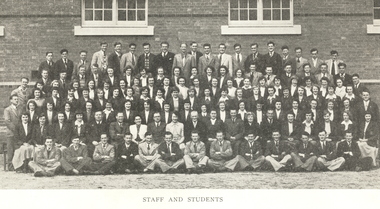 Federation University Historical Collection
Book, Extra Muros, 1950, 1950
... staff consisted of Miss E.B. Hughes, Mr C.B. Bryan, Miss Monica H. Millar (music), Miss G. Kentish (physical education) btc ballarat teachers college g walker n walker e hughes l erdman l melgaard b young s winmill v pyers f stacpoole r botsman r fellows b macdonald b thompson i bicknell j sheehan r hodgens m cross b sweeny p jaensch d keiller s windmill d flanagan van leeuwed joyce murphy monica miller v. pyers val pyers frank lord graham turner norman schulz richard bayly mardi chisholm ron lane george telushkin betty roberts bob newman jack hickson nancy lees Charcoal blue cover with gold titles. ...1946 Ballarat Teachers’ College reopened at Dana Street State School (no. 33) offering a one year course. The principal was W.F. Lord, and the staff consisted of Miss E.B. Hughes, Mr C.B. Bryan, Miss Monica H. Millar (music), Miss G. Kentish (physical education) Charcoal blue cover with gold titles. Magazine of the Ballarat Teachers' College. The magazine includes the events of the year and advertisements, Principa Frank Lord's Foreword " A good way to relieve the monotony of any job is to think of ways of improving it"; Sport; The Australian Soldier; Hockey Team, Basketball Team; Football Team The magazine included many photographs, including a whole College photograph; Student Representative Council and Group Leaders; Sport Committee Names reading from right to left. Back Row: J.R. Stuchberry, M.F. Ross, L.H.T. Melgaard, G.J.A. Walker, R.J. Lane, T.P. Newton, J.I. Fielding, I.T. Bicknell, R.W. Bayly, J.W. Allan, J.D.J. Rochford, D.A. Farquhar, M.J. Binder, J.G. Segrave, A.T.G. Jennings. David van Leeuwen, E.J. Campbell, J. Woods, N.J. Walker. Second row: V.G. Telushkin, Noel G. Tresize, A.V. Ainge, K.R.B. Skeen, R.G. Hucker, W.A> Poole, M.I. McKenzie, M.M. Molan, P.A. Davey, M.D. Oppy, B.F. Collins, Y.M. Mittchell, A.W. Frith, M.T. O'Brien, P.M. Hanrahan, B.J. Dunsmore, C. Judd, Val G. Pyers, B.L. Shirley. Third row: G.M. Wise, E.M. Rowe, M.M. Napier, A.C. Swanton, B.J. Young, F.M. Stacpoole, P.M. Kelly, S.F. Gardenr, G.M. McCarthy, D. Flanagan, M.J. [Joyce] Murphy, P.M. McIntyre, M.M. green, N.Y. Chappell, J. Kemp, N.B. Forrest, L.J. Scholfield, M.M. Cross, M.J. Burchell, M.A. Leask, A.P. Cunningham, R. Hodgens Fourth Row: S.T. Downs, E.R. Quick, M.J. Krick, D.F. Nicholson, L.O. Quick, C.E. Douglass, F.E. Miller, G. McKenzie, J.N. Lindsay, J.J. Powling, M.V. Langdon, S.R. Wimdmill, G.M. Walton, J.A. Walker, P. Jaensch, G.M. Hoare, B.M. Sweeney, G.J. Monk, D. Keiller, D.M. Ross, B.S. Alderson, O.M. Ball, B.K. Macdonald. Fifth Row: E.W. Munn, H.E. Oxley, M.T. Ryan, M.M. Magee, V.O. Dick, F.K. Curtain, E.A. O'Brien, M.D. MacDonald, M.R. Rafferty, E.V. Bowles, W.D. Batten, E.M. Lawlor, A.Y. Callaway, L.B. Flanders, D.M. McLean, M.J. Whitelock, C.A. Tonzing, B. Nolan. Sixth Row: N.M. Young, W.E. Ramsey, A.P. Maloney, R.E. Botsman, B.M. Barr, Mr McEwin, Miss Aldred, Mr Turner, Miss Hughes, Mr Lord, Monica Miller, Mr Bryan, Miss Hayes, Mr Cumming, Alan Sonsee, V.D. Trainor, M.P. Dwyer, M.D. Chisholm, E. Hodge. Seated: B.S. Murphy, N.G. Schulz, A.W. Gunn, A.W. Thompson, K.J. Tobin, R.W. Chalmers, D.C. Halladay, C.J. R Fellows, J.L. Sheehan, G.E. Mann, L.A. Erdman, G.F. Brown, H.D. Graham. Absent: Y. McLeod, T.G. Philpottbtc, ballarat teachers college, g walker, n walker, e hughes, l erdman, l melgaard, b young, s winmill, v pyers, f stacpoole, r botsman, r fellows, b macdonald, b thompson, i bicknell, j sheehan, r hodgens, m cross, b sweeny, p jaensch, d keiller, s windmill, d flanagan, van leeuwed, joyce murphy, monica miller, v. pyers, val pyers, frank lord, graham turner, norman schulz, richard bayly, mardi chisholm, ron lane, george telushkin, betty roberts, bob newman, jack hickson, nancy lees
