
Showing 90 items matching "regional landscapes"
-
 Nhill and District Historical Society Inc.
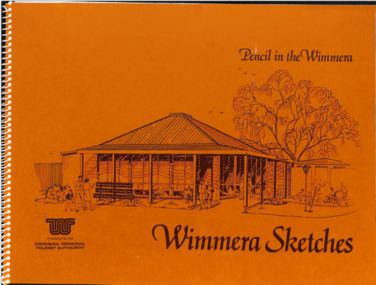
Book - Wimmera Sketches, Jean Hill (1916-2006), Pencils in the Wimmera produced by Wimmera Regional Tourism Authority, 1979
... ...Regional landscapes...Landscape orientation soft bound publication containing a curated series of reproduced pencil sketches by Jean Hill. The drawings depict geographical features, national parks and reserves, townscapes, notable civic buildings, and other man made structures across the Wimmera and Limestone Coast region. The visual content was selected to represent each municipality within the Wimmera Regional...Wimmera-tourism Artist--Jean Hill Regional landscapes townscapes 1979-regional-promotion Wimmera-region Limestone-Coast public-buildings municipal-identity regional-tourism national-parks This book was produced in 1979 and contains a unique collection of prints includes geographical features, national parks and reserves, regions, towns, buildings and other man-made structures, taken from original drawings/sketches by Jean Hill who was commissioned by the Wimmera Regional Tourist Authority to produce selected subjects from each municipality for display in the Horsham Tourist information center to highlight attractions from around the Wimmera and Limestone Coast - from Stawell through to Naracoorte for visitors to the region. ...This book was produced in 1979 and contains a unique collection of prints includes geographical features, national parks and reserves, regions, towns, buildings and other man-made structures, taken from original drawings/sketches by Jean Hill who was commissioned by the Wimmera Regional Tourist Authority to produce selected subjects from each municipality for display in the Horsham Tourist information center to highlight attractions from around the Wimmera and Limestone Coast - from Stawell through to Naracoorte for visitors to the region. Jean Hill was a trained commercial artist of Horsham and a member of the Horsham Gallery Art Group in the 1970s.Landscape orientation soft bound publication containing a curated series of reproduced pencil sketches by Jean Hill. The drawings depict geographical features, national parks and reserves, townscapes, notable civic buildings, and other man made structures across the Wimmera and Limestone Coast region. The visual content was selected to represent each municipality within the Wimmera Regional Tourist Authority’s jurisdiction, forming a cohesive promotional suite for display in the Horsham Tourist Information Centre.non-fictionThis book was produced in 1979 and contains a unique collection of prints includes geographical features, national parks and reserves, regions, towns, buildings and other man-made structures, taken from original drawings/sketches by Jean Hill who was commissioned by the Wimmera Regional Tourist Authority to produce selected subjects from each municipality for display in the Horsham Tourist information center to highlight attractions from around the Wimmera and Limestone Coast - from Stawell through to Naracoorte for visitors to the region. Jean Hill was a trained commercial artist of Horsham and a member of the Horsham Gallery Art Group in the 1970s.wimmera-tourism, artist--jean hill, regional landscapes, townscapes, 1979-regional-promotion, wimmera-region, limestone-coast, public-buildings, municipal-identity, regional-tourism, national-parks -
 Bendigo Historical Society Inc.
Painting - NORMAN PENROSE COLLECTION: ARTWORK
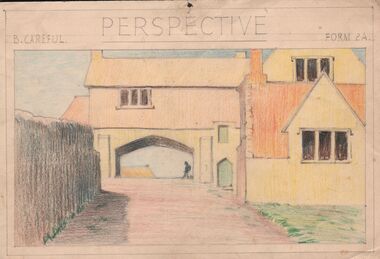
... Norman William Penrose (1903–1976) was an Australian painter and art teacher renowned for his depictions of regional Victorian landscapes and everyday scenes, particularly around Bendigo where he spent most of his life...Norman William Penrose (1903–1976) was an Australian painter and art teacher renowned for his depictions of regional Victorian landscapes and everyday scenes, particularly around Bendigo where he spent most of his life DRAWING Crayon Norman Penrose Collection artwork crayon drawings (C) N. ...Norman William Penrose (1903–1976) was an Australian painter and art teacher renowned for his depictions of regional Victorian landscapes and everyday scenes, particularly around Bendigo where he spent most of his lifeArtwork. Norman Penrose collection: (A) Crayon or pencil (coloured) drawing of a building and fence. A man is walking in an archway in the distance. The buildings are yellow and orange. The picture illustrates perspective. (B) Coloured crayon drawing of a one legged man carrying a parrot on his arm, walking along the cliff top beside the sea. A sailing ship is on the water. (C) Coloured crayon drawing of a green fire breathing dragon above the waves of the sea. The moon and stars are shining in a dark sky. The drawing has a blue paint wash. (D) Coloured crayon drawing of Robinson Crusoe. He is on the beach and has a large trunk open. He is looking in it. A number of coconuts and bowls are around the trunk. It is beside a palm tree. A ship with two masts is just off the shore.(C) N. Penrosedrawing, crayon, norman penrose collection, artwork, crayon drawings -
 Bendigo Historical Society Inc.
Painting - NORMAN PENROSE COLLECTION: WOMEN'S FASHION, Autumn 1940
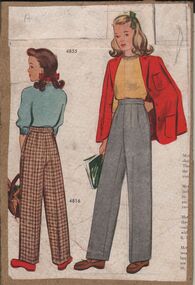
... Norman William Penrose (1903–1976) was an Australian painter and art teacher renowned for his depictions of regional Victorian landscapes and everyday scenes, particularly around Bendigo where he spent most of his life...Norman William Penrose (1903–1976) was an Australian painter and art teacher renowned for his depictions of regional Victorian landscapes and everyday scenes, particularly around Bendigo where he spent most of his life ARTWORK Norman Penrose Collection artwork women's fashion Artwork. ...Norman William Penrose (1903–1976) was an Australian painter and art teacher renowned for his depictions of regional Victorian landscapes and everyday scenes, particularly around Bendigo where he spent most of his lifeArtwork. Norman Penrose collection: various colour and black and white pictures of women's fashion taken from magazines, etc and pasted onto cardboard. Some blue and white illustrations of methods of drawing figures and clothing.artwork, norman penrose collection, artwork, women's fashion -
 Bendigo Historical Society Inc.
Painting - NORMAN PENROSE COLLECTION: BORDER PAINTINGS
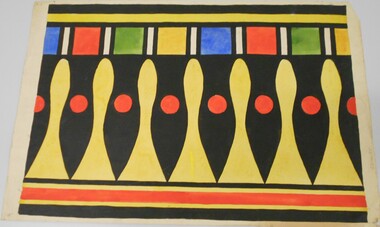
... Norman William Penrose (1903–1976) was an Australian painter and art teacher renowned for his depictions of regional Victorian landscapes and everyday scenes, particularly around Bendigo where he spent most of his life...Norman William Penrose (1903–1976) was an Australian painter and art teacher renowned for his depictions of regional Victorian landscapes and everyday scenes, particularly around Bendigo where he spent most of his life DRAWING Print Norman Penrose Collection artwork border paintings Artwork. ...Norman William Penrose (1903–1976) was an Australian painter and art teacher renowned for his depictions of regional Victorian landscapes and everyday scenes, particularly around Bendigo where he spent most of his lifeArtwork. Norman Penrose collection: 2 border paintings. One has black, red and yellow stripes at the top. A spear shaped design with a red spot in the centre. Yellow, green, red and blue squares separated by two black and a white strip and black and yellow stripes at the bottom. The second one has red, white and black stripes at the top. A black, red and green geometric design in the centre and a black stripe at the bottom. The background is unpainted.drawing, print, norman penrose collection, artwork, border paintings -
 Federation University Art Collection
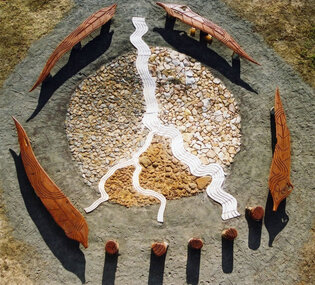
Sculpture, 'Fire Pit' by Glenn Romanis, 2004
... It presents a critical survey of the contemporary regional cultural landscape; and provides much-needed opportunities for artists to gather, present work and enter into meaningful exchange....It presents a critical survey of the contemporary regional cultural landscape; and provides much-needed opportunities for artists to gather, present work and enter into meaningful exchange. ...My visual stories seek to inform about the natural and cultural histories that attribute to the experience of country (place), in order hat the audience gains respect, understanding and a sense of belonging to the place. My practice involves various mediums in two and three dimensional form, which include permanent and ephemeral installation, paving, stonework, woodwork, metal work, lighting design, illustration, mural painting and mosaic work. I am competent in using all these mediums, but do have a preference to stone and wood. Having been involved in public and community art as a designer and sculpture/maker in both individual and collaborations for the past fifteen years, I have been fortunate to work with and partake in various collaborations and project teams; working with council organizations, landscape designers, art practitioners, artisans and arts workers. (https://www.glennromanis.com/biography, accessed 08 June 2022)Glenn ROMANIS Wurundjeri/woi wurrung and Boonwerrung This item is part of the Federation University Art Collection. The Art Collection features over 2000 works and was listed as a 'Ballarat Treasure' in 2007.A fire pit with sculpted redgum seats in the shape of a gum leaf. It was created for the Arts Victoria 'Artlands' Conference held in Horsham in 2004. Artlands is a national event designed to reflect and respond to emerging trends and shine a spotlight on arts in regional Australia. It is designed to showcase new thinking, present contemporary work, and generate exchange and conversations. The programming champions best practice and strengthens a national network of artists and practitioners working in regional, rural and remote Australia. Presented and delivered by Regional Arts Australia, Artlands is positioned as a multi-art, cross-industry and inter-generational. It presents a critical survey of the contemporary regional cultural landscape; and provides much-needed opportunities for artists to gather, present work and enter into meaningful exchange.art, artwork, aboriginal, glenn romanis, sculpture, campsite, camp fire -
 The Beechworth Burke Museum
Photograph - Lantern Slide, c1900
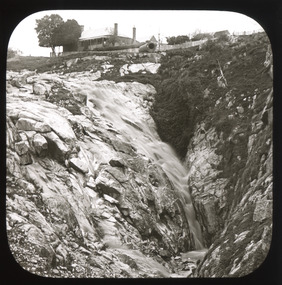
... This glass slide is significant because it provides insight into Beechworth's built environment and natural landscape in the early Twentieth Century, around the time of Australia's Federation. It is also an example of an early photographic and film-making technology in use in regional Victoria in the time period. ...This image shows the gorge adjacent to Beechworth in approximately 1900. Although the exact location of the photograph is yet to be determined, the present-day Beechworth Gorge Walk includes views of the Cascades at the point at which Spring Creek flows into the valley on the level below. Gold-sluicing techniques in use in the town during periods of active gold extraction may have altered the landscape since the photograph was taken, however. In the 1850s a mill was built at the top of the Spring Creek falls by Russian-born Louis Chevalier, brother of artist Nicholas Chevalier. The mill supplied the town with lumber that supported the town's initial construction boom. Lantern slides, sometimes called 'magic lantern' slides, are glass plates on which an image has been secured for the purpose of projection. Glass slides were etched or hand-painted for this purpose from the Eighteenth Century but the process became more popular and accessible to the public with the development of photographic-emulsion slides used with a 'Magic Lantern' device in the mid-Nineteenth Century. Photographic lantern slides comprise a double-negative emulsion layer (forming a positive image) between thin glass plates that are bound together. A number of processes existed to form and bind the emulsion layer to the base plate, including the albumen, wet plate collodion, gelatine dry plate and woodburytype techniques. Lantern slides and magic lantern technologies are seen as foundational precursors to the development of modern photography and film-making techniques.This glass slide is significant because it provides insight into Beechworth's built environment and natural landscape in the early Twentieth Century, around the time of Australia's Federation. It is also an example of an early photographic and film-making technology in use in regional Victoria in the time period.Thin translucent sheet of glass with a square image printed on the front and framed in a black backing. It is held together by metals strips to secure the edges of the slide.burke museum, beechworth, lantern slide, slide, glass slide, plate, burke museum collection, photograph, monochrome, indigo shire, north-east victoria, spring creek falls, beechworth gorge, louis chevalier, nicholas chevalier, lumber industry, timber industry, 1850s, construction, building, mill, mills, waterfall -
 The Beechworth Burke Museum
Photograph - Lantern Slide, c1900
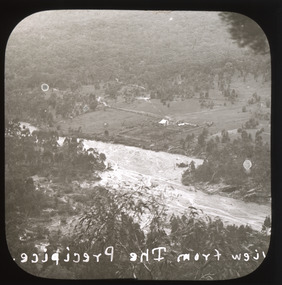
... This glass slide is significant because it provides insight into Beechworth's built environment and natural landscape in the early Twentieth Century, around the time of Australia's Federation. It is also an example of an early photographic and film-making technology in use in regional Victoria in the time period. ...This image shows a semi-aerial view of a property along a river adjacent to Beechworth in approximately 1900. The photographer has capitalised words in the label, indicating that 'The Precipice' may have suggested a particular rather than a general vantage point to local people at the time. Although the exact location of the photograph is yet to be determined, Beechworth Gorge is popular today with hikers and nearby Mt Stanley is noted for its views. Lantern slides, sometimes called 'magic lantern' slides, are glass plates on which an image has been secured for the purpose of projection. Glass slides were etched or hand-painted for this purpose from the Eighteenth Century but the process became more popular and accessible to the public with the development of photographic-emulsion slides used with a 'Magic Lantern' device in the mid-Nineteenth Century. Photographic lantern slides comprise a double-negative emulsion layer (forming a positive image) between thin glass plates that are bound together. A number of processes existed to form and bind the emulsion layer to the base plate, including the albumen, wet plate collodion, gelatine dry plate and woodburytype techniques. Lantern slides and magic lantern technologies are seen as foundational precursors to the development of modern photography and film-making techniques.This glass slide is significant because it provides insight into Beechworth's built environment and natural landscape in the early Twentieth Century, around the time of Australia's Federation. It is also an example of an early photographic and film-making technology in use in regional Victoria in the time period.Thin translucent sheet of glass with a square image printed on the front and framed in a black backing. It is held together by metals strips to secure the edges of the slide.Obverse: Image from The Precipice. /burke museum, beechworth, lantern slide, slide, glass slide, plate, burke museum collection, photograph, monochrome, views, landscapes, farmsteads, rivers, beechworth gorge, mt stanley, emulsion, the precipice -
 The Beechworth Burke Museum
Photograph - Lantern Slide, c1900
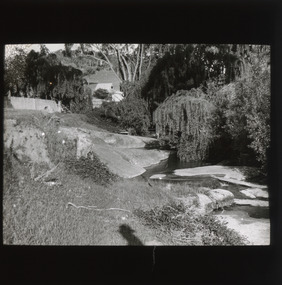
... This glass slide is significant because it provides insight into Beechworth's built environment and natural landscape in the early Twentieth Century, around the time of Australia's Federation. It is also an example of an early photographic and film-making technology in use in regional Victoria in the time period. ...This image shows a view of a properties bordering a river in the vicinity of Beechworth in approximately 1900. Although the exact location of the photograph is yet to be determined, the water source pictured may feed into the bigger system that flows through Beechworth Gorge. A man wearing a hat, possibly the photographer, is silhouetted in the foreground of the picture. Lantern slides, sometimes called 'magic lantern' slides, are glass plates on which an image has been secured for the purpose of projection. Glass slides were etched or hand-painted for this purpose from the Eighteenth Century but the process became more popular and accessible to the public with the development of photographic-emulsion slides used with a 'Magic Lantern' device in the mid-Nineteenth Century. Photographic lantern slides comprise a double-negative emulsion layer (forming a positive image) between thin glass plates that are bound together. A number of processes existed to form and bind the emulsion layer to the base plate, including the albumen, wet plate collodion, gelatine dry plate and woodburytype techniques. Lantern slides and magic lantern technologies are seen as foundational precursors to the development of modern photography and film-making techniques.This glass slide is significant because it provides insight into Beechworth's built environment and natural landscape in the early Twentieth Century, around the time of Australia's Federation. It is also an example of an early photographic and film-making technology in use in regional Victoria in the time period.Thin translucent sheet of glass with a square image printed on the front and framed in a black backing. It is held together by metals strips to secure the edges of the slide.burke museum, beechworth, lantern slide, slide, glass slide, plate, burke museum collection, photograph, monochrome, photographer, beechworth gorge, river, stream, water source, 1900s -
 The Beechworth Burke Museum
Photograph - Lantern Slide, c1900
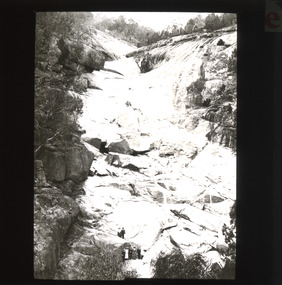
... This glass slide is significant because it provides insight into Beechworth's built environment and natural landscape in the early Twentieth Century, around the time of Australia's Federation. It is also an example of an early photographic and film-making technology in use in regional Victoria in the time period. ...This image shows the gorge adjacent to Beechworth in approximately 1900. Although the exact location of the photograph is yet to be determined, the present-day Beechworth Gorge Walk includes views of the Cascades at the point at which Spring Creek flows into the valley on the level below. Gold-sluicing techniques in use in the town during periods of active gold extraction may have altered the landscape since the photograph was taken, however. In the 1850s a mill was built at the top of the Spring Creek falls by Russian-born Louis Chevalier, brother of artist Nicholas Chevalier. The mill supplied the town with lumber that supported the town's initial construction boom. Lantern slides, sometimes called 'magic lantern' slides, are glass plates on which an image has been secured for the purpose of projection. Glass slides were etched or hand-painted for this purpose from the Eighteenth Century but the process became more popular and accessible to the public with the development of photographic-emulsion slides used with a 'Magic Lantern' device in the mid-Nineteenth Century. Photographic lantern slides comprise a double-negative emulsion layer (forming a positive image) between thin glass plates that are bound together. A number of processes existed to form and bind the emulsion layer to the base plate, including the albumen, wet plate collodion, gelatine dry plate and woodburytype techniques. Lantern slides and magic lantern technologies are seen as foundational precursors to the development of modern photography and film-making techniques.This glass slide is significant because it provides insight into Beechworth's built environment and natural landscape in the early Twentieth Century, around the time of Australia's Federation. It is also an example of an early photographic and film-making technology in use in regional Victoria in the time period.Thin translucent sheet of glass with a square image printed on the front and framed in a black backing. It is held together by metals strips to secure the edges of the slide.burke museum, beechworth, lantern slide, slide, glass slide, plate, burke museum collection, photograph, monochrome, beechworth gorge, indigo shire, landscapes, mill, sluicing, gold mining, north-east victoria, spring creek, louis chevalier, cascades -
 The Beechworth Burke Museum
Photograph - Lantern Slide, c1900
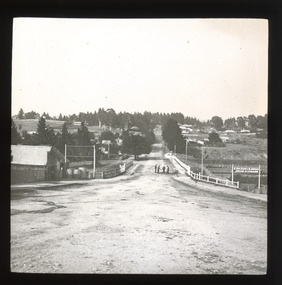
... regional Victoria in the time period. Burke Museum Beechworth Lantern Slide Slide Glass Slide Plate Burke Museum Collection Photograph Monochrome 1900s landscape streetscape Albert Road Thin translucent sheet of glass with a square image printed on the front and framed in a black backing. ...Image taken in c.1900 of Albert Road, Beechworth, showing surrounding landscape. Lantern slides, sometimes called 'magic lantern' slides, are glass plates on which an image has been secured for the purpose of projection. Glass slides were etched or hand-painted for this purpose from the Eighteenth Century but the process became more popular and accessible to the public with the development of photographic-emulsion slides used with a 'Magic Lantern' device in the mid-Nineteenth Century. Photographic lantern slides comprise a double-negative emulsion layer (forming a positive image) between thin glass plates that are bound together. A number of processes existed to form and bind the emulsion layer to the base plate, including the albumen, wet plate collodion, gelatine dry plate and Woodburytype techniques. Lantern slides and magic lantern technologies are seen as foundational precursors to the development of modern photography and film-making techniquesThis glass slide is significant because it provides insight into Beechworth's social amenities and religious infrastructure in the late Nineteenth Century. It is also an example of an early photographic and film-making technology in use in regional Victoria in the time period.Thin translucent sheet of glass with a square image printed on the front and framed in a black backing. It is held together by metals strips to secure the edges of the slide.burke museum, beechworth, lantern slide, slide, glass slide, plate, burke museum collection, photograph, monochrome, 1900s, landscape, streetscape, albert road -
 The Beechworth Burke Museum
Photograph
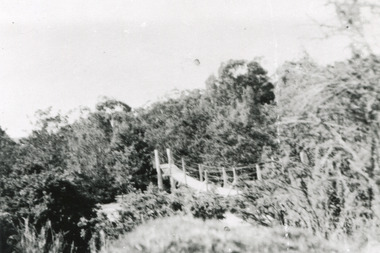
... A good example of the ingenuity of regional settlers to achieve what would have been a difficult and remote construction of a bridge as a means of access. This bridge is evidence of planning and forethought and shows dedication to establishing a life in a remote landscape. black and white photograph bush suspension bridge rope bridge Tannery Spring creek Ovens Tannery bushland Gimlet Creek Matthew Dodd Beechworth reverse: / 2983 / / BMM2983 / Black and white rectangular photograph printed on paper Photograph Photograph ...This rectangle black and white photograph shows a bush scene with part of a suspension rope and wooden plank bridge visible in the middle of the image. It is likely this suspension bridge was used by the Tannery workers to move between the town and the Ovens Tannery located South-West of Beechworth due to its secluded bush location, the bridge likely spanned the gorge across Spring creek. The tannery itself was located alongside Gimlet Creek, about three kilometres from town, down what is now known as Malakoff and Old Tannery Road but which at the time was remote and accessed through bushland. The Ovens tannery was stablished in 1858 by Matthew Dodd and Hallahan and later Matthew and his brother Thomas Dodd in 1866 who developed it over the years. According to Doyle, 'we have little information about its early operations except the tannery itself comprised four small buildings' by 1870 ‘a small village with gardens of vines and fruit trees surrounded the tannery’ (Woods, 121), and by 1887 the Tannery employed fifteen men. The Ovens tannery was among several new businesses establishing themselves such as a foundry that brought industrial manufacturing alongside the developing township and which strengthened the economic stability of Beechworth after the receding mining surge. According to Woods (p. 121) in the 1860’s the government spent considerable sums to establish several public buildings such as the Benevolent Asylum, the Hospital and Insane Asylum to support those in need of care in the area directly after the Indigo gold rush which had left Beechworth, a fairly remote regional and newly formed township (Gold was first discovered in Beechworth in 1852) with a number of infirm and destitute people in its wake and which due to the support and establishment of these facilities ‘made Beechworth a significant social welfare centre in Victoria’ (Woods, p. 121). The tannery provided employment and connected the regional centre with other parts of Victoria and the wider colonial outposts and would have been a welcome opportunity for those seeking work after gold was no longer a source of income.A good example of the ingenuity of regional settlers to achieve what would have been a difficult and remote construction of a bridge as a means of access. This bridge is evidence of planning and forethought and shows dedication to establishing a life in a remote landscape.Black and white rectangular photograph printed on paperreverse: / 2983 / / BMM2983 /black and white photograph, bush, suspension bridge, rope bridge, tannery, spring creek, ovens tannery, bushland, gimlet creek, matthew dodd, beechworth -
 Federation University Historical Collection
Booklet - Annual Report, 1998 Annual Report - The Centre for Rural and Regional Information (CRRI)
... University of Ballarat is a predecessor of Federation University Centre for Rural and Regional information University of Ballarat David W James Lestor Welton Geoff Maher Colin Prowse Martin Westbrooke Steve Jacoby Robert Beggs Les McGrath Annual Report CRRI A4 sized booklet with image of sky and rural landscape on cover. 1998 Annual Report - The Centre for Rural and Regional Information (CRRI) Booklet Annual Report ...University of Ballarat is a predecessor of Federation UniversityA4 sized booklet with image of sky and rural landscape on cover. centre for rural and regional information, university of ballarat, david w james, lestor welton, geoff maher, colin prowse, martin westbrooke, steve jacoby, robert beggs, les mcgrath, annual report, crri -
Marysville & District Historical Society
THE TRIANGLE NEWS-VOL 41 NO 8-MARCH 7 2014
... regional tourism event for free...marysville preschool tesselaar bulb fundraiser...open house event alexandra...bushfire memorials locations...marysville real estate...buxton park first bootcamp...fire prevention irrigation systems...fallons bus service alexandra marysville route service...buxton hotel chinese night...labour day office closures...alexandra clearing sale...marysville primary school cake stall...marysville preschool long day care and kindergarten...marysville beer & platter garden...buxton memorial hall...rock 'n roll night at buxton hall...south cathedral landscape...marysville victoria australia marysville rsl president retires bob emblin triangle news new contact details what's on when in march marysville p.s. parents club agm the committee of management of the gallipoli park precinct marysville community market creative triangle upper room restaurant el kanah east meets west dinner buxton rise vineyard wine tasting world day of prayer church notices australian government mobile service centre cancelled mayor's chair temporary closure of yea & kinglake offices advertisements councillor comment murrindindi shire council advertise your regional tourism event for free marysville preschool tesselaar bulb fundraiser open house event alexandra bushfire memorials locations marysville real estate buxton park first bootcamp fire prevention irrigation systems fallons bus service alexandra marysville route service buxton hotel chinese night labour day office closures alexandra clearing sale marysville primary school cake stall marysville preschool long day care and kindergarten marysville beer & platter garden buxton memorial hall rock 'n roll night at buxton hall south cathedral landscape group trivia night grant street roadworks alexandra dinner and auction fundraiser marysville triangle youth marysville brownies guides open gardens marysville posh dinner story by nancy leslie regional victorian living expo expressions of interest triangle blackberry action group world's longest shave leukaemia foundation THE TRIANGLE NEWS-VOL 41 NO 8-MARCH 7 2014 ...marysville, victoria, australia, marysville rsl president retires, bob emblin, triangle news new contact details, what's on when in march, marysville p.s. parents club agm, the committee of management of the gallipoli park precinct, marysville community market, creative triangle, upper room restaurant, el kanah, east meets west dinner, buxton rise vineyard wine tasting, world day of prayer, church notices, australian government mobile service centre cancelled, mayor's chair, temporary closure of yea & kinglake offices, advertisements, councillor comment, murrindindi shire council, advertise your regional tourism event for free, marysville preschool tesselaar bulb fundraiser, open house event alexandra, bushfire memorials locations, marysville real estate, buxton park first bootcamp, fire prevention irrigation systems, fallons bus service alexandra marysville route service, buxton hotel chinese night, labour day office closures, alexandra clearing sale, marysville primary school cake stall, marysville preschool long day care and kindergarten, marysville beer & platter garden, buxton memorial hall, rock 'n roll night at buxton hall, south cathedral landscape group, trivia night, grant street roadworks alexandra, dinner and auction fundraiser, marysville triangle youth, marysville brownies guides, open gardens marysville, posh dinner story by nancy leslie, regional victorian living expo, expressions of interest, triangle blackberry action group, world's longest shave, leukaemia foundation -
 Flagstaff Hill Maritime Museum and Village
Book - A Fictional Love Story, Alessandro Manzoni, The Betrothed Lovers, 1889
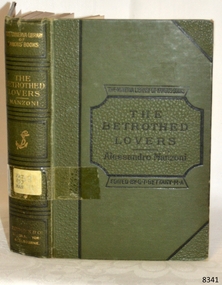
... landscape torn apart by war, political corruption, famine, and a devastating outbreak of the Bubonic Plague in Milan. This work is renowned for its deep psychological realism, social critique, and profound exploration of religious faith and divine providence. The label on the spine cover with typed text PAT 853 MAN Pastedown front endpaper has a sticker from Warrnambool Public Library covered by a sticker from Corangamite Regional ...The subject novel is regarded as a Victorian literary artifact of a masterpiece of European literature. The Betrothed Lovers is the English translation of I Promessi Sposi (originally published in 1827), widely considered the most famous and influential Italian novel ever written. Set in northern Italy in 1628 during the oppressive era of Spanish rule, the story follows two young silk weavers, Renzo and Lucia, who are deeply in love and wish to marry. Their plans are cruelly shattered by a tyrannical local baron, Don Rodrigo, who wants Lucia for himself and forces the couple to flee. The epic narrative follows their separate, perilous journeys through a landscape torn apart by war, political corruption, famine, and a devastating outbreak of the Bubonic Plague in Milan. This work is renowned for its deep psychological realism, social critique, and profound exploration of religious faith and divine providence.The Betrothed Lovers Author: Alessandro Manzoni Publisher: Ward Lock & Co Date: 1889 Further Information: Edited by G.T.BettanyfictionThe subject novel is regarded as a Victorian literary artifact of a masterpiece of European literature. The Betrothed Lovers is the English translation of I Promessi Sposi (originally published in 1827), widely considered the most famous and influential Italian novel ever written. Set in northern Italy in 1628 during the oppressive era of Spanish rule, the story follows two young silk weavers, Renzo and Lucia, who are deeply in love and wish to marry. Their plans are cruelly shattered by a tyrannical local baron, Don Rodrigo, who wants Lucia for himself and forces the couple to flee. The epic narrative follows their separate, perilous journeys through a landscape torn apart by war, political corruption, famine, and a devastating outbreak of the Bubonic Plague in Milan. This work is renowned for its deep psychological realism, social critique, and profound exploration of religious faith and divine providence.flagstaff hill, warrnambool, shipwrecked coast, flagstaff hill maritime museum, maritime museum, shipwreck coast, flagstaff hill maritime village, great ocean road, book, pattison collection, warrnambool library, warrnambool mechanics’ institute, ralph eric pattison, corangamite regional library service, warrnambool city librarian, mechanics’ institute library, victorian library board, warrnambool books and records, warrnambool children’s library, the betrothed lovers, allessandro manzoni, g.t.bettany -
 Flagstaff Hill Maritime Museum and Village
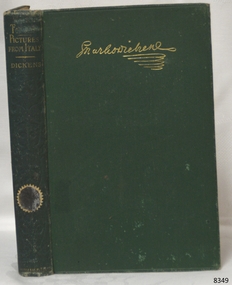
Book - A Travel & Political Critique, Charles Dickens, Hard Times and Pictures from Italy, 1866-1870’s
... landscape, and carnival life with his characteristic observations on social inequality and political fragmentation in pre unification Italy. Together this combined volume offers both a major insight on Victorian industrial England and a lighter, more personal travel narrative showing Dickens from two sides, the social reformer and the acute observer tourist. The label on the spine cover with typed text PAT 823.8 DIC Paste down front end paper has a sticker from Warrnambool Mechanics Institute and Free Library covered by a sticker from Corangamite Regional ...Charles Dickens (1812–1870) was one of the great English novelists of the Victorian era, famous for vivid characters, social criticism, and stories that were first published in serial form. He began as a journalist, rose to enormous popularity during his lifetime, and wrote major works such as Oliver Twist, David Copperfield, and Great Expectations. Pictures from Italy first published 1846 is a travelogue describing Dickens’s 1844 journey through Italy with his family that included Rome, Venice, Florence, and other cities. It mixes vivid descriptions of art, landscape, and carnival life with his characteristic observations on social inequality and political fragmentation in pre unification Italy. Together this combined volume offers both a major insight on Victorian industrial England and a lighter, more personal travel narrative showing Dickens from two sides, the social reformer and the acute observer tourist.Hard Cover edition, Hard Times and Pictures for Italy. Author: Charles Dickens. Publisher: Chapman & Hall Ltd, London. Date: 1866-1870’s first published in book form 1846 (See note section this document for more information on Edition). Green cloth hardcover, Spine black has Author and Title in gold lettering. The spine has a Library label and no Volume information.non-fictionCharles Dickens (1812–1870) was one of the great English novelists of the Victorian era, famous for vivid characters, social criticism, and stories that were first published in serial form. He began as a journalist, rose to enormous popularity during his lifetime, and wrote major works such as Oliver Twist, David Copperfield, and Great Expectations. Pictures from Italy first published 1846 is a travelogue describing Dickens’s 1844 journey through Italy with his family that included Rome, Venice, Florence, and other cities. It mixes vivid descriptions of art, landscape, and carnival life with his characteristic observations on social inequality and political fragmentation in pre unification Italy. Together this combined volume offers both a major insight on Victorian industrial England and a lighter, more personal travel narrative showing Dickens from two sides, the social reformer and the acute observer tourist.book, the old curiosity shop, charles dickens, shipwrecked-coast, flagstaff-hill, flagstaff-hill-maritime-museum, warrnambool, maritime-museum, flagstaff-hill-maritime-village, pattison collection, warrnambool library, warrnambool mechanics’ institute, ralph eric pattison, corangamite regional library service, warrnambool city librarian, mechanics’ institute library, victorian library board, warrnambool books and records, warrnambool children’s library, great ocean road, hard times for these times -
 Flagstaff Hill Maritime Museum and Village
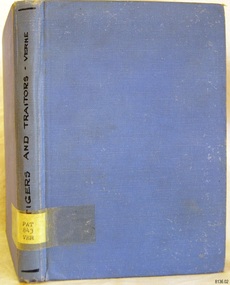
Book - A Fictional Story, Jules Verne, The Steam House Part 2 Tigers and Traitors, 1881
... landscape still seething with discontent after the Mutiny as the story builds to the confrontation with Nana Sahib and the resolution of Munro’s quest for revenge. The second part is also published under the alternative title “The End of Nana Sahib”, indicating that Nana Sahib’s fate is finally revealed. Flyleaf has full publication details. Label on spine cover with typed text PAT 843 VER Front loose end paper has sticker from Warrnambool Public Library covered by a sticker from Corangamite Regional ...“The Steam House” part two “Tigers and Traitors” is where the story continues with the Indian adventure from part one and brings the story of Colonel Munro and Nana Sahib to its climax. The same group of people continue their journey through northern India in the steam powered elephant that pulls two houses. The central conflict is Colonel Munro’s continued hunt for Nana Sahib, the rebel leader responsible for atrocities at Cawnpore during the 1857 Sepoy Rebellion, and for Munro’s wife, who was reported killed there. As they travel deeper into India, the party encounters various challenges including, tigers traitors and conspirators linked to Nana Sahib’s network. The landscape still seething with discontent after the Mutiny as the story builds to the confrontation with Nana Sahib and the resolution of Munro’s quest for revenge. The second part is also published under the alternative title “The End of Nana Sahib”, indicating that Nana Sahib’s fate is finally revealed.Hard cover book, The Steam House Part 2 Tigers and Traitors. Author: Jules Verne Publisher: Sampson Low, Marston, Searle & Rivington, London Date: 1881. Light blue hardcover with the title on the spine having lettering to spine in black hand written text pen. fiction“The Steam House” part two “Tigers and Traitors” is where the story continues with the Indian adventure from part one and brings the story of Colonel Munro and Nana Sahib to its climax. The same group of people continue their journey through northern India in the steam powered elephant that pulls two houses. The central conflict is Colonel Munro’s continued hunt for Nana Sahib, the rebel leader responsible for atrocities at Cawnpore during the 1857 Sepoy Rebellion, and for Munro’s wife, who was reported killed there. As they travel deeper into India, the party encounters various challenges including, tigers traitors and conspirators linked to Nana Sahib’s network. The landscape still seething with discontent after the Mutiny as the story builds to the confrontation with Nana Sahib and the resolution of Munro’s quest for revenge. The second part is also published under the alternative title “The End of Nana Sahib”, indicating that Nana Sahib’s fate is finally revealed.warrnambool, shipwrecked-coast, flagstaff-hill, flagstaff-hill-maritime-museum, maritime-museum, flagstaff-hill-maritime-village, shipwrecked-artefact, book, warrnambool mechanics’ institute, pattison collection, warrnambool library, corangamite regional library service, warrnambool city librarian, mechanics’ institute library, victorian library board, warrnambool books and records, warrnambool children’s library, ralph eric pattison, jules verne, voyages extraordinaire series, l’école des robinson's -
 Glenelg Shire Council Cultural Collection
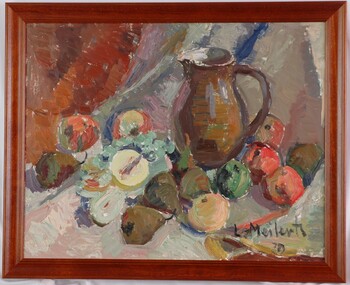
Painting, Ludmilla Meilerts, Still Life, 1970
... landscapes. She particularly like painting dockland scenes. She was a member of The Victorian Artists Society (VAS) and The Melbourne Society Of Woman Painters And Sculptors. Major prizes include The Dunlop Prize in 1952, Gosford Art prize 1971, Camberwell 1973, VAS Purstitz Gold Medal 1982. She is represented in The State Galleries of Victoria, NSW, Tasmania and Western Australia as well as several regional...landscapes. She particularly like painting dockland scenes. She was a member of The Victorian Artists Society (VAS) and The Melbourne Society Of Woman Painters And Sculptors. Major prizes include The Dunlop Prize in 1952, Gosford Art prize 1971, Camberwell 1973, VAS Purstitz Gold Medal 1982. She is represented in The State Galleries of Victoria, NSW, Tasmania and Western Australia as well as several regional ...Ludmilla Meilerts, Oil On Board, Botanical Gardens, Circa 1970 Ludmilla Meilerts (1908 - 1997), Botanical Gardens, Melbourne, an impressive work painted with bold brushstrokes and a vivid colourful palette which typifies the artists work. Born in Riga,Latvia in 1908 - After displaying an early talent for art she studied at The Latvian Academy Of Fine Arts graduating in 1940. Later that year she married Otto Meilerts, an Economist, and they moved to Stuttgart, Germany to avoid living under Soviet occupation and then emigrated to Australia in 1948 settling in Melbourne. She worked as a nurse's aid and in a clothing factory to fund the further development of her artistic career achieving considerable early success with her colourful work encompassing portraiture, florals and city and landscapes. She particularly like painting dockland scenes. She was a member of The Victorian Artists Society (VAS) and The Melbourne Society Of Woman Painters And Sculptors. Major prizes include The Dunlop Prize in 1952, Gosford Art prize 1971, Camberwell 1973, VAS Purstitz Gold Medal 1982. She is represented in The State Galleries of Victoria, NSW, Tasmania and Western Australia as well as several regional Galleries. Still life of fruit and a jog. Painted in thick impasto paint, creating a very textured surface. Fruit is depicted in green, brown, apricot, pink and red. Background is abstract. Upper left background is brown, upper centre and right background is in shades of grey, blue and green, with some white. Brown wooden frame.Front: L Meilerts 70 (lower right, black paint)still life, female artists, women, women artists -
 Greensborough Historical Society
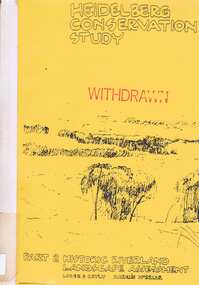
Book, Heidelberg Conservation Study: Part 2: Historic Riverland Landscape Assessment. Revised 1987, 1987_
... This study identifies neighbourhood character, documents past development and the capacity of the environment for future development with particular emphasis on the river precincts - Plenty River, Yarra River and Darebin Creek. heidelberg macleod heidelberg heritage advisory committee marilyn mcbriar plenty river yarra river darebin creek Stamps: Yarra Plenty Regional Library Service, and, Withdrawn Part three of set of three books. Paperback, 333 pages, Illus., maps. 2 copies. Heidelberg Conservation Study: Part 2: Historic Riverland Landscape Assessment. ...Report prepared by Loder and Bayly and Marilyn McBriar on behalf of City of Heidelberg and Heidelberg Heritage Advisory Committee. Area covered is from Darebin Parklands in the south to Plenty River at Yallambie in the north. Revised 1987.This study identifies neighbourhood character, documents past development and the capacity of the environment for future development with particular emphasis on the river precincts - Plenty River, Yarra River and Darebin Creek.Part three of set of three books. Paperback, 333 pages, Illus., maps. 2 copies.Stamps: Yarra Plenty Regional Library Service, and, Withdrawnheidelberg, macleod, heidelberg heritage advisory committee, marilyn mcbriar, plenty river, yarra river, darebin creek -
 Mission to Seafarers Victoria
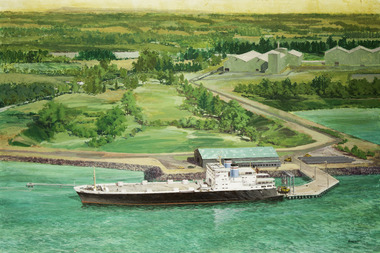
Painting - Painting, Acrylic, Ramon Honisett, Untitled, 1990-2000
... regional steel industry on the route Port Kembla - Westernport - Adelaide. Even after being lengthened by 17 metres, the two ships had remarkably short working lines, with both being broken up by 1988." Fulfills previous MTSV acquisition policy regarding collection of modern or contemporary marine paintings. tankers marine painting maritime art ramon honisett ray honisett anl maritime art prize acta maritime art prize hastings western port victoria steel roll on roll off forklift mornington peninsula artwork-paintings at lower right corner single uc word in black paint : "HONISETT" Large framed unglazed landscape format painting predominantly green depicting in foreground a merchant vessel, a roll-on roll-off cargo ship moored at a single quayside on a river or river mouth. ...Ramon (Ray) Francis Honisett (11.04.1931 - 30.08.2019), Fellow RMIT and medallist specialised in philatelic design, marine and military aircraft painting art and was active in the 1960s - 1990s. Ray Honisett used to live in Rye, in the Mornington Peninsula. According to Gavin Fry's book: The painting likely depicts the Lysaght Endeavour loading at Hastings. "The Lysaght Endeavour and its sister ship Lysaght Entreprise were built in Newcastle in 1973 specifically to serve the regional steel industry on the route Port Kembla - Westernport - Adelaide. Even after being lengthened by 17 metres, the two ships had remarkably short working lines, with both being broken up by 1988."Maritime artLarge framed unglazed landscape format painting predominantly green depicting in foreground a merchant vessel, a roll-on roll-off cargo ship moored at a single quayside on a river or river mouth. The middle ground shows a moderate solid jetty leading to large storage sheds at right. The background appears primarily rural with fields and hills in the distance. The location is probably Hastings Western Port in Victoria - notice the forklifts loading rolls of steel produced at the nearby steel rolling mill - the buildings in the distance. You can see the rolls of steel lined up on the hard stand to the right of the ship. The funnel colours suggest the Australian National Line. The frame incorporates a beige fabric slip with gilt edge the actual dark wood frame also with inset banded gilt edge. The back of the painting is covered with brown paper in places damaged. Hangs on a cotton cord threaded between two screw in eyelet hooks.at lower right corner single uc word in black paint : "HONISETT"tankers, marine painting, maritime art, ramon honisett, ray honisett, anl maritime art prize, acta maritime art prize, hastings, western port, victoria, steel, roll on roll off, forklift, mornington peninsula, artwork-paintings -
 Greensborough Historical Society
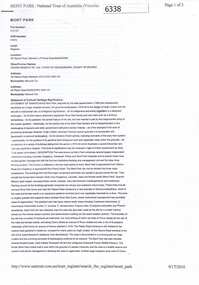
Article - Website, National Trust of Australia (Victoria), Mont Park: Statement written by National Trust of Australia (Victoria), 17/09/2010
... Contains extensive descriptions of regionally significant indigenous and exotic vegetation, landscaped by designer Hugh Linaker....Contains extensive descriptions of regionally significant indigenous and exotic vegetation, landscaped by designer Hugh Linaker. mont park larundel gresswell hugh linaker 2p. typescript Mont Park: Statement written by National Trust of Australia (Victoria) Article - Website National Trust of Australia (Victoria) ...Statement of Cultural heritage Significance for Mont Park acquired by Victorian state government in 1909 and used as a mental hospital complex comprising Larundel Kingsbury and Greswell facilities, finally decommissioned in1969. Contains extensive descriptions of regionally significant indigenous and exotic vegetation, landscaped by designer Hugh Linaker.2p. typescriptmont park, larundel, gresswell, hugh linaker -
 Flagstaff Hill Maritime Museum and Village
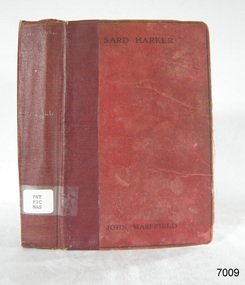
Book - Fictional Story, John Masefield, Sard Harker, 1924
... landscapes and high-stakes survival. Sard Harker shares its fictional South American setting with Masefield's 1926 novel ("One Damn Thing After Another"), which serves as a thematic companion piece. Pattison Collection see item 3678 Flagstaff Hill collections) https://victoriancollections.net.au/items/5580c7e72162f114d8b758db warrnambool shipwrecked-coast flagstaff-hill flagstaff-hill-maritime-museum maritime-museum shipwreck-coast flagstaff-hill-maritime-village shipwrecked-artefact book sard harker john masefield warrnambool mechanics’ institute pattison collection warrnambool library ralph eric pattison corangamite regional library service warrnambool city librarian mechanics’ institute library victorian library board warrnambool books and records warrnambool children’s library The novel centres on Chanticleer "Sard" Harker, a serious, stoic first mate aboard the trading ship Pathfinder. ...The novel centres on Chanticleer "Sard" Harker, a serious, stoic first mate aboard the trading ship Pathfinder. While anchored off the coast of the fictionalised South American nation of Santa Barbara a recurring setting in Masefield's fiction Harker experiences a vivid, recurring dream predicting that a woman named Doña Margherita Luisa Rosa is in grave danger. Driven by a strict sense of duty and premonition, Harker goes ashore to track down the estate where she is staying to deliver a warning. This decision plunges him into an extraordinary physical ordeal: separated from his ship and framed for murder, Harker must trek through hostile jungles, arid deserts, treacherous swamps, and rugged mountain passes while battling corrupt local officials, bandits, and a sinister occultist/cult leader named Don Hirsch Gomez.Hard cover book. Sard Harker Author: John Masefield Publisher: William Heinemann Ltd Date: 1924 Further Information: Red Cloth hardcover with lettering and patterning to spine in black. The spine has a Library label with an inscription.fictionThe novel centres on Chanticleer "Sard" Harker, a serious, stoic first mate aboard the trading ship Pathfinder. While anchored off the coast of the fictionalised South American nation of Santa Barbara a recurring setting in Masefield's fiction Harker experiences a vivid, recurring dream predicting that a woman named Doña Margherita Luisa Rosa is in grave danger. Driven by a strict sense of duty and premonition, Harker goes ashore to track down the estate where she is staying to deliver a warning. This decision plunges him into an extraordinary physical ordeal: separated from his ship and framed for murder, Harker must trek through hostile jungles, arid deserts, treacherous swamps, and rugged mountain passes while battling corrupt local officials, bandits, and a sinister occultist/cult leader named Don Hirsch Gomez.warrnambool, shipwrecked-coast, flagstaff-hill, flagstaff-hill-maritime-museum, maritime-museum, shipwreck-coast, flagstaff-hill-maritime-village, shipwrecked-artefact, book, sard harker, john masefield, warrnambool mechanics’ institute, pattison collection, warrnambool library, ralph eric pattison, corangamite regional library service, warrnambool city librarian, mechanics’ institute library, victorian library board, warrnambool books and records, warrnambool children’s library -
 Flagstaff Hill Maritime Museum and Village
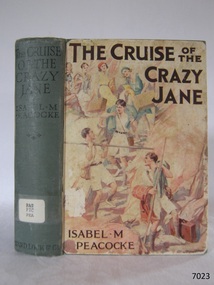
Book - Fictional Story, Isabel Maude Peacocke et al, The Cruise of The Crazy Jane, 1932
... The book stands out in early 20th-century New Zealand children's literature for rejecting generic British settings in favour of authentic regional realism with its local depiction of landscapes and maritime activities. ...The Cruise of The Crazy Jane (published in 1932 by Ward, Lock & Co.) follows young protagonist Vicky and a group of Auckland children on a summer boating and camping holiday aboard a vessel named the Crazy Jane. Set against the local geography of New Zealand including Auckland Harbour and nearby coastal areas the story follows their outdoor excursions, cliff-climbing adventures (such as descending "Jacob's ladder," as depicted in the frontispiece), and holiday mishaps. Unlike many of Isabel Maude Peacocke's other works, which feature adult third-person perspectives, The Cruise of The Crazy Jane is notable for using a child’s direct narrative voice to frame the story.Hard cover book. The Cruise of The Crazy Jane Author: Isabel Maude Peacocke Illustrator. Alan Gilderdale Publisher: Ward, Lock & Co Date: 1932 Further Information: Green Cloth hardcover boards with lettering and patterning to spine in black. Front cover has illustration. The spine has a Library label with an inscription.fictionThe Cruise of The Crazy Jane (published in 1932 by Ward, Lock & Co.) follows young protagonist Vicky and a group of Auckland children on a summer boating and camping holiday aboard a vessel named the Crazy Jane. Set against the local geography of New Zealand including Auckland Harbour and nearby coastal areas the story follows their outdoor excursions, cliff-climbing adventures (such as descending "Jacob's ladder," as depicted in the frontispiece), and holiday mishaps. Unlike many of Isabel Maude Peacocke's other works, which feature adult third-person perspectives, The Cruise of The Crazy Jane is notable for using a child’s direct narrative voice to frame the story.warrnambool, shipwrecked-coast, flagstaff-hill, flagstaff-hill-maritime-museum, maritime-museum, shipwreck-coast, flagstaff-hill-maritime-village, shipwrecked-artefact, book, the cruise of the crazy jane, isabel maude peacocke, warrnambool mechanics’ institute, pattison collection, warrnambool library, ralph eric pattison, corangamite regional library service, warrnambool city librarian, mechanics’ institute library, victorian library board, warrnambool books and records, warrnambool children’s library, i. m. cluett. -
 Flagstaff Hill Maritime Museum and Village
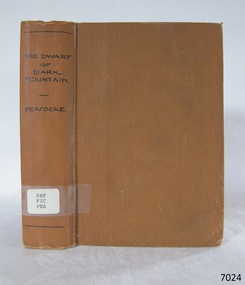
Book - Fictional Story, Isabel Maude Peacocke et al, The Dwarf Of Dark Mountain, 1932-1939
... The book stands out in early 20th-century New Zealand children's literature for rejecting generic British settings in favour of authentic regional realism with its local depiction of landscapes and maritime activities. ...The Dwarf of Dark Mountain is a children's adventure novel illustrated by Norman Sutcliffe. Set against the backdrop of the New Zealand bush and rural landscapes, the story follows a group of young protagonists on a mystery-filled adventure centred around a local geological landmark known as "Dark Mountain". Typical of Isabel Maud Peacocke's popular juvenile fiction of the 1930s (such as The Cruise of the Crazy Jane and Cathleen with a C), the book weaves together themes of bush navigation and exploration. The children venture through dense ti-tree scrub and native fern gullies, with the narrative centring around the titular "dwarf" of the mountain blending rural Australian and New Zealand family life with wholesome mystery, moral growth, and outdoor adventure.The Dwarf Of Dark Mountain Author: Isabel Maude Peacocke Illustrator: Norman Sutcliffe Publisher: Ward Lock & Co Date: Further Information: Plain brown/tan cloth binding with the title and author hand-lettered directly onto the spine with no decorative illustration, gilt stamping, or pictorial design. The spine has a Library label with an inscription.fictionThe Dwarf of Dark Mountain is a children's adventure novel illustrated by Norman Sutcliffe. Set against the backdrop of the New Zealand bush and rural landscapes, the story follows a group of young protagonists on a mystery-filled adventure centred around a local geological landmark known as "Dark Mountain". Typical of Isabel Maud Peacocke's popular juvenile fiction of the 1930s (such as The Cruise of the Crazy Jane and Cathleen with a C), the book weaves together themes of bush navigation and exploration. The children venture through dense ti-tree scrub and native fern gullies, with the narrative centring around the titular "dwarf" of the mountain blending rural Australian and New Zealand family life with wholesome mystery, moral growth, and outdoor adventure.warrnambool, shipwrecked-coast, flagstaff-hill, flagstaff-hill-maritime-museum, maritime-museum, shipwreck-coast, flagstaff-hill-maritime-village, shipwrecked-artefact, book, the dwarf of dark mountain, isabel maude peacocke, warrnambool mechanics’ institute, pattison collection, warrnambool library, ralph eric pattison, corangamite regional library service, warrnambool city librarian, mechanics’ institute library, victorian library board, warrnambool books and records, warrnambool children’s library, i. m. cluett., illustrator norman sutcliffe -
 Flagstaff Hill Maritime Museum and Village
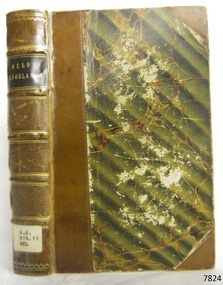
Book - Reference Book/History/Travel, Charles Richard Weld, Two months in the Highlands, Orcadia and Skye, 1860
... landscape and travel writing studies. Two Months in the Highlands, Orcadia and Skye (1860) is not a major canonical work in English literature, but it is considered a moderately significant Victorian era travelogue and is treated by collectors and historians as a valuable regional/antique book, especially in its first‑edition form. ...Charles Richard Weld (1813–1869) was an English writer and legal‑trained man who became best known for “A History of the Royal Society”, with Memoirs of the Presidents (1848), which is regarded as the first substantial institutional history of the Royal Society and remains a standard reference on early British science. Two Months in the Highlands, Orcadia, and Skye is a 1860 travel book by him, published in London and listed as a first edition. Weld is also known as an historian of the Royal Society. It should be noted that the subject work is sometimes catalogued with “Orcadia” and sometimes with “Orcadia and Skye” in slightly different punctuation, but the core bibliographic details are the same. With Weld as author and 1860 as the publication year, and Longman, Green, Longman, and Roberts as publisher.Weld's Highlands: Two Months in the Highlands Orcadia and Skye Author: Charles Richard Weld Publisher: Longman Green Longman Roberts Date: 1860 Light and dark diagonally striped hardcover with a brown spine and reinforced corners. The spine has a label with an inscription.non-fictionCharles Richard Weld (1813–1869) was an English writer and legal‑trained man who became best known for “A History of the Royal Society”, with Memoirs of the Presidents (1848), which is regarded as the first substantial institutional history of the Royal Society and remains a standard reference on early British science. Two Months in the Highlands, Orcadia, and Skye is a 1860 travel book by him, published in London and listed as a first edition. Weld is also known as an historian of the Royal Society. It should be noted that the subject work is sometimes catalogued with “Orcadia” and sometimes with “Orcadia and Skye” in slightly different punctuation, but the core bibliographic details are the same. With Weld as author and 1860 as the publication year, and Longman, Green, Longman, and Roberts as publisher. warrnambool, shipwrecked-coast, flagstaff-hill, flagstaff-hill-maritime-museum, maritime-museum, great ocean road, warrnambool library, warrnambool mechanics’ institute, mechanics’ institute library, warrnambool books and records, warrnambool public library, weld's highlands, two months in the highlands orcadia and skye, charles richard weld, 1860, longman green longman and roberts -
 The Beechworth Burke Museum
Photograph, c. 1910
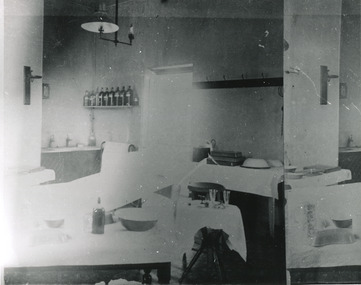
... The hospital is made up of a number of buildings, landscaping, ha-ha, workshops, laundry, administrative facilities and farmland, it was constructed in 'Italianate' style by a team of up to two hundred and fifty workers (Woods p. 122). The asylum was established in response to the need for the regional...The hospital is made up of a number of buildings, landscaping, ha-ha, workshops, laundry, administrative facilities and farmland, it was constructed in 'Italianate' style by a team of up to two hundred and fifty workers (Woods p. 122). The asylum was established in response to the need for the regional ...Taken approximately 1910, this black and white photograph shows the interior of the surgery and consulting rooms at the Mayday Hills mental hospital known at that time as a lunatic asylum in Beechworth. Mayday Hills Hospital, then known as the Beechworth Lunatic Asylum was constructed between 1864-67 designed by The Public Works Department. The hospital is made up of a number of buildings, landscaping, ha-ha, workshops, laundry, administrative facilities and farmland, it was constructed in 'Italianate' style by a team of up to two hundred and fifty workers (Woods p. 122). The asylum was established in response to the need for the regional shire to locally care for those particularly affected by their time working the Ovens goldfield during the Indigo Shire gold rush era where poor living conditions and isolation were significantly affecting the welfare of a great many people through poverty and lack of resources. The gaol and orphan labour systems were not able to effectively support to give housing, rehabilitation and ongoing care for the mentally ill, and transporting to Melbourne by waggon was a time consuming and counter-productive solution when the metro facilities were already overcrowded. According to Woods (A Titan's Field p. 122), between 1901 and 1911 a large percentage (thirty five percent in 1901 and twenty four in 1911) of the Beechworth population were either patients or inmates of Beechworth institutions, Mayday Hills accounted for some six hundred and seventy four patients in 1901, Beechworth's Mayday Hills was chosen as the site of Victoria's newest asylum, at the time, due to the landscape and altitude. The hilltop atmosphere and the native fauna, it was argued, would assist in the cure of the patients kept at the hospital (Wood 1985, 122). The positioning of the hospital had a beneficial effect on the rural town and the large volume of people living at the hospital and contributing to this population growth is counted as reason for the survival of Beechworth as a regional township. Mayday Hills continued to function as a mental hospital up until 1995 when it was sold to LaTrobe university. The building and grounds are listed on the Victorian Heritage Register under criterion A, B, D, E and F. Although grainy, the image gives a good indication of a functioning interior space of a surgery and consulting room at Mayday Hills in the early 1900's, from which we might interpret (from the types of tools and furniture present), the medical practices being performed at the time.Black and white rectangular photographmedical, asylum, surgery, hospital, beechworth, mayday hills, mayday hills asylum, mayday hills hospital, mental hospital, beechworth lunatic asylum, beechworth institutions, social welfare, public works department, consulting room -
 The Beechworth Burke Museum
Photograph - Postcard, George Rose, c. 1910
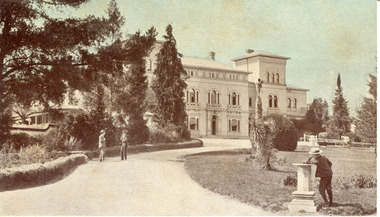
... The hospital is made up of a number of buildings, landscaping, ha-ha, workshops, laundry, administrative facilities and farmland, it was constructed in 'Italianate' style by a team of up to two hundred and fifty workers (Woods p. 122). The asylum was established in response to the need for the regional...The hospital is made up of a number of buildings, landscaping, ha-ha, workshops, laundry, administrative facilities and farmland, it was constructed in 'Italianate' style by a team of up to two hundred and fifty workers (Woods p. 122). The asylum was established in response to the need for the regional ...Produced c. 1910 by The Rose Stereograph co. This colourised photographic postcard shows the exterior of the administrative buildings at Mayday Hills mental hospital with three young boys in the foreground. This postcard forms part of the extensive Rose Series. (P. 4689) of postcards being produced by the Rose Stereograph co. which depicted landmarks from across Australia. Despite the early date attributed to this image, according to Walsh dates from this series place the postcards being produced typically between 1920-54. Mayday Hills Hospital, then known as the Beechworth Lunatic Asylum was constructed between 1864-67 designed by The Public Works Department. The hospital is made up of a number of buildings, landscaping, ha-ha, workshops, laundry, administrative facilities and farmland, it was constructed in 'Italianate' style by a team of up to two hundred and fifty workers (Woods p. 122). The asylum was established in response to the need for the regional shire to locally care for those particularly affected by their time working the Ovens goldfield during the Indigo Shire gold rush era where poor living conditions and isolation were significantly affecting the welfare of a great many people through poverty and lack of resources. The gaol and orphan labour systems were not able to effectively support to give housing, rehabilitation and ongoing care for the mentally ill, and transporting to Melbourne by waggon was a time consuming and counter-productive solution when the metro facilities were already overcrowded. According to Woods (A Titan's Field p. 122), between 1901 and 1911 a large percentage (thirty five percent in 1901 and twenty four in 1911) of the Beechworth population were either patients or inmates of Beechworth institutions, Mayday Hills accounted for some six hundred and seventy four patients in 1901, Beechworth's Mayday Hills was chosen as the site of Victoria's newest asylum, at the time, due to the landscape and altitude. The hilltop atmosphere and the native fauna, it was argued, would assist in the cure of the patients kept at the hospital (Wood 1985, 122). The positioning of the hospital had a beneficial effect on the rural town and the large volume of people living at the hospital and contributing to this population growth is counted as reason for the survival of Beechworth as a regional township. Mayday Hills continued to function as a mental hospital up until 1995 when it was sold to LaTrobe university. The building and grounds are listed on the Victorian Heritage Register under criterion A, B, D, E and F. Through the colourisation of the photograph and through the unusual choice of the subject matter being used as a postcard, we can get a good indication of aesthetic interests of the time.Rectangular coloured photograph printed as postcardObverse: Beautiful / Beechworth / (Vic.) / 1800 ft. / above / Sea / Level / - / Asylum / for / insane / (Front / View) / Copyright. / F. / Foxcroft / Photo Reverse: 1997.2454 / Postcard / THIS / SPACE / MAY / BE / USED / FOR / CORRESPONDENCE: / THIS / SPACE / FOR / NAME / AND / ADDRESS / STAMPpostcard, rose series, mayday hills hospital, mayday hills, beechworth lunatic asylum, photographic postcard, george rose, the rose stereograph co., social welfare, welfare services, ovens goldfield, lunatic asylum, the public works department, australian landmark, regional shire, indigo shire council, gold rush, beechworth institution, victorian heritage register -
 The Beechworth Burke Museum
Photograph - Photographs, E. Yellard, c. 1950's
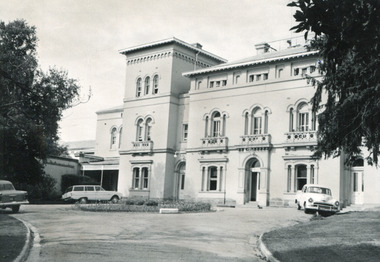
... The hospital is made up of a number of buildings, landscaping, ha-ha, workshops, laundry, administrative facilities and farmland, it was constructed in 'Italianate' style by a team of up to two hundred and fifty workers (Woods p. 122). The asylum was established in response to the need for the regional...The hospital is made up of a number of buildings, landscaping, ha-ha, workshops, laundry, administrative facilities and farmland, it was constructed in 'Italianate' style by a team of up to two hundred and fifty workers (Woods p. 122). The asylum was established in response to the need for the regional ...Two rectangular black and white photographs of the Beechworth Mental Hospital (Mayday Hills) administrative building showing the left and right hand sides of the exterior building with three cars parked in driveway turning circle in the foreground taken in the 1950's by E. Yellard. Mayday Hills Hospital, originally known as the Beechworth Lunatic Asylum was constructed between 1864-67 designed by The Public Works Department. The hospital is made up of a number of buildings, landscaping, ha-ha, workshops, laundry, administrative facilities and farmland, it was constructed in 'Italianate' style by a team of up to two hundred and fifty workers (Woods p. 122). The asylum was established in response to the need for the regional shire to locally care for those particularly affected by their time working the Ovens goldfield during the Indigo Shire gold rush era where poor living conditions and isolation were significantly affecting the welfare of a great many people through poverty and lack of resources. The gaol and orphan labour systems were not able to effectively support to give housing, rehabilitation and ongoing care for the mentally ill, and transporting to Melbourne by waggon was a time consuming and counter-productive solution when the metro facilities were already overcrowded. According to Woods (A Titan's Field p. 122), between 1901 and 1911 a large percentage (thirty five percent in 1901 and twenty four in 1911) of the Beechworth population were either patients or inmates of Beechworth institutions, Mayday Hills accounted for some six hundred and seventy four patients in 1901, Beechworth's Mayday Hills was chosen as the site of Victoria's newest asylum, at the time, due to the landscape and altitude. The hilltop atmosphere and the native fauna, it was argued, would assist in the cure of the patients kept at the hospital (Wood 1985, 122). The positioning of the hospital had a beneficial effect on the rural town and the large volume of people living at the hospital and contributing to this population growth is counted as reason for the survival of Beechworth as a regional township. According to the Victorian Heritage database, during the period 1921-1950 Mayday Hills underwent some modernisation by Public Works Department architect Percy Everett which included a nurses' hostel and new ward which were further developed and continued to function as a mental hospital up until 1995 when it was sold to LaTrobe university. The building and grounds are listed on the Victorian Heritage Register under criterion A, B, D, E and F.These photographs give a good indication of the ongoing use of Mayday Hills from its original establishment in the 1860's through to almost one hundred years later when these photographs were taken. The clarity of the images combined with the style and make of the cars in the foreground give a good indication of the time period and show the continued use and need for the facility over the years. Through images of building facades such as these, we might gain fuller understanding of the structural and aesthetic characteristics to be used in any future development or restorative work.2 x black and white rectangular photographs [copies] printed on Ilford photographic paper8688.1 reverse: Beechworth / Mental / Hospital / 80% 19cm / 12 cm / 80% / 728 / New / Print / BMM / 8688.1 / E. / Yellard / [Stamped : ILFORD] 8688.2 reverse: Beechworth / Mental / Hospital / E. / Yellard / BMM / 8688.1 / [Stamped : ILFORD]administrative building, black and white photographs, beechworth, mental hospital, beechworth mental hospital, mayday hills, cars, 1950, e. yellard, the public works department, public works department, hospital, mayday hills hospital, beechworth lunatic asylum, lunatic asylum, asylum, ovens goldfield, indigo shire, indigo shire gold rush -
 Eltham District Historical Society Inc
Book, State Government of Victoria, The Middle Yarra Concept Plan: Burke Road to Watsons Creek, July 1991
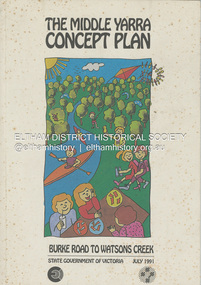
... recreation areas regional planning Yarra River Watsons Creek A draft concept plan developed for the Middle Yarra River between Burke Road and Watsons Creek which includes planning controls, developed and managed to meet the recreation and landscape objectives whilst protecting the natural resourcesa nd cultural heritage. ...A draft concept plan developed for the Middle Yarra River between Burke Road and Watsons Creek which includes planning controls, developed and managed to meet the recreation and landscape objectives whilst protecting the natural resourcesa nd cultural heritage. It established a broad framework for more detailed plans and guidelines. Jointly produced by staff from the Victorian Department of Planning and Housing. July 1991.non-fictionA draft concept plan developed for the Middle Yarra River between Burke Road and Watsons Creek which includes planning controls, developed and managed to meet the recreation and landscape objectives whilst protecting the natural resourcesa nd cultural heritage. It established a broad framework for more detailed plans and guidelines. Jointly produced by staff from the Victorian Department of Planning and Housing. July 1991.recreation areas, regional planning, yarra river, watsons creek -
 Eltham District Historical Society Inc
Photograph - Digital Photograph, Alan King, The Robins, 13 Kangaroo Ground-Warrandyte Road, North Warrandyte, 2 March 2008
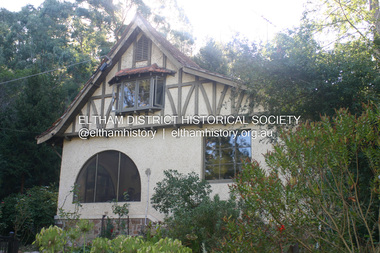
... landscape painters. He loved colour, having been influenced early by Turner and McCubbin. His works are in all Australian state galleries, the National Collection in Canberra as well as in regional galleries.7 His wife Edith was also an artist having studied at the Slade School, London, and in Paris with Phillips Fox. ...landscape painters. He loved colour, having been influenced early by Turner and McCubbin. His works are in all Australian state galleries, the National Collection in Canberra as well as in regional galleries.7 His wife Edith was also an artist having studied at the Slade School, London, and in Paris with Phillips Fox. ...Built by noted artist Theodore Penleigh Boyd, father of architect Robin Boyd. Covered under National Estate, National Trust of Australia (Victoria) Local Significance and Heritage Overlay, Nillumbik Planning Scheme. Published: Nillumbik Now and Then / Marguerite Marshall 2008; photographs Alan King with Marguerite Marshall.; p111 The Robins at Warrandyte,* was once home to a member of a famous family and is also one of the first reinforced concrete houses in Victoria. The builder, Theodore Penleigh Boyd, born in 1890, was a talented painter1 noted for his works of the Warrandyte bush. He was the father of architect Robin Boyd, author of the Australian Ugliness and the uncle of painter, Arthur Boyd. Penleigh Boyd’s great grandfather was Sir William A’Beckett, Victoria’s first Chief Justice. Penleigh Boyd is considered by some to be an ‘unsung hero’ overshadowed by more famous members of his family. Mornington Gallery Director Andrea May said many believed Boyd ‘had never received the national acclaim that he deserved’.2 Classified by the National Trust3 and part of the Australian National Heritage,4 The Robins is set well back near the end of Kangaroo Ground – Warrandyte Road, unobserved by passers-by. Built in 1913, The Robins has some Art Nouveau influences and is a descendant of the Queen Anne style. It is covered in stucco and has a prominent attic, which Boyd used as a studio. Some parts of the house are up to 33 centimetres thick and built in part with pisé (rammed earth) and in part with reinforced concrete. Amazingly, Boyd built The Robins without an accessible driveway, and only a narrow track along which he had to cart building materials. The journey was uphill and Boyd terraced the land with Warrandyte rock5 without the aid of machinery. At only 33 years, Boyd was killed in a car accident in 1923. He was buried in Brighton near the home of his parents. Several people have since owned the house, including political journalist, Owen Webster. Boyd was born at Penleigh House, Wiltshire, and studied at Haileybury College, Melbourne and The Hutchins School, Hobart. He attended the Melbourne National Gallery School and in his final year exhibited at the Victorian Artists’ Society. He arrived in London in 1911 and his painting Springtime was hung at the Royal Academy. He painted in several studios in England and then worked in Paris.6 There he met painter Phillips Fox through whom he met artists of the French modern school and also his wife-to-be, Edith Anderson, whom he married in Paris in 1912. After touring France and Italy, the couple returned to Melbourne. In 1913 Boyd held an exhibition and won second prize in the Federal Capital site competition, then the Wynne Prize for landscape in 1914. In 1915 Boyd joined the Australian Imperial Force, and became a sergeant in the Electrical and Mechanical Mining Company. However he was severely gassed at Ypres and invalided to England. In 1918 in London Boyd published Salvage, writing the text and illustrating it with 20 black-and-white ink-sketches of army scenes. Later that year he returned to Melbourne, and, despite suffering from the effects of gas, he held several successful one-man shows, quickly selling his water-colour and oil paintings. In his short career Penleigh Boyd was recognized as one of Australia’s finest landscape painters. He loved colour, having been influenced early by Turner and McCubbin. His works are in all Australian state galleries, the National Collection in Canberra as well as in regional galleries.7 His wife Edith was also an artist having studied at the Slade School, London, and in Paris with Phillips Fox. After her marriage she continued to paint and excelled in drawing. In later years she wrote several dramas, staged by repertory companies, and radio plays for the Australian Broadcasting Commission, in which she took part. She was the model for the beautiful red-haired woman in several of Phillips Fox’s paintings and the family hold three of his portraits of her. *Possibly named after the Aboriginal words warran, meaning ‘object’ and dyte, meaning ‘thrown at’.This collection of almost 130 photos about places and people within the Shire of Nillumbik, an urban and rural municipality in Melbourne's north, contributes to an understanding of the history of the Shire. Published in 2008 immediately prior to the Black Saturday bushfires of February 7, 2009, it documents sites that were impacted, and in some cases destroyed by the fires. It includes photographs taken especially for the publication, creating a unique time capsule representing the Shire in the early 21st century. It remains the most recent comprehenesive publication devoted to the Shire's history connecting local residents to the past. nillumbik now and then (marshall-king) collection, kangaroo ground-warrandyte road, north warrandyte, the robins -
 Eltham District Historical Society Inc
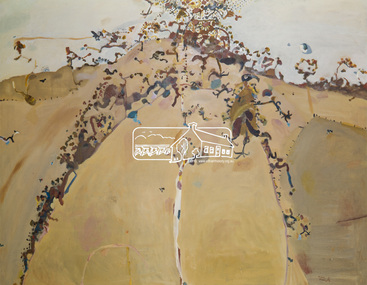
Photograph, 'Chasing Bird Landscape' 1969, John Olsen, 1971
... Landscape'. This photo forms part of a collection of photographs gathered by the Shire of Eltham for their centenary project book,"Pioneers and Painters: 100 years of the Shire of Eltham" by Alan Marshall (1971). The collection of over 500 images is held in partnership between Eltham District Historical Society and Yarra Plenty Regional ...The 1969 Wynne Prize for landscape was awarded to John Olsen, 41, of Cottlesbridge, Victoria, for his painting, 'Chasing Bird Landscape'.This photo forms part of a collection of photographs gathered by the Shire of Eltham for their centenary project book,"Pioneers and Painters: 100 years of the Shire of Eltham" by Alan Marshall (1971). The collection of over 500 images is held in partnership between Eltham District Historical Society and Yarra Plenty Regional Library (Eltham Library) and is now formally known as the 'The Shire of Eltham Pioneers Photograph Collection.' It is significant in being the first community sourced collection representing the places and people of the Shire's first one hundred years.4 x 5 inch colour reversal film (1) Condition: May not be true to colour of original work. Scanned from a 4 x 5 inch colour transparency which was taken c.1970 (approx. 50 years old) and which has undergone significant colour degradation towards the red spectrum. Allowances made for colour cast correction in scan with best guess for white balance. In some cases, significant light flare is reflected off glossy surface of original work at camera lens causing quality issues.sepp, shire of eltham pioneers photograph collection, john olsen, cottlesbridge, 1969 wynne prize
