
Showing 107 items matching "roper family"
-
 Kiewa Valley Historical Society
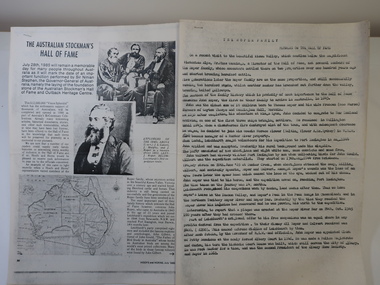
Papers - Roper Family, The Australian Stockman's Hall of Fame
... Papers - Roper Family......The Roper Family...The article has the title: 'The Australian Stockman's Hall of Fame' 2 papers - Title The Roper Family compiled by Wilma Davies (nee Roper) and Mr Mike Cummings. ...The Australian Stockman's Hall of Fame Papers - Roper Family ...The Australian Stockman's Hall of Fame is a museum located in Longreach, Queensland, Australia, which pays tribute to pioneers of the Australian outback. The centre is also dedicated to Australian stockmen who have shown bravery and courage. Registered in 1974. On July 28th 1985 the foundation stone of the Australian Stockman's Hall of Fame and Outback Heritage Centre was laid. Hoofs and Horns magazine was established by R.M.Williams in 1944 and ceased in 2005. It was aimed at cattlemen and horsemen.'The Roper family's ancestors settled in the beautiful Kiewa Valley, Victoria over a century ago and started breeding Hereford cattle and horses.' This is their interest in Hoofs and Horns but the Hall of Fame is interested in 'John Roper, who came to Australia in 1843 at the age of 23 years and joined Leichhardt's expedition ...'2 papers - Hoofs and Horns, July 1985, Page 88 and page 90 printed with photos and map. The article has the title: 'The Australian Stockman's Hall of Fame' 2 papers - Title The Roper Family compiled by Wilma Davies (nee Roper) and Mr Mike Cummings. Members of the Hall of Fame.. australian stockman's hall of flame, hoofs and horns magazine, cattlemen and horsemen, the roper family -
 Kiewa Valley Historical Society
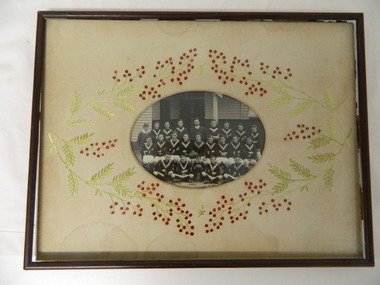
Photo - 1909 Football Team
... football. roper family. bert roper. c.g.s.. kiewa valley. embroidery....The Roper family lived and farmed in the Kiewa Valley. ...The Roper family lived and farmed in the Kiewa Valley. ...The Roper family lived and farmed in the Kiewa Valley. They may have sent their son, Bert, to C.G.S. (Caufield Grammar / Camberwell Grammar School). The Roper family were early settlers in the Kiewa Valley.Glass cover of a Black & White Photo of a boys football team with 'V' jumpers, white shorts and 2 footballs with 'C.G.S / 1909' written on them. The photo is attached to an embroidered cotton backing allowing the photo to be seen through an oval shape cut out in the middle. Around the embroidery is a brown wooden frame. The embroidered piece is backed by masonite with the framer's name attached.On the back of the photo, handwritten: Dear Mother / Wishing you a very / happy birthday on the 29th October / From Bert. Miss Roper / Call ... On the back of the masonite: Heatherley & Horsfall, Picture Framers & Mount Cutters ...football. roper family. bert roper. c.g.s.. kiewa valley. embroidery. -
 Kiewa Valley Historical Society
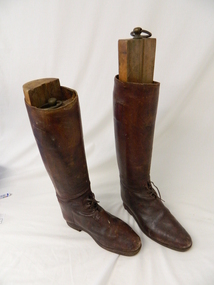
Boots Riding, late 1800's - early 1900's
... riding boots. footwear. cattle mustering footwear. roper family. cattlemen. bogong high plains....Many farmers of the Kiewa Valley built huts on the Bogong High Plains to stay in during the summer mustering season. The Roper family had their own cattle run on the High Plains with several version's of Ropers Hut being built and used for this purpose. ...Many farmers of the Kiewa Valley built huts on the Bogong High Plains to stay in during the summer mustering season. The Roper family had their own cattle run on the High Plains with several version's of Ropers Hut being built and used for this purpose. ...The early Kiewa Valley farmers opened up the Bogong High Plains for cattle grazing in the late 1800's and early 1900's. Many farmers of the Kiewa Valley built huts on the Bogong High Plains to stay in during the summer mustering season. The Roper family had their own cattle run on the High Plains with several version's of Ropers Hut being built and used for this purpose. These boots were owned by Fred Roper whose father was one of the first pioneers of the Upper Kiewa Valley and Tawonga farming district. These boots were made around the late 1800's to early 1900's and are of a quality hide and a very good example of historical clothing worn at the time. These boots are very significant to the Kiewa Valley because the mark a period of early farming within the Kiewa Valley and Bogong High Plains as they were worn by Fred Roper who comes from one of the farming pioneering families of Tawonga. These boots were used when mustering the families cattle up to the Bogong High Plains for summer grazing and also around his farm in Tawonga when riding his horses. They were donated by his great grand daughter Leonie Roper in 2011, therefore the manufacturing of these boots could be anything from the late 1880's to early 1900's. They are made of high quality leather and were made to last the tough conditions of mustering and farming cattle. They also had wooden stock which fitted into them "KVHS 0445"These knee high "riding" boots have a 4 "rung" laces at the base of the upright boot and a strap at the top of the boot. They are made of brown leather and have a small heel (not the usual higher heel for stirrups)riding boots. footwear. cattle mustering footwear. roper family. cattlemen. bogong high plains. -
 Kiewa Valley Historical Society
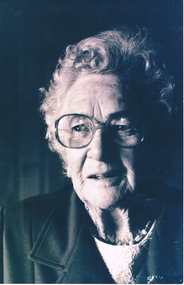
Photograph - Mrs Claire Roper, 1956
... ...the roper family...family or public occasions. This photograph holds and protects from ageing, part of a very significant occasion, the 90th birthday photograph of the matriarch Claire Roper, one of the founding grazier families from Tawonga within the Kiewa Valley This photograph therefore hold a very historical significance and has good exhibition value. photograph of early 1900's kiewa valley pioneer the roper family claire roper pioneer family cattle bogong high plains On back of photograph "KODAK official sponsor of the Olympic Games" Underneath the symbolic rings of the Olympic Federation This black and white photograph was professionally taken on Kodak paper in the time of the Australian Melbourne Olympics 1956. ...This photograph was typical of the mid 1900's when photography was in the hands of the professional artist for important events, be they family or public occasions. This photograph holds and protects from ageing, part of a very significant occasion, the 90th birthday photograph of the matriarch Claire Roper, one of the founding grazier families from Tawonga within the Kiewa Valley This photograph therefore hold a very historical significance and has good exhibition value. This black and white photograph was professionally taken on Kodak paper in the time of the Australian Melbourne Olympics 1956. See KVHS 0092 for frame.On back of photograph "KODAK official sponsor of the Olympic Games" Underneath the symbolic rings of the Olympic Federationphotograph of early 1900's kiewa valley pioneer, the roper family, claire roper, pioneer family, cattle, bogong high plains -
 Kiewa Valley Historical Society
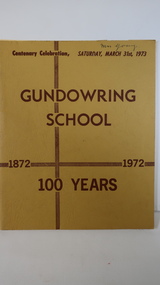
Book - Gundowring x2, Gundowring School 1872 - 1972 100 Years
... Glued inside the front cover "Mr & Mrs Roper & family" - Invitation. Also a newspaper cutting titled "Gundowring"...The book gives an insight into the education and lifestyle of the time. gundowring education kiewa valley school centenary Glued inside the front cover "Mr & Mrs Roper & family" - Invitation. Also a newspaper cutting titled "Gundowring" Mustard cardboard cover with brownish print. ...A school was built in 1871, a shingle roofed wooden building built by the local residents. It was replaced in 1873 with the old school becoming the teacher's residence. The continues with a timeline, a pupil's insight into life at the school, a list of teachers and families. An interesting history of the area and education of the time. Gundowring is a farming town in the Kiewa Valley. The book gives an insight into the education and lifestyle of the time.Mustard cardboard cover with brownish print. Across the top "Centenary Celebration, Saturday, March 31st, 1973". It has 18 pages, some colored, printed on both sides and held together by 2 staples. It includes sketches.Glued inside the front cover "Mr & Mrs Roper & family" - Invitation. Also a newspaper cutting titled "Gundowring"gundowring, education, kiewa valley, school centenary -
 Kiewa Valley Historical Society
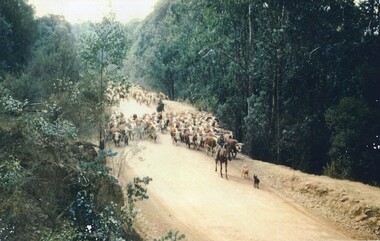
Photo: Colour photo of Ropers' Cattle on the road below Howman's Gap
... ...Roper Family...Droving cattle Roper Family Coloured photo of Cattle being driven along a dirt road. ...Cattle were taken up to the High Pains during Summer for grazing on the farmer's lease.Coloured photo of Cattle being driven along a dirt road. In the foreground are two dogs and a man on a horse. droving cattle, roper family -
 Kiewa Valley Historical Society
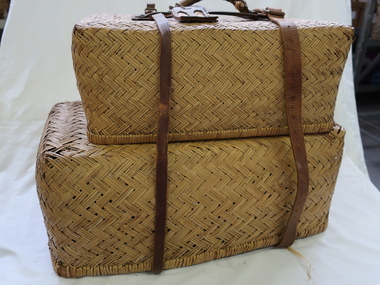
Baskets - Travel
... ...Roper family...Clare lived on a farm in the Kiewa Valley. The Roper family was one of the early settlers of the Kiewa Valley travel baskets dress basket Roper family The tag has "Albury" printed / scratched on it. ...These baskets were used to store dresses for travelling eg. to Melbourne or Albury either by train or on a coach, a carriage or on the back of an early motor car (eg. on the dicky seat - an upholstered exterior seat) Owned and used by Clare Roper's mother in 1900. Clare lived on a farm in the Kiewa Valley. The Roper family was one of the early settlers of the Kiewa Valley Two wicker, rectangular baskets, one big and one small held together, one on top of the other, by a leather strap and handle. Both baskets have a close fitting lid that goes all the way down to the bottom thus re-enforcing the sides by doubling them.The handle has an ID tag attached.The tag has "Albury" printed / scratched on it.travel baskets, dress basket, roper family -
 Kiewa Valley Historical Society
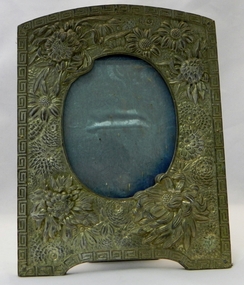
Frame - Photograph
... ...the roper family...The frame therefore has historical significance. photograph frame early 1900's the roper family This gold painted aluminium photograph frame has a glass (broken) pane within a formed inlay and two swivel clip toggles. ...This photograph frame with its decorative floral and Greek patterned boarder was typical of the early 1900's when photography was in the hands of the professional artist. It was in a period before the "instant" photo and required a dark room and processing liquids for development. It was therefor in a time when photographs were "shot" only at important events be they family or public occasions.This photograph frame holds and protects, part of a very significant occasion, the 90th birthday photograph of the matriarch of one of the founding families within the Kiewa Valley. The frame therefore has historical significance.This gold painted aluminium photograph frame has a glass (broken) pane within a formed inlay and two swivel clip toggles. These are installed to allow the photograph to be securely positioned within the correct alignment of the the frame.The metal front plate has seven rivets holding the cloth covered cardboard back frame to the metal front cover. The front part of the frame has sculptured wild flowers and is boarded with a Greek "key" pattern. Half way on the back panel is a rectangular swiveled stabiliser flap. See also KVHS 0093.photograph frame early 1900's, the roper family -
 Kiewa Valley Historical Society
Frame Photograph, circa early 1900s
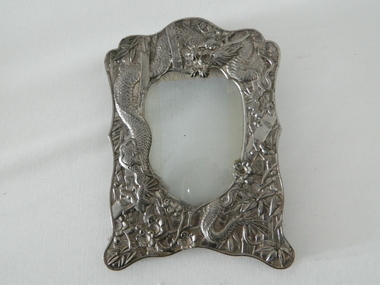
... ...the roper family...The frame therefore has historical significance. photograph frame early 1900's the roper family This silver painted aluminium photograph frame has a glass front pane within a formed inlay and a formed inlay at the back. ...This photograph frame with its decorative dragon and bamboo shoots was typical of the early 1900's when photography was in the hands of the professional artist. It was in a period before the "instant" photo and required a dark room and processing liquids for development. It was therefor in a time when photographs were "shot" only at important events, be they family or public occasions. Good quality picture frames such as this item were a part of the "reverence" of photographs per se.This photograph frame holds and protects, part of a very significant occasion, the 90th birthday photograph of the matriarch of one of the founding families within the Kiewa Valley. The frame therefore has historical significance.This silver painted aluminium photograph frame has a glass front pane within a formed inlay and a formed inlay at the back. The anchor points, at the back, for securing toggles are in place but not the toggles. These toggles were installed to allow the photograph to be securely positioned within the correct alignment of the the frame.The metal front plate has seven rivets holding the cloth covered cardboard back frame to the metal front cover. The front part of the frame has sculptured dragon and wild bamboo shoots and is boarded with a plain border pattern. The back panel to secure the photo and hold the stabiliser flap is missing. See also KVHS 0092 for a more complete frame.photograph frame early 1900's, the roper family -
 Kiewa Valley Historical Society
Boots Riding Women's, Circa 1950's
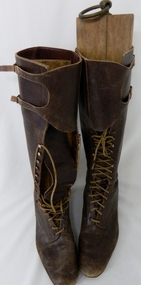
... ladies riding boots. cattle mustering footwear. rural footwear. cattlemen. bogong high plains. roper family. horses...., part of the Roper Family who built a "lodging" hut on the "High Plains" for accommodating riders during the periods (up to six weeks) when controlling grazing cattle during the summer muster seasons. ...This pair of "adjustable" boots came from the 1950's era in which the majority of footwear was either locally manufactured or imported from England or Europe. Quality hard wearing leather was a rural necessity especially for the cattle mustering activity in the Kiewa Valley and the Bogong High Plains region. The late 1900's provided a cheaper made riding boot from Asia, however many rural based riders still prefer an Australian made boot. The better quality (stronger stitching) of Australian boots is the main considerations of "stock horse riders". In 1947 a scientific research project started to provide an impact analysis of any damage to alpine vegetation by cattle grazing in the Alpine regions incorporating the Bogong High Plains area. This monitoring is the longest running ecological study ever undertaken in Australia. From this study, compelling evidence was presented to the Victorian Government to cease cattle grazing in the Alpine regions including the Bogong High Plains. All grazing was banned by the Victorian Government in 2005. Recreational horse riding within the Bogong High Plains is still permitted.These pair of women's riding boots are very significant to the Kiewa Valley as the boots were worn by one of the descendants of a pioneer family living and operating a cattle station before the SEC Hydro Electricity Scheme opened up the semi remote rural location in the 1950's. These boots were worn during the annual six weeks (approx.) mustering of cattle in the Bogong High Plains location (Victorian Alps region). The owner of these boots was Clare Roper, part of the Roper Family who built a "lodging" hut on the "High Plains" for accommodating riders during the periods (up to six weeks) when controlling grazing cattle during the summer muster seasons. It was unusual for women in the early to mid 1900's to go up on the High Plains to join the muster, which Clare Roper often did. These boots have high historical significance and good interpretive capacity.These brown "knee high" lady riding boots, are fastened by long "boot" laces which go from the base of the "fastening" position to a boot height of 22 cm. At the top end of the boot is a leather flap which crosses the front section of the boot and is fastened to the outside leg region by two straps. These provide the wearer with an adjustable tie. The boot has a "tongue" of 22 mm long. The boot has six pairs of metal boot lace "hooks" and eight pairs of boot lace "eyelets".ladies riding boots. cattle mustering footwear. rural footwear. cattlemen. bogong high plains. roper family. horses. -
 Kiewa Valley Historical Society
Stocks for Riding Boots, Late 1800's to early 1900's
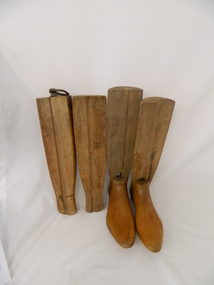
... High Plains. grazing. cattlemen. laces. studs. stocks. Roper family. Bogong High Plains....High Plains. grazing. cattlemen. laces. studs. stocks. Roper family. Bogong High Plains. On top "L" (for left boot), "R" (for right boot) This pair of wooden stocks for riding boots trees has been manufactured to a very high standard. ...These wooden trees for riding stocks are a concept that was brought to early colonial days from "mother" England. Gentle folk of wealth and status used these trees from early 1800's to keep and maintain their riding boots in their correct form. This form of maintaining the tall riding boot structure was maintained in Australia by the rural "elite" both on cattle properties and smaller cattle stations in the early 1900's. Good riding boots were a status symbol in rural and outback Australia. The riding stocks "wooden trees" are very significant in the Kiewa Valley because they were used by members of some of the original grazing cattle families to settle there. Both cattle and sheep properties occupied large areas of the Kiewa Valley and they also herded their flock and herd on the Bogong High Plains region. These stocks and boots were worn by Fred Roper whose great grand daughter donated them to KVHS. Therefore these boots and stocks would date from 1880's to 1920's and are a good representation of the style of boots worn during this period. This pair of wooden stocks for riding boots trees has been manufactured to a very high standard. Each of the four boot tree parts fit snugly together and maintain their form, and that of the boot that they occupy. The groove channels and foot forms (tongue and groove) are exact and once snapped together become very solid. There is a brass ring, attached by a small brass "peg" on each of the thin "sliding" middle uprights. See KVHS 0177 - Riding boots.On top "L" (for left boot), "R" (for right boot)horse. country. leather. gaiters. high plains. grazing. cattlemen. laces. studs. stocks. roper family. bogong high plains. -
 Kiewa Valley Historical Society
Roper's Hut Memorabilia
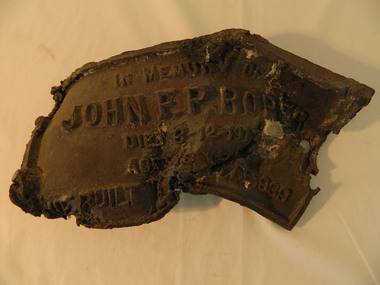
... ...roper family...The memorabilia is significant as the items belonged to the Roper family who were one of the original settlers of the Kiewa Valley and one of the original families who drove their cattle up to the Bogong High Plains. ...Roper's Hut was built in 1939 and was burnt down in 2003. It was rebuilt in 2008 and is situated on the Bogong High Plains on Duane Spur (where Duane's hut had been before it too was destroyed by (1939) bushfires, between Mt Nelse and Big River. The original hut was used as a shelter for cattlemen who grazed their cattle on the High Plains during summer. The Victorian High Country Huts Association Inc. members and friends helped rebuild the hut which is now used as an emergency shelter for visitors to the High Plains.The memorabilia is significant as the items belonged to the Roper family who were one of the original settlers of the Kiewa Valley and one of the original families who drove their cattle up to the Bogong High Plains. The burnt plaque and forks and the rebuilding of the huts (Duane's & Roper's) are significant as bush fires are a constant threat to the Bogong High Plains destroying large areas at a time.1. Bronze Plaque and 2 damaged forks from Roper's Hut which was destroyed by bush fires in 2003. 2. DVD & USB and hard copy photos of the rebuild of Roper's Hut in January 2008.The plaque had 'In Memory of / John F. P. Roper/ died 3-12-1977 / Aged 78 years / He built the original hut Feb. 1939'roper's hut, cattlemen, bogong high plains, bronze plaque, roper family, bush fires -
 Canterbury History Group
Photograph - Eileen Fisher Family
... Fisher family...Roper...Family photos of Eileen Fisher who lived at 1 Balwyn Road also includes photos of Eileen with her mother Elizabeth Fisher at MLC in 1923 Fisher family Roper>Alice Victoria Fisher>Eileen Elizabeth Balwyn Road 2 black and white photographs Photograph Eileen Fisher Family ...Family photos of Eileen Fisher who lived at 1 Balwyn Road also includes photos of Eileen with her mother Elizabeth Fisher at MLC in 1923 2 black and white photographsfisher family, roper>alice victoria, fisher>eileen elizabeth, balwyn road -
 Kiewa Valley Historical Society
Case - Roper's Hut Visitors' Journals
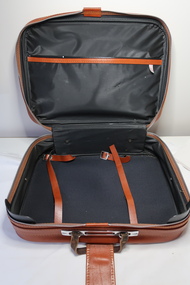
... Roper's Hut belonged to the Roper family who brought their cattle up onto the Bogong High Plains during summer. ...Roper's Hut belonged to the Roper family who brought their cattle up onto the Bogong High Plains during summer. ...Roper's Hut belonged to the Roper family who brought their cattle up onto the Bogong High Plains during summer. Their hut was visited and used by skiers and walkers. The log books kept a record of their visits over the years.The log books gave an insight into the activities of visitors, the weather, the frequency, etc. The case was a safe place for storage of these books.Light brown vinyl case with zip fastener around three sides and partly at the back on each side. There is a separate pocket at the top with a zip fastener. There is a flap to fasten the case across the centre top and a leather handle. The zip around the case has a silver fastener with a small key hole.The inside is mostly black and has two vinyl straps that fasten to hold the contents in place and there is an open pocket inside.roper's hut case, roper's hut log book, cattlemen's hut -
 Kiewa Valley Historical Society
Folder - Clare Roper No. 7, Items of Interest
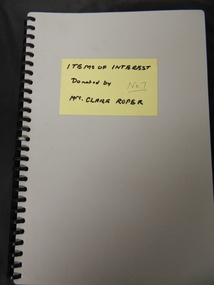
... Grey plastic front and back cover with black spiral spine with 24 clear plastic sleeves / pages plus 2 sleeves empty. Includes: Roper Family. Thomas Mitchell C.M.G.. North Eastern Dairy Company. ...Clare Roper; scrap book Grey plastic front and back cover with black spiral spine with 24 clear plastic sleeves / pages plus 2 sleeves empty. Includes: Roper Family. Thomas Mitchell C.M.G.. North Eastern Dairy Company. ...Clare Roper was a resident of the Kiewa Valley and belonged to the Kiewa Valley Historical Society.Clare Roper collected and collated items of historical interest for the Kiewa Valley Historical Society.Grey plastic front and back cover with black spiral spine with 24 clear plastic sleeves / pages plus 2 sleeves empty. Includes: Roper Family. Thomas Mitchell C.M.G.. North Eastern Dairy Company. Johann Gottfried Scholy's History. Rutherglen's Early Days.The Viticulture College. Botharambo. Pledge of Loyalty (to the Queen). North East Historical Societies. The Land Act 1883. Protection of the Aborigines 1886.clare roper; scrap book -
 Kiewa Valley Historical Society
Plaque - Country Women's Association of Victoria, Tawonga Branch of the C.W.A, 1960's
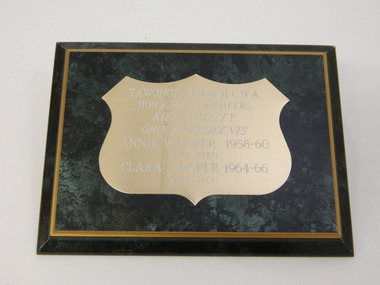
... The C.W.A. aimed to improve health, welfare and education for women and children in the country. The Roper family were very involved for many years in the activities of the branch. ...The C.W.A. aimed to improve health, welfare and education for women and children in the country. The Roper family were very involved for many years in the activities of the branch. ...The Tawonga branch of the C.W.A. commenced on the 7th Feb. 1946 and often combined activities with the other branches in the Kiewa Valley. The C.W.A. aimed to improve health, welfare and education for women and children in the country. The Roper family were very involved for many years in the activities of the branch. Clare Roper collected and documented the history of the Tawonga C.W.A. and the Kiewa Valley C.W.A.. Women living in Tawonga were mostly on farms and, in 1946, when the branch commenced would have been feeling more remote with WW11 having had an effect of available workers and the well being of the women and children.Black wooden plaque sloped to a narrow gold coloured border surrounding a black surface with a gold badge shaped plaque. The plaque has writing etched into it and painted white.Tawonga Branch C.W.A. / honours its Members / Kiewa Valley / Group Presidents / Annie V. Roper 1958 - 60 / (Mrs Bert) / Clara J. Roper 1964 - 66 / (Mrs Jack)tawonga. country woman's association of victoria. clara roper. annie roper. -
 Kiewa Valley Historical Society
Pot Large with Tap, Circa 1950
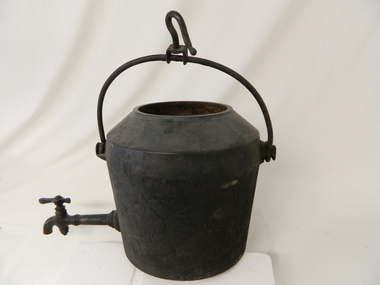
... There was a "log" hut built by the Roper family as temporary accommodation for cattlemen and other family members....There was a "log" hut built by the Roper family as temporary accommodation for cattlemen and other family members. ...This type of cast iron kettle was used by pioneer families, mainly rural in the early 1900's upon open fires (log). It covered rural activities that needed a constant readily available source of boiling water, in or mainly outside the kitchen of homesteads. This kettle was used in the early to late 1900's for the refreshment of stock men and farmers that had irregular "tea" breaks under sometimes hard and gruelling conditions.This kettle belonged to and was used by a Kiewa Valley, pioneer family, the Roper Family. This kettle was moved from their Kiewa Valley property to their hut built on the Bogong High Plains. The Bogong High Plains area provided Kiewa Valley cattlemen a good supply of fodder to supplement their Kiewa Valley grazing areas. This "camp draft" activity , in the high plains, could take up to six weeks.This large cast iron modified camp pot (cauldron) has a long tap connection located at the bottom end. The "tap" is made from brass and has a simple elongated "bar" control swivel at the end to control the water flow. The tap suggests that only water was heated (to a constant boil) for the replenishment of cattlemen's, or other horse rider's, tea or coffee mugs. Refreshments at a "temporary" location on the Bogong High Plains. There was a "log" hut built by the Roper family as temporary accommodation for cattlemen and other family members.Ot the flat bottom "FIRST QUALITY 2 GALLONS"camp fire cooking utensils, hot plate, cast iron cooking appliance, drovers kitchen -
 Kiewa Valley Historical Society
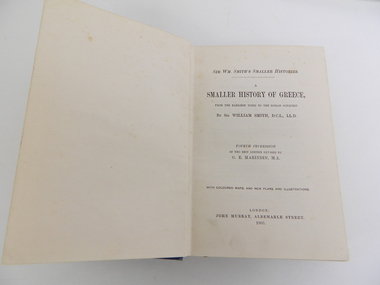
Book - History, Smaller History of Greece, from the earliest times to the Roman conquest, 1903
... This book was used as a text book at Camberwell Grammar School by Jack Roper whose family lived and farmed at Mt Yorke Station, Tawonga. ...This book was used as a text book at Camberwell Grammar School by Jack Roper whose family lived and farmed at Mt Yorke Station, Tawonga. ...This book was used as a text book at Camberwell Grammar School by Jack Roper whose family lived and farmed at Mt Yorke Station, Tawonga. At the time there wasn't a local High School, the closest one being in Albury. Historical: Students studied History. Country students boarded in Melbourne for their education. Provenance: Jack Roper had a private school education. His family still live and farm in the Kiewa Valley. Comparative to his descendants' education.Blue book with embossed hard cover including cloud like patterns in a rectangular shape around the title.Inside cover - hand written: Jack Roper / Camberwell G.S. / Jack Rooper / Mt Yorke Station / Tawonga/ Via Yackandandah Also handwritten notations: Marathon 490; 130 to 136 History; 4 chapter after holidays 18 to 24; !V chapter. Also smudged ink stain.education. history. greece. jack roper. mt yorke station. tawonga. camberwell grammar school. -
 Falls Creek Historical Society
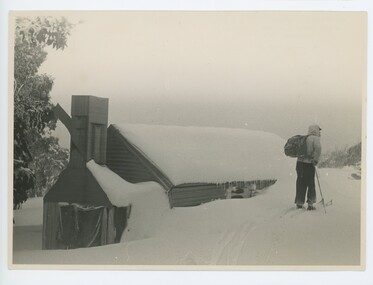
Photograph - Ray Meyer at Roper's Hut
... Frederick Roper and his family grazed the Bogong High Plains from the 1890s until 1908. ...Frederick Roper and his family grazed the Bogong High Plains from the 1890s until 1908. ...MEYER COLLECTION - FALLS CREEK PHOTOS In 1947 a determined group of like-minded State Electricity Commission (SEC) staff including Ray Meyer, the chief surveyor of the Kiewa Hydro-Electric Scheme, had a common interest that revolved around the skiing potential of the snow-covered high plains which included what is now the resort of Falls Creek. The six SEC employees, Toni St Elmo, Ray Meyer, Jack Minogue, Lloyd Dunn, Adrian Ruffenacht and Dave Gibson (together with their families) banded together to secretly build a 'hut' that was the first ski lodge at Falls Creek. Using a road built in 1930s to gain access to Falls Creek, their hut project was carried out in secret as efforts by other skiers were blocked by H.H.C. Williams – the engineer in charge of the Hydro Scheme. In 1946 Ray Meyer made a trip to the Lands Office in Melbourne. He came away with a 99-year lease on three acres that was ideally suited for a hut designed by Lloyd Dunn. Adrian Ruffenacht (Design Engineer for the KHS) had suggested where the group should build because of easy access to a spring for water. Much of the building material required was scavenged from derelict huts on the high plains. Due to the need for secrecy, the determined group worked on the hut in the evenings and weekends to avoid detection. During the building period the group had met at Echidna Rock (now known as Eagle Rock) where Skippy St Elmo announced, "This is my favourite ‘Skyline’.” And so the first lodge in the area at Falls Creek Ski Resort came into existence. With the development of the International Poma in the 1970s, the Skyline Lodge, which was sited between the ski-lift’s pole one and pole two, was demolished. However, the legacy of Ray Meyer, Toni St Elmo, Jack Minogue, Lloyd Dunn, Adrian Ruffenacht and Dave Gibson and Skyline lives on in the vibrant atmosphere of Falls Creek Resort. The MEYER COLLECTION documents developments on the Kiewa Hydro Scheme and their life at Falls Creek from the mid 1930s to 1960s.These images are significant because they depict aspects of the life of a pioneering family of Falls Creek and the founders of "Skyline", the first lodge at Falls Creek.Two black and white images of Ray Meyer outside Roper's Hut. Frederick Roper and his family grazed the Bogong High Plains from the 1890s until 1908. Frederick "Jack" built three huts. The hut known as Roper’s Hut was built on Jack's new grazing lease after his former run had been acquired by the SEC in the late 1930s. It had become a well-used refuge hut prior to its destruction in the 2003 bushfires. It was rebuilt by Victorian High Country Huts Association in 2008.falls creek, building skyline, skyline founders, toni st elmo, adrian ruffenacht, jack minogue, ray meyer, lloyd dunn, david gibson -
 Bendigo Historical Society Inc.
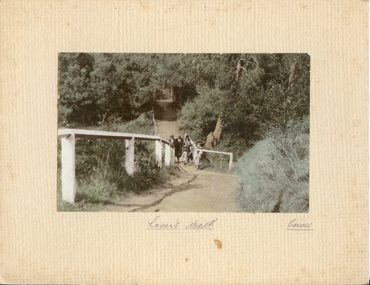
Photograph - LOVER'S WALK, COWES
... Batchelder ( Bendigo Photographer's family ? ) ' Gents Rope Quoits/Bay View Cowes, Feb. 1933 '...Batchelder ( Bendigo Photographer's family ? ) ' Gents Rope Quoits/Bay View Cowes, Feb. 1933 ' Photograph LOVER'S WALK, COWES ...coloured photo: family group ? 3 adult females in cloche hats and overcoats, two small females on scenic walk. Path through bush and trees with white post and rail fence. On front board, handwritten ' Lovers Walk, Cowes' Won by Mr. L. Batchelder ( Bendigo Photographer's family ? ) ' Gents Rope Quoits/Bay View Cowes, Feb. 1933 'A.J. Murray, Ciommercial Photographer, Photo Shop, Cosesplace -
 Falls Creek Historical Society
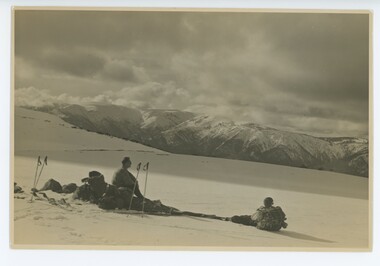
Photograph - Bogong Trip 1951- Mt. Bogong from above Roper's Hut
... ROPER'S HUT Frederick Roper and his family grazed the Bogong High Plains from the 1890s until 1908. ...ROPER'S HUT Frederick Roper and his family grazed the Bogong High Plains from the 1890s until 1908. ...MEYER COLLECTION - FALLS CREEK PHOTOS In 1947 a determined group of like-minded State Electricity Commission (SEC) staff including Ray Meyer, the chief surveyor of the Kiewa Hydro-Electric Scheme, had a common interest that revolved around the skiing potential of the snow-covered high plains which included what is now the resort of Falls Creek. The six SEC employees, Toni St Elmo, Ray Meyer, Jack Minogue, Lloyd Dunn, Adrian Ruffenacht and Dave Gibson (together with their families) banded together to secretly build a 'hut' that was the first ski lodge at Falls Creek. Using a road built in 1930s to gain access to Falls Creek, their hut project was carried out in secret as efforts by other skiers were blocked by H.H.C. Williams – the engineer in charge of the Hydro Scheme. In 1946 Ray Meyer made a trip to the Lands Office in Melbourne. He came away with a 99-year lease on three acres that was ideally suited for a hut designed by Lloyd Dunn. Adrian Ruffenacht (Design Engineer for the KHS) had suggested where the group should build because of easy access to a spring for water. Much of the building material required was scavenged from derelict huts on the high plains. Due to the need for secrecy, the determined group worked on the hut in the evenings and weekends to avoid detection. During the building period the group had met at Echidna Rock (now known as Eagle Rock) where Skippy St Elmo announced, "This is my favourite ‘Skyline’.” And so the first lodge in the area at Falls Creek Ski Resort came into existence. With the development of the International Poma in the 1970s, the Skyline Lodge, which was sited between the ski-lift’s pole one and pole two, was demolished. However, the legacy of Ray Meyer, Toni St Elmo, Jack Minogue, Lloyd Dunn, Adrian Ruffenacht and Dave Gibson and Skyline lives on in the vibrant atmosphere of Falls Creek Resort. The MEYER COLLECTION documents developments on the Kiewa Hydro Scheme and their life at Falls Creek from the mid 1930s to 1960s.This image is significant because it depicts aspects of the life of a pioneering family of Falls Creek and the founders of "Skyline", the first lodge at Falls Creek.Black and White Image of Mt. Bogong from above Roper's Hut with Wal Johnson and Ray Meyer seated on the ground. ROPER'S HUT Frederick Roper and his family grazed the Bogong High Plains from the 1890s until 1908. Frederick "Jack" built three huts. The hut known as Roper’s Hut was built on Jack's new grazing lease after his former run had been acquired by the SEC in the late 1930s. It had become a well-used refuge hut prior to its destruction in the 2003 bushfires. It was rebuilt by Victorian High Country Huts Association in 2008.falls creek, bogong high plains, wal johnson, ray meyer, ropers hut -
 Flagstaff Hill Maritime Museum and Village
Photograph, 1907-1914
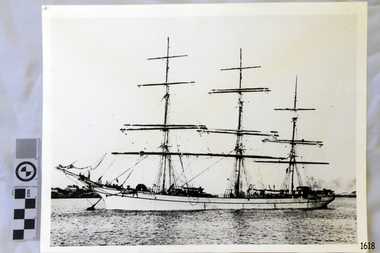
... family laughed and disbelieved him, as this young fellow was prone to telling fictional tales. About a month later, on December 13th 1914, local farmers Phillip Le Couteur and Peter Mathieson were riding in the vicinity, checking on cattle. Phillip Le Couteur saw what he “thought was the hull of a ship below the cliffs.” He rode to Allansford and contacted police. The next day, two Constables and Phillip Le Couteur returned to the site, where they dug a trench near the top of the cliff and sank a log in it. To this they attached a rope...family laughed and disbelieved him, as this young fellow was prone to telling fictional tales. About a month later, on December 13th 1914, local farmers Phillip Le Couteur and Peter Mathieson were riding in the vicinity, checking on cattle. Phillip Le Couteur saw what he “thought was the hull of a ship below the cliffs.” He rode to Allansford and contacted police. The next day, two Constables and Phillip Le Couteur returned to the site, where they dug a trench near the top of the cliff and sank a log in it. To this they attached a rope ...This photograph is of the sailing ship ANTARES at full sail, taken between 1907, when she was named ANTARES, and 1914, when she was wrecked.. THE ANTARES In mid-November 1914, after the beginning of the First World War, a young local man went one evening to fish near the Bay of Islands, west of Peterborough. He later arrived home hurriedly and in an agitated state declaring: "The Germans are coming!" His family laughed and disbelieved him, as this young fellow was prone to telling fictional tales. About a month later, on December 13th 1914, local farmers Phillip Le Couteur and Peter Mathieson were riding in the vicinity, checking on cattle. Phillip Le Couteur saw what he “thought was the hull of a ship below the cliffs.” He rode to Allansford and contacted police. The next day, two Constables and Phillip Le Couteur returned to the site, where they dug a trench near the top of the cliff and sank a log in it. To this they attached a rope, which they threw down the cliff face. Constable Stainsbury and Phillip Le Couteur then made the dangerous descent down the rope on the sheer cliff face. They found wreckage strewn around a small cove and a portion of a man's body under the cliffs. The hull of the ship could be seen about 300 metres out to sea. Some of the wreckage revealed the name Antares and the remains of the ship's dinghy bore the name Sutlej. During the next two weeks and with the help of the Warrnambool lifeboat and crew, two more bodies were found. Later investigations proved that the tragic wreck was indeed that of the Antares, reported overdue on the 207th day of her voyage from Marseilles, France, to Melbourne. She was a three masted, 1749 ton iron clipper, built in Glasgow in 1888 and originally named and launched as the Sutlej. Bought in 1907 by Semider Bros. from Genoa, Italy, she was refitted and renamed Antares. It was later realised that the local lad who a month earlier had declared he had seen German guns being fired, had probably seen distress flares fired from the deck of the Antares the night she was wrecked. She was last sailed under Captain Gazedo and wrecked at what is now known as Antares Rock, near the Bay of Islands. She had been carrying a large cargo of roofing tiles from France to Melbourne, consigned to Mullaly & Byrne. Many of them are now to be seen amongst the battered and scattered remains of the wreck. Some of the timbers were found to be blackened by fire. An Information Board has been erected on the cliff top near to the site of the Antares wreck, at the end of Radfords Rd, west of Peterborough. (Ref: Flagstaff Hill Maritime Village’s “Antares” fact sheet, Victorian Heritage Database, Information Board at Peterborough, Flagstaff Hill Significance Assessment 2010) The Antares was one of the last of the 'tall ships' to be lost along the south west coast of Victoria, and is the only wreck that took the lives of all people on board. She is listed on the Victorian Heritage Register VHS S34. The Antares is significant as a sail trader carrying an international inbound cargo. It is part of the Great Ocean Road Historic Shipwreck Trail. Photograph of the three masted fully rigged Antares at anchor. (ref: Ships A-B SH016.)flagstaff hill, warrnambool, shipwrecked-coast, flagstaff-hill, flagstaff-hill-maritime-museum, maritime-museum, shipwreck-coast, flagstaff-hill-maritime-village, antares, tall ship, peterborough, 1914 shipwreck, phillip le couteur, peter mathieson, constable stainsbury, sutlej, antares rock., bay of islands -
 Flagstaff Hill Maritime Museum and Village
Instrument - Scale, George Salter & Co, Circa 1921
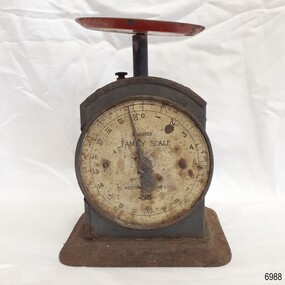
... “HUGHES’ / FAMILY SCALE / No. 48” “BRITISH MADE” “TO WEIGH 20 LBS BY 1 OZ” “SALTER” above logo [knotted rope with an arrow through loops]...Flagstaff Hill Warrnambool Maritime Museum Maritime Village Great Ocean Road Shipwreck Coast Hughes Salter British made Family Scale No. 48 spring balance scale weighing instrument weights and measures weighing machine kitchen utensil baking accessory domestic equipment cookware bakeware kitchen scale kitchen accessory food preparation recipes cooking measuring “HUGHES’ / FAMILY SCALE / No. 48” “BRITISH MADE” “TO WEIGH 20 LBS BY 1 OZ” “SALTER” above logo [knotted rope with an arrow through loops] Scale; a domestic spring balance scale for measuring weight from 0 to 20 pounds. ...The Hughes’ Family Scale No. 48 is a spring balance scale. It uses the Imperial measurements of ounces and pounds. There are 16 ounces (OZ) in one pound (LB), and each pound equals approximately 454 grams in Metric measurements. Scales have been used to measure and compare items for value for centuries. A weight was placed on one side of a balance and the object was placed on the other. Adjustments were made to either the weight or the object until the balance was horizontal, which meant that each side was the same weight. The Salter family business began in 1760 with spring makers, Richard and William Salter. In the late 18th century, Richard Salter invented the spring scale, where the weight of an object on the tray of the scale causes pressure on a spring in the scale. The pressure caused by gravity was then measured to calculate the weight of an object. Spring scales are still used today along with the more recent and accurate digital scales. The company began manufacturing in West Bromwich, England, in 1770. The firm was taken over by William’s sons, John and George. In 1824, after the death of John, the firm became George Salter & Co. The company produced a wide variety of products, including Britain’s first bathroom scale and the first English typewriter. In 1884 the Salter Trademark of a Staffordshire knot pierced by an arrow was registered. After over 100 years of manufacturing, the company was bought out by Staveley Industries, which was bought by Weigh-Tronix, and then that company was bought by HoMedics Company in 2004.This scale was made by Salter, the company that invented the balance scale, the first British bathroom scale and the first English typewriter. The scale represents the domestic equipment used for measuring in food preparation over 100 years ago. Modern kitchen scales are still using the same principal, along with scales used in business and industry.Scale; a domestic spring balance scale for measuring weight from 0 to 20 pounds. The scale’s grey metal case has a round white dial on the front with black markings, an arrow indicator and a round shallow metal bowl on a pedestal at the top. The scale is raised on a rectangular metal base with outward-sloping sides. An adjustable screw is on the dome top. The scale is marked from 0 to 20 pounds, with each pound marked in 1-ounce increments. The scale is named the Hughes Family Scale No. 48 and was made in Britain by Salter.“HUGHES’ / FAMILY SCALE / No. 48” “BRITISH MADE” “TO WEIGH 20 LBS BY 1 OZ” “SALTER” above logo [knotted rope with an arrow through loops]flagstaff hill, warrnambool, maritime museum, maritime village, great ocean road, shipwreck coast, hughes, salter, british made, family scale, no. 48, spring balance, scale, weighing instrument, weights and measures, weighing machine, kitchen utensil, baking accessory, domestic equipment, cookware, bakeware, kitchen scale, kitchen accessory, food preparation, recipes, cooking, measuring -
 Flagstaff Hill Maritime Museum and Village
Ceramic - Soap dish, circa 1883
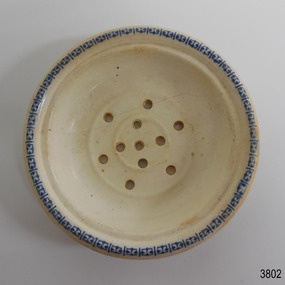
... Roper in the 1960s-70s. Items that come from several wrecks along Victoria's coast have since been donated to the Flagstaff Hill Maritime Village’s museum collection by his family, illustrating this item’s level of historical value. ...This ceramic soap dish was recovered from the wreck of the 1882-1883 George Roper between the late 1960’s to early 1970’s. It is one of the shipwreck artefacts in the John Chance Collection. Soap dishes were often part of a wash set that also included a water jug and wash bowl. The holes in the dish allowed water to drain out of the dish, keeping the soap dry for next use. The GEORGE ROPER 1882 - 1883 - The George Roper was a 4-masted iron sailing ship built in Liverpool, England, in 1882 for fast international trade with Australia. The large vessel was launched in February 1883. The ship was on its first trip, departing Liverpool for Melbourne, captained by John Ward and a crew of 31. She had almost reached her destination on July 4 1883, approaching Port Phillip Bay and being towed by the steam tug William. The weather changed to rough with fog and both the George Roper and the William hit the dangerous Lonsdale Reef at Port Phillip Heads. The Captain and crew were eventually rescued and taken to Queenscliff. Salvage syndicates were able to recover a lot of the cargo before the George Roper broke up and sank. Amongst the cargo was soft goods, draperies, household items, spirits of malt and distilled liquors, chemicals, dynamite, and 1,400 tons of steel rails for the Victorian Government. Also in the hold were Russell Stourbridge bricks, as paying ballast. This 1880s soap dish is an example of personal hygiene accessories and may have been part of a set comprising jug, bowl and dish.. The soap dish is also significant as it was recovered by John Chance, a diver from the wreck of the George Roper in the 1960s-70s. Items that come from several wrecks along Victoria's coast have since been donated to the Flagstaff Hill Maritime Village’s museum collection by his family, illustrating this item’s level of historical value. The soap dish is significant for its association with the barque George Roper, which is considered historically and archaeologically significant and as such, is listed on the Victorian Heritage Database, VHR S286. The George Roper is an example of a vessel built specifically for fast travel to and from Australia with a large shipment of cargo. Its cargo of steel rails adds to the historical significance of international trade to the growing colony of Australia and Victoria in particular, with rail transportation soon to become a faster and safer form of transportation between colonial towns. Divers can still access parts of the scattered wreck and other artefacts recovered in the 1970s and 1980s can be viewed in both public and private collections. Soap dish; glazed white porcelain. Round shallow bowl with blue patterned border, resembling butterflies. Two raised, concentric rings are moulded into the base. Six pierced holes are evenly spaced between the rings, five holes are in the centre of the dish.flagstaff hill, warrnambool, flagstaff hill maritime museum, maritime museum, shipwreck coast, flagstaff hill maritime village, great ocean road, john chance, west coast trader, george roper, captain john ward, russell stourbridge bricks, port phillip heads, lonsdale reef, dive wreck, vhr s286, coastal trader, ceramic, vintage, personal hygiene, bathroom accessory, soap dish -
 Flagstaff Hill Maritime Museum and Village
Ceramic - Cover, circa 1883
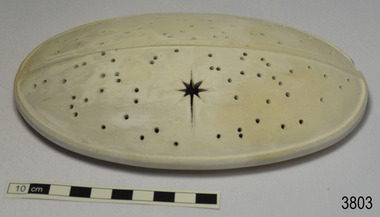
... Items that come from several wrecks along Victoria's coast have since been donated to the Flagstaff Hill Maritime Village’s museum collection by his family, illustrating this item’s level of historical value. The George Roper is considered historically and archaeologically significant and as such, is listed on the Victorian Heritage Database, VHR S286. ...This ceramic cover was recovered from the wreck of the 1882-1883 George Roper between the late 1960’s to early 1970’s. It is one of the shipwreck artefacts in the John Chance Collection. The purpose of the cover is unclear. The holes could be for ventilation. The cover may have been used to protect food or keep it at an even temperature. It may also have been used for covering fragrant petals, allowing some scent to escape through the holes. The residue around the underside of the holes and their random placement indicate that the cover could be partially handmade. The discolouration could have come from its time in the sea. The GEORGE ROPER 1882 - 1883 - The George Roper was a 4-masted iron sailing ship built in Liverpool, England, in 1882 for fast international trade with Australia. The large vessel was launched in February 1883. The ship was on its first trip, departing Liverpool for Melbourne, captained by John Ward and a crew of 31. She had almost reached her destination on July 4 1883, approaching Port Phillip Bay and being towed by the steam tug William. The weather changed to rough with fog and both the George Roper and the William hit the dangerous Lonsdale Reef at Port Phillip Heads. The Captain and crew were eventually rescued and taken to Queenscliff. Salvage syndicates were able to recover a lot of the cargo before the George Roper broke up and sank. Amongst the cargo was soft goods, draperies, household items, spirits of malt and distilled liquors, chemicals, dynamite, and 1,400 tons of steel rails for the Victorian Government. Also in the hold were Russell Stourbridge bricks, as paying ballast. The ventilated cover is as an example of domestic ceramic ware of the 1880s. The cover also holds significance as it was recovered by John Chance, a diver from the wreck of the George Groper in the 1960s-70s. Items that come from several wrecks along Victoria's coast have since been donated to the Flagstaff Hill Maritime Village’s museum collection by his family, illustrating this item’s level of historical value. The George Roper is considered historically and archaeologically significant and as such, is listed on the Victorian Heritage Database, VHR S286. It is an example of a vessel built specifically for fast travel to and from Australia with a large shipment of cargo. The George Roper’s cargo of steel rails adds to the historical significance of international trade to the growing colony of Australia and Victoria in particular, with rail transportation soon to become a faster and safer form of transportation between colonial towns. Divers can still access parts of the scattered wreck and other artefacts recovered in the 1970s and 1980s can be viewed in both public and private collections. Cover; unglazed white ceramic, oval shape. The cover has holes randomly poked through its surface, one large hole is a six pointed star shape. Underneath there is a narrow rim placed slightly inside the edge. There is residue on the underneath around the holes. There is orange-brown discolouration and areas where the surface is lighter coloured. flagstaff hill, warrnambool, flagstaff hill maritime museum, maritime museum, shipwreck coast, flagstaff hill maritime village, great ocean road, john chance, west coast trader, george roper, w. h. potter & sons, w.t. dickson and son, captain john ward, russell stourbridge bricks, port phillip heads, lonsdale reef, dive wreck, vhr s286, coastal trader, ceramic, vintage, ventilated cover, domestic item -
 City of Moorabbin Historical Society (Operating the Box Cottage Museum)
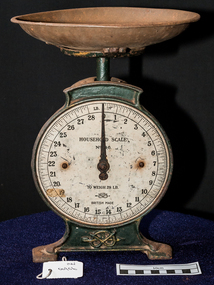
Scales, Imperial, Spring, 'Salter Household Scale’ 28lb, c1920
... In 2004 was sold to the US-based HoMedics company, and in 2006, Salter Housewares USA and Taylor Precision Products Inc (also owned by HoMedics) merged. weights measures shops scales. balances grocery stores early settlers moorabbin bentleigh cheltenham salter housewares pty ltd west bromwich england salter george salter richard bilston england HOUSEHOLD SCALE / NO. 46 / SALTER / TO WEIGH 28 LB / ( rope & arrow TM) BRITISH MADE Base rope & anchor S (trade mark) Salter Brand No. 46 Household Spring Balance Kitchen Scales made of green painted metal with a white large clock face dial marked in 1oz graduations and with a shallow metal bowl placed on the flat top connected to the mechanism. An adjustable screw tightened or loosened the spring to bring the pointer to zero, prior to adding the material to be weighed.. A common piece of kitchen equipment as most families ...In the 18th century, spring scales appeared. To produce these scales, a manufacturer would use the resistance of a spring to calculate weights, which could be read automatically on the scale’s face. The ease of use of spring scales over balance scales is what led most post offices to outfit their clerks with spring postal scales. One of the most common types of spring scales was the kitchen scale—also known as a family or dial scale. Designed for horizontal surfaces, these scales used the weight of goods in a pan at the top of the scale to force the spring down. Such scales were common in early-20th-century households and were sold by Sears and Montgomery Ward. Many had flat weighing surfaces but some were topped by shallow pans. Companies such as Salters, Chatillon, and Fairbanks made both. SALTER HOUSEWARES began in the late 1760 in the village of Bilston, England. At this time Richard Salter, a spring maker, began making 'pocket steelyards', a scale similar to the fisherman's scale of today. By 1825 his nephew George had taken over the company, which became known as George Salter & Co. and later established a large, well equipped manufacturing site in the town of West Bromwich. The business thrived throughout the 1900s, and in 1972 the company was purchased by Staveley Industries Plc. In 2002, the management team at Salter Housewares Ltd, backed by Barclays Private Equity, bought the company out from the group, to concentrate on its consumer businesses. In 2004 was sold to the US-based HoMedics company, and in 2006, Salter Housewares USA and Taylor Precision Products Inc (also owned by HoMedics) merged.Salter Brand No. 46 Household Spring Balance Kitchen Scales made of green painted metal with a white large clock face dial marked in 1oz graduations and with a shallow metal bowl placed on the flat top connected to the mechanism. An adjustable screw tightened or loosened the spring to bring the pointer to zero, prior to adding the material to be weighed.. A common piece of kitchen equipment as most families used this type of scale when measuring goods for cooking or storing. HOUSEHOLD SCALE / NO. 46 / SALTER / TO WEIGH 28 LB / ( rope & arrow TM) BRITISH MADE Base rope & anchor S (trade mark) weights, measures, shops, scales. balances, grocery stores, early settlers, moorabbin, bentleigh, cheltenham, salter housewares pty ltd, west bromwich, england, salter george, salter richard, bilston england -
 City of Moorabbin Historical Society (Operating the Box Cottage Museum)
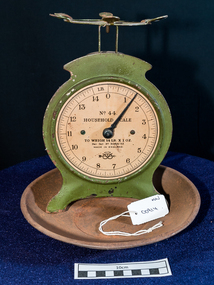
Scales,Spring Balnce Imperial ‘Household’ Salter, 20thC
... No. 30819 / 32 / MADE IN ENGLAND / SALTER / S in trademark rope with arrow Salter Brand No. 44 Household Spring Balance Kitchen Scales made of green painted metal with a large clock face dial marked in 1oz graduations and with a shallow metal bowl placed on the flat top connected to the mechanism. An adjustable screw tightened or loosened the spring to bring the pointer to zero, prior to adding the material to be weighed.. A common piece of kitchen equipment as most families ...In the 18th century, spring scales appeared. To produce these scales, a manufacturer would use the resistance of a spring to calculate weights, which could be read automatically on the scale’s face. The ease of use of spring scales over balance scales is what led most post offices to outfit their clerks with spring postal scales. One of the most common types of spring scales was the kitchen scale—also known as a family or dial scale. Designed for horizontal surfaces, these scales used the weight of goods in a pan at the top of the scale to force the spring down. Such scales were common in early-20th-century households and were sold by Sears and Montgomery Ward. Many had flat weighing surfaces but some were topped by shallow pans. Companies such as Salters, Chatillon, and Fairbanks made both. SALTER HOUSEWARES began in the late 1760 in the village of Bilston, England. At this time Richard Salter, a spring maker, began making 'pocket steelyards', a scale similar to the fisherman's scale of today. By 1825 his nephew George had taken over the company, which became known as George Salter & Co. and later established a large, well equipped manufacturing site in the town of West Bromwich. The business thrived throughout the 1900s, and in 1972 the company was purchased by Staveley Industries Plc. In 2002, the management team at Salter Housewares Ltd, backed by Barclays Private Equity, bought the company out from the group, to concentrate on its consumer businesses. In 2004 was sold to the US-based HoMedics company, and in 2006, Salter Housewares USA and Taylor Precision Products Inc (also owned by HoMedics) merged. Salter Brand No. 44 Household Spring Balance Kitchen Scales made of green painted metal with a large clock face dial marked in 1oz graduations and with a shallow metal bowl placed on the flat top connected to the mechanism. An adjustable screw tightened or loosened the spring to bring the pointer to zero, prior to adding the material to be weighed.. A common piece of kitchen equipment as most families used this type of scale when measuring goods for cooking or storing.On Clock face ; NO. 44 / HOUSEHOLD SCALE / TO WEIGH 14LB X 1OZ / Pro. Pat. No. 30819 / 32 / MADE IN ENGLAND / SALTER / S in trademark rope with arrow market gardeners, early settlers, fruit, vegetables, farmers, cooking, recipes, scales, weights, measures, brass, balance beam, moorabbin, cheltenham, bentleigh, kitchen scales, dairy products, cereals, wheat flour, salter housewares pty ltd, west bromwich england -
Glenelg Shire Council Cultural Collection
Functional object - Life Buoy, n.d
... The case was provided by the Sullivan family in memory of John Loring Sullivan who was lost at sea on 30.11.1934. lifesaving marine maritime history Front: 'Coramba' 'Port Fairy' Back: - Circular ring, white and red painted canvas on buoyant material perhaps cork. "Coramba' and PORT FAIRY lettered in black. A rope ...The case was provided by the Sullivan family in memory of John Loring Sullivan who was lost at sea on 30.11.1934.Circular ring, white and red painted canvas on buoyant material perhaps cork. "Coramba' and PORT FAIRY lettered in black. A rope loop fastened in 4 places around the edge of the buoy. The buoy hangs in a glass fronted clear finish timber case, stands vertically on 2 timber footings. The 2 hanging brackets are made form stainless steel. Memorial plaque in centre of case.Front: 'Coramba' 'Port Fairy' Back: -lifesaving, marine, maritime history -
 City of Moorabbin Historical Society (Operating the Box Cottage Museum)
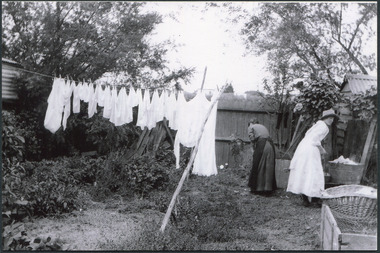
Photograph - Washing Day at 'Law Muir Den' Mrs J L Smith c1910, c1910
... family were involved with local Church, Red Cross, and other community organizations. Photograph, Black & White, showing 2 women washing clothes in a large tub, set over a fire in a stone pit, in the back yard. Clothes are hanging from a rope ...Mrs J.L.Smith and Ada Smith in the backyard of the house Law Muir Den 510 Centre Rd Bentleigh c 1910. . The early settler women usually devoted a whole day to washing as it was very labourious. A fire was lit in a stone pit and a large tub of water boiled. Soap that had been made, usually in the previous Autumn, from fat drippings and caustic soda, was flaked into the tub to form suds. The clothes were moved around in the tub with a long wooden paddle that was also used to lift the clothes out of the tub into another tub of cold rinsing water..Stains were removed by scrubbing soap on the cloth against a scrubbing board. Clothes were wrung by hand or a mechanical wringer and hung on the clothes line to dry. Mary Ann Smith was married John Logan Smith 1860-1932 who at first rented a cottage 'Law Muir Den' & Shed from Mr Box and commenced business as a wood merchant - sawing logs into shorter pieces using one horse to power the saw. He purchased the property, added to the buildings , began trading in fuel and fodder as well and installed a chaff cutting mill powered by 10hp steam engine. The business prospered As Motor transport was increasing 1926 J L Smith built a small Garage on the opposite corner (Woolworths Supermarket 2005) , employed a good mechanic ( Reg Hunt ) and developed another successful business. J.L.Smith was an early settler in East Brighton now Bentleigh and established successful Wood cutting, Grain & Chaff cutting and Motor garage businesses in Centre Road . He was elected Councillor of the Shire of Moorabbin and, with Mary Ann, his family were involved with local Church, Red Cross, and other community organizations.Photograph, Black & White, showing 2 women washing clothes in a large tub, set over a fire in a stone pit, in the back yard. Clothes are hanging from a rope line strung between 2 trees and held up with a wooden 'prop' -
 Orbost & District Historical Society
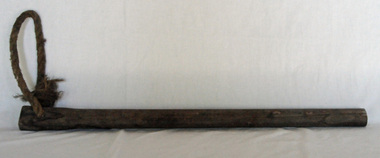
animl prodder, first half 20th century
... This is an example of the resourcefulness of rural families in economising and re-cycling. livestock prod A wooden stick - probably a handle from a tool - with rope threaded through the top. ...A cattle prod, also called a stock prod, is a handheld device commonly used to make cattle or other livestock move by striking or poking them. This is a home-made prod.This is an example of the resourcefulness of rural families in economising and re-cycling.A wooden stick - probably a handle from a tool - with rope threaded through the top. It was probably a home-made animal prodder.livestock prod
