
Showing 116 items matching "ship’s cat"
-
 Flagstaff Hill Maritime Museum and Village
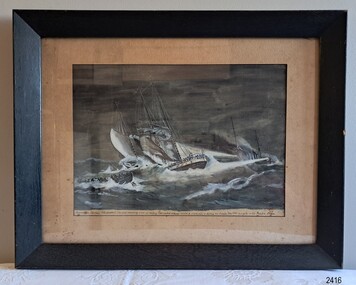
Print - Lithograph, sea rescue, R.N. Duffield, Australian cruiser “MELBOURNE” (Tons 5600) rescuing crew of sinking four-masted schooner “HELEN B. STERLING” of Halifax NS Canada, Tons 1343 in a gale in the Pacific Ocean, 19-11-1924
... ship...shipwreck...sea rescue...gale...cyclone...1922 rescue...shipwreck rescue...breeches buoy...line rescue...rescue line...lifesaving...cutter...cutter Melbourne...sea boat...lifesaving crew...12-oar cutter...shipwreck victim...R.N. Duffield...marine artist...Nov. 19. 1924...20th century artist...A Frith...Footscray picture framer...Shiplovers’ Society of Victoria...Shiplovers’ Society Library...watercolour...A V Gregory...Arthur Victor Gregory...Melbourne artist...Newcastle coal...Newcastle NSW...Society Islands...San Fracisco...Aukland New Zealand...school composition...ship’s cat...ship began to sink. The rescue from the wreck was an exciting time for the young boy, and even more so when one of his cats survived after being carefully wrapped in a pillowcase and thrown down from the ship for the boy. ...Duffield marine artist Nov. 19. 1924 20th century artist A Frith Footscray picture framer Shiplovers’ Society of Victoria Shiplovers’ Society Library watercolour A V Gregory Arthur Victor Gregory Melbourne artist Newcastle coal Newcastle NSW Society Islands San Fracisco Aukland New Zealand school composition ship’s cat SOS signal Lord Mayor Cr. Swanston heroes cigarette case Painted on the ship’s bow: “HELEN B. ...This framed lithograph print in watercolour and gouache was produced on November 19th, 1924, by 20th-century marine artist, Mr R.N. Duffield. It depicts the event of a sea rescue that took place two years earlier. The framer was A.L. Frith of Footscray, Melbourne, who actively advertised from 1933 to 1935. The now disbanded Shiplovers' Society of Victoria (1930-2018) donated the print, and it seems likely that this print was framed for that organisation. This graphic image shows the conditions in which the rescue from the wrecked Helen B. Sterling happened. Captain George Harris was master of the American-owned, four-masted windjammer. His wife Edith and their ten-year-old son Leslie were on board, along with a crew of fifteen seamen. The ship set off from Newcastle, NSW, on January 5th, 1922, loaded with a cargo of coal to deliver to the Society Islands and on to San Francisco. Young Leslie later wrote a lively school composition for his teacher about his experiences on board the Helen B Sterling. He tells of a fire that broke out the day after they departed and burned a hole in a beam. Then another troublesome time on the 9th, when a strong gale blew a sail off the ship. Finally, he tells of the highlight of his voyage when, on the 18th January, the ship was right in the path of a strong cyclone, which broke the mainmast. Huge waves crashed over both sides of the deck, meeting in the middle, and the ship began to sink. The rescue from the wreck was an exciting time for the young boy, and even more so when one of his cats survived after being carefully wrapped in a pillowcase and thrown down from the ship for the boy. Reporters later wrote about Leslie’s comments, “... what had grieved him most was the thought that he might never see his two little sisters again”. Captain Harris said in a published statement, “… the gale was the worst he had met in his 12 years’ experience at sea. All went well for the first week. We then encountered a strong blow from the south-east. We tried the gasoline pump, but the engine broke down, and we had to do the pumping by hand. We at once shortened sail, but the sea increased in fury to such an extent that men were washed from the pumps. I was below at 5:30 on Sunday morning [January 22nd, 1922] when the main mast went over the side, … I at once sent out SOS signals, and got word that HMAS Melbourne was coming to our assistance. I had made a mistake with regard to our position, but did not know it until 11:30 o’clock, when I sent out the correct location. This was picked up by the Melbourne and I received the following reply: “We will reach you about 2 am. Keep a good heart. The Melbourne will do all she can.” Our ship was practically awash when we were taken off.” (Ref: the ‘Helen B. Sterling Disaster’, Maitland Weekly Mercury, NSW, 4-2-1922.) Officers from the Royal Australian Navy, Captain Henry J Feakes (later Rear-Admiral) and Commander Wilfrid Ward Hunt, were on board the light cruiser, HMAS Melbourne (1913-1928), when it left Sydney for New Zealand. After the SOS was received, the ship sped at full steam towards the sinking Helen B. Sterling. They found the vessel at about midnight and shone bright search lights on the distressed ship to illuminate the desperate scene. The Melbourne was unable to move close to the schooner, so sixteen seamen, including Commander Hunt, volunteered to man the Melbourne’s lifesaving 12-oared cutter. They rowed the sea boat with great urgency towards the victims of the sinking ship, keen to save lives no matter what the conditions. When the cutter was close to the Sterling, a line was secured between the Sterling and the cutter. The weary, waterlogged and anxious men on board could be rescued, one at a time, in the breeches buoy equipment, which looked like canvas shorts with a lifesaving ring in the waistband. The victims were hauled along the line and pulled aboard by many willing hands. All eighteen crew and passengers were saved, including Captain Harris and his family. The seamen of the Melbourne received a heroes’ welcome when they arrived in New Zealand. The grateful survivors were taken to Auckland, where they received the care and comfort they needed. Melbourne’s Lord Mayor, Cr. Swanston, on behalf of the citizens of Melbourne, formally recognised the heroic rescue efforts of the seamen of the HMAS Melbourne on March 2nd, 1922, at a special presentation. Two large flags, a White Ensign and an Australian “Jack" Flag, were presented to the Captain of HMAS Melbourne, and souvenirs were awarded to the sea boat’s crew and its Commander, Wilfred Ward Hunt. Commander Hunt was also presented with an original watercolour depicting the heroic rescue from the wreck of the Helen B. Sterling, painted just after the event by renowned marine artist Arthur V Gregory (1867-1957), and he received a silver cigarette case bearing the City’s coat of arms and the inscription, "To Commander Ward Hunt from the Citizens of Melbourne as a memento of the rescue of the crew of Helen B. Stirling by H.M.A.S. Melbourne, on 23.1.22". Both the painting and the cigarette case are now treasured items inherited by his grandson; a reminder of “… a very fine naval gentleman who believed in leading by example." R.N. DUFFIELD: - The Lithograph print in our collection by 20th-century English artist R.N. Duffield is dated Nov. 19, 1924. It is very similar to, and possibly created from, the original A V Gregory watercolour presented to Commander Hunt and dated 1922. Mr R.N. Duffield has art works in the Yarmouth Museums, Norfolk Museums Collection; “Orient Liner Otranto …,” and "Convoy of six ships at sea", both painted in watercolour and gouache during the 1940s. Some of his other works, also painted in watercolour and gouache, have been advertised for sale on Internet sites. Some details differ between the original A.V. Gregory and this Lithograph Print: - -the words on the bow on the original watercolour are “Helen B. Sterling, Blain”, which is in Washington, USA, where the Sterling Shipping Company was registered from around 1919; the words on the print are “Helen B. Sterling, Halifax, N S”, for Nova Scotia, Canada, which is the hometown of Sterling Shipping Company founder’s wife, Helen B Sterling. -The watercolour is coloured and has fine details; the print is monochrome - The A V Gregory signed the watercolour in 1922, on the lower left; the print is signed with the Lithographer’s name on the lower right; “R N Duffield, Nov. 19. 1924” ARTHUR VICTOR GREGORY (1867-1957): - A.V. Gregory is a renowned marine artist who worked in watercolour and gouache. He painted actively between 1899 and 1932, creating over 3o0 works. South Melbourne, Victoria, was where he lived and worked. This Lithograph print is significant in that it depicts the rescuing of the passengers and crew of the schooner “Helen B Stirling”. At the time this was a significant event that made most Australian and New Zealand papers because of the involvement of the Australian cruiser “Melbourne”. The image demonstrates the perilous conditions experienced by seafarers. It includes an example of the line and breeches buoy method used to save lives at sea from the 1860s and into the 20th century. It reflects a time in our history when sail and steam ships cruised the world’s seas together, the former trading with a cargo of coal from Newcastle, the latter defending our country in World War I. The print is part of Flagstaff Hill Maritime Museum’s Collection of maritime artworks that depict famous events, vessels and locations, showing the evolution of sea craft, and aiding the interpretation of our maritime history. The Lithograph print is behind glass in a black painted timber frame and mounted under a cream matte. The vivid image depicts a sea rescue in progress. The night scene is illuminated by a light beaming from a steamship, the Cruiser HMAS Melbourne. It reveals figures on the deck of a sinking sailing ship, the schooner Helen B. Sterling, as foaming waves roll across it. The stricken ship has a broken main mast, and a sail has been detached. A small figure is floating in the choppy sea, secured in a breeches buoy that is attached to a rescue line between a lifesaving cutter and the sailing ship. The crewmen in the cutter are ready to haul the shipwrecked victim aboard, while the figures on the foundering ‘Sterling’ watch them. The print’s paper-covered wooden backboard is attached to the frame with small tacks. A metal hanging wire is secured to two dissimilar eyelet screws. Inscriptions include text on the bow of the sinking vessel, a handwritten title below the picture, and a handwritten name in the print’s lower right corner. On the reverse are two oval, black ink stamps and a round cream label with printed text. The hand-painted print was reproduced from a lithograph, signed in the lower right, by R.N. Duffield of England, on November 19th, 1924. A Frith of Footscray, Melbourne framed it. Painted on the ship’s bow: “HELEN B. STERLING / HALIFAX N S” [Nova Scotia, Canada] Handwritten below the print: “AUSTRALIAN CRUISER “MEMBOURNE” (Tons 5600) rescuing crew of sinking four-masted schooner “HELEN B. STERLING” of Halifax NS Canada, Tons 1343 in a gale in the Pacific Ocean.” Handwritten on lower right: “R.N. DUFFIELD / Nov. 19. 1924” (underlined) On paper label: “Phone: / Footscray 398 [some of the text has torn off] / “A. FRITH / PICTURE FRAMER / Manufacturer / 17 Paisley Street / Footscray.“ On both oval stamps: “SHIPLOVERS SOCIETY OF VICTORIA / LIBRARY” flagstaff hill, flagstaff hill maritime museum and village, warrnambool, maritime museum, maritime village, great ocean road, shipwreck coast, lithograph, lithograph print, reproduction print, helen b. sterling, the sterling, american owned schooner, halifax, halifax n s, halifax nova scotia, nova scotia, halifax n s canada, schooner, windjammer, sailing ship, four-masted ship, captain george harris, george harris, edith harris, leslie harris, sterling shipping line, hmas melbourne, hmas melbourne (1), cruiser hmas melbourne, the melbourne, australian cruiser, captain henry j feakes, commander wilfred ward hunt, sinking ship, shipwreck, sea rescue, gale, cyclone, 1922 rescue, shipwreck rescue, breeches buoy, line rescue, rescue line, lifesaving, cutter, cutter melbourne, sea boat, lifesaving crew, 12-oar cutter, shipwreck victim, r.n. duffield, marine artist, nov. 19. 1924, 20th century artist, a frith, footscray picture framer, shiplovers’ society of victoria, shiplovers’ society library, watercolour, a v gregory, arthur victor gregory, melbourne artist, newcastle coal, newcastle nsw, society islands, san fracisco, aukland new zealand, school composition, ship’s cat, sos signal, lord mayor cr. swanston, heroes, cigarette case -
 Peterborough History Group
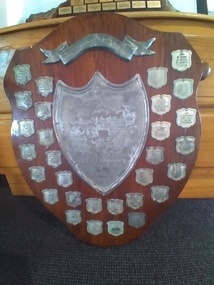
Memorabilia - The Schomberg Cup Honour Board
... Moore, Captain Wocca Moore Chief Engineer Andy Chirnside Boson John Wiber Chief Petty Officer (Later Mutinously & illegally self appointed Tinny Grimwade Lieutenant Commander) Ships Cat Tom Austin Master at Arms I Barty (Mr. ...Moore, Captain Wocca Moore Chief Engineer Andy Chirnside Boson John Wiber Chief Petty Officer (Later Mutinously & illegally self appointed Tinny Grimwade Lieutenant Commander) Ships Cat Tom Austin Master at Arms I Barty (Mr. ...The golf tournament evolved from the P'boro Power Boat Race. The tournament is still a big event on the Peterborough Golf Club calendar. The Cup records the winners of the actual boat race, including the name of the winning boat and the skipper from 1949 to 1962. The winners were: 1949 Won by Albie Affleck Skipper HT Grimwade. 1950 Won by Lady Emma Skipper DC Moore, 1951 Aunt Spee Skipper A W Moore, 1952 JB Skipper J W Bartlam, 1953. Cynic Skipper HT Grimwade, 1954 Tom Thumb Skipper CR Chirnside, 1955 Nipper Skipper PW Coy, 1956 Typhoon Skipper LG Tabart 1957 Lady Nelson skipper DC Moore, 1958 - 1959 The Sea Moore Skipper F Moore, 1960 Cutty Sark Skipper RA Chirnside, 1961 Sweep Skipper S Joyce, 1962 scum skipper WM HolbeachThis honour board is significant because it records the winners over time of the event, but also because it is a link with the original boat race, which was a major fun event over summer in the town.A shield shaped wooden plaque with a metal scroll at the top and metal engraved shield shape in the centre of the board, surrounded by numerous smaller shield shapes, each engraved with the names of the winners and the date. Also a cup with shield shaped plaques around the base to record the winners.Central plaque inscribed thus: THE SCHOMBERG CUP THE OFFICERS OF THE PPBC 1949 Admiral Desmond C. Moore, Captain Wocca Moore Chief Engineer Andy Chirnside Boson John Wiber Chief Petty Officer (Later Mutinously & illegally self appointed Tinny Grimwade Lieutenant Commander) Ships Cat Tom Austin Master at Arms I Barty (Mr. Bartlam) II Brigadier Tinsley III Mark Howard Sub Lieutenant Gitchie Calvert Jnr Boson II Moyle Breton Chief Writer Jonnie Moore peterborough, golf tournament, the schomberg cup, peterborough golf club -
 Port Melbourne Historical & Preservation Society
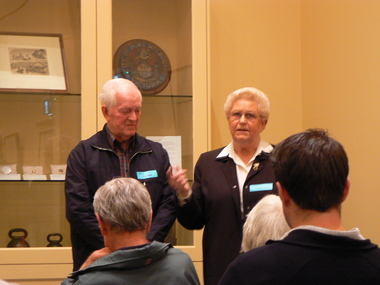
Photograph - Bill and Hazel Thackray, PMHPS Meeting Sep 2010, 27 Sep 2010
... Bill and his wife, Hazel, spoke at the PMHPS Meeting on 27 September 2010 where he donated an Art Deco plaster frieze of a ship (Cat No 2734), salvaged from Port Melbourne Town Hall in the 1970s when the building was renovated....Bill and his wife, Hazel, spoke at the PMHPS Meeting on 27 September 2010 where he donated an Art Deco plaster frieze of a ship (Cat No 2734), salvaged from Port Melbourne Town Hall in the 1970s when the building was renovated. ...Bill THACKARY join Port Melbourne Council in 1946 working in various engineering roles completing his career at Port as City Engineer from 1968 to his retirement 1988. Bill and his wife, Hazel, spoke at the PMHPS Meeting on 27 September 2010 where he donated an Art Deco plaster frieze of a ship (Cat No 2734), salvaged from Port Melbourne Town Hall in the 1970s when the building was renovated.Colour digital photograph of Bill and Hazel THACKRAY at the PMHPS meeting September 2010 in the Council Chamber at Port Melbourne Town Hall.pmhps, port melbourne historical & preservation society, bill thackray, hazel thackray -
 Port Melbourne Historical & Preservation Society
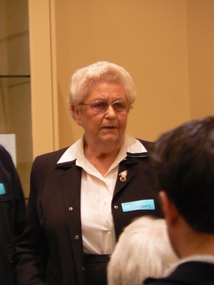
Photograph - Hazel Thackray, PMHPS Meeting Sep 2010, 27 Sep 2010
... Bill and his wife, Hazel, spoke at the PMHPS Meeting on 27 September 2010 where he donated an Art Deco plaster frieze of a ship (Cat No 2734), salvaged from Port Melbourne Town Hall in the 1970s when the building was renovated....Bill and his wife, Hazel, spoke at the PMHPS Meeting on 27 September 2010 where he donated an Art Deco plaster frieze of a ship (Cat No 2734), salvaged from Port Melbourne Town Hall in the 1970s when the building was renovated. ...Bill THACKARY join Port Melbourne Council in 1946 working in various engineering roles completing his career at Port as City Engineer from 1968 to his retirement 1988. Bill and his wife, Hazel, spoke at the PMHPS Meeting on 27 September 2010 where he donated an Art Deco plaster frieze of a ship (Cat No 2734), salvaged from Port Melbourne Town Hall in the 1970s when the building was renovated.Colour digital photograph of Hazel THACKRAY at the PMHPS meeting September 2010 in the Council Chamber at Port Melbourne Town Hall.pmhps, port melbourne historical & preservation society, hazel thackray -
 Bendigo Military Museum
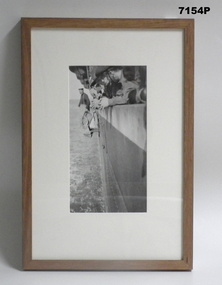
Photograph - FRAMED WW1 PHOTOGRAPH, Wayne Eels, C.2008/2009
... On board ship coming home. Refer Cat No. 1280 for Jacks Grintons service details....On board ship coming home. Refer Cat No. 1280 for Jacks Grintons service details. ...The Grinton Collection. On board ship coming home. Refer Cat No. 1280 for Jacks Grintons service details.Photograph framed. Photograph - black and white photograph on paper depicting a group of soldiers leaning on a ship's gunwale, watching a ship's crewman working off the gunwale. Frame - timber, light varnish finish, Perspex front, cardboard backing."Group 5: Quota 45 - Journey Home". "F. Soldiers watch a ship's crewman."framed accessories, camera on the somme, ww1, 38th bn, grinton, hmat karmala -
 Federation University Historical Collection
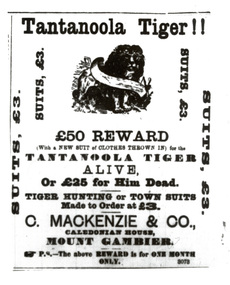
Newspaper - Newsclippings, Tantanoola Tiger Newsclippings
... ships wrecked of the coast between 1890 and 1893, making it to shore along with some of the shipwrecked passengers. (From a card produced by the Tantanoola Tiger Hotel, where the 'tiger' is on display.) australian animal folklore collection tantanoola tiger tom donovan herbert allchurch charles edmunson sheep charlie edmunson mythical myth folklore A collection of Newsclippings from 1892 - 1895 photocopied onto A4 white paper. The clippings relate to the Tantanoola Tiger. Clippings include: * Border Watch 1892 - Tantanoola Tiger Reward * Sydney Morning Herald, 04/07/1857 - Animals in Zoological Gardens, including a number of large cats ...In the early 1880s a small circus travelled between Millicent and Mt Gambier, South Australia. After camping overnight they discovered their Bengal Tiger at escaped and disappeared into dense scrub. After searching for hours they continued to Mt Gambier and reported the loss of the tiger to police. Police and local volunteers continued the search for the escaped tiger, but no sighting were made. In the early 1890s sheep in the Tantanoola area started to disappear with the still unsighted tiger being blamed. In 1893 reports of an unusual animal in the Tantanoola area started, with many describing the animal as the missing tiger, or a large dog. One eye witness claimed to have seen the animal carrying a full grown sheep in its mouth. The reports grew in number and exaggeration with sightings from Robe to Bendigo. In the Tantanoola district children were escorted with shotgun guards to and from school, with many homes keeping guns at the ready in case the tiger suddenly appeared. In August 1895 Tom Donovan shot the "Tantanoola Tiger" on Mt Salt Station, around 20 kms south of Tantanoola. The corpse was taken to Marks, a Mount Gambier taxidermist, at which time the animal was identified as an Assyrian or Northern Russian Wolf. Donovan displayed the animal far and wide. Despite the animal's death sheep continued to disappear from properties in the district over many years. It was of particular concern between 1909 and 1910. At that time Herbert Allchurch, an Adelaide detective, was sent to solve the mystery. A few days after his arrival Allchruch went to the front bar of the Tiger Hotel and arrested local rabbit shooter and trapper, Charlie Edmunson, with sheep stealing. After his 1911 trial Edmunson admitted to stealing over 4,000 sheep during the previous 20 years. He was gaoled for six years with hard-labour in January 1911. Edmunson had been selling the skins of the stolen sheep, leaving the carcusses to rot. He earned around five pounds per week during the 1990s and early 1900s, a time when the economy was depressed. It is not known had the animal known as the Tantanoola Tiger came to Australia, but it is believed it survived one of three ships wrecked of the coast between 1890 and 1893, making it to shore along with some of the shipwrecked passengers. (From a card produced by the Tantanoola Tiger Hotel, where the 'tiger' is on display.)A collection of Newsclippings from 1892 - 1895 photocopied onto A4 white paper. The clippings relate to the Tantanoola Tiger. Clippings include: * Border Watch 1892 - Tantanoola Tiger Reward * Sydney Morning Herald, 04/07/1857 - Animals in Zoological Gardens, including a number of large cats. * Claims the Tantanoola Tiger was an escaped circus animal (ie The Advertiser [Adelaide], 31 October 1893) * Search parties for the Tantanoola Tiger (ie Barrier Miner 19/05/1893; Barrier Miner 03/1081893) * Thylacine claim (ie Morning Bulletin [Rockhampton] 11/03/1895 * Afghan and Indian Hunters (ie Barrier Miner 07/02/1895) * Sighting by John Bird of Scarsdale - Wanganui Herald 15/12/1900. " ... Mr Bird was travelling on foot along a lonely track through very dense scrub, when he was stricken with amazement to see a full-grown tiger standing in a small dam about 30ft away, and holding in its jaws the carcass of a newly-killed lamb. He remained long enough to thoroughly take in the animals appearance, and then beat a hasty retreat unmolested. His description of the animal is as follows: A tawny-coloured creature, with a dirty mottled skin; in general appearance like an immense cat; body 4ft long, and of a uniform thickness from shoulder to hindquarters; in bulk equal to a very large pig. The legs were hidden in the water. A similar animal is reported to gave been seen near Canico, some miles away. ..." * Victorian country sightings # Bullarto - Argus 06/05/1905 # Dean - Launceston Examiner 28/01/1895 # Bendigo - Hobart Mercury 15/03/1895 # Ballan - Launceston Examiner 03/08/1895 * South Australian register 17/06/1885 " There is a tiger or panther wandering at large in Victoria, according to a rumour. It has taken the place of the Bunyip, whom hundreds have seen but none captured. This tiger is supposed to have broken loose from a travelling menagerie in the North-eastern district. At the beginning we should like it roved that such an escape ever took place. Perhaps the showmen were afraid to report the fact to the police; at any rate they did not do so. The first story about the tiger being seen came from the neighborhood of Wangaratta, 60 miles from the place where it is said to have commenced business on its own account. He was followed, but vanished among trees. Next we hear of a strange animal, bigger than a St Bernard's dog, but shorter legged, having appeared at least 150 miles from Wangaratta. Between Lilydale and Wangaratta there is a dividing range 2,000 feet high in the lowest past, besides several large rivers. An finally, the tiger - changed from a panther - is reported as having been seen within the suburban circle, about 8 miles from the general Post Office. They show you footprints, and point to the carcasses of mangled cows and calves. Casts have been taken of the footprints for examination by scientific men, who pronounce them doglike, and yet not doglike, but panther-like, which gives a nervous turn, for the panther may take up killing children and grown-up people. One tiger will not account for so many apparitions. There must have been a general strike among the menageries, and a breaking-up companies. ... * Research article by Philip A. Clarke "Indigenous Spirit and Ghost Folklore of 'Settled' Australia. australian animal folklore collection, tantanoola tiger, tom donovan, herbert allchurch, charles edmunson, sheep, charlie edmunson, mythical, myth, folklore -
 Federation University Historical Collection
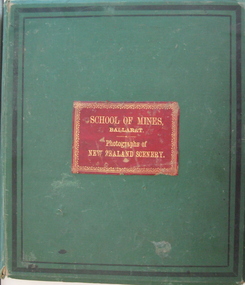
Book - Photo album, Photographs of New Zealand Scenery, 1886, 1886 (exact)
... Cat. No. 458, No. 1720) Alfred Burton was born in 1834 at Leicester and died at Dunedun, New Zealand, in 1914. Walter Burton was born in 1836, and died in 1889. pink terrace white terrace new zealand sumner burton bros rotokakahi wairoa rotomahana crater tikitapu bush wanganui bridge maori canoe volcano mount tarawara james oddie ballarat school of mines museum eruption waterfall bridge sulphur pool crater mt tarawera tikitapu lake rananga house wairoa waikato maori church wairoa ganaru taherepokiore golden bay paterson dowling st dunedin rocky hill harison's cove milford sound tall ship hydraulic mining hale's arm james oddie (donor) george hook stephen carey Lake Rotomahana Each photo has a caption. ...Before Mt Tarawera erupted, the Pink and White Terraces at Lake Rotomahana in New Zealand’s North Island, were considered one of the wonders of the world. Tourists came to soak in the thermal hot pools and view the marble-like terraces. Due to a volcanic eruption of Mt Tarawera On June 10 1886, between 108-120 people were killed and several settlements were destroyed. It also destroyed the world-famous Pink and White Terraces. The terraces became a crater over 100 metres deep. Within 15 years it filled with water, forming a much larger new Lake Rotomahana. The chain of craters at Waimangu became the site of many new geothermal features, including Waimangu Geyser, the largest in the world, and New Zealand’s largest hot spring, Frying Pan Lake. The Burton brothers (photographers), Alfred Burton was born in 1834 in Leicester and died in 1914 in Dunedin. His brother Walter Burton was born in 1836 and died in 1880. Many of the Burton Brothers' works and original equipment were collected by Dunedin photographer and historian Hardwicke Knight, and are now housed in the Museum of New Zealand Te Papa Tongarewa in Wellington. This album was donated to the Ballarat School of Mines Museum by James Oddie in 1887. (See Cat. No. 458, No. 1720) Alfred Burton was born in 1834 at Leicester and died at Dunedun, New Zealand, in 1914. Walter Burton was born in 1836, and died in 1889. Large green album containing numerous B/W original photographs of New Zealand, especially volcanos. - Includes Pink and White Terraces (no longer in existance). Photos were taken before and after volcanic eruption. A recent inclusion is article on the terraces by Federation University's George Hook and Stephen Carey.Each photo has a caption.pink terrace, white terrace, new zealand, sumner, burton bros, rotokakahi wairoa, rotomahana crater, tikitapu bush, wanganui bridge, maori, canoe, volcano, mount tarawara, james oddie, ballarat school of mines museum, eruption, waterfall, bridge, sulphur pool, crater, mt tarawera, tikitapu lake, rananga house, wairoa, waikato, maori church wairoa, ganaru, taherepokiore, golden bay, paterson, dowling st dunedin, rocky hill, harison's cove, milford sound, tall ship, hydraulic mining, hale's arm, james oddie (donor), george hook, stephen carey, lake rotomahana -
 Federation University Historical Collection
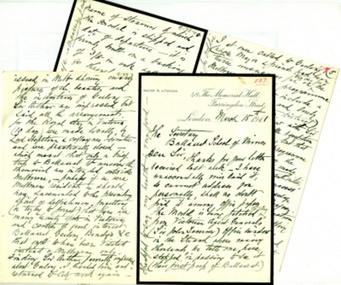
Letter - Correspondence, Walter M. Hitchcock, Letters from Walter M. Hitchcock concerning a model of a Ballarat tent (and more), 1911, 1911 (exact)
... I hope and believe your President will accept it in due time Meantime believe me to be very truly Cat Walter Hitchcock G.F.B. 48 The Memorial Hall Farringdon St London March 15th 1911 The Secretary Ballarat School of Mines Dear Sir, Thanks for your letter received last week – I have unaccountably mislaid it, so cannot address you personally, shall no doubt find it among office papers. The model is being fetched today from Victorian Agent General’s (Sir John [Lavernor?] office window in the Strand where many thousands, he tells me, have stopped in passing to see it (their first peep of Ballaarat). It will be on view at Blackheath (Kent) for a week, then packed and shipped...I hope and believe your President will accept it in due time Meantime believe me to be very truly Cat Walter Hitchcock G.F.B. 48 The Memorial Hall Farringdon St London March 15th 1911 The Secretary Ballarat School of Mines Dear Sir, Thanks for your letter received last week – I have unaccountably mislaid it, so cannot address you personally, shall no doubt find it among office papers. The model is being fetched today from Victorian Agent General’s (Sir John [Lavernor?] office window in the Strand where many thousands, he tells me, have stopped in passing to see it (their first peep of Ballaarat). It will be on view at Blackheath (Kent) for a week, then packed and shipped ...The tent model mentioned in the letters was displayed in the Ballarat School of Mines Museum. During the 1960s it was transferred to the Ballarat Historical Society. Two handwritten letters on paper with black mourning edge written by Walter M. Hitchcock to the Ballarat School of Mines, and another written by Walter's brother George M. Hitchcock.Letter transcription follow: Letter from Walter M. Hitchcock regarding the death of James Oddie and early gold mining at Ballarat, 1910 and 1911 48 The Memorial Hall Farringdon St London Dec1/10 The Secretary Ballarat Museum Dear Sir, I am just now sending you this line, i anticipation of further correspondence later on, simply to forward you a Post Card of the 1st mining tent erected 1851 on the site of he then newly proclaimed Township of Ballarat, which, as the sole survivor of the party who built the original, I have had the pleasure in making, and have decided to present it to your museum, Sir Jno Lasenor out Agent General for Victoria came to a Bazaar recently held in London. where I had it on view in the museum from 3 days, - and desired I would allow its [ ? ] exhibited in the first large window of the beautiful new building of the Victoria Agency situate in the Strand. It is there for the past few days and he may wish it to remain a week or two longer, I know of no other exhibition of it to delay it being packed and shipped to my relatives in Geelong (Mr [?] Bright of Hitchock's Firm) who may wish to show it in one of their windows before forwarding it to your museum - I have had an itemised pane glass case made for it with drop down end and [?} it stands on a plateau of moss, to represent grass 32 x 13 x 13 high and chimney 14 1/2 - the case is made 34 x 26 x 20 high inside - I shall have it very carefully packed - tent emptied tools, beds, &c &c in separate packing and insured for 50 pounds - I will send you full details later on. I hope and believe your President will accept it in due time Meantime believe me to be very truly Cat Walter Hitchcock G.F.B. 48 The Memorial Hall Farringdon St London March 15th 1911 The Secretary Ballarat School of Mines Dear Sir, Thanks for your letter received last week – I have unaccountably mislaid it, so cannot address you personally, shall no doubt find it among office papers. The model is being fetched today from Victorian Agent General’s (Sir John [Lavernor?] office window in the Strand where many thousands, he tells me, have stopped in passing to see it (their first peep of Ballaarat). It will be on view at Blackheath (Kent) for a week, then packed and shipped without further delay. I shall enclose in the glass case (which is 26 x 34 x 16 in high) some spare minced moss and gas (smoke) in case in transit the plateau suffers by shaking (though it is well glued down). All the tools, mining appliances, cradle, windlass, &c will be separately packed enclosed – which you can easily place in respective positions. HRH Prince of Wales has graciously accepted a photo of it – and in my letter to him when sending it for his acceptance I said – as he would probably ere long visit Australia as did his grandfather and father, which ought to (and certainly will) include at least a day or two in seeing your beautiful City, and also something of your mines &c instead of the hurried visit of his father (2 hours) when he, as Duke of York, unveiled a statue to the memory of those slain in the sad Boer War, which now is admitted by almost everybody to have been a big political mistake, - though in the future with England’s present wise policy towards that country it will prove for Africa’s welfare. It may interest you to know that when I ascertained that Geelong was not to be visited by the Royal Pair – I went up to St James’s Palace by appointed time the Duke’s private Secy Sir Arthur Bigge – taking with me a specially illustrated paper issued in Melb. showing many pictures of the beauties and industries of Geelong – Sir Arthur was impressed but said all the arrangements for the Royal stay in Victoria (10 days) were made locally, by Lord Hopetoun and collegues and committee, and were practically closed – which meant that only a brief trip to Ballarat to uncover the memorial was intended outside Melbourne. Perhaps if we were Melbourne residents we should have succumbed to the prevailing spirit of selfishness – forgetting (or trying to forget) that there are many beauty spots in Victoria and centres of great interest - Ballarat, Geelong, Bendigo, &c that ought to have been visited instead of Melbourne only. Finding Sir Arthur favorably impressed about Geelong I thanked him and returned to City work again. I at once called to Geelong whose mayor and friends had been twice unsuccessful in trying for the Melbourne functions programme being altered to include a visit to Geelong and lovely spots in the Western District, reporting my interview with Sir A B and his favourable reception of my representations, but that any alteration to the programme of engagements during the Royal visit must be made locally and by the local authorities. This had the desired success for on receipt of my message the Geelong mayor and colleagues again reopened the question and went to Melbourne, resulting in a concession (but what an altogether inadequate one) and they graciously ? consented to the train, on its way with the Duke and Duchess to your city, to stop at the Geelong stn (15 minutes) and so it came about that by a hasty local effort, 3,000 school children, and not a few of the leading people including the Mayor &c were gathered to welcome them in Geelong. The National anthem being sung, an Address read and presented and kindly replied to. Now Ballarat should doubtless has influence. See to it when our P. Of Wales visits Victoria – an unselfish ¬ programme is fixed up – and HRH afforded ample opportunity of visiting leisurely your city, Geelong, Bendigo and other centres of beauty and importance. The Prince himself will be the gainer by such an equitable and enlightened programme, - and come back with all the more favourable views of the marvellous development ever since our family first settled in Geelong in 1850. A far preferable result of such a visit than night after night having Melbourne Banquets and the visiting of its undoubted attractions - whilst all the rest of the State remained unvisited. Such an official mistake must not be made again. I will write you again, stating name of steamer of which the model is shipped and date of departure – it is firmly built on a backing of 3/8 in oak tall uprights so through the 7/8 in plateau and am entrusting the packing be very careful. I expressed firm – so that except possibly any breakage in glass case – it should reach you in due time all right. The top of case will be screwed so that it can be readily removed temporarily to enable my [ ? ] firm to show it in one of their windows. Believe me Yours very truly Captn Walter M. Hitchcock My brother will deliver it on my a/c – all carriage paid. Mt very kind regards to my friend since 1850 Jas Oddie. University of Ballarat Historical Collection Cat. No. 8133.3 & .4 Letter from Walter M. Hitchcock regarding the death of James Oddie and early gold mining at Ballarat, 1911 48 The Memorial Hall Farringdon St London April 20th 1911 My Dear Sir, It is with no ordinary feeling of regret that I received the tidings of the death of my good friend, your fellow citizen for many years, Mr James Oddie. Living at Geelong from March 1850 I came to know him there as carrying on a foundry business in Ashby. With the discovery of gold at Ballarat started off almost of the working people, as well as of all other classes of the male population. Mr Oddie arrived in Ballarat I believe on or about September 1st 1851. My three comrades and I arrived October 1st 1851 – among the many thousands soon gathered within a mile or so of Golden Point – my friend Oddie and I often met. I returning to Geelong after a year mining – my friend on the other hand remaining at Ballarat ever since – a marvellous record, and I am sure his life has been one of unique value to your City in many ways, - his age (87) naturally prepared me for his call home – and only two mails before the news came I received from him on of his kindly chatty letters in which amongst other things – he referred with pleasure to having received from me two 10 x 12 photos – one being of my model and that he was arranging to have it placed in a shop window in your city. I am interested in the fact of your having known each of my three comrades of 1851/52. It was J.M. Garrett and I who got permission to conduct public Sunday morning service in their large Marquee – used all the week for issue of Licenses in the absence of any church buildings, and it being on wet Sundays impossible to have services as usual under the trees – Ballarat then was more like a Gentleman’s Park – than bush country – but the axe soon did its work – and all were felled for our cooking, and hencewith to make our kindling etc. Shafting of holes not being at first done because too shallow – our deepest (at Eureka) was only 115 ft. Bendigo I hear had now mines of 4,000 ft in depth (deeper than our tin or coal mines here). I fortunately have, in excellent state of preservation, my last of 12 licenses dated October 1 1852 and have recently purchased here a Miner’s Right dated 1864, to that when explaining on matters re Gold Licensing I can show sample of each. With kind regards Believe me Yours sincerely Walter M. Hitchcock Geelong June 20/11 Dear Sir, By rail to day through Messrs Bannister I send the model of miner’s tent packed in a case 50 donated by my brother Captain Walter M. Hitchcock of London. This model was made by my brother and represents the tent he worked in on the Ballarat Gold Fields in the year 1851 or 2. In a separate parcel a few extras omitted from the case. Please send me receipts in duplicate, one for my brother, the other for the Customs, Geelong, as being donated to your institution, after some little correspondence it was admitted [??] any payment for duty. You probably have my brother’s address and would like to acknowledge its arrival, direct. I hope it is in good order. I did not open it for show in Geelong, as there would be less risk of breakage on repacking. With kind remembrances. I am Yours Faithfully Geo. M. Hitchcock. A Mr G. F. B. Sharick who is living near my home called in to see my model – he said he knew FM [Fred Martell] and was lately at Ballaratballarat school of mines, frederick martell, fred martell, james oddie, walter m hitchcock, walter hitchcock, f m garratt, george hitchcock, hitchcock, golden point, gold discovery, j m garrett, gold license, j.m. garrett, t.m. hall, george m. hitchcock, f.m. garratt, walter m. hitchcock -
 Mission to Seafarers Victoria
Letter - Correspondence, Irwin, 30/04/1938
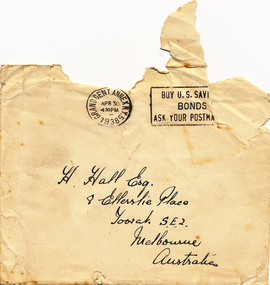
... ship. This is a photograph of social and historic significance, being part of a sub-collection of material that provides a snapshot of the type of individuals involved in the Ladies Harbour Lights Guild and the activities carried out by that organisation. olive duncan olive hall new york irwin henry hall grand central cat photography lillie duncan Waldorf Historia letterhead Envelope with hand written address in ink, to H Hall Esq. ...This letter and photograph illustrates the broad social circle of Henry Gaucheron Hall Jnr and Olive Hall (nee Duncan), who was a member of the Ladies Harbour Lights Guild. The photograph affords a view of a ship's deck, circa 1938. Irwin (family name unknown), is writing about his camera and sends one photograph as an example. He's also writing about the trip on the ship.This is a photograph of social and historic significance, being part of a sub-collection of material that provides a snapshot of the type of individuals involved in the Ladies Harbour Lights Guild and the activities carried out by that organisation.Envelope with hand written address in ink, to H Hall Esq. Postmarked April 1938. Letter hand written in ink dated 30.04.1938 adorned with the Waldorf Historia crest (New York), signed by Irwin. The letter mentions Olive and has a photograph enclosed. Small photograph of ship's deck and two crew inscribed in same ink with "Roy's best Love".Waldorf Historia letterheadolive duncan, olive hall, new york, irwin, henry hall, grand central, cat, photography, lillie duncan -
 Mission to Seafarers Victoria
Journal (item) - Periodicals-Annual, Shiplovers' Society of Victoria, The Annual Dog Watch
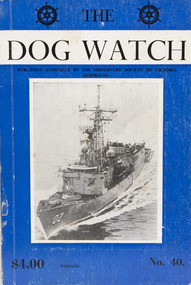
... ships steamships shipping seafaring life shiplovers' society of victoria dog watch Contents Foreword - His Excellency Rear Admiral Sir Brian Murray, K.C.M.G., A.O., K.St.J. - 5 Editorial - Joyce M. B. Lambert - 7 Thirty Years at Garden Island - Illingworth Mackay - 11 Swedish Christmas in New Guinea Waters - Joyce M. B. Lambert - 26 A Gentlemen's Disagreement - Capt. W. Sheffield-Williamson - 34 Around the Horn in "Falls of Clyde" - Capt. Frederick S. Moody, Jnr. - 37 Off the Beaten Track - Mrs. Mary Mithassel - 46 Greek Determination - W. P. Shemmeld - 51 Wharf Cats ...This journal provides the reader with glimpses of the adventures and hardships of a seaman's life. Many of the stories are of sailing ships.Contributes to our knowledge of the importance of shipping and places on record those stories of the sea which would otherwise be lost.Contents Foreword - His Excellency Rear Admiral Sir Brian Murray, K.C.M.G., A.O., K.St.J. - 5 Editorial - Joyce M. B. Lambert - 7 Thirty Years at Garden Island - Illingworth Mackay - 11 Swedish Christmas in New Guinea Waters - Joyce M. B. Lambert - 26 A Gentlemen's Disagreement - Capt. W. Sheffield-Williamson - 34 Around the Horn in "Falls of Clyde" - Capt. Frederick S. Moody, Jnr. - 37 Off the Beaten Track - Mrs. Mary Mithassel - 46 Greek Determination - W. P. Shemmeld - 51 Wharf Cats and Psychology - J.M.B.L. - 56 The Sailor's Wife - C. E. Bonwick - 57 The Dog Watch -- A Tribute to S. A. E. Strom - C. E. - - 58 Behind the Scenes of Captain's Courageous - Capt. Fred Klebingat - 63 Human Error - R. N. Thiele -66 Pay Up - Alex Duffield - 70 Letters from the Barque "Garthneill" Apprentice Colin Goss - 73 Drake and his Treasure - Captain R. G. Edwards - 82 The Story of Two Dogs - Captain Laurie Gibson - 87 Adventure and Misadventure - K. S. Bull - 93 Moonstruck - Captain P. J. Elsey - 96 Confirmation of the Flood? - Doctor J. C. Anderson - 98 The "Scottish Glens" - Captain W. J. Cowling - 100 'Couta Boats at the "Cliff" - Tim Phillips - 107 "Marco Polo" - Extracts - 111 Sailors at Westminster Abbey - E. Harper - 115 Book Reviewssailing ships, steamships, shipping, seafaring life, shiplovers' society of victoria, dog watch -
 Mission to Seafarers Victoria
Journal (item) - Periodicals-Annual, Shiplovers' Society of Victoria, The Annual Dog Watch
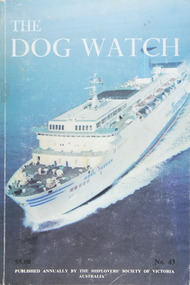
... ships steamships shipping seafaring life shiplovers' society of victoria dog watch Contents Editorial - - 5 Foreword - Capt.R.J.F. McDonell - 6 Abel Tasman -- The Highway to Tasmania - - 9 Up for Second Mate - E. Moodie-Heddle - 13 The Manifest of the Thistle - - 19 HMAS Shropshire in the Philippines Pt. 2 The Lingayen Landings - F. Hoolahan - 21 Two Shipbuilders - J.B. Thompson - 27 The Diamond Cargo Blues - Captain L. Gibson - 32 Port Victoria Epilogue - W.P. Shemmeld - 33 Letter to the Editor - - 39 Sea Shanties - S. Buckland - 41 Cat ...This journal provides the reader with glimpses of the adventures and hardships of a seaman's life. Many of the stories are of sailing ships.Contributes to our knowledge of the importance of shipping and places on record those stories of the sea which would otherwise be lost.Contents Editorial - - 5 Foreword - Capt.R.J.F. McDonell - 6 Abel Tasman -- The Highway to Tasmania - - 9 Up for Second Mate - E. Moodie-Heddle - 13 The Manifest of the Thistle - - 19 HMAS Shropshire in the Philippines Pt. 2 The Lingayen Landings - F. Hoolahan - 21 Two Shipbuilders - J.B. Thompson - 27 The Diamond Cargo Blues - Captain L. Gibson - 32 Port Victoria Epilogue - W.P. Shemmeld - 33 Letter to the Editor - - 39 Sea Shanties - S. Buckland - 41 Cat Overboard - captain Ron Munro - 45 Voyage in Wongala - Desmond Jackson - 48 Retirement of Tor Lingquist - - 66 The "Lawhill" at Sydney Harbour - - 67 Salvage of the Barque Garthsnaid - Captain L. Gibson - 69 A New Entrance to the Port of Brisbane - - 73 Summer -- North Atlantic - Capt. Fred K. Klebingat - 78 The Days of "Whack" and "Slush" - Sir James Bisset - 89 Olivebank Remembered - Alan Glover - 93 The Hobson's Bay Ferry Boats - Capt. H.R. Watson - 97 The King Island Letter - - 101 As My Memory Serves Me - Gordon Wright - 107 The Yardarmer - R.N. Thiele - 112 Piling Up Memories - F. Wavell Urry - 117 Book Reviews - - 127sailing ships, steamships, shipping, seafaring life, shiplovers' society of victoria, dog watch -
 Mission to Seafarers Victoria
Postcard - Photograph, Black and white, Green Bros, 1918
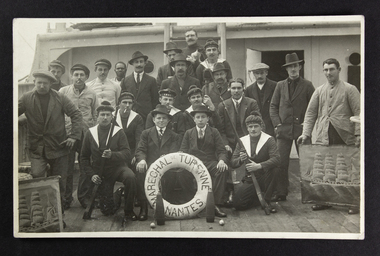
... ...ship mascot...cat...At sea, the threat were the German submarines: the U-boats. crew barque french 1918 marechal de turenne nantes wwi world war one first world war great war buoy ship mascot cat a.m.b.c bayonet african black man apprentices armement militaire des bâtiments de commerce bachi sailor beret radio transmitters telegraph morse telecommunication german submarines u-boats cigarettes smoking williamstown mission to seafarers seamen's mission nelson place crews and ships Printed at the back: On the left: Green Bros/Photo/251 Nelson Place, Williamstown Centered: Post Card/Correspondence/Address only Top right corner for the stamp: Kodak Australia Written at the back: octobre 1918 Souvenir du navire Maréchal de Turenne Berthot Jacquet Renaut R. ...The Maréchal de Turenne, a three mast barque, was built in the "Chantiers de la Loire" shipyard in Nantes, port in the West of France, in 1899 by the company René Guillon et René Fleury. Capacity of 3000 barrels. The barque is called a "cap-hornier" in French. In a book written in 1973 by Georges Aubin, "La mer douce et cruelle", ed. France-Empire, a chapter "Une traversée du trois-mâts nantais Maréchal de Turenne" (page 285 to 319) tells how the ship was navigating from London to New-York to load barrels of petrol bound for Melbourne.The photograph demonstrates how prepared the merchant navy was during the First World War. The French Merchant Navy had additional men from the Navy: the six sailors in uniform and sailor "bachi" bonnet with the AMBC inscription were on the ship to support the crew in case of enemy attack. Two of those soldiers carry a bayonet. One of the sailors is wearing headphones: World War One saw telecommunication progress. At sea, the threat were the German submarines: the U-boats.The photograph depicting the 22 members of the crew was taken in October 1918 onboard the Marechal de Turenne. The two on the right and left side are holding a picture of the barque. One man at the back is holding a cat. 11 names are written at the back. The photograph was turned into a postcard.Printed at the back: On the left: Green Bros/Photo/251 Nelson Place, Williamstown Centered: Post Card/Correspondence/Address only Top right corner for the stamp: Kodak Australia Written at the back: octobre 1918 Souvenir du navire Maréchal de Turenne Berthot Jacquet Renaut R. Renaut H. Lecoq Mercier Berger Dubas Lorie Coat Tilloncrew, barque, french, 1918, marechal de turenne, nantes, wwi, world war one, first world war, great war, buoy, ship mascot, cat, a.m.b.c, bayonet, african, black man, apprentices, armement militaire des bâtiments de commerce, bachi, sailor beret, radio transmitters, telegraph, morse, telecommunication, german submarines, u-boats, cigarettes, smoking, williamstown, mission to seafarers, seamen's mission, nelson place, crews and ships -
 Federation University Historical Collection
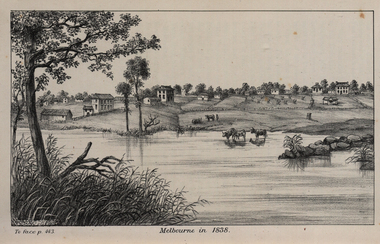
Image, John Helder Wedge, Melbourne in 1838, 1938
... Ship Trust, a not-for-profit organisation. The first settlers were those on board the Enterprize — her crew and passengers. They were John Lancey , master mariner and Fawkner’s representative; Enterprize's captain, Peter Hunter; George Evans, plasterer/builder; carpenters William Jackson and Robert Hay Marr; Evan Evans, George Evans’ servant; and Fawkner’s servants ploughman Charles Wise, general servant Thomas Morgan, blacksmith James Gilbert and his pregnant wife, Mary. And Mary's cat...Ship Trust, a not-for-profit organisation. The first settlers were those on board the Enterprize — her crew and passengers. They were John Lancey , master mariner and Fawkner’s representative; Enterprize's captain, Peter Hunter; George Evans, plasterer/builder; carpenters William Jackson and Robert Hay Marr; Evan Evans, George Evans’ servant; and Fawkner’s servants ploughman Charles Wise, general servant Thomas Morgan, blacksmith James Gilbert and his pregnant wife, Mary. And Mary's cat ...The following information is from http://melbourneday.com.au/about.html, accessed 30 August 2016 Melbourne was founded on 30 August 1835 by settlers who sailed from Van Diemen’s Land (Tasmania) aboard the schooner Enterprize. They landed on the north bank of the Yarra River and established the first permanent settlement, close to where the Immigration Museum at the Old Customs House — on the corner of William and Flinders Streets — stands and the place today known as Enterprize Park. Melbourne Day Committee was established to help correct the record about the founding of Melbourne and celebrate its anniversaries. The settlers came from Launceston in search of sheep-grazing land. Land had become expensive and there had long been stories told by whalers and sealers working in Bass Strait of fertile land to the north. This was the southern part of the colony of New South Wales, which the Colonial Government did not want settled at that time. After the Henty family crossed Bass Strait and settled at Portland in 1834 others quickly followed. The north bank was chosen because a small waterfall, or rapids, stopped further progress up the river. The waterfall also separated the tidal movement, providing a vital supply of fresh water. The site had previously been noted by the colony of New South Wales' surveyor, Charles Grimes, in 1803. The north bank also offered more stable, suitable ground. The people of the Kulin nation are the traditional owners of the land that became Melbourne — including the Boonwurrung, Woiwurrung, Taungurung and Djadjawurrung people, who gathered in this place for ceremonies and cultural activities. The topsail schooner Enterprize you see today is a full-size replica of the one that brought the settlers and has become a symbol of Melbourne Day. Her keel was laid at Polly Woodside Maritime Museum in 1991, and the $2.5 million, 27m vessel was launched by Felicity Kennett on 30 August, 1997, at Hobsons Bay. The original ship was bought by John Pascoe Fawkner in April 1835 specifically to search for a suitable place for a settlement in the Port Phillip District. After helping establish Melbourne, the original Enterprize continued operating as a coastal trading vessel for a number of years. She eventually disappeared off the shipping register in 1847, having been wrecked on a sand bar in the Richmond River in northern NSW, with the loss of two lives. The replica is managed by the Enterprize Ship Trust, a not-for-profit organisation. The first settlers were those on board the Enterprize — her crew and passengers. They were John Lancey , master mariner and Fawkner’s representative; Enterprize's captain, Peter Hunter; George Evans, plasterer/builder; carpenters William Jackson and Robert Hay Marr; Evan Evans, George Evans’ servant; and Fawkner’s servants ploughman Charles Wise, general servant Thomas Morgan, blacksmith James Gilbert and his pregnant wife, Mary. And Mary's cat! Enterprize set sail on her historic voyage from Launceston on July 21, 1835, stopping at George Town in northern Tasmania where creditors detained Fawkner. He was therefore not part of the first trip to Melbourne. Enterprize then left on August 1 under the command of captain Hunter. The expedition was led by Lancey, Fawkner's delegate. The party first considered Western Port and the eastern side of Port Phillip for a place to settle, before deciding on the Yarra’s north bank — known today as Enterprize Park. On Sunday, August 30, they disembarked and began to erect shelter, build a store and clear land to grow food, thus starting the permanent European settlement of Melbourne.Image of the fledgling town of Melbourne on the banks of the Yarra River. melbourne, yarra river, john helder wedge -
 Mission to Seafarers Victoria
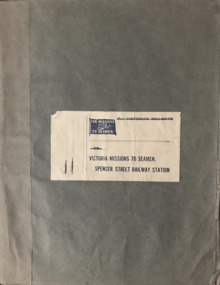
Administrative record (Item) - Scrapbook, Edith E Hitchcock, Victoria Missions to Seamen, Spencer Street Railway Station, 1931-1943
... ship pegasus...sydney harbour bridge...sugar...kota inten...philip vanderhill...lord somers...reverend r. kerdell...r.m.s. moldavia...victoria dock...ww2...pets...bird...dog...cat...Dreillek, Swedish ship Yngaren (similar photo published in 1937 in the Courier Mail Brisbane) Page 9 - 1935: "Reunited": Dog Patsy with ship Pegasus crew members / "Sydney Harbour Bridge": Phillip Vanderhill, Cook of the Kota Inter and its sitar creation Page 11: Mr G. Gatty and Tim, the cat...Dreillek, Swedish ship Yngaren (similar photo published in 1937 in the Courier Mail Brisbane) Page 9 - 1935: "Reunited": Dog Patsy with ship Pegasus crew members / "Sydney Harbour Bridge": Phillip Vanderhill, Cook of the Kota Inter and its sitar creation Page 11: Mr G. Gatty and Tim, the cat ...The scrapbook, compiled by Edith E Hitchcock, displays a variety of newspaper clippings with photographs relating to ships, sailors, their hobbies, Padre Oliver. Page 1 - Map of the British Empire Page 3 - Newspaper clipping with photographs: "Happy Sailors Lads" onboard the CB Pedersen C.1935 Page 5 - Photograph depicting three children watching of a ship at sea Page 7 - 1937: article: with photograph"Sea Captain and Artist": Captain A.C.G. Dreillek, Swedish ship Yngaren (similar photo published in 1937 in the Courier Mail Brisbane) Page 9 - 1935: "Reunited": Dog Patsy with ship Pegasus crew members / "Sydney Harbour Bridge": Phillip Vanderhill, Cook of the Kota Inter and its sitar creation Page 11: Mr G. Gatty and Tim, the cat from the Esperance Bay / Herbert the hen, pet on the ship King Arthur / Frank Simpson, quartermaster and painter from the ship City of Dieppe. Page 13: Conway Seymour and shipmate aboard the Orford. Page 15: 3 photographs of French sailors from the cruiser Rigault de Grenouilly in 1936. Page 16: Photograph of A.J. Kramer working on a ship model aboard the Dutch ship, Kota Inten. Page 17: 1936: Photographs of sailors from the French ship Rigault de Grenouilly and the American ship: California State berthed in Prince's Pier. (plus two large loose clippings with portraits of same sailors). Page 18: 1934: Ball on the Manunda to raise funds for the Mission: photograph of Captain Robert Sunter, Padre Oliver, Moira Oliver, Mrs Harold Clapp. Page 19: Photograph of French sailors from the Rigault de Grenouilly in a bus en route to the Dandenong Ranges. Page 21: Photographs of a shipwreck (probably Kakariki in 1938, see next page). Page 23: Aerial photograph of the shipwreck Kakariki in Hobson's Bay in 1937 Page 25: Photograph of the shipwreck Kakariki in Hobson's Bay in 1937. Page 26: Photograph of the shipwreck Kakariki in Hobson's Bay in 1937. Page 27: Photograph of the survivors from the shipwreck Kakariki in the Mission in 1937: A. Bunyard, W. Fisk, J. Greene, L. Tarlington, J. McInnes, G. Coote, G. Sugar. Page 28: Photograph of the survivors from the shipwreck Kakariki in the Caradale in 1937: W. Fisk, T.W. White. Page 29: Missioneers talk to Firemen: Padre Oliver and his assistant, L.V. Owen talking to ship's firemen.(the Argus, 24 July 1931) Page 31: 3 articles with photographs: American cadets from the California State / Governor's Surprise Visit: Lord Huntingfield visiting Padre Oliver in the Mission (the Argus, 19 May 1936) / Sea Scouts on Liner: Padre Oliver on the P&O Cathay (the Argus, 16 June 1936) Page 33: Harbour Lights: padre Oliver, Lord Somers and Rev. R. Kerdell / Visit of the Duchess to the Mission (the Argus, 26 february 1945). Page 34: Photograph titled "An old salt still yearns for the sea- 369 miles away". Page 35: two clippings : Presentation of cheques for Merchant Navy: Betty Raymond giving a cheque to Padre L.L. Elliott / A cheque for the Seamen's Mission: Photograph of Padre Oliver with a cheque. Page 37: 4 clippings with photographs: Padre Oliver playing the piano for the cadets of the C.B. Pedersen / Miss Gladys Grant with parcels (from the Age 10 November 1943) / All Nations' Dance / Christmas at the Flinders Street mission, Padre Oliver cutting the cake (The Age, 15 December 1942) Page 39: Unveiling of the Memorial window to Captain Robert Sunter in 1936. Page 41: 2 clippings: At the Seamen's Mission: photographs of J. W. Neill and Padre Oliver / Married: Albert Robertson and Beryl Landrigan / Postcard of the St Peter Chapel. Page 43: 2 postcards: The Cloisters / The Mission view from Flinders Street. Page 45: Postcard of the windvane. / clipping of Sailors from the Zealandic. Page 46: 2 clippings: Virtually a Man without a country: Frans Nobel on the ship Milleeta / Seaman, Soldier, Waiter, Singer, Cook Finds Peace (Frans Nobel).(1939) Page 47: That Land Looks Good: two seamen from the tanker British Fame Page 48: large clipping of the C.B. Pedersen "Like a page from the past".(april-May 1935) Page 49: Photograph of Padre Oliver in his army uniform.This scrapbook is significant because it makes reference to contemporaneous events related to the Mission to Seafarers. On the inside cover is the name Edith E. Hitchcock.edith e. hitchcock, scrapbooks, c.b. pedersen, hobbies, ship models, painting, frank leslie oliver, mv manunda, captain robert sunter, windvane, rigault de genouilly, french, german, california, kakariki, ship pegasus, sydney harbour bridge, sugar, kota inten, philip vanderhill, lord somers, reverend r. kerdell, r.m.s. moldavia, victoria dock, ww2, pets, bird, dog, cat, gladys grant, alphonse polo, eugene emonin, raoul gannson, esperance bay, g. gatty, captain a. macwhirter, frank simpson, city of dieppe, conway seymour, orford, a.j. kramer, dutch, moira bird oliver (nee good), mrs harold clapp, caradale, 3uz radio, betty raymond, l.l. elliott, j.h. bustard, merchant navy patriotic fund, g.h. martin, j.w. neill, albert robertson, beryl landrigan, zealandic, frans nobel, milleeta, british fame -
 Mission to Seafarers Victoria
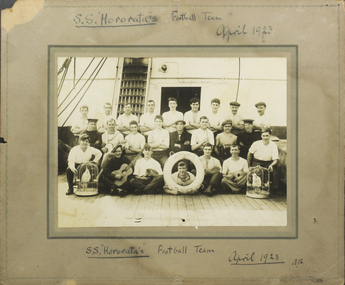
Photograph - Photograph, Black and white, S.S. "Hororata's" Football Team, April 1923, April 1923
... cat...ladder...ss hororata football team...ss hororata...lute...ww1...ww2...troopship...ship...In addition this particular group photograph is of interest as it indicates the many talents and interests of the crew through the items and animals the individuals are posed with. hat 1923 uniform pulley cap banjo guitar rope cockatoo accordion flute cat ladder ss hororata football team ss hororata lute ww1 ww2 troopship ship crew deck soccer football sports crew photo crews and ships On lower edge of mount handwritten in black ink: S.S. ...This is a photograph of crew members that formed the football team of the S.S. Hororata. The vessel was ordered by the New Zealand Shipping Co Ltd of London, completed in 1914. In august of that year she was requisitioned ( as A20) for transport of the Australian expeditionary force in WW1. In WW2 she was known as the SS Waroonga and torpedoed in 1943. (Internet ref 2018) This vessel was a regular visitor to Melbourne and crews visited and contributed donations to the MTS.This photograph provides an early record of the many crew based football (soccer) teams that would enjoy matches when ashore with other crews. The Mission to seamen organised and promoted many such matches and encouraged the friendly competition during outings. In addition this particular group photograph is of interest as it indicates the many talents and interests of the crew through the items and animals the individuals are posed with. Sepia toned photograph of the S.S. "Hororata" Football Team dated April 1923. The photograph has been mounted onto a brown cardboard frame with the text 'S.S. "Hororata's" Football Team/April 1923' on the top and the bottom. The photograph itself is of 24 men in three rows, 9 on the top row, 8 in the middle row and 7 on the bottom row. The man in the bottom row furthest left is kneeling behind a bird cage with a cockatoo in it. The man second from the left is holding a guitar. The man third from the left is holding a cat. The man fourth from the left is lying down peeking through the buoy with the text "S.S. Hororata's/Plymouth". The man second from the right is holding a lute and the man furthest right on the bottom row is also kneeling behind a bird cage with a cockatoo. In the middle row, the man second from the left is holding a banjo. The man third from the right is holding a flute. The man second from the right is holding an accordion. All other men in the middle and top rows have their arms crossed. The men are situated on the ships deck. Behind them is a ladder and what appears to be a door opening and on the left side of the photograph are some ropes and a pulley system.On lower edge of mount handwritten in black ink: S.S. "Hororata" Football Team April 1923hat, 1923, uniform, pulley, cap, banjo, guitar, rope, cockatoo, accordion, flute, cat, ladder, ss hororata football team, ss hororata, lute, ww1, ww2, troopship, ship crew, deck, soccer, football, sports, crew photo, crews and ships -
 Flagstaff Hill Maritime Museum and Village
Cat, 19th century
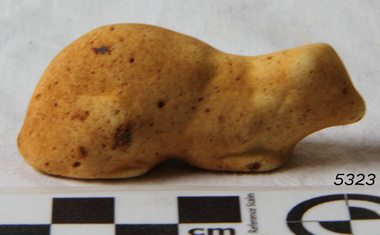
... cat was part of the cargo from the Fiji and amongst the articles salvaged from the wreck. The three-masted iron barque Fiji had been built in Belfast, Ireland, in 1875 by Harland and Wolfe for a Liverpool based shipping company. The ship...cat was part of the cargo from the Fiji and amongst the articles salvaged from the wreck. The three-masted iron barque Fiji had been built in Belfast, Ireland, in 1875 by Harland and Wolfe for a Liverpool based shipping company. The ship ...This toy cat was part of the cargo from the Fiji and amongst the articles salvaged from the wreck. The three-masted iron barque Fiji had been built in Belfast, Ireland, in 1875 by Harland and Wolfe for a Liverpool based shipping company. The ship departed Hamburg on 22nd May 1891 bound for Melbourne, under the command of Captain William Vickers with a crew of 25. The ship’s manifest shows that she was loaded with a cargo of 260 cases of dynamite, pig iron, steel goods, spirits (whisky, schnapps, gin, brandy), sailcloth, tobacco, coiled fencing wire, concrete, 400 German pianos (Sweet Hapsburg), concertinas and other musical instruments, artists supplies including brushes, porcelain, furniture, china, and general cargo including candles. There were also toys in anticipation for Christmas, including wooden rocking horses, miniature ships, dolls with china limbs and rubber balls. On September 5th, one hundred days out from Hamburg in squally and boisterous south west winds the Cape Otway light was sighted on a bearing differing from Captain Vickers’ calculation of his position. At about 2:30am, Sunday 6th September 1891 land was reported 4-5 miles off the port bow. The captain tried to put the ship on the other tack, but she would not respond. He then tried to turn her the other way but just as the manoeuvre was being completed the Fiji struck rock only 300 yards (274 metres) from shore. The place is known as Wreck Bay, Moonlight Head. Blue lights were burned and rockets fired whilst an effort was made to lower boats but all capsized or swamped and smashed to pieces. Two of the younger crewmen volunteered to swim for the shore, taking a line. One, a Russian named Daniel Carkland, drowned after he was swept away when the line broke. The other, 17 year old able seaman Julius Gebauhr, a German, reached shore safely on his second attempt but without the line, which he had cut lose with his sheath-knife when it become tangled in kelp. He rested on the beach a while then climbed the steep cliffs in search of help. At about 10am on the Sunday morning a party of land selectors - including F. J. Stansmore, Leslie Dickson (or Dixon) and Mott - found Gebauhr. They were near Ryans Den, on their travels on horseback from Princetown towards Moonlight Head, and about 5km from the wreck. Gebauhr was lying in the scrub in a poor state, bleeding and dressed only in singlet, socks and a belt with his sheath-knife, ready for all emergencies. At first they were concerned about his wild and shaggy looking state and what seemed to be gibberish speech, taking him to be an escaped lunatic. They were reassured after he threw his knife away and realised that he was speaking half-English, half-German. They gave him food and brandy and some clothing and were then able to gain information about the wreck. Some of the men took him to Rivernook, a nearby guest house owned by John Evans, where he was cared for. Stansmore and Dickson rode off to try and summon help. Others went down to the site of the wreck. Messages for rescuing the rest of the crew were sent both to Port Campbell for the rocket rescue crew and to Warrnambool for the lifeboat. The S.S. Casino sailed from Portland towards the scene. After travelling the 25 miles to the scene, half of the Port Campbell rocket crew and equipment arrived and set up the rocket tripod on the beach below the cliffs. By this time the crew of the Fiji had been clinging to the jib-boom for almost 15 hours, calling frantically for help. Mr Tregear from the Rocket Crew fired the line. The light line broke and the rocket was carried away. A second line was successfully fired across the ship and made fast. The anxious sailors then attempted to come ashore along the line but, with as many as five at a time, the line sagged considerably and some were washed off. Others, nearly exhausted, had to then make their way through masses of seaweed and were often smothered by waves. Only 14 of the 24 who had remained on the ship made it to shore. Many onlookers on the beach took it in turns to go into the surf and drag half-drowned seamen to safety. These rescuers included Bill (William James) Robe, Edwin Vinge, Hugh Cameron, Fenelon Mott, Arthur Wilkinson and Peter Carmody. (Peter Carmody was also involved in the rescue of men from the Newfield.) Arthur Wilkinson, a 29 year old land selector, swam out to the aid of one of the ship’s crewmen, a carpenter named John Plunken. Plunken was attempting to swim from the Fiji to the shore. Two or three times both men almost reached the shore but were washed back to the wreck. A line was thrown to them and they were both hauled aboard. It was thought that Wilkinson struck his head on the anchor before s they were brought up. He remained unconscious. The carpenter survived this ordeal but Wilkinson later died and his body was washed up the next day. It was 26 year old Bill Robe who hauled out the last man, the captain, who had become tangled in the kelp. The wreck of the Fiji was smashed apart within 20 minutes of the captain being brought ashore, and it settled in about 6m of water. Of the 26 men on the Fiji, 11 in total lost their lives. The remains of 7 bodies were washed onto the beach and their coffins were made from timbers from the wrecked Fiji. They were buried on the cliff top above the wreck. The survivors were warmed by fires on the beach then taken to Rivernook and cared for over the next few days. Funds were raised by local communities soon after the wreck in aid of the sufferers of the Fiji disaster. Captain Vickers was severely reprimanded for his mishandling of the ship. His Masters Certificate was suspended for 12 months. At the time there was also a great deal of public criticism at the slow and disorganised rescue attempt to save those on board. The important canvas ‘breech buoy’ or ‘bucket chair’ and the heavy line from the Rocket Rescue was in the half of the rocket outfit that didn’t make it in time for the rescue: they had been delayed at the Gellibrand River ferry. Communications to Warrnambool were down so the call for help didn’t get through on time and the two or three boats that had been notified of the wreck failed to reach it in time. Much looting occurred of the cargo that washed up on the shore, with nearly every visitor leaving the beach with bulky pockets. One looter was caught with a small load of red and white rubber balls, which were duly confiscated and he was ‘detained’ for 14 days. Essence of peppermint mysteriously turned up in many settlers homes. Sailcloth was salvaged and used for horse rugs and tent flies. Soon after the wreck “Fiji tobacco” was being advertised around Victoria. A Customs officer, trying to prevent some of the looting, was assaulted by looters and thrown over a steep cliff. He managed to cling to a bush lower down until rescued. In 1894 some coiled fencing wire was salvaged from the wreck. Hundreds of coils are still strewn over the site of the wreck, encrusted and solidified. The hull is broken but the vessel’s iron ribs can be seen along with some of the cargo of concrete and pig iron. Captain Vickers presented Bill Robe with his silver-cased pocket watch, the only possession that he still had, as a token for having saved his life and the lives of some of the crew. (The pocket watch came with 2 winding keys, one to wind it and one to change the hands.) Years later Bill passed the watch to his brother-in-law Gib (Gilbert) Hulands as payment of a debt and it has been passed down the family to Gilbert Hulands’ grandson, John Hulands. Seaman Julius Gebauhr later gave his knife, in its hand crafted leather sheath, to F. J. Stansmore for caring for him when he came ashore. The knife handle had a personal inscription on it. A marble headstone on the 200m high cliffs overlooking Wreck Beach, west of Moonlight Head, paying tribute to the men who lost their lives when Fiji ran aground. The scene of the wreck is marked by the anchor from the Fiji, erected by Warrnambool skin divers in 1967. Amongst the artefacts salvaged from the Fiji are bisque (or china) toys, (including miniature animals, limbs from small bisque dolls), rubber balls, a slate pencil, a glass bottle, sample of rope from the distress rocket and a candlestick holder. These items are now part of the Fiji collection at Flagstaff Hill Maritime Museum, along with Captain Vickers’ pocket watch and Julius Gebauhr’s sheath knife.This toy cat is classified as Fiji 10 on the SWR Flagstaff Hill’s Fiji collection is of historical significance at a State level because of its association with the wreck Fiji, which is on the Victorian Heritage Register VHR S259. The Fiji is archaeologically significant as the wreck of a typical 19th century international sailing ship with cargo. It is educationally and recreationally significant as one of Victoria's most spectacular historic shipwreck dive sites with structural features and remains of the cargo evident. It also represents aspects of Victoria’s shipping history and its potential to interpret sub-theme 1.5 of Victoria’s Framework of Historical Themes (living with natural processes). The Fiji collection meets the following criteria for assessment: Criterion A: Importance to the course, or pattern, of Victoria’s cultural history. Criterion B: Possession of uncommon, rare or endangered aspects of Victoria’s cultural history Criterion C: Potential to yield information that will contribute to an understanding of Victoria’s cultural history. China toy cat salvaged from the wreck of the Fiji. The cat is in a resting pose. This solid, moulded toy is made of bisque (sometimes described as bisque or porcelain) and the material is tan in colour with a slightly pitted surface.1891, china, shipwrecked coast, flagstaff hill, flagstaff hill maritime museum, maritime museum, shipwrecked artefact, flagstaff hill maritime village, shipwreck coast, warrnambool, porcelain, moonlight head, wreck bay, cargo, bisque, toys, miniature animals, cat -
 Bendigo Military Museum
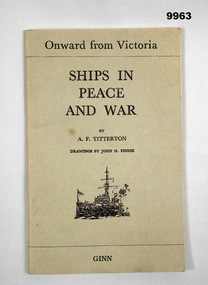
Booklet - UK NAVY SHIPS, Ginn & Company Ltd
... Cat No. 9955. David William Ralph Davies History Booklet UK Navy Light green coloured booklet with 32 white pages inside. Contains 14 Chapters with black writing and some sketches of ships. ...Part of a series of history of the UK. Part of the collection of "Pte David Davies V245464”. For details Refer Cat No. 9955.Light green coloured booklet with 32 white pages inside. Contains 14 Chapters with black writing and some sketches of ships. Covers period of Victorian times to the modern day.david william ralph davies, history, booklet, uk navy -
 Bendigo Military Museum
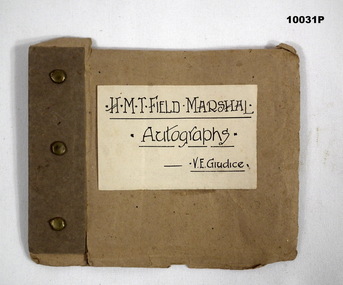
Album - BOOKLET OF AUTOGRAPHS & PHOTOGRAPHS, c. 1917
... Cat No. 4136P. Photos Autographs William (Bill) Thomason Collection Front cover has "H.M.T. FIELD MARSHAL AUTOGRAPHS - V. E. GIUDICE" Brown rough made booklet with 3 studs with clips binding the pages. Inside 5 white pages with autographs on all pages except First and Last Page. Includes photos of A.I.F. Officers, Sergeants, Picture of the convoy, Nurses and on board ship ...From "Vincent Emelio Giudice" No. 53730. Enlisted 12.6.17 in NSW (Reinforcement 4). Embarked for England 19.6.18. Disembarked 26.8.18. Hospitalisation with Bronchitis 14.10.18. Rejoined unit 29.10.18. Promotion to Sergeant 31.8.18. Posted to France as Australian Burials detachment. Discharged 27.1.20 from 55th Battalion. Troopship was a captured German Vessel. Part of the William Thomason Collection. Refer Cat No. 4136P.Brown rough made booklet with 3 studs with clips binding the pages. Inside 5 white pages with autographs on all pages except First and Last Page. Includes photos of A.I.F. Officers, Sergeants, Picture of the convoy, Nurses and on board ship crowd. Label stuck on front cover.Front cover has "H.M.T. FIELD MARSHAL AUTOGRAPHS - V. E. GIUDICE"photos, autographs, william (bill) thomason collection -
 Bendigo Military Museum
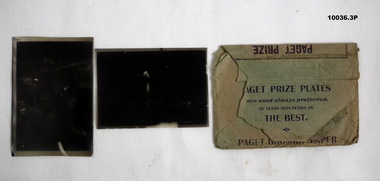
Photograph - PHOTOGRAPHIC NEGATIVES & POUCH, V.E. Giudice, 1917
... Cat No. 4136P. Vincent Emelio Giudice William (Bill) THOMASON Collection Negatives WW1 Stamped "Specially prepared - referring to 12 pieces. Ref No. 6986 3 1/2 x 2 1/2." Also has instructions for development. 1. Black cellulose negative photo of soldiers on board ship ...On board trip to Europe 1917, WW1 by "Vincent Emelio Giudice". Refer Cat No. 10031P for details. Part of the collection of William (Bill) Thomason. Cat No. 4136P.1. Black cellulose negative photo of soldiers on board ship travelling to Europe on a troop convoy. 2. Black cellulose negative photo of boat off the Cape in South Africa. 3. Tattered brown envelope containing the two negatives.Stamped "Specially prepared - referring to 12 pieces. Ref No. 6986 3 1/2 x 2 1/2." Also has instructions for development.vincent emelio giudice, william (bill) thomason collection, negatives, ww1 -
 Bendigo Military Museum
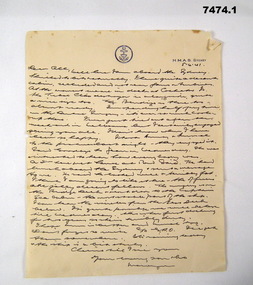
Letter - LETTERS, HMAS SYDNEY, Personal Letter TOWNSEND, C.1941
... Cat No. 2313P for his service details. HMAS SYDNEY was sunk 15 Nov 1941 by German Raider Kormoran. Letter sent to family, parents Edward and Muriel Townsend. HMAS SYDNEY LETTERS WW2 MERVYN CLIVE TOWNSEND .1) Stamped HMAS SYDNEY and dated 5 April 1941. Top of page A - stamp of small circle with an anchor inside it. .2) Stamped HMAS SYDNEY - dated 7 Nov 1941. Top of page, a stamp of small circle with anchor inside it. .1) Letter written on white paper. In black writing on one side blank on other. Stamp of circle and anchor and name of ship ...Letter written by "Mervyn Clive Townsend", Dental Surgeon, KIA HMAS SYDNEY. Refer Cat No. 2313P for his service details. HMAS SYDNEY was sunk 15 Nov 1941 by German Raider Kormoran. Letter sent to family, parents Edward and Muriel Townsend..1) Letter written on white paper. In black writing on one side blank on other. Stamp of circle and anchor and name of ship in blue. .2) Letter written on blue paper with handwriting in blue. Blank on one side and writing on other with stamp of circle and anchor plus ships name..1) Stamped HMAS SYDNEY and dated 5 April 1941. Top of page A - stamp of small circle with an anchor inside it. .2) Stamped HMAS SYDNEY - dated 7 Nov 1941. Top of page, a stamp of small circle with anchor inside it.hmas sydney, letters, ww2, mervyn clive townsend -
 Bendigo Military Museum
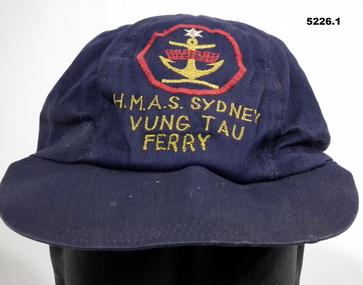
Headwear - CAPS , BASEBALL
... "HMAS BRISBANE/DDG-41" with ship "DICKO" on back and "THE STEEL CAT" on back. 3. "HMAS SUCCESS/OR 304" with ship "DAVID" ON BACK. ...Cat No 5215.5 for his service details. Uniform Headwear Navy Embroidered gold thread, grey thread on illustrations. 1. "HMAS SYDNEY/VUNG TAU/FERRY" below red and gold emblem of an anchor. 2. "HMAS BRISBANE/DDG-41" with ship ...Items in collection re David Dixon RAN R112262, refer Cat No 5215.5 for his service details. Four Baseball caps - with peak, navy blue cotton fabric. 2. With red peak and strap. 3. Corduroy cotton fabric.Embroidered gold thread, grey thread on illustrations. 1. "HMAS SYDNEY/VUNG TAU/FERRY" below red and gold emblem of an anchor. 2. "HMAS BRISBANE/DDG-41" with ship "DICKO" on back and "THE STEEL CAT" on back. 3. "HMAS SUCCESS/OR 304" with ship "DAVID" ON BACK. Handwritten inside "1997/LSMM DIXON/R112262" in black ink. 4. "HMAS YARRA/DE45" with ship on a fabric badge.uniform, headwear, navy -
 Bendigo Military Museum
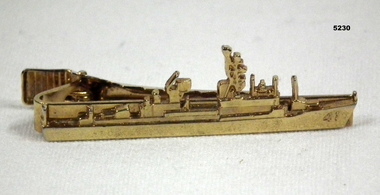
Accessory - TIE CLASP
... Item in collection re David Dixon RAN R112262, refer Cat No 5215.5 for his service details. Accessory Tie clasp Ship RAN Bow of ship has marking 41. ...Item in collection re David Dixon RAN R112262, refer Cat No 5215.5 for his service details. Tie Clasp - Yellow metal tie clasp in the shape of a ship.Bow of ship has marking 41.accessory, tie clasp, ship, ran -
 Bendigo Military Museum
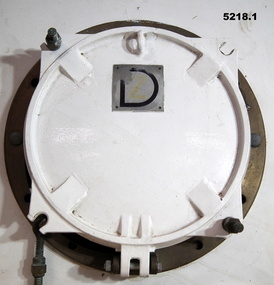
Souvenir - SOUVENIR - RAN SCUTTLE
... Brass Ships Scuttle from HMAS Brisbane 11 - Decommissioned 2001. Bridge and Mount 51 is at AWM. Items in collection re David Dixon RAN R112262, refer Cat No 5215.5 for his service details....Brass Ships Scuttle from HMAS Brisbane 11 - Decommissioned 2001. Bridge and Mount 51 is at AWM. Items in collection re David Dixon RAN R112262, refer Cat No 5215.5 for his service details. ...Brass Ships Scuttle from HMAS Brisbane 11 - Decommissioned 2001. Bridge and Mount 51 is at AWM. Items in collection re David Dixon RAN R112262, refer Cat No 5215.5 for his service details.Brass Ships scuttle from HMAS BRISBANE 11. 1. Circular window with brass frame and glass similar to a porthole, with white painted metal cover secured to frame with hinge and four sadjustable bolts. 2. Circular black plastic decorative insert to cover glass with etching.1. Metal label on scuttle cover - "2" 2. Etching of ships profile with No. "41" on bow (No. 41 - HMAS BRISBANE 11).souvenir, navy, ran -
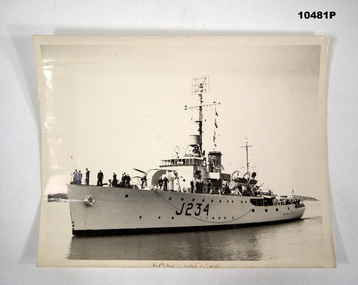 Bendigo Military Museum
Photograph - HMAS LATROBE WW2, Unknown
... Cat No. 4136P. Collection of William (Bill) Thomason HMAS LATROBE Photograph On bottom of photo "HMAS LATROBE". Faded black and white photo of HMAS LATROBE with crewmen standing on board with ship displaying the No. ...HMAS LATROBE was one of the corvettes manufactured during WW2 and was named after a town in Tasmania. Part of William (Bill) Thomason Collection. Refer Cat No. 4136P.Faded black and white photo of HMAS LATROBE with crewmen standing on board with ship displaying the No. "J234". Ship appears to be moving slowly in very calm water.On bottom of photo "HMAS LATROBE".collection of william (bill) thomason, hmas latrobe, photograph -
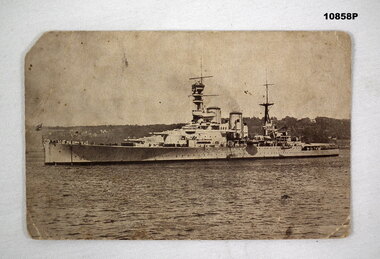 Bendigo Military Museum
Photograph - PHOTOGRAPHIC POSTCARD, HMS RENOWN, c.WW1
... Cat No. 10785P for details of service for "Ernest James Meade" (No. 2112). Meade Collection Ernest James MEADE HMS Renown Photograph Black and white photograph of a battleship at anchor. Postcard format on back with background information on the ship ...Background information on H.M.S. "Renown" printed on back of postcard. Part of the Meade Collection. See Cat No. 10785P for details of service for "Ernest James Meade" (No. 2112).Black and white photograph of a battleship at anchor. Postcard format on back with background information on the ship featured. Text in brown type. No handwritten information.meade collection, ernest james meade, hms renown, photograph -
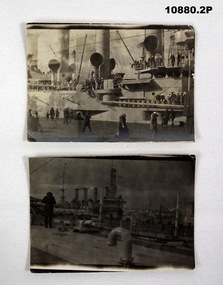 Bendigo Military Museum
Photograph - SHIP DECK, WW2, c.WW2
... See Cat No. 10785P for details of service for "Ernest James Meade" No. 2112. Meade Collection Ernest James MEADE United States Navy WW2 Photograph 1. Black and white photograph of a ship ...Part of the Meade Collection. See Cat No. 10785P for details of service for "Ernest James Meade" No. 2112.1. Black and white photograph of a ship alongside a wharf. United States Navy personnel visible on the deck of the ship. Civilians on wharf. 2. Black and white photograph of a man in civilian clothing standing on the deck of a ship. A four funnel ship in background likely to be the ship pictured in No.1meade collection, ernest james meade, united states navy, ww2, photograph -
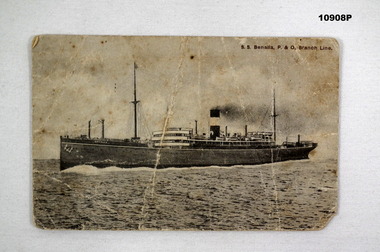 Bendigo Military Museum
Photograph - PHOTOGRAPHIC POSTCARD, HMAT BENALLA, H.M. Flatt, c.WW1
... It was part of the first convoy of ships transporting troops of the Australian Expeditionary Force out of Albany W.A, in November 1914. Part of the Meade Collection. See Cat...It was part of the first convoy of ships transporting troops of the Australian Expeditionary Force out of Albany W.A, in November 1914. Part of the Meade Collection. See Cat ...S.S. Benalla was a WW1 troopship renamed HMAT A24 Benalla. It was part of the first convoy of ships transporting troops of the Australian Expeditionary Force out of Albany W.A, in November 1914. Part of the Meade Collection. See Cat 10785P for details of service for "Ernest James Meade" No. 2112.Black and white photographic postcard of a ship under steam at sea. Single funnel with mast fore and aft. Name of ship on bow "BENALLA". Blank postcard format in brown type on back.Printed in brown lettering on top RH Corner; "S.S. BENALLA, P & O BRANCH LINE"meade collection, ernest james meade, postcard, hmat benalla, australian expeditionary force, ww1, troopship -
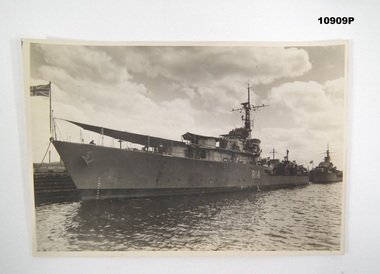 Bendigo Military Museum
Photograph - PHOTOGRAPHIC POSTCARD, HMS ARMADA, c. 1946
... This photograph pictures the ship in Port Melbourne in 1946. Part of the Meade Collection. See Cat No. 10785P for details of service for "Ernest James Meade" No. 2112....This photograph pictures the ship in Port Melbourne in 1946. Part of the Meade Collection. See Cat No. 10785P for details of service for "Ernest James Meade" No. 2112. ...Photograph of British battle-class destroyer HMS Armada. Launched 1943 and commissioned 1945. the ship served as a destroyer escort in WWII. This photograph pictures the ship in Port Melbourne in 1946. Part of the Meade Collection. See Cat No. 10785P for details of service for "Ernest James Meade" No. 2112.Black and white photograph of a ship tied to a wharf. Ship is flying the Union Jack from a mast on bow. Plimsol line on bow is visible. "R14" painted on port side in white. A second ship is visible behind R14.meade collection, ernest james meade, hms armada, ww2 -
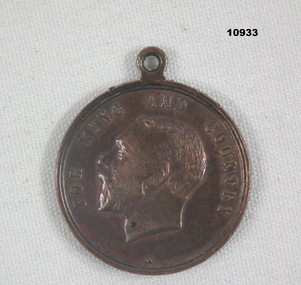 Bendigo Military Museum
Memorabilia - BRITISH NAVAL SQUADRON VISIT, 1924, c.1924
... Cat No. 100928.3 for details of service for "Robert Raymond O'Donahoo", 1399. O'Donahoo Collection Robert Raymond O'Donahoo Commemorative Medal British Navy Copper coloured round medal with loop at top. Obverse features the head of George V with 'FOR KING AND COUNTRY' around it. Reverse side features a sailor on a deck with bull dog standing before a cannon. Cutlass in hand. Four ships ...Medal issued to commemorate the visit of the British Naval Squadron to Australia in 1924. Part of the Donahoo collection. See Cat No. 100928.3 for details of service for "Robert Raymond O'Donahoo", 1399.Copper coloured round medal with loop at top. Obverse features the head of George V with 'FOR KING AND COUNTRY' around it. Reverse side features a sailor on a deck with bull dog standing before a cannon. Cutlass in hand. Four ships in background. Words 'AUSTRALIA WELCOMES THE BRITISH NAVAL SQUADRON 1924'.o'donahoo collection, robert raymond o'donahoo, commemorative medal, british navy -
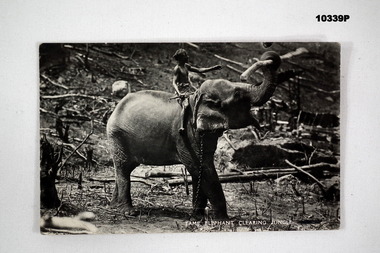 Bendigo Military Museum
Postcard - PHOTOGRAPH POSTCARD, 13 May 1940
... Cat No. 4136P. Collection of William (Bill) Thomason Postcard WW2 Detailed letter on back. "Dated 13 May 1940". A signature faintly scribbled in pencil on top corner. Black and white photo of a boy riding an elephant, clearing the jungle. Has No VX15554 and unit at top then a detailed letter addressed to "Norm", outlining his life on the transport ship ...Postcard from soldier at sea presumably in transit to the Middle East. Signed VX15554 HQ Coy 2/6th Battn, 2 A.I.F. Part of the collection of William (Bill) Thomason, Refer Cat No. 4136P.Black and white photo of a boy riding an elephant, clearing the jungle. Has No VX15554 and unit at top then a detailed letter addressed to "Norm", outlining his life on the transport ship. Detailed letter on back. "Dated 13 May 1940". A signature faintly scribbled in pencil on top corner.collection of william (bill) thomason, postcard, ww2
