
Showing 40 items matching "souvenir wodonga"
-
 Wodonga & District Historical Society Inc
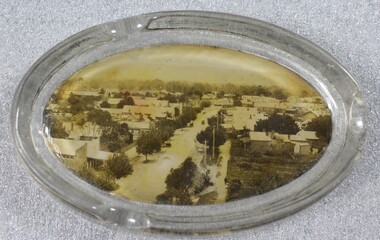
Memorabilia - Souvenir Glass Ashtray Wodonga, Victoria
... Souvenir Glass Ashtray Wodonga, Victoria...Souvenir Glass Ashtray Wodonga, Victoria...wodonga victoria...souvenir...A wide range of small china or glass pieces carrying scenic views of holiday destinations or key locations were a popular kind of souvenir during much of the 20th century. Several different items have been produced to commemorate Wodonga and its landmarks over time. ...This ashtray showcases a photo of High Street, Wodonga, Victoria This item has local historic and social significance as it depicts which features of the city the community valued in the past. It has artistic significance as an example of the kinds of souvenirs used widely across Australia to represent communities and the landscape. wodonga victoria souvenir high street wodonga ash trays An oval shaped glass ashtray, incorporating a sepia print image of High Street, Wodonga, Victoria Souvenir Glass Ashtray Wodonga, Victoria Memorabilia Souvenir Glass Ashtray Wodonga, Victoria ...A wide range of small china or glass pieces carrying scenic views of holiday destinations or key locations were a popular kind of souvenir during much of the 20th century. Several different items have been produced to commemorate Wodonga and its landmarks over time. These items document key changes in Wodonga and its heritage. This ashtray showcases a photo of High Street, Wodonga, VictoriaThis item has local historic and social significance as it depicts which features of the city the community valued in the past. It has artistic significance as an example of the kinds of souvenirs used widely across Australia to represent communities and the landscape.An oval shaped glass ashtray, incorporating a sepia print image of High Street, Wodonga, Victoriawodonga victoria, souvenir, high street wodonga, ash trays -
 Wodonga & District Historical Society Inc
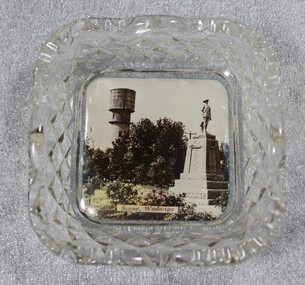
Memorabilia - Souvenir Dish Wodonga Victoria, C. 1925 - 1935
... Souvenir Dish Wodonga Victoria...Souvenir Dish Wodonga Victoria...A wide range of souvenirs have been produced to commemorate Wodonga and its landmarks over time. ...These items have local and social significance as they reflect the landmarks or local features valued by the community over time. wodonga souvenirs water tower soldiers memorial At bottom of central image "Scene, Wodonga" A square crystal dish with image of the Water Tower and Soldiers Memorial Souvenir Dish Wodonga Victoria Memorabilia Souvenir Dish Wodonga Victoria ...A wide range of souvenirs have been produced to commemorate Wodonga and its landmarks over time. These items document key changes in Wodonga and its heritage. The Water Tower and Soldiers Memorial have been key landmarks in the centre of the main street. The Water Tower was in operation from 1924 until it ceased operation in 1959. The original Soldier Memorial was dedicated on Tuesday 18th November, 1924.Small china and glass pieces carrying scenic views of holiday destinations were a popular kind of souvenir during much of the 20th century. These items have local and social significance as they reflect the landmarks or local features valued by the community over time.A square crystal dish with image of the Water Tower and Soldiers MemorialAt bottom of central image "Scene, Wodonga"wodonga, souvenirs, water tower, soldiers memorial -
 Wodonga & District Historical Society Inc
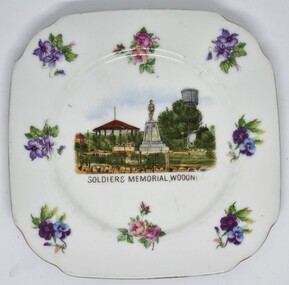
Souvenir - China Souvenir Plate Soldiers' Memorial. Wodonga, Victoria China, c1924 - 1939
... China Souvenir Plate Soldiers' Memorial. Wodonga...China Souvenir Plate Soldiers' Memorial. Wodonga......souvenir wodonga...Wodonga. A wide range of small china pieces carrying scenic views of holiday destinations or key locations were a popular kind of souvenir during much of the 20th century. ...China Souvenir Plate Soldiers' Memorial. Wodonga Souvenir China Souvenir Plate Soldiers' Memorial. ...This item is from a collection donated by descendants of John Francis Turner of Wodonga. A wide range of small china pieces carrying scenic views of holiday destinations or key locations were a popular kind of souvenir during much of the 20th century. Several different items have been produced to commemorate Wodonga and its landmarks over time. These items document key changes in Wodonga and its heritage. This plate depicts three key landmarks in Wodonga. THE SOLDIERS' MEMORIAL in Wodonga was unveiled on Tuesday 18th November 1924. It was designed by Messrs. Hosken & Co., of Hawthorn, Victoria. The monument is all of Australian workmanship. The pedestal is made of Harcourt granite, 9ft x 9ft at the base, and rising in seven courses to a height of 10ft 2in. The emblems (rising sun and wreath) are of bronze, and the lettering of the inscription and names of fallen soldiers are in raised lead letters. Originally the Memorial was completed with a full life size, 6ft in height, sculpture of an Australian soldier in Sicilian marble. The memorial bore the inscriptions: ERECTED BY THE RESIDENTS OF WODONGA AND DISTRICT IN MEMORY of the Men of this Town and District who fell in the Great War, 1914-1919, Also in grateful recognition of the men who served and returned. “Lest We Forget.” In 1982, due to frequent vandalism and high cost of materials to repair, the soldier statue was removed and later installed at the RSL Rooms. THE WATER TOWER is a major landmark of High Street, Wodonga. It began operation from January 1924 until it ceased operation in 1959. It stood unused for a decade until the lower section was modified and put to use as “ The Tower’s Cobbler’s Inn” in 1962. In 1972 Wodonga City Council proposed to demolish the Tower. Their suggestion received an unfavorable response from the city’s citizens, so the Tower still stands today. THE BAND ROTUNDA was officially opened on Sunday 5th September 1920 at the naming of the triangular reserve at the corner of High and Hovell Streets as Woodland Grove. The Wodonga Band gave a public performance on this occasion. The tri-coloured ribbon, which stretched across the entrance to the Rotunda was cut by Mrs R.H Murphy, daughter of Mr. John Woodland, secretary of the Wodonga Shire Council for 35 years, after whom the area was named. The rotunda has since been moved to Martin Park, Wodonga.This item comes from a collection used by a prominent citizen of Wodonga. It is also an excellent example of souvenir items created featuring landmarks to represent the city of Wodonga.A china plate depicting the Soldiers' Memorial Wodonga. The central coloured image is surrounded by a 8 representations of a variety of flowers and a silver edge trim. The makers mark underneath the dish was used between 1918 - 1939 so assists in establishing provenance of the irem.Beneath image: "SOLDIERS' MEMORIAL WODONGA On back of dish, Beneath a crown " VICTORIA CHINA CZECHOSLAVAKIA"victoria china, souvenir wodonga, wodonga soldiers memorial, woodland grove wodonga -
 Wodonga & District Historical Society Inc
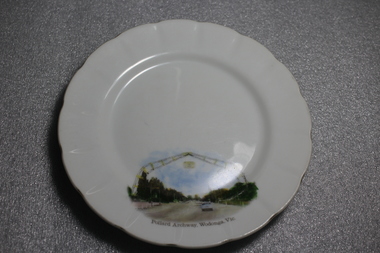
Memorabilia - Souvenir Plate Pollard Arch, Wodonga, Victoria, C. 1960s
... Souvenir Plate Pollard Arch, Wodonga, Victoria...Souvenir Plate Pollard Arch, Wodonga, Victoria...souvenir...wodonga...A wide range of souvenirs have been produced to commemorate Wodonga and its landmarks over time. ...These items have local and social significance as they reflect the landmarks or local features valued by the community over time. souvenir wodonga victoria pollard archway landmarks wodonga On bottom of image "Pollard Archway, Wodonga, Vic". ...A wide range of souvenirs have been produced to commemorate Wodonga and its landmarks over time. These items document key changes in Wodonga and its heritage. The arch is named in honour of Cr Charles Pollard, a foundation member of the Wodonga Show Society and former Wodonga Shire councillor and president. The arch is 29 metres wide and 15 metres high and consists of two boomerangs coming together to form an archway. Originally spanning across a single carriageway of the Lincoln Causeway, the arch was opened by Princess Alexandra of Kent in 1959 and was built for £1230. When the Country Roads Board said the causeway would have to be duplicated in 1973, a new home was required for the arch. At the request of the Wodonga Show Society, the arch was moved to the entrance of the showgrounds in 1982. After development of the precinct in 2015, the Pollard Arch was erected on Hamilton Smith Drive Wodonga.Small china pieces carrying scenic views of holiday destinations were a popular kind of souvenir during much of the 20th century. These items have local and social significance as they reflect the landmarks or local features valued by the community over time.Fine china round plate, white with image of the Pollard Archway in Wodonga, Victoria in the bottom third of the plate. Inscription below the image.On bottom of image "Pollard Archway, Wodonga, Vic". Manufacturer's mark on back "St Kilda/ Fine China/ Australia / Hand Painted"souvenir, wodonga, victoria, pollard archway, landmarks wodonga -
 Wodonga & District Historical Society Inc
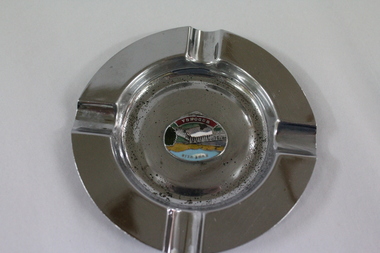
Memorabilia - Souvenir Ashtray Hume Weir Wodonga
... Souvenir Ashtray Hume Weir Wodonga...Souvenir Ashtray Hume Weir Wodonga...souvenir...hume weir...wodonga...Souvenir Ashtray Hume Weir Wodonga Memorabilia Souvenir Ashtray Hume Weir Wodonga ...Metal, china and glass ashtrays and other small pieces carrying scenic views of holiday destinations were a popular kind of souvenir during much of the 20th century. The pictures on the souvenirs ranged across natural beauty spots (beaches, waterfalls, rivers), civic buildings and monuments (town halls, war memorials), and indicators of local progress (commercial centres and occasionally even industrial sites).This ashtray is representative of a range of souvenirs used in the 20th century to depict Wodonga, Victoria and also on a State and National level throughout Australia.A metal circular ashtray including a coloured enamel image of the Hume Weir in the cenre."Above the central image "HUME WEIR" Beneath the central image "WODONGA"souvenir, hume weir, wodonga, ashtray -
 Wodonga & District Historical Society Inc
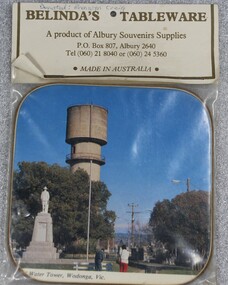
Memorabilia - Souvenir Coaster Woodland Grove Wodonga, Albury Souvenir Supplies, C. 1980s
... Souvenir Coaster Woodland Grove Wodonga...Souvenir Coaster Woodland Grove Wodonga...A range of souvenirs depicting local landmarks were produced to represent and promote Wodonga and other towns throughout much of the 20th century. ...An unopened packet containing a souvenir drink coaster representing Wodonga, Victoria. The coaster is a coloured photo of the Water Tower and Soldiers' Memorial in High Street, Wodonga....The coaster is a coloured photo of the Water Tower and Soldiers' Memorial in High Street, Wodonga. Souvenir Coaster Woodland Grove Wodonga Memorabilia Souvenir Coaster Woodland Grove Wodonga Albury Souvenir Supplies ...A range of souvenirs depicting local landmarks were produced to represent and promote Wodonga and other towns throughout much of the 20th century. THE WATER TOWER is a major landmark of High Street, Wodonga. It began operation from 1924 until it ceased operation in 1959. It stood unused for a decade until the lower section was modified and put to use as “The Tower’s Cobbler’s Inn” in 1962. In 1972 Wodonga City Council proposed to demolish the Tower. Their suggestion received an unfavorable response from the city’s citizens, so the Tower still stands today. THE SOLDIERS' MEMORIAL in Wodonga was unveiled on Tuesday 18th November 1924. The soldier statue on the top has since been removed and placed in the RSL rooms, WodongaAn unopened packet containing a souvenir drink coaster representing Wodonga, Victoria. The coaster is a coloured photo of the Water Tower and Soldiers' Memorial in High Street, Wodonga.Beneath the photo "WATER TOWER, WODONGA, VICsouvenirs wodonga, water tower, memorials, woodland grove -
 Wodonga & District Historical Society Inc
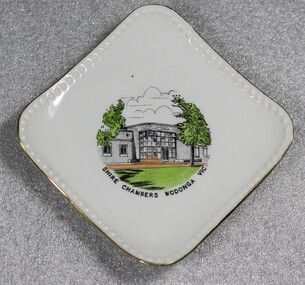
Memorabilia - China Souvenir Plate Shire Chambers Wodonga, Westminster Fine China Australia, C. 1957 - 1962
... China Souvenir Plate Shire Chambers Wodonga...China Souvenir Plate Shire Chambers Wodonga...Wodonga Councillors on 7th August 1957. The Woodland Grove building has since been used for a range of purposes, most recently as a café, but is currently unoccupied. The third purpose-built council chambers were opened in November 1976 with the first council meeting there on 1st December 1976. Westminster Fine China Australia started in the Melbourne suburb of Cheltenham at 7 Arnold Street, in 1954 by Stanley Rogers and Son Ltd. They initially used imported blanks from Japan, which were made to their specifications, and which were then decorated locally. They produced a standard range of shapes for souvenir...The trademark of Westminster Fine China Australia is on the under side of the plate China Souvenir Plate Shire Chambers Wodonga Memorabilia China Souvenir Plate Shire Chambers Wodonga Westminster Fine China Australia ...After meeting for 14 years in rented premises, in the Prince of Wales Hall, Wodonga Council built its first Shire Hall on the corner of High and Elgin Streets in 1890. The first Shire Hall was demolished in 1971. The second building, Wodonga’s new Municipal Offices in Woodland Grove were used for the first time by Wodonga Councillors on 7th August 1957. The Woodland Grove building has since been used for a range of purposes, most recently as a café, but is currently unoccupied. The third purpose-built council chambers were opened in November 1976 with the first council meeting there on 1st December 1976. Westminster Fine China Australia started in the Melbourne suburb of Cheltenham at 7 Arnold Street, in 1954 by Stanley Rogers and Son Ltd. They initially used imported blanks from Japan, which were made to their specifications, and which were then decorated locally. They produced a standard range of shapes for souvenir ware, later expanding into a wide range of tea sets, dinnerware and many other styles of china ware. The Abbey mark, based on Westminster Abbey in London, was used from the start of production until about 1962.Woodland Grove was named in honour of Wodonga Shire’s first president, John Woodland. The building depicted served as the centre of municipal government for approximately 20 years, throughout the 1960s and 1970s. Woodland Grove is a central point in the Wodonga CBD and a focus for many civic and cultural activities.Small square plate with gold trim and central coloured image of Wodonga Shire Chambers. The trademark of Westminster Fine China Australia is on the under side of the plateOn front beneath image "SHIRE CHAMBERS WODONGA VIC" Underneath the plate, surrounding an drawing of Westminster Abbey "FINE CHINA/WESTMINSTER CHINA /AUSTRALIA/ 7" municipal offices, woodland grove wodonga, souvenirs, westminster china -
 Wodonga & District Historical Society Inc
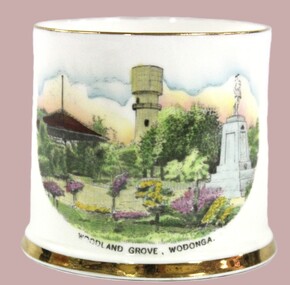
Memorabilia - China Souvenir Cup Woodland Grove Wodonga, c. 1925 - 1940
... China Souvenir Cup Woodland Grove Wodonga...China Souvenir Cup Woodland Grove Wodonga...A wide range of small china pieces carrying scenic views of holiday destinations or key locations were a popular kind of souvenir during much of the 20th century. Several different items have been produced to commemorate Wodonga and its landmarks over time. ...A white souvenir cup made from china with a water colour image of Woodland Grove, Wodonga which incorporates the Soldier Memorial, Water Tower and the Rotunda....China Souvenir Cup Woodland Grove Wodonga Memorabilia China Souvenir Cup Woodland Grove Wodonga Royal Stafford China ...A wide range of small china pieces carrying scenic views of holiday destinations or key locations were a popular kind of souvenir during much of the 20th century. Several different items have been produced to commemorate Wodonga and its landmarks over time. These items document key changes in Wodonga and its heritage. This cup depicts three key landmarks in Wodonga. THE SOLDIERS' MEMORIAL in Wodonga was unveiled on Tuesday 18th November 1924. It was designed by Messrs. Hosken & Co., of Hawthorn, Victoria. The monument is all of Australian workmanship. The pedestal is made of Harcourt granite, 9ft x 9ft at the base, and rising in seven courses to a height of 10ft 2in. The emblems (rising sun and wreath) are of bronze, and the lettering of the inscription and names of fallen soldiers are in raised lead letters. Originally the Memorial was completed with a full life size, 6ft in height, sculpture of an Australian soldier in Sicilian marble. The memorial bore the inscriptions: ERECTED BY THE RESIDENTS OF WODONGA AND DISTRICT IN MEMORY of the Men of this Town and District who fell in the Great War, 1914-1919, Also in grateful recognition of the men who served and returned. “Lest We Forget.” In 1982, due to frequent vandalism and high cost of materials to repair, the soldier statue was removed and later installed at the RSL Rooms. THE WATER TOWER is a major landmark of High Street, Wodonga. It began operation from 1924 until it ceased operation in 1959. It stood unused for a decade until the lower section was modified and put to use as “ The Tower’s Cobbler’s Inn” in 1962. In 1972 Wodonga City Council proposed to demolish the Tower. Their suggestion received an unfavorable response from the city’s citizens, so the Tower still stands today. THE BAND ROTUNDA was officially opened on Sunday 5th September 1920 at the naming of the triangular reserve at the corner of High and Hovell Streets as Woodland Grove. The Wodonga Band gave a public performance on this occasion. The tri-coloured ribbon, which stretched across the entrance to the Rotunda was cut by Mrs R.H Murphy, daughter of Mr. John Woodland, secretary of the Wodonga Shire Council for 35 years, after whom the area was named. The rotunda has since been moved to Martin Park, Wodonga. This item has local historic and social significance as it depicts which features of the city the community valued in the past. It has artistic significance as an example of the kinds of souvenirs used widely across Australia to represent communities and the landscape.A white souvenir cup made from china with a water colour image of Woodland Grove, Wodonga which incorporates the Soldier Memorial, Water Tower and the Rotunda."WOODLAND GROVE, WODONGA."souvenirs, wodonga, woodland grove, soldiers memorial, wodonga landmarks -
 Wodonga & District Historical Society Inc
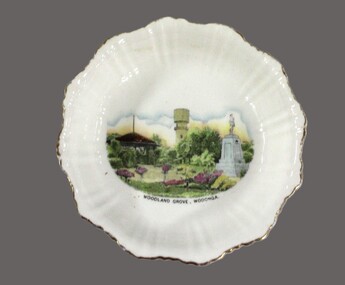
Memorabilia - China Souvenir Bowl Woodland Grove Wodonga, c. 1920 - 1940
... China Souvenir Bowl Woodland Grove Wodonga...China Souvenir Bowl Woodland Grove Wodonga...A wide range of small china pieces carrying scenic views of holiday destinations or key locations were a popular kind of souvenir during much of the 20th century. Several different items have been produced to commemorate Wodonga and its landmarks over time. ...souvenir bowl. Frilled edge. Includes a painted representation of Woodland Grove, Wodonga, Victoria...Includes a painted representation of Woodland Grove, Wodonga, Victoria China Souvenir Bowl Woodland Grove Wodonga Memorabilia China Souvenir Bowl Woodland Grove Wodonga Royal Stafford China ...A wide range of small china pieces carrying scenic views of holiday destinations or key locations were a popular kind of souvenir during much of the 20th century. Several different items have been produced to commemorate Wodonga and its landmarks over time. These items document key changes in Wodonga and its heritage. This plate depicts three key landmarks in Wodonga. THE SOLDIERS' MEMORIAL in Wodonga was unveiled on Tuesday 18th November 1924. It was designed by Messrs. Hosken & Co., of Hawthorn, Victoria. The monument is all of Australian workmanship. The pedestal is made of Harcourt granite, 9ft x 9ft at the base, and rising in seven courses to a height of 10ft 2in. The emblems (rising sun and wreath) are of bronze, and the lettering of the inscription and names of fallen soldiers are in raised lead letters. Originally the Memorial was completed with a full life size, 6ft in height, sculpture of an Australian soldier in Sicilian marble. The memorial bore the inscriptions: ERECTED BY THE RESIDENTS OF WODONGA AND DISTRICT IN MEMORY of the Men of this Town and District who fell in the Great War, 1914-1919, Also in grateful recognition of the men who served and returned. “Lest We Forget.” In 1982, due to frequent vandalism and high cost of materials to repair, the soldier statue was removed and later installed at the RSL Rooms. THE WATER TOWER is a major landmark of High Street, Wodonga. It began operation from 1924 until it ceased operation in 1959. It stood unused for a decade until the lower section was modified and put to use as “ The Tower’s Cobbler’s Inn” in 1962. In 1972 Wodonga City Council proposed to demolish the Tower. Their suggestion received an unfavorable response from the city’s citizens, so the Tower still stands today. THE BAND ROTUNDA was officially opened on Sunday 5th September 1920 at the naming of the triangular reserve at the corner of High and Hovell Streets as Woodland Grove. The Wodonga Band gave a public performance on this occasion. The tri-coloured ribbon, which stretched across the entrance to the Rotunda was cut by Mrs R.H Murphy, daughter of Mr. John Woodland, secretary of the Wodonga Shire Council for 35 years, after whom the area was named. The rotunda has since been moved to Martin Park, Wodonga. This item has local historic and social significance as it depicts which features of the city the community valued in the past. It has artistic significance as an example of the kinds of souvenirs used widely across Australia to represent communities and the landscape.A white glazed china souvenir bowl. Frilled edge. Includes a painted representation of Woodland Grove, Wodonga, VictoriaBeneath the painted central image "WOODLAND GROVE, WODONGAwodonga, souvenirs, woodland grove, ceramics -
 Wodonga & District Historical Society Inc
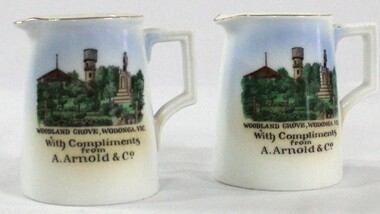
Memorabilia - China Souvenir Jugs Woodland Grove Wodonga, c. 1940
... China Souvenir Jugs Woodland Grove Wodonga...China Souvenir Jugs Woodland Grove Wodonga...A wide range of small china pieces carrying scenic views of holiday destinations or key locations were a popular kind of souvenir during much of the 20th century. Several different pieces were used to depict Wodonga during this period, primarily focusing on the Woodland Grove and the Soldier Memorial. ...A hand-coloured transfer image fills the front side depicts Woodland Grove Wodonga, including the Soldiers' Memorial, Water Tower and Rotunda China Souvenir Jugs Woodland Grove Wodonga Memorabilia China Souvenir Jugs Woodland Grove Wodonga IBC Royal Scenic China ...A wide range of small china pieces carrying scenic views of holiday destinations or key locations were a popular kind of souvenir during much of the 20th century. Several different pieces were used to depict Wodonga during this period, primarily focusing on the Woodland Grove and the Soldier Memorial. In 1924, Arthur Arnold and his father Wilhelm Arnold had established a general store in High Street, near the water tower, but in 1931–32 they moved to new premises in High Street on the corner of what is now known as Elgin Boulevard. In 1933-34 they widened the frontage of the shop and added new premises at the rear for the sale of produce. As customer debt mounted during the depression, it became difficult for Arthur and Wilhelm to re-stock the shop, so they enticed customers into paying their accounts by rewarding them with a small individual cream or milk jug upon payment. The jugs were made in Czechoslovakia and displayed the war memorial, water tower and bandstand from Woodland Grove, Wodonga. The Arnolds continued to trade until they finally closed their store in 1950. Wilhelm Arnold was a brother of J G Arnold, whose business ultimately became the present-day Arnold’s Fruit Market, Wodonga. This item has local historic and social significance as it depicts which features of the city the community valued in the past. It has artistic significance as an example of the kinds of souvenirs used widely across Australia to represent communities and the landscape.A pair of miniature white jugs with a gold rim and handle detailing. A hand-coloured transfer image fills the front side depicts Woodland Grove Wodonga, including the Soldiers' Memorial, Water Tower and RotundaBeneath the image : "WOODLAND GROVE, VIC. / With Compliments/ from/ A. Arnold & Co."wodonga, souvenirs, woodland grove, ceramics, arnolds wodonga -
 Wodonga & District Historical Society Inc
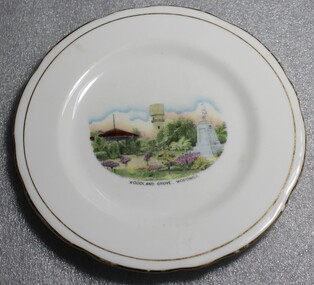
Memorabilia - Souvenir Plate Woodland Grove, Wodonga, Victoria, Royal Stafford China
... Souvenir Plate Woodland Grove, Wodonga, Victoria...Souvenir Plate Woodland Grove, Wodonga, Victoria...A wide range of small china pieces carrying scenic views of holiday destinations or key locations were a popular kind of souvenir during much of the 20th century. Several different items have been produced to commemorate Wodonga and its landmarks over time. ... Plate Woodland Grove, Wodonga, Victoria Memorabilia Souvenir Plate Woodland Grove, Wodonga, Victoria Royal Stafford China ...A wide range of small china pieces carrying scenic views of holiday destinations or key locations were a popular kind of souvenir during much of the 20th century. Several different items have been produced to commemorate Wodonga and its landmarks over time. These items document key changes in Wodonga and its heritage. This plate depicts three key landmarks in Wodonga. THE SOLDIERS' MEMORIAL in Wodonga was unveiled on Tuesday 18th November 1924. It was designed by Messrs. Hosken & Co., of Hawthorn, Victoria. The monument is all of Australian workmanship. The pedestal is made of Harcourt granite, 9ft x 9ft at the base, and rising in seven courses to a height of 10ft 2in. The emblems (rising sun and wreath) are of bronze, and the lettering of the inscription and names of fallen soldiers are in raised lead letters. Originally the Memorial was completed with a full life size, 6ft in height, sculpture of an Australian soldier in Sicilian marble. The memorial bore the inscriptions: ERECTED BY THE RESIDENTS OF WODONGA AND DISTRICT IN MEMORY of the Men of this Town and District who fell in the Great War, 1914-1919, Also in grateful recognition of the men who served and returned. “Lest We Forget.” In 1982, due to frequent vandalism and high cost of materials to repair, the soldier statue was removed and later installed at the RSL Rooms. THE WATER TOWER is a major landmark of High Street, Wodonga. It began operation from 1924 until it ceased operation in 1959. It stood unused for a decade until the lower section was modified and put to use as “ The Tower’s Cobbler’s Inn” in 1962. In 1972 Wodonga City Council proposed to demolish the Tower. Their suggestion received an unfavorable response from the city’s citizens, so the Tower still stands today. THE BAND ROTUNDA was officially opened on Sunday 5th September 1920 at the naming of the triangular reserve at the corner of High and Hovell Streets as Woodland Grove. The Wodonga Band gave a public performance on this occasion. The tri-coloured ribbon, which stretched across the entrance to the Rotunda was cut by Mrs R.H Murphy, daughter of Mr. John Woodland, secretary of the Wodonga Shire Council for 35 years, after whom the area was named. The rotunda has since been moved to Martin Park, Wodonga. This bone china plate features an image of Woodland Grove. Wodonga, Victoria. The image incorporates landmarks in Woodland Grove, including the Soldiers' Memorial, the Rotunda and the Water Tower. There is a makers' mark imprinted on the underside of the plate."ROYAL STAFFORD/BONE CHINA/ MADE IN ENGLAND/ 423" . A crown is in the centre of the textmemorabilia, woodland grove, wodonga victoria -
 Wodonga & District Historical Society Inc
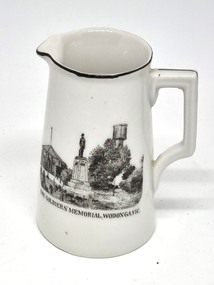
Souvenir - Souvenir Cream Jug - Soldiers' Memorial, Wodonga
... Souvenir Cream Jug - Soldiers' Memorial, Wodonga ...Souvenir Cream Jug - Soldiers' Memorial, Wodonga ......souvenir wodonga...Wodonga. A wide range of small china pieces carrying scenic views of holiday destinations or key locations were a popular kind of souvenir during much of the 20th century. ... Cream Jug - Soldiers' Memorial, Wodonga Souvenir Souvenir Cream Jug - Soldiers' Memorial, Wodonga ...This item is from a collection donated by descendants of John Francis Turner of Wodonga. A wide range of small china pieces carrying scenic views of holiday destinations or key locations were a popular kind of souvenir during much of the 20th century. Several different items have been produced to commemorate Wodonga and its landmarks over time. These items document key changes in Wodonga and its heritage. This plate depicts three key landmarks in Wodonga. THE SOLDIERS' MEMORIAL in Wodonga was unveiled on Tuesday 18th November 1924. It was designed by Messrs. Hosken & Co., of Hawthorn, Victoria. The monument is all of Australian workmanship. The pedestal is made of Harcourt granite, 9ft x 9ft at the base, and rising in seven courses to a height of 10ft 2in. The emblems (rising sun and wreath) are of bronze, and the lettering of the inscription and names of fallen soldiers are in raised lead letters. Originally the Memorial was completed with a full life size, 6ft in height, sculpture of an Australian soldier in Sicilian marble. The memorial bore the inscriptions: ERECTED BY THE RESIDENTS OF WODONGA AND DISTRICT IN MEMORY of the Men of this Town and District who fell in the Great War, 1914-1919, Also in grateful recognition of the men who served and returned. “Lest We Forget.” In 1982, due to frequent vandalism and high cost of materials to repair, the soldier statue was removed and later installed at the RSL Rooms. THE WATER TOWER is a major landmark of High Street, Wodonga. It began operation from January 1924 until it ceased operation in 1959. It stood unused for a decade until the lower section was modified and put to use as “ The Tower’s Cobbler’s Inn” in 1962. In 1972 Wodonga City Council proposed to demolish the Tower. Their suggestion received an unfavorable response from the city’s citizens, so the Tower still stands today. THE BAND ROTUNDA was officially opened on Sunday 5th September 1920 at the naming of the triangular reserve at the corner of High and Hovell Streets as Woodland Grove. The Wodonga Band gave a public performance on this occasion. The tri-coloured ribbon, which stretched across the entrance to the Rotunda was cut by Mrs R.H Murphy, daughter of Mr. John Woodland, secretary of the Wodonga Shire Council for 35 years, after whom the area was named. The rotunda has since been moved to Martin Park, Wodonga.This item comes from a collection used by a prominent citizen of Wodonga. It is also an excellent example of souvenir items created featuring landmarks to represent the city of Wodonga.White glazed porcelain cream jug with grooved square handle. The base is unglazed. The rim and outer face of the handle are outlined in black paint. On one side of the jug is a black transfer print of a the Wodonga Soldiers' Memorial. Text underneath the scene reads "THE SOLDIERS' MEMORIAL, WODONGA, VIC."'. The manufacturer's trademark is printed on the base of the jug. RKG stood for Rudolf Kampf of Grunlas. The mark with the initials under the crown was used from 1921 to 1938.Beneath the image: 'THE SOLDIERS' MEMORIAL WODONGA VIC" Under the jug Manufacturer's trademark printed in orange paint, in a circular formation '(crown) / RK / G' ('RK / G' within circle with handles) above the words "Made in Czechoslovakia"domestic items, souvenir wodonga, woodland grove wodonga -
 Wodonga & District Historical Society Inc
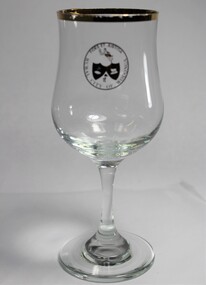
Memorabilia - Wine Glass Rural City of Wodonga, C. 1973 - 2000
... ...souvenir wodonga...Wodonga had "Rural City" status from 1973 until 2003. wodonga local government rural city souvenir wodonga Around the edge of the logo "RURAL CITY OF WODONGA / FIDES ET JUSTITIA" A standard wine glass with a gold trim and bearing the logo of the Rural City of Wodonga Wine Glass Rural City of Wodonga Memorabilia Wine Glass Rural City of Wodonga ...Wodonga Shire was created in 1876 when the colonial government agreed to ratepayers' petitions to have their area severed from the Yackandandah Shire and form a new municipality. In 1973, the Wodonga Shire was granted rural city status and was officially named the Rural City of Wodonga by the Governor of Victoria, Sir Rohan Delacombe. In 1994, a new local government authority, the Wodonga Rural City Council was created. In December 2003, the council was again legally re-named to become Wodonga City Council.The glass is representative of memorabilia produced to celebrate the achievement of a special status in the development of local government in Wodonga. Wodonga had "Rural City" status from 1973 until 2003.A standard wine glass with a gold trim and bearing the logo of the Rural City of WodongaAround the edge of the logo "RURAL CITY OF WODONGA / FIDES ET JUSTITIA"wodonga, local government, rural city, souvenir wodonga -
 Wodonga & District Historical Society Inc
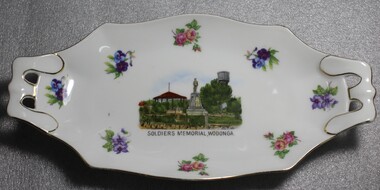
Memorabilia - Wodonga Soldiers' Memorial Plate, Victoria China, C. 1918 - 1939
... souvenir...soldiers memorial...wodonga...A wide range of souvenirs have been produced to commemorate Wodonga and its landmarks over time. ...These items have local and social significance as they reflect the landmarks or local features valued by the community over time. souvenir soldiers memorial wodonga victoria victoria china memorabilia "SOLDIERS MEMORIAL WODONGA" China Plate, Oblong in shape decorated with flowers and an image of the Soldiers' Memorial in Wodonga in the centre. ...A wide range of small china pieces carrying scenic views of holiday destinations or key locations were a popular kind of souvenir during much of the 20th century. Several different pieces were used to depict Wodonga during this period, primarily focusing on the Woodland Grove and the Soldier Memorial. A wide range of souvenirs have been produced to commemorate Wodonga and its landmarks over time. These items document key changes in Wodonga and its heritage. The producers mark on the plate was used by the company Victoria China Czechoslovakia between 1919 and 1938.Small china pieces carrying scenic views of holiday destinations were a popular kind of souvenir during much of the 20th century. These items have local and social significance as they reflect the landmarks or local features valued by the community over time.China Plate, Oblong in shape decorated with flowers and an image of the Soldiers' Memorial in Wodonga in the centre. Makers mark of Victoria China Czechoslovakia which was used from 1918 to1939."SOLDIERS MEMORIAL WODONGA"souvenir, soldiers memorial, wodonga victoria, victoria china, memorabilia -
 Kiewa Valley Historical Society
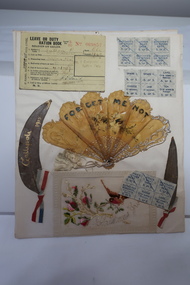
Memorabilia/Souvenir WW1 - Pte. Percy Sutton
... Wodonga. He died on 29th May 1971 at Mt Beauty in the Kiewa Valley. Pte. Percy Sutton WW1 soldier On the Ration book - "Sutton, P. Pte. No. 3942". End of Leave or Duty: "7-1-19". Signed: "G.E.Tait" Stamped: "No. 1 Command Sutton Veny" Attached to white paper a collection of souvenirs from WW1. ...During WW1 soldiers communicated with family in Australia. When they were not required 'in-the-field' they occupied themselves with souvenirs and art work. This includes his ration book and tickets, and artwork consisting of 2 leaves, a fan and Xmas Card all attached to a white piece of paper. This collection may have been attached to the paper by family in Australia or by Percy before his return.Pte. Percy Sutton No. 3942 served in France in WW1. He joined the army on 3rd August 1915, aged 19 years and 5 months and was in the 8th Battalion. He was a railway employee, son of Margaret Sutton of William St, Wodonga. He was 5 feet 7and a half inches tall and a Methodist. He was discharged on 13th April 1919. He was born on 27th January 1897, the son of George and Margaret (nee McIntyre) Sutton. He returned to Wodonga. He died on 29th May 1971 at Mt Beauty in the Kiewa Valley. Attached to white paper a collection of souvenirs from WW1. It includes a Ration book and tickets, 2 gum leaves with French coloured ribbons, a fan inscribed with 'Forget me Not' and a 'Christmas Greetings' Card.On the Ration book - "Sutton, P. Pte. No. 3942". End of Leave or Duty: "7-1-19". Signed: "G.E.Tait" Stamped: "No. 1 Command Sutton Veny"pte. percy sutton, ww1 soldier -
 Wodonga & District Historical Society Inc
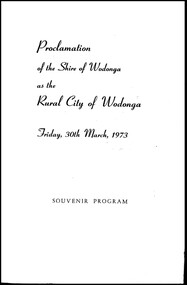
Programme - Proclamation of the Shire of Wodonga as a Rural City, 1973
... On Cover: Proclamation of the Shire of Wodonga as the Rural City of Wodonga Friday 30th March 1973 SOUVENIR PROGRAM...On Cover: Proclamation of the Shire of Wodonga as the Rural City of Wodonga Friday 30th March 1973 SOUVENIR PROGRAM A small booklet of 4 pages stabled along the centre fold. ...This program from the ceremony proclaiming the Shire of Wodonga as a Rural City in 1973 documents the development of Wodonga as an important centre in North East Victoria. The decentralisation of industry and the establishment of international companies in Wodonga in the second half of the 20th century contributed to the growth of Wodonga as a major regional centre today.A small booklet of 4 pages stabled along the centre fold. The cover is printed on glossy light-weight card. It is printed in dark blue ink.This program from the ceremony proclaiming the Shire of Wodonga as a Rural City in 1973 documents the development of Wodonga as an important centre in North East Victoria. The decentralisation of industry and the establishment of international companies in Wodonga in the second half of the 20th century contributed to the growth of Wodonga as a major regional centre today.rural city of wodonga, wodonga council, proclamation wodonga -
 Wodonga & District Historical Society Inc
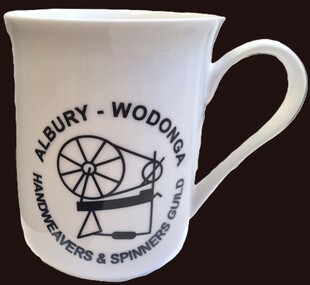
Souvenir - Mug Albury Wodonga Handweavers & Spinners Guild
... The Albury Wodonga Handweavers and Spinners Guild Community Groups Around the spinning wheel ALBURY - Wodonga Handweavers & Spinners Guild Under the base - ARIA Porcelain made in Australia by Australian Fine China DIshwasher & Microwave Safe A white china mug bearing the outline of a spinning wheel, surrounded by black lettering, Mug Albury Wodonga Handweavers & Spinners Guild Souvenir Mug Albury Wodonga Handweavers & Spinners Guild ...The Albury/Wodonga Handweavers and Spinners Guild was formed on 15th July 1970 at a meeting calling for interested people to attend a meeting, Mrs Reis had migrated from England bringing her spinning wheel and floor loom with her. The Guild was formed with 23 inaugural members. Guild members conducted workshops and demonstrated their work at the Albury Show and other venues. In 1973 a Woolcraft Festival Committee was formed and in 1974 the Guild was affiliated with the National Woolcraft Festival, which was held for many years at the Wool Store (in Albury and later at the Albury Showgrounds. In 1980 the Guild published “The Woolgatherers Handspun Pattern Book” which was very popular and had several reprints. The Albury Wodonga Handweavers and Spinners Guild is still an active organisation in the community more than 50 years after its formation. The Company name Australian Fine China was adopted in 1997. Its products were first produced in 1921 from its factory in Subiaco, Western Australia which opened under the name of Calyx Porcelain and Paint Company. In 1938 it was re-named H. L. Brisbane and Wunderlich Ltd. One of its key brands was Bristile with earthenware items known as Wembley Ware. Bristile was re-introduced in the 1960s with the manufacture of vitrified white crockery. In 1997 the name of Australian Fine China was adopted, and the company made china under this name until the closure of the Subiaco factory in 2006. From this time Australian Fine China has operated its business from its headquarters in Welshpool, Perth in Western Australia, with all the products now being made overseas.This item is significant because it represents a long-standing organisation in the Albury Wodonga Community.A white china mug bearing the outline of a spinning wheel, surrounded by black lettering,Around the spinning wheel ALBURY - Wodonga Handweavers & Spinners Guild Under the base - ARIA Porcelain made in Australia by Australian Fine China DIshwasher & Microwave Safethe albury wodonga handweavers and spinners guild, community groups -
 Wodonga & District Historical Society Inc
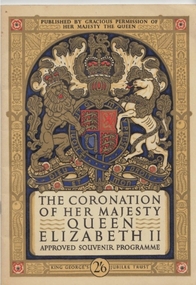
Programme - The Coronation of Her Majesty Queen Elizabeth II, Her Majesty's Printers, 1953
... Wodonga residents. Queen Elizabeth became the official head of the Government of Australia at that time. Coronation of Queen Elizabeth II British Royal Family This souvenir programme was produced to record the coronation of Queen Elizabeth II. ...This souvenir programme was produced to record the coronation of Queen Elizabeth II. Her Majesty ascended the throne, at the age of 25, on the death of her father King George VI on the 6th February 1952. Elizabeth was crowned as the Queen of the United Kingdom and the other Commonwealth realms on June 2nd 1953 at Westminster Abbey. Preparations for the coronation took over a year, it was the first British coronation to be fully televised when cameras were allowed inside the Abbey for the first time and the event was estimated to have cost £1.57 million.An official souvenir programme of the Coronation of Queen Elizabeth II. It includes images, text and the official order of service.This souvenir programme was produced to record the coronation of Queen Elizabeth II. Her Majesty ascended the throne, at the age of 25, on the death of her father King George VI on the 6th February 1952. Elizabeth was crowned as the Queen of the United Kingdom and the other Commonwealth realms on June 2nd 1953 at Westminster Abbey. Preparations for the coronation took over a year, it was the first British coronation to be fully televised when cameras were allowed inside the Abbey for the first time and the event was estimated to have cost £1.57 million.coronation of queen elizabeth ii, british royal family -
 Wodonga & District Historical Society Inc
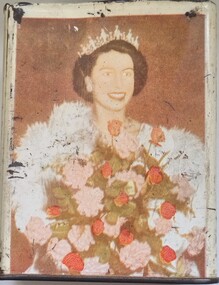
Memorabilia - Money Box - Coronation of Queen Elizabeth II, Besters Sweets, 1953
... souvenirs. Commemorative items also included spoons, tins, flags and money boxes such as this item produced by Bester's Sweets Company in England and in Melbourne, Victoria. This item is significant because it records an important event in the British Royal Family, a vital part of the hereditary of many Wodonga residents. ...The coronation of Elizabeth II as Queen of the United Kingdom and the other Commonwealth realms took place on 2 June 1953 at Westminster Abbey in London. Elizabeth acceded to the throne at the age of 25 upon the death of her father, George VI, on 6 February 1952. It was the first British coronation to be fully televised around the world. Celebrations took place around the world and a wide array of memorabilia was produced. Items ranged from mass-produced ceramics (mugs, plates, teasets) by firms like Doulton to official, limited-edition souvenirs. Commemorative items also included spoons, tins, flags and money boxes such as this item produced by Bester's Sweets Company in England and in Melbourne, Victoria.This item is significant because it records an important event in the British Royal Family, a vital part of the hereditary of many Wodonga residents. Queen Elizabeth became the official head of the Government of Australia at that time.Rectangular money box with light yellow background and a different illustration and inscription on each side. On one side is Queen Elizabeth with Prince Charles. They are framed by a window. She is wearing a light blue suit with a brooch on the lapel and a string of pearls around her neck. A more formal image of the Queen is on the opposite side. She is wearing a tiara and a white fur and is holding a large bunch of flowers. The background is brown. Both side panels are inscribed. Side 1 - "THE ROYAL LINE / SAXON / NORMAN / PLANTAGENET / TUDOR / STUART / HANOVER / SAXE-COBURG AND GOTHA / WINDSOR / ELIZABETH II" Side 2 - EIIR / BORN/ April 21st, 1926 / MARRIED / November 20th, 1947 / ACCESSION TO THRONE / February 6th, 1952 / CORONATION / June 2nd, 1953" One base - Bester's Sweetscoronation of queen elizabeth ii, british royal family, royal memorabilia -
 Wodonga & District Historical Society Inc
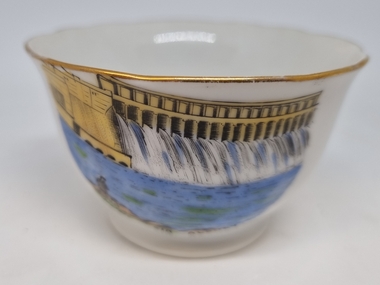
Souvenir - China Bowl - Hume Weir, Albury, Westminster Fine China Australia, c1957
... Wodonga. Westminster Fine China Australia started in the Melbourne suburb of Cheltenham at 7 Arnold Street, in 1954 by Stanley Rogers and Son Ltd. They initially used imported blanks from Japan, which were made to their specifications, and which were then decorated locally. They produced a standard range of shapes for souvenir...Wodonga. Westminster Fine China Australia started in the Melbourne suburb of Cheltenham at 7 Arnold Street, in 1954 by Stanley Rogers and Son Ltd. They initially used imported blanks from Japan, which were made to their specifications, and which were then decorated locally. They produced a standard range of shapes for souvenir ...This item is from a collection donated by descendants of John Francis Turner of Wodonga. Mr Turner was born on 6 June 1885. He completed all of his schooling at Scots Boarding School in Albury, New South Wales. On leaving school, he was employed at Dalgety’s, Albury as an auctioneer. In 1924 John was promoted to Manager of the Wodonga Branch of Dalgety’s. On 15/03/1900 he married Beatrice Neal (born 7/12/1887 and died 7/2/1953) from Collingwood, Victoria. They had four daughters – Frances (Nancy), Heather, Jessie and Mary. In 1920, the family moved from Albury to Wodonga, purchasing their family home “Locherbie” at 169 High Street, Wodonga. "Locherbie" still stands in Wodonga in 2022. The collection contains items used by the Turner family during their life in Wodonga. Westminster Fine China Australia started in the Melbourne suburb of Cheltenham at 7 Arnold Street, in 1954 by Stanley Rogers and Son Ltd. They initially used imported blanks from Japan, which were made to their specifications, and which were then decorated locally. They produced a standard range of shapes for souvenir ware, later expanding into a wide range of tea sets, dinnerware and many other styles of china ware. The Abbey mark, based on Westminster Abbey in London, was used from the start of production until about 1962.The Hume Weir was constructed in the late 1920s and was a critical state in the development of water management in the Murray Darling Basin. At the time of its construction it was the largest water reservoir in the British Empire. Small bowl with gold trim printed with an image of the Hume Weir, Albury. The trademark of Westminster Fine China Australia is on the under side of the plate.On front beneath image "Hume Weir, Albury" Underneath the plate, surrounding an image of Westminster Abbey "FINE CHINA/WESTMINSTER CHINA /AUSTRALIA" souvenirs, westminster china, hume weir australia, memorabilia albury -
 Wodonga & District Historical Society Inc
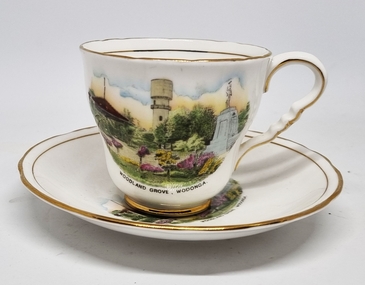
Souvenir - Souvenir Cup and Saucer Woodland Grove, Wodonga, Victoria, Royal Stafford China, c1940s
... Souvenir Cup and Saucer Woodland Grove, Wodonga, Victoria...Souvenir Cup and Saucer Woodland Grove, Wodonga, Victoria...Wodonga. A wide range of small china pieces carrying scenic views of holiday destinations or key locations were a popular kind of souvenir during much of the 20th century. ... Cup and Saucer Woodland Grove, Wodonga, Victoria Souvenir Souvenir Cup and Saucer Woodland Grove, Wodonga, Victoria Royal Stafford China ...This item is from a collection donated by descendants of John Francis Turner of Wodonga. Mr Turner was born on 6 June 1885. He completed all of his schooling at Scots Boarding School in Albury, New South Wales. On leaving school, he was employed at Dalgety’s, Albury as an auctioneer. In 1924 John was promoted to Manager of the Wodonga Branch of Dalgety’s. On 15/03/1900 he married Beatrice Neal (born 7/12/1887 and died 7/2/1953) from Collingwood, Victoria. They had four daughters – Frances (Nancy), Heather, Jessie and Mary. In 1920, the family moved from Albury to Wodonga, purchasing their family home “Locherbie” at 169 High Street, Wodonga. "Locherbie" still stands in Wodonga in 2022. The collection contains items used by the Turner family during their life in Wodonga. A wide range of small china pieces carrying scenic views of holiday destinations or key locations were a popular kind of souvenir during much of the 20th century. Several different items have been produced to commemorate Wodonga and its landmarks over time. These items document key changes in Wodonga and its heritage. This plate depicts three key landmarks in Wodonga. THE SOLDIERS' MEMORIAL in Wodonga was unveiled on Tuesday 18th November 1924. It was designed by Messrs. Hosken & Co., of Hawthorn, Victoria. The monument is all of Australian workmanship. The pedestal is made of Harcourt granite, 9ft x 9ft at the base, and rising in seven courses to a height of 10ft 2in. The emblems (rising sun and wreath) are of bronze, and the lettering of the inscription and names of fallen soldiers are in raised lead letters. Originally the Memorial was completed with a full life size, 6ft in height, sculpture of an Australian soldier in Sicilian marble. The memorial bore the inscriptions: ERECTED BY THE RESIDENTS OF WODONGA AND DISTRICT IN MEMORY of the Men of this Town and District who fell in the Great War, 1914-1919, Also in grateful recognition of the men who served and returned. “Lest We Forget.” In 1982, due to frequent vandalism and high cost of materials to repair, the soldier statue was removed and later installed at the RSL Rooms. THE WATER TOWER is a major landmark of High Street, Wodonga. It began operation from January 1924 until it ceased operation in 1959. It stood unused for a decade until the lower section was modified and put to use as “ The Tower’s Cobbler’s Inn” in 1962. In 1972 Wodonga City Council proposed to demolish the Tower. Their suggestion received an unfavorable response from the city’s citizens, so the Tower still stands today. THE BAND ROTUNDA was officially opened on Sunday 5th September 1920 at the naming of the triangular reserve at the corner of High and Hovell Streets as Woodland Grove. The Wodonga Band gave a public performance on this occasion. The tri-coloured ribbon, which stretched across the entrance to the Rotunda was cut by Mrs R.H Murphy, daughter of Mr. John Woodland, secretary of the Wodonga Shire Council for 35 years, after whom the area was named. The rotunda has since been moved to Martin Park, Wodonga. This item comes from a collection used by a prominent citizen of Wodonga. It is also representative of a domestic item common in the 1940s and features significant landmarks used in many forms to represent the city of Wodonga.This bone china cup and saucer set features an image of Woodland Grove. Wodonga, Victoria. The image incorporates landmarks in Woodland Grove, including the Soldiers' Memorial, the Rotunda and the Water Tower. There is a makers' mark imprinted on the underside of the plate."ROYAL STAFFORD/BONE CHINA/ MADE IN ENGLAND/ 423" . A crown is in the centre of the textmemorabilia, woodland grove, wodonga victoria -
 Wodonga & District Historical Society Inc
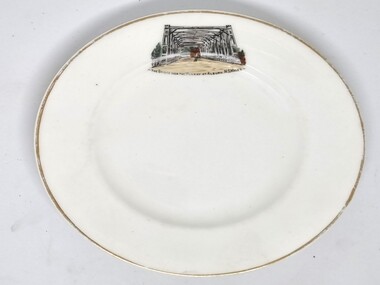
Souvenir - Souvenir Plate - Union Bridge, Albury, Hancock and Sons, c1930s
... This item is from a collection donated by descendants of John Francis Turner of Wodonga. It is one of many souvenirs produced to represent landmarks in the Albury-Wodonga district. ...Wodonga. It is representative of a items produced to represent historic landmarks or features of the district. Albury Souvenirs ...This item is from a collection donated by descendants of John Francis Turner of Wodonga. It is one of many souvenirs produced to represent landmarks in the Albury-Wodonga district. The first punt across the Murray River at Albury was established by Robert Brown in 1843. In 1861 the first Union Bridge was built. It was demolished to make way for the second Union Bridge which opened in 1898. This second bridge closed and was eventually demolished after the third and existing bridge was opened in 1961. Hancock and Sons, Stoke on Trent - Sampson Hancock, a prominent Wesleyan Methodist, started potting in 1857. In 1891 he established the business of Sampson Hancock & Sons. Sampson died in 1900 and the business was continued by his three sons - Jabez, Harry and Arthur. In 1935 the business was in financial difficulty and was made bankrupt. It was restarted as S Hancock & Sons (Potters) Ltd. and moved to the Gordon Works, Hanley - which was renamed the Corona Works. The restarted company was not a success and it finally closed in 1937, having been put into receivership on 23rd March. This information helps to establish provenance of this plate.This item comes from a collection used by a prominent citizen of Wodonga. It is representative of a items produced to represent historic landmarks or features of the district.Fine China round plate with gilt edge and image of the Union Bridge, AlburyBeneath image: " THE BRIDGE OVER THE MURRAY AT ALBURY, NSWALESalbury souvenirs, union bridge albury, albury-wodonga border, murray river bridges -
 Wodonga & District Historical Society Inc
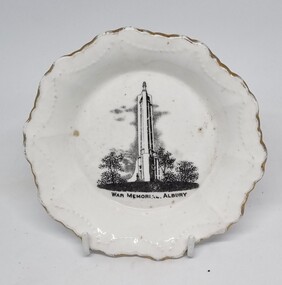
Souvenir - Souvenir Butter Dish - War Memorial, Albury, c1930 -1950s
... This item is from a collection donated by descendants of John Francis Turner of Wodonga It is one of many souvenirs produced to represent landmarks in the Albury-Wodonga district. ...This item is from a collection donated by descendants of John Francis Turner of Wodonga It is one of many souvenirs produced to represent landmarks in the Albury-Wodonga district. ...This item is from a collection donated by descendants of John Francis Turner of Wodonga It is one of many souvenirs produced to represent landmarks in the Albury-Wodonga district. The Albury and District War Memorial was opened on Anzac Day 1925 by General Paine. Designed by the Architect Louis Harrison, the site was chosen by the town planner Charles Reade. The monument is a white ferro concrete tower, in the form of a tapered lighthouse painted stark white and surmounted by a 'torch of liberty'. This torch is 1.8 meters high and faced with 40 panes of prismatic glass. During the day sunlight plays through this glazing giving the torch the illusion it is lit.This item comes from a collection used by a prominent citizen of Wodonga. It is representative of a items produced to represent historic landmarks or features of the district.A small butter bone china butter dish with scalloped edge with gilt edge trim.It features a black and white image of the War' Memorial in Albury.Below image: "WAR MEMORIAL ALBURY"domestic items, albury souvenirs, war memorial albury -
 Wodonga & District Historical Society Inc
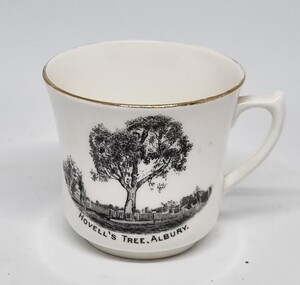
Souvenir - Cup Hovell's Tree, Albury
... This souvenir represents the Hovell Tree, a local historic landmark in Albury, NSW. This item is from a collection donated by descendants of John Francis Turner of Wodonga. ...This item is representative of souvenirs produced to represent key buildings and historic landmarks in the Albury-Wodonga district. ...This souvenir represents the Hovell Tree, a local historic landmark in Albury, NSW. This item is from a collection donated by descendants of John Francis Turner of Wodonga. The Hovell Tree commemorates the exploration and naming of the Hume River (now the Murray) by Hume and Hovell`s expedition of 1824. In 1824, Governor Brisbane asked Hume to join forces with an English sea captain, William Hovell, to go from Lake George to the Spencer Gulf in South Australia. The Hovell Tree, marked by William Hovell on November 17, 1824 was flanked by another tree marked by Hamilton Hume which was destroyed by fire in the 1840's. The river gum was marked by William Hovell when discovering river. Hume and Hovell travelled from the Yass area and after crossing the Murray River where Lake Hume now is, they crossed the Mitta Mitta River and proceeded to Corio Bay, Westernport.This item is representative of souvenirs produced to represent key buildings and historic landmarks in the Albury-Wodonga district.A white cup with gilt trim around the lip. It bears an image of the Hovell Tree in Albury, NSWBeneath image: "HOVELL'S TREE, ALBURY."albury souvenirs, hovell tree, hume and hovell, australian exploration -
 Wodonga & District Historical Society Inc
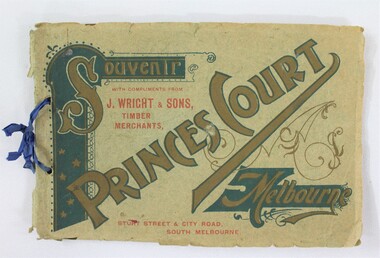
Booklet - Souvenir Booklet for Princes Court Amusement Park, Melbourne 1904-1905
... This item contributes to our understanding of social life and recreation in early twentieth century Victoria. wodonga melbourne princes park amusement park rides fair fairground japanese tea house st kilda A souvenir booklet for Princes Court, an amusement park in Melbourne, printed for the years 1904-5. ...Princes Court was an amusement park in Melbourne, located on St Kilda Road. Established in 1904, it closed its doors in 1909 after poor ticket sales due to Melbourne's temperamental weather. The park featured a toboggan ride and water chute ride where patrons inside open carriages were plunged down sloping structures from a height at great speeds. The park's other facilities and activities included a rifle range, a tug of war game, a Japanese tea house, a wine bar, a variety show, an open air cinema, and roller skating and bicycle races.This item contributes to our understanding of social life and recreation in early twentieth century Victoria. A souvenir booklet for Princes Court, an amusement park in Melbourne, printed for the years 1904-5. The booklet features photographs of the park's attractions, and advertisements for local businesses in Melbourne. wodonga, melbourne, princes park, amusement park, rides, fair, fairground, japanese tea house, st kilda -
 Wodonga & District Historical Society Inc
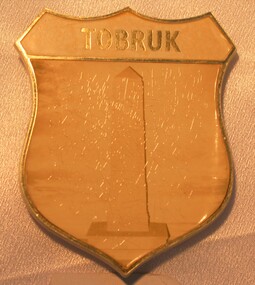
Memorabilia - Tobruk Monument Souvenir
... Wodonga region. World War 11 Rats of Tobruk Tobruk Tobruk Memorial Across the top "TOBRUK" A small plastic shield that depicts the Tobruk Memorial in the centre and Tobruk written across the top in gold lettering. Tobruk Monument Souvenir ...The image on this shield is a representation of the memorial in the middle of the Tobruk War Cemetery. Tobruk War Cemetery incorporates the burial ground used during the siege and the memorial erected there at the time by the Australians has been replaced by a permanent memorial of similar design. Many battlefield graves in the desert have been brought into the cemetery. There are now 2,282 Commonwealth servicemen of the Second World War buried or commemorated in Tobruk War Cemetery. 171 of the burials are unidentified but special memorials commemorate a number of casualties known or believed to be buried among them. This item is part of a collection of items owned by Arthur Lock, a member of the 2/23rd Battalion, an all-volunteer Second Australian Imperial Force which served as part of the garrison during the Siege of Tobruk, then at El Alamein, New Guinea and Borneo. It has particular local significance as the battalion was know as "Albury's Own" because a large majority of the battalion's initial intake of volunteers came from the Albury–Wodonga region.A small plastic shield that depicts the Tobruk Memorial in the centre and Tobruk written across the top in gold lettering.Across the top "TOBRUK"world war 11, rats of tobruk, tobruk, tobruk memorial -
 Wodonga & District Historical Society Inc
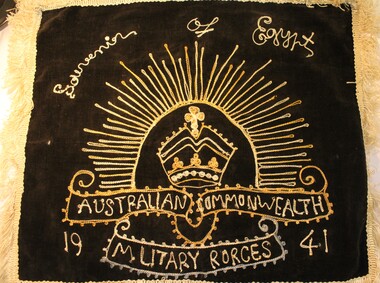
Memorabilia - Souvenir Cushion Cover Egypt 1941
... Wodonga region. World War 11 Rats of Tobruk Tobruk Egypt A cushion cover embroidered with the insignia of the Australian Commonwealth Military Forces 1941 Souvenir Cushion Cover Egypt 1941 Memorabilia Souvenir Cushion Cover Egypt 1941 ...This cushion cover was owned by Arthur Lock, a soldier in the 2/23rd Battalion. After initial training in Albury, N.S.W. and Bonegilla, Victoria, they left for overseas service. Embarking in November 1940 on the transport Strathmore at Port Melbourne, the 2/23rd arrived in Egypt in mid-December. From Egypt they were deployed to Tobruk.This item is part of a collection of items owned by Arthur Lock, a member of the 2/23rd Battalion, an all-volunteer Second Australian Imperial Force which served as part of the garrison during the Siege of Tobruk, then at El Alamein, New Guinea and Borneo. It has particular local significance as the battalion was know as "Albury's Own" because a large majority of the battalion's initial intake of volunteers came from the Albury–Wodonga region.A cushion cover embroidered with the insignia of the Australian Commonwealth Military Forces 1941world war 11, rats of tobruk, tobruk, egypt -
 Wodonga & District Historical Society Inc
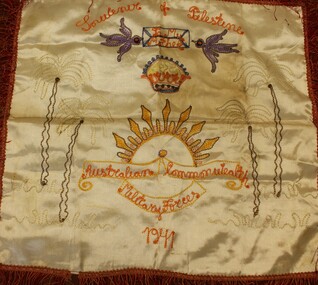
Memorabilia - Souvenir Cushion Cover Palestine 1941
... It has particular local significance as the battalion was know as "Albury's Own" because a large majority of the battalion's initial intake of volunteers came from the Albury–Wodonga region. World War 11 Rats of Tobruk Palestine Top 'Souvenir of Palestine" Centre Insignia of the Australian Commonwealth Military Forces, Bottom "1941" A cushion cover embroidered with the insignia of the Australian Commonwealth Military Forces 1941. ...This cushion cover was owned by Arthur Lock, a soldier in the 2/23rd Battalion. After initial training in Albury, N.S.W. and Bonegilla, Victoria, they left for overseas service. Embarking in November 1940 on the transport Strathmore at Port Melbourne, the 2/23rd arrived in Egypt in mid-December. From Egypt they were deployed to Tobruk. The battalion helped defend Tobruk for eight months, manning a series of concrete pillboxes located in a semicircle around the town, called the Red Line. In October the majority of the 9th Division, except the 2/13th Infantry Battalion, was evacuated by sea. The 2/23rd left on 18 October and sailed to Alexandria. The division was transferred to Palestine and then Syria for rest and garrison duties.This item is part of a collection of items owned by Arthur Lock, a member of the 2/23rd Battalion, an all-volunteer Second Australian Imperial Force which served as part of the garrison during the Siege of Tobruk, then at El Alamein, New Guinea and Borneo. It has particular local significance as the battalion was know as "Albury's Own" because a large majority of the battalion's initial intake of volunteers came from the Albury–Wodonga region.A cushion cover embroidered with the insignia of the Australian Commonwealth Military Forces 1941. Top 'Souvenir of Palestine" Centre Insignia of the Australian Commonwealth Military Forces, Bottom "1941"world war 11, rats of tobruk, palestine -
 Wodonga & District Historical Society Inc
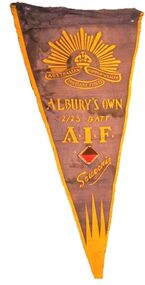
Banner - Souvenir Banner 2/23rd Battalion - Albury's Own
... Wodonga region. World War 11 2/23rd Battalion Albury's Own Arthur Lock A souvenir banner representing the 2/23rd Battalion - Albury's Own. ...Established at Victoria Barracks, in Melbourne, in June 1940, the 2/23rd Battalion was raised as part of the all-volunteer Second Australian Imperial Force and assigned to the 26th Brigade. Under the command of Lieutenant Colonel Bernard Evans, a small cadre of experienced personnel drawn from Victorian Militia units were concentrated at Victoria Barracks prior to the battalion headquarters being relocated to Albury, New South Wales, where a large number of volunteers were completing their recruit training at the 4th Recruit Training Battalion. Upon the conclusion of this course, the recruits were posted to the 2/23rd and the battalion – over 900 strong– moved to Bonegilla, Victoria, just across the border, where more complex collective training was completed prior to departure overseas. A large majority of the battalion's initial intake of volunteers came from the Albury–Wodonga region and as a result, the 2/23rd became known as "Albury's Own"This item is part of a collection of items owned by Arthur Lock, a member of the 2/23rd Battalion, an all-volunteer Second Australian Imperial Force which served as part of the garrison during the Siege of Tobruk, then at El Alamein, New Guinea and Borneo. It has particular local significance as the battalion was know as "Albury's Own" because a large majority of the battalion's initial intake of volunteers came from the Albury–Wodonga region.A souvenir banner representing the 2/23rd Battalion - Albury's Own. The banner incorporates the insignia of the Commonwealth of Australia Military Forces. It also includes the Unit colour patch which is a lozenge shape, divided into brown over red, with a grey trim. This patch was used from 1940 to 1942 when the patch representing service at Tobruk was introduced. world war 11, 2/23rd battalion, albury's own, arthur lock -
 Wodonga & District Historical Society Inc
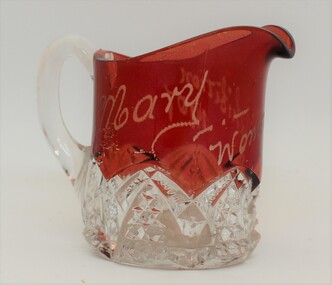
Decorative object - Ruby Glass and crystal jug, 1907
... Wodonga Historical Society by Mrs. Jean Raper. vase glassware decorative items "Mary Women's Exhibition 1907" A small ruby glass and crystal jug which was produced as a souvenir of the Australian Exhibition of Women's Work held at the Exhibition Building in Melbourne in 1907. ...The First Australian Exhibition of Women's Work was held at the Exhibition Building, Melbourne, from 23 October to 30 November 1907. It was opened by Lady Northcote (the wife of Australia’s Governor General) and Pattie Deakin (wife of the Prime Minister), who also ran a model creche during the exhibition. The five week exhibition showcased the work of women musicians, artists and craftswomen with over 16,000 exhibits in all fields of artistic endeavour. It was attended by approximately 250,000 people. Exhibits were divided into Classes, including Fine Arts; Applied Arts; Photography; Plain Needlework; Cookery, Preserves and Laundry Work; Horticulture; and Medical and Nursing. This item was owned by Mrs. Mary Burrowes, aunt of Mrs. Jean Raper.This item is from Raper Collection donated to the Wodonga Historical Society by Mrs. Jean Raper. A small ruby glass and crystal jug which was produced as a souvenir of the Australian Exhibition of Women's Work held at the Exhibition Building in Melbourne in 1907. It has been inscribed in gold coloured paint. "Mary Women's Exhibition 1907"vase, glassware, decorative items
