
Showing 36 items matching "tarpaulin"
-
 Bendigo Military Museum
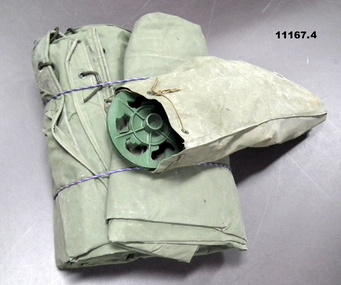
Equipment - TENT, Unknown
... ...Tarpaulin...Tubes, steel for joining tent poles (set of 14). 4. Large tarpaulin, green canvas with attached nylon rope loops....4. Tarpaulin has stencilled on it + Tarpaulin 9.15m x 7.1 metres. 8340-66-019-3631....Equipment Shelter Tarpaulin 4. Tarpaulin has stencilled on it + Tarpaulin 9.15m x 7.1 metres. 8340-66-019-3631. 1. ...Collection re "Paul Denis Ahearn" No, 331325. Refer to Cat No. 11108P for his service details.1. Pegs, tent, black plastic (set of 9). 2. Plastic base plates for tent poles - green colour (set of six). 3. Tubes, steel for joining tent poles (set of 14). 4. Large tarpaulin, green canvas with attached nylon rope loops.4. Tarpaulin has stencilled on it + Tarpaulin 9.15m x 7.1 metres. 8340-66-019-3631.equipment, shelter, tarpaulin -
 Halls Gap & Grampians Historical Society
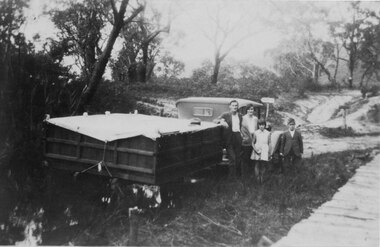
Photograph - B/W, C 1932
... The photo shows a family (a man, a woman, a girl and a boy) standing beside an old car pulling a deep, wooden wagon covered by a tarpaulin. A mans hat sits on the tarpaulin near the man's elbow.The wagon appears to be standing in water and there is a wooden slat surfaced bridge ortrestle to the right. ...RECREATION Camping TRANSPORT Cars The photo shows a family (a man, a woman, a girl and a boy) standing beside an old car pulling a deep, wooden wagon covered by a tarpaulin. A mans hat sits on the tarpaulin near the man's elbow.The wagon appears to be standing in water and there is a wooden slat surfaced bridge ortrestle to the right. ...A family on holiday in the Grampians. The deep wagon is an early form of caravan, which folded down and was ready to erect when a site was found. The man is Jack Diamond from Donald.The photo shows a family (a man, a woman, a girl and a boy) standing beside an old car pulling a deep, wooden wagon covered by a tarpaulin. A mans hat sits on the tarpaulin near the man's elbow.The wagon appears to be standing in water and there is a wooden slat surfaced bridge ortrestle to the right. A track with two signposts is in front of the car and there is thin bush in the background.recreation, camping, transport, cars -
 Lakes Entrance Historical Society
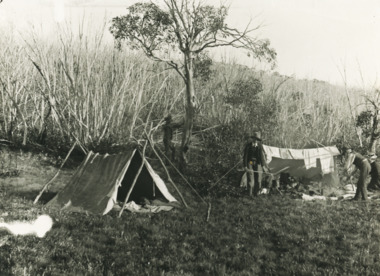
Photograph - Photographers Campsite c1903
... Black and white photograph showing three men and a woman at a basic campsite of tarpaulin tent washing line and open air cooking in East Gippsland Victoria...Other man helped lug the gear Camping Photographers Black and white photograph showing three men and a woman at a basic campsite of tarpaulin tent washing line and open air cooking in East Gippsland Victoria Photograph Photographers Campsite c1903 ...Man at fire looks like Nicholas Caire Photographer. Woman Mrs Caire who often travelled with him. Young man possibly H D Bulmer who travelled with Caire and learned photography. Other man helped lug the gearBlack and white photograph showing three men and a woman at a basic campsite of tarpaulin tent washing line and open air cooking in East Gippsland Victoriacamping, photographers -
 Glenelg Shire Council Cultural Collection
Photograph - Photograph - aerial view of cargo train being prepared for unloading, n.d
... Carriages have tarpaulins being removed. Front of train is under cover of a shed....Carriages have tarpaulins being removed. Front of train is under cover of a shed. ...Port of Portland Authority archivesFront: (no inscriptions) Back: (no inscriptions)port of portland archives, aerial photography, portland harbour -
 National Vietnam Veterans Museum (NVVM)
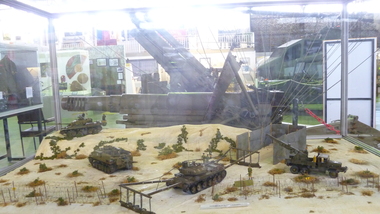
Model - Diorama
... Three tanks and one recovery vehicle. A tarpaulin eclosure and barbed wire fence....Three tanks and one recovery vehicle. A tarpaulin eclosure and barbed wire fence. Model Diorama ...Terrain and vehicles used to clear Australian constructed minefield in Phuoc Tuy Province. Three tanks and one recovery vehicle. A tarpaulin eclosure and barbed wire fence.169099 38D, 169122 38D, 169072 38D on tanks. White star on recovery vehicle.diorama, phuoc tuy province, mine clearing -
 National Vietnam Veterans Museum (NVVM)
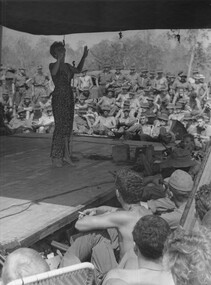
Photograph, Gibbons, Denis, Needed Shade
... A black and white photograph - Following an approach by Denis Gibbons after seeing the distress of the entertainers at the morning show, the engineers erected a tarpaulin over the temporary state. Here Lorrae Desmond enjoys the coolness. ...Photograph Entertainers Lorrae Desmond Gibbons Collection Catalogue 1 ATF Nui Dat Digger Engineers 1st Australian Task Force Denis Gibbons A black and white photograph - Following an approach by Denis Gibbons after seeing the distress of the entertainers at the morning show, the engineers erected a tarpaulin over the temporary state. Here Lorrae Desmond enjoys the coolness. ...Denis Gibbons (1937 – 2011) Trained with the Australian Army, before travelling to Vietnam in January 1966, Denis stayed with the 1st Australian Task Force in Nui Dat working as a photographer. For almost five years Gibbons toured with nine Australian infantry battalions, posting compelling war images from within many combat zones before being flown out in late November 1970 after sustaining injuries. The images held within the National Vietnam Veterans Museum make up the Gibbons Collection. A black and white photograph - Following an approach by Denis Gibbons after seeing the distress of the entertainers at the morning show, the engineers erected a tarpaulin over the temporary state. Here Lorrae Desmond enjoys the coolness. photograph, entertainers, lorrae desmond, gibbons collection catalogue, 1 atf, nui dat, digger, engineers, 1st australian task force, denis gibbons -
 Eltham District Historical Society Inc
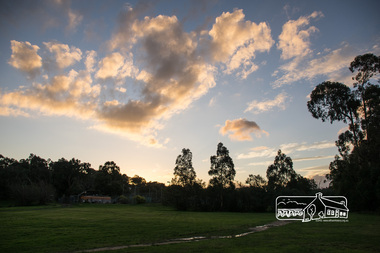
Photograph, Fred Mitchell, Clouds over the Diamond Creek Trail, 23 May 2014, 23/05/2014
... The structure with an orange tarpaulin is the plant nursery attached to the Diamond Creek Men's Shed....The structure with an orange tarpaulin is the plant nursery attached to the Diamond Creek Men's Shed. fred mitchell collection 2014 diamond creek trail Digital copy of colour photograph Clouds over the Diamond Creek Trail, 23 May 2014 Photograph Fred Mitchell ...The structure with an orange tarpaulin is the plant nursery attached to the Diamond Creek Men's Shed.Digital copy of colour photographfred mitchell collection, 2014, diamond creek trail -
 City of Ballarat Libraries
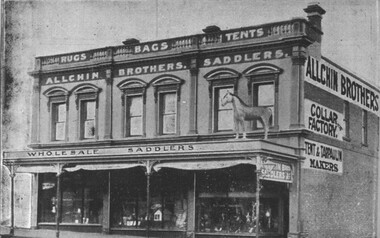
Photograph - Card Box Photographs, Allchin Brothers Saddlers, Ballarat 1914
... Along with saddles, they also made rugs, tents & tarpaulins....Along with saddles, they also made rugs, tents & tarpaulins. Allchin Brothers Doveton Street North Building Commerical Store Manufacturing Public Allchin Brothers Saddlers, Ballarat 1914. ...The store was located at 20 Doveton Street North. Along with saddles, they also made rugs, tents & tarpaulins.allchin brothers, doveton street north, building, commerical, store, manufacturing, public -
 Tennis Australia
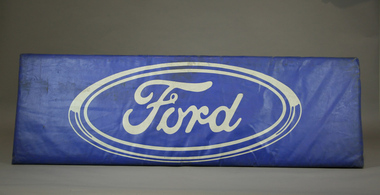
Court barrier, Circa 1988
... The Ford logo features prominently across the two faces of each barrier. Materials: Tarpaulin, Foam, Metal, Ink...The Ford logo features prominently across the two faces of each barrier. Materials: Tarpaulin, Foam, Metal, Ink Court barrier ...Two identical court barriers (.1-.2) used around the late 1980's during the Ford Australian Open, at the National Tennis Centre at Flinders Park (now Melbourne Park). The Ford logo features prominently across the two faces of each barrier. Materials: Tarpaulin, Foam, Metal, Inktennis -
 Sunbury Family History and Heritage Society Inc.
Photograph, Gellibrand Hill, 1987
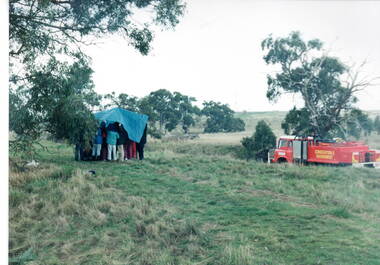
... The students from Bulla Primary School were enjoying a tree-planting excursion at Gellibrand Hill and while they were taken for a ride around the park by the park ranger, the entire group were caught in a sudden shower of rain and had to take shelter under a large tarpaulin....The students from Bulla Primary School were enjoying a tree-planting excursion at Gellibrand Hill and while they were taken for a ride around the park by the park ranger, the entire group were caught in a sudden shower of rain and had to take shelter under a large tarpaulin. Gellibrand Hill School Excursions Bulla Primary School A non-digital coloured photograph of children huddled under a large waterproof sheet to shelter from a sudden shower of rain with the truck which they were all on is parked a short distance from them. ...The students from Bulla Primary School were enjoying a tree-planting excursion at Gellibrand Hill and while they were taken for a ride around the park by the park ranger, the entire group were caught in a sudden shower of rain and had to take shelter under a large tarpaulin.A non-digital coloured photograph of children huddled under a large waterproof sheet to shelter from a sudden shower of rain with the truck which they were all on is parked a short distance from them.gellibrand hill, school excursions, bulla primary school -
Unions Ballarat
Eddie Ward: Firebrand of East Sydney (Don Woodward Collection), Spratt, Elwyn, 1965
... Before entering politics, Ward worked as a labourer, boilermaker, tarpaulin maker, tramways worker and prize boxer. ...Before entering politics, Ward worked as a labourer, boilermaker, tarpaulin maker, tramways worker and prize boxer. ...Biography. Eddie Ward served in the Australian House of Representatives from 1932 to 1963 (when he died). He represented the Australian Labor Party. Before entering politics, Ward worked as a labourer, boilermaker, tarpaulin maker, tramways worker and prize boxer. He was a committed unionist.Biographical, historical and political.Book; 262 pages. Dustjacket: red background; black and white photograph of Eddie Ward; yellow and white lettering; author's name and title. Cover: burgundy/red background; gold lettering; author's name and title on the spine.In black ink: name [illegible].btlc, ballarat trades hall, ballarat trades and labour council, australian labor party, alp, politics and government, house of representatives, biography -
 Otway Districts Historical Society
Photograph, Ray Jude, Last train to Beech Forest, 30 June 1962
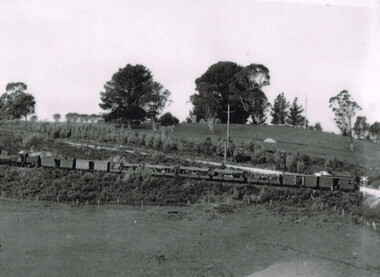
... The train had a particularly motley look with 180 passengers loaded into NU goods vans and the old NQ wagons hastily fitted out with temporary seats and tarpaulin roofing. The train was hauled by the G42 locomotive kept alive through patch-up repairs and cannibalised G41 parts, steam escaping from every joint....The train had a particularly motley look with 180 passengers loaded into NU goods vans and the old NQ wagons hastily fitted out with temporary seats and tarpaulin roofing. The train was hauled by the G42 locomotive kept alive through patch-up repairs and cannibalised G41 parts, steam escaping from every joint. ...The last train to Beech Forest ran on 30 June 1962, between Banool and Wimba. The train had a particularly motley look with 180 passengers loaded into NU goods vans and the old NQ wagons hastily fitted out with temporary seats and tarpaulin roofing. The train was hauled by the G42 locomotive kept alive through patch-up repairs and cannibalised G41 parts, steam escaping from every joint.Last train to Beech Forest, 30 June 1962.beech forest; trains; railways; -
 Otway Districts Historical Society
Photograph, Ray Jude, Tulloh: last passenger train to Beech Forest, 30 June 1962
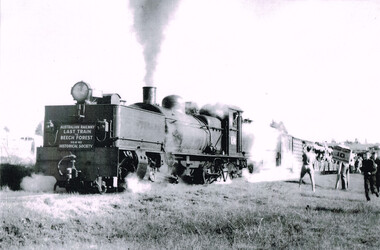
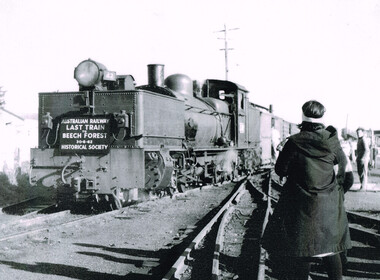
... It had a particularly motley look: 180 passengers were loaded into a series of NU goods wagons hastily fitted with temporary seats and, given the time of year, tarpaulin covers. The G42 locomotive had patched-up repairs and cannibalised G41 parts. ...It had a particularly motley look: 180 passengers were loaded into a series of NU goods wagons hastily fitted with temporary seats and, given the time of year, tarpaulin covers. The G42 locomotive had patched-up repairs and cannibalised G41 parts. ...The last train ran to Beech Forest on 30 June 1962. It had a particularly motley look: 180 passengers were loaded into a series of NU goods wagons hastily fitted with temporary seats and, given the time of year, tarpaulin covers. The G42 locomotive had patched-up repairs and cannibalised G41 parts. Intending travellers faced up to the trip with some trepidation but the train made it with no problems. On this cold, gloomy day when it got back to Colac it signalled the end of narrow gauge operations in the Otway Ranges.B/W. Locomotive G42 with the sign "Australian Railway Historical Society, Last Train to Beech Forest, 30-6-62", an NC guard's van, a NU louvred van and many NQR open wagons, at a photostop near Tulloh. Several passengers taking photos while the driver is waiting to proceed.colac; beech forest; railway; tulloh; -
 Port of Echuca
Black and white rectangular photograph, 1950?
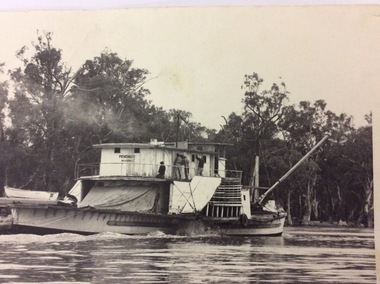
... She does not appear to be towing a barge, but a large tarpaulin could be covering a load for transport. ...She does not appear to be towing a barge, but a large tarpaulin could be covering a load for transport. ...The paddle steamer P. S Pevensy appears to still be a working steamer in this photograph. The boat seems a bit dishevelled and the workers are doing repairs on her, while she is still steaming up the river. If this photograph was taken in 1950, that would have been well before the development of the Tourism Industry in the Murray Darling area. This would explain the number of workers and the fact that they were doing maintenance while the Paddle Steamer was still working. She does not appear to be towing a barge, but a large tarpaulin could be covering a load for transport. This picture holds significance because it shows a paddle steamer in use before the Tourism Industry had developed in the Murray Darling region. The paddle steamer which now carries passengers every day has been renovated to cater for passengers cruising up and down the river. Here is this photograph the P.S Pevensy looks a bit dishevelled and untidy.This is a black and white rectangular photograph of the P.S Pevensey. Four people can be seen painting the wall of the cabins on the upper deck. A person can also be seen kneeling on the back deck working on something lying on the back deck. A wooden boat is nearby, also on the back deck. The boat is steaming and appears to be moving upstream. There is along pole at a 45 degree angle attached to the very front of the paddle steamer.On the front of the photograph written on the paddle steamer can't be seen the words "PEVENSEY. Melbourne." Written on the back of the photograph in lead pencil " M4414-17. K4". p.s pevensey, paddle steamers -
 Otway Districts Historical Society
Photograph, Ray Jude, Colac: G42 about to depart with the last train, 30 June 1962
... The train had a particularly motley look to it; 180 passengers were loaded into NU goods vans which had been hastily fitted out with temporary seats and tarpaulin roofing. The train was hauled by the dilapidated G42 locomotive, kept alive through patch-up repairs and cannibalised G41 parts, which intending travellers looked at with some trepidation. ...The train had a particularly motley look to it; 180 passengers were loaded into NU goods vans which had been hastily fitted out with temporary seats and tarpaulin roofing. The train was hauled by the dilapidated G42 locomotive, kept alive through patch-up repairs and cannibalised G41 parts, which intending travellers looked at with some trepidation. ...The last train to Beech Forest ran on 30 June, 1962. The train had a particularly motley look to it; 180 passengers were loaded into NU goods vans which had been hastily fitted out with temporary seats and tarpaulin roofing. The train was hauled by the dilapidated G42 locomotive, kept alive through patch-up repairs and cannibalised G41 parts, which intending travellers looked at with some trepidation. The train made it without mishap. When it returned to Colac on that cold, gloomy June day it signalled the end of narrow gauge operations in the Otway Ranges.B/W. Locomotive G42 with the sign " Australian Railway, Last Train to Beech Forest, 30-6-62, Historical Society" is departing Colac. NC guard's van and NU louvred van are attached. A woman and man watching. .colac; beech forest; railways; -
Mission to Seafarers Victoria
Letter - Correspondence, 1/12/1950
... In this letter to his mother Allan describes how beautiful it was sailing into Norrkoping with everything covered with just a little snow but after a snow-storm the next day the ropes were frozen and the tarpaulins were like sheets of iron. The ship is half full of timber for Australia and will arrive in Adelaide in late January 1951 but he won't be on it as he is handing in his book and will sign off in Gothenburg on the 11th December. ...Quinn Collection letters-from-abroad allan quinn m s mongabarra antwerp gothenburg norrkoping, sweden In this letter to his mother Allan describes how beautiful it was sailing into Norrkoping with everything covered with just a little snow but after a snow-storm the next day the ropes were frozen and the tarpaulins were like sheets of iron. The ship is half full of timber for Australia and will arrive in Adelaide in late January 1951 but he won't be on it as he is handing in his book and will sign off in Gothenburg on the 11th December. ...Allan writes of being in Gothenburg the day after the Swedish King died (November 1950).Quinn CollectionA three-page letter written in green ink on three pages of buff coloured unlined paper (0851.a1-3) headed M.S.Mongabarra, Norrkoping, Sweden and dated 1/12/50. The pale blue envelope (0851.b) is addressed to Mrs K Hayes, 14 Fitzroy Street, St Kilda, Victoria. There are 9 red stamps, valued at 20 Norwegian Krona each, and one green stamp, valued at 10 N.Krona, across the top of the envelope. There are three postmarks.In this letter to his mother Allan describes how beautiful it was sailing into Norrkoping with everything covered with just a little snow but after a snow-storm the next day the ropes were frozen and the tarpaulins were like sheets of iron. The ship is half full of timber for Australia and will arrive in Adelaide in late January 1951 but he won't be on it as he is handing in his book and will sign off in Gothenburg on the 11th December. He plans to spend Christmas in Oslo before travelling to London. He anticipates being back in Australia for good in the middle of 1951. letters-from-abroad, allan quinn, m s mongabarra, antwerp, gothenburg, norrkoping, sweden -
 Southern Sherbrooke Historical Society Inc.
Photograph - Terry Smith at the building site of the caretaker's house, Belgrave Reservoir, c.1940s
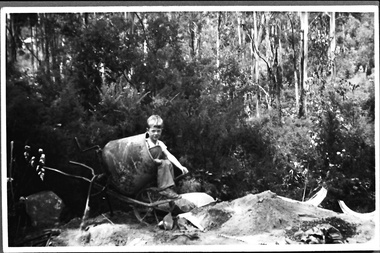
... A pile of sand is on a tarpaulin. Behind Terry there are shrubs and small trees and behind them are tall trees on a steep hillside. ...A pile of sand is on a tarpaulin. Behind Terry there are shrubs and small trees and behind them are tall trees on a steep hillside. ...Black and white photo of Terry Smith, Pam Harris's younger brother, aged about 6 or 7, during the building of a septic tank for the caretaker's house at Belgrave Lake Park. Terry is sitting in a concrete mixer. On the ground are bags of concrete. A pile of sand is on a tarpaulin. Behind Terry there are shrubs and small trees and behind them are tall trees on a steep hillside. The Belgrave Reservoir is at the bottom of the slope. A house can be seen in the distance, possibly the house visible in B0399. Terry and Pam's father, Oscar Smith, built the caretaker's house, selling it in 1960 for £1250. The photo probably dates to the 1940s and is part of a collection of family photos donated by Pam Harris, Shire of Sherbrooke President, 1982-1983 & 1987-1988. -
 Bendigo Historical Society Inc.
Photograph - W. G. DAHL PHOTO SERIES
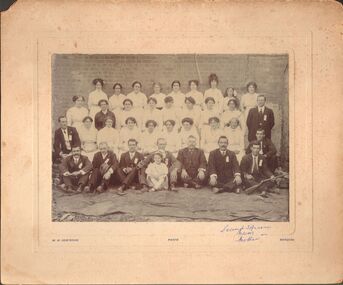
... Group photograph of mixed aged females dressed in white with suited males in foreground sitting on tarpaulin and against brick wall. Men and possibly ladies wearing labels. ...Group photograph of mixed aged females dressed in white with suited males in foreground sitting on tarpaulin and against brick wall. Men and possibly ladies wearing labels. ...W G Dahl series of nine photographs. Group photograph of mixed aged females dressed in white with suited males in foreground sitting on tarpaulin and against brick wall. Men and possibly ladies wearing labels. Possible label connection with Bendigo Miner's Association. W H Robinson, Bendigo photographer. Stamped W H Dahl, 79 Lansdowne Street, Blairgowrie, 3942, Phone 8861 on reverse not contemporary with photograph exposure. Biro ticked subject described in margin 'Second Top Row' Mum's Mother, possibly depicts W H Dahl grandmother. Front row males holding Gun Powder flask, .22 calibre single shot rifles, with muzzle loading pistol between feet of male second from left. Enlistment papers for William George Dahl. Dahl's had a hotel at Diamond Hill, Dahl's Hotel.bendigo, history, dahl family -
 Flagstaff Hill Maritime Museum and Village
Photograph - Set of shipping photographs, Late 1870's - early 1920's
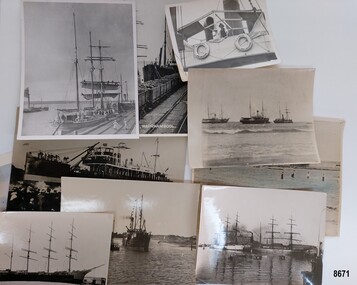
... He then moved into working with tarpaulins and canvases for the trucking industry. ...He then moved into working with tarpaulins and canvases for the trucking industry. ...This set of ten photographs was donated to Flagstaff Hill Maritime Museum and Village by Fred Trewartha. Frederick John Fox Trewartha (Fred) was a well-known Warrnambool businessman. He was born in Beeac near Geelong in 1920 and came to Warrnambool with his family as a very young child. He was apprenticed to his father John, as a saddler and later opened his own shop on Raglan Parade. He then moved into working with tarpaulins and canvases for the trucking industry. Fred was keenly interested in photography (and was a member of the Warrnambool Cine Club), yachting and boat building. He kept his yacht moored at Port Fairy for many years and participated in sailing events locally and interstate. He also built boats with his sons. He had the opportunity to meet many older sailors and it's thought these photographs may have been given to him by one of these men. Fred Trewartha died in 2016 in Warrnambool.These photographs are significant because of their association with coastal trading along Victoria's West Coast in the late 19th and early 20th centuries. Some of the photographs also reflect the importance of ships to Australia in its world wide trading routes.Collection of ten photographs of different sailing ships and coastal steamers. They are different sizes and at different locations. Nine of the photos are black and white or sepia toned and tend to show the ships either moored at a dock or anchored in a bay. All the photographs have the donor's name and telephone number handwritten on the back as well as a handwritten note naming the ships in the picture.Backs of photographs - Donor's name, telephone number and address handwritten in ink Handwritten notes about ship(s)depicted Some have stamped numbersflagstaff hill maritime museum and village, warrnambool, great ocean road, shipping, sailing ships, steamers, coastal trade, port fairy, portland, melbourne, fred trewartha, frederick john fox trewartha, photographs, maritime photographs -
 City of Melbourne Libraries
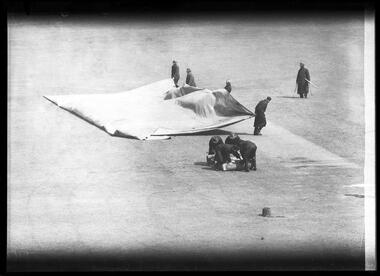
Photograph, Bull, Hugh Jones, 1897-1993, Groundsmen cover wicket during rain at the MCG match, Victoria v South Australia
... Published caption: Placing the tarpaulin over the wicket during one of the showers. ...Published caption: Placing the tarpaulin over the wicket during one of the showers. ...“How’s the wicket, Bert?” During the 4-Day Victoria v South Australia Sheffield Shield match, held 13-17 November 1936 at the Melbourne Cricket Ground, the play was often interrupted by rain squalls, causing the groundsmen to cover their carefully prepared wicket with tarpaulins to protect it. “How’s the wicket, Bert?” is the question on everyone’s lips – Will it be a batsman’s nightmare? A bowler’s dream? Will the spectators see a full day’s play or will rain spoil it? With a twinkle in his eye, Bert “Maker of Pitches” Luttrell, the MCG curator’s response is: “It’s not the wicket when batsmen get out early, it’s good bowling!” FRC Published: The Age 17 November 1936 Featured in "Newsworthy: Melbourne in photographs 1933-1936" exhibition at East Melbourne Library, October to December 2023. Exhibition caption by project volunteer, Fiona Collyer. Photographer notations on slide: "Covering wicket during Vict v Sth Aust Cricket at M.C.G. Nov 1936 B117" Published: Age (Melbourne, Vic. : 1854 - 1954), Tuesday 17 November 1936, page 13 Published title: SHEFFIELD SHIELD CRICKET. Published caption: Placing the tarpaulin over the wicket during one of the showers. This was done four times during the day. Trove article identifier: http://nla.gov.au/nla.news-article205952141 Description: Nine men wearing black macintoshes and hats drag a tarpaulin over a cricket pitch. There is a bucket containing pegs in the foreground. Research by project volunteer, Fiona Collyer: During the four day Victoria v South Australia Sheffield Shield match, held 13-17 November 1936 at the Melbourne Cricket Ground, the play was often interrupted by rain squalls, causing the groundsmen to cover their carefully prepared wicket with tarpaulins to protect it. “How’s the wicket, Bert?” is the question on everybody’s lips - will it be a batsman’s nightmare? A bowler’s dream? Will the spectators see a full day’s play or will rain spoil it? With a twinkle in his eye, Bert “Maker of Pitches” Luttrell, the MCG curator’s response is: “It’s not the wicket when batsmen get out early, it’s good bowling!” Albert (Bert) John Wesley Luttrell 1875-1951, was born in Geelong and worked as a painter and decorator. He played cricket for Clarendon Cricket Club while helping to prepare the wicket at Kardinia Park. In 1890, Mr Phillip Russell, a wealthy merino sheep breeder of Osborne House, North Geelong, offered Bert the job of curator and cricket player for his team “The Nondescripts”, a social team who played at his private oval at Osborne House. After five years at Osborne House, Bert took up a position at Geelong Grammar School and then in 1900 he was appointed curator of Warehousemen’s Ground, Albert Park (later called Albert Ground). There he prepared the tennis courts for the 1908 Davis Cup - Australia v USA featuring the eventual winner of the tournament, Wimbledon champion Sir Norman Brookes. Following the retirement of the MCG curator, Bert was offered the position there for the 1919/20 season. Sport was resuming at the MCG after the suspension caused by the Great War and the Spanish Influenza pandemic. Cricket grounds and matches are always at the mercy of the weather. Sudden heavy downpours can make the ground unfit for play. In 1933, Bert invented and patented an absorbent roller for soaked pitches. Similar to a lawn mower in appearance, it was fitted with a rubber sponge which sucked up the water and then squeezed it into a tank. The sponge was said to mop up a gallon (3.78 litres) of water in 32 seconds and remove 100 to 120 gallons (378 - 454 litres) of water from any wet sports ground in an hour. Bert worked as a curator of the MCG for nearly 30 years, invariably creating his famous “shirt front” wicket. He retired in 1947 due to ill health. He was married to Emma and they had six children- Albert, Harry, Nell, Lily, Frank and Jack. Bert died at home in South Yarra in 1951 at 76 years of age. References: SHEFFIELD SHIELD CRICKET. ENGLISH FLYING BOAT. VICTORIA DOCK. (1936, November 17). The Age (Melbourne, Vic. : 1854 - 1954), p. 13. Retrieved May 19, 2024, from http://nla.gov.au/nla.news-article205952141 To Dry Grounds (1933, May 13). Sporting Globe (Melbourne, Vic. : 1922 - 1954), p. 3 (Edition2). Retrieved May 20, 2024, from http://nla.gov.au/nla.news-article183038194 No title (1937, February 25). The Age (Melbourne, Vic. : 1854 - 1954), p. 10. Retrieved May 19, 2024, from http://nla.gov.au/nla.news-article206185862 GOSSIP of THE GAME (1937, November 12). The Herald (Melbourne, Vic. : 1861 - 1954), p. 21. Retrieved May 20, 2024, from http://nla.gov.au/nla.news-article244541623Photographer notations on slide: "Covering wicket during Vict v Sth Aust Cricket at M.C.G. Nov 1936 B117".cricket, 1930-1939 -
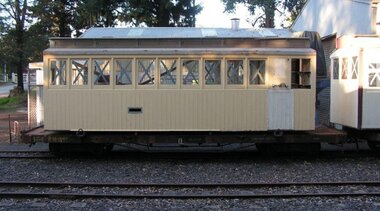 Puffing Billy Railway
6 NB - Saloon carriage, 22/ 8/1904
... Minor refurbishment has taken place along with covering with Tarpaulins....Minor refurbishment has taken place along with covering with Tarpaulins. Historic - Victorian Railways Narrow Gauge - Passenger Rolling Stock: Saloon carriage puffing billy railway, pbr, rolling stock , 6 nb puffing billy 6nb saloon carriage victorian railways narrow gauge passenger rolling stock 2'6" guage 6 NB Passenger Rolling Stock: Saloon carriage 6NB - Made of Timber. 6 NB - Saloon carriage Victorian Railways - Newport Workshop ...NB Class - Number Built (1st Series) 6 - Number Built (2nd Series) 17 - Number Built (3rd Series) 4 6 NB - Saloon carriage (24) Body Length 20 feet 6 inches ( 6248 mm) Vehicle Length 25 feet 2 inches ( 7671 mm) Coupled Length 27 feet 4 inches (8330 mm) Width 6 feet 3 inches (1905 mm) Height 9 feet 5 inches (2870 mm) Weight 8 tons Capacity 16 passengers Built 1898 - 1904 Number Built 6 In use NB 1. NBD 2, 5 Awaiting restoration NB 6 VR Service History NBB 6.VA - 22/ 8/1904 NWS Built new - circa 1910 - To NB 6.VA - *NB 6.VA - / 4/1926 - Modified AC Malco 4/ 3/1938 - Scrapped - Puffing Billy Service History or Notes NB (first series) NB - There were three types: -Nos. 1-6 were Saloon cars having end platforms and a ladies toilet, and were built from 1899-1904. Nos. 7-23 were 5-compartment side loading cars, built from 1906-1915. Nos. 24-27 were the former NAB class cars mentioned previously and were also side loading, having 6 compartments and two ladies toilets. Rescued by the Puffing Billy Preservation Society from Ocean Grove Victorian in Nov 2010 Nov 2010 Two carriages have been rescued from Ocean Grove where they had been built into a house. They are now at Emerald, one being a platform NB carriage and the other a swing door NB carriage. Storage of these vehicles is being considered. Many people were involved in the move: thanks go to Raymond and Thelma Cotter for providing tarps to protect the cars from the elements. Dec 2010 Two carriages rescued from Ocean Grove are now at Emerald, one being a platform NB car (6NB) and the other a 2nd Class swing door carriage. Minor refurbishment has taken place along with covering with Tarpaulins.Historic - Victorian Railways Narrow Gauge - Passenger Rolling Stock: Saloon carriagePassenger Rolling Stock: Saloon carriage 6NB - Made of Timber. 6 NBpuffing billy railway, pbr, rolling stock , 6 nb, puffing billy, 6nb, saloon carriage, victorian railways, narrow gauge passenger rolling stock, 2'6" guage -
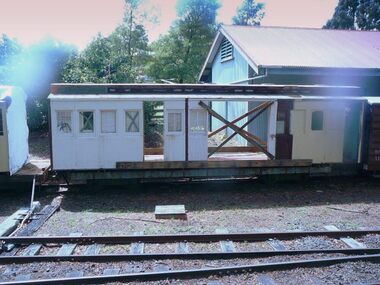 Puffing Billy Railway
8 NB - Compartment Passenger Carriage, 1906
... Minor refurbishment has taken place along with covering with Tarpaulins. 29 Jan 2020 - 8 NB - passenger carriage - Body only is moved by the PBPS Heritage Rolling Stock Committee from Emerald Station sidings and placed into storage in a warehouse at Officer to enable it to be investigated into its possible restoration. 29 Feb 2020 - investigation on the carriage by the PBPS Heritage Rolling Stock Committee found the number of the carriage 8 NB stamped on the inside of the side of the windows frames. ...Minor refurbishment has taken place along with covering with Tarpaulins. 29 Jan 2020 - 8 NB - passenger carriage - Body only is moved by the PBPS Heritage Rolling Stock Committee from Emerald Station sidings and placed into storage in a warehouse at Officer to enable it to be investigated into its possible restoration. 29 Feb 2020 - investigation on the carriage by the PBPS Heritage Rolling Stock Committee found the number of the carriage 8 NB stamped on the inside of the side of the windows frames. ...8 NB - 6 compartments (40) Victorian Railways Service History 8 NB - passenger carriage (PBPS Body only - currently no underframe) 21 Dec 1906 Built New at Newport Workshops - numbered classed as NBB 8. Type: 2nd Class swing door carriage - 5 or 6 compartments 2'6" Bogie [8W]: Eight Wheels (2 x Four Wheel bogies) [CDG]: Continuous Draw Gear [WHB]: Westinghouse Brake circa 1910 - reclassed to NB 8 May 1926 - Modified with Automatic Couplers Malco Oct 1928 - Modified with Automatic Couplers Malco Bottom Operated 16 Dec 1937 - Consigned as to be scrapped 19 Feb 1938 - Condemned 4 Mar 1938 - Scrapped & Broken Up - Condemned Rolling stock Book Body to be offered for sale & underframe & bogies retained for use in construction of any additional NG trucks undertaken in near future. Sold by V.R and privately bought and used in the construction of a house at 80 Dare Street, Ocean Grove Puffing Billy Preservation Society Service History or Notes Sept 2010 - Ocean Grove house demolition results in PBPS being contacted that there were two carriages (6 NB & 8 NB) in the house. PBPS arrange to buy the two carriages bodies from the Demolition company Nov 2010 - Two carriages have been rescued from 80 Dare Street, Ocean Grove where they had been built into a house. Many people were involved in the move: thanks go to Raymond and Thelma Cotter for providing tarps to protect the cars from the elements. Dec 2010 - Two carriages rescued from Ocean Grove are now at Emerald, one being a platform NB car (6NB) and the other 8 NB a 2nd Class swing door carriage. Minor refurbishment has taken place along with covering with Tarpaulins. 29 Jan 2020 - 8 NB - passenger carriage - Body only is moved by the PBPS Heritage Rolling Stock Committee from Emerald Station sidings and placed into storage in a warehouse at Officer to enable it to be investigated into its possible restoration. 29 Feb 2020 - investigation on the carriage by the PBPS Heritage Rolling Stock Committee found the number of the carriage 8 NB stamped on the inside of the side of the windows frames. Current - At OfficerNB Class - Number Built (1st Series) 6 - Number Built (2nd Series) 17 - Number Built (3rd Series) 4 Historic - Victorian Railways Narrow Gauge - Passenger Rolling Stock: Passsenger carriage. 14 NB and this carriage (both of the 2nd Series) are the last known existing vehicles of this type out of the 17 built - maybe!.Passenger Rolling Stock: ? NB - Passenger carriage - Made of Timber NB - 2nd Class swing door carriage - 5 compartments number unknown ? NB puffing billy, nb passenger carriage, victorian railways, narrow gauge passenger rolling stock, 2'6" gauge -
 City of Melbourne Libraries
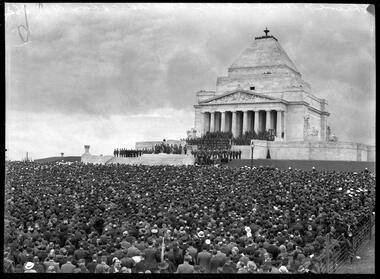
Photograph, Bull, Hugh Jones, 1897-1993, Shrine and multitude afield at opening dedication, Shrine of Remembrance
... In the early hours of the morning he had a busy time covering the panniers with a tarpaulin to protect the birds from the rain.” ...In the early hours of the morning he had a busy time covering the panniers with a tarpaulin to protect the birds from the rain.” ...On Armistice Day, 11 November 1934, an estimated third of Melbourne’s population, assembled for the Dedication Ceremony of the Shrine of Remembrance by Prince Henry, Duke of Gloucester. Featured in "Newsworthy: Melbourne in photographs 1933-1936" exhibition at East Melbourne Library, October to December 2023 Photographer notations on slide: "Shrine and multitude afield B62" Description: “Shrine and multitude afield” On Armistice Day, 11 November 1934, an estimated third of Melbourne’s population, assembled for the Dedication Ceremony of the Shrine of Remembrance by Prince Henry, Duke of Gloucester. The Argus reported the following day: “10,000 Pigeons Released. With whirring wings, 10,000 pigeons rose above the Shrine like a huge puff of smoke when they were released from the second balcony at 11.43am, after the ceremony of dedication. The pigeons had come from all parts of the metropolitan area and from places as far away as Shepparton, Broadford, and Trentham. They hovered above the Shrine for a moment or two, taking their bearings, and then flew away toward their homes. A boy at Burnley reported later that one of his pigeons had returned and entered its box two minutes after the liberation. The pigeons were assembled in metropolitan clubrooms of the Victorian Homing Pigeon Association on Saturday night, and transported in 75 panniers to the Shrine, carried up stairways, and placed in readiness on the balcony. A man remained in charge of them all night. In the early hours of the morning he had a busy time covering the panniers with a tarpaulin to protect the birds from the rain.” In the foreground can be seen three women standing with their backs to the Shrine, looking upwards. In the same coverage, The Argus noted: “Women, unconscious probably of the fact that they were resorting to the principle of the periscope of the days of the war which had brought this vast assemblage together, turned their backs upon the scene the better to view it by looking into mirrors held high in one hand.” FRC Featured in "Newsworthy: Melbourne in photographs 1933-1936" exhibition at East Melbourne Library, October to December 2023. Exhibition caption by project volunteer, Fiona Collyer. References: President Roosevelt's Tribute (1934, November 13). The Advertiser (Adelaide, SA : 1931 - 1954), p. 16. Retrieved November 8, 2024, from http://nla.gov.au/nla.news-article35018382 Here, There and Everywhere (1934, November 12). The Sun News-Pictorial (Melbourne, Vic. : 1922 - 1954; 1956), p. 7. Retrieved June 19, 2024, from http://nla.gov.au/nla.news-article277075769 DAY OF SOLEMNITY (1934, November 12). The Argus (Melbourne, Vic. : 1848 - 1957), p. 9. Retrieved November 8, 2024, from http://nla.gov.au/nla.news-article10992864Photographer notations on slide: "Shrine and multitude afield B62".shrine of remembrance, 1930-1939, ceremonies, world war 1, pigeons -
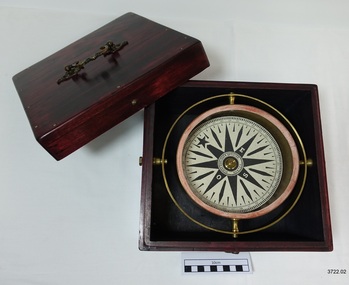 Flagstaff Hill Maritime Museum and Village
Functional object - Compass, mid-19th Century
... David then helped his relative establish a tent and tarpaulin-making business there. Evan later transferred his successful business to a shop in Elizabeth St, Melbourne, under the name Evan Evans Pty. ...David then helped his relative establish a tent and tarpaulin-making business there. Evan later transferred his successful business to a shop in Elizabeth St, Melbourne, under the name Evan Evans Pty. ...Captain Robilliard: James Arthur Robilliard was a sea captain and tentmaker, born on the 19th April 1843 at Saint Helier, Jersey. He trained there in his father's sail loft as a sailmaker. His first job as a sailor was in Liverpool, England, and in 1875, James Robilliard migrated to Australia as a mate on the "E.M. Young". James Robilliard and his family were amongst the early settlers who arrived along the Curdies River in the Heytesbury district of Western Victoria. In 1877, he became a Captain and would have used his compass from ship to ship. On 28th May 1877, in that same district, a small 3-masted schooner, the "Young Australian", was wrecked. This schooner had been built in 1864 at Jervis Bay, NSW. It had been on her way from Maryborough, Queensland, to Adelaide, under the command of Captain Whitfield, when it lost its mainmast in a heavy gale. It was beached at Curdies Inlet in Peterborough, Victoria. Captain Robilliard was placed in charge of the salvaging operation and recovered a good portion of the cargo. Not long after this incident, a Warrnambool shop owner, David Evans, found employment for James Robilliard with Evan Evans, who produced tents, sails, tarpaulins and similar goods; James already had the necessary skills for this work. Evan Evans was the same sailor rescued from the “Young Australian”. Soon after his rescue, Evan recalled he had a relative in Australia in a town called Warrnambool, and while walking in Timor Street, Warrnambool, he saw a sign over a shop that said “David Evans,” and once the two men met, Evan was warmly welcomed. David then helped his relative establish a tent and tarpaulin-making business there. Evan later transferred his successful business to a shop in Elizabeth St, Melbourne, under the name Evan Evans Pty. Ltd.) James Robilliard was a committed Christian and accredited Lay Preacher with the Methodist Church. He travelled around the local district leading the settlers in worship. On 14th November 1879, Captain Robilliard married Helen Beckett. Alfred and Selina Beckett and their family all attended the church at Brucknell, where Captain Robilliard preached. He was said to have been taken by their young daughter, Helen. James and Helen had ten children: James Arthur (Jnr), Henry William, Nellie Jessie, Alfred Albert, Rubena Nellie, De Jersy Norman, Clifford Beckett, Olive Ida, Frances Ridley Havergal and Nellie Elvie, all born in Victoria. In the 1880s, James Robilliard captained the cutter "Hannah Thompson" into Port Campbell, Victoria. This vessel was the first coastal trader to operate between Melbourne and Port Campbell. At one time, Captain Robilliard had to beach the "Hannah Thompson" for repairs. In 1923, the vessel was blown ashore in a gale and wrecked at Oberon Bay, at Wilson's Promontory. In 1889, the compass was saved by Captain James Arthur Robilliard from his sinking brigantine "Mary Campbell". This vessel was used to carry equipment for the Sydney Sugar Refinery's Mill in Southgate, NSW. The ship had been built in 1869 and traded for the next 20 years between Australian ports and rivers along the east coast, as well as regular ports in New Zealand. It was recognised by the Sydney Morning Herald as one of the best "carrying vessels in the timber trade". It had several owners over this time, the last one being Captain James A. Robilliard. On 29th April 1889, the "Mary Campbell", with Captain James A Robilliard as captain and owner, was on its way from Clarence River, NSW to Melbourne, Victoria with a cargo of railway girders for the Melbourne Harbour Trust. Captain Robilliard encountered a storm off Port Macquarie. He sailed the vessel south to about 40km east of Cape Hawke, near Tuncurry. At around 7 pm, he discovered that the cargo had shifted during the storm and the heavy girders had damaged the hull, causing a leak. The pumps were inadequate to stem the fast-flowing leak, and water soon filled the hull during the next two hours. Some of the crew began throwing the cargo overboard to lighten the vessel, hoping to keep it afloat until daylight. When the water reached over 2 meters in the hull, they realised their efforts were in vain. On the 30th April 1889, the crew left the vessel the ship was sinking fast, so they made for the shore. While still miles off Cape Hawke, all seven crew members, including the Captain, were rescued by the Government Tug "Rhea" and taken to Port Macquarie Hospital and later returned to Sydney in the vessel "Wellington". No cargo had been saved, and the consignment had been under-insured, only covered for half its value. The name of the last ship Captain Robilliard sailed is currently unknown; however, he sailed that ship from the port of Marlborough, Queensland, carting steel railway girders for the Geelong-to-Camperdown railway line. On this trip, the ship hit a storm, the cargo shifted, and the ship was wrecked along the NSW coast. After this, Captain Robilliard retired from the sea and began farming in Peterborough. In about 1897, verging on retirement, Capt. Robilliard superintended the Melbourne Sailors’ Home in Spencer Street, Melbourne, before being asked to leave this position in 1902 for trying to shut down a local hotel. On 6th May 1917, Captain James Arthur Robilliard J.P. died at Blackwood Park, in the Cobden district of Brucknell, the first Robilliard family homestead in Australia. He was buried in the Melbourne General Cemetery, Victoria. His wife Helen, passed away in 1947. This compass, once belonging to Captain James Arthur Robilliard, is of local and state historical significance for its use by the Captain with his vessel, the "Mary Campbell", a trading vessel that was bringing railway girders to the Melbourne Harbour Trust. He also used this compass on the "Hannah Thompson", listed on the Victorian Heritage Register and known as being the first coastal trader to operate between Melbourne and Port Campbell. The compass is also a very fine example of maritime navigational instruments manufactured and used in the mid-19th century. Marine compass, brass, in a wooden box with a separate, fitted lid. The compass card has sixteen points. The four principal points are marked: North with a star-shape, South with an “S”, East with an “E” and West with an “O” (French word OUEST). Each quadrant of the circle is numbered from 0 – 90 degrees. The card is floating in a liquid. The compass gimbal is attached to the sides of the box and to the front and back of the compass’ cylindrical brass frame. The mahogany coloured timber storage case is joined with brass nails. The centre of the lid has a folding decorative brass handle. The lid fits over the base and closes with a brass screw and hook on both front and back. Maker: Dubas Watchmaker Optician, Nantes, France, c 1860-1870. Compass came from the ship “Mary Campbell”, which sank off the NSW coast in 1889, near Forster. The compass, as well as the ship, belonged to Captain James Arthur Robilliard and was donated by his family. “DUBAS MANTES” stamped into the side of the gimbal. “DUBAS HORLOGER OPTICIEN. NANTES.” printed around the centre of the card. flagstaff hill, warrnambool, shipwrecked coast, flagstaff hill maritime museum, maritime museum, shipwreck coast, flagstaff hill maritime village, great ocean road, marine compass, navigation instrument 19th century, marine instruments, dubas mantes, captain james arthur robilliard, j.a. robilliard, helen beckett, ship young australian, ship young australia(n), ship hannah thompson, ship mary campbell, melbourne sailors home, david evans, evan evans, curdies inlet, brucknell church, curdies railway, great lakes museum, dubas horloger opticien. nantes -
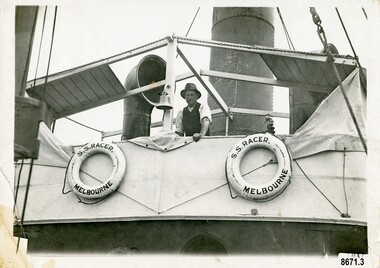 Flagstaff Hill Maritime Museum and Village
Photograph - Vessel, Steam tug, circa 1920's
... He then moved into working with tarpaulins and canvases for the trucking industry. ...He then moved into working with tarpaulins and canvases for the trucking industry. ...The ocean Steamtug "Racer" was built in 1886 in Sunderland by "Boolds, Sharer and Company" for the "Queenstown Tug and Shipping Company". It is mentioned in several newspapers that soon afterwards it sank in Queenstown Harbour, Ireland and remained submerged for six months before being raised. It was a steel screw boat with a sluice keel, was 185 tons and 420 feet long. It was purchased around 1889 by the "Melbourne Coal, Shipping and Engineering Company Ltd" as it had sufficient power to work with the huge iron clippers that the company were dealing with. It survived several dangerous incidents on its voyage out to Melbourne. On May 28th in the middle of the night in a heavy gale, the tug was swamped by heavy seas and then several hours later was almost run down by a very large ship (the clipper Loch Vennachar) in full sail. The "Racer" (later owned by the "Melbourne Steamship Company") became one of the fastest and best-known tugs in the Port of Melbourne - working in the port until 1935. The "Racer" was involved in many rescues and dangerous incidents during its 45 years including the attempted rescue of the "Craigburn" near Cape Schanck, the rescue of the "Edina" from a reef near Williamstown and the rescue of the "Netherby" from heavy seas near Inverloch. In March 1930 she was caught by a strong wind when turning in the Yarra River and crashed into the Spencer Street Bridge - resulting in some damage to the scaffolding on the bridge and slight damage to the tug. In 1906 the "Racer" created a record for the fastest tow when it towed the 900-ton barque "Elizabeth Graham" from Sydney to Melbourne in 73 hours. In 1934 it was withdrawn from commission with plans for it to be broken up for scrap metal but was bought by a Melbourne businessman to be converted into a three masted schooner trading between Tasmania and Melbourne. George (Joe) Cunningham was born in 1892 in Geelong. His father, Alexander Cunningham was a ship builder and carpenter. George worked on oceangoing ships as a young man but after his marriage, had a twenty-six year career on Tugboats. He worked as a deckhand on the "Racer" and then worked his way up as a mate and then master on the "Maitland" and "Tooronga". Later he was in charge of two larger boats - the "Alvina" and "Helen Moore" and was engaged in salvaging the Union Steamship vessel "Karkariki" near Gellibrand Pile Light at the entrance to Hobsons Bay. George Cunningham died in 1978. This photograph was one of ten photographs donated to Flagstaff Hill Maritime Museum and Village by Fred Trewartha. Frederick John Fox Trewartha (Fred) was a well-known Warrnambool businessman. He was born in Beeac near Geelong in 1920 and came to Warrnambool with his family as a very young child. He was apprenticed to his father John, as a saddler and later opened his own shop on Raglan Parade. He then moved into working with tarpaulins and canvases for the trucking industry. Fred was keenly interested in photography (and was a member of the Warrnambool Cine Club), yachting and boat building. He kept his yacht moored at Port Fairy for many years and participated in sailing events locally and interstate. He also built boats with his sons. He had the opportunity to meet many older sailors and it's thought this photo (and others in the set) may have been given to him by one of these men. Fred Trewartha died in 2016 in Warrnambool.This item is significant as a reminder of the important role tugboats and their crews played in the maritime history of Melbourne and the surrounding seas. This is a close-up view of a tugboat showing a man leaning against the upper deck. Two lifebuoys (with the words S. S. Racer Melbourne) are attached to the side of the deck and a funnel and an airvent are in the background. A handwritten note in pencil saying "Geo Cunningham on board Racer "is on the back of the photograph.Back - "Geo Cunningham on board Racer" Front (on lifebuoys) - "S. S. RACER MELBOURNE"flagstaff hill maritime museum and village, great ocean road, tugboats, steamtug boats, racer, george cunningham, port of melbourne, melbourne steamship company, rescues, craigburn, steamtug, edina, elizabeth graham, netherby, yarra river, ships, historic maritime photographs, boolds sharer and company, queenstown tug and shipping company, melbourne coal shipping and engineering company limited -
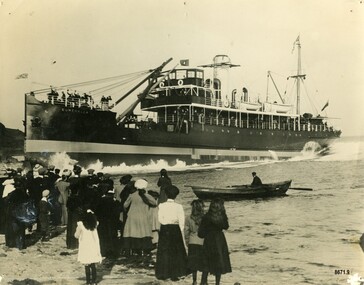 Flagstaff Hill Maritime Museum and Village
Photograph - Photograph of S. S. Eumeralla launch, 1908
... He then moved into working with tarpaulins and canvases for the trucking industry. ...He then moved into working with tarpaulins and canvases for the trucking industry. ...This photograph was one of ten photographs donated to Flagstaff Hill Maritime Museum and Village by Fred Trewartha. Frederick John Fox Trewartha (Fred) was a well-known Warrnambool businessman. He was born in Beeac near Geelong in 1920 and came to Warrnambool with his family as a very young child. He was apprenticed to his father John, as a saddler and later opened his own shop on Raglan Parade. He then moved into working with tarpaulins and canvases for the trucking industry. Fred was keenly interested in photography (and was a member of the Warrnambool Cine Club), yachting and boat building. He kept his yacht moored at Port Fairy for many years and participated in sailing events locally and interstate. He also built boats with his sons. He had the opportunity to meet many older sailors and it's thought this photo (and others in the set) may have been given to him by one of these men. Fred Trewartha died in 2016 in Warrnambool. The Eumeralla (sometimes spelt Eumerella) was built in 1908 in Scotland by Messrs. Scott of Kinghorn on the Firth of Forth. It was a steel screw steamer and had been designed to meet the growing demand for a thoroughly up to date passenger and cargo steamer for the Melbourne to Portland service for John McIlwraith and Company in partnership with the Belfast, Koroit Steam Navigation Company and Howard Smith Company Ltd. This photograph appeared in the Leader (Melbourne) on Saturday 28th November 1908 with the headline "Launching the Eumeralla" and shows the ship being launched on October 10th, 1908, in Scotland. It was described as "Length, 190 feet; breadth, 30 feet; depth 15 feet". It went on to say it had a speed guaranteed at 11 knots and was expected in Melbourne by the following January. It could accommodate sixty saloon passengers and thirty in steerage and had electric light fitted throughout. While on the Melbourne to Portland service the Eumeralla had several mishaps. In 1909 it crashed into the breakwater at Portarlington, splintering the woodwork and leaving a gap of about 12 feet. On Saturday 9th August 1913, as it was leaving Warrnambool, it encountered heavy seas and a passenger (Frederick Mahoney) sustained fatal injuries after hitting his head on the bulwark - and the second mate was found dead after the water poured off the deck. Several other passengers were also injured. Between 1912 and 1913 it was used to carry passengers between Brisbane, Maryborough and Rockhampton before being sent back to Melbourne for an overhaul. In 1915 it was selected for the Winter service to run daily trips between Melbourne and Geelong. In 1925 it nearly sank in the Yarra (at Queens Wharf) when it developed a list and water entered the engine room. Firemen from the Eastern Hill Station, crew and wharf workers were able to stop it from sinking. Between 1928 and 1935 the Eumeralla was laid up in Hobson's Bay before being sold to a Chinese firm to be used on the short coastal run between Shanghai and Wen Chow. It was renamed "Mel Lee (Mow Lee) Number 2". It arrived on July 12th, 1935, at Tanghai (a small Chinese port to the south of Shanghai) with 400 local passengers. The population of the town turned out to welcome the new ship with a fireworks display which caused the passengers to rush across to the side of the ship nearest the scene. The steamer immediately listed to one side and sank.This photograph is significant because of its association with the coastal trader S.S. Eumeralla and its important contribution to trade along Victoria's West Coast in the early 20th century.Black and white photograph showing a crowd of people standing on a shore watching a steamer (the Eumeralla) being launched. The crew of the steamer are standing in the bow, waving at the crowd. A single oarsman is in a small rowboat nearby. On the back of the photograph, the name, address and telephone number of the donor is written in black, ballpoint pen. More writing, in cursive script (in blue ink) gives a brief description of the ship and the events depicted in the photograph.Name of donor, address and telephone number "S. S. Eumeralla / Built in Scotland / being launched/ in Scotland/ 1904"warrnambool, flagstaff hill maritime museum and village, great ocean road, portland, port fairy, eumeralla, s. s. eumeralla, eumerella, steamer eumeralla, john mcilwraith and company, belfast and koroit steam navigation company, howard smith ltd, portarlington, geelong, melbourne, mel lee no. 2, mow lee no. 2, tanghai, steamship, steamer, fred trewartha, frederick john fox trewartha -
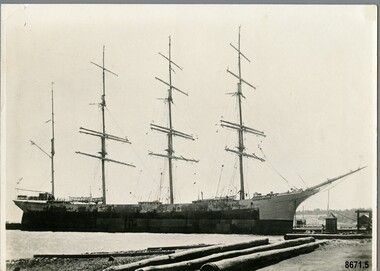 Flagstaff Hill Maritime Museum and Village
Photograph - Vessel "Strathgryfe", late 19th or early 20th century
... He then moved into working with tarpaulins and canvases for the trucking industry. ...He then moved into working with tarpaulins and canvases for the trucking industry. ...This photograph was one of ten photographs donated to Flagstaff Hill Maritime Museum and Village by Fred Trewartha. Frederick John Fox Trewartha (Fred) was a well-known Warrnambool businessman. He was born in Beeac near Geelong in 1920 and came to Warrnambool with his family as a very young child. He was apprenticed to his father John, as a saddler and later opened his own shop on Raglan Parade. He then moved into working with tarpaulins and canvases for the trucking industry. Fred was keenly interested in photography (and was a member of the Warrnambool Cine Club), yachting and boat building. He kept his yacht moored at Port Fairy for many years and participated in sailing events locally and interstate. He also built boats with his sons. He had the opportunity to meet many older sailors and it's thought this photo (and others in the set) may have been given to him by one of these men. Fred Trewartha died in 2016 in Warrnambool. The "Strathgryfe" was a four masted steel barque built in 1890 by "Russell and Company", Port Glasgow and was owned by Duncan McGillivray (The Strathgryfe Ship Company Limited), Greenock. It arrived in Melbourne in December 1891 from New York. Between 1891 and 1910 it carried merchandise in and out of Australia to ports around the world - Melbourne to London (1892), Newcastle to San Francisco (1894), Capetown to Newcastle (1894), New York to Shanghai (1897), New York to Melbourne (1898), Frederickstadt to Melbourne (1899), Liverpool to Sydney (1900), San Francisco to Brisbane (1903), Newcastle to Pisagna, Chile (1905) and Rotterdam to Melbourne (1910). It carried breadstuffs from San Francisco, coal from Newcastle, wool from Sydney, saltpetre from Hamburg and wheat from Brisbane and Melbourne as well as a variety of general merchandise. In 1898, whilst on route between New York and Melbourne, it came across the Captain and crew of the missing barque "Glen Huntley" which had been reported as "lost" several months earlier. They had been marooned at Tristan D'Acunha (a remote group of volcanic islands in the South Atlantic ocean). Captain McIntyre, of the Strathgryfe, offered to bring Captain Shaw (of the Glen Huntly) on to Melbourne with them but the "old mariner" decided to stay on with his crew till arrangements could be made for rescuing the whole of them. In 1899, when in Melbourne, seven of its crew refused to go to sea in it due to its unsafe conditions. They said the vessel was unseaworthy and that the rigging was unsafe and the lifeboats, not watertight. The Captain (Donald McIntyre) denied the allegations and produced a marine surveyor's certificate as evidence of the condition of the vessel. The men were sentenced to three weeks imprisonment. In 1901 there was a fire on board the Strathgryfe just after it left Sydney for London which resulted in many bales of wool being destroyed. In 1902 it was beached at Shellback island (near Wilson's promontory) for several weeks and had to be considerably dismantled in order to lighten its load enough to allow tugs to pull it back into deep water. In 1910 it was sold to a German firm and renamed "Margretha". It continued to operate in Australian ports until 1914 when it left Sydney for the English Channel with 42,438 bags of wheat. However owing to W.W.1 breaking out, it made for the port of St Michael's where it remained for twenty-one months. Later it was seized by the Portuguese Government and renamed "Graciosa" and was leased back to the English Government. It was sunk by two German submarines in 1918.This photograph is significant as a record of the world wide mercantile trade Australia was engaged in at the end of the nineteenth century and beginning of the twentieth century.Black and white photograph of a four masted barque moored at a dock. The rigging and two lifeboats are clearly visible. Three large timber logs are in the foreground. On the back of the photograph, the donor's name and telephone number have been written in black ballpoint pen and the name of the ship has been handwritten (incorrectly) in pencil in cursive script.Back of Photo - donor's name and telephone number "Strarthgryfe" [Strathgryfe] / "late" / "Margurita" [Margretha]flagstaff hill maritime museum and village, warrnambool, great ocean road, shipwreck coast, strathgryfe, barque, steel barque, margretha, graciosa, frederick trewartha, mercantile trade, russell and company, merchandise, cargo ship, glen huntly, w. w. 1 -
 Flagstaff Hill Maritime Museum and Village
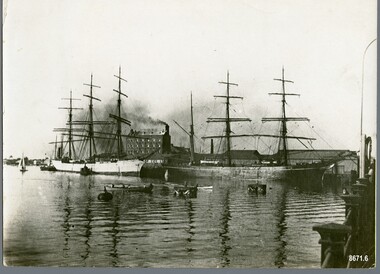
Photograph - Vessels, Sailing Ships, Circa 1910 - 1913
... He then moved into working with tarpaulins and canvases for the trucking industry. ...He then moved into working with tarpaulins and canvases for the trucking industry. ...This photograph was one of ten photographs donated to Flagstaff Hill Maritime Museum and Village by Fred Trewartha. Frederick John Fox Trewartha (Fred) was a well-known Warrnambool businessman. He was born in Beeac near Geelong in 1920 and came to Warrnambool with his family as a very young child. He was apprenticed to his father John, as a saddler and later opened his own shop on Raglan Parade. He then moved into working with tarpaulins and canvases for the trucking industry. Fred was keenly interested in photography (and was a member of the Warrnambool Cine Club), yachting and boat building. He kept his yacht moored at Port Fairy for many years and participated in sailing events locally and interstate. He also built boats with his sons. He had the opportunity to meet many older sailors and it's thought this photo (and others in the set) may have been given to him by one of these men. Fred Trewartha died in 2016 in Warrnambool. There is some conflict re the identity of the ship in the foreground of this photograph. It has been identified as the "Dimsdale" by the original owner of this photograph and by the website "Photos of the Past" which have an identical copy of the photo, however the State Library of South Australia (who also have an identical copy of the photograph) have identified the date of the photograph as 1910 and the ship as the "Ainsdale". The "Dimsdale" and the "Lobo" were recorded several times in the local shipping news as being docked at the Port of Adelaide, at the same time, during the years 1912 and 1913, whereas the "Ainsdale" wasn't in Adelaide very often but was recorded as coming in and out of the Port of Adelaide in the years 1915 and 1916. On February 25th 1916, the two ships (the "Ainsdale" and "Lobo") were both in the Port of Adelaide at the same time, but the "Ainsdale" was loading at Outer Harbor and the "Lobo" was discharging timber at Corporation Wharf. The "Ainsdale" was owned by the same firm that had owned the "Dimsdale". The Dimsdale was a three masted steel ship built in 1890 by C. J. Bigger of Londonderry. It became notorious when it struck the Wonga Shoal lighthouse near Port Adelaide on the night of 17th November 1912, destroying the structure and killing two lighthouse keepers. The accident was investigated by the Marine Board, the Coroner, the Police Court, the Admiralty Court and by the Criminal Courts of South Australia where the Captain (John Jones) was charged with manslaughter and found "not guilty". The Dimsdale was sold to a Norwegian firm and its name was changed to "Kwango". It sank in 1915 near the Magdalen Islands in the Gulf of St. Lawrence. The "Lobo" was a well known "windjammer" trading from the Port of Adelaide to other parts of the world. For a number of years it was employed in the New Zealand and Tasmanian services, after which it made several voyages to North America. It was an iron barque of 945 tons, built at Sunderland in 1877 by Osbourne, Graham and Company. On October 18th 1916, the Lobo (owned by Walter and Morris, timber merchants) was on a voyage from Parapato (Mozambique) to New York with a cargo of mango bark and ebony, when it struck rocks and ran aground 30 miles east of the Angoche River in Portuguese East Africa. A detailed account of the incident, written by Mrs Murchison (the Captains wife who was on board with her two year old son) was published in the Adelaide newspaper "The Mail" on Saturday 9th December 1916. She, and several of the crew were put in a boat early in the morning and sent away from the wreck. Several hours later, they were joined by Captain Murchison and the remainder of the crew. They were in their small open boats for several hours before landing on a small uninhabited island where they remained for several days before being picked up by another vessel and taken back to Parapato. The captain was able to obtain a position on a steamer which took him and his wife and child back to England.This photograph is significant as a record of the world wide mercantile trade Australia was engaged in at the end of the nineteenth century and beginning of the twentieth century and as a record of the dangers faced by the crews of these ships.A black and white photograph showing two large sailing ships moored at a dock. There are industrial buildings in the background (one has smoke coming from its chimney) and several smaller craft (a rowing boat, two small boats that may be tugs and a little yacht) at the side of the ships. Pylons can be seen in the water and a metal fence is in the bottom right corner. On the back of the photo the words "Ship Dimsdale" and "Bk Lobo" are written diagonally across the top left corner in pencil. A beige paper label has been attached to the top right corner with the words "Dimsdale at Port Adelaide" and "Port Adelaide Historical Society may be interested" written in black ballpoint pen."Ship Dimsdale" / "Bk Lobo" ""Dimsdale" / at Port Adelaide" "- Port Adelaide Historical /Society may be / interested"warrnambool, dimsdale, lobo, barque lobo, port of adelaide, kwango, wonga shoal lighthouse, fred trewartha, ainsdale, frederick john fox trewartha, captain john jones, windjammer, iron barque, parapato -
 Flagstaff Hill Maritime Museum and Village
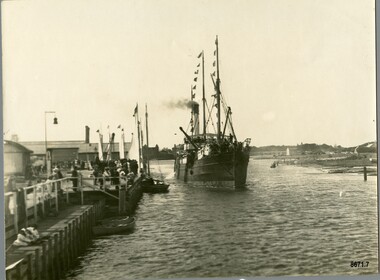
Photograph - S. S. Casino, Early 19th century
... He then moved into working with tarpaulins and canvases for the trucking industry. ...He then moved into working with tarpaulins and canvases for the trucking industry. ...This photograph was one of ten photographs donated to Flagstaff Hill Maritime Museum and Village by Fred Trewartha. Frederick John Fox Trewartha (Fred) was a well-known Warrnambool businessman. He was born in Beeac near Geelong in 1920 and came to Warrnambool with his family as a very young child. He was apprenticed to his father John, as a saddler and later opened his own shop on Raglan Parade. He then moved into working with tarpaulins and canvases for the trucking industry. Fred was keenly interested in photography (and was a member of the Warrnambool Cine Club), yachting and boat building. He kept his yacht moored at Port Fairy for many years and participated in sailing events locally and interstate. He also built boats with his sons. He had the opportunity to meet many older sailors and it's thought this photo (and others in the set) may have been given to him by one of these men. Fred Trewartha died in 2016 in Warrnambool. The S.S. Casino was a passenger and freight steamer built in Dundee, Scotland, in 1882 for the Newcastle and Hunter River Steam Navigation Company of N.S.W. She weighed 425 tons gross with a length of 160.4 feet, beam of 24.1 feet and a depth of 10.2 feet. She had saloon accommodation for 35 people, a fore cabin for 25 more people, and she carried 300 tons of cargo. While on her delivery journey on May 30th 1882, the S.S. Casino called in at the Port of Warrnambool for coal, narrowly escaping going ashore in gale force winds due to the quick action of the pilot. At that time, still at anchor, she impressed the directors of the Belfast and Koroit Steam Navigation Company so much that they bought her immediately; she was ideal for trade along the West Coast of Victoria. (The Belfast and Koroit Steam Navigation Company was first managed by Messers. Saltau and Osburne and after the passing of Mr. Osburne, by produce merchants Messers H. Sautau and Sons, who had a hay and corn store and shipping agency on the corner of Liebig and Koroit Streets in Warrnambool. ) The S.S. Casino became “the most famous steamer to operate in Victorian waters along the West Coast” by author Jack Loney. Captain Boyd was her first Master, followed by Captain Chapman, who stayed with her from 1890 until 1924. Captain W. Robertson followed for a short term, and then Captain Middleton then took command from 1925 - 1932. An article published on Monday 11th June 1932 in The Sun News Pictorial (Melbourne) giving a detailed history of S. S. Casino said "owned by Port Fairy interests, she was an integral part of the town's development ... for a long time, her arrival in Port Fairy was an event, the townspeople going down to the wharf to see her come in". It also said "Except when the weather was bad, the Casino hugged the coast on her trips and passengers obtained wonderful views of the sandstone terraces and caves. A little time ago every member of her regular crew except one, was a Scotsman." This particular photograph of the S.S. Casino shows it decorated with numerous flags in "holiday rigging". During the years between 1884 and 1915, the Casino would take locals and holiday makers on excursions around the Port Fairy Bay. Local towns such as Terang, Penshurst and Mortlake held their Picnic Days in Port Fairy and excursions on the Casino would be available for them and in 1906 Terang and District Schools held an excursion to Port Fairy (where the Casino was organised to provide a series of trips around the Bay.) In 1916 new regulations introduced by the Marine Board requiring the Casino to carry enough lifebelts for every passenger on board, prevented the steamer from making trips around the Bay on excursion days. The S.S. Casino had several mishaps during her life. One was on 3rd January 1898 when she collided with the S.S. Flinders in Apollo Bay with minor damage. Another was on 24th October 1924 when she grounded on a reef at Point Hawdon near Grey River and most of her cargo (of Christmas goods) had to be dumped into the sea. Then in February 1929 she was ‘holed’ when she struck a submerged object as she entered Lady Bay, Warrnambool. In the years following the turn of the century, the S.S. Casino remained the only regular trader with normal passenger accommodation along the West Coast. From 1882 she had made at least 2,500 voyages on the one run. On the morning of 10th July 1932, after attempting to berth at Apollo Bay jetty in heavy seas, Captain Middleton decided to take her out into the bay and wait until the seas abated. It was not realised that the anchor used to steady her as she manoeuvred to her berth had pierced her hull. She put about and headed for the beach but sank. Captain Middleton and nine others lost their lives; nine people were rescued including the two female passengers. Captain Middleton had been in charge of the S.S. Casino for seven years. He was the first ship’s Master to lose his life in a shipwreck in the West Coast trade. In June 1932, the directors of the Belfast and Koroit Steam Navigation Company had proposed to celebrate the completion of fifty years of trading by the steamer Casino in August, but tragically the Casino was wrecked only one month later (and "was only one month off completing its fifty years of valuable service between Melbourne and Portland.") Flagstaff Hill’s collection has a photograph of a portrait of Captain Chapman, a ship model of the S.S. Casino that shows both forms of power under which she sailed, steam and sail. The ship is painted green and flies three flags. The inscription across the case of the ship model, incorrectly dated, tells the sad story of the wreck of the ship and the loss of lives on July 10th 1932 at Apollo Bay. A print in the Collection shows S.S. Casino underway in the heavy sea off Point Lonsdale, another two photographs show her at the Port of Warrnambool, leaving from the Breakwater in Lady Bay and another identifies the S.S. Casino as a ship from the Belfast and Koroit Steam Navigation Company. (Belfast is the original name for the township of Port Fairy).This photograph is significant because of its association with the coastal trader S.S. Casino and its significance to trade along Victoria's West Coast in the late 19th and early 20th centuries. The wreck of the S.S. Casino is considered an important part of Victorian and Australian cultural heritage and as such has been declared and protected as an Historic Shipwreck under State and Commonwealth Law in the Commonwealth Historic Shipwrecks Act (1976).A black and white photograph showing a small steamer with decorative flags on both masts, coming into up a river towards a pier where a small crowd is waiting. The pier on the left of the photograph has several buildings and a bell on it. Three small boats are tied up to the dock. Low lying land with several buildings scattered on it can be seen on the right hand side. On the back of the photograph are handwritten labels. One is printed in dark blue ink and one is written in cursive writing in biro. There is also the number 6944 stamped in the centre of the photograph.Back - Donors name, address and telephone number 6944 "CASINO IN HOLIDAY RIG" "at Port Fairy"flagstaff hill maritime museum and village, warrnambool, great ocean road, shipwreck coast, s. s. casino, steamer casino, casino, port fairy, captain chapman, belfast and koroit steam navigation company, saltau and osburne, captain middleton, apollo bay, apollo bay shipwreck, lady bay -
 City of Melbourne Libraries
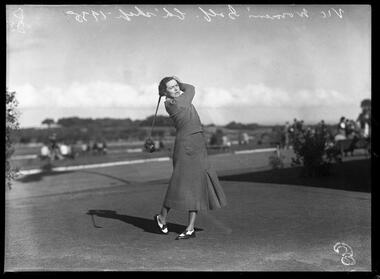
Photograph, Bull, Hugh Jones, 1897-1993, Miss Betty Sale
... For a fortnight they did not change their clothes and slept under tarpaulins in the hatchway. The only choice of food was porridge or pea soup. ...For a fortnight they did not change their clothes and slept under tarpaulins in the hatchway. The only choice of food was porridge or pea soup. ...Betty Sale (1905-1976) won the Tasmanian State Championship in 1934, 1935 and 1936. She also worked as a car saleswoman in Hobart. In 1939, London reported: “Betty Sale, pretty Tasmanian brunette, will soon leave England for Finland, where she will drive an ambulance behind the Mannerheim Line. With twenty-three English society girls, she volunteered for the job because she wanted to do something for the brave Finns.” Betty volunteered for First Aid Nursing Yeomanry Service (F.A.N.Y.), conveying refugees and casualties to hospitals by ambulance in Finland’s harsh weather. Back in England, as a corporal, she worked during bombings in Plymouth, writing to her brother: “Bombs were dropping all around us, fires are raging, debris everywhere and huge holes around us. When we had got all the live ones, we went and collected dead bodies.” Betty was awarded an MBE and the Winter War Medal for Civilians from Finland Government 1939-40. MCK142 Published The Age 29 August 1935 Featured in "Newsworthy: Melbourne in photographs 1933-1936" exhibition at East Melbourne Library, October to December 2023. Exhibition caption by project volunteer, Fiona Collyer. Photographer notations on slide: "Vic. Women's Golf Ch'ship 1935 B98" Published: The Age 29 August 1935 p. 11 Published title: SIX STATE CHAMPIONS IN NATIONAL GOLF CHAMPIONSHIP. Published caption: Six State champions for the first time in the history of women’s golf are competing in the matches for the Australian title. — 1. Miss B. Sale (Tas.). 2. Miss J. Hood-Hammond (N.S.W.). 3. Miss J. Gardiner (Qld,) 4. Miss K. Rymill (S.A.). 5. Mrs. O. J. Negus (W.A.). 6. Mrs. S. Morpeth (Vic.) RESEARCHER'S NOTE: The Age listed Golfer 1 as Miss B. Sale and Golfer 4 as Miss K. Rymill. We verified that these should in fact be the other way around: 1 is Miss K. Rymill, 4 is Miss B. Sale. Description: Action shot of woman driving golf ball Research by project volunteer, Fiona Collyer: MISS BETTY SALE Mrs Margaret Elizabeth Scott Rigg (1905-1976) MBE Betty Sale grew up in Hobart and attended St Michael’s Collegiate School. She was a champion Tasmania golfer and won the State Championship in 1934, 1935, 1936. Betty competed in the Australian Women’s Golf Championship at Royal Melbourne against the British Women’s Team in 1935. Betty worked as a car saleswoman at Robert Nettleford Pty Ltd at 113 Macquarie Street, Hobart. They were the agent for Austin, Buick, Chevrolet and Vauxhall. In April 1939, Betty sailed on the RMS Orford to London where she worked in sales for Henley’s, an exclusive motor sales firm. In November 1939 she volunteered for the Woman’s Transport Arm of the First Aid Nursing Yeomanry Service (F.A.N.Y.) and was part of the team delivering 10 ambulances to Finland, which had been invaded by the Soviet Union. Betty worked conveying refugees and military casualties to military hospitals, often over tracks with only sleigh marks to guide them. Despite contracting measles she continued to work tirelessly, often for 22-hour shifts. She was awarded the Finland Winter War medal 1939-1940 for civilians by Field-Marshall Mannerheim (later President of Finland). Betty was quoted in the Australian Women’s Weekly 17/1/1940: “I joined the ambulance corp for Finland because I was filled with admiration for the courage and determination of the Finns. I don’t think that there has ever been anything so dramatic in history as the manner in which Finland, a land of 4,000,000 people has resisted the aggression of the teeming millions of Russians.” After six months working in Finland, the FANYs found themselves held up unable to get aid from Britain to escape and they felt a burden on the Finns. Eventually money was sent privately from a neutral country and the 17 FANYs determined to get away. They set off from Helsinki with only the civilian clothes they were wearing and travelled by train and bus to a northern port where they boarded a cargo vessel. For a fortnight they did not change their clothes and slept under tarpaulins in the hatchway. The only choice of food was porridge or pea soup. After two weeks aboard the cargo vessel, a palatial liner approached the ship and in mid-ocean the FANYs were transhipped by rope ladders. The women enjoyed three course meals and other luxuries for three days before arriving back in England. Betty, now a corporal, worked for two years transporting civilian and military casualties during bombings in Plymouth. In a letter to her brother, Mr J Sale of Gerogery NSW, Betty wrote, “We have had a very lively time here as we have been blitzed for two nights. There is literally nothing of Plymouth left. We were out all the first night with the ambulance collecting casualties and have never seen such injuries. Bombs were dropping all around us, fires were raging, debris everywhere, and huge holes in the roads. When we had got all the live ones, we went and collected dead bodies. The people are marvellous.” “Next night, we had a worse blitz. We were not out so long but it was not a pleasant party. I didn’t know I was so brave but could not stand it too long. Mr Menzies was here for the second night’s blitz. We have adopted a homeless and hurt dog – a raid victim – and the poor fellow is completely exhausted.” In 1942, Betty worked in Algeria in charge of 100 specialists and technicians - the first servicewomen to arrive in North Africa. In 1945, she was awarded an MBE in recognition and on behalf of the work this unit was involved in. In 1945, Betty was promoted to Captain and posted to Australia to establish a Signal Station. In 1946, she married Lt-Col H. Henry O. Rigg of the Royal Artillery in Tasmania. The couple had first met in Algeria in 1943. The Australian press closely followed Betty’s wartime activities praising her courage, capability, driving and mechanical knowledge and of course Australian women’s hardiness. After the war, Betty lived in Sheffield, England with her husband, working as an office manager. She continued to play golf until her death aged 71 in 1976.Photographer notations on slide: "Vic. Women's Golf Ch'ship 1935 B98".golf, women golfers, royal melbourne golf club
