
Showing 32 items matching "the child bird"
-
 Moorabbin Air Museum
Book - General aviation, Earlybird The Story of Phil Lightband
... The child bird...General aviation The child bird Air born The helmet speaks Solo Old enough Dancing Discipline Crossroads War bird Grounded Sea gulls The silver blue bird First leg Bogged Foreign skies Winged Jail birds Wings clipped Bikes & prams Phoenix Between two worids Amphibians Rainmakers Biography of NZ pilot Phil Lightbrand & his involvement in NZ general aviation, circa 1996 Earlybird The Story of Phil Lightband Book General aviation ...Biography of NZ pilot Phil Lightbrand & his involvement in NZ general aviation, circa 1996non-fictionBiography of NZ pilot Phil Lightbrand & his involvement in NZ general aviation, circa 1996the child bird, air born, the helmet speaks, solo, old enough, dancing, discipline, crossroads, war bird, grounded, sea gulls, the silver blue bird, first leg, bogged, foreign skies, winged, jail birds, wings clipped, bikes & prams, phoenix, between two worids, amphibians, rainmakers -
 Mont De Lancey
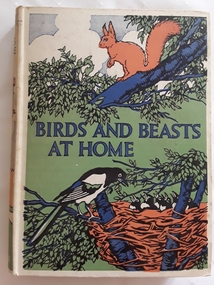
Book, W.Gilhespy et al, Birds and Beasts at Home. Nelson's Bumper Books series, Unknown
... bird feeding her babies in a nest. The title is printed in blue. The spine has the title and an illustration of a dovecote, along with the publisher Nelson written below. A coloured plate is at the front and throughout there are black and white illustrations. A child...bird feeding her babies in a nest. The title is printed in blue. The spine has the title and an illustration of a dovecote, along with the publisher Nelson written below. A coloured plate is at the front and throughout there are black and white illustrations. A child ...A collection of birds and beasts at home fiction stories for young children. Clem Thiele presumably owned the book indicated by the stamps inside with his name.Children's hardcover collection of Birds and Beasts at Home stories by W. Gilhespy. The cover has a coloured picture of a squirrel sitting on a branch of a tree and a mother bird feeding her babies in a nest. The title is printed in blue. The spine has the title and an illustration of a dovecote, along with the publisher Nelson written below. A coloured plate is at the front and throughout there are black and white illustrations. A child has stamped birds and other pictures here and there.Clem Thiele Doncaster is stamped four times on the endpaper at the front with stamps of a gentleman and his dog too.children's fiction, animal stories, bird stories -
 Flagstaff Hill Maritime Museum and Village
Leisure object - Toy, Circa 1878
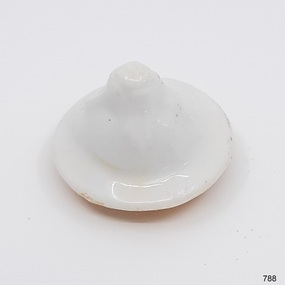
... Through is associated with the worst and best-known shipwreck in Victoria's history. flagstaff hill warrnambool flagstaff hill maritime museum shipwreck coast flagstaff hill maritime village great ocean road loch line loch ard captain gibbs eva carmichael tom pearce glenample station mutton bird island loch ard gorge toy child's tea set toy lid Toy; a white ceramic lid from a child's tea set. ...This ceramic lid is part of a child's tea set, perhaps from a sugar bowl or tea pot. It was recovered from the wreck of the Loch Ard. The Loch Ard got its name from "Loch Ard" a loch that lies to the west of Aberfoyle, and the east of Loch Lomond. It means "high lake" in Scottish Gaelic. The vessel belonged to the famous Loch Line which sailed many vessels from England to Australia. The Loch Ard was built in Glasgow by Barclay, Curle & Co. in 1873, the vessel was a three-masted square-rigged iron sailing ship that measured 79.87 meters in length, 11.58 m in width, and 7 m in depth with a gross tonnage of 1693 tons with a mainmast that measured a massive 45.7 m in height. Loch Ard made three trips to Australia and one trip to Calcutta before its fateful voyage. Loch Ard left England on March 2, 1878, under the command of 29-year-old Captain Gibbs, who was newly married. The ship was bound for Melbourne with a crew of 37, plus 17 passengers. The general cargo reflected the affluence of Melbourne at the time. Onboard were straw hats, umbrellas, perfumes, clay pipes, pianos, clocks, confectionery, linen, and candles, as well as a heavier load of railway irons, cement, lead, and copper. There were other items included that were intended for display in the Melbourne International Exhibition of 1880. The voyage to Port Phillip was long but uneventful. Then at 3 am on June 1, 1878, Captain Gibbs was expecting to see land. But the Loch Ard was running into a fog which greatly reduced visibility. Captain Gibbs was becoming anxious as there was no sign of land or the Cape Otway lighthouse. At 4 am the fog lifted and a lookout aloft announced that he could see breakers. The sheer cliffs of Victoria's west coast came into view, and Captain Gibbs realised that the ship was much closer to them than expected. He ordered as much sail to be set as time would permit and then attempted to steer the vessel out to sea. On coming head-on into the wind, the ship lost momentum, the sails fell limp and Loch Ard's bow swung back towards land. Gibbs then ordered the anchors to be released in an attempt to hold their position. The anchors sank some 50 fathoms - but did not hold. By this time the ship was among the breakers and the tall cliffs of Mutton Bird Island rose behind. Just half a mile from the coast, the ship's bow was suddenly pulled around by the anchor. The captain tried to tack out to sea, but the ship struck a reef at the base of Mutton Bird Island, near Port Campbell. Waves subsequently broke over the ship and the top deck became loosened from the hull. The masts and rigging came crashing down knocking passengers and crew overboard. When a lifeboat was finally launched, it crashed into the side of Loch Ard and capsized. Tom Pearce, who had launched the boat, managed to cling to its overturned hull and shelter beneath it. He drifted out to sea and then on the flood tide came into what is now known as Lochard Gorge. He swam to shore, bruised and dazed, and found a cave in which to shelter. Some of the crew stayed below deck to shelter from the falling rigging but drowned when the ship slipped off the reef into deeper water. Eva Carmichael a passenger had raced onto the deck to find out what was happening only to be confronted by towering cliffs looming above the stricken ship. In all the chaos, Captain Gibbs grabbed Eva and said, "If you are saved Eva, let my dear wife know that I died like a sailor". That was the last Eva Carmichael saw of the captain. She was swept off the ship by a huge wave. Eva saw Tom Pearce on a small rocky beach and yelled to attract his attention. He dived in and swam to the exhausted woman and dragged her to shore. He took her to the cave and broke the open case of brandy that had washed up on the beach. He opened a bottle to revive the unconscious woman. A few hours later Tom scaled a cliff in search of help. He followed hoof prints and came by chance upon two men from nearby Glenample Station three and a half miles away. In a complete state of exhaustion, he told the men of the tragedy. Tom then returned to the gorge while the two men rode back to the station to get help. By the time they reached Loch Ard Gorge, it was cold and dark. The two shipwreck survivors were taken to Glenample Station to recover. Eva stayed at the station for six weeks before returning to Ireland by steamship. In Melbourne, Tom Pearce received a hero's welcome. He was presented with the first gold medal of the Royal Humane Society of Victoria and a £1000 cheque from the Victorian Government. Concerts were performed to honour the young man's bravery and to raise money for those who lost families in the disaster. Of the 54 crew members and passengers on board, only two survived: the apprentice, Tom Pearce, and the young woman passenger, Eva Carmichael, who lost her family in the tragedy. Ten days after the Lochard tragedy, salvage rights to the wreck were sold at auction for £2,120. Cargo valued at £3,000 was salvaged and placed on the beach, but most washed back into the sea when another storm developed. The wreck of Lochard still lies at the base of Mutton Bird Island. Much of the cargo has now been salvaged and some items were washed up into Lochard Gorge. Cargo and artifacts have also been illegally salvaged over many years before protective legislation was introduced in March 1982. One of the most unlikely pieces of cargo to have survived the shipwreck was a Minton majolica peacock- one of only nine in the world. The peacock was destined for the Melbourne 1880 International Exhibition. It had been well packed, which gave it adequate protection during the violent storm. Today the Minton peacock can be seen at the Flagstaff Hill Maritime Museum in Warrnambool. From Australia's most dramatic shipwreck, it has now become Australia's most valuable shipwreck artifact and is one of very few 'objects' on the Victorian State Heritage Register. The shipwreck of the Loch Ard is of significance for Victoria and is registered on the Victorian Heritage Register ( S 417). Flagstaff Hill has a varied collection of artifacts from Loch Ard and its collection is significant for being one of the largest accumulation of artifacts from this notable Victorian shipwreck of which the subject items are a small part. The collection's objects give us a snapshot of how we can interpret the story of this tragic event. The collection is also archaeologically significant as it represents aspects of Victoria's shipping history that allows us to interpret Victoria's social and historical themes of the time. Through is associated with the worst and best-known shipwreck in Victoria's history.Toy; a white ceramic lid from a child's tea set. The underside is hollow. The lid is glazed and the surface of the lid is uneven under the glaze.flagstaff hill, warrnambool, flagstaff hill maritime museum, shipwreck coast, flagstaff hill maritime village, great ocean road, loch line, loch ard, captain gibbs, eva carmichael, tom pearce, glenample station, mutton bird island, loch ard gorge, toy, child's tea set, toy lid -
 Flagstaff Hill Maritime Museum and Village
Ceramic - Lid, circa 1878
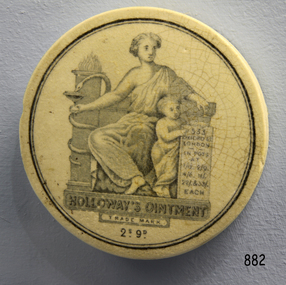
... Through is associated with the worst and best-known shipwreck in Victoria's history. flagstaff hill warrnambool flagstaff hill maritime museum shipwreck coast flagstaff hill maritime village great ocean road loch line loch ard captain gibbs eva carmichael tom pearce glenample station mutton bird island loch ard gorge holloway’s ointment ceramic lid pot lid nineteenth-century medicines pharmaceutical marketing The front face of the lid, at the base of the woman on the throne, bears the label “HOLLOWAY’S OINTMENT”. Below this, in smaller letters, is written “TRADE MARK” and “2S.9D.” On the stone tablet pointed to by the child ...This ceramic lid is from a Holloway’s Ointment pot. It was retrieved from the wreckage of the LOCH ARD. The vessel was laden with an up-to-date, high-value cargo, including luxury items intended for the Melbourne International Exhibition in 1880. Britain exported her manufactures to the Australasian colonies and the Americas. Holloway’s Ointment was one nineteenth-century pharmaceutical product that was advertised in both these markets. The price of this particular jar and its contents was printed on the label as “2S 9D” (2 shillings and nine pence). This value calculated to the approximate price in 2014, would be £51.31 (UK pounds and decimal pence) or $85 AU ― quite an expensive ointment. The label also shows a picture of a stone tablet with the inscription "IN POTS AT 1/½, 2/9, 4/6,11/-, 22/- & 33/- EACH”, which is most likely the alternative prices that the ointment was available for in differently sized containers. Holloway’s claims for his “great remedy” included the cure of sores, wounds, ulcers and boils, gout, rheumatism, diphtheria, bronchitis, influenza, sore throats, coughs and colds, “all varieties of skin diseases”, scrofula, ringworm, scurvy, “dropsical swellings” and liver disease, piles, fistulas, and internal inflammation. The salve cream was said to penetrate the skin when rubbed on; purifying internal tissues and organs, cleansing all bodily fluids particularly the blood, and eradicating all disease from the body. Purchasers were assured that if Holloway’s Ointment alone did not affect immediate cure, then the combination of it and Holloway’s Pills (sold separately) most certainly would. Thomas Holloway began manufacturing and marketing his miraculous ointment from premises at 244 Strand in the 1840s, moving to the more prestigious address of 533 Oxford in the late 1860s. The London address was an important part of his promotional appeal and was displayed prominently on the packaging of his products. Holloway’s attention to marketing is also observed in the pseudo-Classical emblems that decorated his containers. The sign of a snake curled around a staff is a longstanding and commonly recognised symbol of the physician’s power to heal. Similar reference on this lid is also being made to an ancient goddess of healing and her healthy young offspring. History of the Loch Ard: The Loch Ard got its name from ”Loch Ard” a loch which lies to the west of Aberfoyle, and the east of Loch Lomond. It means "high lake" in Scottish Gaelic. The vessel belonged to the famous Loch Line which sailed many vessels from England to Australia. The Loch Ard was built in Glasgow by Barclay, Curdle and Co. in 1873, the vessel was a three-masted square-rigged iron sailing ship that measured 79.87 meters in length, 11.58 m in width, and 7 m in depth with a gross tonnage of 1693 tons with a mainmast that measured a massive 45.7 m in height. Loch Ard made three trips to Australia and one trip to Calcutta before its fateful voyage. Loch Ard left England on March 2, 1878, under the command of 29-year-old Captain Gibbs, who was newly married. The ship was bound for Melbourne with a crew of 37, plus 17 passengers. The general cargo reflected the affluence of Melbourne at the time. Onboard were straw hats, umbrella, perfumes, clay pipes, pianos, clocks, confectionery, linen and candles, as well as a heavier load of railway irons, cement, lead and copper. There were other items included that were intended for display in the Melbourne International Exhibition of 1880. The voyage to Port Phillip was long but uneventful. Then at 3 am on June 1, 1878, Captain Gibbs was expecting to see land. But the Loch Ard was running into a fog which greatly reduced visibility. Captain Gibbs was becoming anxious as there was no sign of land or the Cape Otway lighthouse. At 4 am the fog lifted and a lookout aloft announced that he could see breakers. The sheer cliffs of Victoria's west coast came into view, and Captain Gibbs realised that the ship was much closer to them than expected. He ordered as much sail to be set as time would permit and then attempted to steer the vessel out to sea. On coming head-on into the wind, the ship lost momentum, the sails fell limp and Loch Ard's bow swung back towards land. Gibbs then ordered the anchors to be released in an attempt to hold its position. The anchors sank some 50 fathoms - but did not hold. By this time the ship was among the breakers and the tall cliffs of Mutton Bird Island rose behind. Just half a mile from the coast, the ship's bow was suddenly pulled around by the anchor. The captain tried to tack out to sea, but the ship struck a reef at the base of Mutton Bird Island, near Port Campbell. Waves subsequently broke over the ship and the top deck became loosened from the hull. The masts and rigging came crashing down knocking passengers and crew overboard. When a lifeboat was finally launched, it crashed into the side of Loch Ard and capsized. Tom Pearce, who had launched the boat, managed to cling to its overturned hull and shelter beneath it. He drifted out to sea and then on the flood tide came into what is now known as Lochard Gorge. He swam to shore, bruised and dazed, and found a cave in which to shelter. Some of the crew stayed below deck to shelter from the falling rigging but drowned when the ship slipped off the reef into deeper water. Eva Carmichael a passenger had raced onto the deck to find out what was happening only to be confronted by towering cliffs looming above the stricken ship. In all the chaos, Captain Gibbs grabbed Eva and said, "If you are saved Eva, let my dear wife know that I died like a sailor". That was the last Eva Carmichael saw of the captain. She was swept off the ship by a huge wave. Eva saw Tom Pearce on a small rocky beach and yelled to attract his attention. He dived in and swam to the exhausted woman and dragged her to shore. He took her to the cave and broke the open case of brandy which had washed up on the beach. He opened a bottle to revive the unconscious woman. A few hours later Tom scaled a cliff in search of help. He followed hoof prints and came by chance upon two men from nearby Glenample Station three and a half miles away. In a complete state of exhaustion, he told the men of the tragedy. Tom then returned to the gorge while the two men rode back to the station to get help. By the time they reached Loch Ard Gorge, it was cold and dark. The two shipwreck survivors were taken to Glenample Station to recover. Eva stayed at the station for six weeks before returning to Ireland by steamship. In Melbourne, Tom Pearce received a hero's welcome. He was presented with the first gold medal of the Royal Humane Society of Victoria and a £1000 cheque from the Victorian Government. Concerts were performed to honour the young man's bravery and to raise money for those who lost family in the disaster. Of the 54 crew members and passengers on board, only two survived: the apprentice, Tom Pearce and the young woman passenger, Eva Carmichael, who lost her family in the tragedy. Ten days after the Lochard tragedy, salvage rights to the wreck were sold at auction for £2,120. Cargo valued at £3,000 was salvaged and placed on the beach, but most washed back into the sea when another storm developed. The wreck of Lochard still lies at the base of Mutton Bird Island. Much of the cargo has now been salvaged and some items were washed up into Lochard Gorge. Cargo and artefacts have also been illegally salvaged over many years before protective legislation was introduced in March 1982. One of the most unlikely pieces of cargo to have survived the shipwreck was a Minton majolica peacock- one of only nine in the world. The peacock was destined for the Melbourne 1880 International Exhibition in. It had been well packed, which gave it adequate protection during the violent storm. Today the Minton peacock can be seen at the Flagstaff Hill Maritime Museum in Warrnambool. From Australia's most dramatic shipwreck it has now become Australia's most valuable shipwreck artifact and is one of very few 'objects' on the Victorian State Heritage Register.The shipwreck of the Loch Ard is of significance for Victoria and is registered on the Victorian Heritage Register ( S 417). Flagstaff Hill has a varied collection of artefacts from Loch Ard and its collection is significant for being one of the largest accumulation of artefacts from this notable Victorian shipwreck of which the subject items are a small part. The collections objects give us a snapshot of how we can interpret the story of this tragic event. The collection is also archaeologically significant as it represents aspects of Victoria's shipping history that allows us to interpret Victoria's social and historical themes of the time. Through is associated with the worst and best-known shipwreck in Victoria's history. The ceramic lid off a Holloway’s Ointment container, retrieved from the wreckage of the LOCH ARD. The artefact is white with the pale blue image of a woman (seated) and a child (standing). The woman is draped in a soft white robe and her throne is beside a pillar that is entwined by a serpent. The child points to an inscribed stone tablet he is holding on the other side of seated woman. The front face of the lid, at the base of the woman on the throne, bears the label “HOLLOWAY’S OINTMENT”. Below this, in smaller letters, is written “TRADE MARK” and “2S.9D.” On the stone tablet pointed to by the child is inscribed “533 OXFORD ST. LONDON”, and beneath this, “IN POTS AT 1/½, 2/9, 4/6,11/-, 22/- & 33/- EACH”.flagstaff hill, warrnambool, flagstaff hill maritime museum, shipwreck coast, flagstaff hill maritime village, great ocean road, loch line, loch ard, captain gibbs, eva carmichael, tom pearce, glenample station, mutton bird island, loch ard gorge, holloway’s ointment, ceramic lid, pot lid, nineteenth-century medicines, pharmaceutical marketing -
 Federation University Historical Collection
Book, Victoria Education Gazette and Teachers' Aid, 1921-1930, 1921-1930
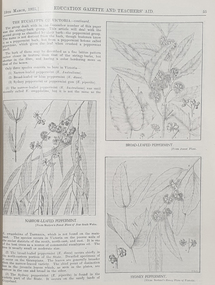
... Child Hudson Hard Obituary, Leeches, Relief for Distress in Europe, Dental, Teachers' Library, History of Portarlington, J.E. Stevens Obituary, Victorian Teachers in England Images: Swimming and Life-Saving Medallion .3) Swimming and Lifesaving, Bronze medallion, Victoria Leage of Victori, War Savings Stamps, Rural School Sytem of Victoria, .4) War Relief, Talbot Colony for Epileptics Masonmeadows, Discipline New and Old (Percy Samson), Soldier teachers, Preservation of Australian Birds, Arbor Day, Jubilee of Free Education, Teaching Geography, Poery in Schools, School Committees, Shelter Pavilion, Mysia Memorial School, Clovers, Jubilee Exhibition, Domestic Arts, Louis Pasteur, .5) Victoria League of Victoria, An Endowment Scheme (Pine Plantations), School Endowment Plantations, Protecting our trees by Owen Jones,. ...Child Hudson Hard Obituary, Leeches, Relief for Distress in Europe, Dental, Teachers' Library, History of Portarlington, J.E. Stevens Obituary, Victorian Teachers in England Images: Swimming and Life-Saving Medallion .3) Swimming and Lifesaving, Bronze medallion, Victoria Leage of Victori, War Savings Stamps, Rural School Sytem of Victoria, .4) War Relief, Talbot Colony for Epileptics Masonmeadows, Discipline New and Old (Percy Samson), Soldier teachers, Preservation of Australian Birds, Arbor Day, Jubilee of Free Education, Teaching Geography, Poery in Schools, School Committees, Shelter Pavilion, Mysia Memorial School, Clovers, Jubilee Exhibition, Domestic Arts, Louis Pasteur, .5) Victoria League of Victoria, An Endowment Scheme (Pine Plantations), School Endowment Plantations, Protecting our trees by Owen Jones,. ...The Victoria Education Gazette and Teachers' Aid was published for Victoria's teachers and was sent to all school on the state. In 1920 The Ballarat School of Mines had donated 136 pounds 14 shillings and 10 pence to the Victorian Education Department's War Relief Account, and the Ballarat Junior Technical School had donated 10 pounds 6 shillings and 10 pence.Ten black hard covered volumes with red tape spine, covering 1921 to 1930. The gazettes include Education Department appointments, transfers, resignations and retirements, vacancies, notices, queries, notices of books, examination papers, original articles, lesson plans, suggestions for lessons, drawing, obituaries, notes on nature study, mathematics, music, sloyd woodwork, English grammar, Victorian State School Swimming Clubs, Geography, penmanship, science, History, Latin, Geography, The School Garden, horticulture, singing, World War One; ANZAC Day, lifesaving, Astronomy, Empire Day, ANZAC Buffet London, Victorian Education Department's War Relief Fund .1) 1928. Articles include: New Caledonia, Swimming and Lifesaving, School forestry, a visit to the pyramids, Exploration of Gippsland, paul de Strezelecki, Angus McMillan, Villers Bretonneux Memorial School, American Black Walnut, Red Gum, Messmate Stringybark, The Great Barrier Reef, retirement of Frank Tate, Stawell High School, Report on Some Aspects of Education in the United States, Jubilee Education Exhibition , New School Readers; measured Drawing Images include: Macarthur Street School's Plantation, Maryborough School Plantation, Pinus Insignis (Radiata) ready for Milling, Creswick State Forest, Metalwork, Daylesford Pine Plantation four years old, Henry Harvey (art Inspector); Omeo School Endowment Plantation; Frank Tate; Stawell High School Drawings From Casts; Lake Tyers School Endowment Plantation, measured drawing, Thomas H. Stuart, GEorge Swinburne. J.R. Tantham-Fryer, Cookery Class, John Edward Thomas. .3) War Savings Stampsm Swimming and Life-saving, Teh Rural School System of Victoria, Imaginative Composition, ANZAC Day, Retardation, Teh Bright Child Hudson Hard Obituary, Leeches, Relief for Distress in Europe, Dental, Teachers' Library, History of Portarlington, J.E. Stevens Obituary, Victorian Teachers in England Images: Swimming and Life-Saving Medallion .3) Swimming and Lifesaving, Bronze medallion, Victoria Leage of Victori, War Savings Stamps, Rural School Sytem of Victoria, .4) War Relief, Talbot Colony for Epileptics Masonmeadows, Discipline New and Old (Percy Samson), Soldier teachers, Preservation of Australian Birds, Arbor Day, Jubilee of Free Education, Teaching Geography, Poery in Schools, School Committees, Shelter Pavilion, Mysia Memorial School, Clovers, Jubilee Exhibition, Domestic Arts, Louis Pasteur, .5) Victoria League of Victoria, An Endowment Scheme (Pine Plantations), School Endowment Plantations, Protecting our trees by Owen Jones,. Victorian State Schools Horticultural Society, Sloyd Woodwork, School Forestry, Thomas Brodribb Obituary and portrait, Imperial Education Conference London, school Management and Method, School plantations, Eucalypt plantations in the Bendix and Heathcote District, Junior Red Cross, Jubilee Education Exhibition, Gould League Competitions, handwriting, The School Magazine, Frank Tate in London, Victorian beetles, Council of Public Education, Villers Bretonneux and its new School, Death of Samuel Summons, Woodwork Summer School, Swimming, Japanese Relief Fund, Retirement of John Cross, reminiscences of the Late Mr Albert Mattingley .6) Thomas H. Trengrove and the Villers Bretonneux School hall and pilaster carvings, forestry, visit of Maryborough teachers to Ballarat Water Reserves, noxious weeds, relief for Distressed Europe, The Dalton Plan, Empire Day, Retirement of Mr Fussell, Centenary of Hume and Hovell Expedition, League of Kindness, Effective Nature Study in a Rural School, Some Facts About Paper and their Bearing Upon School Plantations, Council of the Working Men's College Melbourne, Maria Montessori, University Vacation School, Horticulture in State Schools, An Informal Chat About French Schools (C.R. McRae), The Vacation School, Johann Heinrich Pestalozzi, Inspector's Report on a 5th-class School, Can Children Write Verse, John Adams, Victoria League of Victoria, R.F. Toutcher, Sir James Barbie's Address to High-School Girls, Impressions of a High School Teacher Abroad (R.D. Collman), The Spirit of the School Plantation Scheme, Monument of the Late Mr and Mrs A.T. Sharp at Box Hill Cemetery, The Teaching of Geography, The Treatment of Poetry in Class, Two Difficult Arithmetic Lessons, Location of Principal Australian Timbers, Dr John Smyth, Stammering and its Influence on Education, Wireless Broadcasting as an Educational Medium, Boys School at Villers Brettonneux, The New School at Villers Brettonneux, Bird Day, Messmate or Stringybark, What Every Woman Knows, Director's Report on Denmark .7)1925 . Includes: School Forestry, horticulture, J.H. Betheras retirement, Ivanhoe School, Coburg School, Moorabool Junior Technical School, Villers Bretonneux School hall and pilaster carvings, Francis Ormond, William Charles Kernot, Corsican Pnes at Creswick, Ballarat High School Plantation, Workin Men's College, RMIT, Naorrow LEafed Peppermint, Education and World Peace, Eucalypts of Victoria, John C. Eccles, Blue Gum. Manners, Giving the Poorly Nourished Boy A Chance, Native Ferns, Marybourough Technical School, Memorial School at Villers-Brettonneux .8) Experimental Plots in Country Schools (W.W. Gay), Villers Bretonneaux and its Memorial School. nominated classes for Art Teachers, The Teachers Act 1925, Horsham High School, Richmond Technical School, Farewell to Messrs C.R. Long and Ponsonby Carew-Smyth, Frank Tate, Phyiscal Training, Arbor Day, ANZAC Day, Shakespeare Day,Bendigo Junior Techncial School, Musical Appreciation, Motor Dental Unit, School Camps, Education Act of 1872: Mr Angus McKay's Part (George Mackay), A Bush Fire Experience (Irene Stable), Black Sunday, Californian Red Pine, Women's Education in America, Farewell to Lord and Lady Stradbroke, Grevilia Robusta, Silky Oak, Redwood, John E. Grant, The Need for Research (Donald Clark), Junior Drama, Ida D. Marshall, John Pounds, Australian Books, Fish Creek School, State Boundaries, History in the Curriculum, Ceramic Art in Australia (Percy E. Everett), Choice of School Songs, Tasmanian Beech, Should History be Taught on a National or an International Basis, Hydatid Disease, James Holland Obituary, Florrie Hodges, Queensland Maple, Post Bushfire Ruins at Fumina, Arbor Day at Fumina, Queensland Rosewood, Omeo Endowment Plantation, Bird Day, Junior Red Cross, Pioneers' Day, Edward Henty, Junior Technical Schools, Yellow Pine, History and Progress of Needlework, A.B.C. of Astronomy, Northumberland Mental tests, Queensland Red Cedar, Teh Globe Theatre, .9) 1927 includes The ABC of Astronomy, Atr Theatre, English Beech, Angus McMillan Art Pottery, School Singing, State Schools' Nursery, School endowment plantations, Making a Man, experimental proof of Charles's Law, John Smyth obituary and portrait, Linton Pine Planation, motivation of arithmetic, Women's Classes at Dookie, Swimming and Lifesaving, Pioneers Day, Drawing, Ballarat High School planation, biting fly, Tir-Na-N'og, John Byatt retirement and portrait, Technical Schools Conference at Daylesford, Ethel Osborne and portrait, library. Francis Thompson portrait, Adam Lindsay Gordon, Solar movement, motor transport, Liverpool Cathedral, Teh Story of the Cathedral, Bendigo School of Mines, Omeo School pine plantation, Egypt and the Nile, Self-Criticism Images include Ballarat High School Pine Plantation, Vale Park, Francis Ormond, Woking Men's College (RMIT), W.N. Kernot, A Stand of Corsican Pines at Creswick, Victoria .10) Some Remarks on the Relationship of the technical Schools to the University (Donald Clark) , Present Day Education in England , Memorial to Joseph Cornwall, Spelling, motivation, Singing, State Scholarships, Agriculture, T.W. Bothroyd, The Swimmer - A Summer School Sketch (H.H. Croll), Swimming woodwork, Farewell to Dr Sutton. ,Drowning, War Savings Movement, White Beech. George S. Browne , Example of School Honor Book, Blackwood, Optimistic teacher, Soldier settlement around Shapparton, Oral Hygiene, Cinema Machines, Basketball, Wakter M. Camble obituary, ANZAC day Pilgrimage in England, Froebel's System, Montessori Method, War Relief Fund, New Zealand Kauri Tree, Bat Tenis at a Bush School., Advice to Australian Girls, Chrysanthemums, Royal Visit, National Parks of Victoria, Maurice Copland Obituary, total eclipse of the Moon, School libraries, The teacher and the COmmunity (A.M. Barry), The Reading Lesson, Swimming and Life-saving, MElbourne Teachers' College War Memorial Windows Old Trainees War Memorial, Cultivating a Natinoal Art education gazette, school, education, teaching, teacher, world war one, school plantations, macarthur street pine plantation, school forestry, creswick state forest, anzac day, armistance celebrations, frank tate, frank tate retirement, drawing from cast, education department school readers, lake tyers pine plantation, w.n. kernot, rmit, working men's college, francis ormond, pine plantations, calenbeem park, creswick, villers-brettonneux school hall and carvings, thomas trengrove, corsican pines, creswick, pine endowment plantations, mccarthur st primary school pine plantation, ballarat high school pine plantation, vale park, mount pleasant primary school pine plantation, golden point pine plantation, angus macmillan, paul de strzelecki, gippsland, villers-bretonneaux memorial school, francis thompson, english ash, pestalozzi centenary, shakespeare day, swimming classes, clear pine, cinema in education, american black walnut, red gum, thomas wolliam bothroyd obituary, and portrait, physical training displays, teaching of spelling, ohm's law, blue gum -
 Federation University Historical Collection
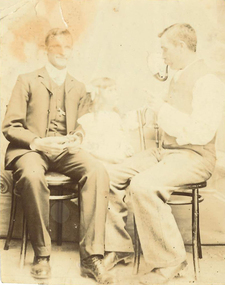
Photograph, James (Jim) Smith of Happy Valley
... child in the photograph is Phyllis Joy Smith, Jim's eldest daughter. Jim Smith was the brother of Clara Emma Yung nee Smith. jim smith james smith clara emma smith happy valley yendon piggoreet south africa mining orchard edward keys george henry smith emma keys smith clara emma yung annie bolte shire of grenville Clarkesdale Bird Sanctury Verso: Jim Smith South Africa (Mining) Established orchard halfway near Linton and Happy Valley. ...James (Jim) Smith, (died 03/08/1974, aged 93 years) established an orchard growing snow apples near in Happy Valley after returning from mining activities in South Africa. The orchard was called "Springdallah" and was beside the Linton/Happy Valley Road across from the old Happy Valley railway station. Jim was the son of George Henry Smith (18/12/1840 - 26/11/1903) and Emma Keys Smith born Keys (07/08/1842 - 28/08/1888). George and Emma left Liverpool with other unassisted immigrants on the "Bates Family" ship with baby Clara on 08/06/1863 arriving in Melbourne on 08/06/1863. George and Emma emigrated to Australia on the invitation of Emma's brother Edward Keys who owned a property near the school at Happy Valley on which there were two houses. Teddy offered George and Emma the smaller one to live in. When "Teddy" decided to go into hotel keeping George took over the 200 acres of his property and made it a pleasant orchard and garden called "Cress Green Gardens". George had various secretarial jobs - rate collector; paymaster at the mines; until he became Shire Secretary for the Shire of Grenville, whose centre was Linton and Government Auditor for Western Victoria (1894-1903), the means of transport being horse and buggy. Another son followed his father as Shire Secretary. George and Emma had 14 children, Emma dying giving birth to Emma Keys who lived for 16 months. George later married Annie Bolte with 2 more children being born. Annie later sold the property. The land was used for grazing and the two houses fell into disrepair. In 1995 George's grandson Ernest (Alf) Alfred Watson visited the site and reported a wrought iron gate at the site and a mulberry tree near the site of his grandmother's family home. Bluestone blocks can still be seen in the paddocks from the roadside. The child in the photograph is Phyllis Joy Smith, Jim's eldest daughter. Jim Smith was the brother of Clara Emma Yung nee Smith.Sepia photo of two men and a girl. One of them is Jim Smith who established on orchard at Happy Valley. He also went to South Africa - mining activities. The orchard is now part of Clarkesdale Bird Sanctuary located at 360 Linton-Piggoreet Rd, Linton, Vic. 3360. Verso: Jim Smith South Africa (Mining) Established orchard halfway near Linton and Happy Valley. Clara Emma's brother. jim smith, james smith, clara emma smith, happy valley, yendon, piggoreet, south africa, mining, orchard, edward keys, george henry smith, emma keys smith, clara emma yung, annie bolte, shire of grenville, clarkesdale bird sanctury -
 Federation University Historical Collection
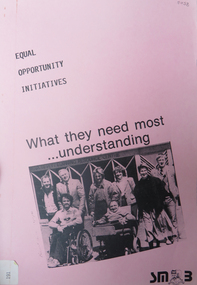
Booklet, Ballarat School of Mines Equal Opportunity Initiatives: What They Need Most ... Understanding, 08/1987
... child care certificate...aboriginal welfare studies certificate...disability...women's trade and technical program...linda bland...l. bird...equal opportunity initiatives aboriginal programs aboriginal child care certificate aboriginal welfare studies certificate disability women's trade and technical program linda bland l. bird w. lovett d. rose leoda atkinson kate denyer lucy taylor audrey gibbs dianne nikkleson marie bird anne goodfellow lily saylor aborigines aboriginal education centre cordell kent ballarat and district aboriginal co-operative ltd aboriginal studies john morris shane everard ann-marie harris julie baulch tracey coleman don dalton michele scott laurell pearse christine pearce margaret o'mara kerrie cross Women Pink plastic bound report of 29 pages. ...Pink plastic bound report of 29 pages. Contents include Aboriginal Programs, People with Disabilities, Women's Trade and Technical Program.equal opportunity initiatives, aboriginal programs, aboriginal child care certificate, aboriginal welfare studies certificate, disability, women's trade and technical program, linda bland, l. bird, w. lovett, d. rose, leoda atkinson, kate denyer, lucy taylor, audrey gibbs, dianne nikkleson, marie bird, anne goodfellow, lily saylor, aborigines, aboriginal education centre, cordell kent, ballarat and district aboriginal co-operative ltd, aboriginal studies, john morris, shane everard, ann-marie harris, julie baulch, tracey coleman, don dalton, michele scott, laurell pearse, christine pearce, margaret o'mara, kerrie cross, women -
 Orbost & District Historical Society
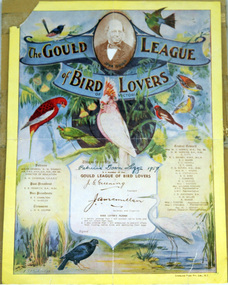
certificate, Stockland Press Pty Ltd, mid 20th century
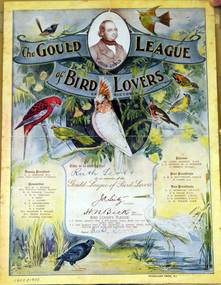
... bird-day concerts'. This certificate belonged to Patricia Legge. Ruth Scott, daughter of Herbert Scott and Bertha (nee Coverdale), married David Legge. Patricia Dawn Legge and Kevin David Legge are Ruth and David's children. The Gould League has made a significant impact on generations of Australians and their environmental attitudes. Being a Gould league member as a child ...Named to honour the work of John and Elizabeth Gould, 'The Gould League of Bird Lovers' was formed in 1909. It was originally set up to prevent bird egg collecting and to educate for the protection of Australian birds. Gould League members were recruited via schools and received membership certificates and badges. Members were encouraged to enter competitions in bird mimicry, write stories and poems and attend 'bird-day concerts'. This certificate belonged to Patricia Legge. Ruth Scott, daughter of Herbert Scott and Bertha (nee Coverdale), married David Legge. Patricia Dawn Legge and Kevin David Legge are Ruth and David's children. The Gould League has made a significant impact on generations of Australians and their environmental attitudes. Being a Gould league member as a child in primary school gave children the opportunity to belong to a group that was learning about and protecting native bushland and its wildlife. Although not operating some Australian states the Gould League continues in Victoria.A Gould League of Bird Lovers of Victoria membership certificate for Patricia Dawn Legge 1959. It has colourful illustrations of native Australian birds on a pale yellow background. The illustrations are by A.T. Mockridge, an early 20th century Melbourne commercial artist and portraitist. In a banner at the top is a photo of John Gould with GOULD LEAGUE of BIRD LOVERS around it. It has a list of patrons, presidents and the Central Council. There is also the Bird Lover's Pledge unsigned in the middle.In pen - Patricia Dawn Legge 1959certificate gould-league -
 Orbost & District Historical Society
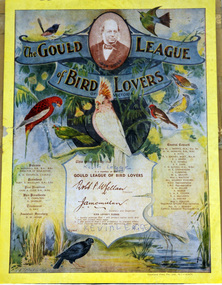
certificate, Stockland Press Pty Ltd, mid 20th century
... bird-day concerts'. This certificate belonged to Kevin Legge. The Gould League has made a significant impact on generations of Australians and their environmental attitudes. Being a Gould league member as a child ...Named to honour the work of John and Elizabeth Gould, 'The Gould League of Bird Lovers' was formed in 1909. It was originally set up to prevent bird egg collecting and to educate for the protection of Australian birds. Gould League members were recruited via schools and received membership certificates and badges. Members were encouraged to enter competitions in bird mimicry, write stories and poems and attend 'bird-day concerts'. This certificate belonged to Kevin Legge. The Gould League has made a significant impact on generations of Australians and their environmental attitudes. Being a Gould league member as a child in primary school gave children the opportunity to belong to a group that was learning about and protecting native bushland and its wildlife. Although not operating some Australian states the Gould League still functions in Victoria.A Gould League of Bird Lovers of Victoria membership certificate for Kevin Legge. It has colourful illustrations of native Australian birds on a pale yellow background. The illustrations are by A.T. Mockridge, an early 20th century Melbourne commercial artist and portraitist. In a banner at the top is a photo of John Gould with GOULD LEAGUE of BIRD LOVERS around it. It has a list of patrons, presidents and the Central Council. In the middle there is also the Bird Lover's Pledge signed by Kevin Legge . Ruth Scott, daughter of Herbert Scott and Bertha (nee Coverdale), married David Legge. Patricia Dawn Legge and Kevin David Legge are Ruth and David's children. Kevin was born in 1958.The pledge has been signed by Kevin Legge. -
 Orbost & District Historical Society
certificate, Stockland Press Pty Ltd, 1930's
... bird-day concerts'. This certificate was owned to Ruth Scott of Nicholson Street Orbost when she was 10 years old. She was a member of the Gould League for 61 years. Ruth Scott, daughter of Herbert Scott and Bertha (nee Coverdale), married David Legge. Patricia Dawn Legge and Kevin David Legge are Ruth and David's children. There are Gould League certificates for both children in the collection. The Gould League has made a significant impact on generations of Australians and their environmental attitudes. Being a Gould league member as a child ...Named to honour the work of John and Elizabeth Gould, 'The Gould League of Bird Lovers' was formed in 1909. It was originally set up to prevent bird egg collecting and to educate for the protection of Australian birds. Gould League members were recruited via schools and received membership certificates and badges. Members were encouraged to enter competitions in bird mimicry, write stories and poems and attend 'bird-day concerts'. This certificate was owned to Ruth Scott of Nicholson Street Orbost when she was 10 years old. She was a member of the Gould League for 61 years. Ruth Scott, daughter of Herbert Scott and Bertha (nee Coverdale), married David Legge. Patricia Dawn Legge and Kevin David Legge are Ruth and David's children. There are Gould League certificates for both children in the collection.The Gould League has made a significant impact on generations of Australians and their environmental attitudes. Being a Gould league member as a child in primary school gave children the opportunity to belong to a group that was learning about and protecting native bushland and its wildlife. Although not operating some Australian states the Gould League still functions in Victoria.A Gould League of Bird Lovers of Victoria membership certificate for Ruth Scott. It has colourful illustrations of native Australian birds on a pale yellow background. The illustrations are by A.T. Mockridge, an early 20th century Melbourne commercial artist and portraitist. In a banner at the top is a photo of John Gould with GOULD LEAGUE of BIRD LOVERS around it. It has a list of patrons, presidents and the Central Council. In the middle there is also the Bird Lover's Pledge signed by Ruth Scott..The pledge has been signed by Ruth Scott.certificate gould-league -
 Flagstaff Hill Maritime Museum and Village
Award - Medal, ca. 1872
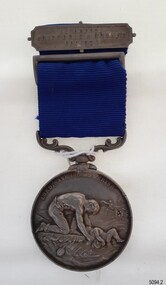
... child from the sea. There is a manned boat in the distance rescuing someone from the sea. In the far background there is a sailing ship. The top third of the medal has an inscription around it. The reverse shows a long-legged hen cormorant with extended wings holding an olive branch in its beak. The bird...child from the sea. There is a manned boat in the distance rescuing someone from the sea. In the far background there is a sailing ship. The top third of the medal has an inscription around it. The reverse shows a long-legged hen cormorant with extended wings holding an olive branch in its beak. The bird ...This medal is the Liverpool Shipwreck and Humane Society’s “Bramley-Moore medal for saving life at sea 1872”. The Society was formed in 1839. In 1872 Mr John Bramley-Moore donated £500 on condition that the medal have the specific inscription above on its reverse. The Bramley Morre medal was first awarded in 1874 and records show that since that time only one gold medal has been awarded, twenty-two silver medals and seventeen bronze medals, the last being in 1945. This Bromley-Moore medal was awarded to Peter Carmody for his bravery in saving lives on the Newfield shipwreck. The Newfield was a three-masted iron and steel barque, built in Dundee, Scotland, in 1889 by Alexander Stephen and Sons. It was owned by the Newfield Ship Company in 1890 and later that year It was registered in Liverpool to owners Brownells and Co. The Newfield left Sharpness, Scotland, on 28th May 1892 with a crew of 25 under the command of Captain George Scott and on 1st June left Liverpool. She was bound for Brisbane, Australia, with a cargo of 1850 tons of fine rock salt, the main export product of Sharpness. At about 9pm on 28th August 1892, in heavy weather, Captain Scott sighted, between heavy squalls, the Cape Otway light on the mainland of Victoria but, due to a navigational error (the ship’s chronometers were wrong), he assumed it to be the Cape Wickham light on King Island, some 40 miles south. He altered his course to the north, expecting to enter Bass Strait. The ship was now heading straight for the south west Victorian coast. At about 1:30am the Newfield ran aground on a reef about 100 yards from shore and one mile east of Curdie’s Inlet, Peterborough. The ship struck heavily three times before grounding on an inner shoal with 6 feet of water in the holds. Rough sea made the job of launching lifeboats very difficult. The first two lifeboats launched by the crew were smashed against the side of the ship and some men were crushed or swept away. The third lifeboat brought eight men to shore. It capsized when the crew tried to return it to the ship for further rescue The rescue was a difficult operation. The Port Campbell Rocket Crew arrived and fired four rocket lines, none of which connected with the ship. Peter Carmody, a local man, volunteered to swim about one mile off shore to the ship with a line to guide the fourth and final lifeboat safely to shore. He was assisted by James McKenzie and Gerard Irvine. Seventeen men survived the shipwreck but the captain and eight of his crew perished. The Newfield remained upright on the reef with sails set for a considerable time as the wind slowly ripped the canvas to shreds and the sea battered the hull to pieces. The Marine Board inquiry found the wreck was caused by a "one man style of navigation" and that the Captain had not heeded the advice of his crew. According to Jack Loney ‘… when the drama was over . . the Newfield was deserted except for the Captain’s dog and two pigs.’ Peter Carmody was awarded the Bramley-Moore medal by the Liverpool Shipwreck and Humane Society for Saving Life at Ssea, which he received by mail on January 21st 1893. The medal and a letter of congratulations were donated to Flagstaff Hill Maritime Museum by Peter Carmody’s grand-daughter Norma Bracken and her son Stuart Bracken on 25th May 2006. The Medal and Letter of Congratulations join other items in the Newfield collection.The Carmody Medal recognises the bravery of Peter Carmody in risking his life to rescue crew members of the Barque Newfield when it was wrecked near Curdies Inlet in August 1892. The ‘Bramley-Moore medal for saving life at sea, 1872’ was presented by the Liverpool Shipwreck and Humane Society. The medal and accompanying letter have local and international historic significance as they demonstrate both the difficulties associated with navigation and the dangers of shipping along the South West Coast of Victoria in the 19th century and the medal’s association with the Liverpool Shipwreck and Humane Society and John Bramley-Moore, who provided £500 to found the Bramley-Moore medal. The medal is socially significant. It emphasises the importance of Peter Carmody in rescuing victims of shipwrecks with little thought for his own safety. The medal reminds us of the importance of local people to Victoria’s maritime history. The Carmody Medal and Humane Society letter were in the Carmody family until they were presented to Flagstaff Hill Maritime Village, by the grand-daughter and great-grandson of Peter Carmody, on the 25th May 2006. The medal is significant for its complete provenance recorded in the donation documentation. The medal is in very good condition and relatively rare with only 22 silver medals awarded between 1874 and 1945. The Carmody Medal and letter add a human element to the story of the shipwrecks. They give life and significance to the Newfield, its victims and its artefacts. Bramley-Moore medal from the Liverpool Shipwreck and Humane Society, awarded to Peter Carmody. The round,silver medal is attached to a looped blue ribbon by a decorative, swivelling silver connector. The top of the ribbon has a silver pin bar threaded through it. The obverse of the medal has a design of a man kneeling on a floating part of a wreck. He is rescuing a child from the sea. There is a manned boat in the distance rescuing someone from the sea. In the far background there is a sailing ship. The top third of the medal has an inscription around it. The reverse shows a long-legged hen cormorant with extended wings holding an olive branch in its beak. The bird is surrounded by a wreath of oak leaves made from two branches. There is an inscription between the design and the rim that goes all the way around the circumference. There is a name engraved around the edge of the medal. The medal in embedded in a purple velvet panel that rests inside a brown, leather-covered case. The lid of the case has a gold embossed emblem in the cemtre. Both the lid and base have a rectangular gold border. The lid is attached to the base with two brass hinges. The base has a brass push-button catch. The box is lined with padded cream silk. The lining inside the lid has a gold emblem in the centre.The obverse has the words "LORD, SAVE US, WE PERISH". The reverse has the words "BRAMLEY-MOORE MEDAL FOR SAVING LIFE AT SEA" and "1872". Around the edge of the medal are the words "PETER CARMODY, FOR HAVING BEEN MAINLY INSTRUMENTAL IN RESCUING THE CREW OF THE BARQUE NEWFIELD, AUG 29 1892" The pin bar has the words “LIVERPOOL SHIPWRECK & HUMANE SOCIETY” written across it. The gold embossed emblem on the lid of the box has the words in the centre "SHIPWRECK AND …. …. ….FOUNDED 1839" The gold emblem on the cream silk lining has the words “BY APPOINTMENT ELKINGTON & CO” printed on it.medal, shipwrecked coast, flagstaff hill, flagstaff hill maritime museum, maritime museum, flagstaff hill maritime village, shipwreck coast, warrnambool, peter, peter carmody, carmody, bramley moore, newfield, liverpool shipwreck and humane society, 1892, 28 august 1892, august 1892, port campbell, bravery, shipwreck, rescue, nineteenth century, ship, curdie s river, victorian shipwrecks, barque, stuart bracken, norma bracken, gerard irvine, james mckenzie -
 Eltham District Historical Society Inc
Negative - Photograph, Harry Gilham, Graves of George and Janet Bird and family, Eltham Cemetery, Victoria, 1 Aug 2007
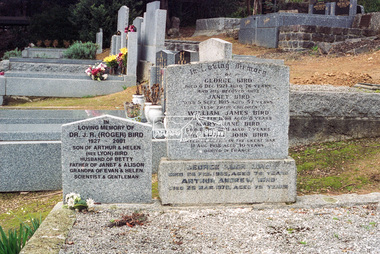
... George Bird was born in England in 1845 and arrived in Australia in 1856 as a child of assisted migrants. ...George Bird was born in England in 1845 and arrived in Australia in 1856 as a child of assisted migrants. ...George Bird was born in England in 1845 and arrived in Australia in 1856 as a child of assisted migrants. Soon afterwards he came out to Eltham to live with his uncle George Stebbings, working for him as bricklayer's assistant in building, amongst others, Shillinglaw Cottage and the Anglican and Methodist Churches in Eltham. He later purchased 72 acres at the eastern end of Pitt Street (bounded by Eucalyptus Road, Mount Pleasant Road and present-day Rockliffe Street) and established the property ‘View Hill’, which was worked as a mixed farm and orchard (including berries). In 1878 he married Janet Kilpatrick, who had emigrated from Scotland. They had ten children, three of whom died in infancy. The wedding in 1904 of their eldest surviving daughter Sarah (‘Sis’) to Edward Pepper appears to have been quite a society event. George was a staunch Methodist and was a Church Steward and a Sunday School Superintendent in about 1890. Janet died in 1915 and George died in 1920 (though his gravestone says 1921). George's will stated that his property was to be divided between all his children in equal shares. This necessitated subdivision of the View Hill property, which took place progressively between 1922 and 1926. One son, George Hugh Bird, operated a drapery store in Main Road (near Bridge Street) in around 1915. Later, in the 1920s, he ran a greengrocer's shop (also selling confectionery) in Main Road opposite Eltham Station. It was the first shop in Eltham to have plate glass windows. At the same time, his brother Reg had a grocery store on the station side of Main Road. George and Janet are buried together in a family plot in Eltham Cemetery. Several descendants are also buried in the cemetery. In Loving Memory Of George Bird Died 5 December 1921 aged 76 years And his beloved wife Janet Bird Died 5 Sept 1915 aged 57 years Also their children William James Bird Died 25 Feb 1888 aged 8 years Mary Jane Bird Died 8 Oct 1891 aged 7 years Pte Edwin John Bird Killed in action in the Great War 11 Aug 1918 aged 30 years Buried in France And on the base stone George Hugh Bird Died 26 Feb. 1965. Aged 79 years Arthur Andrew Bird Died 25 Mar. 1970 Aged 75 years To the left In Loving Memory of Dr. J. R. (Roger) Bird 1927 2001 Son of Arthur & Helen (nee Lyon) Bird Husband of Betty Father of Janet & Alison Grandpa of Evan & Helen Scientist & Gentleman To the right In Loving Memory of Harold Edwin Bird OAM 1922 - 2015 Son of Arthur & Helen (nee Lyon) Bird Husband of Yvonne Father of Estell & Russell In our hearts Forever moreeltham cemetery, gravestones, memorials, arthur andrew bird, arthur bird, edwin john bird, george bird, george hugh bird, harold edwin bird, helen bird (nee lyon), j. r. (roger) bird, j.r. (roger) bird, janet bird, janet bird (nee kilpatrick), william james bird, yvonne bird -
 Eltham District Historical Society Inc
Photograph, Peter Pidgeon, Graves of George and Janet Bird and family, Eltham Cemetery, Victoria, 5 April 2021
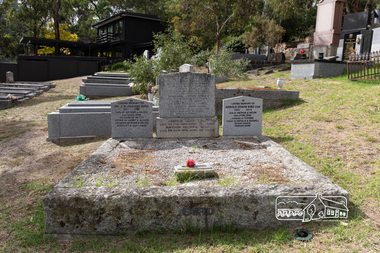
... George Bird was born in England in 1845 and arrived in Australia in 1856 as a child of assisted migrants. ...George Bird was born in England in 1845 and arrived in Australia in 1856 as a child of assisted migrants. ...George Bird was born in England in 1845 and arrived in Australia in 1856 as a child of assisted migrants. Soon afterwards he came out to Eltham to live with his uncle George Stebbings, working for him as bricklayer's assistant in building, amongst others, Shillinglaw Cottage and the Anglican and Methodist Churches in Eltham. He later purchased 72 acres at the eastern end of Pitt Street (bounded by Eucalyptus Road, Mount Pleasant Road and present-day Rockliffe Street) and established the property ‘View Hill’, which was worked as a mixed farm and orchard (including berries). In 1878 he married Janet Kilpatrick, who had emigrated from Scotland. They had ten children, three of whom died in infancy. The wedding in 1904 of their eldest surviving daughter Sarah (‘Sis’) to Edward Pepper appears to have been quite a society event. George was a staunch Methodist and was a Church Steward and a Sunday School Superintendent in about 1890. Janet died in 1915 and George died in 1920 (though his gravestone says 1921). George's will stated that his property was to be divided between all his children in equal shares. This necessitated subdivision of the View Hill property, which took place progressively between 1922 and 1926. One son, George Hugh Bird, operated a drapery store in Main Road (near Bridge Street) in around 1915. Later, in the 1920s, he ran a greengrocer's shop (also selling confectionery) in Main Road opposite Eltham Station. It was the first shop in Eltham to have plate glass windows. At the same time, his brother Reg had a grocery store on the station side of Main Road. George and Janet are buried together in a family plot in Eltham Cemetery. Several descendants are also buried in the cemetery. In Loving Memory Of George Bird Died 5 December 1921 aged 76 years And his beloved wife Janet Bird Died 5 Sept 1915 aged 57 years Also their children William James Bird Died 25 Feb 1888 aged 8 years Mary Jane Bird Died 8 Oct 1891 aged 7 years Pte Edwin John Bird Killed in action in the Great War 11 Aug 1918 aged 30 years Buried in France And on the base stone George Hugh Bird Died 26 Feb. 1965. Aged 79 years Arthur Andrew Bird Died 25 Mar. 1970 Aged 75 years To the left In Loving Memory of Dr. J. R. (Roger) Bird 1927 2001 Son of Arthur & Helen (nee Lyon) Bird Husband of Betty Father of Janet & Alison Grandpa of Evan & Helen Scientist & Gentleman To the right In Loving Memory of Harold Edwin Bird OAM 1922 - 2015 Son of Arthur & Helen (nee Lyon) Bird Husband of Yvonne Father of Estell & Russell In our hearts Forever moreBorn Digitaleltham cemetery, gravestones, arthur andrew bird, arthur bird, edwin john bird, george bird, george hugh bird, harold edwin bird, helen bird (nee lyon), j. r. (roger) bird, janet bird (nee kilpatrick), william james bird, yvonne bird -
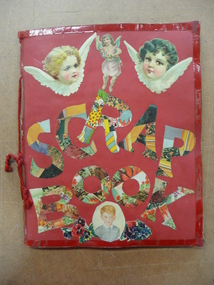 Bendigo Historical Society Inc.
Book - CHILDS SCRAPBOOK
... Childs scrapbook, red cardboard cover containing cuttings and cards with depictions of birds, animals, cars, flowers, etc....BOOKS Children's scrapbook Childs scrapbook, red cardboard cover containing cuttings and cards with depictions of birds, animals, cars, flowers, etc. ...Childs scrapbook, red cardboard cover containing cuttings and cards with depictions of birds, animals, cars, flowers, etc.books, children's, scrapbook -
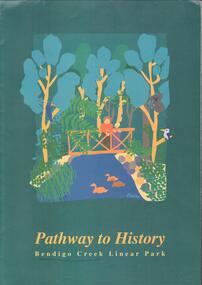 Bendigo Historical Society Inc.
Document - PATHWAY TO HISTORY - BENDIGO CREEK LINEAR PARK
... Drawing of a man and child standing on a bridge over a creek, surrounded by bush and several native animals and birds. ...Drawing of a man and child standing on a bridge over a creek, surrounded by bush and several native animals and birds. ...Coloured brochure, written on front : 'Pathway to history, Bendigo creek linear park'. Drawing of a man and child standing on a bridge over a creek, surrounded by bush and several native animals and birds. bendigo, parks and gardens, bendigo creek linear park -
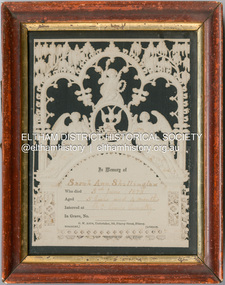 Eltham District Historical Society Inc
Memorabilia - Memorial Card, In Memory of Sarah Ann Shillinglaw, 1878
... child of Phillip Shillinglaw and Sarah Ann (nee Kidd). She was born February 14, 1873 at Bundoora and died June 3, 1878 at Bundoora and was buried in McLeans Cemetery at Preston. In Memory of Sarah Ann Shillinglaw Who died 3rd June 1878 Aged 5 years and 4 months Interred at McLean's Cemetery Also written in brown ink above main inscription in document held by the bird "I'm going to Heaven to see little Janie" Janie was Sarah's younger sister, Phillp and Sarah's second child born January 14, 1875 at Bundoora who died May 4, 1876 Memorial card manufactured in delicate embossed paper lace, printed in black and completed in (faded) brown ink; loosely placed on a black painted wooden mount inside a wooden frame 19 x 15 x 2 cm fitted with glass pane. ...child of Phillip Shillinglaw and Sarah Ann (nee Kidd). She was born February 14, 1873 at Bundoora and died June 3, 1878 at Bundoora and was buried in McLeans Cemetery at Preston. In Memory of Sarah Ann Shillinglaw Who died 3rd June 1878 Aged 5 years and 4 months Interred at McLean's Cemetery Also written in brown ink above main inscription in document held by the bird "I'm going to Heaven to see little Janie" Janie was Sarah's younger sister, Phillp and Sarah's second child born January 14, 1875 at Bundoora who died May 4, 1876 Memorial card manufactured in delicate embossed paper lace, printed in black and completed in (faded) brown ink; loosely placed on a black painted wooden mount inside a wooden frame 19 x 15 x 2 cm fitted with glass pane. ...Sarah Ann Shillinglaw was the first child of Phillip Shillinglaw and Sarah Ann (nee Kidd). She was born February 14, 1873 at Bundoora and died June 3, 1878 at Bundoora and was buried in McLeans Cemetery at Preston. In Memory of Sarah Ann Shillinglaw Who died 3rd June 1878 Aged 5 years and 4 months Interred at McLean's Cemetery Also written in brown ink above main inscription in document held by the bird "I'm going to Heaven to see little Janie" Janie was Sarah's younger sister, Phillp and Sarah's second child born January 14, 1875 at Bundoora who died May 4, 1876 Memorial card manufactured in delicate embossed paper lace, printed in black and completed in (faded) brown ink; loosely placed on a black painted wooden mount inside a wooden frame 19 x 15 x 2 cm fitted with glass pane. Inserted loosely behind this lace card is a second half size embossed paper lace which states Sarah was interred at Melbourne Cemetery on 5th June 1878. G.W. Apps, Undertaker, 165 Fitzroy Street, Fitzroymarg ball collection, memorial card, sarah ann shillinglaw (1873-1878), jane shillinglaw (1875-1876), mcleans cemetery preston -
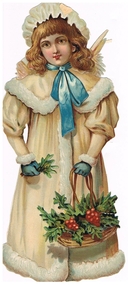 Bendigo Historical Society Inc.
Ephemera - JACK EMMETT COLLECTION: VICTORIANA PAPER CUT OUTS
... JACK EMMETT COLLECTION Early 1900's Victoriana paper glossy scrap sheets cut-outs including 'Giant relief No. 895 - deer/rabbits -people animals and birds from around the world /angels -sign attached 'Gigantic Relief No.978 Raphael Tuck & Sons Ltd - Christmas cut-outs / 'Giant relief No. 920 / child wearing a bonnet carrying flask and a parcel titled 'Father's Dinner ' / picture of Postman titled 'The Jolly Postman / colour enhanced photo 'The Queen's Grandchildren -Child's Own magazine 1865 '- writing on back 'Prince Frederick William born …1859 , Princess Charlott .., Prince Henry / piece of paper with brown print - 'The Kings Business -Nicholson - Hemminger United Mission - Royal Princess Theatre -Evangelistic Services showing days with corresponding lecture subjects....Child's Own magazine 1865 ' ./ Nicholson - Hemminger United Mission Raphael Tuck & Sons Ltd JACK EMMETT COLLECTION Early 1900's Victoriana paper glossy scrap sheets cut-outs including 'Giant relief No. 895 - deer/rabbits -people animals and birds from around the world /angels -sign attached 'Gigantic Relief No.978 Raphael Tuck & Sons Ltd - Christmas cut-outs / 'Giant relief No. 920 / child wearing a bonnet carrying flask and a parcel titled 'Father's Dinner ' / picture of Postman titled 'The Jolly Postman / colour enhanced photo 'The Queen's Grandchildren -Child's Own magazine 1865 '- writing on back 'Prince Frederick William born …1859 , Princess Charlott .., Prince Henry / piece of paper with brown print - 'The Kings Business -Nicholson - Hemminger United Mission - Royal Princess Theatre -Evangelistic Services showing days with corresponding lecture subjects. ...JACK EMMETT COLLECTION Early 1900's Victoriana paper glossy scrap sheets cut-outs including 'Giant relief No. 895 - deer/rabbits -people animals and birds from around the world /angels -sign attached 'Gigantic Relief No.978 Raphael Tuck & Sons Ltd - Christmas cut-outs / 'Giant relief No. 920 / child wearing a bonnet carrying flask and a parcel titled 'Father's Dinner ' / picture of Postman titled 'The Jolly Postman / colour enhanced photo 'The Queen's Grandchildren -Child's Own magazine 1865 '- writing on back 'Prince Frederick William born …1859 , Princess Charlott .., Prince Henry / piece of paper with brown print - 'The Kings Business -Nicholson - Hemminger United Mission - Royal Princess Theatre -Evangelistic Services showing days with corresponding lecture subjects.Raphael Tuck & Sons Ltdephemera, mementoes, raphael tuck & sons ltd / -child's own magazine 1865 ' ./ nicholson - hemminger united mission -
 Bendigo Historical Society Inc.
Book - HARRIS COLLECTION: "The Wonderful Pocket"
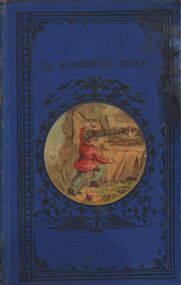
... Circular coloured painting of small child climbing upwards on rocks to reach bird nest, centred on front cover. ...Circular coloured painting of small child climbing upwards on rocks to reach bird nest, centred on front cover. ...Blue cover 160 page book 'The Wonderful Pocket', title barely discernible on front cover. Circular coloured painting of small child climbing upwards on rocks to reach bird nest, centred on front cover. Written on fly page, very faded, 'Presbyterian Sabbath School Axedale, Awarded to Jonathan Harris for attendance, October 1886 (? faint) Impress of bookseller ' Bookseller, R. Souter, Sandhurst' on top RH corner of flyleaf. Book is an instructive text 'an attempt to embody some useful truths in a form to interest the young' and contains a chapter at the end titled: 'wise sayings from Africa'. Author Chauncey Giles. Published by Wakefield, William Nicholson and Sons, London. S.D. Ewins and Co., and W. Tegg.Chauncey Gilesperson, individual, jonathan harris -
 Bendigo Historical Society Inc.
Book - HARRIS COLLECTION: 'THE LEISURE HOUR'
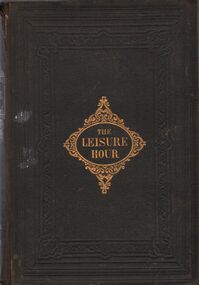
... Both stuck over child's drawings of a kangaroo and bird (written underneath 'The Buphaa Africanus' Four more cuttings on back blank page ' Policeman shot by a burglar'. ...Both stuck over child's drawings of a kangaroo and bird (written underneath 'The Buphaa Africanus' Four more cuttings on back blank page ' Policeman shot by a burglar'. ...Black cover book, 828 pages, gold embossed 'The Leisure Hour' on front cover. Written inside front cover in black pen 'The Honourable F.F. Casey, Members of Parliament of Victoria, Australia' (writing appears childlike ) Three newspaper cutouts stuck to same page, J. Casey, Sir J. O'Shanessy and E.L. Zox? (difficult to discern) Written on top of title page in black pen 'Harriet Harris'. Harriet Harris was the mother of George Harris and the wife of Jonathan Harris, Axedale, Victoria. 'The Leisure Hour 1866' and 'London, Paternoster Row and 164 Piccadilly' on title page, surrounded by lithographed images of foliage and families reading books. Further cutting from newspapers stuck on first blank page 'Death of the Hon Francis Ormond, MLC and 'Spare the Horse'. Both stuck over child's drawings of a kangaroo and bird (written underneath 'The Buphaa Africanus' Four more cuttings on back blank page ' Policeman shot by a burglar'. 'The funeral of the late Mr. J.B. Watson', lithograph images of Hon John O'Shanassy, MLC and W.J.T. Clarke Esq.harriet harris, axedale, education -
 Ithacan Historical Society
Photograph, A young John Black, c 1920s
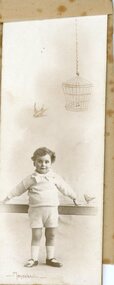
... child, was the only son of Constantine and Efstathia Black (Mavrokefalos). John's parents came to Australia in the early 1900s. They owned and operated the Paris Residential Cafe at 56 Swanston Street in the second decade of the 20th century. John is the brother of Olga and Nina Black, both of whom were very active in Ithacan and Greek community cultural life. A scanned black and white studio photograph of a little boy leaning against a wall which has drawings of two birds ...John Black pictured as a young child, was the only son of Constantine and Efstathia Black (Mavrokefalos). John's parents came to Australia in the early 1900s. They owned and operated the Paris Residential Cafe at 56 Swanston Street in the second decade of the 20th century. John is the brother of Olga and Nina Black, both of whom were very active in Ithacan and Greek community cultural life. A scanned black and white studio photograph of a little boy leaning against a wall which has drawings of two birds and a bird cage on it. The boy is wearing a woollen jumper and light trousers and is looking intently at the camera. -
 Churchill Island Heritage Precinct
Ceramic - Saucer, 1909
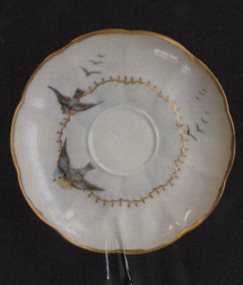
... Margaret Amess was the youngest child of Samuel and Jane Amess, who first purchased Churchill Island in 1872, and was renowned for her china painting. saucer margaret amess churchill island Saucer with gold rim and decoration, 2 swallows and 10 stylised birds. ...The Churchill Island collection includes objects from the late 1800s. The collection is presented in sets and series, of which this saucer represents the Amess era.Margaret Amess was the youngest child of Samuel and Jane Amess, who first purchased Churchill Island in 1872, and was renowned for her china painting.Saucer with gold rim and decoration, 2 swallows and 10 stylised birds. Hand-painted by Margaret Amess.saucer, margaret amess, churchill island -
 Embroiderers Guild, Victoria
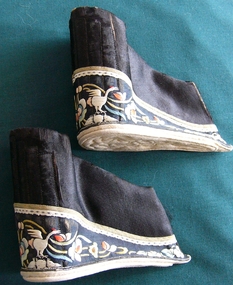
Footwear - Shoes, Early 20th century (?)
... Lower edge embroidered in silk with multicoloured flowers, leaves, 2 birds and ribbons. Shoes show some wear. Maybe they were for a child, or an adult with bound feet....Lower edge embroidered in silk with multicoloured flowers, leaves, 2 birds and ribbons. Shoes show some wear. Maybe they were for a child, or an adult with bound feet. ...Purchased at a flea market in New York, September 2004Black silk uppers, lined in blue cotton, and stiffened with a small amount of quilting. Lower edge embroidered in silk with multicoloured flowers, leaves, 2 birds and ribbons. Shoes show some wear. Maybe they were for a child, or an adult with bound feet.shoes, silk embroidery, oriental, china, embroidery -
 Embroiderers Guild, Victoria
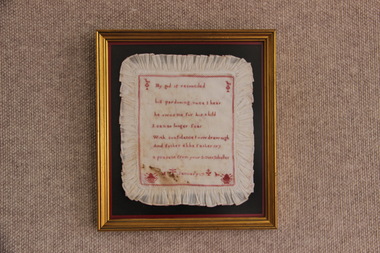
Textile - Isbeller 1836 Sampler, Iserbella, 1836
... Embroidery Cross stitch Sampler Text on the sampler "My God is reconciled His pardoning voice I hear He owns me for his child I can no longer fear With confidence I now draw nigh And father abba father cry" A present from your sister Isbeller January 17th On back of frame "1836" Fine cotton sampler, stitched in very fine red cross stitch, birds and baskets and tree surround the text, and a tiny cross stitch border inside a frilled edging which has been whip-stitched in red. ...Fine cotton sampler, stitched in very fine red cross stitch, birds and baskets and tree surround the text, and a tiny cross stitch border inside a frilled edging which has been whip-stitched in red. Mounted on dark green, gold frame with inner red border.Text on the sampler "My God is reconciled His pardoning voice I hear He owns me for his child I can no longer fear With confidence I now draw nigh And father abba father cry" A present from your sister Isbeller January 17th On back of frame "1836"embroidery, cross stitch, sampler -
 Victorian Aboriginal Corporation for Languages
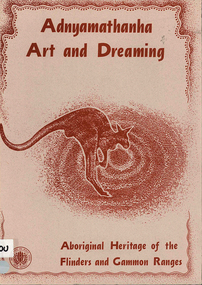
Folder, Vince Coulthard, Adnyamathanha art and dreaming : Aboriginal heritage of the Flinders and Gammon Ranges, 1989
... Includes pamphlet on the interpretation of rock art in the Flinders Ranges - explanation of the symbols used; six sheets relating individual Flinders and Gammon Range myths - lost children, giant serpent, mistletoe bird, native orange, old woman/child/kangaroo, eagle/crow/magpie; composition of the Adnyamathanha...Adnyamathanha Flinders Ranges Gammon Ranges Illustrations Includes pamphlet on the interpretation of rock art in the Flinders Ranges - explanation of the symbols used; six sheets relating individual Flinders and Gammon Range myths - lost children, giant serpent, mistletoe bird, native orange, old woman/child/kangaroo, eagle/crow/magpie; composition of the Adnyamathanha Adnyamathanha art and dreaming : Aboriginal heritage of the Flinders and Gammon Ranges Folder Vince Coulthard ...Includes pamphlet on the interpretation of rock art in the Flinders Ranges - explanation of the symbols used; six sheets relating individual Flinders and Gammon Range myths - lost children, giant serpent, mistletoe bird, native orange, old woman/child/kangaroo, eagle/crow/magpie; composition of the AdnyamathanhaIllustrationsadnyamathanha, flinders ranges, gammon ranges -
 Sunshine and District Historical Society Incorporated
Administrative record - City of Sunshine - Commissioner Mr Alexander Alex George Gillon Collection 1976 - 1982 - Minutes of the ordinary meeting of council held on 29th June 1977, City of Sunshine, 29th June 1977
... Bird Street...Anderson Road...Sunshine...Devonshire Road...Martin Street...Darnley Street Hostel...Darnley Street...Welwyn Uniting Kindergarten...Welwyn Street...Mitchell Street...Rosamond Road...Maidstone...Geelong Road...Francis Street...Brooklyn...Sunshine Golf Club...Ralph Street...Trafalgar Street...St. Albans...Sunshine City Club Car...Talmage Street...Sperry Vickers...Maribyrnong...Judge Street...Errol Street...Braybrook...Main Road West...Main Road East...St. Albans Road...East Esplanade...Oakwood Road...Albanvale Residents Association...Canning Street...Avondale Heights...Carlton Street...Braybrook Hotel...Ballarat Road...Ferndale Road...Durham Road...Duke Street...Lima Street...Huddersfield Road...Ainsworth Reserve...Ainsworth Reserve Child...Bird Street Anderson Road Sunshine Devonshire Road Martin Street Darnley Street Hostel Darnley Street Welwyn Uniting Kindergarten Welwyn Street Mitchell Street Rosamond Road Maidstone Geelong Road Francis Street Brooklyn Sunshine Golf Club Ralph Street Trafalgar Street St. Albans Sunshine City Club Car Talmage Street Sperry Vickers Maribyrnong Judge Street Errol Street Braybrook Main Road West Main Road East St. Albans Road East Esplanade Oakwood Road Albanvale Residents Association Canning Street Avondale Heights Carlton Street Braybrook Hotel Ballarat Road Ferndale Road Durham Road Duke Street Lima Street Huddersfield Road Ainsworth Reserve Ainsworth Reserve Child ...Minutes of the Ordinary Meeting of Council held on 29th June 1977 Report of the Town Clerk's Department Report of the Town Clerk Victorian Family and Community Services Programme Bikeway Seminar School Facilities Sunshine North Technical School Proposed Use and Agreement Maidstone Elderly Citizens Club And Meals on Wheels Lease if Navigational Beacon Site in Robinson Road Deer Park Community Use of Tennis Courts Request For Closing Street Bird Street South of Quinn Street Deer Park Capital Works Possible Subsidies Department of Youth, Sport & Recreation Use of School Facilities Sunshine West High School Council Contribution to Cost Proposed Lease of Railway land Next to Gardens Anderson Road Proposed Lease of Commonwealth Land Corner Devonshire Road and Martin Street Ardeer South Primary School Development of School Grounds Community Use Council Contribution Darnley Street Hostel for the Frail / Aged Deportation of Migrants Welwyn Uniting Kindergarten Maintenance Fee to the Deer Park Methodist Church Western Region Women's Refuge Report of the Chief Health Inspector Prosecutions Proceedings Sunshine Magistrate Court Application for Septic Tank Health Centre Robert Crescent Sunshine Navel Wives Association Plagues on all House Health Hygiene and History Office of Continuing Education University of Melbourne Proposed Course Visit of Interdepartmental Government Committee of Liquid Trade Waste Deposal Report of the Medical Officer of Health Report of City Engineer Land Use Permit Application Diecasting Shop Addition to Existing Manufacturing Complex South West Corner Mitchell Street and Rosamond Road Land Use Permit Application Subdivision Geelong Road and Francis Street Land Use Permit Application Sunshine Golf Club Pavilion Ralph Street Looking For Permission to Rebuild Thier Burnt Down Pavilion Land Use Permit Application Sign 568 Geelong Road Land Use Permit Application Resident Bee Keeping 47 Trafalgar Street St. Albans Land Use Permit Factory Lot 3 Suffolk Road Sunshine North Proposed Melbourne Metropolitan Planning Scheme Amendment 70 Land Use Permit Application Sunshine City Club Car Park Talmage Street Albion Land Use Permit Application installation of Underground Petrol Tank and Pumping Facilities and Addition to Existing Factory Sperry Vickers Rosamond Road Maribyrnong Land Use Permit Application Parking of Motor Car and Caravan 24 Judge Street Land Use Permit Application Motor Repair Station and Car Sales Yard 19 Errol Street Western Highway Street Lighting Traffic Signals Main Road West, Main Road East, St. Albans Road & East Esplanade Melbourne Metropolitan Planning Scheme Amendment No 42 Footscray Institute of Technology Fairnsworth Avenue Deviation Footscray Citizens Against Freeways Royal Australian Institute of Parks & Recreation 50th Conference Buckingham Crescent Area Layout Design Art Show McKay Gardens Oakwood Road Footpath Albanvale Residents Association Canning Street Tenders Received Automatic Sprinkler System Sports Grounds Tenders Received Playground Equipment Plan of Subdivision Main Road West R.D.C. Projects Transfer of Land Lots 434 to 437 Carlton Street Housing Commission Victoria to Braybrook Hotel for Car Parking Purposes Strata Subdivision 37 Ferndale Road Installation of Traffic Signals Anderson Road / Durham Road Sunshine A No Standing Any Time Bookmobile Excepted Sign 27 Duke Street Sunshine Report of the Building Surveyor Application Outbuilding 19 Lima Street St. Albans Application Outbuilding 25 Huddersfield Road Deer Park Child Care Centre Pavilion Ainsworth Reserve Child Care Building Program city of sunshine, alexander "alex" george gillon, navigational beacon, robinsons road, deer park, maidstone elderly citizens club, sunshine west high school, lachlan road, sunshine west, ardeer south primary school, sunshine north technical school, suffolk road, sunshine north, bird street, anderson road, sunshine, devonshire road, martin street, darnley street hostel, darnley street, welwyn uniting kindergarten, welwyn street, mitchell street, rosamond road, maidstone, geelong road, francis street, brooklyn, sunshine golf club, ralph street, trafalgar street, st. albans, sunshine city club car, talmage street, sperry vickers, maribyrnong, judge street, errol street, braybrook, main road west, main road east, st. albans road, east esplanade, oakwood road, albanvale residents association, canning street, avondale heights, carlton street, braybrook hotel, ballarat road, ferndale road, durham road, duke street, lima street, huddersfield road, ainsworth reserve, ainsworth reserve child care centre, vernon street -
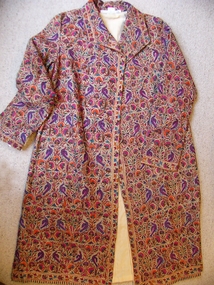 Embroiderers Guild, Victoria
Clothing - Kashmiri Wool Embroidered Coat, C. 1950
... “It is essentially a child of landscape and bountiful nature and is, therefore, as varied in it’s richness, as superb in its beauty”. The floral motifs with their inexhaustible display of colours, variegated birds, luscious fruits, majestic mountains, shimmering lakes – all find a place in Kashmir embroidery’ ~ Kamaladevi Chattopadhyay Source: India Craft...“It is essentially a child of landscape and bountiful nature and is, therefore, as varied in it’s richness, as superb in its beauty”. The floral motifs with their inexhaustible display of colours, variegated birds, luscious fruits, majestic mountains, shimmering lakes – all find a place in Kashmir embroidery’ ~ Kamaladevi Chattopadhyay Source: India Craft Embroidery Surface stitchery Garments 1940-60 India Fine dark beige wool with all over embroidery in fine wool thread. ...Kashmiri embroidery has a distinct characteristic to it – both in technique and appearance. Kashida is the traditional name of Kashmiri embroidery, which came with the Persians, just as the motifs and style suggest much of Persian influence. The work is very colorful and derives its designs from elements in the scenic beauty of the land. This craft, mostly done by men, is said to have descended from royal patronage. “It is essentially a child of landscape and bountiful nature and is, therefore, as varied in it’s richness, as superb in its beauty”. The floral motifs with their inexhaustible display of colours, variegated birds, luscious fruits, majestic mountains, shimmering lakes – all find a place in Kashmir embroidery’ ~ Kamaladevi Chattopadhyay Source: India CraftFine dark beige wool with all over embroidery in fine wool thread. Colours are red, orange, pinks, blue, green and brown. Borders on collar, front and bottom of the coat are edged with a red line couched in yellow thread. Design flowers and birds.embroidery, surface stitchery, garments, 1940-60, india -
 Phillip Island Conservation Society Inc.
Work on paper - Photocopy of newspaper cutting, "A Note to Simon", Tuesday February 10, 1966
... It also indicates that there was apparently no process in place for dealing with weak birds found by the public. Neither the child nor the photographer knew any better than to allow the child to interfere with or hold a sick Penguin as shown in the photo. ...Written in February 1966, this is a letter from the editor or a journalist to a child who had brought a weak young Little Penguin into the office of the Express newspaper in Wonthaggi. February is the time that adult penguins have what is known as a “catastrophic moult" when they lose all of their feathers within a week or 2 and cannot go to the sea to fish. Any chicks left in the burrow will not be fed and need to go to sea themselves to feed. Some are just not strong enough or have mature feathers to do this and perish. Bert West was a Phillip Island resident and manager at the Penguin Parade, who was very knowledgeable about Little Penguins and was able to explain this to the journalist who then wrote the letter. Presumably the photograph had been in a previous edition so this item in the form of a letter to Simon would be a follow up to the original article. This cutting is significant because it indicates that this Little Penguin had been fishing in the Cape Paterson area, and possibly was not able to find sufficient food there. It also indicates that there was apparently no process in place for dealing with weak birds found by the public. Neither the child nor the photographer knew any better than to allow the child to interfere with or hold a sick Penguin as shown in the photo. That is definitely no longer recommended, as we now know that handling a sick bird in that way is very stressful to them and can contribute to poor outcomes for them. Very poor photocopy of single column with large photo of boy holding penguin under textTHE EXPRESSphillip island, penguin parade, cape paterson, bert west, wildlife care, little penguin -
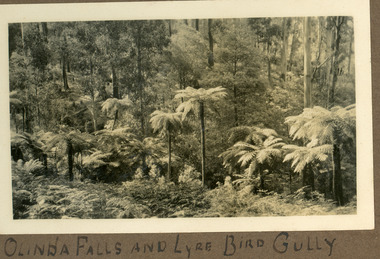 Mt Dandenong & District Historical Society Inc.
Photograph
... Bird Gully Track run alongside the Olinda Falls. The area has been a popular walking track in the from the 1920s onwards. The photograph is from the album of Ivy Child. ...Bird Gully Track run alongside the Olinda Falls. The area has been a popular walking track in the from the 1920s onwards. The photograph is from the album of Ivy Child. ...Lyre Bird Gully and Lyre Bird Gully Track run alongside the Olinda Falls. The area has been a popular walking track in the from the 1920s onwards. The photograph is from the album of Ivy Child. Ivy May Child (1910 – 1989) was the daughter of Arthur Edward (Ted) Child (1878 – 1964) and Ethel May Madden (1888 – 1970). Ted Child was the son of Matthew Francis Child (1839 – 1933) and Martha Jeeves (1857 – 1926). He was the grandson of one of the early pioneers Francis Child. Ivy grew up on the family property on Childs Road and took many photographs. Most of these are glued into her photo album. The album covered the years from c1927 – 1932. Ivy married Henry William Burgess (1906 – 1968) in 1944. The photographs remain in their original state in the album with individual copies made. Black and white photograph showing a row of tree ferns in the foreground with bush behind.Written below photograph in album: OLINDA FALLS AND LYRE BIRD GULLYolinda falls, falls, lyrebird, lyrebird gully, lyrebird track -
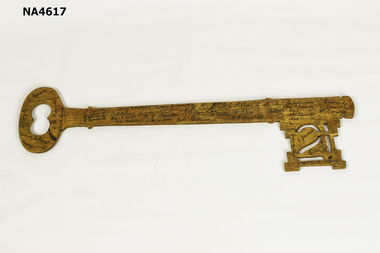 Whitehorse Historical Society Inc.
Functional object - Key - 21st, Approx August, 1935
... child of Arthur and Martha Edwards. In 1929 aged 15 he contracted poliomyelitis and became an invalid. He died in 1955 at Forest Hill. This item is significant in the history of Forest Hill as all the attendees and Ronald Arthur Edwards are from the pioneering families of the area of the Shire of Nunawading. handcrafts woodwork See Description Large wooden plywood key made to celebrate the 21st birthday of Ronald Arthur Edwards in August 1935. Written on handle end in pen Ron Edwards 21st - 19.Key end signed Anna Course, Herbert Course, R.J. Bird ...This is the twenty-first key presented to Ronald Arthur Edwards in August 1935. The celebration, held at his parents home in Husband Road, Forest Hill, was attended by many well known local people who signed his birthday key. Ronald Edwards was the youngest child of Arthur and Martha Edwards. In 1929 aged 15 he contracted poliomyelitis and became an invalid. He died in 1955 at Forest Hill.This item is significant in the history of Forest Hill as all the attendees and Ronald Arthur Edwards are from the pioneering families of the area of the Shire of Nunawading.Large wooden plywood key made to celebrate the 21st birthday of Ronald Arthur Edwards in August 1935. Written on handle end in pen Ron Edwards 21st - 19.Key end signed Anna Course, Herbert Course, R.J. Bird, D.J. Bogle.Reverse side R. Course, A.H. Course, Aunt Corrie, F. Bogle, Aunt Harriet, Marjory Course, S. Edwards, Edwards, H. Edwards, E. Edwards, Doug Edwards, Charlie Course, Jean Course, Tom Bailey, H.S. Tainton, N. Tainton, ?Luen Edwards, C.W. Bird, ?S.U. Course, J. Porter, Bob Course, J.E. Bird, M.P.? Course, ?Edwards, L. Tainton, J. Bird, Shirley Edwards, H. Edwards, Ed, A.E. Edwards, Albert H..., V. Edwards, F. Smith, W. Smith, L.James, E. Galley ?, A.E. Edwards, Mother and Father. Gold traces on one side; 21 carved out in key end.See Descriptionhandcrafts, woodwork -
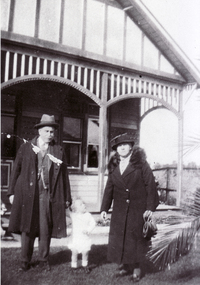 Whitehorse Historical Society Inc.
Photograph, Neville Bird, 1/06/1937 12:00:00 AM
... Black and white photograph of Neville Bird as a child with his grandparents before they left for England in 1937....bird neville Black and white photograph of Neville Bird as a child with his grandparents before they left for England in 1937. ...Black and white photograph of Neville Bird as a child with his grandparents before they left for England in 1937.bird, neville
